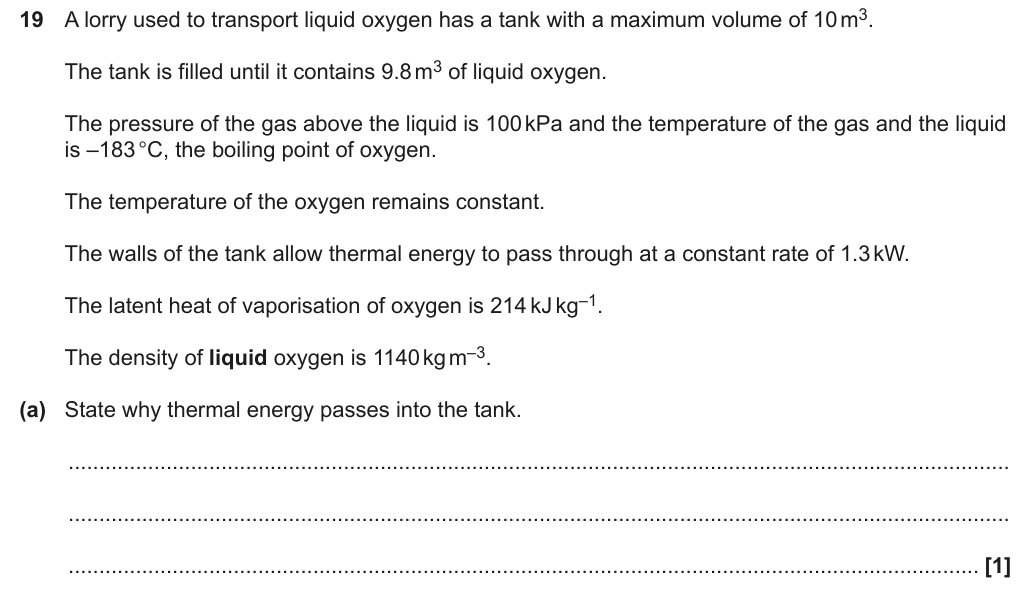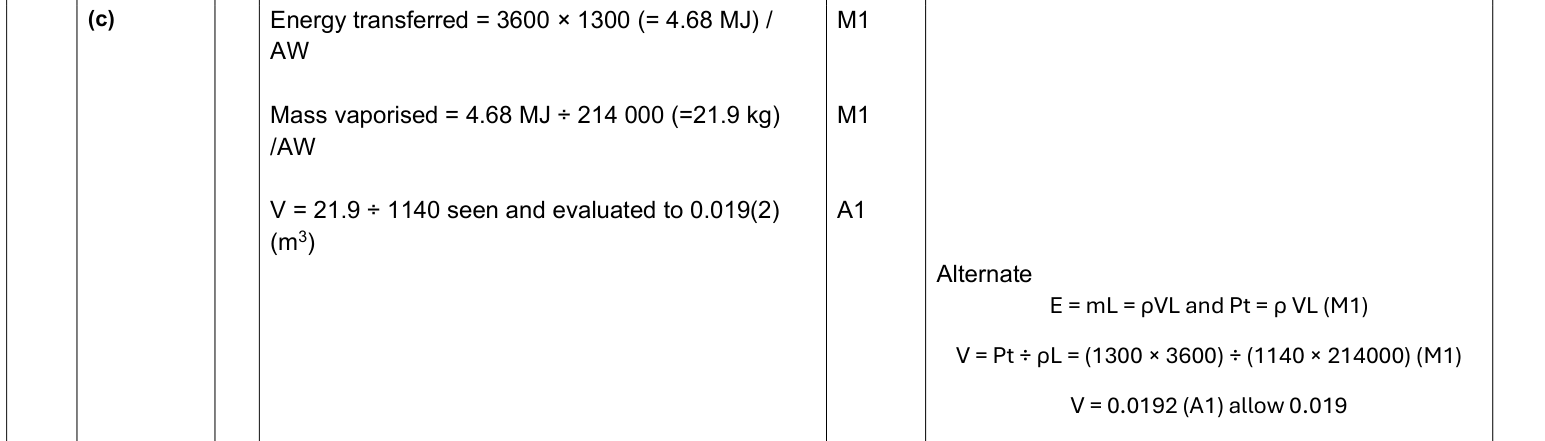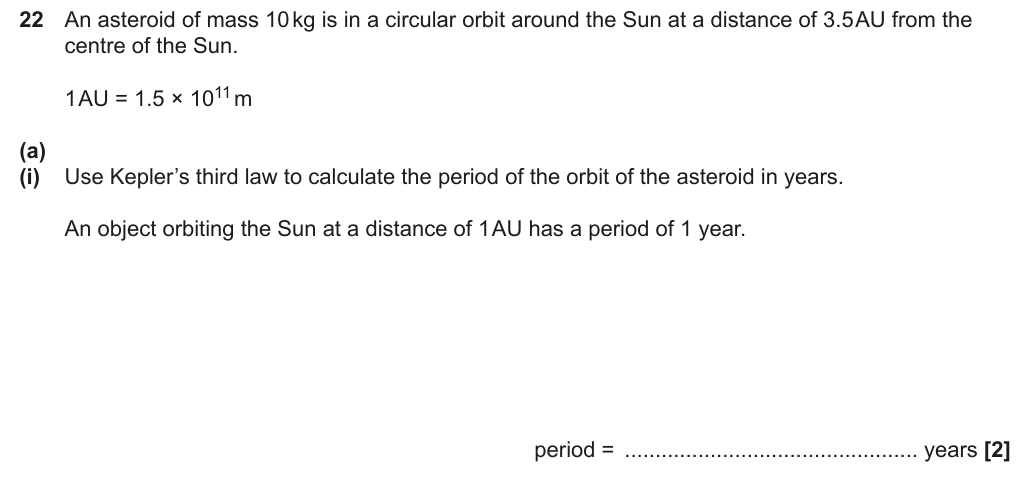
Answer
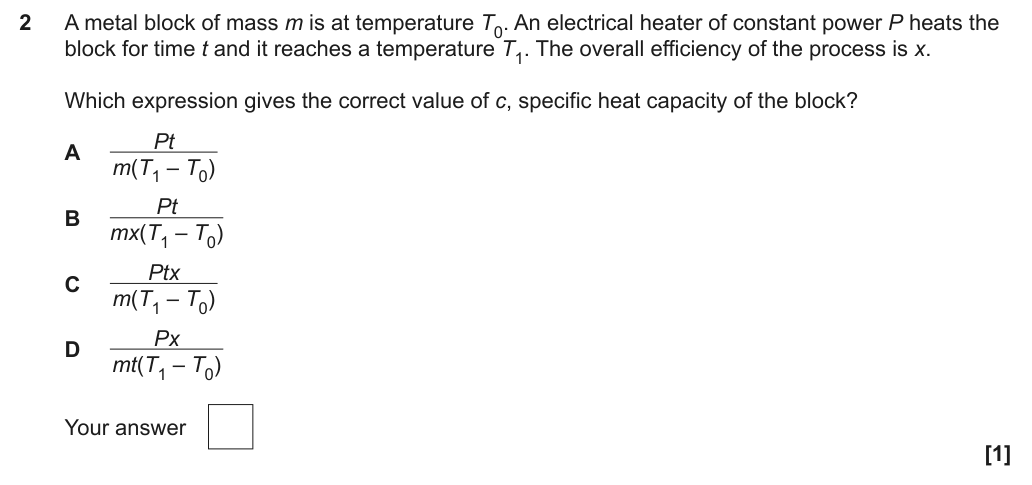
C
Mark scheme

Examiner's comment
This question was answered successfully by the majority of candidates who rearranged and substituted accurately.
Notes and key-term cards for this topic are being written by our tutors. The past-paper questions below are ready now.
| Series | Paper | Q | What it asks |
|---|---|---|---|
| June 2025 | Paper 3 | 3(c) | A gravitational potential energy storage system, as described in (a), is proposed as follows: |
| June 2024 | Paper 1 | 22(c) | Large satellites are often launched by rockets from sites near the equator. The rotation of the strategy. Use calculations to support your evaluation. |
| November 2021 | Paper 1 | 20(b) | A satellite is in a circular geostationary orbit around the centre of the Earth. The satellite has • Describe some of the features of a geostationary orbit. |
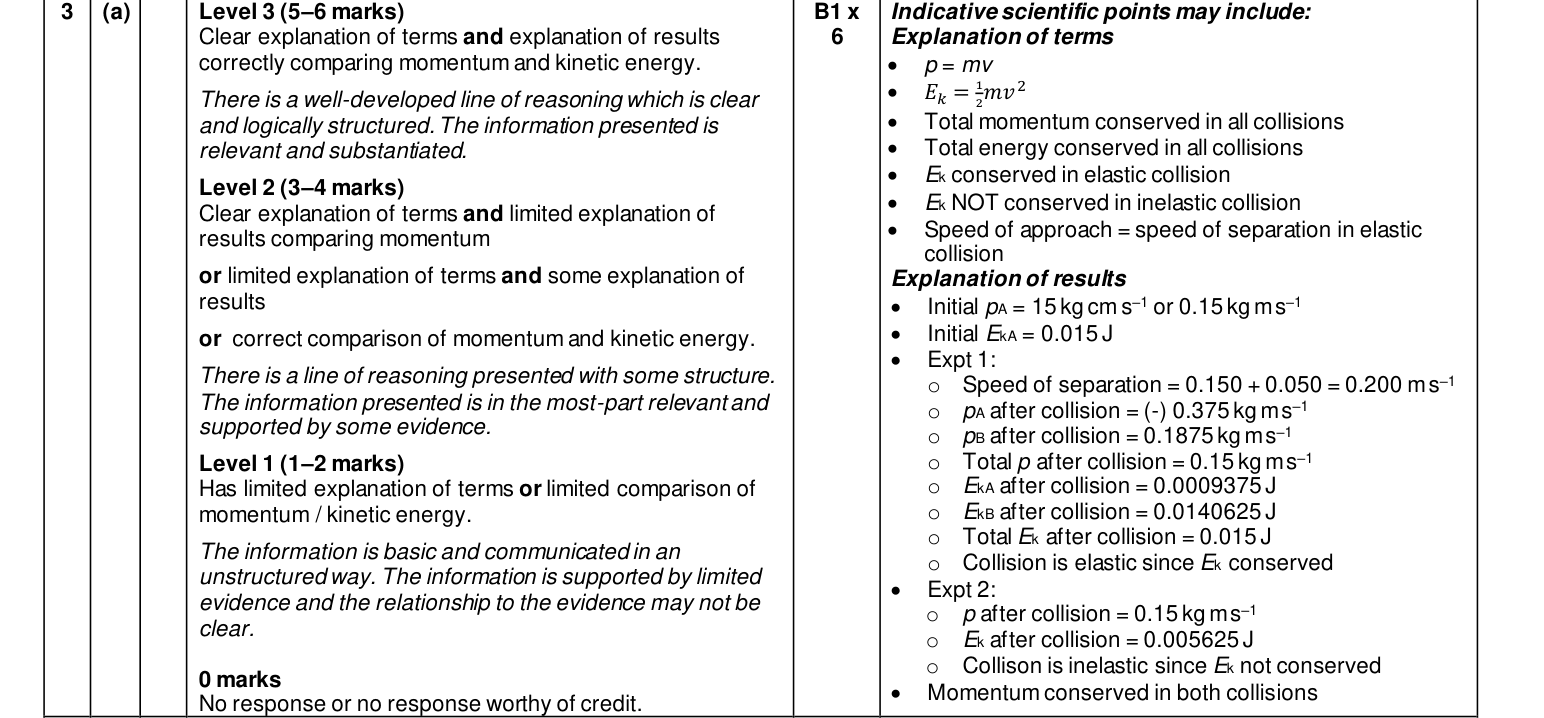
| November 2021 | AS Paper 2 | 3(a) | (a)* A linear air track is used to investigate the collision of two gliders A and B, as shown in |
| November 2020 | AS Paper 2 | 4 | A metal ball leaves a horizontal surface with velocity v. Describe with the aid of a suitable diagram how an experiment can be safely conducted, and how |
| June 2019 | Paper 1 | 19(b) | A student rolls a marble at different speeds on a carpet to model the braking of a car. • Describe how an experiment can be conducted in the laboratory to investigate the |
| June 2019 | Paper 3 | 3(c) | *(c) In the torch, the gravitational potential energy of the magnet is converted into electrical energy • Describe how you will make accurate measurements to collect your data. Assume that |
| June 2018 | AS Paper 2 | 2 | A student wishes to determine experimentally the efficiency of a small low-voltage DC motor. The Describe with the aid of a suitable diagram how an experiment to determine the efficiency of the |
C
This question was answered successfully by the majority of candidates who rearranged and substituted accurately.
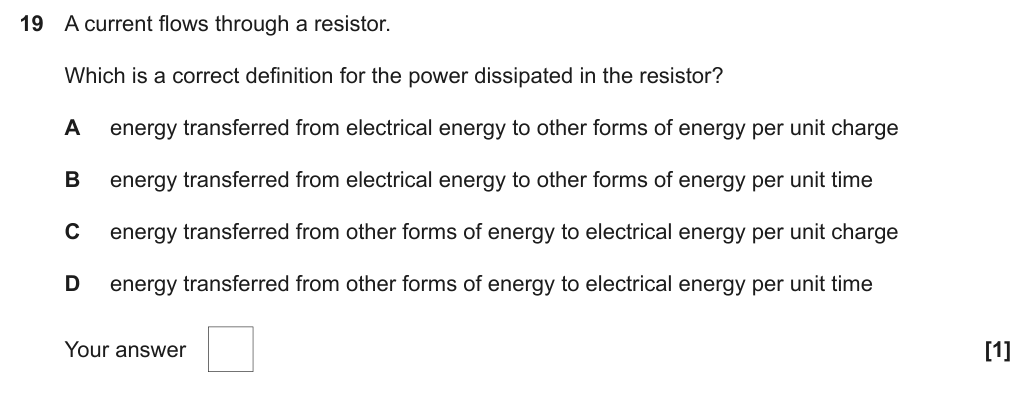
B
This question was assessing candidates’ knowledge of the definition of power. Many candidates confused the definition of power with the definition of potential difference and gave answer A.
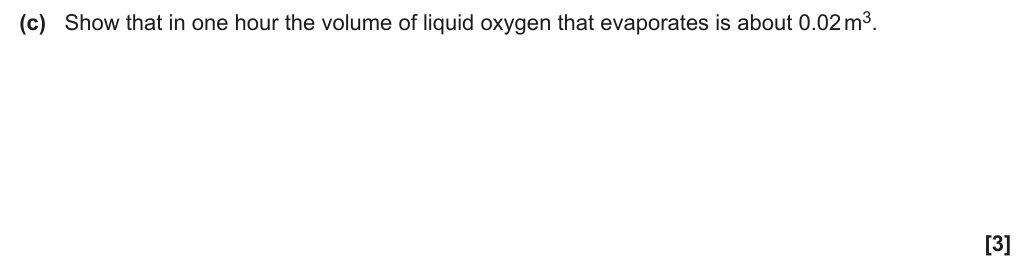
Successful candidates either rearranged all of the variables into a viable expression and then substituted into that expression or they performed each calculation separately. The common thread to all of the best answers was that the working was clear, with words often accompanying the calculations.
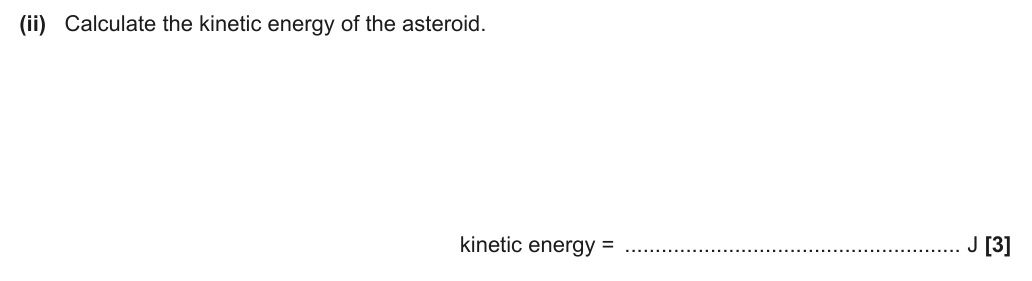
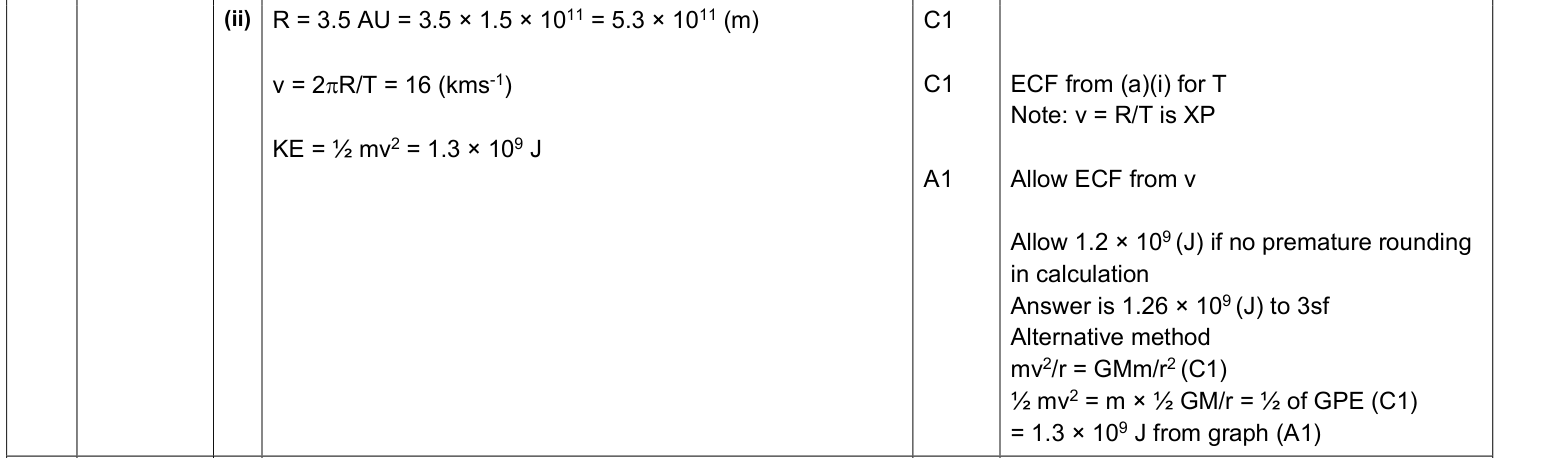
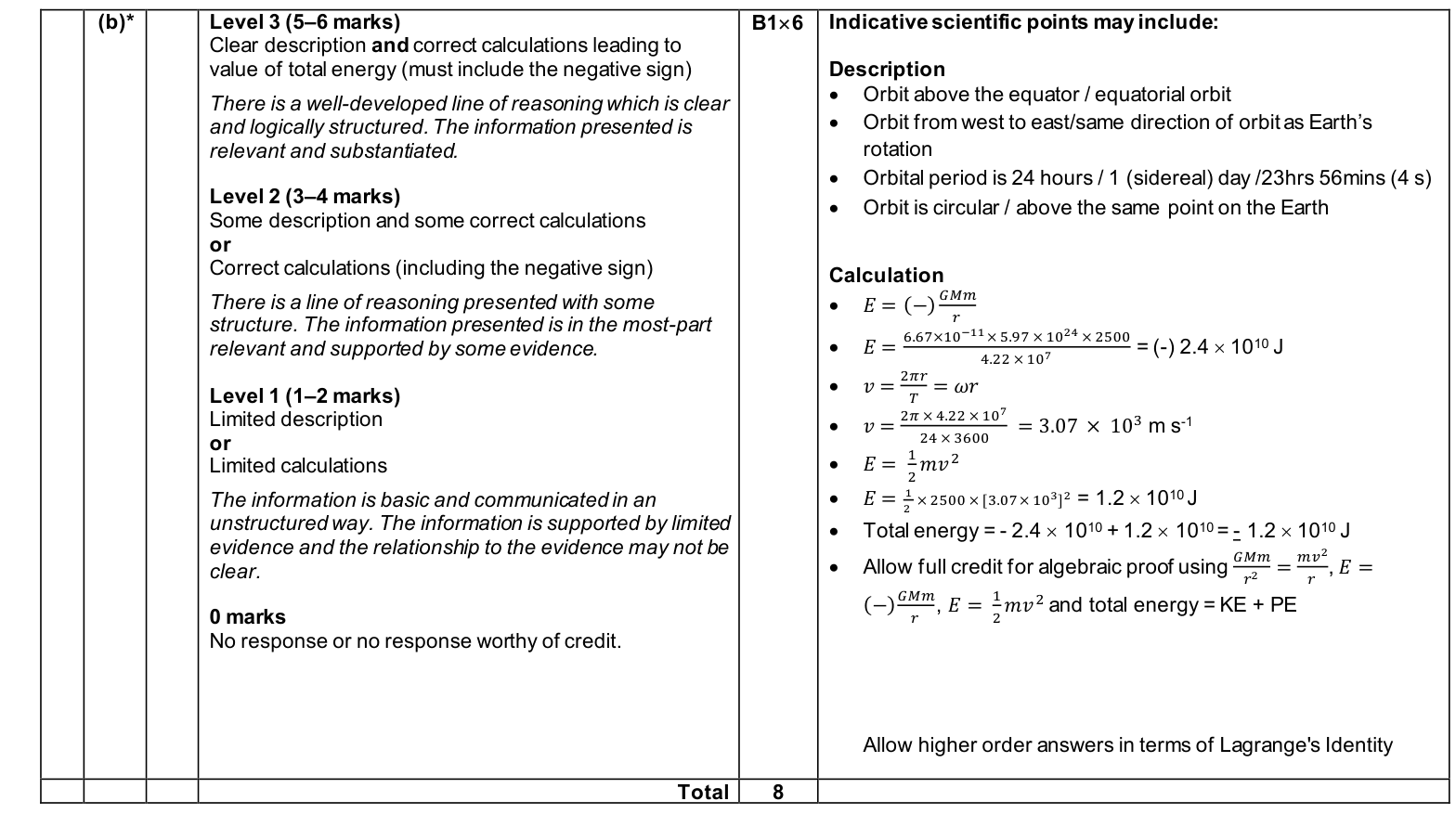
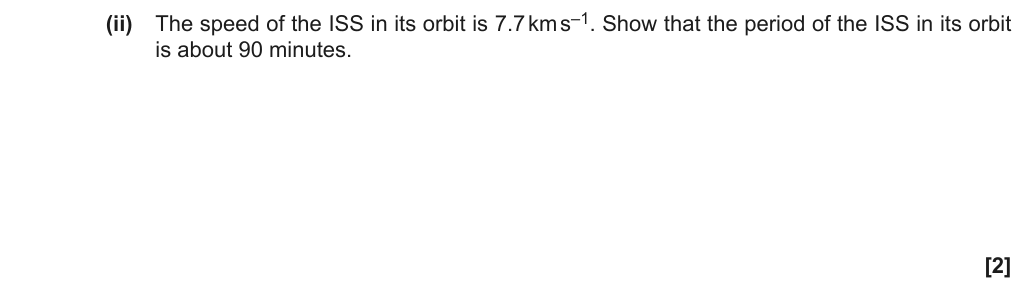
The ‘error carried forward’ rule was applied here in the case of the wrong value for the orbital period and again if the orbital velocity was incorrectly calculated. Otherwise this question was successfully completed.
Skills: M0.1 Recognise and make use of appropriate units in calculations; M2.3 Substitute numerical values into algebraic equations using appropriate units for physical quantities
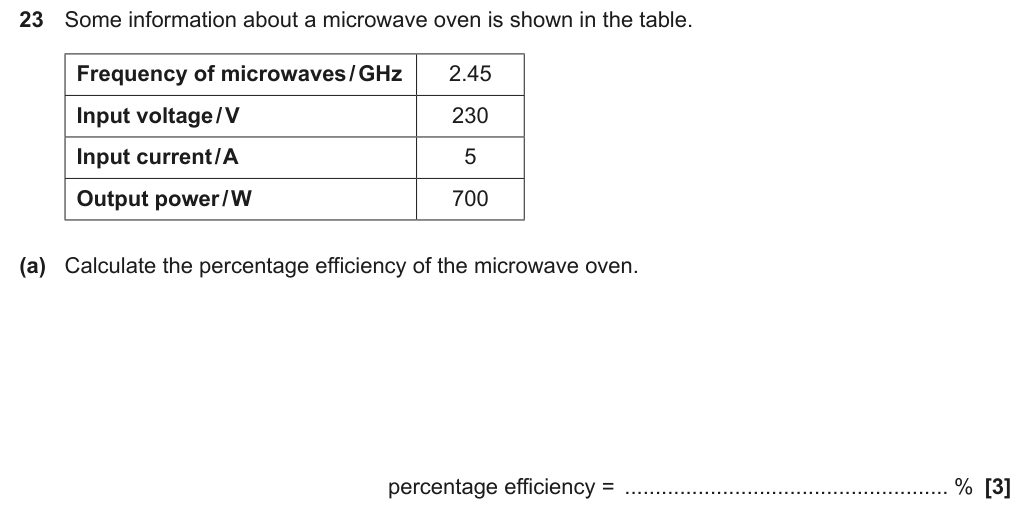
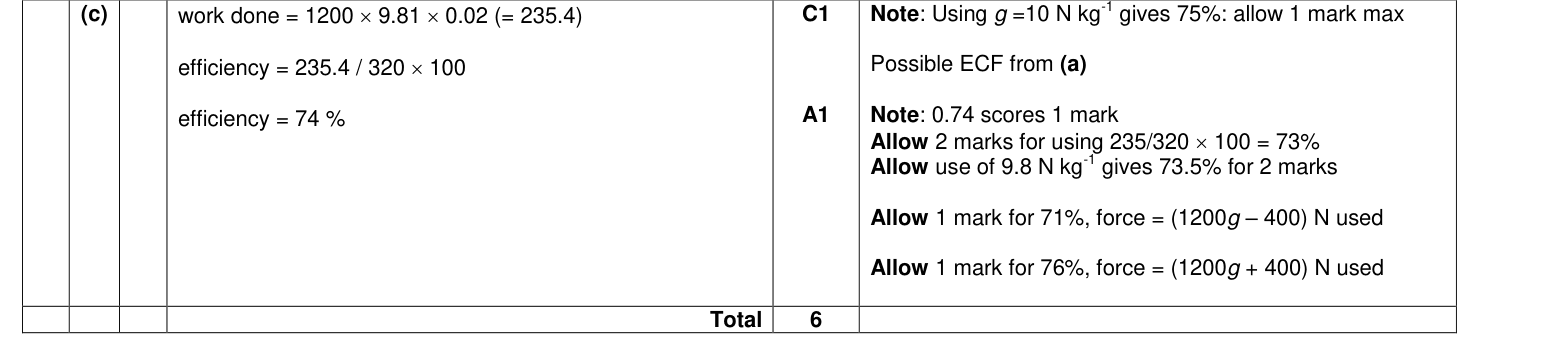
This question was usually answered well. Since this was a multi-stage calculation candidates should be encouraged to show all their working in their answers. In this question high scoring candidates showed the calculation of input power before substituting the data into the efficiency equation.
Skills: M0.3 Use ratios, fractions and percentages; M2.3 Substitute numerical values into algebraic equations using appropriate units for physical quantities
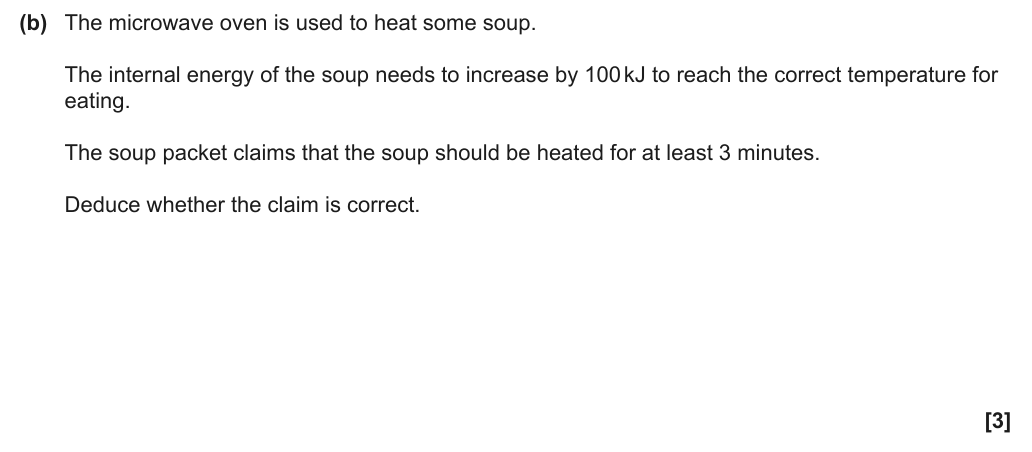
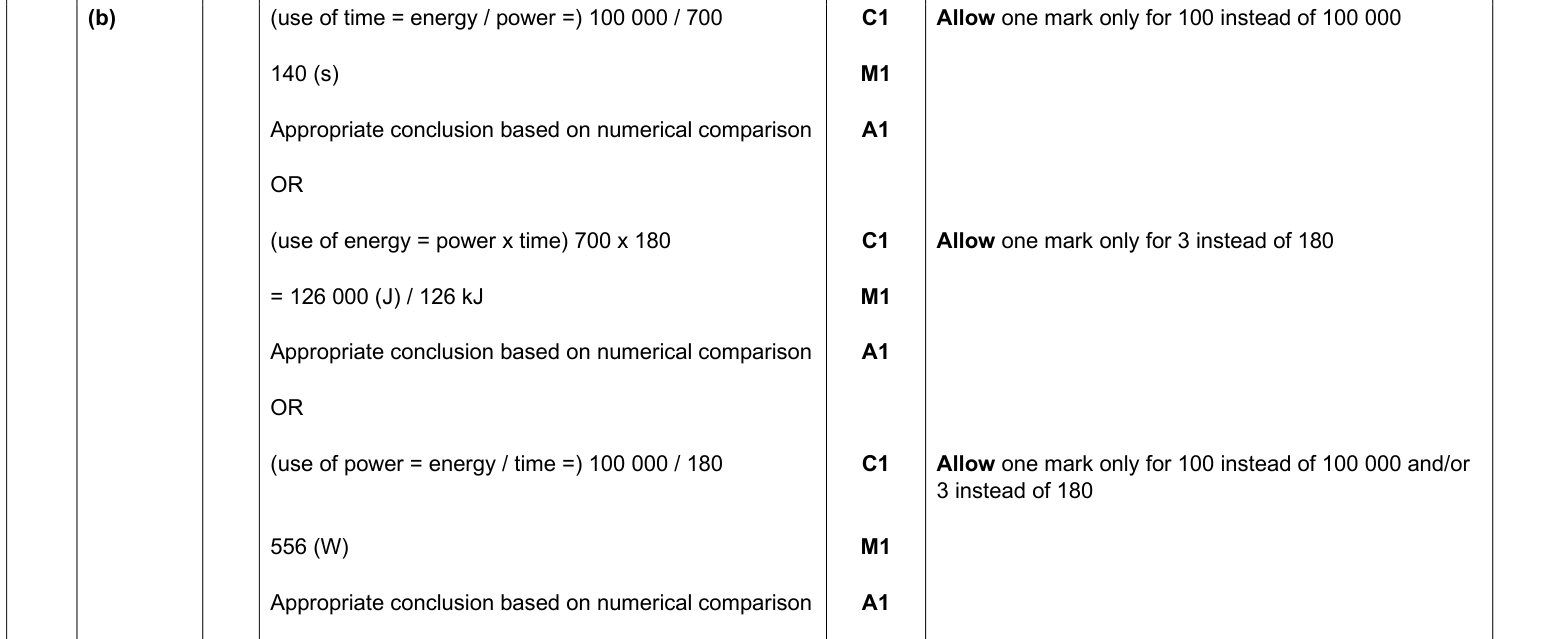
There were many different ways to answer this question which required candidates to demonstrate their knowledge and understanding of the definition of power. Candidates needed to demonstrate the use of this equation with appropriate conversion of units, including time. To gain full credit candidates needed to explain whether their calculation showed whether the claim was correct.
Skills: M0.1 Recognise and make use of appropriate units in calculations; M2.2 Change the subject of an equation, including non-linear equations
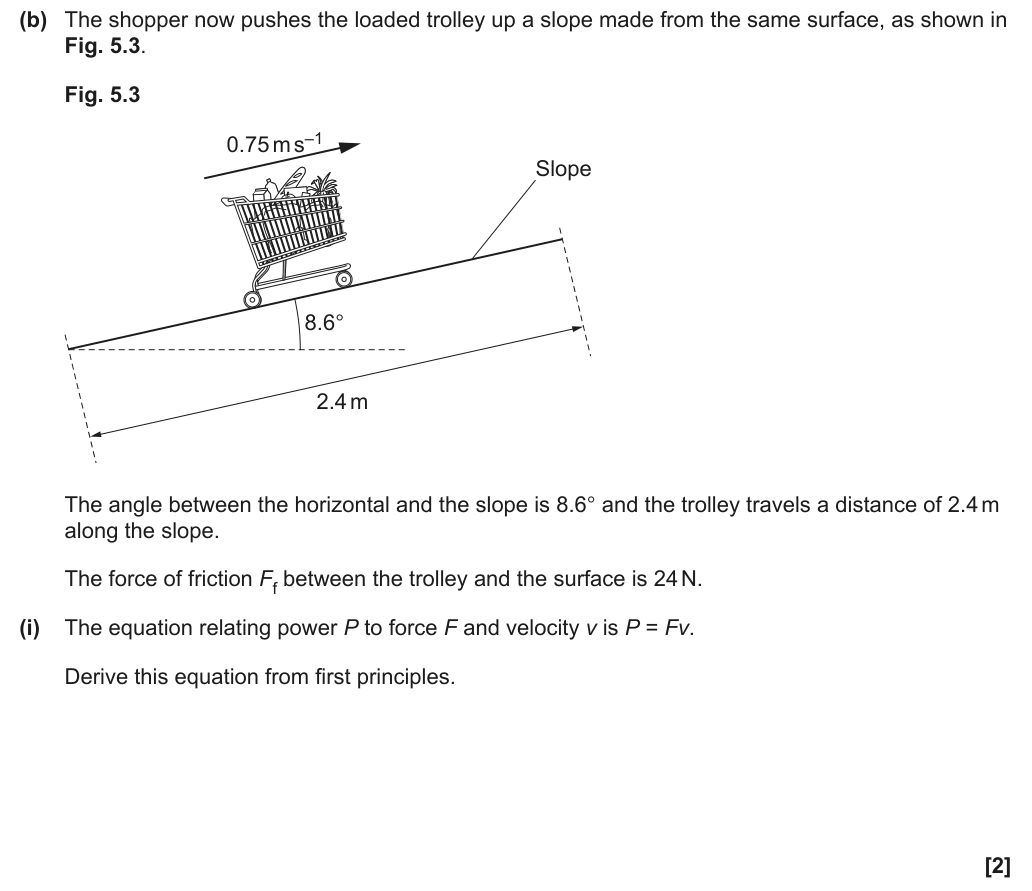
This question tested a specific learning outcome (3.3.3 (b)). To successfully gain marks in this question, three equations for work done, power and velocity needed to be stated and then clear logical manipulation of the equations needed to show the given equation. A common error was working out the power in base units.
Skills: M2.2 Change the subject of an equation, including non-linear equations
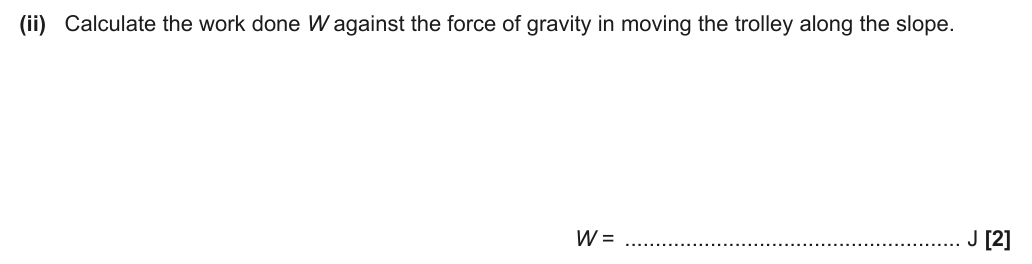
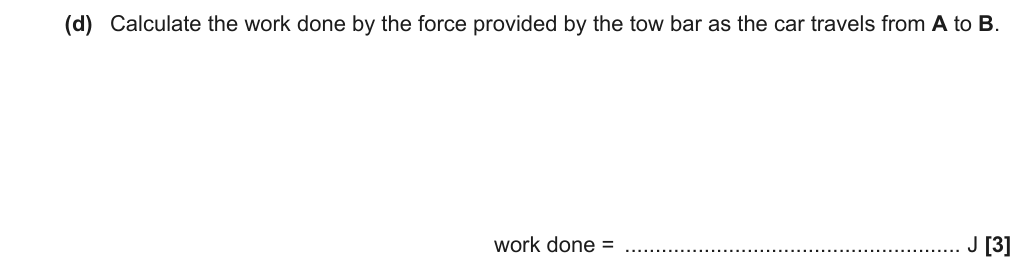
There were two possible methods of calculating W. One method was using the equation W = Fxcosθ and the other was to use the vertical component of the distance. Some candidates for both methods did not use the correct angle.
Skills: M0.6 Use calculators to handle sin x, cos x and tan x when x is expressed in degrees or radians; M4.5 Use sin, cos and tan in physical problems
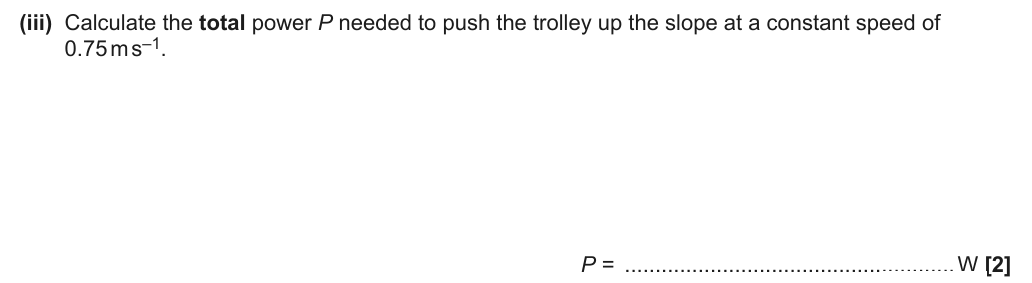
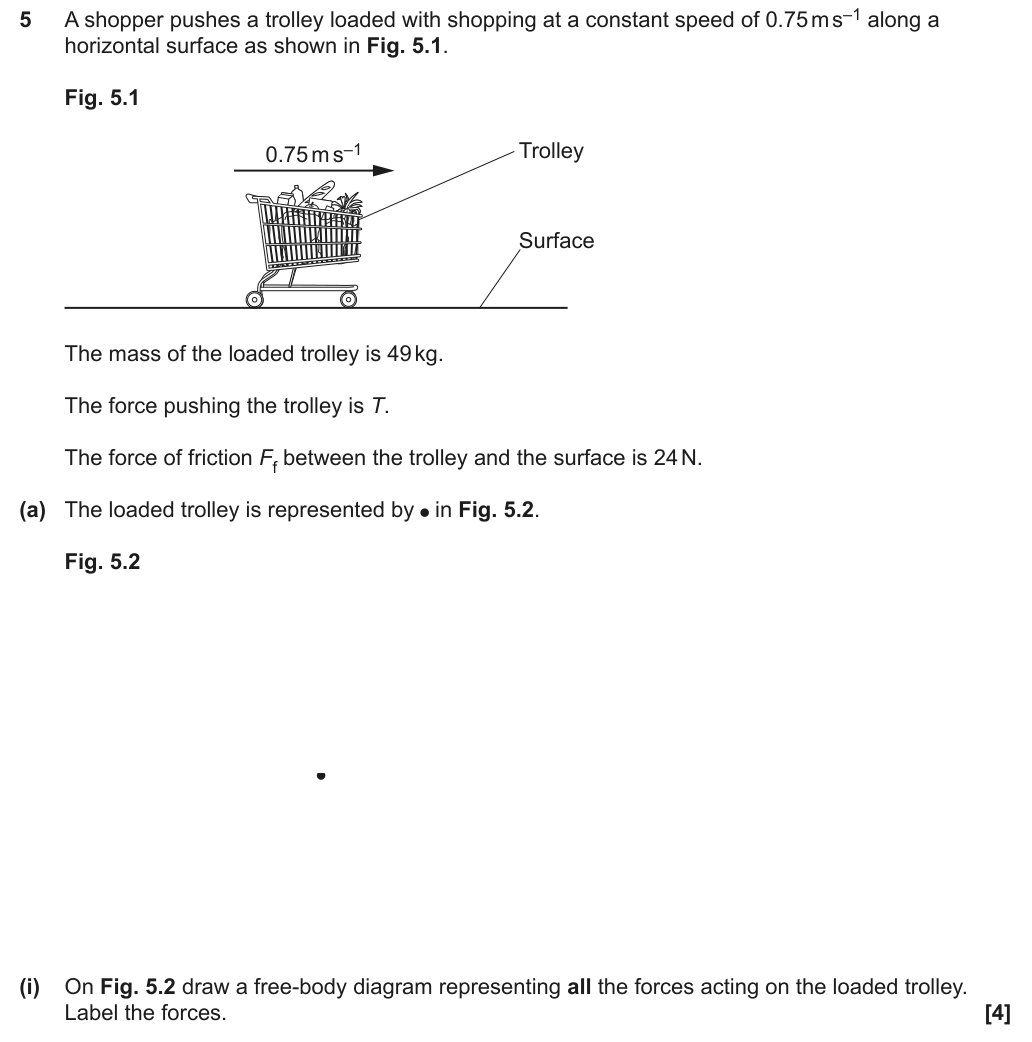
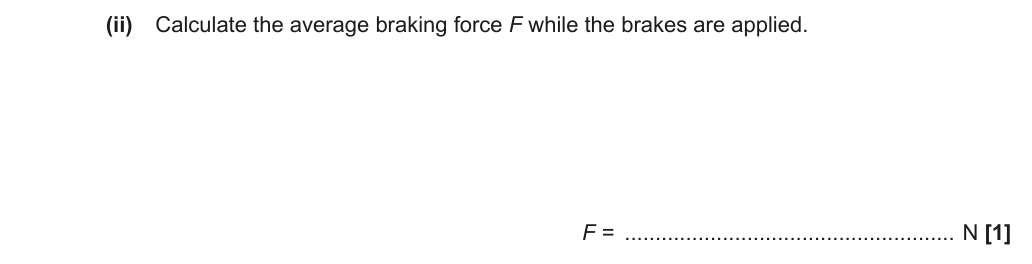
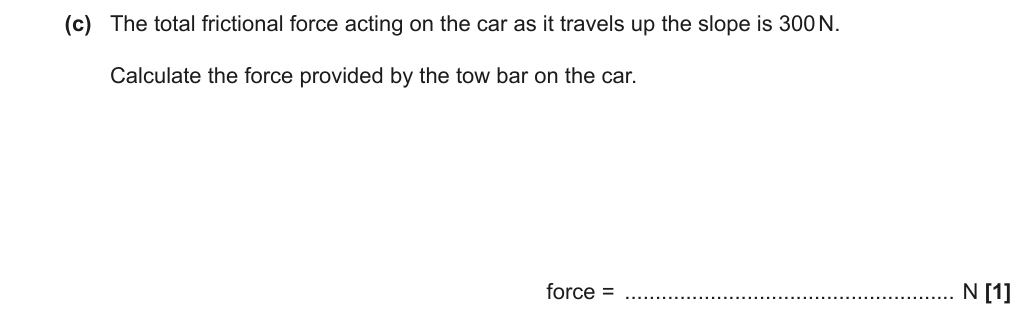
This was a challenging question. Many candidates worked out part of the force part did not add on the friction force. There were several methods, including determining the time.
Skills: M2.3 Substitute numerical values into algebraic equations using appropriate units for physical quantities
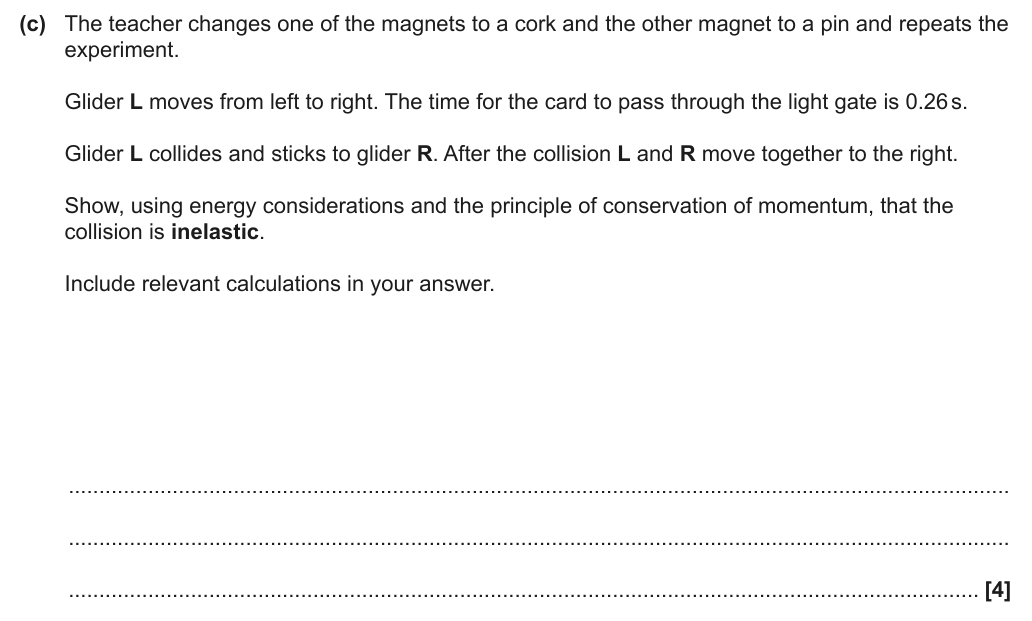
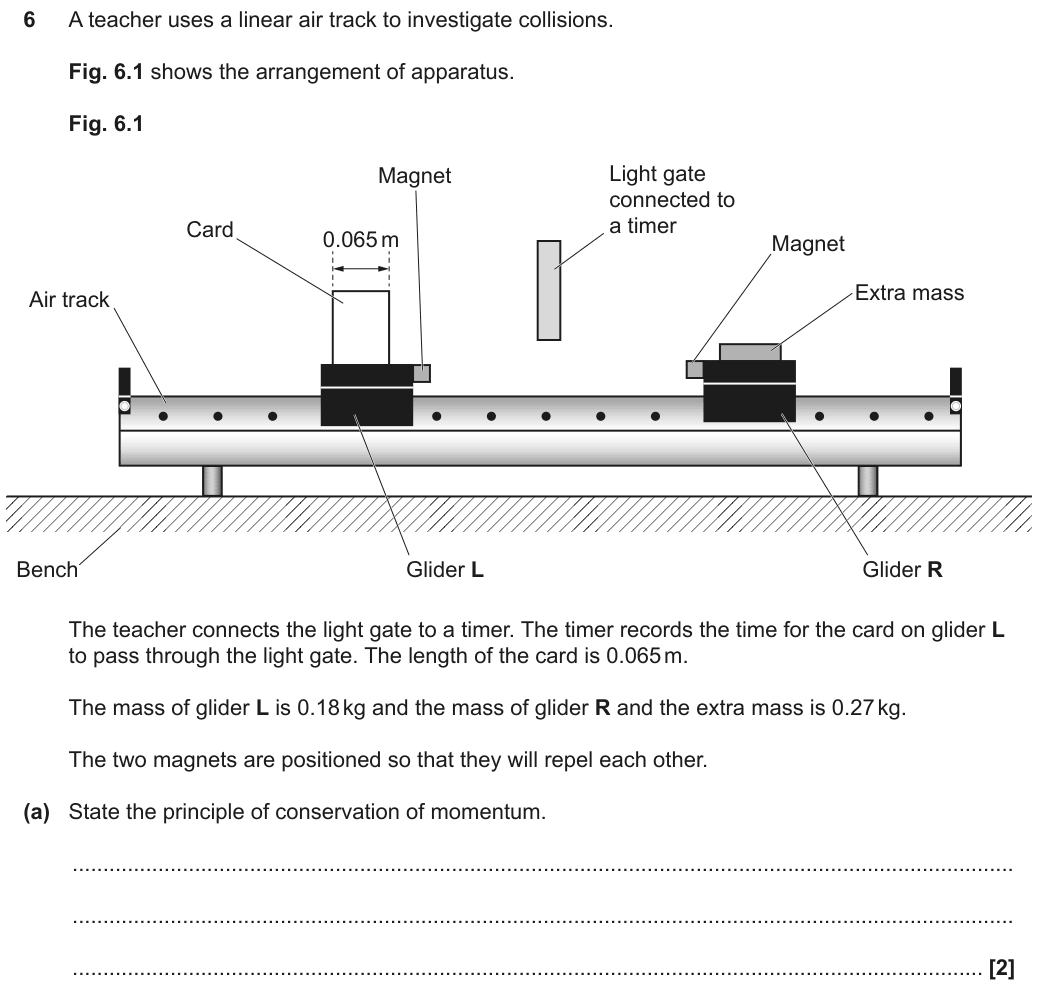
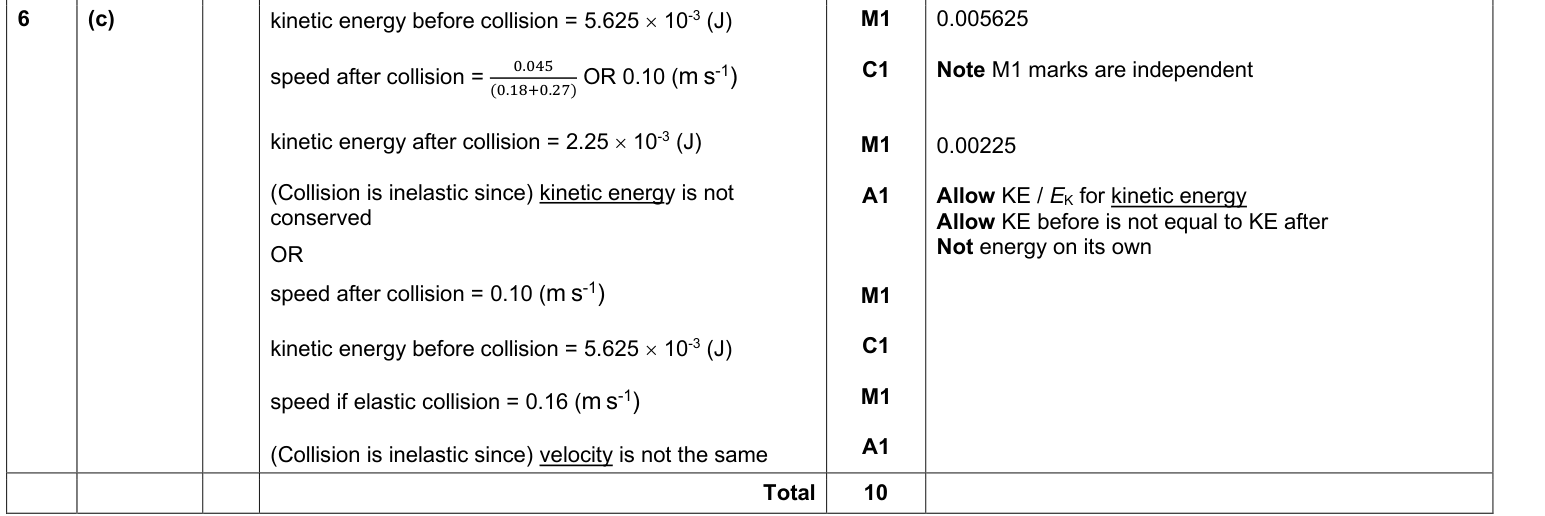
This question gave candidates the opportunity of structuring their answer for several calculations. High performing candidates clearly showed their working, firstly working out the initial kinetic energy before then working out the speed of both gliders after the collision, using the principle of conservation of momentum and then the kinetic energy after the collision. A conclusion in terms of the kinetic energy not being conserved was needed for the final mark.
Skills: M2.3 Substitute numerical values into algebraic equations using appropriate units for physical quantities; PAG1 Investigating motion
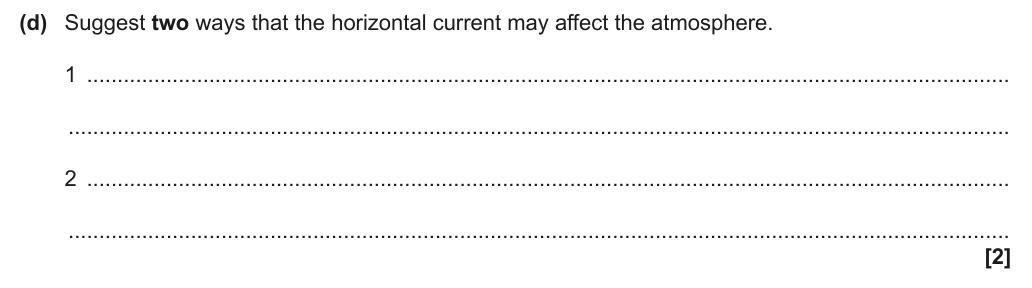
Many responses did not refer to atmospheric effects or repeated information from the stem and therefore could not gain marks. The most common correct response referred to ionisation of atoms causing lightning. Very few candidates referred to the heating effect of a current.
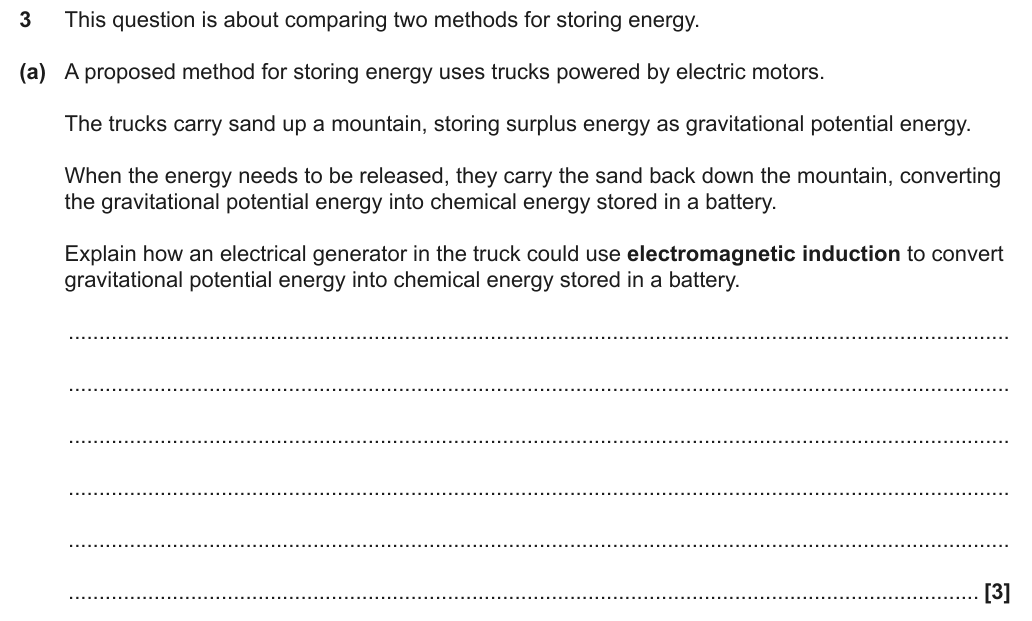
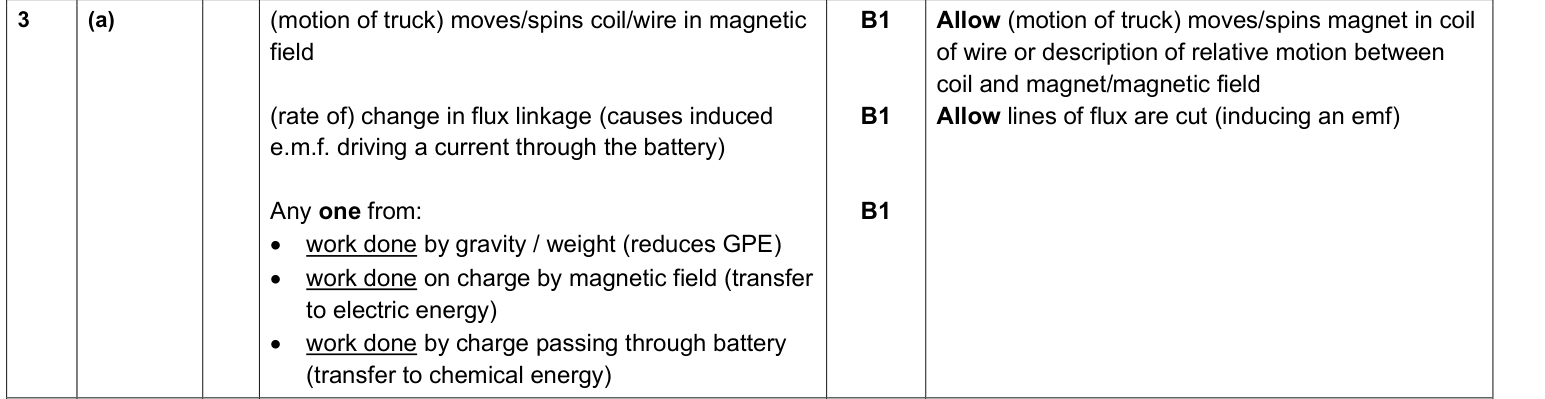
Many candidates gained no marks on this question. Many responses were vague, for example ‘turn a generator’ or confused saying, for example, that the sand moved through magnets. Some responses were not clearly linked to the context given. The question stem clearly highlighted the need to discuss electromagnetic induction but many responses only described energy stores. The mark most often gained was for discussing the rate of change of flux linkage. Many candidates attempted to describe how this might be achieved but often omitted to mention relative motion between a coil/wire and a magnet.
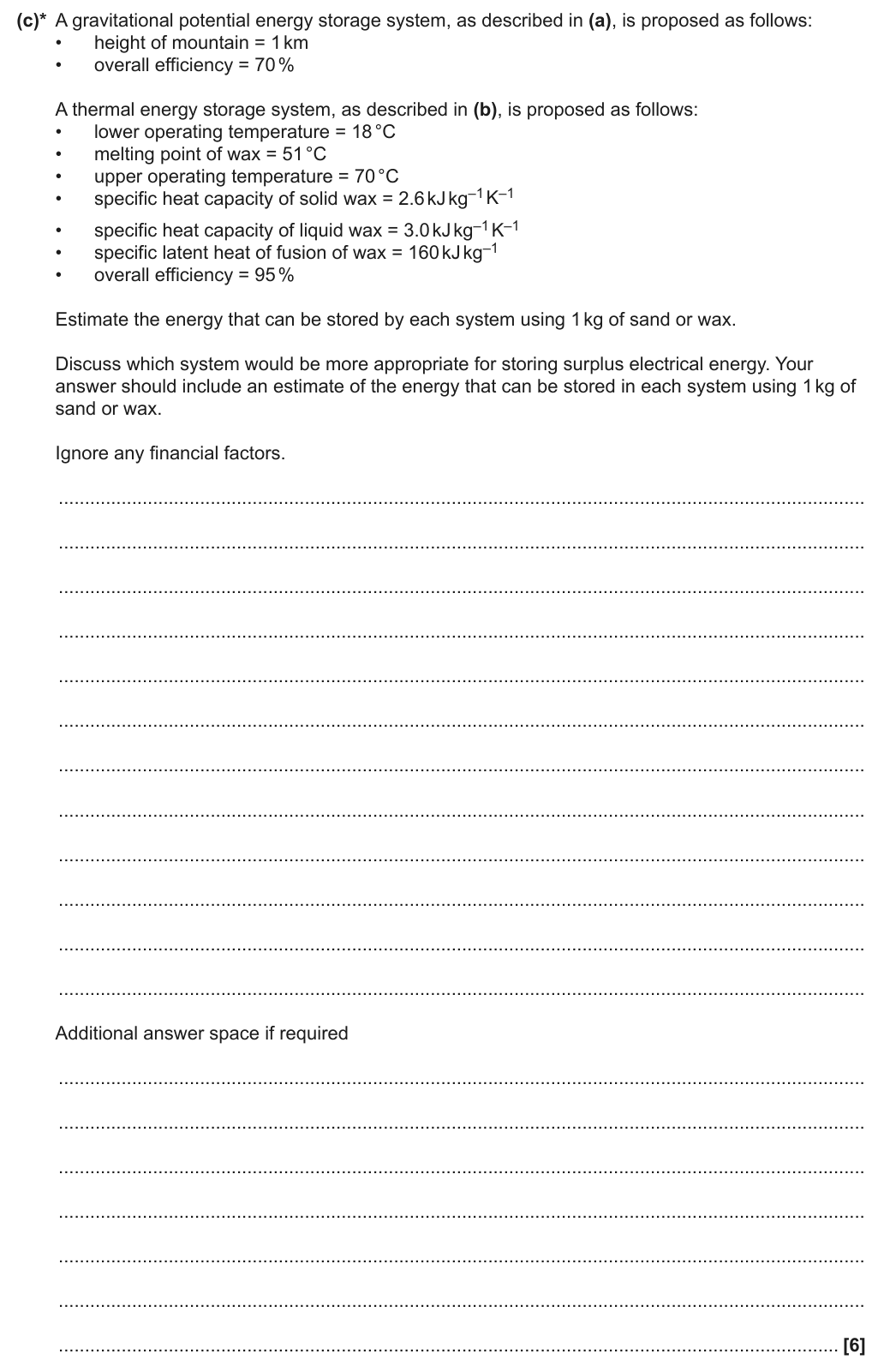
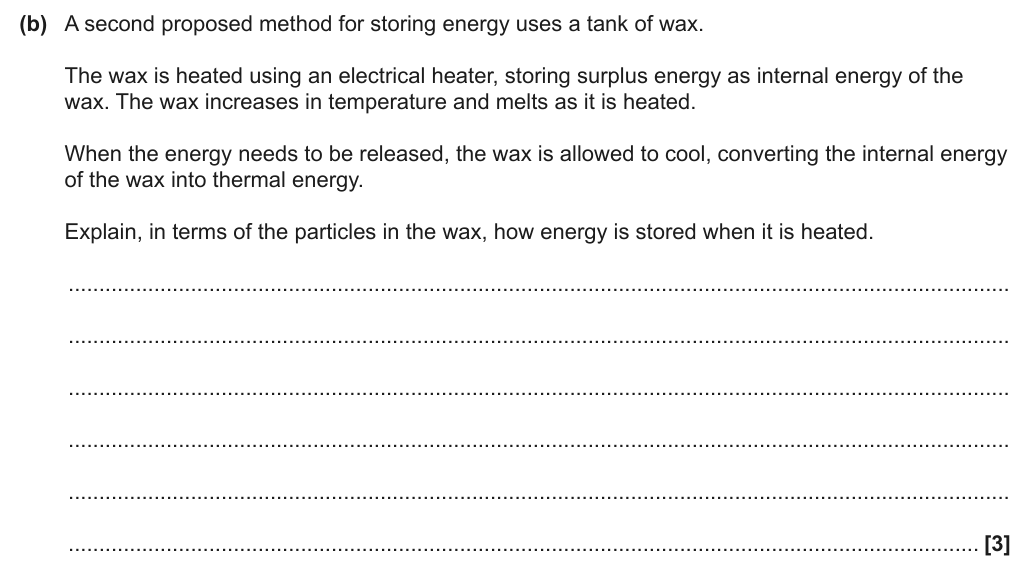
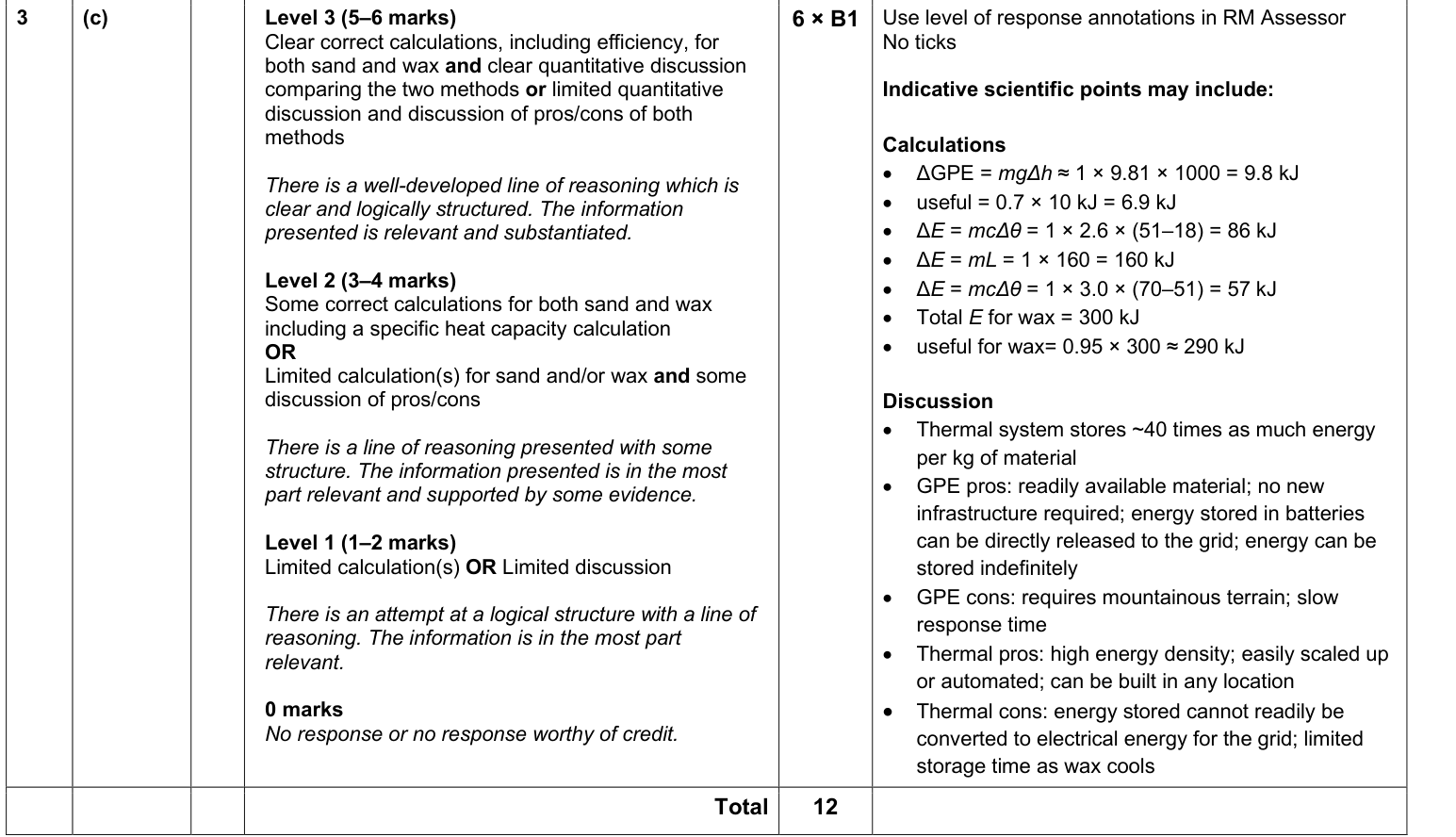
This Level of Response (LoR) question was well answered by the majority of candidates who were able to gain a high Level 2 or Level 3 mark. Characteristics of Level 3 responses were clearly set out calculations that indicated what was being calculated at each stage and a discussion which included a clear comparison of the total energy stored by wax and sand. A significant minority incorrectly calculated the total energy stored for wax despite correctly calculating for each stage of the process. The most common error in such responses was subtracting one of the values rather than adding all three. Other common mistakes were using incorrect powers of ten from prefixes, incorrect temperature changes or transposing data for different stages.
Skills: M0.1 Recognise and make use of appropriate units in calculations; M0.3 Use ratios, fractions and percentages; M2.3 Substitute numerical values into algebraic equations using appropriate units for physical quantities
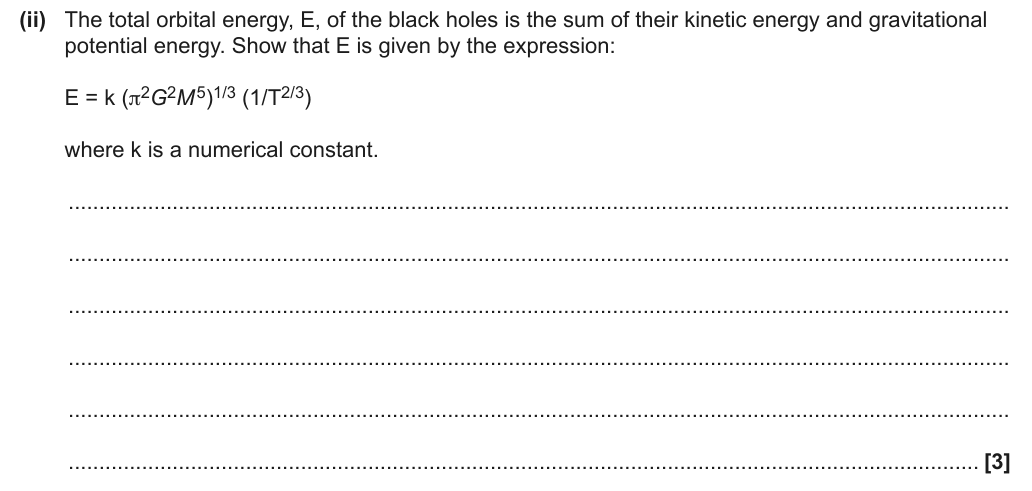
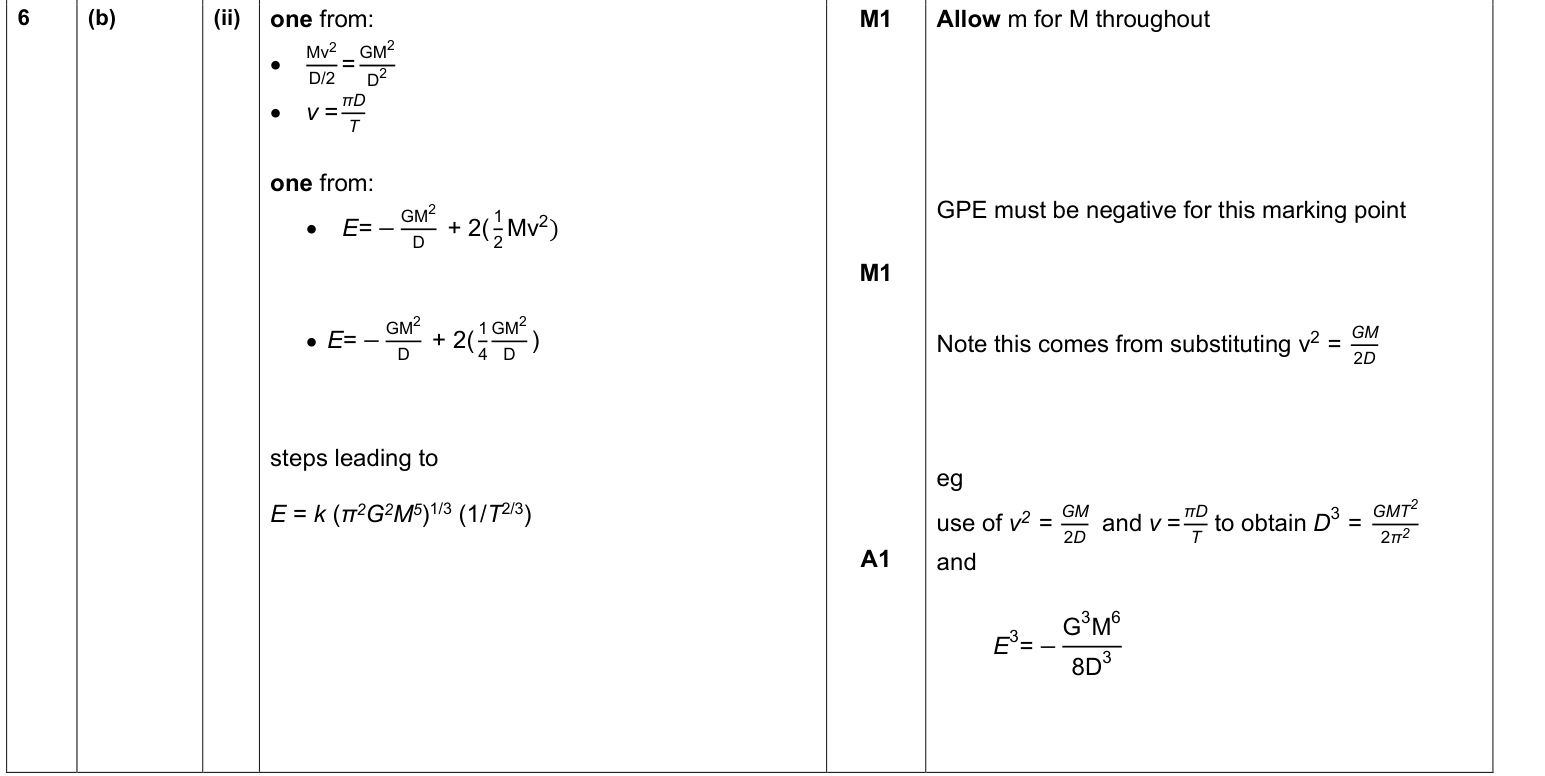
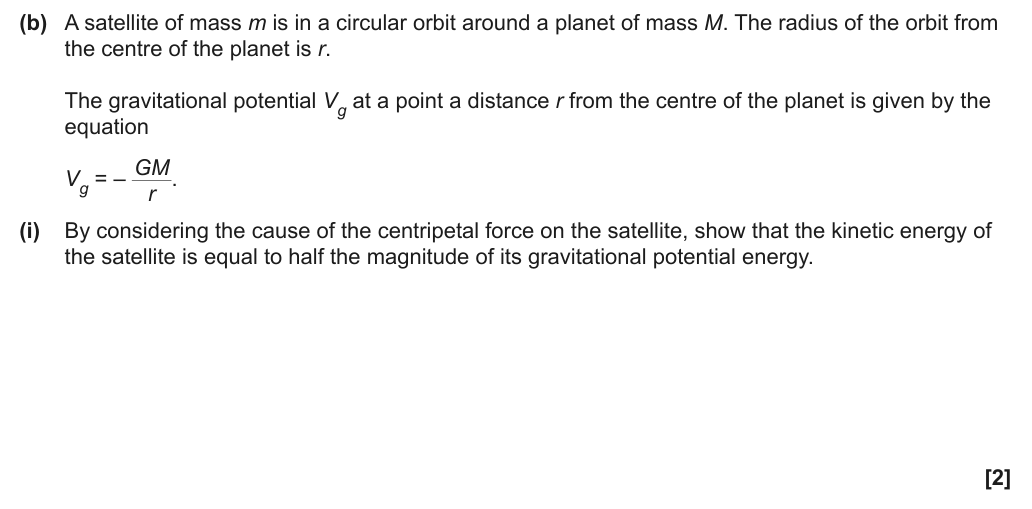
This derivation was designed to challenge the highest scoring candidates although the first two marking points were accessible to students across the mark range. Common issues • omitting the − sign from GPE • using r instead of D in equations • attempting to use Kepler’s laws rather than gravitational potential energy and kinetic energy equations.
Skills: M0.5 Use calculators to find and use power, exponential and logarithmic functions; M2.2 Change the subject of an equation, including non-linear equations; M2.4 Solve algebraic equations, including quadratic equations
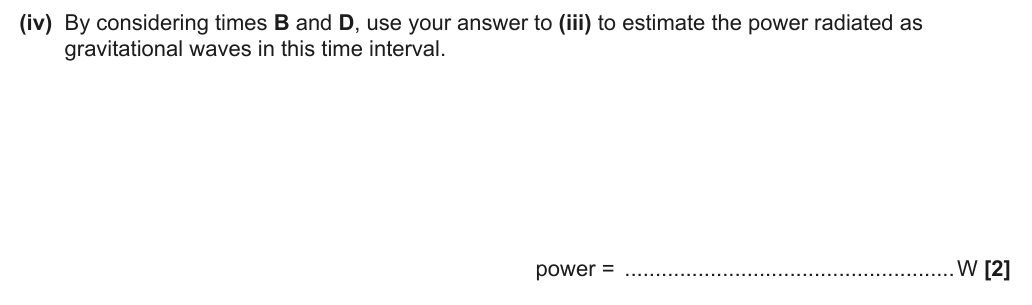
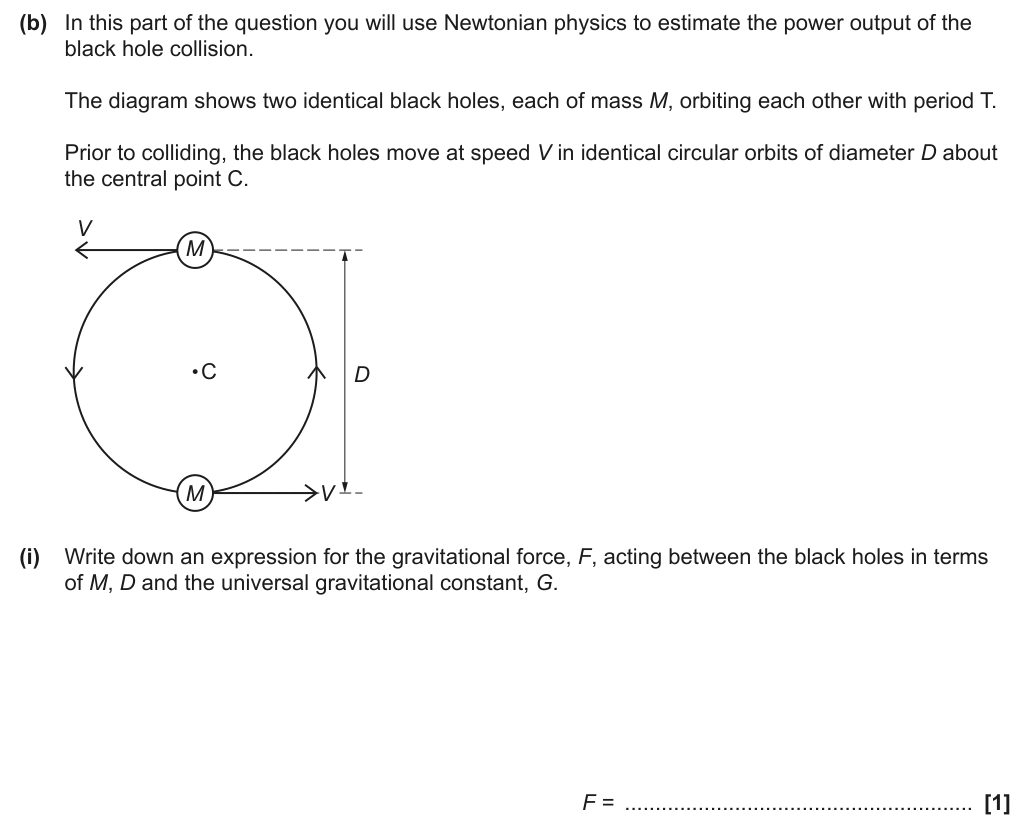
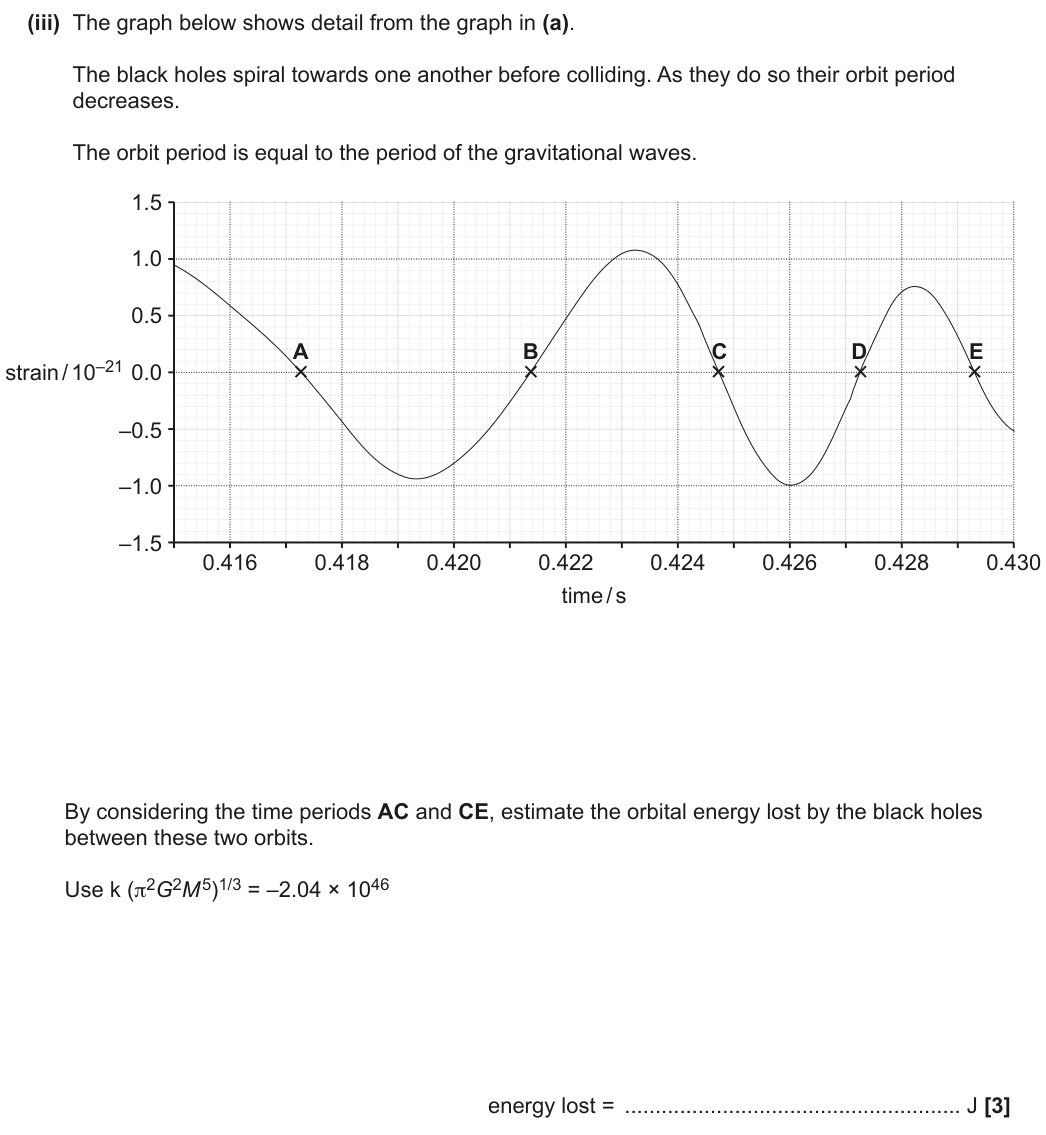
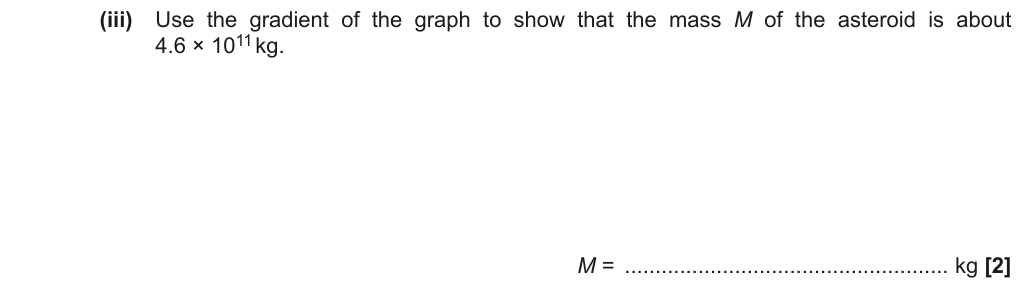
Question 6 (b) (i) Candidates who realised that the separation D should be used instead of D/2 or r often gained the mark. Question 6 (b) (ii) This derivation was designed to challenge the highest scoring candidates although the first two marking points were accessible to students across the mark range. Question 6 (b) (iii) Many candidates were able to gain at least 2 marks on this question.
Skills: M2.3 Substitute numerical values into algebraic equations using appropriate units for physical quantities; M3.1 Translate information between graphical, numerical and algebraic forms
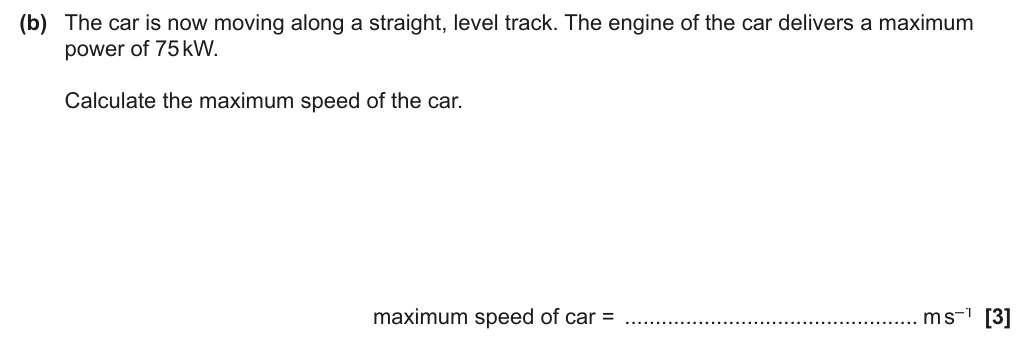
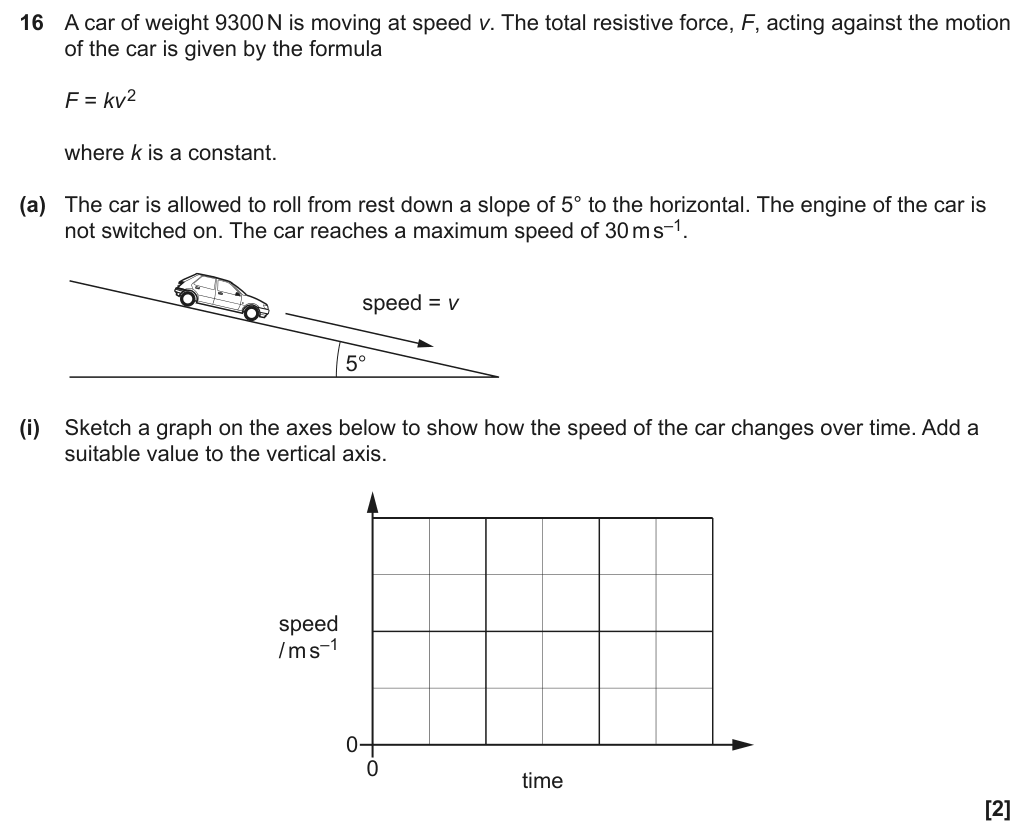
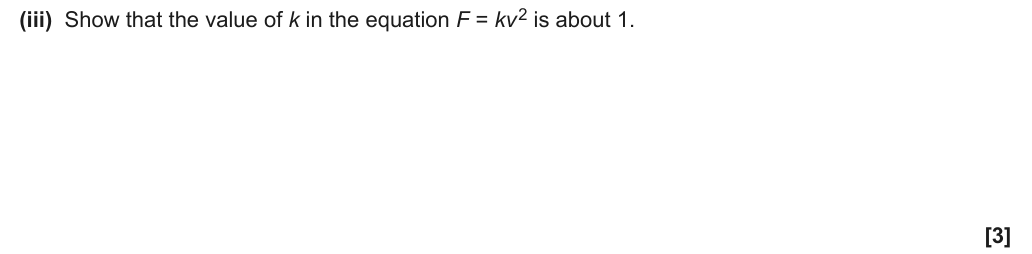
The key idea here is that the force from the engine (given by F = P / v) will equal the resistive forces (F = kv2) when the car is at maximum speed. Candidates could choose which value of k they used here, either k = 1 from the question data or the value of k from the previous item. This gives an acceptable range of speeds as stated in the mark scheme.
Skills: M0.5 Use calculators to find and use power, exponential and logarithmic functions; M2.2 Change the subject of an equation, including non-linear equations; M2.4 Solve algebraic equations, including quadratic equations
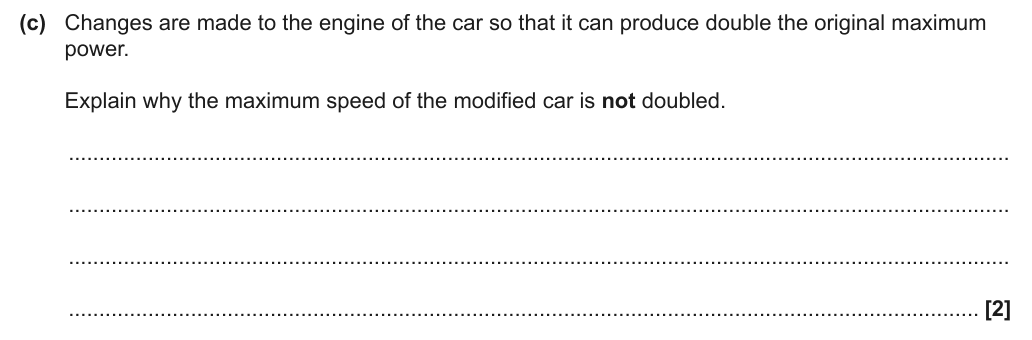
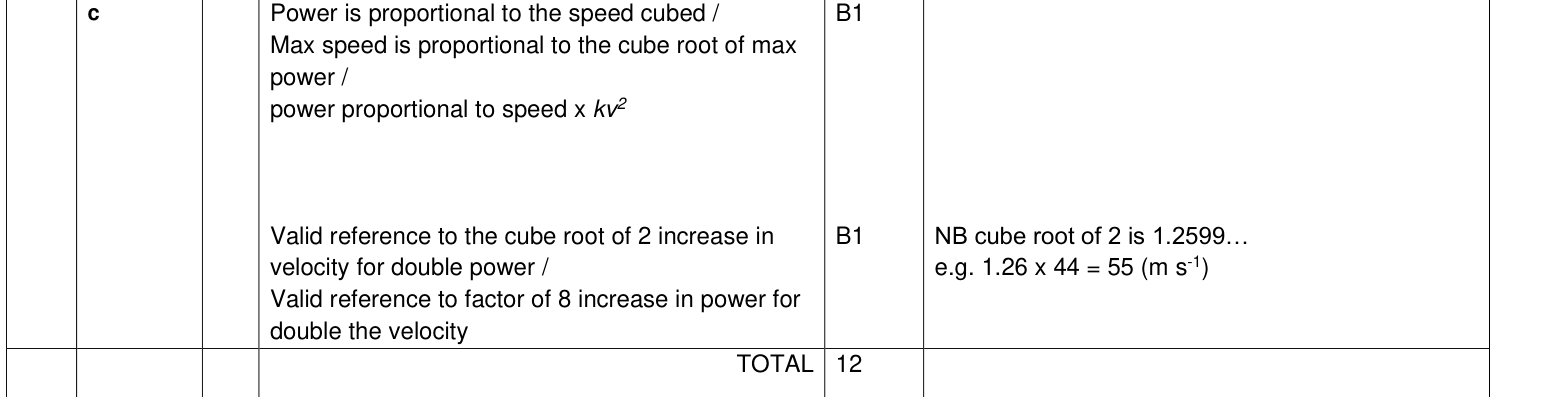
Even if they couldn’t complete the calculation in the previous item, candidates needed to be able to state the idea qualitatively for the first mark. No further calculations were required, except the correct answer that the maximum speed would increase by a factor of cube root (2).
Skills: M0.3 Use ratios, fractions and percentages
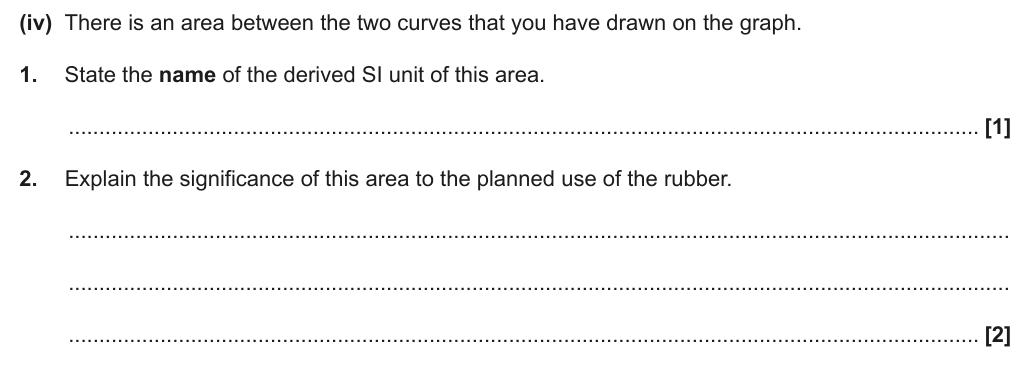
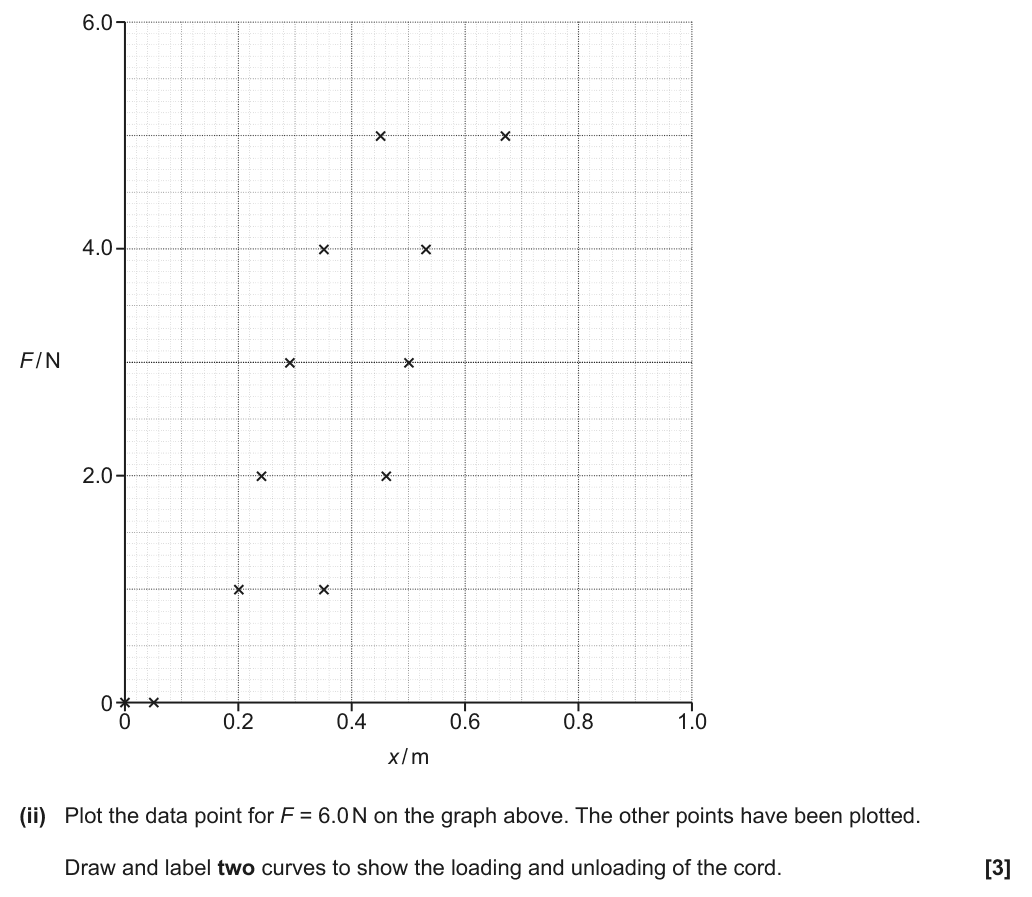
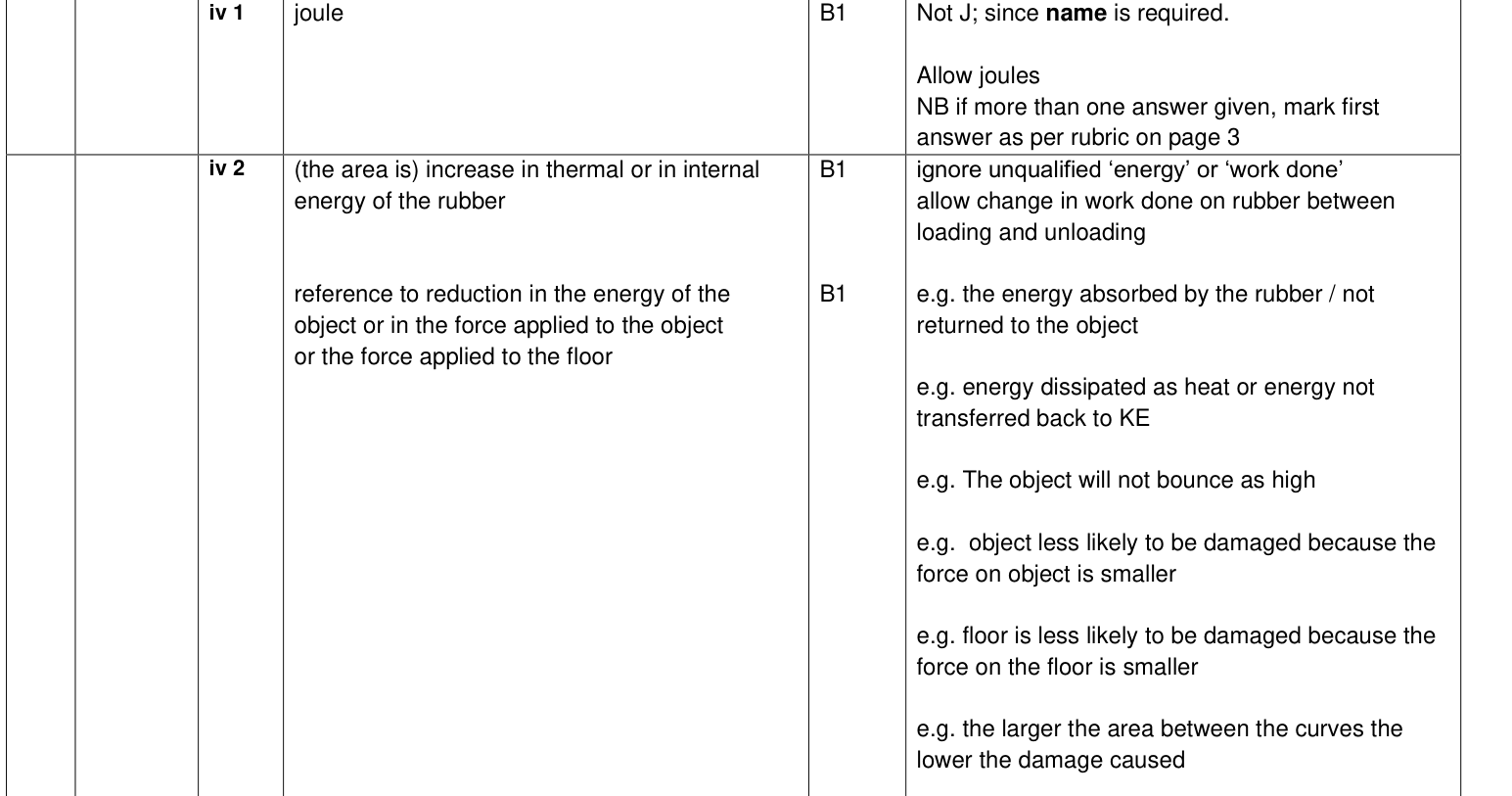
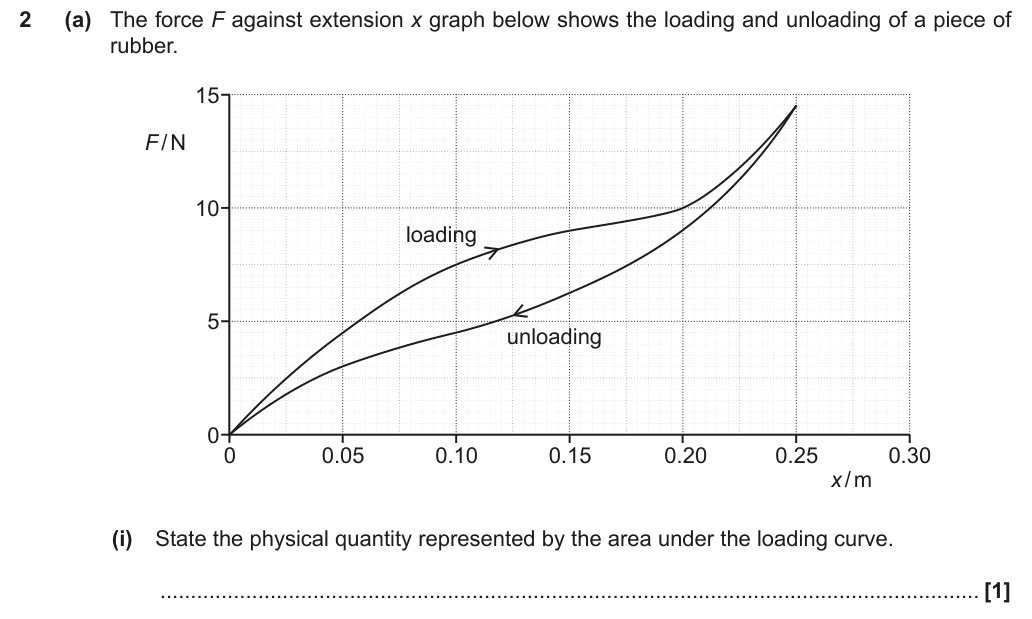
Some candidates stated the quantity (energy) or the base units (kg m2 s-2) or did both. The rubric in the mark scheme is clear: only the first answer is acceptable for this sort of question. The scientific language is subtle here. The area between the two curves is not the work done (which is the area underneath any particular F-x graph) but it is the increase in the object’s internal energy typically as thermal energy, Similarly, the language needed to be suitably scientific for the second marking point, using A Level terminology.
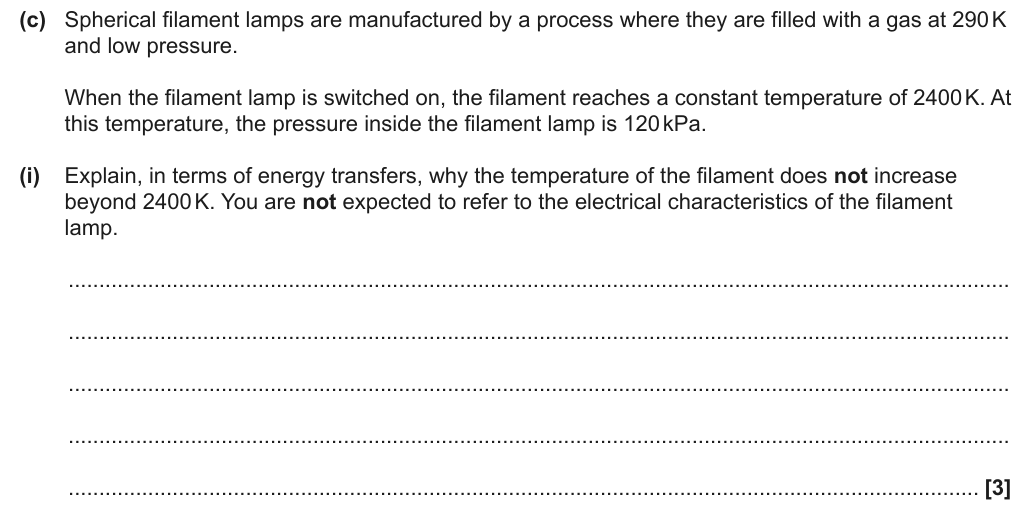
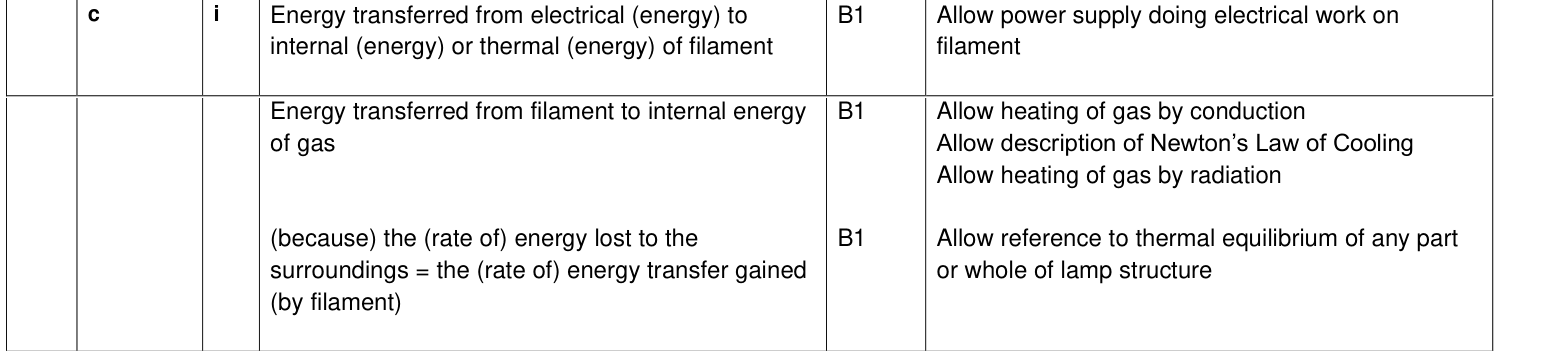
Again, the language required to suitably communicate the correct Physics was challenging here. Respones which described gas law physics had missed the point. The principal reasons why the temperature of the filament does not increase above any given temperature is that the energy in = energy out in a given time period. Further marks were for describing the energy process for supplying energy to the filament and the transfer of energy away from the filament. Quantities in Physics remain unchanged often because an idea of equilibrium or balancing two sides of an equation (see questions 16(a)(iii) or 16(b) for earlier examples). Explaining the physics of either side of that equation is often creditworthy.
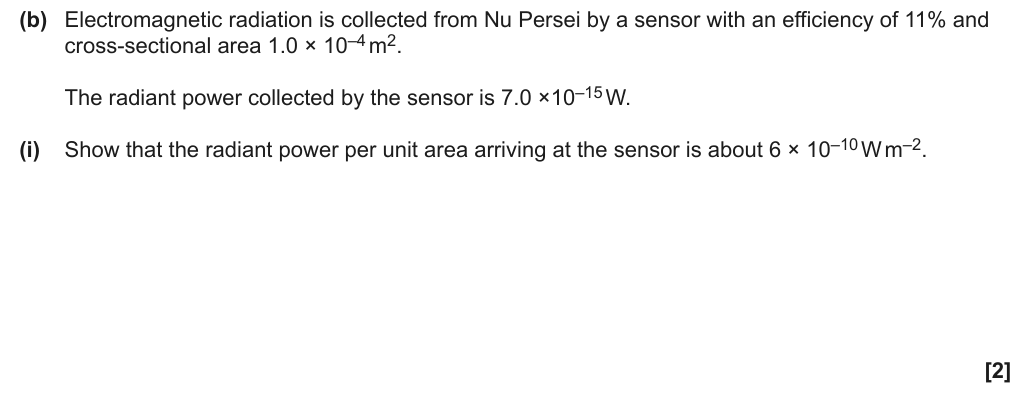
Most candidates successfully manipulated the data given to show that the radiant power per unit as required.
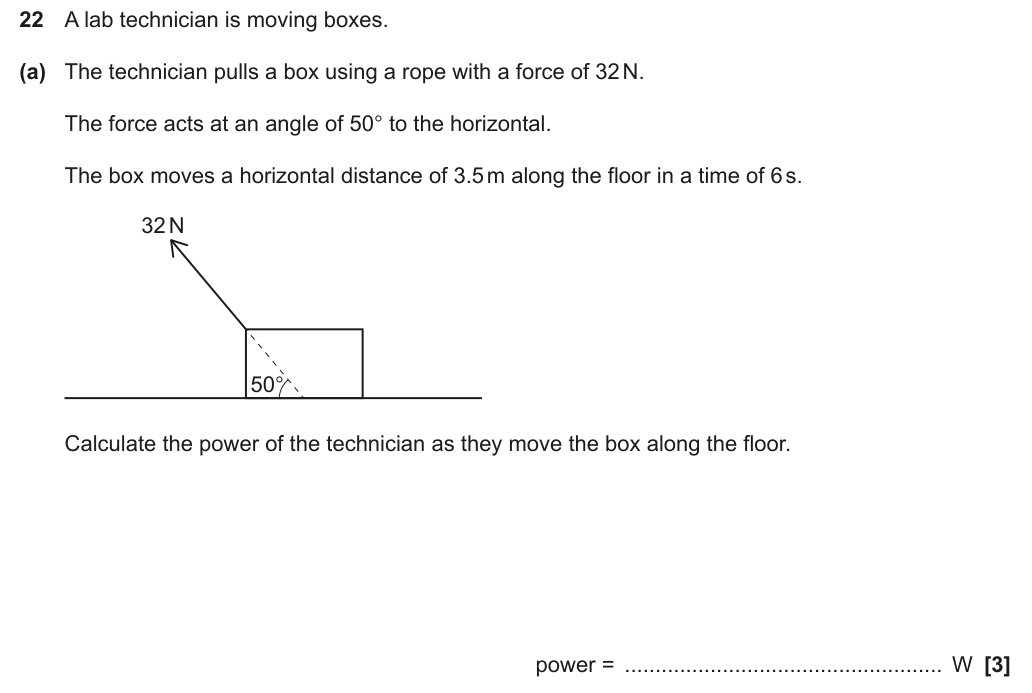
Candidates performed well on this question by correctly applying P=Fv by calculating the horizontal component of the 32N force acting on the box and the velocity as it moved along the floor to calculate the power of the technician as 12W.
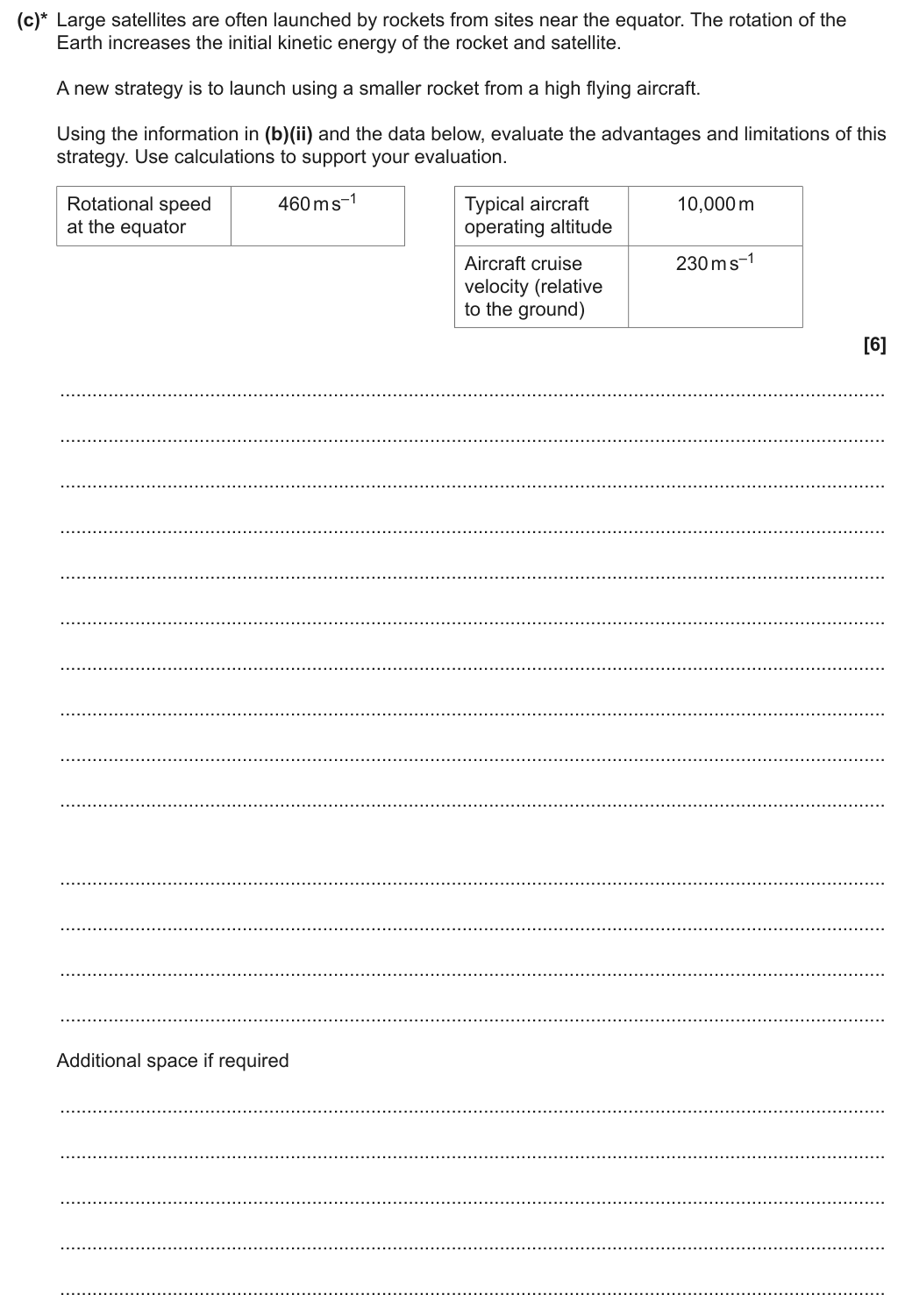
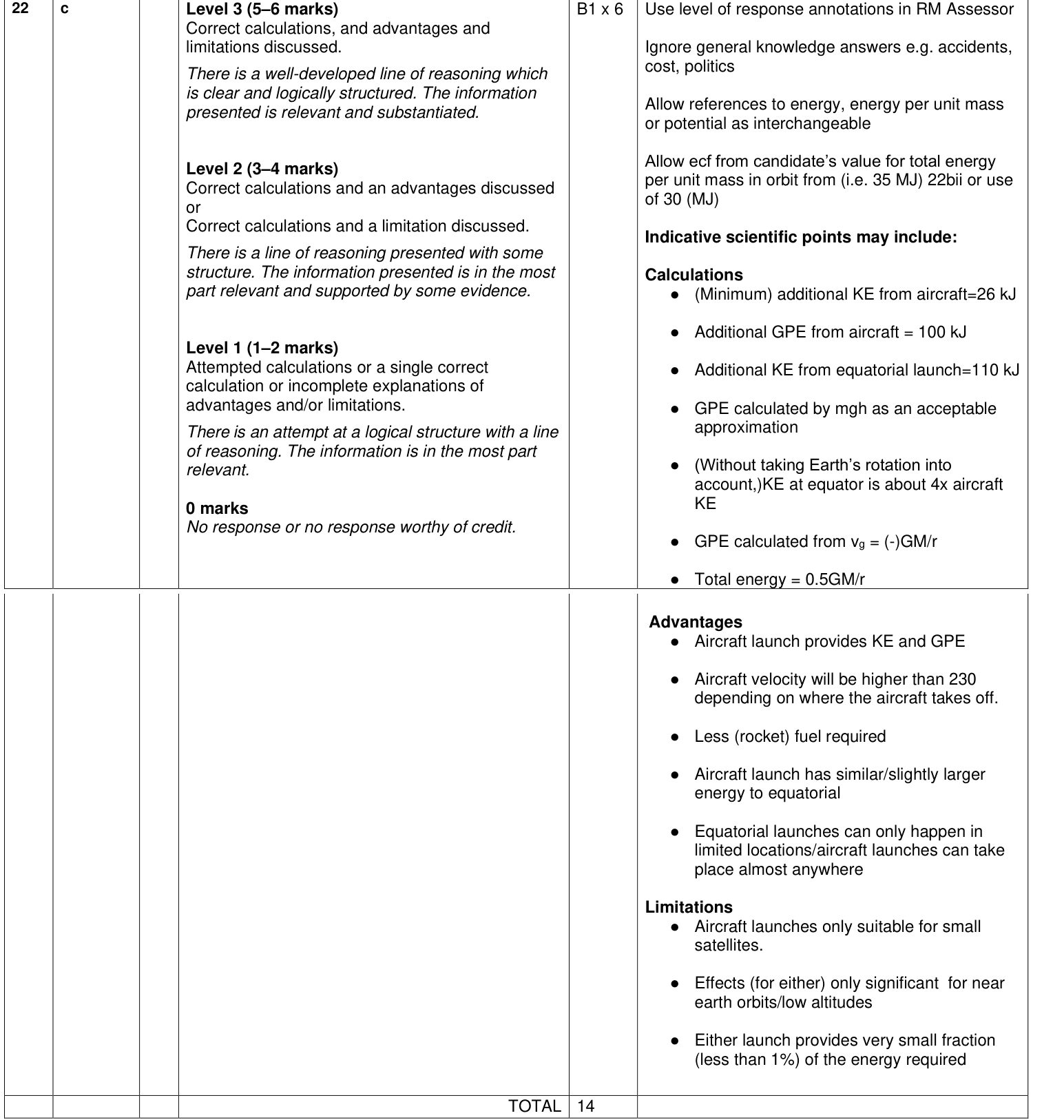
Many candidates found this difficult to access. A solely qualitative evaluation was limited to level 1 (2 marks). In Exemplar 2, the candidate has completed a small number of calculations comparing the KE the two methods would raise. There is also a statement that these differ by a factor of 4 along with an attempt at calculating the GPE advantage by launching from the aircraft rather than from the ground. Crucially, there is very little mention of limitation and no supporting calculations. Holistically speaking, therefore, there was not enough evidence to award this candidate Level 3, yet sufficient for a Level 2. In Exemplar 3, this candidate makes an excellent attempt at every portion of the question. They have taken great effort to make themselves clear with technical language. They have also performed numerous calculations to compare the GPE and KE in the two different scenarios. A further figure appears right at the bottom of the response. The candidate has correctly calculated the percentage of the overall energy required that is supplied by either method. In conclusion, the candidate has used their many correct calculations to weigh up evidence effectively in terms of the advantages and limitations.
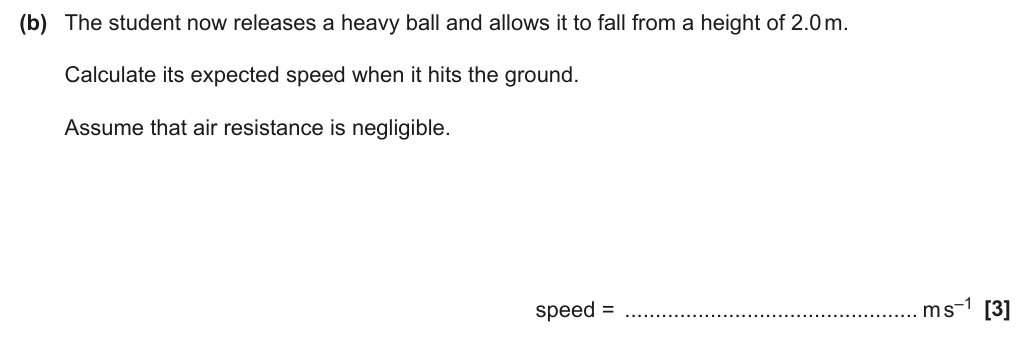
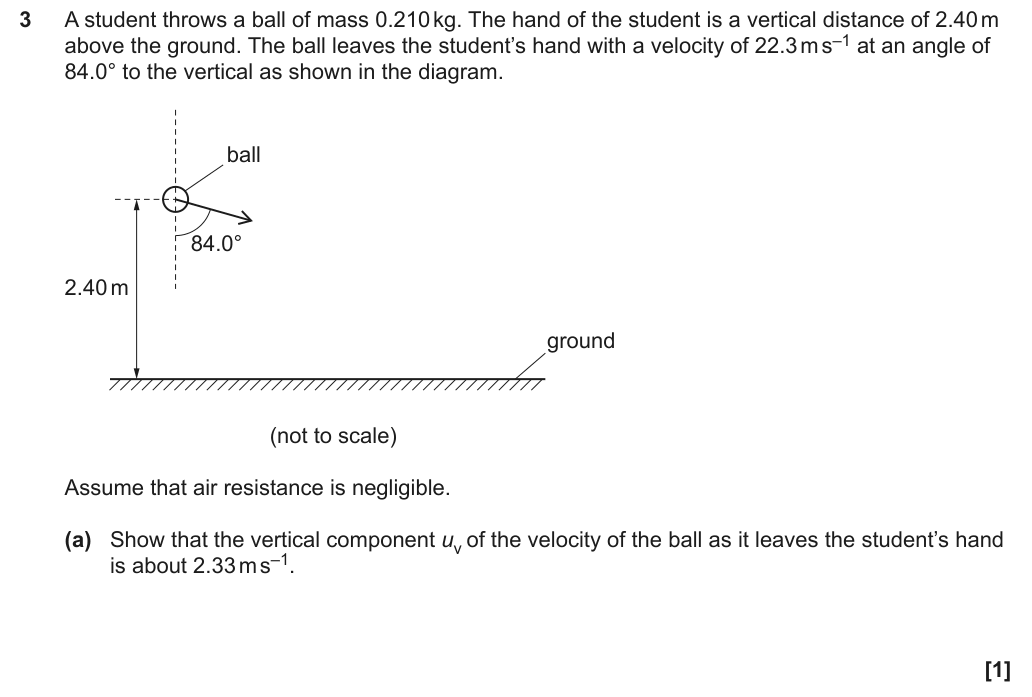
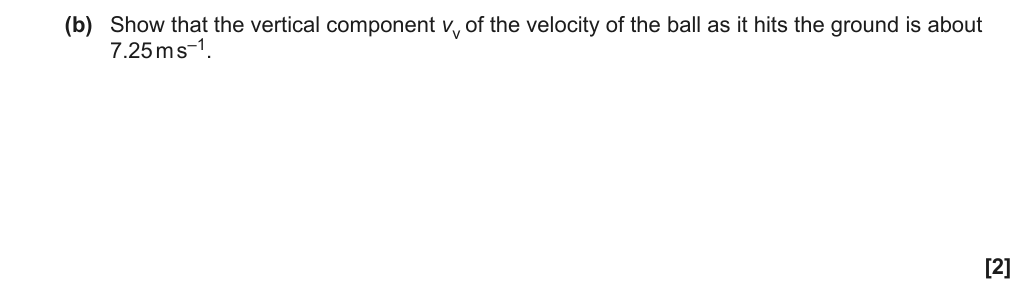
Candidates performed very well on this question by selecting and applying the correct equation of motion to calculate the speed of the ball when it hit the ground. Selection and application of formulae Candidates performed well on the selection and application of equations of motion from Module 3: Forces and motion.
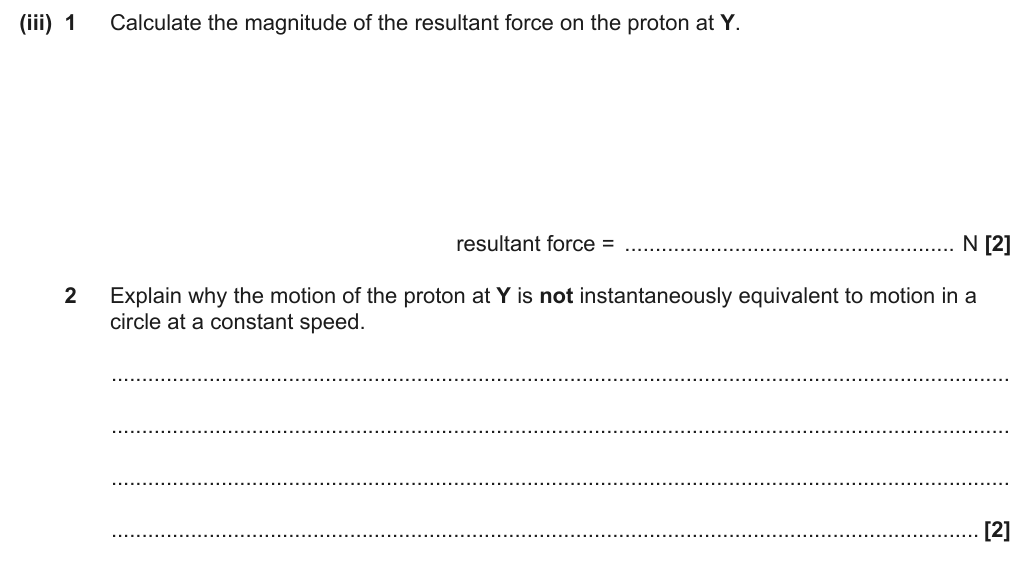
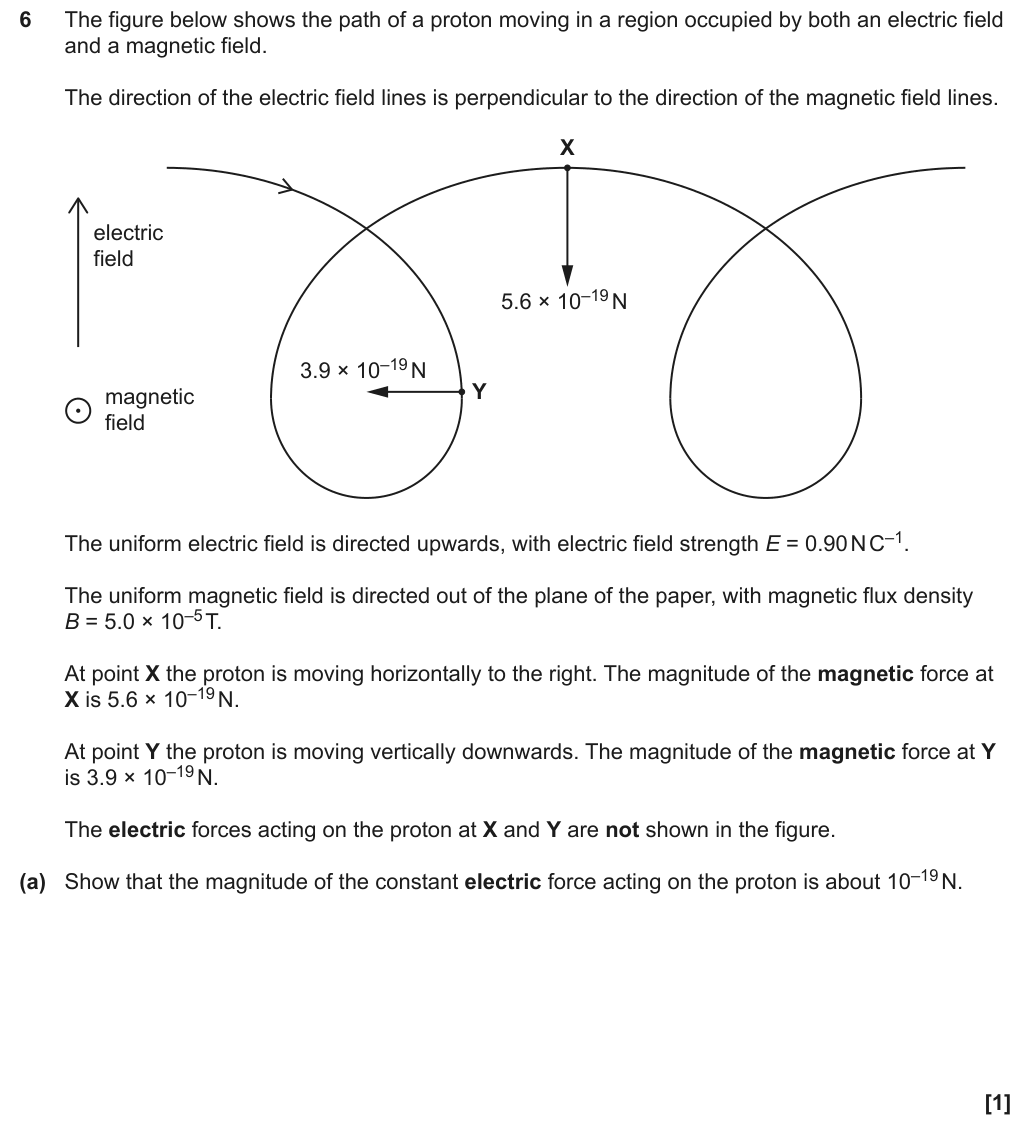
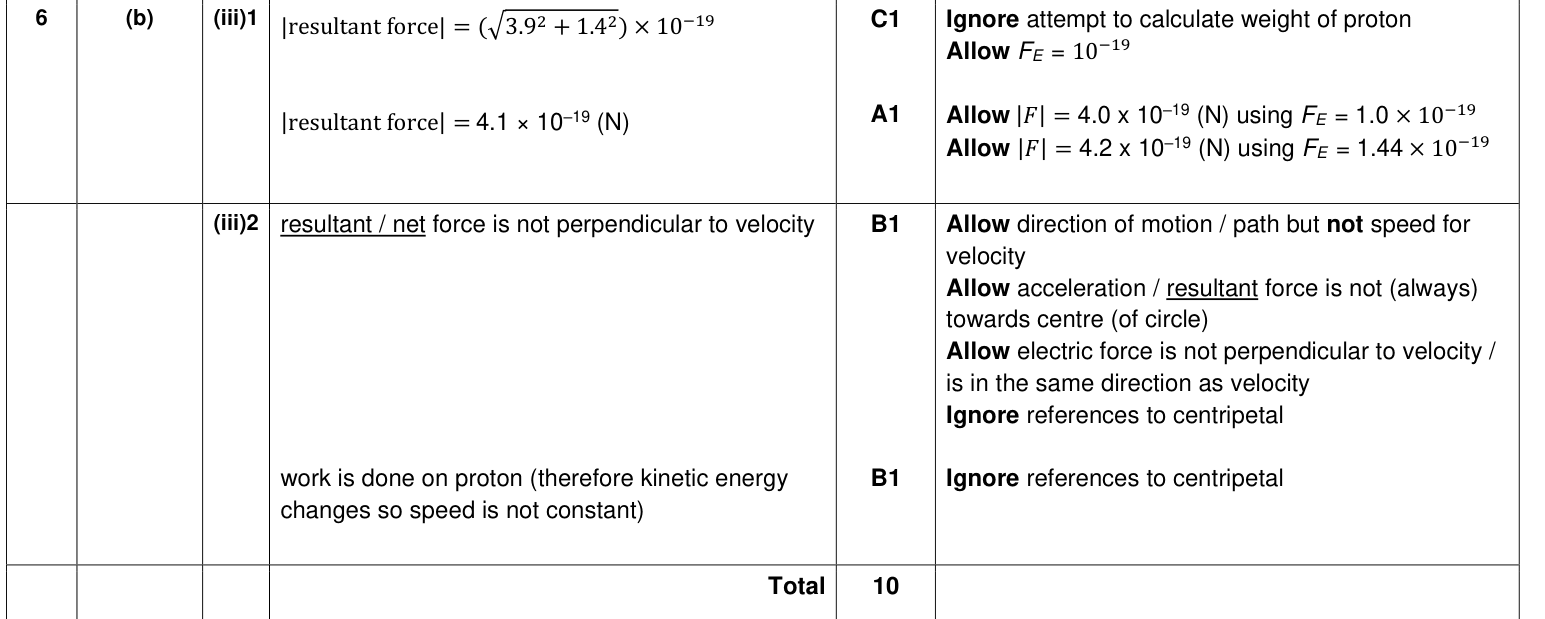
There are two forces acting on the proton at Y: an electric force upwards (given in (a)) and a magnetic force to the left (shown on the diagram). These two forces act at right angles to each other, and so the magnitude of their resultant can be found using Pythagoras’s Theorem. Credit was given for using a value for the electric force to 1, 2 or more significant figures. At Y, the proton is moving downwards, with a resultant force being the combination of an electric force upwards and a magnetic force to the left (calculated in part 1). The resultant force cannot be at right angles to the velocity, so we cannot have circular motion. The component of the resultant force acting in the direction of the proton’s motion will do work on the proton and change its speed. So, the proton cannot be travelling at a constant speed.
Skills: M4.4 Use Pythagoras’ theorem, and the angle sum of a triangle
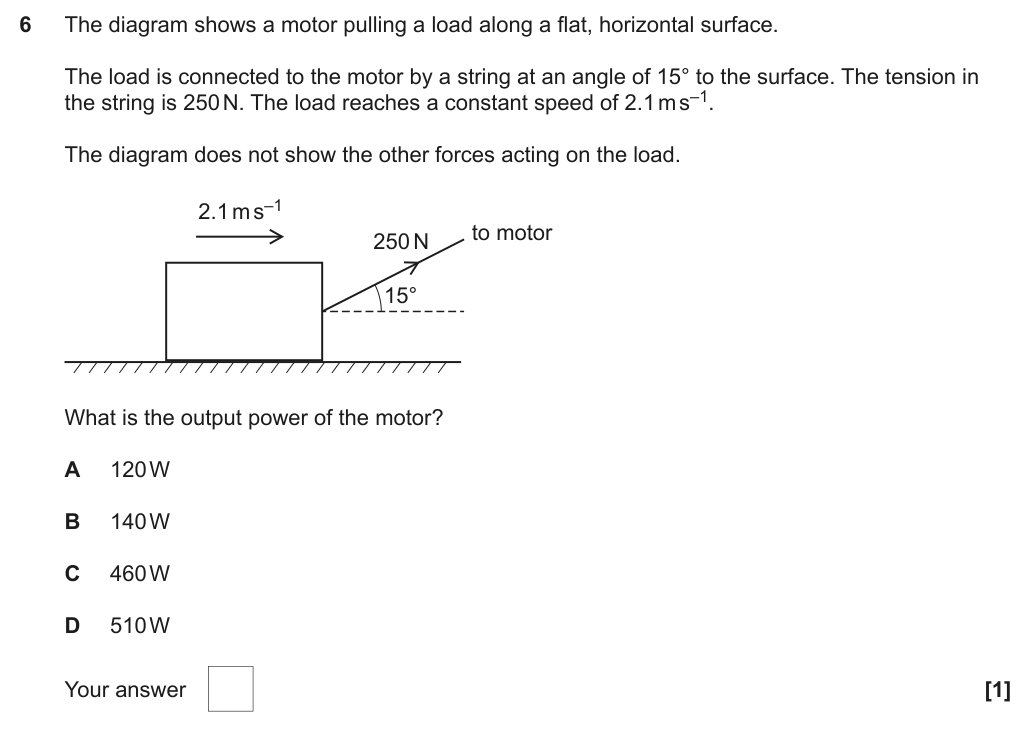
D
This question was answered well as candidates were able to calculate the correct output power by applying the equation P = Fv and resolving the 250 N to give its horizontal component.
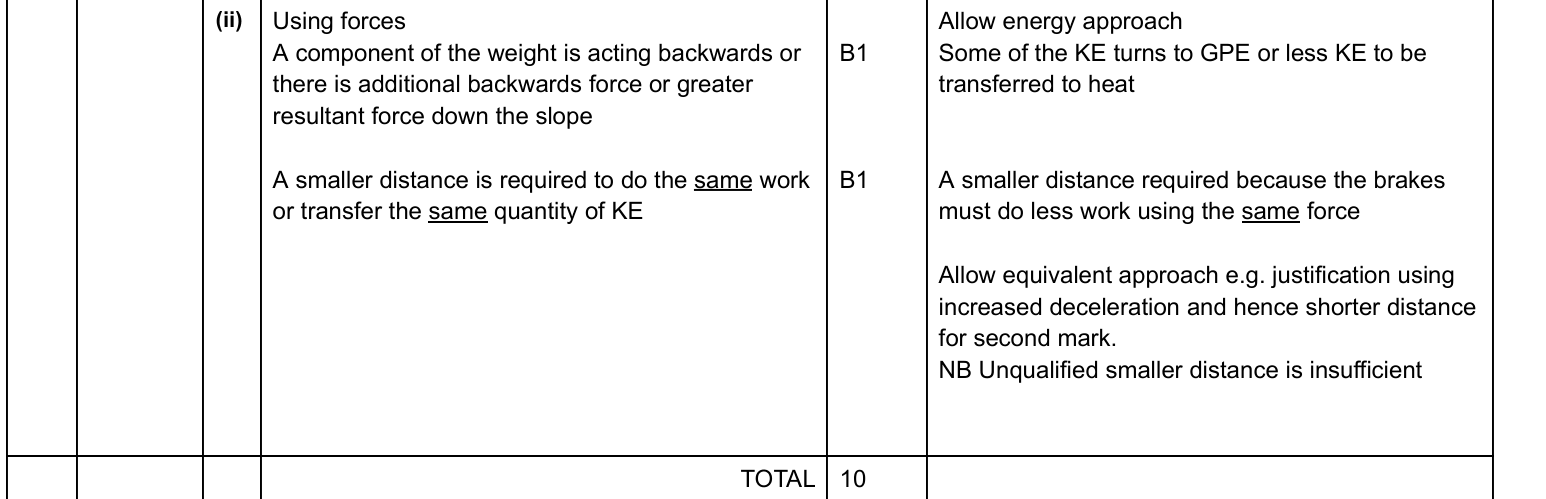
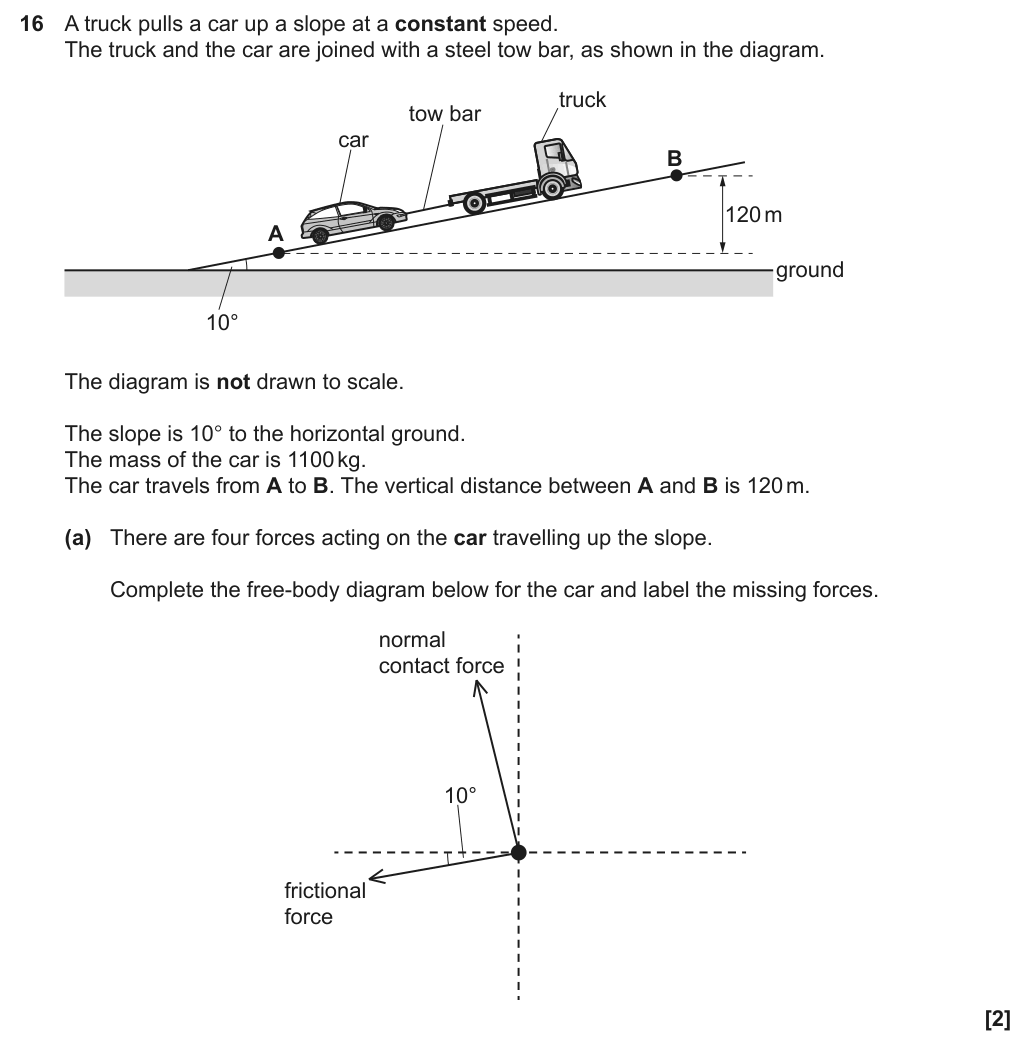
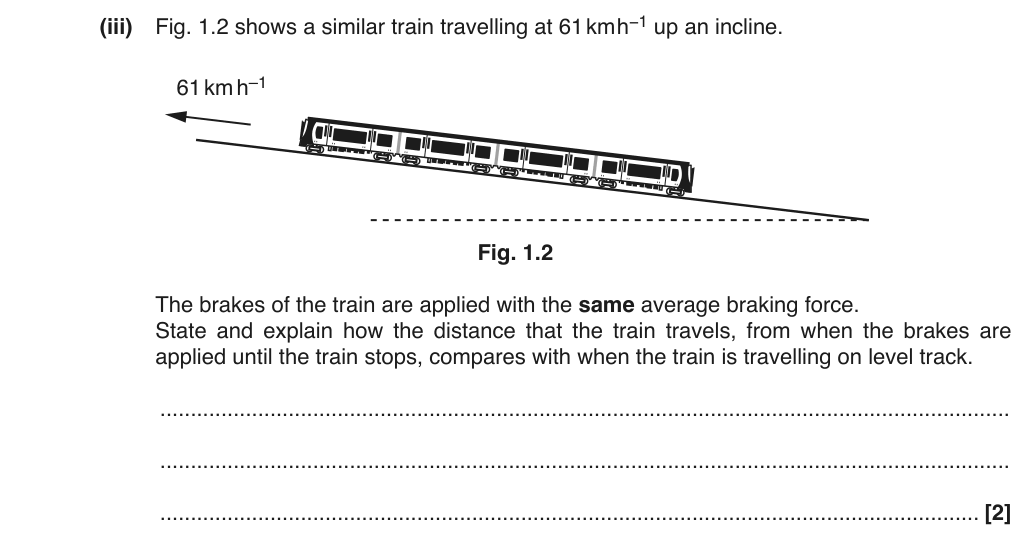
In Question 16 (b) (i), most candidates used the data available in the question to calculate an acceleration and hence a resultant force. In part (b) (ii), rather fewer used acceptable technical language to communicate their ideas. Useful phrases for explanations on this idea were ‘resultant force’ and ‘component of weight parallel to the slope’ rather than ‘extra force’ or ‘some of the vehicle’s gravity helped’.
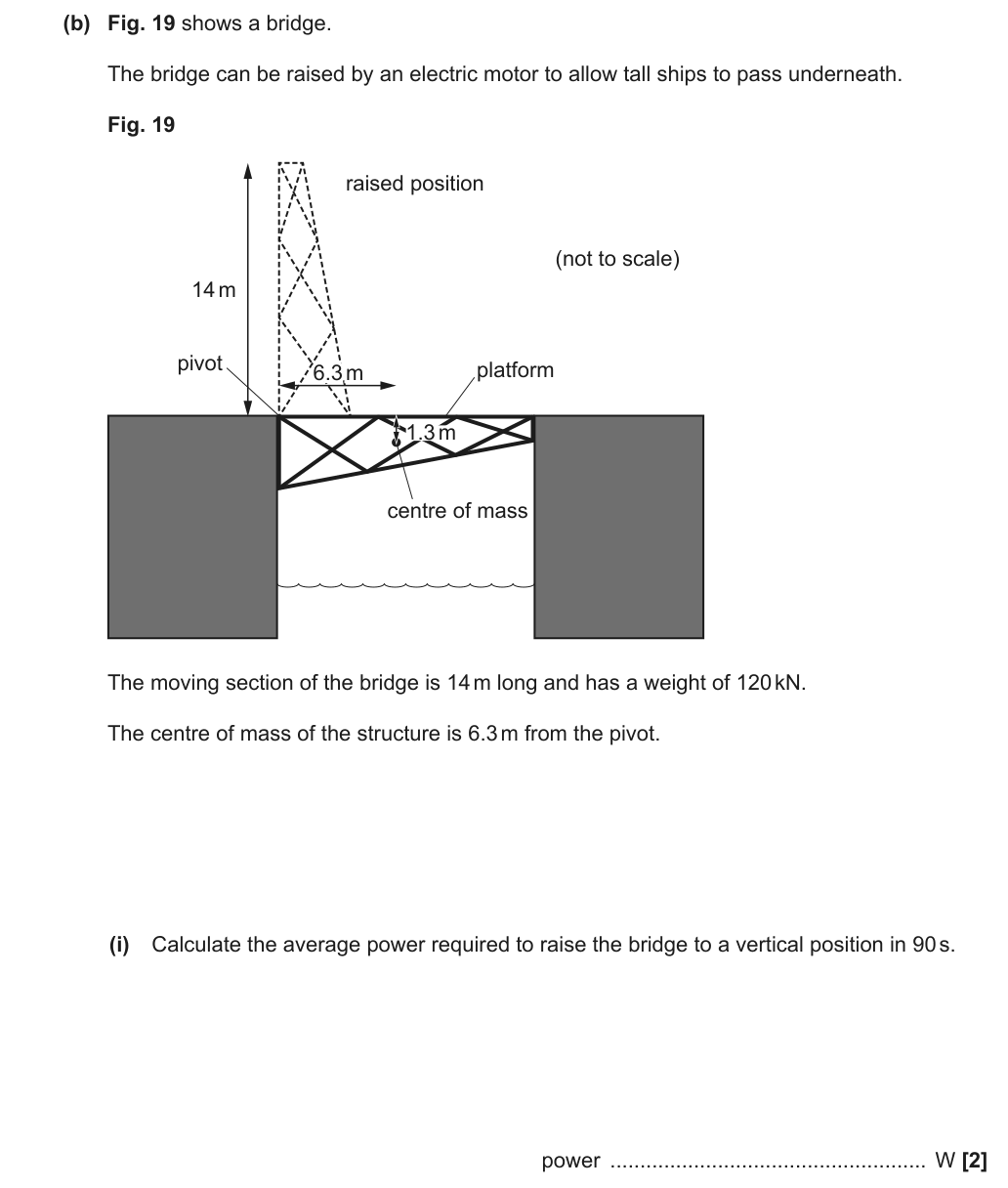
In Question 19 (b) (i), many candidates spotted the need to calculate the GPE required to raise the bridge using the relationship GPE = mgh although there was some confusion about the value of h. The centre of mass goes from a position 1.3 m below the top of the grey boxes to a position 6.3m above those same grey boxes, making the total value of h 7.6 m. Once the candidates had calculated the GPE, the successful ones divided by the time taken to lift the platform i.e. 90 seconds. Candidates that forgot the extra 1.3 m but otherwise completed the calculation correctly scored 1 mark out of the 2 available. No other distances were given credit. In part (b) (ii), there were lots of very sensible answers, many of which gained credit.
Skills: M0.1 Recognise and make use of appropriate units in calculations; M2.3 Substitute numerical values into algebraic equations using appropriate units for physical quantities
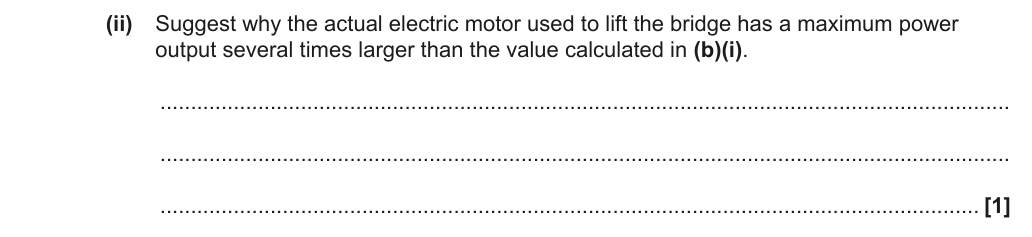
In Question 19 (b) (i), many candidates spotted the need to calculate the GPE required to raise the bridge using the relationship GPE = mgh although there was some confusion about the value of h. The centre of mass goes from a position 1.3 m below the top of the grey boxes to a position 6.3m above those same grey boxes, making the total value of h 7.6 m. Once the candidates had calculated the GPE, the successful ones divided by the time taken to lift the platform i.e. 90 seconds. Candidates that forgot the extra 1.3 m but otherwise completed the calculation correctly scored 1 mark out of the 2 available. No other distances were given credit. In part (b) (ii), there were lots of very sensible answers, many of which gained credit.
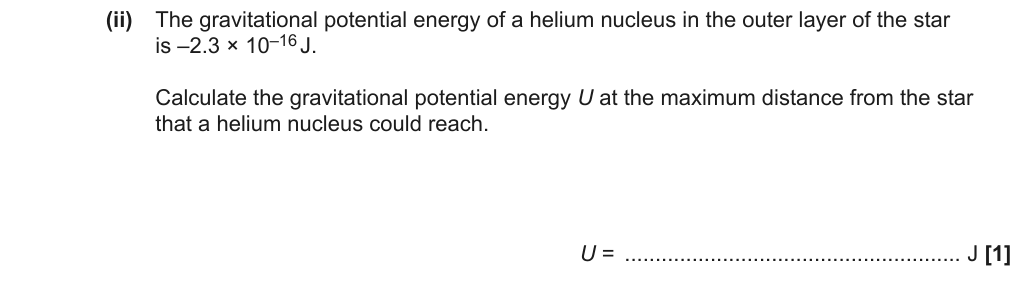
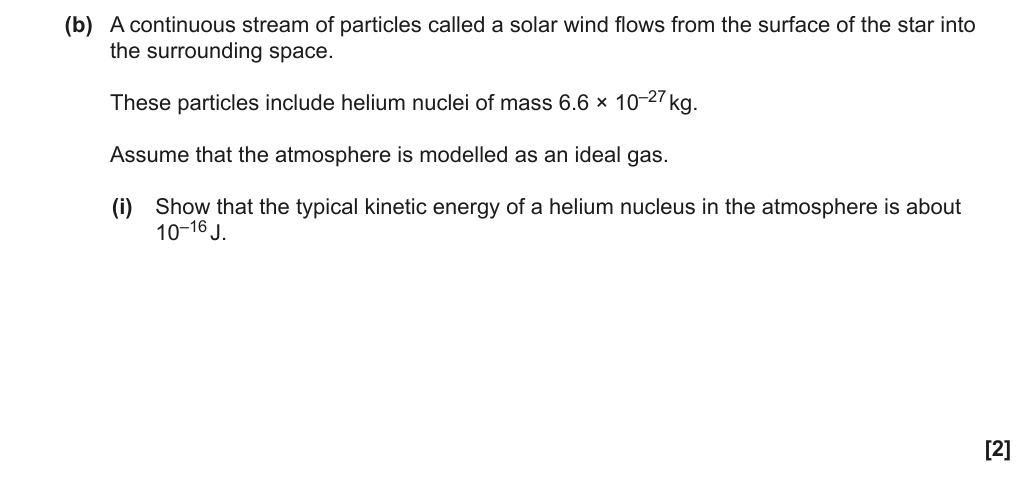
Question 23 (b) (i) Question 23 (b) (ii) Question 23 (b) (iii) Question 23 (b) (iv) Candidates answered Question 23 (b) (i) well, provided that they used the correct temperature i.e. that of the stellar atmosphere and not the surface temperature. Question 23 (b) (iv) has several acceptable responses yet the predominant correct candidate answers were that the solar wind particles might be lighter (i.e. hydrogen) or that the Maxwell-Boltzmann distribution of KE values in a gas of particles would mean that some particles would have greater than average KE.
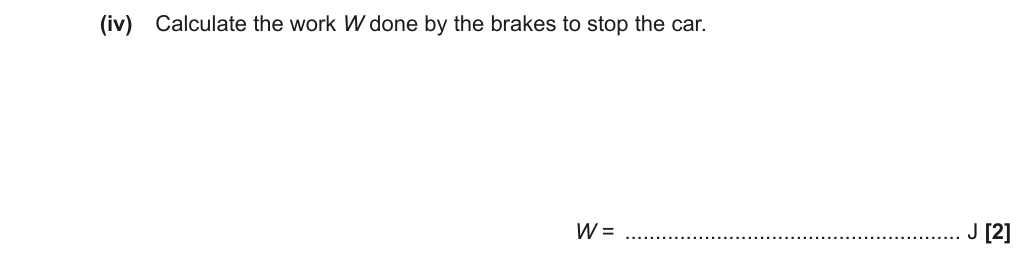
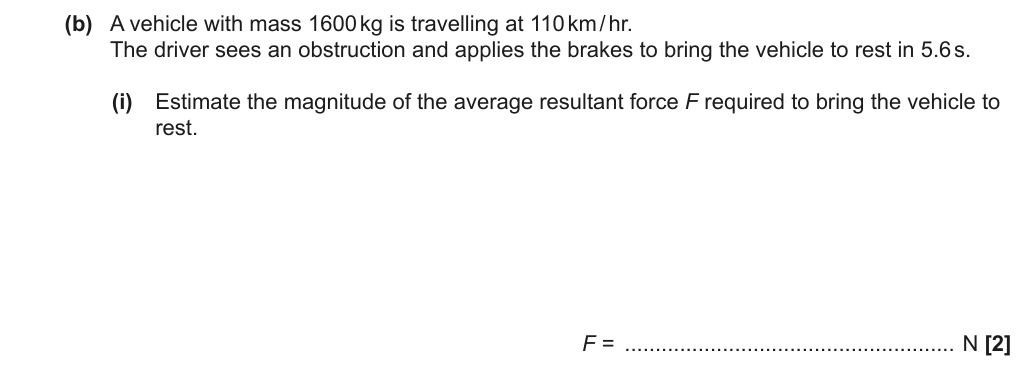
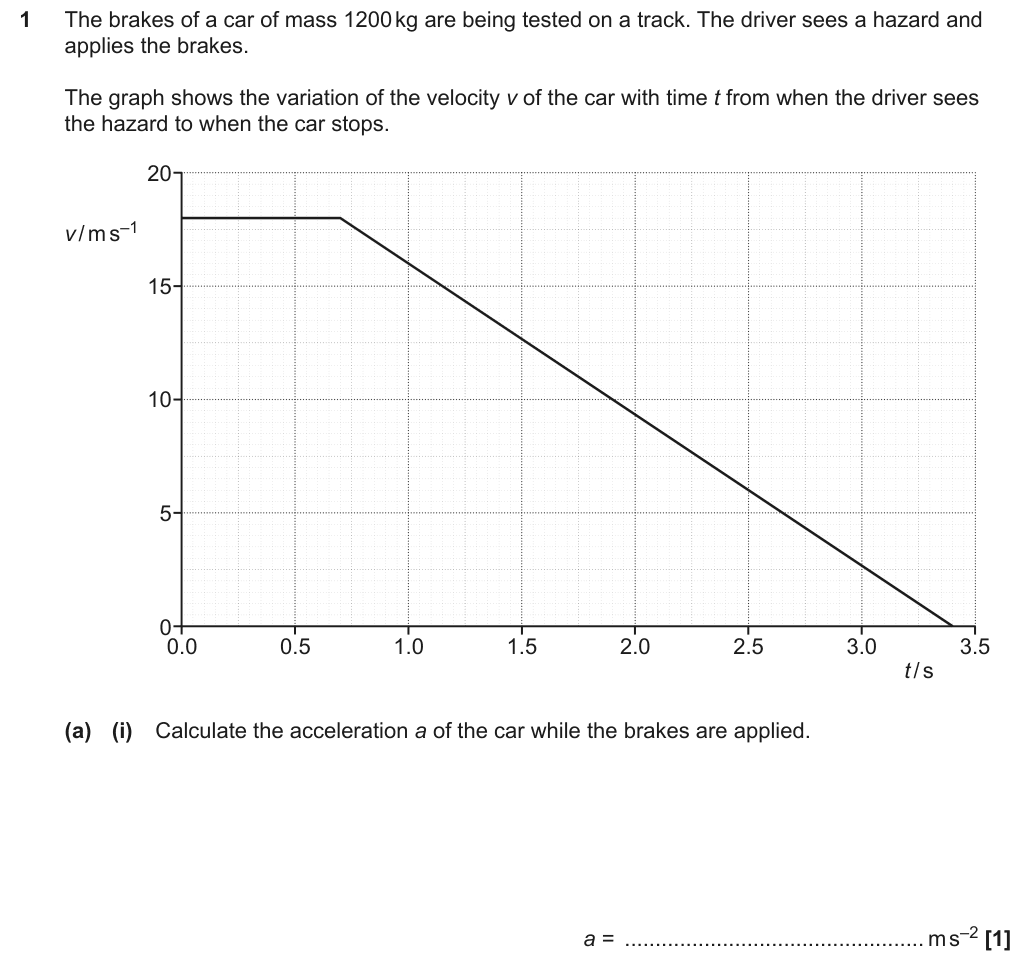
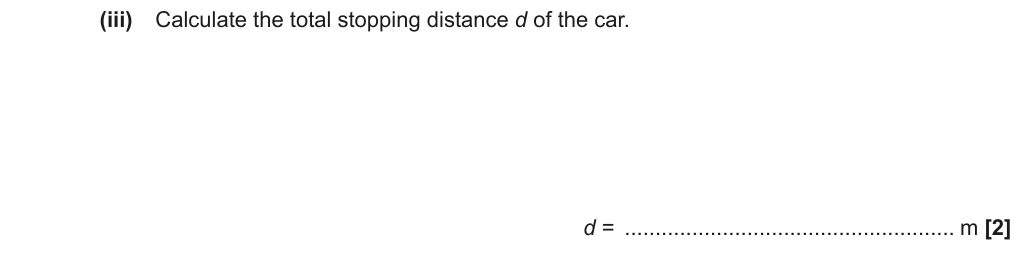
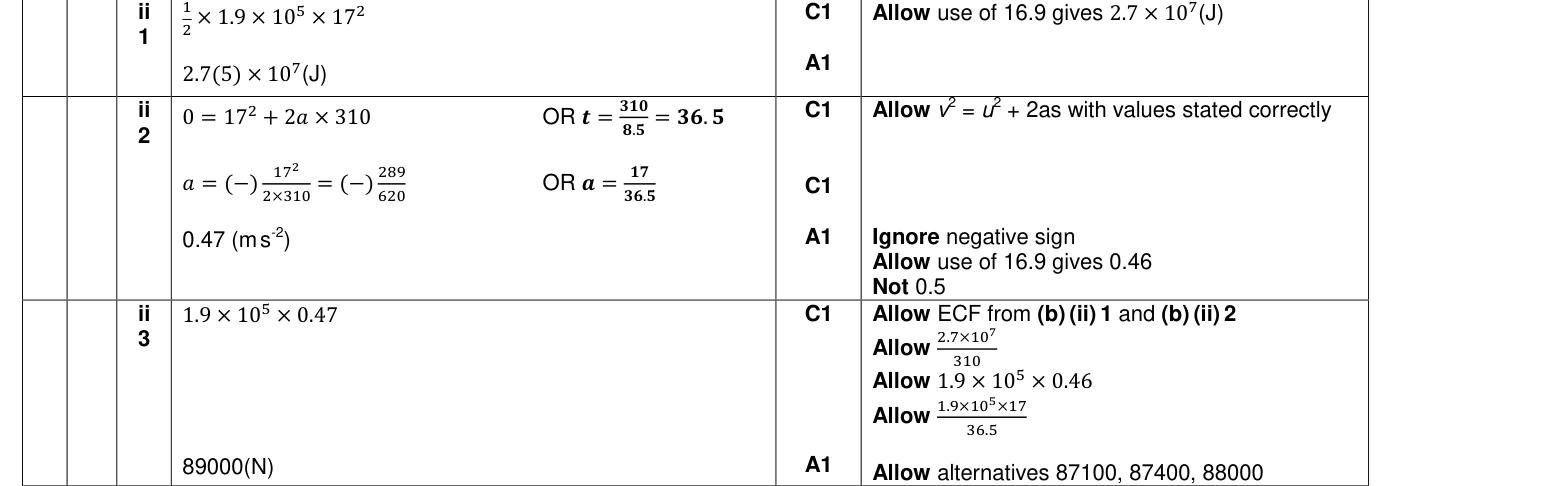
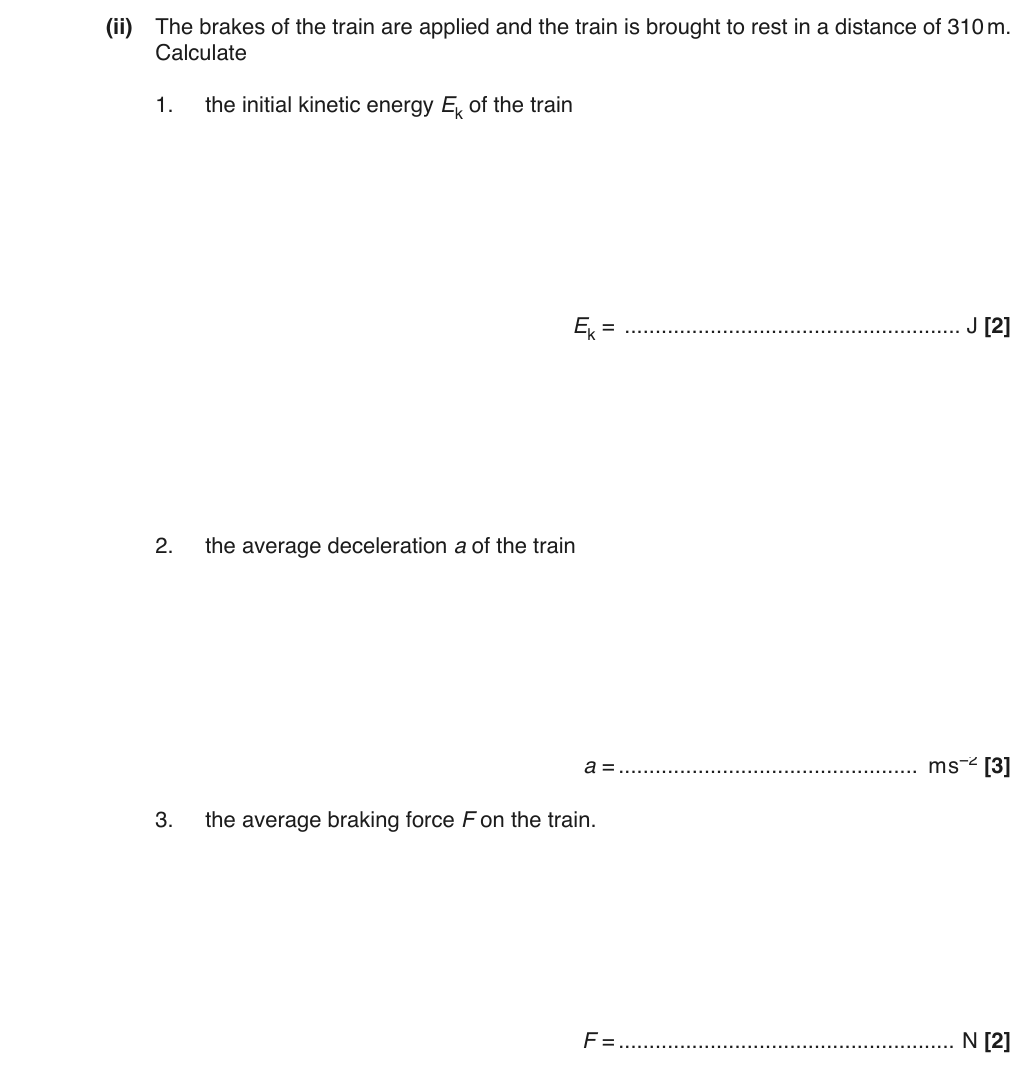
Many candidates multiplied force (from Question 1 (a) (ii)) by the braking distance. A common error was to use the stopping distance rather than the braking distance. Other candidates correctly calculated the kinetic energy. One error that was occasionally observed was the incorrect use of P = Fv.
Skills: M2.3 Substitute numerical values into algebraic equations using appropriate units for physical quantities
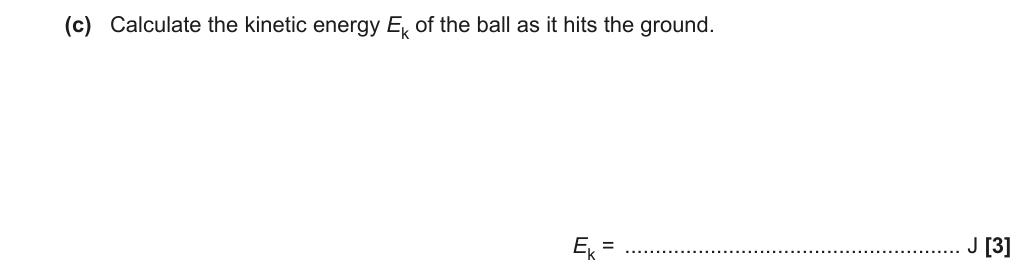
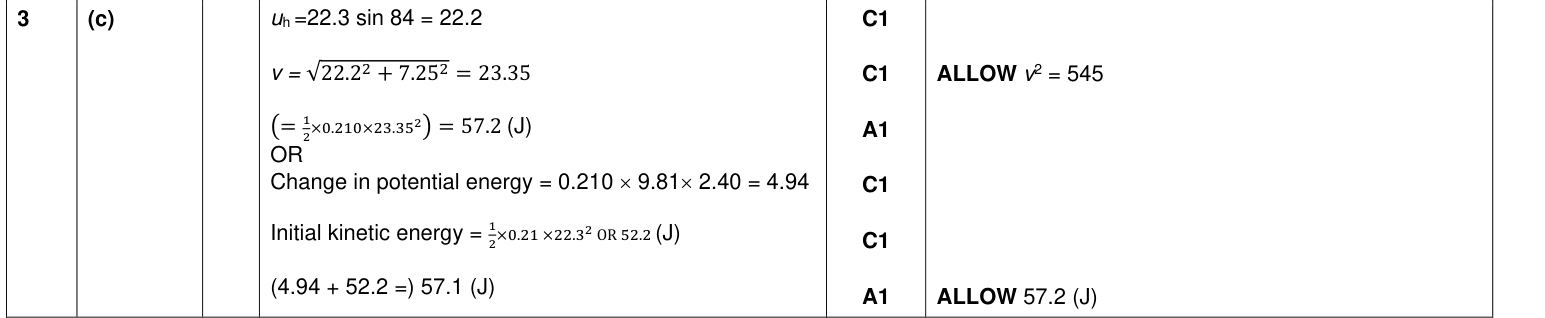
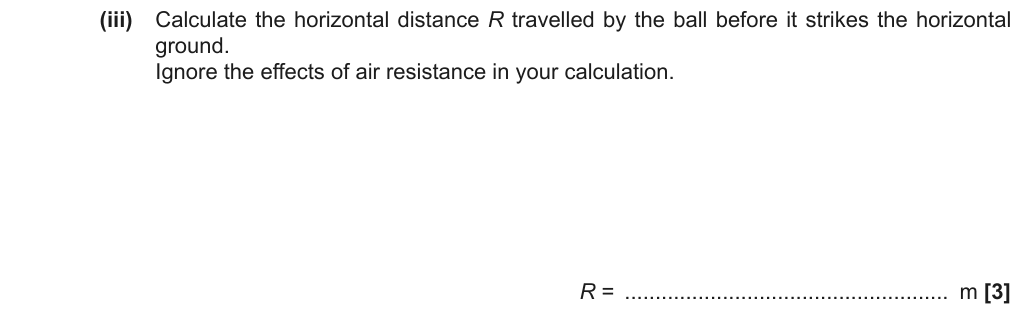
This question proved challenging to candidates. The common error was to calculate the kinetic energy using a value of 7.25 m s–1. There were two main methods of answering this question: Either: determining the horizontal component of the velocity of the ball, (which remains constant) then working out the resultant velocity of the ball as it hits the ground and then calculate the kinetic energy. Or: Calculate the change in gravitational potential energy Calculate the initial kinetic energy of the ball And then add the two values together.
Skills: M2.3 Substitute numerical values into algebraic equations using appropriate units for physical quantities; M4.4 Use Pythagoras’ theorem, and the angle sum of a triangle
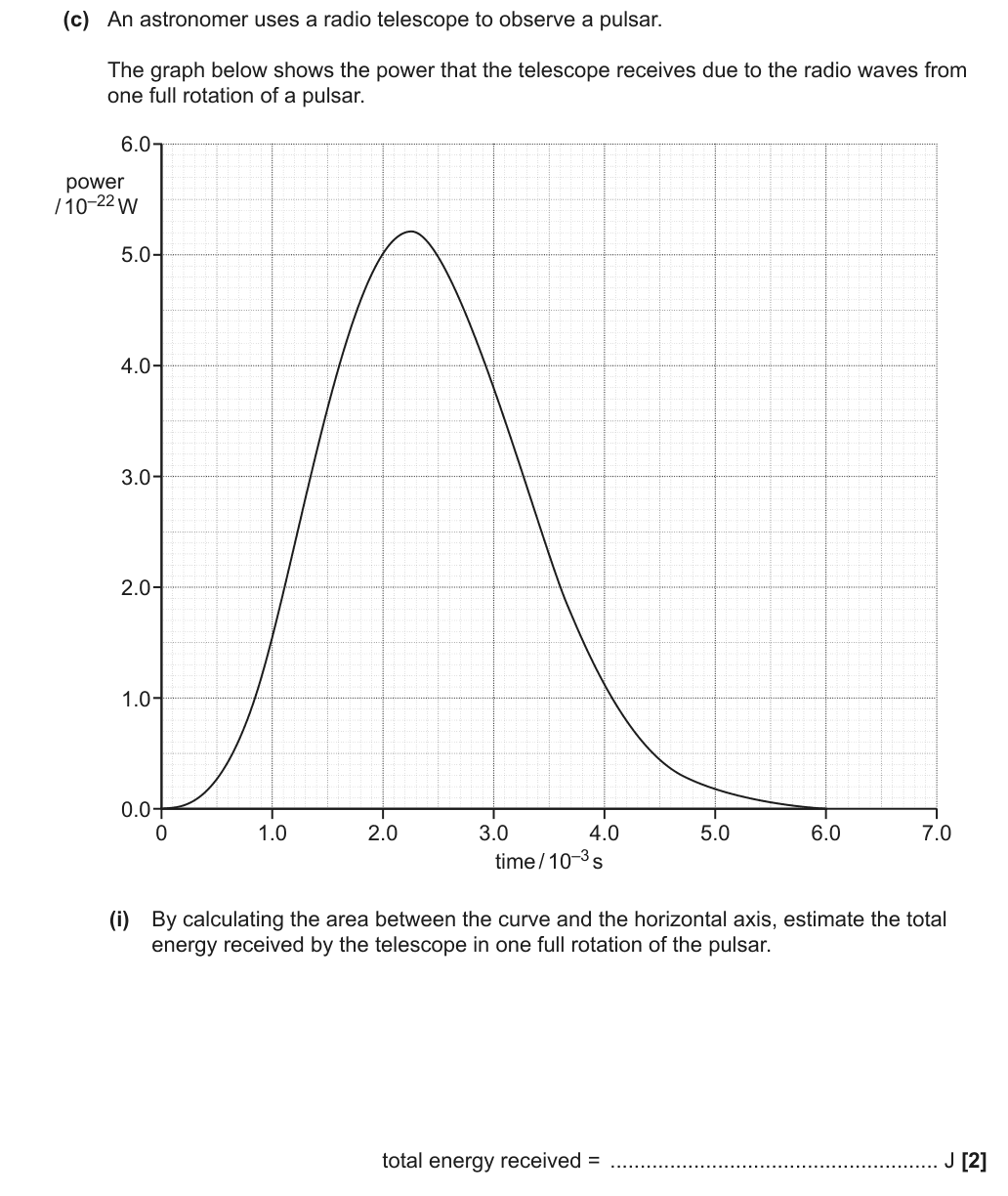
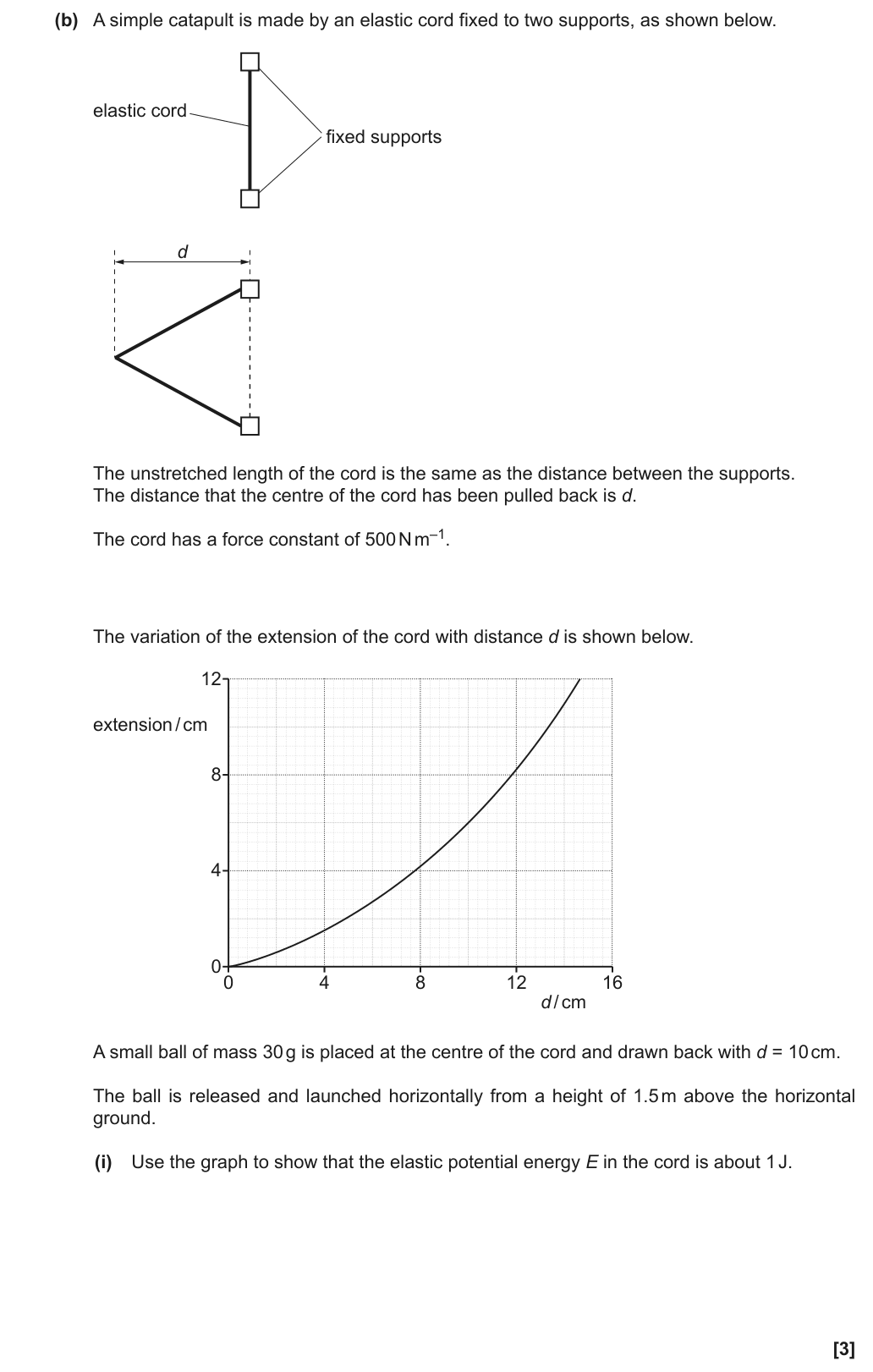
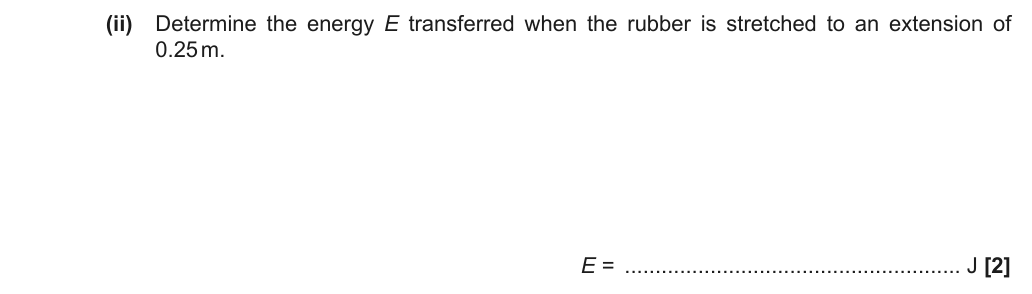
Candidates who counted squares underneath the curve almost always got areas within the allowed range. Those who tried to use trapeziums or other regular shapes were usually less successful.
Skills: M0.4 Estimate results; M3.8 Understand the possible physical significance of the area between a curve and the x axis and be able to calculate it or estimate it by graphical methods as appropriate
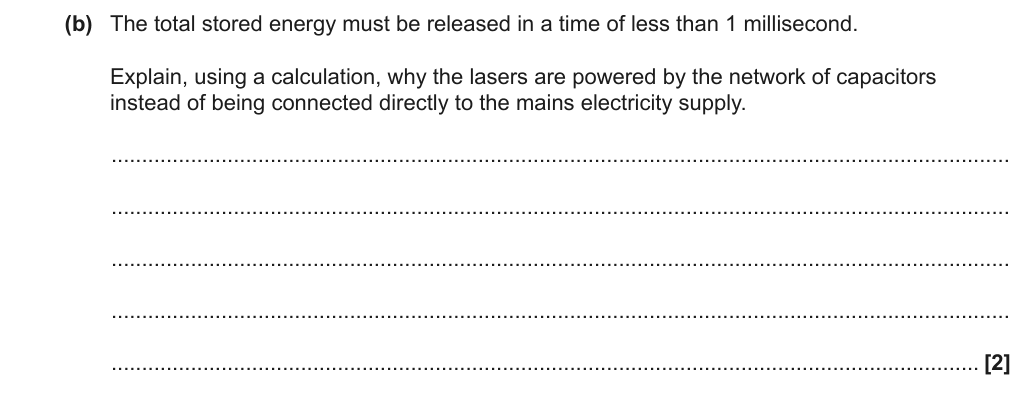
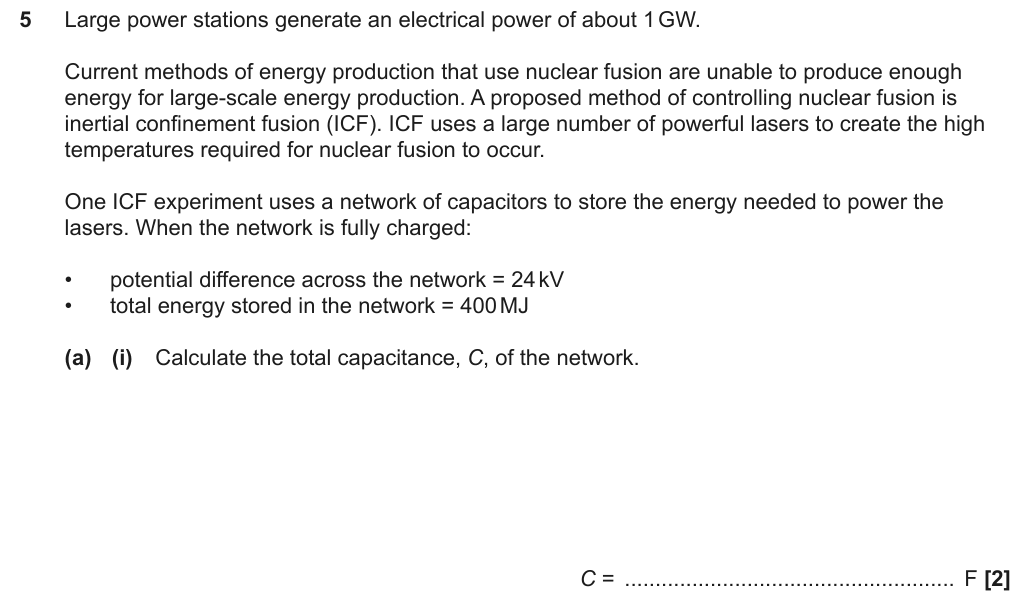
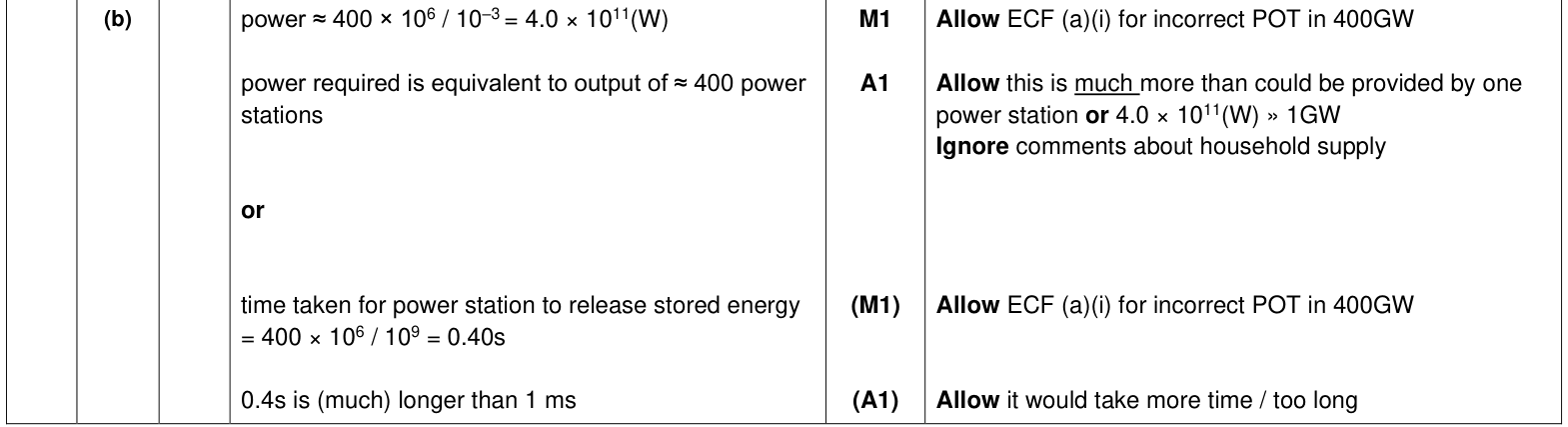
Candidates were expected to link the power output of a conventional power station (1GW) given at the start of the question to the power requirement of the fusion reactor (400 MJ in less than 1 ms). Alternative approaches which received credit were finding the energy supplied by a conventional power station in 1 ms, or calculating the time required for a conventional power station to release 400 MJ. A common incorrect approach involved attempting to calculate the time constant of a capacitor. Many candidates disregarded the instruction to use a calculation in their response and thus were unable to earn any marks despite a good understanding of the problem.
Skills: M0.1 Recognise and make use of appropriate units in calculations; M1.4 Make order of magnitude calculations
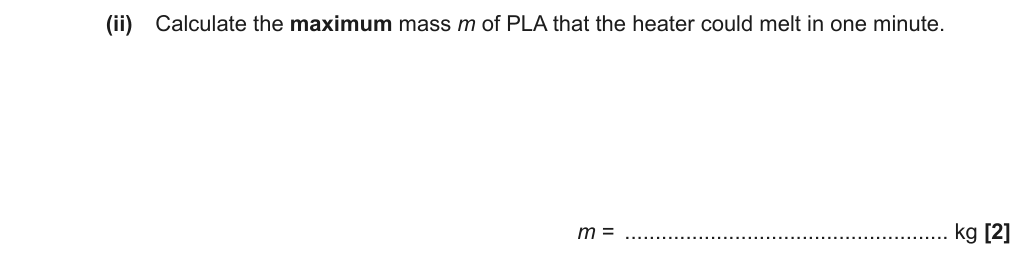
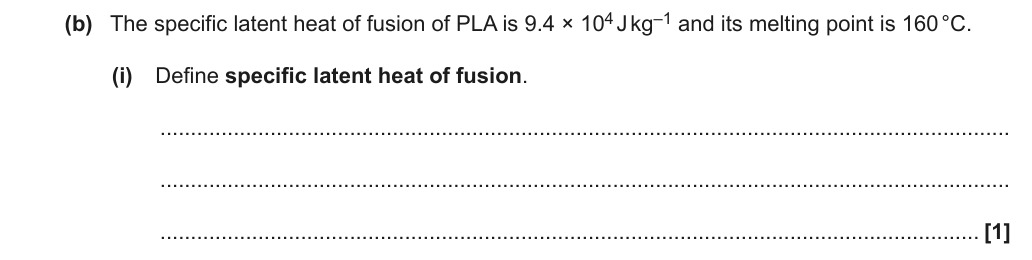
This question was well answered by most candidates. However, some tried to use E = mcΔθ with Δθ = 160 °C and a few gave their answer to only 1 sf.
Skills: M0.1 Recognise and make use of appropriate units in calculations; M2.2 Change the subject of an equation, including non-linear equations
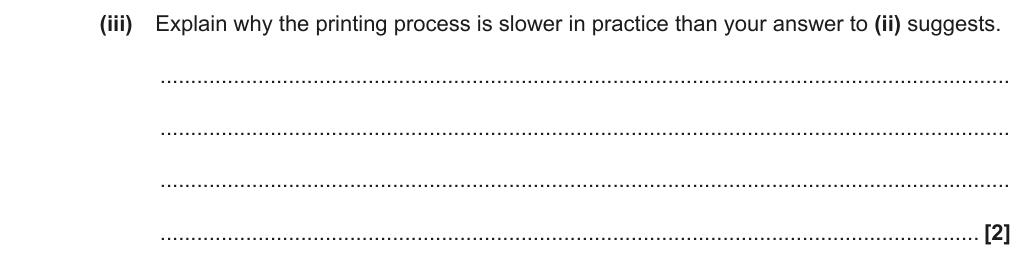
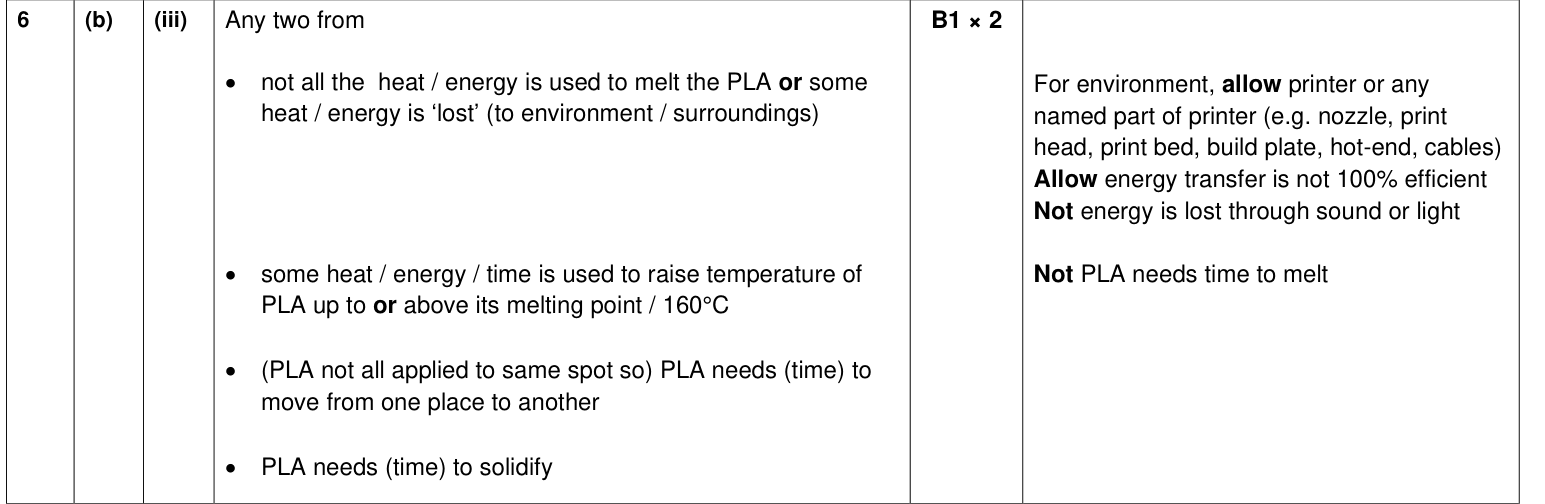
The most common correct response related to energy dissipated to the surroundings. A smaller number of correct responses mentioned that energy was needed to raise the temperature to melting point. Some candidates incorrectly referred to energy used for other parts of the system (e.g. motors to drive the mechanism) which was not relevant to the question.
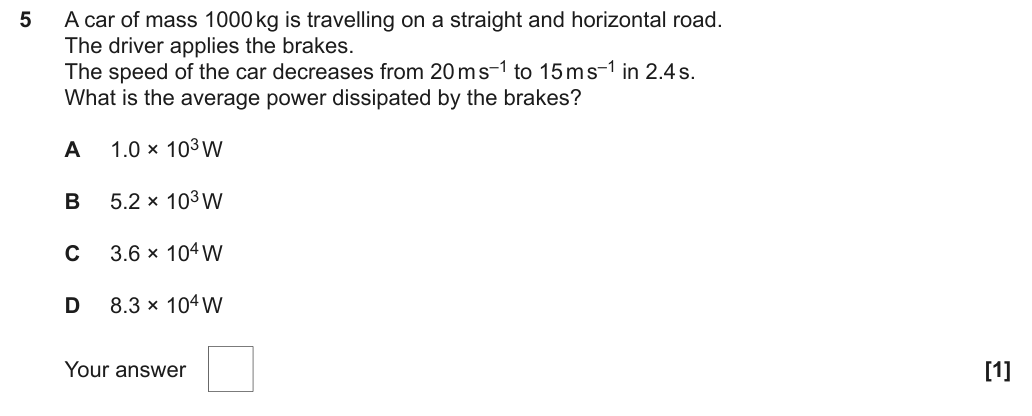
C
Candidates did not perform as well on this question with just a small majority of candidates calculating the correct answer C. If candidates did show working out it was evident that they understood that power = energy / time but they did not calculate the difference in kinetic energy to calculate the power dissipated in the time given.
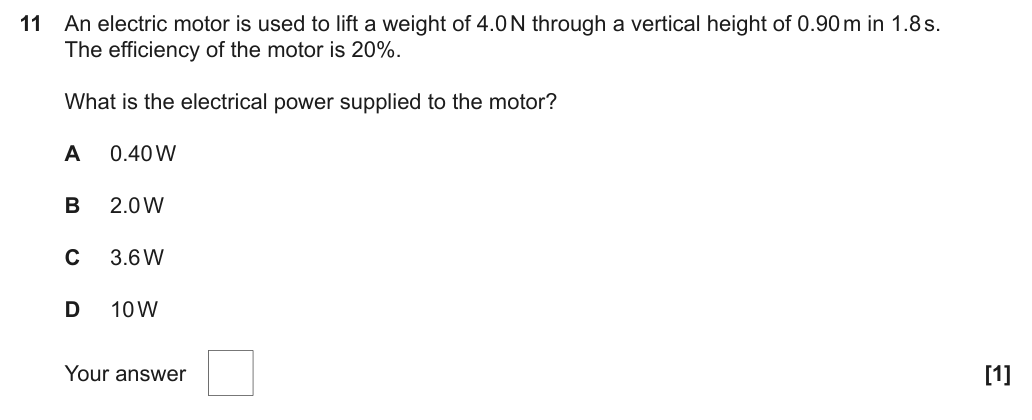
D
Only half of candidates answered this question correctly, D, with the most common distractor being answer B. This response demonstrated that they had calculated the correct work done in lifting the motor and then calculated the useful power rather than the power supplied to the motor.
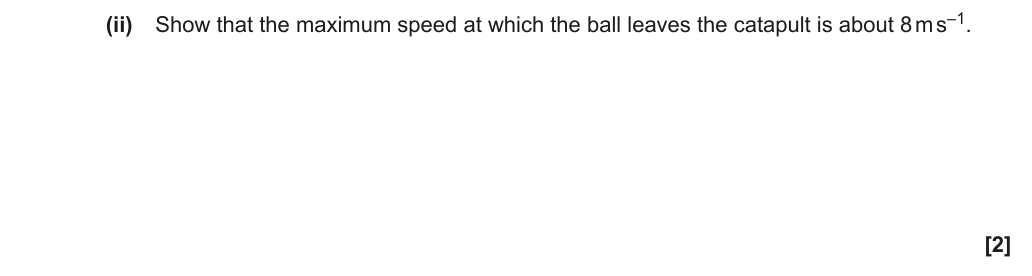
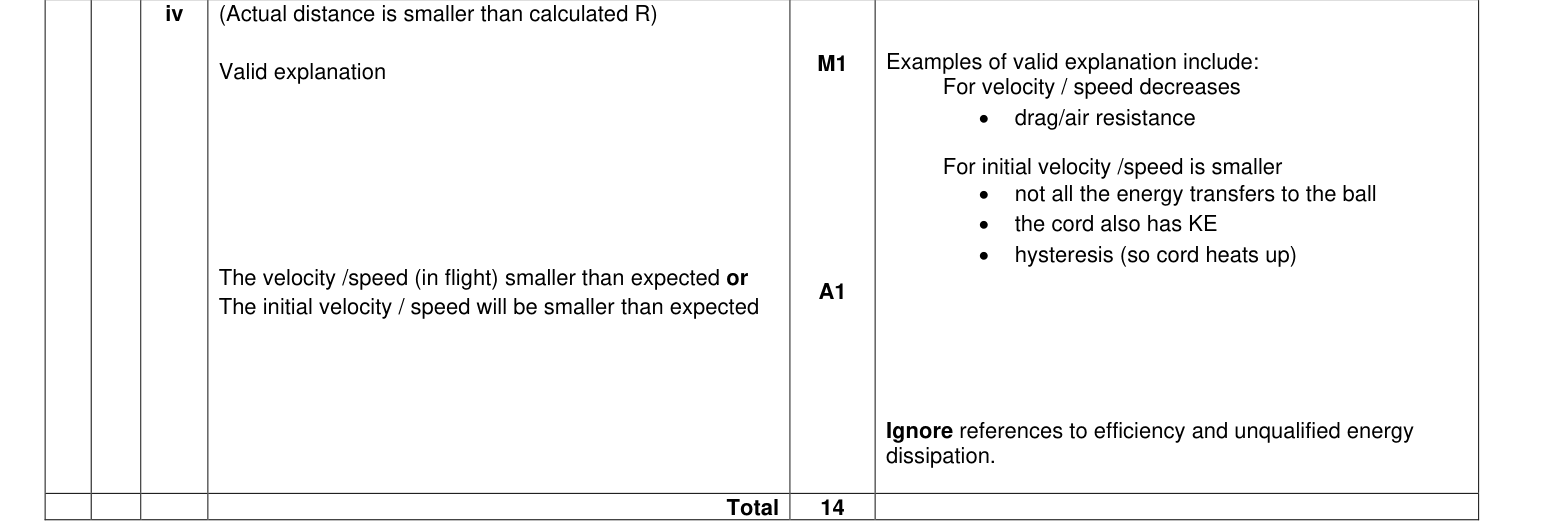
Question 16 (b) (iv) was answered well by candidates that realised the distance in real life would be less and could explain why that was the case.
Skills: M0.1 Recognise and make use of appropriate units in calculations; M2.2 Change the subject of an equation, including non-linear equations
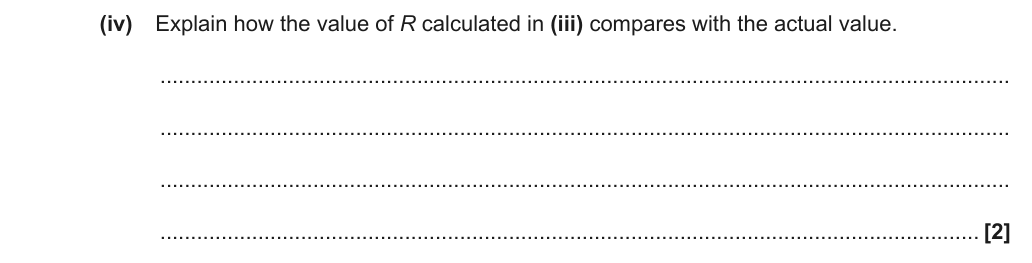
Question 16 (b) (iv) was answered well by candidates that realised the distance in real life would be less and could explain why that was the case.
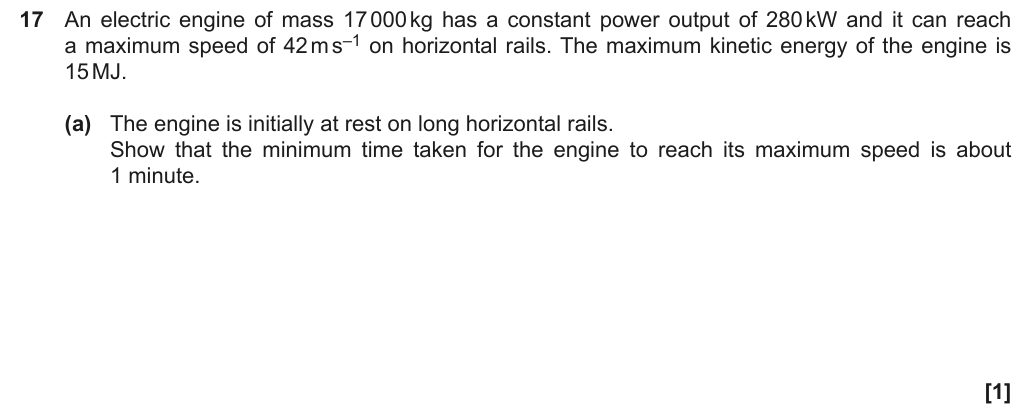
This was completed well. The mark was lost by those, generally, that did not round their answer correctly.
Skills: M0.1 Recognise and make use of appropriate units in calculations; M2.2 Change the subject of an equation, including non-linear equations
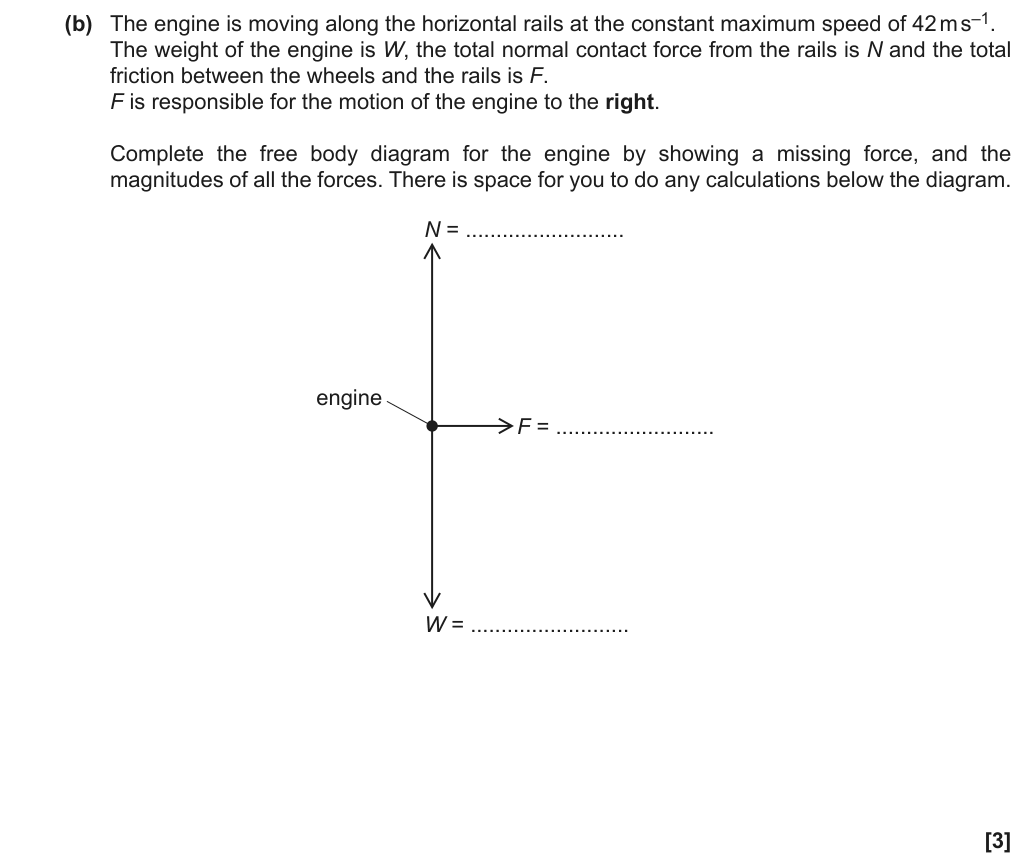
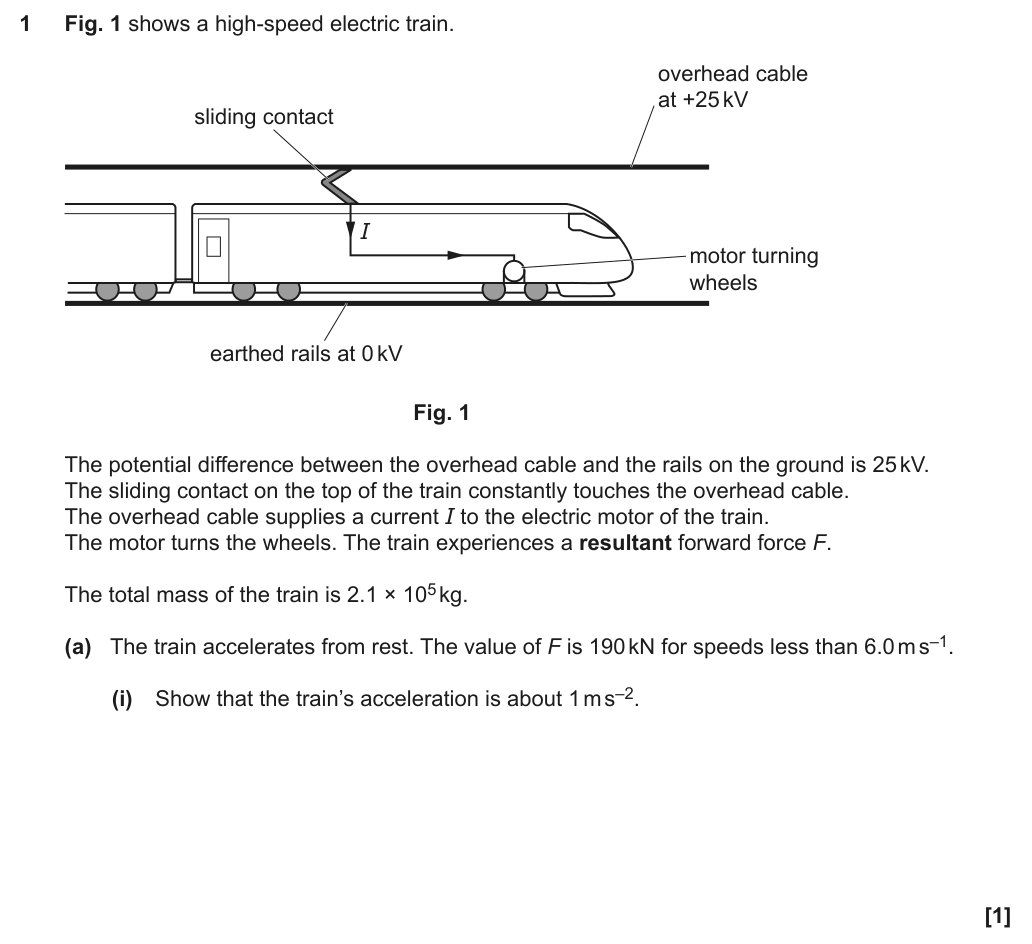
This question was answered well, in part. Candidates found the weight of the engine with ease, broadly. The force F, being the value of the power divided by the velocity was less well calculated. Most candidates realised that this object was in equilibrium and so that there should be a force to the left of equal magnitude to force F. This is an example of a frictional force causing an acceleration. The friction force on the rails is to the left. By Newton’s 3rd Law, the friction force on the engine from the rails must therefore be to the right. The force to the left is a drag force, causing equilibrium.
Skills: M2.2 Change the subject of an equation, including non-linear equations
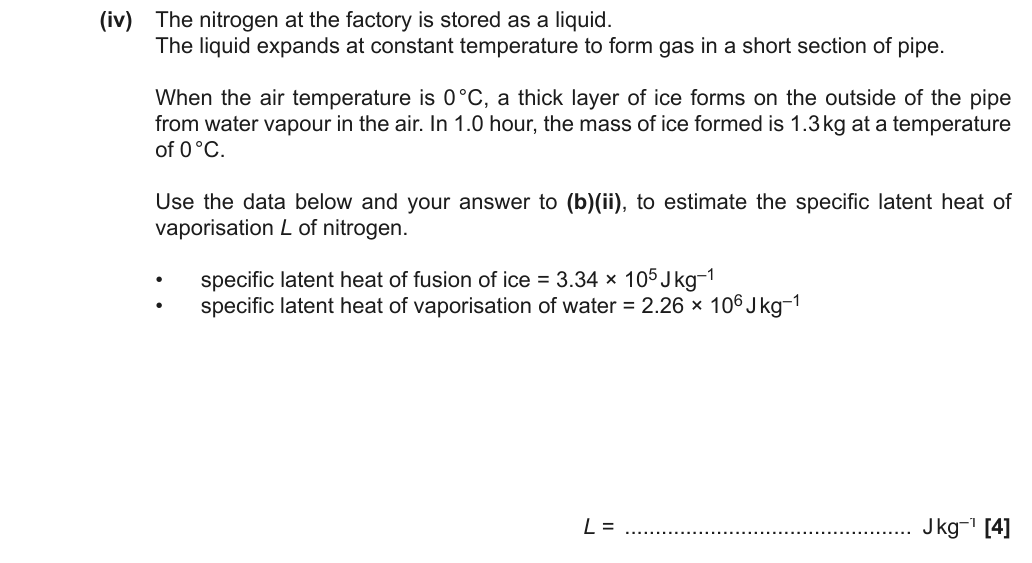
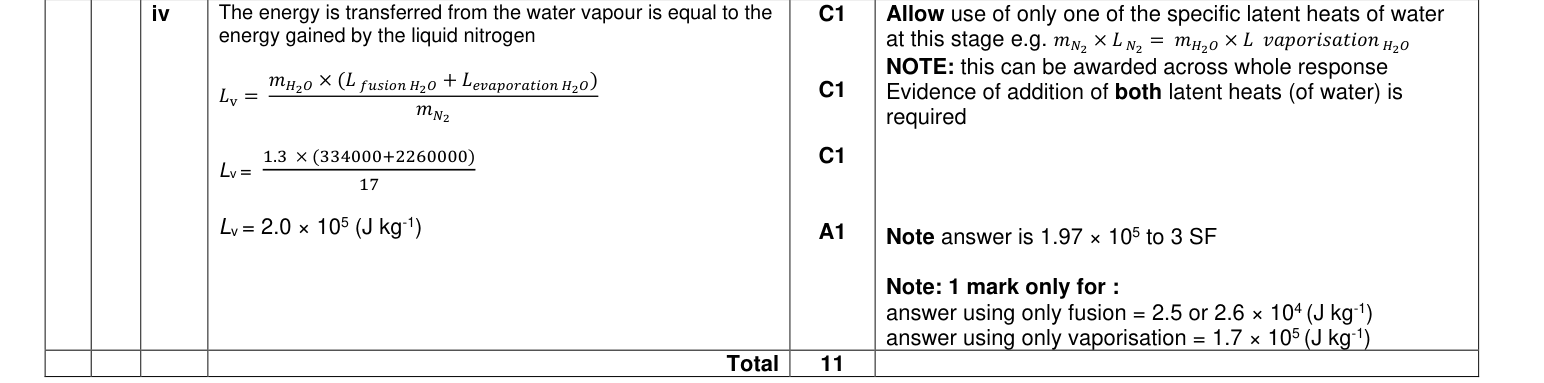
Most candidates calculated the energy loss for either the vapour to liquid change or the liquid to ice change for the water. A minority realised that the correct approach was to add these two energy changes before dividing by the mass of the nitrogen. This candidate has set out the calculation very carefully, with a diagram in the top left to help their thinking. They have calculated the energy loss required to condense the vapour to liquid water and also the energy loss required to freeze the water to ice. These calculations are done on separate lines yet one after the other. This total energy loss must be equal to the total energy gained by the nitrogen when turning from liquid to gas.
Skills: M0.2 Recognise and use expressions in decimal and standard form; M2.2 Change the subject of an equation, including non-linear equations; M2.3 Substitute numerical values into algebraic equations using appropriate units for physical quantities

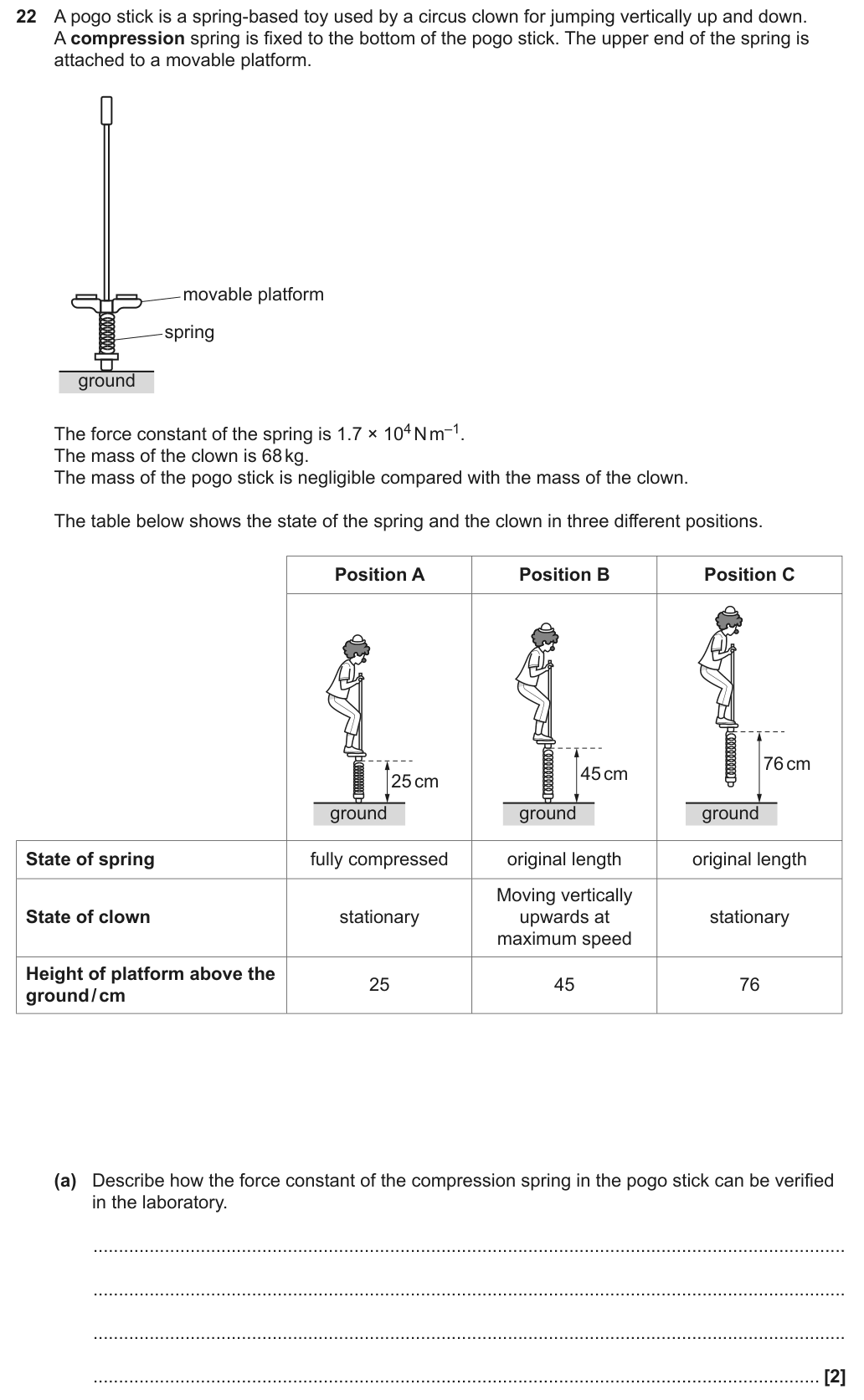
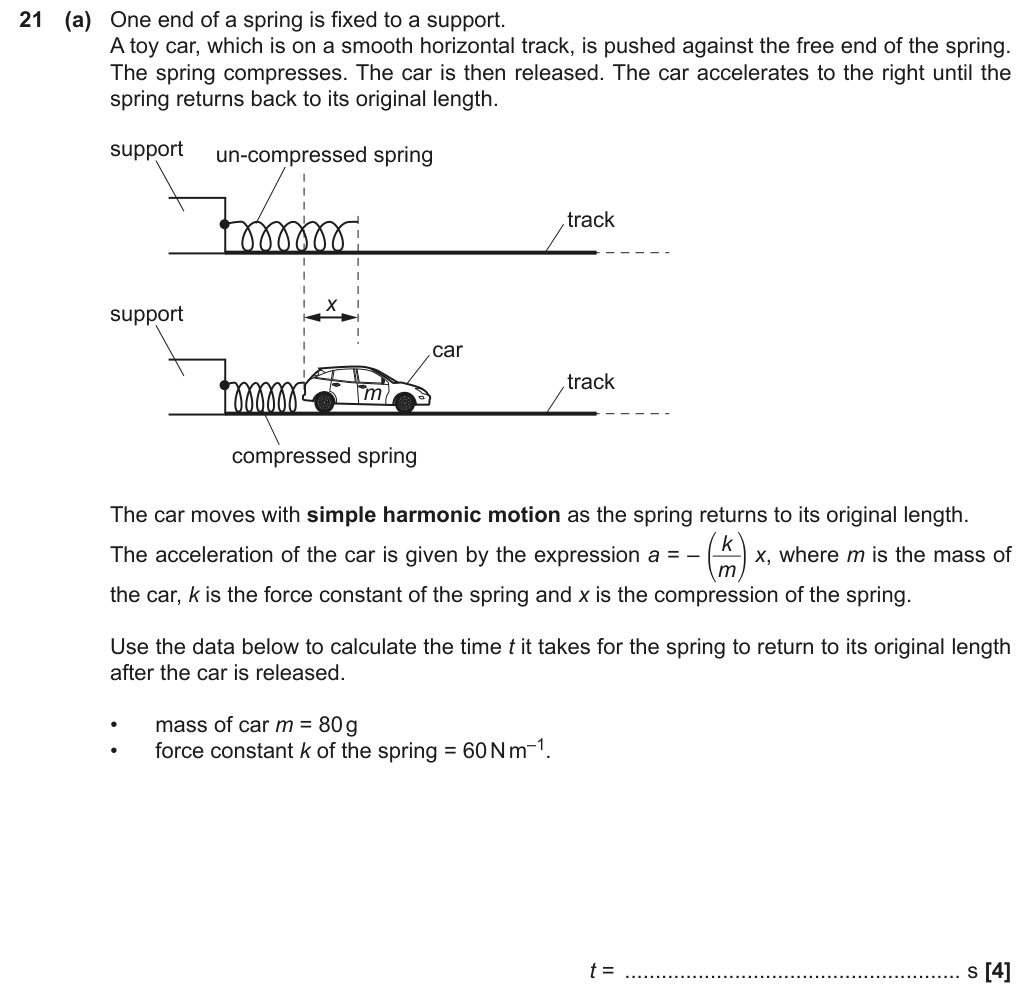
Only half of candidates answered this question correctly by recognising that when the spring was at position B the spring had returned to its original length and hence had no store of elastic potential energy. Often, candidates described the energy changes at A, B and C but were not explicit in identifying the position of the spring, so it was assumed that responses described positions B and C and hence no marks were given. Candidates must be specific in their responses so there is no ambiguity in their understanding of the question.
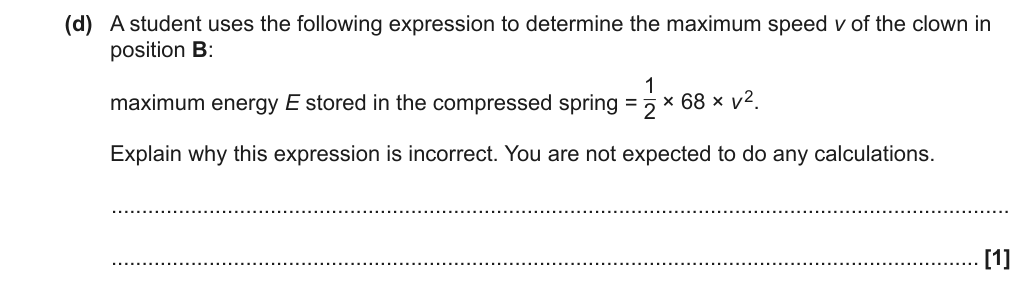
Only about 10% of candidates accessed this question correctly to be given 1 mark for responses describing energy transfers to the gravitational potential energy store of the spring. Most responses described energy transfers as energy losses to increase the thermal store of the surroundings.

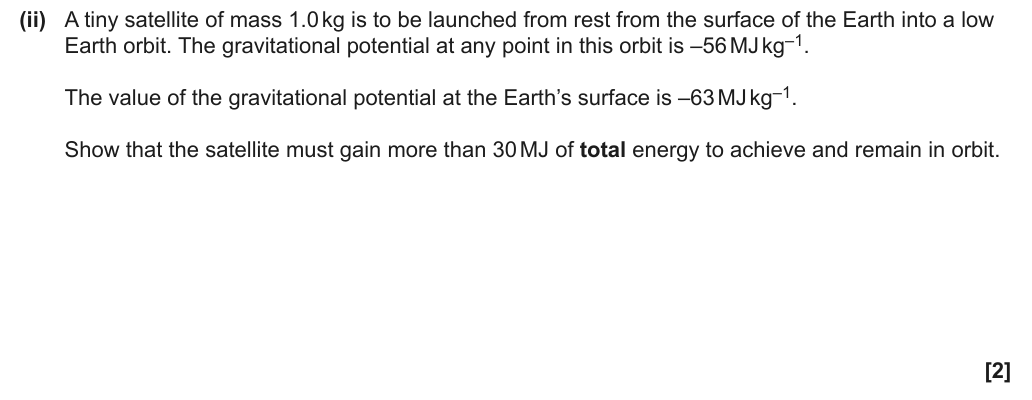
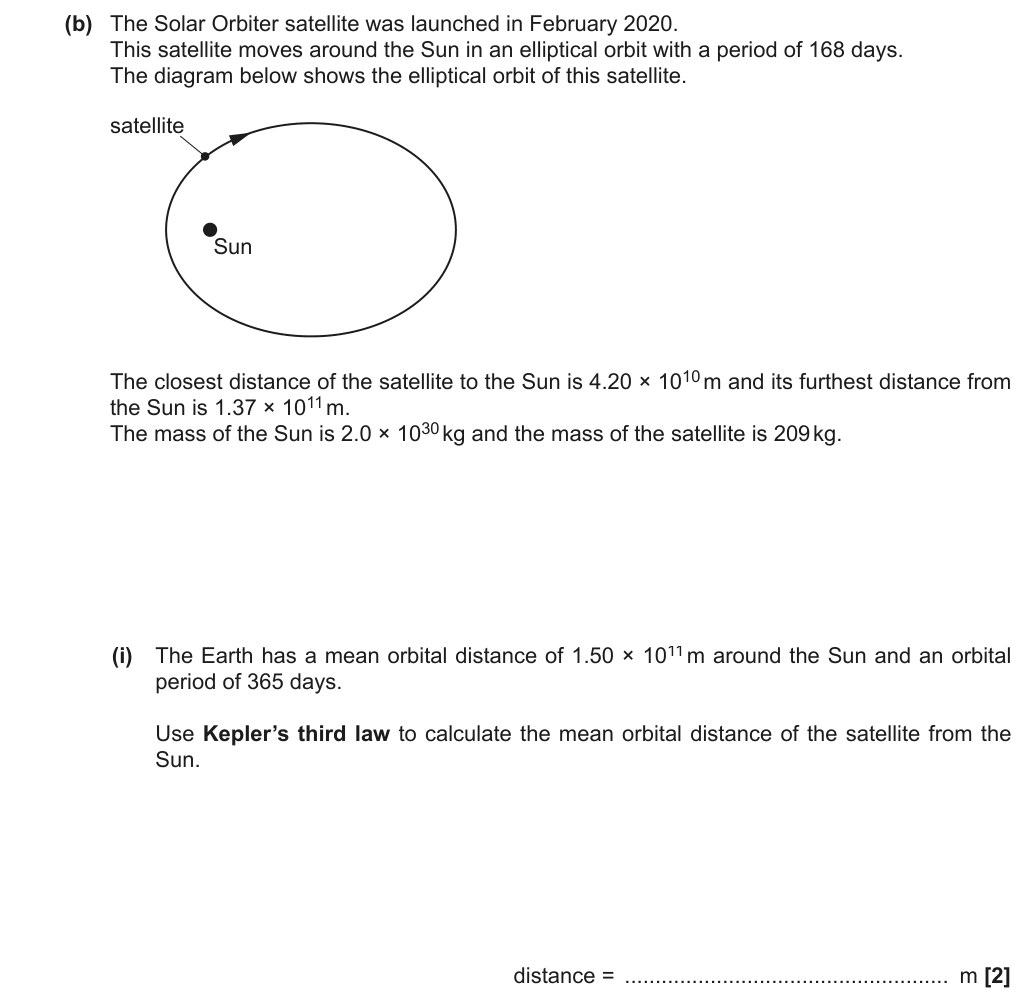
This question provides one of the ‘stretch and challenge’ marks in this paper. The idea is that the satellite needs first to climb out of the Earth’s gravitational well before it can be a satellite of the Sun. If any of your students’ results are not as expected, you may wish to consider one of our post-results services. For full information about the options available visit the OCR website. We send a weekly roundup to tell you about important updates. You can also sign up for your subject specific updates. If you haven’t already, sign up here. Attend one of our popular CPD courses to hear directly from a senior assessor or drop in to a Q&A session. Most of our courses are delivered live via an online platform, so you can attend from any location. Please find details for all our courses on the relevant subject page on our website or visit OCR professional development. ExamBuilder is the question builder platform for a range of our GCSE, A Level, Cambridge Nationals and Cambridge Technicals qualifications. Find out more. ExamBuilder is free for all OCR centres with an Interchange account and gives you unlimited users per centre. We need an Interchange username to validate the identity of your centre's first user account for ExamBuilder. If you do not have an Interchange account please contact your centre administrator (usually the Exams Officer) to request a username, or nominate an existing Interchange user in your department. Review students' exam performance with our free online results analysis tool. It is available for all GCSEs, AS and A Levels and Cambridge Nationals. It allows you to: • review and run analysis reports on exam performance • analyse results at question and/or topic level • compare your centre with OCR national averages • identify trends across the centre • facilitate effective planning and delivery of courses • identify areas of the curriculum where students excel or struggle • help pinpoint strengths and weaknesses of students and teaching departments. Find out more. Post-results services Keep up-to-date OCR Professional Development Signed up for ExamBuilder?
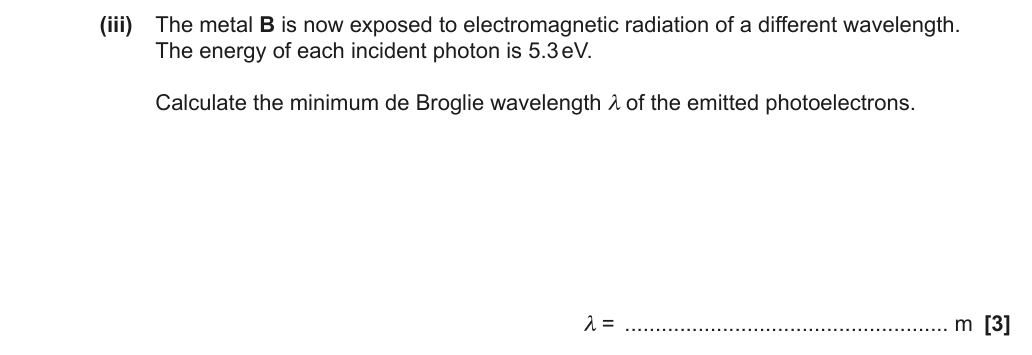
Most candidates were able to convert eV to J but did not correctly use this to calculate the velocity of the photoelectrons as they did not apply the formula λ = h/p to calculate the momentum. Only a few candidates correctly applied both formulae hf = φ + KEmax and λ = h/p to calculate the de Broglie wavelength. This response demonstrates a lack of understanding of the photoelectric effect and use and application of the formula hf = φ + KEmax. Candidates have selected the correct formula to calculate the de Broglie wavelength and have converted eV to J but have not understood that p is required to be calculated using v from the correct KE.
Skills: M0.2 Recognise and use expressions in decimal and standard form; M2.2 Change the subject of an equation, including non-linear equations; M2.3 Substitute numerical values into algebraic equations using appropriate units for physical quantities
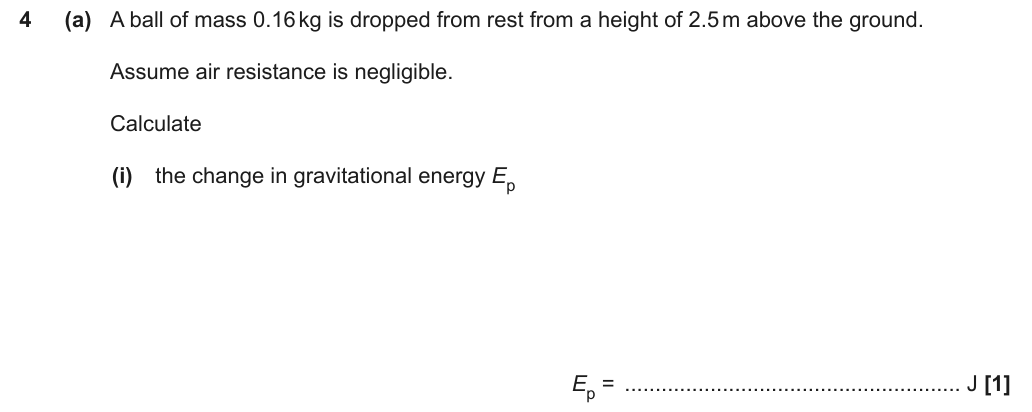
This question was generally answered well.
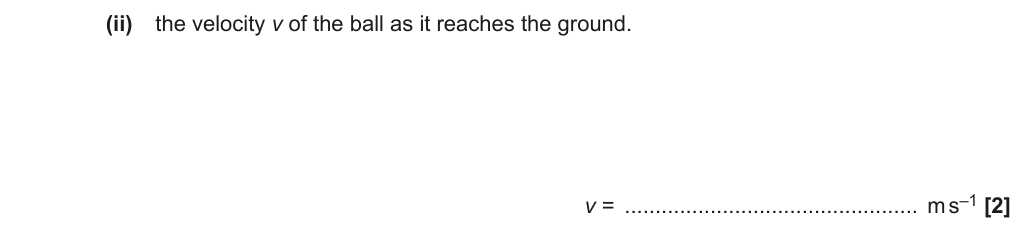
Most candidates correctly equated the change in gravitational potential energy to kinetic energy and gained the correct answer. Other candidates correctly used v2 = 2 gh. A number of candidates gave the answer as 7 (m s-1) – since the data in the question was given to two significant figures the answers should also be given to two significant figures. Ideally the substitution of data into appropriate equations should be shown.
Skills: M2.2 Change the subject of an equation, including non-linear equations; M2.3 Substitute numerical values into algebraic equations using appropriate units for physical quantities
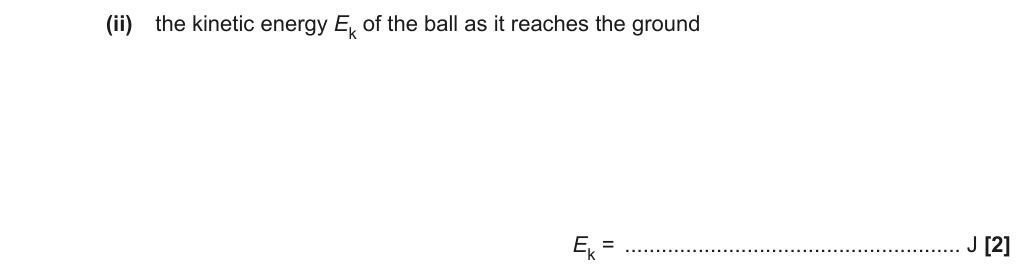
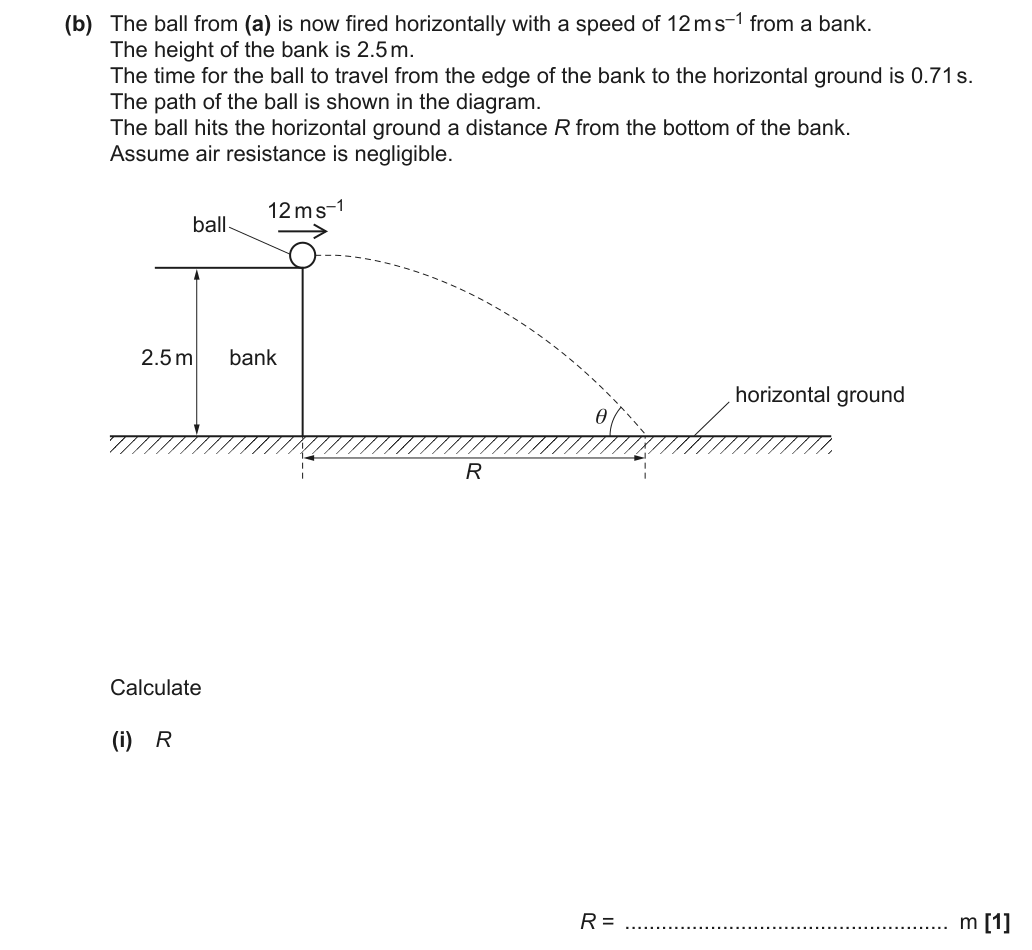
Many candidates calculated the kinetic energy of the ball using the velocity of the ball in the horizontal direction but then did not add the change in potential energy of the ball as it fell. Other candidates determined the resultant velocity of the ball and then calculated the kinetic energy.
Skills: M2.3 Substitute numerical values into algebraic equations using appropriate units for physical quantities
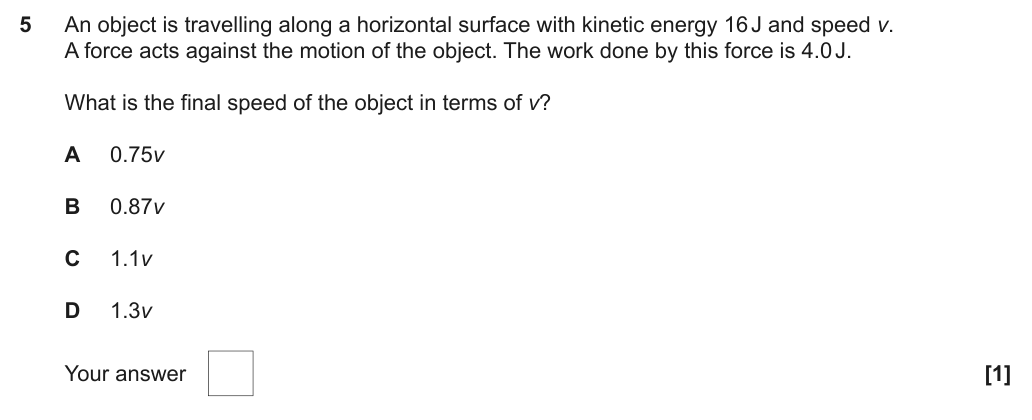
B
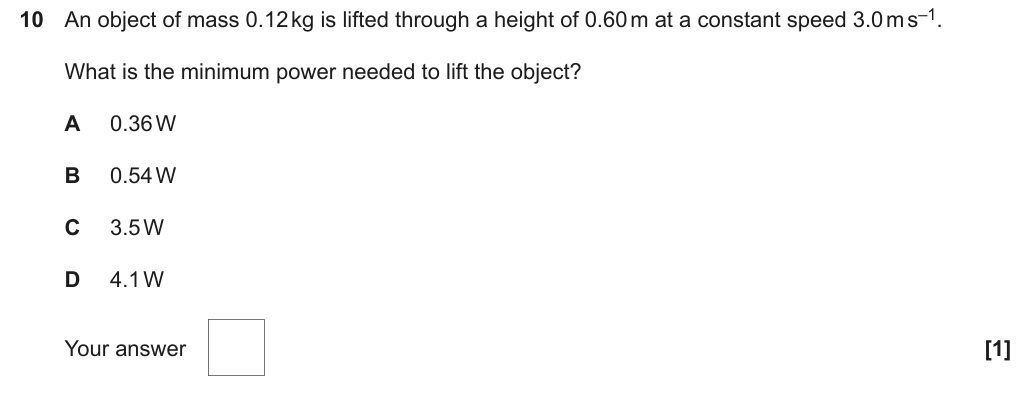
C
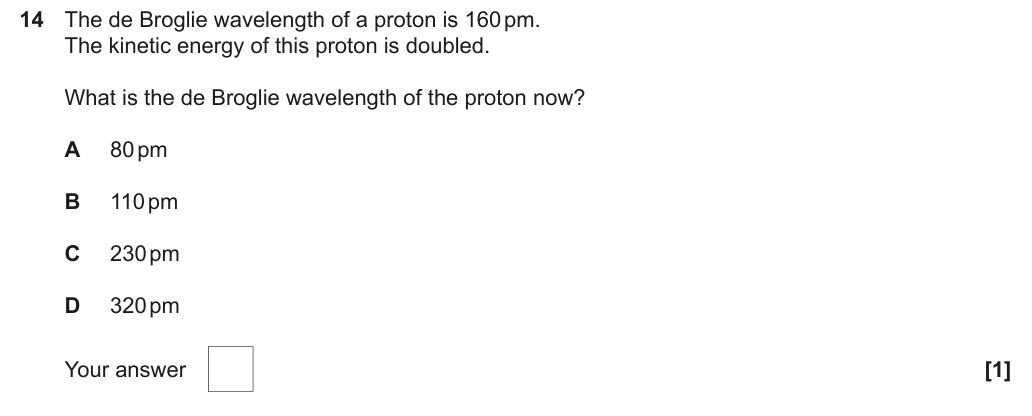
B
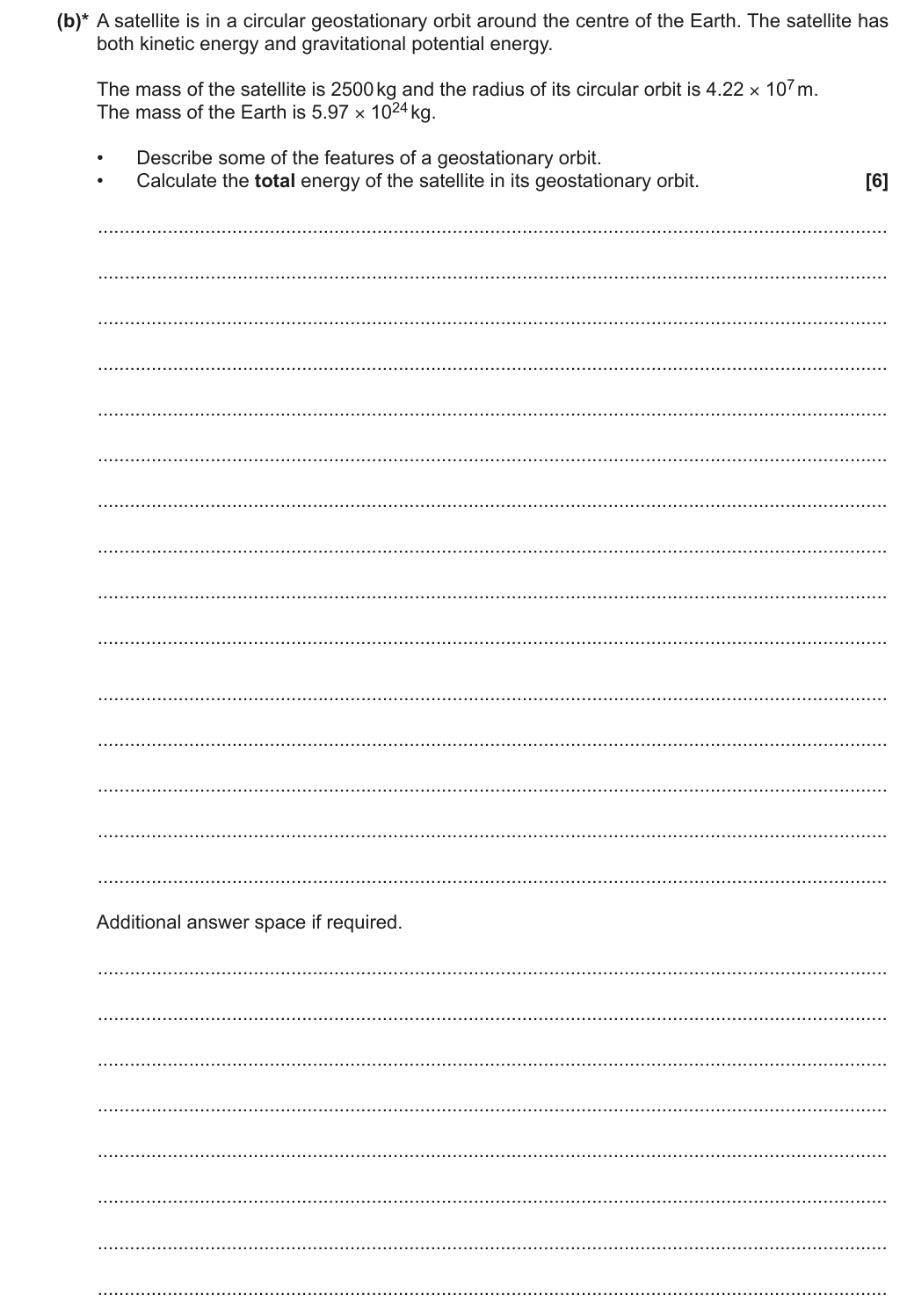
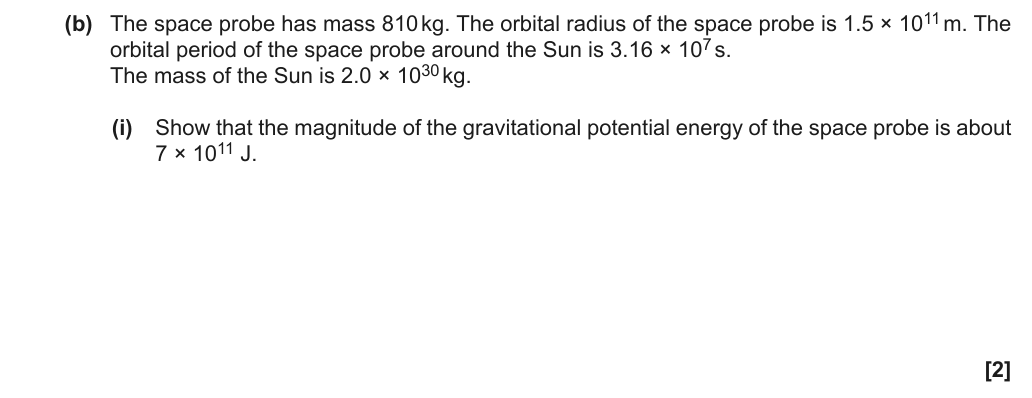
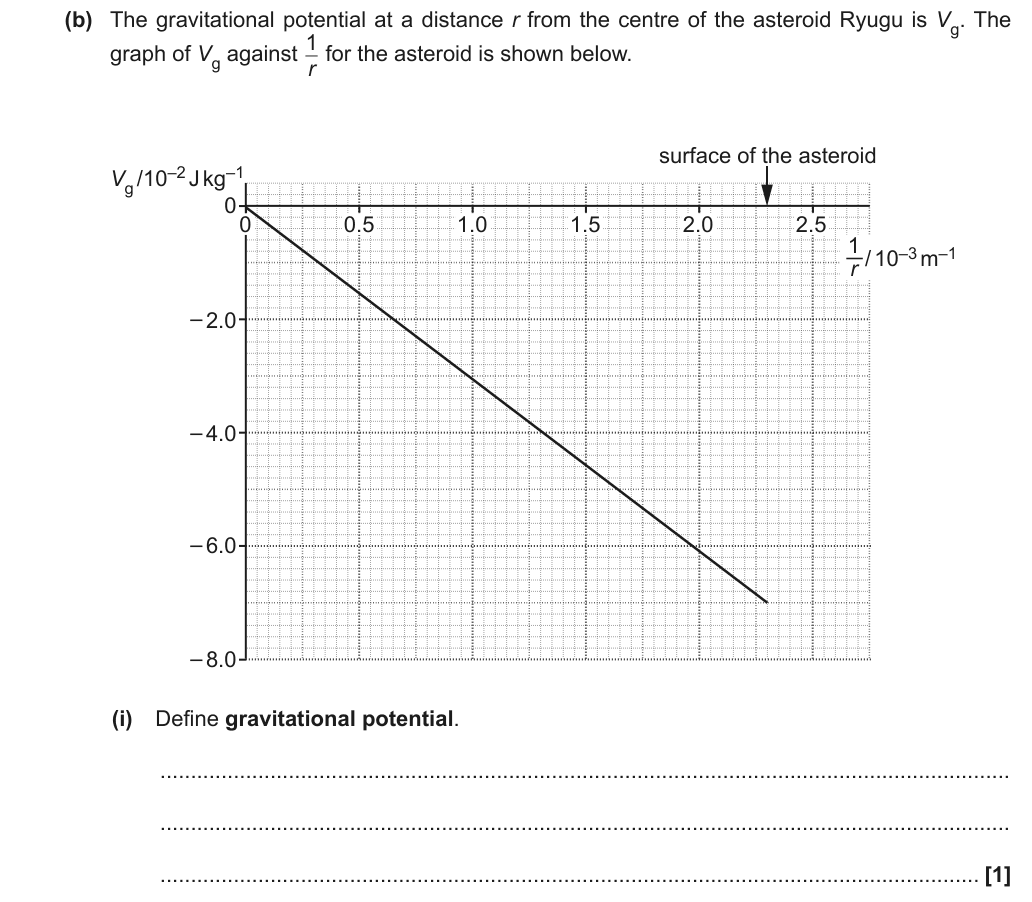
Common misconceptions Almost all candidates forgot that Gravitational Potential Energy is negative in Q20(b).
Skills: M0.2 Recognise and use expressions in decimal and standard form; M2.3 Substitute numerical values into algebraic equations using appropriate units for physical quantities
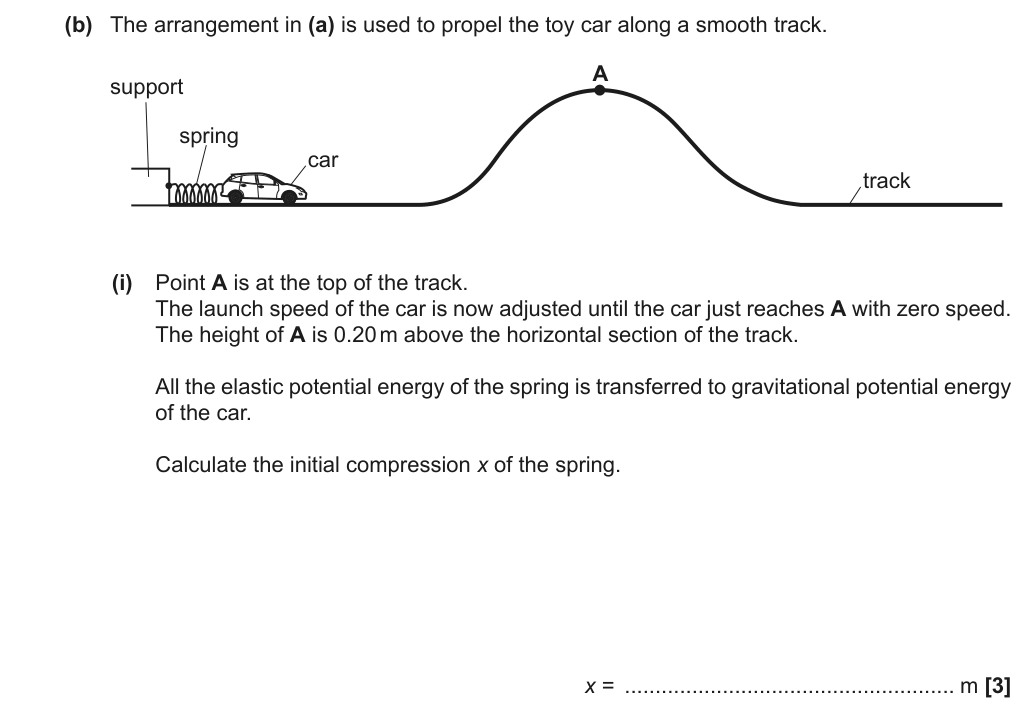

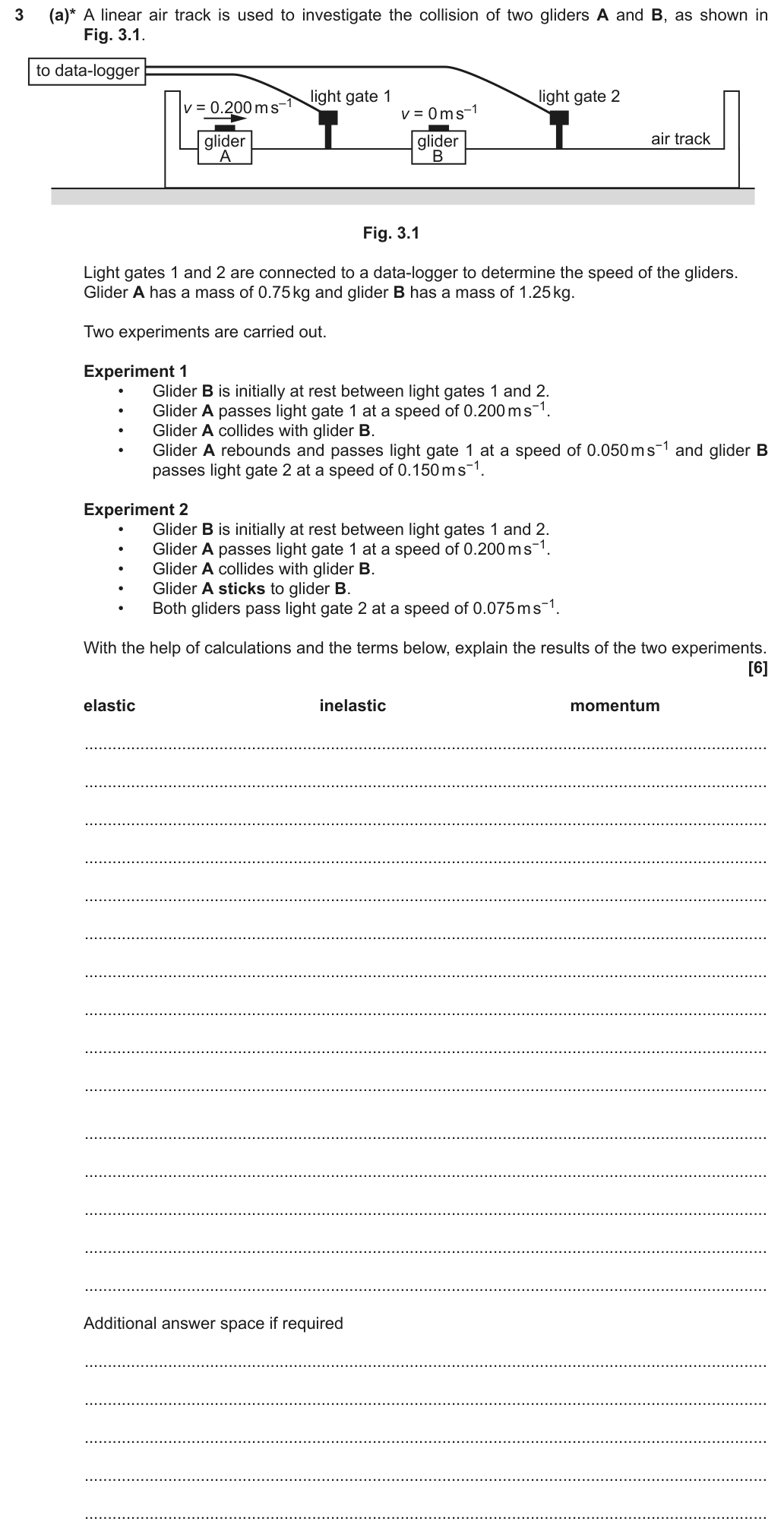
Skills: M2.3 Substitute numerical values into algebraic equations using appropriate units for physical quantities; PAG1 Investigating motion
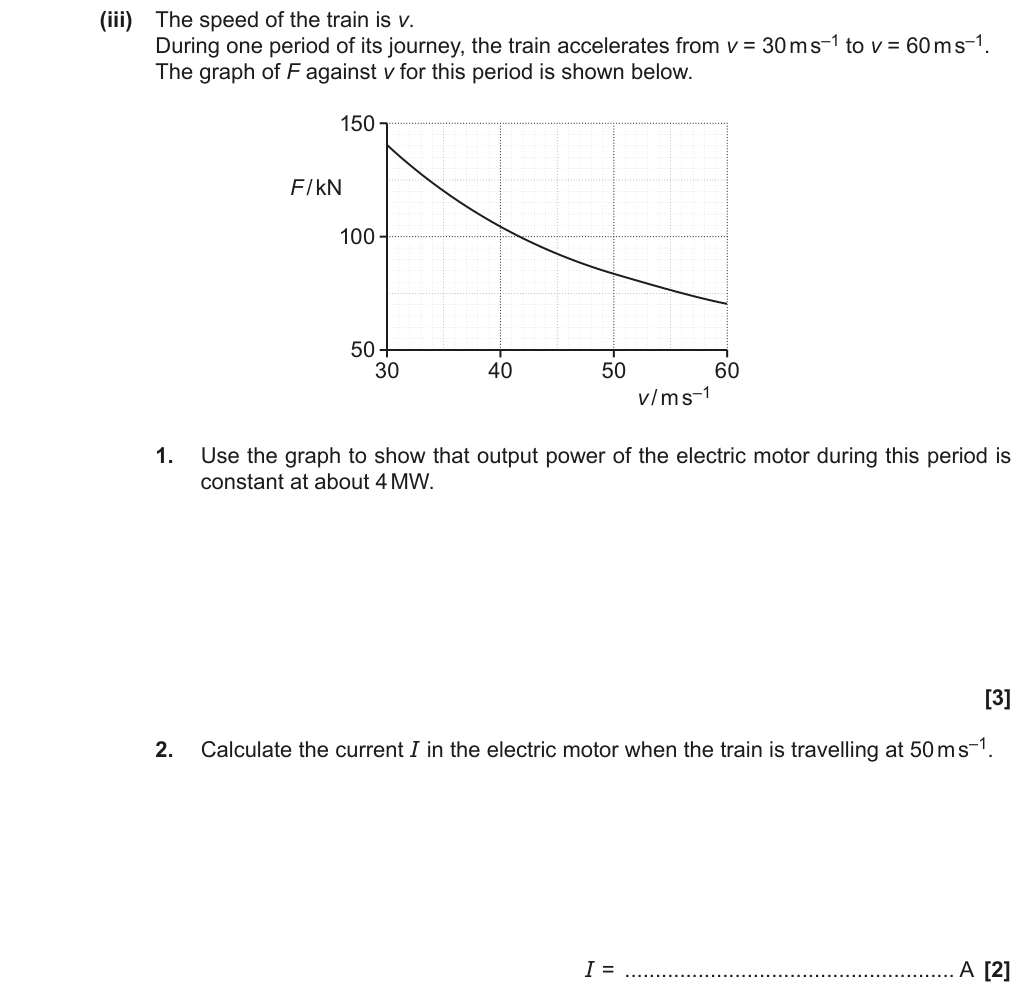
Skills: M0.1 Recognise and make use of appropriate units in calculations; M2.3 Substitute numerical values into algebraic equations using appropriate units for physical quantities; M3.1 Translate information between graphical, numerical and algebraic forms
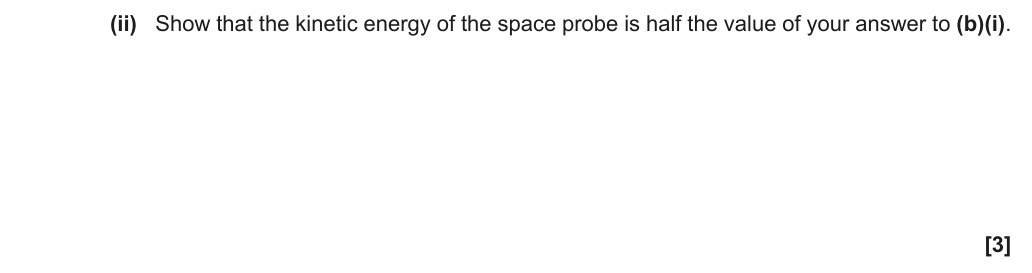
Key teaching and learning point Question 3(b) was a question designed to test candidates’ knowledge that gravitational potential energy is always negative.
Skills: M0.2 Recognise and use expressions in decimal and standard form; M2.3 Substitute numerical values into algebraic equations using appropriate units for physical quantities
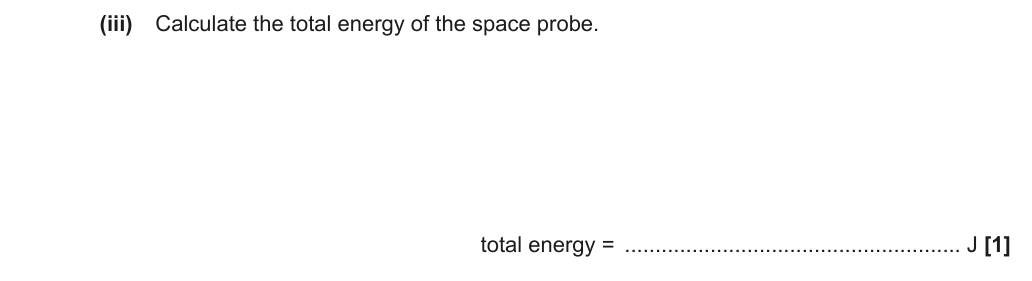
Key teaching and learning point Question 3(b) was a question designed to test candidates’ knowledge that gravitational potential energy is always negative.
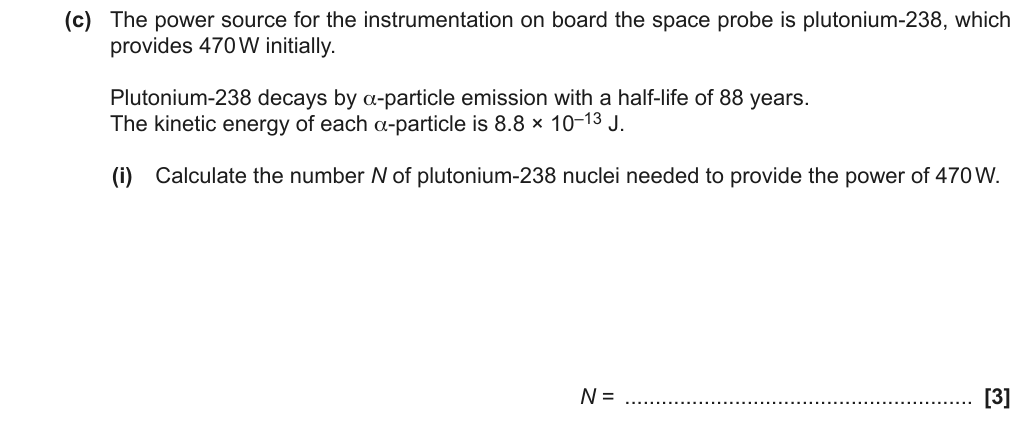
Skills: M0.1 Recognise and make use of appropriate units in calculations; M0.2 Recognise and use expressions in decimal and standard form; M2.2 Change the subject of an equation, including non-linear equations; M2.3 Substitute numerical values into algebraic equations using appropriate units for physical quantities
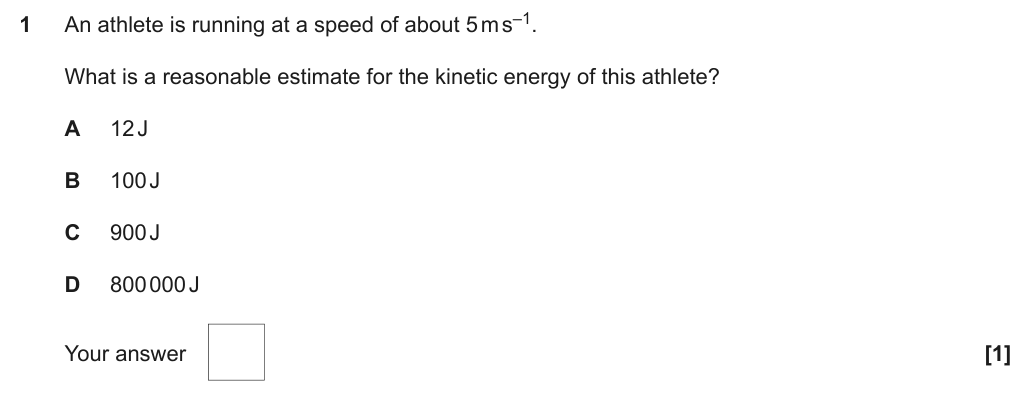
C
Candidates found Question 1, Question 2 and Question 15 very straightforward.
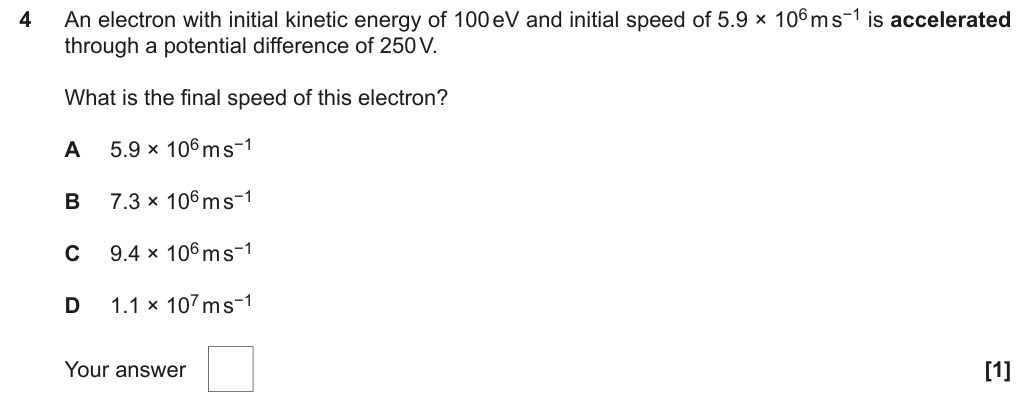
D
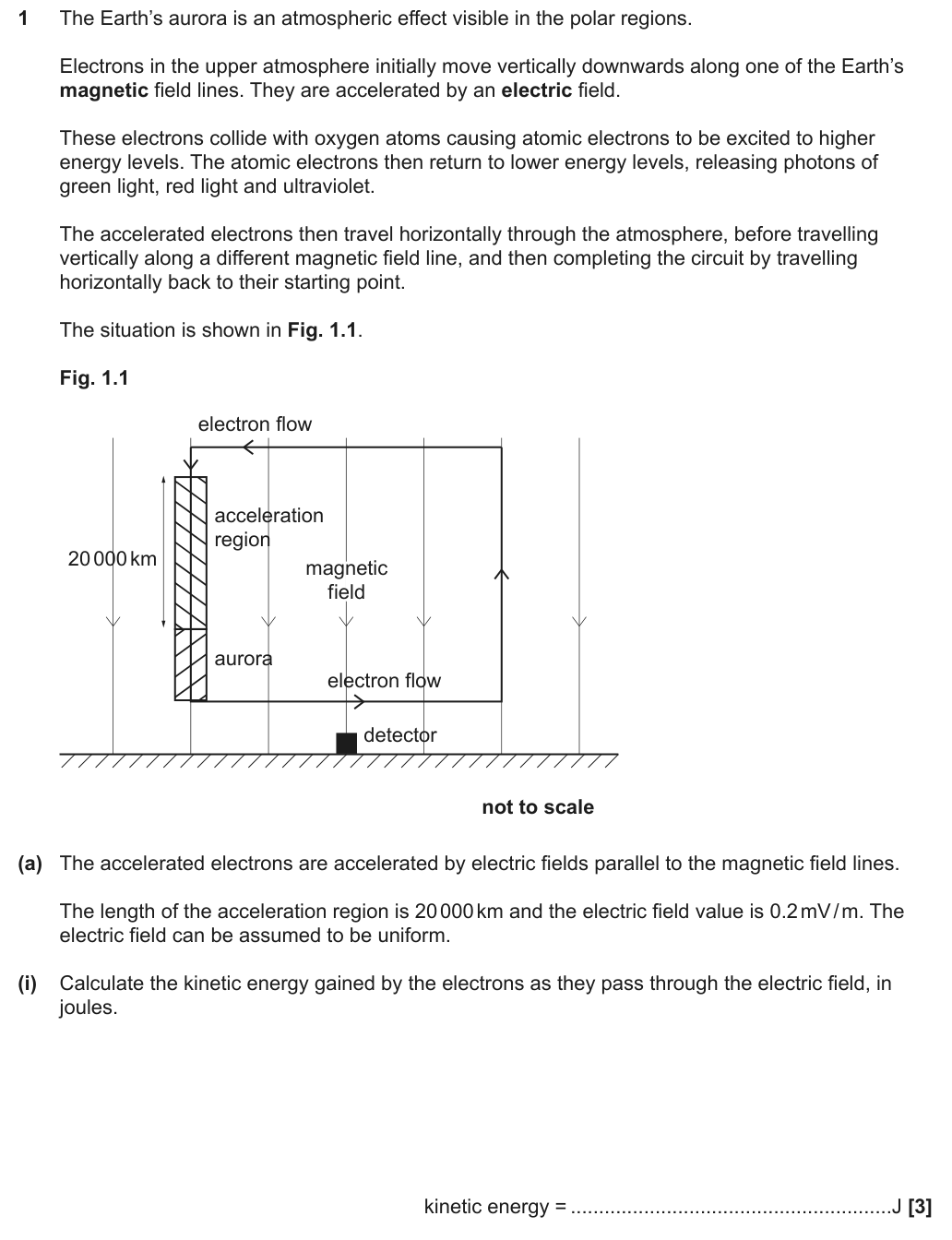
At the diametric end, Questions 4 and 14, were more challenging, and accessible only to the top-end candidates. Question 4 is all about two key ideas: KE = ½ mv2 and energy gained by the electron = Ve.
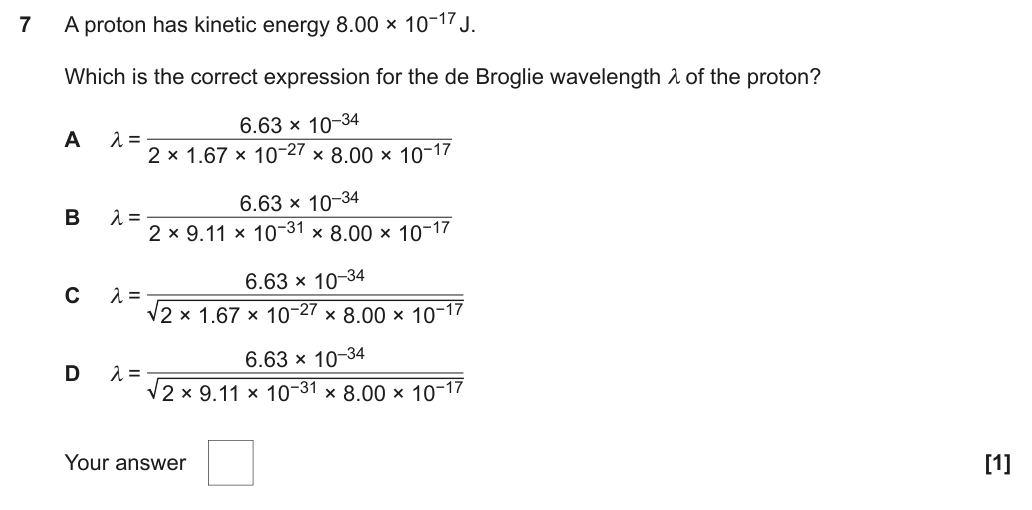
C
Skills: M2.3 Substitute numerical values into algebraic equations using appropriate units for physical quantities; M4.5 Use sin, cos and tan in physical problems
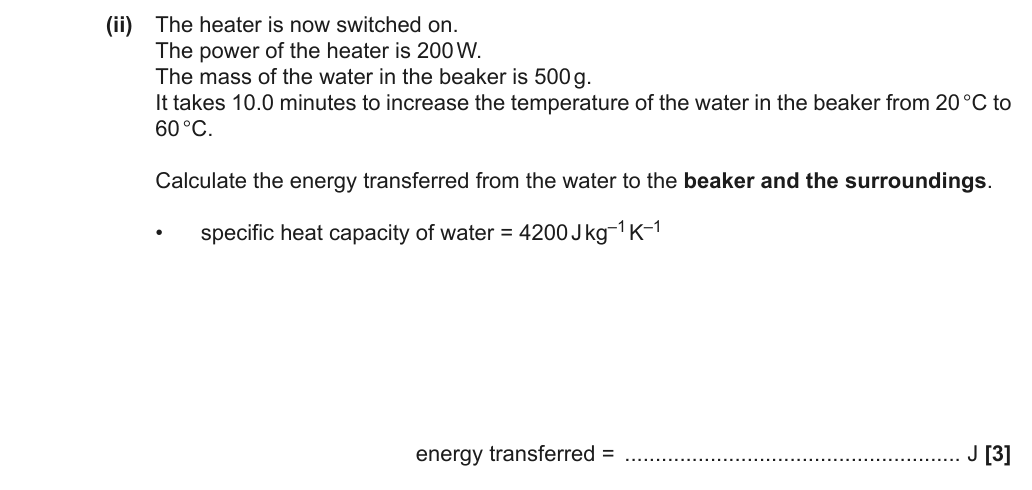
Question 17b was more challenging in this respect, as to get the correct answer for the specific latent heat, the candidate needed to understand the significance of the control apparatus.
Skills: M0.1 Recognise and make use of appropriate units in calculations; M2.3 Substitute numerical values into algebraic equations using appropriate units for physical quantities
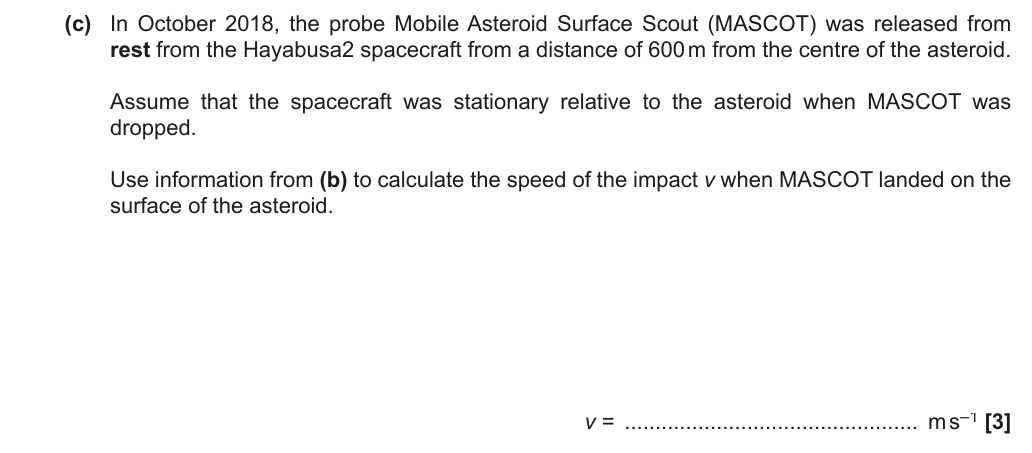
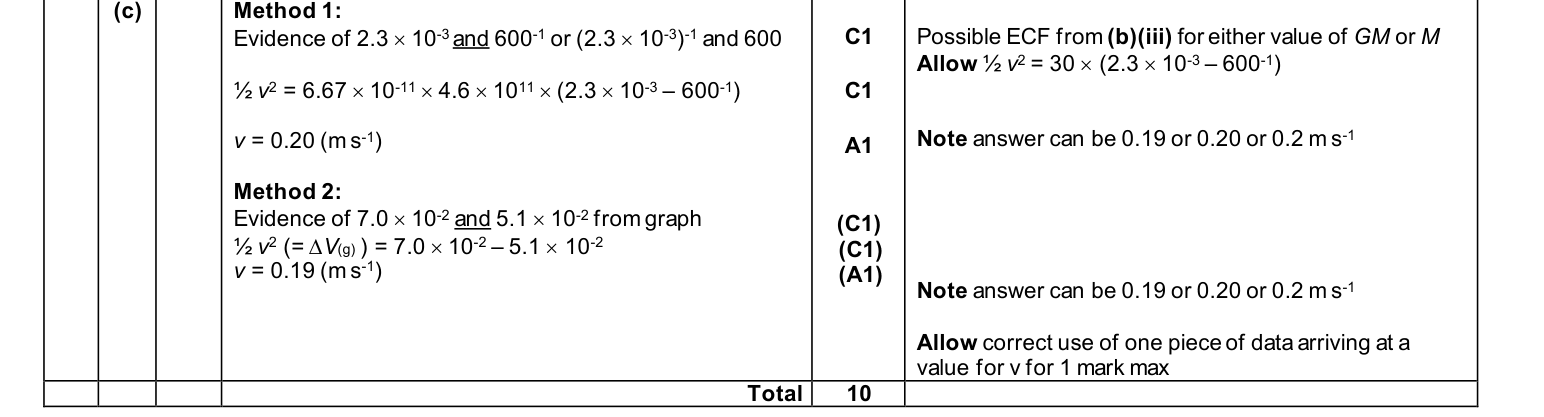
Question 23c showed that candidates were unfamiliar with the idea of finding a difference in potentials between two points in order to find the change in potential energy.
Skills: M2.2 Change the subject of an equation, including non-linear equations; M2.3 Substitute numerical values into algebraic equations using appropriate units for physical quantities; M3.1 Translate information between graphical, numerical and algebraic forms
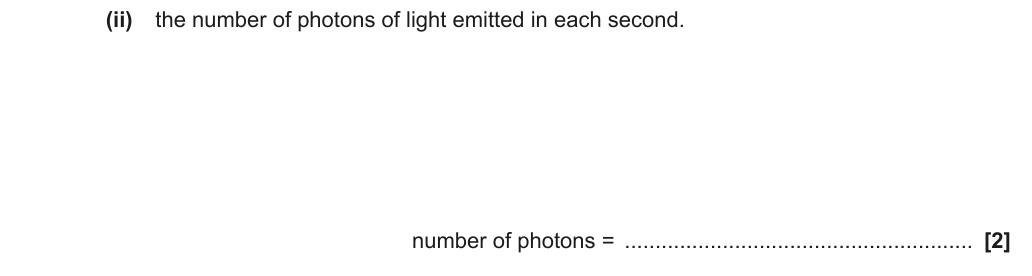
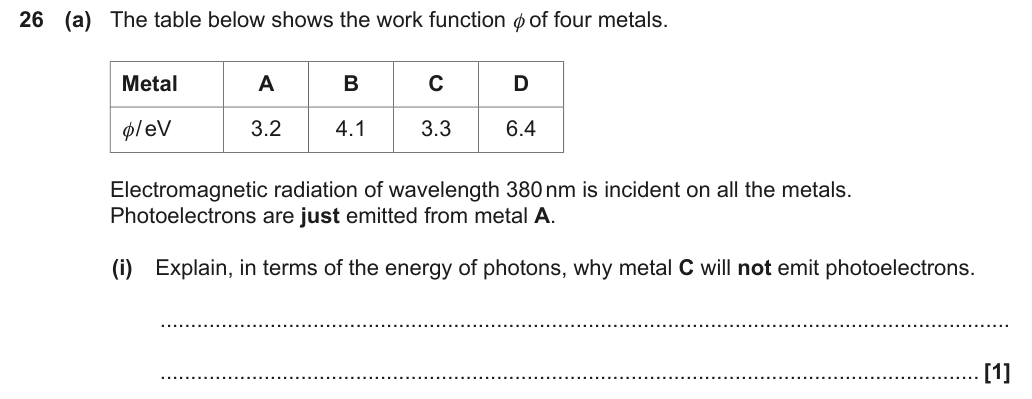
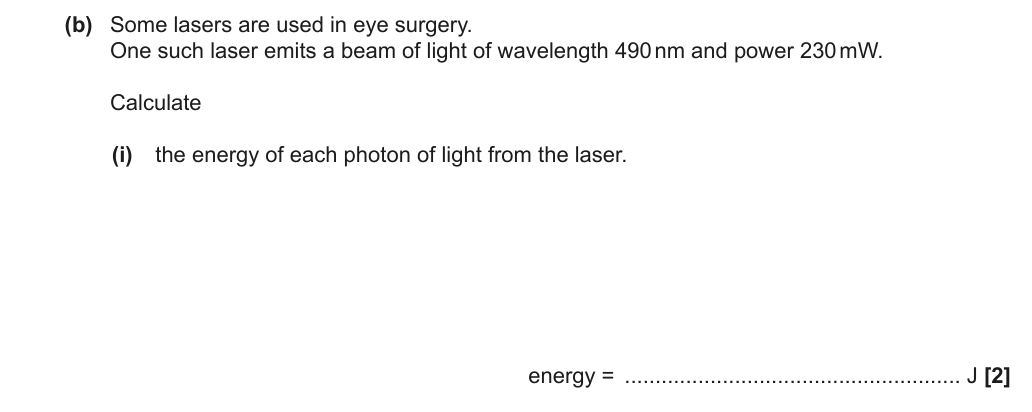
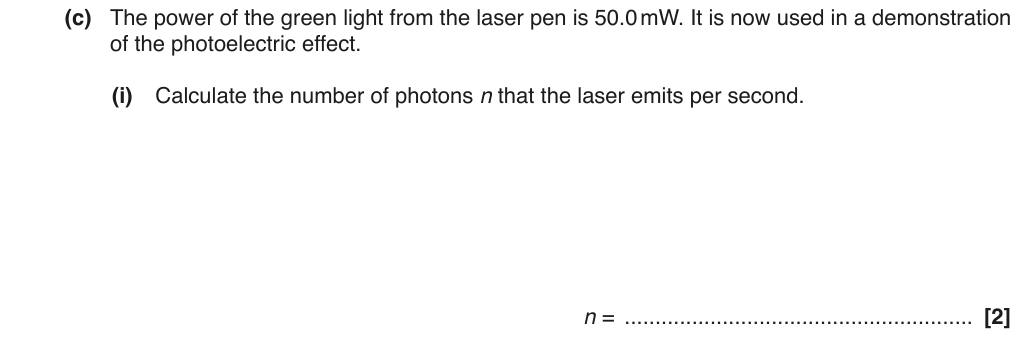
Questions 22b and 23bi • showed poor recall of prefixes, e.g. nano (n) in Question 28b • did not underline (or circle) key data and terms in the questions, notably in the MCQs. Most of the candidates finished the paper in the allotted time, with about 1 in 10 omitting the last Question 28bii. For example, in Question 28a, it was important to understand that photoemission cannot take place when the wavelength λ of the incident electromagnetic radiation is greater than λ0 because the energy of each photon is less than the work function of the metal, or the frequency of the incident radiation is less than the threshold frequency. Misconception Question 28bii The most frequent error here was to divide the power of the laser beam by 1.60 × 10⁻¹⁹ J instead of the energy of a single photon 4.06 × 10⁻¹⁹ J.
Skills: M0.2 Recognise and use expressions in decimal and standard form; M2.3 Substitute numerical values into algebraic equations using appropriate units for physical quantities
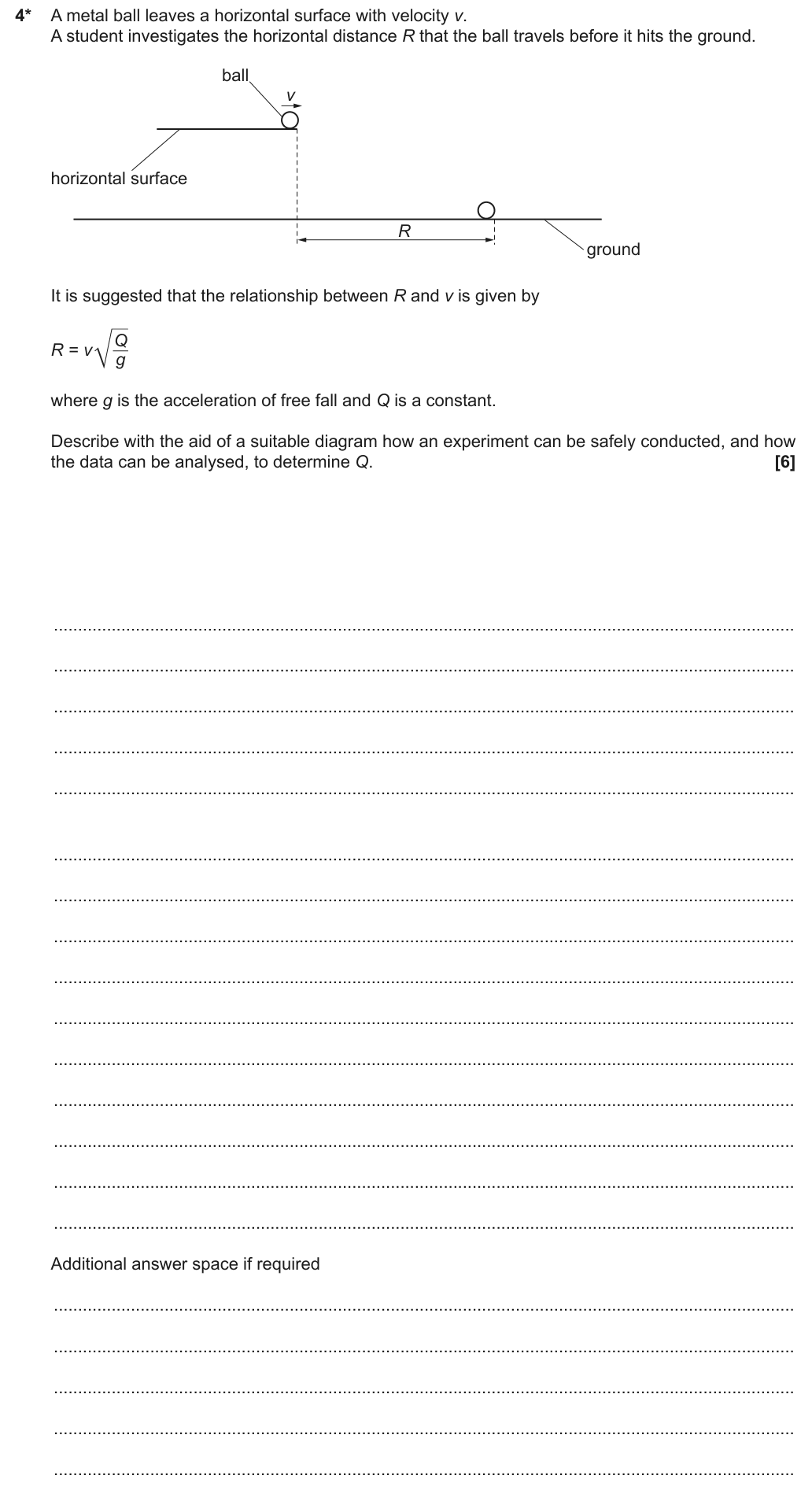
Comments on responses by question type Level of response questions The two LoR questions were Question 4 and Question 8. In Question 4, candidates were required to plan an experiment.
Skills: M3.3 Understand that y = mx + c represents a linear relationship; M3.4 Determine the slope and intercept of a linear graph; PAG1 Investigating motion
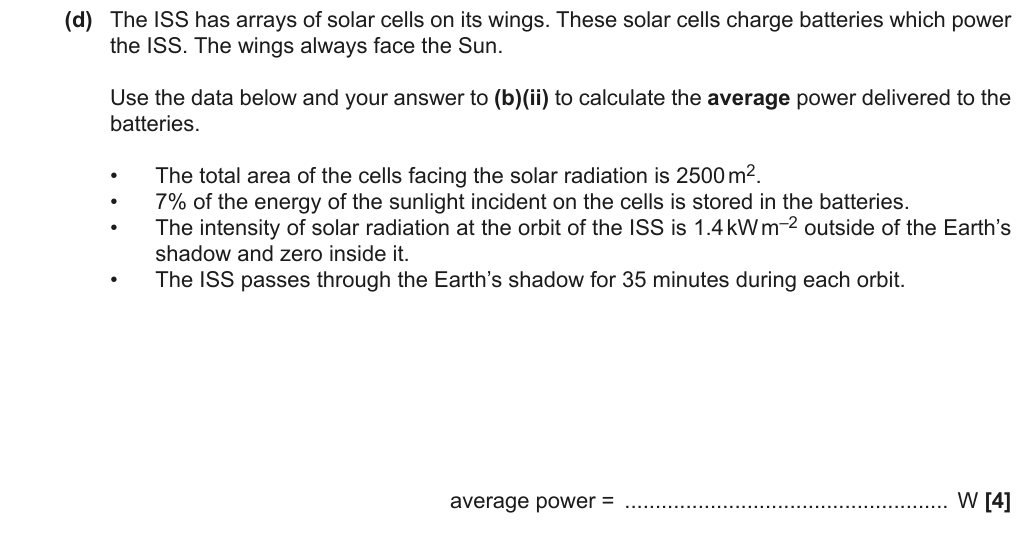
Question 4a Misconception Experiencing weightlessness is not the same as being in freefall There was a lack of understanding of the nature of feeling weightless. Question 4bi The simplest method here was to use the fact that g is inversely proportional to r2, so gr2 = constant. Question 4c The success in this question depended on understanding the meaning of the term m in the formula 2mc2 തതത = 3 2 kT given in the Data, Formulae and Relationship booklet. Question 4d Although this question looked daunting, it was actually quite linear and many candidates who attempted it were able to gain two or three marks even if they did not eventually get to the correct response.
Skills: M0.1 Recognise and make use of appropriate units in calculations; M0.3 Use ratios, fractions and percentages; M2.3 Substitute numerical values into algebraic equations using appropriate units for physical quantities
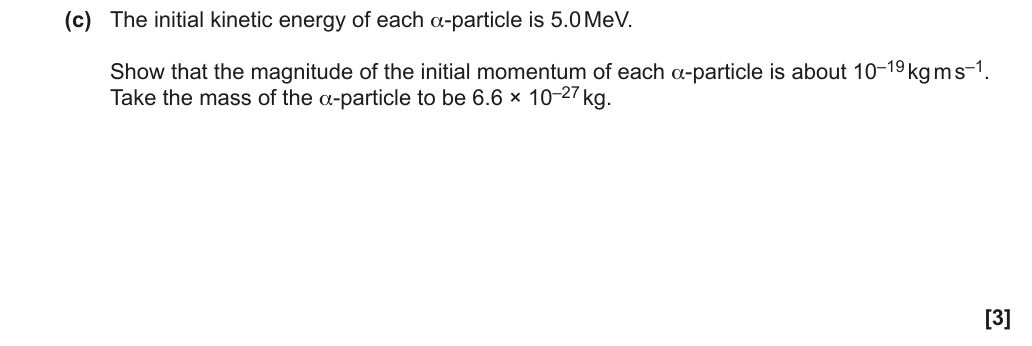
Since this paper is synoptic, candidates need to be able to apply their knowledge and understanding in unfamiliar contexts in order to gain high marks, To do well in this paper, candidates must be able to: • perform and layout calculations logically, showing clear working (such as Question 6c) • produce concise but accurate responses to questions which involve extended writing (such as question 1b) • craft clearly structured and well-reasoned arguments to the Level of Response Questions (3b and 5d) • process and interpret data from an experiment to reach conclusions (Question 2). Question 6a The common errors here were: • not realising that, for the particle to be deflected through a smaller angle, it needed to be travelling further away from N • not labelling the final angle of 30° • not adding arrows to show the direction of travel • drawing a path that continued bending beyond the stated 30° (usually ending up parallel to the original path). Question 6b The most common error here was to use incorrect values for the charges on the two ions. Question 6c This question provided an excellent opportunity for candidates to produce immaculate responses: identify the physics involved, select and write down the correct formula, do the necessary conversion (MeV to J), rearrange the formula, substitute correctly and then write the final response in standard form to a correct number of significant figures. Question 6d This was not an easy question but, even so, a good number of candidates did well.
Skills: M0.2 Recognise and use expressions in decimal and standard form; M0.5 Use calculators to find and use power, exponential and logarithmic functions; M2.2 Change the subject of an equation, including non-linear equations
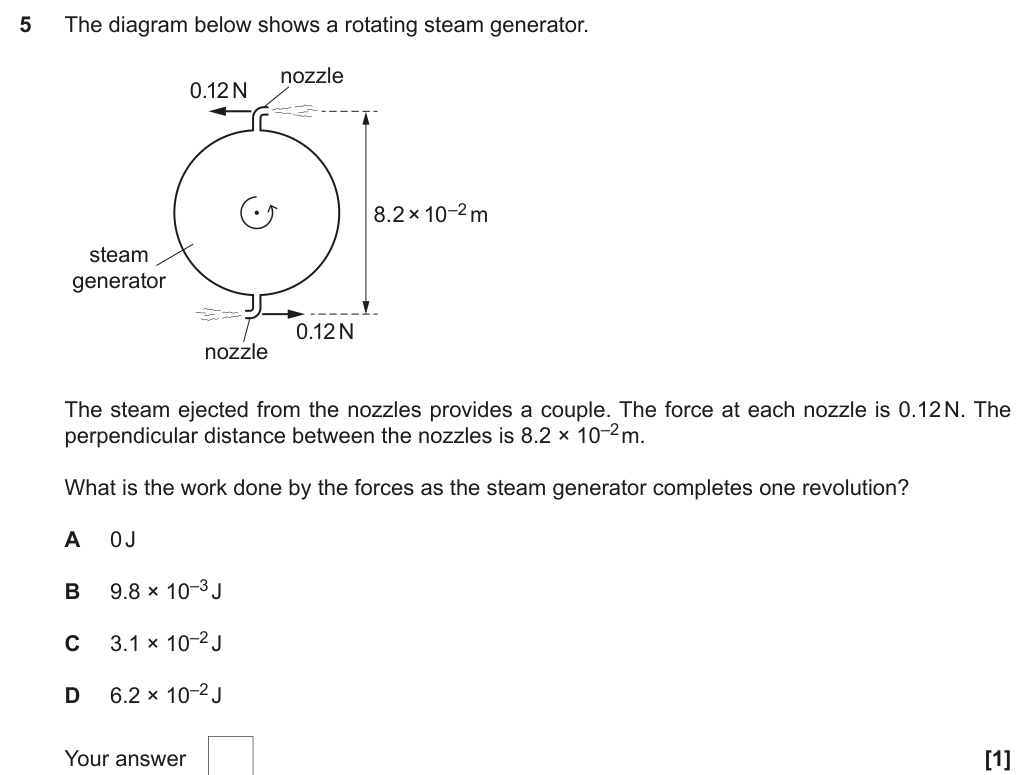
D
This question was based on work done by a couple, and as such proved to be quite challenging. The work done by the couple is given by the expression below: work done = 2 × work done by each force = 2 × [0.12 × π × 8.2 × 10⁻²] = 6.2 × 10⁻² J The most popular answers turned out to be either A or C. The answer C was for the work done by one of the forces. This question was only accessible to the very top-end candidates. The exemplar 1 below shows an incorrect analysis that led to B being inserted into the answer box. The candidate has either written the equation for work done, or torque of a couple. Substitution shows that the torque has been calculated. Unfortunately, the response of 9.8 × 10⁻³ J was there as one of the options. This exemplar shows that if the starting point is incorrect, it can easily lead to what looks like a promising response.
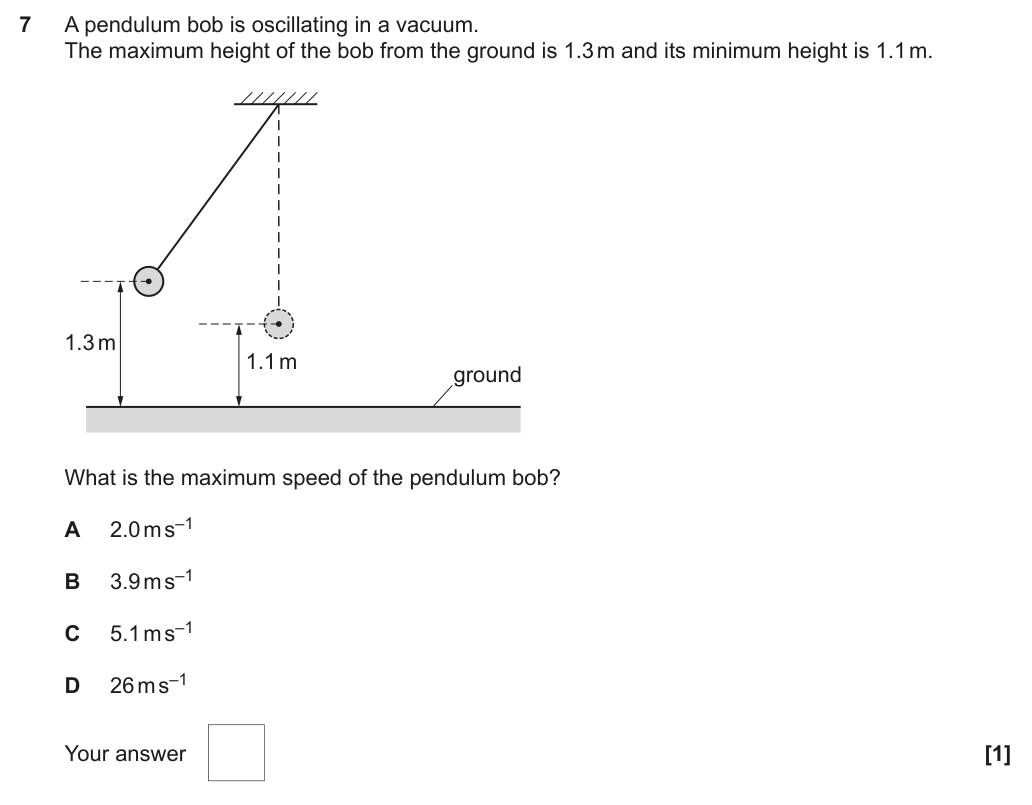
A
The key to this question is to consider the GPE lost and equate it to the KE gained. The GPE lost here = mass × 9.81 × 0.20 = ½ × mass × v2. The masses cancel (which is why the mass wasn’t given). This makes v2 = 3.924. The most common wrong answer was B, as candidates had forgotten to take the square root. The correct speed is 1.98 m s-1 giving the correct answer, A.
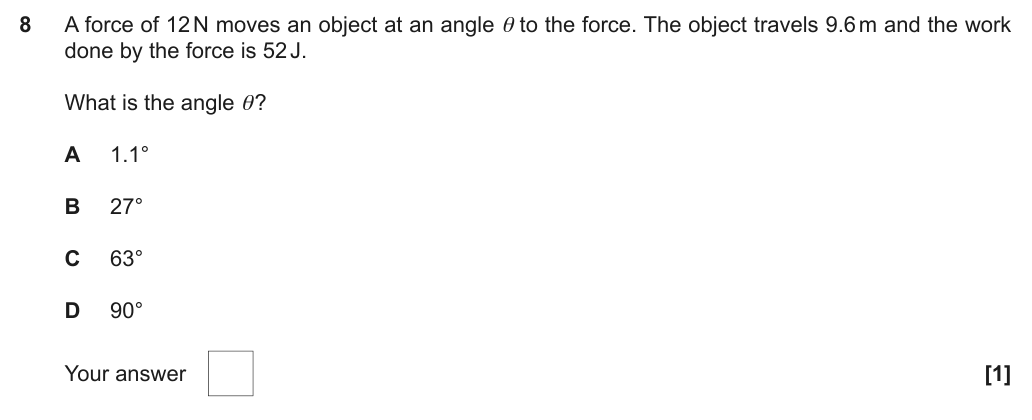
C
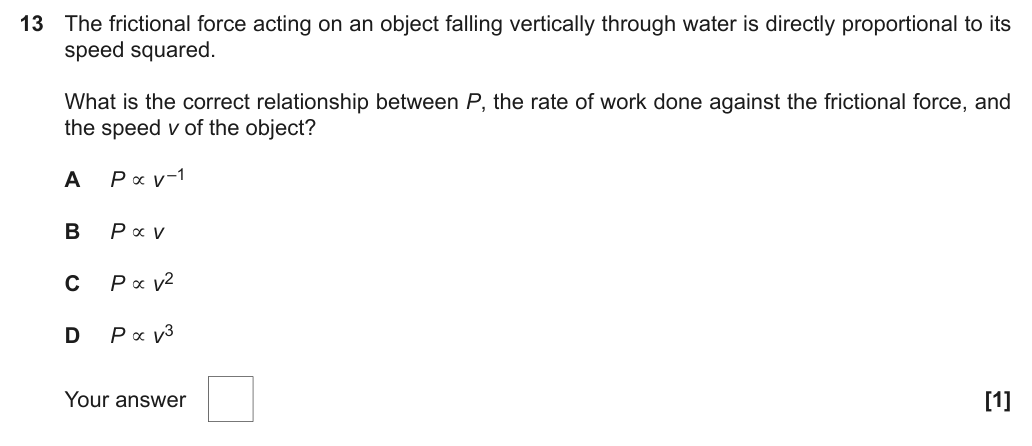
D
This question is based on the equation P = Fv, which also appears in the Data, Formulae and Relationship Booklet. In the question, information is given about the frictional force F, which is directly proportional to v2. Therefore, the rate of work done P must be proportional to v3; making D as the answer. Most candidates struggled with this question, with all the distractors being equally popular. Less than a quarter of the candidates, mainly from the upper quartile, scored a mark in this question. The exemplar 2 below the correct response from a candidate. This candidate demonstrates how this question can be tackled with minimal amount of work. The key equation is on the script, as is the relationship between F and v. The final answer appears in the box; a perfect technique.
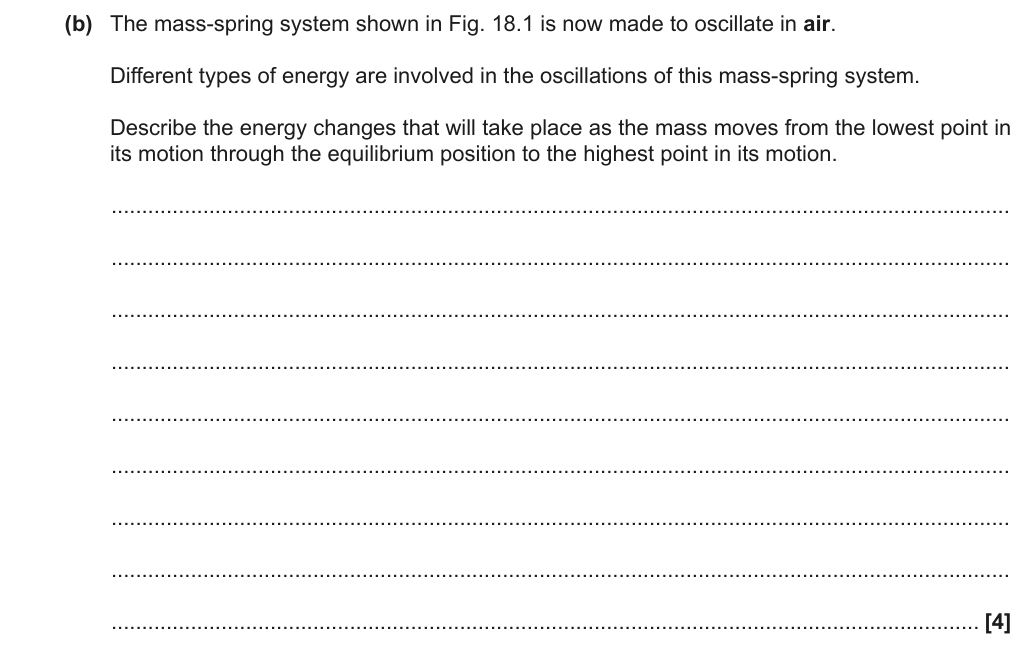
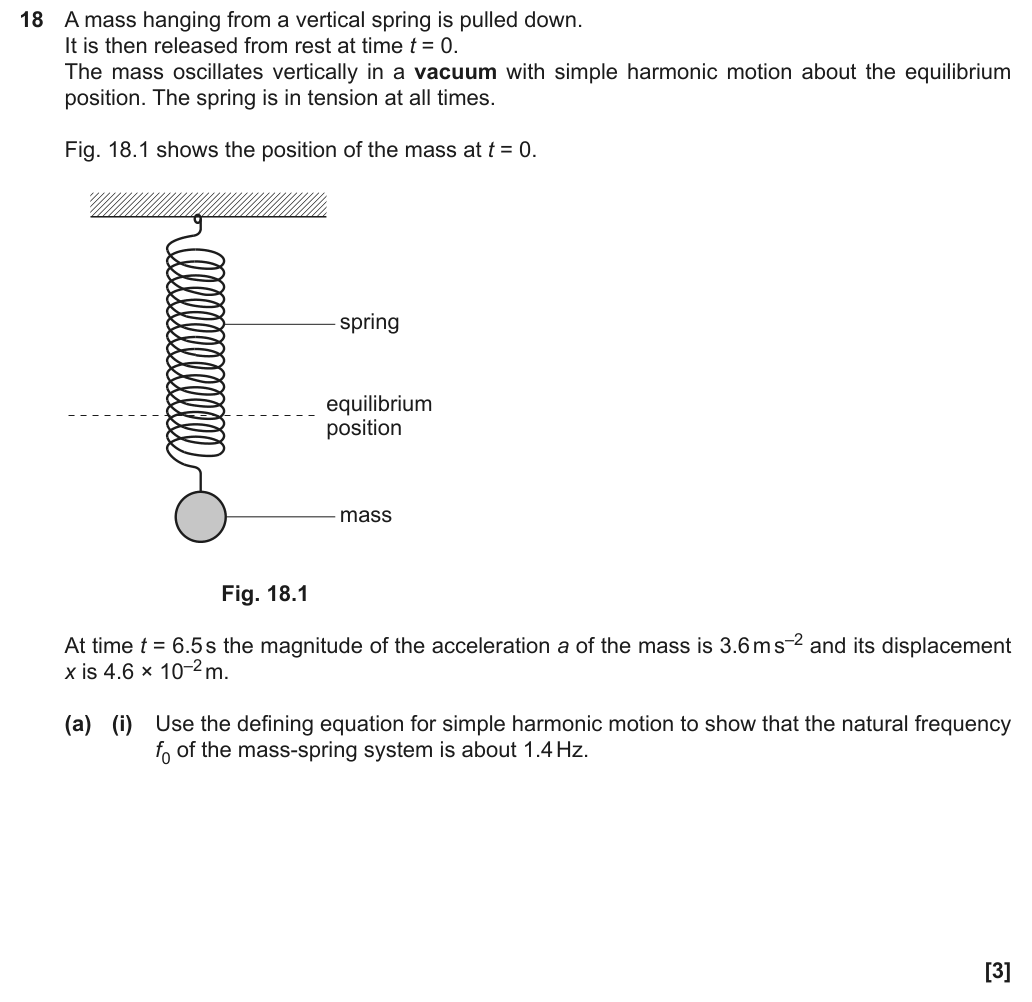
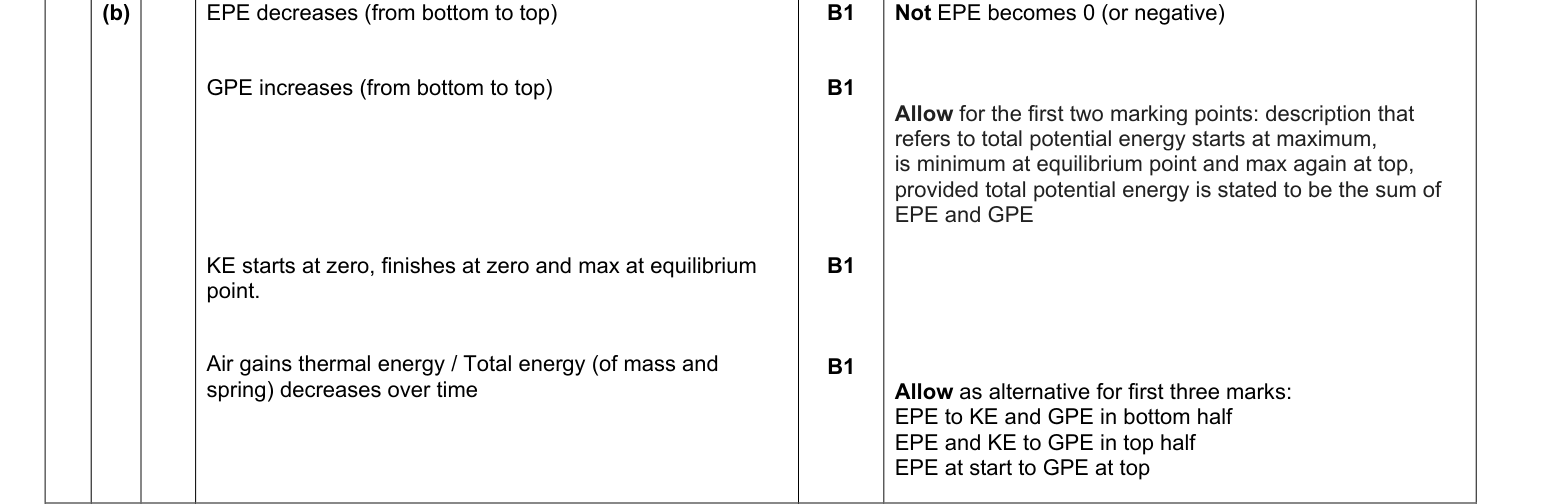
The best way to answer this question is to plan out what happens to each of the relevant energy types. In this case the relevant energy types are elastic potential, gravitational potential and kinetic energy. Candidates often carefully recalled the details of energy changes for a horizontal mass-spring system, which was incorrect. Earlier in the question, the candidates were told that the spring is always under tension. This means that the elastic potential energy cannot be zero or indeed negative. At the bottom and the top of the motion, the kinetic energy of the system is zero, as the objects have zero velocity. At the equilibrium position, the kinetic energy of the system is maximum. Responses that included merely ‘potential energy’ were too vague, unless it was clear that the potential energy of this system is the sum of both the gravitational and elastic potential energies. The first 2 statements in this response are true yet not enough. The third statement is untrue, as it implies that GPE is decreasing (and so contradicts the second statement) and also states that the elastic potential energy is increasing. Zero marks. This response is separated out into the 3 main energy types. The changes for each of the types is correct. The only thing they haven’t mentioned is that the total energy of the system will decrease because of the damping effect of the air. 3 marks. Question 18 (c) (i) and (c) (ii) The correct shape for Question 18(c)(i) is a standard resonance curve. The natural frequency of this system is 1.4 Hz, as stated in Question 18(a). This means that the peak of the curve should come at 1.4 Hz. The curve for Question 18(c) needed to be of lower amplitude throughout the frequency range (not including at 0 Hz). Some candidates put the peak of curve D at the same frequency as curve K and others put the peak of curve D slightly to the left. Both were given the mark.
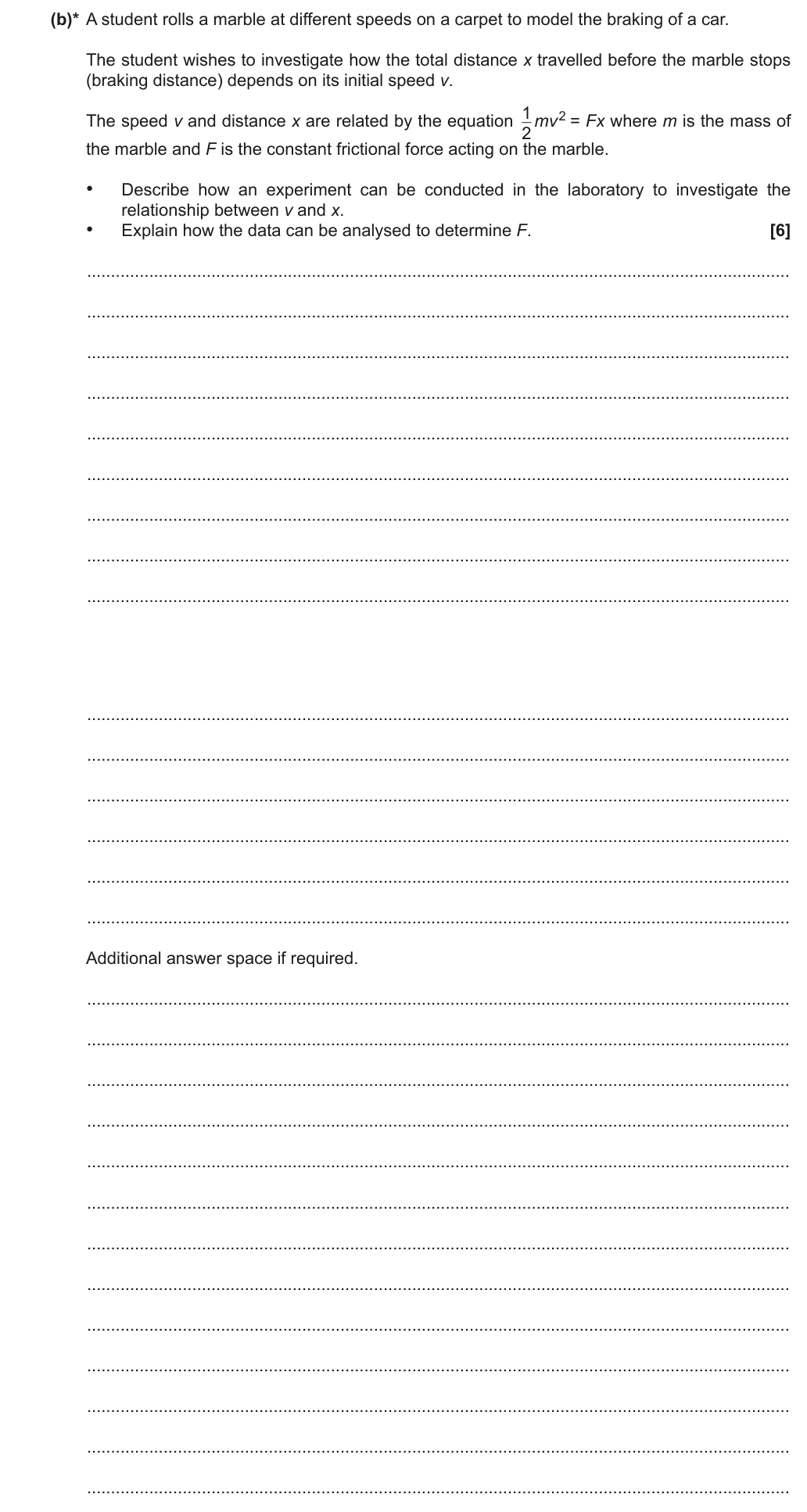
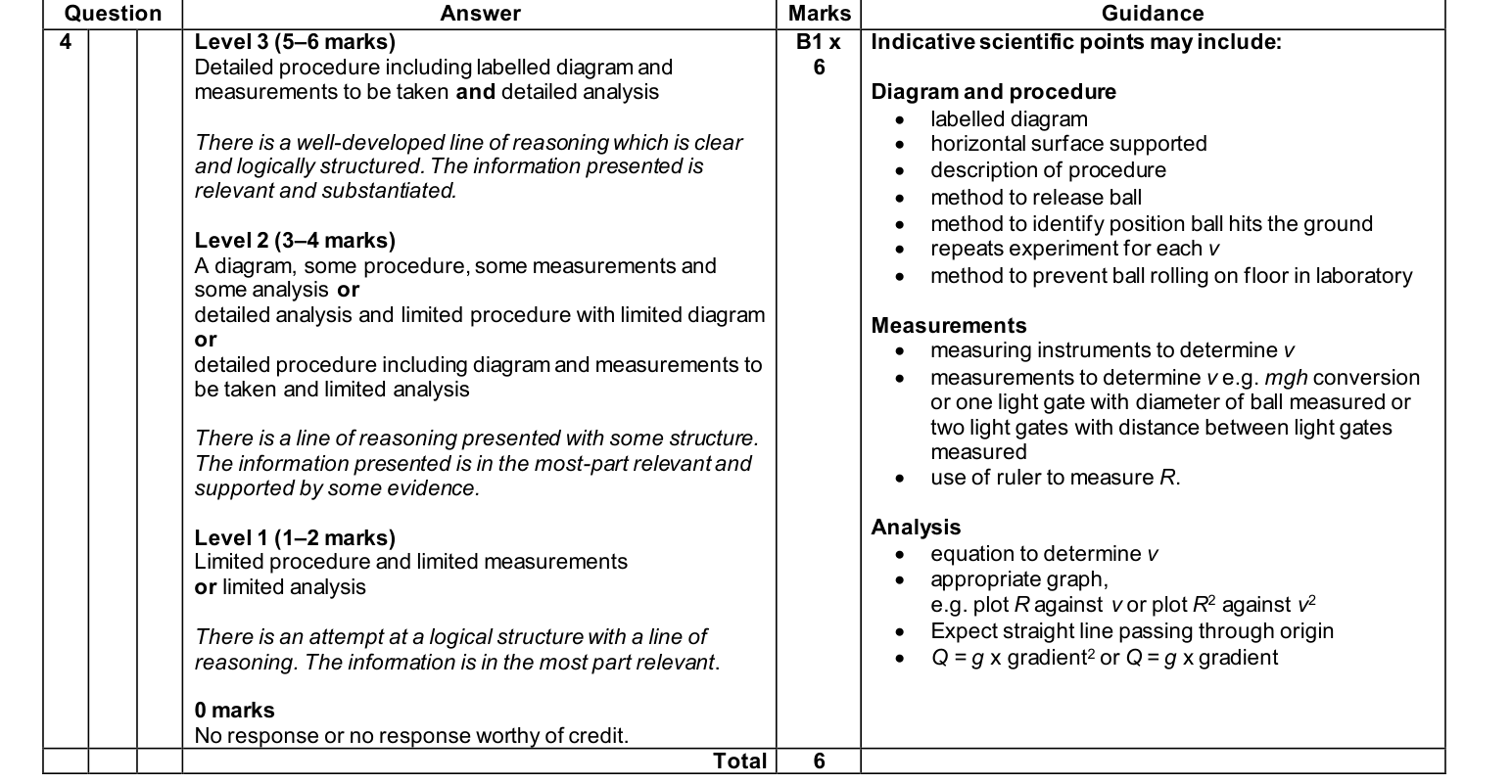
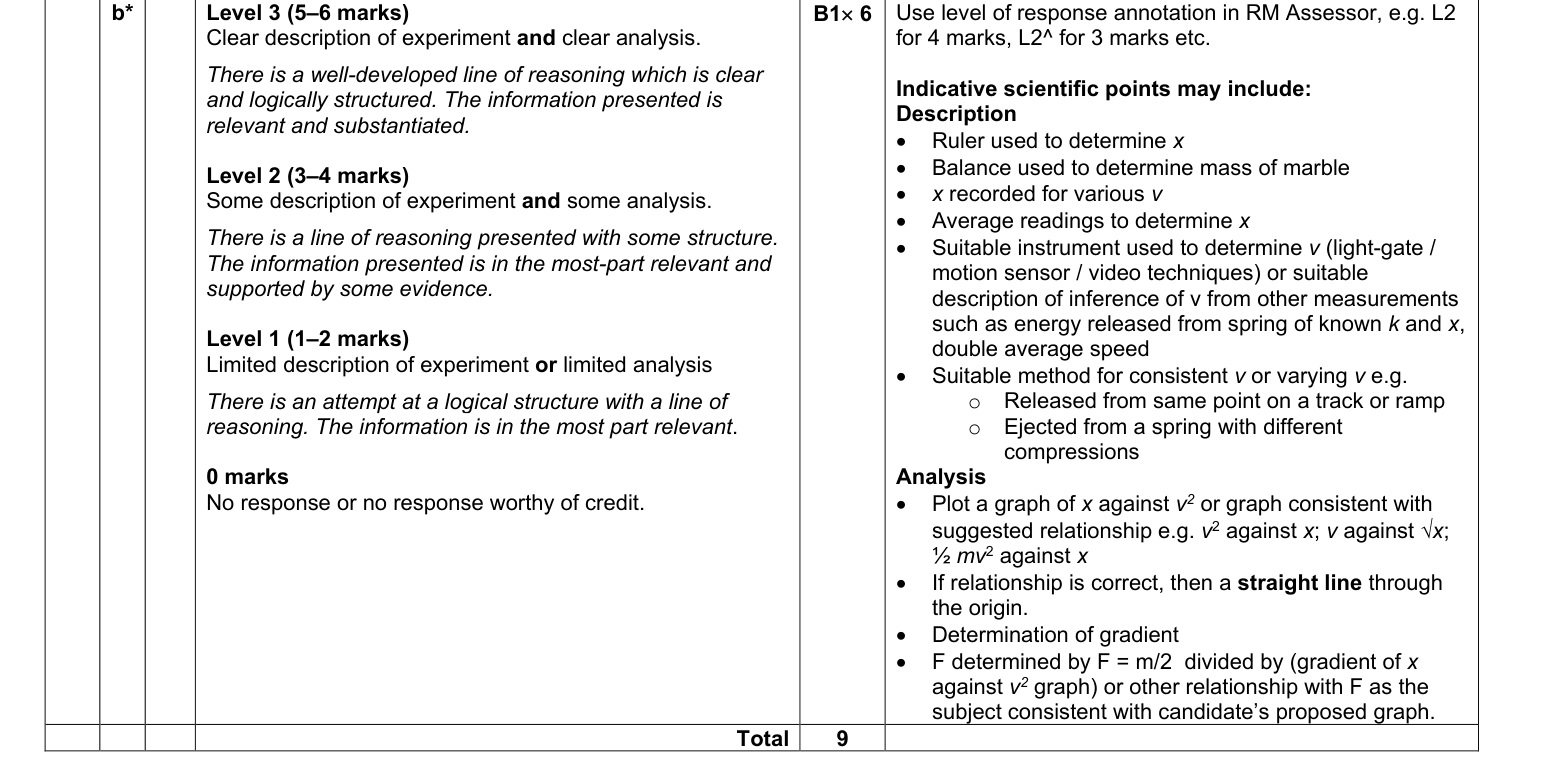
Most candidates made excellent attempts at describing this investigation. The analysis section was particularly well completed compared with previous sessions. Many of these investigations would have been successful had they been given as instructions to year 12 students as shown by Exemplar 6. The higher ability candidates distinguished themselves by being clear about how they were going to measure or calculate the speed of the marble and do that in a predictable way. This is shown best by exemplar 7. This response is a very good attempt. They have employed a light gate to measure the speed, without much explanation of how that device would calculate the speed itself. The analysis is sound, with a clear indication of what they would do with the data and how the relationship in the question matched up to a straight line of best fit. The candidate has made sure that they have explained how to calculate F from the gradient, rather than leaving it to the reader to work it out for themselves. This response scored Level 2. This response is similar in many ways to the previous exemplar. The difference is that the candidate has explained carefully how they will achieve different speeds and equally, how 2 light gates connected to a datalogger will measure the time of transit between the gates. The calculation of the speed v is easy to spot as the distance between the light gates divided by the time between them. Furthermore, there is reference to repeat readings for given v and an average distance for x. The analysis to find F is not quite as explicit as that in the previous exemplar, yet it is easily sufficient for a Level 3 response.
Skills: M3.3 Understand that y = mx + c represents a linear relationship; M3.4 Determine the slope and intercept of a linear graph; PAG1 Investigating motion
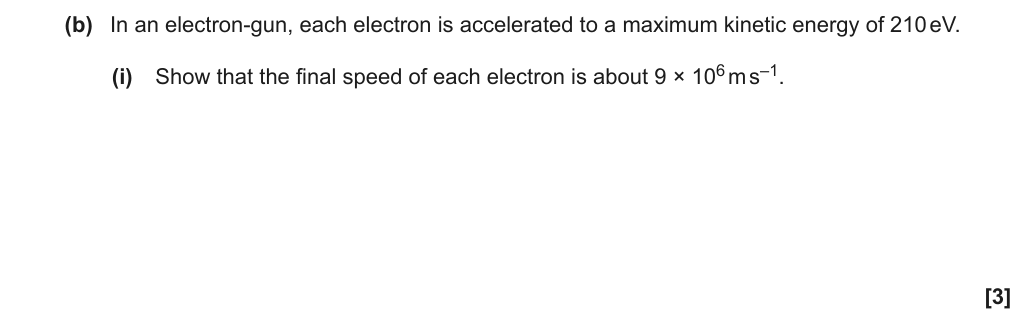
This was not a straight forward question but most candidates demonstrated excellent knowledge and application of physics here. The conversion of 210 eV was often done correctly. The K.E. equation was used successfully to show the final speed of the electrons to be about 8.6 × 10⁶ m s-1. The exemplar 11 below shows a model response from a top-end candidate. This exemplar shows a typical response produced by most of the candidates. The conversion from eV to J is very clear. The correct mass of the electron has been used to get the response of 8.6 × 10⁶ m s-1. It is good to report that very few candidates used 210 J to get the impossible response of 2.1 × 10¹⁶ m s-1.
Skills: M0.2 Recognise and use expressions in decimal and standard form; M2.2 Change the subject of an equation, including non-linear equations; M2.3 Substitute numerical values into algebraic equations using appropriate units for physical quantities

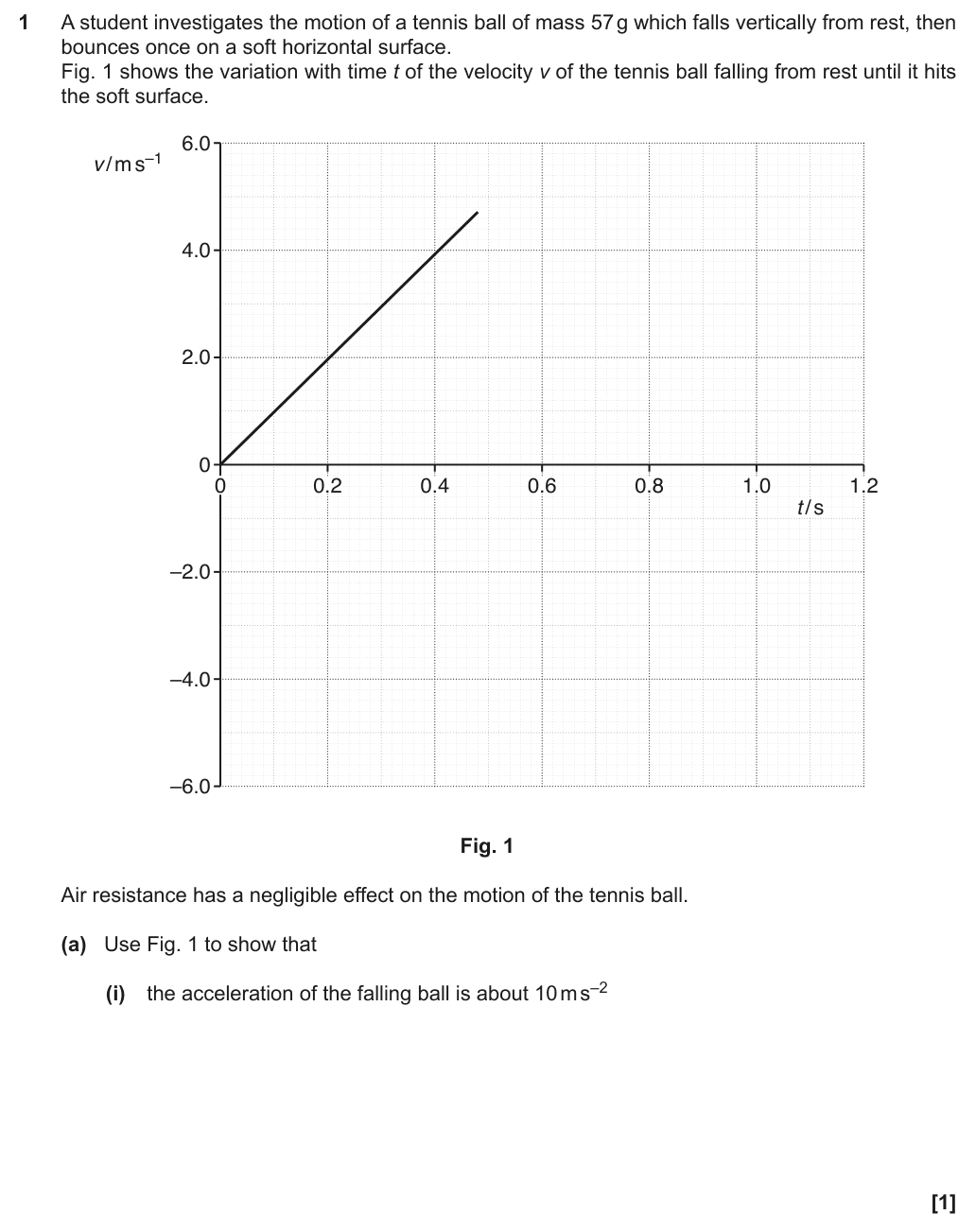
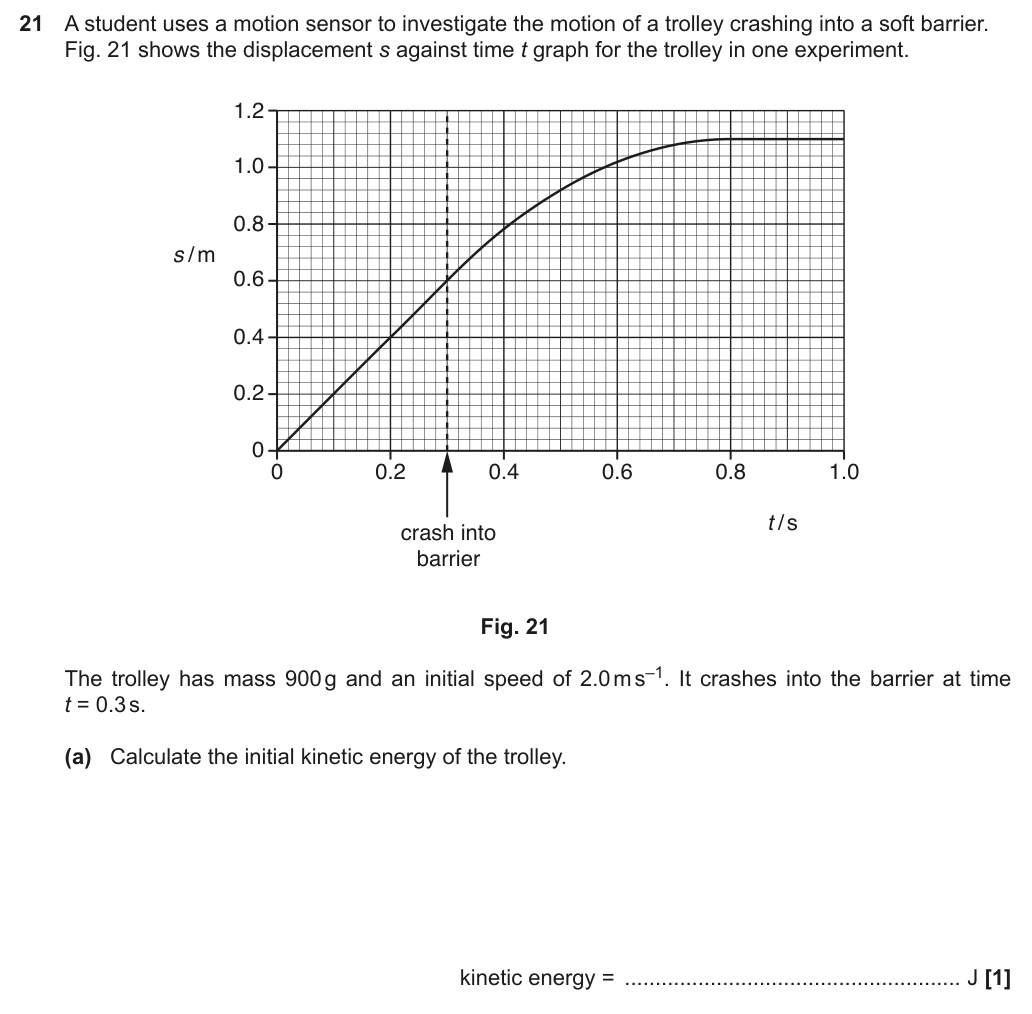
This was also a “show” type of question. Candidates needed to correctly read the maximum velocity (4.79 m s–1) from the graph and change the mass of 57 g into kilograms. To gain the marks, clear substitution into the kinetic energy equation was needed with a correctly evaluated answer. In this two-mark answer, the candidate has clearly demonstrated the value from the graph as well as the equation that is going to be used. The candidate has correctly changed 57 g to kilograms effectively by using standard form. The candidate has then correctly evaluated the expression as 0.62957 before stating that this is approximately equal to 0.63 J. Candidates often find it helpful to underline relevant quantities. In this response the candidate has underlined 0.63 J.
Skills: M0.1 Recognise and make use of appropriate units in calculations; M2.3 Substitute numerical values into algebraic equations using appropriate units for physical quantities; M3.1 Translate information between graphical, numerical and algebraic forms
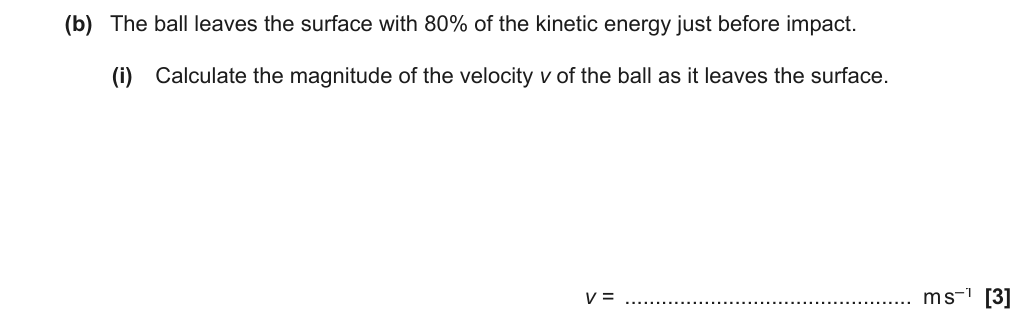
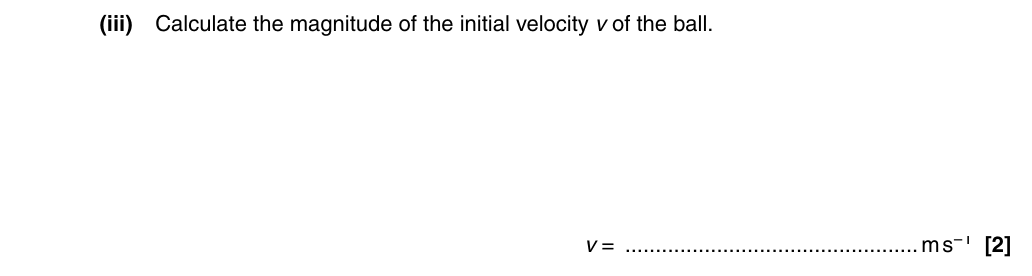
In this question, higher ability candidates initially determined the kinetic energy (0.504 J) as the ball leaves the surface, before rearranging the kinetic energy equation. A few candidates did not take the final square root.
Skills: M0.3 Use ratios, fractions and percentages; M2.2 Change the subject of an equation, including non-linear equations
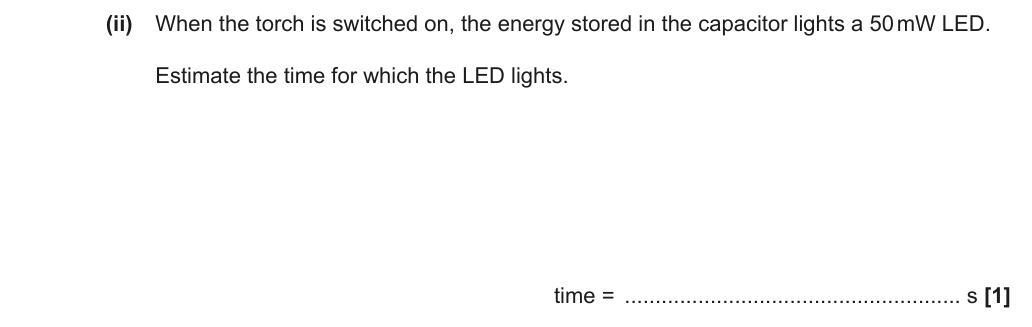
Almost all candidates gained the mark for 3(b)(ii), as any incorrect answer to 3(b)(i) was accepted with error carried forward (ECF).
Skills: M0.1 Recognise and make use of appropriate units in calculations; M2.2 Change the subject of an equation, including non-linear equations
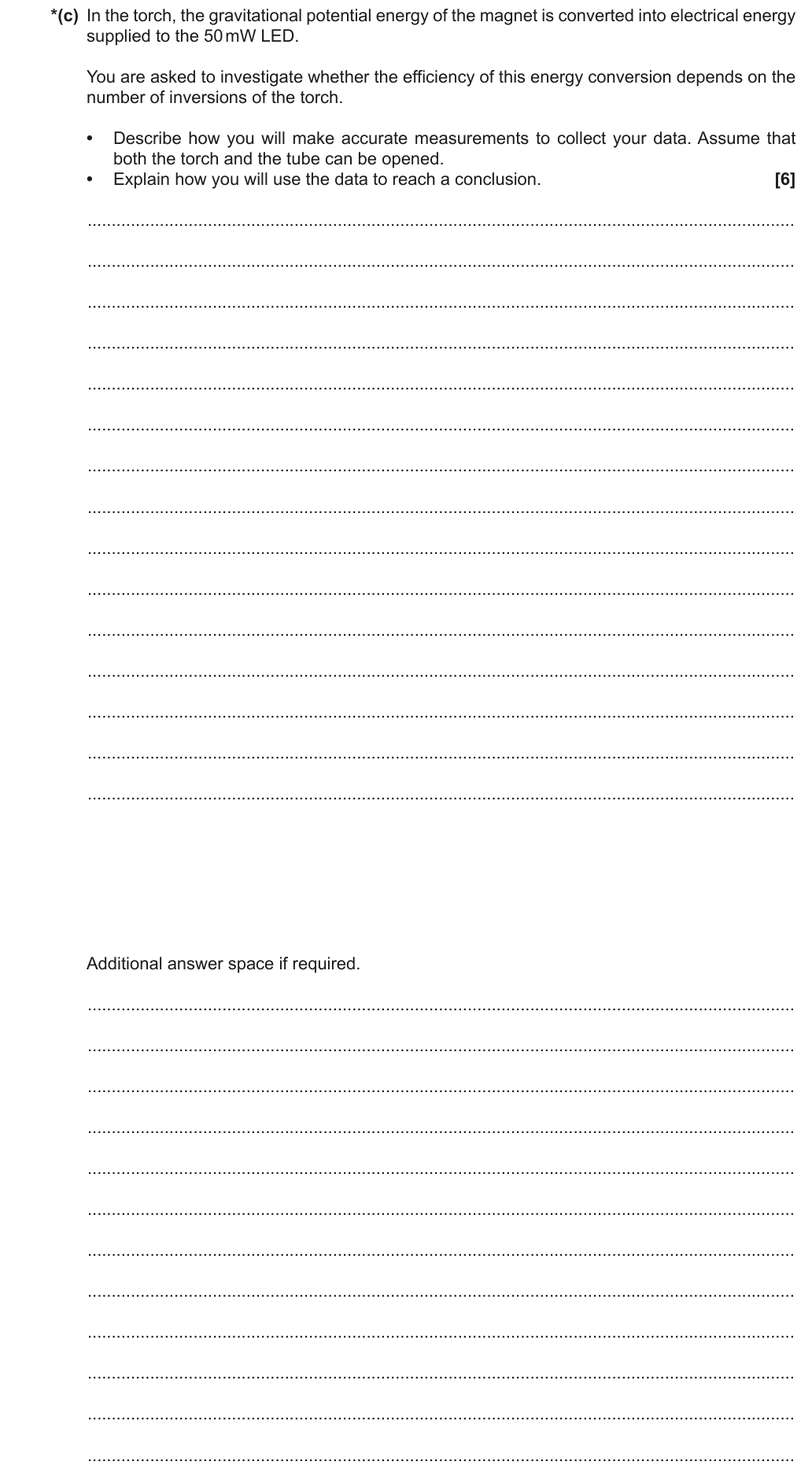
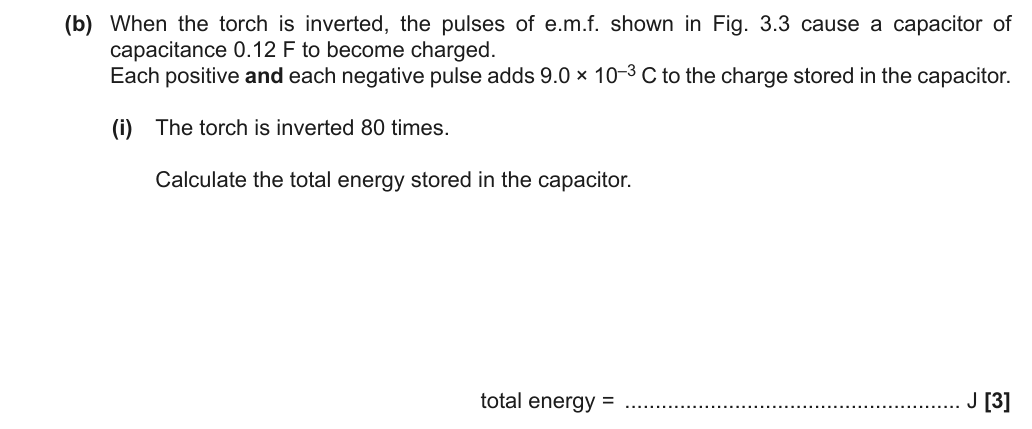
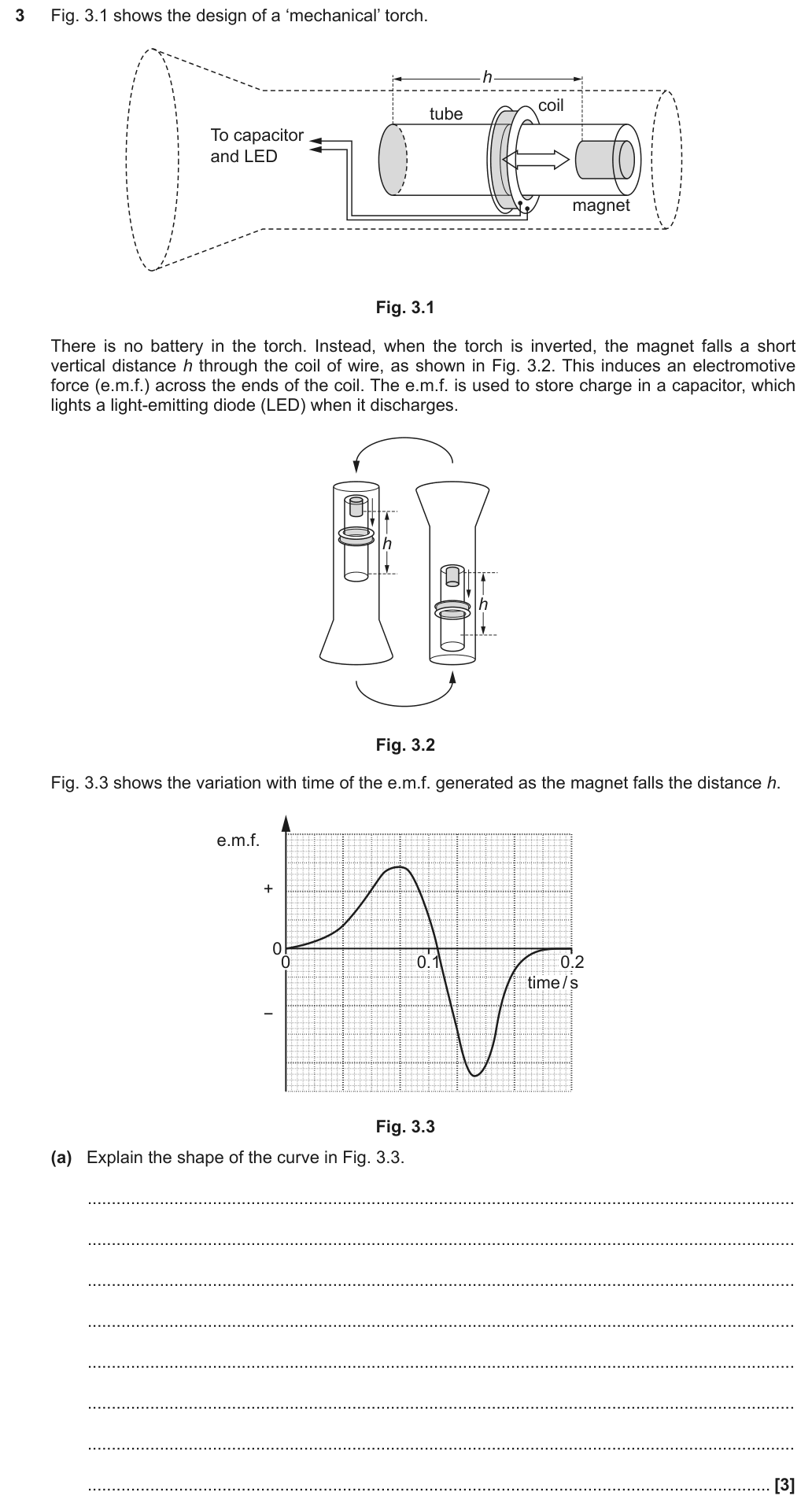
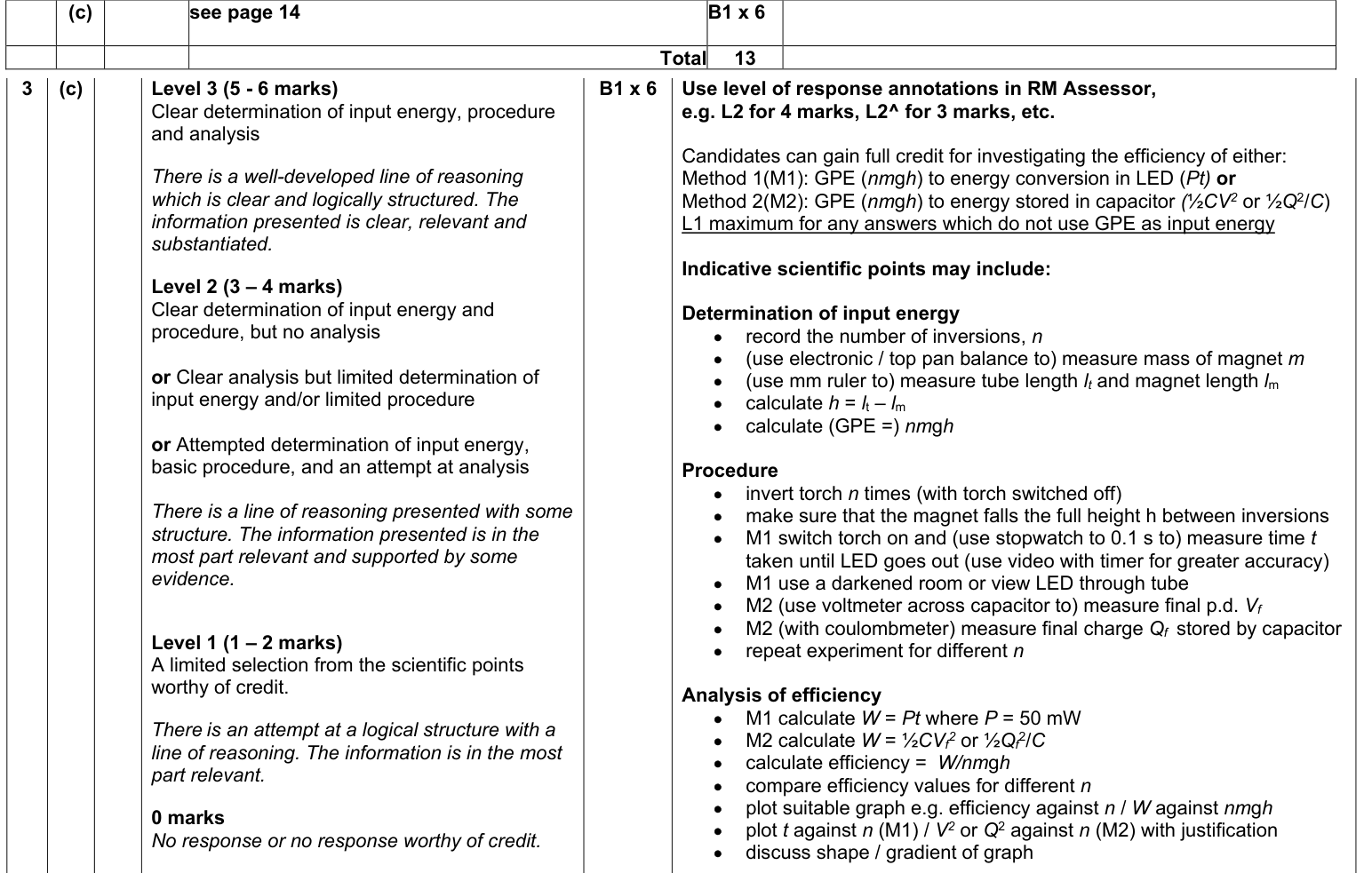
In level of response questions like 3(c), candidates must remember to refer closely to the stem of the question when planning their extended answer to make sure that they are addressing the question asked. The challenge in this question was to design an experiment that would yield results leading to a valid conclusion. Candidates could gain full credit for investigating the efficiency of gravitational potential energy (GPE) to either: • energy conversion in the LED (power x time) or • energy stored in the capacitor (½CV2 or ½Q2/C) Candidates were then expected to describe how the efficiency would be calculated, and how they could tell whether the efficiency depended on the number of times the torch is turned or inverted, n. Many candidates were able to describe a valid graphical method, usually plotting efficiency against n, or output energy against input energy. Some candidates plotted time against number of inversions, which was able to score maximum credit provided that they clearly explained that t and n were proportional to output and input energy respectively. The best responses were those where candidates had not just stated what to plot but had gone on to describe and explain the expected shape of the graph and what its gradient would show. Common problems in 3c • investigating the energy conversion ½Q2/C to Pt • assuming the number of inversions was varied without stating it explicitly • using mgh for input energy rather than nmgh, accounting for the number of inversions • assuming that the torch would gain the same amount of charge at every inversion rather than attempting to measure the final charge after n inversions • using the formula efficiency = energy loss/input energy • making an assumption about the outcome (e.g. I would expect to get a straight line through the origin) • wrongly interpreting the graphical results they expected to get efficiency of GPE converted to electrical energy in the torch, but their response lacks the clarity and detail needed for a Level 3 response. Also, their method will not yield correct results because they have • not realised that GPE increases with the number of turns, so they need to use the formula GPE = nmgh. • not specified that the length h is the distance that the magnet falls, rather than the length of the tube. • not made clear which is the input and which the output energy in the (correct) efficiency formula. • used incorrect graphical analysis for their graph of efficiency against n. We want to discover whether efficiency depends on n, not demonstrate that efficiency increases proportionally to n, which is impossible.
Skills: M0.3 Use ratios, fractions and percentages
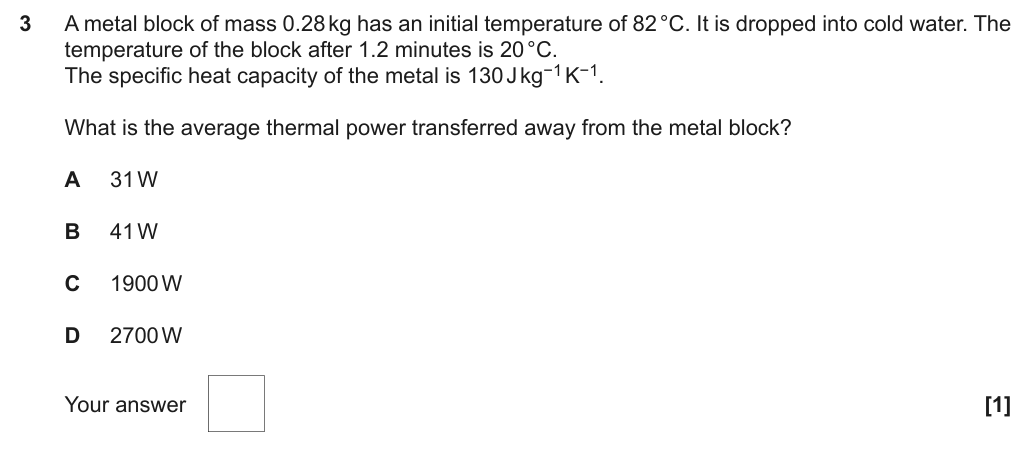
A
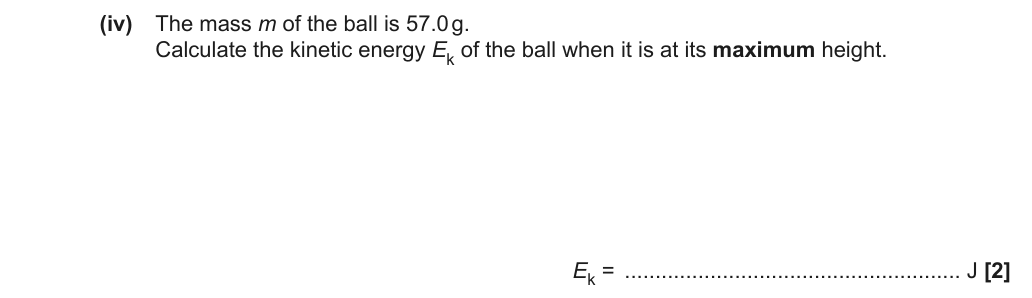
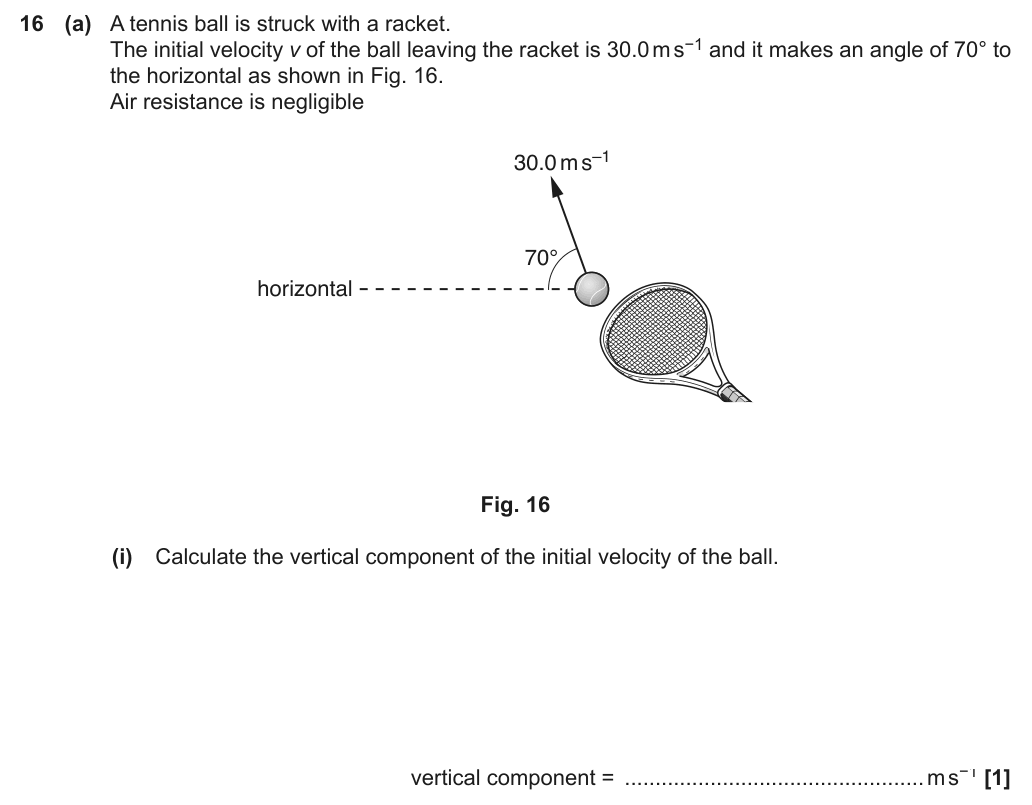
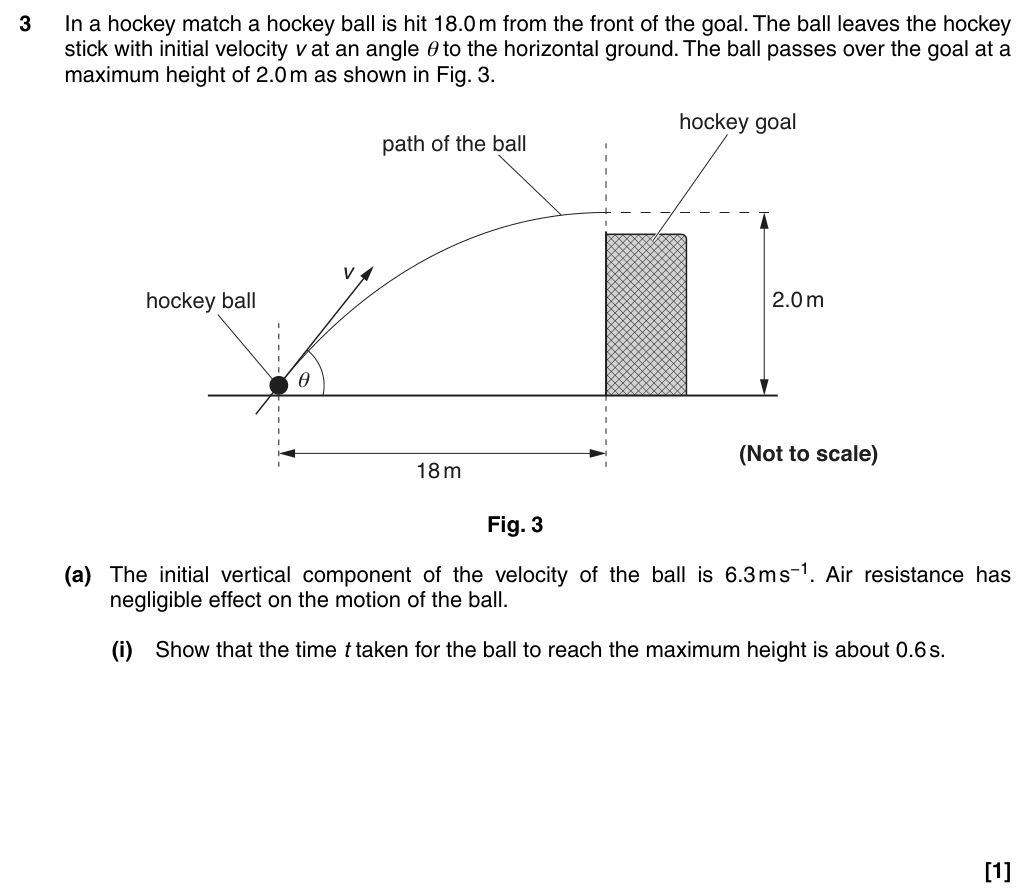
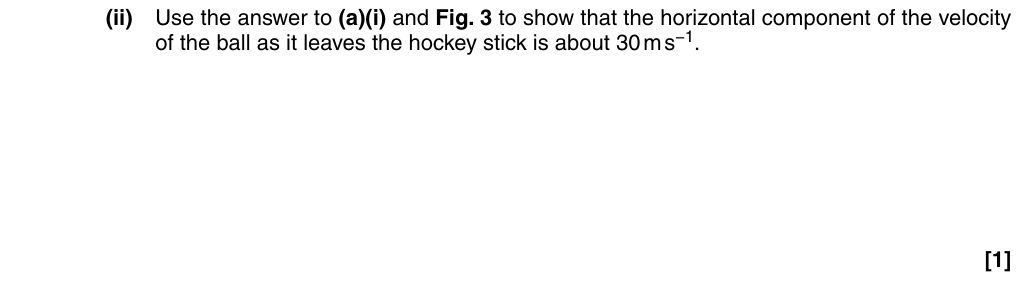
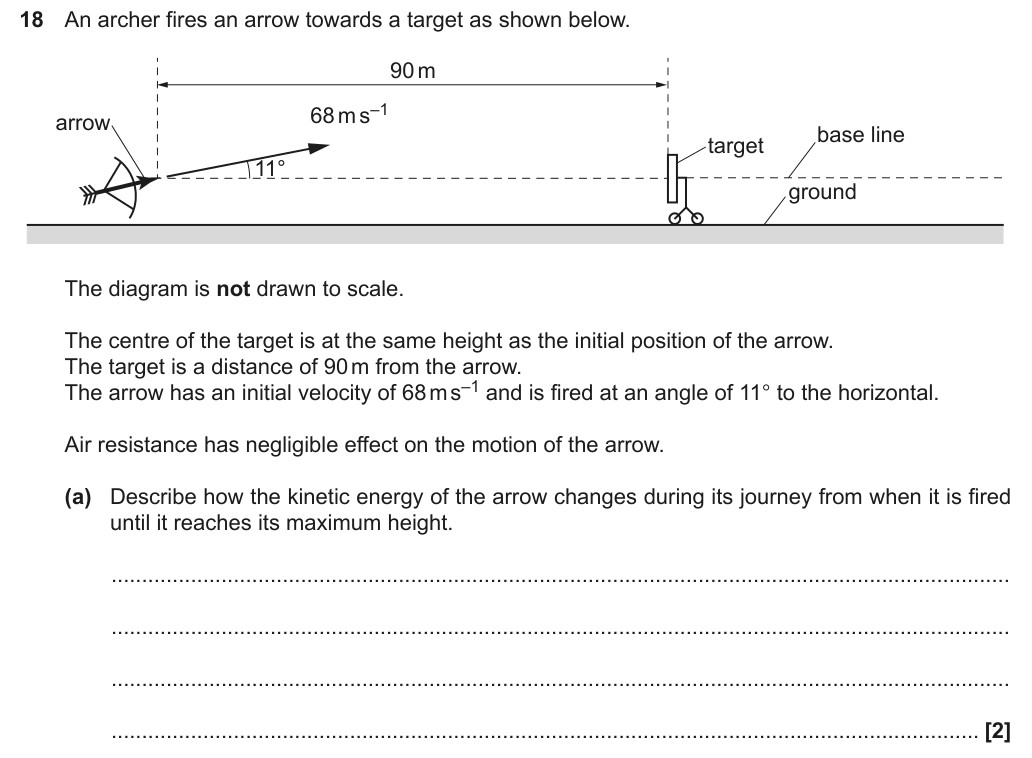
Part (i) was particularly well answered by 95% of all candidates. Nine out of ten candidates scored full marks in part (a)(ii), as they remembered that the question asks to show that the maximum height is around 40m. Working for this type of question is essential. In part (a)(iii), three quarters of all candidates correctly talked about the ball still having a horizontal velocity (which wasn’t zero) and therefore still possessing some KE. The key to this part (a)(iv), remembered by most candidates, was to use the horizontal component of velocity to find the KE at the maximum height. Some used the initial speed and others used the initial vertical velocity component found in part (a)(i).
Skills: M0.1 Recognise and make use of appropriate units in calculations; M0.6 Use calculators to handle sin x, cos x and tan x when x is expressed in degrees or radians; M2.3 Substitute numerical values into algebraic equations using appropriate units for physical quantities
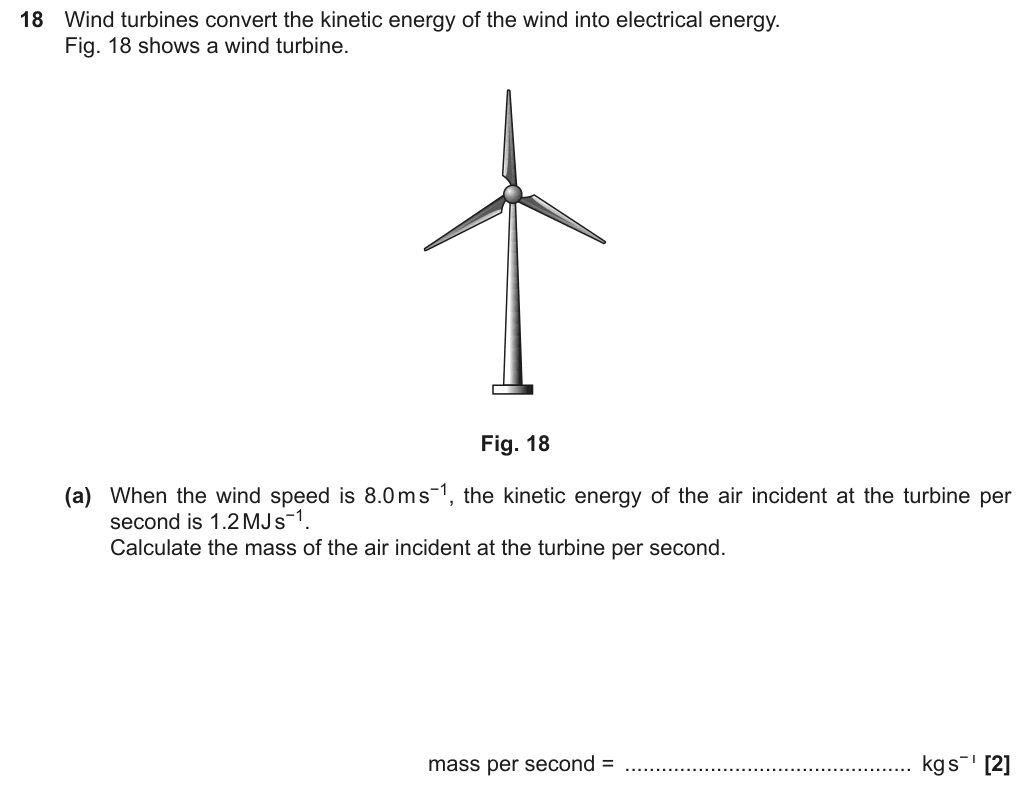
A large majority of candidates got this right. Those that did not usually forgot to square the velocity.
Skills: M0.2 Recognise and use expressions in decimal and standard form; M2.2 Change the subject of an equation, including non-linear equations
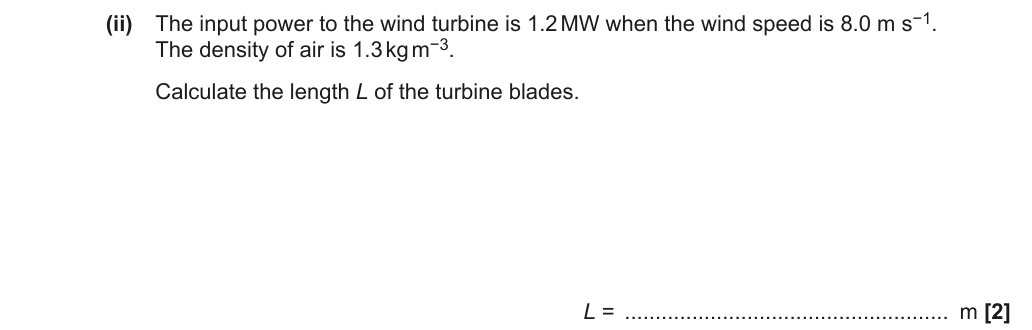
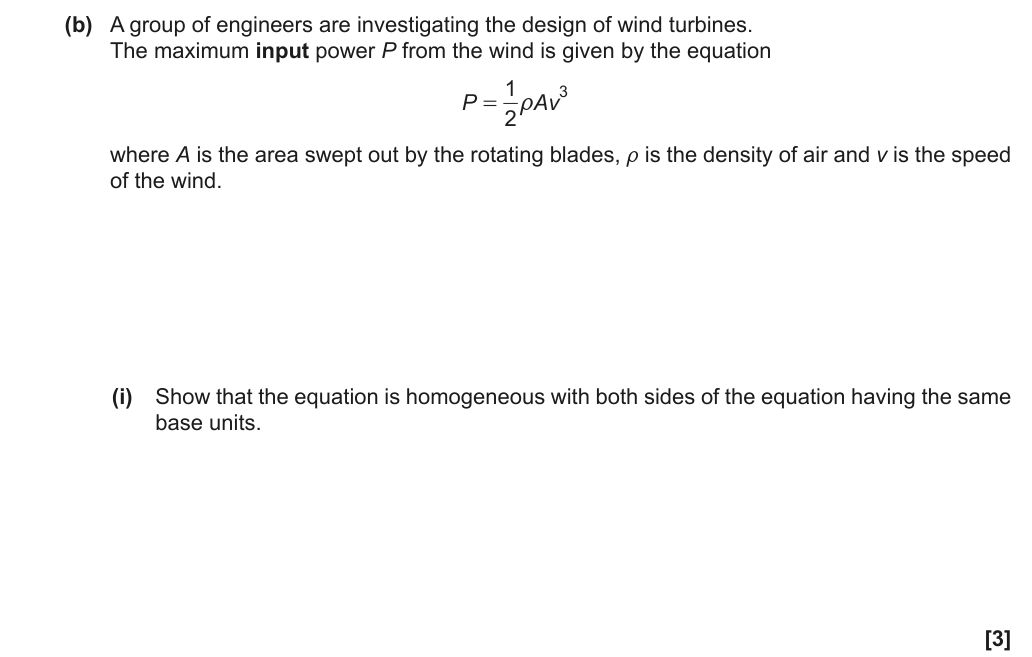
About two thirds of candidates got full marks on this item. By substituting the values into the formula, the area required is approximately 3600 m2. Some candidates did not read the question and instead of thinking about area swept out being a circle, they took it to be square, giving the length of the blade to be √3600 = 60 m.
Skills: M0.5 Use calculators to find and use power, exponential and logarithmic functions; M2.2 Change the subject of an equation, including non-linear equations; M4.3 Calculate areas of triangles, circumferences and areas of circles, surface areas and volumes of rectangular blocks, cylinders and spheres
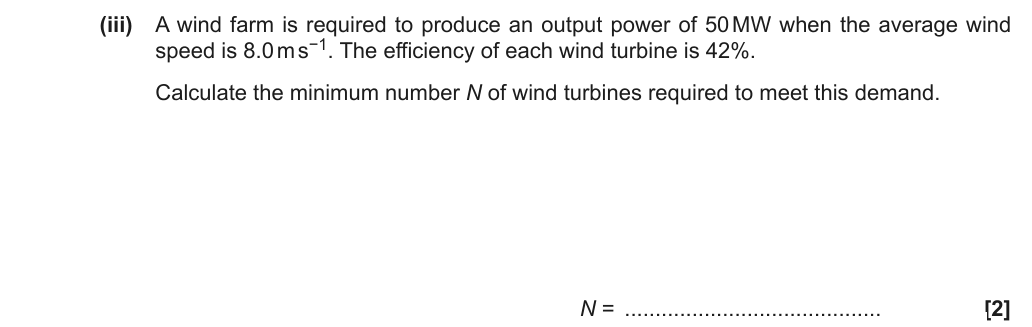
Rather more candidates got this item right. Some candidates mis-converted the unit and got values that could not be right i.e. 1 or 106 yet the majority arrived at 99.2 and correctly stated that the minimum number of required turbines must be 100 and not 99.
Skills: M0.3 Use ratios, fractions and percentages
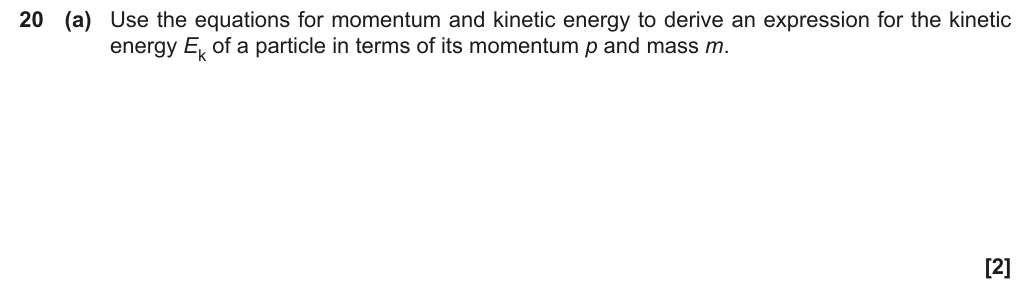
Question 20 (a) Examiners’ report Question 20 (b) (i) Examiners’ report Question 20 (b) (ii) Nearly four fifths of candidates completed 20a well, especially if they clearly stated the equations for momentum and kinetic energy.
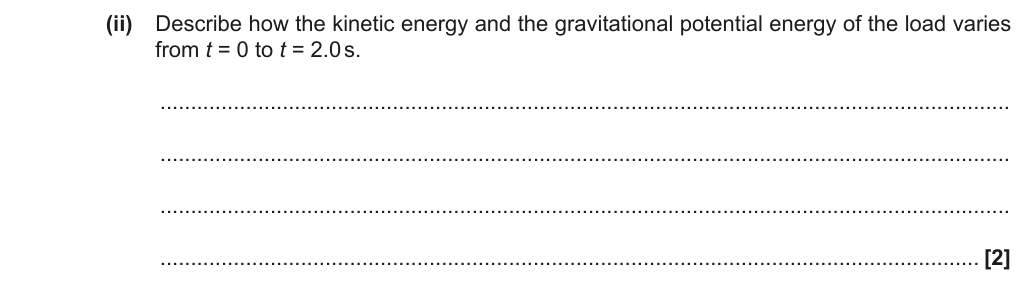
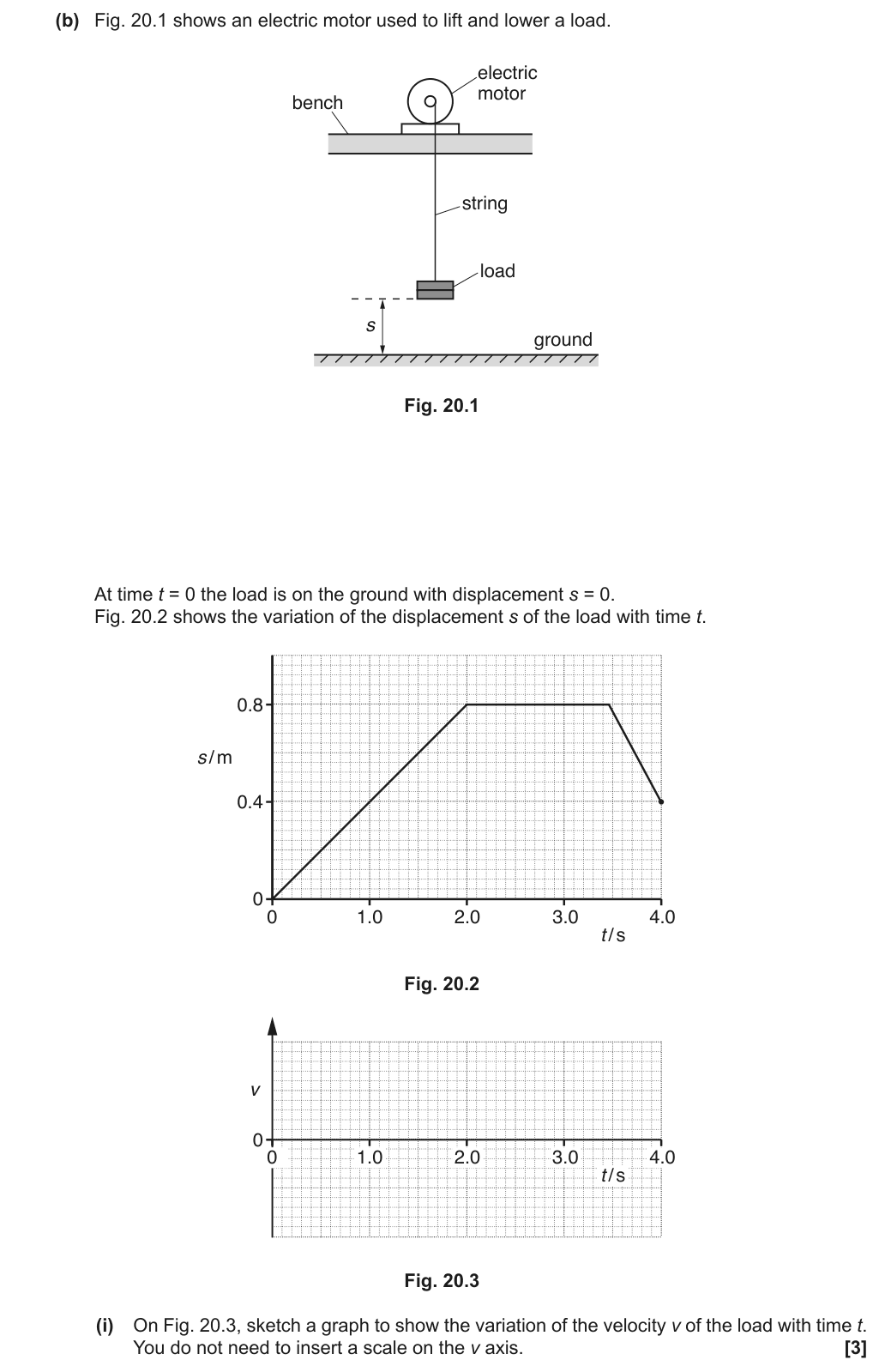
Nearly four fifths of candidates completed 20a well, especially if they clearly stated the equations for momentum and kinetic energy. Those that did not generally forgot that the question required an expression with ‘p’ and ‘m’ in it. ½ pv was a common wrong answer. 20bi was answered well, with some candidates either slightly misreading the graph when the velocity became negative or not spotting that the line was steeper for the last section of the movement than it was in the first. Most candidates spotted that the KE was constant because the velocity was constant. Rather fewer candidates explained that the GPE increased at a constant rate.
Skills: M3.1 Translate information between graphical, numerical and algebraic forms
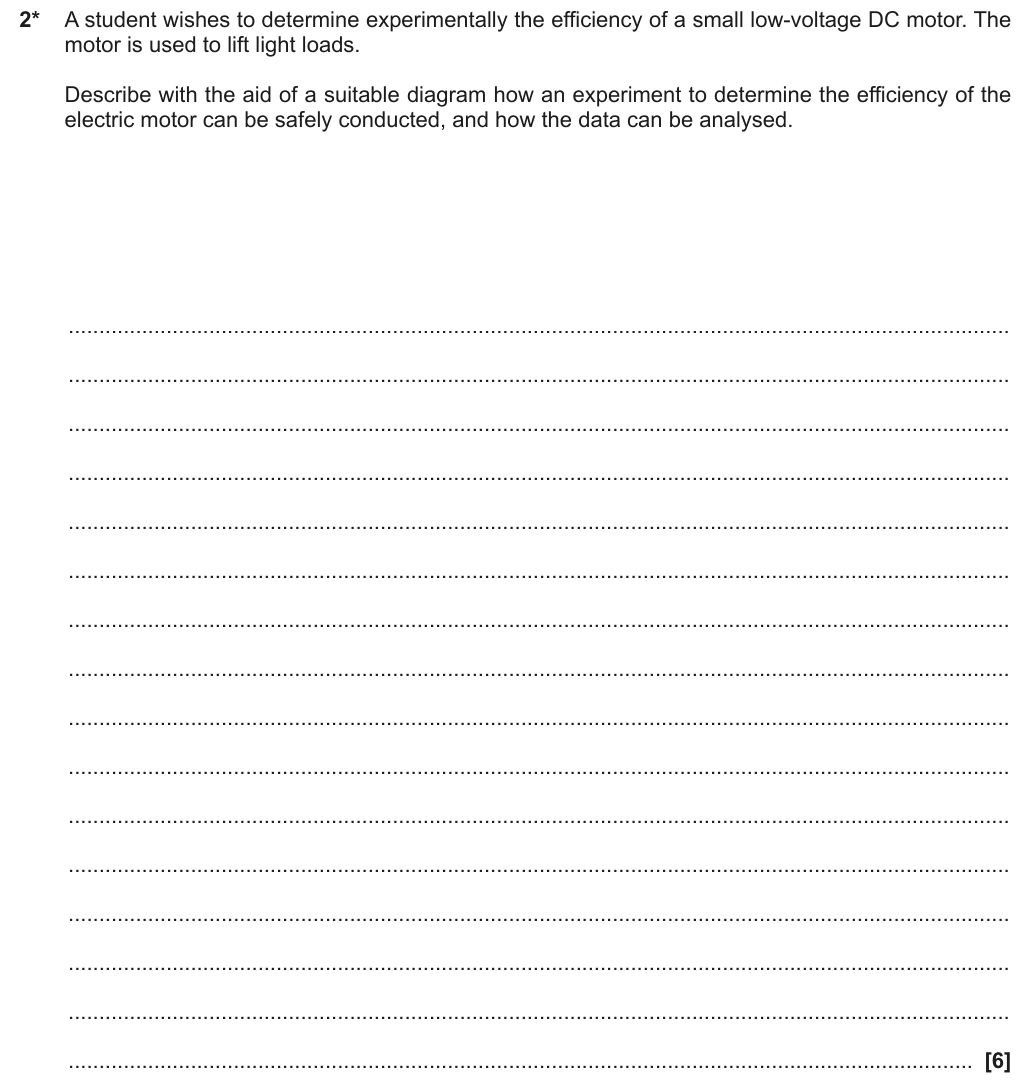
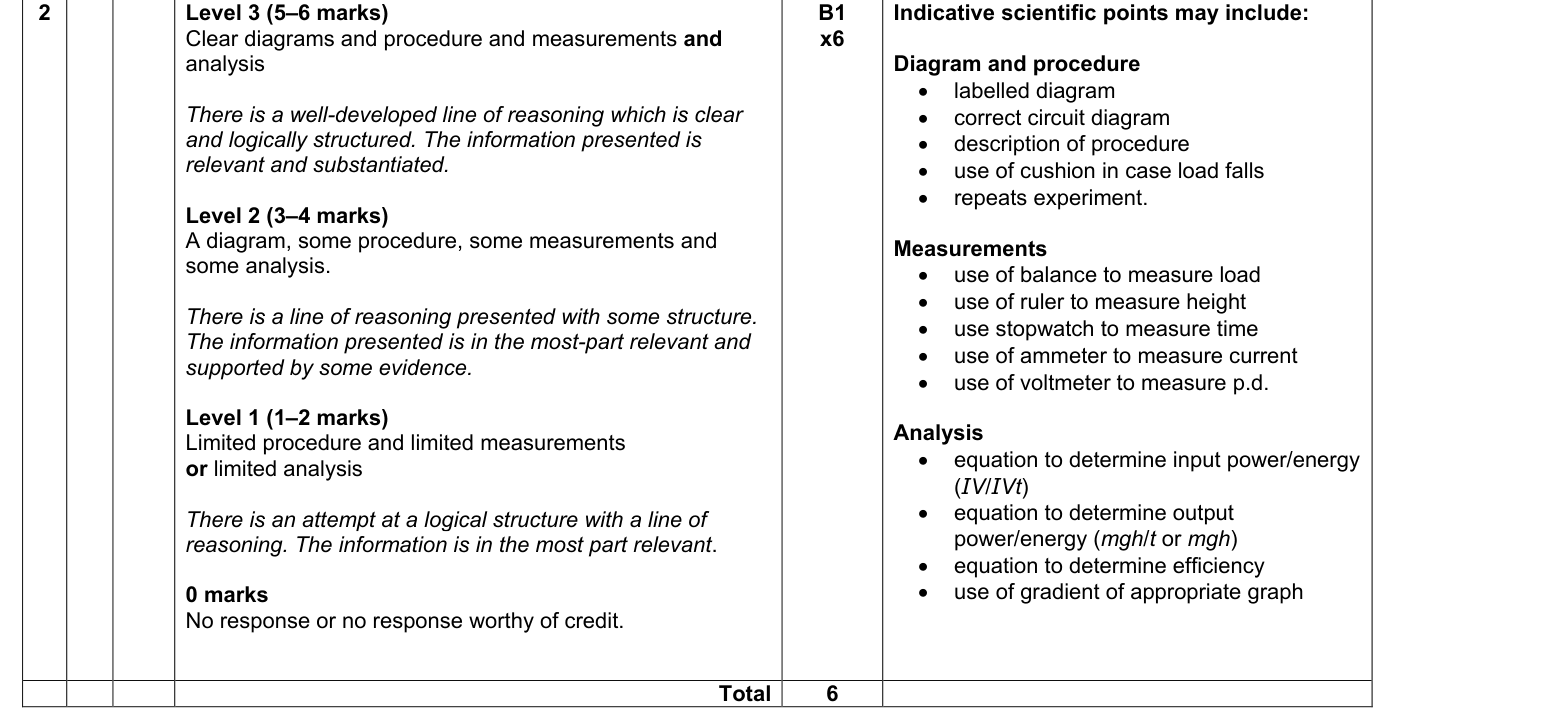
This question is assessing candidates’ abilities to plan an investigation. The question is set to help candidates e.g. “lift light loads” should have given the hint of gravitational potential energy. The stem of the question indicates that a suitable diagram should be drawn. Many candidates did not label their diagrams, or the diagrams were not workable. It was expected that there would be a workable circuit diagram with appropriate measuring instruments to determine the input power or energy; correct circuit symbols should be used. There also needed to be a diagram indicting how the useful power or energy could be determined. See Exemplar 1. When answering planning questions, candidates should identify the measurements that need to be taken and indicate appropriate measuring instruments. Candidates also needed to explain how the data would be analysed. This required them to give the appropriate equations using their measurements to determine the input power/energy, the output power/energy and the efficiency. Good candidates suggested the plotting of an appropriate graph and explained how the efficiency could be determined from the gradient. This candidate has drawn two diagrams – one diagram indicating clearly how the motor is connected to a cell with an ammeter and voltmeter which could be used to determine the input power. The left-hand diagram is an arrangement of the apparatus which indicates the basic set up and included a foam box for the mass to fall into if the experiment does not work properly. This candidate has also underlined key words from the question.
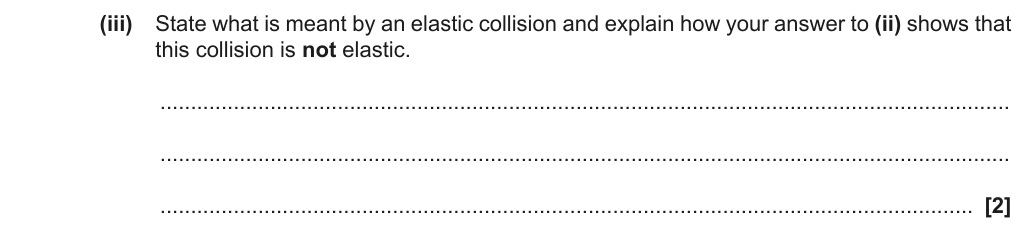
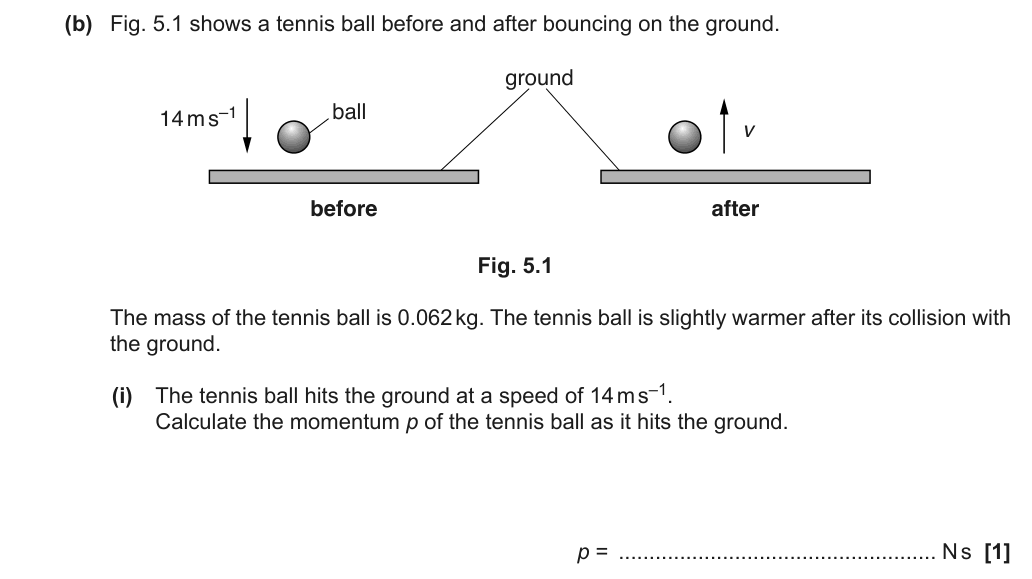
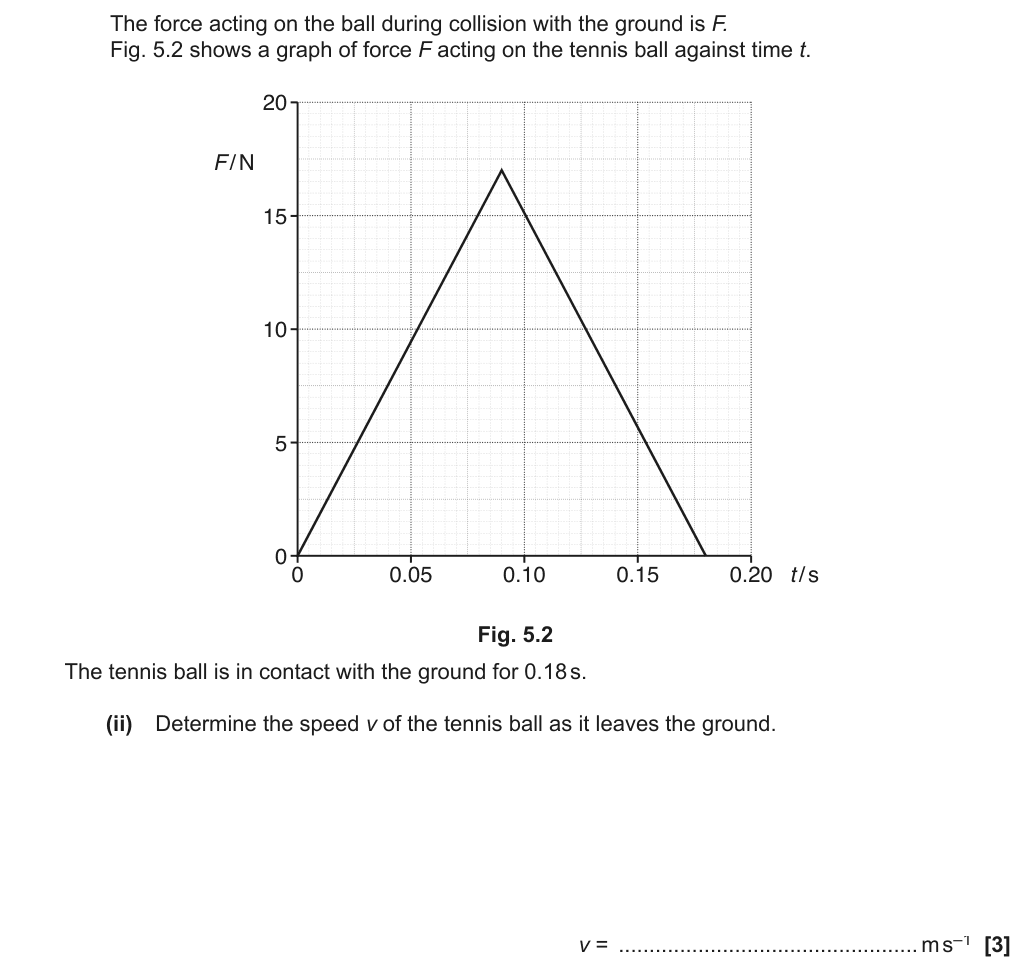
Many candidates did not state that the kinetic energy is conserved – often there were general statements about energy being conserved. Some candidates did not relate their answer to part (ii) as required by the question. Some candidates determined the kinetic energy before and after the ball left the ground – candidates could gain full marks with this approach.
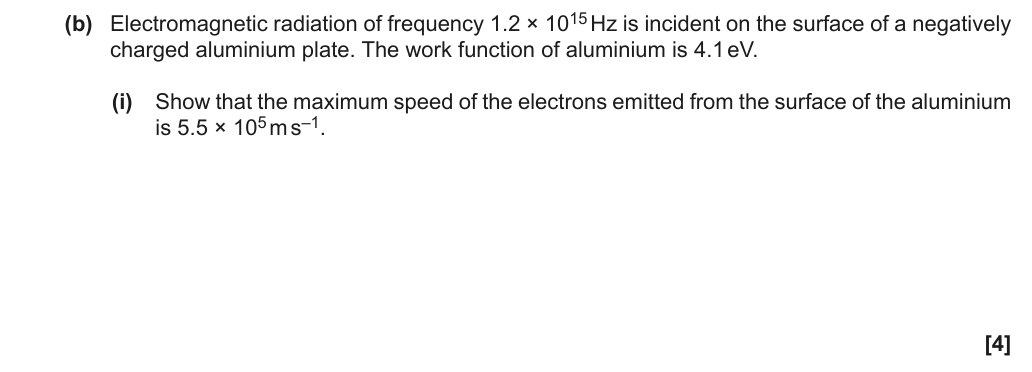
Good candidates clearly showed the individual steps in this calculation, e.g. the conversion of electron- volt to joule for the work function, the energy of the photon calculated. It was important that candidates demonstrated that they had substituted the mass of the electron from the data booklet and correctly evaluated the square root term. Examiners expected to see 5.536 x 10⁵ (m s-1) for full credit so that it was clear that candidates had correctly calculated the powers of ten. In line 3 of the candidate’s working, there is a rearrangement of the equation given at the beginning of the question. There is then clear substitution of the energy of a photon which was calculated in line 1 and the work function which had been converted from electron volt to joule in line 2 to give a value for the maximum kinetic energy of the electrons. This scores three marks. In the final part the candidate correctly shows the rearrangement of the kinetic energy equation to give v as the subject and then correctly substitutes in the values including the mass of the electron from the data and formulae sheet. The final answer is given as 5.527 x 10⁵ which is then shown to be approximately equal to 5.5 x 10⁵ (ms- 1). This last part is essential in these show type questions.
Skills: M0.2 Recognise and use expressions in decimal and standard form; M2.2 Change the subject of an equation, including non-linear equations; M2.3 Substitute numerical values into algebraic equations using appropriate units for physical quantities
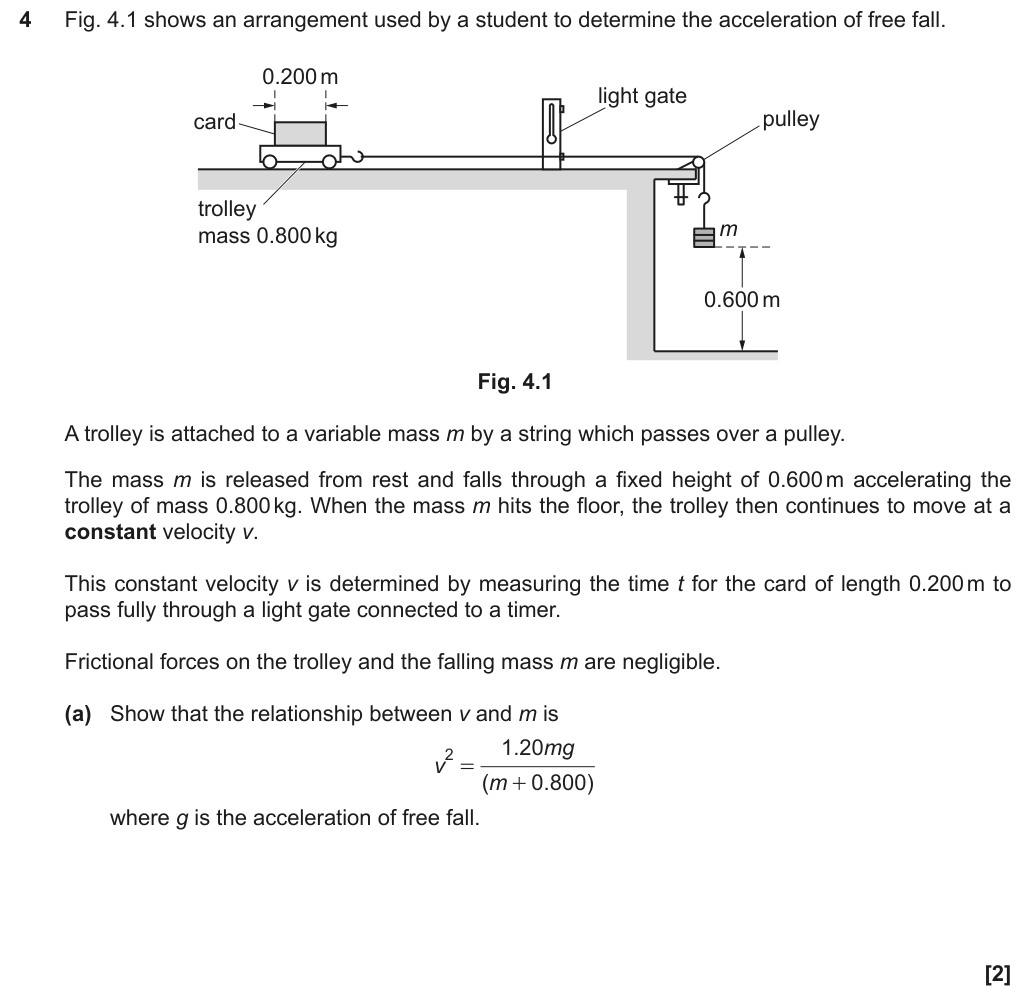
The challenge to candidates in answering this show that question was to produce a convincing proof. More chose to use constant acceleration equations and F = ma rather than loss of potential energy equates to gain in kinetic energy. The difficulty in the former method was justifying the statement F = mg = (m + 0.800) a. Most just quoted that a = mg/ (m + 0.800) which immediately gave the relationship shown in the question. The difficulty with the second method was that most candidates wrote mgh = ±½mv2 as the first line of their answer. In the next line one m became (m + 0.800) without explanation to give the required relationship. Only candidates who gave more explanation were credited the marks. The candidate who wrote this perfect answer (exemplar 7) solved the problem in the first method of solution by introducing the tension in the string (labelled T on Fig. 4.1).
Skills: M2.2 Change the subject of an equation, including non-linear equations
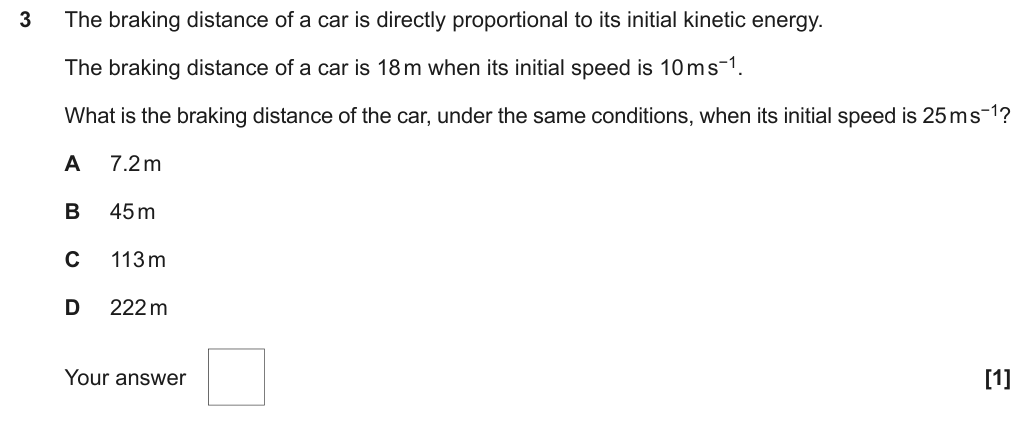
C
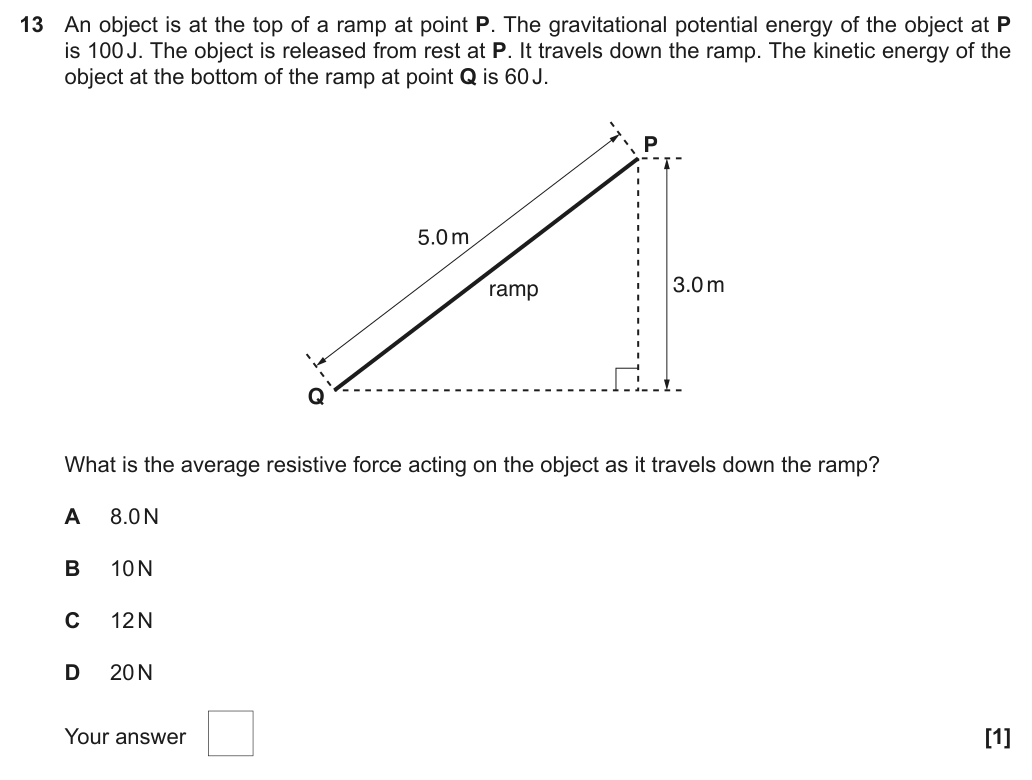
A
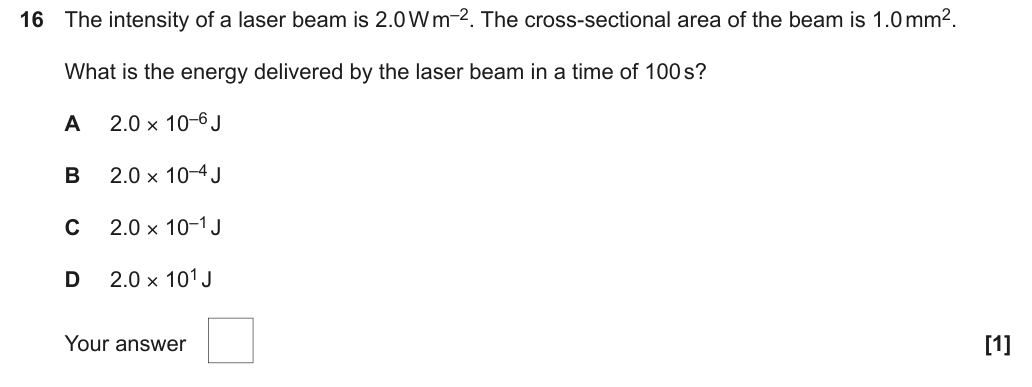
B
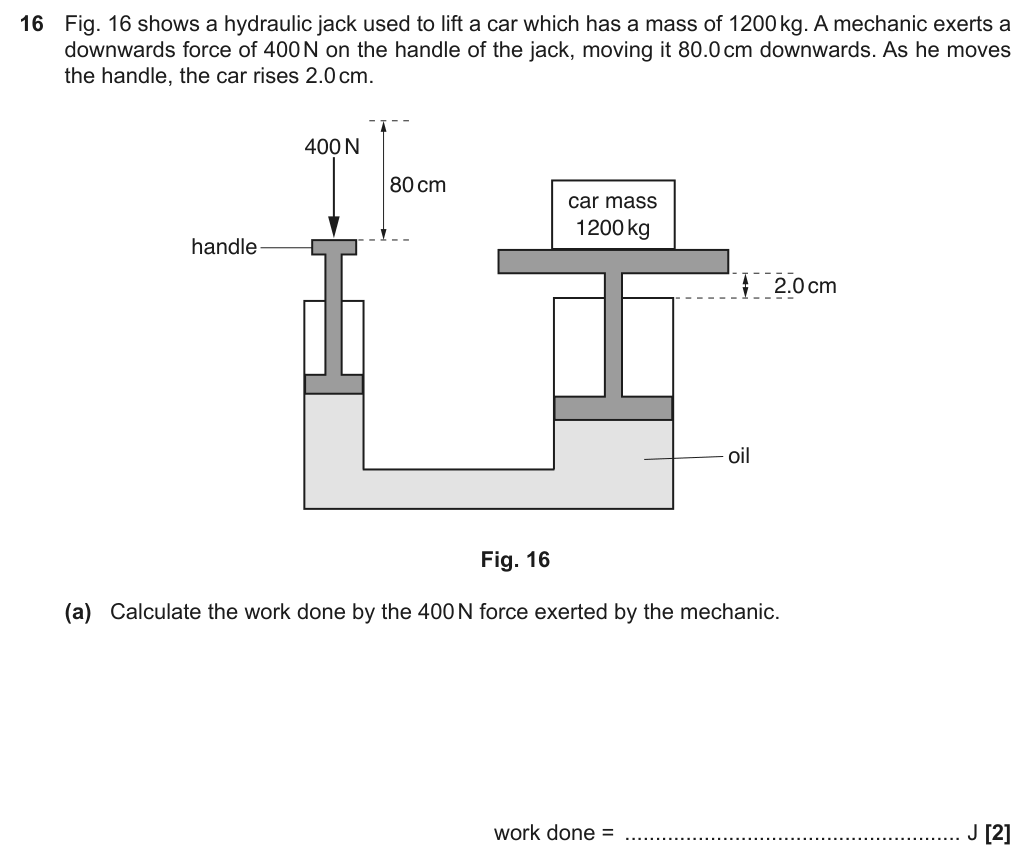
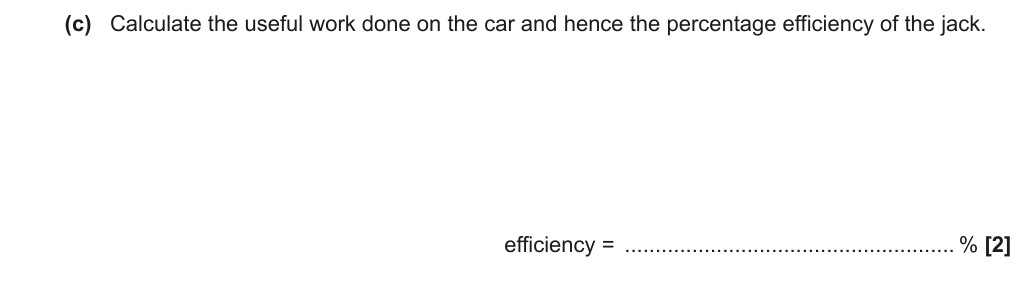
Skills: M0.3 Use ratios, fractions and percentages; M2.3 Substitute numerical values into algebraic equations using appropriate units for physical quantities
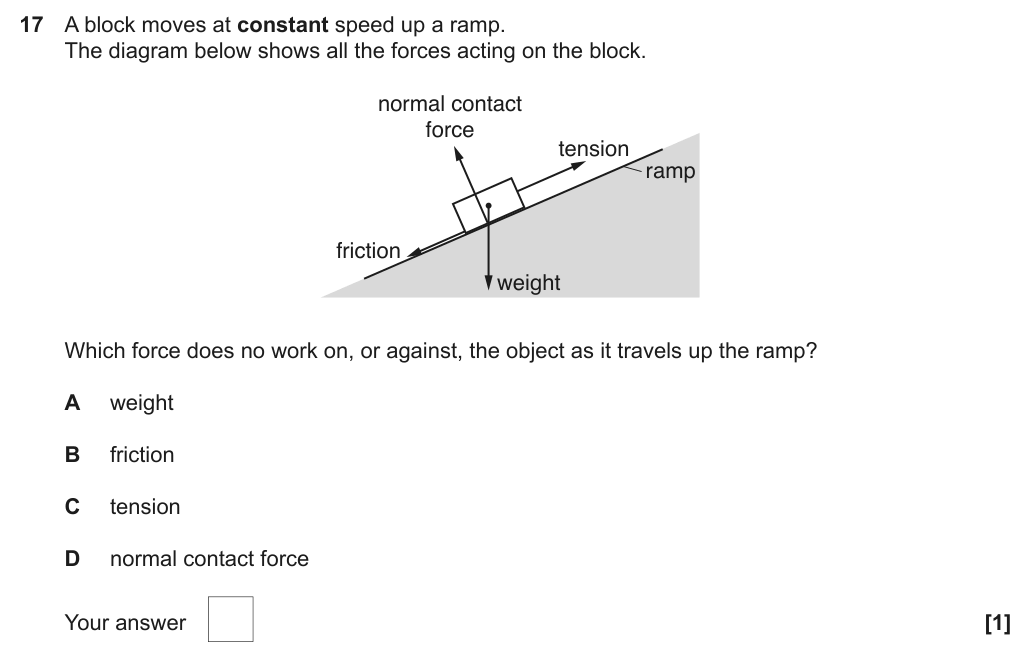
D
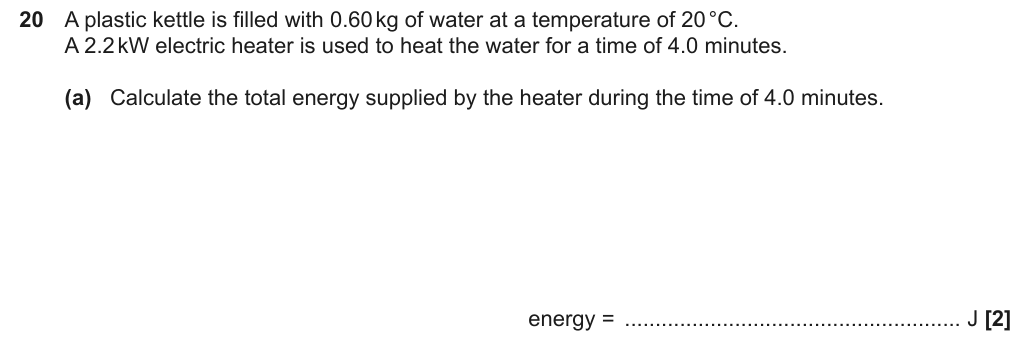
Skills: M0.2 Recognise and use expressions in decimal and standard form; M2.2 Change the subject of an equation, including non-linear equations; M2.3 Substitute numerical values into algebraic equations using appropriate units for physical quantities
Skills: M0.2 Recognise and use expressions in decimal and standard form; M2.3 Substitute numerical values into algebraic equations using appropriate units for physical quantities
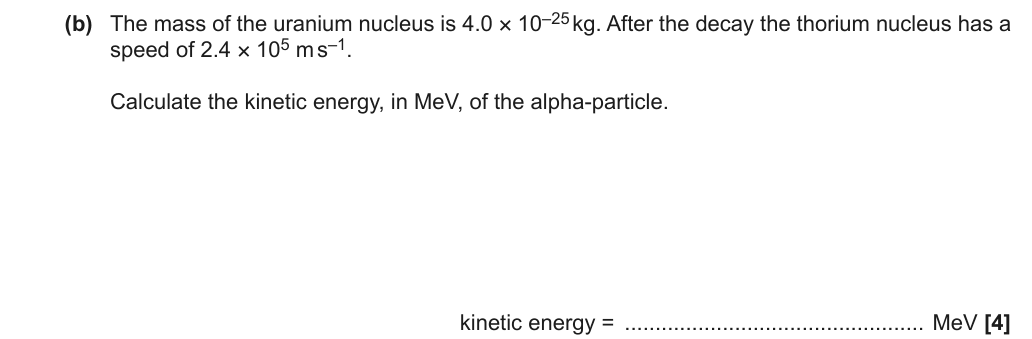
Skills: M0.1 Recognise and make use of appropriate units in calculations; M2.2 Change the subject of an equation, including non-linear equations; M2.3 Substitute numerical values into algebraic equations using appropriate units for physical quantities
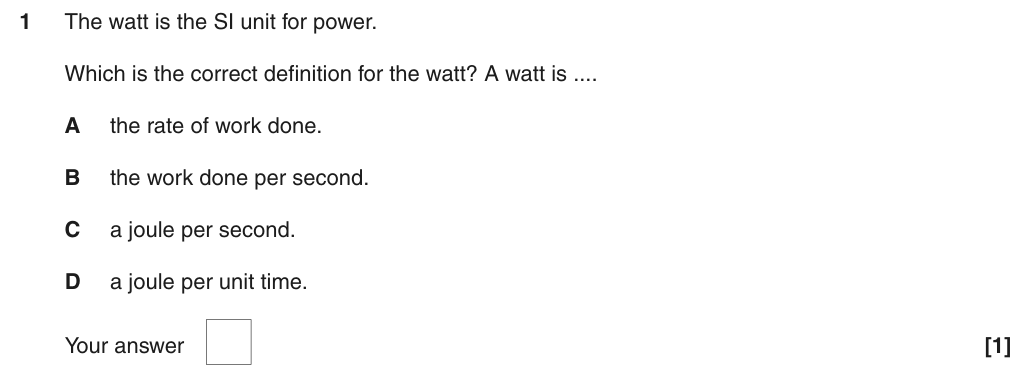
C
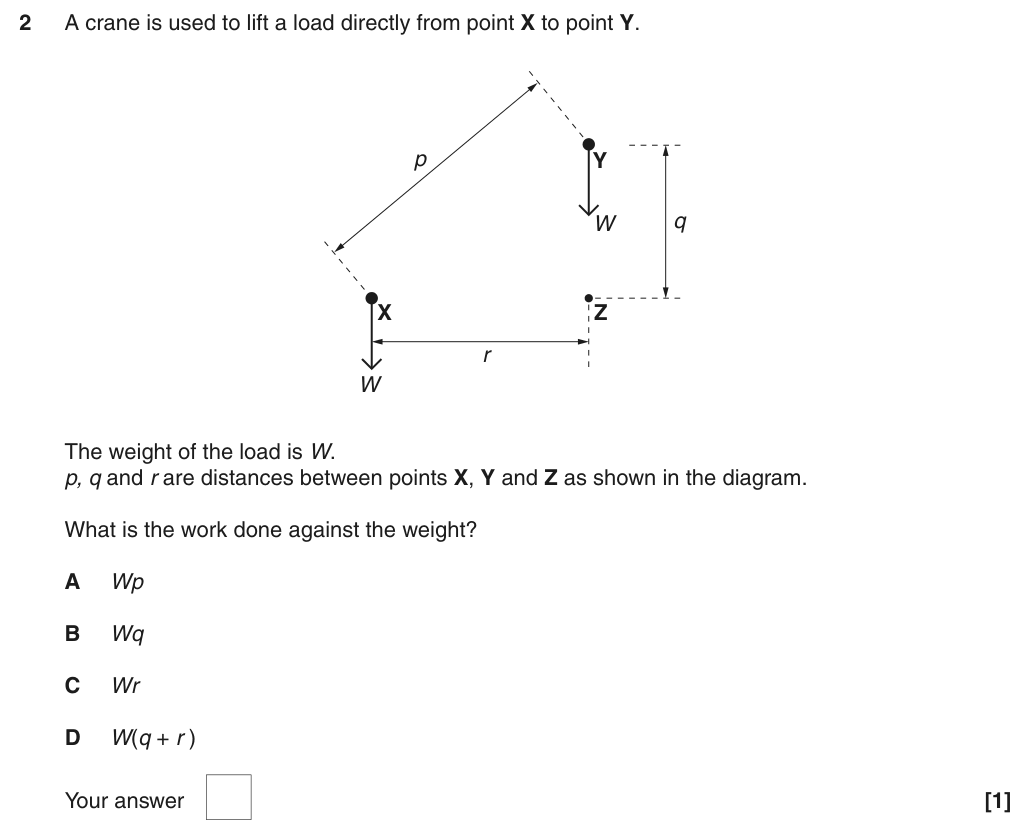
B
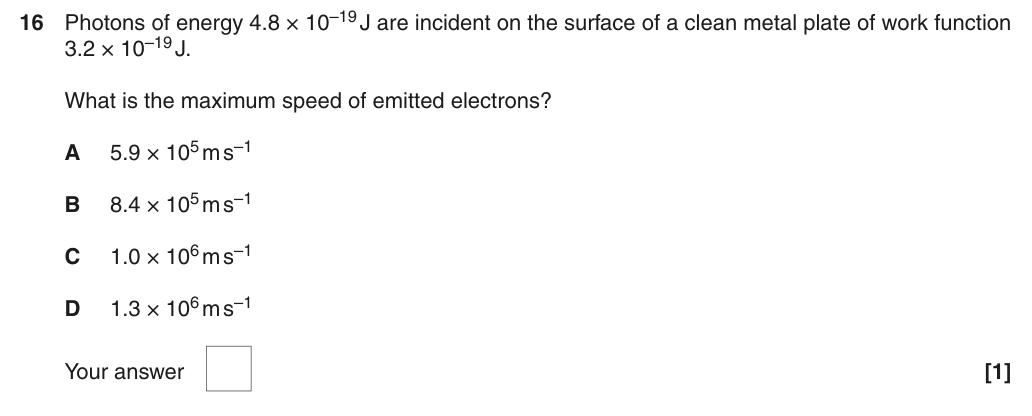
A
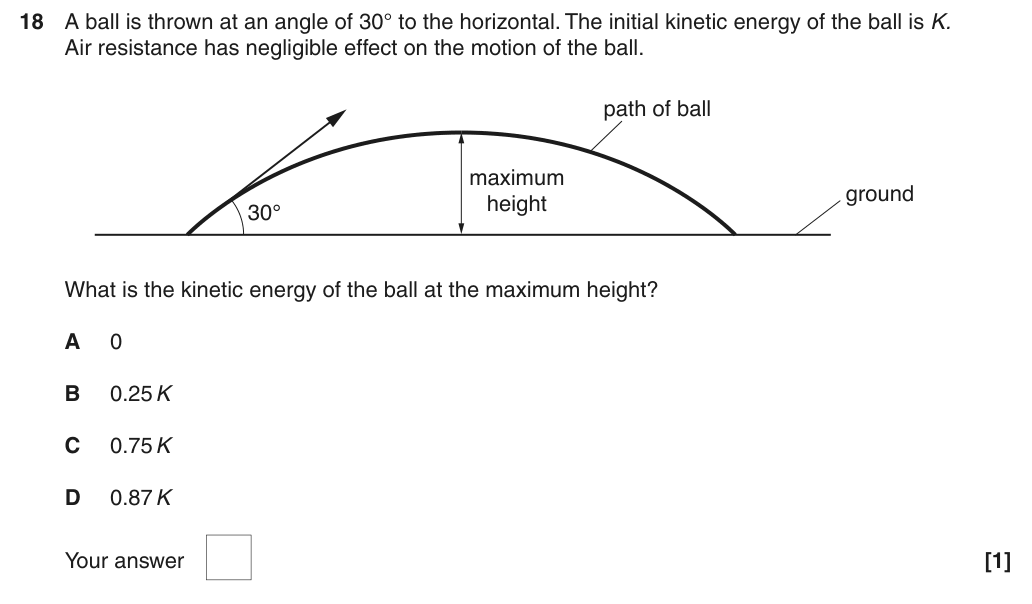
C
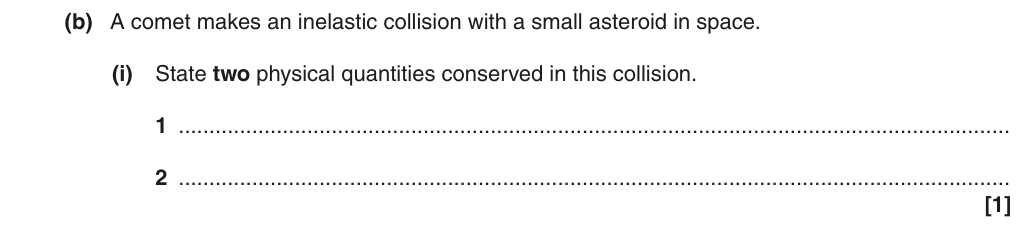
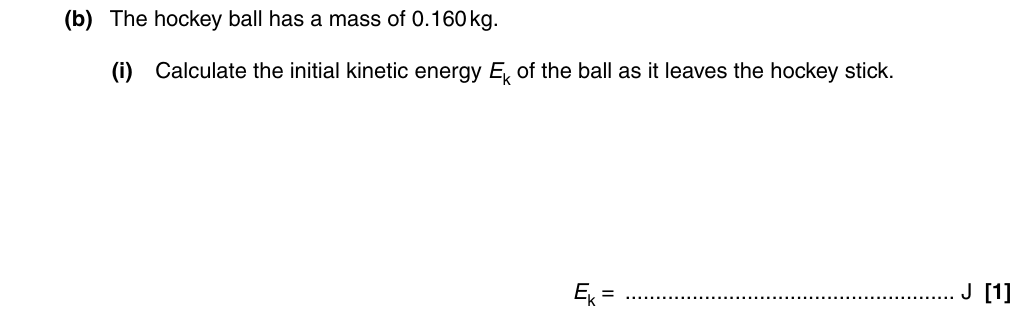
Skills: M2.3 Substitute numerical values into algebraic equations using appropriate units for physical quantities
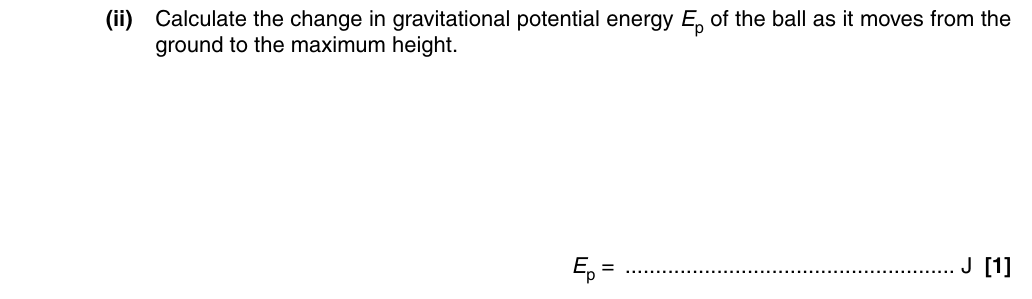
Skills: M2.3 Substitute numerical values into algebraic equations using appropriate units for physical quantities
Skills: M2.3 Substitute numerical values into algebraic equations using appropriate units for physical quantities
Dropping marks on calculations, practical questions or the six-mark level of response questions? Book a trial session with a specialist OCR physics tutor.