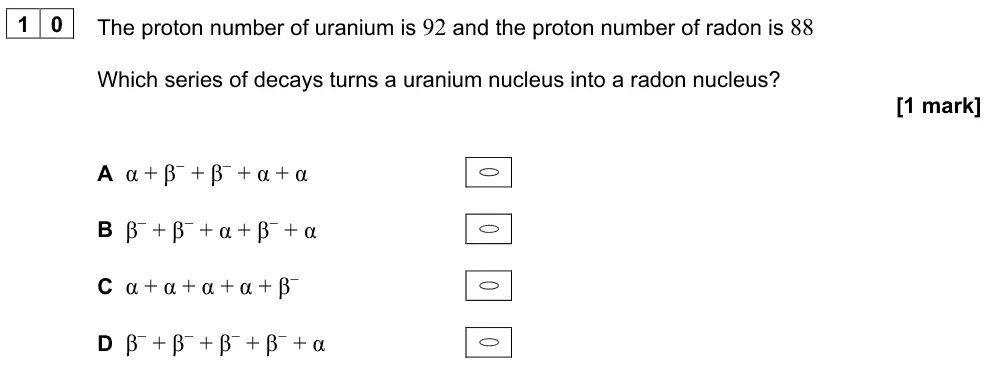
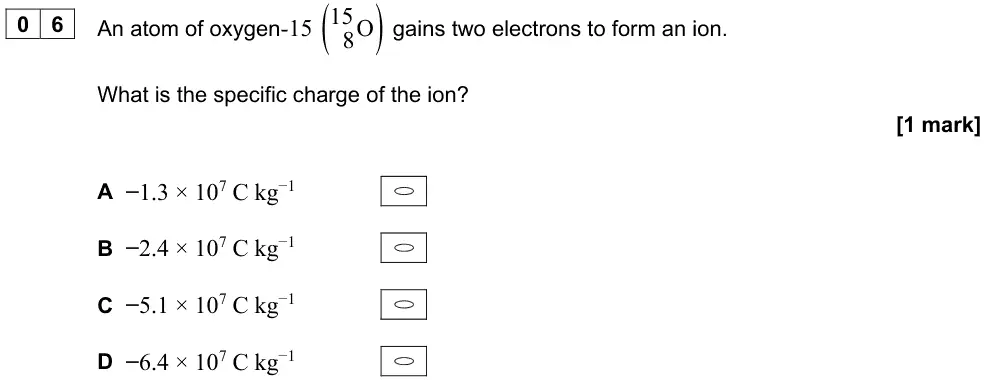
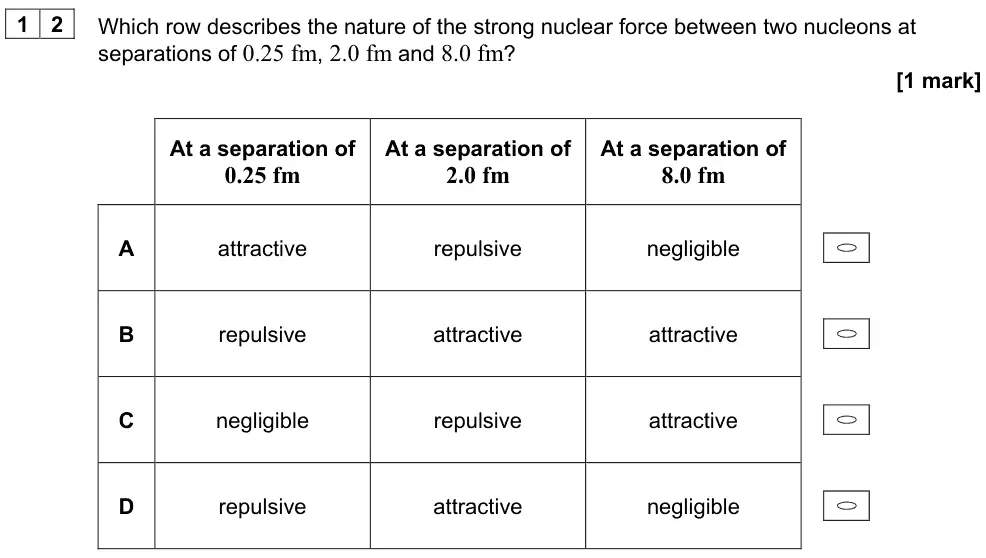
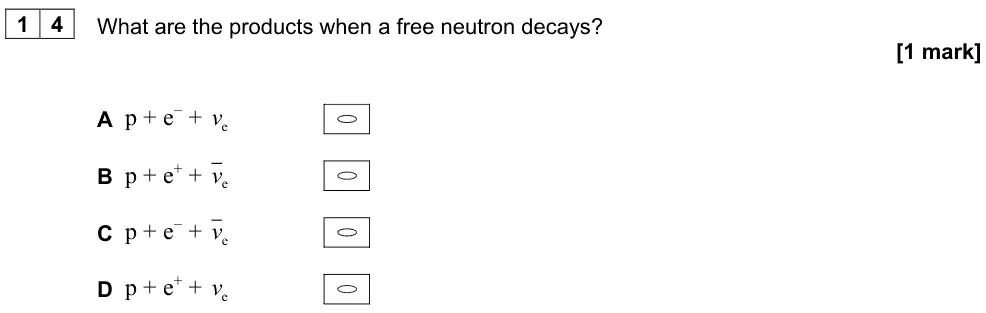
Notes and key-term cards for this topic are being written by our tutors. The past-paper questions below are ready now.
Specification statements
Show the 10 statements from the specification
3.2.1.1-01 Simple model of the atom, including the proton, neutron and electron. Charge and mass of the proton, neutron and electron in SI units and relative units.
3.2.1.1-02 The atomic mass unit (amu) is included in the A-level Nuclear physics section.
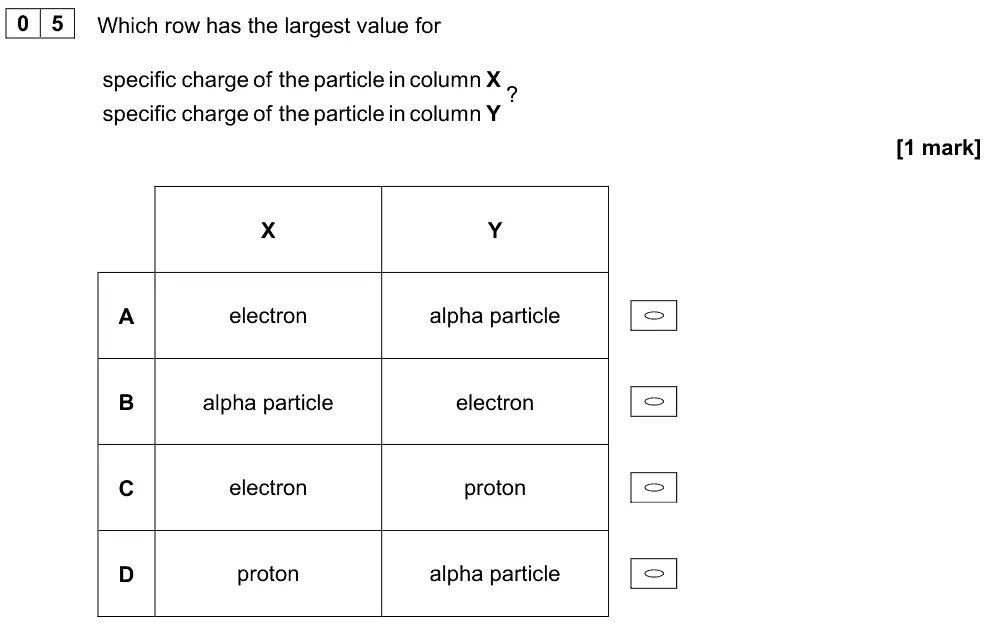
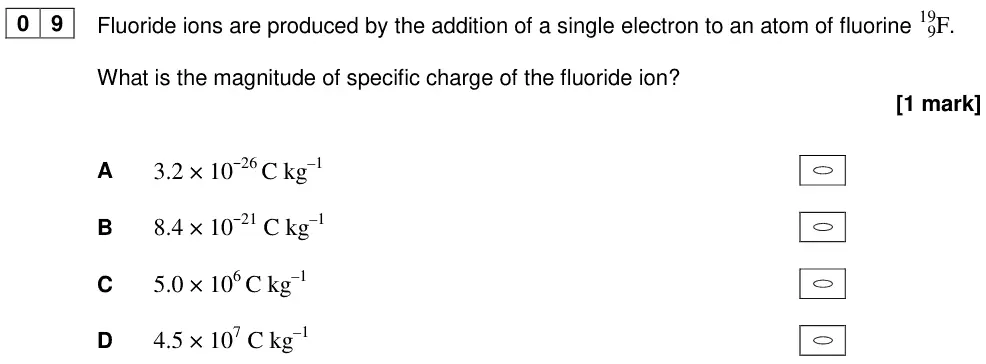
3.2.1.1-03 Specific charge of the proton and the electron, and of nuclei and ions.
3.2.1.1-04 Proton number Z, nucleon number A, nuclide notation.
3.2.1.1-05 Students should be familiar with the X Z A notation.
3.2.1.1-06 Meaning of isotopes and the use of isotopic data.
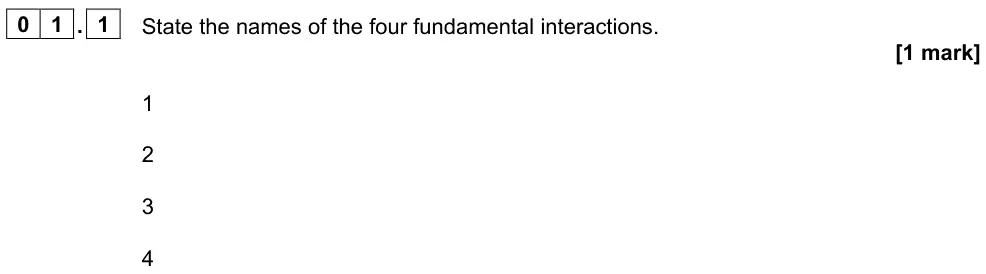
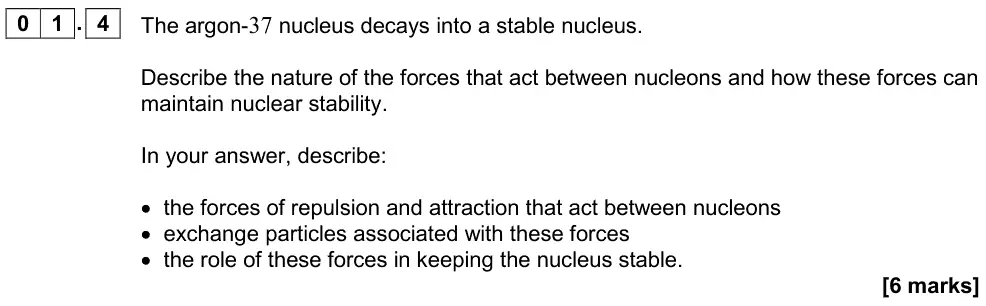
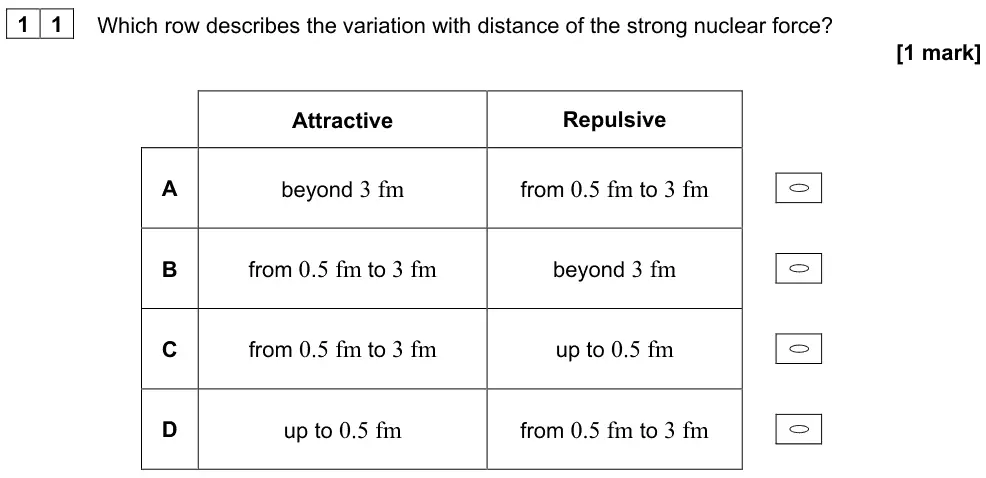
3.2.1.2-01 The strong nuclear force; its role in keeping the nucleus stable; short-range attraction up to approximately 3 fm, very-short range repulsion closer than approximately 0.5 fm.
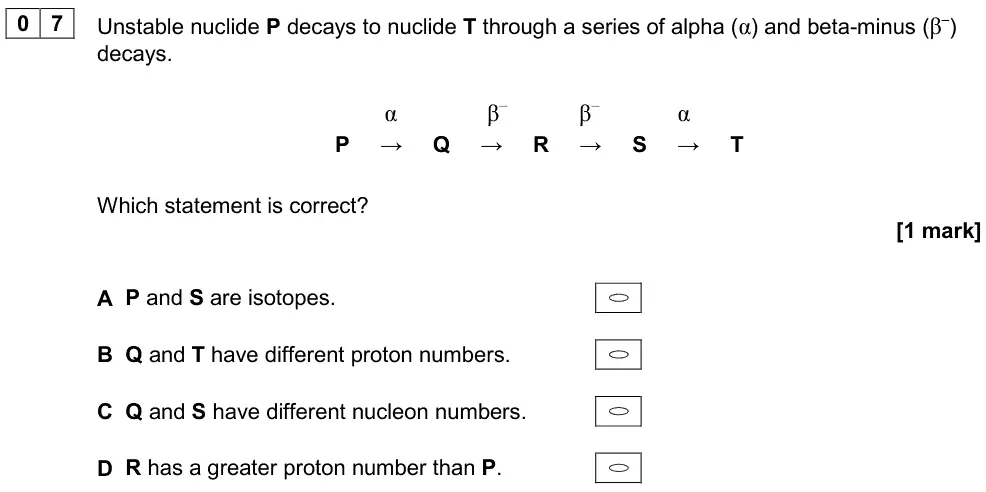
3.2.1.2-02 Unstable nuclei; alpha and beta decay.
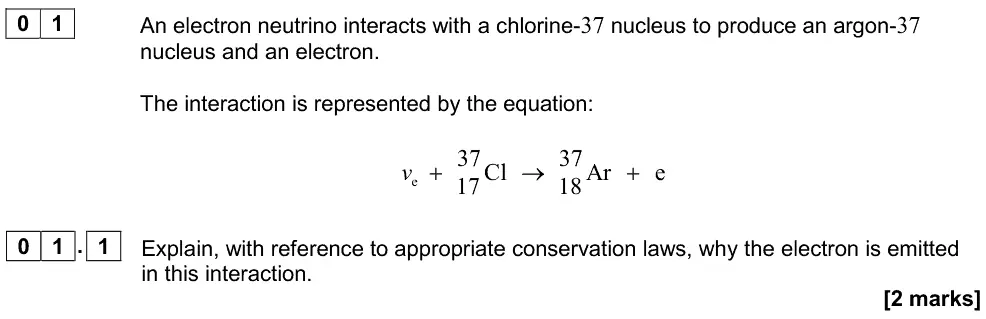
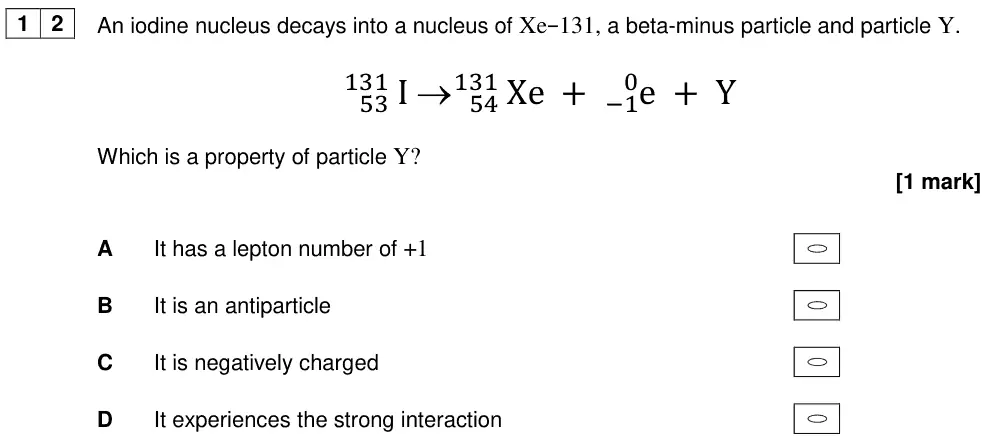
3.2.1.2-03 Equations for alpha decay, β− decay including the need for the neutrino.
3.2.1.2-04 The existence of the neutrino was hypothesised to account for conservation of energy in beta decay.
Six-mark extended response questions on this topic
Tap a question to zoom it. Where a part needs a figure, table or graph from earlier in the question, that part folds out above it; the mark scheme and examiner's comment open underneath. Have the AQA data and formulae booklet beside you (see the formula sheet page).
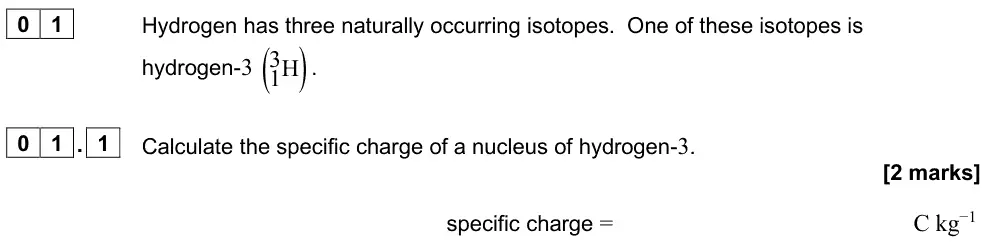
June 2025 · AS Paper 1 · Q1.12 marksAO1=1, AO2=1CalculationEasy
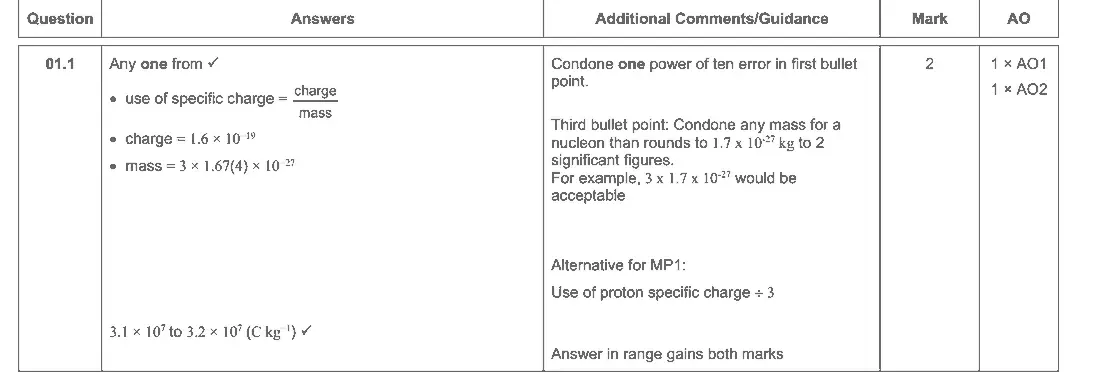
Mark scheme
Examiner's comment
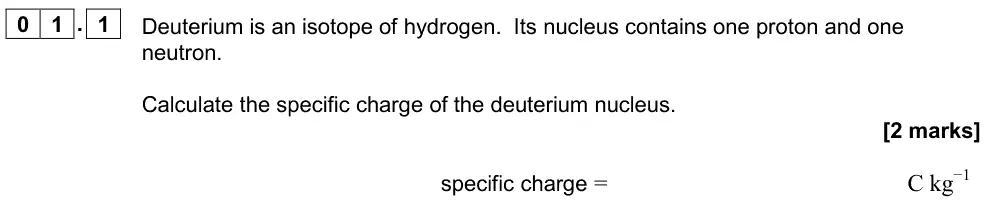
01.1 Most students performed well in this straightforward calculation, with over 65% achieving full marks and a further 20% securing one mark. Common misconceptions included: reversing the required ratio by dividing mass by charge, despite the unit (C kg–1 ) • provided on the answer line. incorrectly using the relative mass and charge values of 1 for a proton rather than the • actual values. misjudging the magnitude; some students incorrectly rewrote 3.2 × 10⁷ as 3.2 × 10⁻⁷ , • believing the initial result was implausibly large. 01.2 Over 80% of students gained at least one mark, though only about 40% were able to produce an answer that gained both marks. Common deficiencies in answers included: discussing differences in mass between isotopes without noting that the charge • remains constant. identifying that isotopes have different numbers of neutrons but neglecting to deduce, • either from previous knowledge or the information in the question, that hydrogen-3 has more neutrons. not recognising hydrogen-1 as an isotope limiting their comparisons to hydrogen-3 and • hydrogen-2 (although these students were able to gain both marks where appropriate working that mentioned charge and mass was seen). 01.3 Approximately 40% of students correctly deduced and justified the quark structure of this neutral kaon (s̅d). A further 20% gained two marks, typically by: stating the correct structure but neglecting to provide the supporting reasoning. • correctly identifying the presence of a strange quark but omitting the understanding • that a kaon is a meson. 01.4 Higher performing students (approximately 40%) were able to answer this question by realising that conservation of lepton number occurs within each generation and that particle A must be an antilepton due to it carrying a positive charge. stating that charge must be conserved. • a general statement that lepton number is conserved without realising that this is true • within each lepton generation.
Common incorrect responses for A and B included: an incorrect lepton-antilepton combination such as electron and electron • antineutrino, through not applying conservation of charge. quoting A as a positron but then quoting B as an electron antineutrino, through not • realising that both are antiparticles.
Notes from the mark scheme and report
Answer: 3.2 x 10^7 C kg^-1 (1.6 x 10^-19 / (3 x 1.67 x 10^-27))
inverting the ratio or using relative values 1 were common errors
Skills: MS2.3 Substitute numerical values into algebraic equations using appropriate units for physical quantities; MS0.2 Recognise and use expressions in decimal and standard form
June 2025 · AS Paper 1 · Q1.22 marksAO1=1, AO2=1Explanation
Earlier part of question 1 that this part uses
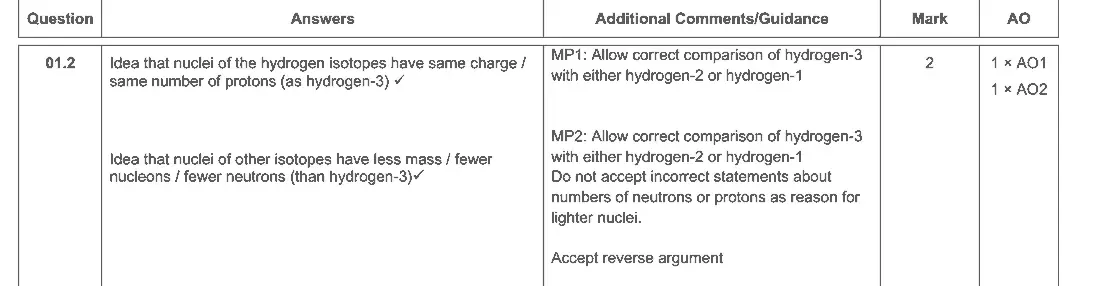
Mark scheme
Examiner's comment
01.1 Most students performed well in this straightforward calculation, with over 65% achieving full marks and a further 20% securing one mark. Common misconceptions included: reversing the required ratio by dividing mass by charge, despite the unit (C kg–1 ) • provided on the answer line. incorrectly using the relative mass and charge values of 1 for a proton rather than the • actual values. misjudging the magnitude; some students incorrectly rewrote 3.2 × 10⁷ as 3.2 × 10⁻⁷ , • believing the initial result was implausibly large. 01.2 Over 80% of students gained at least one mark, though only about 40% were able to produce an answer that gained both marks. Common deficiencies in answers included: discussing differences in mass between isotopes without noting that the charge • remains constant. identifying that isotopes have different numbers of neutrons but neglecting to deduce, • either from previous knowledge or the information in the question, that hydrogen-3 has more neutrons. not recognising hydrogen-1 as an isotope limiting their comparisons to hydrogen-3 and • hydrogen-2 (although these students were able to gain both marks where appropriate working that mentioned charge and mass was seen). 01.3 Approximately 40% of students correctly deduced and justified the quark structure of this neutral kaon (s̅d). A further 20% gained two marks, typically by: stating the correct structure but neglecting to provide the supporting reasoning. • correctly identifying the presence of a strange quark but omitting the understanding • that a kaon is a meson. 01.4 Higher performing students (approximately 40%) were able to answer this question by realising that conservation of lepton number occurs within each generation and that particle A must be an antilepton due to it carrying a positive charge. stating that charge must be conserved. • a general statement that lepton number is conserved without realising that this is true • within each lepton generation.
Notes from the mark scheme and report
All isotopes have the same charge (one proton)
the other nuclei have fewer neutrons so less mass
must note the charge is the same
June 2025 · Paper 1 · Q1.32 marksAO2=1, AO3=1CalculationEasy
Earlier part of question 1 that this part uses
Mark scheme
Examiner's comment
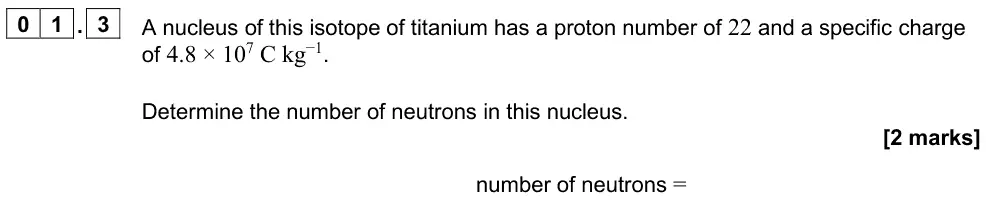
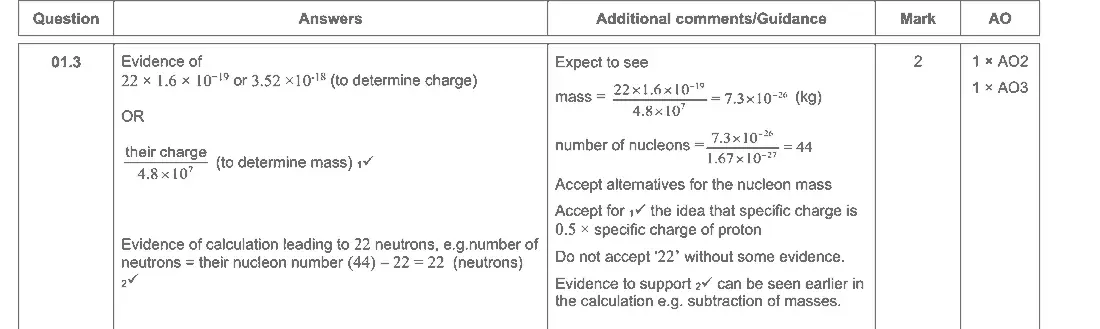
The calculation in 1.3 was very accessible, with over 65% of students getting both marks. There were several correct routes that were given full credit. Some students who arrived at the correct answer decided to round their value down to 21 and lost the second mark. Examiners commented on how pleasing it was to see answers that were set out clearly.
Notes from the mark scheme and report
Answer: 22 neutrons (charge 3.52 x 10^-18 C, mass 7.3 x 10^-26 kg, 44 nucleons)
bare '22' without working not credited
rounding down to 21 lost the mark
Skills: MS0.2 Recognise and use expressions in decimal and standard form; MS2.2 Change the subject of an equation, including non-linear equations; MS2.3 Substitute numerical values into algebraic equations using appropriate units for physical quantities
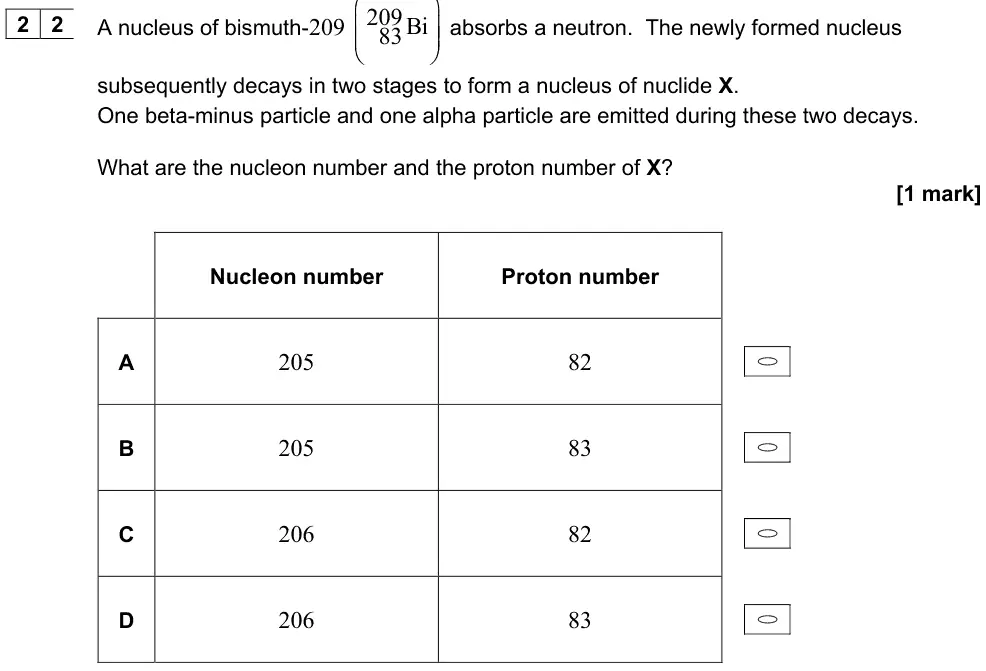
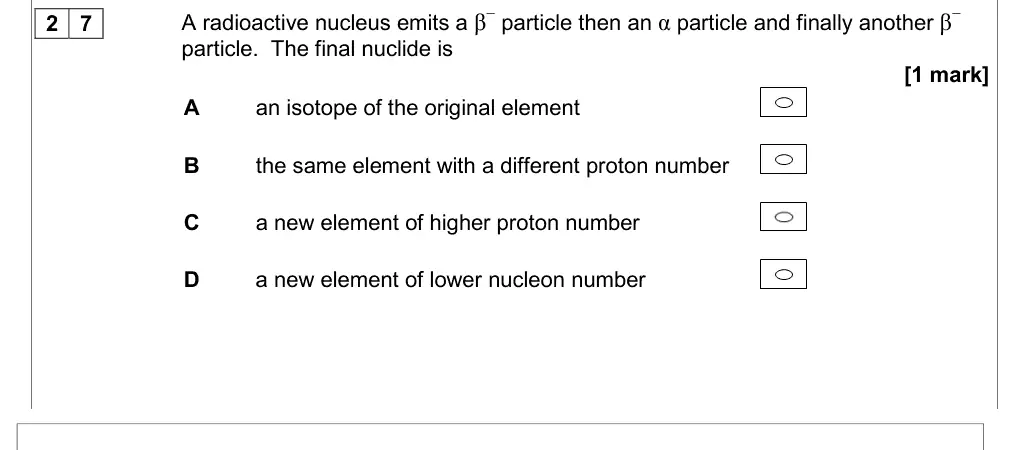
June 2025 · AS Paper 2 · Q281 markAO1=1Multiple choice
Answer
B
Mark scheme
Examiner's comment
Students were more successful in answering questions 6, 11, 14, 19, 22, 28, and were less successful in answering questions 10, 15, 21, 25, 29.
Notes from the mark scheme and report
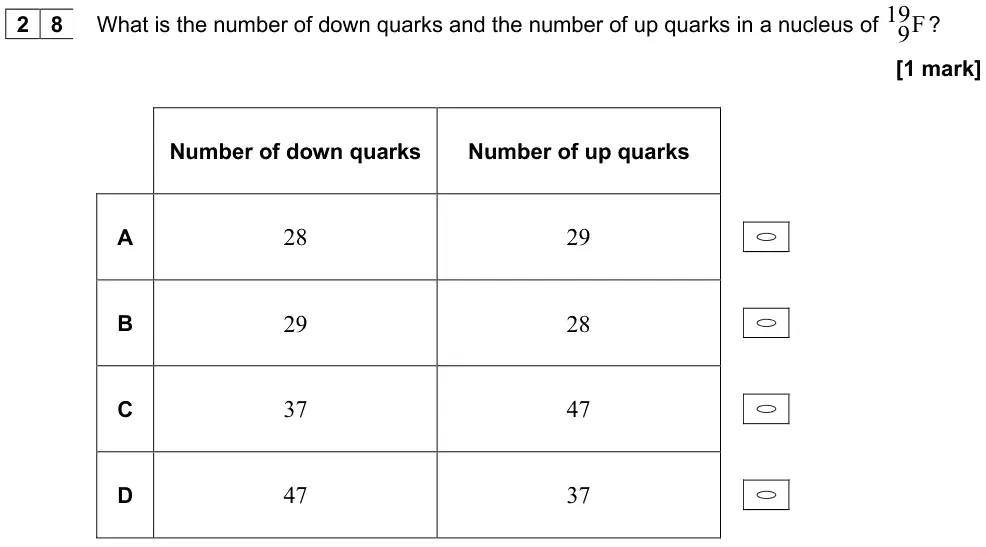
Answer: B
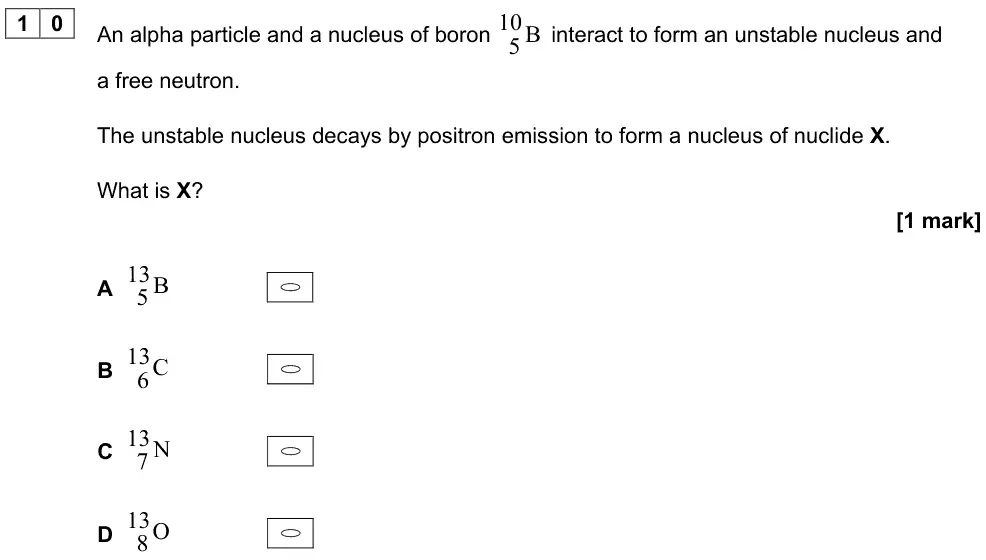
June 2025 · AS Paper 2 · Q321 markAO1=1Multiple choice
Answer
C
Mark scheme
Notes from the mark scheme and report
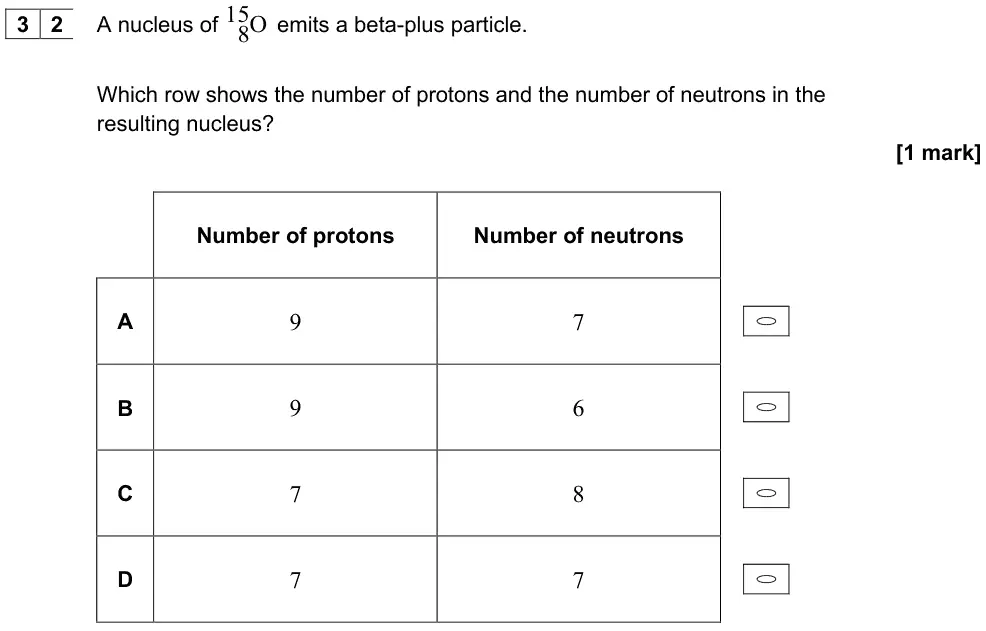
Answer: C
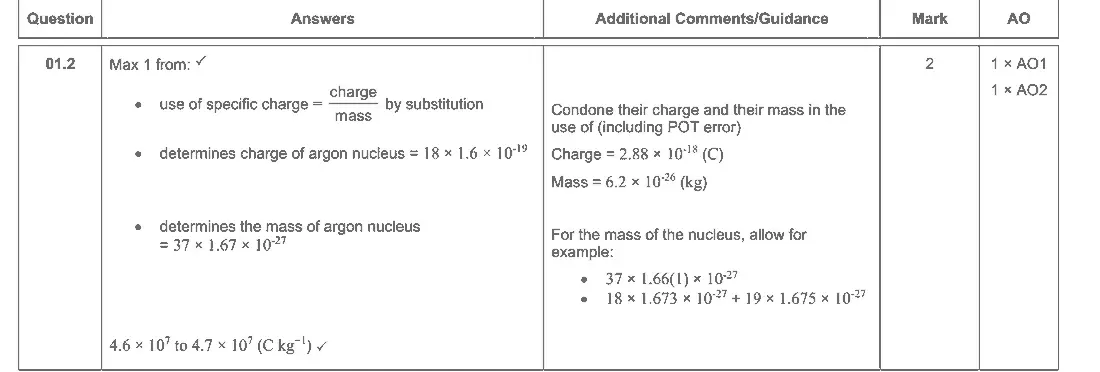
June 2024 · AS Paper 1 · Q1.22 marksAO1=1, AO2=1Calculation
Earlier part of question 1 that this part uses
Mark scheme
Examiner's comment
01.2
Notes from the mark scheme and report
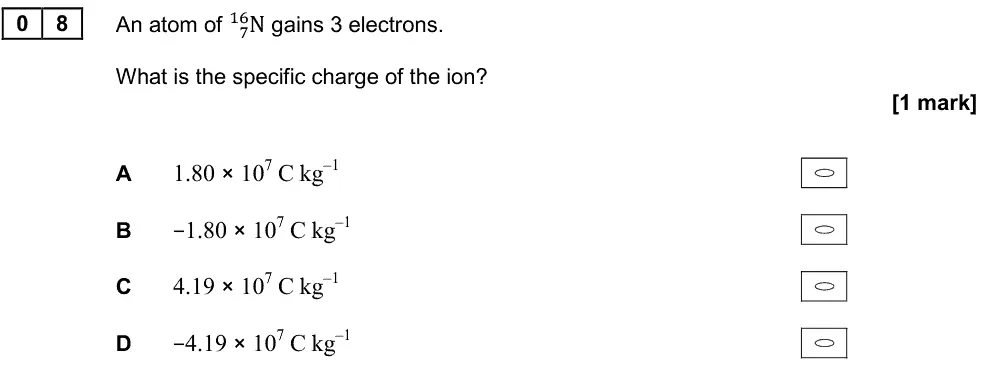
Answer: 4.6-4.7 x 10^7 C kg^-1 (charge 18 x 1.6 x 10^-19 = 2.88 x 10^-18 C, mass 37 x 1.67 x 10^-27 = 6.2 x 10^-26 kg)
Skills: MS2.3 Substitute numerical values into algebraic equations using appropriate units for physical quantities; MS0.2 Recognise and use expressions in decimal and standard form
June 2024 · Paper 1 · Q1.21 markAO1=1Short answer
Earlier part of question 1 that this part uses
Mark scheme
Examiner's comment
Question 01.2 was similarly well answered. There were many variations seen for the electron antineutrino. Care needs to be taken when writing the symbol to ensure that the subscript ‘e’ is not the same size as the n.
In question 01.3, most students were able to identify the weak interaction as the one responsible for neutron decay. Many failed to obtain the second mark by giving weak or irrelevant answers. The best answers made a clear reference to leptons or the change in quark flavour.
The most common mark awarded in question 01.4 was for identifying the virtual photon as the exchange particle. Very few students went on to explain the change in paths in terms of conservation of momentum. This is clearly a part of the specification that is poorly understood. The question did discriminate quite well, however.
Notes from the mark scheme and report
Proton, beta-minus (electron) and electron antineutrino, all three for the mark
write the antineutrino symbol clearly
June 2024 · AS Paper 1 · Q1.46 marksAO1=66-mark extended response
Earlier part of question 1 that this part uses
Mark scheme, with the levels and indicative content
Examiner's comment
Many students thought that a neutron changed into a proton in this interaction and found it difficult to access more than two marks. Others commented on the effect the interaction had on the baryon number rather than on the baryon. Typically, higher attaining students presented work that was easy to follow and clearly linked their reason to the appropriate deduction. 01.4
Notes from the mark scheme and report
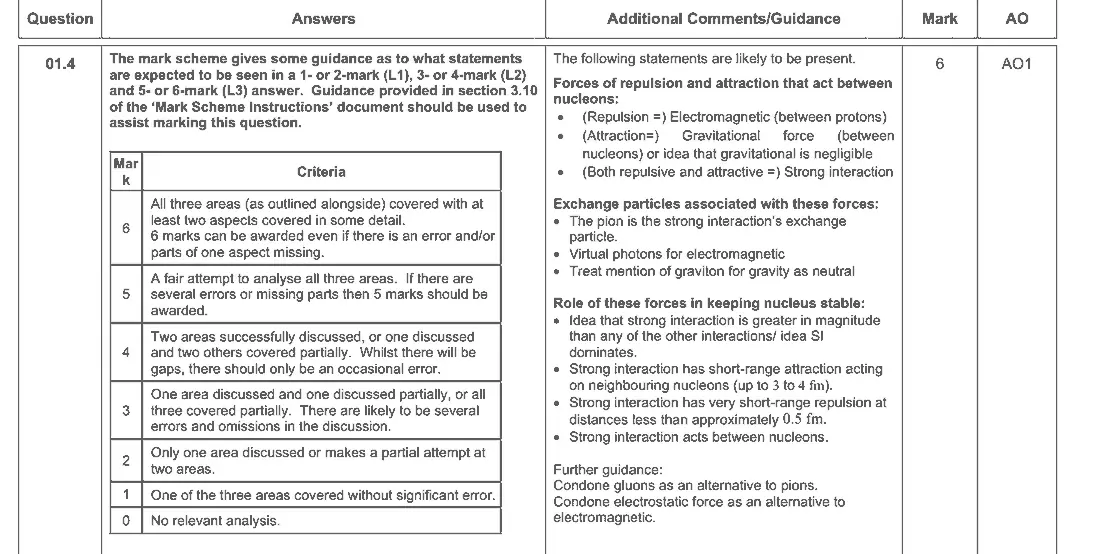
Levels of response: electromagnetic repulsion between protons (virtual photon), negligible gravity, strong interaction attractive to about 3 fm and repulsive below 0.5 fm (pion exchange), strong interaction dominates between neighbouring nucleons
June 2024 · Paper 1 · Q81 markAO2=1Multiple choice
Answer
C
Mark scheme
Notes from the mark scheme and report
Answer: C
Skills: MS0.3 Use ratios, fractions and percentages
June 2024 · AS Paper 2 · Q51 markMultiple choice
Answer
B
Mark scheme
Examiner's comment
Generally, students were more successful in answering questions 5, 6, 7, 11, 14, 17 and were less successful in answering questions 9, 10, 12, 13, 15, 16, 18, 21, 22, 23.
Notes from the mark scheme and report
Answer: B
June 2024 · AS Paper 2 · Q81 markMultiple choice
Answer
A
Mark scheme
Notes from the mark scheme and report
Answer: A
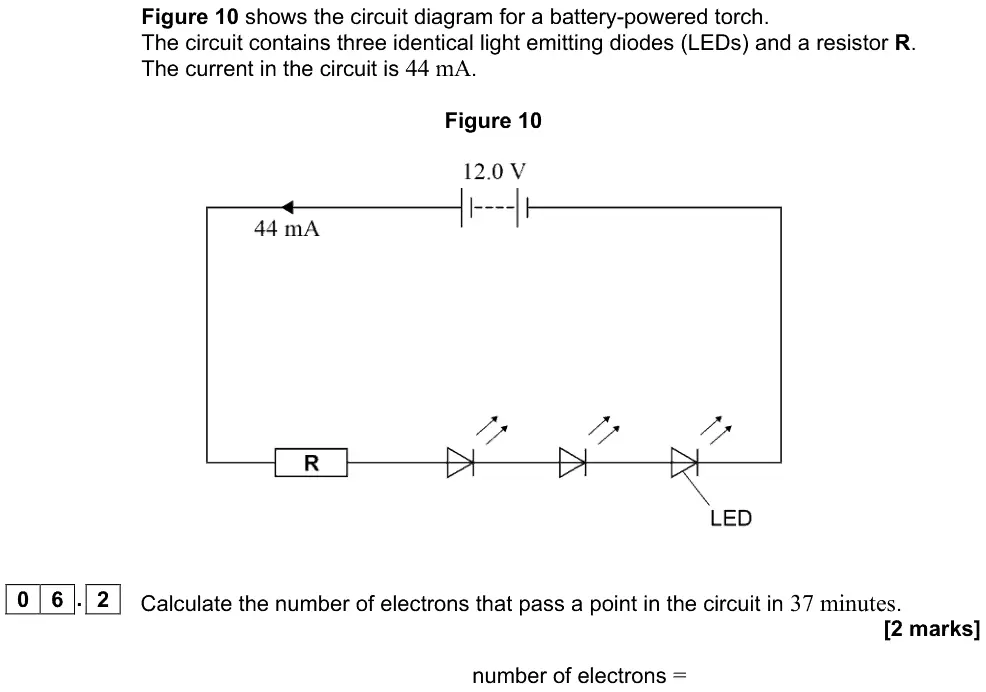
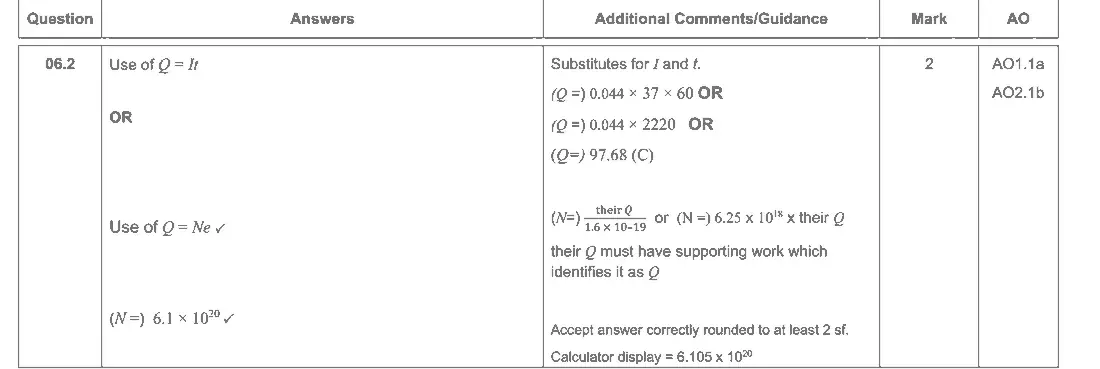
June 2023 · AS Paper 1 · Q6.22 marksCalculation
Earlier part of question 6 that this part uses
Mark scheme
Examiner's comment
06.2 39% scored two marks while another 25% of students scored one mark. The students who scored one mark calculated the charge that passes a point in 37 minutes and presented this as their answer. This is another example of students carrying out one of the steps in a multi-step calculation with no awareness of the context or what they have been asked to determine. 30% of students achieved zero, often due to multiplying the current, voltage and time together. This demonstrated a limited appreciation of the fundamentals of electricity. Lack of knowledge of prefixes again was an issue; students need to be much more aware of the need to check prefixes and know how to convert these before they substitute into equations.
Notes from the mark scheme and report
Answer: 6.1 x 10^20 (Q = 0.044 x 2220 s = 97.7 C, divided by 1.6 x 10^-19)
stopping at Q, or multiplying I, V and t, were common
Skills: MS0.1 Recognise and make use of appropriate units in calculations; MS0.2 Recognise and use expressions in decimal and standard form
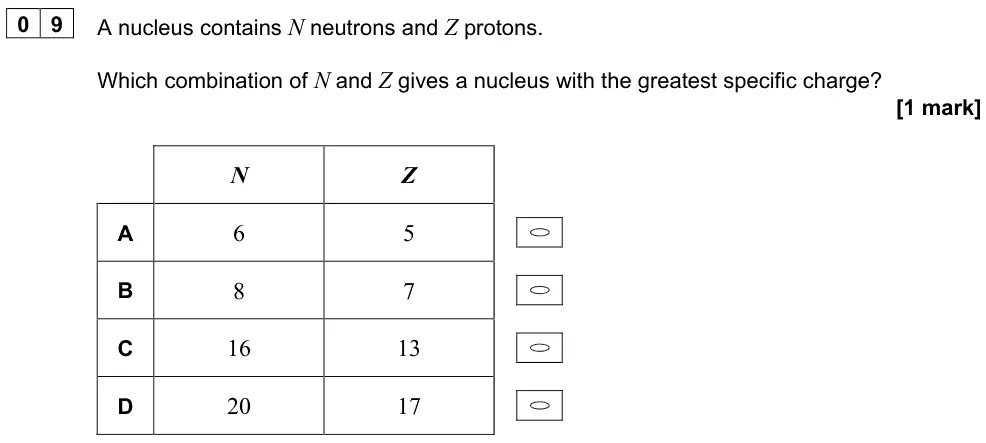
June 2023 · Paper 1 · Q91 markMultiple choice
Answer
B
Mark scheme
Notes from the mark scheme and report
Answer: B
Skills: MS0.3 Use ratios, fractions and percentages
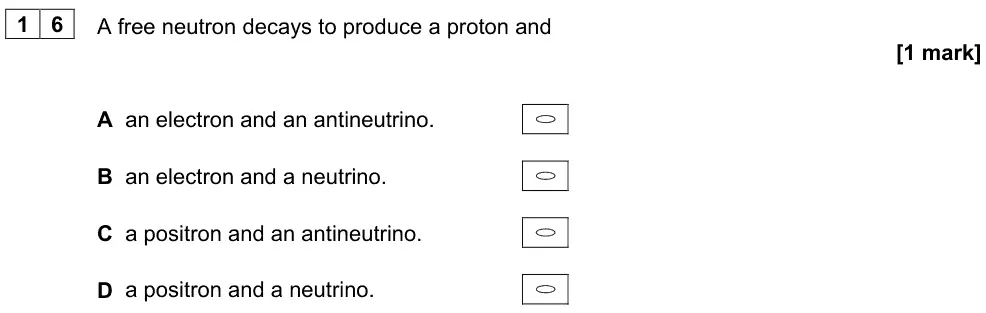
June 2023 · AS Paper 2 · Q161 markMultiple choice
Answer
A
Notes from the mark scheme and report
Answer: A
June 2023 · AS Paper 2 · Q221 markMultiple choice
Answer
C
Mark scheme
Notes from the mark scheme and report
Answer: C
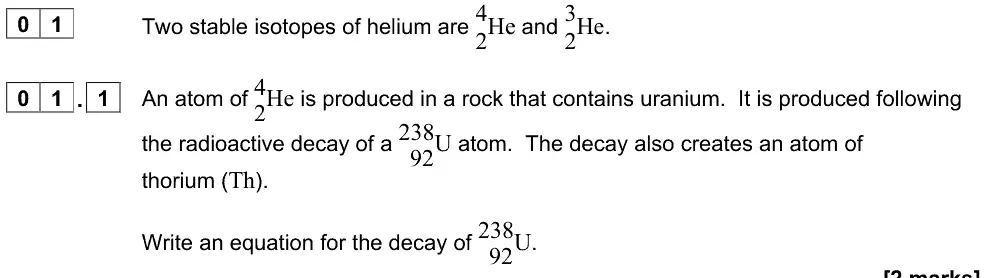
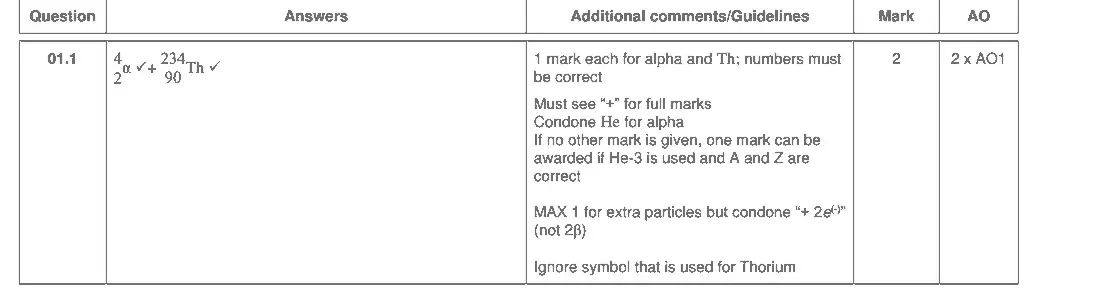
June 2022 · Paper 1 · Q1.12 marksAO1=2Short answer
Mark scheme
Examiner's comment
Most students achieved both marks on 01.1. Students who wrote ‘a’ for the alpha particle did not receive credit. Several students also included other particles, such as neutrinos, in the equation.
Notes from the mark scheme and report
Answer: U-238 to Th-234 (Z = 90) + He-4 (alpha, Z = 2)
'a' for alpha not credited
extra particles such as neutrinos max 1
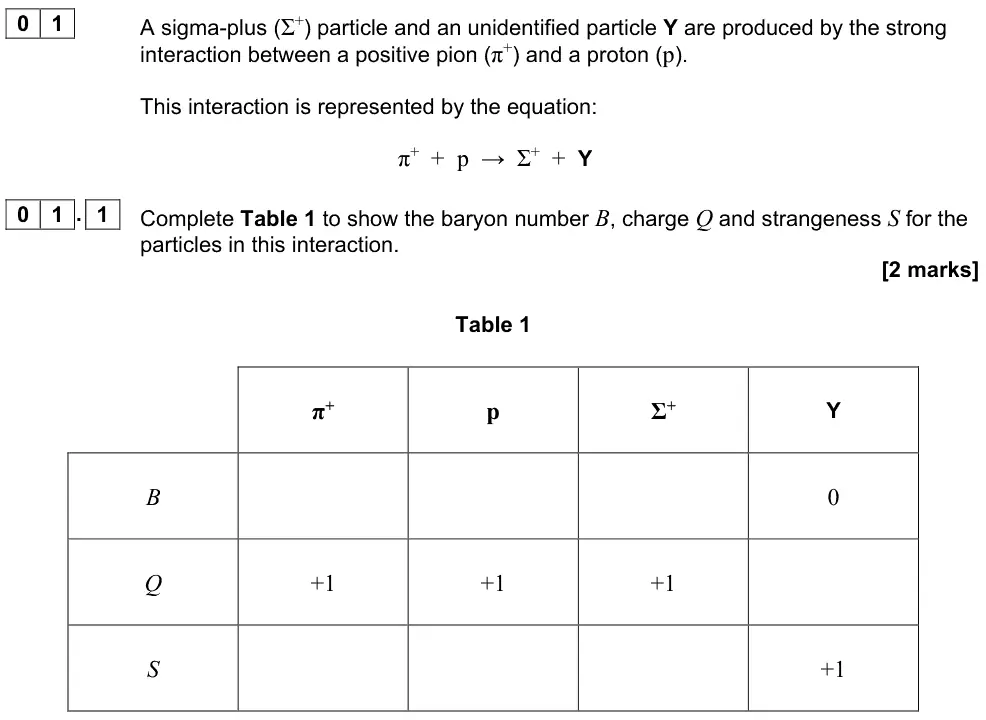
June 2022 · AS Paper 1 · Q1.33 marksAO3=3ExplanationHard
Earlier part of question 1 that this part uses
Mark scheme
Examiner's comment
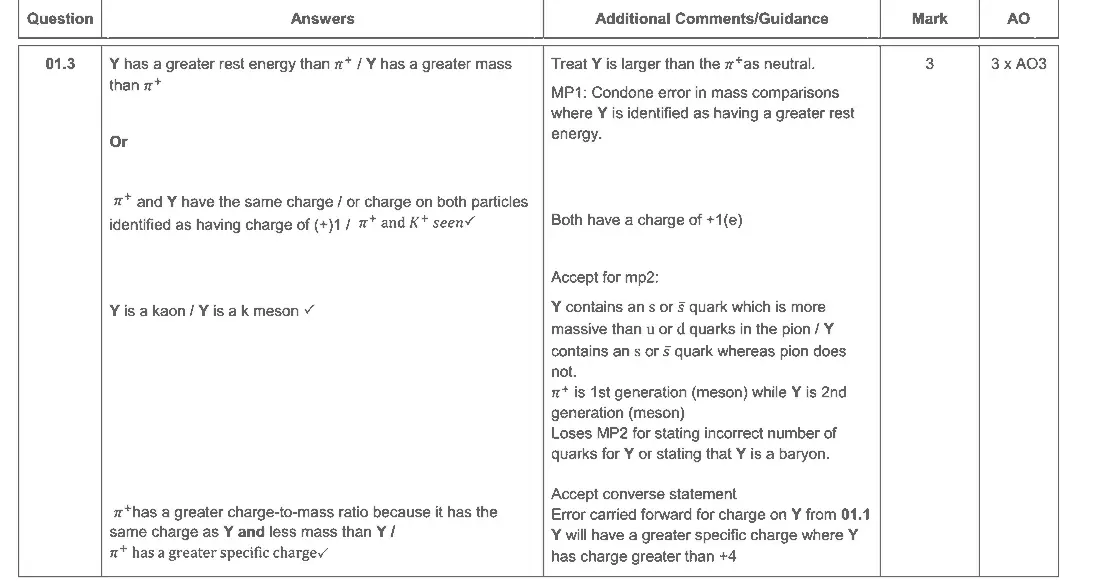
01.3 This question proved challenging for most students. Less than 35% of students gained more well-written account of why the 𝜋𝜋+ had a greater charge-to-mass ratio. Other students typically than one mark. The most able students were able to identify Y as a positive kaon and provide a
𝜋𝜋+ were both mesons but went on to state that they had the same mass. made statements without attempting any supporting explanation. Some students knew that Y and
Students should be aware of the command words in the question, the number of marks, and the size of the answer space as a guide to how much detail is required.
Notes from the mark scheme and report
Y is a K+ (contains a strange quark) so has greater mass/rest energy than pi+ with the same +1 charge, so pi+ has the greater charge-to-mass ratio
saying Y is a baryon loses MP2
June 2022 · AS Paper 1 · Q2.22 marksAO2=2CalculationHard
Earlier part of question 2 that this part uses
Mark scheme
Examiner's comment
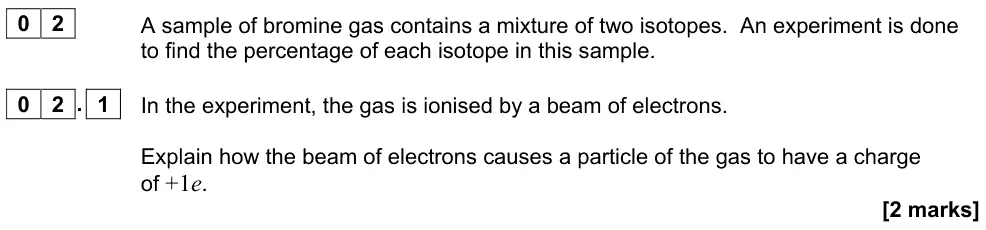
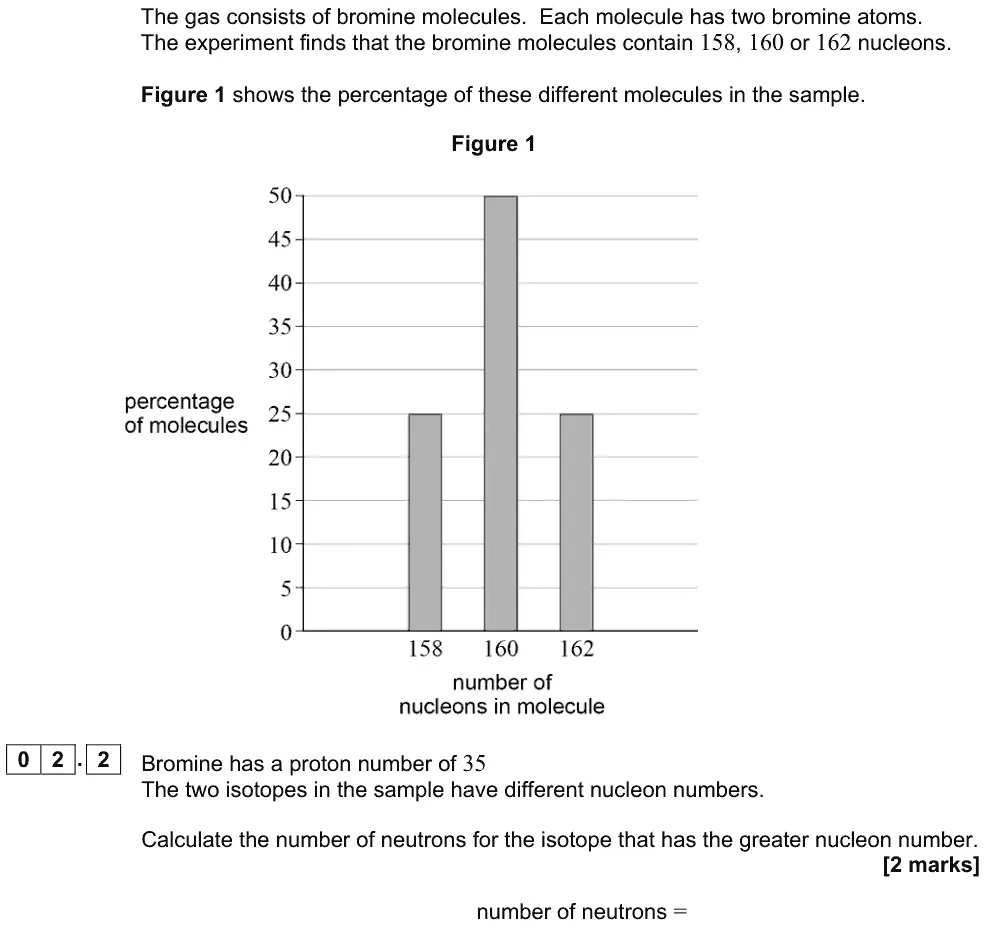
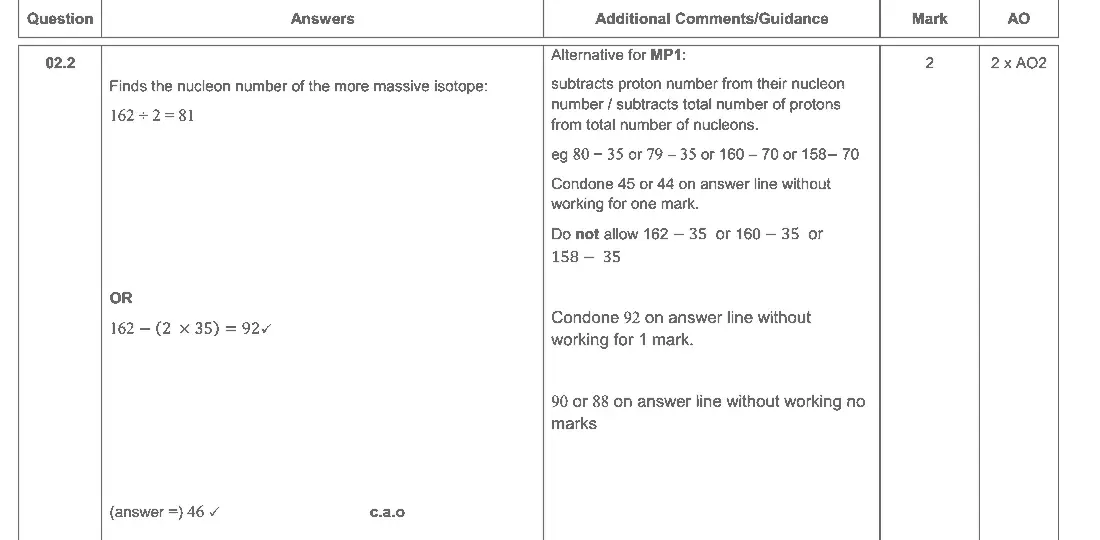
02.1 Just under 50% of students achieved no marks in this question. Good answers described the beam electron colliding with the orbital electron and the resulting energy transfer. They also described how the gas particle developed a charge of +1e. Others were less successful through making statements that were too vague and did not address the context or the answers lacked the appropriate level of technical language expected of an AS student. A very common misconception seen was that a bromine atom captured the beam electron giving it a charge of +1. 02.2 Approximately one-third of the students gained both marks here. Many students had little or no understanding of the question and these answers typically involved subtracting 35 from 162. These students were unable to appreciate that the term isotope applied to the nucleus of a bromine atom and instead treated it as a term describing the diatomic molecule.
Notes from the mark scheme and report
Answer: 46 (heavier isotope has 162/2 = 81 nucleons, minus 35 protons)
subtracting 35 from 162 was the common error
Skills: MS0.3 Use ratios, fractions and percentages
June 2022 · Paper 1 · Q2.22 marksAO1=2Explanation
Earlier part of question 2 that this part uses
Mark scheme
Examiner's comment
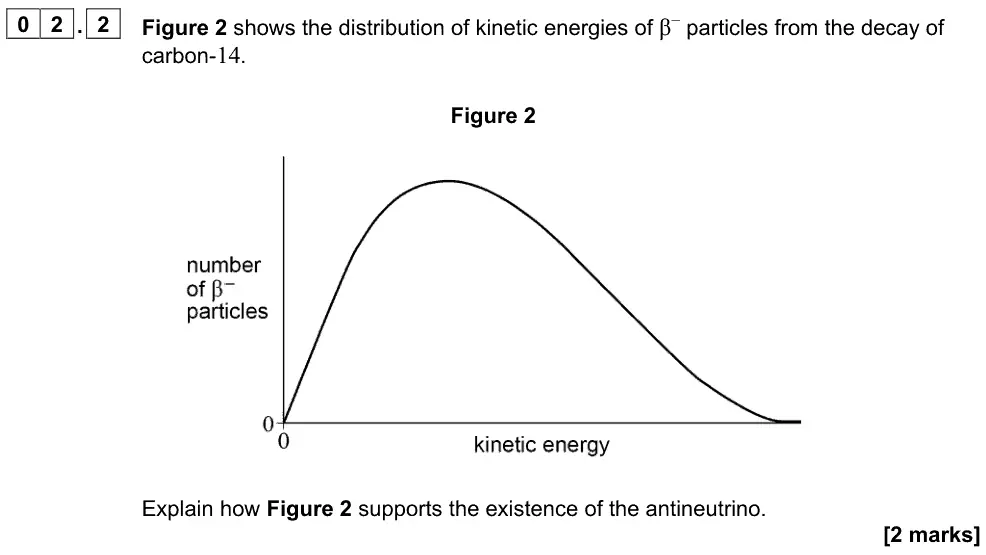
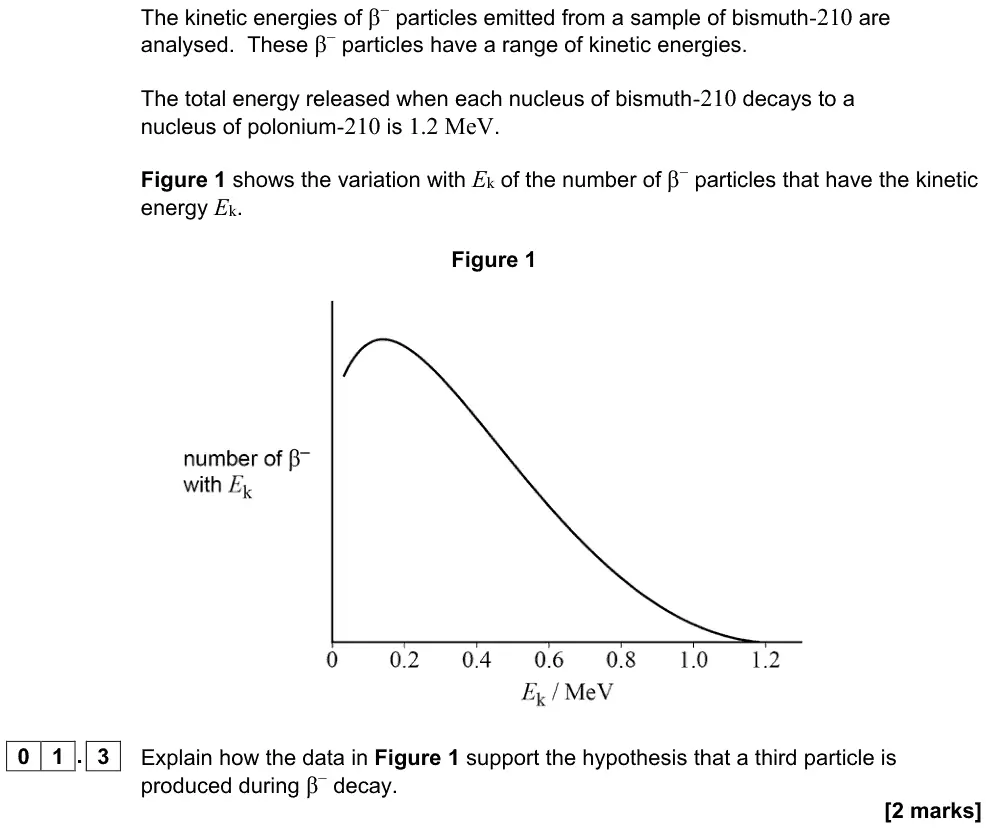
Most students found 02.2 very challenging. An important aspect of the question was that there was a fixed amount of energy released in the process; this point was often missed. The confusion in many answers demonstrated that few students understood what the graph was telling them.
Notes from the mark scheme and report
Beta particles have a range of kinetic energies but a fixed total energy is released, so another particle (antineutrino) carries the rest
'conservation of energy' alone not enough
found very challenging
June 2022 · AS Paper 1 · Q2.32 marksAO3=2ExplanationHard
Earlier part of question 2 that this part uses
Mark scheme
Examiner's comment
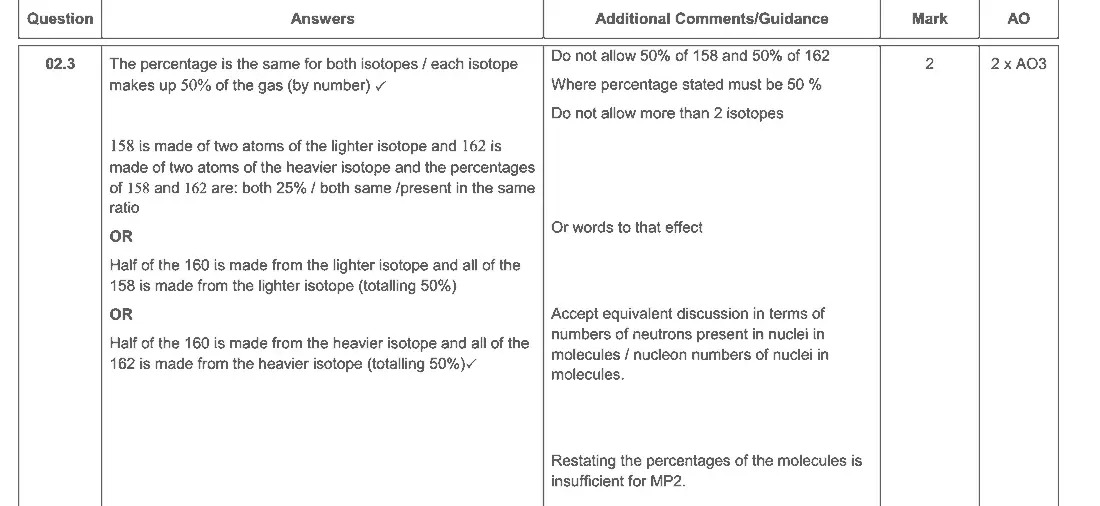
02.3 This question had a very low success rate with over 20% of students unable to make any attempt. Another 50% were unable to score any marks. The best answers appreciated that there were two isotopes, Br-79 and Br-81, and provided a good description of why the data supported them being present in equal quantities. This level of explanation was a good indicator of A-grade performance.
Other students were able to demonstrate some understanding by identifying the two isotopes and stating that they existed in equal proportions. These students were less successful in describing how the data supported their deduction.
Poor answers assumed that isotopes are the most common type of nucleon number and described this as being Br-80 due to 160 being the number of nucleons in the most commonly occurring molecule.
Notes from the mark scheme and report
50% each: 158 molecules are two light atoms and 162 two heavy atoms, both 25%, and 160 is one of each
restating the molecule percentages is not enough
Skills: MS0.3 Use ratios, fractions and percentages
June 2022 · Paper 1 · Q101 markAO2=1Multiple choice
Answer
A
Mark scheme
Notes from the mark scheme and report
Answer: A
Skills: MS0.2 Recognise and use expressions in decimal and standard form
June 2022 · Paper 1 · Q111 markAO1=1Multiple choice
Answer
C
Mark scheme
Notes from the mark scheme and report
Answer: C
June 2022 · AS Paper 2 · Q51 markAO1=1Multiple choice
Answer
A
Mark scheme
Notes from the mark scheme and report
Answer: A
Skills: MS0.3 Use ratios, fractions and percentages
June 2022 · AS Paper 2 · Q101 markAO1=1Multiple choice
Answer
B
Mark scheme
Notes from the mark scheme and report
Answer: B
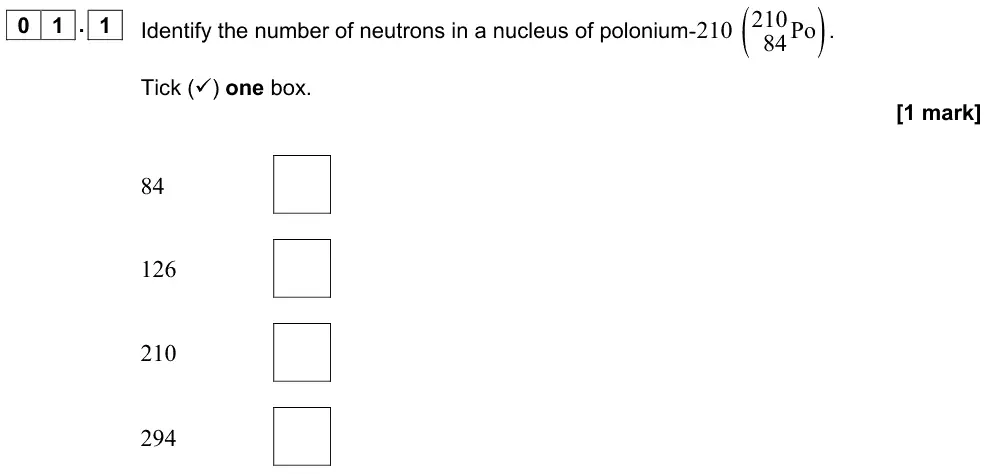
November 2021 · AS Paper 1 · Q1.11 markAO1=1Short answer
Mark scheme
Notes from the mark scheme and report
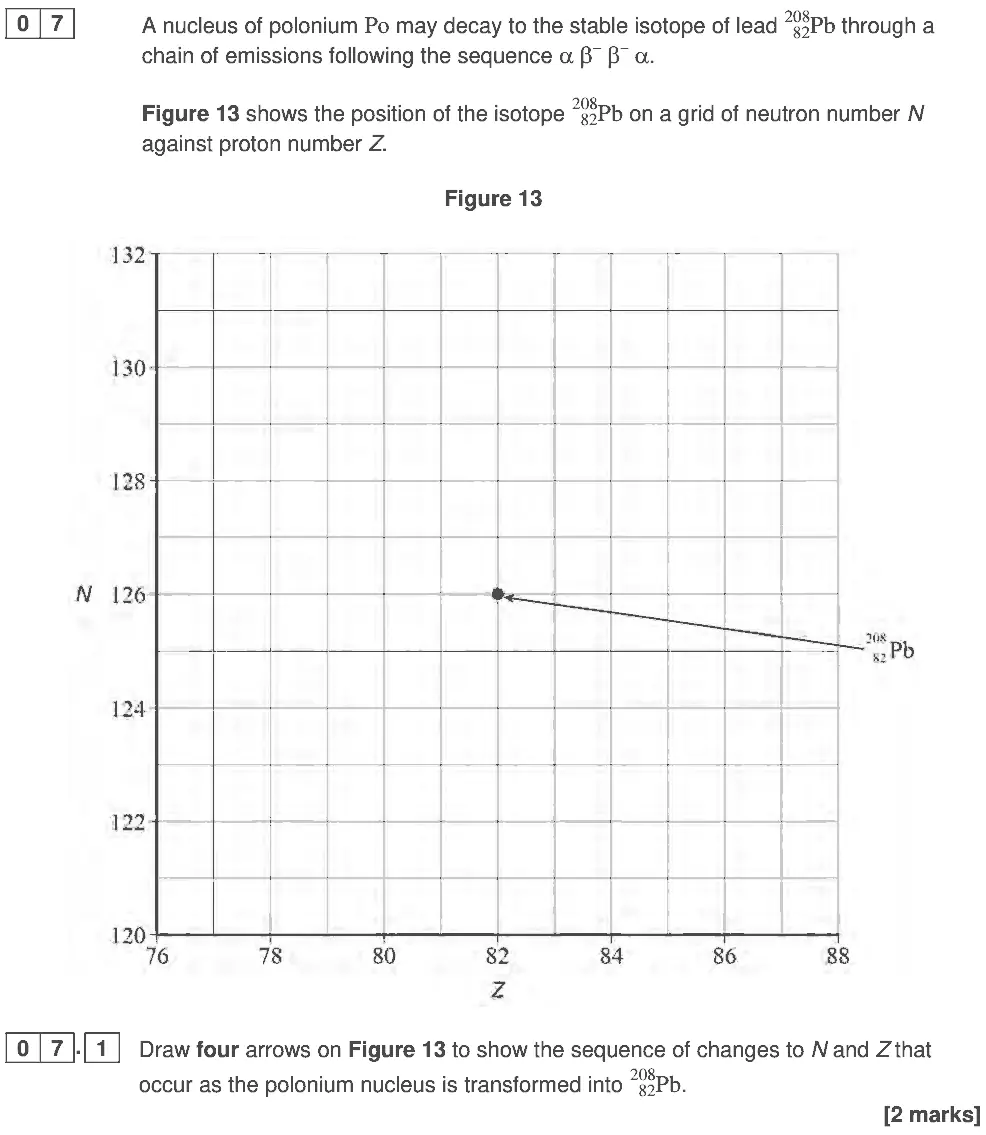
Answer: 126 (210 - 84)
tick-box item with 84, 126, 210, 294
Skills: MS0.3 Use ratios, fractions and percentages
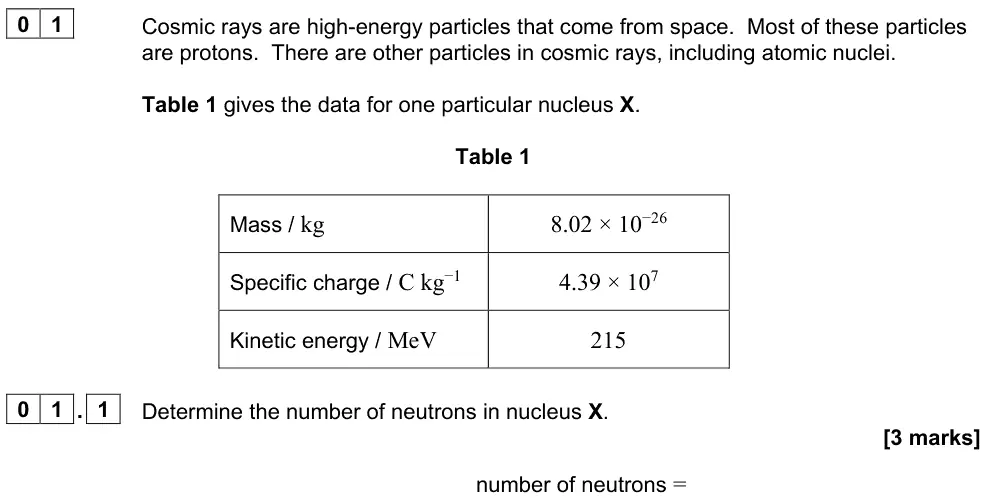
November 2021 · Paper 1 · Q1.13 marksAO2=3Calculation
Mark scheme
Examiner's comment
Question 01.1 was answered correctly by a majority of students. However, although a mark was available for answers that included the calculation of the number of nucleons, this mark was withheld when the student made any suggestion that what they had calculated was the number of neutrons. This resulted in very few students receiving more than one out of three marks for partial answers. In question 01.2 many students were familiar with the kinetic energy equation, but had difficulties with the conversion between MeV and J. Answers to the remaining parts indicated that many students were unfamiliar with the conservation laws or the decay of the kaon into pions, which are both explicitly on the specification.
Notes from the mark scheme and report
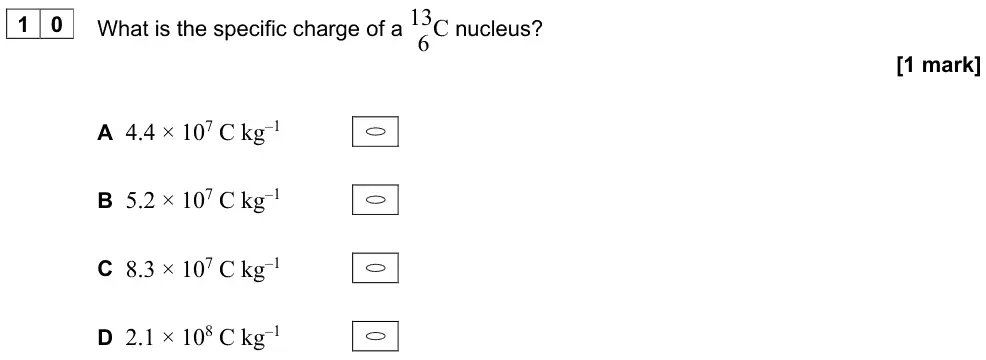
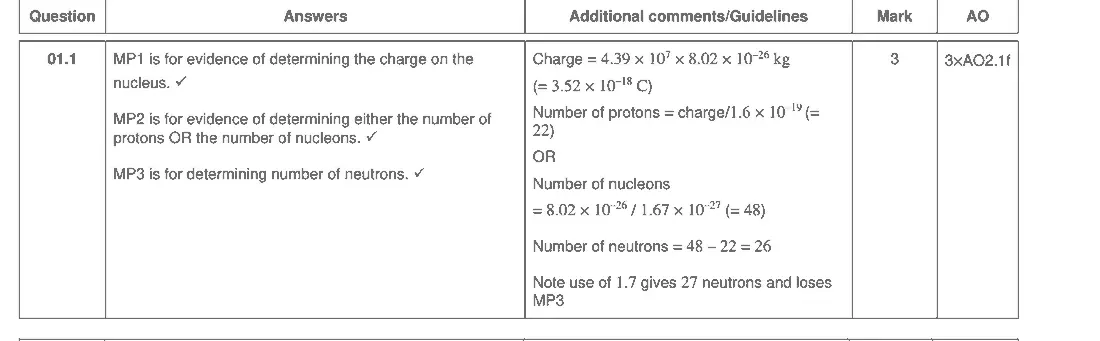
Answer: 26 neutrons (charge = 4.39 x 10^7 x 8.02 x 10^-26 = 3.52 x 10^-18 C so 22 protons
8.02 x 10^-26 / 1.67 x 10^-27 = 48 nucleons)
calling the nucleon count the neutron number lost the mark
Skills: MS2.2 Change the subject of an equation, including non-linear equations; MS2.3 Substitute numerical values into algebraic equations using appropriate units for physical quantities
November 2021 · AS Paper 1 · Q1.22 marksAO2=2Explanation
Earlier part of question 1 that this part uses
Mark scheme
Notes from the mark scheme and report
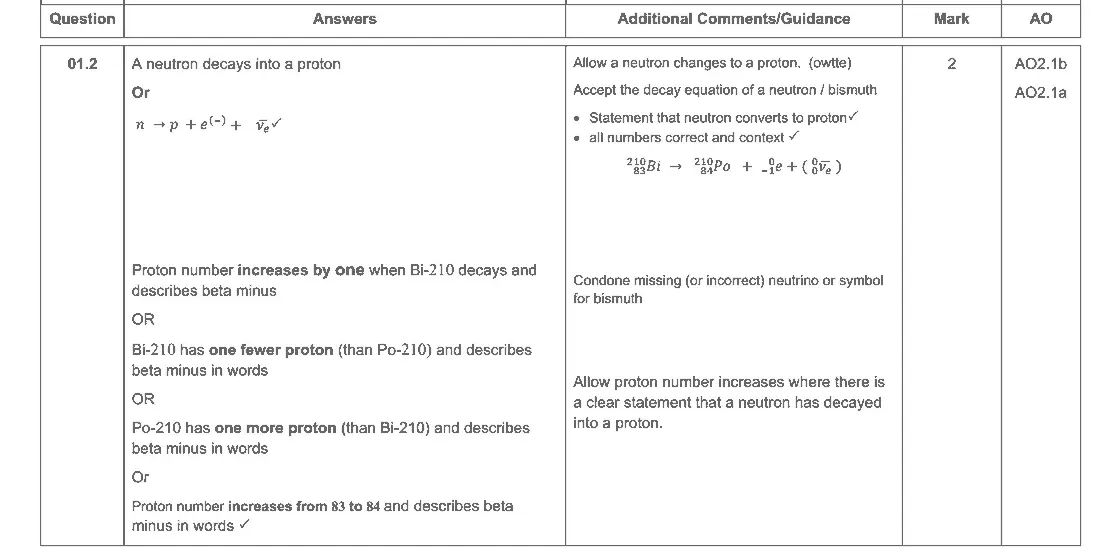
A neutron changes into a proton (plus electron and antineutrino), so proton number rises by one from 83 to 84
November 2021 · AS Paper 1 · Q1.32 marksAO1=2Explanation
Earlier part of question 1 that this part uses
Mark scheme
Notes from the mark scheme and report
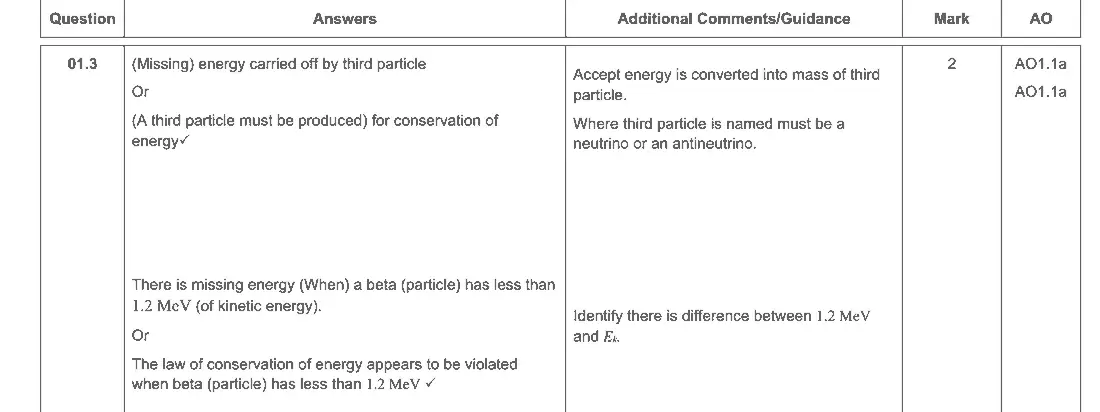
Most beta particles have less than the 1.2 MeV released, so energy appears missing
a third particle carries the remaining energy so energy is conserved
November 2021 · Paper 1 · Q101 markMultiple choiceEasy
Answer
A
Mark scheme
Examiner's comment
Several of the multiple-choice questions proved to be extremely difficult. In particular, questions 20, 27 and 29 were answered correctly by fewer than 30% of the students. In question 20 more students opted for B and for C than for the correct answer (D), indicating a lack of familiarity with scale diagrams. In question 27 the most popular answer was B, indicating the difficulties students have with combining resistors, and the second most popular was C, suggesting that students did not understand the difference between open and short circuits. The most popular answer to question 18 was D, probably because the students did not spot that this was a stationary, rather than progressive, wave. The most accessible questions were 10 and 16, both of which were answered correctly by over 70% of the students.
Notes from the mark scheme and report
Answer: A
November 2021 · AS Paper 2 · Q61 markMultiple choice
Answer
A
Mark scheme
Notes from the mark scheme and report
Answer: A
Skills: MS0.2 Recognise and use expressions in decimal and standard form
November 2021 · AS Paper 2 · Q121 markMultiple choice
Answer
D
Mark scheme
Notes from the mark scheme and report
Answer: D
November 2021 · AS Paper 2 · Q141 markMultiple choice
Answer
C
Mark scheme
Notes from the mark scheme and report
Answer: C
November 2020 · AS Paper 1 · Q4.11 markCalculation
Mark scheme
Notes from the mark scheme and report
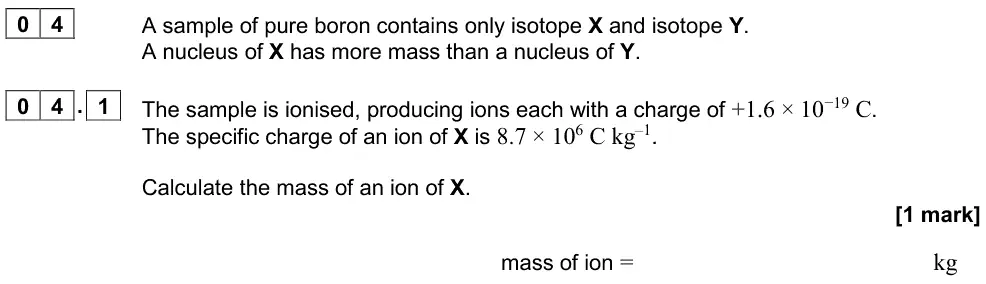
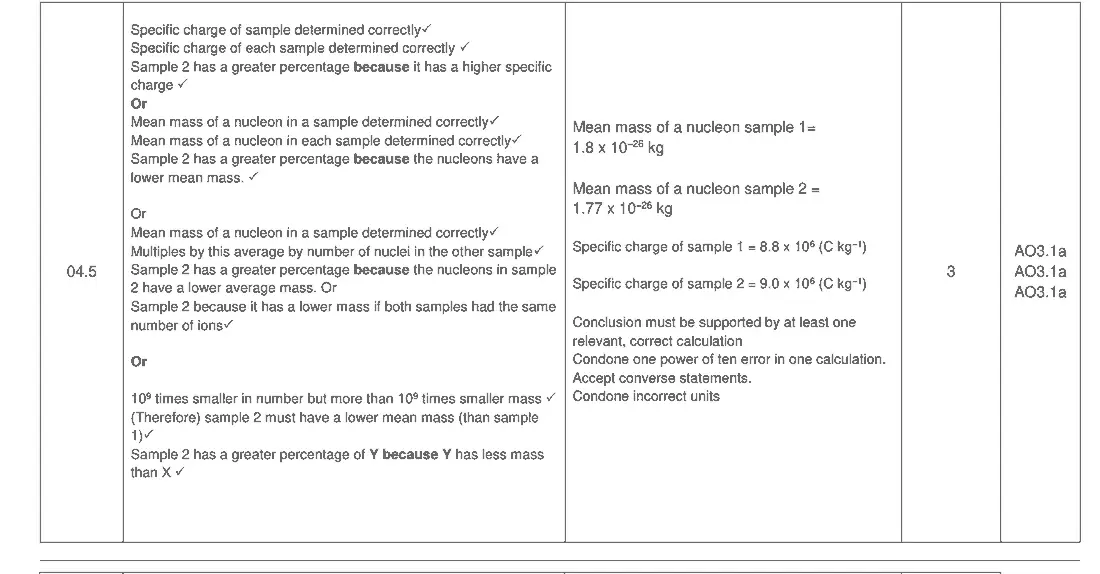
Answer: 1.8 x 10^-26 kg (1.6 x 10^-19 / 8.7 x 10^6)
Skills: MS2.2 Change the subject of an equation, including non-linear equations; MS0.2 Recognise and use expressions in decimal and standard form
November 2020 · AS Paper 1 · Q4.22 marksCalculation
Earlier part of question 4 that this part uses
Mark scheme
Notes from the mark scheme and report
Answer: 11 nucleons (1.84 x 10^-26 / 1.7 x 10^-27 = 10.8)
must round to a whole number
Skills: MS0.3 Use ratios, fractions and percentages
November 2020 · AS Paper 1 · Q4.32 marksShort answer
Earlier part of question 4 that this part uses
Mark scheme
Notes from the mark scheme and report
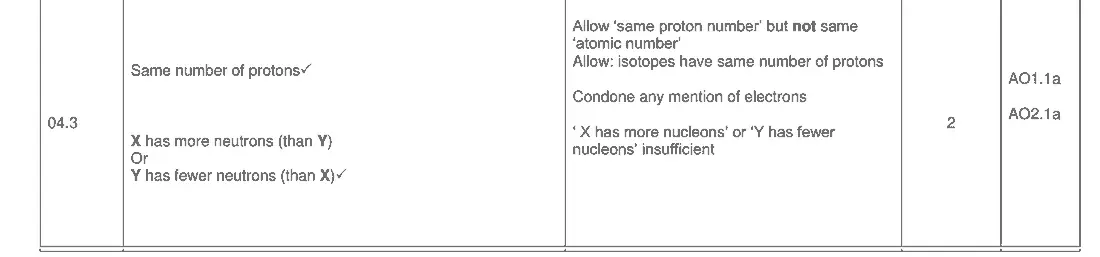
Same number of protons
X has more neutrons
'X has more nucleons' insufficient
'same atomic number' not accepted
November 2020 · AS Paper 1 · Q4.42 marksExplanation
Earlier part of question 4 that this part uses
Mark scheme
Notes from the mark scheme and report
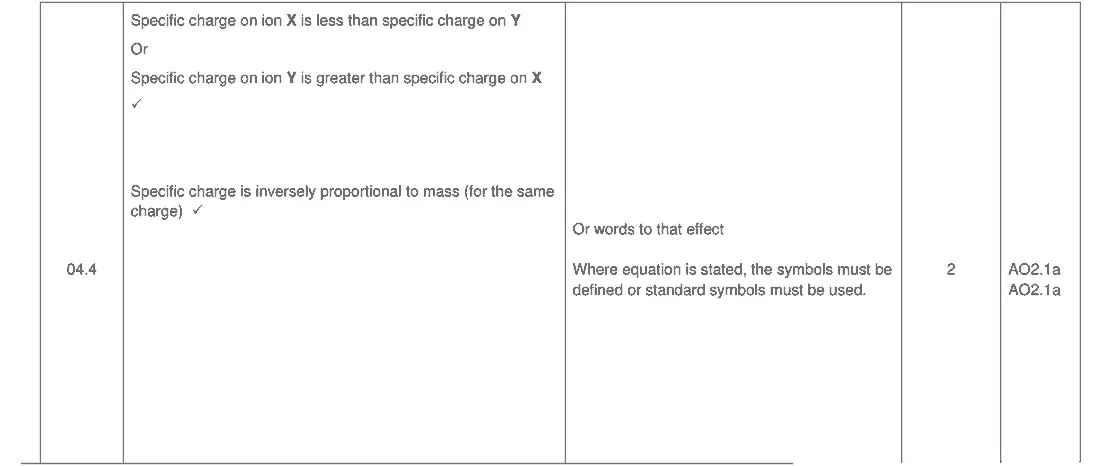
X has smaller specific charge than Y, because specific charge is inversely proportional to mass for the same charge
November 2020 · AS Paper 1 · Q4.53 marksCalculation
Earlier part of question 4 that this part uses
Mark scheme
Notes from the mark scheme and report
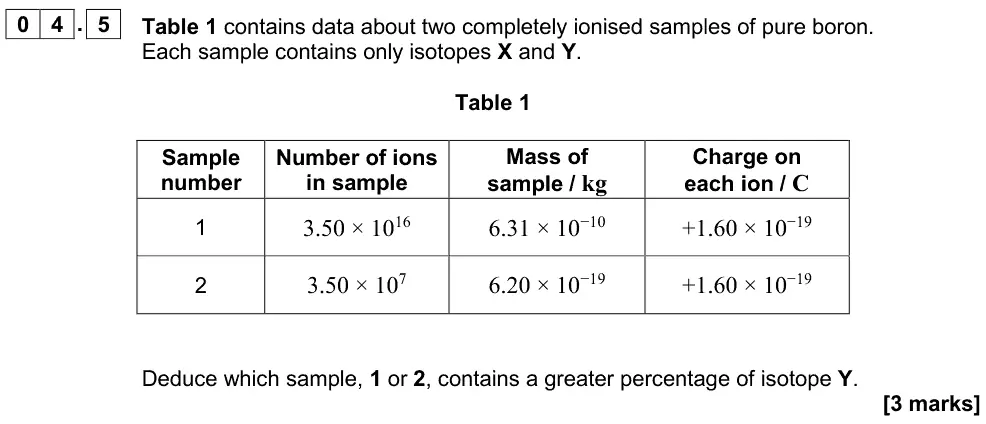
Answer: sample 2 (specific charge 9.0 x 10^6 vs 8.8 x 10^6 C kg^-1, or mean ion mass 1.77 x 10^-26 vs 1.80 x 10^-26 kg)
conclusion needs a supporting calculation
Skills: MS0.2 Recognise and use expressions in decimal and standard form; MS0.3 Use ratios, fractions and percentages
November 2020 · Paper 1 · Q91 markMultiple choice
Answer
B
Mark scheme
Notes from the mark scheme and report
Answer: B
November 2020 · Paper 1 · Q101 markMultiple choice
Answer
C
Mark scheme
Notes from the mark scheme and report
Answer: C
November 2020 · AS Paper 2 · Q71 markMultiple choice
Answer
C
Mark scheme
Notes from the mark scheme and report
Answer: C
Skills: MS2.4 Solve algebraic equations, including quadratic equations
June 2019 · AS Paper 1 · Q1.12 marksCalculationEasy
Mark scheme
Examiner's comment
01.1 A little over 60% of students achieved full marks for this question. About 20% gained only one mark. Mistakes seen included misuse of the atomic mass unit or misquoting the relative charge (+1) of the proton.
Notes from the mark scheme and report
Answer: 4.8 x 10^7 C kg^-1 (1.60 x 10^-19 C / 3.35 x 10^-27 kg)
misuse of the atomic mass unit or the relative charge +1 were the errors
Skills: MS2.3 Substitute numerical values into algebraic equations using appropriate units for physical quantities; MS0.2 Recognise and use expressions in decimal and standard form
June 2019 · Paper 1 · Q1.11 markShort answer
Mark scheme
Examiner's comment
1.1 This question was answered correctly by the majority of students. A common error was to omit detail, referring simply to a difference in the number of neutrons rather than saying clearly that Iodine-131 has 6 more neutrons. Occasionally students were confused between protons and neutrons, or simply referred to the number of nucleons. These responses did not gain credit.
Notes from the mark scheme and report
Iodine-131 has 6 more neutrons (78 vs 72)
just 'different number of neutrons', protons or nucleons not credited
June 2019 · Paper 1 · Q1.21 markShort answer
Earlier part of question 1 that this part uses
Mark scheme
Examiner's comment
1.2 Few students had any problem giving the correct answer to this question. In a small number of cases, the student gave too much information, so that it was unclear which part of it was their answer. In ‘state’ questions of this kind, students should be encouraged to write down just the answer expected, or at least to make the answer explicit.
Notes from the mark scheme and report
Answer: 131
make the nucleon number explicit if more than one number is given
June 2019 · AS Paper 1 · Q1.33 marksExplanation
Earlier part of question 1 that this part uses
Mark scheme
Examiner's comment
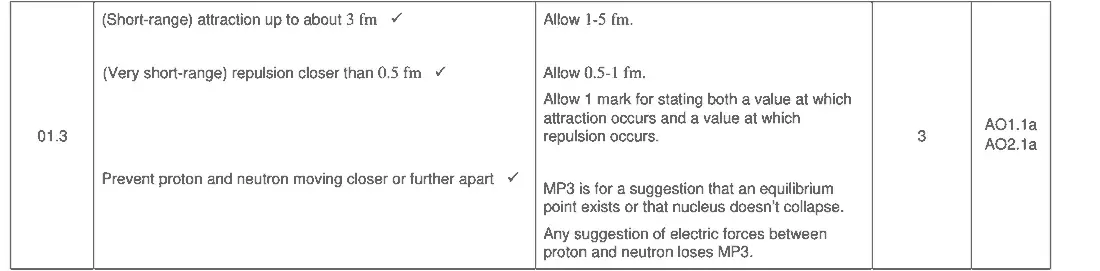
01.3 Many students recalled the range of distances over which the strong nuclear force is attractive and repulsive. Some students stated only a single value of distance. This was not sufficient as a distance range was required. Few students were able to go on to describe how a balance between attraction and repulsion leads to the proton and neutron achieving an equilibrium position.
Notes from the mark scheme and report
Attraction up to about 3 fm, repulsion closer than 0.5 fm (a distance range needed, not one value)
so the proton and neutron sit at an equilibrium separation
any electrostatic force between p and n loses MP3
June 2019 · Paper 1 · Q1.32 marksShort answer
Earlier part of question 1 that this part uses
Mark scheme
Examiner's comment
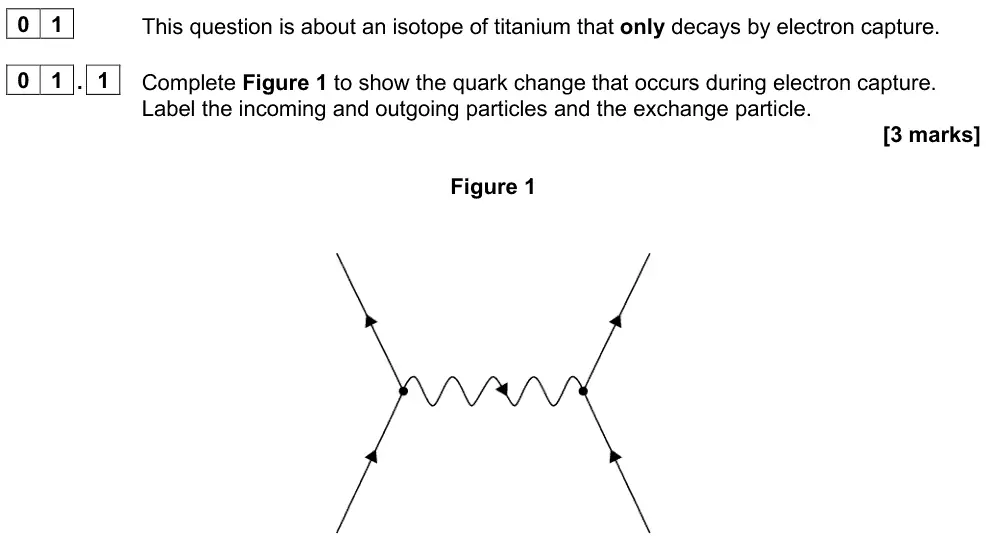
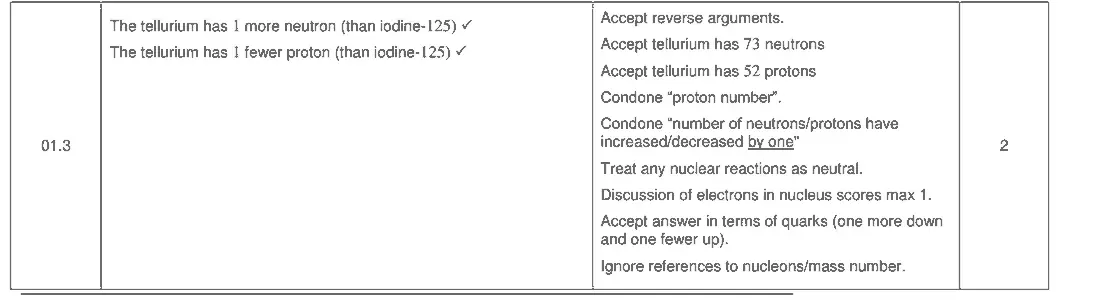
1.3 Many students demonstrated a good understanding of electron capture and so obtained full marks. There was some evidence of confusion with beta decay, however. A surprising number of students referred to changes in the number of electrons within the nucleus and answers of this kind rarely gained any credit. The clearest responses referenced the nucleus clearly and stated what happened to the number of protons and neutrons. Vague answers tended to be unclear about which nucleus did what.
Notes from the mark scheme and report
Tellurium has one more neutron and one fewer proton (or one more down, one fewer up quark)
talk of electrons in the nucleus scores max 1
June 2019 · AS Paper 1 · Q1.43 marksExplanation
Earlier part of question 1 that this part uses
Mark scheme
Examiner's comment
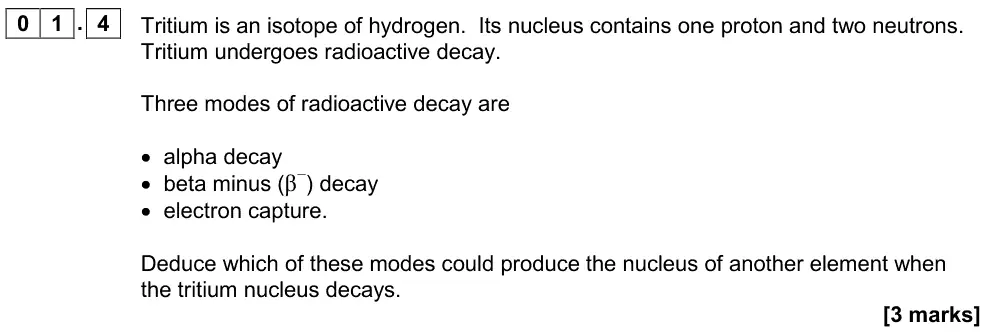
01.4 This question discriminated well, with some well-structured answers seen. Lack of a clear conclusion was a common feature of answers that gained partial credit.
Notes from the mark scheme and report
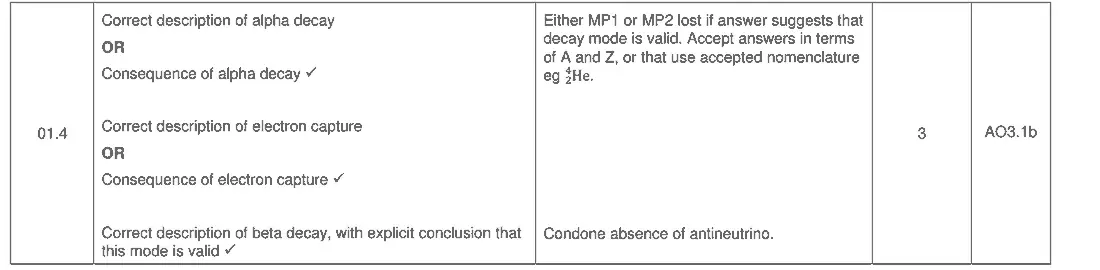
Alpha impossible (only 3 nucleons), electron capture impossible (only one proton, would give 3 neutrons), beta-minus gives helium-3 so it is the valid mode
an explicit conclusion is needed
June 2019 · Paper 1 · Q1.43 marksExplanation
Earlier part of question 1 that this part uses
Mark scheme
Examiner's comment
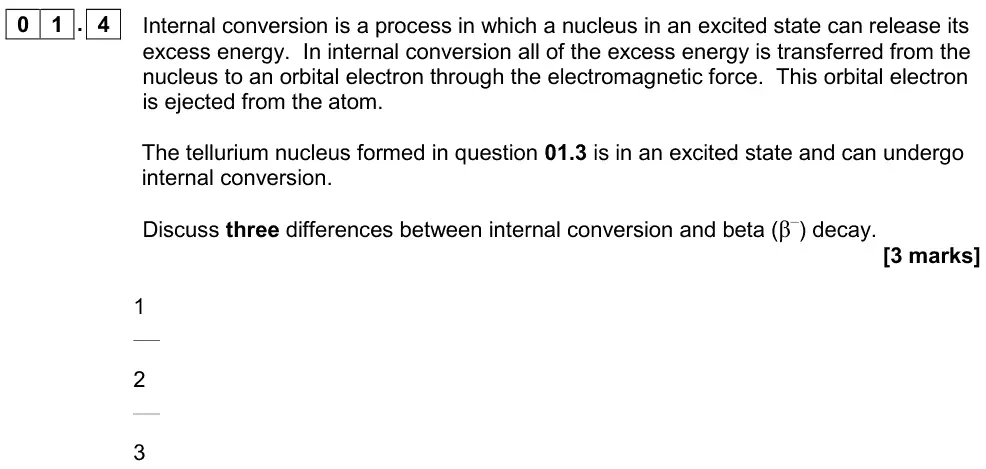
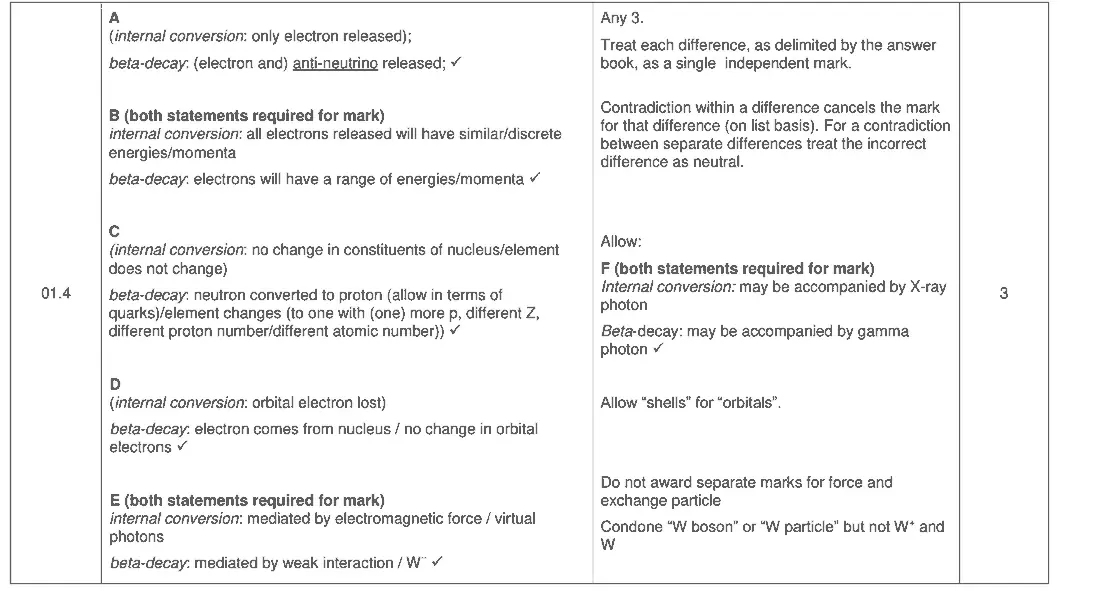
1.4 This question tested students’ ability to apply their knowledge and understanding to an unfamiliar context. It was pleasing to note that half of the students were able to provide information on at least two differences. References to both processes were expected for each difference, although a missing reference was condoned in situations where no change occurred. Occasionally students gave the mediating particle and the fundamental force involved as separate answers, but this was only credited as one difference.
Notes from the mark scheme and report
Any 3 paired differences: beta releases an antineutrino
beta electrons have a range of energies
beta changes the element (n to p)
beta electron comes from the nucleus not an orbital
weak (W-) vs electromagnetic (virtual photon)
force and exchange particle count once
unfamiliar context
June 2019 · AS Paper 2 · Q61 markMultiple choice
Answer
D
Mark scheme
Notes from the mark scheme and report
Answer: D
June 2019 · AS Paper 2 · Q71 markMultiple choice
Answer
A
Mark scheme
Notes from the mark scheme and report
Answer: A
June 2018 · AS Paper 1 · Q1.13 marksExplanation
Mark scheme
Examiner's comment
01.1 This required a description of the strong interaction and it was well answered, with just under half of students gaining all three marks. Most students appreciated the type of interaction involved and were able to provide correct properties. The range of repulsion and attraction of the interaction seemed to be well understood.
Notes from the mark scheme and report
Strong interaction named (wrong interaction scores zero)
short range, attractive to about 3-5 fm, repulsive below about 0.5-1 fm, acts only on hadrons, pion/gluon exchange
just under half got all three
June 2018 · AS Paper 1 · Q1.23 marksExplanationHard
Earlier part of question 1 that this part uses
Mark scheme
Examiner's comment
01.2 This question proved to be more challenging; only 11.3% of students gained maximum marks here. This was mainly due to poor structuring of answers so it was not clear how baryon number was being conserved in these decays. Many students concentrated on the baryon number of the alpha particle without referring to the baryon numbers of the nuclei involved. With beta decay it was common to see responses that showed how the baryon number had not changed as a neutron changed to a proton. It was, however, less common to see a discussion of the other particles involved and why, because they were leptons, they did not affect baryon number.
Notes from the mark scheme and report
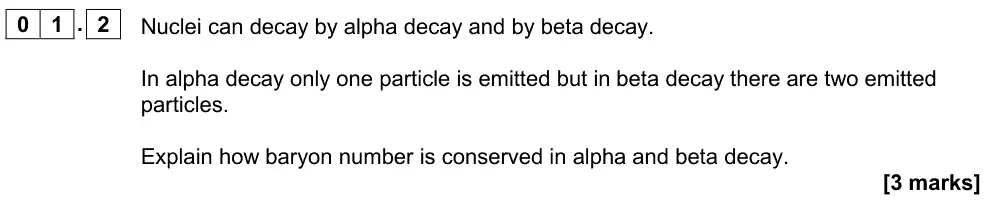
Alpha: total nucleons of daughter plus alpha equals parent
beta: neutron becomes proton (both B = 1), electron and antineutrino are leptons with B = 0
many only discussed the alpha particle's baryon number
June 2018 · Paper 1 · Q91 markMultiple choice
Answer
C
Notes from the mark scheme and report
Answer: C
Skills: MS0.2 Recognise and use expressions in decimal and standard form
June 2018 · Paper 1 · Q121 markMultiple choiceEasy
Answer
B
Examiner's comment
The 25 questions in Section B are summarised in the table below. For each question, the key (correct answer) is provided, along with the percentage of students answering correctly. There was a good range of ‘facility’ across this section; the most accessible questions were 12 and 18 (both answered correctly by 89.2% of students), the least accessible was 20 (answered correctly by only 38.1% of students). The overall mean mark achieved by the students for Section B was 15.7 out of 25 (62.8%).
Notes from the mark scheme and report
Answer: B
June 2018 · AS Paper 2 · Q3.12 marksShow that
Mark scheme
Examiner's comment
03.1 There were a number of stages to this “show that” question. Because of its level of demand the mark scheme was less stringent than usual about how “show that” calculations should be presented. However, students should be encouraged to ensure they have fully demonstrated how the answer is obtained. These pieces of advice should be considered:
• any equations used should be written with subjects seen at each stage of the calculation; • mid-calculation rounding should be avoided; • the answer should be quoted to more significant figures than the value they have been asked to find.
Most students selected B as their answer by converting 1 kW to 1000 W and dividing by 1.6 x 10⁻¹⁹. These students seemed unaware of the kWh as a unit of energy; this was evidenced by their disregard of the 1 hour in their calculation. Students would improve performance by checking the specification content including section 3.1 (Measurements and their errors). Just under a quarter of students were successful here.
Notes from the mark scheme and report
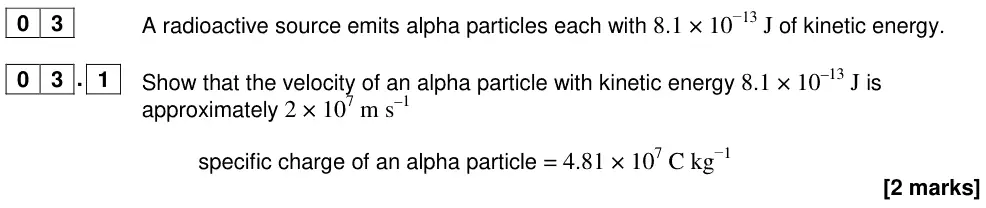
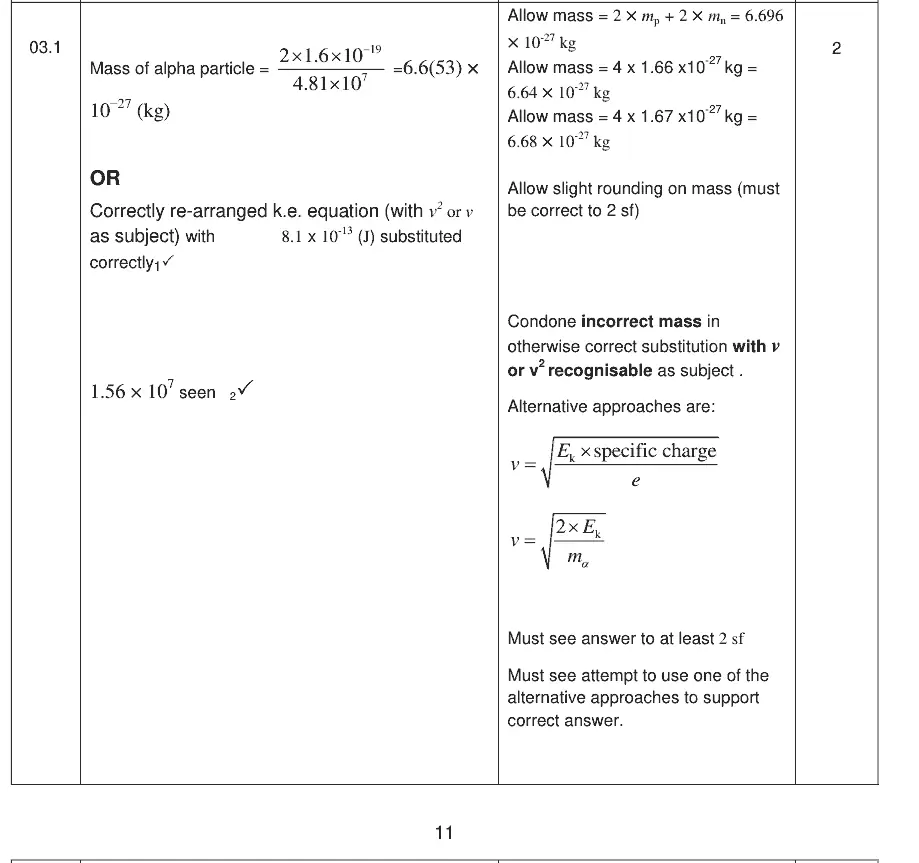
Answer: v = 1.56 x 10^7 m s^-1 (mass = 3.2 x 10^-19 / 4.81 x 10^7 = 6.65 x 10^-27 kg)
show subject at each stage and answer to more sf than given
Skills: MS2.2 Change the subject of an equation, including non-linear equations; MS2.3 Substitute numerical values into algebraic equations using appropriate units for physical quantities
June 2018 · AS Paper 2 · Q51 markMultiple choice
Answer
B
Notes from the mark scheme and report
Answer: B
June 2018 · AS Paper 2 · Q61 markMultiple choice
Answer
C
Notes from the mark scheme and report
Answer: C
Skills: MS0.3 Use ratios, fractions and percentages
June 2018 · Paper 2 · Q7.24 marksExplanation
Earlier part of question 7 that this part uses
Mark scheme
Examiner's comment
07.2 This question discriminated very well; there was a very good spread from zero to four marks. It was only the very weak students who did not understand that the question was about describing the contributions made by the strong nuclear force and the electromagnetic force. These students introduced the weak nuclear force and gravity as having some influence on the situation. Most students scored marks by knowing that the electromagnetic force is repulsive for protons in the nucleus and that the SNF is attractive between nucleons at short range. The variation in the marks came from students giving different amounts of detail, which could be about the specific ranges involved and the fact that the SNF is repulsive at very short range. Only the best students appreciated how the main forces lead to the requirement for more neutrons.
Notes from the mark scheme and report
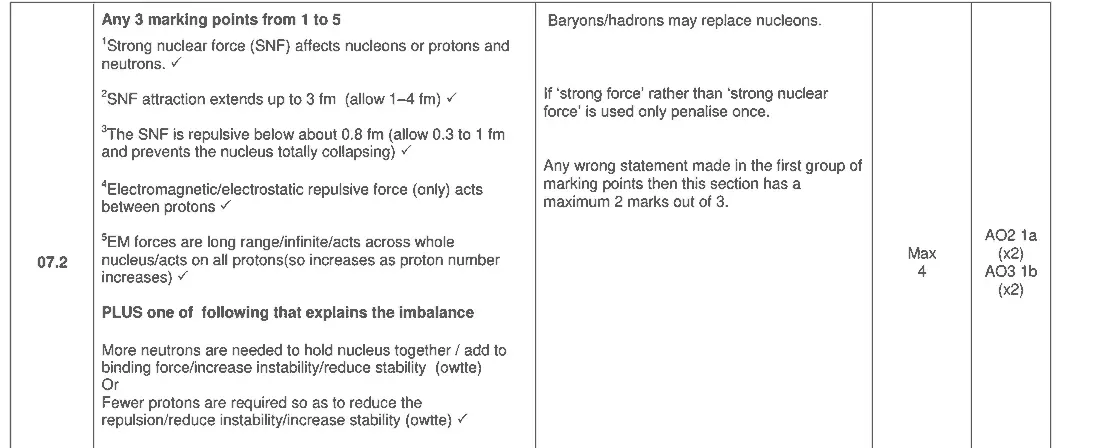
SNF acts on all nucleons, attractive to about 3 fm, repulsive below about 0.5 fm
electrostatic repulsion only between protons and acts across the whole nucleus
so extra neutrons add attraction without repulsion
June 2017 · Paper 1 · Q1.12 marksShort answer
Mark scheme
Examiner's comment
This question was generally well answered. In question 01.1, students had to complete the electron capture equation. While the majority were able to correctly identify the mass number and atomic number for argon, they were less successful at identifying the electron neutrino, with responses giving the particle as a neutron or gamma photon being quite common.
Notes from the mark scheme and report
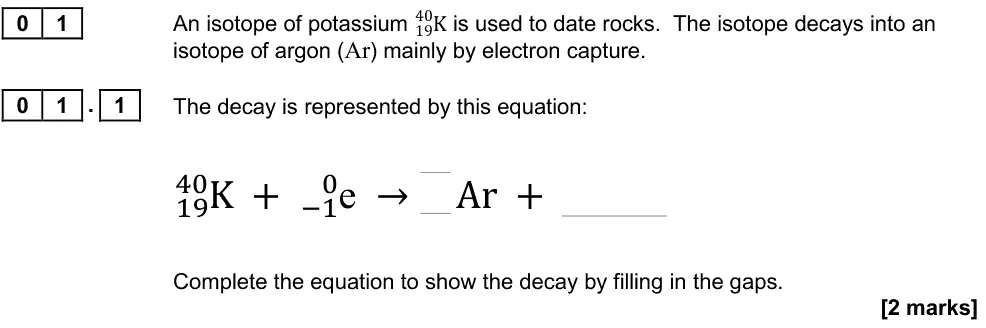
Answer: Ar-40 with Z = 18 plus an electron neutrino
neutron or gamma photon given for the neutrino was common
antineutrino bar or negative sign loses the mark
June 2017 · Paper 1 · Q1.43 marksExplanation
Earlier part of question 1 that this part uses
Mark scheme
Examiner's comment
Question 01.4 was an example of students being required to make a judgement, and many good responses were seen. A significant proportion of students did, however, give generic answers indicating how they would distinguish between alpha, beta and gamma decay. This did not answer the question which required them to state what interaction was occurring to produce calcium–40 from the potassium isotope.
In question 04.1 the commonest reason for losing a mark was a failure to indicate that the gradient of the graph gave the negative value of internal resistance. Identifying which circuit would be suitable to power the road sign involved a detailed analysis; while over a third of students were able to do this successfully, a significant proportion of these then failed to score the conclusion mark because they did not state clearly that the circuit in Figure 6 was suitable because it provided a current greater than 75 mA. Less able students struggled when dealing with the series and parallel combination of cells. Of those who could correctly identify the combined internal resistance as 12 Ω, few were then able to give the combined emf as 1.4 V.
Notes from the mark scheme and report
Identify the Ca-40 route as beta-minus decay, so expect an electron (detected e.g. by cloud chamber or absorption) and an antineutrino, no photon
generic alpha/beta/gamma distinctions did not answer the question
June 2017 · Paper 1 · Q81 markMultiple choice
Answer
B
Notes from the mark scheme and report
Answer: B
Skills: MS0.2 Recognise and use expressions in decimal and standard form
June 2017 · AS Paper 2 · Q4.12 marksCalculation
Mark scheme
Examiner's comment
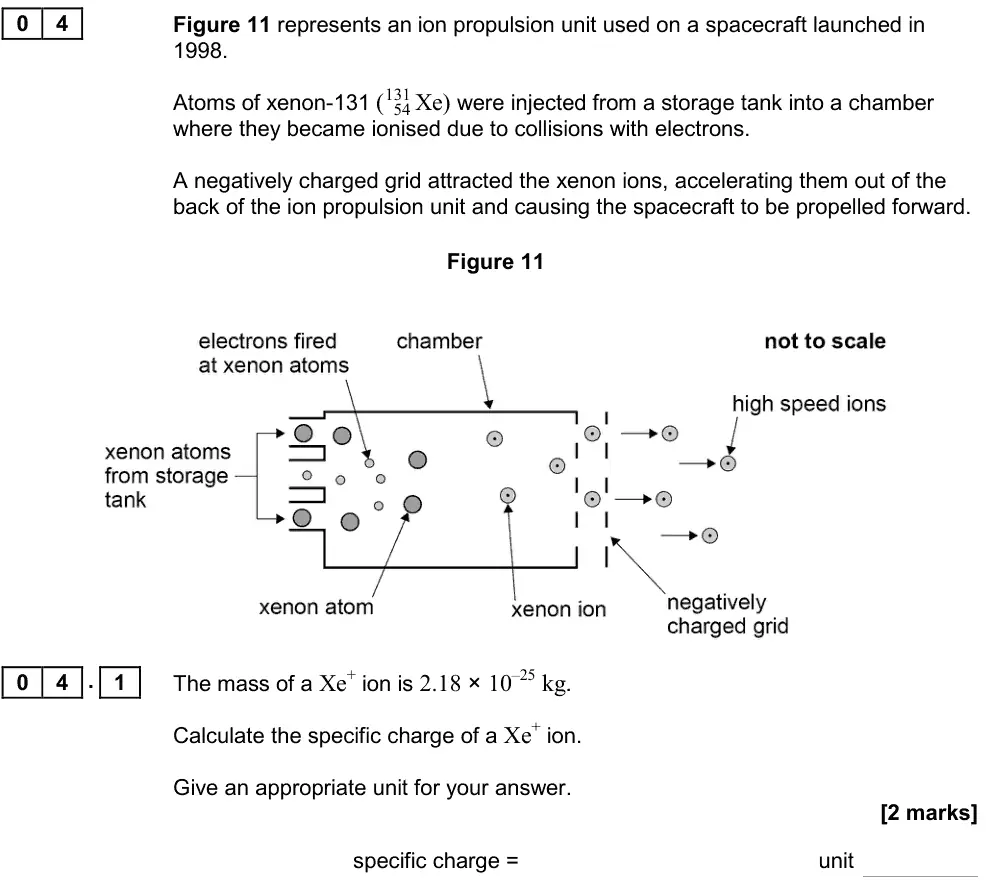
04.1 A significant number of students had difficulty with this question. Common wrong answers included: The charge = 53 × 1.6 × 10-19 arriving at an answer = 3.9 x 10⁷ • Mass divided by charge • Other students could not recall the units for specific charge; the coulomb and the joule were common wrong answers. Students who did not express the unit using index notation did not receive the mark. A common error seen was 1300 ÷ 1.6 x 10-19 = 8.125 x 10²¹ Many students could not convert 1300 eV into its equivalent 2.1 x 10⁻¹⁶ J. 04.2 04.3 A wide range in the quality of response seen here. Those who obtained 3 marks typically presented their working in a way that demonstrated a good understanding of the calculation required. Students who made some progress typically by determining the number of xenon ions in 79 kg obtained some credit. There was a significant number of non-attempts seen.
Notes from the mark scheme and report
Answer: 7.3 x 10^5 C kg^-1 (1.6 x 10^-19 / 2.18 x 10^-25)
using 54e or inverting the ratio were errors
unit must be in index form
Skills: MS2.3 Substitute numerical values into algebraic equations using appropriate units for physical quantities; MS0.1 Recognise and make use of appropriate units in calculations
June 2017 · AS Paper 2 · Q81 markMultiple choice
Answer
C
Notes from the mark scheme and report
Answer: C
Specimen set 1 · Paper 1 · Q1.12 marksShort answer
Mark scheme
Notes from the mark scheme and report
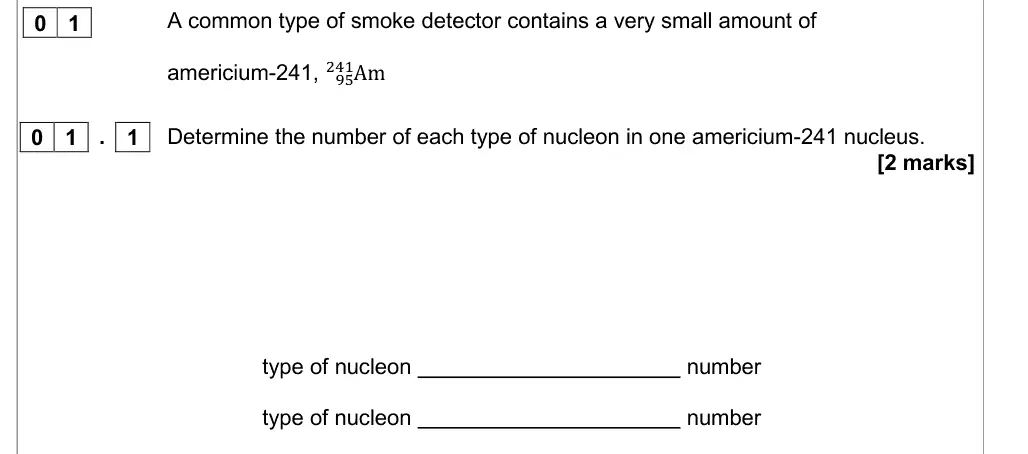
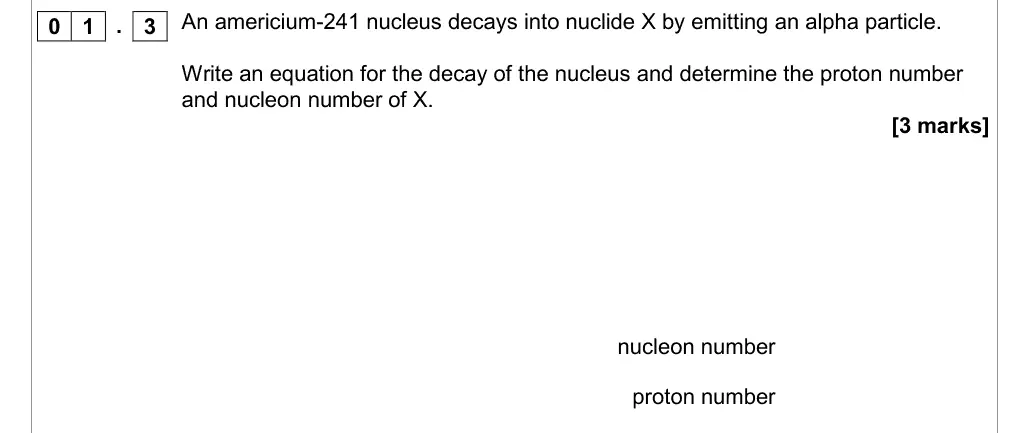
Answer: 95 protons and 146 neutrons (241 - 95)
specimen paper, no examiners' report
Specimen set 1 · Paper 1 · Q1.22 marksExplanation
Earlier part of question 1 that this part uses
Mark scheme
Notes from the mark scheme and report
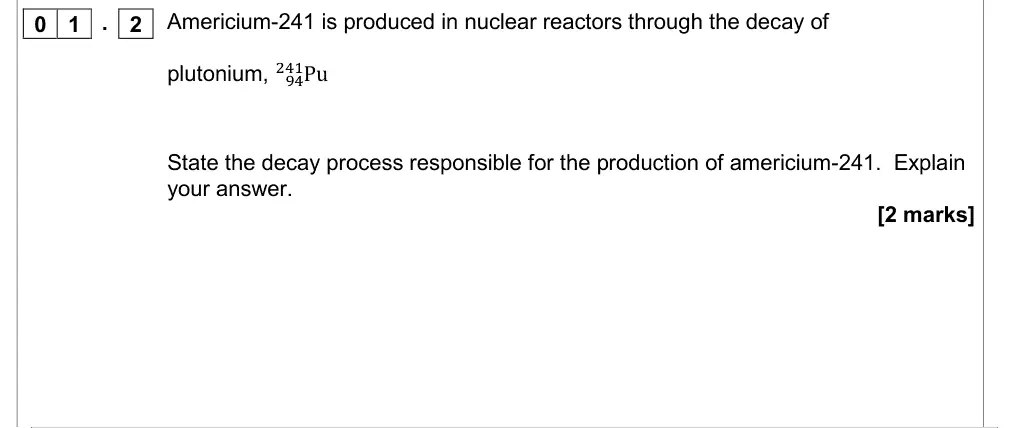
Beta-minus decay
nucleon number unchanged and proton number up by 1
a correct equation can earn the marks, antineutrino may be omitted
Specimen set 1 · Paper 1 · Q1.33 marksShort answer
Earlier part of question 1 that this part uses
Mark scheme
Notes from the mark scheme and report
Answer: X has nucleon number 237 and proton number 93
equation with alpha as He-4 (Z = 2)
Specimen set 1 · Paper 1 · Q1.52 marksExplanation
Earlier part of question 1 that this part uses
Mark scheme
Notes from the mark scheme and report
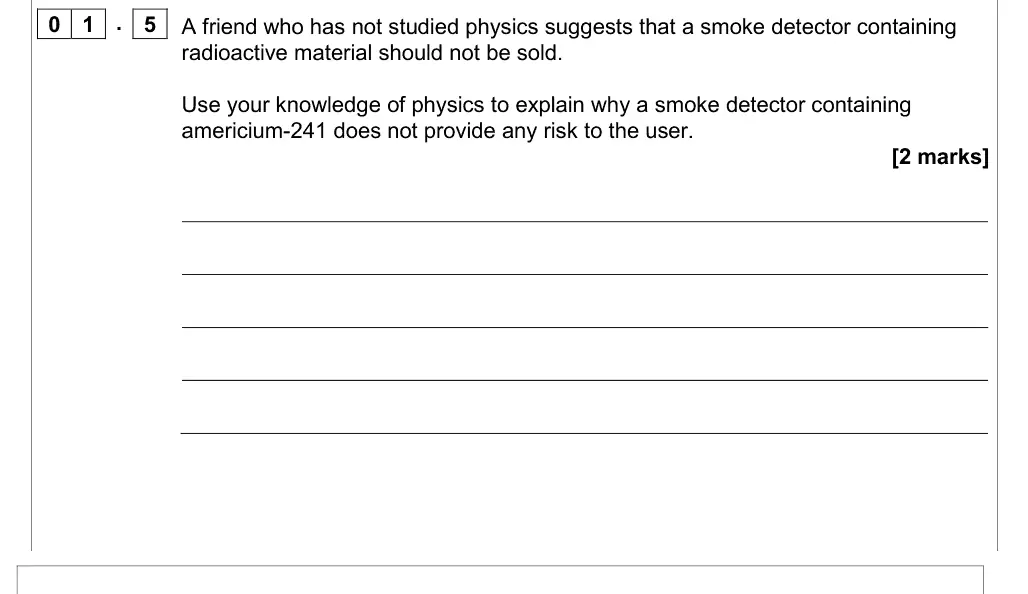
Very small quantity of material
alpha particles travel only a few cm in air (stopped inside the detector)
June 2016 · AS Paper 1 · Q6.12 marksShort answer
Mark scheme
Examiner's comment
In this question students were required to extract information from an introductory passage. Question 6.1 was a straightforward starter but as with 3.1 a significant proportion of answers were spoilt by a lack of precision. Students were required to mention atoms or nuclei in their responses and a significant proportion did not do this. Question 6.2 required an explanation as to why two photons were produced. A number of students seemed to think this was necessary due to energy conservation. Of those who realised this was due to momentum conservation, a significant proportion then failed to appreciate the importance of the photons travelling in different directions. Question 6.3 was an extended calculation and students were told to calculate the maximum frequency of the photons produced in the annihilation of the two nuclei. Maximum was necessary to indicate that the whole rest energy of the nuclei should be used and excluded the possibility of calculating the frequency of photons produced due to annihilation of individual nucleons within the helium and anti-helium nuclei. It is true that higher frequency photons would be produced if the nuclei had significant kinetic energy but students were told to use information from the passage in which there was no mention of kinetic energy. For full marks students needed to explain how they dealt with two nuclei annihilating and two photons being produced. Questions 6.4 and 6.5 were well answered and the only common error was a failure to identify the positron correctly in the equation.
Notes from the mark scheme and report
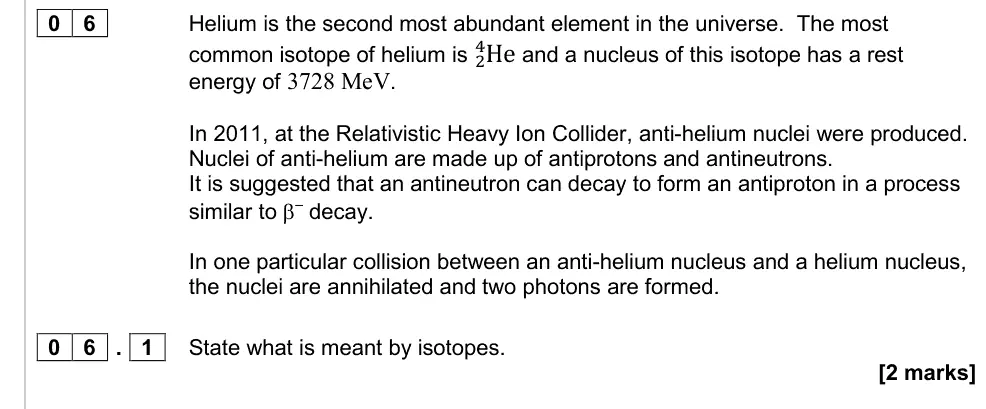
Atoms/nuclei with the same number of protons but different numbers of neutrons
must mention atoms or nuclei
June 2016 · AS Paper 1 · Q6.42 marksShort answer
Earlier part of question 6 that this part uses
Mark scheme
Examiner's comment
In this question students were required to extract information from an introductory passage. Question 6.1 was a straightforward starter but as with 3.1 a significant proportion of answers were spoilt by a lack of precision. Students were required to mention atoms or nuclei in their responses and a significant proportion did not do this. Question 6.2 required an explanation as to why two photons were produced. A number of students seemed to think this was necessary due to energy conservation. Of those who realised this was due to momentum conservation, a significant proportion then failed to appreciate the importance of the photons travelling in different directions. Question 6.3 was an extended calculation and students were told to calculate the maximum frequency of the photons produced in the annihilation of the two nuclei. Maximum was necessary to indicate that the whole rest energy of the nuclei should be used and excluded the possibility of calculating the frequency of photons produced due to annihilation of individual nucleons within the helium and anti-helium nuclei. It is true that higher frequency photons would be produced if the nuclei had significant kinetic energy but students were told to use information from the passage in which there was no mention of kinetic energy. For full marks students needed to explain how they dealt with two nuclei annihilating and two photons being produced. Questions 6.4 and 6.5 were well answered and the only common error was a failure to identify the positron correctly in the equation.
Notes from the mark scheme and report
Antineutron -> antiproton + positron (0/+1 e) + electron neutrino
positron often wrongly identified
Specimen set 1 · Paper 1 · Q71 markMultiple choice
Answer
C
Notes from the mark scheme and report
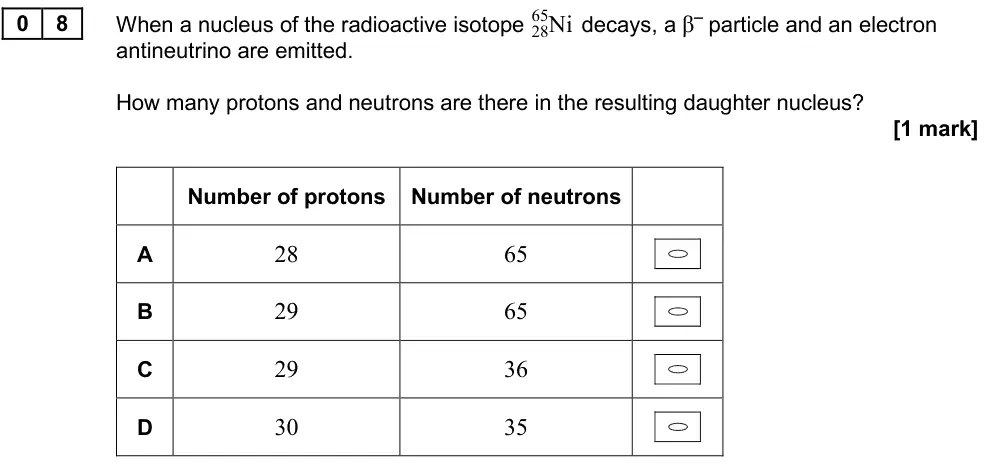
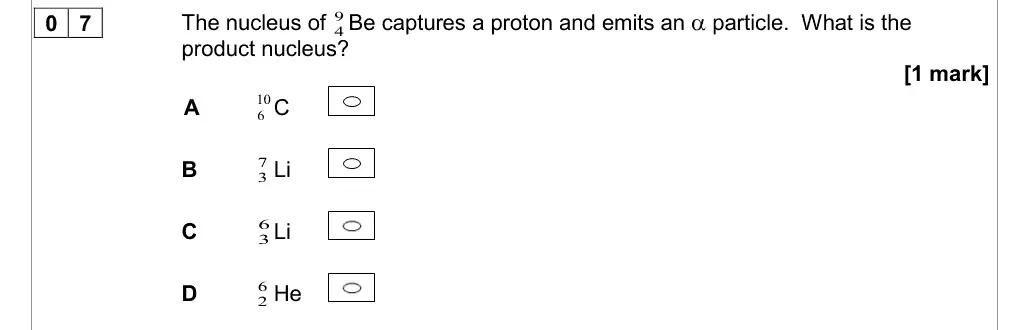
Answer: C (Li-6
conserve nucleon and proton numbers)
Specimen set 1 · Paper 2 · Q1.54 marksExplanation
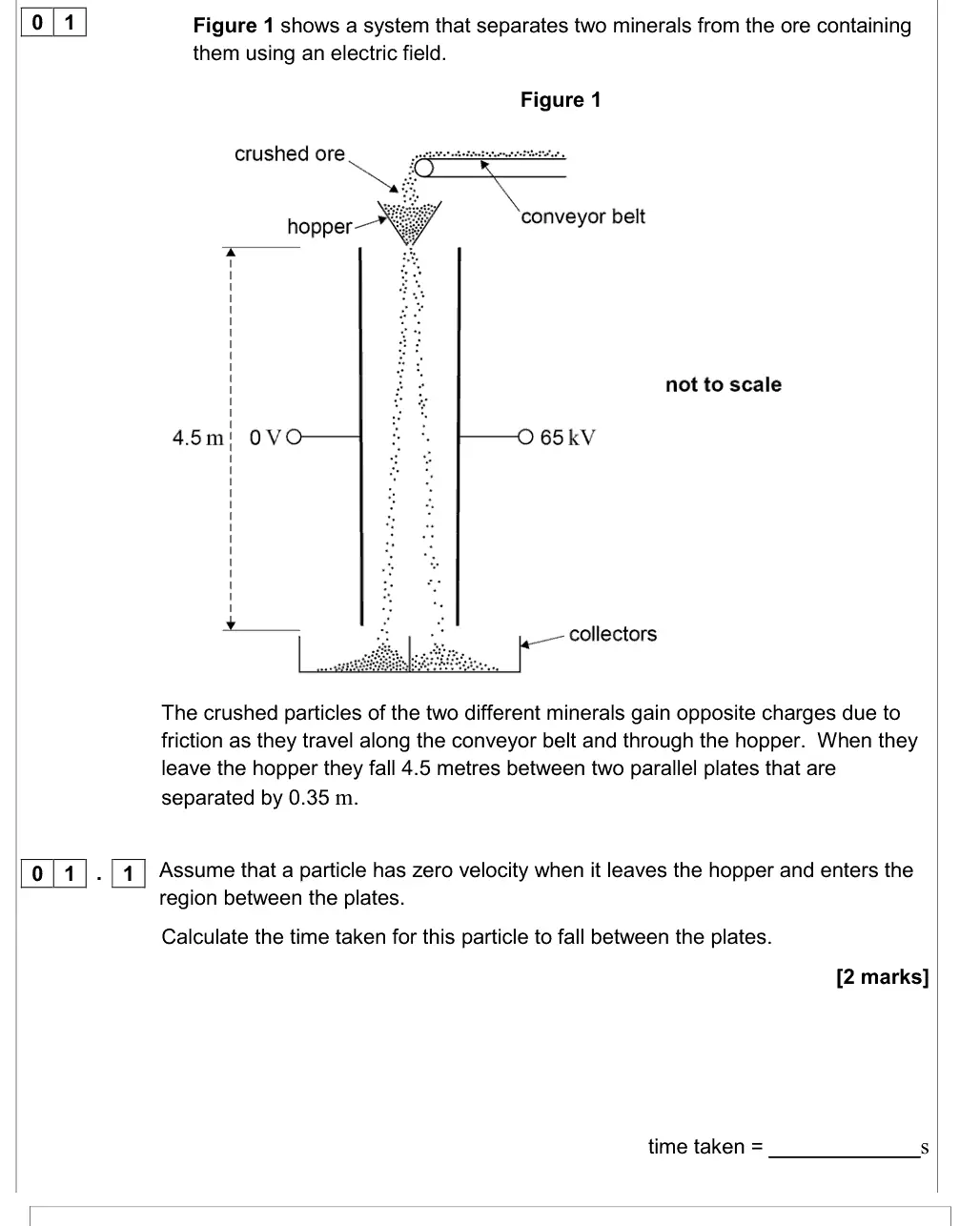
Earlier part of question 1 that this part uses
Mark scheme
Notes from the mark scheme and report
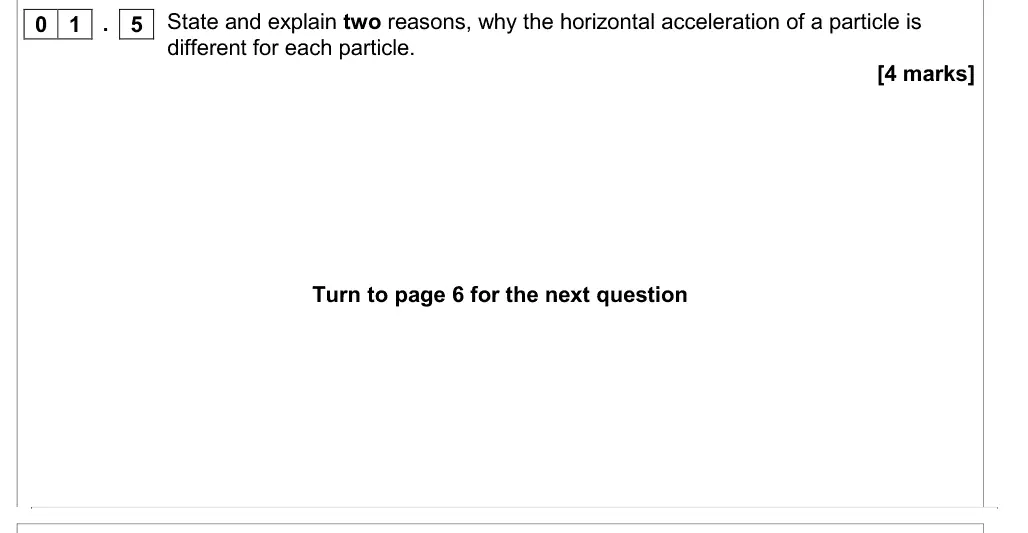
Mass varies and charge varies between particles
a = Eq/m with E = V/d constant, so q/m (and hence a) differs
June 2016 · AS Paper 2 · Q4.12 marksShort answer
Mark scheme
Examiner's comment
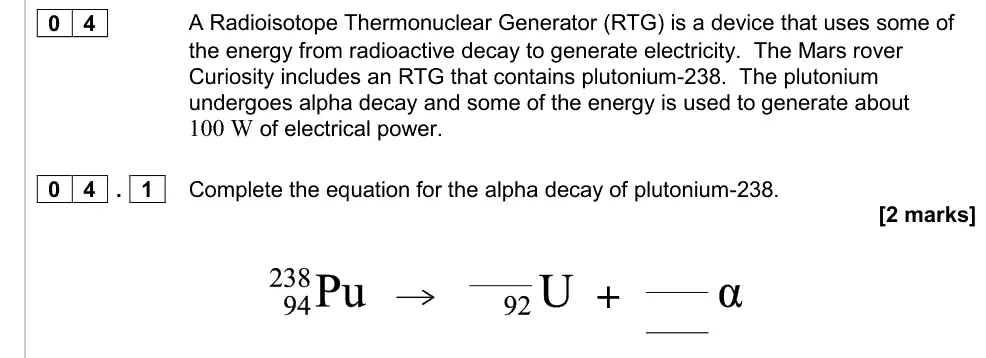
4.1 This question caused few students any difficulty. The few errors seen tended to be linked to using 2 for the nucleon number of the alpha particle.
Notes from the mark scheme and report
238/94 Pu to 234/92 U + 4/2 alpha
nucleon numbers 234 and 4 for one mark, proton number 2 for the other
June 2016 · AS Paper 2 · Q51 markMultiple choice
Answer
B
Notes from the mark scheme and report
Answer: B
Specimen set 1 · Paper 2 · Q271 markMultiple choice
Answer
A
Notes from the mark scheme and report
Answer: A
Work with an AQA physics tutor
Dropping marks on calculations, required practicals or the six-markers? Book a trial session with a specialist AQA physics tutor.