Tap a question to zoom it. Where a part needs a figure, table or graph from earlier in the question, that part folds out above it; the mark scheme and examiner's comment open underneath. Have the AQA data and formulae booklet beside you (see the formula sheet page).
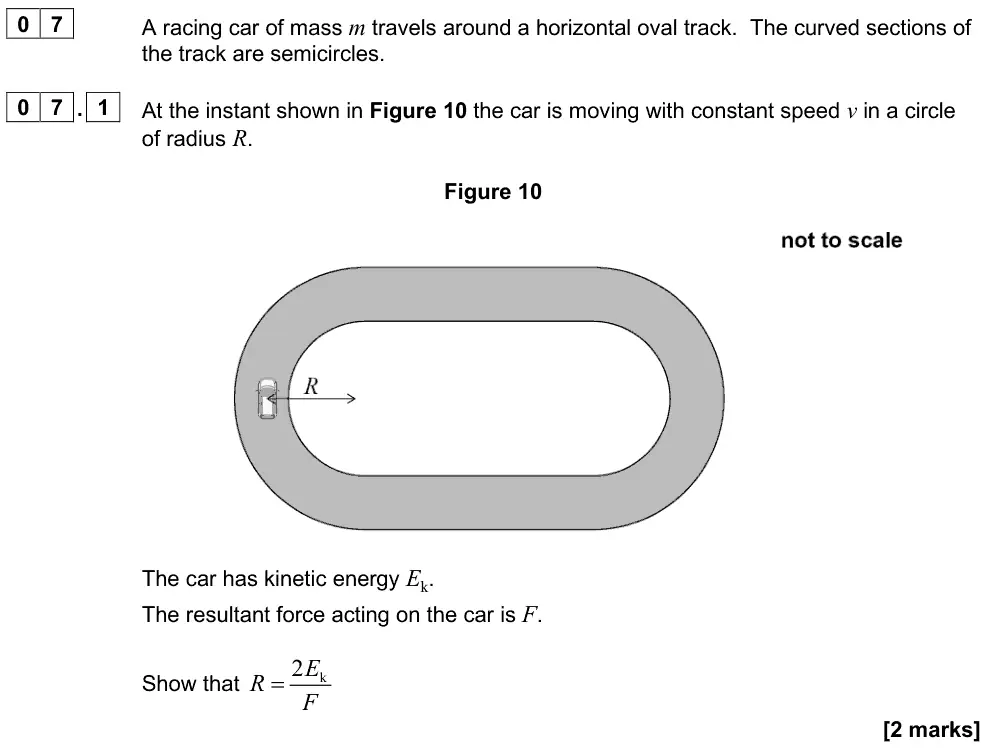
June 2025 · Paper 1 · Q7.12 marksAO2=2Show that
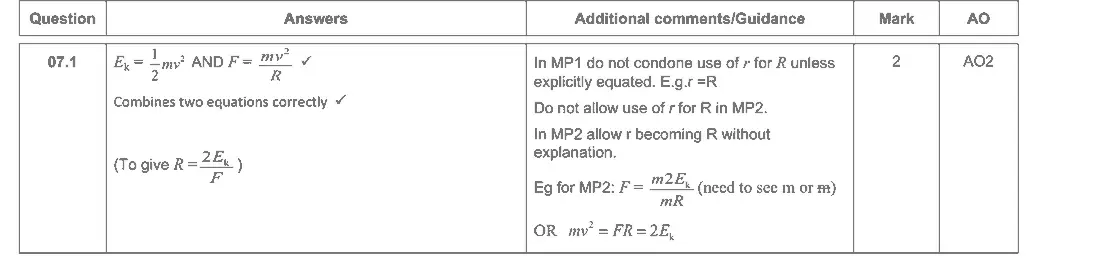
Mark scheme
Examiner's comment
57% of students obtained full marks for Question 7.1. As this was a ‘show that’ question, each step in the derivation had to be clear. Students given one mark often used ‘r’ for the radius in early stages before substituting R in their final answer without reason. It was expected that students used R throughout or wrote r=R at some point. Students who tried to work backwards from the answer rarely gained much credit.
Notes from the mark scheme and report
Combine Ek = mv^2/2 with F = mv^2/R
use R throughout (r for R lost a mark)
working backwards rarely credited
Skills: MS2.2 Change the subject of an equation, including non-linear equations
June 2025 · Paper 1 · Q7.21 markAO2=1CalculationEasy
Earlier part of question 7 that this part uses
Mark scheme
Examiner's comment
The straightforward calculation in Question 7.2 was completed correctly by about 85% of students. Occasionally students lost the mark for incorrectly rounding to 59.0.
Notes from the mark scheme and report
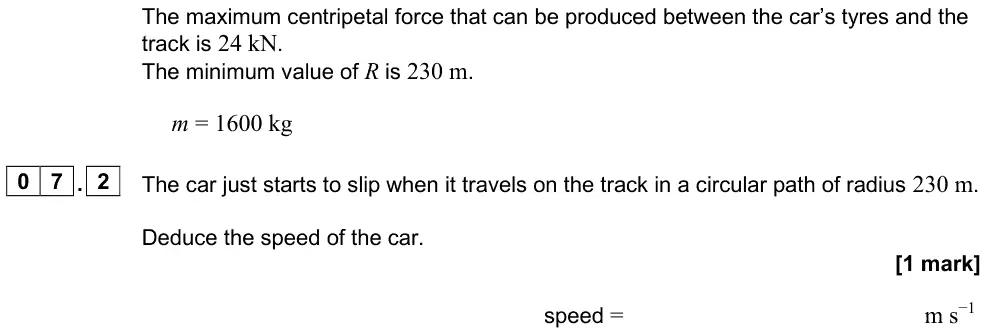
Answer: 58.7 m s^-1 (v^2 = 24000 x 230/1600)
rounding to 59.0 lost the mark
Skills: MS2.3 Substitute numerical values into algebraic equations using appropriate units for physical quantities
June 2025 · Paper 1 · Q7.31 markAO3=1Short answer
Earlier part of question 7 that this part uses
Mark scheme
Examiner's comment
Most students suggested increasing the radius, and therefore obtained the mark for Question 7.3. Some suggested changing the banking. This was not rewarded as the question clearly referred to the curved section of the track in the earlier part of the question. Other correct answers in the mark scheme were also seen fairly frequently.
Notes from the mark scheme and report
Increase the radius of the path (drive from outside to inside) or increase friction
banking answers neutral
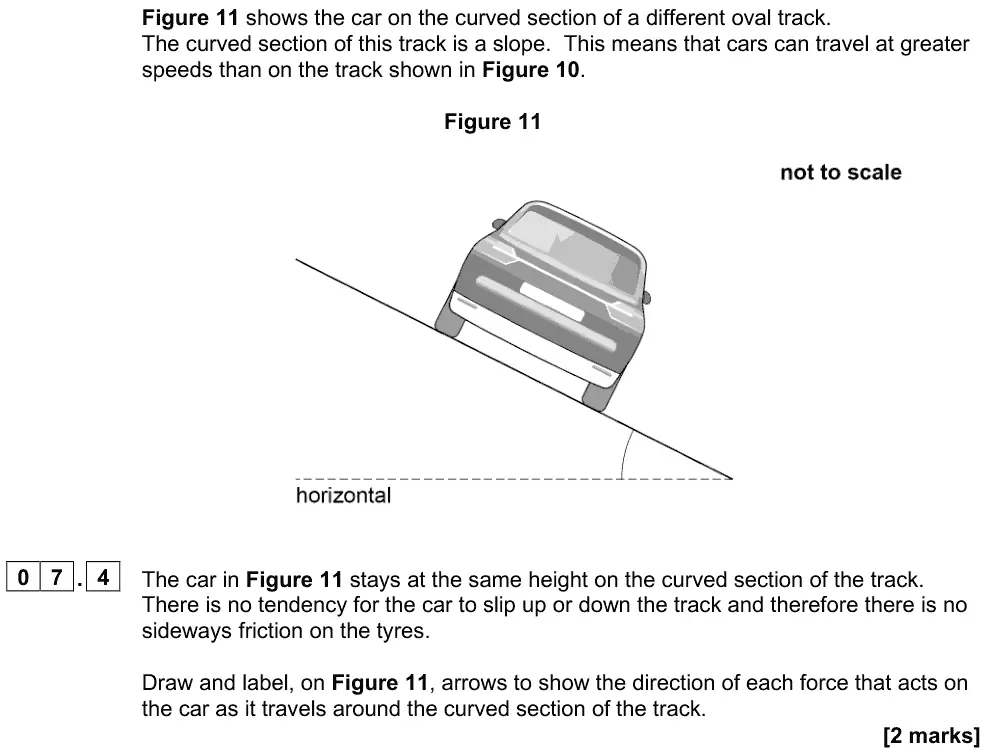
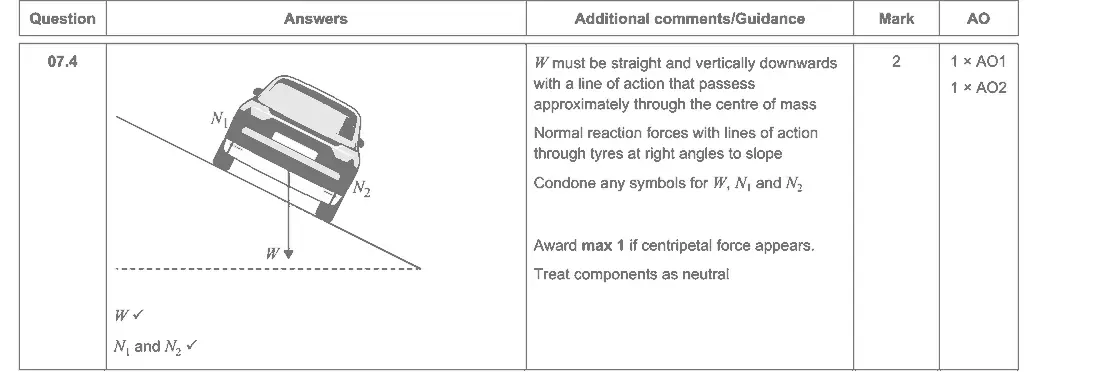
June 2025 · Paper 1 · Q7.42 marksAO1=1, AO2=1Diagram or graph
Earlier part of question 7 that this part uses
Mark scheme
Examiner's comment
Most students obtained 1 mark for Question 7.4 by labelling the weight. It was expected that this would pass through the centre of mass of the car. Whilst some leeway was given, answers that showed a wobbly line or did not pass through a point near the centre of the car were not credited. Very few students labelled the two reaction forces that act through the wheels. A very common error was to see a centripetal force drawn, as though this was an extra force Students should be encouraged to use a ruler whenever drawing forces on a diagram. They should give attention to the line of action of these forces. It should also be stressed that a centripetal force gives rise to circular motion, and not the other way round.
Notes from the mark scheme and report
Weight vertically down through centre of mass
normal reactions at the tyres perpendicular to the slope
max 1 if a centripetal force is drawn
use a ruler
June 2025 · Paper 1 · Q7.52 marksAO3=2Explanation
Earlier part of question 7 that this part uses
Mark scheme
Examiner's comment
Question 7.5 proved to be more difficult than expected. A common error was to suggest that the weight of the car had a horizontal component because of the slope.
Notes from the mark scheme and report
Horizontal component of the normal reaction adds to the centripetal force, so v can be larger for the same R
many wrongly gave weight a horizontal component
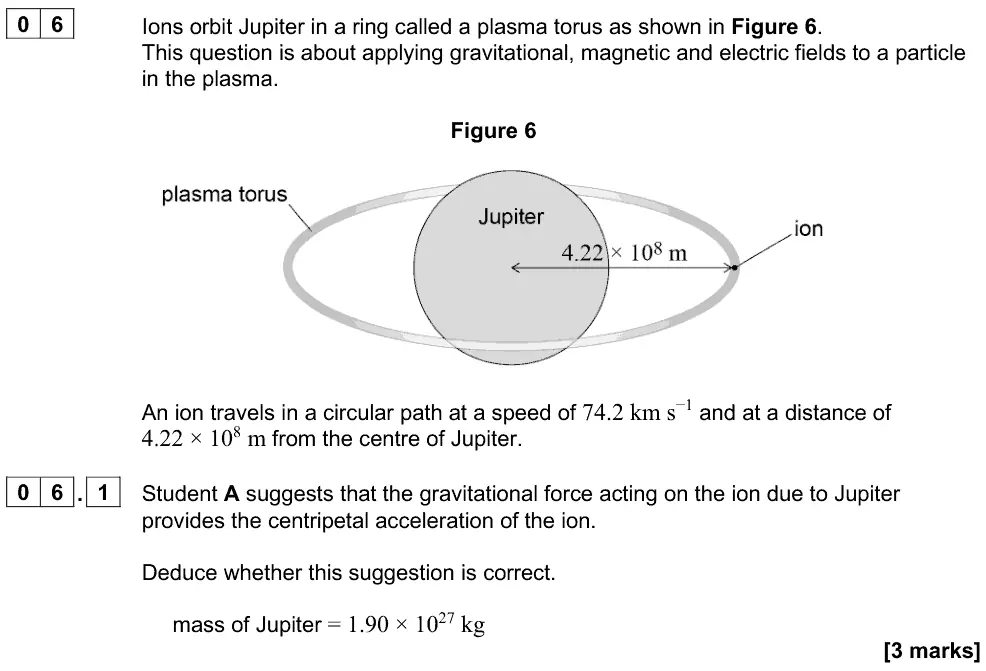
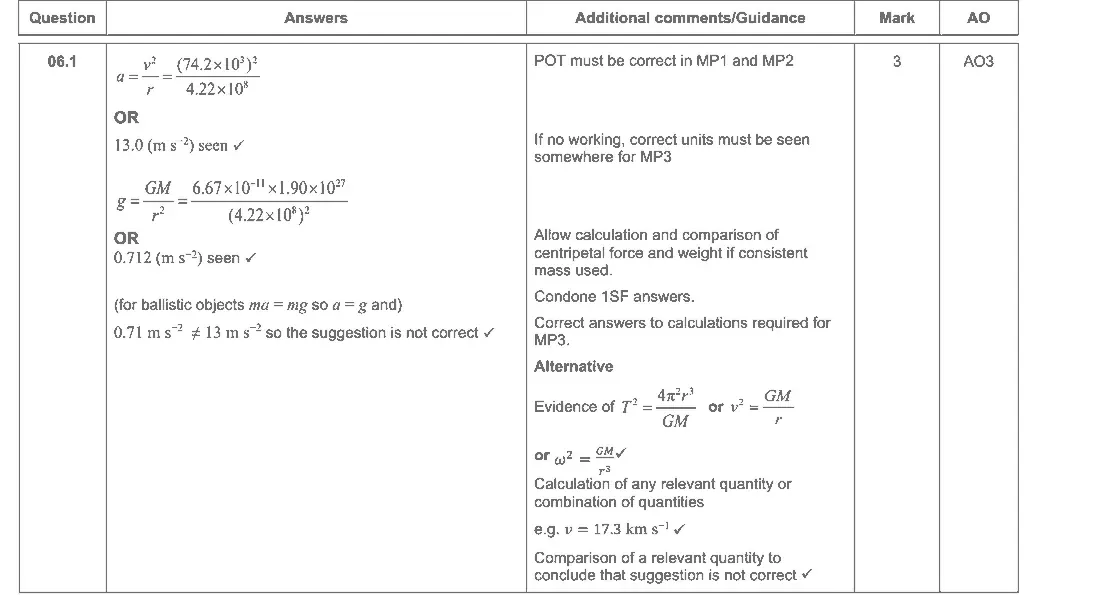
June 2025 · Paper 2 · Q6.13 marksAO3=3Calculation
Mark scheme
Examiner's comment
6.1 Students found this question very accessible, with most following the prompting in the question to determine and compare the centripetal acceleration of the ion with the gravitational field strength at the ion’s location. Most students remembered to include the comparison in this question, as they were comparing two calculated values.
However, this was not the only approach, with a wide variety of approaches seen for a the ion’s speed and included comparing the value of 𝐺𝐺 required with the value of 𝐺𝐺 on the minority of students. The most popular was comparing the speed for a gravitational orbit with
formulae sheet. All correct approaches were rewarded.
Notes from the mark scheme and report
Not correct: centripetal acceleration v^2/r = 13.0 m s^-2 but g at that radius = 0.712 N kg^-1 (or orbital speed for gravity alone 17.3 km s^-1)
Skills: MS2.3 Substitute numerical values into algebraic equations using appropriate units for physical quantities
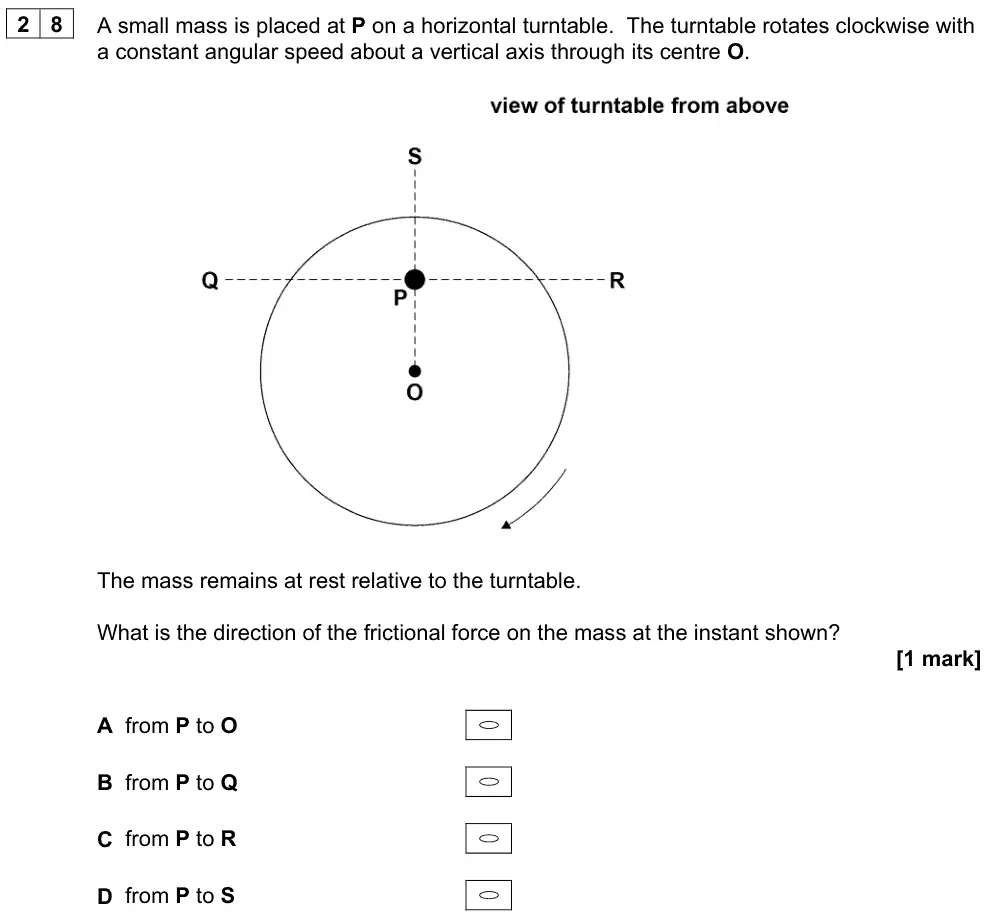
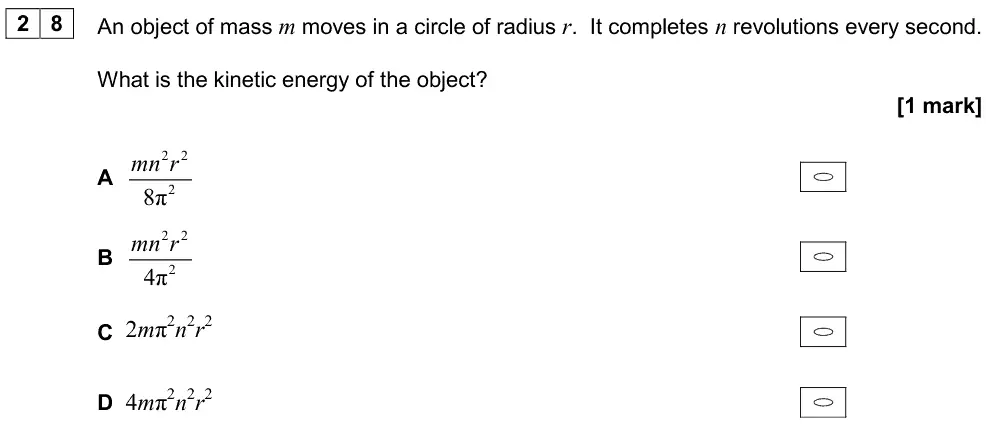
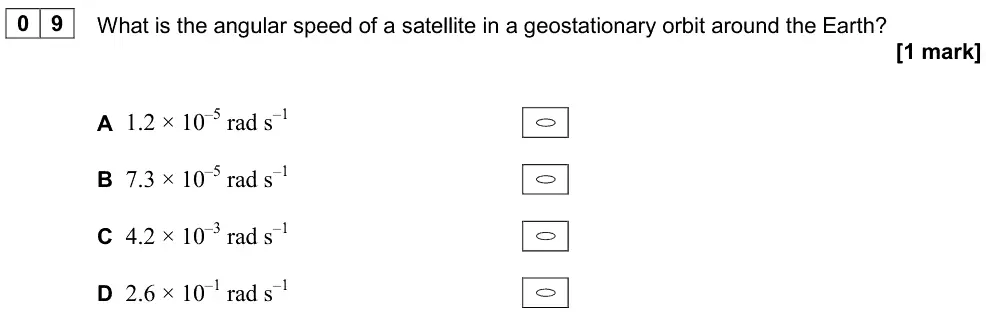
June 2024 · Paper 1 · Q281 markAO1=1Multiple choice
Answer
A
Mark scheme
Notes from the mark scheme and report
Answer: A
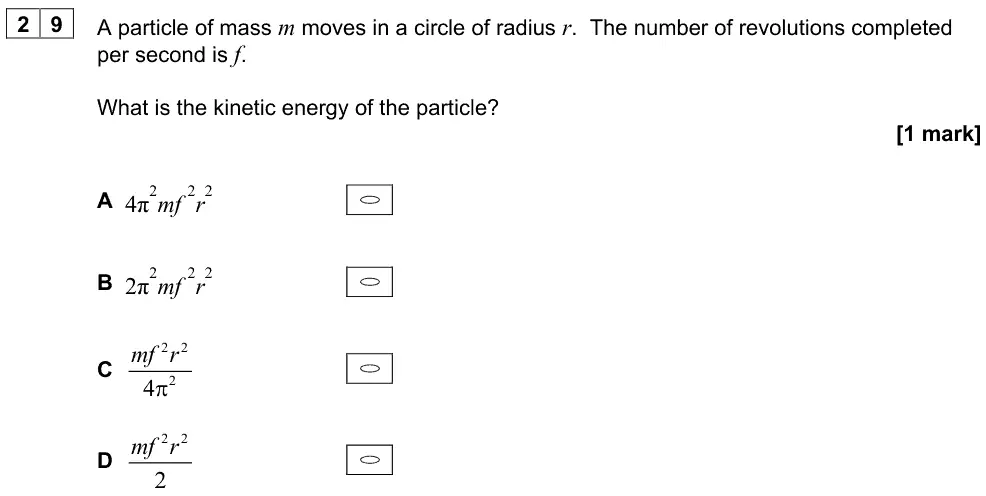
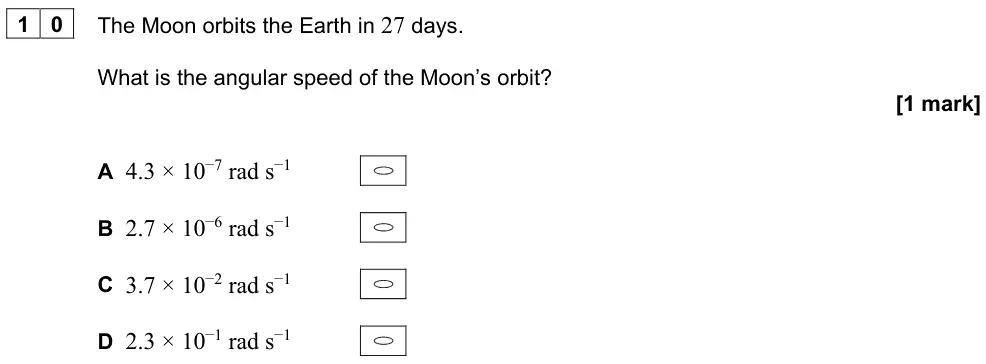
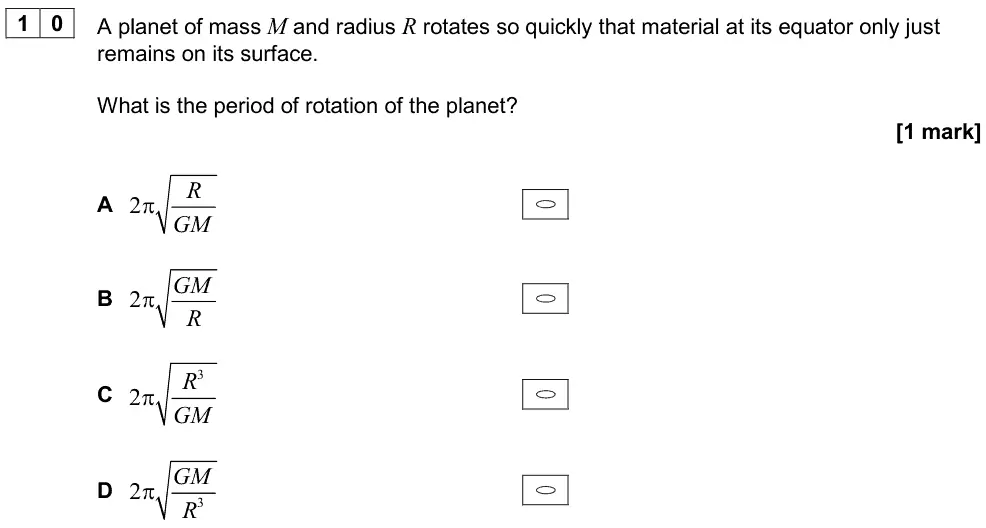
June 2024 · Paper 1 · Q291 markAO1=1Multiple choiceEasy
Answer
B
Mark scheme
Examiner's comment
There were five very accessible questions that were correctly answered by more than 70% of students. These were B12, B18, B14, B27 and B29.
Notes from the mark scheme and report
Answer: B
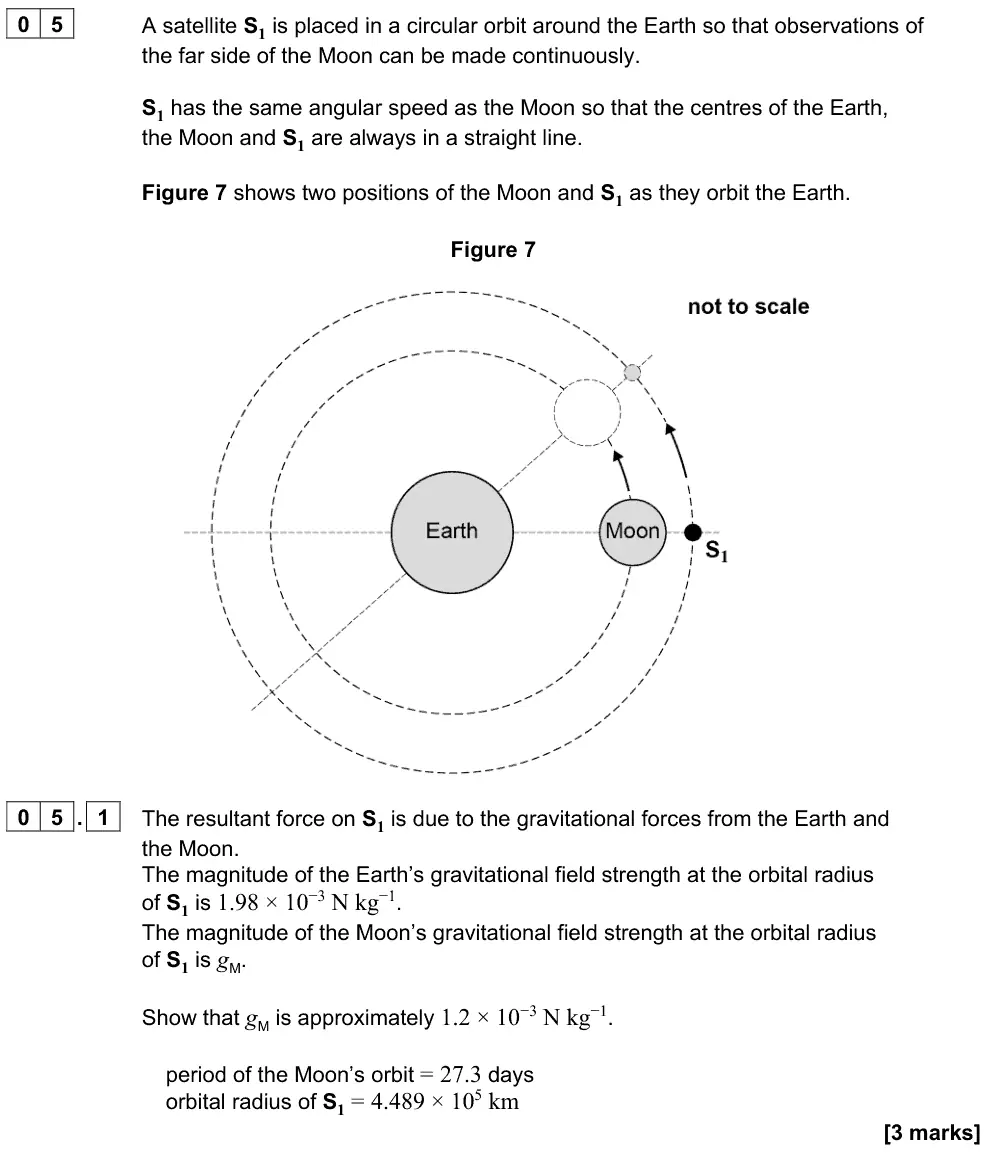
June 2024 · Paper 2 · Q5.13 marksAO2=3Show that
Mark scheme
Examiner's comment
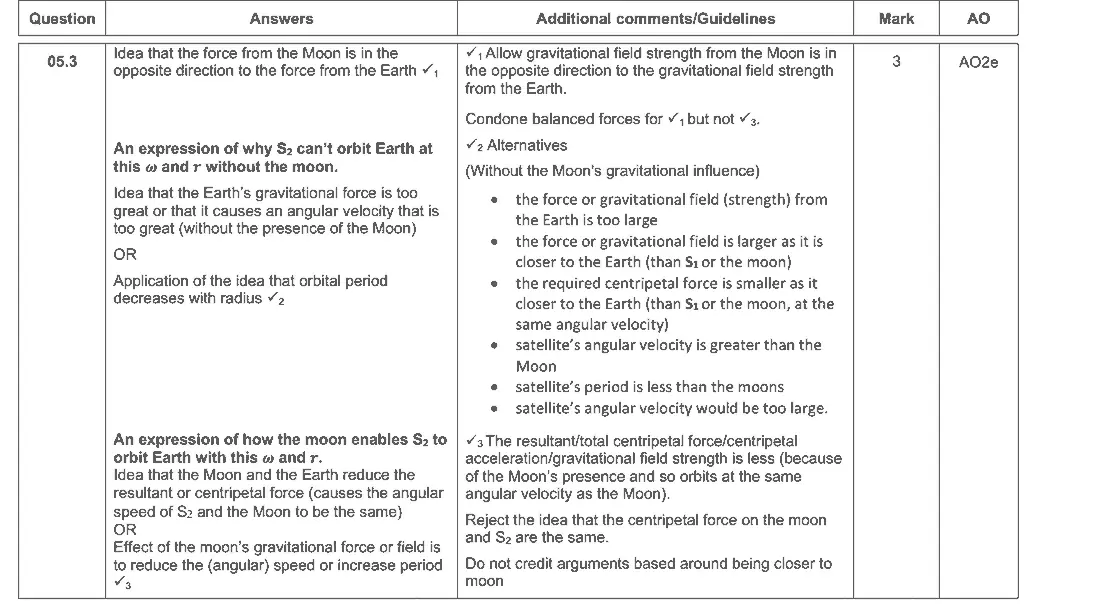
05.1 This question was very challenging, with most students gaining 1 or 0. The first mark was for calculating the angular speed of S1. Some students did gain this mark although they did not know how to progress from there. In order to make much progress with this question students had to realise that the centripetal acceleration was equal to the resultant gravitational field strength. They could then subtract the gravitational field strength of the Earth to determine the gravitational field strength of the moon. 𝑇𝑇2 = 4𝜋𝜋𝑟𝑟3 Some students attempted to determine an effective mass to allow this period and then use this with 𝐺𝐺𝐺𝐺; this approach did not gain credit. 05.2 rearrangement of 𝑔𝑔= 𝐺𝐺𝐺𝐺 This question was much more accessible, with many students realising that this was a simple 𝑟𝑟2 . It is unfortunate that the challenging 05.1 put some students off attempting the much more straightforward 05.2. Those who tried to use 𝑇𝑇2 = 4𝜋𝜋𝑟𝑟3 𝐺𝐺𝐺𝐺 did not score here. 05.3 This question also proved to be very challenging. Students had to recognise that the forces or fields acted in opposite directions on S2. This was the most accessible mark and could be achieved in many different ways, including by annotating Figure 8, although simply writing about being attracted to the moon and the Earth was not enough. The second mark was for realising that S2 would be travelling too fast to orbit at the lower distance. Again, this could be expressed in a variety of ways by discussing speed, angular speed or the magnitudes of the fields or forces involved. This proved the most challenging mark to score. The last mark was for stating how the moon reduced the resultant field or force to allow S2 to orbit the Earth at the correct speed at a lower radius.
Some answers referred to S2 requiring the same force as the moon to orbit with the same period. This idea was rejected, as the force depends on the radius and the mass, both of which are different. Some wrote about the gravitational forces of the moon and the Earth cancelling each other; this was condoned for the first marking point, but would have resulted in S2 moving in a straight line, rather than a circular orbit and was rejected for the second and third marking points.
Notes from the mark scheme and report
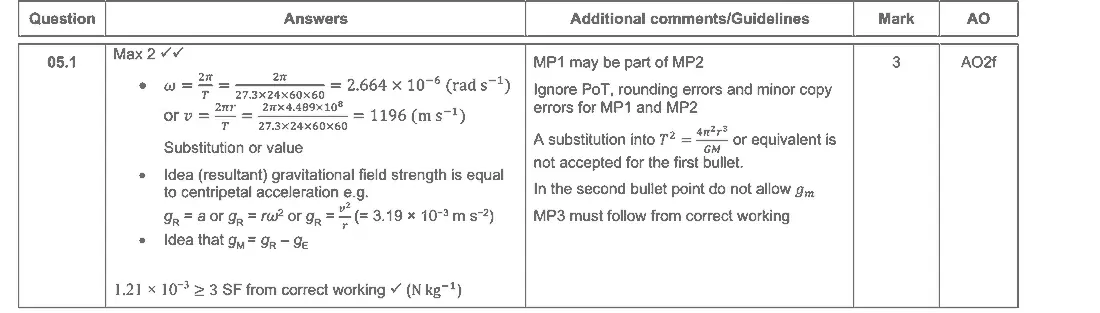
Omega = 2 pi / 27.3 days = 2.664 x 10^-6 rad s^-1
resultant g = r omega^2 = 3.19 x 10^-3
gM = 3.19 x 10^-3 - 1.98 x 10^-3 = 1.21 x 10^-3 N kg^-1 to 3 sf
most scored 0 or 1
Skills: MS2.3 Substitute numerical values into algebraic equations using appropriate units for physical quantities; MS0.1 Recognise and make use of appropriate units in calculations
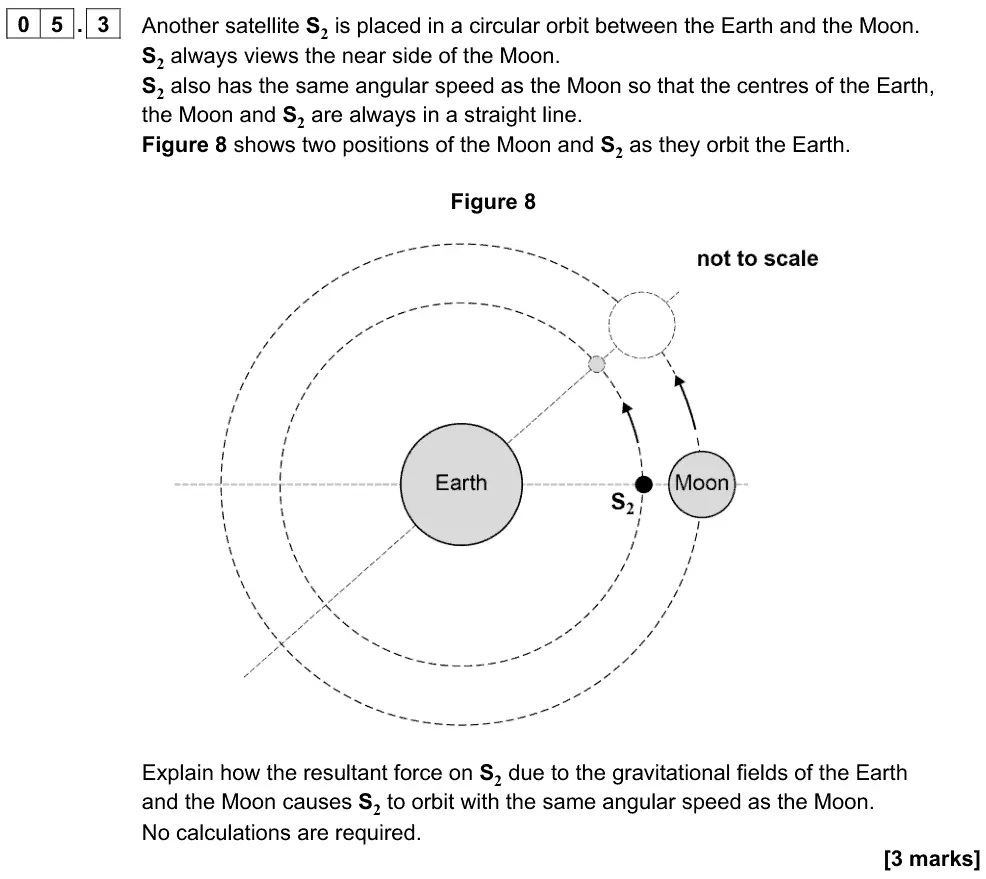
June 2024 · Paper 2 · Q5.33 marksAO2=3Explanation
Earlier part of question 5 that this part uses
Mark scheme
Examiner's comment
05.1 This question was very challenging, with most students gaining 1 or 0. The first mark was for calculating the angular speed of S1. Some students did gain this mark although they did not know how to progress from there. In order to make much progress with this question students had to realise that the centripetal acceleration was equal to the resultant gravitational field strength. They could then subtract the gravitational field strength of the Earth to determine the gravitational field strength of the moon. 𝑇𝑇2 = 4𝜋𝜋𝑟𝑟3 Some students attempted to determine an effective mass to allow this period and then use this with 𝐺𝐺𝐺𝐺; this approach did not gain credit. 05.2 rearrangement of 𝑔𝑔= 𝐺𝐺𝐺𝐺 This question was much more accessible, with many students realising that this was a simple 𝑟𝑟2 . It is unfortunate that the challenging 05.1 put some students off attempting the much more straightforward 05.2. Those who tried to use 𝑇𝑇2 = 4𝜋𝜋𝑟𝑟3 𝐺𝐺𝐺𝐺 did not score here. 05.3 This question also proved to be very challenging. Students had to recognise that the forces or fields acted in opposite directions on S2. This was the most accessible mark and could be achieved in many different ways, including by annotating Figure 8, although simply writing about being attracted to the moon and the Earth was not enough. The second mark was for realising that S2 would be travelling too fast to orbit at the lower distance. Again, this could be expressed in a variety of ways by discussing speed, angular speed or the magnitudes of the fields or forces involved. This proved the most challenging mark to score. The last mark was for stating how the moon reduced the resultant field or force to allow S2 to orbit the Earth at the correct speed at a lower radius.
Notes from the mark scheme and report
Moon's pull is opposite to Earth's
on its own, Earth's pull at that radius would give a greater angular speed (shorter period)
Moon's pull reduces the resultant centripetal force so angular speed matches the Moon's
June 2023 · Paper 1 · Q281 markMultiple choice
Answer
A
Mark scheme
Notes from the mark scheme and report
Answer: A
Skills: MS4.7 Understand the relationship between degrees and radians and translate from one to the other
June 2023 · Paper 1 · Q301 markMultiple choice
Answer
D
Mark scheme
Notes from the mark scheme and report
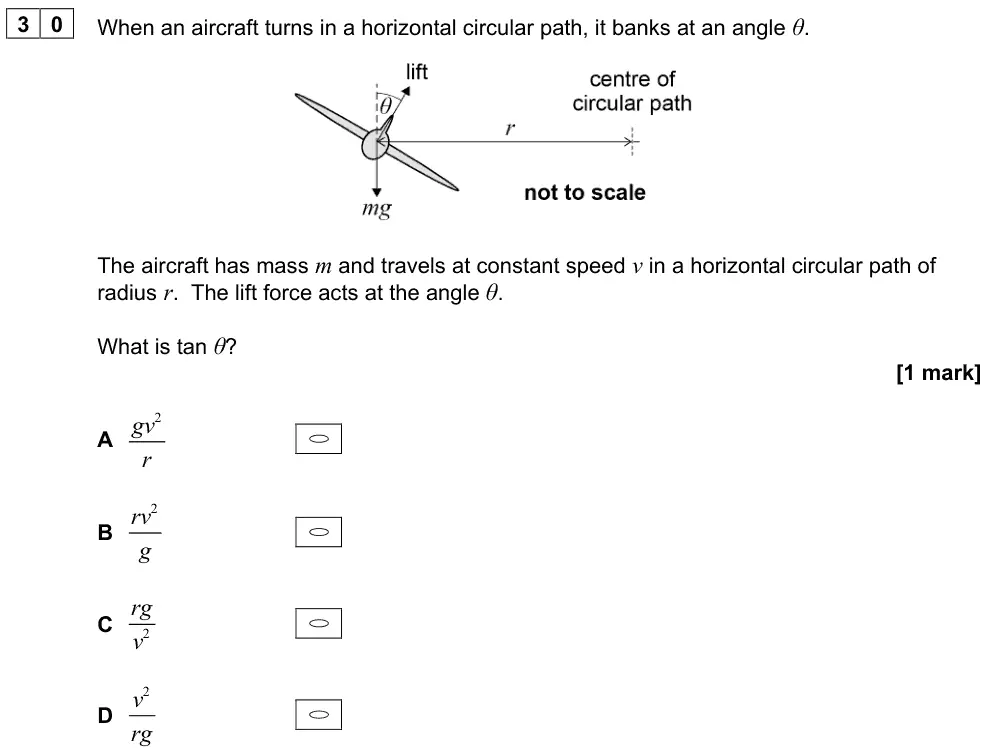
Answer: D
Skills: MS4.5 Use sin, cos and tan in physical problems
June 2022 · Paper 1 · Q5.12 marksAO1=2Calculation
Mark scheme
Examiner's comment
The calculations in 05.1, 05.3 and 05.5 were very straightforward and caused little trouble for most students. 05.2 was more challenging. Examiners were lenient in their interpretation of the arrow, but several students lost the mark through carelessness. When drawing a direction such as this students should use a ruler and avoid ambiguity in the construction.
Notes from the mark scheme and report
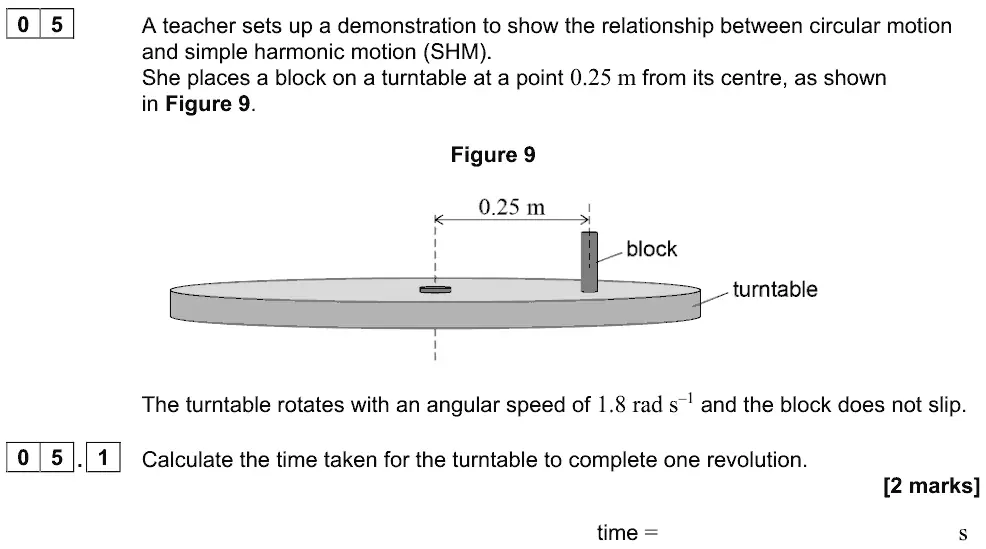
Answer: 3.5 s (2 pi / 1.8)
Skills: MS2.3 Substitute numerical values into algebraic equations using appropriate units for physical quantities
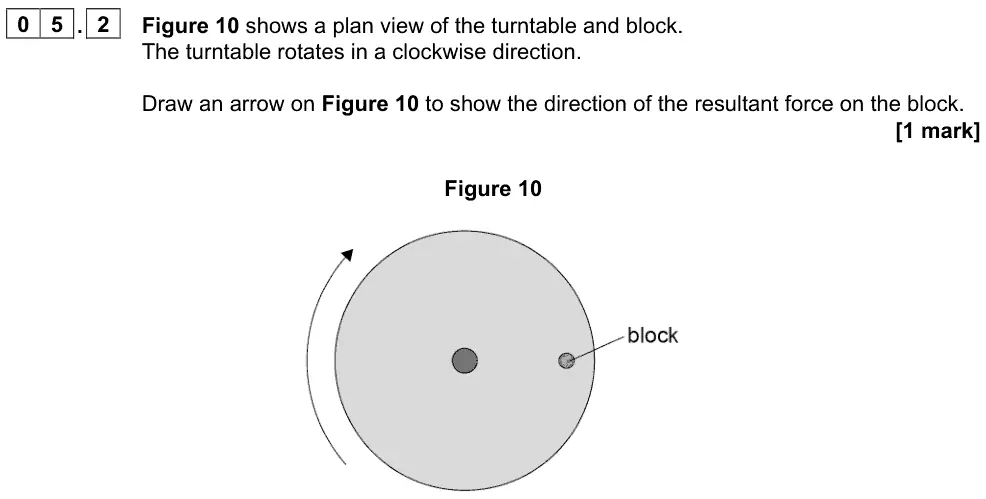
June 2022 · Paper 1 · Q5.21 markAO1=1Diagram or graph
Earlier part of question 5 that this part uses
Mark scheme
Examiner's comment
The calculations in 05.1, 05.3 and 05.5 were very straightforward and caused little trouble for most students. 05.2 was more challenging. Examiners were lenient in their interpretation of the arrow, but several students lost the mark through carelessness. When drawing a direction such as this students should use a ruler and avoid ambiguity in the construction.
Notes from the mark scheme and report
Arrow from the block towards the centre of the turntable
use a ruler
June 2022 · Paper 1 · Q5.32 marksAO2=2Calculation
Earlier part of question 5 that this part uses
Mark scheme
Examiner's comment
The calculations in 05.1, 05.3 and 05.5 were very straightforward and caused little trouble for most students. 05.2 was more challenging. Examiners were lenient in their interpretation of the arrow, but several students lost the mark through carelessness. When drawing a direction such as this students should use a ruler and avoid ambiguity in the construction.
Notes from the mark scheme and report
Answer: 0.097 N (m r omega^2 = 0.12 x 0.25 x 1.8^2)
Skills: MS2.3 Substitute numerical values into algebraic equations using appropriate units for physical quantities
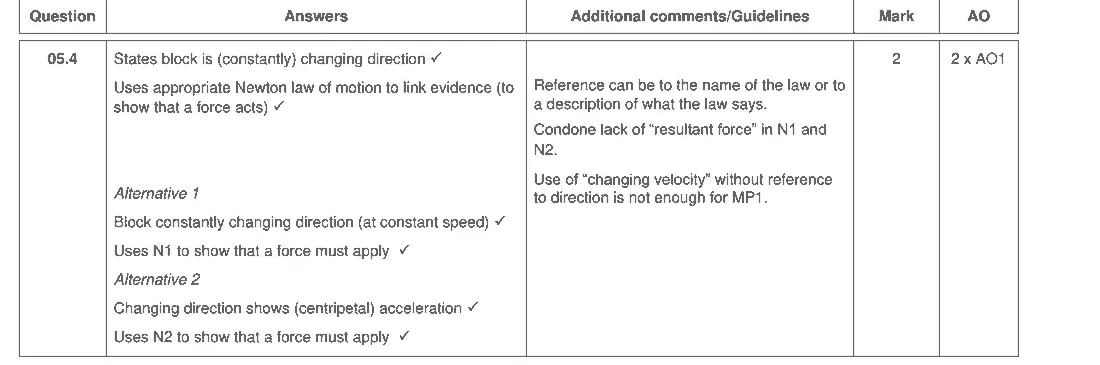
June 2022 · Paper 1 · Q5.42 marksAO1=2Explanation
Earlier part of question 5 that this part uses
Mark scheme
Examiner's comment
In order to answer 05.4 correctly students had to be clear about the evidence on which their answer was based. Stating that the velocity is changing, without any mention of direction, was not interpreted by examiners as evidence. Many students invoked Newton’s 3rd law without success.
Notes from the mark scheme and report
Block constantly changes direction, so by N1 (or N2 via centripetal acceleration) a resultant force acts
'changing velocity' without direction and N3 not credited
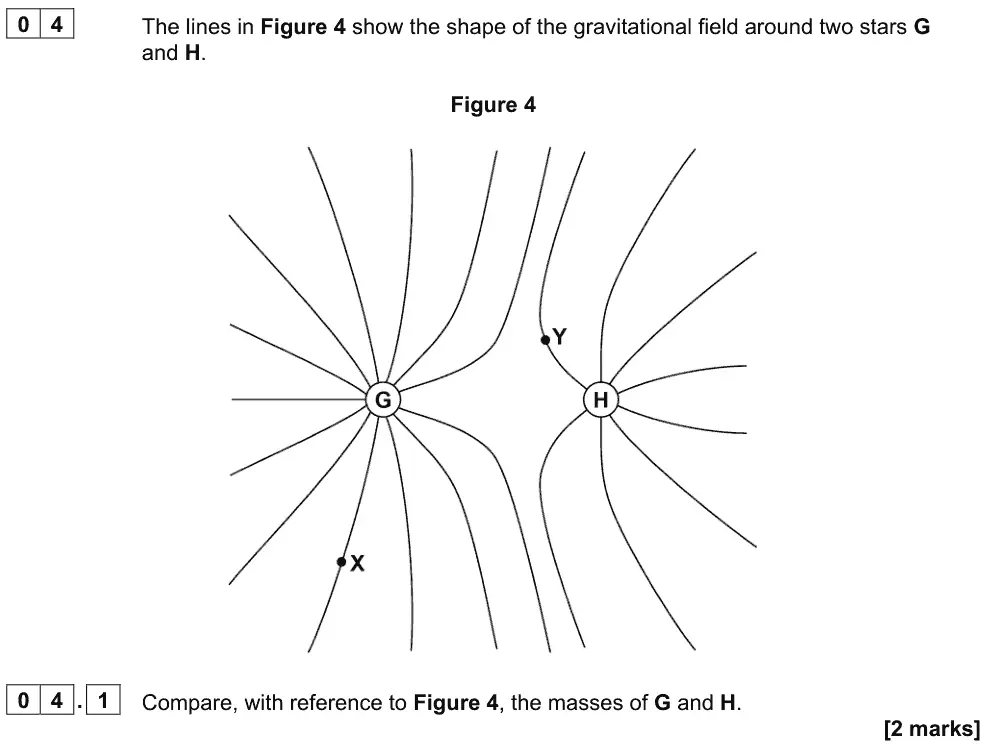
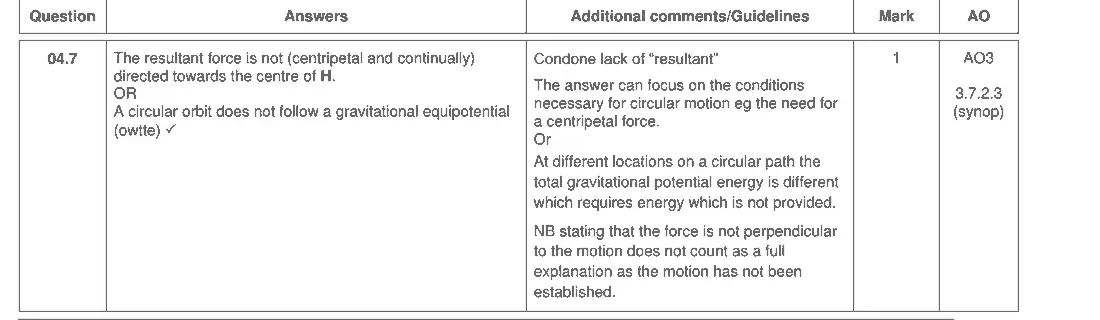
June 2022 · Paper 2 · Q4.71 markAO3=1Explanation
Earlier part of question 4 that this part uses
Mark scheme
Examiner's comment
Most students failed to gain the mark for this question because they did not start by thinking about what conditions are necessary for circular motion, i.e. the need for a centripetal force. Many discussed the problem in general terms such as ‘force from G pulls the path out of circular’. This is true but it lacks the main explanation of the necessary conditions required for circular motion. In a similar way, some students stated that the force is not at right angles to the motion. Again, this sounds quite reasonable but the motion or path has not been established so this really cannot be used as a reference.
Question 04.7
Notes from the mark scheme and report
Resultant force is not always directed towards the centre of H (not centripetal) because of G's pull
'not perpendicular to motion' alone not enough
June 2022 · Paper 2 · Q101 markAO1=1Multiple choice
Answer
B
Mark scheme
Notes from the mark scheme and report
Answer: B
Skills: MS2.3 Substitute numerical values into algebraic equations using appropriate units for physical quantities
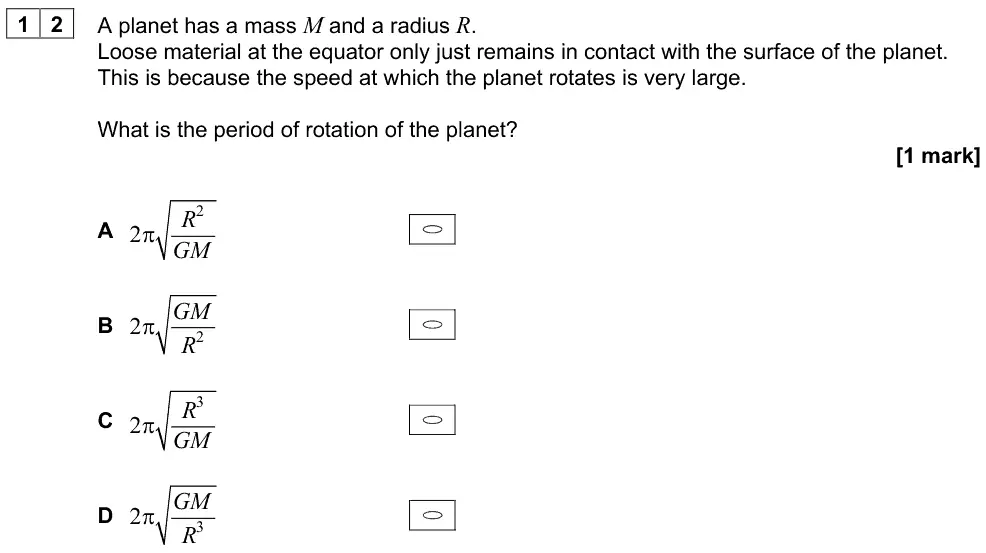
June 2022 · Paper 2 · Q121 markAO2=1Multiple choice
Answer
C
Mark scheme
Notes from the mark scheme and report
Answer: C
Skills: MS2.2 Change the subject of an equation, including non-linear equations
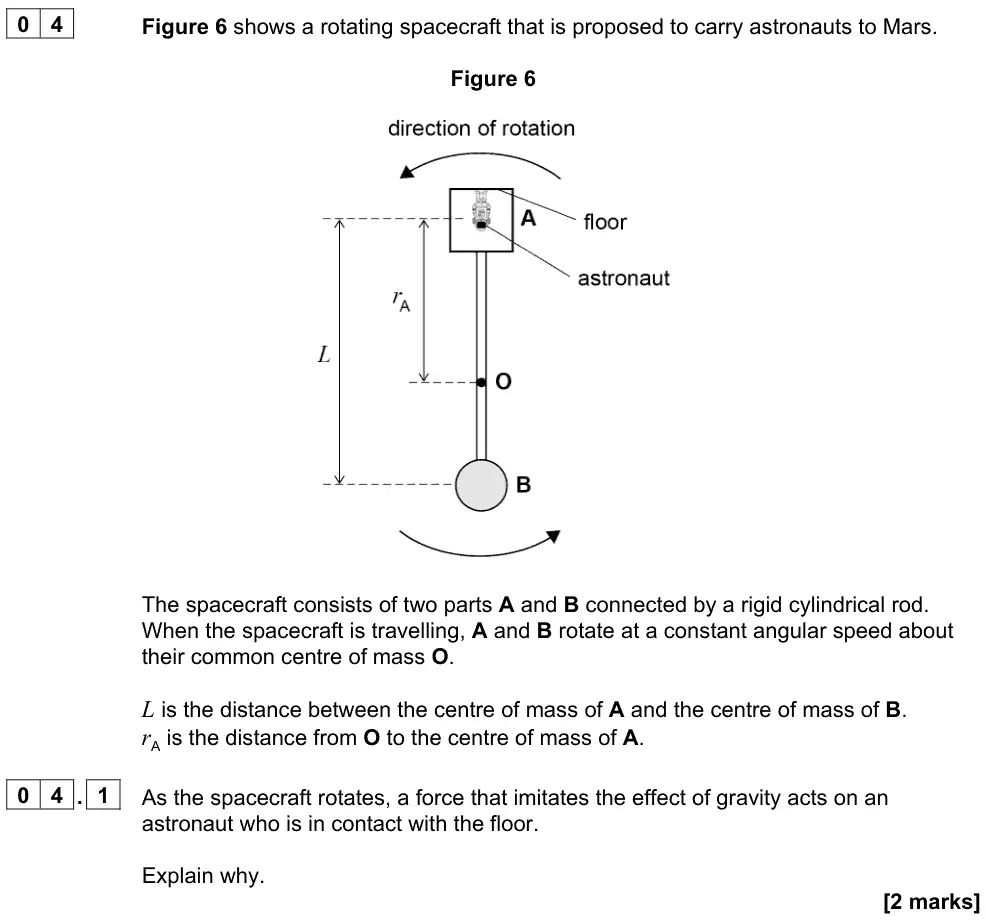
November 2021 · Paper 1 · Q4.12 marksAO2=2Explanation
Mark scheme
Notes from the mark scheme and report
A centripetal force towards the centre is needed
it is provided by the floor's reaction force on the astronaut, which feels like weight
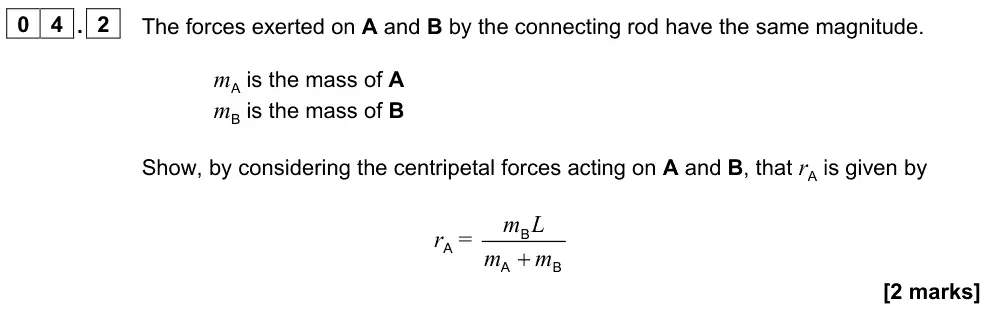
November 2021 · Paper 1 · Q4.22 marksAO2=2Show that
Earlier part of question 4 that this part uses
Mark scheme
Notes from the mark scheme and report
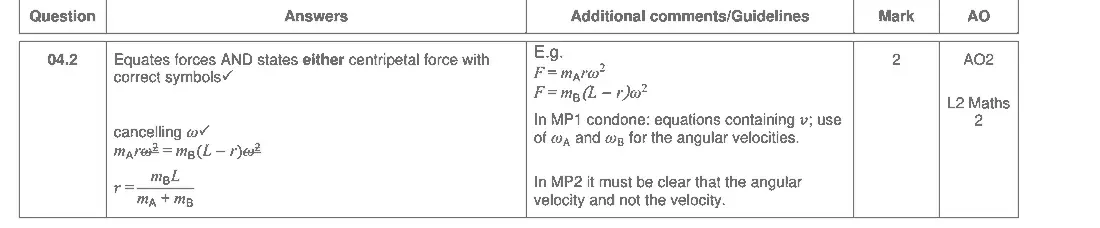
Equate mA rA omega^2 = mB (L - rA) omega^2, cancel omega (same angular speed) and rearrange to rA = mB L / (mA + mB)
Skills: MS2.2 Change the subject of an equation, including non-linear equations
November 2021 · Paper 1 · Q4.32 marksAO3=2Explanation
Earlier part of question 4 that this part uses
Mark scheme
Notes from the mark scheme and report
Same angular speed
A has the larger radius (mA < mB), so v = r omega is greater for A
November 2021 · Paper 2 · Q2.12 marksAO2=2Show that
Mark scheme
Examiner's comment
02.1 About half of the students successfully completed the task. Most of the others either did not choose an acceptable starting point or became confused in their algebra. 02.2 A majority of students tackled this question successfully. A common fault by the minority was the failure to realise that they should begin with the equation provided in the previous section. 02.3 Students commonly thought that the deciding factor was launch height. Even those choosing location Z thought that the diameter of the Earth was greatest at this point. When explaining the height advantage, only a handful of students referred to the reduced difference in gravitational potential energy required to place the satellite in orbit. A minority of students referred to the spin of the earth. 02.4 Students often calculated gravitational potential rather than gravitational potential energy. mgh = Some reverted to simplistic physics by quoting GPE . Only a minority correctly gave a negative answer, further reducing the success rate on this question. 02.5 A few able students justified the statement that the linear speed is smaller for higher orbits which they worked out either from the equation given in part 02.1 or from first principles. A majority thought the linear speed was greater, often justifying this by incorrectly taking the angular velocity to be constant.
Notes from the mark scheme and report
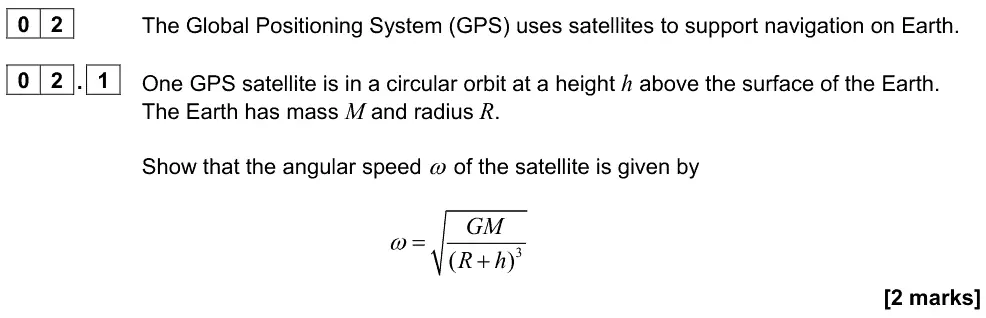
GMm/(R + h)^2 = m (R + h) omega^2 rearranged to omega = root(GM/(R + h)^3)
about half succeeded
Skills: MS2.2 Change the subject of an equation, including non-linear equations
November 2021 · Paper 2 · Q2.22 marksAO2=2Calculation
Earlier part of question 2 that this part uses
Mark scheme
Examiner's comment
02.1 About half of the students successfully completed the task. Most of the others either did not choose an acceptable starting point or became confused in their algebra. 02.2 A majority of students tackled this question successfully. A common fault by the minority was the failure to realise that they should begin with the equation provided in the previous section. 02.3 Students commonly thought that the deciding factor was launch height. Even those choosing location Z thought that the diameter of the Earth was greatest at this point. When explaining the height advantage, only a handful of students referred to the reduced difference in gravitational potential energy required to place the satellite in orbit. A minority of students referred to the spin of the earth. 02.4 Students often calculated gravitational potential rather than gravitational potential energy. mgh = Some reverted to simplistic physics by quoting GPE . Only a minority correctly gave a negative answer, further reducing the success rate on this question. 02.5 A few able students justified the statement that the linear speed is smaller for higher orbits which they worked out either from the equation given in part 02.1 or from first principles. A majority thought the linear speed was greater, often justifying this by incorrectly taking the angular velocity to be constant.
Notes from the mark scheme and report
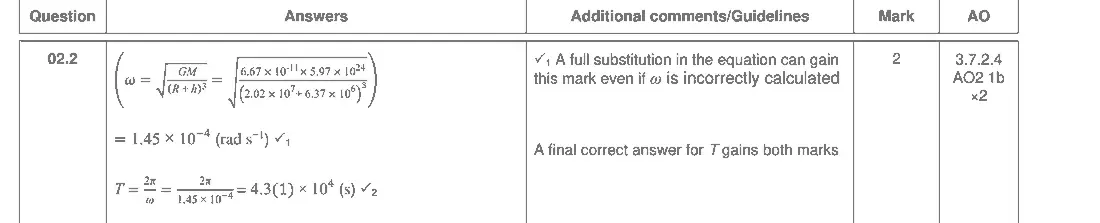
Answer: 4.3 x 10^4 s (omega = 1.45 x 10^-4 rad s^-1 with R + h = 2.66 x 10^7 m
T = 2 pi / omega)
Skills: MS2.3 Substitute numerical values into algebraic equations using appropriate units for physical quantities
November 2021 · Paper 2 · Q2.32 marksExplanation
Earlier part of question 2 that this part uses
Mark scheme
Examiner's comment
02.1 About half of the students successfully completed the task. Most of the others either did not choose an acceptable starting point or became confused in their algebra. 02.2 A majority of students tackled this question successfully. A common fault by the minority was the failure to realise that they should begin with the equation provided in the previous section. 02.3 Students commonly thought that the deciding factor was launch height. Even those choosing location Z thought that the diameter of the Earth was greatest at this point. When explaining the height advantage, only a handful of students referred to the reduced difference in gravitational potential energy required to place the satellite in orbit. A minority of students referred to the spin of the earth. 02.4 Students often calculated gravitational potential rather than gravitational potential energy. mgh = Some reverted to simplistic physics by quoting GPE . Only a minority correctly gave a negative answer, further reducing the success rate on this question. 02.5 A few able students justified the statement that the linear speed is smaller for higher orbits which they worked out either from the equation given in part 02.1 or from first principles. A majority thought the linear speed was greater, often justifying this by incorrectly taking the angular velocity to be constant.
Notes from the mark scheme and report
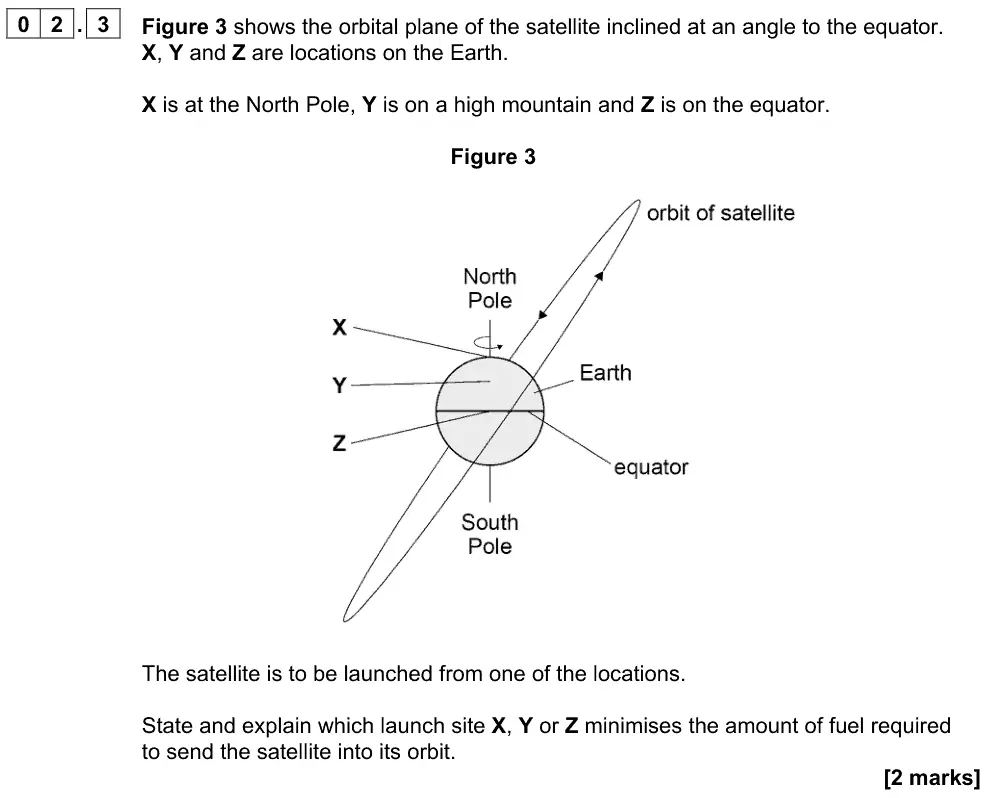
Z (equator): the launch site has the greatest speed / kinetic energy from the Earth's rotation
most chose the mountain (height)
November 2021 · Paper 2 · Q3.22 marksAO2=2Show that
Earlier part of question 3 that this part uses
Mark scheme
Examiner's comment
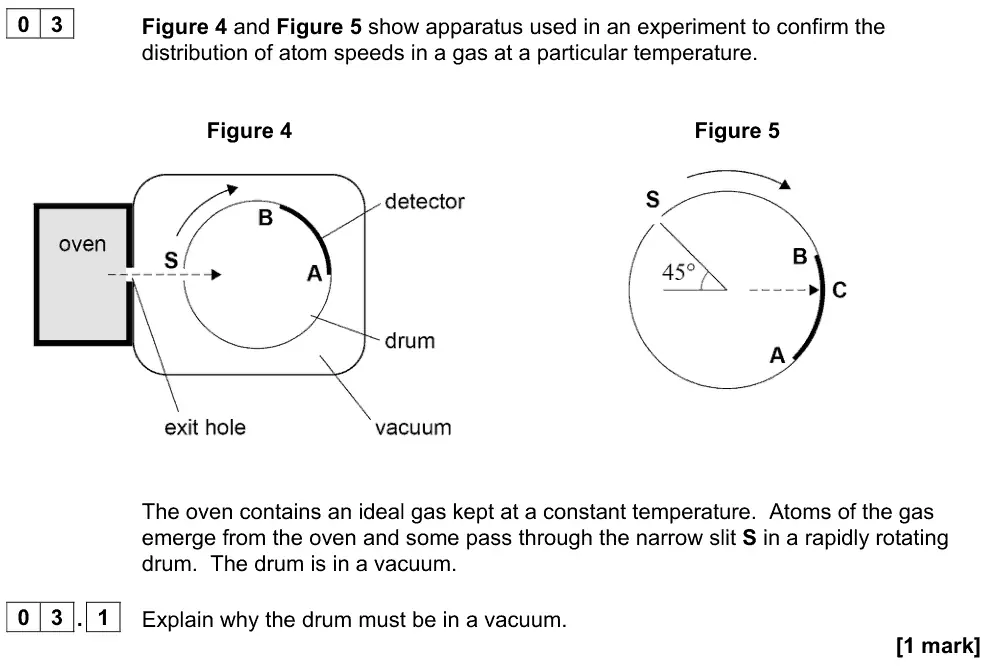
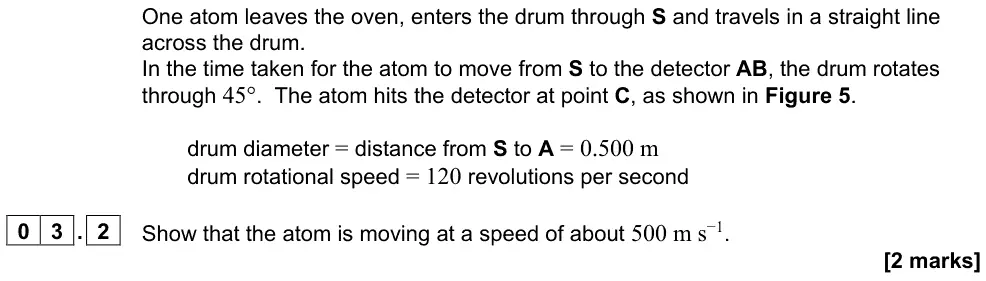
03.1 In the main, students thought it was sufficient to explain that in a vacuum a collision would not occur. Only about a fifth of them went on to explain how collisions might affect the speed distribution of the atoms emerging from the oven. 03.2 Half of the students sailed easily through this question. There was a significant number, however, who failed to identify the time and then could not make any progress. 03.3 A significant number of students went wrong at an early stage by not knowing the difference between mass and molar mass. In general, the students who could evaluate the mass of a single atom had no difficulty in completing the whole question. 03.4 Almost all students made reference to having fewer atoms in the oven. Several different types of errors then occurred: • a number of students failed to discuss any kinetic motion, instead these students chose to rely incorrectly on the gas laws; • a failure to discuss the rate of collision with the oven wall even when it was these collisions that were recognised to be of importance; • poor use of technical language. It was not always clear whether described momentum changes referred to single atoms or the whole ensemble. The first of these should be described as being, on average, constant whereas the total momentum change would decrease. 03.5 A majority of students did not have enough knowledge or experience of the gas equations to make any progress. Most attempted an answer using inappropriate equations. 03.6 Most students understood the situation but many did not always describe the motion of the atoms with sufficient clarity in writing about the new detector. A number thought the detector would darken more because it was hit harder and did not focus on the number of colliding atoms.
Notes from the mark scheme and report
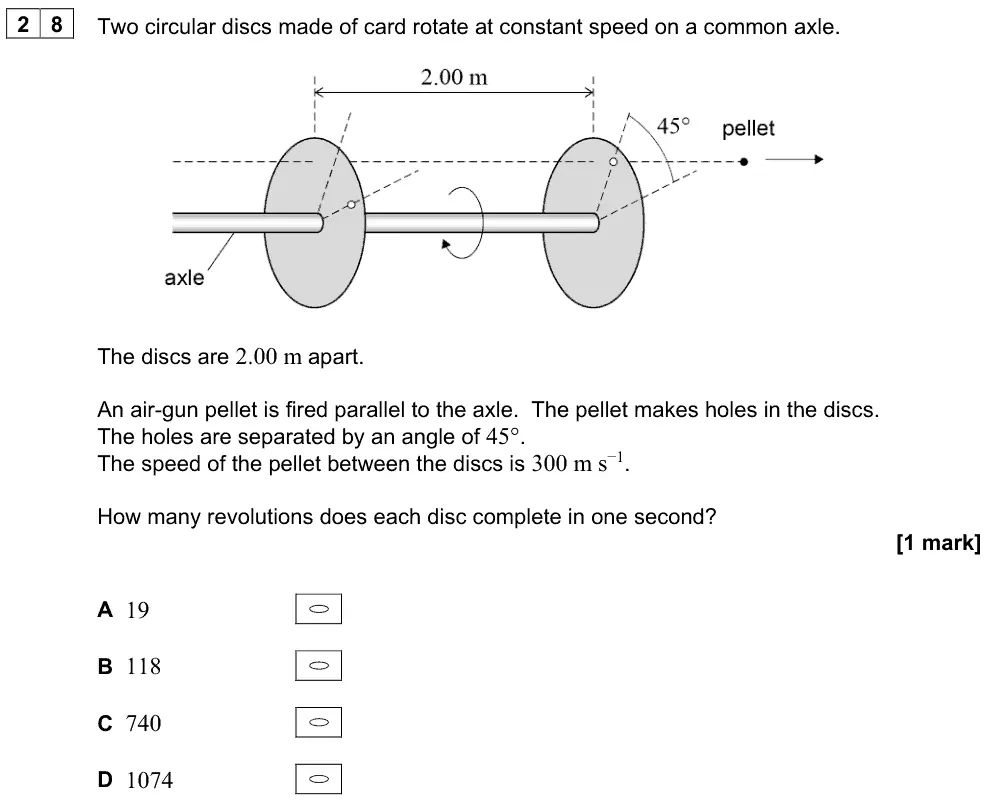
Answer: 480 m s^-1 (1/8 rev takes 1.04 x 10^-3 s
0.500 m / 1.04 x 10^-3 s)
time must be shown
Skills: MS2.3 Substitute numerical values into algebraic equations using appropriate units for physical quantities
November 2020 · Paper 1 · Q4.54 marksCalculation
Earlier part of question 4 that this part uses
Mark scheme
Examiner's comment
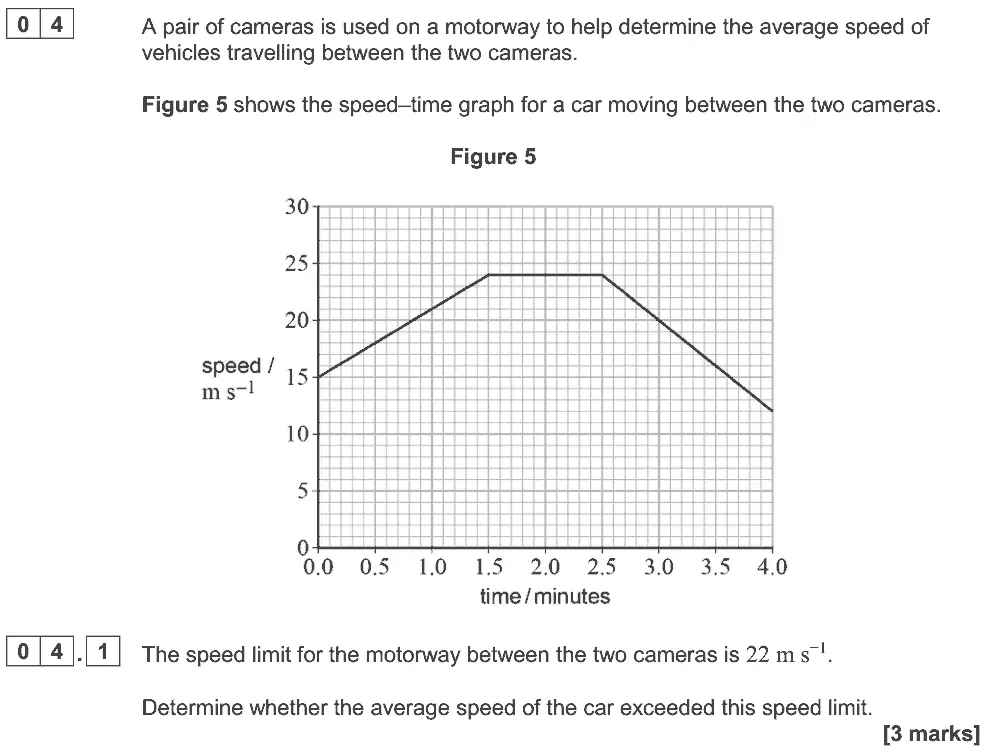
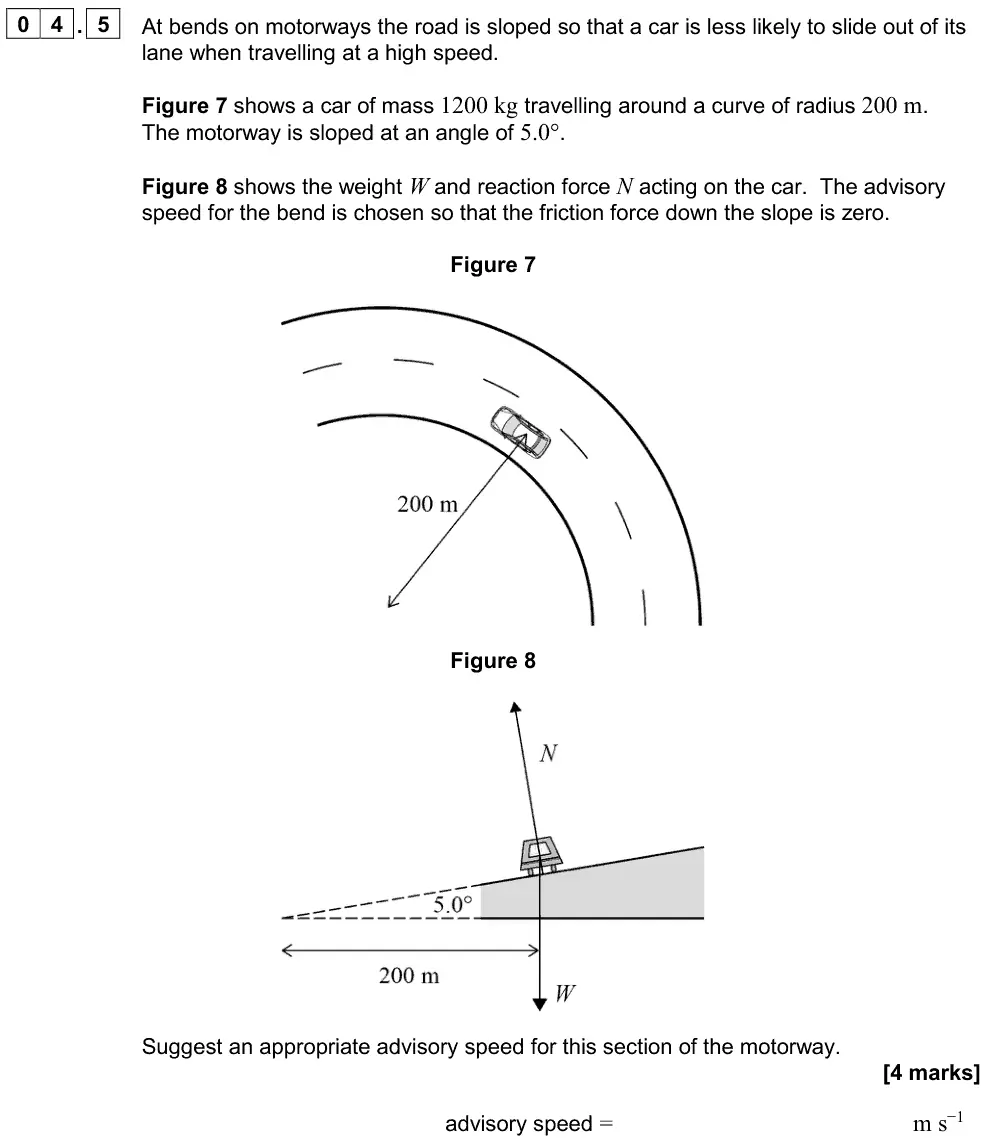
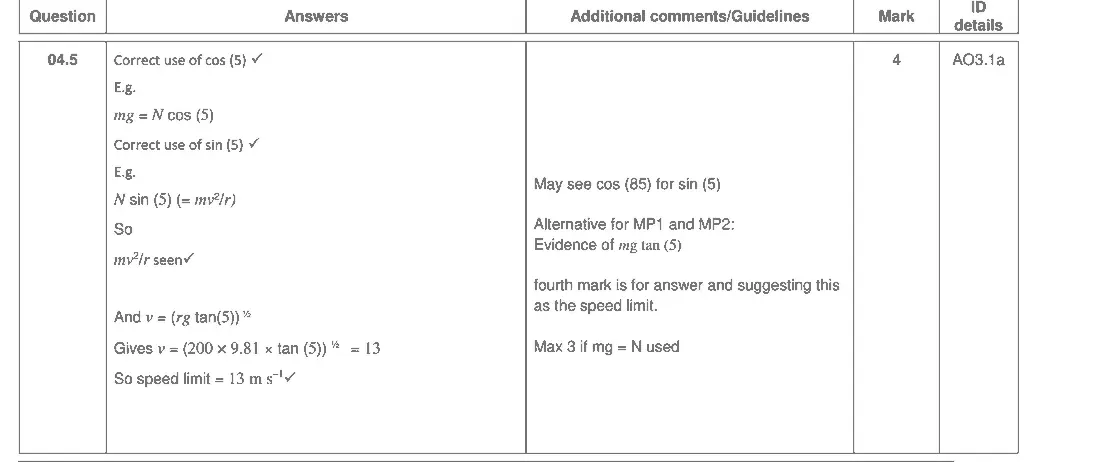
Much of the work on motion in this question was relatively straightforward and, in a typical series, students would be expected to score well on it. Although the average scores on most of the question parts were higher than the paper average, a large number of errors in basic understanding were seen. In 04.1, for example, many students struggled to work out the area, or suggested that the average speed was the average of the speeds of the three sections. In 04.2, a surprisingly large number of students did not identify the slower response time as the appropriate one for the calculation. Many careless errors in the use of suvat equations were also seen in 04.3. It was pleasing to note in 04.4 that several students understood the premise of the question and indicated that the chevrons would be too far apart and therefore people would ignore them or that the car in front would also take some distance to come to rest. Very few fully correct answers were seen in 04.5. Although most students attempted to apply ideas of circular motion, the angle of the slope was largely ignored. Many answers suggesting N mg = , or applying the equation of circular motion down the slope rather than horizontally, were seen.
Notes from the mark scheme and report
Answer: 13 m s^-1 (N cos5 = mg, N sin5 = mv^2/r, v = root(rg tan5))
N = mg or circular motion along the slope were common errors
very few fully correct
Skills: MS4.5 Use sin, cos and tan in physical problems; MS2.2 Change the subject of an equation, including non-linear equations; MS2.3 Substitute numerical values into algebraic equations using appropriate units for physical quantities
November 2020 · Paper 2 · Q2.13 marksAO1=3Show that
Mark scheme
Examiner's comment
About half the students were given full marks, with a large portion of them showing the equations and an efficient manipulation of them. The remainder did not show such a logical approach. A typical technique was to write down as many equations as possible, placed in any position in the answer space. These students then hoped to find some link between them. The weaker students sometimes picked up the second mark for converting the equation for circular motion into one that involved time.
Question 02.1
Notes from the mark scheme and report
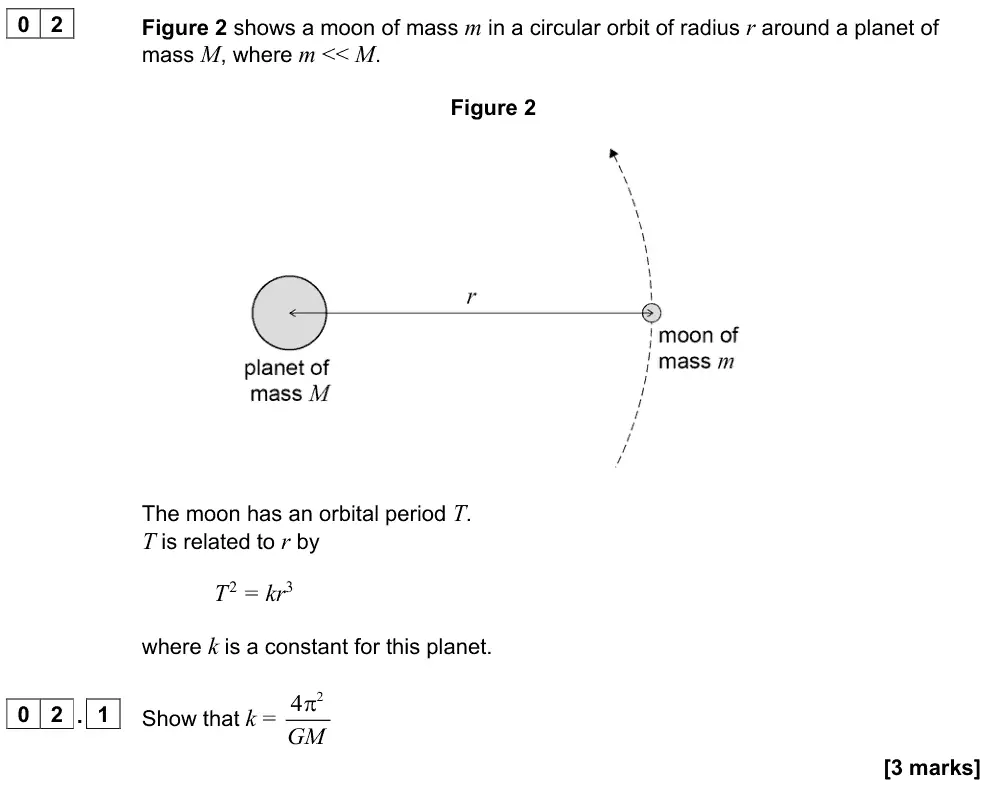
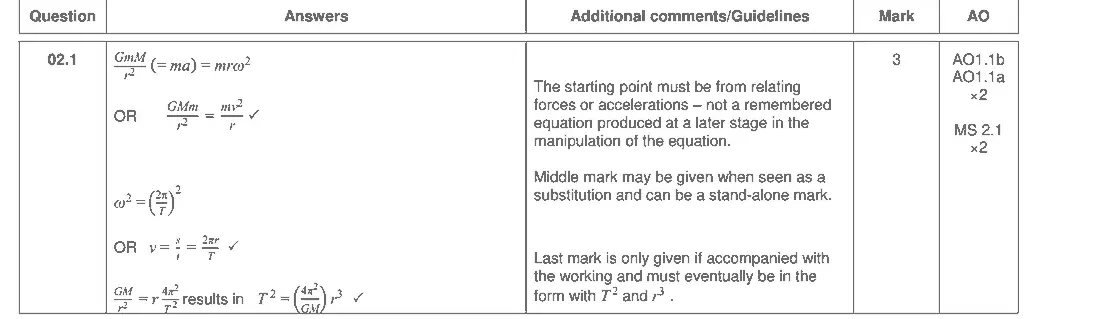
GMm/r^2 = m r omega^2 (or mv^2/r) with omega = 2 pi / T leads to T^2 = (4 pi^2 / GM) r^3
must start from forces
about half full marks
Skills: MS2.2 Change the subject of an equation, including non-linear equations
November 2020 · Paper 2 · Q3.31 markAO2=1Show that
Earlier part of question 3 that this part uses
Mark scheme
Examiner's comment
Most students answered this question successfully. The others typically failed to write down more than a single equation or they failed to make clear that the expressions they wrote related to a force.
Question 03.3
Notes from the mark scheme and report
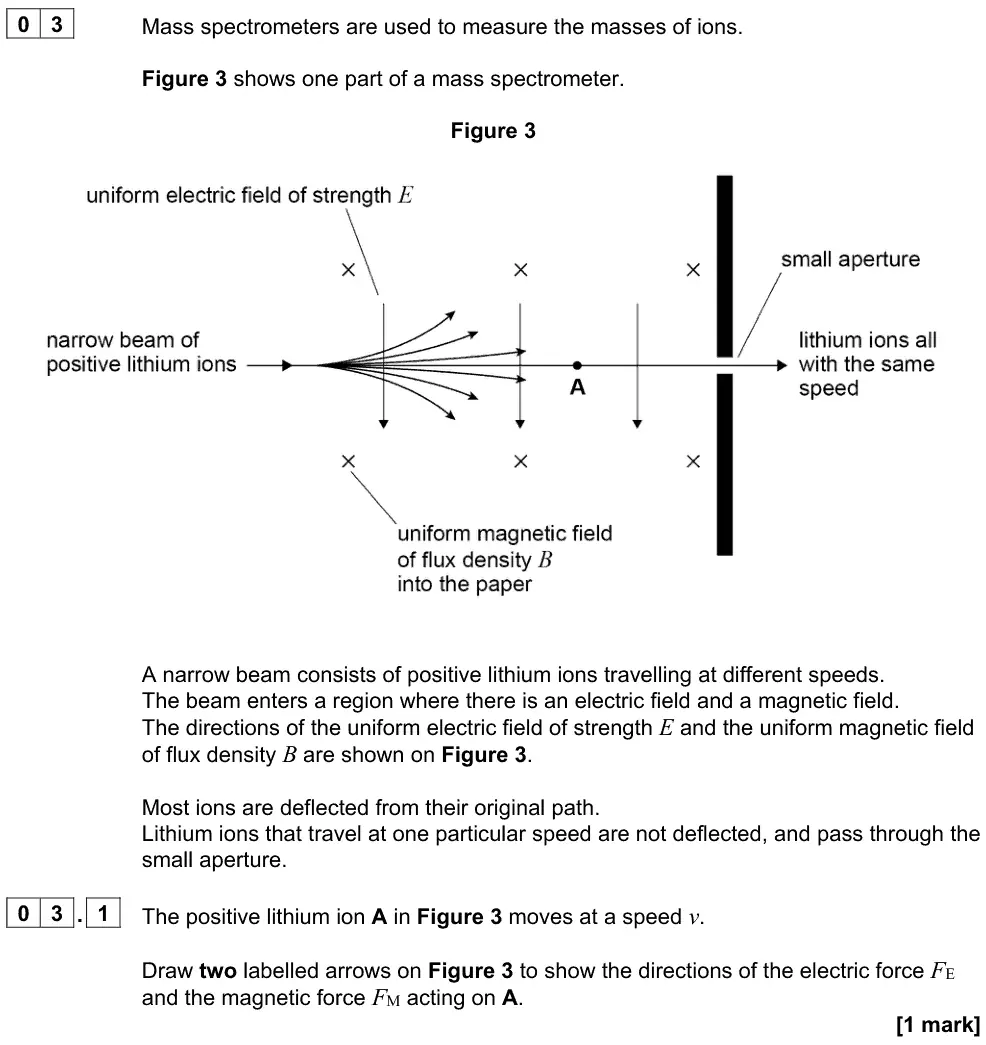
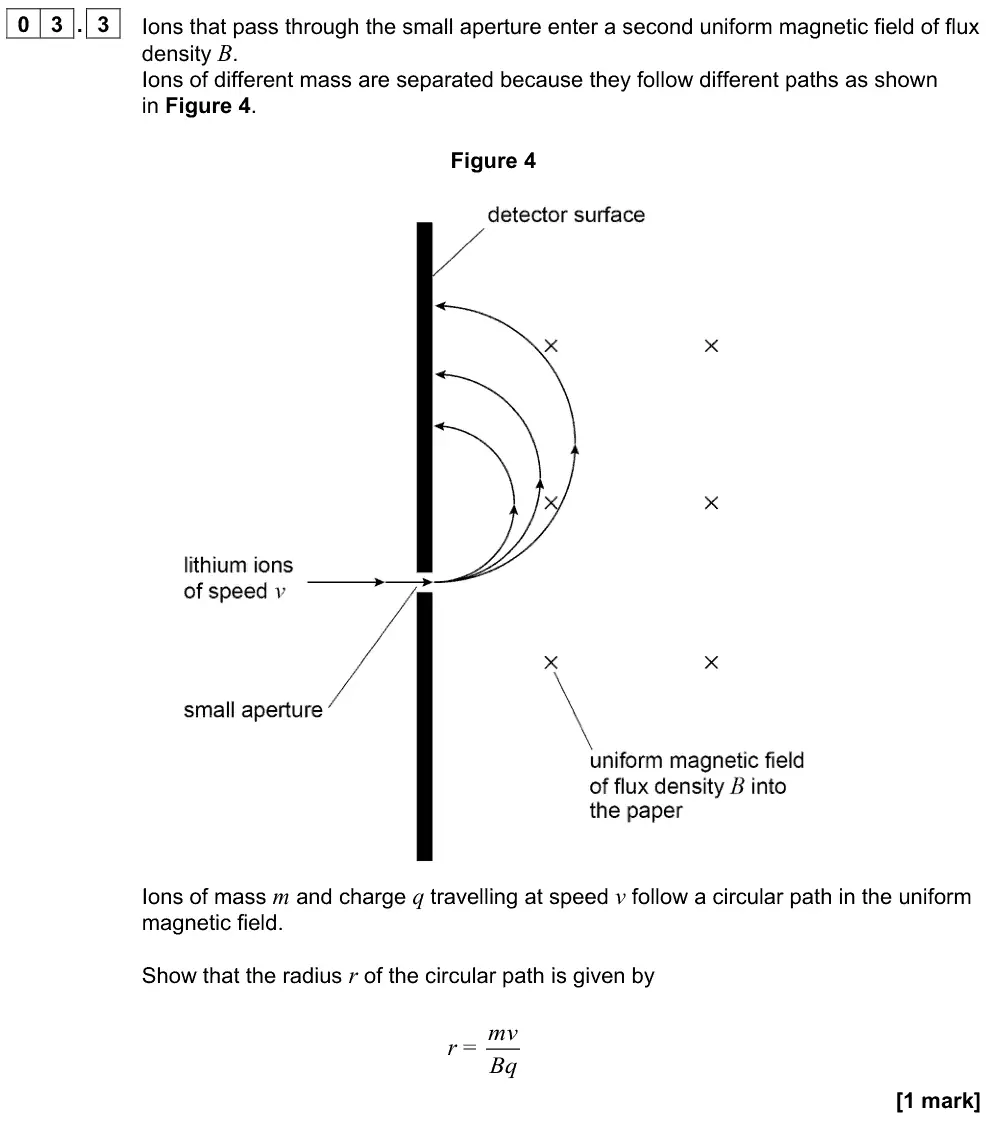
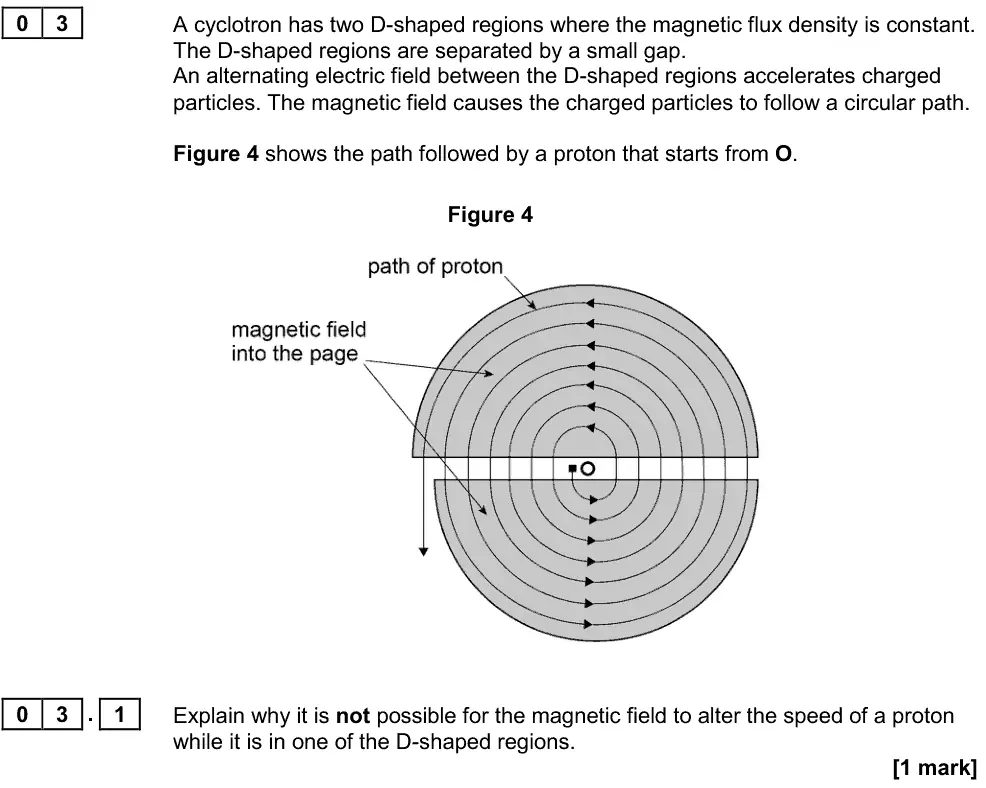
mv^2 / r = Bqv so r = mv / Bq
must show these are forces
Skills: MS2.2 Change the subject of an equation, including non-linear equations
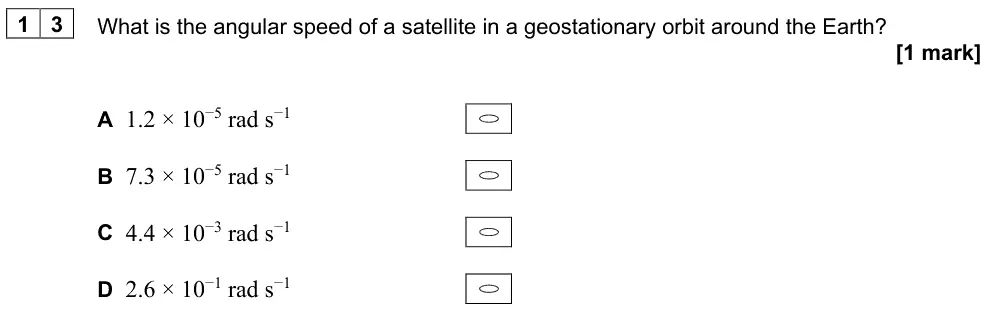
November 2020 · Paper 2 · Q131 markMultiple choice
Answer
B
Notes from the mark scheme and report
Answer: B
Skills: MS2.3 Substitute numerical values into algebraic equations using appropriate units for physical quantities
June 2019 · Paper 1 · Q281 markMultiple choice
Answer
C
Notes from the mark scheme and report
Answer: C
Skills: MS2.3 Substitute numerical values into algebraic equations using appropriate units for physical quantities
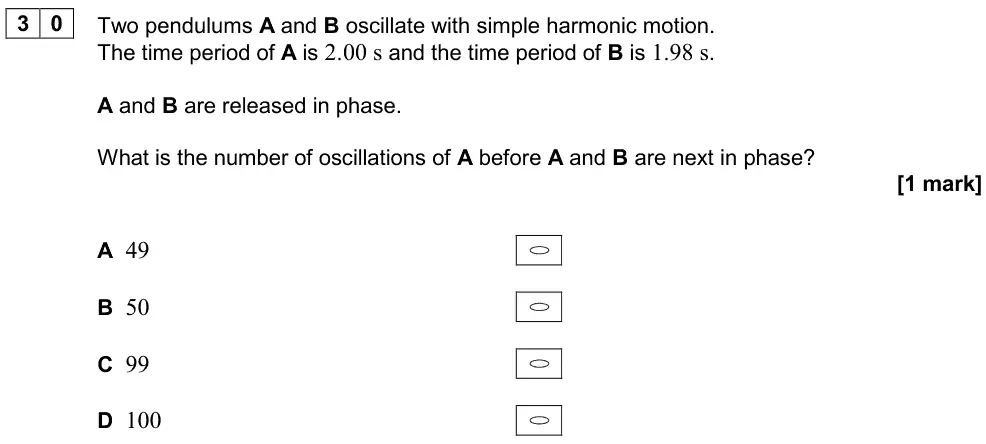
June 2019 · Paper 1 · Q301 markMultiple choice
Answer
C
Notes from the mark scheme and report
Answer: C
fewer than half correct, D the popular distractor (oscillations of B)
Skills: MS0.3 Use ratios, fractions and percentages
June 2019 · Paper 2 · Q91 markMultiple choice
Answer
B
Notes from the mark scheme and report
Answer: B
Skills: MS2.3 Substitute numerical values into algebraic equations using appropriate units for physical quantities
June 2019 · Paper 2 · Q101 markMultiple choice
Answer
C
Notes from the mark scheme and report
Answer: C
Skills: MS2.2 Change the subject of an equation, including non-linear equations
June 2018 · Paper 1 · Q5.12 marksShow that
Mark scheme
Examiner's comment
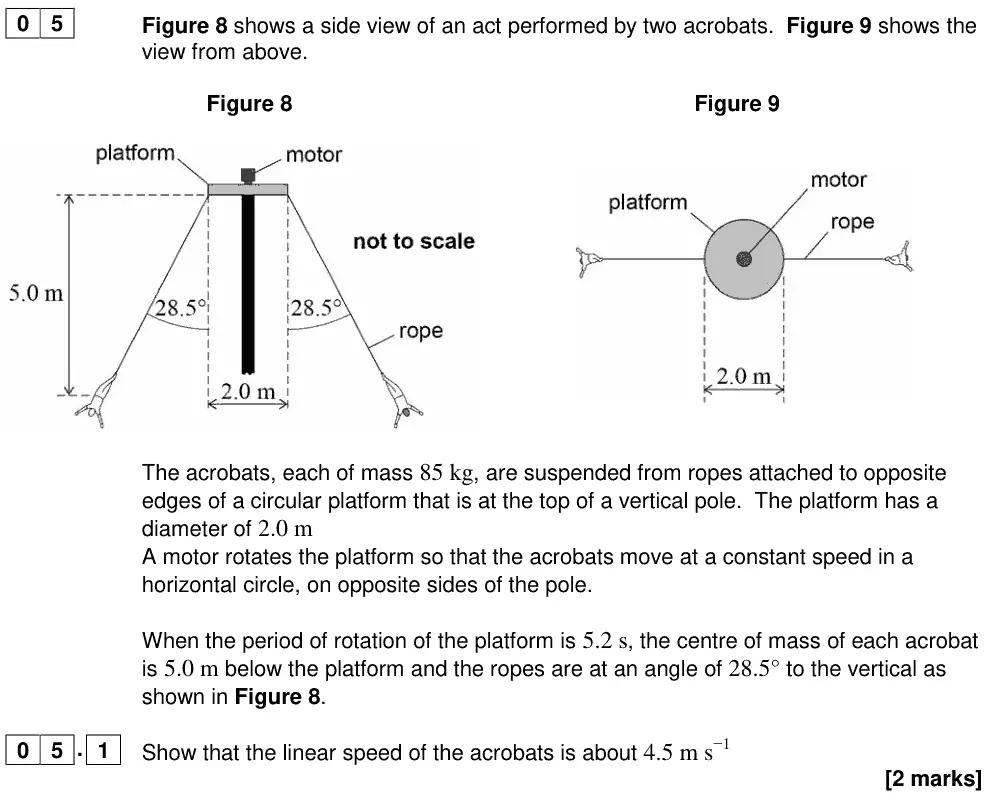
05.1 Many students (59%) completed this part fully successfully. This and part 05.2 exposed weaknesses in the understanding of some students when using sine, cosine and tangent. Many who arrived at 2.71 m did not add the extra metre for the platform to deduce the radius of the circular path followed by the acrobats.
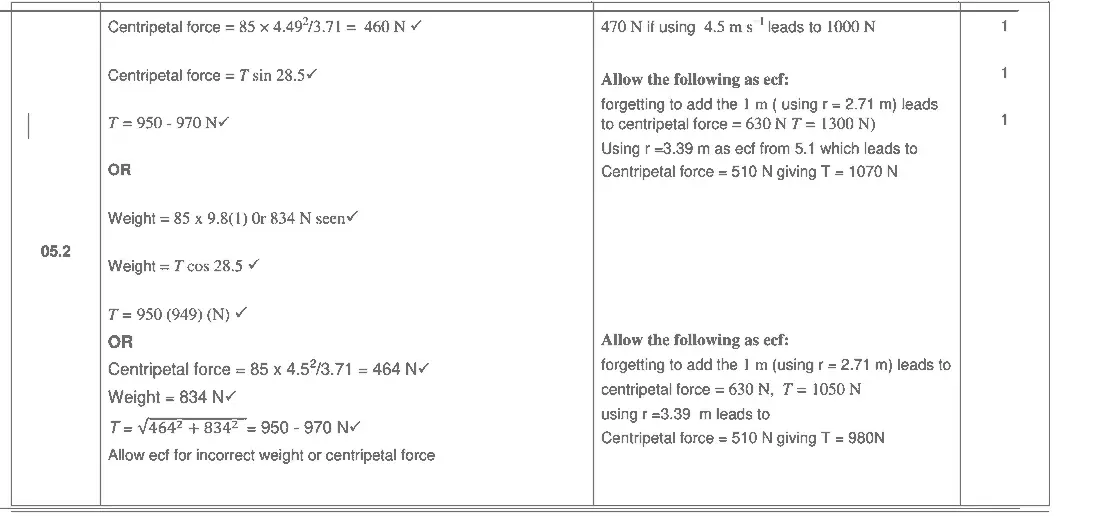
05.2 The simplest and most common route to the answer was to consider the vertical forces. There were other routes to the answer too. The most common of these was to realise that the horizontal force due to the tension provided the centripetal force. Examiners allowed the error carried forward from 05.1 for the radius of the path for those who solved the problem this way.
Notes from the mark scheme and report
Radius = 5.0 tan28.5 + 1.0 = 3.71 m
v = 2 pi r / 5.2 = 4.49 m s^-1
forgetting the platform 1 m or using sin was common
Skills: MS4.5 Use sin, cos and tan in physical problems; MS2.3 Substitute numerical values into algebraic equations using appropriate units for physical quantities
June 2018 · Paper 1 · Q5.23 marksCalculation
Earlier part of question 5 that this part uses
Mark scheme
Examiner's comment
05.2 The simplest and most common route to the answer was to consider the vertical forces. There were other routes to the answer too. The most common of these was to realise that the horizontal force due to the tension provided the centripetal force. Examiners allowed the error carried forward from 05.1 for the radius of the path for those who solved the problem this way.
05.1 Many students (59%) completed this part fully successfully. This and part 05.2 exposed weaknesses in the understanding of some students when using sine, cosine and tangent. Many who arrived at 2.71 m did not add the extra metre for the platform to deduce the radius of the circular path followed by the acrobats.
Notes from the mark scheme and report
Answer: 950 N (T cos28.5 = 834 N, or T sin28.5 = mv^2/r = 460 N)
ecf from 05.1 radius
Skills: MS4.5 Use sin, cos and tan in physical problems; MS2.3 Substitute numerical values into algebraic equations using appropriate units for physical quantities
June 2018 · Paper 1 · Q5.33 marksExplanation
Earlier part of question 5 that this part uses
Mark scheme
Examiner's comment
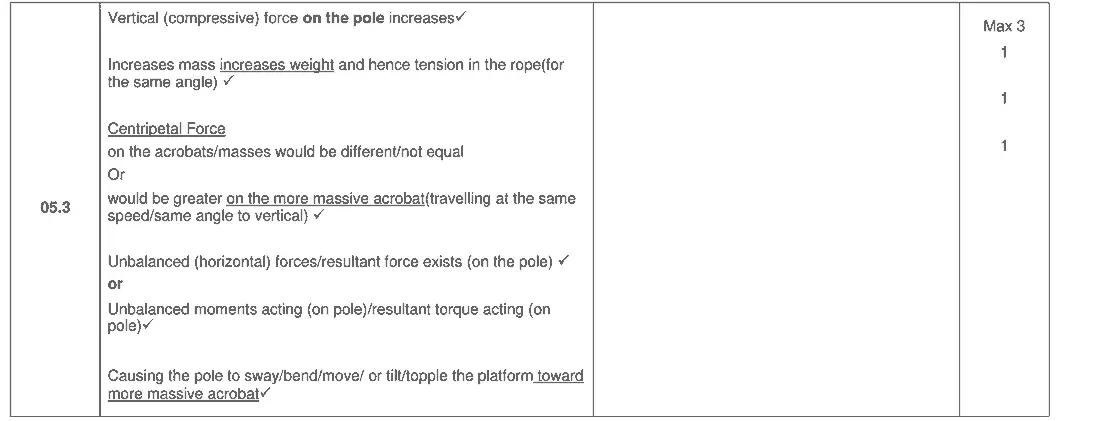
05.3 There were some very good responses to this part and many students provided at least part of the necessary analysis. A high proportion of students wrote that there would be unbalanced forces on the acrobat, but in the subsequent explanation of how this imbalance occurred many answers were spoiled when students wrote about effects of weight when they should have referred to mass and vice versa. Most responses concentrated on the unbalanced horizontal force or considered the moments of the forces. Few made any comment of the increased vertical force on the pole.
Notes from the mark scheme and report
Any 3: larger vertical compressive force on pole
larger tension and centripetal force for the heavier acrobat
unbalanced horizontal force or resultant moment so the pole bends/tilts
mass and weight often confused
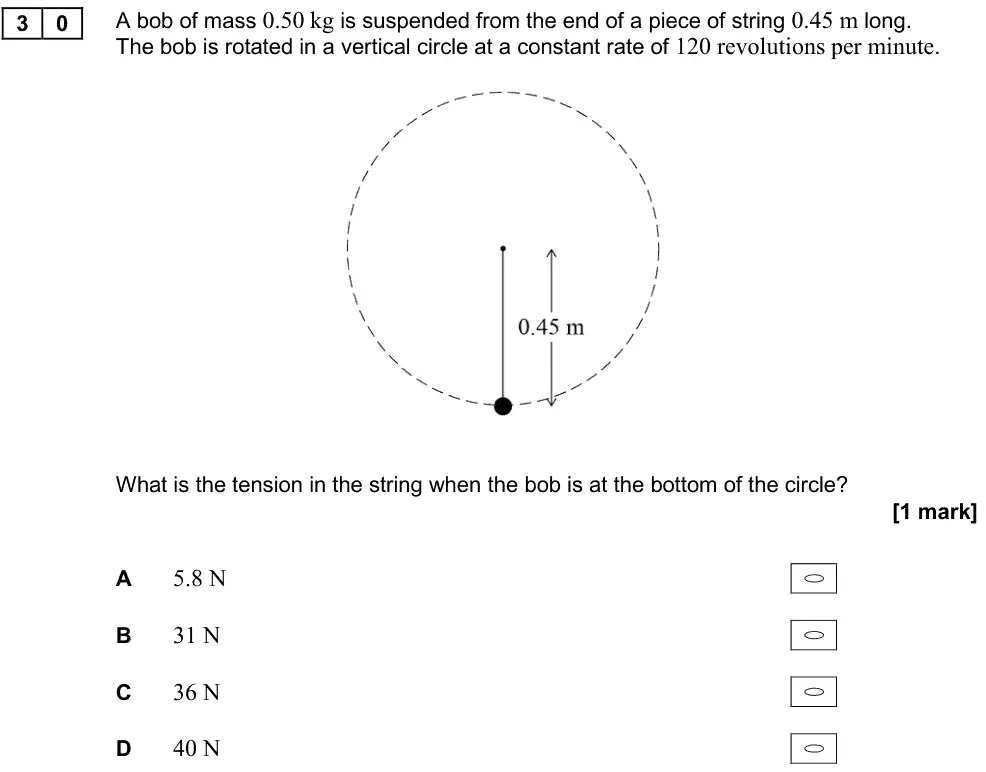
June 2017 · Paper 1 · Q301 markMultiple choice
Answer
D
Notes from the mark scheme and report
Answer: D
Skills: MS2.3 Substitute numerical values into algebraic equations using appropriate units for physical quantities
June 2017 · Paper 2 · Q3.23 marksShow that
Earlier part of question 3 that this part uses
Mark scheme
Examiner's comment
03.2 More than half the students could present the starting equation relating the force due to the magnetic field, to the centripetal force. Many continued to successfully find an expression for the period of motion. However, only some of these referred back to the question to give the time to travel round one semi-circle. Many of the other students got into difficulties if their initial expression for the centripetal force did not involve velocity. From this point on, they often took numerous false trails and the work presented looked very disorganised. Another route taken by some was to reduce their first equation to R = mv / BQ and simply say that this radius does not involve time and is constant. This not only re-writes the question, but misses the point that v is different on each transit.
Notes from the mark scheme and report
BQv = mv^2/r and t = pi r / v give t = pi m / BQ, independent of r
many found the full period and did not halve it
r = mv/BQ alone misses that v changes
Skills: MS2.2 Change the subject of an equation, including non-linear equations
June 2017 · Paper 2 · Q7.12 marksShow that
Mark scheme
Examiner's comment
07.1 Most scripts showed a clear connection between the centripetal force and the force of gravity on the satellite, to arrive at the correct proportional relationship between T2 and r3. Less able students failed to get the two starting equations and only toyed with the centripetal equation unsuccessfully. The most common algebraic mistake was to miss that the π term was squared when (2π)2 was expanded.
Notes from the mark scheme and report
GMm/r^2 = m r (2 pi/T)^2 gives T^2 = (4 pi^2/GM) r^3
common slip: not squaring 2 pi
Skills: MS2.2 Change the subject of an equation, including non-linear equations
June 2017 · Paper 2 · Q141 markMultiple choice
Answer
A
Notes from the mark scheme and report
Answer: A
Skills: MS2.2 Change the subject of an equation, including non-linear equations
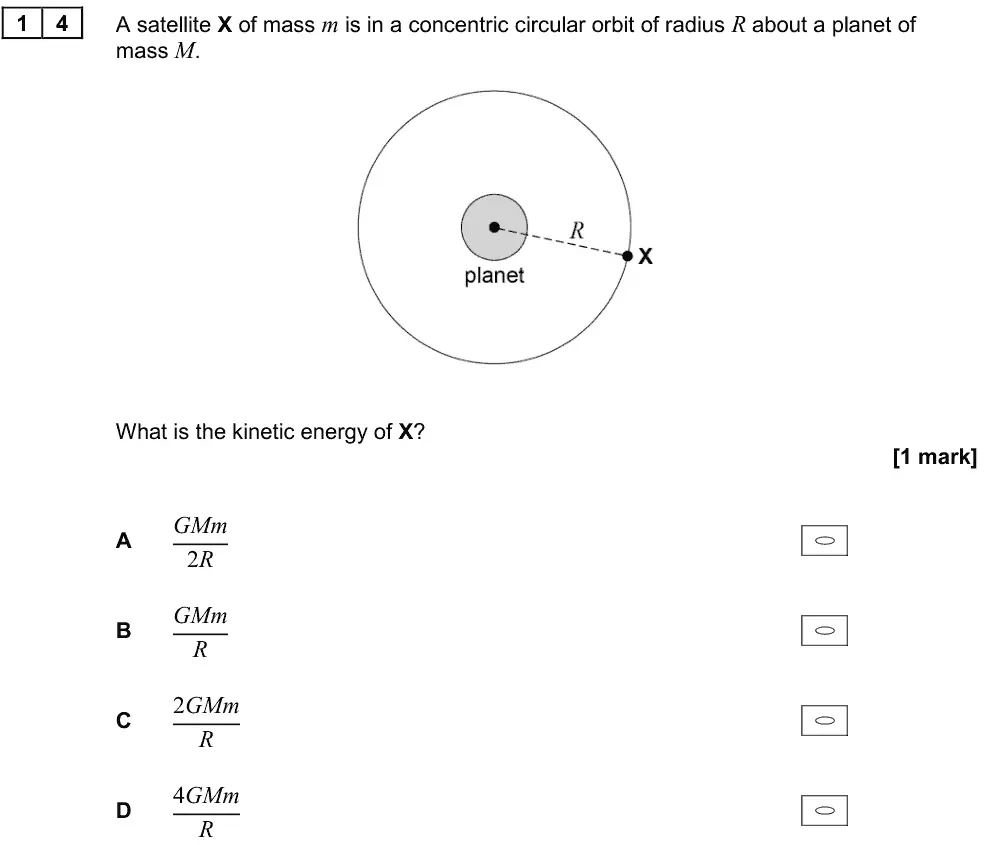
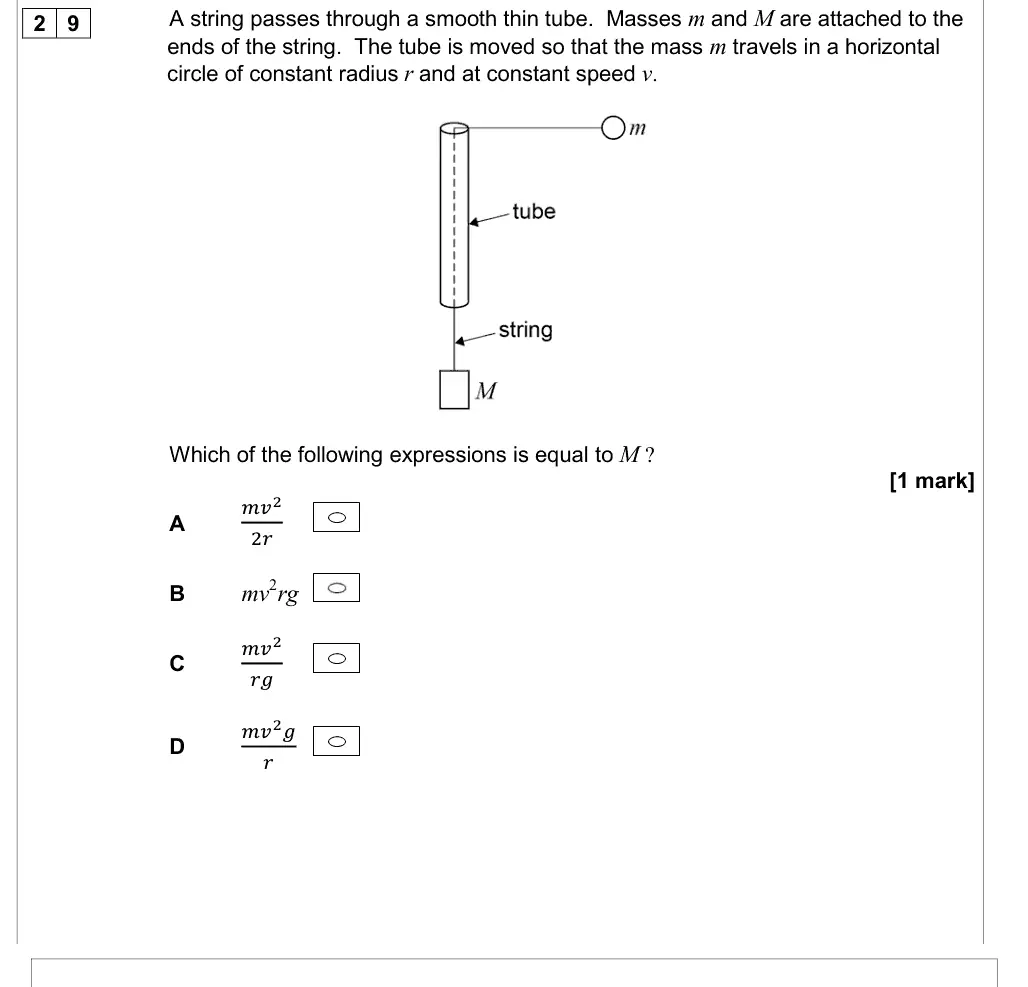
Specimen set 1 · Paper 1 · Q291 markMultiple choice
Answer
C
Notes from the mark scheme and report
Answer: C (Mg = mv^2/r)
Skills: MS2.2 Change the subject of an equation, including non-linear equations
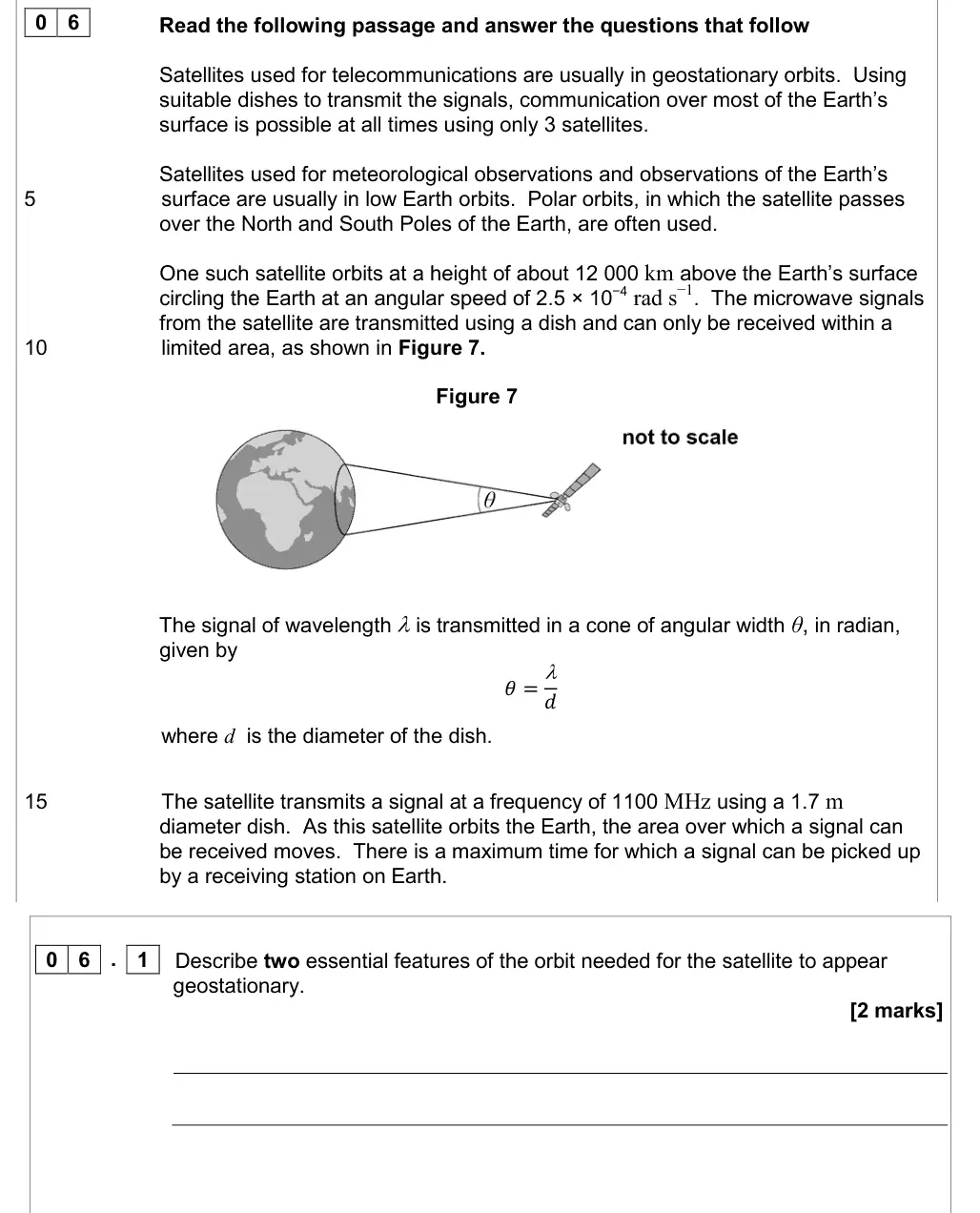
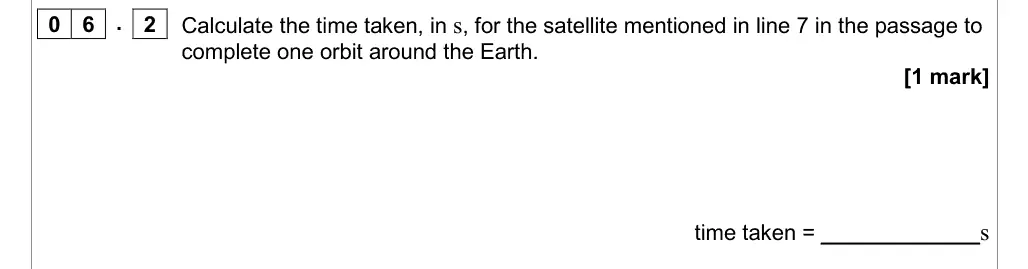
Specimen set 1 · Paper 2 · Q6.21 markCalculation
Earlier part of question 6 that this part uses
Mark scheme
Notes from the mark scheme and report
Answer: 2.5 x 10^4 s (T = 2 pi / omega with omega = 2.5 x 10^-4 rad s^-1)
Skills: MS2.3 Substitute numerical values into algebraic equations using appropriate units for physical quantities
Specimen set 1 · Paper 2 · Q6.33 marksShow that
Earlier part of question 6 that this part uses
Mark scheme
Notes from the mark scheme and report
Answer: 1.9 x 10^3 km (lambda = c/f = 0.273 m, theta = lambda/d = 0.161 rad, width = 12 000 km x theta)
Skills: MS2.3 Substitute numerical values into algebraic equations using appropriate units for physical quantities; MS4.6 Use of small angle approximations including sinθ ≈θ, tanθ ≈θ, cosθ ≈1 for small θ where appropriate
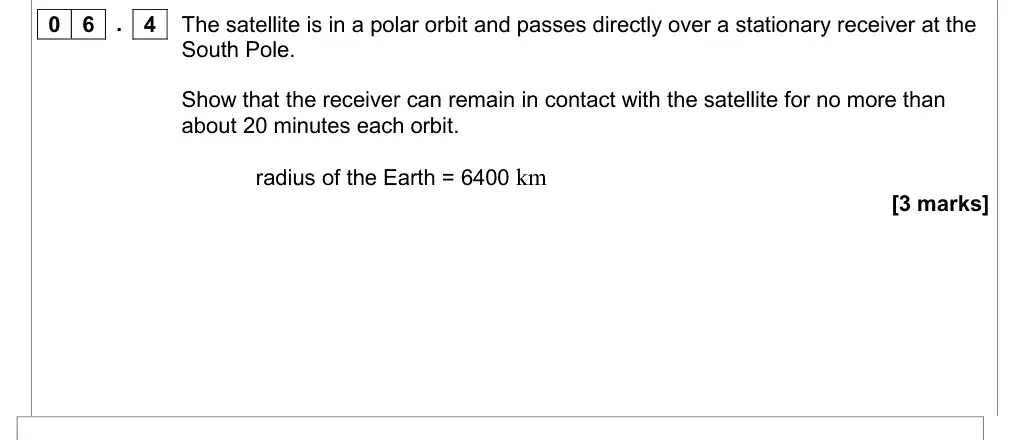
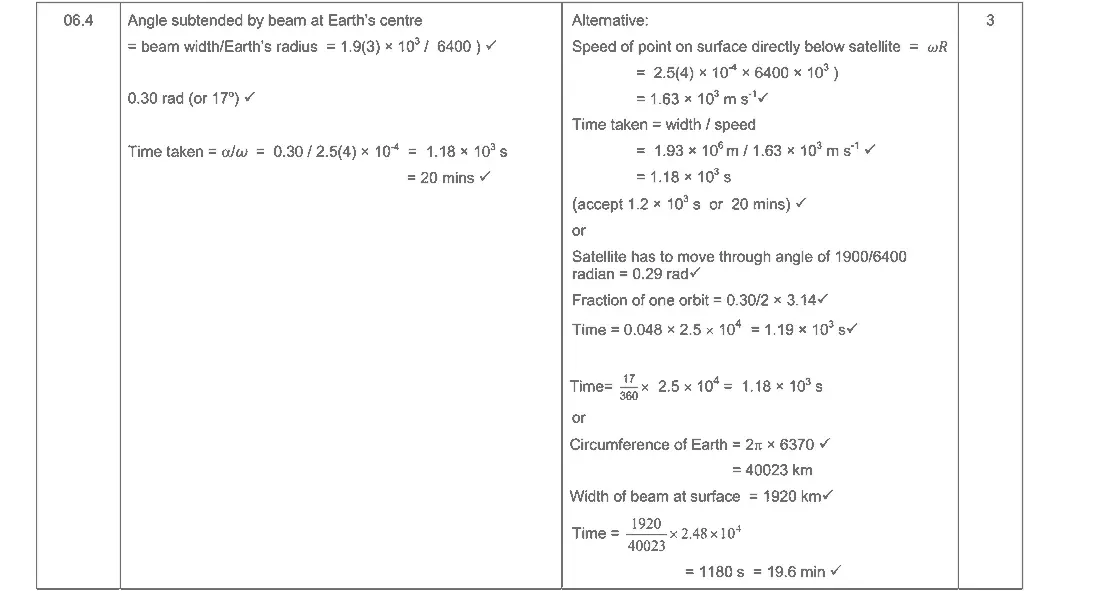
Specimen set 1 · Paper 2 · Q6.43 marksShow that
Earlier part of question 6 that this part uses
Mark scheme
Notes from the mark scheme and report
Answer: about 1.2 x 10^3 s = 20 min (beam width / Earth radius = 0.30 rad
time = angle / omega)
several equivalent routes credited
Skills: MS4.6 Use of small angle approximations including sinθ ≈θ, tanθ ≈θ, cosθ ≈1 for small θ where appropriate; MS2.3 Substitute numerical values into algebraic equations using appropriate units for physical quantities
Work with an AQA physics tutor
Dropping marks on calculations, required practicals or the six-markers? Book a trial session with a specialist AQA physics tutor.