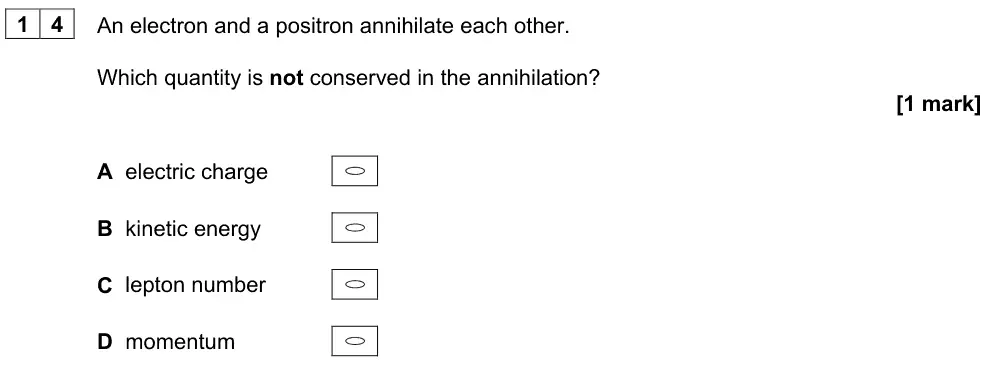
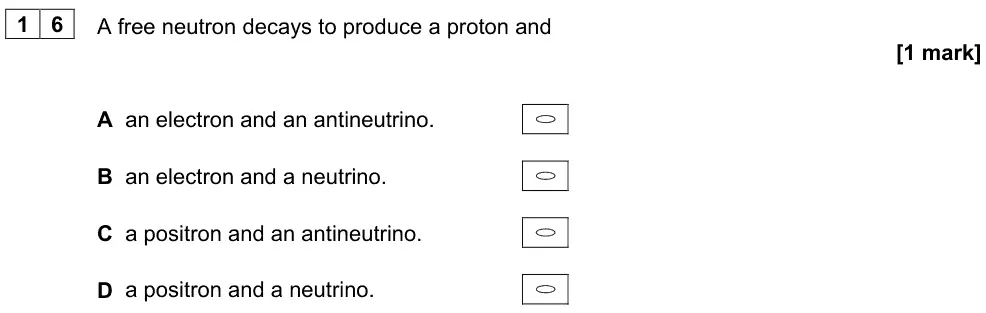
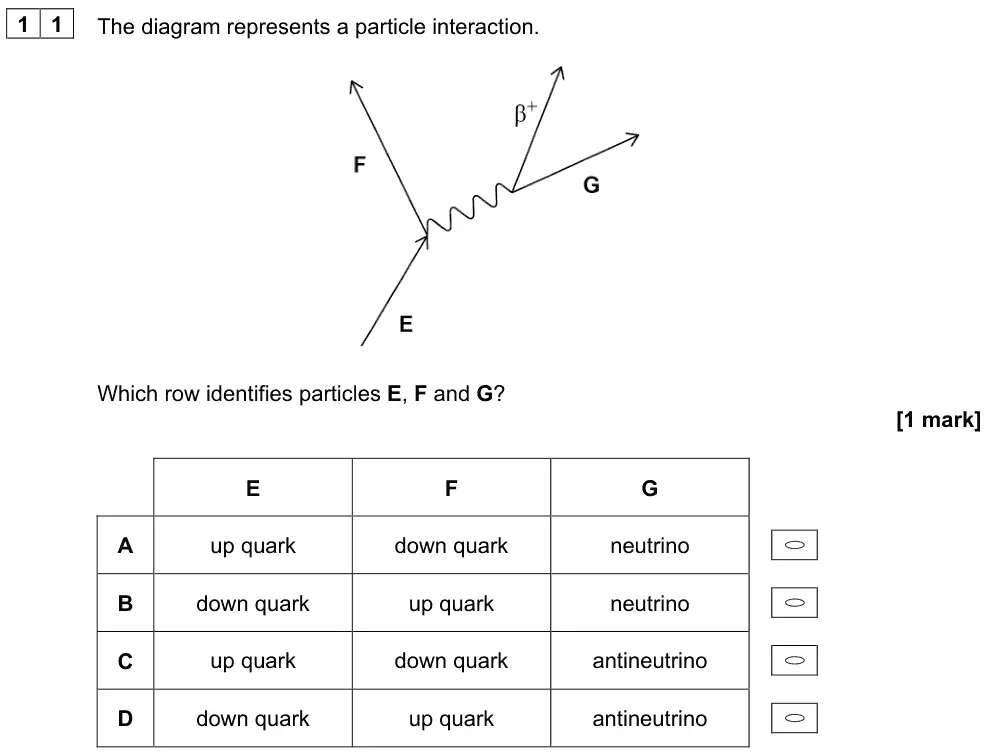
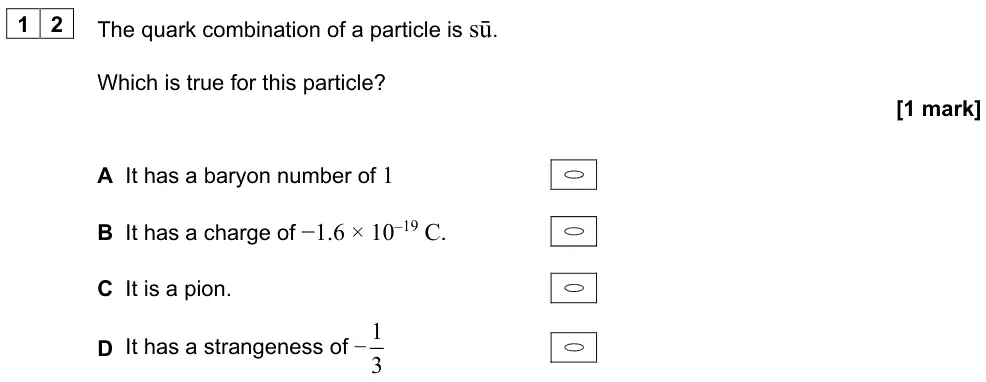
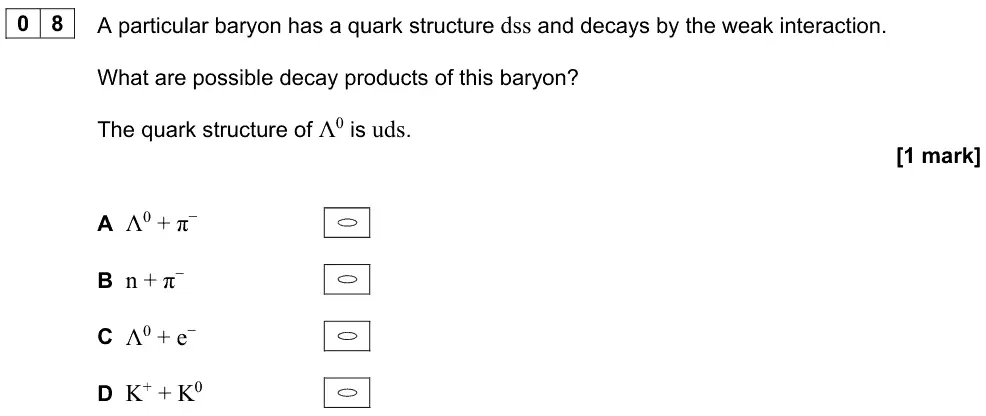
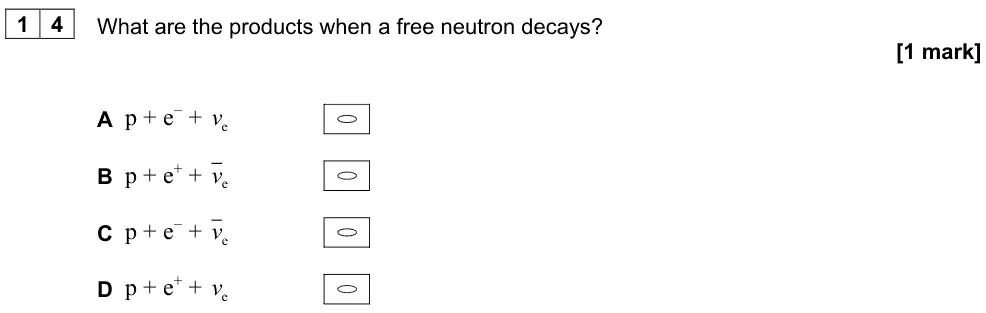
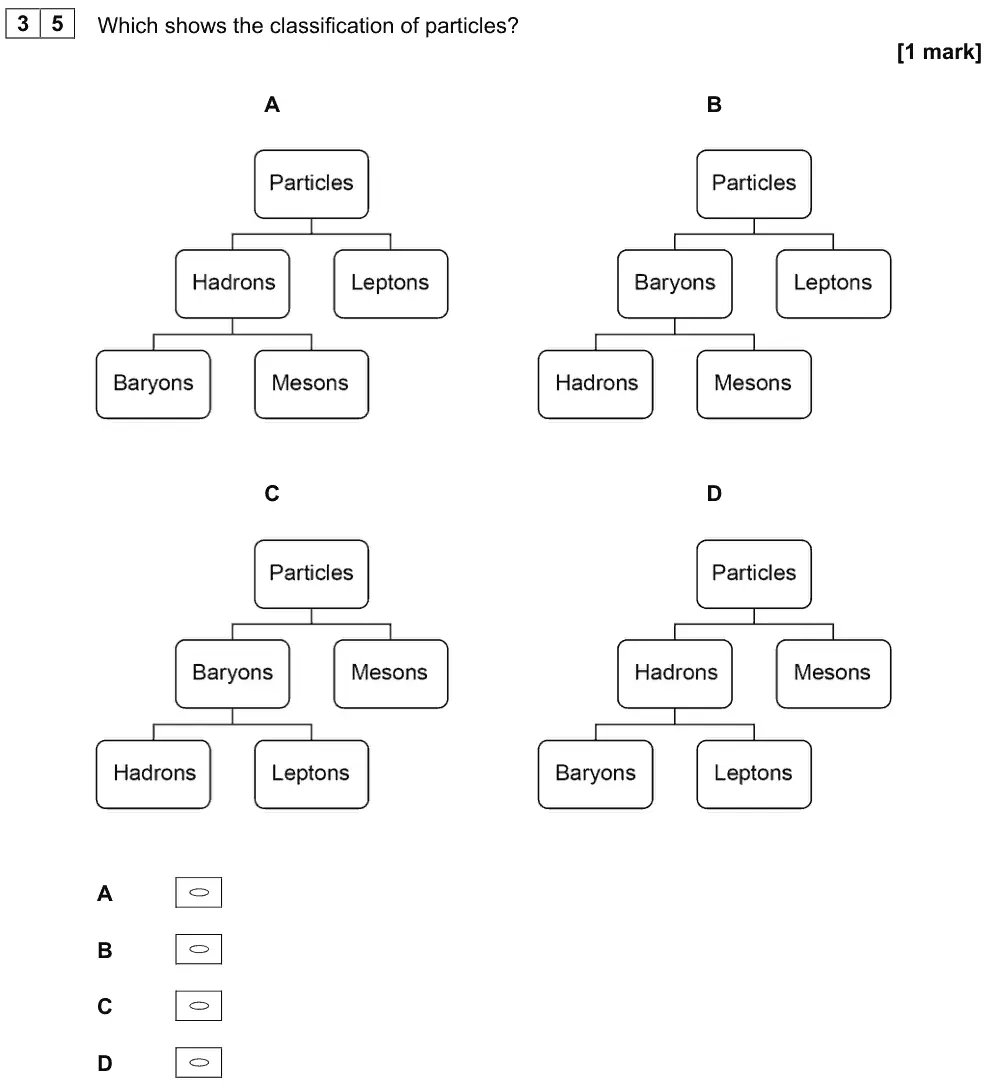
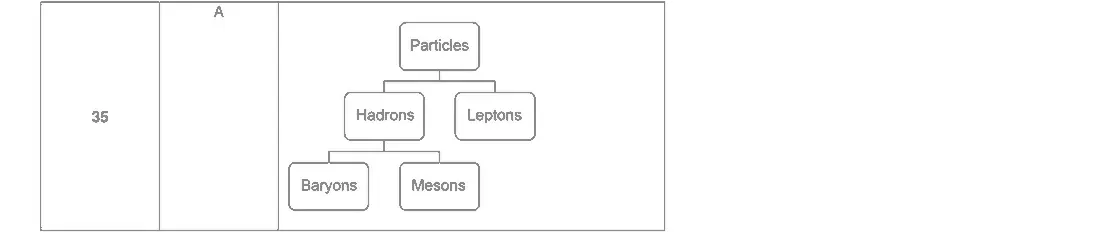
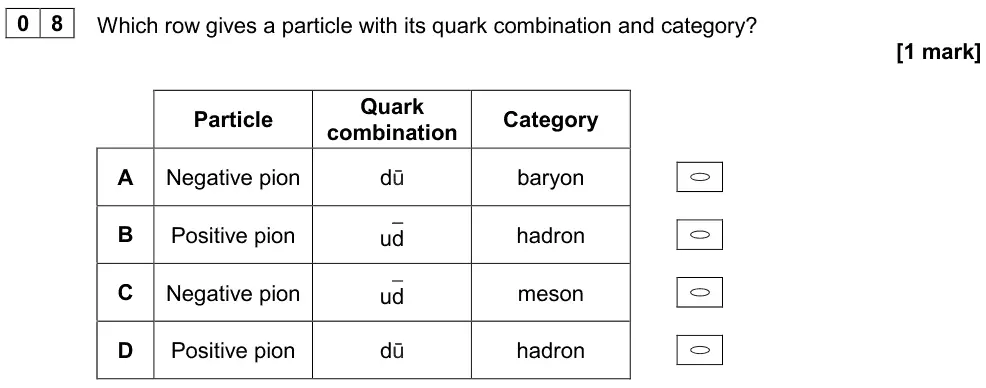
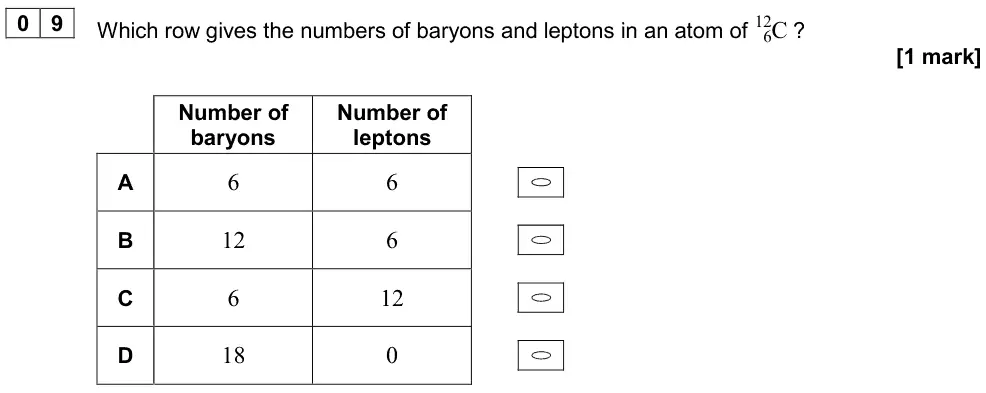
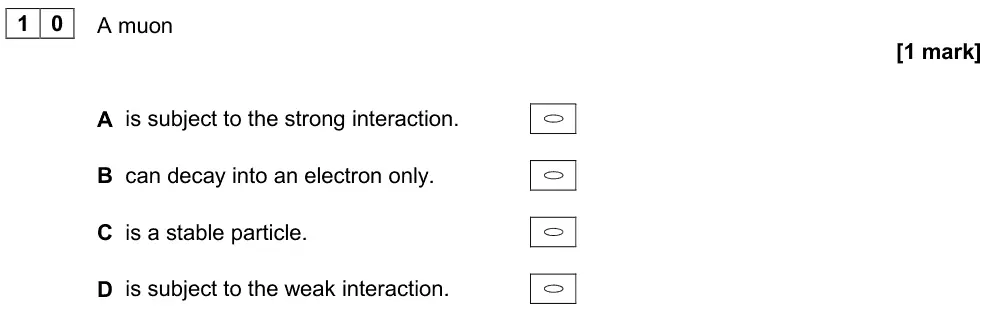
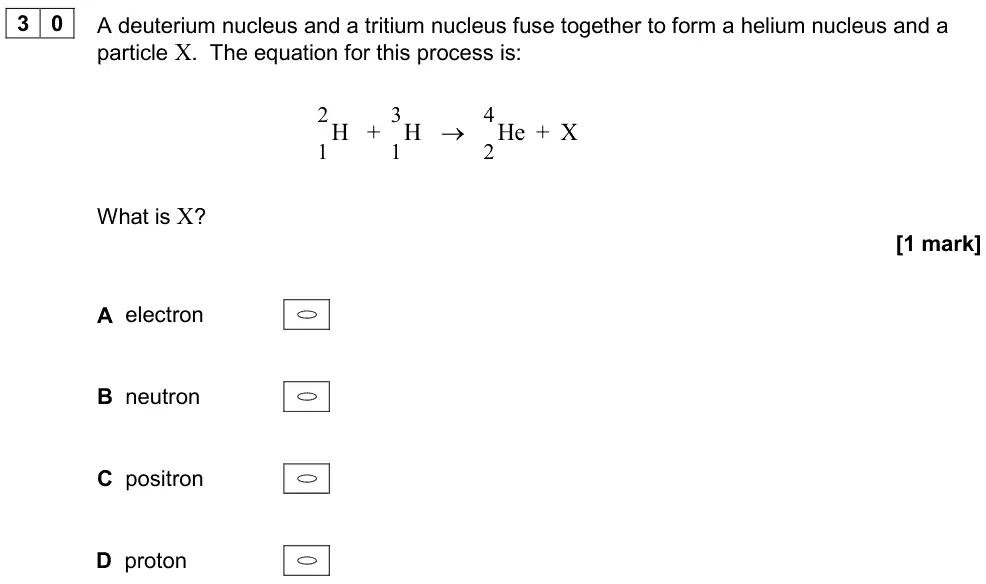
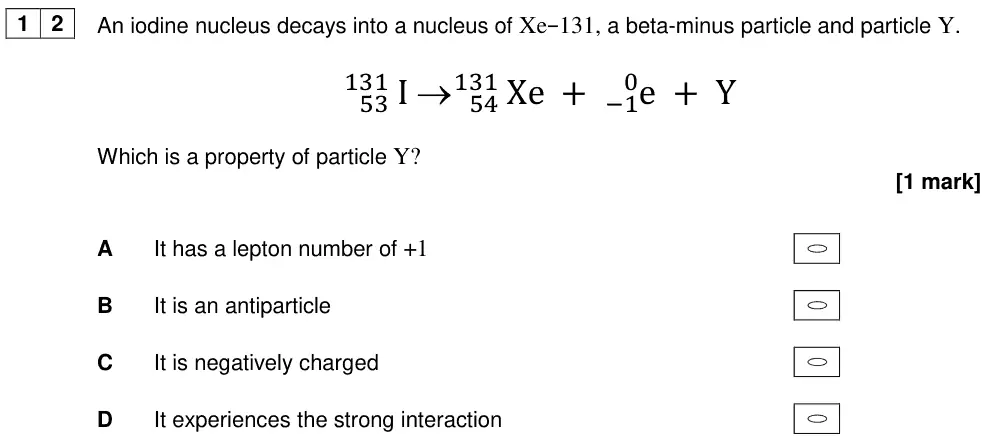
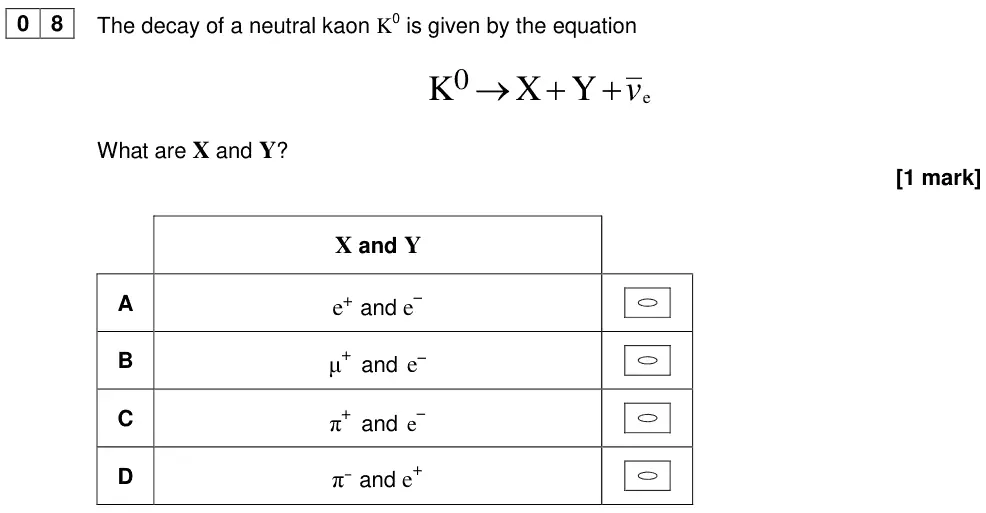
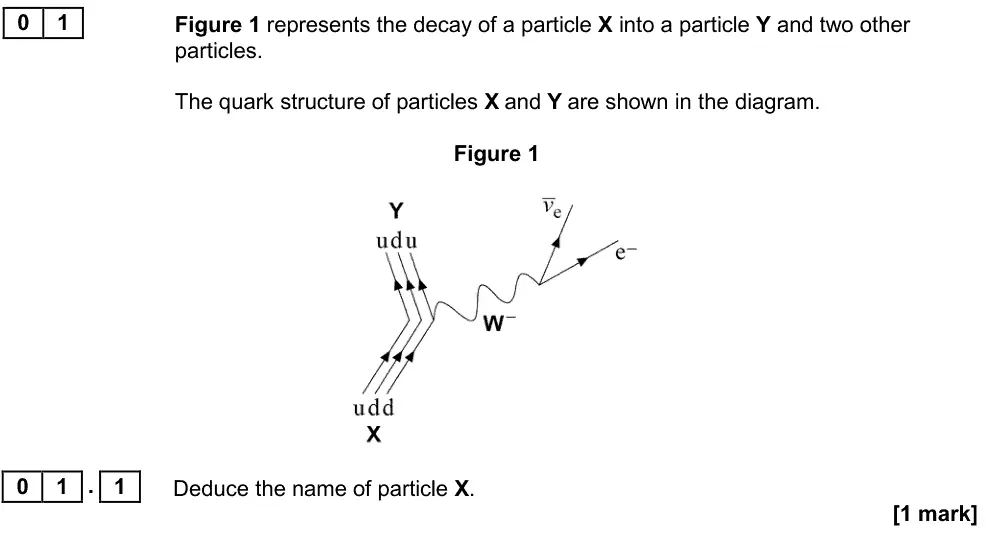
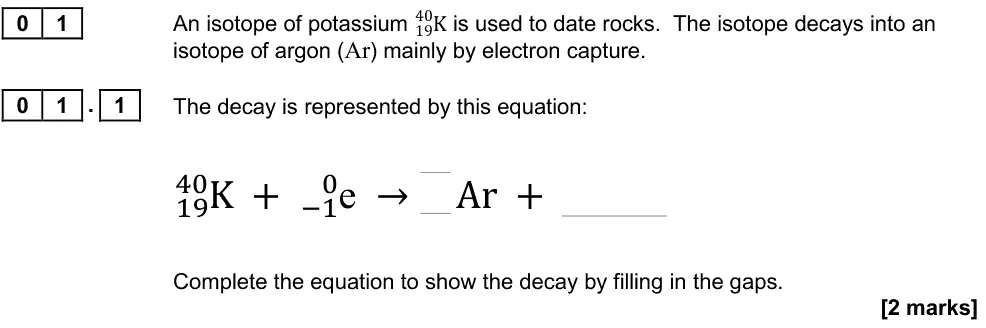
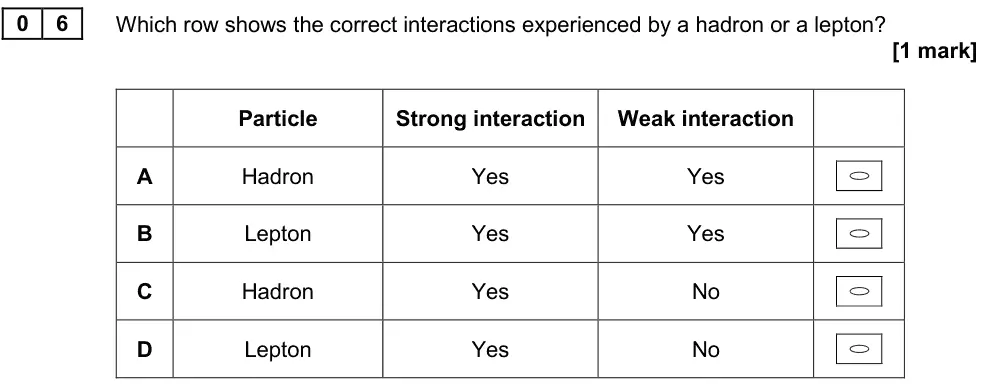
3.2.1.5-01 Hadrons are subject to the strong interaction.
3.2.1.5-02 The two classes of hadrons: • baryons (proton, neutron) and antibaryons (antiproton and antineutron) • mesons (pion, kaon).
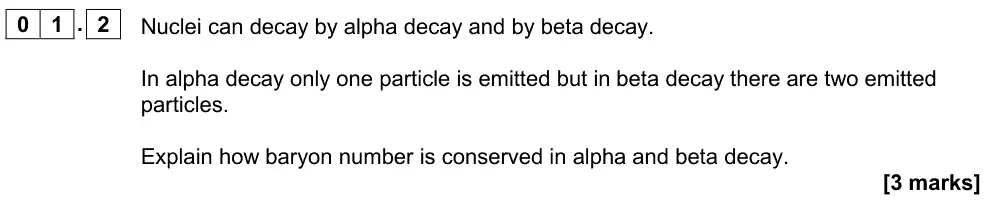
3.2.1.5-03 Baryon number as a quantum number.
3.2.1.5-04 Conservation of baryon number.
3.2.1.5-05 The proton is the only stable baryon into which other baryons eventually decay.
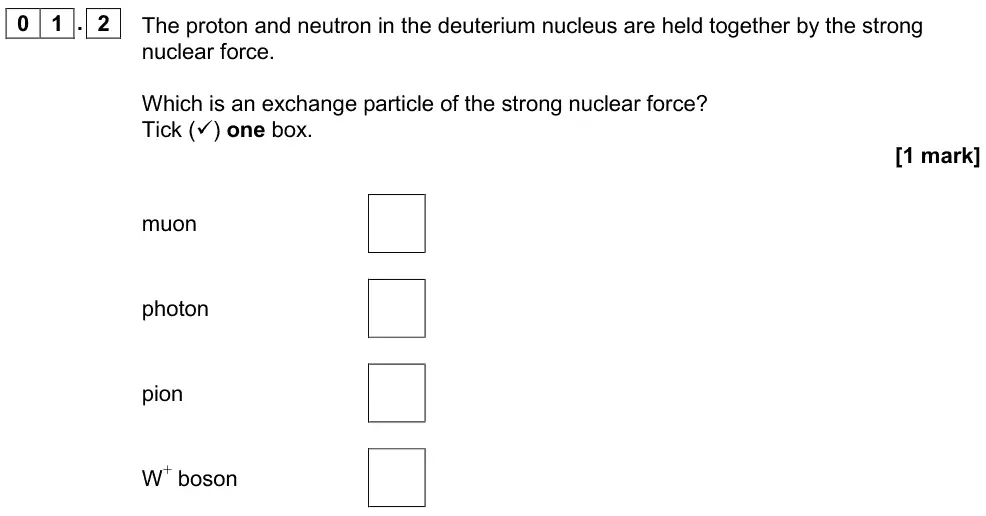
3.2.1.5-06 The pion as the exchange particle of the strong nuclear force.
3.2.1.5-07 The kaon as a particle that can decay into pions.
3.2.1.5-08 Leptons: electron, muon, neutrino (electron and muon types only) and their antiparticles.
3.2.1.5-09 Lepton number as a quantum number; conservation of lepton number for muon leptons and for electron leptons.
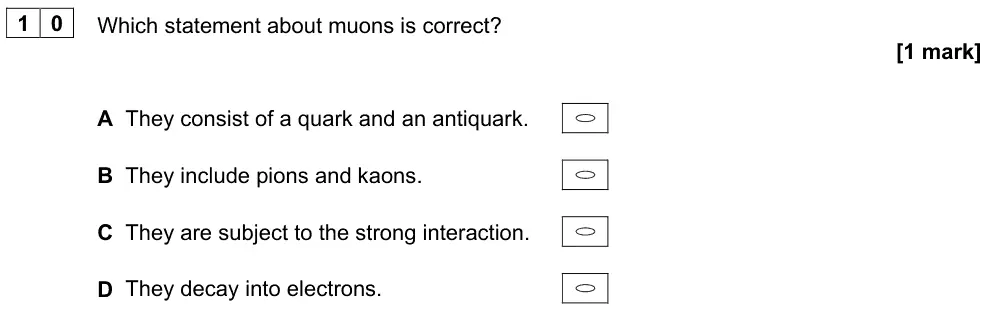
3.2.1.5-10 The muon as a particle that decays into an electron.
3.2.1.5-11 Strange particles
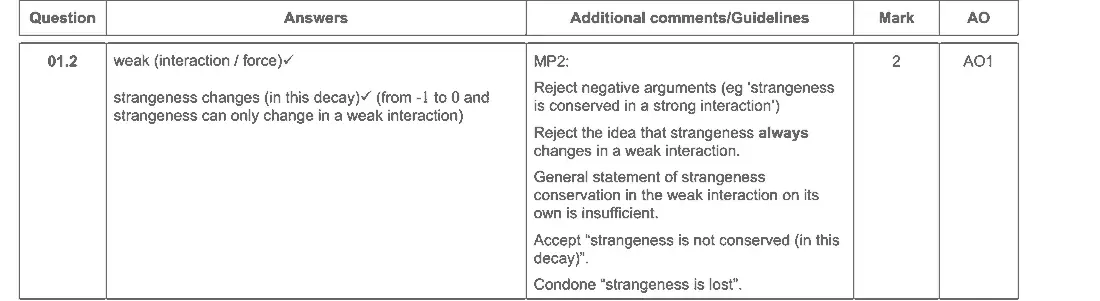
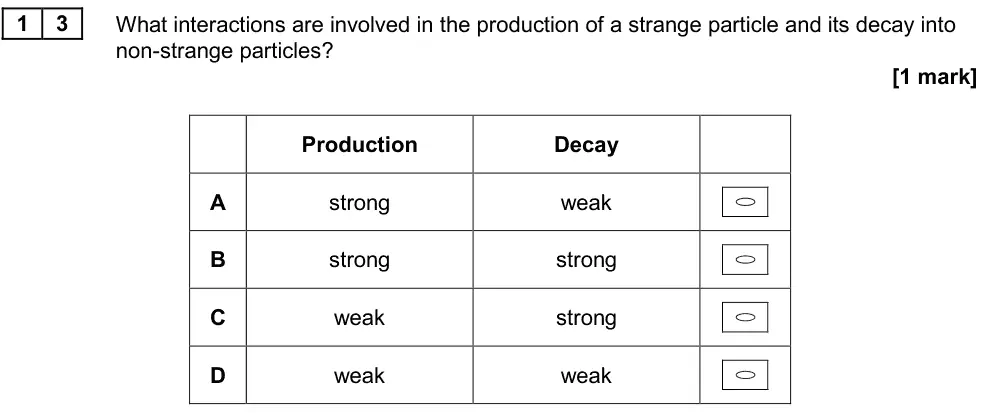
3.2.1.5-12 Strange particles as particles that are produced through the strong interaction and decay through the weak interaction (eg kaons).
3.2.1.5-13 Strangeness (symbol s) as a quantum number to reflect the fact that strange particles are always created in pairs.
3.2.1.5-14 Conservation of strangeness in strong interactions.
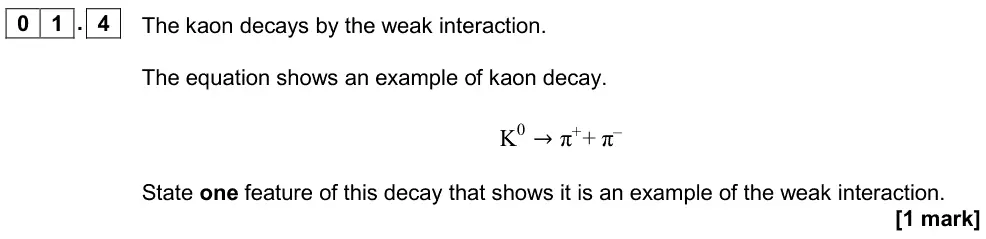
3.2.1.5-15 Strangeness can change by 0, +1 or -1 in weak interactions.
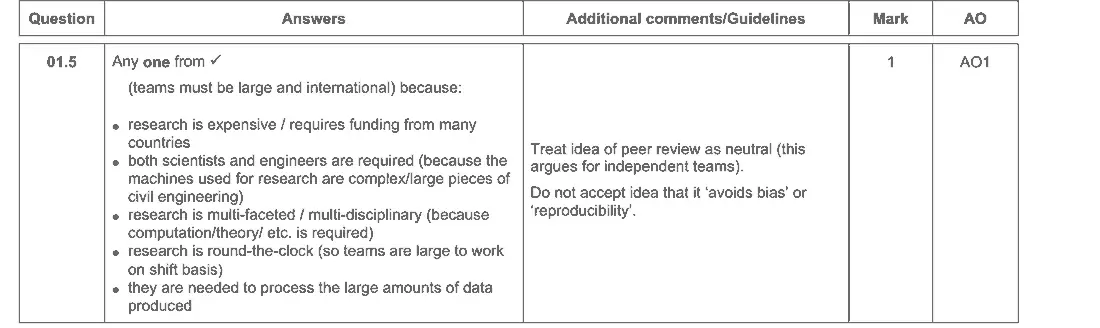
3.2.1.5-16 Appreciation that particle physics relies on the collaborative efforts of large teams of scientists and engineers to validate new knowledge.
3.2.1.6-01 Properties of quarks and antiquarks: charge, baryon number and strangeness.
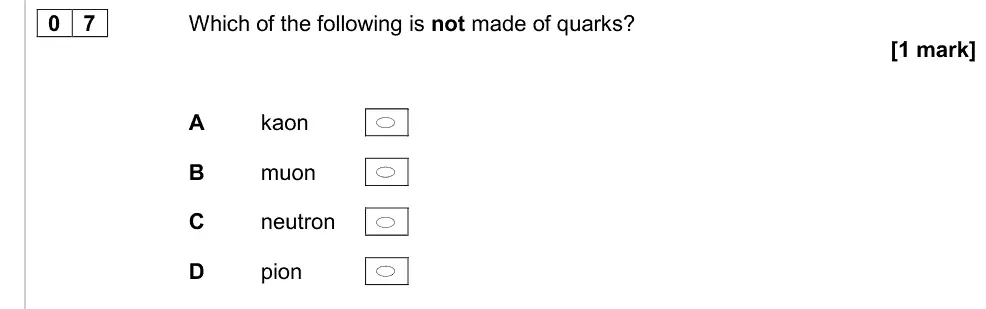
3.2.1.6-02 Combinations of quarks and antiquarks required for baryons (proton and neutron only), antibaryons (antiproton and antineutron only) and mesons (pion and kaon only).
3.2.1.6-03 Only knowledge of up (u), down (d) and strange (s) quarks and their antiquarks will be tested.
3.2.1.6-04 The decay of the neutron should be known.
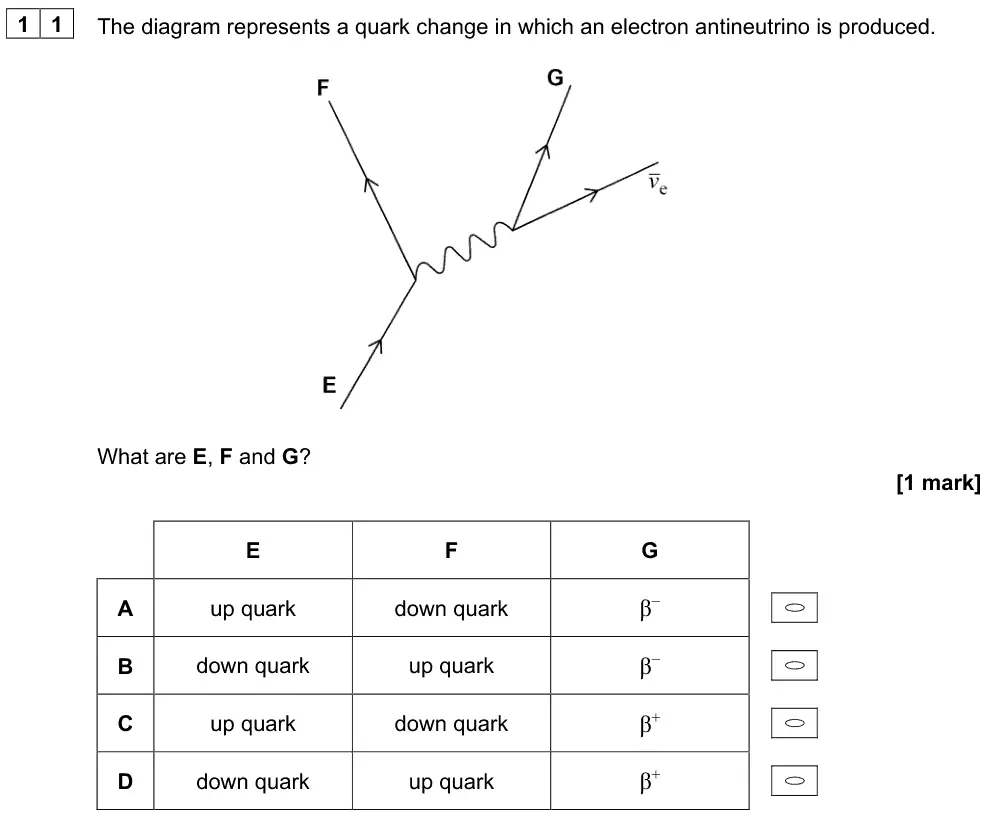
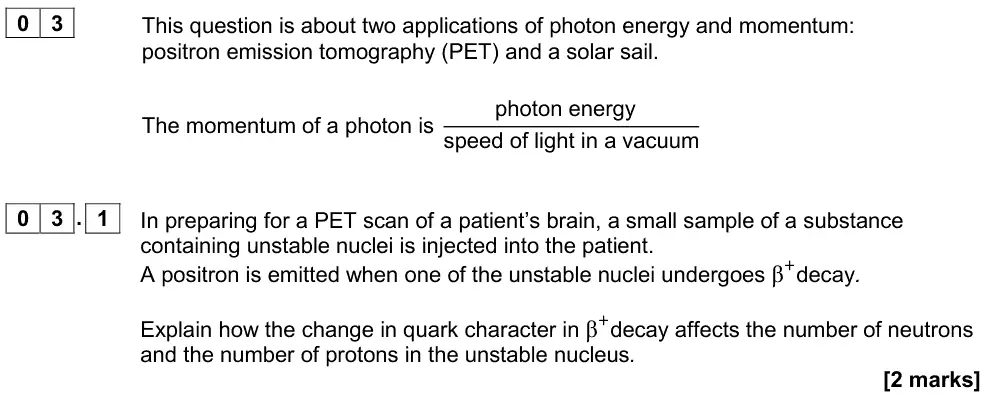
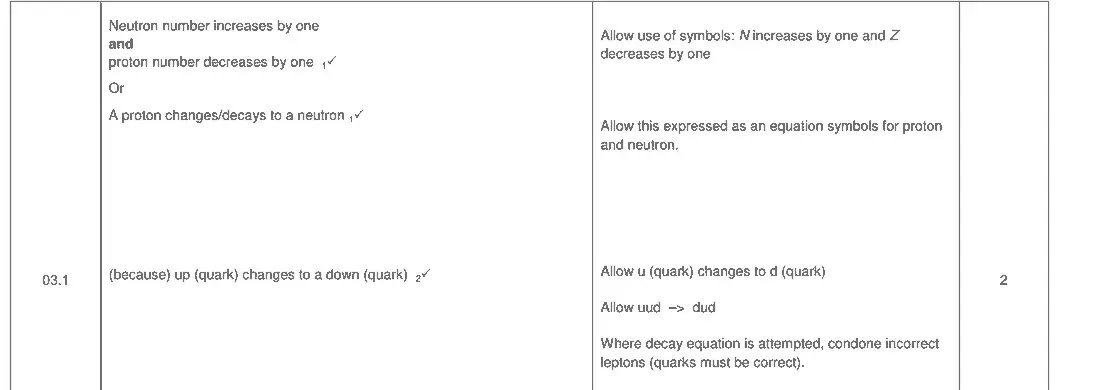
3.2.1.7-01 Change of quark character in β−and in β + decay.
3.2.1.7-02 Application of the conservation laws for charge, baryon number, lepton number and strangeness to particle interactions. The necessary data will be provided in questions for particles outside those specified.
3.2.1.7-03 Students should recognise that energy and momentum are conserved in interactions.
Six-mark extended response questions on this topic
Tap a question to zoom it. Where a part needs a figure, table or graph from earlier in the question, that part folds out above it; the mark scheme and examiner's comment open underneath. Have the AQA data and formulae booklet beside you (see the formula sheet page).
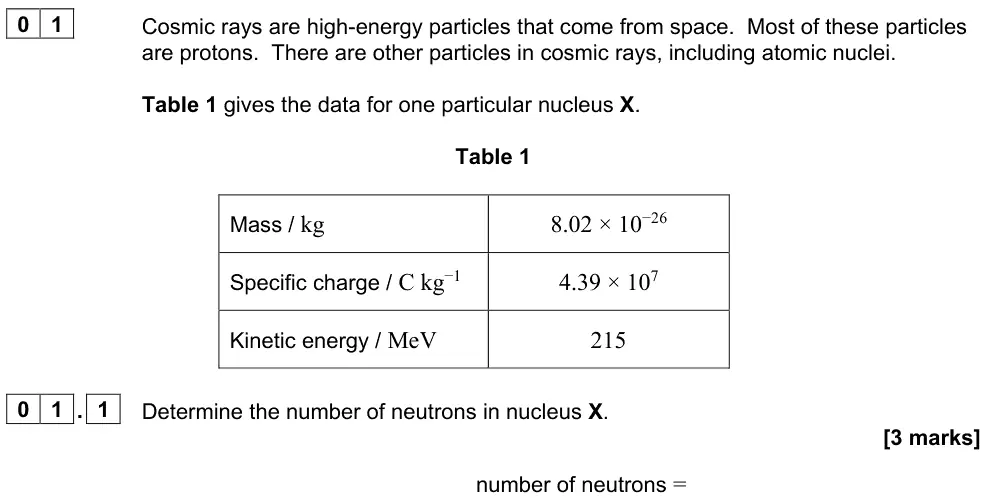
June 2025 · AS Paper 1 · Q1.33 marksAO3=3Explanation
Earlier part of question 1 that this part uses
Mark scheme
Examiner's comment
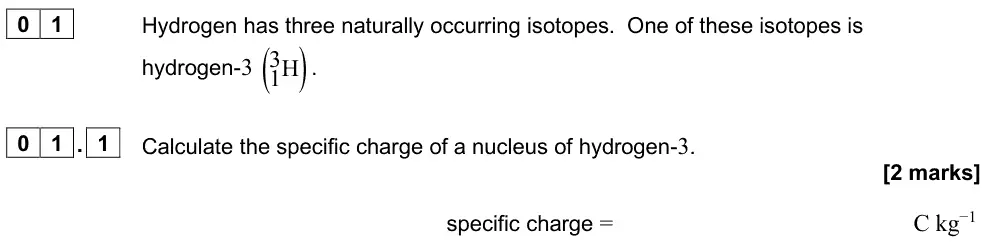
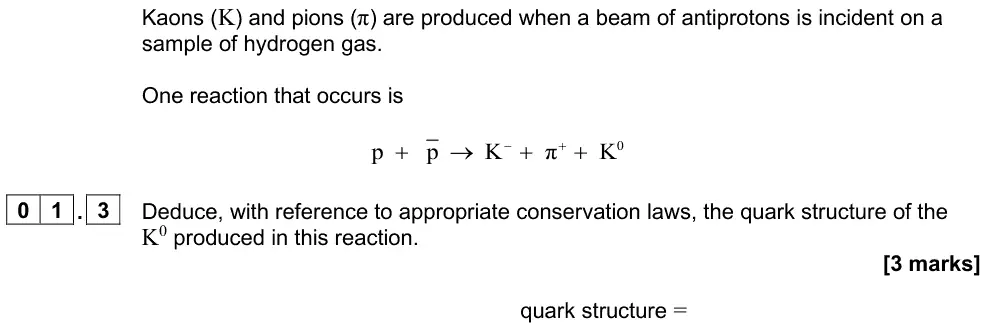
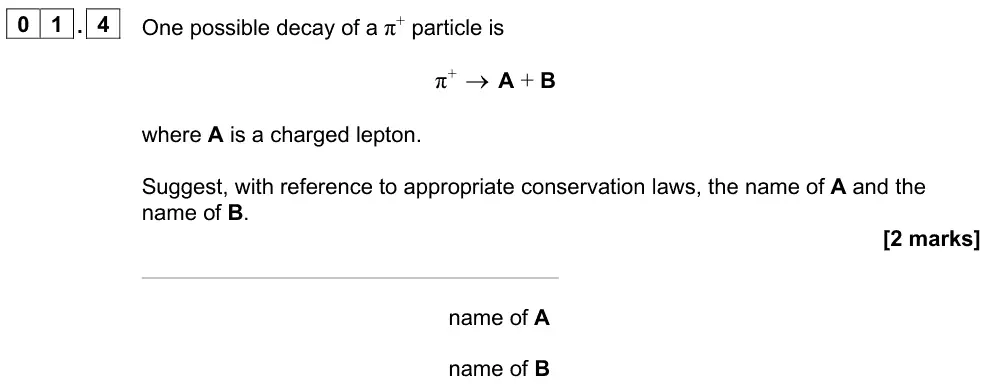
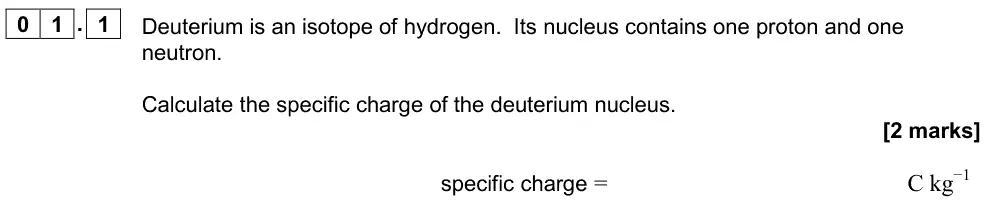
01.1 Most students performed well in this straightforward calculation, with over 65% achieving full marks and a further 20% securing one mark. Common misconceptions included: reversing the required ratio by dividing mass by charge, despite the unit (C kg–1 ) • provided on the answer line. incorrectly using the relative mass and charge values of 1 for a proton rather than the • actual values. misjudging the magnitude; some students incorrectly rewrote 3.2 × 10⁷ as 3.2 × 10⁻⁷ , • believing the initial result was implausibly large. 01.2 Over 80% of students gained at least one mark, though only about 40% were able to produce an answer that gained both marks. Common deficiencies in answers included: discussing differences in mass between isotopes without noting that the charge • remains constant. identifying that isotopes have different numbers of neutrons but neglecting to deduce, • either from previous knowledge or the information in the question, that hydrogen-3 has more neutrons. not recognising hydrogen-1 as an isotope limiting their comparisons to hydrogen-3 and • hydrogen-2 (although these students were able to gain both marks where appropriate working that mentioned charge and mass was seen). 01.3 Approximately 40% of students correctly deduced and justified the quark structure of this neutral kaon (s̅d). A further 20% gained two marks, typically by: stating the correct structure but neglecting to provide the supporting reasoning. • correctly identifying the presence of a strange quark but omitting the understanding • that a kaon is a meson. 01.4 Higher performing students (approximately 40%) were able to answer this question by realising that conservation of lepton number occurs within each generation and that particle A must be an antilepton due to it carrying a positive charge. stating that charge must be conserved. • a general statement that lepton number is conserved without realising that this is true • within each lepton generation.
Notes from the mark scheme and report
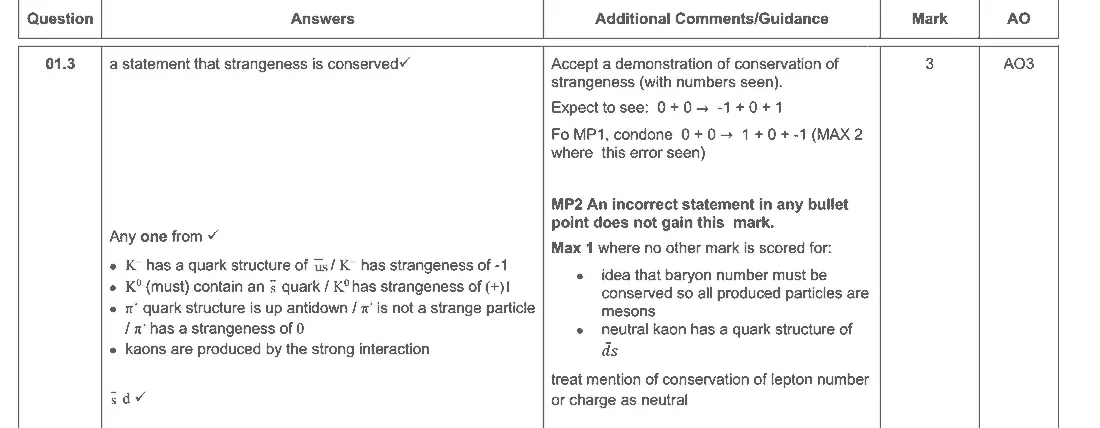
Answer: d s-bar
strangeness conserved in the strong interaction (0 + 0 = -1 + 0 + 1), K- is s u-bar so K0 contains an anti-strange
kaon is a meson
June 2025 · AS Paper 1 · Q1.42 marksAO3=2Short answer
Earlier part of question 1 that this part uses
Mark scheme
Examiner's comment
01.1 Most students performed well in this straightforward calculation, with over 65% achieving full marks and a further 20% securing one mark. Common misconceptions included: reversing the required ratio by dividing mass by charge, despite the unit (C kg–1 ) • provided on the answer line. incorrectly using the relative mass and charge values of 1 for a proton rather than the • actual values. misjudging the magnitude; some students incorrectly rewrote 3.2 × 10⁷ as 3.2 × 10⁻⁷ , • believing the initial result was implausibly large. 01.2 Over 80% of students gained at least one mark, though only about 40% were able to produce an answer that gained both marks. Common deficiencies in answers included: discussing differences in mass between isotopes without noting that the charge • remains constant. identifying that isotopes have different numbers of neutrons but neglecting to deduce, • either from previous knowledge or the information in the question, that hydrogen-3 has more neutrons. not recognising hydrogen-1 as an isotope limiting their comparisons to hydrogen-3 and • hydrogen-2 (although these students were able to gain both marks where appropriate working that mentioned charge and mass was seen). 01.3 Approximately 40% of students correctly deduced and justified the quark structure of this neutral kaon (s̅d). A further 20% gained two marks, typically by: stating the correct structure but neglecting to provide the supporting reasoning. • correctly identifying the presence of a strange quark but omitting the understanding • that a kaon is a meson. 01.4 Higher performing students (approximately 40%) were able to answer this question by realising that conservation of lepton number occurs within each generation and that particle A must be an antilepton due to it carrying a positive charge. stating that charge must be conserved. • a general statement that lepton number is conserved without realising that this is true • within each lepton generation.
Notes from the mark scheme and report
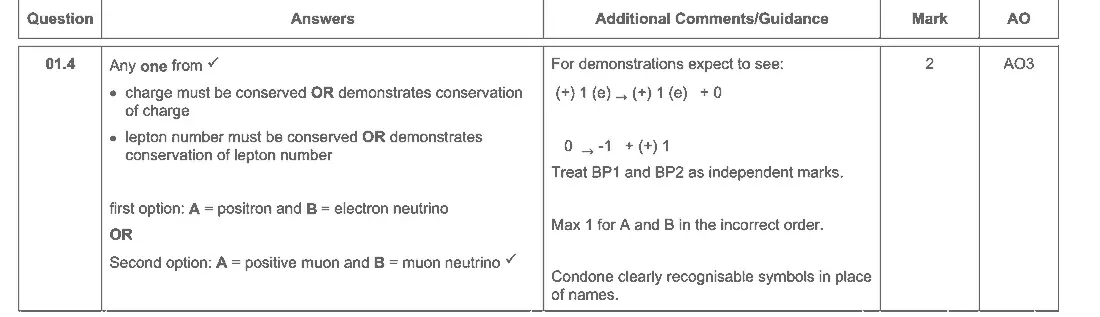
A = positron and B = electron neutrino (or positive muon and muon neutrino)
charge conserved and lepton number conserved within each generation
e+ with electron antineutrino a common error
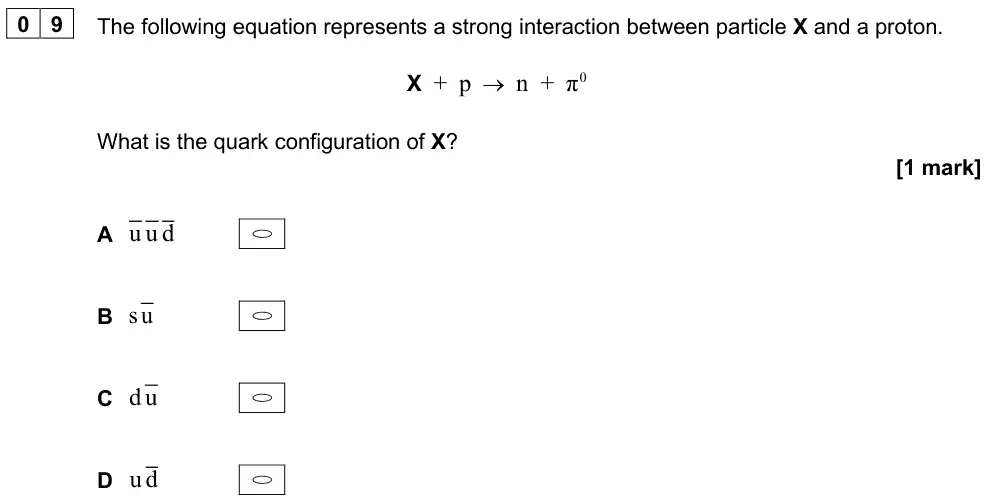
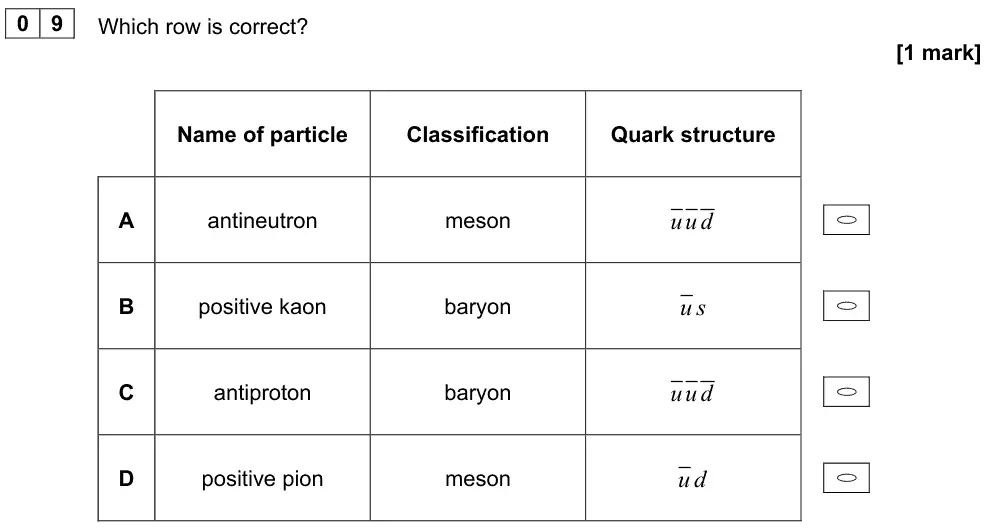
June 2025 · Paper 1 · Q91 markAO1=1Multiple choice
Answer
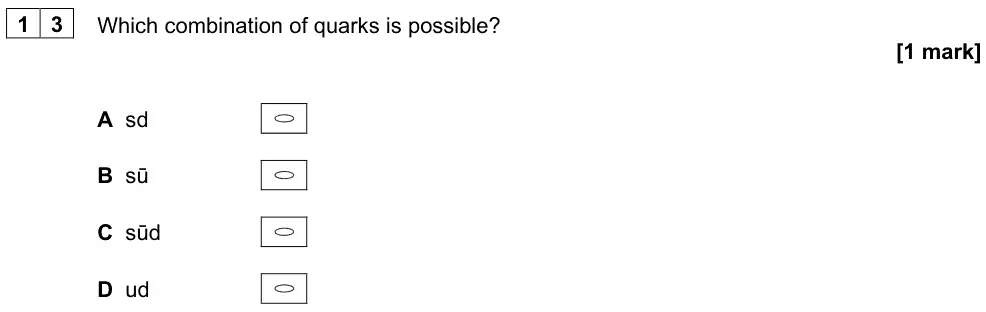
C
Mark scheme
Notes from the mark scheme and report
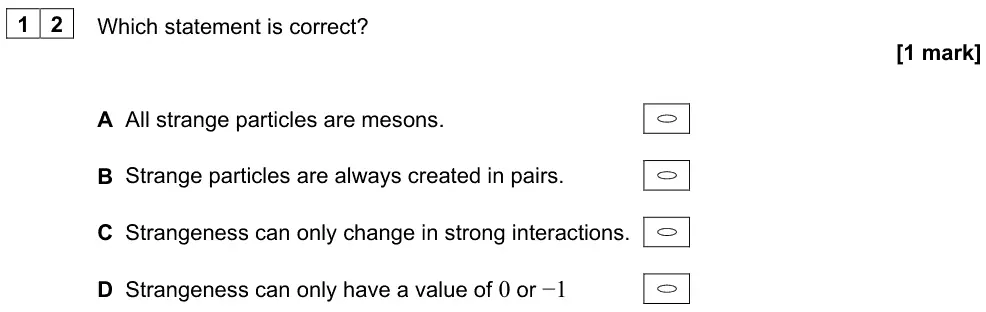
Answer: C
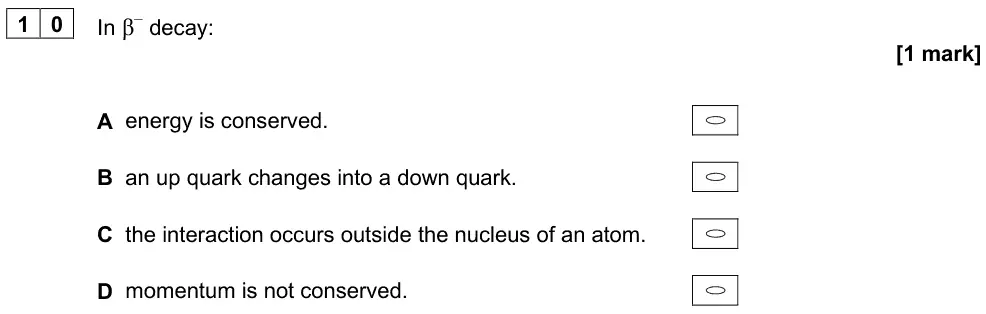
June 2025 · Paper 1 · Q101 markAO1=1Multiple choice
Answer
A
Mark scheme
Notes from the mark scheme and report
Answer: A
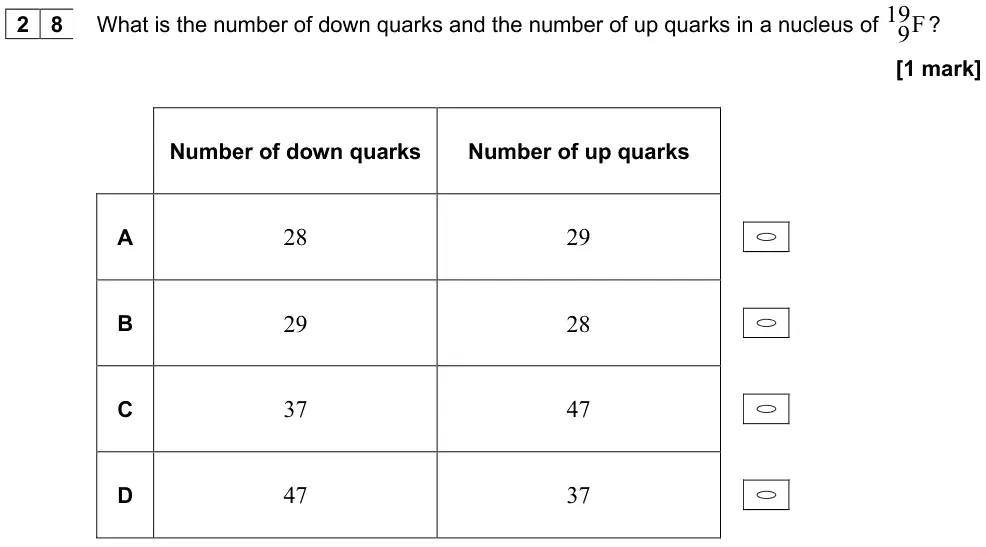
June 2025 · AS Paper 2 · Q281 markAO1=1Multiple choice
Answer
B
Mark scheme
Examiner's comment
Students were more successful in answering questions 6, 11, 14, 19, 22, 28, and were less successful in answering questions 10, 15, 21, 25, 29.
Notes from the mark scheme and report
Answer: B
June 2024 · AS Paper 1 · Q1.12 marksAO2=2Explanation
Mark scheme
Examiner's comment
01.1
Over 40% of students gained this mark. Many students converted 6.7 eV into 1.1 × 10⁻¹⁸ J and gave this as their answer. Others then used W=QV with W equal to 1.1 × 10⁻¹⁸ (J) to determine the potential difference V. Very few had a direct approach of recognising that 6.7 eV of work on the electron requires a potential difference of 6.7 V. Many students divided 6.7 (eV) by the charge on an electron and presented 4.2 × 10¹⁹ as their answer.
Notes from the mark scheme and report
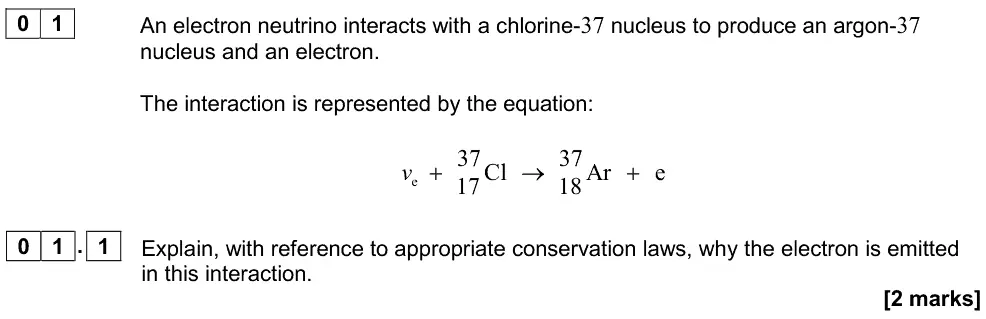
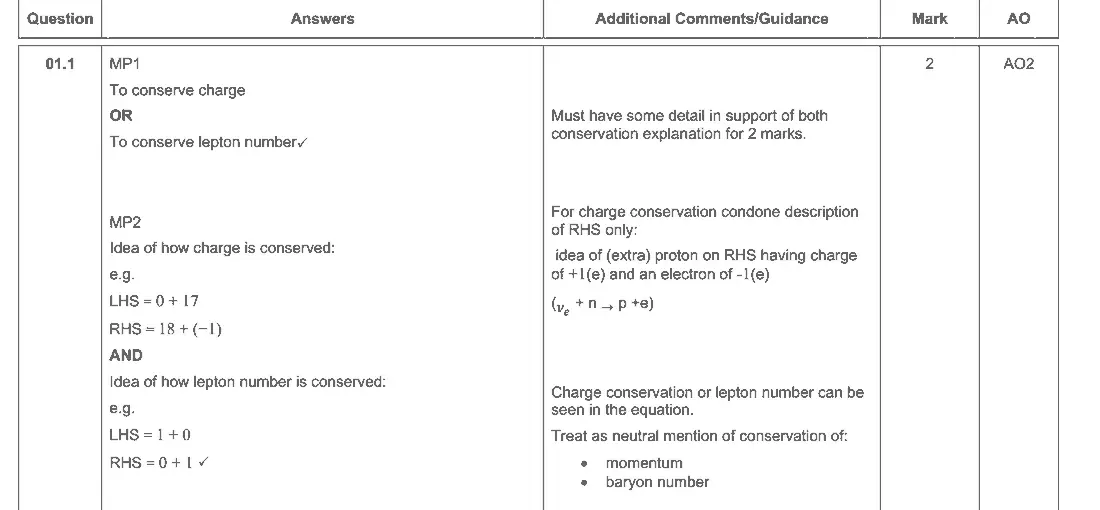
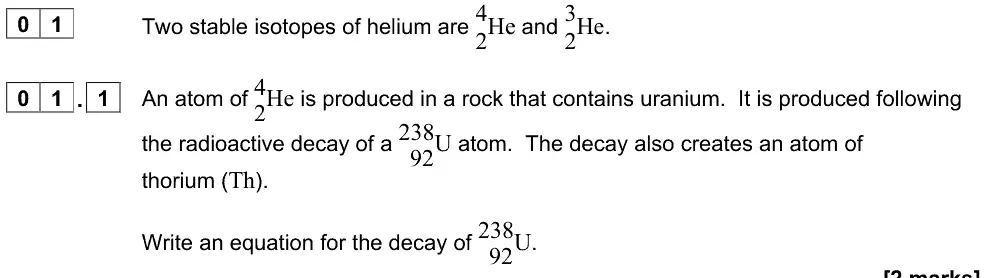
Electron emitted to conserve charge (LHS 0 + 17 = RHS 18 - 1) and lepton number (LHS 1 = RHS 1)
detail needed for both laws for 2 marks
June 2024 · Paper 1 · Q1.21 markAO1=1Short answer
Earlier part of question 1 that this part uses
Mark scheme
Examiner's comment
Question 01.2 was similarly well answered. There were many variations seen for the electron antineutrino. Care needs to be taken when writing the symbol to ensure that the subscript ‘e’ is not the same size as the n.
In question 01.3, most students were able to identify the weak interaction as the one responsible for neutron decay. Many failed to obtain the second mark by giving weak or irrelevant answers. The best answers made a clear reference to leptons or the change in quark flavour.
The most common mark awarded in question 01.4 was for identifying the virtual photon as the exchange particle. Very few students went on to explain the change in paths in terms of conservation of momentum. This is clearly a part of the specification that is poorly understood. The question did discriminate quite well, however.
Notes from the mark scheme and report
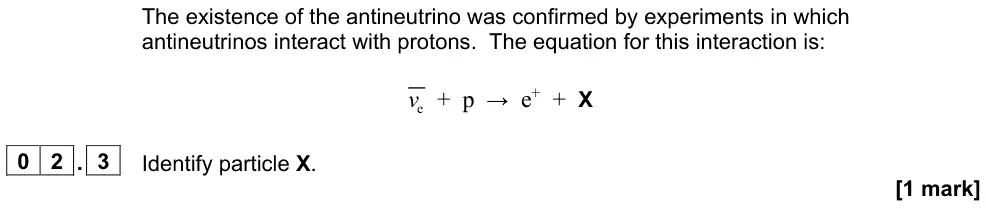
Proton, beta-minus (electron) and electron antineutrino, all three for the mark
write the antineutrino symbol clearly
June 2024 · AS Paper 1 · Q1.34 marksAO3=4Explanation
Earlier part of question 1 that this part uses
Mark scheme
Examiner's comment
01.3
Notes from the mark scheme and report
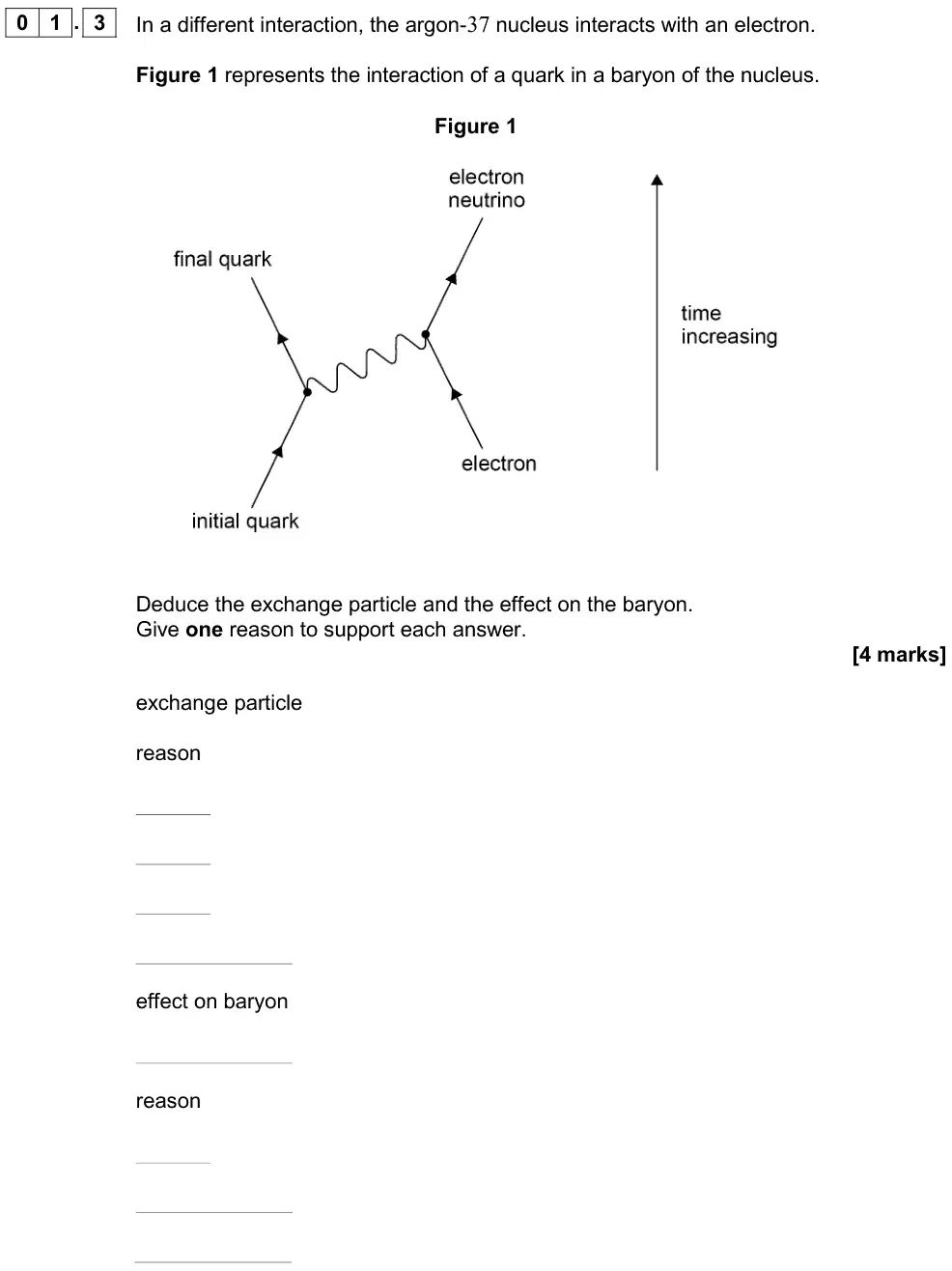
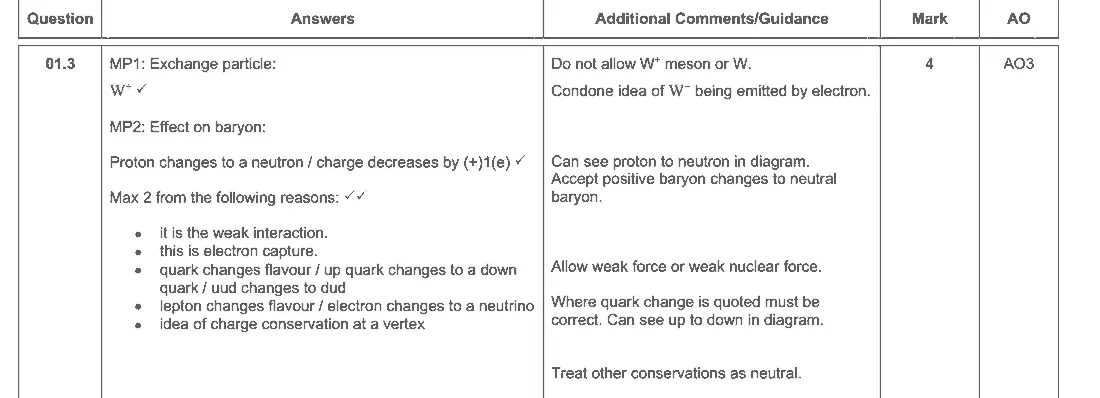
Exchange particle W+ (weak interaction / electron capture)
proton changes to a neutron (up quark becomes down)
one reason each
many thought a neutron became a proton
June 2024 · Paper 1 · Q2.12 marksAO1=1, AO2=1Short answer
Mark scheme
Examiner's comment
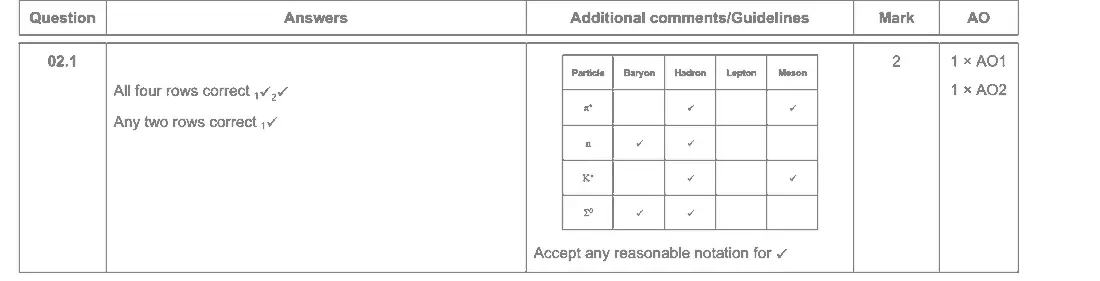
More than half of students obtained both marks for question 02.1. A common error was only putting one tick in each row. These students presumably did not realise that a particle could be both a hadron and a meson, for example. The command sentence makes it clear that multiple boxes should be ticked for each particle. Students should be encouraged to read these command sentences carefully so that they understand what they need to do.
Notes from the mark scheme and report
2 marks all four rows, 1 mark any two
a particle can need two ticks (hadron and meson / hadron and baryon) - one tick per row was the common error
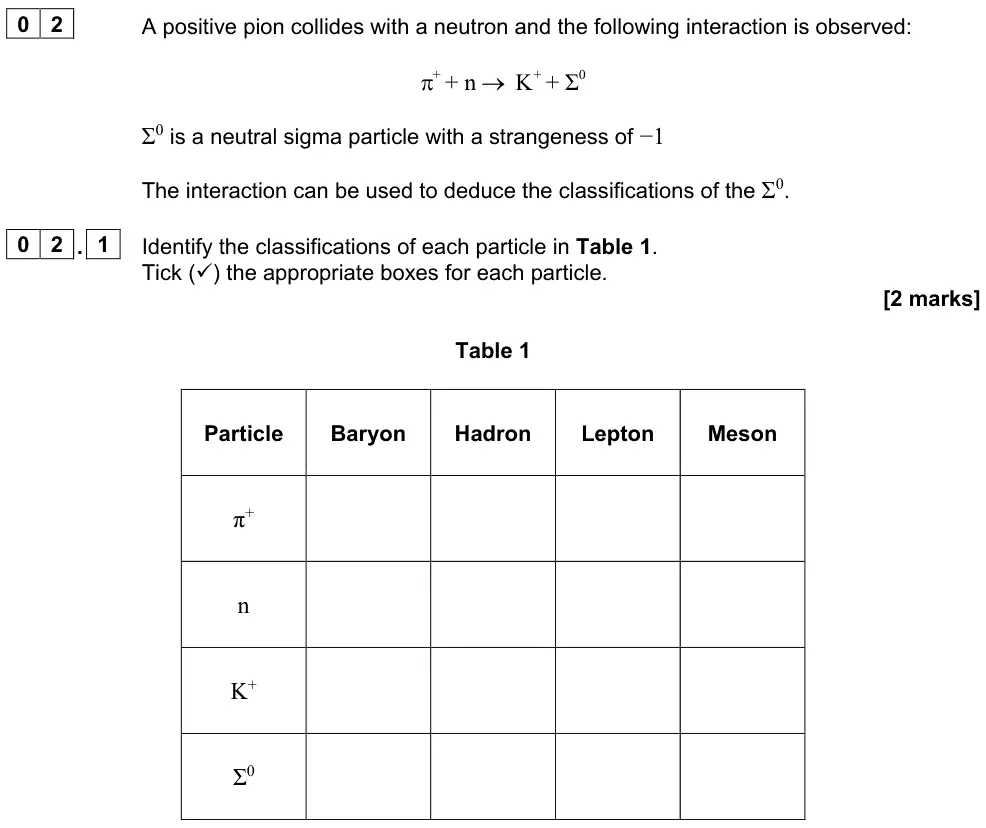
June 2024 · Paper 1 · Q2.23 marksAO3=3Explanation
Earlier part of question 2 that this part uses
Mark scheme
Examiner's comment
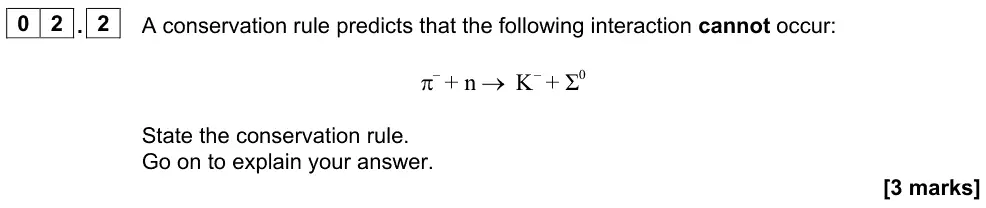
Question 02.2 produced a good spread of marks and discriminated reasonably well. Most students identified conservation of strangeness as the rule being broken. Far fewer could explain their answer in sufficient clarity or detail. Many students referred to both weak and strong interactions in their answer, and therefore did not apply the conservation rule precisely to this situation.
Notes from the mark scheme and report
Strangeness, because the interaction is strong
no credit if another quantum number is said not to be conserved
must show LHS = 0 and RHS = -2
June 2024 · Paper 1 · Q2.51 markAO1=1Short answer
Earlier part of question 2 that this part uses
Mark scheme
Examiner's comment
Question 02.5 tests a very small part of the specification that appears to be often overlooked. As a similar question had been asked on a previous series, it was expected that this would answer quite well. Just under 50% of students were awarded the mark. The most common answer that was not rewarded was a vague comment about peer review.
Notes from the mark scheme and report
International collaboration/verification or expensive equipment
peer review and 'takes a long time' ignored
June 2024 · AS Paper 2 · Q161 markMultiple choice
Answer
C
Mark scheme
Notes from the mark scheme and report
Answer: C
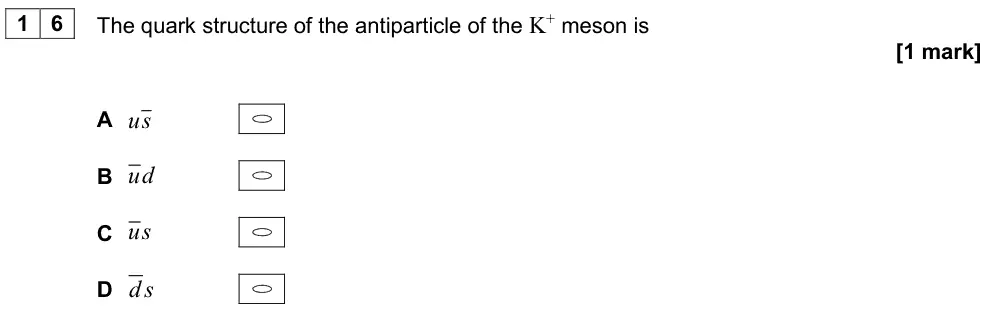
most chose A, the K+ itself
June 2023 · AS Paper 1 · Q1.12 marksAO2=2Short answerEasy
Mark scheme
Examiner's comment
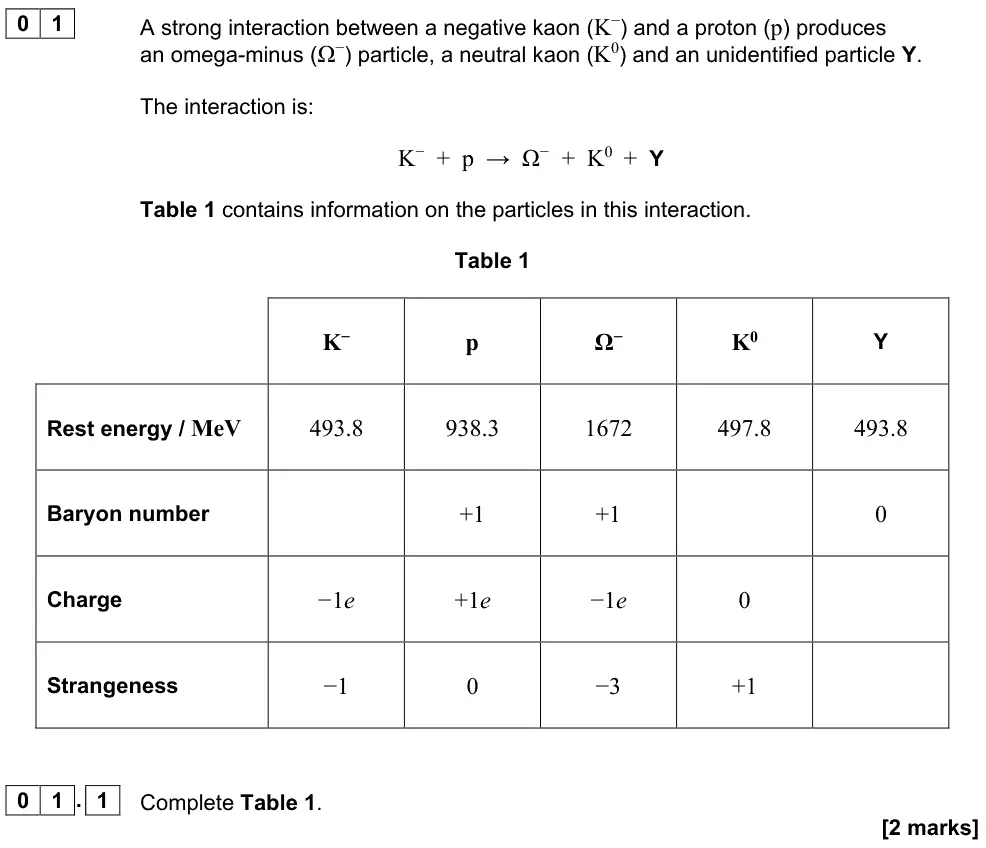
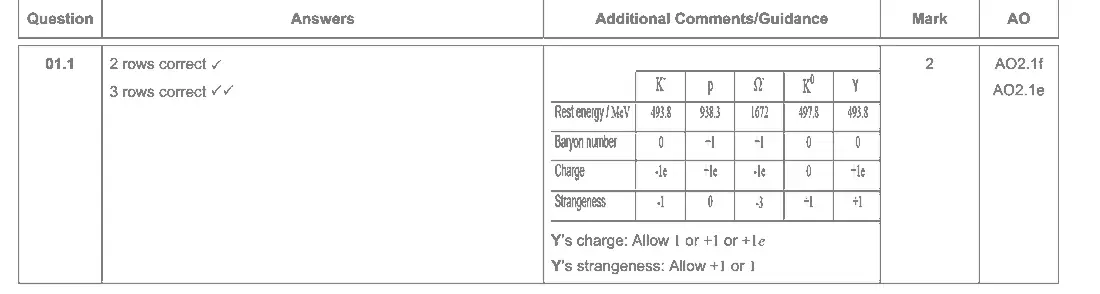
01.1 67% of students scored two marks. A significant proportion of the students scoring one mark incorrectly gave kaons a baryon number of 1.
This question proved the most accessible question in the paper for E grade students. Most students were able to gain some marks in parts 01.1 and 01.2. However, successful attempts at parts 01.3 and 01.4 were less common and usually indicative of grade A performance.
Notes from the mark scheme and report
Kaons B = 0 (both K- and K0)
Y charge +1 and strangeness +1 from conservation in a strong interaction
giving kaons B = 1 was the common error
June 2023 · Paper 1 · Q1.11 markAO3=1Short answer
Mark scheme
Examiner's comment
01.1 The majority of students correctly identified the quark structure. There were some students who believed the particle was a meson and therefore did not get the mark.
Notes from the mark scheme and report
Answer: uds (baryon, charge 0, strangeness -1)
treating it as a meson was the common error
June 2023 · Paper 1 · Q1.22 marksAO1=2Explanation
Earlier part of question 1 that this part uses
Mark scheme
Examiner's comment
01.2 The two marks were awarded independently. The majority of students scored both marks, but a significant number identified the change in strangeness but linked it to the strong force. Many other students knew it was a weak interaction but explained it in only general terms. These answers only received one mark.
Notes from the mark scheme and report
Weak interaction because strangeness changes (-1 to 0), which only happens in weak interactions
linking strangeness change to the strong force or general statements lose marks
June 2023 · AS Paper 1 · Q1.32 marksExplanation
Earlier part of question 1 that this part uses
Mark scheme
Examiner's comment
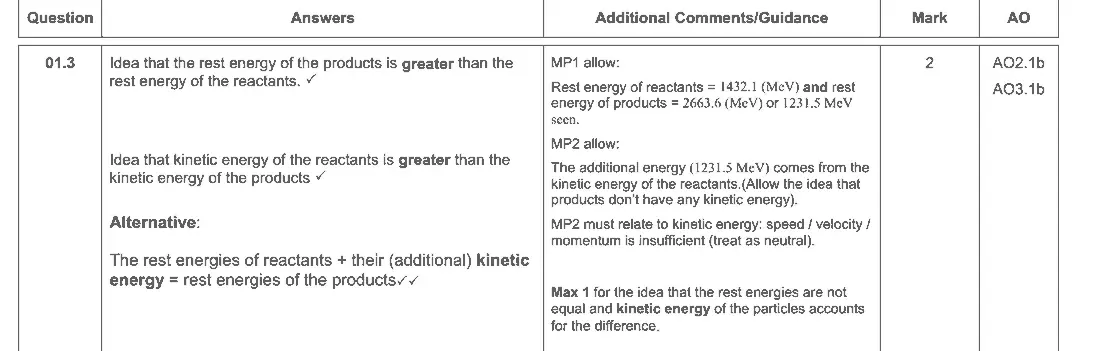
01.3 Over 50% of students scored zero in this part. Many students misinterpreted this question, thinking that it was equivalent to energy conservation in beta minus decay. These students stated that another particle is produced that carries away the missing energy even though the energy of the products had increased. Others attempted to refer to conservation of charge, baryon number and strangeness as evidence that energy must also be conserved, without any reference to the rest energies of the particles. Better performing students typically produced statements that answered the question in a clear and concise manner.
This question proved the most accessible question in the paper for E grade students. Most students were able to gain some marks in parts 01.1 and 01.2. However, successful attempts at parts 01.3 and 01.4 were less common and usually indicative of grade A performance.
Notes from the mark scheme and report
Products' rest energy (2663.6 MeV) exceeds reactants' (1432.1 MeV)
the difference comes from the reactants' kinetic energy (more KE before than after)
many wrongly argued a missing particle as in beta decay
June 2023 · Paper 1 · Q1.31 markAO1=1Short answer
Earlier part of question 1 that this part uses
Mark scheme
Examiner's comment
01.3 Just over half of the students gave the correct answer. Ambiguous and contradictory answers were relatively common. Students should be advised to make their answer clear in order to get credit.
Notes from the mark scheme and report
Antineutron
answer in quarks only or ambiguous answers not credited
just over half correct
June 2023 · AS Paper 1 · Q1.44 marksAO3=4ExplanationHard
Earlier part of question 1 that this part uses
Mark scheme
Examiner's comment
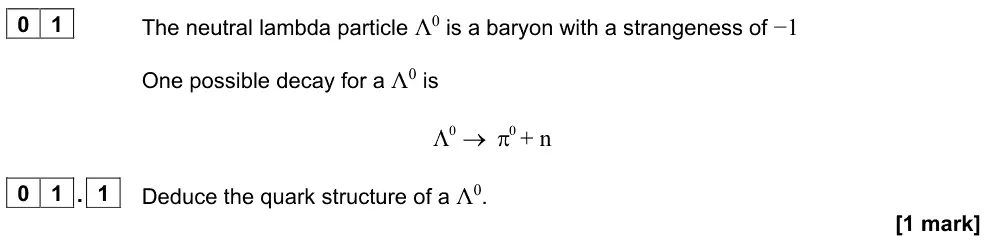
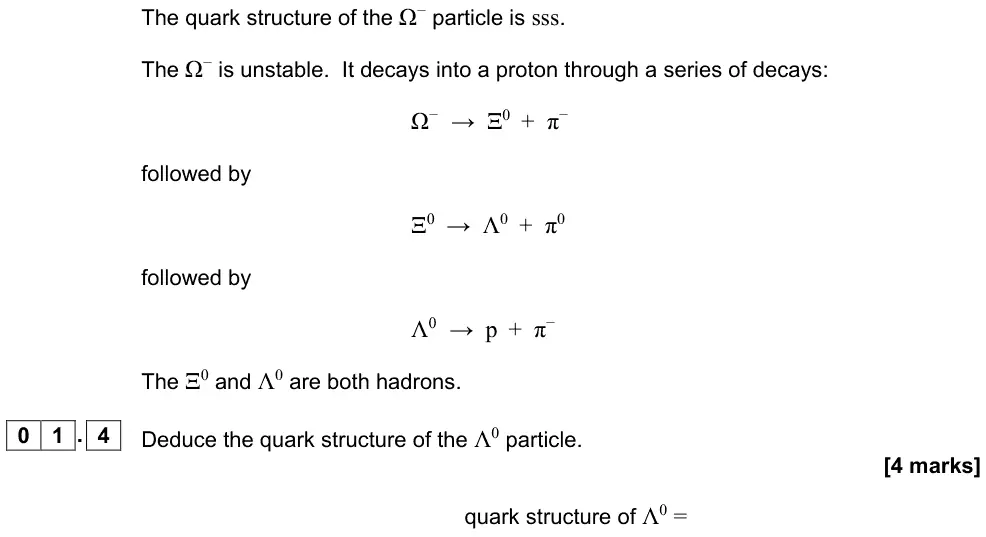
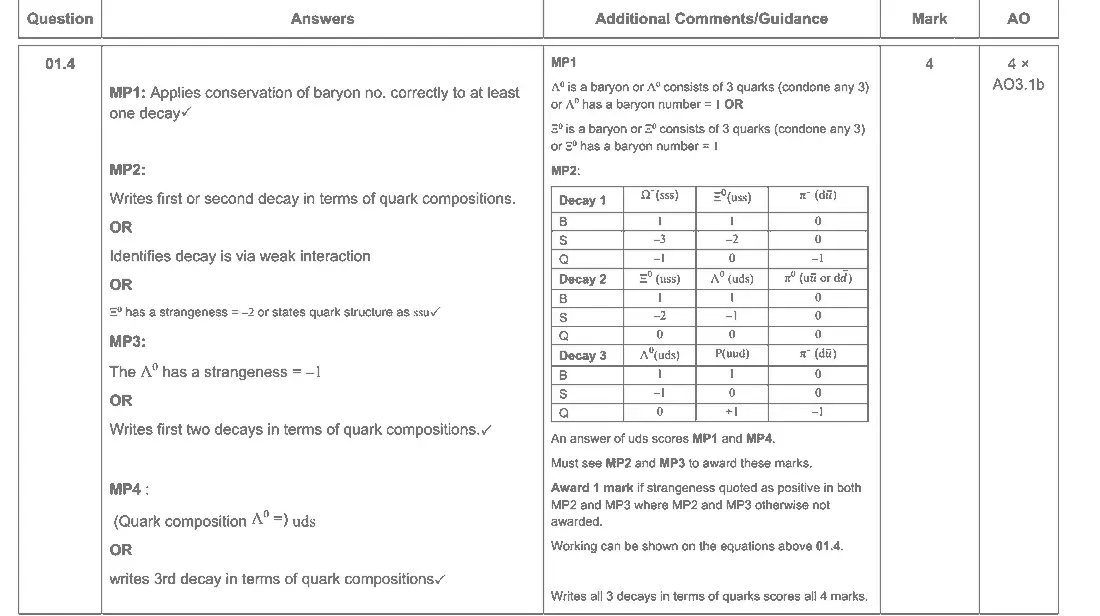
01.4 21% of students scored more than two marks in this part. Many students were able to state the quark structure of Λ0 as uds without being able to provide any support. These students appeared to be familiar with the quark structure of the particle rather than deducing its structure by analysing the information provided in the question. Most students were able to make some progress by demonstrating some appreciation of the underlying physics by applying baryon conservation to an equation or by identifying weak interaction as the decay mechanism.
This question proved the most accessible question in the paper for E grade students. Most students were able to gain some marks in parts 01.1 and 01.2. However, successful attempts at parts 01.3 and 01.4 were less common and usually indicative of grade A performance.
Notes from the mark scheme and report
Answer: uds
weak decays so strangeness changes by 1 each step: Xi0 = uss (S = -2), Lambda0 = uds (S = -1)
baryon number conserved
bald uds scores only 2 of 4
June 2023 · Paper 1 · Q1.51 markAO1=1Short answer
Earlier part of question 1 that this part uses
Mark scheme
Examiner's comment
01.5 This dealt with the nature of Particle Physics research. A common answer was related to peer review, which, whilst important, is related to separate, independent teams. The context of the question was the large international teams involved in particle physics research. Answers that identified the collaborative nature of these teams gained credit.
Notes from the mark scheme and report
Research is expensive (multi-country funding), needs scientists and engineers, is multidisciplinary, runs round the clock, or produces huge data
peer review and 'avoids bias' not credited
June 2023 · AS Paper 1 · Q1.61 markAO3=1Short answerEasy
Earlier part of question 1 that this part uses
Mark scheme
Examiner's comment
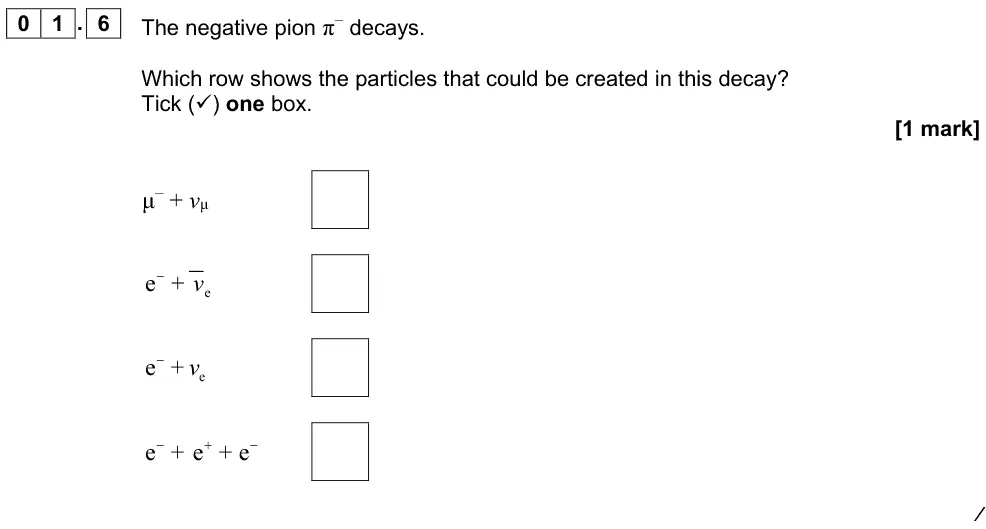
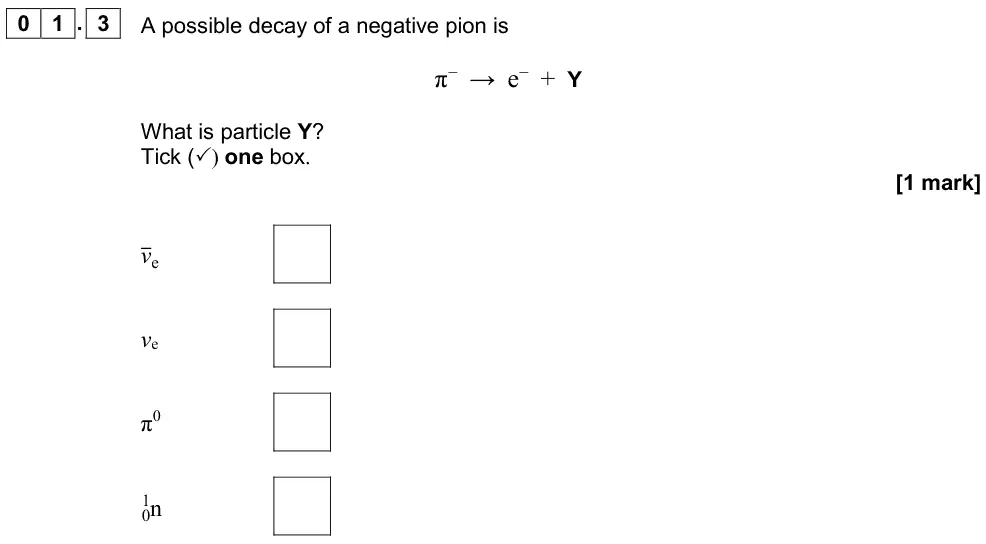
01.6 72% of students correctly identified the electron and electron antineutrino as the particles produced in the decay of a negative pion. The most popular distractors selected were boxes 1 and 3. Fewer than 4% of students selected box 4.
01.2 51% of students scored two marks. Power of ten errors were common, with a significant proportion of students either ignoring the prefix or dividing by 106 rather than multiplying by it. Many students divided by 1.6 × 10⁻¹⁹ rather than multiplying by this factor. Alternatively, they multiplied by the Planck constant.
Notes from the mark scheme and report
Electron and electron antineutrino (second box)
lepton number conservation
tick-box item
June 2023 · Paper 1 · Q101 markMultiple choiceEasy
Answer
D
Mark scheme
Examiner's comment
The multiple choice questions covered parts of the specification not covered in Section A. The distractors in these questions were written with common errors and misconceptions in mind. These questions are therefore an extremely useful resource when preparing students. The easiest questions were 7, 12, 20, 10 and 11, with over 75% of students getting these questions right. The most demanding were 18, 26, 22, 21 and 13; fewer than 40% of students got these right. For several of these the correct answer was not the most popular choice.
Notes from the mark scheme and report
Answer: D
June 2023 · Paper 1 · Q111 markMultiple choiceEasy
Answer
B
Mark scheme
Examiner's comment
The multiple choice questions covered parts of the specification not covered in Section A. The distractors in these questions were written with common errors and misconceptions in mind. These questions are therefore an extremely useful resource when preparing students. The easiest questions were 7, 12, 20, 10 and 11, with over 75% of students getting these questions right. The most demanding were 18, 26, 22, 21 and 13; fewer than 40% of students got these right. For several of these the correct answer was not the most popular choice.
Notes from the mark scheme and report
Answer: B
June 2023 · AS Paper 2 · Q141 markMultiple choice
Answer
B
Mark scheme
Notes from the mark scheme and report
Answer: B
June 2023 · AS Paper 2 · Q161 markMultiple choice
Answer
A
Notes from the mark scheme and report
Answer: A
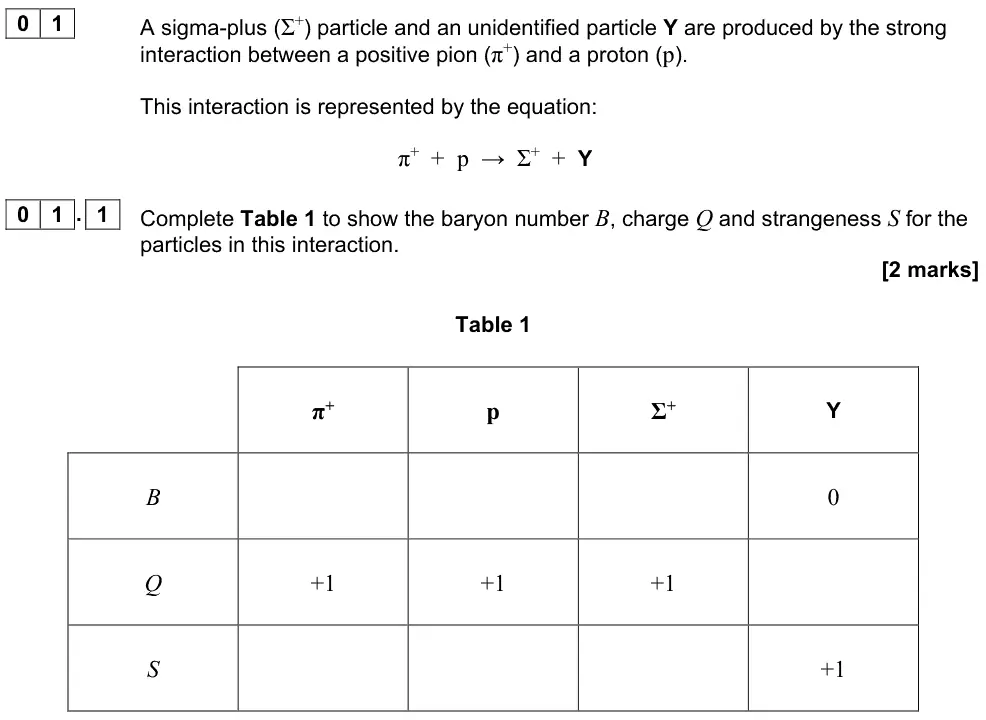
June 2022 · AS Paper 1 · Q1.12 marksAO1=1, AO2=1Short answerEasy
Mark scheme
Examiner's comment
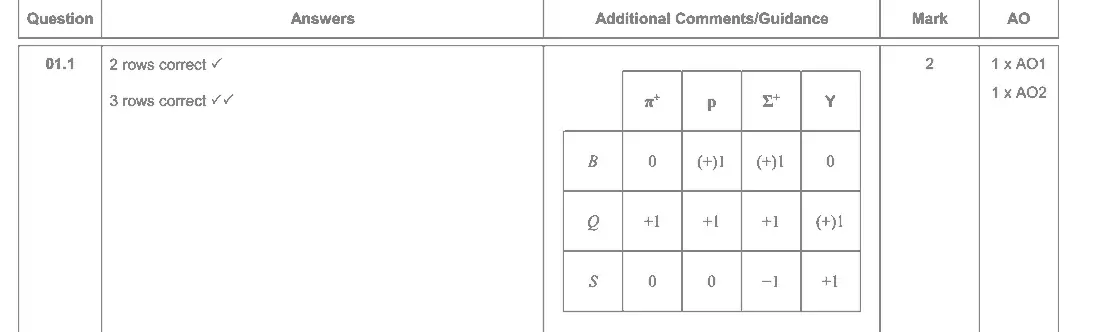
01.1 This question required students to recall the baryon number and strangeness of a pion and a proton and then to apply the conservation laws to determine the properties of two other particles. Over 60% of students scored both marks. Some students were unable to apply conservation of charge correctly or mistakenly gave the pion and proton a strangeness.
Notes from the mark scheme and report
pi+: B 0, S 0
p: B 1, S 0
Sigma+: B 1, S -1
Y: Q +1
3 rows for 2 marks, 2 rows for 1
giving the pion or proton strangeness was a common error
June 2022 · AS Paper 1 · Q1.21 markAO2=1Short answerEasy
Earlier part of question 1 that this part uses
Mark scheme
Examiner's comment
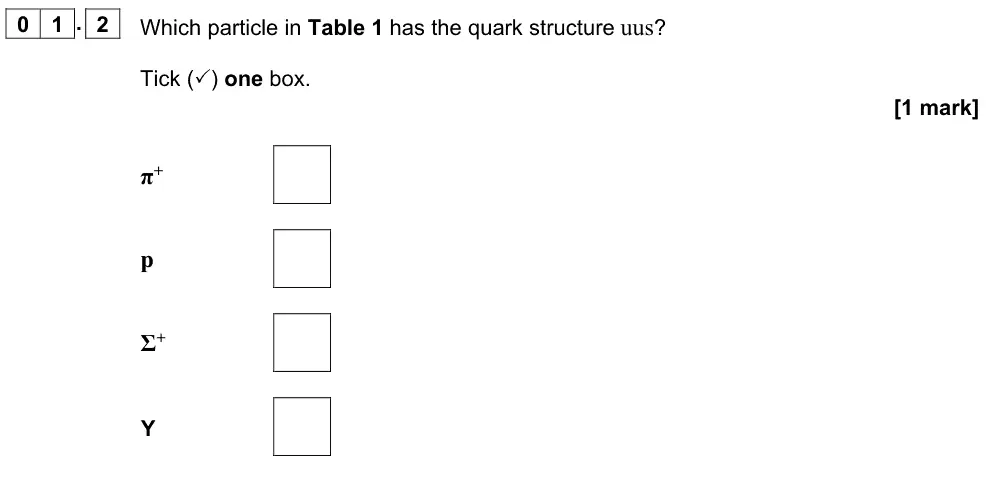
01.2 This was done successfully with over 70% of students able to identify the sigma-plus as the particle with the quark structure uus.
06.1 Over 25% of the students obtained all three marks. Many of these students had labelled Figure 5 with distances and forces and gave clear working that was easy to follow. A common incorrect answer was 1.2 m. This was usually caused by incorrect use of d in the moments equation.
Notes from the mark scheme and report
Sigma+ (third box)
tick-box item
June 2022 · Paper 1 · Q1.22 marksAO2=1, AO3=1Explanation
Earlier part of question 1 that this part uses
Mark scheme
Examiner's comment
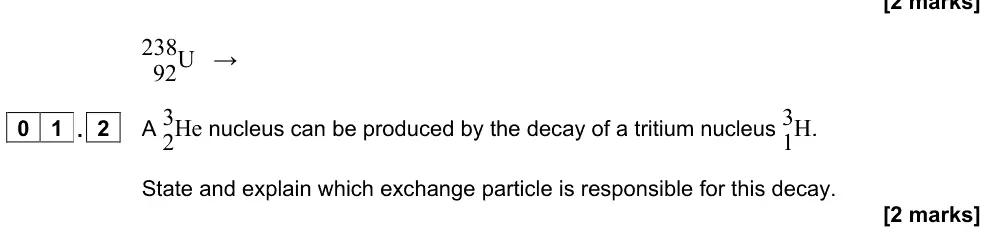
01.2 proved to be much more challenging. Most students were able to access the first mark, but few went on to explain fully why the boson was the W–, often missing out any consideration of the significance of the charge.
Notes from the mark scheme and report
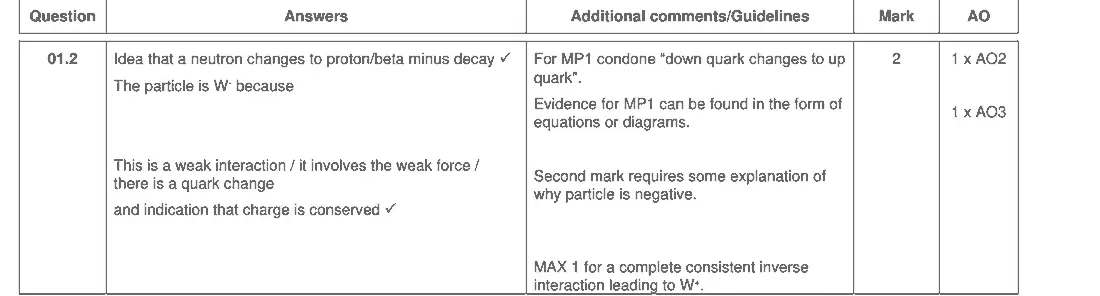
Tritium decay is beta-minus (neutron to proton, d to u), a weak interaction
exchange particle W- because charge must be conserved
the charge reasoning was usually missing
June 2022 · AS Paper 1 · Q1.33 marksAO3=3ExplanationHard
Earlier part of question 1 that this part uses
Mark scheme
Examiner's comment
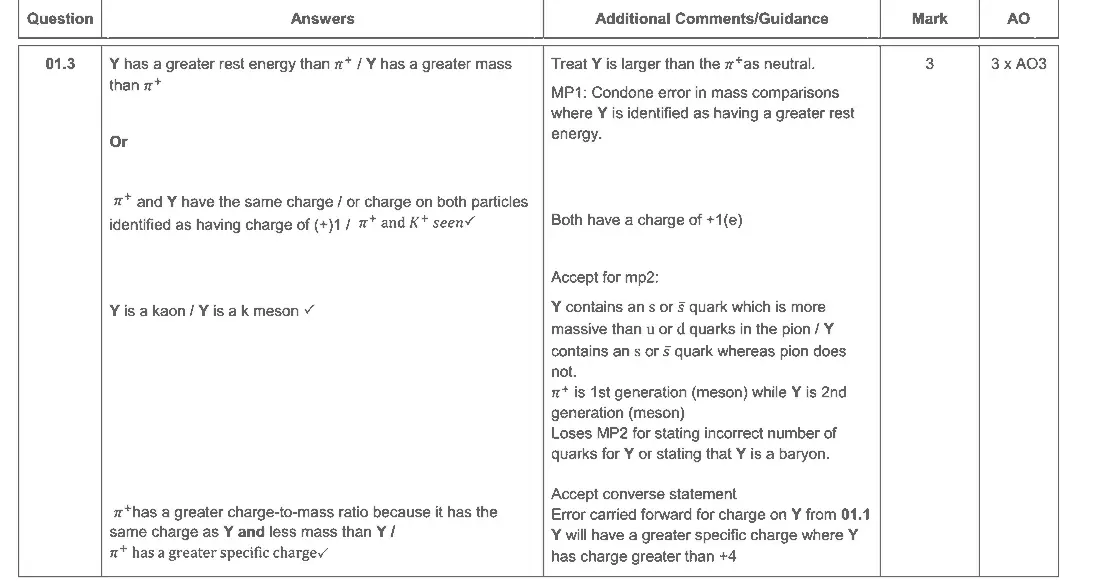
01.3 This question proved challenging for most students. Less than 35% of students gained more well-written account of why the 𝜋𝜋+ had a greater charge-to-mass ratio. Other students typically than one mark. The most able students were able to identify Y as a positive kaon and provide a
𝜋𝜋+ were both mesons but went on to state that they had the same mass. made statements without attempting any supporting explanation. Some students knew that Y and
Students should be aware of the command words in the question, the number of marks, and the size of the answer space as a guide to how much detail is required.
Notes from the mark scheme and report
Y is a K+ (contains a strange quark) so has greater mass/rest energy than pi+ with the same +1 charge, so pi+ has the greater charge-to-mass ratio
saying Y is a baryon loses MP2
June 2022 · Paper 1 · Q2.11 markAO1=1Short answer
Mark scheme
Examiner's comment
02.1 and 02.3 were answered correctly by the vast majority of students.
Most students found 02.2 very challenging. An important aspect of the question was that there was a fixed amount of energy released in the process; this point was often missed. The confusion in many answers demonstrated that few students understood what the graph was telling them.
Notes from the mark scheme and report
Down quark changes to up quark
June 2022 · Paper 1 · Q2.31 markAO1=1Short answer
Earlier part of question 2 that this part uses
Mark scheme
Examiner's comment
02.1 and 02.3 were answered correctly by the vast majority of students.
Notes from the mark scheme and report
Neutron (n, not N or udd)
June 2022 · Paper 1 · Q121 markAO1=1Multiple choice
Answer
B
Mark scheme
Notes from the mark scheme and report
Answer: B
June 2022 · Paper 1 · Q131 markAO2=1Multiple choice
Answer
B
Mark scheme
Notes from the mark scheme and report
Answer: B
June 2022 · AS Paper 2 · Q91 markAO1=1Multiple choice
Answer
C
Mark scheme
Examiner's comment
Generally, students were more successful in answering questions 9, 21, 23 and 30 and less successful in answering 7, 8, 19, 20, 22, 24, 32 and 34.
Notes from the mark scheme and report
Answer: C
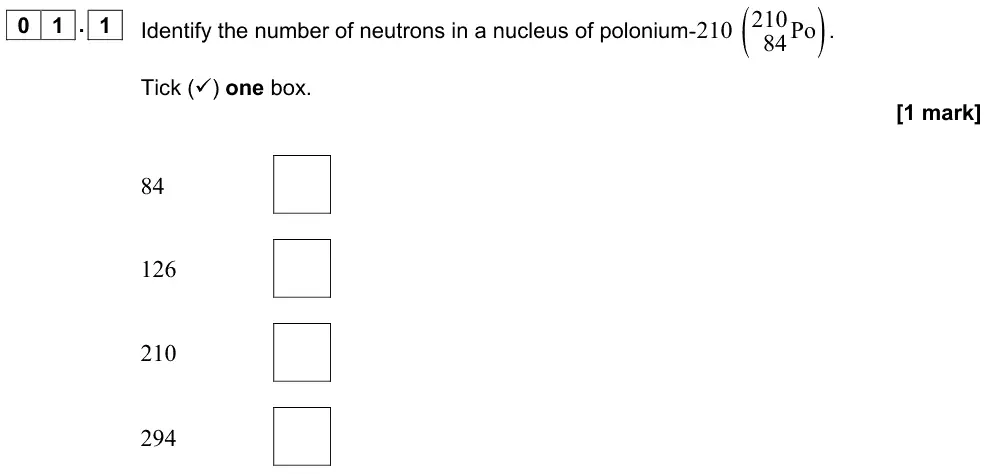
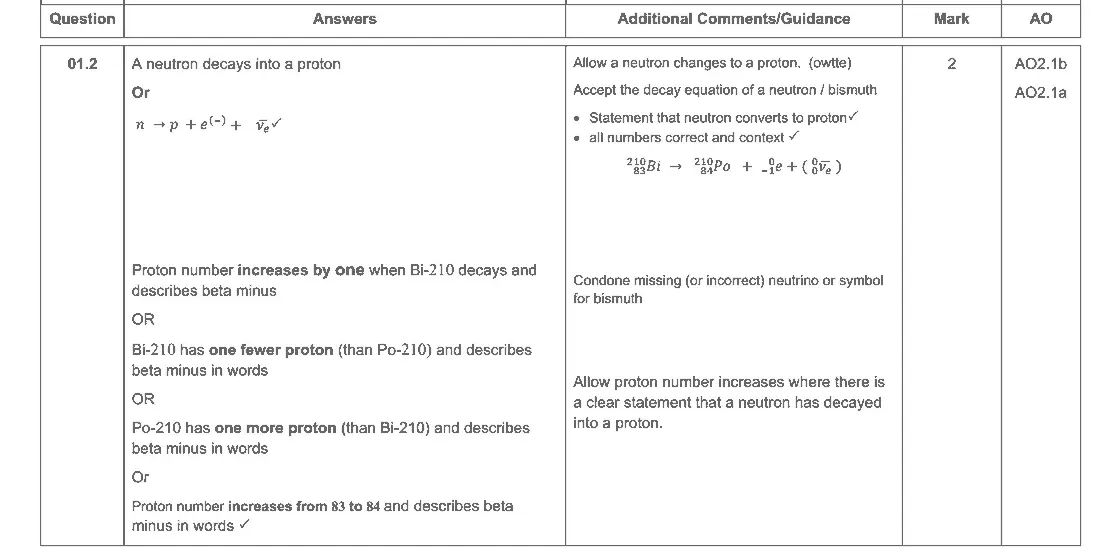
November 2021 · AS Paper 1 · Q1.22 marksAO2=2Explanation
Earlier part of question 1 that this part uses
Mark scheme
Notes from the mark scheme and report
A neutron changes into a proton (plus electron and antineutrino), so proton number rises by one from 83 to 84
November 2021 · Paper 1 · Q1.32 marksAO1=2Explanation
Earlier part of question 1 that this part uses
Mark scheme
Notes from the mark scheme and report
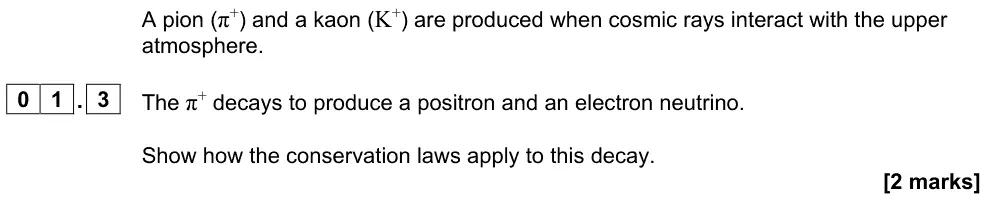
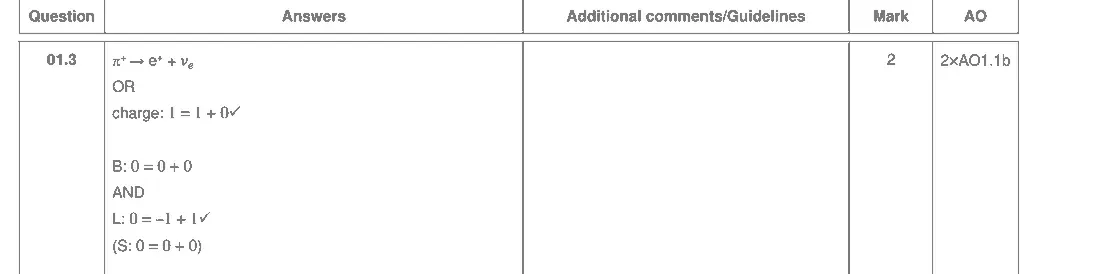
pi+ to e+ + electron neutrino: charge 1 = 1 + 0
baryon number 0 = 0 + 0
lepton number 0 = -1 + 1
conservation laws often unfamiliar
November 2021 · AS Paper 1 · Q1.42 marksExplanation
Earlier part of question 1 that this part uses
Mark scheme
Notes from the mark scheme and report
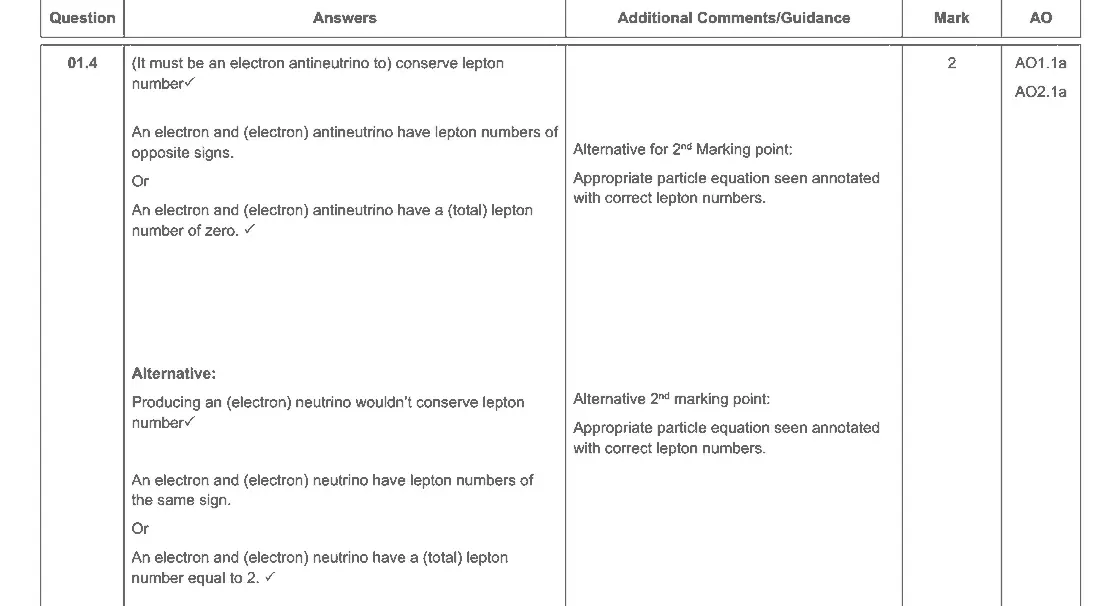
Lepton number conservation: electron L = +1 so an antineutrino (L = -1) is needed for total 0
a neutrino would give total 2
November 2021 · Paper 1 · Q1.42 marksAO1=2Explanation
Earlier part of question 1 that this part uses
Mark scheme
Notes from the mark scheme and report
Strangeness +1 before, 0 after
allowed because it is a weak interaction, where strangeness can change by 0 or plus/minus 1
November 2021 · Paper 1 · Q1.52 marksAO1=2Short answer
Earlier part of question 1 that this part uses
Mark scheme
Notes from the mark scheme and report
e.g. K+ to pi+ + pi0 or K+ to pi+ + pi+ + pi-
must conserve charge, baryon and lepton number
kaon decay to pions was often unknown
November 2021 · Paper 1 · Q91 markMultiple choice
Answer
A
Mark scheme
Notes from the mark scheme and report
Answer: A
November 2021 · Paper 1 · Q111 markMultiple choice
Answer
A
Mark scheme
Notes from the mark scheme and report
Answer: A
November 2021 · Paper 1 · Q121 markMultiple choice
Answer
B
Mark scheme
Notes from the mark scheme and report
Answer: B
November 2021 · AS Paper 2 · Q81 markMultiple choice
Answer
A
Mark scheme
Notes from the mark scheme and report
Answer: A
November 2021 · AS Paper 2 · Q141 markMultiple choice
Answer
C
Mark scheme
Notes from the mark scheme and report
Answer: C
November 2021 · AS Paper 2 · Q351 markMultiple choice
Answer
A
Mark scheme
Notes from the mark scheme and report
Answer: A
November 2020 · AS Paper 1 · Q1.12 marksShort answer
Mark scheme
Notes from the mark scheme and report
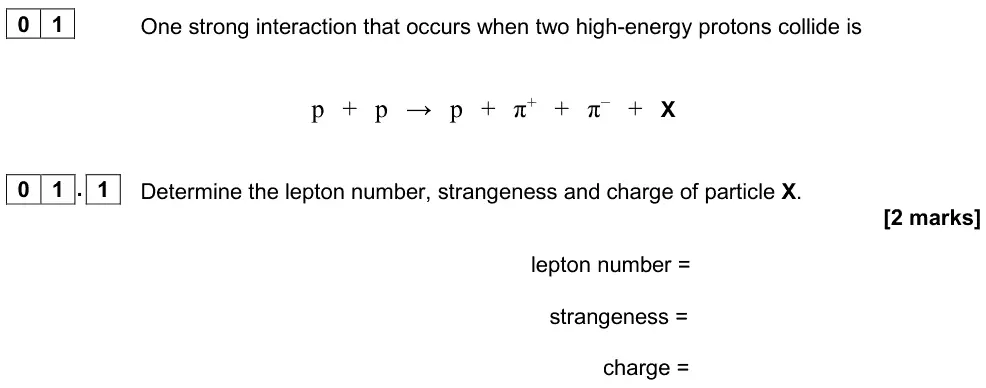
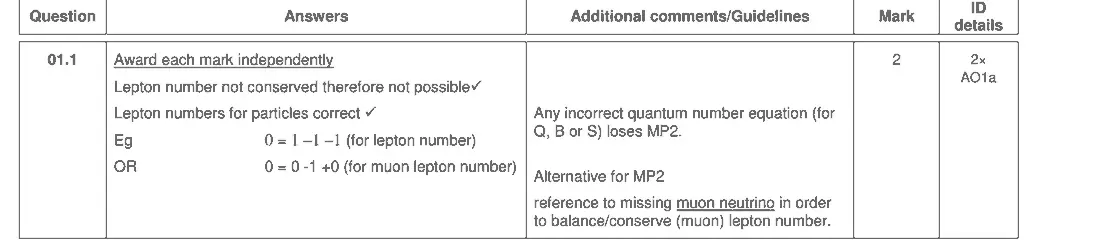
Lepton number 0 and strangeness 0 (one mark), charge +1 (second mark), from conservation in a strong interaction
November 2020 · Paper 1 · Q1.12 marksExplanation
Mark scheme
Examiner's comment
Although some very good work was evident, there was much evidence of carelessness in the answers seen. Common errors included the incorrect value for the lepton number of a positive muon in 01.1, a failure to identify the uncharged nature of the particles in 01.2 and 01.3, and giving incomplete answers. In 01.4 in particular, many students only compared the rest masses of the particles and went no further.
Notes from the mark scheme and report
Not possible: lepton number not conserved (0 = 1 - 1 - 1, or muon lepton number 0 = -1)
wrong lepton number for the positive muon was common
November 2020 · AS Paper 1 · Q1.21 markShort answer
Earlier part of question 1 that this part uses
Mark scheme
Notes from the mark scheme and report
Proton (ecf for any particle consistent with their L, S and Q)
November 2020 · Paper 1 · Q1.21 markShort answer
Earlier part of question 1 that this part uses
Mark scheme
Examiner's comment
Although some very good work was evident, there was much evidence of carelessness in the answers seen. Common errors included the incorrect value for the lepton number of a positive muon in 01.1, a failure to identify the uncharged nature of the particles in 01.2 and 01.3, and giving incomplete answers. In 01.4 in particular, many students only compared the rest masses of the particles and went no further.
Notes from the mark scheme and report
Up anti-up and down anti-down
no capital letters
the neutral charge was often missed
November 2020 · AS Paper 1 · Q1.31 markShort answer
Earlier part of question 1 that this part uses
Mark scheme
Notes from the mark scheme and report
Electron antineutrino (first box)
lepton number conservation
tick-box item
November 2020 · Paper 1 · Q1.32 marksExplanation
Earlier part of question 1 that this part uses
Mark scheme
Examiner's comment
Although some very good work was evident, there was much evidence of carelessness in the answers seen. Common errors included the incorrect value for the lepton number of a positive muon in 01.1, a failure to identify the uncharged nature of the particles in 01.2 and 01.3, and giving incomplete answers. In 01.4 in particular, many students only compared the rest masses of the particles and went no further.
Notes from the mark scheme and report
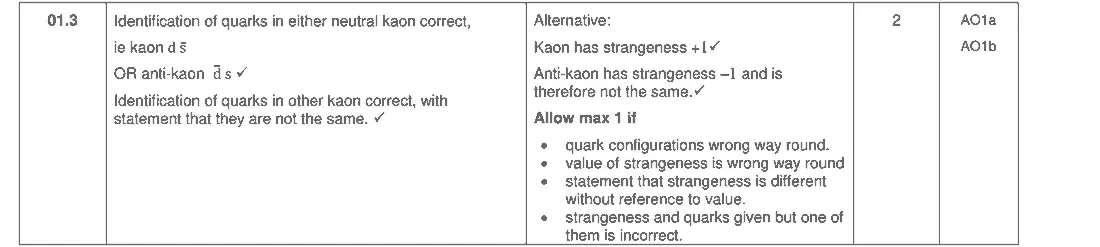
Not the same: K0 is d anti-s (strangeness +1), anti-kaon is anti-d s (strangeness -1)
values must be the right way round
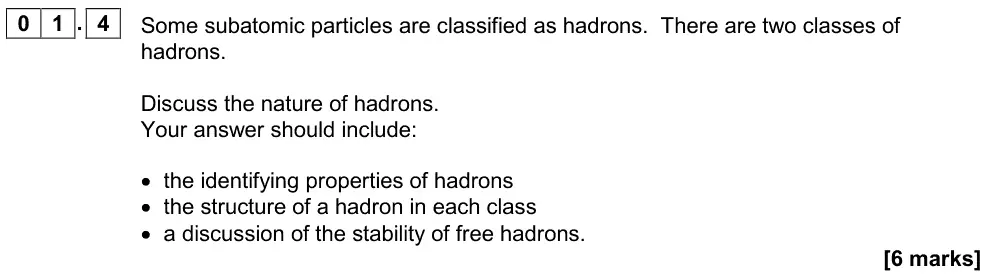
November 2020 · AS Paper 1 · Q1.46 marks6-mark extended response
Earlier part of question 1 that this part uses
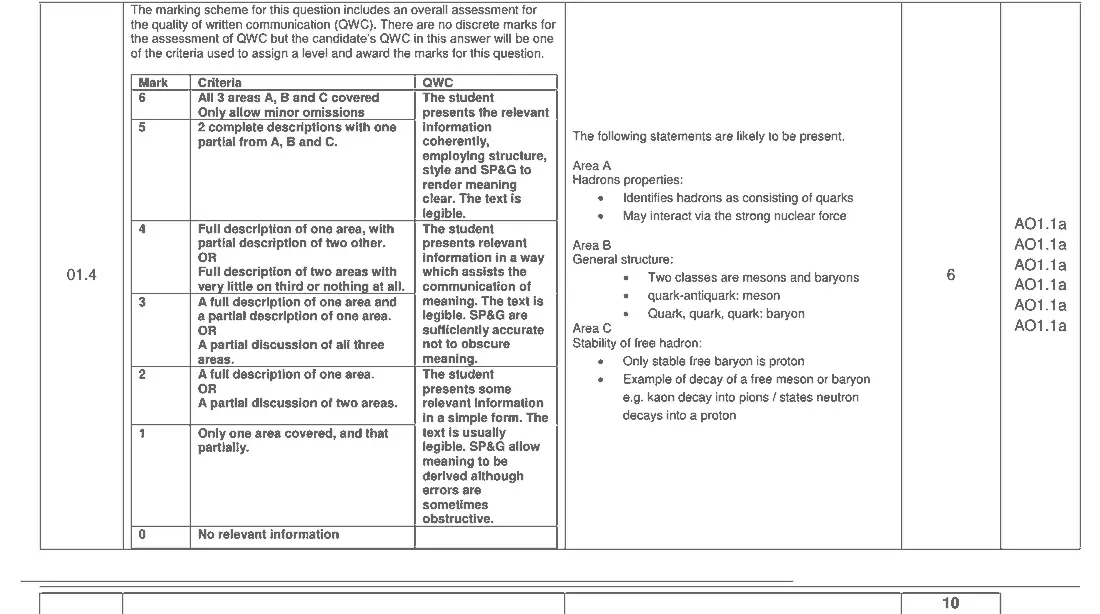
Mark scheme, with the levels and indicative content
Notes from the mark scheme and report
Levels of response, three areas: hadrons made of quarks and feel the strong interaction
baryons qqq, mesons quark-antiquark
proton the only stable free baryon, free neutron decays to proton, kaons decay to pions
November 2020 · Paper 1 · Q1.44 marksExplanation
Earlier part of question 1 that this part uses
Mark scheme
Examiner's comment
Although some very good work was evident, there was much evidence of carelessness in the answers seen. Common errors included the incorrect value for the lepton number of a positive muon in 01.1, a failure to identify the uncharged nature of the particles in 01.2 and 01.3, and giving incomplete answers. In 01.4 in particular, many students only compared the rest masses of the particles and went no further.
Notes from the mark scheme and report
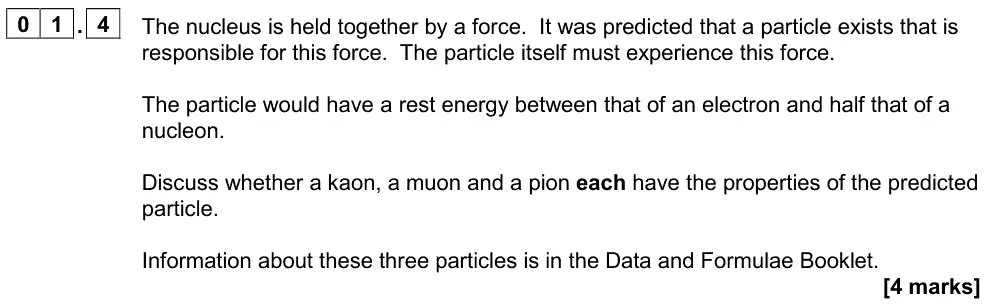
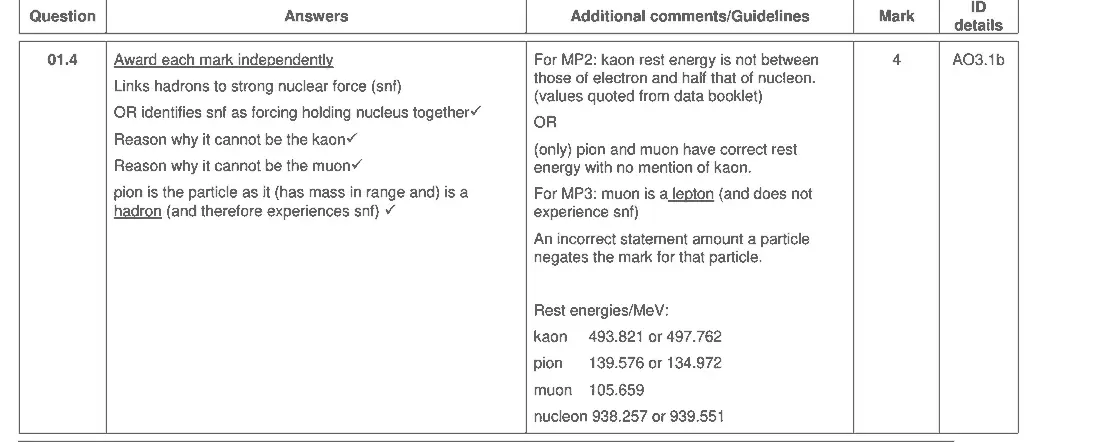
Strong nuclear force holds the nucleus, so particle must be a hadron
kaon rest energy (494 MeV) above half a nucleon
muon is a lepton
pion (135-140 MeV) is a hadron in range
many only compared rest masses
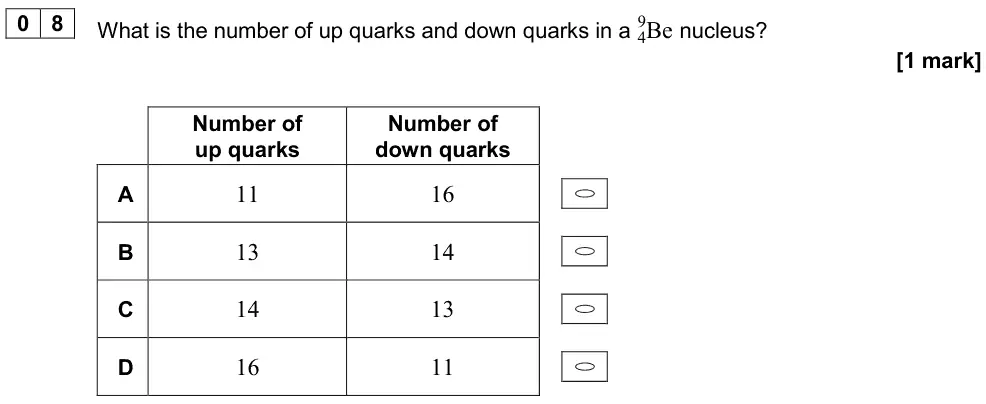
November 2020 · AS Paper 2 · Q81 markMultiple choice
Answer
B
Mark scheme
Notes from the mark scheme and report
Answer: B
13 up, 14 down
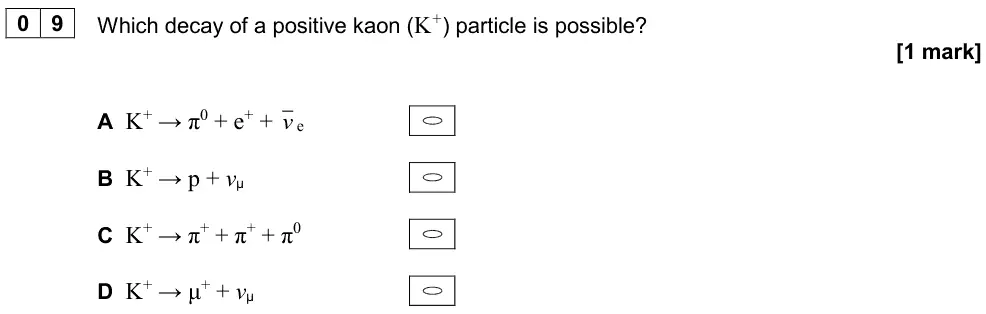
November 2020 · AS Paper 2 · Q91 markMultiple choice
Answer
D
Mark scheme
Notes from the mark scheme and report
Answer: D
June 2019 · AS Paper 1 · Q1.21 markShort answer
Earlier part of question 1 that this part uses
Mark scheme
Examiner's comment
01.2 About 55% of the cohort selected the correct response.
Notes from the mark scheme and report
Pion
tick-box item (muon, photon, pion, W+ boson)
June 2019 · AS Paper 2 · Q3.12 marksExplanation
Mark scheme
Examiner's comment
3.1 Almost half of students achieved both marks. However, over 30% scored zero. Students gaining 1 mark did so by correctly identifying this proton–neutron conversion. Students gaining more than 1 went on to describe correctly how the quark character changed. Students scoring zero usually thought that a neutron converted to a proton in beta-plus decay.
Notes from the mark scheme and report
Proton changes to neutron (N up by one, Z down by one) because an up quark changes to a down quark
many reversed it as in beta-minus
June 2019 · AS Paper 2 · Q81 markMultiple choice
Answer
B
Mark scheme
Notes from the mark scheme and report
Answer: B
June 2019 · AS Paper 2 · Q91 markMultiple choice
Answer
B
Mark scheme
Notes from the mark scheme and report
Answer: B
June 2019 · AS Paper 2 · Q101 markMultiple choice
Answer
D
Mark scheme
Notes from the mark scheme and report
Answer: D
June 2019 · Paper 2 · Q301 markMultiple choice
Answer
B
Notes from the mark scheme and report
Answer: B
June 2018 · AS Paper 1 · Q1.13 marksExplanation
Mark scheme
Examiner's comment
01.1 This required a description of the strong interaction and it was well answered, with just under half of students gaining all three marks. Most students appreciated the type of interaction involved and were able to provide correct properties. The range of repulsion and attraction of the interaction seemed to be well understood.
Notes from the mark scheme and report
Strong interaction named (wrong interaction scores zero)
short range, attractive to about 3-5 fm, repulsive below about 0.5-1 fm, acts only on hadrons, pion/gluon exchange
just under half got all three
June 2018 · AS Paper 1 · Q1.23 marksExplanationHard
Earlier part of question 1 that this part uses
Mark scheme
Examiner's comment
01.2 This question proved to be more challenging; only 11.3% of students gained maximum marks here. This was mainly due to poor structuring of answers so it was not clear how baryon number was being conserved in these decays. Many students concentrated on the baryon number of the alpha particle without referring to the baryon numbers of the nuclei involved. With beta decay it was common to see responses that showed how the baryon number had not changed as a neutron changed to a proton. It was, however, less common to see a discussion of the other particles involved and why, because they were leptons, they did not affect baryon number.
Notes from the mark scheme and report
Alpha: total nucleons of daughter plus alpha equals parent
beta: neutron becomes proton (both B = 1), electron and antineutrino are leptons with B = 0
many only discussed the alpha particle's baryon number
June 2018 · AS Paper 1 · Q1.32 marksShort answer
Earlier part of question 1 that this part uses
Mark scheme
Examiner's comment
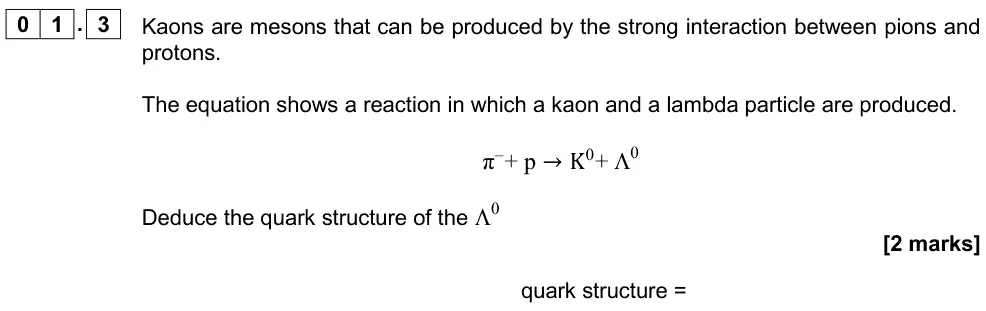
01.3 There was reasonably good discrimination in this question. Over half of the students were able to provide a correct quark structure for one of the particles involved but only the best students were able to deduce the correct quark structure of the lambda particle.
Notes from the mark scheme and report
Answer: uds (pi- = u-bar d, p = uud, K0 = d s-bar
quarks conserved in a strong interaction)
only the best deduced the lambda
June 2018 · AS Paper 1 · Q1.41 markShort answer
Earlier part of question 1 that this part uses
Mark scheme
Examiner's comment
01.4 This question was well answered with many students (53.7%) appreciating that strangeness was not conserved.
Notes from the mark scheme and report
Strangeness not conserved (changes by 1)
June 2018 · AS Paper 1 · Q1.52 marksShort answerHard
Earlier part of question 1 that this part uses
Mark scheme
Examiner's comment
01.5 Over half of the students managed to come up with a reason for many teams being beneficial. However, only a few students (5.1%) were able to come up with more than one reason.
Notes from the mark scheme and report
Two from: results independently checked/validated, accelerators very expensive so costs shared, many skills needed
most gave only one reason
June 2018 · Paper 1 · Q111 markMultiple choice
Answer
A
Notes from the mark scheme and report
Answer: A
June 2018 · Paper 1 · Q121 markMultiple choiceEasy
Answer
B
Examiner's comment
The 25 questions in Section B are summarised in the table below. For each question, the key (correct answer) is provided, along with the percentage of students answering correctly. There was a good range of ‘facility’ across this section; the most accessible questions were 12 and 18 (both answered correctly by 89.2% of students), the least accessible was 20 (answered correctly by only 38.1% of students). The overall mean mark achieved by the students for Section B was 15.7 out of 25 (62.8%).
Notes from the mark scheme and report
Answer: B
June 2018 · AS Paper 2 · Q81 markMultiple choice
Answer
C
Notes from the mark scheme and report
Answer: C
June 2017 · AS Paper 1 · Q1.11 markShort answerEasy
Mark scheme
Examiner's comment
01.1 This was the most accessible question on the paper, with over 90% of students providing the correct answer.
Notes from the mark scheme and report
Neutron (udd)
June 2017 · Paper 1 · Q1.22 marksExplanation
Earlier part of question 1 that this part uses
Mark scheme
Notes from the mark scheme and report
Weak interaction, because leptons and hadrons are involved or quark flavour changes (up to down)
June 2017 · AS Paper 1 · Q1.42 marksShort answer
Earlier part of question 1 that this part uses
Mark scheme
Examiner's comment
01.4 This question proved to be more challenging with approximately half of the students only receiving one mark for failing to express their answers in terms of quarks. Other common errors included missing out the baryon number of the leptons (0) or the zero charge on the antineutrino. A surprisingly large number of students tried to answer using extended writing rather than using an equation approach such as the one provided in the mark scheme.
Notes from the mark scheme and report
Charge: 2/3 - 1/3 - 1/3 = 2/3 - 1/3 + 2/3 - 1 + 0
baryon number: 1/3 x 3 = 1/3 x 3 + 0 + 0
quark values needed (n and p only gets 1)
antineutrino zero charge and lepton baryon number 0 often omitted
June 2017 · AS Paper 1 · Q1.51 markShort answer
Earlier part of question 1 that this part uses
Mark scheme
Examiner's comment
01.5 This straightforward piece of recall was provided by a large majority of students. There was no particular incorrect answer.
Notes from the mark scheme and report
Proton
June 2017 · AS Paper 1 · Q1.61 markShort answer
Earlier part of question 1 that this part uses
Mark scheme
Examiner's comment
01.6 In this question students needed to provide a lot of information for the single mark available. Unsurprisingly, perhaps, this was one of the least accessible questions on the paper. Few students attempted to provide a reasoned answer based on conservation of electron and muon lepton numbers, i.e. conservation of muon lepton number requires a muon neutrino to be produced; conservation of charge suggests an electron is also produced; and conservation of electron lepton number requires the production of an electron antineutrino.
Notes from the mark scheme and report
Electron, electron antineutrino and muon neutrino (all three, names not symbols)
one of the least accessible
June 2017 · AS Paper 2 · Q61 markMultiple choice
Answer
A
Notes from the mark scheme and report
Answer: A
June 2017 · AS Paper 2 · Q131 markMultiple choice
Answer
A
Notes from the mark scheme and report
Answer: A
June 2016 · AS Paper 1 · Q6.22 marksExplanation
Earlier part of question 6 that this part uses
Mark scheme
Examiner's comment
In this question students were required to extract information from an introductory passage. Question 6.1 was a straightforward starter but as with 3.1 a significant proportion of answers were spoilt by a lack of precision. Students were required to mention atoms or nuclei in their responses and a significant proportion did not do this. Question 6.2 required an explanation as to why two photons were produced. A number of students seemed to think this was necessary due to energy conservation. Of those who realised this was due to momentum conservation, a significant proportion then failed to appreciate the importance of the photons travelling in different directions. Question 6.3 was an extended calculation and students were told to calculate the maximum frequency of the photons produced in the annihilation of the two nuclei. Maximum was necessary to indicate that the whole rest energy of the nuclei should be used and excluded the possibility of calculating the frequency of photons produced due to annihilation of individual nucleons within the helium and anti-helium nuclei. It is true that higher frequency photons would be produced if the nuclei had significant kinetic energy but students were told to use information from the passage in which there was no mention of kinetic energy. For full marks students needed to explain how they dealt with two nuclei annihilating and two photons being produced. Questions 6.4 and 6.5 were well answered and the only common error was a failure to identify the positron correctly in the equation.
Notes from the mark scheme and report
Momentum must be conserved (initial momentum about zero), so two photons travelling in opposite directions
energy-conservation arguments not enough
June 2016 · AS Paper 2 · Q71 markMultiple choiceEasy
Answer
B
Examiner's comment
7 With 87% of students choosing the correct answer, few students had any difficulty with this question. The remaining answers were fairly evenly spread between the three distractors.
Notes from the mark scheme and report
Answer: B
June 2016 · AS Paper 2 · Q81 markMultiple choiceEasy
Answer
D
Examiner's comment
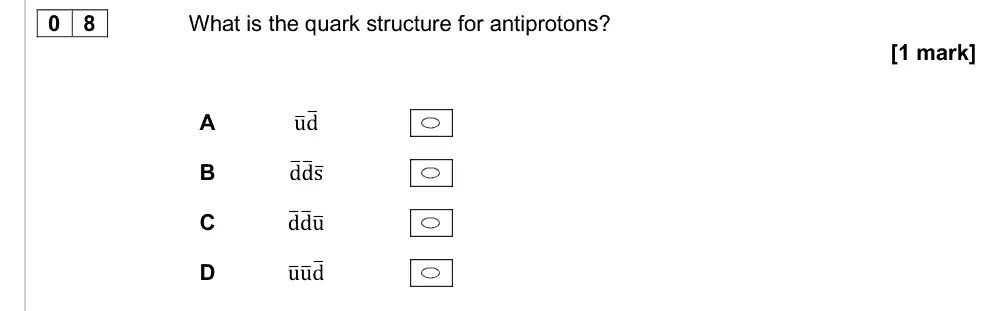
8 This was the most accessible question on the paper with 95% of students able to recall the quark structure of an antiproton. C was the most popular distractor, chosen by students confusing protons and neutrons perhaps.
Notes from the mark scheme and report
Answer: D
C (neutron confusion) the main distractor
June 2016 · AS Paper 2 · Q91 markMultiple choice
Examiner's comment
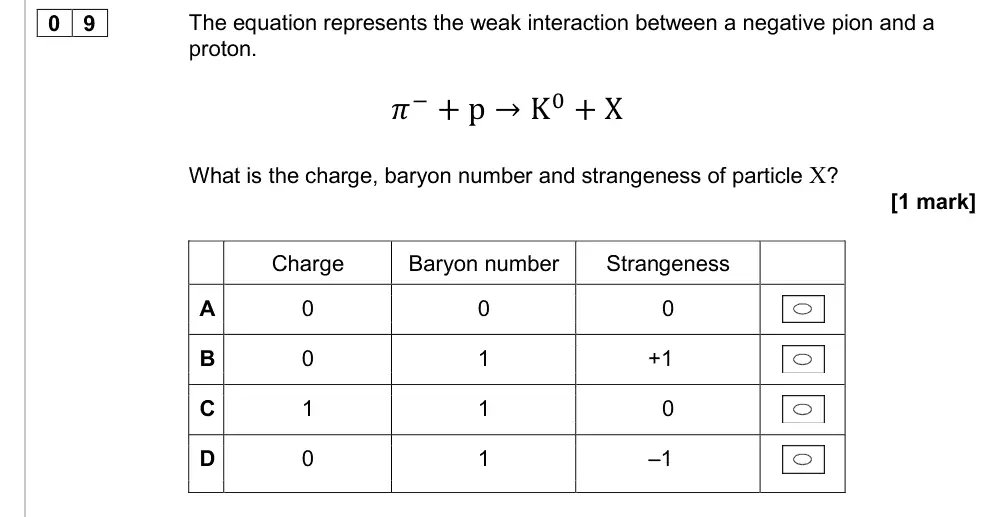
This section consisted of 30 multiple choice questions covering all of the topics in the AS specification. A problem associated with question 9 meant that this question was withdrawn. There was some evidence to suggest that some students were unfamiliar with this form of assessment and that they would have benefitted from more practice. In particular students should be made aware that they can write on the paper to perform any necessary calculations and that, when the correct answer isn’t obvious, eliminating incorrect answers increases the likelihood of a guess being correct. Given that there is no negative marking (ie no penalty for incorrect answers), it was surprising to see some of the answers left blank. Many students did not use the correct method to mark, or correct, their answer as laid out at the beginning of the section. Whilst benefit of the doubt was given to many of these answers on this occasion, students should be made aware that they increase the likelihood of their intentions being understood if they follow the instructions in the paper. This includes the clear instruction that only one answer per question is allowed: any indication of more than one answer being provided immediately lost the mark.
Notes from the mark scheme and report
Not sat: withdrawn by a notice to invigilators
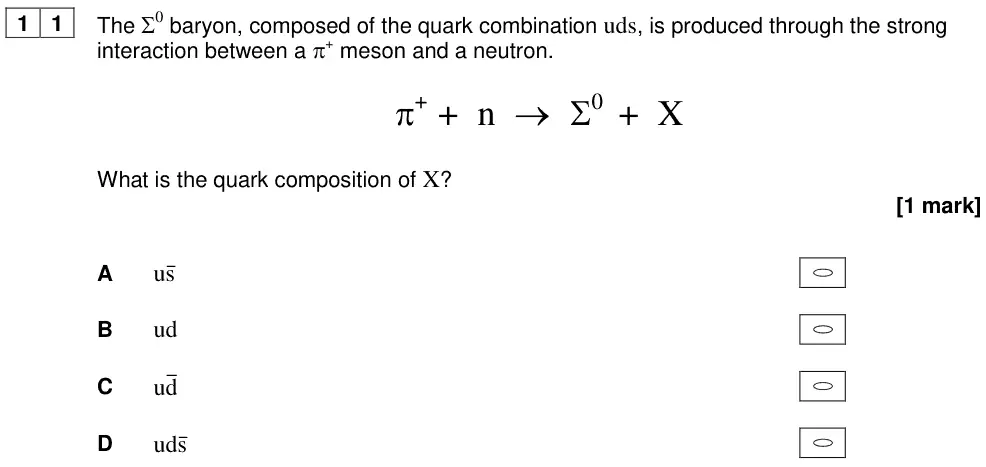
no key in the mark scheme. Weak interaction pi- + p to K0 + X: charge 0, baryon number 1
strangeness can change by 1 in a weak interaction
Work with an AQA physics tutor
Dropping marks on calculations, required practicals or the six-markers? Book a trial session with a specialist AQA physics tutor.