Notes and key-term cards for this topic are being written by our tutors. The past-paper questions below are ready now.
Specification statements
Show the 25 statements from the specification
3.9.2.1-01 Apparent magnitude, m.
3.9.2.1-02 The Hipparcos scale.
3.9.2.1-03 Dimmest visible stars have a magnitude of 6.
3.9.2.1-04 Relation between brightness and apparent magnitude. Difference of 1 on magnitude scale is equal to an intensity ratio of 2.51.
3.9.2.1-05 Brightness is a subjective scale of measurement.
3.9.2.2-01 Parsec and light year.
3.9.2.2-02 Definition of M , relation to m: m – M = 5 log d 10
3.9.2.3-01 Stefan’s law and Wien’s displacement law.
3.9.2.3-02 General shape of black-body curves, use of Wien’s displacement law to estimate black-body temperature of sources.
3.9.2.3-03 Experimental verification is not required. λmaxT = constant = 2.9 × 10 −3 m K
3.9.2.3-04 Assumption that a star is a black body.
3.9.2.3-05 Inverse square law, assumptions in its application.
3.9.2.3-06 Use of Stefan’s law to compare the power output, temperature and size of stars P = σAT 4
3.9.2.4-01 Description of the main classes: Spectral Intrinsic Temperature / K Prominent absorption lines class colour O blue 25 000 – 50 000 He+, He, H B blue 11 000 – 25 000 He, H A blue-white 7 500 – 11 000 H (strongest) ionized metals F white 6 000 – 7 500 ionized metals G yellow-white 5 000 – 6 000 ionized & neutral metals K orange 3 500 – 5 000 neutral metals M red < 3 500 neutral atoms, TiO Temperature related to absorption spectra limited to Hydrogen Balmer absorption lines: requirement for atoms in an n = 2 state.
3.9.2.5-01 General shape: main sequence, dwarfs and giants.
3.9.2.5-02 Axis scales range from –10 to +15 (absolute magnitude) and 50 000 K to 2 500 K (temperature) or OBAFGKM (spectral class).
3.9.2.5-03 Students should be familiar with the position of the Sun on the HR diagram.
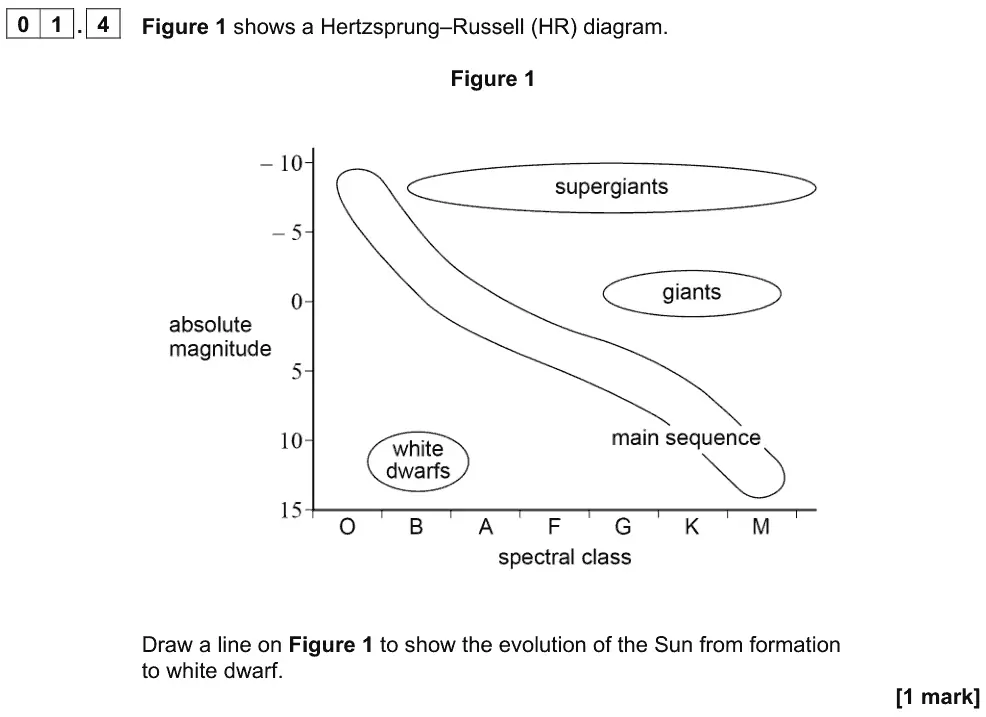
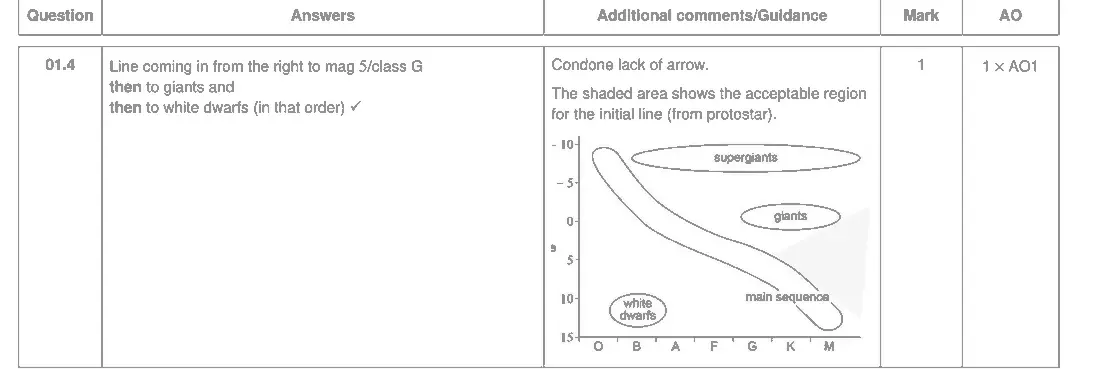
3.9.2.5-04 Stellar evolution: path of a star similar to our Sun on the HR diagram from formation to white dwarf.
3.9.2.6-01 Defining properties: rapid increase in absolute magnitude of supernovae; composition and density of neutron stars; escape velocity > c for black holes.
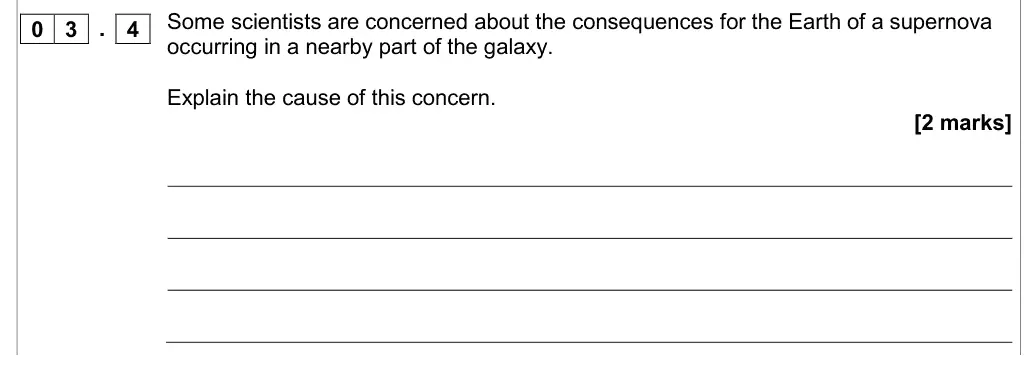
3.9.2.6-02 Gamma ray bursts due to the collapse of supergiant stars to form neutron stars or black holes.
3.9.2.6-03 Comparison of energy output with total energy output of the Sun.
3.9.2.6-04 Use of type 1a supernovae as standard candles to determine distances. Controversy concerning accelerating Universe and dark energy.
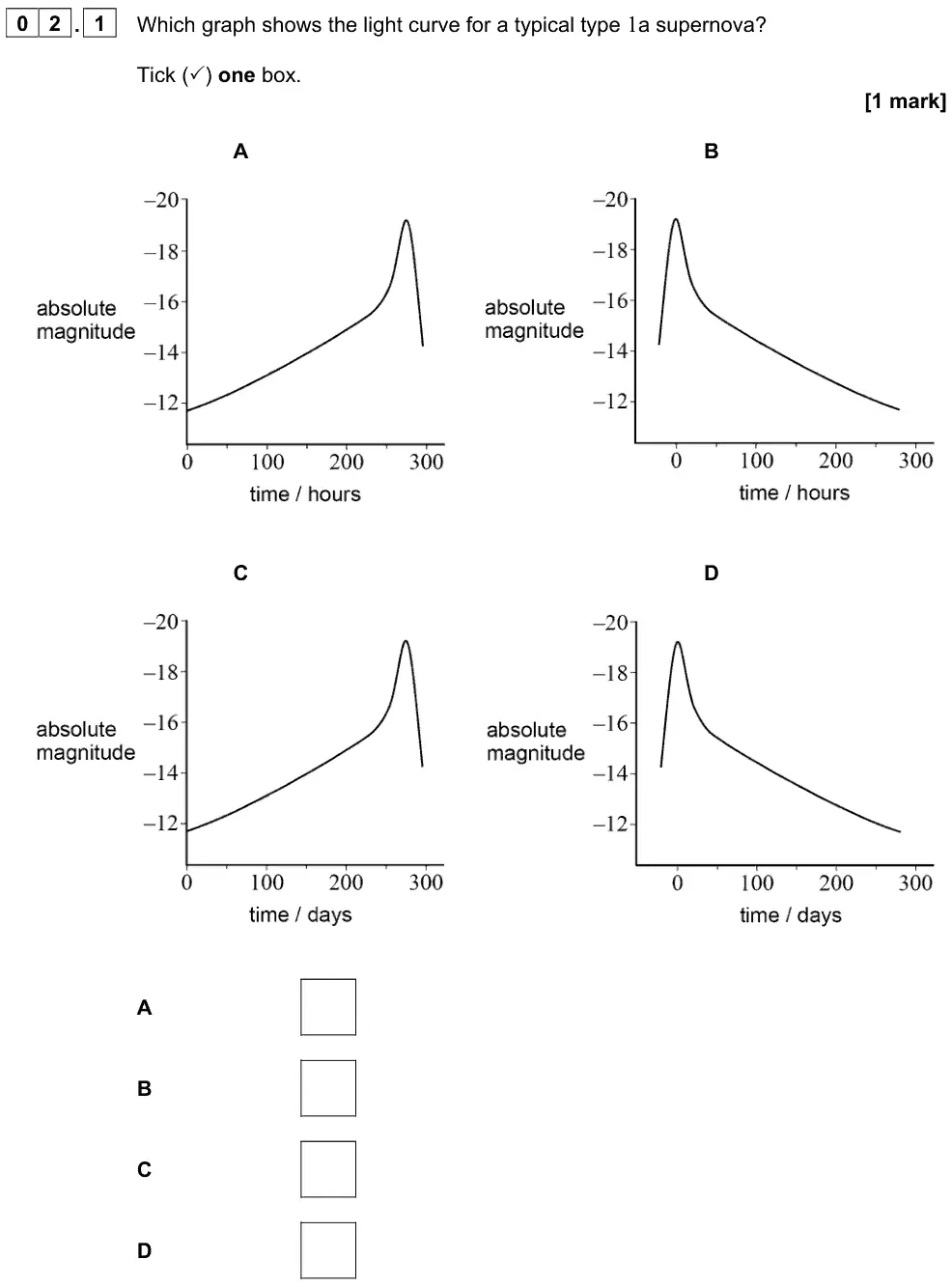
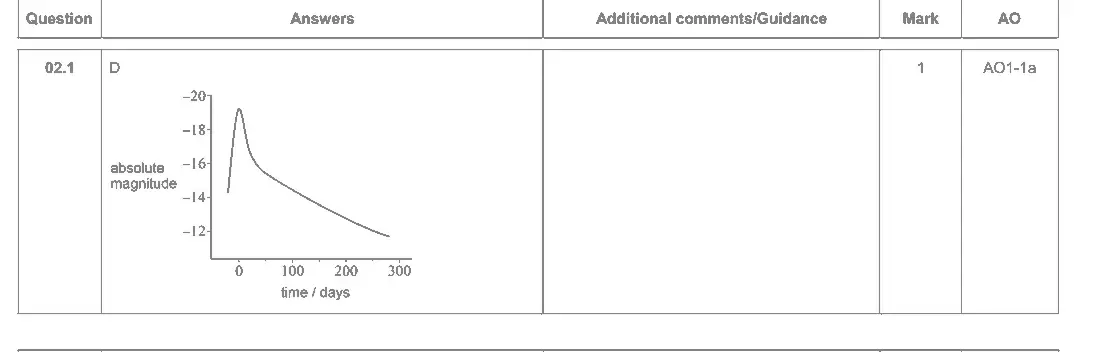
3.9.2.6-05 Students should be familiar with the light curve of typical type 1a supernovae.
3.9.2.6-06 Supermassive black holes at the centre of galaxies.
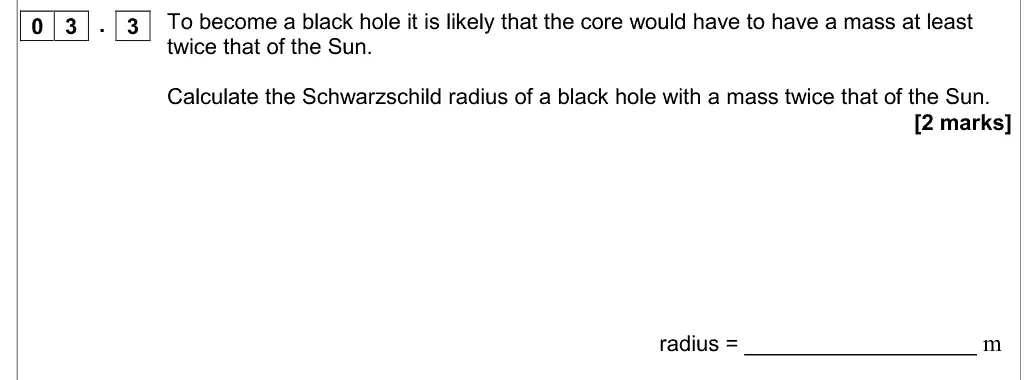
3.9.2.6-07 Calculation of the radius of the event horizon for a black hole, Schwarzschild radius Rs , Rs ≈ 2GM c2
Six-mark extended response questions on this topic
Tap a question to zoom it. Where a part needs a figure, table or graph from earlier in the question, that part folds out above it; the mark scheme and examiner's comment open underneath. Have the AQA data and formulae booklet beside you (see the formula sheet page).
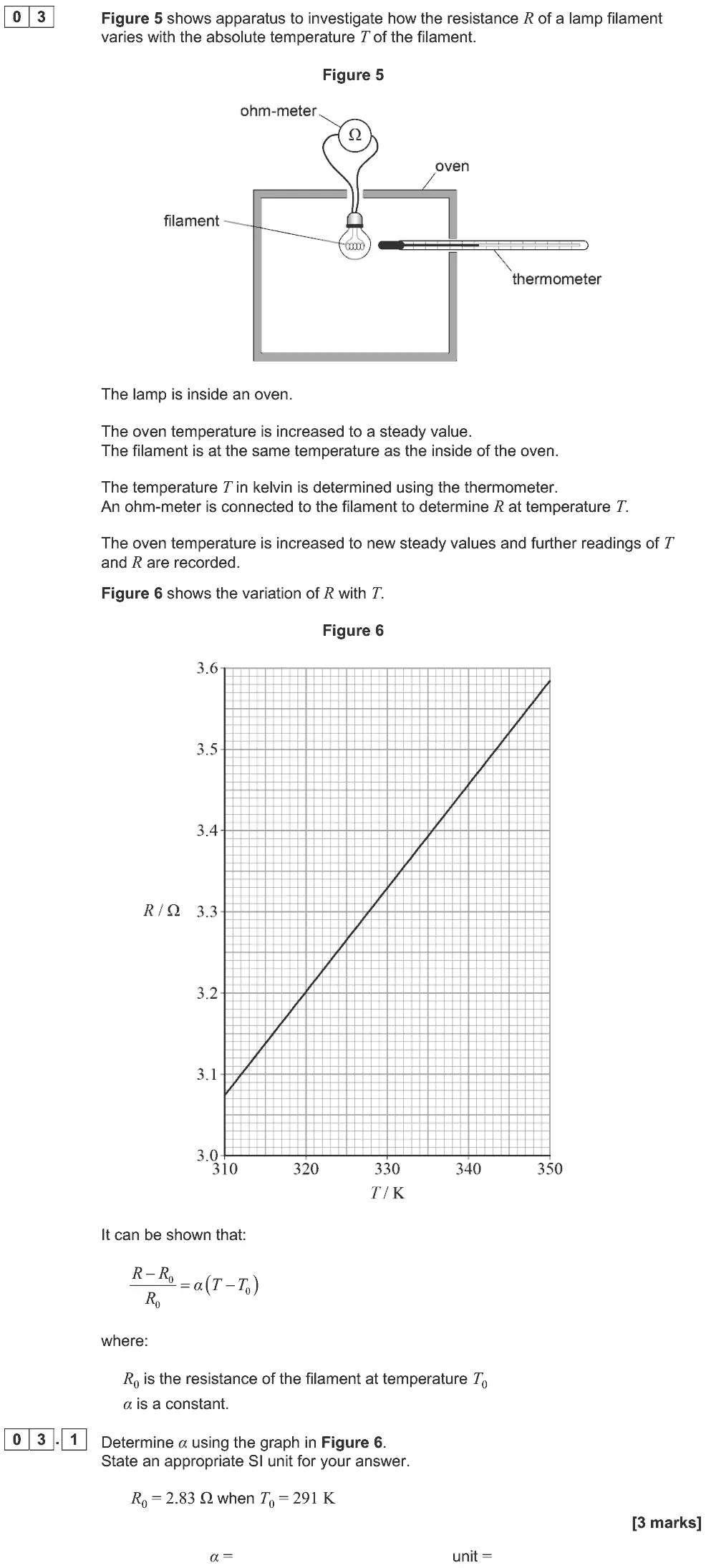
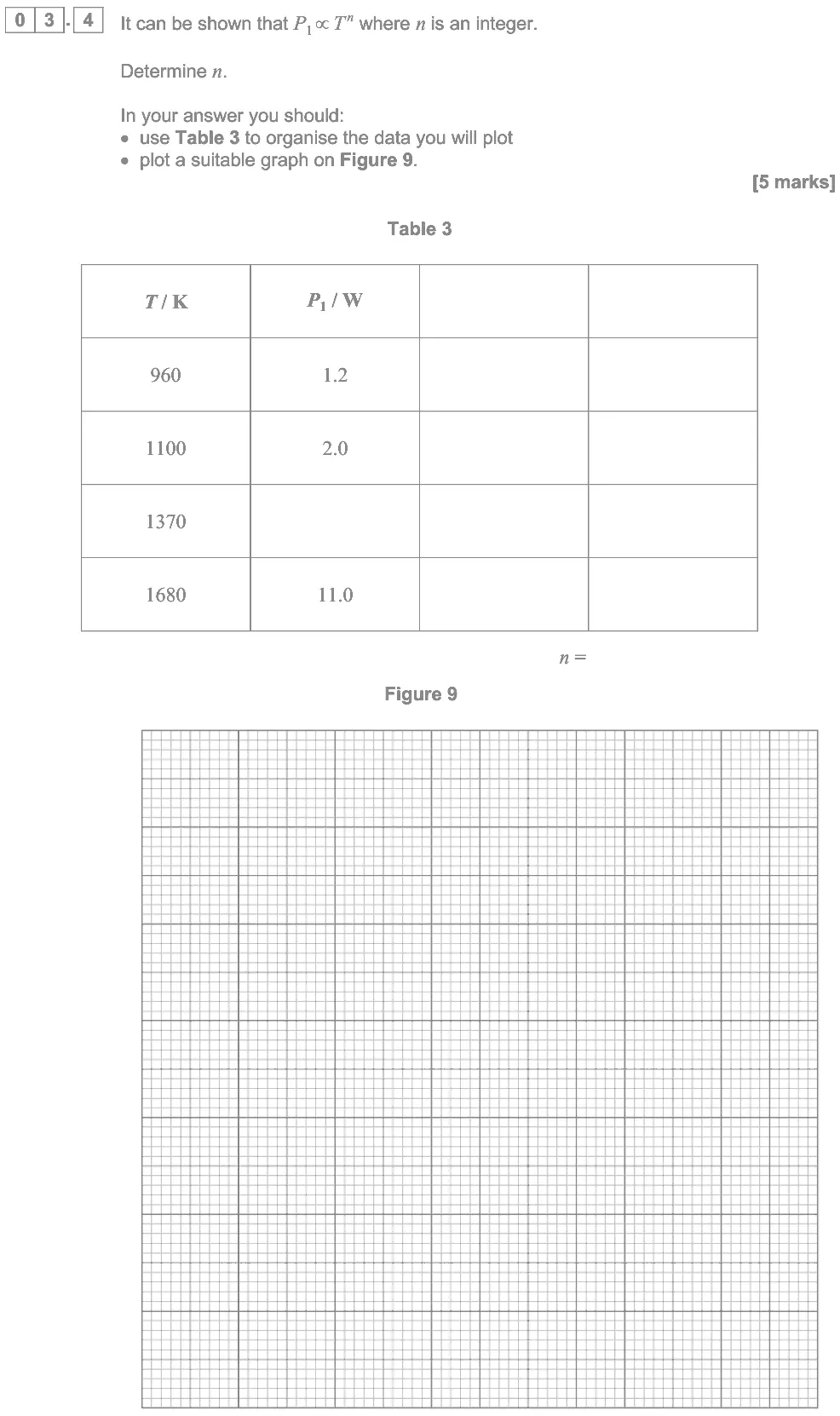
June 2025 · Paper 3 Section A · Q3.45 marksAO1=2, AO2=2, AO3=1Practical and data analysis
Earlier part of question 3 that this part uses
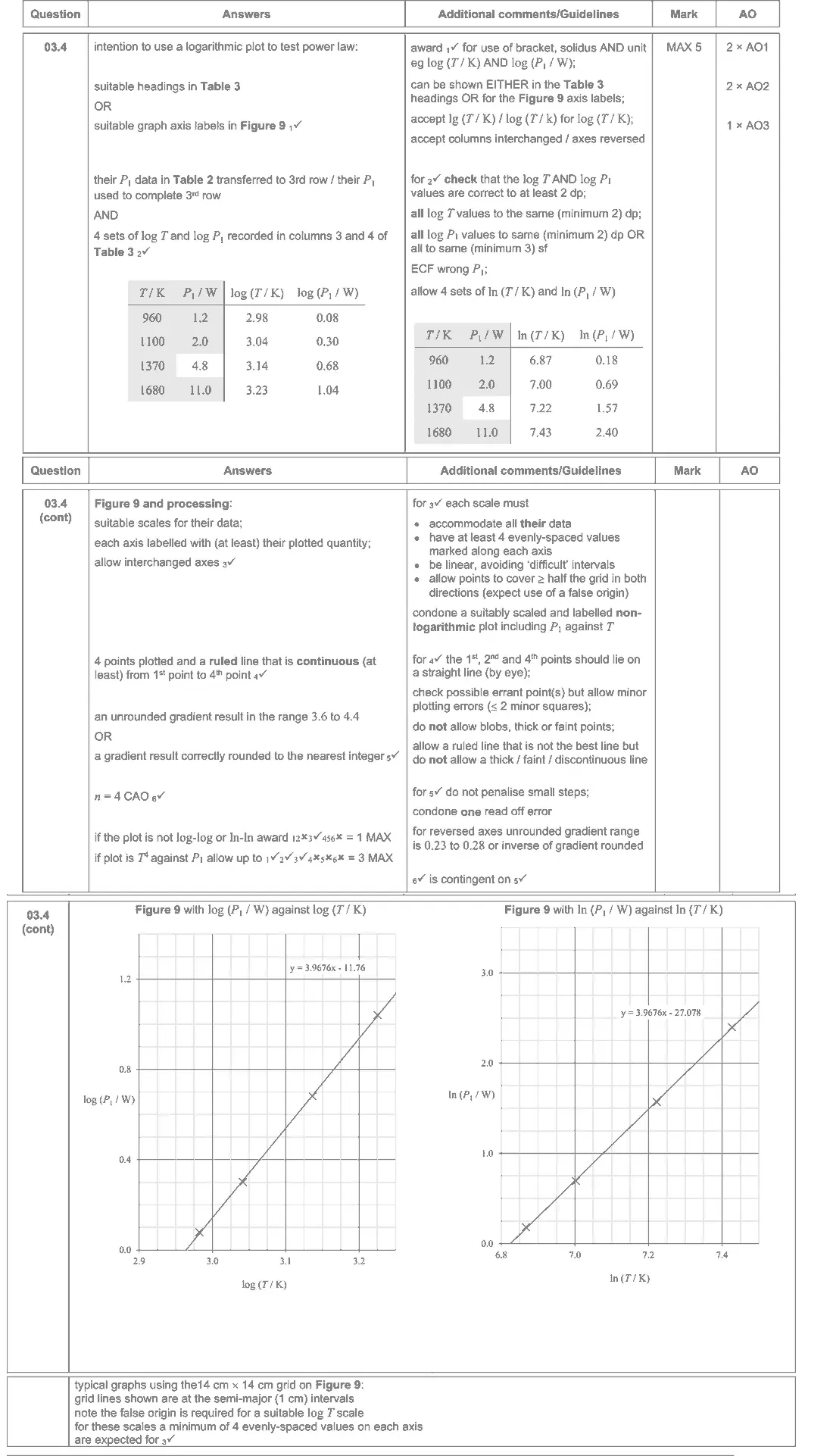
Mark scheme
Examiner's comment
Part 03.4 defeated the less successful students who didn’t understand that they should use a logarithmic plot to identify n. These students usually plotted a graph of P1 against T. Despite producing a valid gradient result, many did not write an integer on the answer line.
We noticed in 2024 that students are often good at deriving the SI units for a quantity, and in part 03.1 many identified the correct unit for α. We saw some examples of excellent work for part 03.4 and most realised that they should produce a logarithmic plot. However, the majority found 03.4 very testing. Very few observed the convention for labelling the axes of the log scales. We expect a (solidus) separator between the quantity and unit. The unit must be shown in the label because it affects the placeholder in the value. Brackets were usually missed; these are required because the log of a value is just a unitless number. but log values are different. Log values should be to the same number of decimal places; the first figure is not significant because it is a placeholder.
Notes from the mark scheme and report
Answer: n = 4 (plot log P1 against log T, gradient about 4)
weaker students plotted P1 against T
answer must be an integer
Skills: MS3.11 Use logarithmic plots to test exponential and power law variations; MS3.2 Plot two variables from experimental or other data; MS3.4 Determine the slope and intercept of a linear graph; PS3.1 Plot and interpret graphs
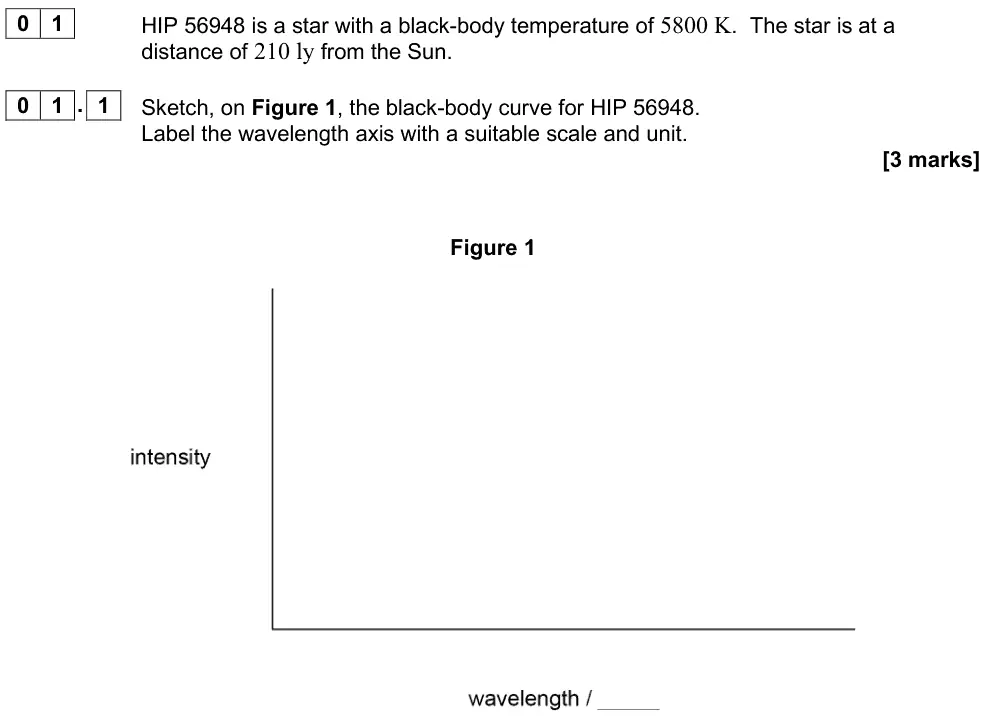
June 2025 · Paper 3B Astrophysics · Q1.13 marksAO1=1, AO2=1, AO3=1Diagram or graph
Mark scheme
Examiner's comment
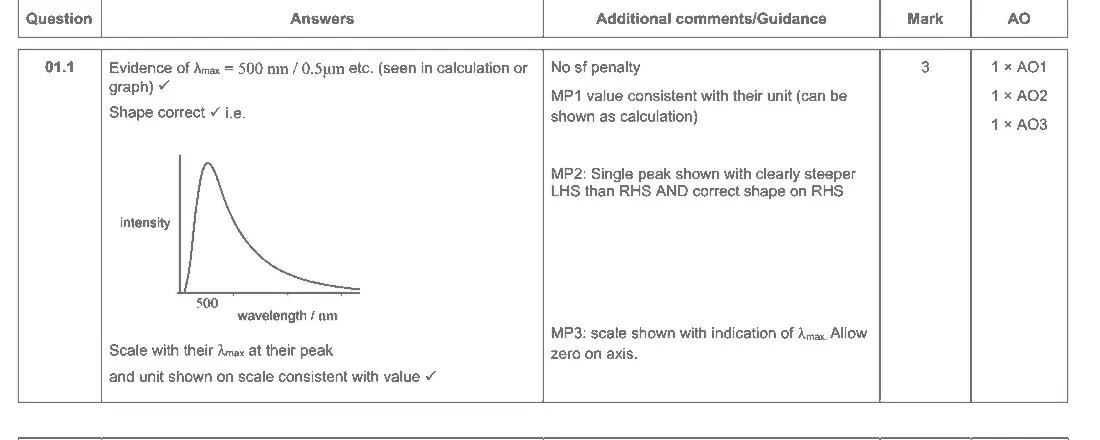
1.1 This question was done quite will with over half of students gaining 2 of the 3 available marks. Many diagrams were too symmetrical to be black-body curves. Marks could be gained as an error carried forward from a miscalculation of their peak, only if their working was shown. Many students did not show any working so missed out on this mark.
Notes from the mark scheme and report
lambda_max = 2.9 x 10^-3/5800 = 500 nm
wavelength scale with unit placing the peak at 500 nm
single peak, steeper on the short-wavelength side
over half gained 2 of 3
Skills: MS3.1 Translate information between graphical, numerical and algebraic forms; MS2.3 Substitute numerical values into algebraic equations using appropriate units for physical quantities
June 2025 · Paper 3B Astrophysics · Q1.21 markAO2=1Short answerHard
Earlier part of question 1 that this part uses
Mark scheme
Examiner's comment
1.2 This question was done poorly with less than 25% of students appreciating that this star was similar to the Sun so would have a similar value of absolute magnitude.
Notes from the mark scheme and report
Answer: about 5 (same size and temperature as the Sun so same power and absolute magnitude)
less than 25% correct
June 2025 · Paper 3B Astrophysics · Q3.31 markAO1=1Short answer
Earlier part of question 3 that this part uses
Mark scheme
Examiner's comment
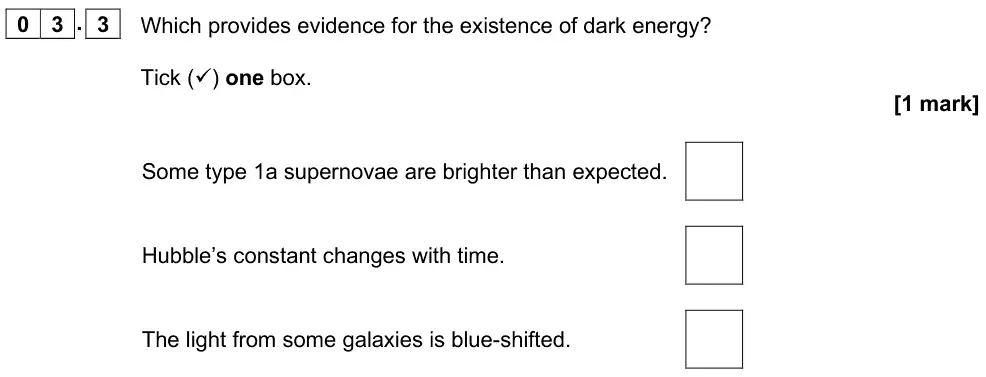
3.3 The most common wrong answer was that Hubble’s constant changes with time. This would be true as the universe ages, and is not necessarily related to its acceleration. The correct answer is based on the idea that the observations of red shift and apparent magnitude suggested that the supernovae had a brighter than expected peak absolute magnitude.
Notes from the mark scheme and report
Answer: some type 1a supernovae are brighter than expected
June 2025 · Paper 3B Astrophysics · Q4.13 marksAO2=3Show that
Mark scheme
Examiner's comment
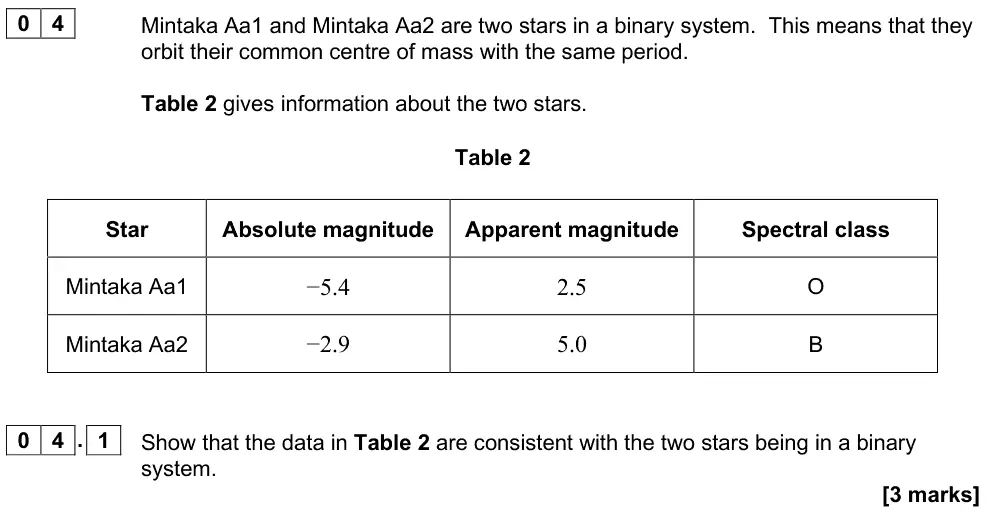
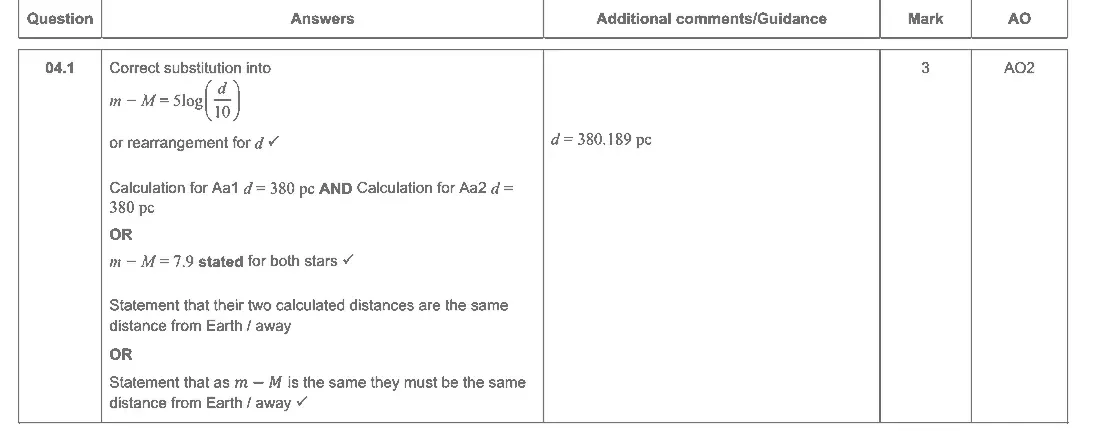
4.1 Almost 60% of students scored full marks on this question. Those who did not generally failed to follow the “show that” command word and simply did some calculations without giving logical steps or a sensible conclusion. Student’s language was often vague so that in their conclusions many calculated the same number and stated that they were “about” the same.
Notes from the mark scheme and report
m - M = 7.9 for both stars, so both d = 380 pc - same distance, consistent with binary
almost 60% full marks
Skills: MS2.5 Use logarithms in relation to quantities that range over several orders of magnitude; MS2.3 Substitute numerical values into algebraic equations using appropriate units for physical quantities
June 2025 · Paper 3B Astrophysics · Q4.21 markAO1=1Short answer
Earlier part of question 4 that this part uses
Mark scheme
Examiner's comment
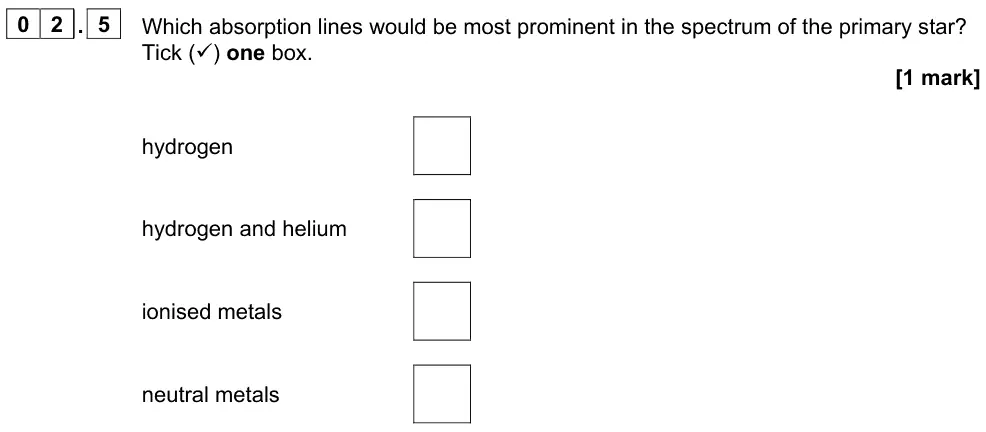
4.2 Students performed relatively poorly on this basic recall question. Often students only included one of the two elements or added in several additional ions.
Notes from the mark scheme and report
Hydrogen and helium (class B)
other elements or ions rejected
June 2025 · Paper 3B Astrophysics · Q4.31 markAO1=1Short answer
Earlier part of question 4 that this part uses
Mark scheme
Examiner's comment
4.3 The command word “explain” was often ignored by students who just stated that Aa1 was brighter. For credit students had to give a clear reason based on the data given earlier in the question. Students frequently referred to “higher” or “lower” spectral class. This is too vague a statement to gain credit without some sort of indication of which class of star was hotter. Just under half of students were awarded this mark.
Notes from the mark scheme and report
Mintaka Aa1: class O is hotter than class B
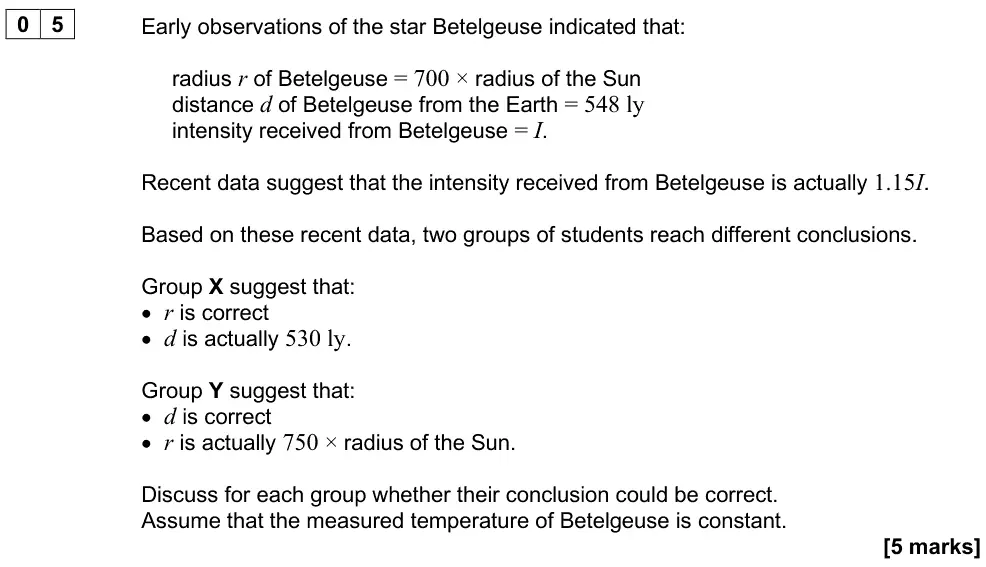
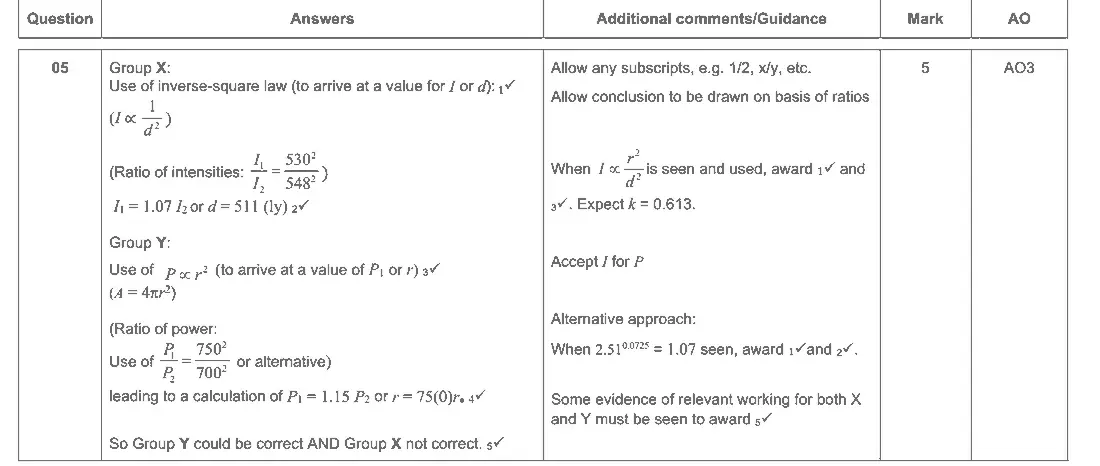
June 2025 · Paper 3B Astrophysics · Q55 marksAO3=5Calculation
Mark scheme
Examiner's comment
Over half of students were able to access the marks for this question although many struggled with the “discuss” command word. Students who did very well on this question provided a logical approach, providing clear calculations for X, clear calculations for Y and then making a logical conclusion based on these. There were several novel approaches which could gain full credit. Grade boundaries and cumulative percentage grades are available on the Results Statistics page of the AQA Website.
Notes from the mark scheme and report
Group X: I proportional to 1/d^2 gives (548/530)^2 = 1.07, not 1.15, so X wrong
Group Y: P proportional to r^2 gives (750/700)^2 = 1.15, so Y could be correct
working needed for both
Skills: MS0.3 Use ratios, fractions and percentages; MS2.3 Substitute numerical values into algebraic equations using appropriate units for physical quantities
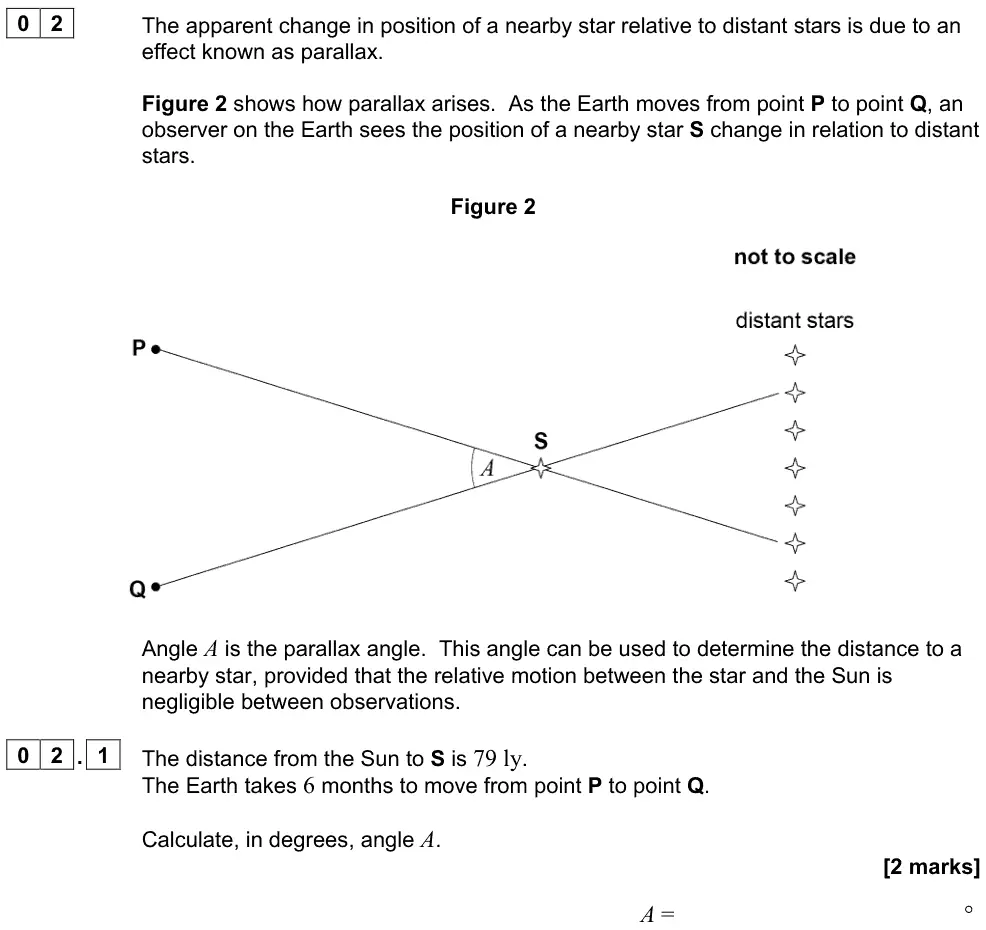
June 2024 · Paper 3B Astrophysics · Q2.12 marksAO2=2Calculation
Mark scheme
Examiner's comment
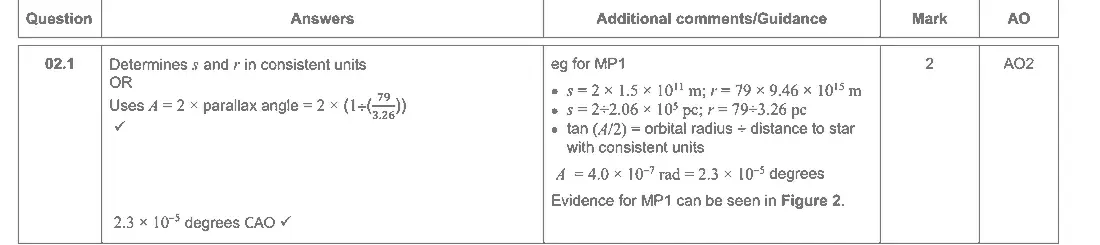
Question 02.1 tested students’ ability to deal with the different units for distance used in astronomy. The best answers correctly converted the distances involved into the same units before working out the correct angle. Partial credit was given to answers that made some progress with this method.
Notes from the mark scheme and report
Answer: 2.3 x 10^-5 degrees (79 ly = 24.2 pc, parallax 1/24.2 arcsec, A = 2 x parallax)
unit conversion is the key skill
Skills: MS4.6 Use of small angle approximations including sinθ ≈θ, tanθ ≈θ, cosθ ≈1 for small θ where appropriate; MS0.1 Recognise and make use of appropriate units in calculations
June 2024 · Paper 3B Astrophysics · Q2.24 marksAO3=4Calculation
Earlier part of question 2 that this part uses
Mark scheme
Examiner's comment
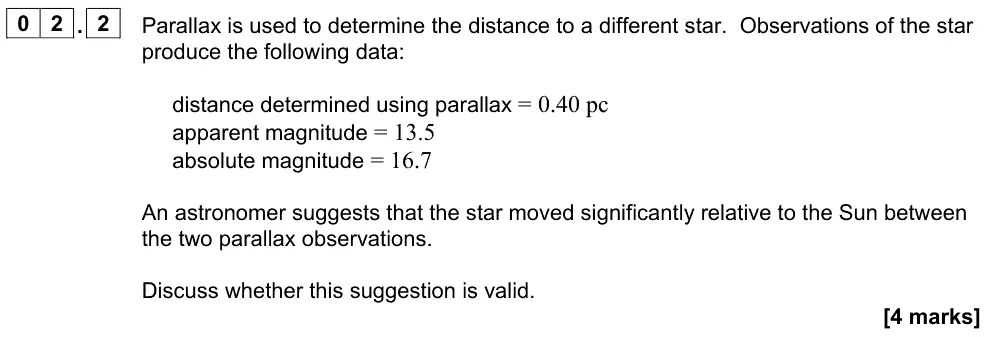
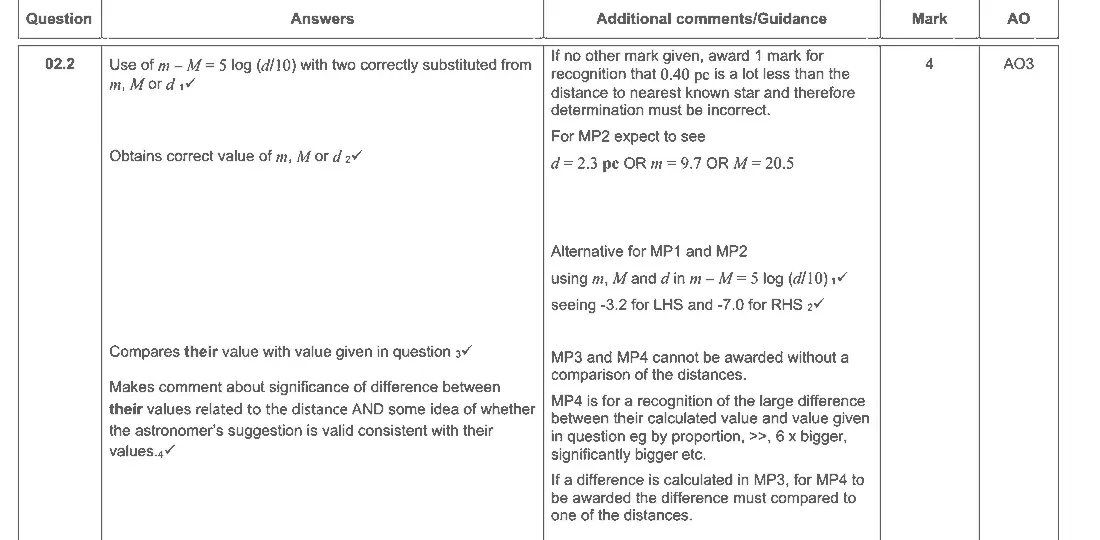
Question 02.2 was more open-ended. The most successful answers made a clear comparison of the distance given by parallax and the distance from the magnitudes. They then went on to compare these, making a comment about the significance of the difference. This was often done by calculating a ratio between the two but an appreciation that the difference was very large was sufficient.
Notes from the mark scheme and report
Magnitudes give d = 10 x 10^(-3.2/5) = 2.3 pc, compared with 0.40 pc from parallax
very large difference so suggestion valid (or comment on significance)
Skills: MS2.5 Use logarithms in relation to quantities that range over several orders of magnitude; MS0.3 Use ratios, fractions and percentages
June 2024 · Paper 3B Astrophysics · Q3.12 marksAO2=1, AO3=1Show that
Mark scheme
Examiner's comment
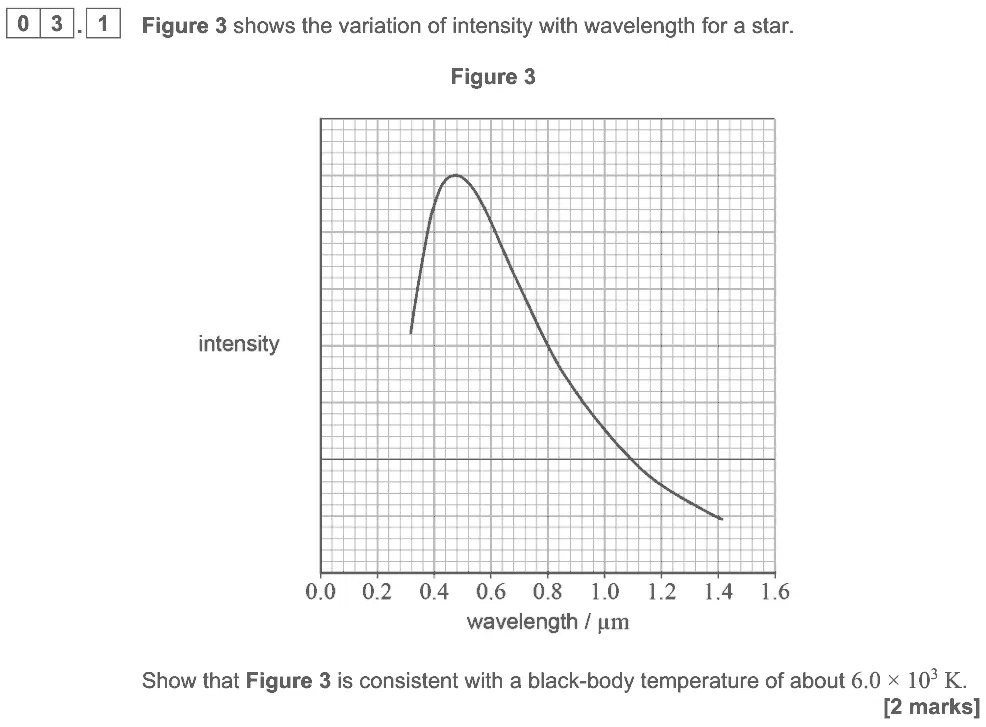
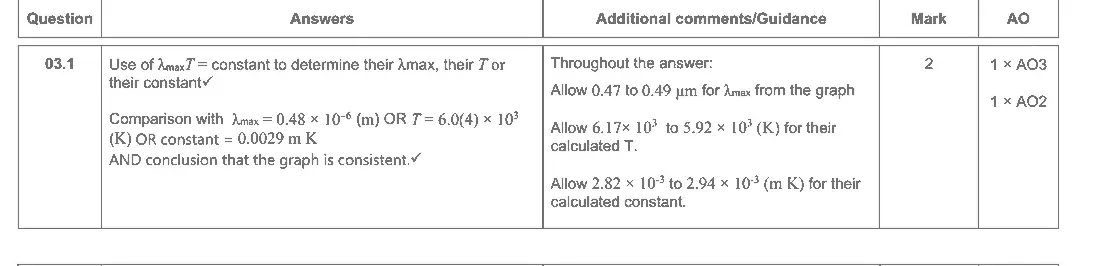
In 03.1 most students simply calculated the temperature of the star using Wien’s law. Some students used an incorrect peak wavelength, either misreading the scale or using the cut-off rather than the peak. The question also required them to show that the graph was consistent with the value given, and therefore some comparison was expected. Other successful routes included calculating a value for Wien’s constant using the data in the question, or a value for the peak wavelength. In both these cases a comparison with the given value was required for full credit.
Notes from the mark scheme and report
Peak 0.48 um gives T = 2.9 x 10^-3/0.48 x 10^-6 = 6.0 x 10^3 K, with a comparison/conclusion
misreading the peak or using the cut-off were errors
Skills: MS3.1 Translate information between graphical, numerical and algebraic forms; MS2.3 Substitute numerical values into algebraic equations using appropriate units for physical quantities
June 2024 · Paper 3B Astrophysics · Q3.22 marksAO2=2Calculation
Earlier part of question 3 that this part uses
Mark scheme
Examiner's comment
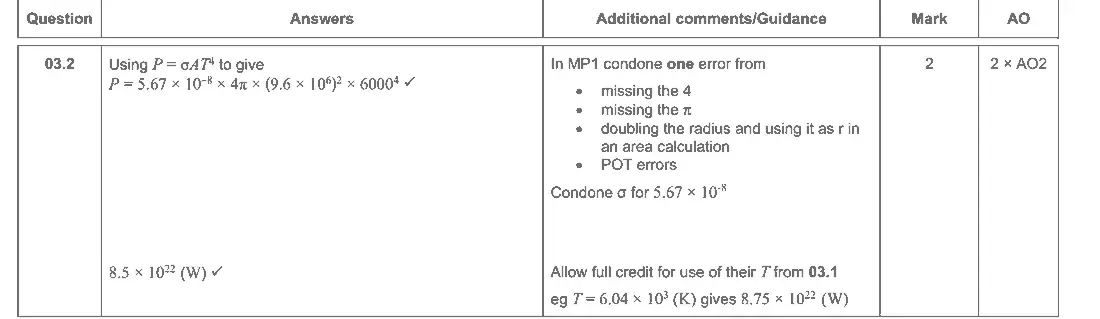
Question 03.2 required the use of Stefan’s law and was answered correctly by almost 60% of students. Common errors included using the volume or area of a circle for the surface area of a sphere and missing out the power of four for the temperature. Partial credit was given for some of these errors.
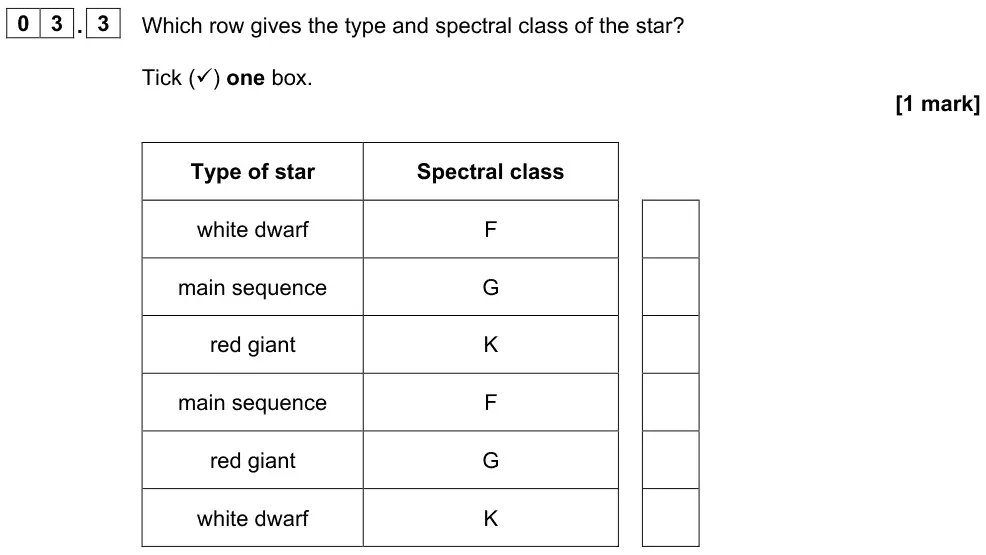
Question 03.3 required students to realise that the radius in 03.2 made the star a dwarf, and that the only option with a compatible spectral class for the temperature was the first one.
Notes from the mark scheme and report
Answer: 8.5 x 10^22 W (sigma 4 pi r^2 T^4)
errors: volume or circle area, missing T^4
almost 60% correct
Skills: MS2.3 Substitute numerical values into algebraic equations using appropriate units for physical quantities; MS4.3 Calculate areas of triangles, circumferences and areas of circles, surface areas and volumes of rectangular blocks, cylinders and spheres
June 2024 · Paper 3B Astrophysics · Q3.31 markAO3=1Short answer
Earlier part of question 3 that this part uses
Mark scheme
Examiner's comment
Question 03.3 required students to realise that the radius in 03.2 made the star a dwarf, and that the only option with a compatible spectral class for the temperature was the first one.
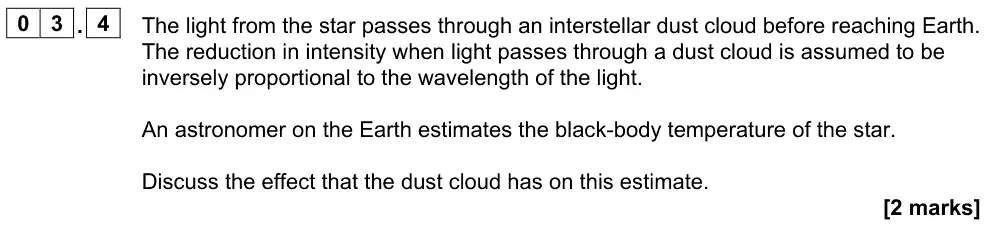
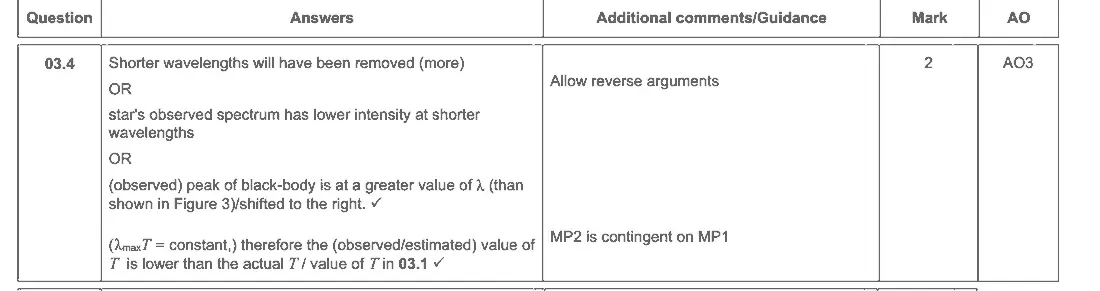
To obtain both marks in 03.4, students had to identify the effect the absorption would have on the wavelength of the peak, and then conclude the effect this would have on the observed temperature. Some students attempted to argue in terms of Stefan’s law, suggesting that the overall power output would apparently be reduced. This would not affect the estimate unless the absolute magnitude of the star was known, however.
Notes from the mark scheme and report
Answer: white dwarf, F (tiny radius, 6000 K)
June 2024 · Paper 3B Astrophysics · Q3.42 marksAO3=2Explanation
Earlier part of question 3 that this part uses
Mark scheme
Examiner's comment
To obtain both marks in 03.4, students had to identify the effect the absorption would have on the wavelength of the peak, and then conclude the effect this would have on the observed temperature. Some students attempted to argue in terms of Stefan’s law, suggesting that the overall power output would apparently be reduced. This would not affect the estimate unless the absolute magnitude of the star was known, however.
Notes from the mark scheme and report
Dust removes shorter wavelengths more, so observed peak shifts to longer wavelength
by Wien's law the estimated temperature is lower than actual
Stefan's-law power arguments not relevant
June 2024 · Paper 3B Astrophysics · Q4.23 marksAO1=1, AO2=2Calculation
Earlier part of question 4 that this part uses
Mark scheme
Examiner's comment
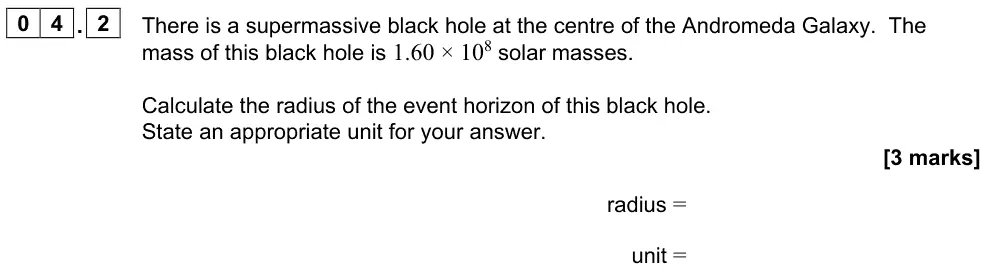
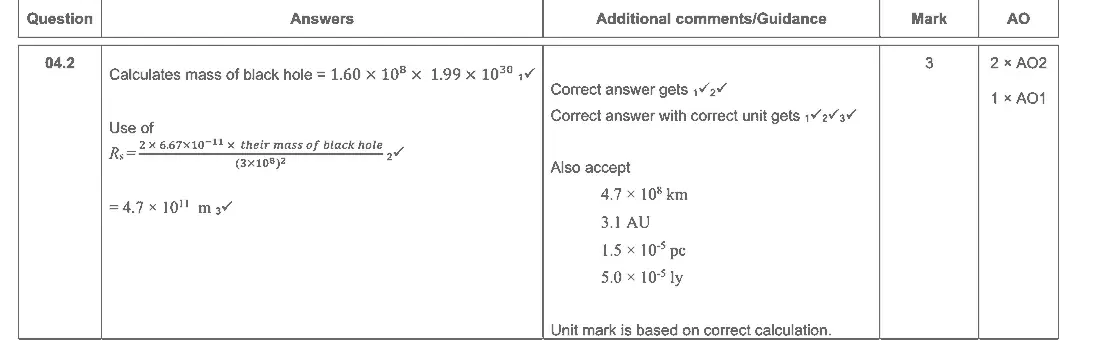
The calculation in question 04.2 was completed successfully by more than half of the students. Common errors included missing out the factor of 2, incorrectly calculating the mass of the black hole and failing to square the speed of light. The unit mark was linked to the final answer, and any appropriate unit was accepted provided the value was correct.
Notes from the mark scheme and report
Answer: 4.7 x 10^11 m (M = 1.60 x 10^8 x 1.99 x 10^30 kg)
errors: missing 2, not squaring c
unit mark needs correct value
more than half correct
Skills: MS2.3 Substitute numerical values into algebraic equations using appropriate units for physical quantities; MS0.1 Recognise and make use of appropriate units in calculations
June 2023 · Paper 3B Astrophysics · Q1.11 markAO1=1Diagram or graph
Mark scheme
Examiner's comment
01.1 The diagram of a parsec required students to include a lot of detail for one mark. This proved to be quite demanding. Many students labelled the wrong angle as the arc second, or failed to label the AU. A fairly common error was drawing 1 AU between the surfaces of an enlarged Sun and Earth. This was not given credit.
Notes from the mark scheme and report
Diagram labelling 1 AU (Sun-Earth, not between enlarged surfaces), 1 pc and the 1 arc second angle at the star
wrong angle labelled was common
Skills: MS4.2 Visualise and represent 2D and 3D forms including two- dimensional representations of 3D objects
June 2023 · Paper 3B Astrophysics · Q1.21 markAO1=1Short answerEasy
Earlier part of question 1 that this part uses
Mark scheme
Examiner's comment
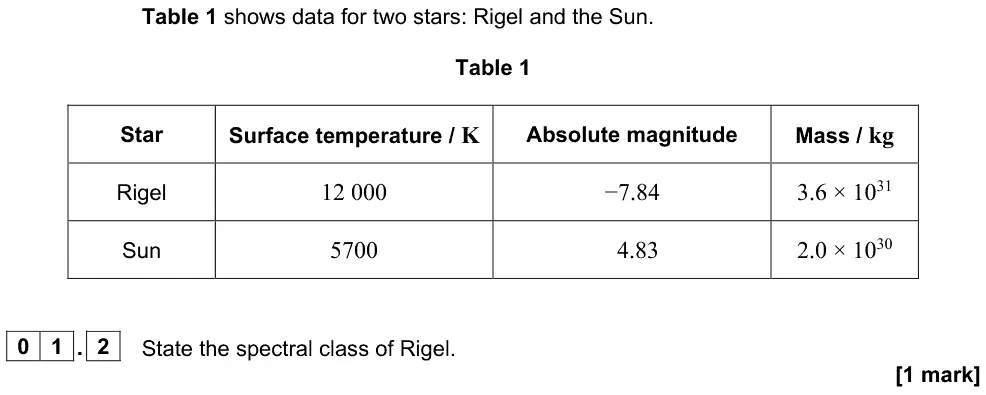
01.2 Identifying the spectral class of Rigel was also surprisingly difficult, with only 65% of students getting the mark. Note that a lower case ‘b’ was not credited.
Notes from the mark scheme and report
B (12 000 K)
lower-case b not credited
65% correct
June 2023 · Paper 3B Astrophysics · Q1.32 marksAO2=2CalculationEasy
Earlier part of question 1 that this part uses
Mark scheme
Examiner's comment
01.3 Almost 70% of students obtained both marks. Students who got the wrong answer could access one mark for either using m-M correctly or using base-10 antilogs, provided they set out their answers sufficiently clearly so that examiners could spot what they were doing.
Notes from the mark scheme and report
Answer: 390 pc (0.11 - (-7.84) = 5 log(d/10))
almost 70% both marks
Skills: MS2.5 Use logarithms in relation to quantities that range over several orders of magnitude; MS0.5 Use calculators to find and use power, exponential and logarithmic functions
June 2023 · Paper 3B Astrophysics · Q1.41 markAO1=1Diagram or graphHard
Earlier part of question 1 that this part uses
Mark scheme
Examiner's comment
01.4 Many students who did not get the mark started their answer at the position where the Sun is now, having failed to read the question. Many answers were also seen that went into the supergiant region, or did not go through the area around G5. This meant that fewer than 30% of students were awarded the mark.
Notes from the mark scheme and report
Line from the right to magnitude 5/class G, then to giants (not supergiants), then to white dwarfs
many started at the Sun's present position
fewer than 30% correct
June 2023 · Paper 3B Astrophysics · Q1.52 marksAO2=1, AO3=1Explanation
Earlier part of question 1 that this part uses
Mark scheme
Examiner's comment
01.5 Although it is not fully understood, the important aspects of the GRB are that the star must be a supergiant that is collapsing into a neutron star or black hole. Many answers were confused with type 1a supernovae or were in other ways vague or incomplete.
Notes from the mark scheme and report
Supergiant collapses to form a neutron star or black hole
confusion with type 1a supernovae common
June 2023 · Paper 3B Astrophysics · Q2.32 marksAO2=2Calculation
Earlier part of question 2 that this part uses
Mark scheme
Examiner's comment
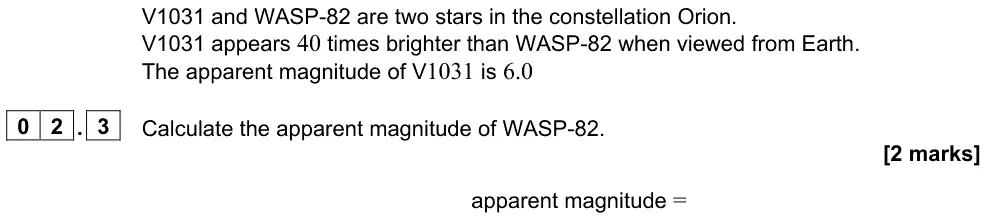
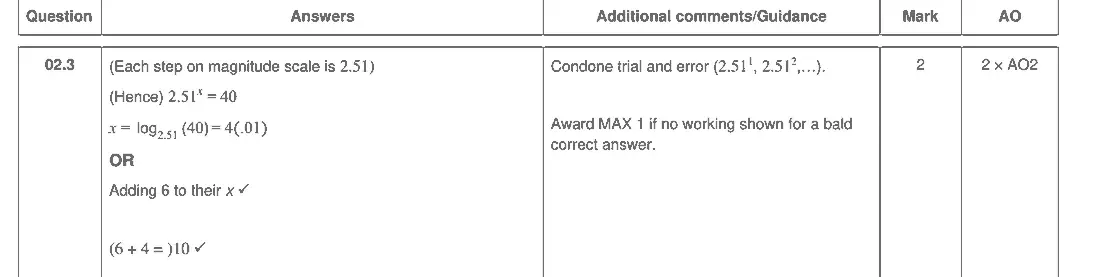
02.3 This discriminated well. Students who did not get the correct answer could access one mark if they realised that they had to add the value of 6 to their magnitude.
Notes from the mark scheme and report
Answer: 10 (2.51^x = 40 gives x = 4.0, add to 6.0)
bald answer max 1
Skills: MS2.5 Use logarithms in relation to quantities that range over several orders of magnitude; MS0.5 Use calculators to find and use power, exponential and logarithmic functions
June 2023 · Paper 3B Astrophysics · Q3.11 markAO1=1Short answer
Mark scheme
Examiner's comment
03.1 The defining feature of a black hole is stated in the specification. Many answers appeared to confuse black holes with black bodies, made references to singularities or density or simply said ‘light cannot escape’. Other answers also failed to gain the mark for a lack of clarity, for example referring to ‘beyond’, ‘past’ or ‘before’ the event horizon without specifying direction. Other answers defined the event horizon rather than a black hole.
Notes from the mark scheme and report
Escape velocity greater than the speed of light
vague 'beyond the event horizon', singularities or density not credited
June 2023 · Paper 3B Astrophysics · Q3.24 marksAO3=4Calculation
Earlier part of question 3 that this part uses
Mark scheme
Examiner's comment
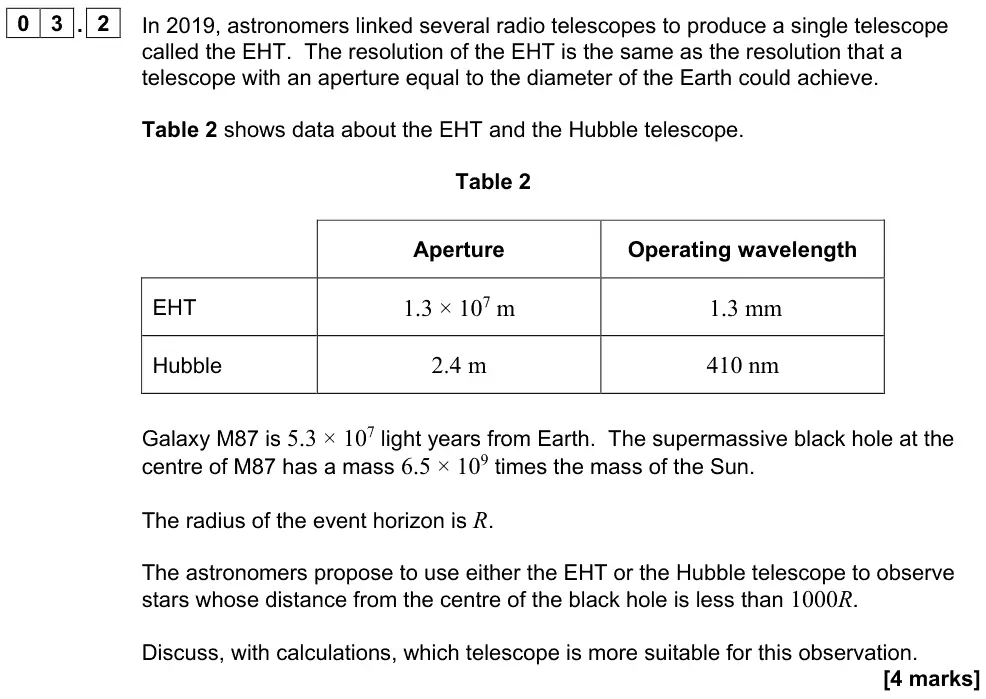
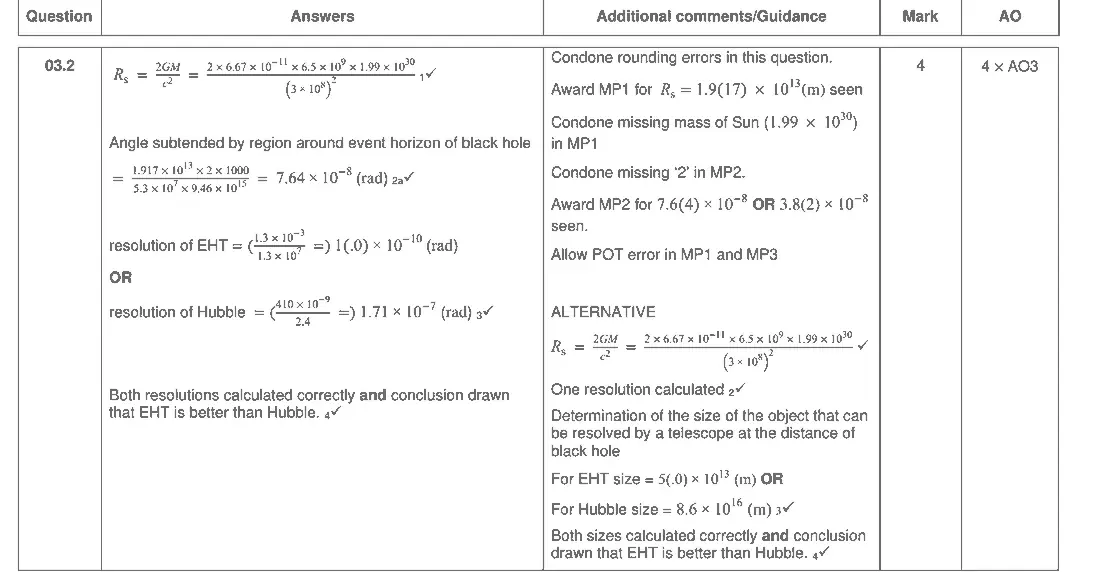
03.2 This was one of two questions that provided the best discrimination on the paper. The best answers worked out the resolution of each telescope, and showed an understanding of angular resolution in their discussion. They also included calculations of the angle between the stars and the black hole to show that the EHT would be able to resolve them but that the Hubble would not. Problems with powers of ten and other arithmetic errors were quite common.
This question was marked using a levels of response mark scheme. Along with 03.2 it was the best discriminating question on the paper.
Notes from the mark scheme and report
Rs = 1.9 x 10^13 m
1000R region subtends 7.6 x 10^-8 rad at 5.3 x 10^7 ly
EHT resolution 1.0 x 10^-10 rad, Hubble 1.7 x 10^-7 rad
only EHT can resolve
best discriminator
Skills: MS2.3 Substitute numerical values into algebraic equations using appropriate units for physical quantities; MS4.6 Use of small angle approximations including sinθ ≈θ, tanθ ≈θ, cosθ ≈1 for small θ where appropriate; MS0.2 Recognise and use expressions in decimal and standard form
June 2023 · Paper 3B Astrophysics · Q46 marksAO2=4, AO3=26-mark extended response
Mark scheme, with the levels and indicative content
Examiner's comment
This question was marked using a levels of response mark scheme. Along with 03.2 it was the best discriminating question on the paper.
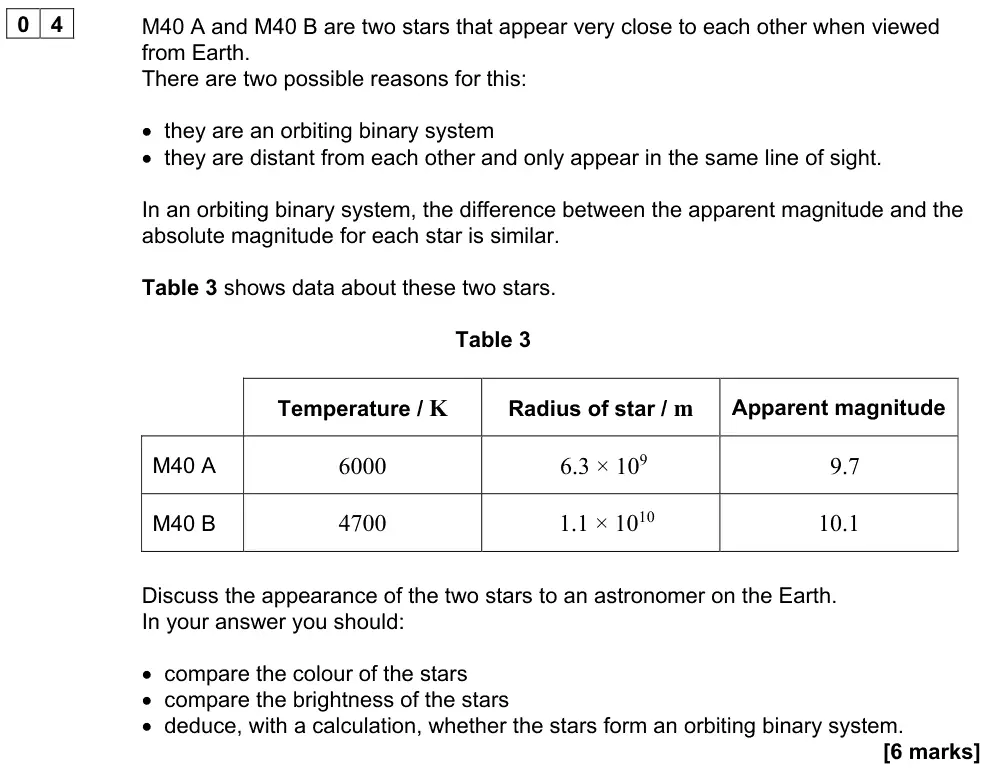
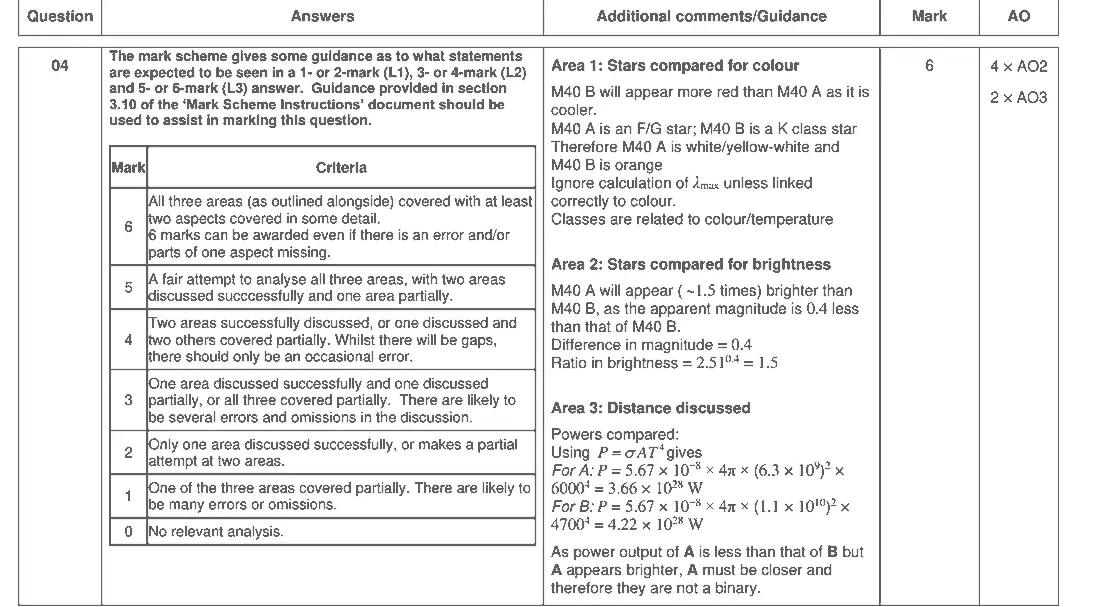
Most students demonstrated an understanding of how the spectral class was related to colour. There was some confusion about apparent magnitude and absolute magnitude, with students unsure whether they were writing about what can be seen from Earth or not. Some students attempted to calculate an absolute magnitude assuming a distance. Calculations were often well done, but a missing factor of 4 for the area of the star in Stefan’s Law was very common. The best answers included the calculation of the difference in brightness as seen from Earth and the difference in power output to show that M40A must be closer than M40B.
Notes from the mark scheme and report
Levels of response. M40 B cooler (class K, orange) vs M40 A (F/G, yellow-white)
A appears 2.51^0.4 = 1.5 times brighter
Stefan's law power ratio and inverse-square/absolute magnitude show whether at the same distance (binary)
Skills: MS2.3 Substitute numerical values into algebraic equations using appropriate units for physical quantities; MS0.5 Use calculators to find and use power, exponential and logarithmic functions
June 2023 · Paper 3B Astrophysics · Q5.22 marksAO1=2Short answer
Earlier part of question 5 that this part uses
Mark scheme
Examiner's comment
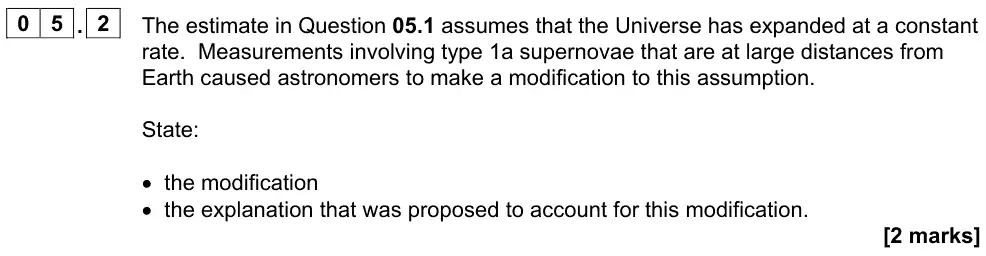
05.2 Many of the answers demonstrated much confusion about the expanding Universe. Some referred to the Universe itself accelerating, or simply stated Hubble’s Law. The best answers made a clear statement that the expansion of the Universe is accelerating and that the idea of dark energy was introduced to explain it. Any reference to dark matter meant that the second mark point could not be awarded.
Notes from the mark scheme and report
Expansion is accelerating
explained by dark energy (not dark matter)
June 2022 · Paper 3B Astrophysics · Q2.51 markAO1=1Short answer
Earlier part of question 2 that this part uses
Mark scheme
Examiner's comment
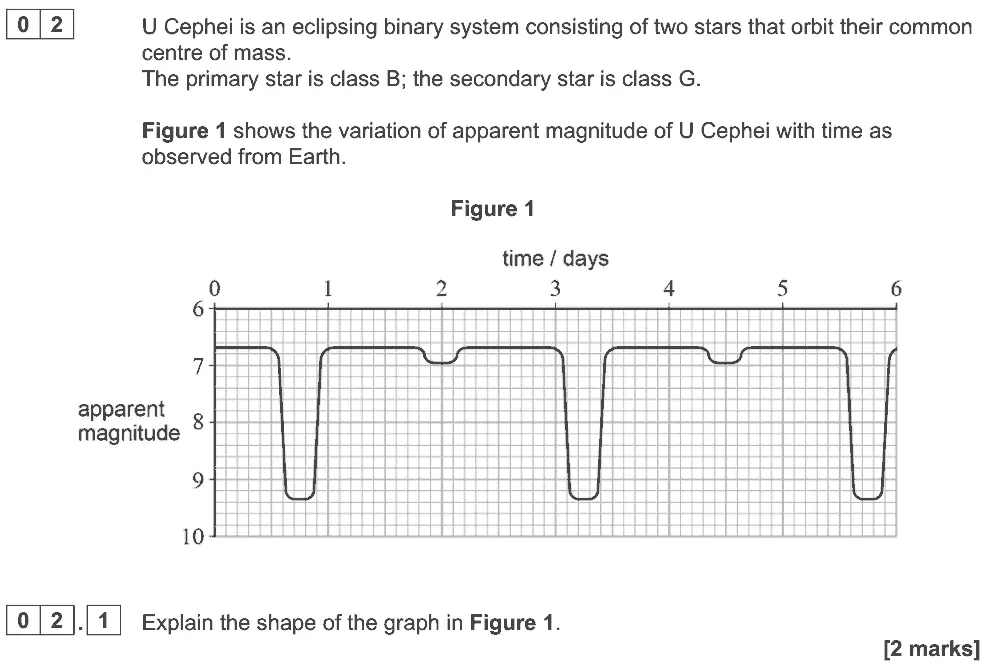
2.4 This was generally well done. A surprising number of students could not correctly read the period from the graph, however. 2.5 A majority of students got this question right.
Notes from the mark scheme and report
Answer: hydrogen and helium (class B)
June 2022 · Paper 3B Astrophysics · Q2.62 marksAO3=2Explanation
Earlier part of question 2 that this part uses
Mark scheme
Examiner's comment
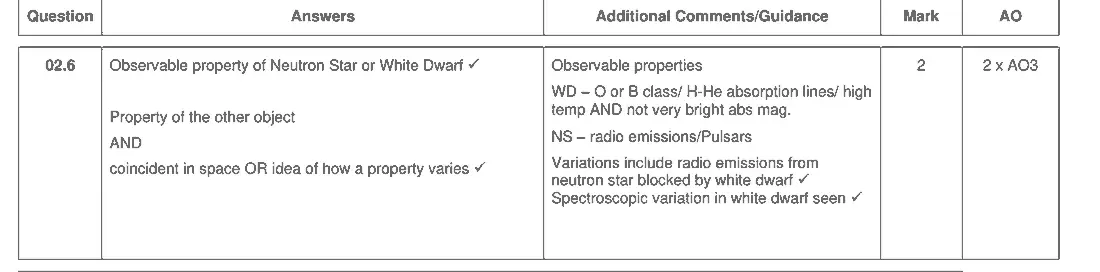
2.6 This proved to be a hard question. Very few students linked their knowledge of white dwarfs and neutron stars to the question.
Notes from the mark scheme and report
An observable property of each object (white dwarf: hot, H-He lines but dim absolute magnitude
neutron star: radio pulses/X-rays) shown to coincide in position or vary with the orbital period
June 2022 · Paper 3B Astrophysics · Q3.22 marksAO1=1, AO2=1Show that
Earlier part of question 3 that this part uses
Mark scheme
Examiner's comment
3.2 A large majority of students scored full marks on this question. They were familiar with the equation and could manipulate it. Those who did not score full marks often converted distance between units incorrectly.
Notes from the mark scheme and report
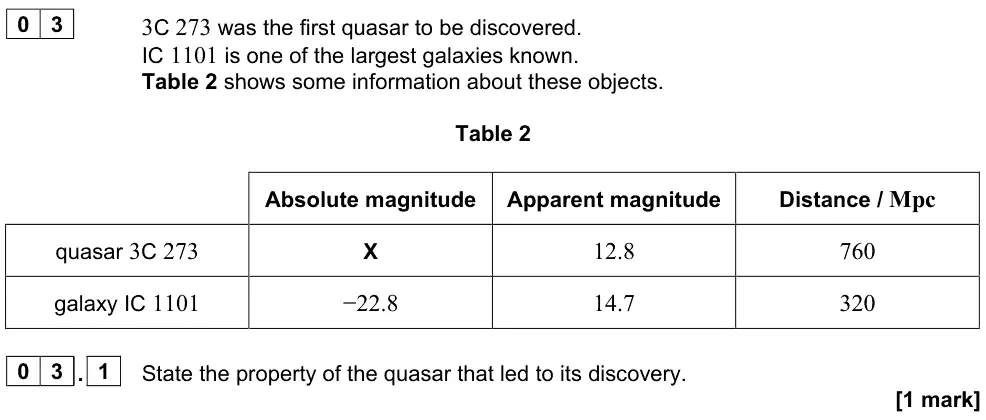
Answer: -26.6 (M = 12.8 - 5 log(760 x 10^6/10))
Skills: MS2.5 Use logarithms in relation to quantities that range over several orders of magnitude; MS2.3 Substitute numerical values into algebraic equations using appropriate units for physical quantities
June 2022 · Paper 3B Astrophysics · Q3.33 marksAO2=3Calculation
Earlier part of question 3 that this part uses
Mark scheme
Examiner's comment
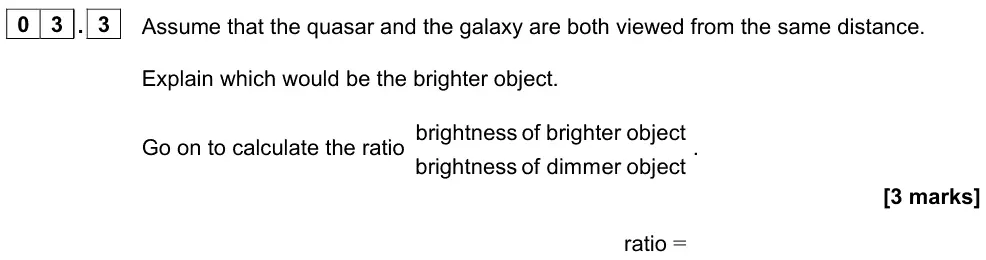
3.3 This question was also well done. It is a recurring problem that students have difficulty in clearly expressing that one magnitude is brighter than another. Examiners were flexible in accepting answers but students should be taught to use phrases like ‘more negative’ to indicate ‘brighter’. Most students knew that the ratio depended on the difference in magnitudes but did not always work out the ratio correctly.
difference 3.8 so ratio 2.51^3.8 = 33 (48 if -27 used)
Skills: MS0.5 Use calculators to find and use power, exponential and logarithmic functions; MS0.3 Use ratios, fractions and percentages
June 2022 · Paper 3B Astrophysics · Q3.43 marksAO1=1, AO2=2Calculation
Earlier part of question 3 that this part uses
Mark scheme
Examiner's comment
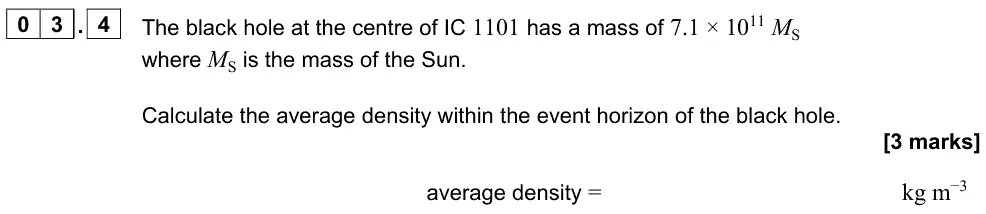
3.4 This was another calculation which was generally well done. Common mistakes included not including the mass of the sun in the calculation and using an incorrect equation for the volume of a sphere.
Notes from the mark scheme and report
Answer: 3.7 x 10^-5 kg m^-3 (Rs = 2GM/c^2 = 2.1 x 10^15 m, V = 4/3 pi Rs^3 = 3.9 x 10^46 m^3)
must include the Sun's mass
Skills: MS2.3 Substitute numerical values into algebraic equations using appropriate units for physical quantities; MS4.3 Calculate areas of triangles, circumferences and areas of circles, surface areas and volumes of rectangular blocks, cylinders and spheres; MS0.2 Recognise and use expressions in decimal and standard form
November 2021 · Paper 3B Astrophysics · Q1.13 marksAO1=3Short answer
Mark scheme
Examiner's comment
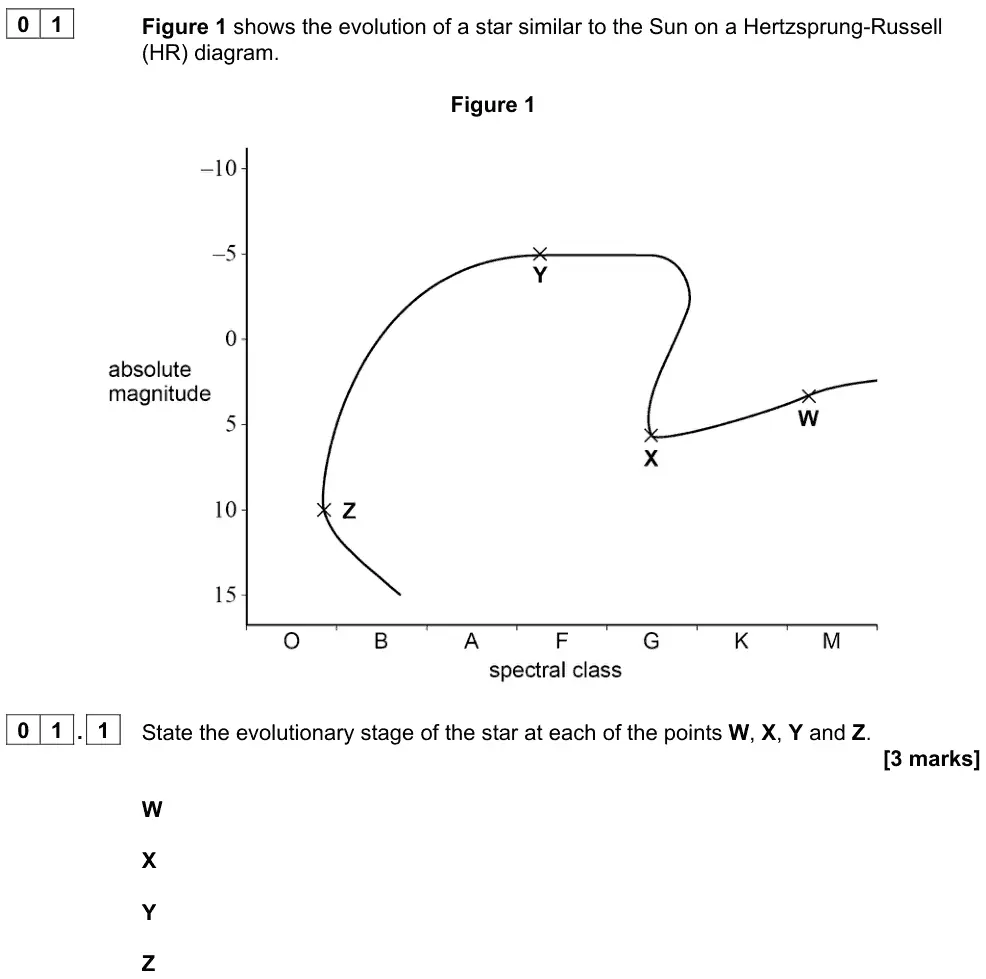
1.1 The H-R diagram is a familiar topic that has been tested many times. Most students could identify the main sequence but few knew the early evolution of a Sun-like star.
This paper was similar in difficulty to those of previous years (including 2020). Questions 1.1 and 4.2 should have been familiar to students. Question 3 approached the topic from an unusual angle, so it was pleasing that a number of students gave good answers.
Notes from the mark scheme and report
W protostar (gas cloud), X main sequence, Y red giant, Z white dwarf (Y and Z together for one mark)
November 2021 · Paper 3B Astrophysics · Q1.21 markAO3=1Diagram or graph
Earlier part of question 1 that this part uses
Mark scheme
Examiner's comment
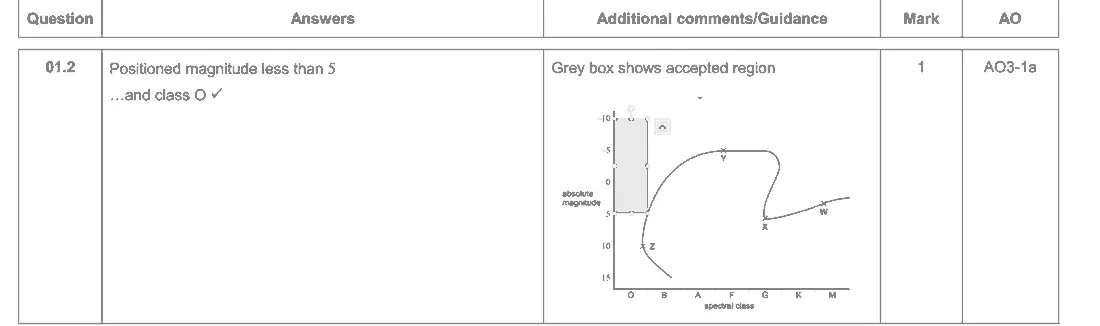
1.2 Theta Carinae is a very bright, class O star. Most students failed to gain the mark because they did not classify the star correctly.
Notes from the mark scheme and report
T in class O (31 000 K) and absolute magnitude brighter than the Sun's (less than +5, above main sequence region)
November 2021 · Paper 3B Astrophysics · Q1.45 marksCalculation
Earlier part of question 1 that this part uses
Mark scheme
Examiner's comment
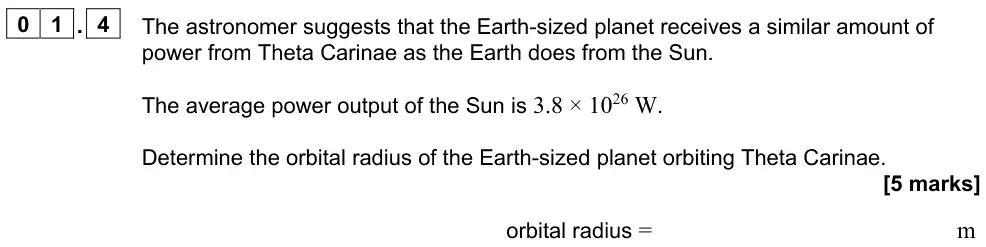
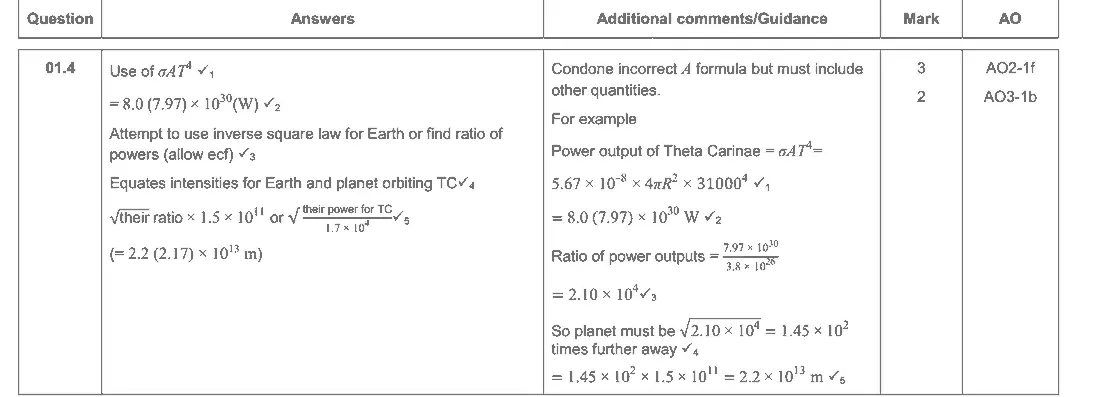
1.4 A few students produced an elegant answer to this question. Of those who made an attempt, a number tried to find the radius of Theta Carinae by assuming that its power output was the same as the sun.
Notes from the mark scheme and report
Answer: 2.2 x 10^13 m (P = sigma 4 pi r^2 T^4 = 8.0 x 10^30 W
equal intensity so r = 1.5 x 10^11 x sqrt(8.0 x 10^30/3.8 x 10^26))
Skills: MS2.3 Substitute numerical values into algebraic equations using appropriate units for physical quantities; MS0.3 Use ratios, fractions and percentages; MS2.2 Change the subject of an equation, including non-linear equations
November 2021 · Paper 3B Astrophysics · Q2.11 markAO1=1Short answer
Mark scheme
Examiner's comment
2.1 Only half of the students got this right. The time scale for a supernova is measured in weeks rather than hours.
Notes from the mark scheme and report
Answer: D (rapid rise to about -19 then slower decline over about 300 days, time in days)
only half correct
November 2021 · Paper 3B Astrophysics · Q2.23 marksAO3=3CalculationHard
Earlier part of question 2 that this part uses
Mark scheme
Examiner's comment
2.2 Around a third of students were able to find the apparent magnitude of the supernova (this is a familiar calculation). Few were then able to go on to link this to the Hipparcos scale. Stars are only visible down to magnitude 6 even in near-perfect conditions.
Notes from the mark scheme and report
Answer: m = 5.1 (M about -19.3, d = 7.7 x 10^5 pc), brighter than the magnitude-6 limit so visible with the naked eye
only around a third found m
Skills: MS2.5 Use logarithms in relation to quantities that range over several orders of magnitude; MS2.3 Substitute numerical values into algebraic equations using appropriate units for physical quantities
November 2021 · Paper 3B Astrophysics · Q36 marks6-mark extended response
Mark scheme, with the levels and indicative content
Examiner's comment
There was a full range of marks on this question. Most of those who attempted it realised that the curve was the typical black-body curve. Some went on to find the temperature of the star and to identify the star correctly. Few students could explain the origin of the dips 2 n = in the graph and that the dips are caused by hydrogen absorption by atoms in the state. This was an alternative route to the identification of the star.
Notes from the mark scheme and report
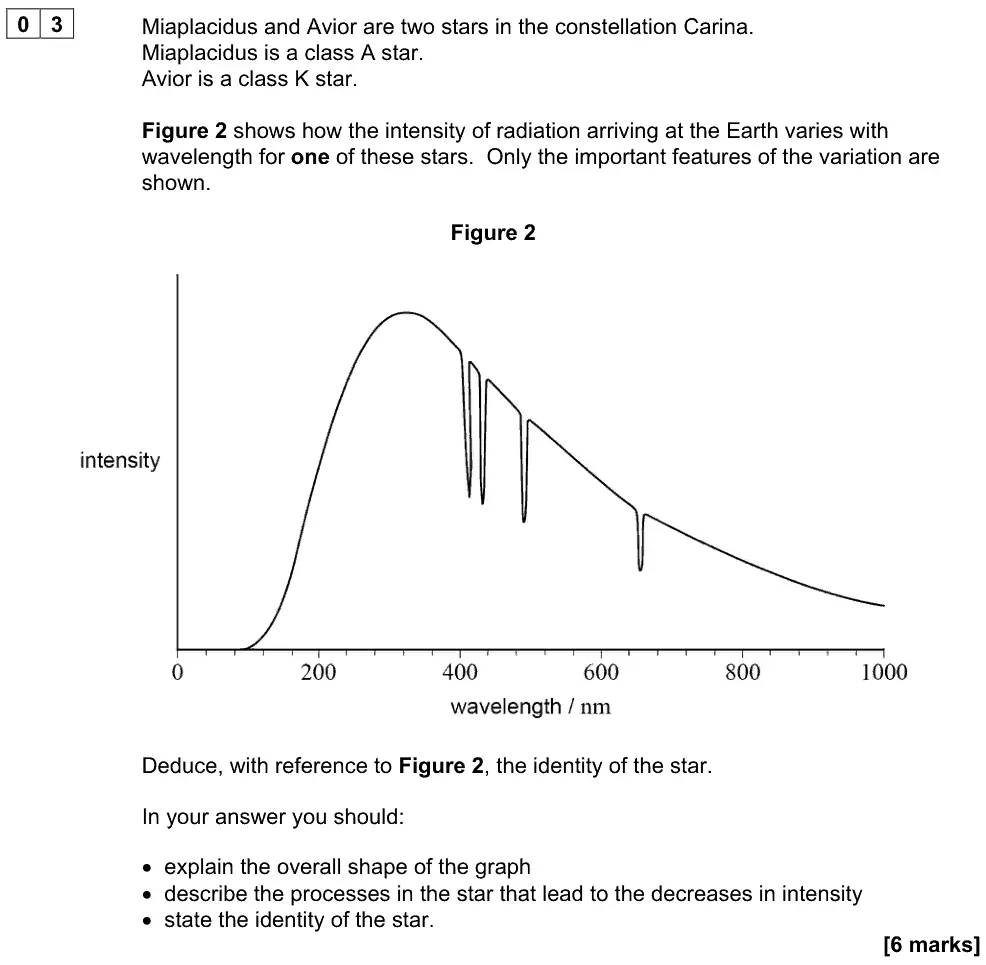
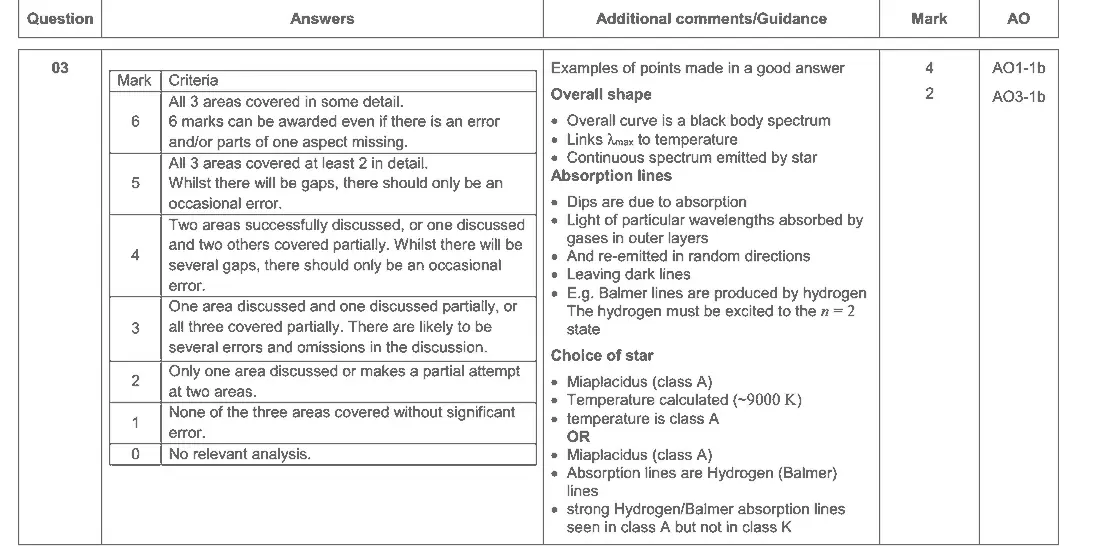
Levels of response. Black-body continuous spectrum, peak about 320 nm gives about 9000 K (Wien)
dips are absorption by cooler outer gases (re-emitted in all directions), Balmer lines need hydrogen in n = 2
strong Balmer lines and temperature fit class A so Miaplacidus
November 2020 · Paper 3B Astrophysics · Q2.11 markAO1=1Short answer
Mark scheme
Notes from the mark scheme and report
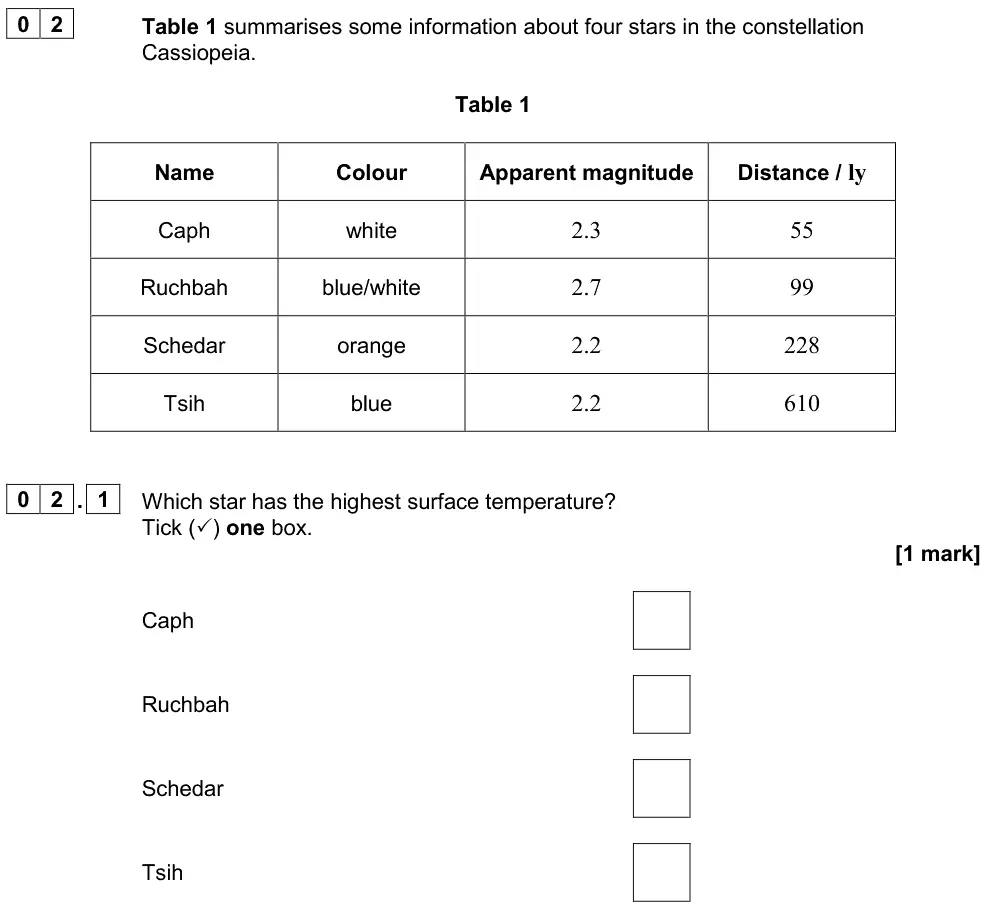
Answer: Tsih (blue)
November 2020 · Paper 3B Astrophysics · Q2.24 marksAO1=1, AO2=1, AO3=2Explanation
Earlier part of question 2 that this part uses
Mark scheme
Examiner's comment
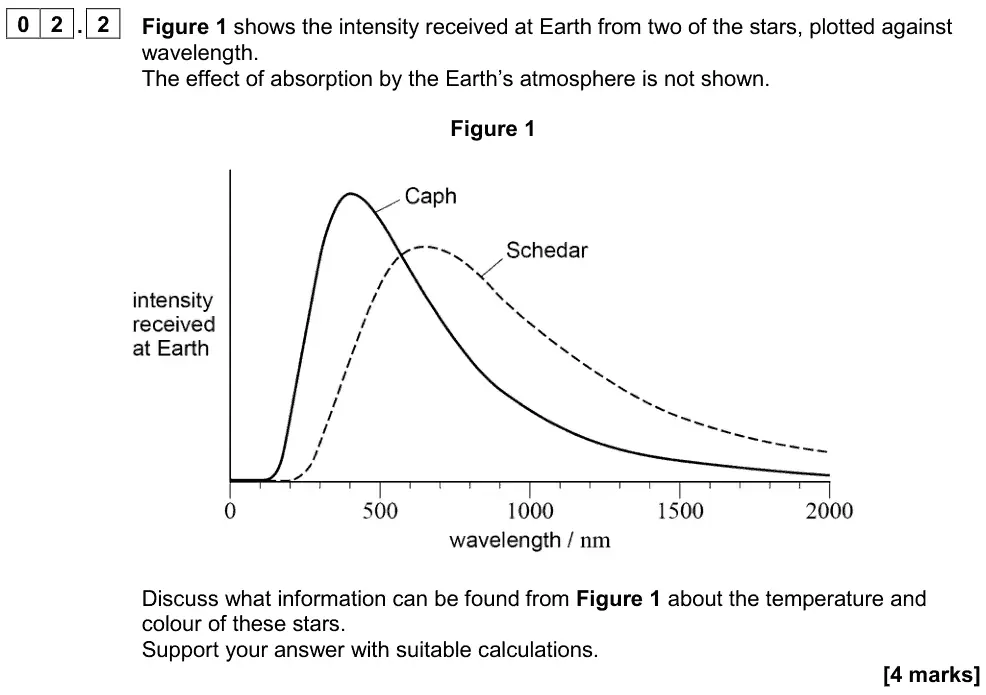
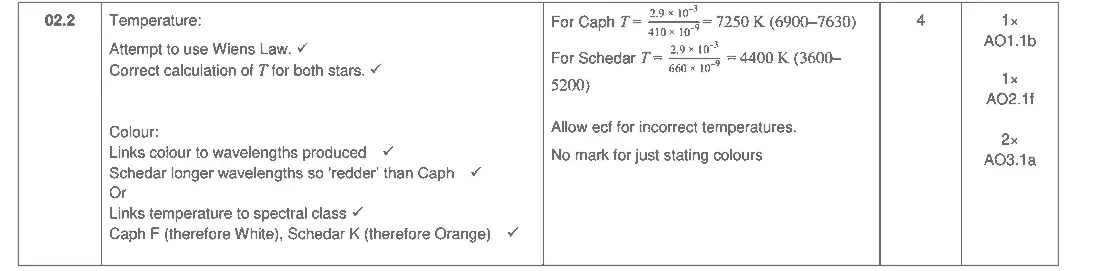
Most students were able to calculate the temperature correctly from the peak wavelength on the graph, though there were a number who had difficulties in reading the wavelength from the graph. The link between colour and either the spectral class or the emitted wavelengths was less well made. Those who went down the spectral class route often scored better. There were no marks for stating the colour; this was in the table above.
Question 02.2
Notes from the mark scheme and report
Wien: Caph peak about 410 nm gives about 7100 K (6900-7630), Schedar about 660 nm gives about 4400 K
Schedar emits longer wavelengths so redder (orange), Caph whiter, or link temperature to classes F and K
colours alone gain nothing
Skills: MS3.1 Translate information between graphical, numerical and algebraic forms; MS2.3 Substitute numerical values into algebraic equations using appropriate units for physical quantities
November 2020 · Paper 3B Astrophysics · Q2.31 markAO2=1Short answer
Earlier part of question 2 that this part uses
Mark scheme
Notes from the mark scheme and report
Caph (similar apparent magnitudes, nearest)
November 2020 · Paper 3B Astrophysics · Q2.43 marksAO2=3Calculation
Earlier part of question 2 that this part uses
Mark scheme
Examiner's comment
Many students did the calculations very well and scored full marks. A common error was failure to convert distance to parsec. Students should recognise that the ‘10’ appears in the equation because the standard distance is 10 pc. A number of students found it difficult to re-arrange the equation.
Question 02.4
Notes from the mark scheme and report
Answer: -2.0 (228 ly = 70 pc
M = 2.2 - 5 log(70/10))
Skills: MS2.5 Use logarithms in relation to quantities that range over several orders of magnitude; MS2.3 Substitute numerical values into algebraic equations using appropriate units for physical quantities
November 2020 · Paper 3B Astrophysics · Q2.52 marksAO2=2Calculation
Earlier part of question 2 that this part uses
Mark scheme
Examiner's comment
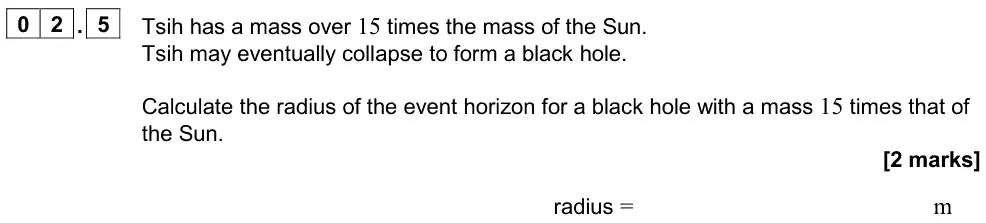
The majority of students did this calculation accurately. Common mistakes were: to use g instead of G, a failure to square the speed of light, and omitting the factor of 2. There was also a significant number of students who were not able to perform the calculation on their calculators.
Question 02.5
This paper was broadly similar in difficulty to previous years. There were questions which have appeared in the same or similar forms in previous years (e.g. 01.1 and 02.5), along with questions on familiar topics which have been in the specification for a long time (e.g. 03.3). Question 04.2 tested knowledge of Gamma Ray Bursts (which was added to the specification at the latest revision) and most students did not know this.
Notes from the mark scheme and report
Answer: 4.4 x 10^4 m (Rs = 2GM/c^2, M = 15 x 1.99 x 10^30 kg)
Skills: MS2.3 Substitute numerical values into algebraic equations using appropriate units for physical quantities; MS0.2 Recognise and use expressions in decimal and standard form
November 2020 · Paper 3B Astrophysics · Q3.11 markAO1=1Short answer
Mark scheme
Examiner's comment
Many students were quite clear that it is knowledge of the absolute magnitude that is important. Supernovae were often stated as the only example of a standard candle; there are others (e.g. Cepheid variables).
Question 03.1
Notes from the mark scheme and report
Object of known absolute magnitude (intrinsic power)
November 2020 · Paper 3B Astrophysics · Q3.23 marksAO1=3Diagram or graph
Earlier part of question 3 that this part uses
Mark scheme
Examiner's comment
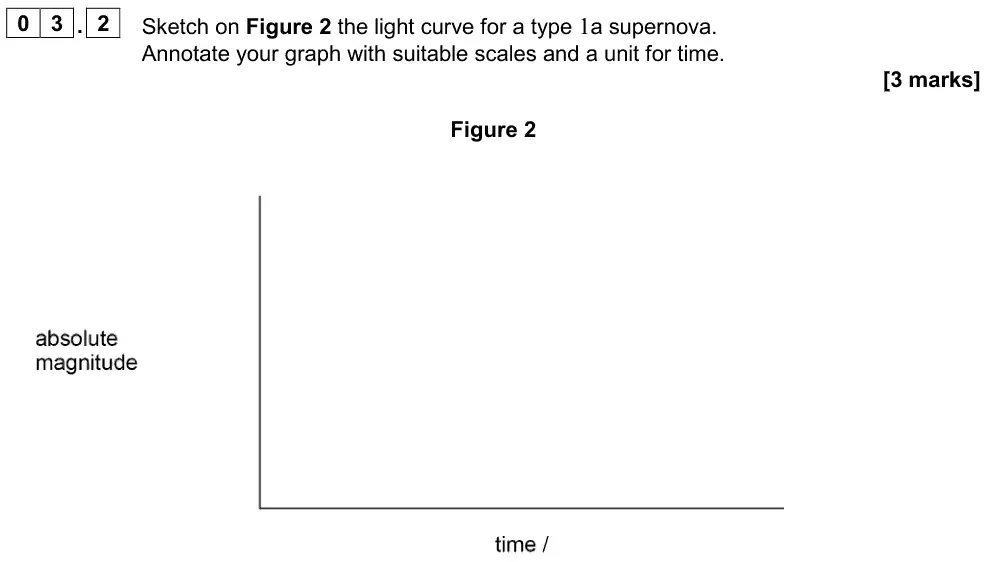
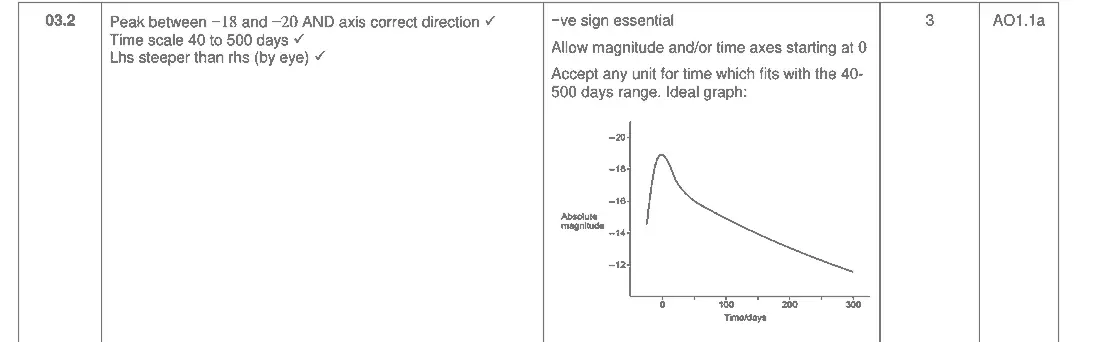
There were many excellent graphs. Some scored marks without being very well drawn. It was common to see the peak at +19.3 and/or the magnitude axis going in the wrong direction. Time scales seen ranged from a few seconds to millions of years. The time scale should be such that it takes around 100 days for the absolute magnitude to decrease through 5 magnitudes.
Question 03.2
Notes from the mark scheme and report
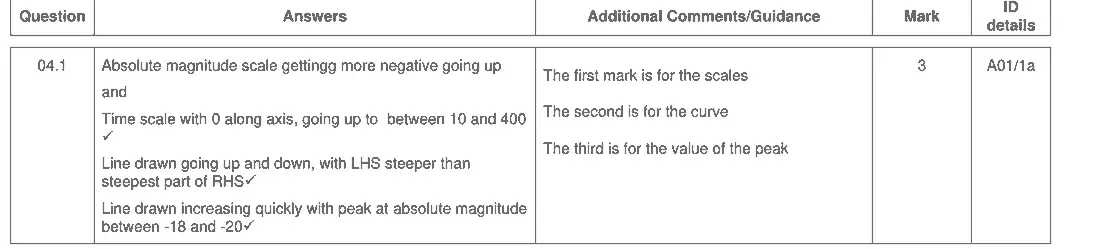
Peak absolute magnitude -18 to -20 with negative values upwards
time scale 40-500 days with unit
rise steeper than decline
Skills: MS3.1 Translate information between graphical, numerical and algebraic forms
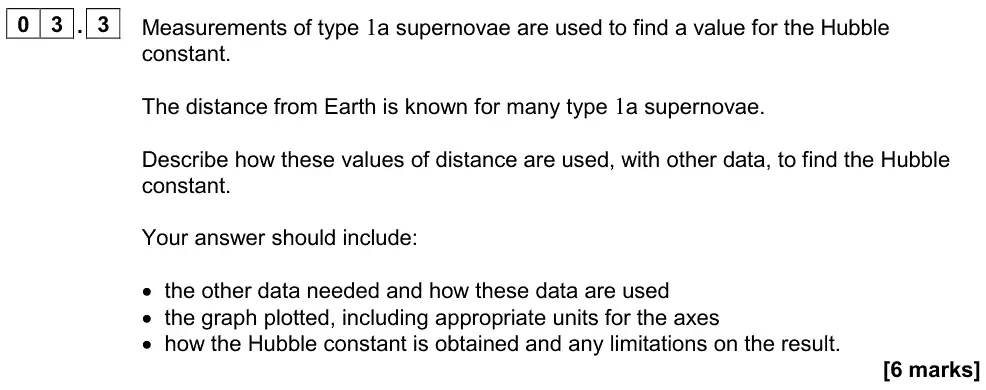
November 2020 · Paper 3B Astrophysics · Q3.36 marks6-mark extended response
Earlier part of question 3 that this part uses
Mark scheme, with the levels and indicative content
Examiner's comment
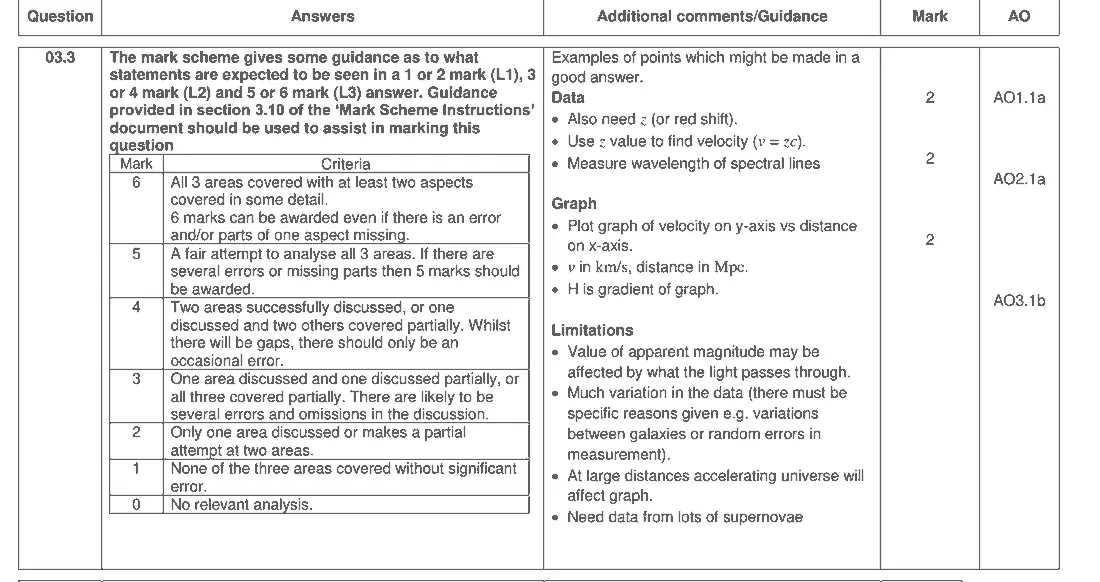
There were many answers where the student was clear about the data they needed and what graph to plot. Some students thought they could find the recession velocity by measuring the distance a year later and finding the distance through which the supernova had moved. The limitations on the result were often less clear. It is not enough to just state “uncertainty in the measurements” - there needs to be a reason given. A larger than usual number of students failed to attempt this question.
Question 03.3
This paper was broadly similar in difficulty to previous years. There were questions which have appeared in the same or similar forms in previous years (e.g. 01.1 and 02.5), along with questions on familiar topics which have been in the specification for a long time (e.g. 03.3). Question 04.2 tested knowledge of Gamma Ray Bursts (which was added to the specification at the latest revision) and most students did not know this.
Notes from the mark scheme and report
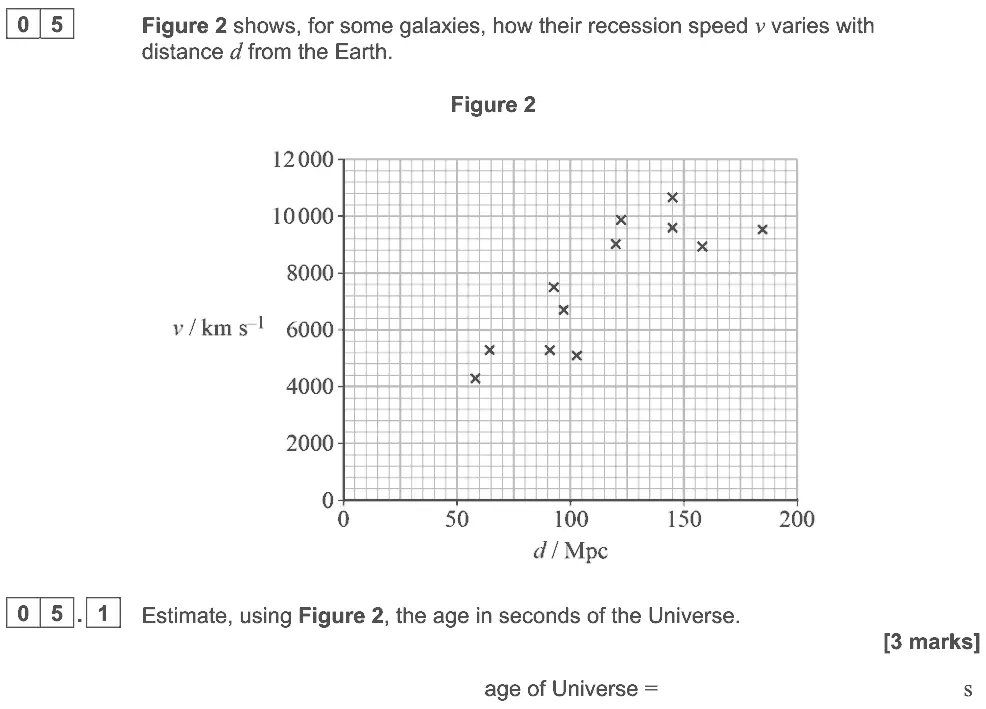
Levels of response. Need red shift z from spectral lines, v = zc
plot v (km s^-1) against d (Mpc), H = gradient
limitations: scatter, extinction affecting apparent magnitude, local motions, accelerating expansion
Skills: MS3.4 Determine the slope and intercept of a linear graph; MS3.1 Translate information between graphical, numerical and algebraic forms
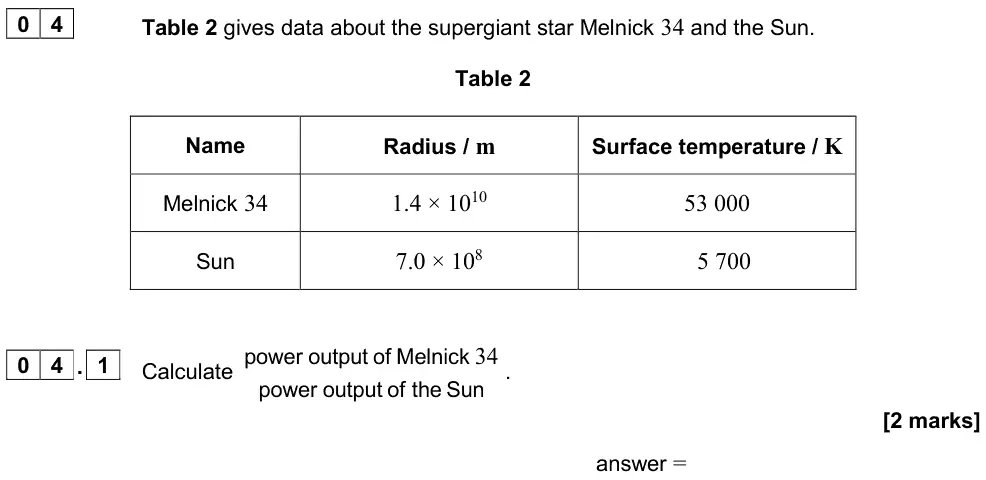
November 2020 · Paper 3B Astrophysics · Q4.12 marksAO2=2Calculation
Mark scheme
Examiner's comment
Many students did this calculation faultlessly. Common errors, however, were using the formula for volume instead of area, failing to raise temperature to the fourth power, and giving the final answer to only one significant figure.
Question 04.1
Notes from the mark scheme and report
Answer: 3.0 x 10^6 (P = sigma A T^4: (1.4 x 10^10/7.0 x 10^8)^2 x (53000/5700)^4)
Skills: MS0.3 Use ratios, fractions and percentages; MS2.3 Substitute numerical values into algebraic equations using appropriate units for physical quantities
November 2020 · Paper 3B Astrophysics · Q4.22 marksAO3=2Explanation
Earlier part of question 4 that this part uses
Mark scheme
Examiner's comment
It was rare to read a very good answer to this question, though many students knew that the star would go supernova and leave a black hole or neutron star. Often the danger was thought to be that the star was much hotter than our sun so would overheat the planet. Gamma Ray Bursts are highly collimated, and this is an important point. Concluding Remarks
This paper was broadly similar in difficulty to previous years. There were questions which have appeared in the same or similar forms in previous years (e.g. 01.1 and 02.5), along with questions on familiar topics which have been in the specification for a long time (e.g. 03.3). Question 04.2 tested knowledge of Gamma Ray Bursts (which was added to the specification at the latest revision) and most students did not know this.
Question 04.2
Notes from the mark scheme and report
Supernova then neutron star/black hole produces a gamma ray burst
highly collimated, if aimed at Earth could kill cells/damage DNA
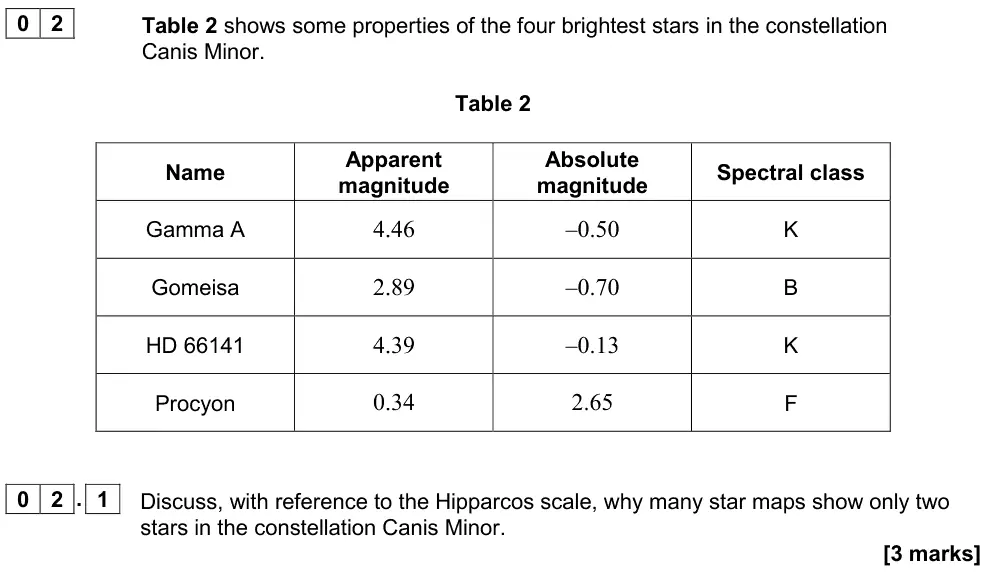
June 2019 · Paper 3B Astrophysics · Q2.13 marksExplanation
Mark scheme
Examiner's comment
2.1 Few students gained full marks on this question, though many scored at least one mark. The main reason for many students failing to gain marks was that they were not familiar with the Hipparcos scale. There were also some students who did not know the magnitude scale so thought the larger numbers were brighter. Also, a surprisingly large number of students thought that the two stars of similar magnitude would blend into one.
Notes from the mark scheme and report
Hipparcos scale: 1 brightest to 6 dimmest visible
Gamma A (4.46) and HD 66141 (4.39) are much dimmer, near the limit, so only Gomeisa and Procyon are usually seen
June 2019 · Paper 3B Astrophysics · Q2.22 marksExplanation
Earlier part of question 2 that this part uses
Mark scheme
Examiner's comment
2.2 Most students had learnt about the absorption lines found in the different spectral classes and most students chose the right star. Few, however, were clear about the reason why B- class stars produce Balmer lines. 2.3 This question scored the full range of marks, with some very well-argued answers. Many students were able to state that the two stars had similar temperatures due to being the d m M 5log10 = − same spectral class. Some students used the equation to work out d, thinking this was the diameter of the star. There were issues with statements about absolute and apparent magnitude. It is difficult to describe this due to the reverse nature of the scale, so students should take care to express themselves clearly. A brighter magnitude takes a smaller (more negative) value.
Notes from the mark scheme and report
Gomeisa (class B): hot enough for hydrogen atoms with electrons in the n = 2 state
June 2019 · Paper 3B Astrophysics · Q2.33 marksExplanation
Earlier part of question 2 that this part uses
Mark scheme
Examiner's comment
2.2 Most students had learnt about the absorption lines found in the different spectral classes and most students chose the right star. Few, however, were clear about the reason why B- class stars produce Balmer lines. 2.3 This question scored the full range of marks, with some very well-argued answers. Many students were able to state that the two stars had similar temperatures due to being the d m M 5log10 = − same spectral class. Some students used the equation to work out d, thinking this was the diameter of the star. There were issues with statements about absolute and apparent magnitude. It is difficult to describe this due to the reverse nature of the scale, so students should take care to express themselves clearly. A brighter magnitude takes a smaller (more negative) value.
Notes from the mark scheme and report
Gamma A: same class K so similar temperature
brighter absolute magnitude so greater power
Stefan's law gives larger area
confusing with apparent magnitude max 1
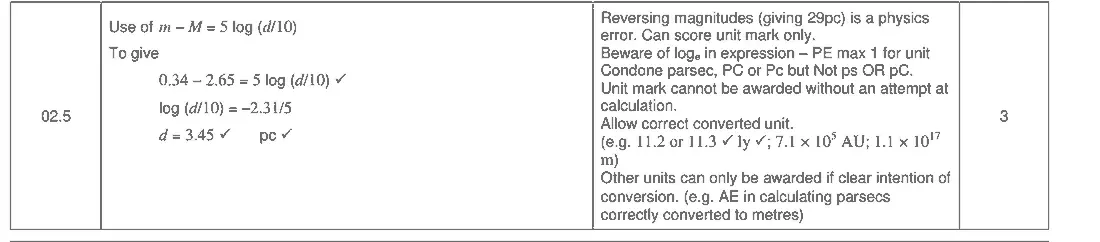
June 2019 · Paper 3B Astrophysics · Q2.53 marksCalculationEasy
Earlier part of question 2 that this part uses
Mark scheme
Examiner's comment
2.5 This was a well answered question, with around 70% of students scoring full marks. Common reasons for failing to gain marks included the use of natural logarithms instead of base 10 in the equation and the choice of incorrect units. The symbol for parsec is pc.
Notes from the mark scheme and report
Answer: 3.45 pc (0.34 - 2.65 = 5 log(d/10))
reversing magnitudes gives 29 pc
around 70% full marks
Skills: MS2.5 Use logarithms in relation to quantities that range over several orders of magnitude; MS2.3 Substitute numerical values into algebraic equations using appropriate units for physical quantities
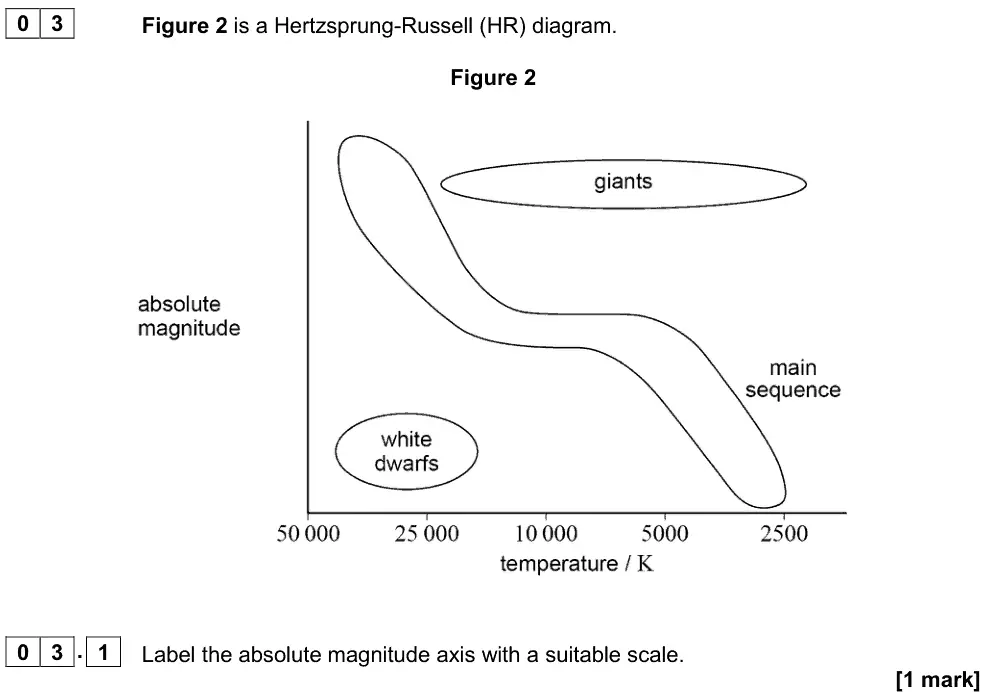
June 2019 · Paper 3B Astrophysics · Q3.11 markDiagram or graphHard
Mark scheme
Examiner's comment
3.1 Less than 30% of students scored this mark. The most common reason for not being awarded the mark was assigning the positive and negative ends of the axis the wrong way around.
Notes from the mark scheme and report
Scale from +15 at the bottom to -10 at the top
less than 30% scored
June 2019 · Paper 3B Astrophysics · Q3.22 marksDiagram or graph
Earlier part of question 3 that this part uses
Mark scheme
Examiner's comment
3.2 Almost all students placed the Sun correctly on the absolute magnitude scale but many could not recall the correct temperature.
Notes from the mark scheme and report
S on the main sequence at about 5000-6000 K and absolute magnitude +5
June 2019 · Paper 3B Astrophysics · Q3.32 marksDiagram or graph
Earlier part of question 3 that this part uses
Mark scheme
Examiner's comment
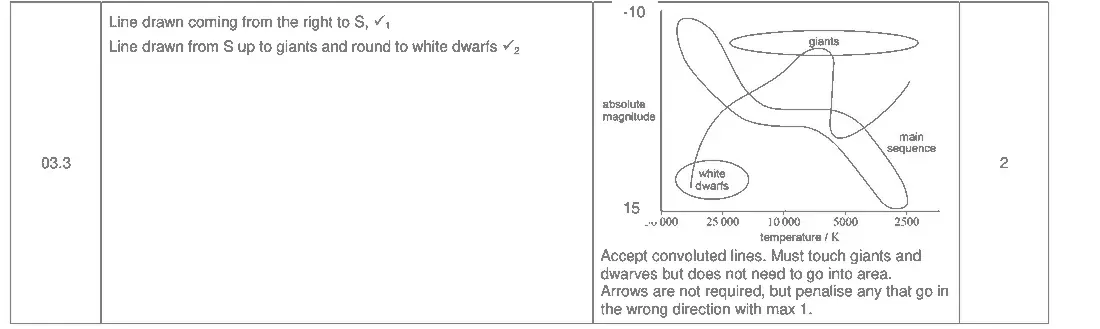
3.3 Most students knew what the future holds for a Sun-like star, but few showed correctly what happened before it joined the main sequence.
Notes from the mark scheme and report
Line from the right to S, then up to giants and round to white dwarfs
arrows wrong way max 1
June 2019 · Paper 3B Astrophysics · Q3.41 markDiagram or graphEasy
Earlier part of question 3 that this part uses
Mark scheme
Examiner's comment
3.4 Another very well-done question, with 70% of students getting the mark.
Notes from the mark scheme and report
P to the right of and above S (cooler, more powerful)
70% correct
June 2019 · Paper 3B Astrophysics · Q3.53 marksExplanation
Earlier part of question 3 that this part uses
Mark scheme
Examiner's comment
3.5 Most students attempted this question and around half scored at least 2 marks. The reason for missing the third mark was either because they only considered temperature or absolute magnitude, or because they considered only one of the two objects.
Notes from the mark scheme and report
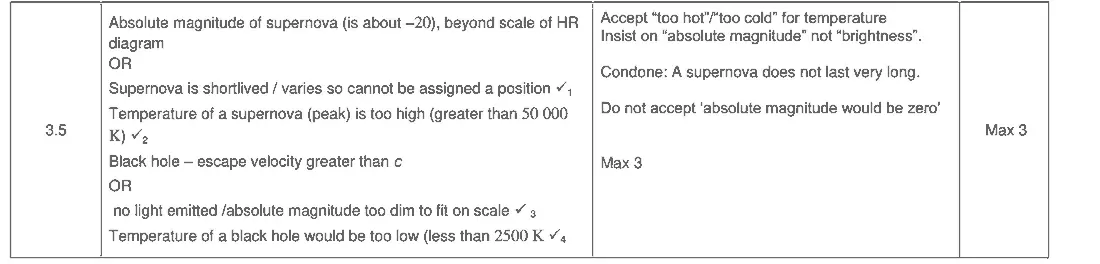
Supernova absolute magnitude about -20 (off scale) and very short-lived/temperature above 50 000 K
black hole emits no light (escape velocity > c) so too dim / too cold
must consider both objects
around half scored at least 2
June 2018 · Paper 3B Astrophysics · Q2.12 marksDiagram or graphEasy
Mark scheme
Examiner's comment
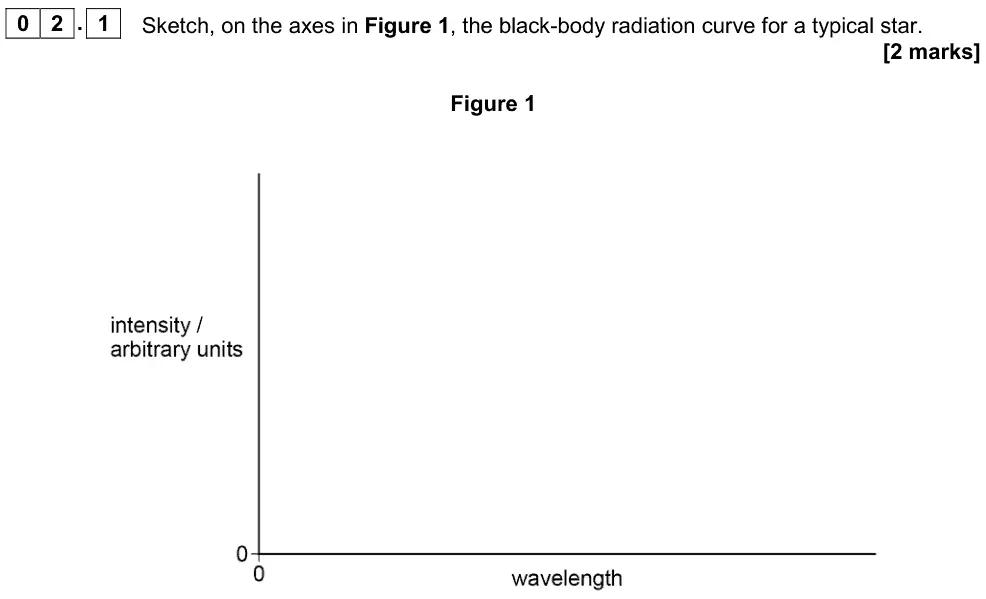
02.1 The mark scheme for this question meant that many students were able to score both marks (63.2%), but some very poor lines were seen. Most students knew that a peak was required, but the curvature of the line either side of the peak was not drawn clearly. The AQA support booklet for this topic, and previous question papers, contain versions of the graph that can be used to make it clear to students what is expected. It should be stressed, for example, that the left hand side of the peak is steeper than the right hand side. 02.2 This question discriminated well, with a range of marks being awarded. Most students mentioned Wien’s Law and identified the wavelength required correctly as the peak rather than maximum. A common error was one of simple algebra, with students incorrectly suggesting that this wavelength should be divided by Wien’s constant, rather than the other way round. It was satisfying to note that very few students suggested that the ‘m’ in the unit of the constant represented milli- rather than metre. This has been a common error in the past.
Notes from the mark scheme and report
Single peak, left side steeper than right, starting at origin
no negative gradient on left
63.2% both marks
Skills: MS3.1 Translate information between graphical, numerical and algebraic forms
June 2018 · Paper 3B Astrophysics · Q2.23 marksExplanation
Earlier part of question 2 that this part uses
Mark scheme
Examiner's comment
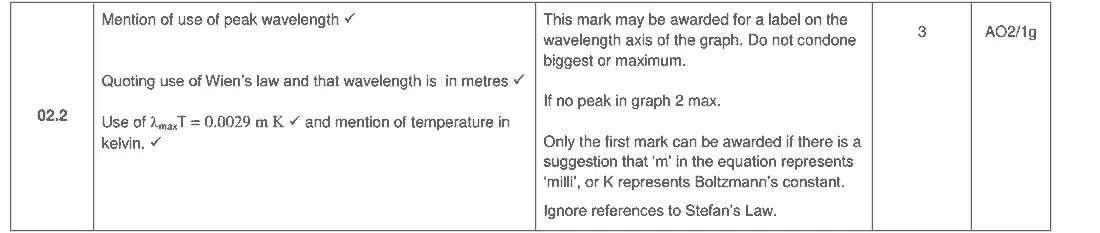
02.1 The mark scheme for this question meant that many students were able to score both marks (63.2%), but some very poor lines were seen. Most students knew that a peak was required, but the curvature of the line either side of the peak was not drawn clearly. The AQA support booklet for this topic, and previous question papers, contain versions of the graph that can be used to make it clear to students what is expected. It should be stressed, for example, that the left hand side of the peak is steeper than the right hand side. 02.2 This question discriminated well, with a range of marks being awarded. Most students mentioned Wien’s Law and identified the wavelength required correctly as the peak rather than maximum. A common error was one of simple algebra, with students incorrectly suggesting that this wavelength should be divided by Wien’s constant, rather than the other way round. It was satisfying to note that very few students suggested that the ‘m’ in the unit of the constant represented milli- rather than metre. This has been a common error in the past.
Notes from the mark scheme and report
Read peak wavelength (in metres) and use lambda_max T = 2.9 x 10^-3 m K to give T in kelvin
'biggest/maximum wavelength' not condoned
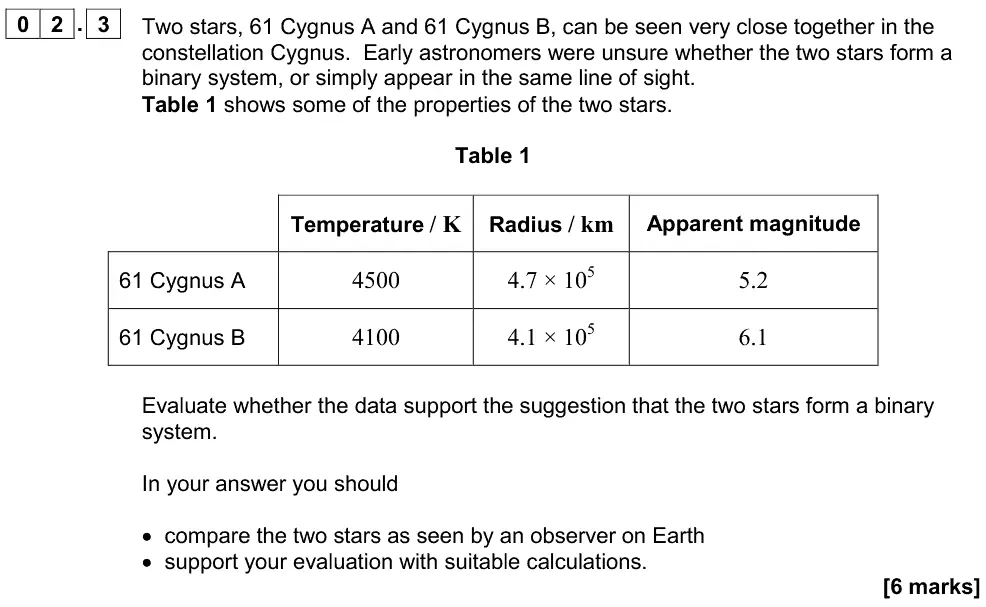
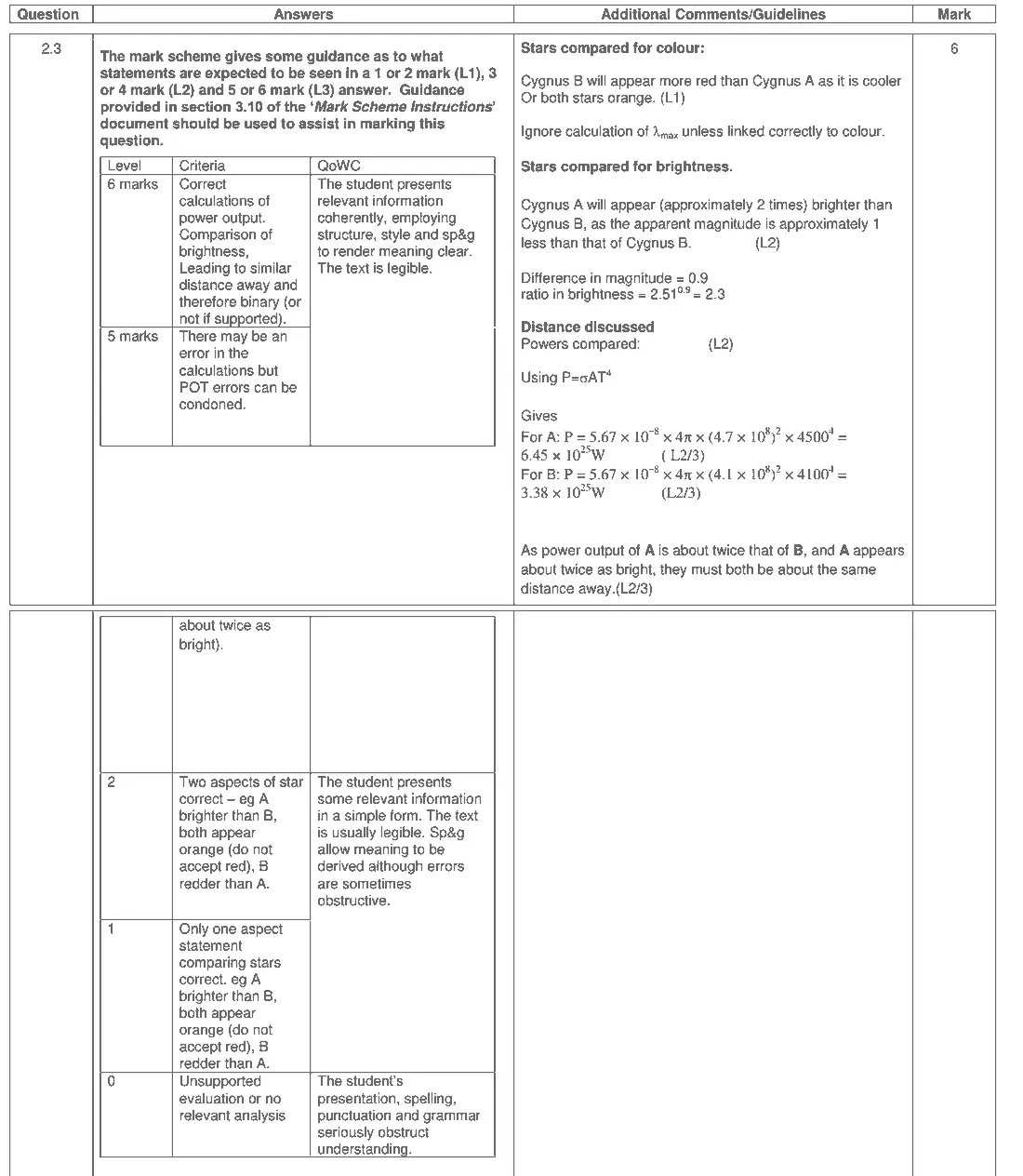
June 2018 · Paper 3B Astrophysics · Q2.36 marks6-mark extended response
Earlier part of question 2 that this part uses
Mark scheme, with the levels and indicative content
Examiner's comment
02.3 The 6-mark question has been a feature of this exam for many years and there is evidence to suggest that students are becoming more familiar with what is expected. Many students correctly identified that calculations using Stefan’s Law were needed to compare the power output of the two stars, and then related that to the difference in apparent magnitude. There were many examples of students failing to use the correct equation for the area of a sphere or neglecting to use the fourth power of the temperature, however. There was evidence to suggest that many students were familiar with the apparent magnitude scale and correctly calculated a ratio of apparent brightness for the two stars. Students who failed to make much progress simply stated that the values of apparent magnitude, radius and temperature were similar and that, therefore, the two stars were the same distance away. It should be noted that, although the two stars do in fact form a binary system, full credit was given to students who argued that the ratio of the power output and the ratio of the brightness are sufficiently different to suggest that they are too far apart. Pleasingly, just over half of the students were able to gain at least four of the six marks available.
Notes from the mark scheme and report
Levels of response. Stefan's law power ratio A/B = (4.7/4.1)^2 x (4500/4100)^4 = 1.9
magnitude difference 0.9 gives intensity ratio 2.51^0.9 = 2.3
similar ratios so consistent with same distance (binary)
area of sphere errors common
just over half gained at least 4 marks
Skills: MS0.3 Use ratios, fractions and percentages; MS2.3 Substitute numerical values into algebraic equations using appropriate units for physical quantities; MS0.5 Use calculators to find and use power, exponential and logarithmic functions
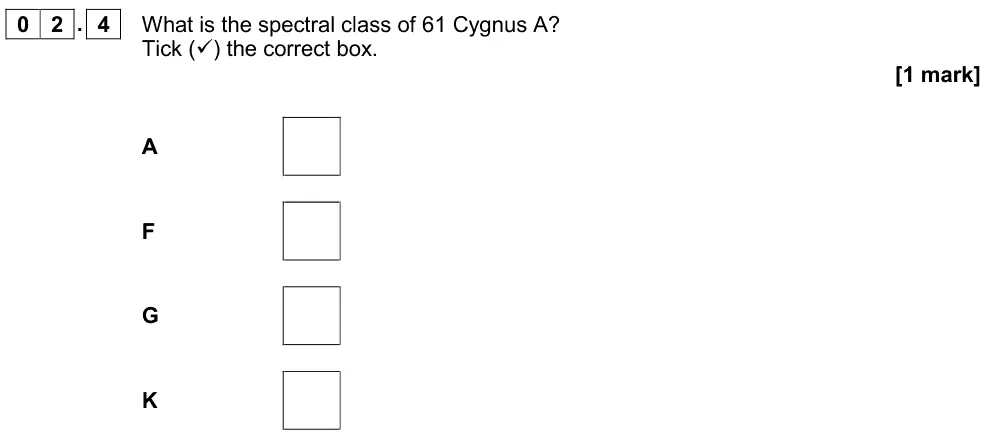
June 2018 · Paper 3B Astrophysics · Q2.41 markShort answer
Earlier part of question 2 that this part uses
Mark scheme
Notes from the mark scheme and report
Answer: K (4500 K)
June 2018 · Paper 3B Astrophysics · Q3.12 marksShort answerHard
Mark scheme
Examiner's comment
03.1 Many answers to this question focused on simple properties of the three objects rather than the relationship between them. Some students, who did see what was required, suggested incorrectly that quasars are black holes, or that galaxies orbit a black hole in a similar way to planets orbiting stars, perhaps. Only 18.2% of students gained both marks here.
Notes from the mark scheme and report
Quasars are produced by (active) supermassive black holes at the centres of galaxies
'quasars are black holes' wrong
only 18.2% both marks
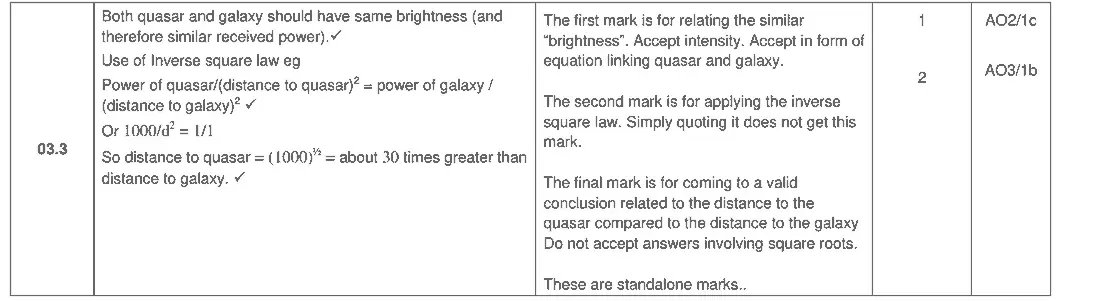
June 2018 · Paper 3B Astrophysics · Q3.33 marksCalculationHard
Earlier part of question 3 that this part uses
Mark scheme
Examiner's comment
03.3 The use of the inverse-square law proved to be significantly more demanding. There was evidence of students obtaining the square root of 1000 as an answer and then missing a mark by leaving it in this form. Answers of 10, 100 or even 1 000 000 were also relatively common. It was clear that many students knew the inverse-square law but were not sure how to apply it. The important point is that the intensity received at the Earth is the same for the two objects, but that was rarely stated. Only 12.1% of students gained all three marks; the proportion that failed to gain even a single mark was 48.5%.
Notes from the mark scheme and report
Same minimum received intensity: 1000/dq^2 = 1/dg^2 so about 30 times further (root 1000)
answers 10, 100, 10^6 common
only 12.1% full marks
Skills: MS0.3 Use ratios, fractions and percentages; MS1.4 Make order of magnitude calculations
June 2017 · Paper 3B Astrophysics · Q3.12 marksShort answer
Mark scheme
Examiner's comment
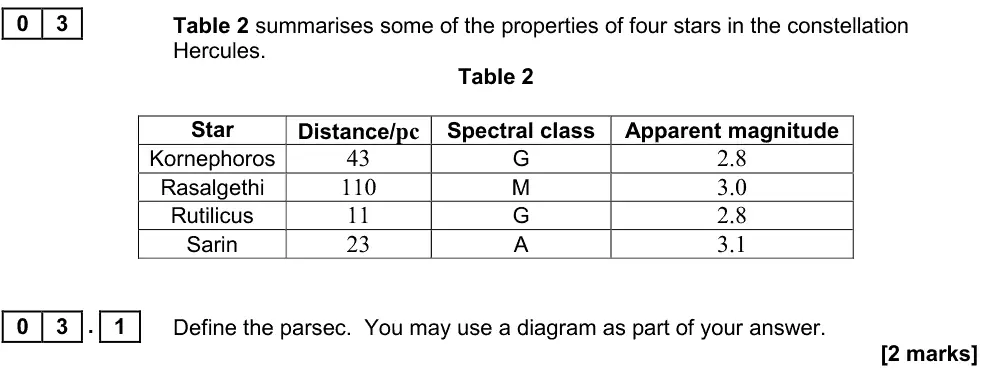
03.1 The definition of the parsec is difficult to express, and therefore most successful students preferred to draw a labelled diagram. Three things needed to be included: the angle of 1 arc second, 1 AU and 1 pc. It was relatively common to see one of these missing or mislabelled. Those students who chose to define in words commonly suggested that it was the distant star that subtended the angle of 1 arc second, rather than the Earth – Sun distance.
Notes from the mark scheme and report
Distance at which 1 AU subtends 1 arc second (1/3600 degree)
a labelled diagram (1 AU, 1 pc, 1 arcsec) is the easiest route
the angle is subtended by the Earth-Sun distance, not by the star
Skills: MS4.2 Visualise and represent 2D and 3D forms including two- dimensional representations of 3D objects
June 2017 · Paper 3B Astrophysics · Q3.23 marksExplanation
Earlier part of question 3 that this part uses
Mark scheme
Examiner's comment
03.2 The use of Stefan’s Law to judge the relative size of a star has been asked in a variety of forms in the previous specification, and many students responded to this question. Many students managed to make some progress by arguing that the absolute magnitude, or power output, of Kornephoros must be greater due it its distance. The use of ‘brightness’ or ‘magnitude’ here did not gain credit as students may have been referring to the apparent magnitude. A more common mistake was the failure to make a reference to the temperature, based on the spectral class. A significant number of students made the classic mistake of not reading the question correctly and discussed the relative size of Rasalgethi.
Notes from the mark scheme and report
Kornephoros: same class G so similar temperature
same apparent magnitude but further away so greater power output
P = sigma A T^4 so larger area
'brightness' alone not credited
June 2017 · Paper 3B Astrophysics · Q3.32 marksCalculation
Earlier part of question 3 that this part uses
Mark scheme
Examiner's comment
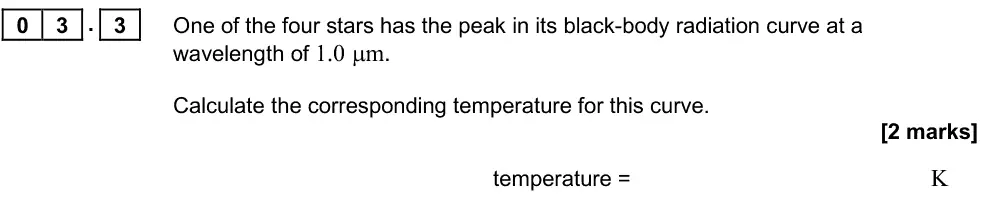
03.3 The vast majority of students had no difficulty determining the temperature based on Wien’s Law. Occasionally answers based on power of ten errors were seen, either related to the micro prefix, or the metres in the unit of the constant being interpreted as milli.
Notes from the mark scheme and report
Answer: 2.9 x 10^3 K (2.9 x 10^-3 / 1.0 x 10^-6)
micro prefix power-of-ten errors
Skills: MS2.3 Substitute numerical values into algebraic equations using appropriate units for physical quantities; MS0.2 Recognise and use expressions in decimal and standard form
June 2017 · Paper 3B Astrophysics · Q3.42 marksShort answer
Earlier part of question 3 that this part uses
Mark scheme
Examiner's comment
03.4 The vast majority of students were also able to use their knowledge of spectral class temperature ranges to identify the correct star.
Notes from the mark scheme and report
2900 K is class M, so Rasalgethi
June 2017 · Paper 3B Astrophysics · Q3.51 markShort answer
Earlier part of question 3 that this part uses
Mark scheme
Examiner's comment
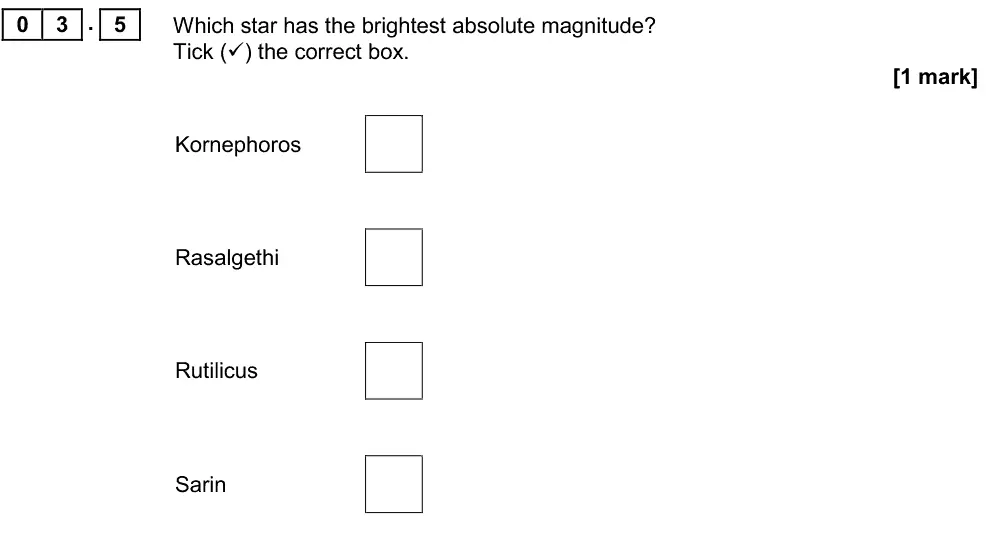
03.5 It was relatively common to see the calculated absolute magnitudes written next to the name of each star. Undoubtedly many students saved time by spotting that all of the stars have a similar apparent magnitude, and yet one is significantly further away than the others.
Notes from the mark scheme and report
Answer: Rasalgethi (similar apparent magnitudes, much further away)
June 2017 · Paper 3B Astrophysics · Q3.63 marksCalculation
Earlier part of question 3 that this part uses
Mark scheme
Examiner's comment
03.6 This calculation was performed correctly by the vast majority of students. Common errors included converting the distance into other units, using natural logs rather than base 10 and confusing m and M.
Notes from the mark scheme and report
Answer: M = 1.3 (3.1 - 5 log(23/10))
errors: converting pc, natural logs, swapping m and M
Skills: MS2.5 Use logarithms in relation to quantities that range over several orders of magnitude; MS2.3 Substitute numerical values into algebraic equations using appropriate units for physical quantities
June 2017 · Paper 3B Astrophysics · Q4.13 marksDiagram or graph
Mark scheme
Examiner's comment
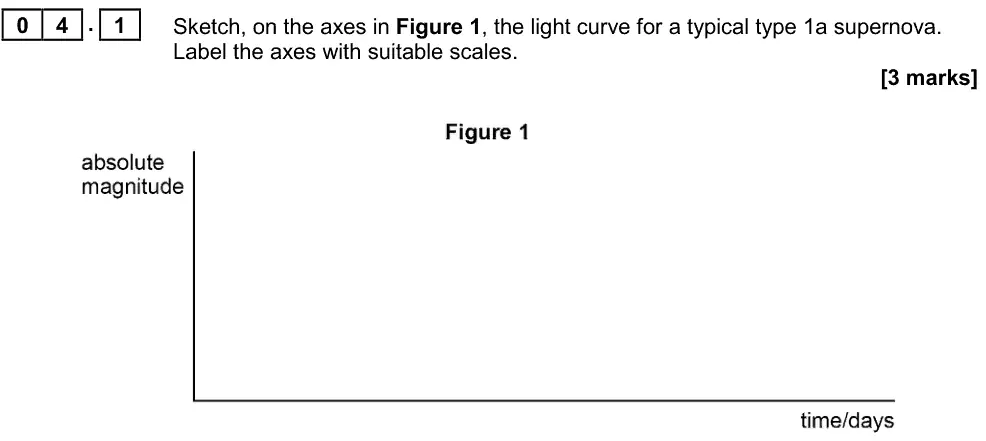
04.1 A significant tool in astronomy is related to the use of standard candles, and this specification focuses on type 1a supernovae. Very few students were able to demonstrate sufficient knowledge to gain all three marks. The shape of the graph caused problems, with some confusion with black body radiation curves being apparent. The labelling of the axes also suggested that few students had studied this light curve in sufficient depth.
Notes from the mark scheme and report
Absolute magnitude axis more negative upwards, peak about -19, time in days (0 to tens/hundreds)
rapid rise then slower decline
few gained all three marks, confusion with black-body curves
Skills: MS3.1 Translate information between graphical, numerical and algebraic forms
June 2017 · Paper 3B Astrophysics · Q4.21 markShort answer
Earlier part of question 4 that this part uses
Mark scheme
Examiner's comment
04.2 Lack of clarity cost many students the mark in this question. As has been pointed out earlier, ‘magnitude’ can be either ‘apparent’ or ‘absolute’ and the correct one needs to be used for credit.
Notes from the mark scheme and report
Object of known absolute magnitude (luminosity)
'fixed/constant' or just 'magnitude' not accepted
June 2017 · Paper 3B Astrophysics · Q4.33 marksExplanation
Earlier part of question 4 that this part uses
Mark scheme
Examiner's comment
04.3 It is expected that students are away of some of the significant discoveries in recent astronomy, the idea of an accelerating universe being the relevant one here. Very students were able to relate the surprising nature of the supernovae measurements. It was fairly common to see answers discussing the big bang or gamma ray bursts. Marks were also lost by students who confused dark energy and dark matter.
Notes from the mark scheme and report
Supernovae dimmer than predicted by Hubble's law, so the expansion of the Universe is accelerating
controversial as no known energy source - dark energy (not dark matter)
Specimen set 1 · Paper 3B Astrophysics · Q2.12 marksShort answer
Mark scheme
Notes from the mark scheme and report
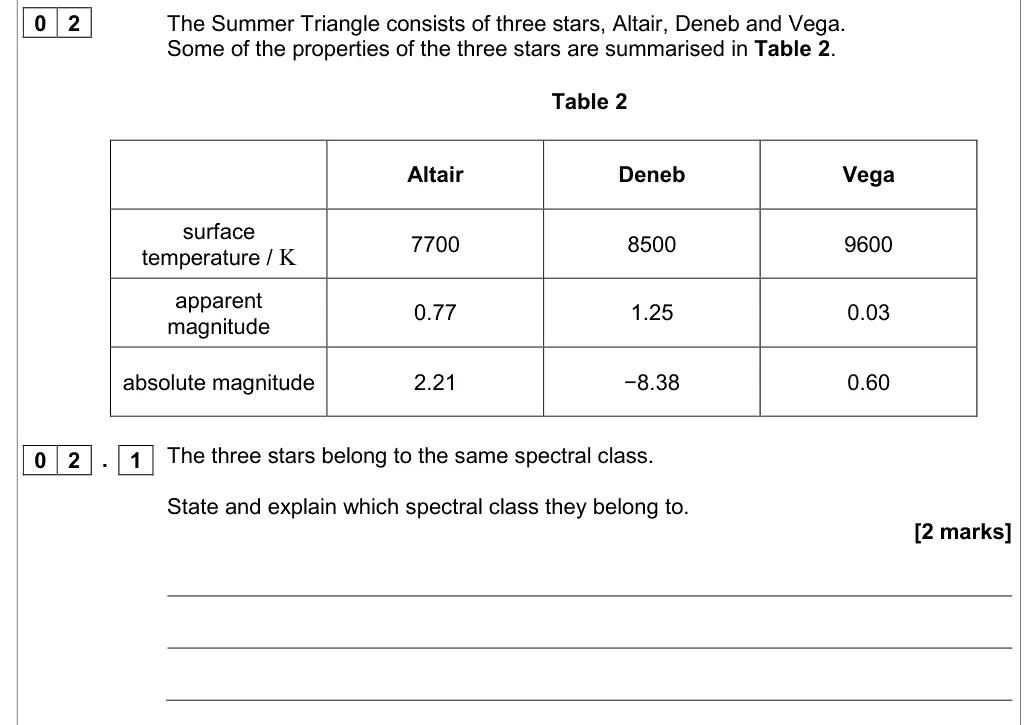
Class A
temperatures within 7500-11000 K
Specimen set 1 · Paper 3B Astrophysics · Q2.22 marksShort answer
Earlier part of question 2 that this part uses
Mark scheme
Notes from the mark scheme and report
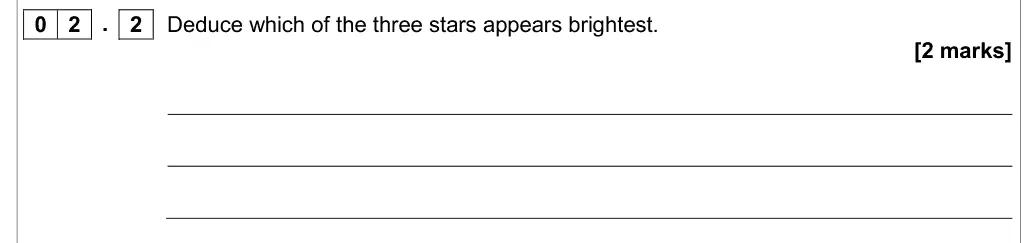
Vega - lowest apparent magnitude is brightest
Specimen set 1 · Paper 3B Astrophysics · Q2.33 marksCalculation
Earlier part of question 2 that this part uses
Mark scheme
Notes from the mark scheme and report
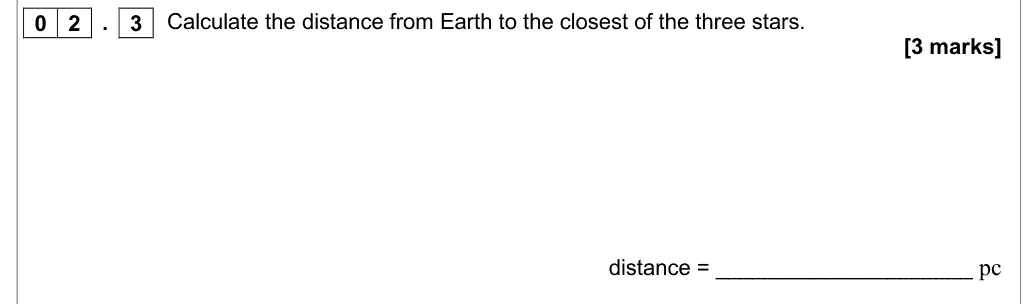
Answer: 5.2 pc (Altair, m - M = -1.44 smallest, so closest
m - M = 5 log(d/10))
Skills: MS2.5 Use logarithms in relation to quantities that range over several orders of magnitude; MS2.3 Substitute numerical values into algebraic equations using appropriate units for physical quantities
Specimen set 1 · Paper 3B Astrophysics · Q2.43 marksExplanation
Earlier part of question 2 that this part uses
Mark scheme
Notes from the mark scheme and report
Deneb: similar temperature but much brighter absolute magnitude so greater power
P = sigma A T^4 so greater area
no mark for unsupported answer
Specimen set 1 · Paper 3B Astrophysics · Q2.52 marksCalculation
Earlier part of question 2 that this part uses
Mark scheme
Notes from the mark scheme and report
Answer: 3.8 x 10^-7 m (0.0029/7700)
Skills: MS2.3 Substitute numerical values into algebraic equations using appropriate units for physical quantities
Specimen set 1 · Paper 3B Astrophysics · Q3.11 markShort answer
Mark scheme
Notes from the mark scheme and report
Rapid increase in brightness (absolute magnitude)
Specimen set 1 · Paper 3B Astrophysics · Q3.22 marksShort answer
Earlier part of question 3 that this part uses
Mark scheme
Notes from the mark scheme and report
Extremely dense
made of neutrons
spin/radio emission ignored
Specimen set 1 · Paper 3B Astrophysics · Q3.32 marksCalculation
Earlier part of question 3 that this part uses
Mark scheme
Notes from the mark scheme and report
Answer: 5.9 x 10^3 m (Rs = 2GM/c^2 with M = 4 x 10^30 kg)
Skills: MS2.3 Substitute numerical values into algebraic equations using appropriate units for physical quantities; MS0.2 Recognise and use expressions in decimal and standard form
Specimen set 1 · Paper 3B Astrophysics · Q3.42 marksExplanation
Earlier part of question 3 that this part uses
Mark scheme
Notes from the mark scheme and report
Gamma ray burst with energy comparable to the Sun's total output
highly collimated, if aimed at Earth could cause mass extinction
Work with an AQA physics tutor
Dropping marks on calculations, required practicals or the six-markers? Book a trial session with a specialist AQA physics tutor.