Notes and key-term cards for this topic are being written by our tutors. The past-paper questions below are ready now.
Specification statements
Show the 13 statements from the specification
3.9.3.1-01 ∆f f = v c and z = ∆λ λ = −v c for v ≪c applied to optical and radio frequencies.
3.9.3.1-02 Calculations on binary stars viewed in the plane of orbit.
3.9.3.1-03 Galaxies and quasars.
3.9.3.2-01 Red shift v = Hd
3.9.3.2-02 Simple interpretation as expansion of universe; estimation of age of universe, assuming H is constant.
3.9.3.2-03 Qualitative treatment of Big Bang theory including evidence from cosmological microwave background radiation, and relative abundance of hydrogen and helium.
3.9.3.3-01 Quasars as the most distant measurable objects.
3.9.3.3-02 Discovery of quasars as bright radio sources.
3.9.3.3-03 Quasars show large optical red shifts; estimation involving distance and power output.
3.9.3.3-04 Formation of quasars from active supermassive black holes.
3.9.3.4-01 Difficulties in the direct detection of exoplanets.
3.9.3.4-02 Detection techniques will be limited to variation in Doppler shift (radial velocity method) and the transit method.
3.9.3.4-03 Typical light curve.
Six-mark extended response questions on this topic
Tap a question to zoom it. Where a part needs a figure, table or graph from earlier in the question, that part folds out above it; the mark scheme and examiner's comment open underneath. Have the AQA data and formulae booklet beside you (see the formula sheet page).
June 2025 · Paper 3B Astrophysics · Q1.31 markAO3=1Short answer
Earlier part of question 1 that this part uses
Mark scheme
Examiner's comment
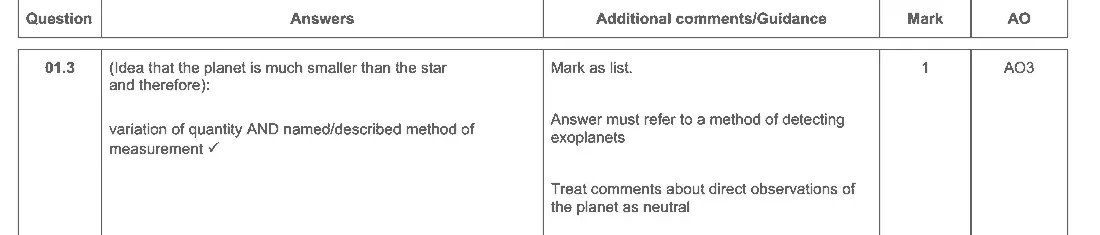
1.3 This was the most demanding question on the paper. Students often gave vague statements about distance or brightness without saying how this impacted a method of detection.
Notes from the mark scheme and report
Planet much smaller than the star so the transit dip in brightness (or the Doppler shift of the star) is tiny
must refer to a detection method
direct observation comments neutral
June 2025 · Paper 3B Astrophysics · Q3.13 marksAO2=3Calculation
Mark scheme
Examiner's comment
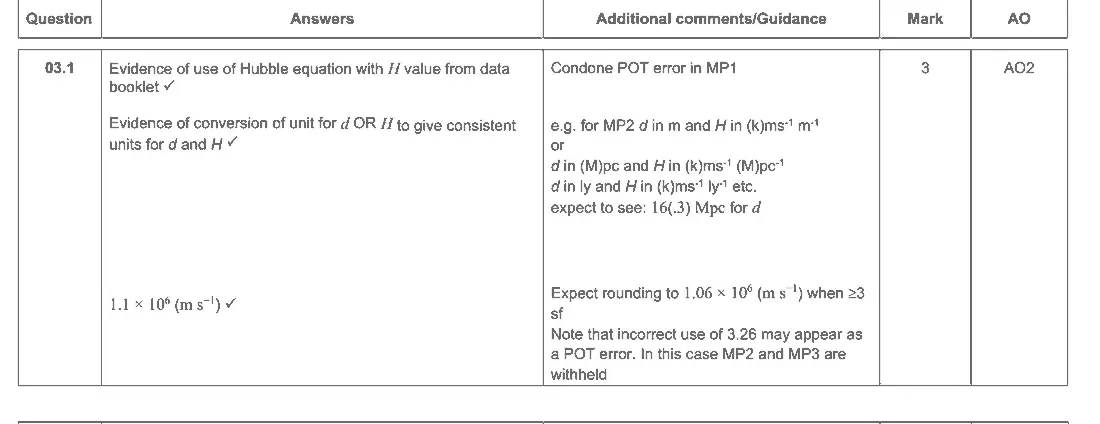
3.1 This question was done very well with over 54% of students scoring full marks. The main sources of error came from students who had not shown clear and logical working meaning that subsidiary marks could not be awarded.
Notes from the mark scheme and report
Answer: 1.1 x 10^6 m s^-1 (v = Hd with data-booklet H
5.3 x 10^7 ly = 16 Mpc, consistent units)
over 54% full marks
Skills: MS2.3 Substitute numerical values into algebraic equations using appropriate units for physical quantities; MS0.1 Recognise and make use of appropriate units in calculations
June 2025 · Paper 3B Astrophysics · Q3.21 markAO1=1Short answer
Earlier part of question 3 that this part uses
Mark scheme
Examiner's comment
3.2 Students often struggled with this question. Talk of a dark or black galactic centre was the main incorrect answer given.
Notes from the mark scheme and report
Very intense radio emission or bright X-ray source (quasar-like jets)
gamma ray burst not accepted
June 2025 · Paper 3B Astrophysics · Q4.43 marksAO3=3Explanation
Earlier part of question 4 that this part uses
Mark scheme
Examiner's comment
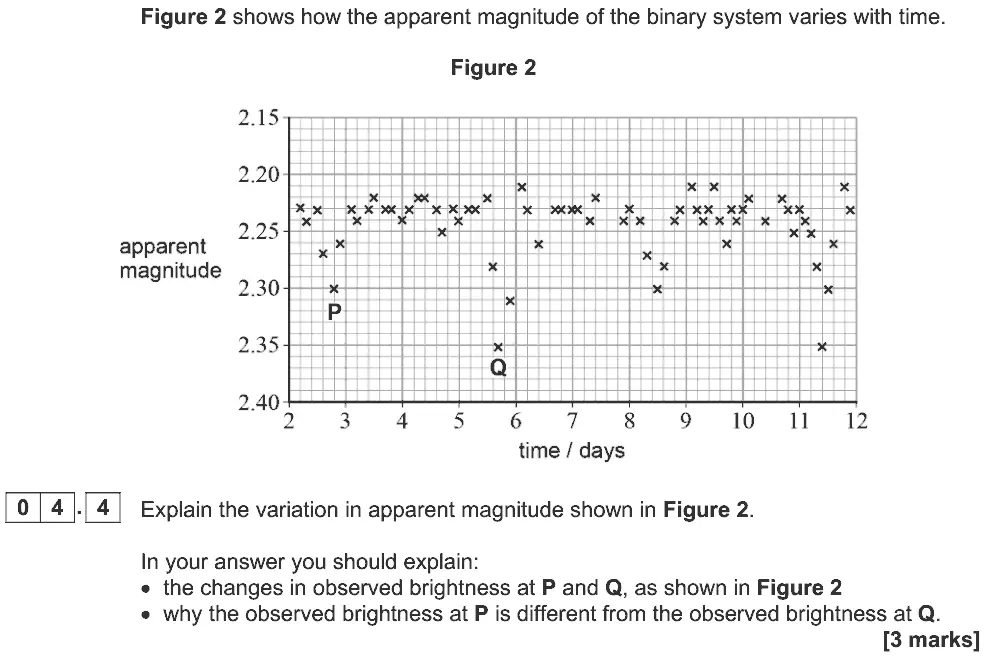
4.4 Students generally noticed that the changes in magnitude were due to one star passing in front of the other with over 75% of students gaining this mark. Many students did not answer the question in full however, and failed to mention the apparent magnitude at points other than P and Q.
Notes from the mark scheme and report
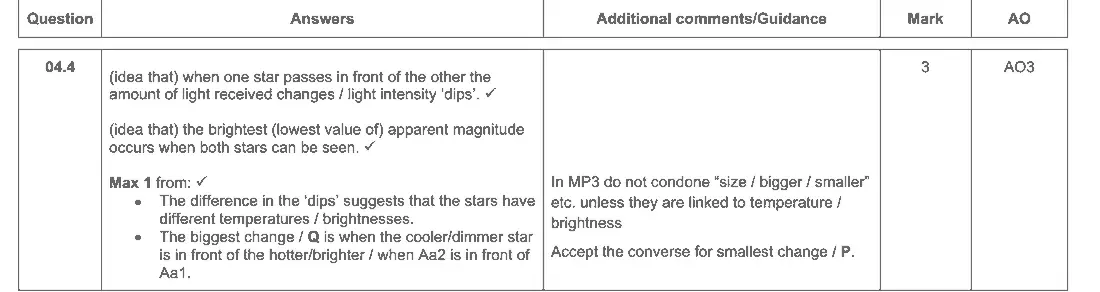
Dips when one star passes in front of the other
brightest when both seen
different dips because the stars differ in temperature/brightness - larger dip (Q) when the cooler/dimmer star is in front
over 75% got the first mark
June 2025 · Paper 3B Astrophysics · Q4.52 marksAO2=2Calculation
Earlier part of question 4 that this part uses
Mark scheme
Examiner's comment
4.5 This question required students to read a value from the graph and then convert this into seconds to use in the angular velocity equation. It was generally done well. Due to the nature of the question, students needed to show correct working to gain marks. Some students missed out several steps with their working or did not include any subjects or units in their calculations making them difficult to follow.
Notes from the mark scheme and report
Answer: 1.3 x 10^-5 rad s^-1 (period 5.7 days between equivalent dips, omega = 2 pi/T)
using half the period max 1
Skills: MS3.1 Translate information between graphical, numerical and algebraic forms; MS2.3 Substitute numerical values into algebraic equations using appropriate units for physical quantities
June 2024 · Paper 3B Astrophysics · Q4.12 marksAO3=2Explanation
Mark scheme
Examiner's comment
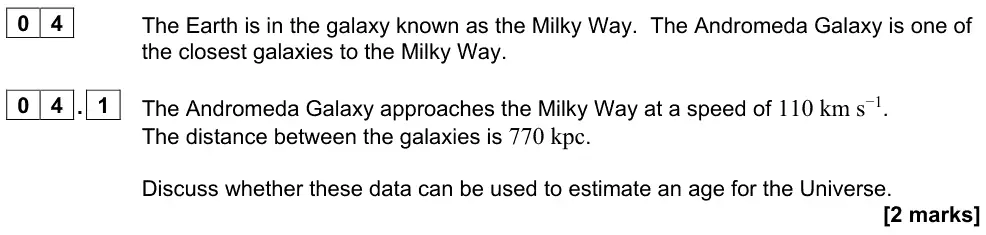
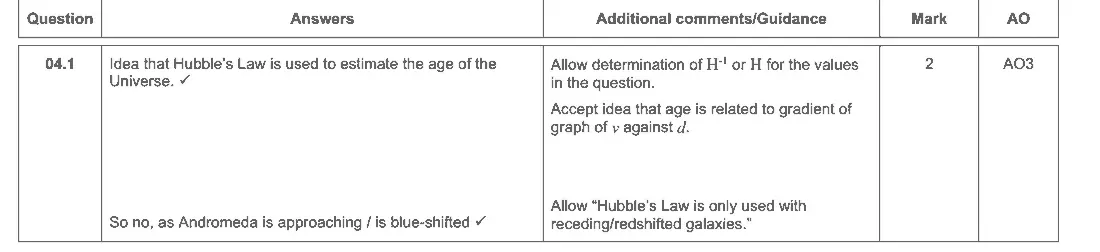
In question 04.1, most students identified Hubble’s law or the Hubble constant as the method of finding the age of the Universe. Far fewer students identified that this was invalid in this situation as the galaxies are approaching and not receding.
Notes from the mark scheme and report
Age from Hubble's law (1/H) needs receding galaxies
Andromeda is approaching (blue-shifted) so cannot be used
few saw this
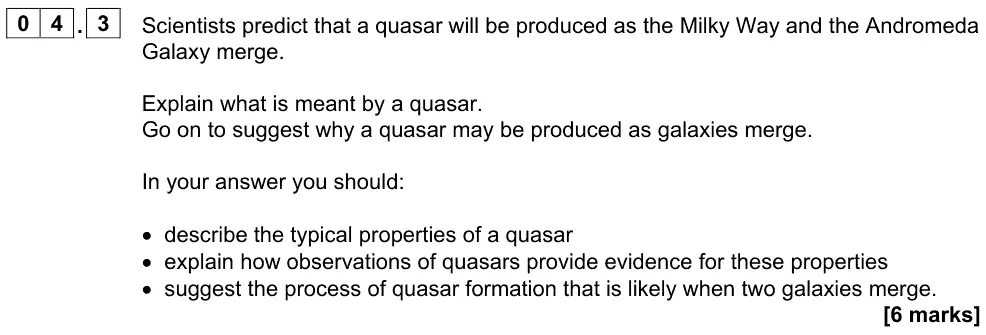
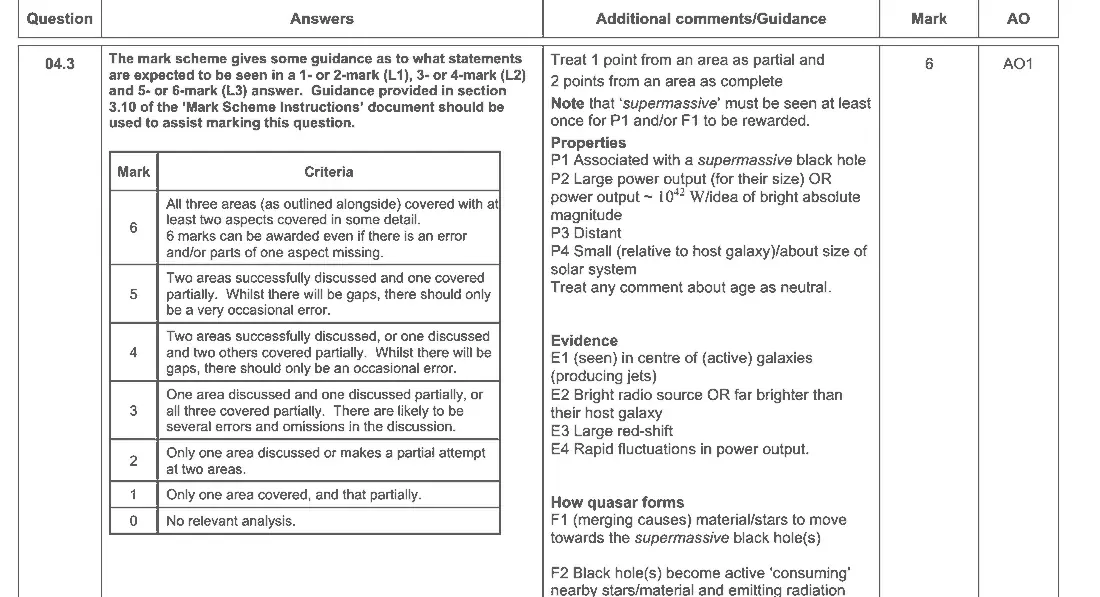
June 2024 · Paper 3B Astrophysics · Q4.36 marksAO1=66-mark extended response
Earlier part of question 4 that this part uses
Mark scheme, with the levels and indicative content
Examiner's comment
Question 04.3 allowed students to explain what they knew and understood about quasars and their formation. As is typical on this paper, this six-mark question was the most discriminating on the paper, allowing E grade students to gain at least one mark and A* students to get five or six marks. The mark scheme was quite generous. Many students had some idea of the power output and distance to quasars and many managed to link these to their brightness relative to their host galaxies and the redshift, respectively. Fewer students managed to successfully describe the likely process of quasar formation with much confusion with type 1a supernovae being evident, for example.
Notes from the mark scheme and report
Levels of response. Quasars: very distant (large red shift), extremely powerful (output of many galaxies) from a small region (variability), strong radio sources
powered by matter accreting onto a supermassive black hole - merger feeds gas to the central black hole(s) making it active
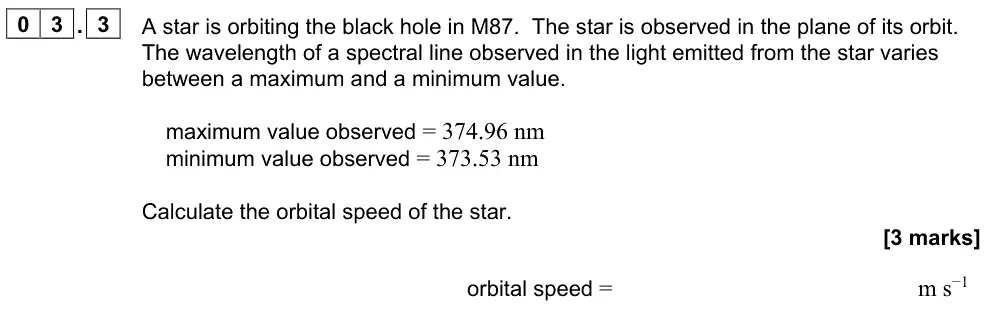
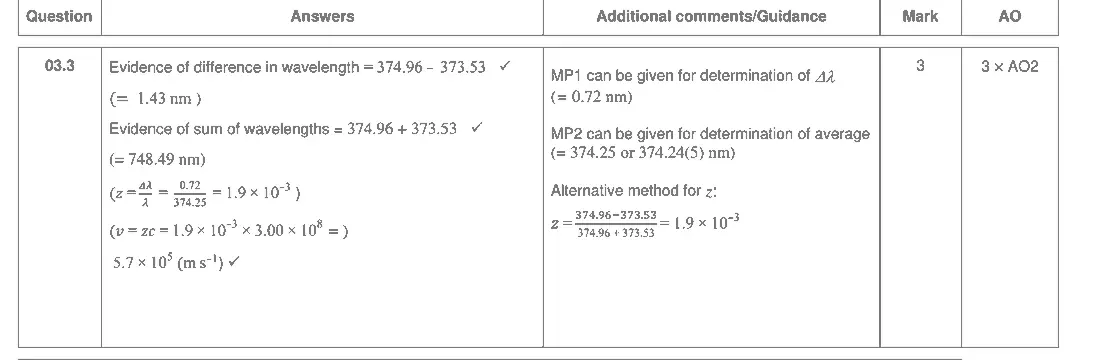
June 2023 · Paper 3B Astrophysics · Q3.33 marksAO2=3Calculation
Earlier part of question 3 that this part uses
Mark scheme
Examiner's comment
03.3 The mark scheme allowed students to receive partial credit for some idea of how to approach this question, which meant nearly 80% obtained at least one mark. Many answers did not take the factor of two into account and therefore obtained the wrong value for z. This question also discriminated well.
Notes from the mark scheme and report
Answer: 5.7 x 10^5 m s^-1 (delta lambda = 1.43/2 nm, mean 374.25 nm, z = 1.9 x 10^-3)
missing factor of two common
nearly 80% at least one mark
Skills: MS2.3 Substitute numerical values into algebraic equations using appropriate units for physical quantities; MS1.2 Find arithmetic means
June 2023 · Paper 3B Astrophysics · Q5.13 marksAO2=1, AO3=2Calculation
Mark scheme
Examiner's comment
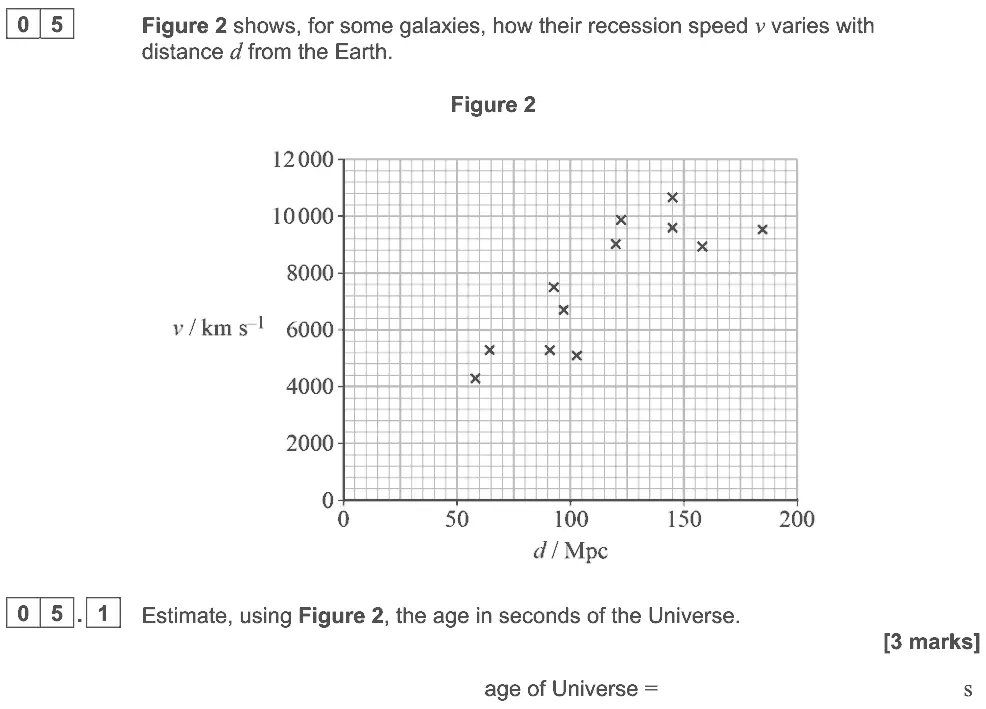
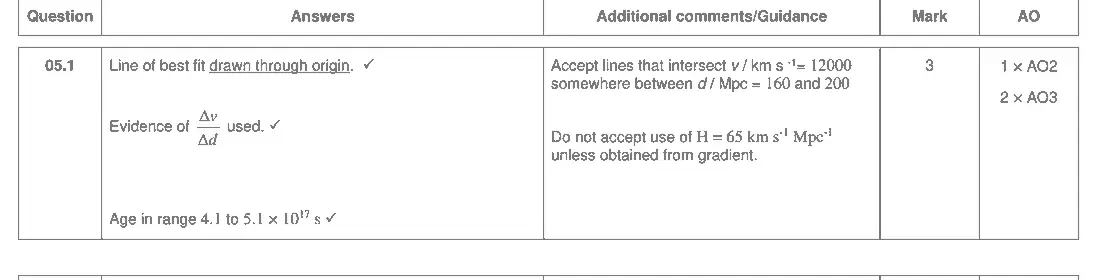
05.1 Students were required to draw a line of best fit through the origin on Figure 2. Many students either failed to do this step or drew a line that did not pass through the origin. A mark was still available, provided the gradient of the line was determined. The third mark was for a correct answer in range. Students who simply used the data booklet value for H were not given credit.
Notes from the mark scheme and report
Answer: 4.1-5.1 x 10^17 s (best-fit line through origin, H = gradient, age = 1/H in s^-1)
data-booklet H not credited
many lines not through origin
Skills: MS3.4 Determine the slope and intercept of a linear graph; MS0.1 Recognise and make use of appropriate units in calculations
June 2022 · Paper 3B Astrophysics · Q2.12 marksAO2=1, AO3=1Explanation
Mark scheme
Examiner's comment
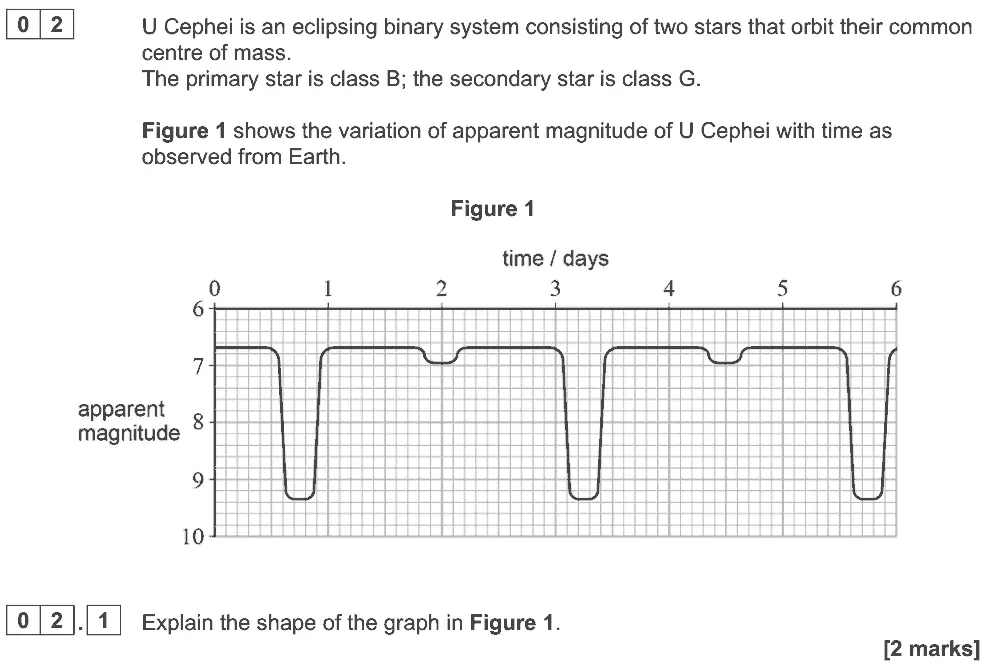
2.1 The majority of students scored one mark for understanding that one star blocked light from the other. A number of students were confused by the idea of a common centre of mass and wrote about a separate mass between the two stars. Very few students clearly stated that the deeper dips are caused by the cooler star passing in front of the hotter one.
Notes from the mark scheme and report
Dips when one star passes in front of the other
deeper minimum when the cooler star eclipses the hotter star (relates to temperature, not size)
June 2022 · Paper 3B Astrophysics · Q2.21 markAO3=1Short answer
Earlier part of question 2 that this part uses
Mark scheme
Examiner's comment
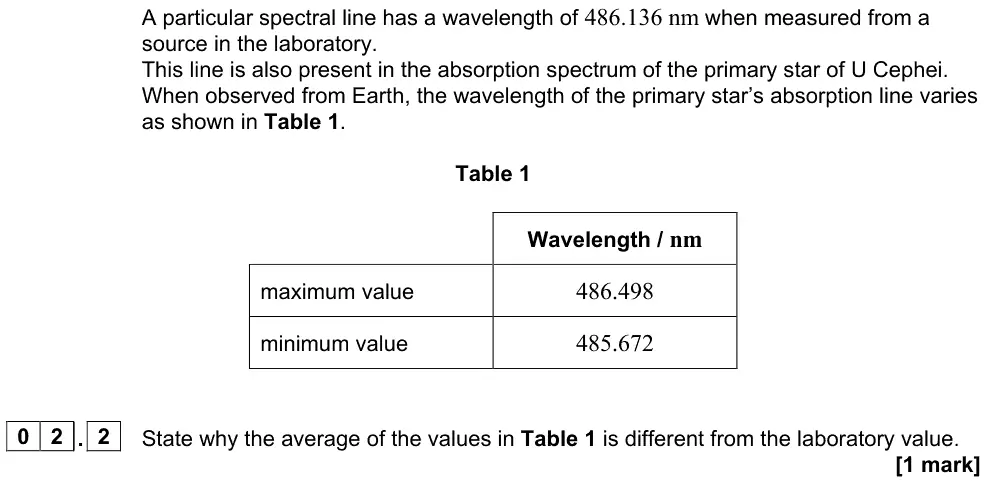
2.2 Few students scored this mark. Many students seemed to think the laboratory value would be more accurate due to better equipment.
Notes from the mark scheme and report
Average (486.085 nm) below laboratory value: system moving towards us, blue shift (Doppler)
June 2022 · Paper 3B Astrophysics · Q2.33 marksAO2=2, AO3=1Show that
Earlier part of question 2 that this part uses
Mark scheme
Examiner's comment
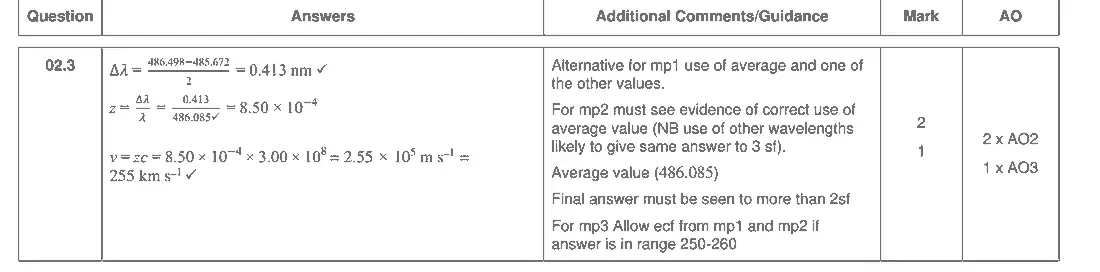
2.3 This calculation was often well done except that students did not use the average value as the denominator. There are other routes through this calculation which were given full credit.
Notes from the mark scheme and report
Answer: 255 km s^-1 (delta lambda = half the range = 0.413 nm, z = 0.413/486.085 = 8.50 x 10^-4, v = zc)
Skills: MS2.3 Substitute numerical values into algebraic equations using appropriate units for physical quantities; MS1.2 Find arithmetic means
June 2022 · Paper 3B Astrophysics · Q2.42 marksAO2=1, AO3=1Calculation
Earlier part of question 2 that this part uses
Mark scheme
Examiner's comment
2.4 This was generally well done. A surprising number of students could not correctly read the period from the graph, however. 2.5 A majority of students got this question right.
Notes from the mark scheme and report
Answer: 8.8 x 10^9 m (period 2.5 days from Figure 1, R = vT/2pi
8.6 x 10^9 m using 250 km s^-1)
Skills: MS3.1 Translate information between graphical, numerical and algebraic forms; MS2.2 Change the subject of an equation, including non-linear equations
June 2022 · Paper 3B Astrophysics · Q2.62 marksAO3=2Explanation
Earlier part of question 2 that this part uses
Mark scheme
Examiner's comment
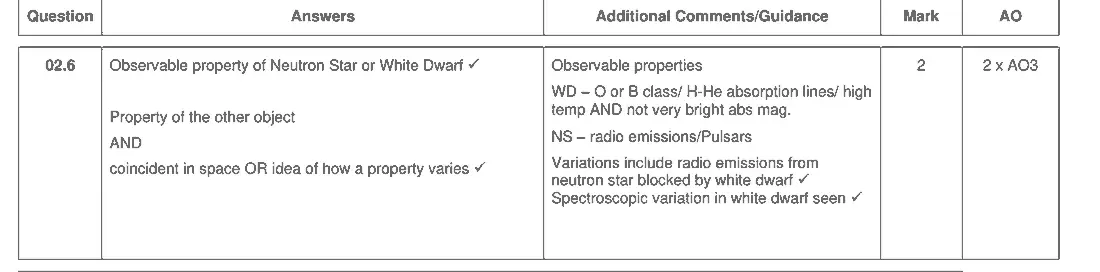
2.6 This proved to be a hard question. Very few students linked their knowledge of white dwarfs and neutron stars to the question.
Notes from the mark scheme and report
An observable property of each object (white dwarf: hot, H-He lines but dim absolute magnitude
neutron star: radio pulses/X-rays) shown to coincide in position or vary with the orbital period
June 2022 · Paper 3B Astrophysics · Q3.11 markAO1=1Short answer
Mark scheme
Examiner's comment
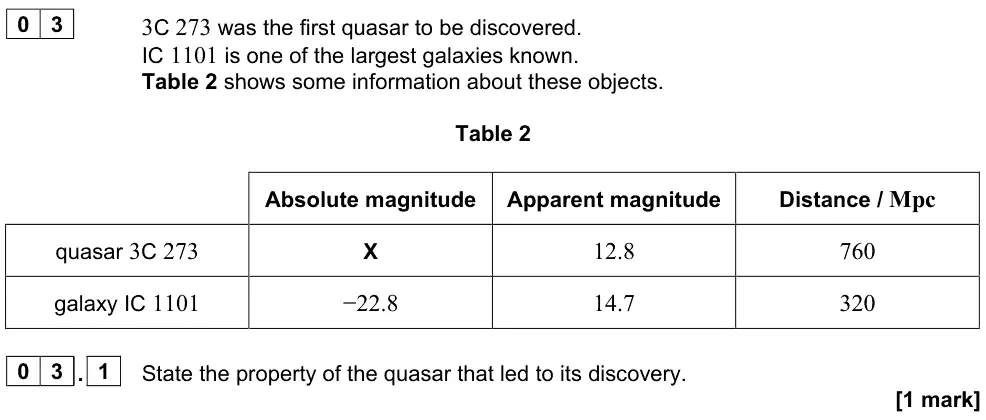
3.1 This question has appeared before so it is surprising how few students recalled that quasars were first discovered due to powerful radio emissions – even though there is no radio emission detected from many quasars.
Notes from the mark scheme and report
Powerful (bright) radio source
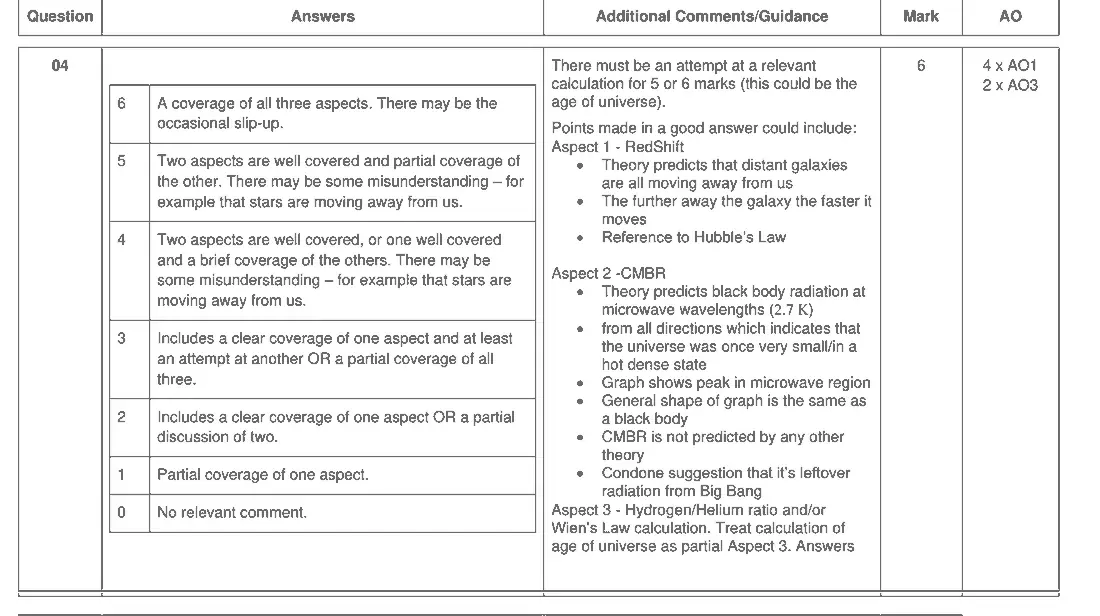
June 2022 · Paper 3B Astrophysics · Q46 marksAO1=4, AO3=26-mark extended response
Mark scheme, with the levels and indicative content
Examiner's comment
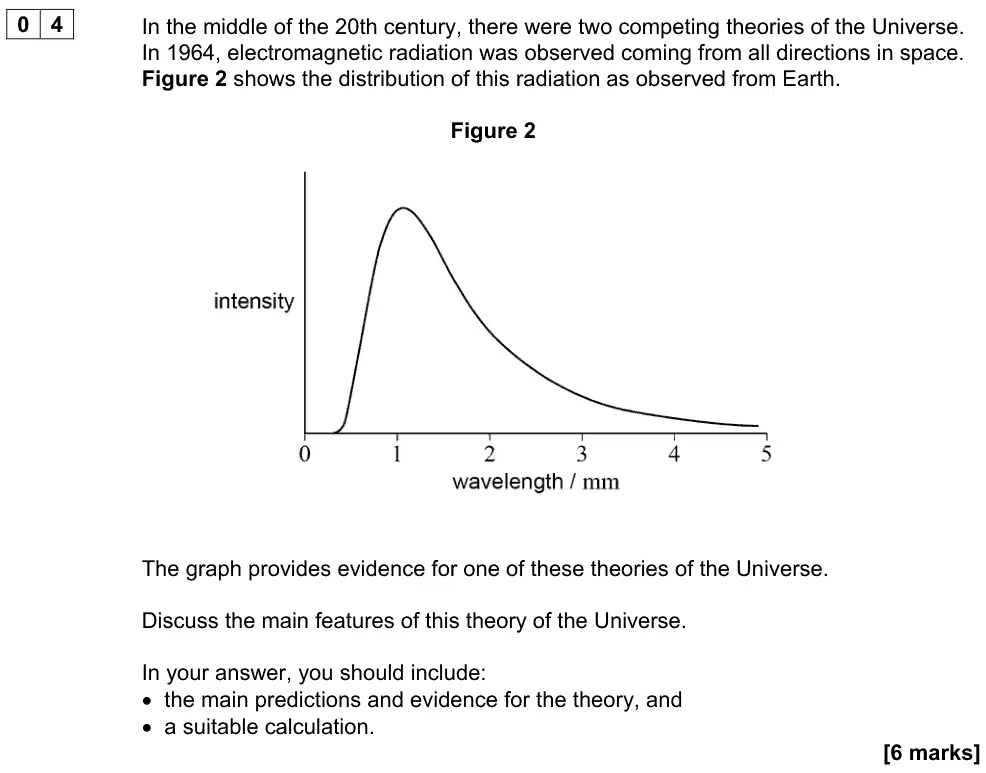
Many students recognised that this was a black-body curve and correctly calculated the λ . When students went on to discuss CMBR in some detail they were temperature from max half-way to a good mark. Unfortunately, many did not make a real effort to discuss the other predictions of the Big Bang theory. It was surprising that many students made no attempt at any calculation as this was requested explicitly in the question.
Notes from the mark scheme and report
Levels of response. Big Bang: galaxy red shift increasing with distance (Hubble's law)
CMBR black-body (2.7 K) from all directions, peak about 1 mm (Wien gives about 2.9 K)
H:He abundance
a calculation (Wien temperature or age 1/H) needed for 5-6 marks
students rarely linked knowledge to the graph
Skills: MS2.3 Substitute numerical values into algebraic equations using appropriate units for physical quantities
November 2021 · Paper 3B Astrophysics · Q1.32 marksExplanation
Earlier part of question 1 that this part uses
Mark scheme
Examiner's comment
1.3 Those few students who were familiar with the transit method for finding exoplanets were unlikely to link their answer to the earth-sized planet.
Notes from the mark scheme and report
Transit measures the drop in light as the planet passes in front
Earth-sized planet tiny compared with a star 5 x Sun radius so very little light blocked
November 2021 · Paper 3B Astrophysics · Q4.12 marksAO2=2Explanation
Mark scheme
Examiner's comment
4.1 This question revealed that few students understand what a quasar is. The specification refers to ‘active’ supermassive black holes. ‘Active’ means that matter is falling into the black hole; it is this which leads to energy release.
Notes from the mark scheme and report
Quasars are powered by supermassive black holes
the black hole no longer has matter falling in (no longer active)
no mention of black holes, no marks
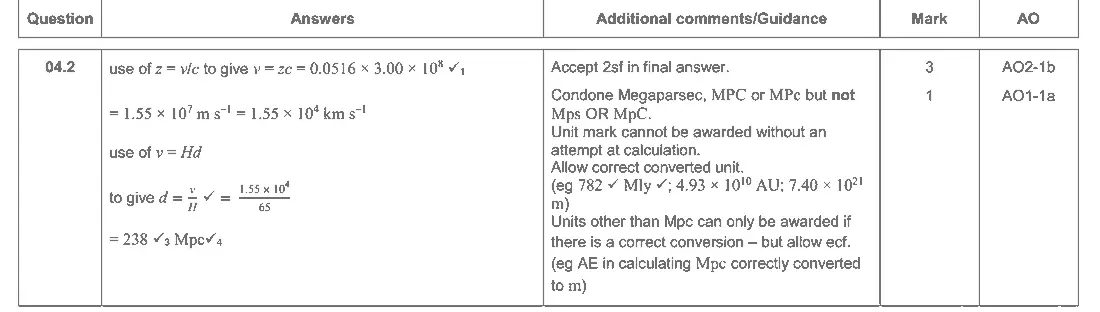
November 2021 · Paper 3B Astrophysics · Q4.24 marksCalculation
Earlier part of question 4 that this part uses
Mark scheme
Examiner's comment
4.2 More students performed better on this question than on any other in the paper. Some students, however, lost marks through unnecessary attempts to change the unit from Mpc. This unit is usually used and is the easiest to find.
This paper was similar in difficulty to those of previous years (including 2020). Questions 1.1 and 4.2 should have been familiar to students. Question 3 approached the topic from an unusual angle, so it was pleasing that a number of students gave good answers.
Notes from the mark scheme and report
Answer: 238 Mpc (v = zc = 1.55 x 10^4 km s^-1, d = v/H with H = 65 km s^-1 Mpc^-1)
unit mark needs an answer
Skills: MS2.3 Substitute numerical values into algebraic equations using appropriate units for physical quantities; MS0.1 Recognise and make use of appropriate units in calculations
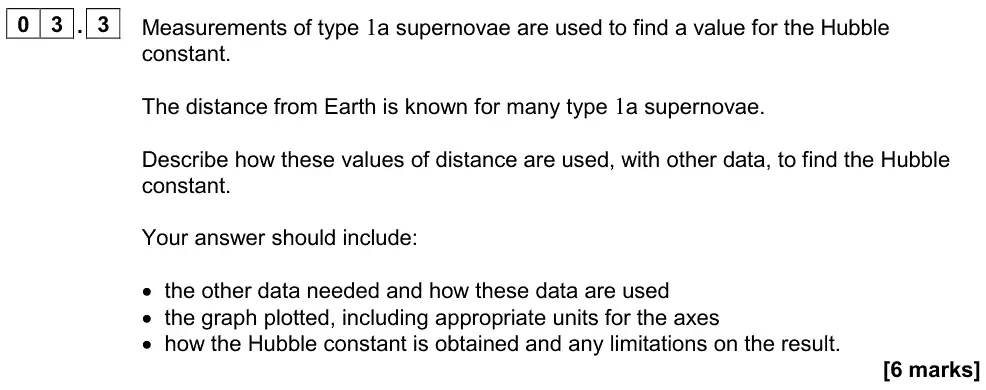
November 2020 · Paper 3B Astrophysics · Q3.36 marks6-mark extended response
Earlier part of question 3 that this part uses
Mark scheme, with the levels and indicative content
Examiner's comment
There were many answers where the student was clear about the data they needed and what graph to plot. Some students thought they could find the recession velocity by measuring the distance a year later and finding the distance through which the supernova had moved. The limitations on the result were often less clear. It is not enough to just state “uncertainty in the measurements” - there needs to be a reason given. A larger than usual number of students failed to attempt this question.
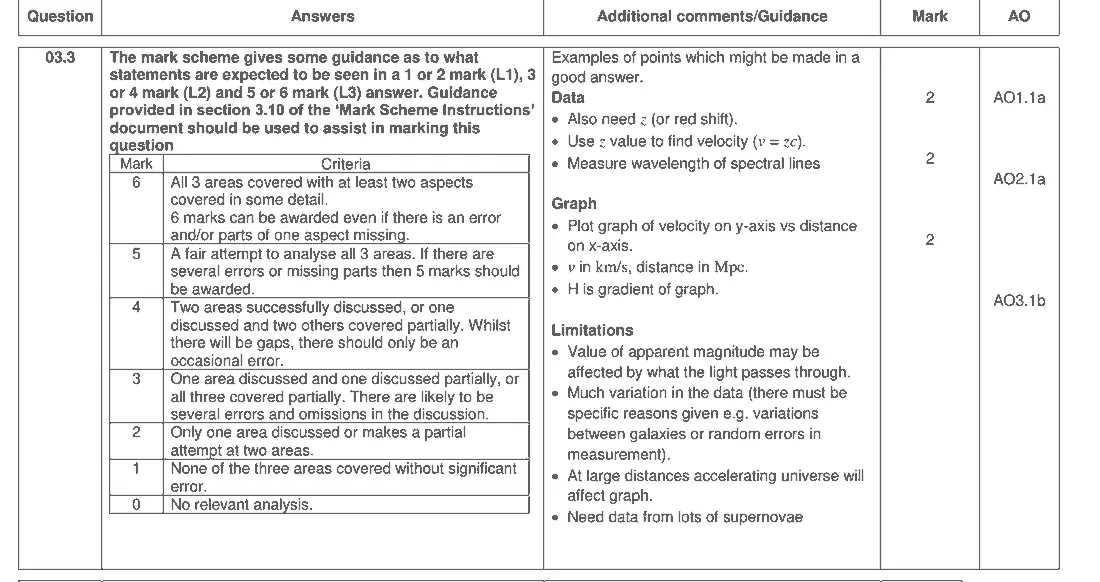
Question 03.3
This paper was broadly similar in difficulty to previous years. There were questions which have appeared in the same or similar forms in previous years (e.g. 01.1 and 02.5), along with questions on familiar topics which have been in the specification for a long time (e.g. 03.3). Question 04.2 tested knowledge of Gamma Ray Bursts (which was added to the specification at the latest revision) and most students did not know this.
Notes from the mark scheme and report
Levels of response. Need red shift z from spectral lines, v = zc
plot v (km s^-1) against d (Mpc), H = gradient
limitations: scatter, extinction affecting apparent magnitude, local motions, accelerating expansion
Skills: MS3.4 Determine the slope and intercept of a linear graph; MS3.1 Translate information between graphical, numerical and algebraic forms
June 2019 · Paper 3B Astrophysics · Q2.42 marksExplanation
Earlier part of question 2 that this part uses
Mark scheme
Examiner's comment
2.4 There were some students who gave excellent answers to this question. They clearly understood the method very well. Others did not understand and, for example, wrote about the star ‘wobbling’. Some students appeared to think that the light which was being studied originated on the planet. A significant number of students described (often quite well) the transit method. This is another example where careful reading of the question is important.
Notes from the mark scheme and report
Periodic Doppler shift of light from the star, caused by star and planet orbiting a common centre of mass
light 'from the planet' loses the mark
June 2019 · Paper 3B Astrophysics · Q4.13 marksCalculation
Mark scheme
Examiner's comment
4.1 This question was answered well, with a wide variety of ways found to answer it. Those with the best understanding showed algebraically that z should be constant and then d showed that the data did not confirm this; this was the most elegant answer. It was more common to see two different values of H calculated and then a statement that they were not the same; this was also awarded full marks. 4.2 This was the most challenging question on the paper with only a few students scoring both marks and only around 20% scoring one mark. Many students talked about how bright quasars are, though the relevant point here is that they are very dim when observed from Earth. The most effective answers referred to the accelerating expansion of the universe meaning that Hubble is not valid at those distances.
Notes from the mark scheme and report
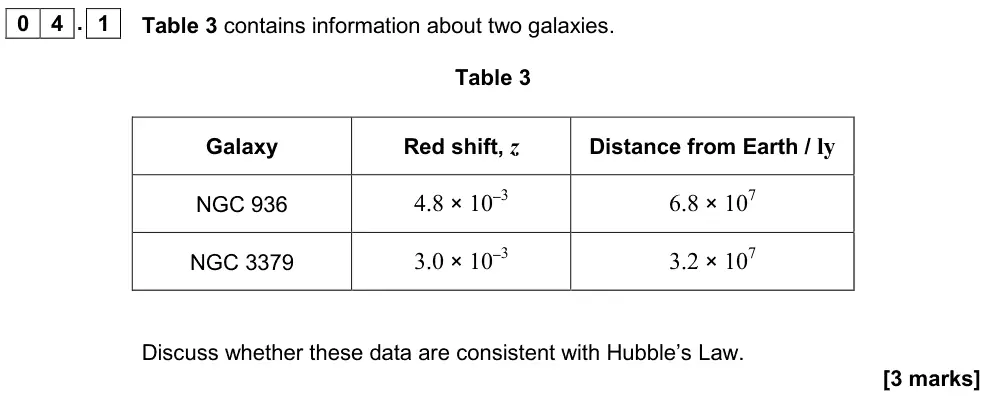
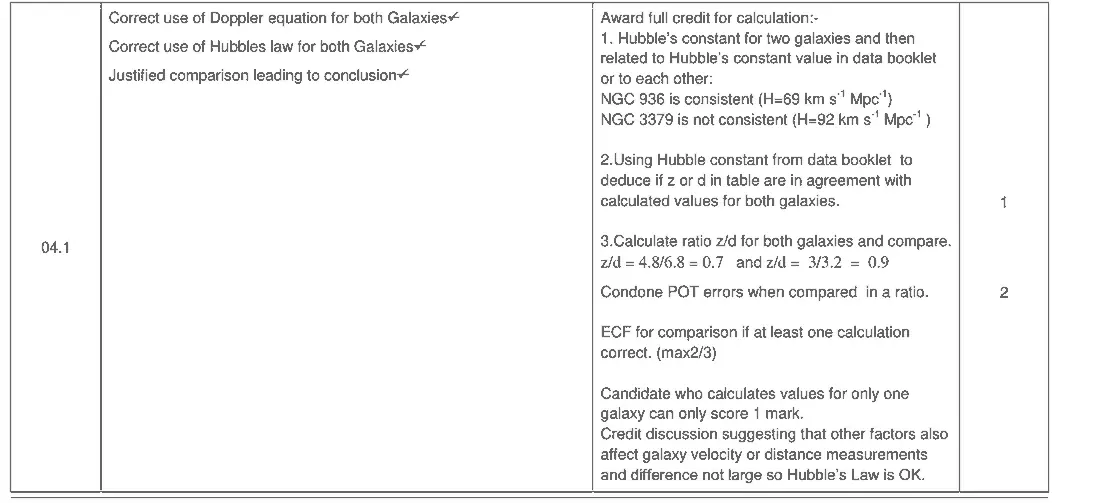
v = cz: 1440 and 900 km s^-1
d = 20.9 and 9.8 Mpc
H = 69 (consistent) and 92 km s^-1 Mpc^-1 (not consistent), or compare z/d ratios
values for one galaxy only max 1
Skills: MS2.3 Substitute numerical values into algebraic equations using appropriate units for physical quantities; MS0.3 Use ratios, fractions and percentages
June 2019 · Paper 3B Astrophysics · Q4.22 marksExplanationHard
Earlier part of question 4 that this part uses
Mark scheme
Examiner's comment
4.1 This question was answered well, with a wide variety of ways found to answer it. Those with the best understanding showed algebraically that z should be constant and then d showed that the data did not confirm this; this was the most elegant answer. It was more common to see two different values of H calculated and then a statement that they were not the same; this was also awarded full marks. 4.2 This was the most challenging question on the paper with only a few students scoring both marks and only around 20% scoring one mark. Many students talked about how bright quasars are, though the relevant point here is that they are very dim when observed from Earth. The most effective answers referred to the accelerating expansion of the universe meaning that Hubble is not valid at those distances.
Notes from the mark scheme and report
Distant quasars (or standard candles near them) very faint, inverse square law
or accelerating expansion makes Hubble's law unreliable at large distances
the most challenging question - only a few scored both marks, around 20% one mark
June 2018 · Paper 3B Astrophysics · Q3.12 marksShort answerHard
Mark scheme
Examiner's comment
03.1 Many answers to this question focused on simple properties of the three objects rather than the relationship between them. Some students, who did see what was required, suggested incorrectly that quasars are black holes, or that galaxies orbit a black hole in a similar way to planets orbiting stars, perhaps. Only 18.2% of students gained both marks here.
Notes from the mark scheme and report
Quasars are produced by (active) supermassive black holes at the centres of galaxies
'quasars are black holes' wrong
only 18.2% both marks
June 2018 · Paper 3B Astrophysics · Q3.24 marksCalculation
Earlier part of question 3 that this part uses
Mark scheme
Examiner's comment
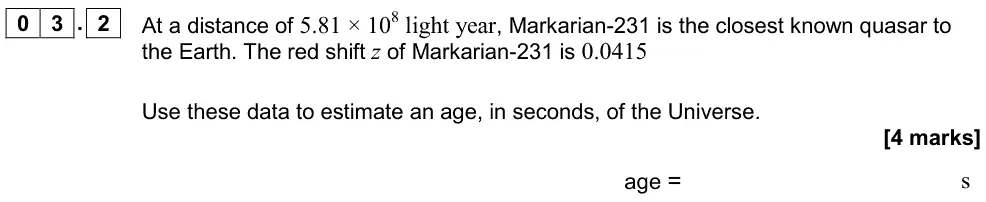
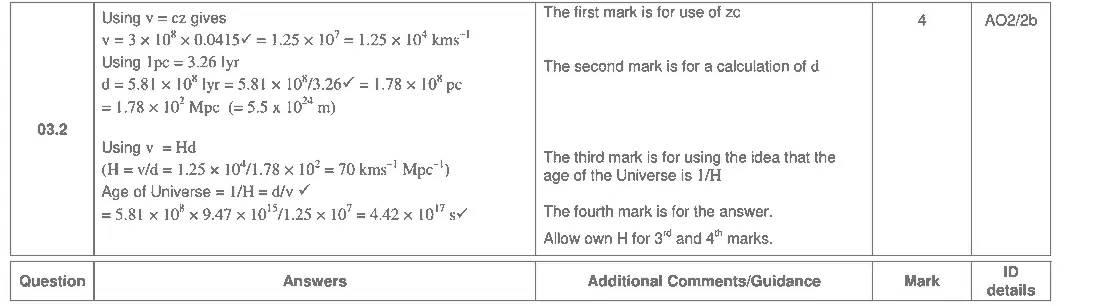
03.2 This calculation was carried out correctly by the majority of students (54.8%). Those who failed to achieve full marks often tried to work backwards from a ‘known’ age of the universe, or used the Hubble constant available in the data booklet. Most correctly calculated a value for the speed and distance and either directly determined a time or calculated a value for H and determined 1/H in seconds.
Notes from the mark scheme and report
Answer: 4.4 x 10^17 s (v = cz = 1.25 x 10^7 m s^-1, d = 5.5 x 10^24 m, age = d/v)
data-booklet H or working backwards not credited
54.8% correct
Skills: MS2.3 Substitute numerical values into algebraic equations using appropriate units for physical quantities; MS0.1 Recognise and make use of appropriate units in calculations
June 2018 · Paper 3B Astrophysics · Q3.33 marksCalculationHard
Earlier part of question 3 that this part uses
Mark scheme
Examiner's comment
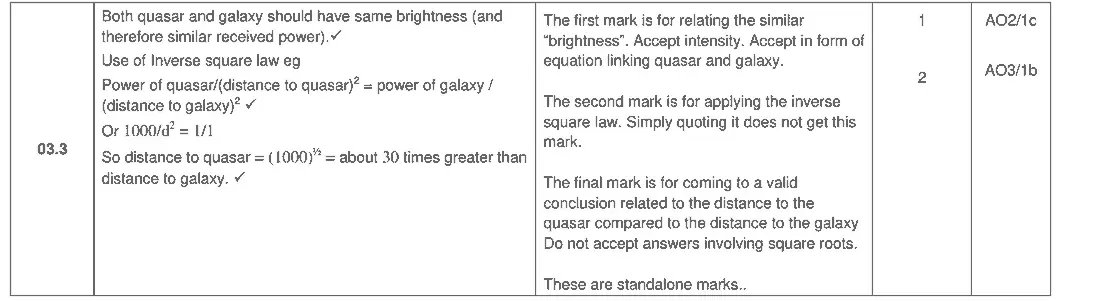
03.3 The use of the inverse-square law proved to be significantly more demanding. There was evidence of students obtaining the square root of 1000 as an answer and then missing a mark by leaving it in this form. Answers of 10, 100 or even 1 000 000 were also relatively common. It was clear that many students knew the inverse-square law but were not sure how to apply it. The important point is that the intensity received at the Earth is the same for the two objects, but that was rarely stated. Only 12.1% of students gained all three marks; the proportion that failed to gain even a single mark was 48.5%.
Notes from the mark scheme and report
Same minimum received intensity: 1000/dq^2 = 1/dg^2 so about 30 times further (root 1000)
answers 10, 100, 10^6 common
only 12.1% full marks
Skills: MS0.3 Use ratios, fractions and percentages; MS1.4 Make order of magnitude calculations
June 2018 · Paper 3B Astrophysics · Q4.13 marksExplanationHard
Mark scheme
Examiner's comment
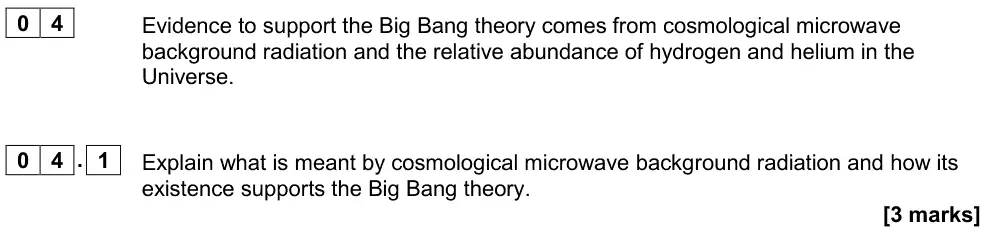
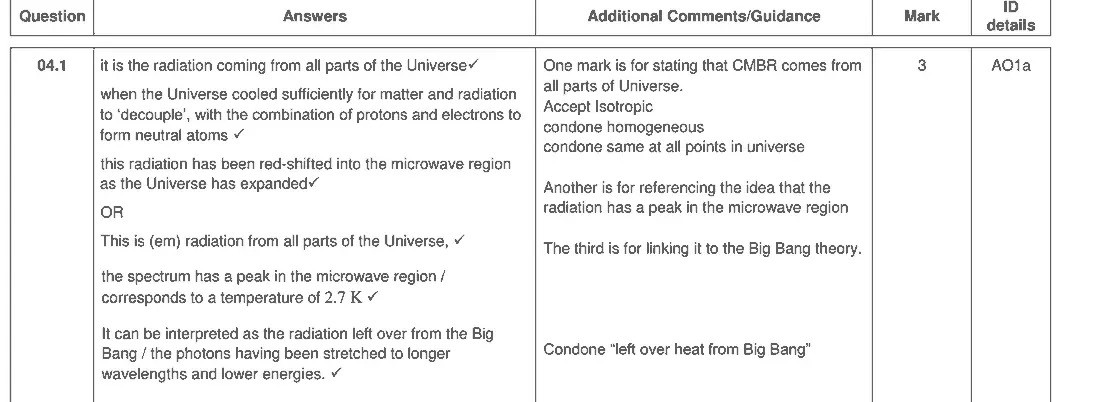
04.1 Answers to this question demonstrated many of the misconceptions associated with the CMBR. Many answers were seen that suggested that the CMBR itself was created at the time of the Big Bang, rather than relating it to the ‘stretching’ of gamma rays as the Universe expanded. It was also fairly common to see answers confusing it with the background radiation that comes from rocks, etc. Students rarely stated that the CMBR follows a black-body radiation curve or that the peak in the curve is consistent with a temperature of 2.7K. Only 6.8% of students gained all three marks here.
Notes from the mark scheme and report
Radiation from all directions released when the Universe cooled enough for atoms to form (decoupling), red-shifted by expansion to microwaves, black-body spectrum about 2.7 K, as predicted by Big Bang
not created at the Big Bang itself, not rock background
only 6.8% full marks
June 2018 · Paper 3B Astrophysics · Q4.23 marksExplanationHard
Earlier part of question 4 that this part uses
Mark scheme
Examiner's comment
04.2 A similar lack of detail or clarity was often seen in answers to this question on the relative abundance of hydrogen and helium. It was rare to see answers that explained why virtually no heavier elements were produced after the formation of helium. Many incorrect answers were seen that focused on fusion processes within stars. There was also some confusion between fission and fusion. Only 3.9% of students gained all three marks; the proportion that failed to gain even a single mark was 47.4%.
Notes from the mark scheme and report
Brief fusion of hydrogen to helium in the early hot Universe
stopped as it expanded and cooled, leaving H:He about 3:1 (too fast for heavier elements)
answers about stellar fusion wrong
only 3.9% full marks
June 2017 · Paper 3B Astrophysics · Q56 marks6-mark extended response
Mark scheme, with the levels and indicative content
Examiner's comment
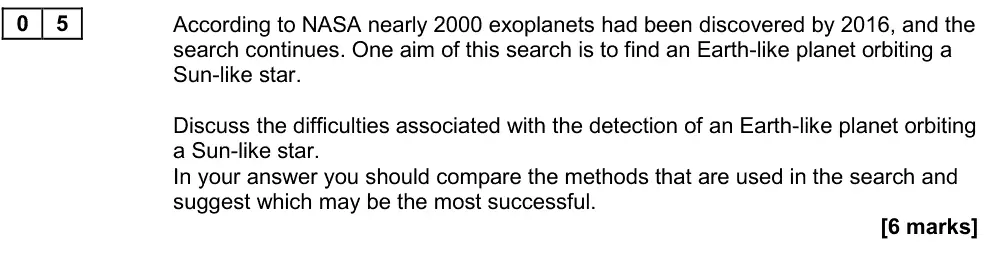
This question was related to another aspect of current astronomical research: the search for planets orbiting other stars. Most students were able to recall the transit and radial velocity methods of detection, without making much more progress. More success was made by those that mentioned problems of direct observation. Very few students related any of these methods to the particular situation of an Earth-like planet orbiting a Sun-like star or made any attempt to discuss which method would be most successful in this situation. The most successful students were able to point out that most of the planets discovered so far have been so-called ‘hot Jupiters’ and that the Earth, being relatively small and far from the Sun, would make little impact on the apparent magnitude of the Sun, or affect its motion significantly.
Notes from the mark scheme and report
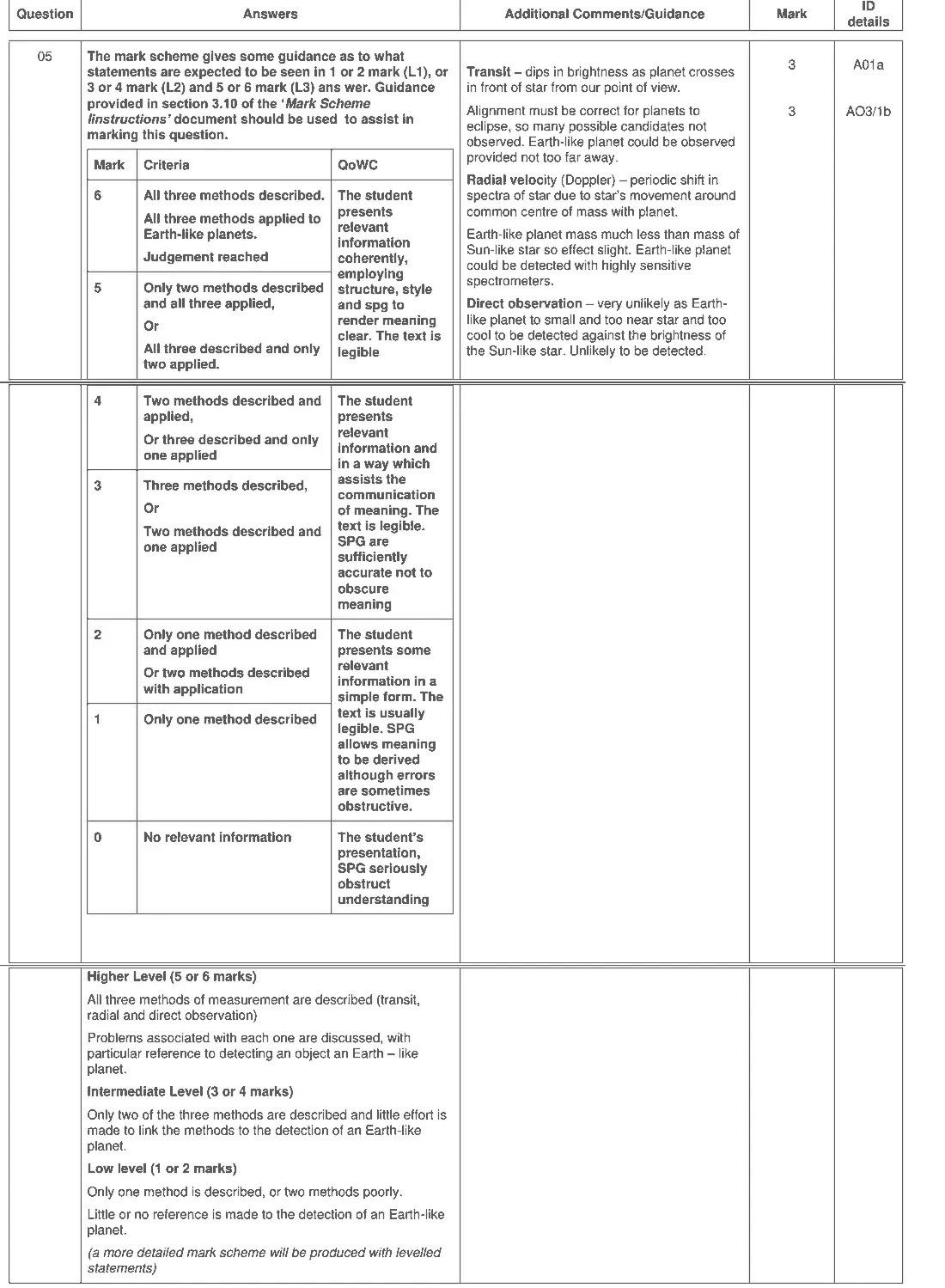
Levels of response. Planet much dimmer than star and very close in angle
radial velocity: tiny Doppler shift from a small planet
transit: small dip, needs aligned orbit, long period (about a year) so needs long observation
judgement on most successful method (e.g. transit with space telescope)
Specimen set 1 · Paper 3B Astrophysics · Q4.11 markShort answer
Mark scheme
Notes from the mark scheme and report
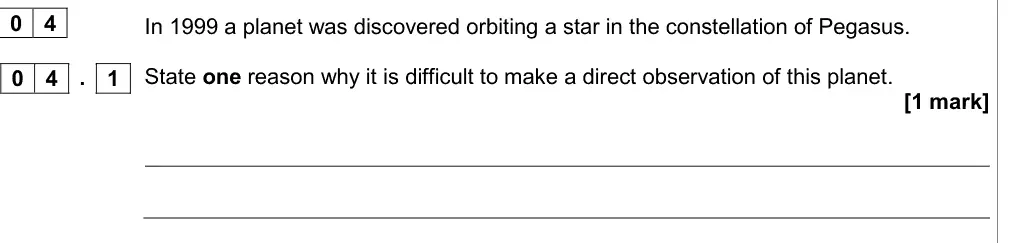
Star far brighter than reflected light from planet, or planet subtends angle below telescope resolution
Specimen set 1 · Paper 3B Astrophysics · Q4.22 marksExplanation
Earlier part of question 4 that this part uses
Mark scheme
Notes from the mark scheme and report
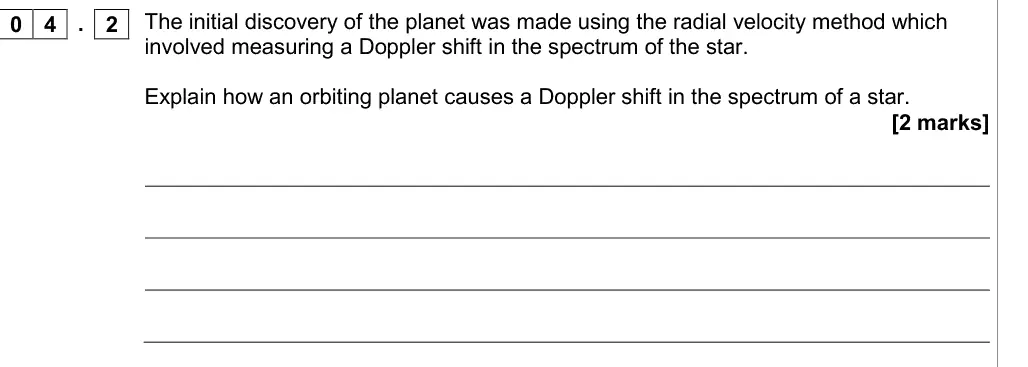
Star and planet orbit common centre of mass so star moves towards/away from Earth
shifts wavelength of received light
Specimen set 1 · Paper 3B Astrophysics · Q4.33 marksDiagram or graph
Earlier part of question 4 that this part uses
Mark scheme
Notes from the mark scheme and report
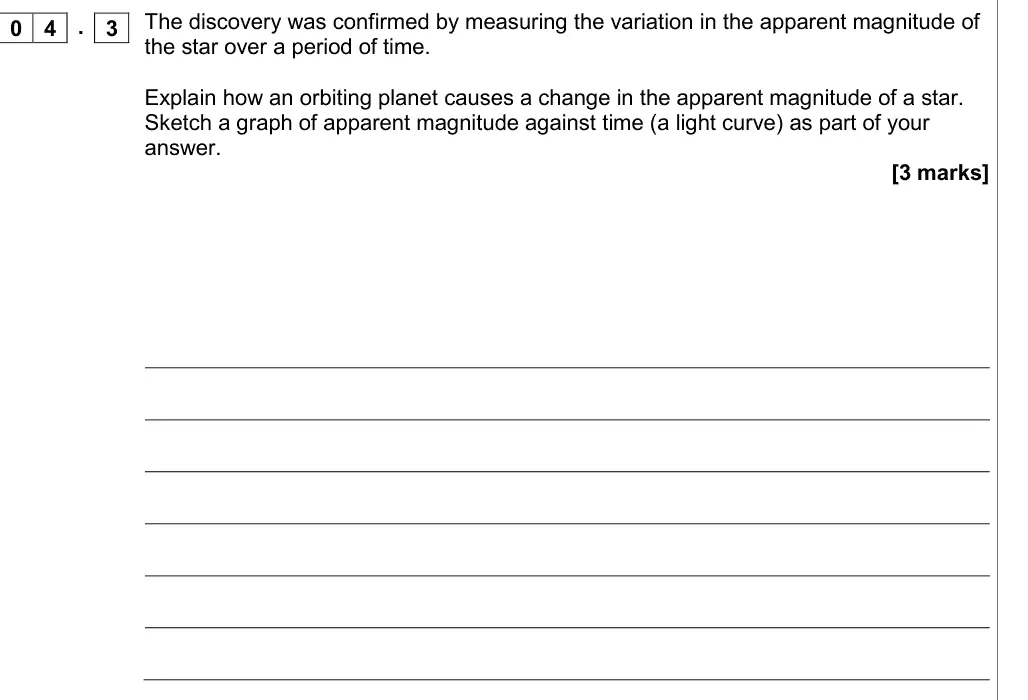
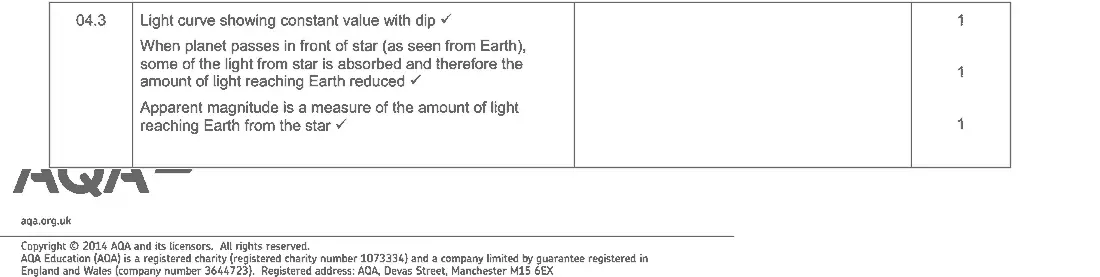
Light curve constant with a periodic dip in brightness
planet passes in front of star (transit), blocking some light so less reaches Earth
apparent magnitude measures light received
Skills: MS3.1 Translate information between graphical, numerical and algebraic forms
Work with an AQA physics tutor
Dropping marks on calculations, required practicals or the six-markers? Book a trial session with a specialist AQA physics tutor.