Notes and key-term cards for this topic are being written by our tutors. The past-paper questions below are ready now.
Specification statements
Show the 27 statements from the specification
3.13.6.1-01 Communication systems, block diagram of 'real time' communication system.
3.13.6.1-02 Only the purpose of each stage is required.
3.13.6.2-01 Transmission-path media: metal wire, optic fibre, electromagnetic (radio, microwave).
3.13.6.2-02 Ground wave, refraction and reflection of sky waves, diffraction of long-wavelength radiation around the Earth’s surface.
3.13.6.2-03 Satellite systems and typical transmission frequencies.
3.13.6.2-04 Students should recognise that up- and down-links require different frequencies so that the receivers are not de-sensed.
3.13.6.2-05 Advantages and disadvantages of various transmission media. Students should consider data transmission rate, cost, and security issues.
3.13.6.3-01 Basic principles of time-division multiplexing.
3.13.6.4-01 Principles of modulation; bandwidth.
3.13.6.4-02 Carrier wave and information signal.
3.13.6.4-03 Details of modulation circuits for modulating a carrier signal with the information signal will not be required.
3.13.6.4-04 Graphical representation of both AM and FM modulated signals.
3.13.6.4-05 A detailed mathematical treatment is not required.
3.13.6.4-06 Students will be expected to identify the carrier frequency and the information frequency from a graph of the variation of signal voltage with time.
3.13.6.4-07 Bandwidth requirements of simple AM and FM: bandwidth = 2 f M for AM bandwidth = 2 ∆f + f M for FM
3.13.6.4-08 Data capacity of a channel.
3.13.6.4-09 Comparison of bandwidth availability for various media.
3.13.6.4-10 4 Scheme of assessment
3.13.6.4-11 Find past papers and mark schemes, and specimen papers for new courses, on our website at aqa.org.uk/pastpapers
3.13.6.4-12 The AS specification is designed to be taken over one or two years with all assessments taken at the end of the course. The A-level specification is designed to be taken over two years with all assessments taken at the end of the course.
3.13.6.4-13 Assessments and certification for the AS specification are available for the first time in May/June and then every May/June for the life of the specification.
3.13.6.4-14 Assessments and certification for the A-level specification are available for the first time in May/ June and then every May/June for the life of the specification.
3.13.6.4-15 These are linear qualifications. In order to achieve the award, students must complete all exams in May/June in a single year. All assessments must be taken in the same series.
3.13.6.4-16 Questions for these specifications will be set which require students to demonstrate: • their knowledge and understanding of the content developed in one section or topic, including the associated mathematical and practical skills or • the ability to apply mathematical and practical skills to areas of content they are not normally developed in or • the ability to draw together different areas of knowledge and understanding within one answer.
3.13.6.4-17 A range of question types will be used, including those that require extended responses. Extended response questions will allow students to demonstrate their ability to construct and develop a sustained line of reasoning which is coherent, relevant, substantiated and logically structured. Extended responses may be in written English, extended calculations, or a combination of both, as appropriate to the question.
3.13.6.4-18 All materials are available in English only. 4.1 Aims
3.13.6.4-19 Courses based on these specifications should encourage students to: • develop their interest in and enthusiasm for the subject, including developing an interest in further study and careers associated with the subject • develop essential knowledge and understanding of different areas of the subject and how they relate to each other • develop and demonstrate a deep appreciation of the skills, knowledge and understanding of scientific methods • develop competence and confidence in a variety of practical, mathematical and problem solving skills • understand how society makes decisions about scientific issues and how the sciences contribute to the success of the economy and society • use theories, models and ideas to develop scientific explanations • use knowledge and understanding to pose scientific questions, define scientific problems, present scientific arguments and scientific ideas
Six-mark extended response questions on this topic
Tap a question to zoom it. Where a part needs a figure, table or graph from earlier in the question, that part folds out above it; the mark scheme and examiner's comment open underneath. Have the AQA data and formulae booklet beside you (see the formula sheet page).
June 2025 · Paper 3B Electronics · Q4.12 marksAO1=2Explanation
Mark scheme
Notes from the mark scheme and report
Fixed-frequency radio wave assigned to a station
its amplitude or frequency is modulated to carry the information signal
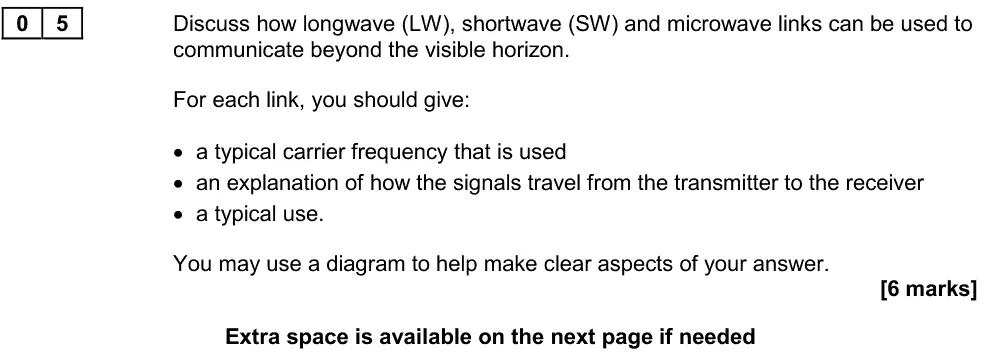
June 2025 · Paper 3B Electronics · Q56 marksAO1=66-mark extended response
Mark scheme, with the levels and indicative content
Notes from the mark scheme and report
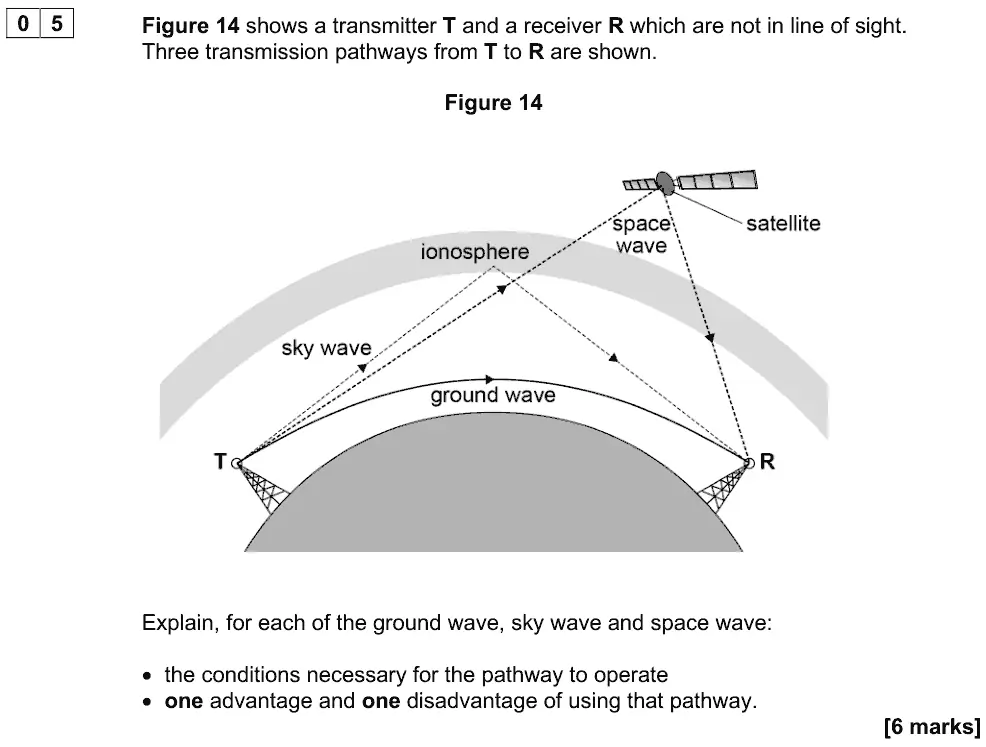
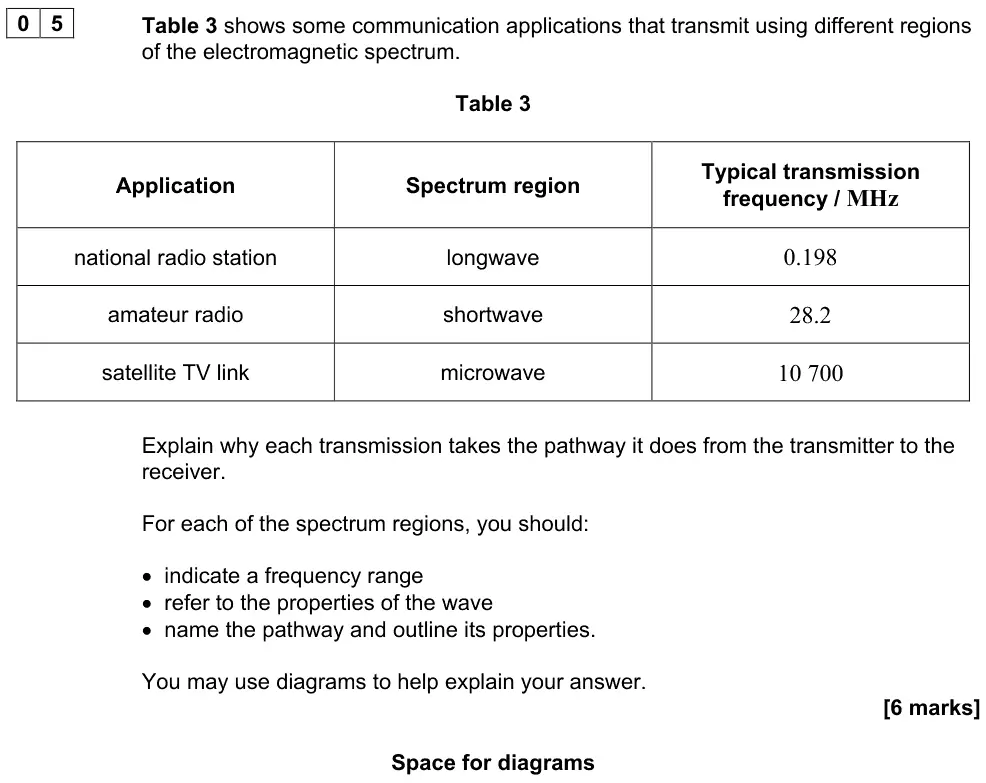
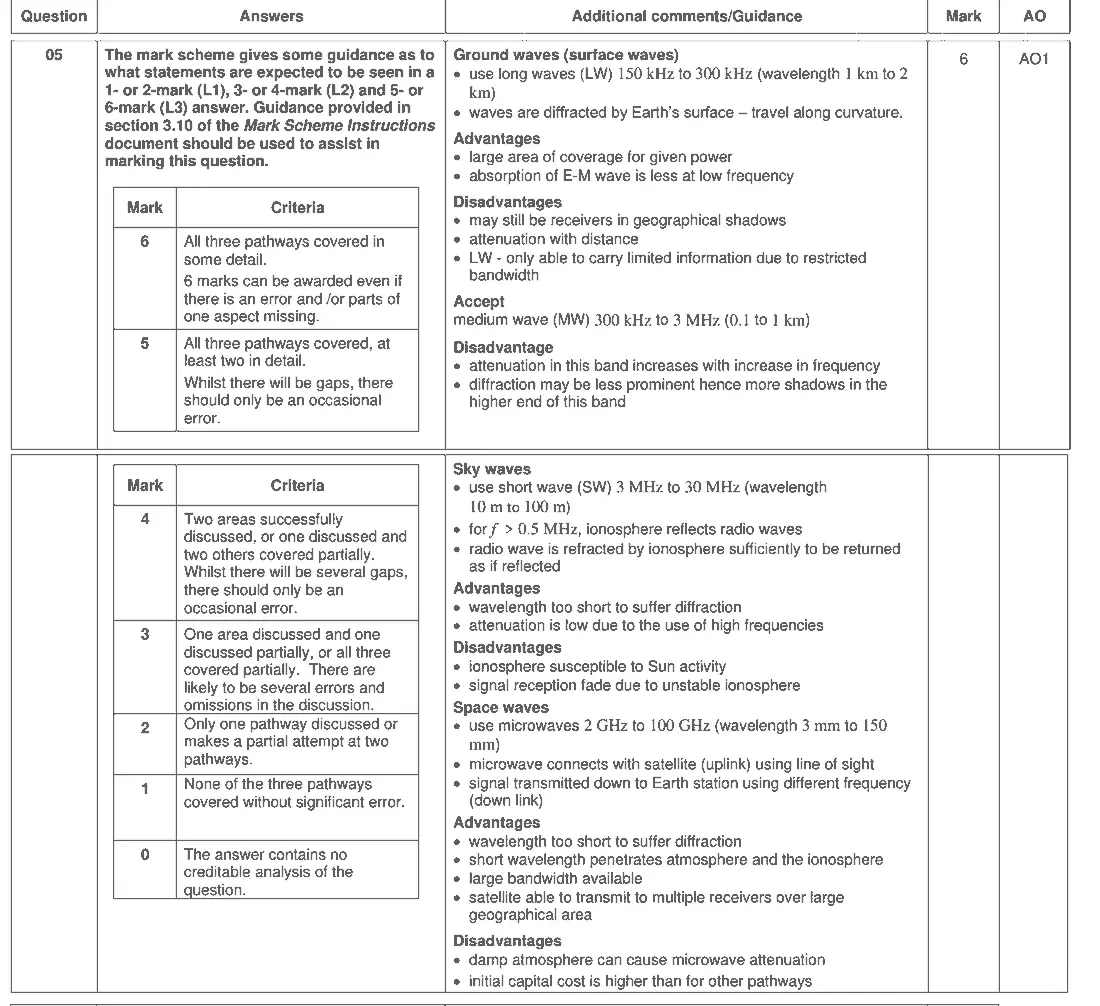
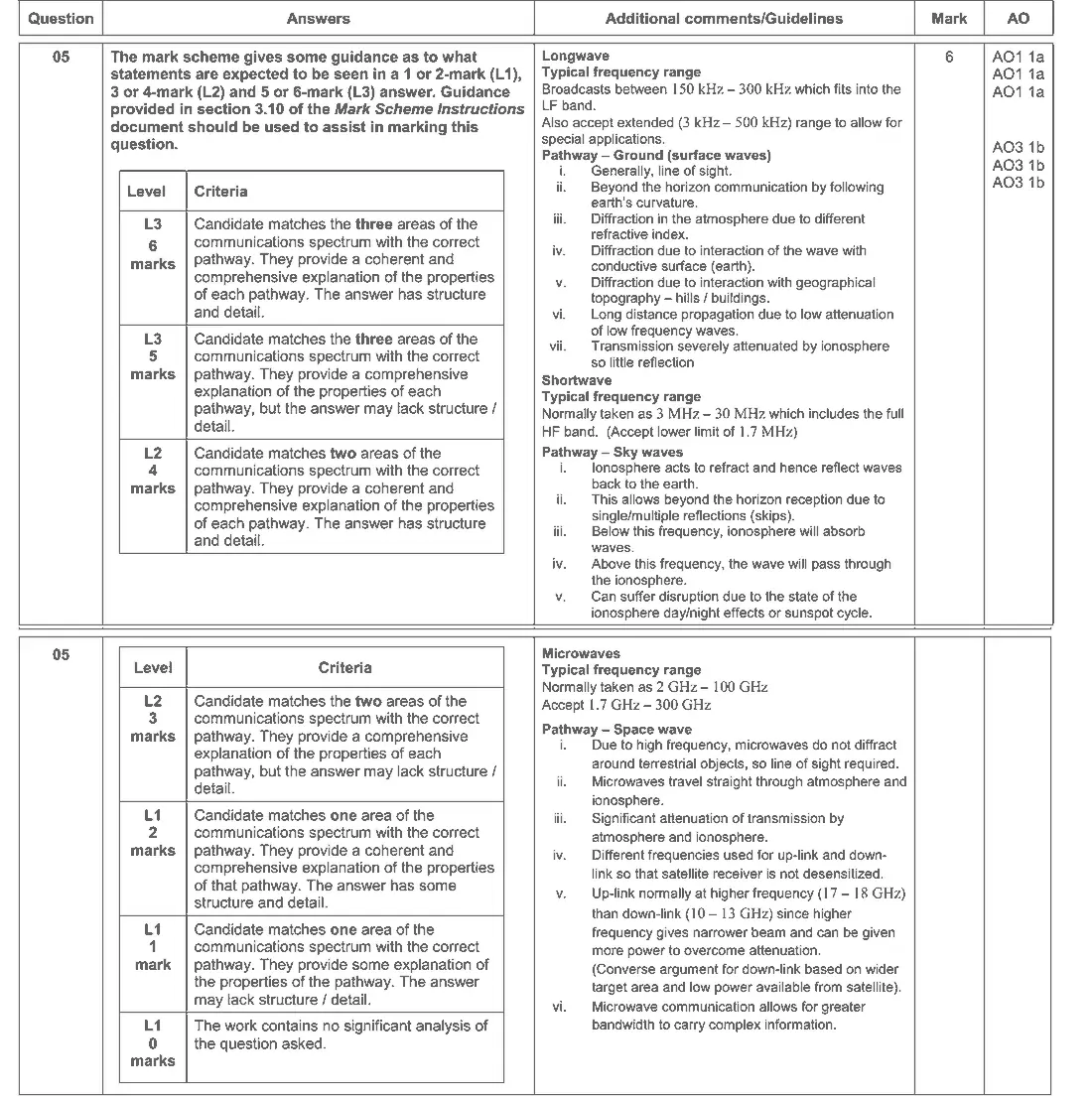
Levels of response: ground wave (LW 150-300 kHz, diffracts along Earth
wide coverage, but limited bandwidth/shadows), sky wave (SW 3-30 MHz, refracted back by ionosphere
long range, but fading with ionosphere), space wave (microwave GHz, line of sight to satellite with different up/down links
large bandwidth, but high cost/rain attenuation)
June 2024 · Paper 3B Electronics · Q2.12 marksAO2=2Calculation
Mark scheme
Notes from the mark scheme and report
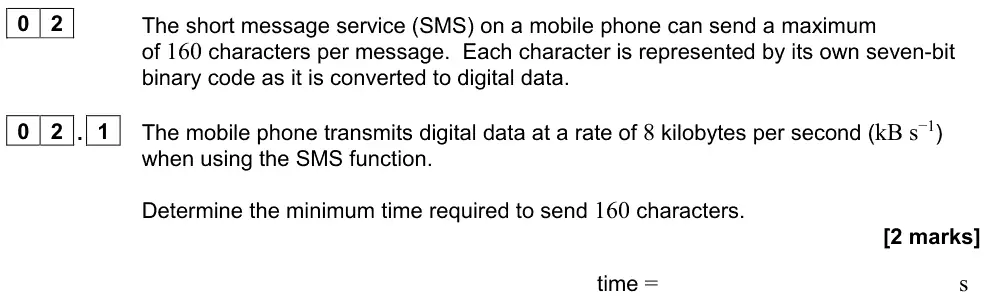
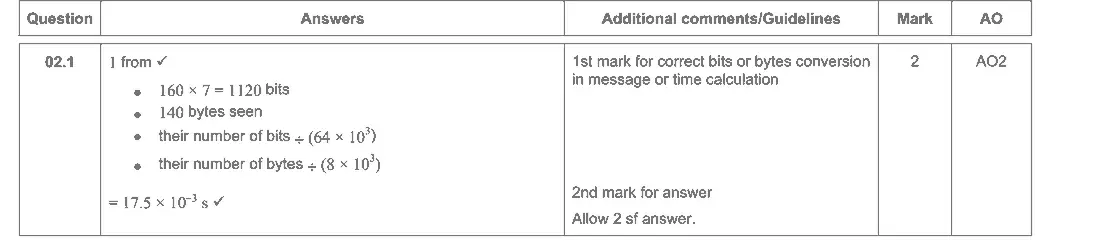
Answer: 0.0175 s (160 x 7 = 1120 bits = 140 bytes
140 / 8000 B s^-1)
Skills: MS2.3 Substitute numerical values into algebraic equations using appropriate units for physical quantities; MS0.1 Recognise and make use of appropriate units in calculations
June 2024 · Paper 3B Electronics · Q2.21 markAO1=1Short answer
Earlier part of question 2 that this part uses
Mark scheme
Notes from the mark scheme and report
Internal thermal agitation of charge carriers, or external electromagnetic interference (cross-talk, switching)
June 2024 · Paper 3B Electronics · Q2.32 marksAO1=2Short answer
Earlier part of question 2 that this part uses
Mark scheme
Notes from the mark scheme and report
Noise degrades the signal quality
it reduces the efficiency of the system (e.g. errors, retransmission, increased latency)
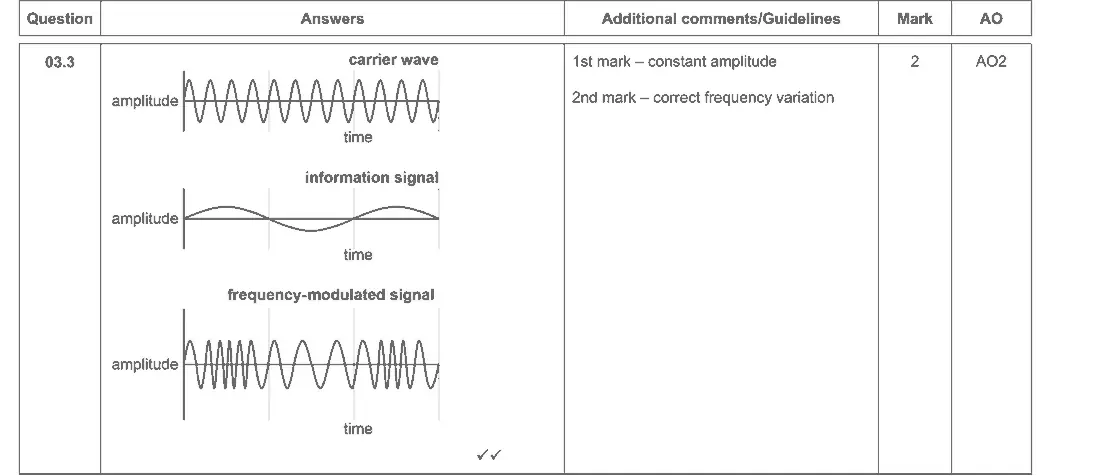
June 2024 · Paper 3B Electronics · Q3.32 marksAO2=2Diagram or graph
Earlier part of question 3 that this part uses
Mark scheme
Notes from the mark scheme and report
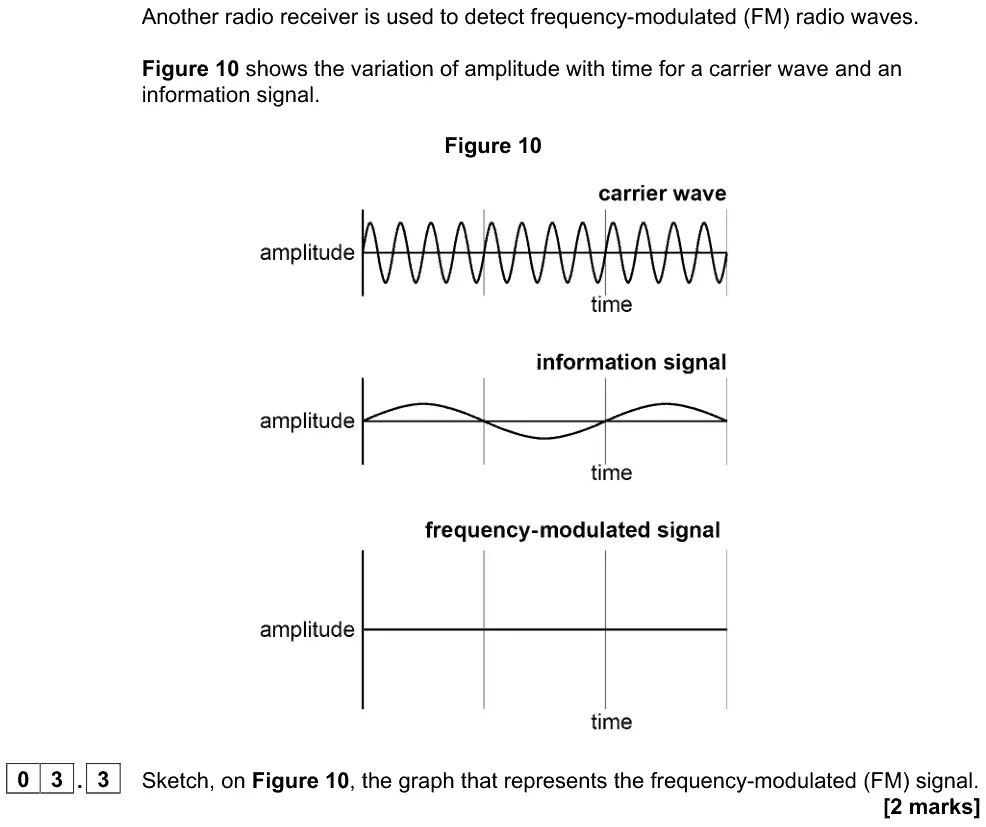
Constant amplitude
frequency higher where the information signal is positive and lower where negative
Skills: MS3.1 Translate information between graphical, numerical and algebraic forms
June 2024 · Paper 3B Electronics · Q3.41 markAO1=1Calculation
Earlier part of question 3 that this part uses
Mark scheme
Notes from the mark scheme and report
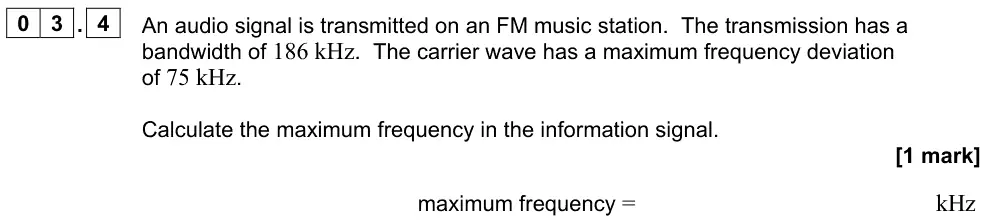
Answer: 18 kHz (186 = 2(75 + fm))
Skills: MS2.2 Change the subject of an equation, including non-linear equations
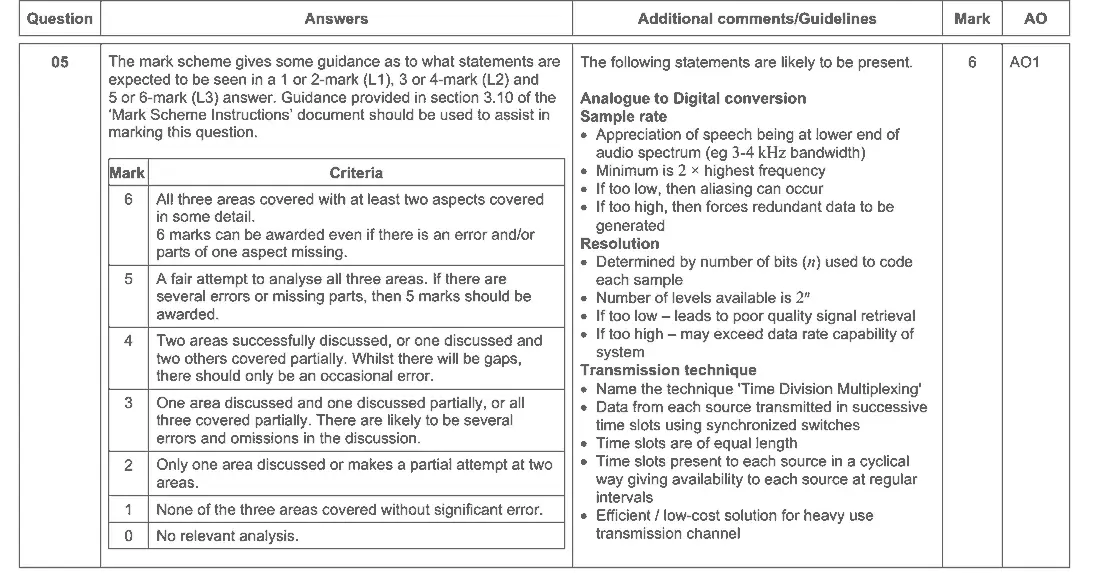
June 2024 · Paper 3B Electronics · Q56 marksAO1=66-mark extended response
Mark scheme, with the levels and indicative content
Notes from the mark scheme and report
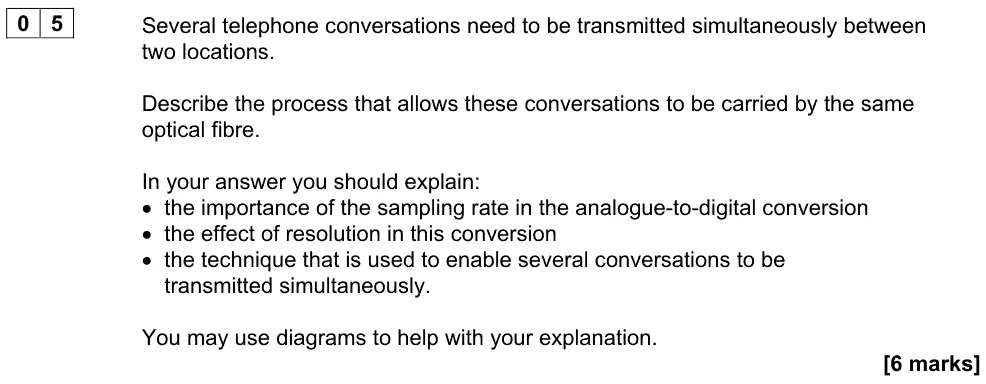
Levels of response: sampling at least twice highest speech frequency (3-4 kHz), aliasing if too low, redundant data if too high
resolution set by bits per sample (2^n levels)
time-division multiplexing with equal cyclic time slots per conversation
June 2023 · Paper 3B Electronics · Q3.11 markAO1=1Short answer
Mark scheme
Notes from the mark scheme and report
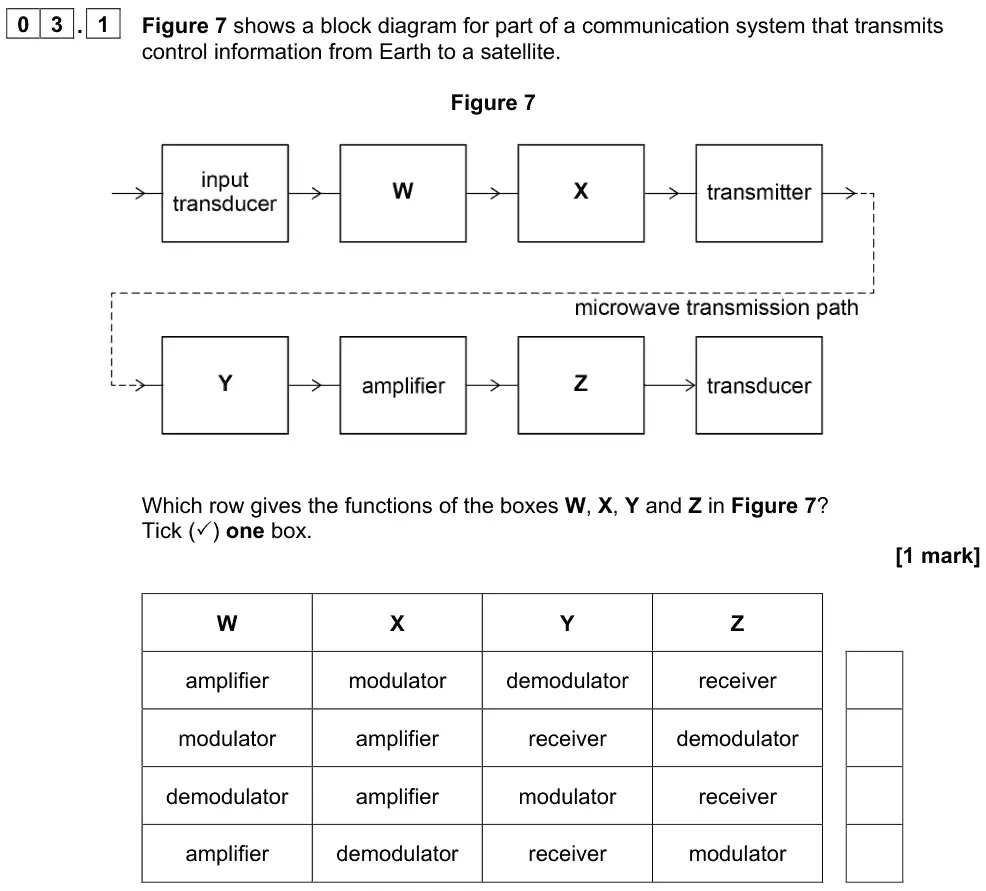
Second row: W modulator, X amplifier, Y receiver, Z demodulator
June 2023 · Paper 3B Electronics · Q3.21 markAO1=1Short answer
Earlier part of question 3 that this part uses
Mark scheme
Notes from the mark scheme and report
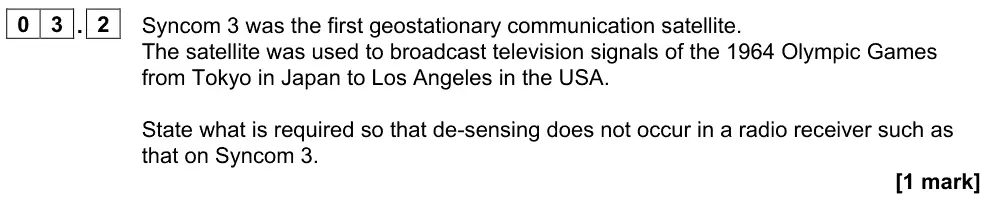
Up-link and down-link frequencies must be different
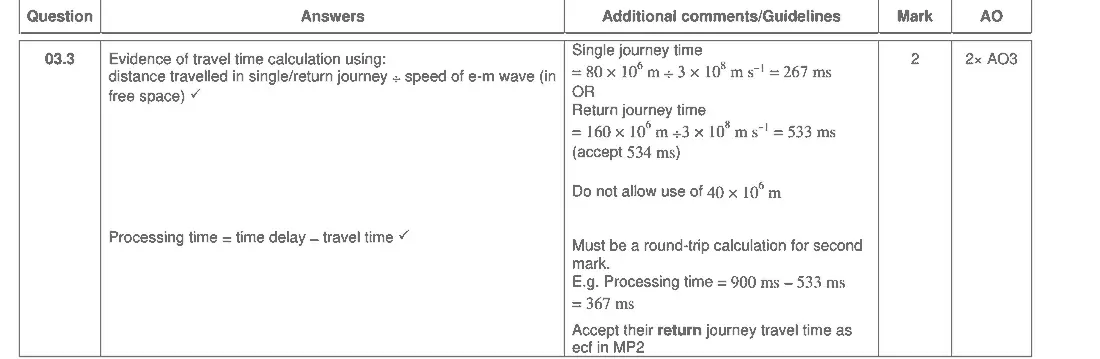
June 2023 · Paper 3B Electronics · Q3.32 marksAO3=2Calculation
Earlier part of question 3 that this part uses
Mark scheme
Notes from the mark scheme and report
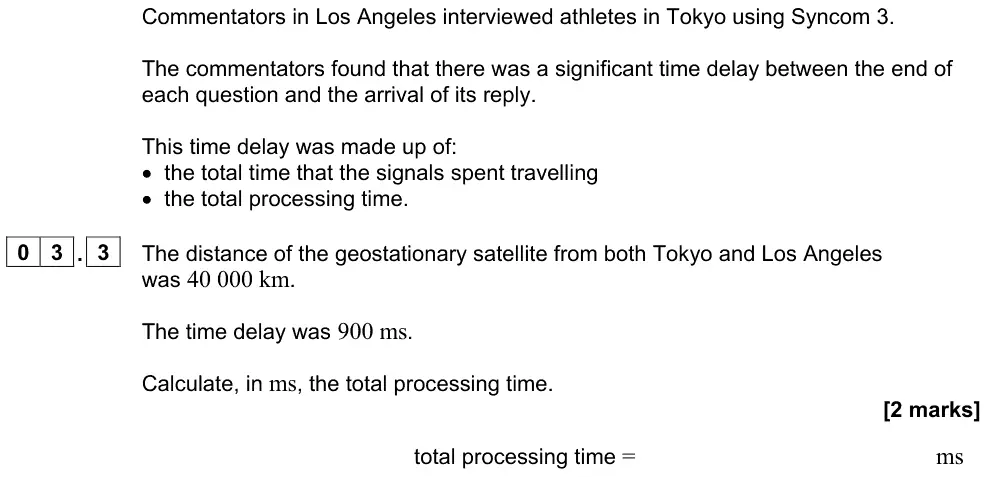
Answer: 367 ms (round trip question and reply = 4 x 40 000 km = 160 000 km, 533 ms travel
900 - 533)
using 40 000 km alone not allowed
Skills: MS2.3 Substitute numerical values into algebraic equations using appropriate units for physical quantities; MS0.2 Recognise and use expressions in decimal and standard form
June 2023 · Paper 3B Electronics · Q3.42 marksAO1=1, AO2=1Explanation
Earlier part of question 3 that this part uses
Mark scheme
Notes from the mark scheme and report
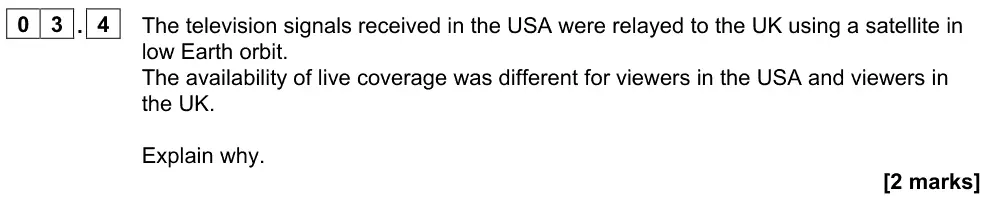
Geostationary satellite gives a permanent USA link
a low-orbit satellite is only in view of both USA and UK for short periods, so UK coverage was intermittent
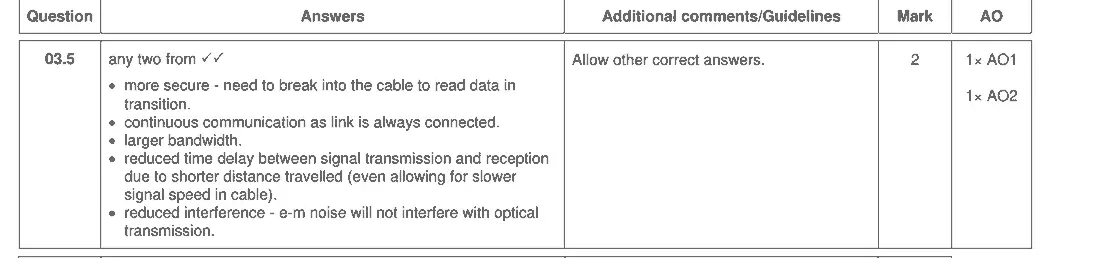
June 2023 · Paper 3B Electronics · Q3.52 marksAO1=1, AO2=1Explanation
Earlier part of question 3 that this part uses
Mark scheme
Notes from the mark scheme and report
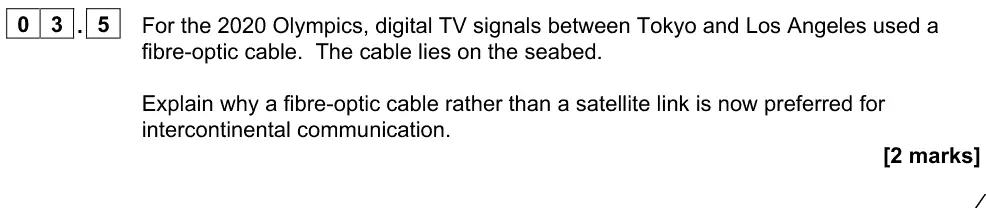
Any two: more secure, continuous link, larger bandwidth, shorter delay (shorter path), immune to EM interference
June 2022 · Paper 3B Electronics · Q3.11 markAO3=1Short answer
Mark scheme
Notes from the mark scheme and report
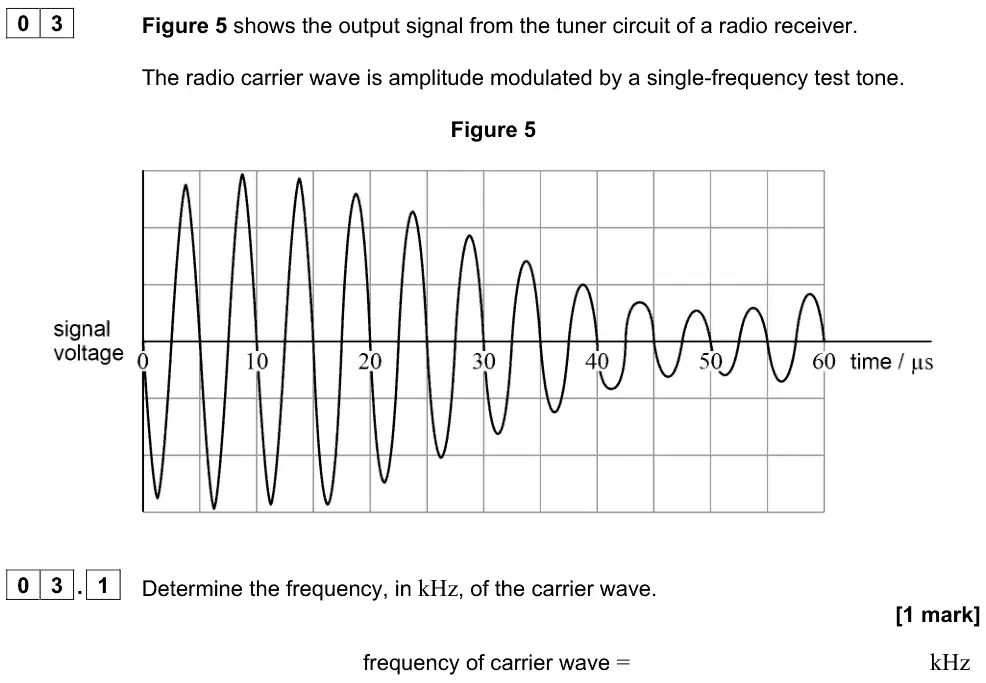
Answer: 200 kHz (carrier period 5 us)
Skills: MS3.1 Translate information between graphical, numerical and algebraic forms
June 2022 · Paper 3B Electronics · Q3.22 marksAO2=1, AO3=1Calculation
Earlier part of question 3 that this part uses
Mark scheme
Notes from the mark scheme and report
Answer: 11.9 kHz (+/- 0.6)
envelope half-period about 42 us so T = 84 us
factor 2 needed
Skills: MS3.1 Translate information between graphical, numerical and algebraic forms
June 2022 · Paper 3B Electronics · Q3.31 markAO1=1Short answer
Earlier part of question 3 that this part uses
Mark scheme
Notes from the mark scheme and report
FM immune to amplitude noise
or good quality at low transmitter power
or wider bandwidth carries more information
June 2022 · Paper 3B Electronics · Q3.41 markAO2=1Calculation
Earlier part of question 3 that this part uses
Mark scheme
Notes from the mark scheme and report
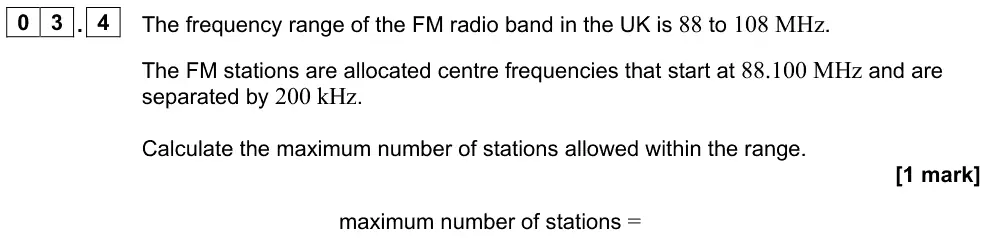
Answer: 100 stations ((108 - 88) MHz / 200 kHz)
Skills: MS0.3 Use ratios, fractions and percentages
June 2022 · Paper 3B Electronics · Q3.52 marksAO1=1, AO3=1Calculation
Earlier part of question 3 that this part uses
Mark scheme
Notes from the mark scheme and report
Answer: bandwidth = 2(75 + 15) kHz = 180 kHz, which fits within the 200 kHz allocation
Skills: MS2.3 Substitute numerical values into algebraic equations using appropriate units for physical quantities
June 2022 · Paper 3B Electronics · Q56 marksAO1=4, AO3=26-mark extended response
Mark scheme, with the levels and indicative content
Notes from the mark scheme and report
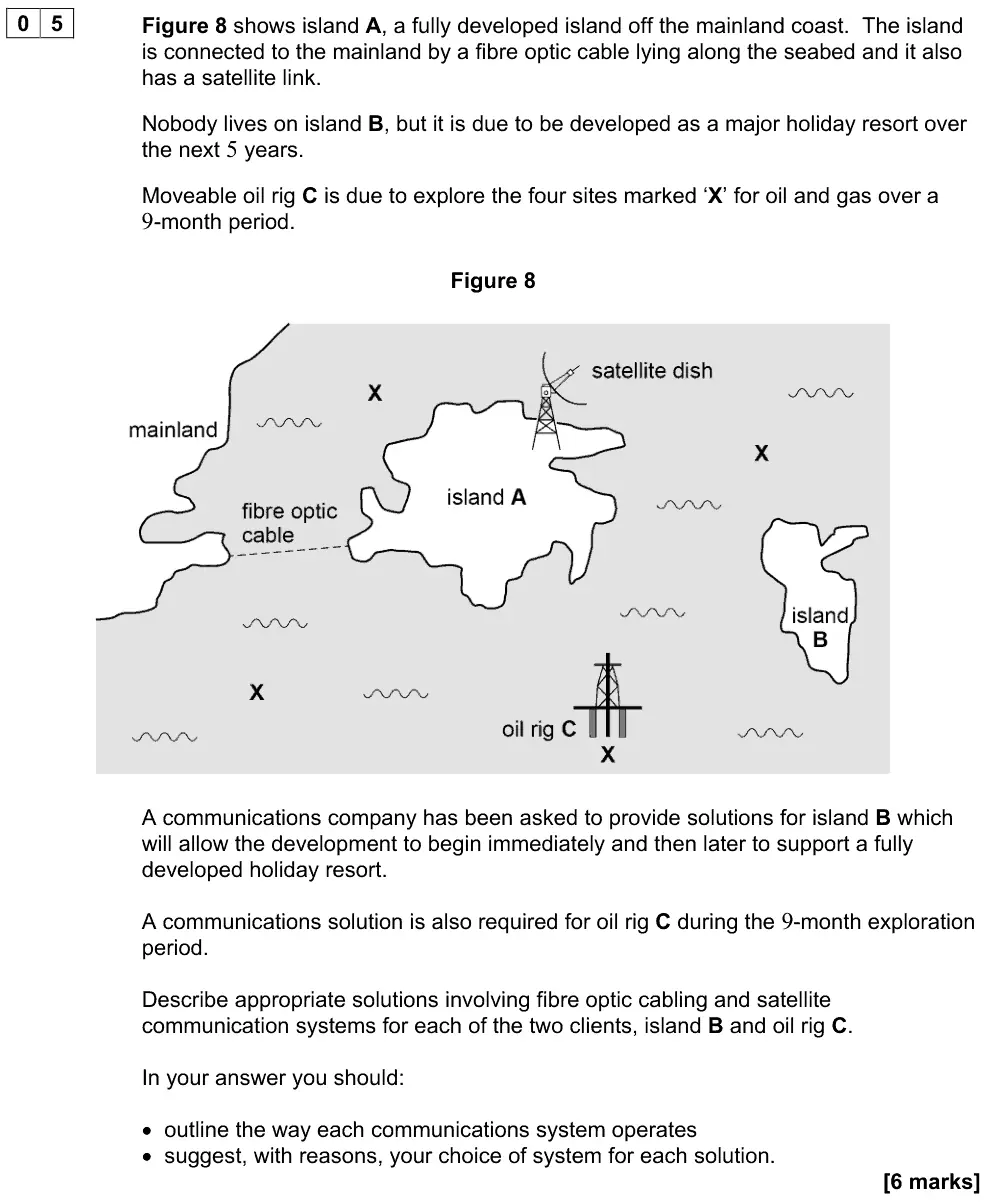
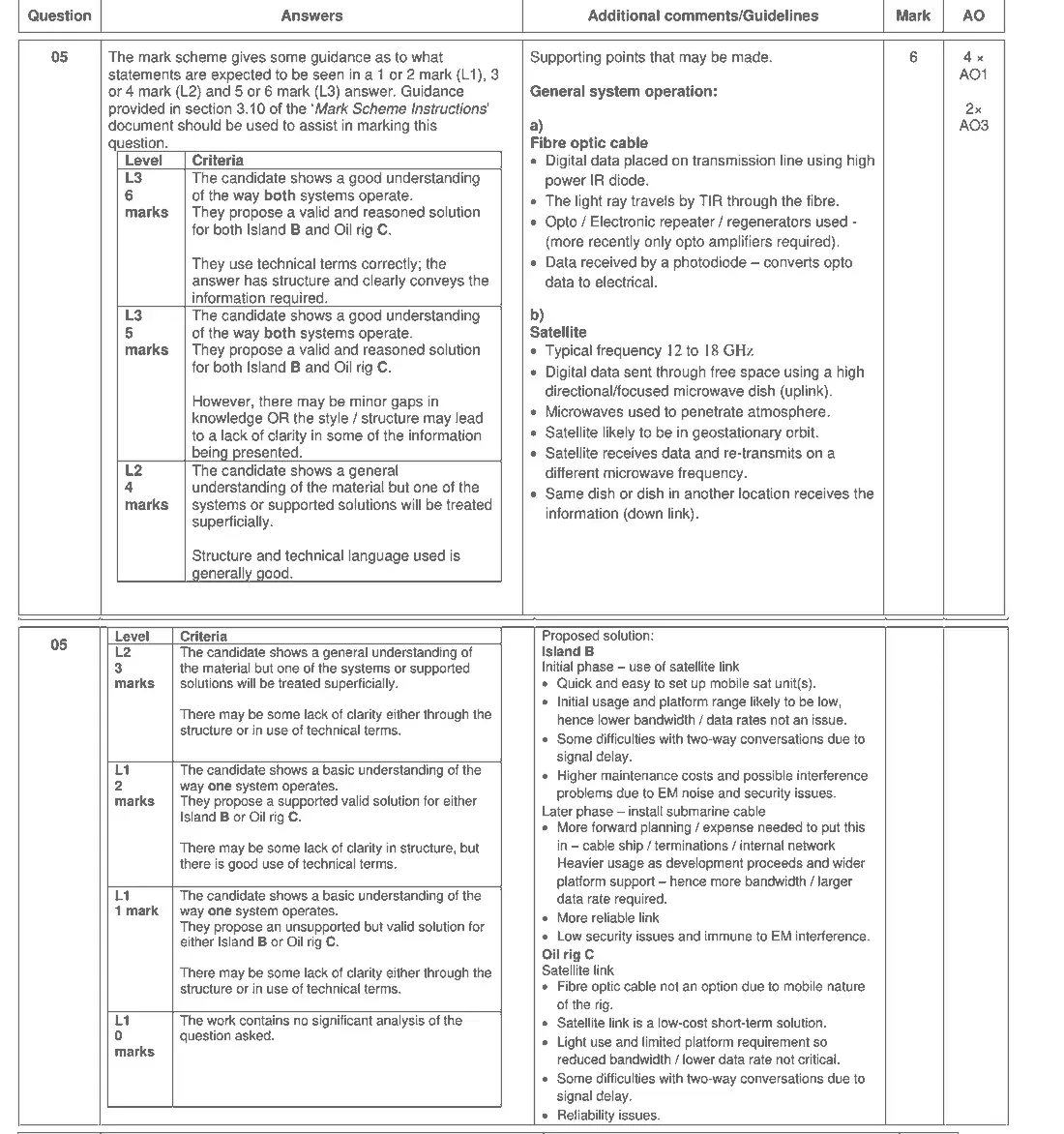
Levels of response: fibre (IR source, TIR, repeaters, photodiode) and satellite (GHz microwave uplink to geostationary satellite, retransmitted on a different downlink frequency)
island B: satellite first (quick set-up) then fibre for high capacity
rig C: satellite as it moves and is temporary
November 2021 · Paper 3B Electronics · Q56 marks6-mark extended response
Mark scheme, with the levels and indicative content
Notes from the mark scheme and report
Levels of response: LW (150-300 kHz) ground/surface wave diffracting round the Earth, low attenuation
SW (3-30 MHz) sky wave refracted back by the ionosphere with skips
microwave (GHz) passes through the ionosphere, line of sight to geostationary satellites with different up/down link frequencies
November 2020 · Paper 3B Electronics · Q3.32 marksAO2=2Calculation
Earlier part of question 3 that this part uses
Mark scheme
Notes from the mark scheme and report
Answer: 37 megabytes (44.1 kHz x 16 bits x 210 s = 148 Mbit per channel
x 2 channels / 8)
Skills: MS2.3 Substitute numerical values into algebraic equations using appropriate units for physical quantities; MS0.1 Recognise and make use of appropriate units in calculations
November 2020 · Paper 3B Electronics · Q3.42 marksAO3=2Explanation
Earlier part of question 3 that this part uses
Mark scheme
Notes from the mark scheme and report
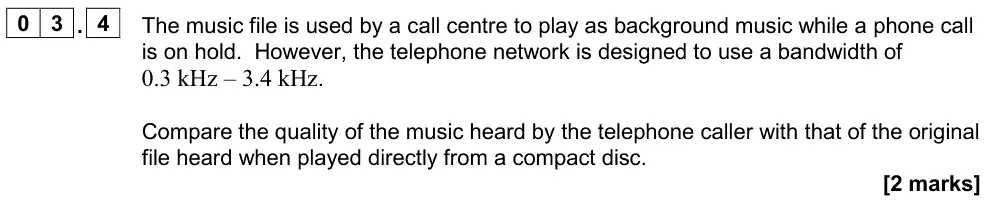
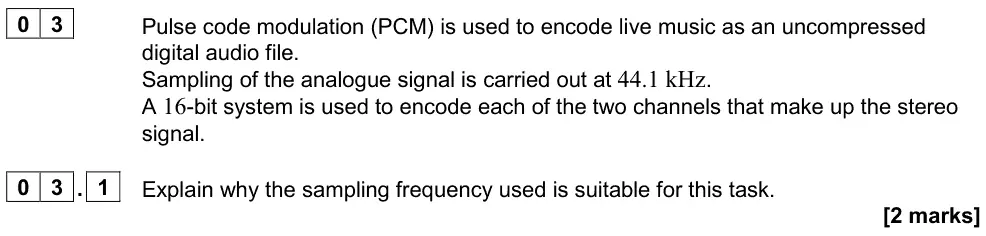
Telephone bandwidth (0.3-3.4 kHz) much smaller than CD audio (about 20 kHz), so high and low frequencies are lost and quality is lower
November 2020 · Paper 3B Electronics · Q56 marks6-mark extended response
Mark scheme, with the levels and indicative content
Notes from the mark scheme and report
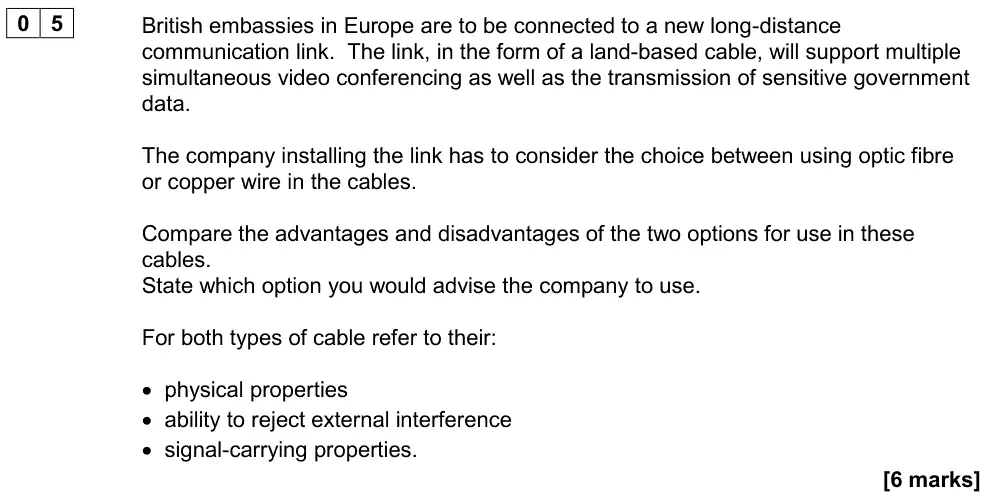
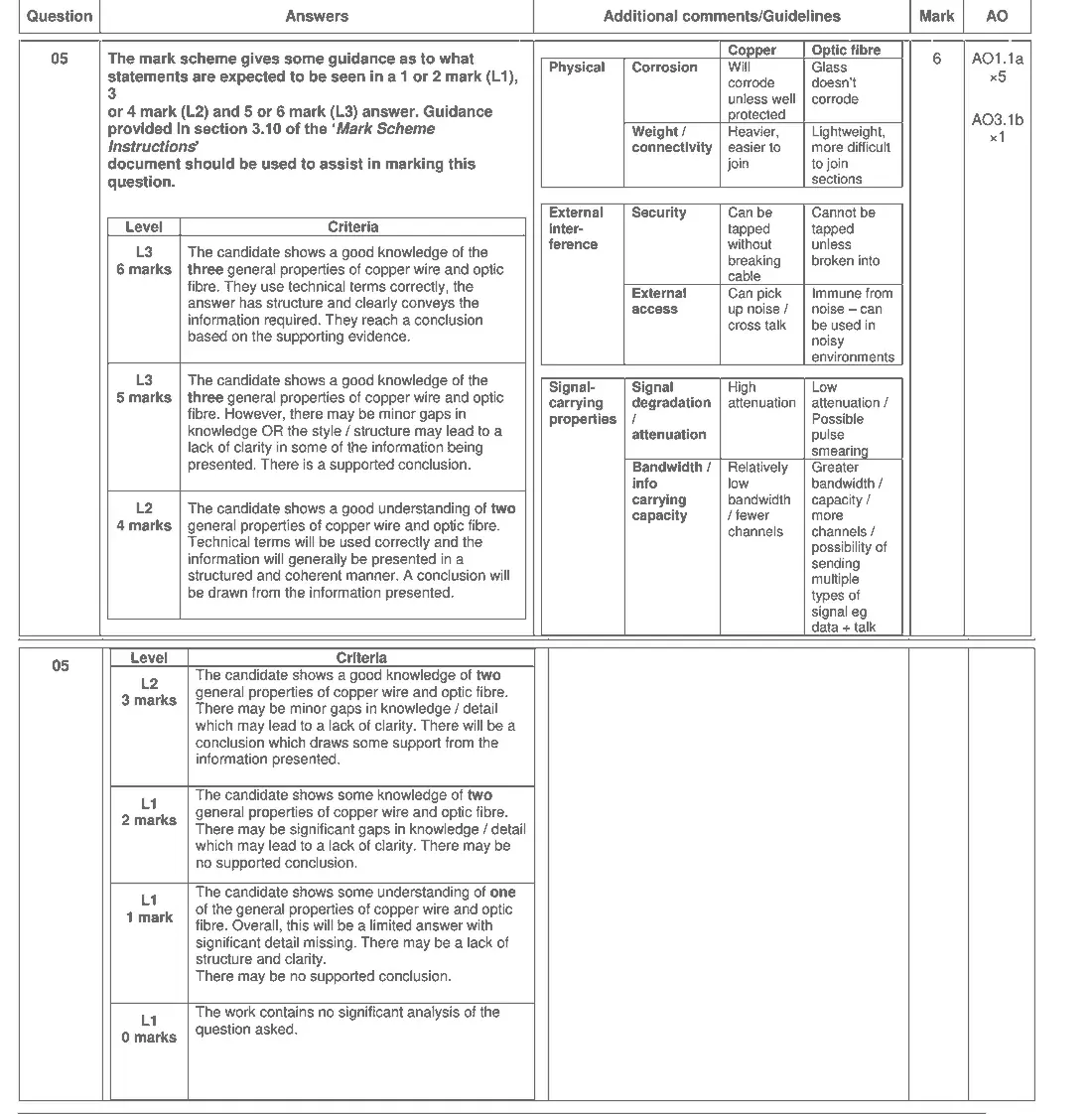
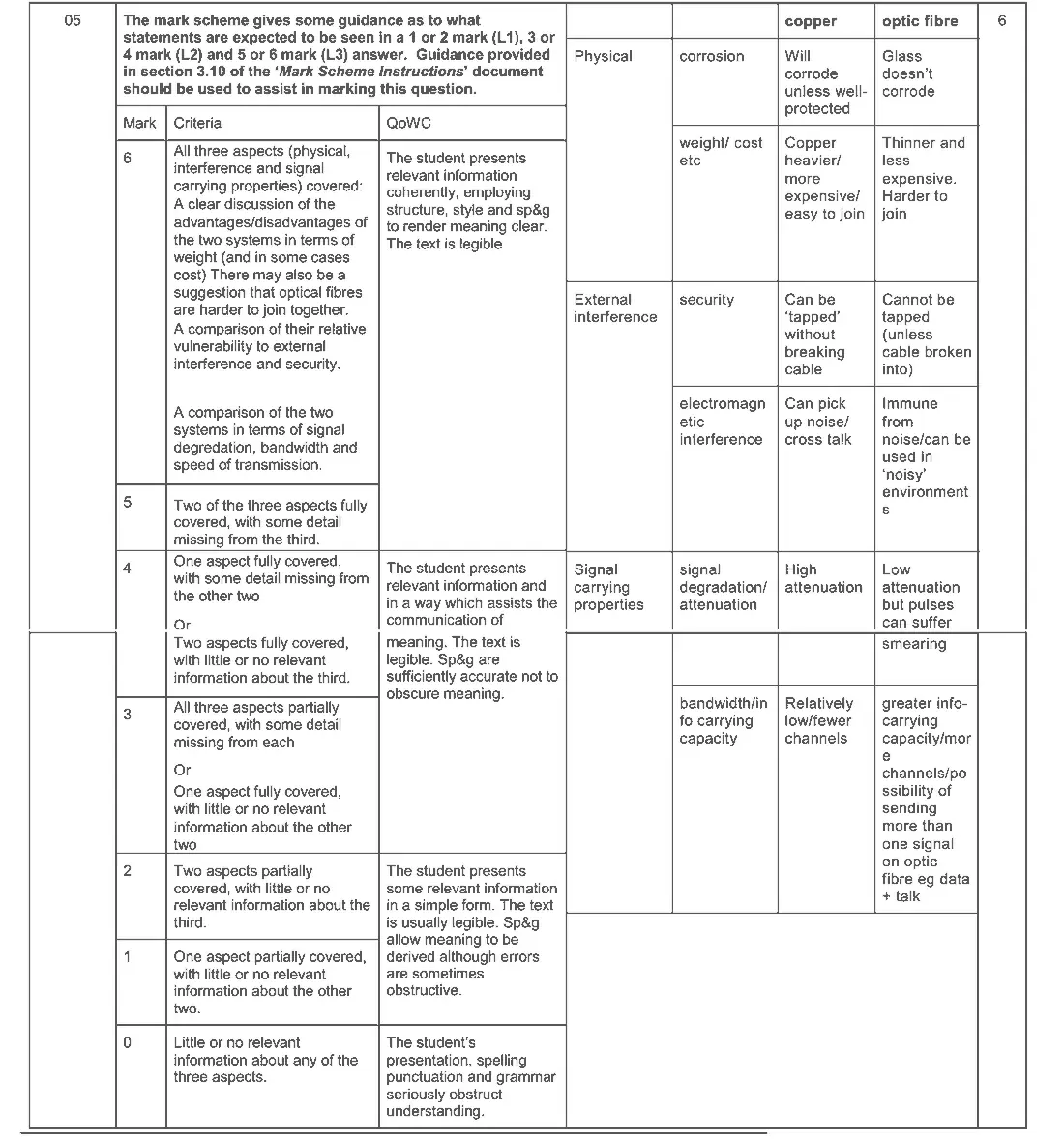
Levels of response: compare copper and optic fibre on physical properties (corrosion, weight, joining), interference/security (fibre immune to EM noise, hard to tap) and signal carrying (attenuation, bandwidth, capacity)
advise optic fibre with supporting reason
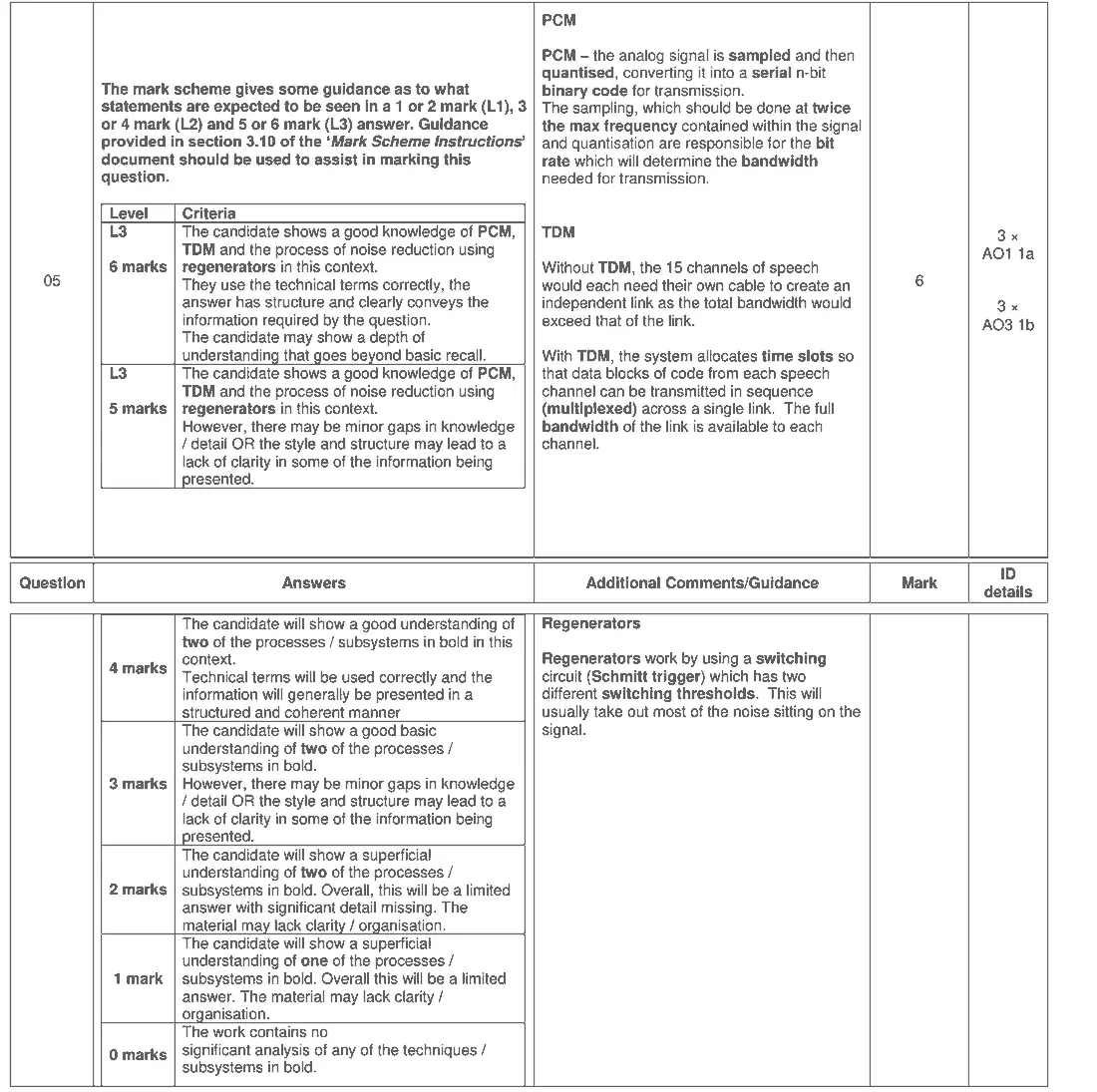
June 2019 · Paper 3B Electronics · Q56 marks6-mark extended response
Mark scheme, with the levels and indicative content
Examiner's comment
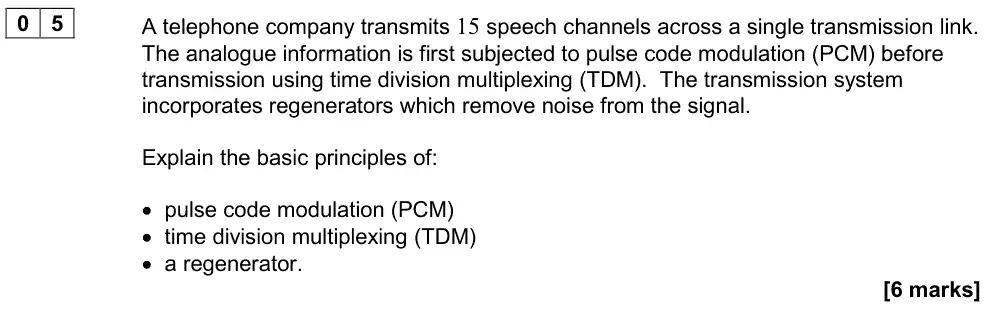
The extended-prose item is intended to test the understanding and use of technical terms and techniques (knowledge), as well as the ability to produce clear and logical explanations. This question produced a wide spread of marks, although only 35% of students gained three marks or better.
PCM is well documented in the guidance notes under ‘communications’ and is an extension of the ‘analogue and digital signals’ section which deals with ADC.
Multiplexing was understood at a general level.
Many students did not take the ‘Regeneration’ concept any further than to repeat the information in the question.
Knowledge of the analogue modulation techniques such as PAM, PWM, PTM or PPM was not, and is not, required.
Notes from the mark scheme and report
Levels of response: PCM samples the analogue signal and codes each sample as a binary number
TDM gives each channel a time slot in turn on one link
June 2018 · Paper 3B Electronics · Q3.11 markShort answer
Mark scheme
Examiner's comment
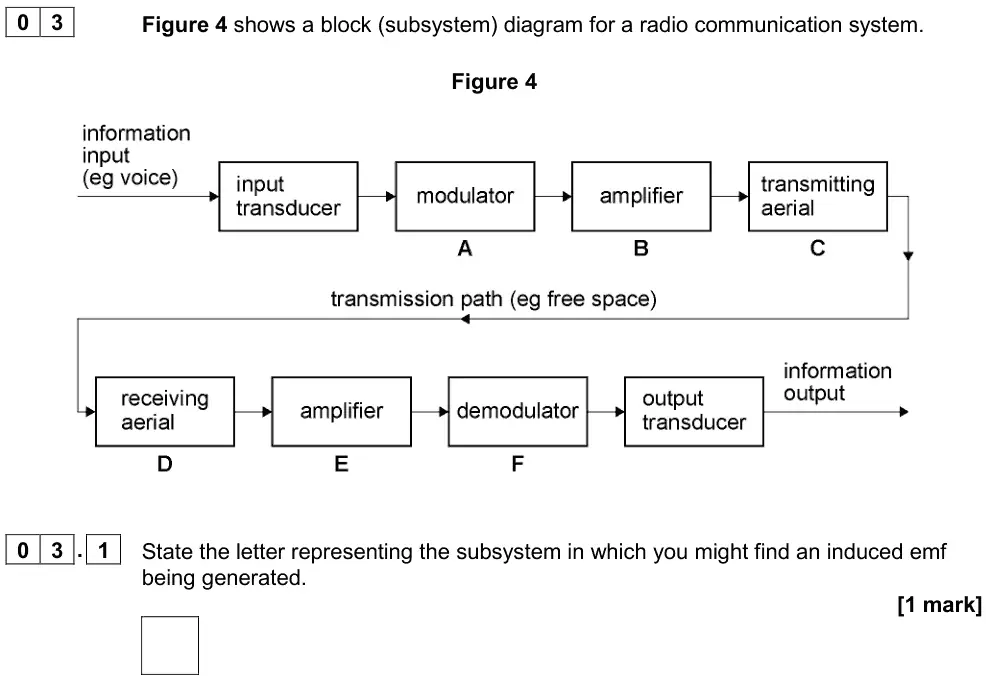
03.1 Only about 52% of students were successful on this question, but given the success achieved on the next question there was obviously a good general understanding of the radio transmission system.
Notes from the mark scheme and report
D (receiving aerial)
June 2018 · Paper 3B Electronics · Q3.21 markShort answerEasy
Earlier part of question 3 that this part uses
Mark scheme
Examiner's comment
03.2 A large proportion of students (82%) gained this mark.
Notes from the mark scheme and report
A (modulator)
June 2018 · Paper 3B Electronics · Q3.31 markShort answer
Earlier part of question 3 that this part uses
Mark scheme
Examiner's comment
03.3 ‘Attenuation across the transmission path’ was accepted for the one mark, although it was good to see some students expand on this statement and give a reason for the attenuation.
Notes from the mark scheme and report
Attenuation along the transmission path (spreading, absorption, only a small fraction of energy reaches the receiver)
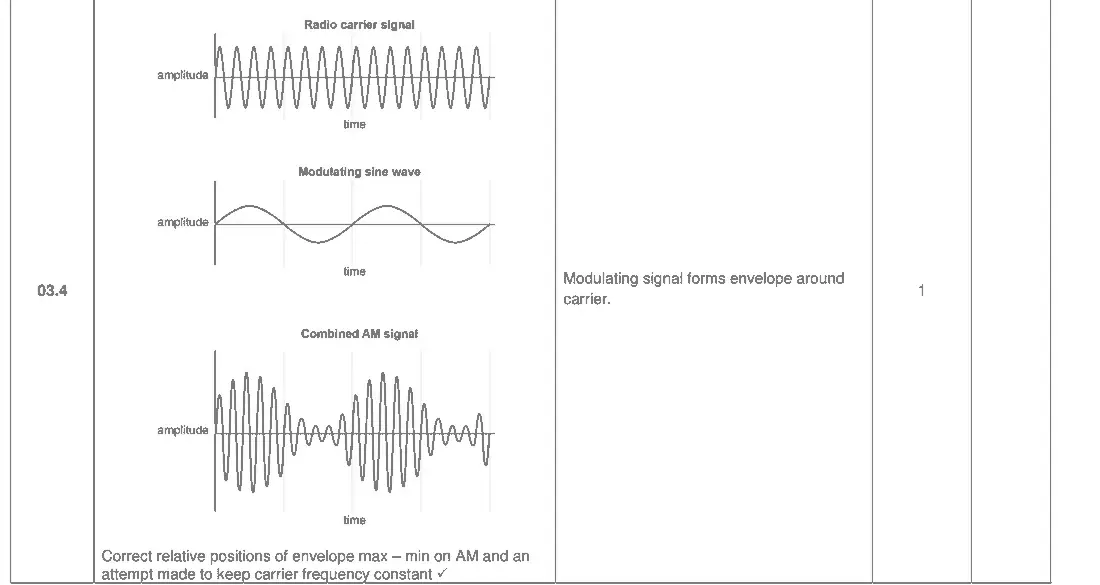
June 2018 · Paper 3B Electronics · Q3.41 markDiagram or graph
Earlier part of question 3 that this part uses
Mark scheme
Examiner's comment
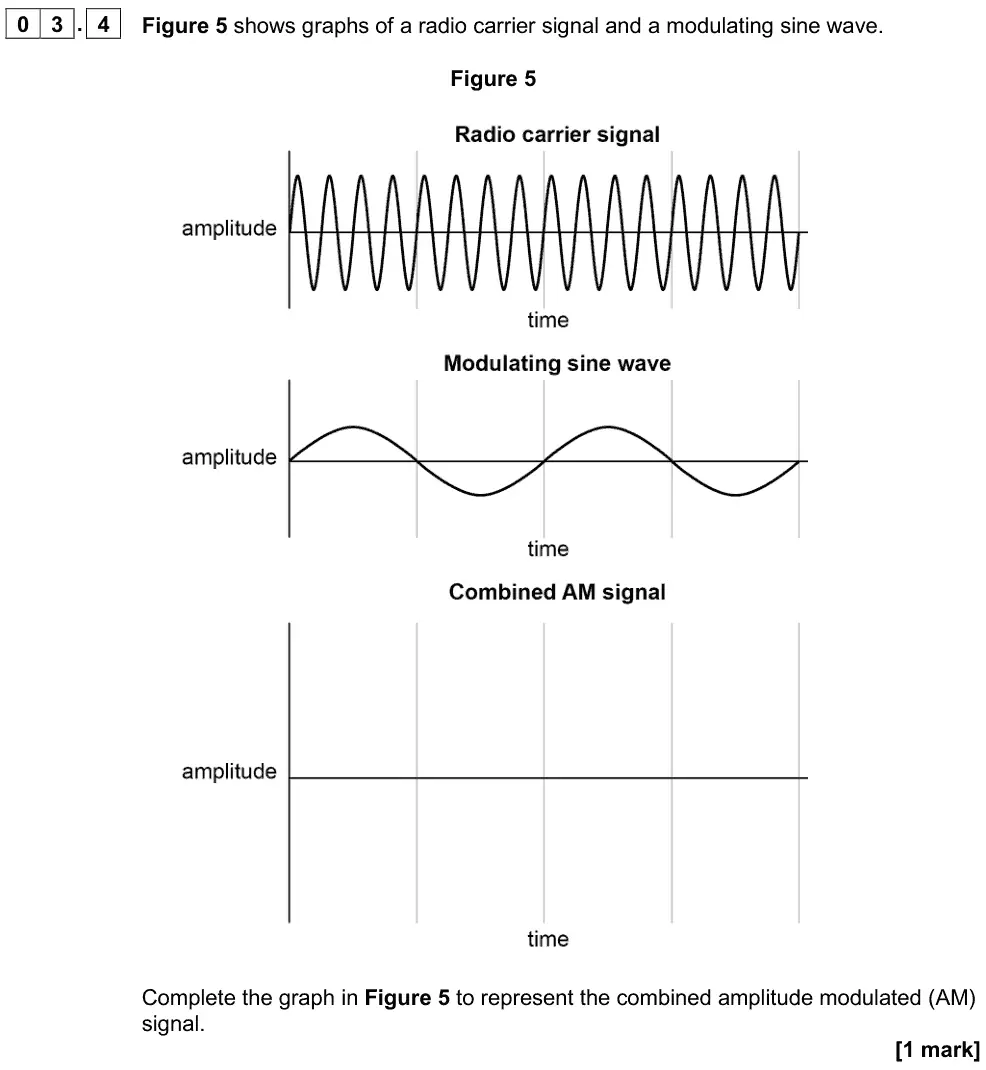
03.4 A significant number of students (61%) failed to get this mark. The problem appeared to be with not knowing the AM shape rather than succumbing to any technical difficulties in drawing the shape.
Notes from the mark scheme and report
Carrier frequency constant, amplitude envelope follows the modulating sine wave (max and min in the right places)
61% failed, mainly not knowing the AM shape
Skills: MS3.1 Translate information between graphical, numerical and algebraic forms
June 2018 · Paper 3B Electronics · Q3.53 marksCalculationHard
Earlier part of question 3 that this part uses
Mark scheme
Examiner's comment
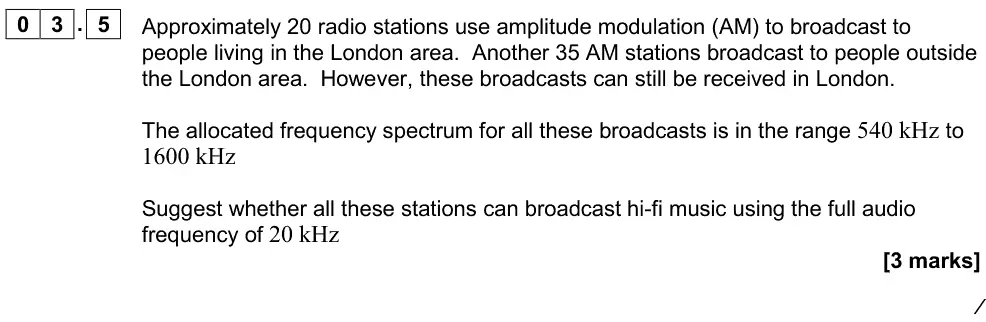
03.5 Students found this question to be more difficult. Many forgot that this was an AM system and the broadcast frequency range had to accommodate the total bandwidth 2 x (fm) for each station. Although a significant number of students still managed to argue (incorrectly) that not all stations could broadcast 20 kHz hi-fi, they failed to pick up the last marking point which was for stating what the consequences would be if the stations went ahead with hi-fi broadcasts across the full audio range. Only 19% of students scored all three marks.
Notes from the mark scheme and report
55 stations x 2 x 20 kHz = 2200 kHz, about twice the 1060 kHz available, so not possible: channels would overlap causing crosstalk/interference
many forgot AM bandwidth is 2 fM
Skills: MS0.3 Use ratios, fractions and percentages
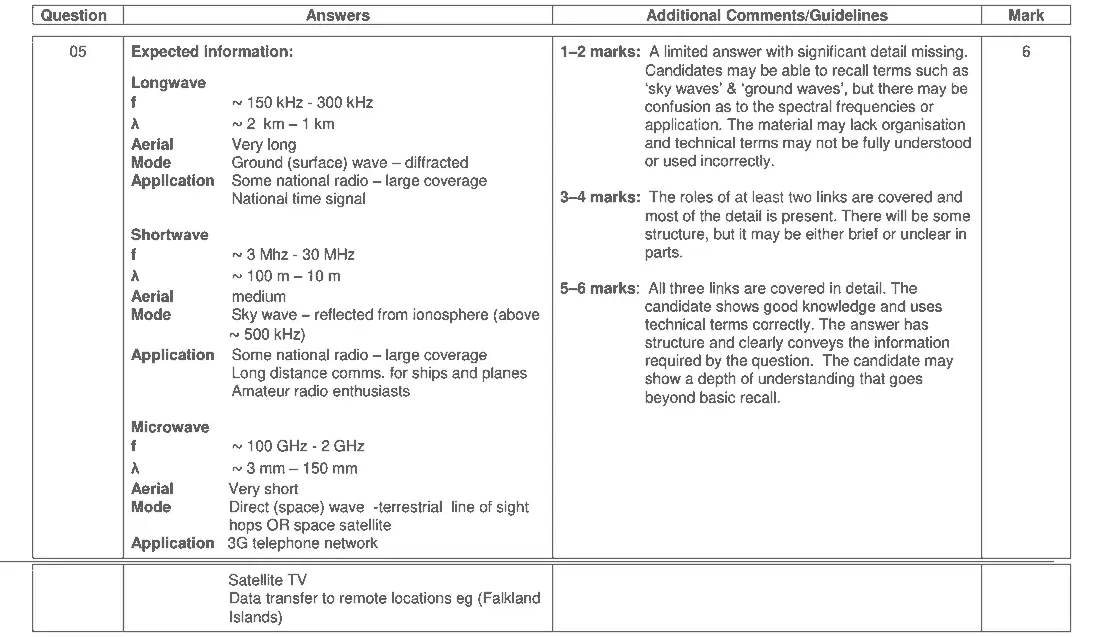
June 2017 · Paper 3B Electronics · Q56 marks6-mark extended response
Mark scheme, with the levels and indicative content
Examiner's comment
This question was designed to give students the chance to write about ‘ground, sky and space waves’ related to the two radio frequency bands, LW and SW, and also to the use of microwaves as communication links. Only a relatively small number of students gained scores in the upper mark band, mainly due to confused knowledge of this part of the specification as opposed to a lack of eloquence.
Notes from the mark scheme and report
Levels of response: LW (about 150-300 kHz) ground wave diffracts round the Earth, national radio/time signal
SW (3-30 MHz) sky wave reflected by the ionosphere, long-distance/ship comms
microwave (GHz) line-of-sight hops or satellite links, phones/satellite TV
few reached the top band
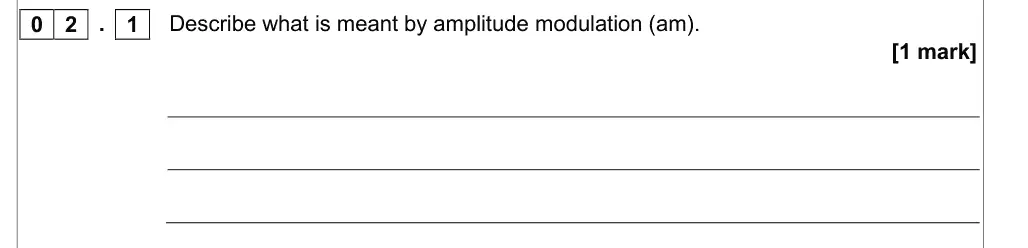
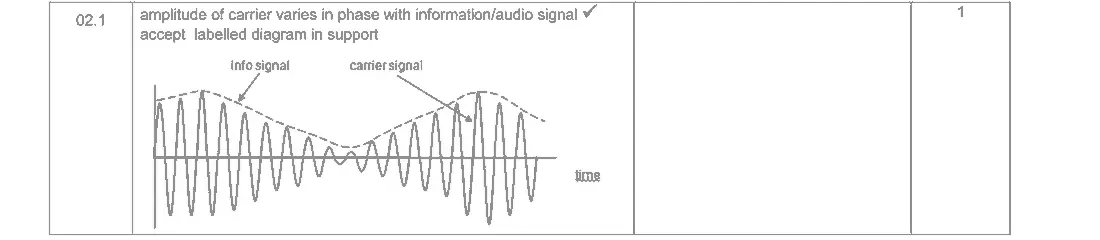
Specimen set 1 · Paper 3B Electronics · Q2.11 markShort answer
Mark scheme
Notes from the mark scheme and report
Amplitude of the carrier varies in step with the information (audio) signal
labelled diagram accepted
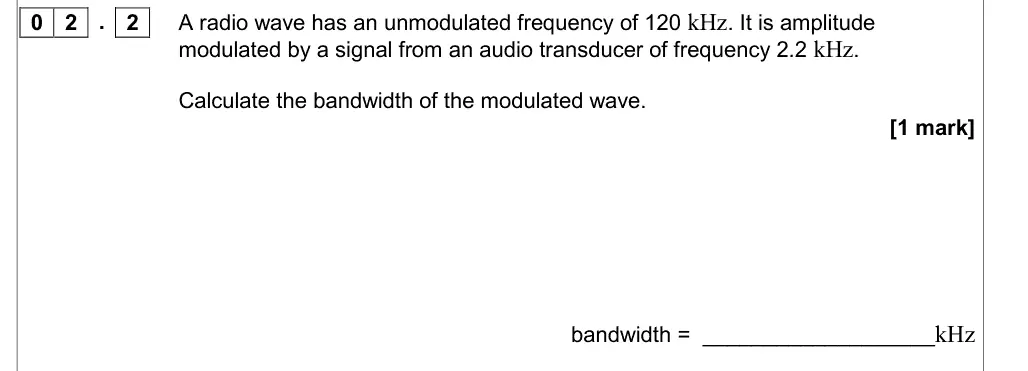
Specimen set 1 · Paper 3B Electronics · Q2.21 markCalculation
Earlier part of question 2 that this part uses
Mark scheme
Notes from the mark scheme and report
Answer: 4.4 kHz (bandwidth = 2 fM = 2 x 2.2 kHz
carrier frequency not needed)
Skills: MS2.3 Substitute numerical values into algebraic equations using appropriate units for physical quantities
Specimen set 1 · Paper 3B Electronics · Q2.31 markShort answer
Earlier part of question 2 that this part uses
Mark scheme
Notes from the mark scheme and report
FM needs a large bandwidth, which would limit the number of channels with low-frequency (MW/LW) carriers
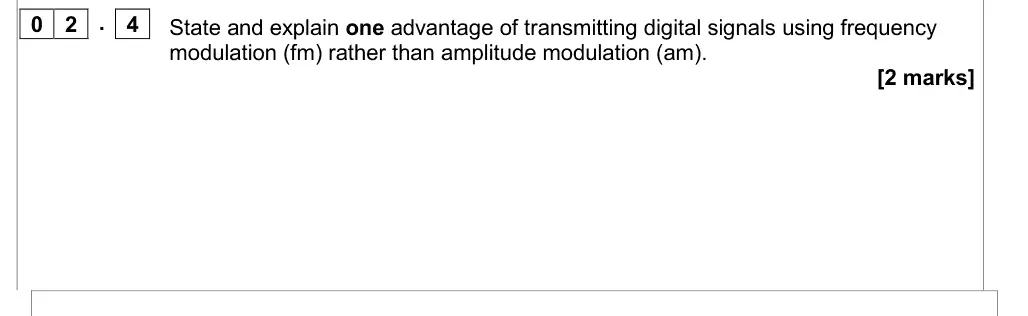
Specimen set 1 · Paper 3B Electronics · Q2.42 marksExplanation
Earlier part of question 2 that this part uses
Mark scheme
Notes from the mark scheme and report
Noise changes amplitude, which affects AM signals (noise amplified with the signal)
FM carries no information in amplitude so the signal can be recovered
Specimen set 1 · Paper 3B Electronics · Q56 marks6-mark extended response
Mark scheme, with the levels and indicative content
Notes from the mark scheme and report
Levels of response: physical (corrosion, weight, cost, ease of joining), external interference and security (fibre immune to EM noise and hard to tap), signal carrying (bandwidth, number of channels, degradation)
Work with an AQA physics tutor
Dropping marks on calculations, required practicals or the six-markers? Book a trial session with a specialist AQA physics tutor.