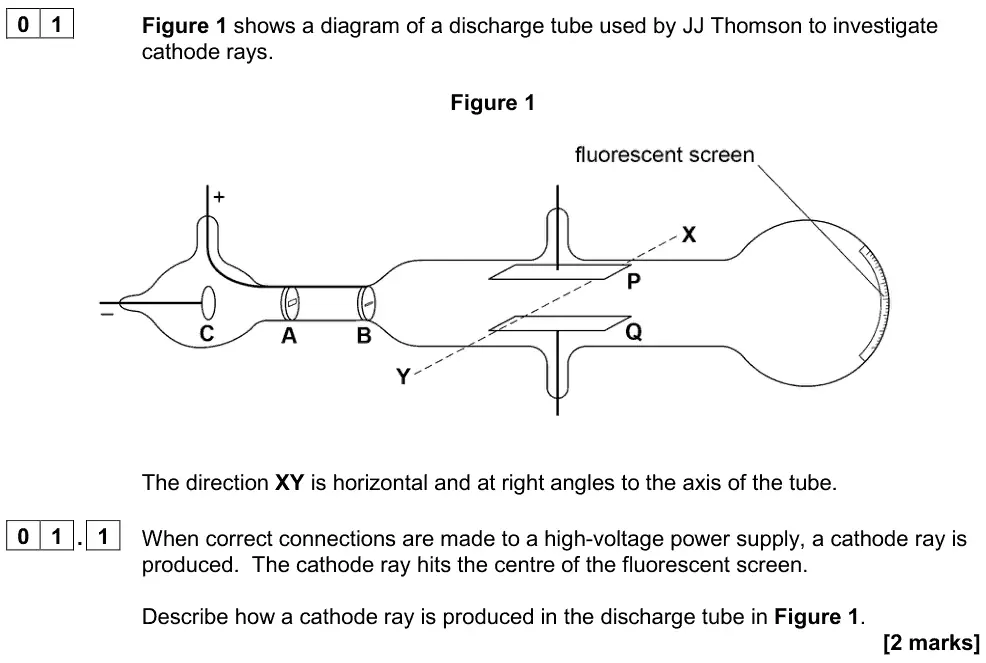
Tap a question to zoom it. Where a part needs a figure, table or graph from earlier in the question, that part folds out above it; the mark scheme and examiner's comment open underneath. Have the AQA data and formulae booklet beside you (see the formula sheet page).
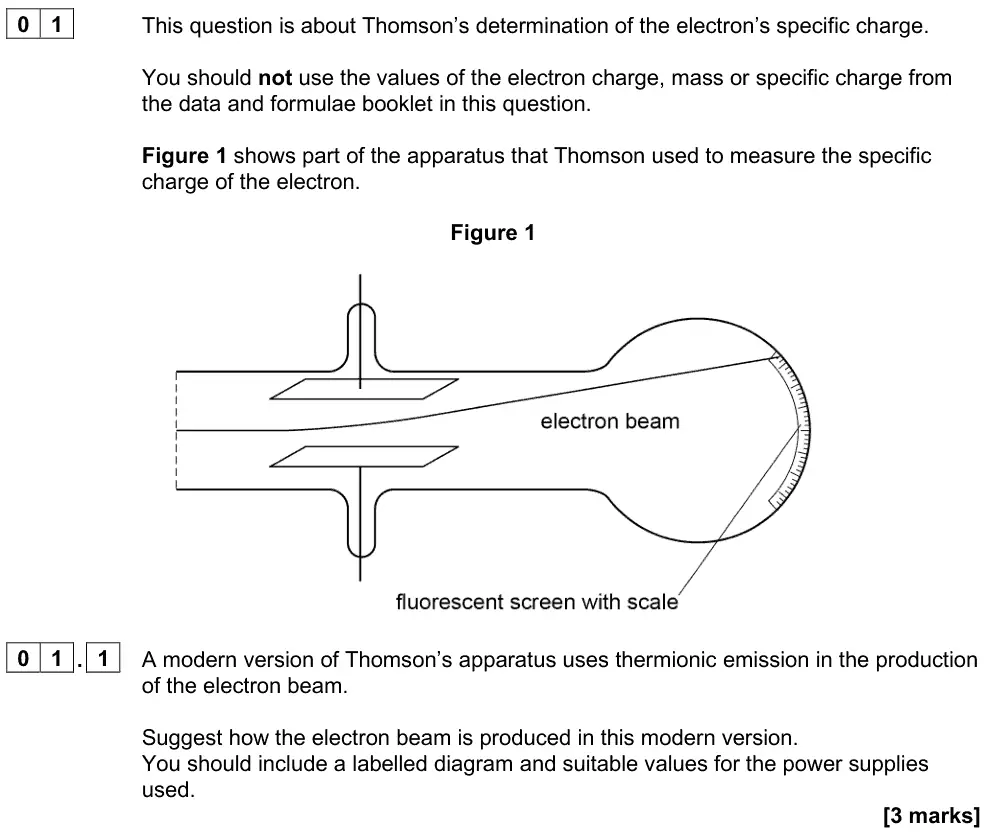
June 2025 · Paper 3B Turning points · Q1.13 marksAO1=3Diagram or graph
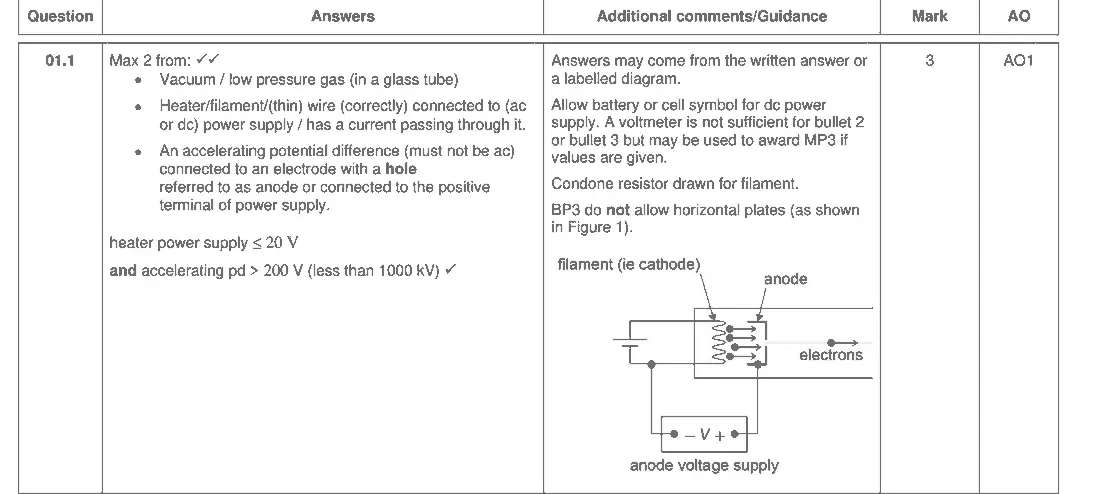
Mark scheme
Examiner's comment
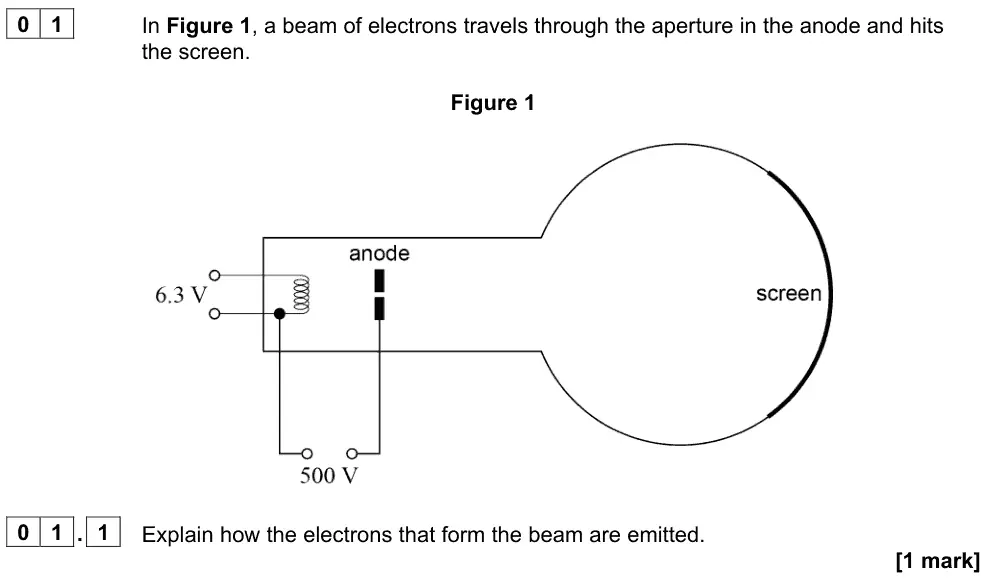
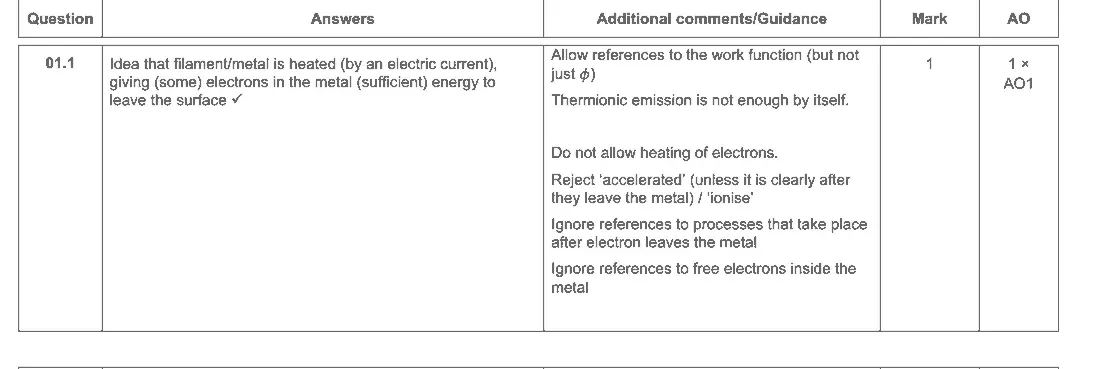
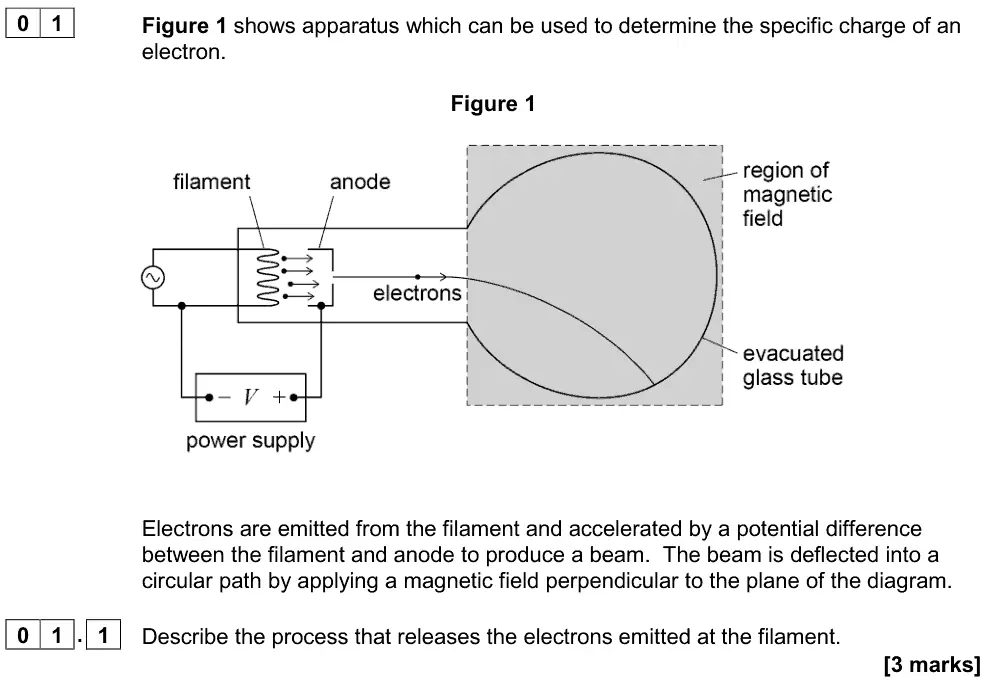
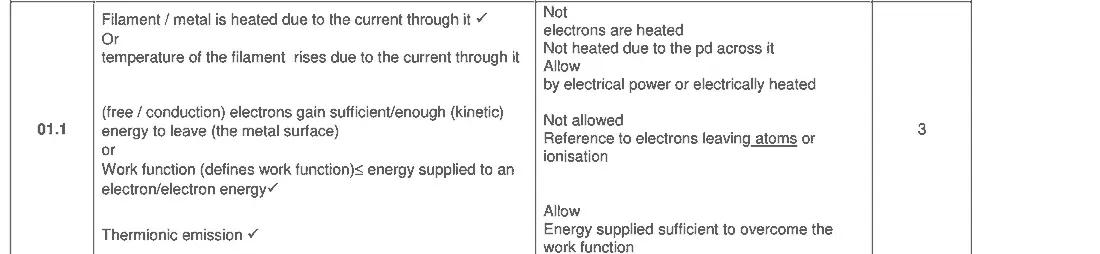
01.1 Most students were able to gain at least one mark on this question, however very few were able to gain full marks. A significant minority did not appear familiar with the process of thermionic emission at all. Marks could be gained from the diagram or text. When drawing these diagrams students need to take care to label diagrams and make clear what lines are wires and which refer to the glass enclosure, as some diagrams were ambiguous.
Notes from the mark scheme and report
Labelled diagram: evacuated tube, heated filament with its own supply (about 6-20 V), anode with a hole at an accelerating pd of a few hundred V or more (dc)
very few gained full marks and some were unfamiliar with thermionic emission
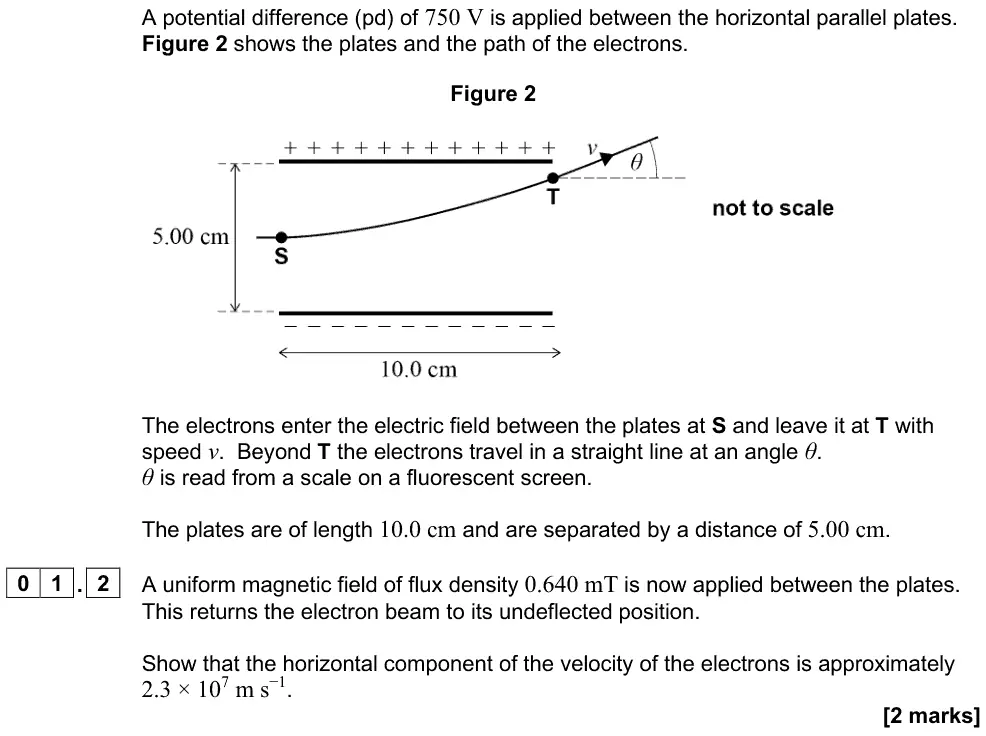
June 2025 · Paper 3B Turning points · Q1.22 marksAO2=2Show that
Earlier part of question 1 that this part uses
Mark scheme
Examiner's comment
Questions 01.2 to 01.4 were “show that” questions where students are expected to provide the equations used as they appear on the formulae sheet, a substitution, a rearrangement (if required) and the answer to at least one more significant figure that the approximate value given in the question. While most students appeared to follow this, some lost marks by missing out some of these steps, most commonly only quoting the answer as the approximate value given in the question.
Most students found 01.2 accessible and were able to gain full marks. 01.3 was reasonably accessible with around two thirds realising that they could use trigonometry with their previous answer to get the mark. 01.4 proved more challenging, with the most common Unfortunately, most of those students did not realise they could use this approach in 01.5 where it provided the correct route to the answer. In 01.4 the correct approach was to use the vertical acceleration. Of those that used this approach, around half correctly used 𝑣𝑣ℎ= 𝑎𝑎𝑎𝑎 with horizontal motion to determine a time and then an equation of motion to determine the their answer to 01.3. However, the other half used 𝑣𝑣2 = 2𝑎𝑎𝑎𝑎, either using 2.5 cm as 𝑠𝑠 or estimating a value smaller than this, as they realised the beam did not reach the top plate. 𝑑𝑑 in 01.5. Most students either used 𝑒𝑒 and 𝑚𝑚 from the formulae booklet or mixed using 𝑚𝑚𝑚𝑚= 𝑄𝑄𝑄𝑄 These students were awarded 1 mark. Very few were able to determine the specific charge
up the accelerating pd with the pd across the plates. A small number of students attempted to use the vertical deflection with the magnetic field.
01.2-01.5 Students had to determine a value for the specific charge, using Thomson’s original approach which involved measuring the deflection angle of the electron beam. It was not expected that all students would have seen Thomson’s approach before; however, it was expected that students would be able to apply their knowledge of fields and their understanding of measuring the specific charge to this technique. 𝑒𝑒 𝑚𝑚 it was not appropriate to use the values of 𝑒𝑒 and 𝑚𝑚 from the formulae booklet, so the many attempts which did use The question explicitly told students that in this determination of these values scored 0 for the part of the question where these values were used. However, this did not prevent other parts from scoring.
Notes from the mark scheme and report
Answer: 2.34 x 10^7 m s^-1 (eV/d = Bev so v = V/(dB) with d = 0.0500 m, B = 0.640 mT)
do not use booklet e or m
at least 3 sf
Skills: MS2.2 Change the subject of an equation, including non-linear equations; MS2.3 Substitute numerical values into algebraic equations using appropriate units for physical quantities; MS1.1 Use an appropriate number of significant figures
June 2025 · Paper 3B Turning points · Q1.31 markAO2=1Show thatEasy
Earlier part of question 1 that this part uses
Mark scheme
Examiner's comment
Most students found 01.2 accessible and were able to gain full marks. 01.3 was reasonably accessible with around two thirds realising that they could use trigonometry with their previous answer to get the mark. 01.4 proved more challenging, with the most common Unfortunately, most of those students did not realise they could use this approach in 01.5 where it provided the correct route to the answer. In 01.4 the correct approach was to use the vertical acceleration. Of those that used this approach, around half correctly used 𝑣𝑣ℎ= 𝑎𝑎𝑎𝑎 with horizontal motion to determine a time and then an equation of motion to determine the their answer to 01.3. However, the other half used 𝑣𝑣2 = 2𝑎𝑎𝑎𝑎, either using 2.5 cm as 𝑠𝑠 or estimating a value smaller than this, as they realised the beam did not reach the top plate. 𝑑𝑑 in 01.5. Most students either used 𝑒𝑒 and 𝑚𝑚 from the formulae booklet or mixed using 𝑚𝑚𝑚𝑚= 𝑄𝑄𝑄𝑄 These students were awarded 1 mark. Very few were able to determine the specific charge
Notes from the mark scheme and report
Answer: 1.09 x 10^7 m s^-1 (vv = vh tan 25 deg)
Skills: MS4.5 Use sin, cos and tan in physical problems; MS1.1 Use an appropriate number of significant figures
June 2025 · Paper 3B Turning points · Q1.42 marksAO2=2Show that
Earlier part of question 1 that this part uses
Mark scheme
Examiner's comment
Questions 01.2 to 01.4 were “show that” questions where students are expected to provide the equations used as they appear on the formulae sheet, a substitution, a rearrangement (if required) and the answer to at least one more significant figure that the approximate value given in the question. While most students appeared to follow this, some lost marks by missing out some of these steps, most commonly only quoting the answer as the approximate value given in the question.
Most students found 01.2 accessible and were able to gain full marks. 01.3 was reasonably accessible with around two thirds realising that they could use trigonometry with their previous answer to get the mark. 01.4 proved more challenging, with the most common Unfortunately, most of those students did not realise they could use this approach in 01.5 where it provided the correct route to the answer. In 01.4 the correct approach was to use the vertical acceleration. Of those that used this approach, around half correctly used 𝑣𝑣ℎ= 𝑎𝑎𝑎𝑎 with horizontal motion to determine a time and then an equation of motion to determine the their answer to 01.3. However, the other half used 𝑣𝑣2 = 2𝑎𝑎𝑎𝑎, either using 2.5 cm as 𝑠𝑠 or estimating a value smaller than this, as they realised the beam did not reach the top plate. 𝑑𝑑 in 01.5. Most students either used 𝑒𝑒 and 𝑚𝑚 from the formulae booklet or mixed using 𝑚𝑚𝑚𝑚= 𝑄𝑄𝑄𝑄 These students were awarded 1 mark. Very few were able to determine the specific charge
04.1 Most students were able to make some progress and gain some marks, with around a third achieving full marks and over half gaining at least 3 marks. The question gave a maximum time that must be experienced by the cargo, a speed of the spaceship and the distance to be relativity calculation so that data in the same reference frame could be compared, and a 𝑣𝑣= 𝑠𝑠 travelled. The distance and time were in different reference frames, so students had to use a 𝑡𝑡 calculation so that the same quantities could be compared. There were at least 7 possible comparisons of quantities: comparing speeds, distances in either reference frame or times in seconds or days in either reference frame. The first mark was for students correctly identifying 1.4 × 10¹⁴ as 𝑙𝑙0 or 10 days as 𝑡𝑡0 and substituting into a relativity equation. This could also be gained by using the results of a 𝑣𝑣= 𝑠𝑠 𝑡𝑡 calculation as 𝑙𝑙 or 𝑡𝑡. The second mark was carrying out a 𝑣𝑣= 𝑠𝑠 𝑡𝑡 with their substituted values in the same references frame. As 𝑣𝑣 was the same in both reference frames, only those who used 𝑠𝑠= 1.4 × 10¹⁴ and 𝑡𝑡= 10 (days) or 864000 (s) or who used 𝑣𝑣 as the speed of light did not gain this mark for the use of 𝑣𝑣= 𝑠𝑠 𝑡𝑡. The third mark was for correctly completing a relativity and a 𝑣𝑣= 𝑠𝑠 𝑡𝑡 calculation. If these were carried out in sequence, then one answer was required. However, students could also carry out two independent calculations, the results of which were compared with each other, in which case two answers were required.
Notes from the mark scheme and report
Answer: 2.56 x 10^15 m s^-2 (time between plates t = 0.10 / vh = 4.27 x 10^-9 s
a = vv / t)
using v^2 = 2as with 2.5 cm gets 1 mark only
Skills: MS2.3 Substitute numerical values into algebraic equations using appropriate units for physical quantities; MS1.1 Use an appropriate number of significant figures
June 2025 · Paper 3B Turning points · Q1.53 marksAO2=3Calculation
Earlier part of question 1 that this part uses
Mark scheme
Examiner's comment
Most students found 01.2 accessible and were able to gain full marks. 01.3 was reasonably accessible with around two thirds realising that they could use trigonometry with their previous answer to get the mark. 01.4 proved more challenging, with the most common Unfortunately, most of those students did not realise they could use this approach in 01.5 where it provided the correct route to the answer. In 01.4 the correct approach was to use the vertical acceleration. Of those that used this approach, around half correctly used 𝑣𝑣ℎ= 𝑎𝑎𝑎𝑎 with horizontal motion to determine a time and then an equation of motion to determine the their answer to 01.3. However, the other half used 𝑣𝑣2 = 2𝑎𝑎𝑎𝑎, either using 2.5 cm as 𝑠𝑠 or estimating a value smaller than this, as they realised the beam did not reach the top plate. 𝑑𝑑 in 01.5. Most students either used 𝑒𝑒 and 𝑚𝑚 from the formulae booklet or mixed using 𝑚𝑚𝑚𝑚= 𝑄𝑄𝑄𝑄 These students were awarded 1 mark. Very few were able to determine the specific charge
01.2-01.5 Students had to determine a value for the specific charge, using Thomson’s original approach which involved measuring the deflection angle of the electron beam. It was not expected that all students would have seen Thomson’s approach before; however, it was expected that students would be able to apply their knowledge of fields and their understanding of measuring the specific charge to this technique. 𝑒𝑒 𝑚𝑚 it was not appropriate to use the values of 𝑒𝑒 and 𝑚𝑚 from the formulae booklet, so the many attempts which did use The question explicitly told students that in this determination of these values scored 0 for the part of the question where these values were used. However, this did not prevent other parts from scoring.
Notes from the mark scheme and report
Answer: 1.7 x 10^11 C kg^-1 (ma = eV/d so e/m = ad/V)
answers using booklet e or m score 0
many mixed up the accelerating pd and the plate pd
very few succeeded
Skills: MS2.2 Change the subject of an equation, including non-linear equations; MS2.3 Substitute numerical values into algebraic equations using appropriate units for physical quantities
June 2025 · Paper 3B Turning points · Q1.62 marksAO1=2Explanation
Earlier part of question 1 that this part uses
Mark scheme
Examiner's comment
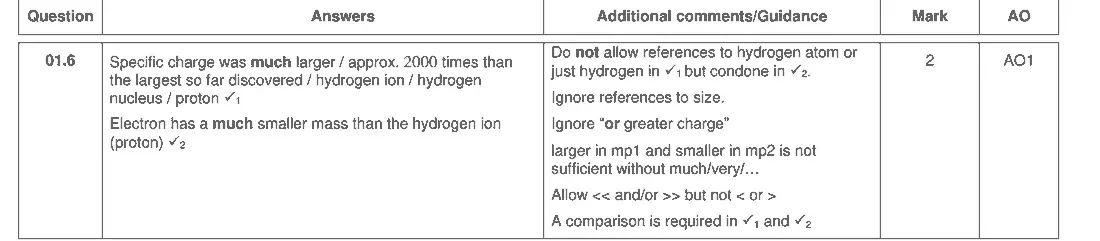
01.6 This question was a standard question, however less than half were able to score, with even fewer able to score both marks. Some answers referred to atoms rather than ions or referred to helium rather than hydrogen and could not gain both marks. Some answers did not use comparative terms, referring to the mass of the electron as small, rather than as having a much smaller mass than the hydrogen ion. The idea that the specific charge was much larger, or several orders of magnitude larger, rather than just larger, was necessary to gain the first mark, as this was the key point of the significance of the Thomson’s result. Answers which referred to size rather than mass did not gain the second mark.
Notes from the mark scheme and report
Specific charge much larger (about 2000 times) than the hydrogen ion's, so electron mass much smaller than the hydrogen ion's
comparative words (much, very) and 'ion' not 'atom' required
less than half scored
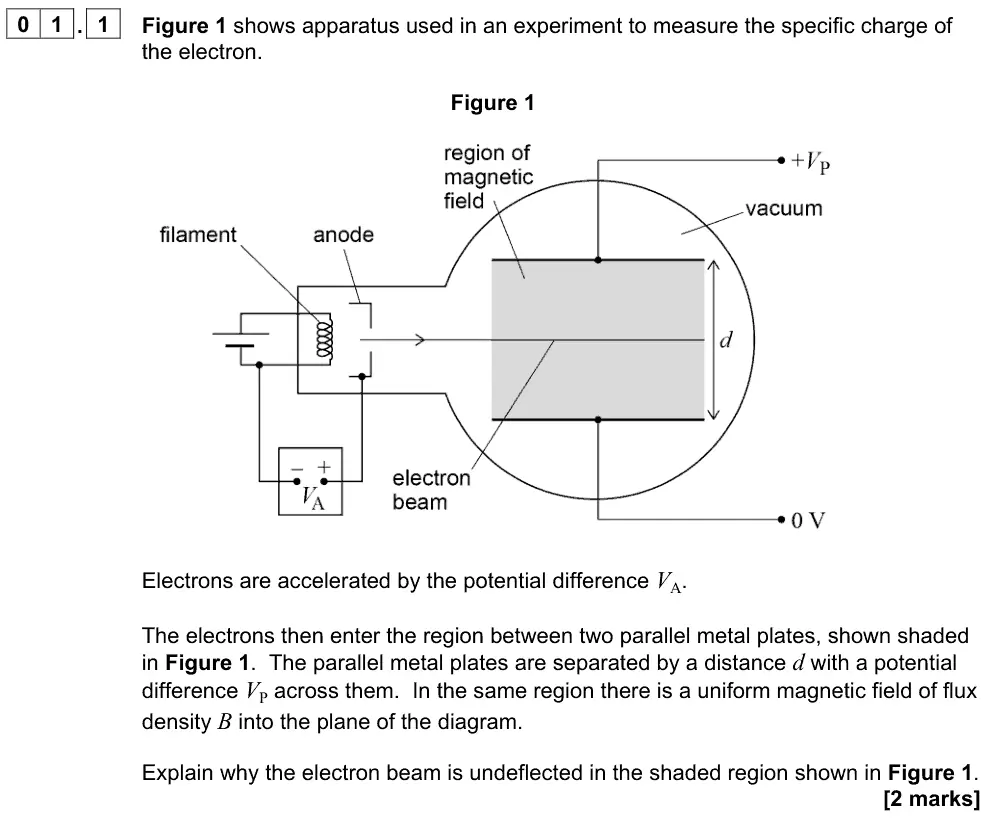
June 2024 · Paper 3B Turning points · Q1.12 marksAO2=2Explanation
Mark scheme
Examiner's comment
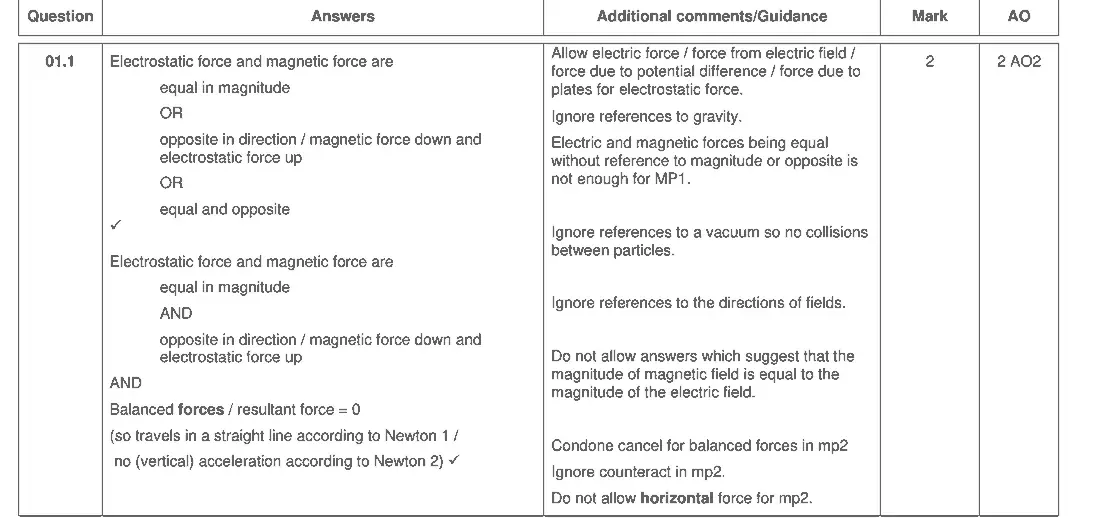
01.1 Most students found the question accessible, however many answers lacked the details required. In order to establish that the electron beam is undeflected, students needed to identify the two forces as electrostatic and magnetic. They then had to state these were equal in magnitude and opposite in direction, which meant that the forces were balanced.
It was hoped that students would refer to either Newton’s first or second law to explain why balanced forces meant that the electron beam was undeflected; however, this was only seen in a very small number of responses, so it was not insisted upon. It is, however, an essential part of why the electron beam is undeflected.
Most students’ responses lacked detail, choosing only to refer to balanced forces without naming the forces or stating why they were balanced or just referring to the forces as equal and opposite, rather than equal in magnitude and opposite in direction.
A very small number referred to gravity being a factor. As the magnitude of the weight on an electron is negligible, references which included gravity as a downwards force were allowed provided they were otherwise correct, while references which replaced the magnetic force with the weight scored no marks.
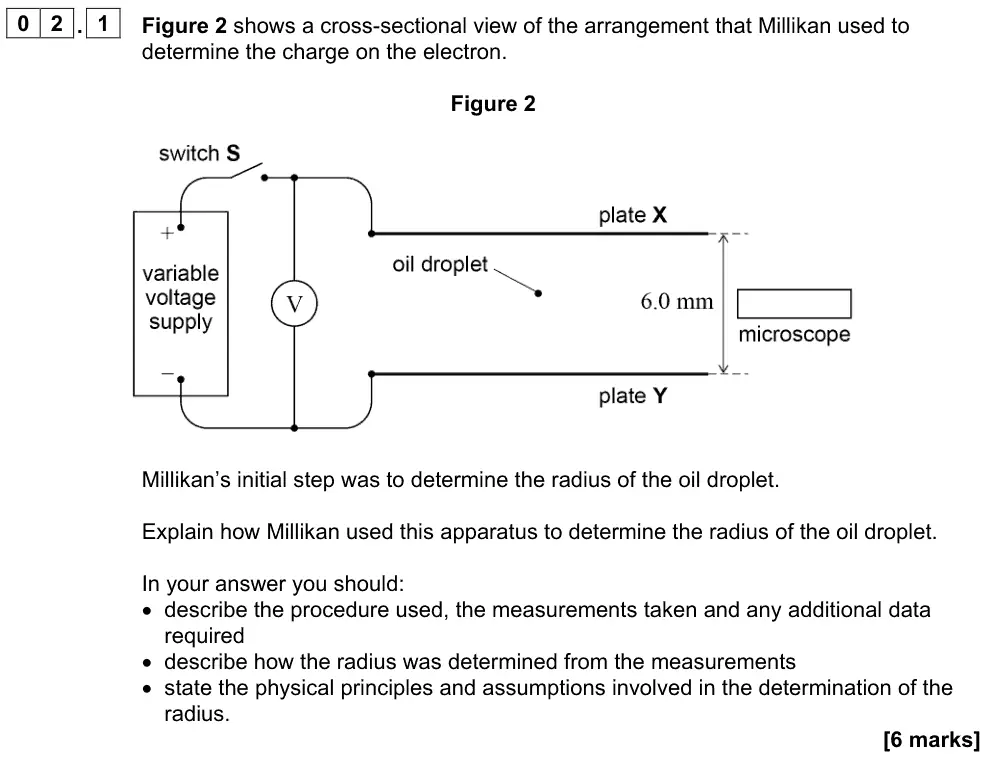
02.1 This was the question marked on a levels-of-response basis and concerned the method used to determine the radius of the oil droplet. While many found this question accessible and were familiar with the experiment, a large number of answers lacked detail or discussed parts of the experiment that were not asked about. References to how the charge was determined or the significance of the Millikan’s experiment were ignored by examiners. A small number of responses seemed not to be familiar with Millikan’s experiment. responses which dealt with the determination of 𝑄𝑄 could gain this point provided it was clear that 𝑟𝑟 To address the question fully, students had to refer to the field being switched off. Student was determined with the field switched off. The method also required a description of how the terminal velocity was determined. While many were able to refer to measuring the time taken to fall 𝑠𝑠 a measured distance, many responses failed to state how the velocity was determined from these 𝑡𝑡. The details about using lines marked on the microscope to determine the distance values using was missing from nearly all responses and was not insisted upon, although it is a vital part of how Millikan was able to carry out the experiment. Most students were able to partially address this area, but few were able to address it fully. Most responses mentioned measuring the distance and time for the droplet to fall but lacked the calculation or a statement that the electric field had to be off. to the correct equation for 𝑟𝑟 students had to identify that 𝜌𝜌 was the density of the oil or 𝜂𝜂 was the Most responses had some idea of the determination. In order to fully address this area, in addition oil and which to the air. Some responses gave an equation for 𝑟𝑟2 which did not fully address how to viscosity of the air. Many either missed this out or wrongly identified which symbol referred to the calculate 𝑟𝑟. A small number of students just listed the equation and then said you should rearrange and solve for 𝑟𝑟; this was not enough to address this area. The principles and assumptions section proved to be the most accessible area to address. The most common response was that the oil droplet was a sphere. The next most common idea was that when the droplet falls at terminal velocity the weight was equal in magnitude and opposite in direction to the drag force. To balance the precision insisted on in 01.1 for a balanced-forces argument, the detail required here was reduced, which meant that statements such as ‘weight was equal to the drag force’ were accepted. However, this had to be linked to the concept of terminal velocity. Other responses included the fact that air acted like a viscous fluid allowing Stoke’s law to be applied or that upthrust or buoyancy was negligible. There was some confusion in this section with some students going from one sentence writing negligible. Others incorrectly referred to Stoke’s law or 6𝜋𝜋𝜋𝜋𝜋𝜋𝜋𝜋 as the buoyancy force. about terminal velocity and viscous drag force to the next which stated that air resistance was
Notes from the mark scheme and report
Electrostatic and magnetic forces equal in magnitude and opposite in direction, so resultant force zero and no deflection (Newton 1/2)
many just said 'balanced' or 'equal and opposite' without naming the forces
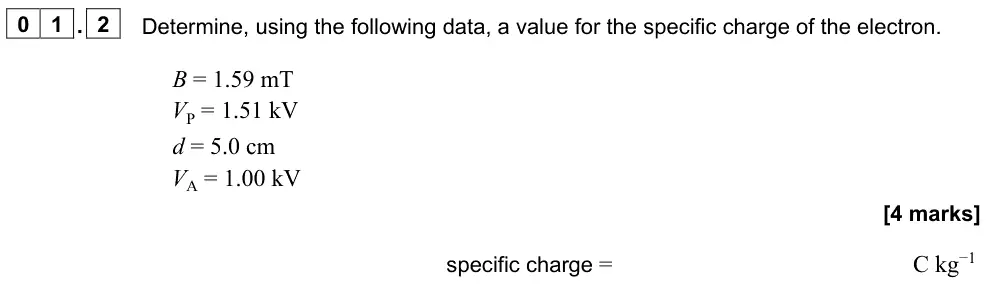
June 2024 · Paper 3B Turning points · Q1.24 marksCalculation
Earlier part of question 1 that this part uses
Mark scheme
Examiner's comment
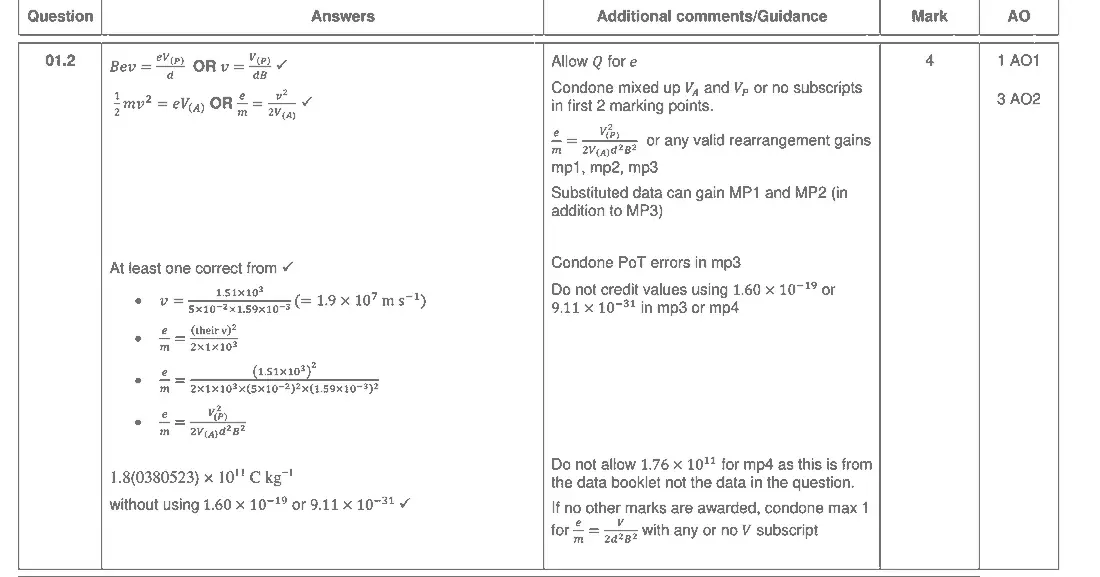
01.2 Students were required to determine the specific charge of the electron from the data supplied in 𝑒𝑒 the question. Answers had to equate magnetic force with electric force and electrostatic potential 𝑚𝑚 or carry this out in 𝑒𝑒 energy with kinetic energy. They could then either combine these two to find 𝑚𝑚. Either route scored full two steps, first determining the speed of the electrons before calculating marks. Students who used the values of the charge and mass from the data and formulae booklet were therefore only able to access the first two marks.
Many students knew how to complete this calculation and were able to score all four marks. Some students mixed up the scenario and used either the magnetic or electrostatic force as a centripetal force; they were generally only able to score one mark for equating the electrostatic potential and kinetic energy.
Notes from the mark scheme and report
Answer: 1.8 x 10^11 C kg^-1 (v = VP/(dB) = 1.9 x 10^7 m s^-1
e/m = v^2/(2VA))
using data-booklet e and m (1.76 x 10^11) not credited
some wrongly used a centripetal force
Skills: MS2.2 Change the subject of an equation, including non-linear equations; MS2.3 Substitute numerical values into algebraic equations using appropriate units for physical quantities; MS0.2 Recognise and use expressions in decimal and standard form
June 2024 · Paper 3B Turning points · Q2.16 marksAO1=66-mark extended response
Mark scheme, with the levels and indicative content
Examiner's comment
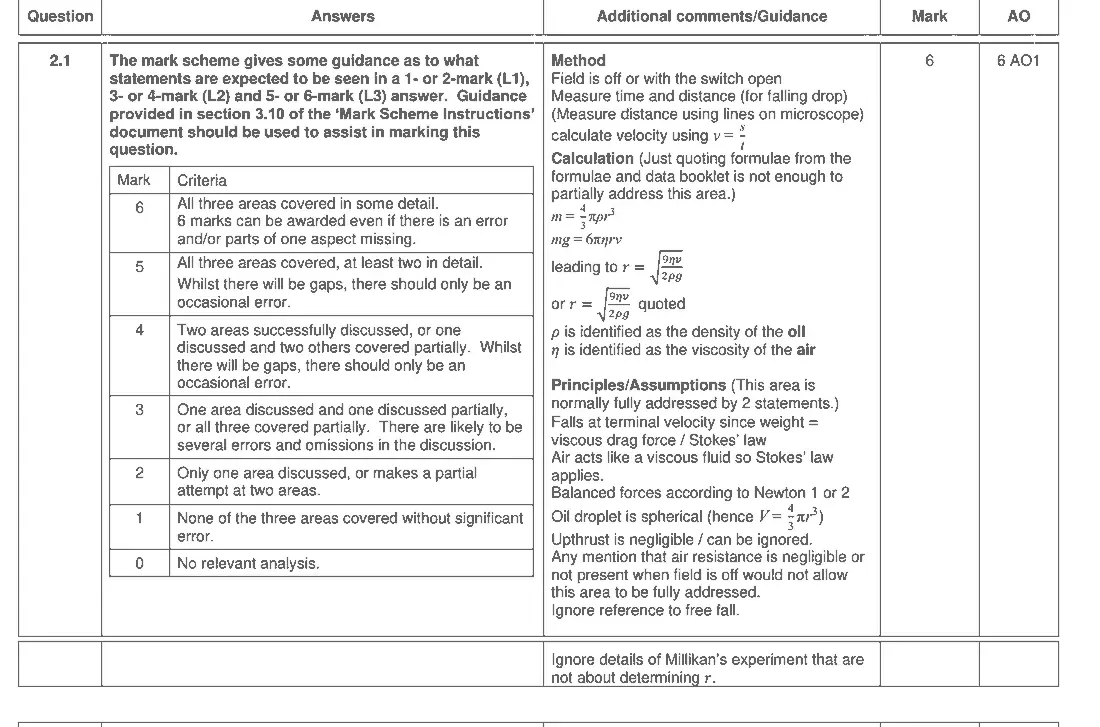
02.1 This was the question marked on a levels-of-response basis and concerned the method used to determine the radius of the oil droplet. While many found this question accessible and were familiar with the experiment, a large number of answers lacked detail or discussed parts of the experiment that were not asked about. References to how the charge was determined or the significance of the Millikan’s experiment were ignored by examiners. A small number of responses seemed not to be familiar with Millikan’s experiment. responses which dealt with the determination of 𝑄𝑄 could gain this point provided it was clear that 𝑟𝑟 To address the question fully, students had to refer to the field being switched off. Student was determined with the field switched off. The method also required a description of how the terminal velocity was determined. While many were able to refer to measuring the time taken to fall 𝑠𝑠 a measured distance, many responses failed to state how the velocity was determined from these 𝑡𝑡. The details about using lines marked on the microscope to determine the distance values using was missing from nearly all responses and was not insisted upon, although it is a vital part of how Millikan was able to carry out the experiment. Most students were able to partially address this area, but few were able to address it fully. Most responses mentioned measuring the distance and time for the droplet to fall but lacked the calculation or a statement that the electric field had to be off. to the correct equation for 𝑟𝑟 students had to identify that 𝜌𝜌 was the density of the oil or 𝜂𝜂 was the Most responses had some idea of the determination. In order to fully address this area, in addition oil and which to the air. Some responses gave an equation for 𝑟𝑟2 which did not fully address how to viscosity of the air. Many either missed this out or wrongly identified which symbol referred to the calculate 𝑟𝑟. A small number of students just listed the equation and then said you should rearrange and solve for 𝑟𝑟; this was not enough to address this area. The principles and assumptions section proved to be the most accessible area to address. The most common response was that the oil droplet was a sphere. The next most common idea was that when the droplet falls at terminal velocity the weight was equal in magnitude and opposite in direction to the drag force. To balance the precision insisted on in 01.1 for a balanced-forces argument, the detail required here was reduced, which meant that statements such as ‘weight was equal to the drag force’ were accepted. However, this had to be linked to the concept of terminal velocity. Other responses included the fact that air acted like a viscous fluid allowing Stoke’s law to be applied or that upthrust or buoyancy was negligible. There was some confusion in this section with some students going from one sentence writing negligible. Others incorrectly referred to Stoke’s law or 6𝜋𝜋𝜋𝜋𝜋𝜋𝜋𝜋 as the buoyancy force. about terminal velocity and viscous drag force to the next which stated that air resistance was
Notes from the mark scheme and report
Levels of response: field off, time drop falling a measured distance to get terminal velocity
mg = 6 pi eta r v with m = 4/3 pi r^3 rho giving r = sqrt(9 eta v / 2 rho g), rho oil density, eta air viscosity
assumptions (spherical drop, weight = drag at terminal speed, upthrust negligible). Many omitted that the field is off
June 2024 · Paper 3B Turning points · Q2.23 marksAO2=3Show that
Earlier part of question 2 that this part uses
Mark scheme
Examiner's comment
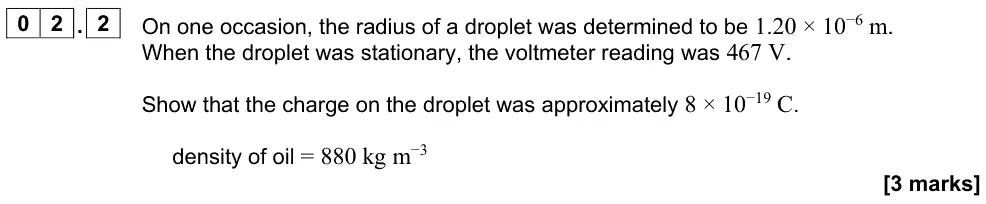
02.2 This question asked for a determination of the charge on the oil droplet. This was well answered with most responses scoring well. However, some responses did not score as well as they could have due to misunderstanding what is required for a ‘show that’ question. The response to any ‘show that’ question should include the equations used, a substitution and the answer given to at least one more significant figure than the approximate value in the question. In this case the answer was expected to at least 2 significant figures (sf).
Notes from the mark scheme and report
Answer: 8.0 x 10^-19 C (m = rho x 4/3 pi r^3
Q = mgd/V with d = 6.0 mm from Figure 2)
equations and substitutions needed, at least 2 sf
Skills: MS2.3 Substitute numerical values into algebraic equations using appropriate units for physical quantities; MS4.3 Calculate areas of triangles, circumferences and areas of circles, surface areas and volumes of rectangular blocks, cylinders and spheres; MS1.1 Use an appropriate number of significant figures
June 2024 · Paper 3B Turning points · Q2.33 marksCalculation
Earlier part of question 2 that this part uses
Mark scheme
Examiner's comment
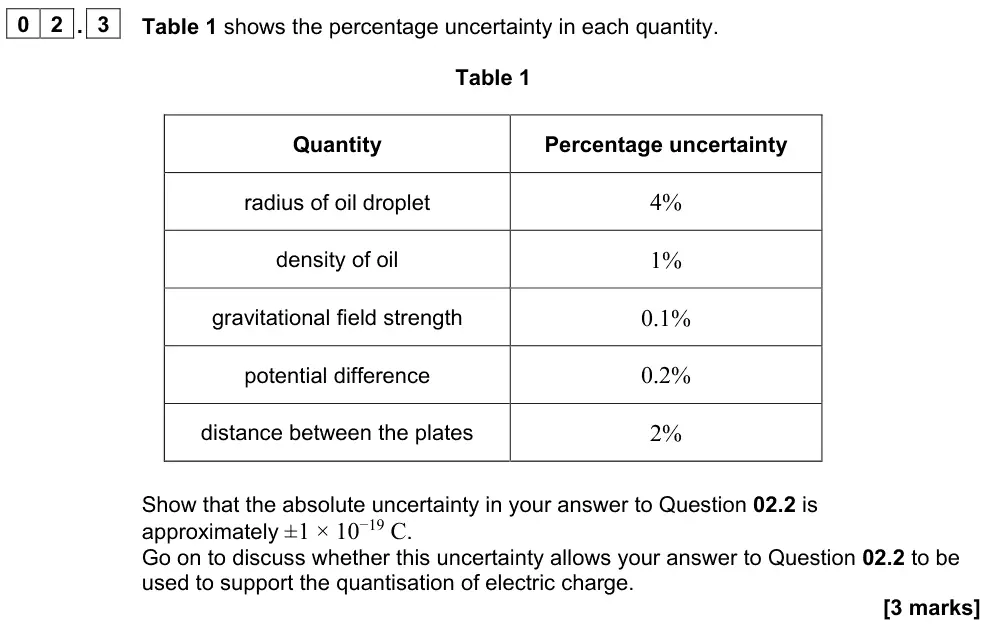
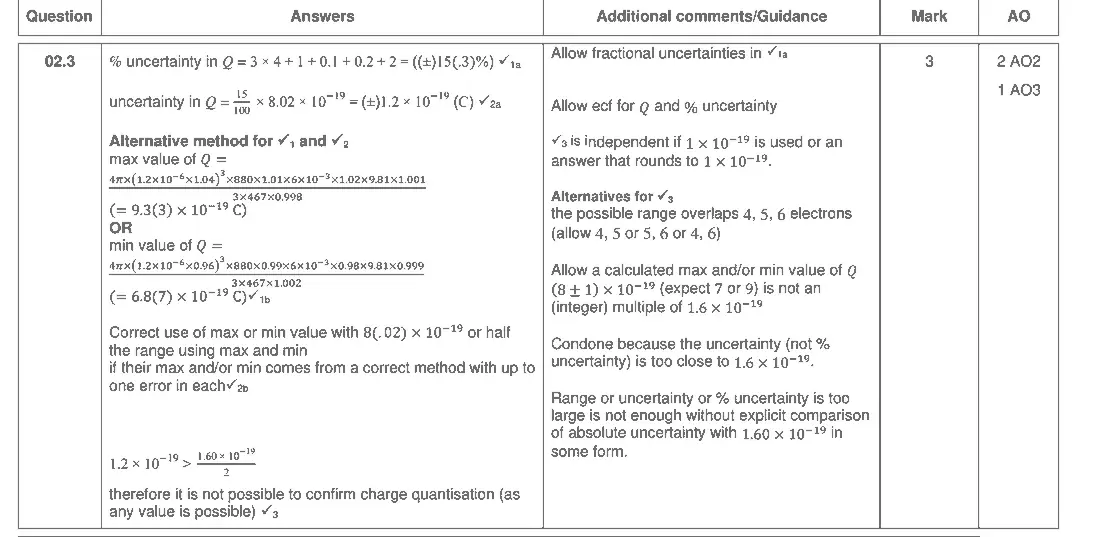
02.3 This question addressed the uncertainties in the experimental data typically given to students to analyse. The most accessible mark was given for converting a percentage uncertainty to an absolute uncertainty, again as the question gave a 1 sf approximate value, 2 sf were required in the answer. A significant number of students were not able to determine the percentage uncertainty in the charge, despite knowing the calculation. Most commonly responses subtracted the percentage uncertainty for the potential difference rather than adding it.
The last mark was for relating the uncertainty to the quantisation of charge. This question was designed to test the understanding of quantisation, rather than a mere statement about charge being quantised. Some students did recognise that as the uncertainty was larger than half of the charge of the electron this meant that it is impossible to state where that quantity was an integer multiple of this charge. The most common approach to answering this correctly was to calculate maximum and minimum values for the charge and to point out that while the mean value was approximately an integer multiple of 1.60 × 10⁻¹⁹, the maximum and minimum values were not. In order to make this argument it was expected that 1.60 × 10⁻¹⁹ was quoted along with the max and quantised, or just referred to 8.0 × 10⁻¹⁹ being a multiple of 1.60 × 10⁻¹⁹. min values. Incorrect answers here often confused the uncertainty with the quantity to be
Notes from the mark scheme and report
Answer: 15% so +/- 1.2 x 10^-19 C (3 x 4% for r cubed + 1 + 0.1 + 0.2 + 2)
uncertainty is more than half of e so cannot confirm quantisation
many subtracted the pd uncertainty
Skills: MS1.5 Identify uncertainties in measurements and use simple techniques to determine uncertainty when data are combined by addition, subtraction, multiplication, division and raising; MS0.3 Use ratios, fractions and percentages
June 2024 · Paper 3B Turning points · Q4.11 markAO1=1Show that
Mark scheme
Examiner's comment
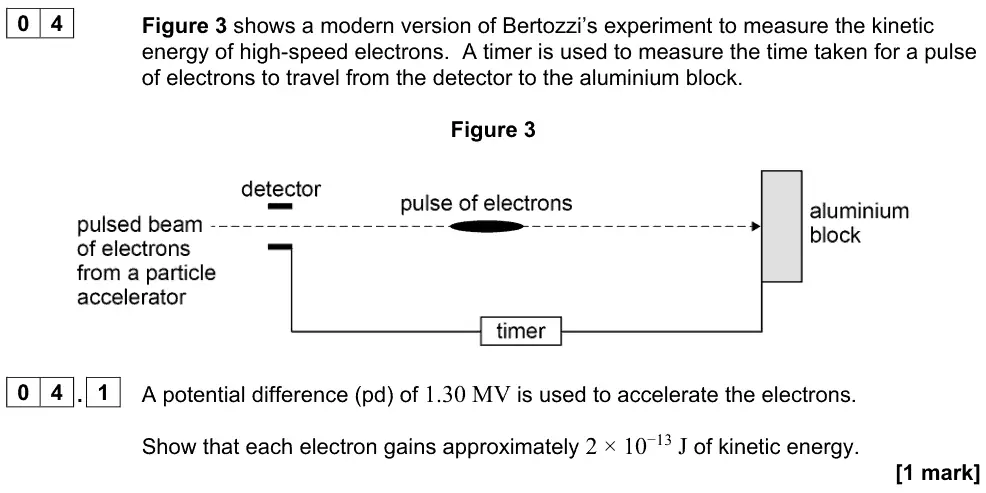
04.1 As in other ‘show that’ questions, the answer must be given to more significant figures than the approximate value given in the question, in this case a minimum of 2 sf. A full substitution including the correct powers of ten was required to gain the mark. Most students were able to score here.
2 𝑚𝑚𝑣𝑣2 they tried to use 𝑚𝑚𝑐𝑐2 using the velocity of the particles instead of the 1 there was also a significant minority who could not calculate the non-relativistic kinetic energy; instead of calculating speed of light. Students were expected to compare the two kinetic energies with their answer to 04.1 and comment that the relativistic equation was correct. In order to score this mark students needed to have calculated values using the correct equation, although minor rounding or calculation errors were tolerated. However, some students opted instead to calculate the speed using the two equations route and could also gain full marks. A small minority of students used the energy here to calculate either a rise in temperature for the aluminium block or an accelerating pd. This again could gain full marks.
Notes from the mark scheme and report
Answer: 2.08 x 10^-13 J (eV with V = 1.30 MV)
at least 2 sf
Skills: MS2.3 Substitute numerical values into algebraic equations using appropriate units for physical quantities
June 2023 · Paper 3B Turning points · Q1.11 markAO1=1Short answer
Mark scheme
Examiner's comment
01.1
divergence was from 0.3 × 10⁸ to 1.1 × 10⁸ m s−1. The second mark was for going through the point established in question 04.3, (2.5 × 10⁸, 122 × 10−12) to within one square. In order to score this mark, the curve drawn had to show an increasing gradient, straight lines drawn through this point did not score.
Notes from the mark scheme and report
Filament heated by the current gives electrons enough energy to escape the metal surface (exceed work function)
'thermionic emission' alone not enough
heating the electrons or 'ionise' rejected
June 2023 · Paper 3B Turning points · Q1.21 markAO2=1Show that
Earlier part of question 1 that this part uses
Mark scheme
Examiner's comment
01.2
Notes from the mark scheme and report
Answer: 1.33 x 10^7 m s^-1 from 1/2 mv^2 = eV with 500 V (not 506.3 V)
at least 3 sf needed
Skills: MS2.3 Substitute numerical values into algebraic equations using appropriate units for physical quantities; MS1.1 Use an appropriate number of significant figures
June 2023 · Paper 3B Turning points · Q1.46 marksAO1=4, AO2=1, AO3=16-mark extended response
Earlier part of question 1 that this part uses
Mark scheme, with the levels and indicative content
Examiner's comment
01.4
Notes from the mark scheme and report
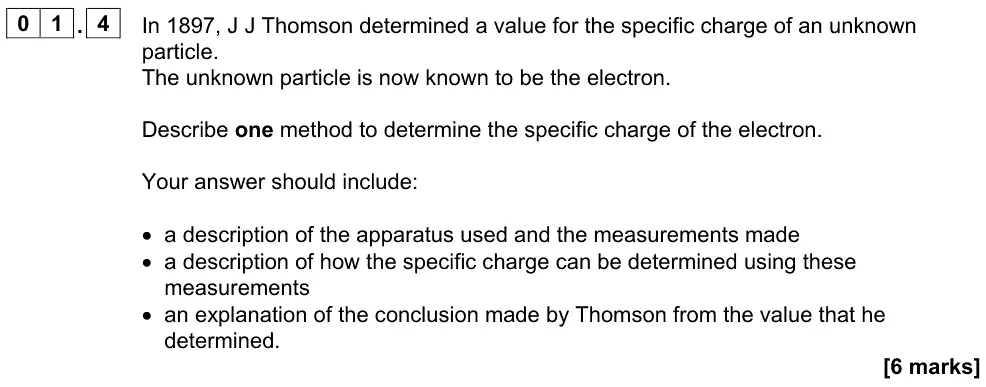
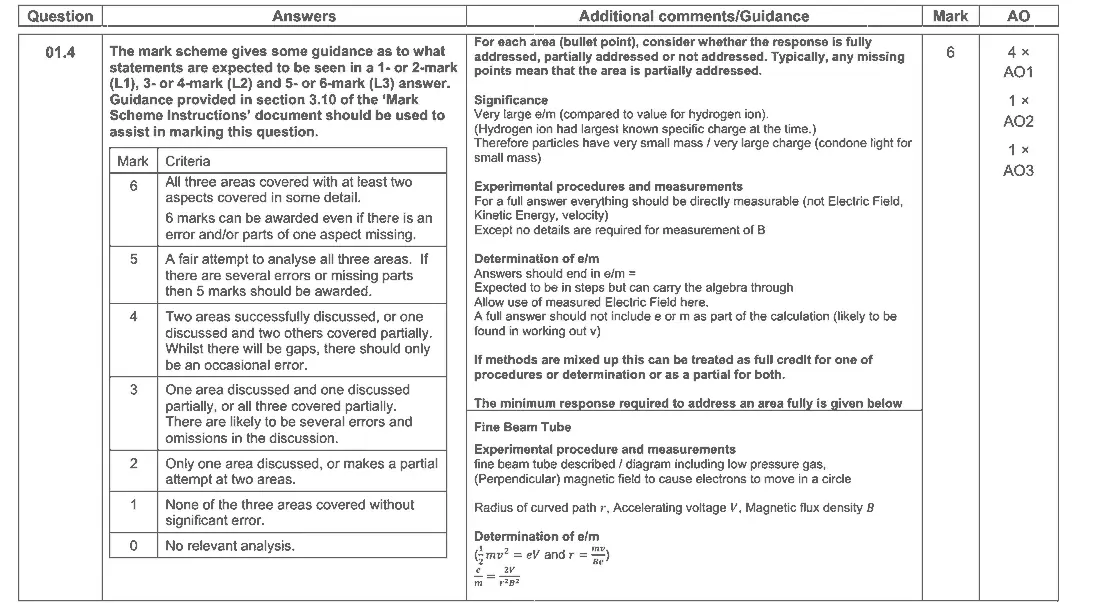
Levels of response: apparatus and directly measurable quantities (e.g. fine beam tube: r, V, B), derivation ending in e/m = 2V/(r^2 B^2), and significance - e/m far larger than hydrogen ion so particle very small mass
June 2023 · Paper 3B Turning points · Q2.13 marksAO2=2, AO3=1Calculation
Mark scheme
Examiner's comment
02.1
Notes from the mark scheme and report
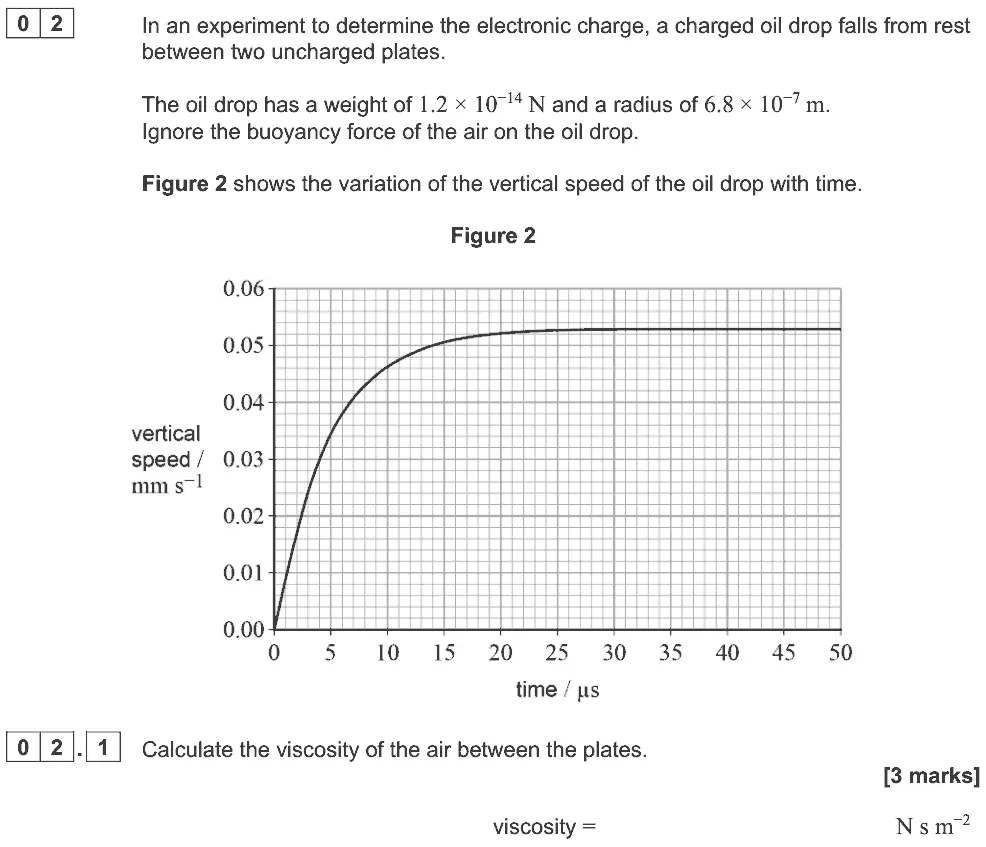
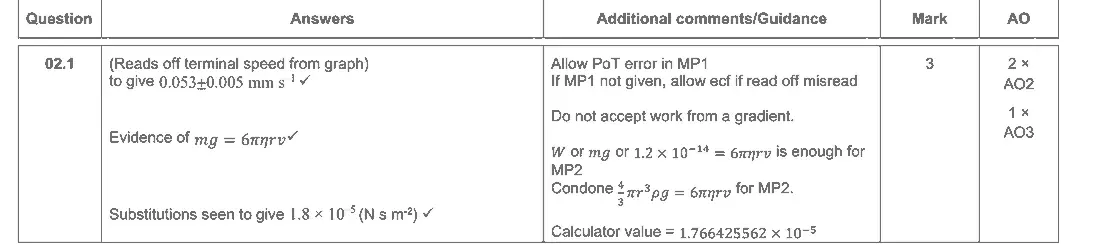
Answer: 1.8 x 10^-5 N s m^-2 (terminal speed 0.053 mm s^-1 read from Figure 2
mg = 6 pi eta r v)
work from a gradient not credited
Skills: MS3.1 Translate information between graphical, numerical and algebraic forms; MS2.2 Change the subject of an equation, including non-linear equations; MS2.3 Substitute numerical values into algebraic equations using appropriate units for physical quantities
June 2023 · Paper 3B Turning points · Q2.23 marksAO2=2, AO3=1Calculation
Earlier part of question 2 that this part uses
Mark scheme
Examiner's comment
02.2
Notes from the mark scheme and report
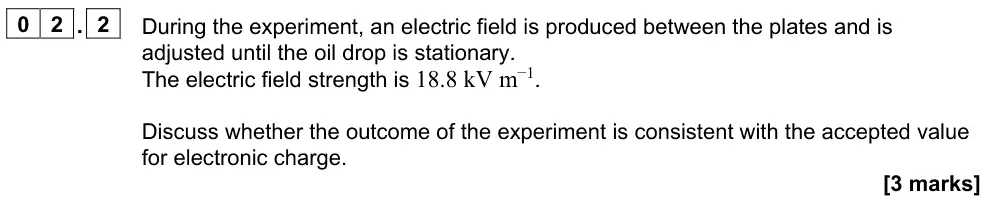
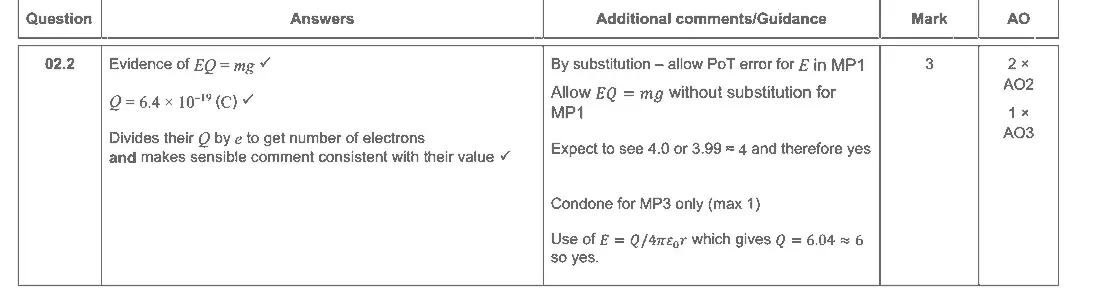
Answer: Q = 6.4 x 10^-19 C from EQ = mg
Q/e = 4.0 so consistent with charge quantised in units of e
Skills: MS2.3 Substitute numerical values into algebraic equations using appropriate units for physical quantities; MS0.3 Use ratios, fractions and percentages
June 2022 · Paper 3B Turning points · Q2.11 markAO1=1Short answer
Mark scheme
Examiner's comment
The best answers to 02.1 annotated the diagram to show the directions of the forces on the droplet and made correct reference to the direction of the electric field. Often answers were vague, with little attempt to describe the equilibrium position, with terms like ‘counteract’ being used to try to give some sense of the relationship between the weight and the force due to the electric field.
Notes from the mark scheme and report
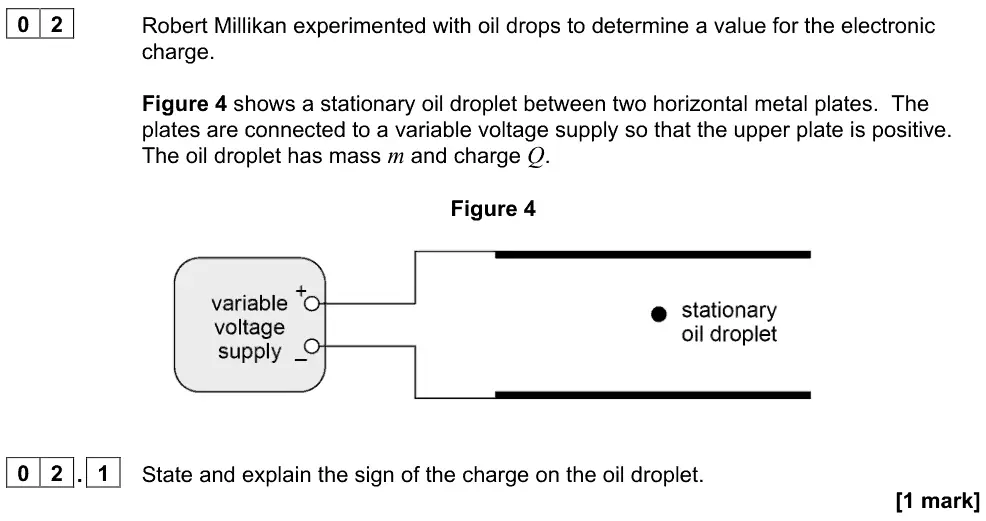
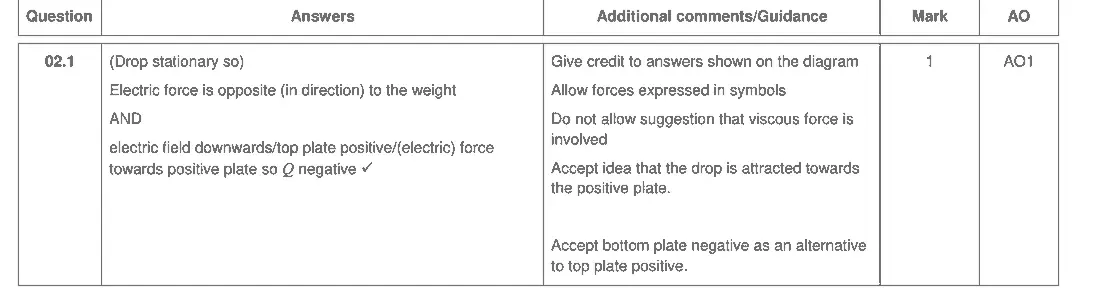
Electric force must be upward to balance weight
field is downward (top plate positive) so the charge is negative
June 2022 · Paper 3B Turning points · Q2.23 marksAO2=3Show that
Earlier part of question 2 that this part uses
Mark scheme
Examiner's comment
The calculation in 02.2 proved to be much more accessible with most students being able to gain all three marks. Partial credit was available for incorrect answers, but the quality of presentation made some students’ work very difficult to follow.
Notes from the mark scheme and report
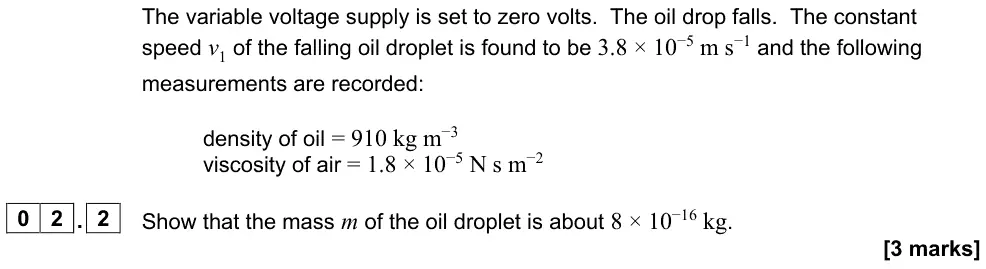
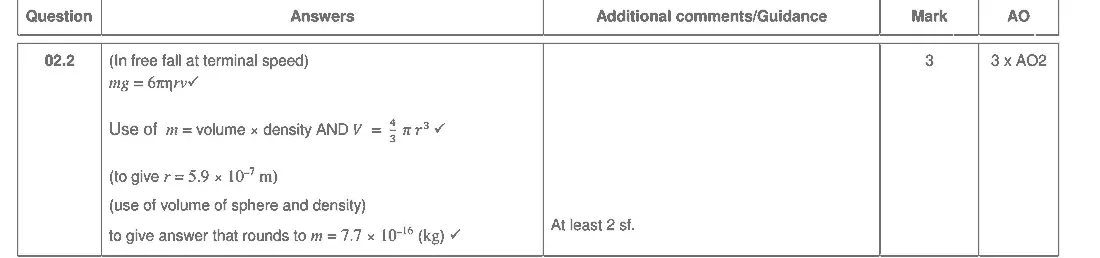
Answer: m = 7.7 x 10^-16 kg (mg = 6 pi eta r v1 with m = (4/3) pi r^3 rho gives r = 5.9 x 10^-7 m)
at least 2 sf
most gained full marks
Skills: MS2.2 Change the subject of an equation, including non-linear equations; MS2.3 Substitute numerical values into algebraic equations using appropriate units for physical quantities; MS4.3 Calculate areas of triangles, circumferences and areas of circles, surface areas and volumes of rectangular blocks, cylinders and spheres
June 2022 · Paper 3B Turning points · Q2.32 marksAO2=2Show that
Earlier part of question 2 that this part uses
Mark scheme
Examiner's comment
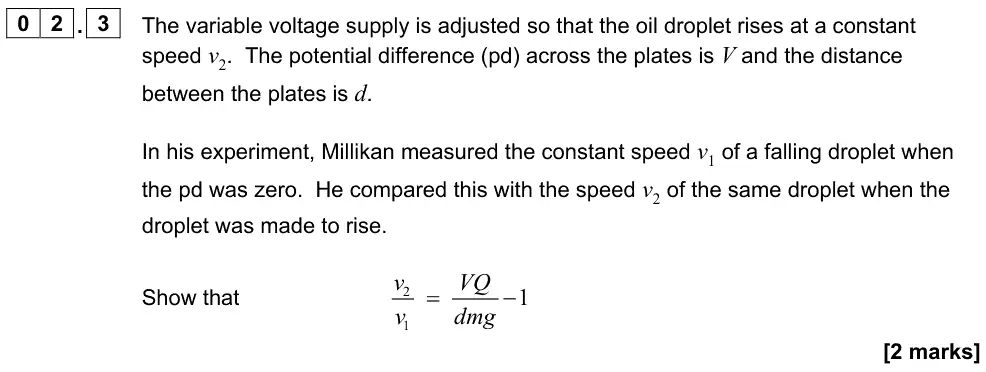
Having the relationship to aim for was a mixed blessing in 02.3. It was clear that many students attempted to work backwards but, without a clear indication of the difference between the two velocities, these approaches did not gain credit. Despite being directed to use the equation in 02.4, many students attempted to work out Q from first principles. Most students who correctly determined the charge on the oil drop spotted that it was a multiple of the electronic charge.
Notes from the mark scheme and report
Rising: QV/d - mg = 6 pi eta r v2
falling: mg = 6 pi eta r v1
divide to get v2/v1 = VQ/(dmg) - 1
working backwards not credited
Skills: MS2.2 Change the subject of an equation, including non-linear equations
June 2022 · Paper 3B Turning points · Q2.43 marksAO2=2, AO3=1Calculation
Earlier part of question 2 that this part uses
Mark scheme
Examiner's comment
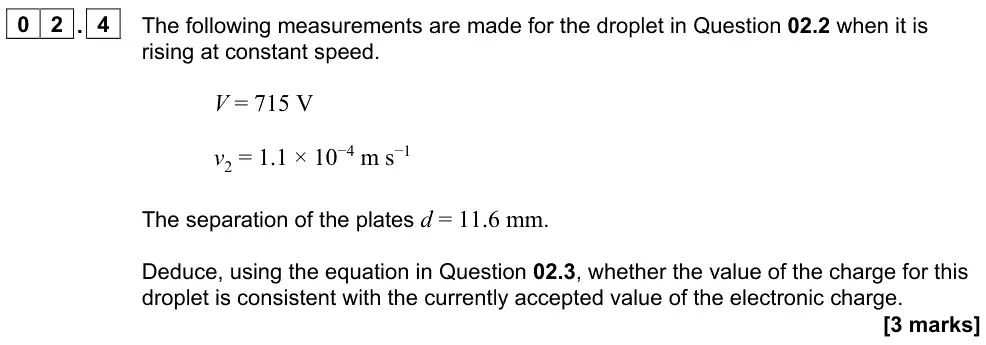
Having the relationship to aim for was a mixed blessing in 02.3. It was clear that many students attempted to work backwards but, without a clear indication of the difference between the two velocities, these approaches did not gain credit. Despite being directed to use the equation in 02.4, many students attempted to work out Q from first principles. Most students who correctly determined the charge on the oil drop spotted that it was a multiple of the electronic charge.
Notes from the mark scheme and report
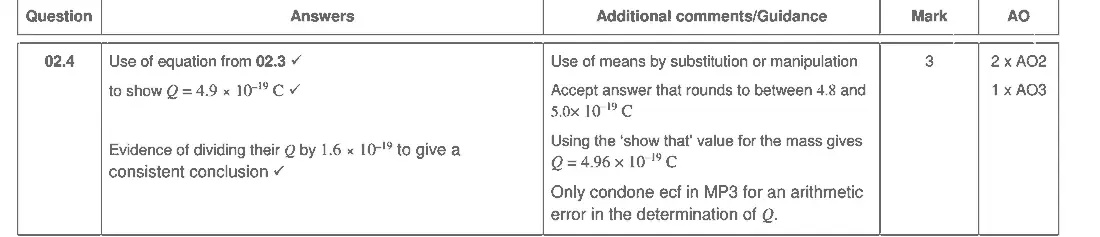
Answer: Q = 4.9 x 10^-19 C, about 3 x 1.6 x 10^-19 C, so consistent
many recalculated Q from first principles
Skills: MS2.2 Change the subject of an equation, including non-linear equations; MS2.3 Substitute numerical values into algebraic equations using appropriate units for physical quantities
June 2022 · Paper 3B Turning points · Q2.53 marksAO3=3Explanation
Earlier part of question 2 that this part uses
Mark scheme
Examiner's comment
In order to obtain full marks in 02.5 students had to have a clear argument about the relationship between the viscosity and the charge. The most commonly missed mark was the second, which required some clarity about how the mass or radius of the droplet was determined.
Notes from the mark scheme and report
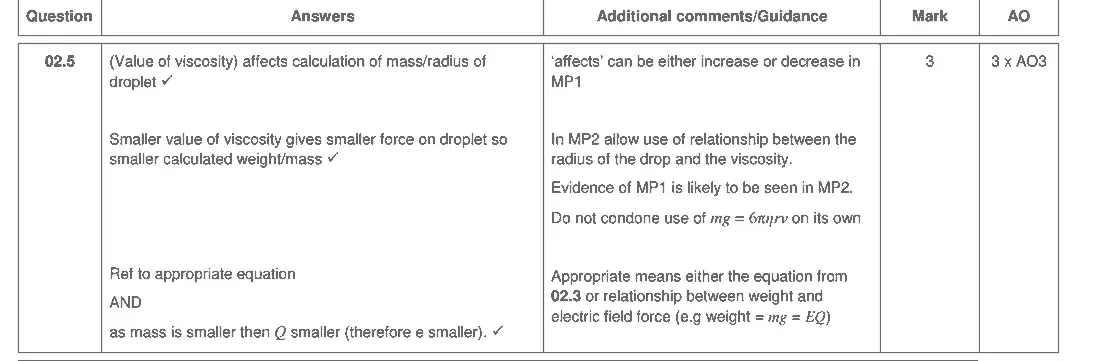
Smaller viscosity gives smaller drag so smaller calculated radius and mass
Q proportional to mg so Millikan's e was too small
mark 2 (how mass found) most often missed
November 2021 · Paper 3B Turning points · Q1.14 marksAO1=2, AO2=2Explanation
Mark scheme
Notes from the mark scheme and report
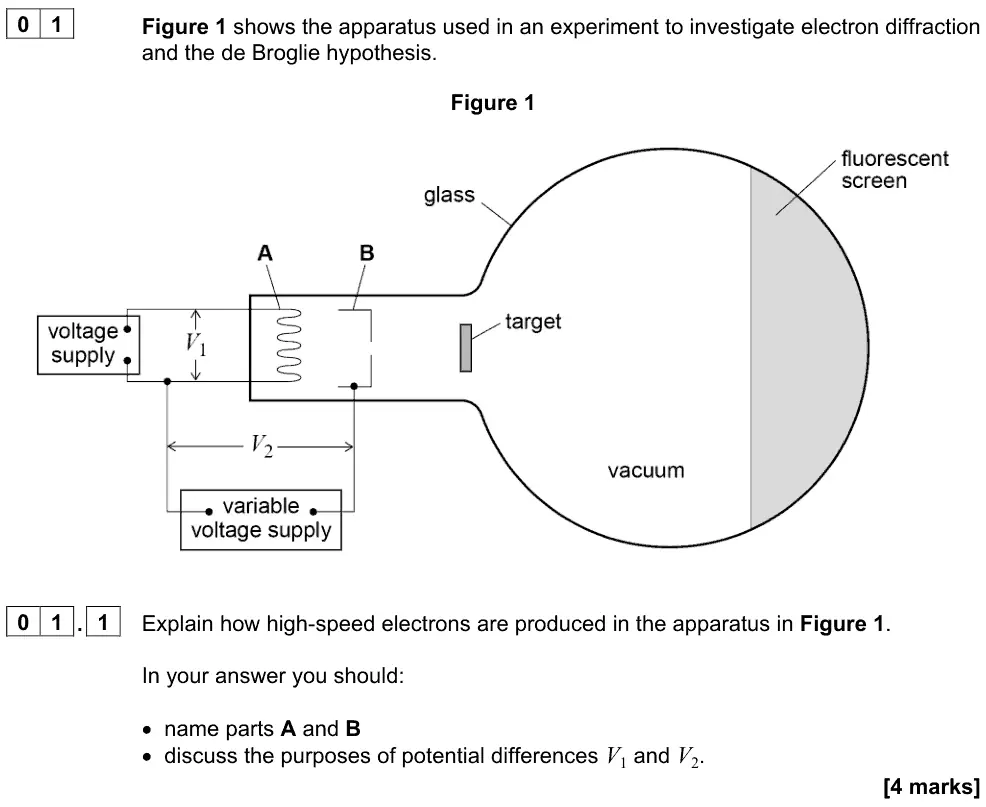
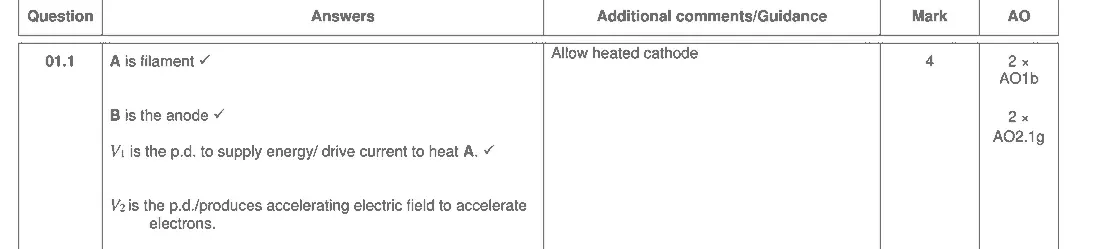
A filament (heated cathode), B anode
V1 drives the current that heats the filament for thermionic emission
V2 accelerates the electrons towards the anode
November 2020 · Paper 3B Turning points · Q1.12 marksExplanation
Mark scheme
Examiner's comment
This question required students to be familiar with JJ Thomson’s work and the discovery of the electron. In 01.1, many students could not explain how the cathode rays were produced in Thomson’s experiment; a description of thermionic emission was a common incorrect answer. Despite 01.2 and 01.3 requiring little more than knowledge from the core physics specification, answers that demonstrated an understanding of the processes involved were rare. By contrast, 01.4 was well answered with over 40% of students obtaining both marks. A common error here was to reverse the relative magnitude of the specific charge for the proton and electron.
Notes from the mark scheme and report
High field ionises gas atoms
positive ions accelerate to and strike the cathode, releasing electrons that are accelerated towards the anode A/B
thermionic emission was a common wrong answer
November 2020 · Paper 3B Turning points · Q1.21 markShort answer
Earlier part of question 1 that this part uses
Mark scheme
Examiner's comment
This question required students to be familiar with JJ Thomson’s work and the discovery of the electron. In 01.1, many students could not explain how the cathode rays were produced in Thomson’s experiment; a description of thermionic emission was a common incorrect answer. Despite 01.2 and 01.3 requiring little more than knowledge from the core physics specification, answers that demonstrated an understanding of the processes involved were rare. By contrast, 01.4 was well answered with over 40% of students obtaining both marks. A common error here was to reverse the relative magnitude of the specific charge for the proton and electron.
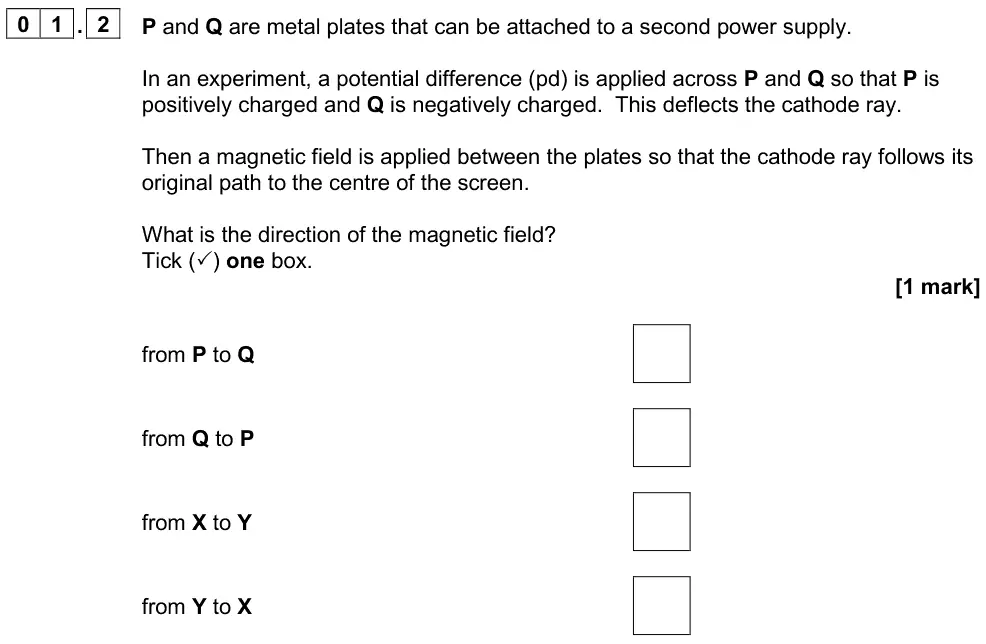
Notes from the mark scheme and report
Answer: from Y to X (magnetic force on the electrons must oppose the electric force towards P)
November 2020 · Paper 3B Turning points · Q1.33 marksExplanation
Earlier part of question 1 that this part uses
Mark scheme
Examiner's comment
This question required students to be familiar with JJ Thomson’s work and the discovery of the electron. In 01.1, many students could not explain how the cathode rays were produced in Thomson’s experiment; a description of thermionic emission was a common incorrect answer. Despite 01.2 and 01.3 requiring little more than knowledge from the core physics specification, answers that demonstrated an understanding of the processes involved were rare. By contrast, 01.4 was well answered with over 40% of students obtaining both marks. A common error here was to reverse the relative magnitude of the specific charge for the proton and electron.
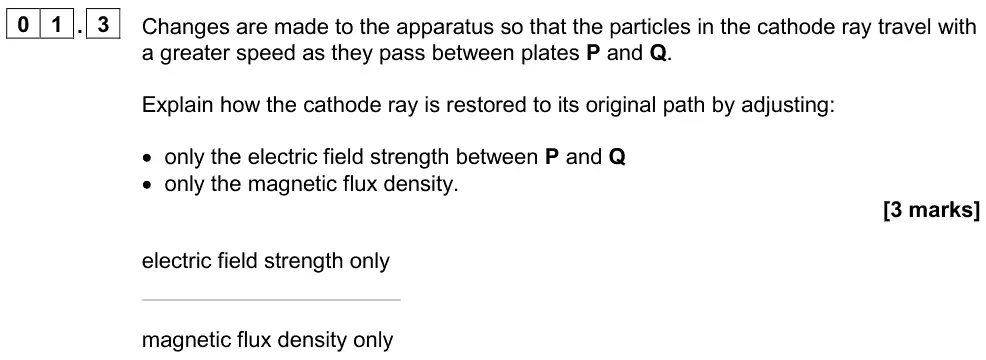
Notes from the mark scheme and report
Undeflected when eE = Bev so v = E/B
for greater v either increase E or decrease B, with supporting physics
few showed understanding
Skills: MS2.2 Change the subject of an equation, including non-linear equations
November 2020 · Paper 3B Turning points · Q1.42 marksExplanation
Earlier part of question 1 that this part uses
Mark scheme
Examiner's comment
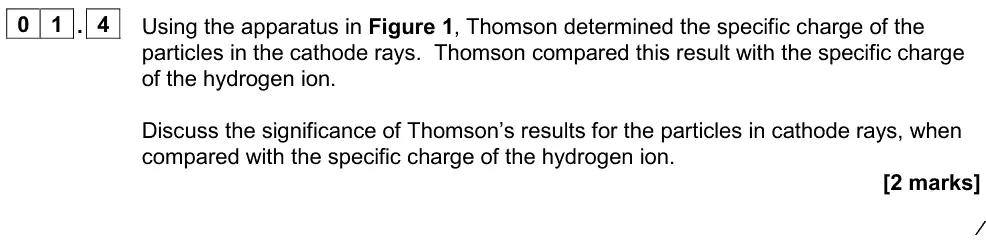
This question required students to be familiar with JJ Thomson’s work and the discovery of the electron. In 01.1, many students could not explain how the cathode rays were produced in Thomson’s experiment; a description of thermionic emission was a common incorrect answer. Despite 01.2 and 01.3 requiring little more than knowledge from the core physics specification, answers that demonstrated an understanding of the processes involved were rare. By contrast, 01.4 was well answered with over 40% of students obtaining both marks. A common error here was to reverse the relative magnitude of the specific charge for the proton and electron.
Notes from the mark scheme and report
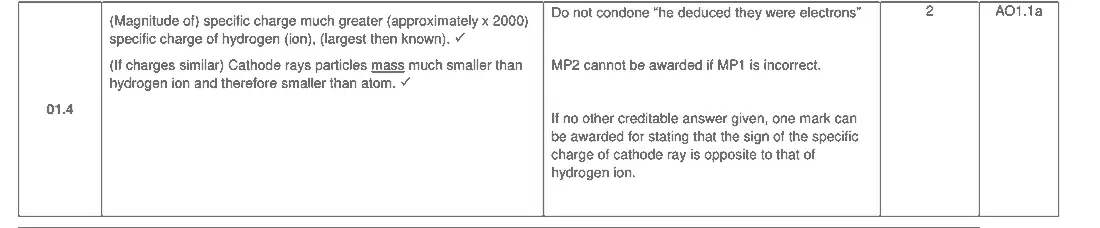
Specific charge about 2000 times that of the hydrogen ion, so (for similar charge) the particles have much smaller mass than an atom
reversing the comparison was common
over 40% both marks
June 2019 · Paper 3B Turning points · Q1.12 marksShort answer
Mark scheme
Examiner's comment
1.1 This question was generally well answered with nearly half of the students receiving both marks. Most students were able to identify the two forces but, for the second mark, students were required to make it clear that the two forces are equal in size and opposite in direction and to give the direction of at least one of the two forces. It was this latter point that prevented some students from gaining the second mark. Although ‘electromagnetic force’ was condoned, it would be helpful for students to understand that the force is electrostatic in nature. This would prevent some students from wrongly stating the force as ‘magnetic’. Writing the relationship between the forces as an equation was acceptable if it was clear what the symbols referred to, but it should be noted that the use of ‘e’ for ‘q’ in the electrostatic-force equation was not given credit in this context.
Notes from the mark scheme and report
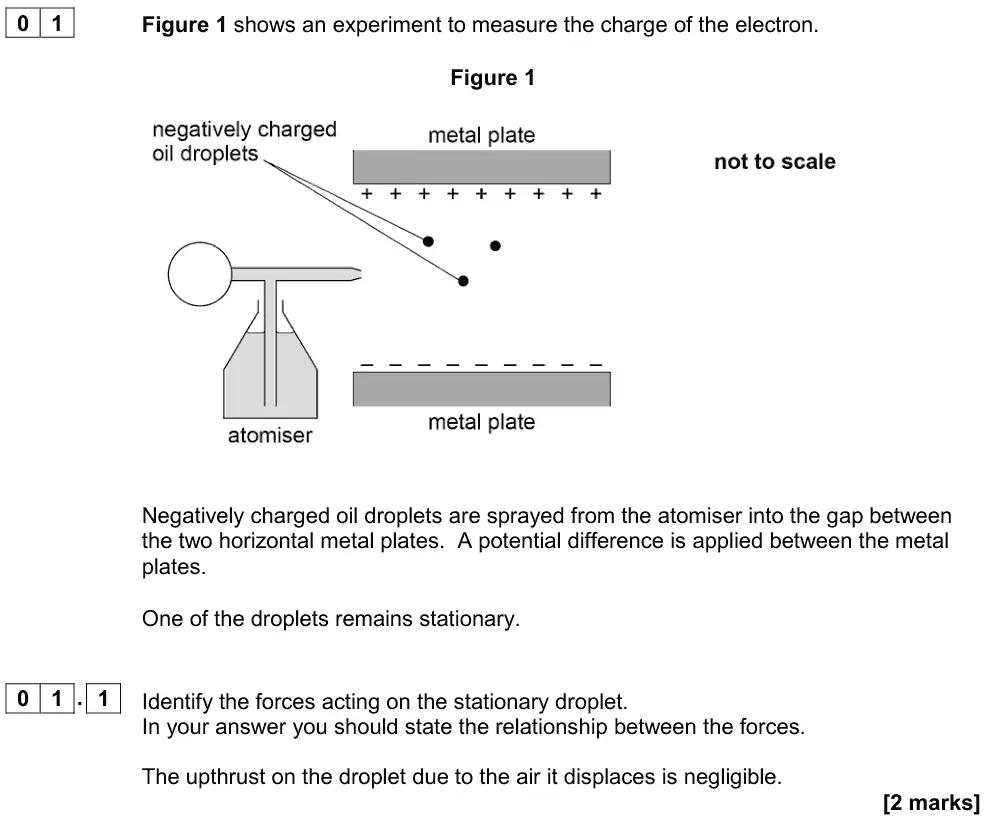
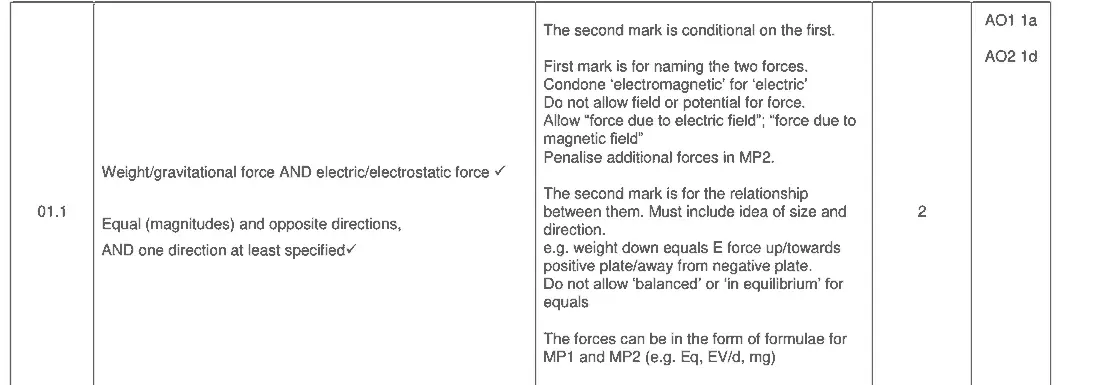
Weight (down) and electric force (up, towards the positive plate) equal in size and opposite in direction
direction must be stated
'balanced' not enough
nearly half scored both
June 2019 · Paper 3B Turning points · Q1.23 marksShow that
Earlier part of question 1 that this part uses
Mark scheme
Examiner's comment
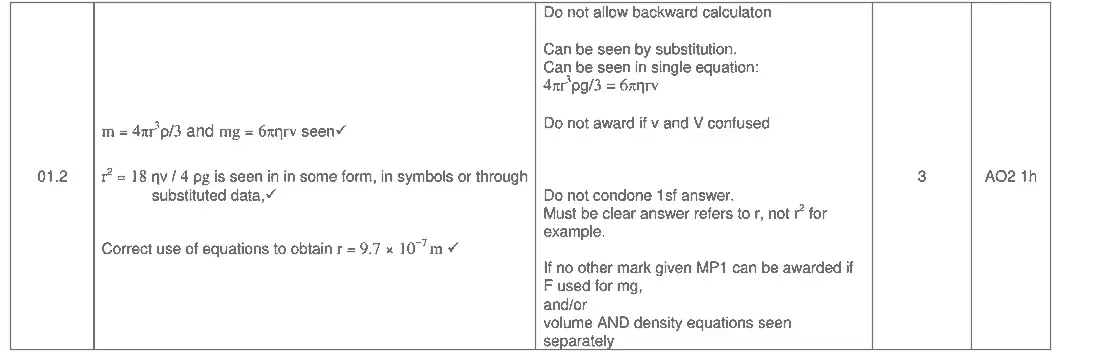
1.2 It was clear from the answers seen that many students were familiar with this type of calculation. Common errors included missing the g in the equation for gravitational force, and, to a lesser extent, confusing v (velocity) and V (volume) in the algebra. Most students understood that, in a ‘show that’ task, they need to quote their final answer to at least one significant figure better than that given in the question.
Notes from the mark scheme and report
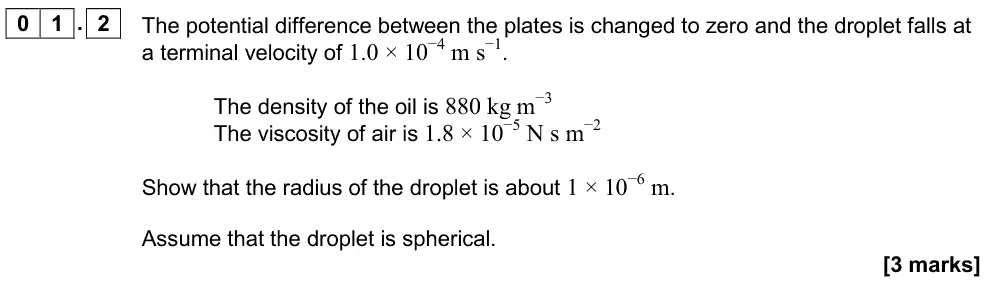
Answer: r = 9.7 x 10^-7 m ((4/3) pi r^3 rho g = 6 pi eta r v, so r^2 = 9 eta v / 2 rho g)
missing g or confusing v and V were common
answer to more than 1 sf
Skills: MS2.2 Change the subject of an equation, including non-linear equations; MS2.3 Substitute numerical values into algebraic equations using appropriate units for physical quantities; MS4.3 Calculate areas of triangles, circumferences and areas of circles, surface areas and volumes of rectangular blocks, cylinders and spheres
June 2019 · Paper 3B Turning points · Q1.33 marksExplanation
Earlier part of question 1 that this part uses
Mark scheme
Examiner's comment
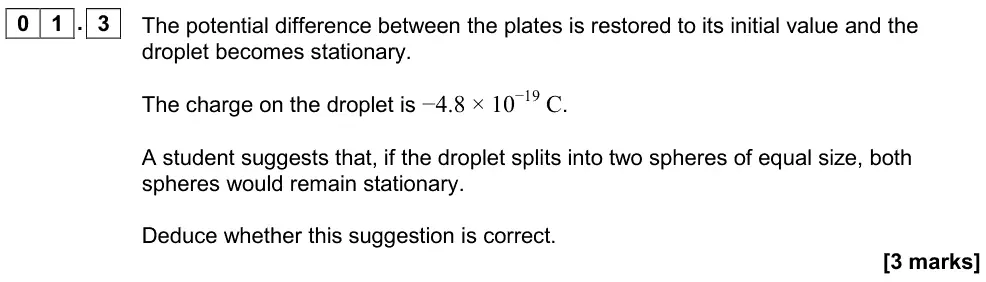
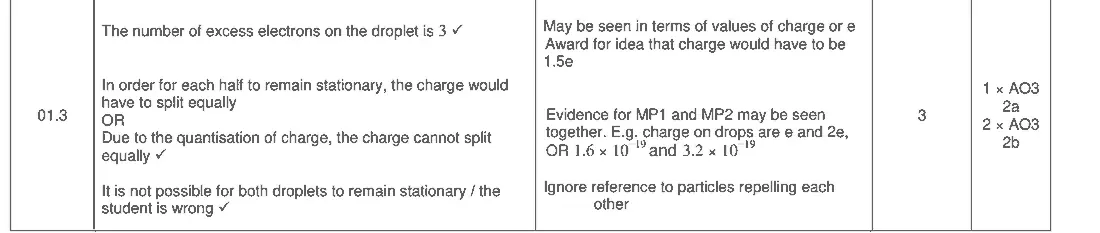
1.3 A fundamental aspect of this part of the specification is the discrete value of electronic charge. It was very disappointing to see that a large number of students failed to apply this information to this question. It is in the nature of AO3 questions like this that students will often be expected to reach a conclusion or make a judgement based on their own analysis. Some students who did realise that the charge involved three electrons and therefore couldn’t be split evenly did not gain the third mark as they did not make it clear that one drop would rise and the other fall.
There is clear evidence that students are being prepared well for this paper. They show familiarity with calculations and demonstrate recall of the general ideas. Difficulties arise when students are expected to reach a judgement. This is related to the testing of Assessment Objective 3 (AO3) and this report highlights where they occur. There is also evidence to suggest that, when faced with less familiar questions, some students resort to their knowledge of the core content of the specification. This can be seen particularly in questions 1.3, 3.1, 4.2 and 4.3. Because of the overlap between this option and the core content, mark schemes will continue to require students to demonstrate knowledge and understanding of content relevant to this option in order to gain full credit.
Notes from the mark scheme and report
Charge is 3e
halves would each need 1.5e but charge is quantised, so they get e and 2e
one drop rises and the other falls, so the student is wrong
many ignored quantisation
Skills: MS0.3 Use ratios, fractions and percentages
June 2018 · Paper 3B Turning points · Q1.13 marksExplanation
Mark scheme
Examiner's comment
01.1 Most students made some progress with this question (69.6% of students scored at least two marks). Those failing to be awarded the first marking point made no mention of the electrical heating due to the current in the filament. Many simply restated the stem, stating that electrons were emitted, without further detail. Thermionic emission was frequently mentioned in the response. Weak answers referred to electrons being “dragged” out of the filament by the positive anode.
Notes from the mark scheme and report
Current heats the filament
conduction electrons gain enough kinetic energy to overcome the work function and leave the surface
thermionic emission
'dragged out by the anode' wrong
June 2018 · Paper 3B Turning points · Q1.22 marksShow that
Earlier part of question 1 that this part uses
Mark scheme
Examiner's comment
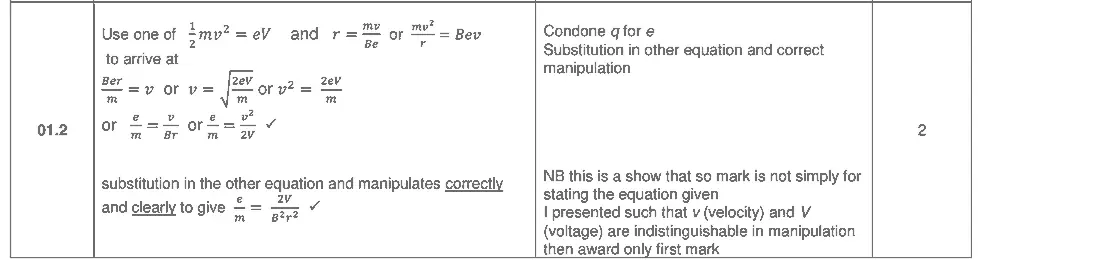
01.2 Presentation of the derivation was often very poor, with the space for the response being occupied by a jumble of equations that were unrelated. Over half of the students scored both marks, however. Whilst giving one correct equation with v as the subject was treated generously, students needed to produce an unambiguous and acceptable structured response to gain full credit. Questions of this type are common and it is expected that students should derive the given equation from more basic equations. It was not acceptable to substitute data in the given equation to produce a value that agreed with the accepted value for e/m. This was tested in part 01.3.
Notes from the mark scheme and report
Combine 0.5 m v^2 = eV with r = mv/Be to give e/m = 2V/(B^2 r^2)
must be a clear derivation, not substitution of data
Skills: MS2.2 Change the subject of an equation, including non-linear equations
June 2018 · Paper 3B Turning points · Q1.32 marksCalculation
Earlier part of question 1 that this part uses
Mark scheme
Examiner's comment
01.3 Students needed to show all data substituted to gain full marks. Most appreciated that the answer needed to be given to two significant figures for consistency with the significant figures in the data used. 58.8% of students were awarded both marks.
01.2 Presentation of the derivation was often very poor, with the space for the response being occupied by a jumble of equations that were unrelated. Over half of the students scored both marks, however. Whilst giving one correct equation with v as the subject was treated generously, students needed to produce an unambiguous and acceptable structured response to gain full credit. Questions of this type are common and it is expected that students should derive the given equation from more basic equations. It was not acceptable to substitute data in the given equation to produce a value that agreed with the accepted value for e/m. This was tested in part 01.3.
Notes from the mark scheme and report
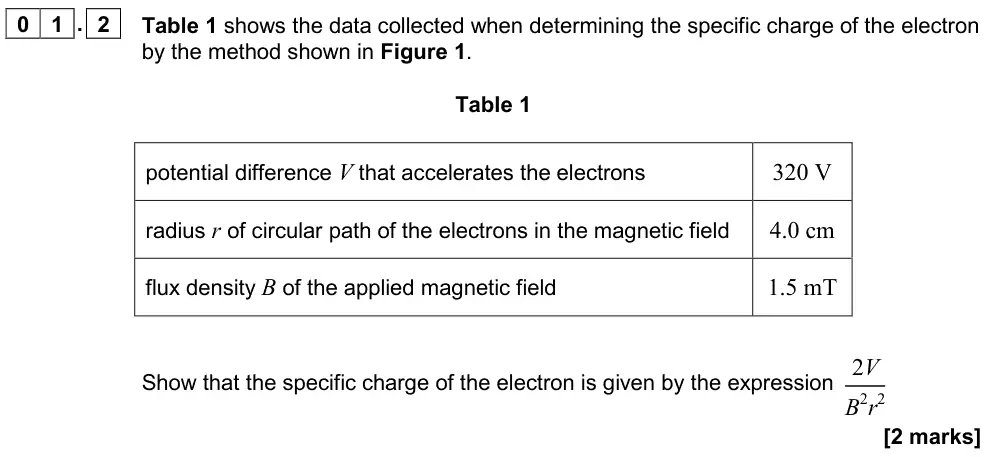
Answer: 1.8 x 10^11 C kg^-1 (2 x 320 / ((1.5 x 10^-3)^2 x 0.040^2))
full substitution needed
2 sf
58.8% both marks
Skills: MS2.3 Substitute numerical values into algebraic equations using appropriate units for physical quantities; MS1.1 Use an appropriate number of significant figures; MS0.2 Recognise and use expressions in decimal and standard form
June 2018 · Paper 3B Turning points · Q1.42 marksExplanation
Earlier part of question 1 that this part uses
Mark scheme
Examiner's comment
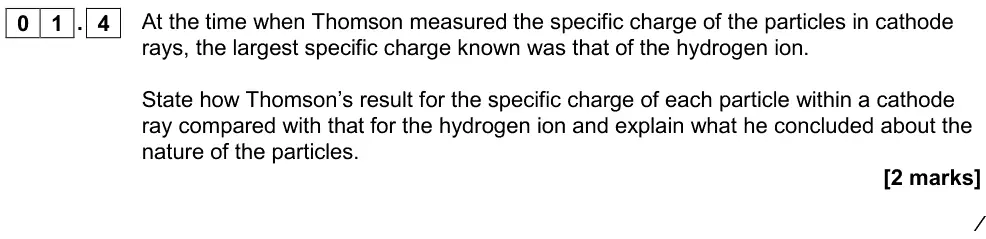
01.4 Weaker answers to this part referred to the greater specific charge for the electron meaning it was smaller rather than it having a lower mass. There was a high proportion of completely correct responses (54.4%) and nearly 80% of students scored at least one mark.
Notes from the mark scheme and report
Specific charge of cathode-ray particles much larger than that of the hydrogen ion, so the particles have much smaller mass (or large charge)
'smaller' rather than lower mass not credited
54.4% fully correct
June 2017 · Paper 3B Turning points · Q1.12 marksExplanation
Mark scheme
Examiner's comment
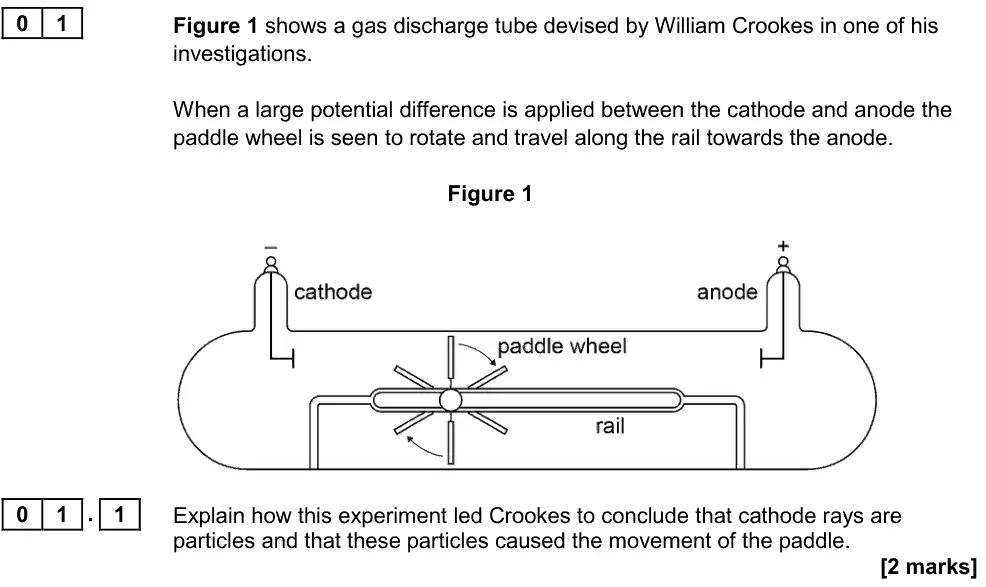
01.1 Although many students could identify the importance of the momentum carried by the particles in this question, not all went on to the explain that this momentum was transferred to the paddle wheel. A good number of students identified that the direction of travel of the cathode rays from cathode to anode was indicated by the direction of rotation of the paddle. Most students scored one of the two available marks, but few scored both.
Notes from the mark scheme and report
Paddle moves towards the anode, showing cathode rays travel from cathode to anode
the rays carry momentum/energy transferred to the paddle, so they are particles
most scored one mark, few both
June 2017 · Paper 3B Turning points · Q1.23 marksExplanation
Earlier part of question 1 that this part uses
Mark scheme
Examiner's comment
01.2 This question was not well answered by significant numbers of students. Common mistakes included describing the processes of thermionic emission and photon emission following de-excitation. A small number of students recalled, to a high level of detail, the process of ionisation and subsequent role of the positive ions in generating the electrons that go on to become cathode rays. A good number of students were able to describe the acceleration of the electrons toward the anode as an important factor in generating cathode rays.
Notes from the mark scheme and report
Gas atoms ionised
positive ions attracted to the cathode release electrons from it
electrons accelerated towards the anode by the pd
thermionic emission and de-excitation answers wrong
June 2017 · Paper 3B Turning points · Q1.32 marksExplanation
Earlier part of question 1 that this part uses
Mark scheme
Examiner's comment
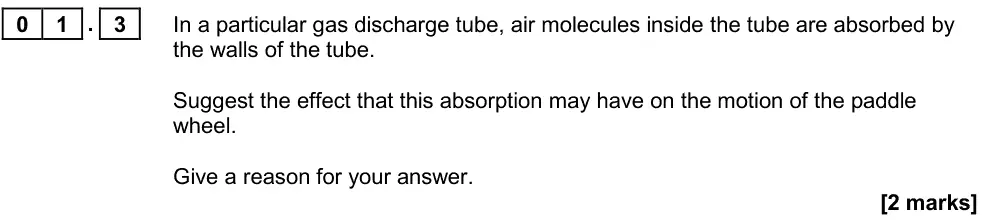
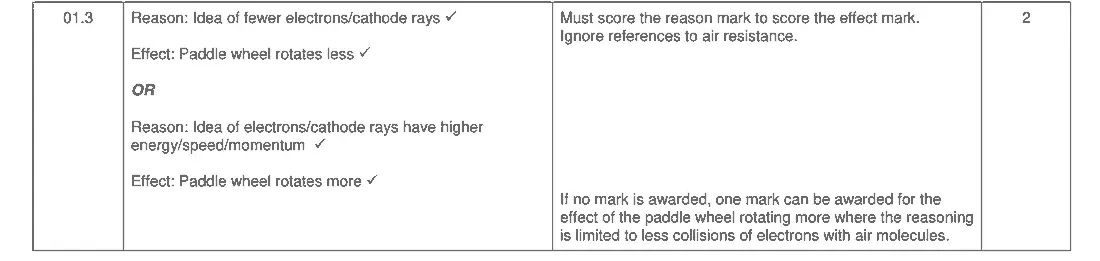
01.3 Responses to this question were good. Most students were able to explain how the lower number of air molecules would either reduce the electrons available to generate cathode rays, or result in the cathode rays present having more energy. Some students did not fully develop the latter argument to the point where cathode rays carried more energy, but were given some credit if they explained that collisions with air molecules would be reduced. A significant number of responses were limited to ideas about air resistance, which was not accepted.
Notes from the mark scheme and report
Fewer gas molecules: fewer ions so fewer cathode-ray electrons and slower paddle, or fewer collisions so electrons gain more energy and the paddle turns faster
reason needed for the effect mark
air resistance not accepted
June 2017 · Paper 3B Turning points · Q3.11 markShort answer
Mark scheme
Examiner's comment
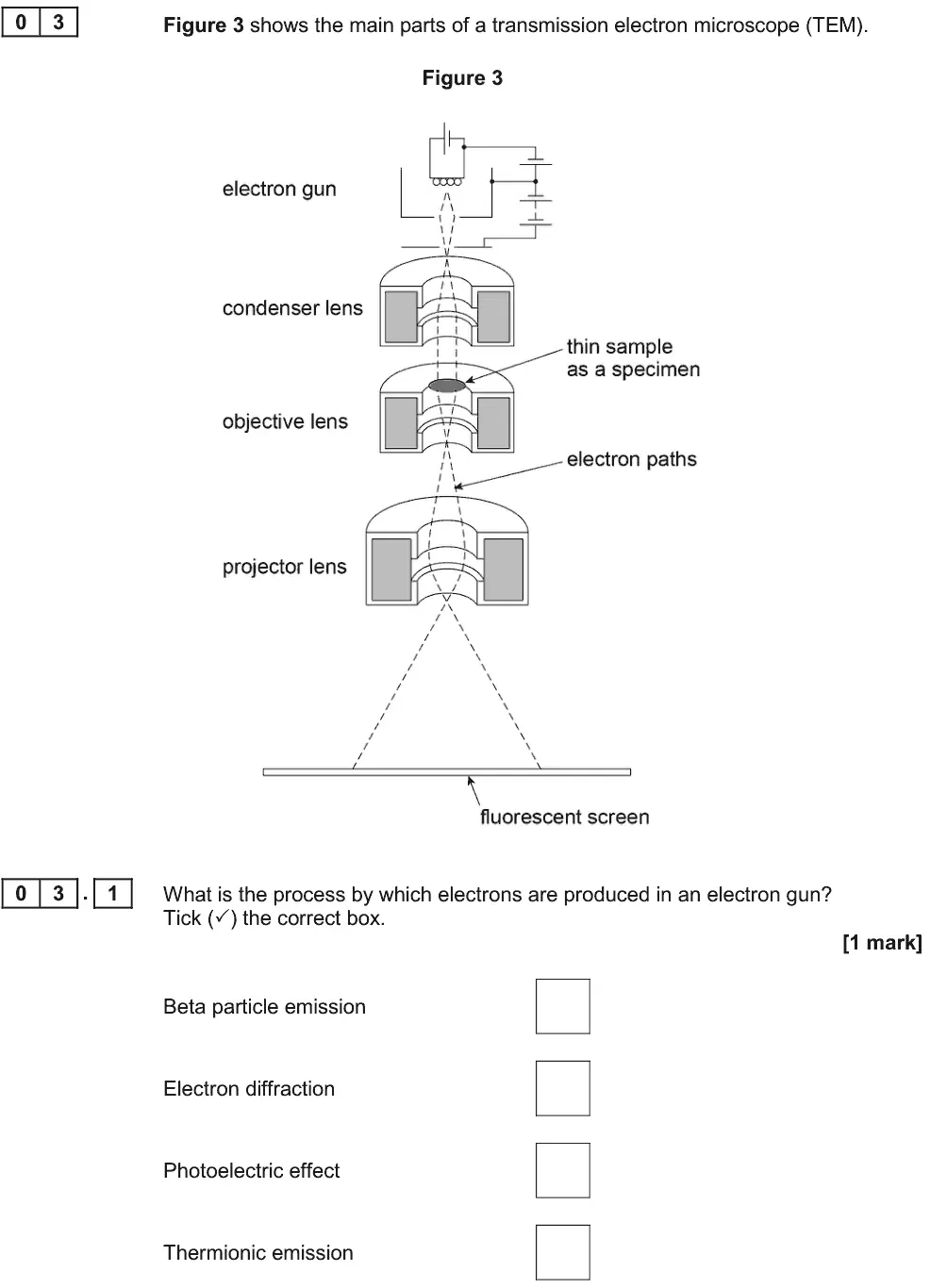
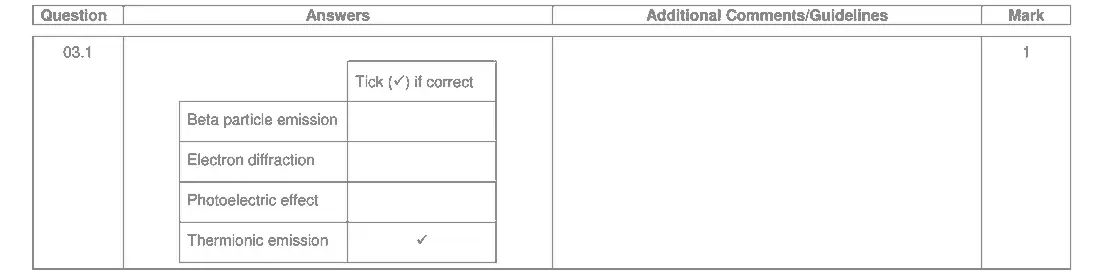
03.1 A very high proportion of students scored this simple recall mark.
Notes from the mark scheme and report
Answer: thermionic emission
very high proportion correct
Specimen set 1 · Paper 3B Turning points · Q1.12 marksShow that
Mark scheme
Notes from the mark scheme and report
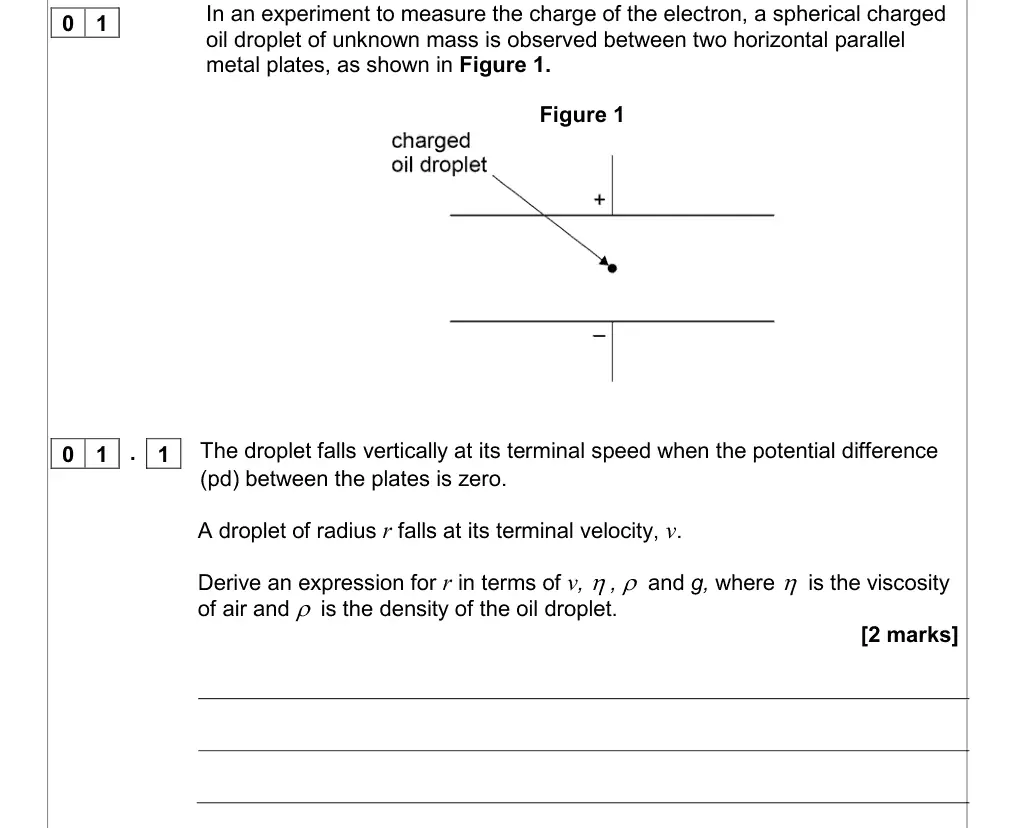
At terminal speed 6 pi eta r v = (4/3) pi r^3 rho g, giving r = (9 eta v / 2 rho g)^(1/2)
upthrust not accepted as the viscous force
Skills: MS2.2 Change the subject of an equation, including non-linear equations; MS4.3 Calculate areas of triangles, circumferences and areas of circles, surface areas and volumes of rectangular blocks, cylinders and spheres
Specimen set 1 · Paper 3B Turning points · Q1.21 markShort answer
Earlier part of question 1 that this part uses
Mark scheme
Notes from the mark scheme and report
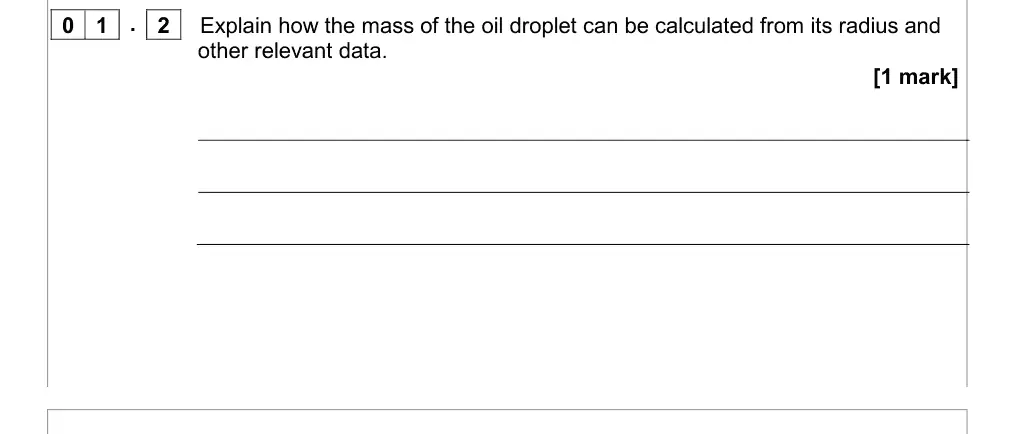
m = (4/3) pi r^3 rho using r from 01.1 (or m = 6 pi eta r v / g)
Skills: MS4.3 Calculate areas of triangles, circumferences and areas of circles, surface areas and volumes of rectangular blocks, cylinders and spheres
Specimen set 1 · Paper 3B Turning points · Q1.32 marksCalculation
Earlier part of question 1 that this part uses
Mark scheme
Notes from the mark scheme and report
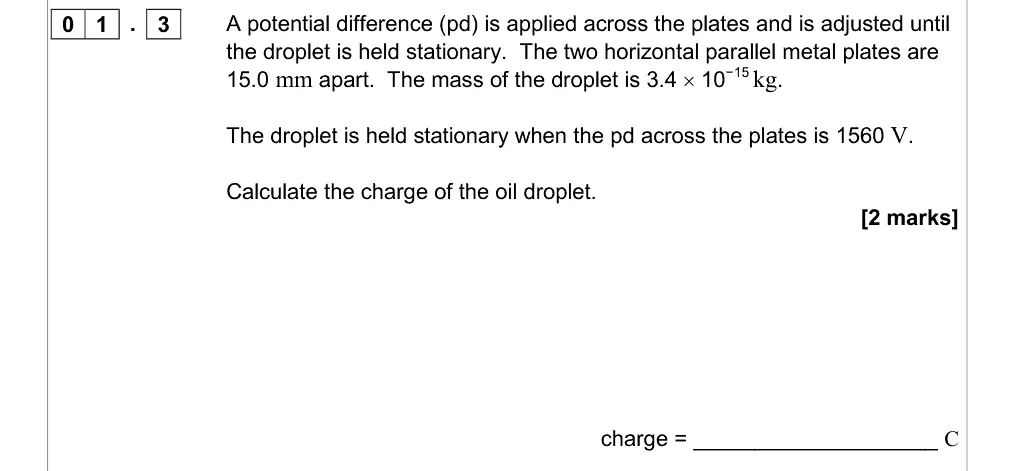
Answer: 3.2 x 10^-19 C (QV/d = mg: 3.4 x 10^-15 x 9.81 x 15.0 x 10^-3 / 1560)
eV/d instead of QV/d loses mark 1
Skills: MS2.3 Substitute numerical values into algebraic equations using appropriate units for physical quantities; MS2.2 Change the subject of an equation, including non-linear equations
Specimen set 1 · Paper 3B Turning points · Q1.43 marksExplanation
Earlier part of question 1 that this part uses
Mark scheme
Notes from the mark scheme and report
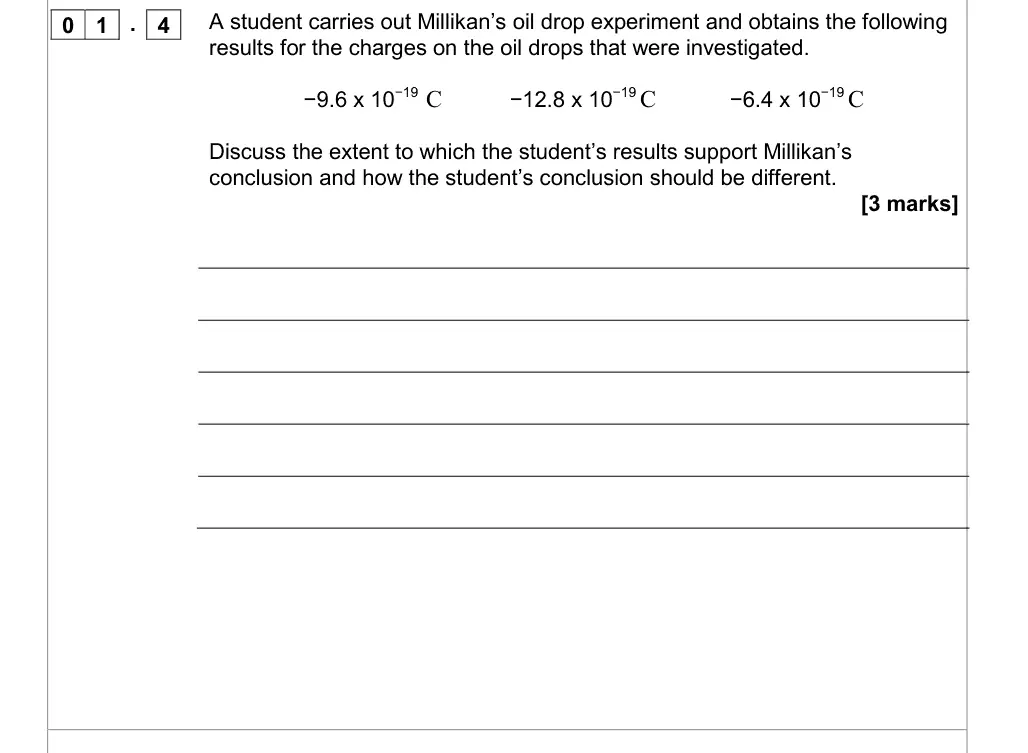
Millikan: charge quantised in multiples of e = 1.6 x 10^-19 C
student's charges are all multiples of 1.6 x 10^-19 C (agree) but alone suggest 3.2 x 10^-19 C as the smallest unit
Specimen set 1 · Paper 3B Turning points · Q2.12 marksShort answer
Mark scheme
Notes from the mark scheme and report
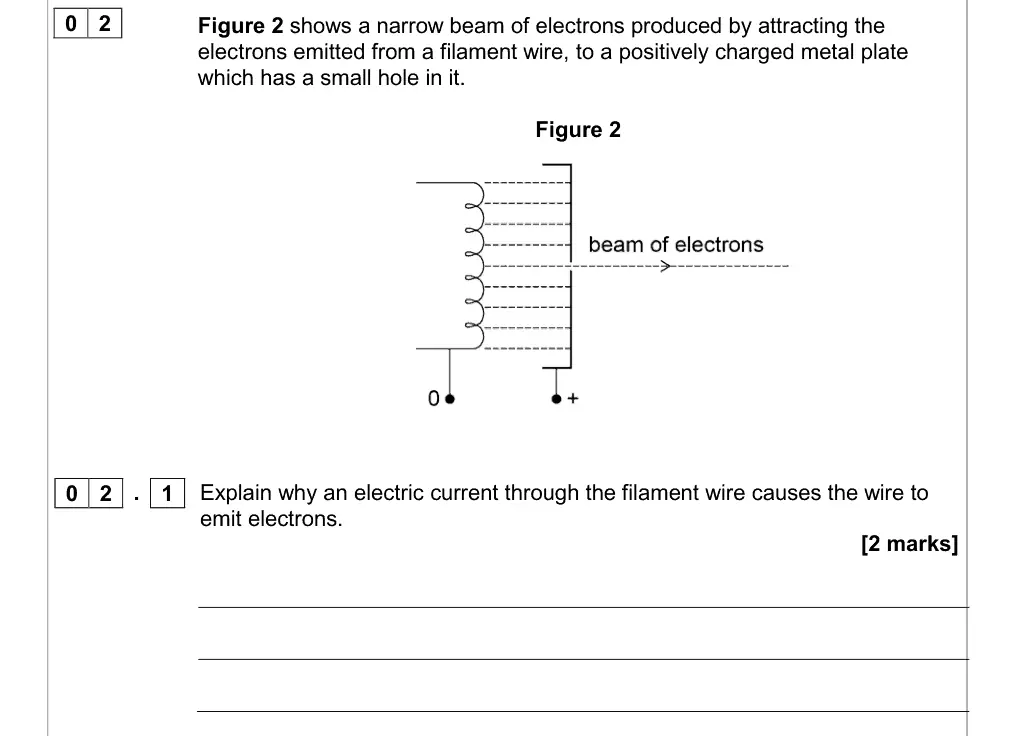
Current heats the filament
conduction electrons gain enough kinetic energy to escape the surface
Specimen set 1 · Paper 3B Turning points · Q2.21 markShort answer
Earlier part of question 2 that this part uses
Mark scheme
Notes from the mark scheme and report
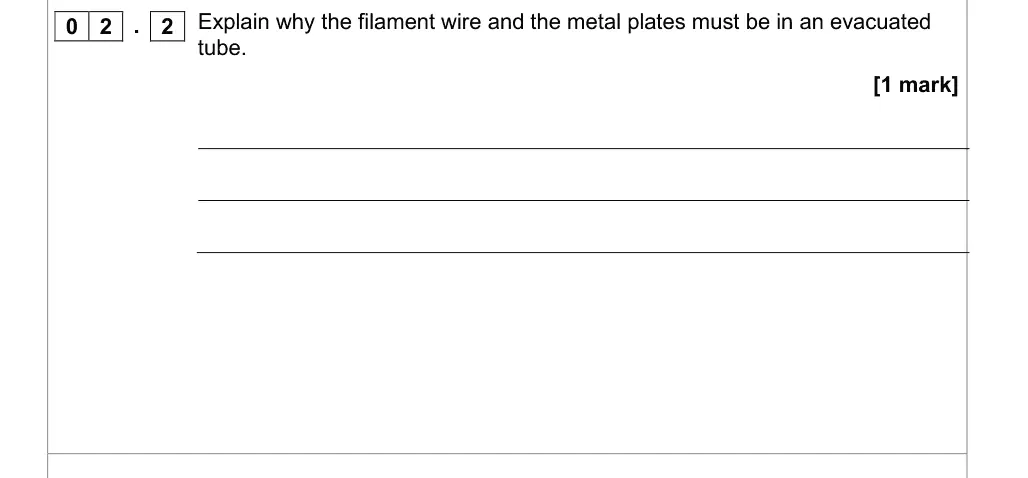
Electrons would collide with or be scattered or absorbed by gas molecules
Specimen set 1 · Paper 3B Turning points · Q2.34 marksCalculation
Earlier part of question 2 that this part uses
Mark scheme
Notes from the mark scheme and report
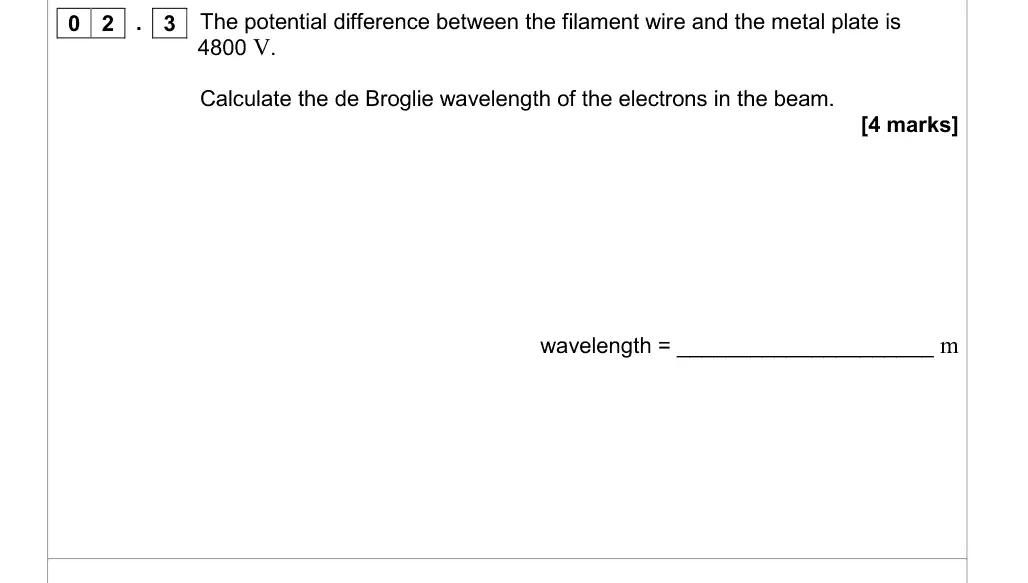
Answer: 1.8 x 10^-11 m (v = (2eV/m)^(1/2) = 4.1 x 10^7 m s^-1
lambda = h/mv)
Skills: MS2.2 Change the subject of an equation, including non-linear equations; MS2.3 Substitute numerical values into algebraic equations using appropriate units for physical quantities
Work with an AQA physics tutor
Dropping marks on calculations, required practicals or the six-markers? Book a trial session with a specialist AQA physics tutor.