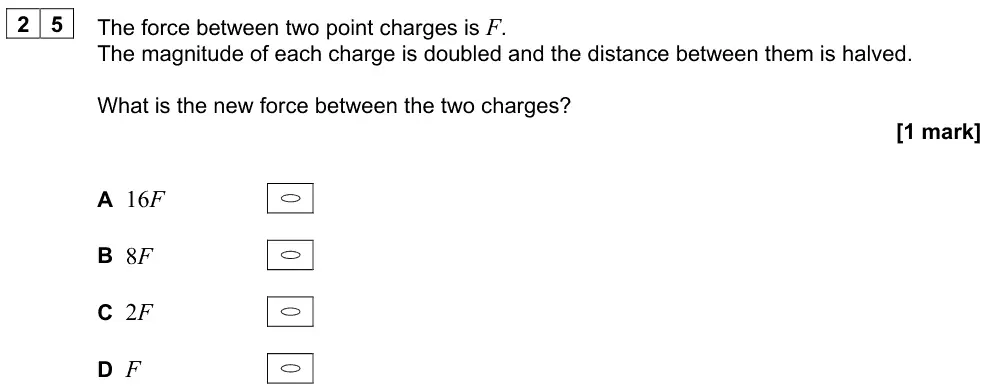
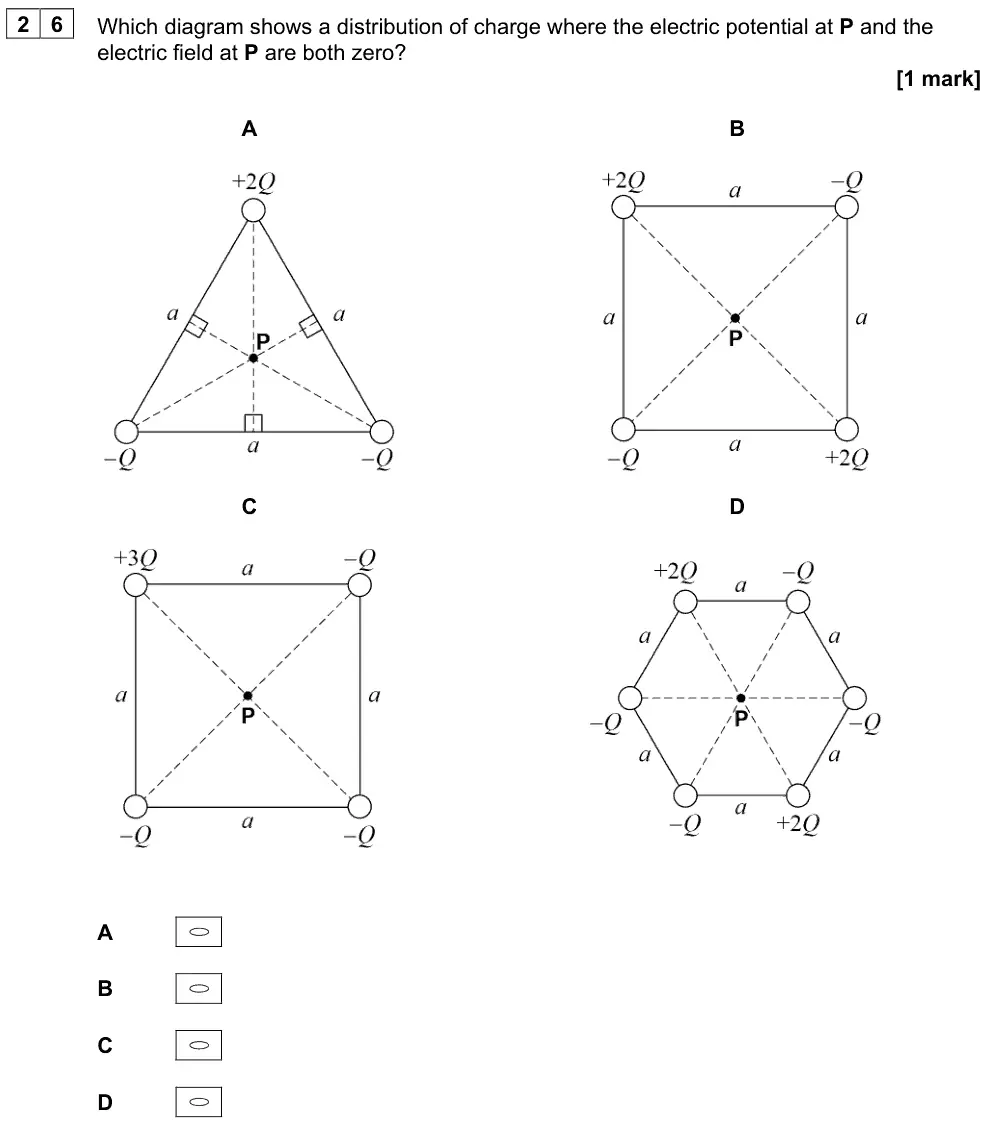
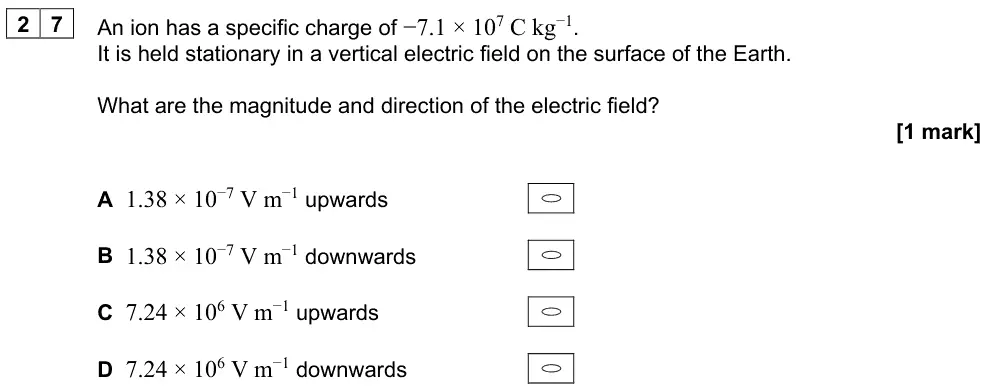
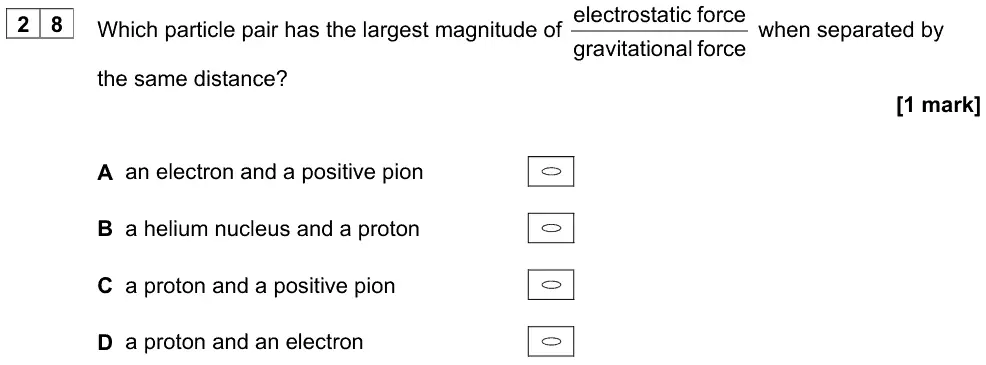
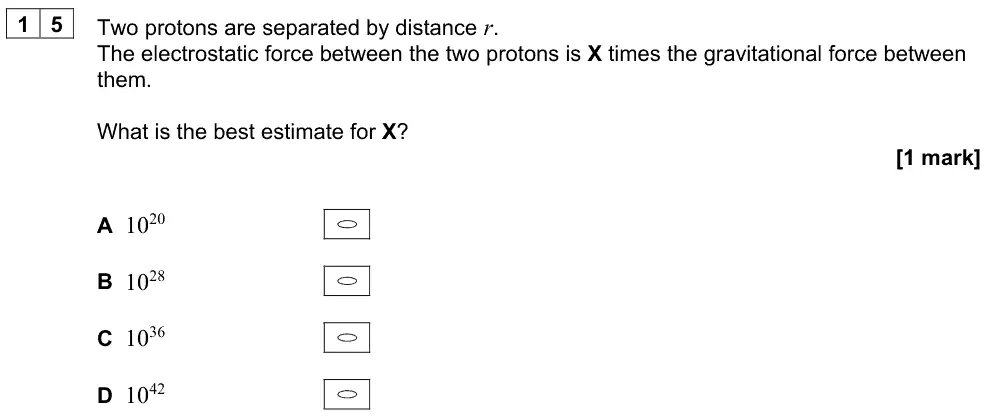
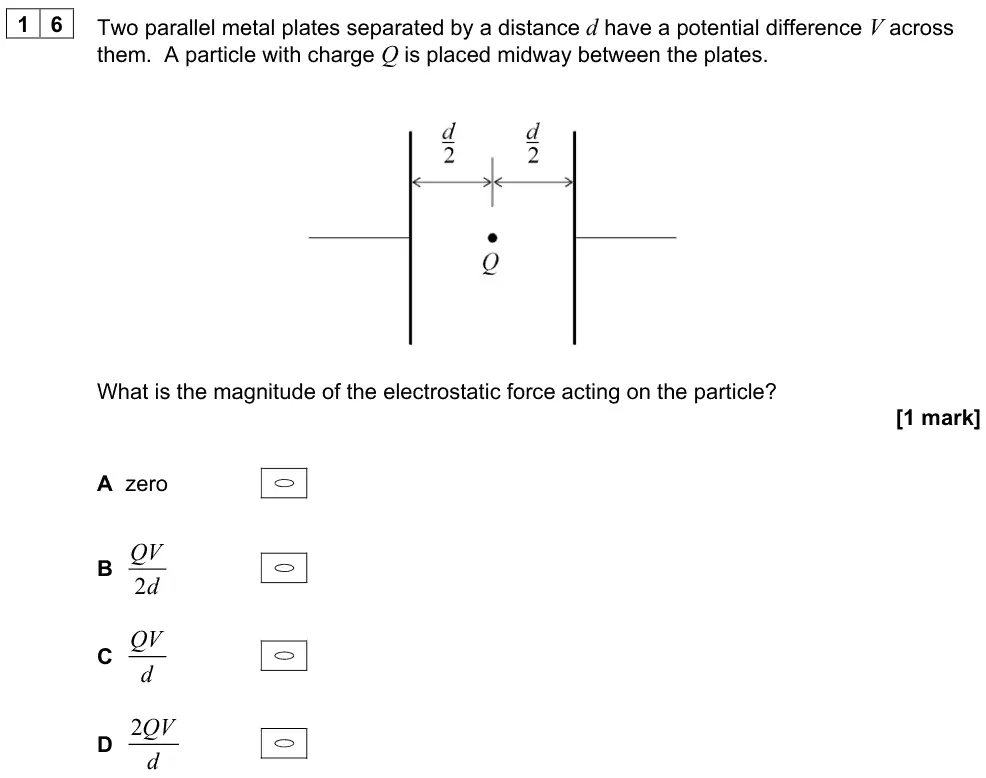
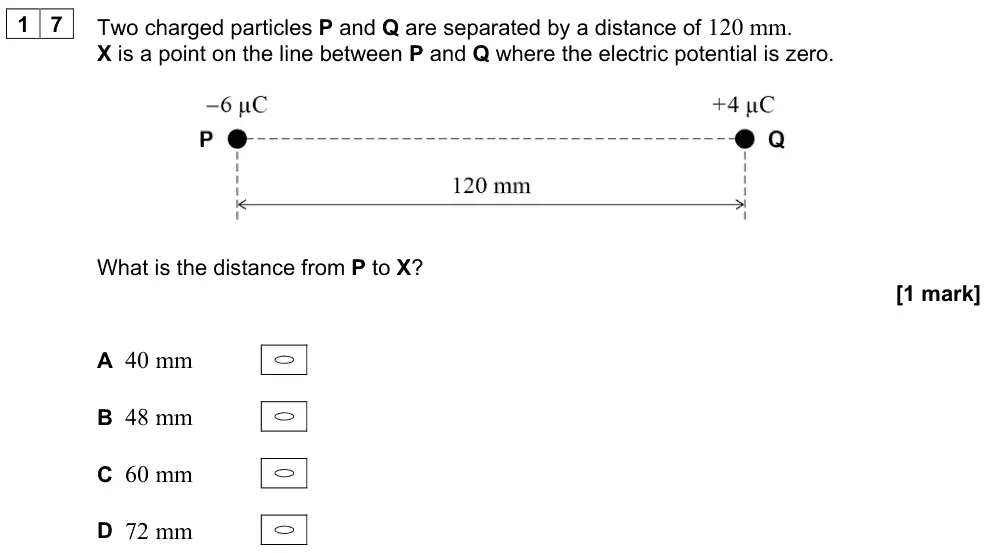
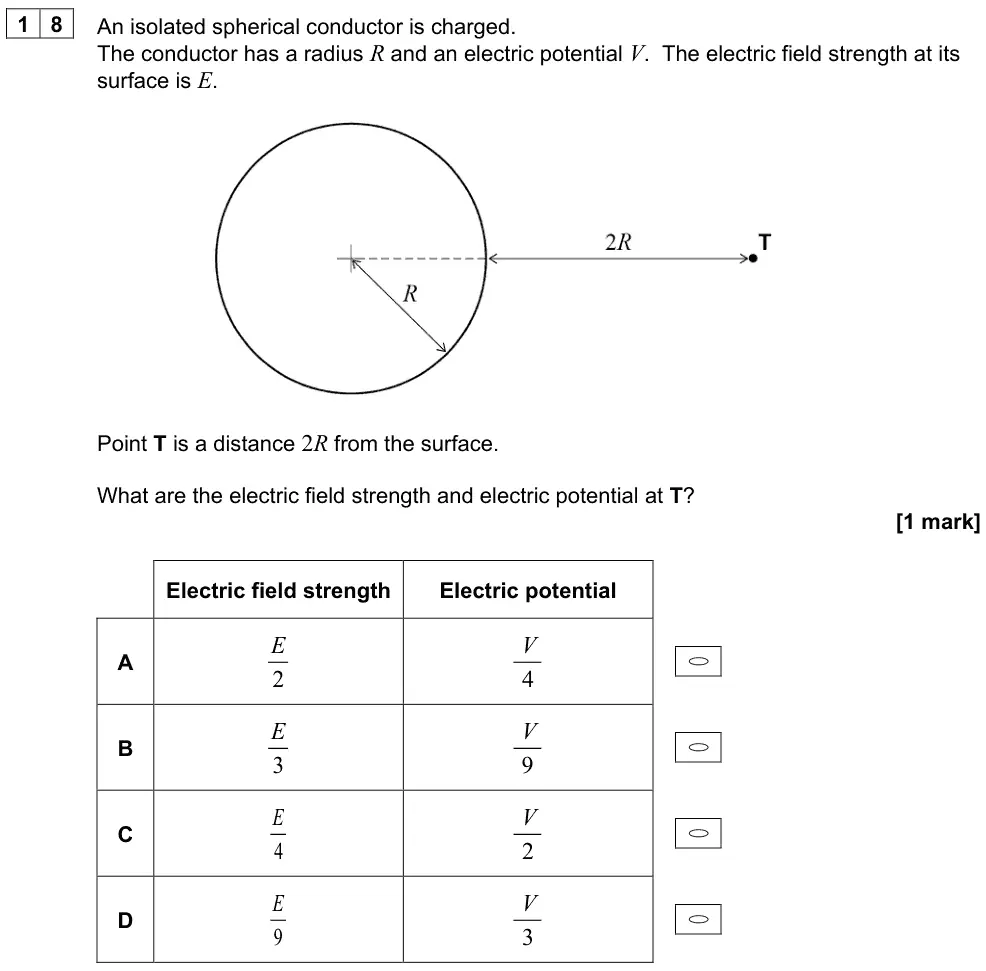
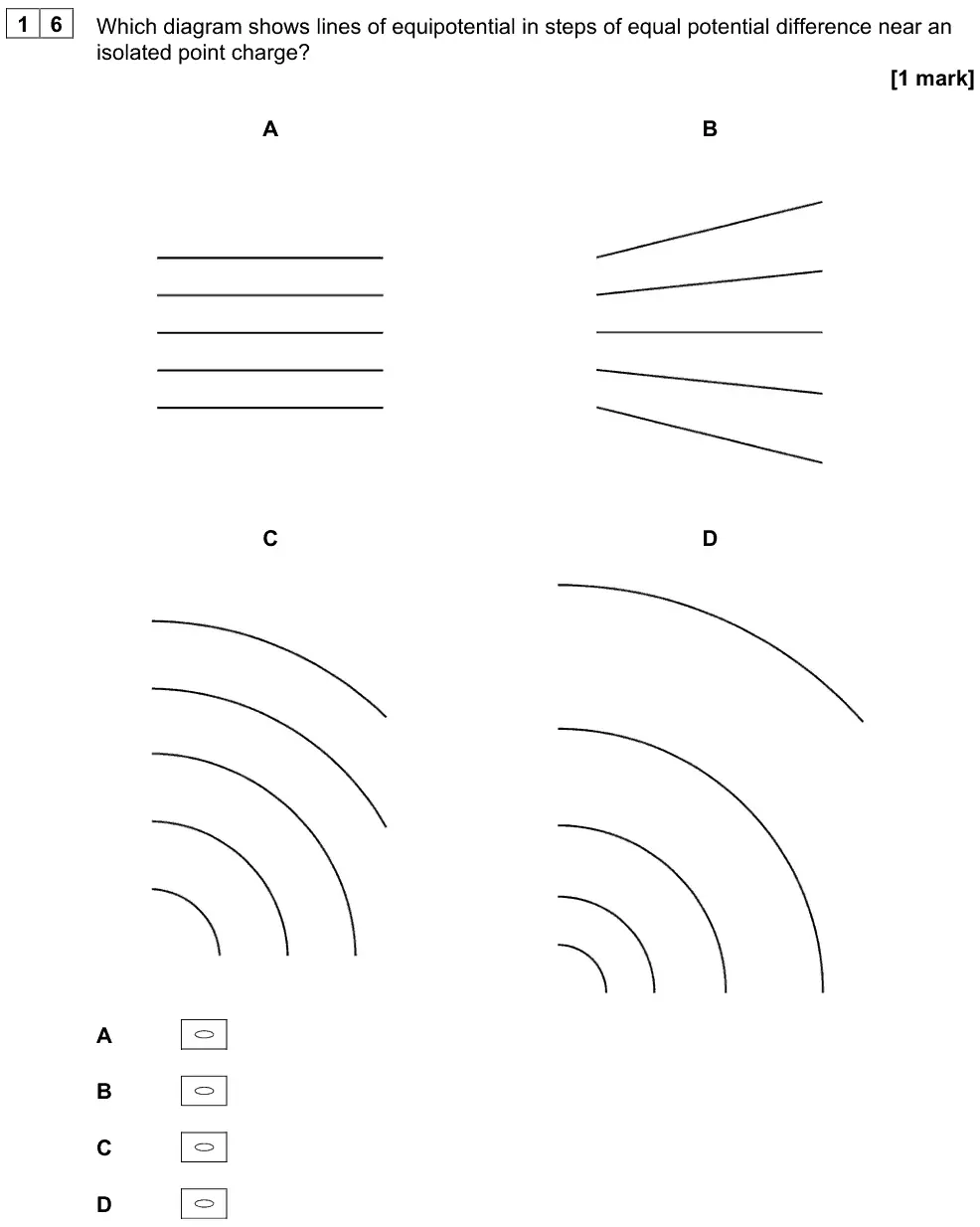
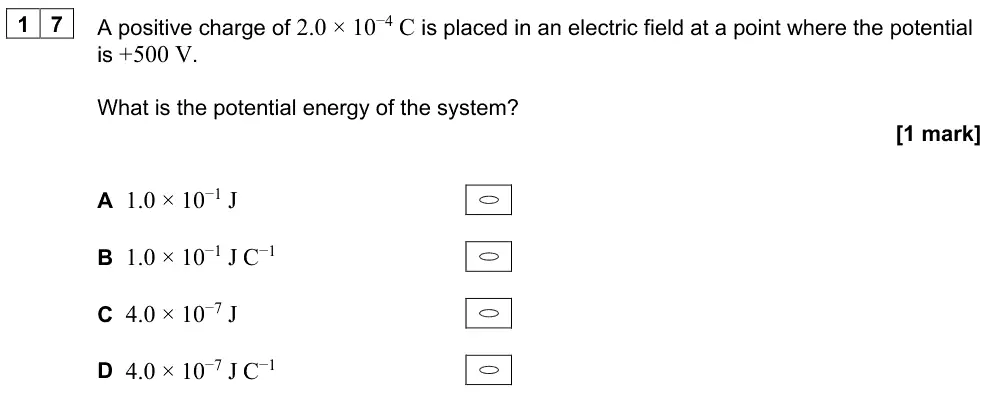
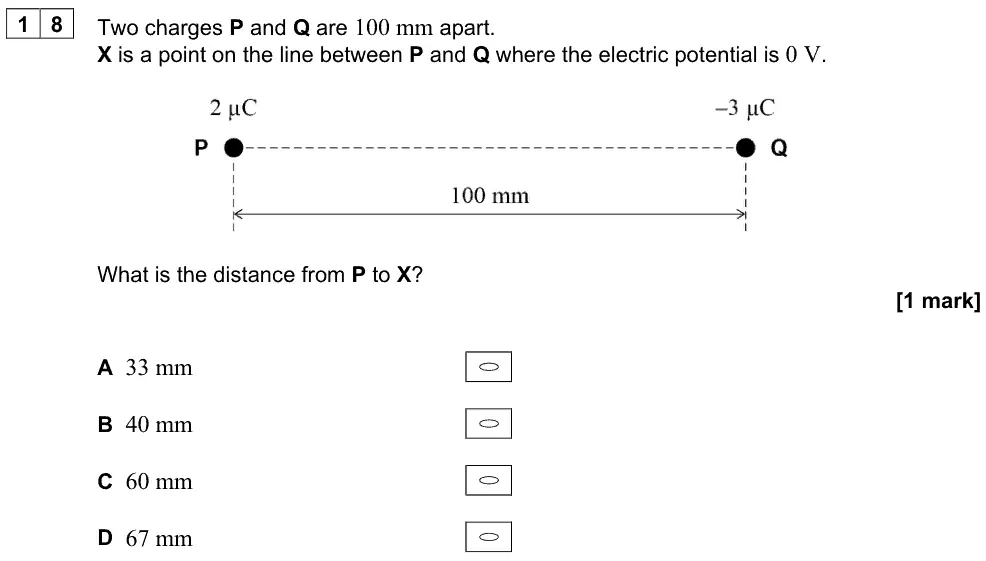
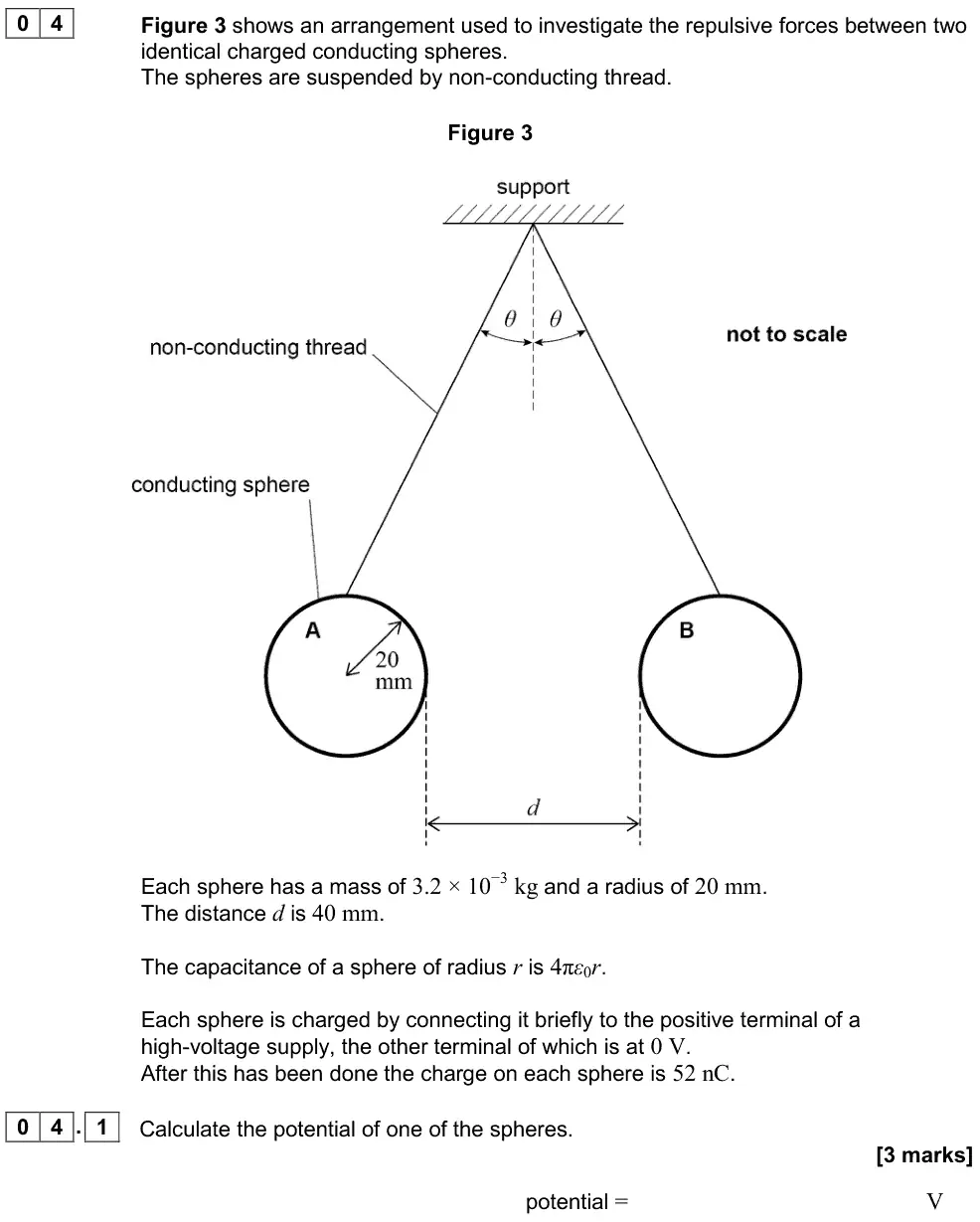
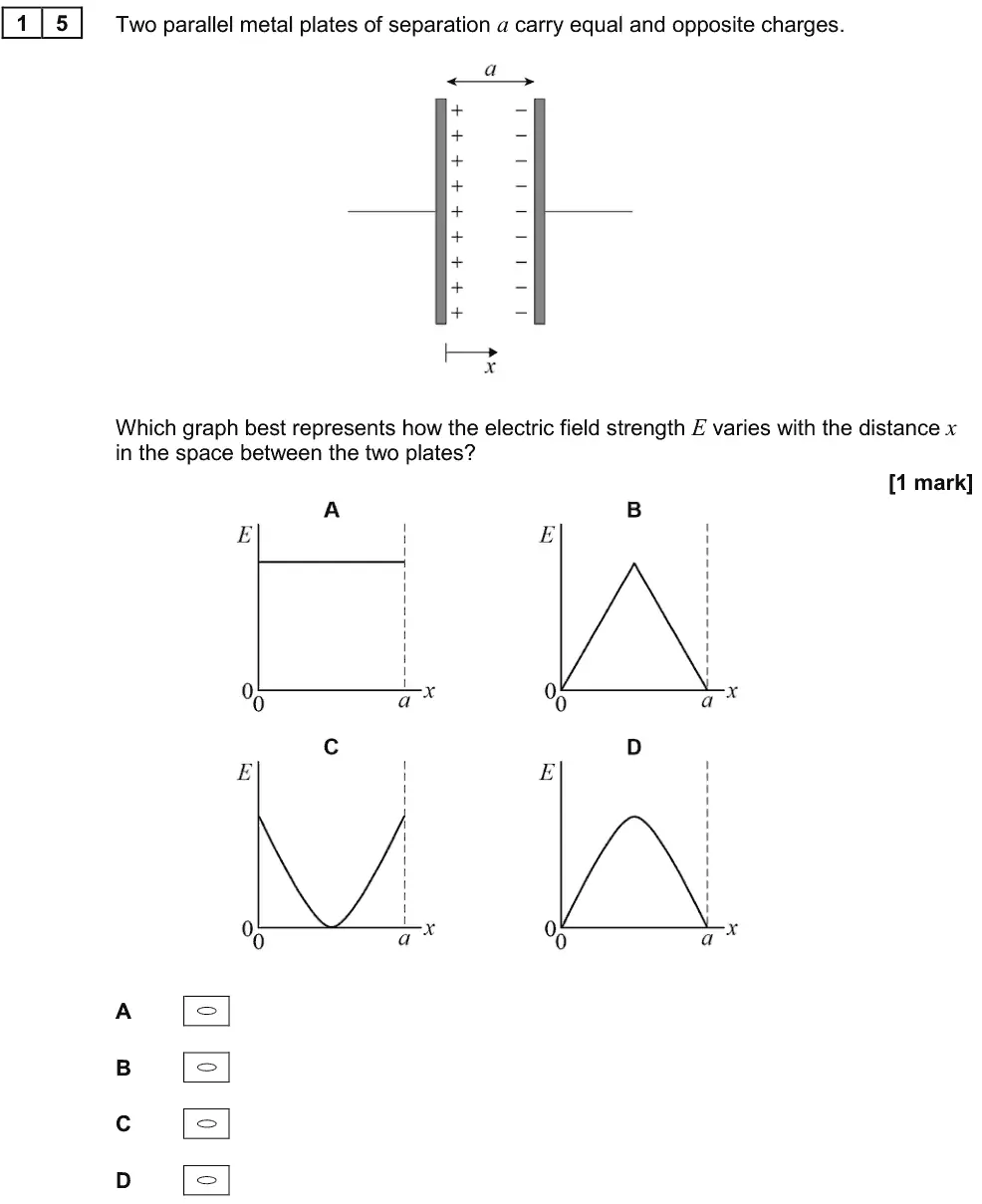
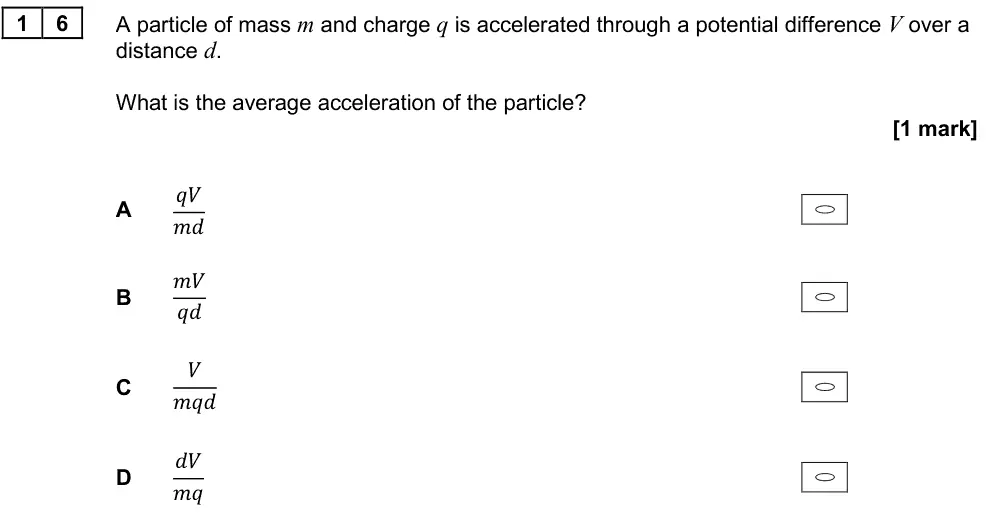
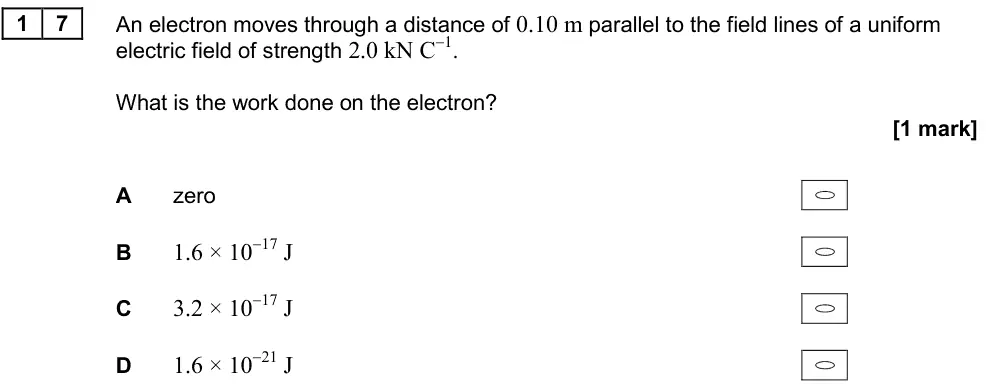
Tap a question to zoom it. Where a part needs a figure, table or graph from earlier in the question, that part folds out above it; the mark scheme and examiner's comment open underneath. Have the AQA data and formulae booklet beside you (see the formula sheet page).
June 2025 · Paper 2 · Q6.43 marksAO2=3Calculation
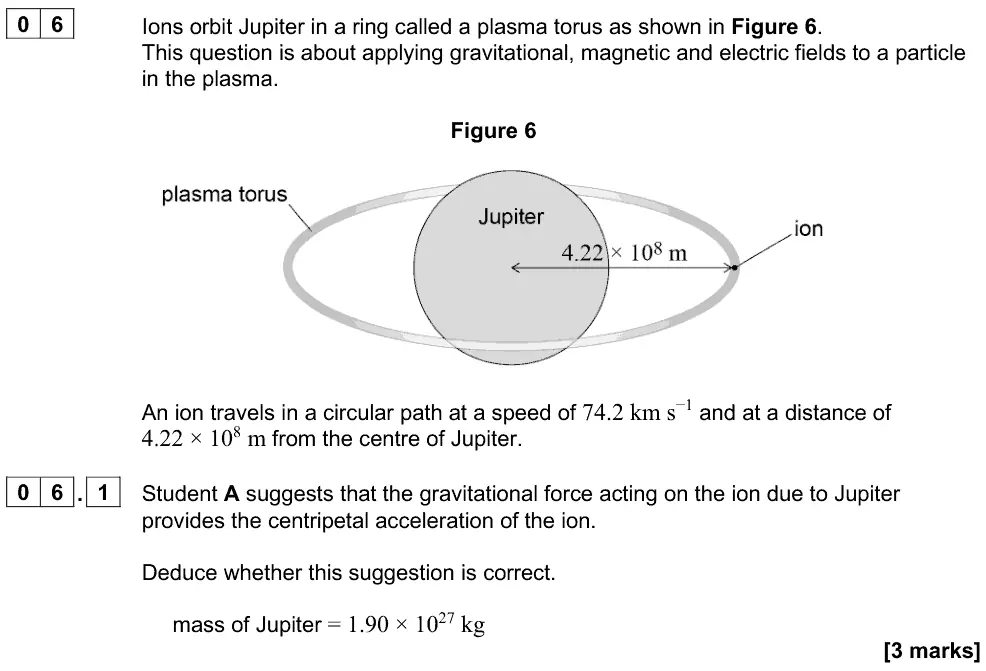
Earlier part of question 6 that this part uses
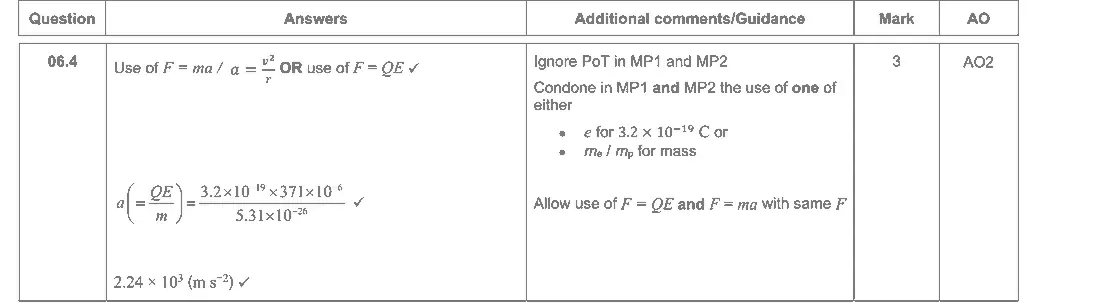
Mark scheme
Examiner's comment
6.4 Most students were able to determine the acceleration of the ion, although a minority of students mixed up the field and the potential.
Notes from the mark scheme and report
Answer: 2.24 x 10^3 m s^-2 (a = QE/m)
a minority mixed up field and potential
Skills: MS2.3 Substitute numerical values into algebraic equations using appropriate units for physical quantities
June 2025 · Paper 2 · Q6.53 marksAO2=3CalculationHard
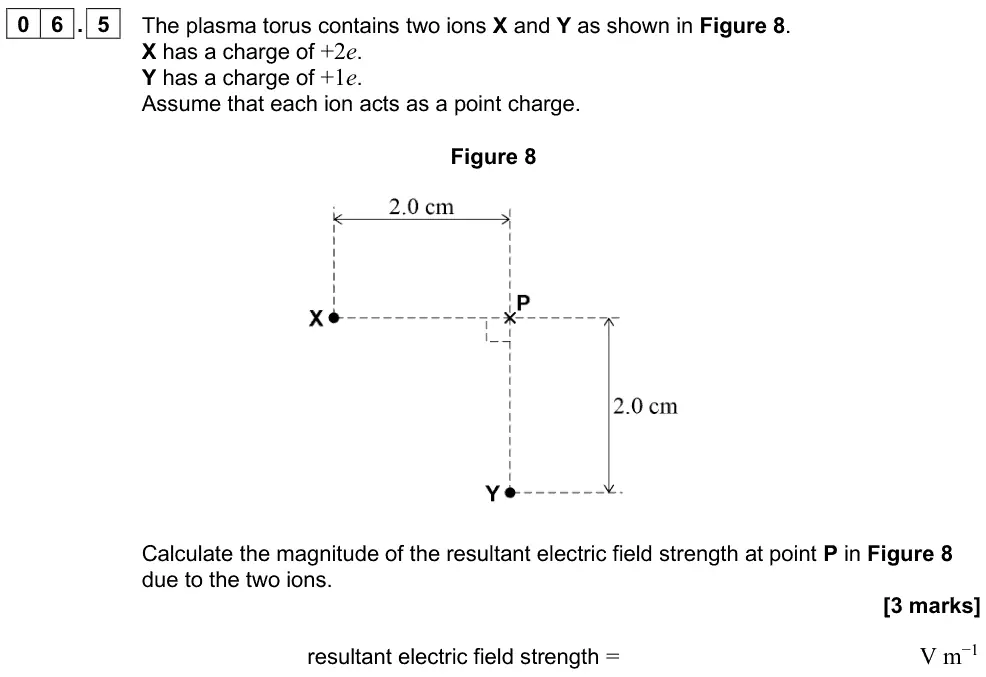
Earlier part of question 6 that this part uses
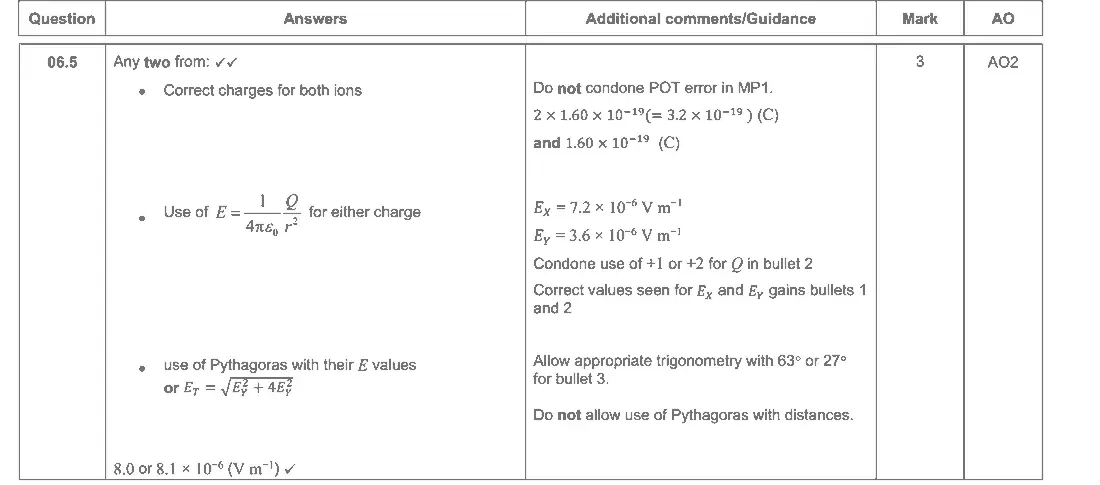
Mark scheme
Examiner's comment
6.5 This question was context free, yet proved challenging for students, with only around a quarter able to gain full marks. Students had to calculate the electric field at P for X and for Y and then combine them as vectors using either Pythagoras or trigonometry.
Common mistakes were: students calculating the force exerted by the charge on each other using coulombs law, determining the field at the location of the other charge rather than P, mixing up the field and the potential, and treating the field as a scalar and simply adding or subtracting the two electric fields. Those students who treated the fields as scalars and who did the algebra before substituting in the values at the end, often scored 0 marks, because they did not write down either charge correctly, did not have a valid substitution into an electric field equation and did not combine the electric fields as vectors. Had they substituted earlier they could have gained 2 marks. This significantly lowered the mean mark for the question.
Notes from the mark scheme and report
Answer: 8.0-8.1 x 10^-6 V m^-1 (E_X = 7.2 x 10^-6, E_Y = 3.6 x 10^-6 at right angles, combined by Pythagoras)
adding fields as scalars or using Coulomb force were common errors
Skills: MS2.3 Substitute numerical values into algebraic equations using appropriate units for physical quantities; MS4.4 Use Pythagoras’ theorem, and the angle sum of a triangle
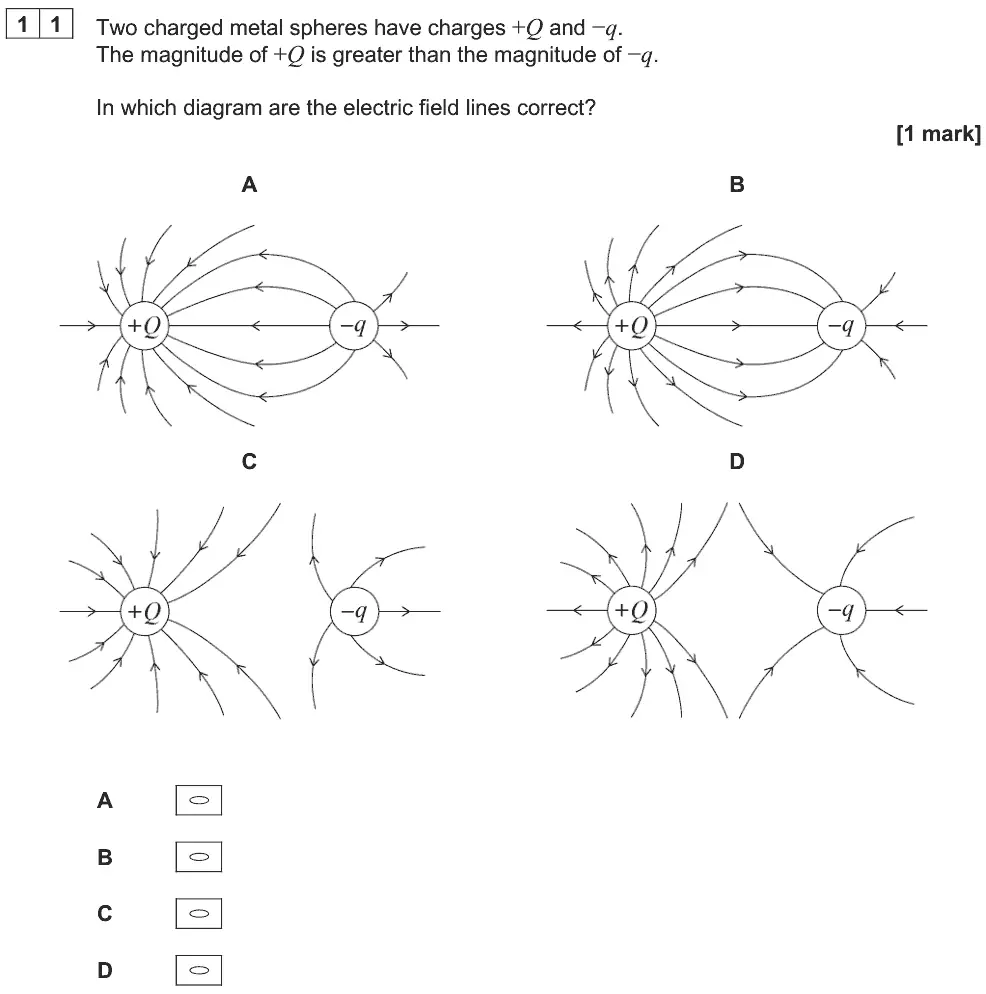
June 2025 · Paper 2 · Q111 markAO2=1Multiple choiceEasy
Answer
B
Mark scheme
Examiner's comment
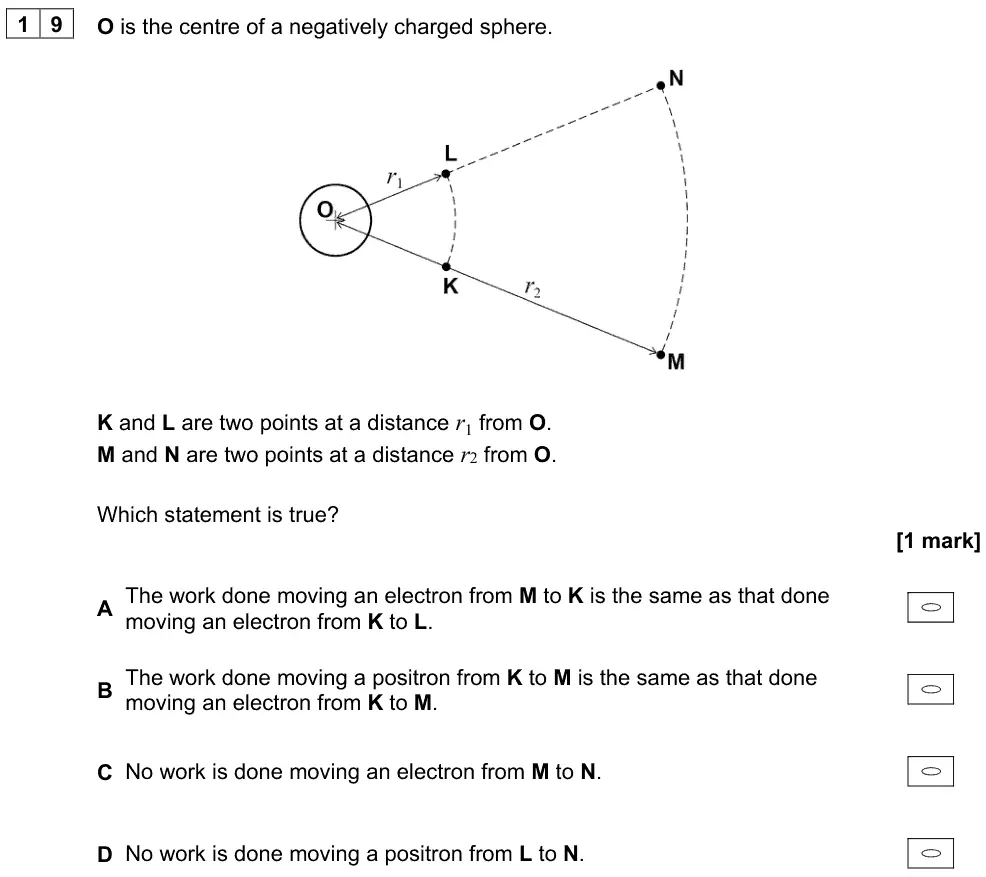
Students found questions 11, 14, 17, 28 and 30 to be very accessible with over two thirds getting these correct.
Notes from the mark scheme and report
Answer: B
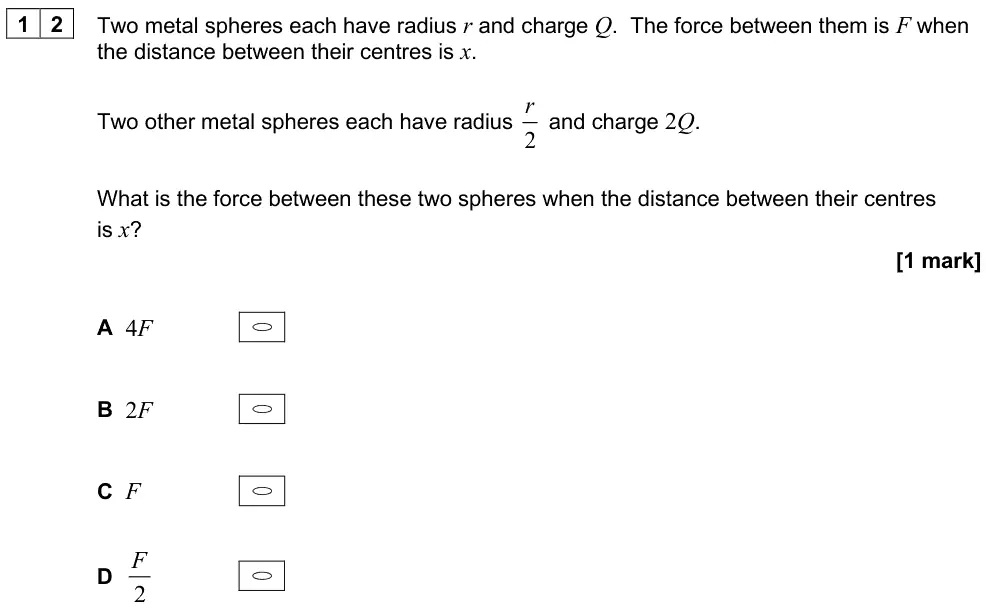
June 2025 · Paper 2 · Q121 markAO2=1Multiple choice
Answer
A
Mark scheme
Notes from the mark scheme and report
Answer: A
Skills: MS0.3 Use ratios, fractions and percentages
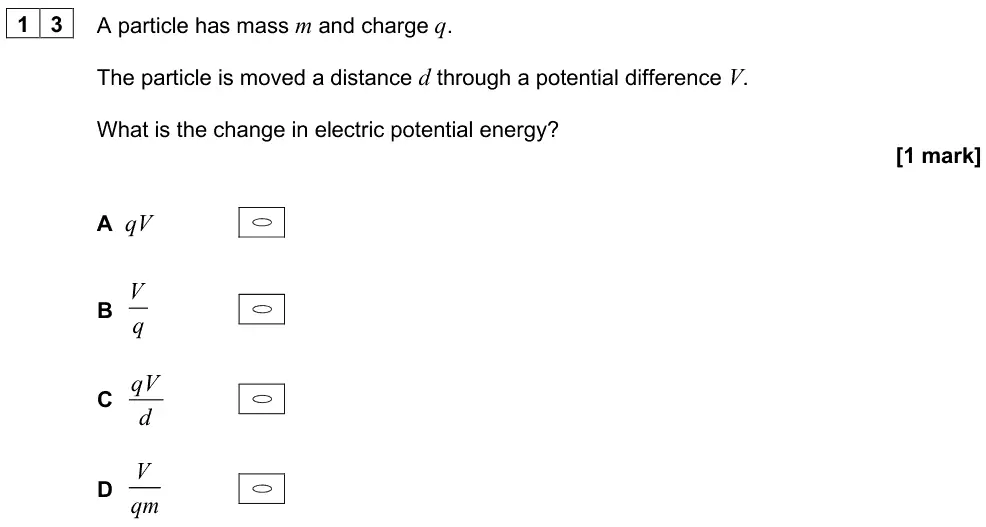
June 2025 · Paper 2 · Q131 markAO1=1Multiple choice
Answer
A
Mark scheme
Notes from the mark scheme and report
Answer: A
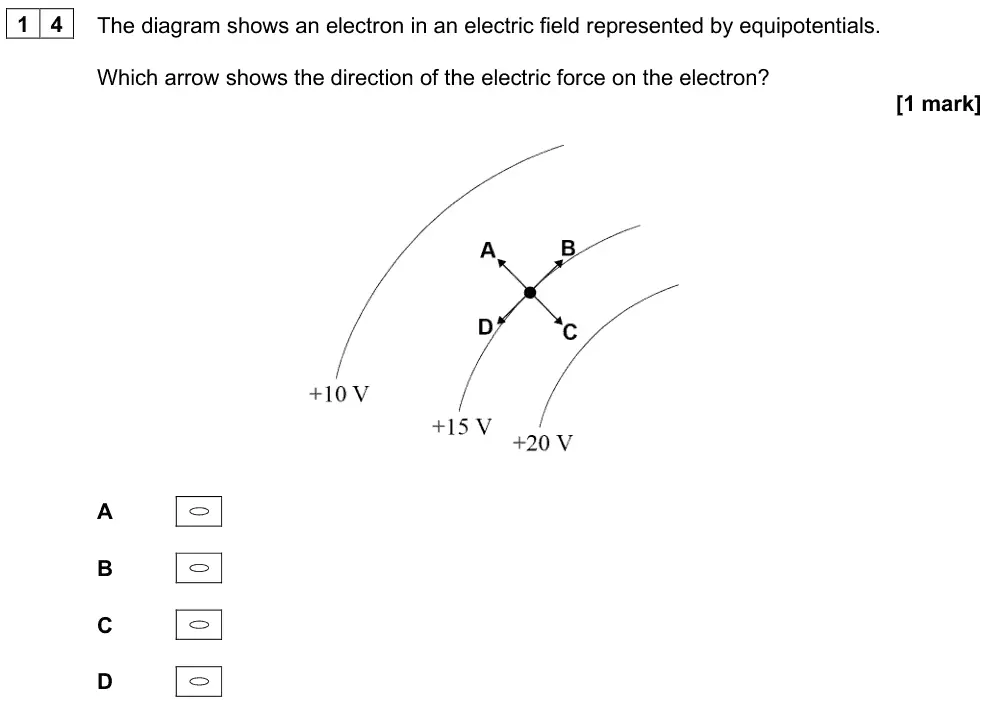
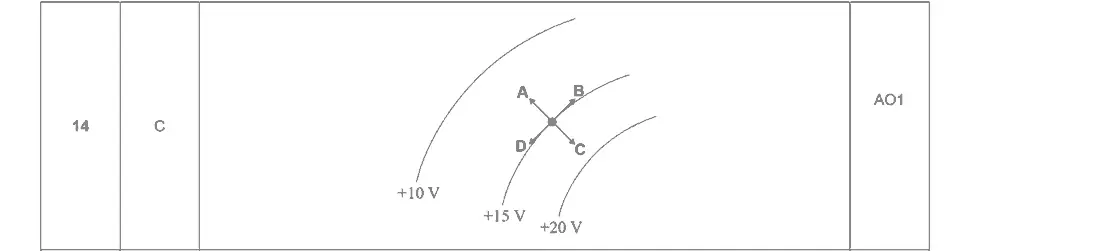
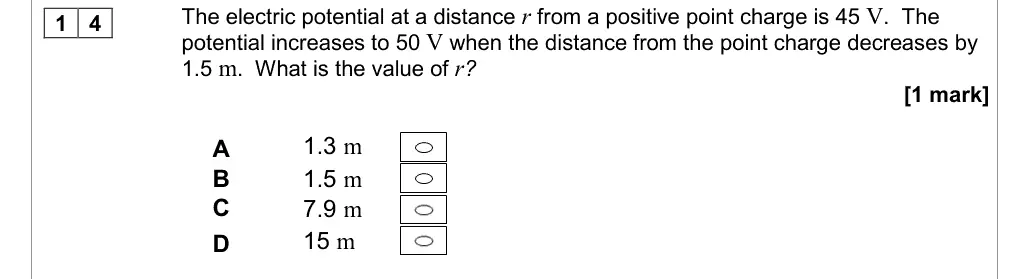
June 2025 · Paper 2 · Q141 markAO1=1Multiple choiceEasy
Answer
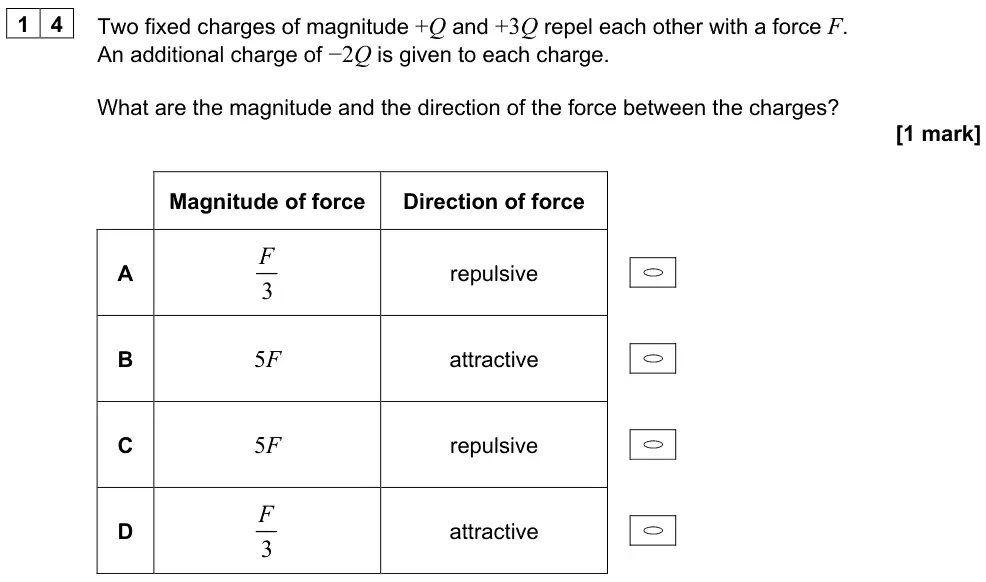
C
Mark scheme
Examiner's comment
Students found questions 11, 14, 17, 28 and 30 to be very accessible with over two thirds getting these correct.
Notes from the mark scheme and report
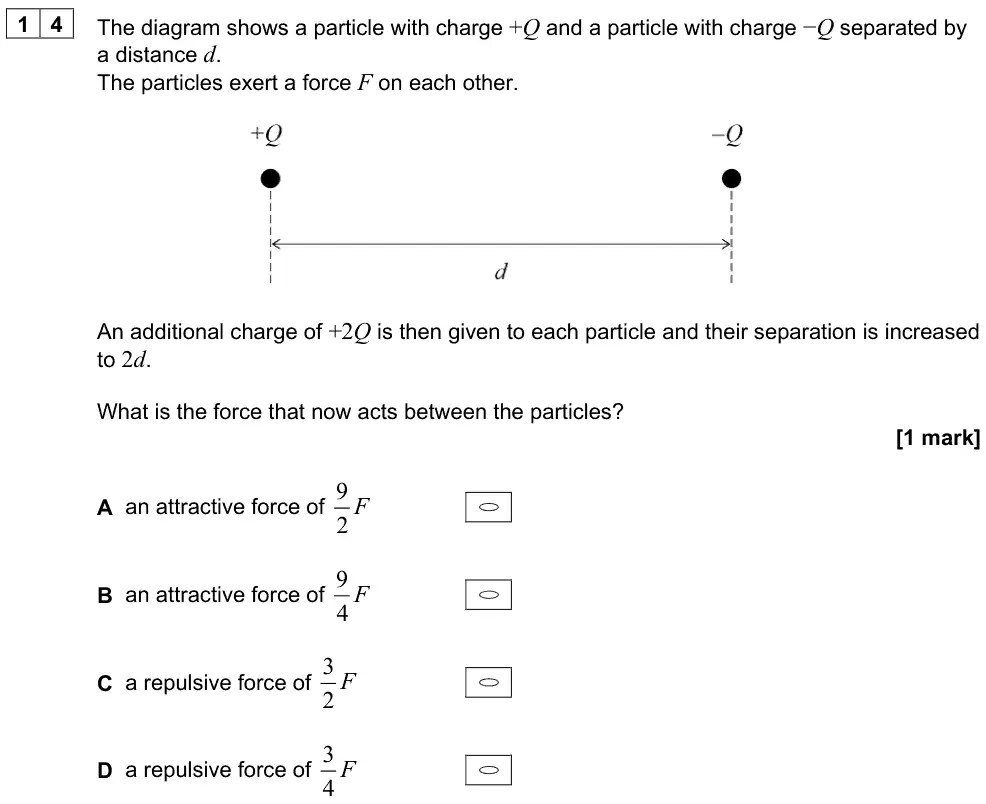
Answer: C
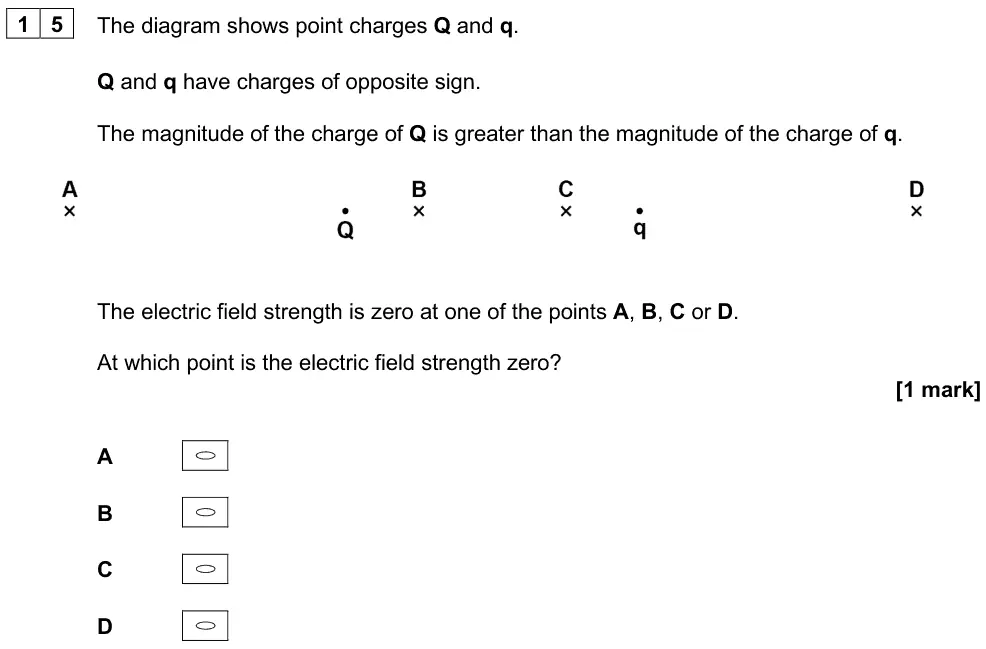
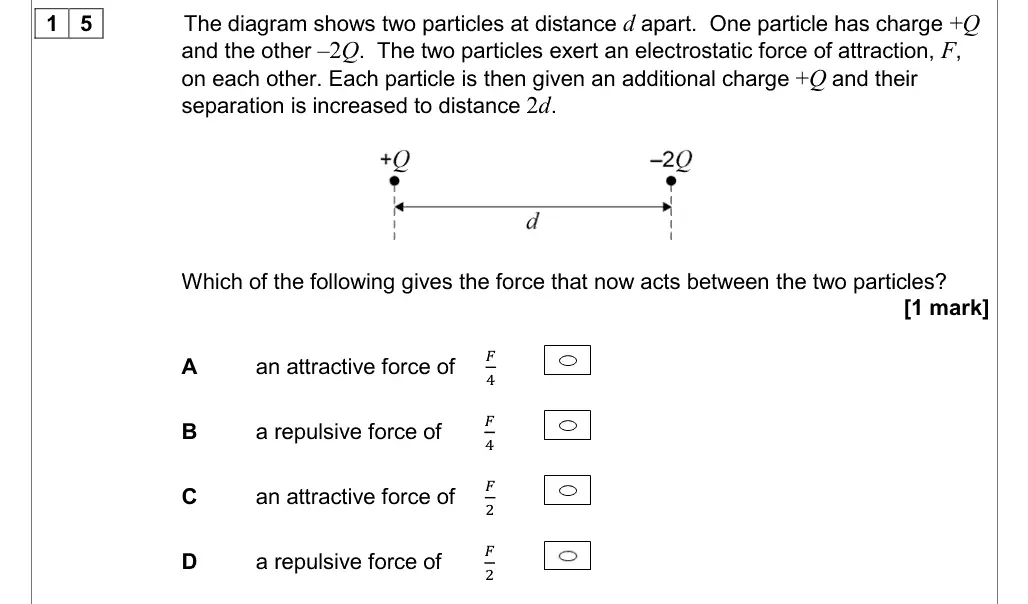
June 2025 · Paper 2 · Q151 markAO2=1Multiple choiceHard
Answer
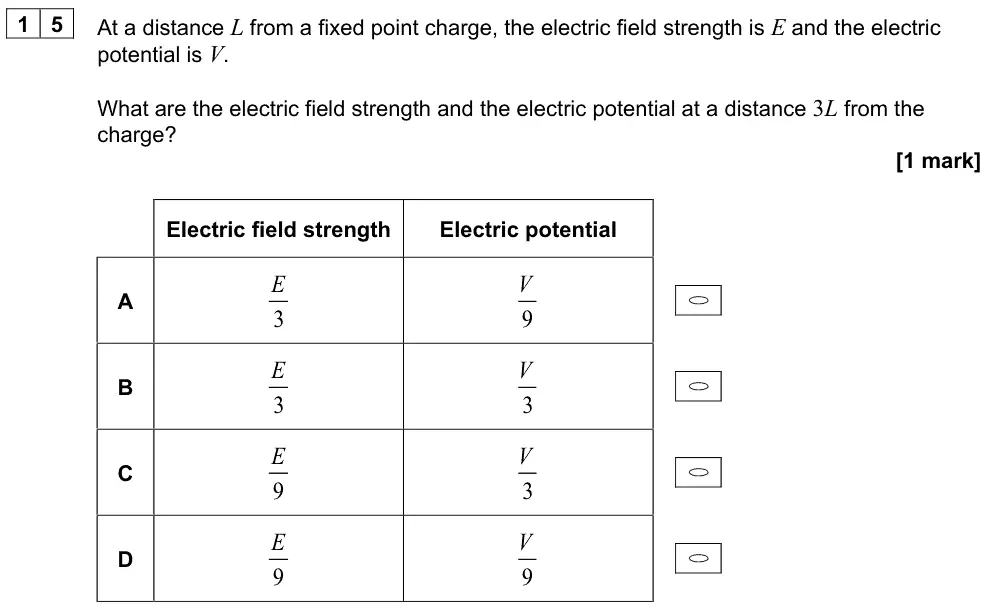
D
Mark scheme
Examiner's comment
15 Around a third of students answered this question correctly. To answer this question, students must consider the magnitude and direction of the fields which would total to give zero. The magnitudes of the fields must be equal, so, since the magnitude of the charge of Q is larger than the magnitude of the charge of q, the point must be closer to q. The answer must be C or D. As electric field strength is a vector, when there are two charges the only way to get zero is for the fields to point in opposite directions. At any location between the two charges, the fields will point in the same direction, as it must point towards one and away from the other. The answer must be A or D. Therefore, the answer must be D; it is closer to q and the fields are in opposite directions. The most popular answer was C, showing students had an awareness of the magnitude of the charge but did not properly take into account the vector nature of electric field. This is nature of electric fields.
Notes from the mark scheme and report
Answer: D
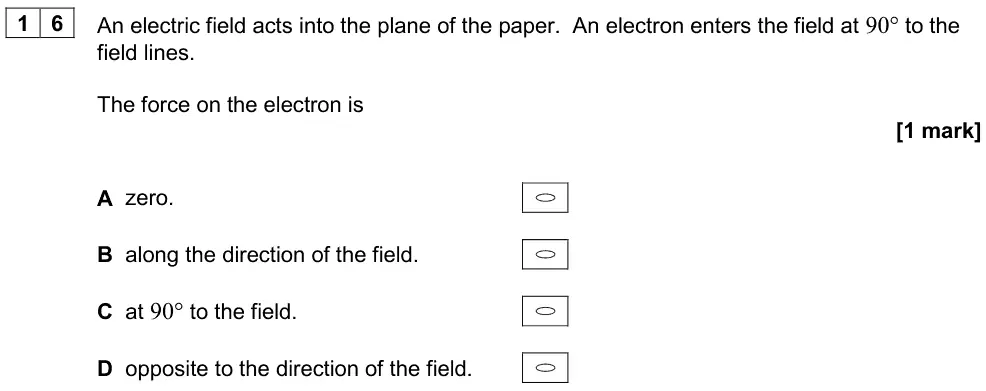
most chose C - fields from opposite charges only cancel outside the pair, nearer the smaller charge
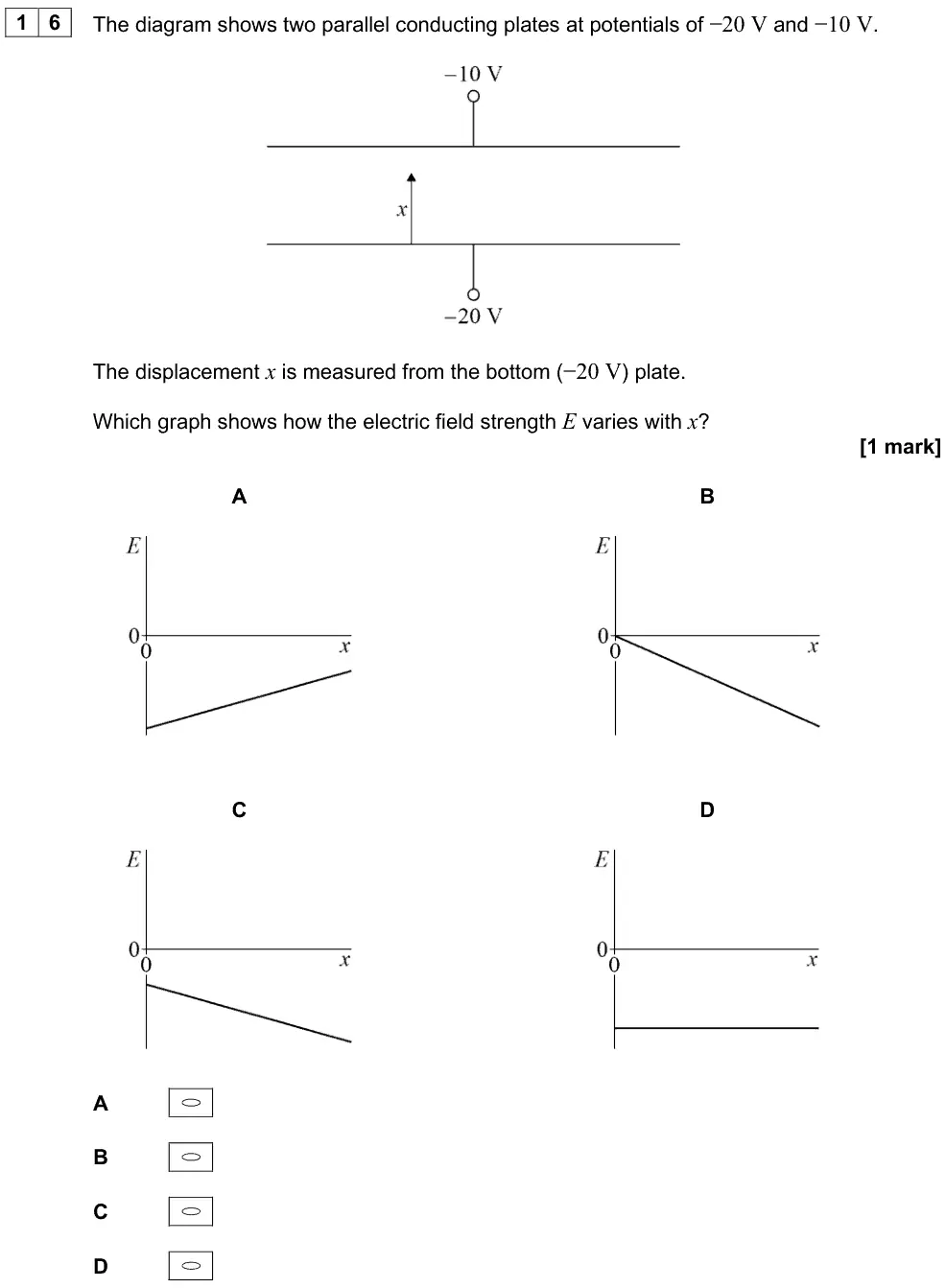
June 2025 · Paper 2 · Q161 markAO1=1Multiple choice
Answer
D
Mark scheme
Notes from the mark scheme and report
Answer: D
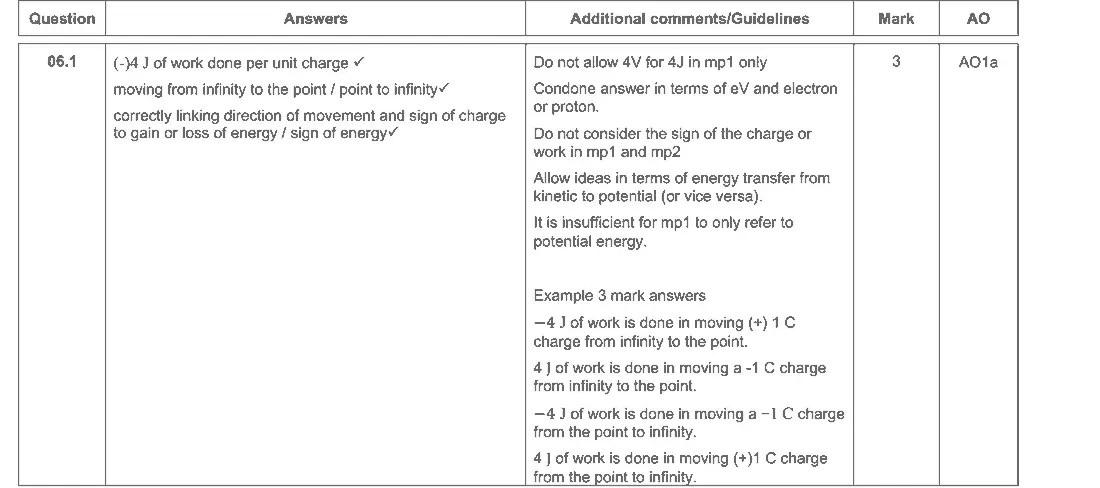
June 2024 · Paper 2 · Q6.13 marksAO1=3Explanation
Mark scheme
Examiner's comment
06.1 This proved more challenging than expected for a simple definition. Many students could not define electric potential. The first mark was for mentioning the work done per unit change being (–)4.0 J. Many answers here gave the unit of work done as V rather than J and were therefore unable to score. The second mark was about moving from infinity to the point and was generally the most accessible mark. The last mark was for getting the direction of movement, the sign of the charge and the direction of energy transfer correct. Students could answer this in various ways, referring to a positive charge gaining energy when moving from the point to infinity; losing energy or having negative work done when moving from the point to infinity; or they could refer to the opposite direction but referring to a negative charge. In order to score here the sign of the charge had to be explicit.
Notes from the mark scheme and report
Work done per unit charge (4 J per C, not V) moving between infinity and the point
sign of charge, direction of movement and gain/loss of energy must be consistent
many could not define potential
June 2024 · Paper 2 · Q6.24 marksAO1=2, AO2=1, AO3=1Calculation
Earlier part of question 6 that this part uses
Mark scheme
Examiner's comment
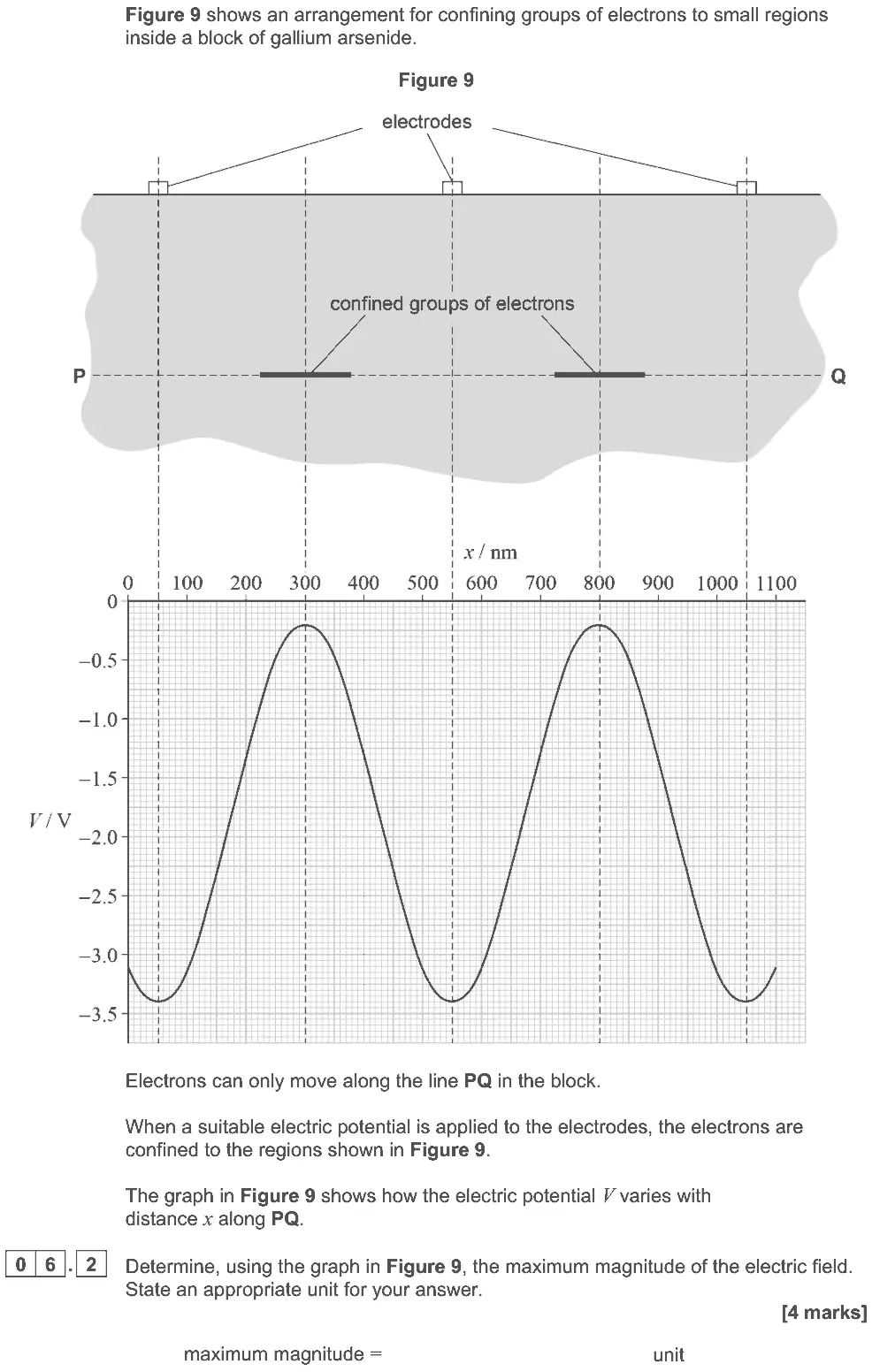
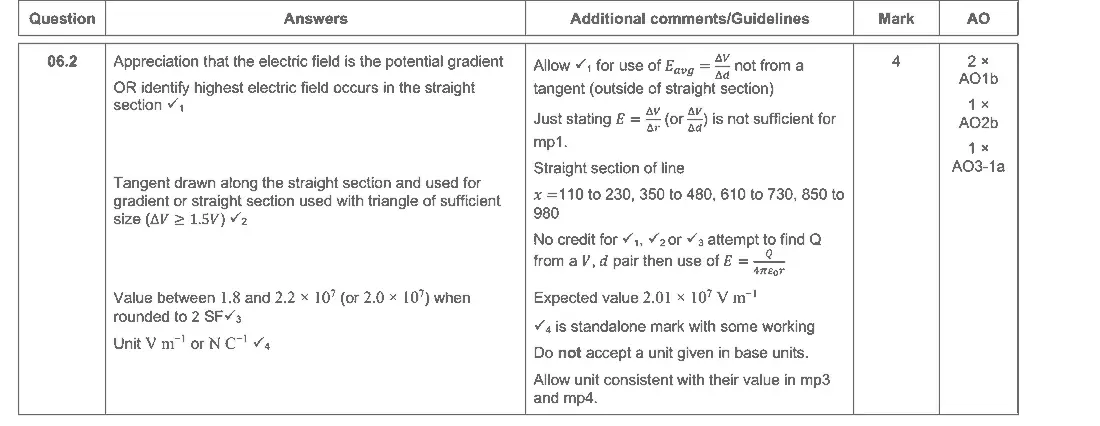
06.2 Some students were confused by the context in what should have been a straightforward question. The students were provided with a potential–distance graph and asked to find the maximum potential. This should have been obtained as the gradient of the steepest part of the graph. As the graph had a long straight section around this point, a tangent did not need to be drawn, provided the data were taken from the straight section of the graph. As with all graph work, students were expected to take their data from well-spaced points for full marks. Δ𝑉𝑉 Δ𝑟𝑟 based on points from the graph that were not from the straight Students who used the equation section were able to gain a mark for calculating the average field.
Most students were able to state the unit for the electric field, although a small minority could not.
A wide variety of answers was accepted for relating the motion of the electron to the information in the graph, but this still proved very challenging. Often answers mixed up concepts like potential energy and potential. It was hoped that 06.2 and 06.3 would have directed the students to talk about field and forces or potential energy being converted into kinetic energy, but many failed to make these links. Those students who realised that the electron would oscillate were generally able to score highly, but only those who really understood the context were able to make that link. Although the motion was not SHM, this answer was accepted as realising this was not applicable is beyond the scope of A-level.
Notes from the mark scheme and report
Answer: about 2.0 x 10^7 V m^-1 (1.8-2.2) from the gradient of a straight section (large triangle, change in V at least 1.5 V)
unit V m^-1 or N C^-1
average field from non-straight points earns one mark
Skills: MS3.4 Determine the slope and intercept of a linear graph; MS3.1 Translate information between graphical, numerical and algebraic forms
June 2024 · Paper 2 · Q6.32 marksAO2=2CalculationHard
Earlier part of question 6 that this part uses
Mark scheme
Examiner's comment
06.3 Nearly 40% of students realised that 𝐸𝐸𝑘𝑘= Δ𝐸𝐸𝐸𝐸= 𝑒𝑒Δ𝑉𝑉 and scored one mark. However, determining the This question was more challenging and required some understanding of the context for full marks. correct Δ𝑉𝑉 was more challenging: only around 14% students realised it was the largest change in potential between the two points and were able to score two marks.
06.4 This question was very challenging for students both in their understanding of the context and their expression of their thinking. It was hoped that, by placing the electron at the edge of the confined group as shown in Figure 9, students would realise the electrons were repelled by the electrodes and remained within the group. However, many students were misled by question 06.3, not realising the difference between the two scenarios and thought that the electron moved to the right. Students who thought the electron moved to the right could gain marks by linking the graph to the motion.
A wide variety of answers was accepted for relating the motion of the electron to the information in the graph, but this still proved very challenging. Often answers mixed up concepts like potential energy and potential. It was hoped that 06.2 and 06.3 would have directed the students to talk about field and forces or potential energy being converted into kinetic energy, but many failed to make these links. Those students who realised that the electron would oscillate were generally able to score highly, but only those who really understood the context were able to make that link. Although the motion was not SHM, this answer was accepted as realising this was not applicable is beyond the scope of A-level.
Notes from the mark scheme and report
Answer: 5.12 x 10^-19 J (e x 3.2 V, largest potential difference between trough and peak, -3.40 V to -0.20 V)
nearly 40% scored one mark
Skills: MS2.3 Substitute numerical values into algebraic equations using appropriate units for physical quantities
June 2024 · Paper 2 · Q6.43 marksAO3=3Explanation
Earlier part of question 6 that this part uses
Mark scheme
Examiner's comment
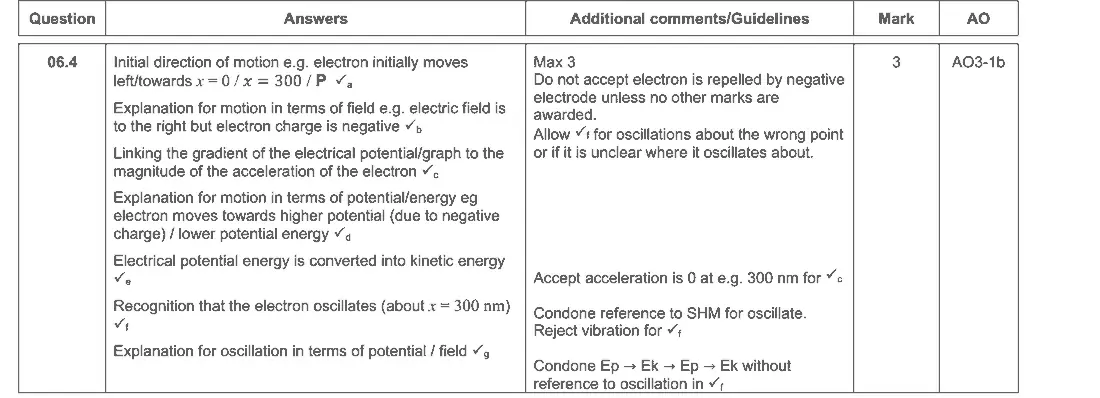
06.4 This question was very challenging for students both in their understanding of the context and their expression of their thinking. It was hoped that, by placing the electron at the edge of the confined group as shown in Figure 9, students would realise the electrons were repelled by the electrodes and remained within the group. However, many students were misled by question 06.3, not realising the difference between the two scenarios and thought that the electron moved to the right. Students who thought the electron moved to the right could gain marks by linking the graph to the motion.
A wide variety of answers was accepted for relating the motion of the electron to the information in the graph, but this still proved very challenging. Often answers mixed up concepts like potential energy and potential. It was hoped that 06.2 and 06.3 would have directed the students to talk about field and forces or potential energy being converted into kinetic energy, but many failed to make these links. Those students who realised that the electron would oscillate were generally able to score highly, but only those who really understood the context were able to make that link. Although the motion was not SHM, this answer was accepted as realising this was not applicable is beyond the scope of A-level.
Notes from the mark scheme and report
Electron (negative) moves left towards higher potential (lower PE), towards x = 300 nm
acceleration depends on gradient
PE converted to KE
it oscillates about 300 nm
many wrongly thought it moved right as in 06.3
June 2024 · Paper 2 · Q241 markMultiple choice
Answer
B
Mark scheme
Notes from the mark scheme and report
Answer: B
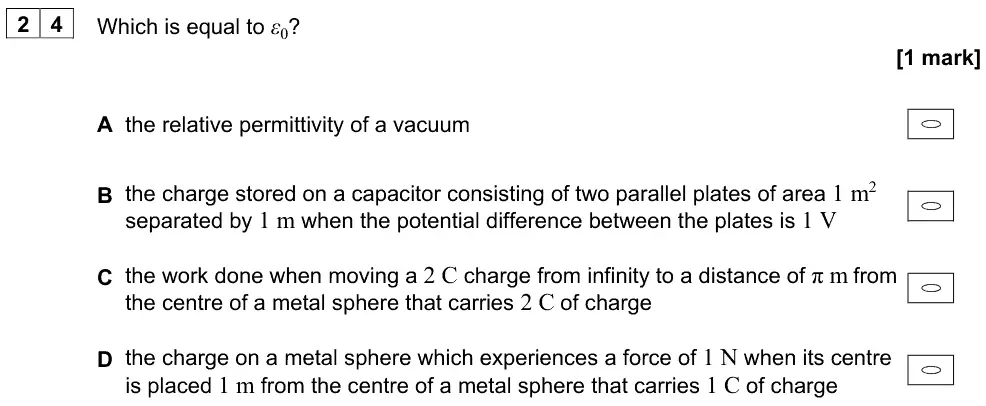
most common answer confused permittivity of free space with relative permittivity (A)
June 2024 · Paper 2 · Q251 markMultiple choice
Answer
A
Mark scheme
Notes from the mark scheme and report
Answer: A
Skills: MS0.3 Use ratios, fractions and percentages
June 2024 · Paper 2 · Q261 markMultiple choice
Answer
D
Mark scheme
Notes from the mark scheme and report
Answer: D
June 2024 · Paper 2 · Q271 markMultiple choice
Answer
B
Mark scheme
Notes from the mark scheme and report
Answer: B
Skills: MS2.3 Substitute numerical values into algebraic equations using appropriate units for physical quantities
June 2024 · Paper 2 · Q281 markMultiple choice
Answer
A
Mark scheme
Notes from the mark scheme and report
Answer: A
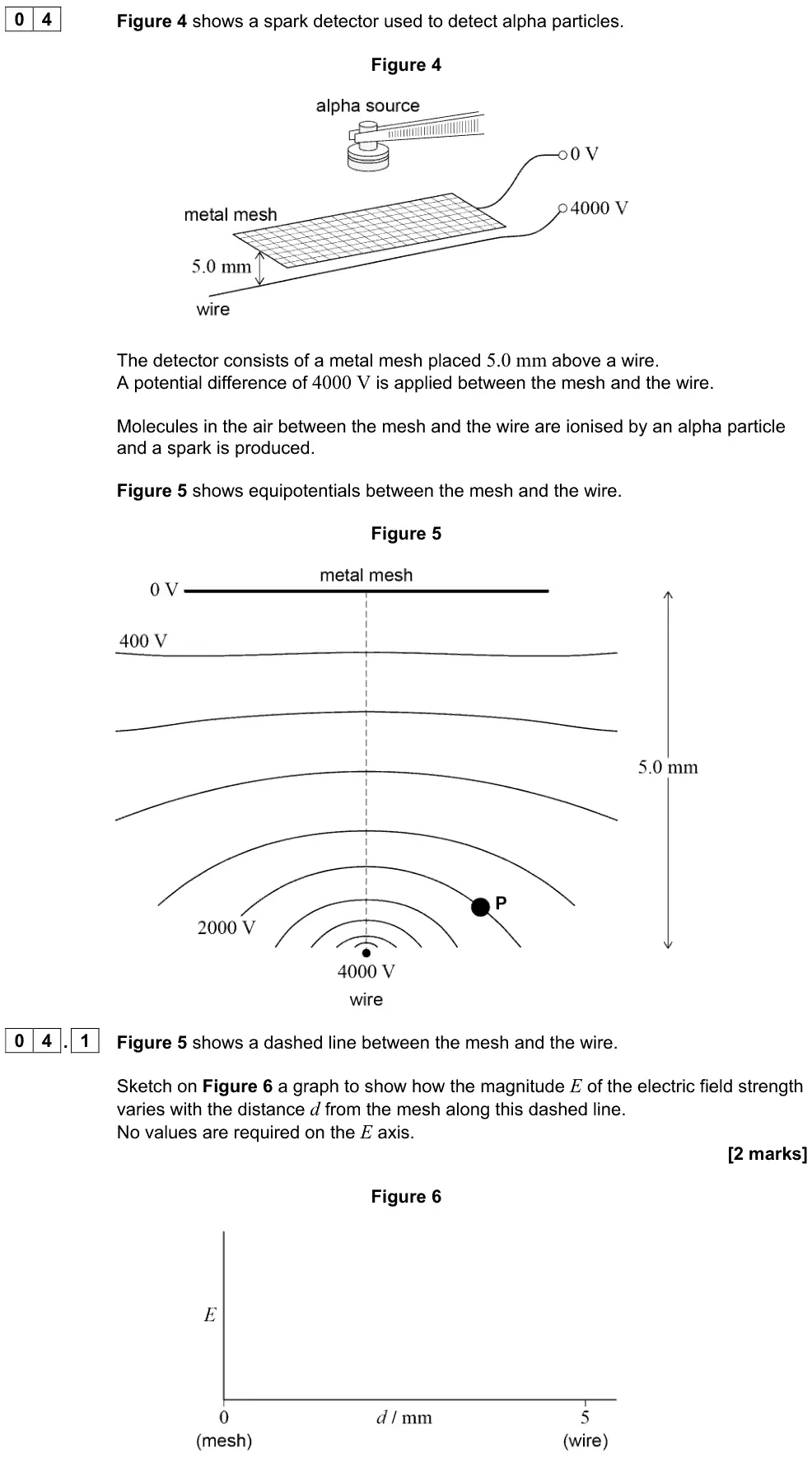
June 2023 · Paper 2 · Q4.12 marksAO2=2Diagram or graph
Mark scheme
Examiner's comment
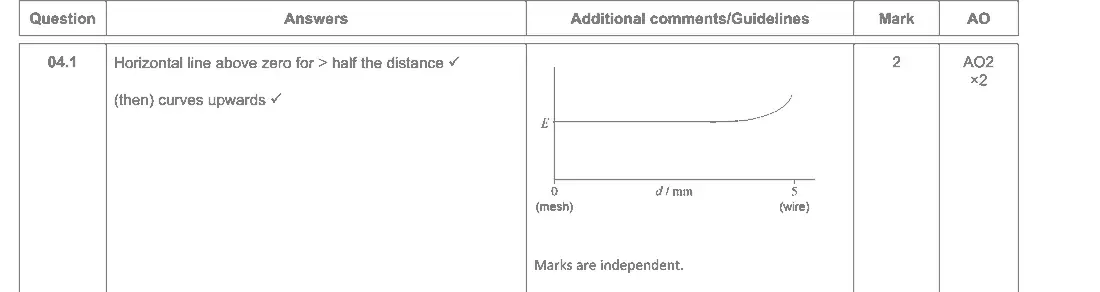
04.1 The most common answer by far was to show that the electric field strength declined with distance, with some even showing a constant gradient. It appeared that most students did not consider Figure 5 in detail, because very few sketches had a horizontal initial section.
Notes from the mark scheme and report
Constant E (horizontal line) over the first half where equipotentials are evenly spaced, then rising towards the wire where they crowd together
most drew a falling line
Skills: MS3.1 Translate information between graphical, numerical and algebraic forms
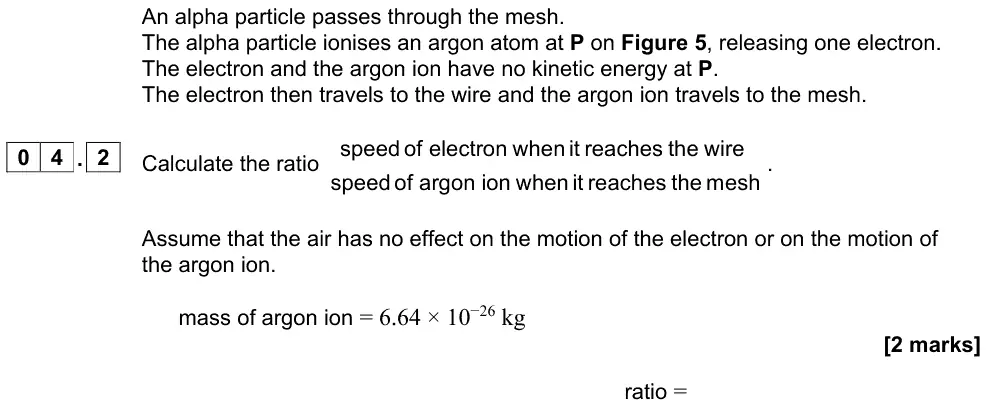
June 2023 · Paper 2 · Q4.22 marksAO3=2Calculation
Earlier part of question 4 that this part uses
Mark scheme
Examiner's comment
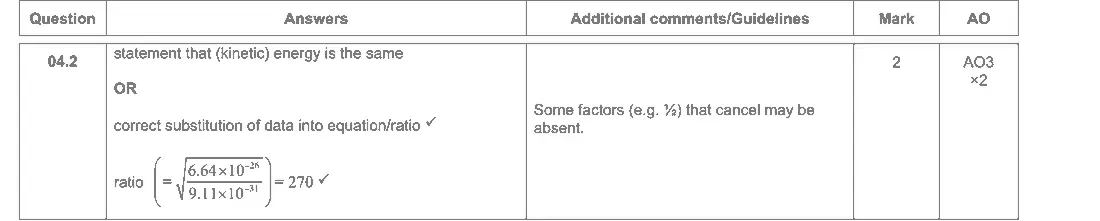
04.2 Many students knew that the energy provided both to the electron and the argon ion was the same. Using this information to calculate the ratio of speeds then contained errors and so marks were missed by many. A significant minority (more than 10% of students) made no attempt at answering this question.
Notes from the mark scheme and report
Answer: 270 (same charge through same pd so same KE
ratio = square root of argon mass / electron mass)
Skills: MS2.2 Change the subject of an equation, including non-linear equations; MS0.3 Use ratios, fractions and percentages
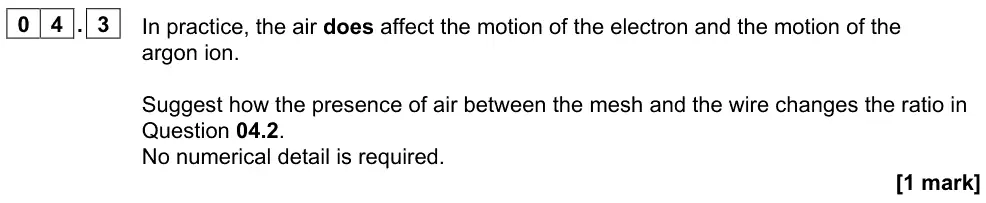
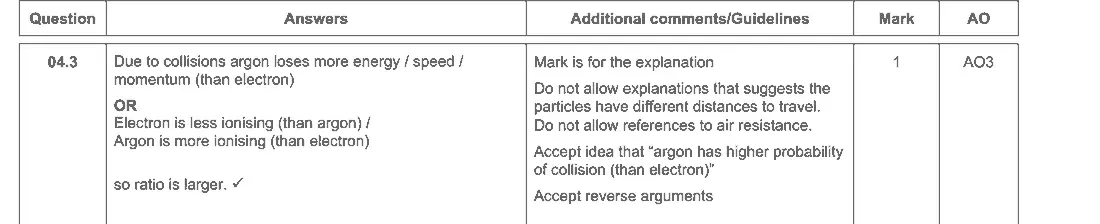
June 2023 · Paper 2 · Q4.31 markAO3=1Explanation
Earlier part of question 4 that this part uses
Mark scheme
Examiner's comment
04.3 A majority thought that the argon ion would slow down more but then gave an inadequate reason. Many suggested that “it is because it’s bigger”. Only a few mentioned collisions in their answers. Several who were on route to gaining the mark spoiled their answer by stating the ratio is smaller. 04.4 Most students knew how to analyse the graph to see whether it followed an inverse-square relationship. It was not common, however, to see this work presented in a clear or logical order. Only a minority showed a method to determine whether the graph followed an exponential relationship; those who did used a variety of acceptable methods. Looking for a variation in the half-distance was the most common. An unexpected number thought that an exponential relationship was the same as a reciprocal relationship and used a wrong test. For the last mark, many thought they had to suggest one of A or B as being correct which was not implied by the question.
Notes from the mark scheme and report
Ratio larger: argon ion collides more (loses more energy/speed) than the electron
'air resistance' or different distances not accepted
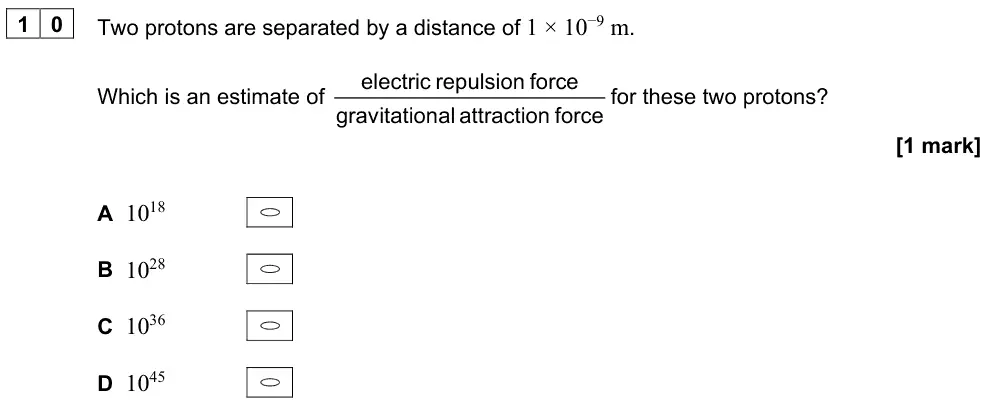
June 2023 · Paper 2 · Q101 markMultiple choice
Answer
C
Mark scheme
Notes from the mark scheme and report
Answer: C
Skills: MS1.4 Make order of magnitude calculations
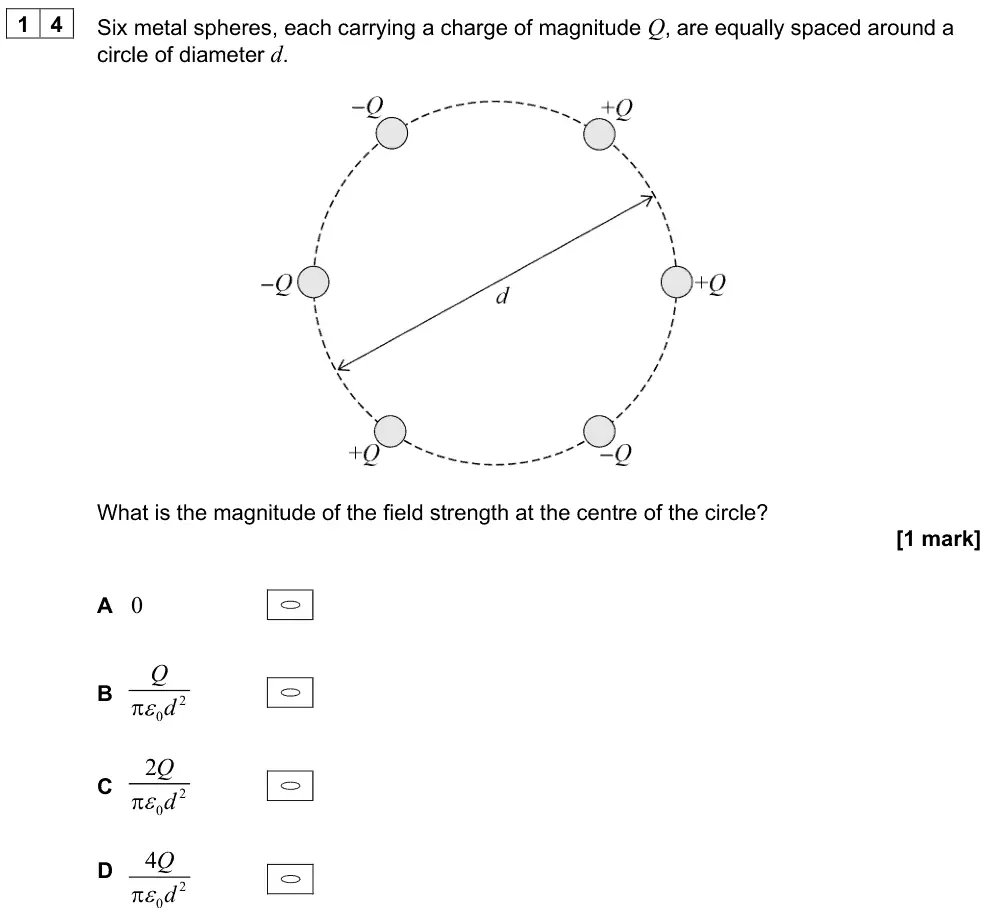
June 2023 · Paper 2 · Q141 markMultiple choiceHard
Answer
C
Mark scheme
Examiner's comment
A number of questions were found to be quite straightforward by students. These included B8, B11, B12, B17, B18, B20, B26 and B28 which were all answered correctly by at least 70% of students. The questions found to be the most difficult were B14, B15 and B25 – answered correctly by fewer than 35% of students.
Notes from the mark scheme and report
Answer: C
opposite charges at the ends of each diameter add their fields
June 2023 · Paper 2 · Q151 markMultiple choiceHard
Answer
A
Mark scheme
Examiner's comment
A number of questions were found to be quite straightforward by students. These included B8, B11, B12, B17, B18, B20, B26 and B28 which were all answered correctly by at least 70% of students. The questions found to be the most difficult were B14, B15 and B25 – answered correctly by fewer than 35% of students.
Notes from the mark scheme and report
Answer: A
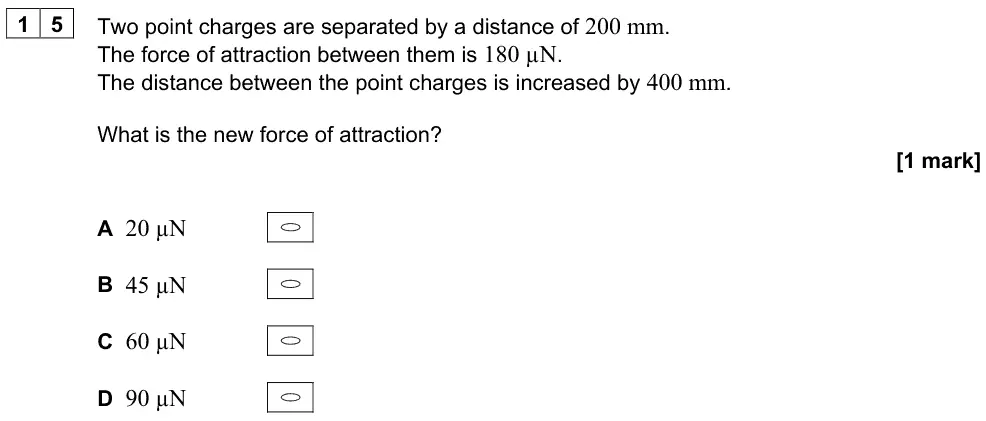
new separation is 600 mm (tripled), so force is one ninth
Skills: MS0.3 Use ratios, fractions and percentages
June 2023 · Paper 2 · Q161 markMultiple choice
Answer
A
Mark scheme
Notes from the mark scheme and report
Answer: A
June 2023 · Paper 2 · Q171 markMultiple choiceEasy
Answer
C
Mark scheme
Examiner's comment
A number of questions were found to be quite straightforward by students. These included B8, B11, B12, B17, B18, B20, B26 and B28 which were all answered correctly by at least 70% of students. The questions found to be the most difficult were B14, B15 and B25 – answered correctly by fewer than 35% of students.
Notes from the mark scheme and report
Answer: C
June 2022 · Paper 2 · Q3.12 marksAO3=2ExplanationHard
Mark scheme
Examiner's comment
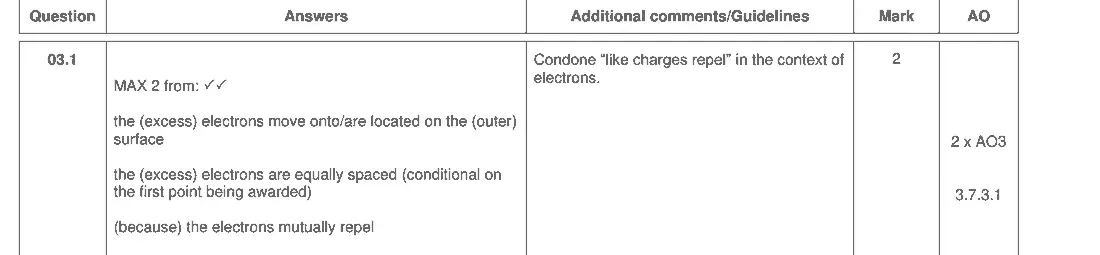
This question was not answered very well. A common wrong answer was that electrons go into orbit around the atoms in the sphere. Another was that the electrons jump out into the surrounding volume. Many students who knew that the electrons would collect on the surface were not very careful with their wording. Electrons were said to ‘surround’ the sphere; it is not clear whether this means in or out of the surface. Few referred to electrons mutually repelling and simply stated the electrons are repelled from the negative charge. Again, a reference to electrons being equally spaced in the surface was rarely stated and less than 10% scored full marks.
Question 03.1
Notes from the mark scheme and report
Excess electrons on the outer surface, evenly spaced, because they mutually repel
'surround the sphere' too vague
June 2022 · Paper 2 · Q3.24 marksAO1=2, AO2=2Calculation
Earlier part of question 3 that this part uses
Mark scheme
Examiner's comment
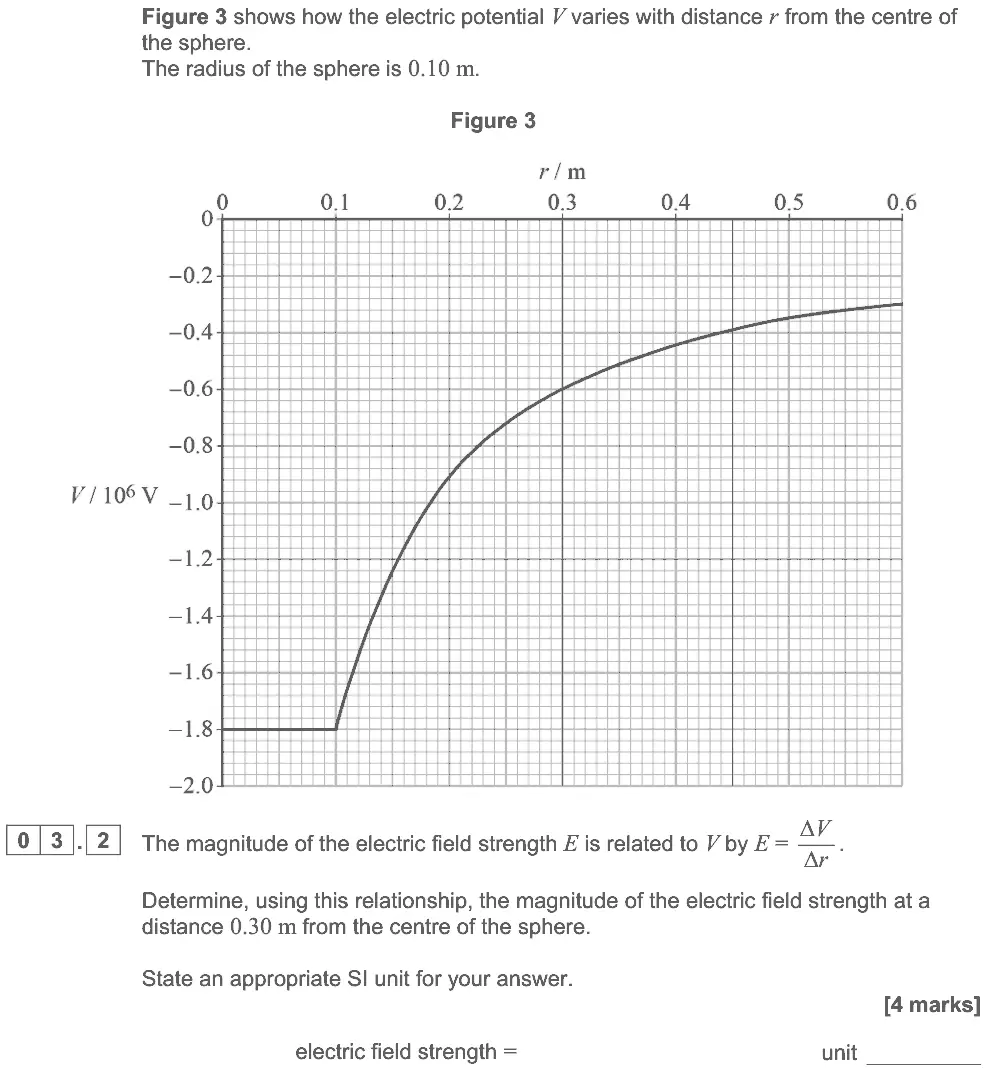
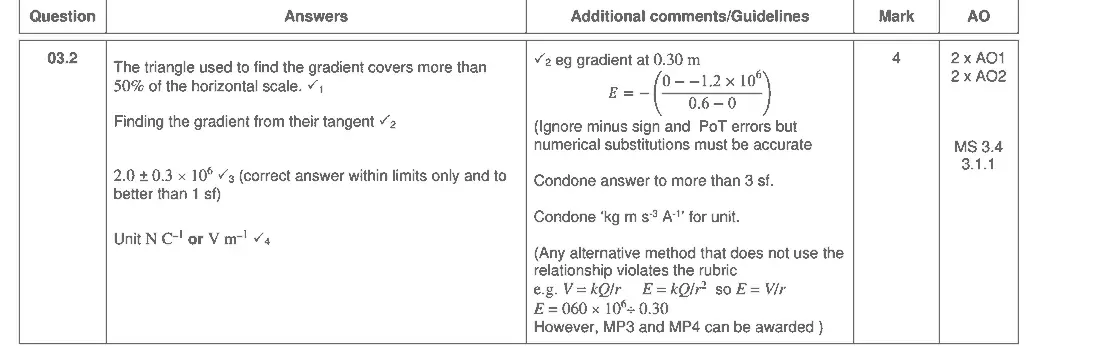
Almost half the students failed at the first stage by not using a tangent, but taking single values of V and r at r = 0.3 m. Those using a tangent approach began by drawing a tangent but then often failed to gain marks for a number of reasons. First, the triangle from which they calculated the gradient was too small. Also, at this stage powers of ten errors crept in because the potential scale was not recognised. This error was condoned in working out the gradient but was penalised in the final answer. Some students failed to give the final answer to better than one significant figure. Students who only scored one mark tended to get the final unit mark correct. Only a handful of students who went back to fundamental base units in this final part were successful.
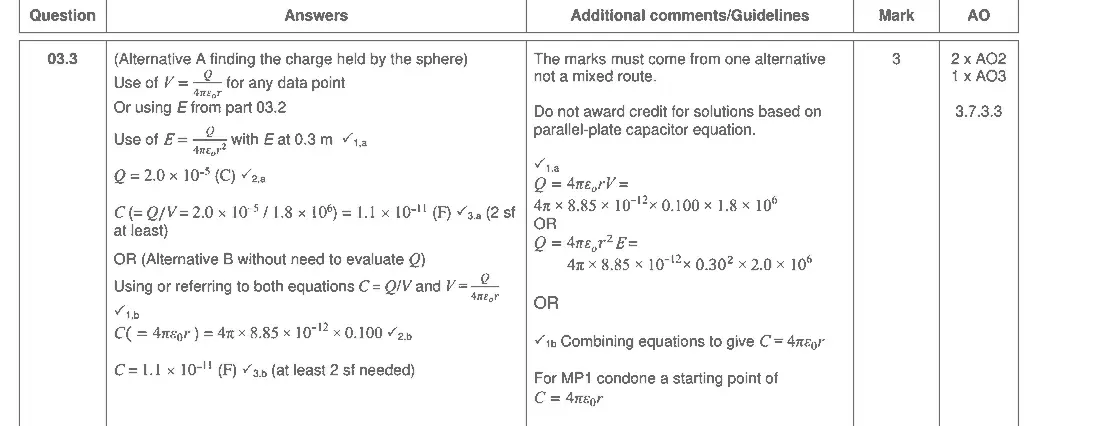
Nearly half of the students confirmed the value of the capacitance successfully. Most combined Q C = to obtain an equation the potential with distance from a point-charge equation with that of V for capacitance that could be evaluated. Some performed this in stages by obtaining the charge, and others obtained the capacitance in one combined stage. More errors were made by students who used information gained in question 03.2 concerning the electric field strength in order to find the charge. A serious conceptual mistake made by students was to think of the situation being the same as a parallel-plate capacitor with the plate area being the surface area of the sphere. This approach failed to score even though it, unfortunately, arrived numerically at the right answer.
Question 03.2
Notes from the mark scheme and report
Answer: 2.0 x 10^6 V m^-1 (or N C^-1), tolerance 0.3 x 10^6
tangent at r = 0.30 m with a large triangle
almost half read single V and r values instead of a tangent
POT errors from the 10^6 scale
Skills: MS3.6 Draw and use the slope of a tangent to a curve as a measure of rate of change; MS3.4 Determine the slope and intercept of a linear graph
June 2022 · Paper 2 · Q3.33 marksAO2=2, AO3=1Show that
Earlier part of question 3 that this part uses
Mark scheme
Examiner's comment
Nearly half of the students confirmed the value of the capacitance successfully. Most combined Q C = to obtain an equation the potential with distance from a point-charge equation with that of V for capacitance that could be evaluated. Some performed this in stages by obtaining the charge, and others obtained the capacitance in one combined stage. More errors were made by students who used information gained in question 03.2 concerning the electric field strength in order to find the charge. A serious conceptual mistake made by students was to think of the situation being the same as a parallel-plate capacitor with the plate area being the surface area of the sphere. This approach failed to score even though it, unfortunately, arrived numerically at the right answer.
Question 03.3
Notes from the mark scheme and report
Answer: C = 4 pi e0 r = 1.1 x 10^-11 F (Q = 2.0 x 10^-5 C at V = 1.8 x 10^6 V)
at least 2 sf
parallel-plate capacitor approach not credited even though it gives the right number
Skills: MS2.3 Substitute numerical values into algebraic equations using appropriate units for physical quantities
June 2022 · Paper 2 · Q151 markAO2=1Multiple choice
Answer
B
Mark scheme
Notes from the mark scheme and report
Answer: B
Skills: MS0.3 Use ratios, fractions and percentages
June 2022 · Paper 2 · Q161 markAO1=1Multiple choice
Answer
A
Mark scheme
Examiner's comment
There was a good spread in the performance on the multiple-choice section. Questions 16, 17, 24, 25 and 29 received correct answers from less than 40% of students. For question 24 it was less than 20%.
Notes from the mark scheme and report
Answer: A
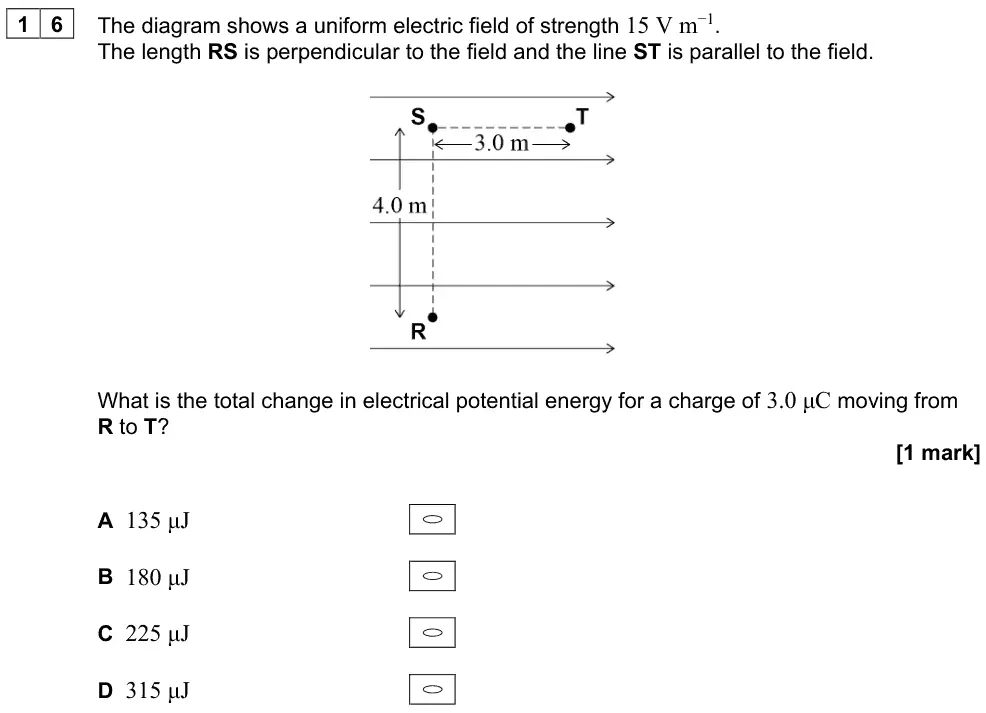
fewer than 40% correct - only the 3.0 m along the field changes potential energy (RS is an equipotential direction)
November 2021 · Paper 2 · Q5.21 markAO2=1Short answerHard
Earlier part of question 5 that this part uses
Mark scheme
Examiner's comment
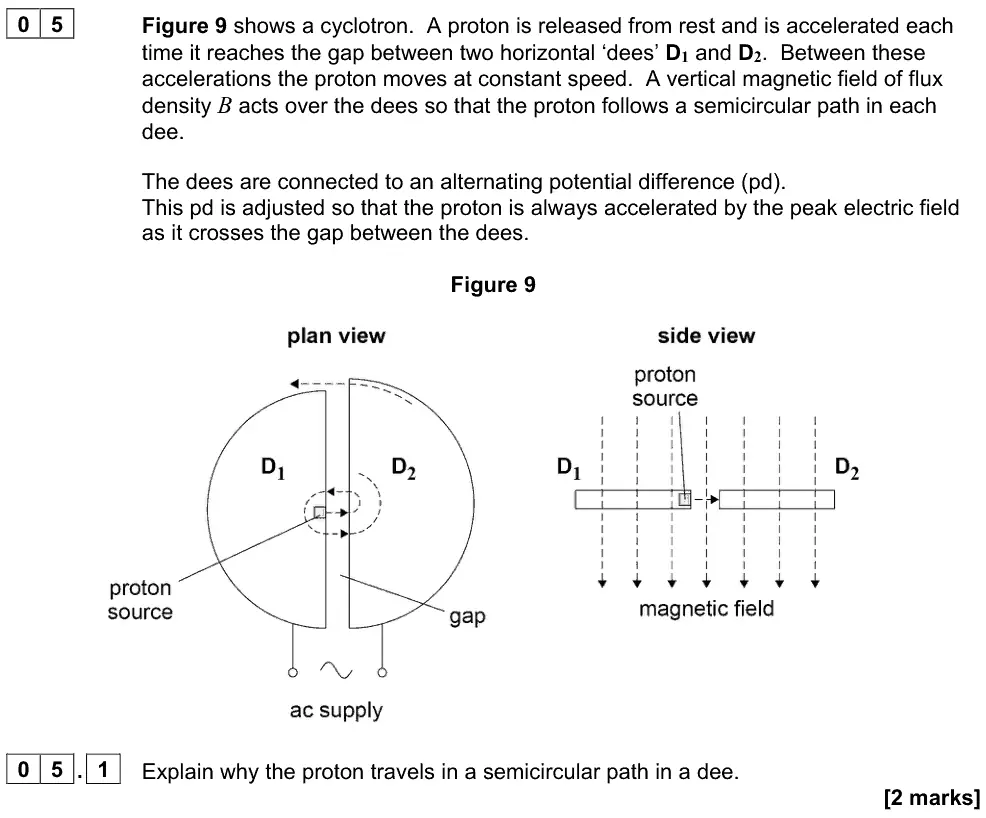
05.1 Generally students did not explain the direction in which the force acts in a clear way. Only a few could identify the magnetic force as centripetal. 05.2 Only a quarter of students determined the correct answer. Others settled at random on various energy equations to attempt an answer. 05.3 About a fifth of the students completed the task in a straightforward way. Others did not seem to know how to start; some of these gained a mark when they had established some clear workable equations in the first place. However, just writing BeV does not constitute a working equation unless there is some appropriate supporting evidence provided by the student. 05.4 Only a minority of students scored highly in this question, with very few attempting the cost calculation. Most could not get beyond the first mark. They could often make headway in calculating the kinetic energy of one cyclotron but then stopped. When it came to the cost calculation, most ignored the power law and simply used a linear relationship between kinetic energy and cost.
Notes from the mark scheme and report
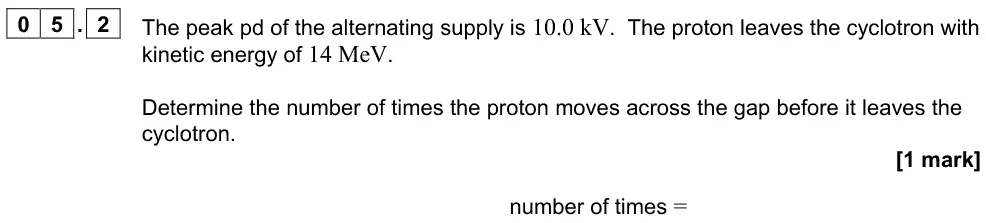
Answer: 1400 (gains 10 keV per crossing
14 MeV / 10 keV)
November 2021 · Paper 2 · Q6.32 marksAO2=2Calculation
Earlier part of question 6 that this part uses
Mark scheme
Examiner's comment
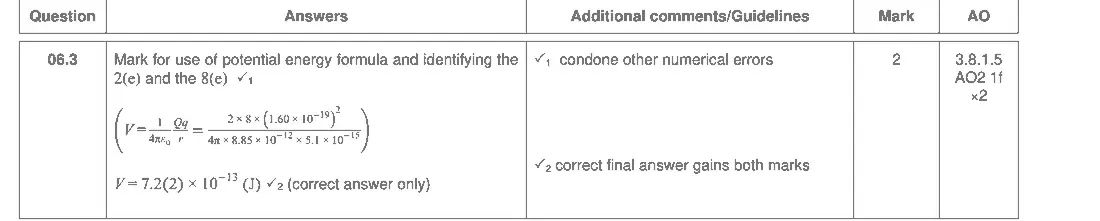
06.1 A large number of students did not address the question and spent much of the time explaining binding energy. Most students knew that energy was released in fusion but got the change in binding energy the wrong way round. They often suggested that binding energy is a quantity that can be physically exchanged. 06.2 This was a question on which most students easily scored at least one mark. Some made it much more difficult for themselves by converting each mass separately instead of just converting the final mass difference. 06.3 Most students struggled to find a correct equation. Coulomb’s force equation was often quoted and even when the correct electric potential energy equation was used, candidates added the charges or omitted the electronic-charge factor. 06.4 Students often determined the difference in nucleon number and charge of the nuclei involved but did not go on to discuss the effect this has on the rate of fusion reaction. Some simply discussed the stability of the final fusion product. Answers rarely gave a sense that the reaction takes place in a star where the nuclei move around at various speeds. Few gained marks, therefore, for stating that a particular fusion only occurs at greater kinetic energy or higher pressure. Finally, students frequently confused rate of fusion reaction with the speed of the fusion event.
Notes from the mark scheme and report
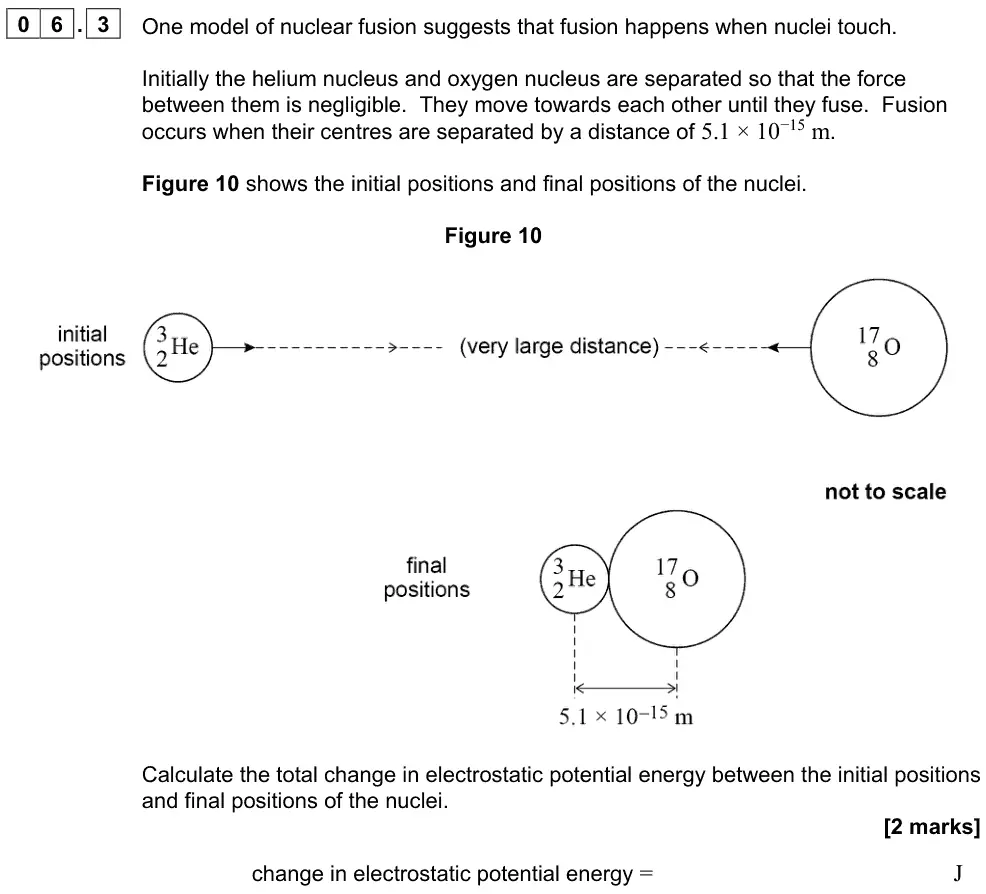
Answer: 7.2 x 10^-13 J (2e x 8e / (4 pi epsilon0 x 5.1 x 10^-15 m))
Coulomb force used by many
adding charges or omitting e were errors
Skills: MS2.3 Substitute numerical values into algebraic equations using appropriate units for physical quantities
November 2021 · Paper 2 · Q6.43 marksExplanation
Earlier part of question 6 that this part uses
Mark scheme
Examiner's comment
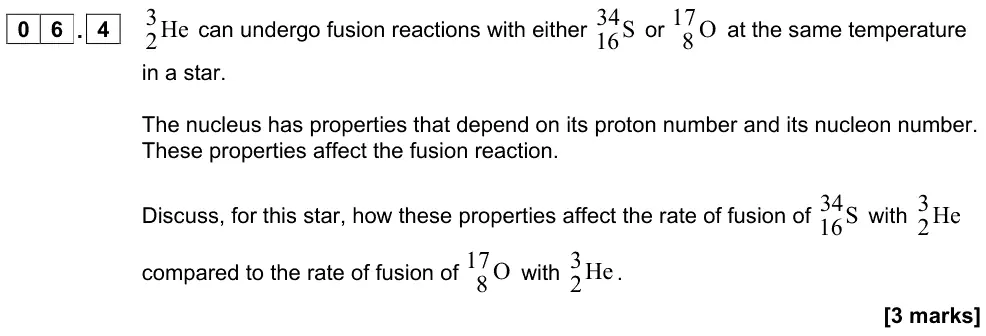
06.1 A large number of students did not address the question and spent much of the time explaining binding energy. Most students knew that energy was released in fusion but got the change in binding energy the wrong way round. They often suggested that binding energy is a quantity that can be physically exchanged. 06.2 This was a question on which most students easily scored at least one mark. Some made it much more difficult for themselves by converting each mass separately instead of just converting the final mass difference. 06.3 Most students struggled to find a correct equation. Coulomb’s force equation was often quoted and even when the correct electric potential energy equation was used, candidates added the charges or omitted the electronic-charge factor. 06.4 Students often determined the difference in nucleon number and charge of the nuclei involved but did not go on to discuss the effect this has on the rate of fusion reaction. Some simply discussed the stability of the final fusion product. Answers rarely gave a sense that the reaction takes place in a star where the nuclei move around at various speeds. Few gained marks, therefore, for stating that a particular fusion only occurs at greater kinetic energy or higher pressure. Finally, students frequently confused rate of fusion reaction with the speed of the fusion event.
Notes from the mark scheme and report
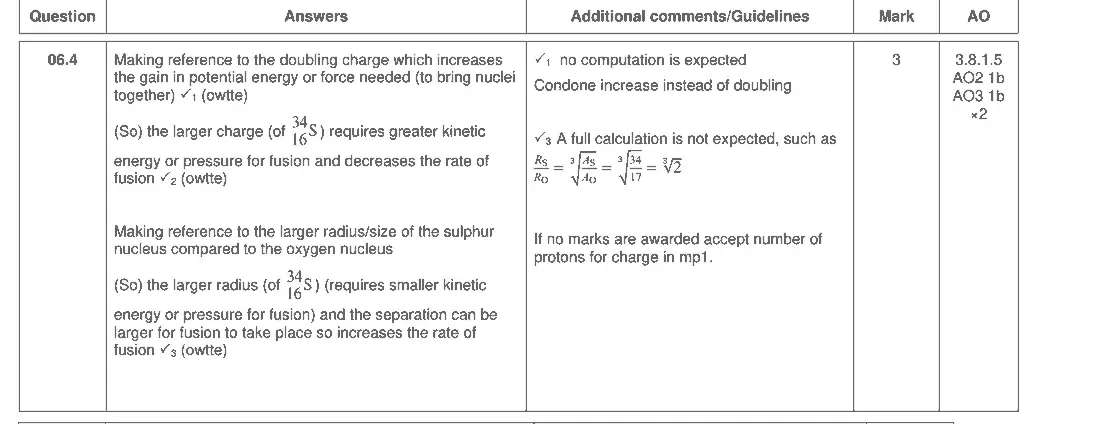
S-34 has double the charge so greater repulsion / energy needed, reducing the rate
larger S radius means fusion at larger separation, which partly increases the rate
must relate to rate in a star
November 2021 · Paper 2 · Q141 markMultiple choice
Answer
D
Mark scheme
Notes from the mark scheme and report
Answer: D
Skills: MS0.3 Use ratios, fractions and percentages
November 2021 · Paper 2 · Q151 markMultiple choice
Answer
C
Mark scheme
Notes from the mark scheme and report
Answer: C
Skills: MS1.4 Make order of magnitude calculations
November 2021 · Paper 2 · Q161 markMultiple choice
Answer
C
Mark scheme
Notes from the mark scheme and report
Answer: C
November 2021 · Paper 2 · Q171 markMultiple choice
Answer
D
Mark scheme
Notes from the mark scheme and report
Answer: D
Skills: MS2.4 Solve algebraic equations, including quadratic equations
November 2021 · Paper 2 · Q181 markMultiple choice
Answer
D
Mark scheme
Notes from the mark scheme and report
Answer: D
Skills: MS0.3 Use ratios, fractions and percentages
November 2021 · Paper 2 · Q191 markMultiple choice
Answer
C
Mark scheme
Notes from the mark scheme and report
Answer: C
November 2020 · Paper 2 · Q3.11 markAO1=1Diagram or graph
Mark scheme
Examiner's comment
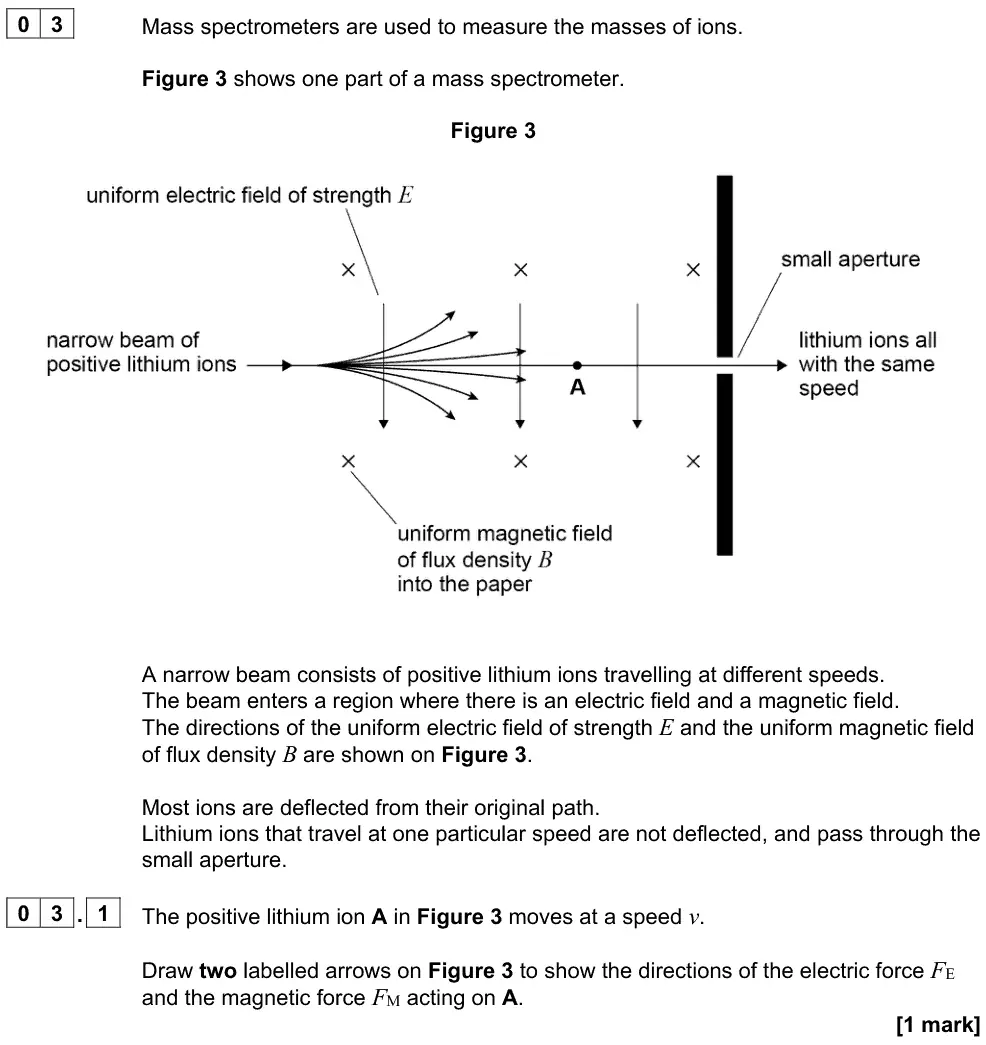
About half of the students did not gain this mark. The main error was a failure to have the forces diametrically opposed to each other. The direction of the magnetic force was the one more likely to be given the wrong direction.
Question 03.1
Notes from the mark scheme and report
Magnetic force FM upwards, electric force FE downwards at A (opposite, balanced)
about half did not gain the mark
November 2020 · Paper 2 · Q3.22 marksCalculation
Earlier part of question 3 that this part uses
Mark scheme
Examiner's comment
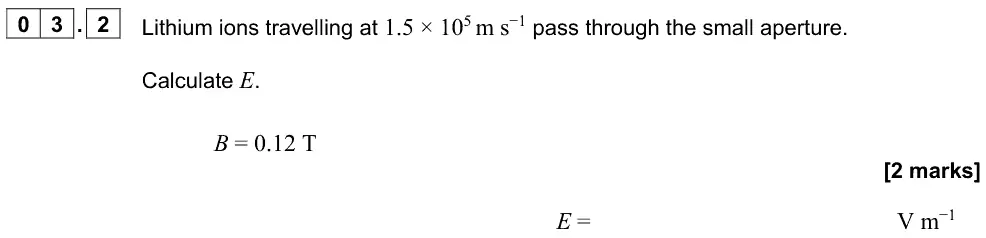
A majority of students scored full marks on this straightforward question. However, some students struggled to find the correct equations to use and a smaller number simply made a power of ten error in their calculation.
Question 03.2
Notes from the mark scheme and report
Answer: 1.8 x 10^4 V m^-1 (forces balance so E = vB)
Skills: MS2.3 Substitute numerical values into algebraic equations using appropriate units for physical quantities
November 2020 · Paper 2 · Q3.53 marksCalculationHard
Earlier part of question 3 that this part uses
Mark scheme
Examiner's comment
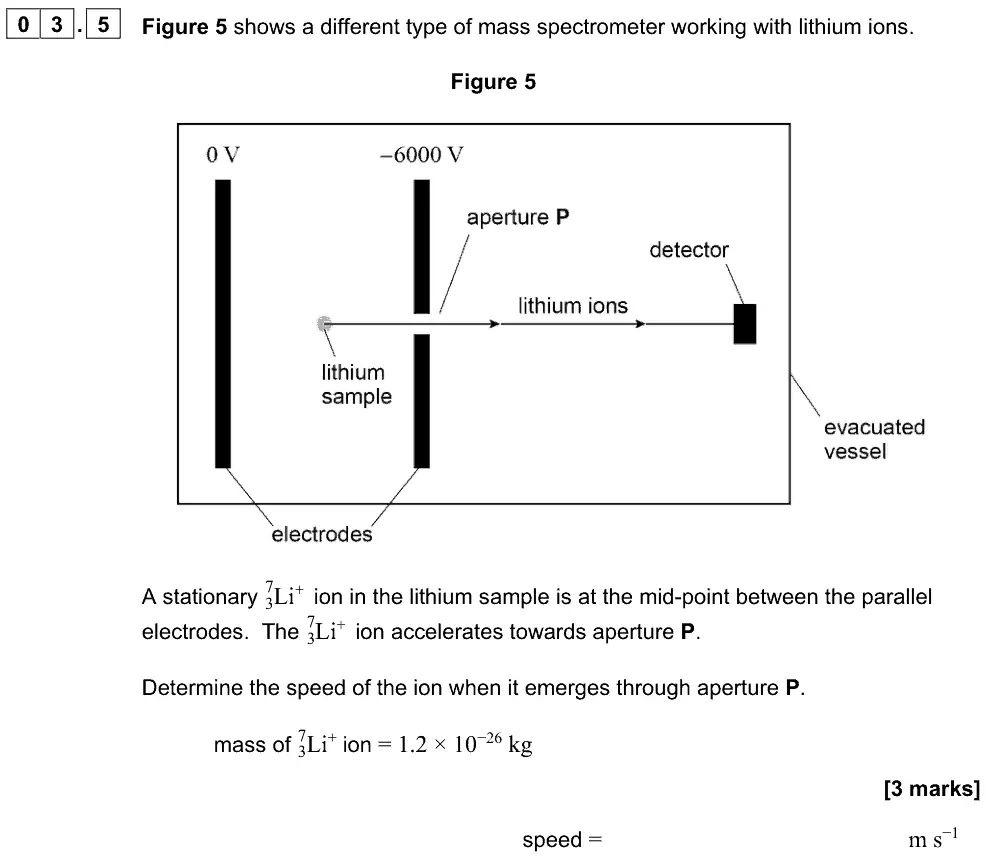
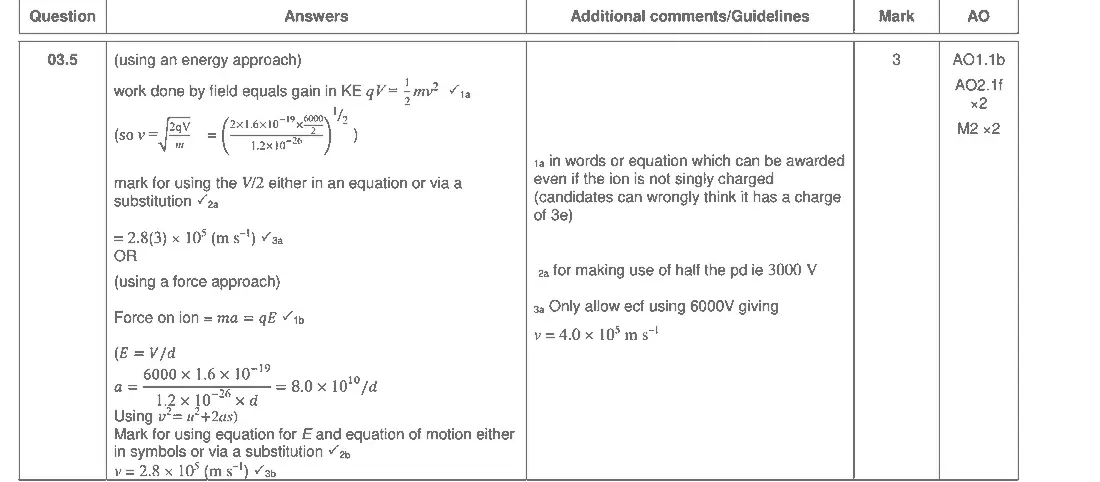
An energy approach to answering the question was the most successful and about one-sixth of the students gained full marks. Many other students were partially successful but these did not appreciate that the potential difference change for the ion was only half of the 6000 V. Those answers gaining no marks normally showed an inappropriate equation.
Question 03.5
Notes from the mark scheme and report
Answer: 2.8 x 10^5 m s^-1 (ion starts at midpoint so pd = 3000 V
qV = mv^2/2)
using 6000 V gives 4.0 x 10^5 m s^-1
Skills: MS2.2 Change the subject of an equation, including non-linear equations; MS2.3 Substitute numerical values into algebraic equations using appropriate units for physical quantities
November 2020 · Paper 2 · Q3.62 marksExplanation
Earlier part of question 3 that this part uses
Mark scheme
Examiner's comment
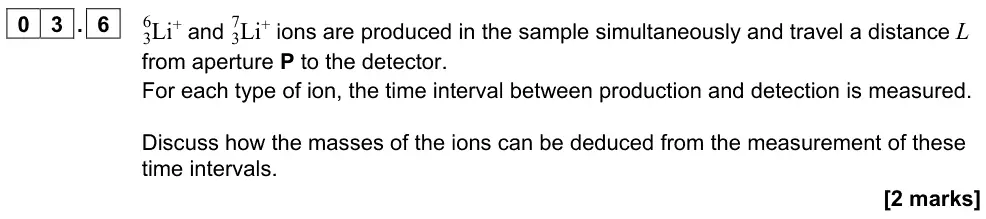
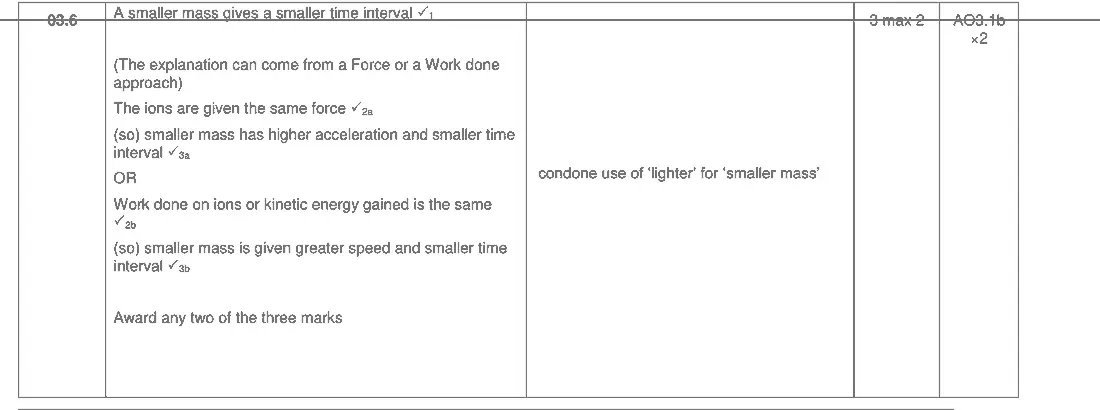
A number of students did not address the mass issue satisfactorily and focussed on the deduction distance velocity = was not detailed enough when the ions are of velocity. Simply stating time initially accelerated and then drift in a field-free region. Generally, students underperformed because they gave very general answers, such as ‘the more massive ions take longer’. Explanations were very thin on the ground. Also, technical language was poor. ‘Bigger’ was used instead of ‘larger mass’. ‘Gets quicker’ was used by students to mean both that the acceleration is larger and the time interval is smaller.
Question 03.6
Notes from the mark scheme and report
Same force (or same work / KE) on both ions so the smaller mass has greater acceleration / speed and shorter time interval
general 'heavier ions take longer' not enough
November 2020 · Paper 2 · Q5.21 markAO1=1Diagram or graph
Earlier part of question 5 that this part uses
Mark scheme
Examiner's comment
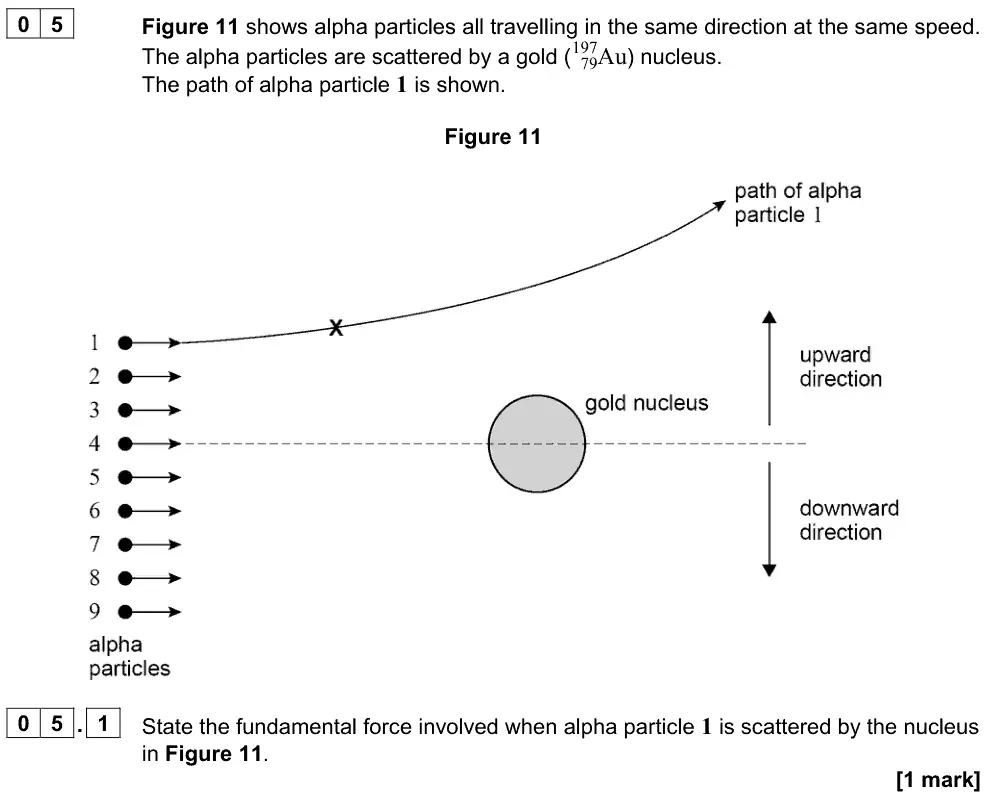
Very few students answered this correctly. Most scripts showed an arrow either in a vague upward direction (possibly normal to the path) or an arrow pointed tangentially along the path. It was clear that most students did not connect ‘rate of change of momentum’ with a force.
Question 05.2
Notes from the mark scheme and report
Arrow at X radially away from the centre of the gold nucleus (direction of the force)
tangential or vague upward arrows common
November 2020 · Paper 2 · Q5.43 marksCalculation
Earlier part of question 5 that this part uses
Mark scheme
Examiner's comment
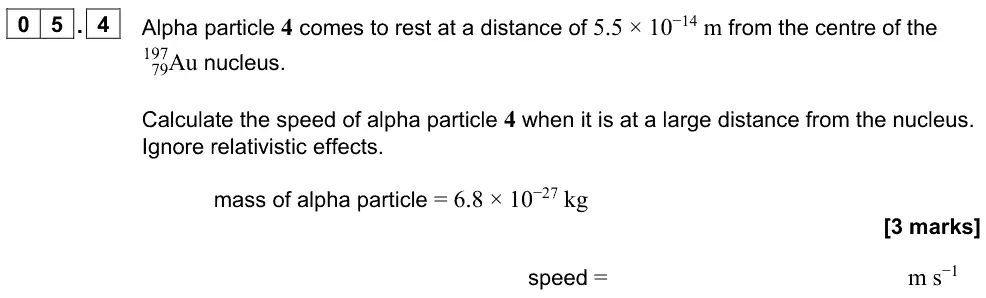
Only a minority were fully successful in answering this question because few started with the correct equation that related the loss in kinetic energy to the gain in potential energy. Many confused an expression for force with one for potential energy. Many other students either made no attempt or presented one or two equations that bore no relation to the problem.
Question 05.4
Notes from the mark scheme and report
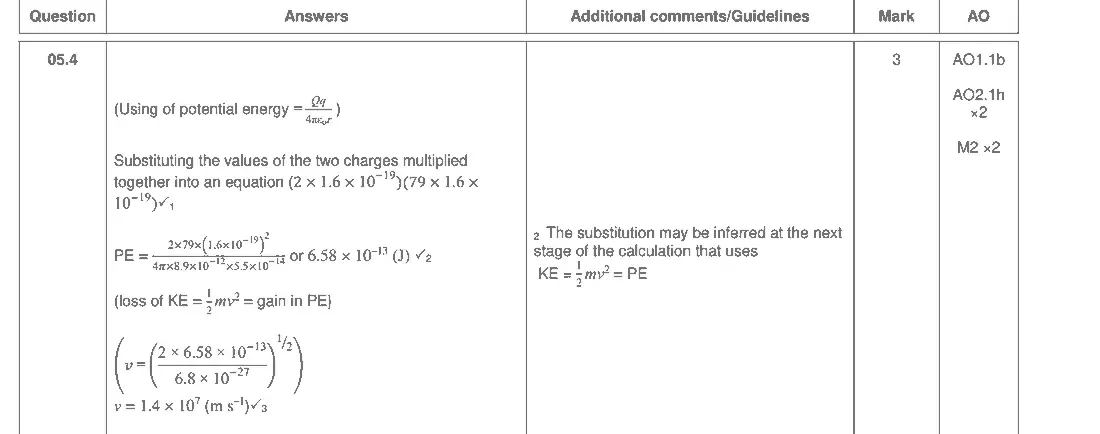
Answer: 1.4 x 10^7 m s^-1 (PE = 2 x 79 x (1.6 x 10^-19)^2 / (4 pi epsilon0 x 5.5 x 10^-14) = 6.6 x 10^-13 J = mv^2/2)
using a force expression for energy was common
Skills: MS2.3 Substitute numerical values into algebraic equations using appropriate units for physical quantities; MS2.2 Change the subject of an equation, including non-linear equations
November 2020 · Paper 2 · Q141 markMultiple choiceEasy
Answer
D
Examiner's comment
The percentage scores in the multiple-choice questions were much higher than in the written questions. A majority of the questions yielded success rates of between 50 and 75%. Questions B14 and B30 had higher success rates than this. Questions that scored in the region of 30 to 50% correct were B8, B16, B22, B26, B27, B29 and B31. Questions B7 and B24 were found to be particularly difficult with only about 16% of students being successful.
Notes from the mark scheme and report
Answer: D
Skills: MS0.3 Use ratios, fractions and percentages
November 2020 · Paper 2 · Q151 markMultiple choice
Answer
C
Notes from the mark scheme and report
Answer: C
Skills: MS0.3 Use ratios, fractions and percentages
November 2020 · Paper 2 · Q161 markMultiple choice
Answer
D
Examiner's comment
The percentage scores in the multiple-choice questions were much higher than in the written questions. A majority of the questions yielded success rates of between 50 and 75%. Questions B14 and B30 had higher success rates than this. Questions that scored in the region of 30 to 50% correct were B8, B16, B22, B26, B27, B29 and B31. Questions B7 and B24 were found to be particularly difficult with only about 16% of students being successful.
Notes from the mark scheme and report
Answer: D
November 2020 · Paper 2 · Q171 markMultiple choice
Answer
A
Notes from the mark scheme and report
Answer: A
Skills: MS0.1 Recognise and make use of appropriate units in calculations
November 2020 · Paper 2 · Q181 markMultiple choice
Answer
B
Notes from the mark scheme and report
Answer: B
Skills: MS2.4 Solve algebraic equations, including quadratic equations
June 2019 · Paper 2 · Q4.13 marksCalculationEasy
Mark scheme
Examiner's comment
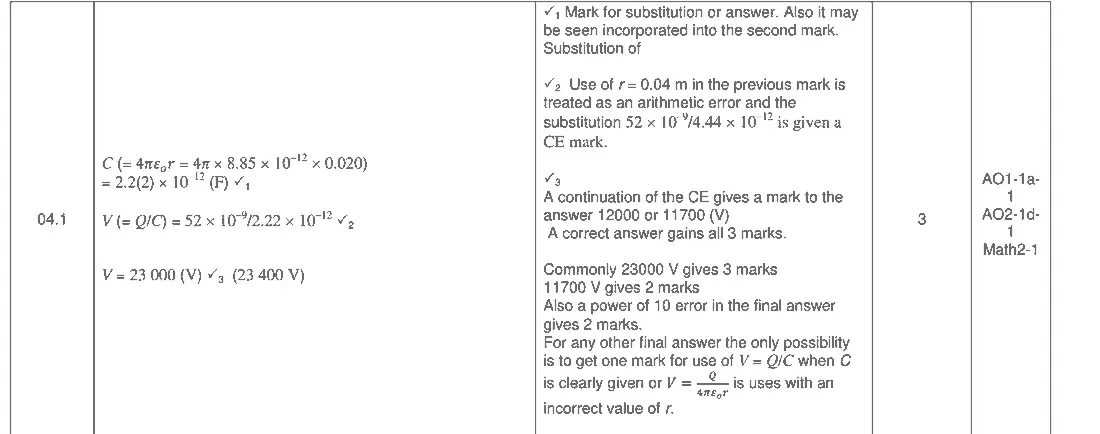
4.1 Many students found this to be a relatively straightforward calculation and 60% gained full marks. For others, the main difficulty was in choosing the correct radius to substitute into the equation. Some who performed the calculation in a single step made a slip and squared the radius.
Notes from the mark scheme and report
Answer: 23 000 V (C = 4 pi epsilon0 r = 2.22 x 10^-12 F with r = 0.020 m
V = Q/C)
wrong radius was the main error
Skills: MS2.3 Substitute numerical values into algebraic equations using appropriate units for physical quantities; MS0.2 Recognise and use expressions in decimal and standard form
June 2019 · Paper 2 · Q4.22 marksDiagram or graphHard
Earlier part of question 4 that this part uses
Mark scheme
Examiner's comment
4.2 On this relatively simple question only a quarter of the students scored both marks. Even more able students did not seem to know that the foot of an arrow represents the position where the force is applied. The weight arrow, for example, was more frequently seen starting at the base of the sphere B rather than starting at the centre of mass. Also, many students did not try to represent all three forces.
Notes from the mark scheme and report
Three labelled arrows on B: tension along the thread upwards, weight vertically down from the centre, electrostatic repulsion to the right
arrows must start at the point of application
June 2019 · Paper 2 · Q4.43 marksShow thatEasy
Earlier part of question 4 that this part uses
Mark scheme
Examiner's comment
4.4 Most students scored some marks on this question and over 60% gained full marks. The minority that failed to gain marks either did not square the distance between the centres of charge or did not use the centre-to-centre distance.
Notes from the mark scheme and report
Answer: 3.8 x 10^-3 N (centre-to-centre distance 80 mm
F = Q^2 / 4 pi epsilon0 r^2)
show at least 2 sf
Skills: MS2.3 Substitute numerical values into algebraic equations using appropriate units for physical quantities
June 2019 · Paper 2 · Q4.62 marksCalculation
Earlier part of question 4 that this part uses
Mark scheme
Examiner's comment
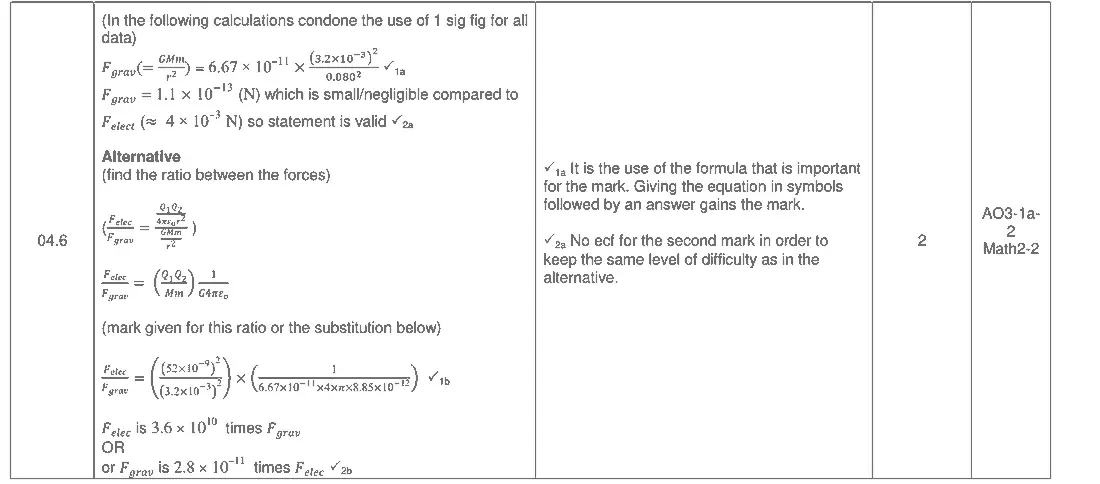
4.6 The calculation of the gravitational force was done well by most students. Unfortunately, many students then failed to compare this to the electrostatic force. Many simply said the gravitational force was negligible without saying compared to what.
Notes from the mark scheme and report
Answer: F grav = 1.1 x 10^-13 N, negligible compared with the electrostatic force 3.8 x 10^-3 N, so valid
must compare with the electrostatic force
Skills: MS2.3 Substitute numerical values into algebraic equations using appropriate units for physical quantities; MS0.2 Recognise and use expressions in decimal and standard form
June 2019 · Paper 2 · Q141 markMultiple choice
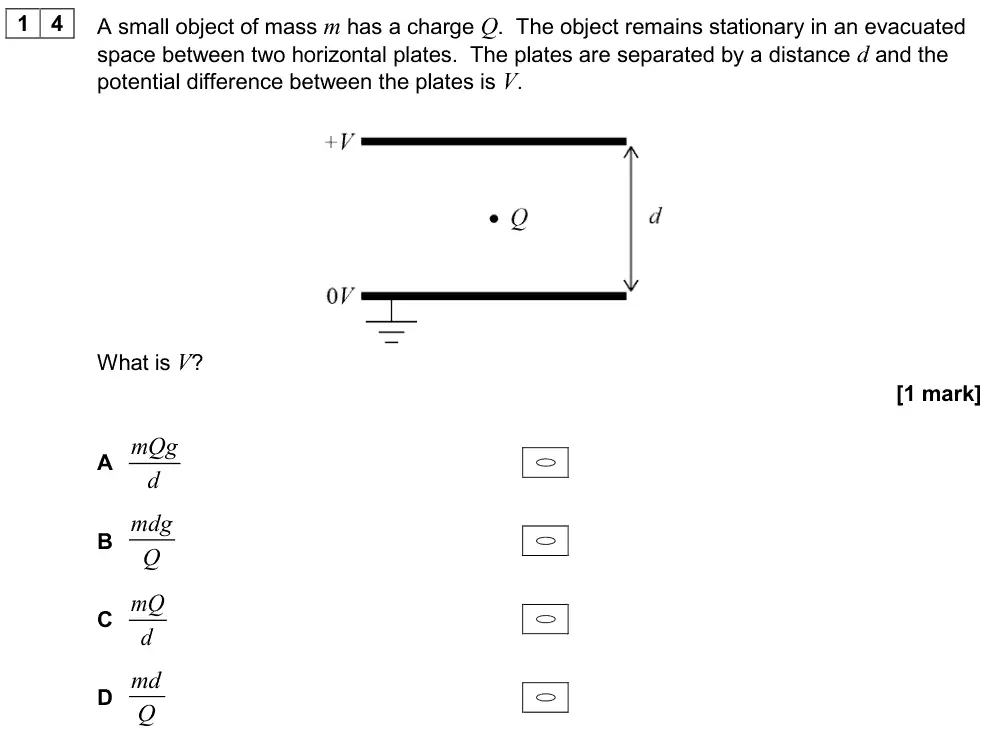
Answer
B
Notes from the mark scheme and report
Answer: B
Skills: MS2.2 Change the subject of an equation, including non-linear equations
June 2019 · Paper 2 · Q151 markMultiple choice
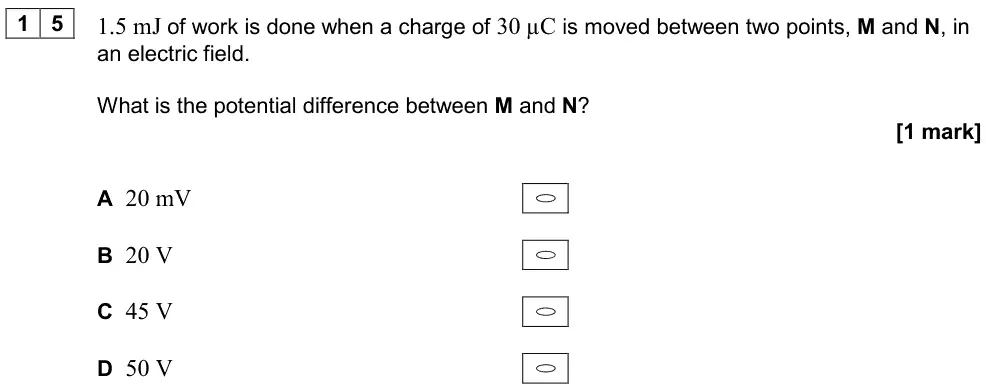
Answer
D
Notes from the mark scheme and report
Answer: D
Skills: MS0.2 Recognise and use expressions in decimal and standard form
June 2019 · Paper 2 · Q161 markMultiple choice
Answer
D
Notes from the mark scheme and report
Answer: D
June 2018 · Paper 2 · Q2.12 marksShort answer
Mark scheme
Examiner's comment
02.1 As was the case in 2017, many students had not learnt definitions thoroughly. So, the actual unit of charge was absent from many scripts as was a reference to a positive charge. Weaker students mixed the definition of electric field strength with electric potential. 44.4% of students did not gain any credit here.
Notes from the mark scheme and report
Force per unit charge (per coulomb) on a small positive charge
equation alone needs defined symbols
confusion with potential
44.4% scored zero
June 2018 · Paper 2 · Q2.23 marksCalculation
Earlier part of question 2 that this part uses
Mark scheme
Examiner's comment
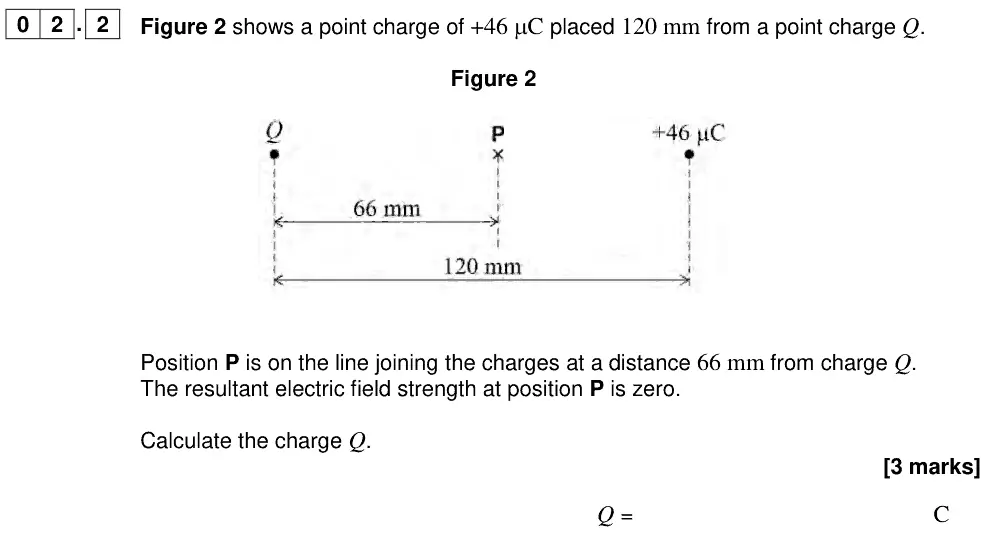
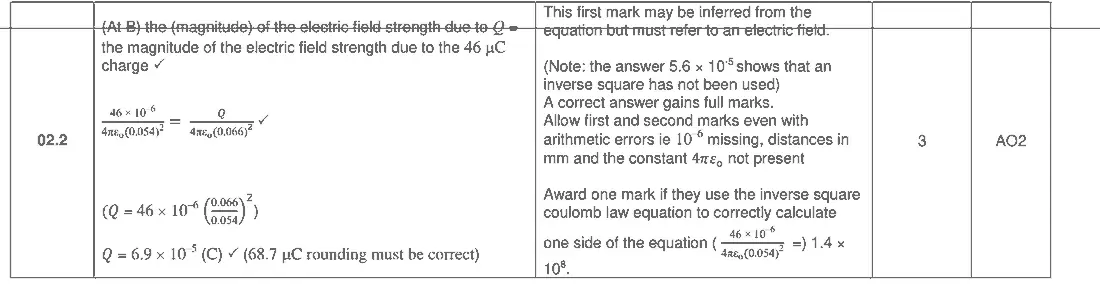
02.2 This was a very discriminating question and just over half of the students performed well and gained at least two marks. The hurdle to overcome was to use an inverse-square force equation rather than an inverse equation that relates to potential. Once the correct equation had been established, most found no difficulty in the re-arrangements involved. It is worth pointing out that students who explained their work with a couple of words were much more likely to obtain marks even if their calculations were wrong.
Notes from the mark scheme and report
Answer: 6.9 x 10^-5 C (Q = 46 microC x (0.066/0.054)^2)
using an inverse (potential) law gives 5.6 x 10^-5 C
Skills: MS2.2 Change the subject of an equation, including non-linear equations; MS2.3 Substitute numerical values into algebraic equations using appropriate units for physical quantities; MS0.3 Use ratios, fractions and percentages
June 2018 · Paper 2 · Q2.32 marksExplanation
Earlier part of question 2 that this part uses
Mark scheme
Examiner's comment
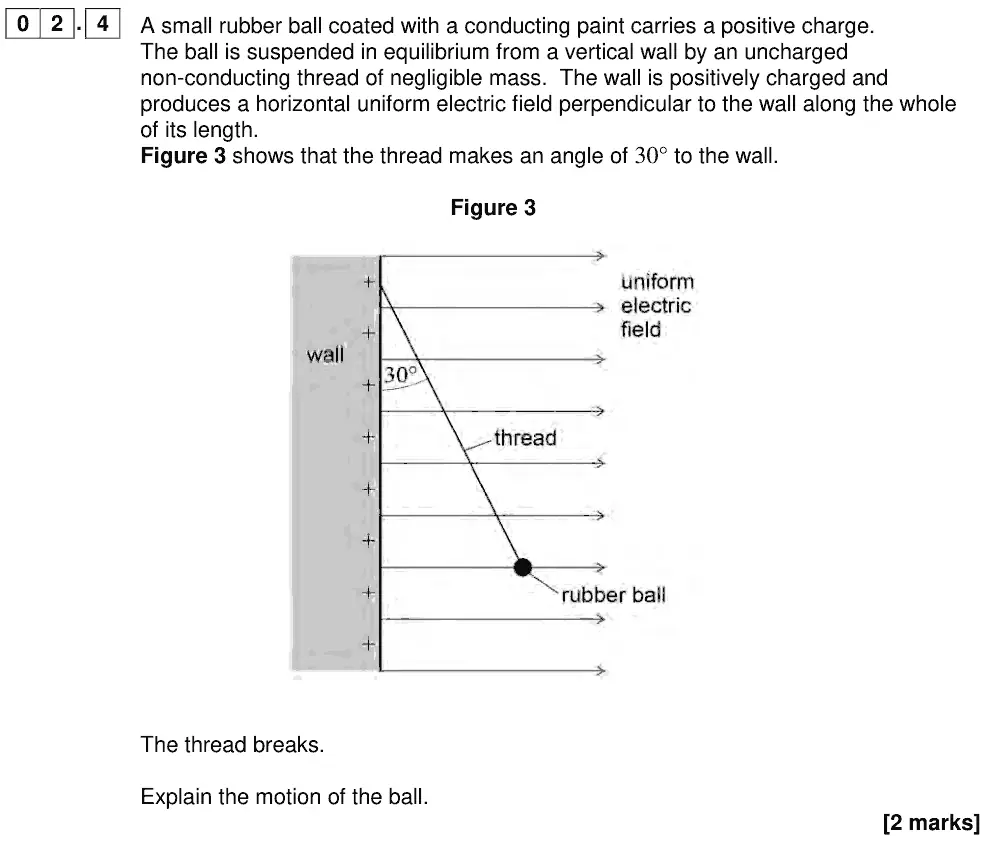
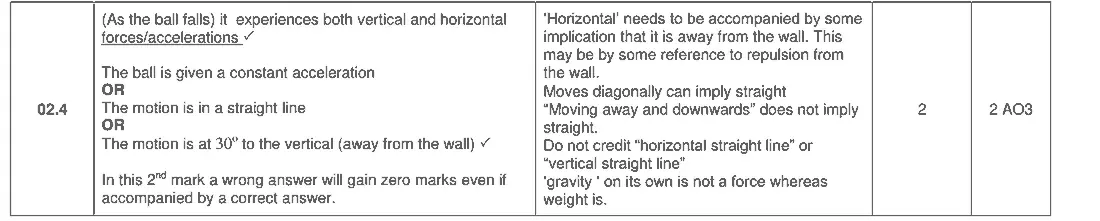
02.3 Most students showed a weakness in their understanding in this topic. The fact that the resultant electric field was zero at P, and they rightly concluded that the field was zero at infinity, made it too tempting to conclude the line between P and infinity must be an equipotential, which was obviously wrong. Only about a third of the students thought about the work that must be done in moving a proton to a region close to two positive charges. Also very few referred to the potential being zero at infinity. 60.7% of students scored zero. 02.4 This was another question done badly, with 61.1% failing to score. The common answers fell into two groups. The first just regarded the ball being released as if it were thrown and therefore following a parabolic path. The second group ignored gravity all together and wrote about the ball travelling away horizontally. Very few students analysed the situation by considering the forces and then the resulting accelerations in the horizontal and vertical directions. In fact, many students did not mention force or acceleration but kept to generalities such as “it moves away from the wall and falls”.
Notes from the mark scheme and report
Yes: P is at a positive potential (both charges positive, like charges repel) and potential at infinity is zero, so work must be done on the proton
zero field at P does not mean zero potential
60.7% scored zero
June 2018 · Paper 2 · Q2.42 marksExplanation
Earlier part of question 2 that this part uses
Mark scheme
Examiner's comment
02.3 Most students showed a weakness in their understanding in this topic. The fact that the resultant electric field was zero at P, and they rightly concluded that the field was zero at infinity, made it too tempting to conclude the line between P and infinity must be an equipotential, which was obviously wrong. Only about a third of the students thought about the work that must be done in moving a proton to a region close to two positive charges. Also very few referred to the potential being zero at infinity. 60.7% of students scored zero. 02.4 This was another question done badly, with 61.1% failing to score. The common answers fell into two groups. The first just regarded the ball being released as if it were thrown and therefore following a parabolic path. The second group ignored gravity all together and wrote about the ball travelling away horizontally. Very few students analysed the situation by considering the forces and then the resulting accelerations in the horizontal and vertical directions. In fact, many students did not mention force or acceleration but kept to generalities such as “it moves away from the wall and falls”.
Notes from the mark scheme and report
Constant horizontal (electric) and vertical (weight) forces give constant acceleration, so a straight line at 30 degrees to the vertical away from the wall
parabolic path or horizontal motion common errors
61.1% failed to score
June 2018 · Paper 2 · Q201 markMultiple choice
Answer
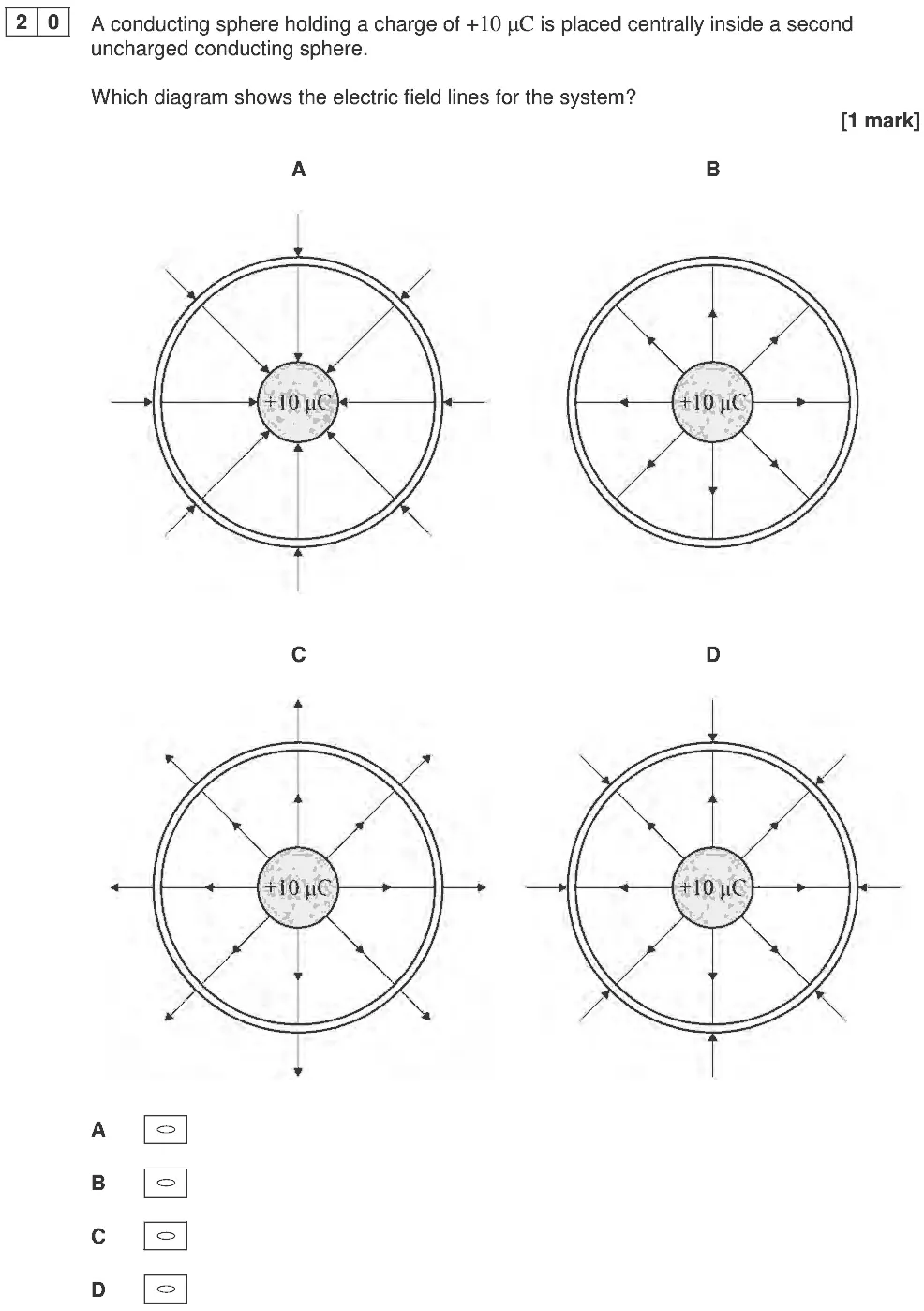
C
Notes from the mark scheme and report
Answer: C
June 2018 · Paper 2 · Q211 markMultiple choice
Answer
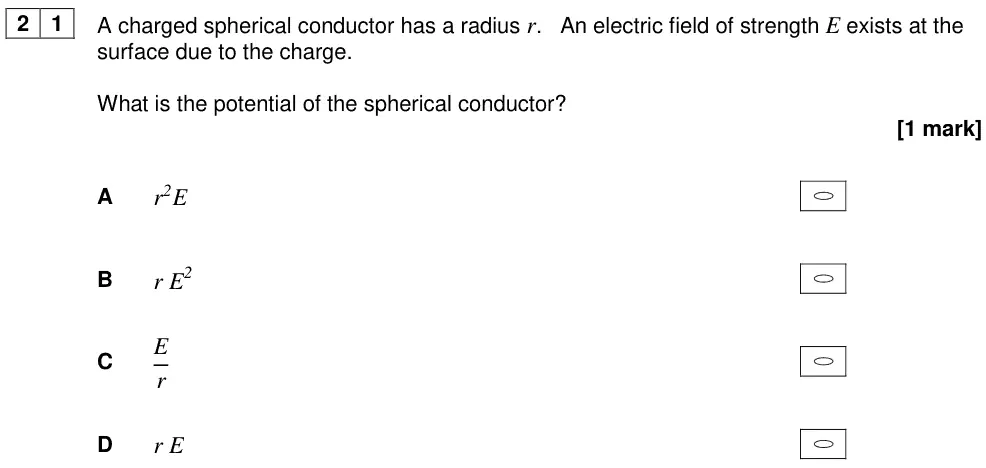
D
Notes from the mark scheme and report
Answer: D
Skills: MS2.2 Change the subject of an equation, including non-linear equations
June 2018 · Paper 2 · Q221 markMultiple choice
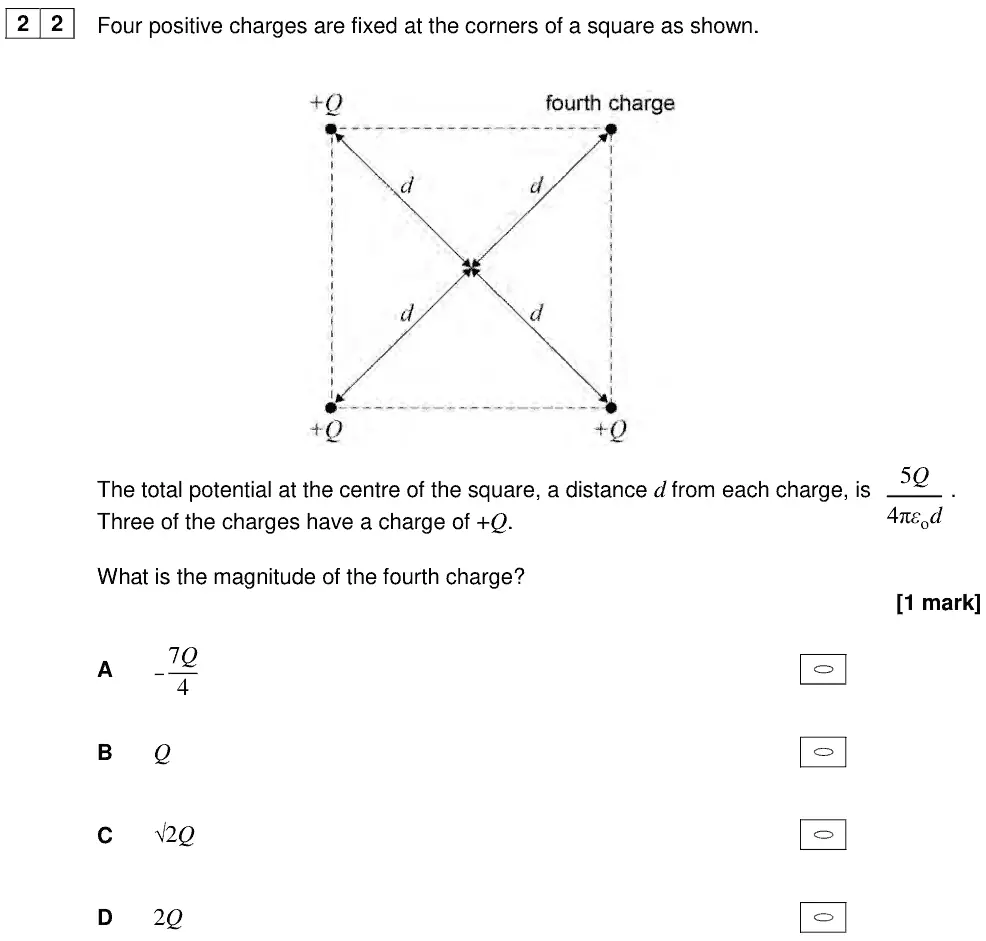
Answer
D
Notes from the mark scheme and report
Answer: D
Skills: MS2.2 Change the subject of an equation, including non-linear equations
June 2018 · Paper 2 · Q231 markMultiple choiceHard
Answer
B
Examiner's comment
The 25 questions in Section B are summarised in the table below. For each question, the key (correct answer) is provided, along with the percentage of students answering correctly. There was a good range of ‘facility’ across this section; the most accessible question was 13 (answered correctly by 81.4% of students), the least accessible were 12 and 23 (answered correctly by only 15% and 13.3% of students respectively). The overall mean mark achieved by the students for Section B was 15.4 out of 25 (61.6%).
Notes from the mark scheme and report
Answer: B
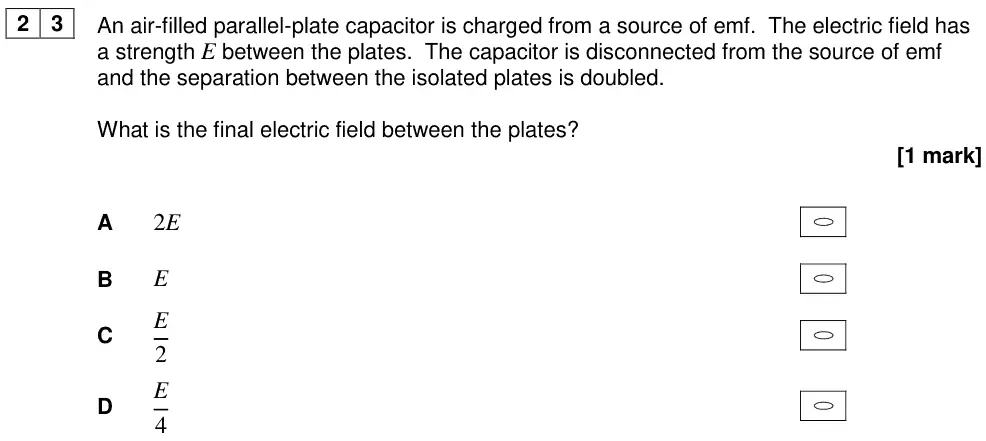
field stays the same because Q (and so charge density) is unchanged
June 2017 · Paper 2 · Q6.41 markShort answer
Earlier part of question 6 that this part uses
Mark scheme
Examiner's comment
06.4 The idea behind the question was well understood by the vast majority of students. It was only the least able who missed out on the mark.
Notes from the mark scheme and report
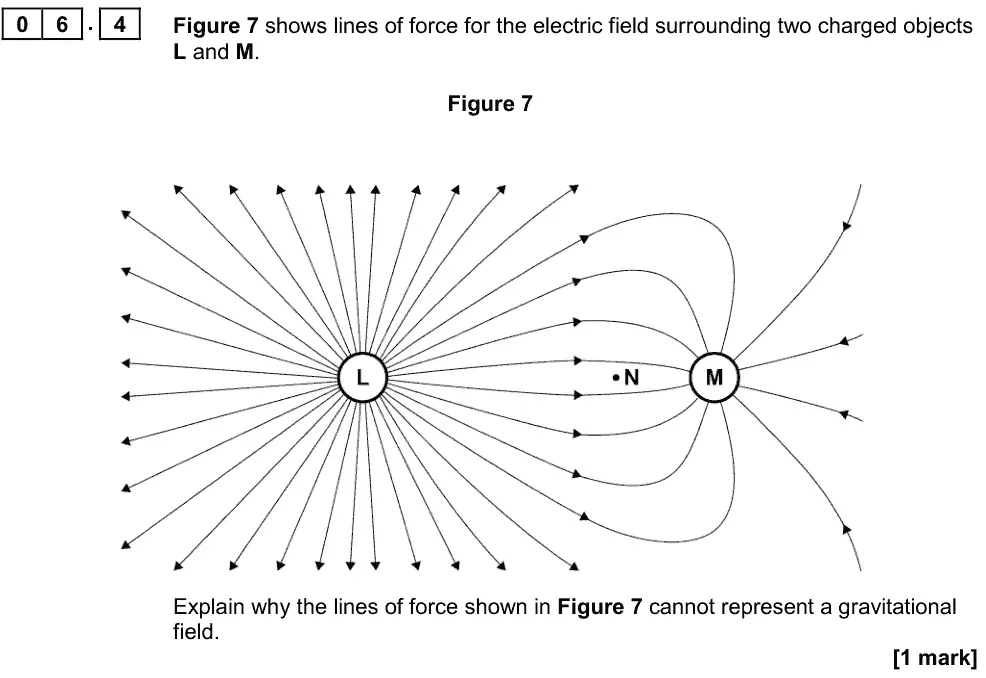
Gravitational field lines can only point towards a mass (attraction only)
lines leave L
referring to positive/negative almost always lost the mark
June 2017 · Paper 2 · Q6.51 markShort answerEasy
Earlier part of question 6 that this part uses
Mark scheme
Examiner's comment
06.5 Most students, 70%, could do this easily.
Notes from the mark scheme and report
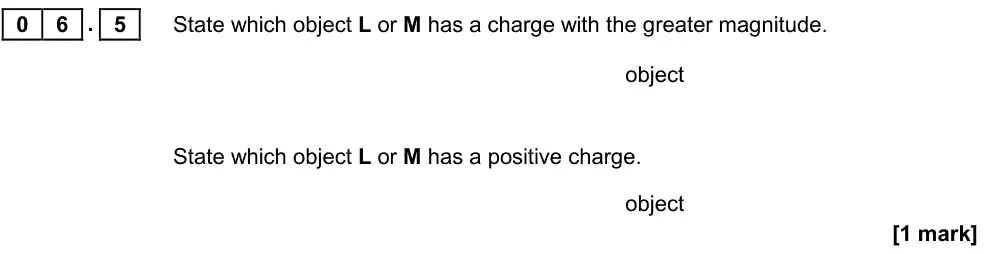
L and L (more lines from L
lines point away from L)
both needed
June 2017 · Paper 2 · Q6.62 marksDiagram or graph
Earlier part of question 6 that this part uses
Mark scheme
Examiner's comment
06.6 A majority of students seemed to be unaware how equipotential lines relate to field lines. Very few scored full marks. Common shapes drawn were a line joining L to M, a straight vertical line, and a tight circle around M.
Notes from the mark scheme and report
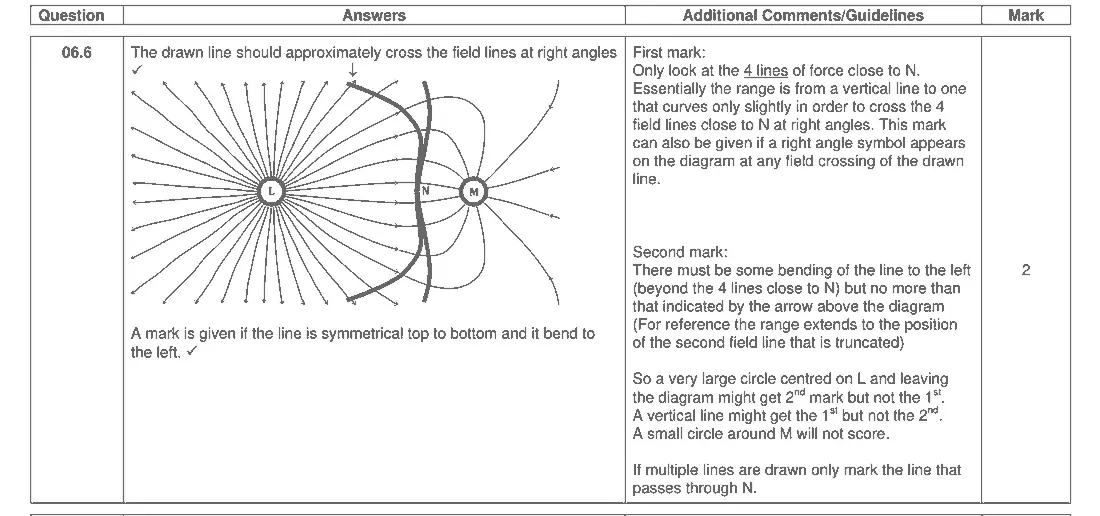
Line through N crossing field lines at right angles, symmetrical and bending towards L
common errors: line from L to M, straight vertical line, tight circle round M
June 2017 · Paper 2 · Q151 markMultiple choice
Answer
A
Notes from the mark scheme and report
Answer: A
Skills: MS3.1 Translate information between graphical, numerical and algebraic forms
June 2017 · Paper 2 · Q161 markMultiple choice
Answer
A
Notes from the mark scheme and report
Answer: A
Skills: MS2.2 Change the subject of an equation, including non-linear equations
June 2017 · Paper 2 · Q171 markMultiple choice
Answer
C
Notes from the mark scheme and report
Answer: C
Skills: MS2.3 Substitute numerical values into algebraic equations using appropriate units for physical quantities
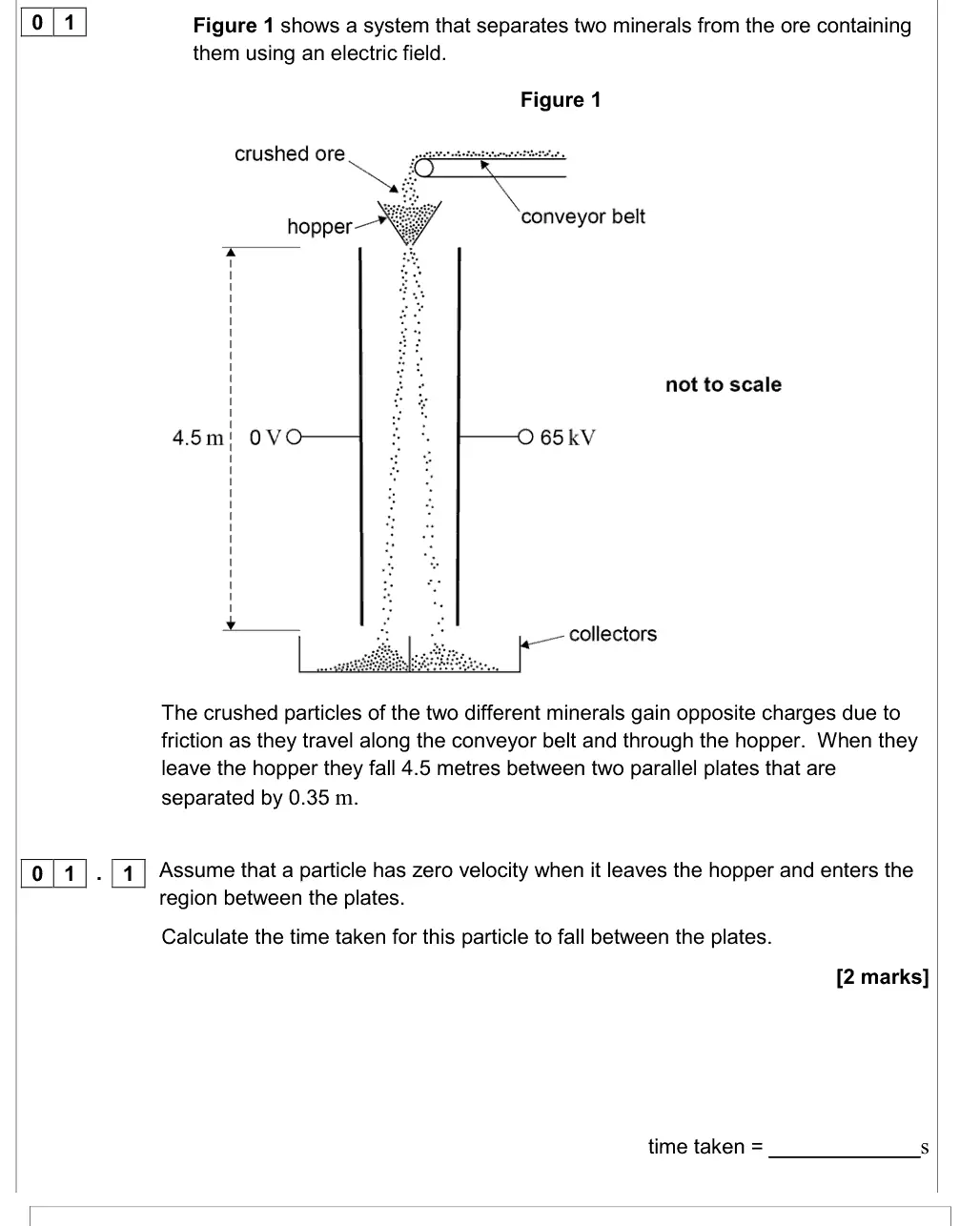
Specimen set 1 · Paper 2 · Q1.23 marksShow that
Earlier part of question 1 that this part uses
Mark scheme
Notes from the mark scheme and report
Answer: 0.22 m s^-2 (E = 65 kV / 0.35 m = 1.86 x 10^5 V m^-1
a = E x Q/m)
Skills: MS2.3 Substitute numerical values into algebraic equations using appropriate units for physical quantities
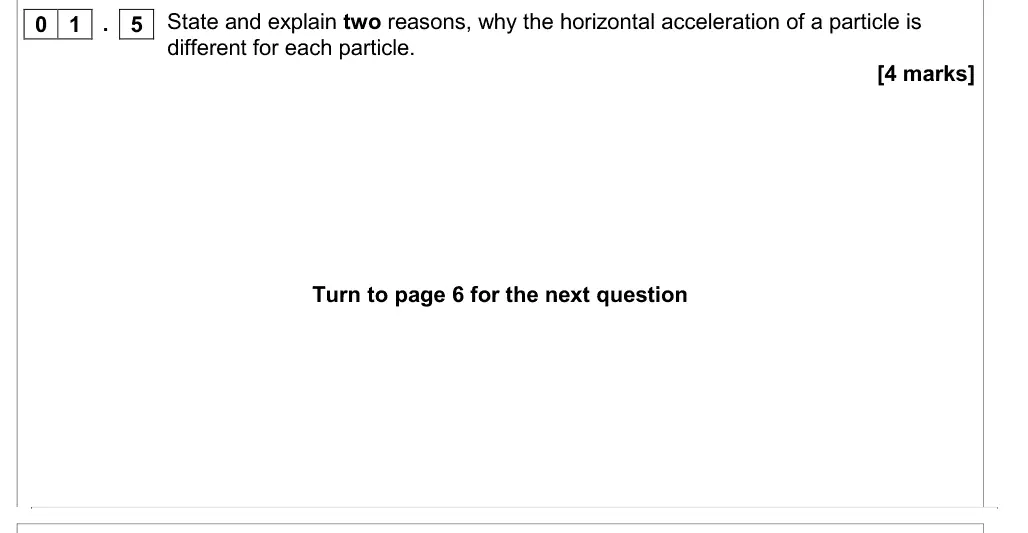
Specimen set 1 · Paper 2 · Q1.54 marksExplanation
Earlier part of question 1 that this part uses
Mark scheme
Notes from the mark scheme and report
Mass varies and charge varies between particles
a = Eq/m with E = V/d constant, so q/m (and hence a) differs
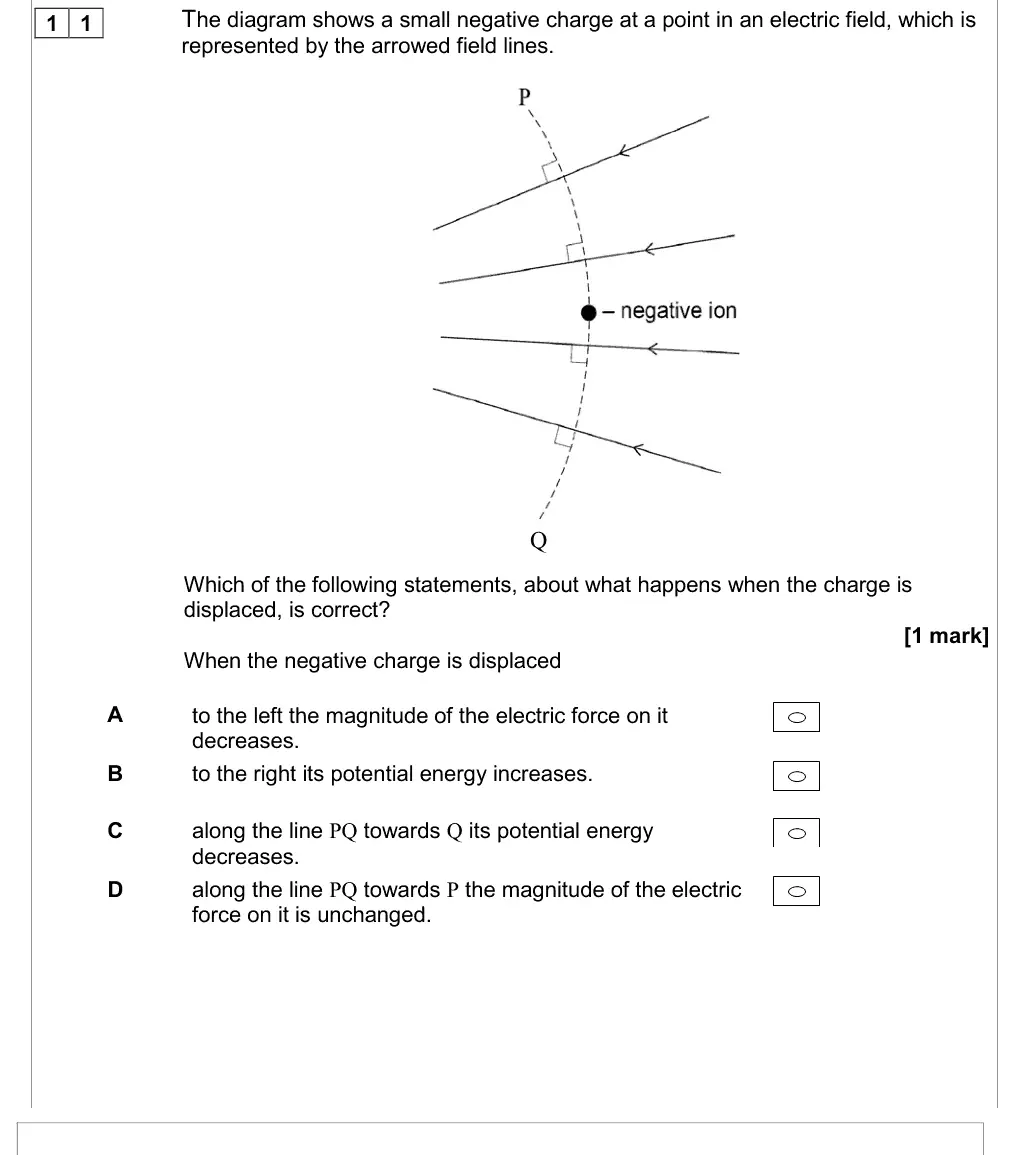
Specimen set 1 · Paper 2 · Q111 markMultiple choice
Answer
D
Notes from the mark scheme and report
Answer: D
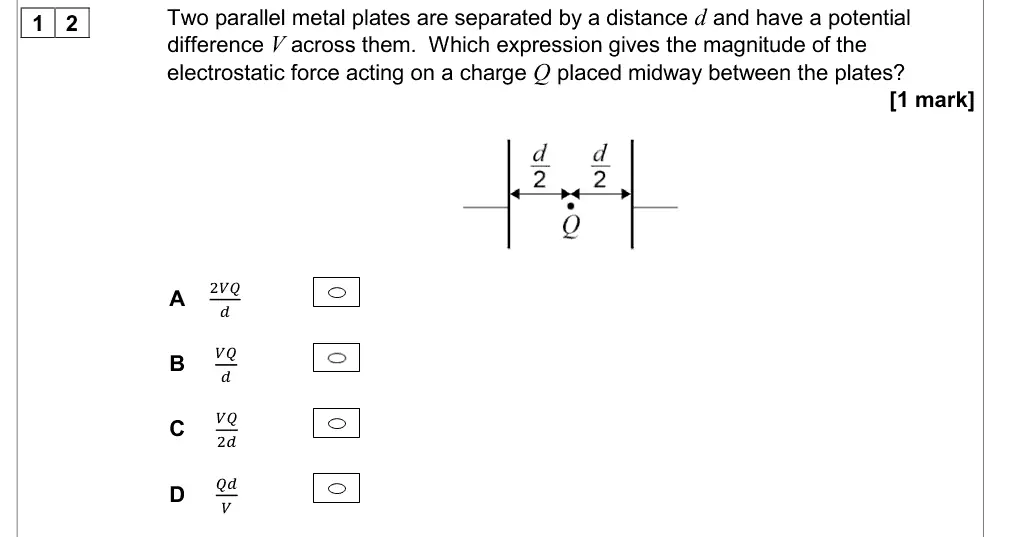
Specimen set 1 · Paper 2 · Q121 markMultiple choice
Answer
B
Notes from the mark scheme and report
Answer: B
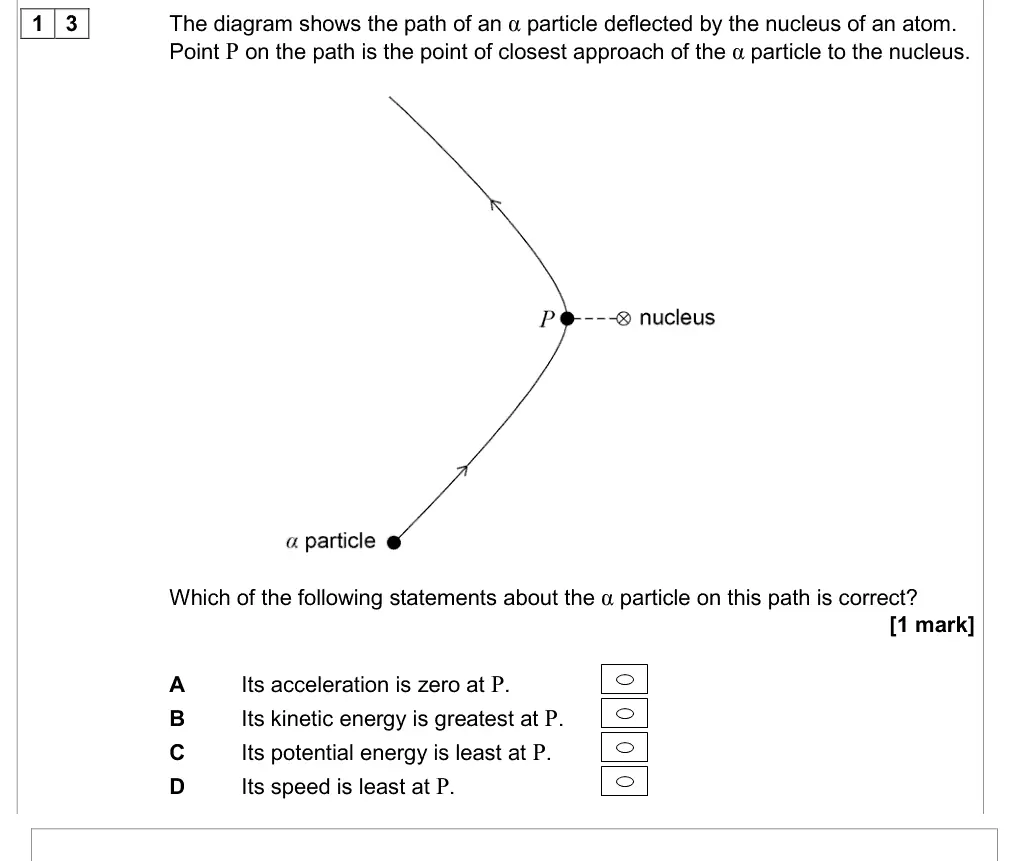
Specimen set 1 · Paper 2 · Q131 markMultiple choice
Answer
D
Notes from the mark scheme and report
Answer: D
Specimen set 1 · Paper 2 · Q141 markMultiple choice
Answer
D
Notes from the mark scheme and report
Answer: D
Skills: MS2.4 Solve algebraic equations, including quadratic equations
Specimen set 1 · Paper 2 · Q151 markMultiple choice
Answer
A
Notes from the mark scheme and report
Answer: A
Skills: MS0.3 Use ratios, fractions and percentages
Work with an AQA physics tutor
Dropping marks on calculations, required practicals or the six-markers? Book a trial session with a specialist AQA physics tutor.