Notes and key-term cards for this topic are being written by our tutors. The past-paper questions below are ready now.
Specification statements
Show the 11 statements from the specification
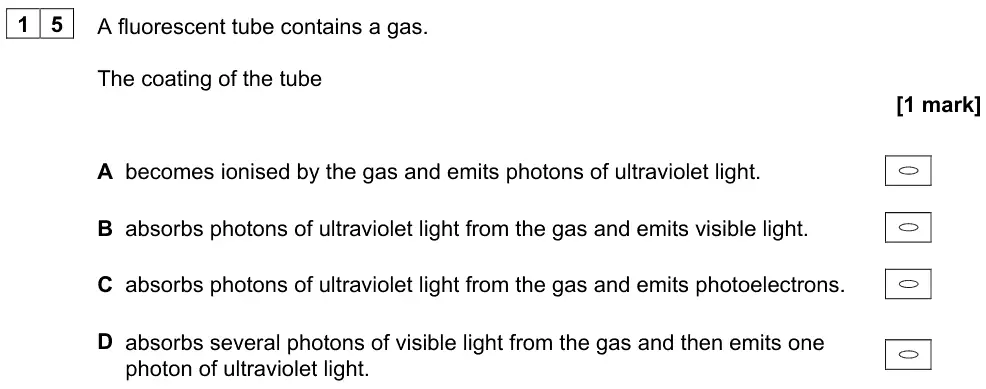
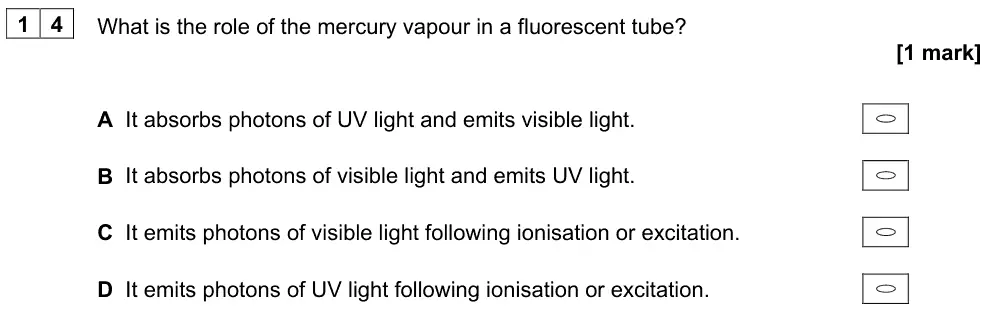
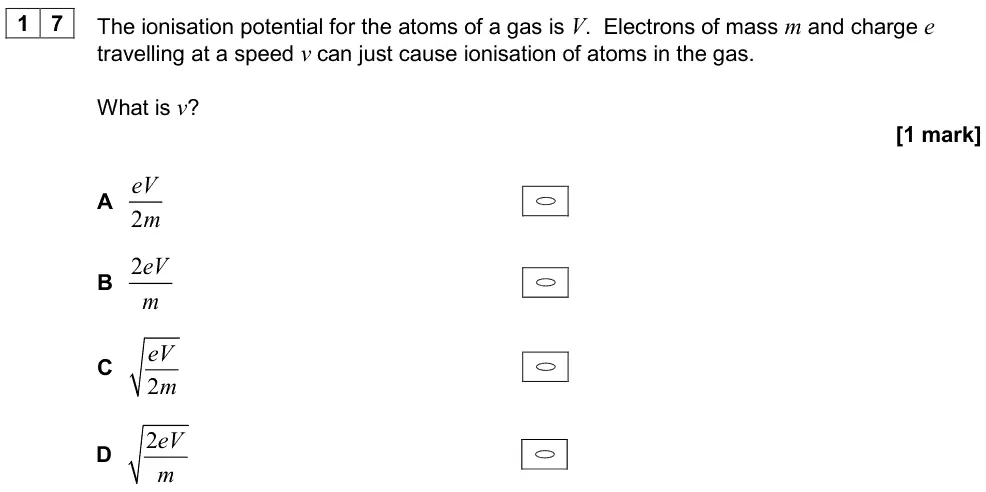
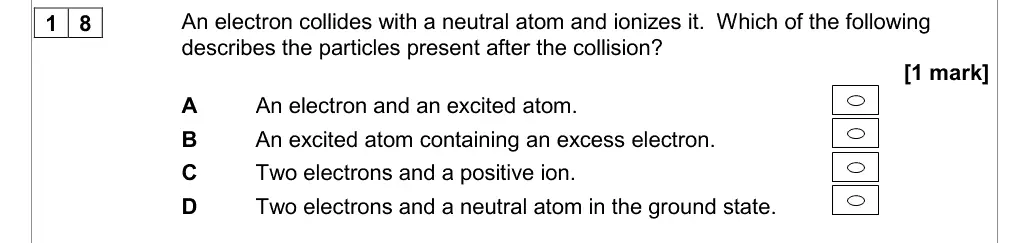
3.2.2.2-01 Ionisation and excitation; understanding of ionisation and excitation in the fluorescent tube.
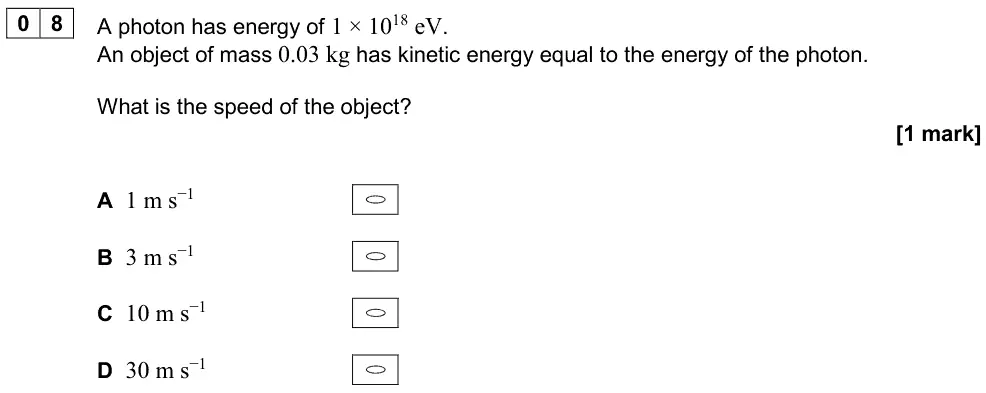
3.2.2.2-02 The electron volt.
3.2.2.2-03 Students will be expected to be able to convert eV into J and vice versa.
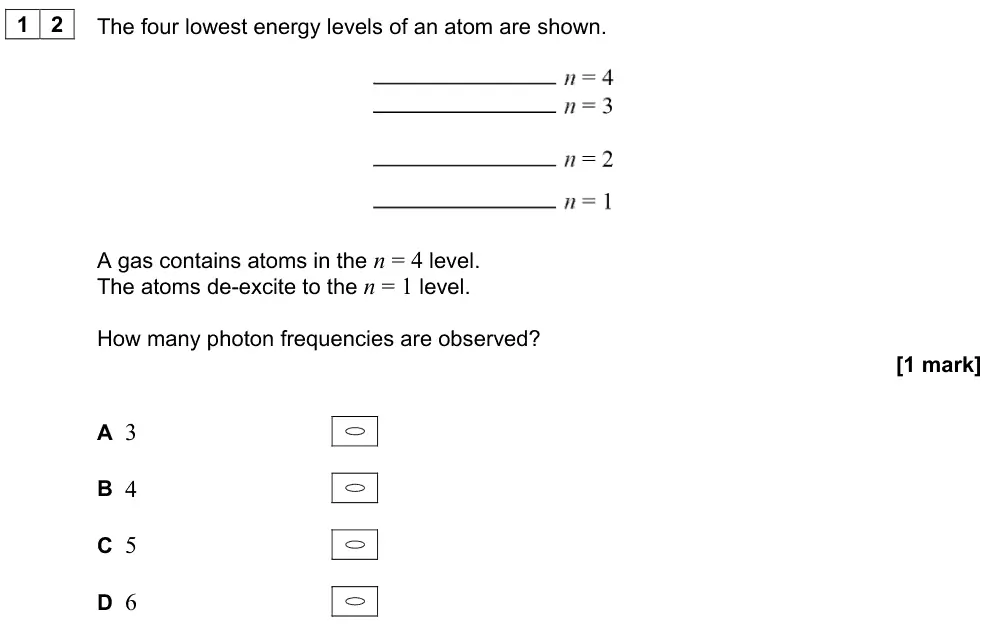
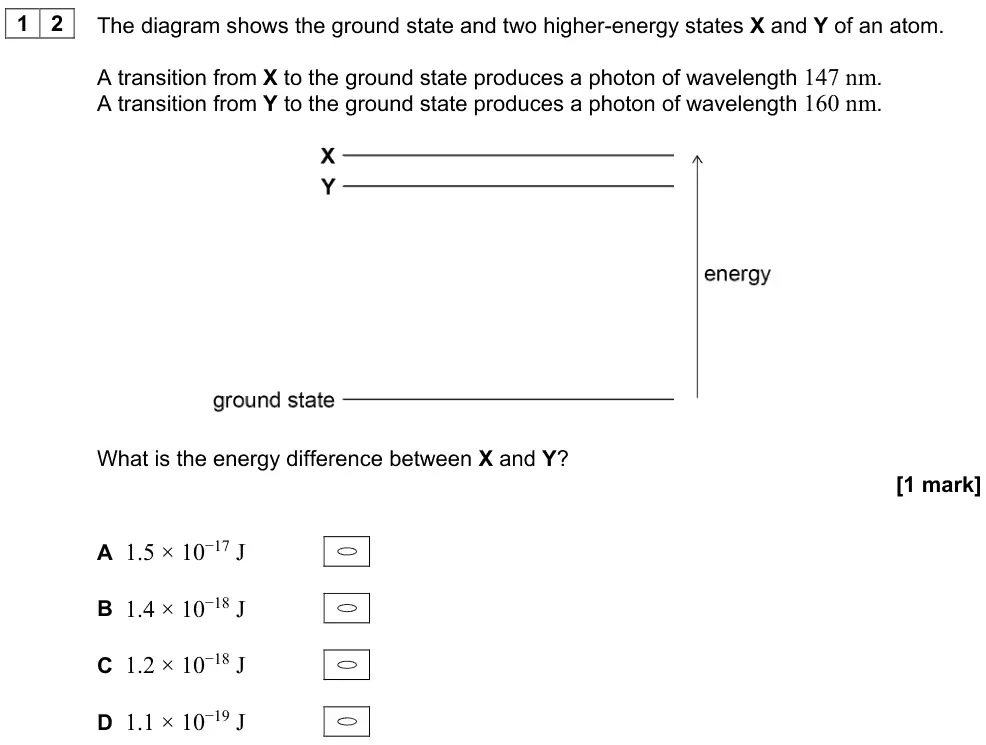
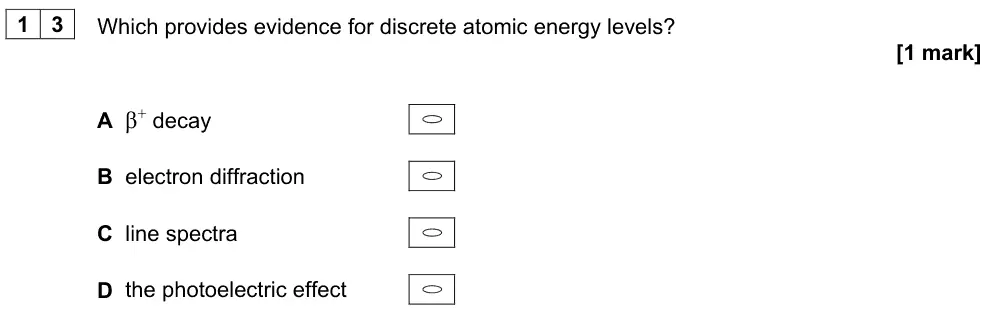
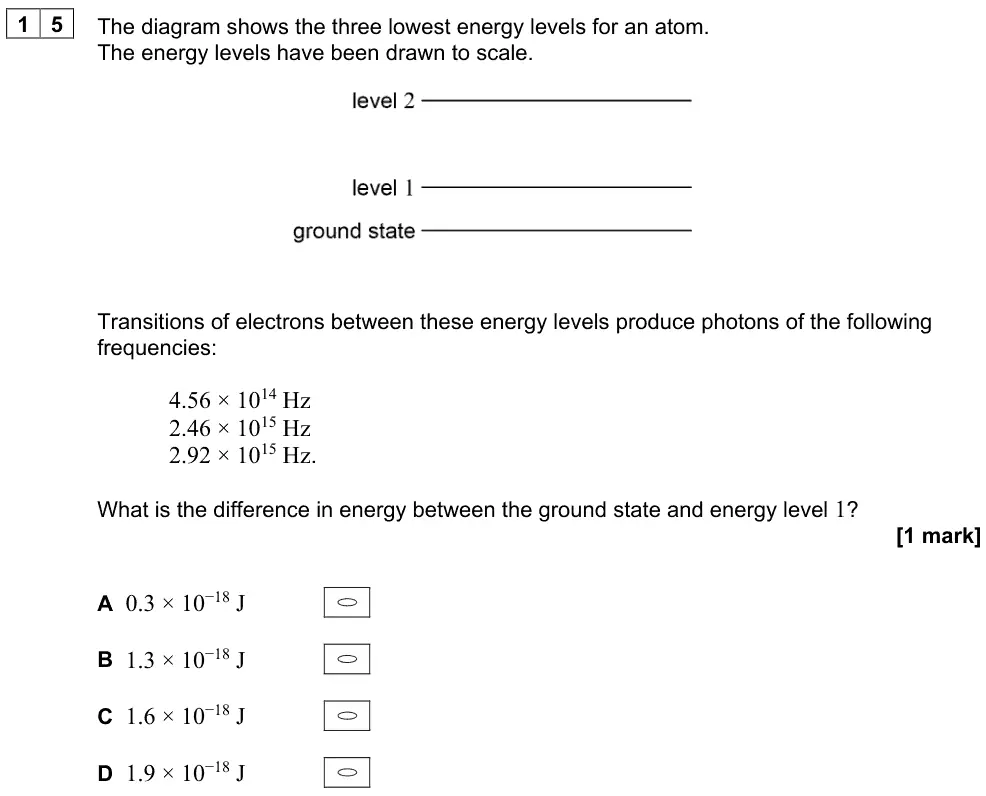
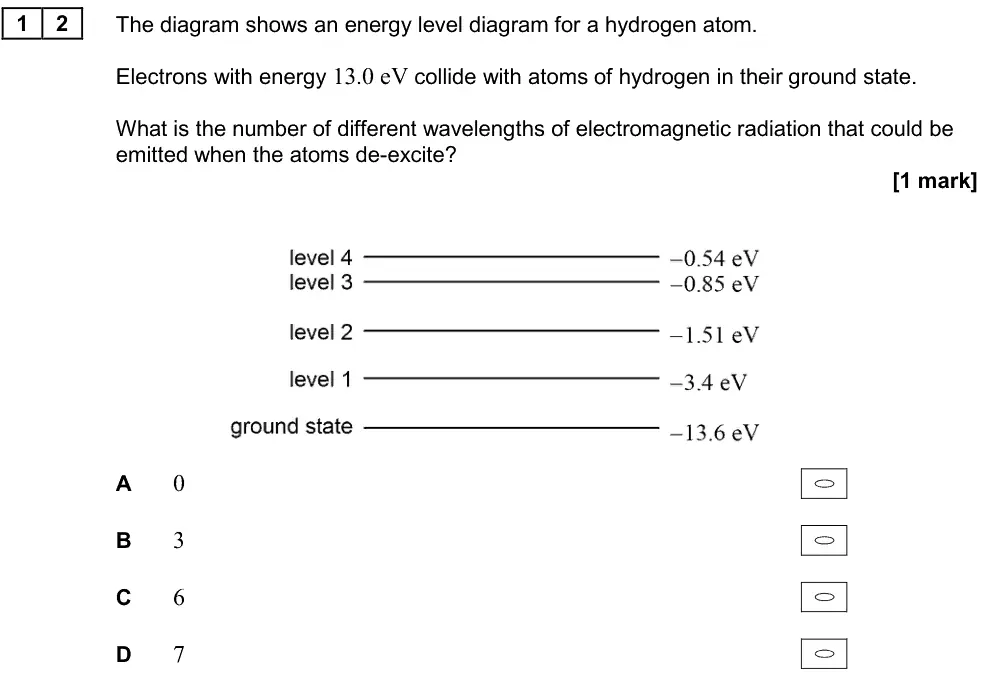
3.2.2.3-01 Line spectra (eg of atomic hydrogen) as evidence for transitions between discrete energy levels in atoms. h f = E1 −E2
3.2.2.3-02 In questions, energy levels may be quoted in J or eV.
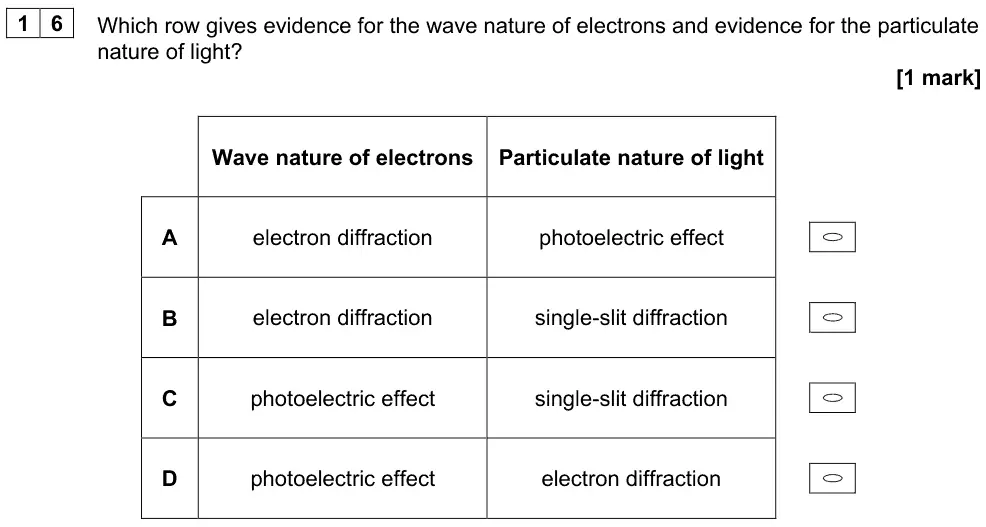
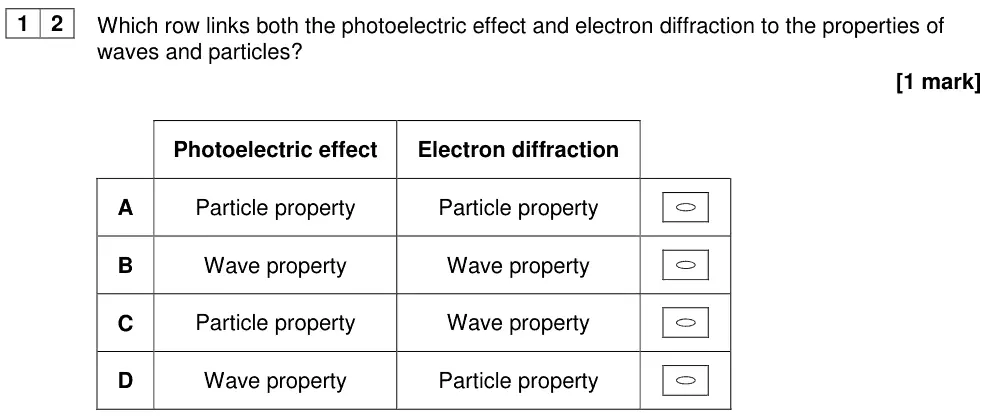
3.2.2.4-01 Students should know that electron diffraction suggests that particles possess wave properties and the photoelectric effect suggests that electromagnetic waves have a particulate nature.
3.2.2.4-02 Details of particular methods of particle diffraction are not expected.
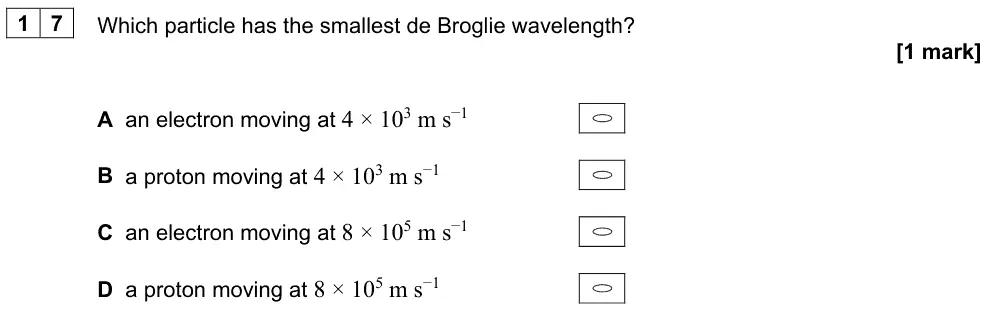
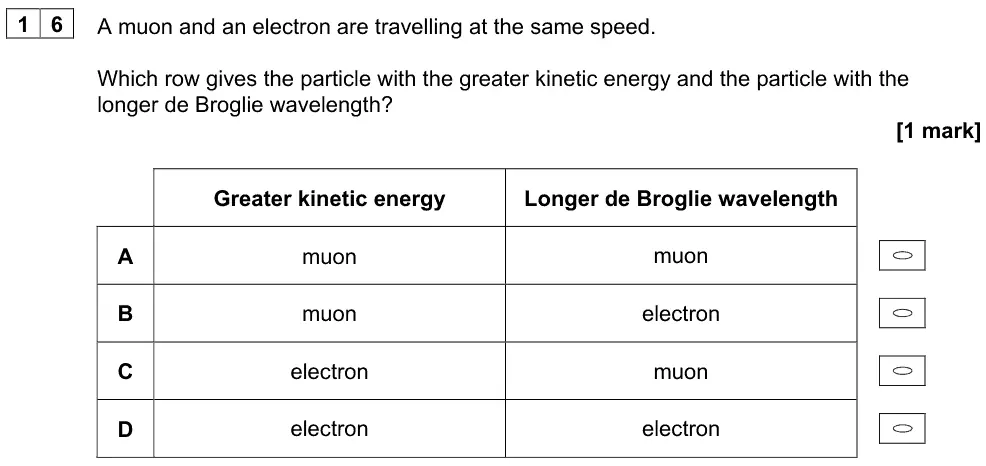
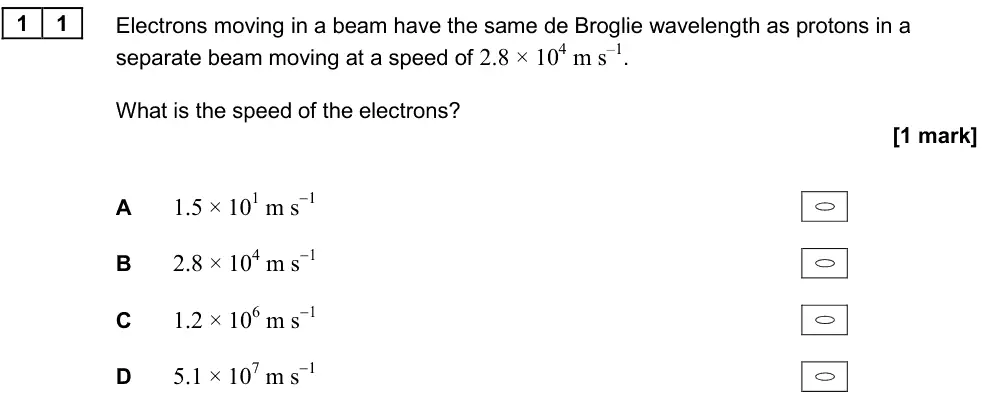
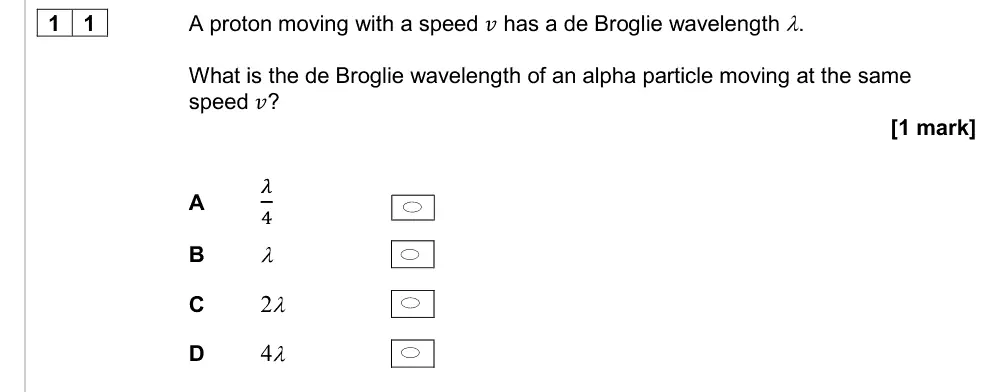
3.2.2.4-03 de Broglie wavelength λ = h mv where mv is the momentum.
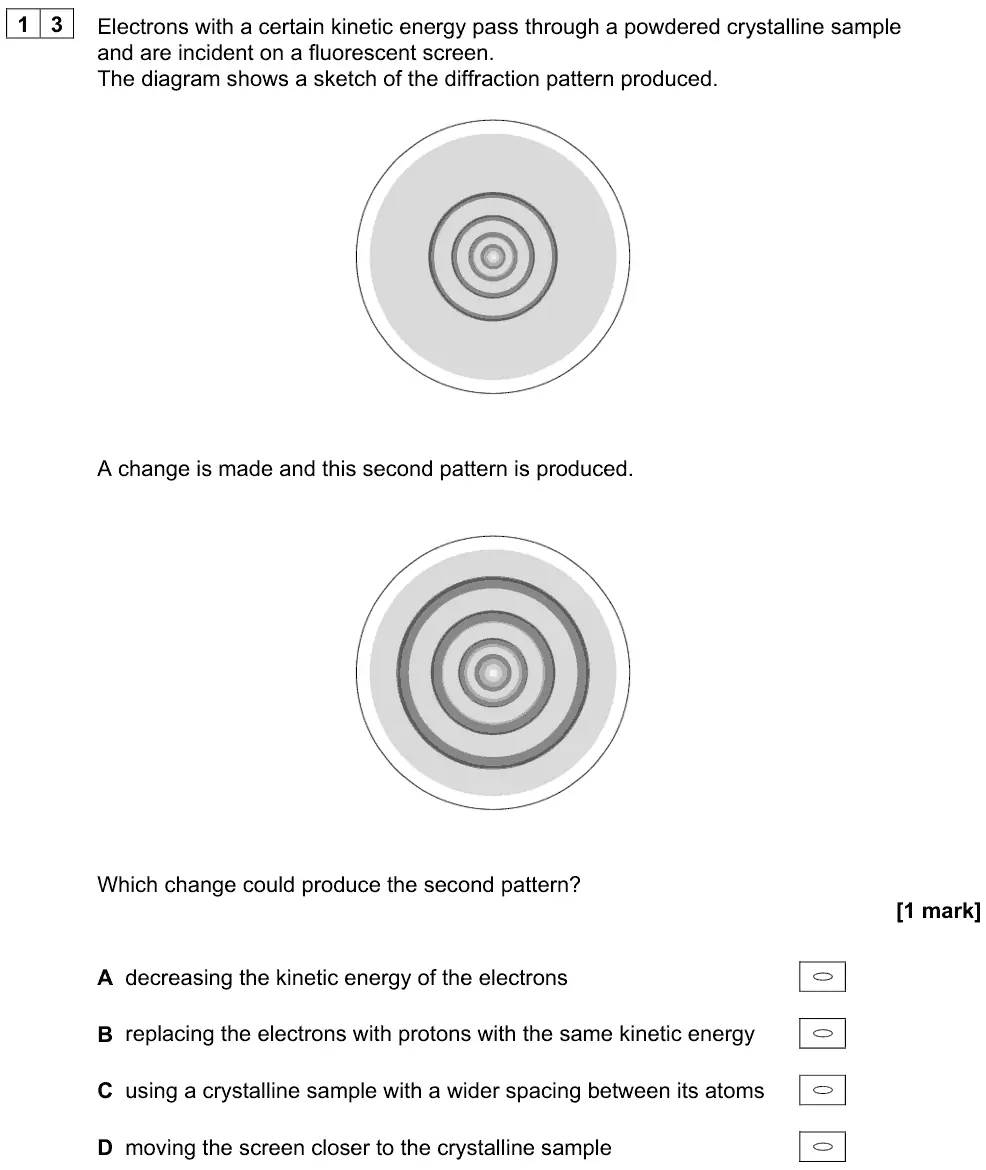
3.2.2.4-04 Students should be able to explain how and why the amount of diffraction changes when the momentum of the particle is changed.
3.2.2.4-05 Appreciation of how knowledge and understanding of the nature of matter changes over time.
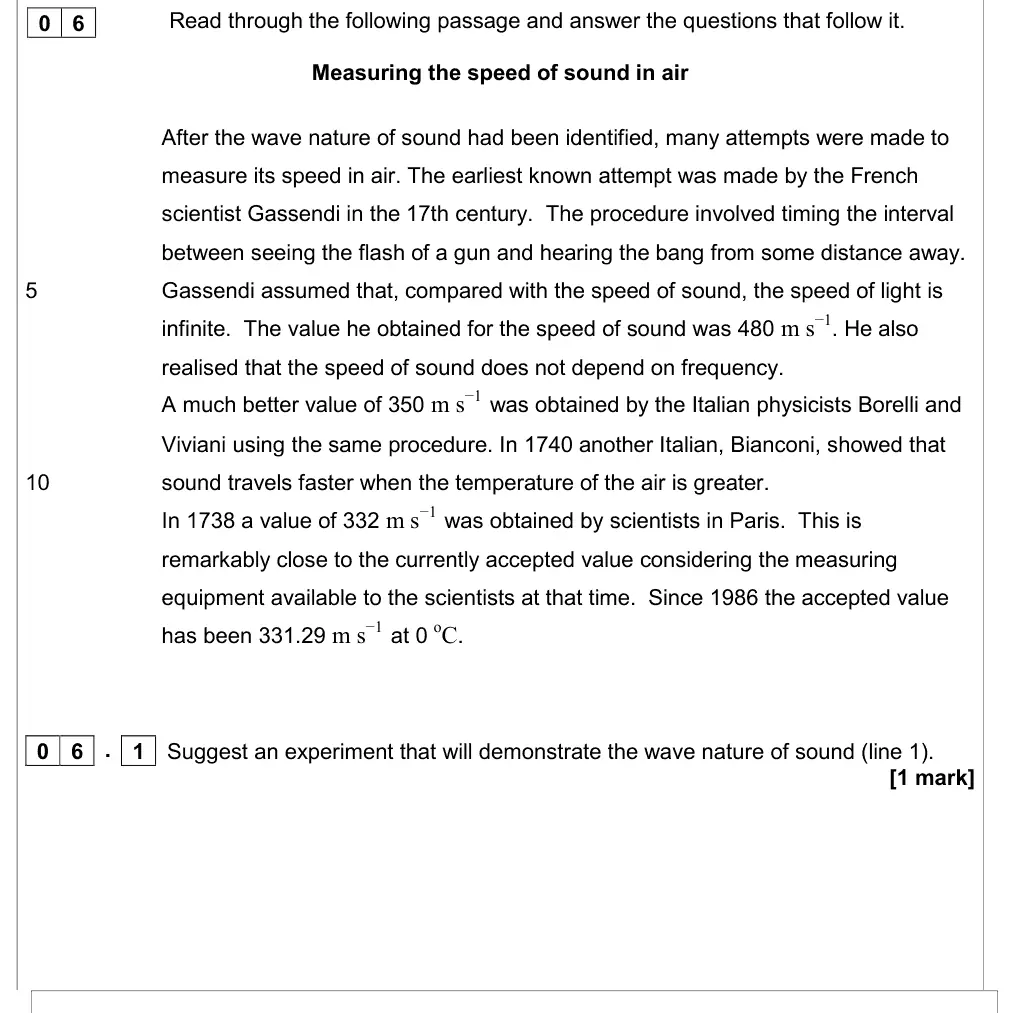
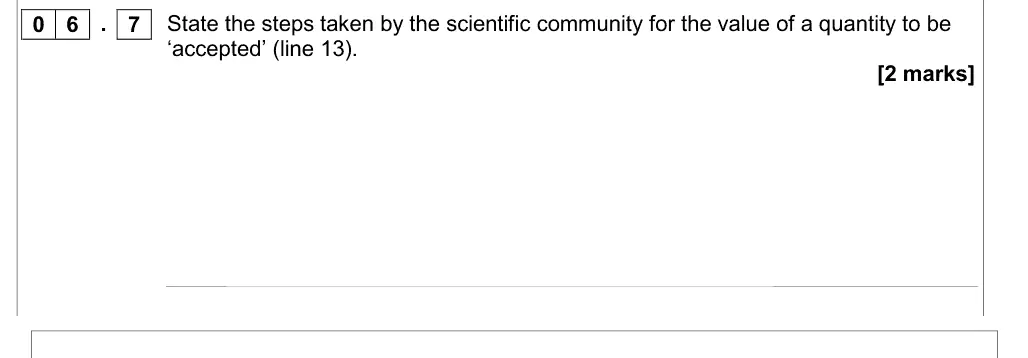
3.2.2.4-06 Appreciation that such changes need to be evaluated through peer review and validated by the scientific community.
Six-mark extended response questions on this topic
Tap a question to zoom it. Where a part needs a figure, table or graph from earlier in the question, that part folds out above it; the mark scheme and examiner's comment open underneath. Have the AQA data and formulae booklet beside you (see the formula sheet page).
June 2025 · AS Paper 1 · Q3.14 marksAO1=2, AO2=2CalculationHard
Mark scheme
Examiner's comment
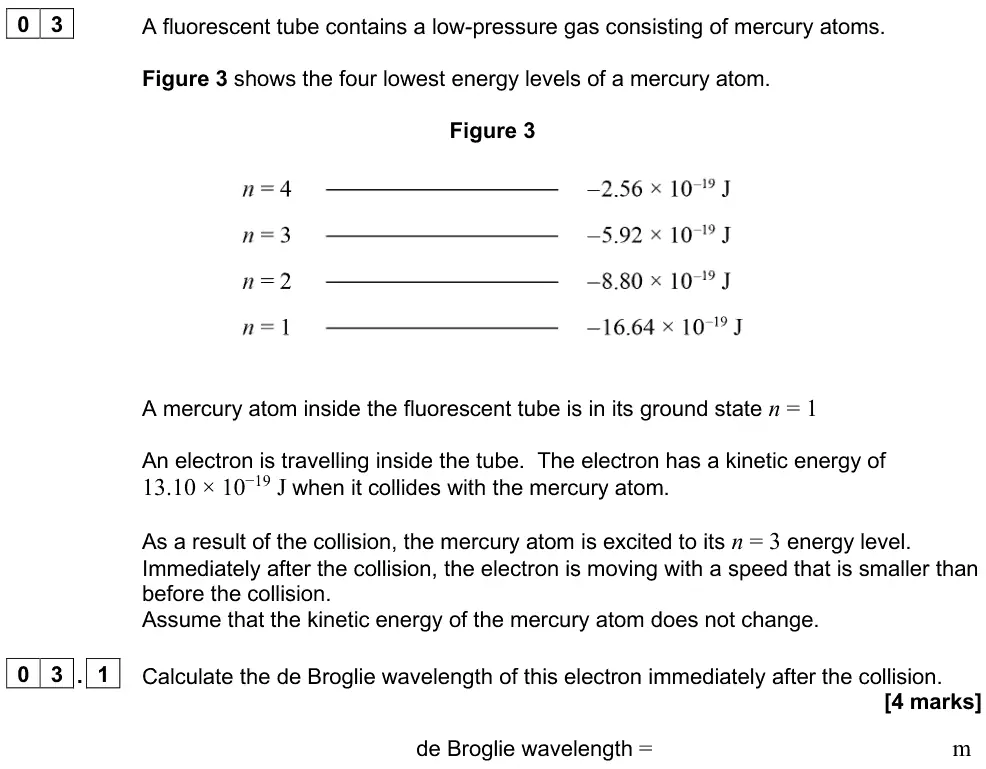
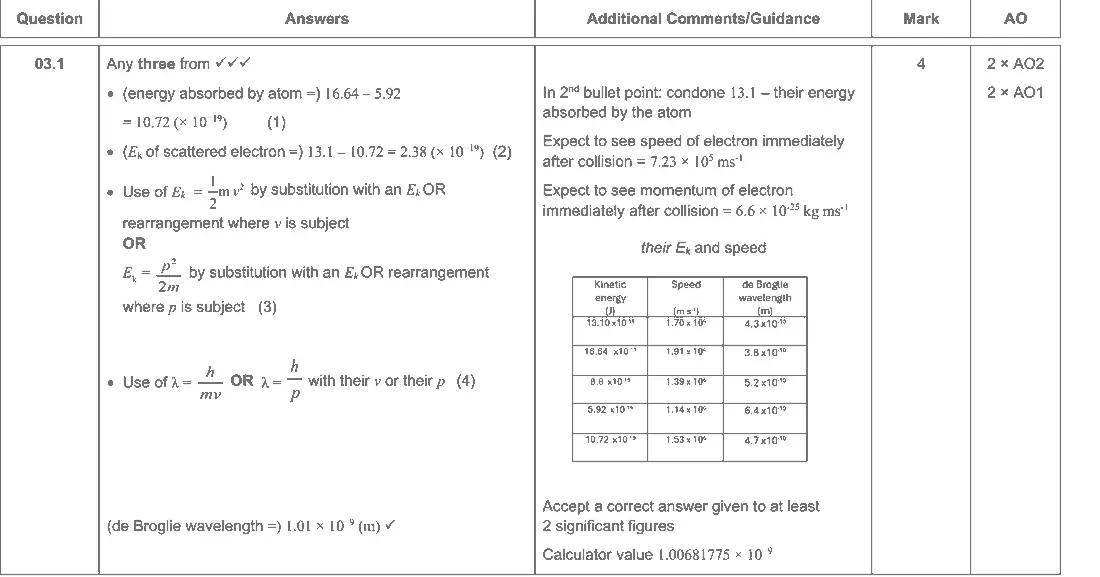
03.1 Again, this multi-step calculation effectively differentiated between student ability levels. Approximately 30% gained all four marks with 20 % gaining three marks, a further 20% gained 2 marks and 15 % one mark. High achieving students typically obtained all 4marks and presented their working in a clear manner that demonstrated their understanding of the context. The most common ways in which students obtained partial marks included: using 13.1 x 10⁻¹⁹ J as the kinetic energy of the electron yielding a value of 4.3 x 10⁻¹⁰ m • for the de Broglie wavelength. determining the kinetic energy of the scattered electron but no knowing how to • ℎ𝑐𝑐 proceed. 𝜆𝜆 to determine a wavelength. setting their kinetic energy equal to • 03.2 63% of students gained both marks while 25% gained one mark. Most students could deal with this less onerous calculation. Where a mark was lost, it was very commonly due an incorrect conversion of their wavelength in metres into nanometres or leaving their answer in metres (2.54 x 10⁻⁷ m).
Notes from the mark scheme and report
Answer: 1.01 x 10^-9 m (energy absorbed 16.64 - 5.92 = 10.72 x 10^-19 J, electron KE left 2.38 x 10^-19 J, v = 7.23 x 10^5 m s^-1)
using the initial 13.1 x 10^-19 J gives 4.3 x 10^-10 m
Skills: MS2.3 Substitute numerical values into algebraic equations using appropriate units for physical quantities; MS2.2 Change the subject of an equation, including non-linear equations
June 2025 · AS Paper 1 · Q3.44 marksAO1=2, AO3=2ExplanationHard
Earlier part of question 3 that this part uses
Mark scheme
Examiner's comment
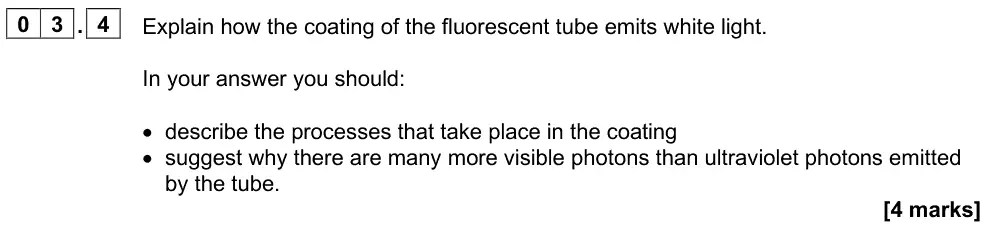
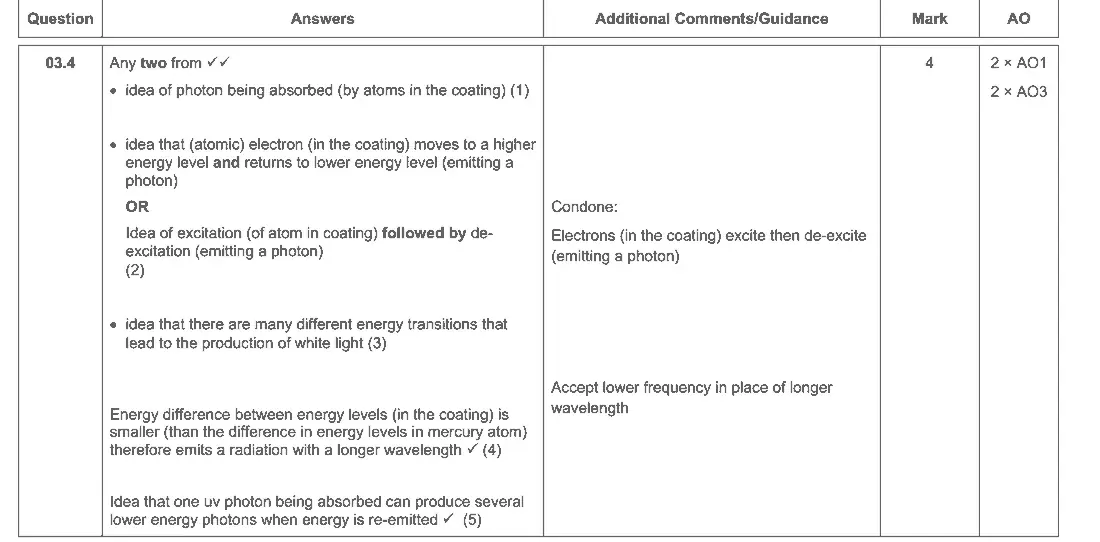
03.4 This question proved very challenging to all but the most able students with approximately 10% gaining 3 marks or more. Lower performing students typically devoted most of their answer to restating information given in the question or describing the workings of the mercury vapour in the fluorescent tube without ever getting to a consideration of the coating and its role in generating white light. Students who made progress typically scored the first two marks in the mark scheme without being able to describe why white light was being produced or why there were more photons of visible light emitted than uv photons. 04.1 This part of the question was one of the few parts of the paper that was designated as pure recall (AO1). Most students were only able to produce very limited statements that lacked the appropriate level of technical language expected at AS. This resulted in most students gaining 1 mark for a ‘clockwise moments = anticlockwise moments’ statement without being able to communicate the conditions under which the principle operates. Approximately 35% of students gained zero; of these, most attempted to define a moment rather than give a statement of the principle of moments.
Notes from the mark scheme and report
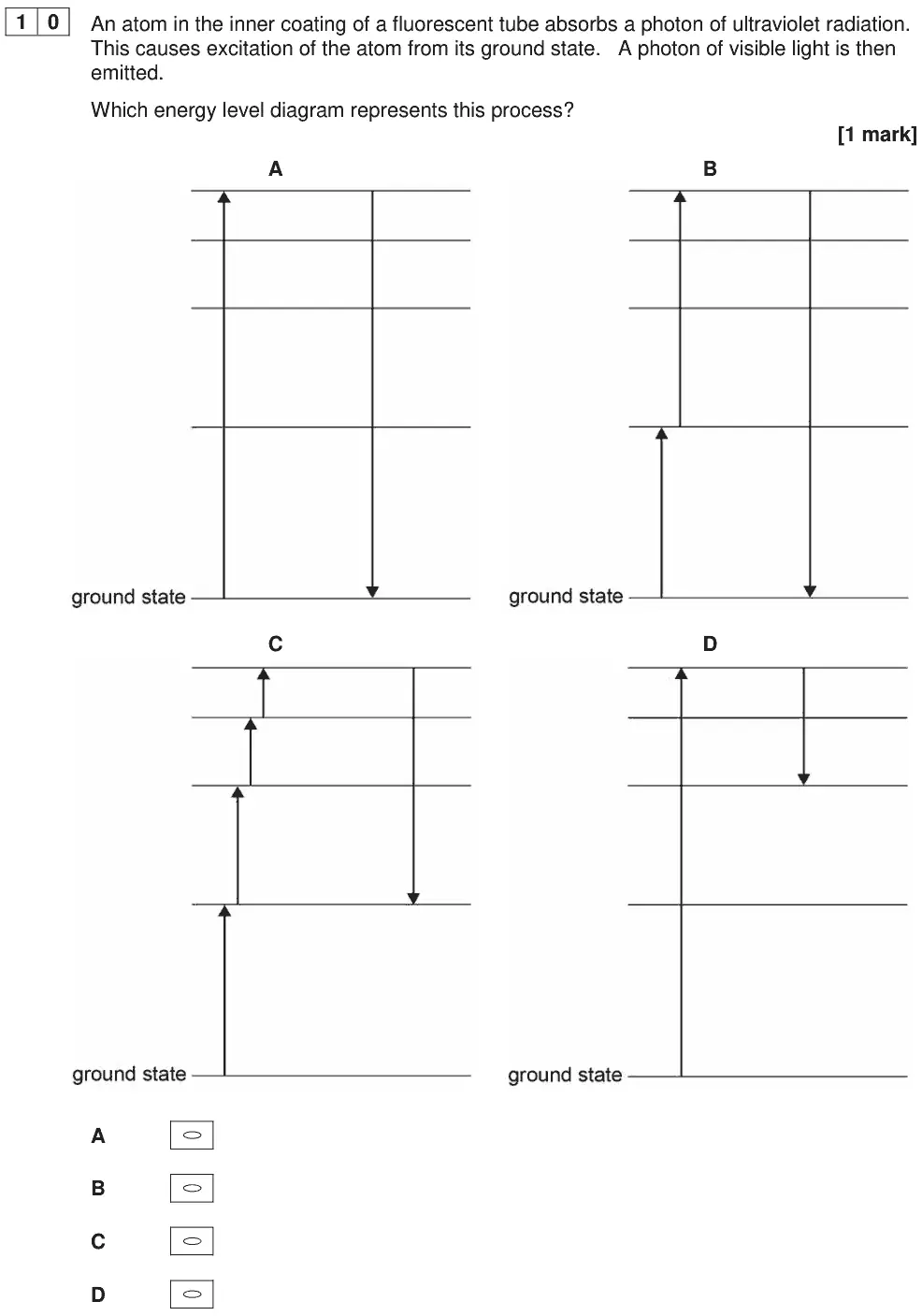
UV photon absorbed by coating atoms, electrons excited then de-excite in smaller steps through many transitions giving a range of visible wavelengths
one UV photon can give several lower-energy photons
many described the mercury vapour instead
June 2025 · AS Paper 1 · Q7.21 markAO1=1Calculation
Earlier part of question 7 that this part uses
Mark scheme
Examiner's comment
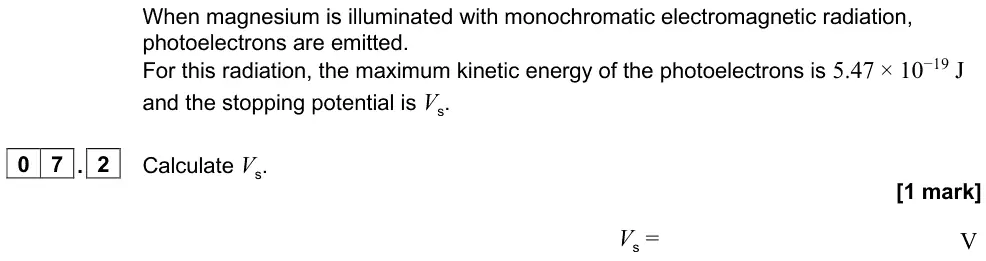
07.2 This question proved very challenging with approximately 50% of students gaining this mark. 14% of students made no attempt at the question. A very similar question on work done crossing a potential difference was asked on this paper in June 2024 (Q2.1).
Notes from the mark scheme and report
Answer: 3.42 V (5.47 x 10^-19 J / 1.6 x 10^-19 C)
14% made no attempt
Skills: MS2.2 Change the subject of an equation, including non-linear equations
June 2025 · Paper 1 · Q8.21 markAO1=1Short answer
Earlier part of question 8 that this part uses
Mark scheme
Examiner's comment
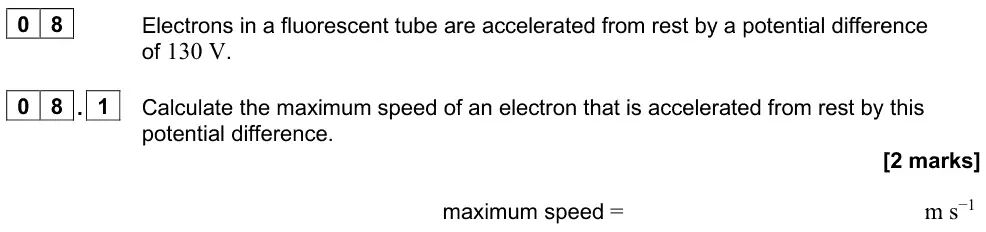
Answers to Question 8.2 were often vague or based on the electrons starting with different speeds. The best answers made it clear that the kinetic energy of electrons was transferred to the gas atoms, or that the collisions were inelastic. Simply stating that collisions occurred was not enough.
Notes from the mark scheme and report
Electrons lose kinetic energy in inelastic collisions with mercury (gas) atoms
'collisions occur' alone not enough
June 2025 · Paper 1 · Q8.32 marksAO1=1, AO3=1Explanation
Earlier part of question 8 that this part uses
Mark scheme
Examiner's comment
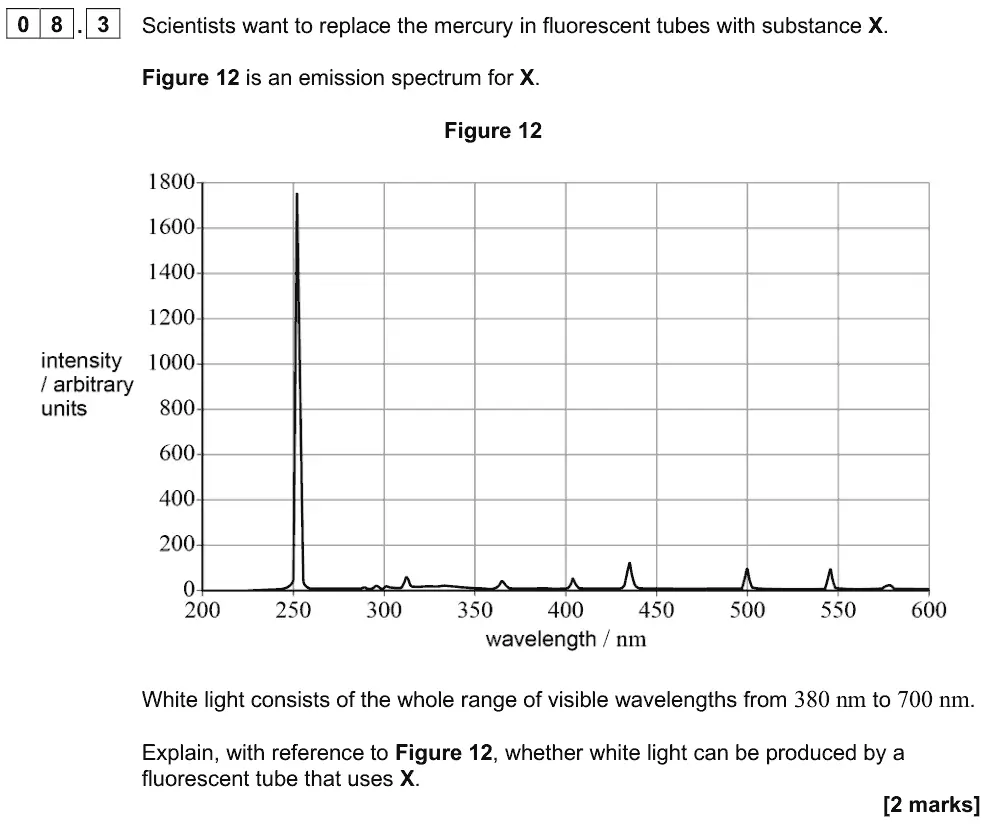
Question 8.3 also proved to be very difficult. Few students applied their knowledge of how fluorescent tubes work to the information in the question. Successful answers identified the peak in Figure 12 to be in the ultraviolet region and then went on to describe how this can be used by the phosphor in the coating to produce white light.
More than 70% of students obtained all three marks for Question 8.4. Common errors included misreading the graph, not converting nm to m correctly and failing to convert to eV. The final mark was withheld from students who gave the answer ‘5’ as this is a 1sf answer. The most straightforward multiple-choice questions were B11 and B13. Both were answered correctly by more than 90% of students.
Several questions had discriminators more popular than the correct answer.
The correct answer to B21 was the least popular. Most chose C, demonstrating that they did not understand that Newton’s third law pairs have to be the same type of force and act on different objects. Option B was the next most popular, chosen by students who did not understand that at terminal velocity the drag force is equal to the weight. 17% of students chose option A, perhaps due to the videos of skydivers where the camera continues to fall rapidly while the skydiver slows down after opening their parachute.
The correct answer to B16 was the third most popular. Half of the students chose B. This is due to a common misconception about the resistance of a non-ohmic device. The next most popular was D. Students should be taught that it is the instantaneous values of current and voltage that are used to determine the resistance and power dissipated.
The correct answer to B14 was the second most popular chosen by less than 20% of students. Almost 60% chose D. These students were confused between square roots and squares perhaps. This was a demanding question that rewarded students who knew which equations to use and were capable of doing the necessary algebra.
The correct answer to B28 was the second most popular. 43% of the students chose B, suggesting that the current did not change, despite the circuit resistance being less. Grade boundaries and cumulative percentage grades are available on the Results Statistics page of the AQA Website.
Notes from the mark scheme and report
Yes: X emits mostly UV (peak near 255 nm)
UV excites the phosphor coating, which de-excites emitting visible light
few applied knowledge of the fluorescent tube
June 2025 · Paper 1 · Q8.43 marksAO1=1, AO2=2CalculationEasy
Earlier part of question 8 that this part uses
Mark scheme
Examiner's comment
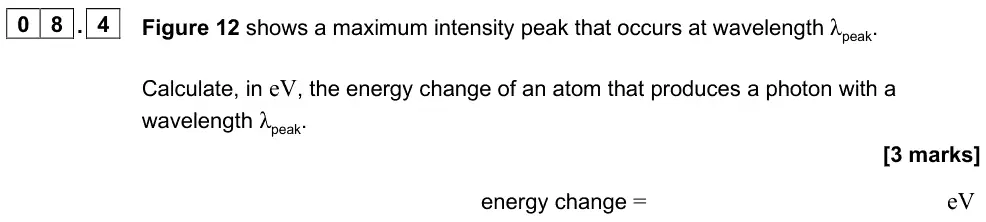
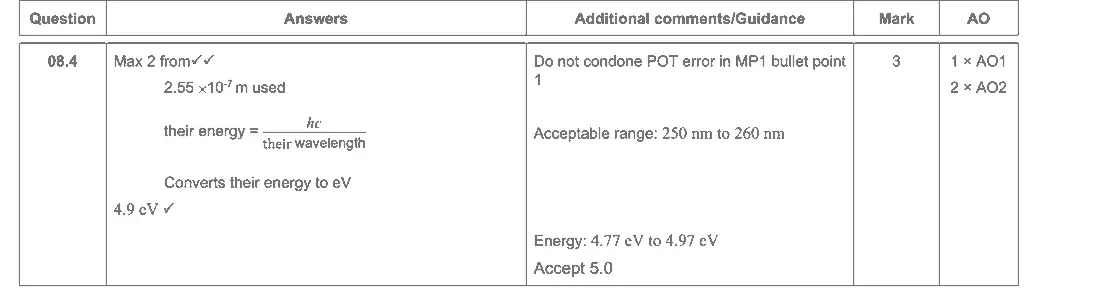
More than 70% of students obtained all three marks for Question 8.4. Common errors included misreading the graph, not converting nm to m correctly and failing to convert to eV. The final mark was withheld from students who gave the answer ‘5’ as this is a 1sf answer. The most straightforward multiple-choice questions were B11 and B13. Both were answered correctly by more than 90% of students.
Notes from the mark scheme and report
Answer: 4.9 eV (lambda peak 2.55 x 10^-7 m, E = hc/lambda = 7.8 x 10^-19 J)
'5' (1 sf) lost the last mark
misreading graph and nm conversion errors
Skills: MS3.1 Translate information between graphical, numerical and algebraic forms; MS2.3 Substitute numerical values into algebraic equations using appropriate units for physical quantities; MS1.1 Use an appropriate number of significant figures
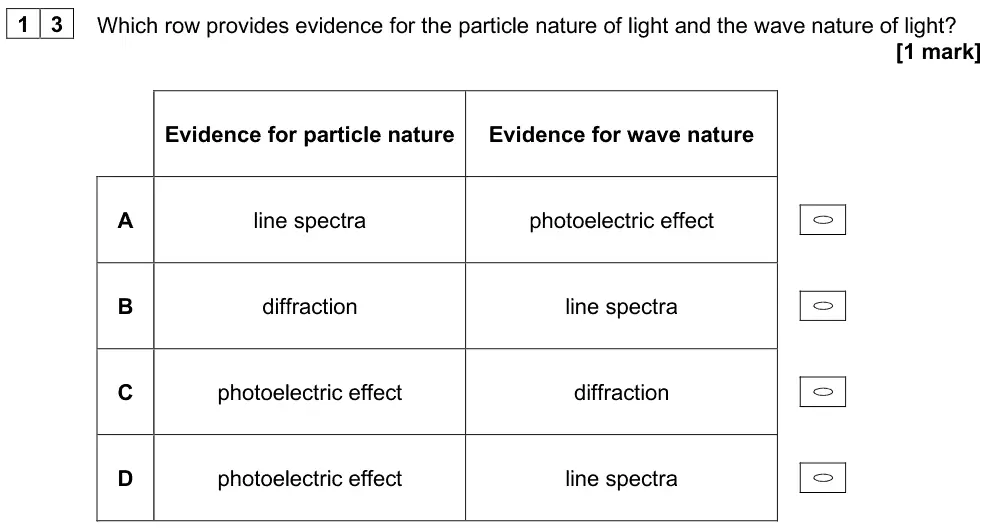
June 2025 · Paper 1 · Q131 markAO1=1Multiple choice
Answer
C
Mark scheme
Notes from the mark scheme and report
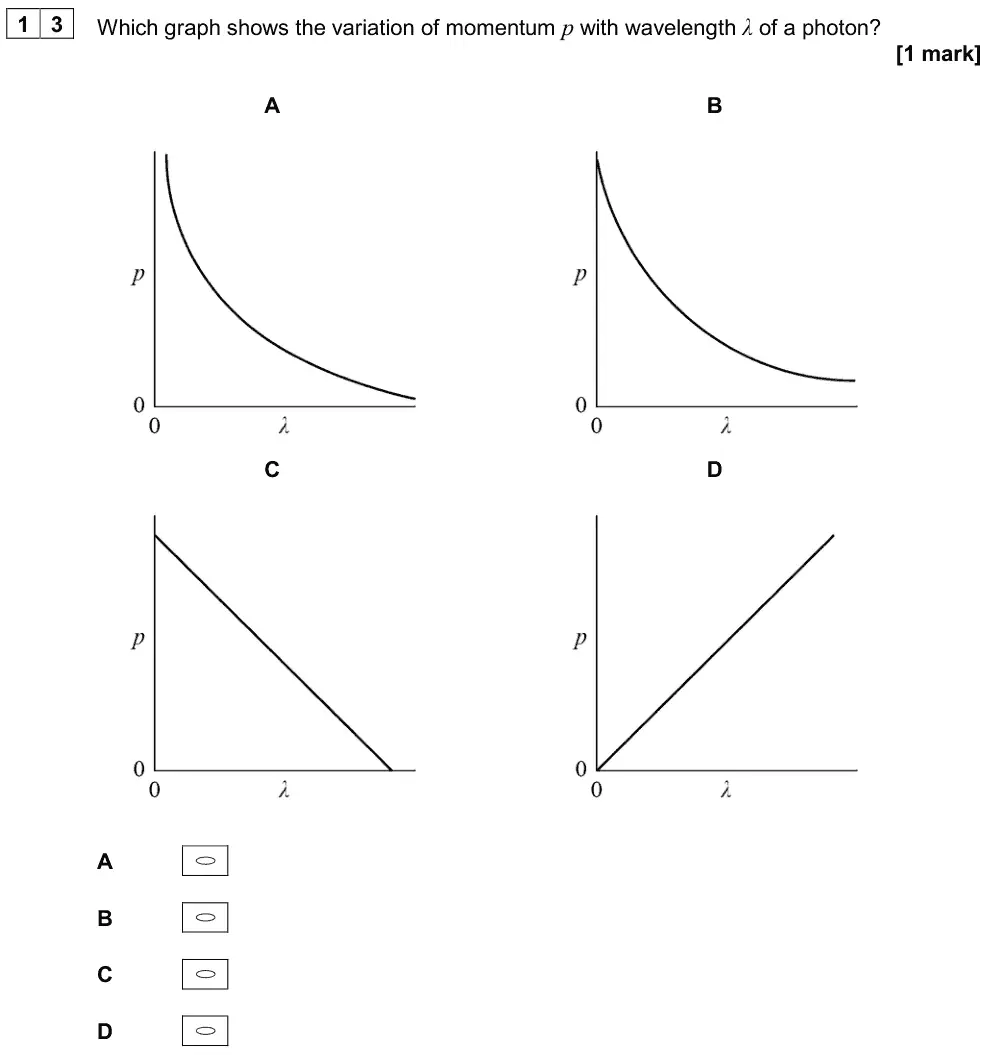
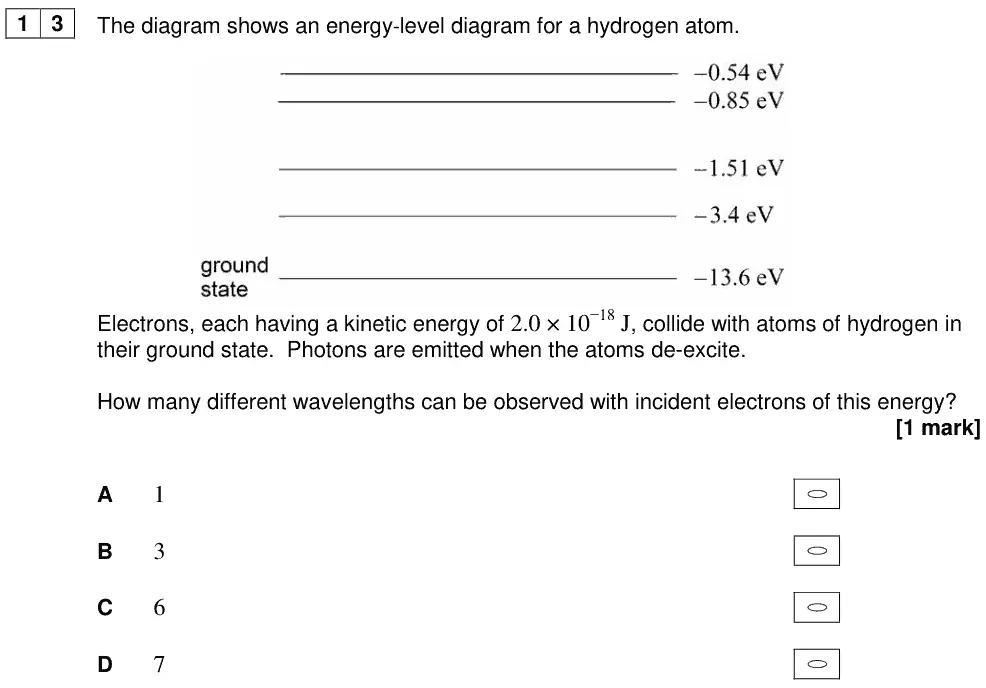
Answer: C
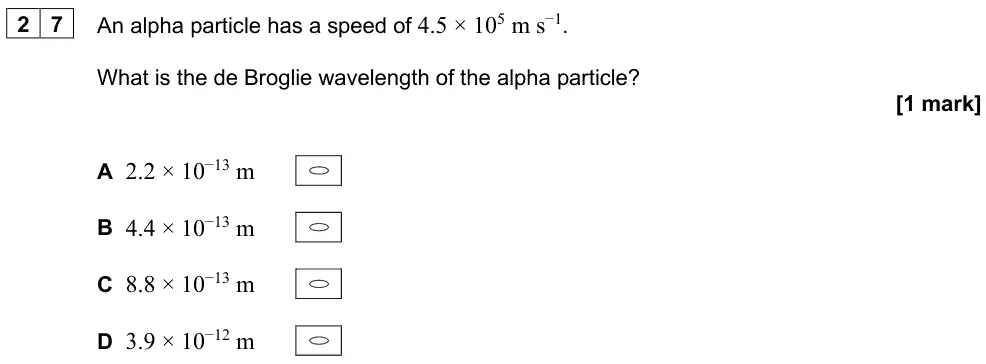
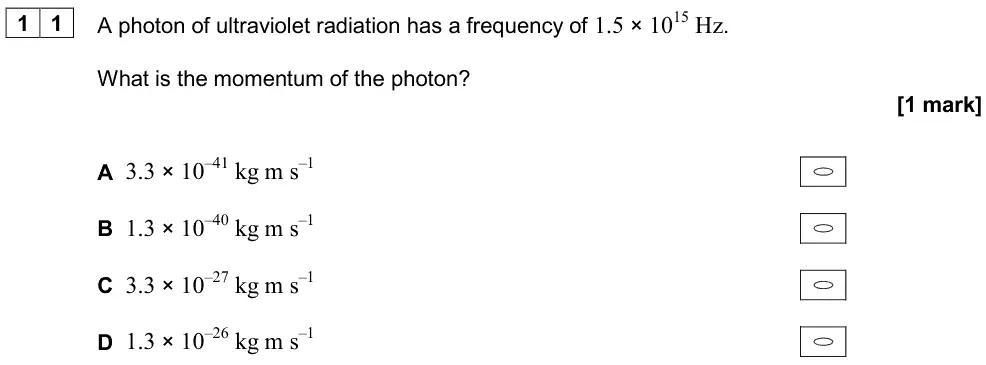
June 2025 · Paper 1 · Q271 markAO1=1Multiple choice
Answer
A
Mark scheme
Notes from the mark scheme and report
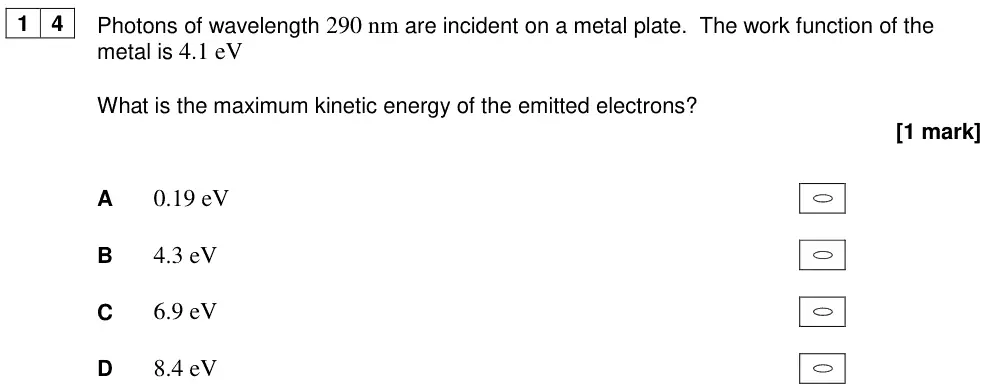
Answer: A
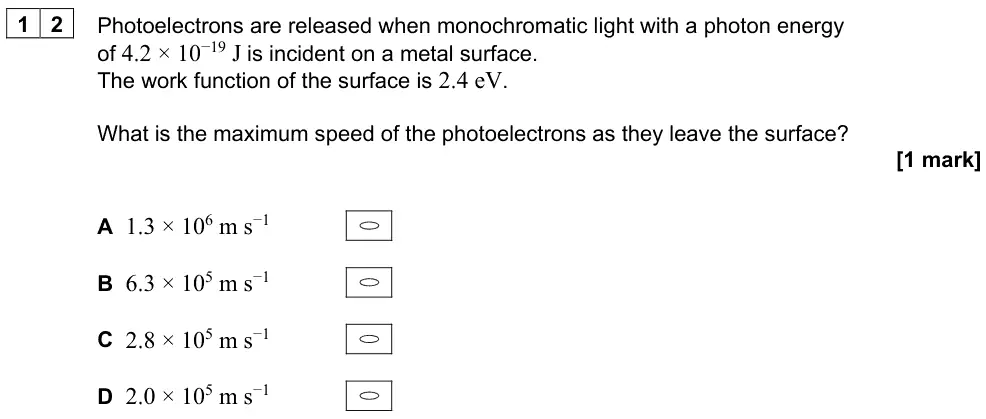
Skills: MS2.3 Substitute numerical values into algebraic equations using appropriate units for physical quantities
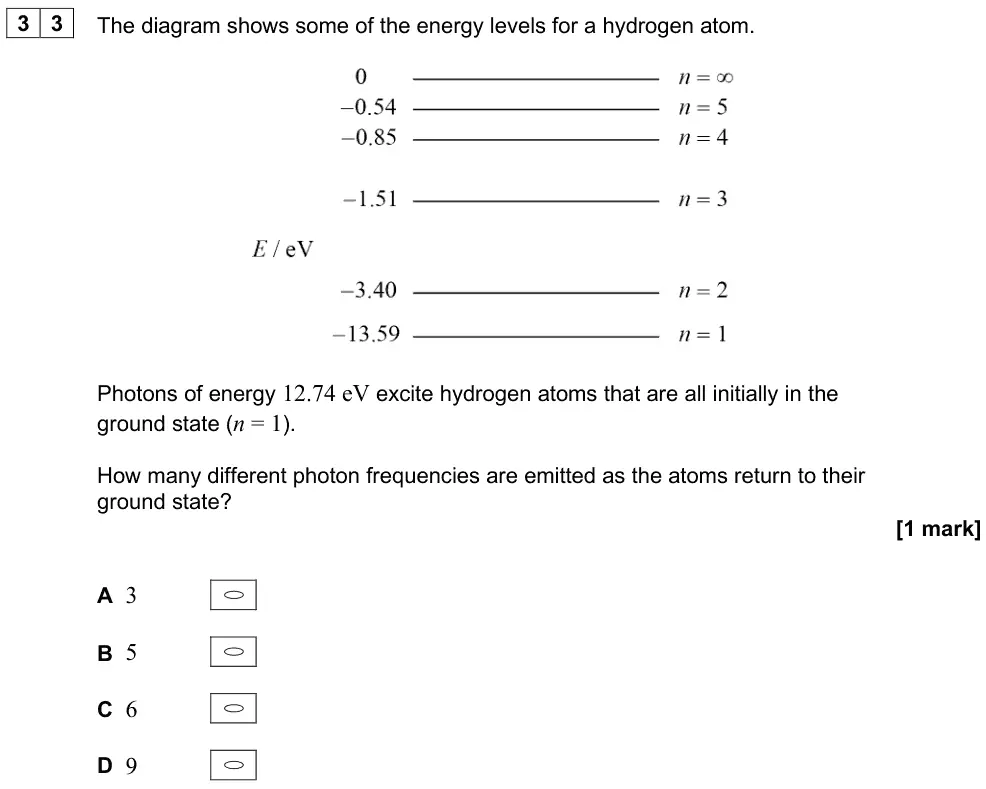
June 2025 · Paper 1 · Q331 markAO1=1Multiple choice
Answer
C
Mark scheme
Notes from the mark scheme and report
Answer: C
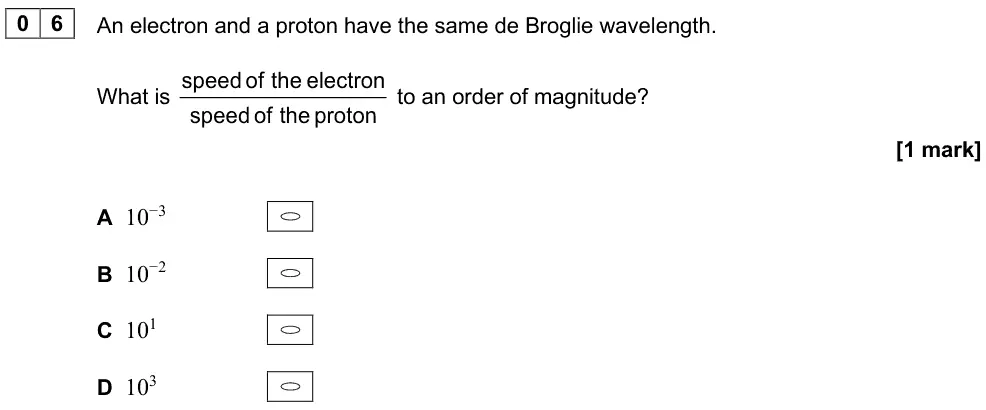
June 2025 · AS Paper 2 · Q61 markAO1=1Multiple choice
Answer
D
Mark scheme
Examiner's comment
Students were more successful in answering questions 6, 11, 14, 19, 22, 28, and were less successful in answering questions 10, 15, 21, 25, 29.
Notes from the mark scheme and report
Answer: D
Skills: MS1.4 Make order of magnitude calculations
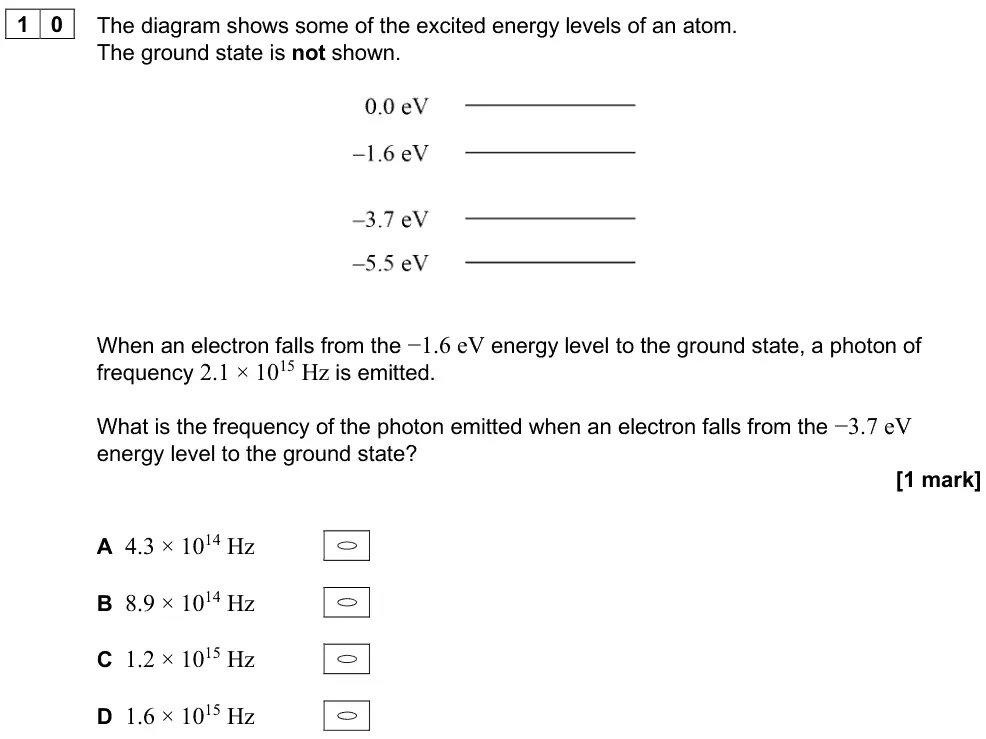
June 2025 · AS Paper 2 · Q101 markAO2=1Multiple choice
Answer
D
Mark scheme
Examiner's comment
Students were more successful in answering questions 6, 11, 14, 19, 22, 28, and were less successful in answering questions 10, 15, 21, 25, 29.
Notes from the mark scheme and report
Answer: D
Skills: MS0.2 Recognise and use expressions in decimal and standard form
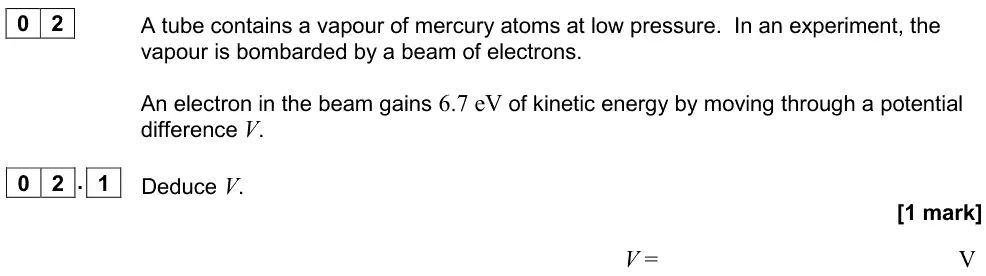
June 2024 · AS Paper 1 · Q2.11 markAO1=1Short answer
Mark scheme
Examiner's comment
02.1
Notes from the mark scheme and report
Answer: 6.7 V
converting to joules or dividing 6.7 by e were common errors
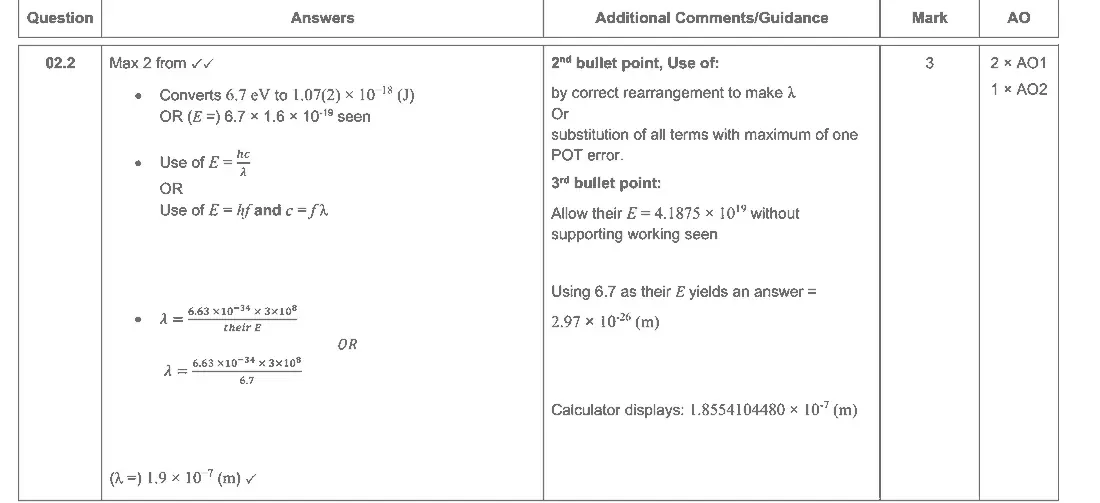
June 2024 · AS Paper 1 · Q2.23 marksAO1=2, AO2=1Calculation
Earlier part of question 2 that this part uses
Mark scheme
Examiner's comment
02.2
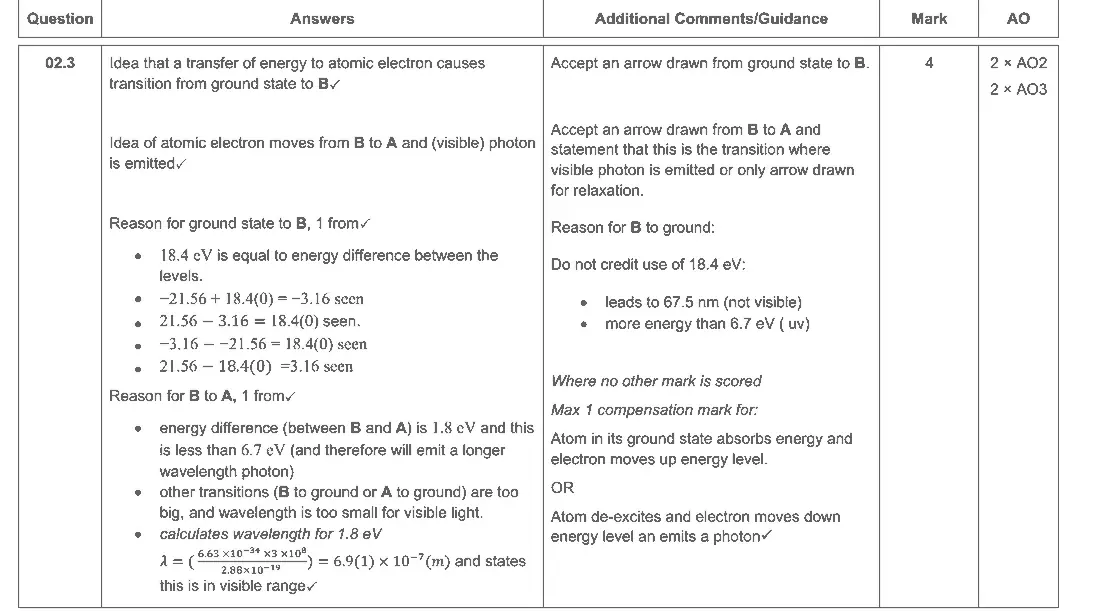
This is another question that worked well in discriminating between students. Over 10% of students gained three marks or more whereas approximately 50% gained at least two marks. Typically, students scoring two marks only answered the absorption aspect of the question. They described how the atomic electron accepted the 18.4 eV and moved from ground state to level B and then stopped, thinking that they had completely answered the question. Some attempted to describe the emission of the visible photon but chose the wrong transition suggesting that the electron moved directly from B to the ground state and that the 18.4 eV photon was visible. The most able students identified the transition from B to A as being responsible for the emission of a visible photon. They calculated the wavelength of this light and knew that this wavelength lay inside the visible range. Very few referred to the information given in the stem above 02.2; the 6.7 eV photon was identified as a photon of ultraviolet radiation. They could have made a comparison of the photon energies of the transitions B to A, A to ground state, and B to ground state with 6.7 eV to decide which transition was responsible for the photon of visible light.
Well over 90% of students gained at least one mark with over 25% gaining both marks. Most students who gained one mark obtained the resistance of the lamp as 2.2 Ω and presented this as their final answer. They determined the resistance by either using V=IR or reading-off the resistance from Figure 13. Of those who realised that more was required, they mostly chose to determine the total mark through arithmetic errors such as 9 – 3.3 = 6.7 instead of 5.7. resistance in the circuit and subtract the lamp’s resistance to find R’s resistance. Some lost the second
Notes from the mark scheme and report
Answer: 1.9 x 10^-7 m (6.7 eV = 1.07 x 10^-18 J, lambda = hc/E)
Skills: MS2.3 Substitute numerical values into algebraic equations using appropriate units for physical quantities; MS0.2 Recognise and use expressions in decimal and standard form
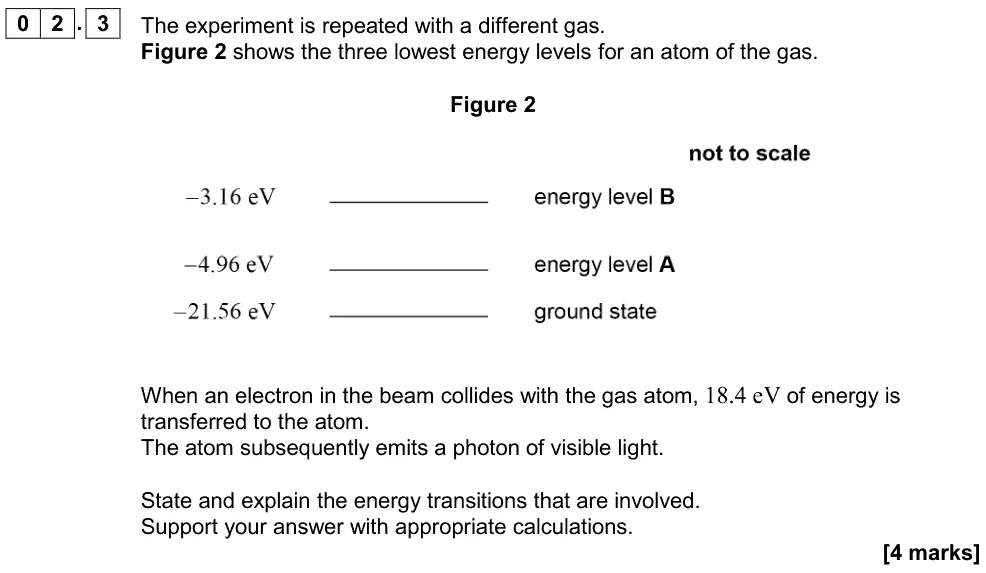
June 2024 · AS Paper 1 · Q2.34 marksAO2=2, AO3=2Explanation
Earlier part of question 2 that this part uses
Mark scheme
Examiner's comment
02.3
Notes from the mark scheme and report
18.4 eV excites ground state (-21.56 eV) to B (-3.16 eV)
B to A (1.8 eV) emits the visible photon (690 nm)
other transitions give UV
many stopped after the absorption step
Skills: MS2.3 Substitute numerical values into algebraic equations using appropriate units for physical quantities
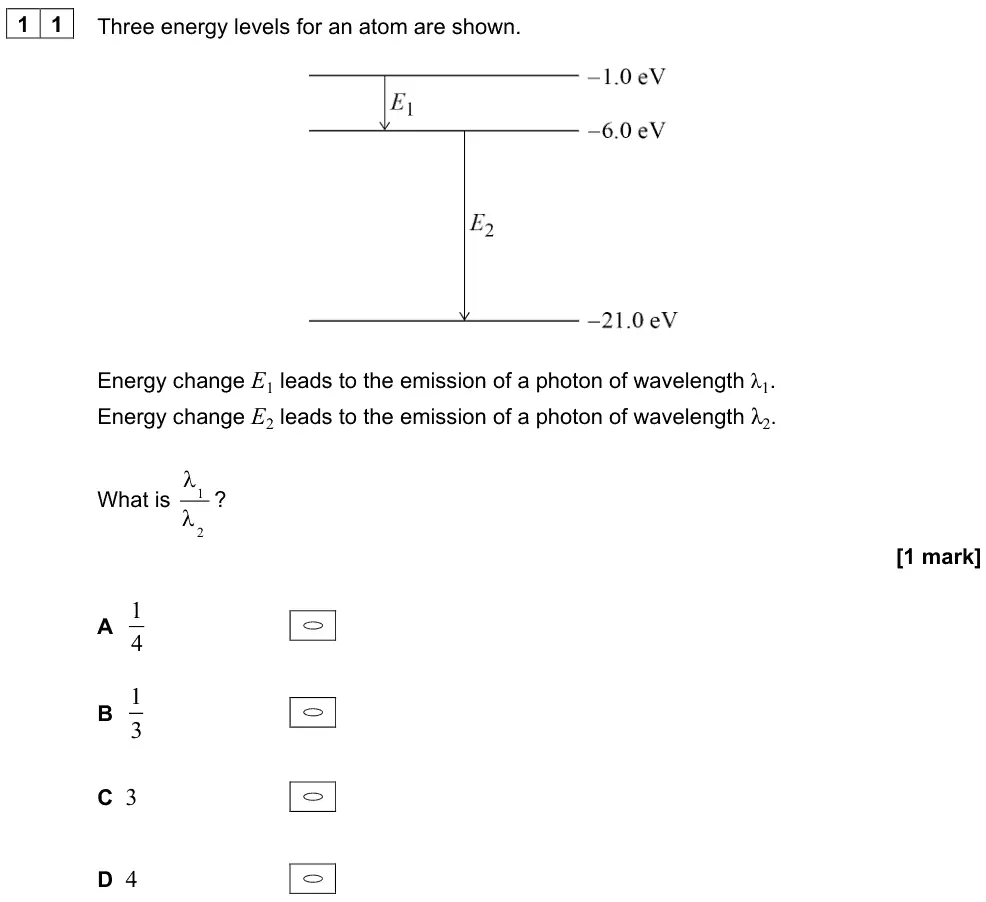
June 2024 · Paper 1 · Q111 markAO1=1Multiple choice
Answer
C
Mark scheme
Notes from the mark scheme and report
Answer: C
Skills: MS0.3 Use ratios, fractions and percentages
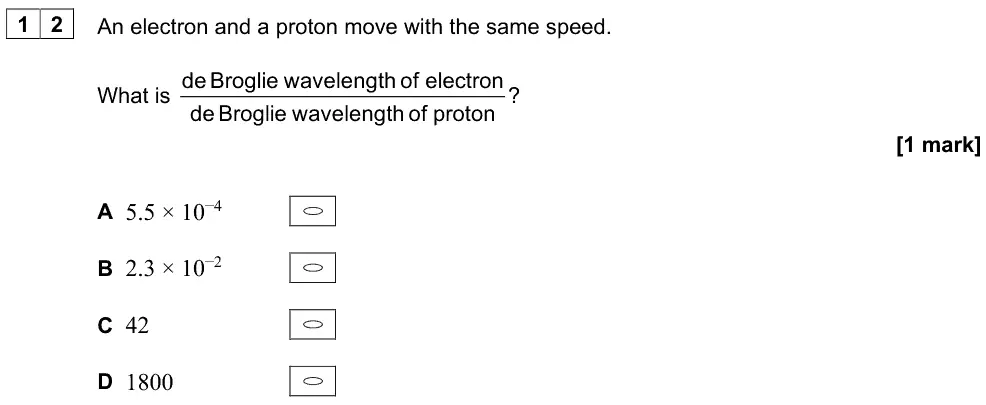
June 2024 · Paper 1 · Q121 markAO2=1Multiple choiceEasy
Answer
D
Mark scheme
Examiner's comment
There were five very accessible questions that were correctly answered by more than 70% of students. These were B12, B18, B14, B27 and B29.
Notes from the mark scheme and report
Answer: D
Skills: MS0.3 Use ratios, fractions and percentages
June 2024 · AS Paper 2 · Q171 markMultiple choice
Answer
D
Mark scheme
Examiner's comment
Generally, students were more successful in answering questions 5, 6, 7, 11, 14, 17 and were less successful in answering questions 9, 10, 12, 13, 15, 16, 18, 21, 22, 23.
Notes from the mark scheme and report
Answer: D
Skills: MS0.2 Recognise and use expressions in decimal and standard form
June 2023 · AS Paper 1 · Q1.22 marksAO1=2Calculation
Earlier part of question 1 that this part uses
Mark scheme
Examiner's comment
01.2 51% of students scored two marks. Power of ten errors were common, with a significant proportion of students either ignoring the prefix or dividing by 106 rather than multiplying by it. Many students divided by 1.6 × 10⁻¹⁹ rather than multiplying by this factor. Alternatively, they multiplied by the Planck constant.
This question proved the most accessible question in the paper for E grade students. Most students were able to gain some marks in parts 01.1 and 01.2. However, successful attempts at parts 01.3 and 01.4 were less common and usually indicative of grade A performance.
Notes from the mark scheme and report
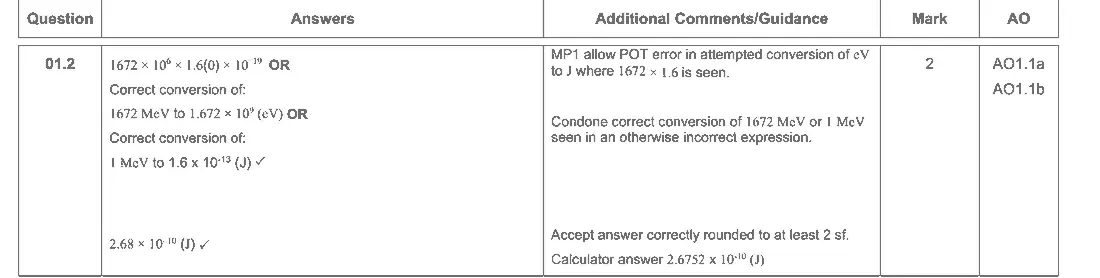
Answer: 2.68 x 10^-10 J (1672 x 10^6 x 1.60 x 10^-19)
prefix and dividing by 1.6 x 10^-19 errors common
Skills: MS0.2 Recognise and use expressions in decimal and standard form; MS0.1 Recognise and make use of appropriate units in calculations
June 2023 · Paper 1 · Q1.41 markAO1=1Calculation
Earlier part of question 1 that this part uses
Mark scheme
Examiner's comment
01.4 This straightforward calculation caused little problem for the majority of students. There were some who had difficulty with the unit conversion, being unsure about whether to multiply or divide by the charge on the electron. With only one mark available, no marks were given for partially correct answers.
Notes from the mark scheme and report
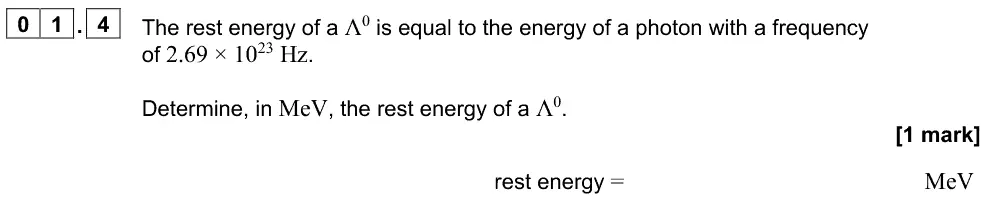
Answer: 1.11 x 10^3 MeV (E = hf = 1.78 x 10^-10 J, divide by 1.6 x 10^-13)
multiply/divide by e confusion
Skills: MS0.2 Recognise and use expressions in decimal and standard form
June 2023 · Paper 1 · Q121 markMultiple choiceEasy
Answer
C
Mark scheme
Examiner's comment
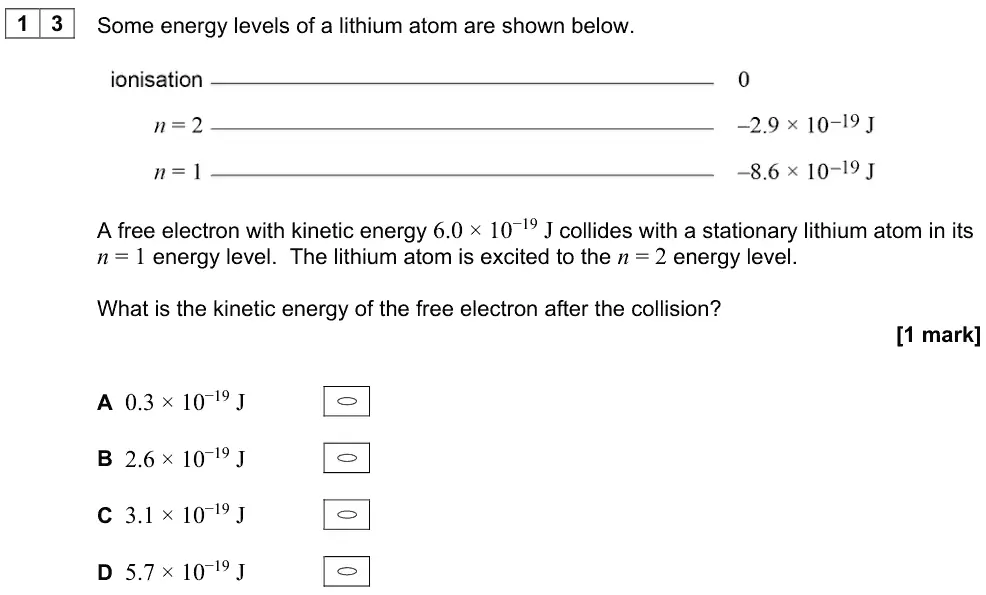
The multiple choice questions covered parts of the specification not covered in Section A. The distractors in these questions were written with common errors and misconceptions in mind. These questions are therefore an extremely useful resource when preparing students. The easiest questions were 7, 12, 20, 10 and 11, with over 75% of students getting these questions right. The most demanding were 18, 26, 22, 21 and 13; fewer than 40% of students got these right. For several of these the correct answer was not the most popular choice.
Notes from the mark scheme and report
Answer: C
Skills: MS2.3 Substitute numerical values into algebraic equations using appropriate units for physical quantities
June 2023 · Paper 1 · Q131 markMultiple choiceHard
Answer
A
Mark scheme
Examiner's comment
The multiple choice questions covered parts of the specification not covered in Section A. The distractors in these questions were written with common errors and misconceptions in mind. These questions are therefore an extremely useful resource when preparing students. The easiest questions were 7, 12, 20, 10 and 11, with over 75% of students getting these questions right. The most demanding were 18, 26, 22, 21 and 13; fewer than 40% of students got these right. For several of these the correct answer was not the most popular choice.
Notes from the mark scheme and report
Answer: A
June 2023 · AS Paper 2 · Q121 markMultiple choice
Answer
D
Mark scheme
Notes from the mark scheme and report
Answer: D
June 2022 · Paper 1 · Q1.32 marksAO3=2Explanation
Earlier part of question 1 that this part uses
Mark scheme
Examiner's comment
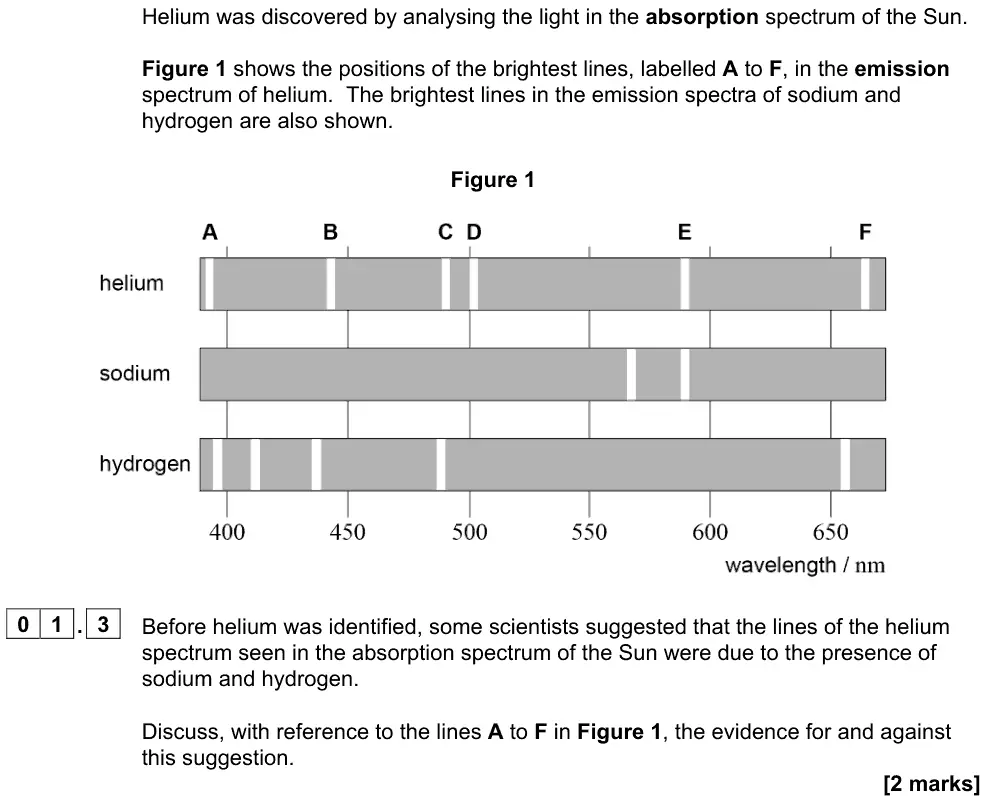
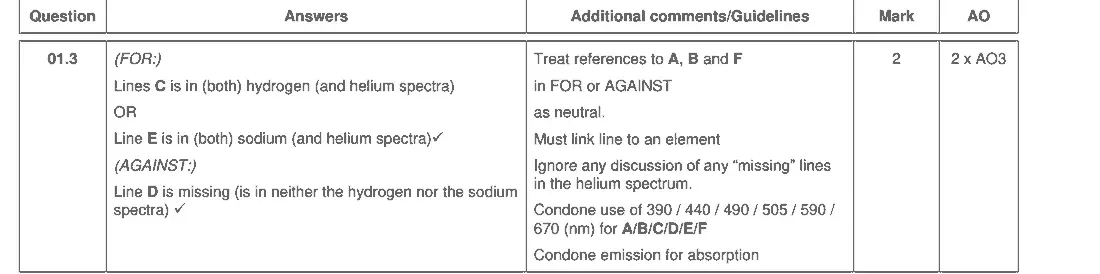
01.3 required students to set out the evidence clearly, linking it to the particular element being discussed. Although it was not penalised, many students discussed whether the lines of hydrogen or sodium matched those of helium, rather than the other way around.
Both 01.4 and 01.5 discriminated reasonably well, each producing a spread of marks.
The calculation in 01.4 was correctly completed by most students. In a significant number of wrong answers there was an attempt to calculate an energy difference which lost credit. Answers that were based on a difference in wavelengths were penalised further.
Notes from the mark scheme and report
For: line C matches hydrogen or line E matches sodium
against: line D is in neither spectrum
must link each line to an element
June 2022 · Paper 1 · Q1.43 marksAO2=2, AO3=1Calculation
Earlier part of question 1 that this part uses
Mark scheme
Examiner's comment
Both 01.4 and 01.5 discriminated reasonably well, each producing a spread of marks.
The calculation in 01.4 was correctly completed by most students. In a significant number of wrong answers there was an attempt to calculate an energy difference which lost credit. Answers that were based on a difference in wavelengths were penalised further.
Notes from the mark scheme and report
Answer: 2.11-2.14 eV (line E at 580-590 nm, E = hc/lambda, J to eV)
energy differences between two lines lost credit
Skills: MS3.1 Translate information between graphical, numerical and algebraic forms; MS2.3 Substitute numerical values into algebraic equations using appropriate units for physical quantities
June 2022 · Paper 1 · Q1.53 marksAO1=3Explanation
Earlier part of question 1 that this part uses
Mark scheme
Examiner's comment
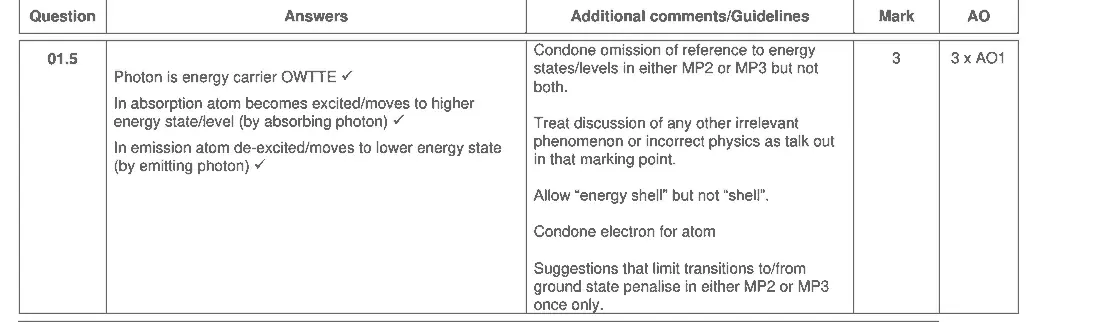
01.5 proved to be more challenging. Answers were often vague or ambiguous. Important details related to the role of the photon, or the significance of energy levels, were also often missing. Rather than simply explaining emission, several students explained how the excitation happened in the first place, and this often led to confusion.
Both 01.4 and 01.5 discriminated reasonably well, each producing a spread of marks.
Notes from the mark scheme and report
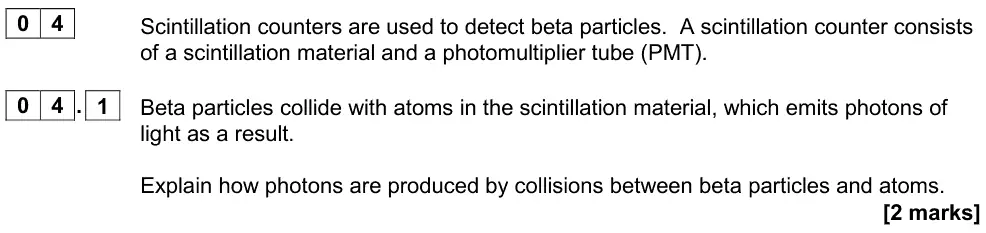
Photon carries the energy
absorption: atom absorbs a photon and is excited to a higher level
emission: atom de-excites to a lower level emitting a photon
answers often vague
June 2022 · AS Paper 1 · Q2.12 marksAO1=1, AO2=1Explanation
Mark scheme
Examiner's comment
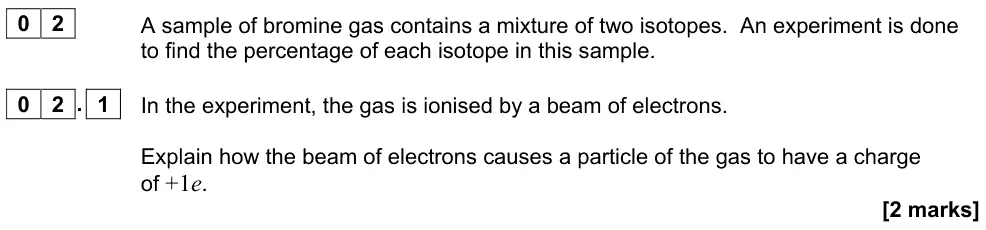
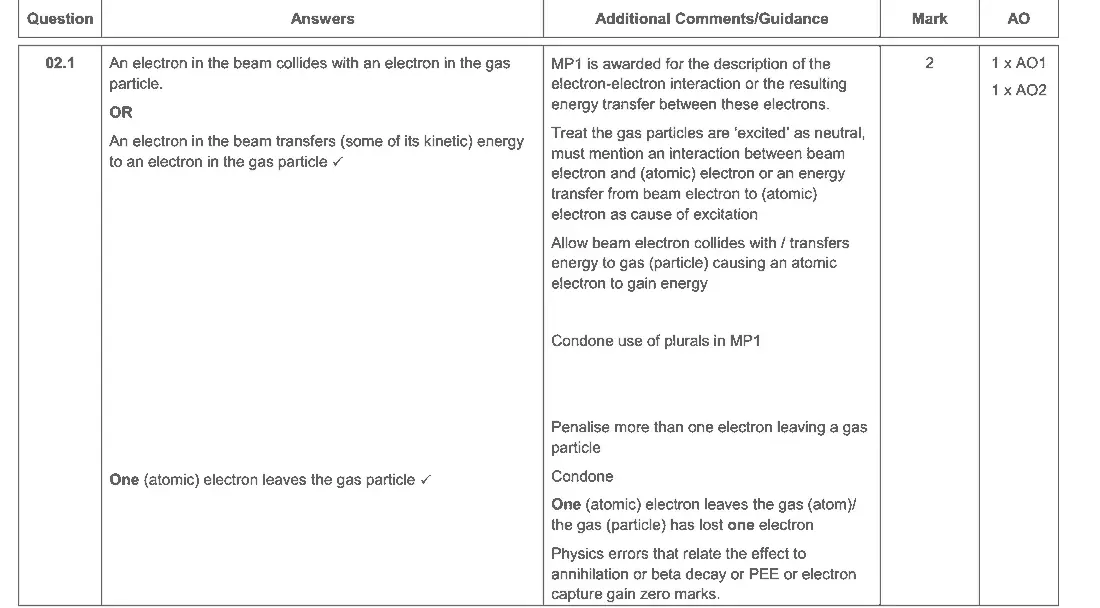
02.1 Just under 50% of students achieved no marks in this question. Good answers described the beam electron colliding with the orbital electron and the resulting energy transfer. They also described how the gas particle developed a charge of +1e. Others were less successful through making statements that were too vague and did not address the context or the answers lacked the appropriate level of technical language expected of an AS student. A very common misconception seen was that a bromine atom captured the beam electron giving it a charge of +1. 02.2 Approximately one-third of the students gained both marks here. Many students had little or no understanding of the question and these answers typically involved subtracting 35 from 162. These students were unable to appreciate that the term isotope applied to the nucleus of a bromine atom and instead treated it as a term describing the diatomic molecule.
Notes from the mark scheme and report
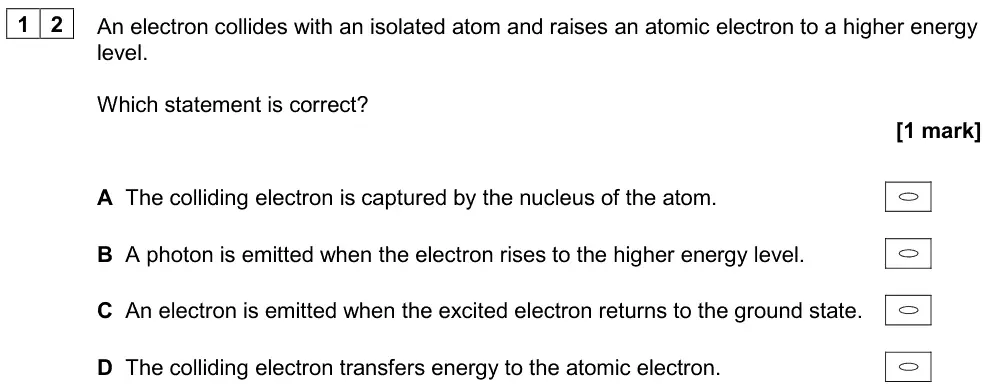
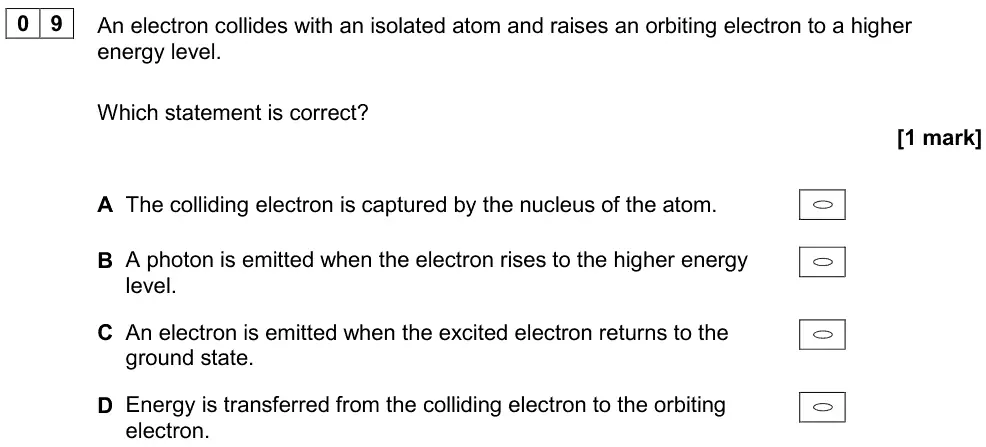
Beam electron collides with / transfers energy to an atomic electron
one electron leaves the particle
'atom captures the electron' was a common misconception
June 2022 · AS Paper 1 · Q4.23 marksAO1=1, AO2=2CalculationEasy
Earlier part of question 4 that this part uses
Mark scheme
Examiner's comment
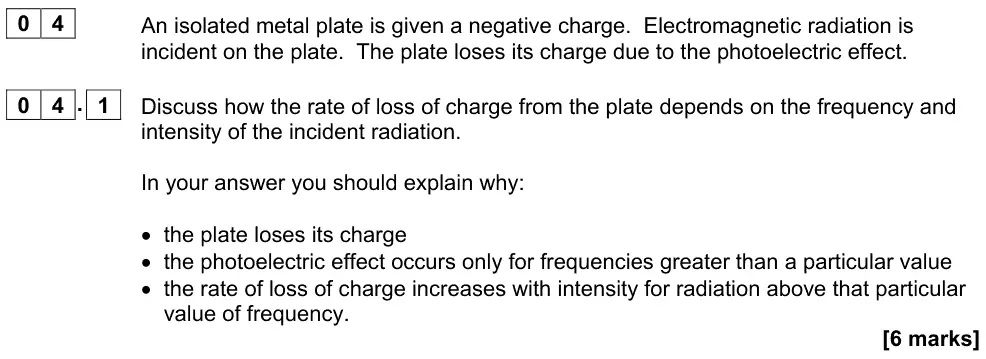
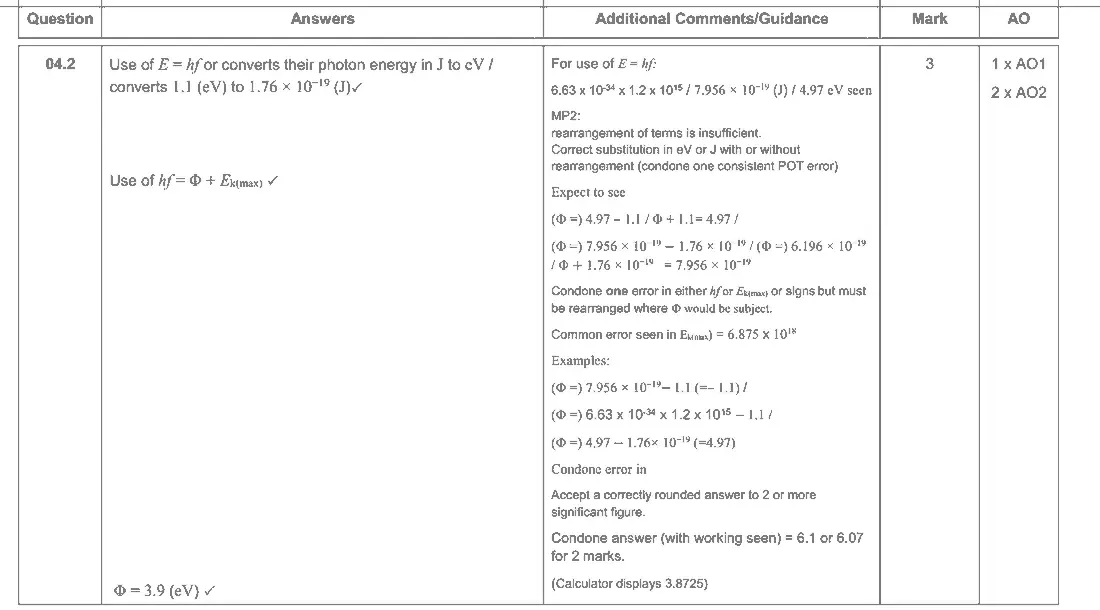
Common errors included a limited use of appropriate technical language such as confusing threshold frequency with work function, and describing electrons as being ionised instead of released from the surface. Other students showed very limited knowledge and could only tentatively suggest that electrons were emitted when the electromagnetic radiation was incident on the metal. 04.2 Most students performed well in this calculation with over 60% gaining both marks. The mismatch of units in the photoelectric equation was a common error with students substituting the photon energy in joules and the kinetic energy in electron volts. Other students failed to gain marks due to forgetting to convert their answer in joules back into electron volts.
Notes from the mark scheme and report
Answer: 3.9 eV (hf = 7.96 x 10^-19 J = 4.97 eV, minus 1.1 eV)
mixing J and eV in the photoelectric equation was the common error
Skills: MS2.3 Substitute numerical values into algebraic equations using appropriate units for physical quantities; MS2.2 Change the subject of an equation, including non-linear equations
June 2022 · AS Paper 1 · Q5.12 marksAO3=2Explanation
Mark scheme
Examiner's comment
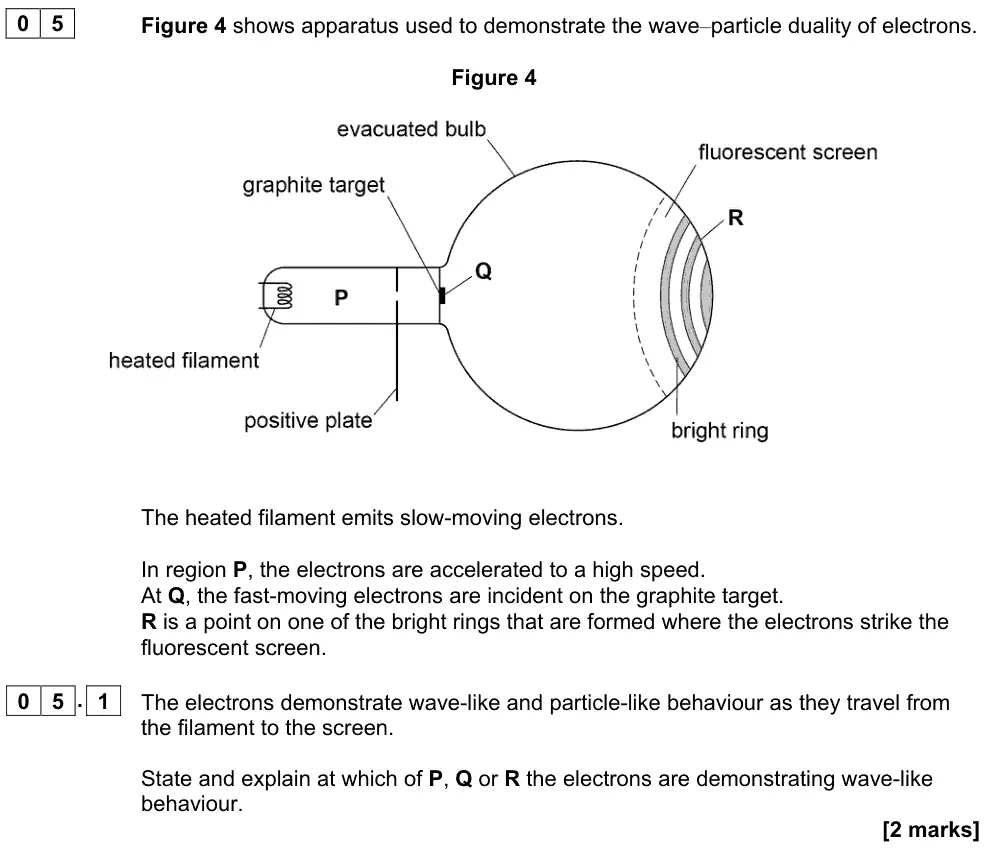
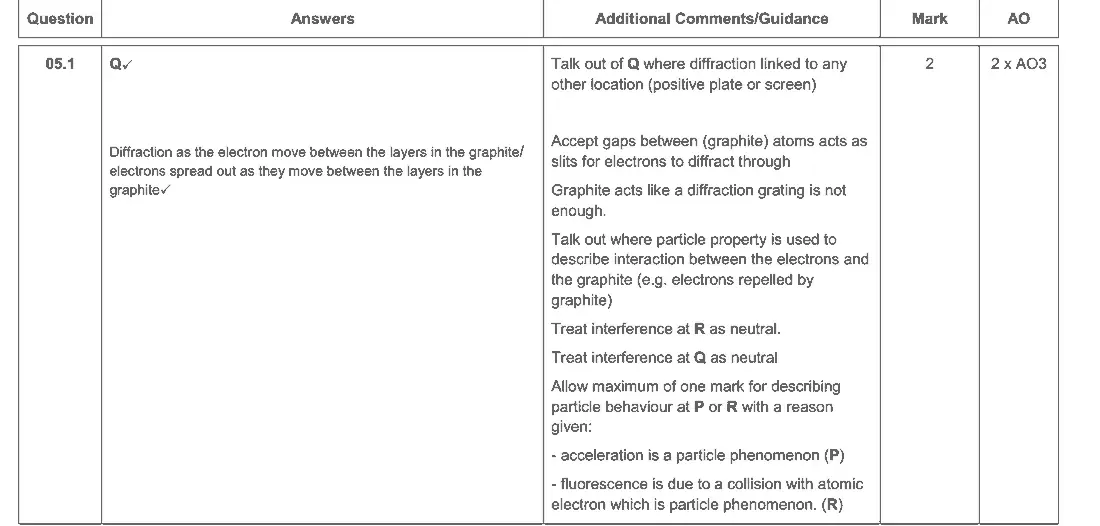
05.1 Most students were unable to score any marks in this question. They had not read the question with enough care to appreciate that R was a point on a bright ring and, as such, was a position where the electron was demonstrating particle behaviour. Those who did identify Q as the position where the electrons were demonstrating wave-like behaviour could not provide any convincing explanation of why this was the case.
Notes from the mark scheme and report
Q: electrons diffract as they pass between the layers/atoms of graphite
R is particle behaviour (fluorescence from collision)
June 2022 · AS Paper 1 · Q5.23 marksAO2=3Explanation
Earlier part of question 5 that this part uses
Mark scheme
Examiner's comment
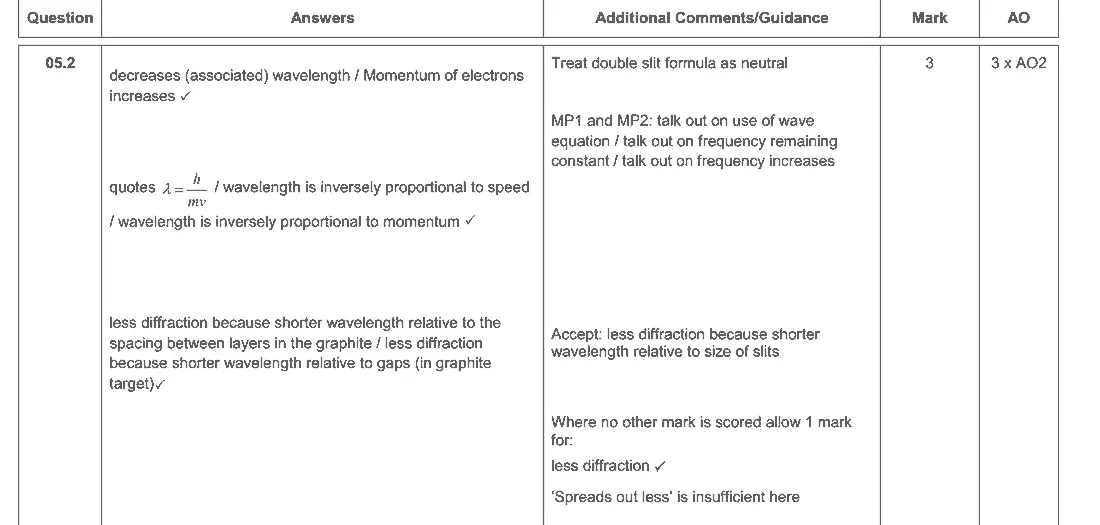
05.2 Students were more successful in this question with over 20% of them gaining at least two marks. These students were able to state that the wavelength had decreased and quoted the de Broglie equation to support this. Very few were able to relate this change of wavelength to the spacing in the graphite and to explain why there was less diffraction.
Some students attempted to use the wave equation to describe why the wavelength decreased whilst others stated that, because the electrons were travelling faster, they had less time to spread out.
Notes from the mark scheme and report
Greater momentum so shorter de Broglie wavelength (lambda = h/mv)
shorter wavelength relative to the atomic spacing gives less diffraction
wave-equation arguments not credited
June 2022 · Paper 1 · Q151 markAO1=1Multiple choice
Answer
B
Mark scheme
Notes from the mark scheme and report
Answer: B
June 2022 · Paper 1 · Q161 markAO1=1Multiple choice
Answer
A
Mark scheme
Notes from the mark scheme and report
Answer: A
June 2022 · Paper 1 · Q171 markAO2=1Multiple choice
Answer
D
Mark scheme
Notes from the mark scheme and report
Answer: D
June 2022 · AS Paper 2 · Q121 markAO1=1Multiple choice
Answer
D
Mark scheme
Notes from the mark scheme and report
Answer: D
Skills: MS0.2 Recognise and use expressions in decimal and standard form
June 2022 · AS Paper 2 · Q131 markAO1=1Multiple choice
Answer
C
Mark scheme
Notes from the mark scheme and report
Answer: C
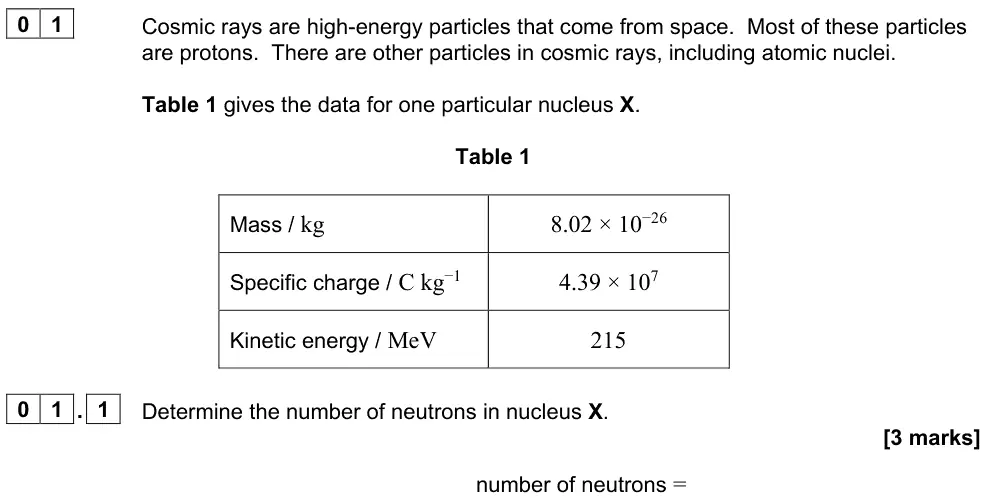
November 2021 · Paper 1 · Q1.23 marksAO1=1, AO2=2Calculation
Earlier part of question 1 that this part uses
Mark scheme
Examiner's comment
Question 01.1 was answered correctly by a majority of students. However, although a mark was available for answers that included the calculation of the number of nucleons, this mark was withheld when the student made any suggestion that what they had calculated was the number of neutrons. This resulted in very few students receiving more than one out of three marks for partial answers. In question 01.2 many students were familiar with the kinetic energy equation, but had difficulties with the conversion between MeV and J. Answers to the remaining parts indicated that many students were unfamiliar with the conservation laws or the decay of the kaon into pions, which are both explicitly on the specification.
Notes from the mark scheme and report
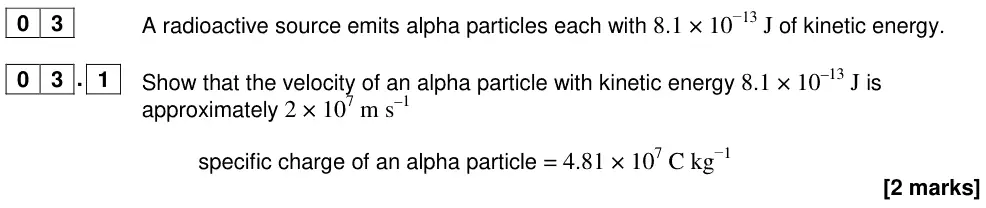
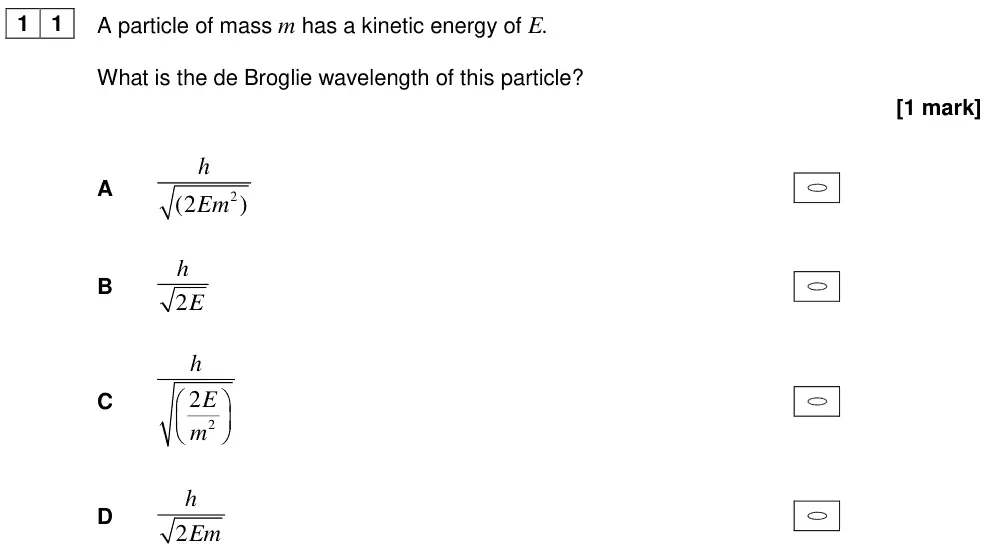
Answer: 2.9 x 10^7 m s^-1 (215 MeV = 3.44 x 10^-11 J, v = root(2E/m))
MeV to J conversion caused difficulty
Skills: MS2.2 Change the subject of an equation, including non-linear equations; MS2.3 Substitute numerical values into algebraic equations using appropriate units for physical quantities; MS0.2 Recognise and use expressions in decimal and standard form
November 2021 · Paper 1 · Q141 markMultiple choice
Answer
D
Mark scheme
Notes from the mark scheme and report
Answer: D
November 2021 · Paper 1 · Q151 markMultiple choice
Answer
C
Mark scheme
Notes from the mark scheme and report
Answer: C
Skills: MS2.3 Substitute numerical values into algebraic equations using appropriate units for physical quantities
November 2021 · Paper 1 · Q161 markMultiple choiceEasy
Answer
B
Mark scheme
Examiner's comment
Several of the multiple-choice questions proved to be extremely difficult. In particular, questions 20, 27 and 29 were answered correctly by fewer than 30% of the students. In question 20 more students opted for B and for C than for the correct answer (D), indicating a lack of familiarity with scale diagrams. In question 27 the most popular answer was B, indicating the difficulties students have with combining resistors, and the second most popular was C, suggesting that students did not understand the difference between open and short circuits. The most popular answer to question 18 was D, probably because the students did not spot that this was a stationary, rather than progressive, wave. The most accessible questions were 10 and 16, both of which were answered correctly by over 70% of the students.
Notes from the mark scheme and report
Answer: B
November 2021 · Paper 2 · Q5.21 markAO2=1Short answerHard
Earlier part of question 5 that this part uses
Mark scheme
Examiner's comment
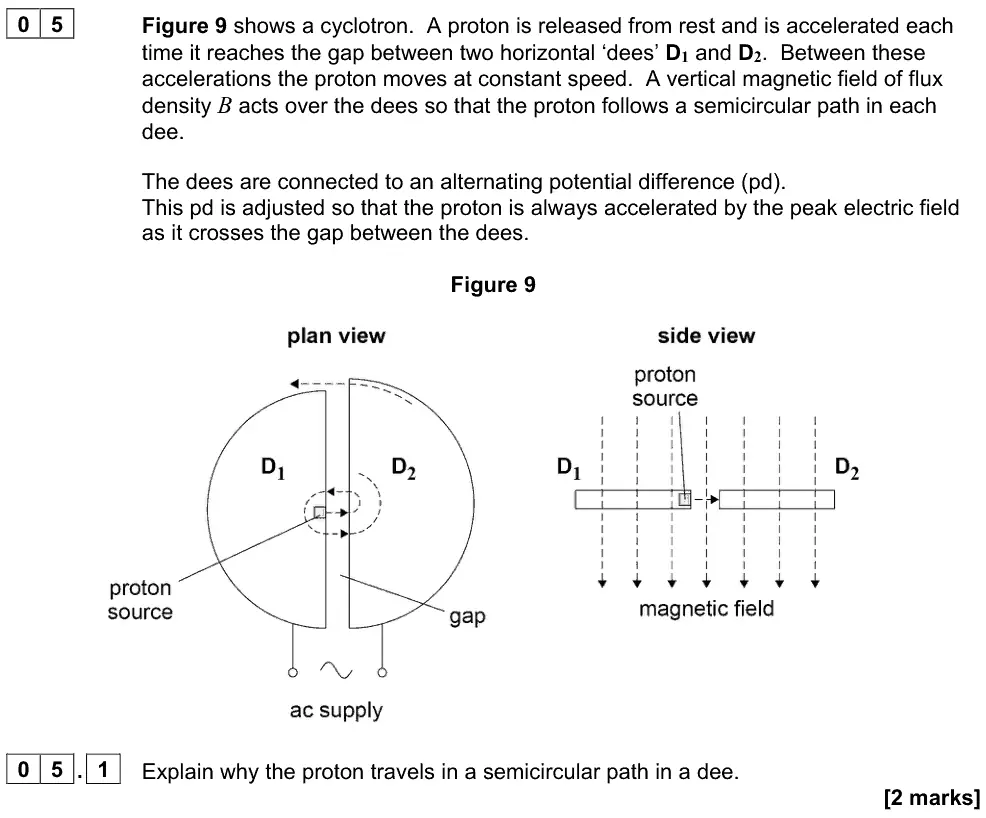
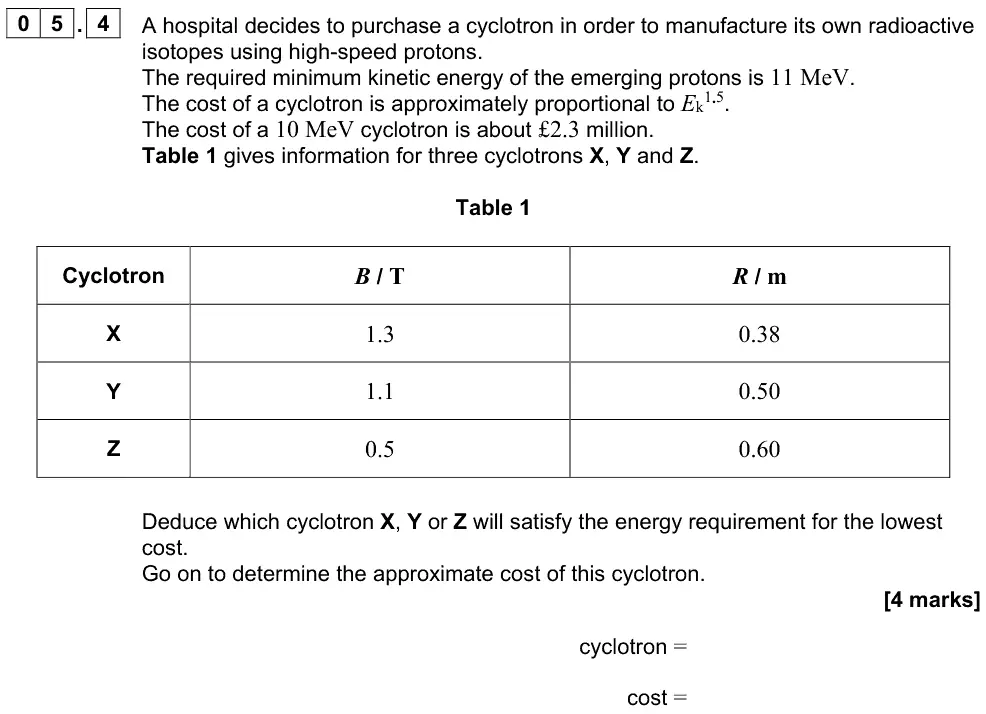
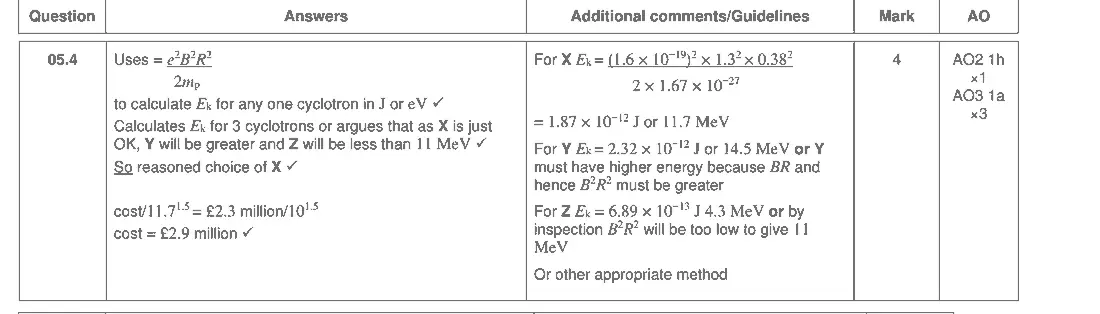
05.1 Generally students did not explain the direction in which the force acts in a clear way. Only a few could identify the magnetic force as centripetal. 05.2 Only a quarter of students determined the correct answer. Others settled at random on various energy equations to attempt an answer. 05.3 About a fifth of the students completed the task in a straightforward way. Others did not seem to know how to start; some of these gained a mark when they had established some clear workable equations in the first place. However, just writing BeV does not constitute a working equation unless there is some appropriate supporting evidence provided by the student. 05.4 Only a minority of students scored highly in this question, with very few attempting the cost calculation. Most could not get beyond the first mark. They could often make headway in calculating the kinetic energy of one cyclotron but then stopped. When it came to the cost calculation, most ignored the power law and simply used a linear relationship between kinetic energy and cost.
Notes from the mark scheme and report
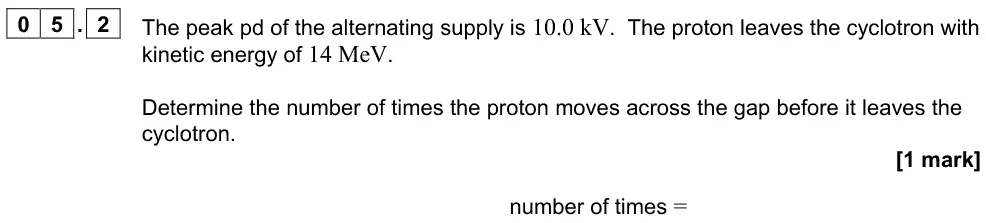
Answer: 1400 (gains 10 keV per crossing
14 MeV / 10 keV)
November 2021 · AS Paper 2 · Q5.36 marks6-mark extended response
Earlier part of question 5 that this part uses
Mark scheme, with the levels and indicative content
Notes from the mark scheme and report
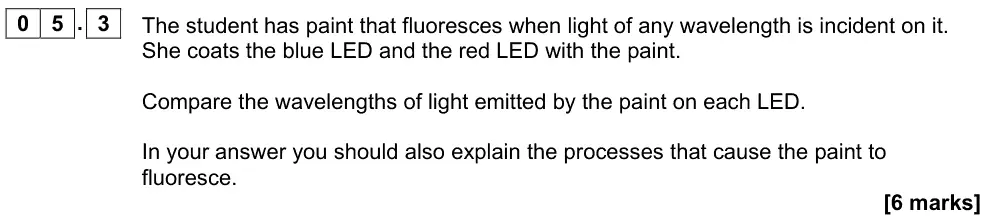
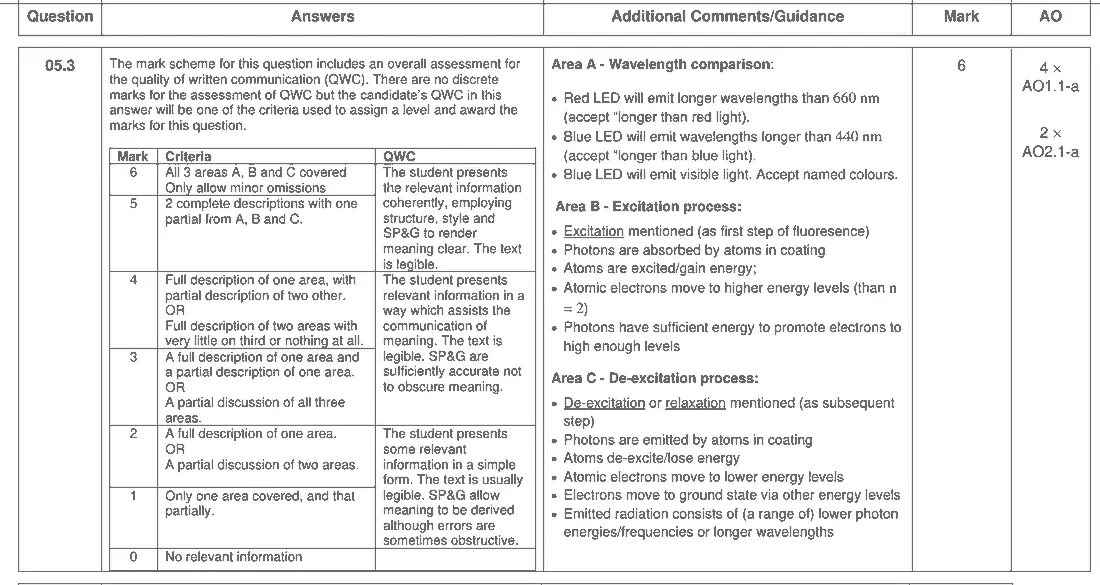
Levels of response: A emitted wavelengths longer than 660 nm (red) and 440 nm (blue)
B photons absorbed, coating atoms excited to higher levels
C de-excitation via intermediate levels emitting lower-energy (longer wavelength) photons
November 2021 · Paper 2 · Q5.44 marksCalculation
Earlier part of question 5 that this part uses
Mark scheme
Examiner's comment
05.1 Generally students did not explain the direction in which the force acts in a clear way. Only a few could identify the magnetic force as centripetal. 05.2 Only a quarter of students determined the correct answer. Others settled at random on various energy equations to attempt an answer. 05.3 About a fifth of the students completed the task in a straightforward way. Others did not seem to know how to start; some of these gained a mark when they had established some clear workable equations in the first place. However, just writing BeV does not constitute a working equation unless there is some appropriate supporting evidence provided by the student. 05.4 Only a minority of students scored highly in this question, with very few attempting the cost calculation. Most could not get beyond the first mark. They could often make headway in calculating the kinetic energy of one cyclotron but then stopped. When it came to the cost calculation, most ignored the power law and simply used a linear relationship between kinetic energy and cost.
Notes from the mark scheme and report
Answer: X, about £2.9 million (Ek for X = 11.7 MeV, Y = 14.5 MeV, Z = 4.3 MeV
cost = 2.3 x (11.7/10)^1.5)
most ignored the 1.5 power
Skills: MS0.5 Use calculators to find and use power, exponential and logarithmic functions; MS0.3 Use ratios, fractions and percentages
November 2021 · AS Paper 2 · Q131 markMultiple choice
Answer
A
Mark scheme
Notes from the mark scheme and report
Answer: A
November 2021 · Paper 3 Section A · Q2.42 marksCalculationHard
Earlier part of question 2 that this part uses
Mark scheme
Examiner's comment
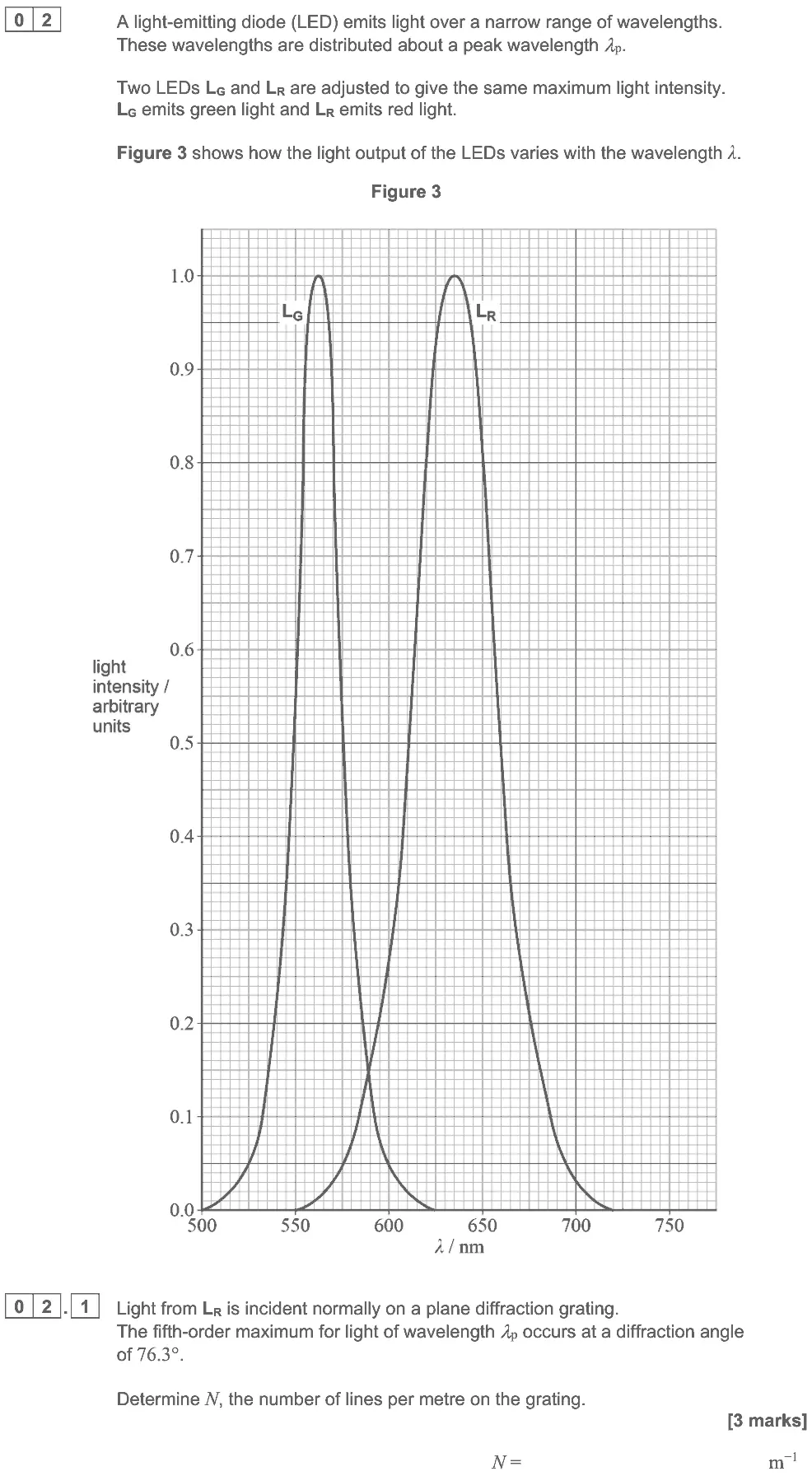
In question 02.4 only 3% of the students successfully used data about both LEDs; some engineered an answer that duplicated the value in the Formulae and Data booklet. All students realised that c is the speed of light but not all recognised that e is the electronic charge and used 2.718 in their calculation.
Notes from the mark scheme and report
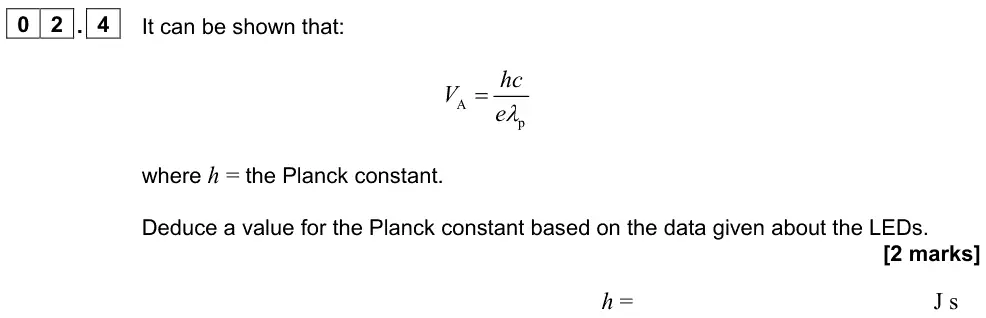
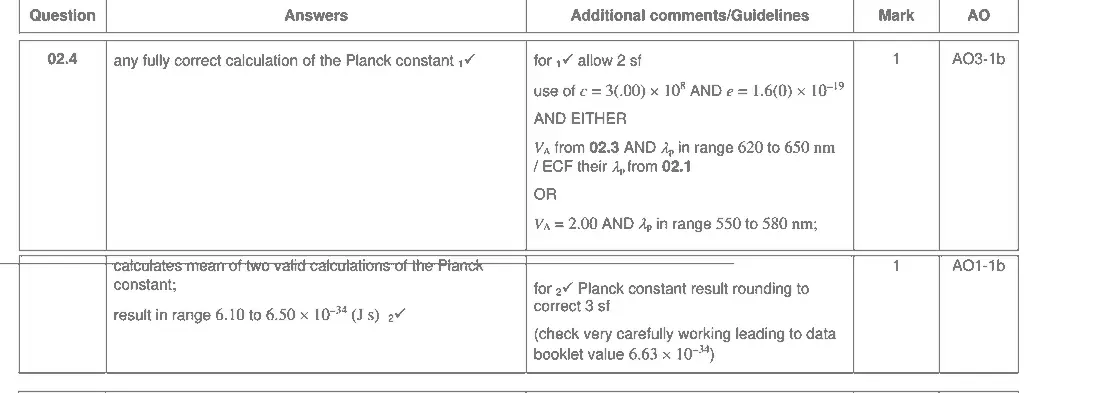
h = e VA lambda_p / c for each LED (VA 1.92 V with 635 nm
2.00 V with 560 nm), mean 6.1-6.5 x 10^-34 J s
using e = 2.718 or engineering the data-booklet value penalised
Skills: MS2.2 Change the subject of an equation, including non-linear equations; MS1.2 Find arithmetic means
November 2020 · Paper 1 · Q81 markMultiple choice
Answer
B
Mark scheme
Notes from the mark scheme and report
Answer: B
Skills: MS0.2 Recognise and use expressions in decimal and standard form; MS2.2 Change the subject of an equation, including non-linear equations
November 2020 · Paper 1 · Q121 markMultiple choice
Answer
D
Mark scheme
Notes from the mark scheme and report
Answer: D
November 2020 · Paper 1 · Q131 markMultiple choice
Answer
A
Mark scheme
Notes from the mark scheme and report
Answer: A
Skills: MS3.1 Translate information between graphical, numerical and algebraic forms
November 2020 · AS Paper 2 · Q4.12 marksExplanation
Mark scheme
Notes from the mark scheme and report
Atom gains energy, electrons excited (or ionised) to higher levels
de-excite to lower levels emitting photons
November 2020 · AS Paper 2 · Q101 markMultiple choice
Answer
A
Mark scheme
Notes from the mark scheme and report
Answer: A
November 2020 · AS Paper 2 · Q111 markMultiple choice
Answer
A
Mark scheme
Notes from the mark scheme and report
Answer: A
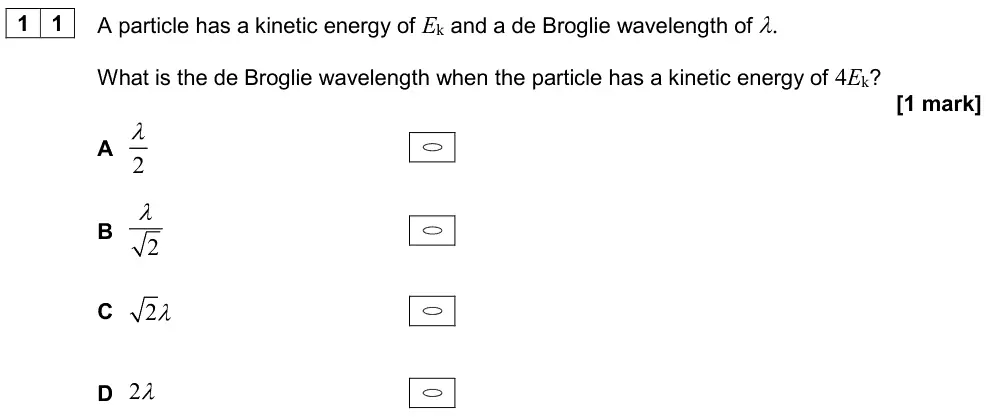
lambda/2
Skills: MS0.3 Use ratios, fractions and percentages
June 2019 · AS Paper 1 · Q6.43 marksExplanation
Earlier part of question 6 that this part uses
Mark scheme
Examiner's comment
2 E mc = 06.3 even though this equation This question discriminated well. Many students applied is not included in specification. Full credit was allowed for this approach. A difficulty for many students was converting the rest energies from MeV to J. 06.4 Few students could describe the formation of a line-emission spectrum concisely. Most began by explaining the process of atomic excitation, which gained no credit. Students should be guided to consider the number of marks available and the specific question. In this case there were three marks and three parts: Why is it a line (rather than continuous) spectrum? Why is it an emission (rather than absorption) spectrum? Why is it a spectrum?
Notes from the mark scheme and report
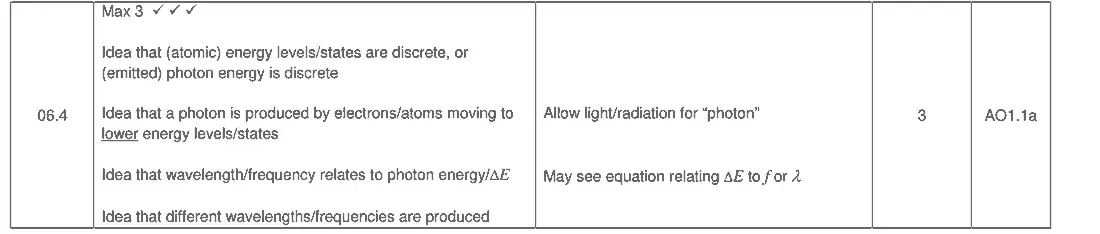
Discrete energy levels
photon emitted when electron moves to a lower level
photon energy = level difference fixes frequency/wavelength, giving distinct lines
describing excitation alone gained nothing
June 2019 · Paper 1 · Q91 markMultiple choice
Answer
D
Notes from the mark scheme and report
Answer: D
June 2019 · Paper 1 · Q111 markMultiple choice
Answer
C
Notes from the mark scheme and report
Answer: C
Skills: MS2.3 Substitute numerical values into algebraic equations using appropriate units for physical quantities
June 2019 · Paper 1 · Q221 markMultiple choice
Answer
D
Notes from the mark scheme and report
Answer: D
about 25% chose C
June 2019 · AS Paper 2 · Q3.22 marksCalculation
Earlier part of question 3 that this part uses
Mark scheme
Examiner's comment
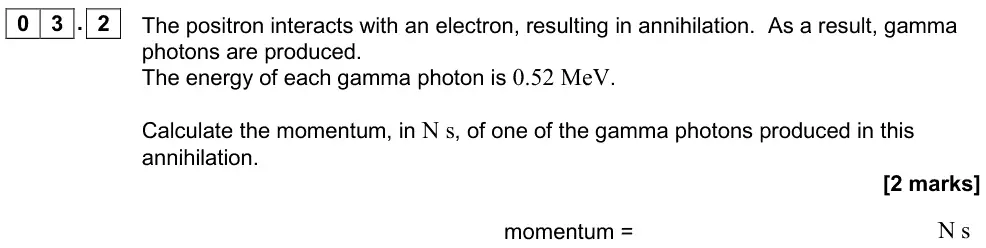
3.2 Students need to take more care in reading the opening stem to a question. The required equation was provided and any use of this obtained credit. Many students were unable to convert 0.52 MeV to joule. This conversion is a key skill expected of AS physics students and should be treated as such.
Notes from the mark scheme and report
Answer: 2.8 x 10^-22 N s (E = 8.32 x 10^-14 J, p = E/c given in stem)
MeV to J conversion was the main failure
Skills: MS2.3 Substitute numerical values into algebraic equations using appropriate units for physical quantities; MS0.2 Recognise and use expressions in decimal and standard form
June 2019 · AS Paper 2 · Q121 markMultiple choice
Answer
C
Mark scheme
Notes from the mark scheme and report
Answer: C
June 2019 · AS Paper 2 · Q141 markMultiple choice
Answer
C
Mark scheme
Notes from the mark scheme and report
Answer: C
June 2019 · Paper 2 · Q171 markMultiple choice
Answer
D
Notes from the mark scheme and report
Answer: D
Skills: MS2.2 Change the subject of an equation, including non-linear equations
June 2018 · Paper 1 · Q2.12 marksShow thatEasy
Mark scheme
Examiner's comment
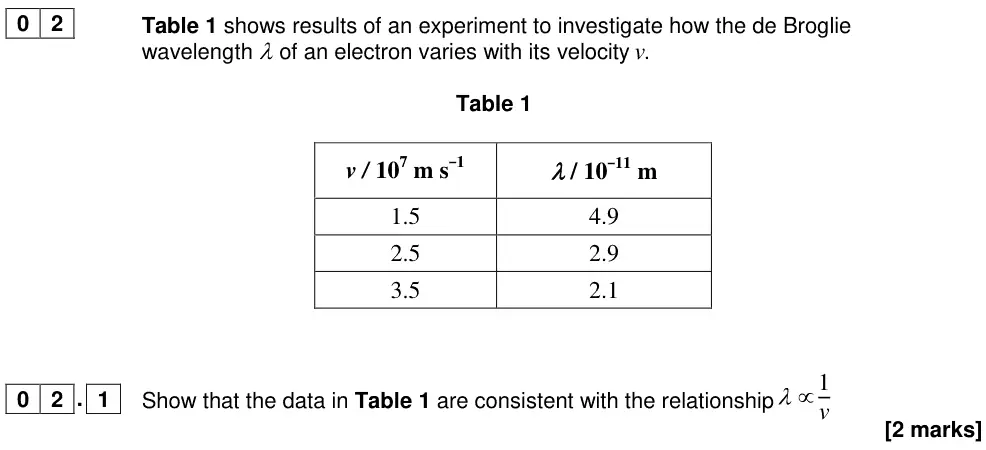
02.1 This was often well answered (63% of students gained both marks), although presentation of the work left much to be desired in many instances. Conclusions were often vague or non-existent (e.g. a series of ticks), rather than a convincing statement. Questions of this type are quite common in examinations and a provide a useful skill in testing practical data. Using a ‘known’ equation and data to demonstrate that the numbers are compatible is not an acceptable approach.
Notes from the mark scheme and report
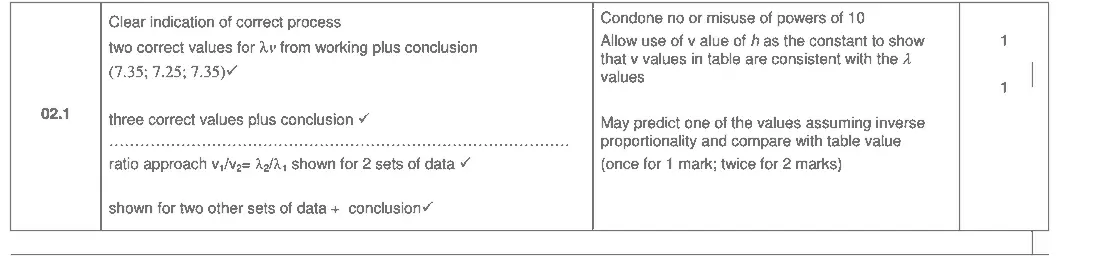
Show lambda x v is constant (7.35, 7.25, 7.35 x 10^-4) or ratio method, with a clear conclusion
using h as a known constant is not acceptable
Skills: MS0.3 Use ratios, fractions and percentages; MS3.1 Translate information between graphical, numerical and algebraic forms
June 2018 · Paper 1 · Q2.22 marksCalculationEasy
Earlier part of question 2 that this part uses
Mark scheme
Examiner's comment
02.2 For full credit in this part it was necessary to provide some evidence of working. It was well done by a majority of the students; over 80% scored two marks.
Notes from the mark scheme and report
Answer: 6.7 x 10^-34 J s (h = lambda m v, 6.6 x 10^-34 from second row)
working must be shown
Skills: MS2.2 Change the subject of an equation, including non-linear equations; MS2.3 Substitute numerical values into algebraic equations using appropriate units for physical quantities; MS0.2 Recognise and use expressions in decimal and standard form
June 2018 · Paper 1 · Q2.33 marksExplanation
Earlier part of question 2 that this part uses
Mark scheme
Examiner's comment
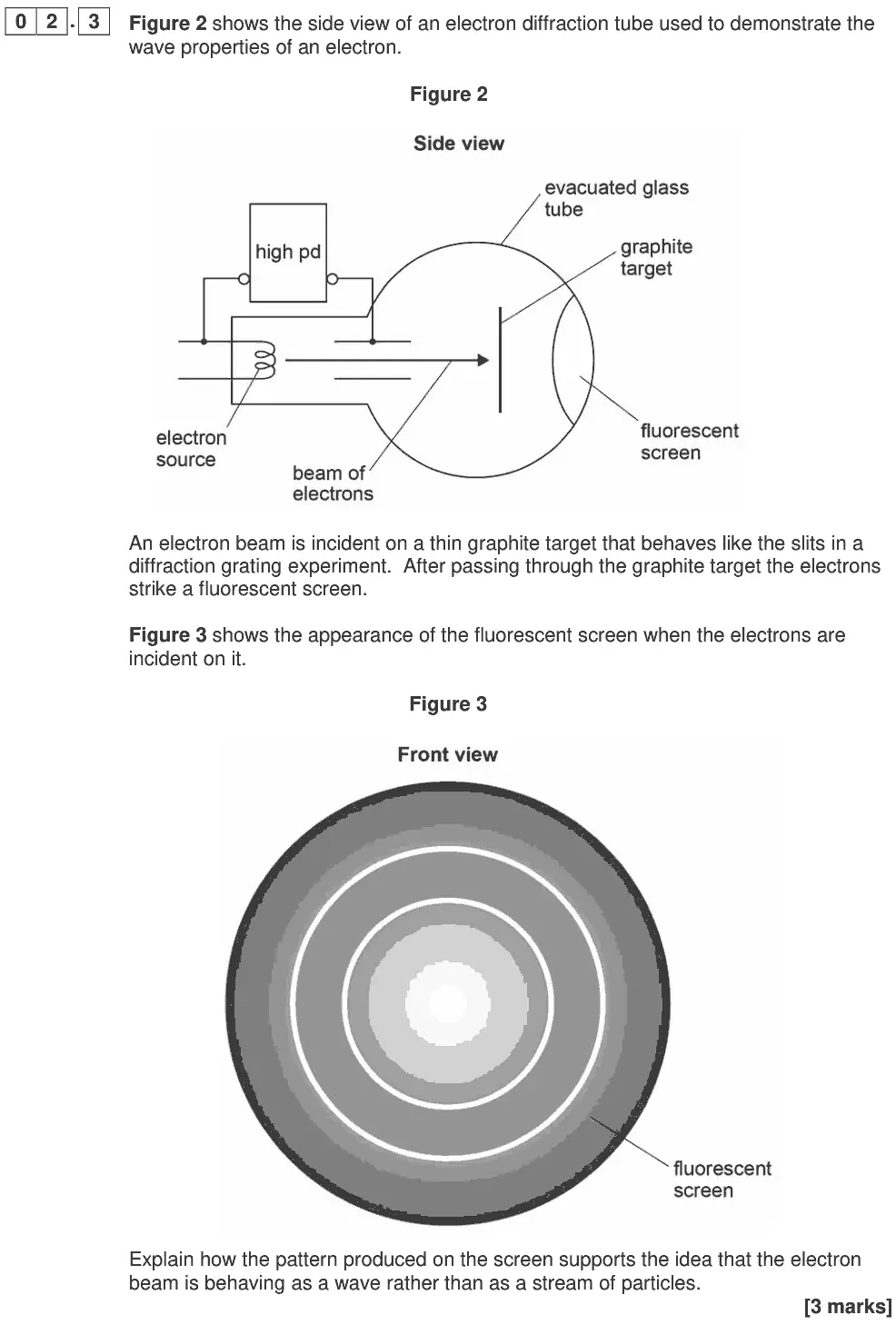
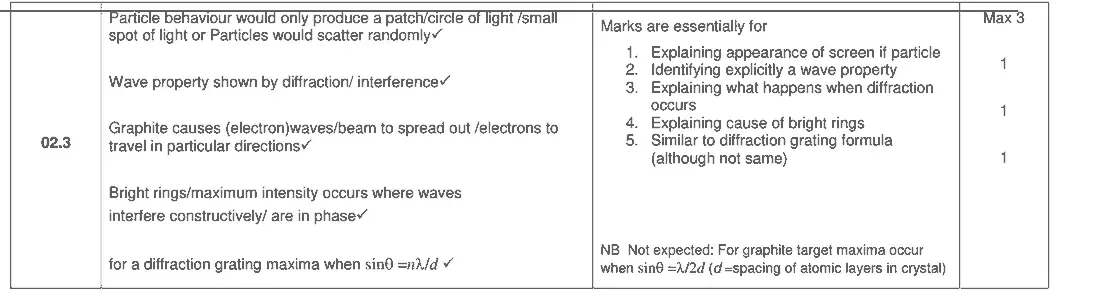
02.3 The fact that diffraction or interference is a wave property and explaining how wave theory explains the bright rings were the two most common points made. To gain full credit, either an explanation of what would be seen if electrons behaved as particles or an explanation of what is meant by diffraction and where it occurred was required. Neither of these was commonly seen in students’ responses.
Notes from the mark scheme and report
Particles would give a single spot/random scatter
diffraction/interference is a wave property
graphite spreads the waves
bright rings where waves arrive in phase (constructive interference)
June 2018 · Paper 1 · Q2.43 marksExplanation
Earlier part of question 2 that this part uses
Mark scheme
Examiner's comment
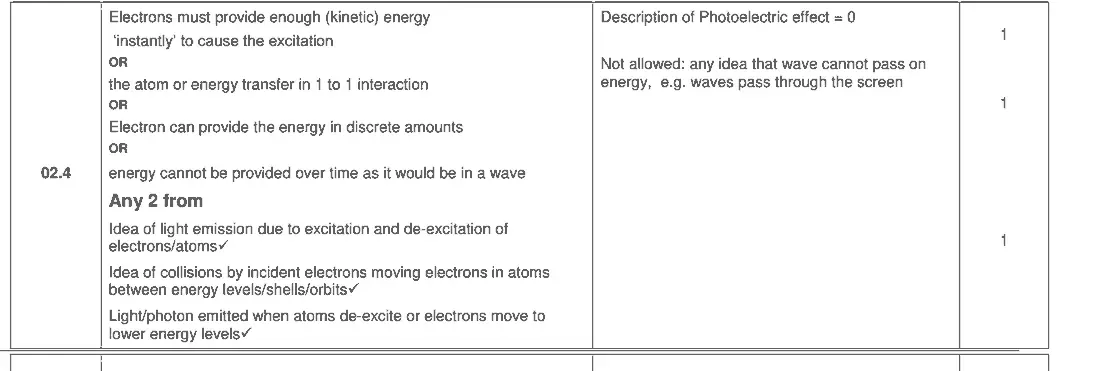
02.4 Most answers missed the point of the question. There were many responses that explained the excitation and de-excitation process, some in much detail, but did not explain clearly that the energy transfer to excite the electron in the atom has to occur with an exact amount of energy being supplied to the electron instantaneously. Many students quoted a ‘one to one interaction’, but this seemed to be a learned response and provided insufficient evidence of them understanding what this means.
Notes from the mark scheme and report
Each electron transfers its energy in one instantaneous, discrete interaction to excite an atom, which de-excites emitting a photon
describing the photoelectric effect scores 0
'one-to-one interaction' alone rarely understood
June 2018 · AS Paper 1 · Q3.11 markShort answerEasy
Mark scheme
Examiner's comment
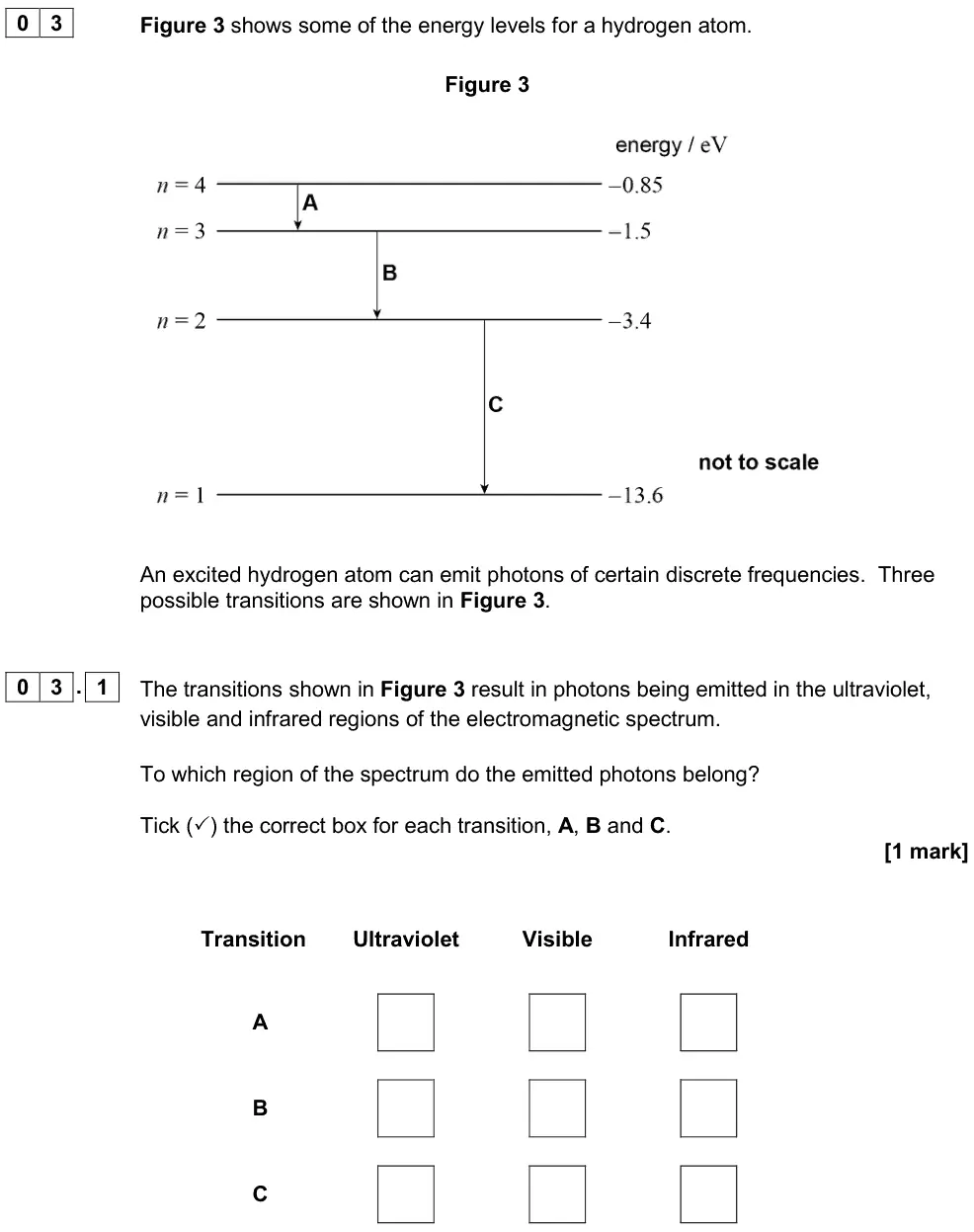
03.1 This objective question was correctly answered by the majority of students (66%).
Notes from the mark scheme and report
A infrared, B visible, C ultraviolet
all three for the mark
June 2018 · AS Paper 1 · Q3.23 marksExplanation
Earlier part of question 3 that this part uses
Mark scheme
Examiner's comment
03.2 This question produced very good discrimination. Many students were able to explain satisfactorily that an exact amount of energy was needed to excite an electron to a higher energy level. Linking this to why the photon needed an exact amount of energy, whereas the free electron only needed a minimum, was more challenging. The idea that all the photon’s energy was absorbed was better understood than the reason why the incident electron only needed a minimum energy. It was common to see answers that made correct statements but then went on to include a discussion of the photoelectric effect. Nearly 40% of students gained no credit.
Notes from the mark scheme and report
Exact energy difference needed for excitation
photon absorbed entirely (one-to-one) so must match
electron can give up part of its KE and carry on
mentioning the photoelectric effect limits to 1 mark
June 2018 · AS Paper 1 · Q3.33 marksCalculation
Earlier part of question 3 that this part uses
Mark scheme
Examiner's comment
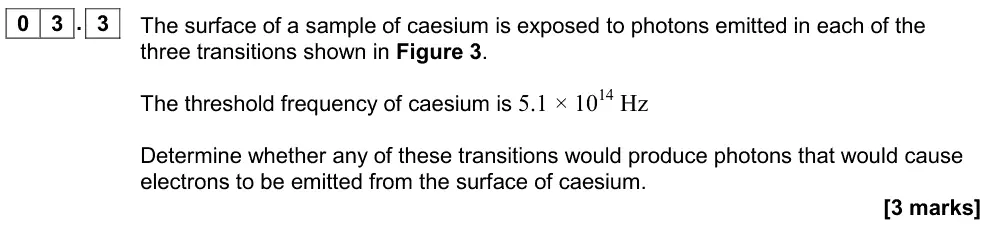
03.3 This question was well done with nearly half the students scoring full marks.
Notes from the mark scheme and report
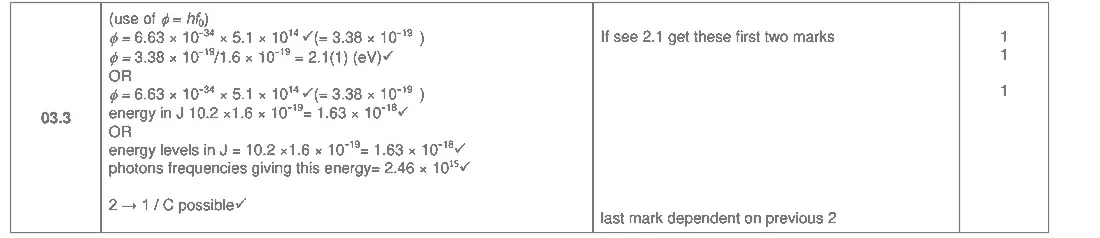
Answer: only C (2 to 1, 10.2 eV) emits electrons
work function hf0 = 3.38 x 10^-19 J = 2.1 eV, larger than A and B photon energies
Skills: MS2.3 Substitute numerical values into algebraic equations using appropriate units for physical quantities
June 2018 · AS Paper 1 · Q3.43 marksCalculation
Earlier part of question 3 that this part uses
Mark scheme
Examiner's comment
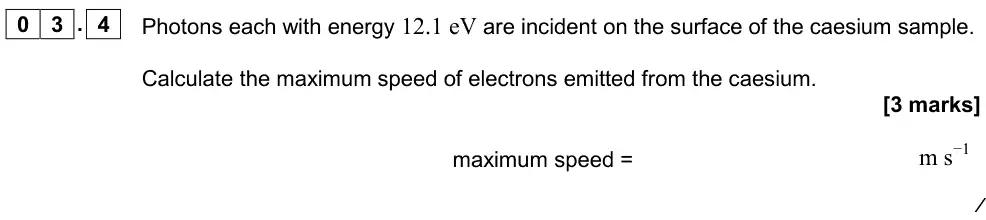
03.4 Performance in this multi-step calculation was disappointing, with over half the students failing to score any marks. The photoelectric equation did seem well known but substitution was a real issue for many. Students had to extract data from different sources and this clearly caused them problems. A common error was a failure to convert the photon energy to joule.
Notes from the mark scheme and report
Answer: 1.9 x 10^6 m s^-1 (Ek = 12.1 - 2.1 = 10 eV = 1.6 x 10^-18 J)
photoelectric equation must be used
failing to convert eV to J was the common error
over half scored zero
Skills: MS2.3 Substitute numerical values into algebraic equations using appropriate units for physical quantities; MS2.2 Change the subject of an equation, including non-linear equations
June 2018 · Paper 1 · Q131 markMultiple choice
Answer
B
Notes from the mark scheme and report
Answer: B
June 2018 · Paper 1 · Q141 markMultiple choice
Answer
A
Notes from the mark scheme and report
Answer: A
Skills: MS2.3 Substitute numerical values into algebraic equations using appropriate units for physical quantities
June 2018 · AS Paper 2 · Q3.33 marksCalculationHard
Earlier part of question 3 that this part uses
Mark scheme
Examiner's comment
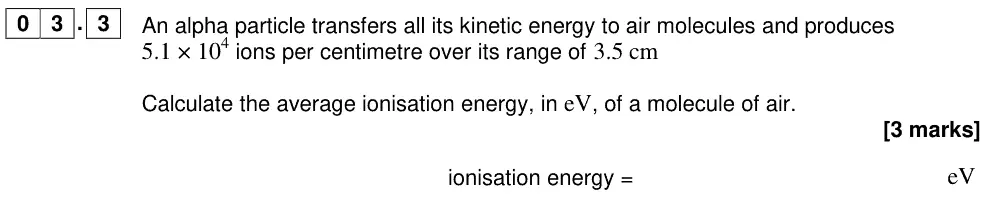
03.3 Good students were able successfully to complete this calculation (23.1%) whereas lower performing students appeared to have little appreciation of the problem and were able to make only limited progress, by perhaps finding the number of ions or converting the energy into electron volts.
The following questions had a significant proportion of non-attempts: Section A 1.5, Section B 3.2, 3.3, 3.4, 3.5, 4.2, 4.3 and Section C 32. It was difficult to ascertain if this was solely due to time management and instead may have been due to students being unable to know where to begin. Students should be encouraged to try and match the question to specification content as a means to unlocking the problem and enabling them to make some progress.
Notes from the mark scheme and report
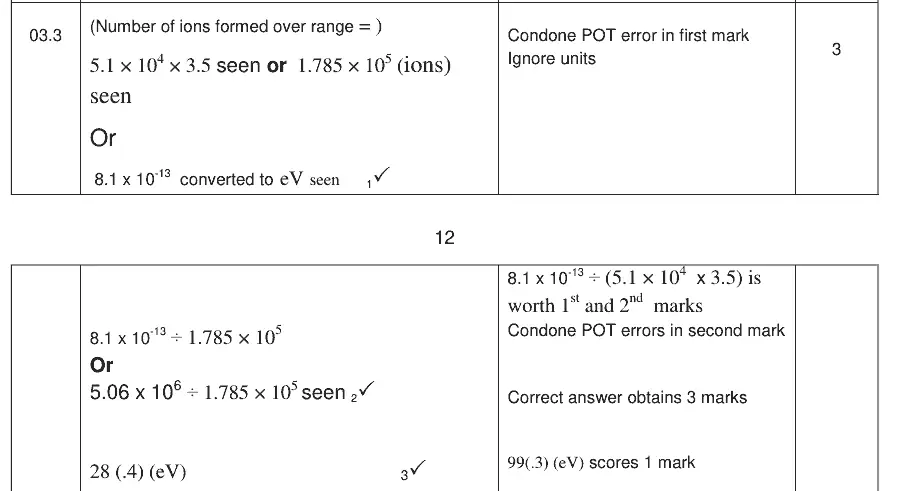
Answer: 28 eV (1.785 x 10^5 ions
8.1 x 10^-13 J / 1.785 x 10^5 = 4.5 x 10^-18 J)
Skills: MS2.3 Substitute numerical values into algebraic equations using appropriate units for physical quantities; MS0.2 Recognise and use expressions in decimal and standard form
June 2018 · Paper 2 · Q7.42 marksExplanationHard
Earlier part of question 7 that this part uses
Mark scheme
Examiner's comment
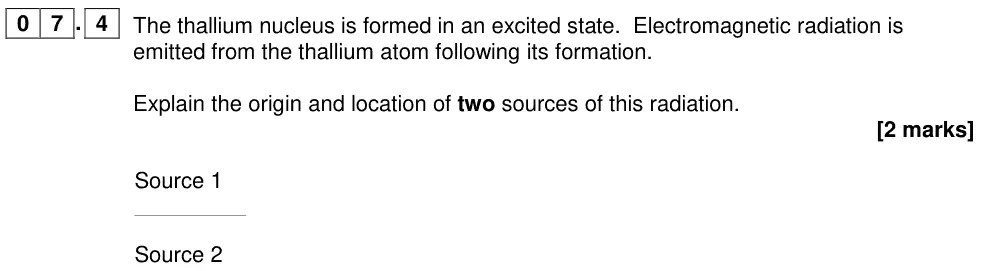
07.4 A good number of students, approaching half, either gave the source of radiation as coming from orbiting electrons or coming from an excited nucleus. Only a few (9.4%) gave two sources. A large number of answers were not specific enough to award marks. “The electrons give off radiation” and “the thallium atom gives off radiation” are examples. It was evident that some students did not fully understand the question and simply quoted situations when radiation is emitted.
Notes from the mark scheme and report
Orbital electrons fall to fill the vacancy left by the captured inner electron (X-ray photons)
the excited nucleus de-excites emitting gamma
vague 'electrons give off radiation' not credited
June 2018 · AS Paper 2 · Q101 markMultiple choice
Answer
D
Notes from the mark scheme and report
Answer: D
June 2018 · AS Paper 2 · Q111 markMultiple choice
Answer
D
Notes from the mark scheme and report
Answer: D
Skills: MS2.2 Change the subject of an equation, including non-linear equations
June 2018 · AS Paper 2 · Q121 markMultiple choice
Answer
C
Notes from the mark scheme and report
Answer: C
June 2018 · AS Paper 2 · Q291 markMultiple choice
Answer
D
Notes from the mark scheme and report
Answer: D
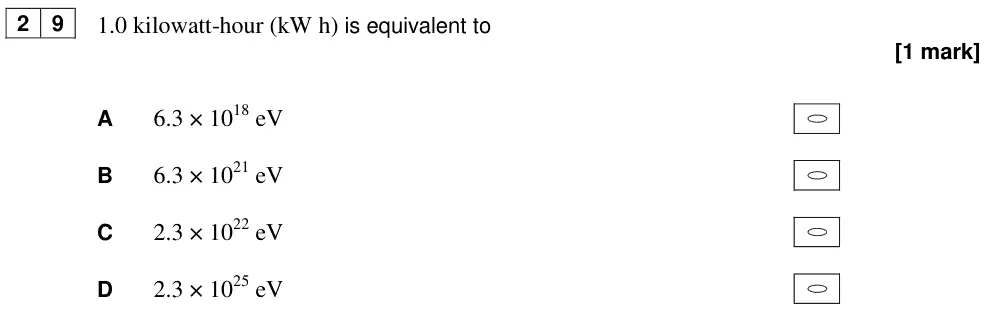
most chose B (1000 W / 1.6 x 10^-19), ignoring the hour - kW h is a unit of energy
Skills: MS0.2 Recognise and use expressions in decimal and standard form
June 2017 · Paper 1 · Q1.33 marksCalculationEasy
Earlier part of question 1 that this part uses
Mark scheme
Examiner's comment
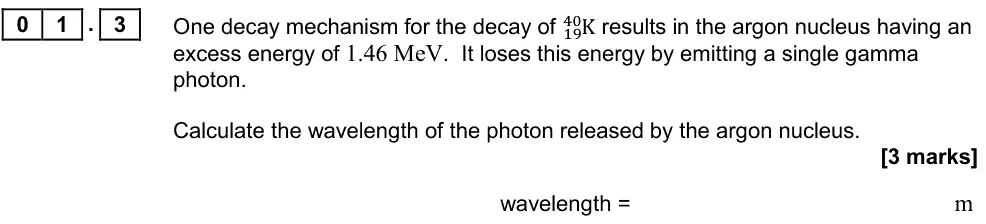
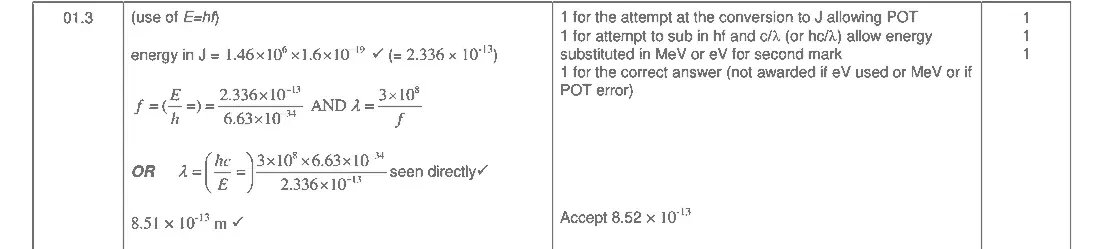
The calculation in question 01.3 was well answered and over two-thirds of students scored full marks. The common errors for those who did not were either failing to convert energy to joules, or a power of ten mistake.
Notes from the mark scheme and report
Answer: 8.51 x 10^-13 m (1.46 MeV = 2.34 x 10^-13 J)
failing to convert to joules or power-of-ten slips were the common errors
Skills: MS0.2 Recognise and use expressions in decimal and standard form; MS2.3 Substitute numerical values into algebraic equations using appropriate units for physical quantities
June 2017 · AS Paper 1 · Q61 markShort answerEasy
Mark scheme
Examiner's comment
Students should be reminded to make it clear which answer they have chosen, and to avoid putting marks in more than one box. It was very accessible, with over 70% obtaining the mark.
Notes from the mark scheme and report
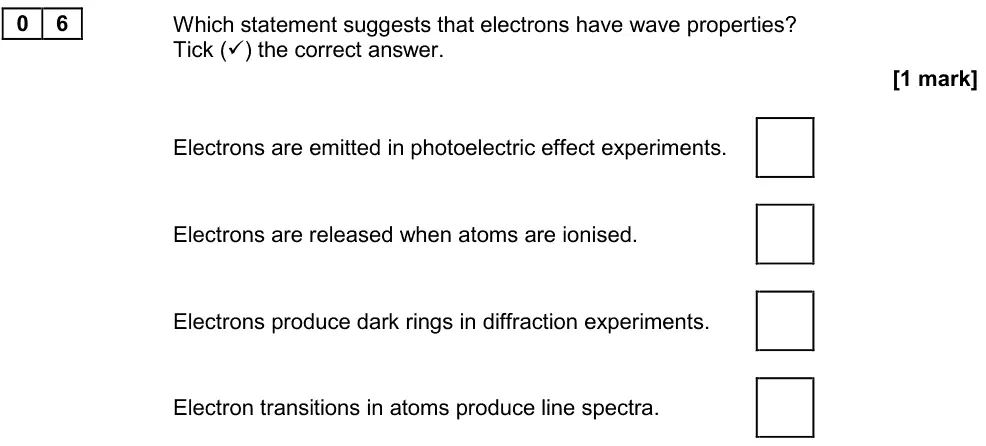
Electrons produce dark rings in diffraction experiments (third box)
June 2017 · AS Paper 1 · Q7.13 marksCalculation
Mark scheme
Examiner's comment
07.1 Difficulties choosing the correct wavelength proved to be an obstacle for many students. The award of the final mark was made without reference to the method. Some credit was also awarded for students who made an error calculating the energy. The conversion to eV proved difficult for some who decided to multiply rather than divide by the charge on the electron.
Notes from the mark scheme and report
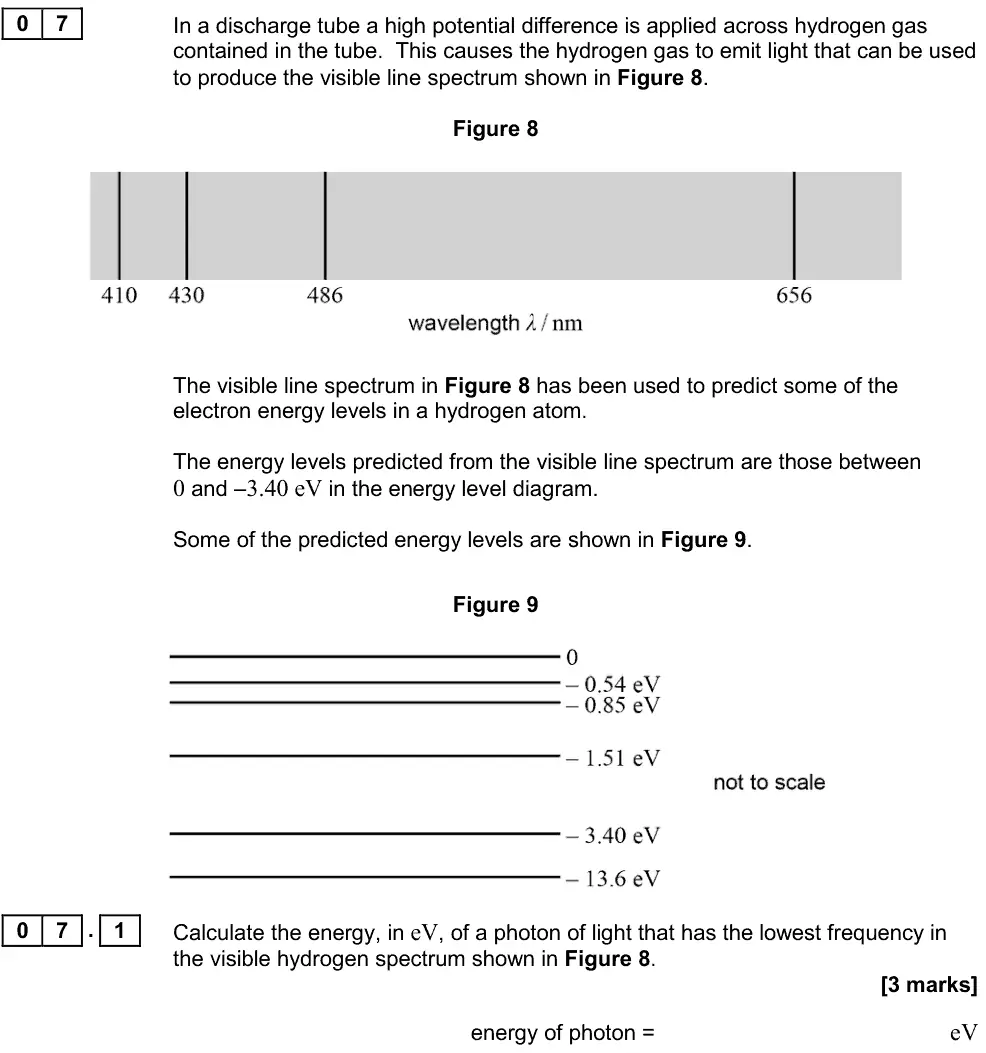
Answer: 1.9 eV (lowest frequency = longest wavelength 656 nm
E = hc/lambda = 3.0 x 10^-19 J, divide by 1.6 x 10^-19)
Skills: MS2.3 Substitute numerical values into algebraic equations using appropriate units for physical quantities; MS0.2 Recognise and use expressions in decimal and standard form
June 2017 · AS Paper 1 · Q7.21 markShort answer
Earlier part of question 7 that this part uses
Mark scheme
Examiner's comment
07.2 Many students found it difficult to describe the ‘free’ energy state and it is clear that this is not an idea that is commonly discussed. Furthermore, many students had difficulties interpreting an energy diagram with the zero at the top. It was common to see this energy level referred to as the ground state because of this.
Notes from the mark scheme and report
Electron is (just) free of the atom (ionised)
often wrongly called the ground state
June 2017 · AS Paper 1 · Q7.31 markShort answer
Earlier part of question 7 that this part uses
Mark scheme
Examiner's comment
07.3 Problems with the ‘upside-down’ scale persisted into this question, although a greater percentage of students was able to identify the ground state.
Notes from the mark scheme and report
Ground state (lowest energy level)
June 2017 · AS Paper 1 · Q7.41 markShort answer
Earlier part of question 7 that this part uses
Mark scheme
Examiner's comment
07.4 It was common to see the negative charge on the electron being given as the reason for negative energy values. Other answers failed to get the mark if they were poorly expressed so that it was unclear what was happening in terms of energy.
This is Paper 1 of the second series of the new AS specification. The paper consists of seven questions from across the AS specification. It makes use of a range of question styles, including multiple choice, short answer, single- and multi-step calculations, data analysis, and extended writing. In general, many students experienced difficulties by missing important details in both the questions and their answers. Calculations were often done well, but many students struggled with answers that required extended writing, particularly those involving some reasoning, such as 02.1, 03.5, 04.3, 05.3, 05.7 and 07.4.
Notes from the mark scheme and report
Zero is the energy of a free electron
energy must be supplied to remove a bound electron, so bound levels are below zero
electron's negative charge is not the reason
June 2017 · AS Paper 1 · Q7.56 marks6-mark extended response
Earlier part of question 7 that this part uses
Mark scheme, with the levels and indicative content
Examiner's comment
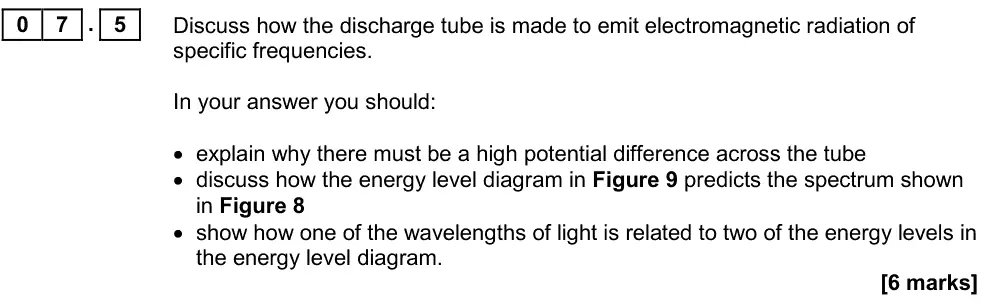
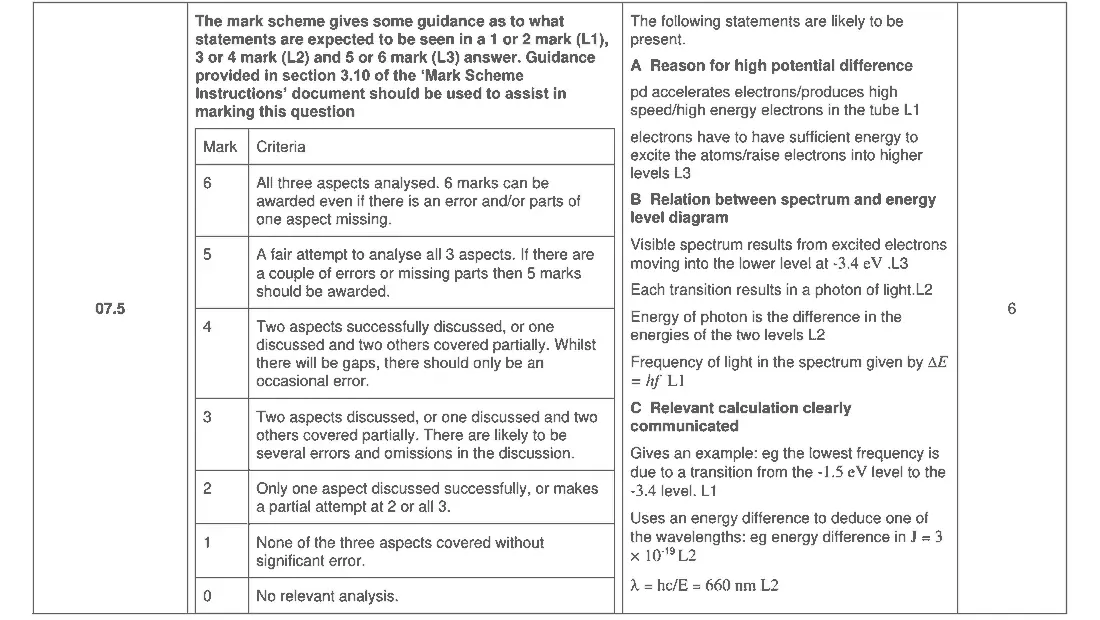
07.5 Despite the extended writing question being the last on the paper, there was no indication that students ran out of time or space. Generally, attempts to explain the reason for high potential difference were often vague so that electrons being accelerated and those within the atoms became confused. On the whole, better attempts were made to link the spectrum and energy level diagrams. Several students used previously analysed data to help answer the final part of this question. Common errors were seen with the introduction of the photoelectric effect or fluorescent tube into the answer.
Notes from the mark scheme and report
Levels of response: high pd accelerates electrons to excite atoms
excited electrons fall to -3.40 eV emitting photons with energy equal to the level difference (hf), giving discrete lines
e.g. -1.51 to -3.40 eV gives 3.0 x 10^-19 J, about 660 nm
June 2017 · Paper 1 · Q111 markMultiple choice
Answer
D
Notes from the mark scheme and report
Answer: D
Skills: MS0.3 Use ratios, fractions and percentages
June 2017 · Paper 1 · Q121 markMultiple choice
Answer
C
Notes from the mark scheme and report
Answer: C
June 2017 · AS Paper 2 · Q4.21 markCalculation
Earlier part of question 4 that this part uses
Mark scheme
Examiner's comment
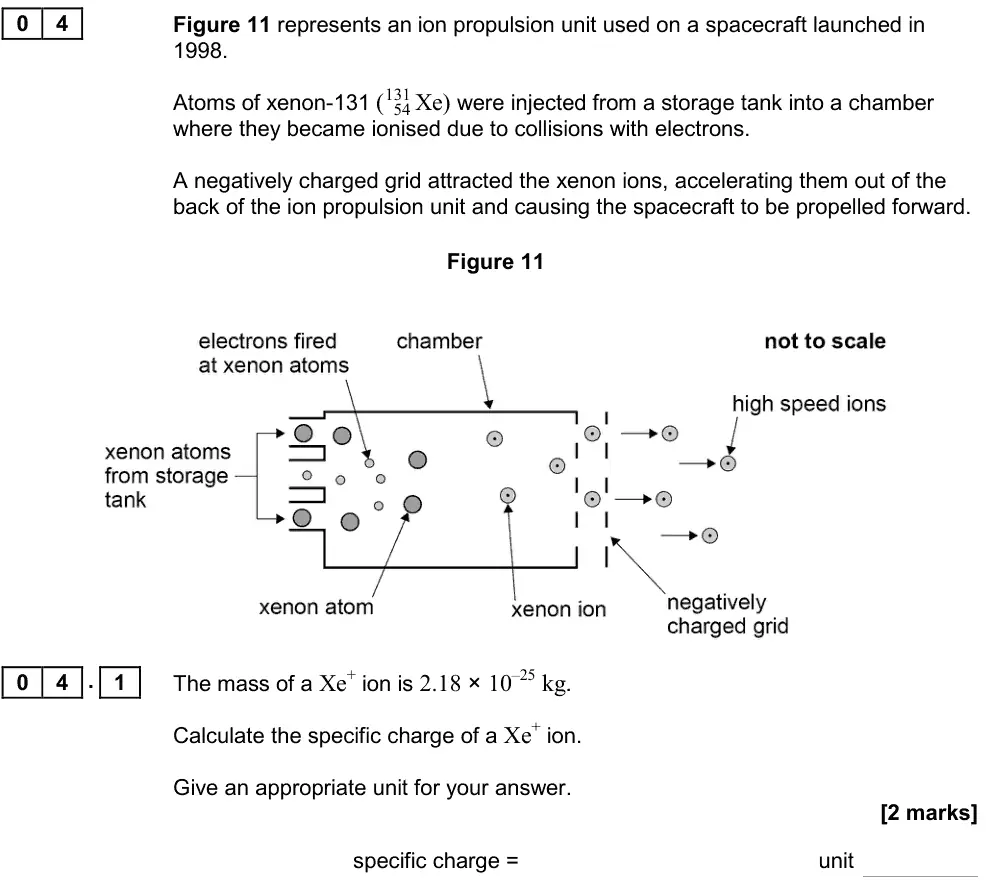
04.1 A significant number of students had difficulty with this question. Common wrong answers included: The charge = 53 × 1.6 × 10-19 arriving at an answer = 3.9 x 10⁷ • Mass divided by charge • Other students could not recall the units for specific charge; the coulomb and the joule were common wrong answers. Students who did not express the unit using index notation did not receive the mark. A common error seen was 1300 ÷ 1.6 x 10-19 = 8.125 x 10²¹ Many students could not convert 1300 eV into its equivalent 2.1 x 10⁻¹⁶ J. 04.2 04.3 A wide range in the quality of response seen here. Those who obtained 3 marks typically presented their working in a way that demonstrated a good understanding of the calculation required. Students who made some progress typically by determining the number of xenon ions in 79 kg obtained some credit. There was a significant number of non-attempts seen.
Notes from the mark scheme and report
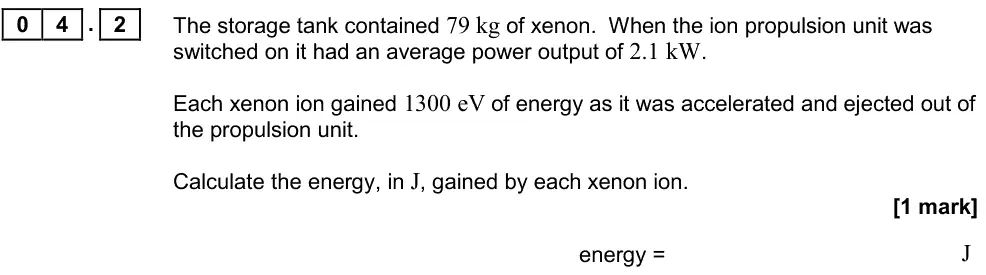
Answer: 2.1 x 10^-16 J (1300 x 1.6 x 10^-19)
dividing by e was common
Skills: MS0.2 Recognise and use expressions in decimal and standard form
June 2017 · AS Paper 2 · Q4.33 marksCalculation
Earlier part of question 4 that this part uses
Mark scheme
Examiner's comment
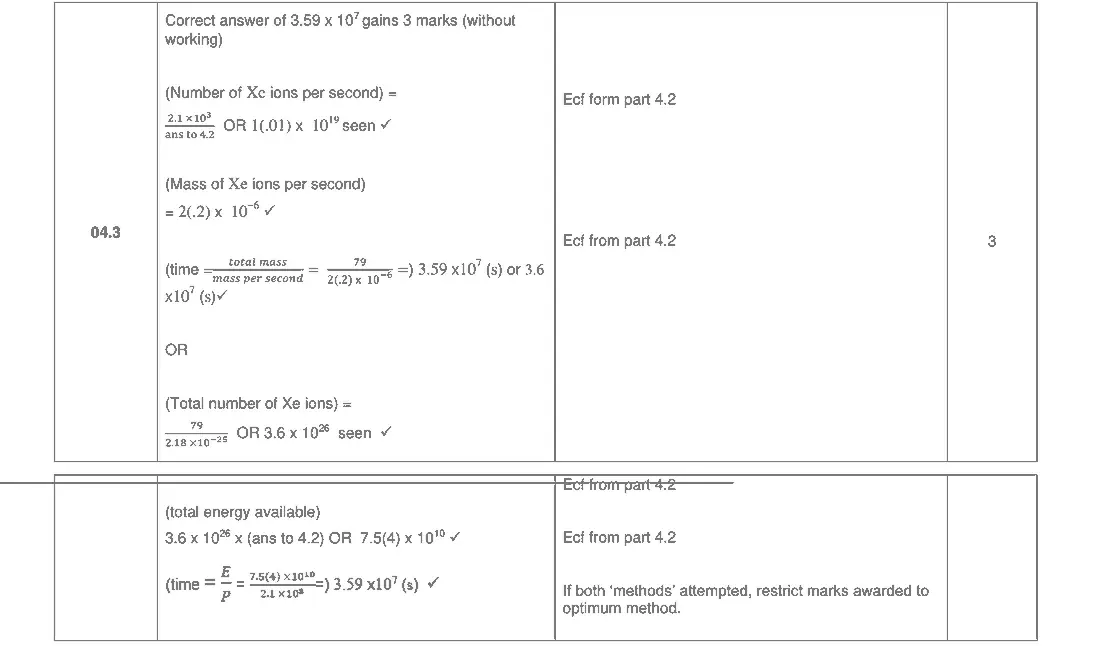
04.1 A significant number of students had difficulty with this question. Common wrong answers included: The charge = 53 × 1.6 × 10-19 arriving at an answer = 3.9 x 10⁷ • Mass divided by charge • Other students could not recall the units for specific charge; the coulomb and the joule were common wrong answers. Students who did not express the unit using index notation did not receive the mark. A common error seen was 1300 ÷ 1.6 x 10-19 = 8.125 x 10²¹ Many students could not convert 1300 eV into its equivalent 2.1 x 10⁻¹⁶ J. 04.2 04.3 A wide range in the quality of response seen here. Those who obtained 3 marks typically presented their working in a way that demonstrated a good understanding of the calculation required. Students who made some progress typically by determining the number of xenon ions in 79 kg obtained some credit. There was a significant number of non-attempts seen.
Notes from the mark scheme and report
Answer: 3.6 x 10^7 s (ions per second = 2100 / 2.08 x 10^-16 = 1.0 x 10^19, mass per second 2.2 x 10^-6 kg
79 kg / that)
many non-attempts
Skills: MS0.2 Recognise and use expressions in decimal and standard form; MS2.3 Substitute numerical values into algebraic equations using appropriate units for physical quantities
June 2017 · Paper 2 · Q5.22 marksCalculation
Earlier part of question 5 that this part uses
Mark scheme
Examiner's comment
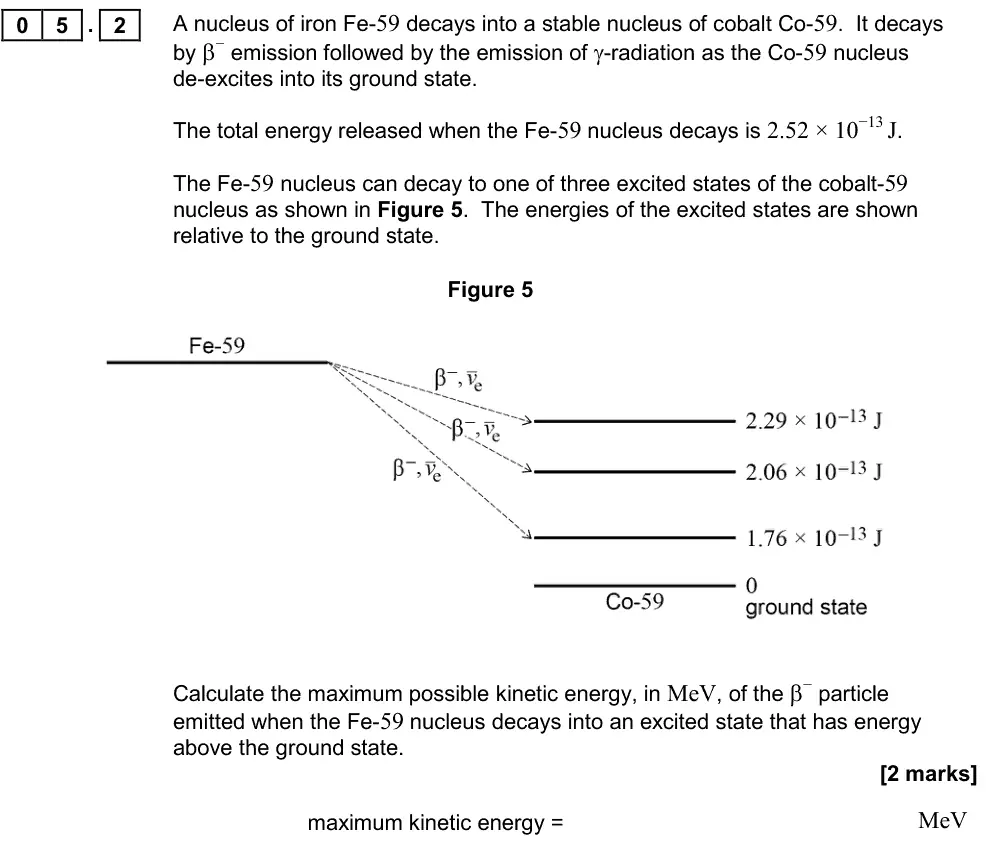
05.2 A majority of students understood the situation and performed the calculation without error. A significant number of others missed seeing the longest energy gap between iron and cobalt. Many of these gave a variety of calculations using energy gaps that did not correspond to beta energies.
Notes from the mark scheme and report
Answer: 0.48 MeV ((2.52 - 1.76) x 10^-13 J = 7.6 x 10^-14 J)
must choose the largest gap from Fe-59 to an excited state
Skills: MS2.3 Substitute numerical values into algebraic equations using appropriate units for physical quantities
Specimen set 1 · Paper 1 · Q1.41 markShort answer
Earlier part of question 1 that this part uses
Mark scheme
Notes from the mark scheme and report
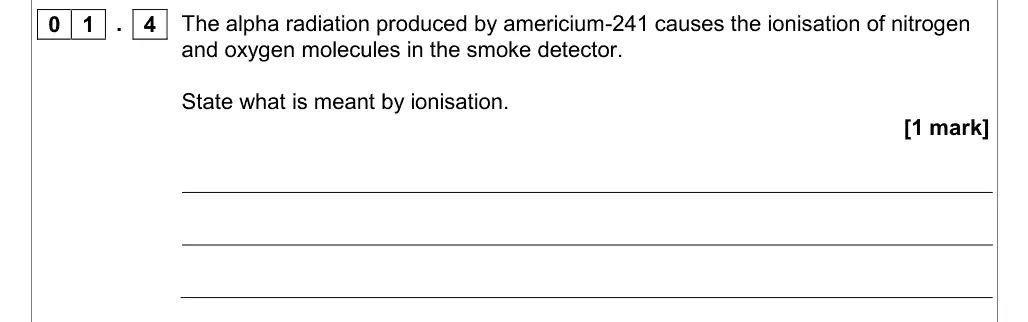
Removal (or addition) of electrons from an atom or molecule
Specimen set 1 · Paper 1 · Q6.72 marksShort answer
Earlier part of question 6 that this part uses
Mark scheme
Notes from the mark scheme and report
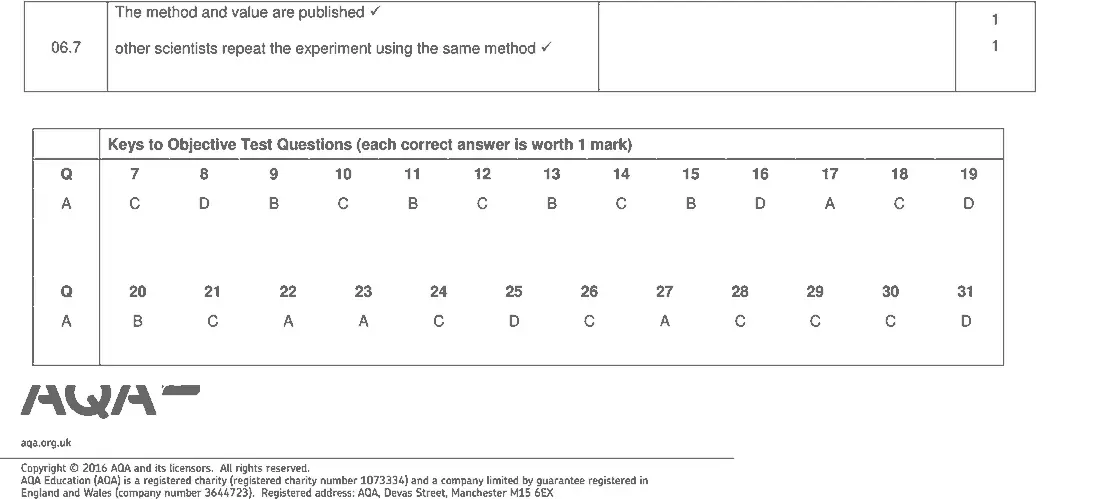
Method and value published (peer review)
other scientists repeat the experiment and get the same value
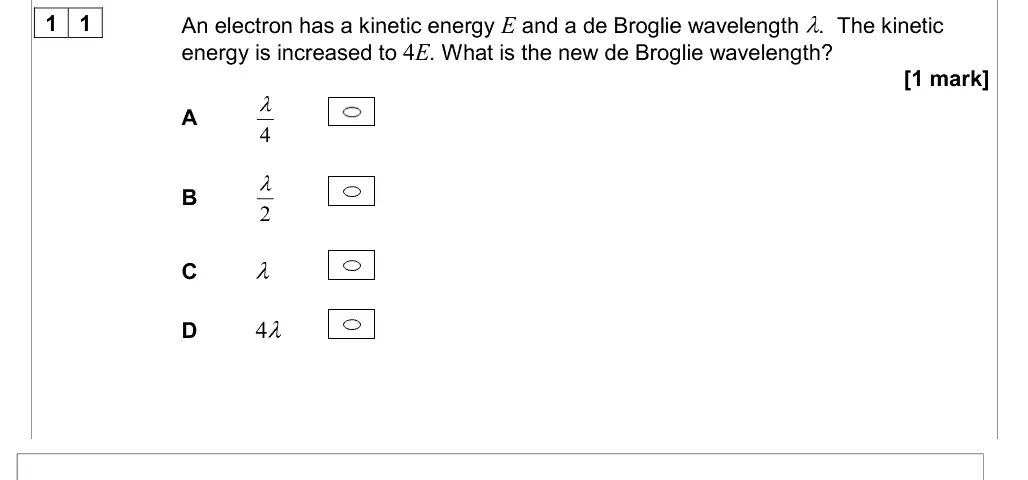
Specimen set 1 · Paper 1 · Q111 markMultiple choice
Answer
B
Notes from the mark scheme and report
Answer: B (momentum doubles when KE x 4)
Skills: MS0.3 Use ratios, fractions and percentages
Specimen set 1 · Paper 1 · Q181 markMultiple choice
Answer
C
Notes from the mark scheme and report
Answer: C
June 2016 · AS Paper 2 · Q101 markMultiple choiceEasy
Answer
D
Examiner's comment
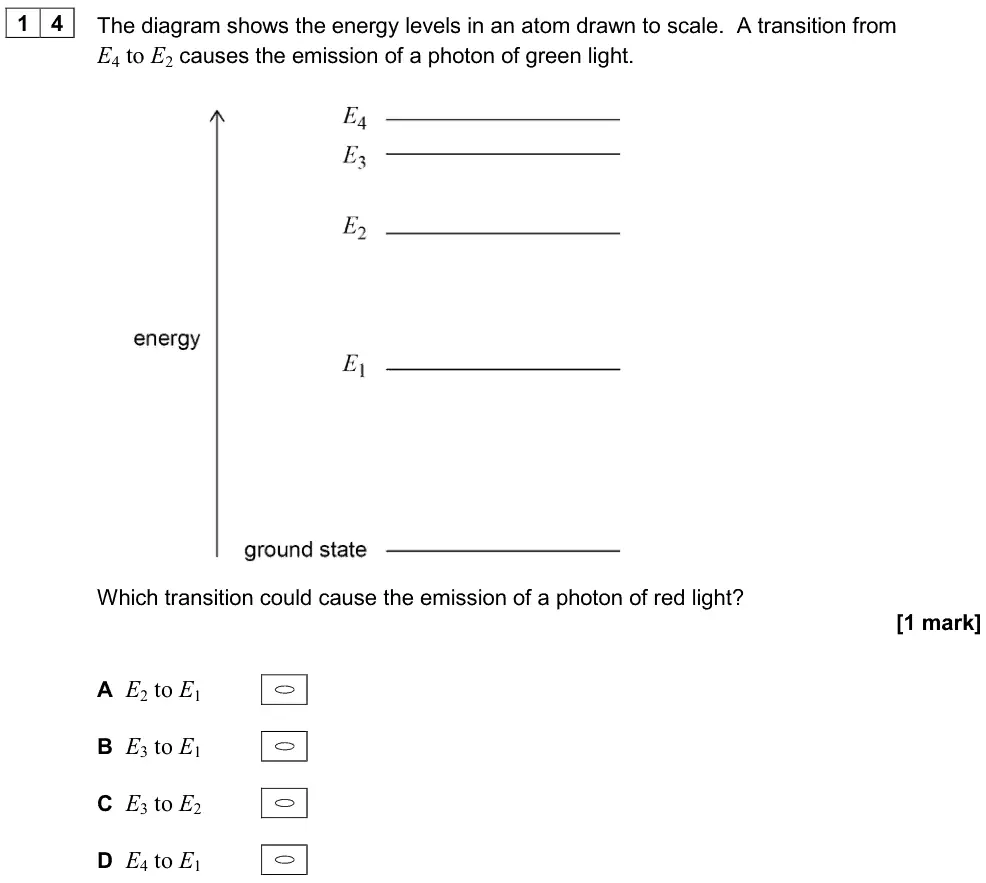
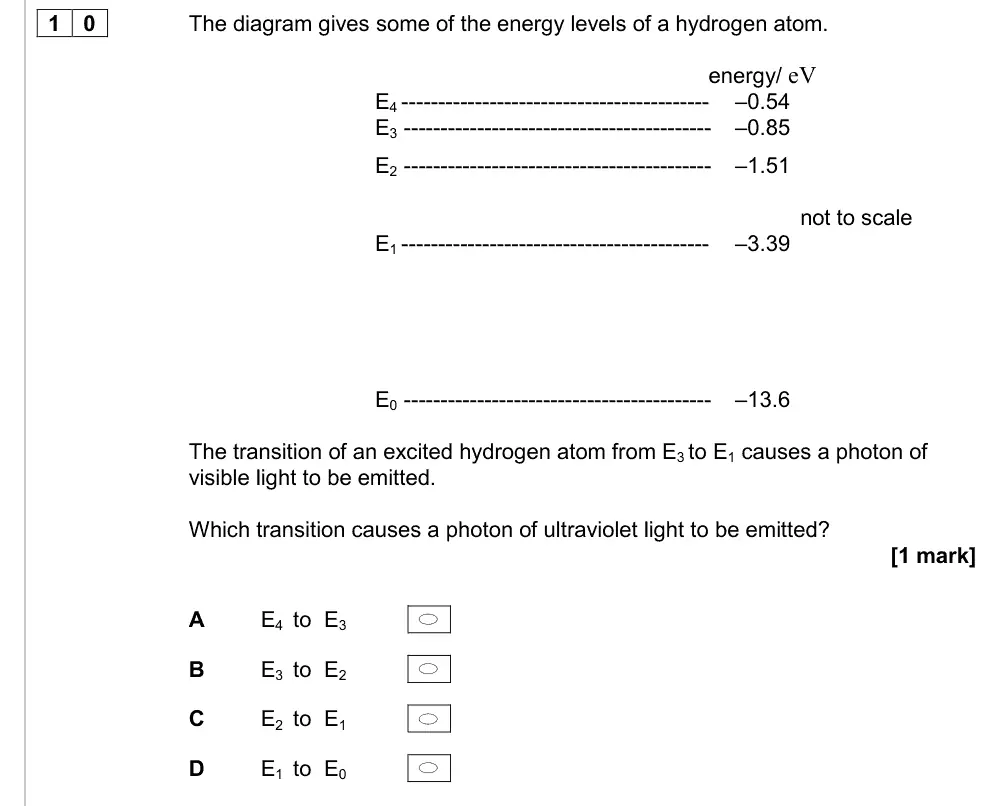
9 This question was removed prior to the exam. There was no evidence to suggest that students were disadvantaged by this. 10 Approximately two thirds of students spotted that a bigger energy jump was needed to produce a photon of UV, and therefore chose D. Distractors A (the smallest energy jump) and C (the next smallest) were chosen by a similar number of students who failed to make the link between energy and frequency perhaps.
Notes from the mark scheme and report
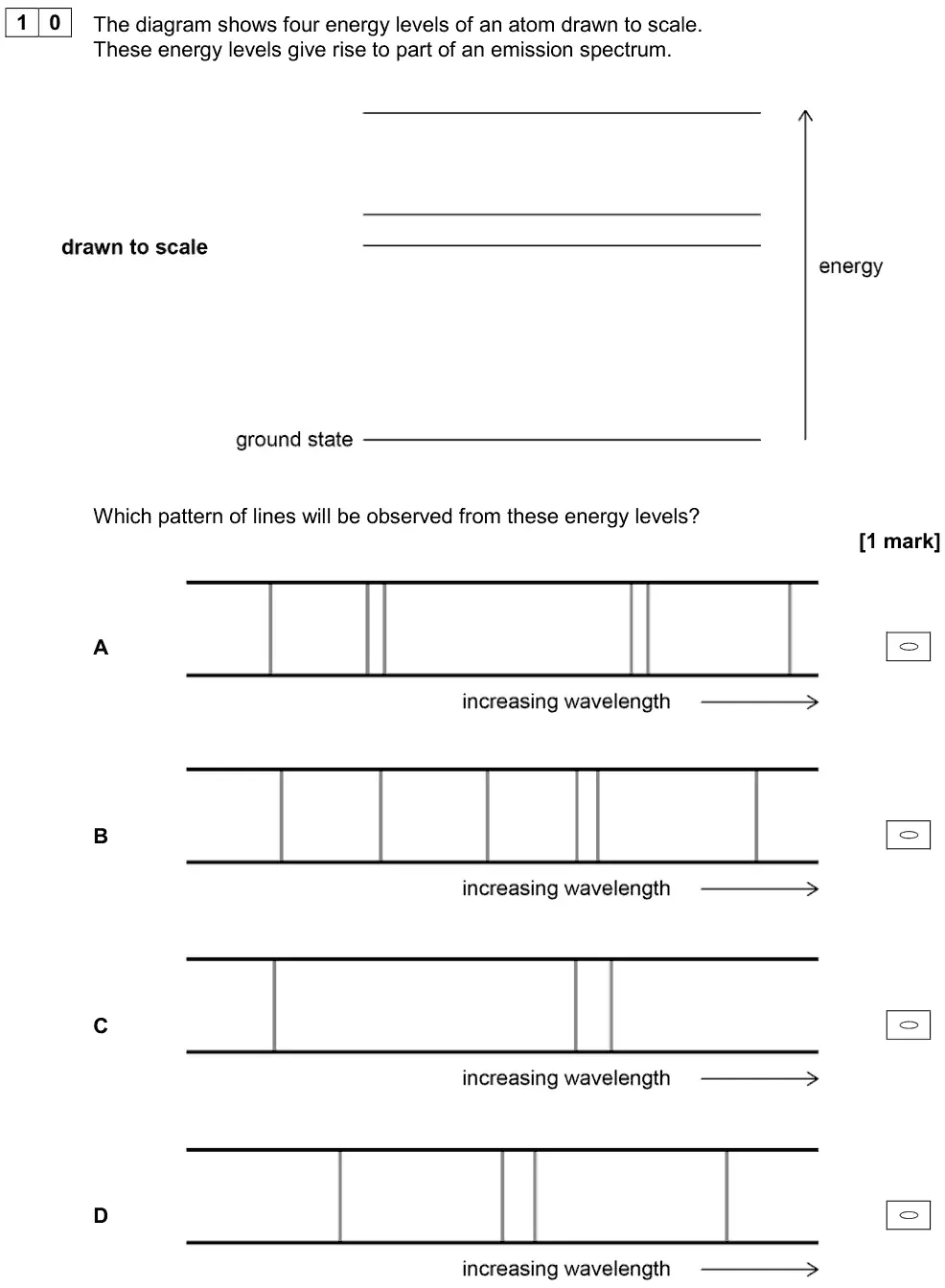
Answer: D
largest energy jump gives the UV photon
June 2016 · AS Paper 2 · Q111 markMultiple choice
Answer
A
Notes from the mark scheme and report
Answer: A
Skills: MS0.3 Use ratios, fractions and percentages
Work with an AQA physics tutor
Dropping marks on calculations, required practicals or the six-markers? Book a trial session with a specialist AQA physics tutor.