Notes and key-term cards for this topic are being written by our tutors. The past-paper questions below are ready now.
Specification statements
Show the 14 statements from the specification
3.10.1.1-01 The eye as an optical refracting system, including ray diagrams of image formation.
3.10.1.1-02 Sensitivity of the eye; spectral response as a photodetector.
3.10.1.1-03 Spatial resolution of the eye; explanation in terms of the behaviour of rods and cones.
3.10.1.2-01 Properties of converging and diverging lenses; principal focus, focal length and power, power = 1 f ; 1 u + 1 v = 1 f ;m = v u
3.10.1.2-02 Myopia, hypermetropia, astigmatism.
3.10.1.2-03 Ray diagrams and calculations of powers (in dioptres) of correcting lenses for myopia and hypermetropia.
3.10.1.2-04 The format of prescriptions for astigmatism.
3.10.2.1-01 Simple structure of the ear, transmission processes.
3.10.2.2-01 Production and interpretation of equal loudness curves.
3.10.2.2-02 Human perception of relative intensity levels and the need for a logarithmic scale to reflect this.
3.10.2.2-03 Definition of intensity. Intensity level = 10 log I I0 where the threshold of hearing I0 = 1.0 × 10 −12 W m −2
3.10.2.2-04 Measurement of sound intensity levels and the use of dB and dBA scales; relative intensity levels of sounds.
3.10.2.3-01 The effect on equal loudness curves and the changes experienced in terms of hearing loss due to injury resulting from exposure to excessive noise or deterioration with age (excluding physiological changes).
3.10.3.1-01 Principles of operation for obtaining the ECG waveform; explanation of the characteristic shape of a normal ECG waveform.
Six-mark extended response questions on this topic
Tap a question to zoom it. Where a part needs a figure, table or graph from earlier in the question, that part folds out above it; the mark scheme and examiner's comment open underneath. Have the AQA data and formulae booklet beside you (see the formula sheet page).
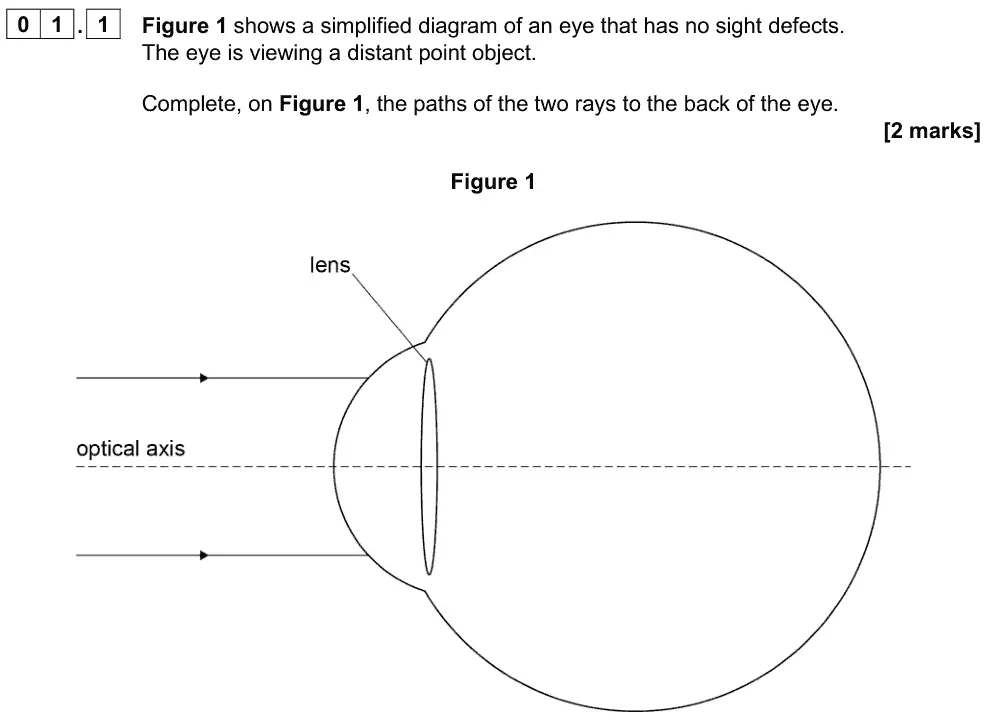
June 2025 · Paper 3B Medical physics · Q1.12 marksAO1=2Diagram or graphHard
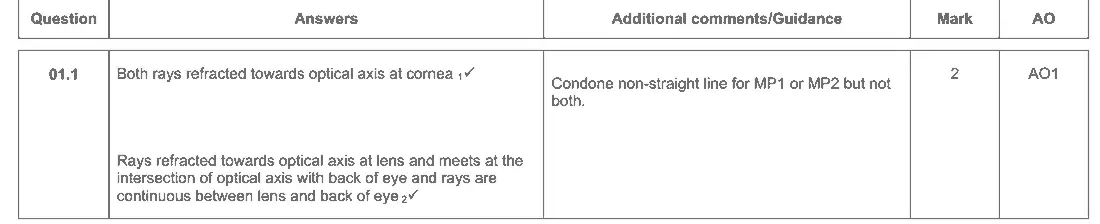
Mark scheme
Examiner's comment
1.1 Fewer than 15% of students gained two marks in this question. Most students were able to draw the two rays refracting at the lens and meeting on the optical axis at the retina, but these often lacked any refraction at the air-cornea boundary. Others had the correct refraction at the air-cornea boundary but were unable to show correct refraction at the lens, typically drawing straight lines through the lens.
Notes from the mark scheme and report
Rays refracted towards the axis at the cornea and again at the lens, meeting where the axis meets the back of the eye
most omitted refraction at the air-cornea boundary or drew straight lines through the lens
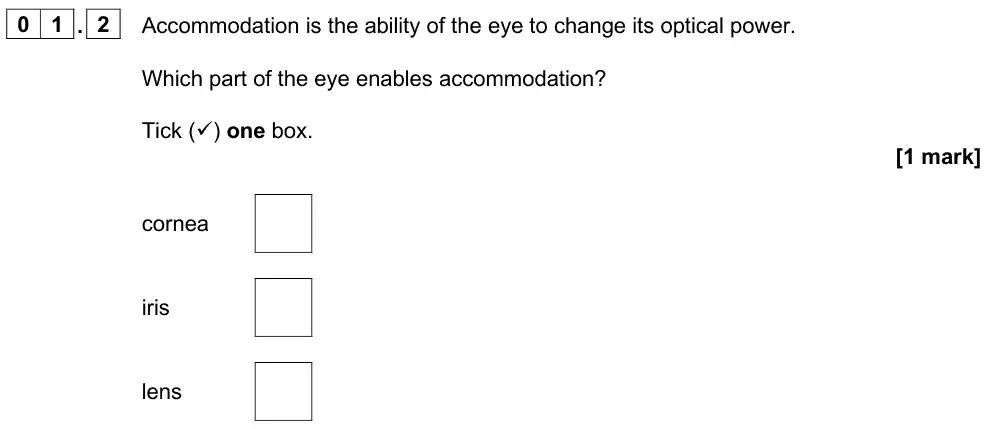
June 2025 · Paper 3B Medical physics · Q1.21 markAO1=1Short answerEasy
Earlier part of question 1 that this part uses
Mark scheme
Examiner's comment
1.2 This was well answered with 75 % of students selecting the lens as the part of the eye that enabled accommodation.
Notes from the mark scheme and report
Answer: lens
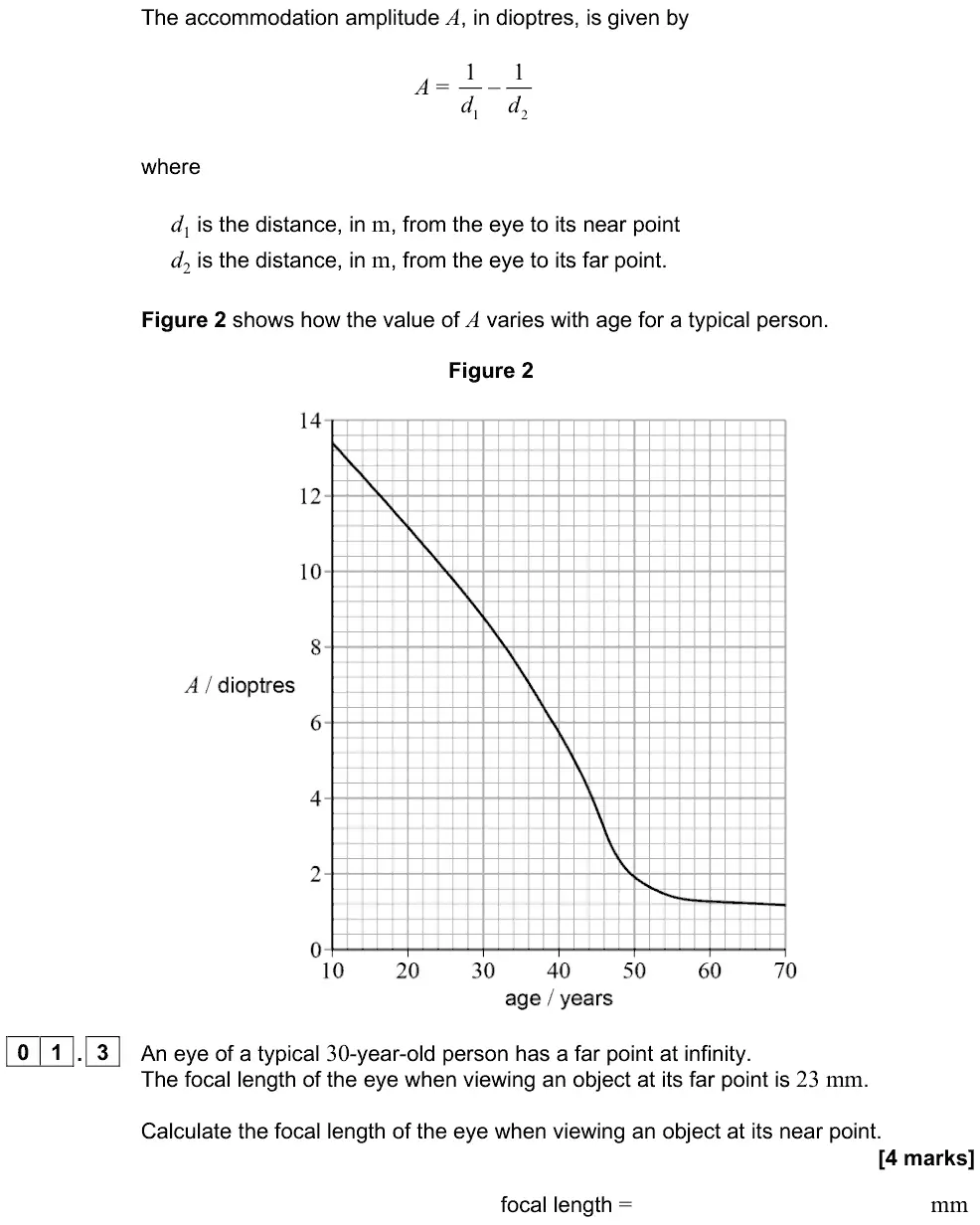
June 2025 · Paper 3B Medical physics · Q1.34 marksAO2=2, AO3=2CalculationHard
Earlier part of question 1 that this part uses
Mark scheme
Examiner's comment
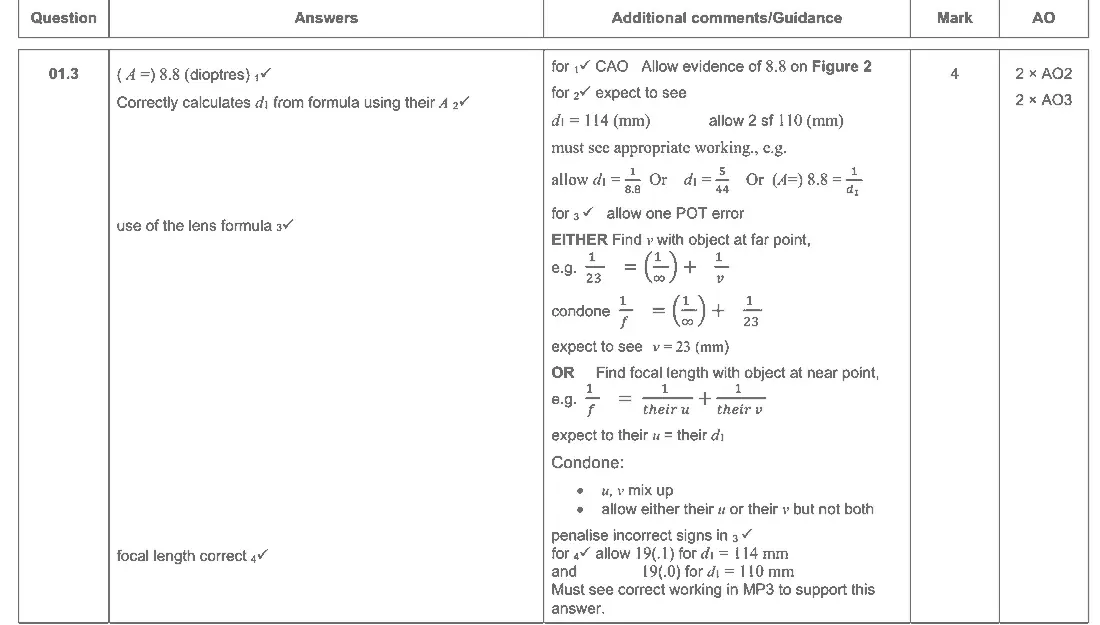
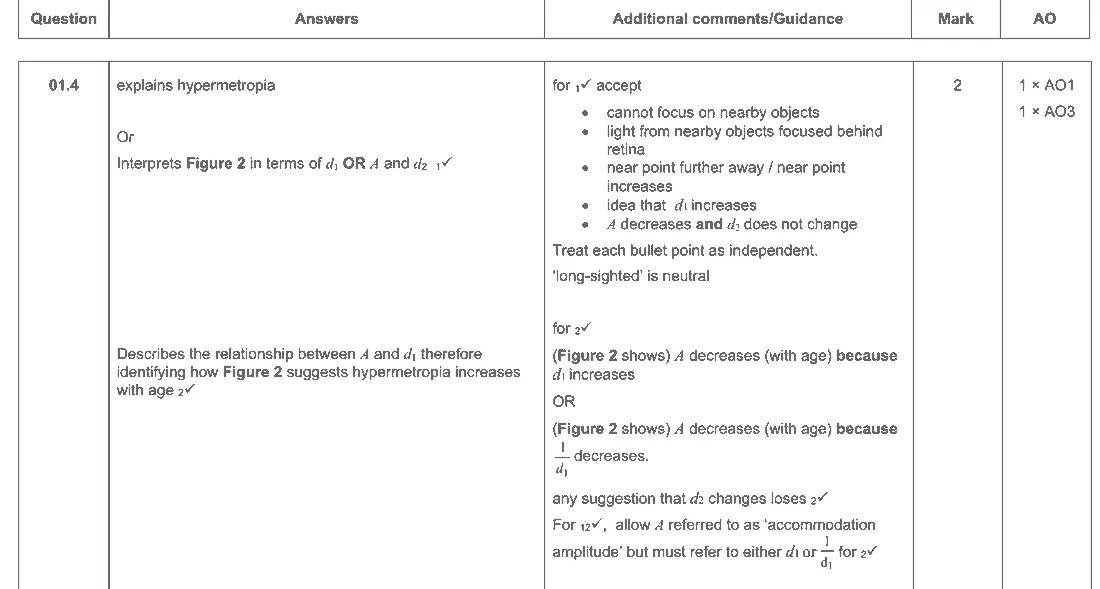
1.3 This question discriminated reasonably well. Fewer than 15% of students gained 4 marks; achieving this mark was indicative of a high-level of performance due to the student demonstrating their ability to perform this multi-step calculation. Although this question was designated as a calculation, correct working was required to obtain credit for a value of d1= 0.11(4) and for an answer of 19 (mm). Many students struggled with this question. The most common error seen was the inability to use the amplitude accommodation due to being unable to recognise the value of d2. Many made d2 = 23 (that was inconsistent with A=8.8 D) and obtained a value for d1 = 0.113. Others used d2=0.023 and obtained a value for d1= 19.1 mm (which they presented as their answer). This yielded a number on the answer line that agreed with the correct answer but was obtained by incorrect means. Fewer students realised that they had to use their d1 to find the focal length at the new near point by using the lens equation with v=23 mm. 1.4 It was relatively easy to score one mark in this question with over 50% of students doing so. The first mark was available to students who described hypermetropia or referred to d1’s variation or A and d2’s variation. how this relationship related to hypermetropia. Lower achieving students mistook hypermetropia for myopia and discussed changes in far point with age.
Notes from the mark scheme and report
Answer: 19 mm (A = 8.8 D at age 30 from Figure 2
d2 infinite so d1 = 0.114 m
lens equation with v = 23 mm)
many took d2 = 23 mm and got 19.1 by a wrong route, which needs correct working
Skills: MS3.1 Translate information between graphical, numerical and algebraic forms; MS2.2 Change the subject of an equation, including non-linear equations; MS2.3 Substitute numerical values into algebraic equations using appropriate units for physical quantities
June 2025 · Paper 3B Medical physics · Q1.42 marksAO1=1, AO3=1Explanation
Earlier part of question 1 that this part uses
Mark scheme
Examiner's comment
1.3 This question discriminated reasonably well. Fewer than 15% of students gained 4 marks; achieving this mark was indicative of a high-level of performance due to the student demonstrating their ability to perform this multi-step calculation. Although this question was designated as a calculation, correct working was required to obtain credit for a value of d1= 0.11(4) and for an answer of 19 (mm). Many students struggled with this question. The most common error seen was the inability to use the amplitude accommodation due to being unable to recognise the value of d2. Many made d2 = 23 (that was inconsistent with A=8.8 D) and obtained a value for d1 = 0.113. Others used d2=0.023 and obtained a value for d1= 19.1 mm (which they presented as their answer). This yielded a number on the answer line that agreed with the correct answer but was obtained by incorrect means. Fewer students realised that they had to use their d1 to find the focal length at the new near point by using the lens equation with v=23 mm. 1.4 It was relatively easy to score one mark in this question with over 50% of students doing so. The first mark was available to students who described hypermetropia or referred to d1’s variation or A and d2’s variation. how this relationship related to hypermetropia. Lower achieving students mistook hypermetropia for myopia and discussed changes in far point with age.
Notes from the mark scheme and report
A falls with age while d2 stays at infinity, so 1/d1 falls and the near point moves further away (hypermetropia)
any suggestion d2 changes loses mark 2
myopia confusion
Skills: MS3.1 Translate information between graphical, numerical and algebraic forms
June 2025 · Paper 3B Medical physics · Q3.12 marksAO1=2Short answerHard
Mark scheme
Examiner's comment
3.1 25 % of students gained two marks in this AO1 recall of what is meant by the threshold of hearing. However, 44% of students were unable to score any marks and typically referred to the minimum intensity that can be heard without referring to 1kHz.
Notes from the mark scheme and report
Minimum intensity an average ear can hear at 1 kHz
1 kHz omitted by many
'minimum intensity level' not accepted
June 2025 · Paper 3B Medical physics · Q3.23 marksAO2=3CalculationHard
Earlier part of question 3 that this part uses
Mark scheme
Examiner's comment
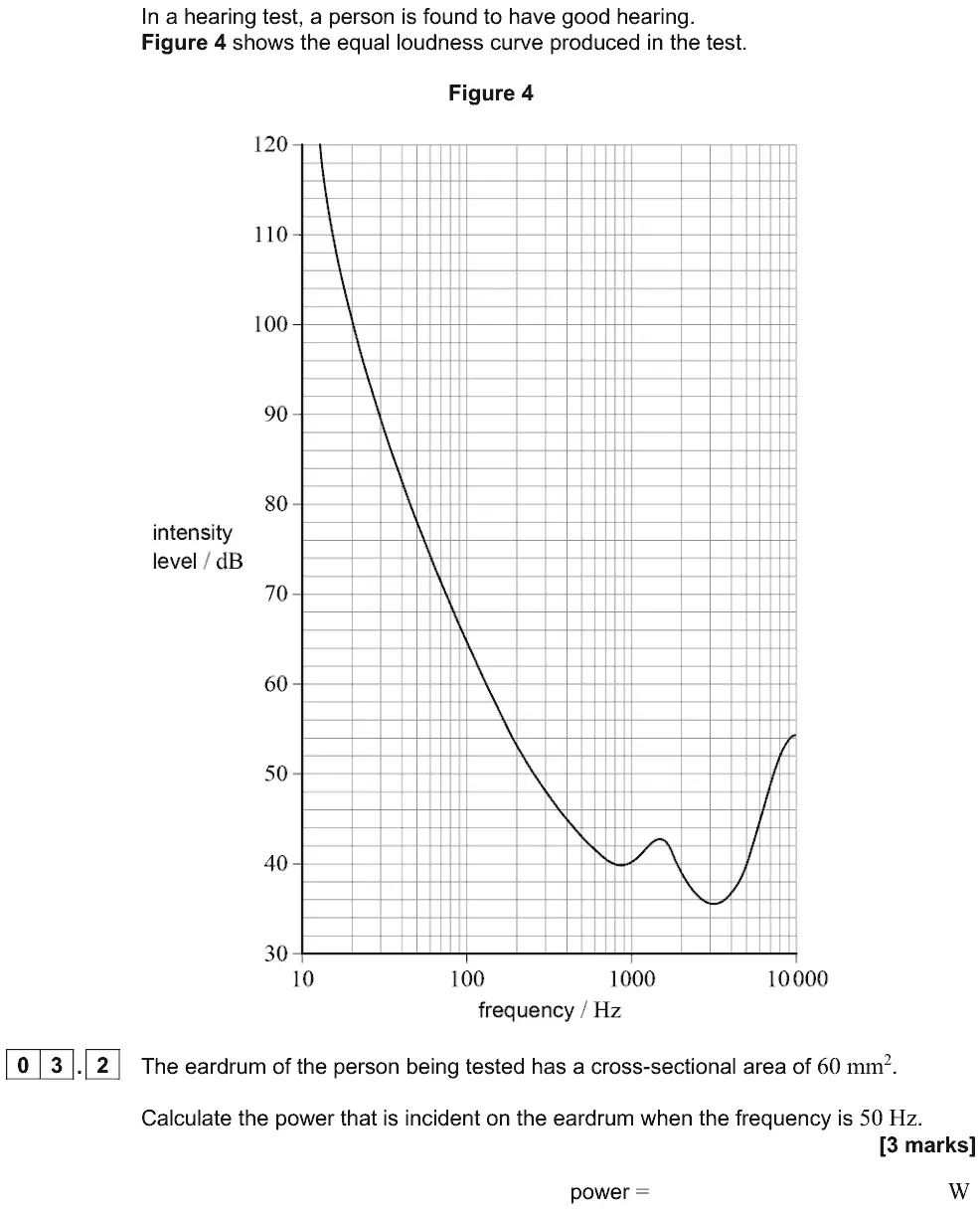
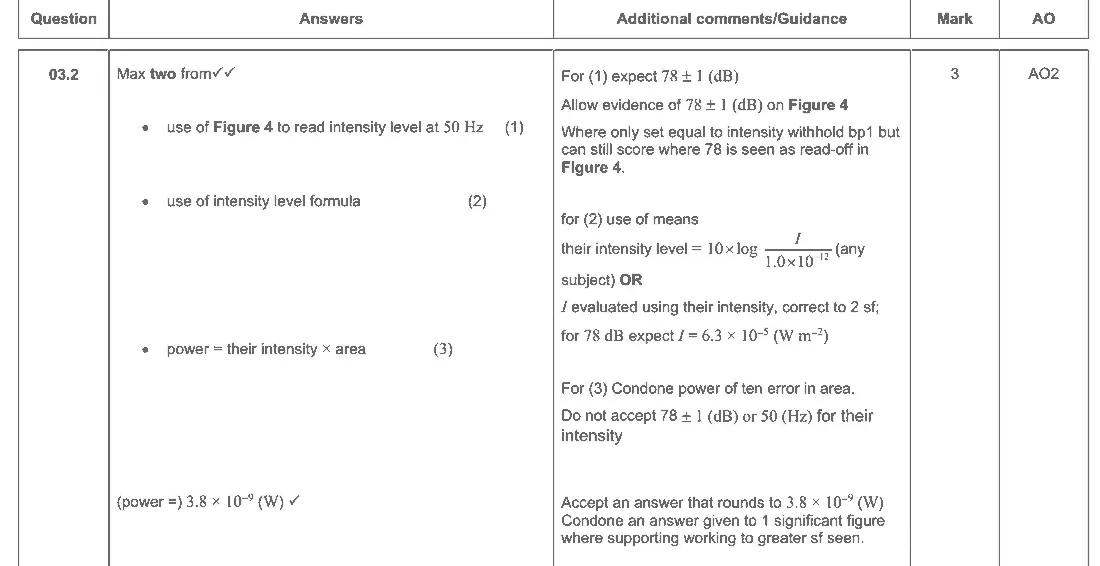
3.2 This question discriminated reasonably well. 32 % of students gained 3 marks, with 23 % gaining 2 marks and approximately 24% gaining 1 mark. Those scoring 3 marks typically had well-presented working that demonstrated the steps taken in obtaining the answer. Most students scored at least 1 mark for reading off 78 dB from the graph where they had to contend with the frequency having a log scale. Some had difficulty with the read-off and incorrectly selected 82 dB or 74 dB; these students were still able to gain 2 marks by use of the intensity level formula or the power formula. Many students multiplied their intensity level by their area, and this was not accepted for use of the power formula. Those who did determine an intensity and use the power formula, quite often made an error in converting the area from 60 mm2 to 6 x 10⁻⁵ m2.
Notes from the mark scheme and report
Answer: 3.8 x 10^-9 W (78 dB at 50 Hz on the log scale
I = 6.3 x 10^-5 W m^-2
area 6.0 x 10^-5 m^2)
multiplying intensity level by area not accepted
mm^2 conversion errors
Skills: MS3.1 Translate information between graphical, numerical and algebraic forms; MS0.5 Use calculators to find and use power, exponential and logarithmic functions; MS2.3 Substitute numerical values into algebraic equations using appropriate units for physical quantities; MS0.1 Recognise and make use of appropriate units in calculations
June 2025 · Paper 3B Medical physics · Q3.32 marksAO2=2Diagram or graphHard
Earlier part of question 3 that this part uses
Mark scheme
Examiner's comment
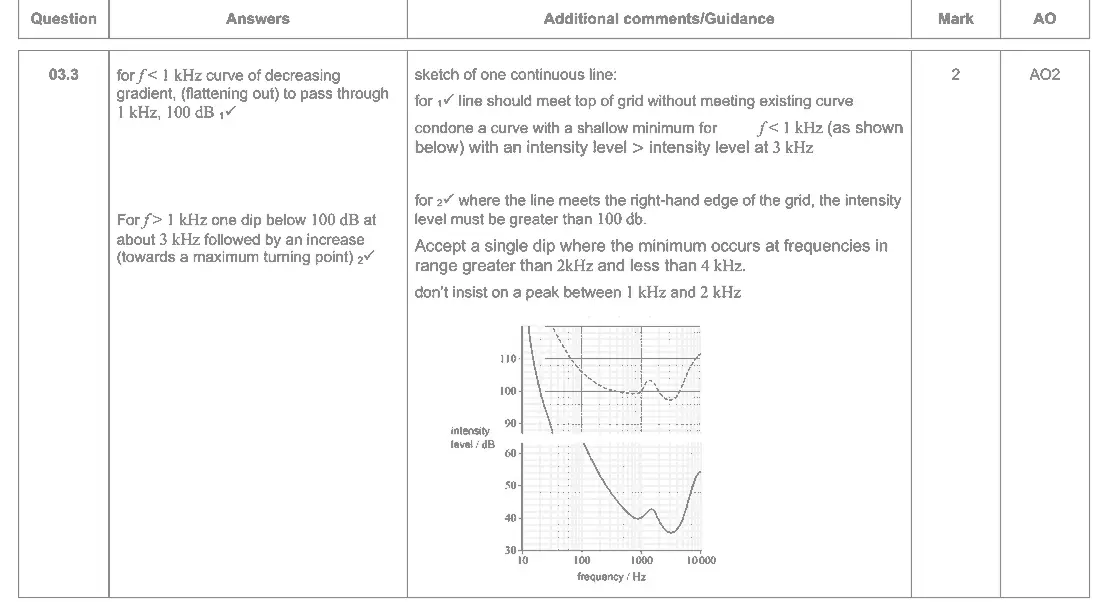
3.3 Almost 33% of students scored both marks for their sketch of the equal loudness curve. Reasons for students losing marks typically included: the minimum intensity level outside of the allowed range of greater than 2 kHz and • less than 4 kHz. mot passing through 1000 Hz, 100dB • where they had a second minimum, its value had a lower intensity level than the • intensity level at 3kHz. drawing a curve that intersected with the original curve. •
Notes from the mark scheme and report
Curve through 100 dB at 1 kHz, flatter than the threshold curve below 1 kHz, single dip at 2-4 kHz then rising
must not cross the given curve
Skills: MS3.1 Translate information between graphical, numerical and algebraic forms
June 2024 · Paper 3B Medical physics · Q1.11 markAO2=1Short answer
Mark scheme
Examiner's comment
01.1 The majority of student were able to correctly identify the defect of vision, most of whom used the correct medical term, myopia.
Notes from the mark scheme and report
Myopia (short sight) - far point closer than infinity
June 2024 · Paper 3B Medical physics · Q1.22 marksAO2=2CalculationHard
Earlier part of question 1 that this part uses
Mark scheme
Examiner's comment
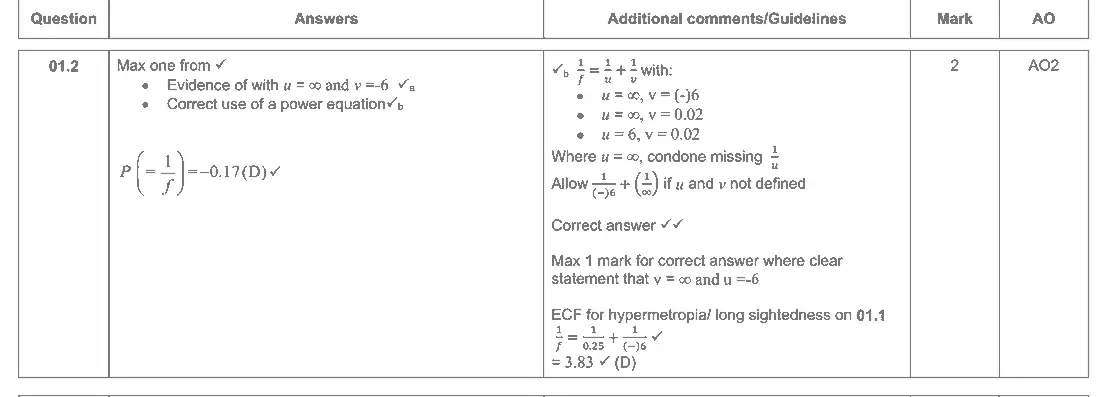
01.2 Around a third of students gained both marks on this calculation. For the majority of those who gained one mark, it was due to an incorrect sign leading to a positive power for the lens. There was also a small number of students who gave their answer as a fraction and hence lost a mark.
Notes from the mark scheme and report
Answer: -0.17 D (u = infinity, v = -6.0 m)
a positive power from a sign error was the commonest loss
fractions lost a mark
Skills: MS2.3 Substitute numerical values into algebraic equations using appropriate units for physical quantities; MS2.2 Change the subject of an equation, including non-linear equations
June 2024 · Paper 3B Medical physics · Q1.31 markAO1=1Short answer
Earlier part of question 1 that this part uses
Mark scheme
Examiner's comment
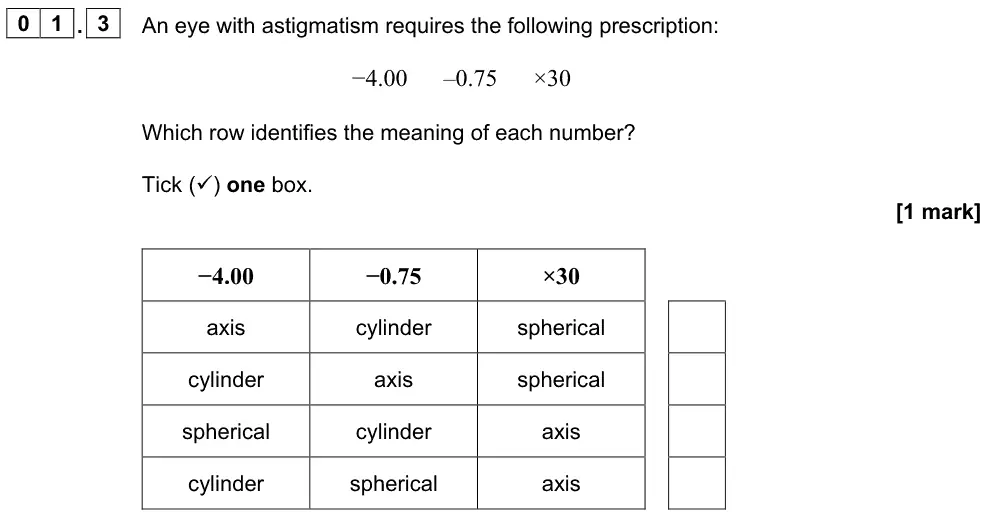
01.3 This was the first time this aspect of the specification has been examined, and around half of the students selected the correct answer.
Notes from the mark scheme and report
Answer: spherical, cylinder, axis
first time this was examined
around half correct
June 2024 · Paper 3B Medical physics · Q2.14 marksAO3=4Calculation
Mark scheme
Examiner's comment
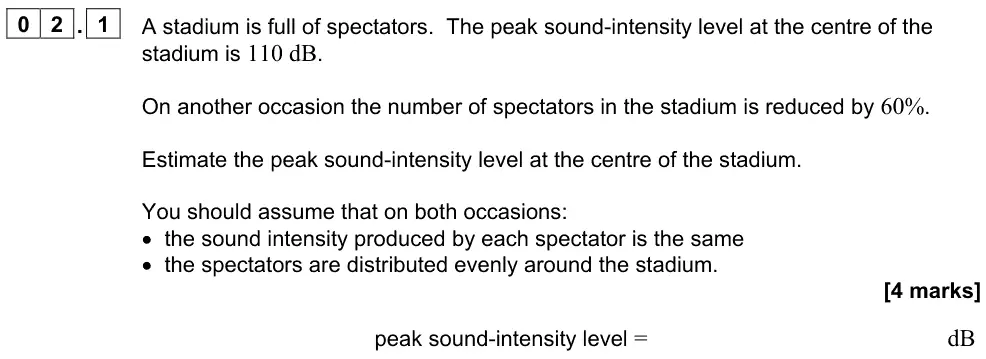
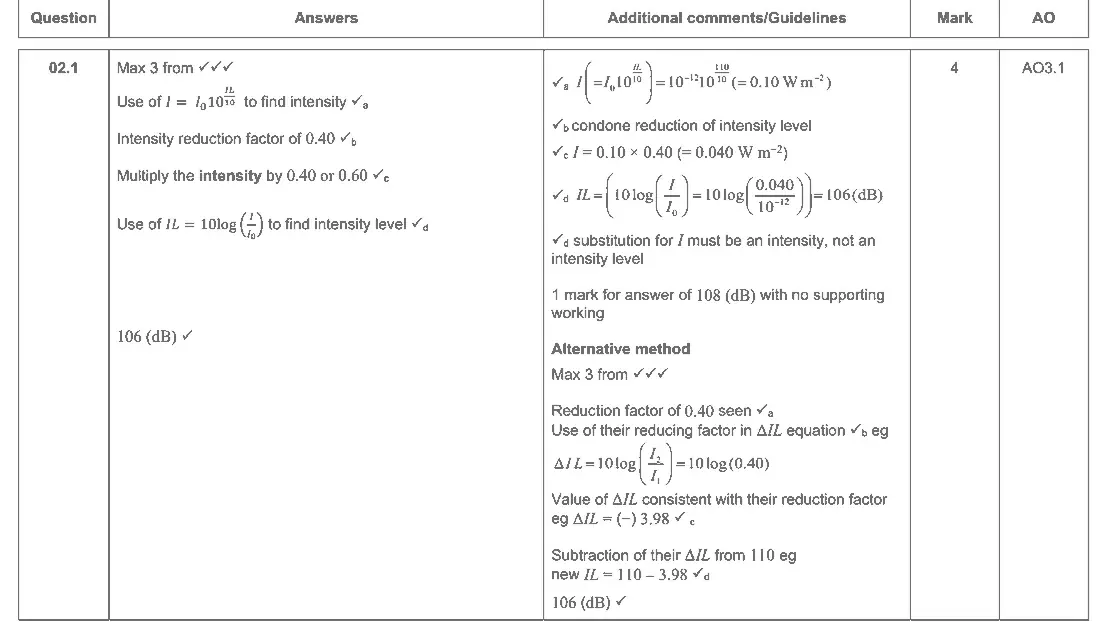
02.1 This multi-step calculation was handled well, with almost half of the students gaining full marks. A further 20% of students lost only one mark, most commonly due to use of a factor of 0.60 rather than 0.40 when finding the reduced intensity, within an otherwise correct approach. Those students who were not able to progress beyond a single mark generally displayed confusion about the difference between intensity and intensity level and were unable to substitute valid data into the relevant equation.
Notes from the mark scheme and report
Answer: 106 dB (I = 0.10 W m^-2 at 110 dB
40% of spectators remain so I = 0.040 W m^-2)
using 0.60 instead of 0.40 was the common slip
confusing intensity and intensity level
almost half full marks
Skills: MS0.5 Use calculators to find and use power, exponential and logarithmic functions; MS0.3 Use ratios, fractions and percentages; MS2.2 Change the subject of an equation, including non-linear equations; MS0.4 Estimate results
June 2024 · Paper 3B Medical physics · Q2.22 marksAO1=2Short answerHard
Earlier part of question 2 that this part uses
Mark scheme
Examiner's comment
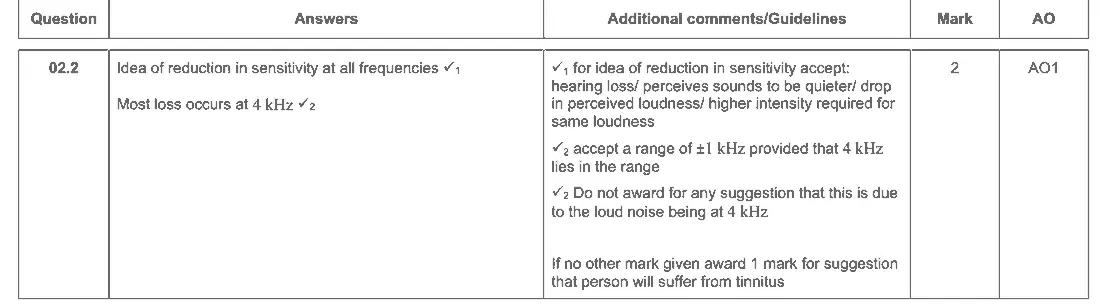
02.2 This was poorly answered, with around 70% of students failing to gain either mark despite very similar questions having been asked in previous series. Many students gave very vague answers about hearing loss, or focussed on the anatomy of the ear, describing how that would be affected rather than describing the impact of that damage on the person’s hearing.
A significant proportion of students did not appear to have a clear understanding of the difference between frequency and intensity level in this context. Comments about hearing loss being maximum at 110 dB, or sounds of 110 dB needing to now be louder were common, often even referring to this as the frequency of the sound. Many students also suggested that hearing loss would be at a maximum at the frequency of the sound that caused it, rather than at 4000 Hz.
Notes from the mark scheme and report
Reduced sensitivity at all frequencies with greatest loss around 4 kHz
tinnitus alone 1 mark
vague 'hearing loss', ear anatomy or loss at the frequency of the noise not credited
June 2023 · Paper 3B Medical physics · Q2.13 marksAO3=3Calculation
Mark scheme
Examiner's comment
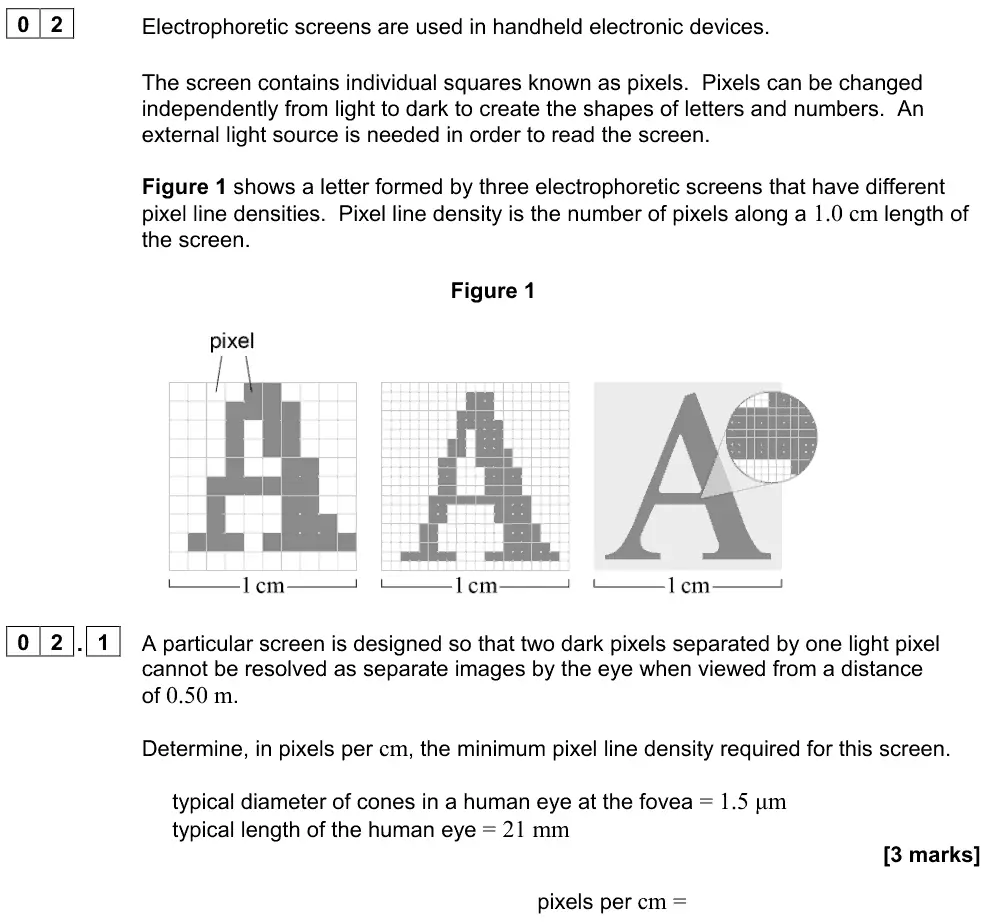
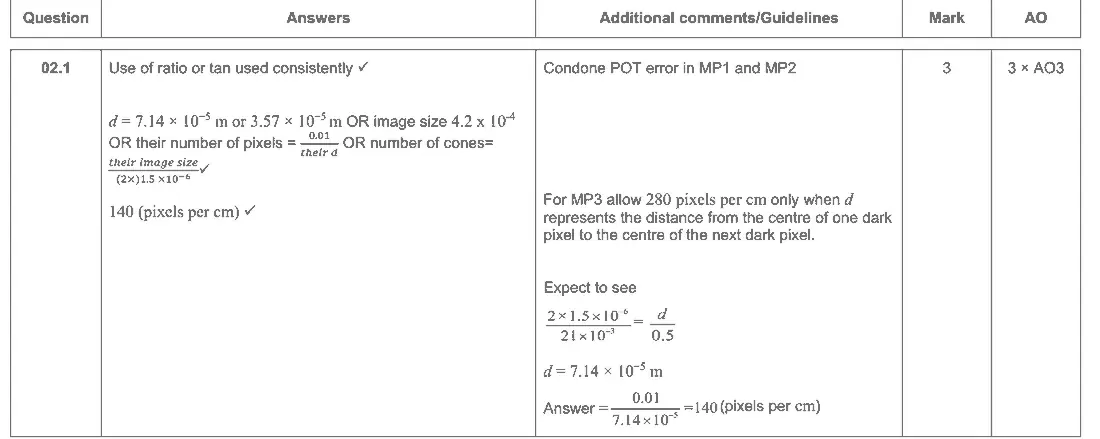
02.1 This question was answered poorly, with less than half of the students gaining any marks. Many unsuccessful students attempted to apply the lens equation which was not applicable for the context. Another common unsuccessful approach was to find the area of the cone cell. A significant number of students simply divided the eye length by the cone diameter. Since the eye length was not considered to be “their image size”, this approach was not awarded any credit. Most of the students who correctly approached the question by use of ratios did this successfully, obtaining one of the stated answers; hence the award of two marks was more common than one. Award of the final mark required the recognition that the diameter of the cone needed to be doubled in order to find the minimum separation required for resolution. Many students omitted this step; some used incorrect factors of three or a half.
Answers in which the distance on the screen was considered to be the distance from the centre of one dark pixel to the centre of the next dark pixel could obtain full credit. Answers with “reverse” working that used a 1 cm object size on the screen in a correct ratio calculation could also gain full credit. Power of ten errors were common, particularly in the conversion into pixels per cm, again forfeiting the final mark.
Notes from the mark scheme and report
Answer: 140 pixels per cm (separation on screen d = 2 x 1.5 um x 0.50 m / 21 mm = 7.14 x 10^-5 m
280 allowed if d is centre to centre)
need two cone widths for resolution
lens equation, cone area and eye length / cone diameter gained nothing
less than half scored
Skills: MS0.3 Use ratios, fractions and percentages; MS2.2 Change the subject of an equation, including non-linear equations; MS0.2 Recognise and use expressions in decimal and standard form
June 2023 · Paper 3B Medical physics · Q2.23 marksAO2=3Explanation
Earlier part of question 2 that this part uses
Mark scheme
Examiner's comment
02.2 More than half of the students gained some credit for this question. The majority of students who were awarded zero failed to link their answer to the eye at all, instead discussing the light levels on the pixels. Many students recognised that the key to this question was the eye’s use of cones in bright conditions and rods when the light level is reduced. Although the question referred only to “reduced” intensity rather than darkness, students were expected to infer from the stated decrease in resolution that cones were no longer in use and rods were exclusively in operation. Although students did not have to be explicit about this in their statement, they were penalised for suggesting that cones were still activated when the image could no longer be resolved.
Many students also recognised the relevance of the fact that cones have their own unique neurone whereas rods share their neurones; however many then struggled or did not attempt to explain why this would lead to a reduction in resolution. Some excellent answers were seen, which could be expressed in a variety of ways, but these were not common. The inclusion of additional information about rods and cones, which had no relevance to the question, was not uncommon.
Notes from the mark scheme and report
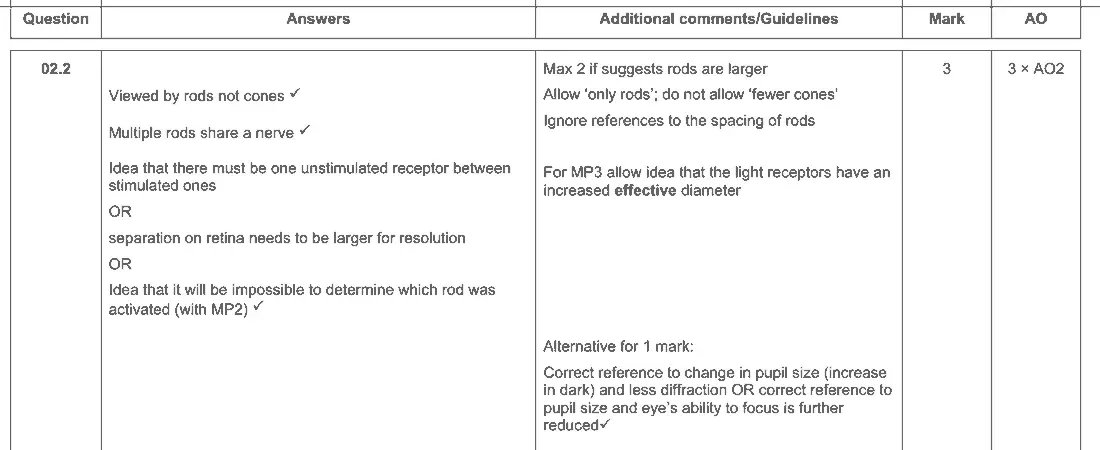
In dim light only rods are used
several rods share one nerve fibre, so an unstimulated receptor between stimulated ones is needed over a larger retinal separation
many discussed the pixels not the eye
June 2023 · Paper 3B Medical physics · Q2.31 markAO2=1Show that
Earlier part of question 2 that this part uses
Mark scheme
Examiner's comment
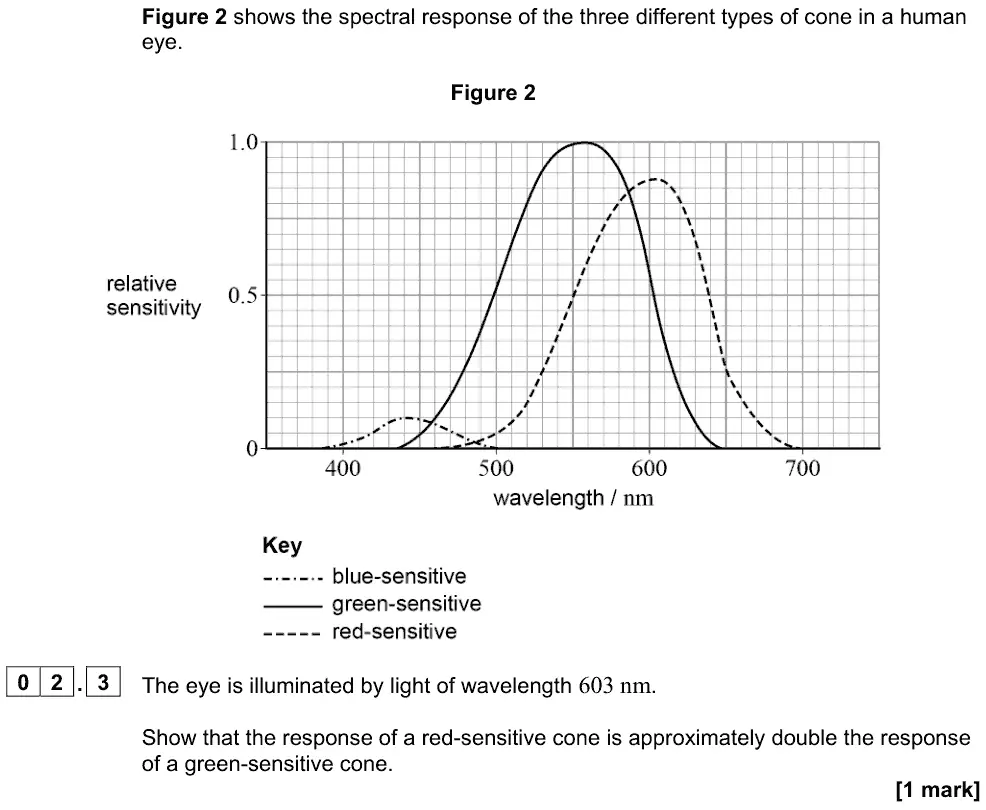
02.3 The majority of students made an attempt at this question and understood what was required. Those who were not awarded the mark had most commonly failed to read carefully from the graph, with readings that fell outside the accepted range. This was despite an unusually large acceptable range being allowed on the green cone data due to the steepness of the graph at this point. The other less common reason to fail to score the mark was a failure to manipulate the data. Given that this was a “show that” question, some quantitative comparison of the data was required.
Despite 02.3 having led them in this direction, only a handful of students correctly went on to consider the ratio of the responses of the red-sensitive cones to the green-sensitive cones in order to determine a wavelength.
Skills: MS3.1 Translate information between graphical, numerical and algebraic forms; MS0.3 Use ratios, fractions and percentages
June 2023 · Paper 3B Medical physics · Q2.43 marksAO3=3CalculationHard
Earlier part of question 2 that this part uses
Mark scheme
Examiner's comment
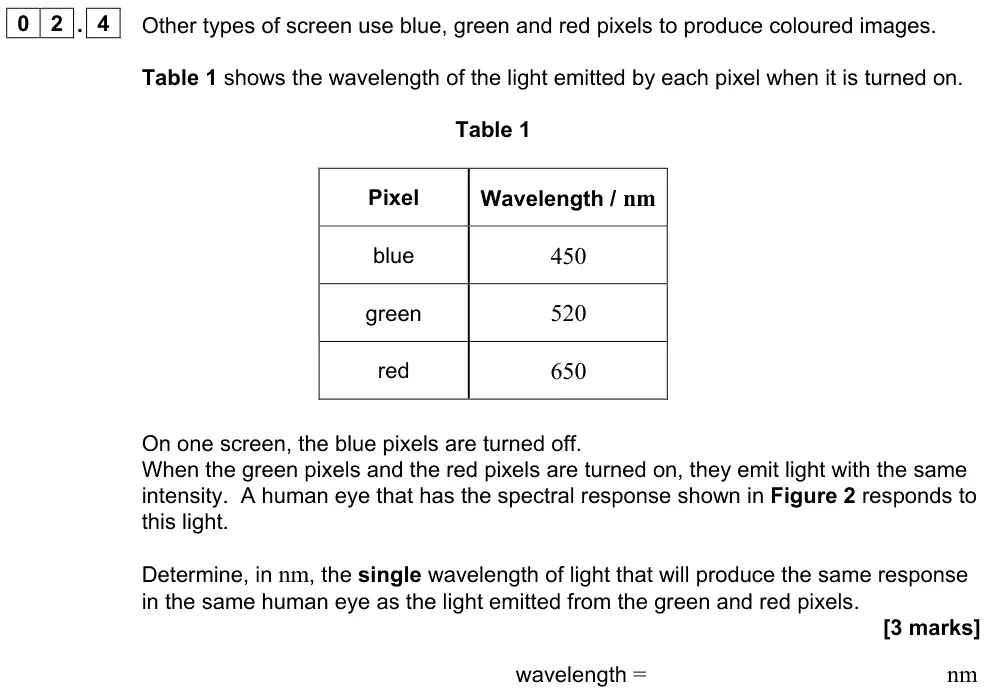
02.4 Students found this question very challenging, with only a quarter of students gaining any credit. Many students simply read off where the two curves intersected, or found the mean value of the two pixel wavelengths, neither of which gained any credit. Some students gained one mark by making a suitable read-off at 520 or 650 nm, although these had to be seen to be linked in some way to the red or green pixel wavelength or colour in order to gain credit. Many students also ignored the response of the red-sensitive cones to the green light. Of the students gaining this mark, the majority were then unsure of how to progress, and either summed or found the mean of their read-off values.
Despite 02.3 having led them in this direction, only a handful of students correctly went on to consider the ratio of the responses of the red-sensitive cones to the green-sensitive cones in order to determine a wavelength.
Notes from the mark scheme and report
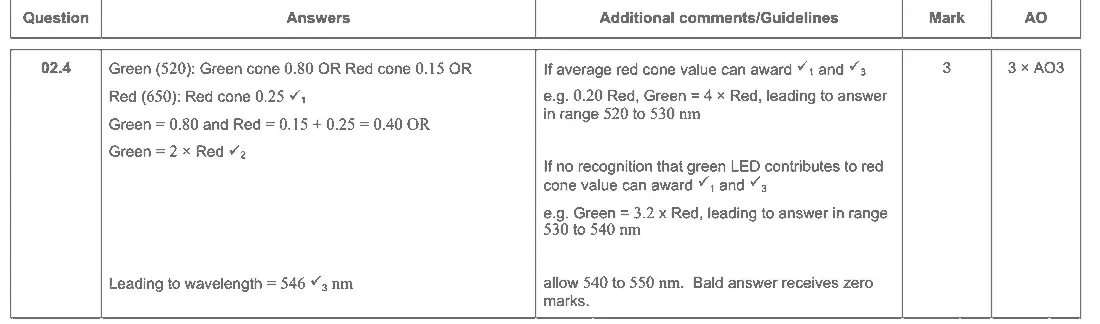
Answer: about 546 nm (green pixel: green cone 0.80, red cone 0.15
red pixel: red cone 0.25
green = 2 x red response, which occurs at about 546 nm)
reading the curve intersection or averaging 520 and 650 gained nothing
many ignored the red-cone response to green light
Skills: MS3.1 Translate information between graphical, numerical and algebraic forms; MS0.3 Use ratios, fractions and percentages
June 2023 · Paper 3B Medical physics · Q3.11 markAO1=1Short answer
Mark scheme
Examiner's comment
03.1 Less than half of the students were able to successfully define intensity. Many gave answers that were linked to human hearing limits or that referred to loudness rather than to power or energy. Some students incorrectly defined it as pressure per unit area, remembering a correct equation but not interpreting it correctly. “Power per area” or “power over area” were not sufficient for the mark to be awarded.
Notes from the mark scheme and report
Power per unit area (or energy per second per unit area)
'power over area', pressure per area or loudness not accepted
less than half correct
June 2023 · Paper 3B Medical physics · Q3.21 markAO1=1Short answer
Earlier part of question 3 that this part uses
Mark scheme
Examiner's comment
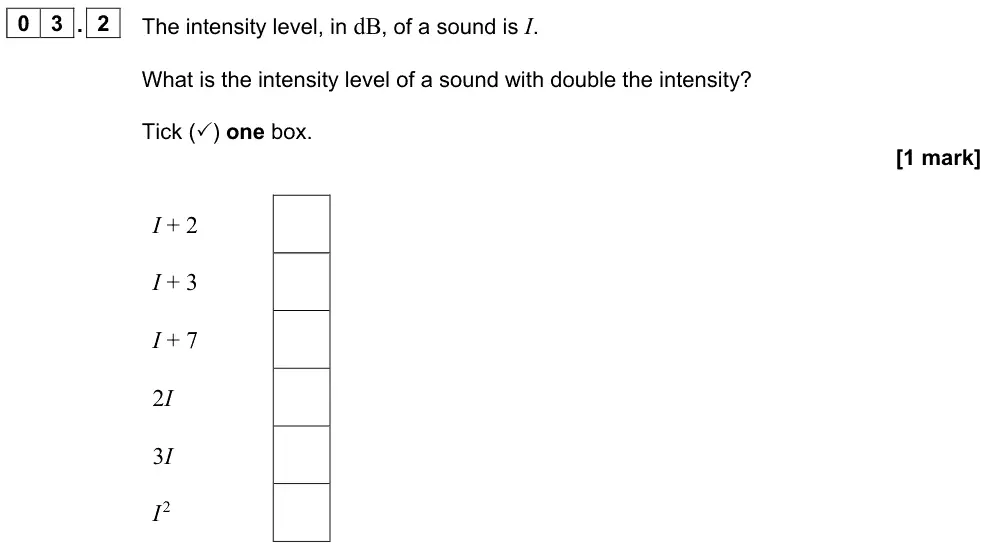
03.2 Almost half of students chose the correct answer.
Notes from the mark scheme and report
Answer: I + 3 (10 log 2 = 3 dB)
almost half chose correctly
Skills: MS0.5 Use calculators to find and use power, exponential and logarithmic functions; MS2.5 Use logarithms in relation to quantities that range over several orders of magnitude
June 2023 · Paper 3B Medical physics · Q3.32 marksAO2=2Calculation
Earlier part of question 3 that this part uses
Mark scheme
Examiner's comment
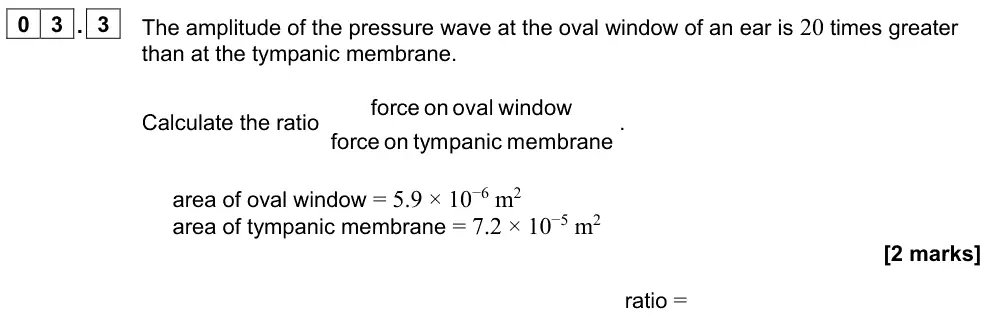
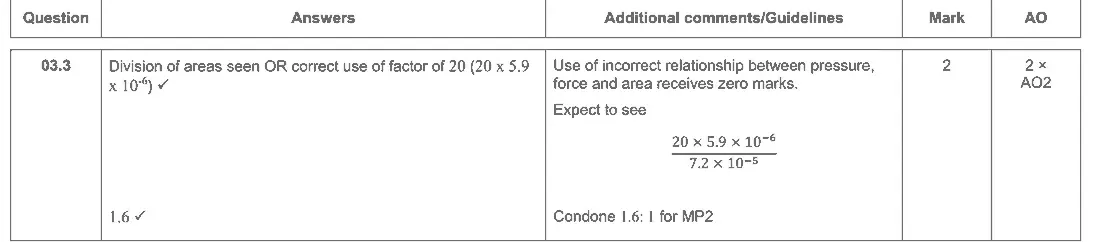
03.3 This question was well answered with almost half of students gaining both marks and the majority gaining at least one mark. Of those who only obtained one mark, the most common errors were to ignore or to misuse the factor of 20. Full marks were also not awarded to those students who left their final answer in the form of a fraction. Of those students who failed to gain a mark, many p = F incorrectly stated the relationship between pressure, force and area, using . This physics A error did not receive credit.
Notes from the mark scheme and report
Answer: 1.6 (20 x 5.9 x 10^-6 / 7.2 x 10^-5)
ignoring or misusing the factor of 20 and leaving a fraction were common
wrong pressure-force-area relationship scores zero
Skills: MS0.3 Use ratios, fractions and percentages; MS2.3 Substitute numerical values into algebraic equations using appropriate units for physical quantities
June 2023 · Paper 3B Medical physics · Q4.23 marksAO2=1, AO3=2Calculation
Earlier part of question 4 that this part uses
Mark scheme
Examiner's comment
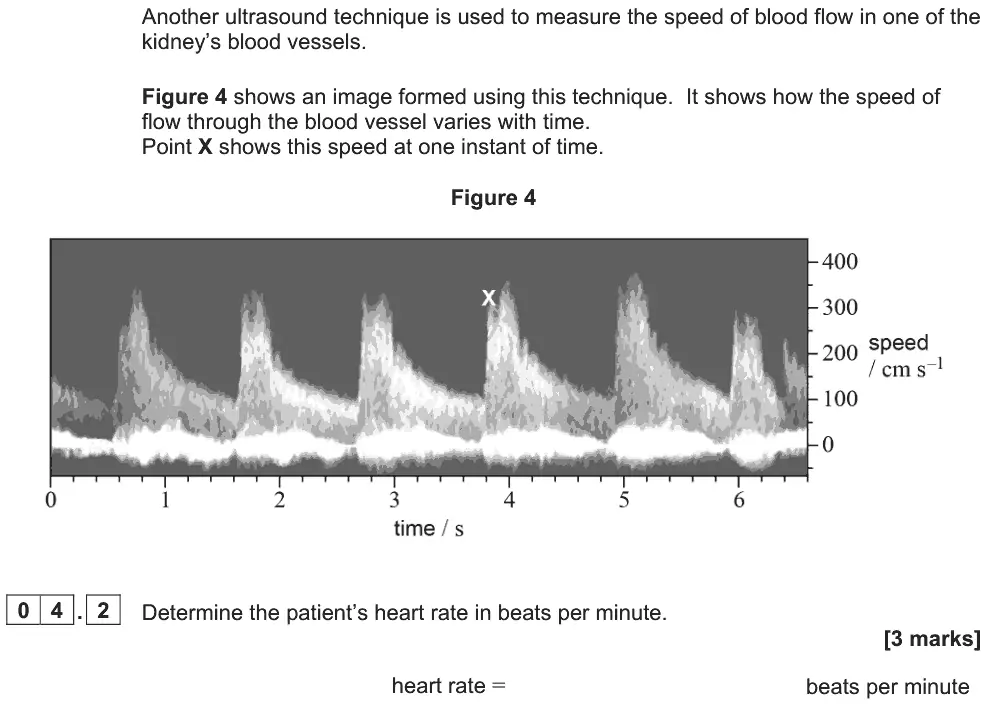
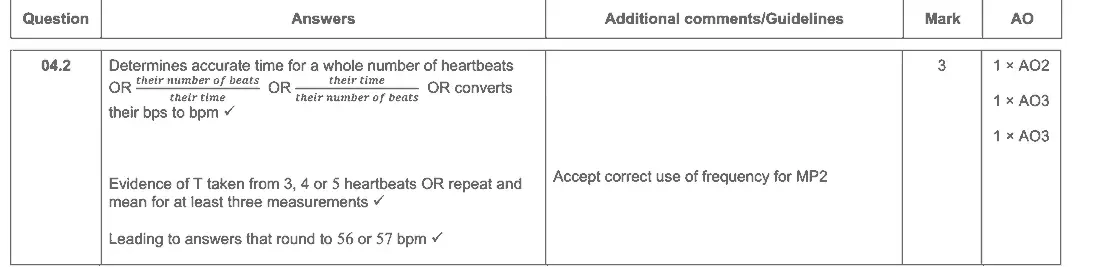
04.2 The majority of students attempted this with some success and accessed at least one mark. The most common reason for only obtaining one mark was the use of just a single heartbeat in order to determine the time period. This gave answers that consistently fell outside of the accepted range. For full marks, a student needed to use at least half of the full range of available data, taking T from either 3, 4 or 5 full heartbeats. Use of the full graph for 6 heartbeats was considered inaccurate as it is unclear where the first and last beat start and finish. This approach also led to answers outside of the accepted range. Some students struggled to convert the time period to beats per minute, confusing time period and frequency.
Notes from the mark scheme and report
Answer: 56-57 beats per minute (period from 3, 4 or 5 beats, about 1.06 s)
timing a single beat or all six beats fell outside range
period/frequency confusion
Skills: MS3.1 Translate information between graphical, numerical and algebraic forms; MS1.2 Find arithmetic means; MS0.1 Recognise and make use of appropriate units in calculations
June 2023 · Paper 3B Medical physics · Q4.34 marksAO1=3, AO2=1Diagram or graph
Earlier part of question 4 that this part uses
Mark scheme
Examiner's comment
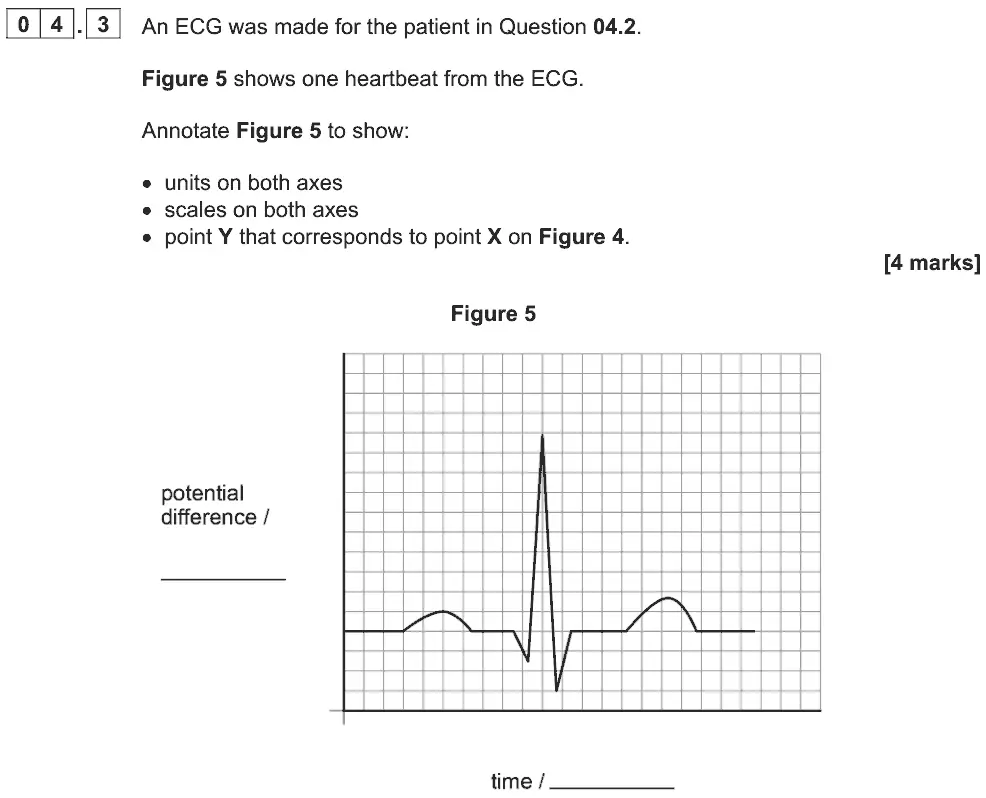
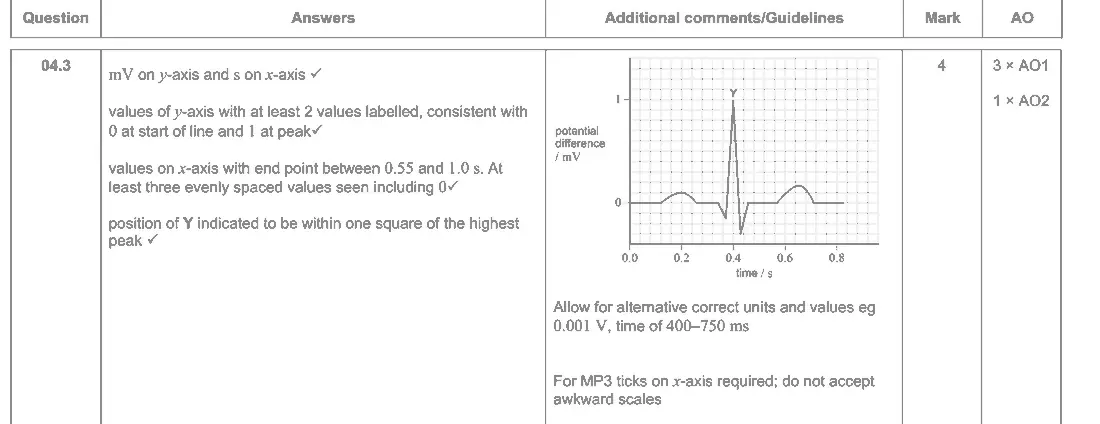
04.3 Although very few students gained full marks on this question, the specific marks which were awarded varied, with all separate marking points being awarded many times. Many students were able to correctly state the units on both sets of axes, although some then lost those marks through the use of incorrect prefixes. Abbreviations such as “secs” were not accepted. Many students were unsure of the range of values for the y-axis, and a common error was to label the origin as zero rather than the start of the line being at zero. A label at this point was not insisted upon, but the values shown needed to be consistent with this point being zero.
Of those students who knew the appropriate range of time values for the x-axis, many were not awarded the mark due to poor graphical work. Most commonly, students did not label the origin as zero. Some went up in uneven increments or used awkward scales, placing their number every third square. Others failed to put any vertical marks onto the axis leading to vaguely positioned, floating numbers.
Notes from the mark scheme and report
mV and s on axes
p.d. scale with baseline 0 and peak about 1 mV
time scale with end between 0.55 and 1.0 s
Y within one square of the R peak
incorrect prefixes, 'secs', unlabelled origin and awkward scales lost marks
very few full marks
Skills: MS3.1 Translate information between graphical, numerical and algebraic forms
June 2023 · Paper 3B Medical physics · Q4.43 marksAO1=2, AO2=1Short answer
Earlier part of question 4 that this part uses
Mark scheme
Examiner's comment
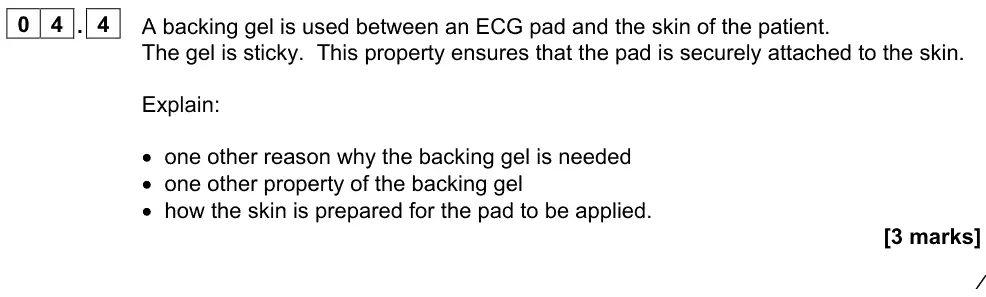
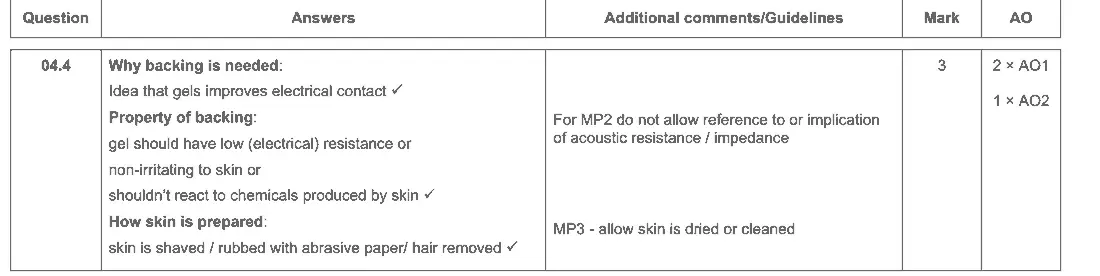
04.4 Nearly all students gained some credit on this question, with the majority being able to explain how the skin is prepared for the application of the pad. Some students were clearly able to express the function of the gel in improving electrical contact. Many, however, missed this mark as they mentioned exclusion of air but did not link this to electrical contact. A significant number of students gave answers that referred to acoustic impedance, many making explicit references to sound or ultrasound. Students who made this error were not awarded full marks.
Notes from the mark scheme and report
Gel improves electrical contact
low electrical resistance or non-irritant
skin shaved, abraded or cleaned
references to acoustic impedance penalised
June 2022 · Paper 3B Medical physics · Q1.11 markAO2=1Short answer
Mark scheme
Examiner's comment
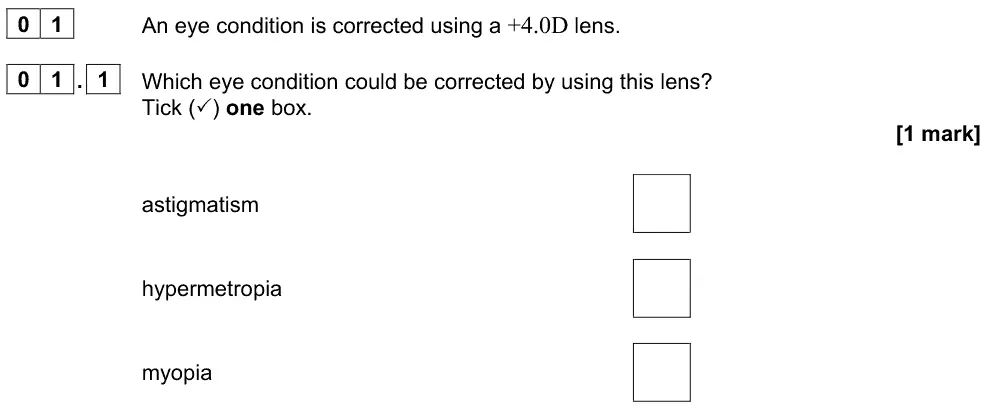
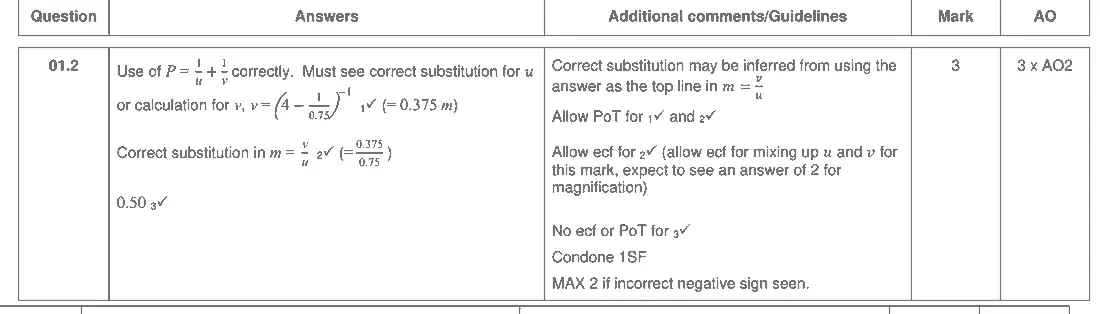
1.1 Most students were able to identify that the eye defect was hypermetropia. Myopia was the most commonly chosen distractor, with only a very few choosing astigmatism. one mark. However, a common mistake was mixing up 𝑢𝑢 and 𝑣𝑣 in the lens equation and 1.2 Many students could successfully complete this calculation, with the majority scoring at least
therefore getting a magnification of 2.0 instead of 0.50. A majority of students gave the answer to one significant figure (sf) which was condoned on this occasion but the answer 1 should have been given to two sf. A small number of students lost a mark by giving the 2. 𝑣𝑣 in the magnification equation instead of 𝑣𝑣. 1 The other common mistakes were for students to confuse the focal answer as a fraction length with the power of the lens and to use
Notes from the mark scheme and report
Answer: hypermetropia (positive power = converging lens)
myopia was the commonest wrong choice
June 2022 · Paper 3B Medical physics · Q1.23 marksAO2=3Calculation
Earlier part of question 1 that this part uses
Mark scheme
Examiner's comment
1.1 Most students were able to identify that the eye defect was hypermetropia. Myopia was the most commonly chosen distractor, with only a very few choosing astigmatism. one mark. However, a common mistake was mixing up 𝑢𝑢 and 𝑣𝑣 in the lens equation and 1.2 Many students could successfully complete this calculation, with the majority scoring at least
Notes from the mark scheme and report
Answer: 0.50 (v = 0.375 m from P = 1/u + 1/v with u = 0.75 m)
mixing up u and v gave 2.0
confusing power with focal length
no ecf on final mark
Skills: MS2.3 Substitute numerical values into algebraic equations using appropriate units for physical quantities; MS2.2 Change the subject of an equation, including non-linear equations; MS0.3 Use ratios, fractions and percentages
June 2022 · Paper 3B Medical physics · Q1.34 marksAO1=4Short answer
Earlier part of question 1 that this part uses
Mark scheme
Examiner's comment
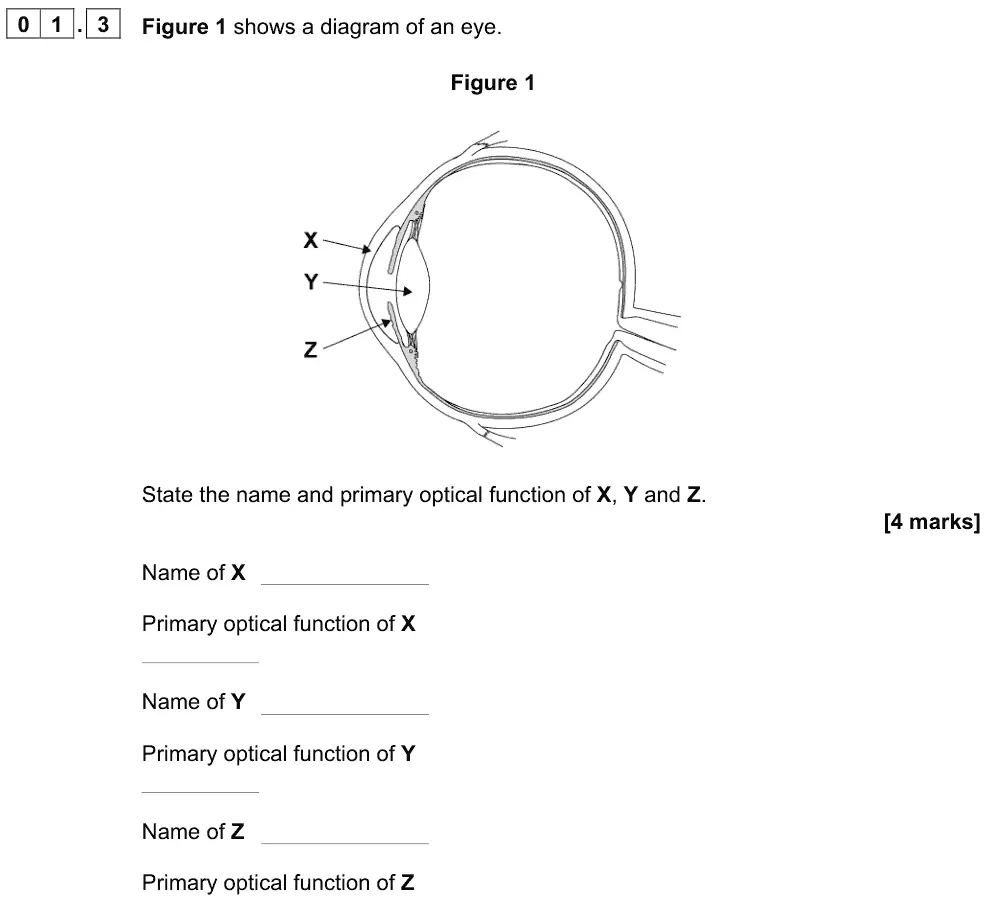
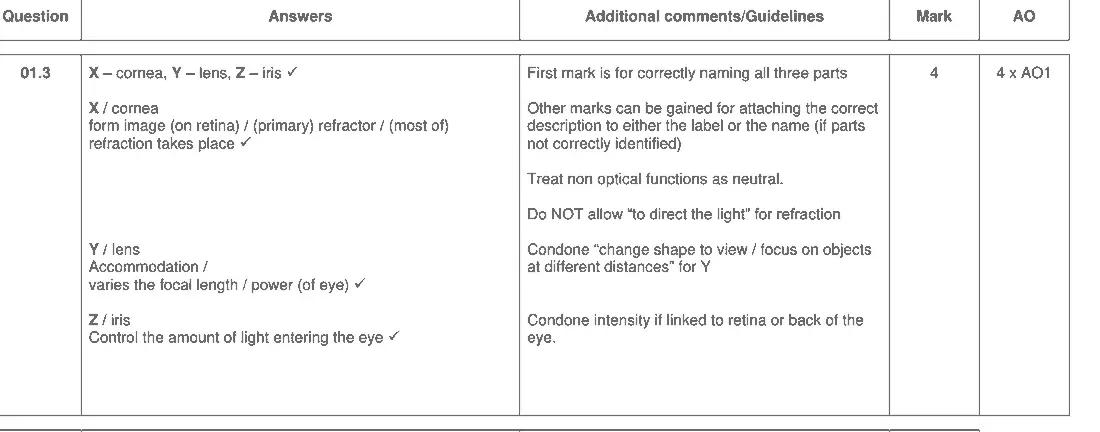
1.3 Many students could name all three components of the eyes or state the function of at least one of the components. However, there were also many who mixed up one or more of the components. The most common mistakes were mistaking the iris for the ciliary muscles, the cornea for the sclera, and the lens for the pupil.
Many students knew that the iris controls the amount of light entering the eye, although a few students confused intensity with the amount of the light and did not get a mark when they indicated that the intensity of light entering the eye was controlled by the iris.
Students generally knew that refraction occurred at the cornea. Examiners did not insist that students stated that most of the refraction occurred there, but the mark was denied when students indicated that there was only a little refraction occurring there or otherwise indicated that the lens refracted the light more. The mark was not given to students who incorrectly stated that the cornea focussed the light on the lens or those that stated that the cornea could diverge the light.
Students struggled to recognise or express the idea that the primary optical function of the lens is to change shape to allow accommodation: to focus light from objects at different distances.
A small minority of students confused refraction with reflection or diffraction.
Notes from the mark scheme and report
X cornea (most refraction), Y lens (accommodation, varies focal length), Z iris (controls amount of light)
all three names for mark 1
iris confused with ciliary muscles, cornea with sclera
'intensity' not accepted
June 2022 · Paper 3B Medical physics · Q3.13 marksAO1=3Diagram or graph
Mark scheme
Examiner's comment
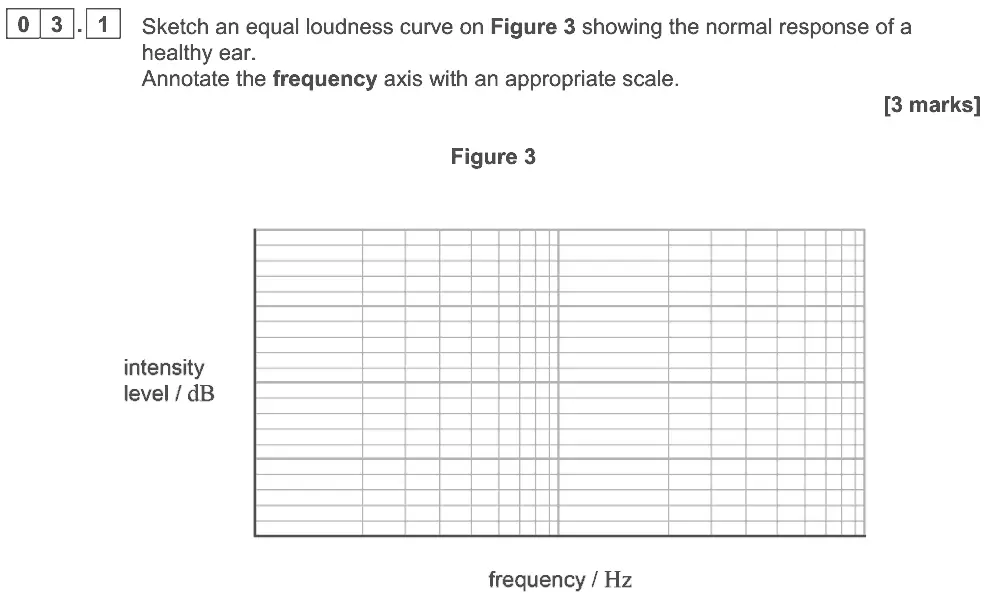
3.1 Some students were clearly not familiar with this graph.
The most common mark was awarded for knowing the general shape of the graph. A simple U shape was sufficient for this mark, although a small number of students knew the shape with more detail. The most common mistake was made by students who drew the graph upside- down.
A significant number of students knew that something happened at 3 kHz, with most of these knowing that it was the minimum. However, some of these students were not precise enough with their sketches and the identified frequency of 3 kHz was not at the location of the minimum. The most common incorrect minima were 4 kHz (where most damage occurs in hearing loss due to exposure to loud noises) and 1 kHz (the reference frequency for the dB scale).
The log scale proved to be the most challenging aspect of the question, with the majority of students being unfamiliar with how a log scale worked. This could be seen in mislabelling or not labelling the origin, mislabelling 3 kHz and treating the scale as linear. All of these lost the first mark, although a clear indication of where the student thought 3 kHz was allowed them to pick up the second mark when it was at the minimum of the graph. In a number of cases where 3 kHz was not labelled, the scale was marked incorrectly enough that no judgement could be reached about the frequency of the minimum and therefore the second marking point could not be awarded.
Notes from the mark scheme and report
U-shaped curve with minimum at 3 kHz on a log frequency scale (100, 1000, 10 000 Hz)
curve drawn upside down, linear scale, minimum at 4 kHz or 1 kHz were common errors
Skills: MS2.5 Use logarithms in relation to quantities that range over several orders of magnitude; MS3.1 Translate information between graphical, numerical and algebraic forms
June 2022 · Paper 3B Medical physics · Q3.22 marksAO1=2Short answer
Earlier part of question 3 that this part uses
Mark scheme
Examiner's comment
3.2 A large number of students were not familiar with this procedure, with over half not scoring.
Some students were familiar with this procedure and were able to describe it well. A majority of these students knew that the reference frequency was 1 kHz. To gain the first mark it had to be clear that the reference frequency of 1 kHz is compared to sounds at other frequencies. A mention of 1 kHz was not enough by itself.
Some methods suggested lacked rigour because they involved either just stating the frequency should be altered or failing to explain that the intensity or volume must be changed until the two signals sound with the same loudness. For two marks it had to be clear that a second signal must be kept at constant frequency while the volume was changed until two signals were heard to be equally loud. A minority described the procedure for determining the threshold of hearing rather than equal loudness curves; this did not score any marks.
Notes from the mark scheme and report
Different frequencies compared with a 1 kHz reference
intensity adjusted until equally loud
over half scored 0
threshold-of-hearing method not credited
June 2022 · Paper 3B Medical physics · Q3.32 marksAO2=2Calculation
Earlier part of question 3 that this part uses
Mark scheme
Examiner's comment
3.3 A large number of students were able to perform this calculation. However, the majority of answers quoted their final answer to 1 sf and so lost a mark.
A small number of students did not use the threshold of hearing from the Data and Formulae number used logarithms with base 𝑒𝑒 instead of base 10. A very small number were unable to sheet. The most common error was to mix up the intensity level and the intensity. A small
perform the algebra correctly.
Notes from the mark scheme and report
Answer: 1.0 x 10^-9 W m^-2 (I0 = 1.0 x 10^-12 W m^-2)
most lost a mark for a 1 sf answer
some used ln
Skills: MS0.5 Use calculators to find and use power, exponential and logarithmic functions; MS2.2 Change the subject of an equation, including non-linear equations; MS1.1 Use an appropriate number of significant figures
November 2021 · Paper 3B Medical physics · Q3.13 marksAO2=3Calculation
Mark scheme
Notes from the mark scheme and report
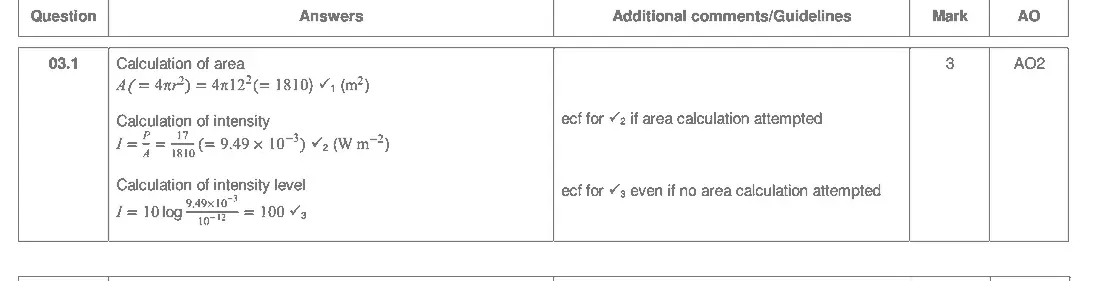
Answer: 100 dB (I = 17/(4 pi 12^2) = 9.5 x 10^-3 W m^-2)
Skills: MS4.3 Calculate areas of triangles, circumferences and areas of circles, surface areas and volumes of rectangular blocks, cylinders and spheres; MS2.5 Use logarithms in relation to quantities that range over several orders of magnitude; MS2.3 Substitute numerical values into algebraic equations using appropriate units for physical quantities
November 2021 · Paper 3B Medical physics · Q3.22 marksAO2=2Explanation
Earlier part of question 3 that this part uses
Mark scheme
Notes from the mark scheme and report
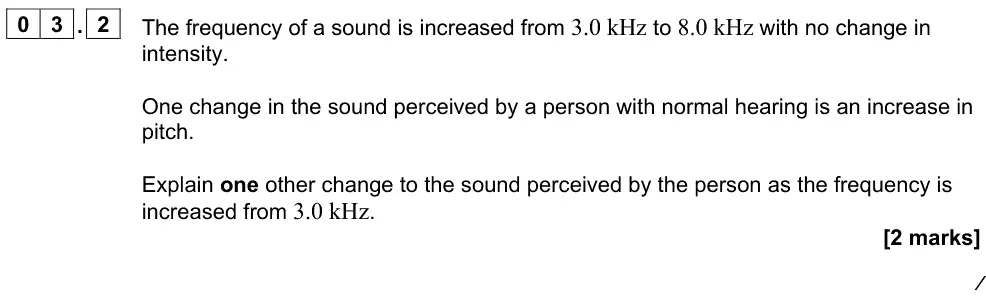
Sound perceived as quieter because the ear is most sensitive around 3 kHz (equal loudness curves)
November 2021 · Paper 3B Medical physics · Q5.11 markAO2=1Short answer
Mark scheme
Notes from the mark scheme and report
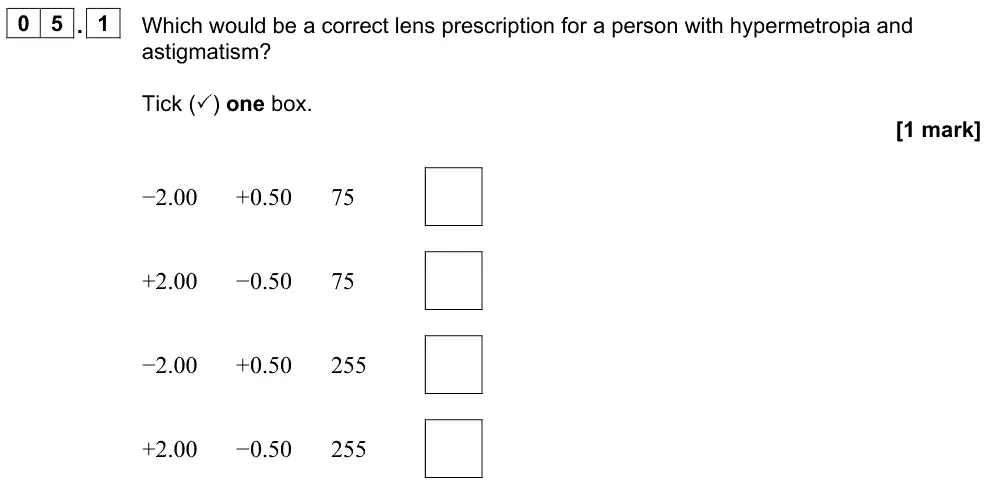
Answer: +2.00 -0.50 75 (positive sphere for hypermetropia
axis 0-180 degrees)
November 2021 · Paper 3B Medical physics · Q5.26 marks6-mark extended response
Earlier part of question 5 that this part uses
Mark scheme, with the levels and indicative content
Notes from the mark scheme and report
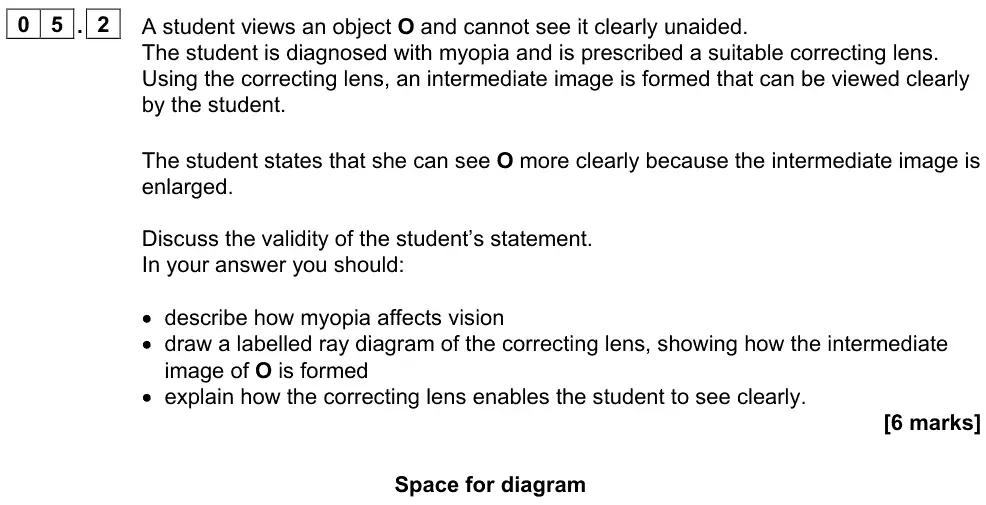
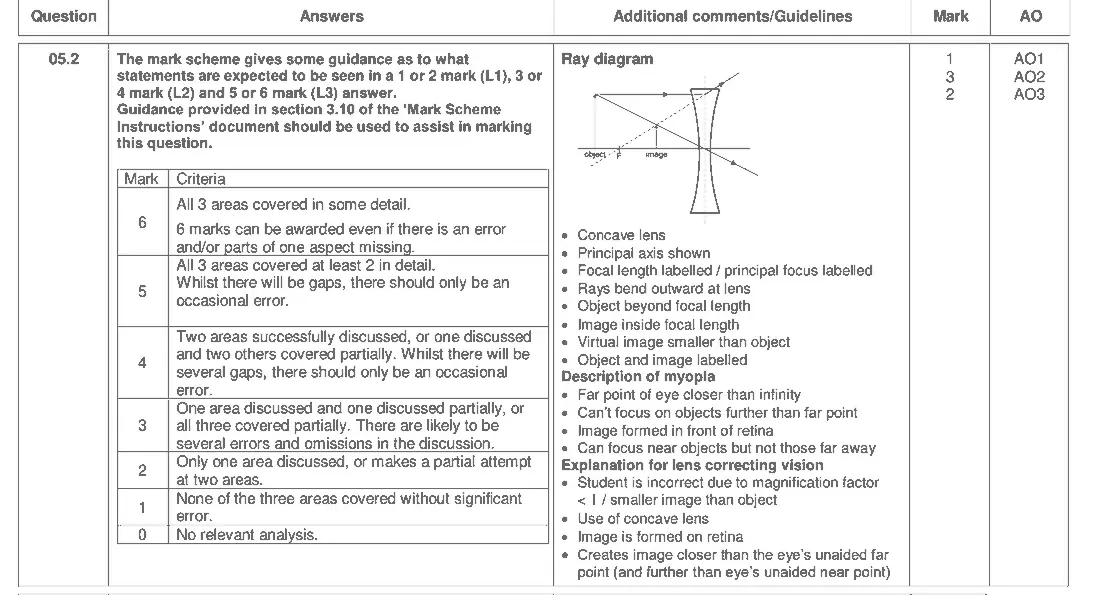
Levels of response. Myopia: distant objects focus in front of the retina, far point too close
diverging lens forms a virtual, upright, diminished intermediate image within the far point (ray diagram)
statement invalid - the image is smaller, it is seen clearly because it lies within the eye's range of accommodation
Skills: MS4.2 Visualise and represent 2D and 3D forms including two- dimensional representations of 3D objects
November 2020 · Paper 3B Medical physics · Q1.15 marksAO1=5Explanation
Mark scheme
Notes from the mark scheme and report
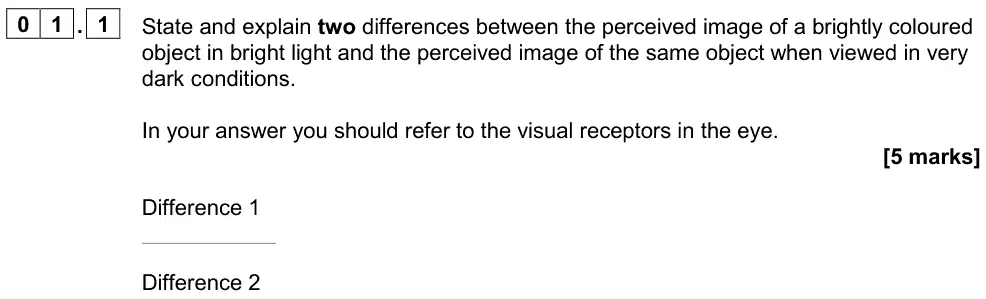
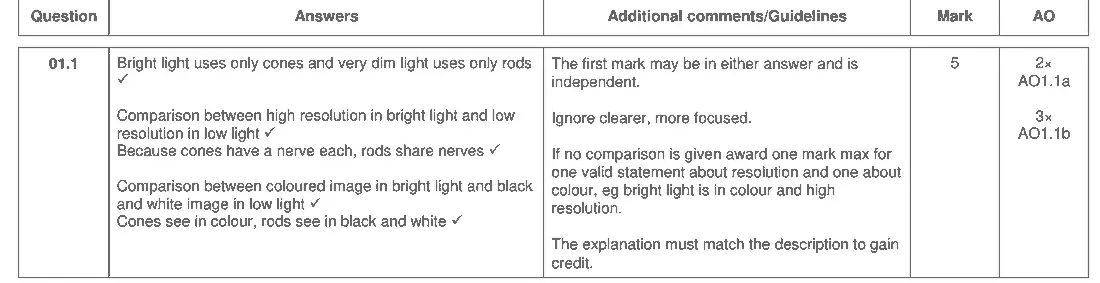
Bright light: cones only
dark: rods only
high resolution in bright light vs low in dark because each cone has its own nerve while rods share nerves
colour vs black-and-white (one type of rod, three types of cone)
November 2020 · Paper 3B Medical physics · Q1.21 markAO1=1Short answer
Earlier part of question 1 that this part uses
Mark scheme
Notes from the mark scheme and report
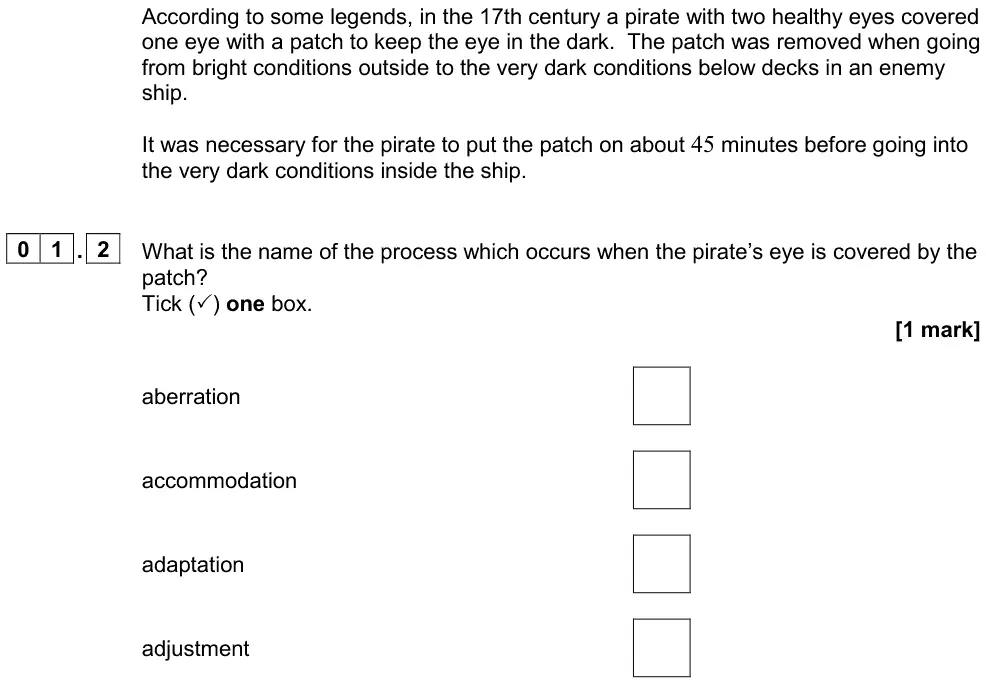
Answer: adaptation
November 2020 · Paper 3B Medical physics · Q1.33 marksAO3=3Explanation
Earlier part of question 1 that this part uses
Mark scheme
Notes from the mark scheme and report
Rods take time to adapt to the dark (regenerate rhodopsin / reverse bleaching), so the covered eye is already dark-adapted on entering
rods must be mentioned for full marks
November 2020 · Paper 3B Medical physics · Q2.12 marksAO1=2Short answer
Mark scheme
Notes from the mark scheme and report
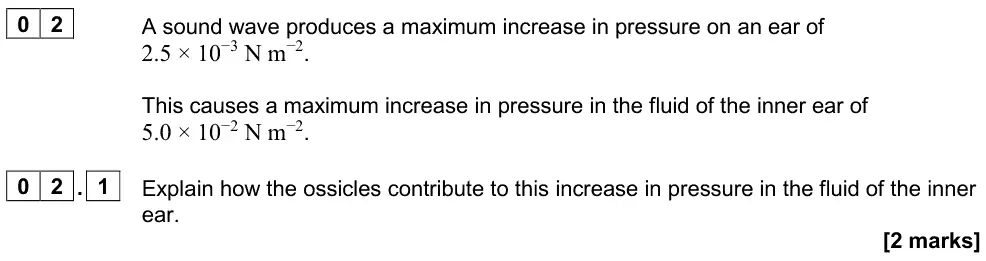
Ossicles act as levers to increase the force (on the oval window)
November 2020 · Paper 3B Medical physics · Q2.23 marksAO2=3Calculation
Earlier part of question 2 that this part uses
Mark scheme
Notes from the mark scheme and report
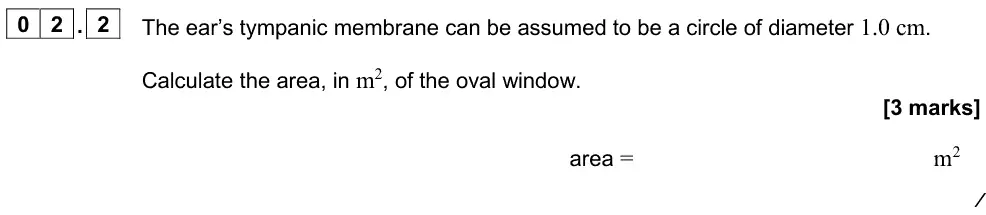
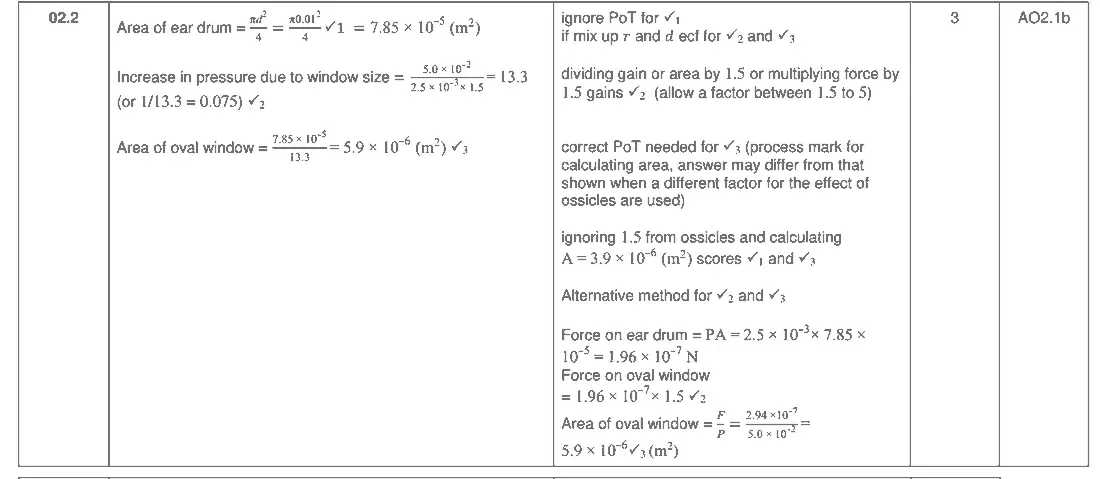
Answer: 5.9 x 10^-6 m^2 (eardrum area 7.85 x 10^-5 m^2
pressure gain 20 divided by lever factor 1.5 gives area ratio 13.3)
Skills: MS4.3 Calculate areas of triangles, circumferences and areas of circles, surface areas and volumes of rectangular blocks, cylinders and spheres; MS0.3 Use ratios, fractions and percentages; MS2.2 Change the subject of an equation, including non-linear equations
June 2019 · Paper 3B Medical physics · Q1.11 markShort answerEasy
Mark scheme
Examiner's comment
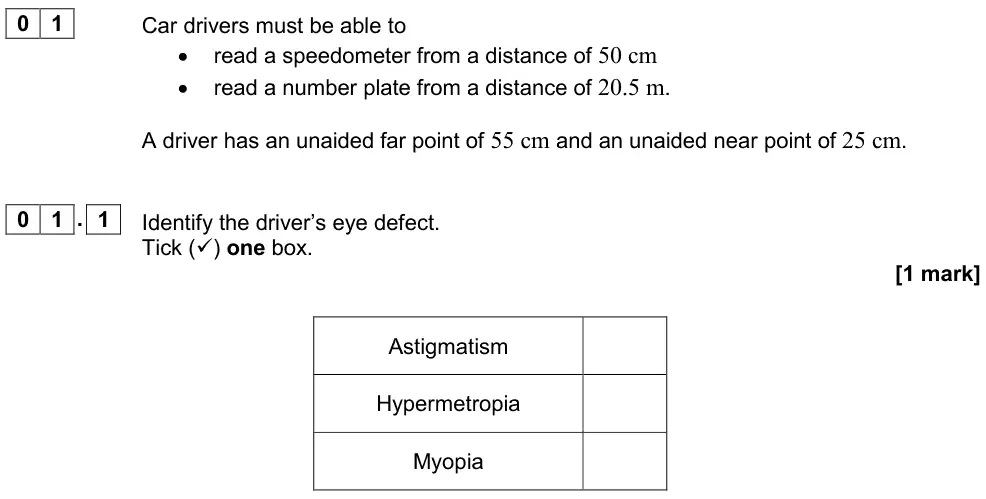
01.1 was a simple multiple-choice question requiring students to identify myopia as the eye defect from the data provided. The question was slightly more difficult than in the past due to the inclusion of the unaided near point, which students had to recognise as being normal. This did not cause a problem to most students. The question was answered correctly by around three-quarters of the students.
Notes from the mark scheme and report
Answer: myopia (far point 55 cm
near point 25 cm normal)
around three-quarters correct
June 2019 · Paper 3B Medical physics · Q1.24 marksDiagram or graph
Earlier part of question 1 that this part uses
Mark scheme
Examiner's comment
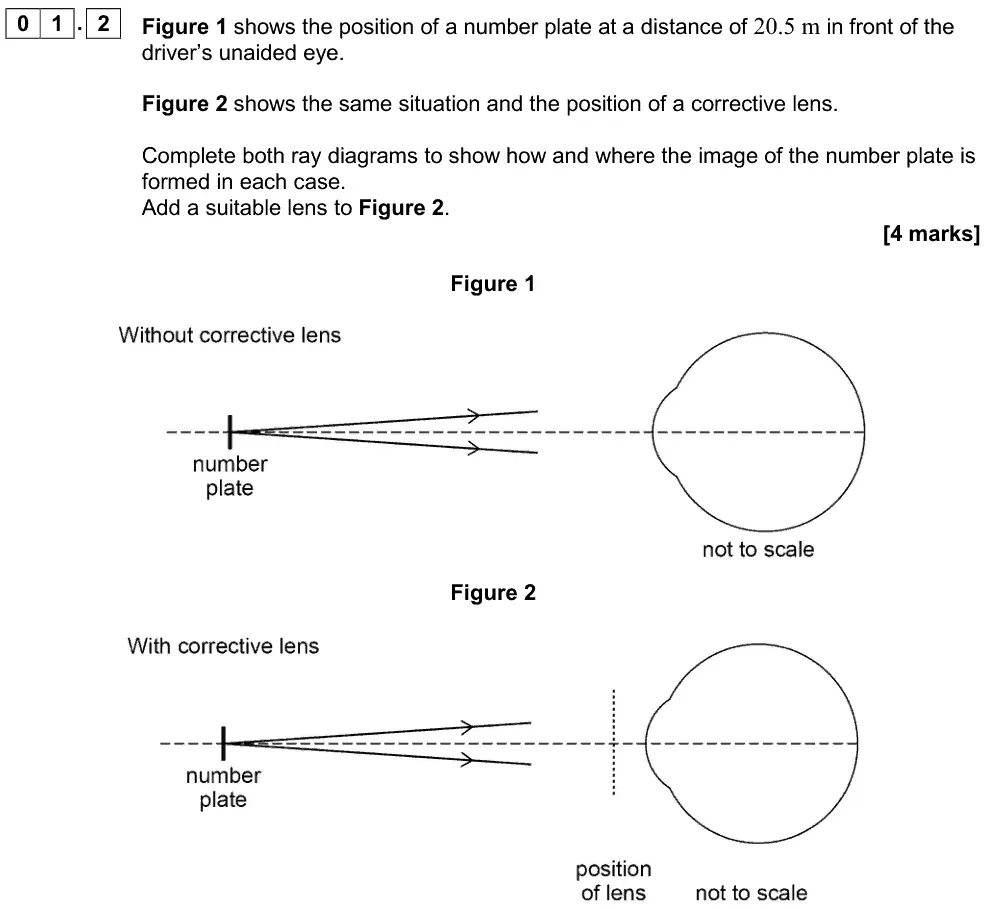
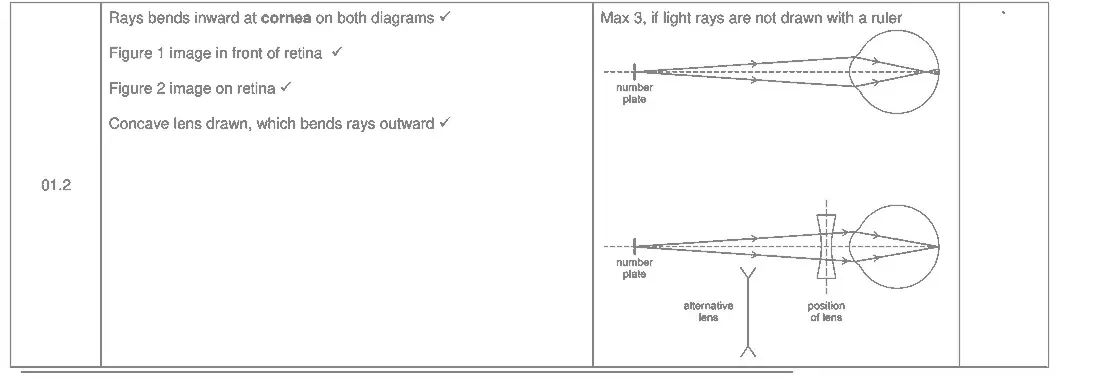
01.2 required students to complete ray diagrams, with and without a lens, for a number plate which was beyond the unaided far point of the eye. More able students answered this question well, with most students gaining at least 2 marks. Nearly all students were able to draw Figure 1 correctly where the rays bent at the cornea and crossed to form an image in front of the retina. A small number of students continued the rays beyond the back of the eye and failed to gain a mark. In Figure 2, while most students knew that the image formed on the retina, many produced careless drawings with rays crossing in front of or behind the retina. Many students either did not draw the concave lens or drew a convex lens instead. Some students had the rays refracting correctly at the cornea in Figure 1, but incorrectly in Figure 2.
Notes from the mark scheme and report
Rays refracted at the cornea
Figure 1 image in front of the retina
Figure 2 diverging (concave) lens bends rays outward so image on the retina
rays with a ruler
Skills: MS4.2 Visualise and represent 2D and 3D forms including two- dimensional representations of 3D objects
June 2019 · Paper 3B Medical physics · Q1.35 marksCalculation
Earlier part of question 1 that this part uses
Mark scheme
Examiner's comment
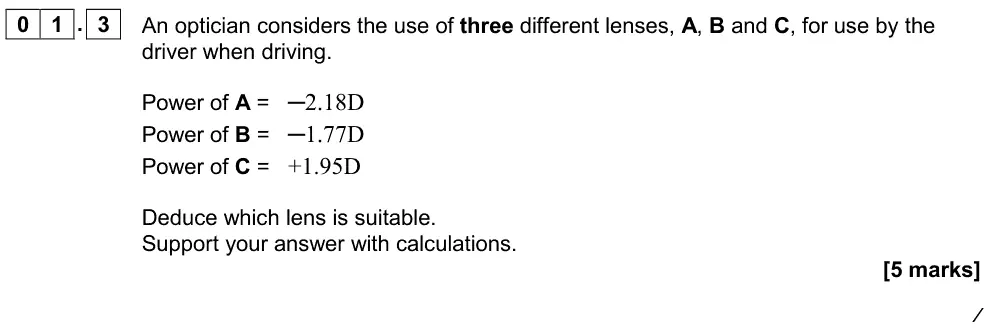
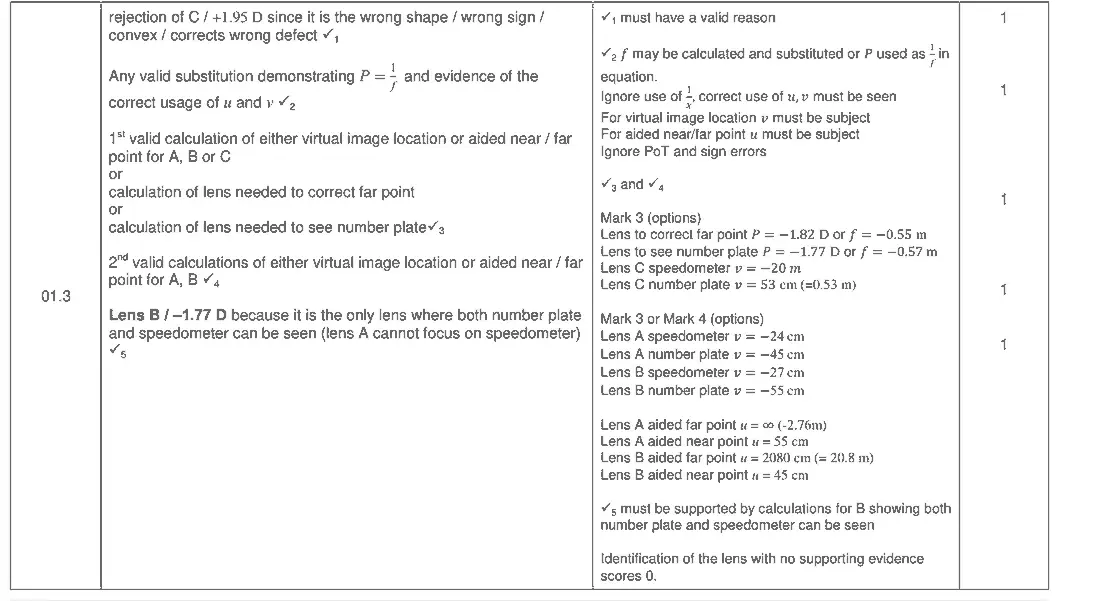
01.3 was a challenging question. In order to score full marks, the students had to select lens B, show that it was the only lens that allowed both the number plate and the speedometer to be viewed, and give a valid reason for rejecting lens C. The key to the question, which was missed by many students, was realising that when a lens is used to correct myopia, it also changes the near point of the eye. Most students either explicitly assumed that the near point did not change or did not consider the speedometer in their answer at all. The first mark was for giving any valid reason to reject lens C, either by stating it was the wrong type of lens or that it corrected the wrong type of defect. There were two main approaches to choosing between lenses A and B. Either the students could
• calculate the position of the images of the number plate and speedometer and compare them to the unaided near and fair points, or, • calculate the aided near and far points and compare them to the positions of the number plate and speedometer. A mark was awarded for any valid substitution of the data using 𝑃𝑃= 𝑓𝑓= 𝑢𝑢+ 1 1 1 1 𝑓𝑓 and 𝑣𝑣, clearly showing 𝑢𝑢 as the object distance and 𝑣𝑣 as the image distance. A minority of students confused 𝑢𝑢 and 𝑣𝑣, although a smaller number than in previous years. It was not enough to calculate 𝑓𝑓 for the three lenses. Two marks were then awarded for the answers to two relevant calculations. These marks were independent of the previous mark. There were many possible calculations but, to gain two marks, at least one of these calculations had to be an image distance or an aided far or near images and the use of near and far points for 𝑢𝑢 and 𝑣𝑣 instead of object and image distances. It point. Common mistakes in these calculations were a failure to use negative values for virtual
was common for students to calculate the correcting lens required to correct the unaided far point or to see the number plate and gain two marks when correct working was seen, with a further mark available for giving a valid reason to reject lens C.
Notes from the mark scheme and report
Lens B (-1.77 D): images of speedometer (v = -27 cm) and number plate (v = -55 cm) lie between near and far points
lens A moves the near point so the speedometer at 50 cm cannot be focused
C is converging (wrong defect)
many missed that the lens changes the near point
Skills: MS2.2 Change the subject of an equation, including non-linear equations; MS2.3 Substitute numerical values into algebraic equations using appropriate units for physical quantities
June 2019 · Paper 3B Medical physics · Q2.12 marksCalculation
Mark scheme
Examiner's comment
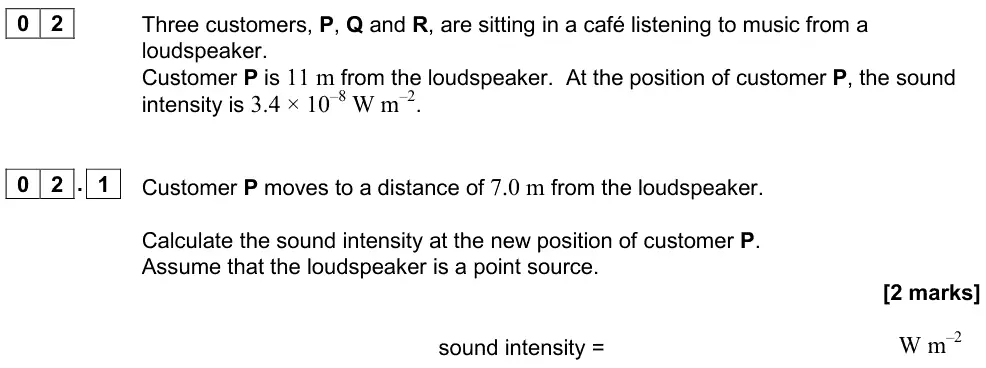
02.1 was answered well by more able students. There were two approaches possible: a calculation of power using 𝑃𝑃= 𝐼𝐼𝐼𝐼 for a distance of 11 m, followed by a determination of • 2 = 𝐼𝐼2𝑥𝑥2 the intensity for the same power at the new distance. Some students failed to gain a mark a proportion calculation 𝐼𝐼1𝑥𝑥1 2. Less able students confused intensity with intensity by using the wrong area, usually the area of a circle instead of the surface area of a sphere; • level and scored 0.
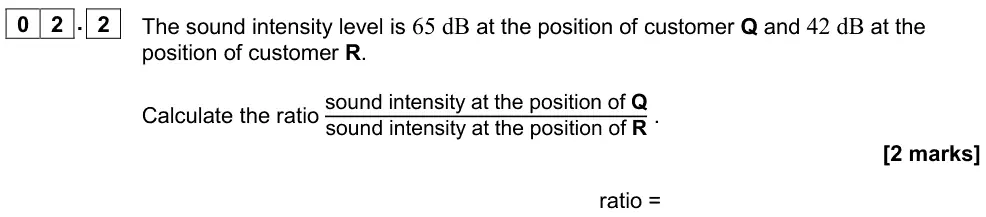
In 02.2, more able students answered well, converting the intensity levels in the question into intensities. A minority calculated the wrong ratio, but most were then able to gain two marks. Less able students calculated the ratio of the intensity levels instead of intensity. A minority expressed the ratio as 200:1 which was not penalised.
Notes from the mark scheme and report
Answer: 8.4 x 10^-8 W m^-2 (I proportional to 1/r^2: 3.4 x 10^-8 x 11^2/7^2)
circle area instead of sphere was an error
Skills: MS0.3 Use ratios, fractions and percentages; MS4.3 Calculate areas of triangles, circumferences and areas of circles, surface areas and volumes of rectangular blocks, cylinders and spheres
June 2019 · Paper 3B Medical physics · Q2.22 marksCalculation
Earlier part of question 2 that this part uses
Mark scheme
Examiner's comment
In 02.2, more able students answered well, converting the intensity levels in the question into intensities. A minority calculated the wrong ratio, but most were then able to gain two marks. Less able students calculated the ratio of the intensity levels instead of intensity. A minority expressed the ratio as 200:1 which was not penalised.
02.3 required students to discuss which measure, intensity level or intensity, was more appropriate to compare perceived loudness. Only the most able students were able to answer this question, stating that intensity level was more appropriate as it was a logarithmic scale which matched the ear’s response. This required students to evaluate their knowledge of intensity level and intensity in the context of perceived loudness. However, the answers given suggested that many students did not have a good understanding of either intensity level or intensity. Some students confused the dB scale (which measures intensity level) with the dBA scale (which is adjusted for frequency). Answers which referred to a frequency dependence of intensity level could not gain full marks on this question. Some students did not realise that the ratio of intensities (= 200 from question 02.2) was not a realistic increase in loudness when moving from 11 m to 7 m, and therefore the answer could not have been intensity.
Notes from the mark scheme and report
Answer: 200 (10^(6.5 - 4.2))
ratio of the dB values themselves was a common error
Skills: MS2.5 Use logarithms in relation to quantities that range over several orders of magnitude; MS0.5 Use calculators to find and use power, exponential and logarithmic functions
June 2019 · Paper 3B Medical physics · Q2.32 marksExplanation
Earlier part of question 2 that this part uses
Mark scheme
Examiner's comment
02.3 required students to discuss which measure, intensity level or intensity, was more appropriate to compare perceived loudness. Only the most able students were able to answer this question, stating that intensity level was more appropriate as it was a logarithmic scale which matched the ear’s response. This required students to evaluate their knowledge of intensity level and intensity in the context of perceived loudness. However, the answers given suggested that many students did not have a good understanding of either intensity level or intensity. Some students confused the dB scale (which measures intensity level) with the dBA scale (which is adjusted for frequency). Answers which referred to a frequency dependence of intensity level could not gain full marks on this question. Some students did not realise that the ratio of intensities (= 200 from question 02.2) was not a realistic increase in loudness when moving from 11 m to 7 m, and therefore the answer could not have been intensity.
Notes from the mark scheme and report
Intensity level, because its logarithmic scale matches the ear's response to loudness
'frequency response' not accepted
only the most able
June 2019 · Paper 3B Medical physics · Q2.43 marksExplanation
Earlier part of question 2 that this part uses
Mark scheme
Examiner's comment
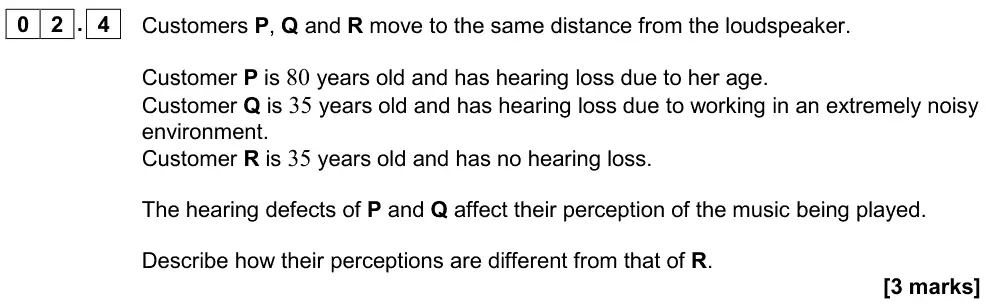
02.4 was answered poorly by most students, with only a few able to score full marks. There was a general familiarity with the concept of hearing loss resulting from age deterioration or loud noise; however, detail was either missing or incorrect. Most students knew that hearing loss due to age was most significant at higher frequencies. Many students thought that hearing loss due to loud noises was either at 3 kHz or the frequency at which the noise occurred. Only a few were able to quote the correct frequency of 4 kHz for this damage. Most students did not state that hearing loss occurred at all frequencies in both cases.
Notes from the mark scheme and report
Both hear quieter than R
P (age) loses most at high frequencies
Q (noise) loses most around 4 kHz
few full marks
June 2018 · Paper 3B Medical physics · Q2.14 marksCalculationHard
Mark scheme
Examiner's comment
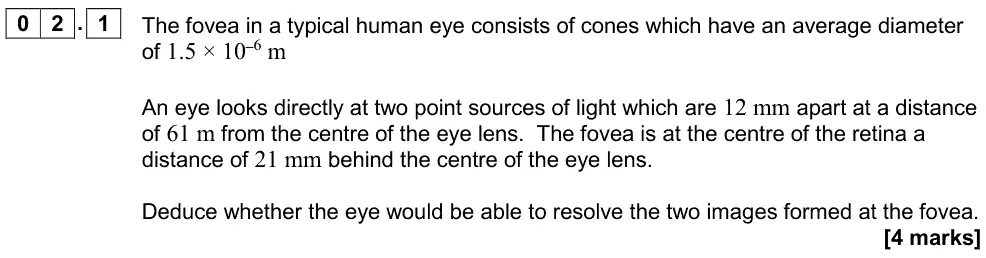
The first part, 02.1, required the students to use the data provided to make a sensible comment on whether the eye could resolve two images on the retina. This could be done in many ways, but the final statement required a direct comparison between either two calculated values, or a comparison between a calculated value and data quoted in the question. In order to gain full marks, students needed to demonstrate that in order to ensure that two images could be resolved, the minimum distance between the two images was greater than two cell diameters. This point was missed by many students who either used one or three cell diameters as the limiting factor. Many other students could not use the data supplied in a meaningful way, with a surprising number trying to use the lens equation to work out a focal length. The mean mark on this question was 0.97 out of 4, with 8.7% of students scoring all four marks available.
Notes from the mark scheme and report
Image separation d = 21 x 10^-3 x 12 x 10^-3/61 = 4.1 x 10^-6 m, about 2.75 cone diameters, so at least one unstimulated cone between - resolved
needs a direct comparison
8.7% full marks
Skills: MS4.6 Use of small angle approximations including sinθ ≈θ, tanθ ≈θ, cosθ ≈1 for small θ where appropriate; MS0.3 Use ratios, fractions and percentages
June 2018 · Paper 3B Medical physics · Q2.23 marksDiagram or graph
Earlier part of question 2 that this part uses
Mark scheme
Examiner's comment
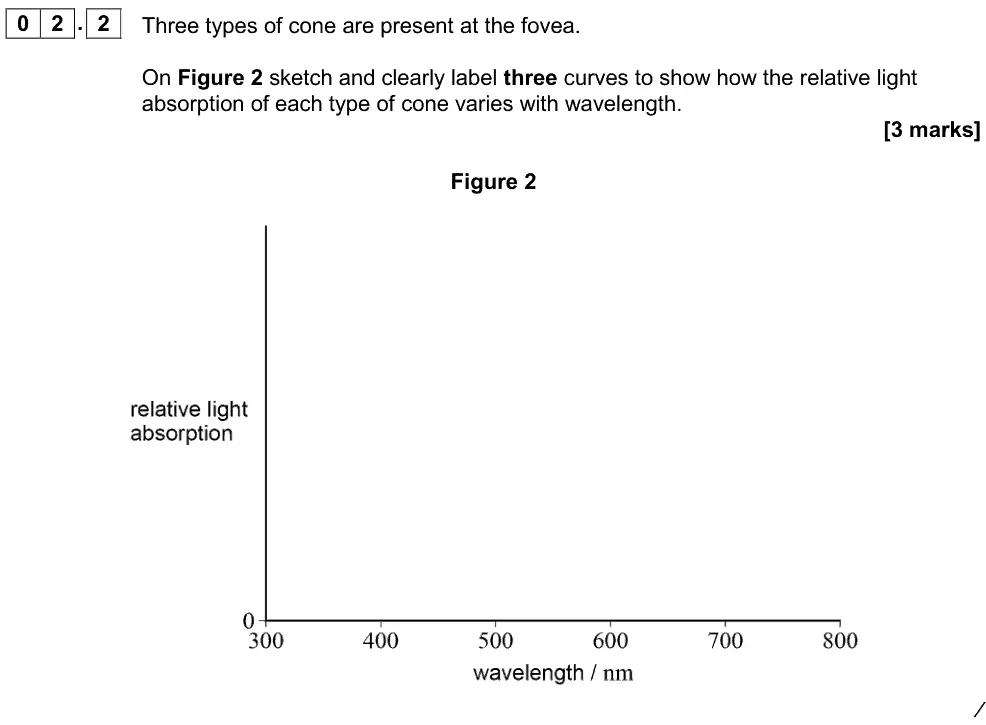
Part 02.2 required students to sketch and label the response curves for the three colour cones of the eye. Although most students gained a mark for drawing three curves and naming the curves blue, green and red with increasing wavelength, hardly any gained either of the other marks for relative heights or range of wavelengths.
Notes from the mark scheme and report
Three labelled curves blue, green, red with increasing peak wavelength
green and red similar heights, blue much lower
ranges roughly 375-500, 425-675, 475-725 nm
few got heights or ranges
June 2018 · Paper 3B Medical physics · Q4.14 marksExplanation
Mark scheme
Examiner's comment
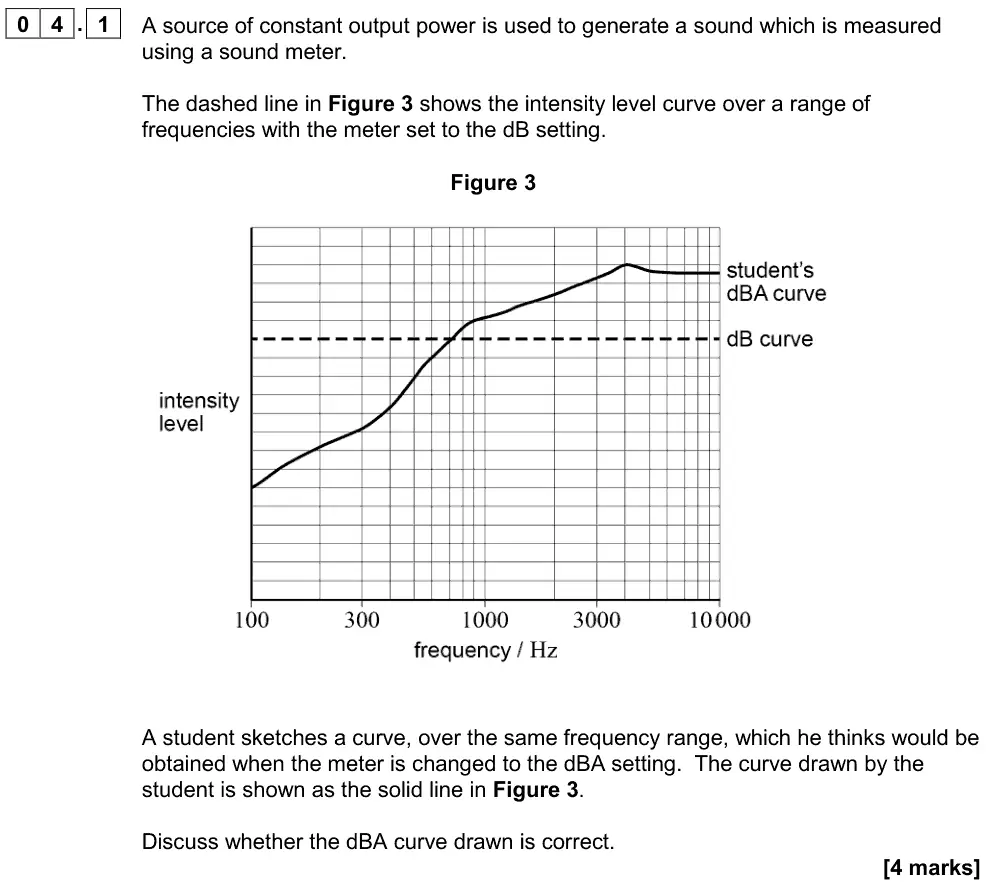
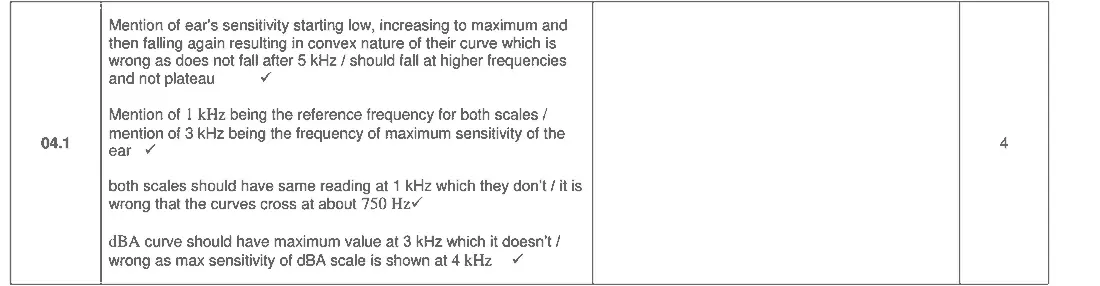
Part 04.1 showed a suggested graph drawn by a student to show the response of a sound meter set to the dBA scale over a range of frequencies in relation to the curve for the dB setting, showing constant output power of the source. The students were asked to discuss whether the curve drawn by the student was correct. There were three main points which were wrong, the fact that the two curves did not cross at 1000 Hz, the fact that the peak of the dBA curve was not at 3000 Hz, and the fact that there was a 6 kHz plateau in the dBA curve. There were many good answers to individual errors, but few were able to put all the answers together and gain full marks. A noticeable number of students suggested that the dBA curve was upside down. The other noticeable error was the inability to read the logarithmic scale, suggesting that the peak of the dBA curve was 3100 or 3200 Hz. Unfortunately, just over 45% of students failed to score on this question.
Notes from the mark scheme and report
Wrong: curves should cross at 1 kHz (reference), dBA should peak about 3 kHz and fall at high frequencies rather than plateau
just over 45% scored nothing
June 2018 · Paper 3B Medical physics · Q4.24 marksCalculation
Earlier part of question 4 that this part uses
Mark scheme
Examiner's comment
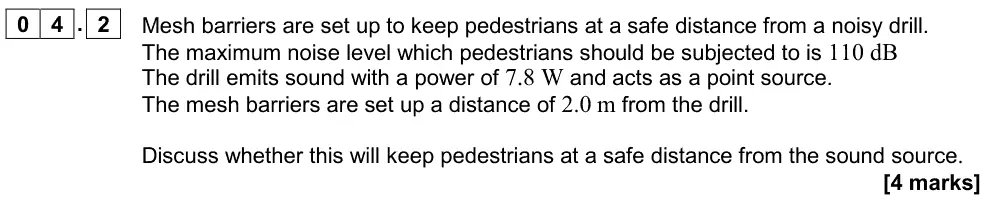
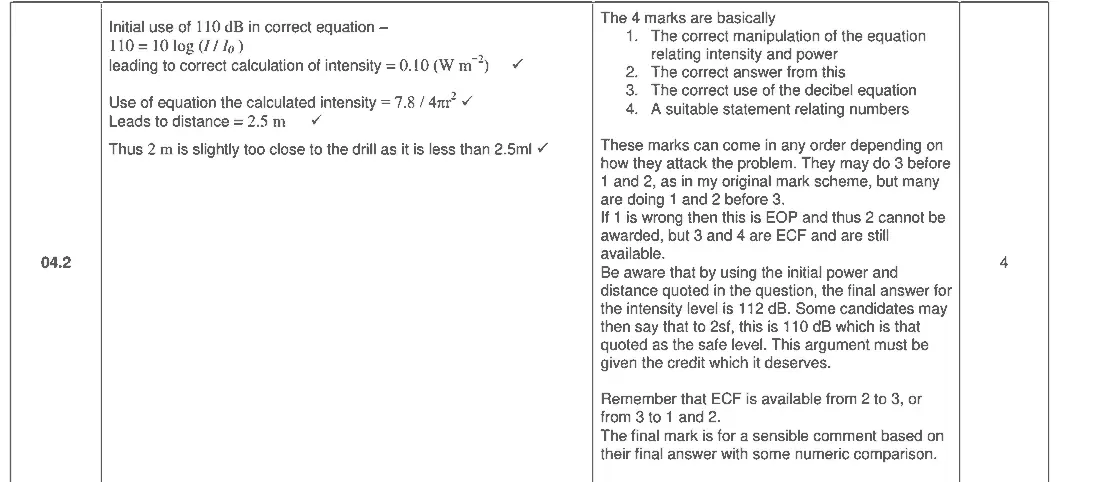
Part 04.2 was answered well by many students, with over a quarter of them gaining all four marks. There were many ways to attempt this question and the examiners were impressed with some of the approaches used by students. The marks were awarded for different calculations which involved specific equations and a final mark for an adequate discussion comparing either the student’s calculated answer with a value quoted in the question, or two calculated answers. The main source of error, which led to a two-mark penalty, was using the wrong formula for the area of a sphere when relating intensity and power. An error here was carried forward so that the remaining marks could still be gained.
Notes from the mark scheme and report
110 dB gives I = 0.10 W m^-2
I = 7.8/(4 pi r^2) gives r = 2.5 m, so 2.0 m barriers are too close
over a quarter full marks
Skills: MS2.5 Use logarithms in relation to quantities that range over several orders of magnitude; MS2.2 Change the subject of an equation, including non-linear equations; MS4.3 Calculate areas of triangles, circumferences and areas of circles, surface areas and volumes of rectangular blocks, cylinders and spheres
June 2017 · Paper 3B Medical physics · Q1.12 marksExplanation
Mark scheme
Examiner's comment
In part 01.1 many students only provided one of the points needed. Students sometimes lost a mark by providing a correct answer and a wrong answer for the same point, for example ‘the eyeball was too short or the lens was too strong’.
Notes from the mark scheme and report
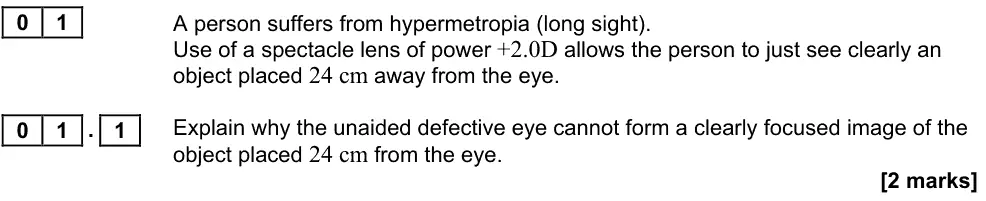
Eye lens cannot be made powerful enough (or eyeball too short), so rays cannot be brought to a focus on the retina
contradictory pairs lose the mark
June 2017 · Paper 3B Medical physics · Q1.23 marksCalculation
Earlier part of question 1 that this part uses
Mark scheme
Examiner's comment
In part 01.2 it was pleasing to find few students who found ‘u’, the object distance, rather than ‘v’, the image distance. However, the units in the calculation proved to be challenging for many students. The power of lens in dioptres meant that object distance needed to be in metres in the calculation. The final answer then needed to be converted back to centimetres. The most common wrong answer was ‘0.51’ which only gained 1 mark for the correct number of significant figures.
Notes from the mark scheme and report
Answer: (-)46 cm (1/0.24 + 1/v = 2 with distances in m, convert back to cm, 2 sf)
unit handling was the main problem, 0.51 common wrong answer
Skills: MS2.2 Change the subject of an equation, including non-linear equations; MS0.1 Recognise and make use of appropriate units in calculations; MS1.1 Use an appropriate number of significant figures
June 2017 · Paper 3B Medical physics · Q1.31 markShort answer
Earlier part of question 1 that this part uses
Mark scheme
Examiner's comment
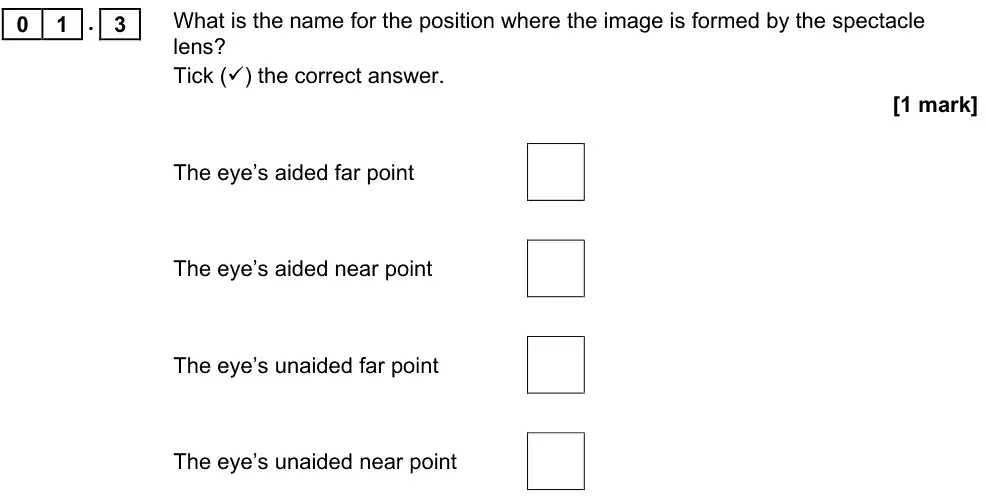
Part 01.3 proved to be difficult, with the majority of students thinking that it was ‘the aided near point’ rather than the correct answer of ‘the unaided near point’.
Notes from the mark scheme and report
Answer: the eye's unaided near point
the majority chose the aided near point
June 2017 · Paper 3B Medical physics · Q1.43 marksDiagram or graph
Earlier part of question 1 that this part uses
Mark scheme
Examiner's comment
Part 01.4 required a ray diagram to be drawn, which a significant number of students were unable to do. Students should be aware that when using a correcting lens, objects are always real and images are always virtual. The majority of diagrams showed the formation of a real image. Many students also failed to score the labelling mark for correct labelling of object, image and a correct principal focus. The students who were able to draw the correct ray diagram were, in the main, also able to correctly label the diagram.
Notes from the mark scheme and report
Converging lens with object inside F
two rays producing a virtual upright magnified image on the same side
label object, image and a principal focus
most drew a real image
Skills: MS4.2 Visualise and represent 2D and 3D forms including two- dimensional representations of 3D objects
June 2017 · Paper 3B Medical physics · Q4.12 marksDiagram or graph
Mark scheme
Examiner's comment
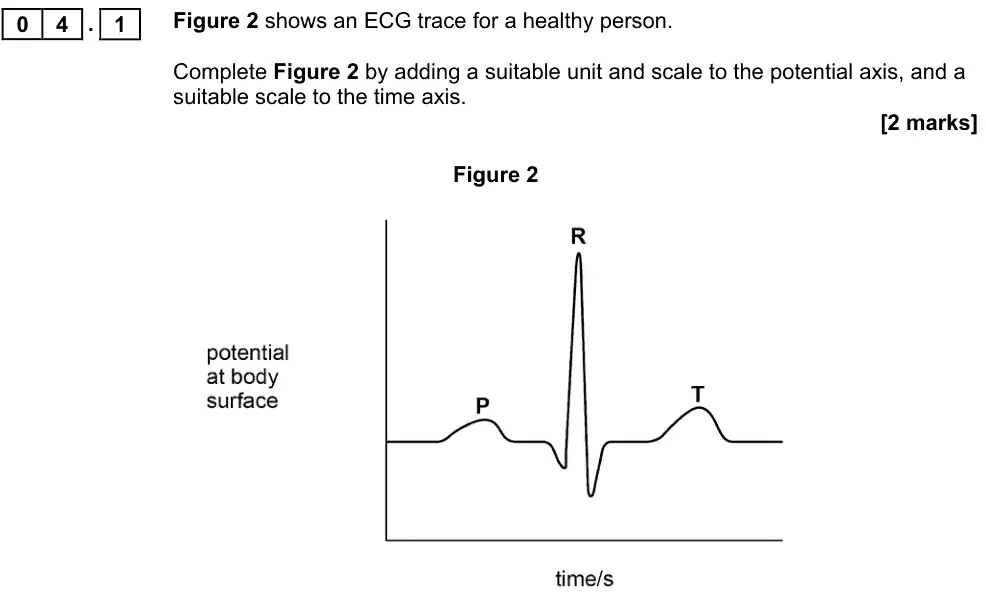
Part 04.1 proved difficult. The labelling of the potential axis caused most problems with many students failing to put the 0 for the scale in the correct place. However, the scale on the time axis also caused problems. A common mistake was to place a number at the end of an axis without another number on the axis to provide a point of reference. For example, the sole number 0.8 at the right of the time axis did not gain credit.
Notes from the mark scheme and report
Potential in mV with 0 at the baseline and about 1 mV at R
time 0 to about 0.6-1 s
a single number at the end of an axis not credited
proved difficult
Skills: MS3.1 Translate information between graphical, numerical and algebraic forms
June 2017 · Paper 3B Medical physics · Q4.23 marksExplanation
Earlier part of question 4 that this part uses
Mark scheme
Examiner's comment
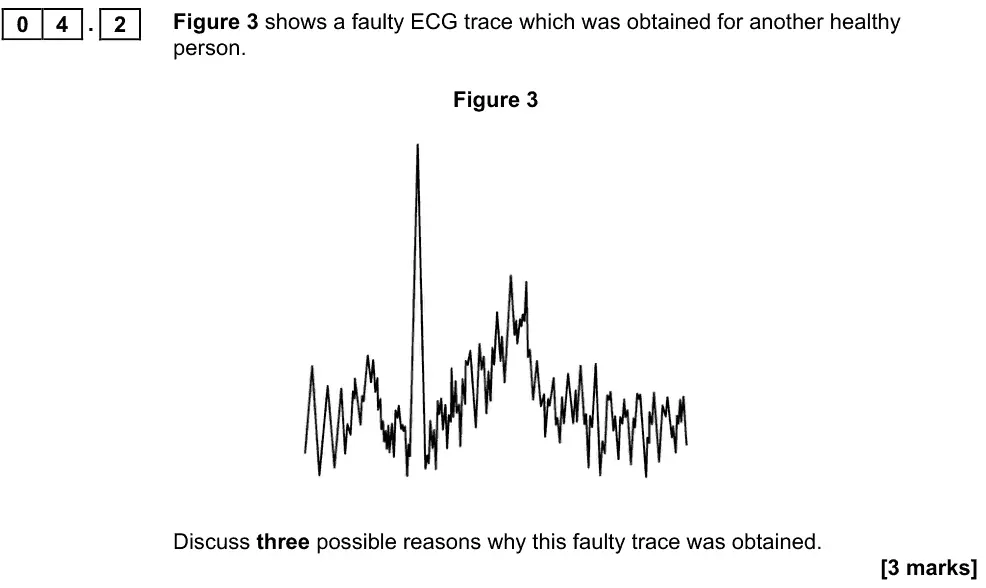
Part 04.2 required students to look at the noise on the trace and suggest reasons for that noise. Answers such as “the skin had not been cleaned”, or “dead skin and hair had not been removed”, were treated as neutral answers, but with the inclusion of “resulting in the electrodes not being securely connected” the correct point was made and a mark awarded. Another answer which was felt to be too vague for the award of a mark was “the electrodes weren’t properly attached”.
Notes from the mark scheme and report
Noise from: electrodes not secure/poor contact (skin not prepared), reactive electrodes, patient moving/tense (muscle signals), amplifier noise or mains interference/unshielded leads
reasons need extension
Specimen set 1 · Paper 3B Medical physics · Q1.12 marksShort answer
Mark scheme
Notes from the mark scheme and report
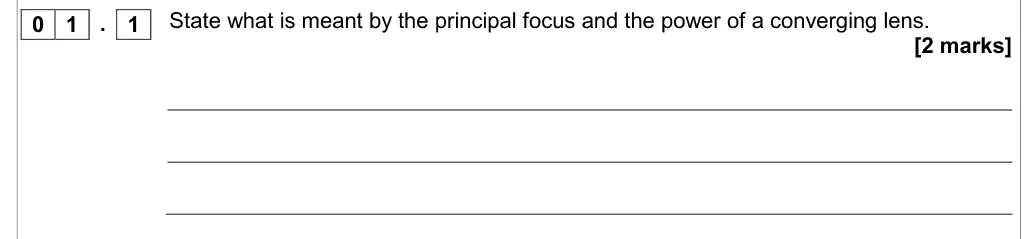
Principal focus: point on the axis through which rays parallel to the axis pass after refraction
power = 1/f with f in metres
Specimen set 1 · Paper 3B Medical physics · Q1.22 marksDiagram or graph
Earlier part of question 1 that this part uses
Mark scheme
Notes from the mark scheme and report
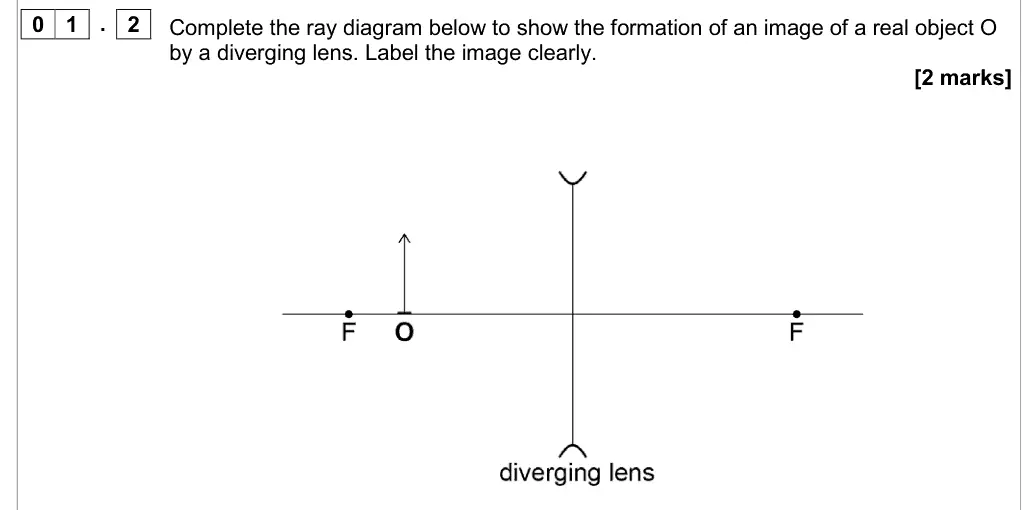
Ray parallel to axis diverges as if from the near-side F
ray through the optical centre undeviated
virtual, upright, diminished image labelled where the backward extensions meet
Skills: MS4.2 Visualise and represent 2D and 3D forms including two- dimensional representations of 3D objects
Specimen set 1 · Paper 3B Medical physics · Q1.31 markShort answer
Earlier part of question 1 that this part uses
Mark scheme
Notes from the mark scheme and report
Myopia (short sight)
Specimen set 1 · Paper 3B Medical physics · Q1.42 marksCalculation
Earlier part of question 1 that this part uses
Mark scheme
Notes from the mark scheme and report
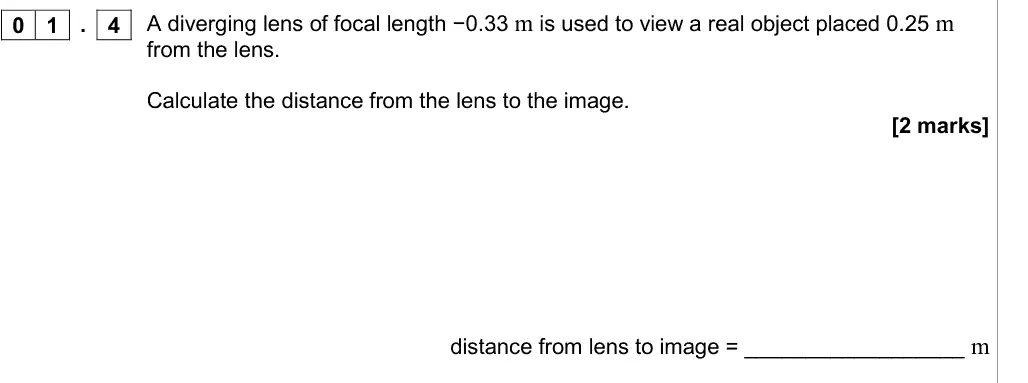
Answer: (-)0.14 m (1/-0.33 = 1/0.25 + 1/v
virtual image)
Skills: MS2.2 Change the subject of an equation, including non-linear equations; MS2.3 Substitute numerical values into algebraic equations using appropriate units for physical quantities
Specimen set 1 · Paper 3B Medical physics · Q1.52 marksShort answer
Earlier part of question 1 that this part uses
Mark scheme
Notes from the mark scheme and report
Images fall on cones (fovea)
the stimulated cones must be separated by at least one unstimulated cone
Specimen set 1 · Paper 3B Medical physics · Q2.12 marksShort answer
Mark scheme
Notes from the mark scheme and report
Frequency unchanged
amplitude reduced
Specimen set 1 · Paper 3B Medical physics · Q2.23 marksExplanation
Earlier part of question 2 that this part uses
Mark scheme
Notes from the mark scheme and report
Ossicles act as a lever increasing force
oval window area much less than eardrum area
pressure = F/A so pressure greatly increased
Specimen set 1 · Paper 3B Medical physics · Q2.33 marksCalculation
Earlier part of question 2 that this part uses
Mark scheme
Notes from the mark scheme and report
Answer: 1.6 x 10^-4 W m^-2 (I = 1.0 x 10^-12 x 10^8.2)
Skills: MS2.5 Use logarithms in relation to quantities that range over several orders of magnitude; MS0.5 Use calculators to find and use power, exponential and logarithmic functions
Specimen set 1 · Paper 3B Medical physics · Q2.42 marksCalculation
Earlier part of question 2 that this part uses
Mark scheme
Notes from the mark scheme and report
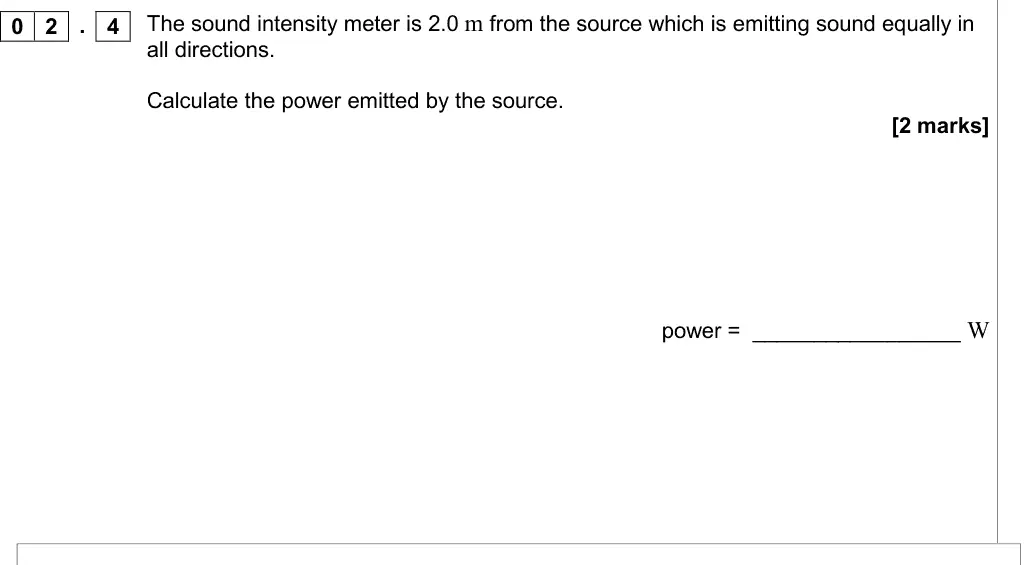
Answer: 8.0 x 10^-3 W (P = I x 4 pi r^2 with r = 2.0 m)
Skills: MS4.3 Calculate areas of triangles, circumferences and areas of circles, surface areas and volumes of rectangular blocks, cylinders and spheres; MS2.3 Substitute numerical values into algebraic equations using appropriate units for physical quantities
Work with an AQA physics tutor
Dropping marks on calculations, required practicals or the six-markers? Book a trial session with a specialist AQA physics tutor.