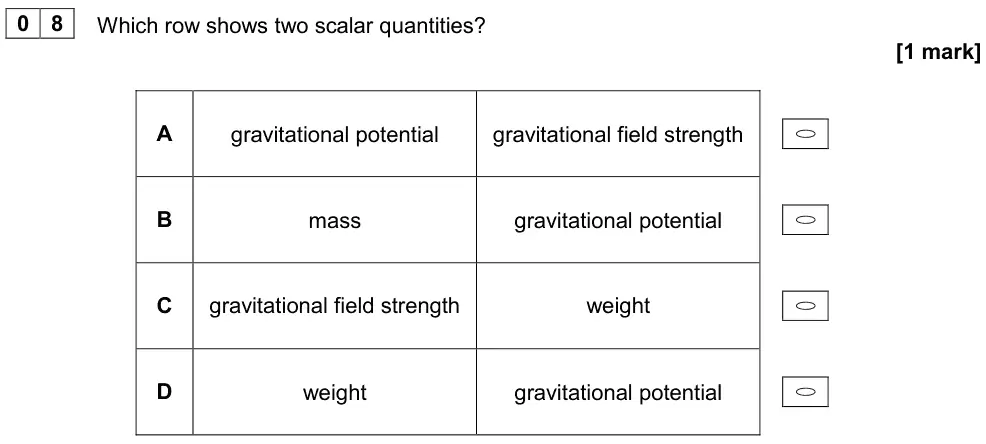
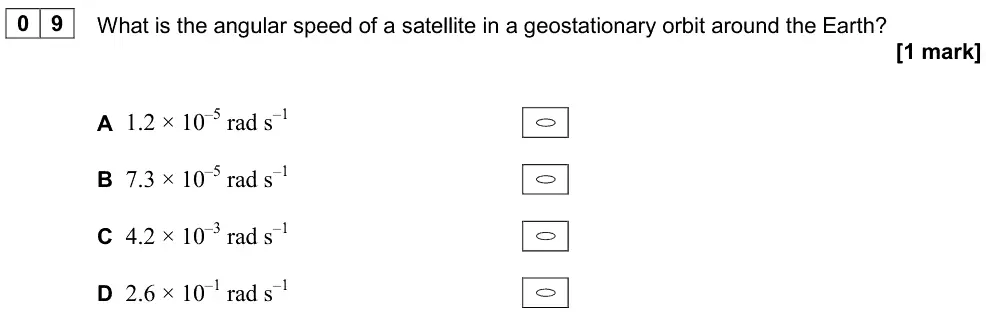
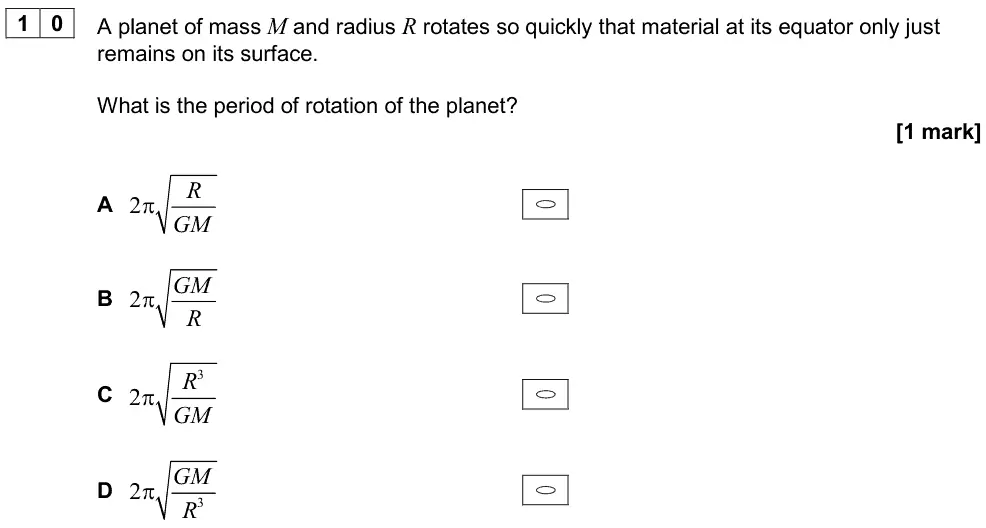
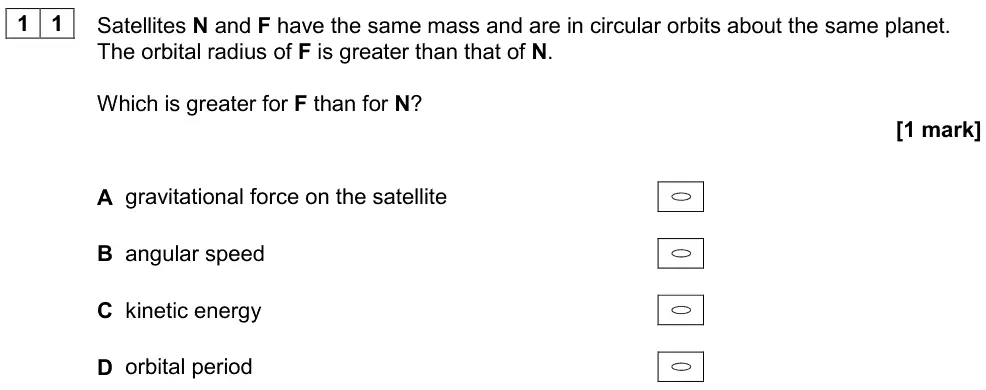
3.7.1-01 Concept of a force field as a region in which a body experiences a non-contact force.
3.7.1-02 Students should recognise that a force field can be represented as a vector, the direction of which must be determined by inspection.
3.7.1-03 Force fields arise from the interaction of mass, of static charge, and between moving charges.
3.7.1-04 Similarities and differences between gravitational and electrostatic forces:
3.7.1-05 Similarities: Both have inverse-square force laws that have many characteristics in common, eg use of field lines, use of potential concept, equipotential surfaces etc
3.7.1-06 Differences: masses always attract, but charges may attract or repel
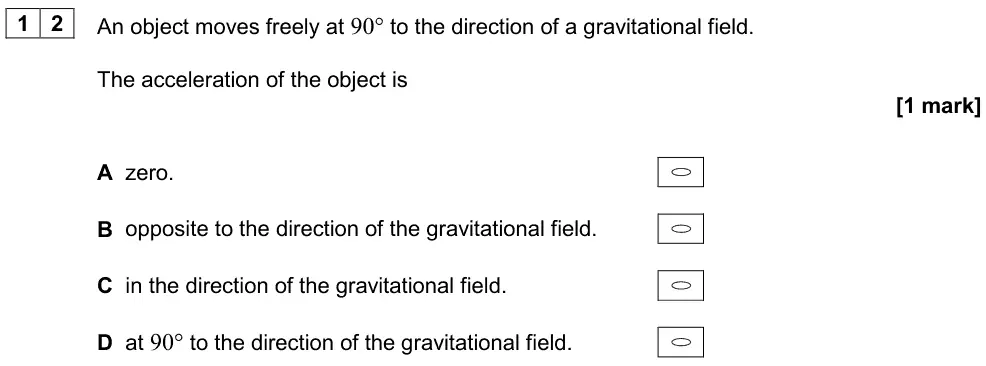
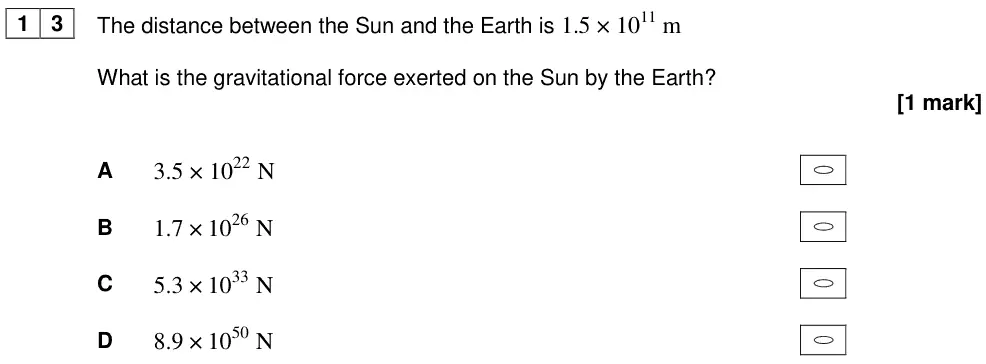
3.7.2.1-01 Gravity as a universal attractive force acting between all matter.
3.7.2.1-02 Magnitude of force between point masses: F = Gm1m2 r2
3.7.2.1-03 where G is the gravitational constant.
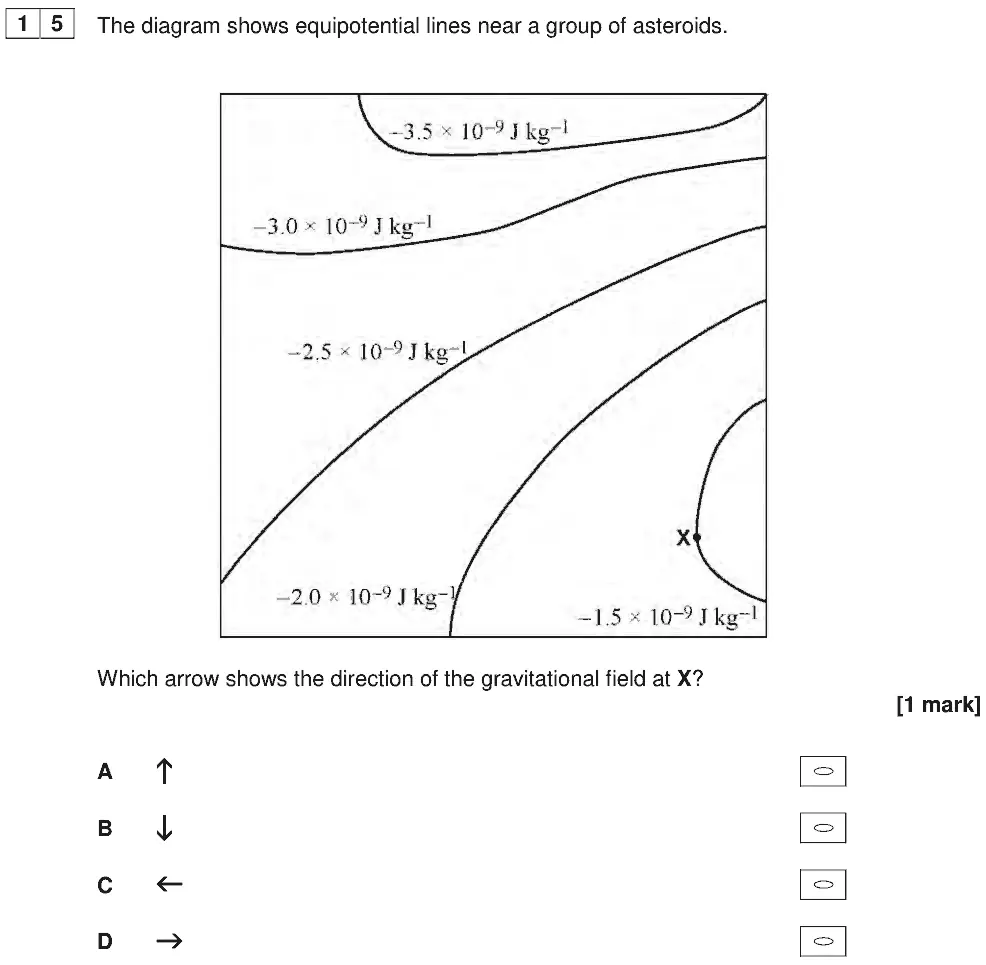
3.7.2.2-01 Representation of a gravitational field by gravitational field lines. g as force per unit mass as defined by g = F m
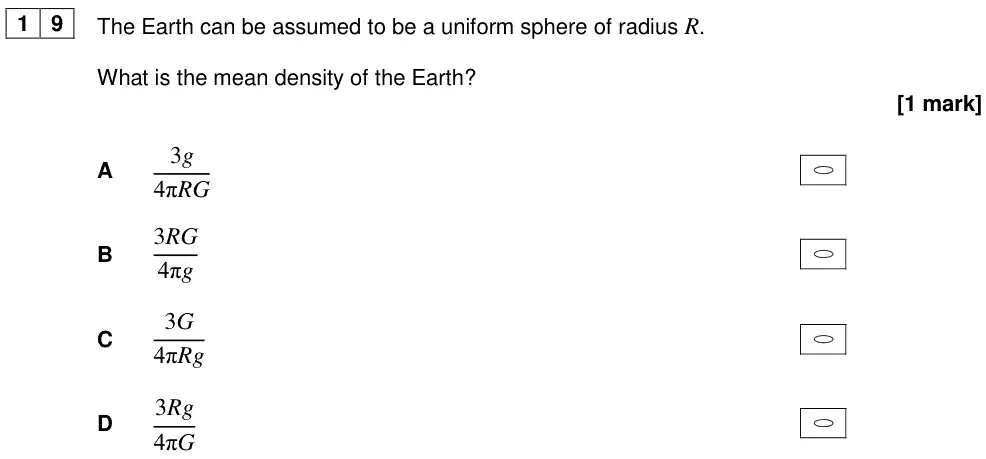
3.7.2.2-02 Magnitude of g in a radial field given by g = GM r2
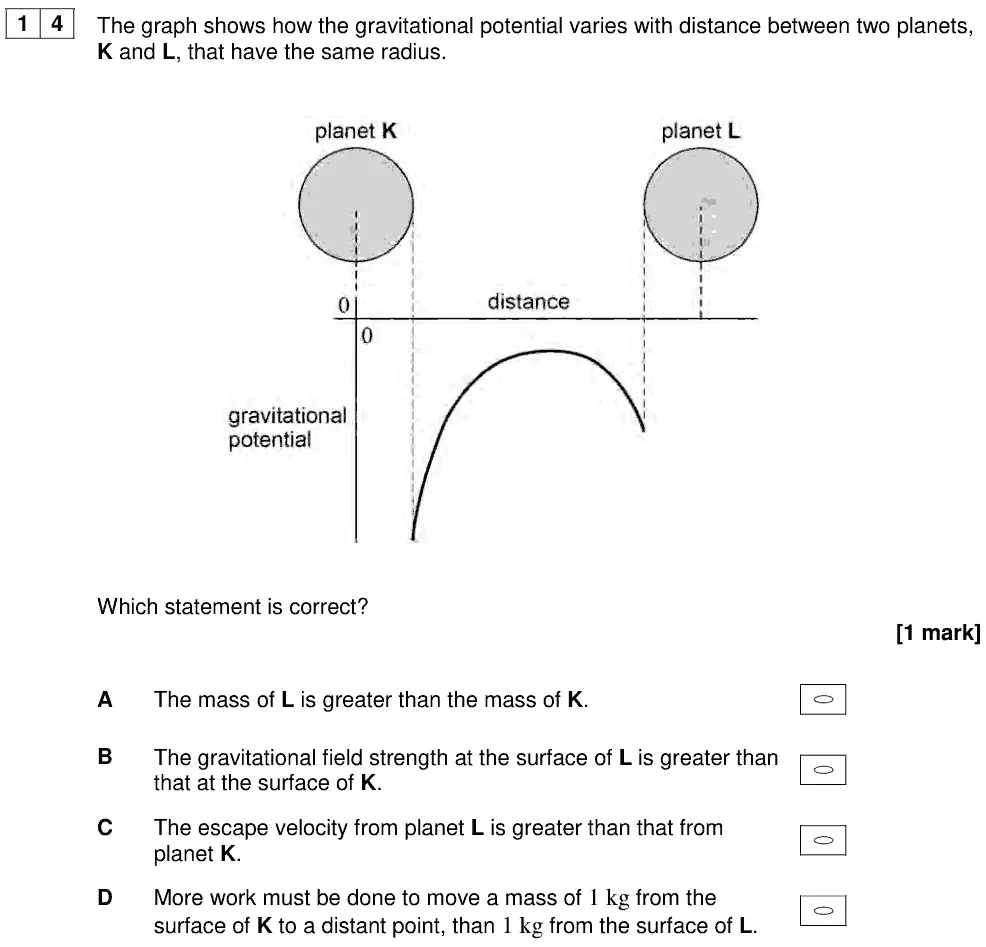
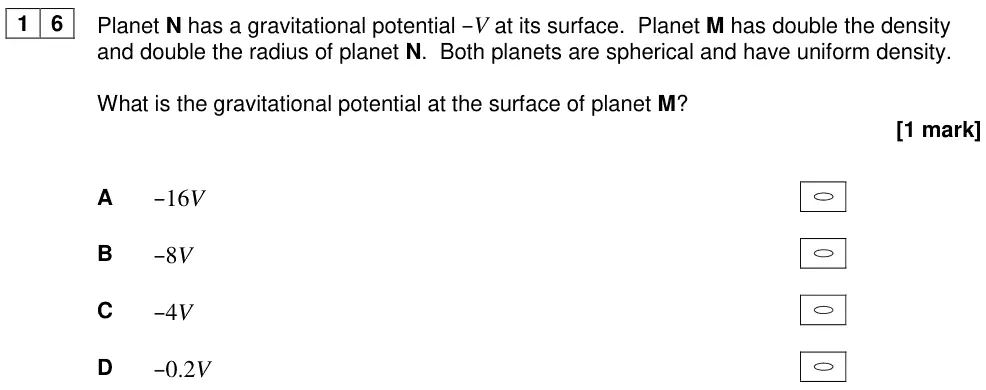
3.7.2.3-01 Understanding of definition of gravitational potential, including zero value at infinity.
3.7.2.3-02 Understanding of gravitational potential difference.
3.7.2.3-03 Work done in moving mass m given by ∆W = m∆V
3.7.2.3-04 Equipotential surfaces.
3.7.2.3-05 Idea that no work is done when moving along an equipotential surface. V in a radial field given by V = −GM r
3.7.2.3-06 Significance of the negative sign.
3.7.2.3-07 Graphical representations of variations of g and V with r. V related to g by: g = −∆V ∆r ∆V from area under graph of g against r.
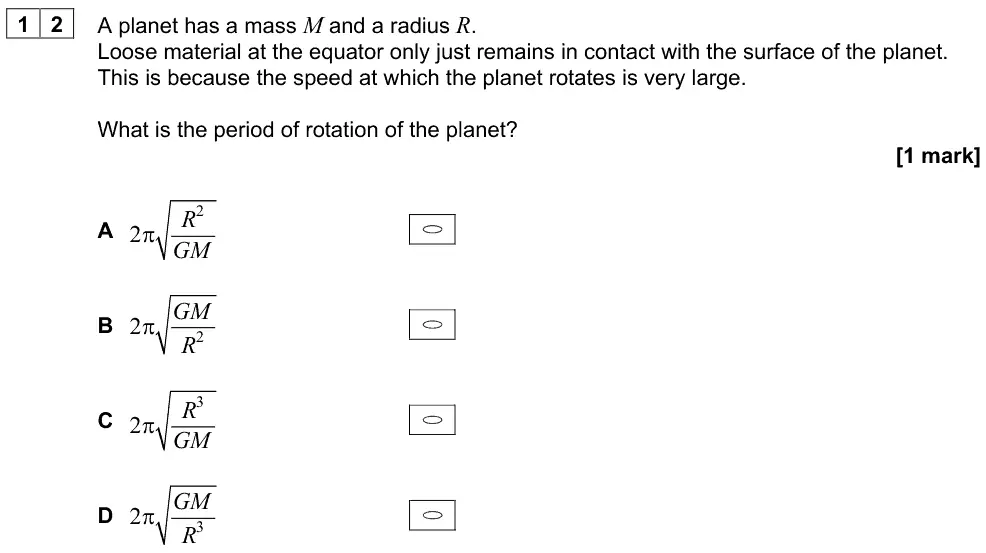
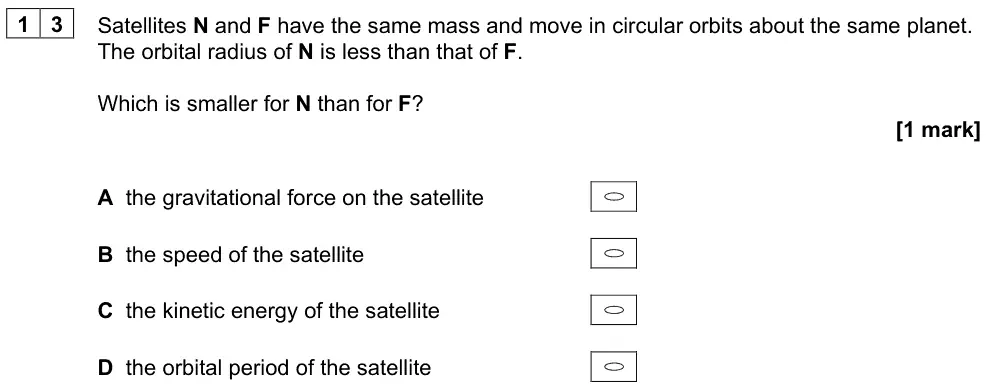
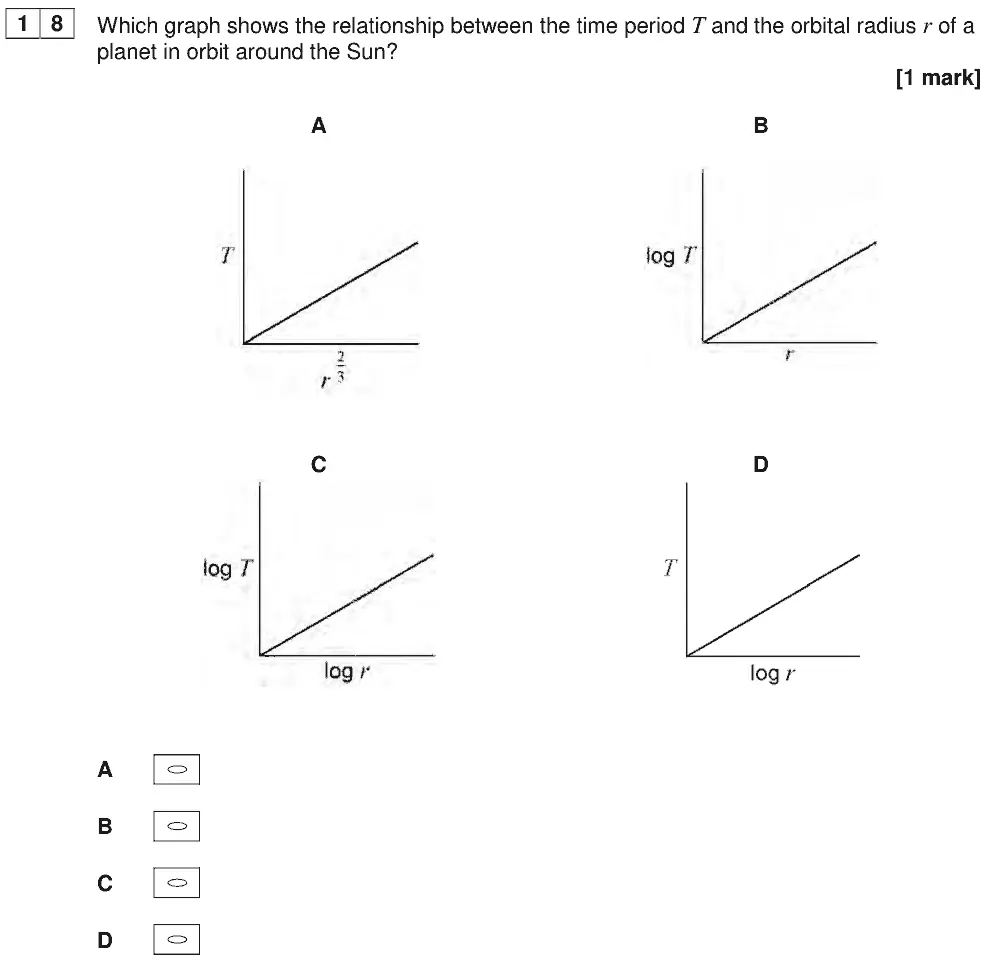
3.7.2.4-01 Orbital period and speed related to radius of circular orbit; derivation of T2 ∝r3
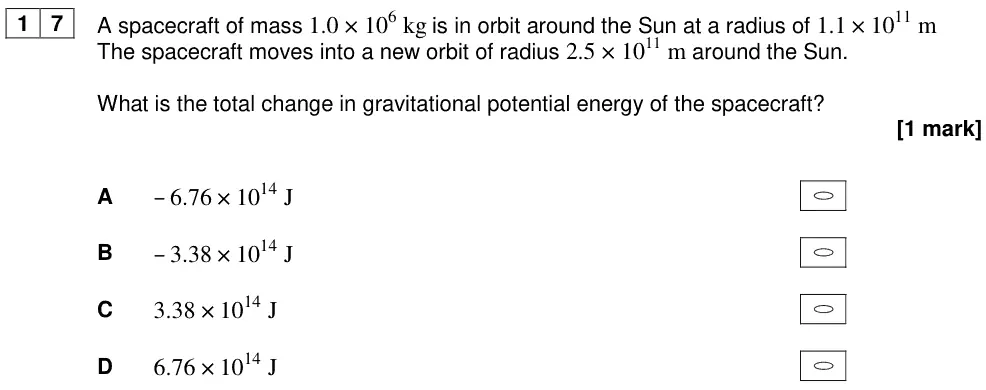
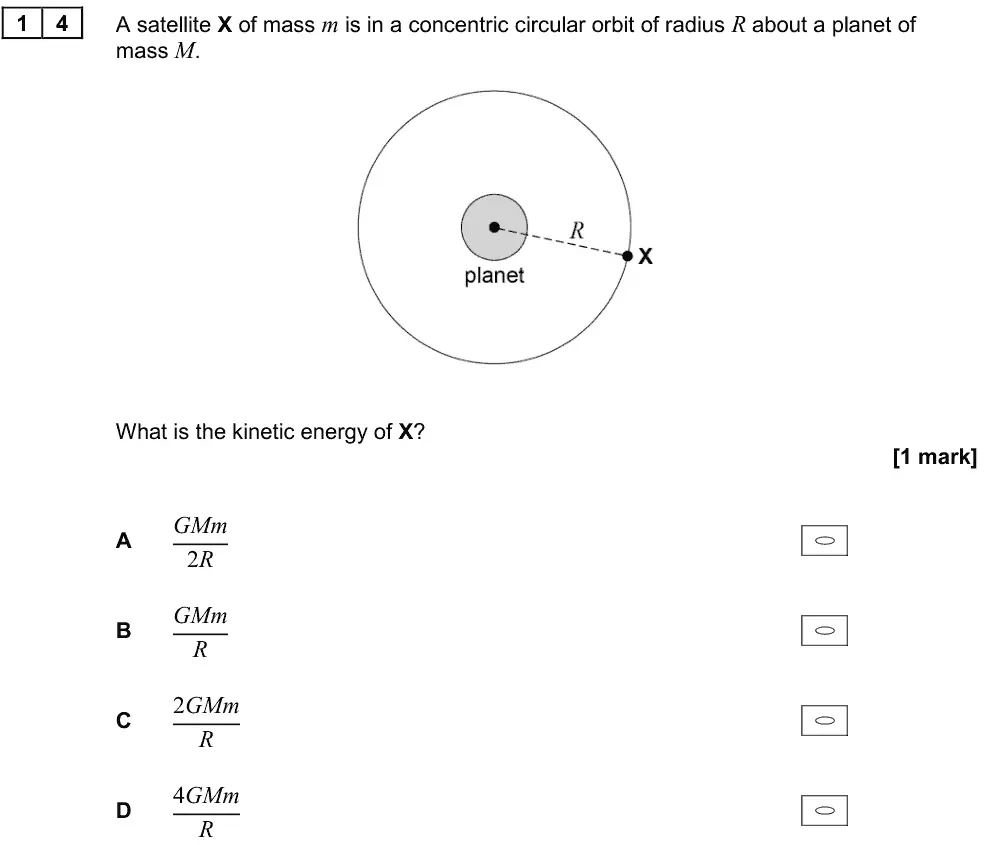
3.7.2.4-02 Energy considerations for an orbiting satellite.
3.7.2.4-03 Total energy of an orbiting satellite.
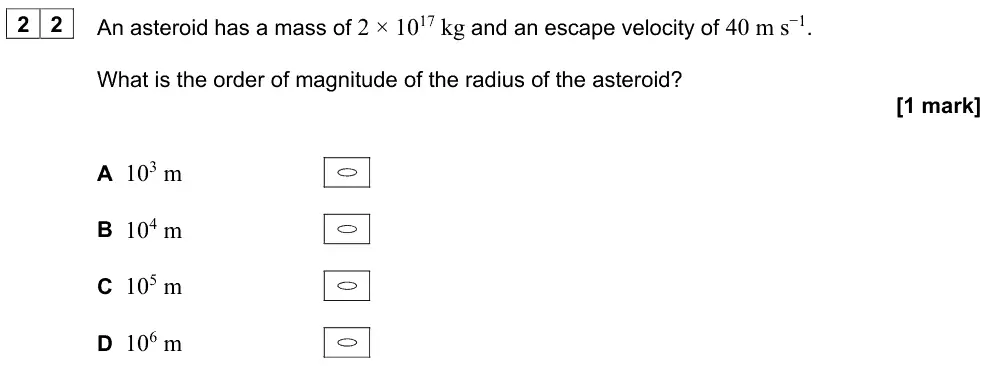
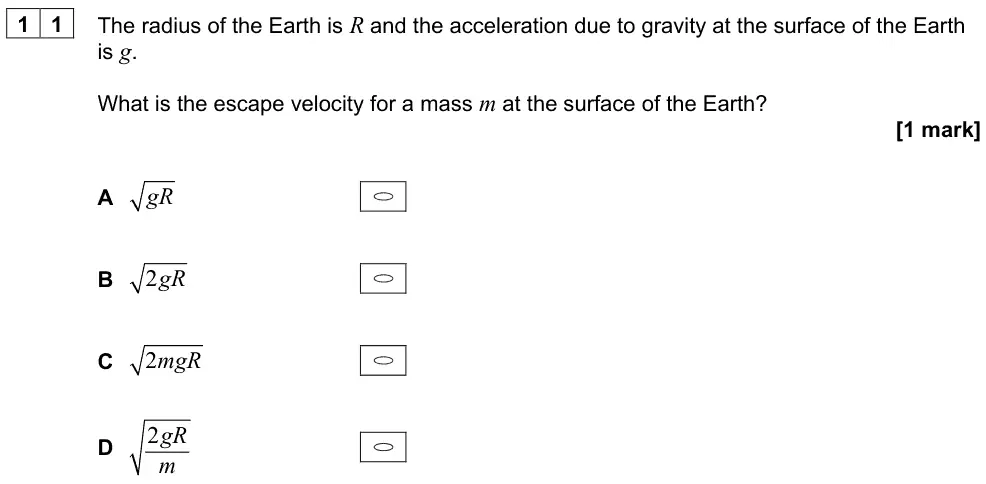
3.7.2.4-04 Escape velocity.
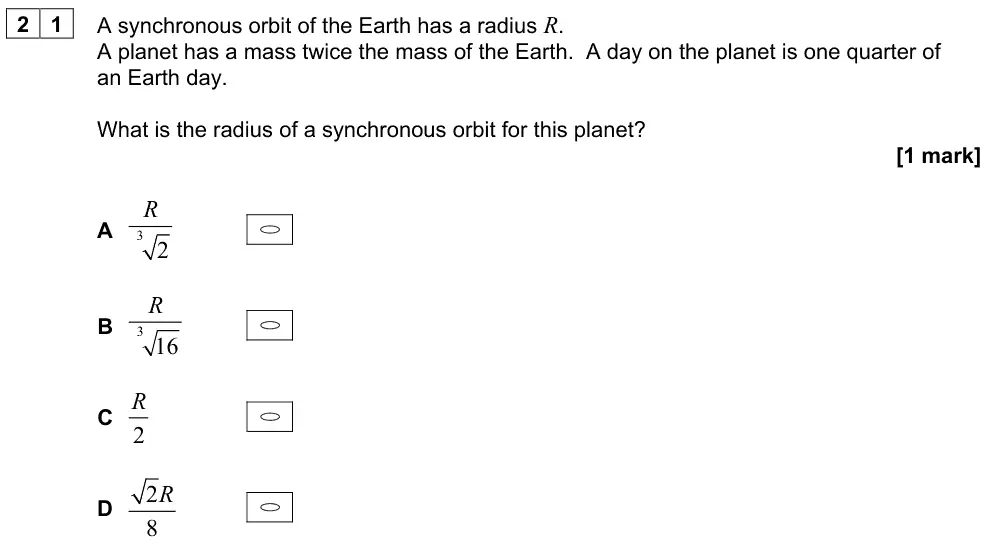
3.7.2.4-05 Synchronous orbits.
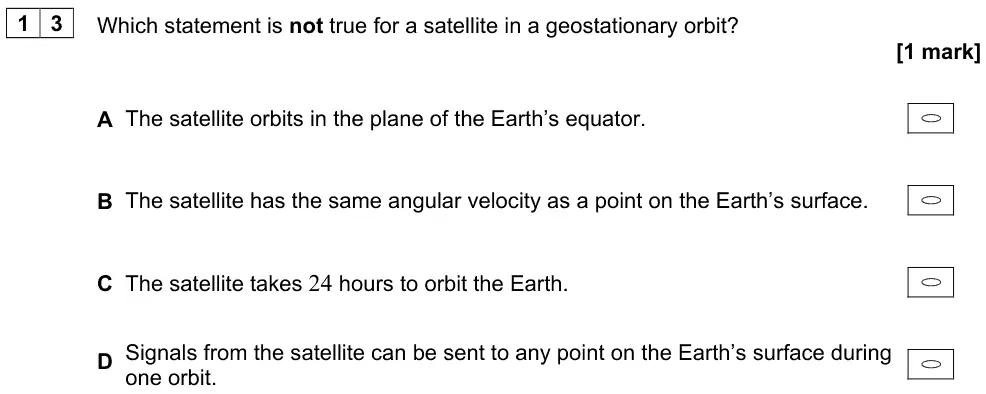
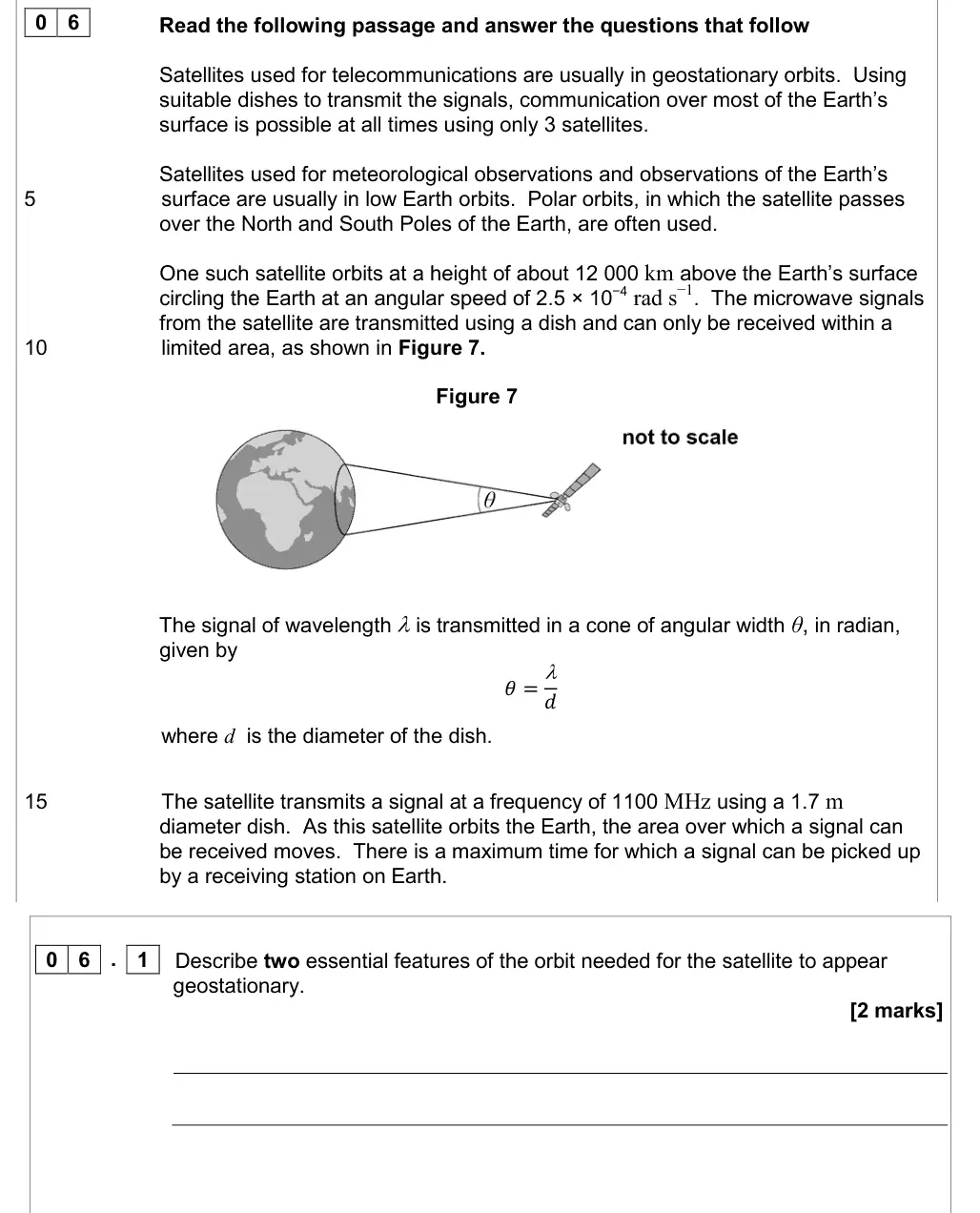
3.7.2.4-06 Use of satellites in low orbits and geostationary orbits, to include plane and radius of geostationary orbit.
Tap a question to zoom it. Where a part needs a figure, table or graph from earlier in the question, that part folds out above it; the mark scheme and examiner's comment open underneath. Have the AQA data and formulae booklet beside you (see the formula sheet page).
June 2025 · Paper 2 · Q4.13 marksAO1=3Calculation
Mark scheme
Examiner's comment
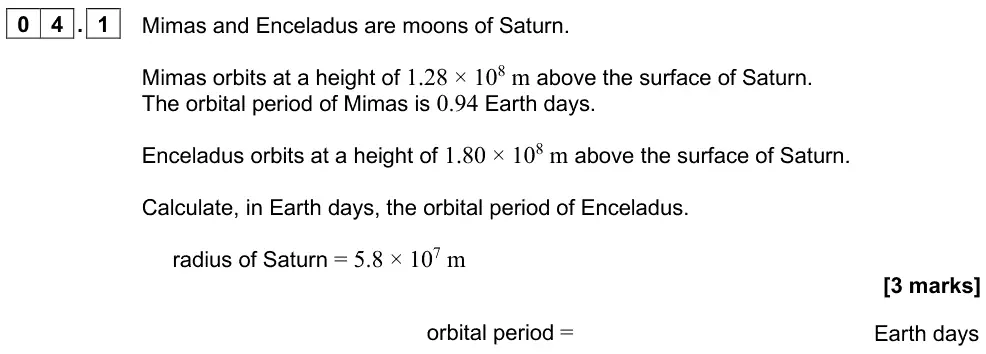
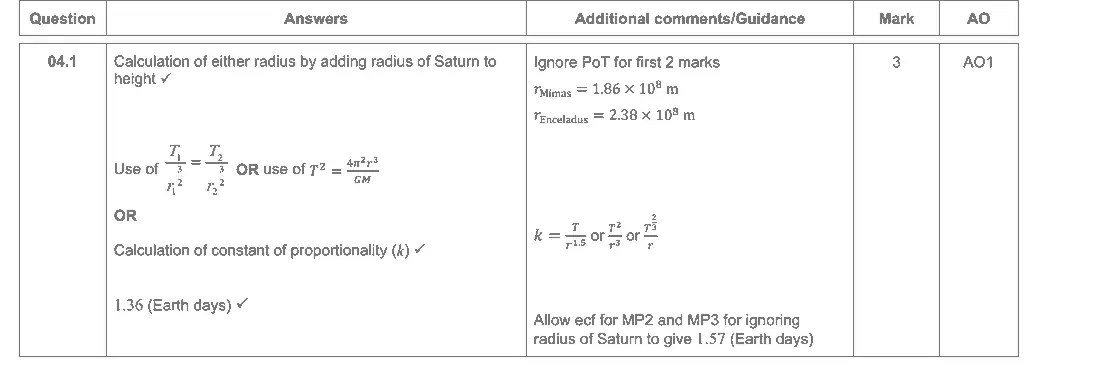
4.1 This question was accessible to most students with over half scoring at least 2 out 3. Common mistakes were: forgetting to add the radius of Saturn, cube the radius, use the square root to the angular speed was the same for both moons. The easiest approach was to use 𝑇𝑇2 ∝𝑟𝑟3 e.g. determine T, converting to seconds and then not converting back to years or assuming that 3, however determining the mass of Saturn from 𝑇𝑇2 = 3 = 𝑇𝑇12 𝑇𝑇22 4𝜋𝜋𝑟𝑟3 𝑟𝑟1 𝑟𝑟2 𝐺𝐺𝐺𝐺 and then using this to determine the period of Enceladus was also a valid approach.
Notes from the mark scheme and report
Answer: 1.36 Earth days (orbital radii 1.86 x 10^8 m and 2.38 x 10^8 m, T^2 proportional to r^3)
forgetting to add Saturn's radius gives 1.57 days
Skills: MS0.3 Use ratios, fractions and percentages; MS0.5 Use calculators to find and use power, exponential and logarithmic functions
June 2025 · Paper 2 · Q4.21 markAO1=1Short answer
Earlier part of question 4 that this part uses
Mark scheme
Examiner's comment
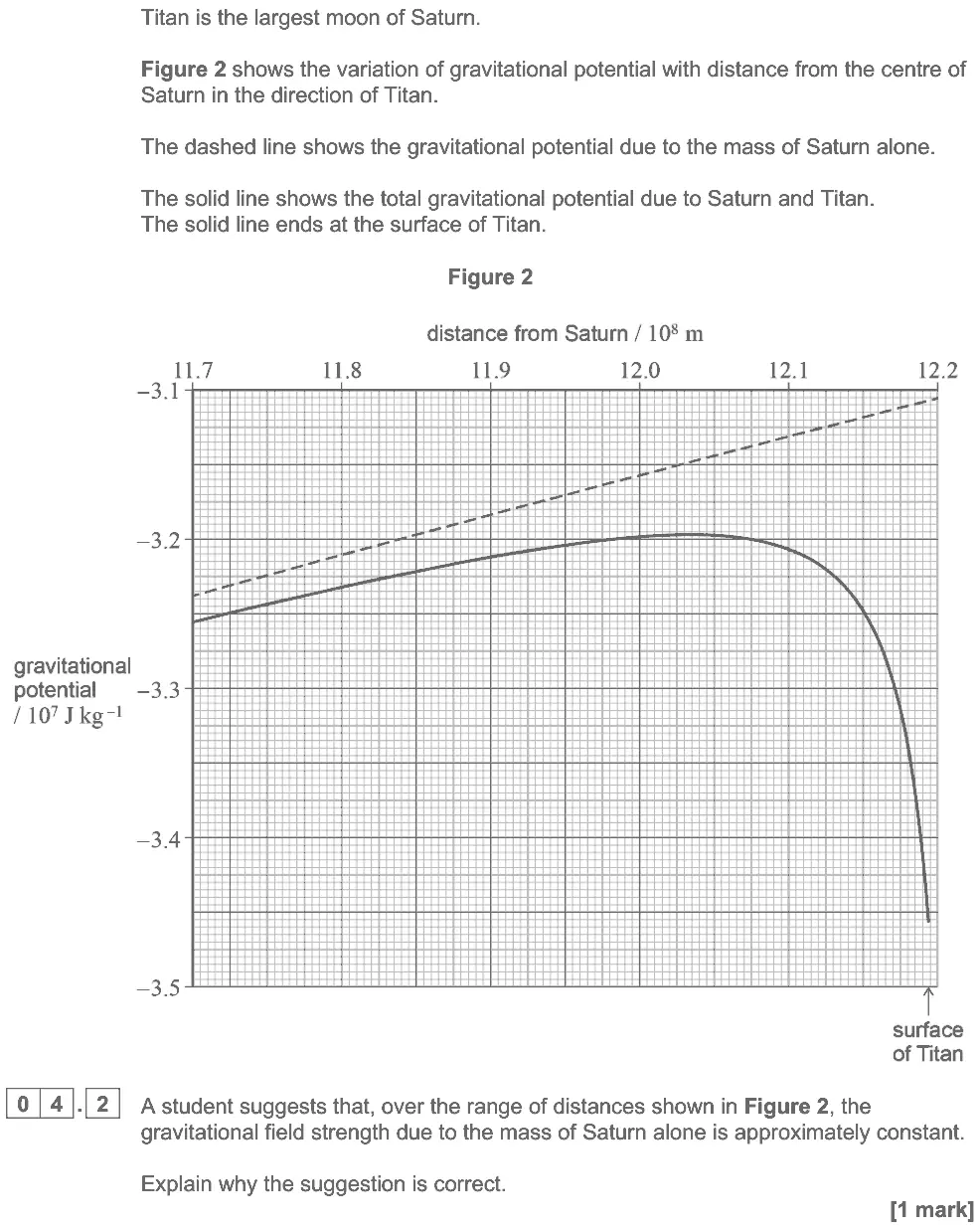
4.2 Most students correctly identified that the graph was linear, however, most of them did not fully explain the significance of this. To explain why the suggestion was correct required a statement that the gravitational field strength was equal to the gradient.
A minority of students answered this by referring to the small range of distances shown compared to the distance from Saturn. Again, to fully explain why this was important, they needed to link this to an equation. Most who followed this route did not do this.
Notes from the mark scheme and report
Dashed (Saturn) line is straight - constant gradient - and field strength equals the potential gradient
most saw linearity but did not link it to g
Skills: MS3.5 Calculate rate of change from a graph showing a linear relationship
June 2025 · Paper 2 · Q4.31 markAO2=1Short answer
Earlier part of question 4 that this part uses
Mark scheme
Examiner's comment
4.3 significant numbers made mistakes reading the graph, either missing out the 108, writing Most students were able to realise that this was when the curved line was horizontal but
Notes from the mark scheme and report
Answer: 12.03-12.04 x 10^8 m (where the solid line is horizontal, gradient zero)
at least 4 sf
misreading the 10^8 scale was common
Skills: MS3.6 Draw and use the slope of a tangent to a curve as a measure of rate of change
June 2025 · Paper 2 · Q4.43 marksAO2=3Calculation
Earlier part of question 4 that this part uses
Mark scheme
Examiner's comment
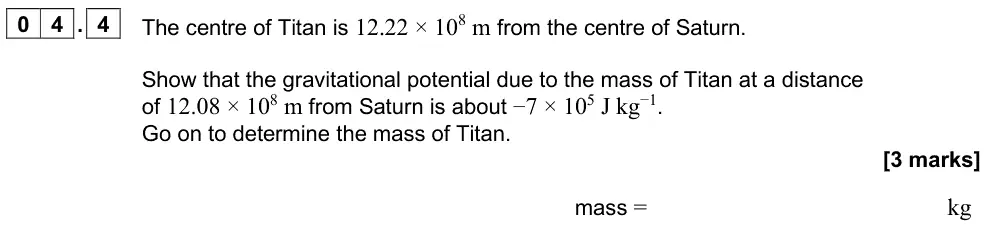
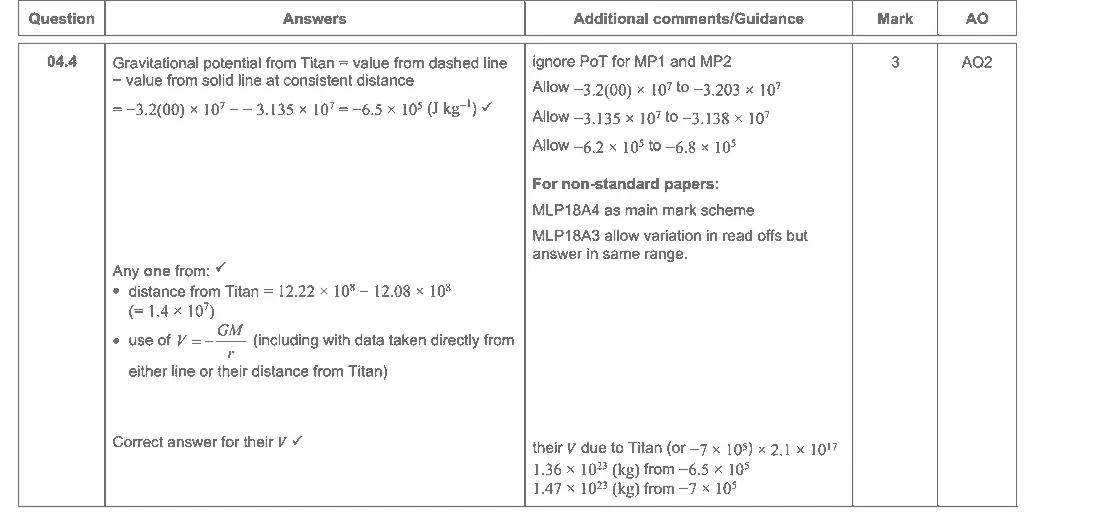
4.4 This question was challenging, although over 60% gained at least 1 mark, only the best students were able to make more progress than this. Saturn and then subtract the values. Some students incorrectly attempted this at the end of the lines, rather than the value that was quoted. 𝑉𝑉= − 𝑟𝑟, or by rearranging the equation to make 𝑀𝑀 the subject. This was the most commonly 𝐺𝐺𝐺𝐺 Students could then get a mark for using their answer or the value quoted in the question into
The least commonly awarded mark was for determining 𝑟𝑟, the distance from Titan, by awarded mark.
subtracting the distance from Saturn from the distance between the centres of Titan and Saturn.
Notes from the mark scheme and report
Potential due to Titan = solid minus dashed reading at 12.08 x 10^8 m (about -6.5 x 10^5 J kg^-1)
r from Titan = 1.4 x 10^7 m
M = -Vr/G = 1.4-1.5 x 10^23 kg
finding the distance from Titan was the least-scored step
Skills: MS3.1 Translate information between graphical, numerical and algebraic forms; MS2.2 Change the subject of an equation, including non-linear equations
June 2025 · Paper 2 · Q6.13 marksAO3=3Calculation
Mark scheme
Examiner's comment
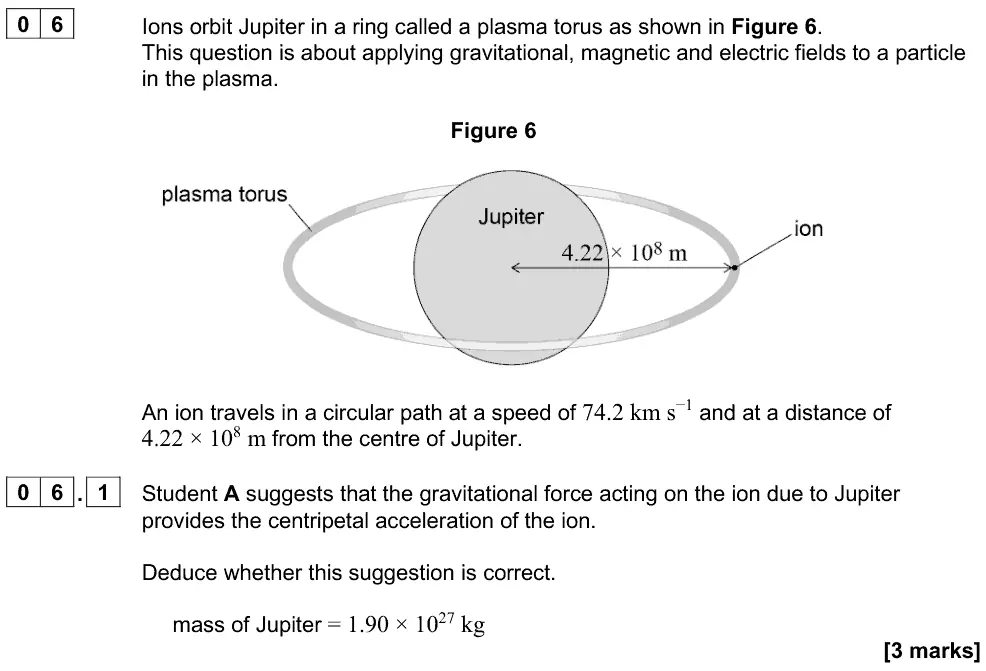
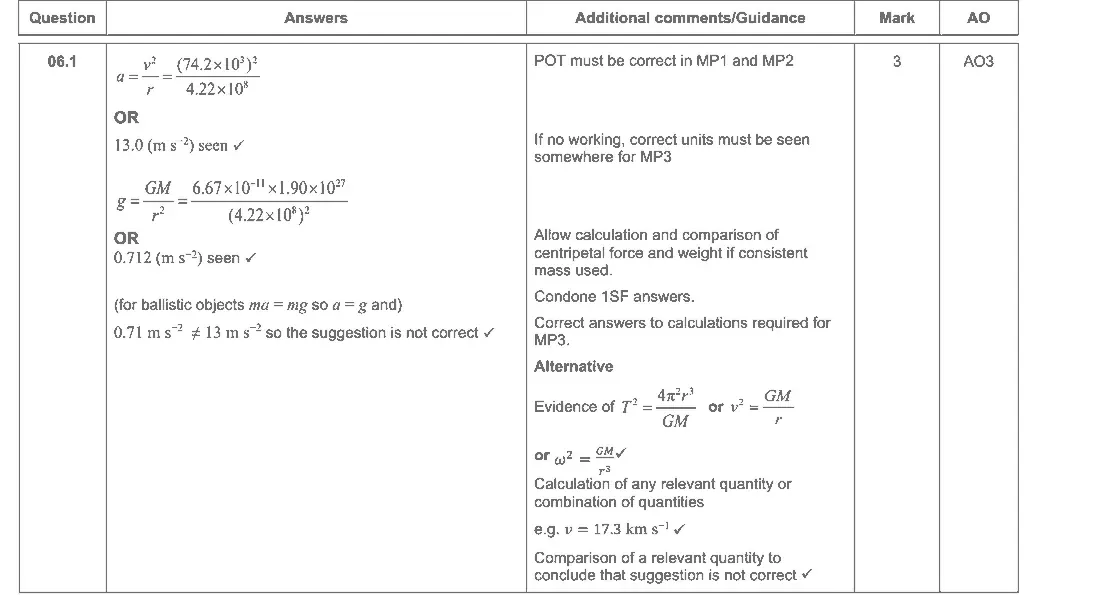
6.1 Students found this question very accessible, with most following the prompting in the question to determine and compare the centripetal acceleration of the ion with the gravitational field strength at the ion’s location. Most students remembered to include the comparison in this question, as they were comparing two calculated values.
However, this was not the only approach, with a wide variety of approaches seen for a the ion’s speed and included comparing the value of 𝐺𝐺 required with the value of 𝐺𝐺 on the minority of students. The most popular was comparing the speed for a gravitational orbit with
formulae sheet. All correct approaches were rewarded.
Notes from the mark scheme and report
Not correct: centripetal acceleration v^2/r = 13.0 m s^-2 but g at that radius = 0.712 N kg^-1 (or orbital speed for gravity alone 17.3 km s^-1)
Skills: MS2.3 Substitute numerical values into algebraic equations using appropriate units for physical quantities
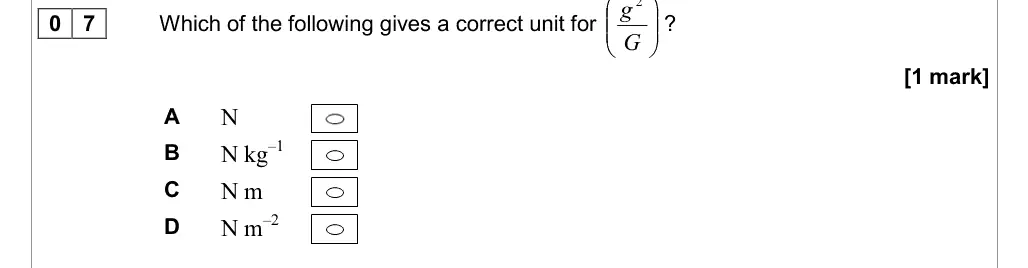
June 2025 · Paper 2 · Q71 markAO2=1Multiple choice
Answer
B
Mark scheme
Notes from the mark scheme and report
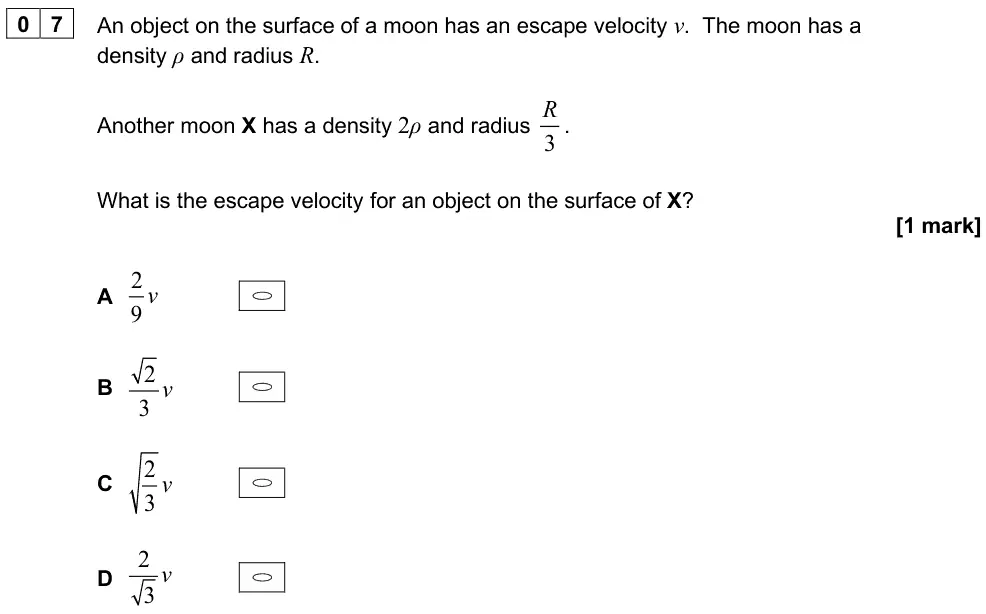
Answer: B
Skills: MS0.3 Use ratios, fractions and percentages
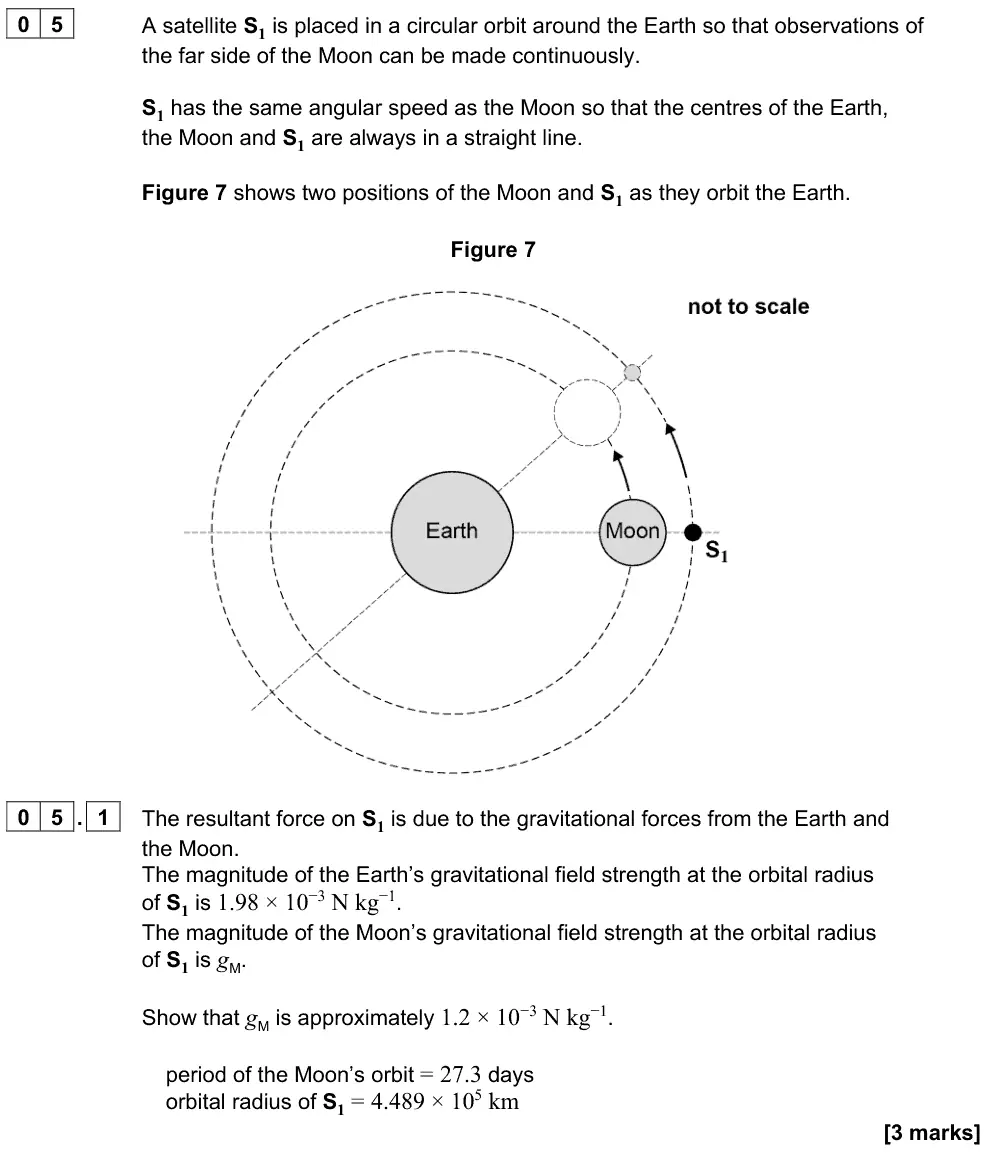
June 2024 · Paper 2 · Q5.13 marksAO2=3Show that
Mark scheme
Examiner's comment
05.1 This question was very challenging, with most students gaining 1 or 0. The first mark was for calculating the angular speed of S1. Some students did gain this mark although they did not know how to progress from there. In order to make much progress with this question students had to realise that the centripetal acceleration was equal to the resultant gravitational field strength. They could then subtract the gravitational field strength of the Earth to determine the gravitational field strength of the moon. 𝑇𝑇2 = 4𝜋𝜋𝑟𝑟3 Some students attempted to determine an effective mass to allow this period and then use this with 𝐺𝐺𝐺𝐺; this approach did not gain credit. 05.2 rearrangement of 𝑔𝑔= 𝐺𝐺𝐺𝐺 This question was much more accessible, with many students realising that this was a simple 𝑟𝑟2 . It is unfortunate that the challenging 05.1 put some students off attempting the much more straightforward 05.2. Those who tried to use 𝑇𝑇2 = 4𝜋𝜋𝑟𝑟3 𝐺𝐺𝐺𝐺 did not score here. 05.3 This question also proved to be very challenging. Students had to recognise that the forces or fields acted in opposite directions on S2. This was the most accessible mark and could be achieved in many different ways, including by annotating Figure 8, although simply writing about being attracted to the moon and the Earth was not enough. The second mark was for realising that S2 would be travelling too fast to orbit at the lower distance. Again, this could be expressed in a variety of ways by discussing speed, angular speed or the magnitudes of the fields or forces involved. This proved the most challenging mark to score. The last mark was for stating how the moon reduced the resultant field or force to allow S2 to orbit the Earth at the correct speed at a lower radius.
Some answers referred to S2 requiring the same force as the moon to orbit with the same period. This idea was rejected, as the force depends on the radius and the mass, both of which are different. Some wrote about the gravitational forces of the moon and the Earth cancelling each other; this was condoned for the first marking point, but would have resulted in S2 moving in a straight line, rather than a circular orbit and was rejected for the second and third marking points.
Notes from the mark scheme and report
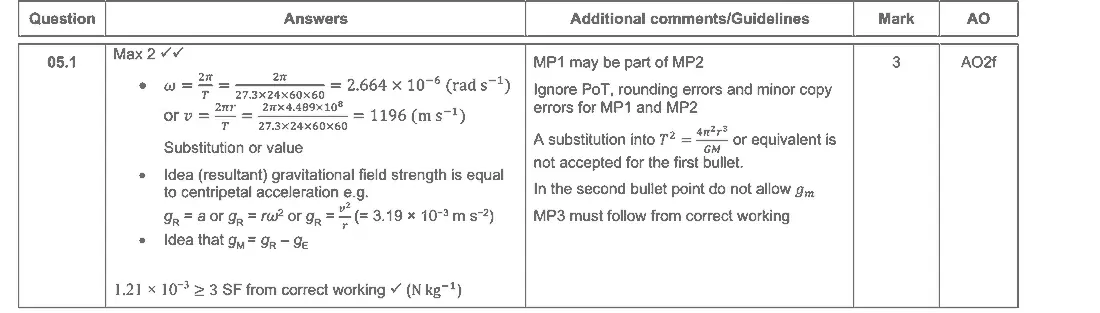
Omega = 2 pi / 27.3 days = 2.664 x 10^-6 rad s^-1
resultant g = r omega^2 = 3.19 x 10^-3
gM = 3.19 x 10^-3 - 1.98 x 10^-3 = 1.21 x 10^-3 N kg^-1 to 3 sf
most scored 0 or 1
Skills: MS2.3 Substitute numerical values into algebraic equations using appropriate units for physical quantities; MS0.1 Recognise and make use of appropriate units in calculations
June 2024 · Paper 2 · Q5.22 marksAO2=2Calculation
Earlier part of question 5 that this part uses
Mark scheme
Examiner's comment
Question 5 proved very challenging, although 05.2 was reasonably accessible for students.
05.1 This question was very challenging, with most students gaining 1 or 0. The first mark was for calculating the angular speed of S1. Some students did gain this mark although they did not know how to progress from there. In order to make much progress with this question students had to realise that the centripetal acceleration was equal to the resultant gravitational field strength. They could then subtract the gravitational field strength of the Earth to determine the gravitational field strength of the moon. 𝑇𝑇2 = 4𝜋𝜋𝑟𝑟3 Some students attempted to determine an effective mass to allow this period and then use this with 𝐺𝐺𝐺𝐺; this approach did not gain credit. 05.2 rearrangement of 𝑔𝑔= 𝐺𝐺𝐺𝐺 This question was much more accessible, with many students realising that this was a simple 𝑟𝑟2 . It is unfortunate that the challenging 05.1 put some students off attempting the much more straightforward 05.2. Those who tried to use 𝑇𝑇2 = 4𝜋𝜋𝑟𝑟3 𝐺𝐺𝐺𝐺 did not score here. 05.3 This question also proved to be very challenging. Students had to recognise that the forces or fields acted in opposite directions on S2. This was the most accessible mark and could be achieved in many different ways, including by annotating Figure 8, although simply writing about being attracted to the moon and the Earth was not enough. The second mark was for realising that S2 would be travelling too fast to orbit at the lower distance. Again, this could be expressed in a variety of ways by discussing speed, angular speed or the magnitudes of the fields or forces involved. This proved the most challenging mark to score. The last mark was for stating how the moon reduced the resultant field or force to allow S2 to orbit the Earth at the correct speed at a lower radius.
Notes from the mark scheme and report
Answer: 6.37 x 10^7 m (r = square root of GM/gM)
Skills: MS2.2 Change the subject of an equation, including non-linear equations; MS2.3 Substitute numerical values into algebraic equations using appropriate units for physical quantities
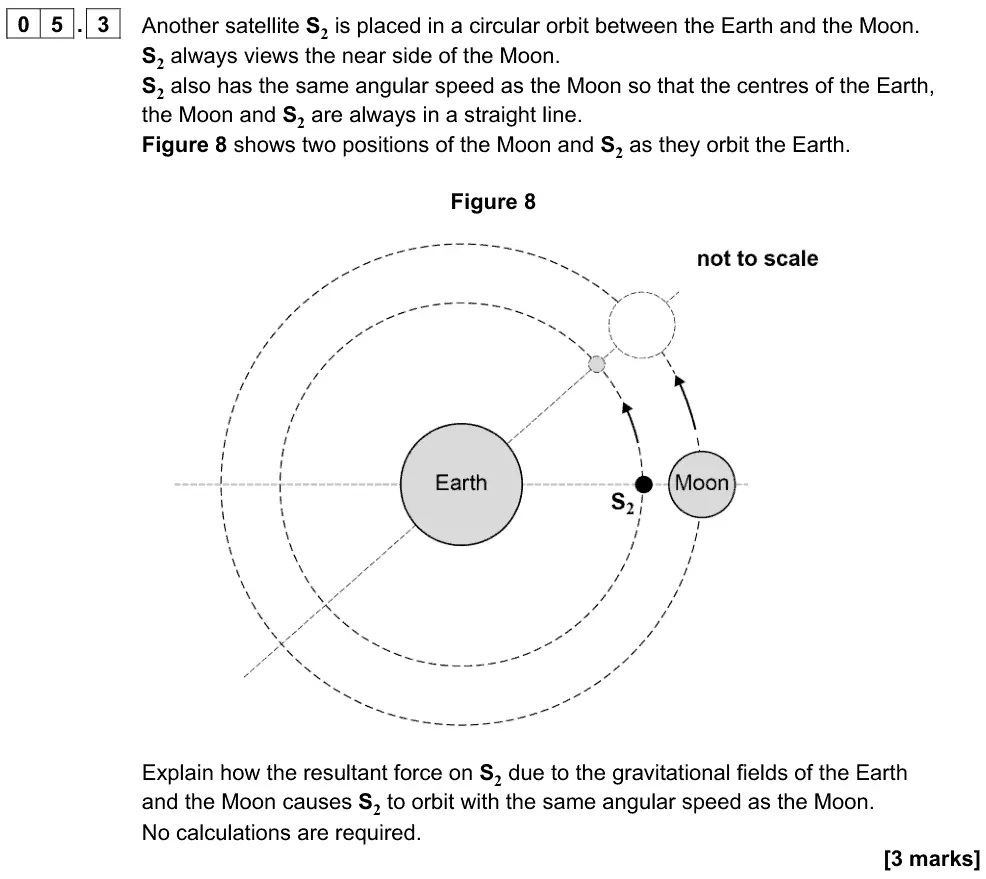
June 2024 · Paper 2 · Q5.33 marksAO2=3Explanation
Earlier part of question 5 that this part uses
Mark scheme
Examiner's comment
05.1 This question was very challenging, with most students gaining 1 or 0. The first mark was for calculating the angular speed of S1. Some students did gain this mark although they did not know how to progress from there. In order to make much progress with this question students had to realise that the centripetal acceleration was equal to the resultant gravitational field strength. They could then subtract the gravitational field strength of the Earth to determine the gravitational field strength of the moon. 𝑇𝑇2 = 4𝜋𝜋𝑟𝑟3 Some students attempted to determine an effective mass to allow this period and then use this with 𝐺𝐺𝐺𝐺; this approach did not gain credit. 05.2 rearrangement of 𝑔𝑔= 𝐺𝐺𝐺𝐺 This question was much more accessible, with many students realising that this was a simple 𝑟𝑟2 . It is unfortunate that the challenging 05.1 put some students off attempting the much more straightforward 05.2. Those who tried to use 𝑇𝑇2 = 4𝜋𝜋𝑟𝑟3 𝐺𝐺𝐺𝐺 did not score here. 05.3 This question also proved to be very challenging. Students had to recognise that the forces or fields acted in opposite directions on S2. This was the most accessible mark and could be achieved in many different ways, including by annotating Figure 8, although simply writing about being attracted to the moon and the Earth was not enough. The second mark was for realising that S2 would be travelling too fast to orbit at the lower distance. Again, this could be expressed in a variety of ways by discussing speed, angular speed or the magnitudes of the fields or forces involved. This proved the most challenging mark to score. The last mark was for stating how the moon reduced the resultant field or force to allow S2 to orbit the Earth at the correct speed at a lower radius.
Notes from the mark scheme and report
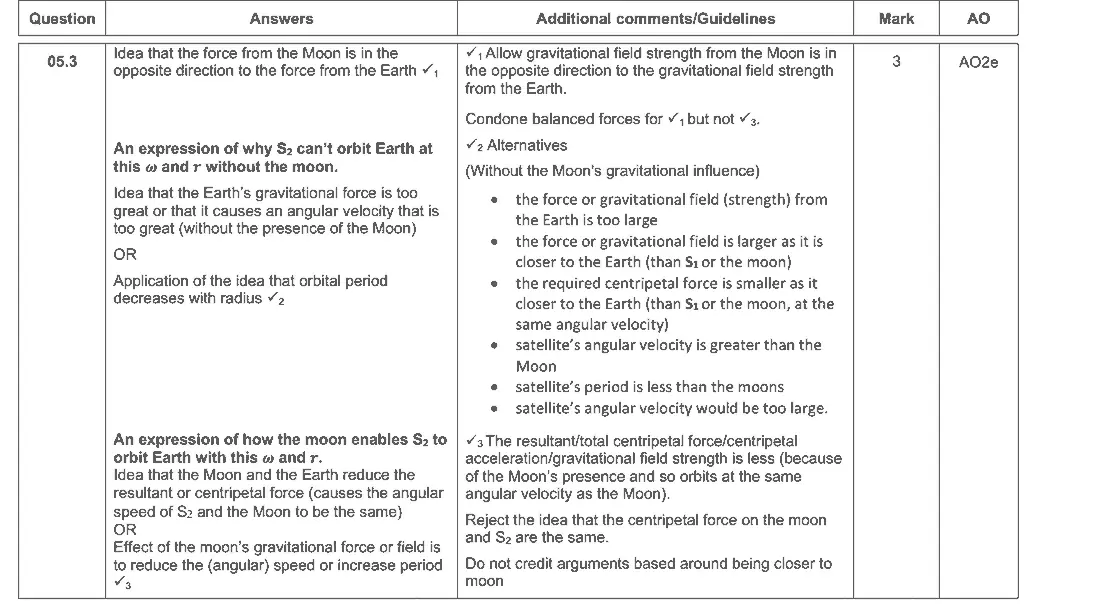
Moon's pull is opposite to Earth's
on its own, Earth's pull at that radius would give a greater angular speed (shorter period)
Moon's pull reduces the resultant centripetal force so angular speed matches the Moon's
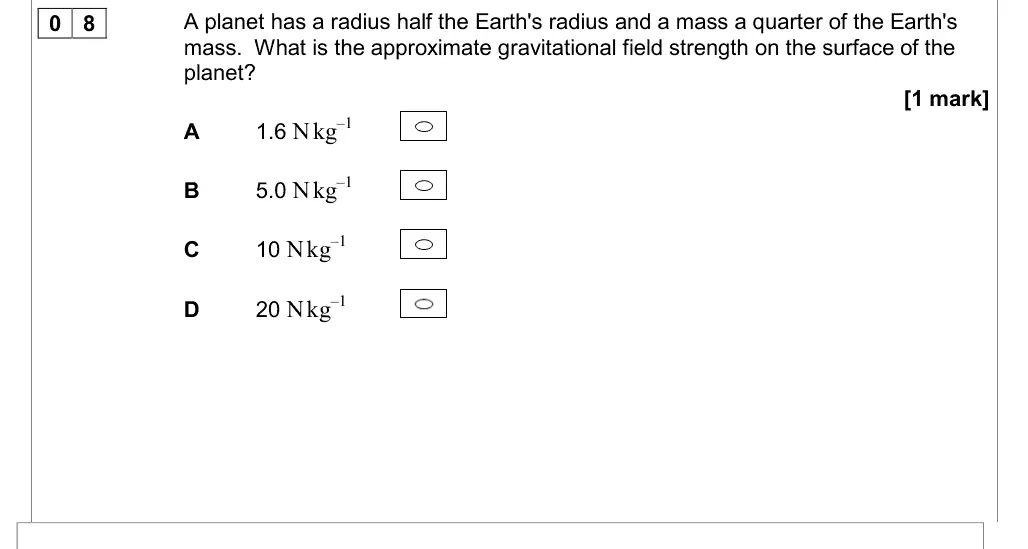
June 2024 · Paper 2 · Q211 markMultiple choice
Answer
C
Mark scheme
Notes from the mark scheme and report
Answer: C
correct answer was the third most popular
Skills: MS0.3 Use ratios, fractions and percentages; MS0.5 Use calculators to find and use power, exponential and logarithmic functions
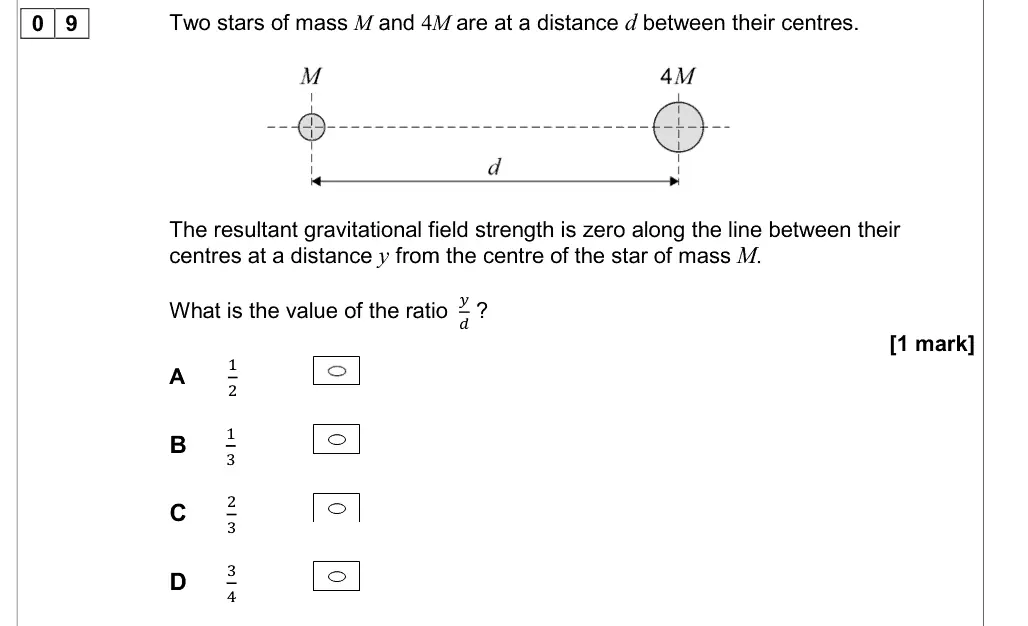
June 2024 · Paper 2 · Q221 markMultiple choice
Answer
B
Mark scheme
Notes from the mark scheme and report
Answer: B
Skills: MS1.4 Make order of magnitude calculations
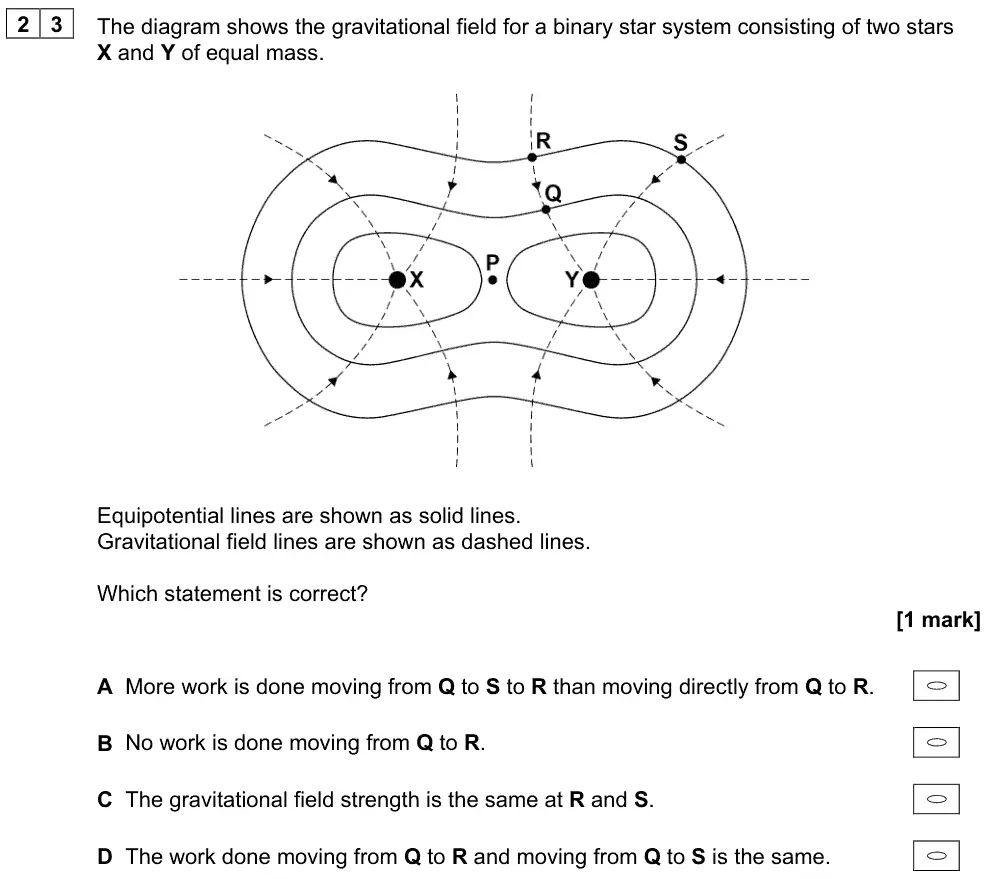
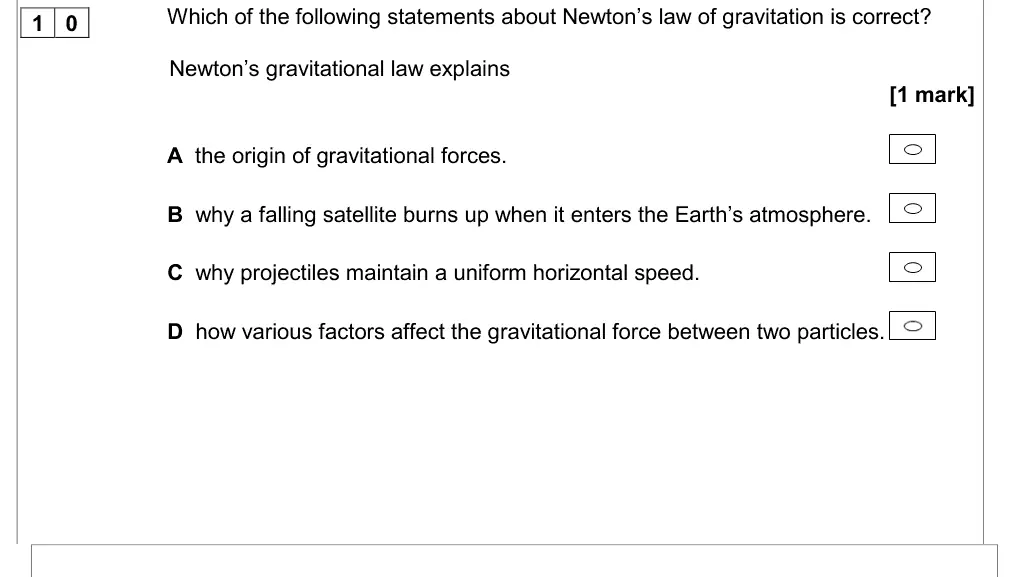
June 2024 · Paper 2 · Q231 markMultiple choice
Answer
D
Mark scheme
Notes from the mark scheme and report
Answer: D
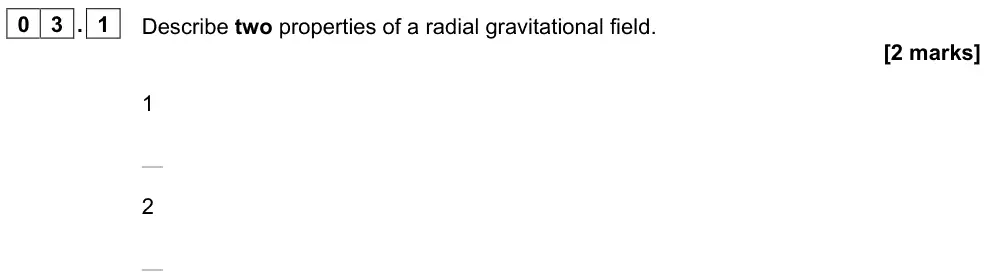
June 2023 · Paper 2 · Q3.12 marksAO1=2Short answer
Mark scheme
Examiner's comment
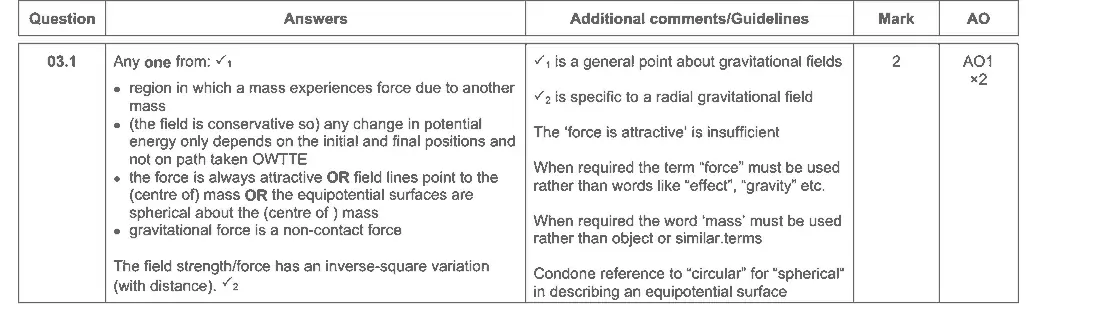
03.1 Most of the answers seen lacked detail. For example, instead of referring to the inverse-square relationship of gravitational field with distance, students often wrote that the field strength decreases with distance. The “field lines spread out” was written instead of referring to the centre of mass being the location at which field lines point or the directional gravitational force acts. Finally, equipotential lines were described as being “curved” rather than being concentric about the centre of mass. 03.2 Most gave the generic answer to what is represented by the area under a force-distance graph. So, references to potential energy or work done were commonly seen but these lacked sufficient details to gain credit. Only a minority considered the extent of the shaded area in Figure 3. When the height was given in the answer, there were still a few who lost the mark by not referring to the space probe; instead they mentioned a unit mass.
Notes from the mark scheme and report
One general point (force on a mass, field lines towards centre of mass, spherical equipotentials) and inverse-square variation
'decreases with distance' or 'curved equipotentials' too vague
June 2023 · Paper 2 · Q3.21 markAO2=1Short answer
Earlier part of question 3 that this part uses
Mark scheme
Examiner's comment
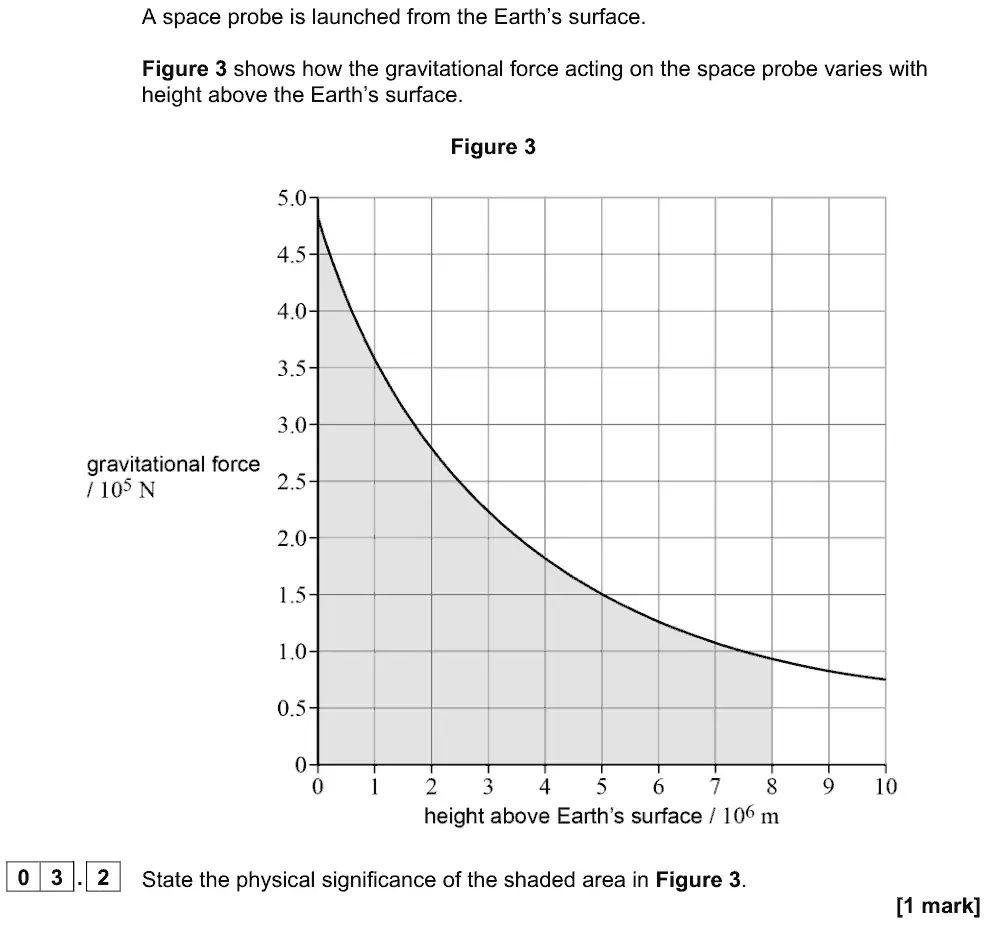
03.1 Most of the answers seen lacked detail. For example, instead of referring to the inverse-square relationship of gravitational field with distance, students often wrote that the field strength decreases with distance. The “field lines spread out” was written instead of referring to the centre of mass being the location at which field lines point or the directional gravitational force acts. Finally, equipotential lines were described as being “curved” rather than being concentric about the centre of mass. 03.2 Most gave the generic answer to what is represented by the area under a force-distance graph. So, references to potential energy or work done were commonly seen but these lacked sufficient details to gain credit. Only a minority considered the extent of the shaded area in Figure 3. When the height was given in the answer, there were still a few who lost the mark by not referring to the space probe; instead they mentioned a unit mass.
Notes from the mark scheme and report
Work done (energy needed) to lift the probe from the surface to 8 x 10^6 m, or its change in GPE
must refer to the probe and the shaded range, not unit mass
Skills: MS3.8 Understand the possible physical significance of the area between a curve and the x axis and be able to calculate it or estimate it by graphical methods as appropriate
June 2023 · Paper 2 · Q3.32 marksAO2=2Calculation
Earlier part of question 3 that this part uses
Mark scheme
Examiner's comment
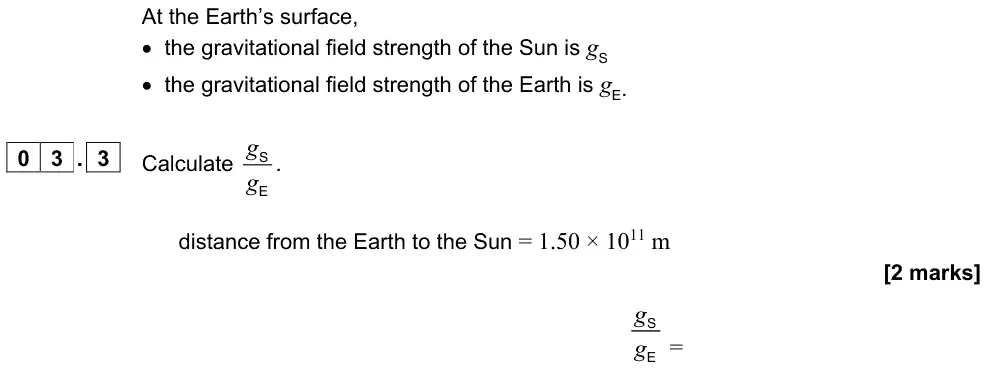
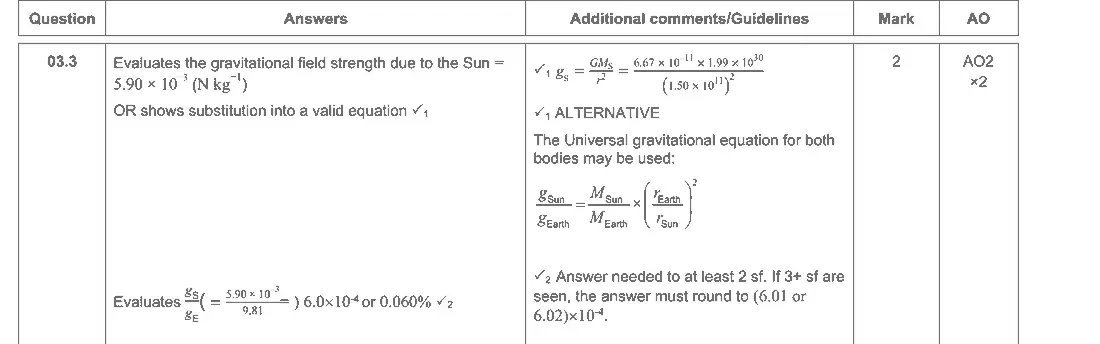
03.3 It was most common for students to determine gS and gE individually rather than going straight to the ratio (as in the alternative on the mark scheme). The major problems for most students were the choice of correct distances to substitute into their working equations or failing to square the chosen distance in their calculations. Adding the Sun’s radius to the distance or just using the Sun’s radius in the calculation of gS was a common error.
Notes from the mark scheme and report
Answer: 6.0 x 10^-4 (gS = 5.90 x 10^-3 N kg^-1 using Sun mass and 1.50 x 10^11 m, divided by 9.81)
not squaring distance or using the Sun's radius were common
Skills: MS2.3 Substitute numerical values into algebraic equations using appropriate units for physical quantities; MS0.3 Use ratios, fractions and percentages
June 2023 · Paper 2 · Q3.41 markAO2=1Explanation
Earlier part of question 3 that this part uses
Mark scheme
Examiner's comment
03.4 Most students did not produce an answer of the standard that is expected at A-level. Many stated the Sun has a larger effect because its is “bigger” or “more massive” than the Earth. They ignored the fact that distance has a bearing on the gravitational force on the probe. Very few took the trouble to state anything about the probe–Earth distance and probe–Sun distance being comparable.
Notes from the mark scheme and report
Probe-Sun and probe-Earth distances become comparable, and the Sun's mass is far greater, so its force dominates
'Sun is bigger' alone not enough
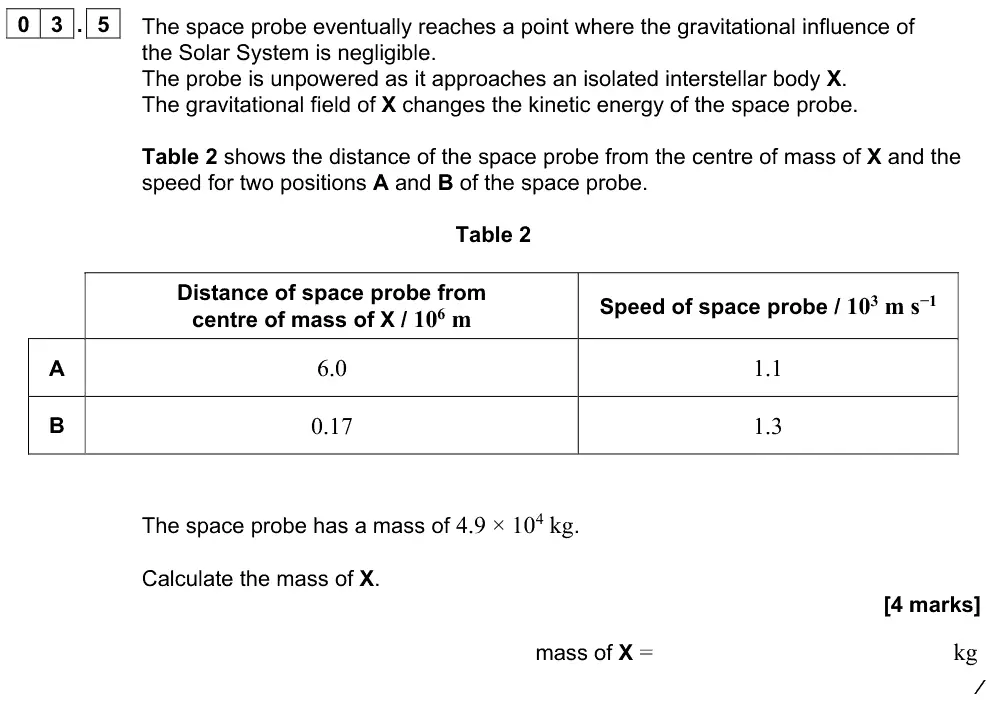
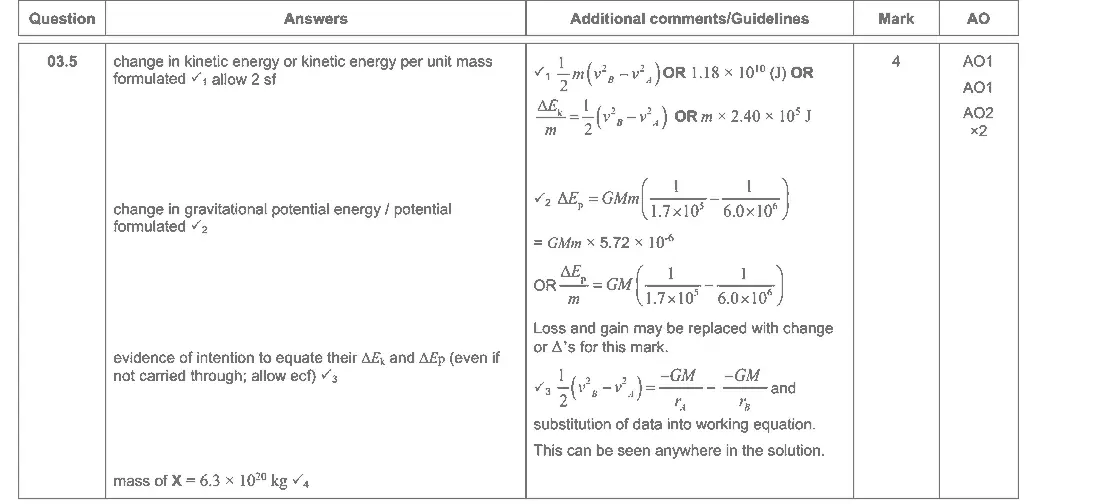
June 2023 · Paper 2 · Q3.54 marksCalculation
Earlier part of question 3 that this part uses
Mark scheme
Examiner's comment
03.5 Most students simply looked for an equation that involved mass, speed and distance, then simply ‘played’ with numbers. Inappropriate force and circular-motion equations were commonly seen. The third marking point was also lost by many who missed any reference to the changes in kinetic and potential energies. The most frequently gained mark was the calculation of change in kinetic energy. However, there were many who failed to gain this mark by using the square of the difference in speed in their calculation. The determination of change in potential energy had a common error too; this was the substitution of the difference in distance for separation into the potential-energy equation.
Notes from the mark scheme and report
Answer: 6.3 x 10^20 kg (gain in KE 1.18 x 10^10 J = loss of GPE = GMm(1/rB - 1/rA))
squaring the speed difference, or using the difference in distances, were common errors
Skills: MS2.2 Change the subject of an equation, including non-linear equations; MS2.3 Substitute numerical values into algebraic equations using appropriate units for physical quantities
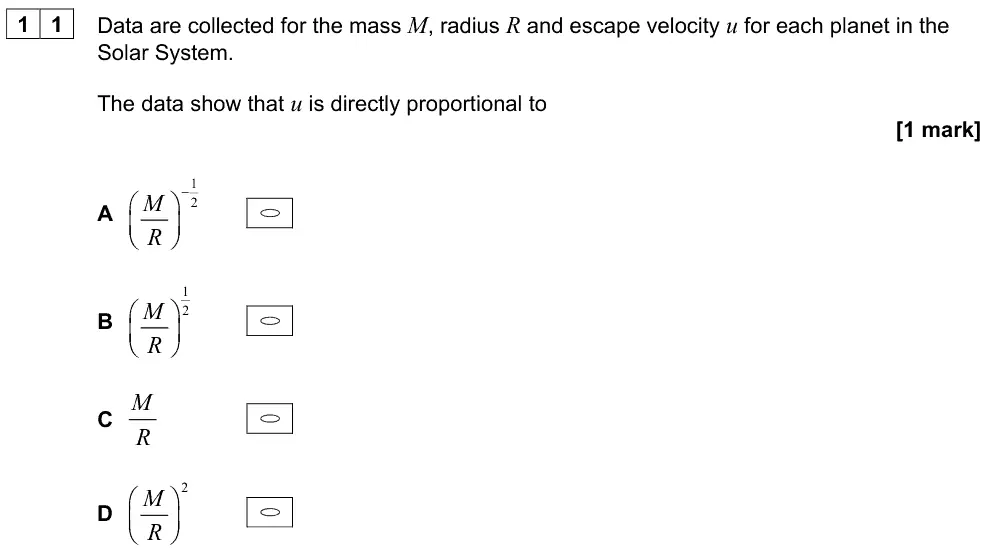
June 2023 · Paper 2 · Q111 markMultiple choiceEasy
Answer
B
Mark scheme
Examiner's comment
A number of questions were found to be quite straightforward by students. These included B8, B11, B12, B17, B18, B20, B26 and B28 which were all answered correctly by at least 70% of students. The questions found to be the most difficult were B14, B15 and B25 – answered correctly by fewer than 35% of students.
Notes from the mark scheme and report
Answer: B
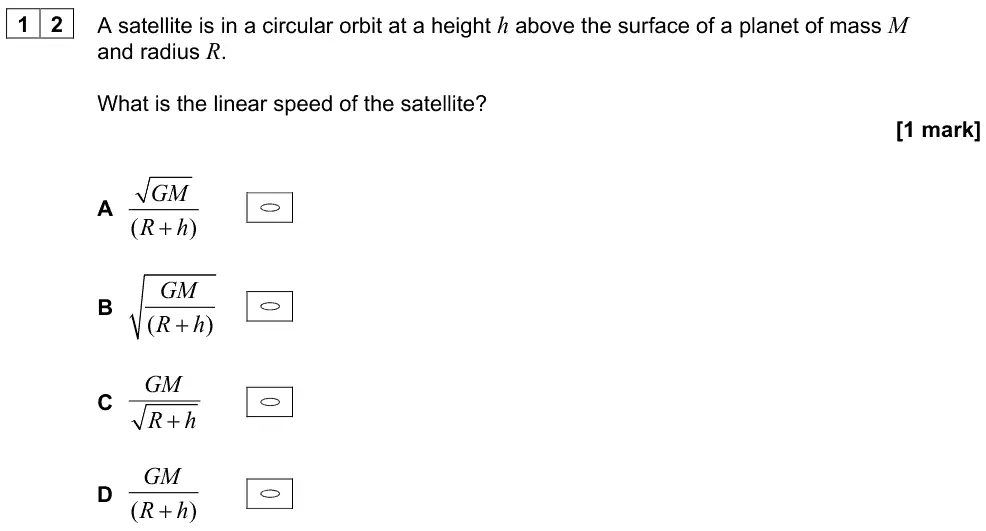
June 2023 · Paper 2 · Q121 markMultiple choiceEasy
Answer
B
Mark scheme
Examiner's comment
A number of questions were found to be quite straightforward by students. These included B8, B11, B12, B17, B18, B20, B26 and B28 which were all answered correctly by at least 70% of students. The questions found to be the most difficult were B14, B15 and B25 – answered correctly by fewer than 35% of students.
Notes from the mark scheme and report
Answer: B
June 2023 · Paper 2 · Q131 markMultiple choice
Answer
D
Mark scheme
Notes from the mark scheme and report
Answer: D
June 2022 · Paper 2 · Q4.12 marksAO3=2Explanation
Mark scheme
Examiner's comment
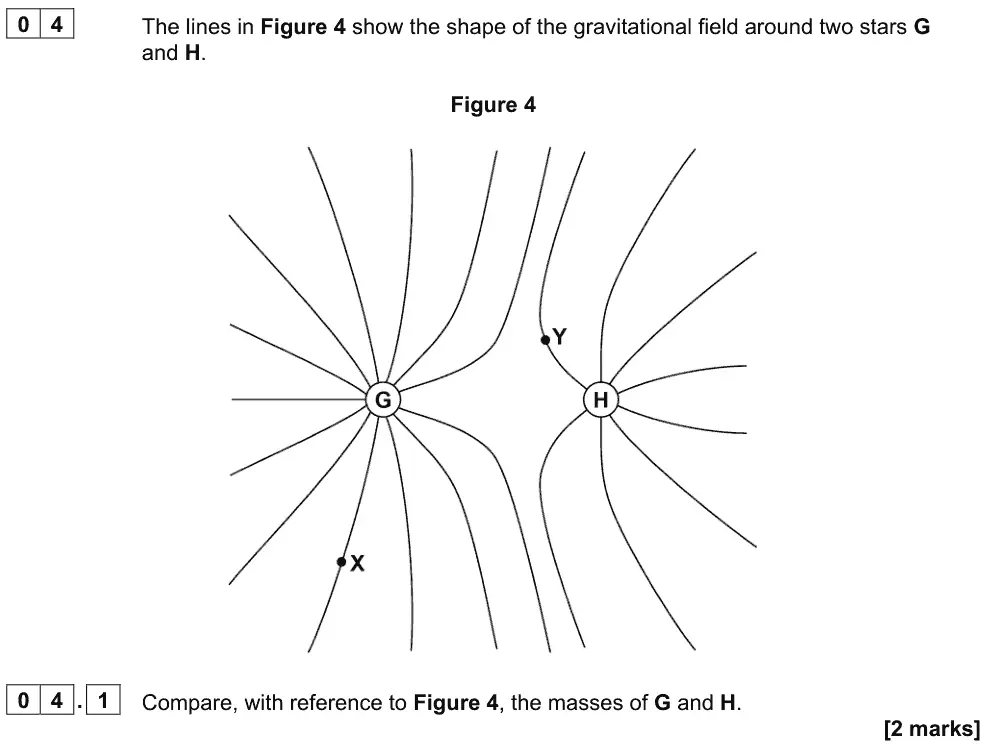
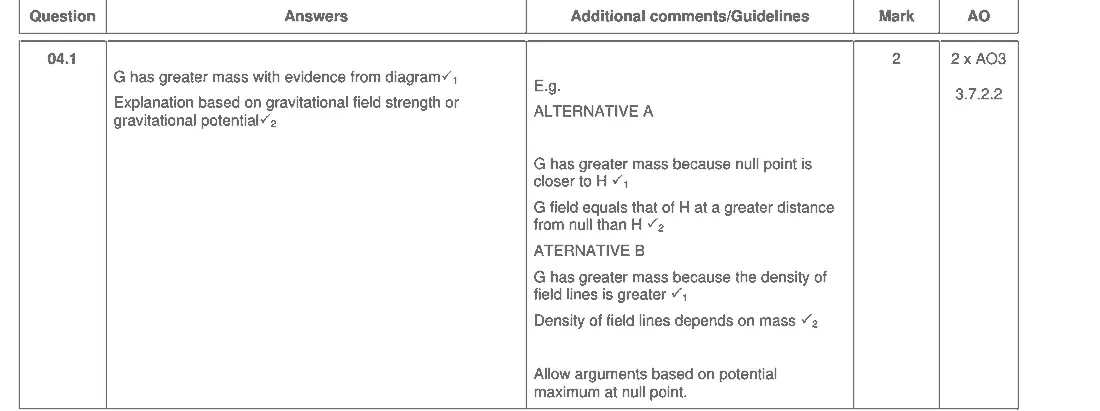
Only a minority of students did not realise that G had the greater mass. Where students failed to gain marks, it was because they explained their answer in a vague way. ‘G has straighter lines’ and ‘G has lines that push lines from H’ are statements seen that do not explain the situation. Many did refer to a greater density of lines around G compared to H to score one mark. Often they failed to gain the second mark because they did not explicitly connect the density of field lines with mass. Students who chose to explain the situation in terms of the null point often scored both marks. Their main downfall was to refer to the equilibrium of null point as a point of zero potential.
Question 04.1
Notes from the mark scheme and report
G has greater mass: null point nearer H, or greater density of field lines at G
must link the evidence to field strength/mass for the second mark
June 2022 · Paper 2 · Q4.21 markAO1=1Diagram or graph
Earlier part of question 4 that this part uses
Mark scheme
Examiner's comment
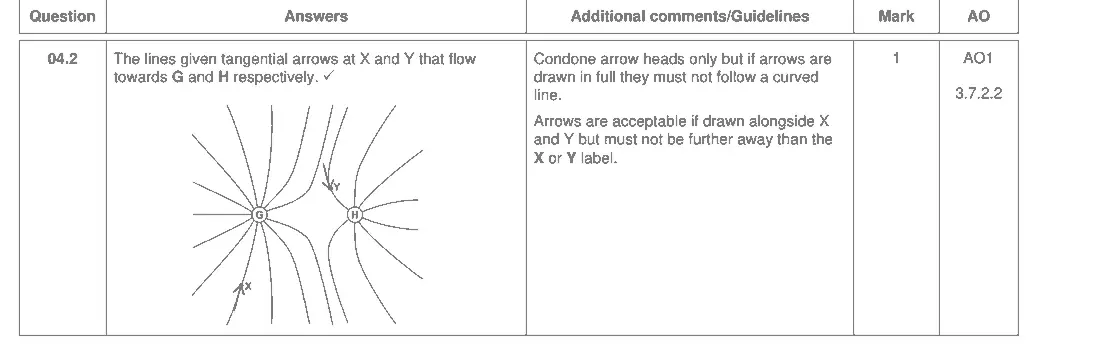
Weak students placed the arrows in totally the wrong direction, sometimes placing them at right angles to the field lines and sometimes having them point away from the masses. Even many stronger students also failed to score on this question – this was because their lines were not drawn in the direction of the tangent to the field line. This was most obvious at Y where the arrow often was curved in the direction of the field line or directed straight to H.
Question 04.2
Notes from the mark scheme and report
Tangential arrows at X and Y pointing along the field line towards G and H respectively
curved arrows or arrows straight to H not credited
June 2022 · Paper 2 · Q4.31 markAO2=1Calculation
Earlier part of question 4 that this part uses
Mark scheme
Examiner's comment
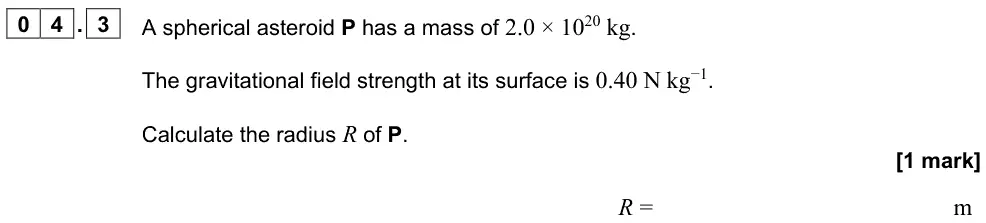
A very straightforward question in which most students were successful. A few failed by not realising that the equation, depending on how it was presented, had a square or square-root term. Others made numerical or re-arrangement errors.
Question 04.3
Notes from the mark scheme and report
Answer: 1.8 x 10^5 m (R = square root of GM/g)
Skills: MS2.2 Change the subject of an equation, including non-linear equations; MS2.3 Substitute numerical values into algebraic equations using appropriate units for physical quantities
June 2022 · Paper 2 · Q4.41 markAO2=1Diagram or graph
Earlier part of question 4 that this part uses
Mark scheme
Examiner's comment
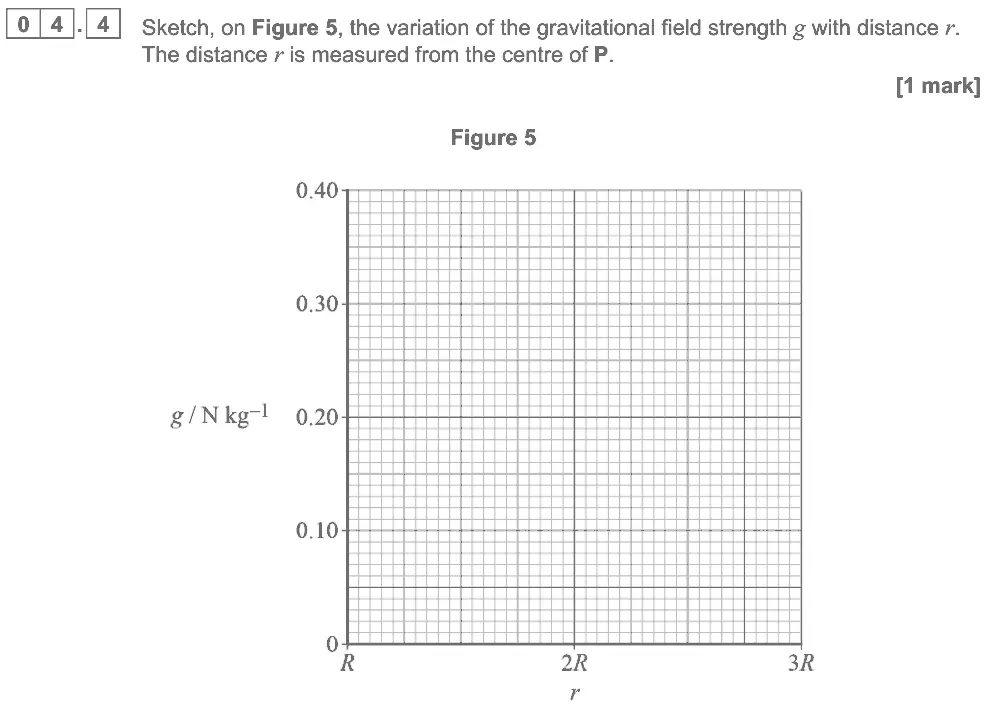
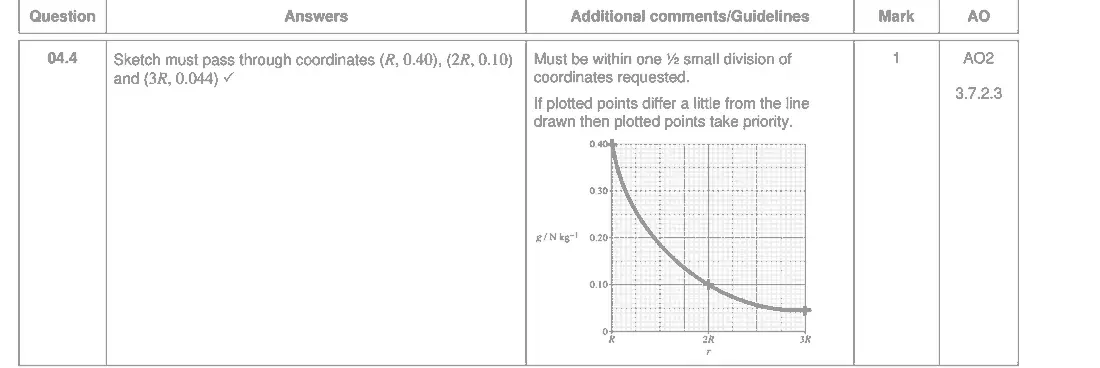
In a similar way to question 02.4, students failed to gain marks by not searching for specific data points to follow. Many just drew the basic shape they expected. A significant number of students did not know what shape to expect so peaks and other shapes were seen.
Question 04.4
Notes from the mark scheme and report
Inverse-square curve through (R, 0.40), (2R, 0.10), (3R, 0.044)
many drew a generic shape without plotting points
Skills: MS3.1 Translate information between graphical, numerical and algebraic forms
June 2022 · Paper 2 · Q4.52 marksAO2=2Explanation
Earlier part of question 4 that this part uses
Mark scheme
Examiner's comment
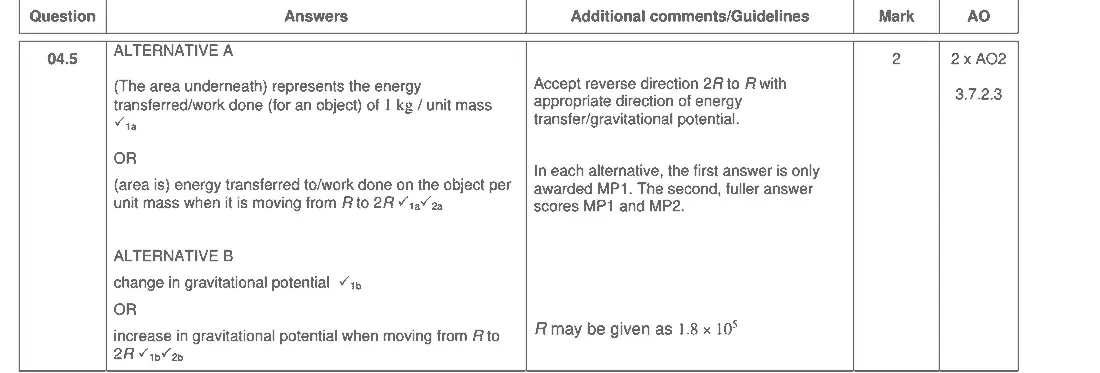
There was quite a spread of marks for this basic bookwork question. Students who referred to a change in gravitational potential tended to stop there and not write about it increasing when moving from R to 2R. Those who preferred to discuss the ‘work done’ route tended to be more successful in gaining two marks. However, when they did not refer to a unit mass they did not score at all.
Question 04.5
Notes from the mark scheme and report
Area = change (increase) in gravitational potential from R to 2R, or work done per unit mass moving from R to 2R
must state per unit mass and direction for both marks
Skills: MS3.8 Understand the possible physical significance of the area between a curve and the x axis and be able to calculate it or estimate it by graphical methods as appropriate
June 2022 · Paper 2 · Q4.64 marksAO1=2, AO2=2Calculation
Earlier part of question 4 that this part uses
Mark scheme
Examiner's comment
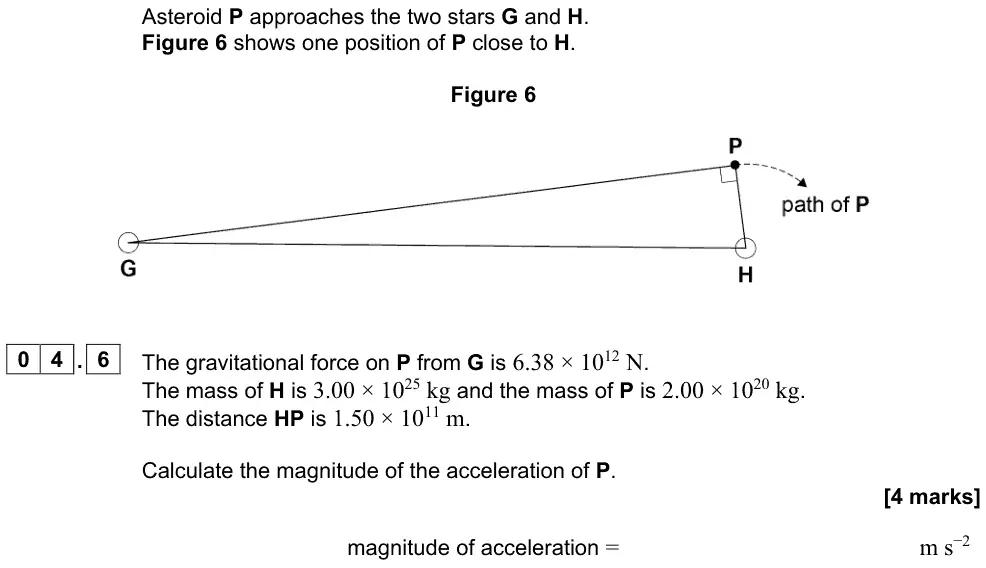
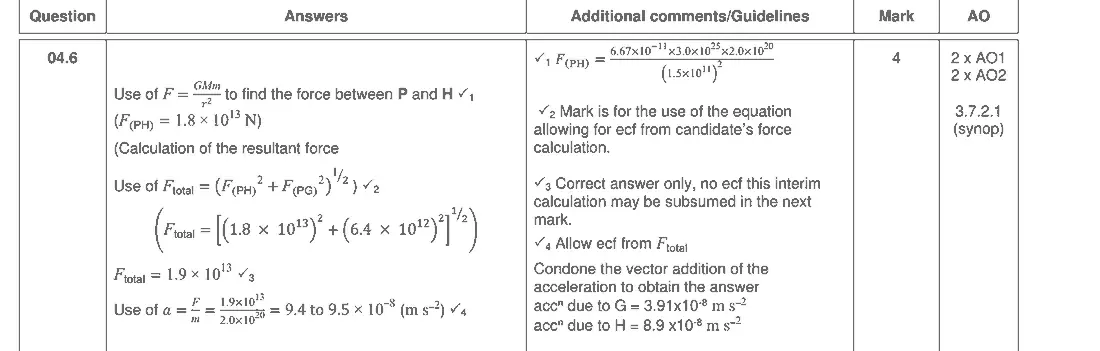
Most students could find the force on P due to H to gain the first mark, but a majority could not add the forces from G and H on P vectorially. Many attempted a plain addition rather than adding them in quadrature. This meant the next two marks were inaccessible for most. An error carried forward was allowed for the last mark (for use of F ma = ) – this gave the second mark for the majority. A few students calculated the accelerations that P would experience from G and H and then made the vector addition. This was an acceptable approach and many of these students scored full marks.
Question 04.6
Notes from the mark scheme and report
Answer: 9.4-9.5 x 10^-8 m s^-2 (F from H = 1.8 x 10^13 N
resultant by Pythagoras 1.9 x 10^13 N
a = F/m)
most added the forces arithmetically instead of in quadrature
Skills: MS2.3 Substitute numerical values into algebraic equations using appropriate units for physical quantities; MS4.4 Use Pythagoras’ theorem, and the angle sum of a triangle
June 2022 · Paper 2 · Q4.71 markAO3=1Explanation
Earlier part of question 4 that this part uses
Mark scheme
Examiner's comment
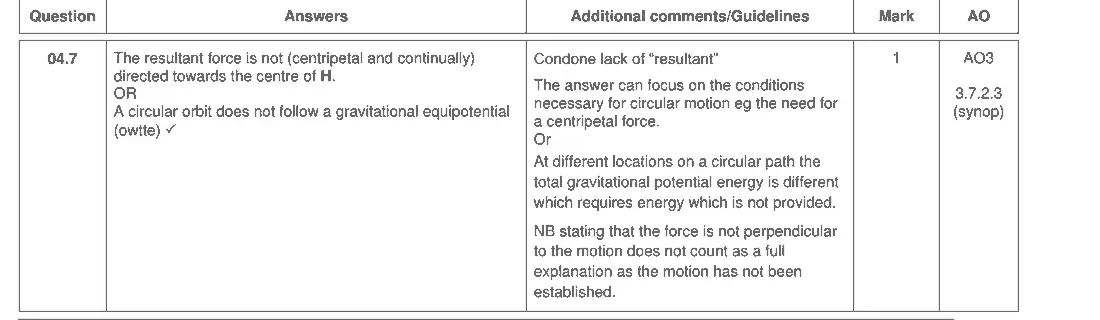
Most students failed to gain the mark for this question because they did not start by thinking about what conditions are necessary for circular motion, i.e. the need for a centripetal force. Many discussed the problem in general terms such as ‘force from G pulls the path out of circular’. This is true but it lacks the main explanation of the necessary conditions required for circular motion. In a similar way, some students stated that the force is not at right angles to the motion. Again, this sounds quite reasonable but the motion or path has not been established so this really cannot be used as a reference.
Question 04.7
Notes from the mark scheme and report
Resultant force is not always directed towards the centre of H (not centripetal) because of G's pull
'not perpendicular to motion' alone not enough
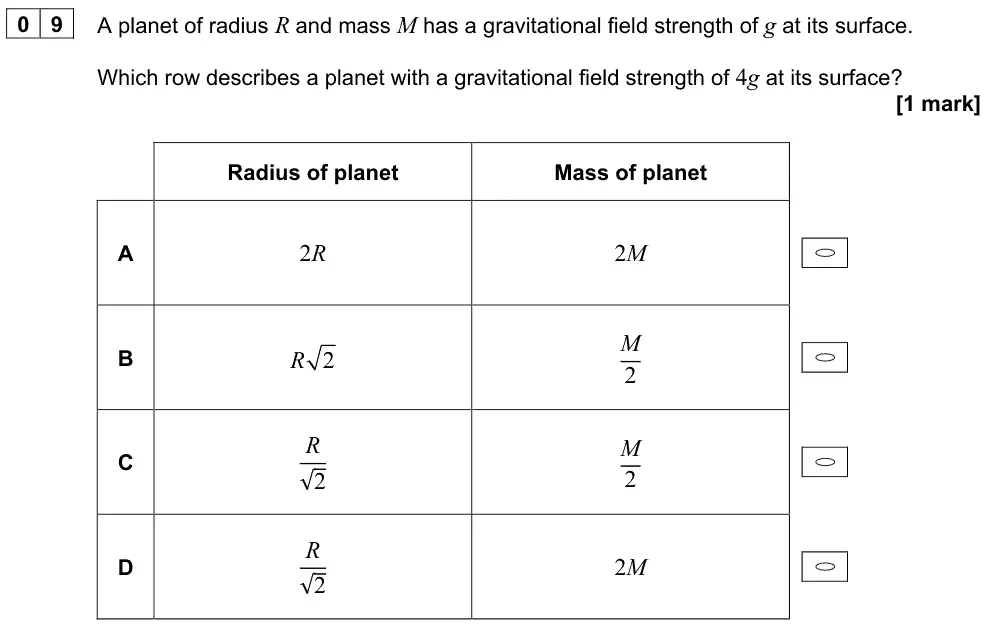
June 2022 · Paper 2 · Q91 markAO2=1Multiple choice
Answer
D
Mark scheme
Notes from the mark scheme and report
Answer: D
Skills: MS0.3 Use ratios, fractions and percentages
June 2022 · Paper 2 · Q111 markAO2=1Multiple choice
Answer
B
Mark scheme
Notes from the mark scheme and report
Answer: B
Skills: MS2.2 Change the subject of an equation, including non-linear equations
June 2022 · Paper 2 · Q121 markAO2=1Multiple choice
Answer
C
Mark scheme
Notes from the mark scheme and report
Answer: C
Skills: MS2.2 Change the subject of an equation, including non-linear equations
June 2022 · Paper 2 · Q131 markAO2=1Multiple choice
Answer
D
Mark scheme
Notes from the mark scheme and report
Answer: D
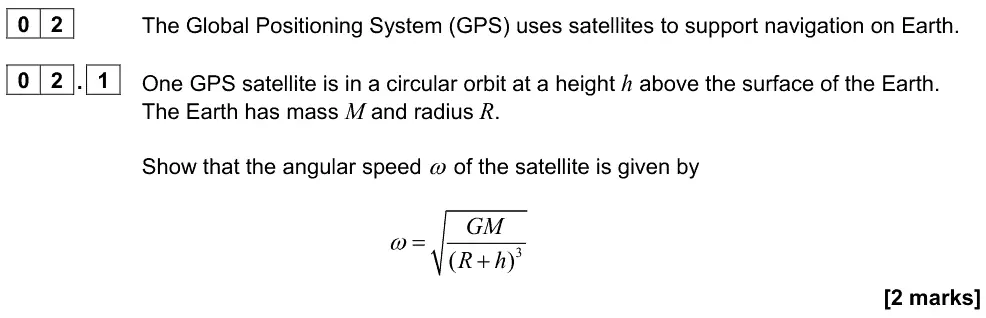
November 2021 · Paper 2 · Q2.12 marksAO2=2Show that
Mark scheme
Examiner's comment
02.1 About half of the students successfully completed the task. Most of the others either did not choose an acceptable starting point or became confused in their algebra. 02.2 A majority of students tackled this question successfully. A common fault by the minority was the failure to realise that they should begin with the equation provided in the previous section. 02.3 Students commonly thought that the deciding factor was launch height. Even those choosing location Z thought that the diameter of the Earth was greatest at this point. When explaining the height advantage, only a handful of students referred to the reduced difference in gravitational potential energy required to place the satellite in orbit. A minority of students referred to the spin of the earth. 02.4 Students often calculated gravitational potential rather than gravitational potential energy. mgh = Some reverted to simplistic physics by quoting GPE . Only a minority correctly gave a negative answer, further reducing the success rate on this question. 02.5 A few able students justified the statement that the linear speed is smaller for higher orbits which they worked out either from the equation given in part 02.1 or from first principles. A majority thought the linear speed was greater, often justifying this by incorrectly taking the angular velocity to be constant.
Notes from the mark scheme and report
GMm/(R + h)^2 = m (R + h) omega^2 rearranged to omega = root(GM/(R + h)^3)
about half succeeded
Skills: MS2.2 Change the subject of an equation, including non-linear equations
November 2021 · Paper 2 · Q2.22 marksAO2=2Calculation
Earlier part of question 2 that this part uses
Mark scheme
Examiner's comment
02.1 About half of the students successfully completed the task. Most of the others either did not choose an acceptable starting point or became confused in their algebra. 02.2 A majority of students tackled this question successfully. A common fault by the minority was the failure to realise that they should begin with the equation provided in the previous section. 02.3 Students commonly thought that the deciding factor was launch height. Even those choosing location Z thought that the diameter of the Earth was greatest at this point. When explaining the height advantage, only a handful of students referred to the reduced difference in gravitational potential energy required to place the satellite in orbit. A minority of students referred to the spin of the earth. 02.4 Students often calculated gravitational potential rather than gravitational potential energy. mgh = Some reverted to simplistic physics by quoting GPE . Only a minority correctly gave a negative answer, further reducing the success rate on this question. 02.5 A few able students justified the statement that the linear speed is smaller for higher orbits which they worked out either from the equation given in part 02.1 or from first principles. A majority thought the linear speed was greater, often justifying this by incorrectly taking the angular velocity to be constant.
Notes from the mark scheme and report
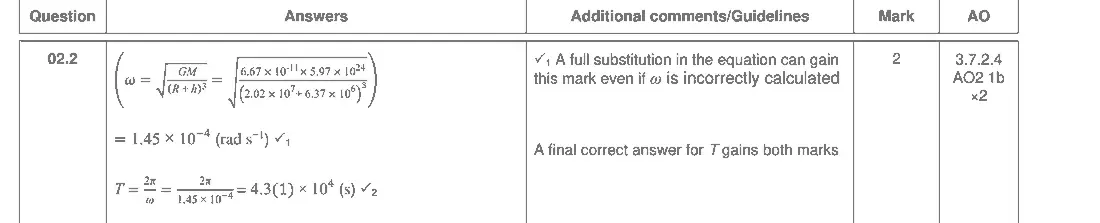
Answer: 4.3 x 10^4 s (omega = 1.45 x 10^-4 rad s^-1 with R + h = 2.66 x 10^7 m
T = 2 pi / omega)
Skills: MS2.3 Substitute numerical values into algebraic equations using appropriate units for physical quantities
November 2021 · Paper 2 · Q2.32 marksExplanation
Earlier part of question 2 that this part uses
Mark scheme
Examiner's comment
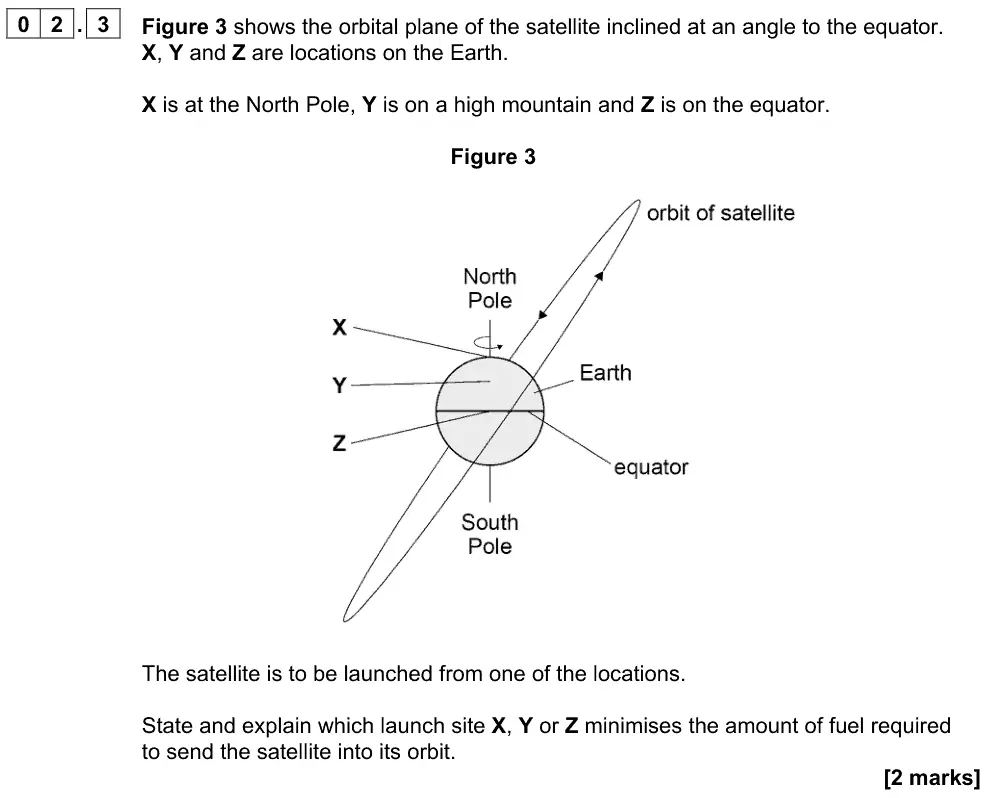
02.1 About half of the students successfully completed the task. Most of the others either did not choose an acceptable starting point or became confused in their algebra. 02.2 A majority of students tackled this question successfully. A common fault by the minority was the failure to realise that they should begin with the equation provided in the previous section. 02.3 Students commonly thought that the deciding factor was launch height. Even those choosing location Z thought that the diameter of the Earth was greatest at this point. When explaining the height advantage, only a handful of students referred to the reduced difference in gravitational potential energy required to place the satellite in orbit. A minority of students referred to the spin of the earth. 02.4 Students often calculated gravitational potential rather than gravitational potential energy. mgh = Some reverted to simplistic physics by quoting GPE . Only a minority correctly gave a negative answer, further reducing the success rate on this question. 02.5 A few able students justified the statement that the linear speed is smaller for higher orbits which they worked out either from the equation given in part 02.1 or from first principles. A majority thought the linear speed was greater, often justifying this by incorrectly taking the angular velocity to be constant.
Notes from the mark scheme and report
Z (equator): the launch site has the greatest speed / kinetic energy from the Earth's rotation
most chose the mountain (height)
November 2021 · Paper 2 · Q2.42 marksAO1=2Calculation
Earlier part of question 2 that this part uses
Mark scheme
Examiner's comment
02.1 About half of the students successfully completed the task. Most of the others either did not choose an acceptable starting point or became confused in their algebra. 02.2 A majority of students tackled this question successfully. A common fault by the minority was the failure to realise that they should begin with the equation provided in the previous section. 02.3 Students commonly thought that the deciding factor was launch height. Even those choosing location Z thought that the diameter of the Earth was greatest at this point. When explaining the height advantage, only a handful of students referred to the reduced difference in gravitational potential energy required to place the satellite in orbit. A minority of students referred to the spin of the earth. 02.4 Students often calculated gravitational potential rather than gravitational potential energy. mgh = Some reverted to simplistic physics by quoting GPE . Only a minority correctly gave a negative answer, further reducing the success rate on this question. 02.5 A few able students justified the statement that the linear speed is smaller for higher orbits which they worked out either from the equation given in part 02.1 or from first principles. A majority thought the linear speed was greater, often justifying this by incorrectly taking the angular velocity to be constant.
Notes from the mark scheme and report
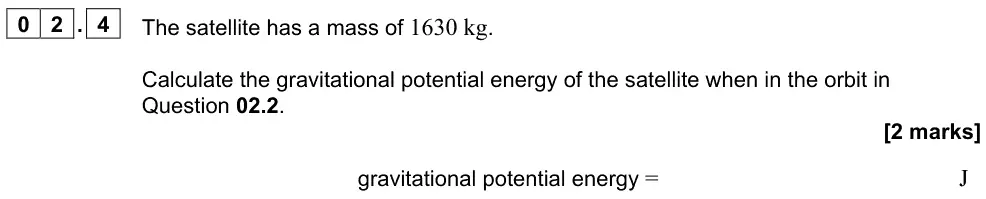
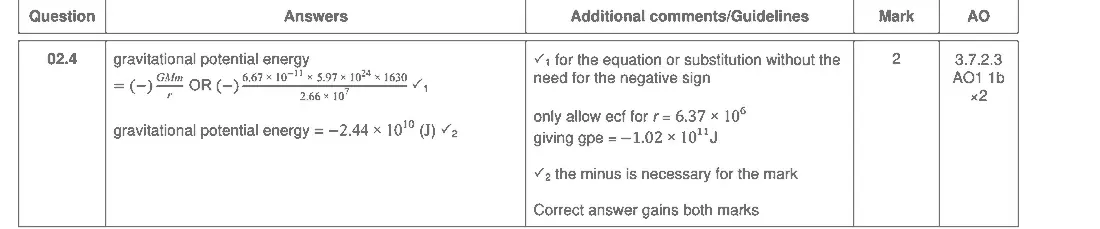
Answer: -2.44 x 10^10 J (-GMm/r with r = 2.66 x 10^7 m)
minus sign required
many gave potential not potential energy or used mgh
Skills: MS2.3 Substitute numerical values into algebraic equations using appropriate units for physical quantities
November 2021 · Paper 2 · Q2.52 marksAO2=2Explanation
Earlier part of question 2 that this part uses
Mark scheme
Examiner's comment
02.1 About half of the students successfully completed the task. Most of the others either did not choose an acceptable starting point or became confused in their algebra. 02.2 A majority of students tackled this question successfully. A common fault by the minority was the failure to realise that they should begin with the equation provided in the previous section. 02.3 Students commonly thought that the deciding factor was launch height. Even those choosing location Z thought that the diameter of the Earth was greatest at this point. When explaining the height advantage, only a handful of students referred to the reduced difference in gravitational potential energy required to place the satellite in orbit. A minority of students referred to the spin of the earth. 02.4 Students often calculated gravitational potential rather than gravitational potential energy. mgh = Some reverted to simplistic physics by quoting GPE . Only a minority correctly gave a negative answer, further reducing the success rate on this question. 02.5 A few able students justified the statement that the linear speed is smaller for higher orbits which they worked out either from the equation given in part 02.1 or from first principles. A majority thought the linear speed was greater, often justifying this by incorrectly taking the angular velocity to be constant.
Notes from the mark scheme and report
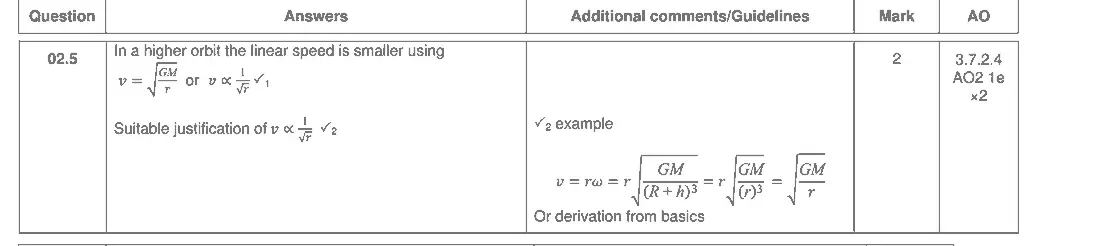
Linear speed is smaller in a higher orbit: v = root(GM/r) (from v = r omega with 02.1)
many wrongly assumed omega constant so v larger
November 2021 · Paper 2 · Q111 markMultiple choice
Answer
B
Mark scheme
Notes from the mark scheme and report
Answer: B
November 2021 · Paper 2 · Q121 markMultiple choice
Answer
B
Mark scheme
Notes from the mark scheme and report
Answer: B
Skills: MS0.3 Use ratios, fractions and percentages
November 2021 · Paper 2 · Q131 markMultiple choice
Answer
A
Mark scheme
Notes from the mark scheme and report
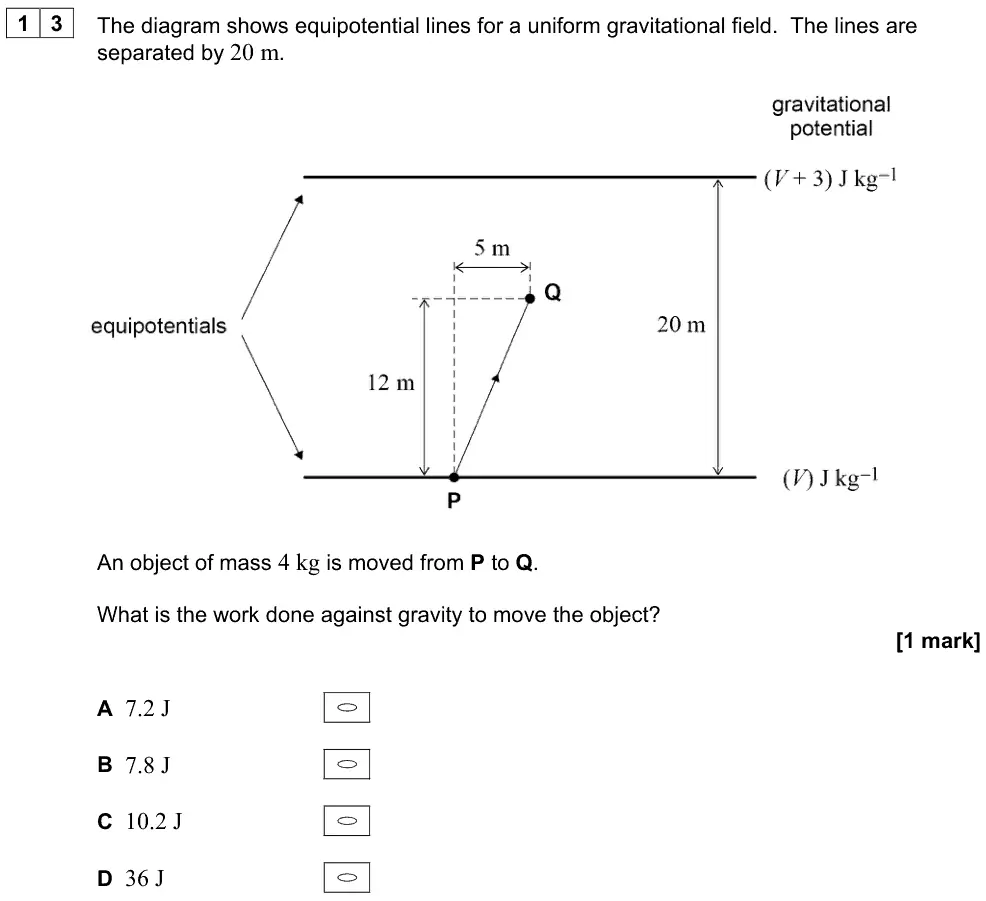
Answer: A
7.2 J: 12/20 of 3 J kg^-1 x 4 kg
Skills: MS0.3 Use ratios, fractions and percentages
November 2021 · Paper 2 · Q151 markMultiple choice
Answer
C
Mark scheme
Notes from the mark scheme and report
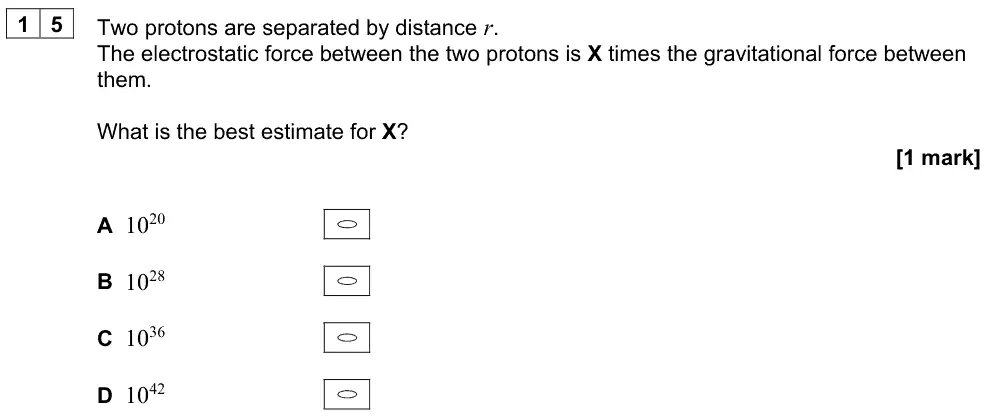
Answer: C
Skills: MS1.4 Make order of magnitude calculations
November 2020 · Paper 2 · Q2.13 marksAO1=3Show that
Mark scheme
Examiner's comment
About half the students were given full marks, with a large portion of them showing the equations and an efficient manipulation of them. The remainder did not show such a logical approach. A typical technique was to write down as many equations as possible, placed in any position in the answer space. These students then hoped to find some link between them. The weaker students sometimes picked up the second mark for converting the equation for circular motion into one that involved time.
Question 02.1
Notes from the mark scheme and report
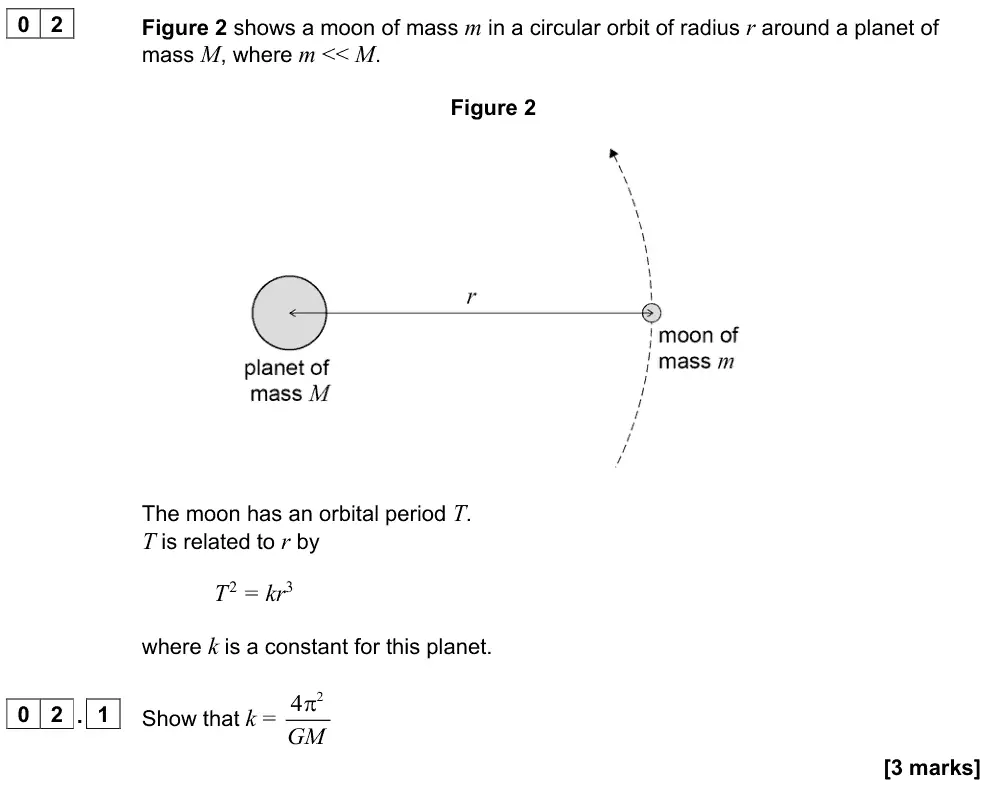
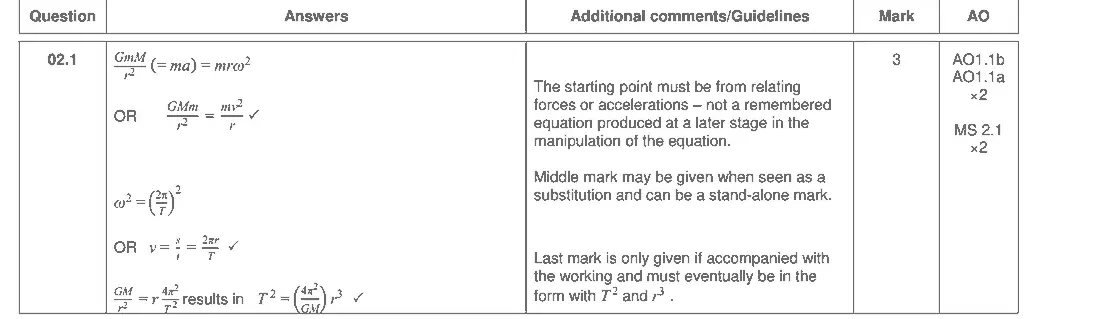
GMm/r^2 = m r omega^2 (or mv^2/r) with omega = 2 pi / T leads to T^2 = (4 pi^2 / GM) r^3
must start from forces
about half full marks
Skills: MS2.2 Change the subject of an equation, including non-linear equations
November 2020 · Paper 2 · Q2.22 marksCalculation
Earlier part of question 2 that this part uses
Mark scheme
Examiner's comment
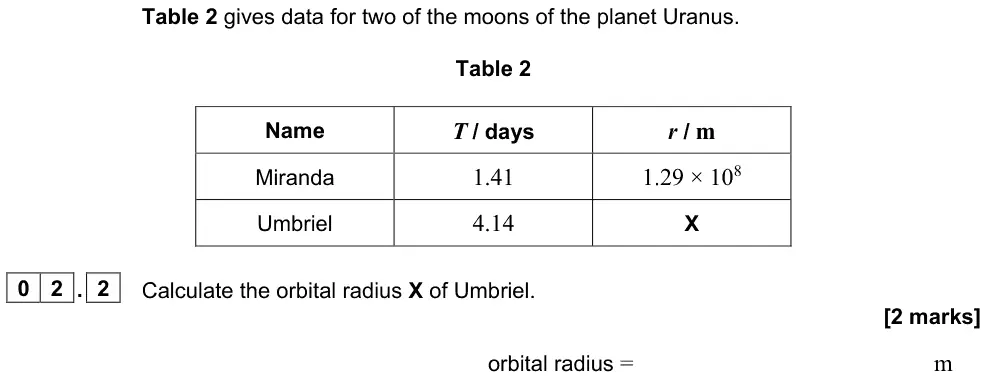
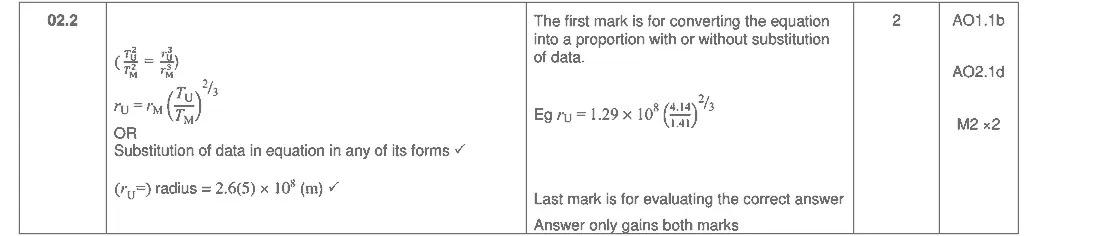
A large number of students could not convert the equation into one showing proportionality and then substitute data correctly. Alternatively, they calculated k but then failed to rearrange the equation to make the radius the required subject. A few students failed to get started on the problem. However, a majority of the students found the question to be very straightforward and headed straight to the answer.
Question 02.2
Notes from the mark scheme and report
Answer: 2.65 x 10^8 m (r = 1.29 x 10^8 x (4.14/1.41)^(2/3))
Skills: MS0.5 Use calculators to find and use power, exponential and logarithmic functions; MS2.2 Change the subject of an equation, including non-linear equations
November 2020 · Paper 2 · Q2.33 marksAO2=3Calculation
Earlier part of question 2 that this part uses
Mark scheme
Examiner's comment
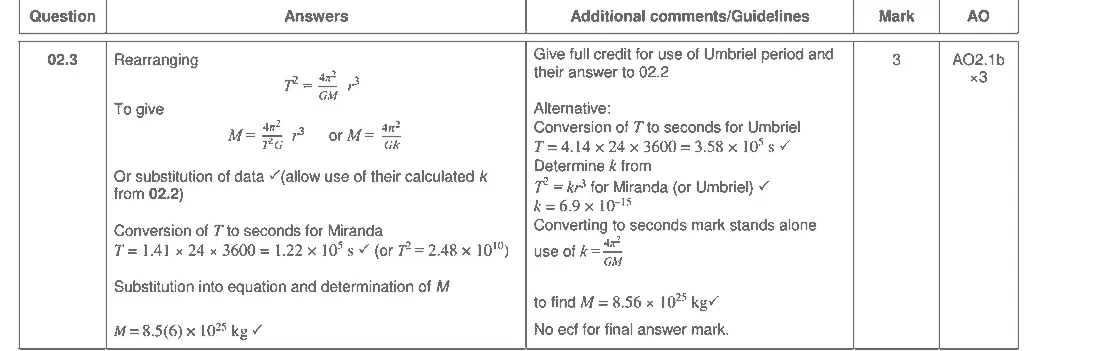
Some students gained the three marks easily but a majority scored only one mark for rearranging the equation to make mass the subject. An equal number made no real attempt at answering the question.
Question 02.3
Notes from the mark scheme and report
Answer: 8.6 x 10^25 kg (M = 4 pi^2 r^3 / G T^2 with T = 1.22 x 10^5 s for Miranda)
majority scored only 1 for rearranging
days must be converted to s
Skills: MS2.2 Change the subject of an equation, including non-linear equations; MS0.1 Recognise and make use of appropriate units in calculations
November 2020 · Paper 2 · Q2.43 marksCalculation
Earlier part of question 2 that this part uses
Mark scheme
Examiner's comment
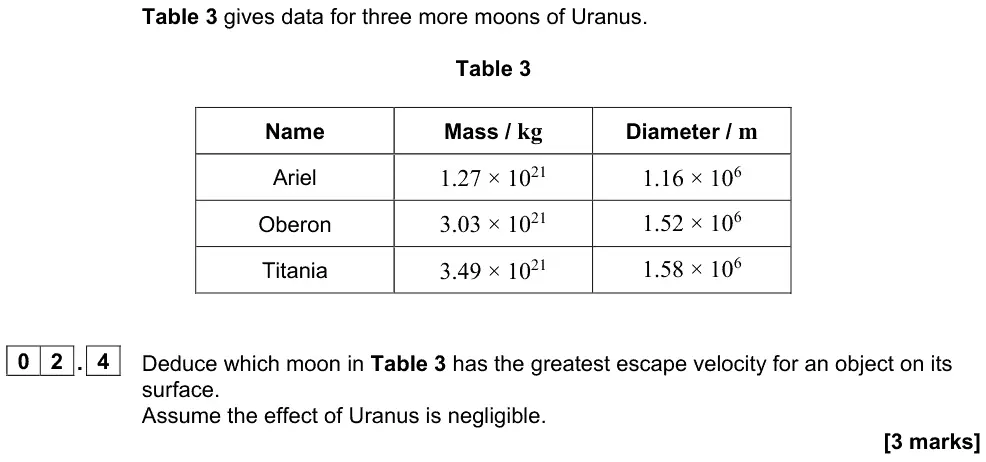
Students who initially established the escape-velocity equation either went on to gain full marks or dropped one mark for not noticing the difference between the radius and diameter. The main error by the less successful students was to equate a centripetal force with a gravitational force and obtain an expression for a velocity. They then thought (wrongly) that this velocity was the escape velocity.
Question 02.4
Notes from the mark scheme and report
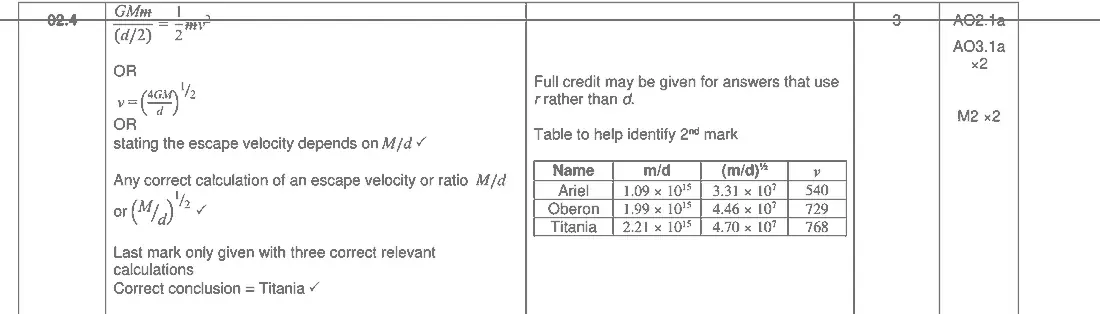
Answer: Titania (v esc = root(4GM/d): Ariel 540, Oberon 729, Titania 768 m s^-1
or compare M/d)
three calculations needed
orbital speed is not escape velocity
Skills: MS2.3 Substitute numerical values into algebraic equations using appropriate units for physical quantities; MS0.3 Use ratios, fractions and percentages
November 2020 · Paper 2 · Q2.53 marksAO2=3Calculation
Earlier part of question 2 that this part uses
Mark scheme
Examiner's comment
Half the students did calculate the gravitational field strength for Ariel but then had no real idea how to use this information. There were some students who gained full marks, but for many the sticking point was providing a proof that the object could not reach 100 m. Stating that the force was 39 times weaker does not constitute proof.
Question 02.5
Notes from the mark scheme and report
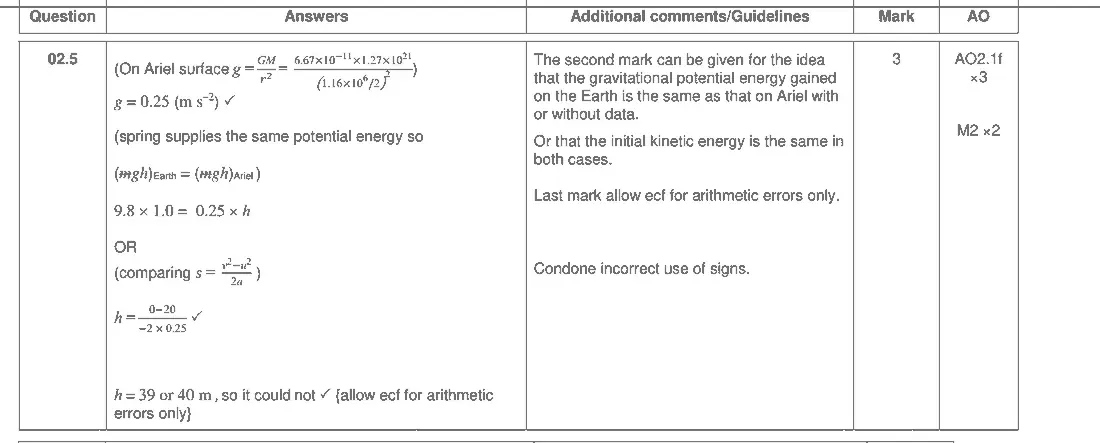
Answer: no - g on Ariel = 0.25 m s^-2, same energy so h = 9.8 x 1.0 / 0.25 = 39-40 m, less than 100 m
'force 39 times weaker' is not a proof
Skills: MS2.3 Substitute numerical values into algebraic equations using appropriate units for physical quantities; MS0.3 Use ratios, fractions and percentages
November 2020 · Paper 2 · Q121 markMultiple choice
Answer
D
Notes from the mark scheme and report
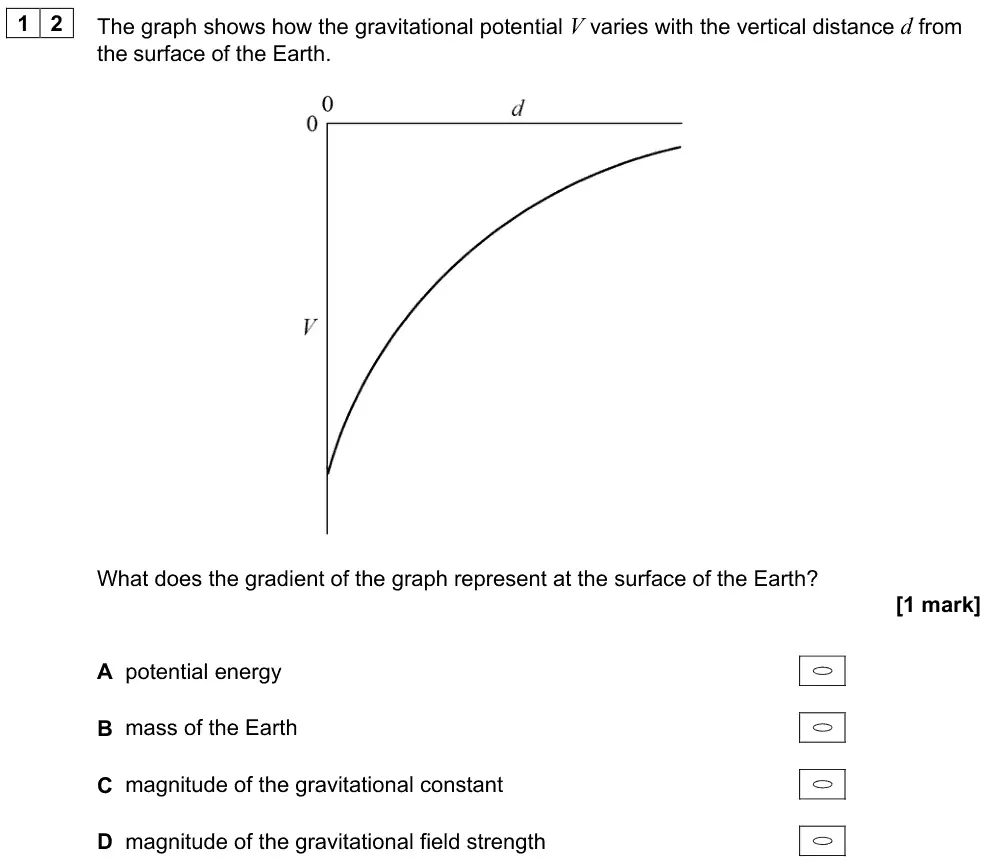
Answer: D
Skills: MS3.6 Draw and use the slope of a tangent to a curve as a measure of rate of change
November 2020 · Paper 2 · Q131 markMultiple choice
Answer
B
Notes from the mark scheme and report
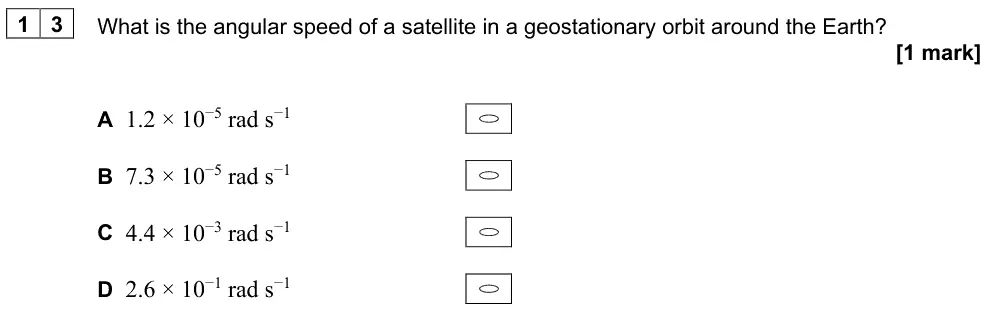
Answer: B
Skills: MS2.3 Substitute numerical values into algebraic equations using appropriate units for physical quantities
June 2019 · Paper 2 · Q3.11 markShort answer
Mark scheme
Examiner's comment
3.1 Here, it was lack of care that prevented students from gaining marks rather than lack of understanding. Around half the students obtained the mark. Those who failed to do so often did not refer to a unit mass. A very few made other errors such as choosing the wrong direction to move the mass.
Notes from the mark scheme and report
Work done per unit mass in bringing a mass from infinity to the point
'test mass' is not unit mass
around half obtained the mark
June 2019 · Paper 2 · Q3.21 markShort answer
Earlier part of question 3 that this part uses
Mark scheme
Examiner's comment
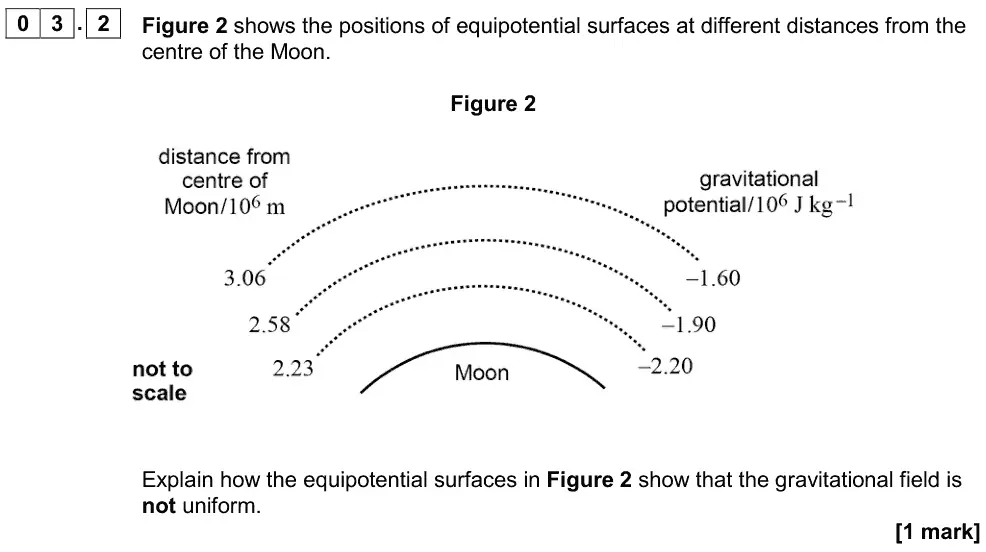
3.2 More than half the students gave a quick answer and said why the field was not uniform. Many of the others did not really know what to say and answers were often very confused. Some who gave a clear statement thought incorrectly that in a uniform field the potential should not change at all.
Notes from the mark scheme and report
Equal potential steps (0.30 x 10^6 J kg^-1) but unequal spacings (delta V / delta r changes), or surfaces are curved, not parallel planes
June 2019 · Paper 2 · Q3.34 marksCalculation
Earlier part of question 3 that this part uses
Mark scheme
Examiner's comment
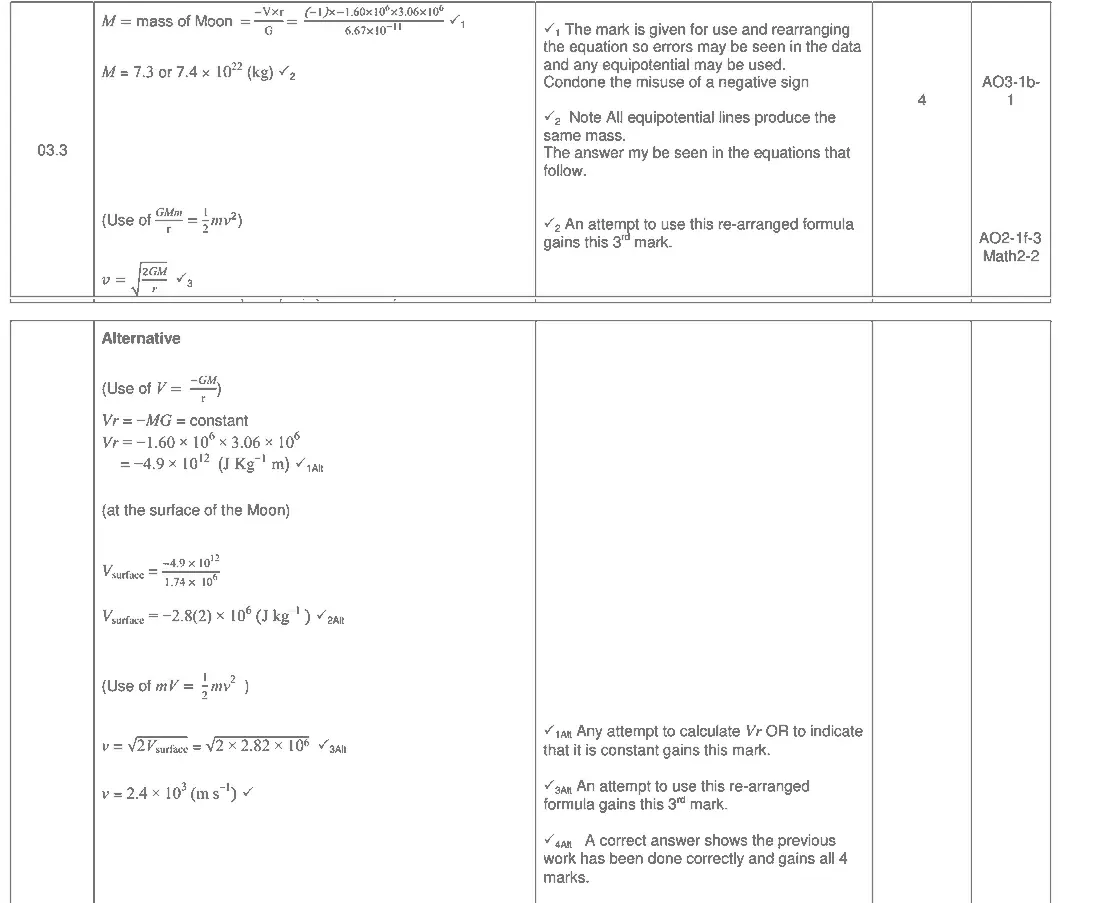
3.3 This was a very discriminating question with around 30% of students achieving no marks but around 40% gaining full marks. A large number of students could conjure up the escape-velocity equation in some form. When used, this gained a mark. The main difficulty for the students was to find an appropriate mass to substitute into the equation and this is where most errors occurred. Either students used a correct potential equation but with the wrong data, or they tried to use a force equation which would not give the correct mass.
Notes from the mark scheme and report
Answer: 2.4 x 10^3 m s^-1 (M = -Vr/G = 7.3 x 10^22 kg from any equipotential
v = root(2GM/r) with r = 1.74 x 10^6 m)
finding the mass was the main difficulty
about 30% scored zero, 40% full marks
Skills: MS2.2 Change the subject of an equation, including non-linear equations; MS2.3 Substitute numerical values into algebraic equations using appropriate units for physical quantities
June 2019 · Paper 2 · Q4.62 marksCalculation
Earlier part of question 4 that this part uses
Mark scheme
Examiner's comment
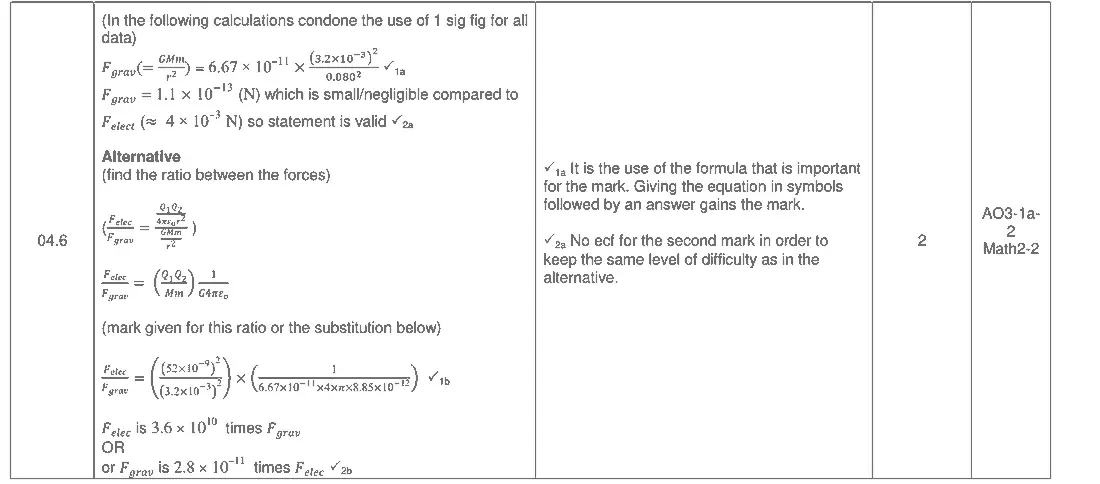
4.6 The calculation of the gravitational force was done well by most students. Unfortunately, many students then failed to compare this to the electrostatic force. Many simply said the gravitational force was negligible without saying compared to what.
Notes from the mark scheme and report
Answer: F grav = 1.1 x 10^-13 N, negligible compared with the electrostatic force 3.8 x 10^-3 N, so valid
must compare with the electrostatic force
Skills: MS2.3 Substitute numerical values into algebraic equations using appropriate units for physical quantities; MS0.2 Recognise and use expressions in decimal and standard form
June 2019 · Paper 2 · Q81 markMultiple choice
Answer
B
Notes from the mark scheme and report
Answer: B
June 2019 · Paper 2 · Q91 markMultiple choice
Answer
B
Notes from the mark scheme and report
Answer: B
Skills: MS2.3 Substitute numerical values into algebraic equations using appropriate units for physical quantities
June 2019 · Paper 2 · Q101 markMultiple choice
Answer
C
Notes from the mark scheme and report
Answer: C
Skills: MS2.2 Change the subject of an equation, including non-linear equations
June 2019 · Paper 2 · Q111 markMultiple choice
Answer
D
Notes from the mark scheme and report
Answer: D
June 2019 · Paper 2 · Q121 markMultiple choice
Answer
C
Notes from the mark scheme and report
Answer: C
June 2018 · Paper 2 · Q131 markMultiple choiceEasy
Answer
A
Examiner's comment
The 25 questions in Section B are summarised in the table below. For each question, the key (correct answer) is provided, along with the percentage of students answering correctly. There was a good range of ‘facility’ across this section; the most accessible question was 13 (answered correctly by 81.4% of students), the least accessible were 12 and 23 (answered correctly by only 15% and 13.3% of students respectively). The overall mean mark achieved by the students for Section B was 15.4 out of 25 (61.6%).
Notes from the mark scheme and report
Answer: A
Skills: MS2.3 Substitute numerical values into algebraic equations using appropriate units for physical quantities
June 2018 · Paper 2 · Q141 markMultiple choice
Answer
D
Notes from the mark scheme and report
Answer: D
June 2018 · Paper 2 · Q151 markMultiple choice
Answer
C
Notes from the mark scheme and report
Answer: C
June 2018 · Paper 2 · Q161 markMultiple choice
Answer
B
Notes from the mark scheme and report
Answer: B
Skills: MS0.3 Use ratios, fractions and percentages
June 2018 · Paper 2 · Q171 markMultiple choice
Answer
D
Notes from the mark scheme and report
Answer: D
Skills: MS2.3 Substitute numerical values into algebraic equations using appropriate units for physical quantities
June 2018 · Paper 2 · Q181 markMultiple choice
Answer
C
Notes from the mark scheme and report
Answer: C
Skills: MS3.11 Use logarithmic plots to test exponential and power law variations
June 2018 · Paper 2 · Q191 markMultiple choice
Answer
A
Notes from the mark scheme and report
Answer: A
Skills: MS2.2 Change the subject of an equation, including non-linear equations; MS4.3 Calculate areas of triangles, circumferences and areas of circles, surface areas and volumes of rectangular blocks, cylinders and spheres
June 2017 · Paper 2 · Q6.11 markShort answer
Mark scheme
Examiner's comment
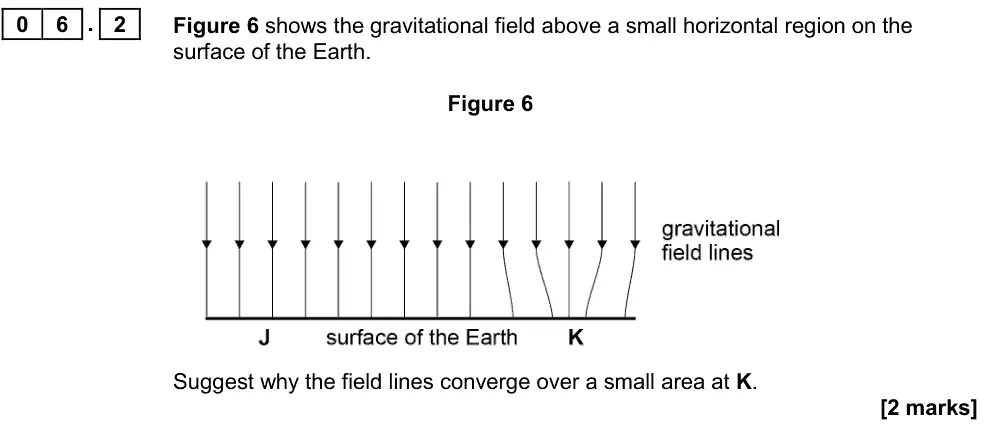
06.1 A majority of answers simply reinterpreted the words of the question and made no reference to force or mass. So there was a proliferation of answers such as, “They show the direction of the field acts in”. Only a minority of students gave a complete answer. A common misunderstanding that was frequently stated was the idea that a mass will follow the field line when free to move. This may be true for an initial movement, but subsequently, because of the build-up of momentum, it is not generally true. 06.2 Many students appreciated that the gravitational field was stronger at K but then did not give a good reason for it. They often referred to the earth not being flat, or stated that K is up a mountain or down a hole. Other students did state that there was a mass at K or it was an area where the Earth’s density is greater, but they did not refer to the field being stronger. Also a few students referred to gravitational force when they were really referring to gravitational field.
Notes from the mark scheme and report
Direction of the force on a (small) mass placed in the field
restating 'direction of the field' not credited
mass does not follow a field line
June 2017 · Paper 2 · Q6.22 marksExplanation
Earlier part of question 6 that this part uses
Mark scheme
Examiner's comment
06.1 A majority of answers simply reinterpreted the words of the question and made no reference to force or mass. So there was a proliferation of answers such as, “They show the direction of the field acts in”. Only a minority of students gave a complete answer. A common misunderstanding that was frequently stated was the idea that a mass will follow the field line when free to move. This may be true for an initial movement, but subsequently, because of the build-up of momentum, it is not generally true. 06.2 Many students appreciated that the gravitational field was stronger at K but then did not give a good reason for it. They often referred to the earth not being flat, or stated that K is up a mountain or down a hole. Other students did state that there was a mass at K or it was an area where the Earth’s density is greater, but they did not refer to the field being stronger. Also a few students referred to gravitational force when they were really referring to gravitational field.
Notes from the mark scheme and report
Lines closer so field stronger at K
denser material (more mass) beneath K
'force stronger' not enough for mark 1
June 2017 · Paper 2 · Q6.32 marksExplanation
Earlier part of question 6 that this part uses
Mark scheme
Examiner's comment
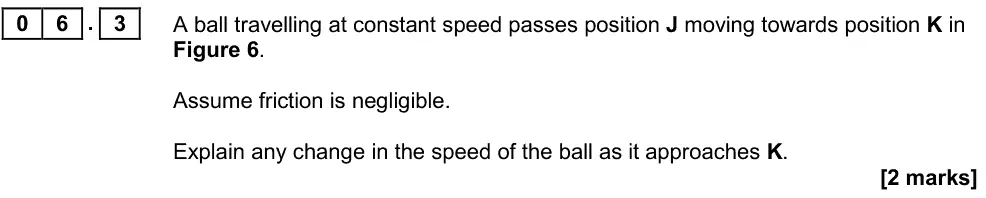
06.3 Only a small number of students deduced that the field had a component horizontally near K. Therefore very few scored 2 marks. A majority did appreciate that the ball would accelerate, even if their reasoning was sometimes false. Several students misinterpreted the question and thought that the ball was falling, but this would not have excluded the student from scoring both marks. If no direction was stated, the motion was treated as horizontal by examiners. If the students thought the ball was falling, and separated the horizontal and vertical motion, both marks are obtainable. The vertical was ignored and both points in the mark scheme are still true for the horizontal motion.
Notes from the mark scheme and report
Ball speeds up: field lines near K have a horizontal component towards K (or potential lower at K)
few saw the horizontal component
June 2017 · Paper 2 · Q6.41 markShort answer
Earlier part of question 6 that this part uses
Mark scheme
Examiner's comment
06.4 The idea behind the question was well understood by the vast majority of students. It was only the least able who missed out on the mark.
Notes from the mark scheme and report
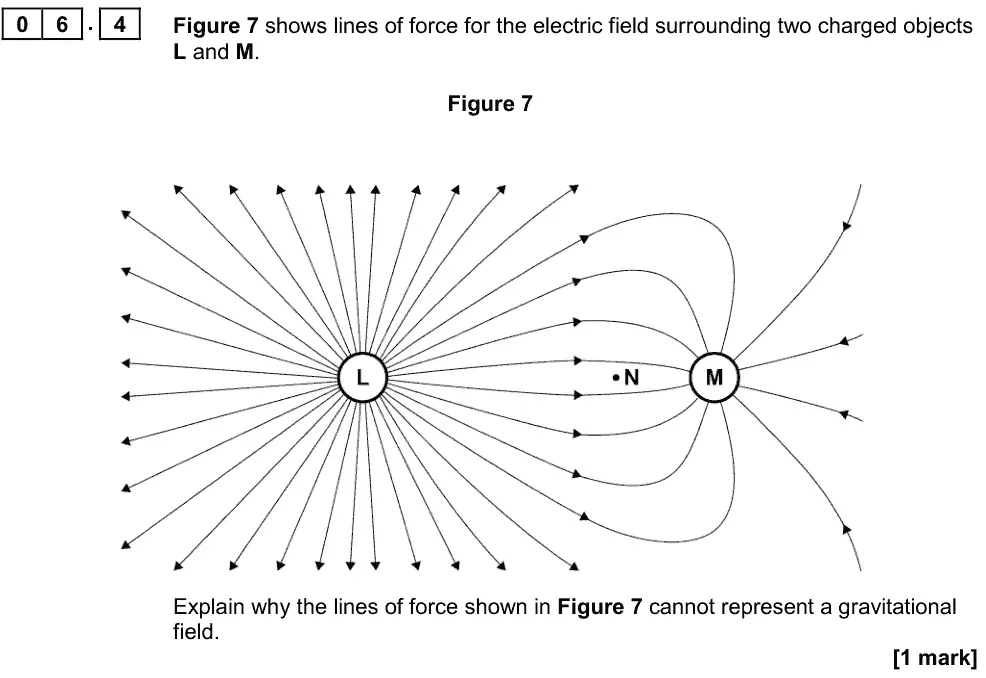
Gravitational field lines can only point towards a mass (attraction only)
lines leave L
referring to positive/negative almost always lost the mark
June 2017 · Paper 2 · Q7.12 marksShow that
Mark scheme
Examiner's comment
07.1 Most scripts showed a clear connection between the centripetal force and the force of gravity on the satellite, to arrive at the correct proportional relationship between T2 and r3. Less able students failed to get the two starting equations and only toyed with the centripetal equation unsuccessfully. The most common algebraic mistake was to miss that the π term was squared when (2π)2 was expanded.
Notes from the mark scheme and report
GMm/r^2 = m r (2 pi/T)^2 gives T^2 = (4 pi^2/GM) r^3
common slip: not squaring 2 pi
Skills: MS2.2 Change the subject of an equation, including non-linear equations
June 2017 · Paper 2 · Q7.22 marksCalculation
Earlier part of question 7 that this part uses
Mark scheme
Examiner's comment
07.2 Marks for this calculation were quite low because students could not cope with the quite complicated proportional relationship. Some students avoided the proportional calculation by using the Kepler’s equation derived earlier. Quite a number of these students then got into difficulty because the distances were given in km and not m.
Notes from the mark scheme and report
Answer: 250 yr ((T/1 yr)^2 = (5.91 x 10^9 / 1.50 x 10^8)^3)
proportional method poorly handled
km to m problems when using GM
Skills: MS0.3 Use ratios, fractions and percentages; MS0.5 Use calculators to find and use power, exponential and logarithmic functions
June 2017 · Paper 2 · Q7.33 marksCalculation
Earlier part of question 7 that this part uses
Mark scheme
Examiner's comment
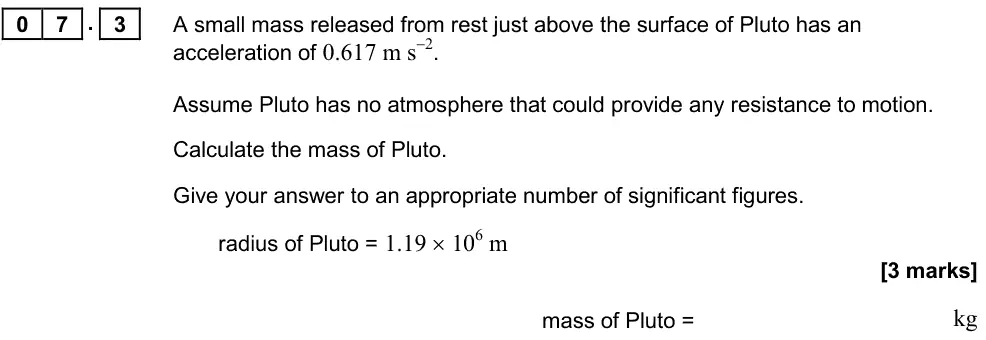
07.3 This question was tackled well by most students. Equating the Universal gravitational force to mg was a well understood task. Only the least able students failed to rearrange the equation or made calculation errors. A significant number that were correct failed to answer using 3 significant figures, but by the same token some making calculation errors did give an answer to 3 significant figures, and thereby gained a mark.
Notes from the mark scheme and report
Answer: 1.31 x 10^22 kg (M = g r^2 / G)
third mark for 3 sf (stands alone)
Skills: MS2.2 Change the subject of an equation, including non-linear equations; MS1.1 Use an appropriate number of significant figures
June 2017 · Paper 2 · Q7.43 marksCalculation
Earlier part of question 7 that this part uses
Mark scheme
Examiner's comment
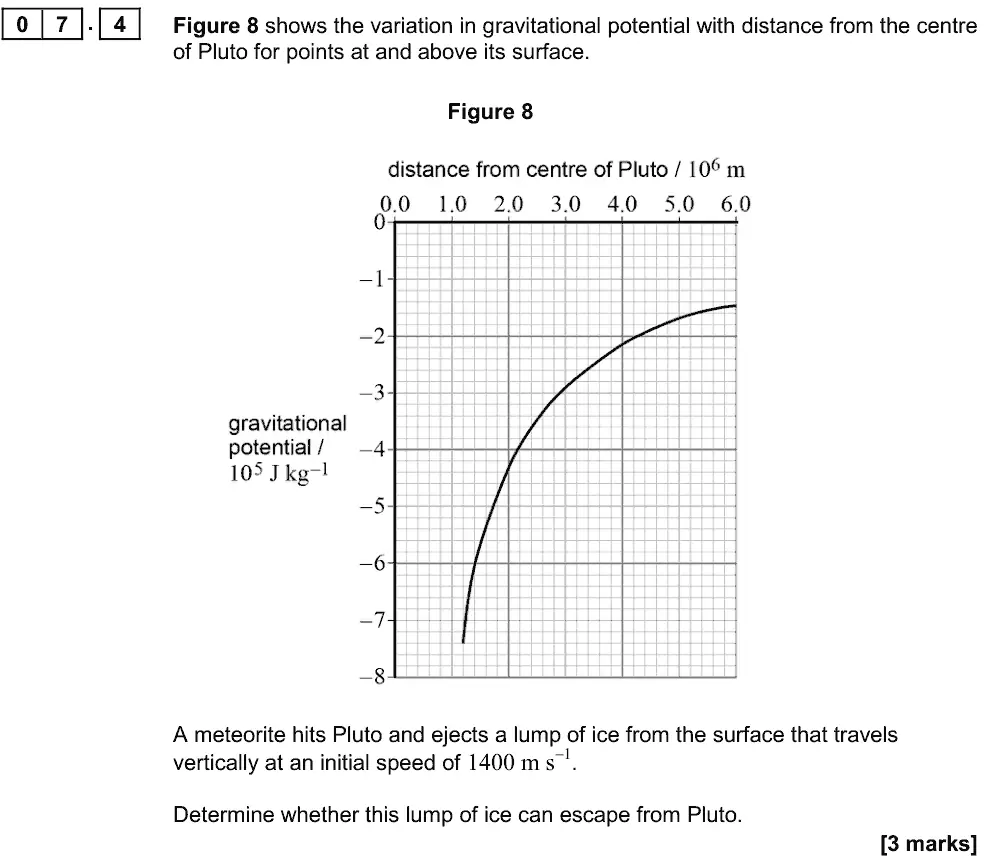
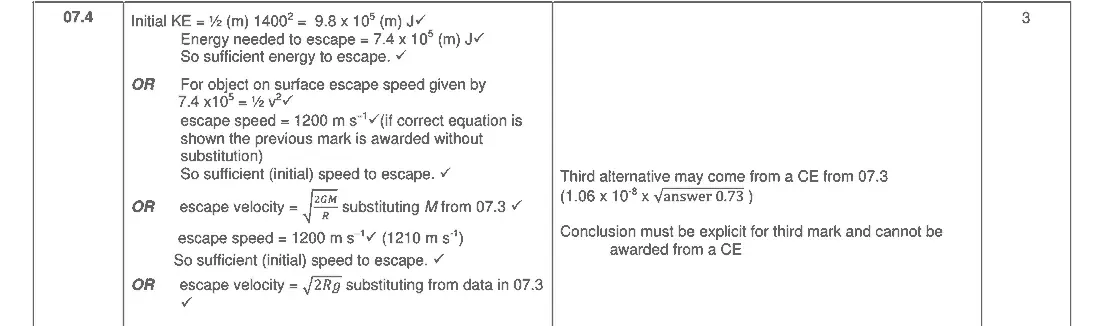
07.4 The students who took the very straightforward approach and calculated the escape velocity were very successful in this question. However, a majority of students made errors. Many did not know the escape velocity equation or could not get to it from the conservation of energy. Other students referred to the top of the graph, Figure 8, at a potential of -1.4 × 10⁵ J kg-1 as being the point at which the ice escapes, which is a physics error.
Notes from the mark scheme and report
Yes: KE per kg = 9.8 x 10^5 J kg^-1 exceeds 7.4 x 10^5 J kg^-1 needed (escape speed about 1200 m s^-1 < 1400 m s^-1)
explicit conclusion needed
using the top of the graph (-1.4 x 10^5) as escape point is wrong
Skills: MS3.1 Translate information between graphical, numerical and algebraic forms; MS2.3 Substitute numerical values into algebraic equations using appropriate units for physical quantities
June 2017 · Paper 2 · Q121 markMultiple choice
Answer
C
Notes from the mark scheme and report
Answer: C
Skills: MS2.4 Solve algebraic equations, including quadratic equations
June 2017 · Paper 2 · Q131 markMultiple choice
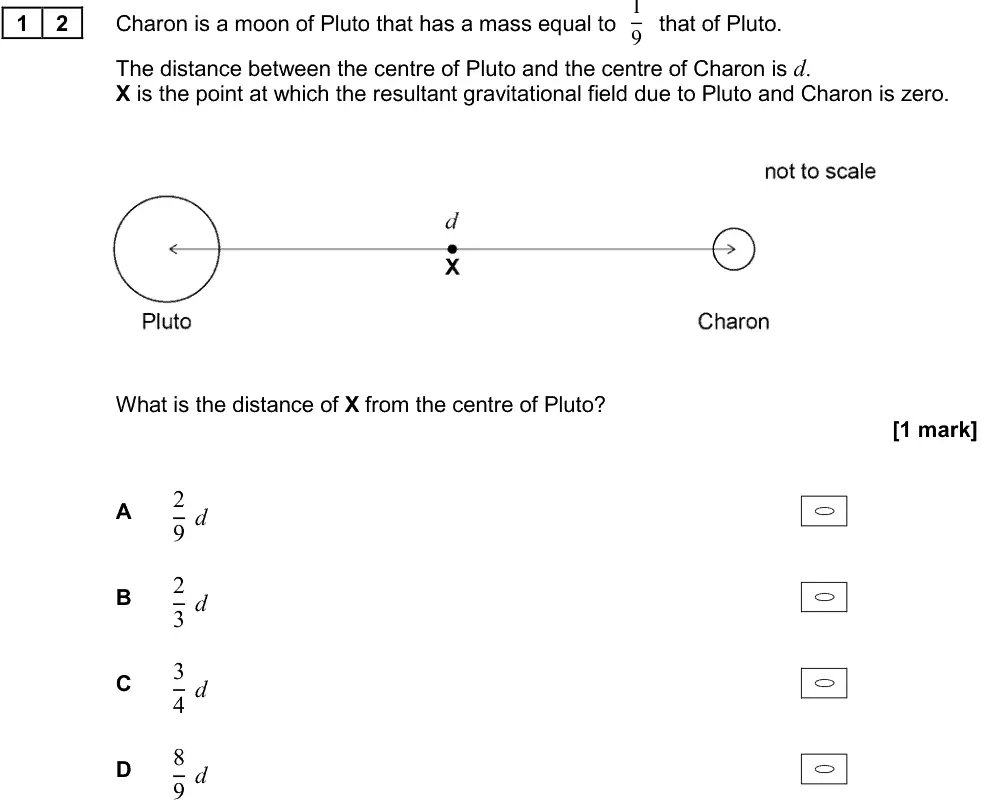
Answer
A
Notes from the mark scheme and report
Answer: A
Skills: MS0.3 Use ratios, fractions and percentages
June 2017 · Paper 2 · Q141 markMultiple choice
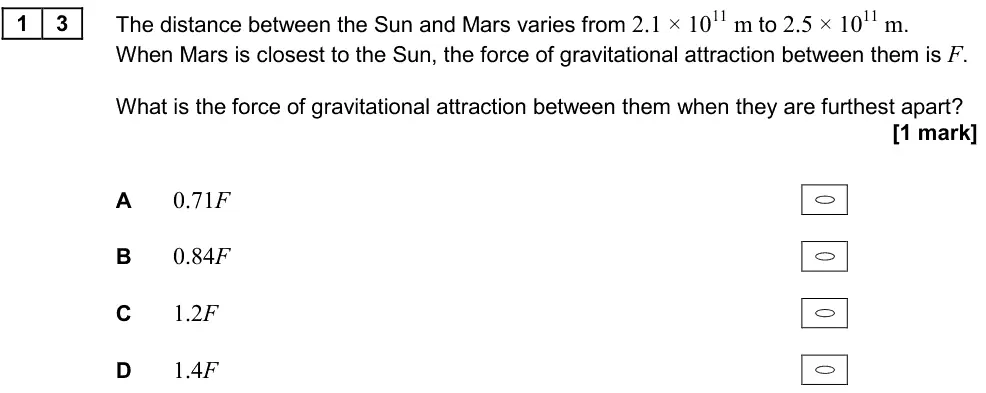
Answer
A
Notes from the mark scheme and report
Answer: A
Skills: MS2.2 Change the subject of an equation, including non-linear equations
Specimen set 1 · Paper 2 · Q6.12 marksShort answer
Mark scheme
Notes from the mark scheme and report
Any two: orbit above the equator
moving west to east (same direction as Earth's rotation)
period 24 hours
Specimen set 1 · Paper 2 · Q6.54 marksExplanation
Earlier part of question 6 that this part uses
Mark scheme
Notes from the mark scheme and report
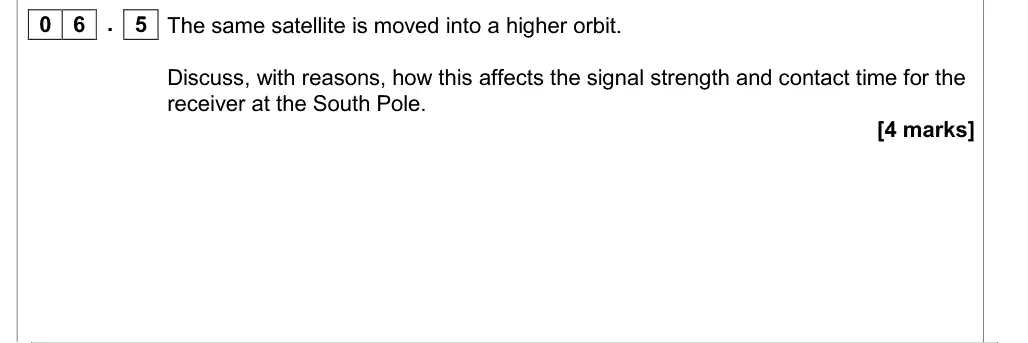
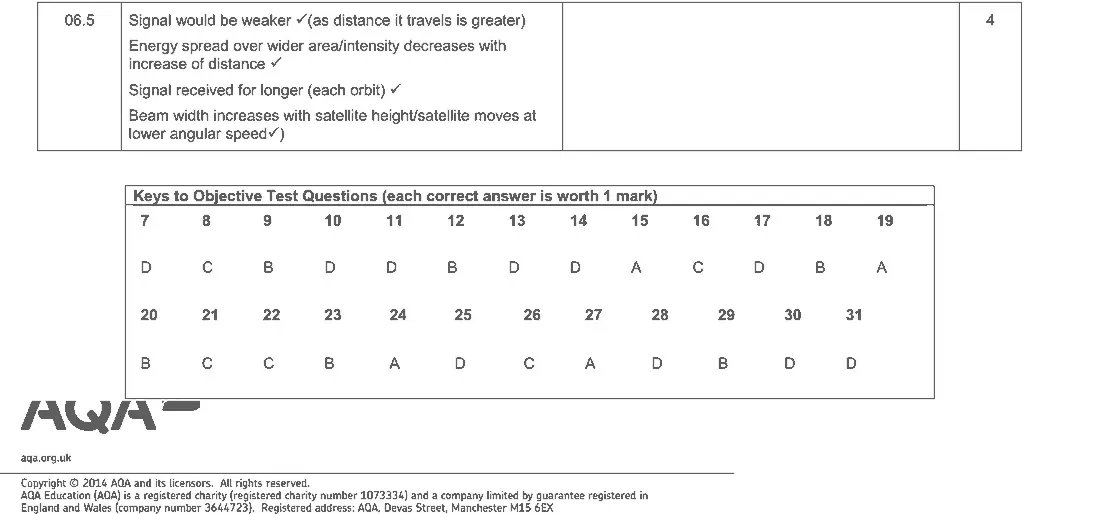
Signal weaker: greater distance, energy spread over a larger area (intensity falls)
contact time longer: wider beam and lower angular speed in a higher orbit
Specimen set 1 · Paper 2 · Q71 markMultiple choice
Answer
D
Notes from the mark scheme and report
Answer: D
Skills: MS0.1 Recognise and make use of appropriate units in calculations
Specimen set 1 · Paper 2 · Q81 markMultiple choice
Answer
C
Notes from the mark scheme and report
Answer: C
Skills: MS0.3 Use ratios, fractions and percentages
Specimen set 1 · Paper 2 · Q91 markMultiple choice
Answer
B
Notes from the mark scheme and report
Answer: B
Skills: MS2.4 Solve algebraic equations, including quadratic equations; MS0.3 Use ratios, fractions and percentages
Specimen set 1 · Paper 2 · Q101 markMultiple choice
Answer
D
Notes from the mark scheme and report
Answer: D
Work with an AQA physics tutor
Dropping marks on calculations, required practicals or the six-markers? Book a trial session with a specialist AQA physics tutor.