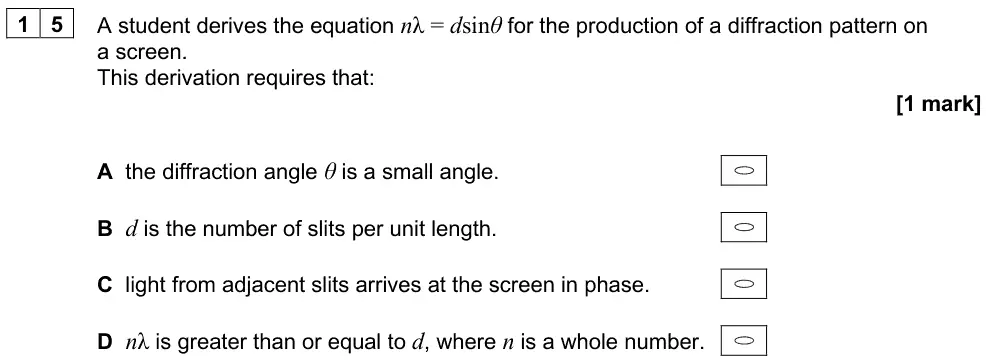
Answer
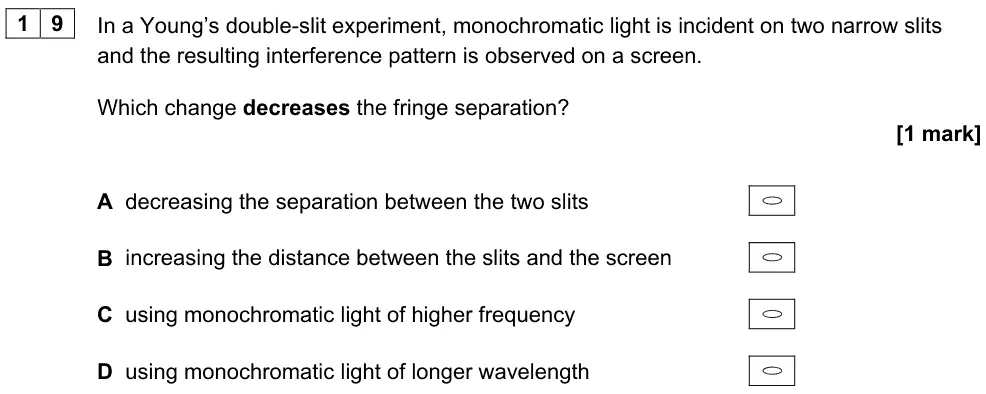
C
Mark scheme

Notes from the mark scheme and report
- Answer: C
Notes and key-term cards for this topic are being written by our tutors. The past-paper questions below are ready now.
| Series | Paper | Q | What it asks |
|---|---|---|---|
| June 2018 | AS Paper 1 | 7.3 | student decides to use the apparatus shown in Figure 8 to determine the |
C
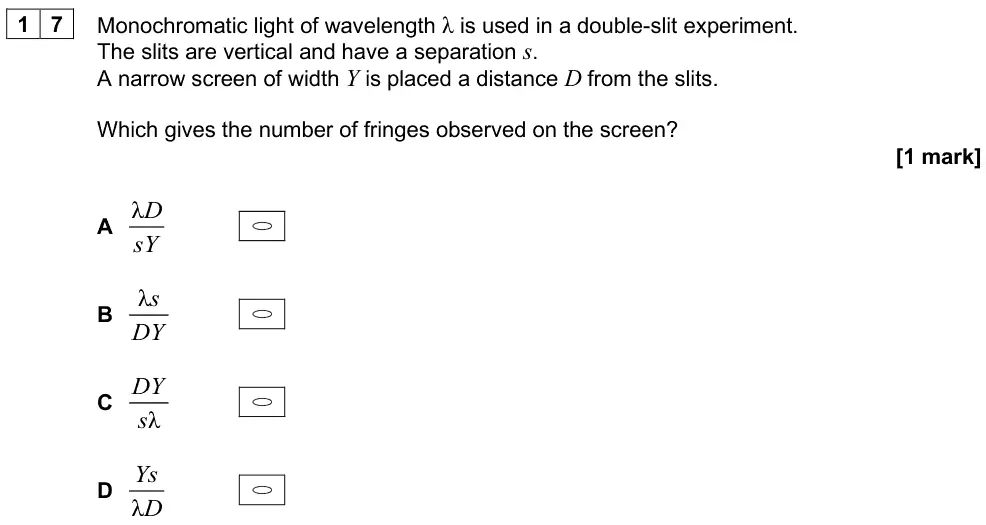
D
Skills: MS2.2 Change the subject of an equation, including non-linear equations
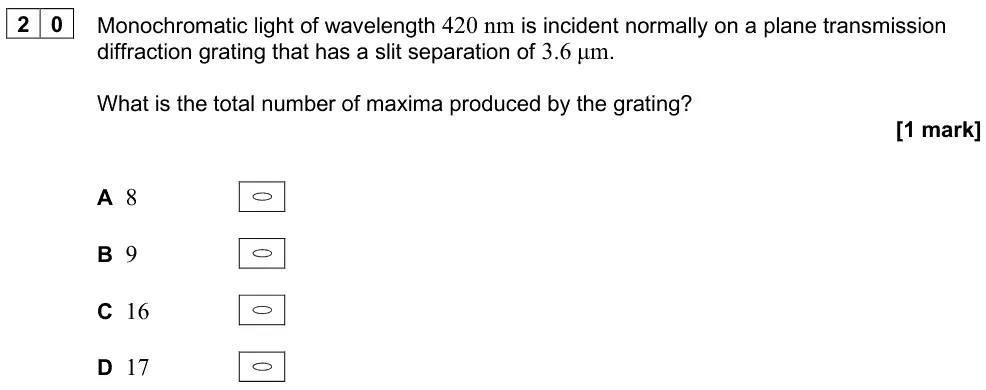
D
Skills: MS0.6 Use calculators to handle sin x, cos x, tan x when x is expressed in degrees or radians
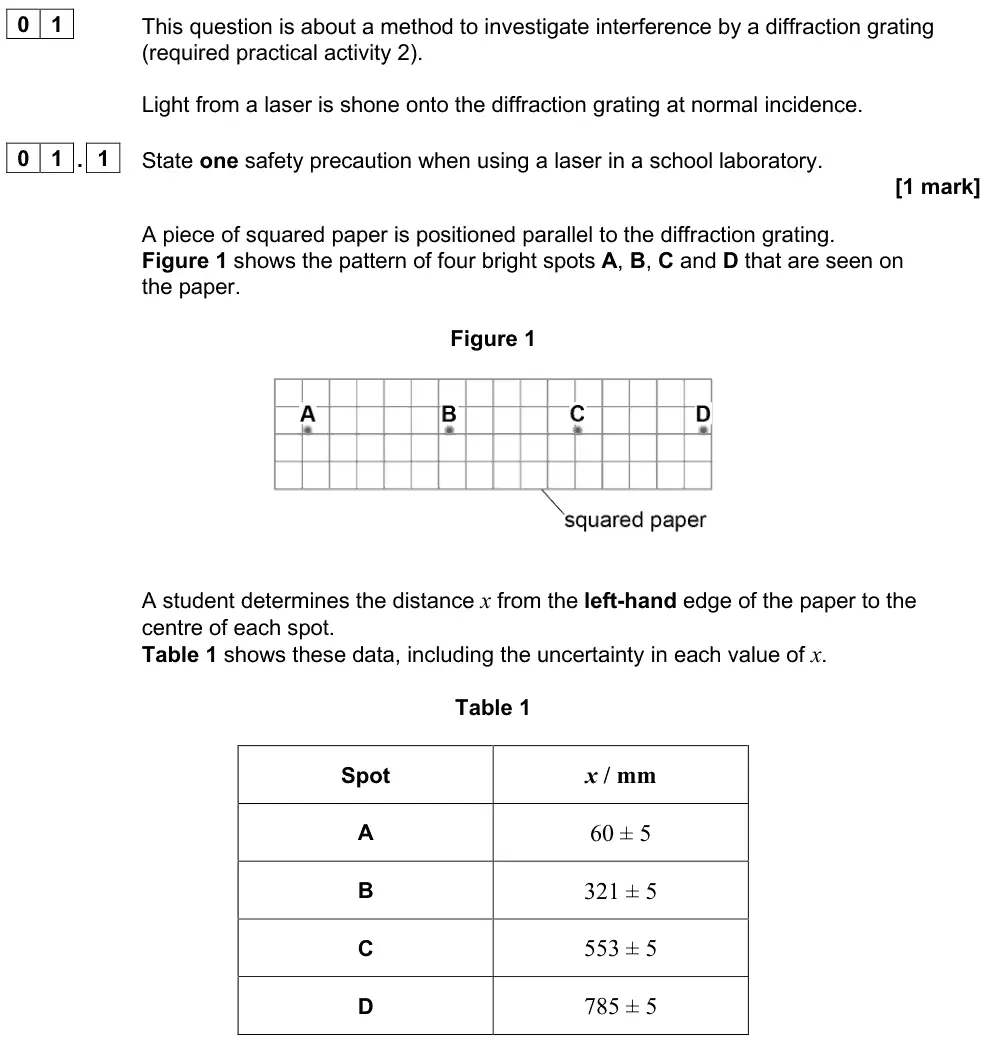
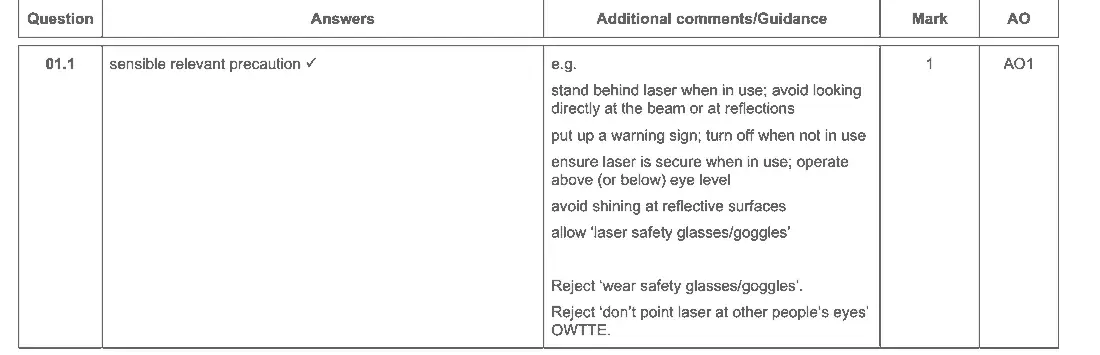
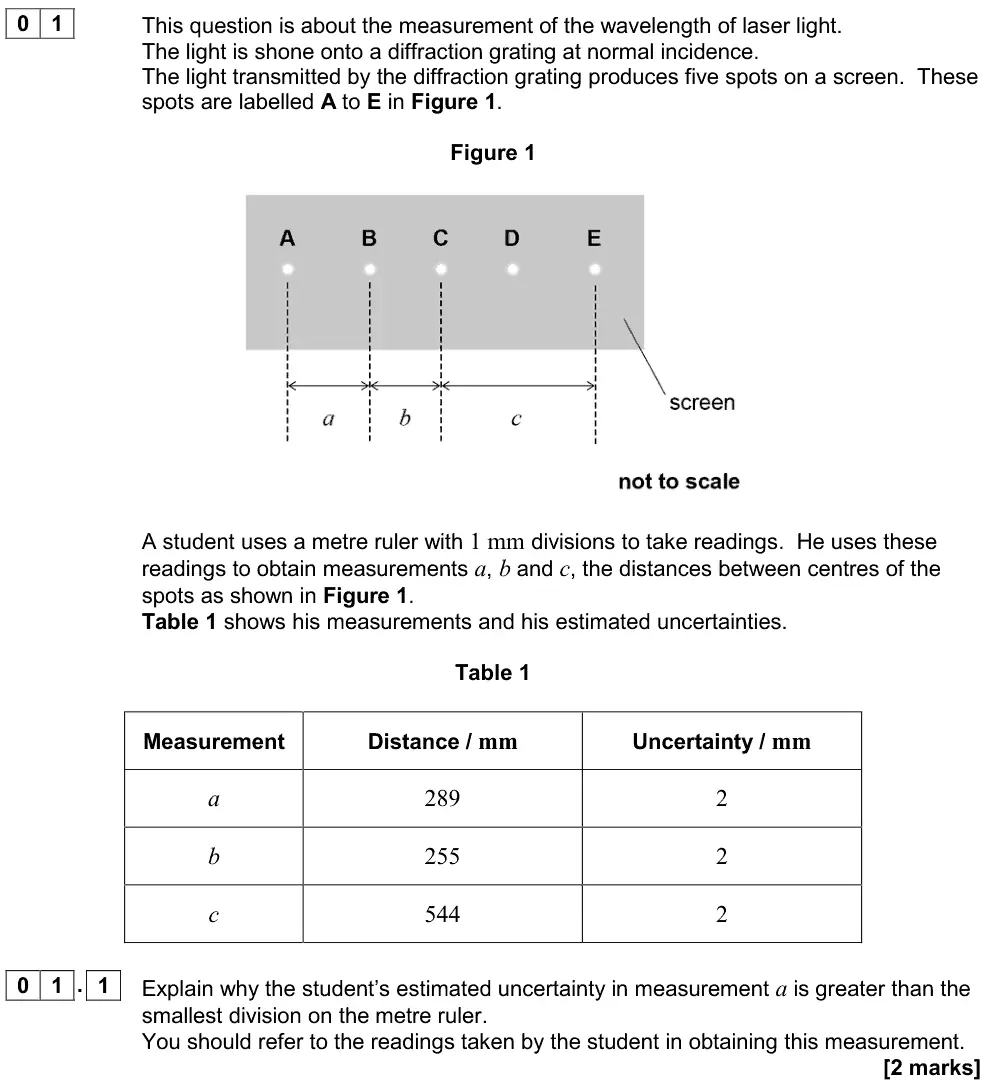
01.1 About 50% of students gave a relevant safety precaution when using a laser. Just over half the cohort gained one mark for determining ∆x. Many percentage 01.2 uncertainties were quoted to more than two significant figures, which was inconsistent with the data.
Skills: PS4.1 Know and understand how to use a wide range of experimental and practical instruments, equipment and techniques; RP2 Investigation of interference effects to include the Young’s slit experiment and interference by a diffraction grating.
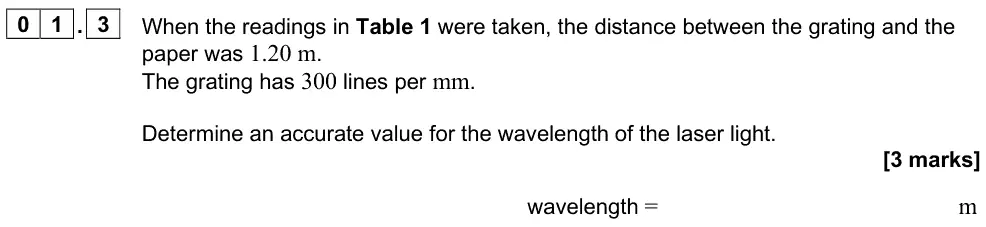
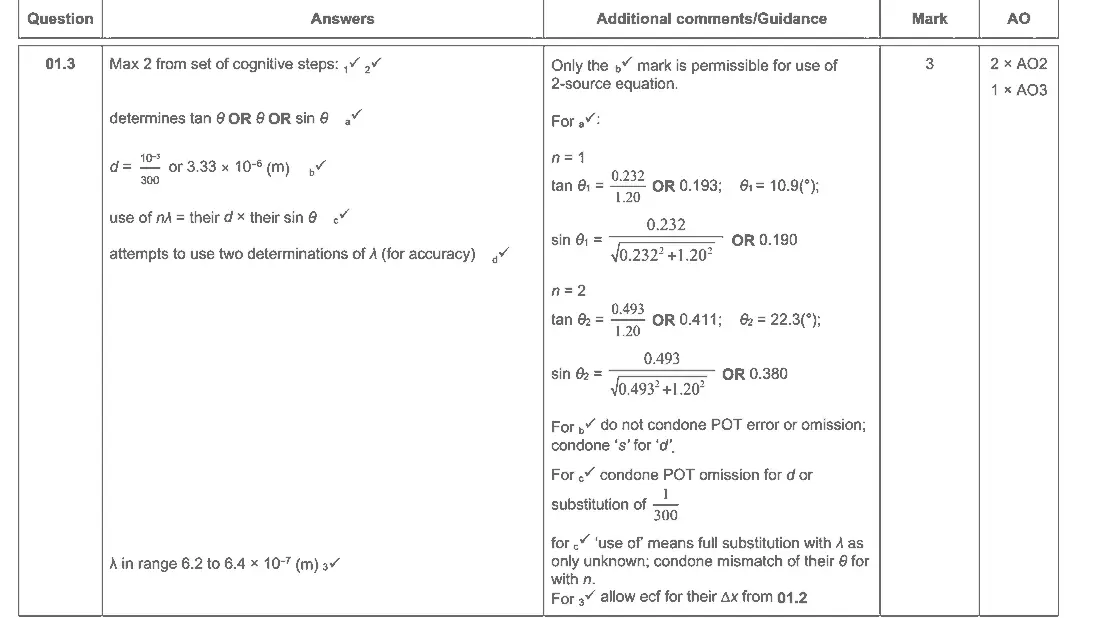
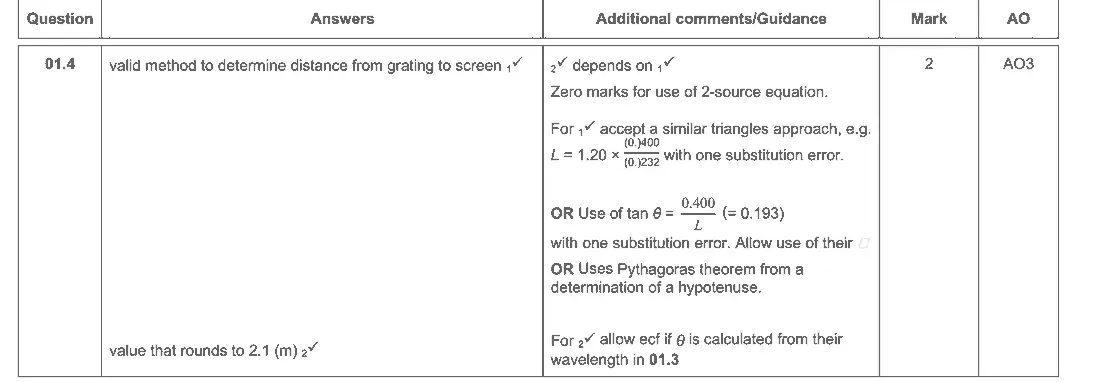
01.3 A large majority of students invoked the double-slit equation for this part and were limited to one mark for a determination of the slit separation. Some students who correctly identified the diffraction grating equation had little idea what values to use with each term, for instance using 300 for n. Only about 30% of students gained more than one mark. 01.4 Only about a quarter of students gained any marks here. As with 01.3, many viewed it as a double-slit investigation and so could not provide anything worthy of credit.
Skills: MS4.5 Use sin, cos and tan in physical problems; MS0.6 Use calculators to handle sin x, cos x, tan x when x is expressed in degrees or radians; MS2.2 Change the subject of an equation, including non-linear equations; RP2 Investigation of interference effects to include the Young’s slit experiment and interference by a diffraction grating.
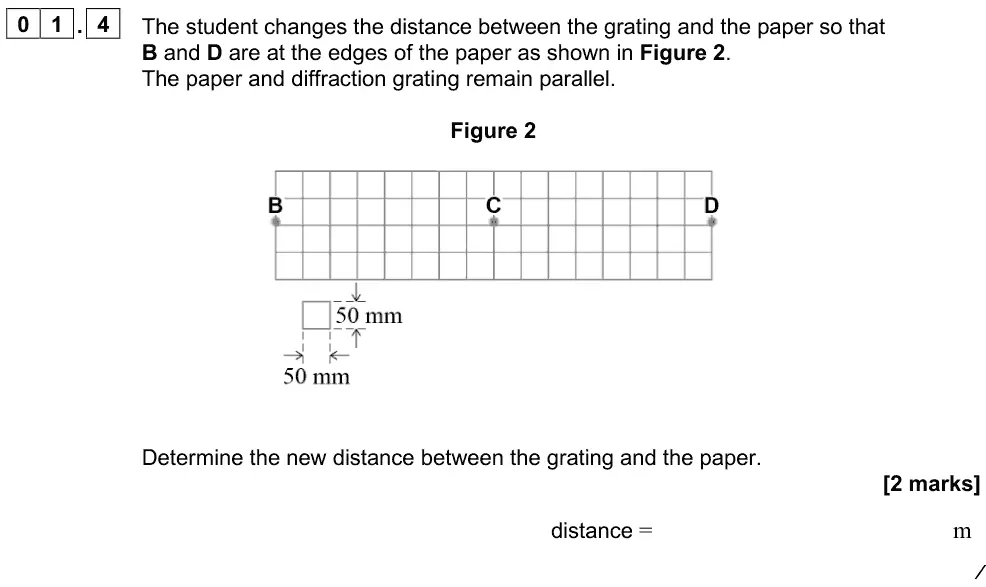
01.4 Only about a quarter of students gained any marks here. As with 01.3, many viewed it as a double-slit investigation and so could not provide anything worthy of credit.
Skills: MS4.5 Use sin, cos and tan in physical problems; MS0.3 Use ratios, fractions and percentages; RP2 Investigation of interference effects to include the Young’s slit experiment and interference by a diffraction grating.
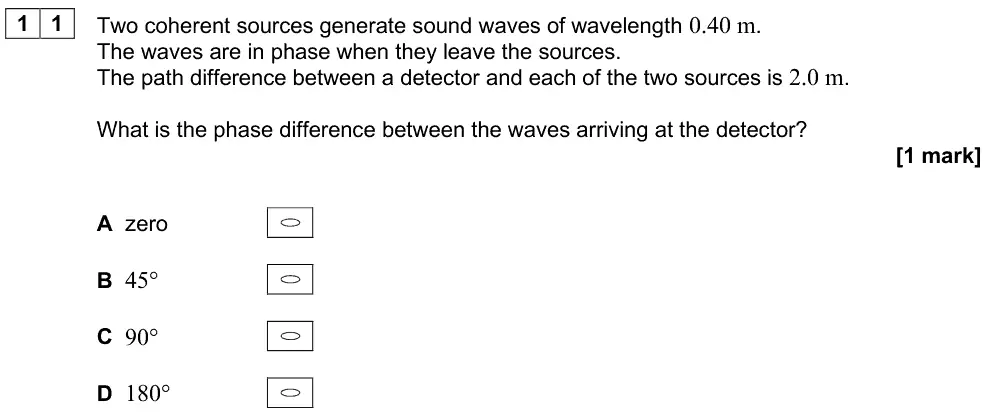
A
Students were more successful in answering questions 6, 11, 14, 19, 22, 28, and were less successful in answering questions 10, 15, 21, 25, 29.

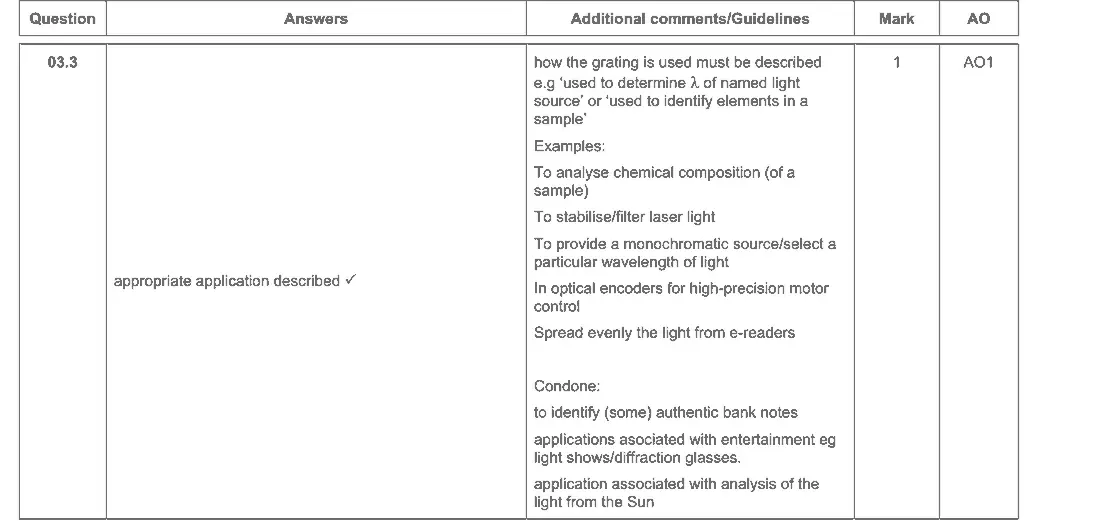
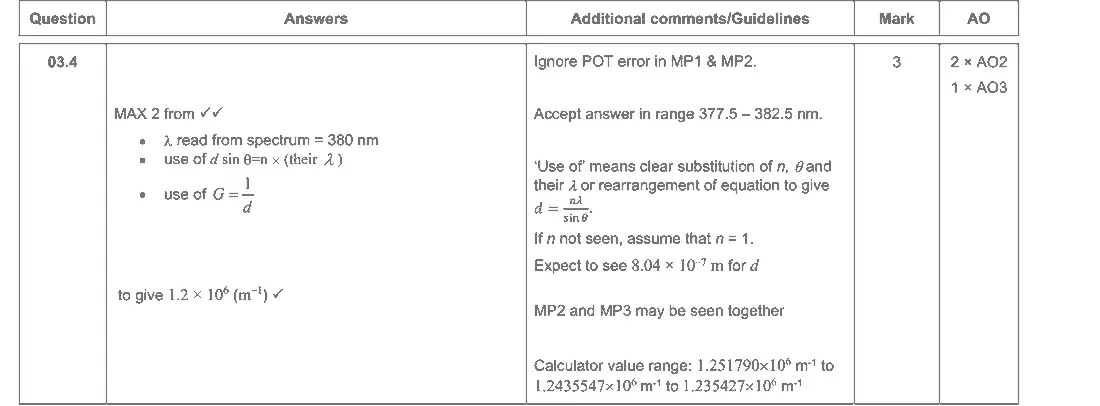
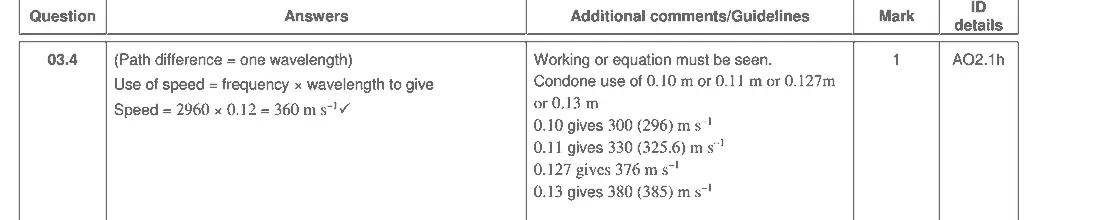
Question 03.3 is another question that is on the specification that most students could not answer. There is a list of acceptable answers in the mark scheme that schools could refer to when teaching this. Answers that referred to the use of diffraction gratings in teaching were not rewarded. The calculation in 03.4 was completed successfully by most students. The structure of the mark scheme allowed the award of intermediate marks provided it was clear what the student was doing. Students should be encouraged to set out their work carefully so that examiners can identify the steps and award marks appropriately. A common error was to provide the slit separation, rather than the number of lines per metre, and therefore not get the last mark.
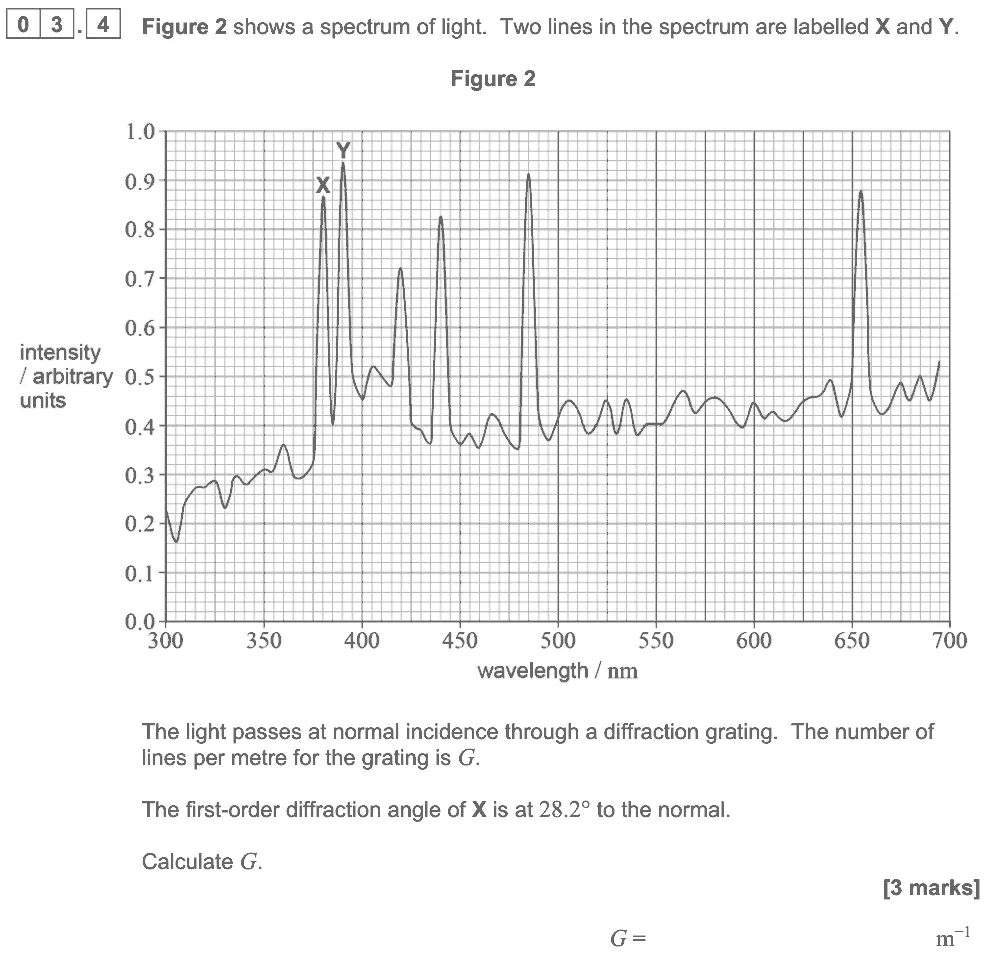
The calculation in 03.4 was completed successfully by most students. The structure of the mark scheme allowed the award of intermediate marks provided it was clear what the student was doing. Students should be encouraged to set out their work carefully so that examiners can identify the steps and award marks appropriately. A common error was to provide the slit separation, rather than the number of lines per metre, and therefore not get the last mark.
Skills: MS3.1 Translate information between graphical, numerical and algebraic forms; MS0.6 Use calculators to handle sin x, cos x, tan x when x is expressed in degrees or radians; MS2.2 Change the subject of an equation, including non-linear equations
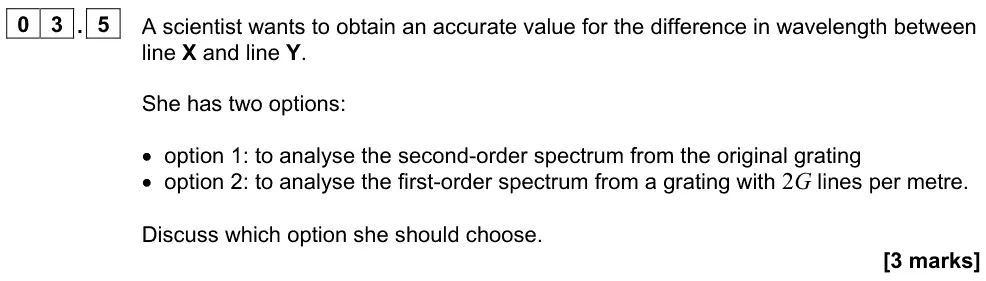
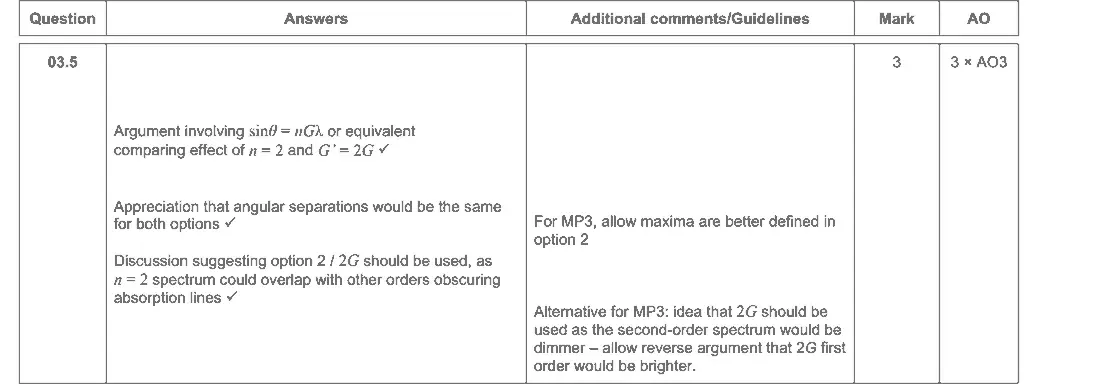
Question 03.5 was one of the hardest on the paper. Many students made no attempt at analysis and made assumptions that led to zero marks. The best answers identified that the angles in the two situations would be the same. Students who did not do this often discussed percentage error in the angle being measured as the difference between them. It was also clear that many students did not understand the difference between accuracy and precision.
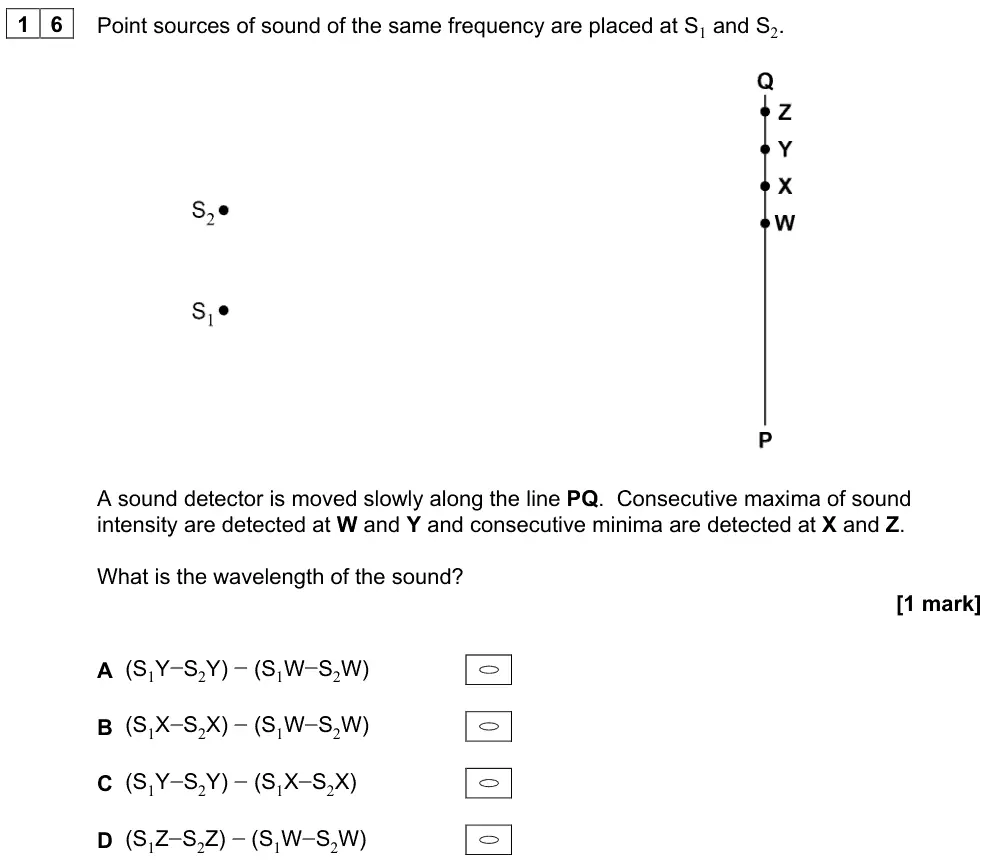
A
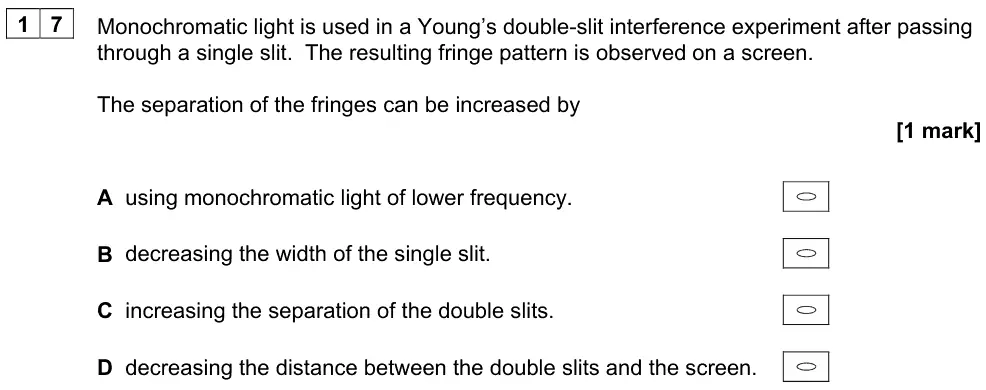
A
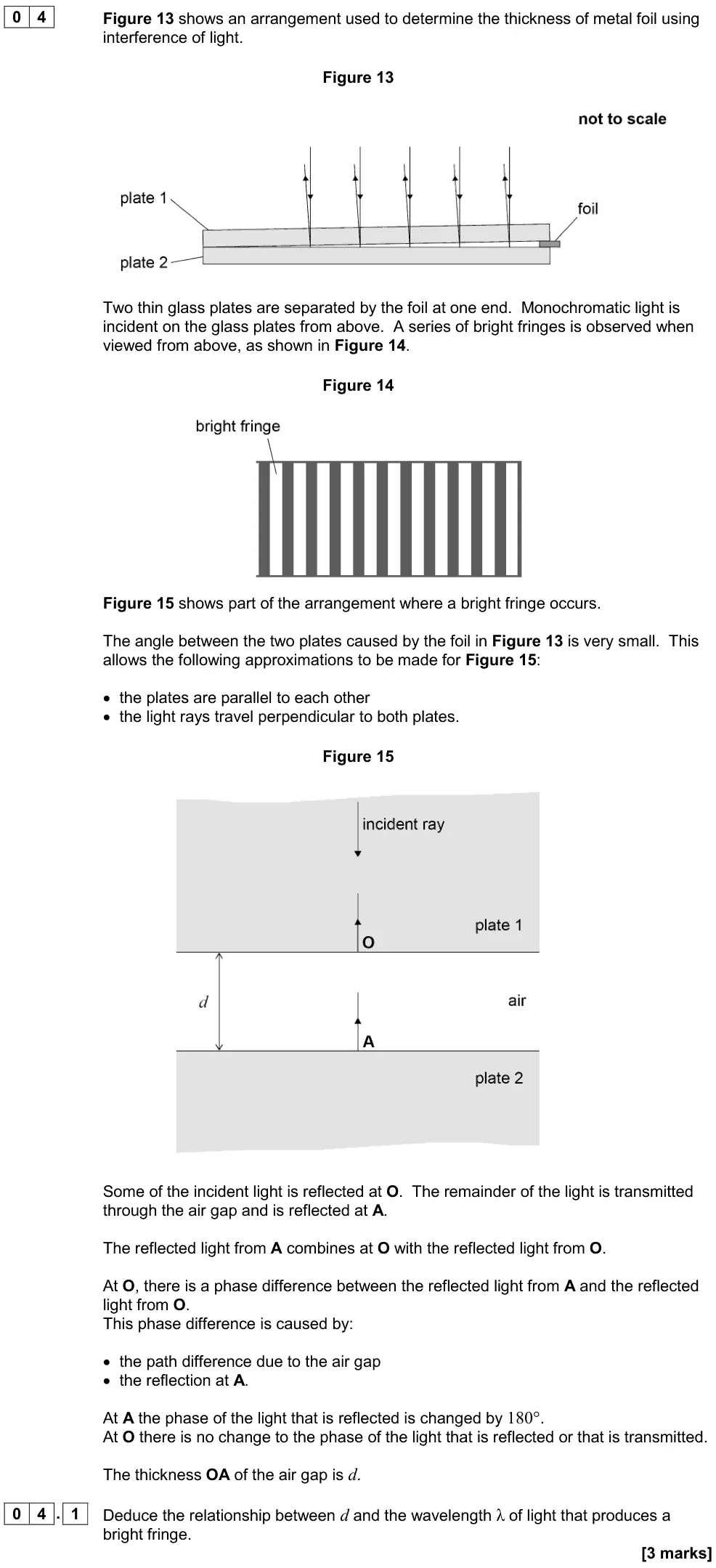
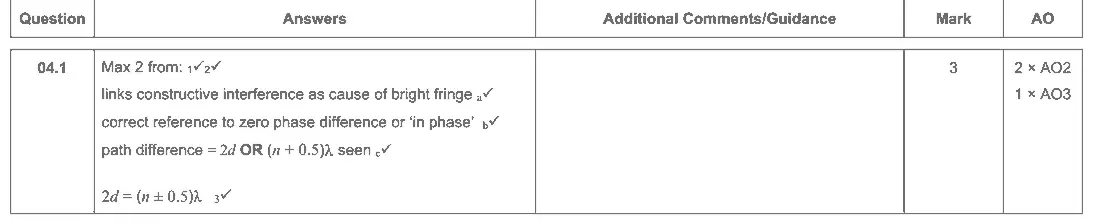
04.1 Most students achieved little success in this question about constructive interference. Many struggled with the meaning of “relationship” and often gave an answer in terms of a correlation, eg “as d increases …”. Answers that invoked the equations for a diffraction grating or two– source interference were frequently given, with no connection to the physics of the arrangement.
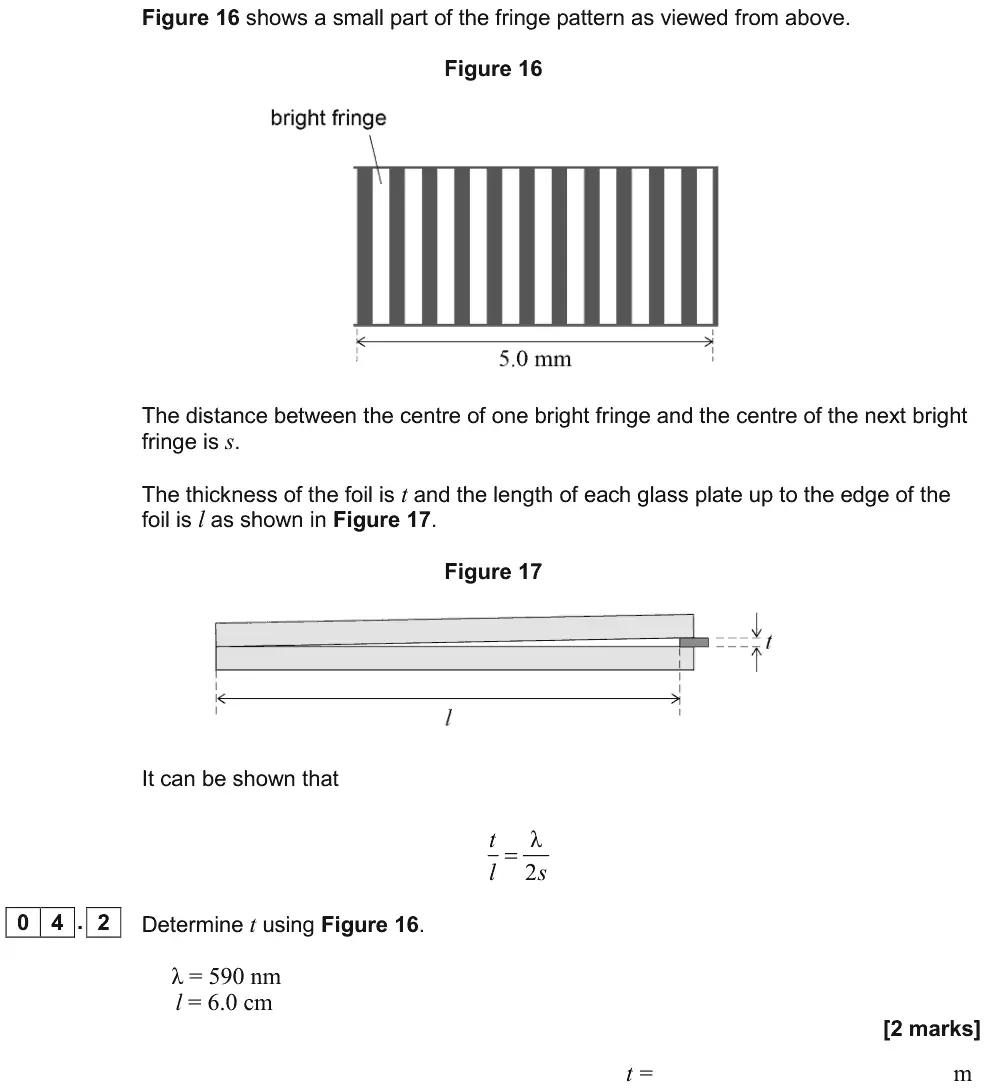
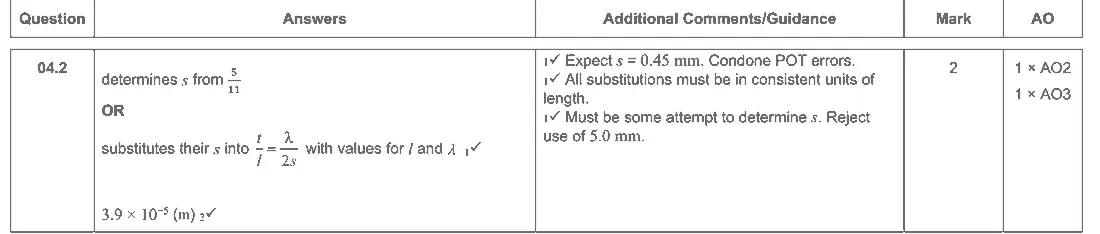
04.2 About 22% of students gained both marks with a further 35% or so gaining one mark for using an incorrect fringe spacing. The common mistakes were to omit the factor 2 when rearranging the equation or to convert prefixes incorrectly.
Skills: MS2.2 Change the subject of an equation, including non-linear equations; MS0.2 Recognise and use expressions in decimal and standard form
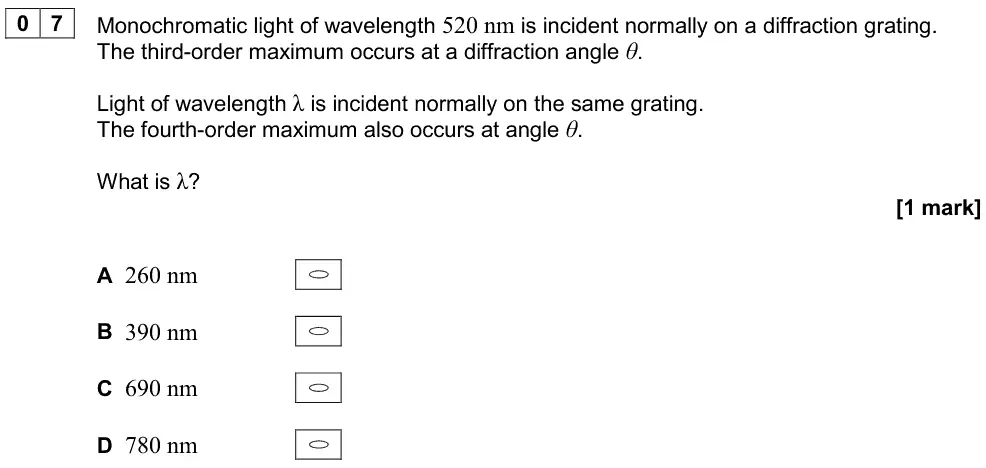
B
Generally, students were more successful in answering questions 5, 6, 7, 11, 14, 17 and were less successful in answering questions 9, 10, 12, 13, 15, 16, 18, 21, 22, 23.
Skills: MS0.3 Use ratios, fractions and percentages
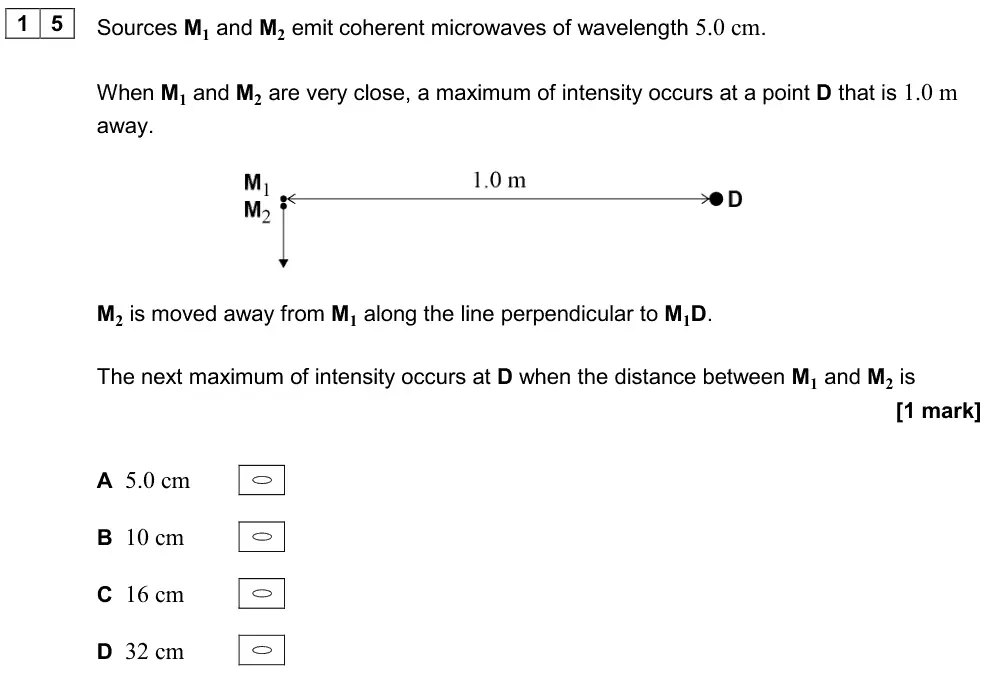
D
Question 15: Option B (10 cm) was the most popular response. Question 16: Option A (𝑢𝑢𝑠𝑠̅) was the most popular response. This is the quark structure of the K+ meson. Question 18: Option C (2) the most popular response.
Skills: MS4.4 Use Pythagoras’ theorem, and the angle sum of a triangle
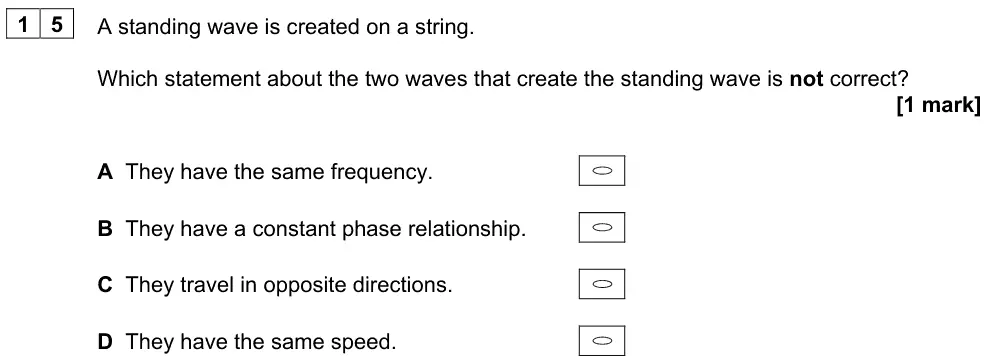
B
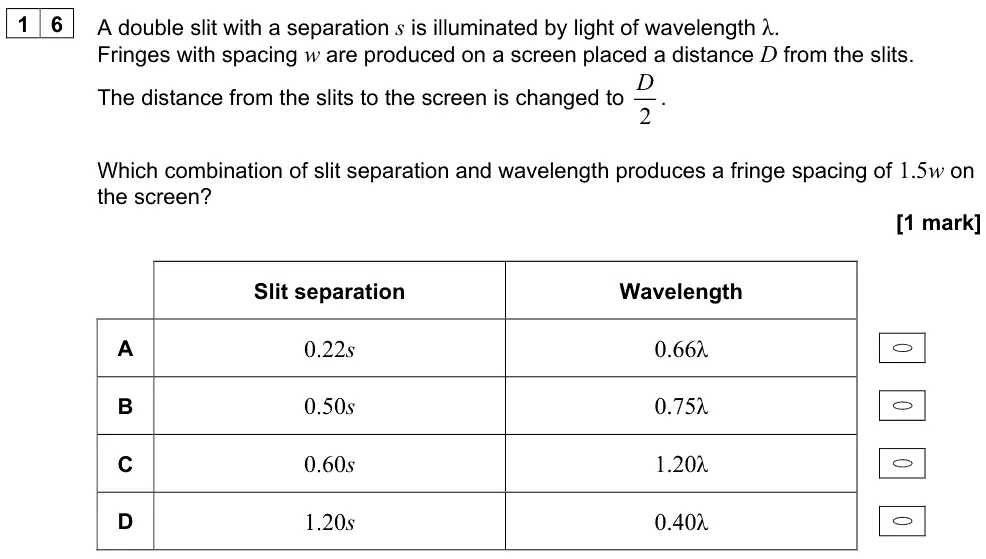
A
Skills: MS0.3 Use ratios, fractions and percentages
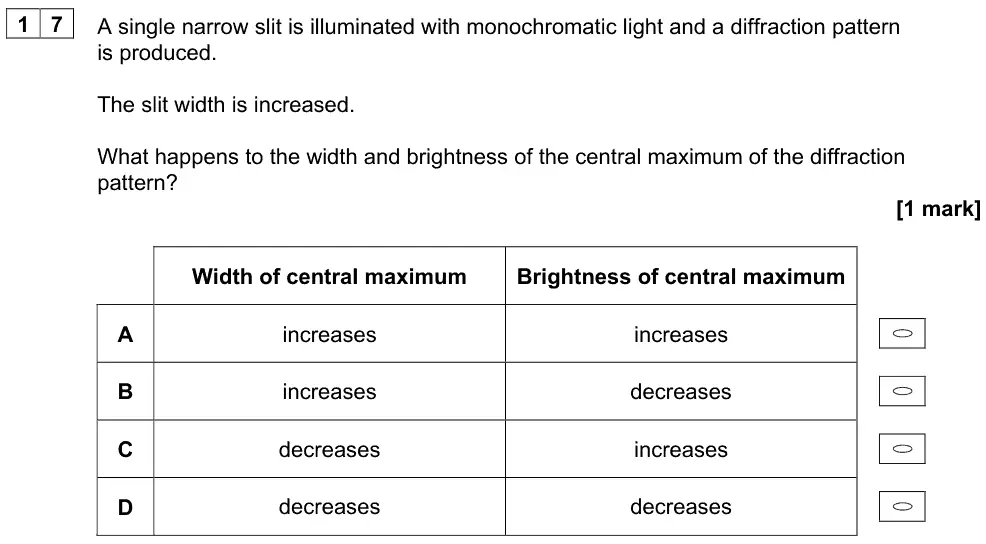
C
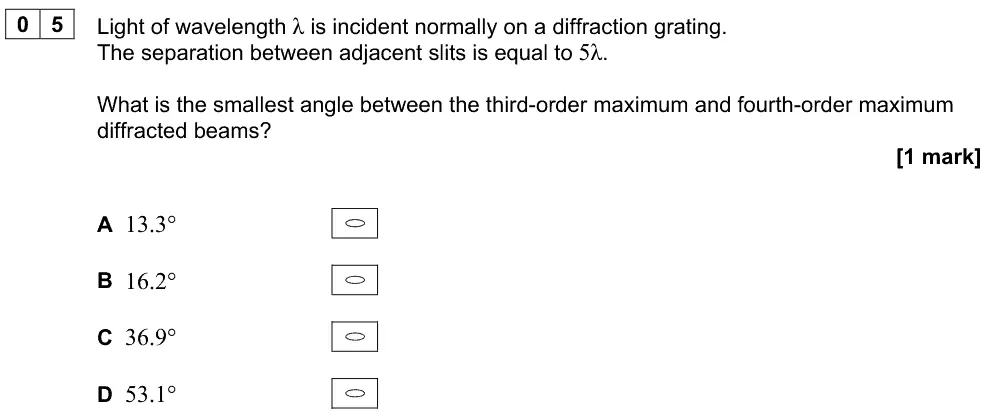
B
Skills: MS0.6 Use calculators to handle sin x, cos x, tan x when x is expressed in degrees or radians
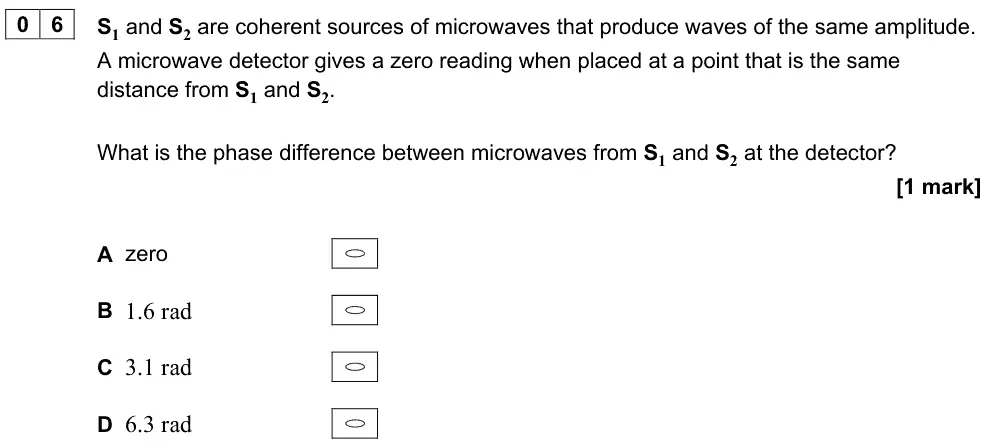
C
Generally, students were more successful in answering questions 9, 15, 16, 19, 25, 27, 28 (these all had a success rate of at least 65%) and were less successful in answering questions 6, 7, 18, 23 and 31 (answered correctly by 35% or fewer).
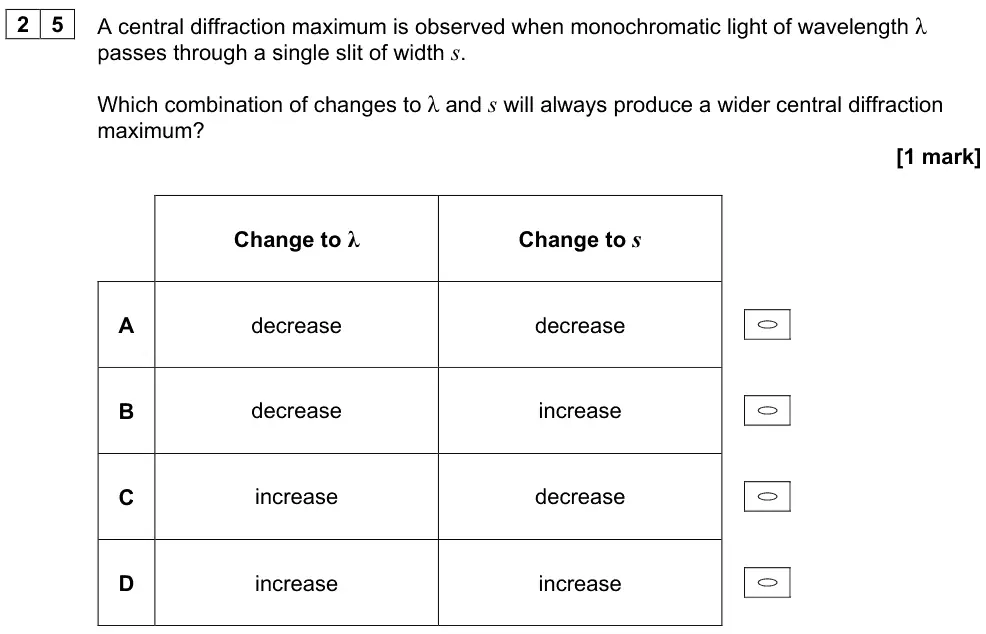
C
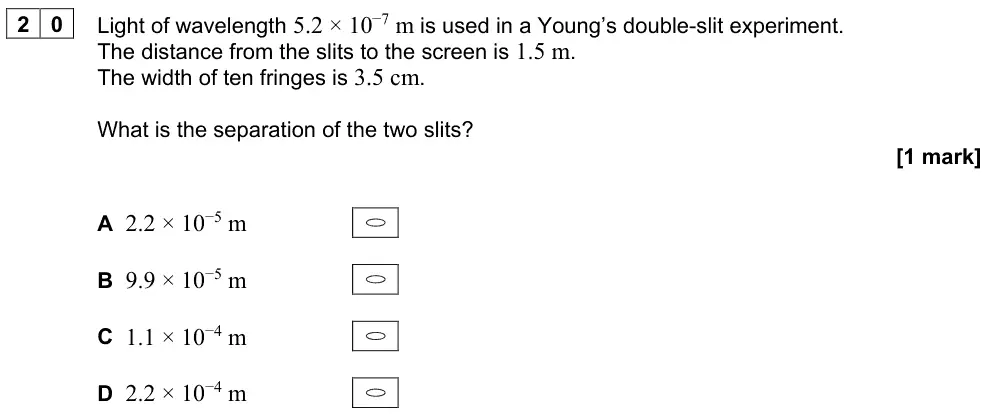
D
Skills: MS2.2 Change the subject of an equation, including non-linear equations; MS0.2 Recognise and use expressions in decimal and standard form
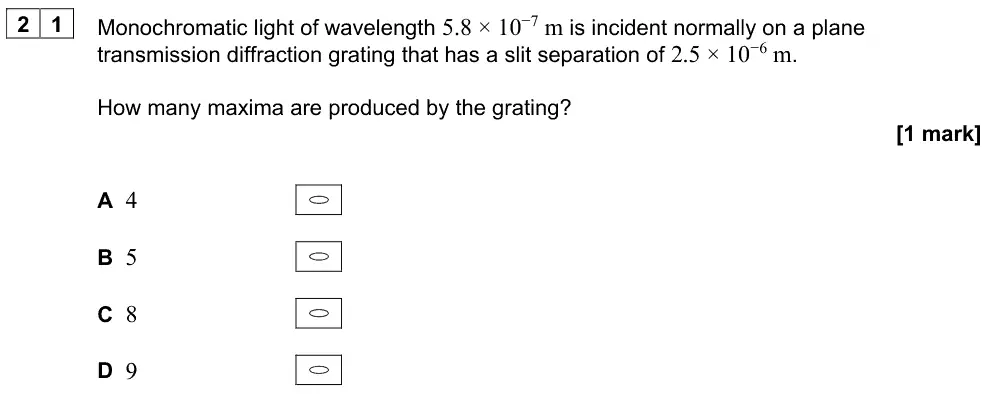
D
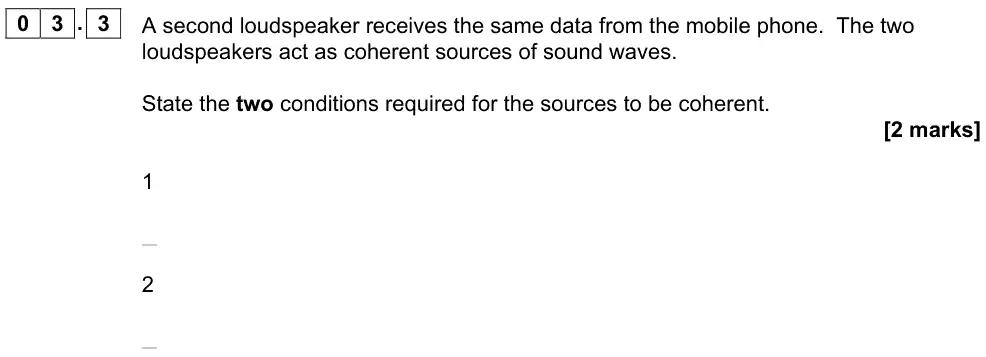
03.3 About 50% of students could give one condition for coherence, with about 30% giving both. Statements about being “in phase” were not accepted as this is an instantaneous situation that can arise between incoherent waves.
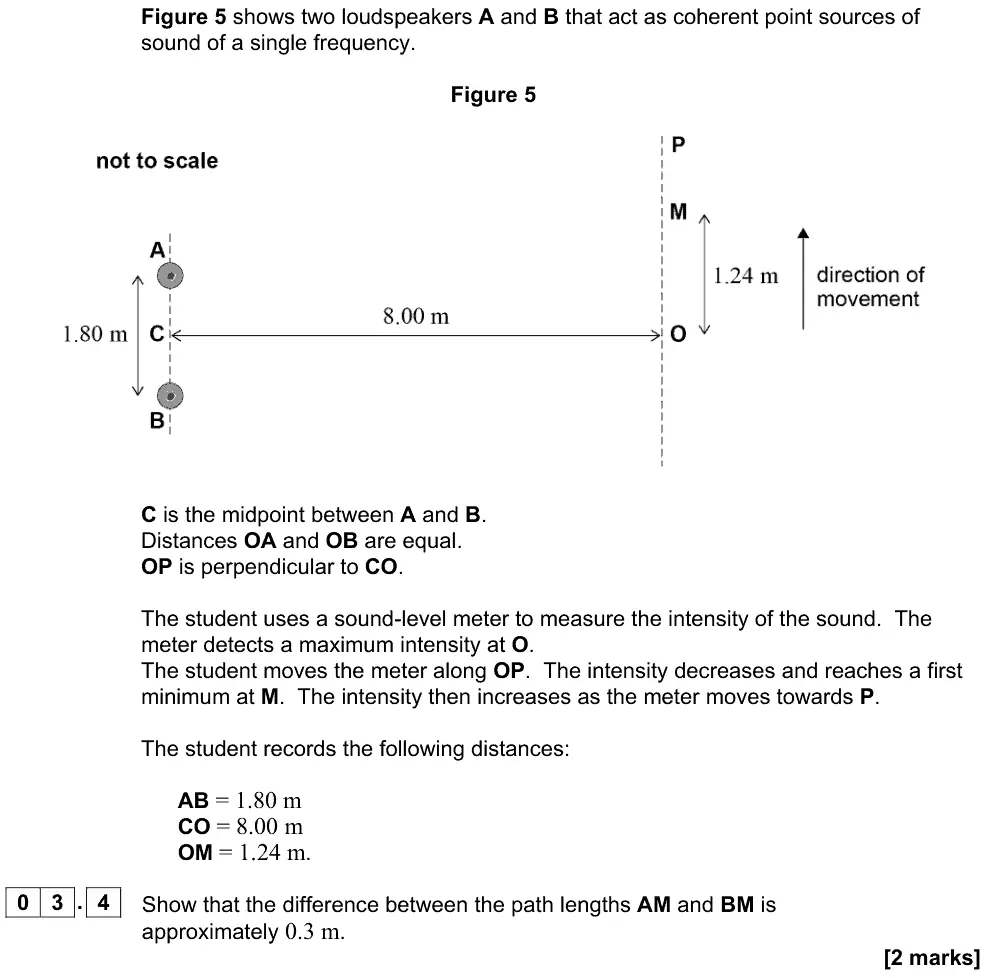
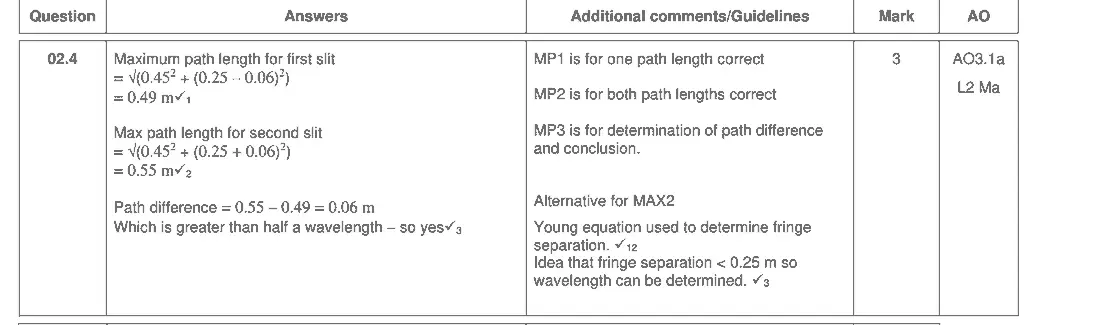
03.4 Many students did not identify that the path difference could be obtained using the Pythagorean theorem. Students could have aided their understanding of the problem by drawing lines AM and BM on Figure 5. Some students failed to gain the second mark because they rounded their values of AM and BM to two significant figures before finding the difference. This gave a final answer of 0.3 m. Students should expect to give their final answer to a numerical ‘show that’ calculation to more significant figures than the target value.
Skills: MS4.4 Use Pythagoras’ theorem, and the angle sum of a triangle; MS1.1 Use an appropriate number of significant figures

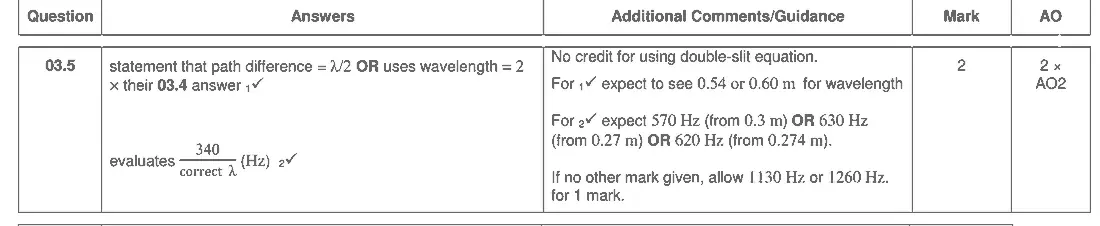
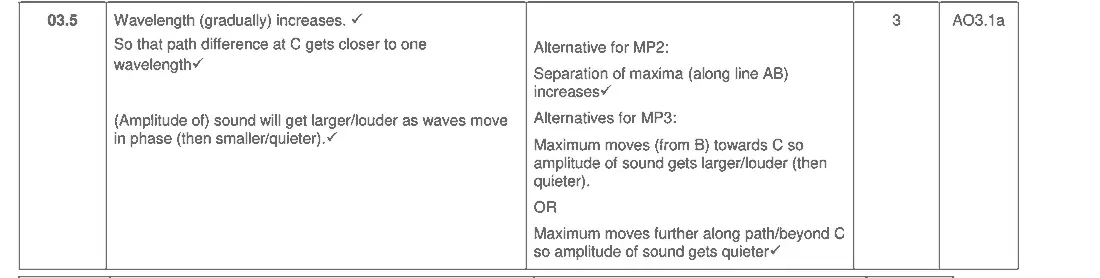
03.5 Students should also appreciate that a ‘show that’ question is usually followed by a question requiring use of the value given. Very few students made the connection between the path difference (leading to a minimum intensity) and the wavelength.
Skills: MS2.3 Substitute numerical values into algebraic equations using appropriate units for physical quantities
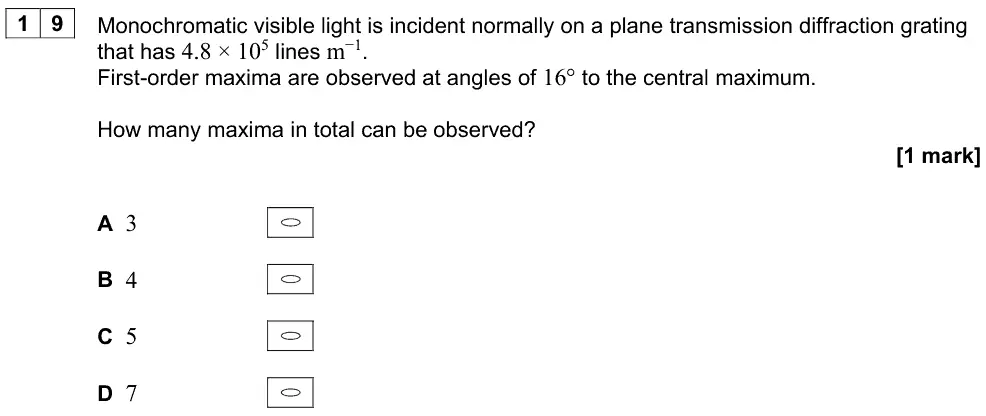
D
Skills: MS0.6 Use calculators to handle sin x, cos x, tan x when x is expressed in degrees or radians
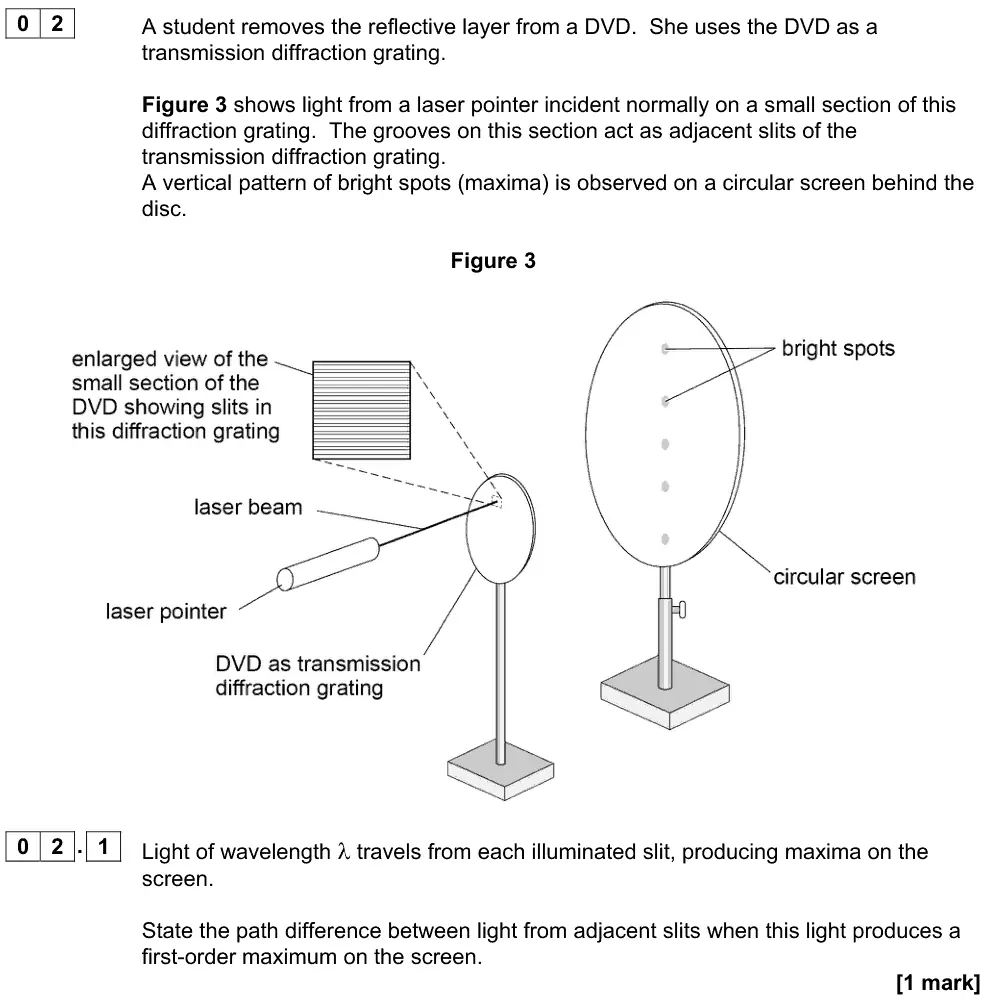

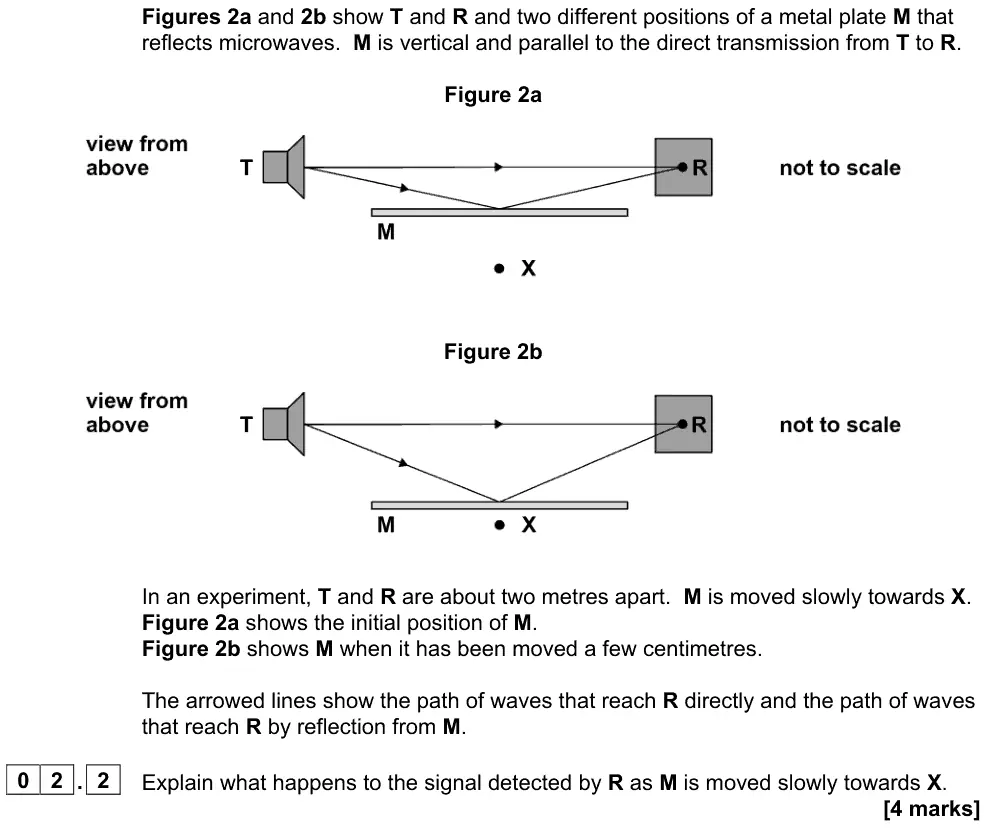
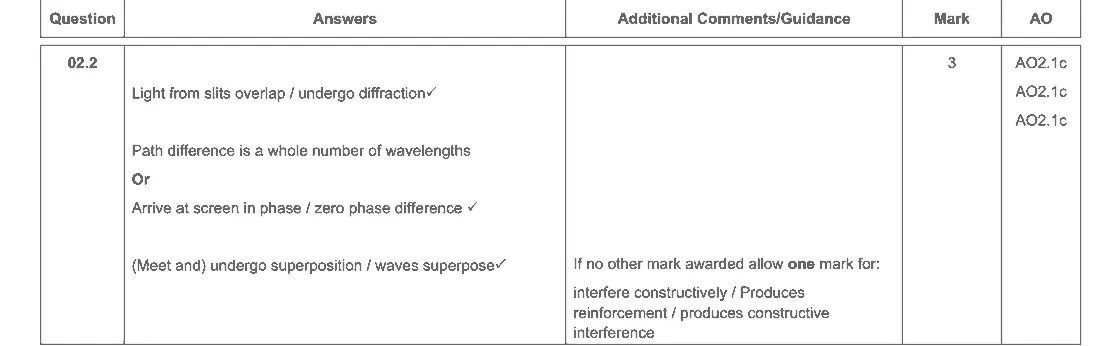
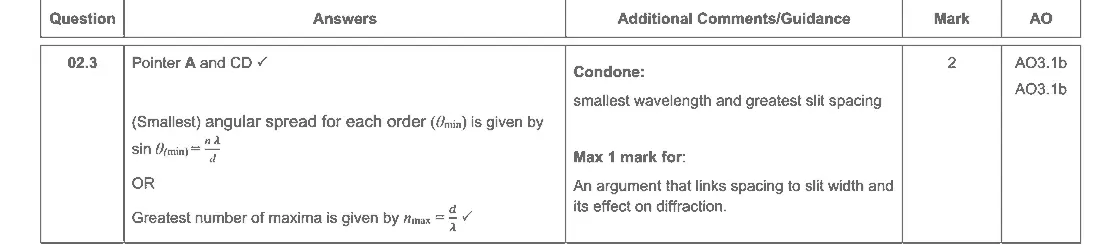
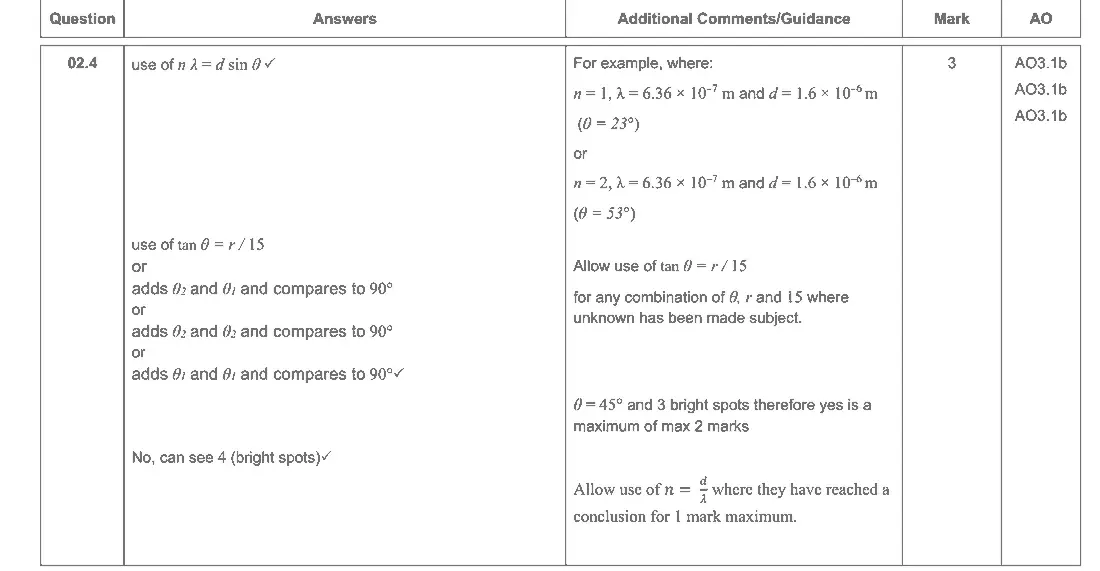
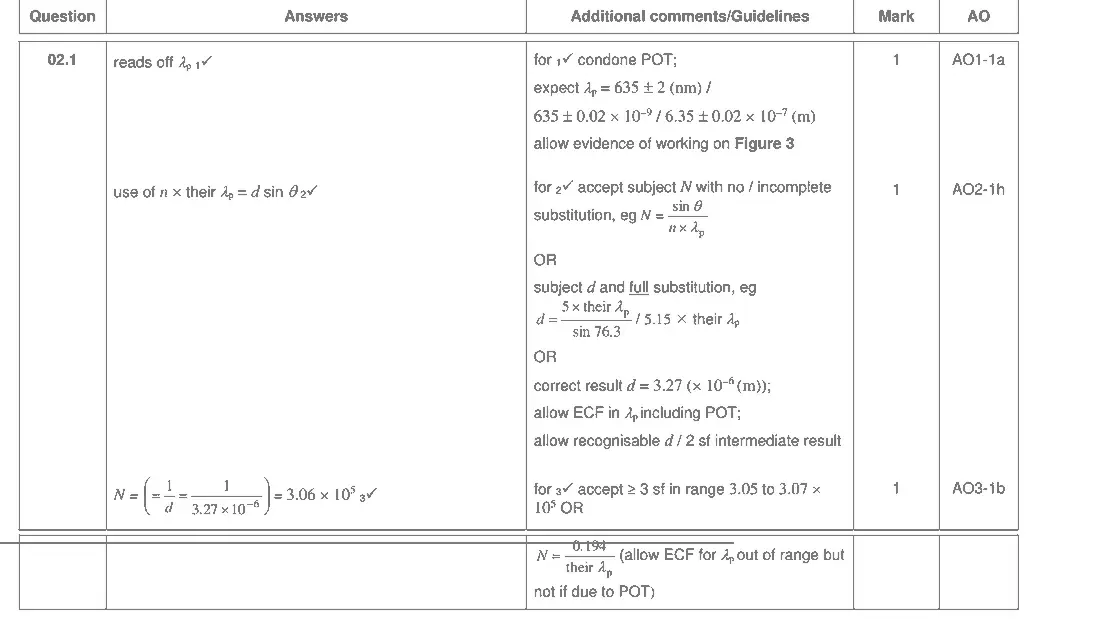
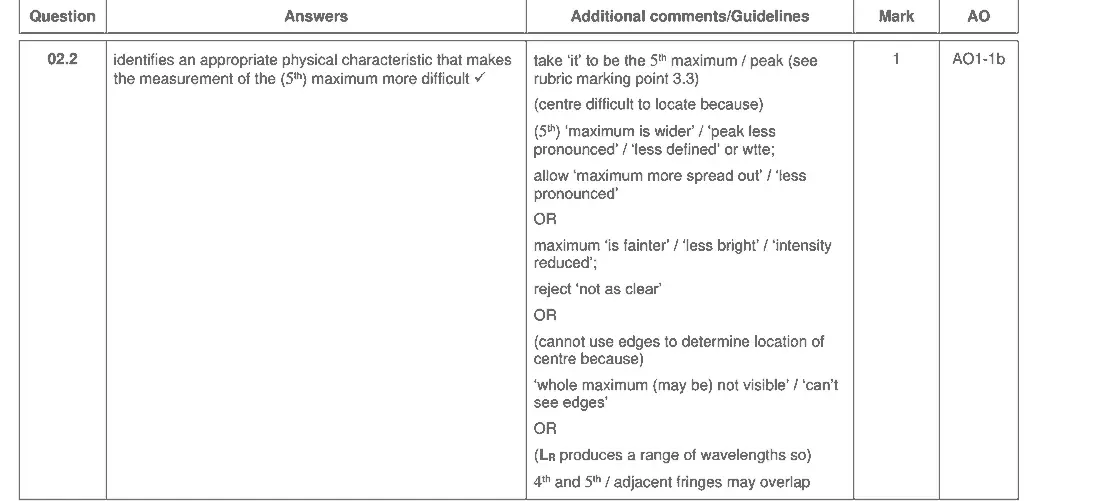
Answers to questions 02.1 and 02.2 were often vague and incomplete, lacking the detail necessary at A-level. This meant that very few students scored full marks on either question. Question 02.3 proved to be one of the least accessible on the paper. Only the occasional student demonstrated any awareness of the assumptions associated with Young’s slits. There are several situations involving two-source interference where the Young double-slit equation is invalid and students should be able to identify them. Despite being told that the equation could not be used, most students ignored this when attempting to answer question 02.4. This meant they could only obtain a maximum of 2 marks for this question.
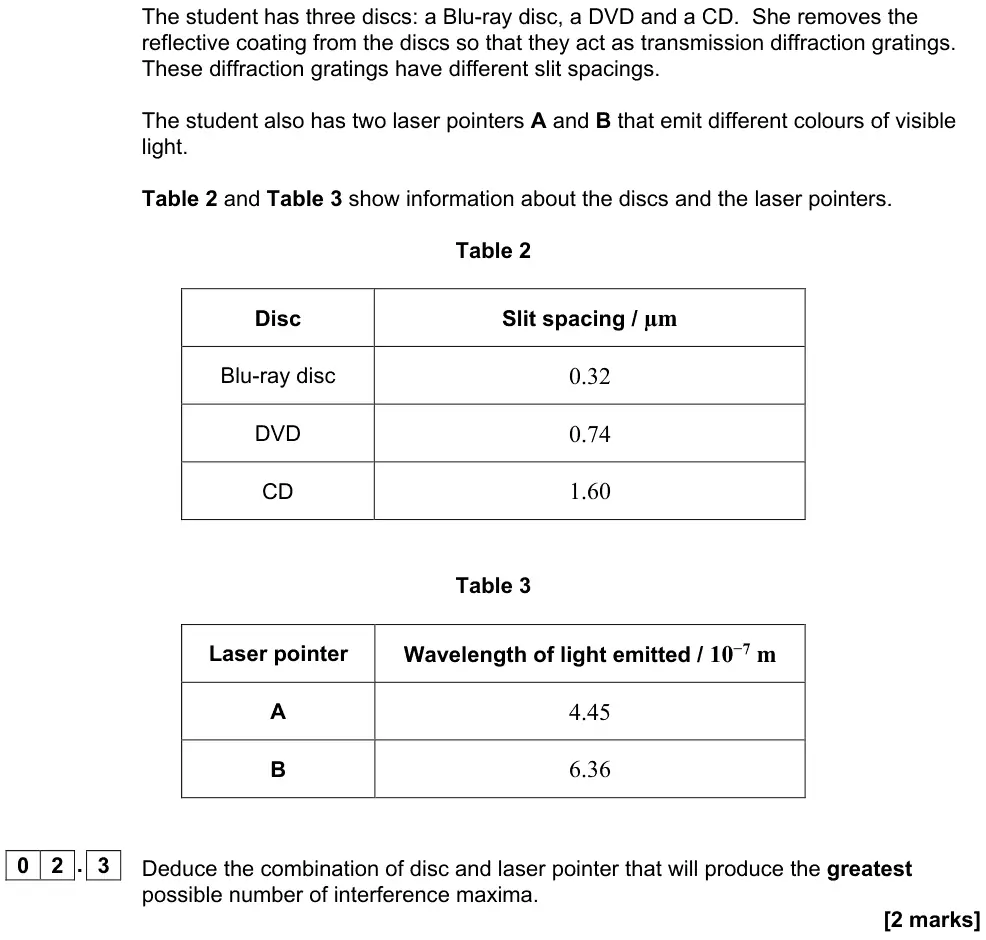
Skills: MS2.2 Change the subject of an equation, including non-linear equations
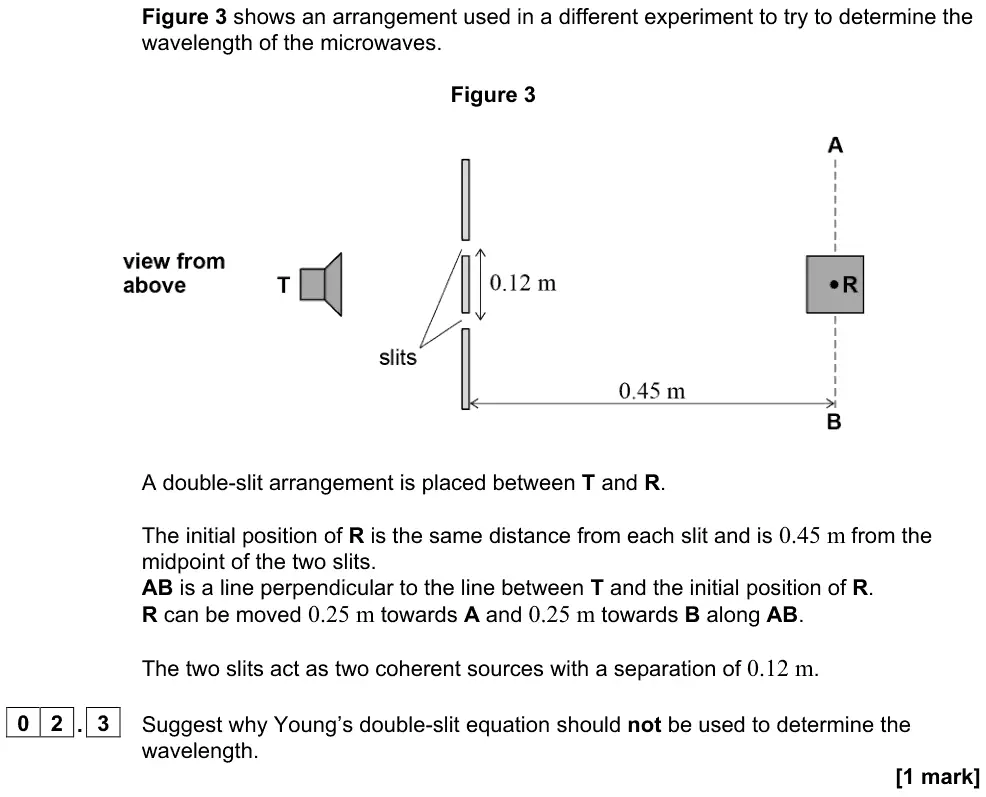
Answers to questions 02.1 and 02.2 were often vague and incomplete, lacking the detail necessary at A-level. This meant that very few students scored full marks on either question. Question 02.3 proved to be one of the least accessible on the paper. Only the occasional student demonstrated any awareness of the assumptions associated with Young’s slits. There are several situations involving two-source interference where the Young double-slit equation is invalid and students should be able to identify them. Despite being told that the equation could not be used, most students ignored this when attempting to answer question 02.4. This meant they could only obtain a maximum of 2 marks for this question.
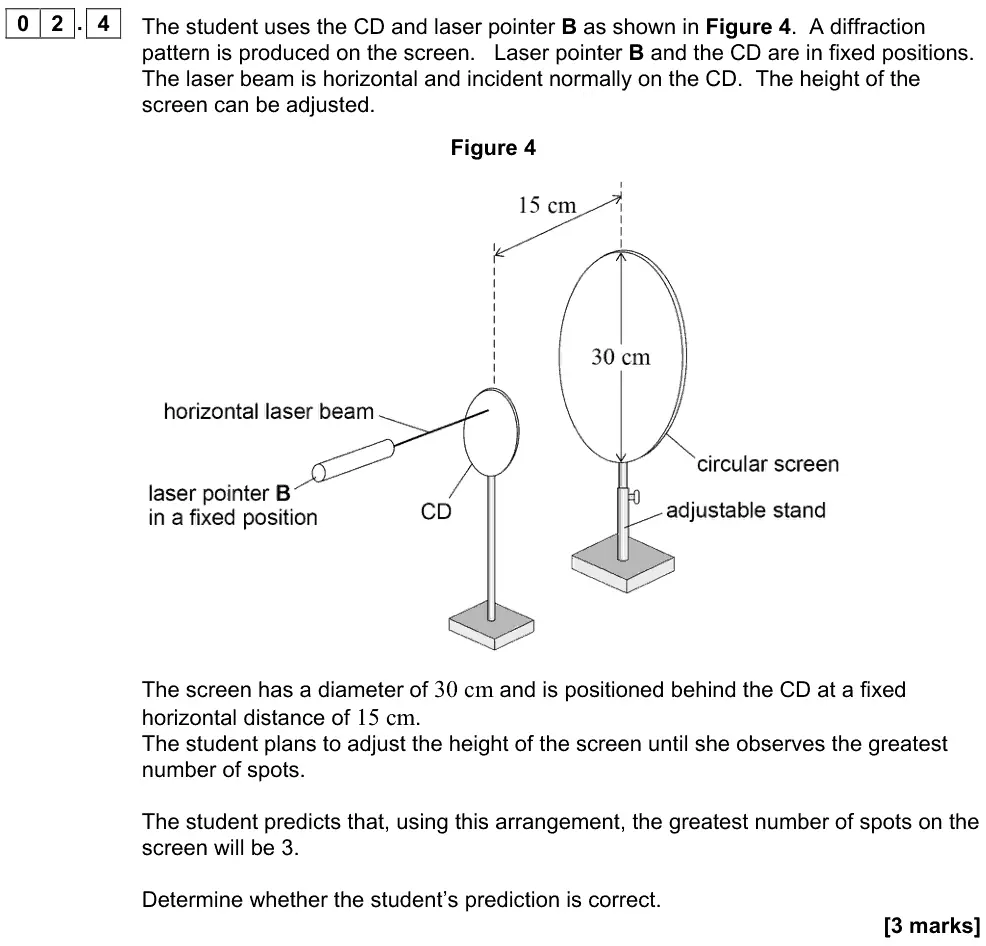
Skills: MS0.6 Use calculators to handle sin x, cos x, tan x when x is expressed in degrees or radians; MS4.5 Use sin, cos and tan in physical problems

Answers to questions 02.1 and 02.2 were often vague and incomplete, lacking the detail necessary at A-level. This meant that very few students scored full marks on either question. Question 02.3 proved to be one of the least accessible on the paper. Only the occasional student demonstrated any awareness of the assumptions associated with Young’s slits. There are several situations involving two-source interference where the Young double-slit equation is invalid and students should be able to identify them. Despite being told that the equation could not be used, most students ignored this when attempting to answer question 02.4. This meant they could only obtain a maximum of 2 marks for this question.
Skills: MS4.4 Use Pythagoras’ theorem, and the angle sum of a triangle; MS2.3 Substitute numerical values into algebraic equations using appropriate units for physical quantities
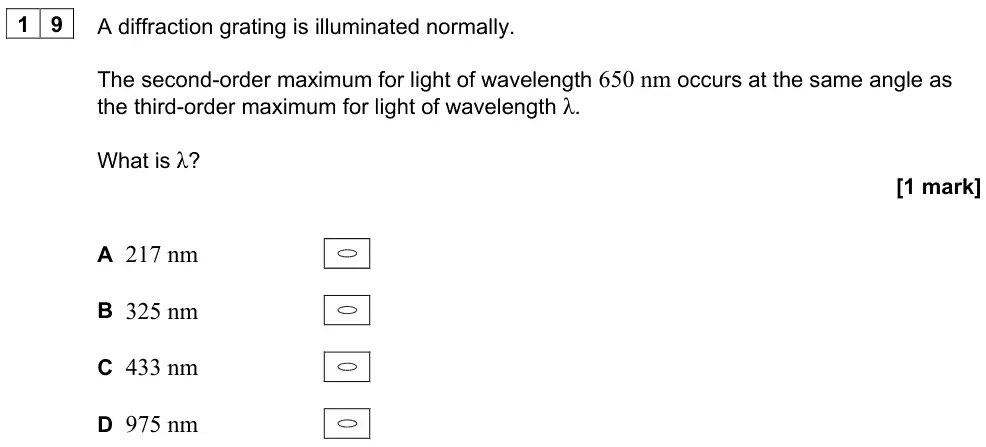
C
Skills: MS0.3 Use ratios, fractions and percentages
C
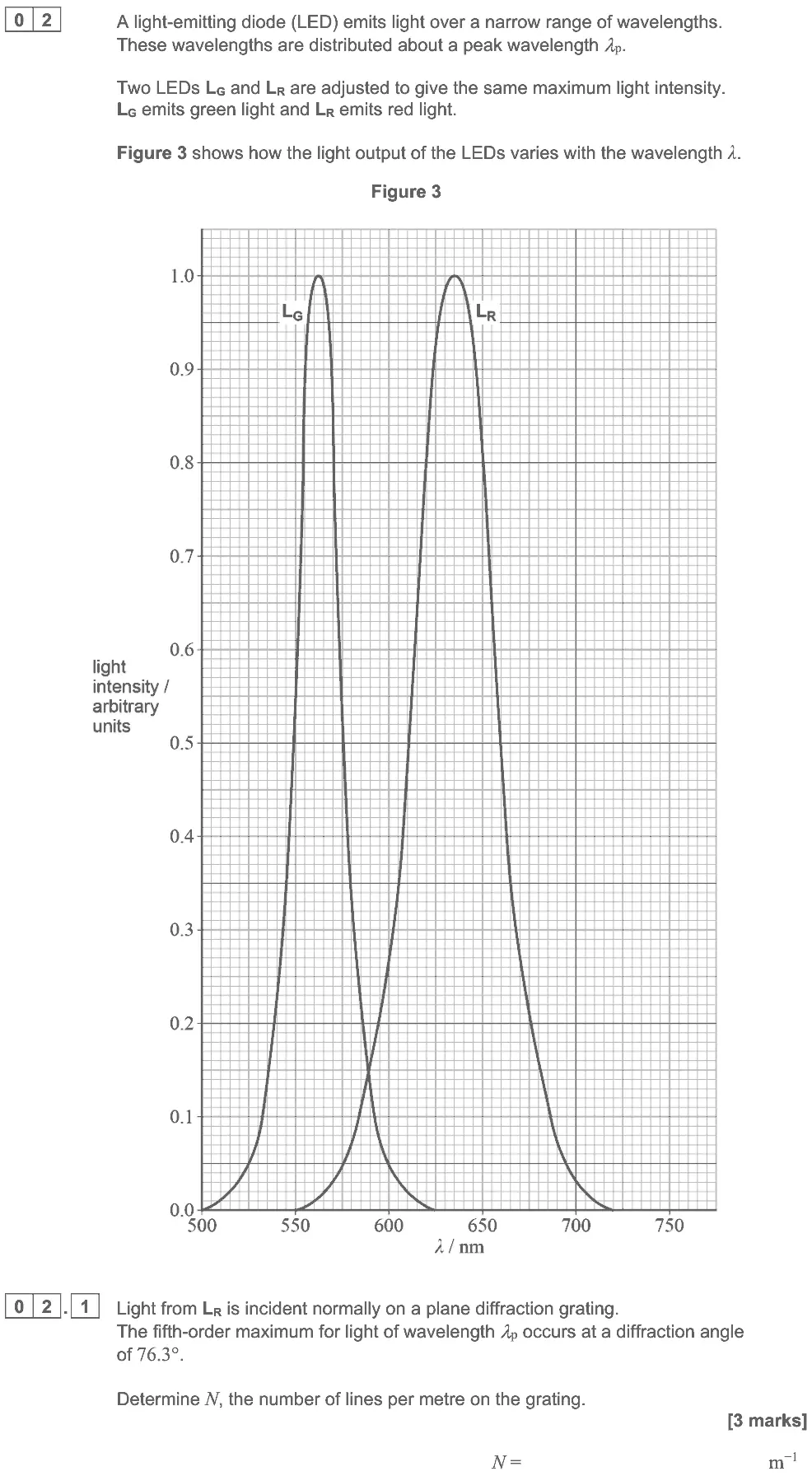
In question 02.1 students had to make an easy read-off from Figure 3 and then apply an equation available in the Formulae and Data booklet. Despite the low demand of the question, fewer than a third of the students were able to obtain full credit. At the other end of the spectrum we saw evidence of calculators set to read angles in radians (in question 02.1) and misguided attempts to use the Boltzmann constant (in question 01.3). Aside from questions 01.2, 01.3, 02.1 and 03.3, students at about the E boundary found marks difficult to obtain.
Skills: MS0.6 Use calculators to handle sin x, cos x, tan x when x is expressed in degrees or radians; MS3.1 Translate information between graphical, numerical and algebraic forms; MS2.2 Change the subject of an equation, including non-linear equations; RP2 Investigation of interference effects to include the Young’s slit experiment and interference by a diffraction grating.

Question 02.2 is one of several in the paper where those suggesting simple practically-based explanations were most likely to score. About 40% of students mentioned some relevant characteristic of the 5th maximum to score the available mark. It was clear that some did not understand what we wanted them to do in question 02.3 and many showed no evidence of working on Figure 4. In question 02.4 only 3% of the students successfully used data about both LEDs; some engineered an answer that duplicated the value in the Formulae and Data booklet. All students realised that c is the speed of light but not all recognised that e is the electronic charge and used 2.718 in their calculation.
Skills: PS2.1 Comment on experimental design and evaluate scientific methods; RP2 Investigation of interference effects to include the Young’s slit experiment and interference by a diffraction grating.
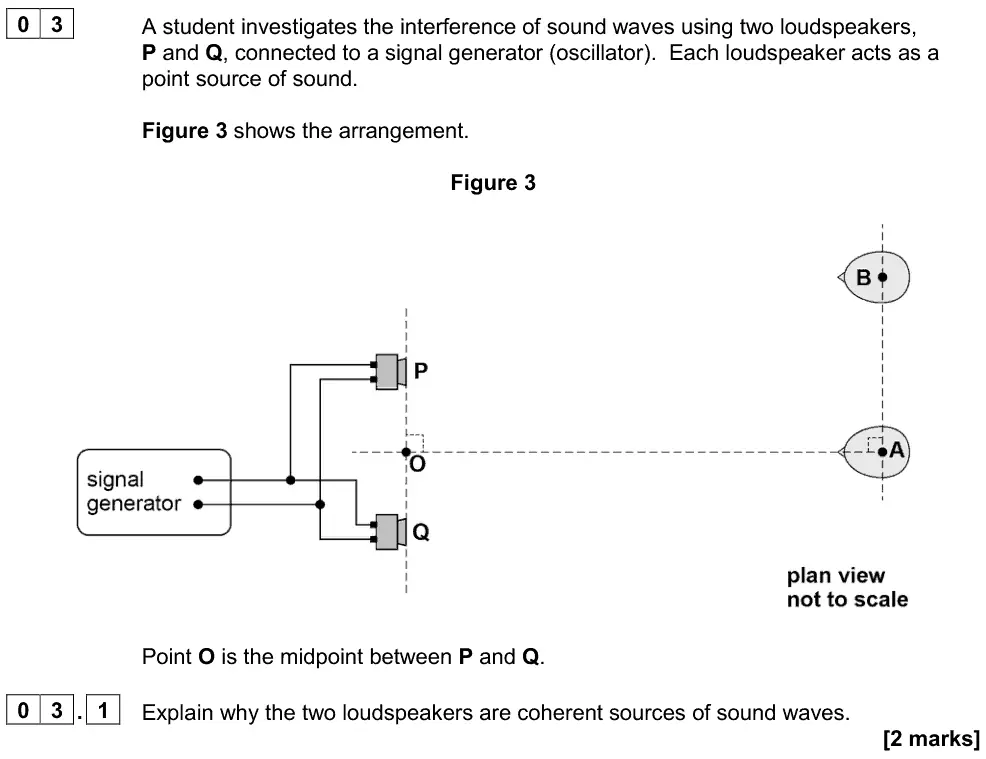
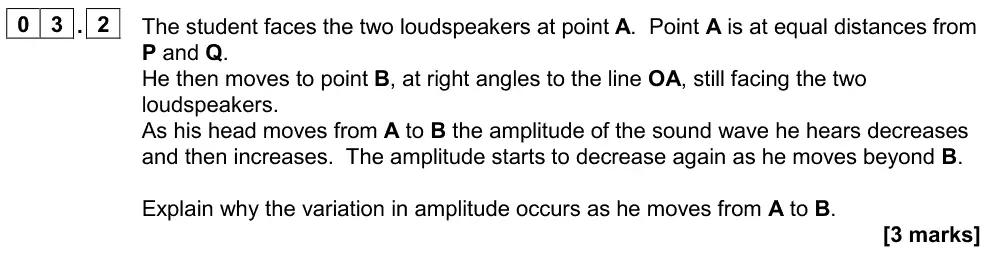
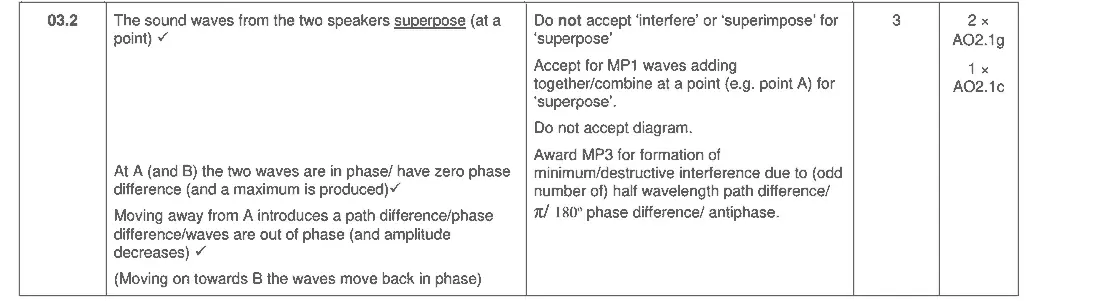
This question dealt with the ideas behind double-slit interference using the context of sound waves. It was pleasing to note that many students understood what was meant by coherence, but some failed to gain the mark for stating that the phase rather than the frequency was the same. In part 03.2, many students demonstrated an awareness of constructive and destructive interference without explaining how they come about. There was also a lot of confusion between phase difference and path difference. In 03.3, the best answers were by students who realised that the Young slit equation should not be used, and who worked out the path difference from first principles. In 03.4, a surprisingly large number of students failed to identify their answer to 03.3 as the wavelength of the sound. In 03.5, although the question specifically asked for a discussion of the amplitude, many students simply referred to a change in pitch. A large number of students also incorrectly suggested that the speed of the sound waves would change.
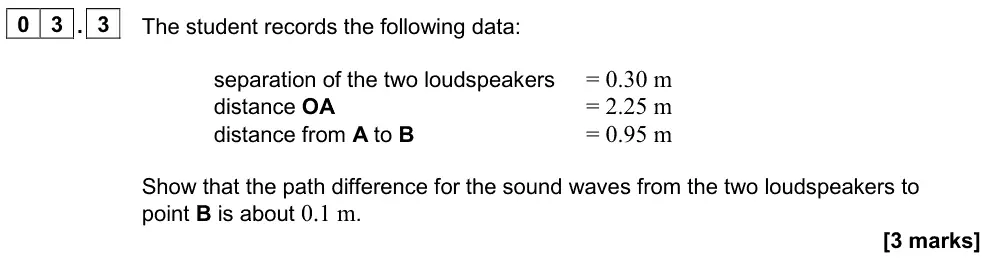
This question dealt with the ideas behind double-slit interference using the context of sound waves. It was pleasing to note that many students understood what was meant by coherence, but some failed to gain the mark for stating that the phase rather than the frequency was the same. In part 03.2, many students demonstrated an awareness of constructive and destructive interference without explaining how they come about. There was also a lot of confusion between phase difference and path difference. In 03.3, the best answers were by students who realised that the Young slit equation should not be used, and who worked out the path difference from first principles. In 03.4, a surprisingly large number of students failed to identify their answer to 03.3 as the wavelength of the sound. In 03.5, although the question specifically asked for a discussion of the amplitude, many students simply referred to a change in pitch. A large number of students also incorrectly suggested that the speed of the sound waves would change.
Skills: MS4.4 Use Pythagoras’ theorem, and the angle sum of a triangle; MS2.3 Substitute numerical values into algebraic equations using appropriate units for physical quantities

This question dealt with the ideas behind double-slit interference using the context of sound waves. It was pleasing to note that many students understood what was meant by coherence, but some failed to gain the mark for stating that the phase rather than the frequency was the same. In part 03.2, many students demonstrated an awareness of constructive and destructive interference without explaining how they come about. There was also a lot of confusion between phase difference and path difference. In 03.3, the best answers were by students who realised that the Young slit equation should not be used, and who worked out the path difference from first principles. In 03.4, a surprisingly large number of students failed to identify their answer to 03.3 as the wavelength of the sound. In 03.5, although the question specifically asked for a discussion of the amplitude, many students simply referred to a change in pitch. A large number of students also incorrectly suggested that the speed of the sound waves would change.
Skills: MS2.3 Substitute numerical values into algebraic equations using appropriate units for physical quantities
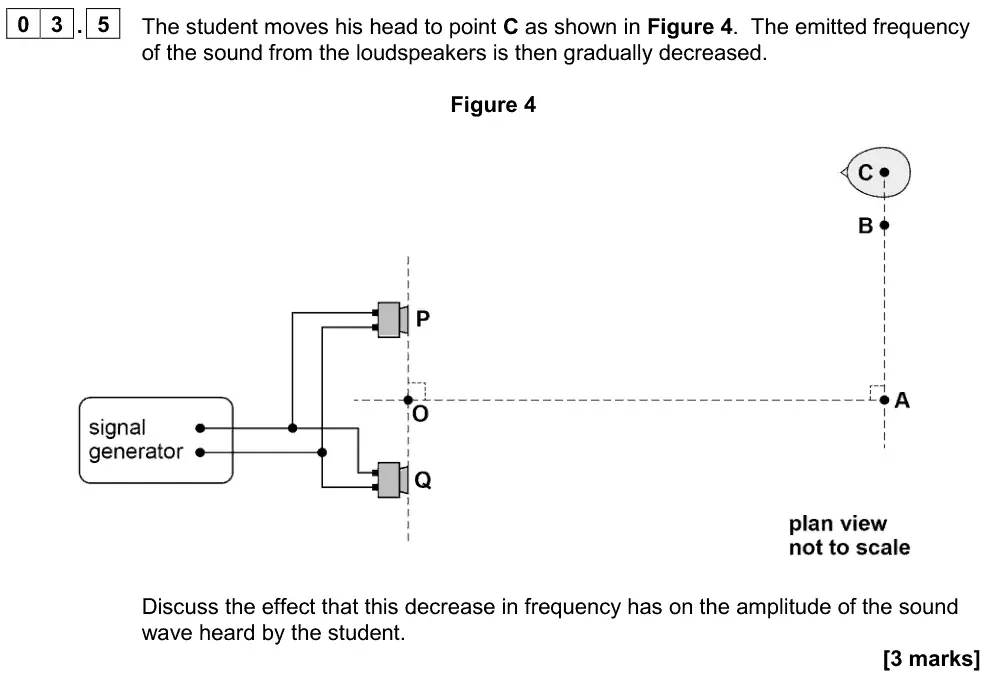
This question dealt with the ideas behind double-slit interference using the context of sound waves. It was pleasing to note that many students understood what was meant by coherence, but some failed to gain the mark for stating that the phase rather than the frequency was the same. In part 03.2, many students demonstrated an awareness of constructive and destructive interference without explaining how they come about. There was also a lot of confusion between phase difference and path difference. In 03.3, the best answers were by students who realised that the Young slit equation should not be used, and who worked out the path difference from first principles. In 03.4, a surprisingly large number of students failed to identify their answer to 03.3 as the wavelength of the sound. In 03.5, although the question specifically asked for a discussion of the amplitude, many students simply referred to a change in pitch. A large number of students also incorrectly suggested that the speed of the sound waves would change.
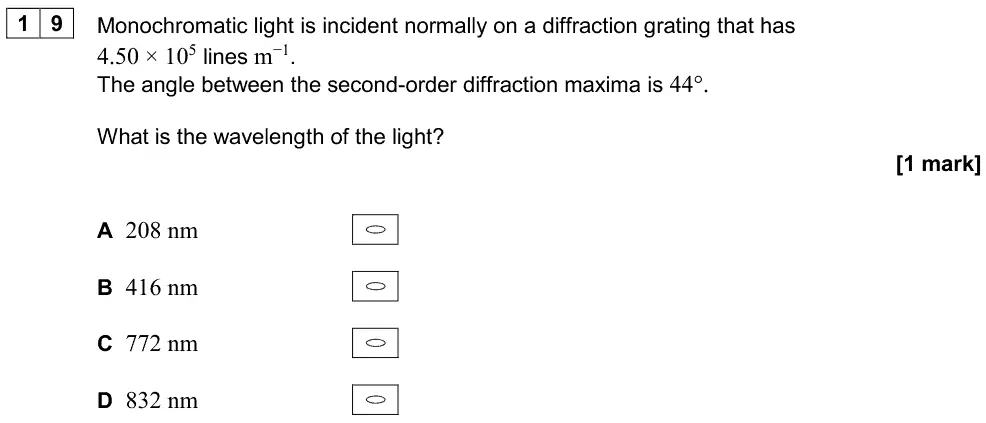
B
Skills: MS0.6 Use calculators to handle sin x, cos x, tan x when x is expressed in degrees or radians
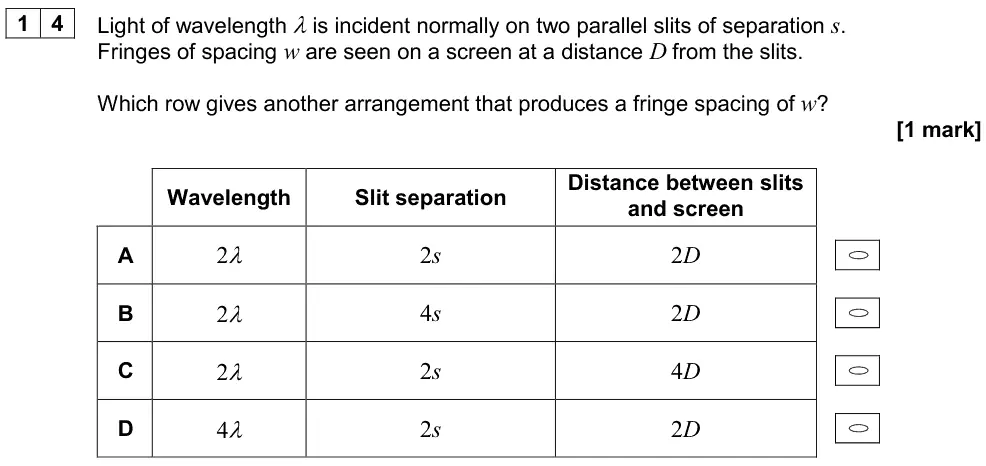
B
Skills: MS0.3 Use ratios, fractions and percentages
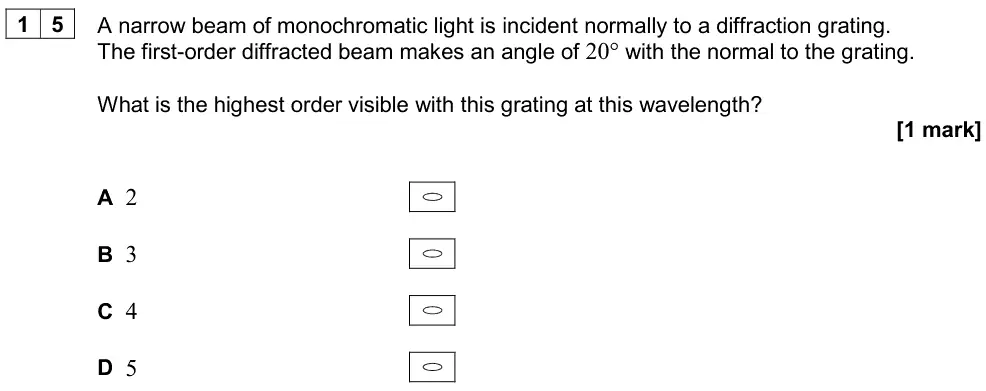
A
Skills: MS0.6 Use calculators to handle sin x, cos x, tan x when x is expressed in degrees or radians
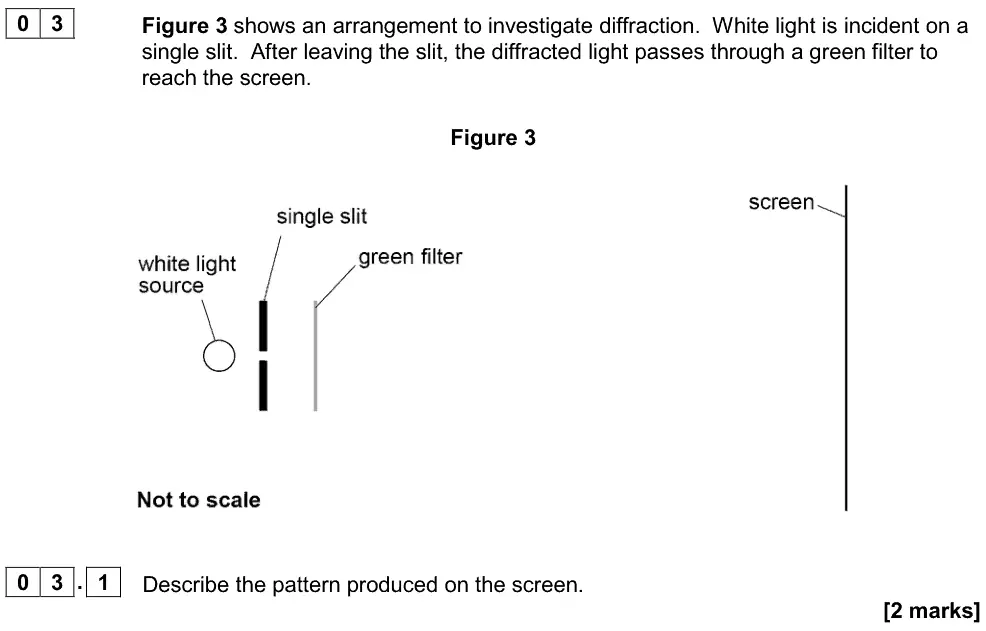
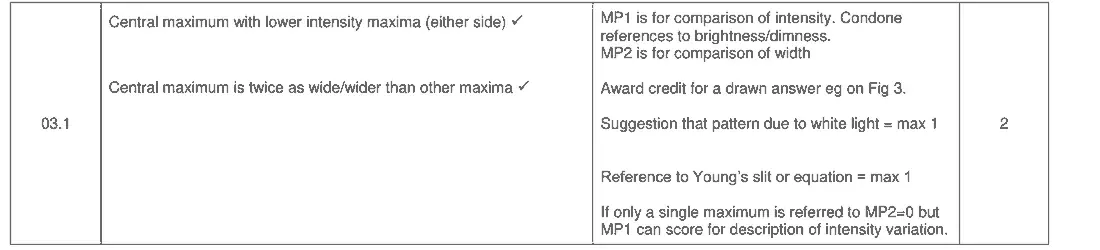
3.1 Although many students were able to recall the single-slit diffraction pattern for monochromatic light, there was confusion as to whether the filter transmitted or absorbed red light. Some students also suggested that the central maximum would be white, but the outer maxima would be green.

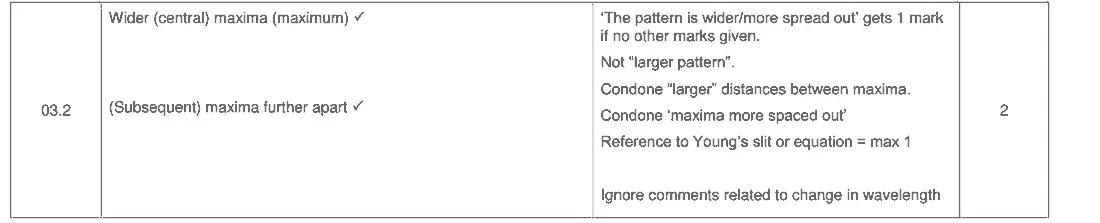
3.2 It was clear that many students understood the relationship between the angle of diffraction and wavelength, but some referred incorrectly to the Young double-slit equation to support it. Some students simply referred to the change in colour, without reference to the size and position of the maxima.
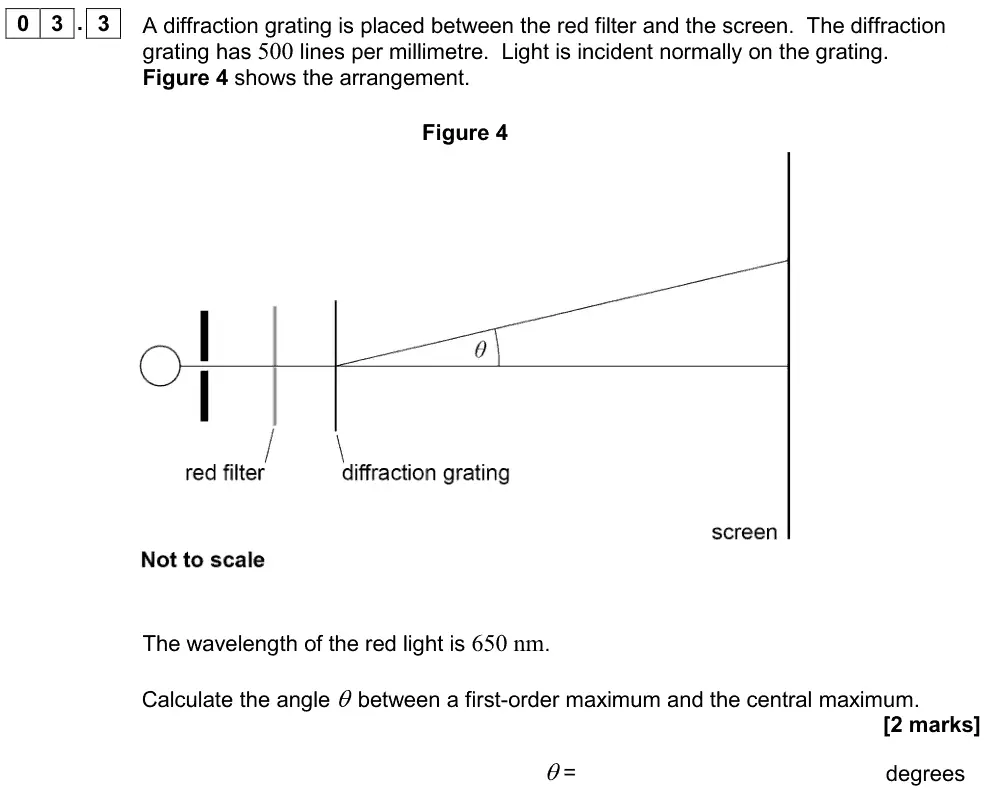
3.3 This calculation was clearly familiar to many students and most students received both marks. For the remainder, there was confusion between the number of lines per millimetre and the slit separation. This route leads to an answer of about 10-10 °. Students should be encouraged to check answers that appear unreasonable; this one clearly is.
Skills: MS0.6 Use calculators to handle sin x, cos x, tan x when x is expressed in degrees or radians; MS2.2 Change the subject of an equation, including non-linear equations; MS0.2 Recognise and use expressions in decimal and standard form; RP2 Investigation of interference effects to include the Young’s slit experiment and interference by a diffraction grating.

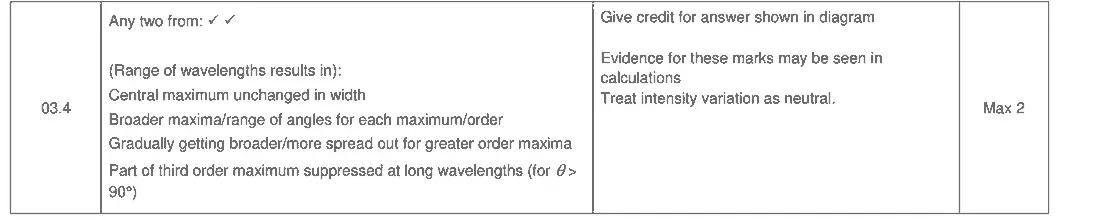
3.4 Many students realised that the range of wavelengths would cause the point maxima associated with a diffraction grating to increase. What was less well understood was that this would not occur with the central maximum, as all wavelengths have a maximum at an angle of zero to the normal of the grating. There were several marking points for students to access, but the award of both marks was rarely seen.
Skills: RP2 Investigation of interference effects to include the Young’s slit experiment and interference by a diffraction grating.

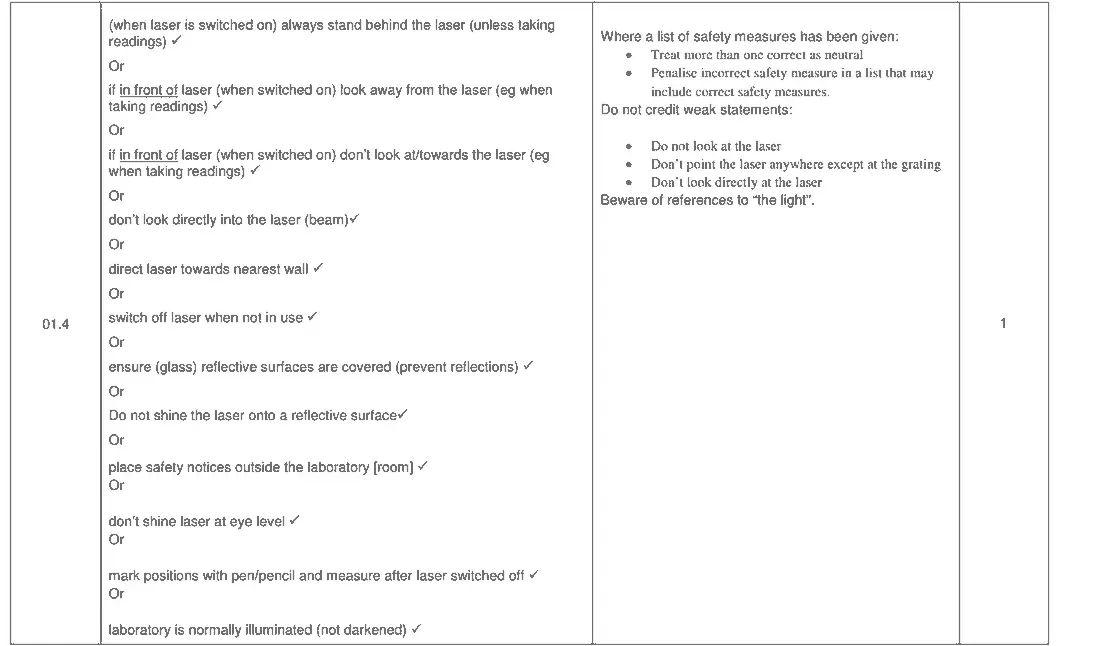
1.4 Most students gained this mark, with a wide range of safety measures being accepted. A significant number of students seem to be reading questions too quickly and failing to capture important information; this was demonstrated here by those who provided ‘safety goggles’ as their response.
Skills: PS4.1 Know and understand how to use a wide range of experimental and practical instruments, equipment and techniques
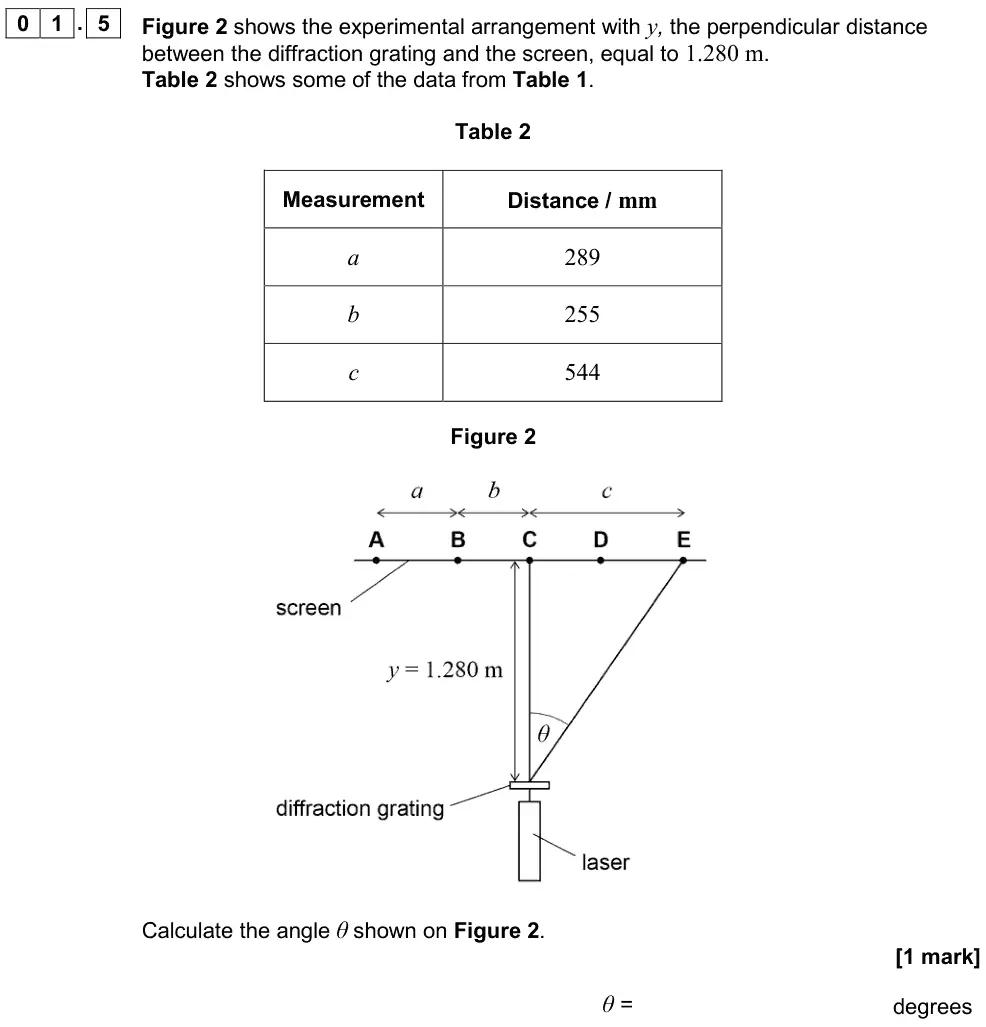
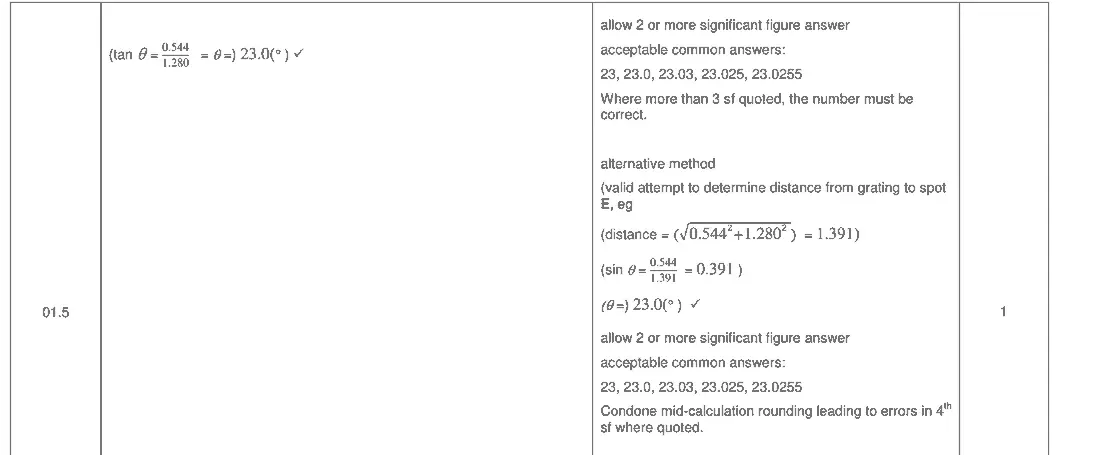
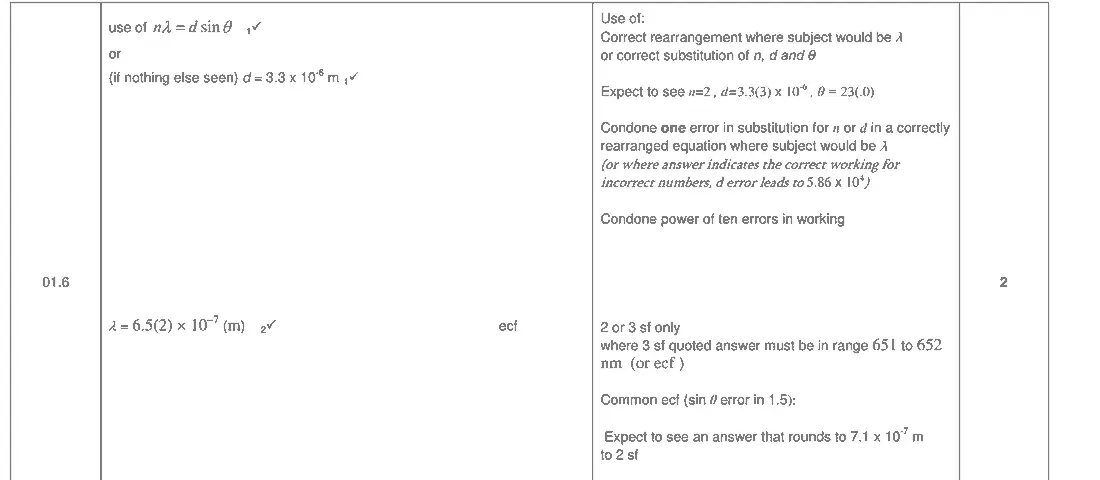
1.5 / 1.6 Less than half of the students were able to obtain full marks. Many students were unable to determine d, choosing to use 3 x 10⁵ m. Other common incorrect answers included use of the double slit formula and use of n as 1.28. 1.2 Many were unable to answer this question and obtained an incorrect answer of 1.5 %. They had added the percentage uncertainties in a and b instead of adding their absolute uncertainties. Students need to ensure they know the correct procedure for combining uncertainties.
Skills: MS4.5 Use sin, cos and tan in physical problems; MS0.6 Use calculators to handle sin x, cos x, tan x when x is expressed in degrees or radians; RP2 Investigation of interference effects to include the Young’s slit experiment and interference by a diffraction grating.

1.5 / 1.6 Less than half of the students were able to obtain full marks. Many students were unable to determine d, choosing to use 3 x 10⁵ m. Other common incorrect answers included use of the double slit formula and use of n as 1.28.
Skills: MS2.2 Change the subject of an equation, including non-linear equations; MS0.6 Use calculators to handle sin x, cos x, tan x when x is expressed in degrees or radians; RP2 Investigation of interference effects to include the Young’s slit experiment and interference by a diffraction grating.
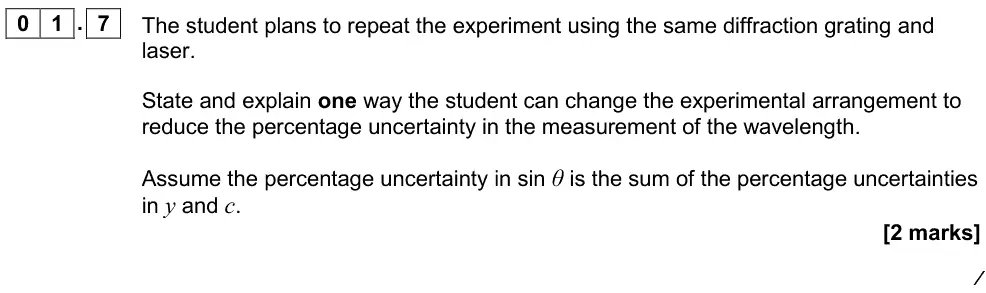
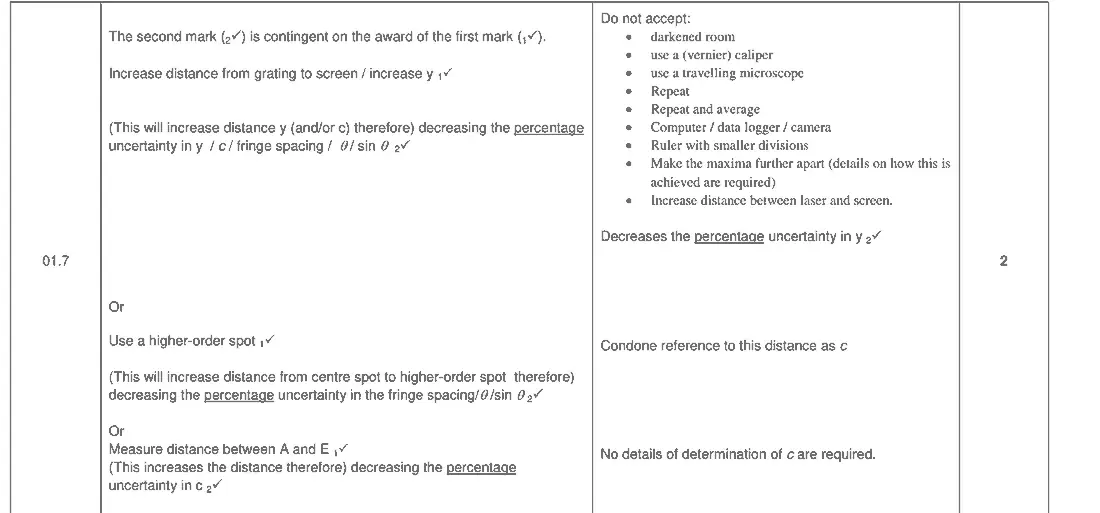
1.7 Many students confused this experiment with the Young’s double slit experiment. They suggested taking a measurement across several fringes then dividing by the number of fringes to find the mean fringe spacing. Students needed to make a clear statement that the percentage uncertainty decreased. Stating that the uncertainty decreased was incorrect and therefore penalised.
Skills: PS2.4 Identify variables including those that must be controlled; RP2 Investigation of interference effects to include the Young’s slit experiment and interference by a diffraction grating.
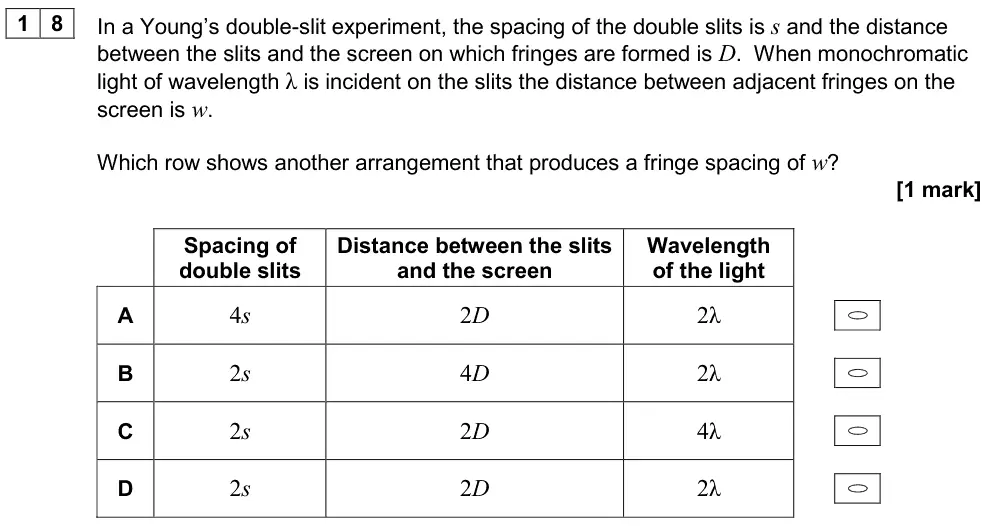
A
Skills: MS0.3 Use ratios, fractions and percentages
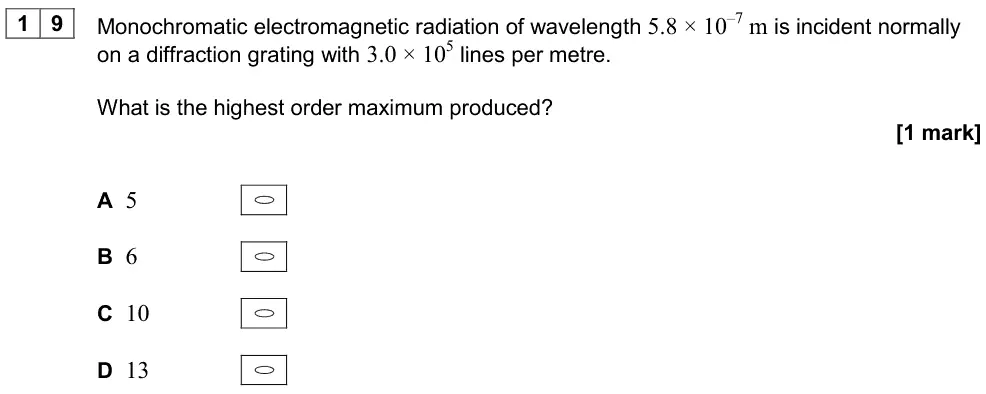
A
Skills: MS0.2 Recognise and use expressions in decimal and standard form
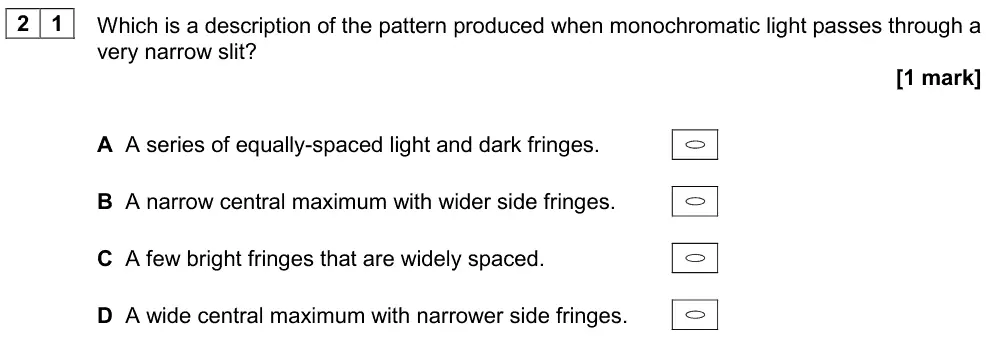
D
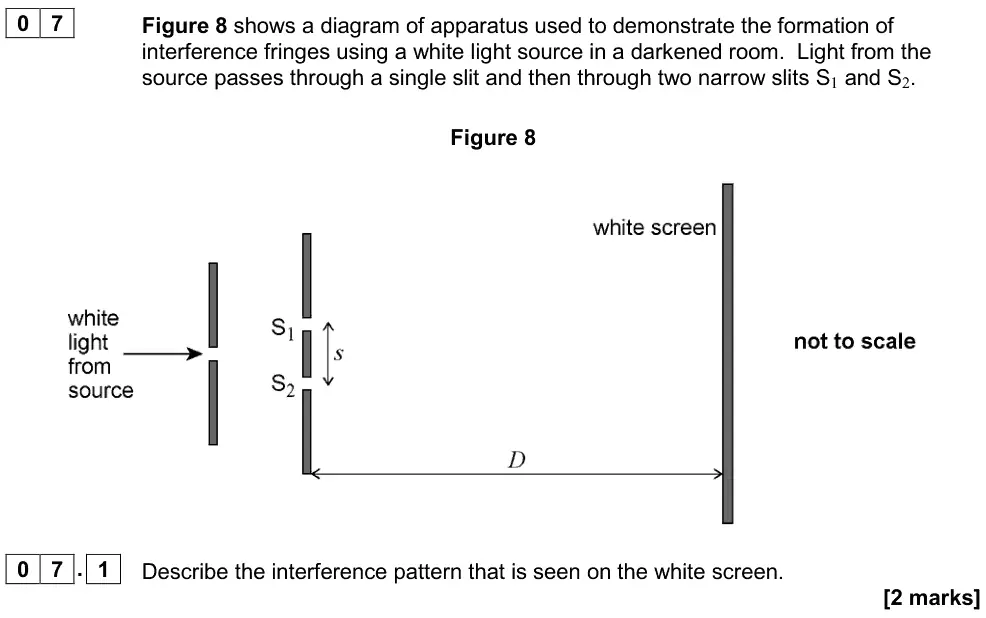
07.1 A significant proportion of students appreciated that the fringes would exhibit a range of colours. It was, however, less common for them to identify the central fringe as being white. Some students did try to explain the reason for the formation of the fringes when only a description of the pattern seen was required.
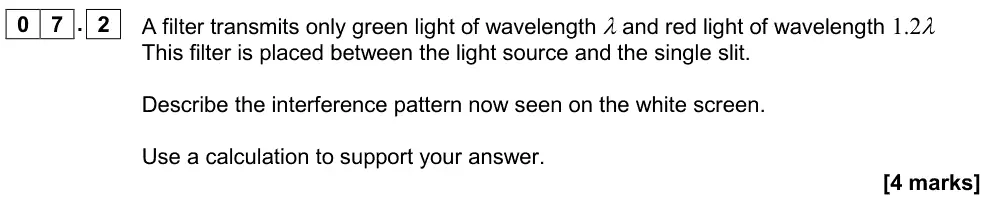
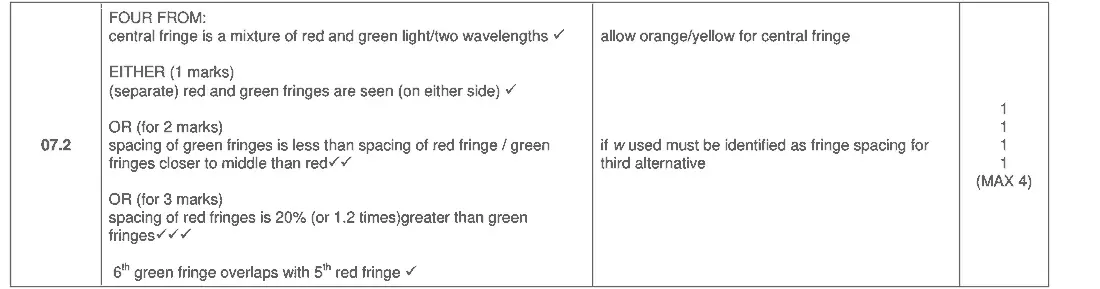
07.2 This question produced good discrimination. Weaker students were able to identify the fact that red and green fringes would be seen, but then frequently thought that the spacing of green fringes would be greater. Only the best students were then able to explain that the red spacing would be 20% greater than the green spacing. It was also quite rare to see responses that explained that the central fringe would be a mixture of red and green.
Skills: MS0.3 Use ratios, fractions and percentages
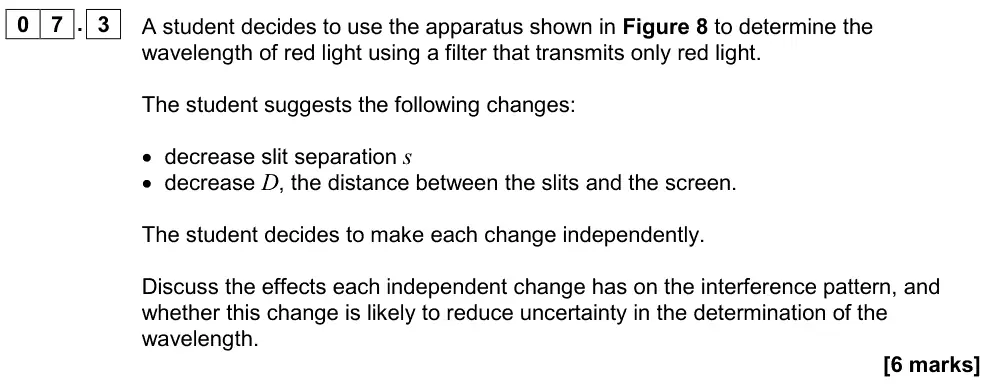
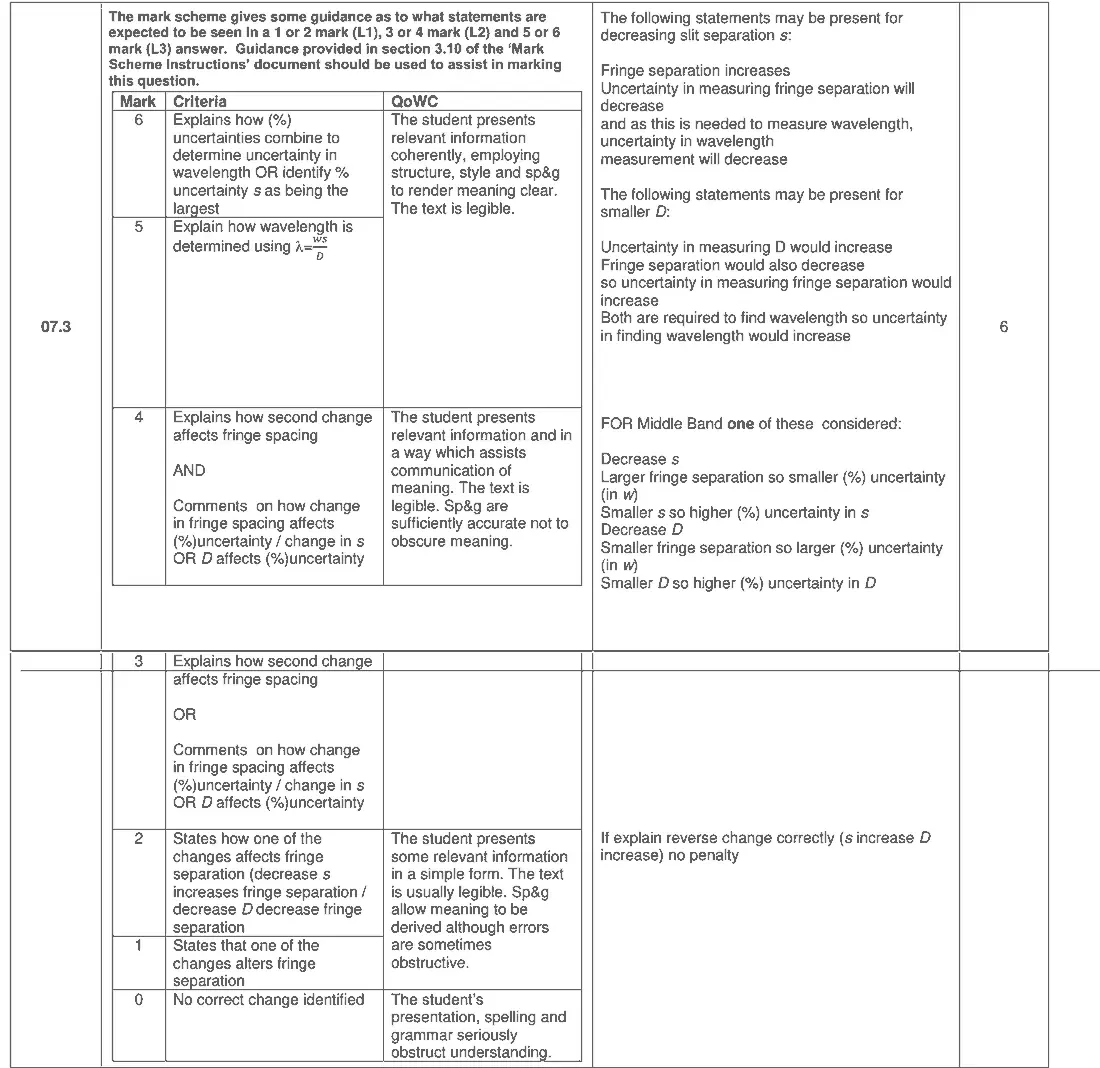
07.3 This was a ‘levels of response’ question and a high proportion of students did at least get into the middle band because they were able to correctly explain the effect of each change on fringe spacing and give some discussion of the effect these changes have on uncertainties. A disappointing number of students (only 3.5%) reached the top band – this was usually because they did not explain how the change in fringe spacing affected the determination of the wavelength of the light and whether the change reduced the overall uncertainty.
Skills: RP2 Investigation of interference effects to include the Young’s slit experiment and interference by a diffraction grating.
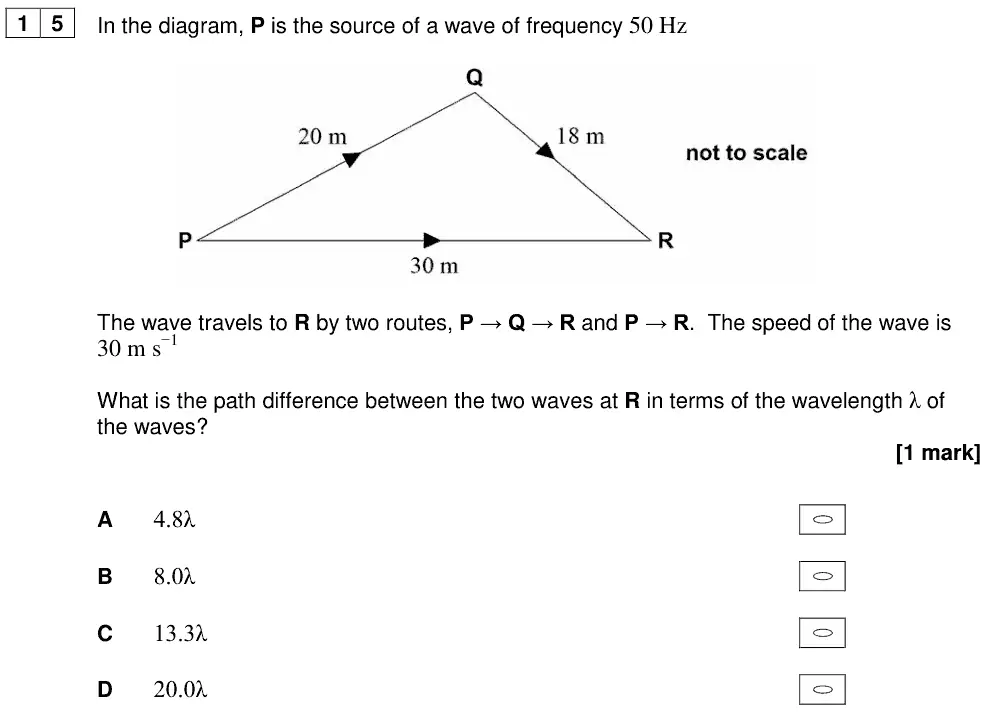
C
Skills: MS0.3 Use ratios, fractions and percentages
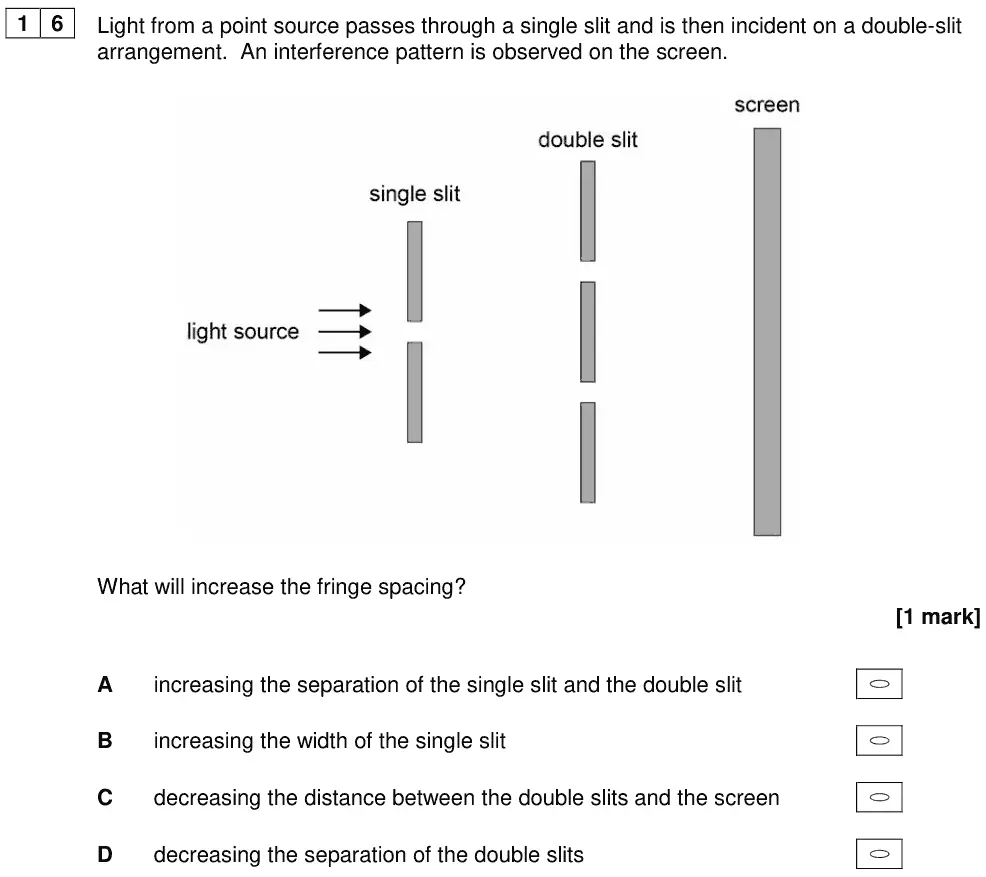
D
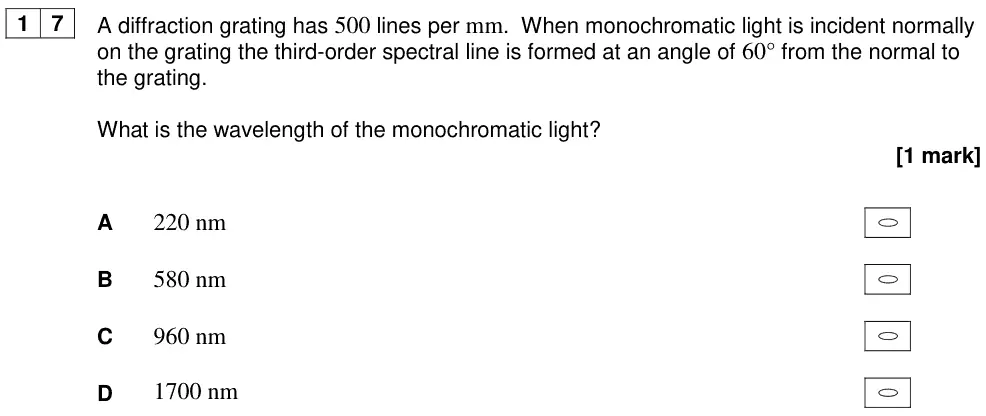
B
Skills: MS0.6 Use calculators to handle sin x, cos x, tan x when x is expressed in degrees or radians
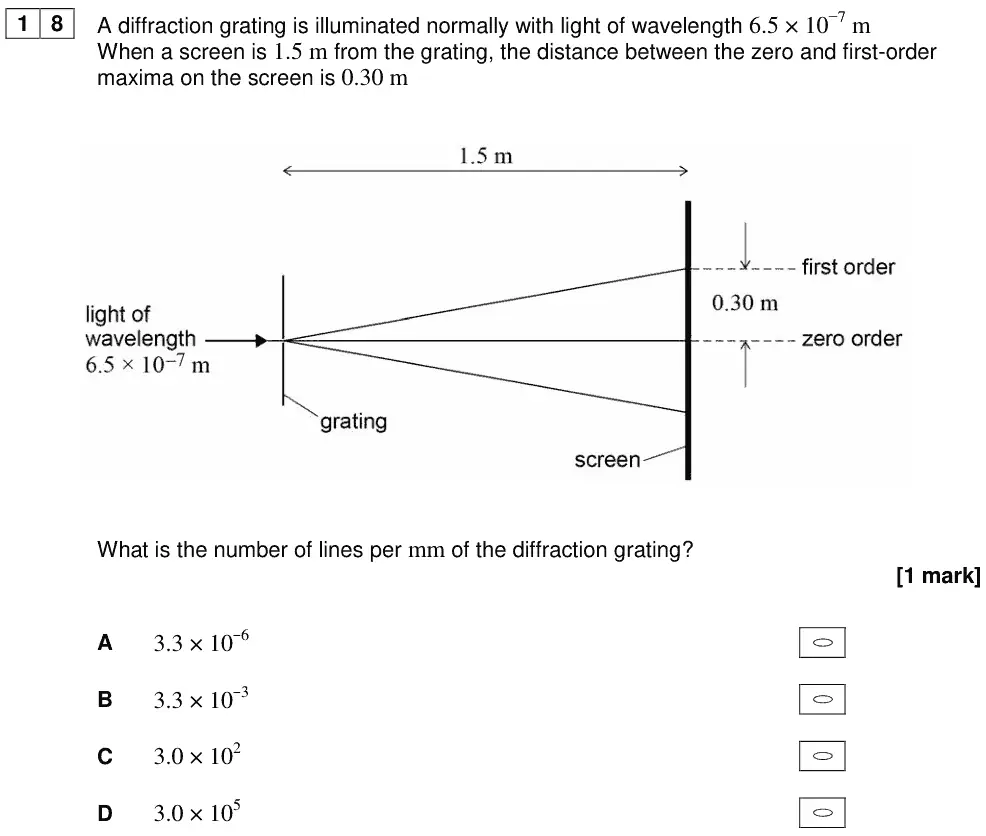
C
Skills: MS4.5 Use sin, cos and tan in physical problems; MS0.1 Recognise and make use of appropriate units in calculations
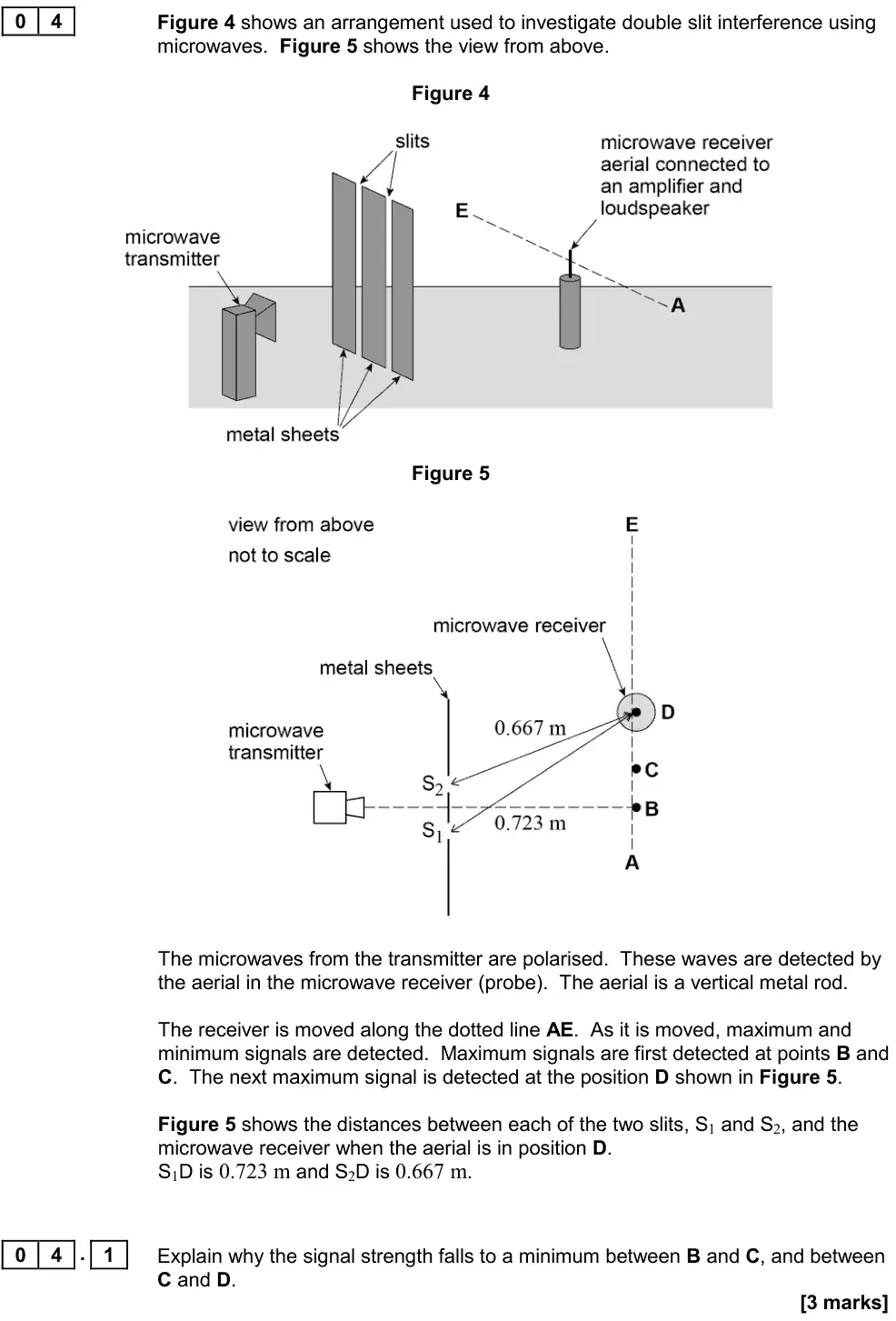
04.1 It was common to see answers referring to a simple line of sight issue related to the three metal plates, despite references to double slit interference in the stem. This may suggest that students fail to read the stem of a question with sufficient care, a problem that may be alleviated if students were in the habit of underlining key words as they read. Students who understood the context often lost marks by confusing path difference and phase difference. Being familiar with the difference, and relationship, between these two is fundamental to an understanding of interference in waves. 4.2 This is a fairly demanding multi-step problem that many found difficult. In order to answer this question, students were required to relate the data in the diagram to the path difference of the waves, specifically 2 x the wavelength. They also had to apply the wave equation to the answer they obtained. Those who managed to make some attempt at an answer commonly missed the double wavelength, or made an arithmetical error in the use of speed = frequency x wavelength.

04.1 It was common to see answers referring to a simple line of sight issue related to the three metal plates, despite references to double slit interference in the stem. This may suggest that students fail to read the stem of a question with sufficient care, a problem that may be alleviated if students were in the habit of underlining key words as they read. Students who understood the context often lost marks by confusing path difference and phase difference. Being familiar with the difference, and relationship, between these two is fundamental to an understanding of interference in waves. 4.2 This is a fairly demanding multi-step problem that many found difficult. In order to answer this question, students were required to relate the data in the diagram to the path difference of the waves, specifically 2 x the wavelength. They also had to apply the wave equation to the answer they obtained. Those who managed to make some attempt at an answer commonly missed the double wavelength, or made an arithmetical error in the use of speed = frequency x wavelength.
Skills: MS2.3 Substitute numerical values into algebraic equations using appropriate units for physical quantities

4.3 Many students suggested that total destructive interference cannot occur, without relating it to the different amplitudes of the waves due to their different path lengths. This is probably due to the fact that students commonly picture waves of equal amplitude interfering, irrespective of path length. Incorrect answers included suggestions that other sources of microwaves, including the CMBR, were to blame. This is Paper 1 of the second series of the new AS specification. The paper consists of seven questions from across the AS specification. It makes use of a range of question styles, including multiple choice, short answer, single- and multi-step calculations, data analysis, and extended writing. In general, many students experienced difficulties by missing important details in both the questions and their answers. Calculations were often done well, but many students struggled with answers that required extended writing, particularly those involving some reasoning, such as 02.1, 03.5, 04.3, 05.3, 05.7 and 07.4.
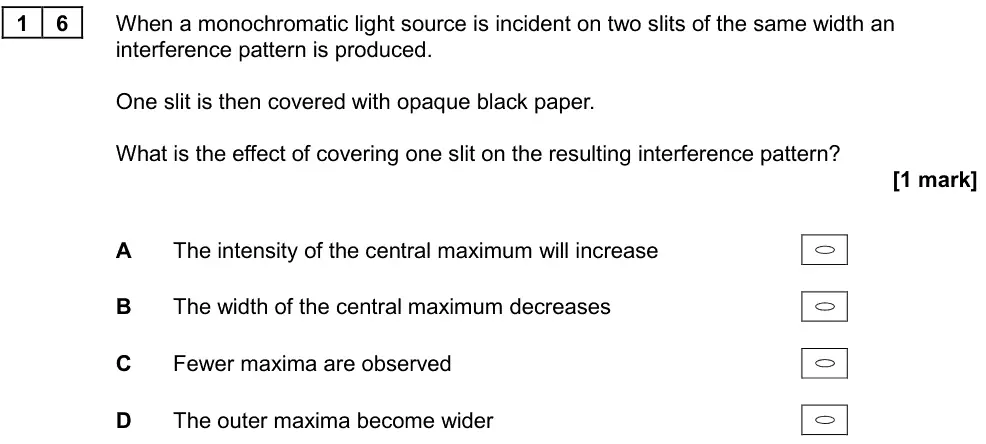
C
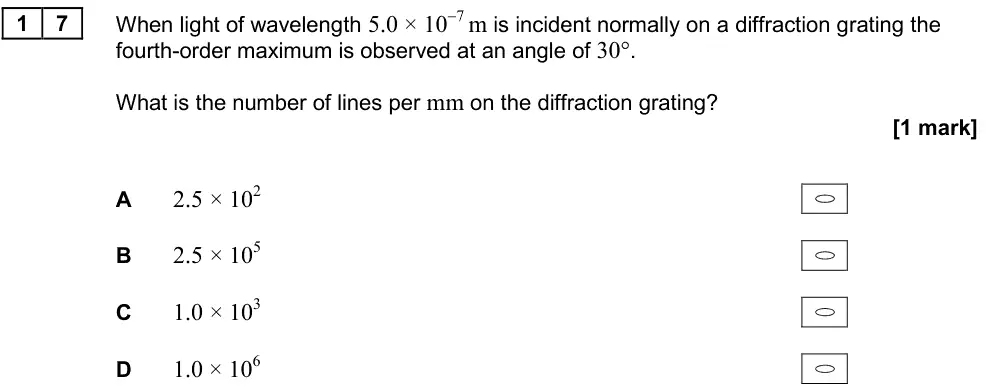
A
Skills: MS0.6 Use calculators to handle sin x, cos x, tan x when x is expressed in degrees or radians; MS0.1 Recognise and make use of appropriate units in calculations
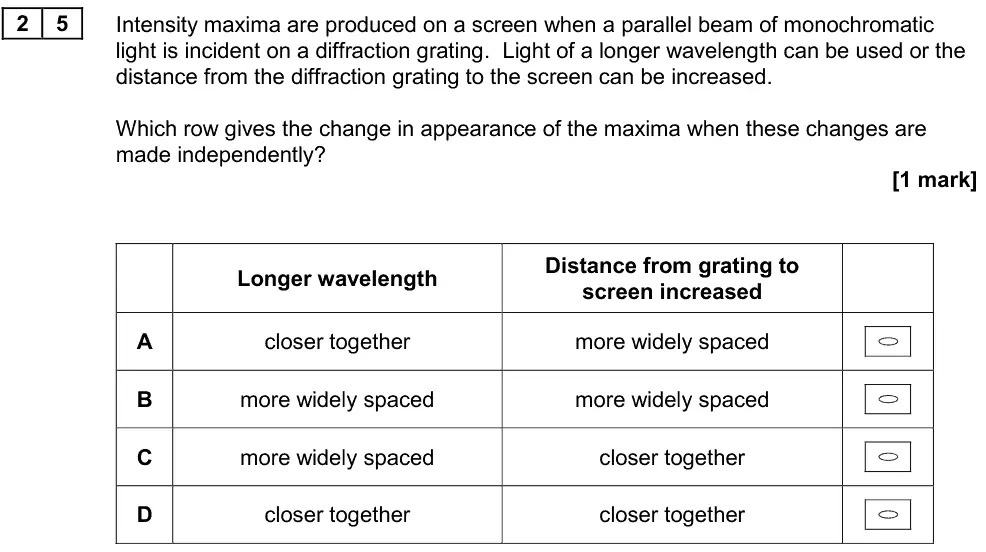
B
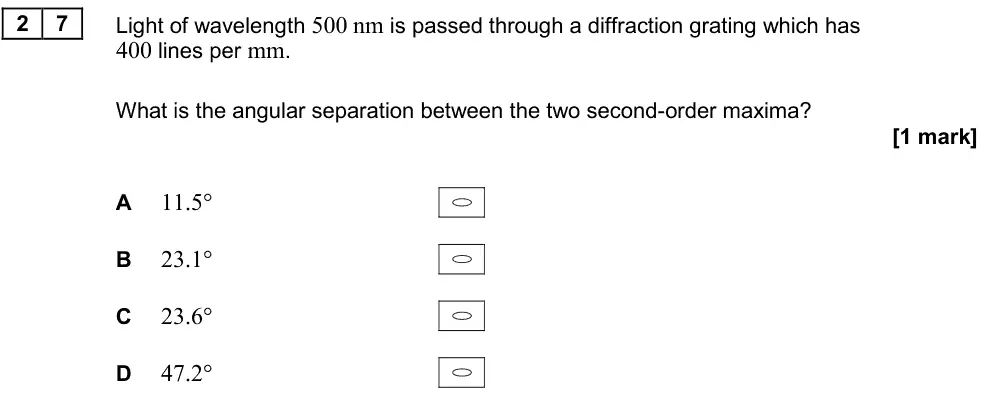
D
Skills: MS0.6 Use calculators to handle sin x, cos x, tan x when x is expressed in degrees or radians; MS2.3 Substitute numerical values into algebraic equations using appropriate units for physical quantities
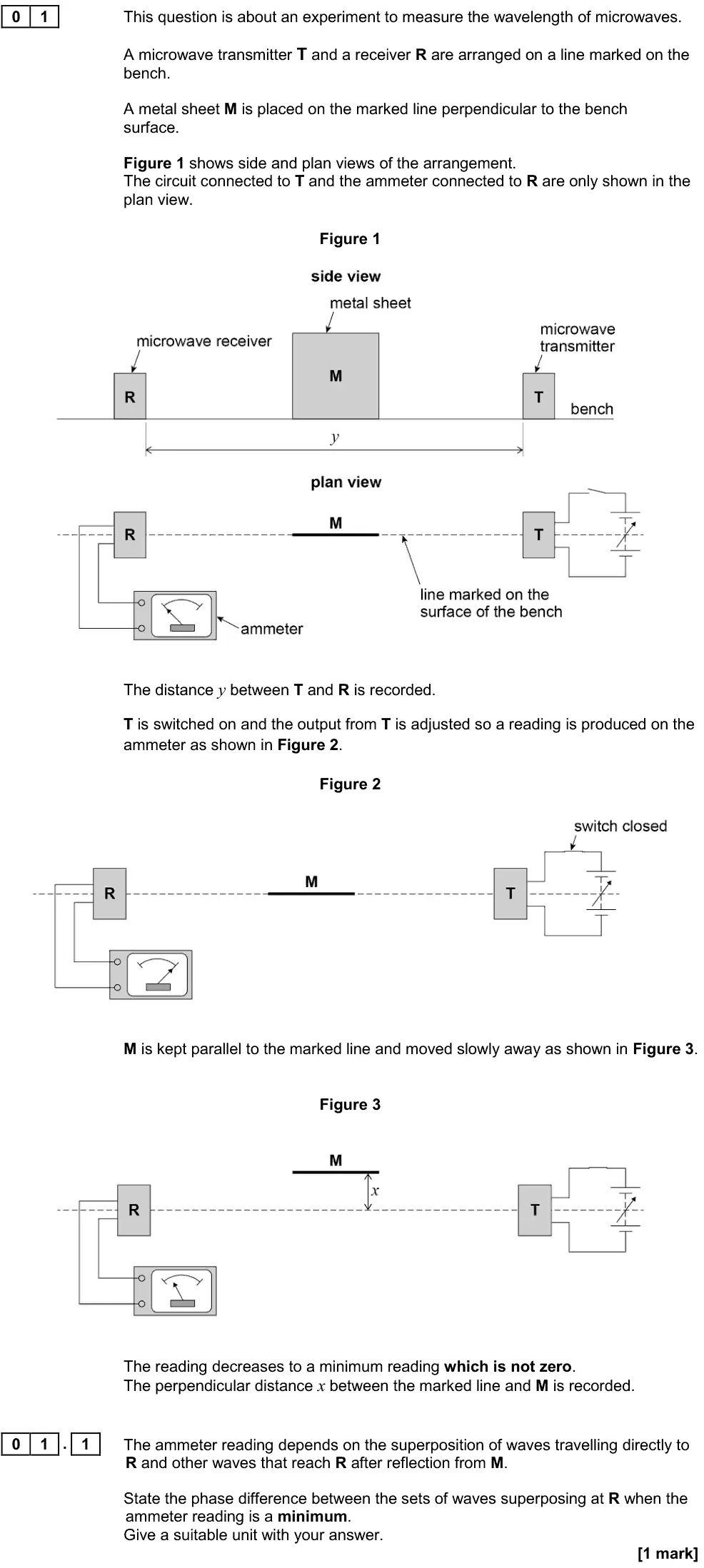
Questions 01.1 and 01.2 exposed poor understanding of superposition. Although there were plenty of correct answers to 01.1 and very few students forgot to supply any unit (we expected π radians or 180°), there were a variety of unsuccessful alternatives and some students clearly confused path difference with phase difference. Most students seemed to think that the resultant amplitude depended only on the phase difference between the sets of superposing waves, and very few considered the possibility that the waves travelling via M would arrive at R with less amplitude than those travelling directly from T. A small but significant number of students blamed microwave background radiation for the non-zero minimum reading on the ammeter. Examiners found that many students ‘improvised’ their answer to question 01.3. Developing strategies for encouraging students to think about the practicalities of arranging apparatus, and challenging their reasoning, would pay dividends in future. A simple approach such as measuring, at different points, the distance between M and the line between T and R, and checking these were equal could earn 1 mark; the sensible use of a set-square earned the second mark. Frequent suggestions that non-standard science equipment, such as tri-squares could be used, perhaps indicated that some students had only had limited opportunities to perform practical work. A common misconception was that the ends of rulers can be assumed to be square; several students stated that aligning the end of the ruler, or the graduations along the edge, with the line between T and R, ensured that perpendicular distances would be measured. One really positive aspect of the work seen was the good standard of sketches students used to illustrate their answers; some of these, by themselves, were sufficient to earn both marks. Answers to question 01.4 were much stronger, with many students demonstrating an understanding of how the error bars could be used to establish the maximum and minimum gradients. Most knew they should use large steps for the gradient calculations, and recognised in question 01.5 that their mean gradient gave λ. In question 01.6, many students appeared to have taken a guess, often based on the size of the error bars, about the uncertainty they should use. The better students used a variety of valid ways, based around ‘best gradient − worst gradient’, of judging the uncertainty. However, full credit proved elusive because the final answer was often compromised by the truncation, in 01.4, of the values for maximum and minimum gradients. Many students seemed to have rushed question 01.7, thinking they were being asked to explain that y was the vertical intercept. However, examiners wanted to know how Figure 4, which did not allow a direct measurement, should be used. Suggesting a calculation method could earn a mark, but this was denied when any suggested algebra was wrong; otherwise, some consideration of an average of the maximum and minimum intercepts also gained credit.
Skills: RP2 Investigation of interference effects to include the Young’s slit experiment and interference by a diffraction grating.

Questions 01.1 and 01.2 exposed poor understanding of superposition. Although there were plenty of correct answers to 01.1 and very few students forgot to supply any unit (we expected π radians or 180°), there were a variety of unsuccessful alternatives and some students clearly confused path difference with phase difference. Most students seemed to think that the resultant amplitude depended only on the phase difference between the sets of superposing waves, and very few considered the possibility that the waves travelling via M would arrive at R with less amplitude than those travelling directly from T. A small but significant number of students blamed microwave background radiation for the non-zero minimum reading on the ammeter.
Skills: PS1.2 Apply scientific knowledge to practical contexts; RP2 Investigation of interference effects to include the Young’s slit experiment and interference by a diffraction grating.
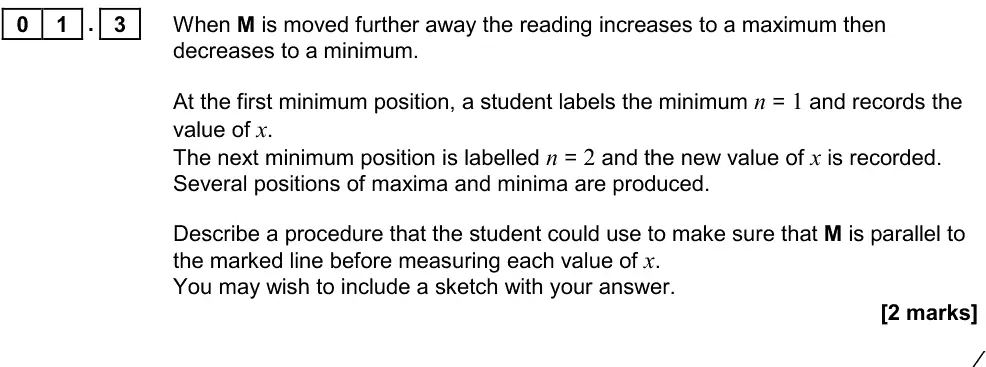
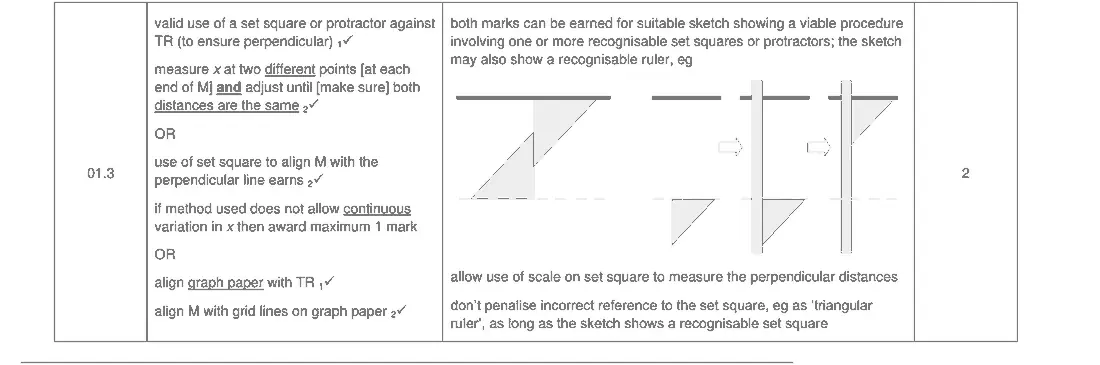
Examiners found that many students ‘improvised’ their answer to question 01.3. Developing strategies for encouraging students to think about the practicalities of arranging apparatus, and challenging their reasoning, would pay dividends in future. A simple approach such as measuring, at different points, the distance between M and the line between T and R, and checking these were equal could earn 1 mark; the sensible use of a set-square earned the second mark. Frequent suggestions that non-standard science equipment, such as tri-squares could be used, perhaps indicated that some students had only had limited opportunities to perform practical work. A common misconception was that the ends of rulers can be assumed to be square; several students stated that aligning the end of the ruler, or the graduations along the edge, with the line between T and R, ensured that perpendicular distances would be measured. One really positive aspect of the work seen was the good standard of sketches students used to illustrate their answers; some of these, by themselves, were sufficient to earn both marks. Answers to question 01.4 were much stronger, with many students demonstrating an understanding of how the error bars could be used to establish the maximum and minimum gradients. Most knew they should use large steps for the gradient calculations, and recognised in question 01.5 that their mean gradient gave λ.
Skills: PS4.1 Know and understand how to use a wide range of experimental and practical instruments, equipment and techniques; ATa analogue apparatus to record measurements and interpolate; ATc methods to increase accuracy (timing over many oscillations, fiducial marker, set square, plumb line); RP2 Investigation of interference effects to include the Young’s slit experiment and interference by a diffraction grating.

Examiners found that many students ‘improvised’ their answer to question 01.3. Developing strategies for encouraging students to think about the practicalities of arranging apparatus, and challenging their reasoning, would pay dividends in future. A simple approach such as measuring, at different points, the distance between M and the line between T and R, and checking these were equal could earn 1 mark; the sensible use of a set-square earned the second mark. Frequent suggestions that non-standard science equipment, such as tri-squares could be used, perhaps indicated that some students had only had limited opportunities to perform practical work. A common misconception was that the ends of rulers can be assumed to be square; several students stated that aligning the end of the ruler, or the graduations along the edge, with the line between T and R, ensured that perpendicular distances would be measured. One really positive aspect of the work seen was the good standard of sketches students used to illustrate their answers; some of these, by themselves, were sufficient to earn both marks. Answers to question 01.4 were much stronger, with many students demonstrating an understanding of how the error bars could be used to establish the maximum and minimum gradients. Most knew they should use large steps for the gradient calculations, and recognised in question 01.5 that their mean gradient gave λ.
Skills: MS3.4 Determine the slope and intercept of a linear graph; MS1.2 Find arithmetic means; RP2 Investigation of interference effects to include the Young’s slit experiment and interference by a diffraction grating.
A
Skills: MS0.6 Use calculators to handle sin x, cos x, tan x when x is expressed in degrees or radians
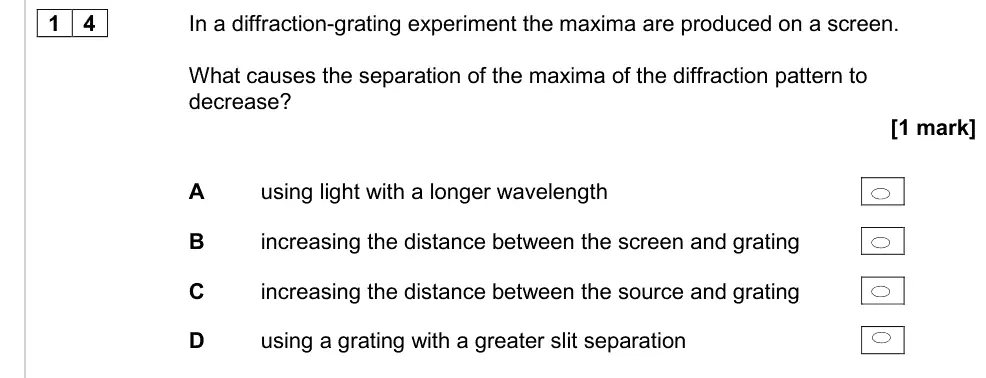
D
14 57% of students correctly identified D as the appropriate answer. The other students were split almost evenly between the distractors, with A being slightly more popular.
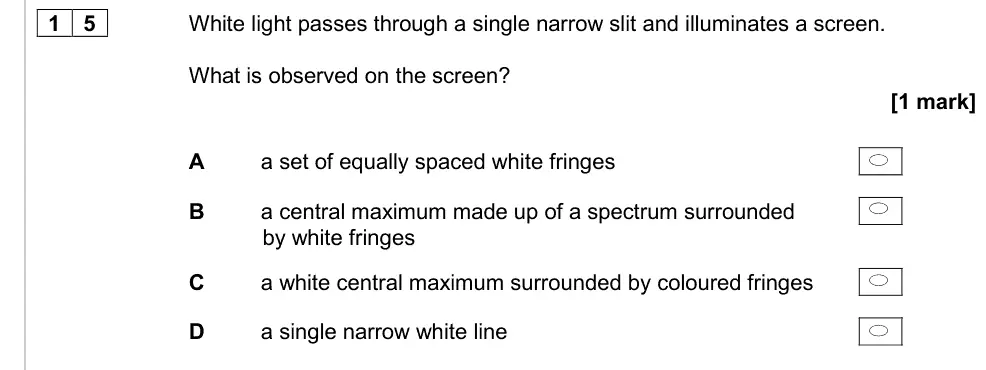
C
15 It was pleasing to note that 74% of students were sufficiently familiar with white light single slit diffraction to give the correct answer here. Approximately 10% of students gave the answer D, suggesting that they were unaware that any effect would occur.
Dropping marks on calculations, required practicals or the six-markers? Book a trial session with a specialist AQA physics tutor.