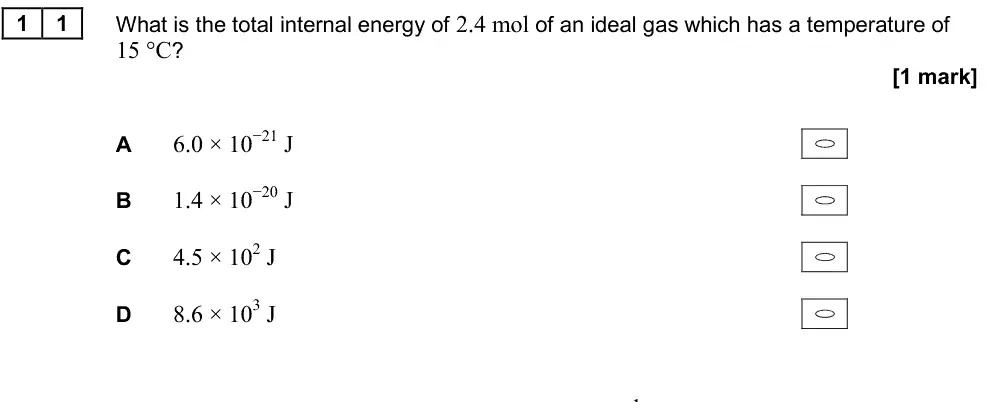
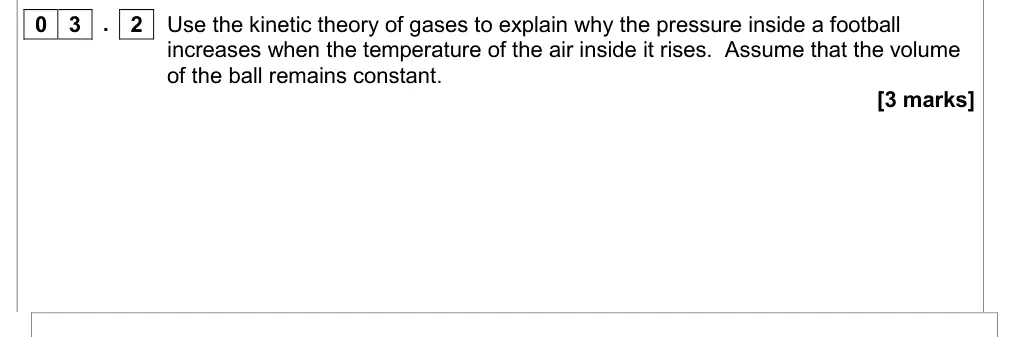
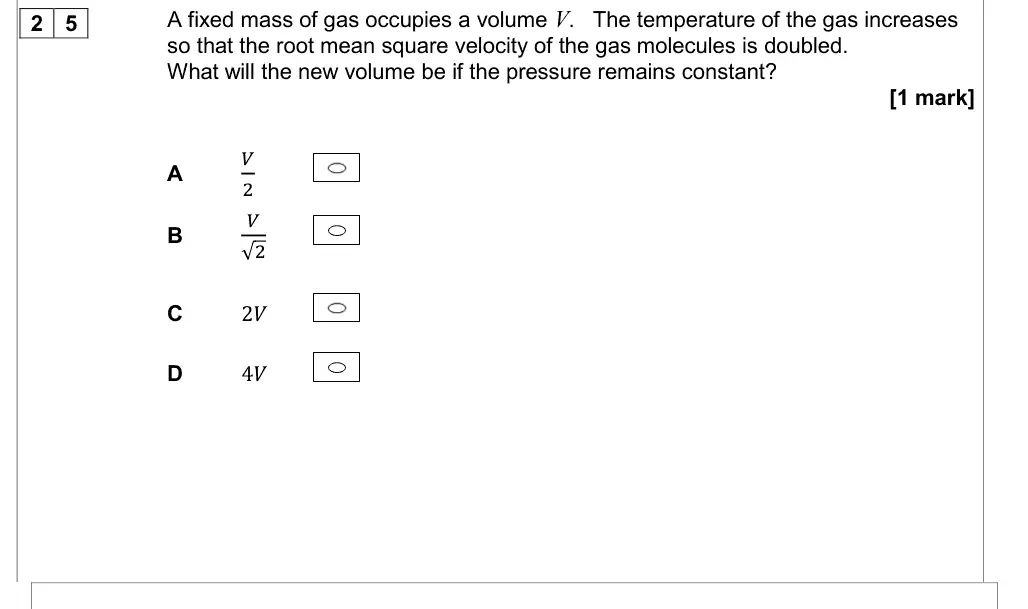
Tap a question to zoom it. Where a part needs a figure, table or graph from earlier in the question, that part folds out above it; the mark scheme and examiner's comment open underneath. Have the AQA data and formulae booklet beside you (see the formula sheet page).
June 2025 · Paper 2 · Q2.12 marksAO1=2Short answer
Mark scheme
Examiner's comment
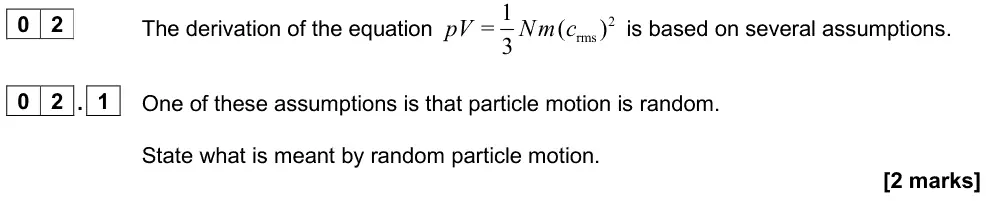
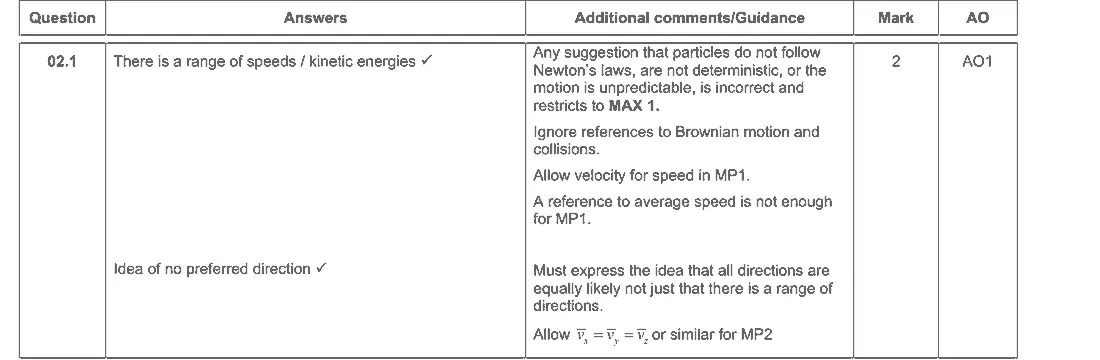
2.1 Most students did not understand the use of the term “random motion” in kinetic theory. Many mixed up the concept with Brownian motion or the random nature of radioactive decay, comment that it is unpredicted, it is spontaneous, or it can’t be affected by external forces. None of these gained marks. In order to gain marks here, students needed to define the word ‘random’ and not just refer to random direction and speed. While a range of speeds was accepted and should have been accessible, few talked about the speed or the magnitude of the velocity with most focussing only on the direction. The direction was more demanding തതത= than just a range of directions. A very few clearly knew the derivation and used ideas like 𝑐𝑐𝑥𝑥2 where answers had to demonstrate the idea that there was no preferred direction, rather തതത= 𝑐𝑐𝑧𝑧2 തതത; this was rewarded, although centres should note that if symbols are used that are 𝑐𝑐𝑦𝑦2 not defined in the questions, they should be defined in the answer.
Question 2 was about kinetic theory and was more accessible, with a mean mark of around 50%. Students found 2.1 and 2.3 to be most the challenging parts of the question.
Notes from the mark scheme and report
Range of speeds and no preferred direction (all directions equally likely)
'unpredictable' or Brownian/radioactive ideas restrict to max 1
June 2025 · Paper 2 · Q2.22 marksAO1=2Short answer
Earlier part of question 2 that this part uses
Mark scheme
Examiner's comment
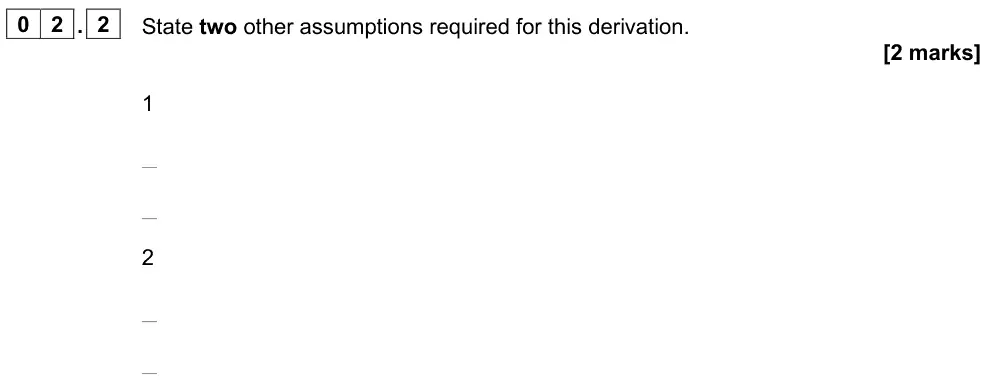
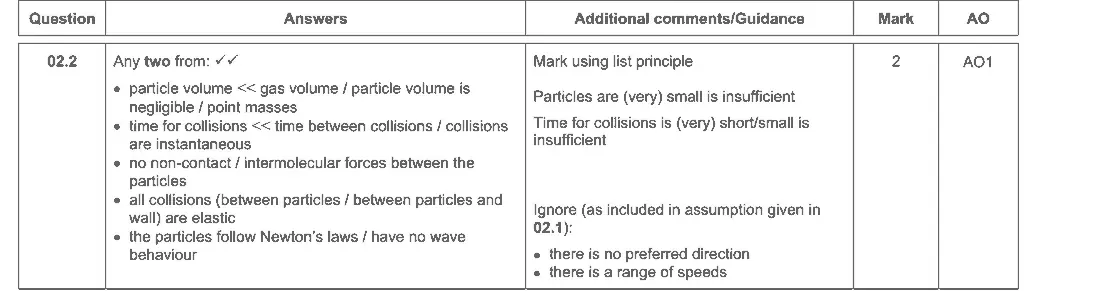
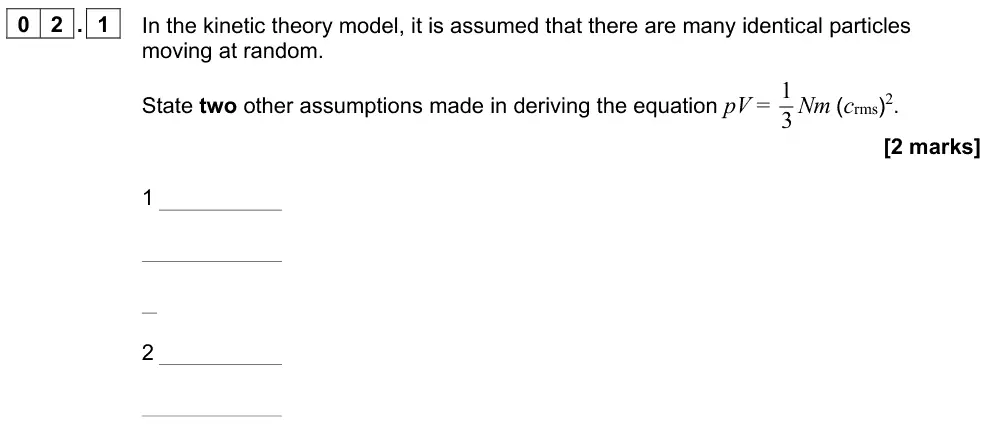
2.2 Generally, students were able to state two of the other assumptions, although some students lacked detail in their responses, referring to the volume being negligible without stating identical particles, constant mass or constant temperature.
In this question, referring toa large number of particles was not accepted as this is only important in ensuring that the particle motion is random and was not therefore considered as another assumption.
Notes from the mark scheme and report
Any two: particle volume negligible vs container, collision time negligible vs time between collisions, no intermolecular forces, elastic collisions, Newton's laws apply
'particles are small' not enough
June 2025 · Paper 2 · Q2.33 marksAO1=3Explanation
Earlier part of question 2 that this part uses
Mark scheme
Examiner's comment
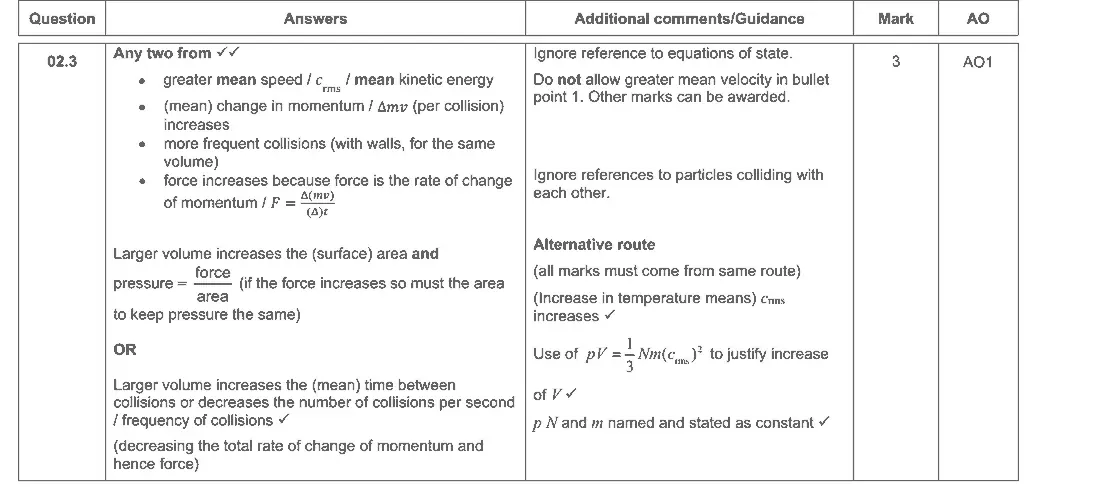
2.3 This was a standard question about using kinetic theory to explain why a fixed mass of gas should expand when heated at constant pressure. Many students found this to be accessible, but some did not express their answer in terms of kinetic theory.
In similar questions students should be encouraged to pay attention to the “using” section. Only answers which address this aspect of the question are going to score. Similar questions could be asked with: using equation(s) of state / gas laws derived from experiment • using kinetic theory • using Newton’s laws •
In this case the questions specified that the answer must use kinetic theory. There were two approaches possible: an argument based on the principles of kinetic theory referring to the 3 𝑁𝑁𝑁𝑁𝑐𝑐rms introduced in the stem of the question 𝑝𝑝𝑝𝑝= 1 2 . Approaches that used the equation had change in momentum of particles when they collide with the wall, or by using the equation to give more information than merely quoting the equation. For the last mark, the following general principles were strictly insisted upon: when using symbols in their answer that are not defined in the question, students • must define them, and when using an equation to deduce what happens to one quantity when another • changes, quantities that are not changing must be explicitly identified as constant. As is common in most years, students are very good at identifying which quantities are changing but are much less likely to state which quantities are constant. In this case, students had to name the quantities and state that they were constant. Very few students did this.
The idea that the gas pushes out on the walls and therefore it must expand was seen frequently and was rejected because an outward push on the walls defines pressure and does not require an expansion.
Question 2 was about kinetic theory and was more accessible, with a mean mark of around 50%. Students found 2.1 and 2.3 to be most the challenging parts of the question.
Notes from the mark scheme and report
Higher temperature: greater mean speed, larger momentum change per collision and more frequent collisions so more force
larger volume increases wall area (or reduces collision rate) so pressure stays constant
must use kinetic theory, not gas laws
June 2025 · Paper 2 · Q2.41 markAO2=1Calculation
Earlier part of question 2 that this part uses
Mark scheme
Examiner's comment
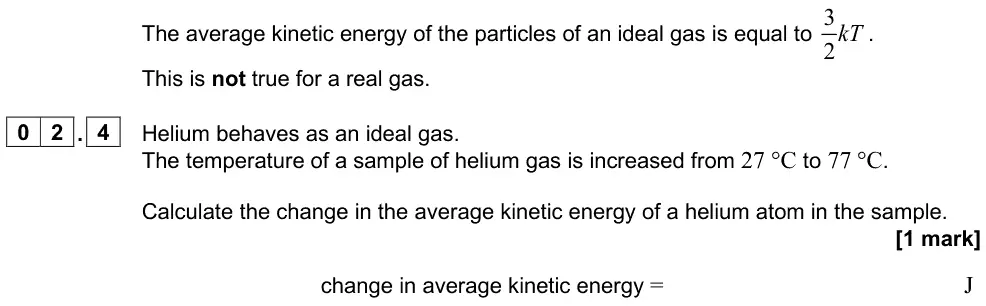
2.4 Most students found this question straightforward, with most able to score a mark. A few lost the mark due to rounding errors, adding 273 to the change in temperature or by mistakenly writing 1.35 instead of 1.035.
2.5 This was generally well answered and proved much more accessible that the earlier written parts of the question, despite being the only part of the question to address an unfamiliar context. Most students calculated the energy required to raise the temperature of 1 molecular mass of water by 50K and compared their answer to question 2.4, concluding that water vapour does not behave like an ideal gas. However, any mass and temperature was possible and many possible routes were allowed, molecules and comparing to 1400 J kg−1 K−1 or comparing differences in temperature or including determining a specific heat capacity based on the increase in kinetic energy of the
Notes from the mark scheme and report
Answer: 1.0(35) x 10^-21 J (3/2 k x 50 K)
adding 273 to the temperature change loses the mark
Skills: MS2.3 Substitute numerical values into algebraic equations using appropriate units for physical quantities
June 2025 · Paper 2 · Q2.53 marksAO3=3Calculation
Earlier part of question 2 that this part uses
Mark scheme
Examiner's comment
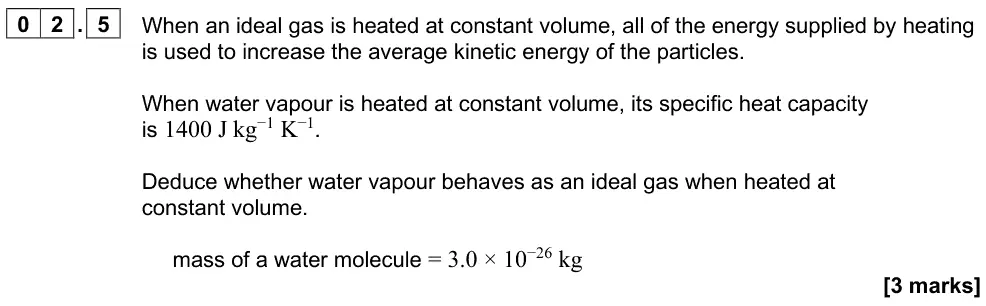
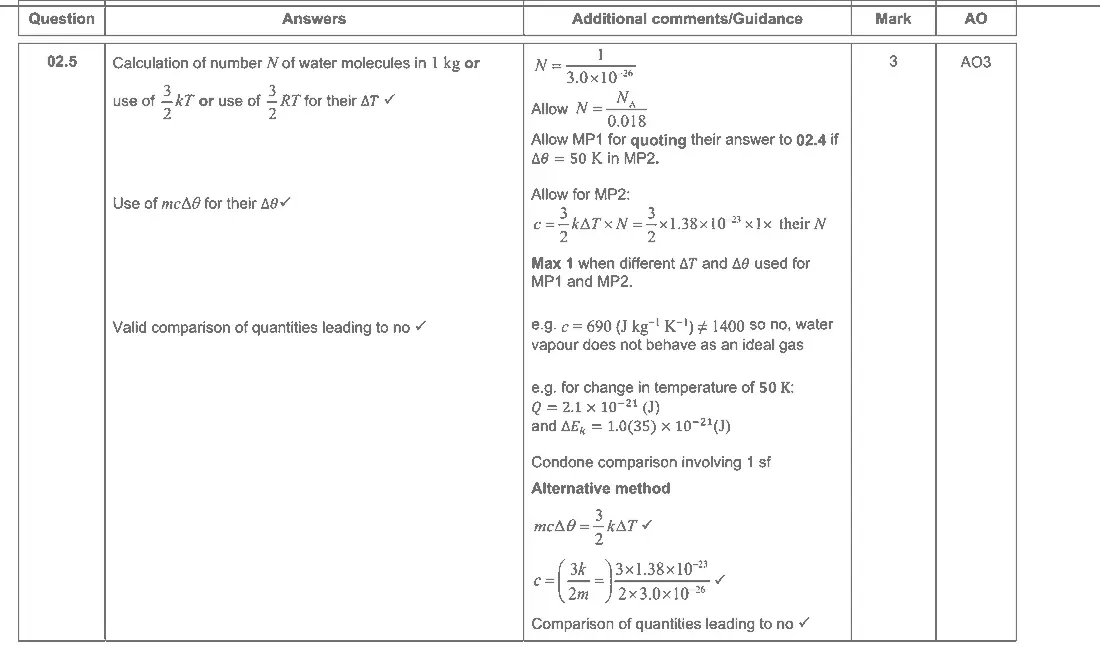
2.5 This was generally well answered and proved much more accessible that the earlier written parts of the question, despite being the only part of the question to address an unfamiliar context. Most students calculated the energy required to raise the temperature of 1 molecular mass of water by 50K and compared their answer to question 2.4, concluding that water vapour does not behave like an ideal gas. However, any mass and temperature was possible and many possible routes were allowed, molecules and comparing to 1400 J kg−1 K−1 or comparing differences in temperature or including determining a specific heat capacity based on the increase in kinetic energy of the
masses.
A small minority of students did not use the specific heat capacity for water vapour and used the value of liquid water.
Some students did not gain the last mark as there was no explicit comparison between quantities. Ideally, an answer should compare the values, state what those values mean and give a conclusion.
Notes from the mark scheme and report
Ideal-gas c = 3k/(2m) = 690 J kg^-1 K^-1, not 1400, so water vapour is not ideal (or compare energies for 50 K: 2.1 x 10^-21 J vs 1.0 x 10^-21 J)
explicit comparison needed
Skills: MS2.3 Substitute numerical values into algebraic equations using appropriate units for physical quantities; MS0.3 Use ratios, fractions and percentages
June 2024 · Paper 2 · Q1.23 marksAO2=3Calculation
Earlier part of question 1 that this part uses
Mark scheme
Examiner's comment
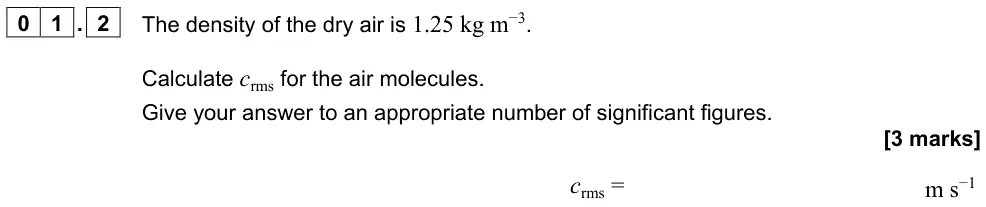
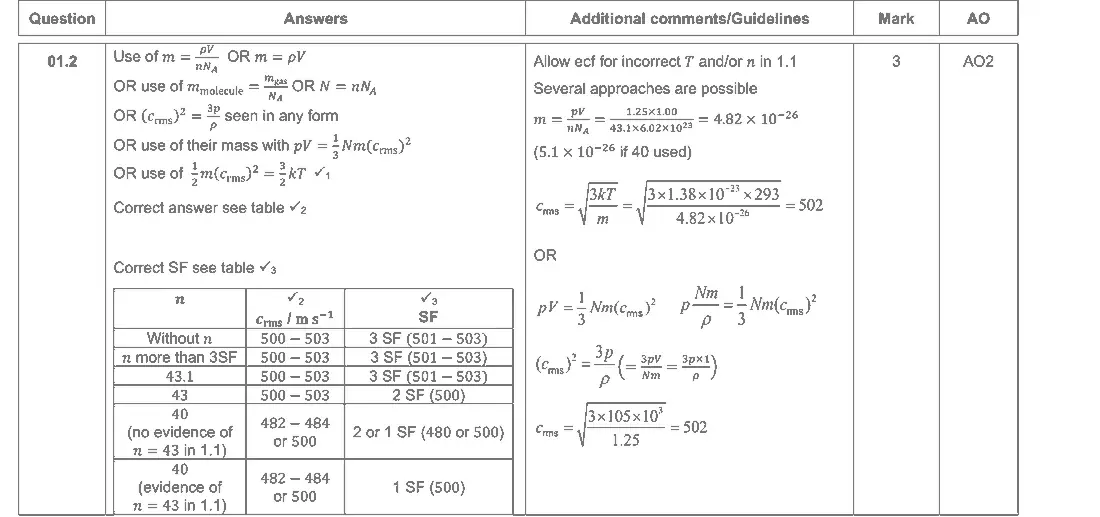
01.2 There were many different routes through this question and most students found this very challenging, although 2 of the 3 marks were easily accessible. The first mark was for some relevant calculations and depended on which value the students used for 𝑛𝑛 from question 01.1, different answers were accepted the last for the correct number of significant figures. Since the value used for the significant figures based on the value of 𝑛𝑛 seen. For those who chose a route that did not require 𝑛𝑛, then an answer to 3 sf was correct. If 𝑛𝑛 was calculated to 2 or 3 sf, then the number of significant figures in 𝑛𝑛 determined the correct answer. If the value of 40 was used and the student had not calculated a correct value in 01.1, correct value of 𝑛𝑛 should have recognised that 40 was therefore to 1 sf. then either 1 or 2 sf was accepted since 40 is ambiguous. Students who identified 43 or 43.1 as the 3 𝑁𝑁𝑁𝑁(𝑐𝑐rms)2 or 2 𝑚𝑚(𝑐𝑐rms)2 Many students were unsure about which mass to use in the equation 𝑝𝑝𝑝𝑝= 1 1 with many confusing the mass of the particle with the mass of the gas. Most students realised that absolute temperature was directly proportional to (𝑐𝑐rms)2 and therefore that 01.3
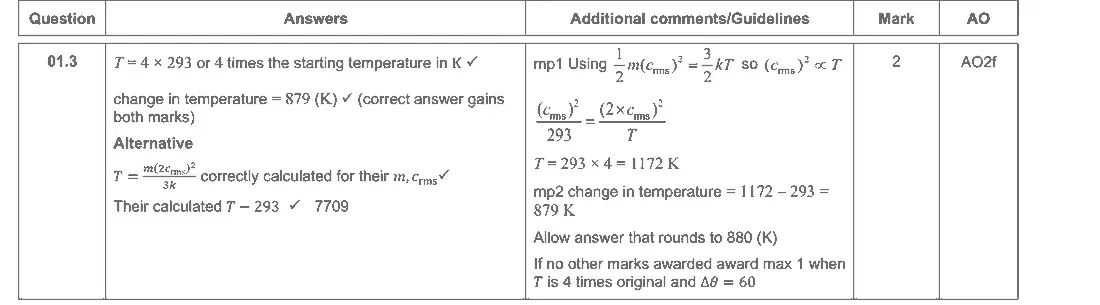
the new temperature was the old temperature multiplied by four. Some failed to recognise that the 2 𝑚𝑚(𝑐𝑐rms)2 = those students who calculated the new temperature by doubling 𝑐𝑐rms and using 2 𝑘𝑘𝑘𝑘 they 1 3 question asked for the change in temperature, so the original temperature had to be subtracted. For
were also able to gain full marks. When they had used the wrong mass in question 01.2 and the same mass was used here, the mass cancelled out – giving the correct answer. If another mistake was made in question 01.2 then full credit cold be awarded here with an error carried forward (ecf). A small number of students rounded their intermediate calculations which led to small errors in the final answer. While this is usually penalised, in this case this was felt to be unduly harsh as they were used. Only a very small number of students did not convert the temperature to K from °C. demonstrating good understanding of the physics involved, and so a range of acceptable answers was
Notes from the mark scheme and report
Answer: about 502 m s^-1 to 3 sf (c_rms^2 = 3p/rho)
sf must match the data (2 sf if n = 43 used)
confusion over which mass to use in pV = 1/3 Nm c_rms^2
Skills: MS2.2 Change the subject of an equation, including non-linear equations; MS2.3 Substitute numerical values into algebraic equations using appropriate units for physical quantities; MS1.1 Use an appropriate number of significant figures
June 2024 · Paper 2 · Q1.32 marksAO2=2Calculation
Earlier part of question 1 that this part uses
Mark scheme
Examiner's comment
01.2 There were many different routes through this question and most students found this very challenging, although 2 of the 3 marks were easily accessible. The first mark was for some relevant calculations and depended on which value the students used for 𝑛𝑛 from question 01.1, different answers were accepted the last for the correct number of significant figures. Since the value used for the significant figures based on the value of 𝑛𝑛 seen. For those who chose a route that did not require 𝑛𝑛, then an answer to 3 sf was correct. If 𝑛𝑛 was calculated to 2 or 3 sf, then the number of significant figures in 𝑛𝑛 determined the correct answer. If the value of 40 was used and the student had not calculated a correct value in 01.1, correct value of 𝑛𝑛 should have recognised that 40 was therefore to 1 sf. then either 1 or 2 sf was accepted since 40 is ambiguous. Students who identified 43 or 43.1 as the 3 𝑁𝑁𝑁𝑁(𝑐𝑐rms)2 or 2 𝑚𝑚(𝑐𝑐rms)2 Many students were unsure about which mass to use in the equation 𝑝𝑝𝑝𝑝= 1 1 with many confusing the mass of the particle with the mass of the gas. Most students realised that absolute temperature was directly proportional to (𝑐𝑐rms)2 and therefore that 01.3
Notes from the mark scheme and report
Answer: 879 K (T proportional to c_rms^2, so T becomes 4 x 293 = 1172 K
change = 879 K)
Skills: MS0.3 Use ratios, fractions and percentages; MS2.2 Change the subject of an equation, including non-linear equations
June 2024 · Paper 2 · Q91 markMultiple choice
Answer
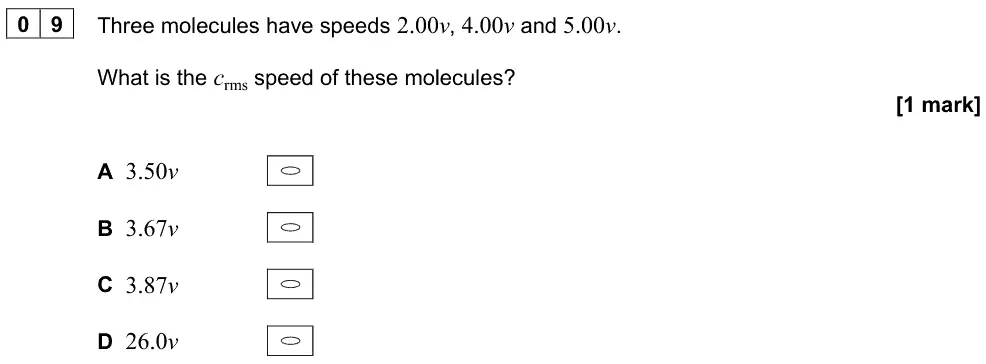
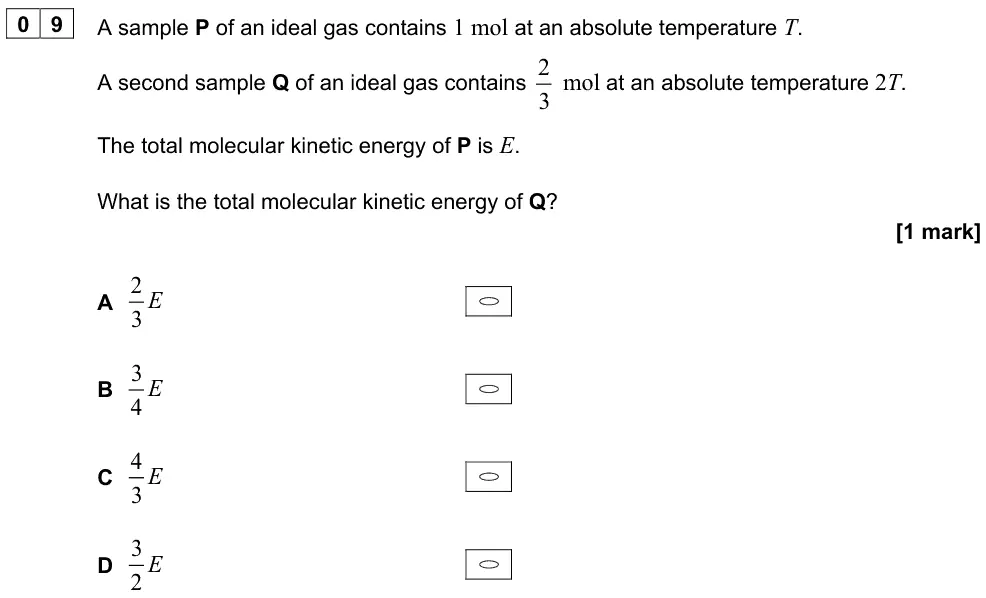
C
Mark scheme
Notes from the mark scheme and report
Answer: C
Skills: MS1.2 Find arithmetic means
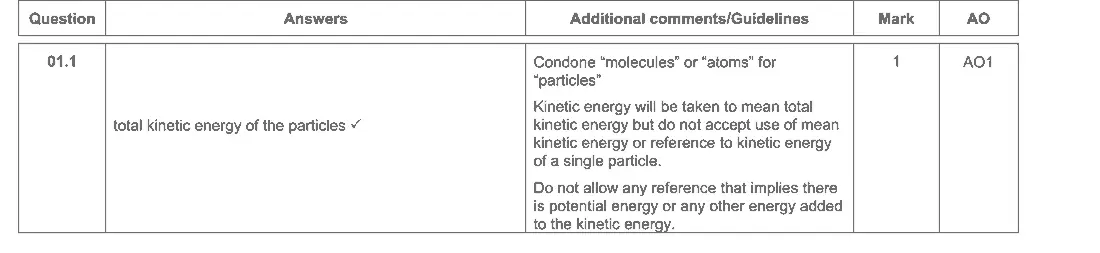
June 2023 · Paper 2 · Q1.11 markAO1=1Short answer
Mark scheme
Examiner's comment
01.1 Most students did not pick up the point that the gas is ideal. Potential energy was often added to the kinetic energy in answers. Only very few students went on to state that, in this case, potential energy is zero. Those who appreciated that kinetic energy alone was the expected answer sometimes spoiled the point by referring to a mean kinetic energy.
Notes from the mark scheme and report
Total kinetic energy of the particles (no potential energy in an ideal gas)
adding potential energy or giving mean kinetic energy loses the mark
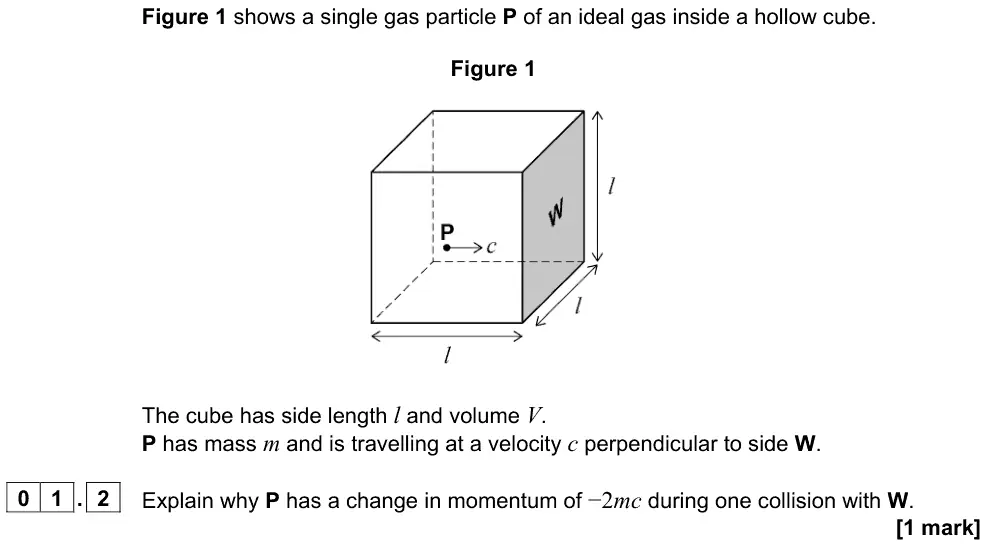
June 2023 · Paper 2 · Q1.21 markAO1=1Explanation
Earlier part of question 1 that this part uses
Mark scheme
Examiner's comment
01.2 Most students did not explain the sign convention by, for example, stating that the initial momentum was mc. Simply giving an answer – mc – mc = –2mc did not explain the situation. Some did add that the collision was elastic and that the speed remains the same but this was not a complete explanation. The statement that “momentum is conserved” was ignored.
Notes from the mark scheme and report
Initial momentum +mc, final -mc (elastic, same speed), so change = -mc - mc = -2mc
sign convention must be explained
'momentum is conserved' ignored
June 2023 · Paper 2 · Q1.31 markAO1=1Show that
Earlier part of question 1 that this part uses
Mark scheme
Examiner's comment
01.3 A number of students brought in terms such as wavelength or factors of 2 which lost credit immediately. Others failed to gain marks due to being too brief and not showing the necessary two stages in the calculation, these being finding an expression for the time and then relating time to frequency.
Notes from the mark scheme and report
Time between collisions with W = 2l/c so f = 1/t = c/2l
must show the time step
v = f lambda not allowed
June 2023 · Paper 2 · Q1.42 marksAO1=2Explanation
Earlier part of question 1 that this part uses
Mark scheme
Examiner's comment
01.4 This question was tackled in a straightforward way by fewer than half of the students; the remainder did not know how to start their answer even though it covers a small stage in a standard proof. It was common to see an absence of any reference to a Newton law.
Notes from the mark scheme and report
F = rate of change of momentum (Newton II) = 2mc x c/2l = mc^2/l
p = F/A = mc^2/l^3 = mc^2/V
a Newton law must be referenced
Skills: MS2.2 Change the subject of an equation, including non-linear equations
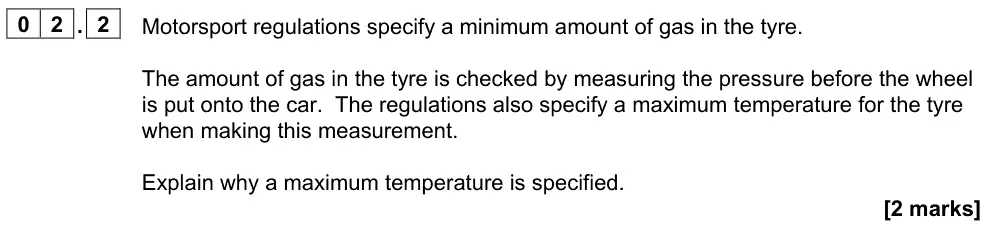
June 2023 · Paper 2 · Q2.22 marksAO2=2Explanation
Earlier part of question 2 that this part uses
Mark scheme
Examiner's comment
02.2 Many students made the link between temperature and pressure to gain the first mark. Many then failed to obtain the second mark because they suggested that the tyre might explode. Only a minority of students understood that the tyre could produce the appropriate pressure with less gas at an elevated temperature.
Notes from the mark scheme and report
Higher temperature raises pressure, so the tyre could pass the check with less gas
'tyre might explode' not credited
June 2023 · Paper 2 · Q7.43 marksAO2=3Calculation
Earlier part of question 7 that this part uses
Mark scheme
Examiner's comment
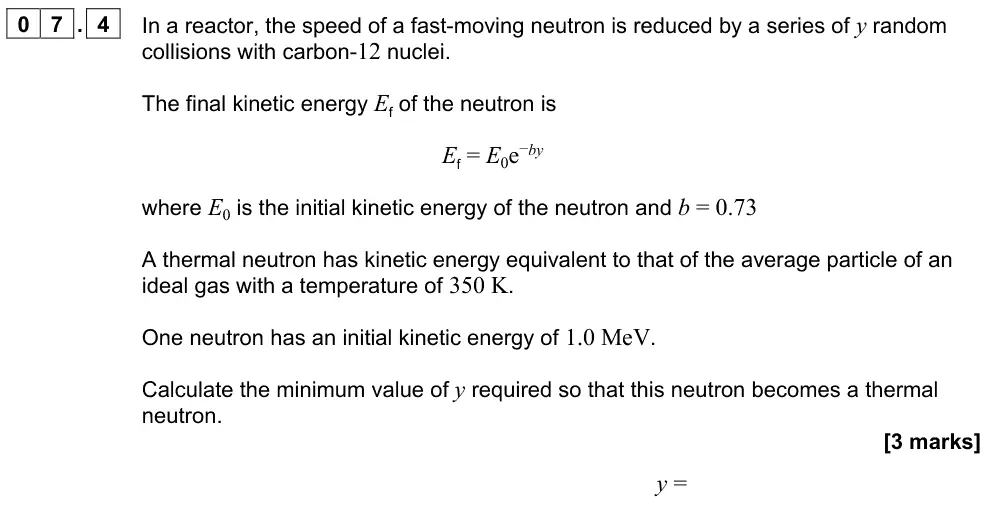
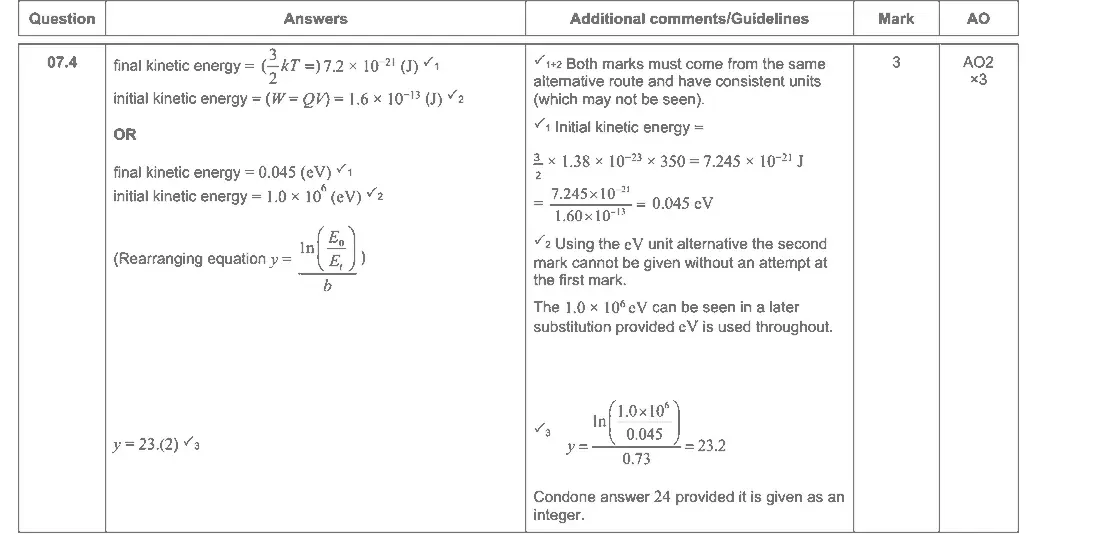
07.4 A majority of students could determine the initial and final kinetic energies in similar units and go on to obtain the correct answer. Re-arranging the equation did not pose much of a difficulty. It was most common for students to work with energies in J. Some of these made errors in converting from eV and some did not use the correct expression for the energy of a thermal neutron. There was also a significant number (nearly 9%) who had no idea how to start.
Notes from the mark scheme and report
Answer: y = 23 (thermal KE = 3/2 kT = 7.2 x 10^-21 J = 0.045 eV
y = ln(E0/Ef)/0.73)
consistent units needed
nearly 9% made no start
Skills: MS0.5 Use calculators to find and use power, exponential and logarithmic functions; MS2.2 Change the subject of an equation, including non-linear equations
June 2022 · Paper 2 · Q2.12 marksAO1=2Short answer
Mark scheme
Examiner's comment
For most this was a straightforward recall question. However, there was a significant number who did not know what to write. These made statements such as ‘the temperature or pressure is constant’ or 'particles move at the same speed’. Students who typically lost one mark tended not to complete the answer fully. They stated that the time taken by collisions is small but did not complete the answer by saying what this time was compared with.
Question 02.1
Notes from the mark scheme and report
Any two: molecular volume negligible compared with container volume
collision time negligible compared with time between collisions
elastic collisions
no forces except during collisions
'volume of gas' not enough
must say what the time is compared with
June 2022 · Paper 2 · Q2.23 marksAO2=3Explanation
Earlier part of question 2 that this part uses
Mark scheme
Examiner's comment
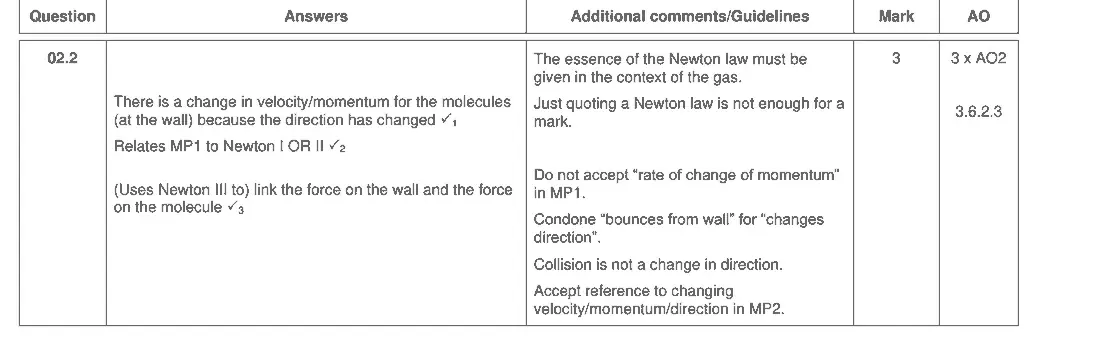
Students at all levels of ability had some problems in answering this question. Newton’s laws are a familiar topic introduced before A-level, so examiners expect that students should raise the standard of their answers above this first introduction; just quoting a Newton’s law was not sufficient – it had to be related to a particular event or situation. Weaker students ignored the Newton’s law reference and were content to write about the kinetic energy of the molecule giving it a force as it hits the wall. More able students tried to use Newton I but only wrote about molecules hitting the wall and failed to state that the velocity or momentum changes. In terms of Newton II, many students did not refer to rate of change when discussing the momentum. A more subtle error was to regard the wall as being given the force even though it was the molecule that had the rate of change of momentum. The forces are obviously related but the order of events was not made clear. The main failure was to quote the law in isolation and not refer to the wall and molecule.
Question 02.2
Notes from the mark scheme and report
Momentum/velocity of molecule changes at the wall (direction change)
link to Newton I or II
Newton III links force on molecule to force on wall
quoting a law without applying it to the molecule and wall scores nothing
June 2022 · Paper 2 · Q2.33 marksAO1=1, AO2=2Calculation
Earlier part of question 2 that this part uses
Mark scheme
Examiner's comment
Students who realised that two equations were necessary to solve this problem generally obtained the correct answer. Others went down this route but confused the number of molecules N with the number of moles n. Many others tried to obtain an answer using only the energy equation or just the ideal gas equation and got nowhere.
Question 02.3
Notes from the mark scheme and report
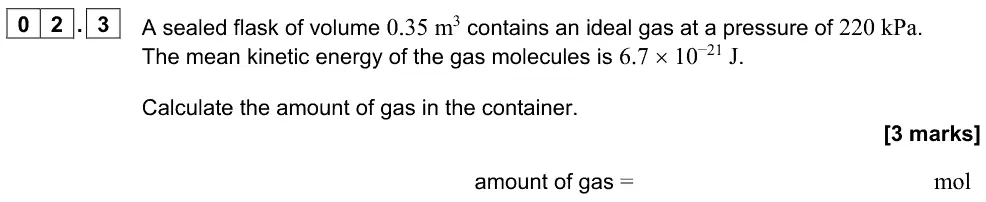
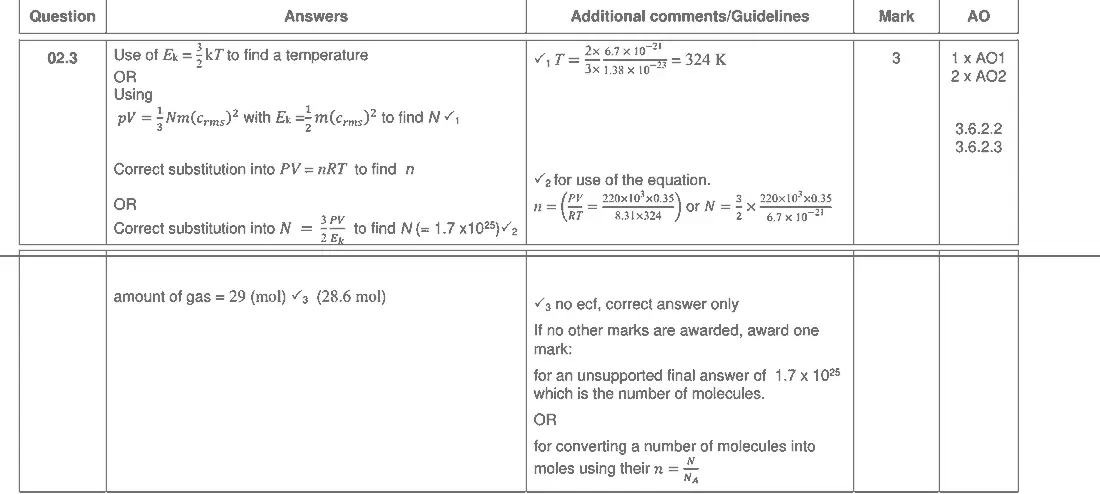
Answer: 29 mol (T = 324 K from Ek = 3/2 kT, then n = pV/RT
or N = 1.7 x 10^25 then divide by NA)
confusing N with n, or using only one equation, were common
Skills: MS2.2 Change the subject of an equation, including non-linear equations; MS2.3 Substitute numerical values into algebraic equations using appropriate units for physical quantities
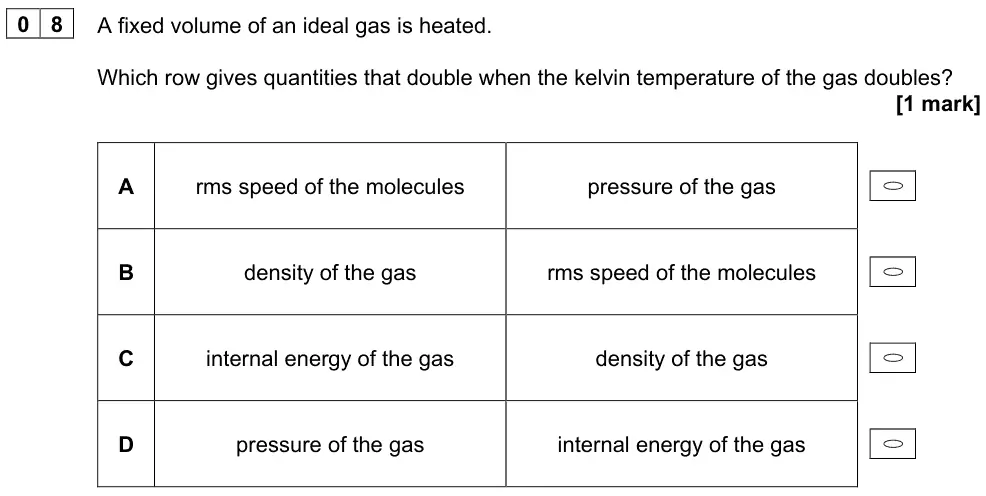
June 2022 · Paper 2 · Q81 markAO2=1Multiple choice
Answer
D
Mark scheme
Notes from the mark scheme and report
Answer: D
November 2021 · Paper 2 · Q3.11 markAO1=1Short answerHard
Mark scheme
Examiner's comment
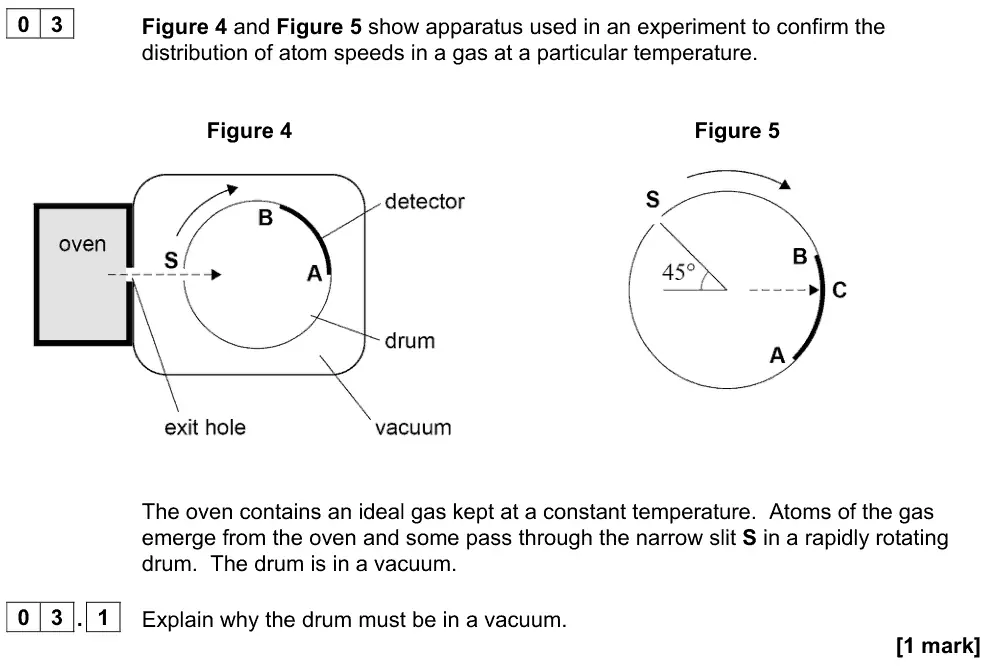
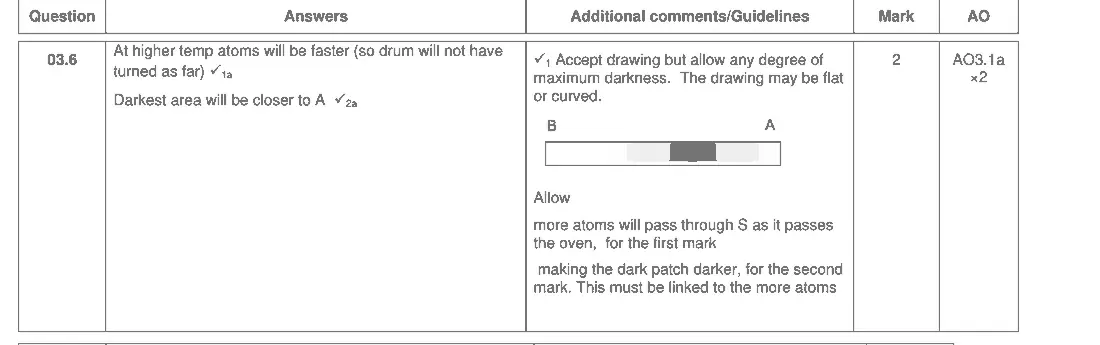
03.1 In the main, students thought it was sufficient to explain that in a vacuum a collision would not occur. Only about a fifth of them went on to explain how collisions might affect the speed distribution of the atoms emerging from the oven. 03.2 Half of the students sailed easily through this question. There was a significant number, however, who failed to identify the time and then could not make any progress. 03.3 A significant number of students went wrong at an early stage by not knowing the difference between mass and molar mass. In general, the students who could evaluate the mass of a single atom had no difficulty in completing the whole question. 03.4 Almost all students made reference to having fewer atoms in the oven. Several different types of errors then occurred: • a number of students failed to discuss any kinetic motion, instead these students chose to rely incorrectly on the gas laws; • a failure to discuss the rate of collision with the oven wall even when it was these collisions that were recognised to be of importance; • poor use of technical language. It was not always clear whether described momentum changes referred to single atoms or the whole ensemble. The first of these should be described as being, on average, constant whereas the total momentum change would decrease. 03.5 A majority of students did not have enough knowledge or experience of the gas equations to make any progress. Most attempted an answer using inappropriate equations. 03.6 Most students understood the situation but many did not always describe the motion of the atoms with sufficient clarity in writing about the new detector. A number thought the detector would darken more because it was hit harder and did not focus on the number of colliding atoms.
Notes from the mark scheme and report
Atoms would collide with air molecules, changing their speeds / directions and so the speed distribution
'no collisions in a vacuum' alone not enough
November 2021 · Paper 2 · Q3.33 marksCalculation
Earlier part of question 3 that this part uses
Mark scheme
Examiner's comment
03.1 In the main, students thought it was sufficient to explain that in a vacuum a collision would not occur. Only about a fifth of them went on to explain how collisions might affect the speed distribution of the atoms emerging from the oven. 03.2 Half of the students sailed easily through this question. There was a significant number, however, who failed to identify the time and then could not make any progress. 03.3 A significant number of students went wrong at an early stage by not knowing the difference between mass and molar mass. In general, the students who could evaluate the mass of a single atom had no difficulty in completing the whole question. 03.4 Almost all students made reference to having fewer atoms in the oven. Several different types of errors then occurred: • a number of students failed to discuss any kinetic motion, instead these students chose to rely incorrectly on the gas laws; • a failure to discuss the rate of collision with the oven wall even when it was these collisions that were recognised to be of importance; • poor use of technical language. It was not always clear whether described momentum changes referred to single atoms or the whole ensemble. The first of these should be described as being, on average, constant whereas the total momentum change would decrease. 03.5 A majority of students did not have enough knowledge or experience of the gas equations to make any progress. Most attempted an answer using inappropriate equations. 03.6 Most students understood the situation but many did not always describe the motion of the atoms with sufficient clarity in writing about the new detector. A number thought the detector would darken more because it was hit harder and did not focus on the number of colliding atoms.
Notes from the mark scheme and report
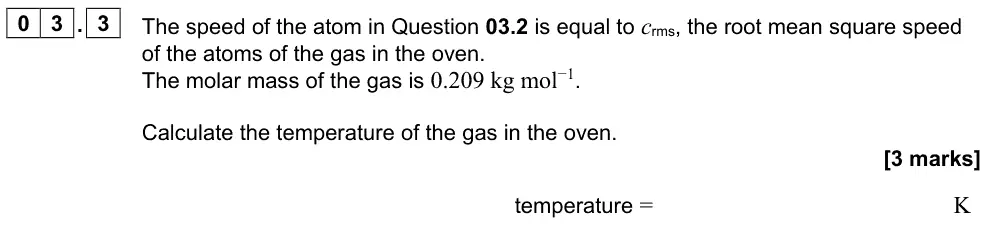
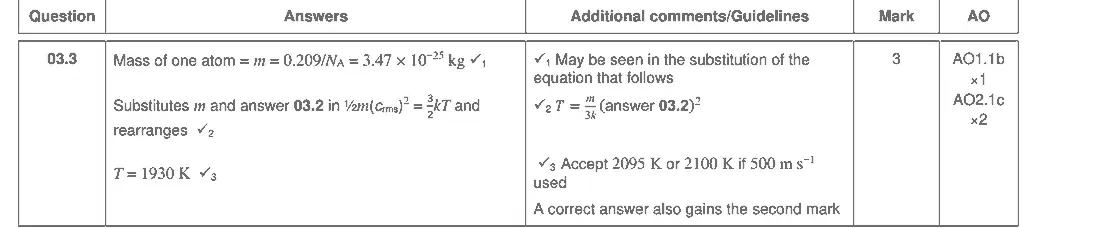
Answer: 1930 K (m = 0.209 / NA = 3.47 x 10^-25 kg
T = m crms^2 / 3k
2100 K if 500 m s^-1 used)
confusing molar and atomic mass
Skills: MS2.2 Change the subject of an equation, including non-linear equations; MS2.3 Substitute numerical values into algebraic equations using appropriate units for physical quantities
November 2021 · Paper 2 · Q3.42 marksExplanation
Earlier part of question 3 that this part uses
Mark scheme
Examiner's comment
03.1 In the main, students thought it was sufficient to explain that in a vacuum a collision would not occur. Only about a fifth of them went on to explain how collisions might affect the speed distribution of the atoms emerging from the oven. 03.2 Half of the students sailed easily through this question. There was a significant number, however, who failed to identify the time and then could not make any progress. 03.3 A significant number of students went wrong at an early stage by not knowing the difference between mass and molar mass. In general, the students who could evaluate the mass of a single atom had no difficulty in completing the whole question. 03.4 Almost all students made reference to having fewer atoms in the oven. Several different types of errors then occurred: • a number of students failed to discuss any kinetic motion, instead these students chose to rely incorrectly on the gas laws; • a failure to discuss the rate of collision with the oven wall even when it was these collisions that were recognised to be of importance; • poor use of technical language. It was not always clear whether described momentum changes referred to single atoms or the whole ensemble. The first of these should be described as being, on average, constant whereas the total momentum change would decrease. 03.5 A majority of students did not have enough knowledge or experience of the gas equations to make any progress. Most attempted an answer using inappropriate equations. 03.6 Most students understood the situation but many did not always describe the motion of the atoms with sufficient clarity in writing about the new detector. A number thought the detector would darken more because it was hit harder and did not focus on the number of colliding atoms.
Notes from the mark scheme and report
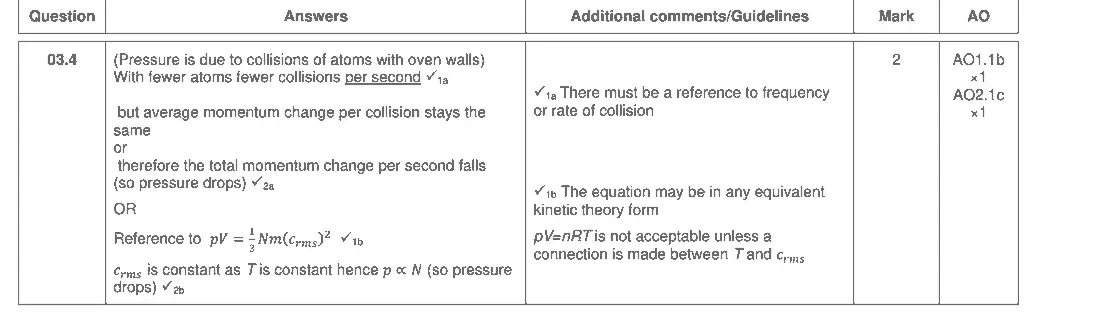
Fewer atoms so fewer collisions per second with the walls
mean momentum change per collision unchanged (T constant) so total rate of momentum change and pressure fall
gas-law-only answers not credited
November 2021 · Paper 2 · Q3.62 marksAO3=2Explanation
Earlier part of question 3 that this part uses
Mark scheme
Examiner's comment
03.1 In the main, students thought it was sufficient to explain that in a vacuum a collision would not occur. Only about a fifth of them went on to explain how collisions might affect the speed distribution of the atoms emerging from the oven. 03.2 Half of the students sailed easily through this question. There was a significant number, however, who failed to identify the time and then could not make any progress. 03.3 A significant number of students went wrong at an early stage by not knowing the difference between mass and molar mass. In general, the students who could evaluate the mass of a single atom had no difficulty in completing the whole question. 03.4 Almost all students made reference to having fewer atoms in the oven. Several different types of errors then occurred: • a number of students failed to discuss any kinetic motion, instead these students chose to rely incorrectly on the gas laws; • a failure to discuss the rate of collision with the oven wall even when it was these collisions that were recognised to be of importance; • poor use of technical language. It was not always clear whether described momentum changes referred to single atoms or the whole ensemble. The first of these should be described as being, on average, constant whereas the total momentum change would decrease. 03.5 A majority of students did not have enough knowledge or experience of the gas equations to make any progress. Most attempted an answer using inappropriate equations. 03.6 Most students understood the situation but many did not always describe the motion of the atoms with sufficient clarity in writing about the new detector. A number thought the detector would darken more because it was hit harder and did not focus on the number of colliding atoms.
Notes from the mark scheme and report
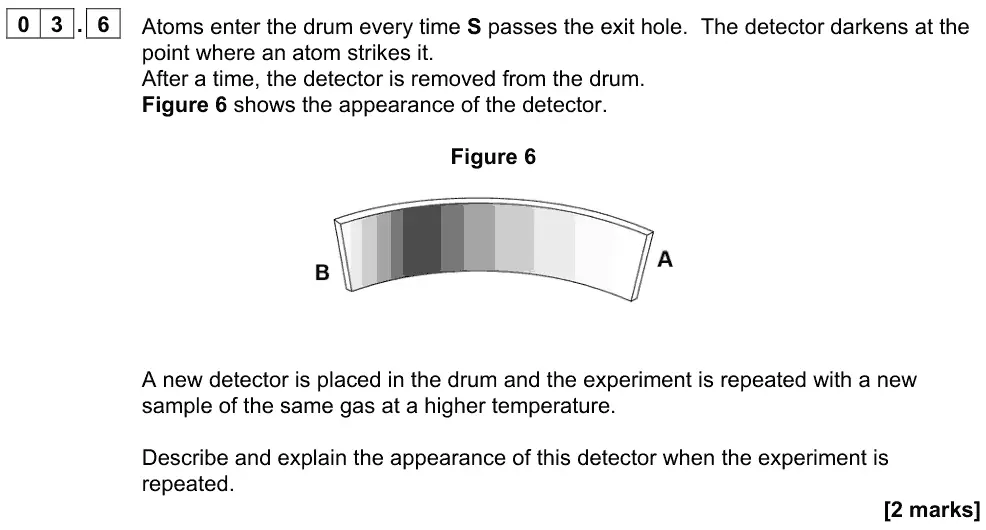
Higher temperature so atoms faster, drum turns less in transit, darkest region closer to A
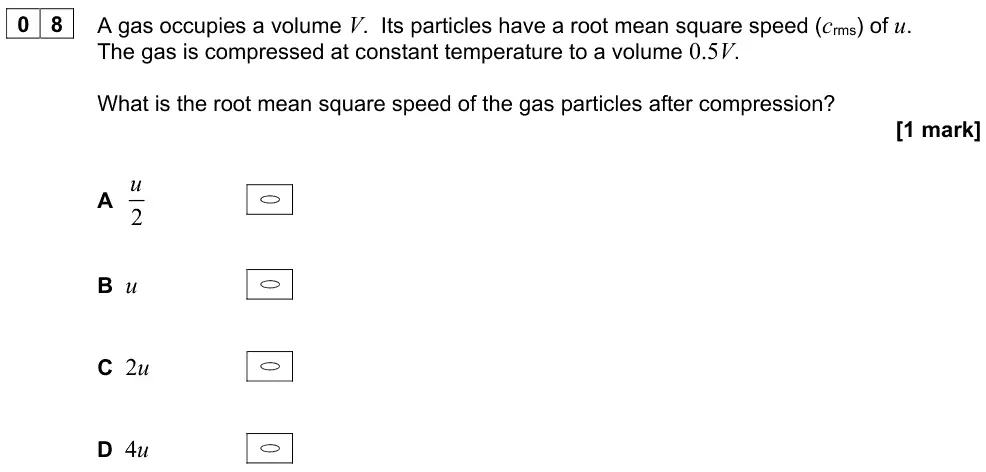
November 2021 · Paper 2 · Q81 markMultiple choice
Answer
B
Mark scheme
Notes from the mark scheme and report
Answer: B
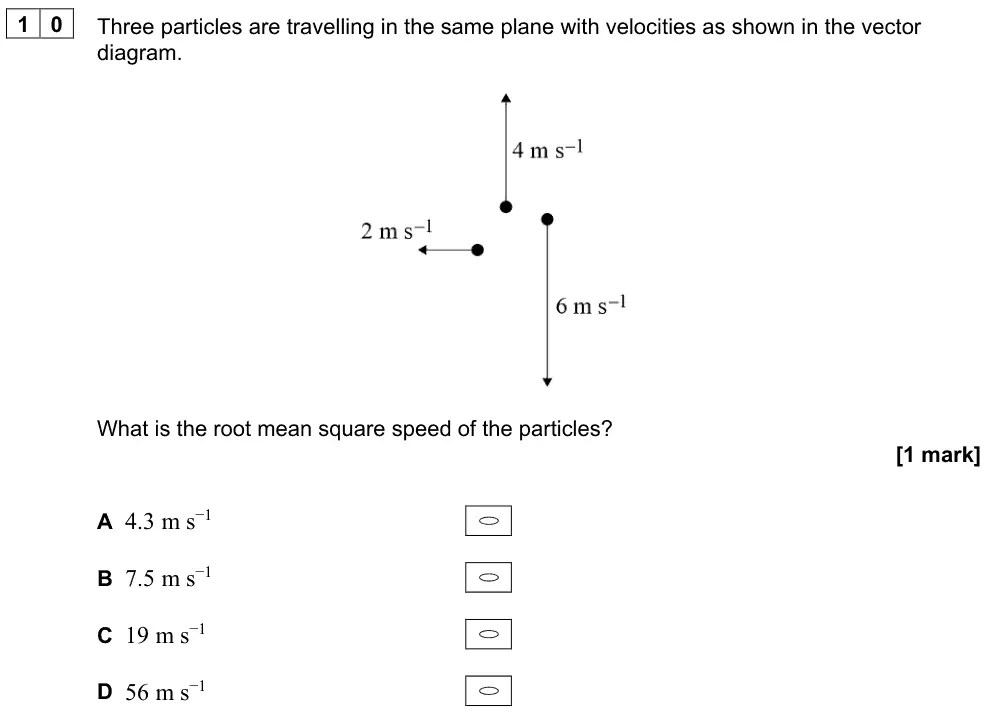
November 2021 · Paper 2 · Q101 markMultiple choice
Answer
A
Mark scheme
Notes from the mark scheme and report
Answer: A
Skills: MS1.2 Find arithmetic means
November 2020 · Paper 2 · Q1.41 markShort answer
Earlier part of question 1 that this part uses
Mark scheme
Examiner's comment
Only a tiny fraction of students made any reference to ‘mean’ or ‘average’. Also, when the answer involved ‘speed’ a number of students used the term ‘velocity’. At this level the correct technical language is essential.
Question 01.4
Notes from the mark scheme and report
Mean speed (mean kinetic energy) of the atoms increases
'mean' and 'speed' (not velocity) needed
November 2020 · Paper 2 · Q91 markMultiple choice
Answer
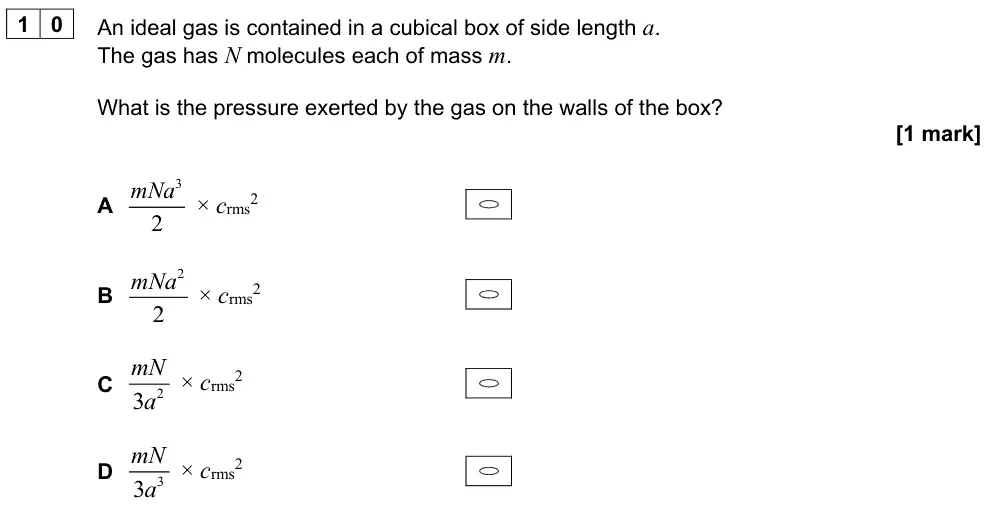
C
Notes from the mark scheme and report
Answer: C
Skills: MS0.3 Use ratios, fractions and percentages
November 2020 · Paper 2 · Q101 markMultiple choice
Answer
D
Notes from the mark scheme and report
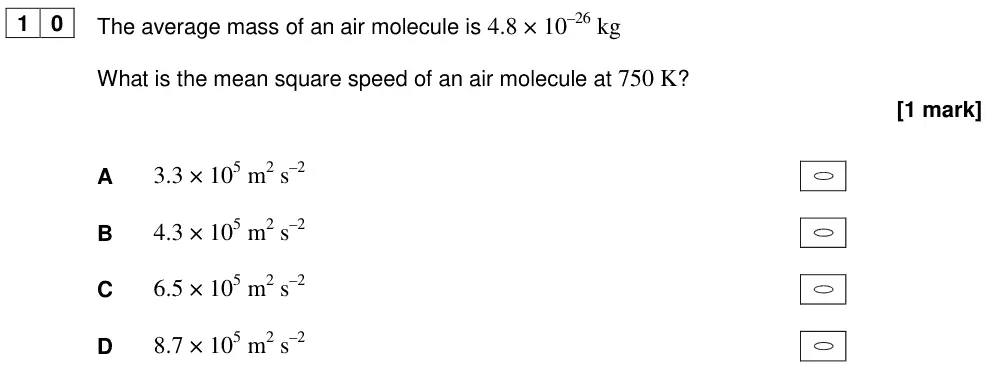
Answer: D
November 2020 · Paper 2 · Q111 markMultiple choice
Answer
C
Notes from the mark scheme and report
Answer: C
June 2019 · Paper 2 · Q2.12 marksShort answerEasy
Mark scheme
Examiner's comment
2.1 At least one of the two marks was scored by 75% of the students. A lack of detail in the answer generally meant the student failed to gain the second mark. References to total energy or particles/atoms were sometimes missing.
Notes from the mark scheme and report
Sum of the (randomly distributed) kinetic and potential energies of the particles
an average energy is not internal energy
reference to kinetic energy earns mark 2
June 2019 · Paper 2 · Q2.22 marksShort answer
Earlier part of question 2 that this part uses
Mark scheme
Examiner's comment
2.2 Most answers were correct but sometimes only one interpretation was given. A significant number of scripts referred incorrectly to the vibration of the gas molecules. This affected the score when the student suggested that at absolute zero the molecules stopped vibrating; examiners did not take this to mean ‘stationary’. Some students simply gave a value of absolute zero in degrees Celsius or they simply described it as the lowest possible temperature. Overall, half the students scored full marks.
Notes from the mark scheme and report
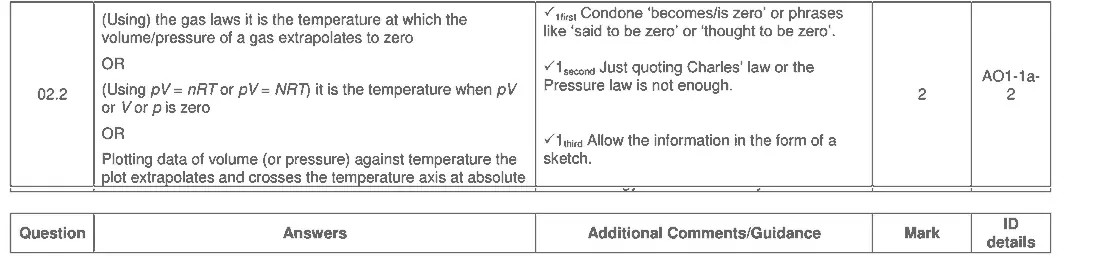
Gas laws: temperature at which p (or V) of an ideal gas extrapolates to zero
kinetic theory: temperature at which random motion stops / mean KE is zero
'stop vibrating' not accepted
half scored full marks
June 2019 · Paper 2 · Q2.33 marksCalculationHard
Earlier part of question 2 that this part uses
Mark scheme
Examiner's comment
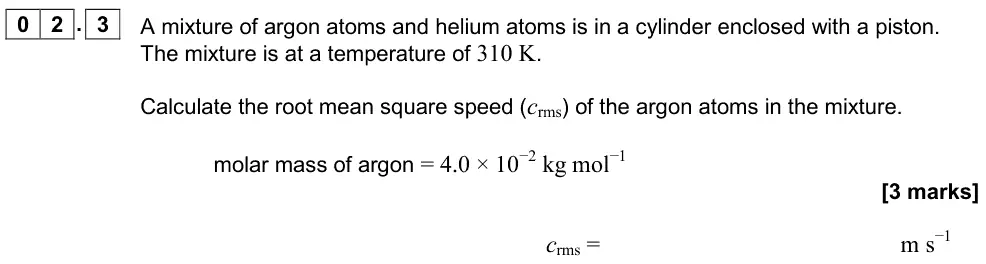
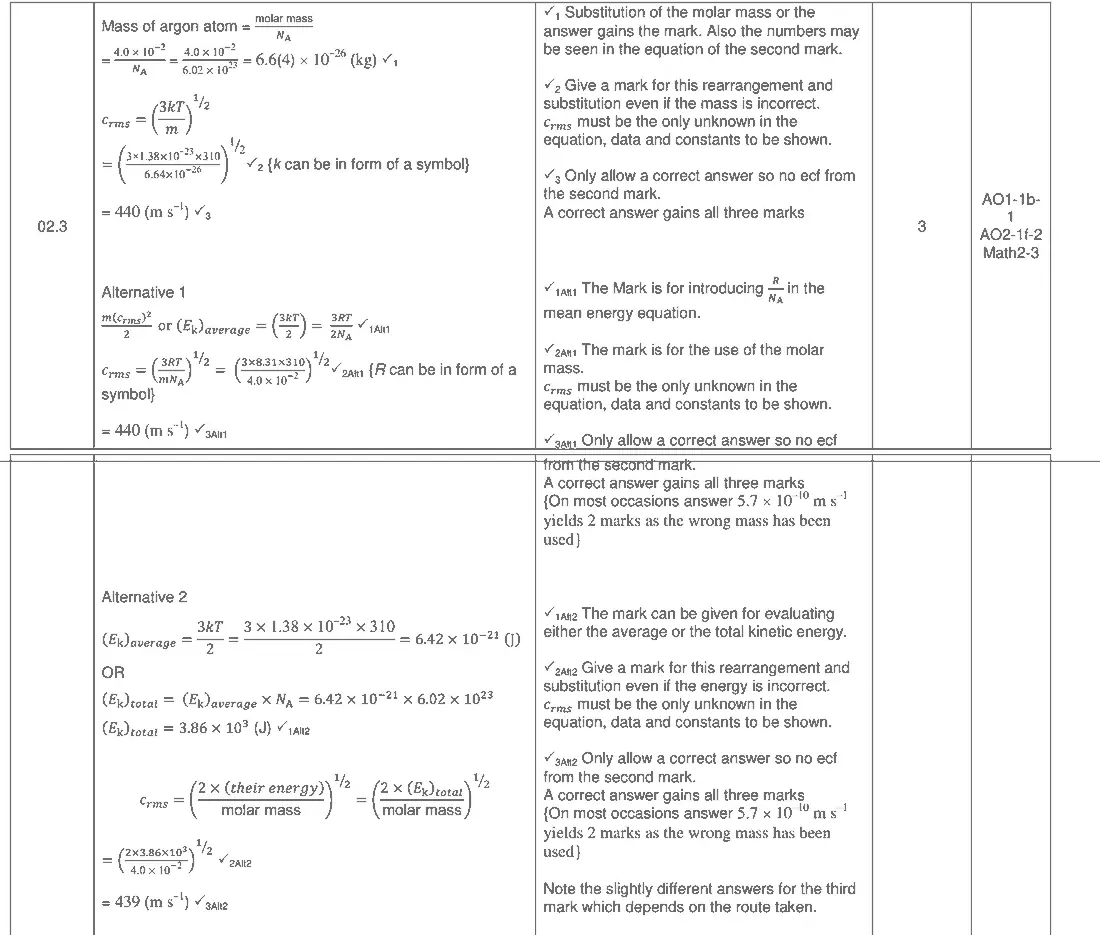
2.3 This question discriminated well. About a fifth of the students did not know a correct version of an equation involving crms that could be used to solve the problem. However, one third of the students scored full marks. Between these two extremes, scripts would show a correct working equation but data were not substituted into it correctly. Often there was a confusion between molecular and molar masses.
Notes from the mark scheme and report
Answer: 440 m s^-1 (m = 0.040 / 6.02 x 10^23 = 6.64 x 10^-26 kg
crms = root(3kT/m))
confusion of molar and molecular mass
about a fifth knew no correct equation
Skills: MS2.2 Change the subject of an equation, including non-linear equations; MS2.3 Substitute numerical values into algebraic equations using appropriate units for physical quantities
June 2019 · Paper 2 · Q2.41 markShort answer
Earlier part of question 2 that this part uses
Mark scheme
Examiner's comment
2.4 Only a minority of students thought the mean kinetic energies were the same. Most were swayed by the idea that a higher mass automatically means a higher kinetic energy. Many scripts dropped the reference to the mean when referring to kinetic energy. The use of complete technical descriptions is essential at this level of examination.
Notes from the mark scheme and report
Same mean kinetic energy because the temperature is the same
most thought the heavier argon atoms have more KE
June 2019 · Paper 2 · Q2.53 marksExplanation
Earlier part of question 2 that this part uses
Mark scheme
Examiner's comment
2.5 Students found this question difficult because they did not follow the wording of the question; it required a response in terms of kinetic theory of gases. Many quoted a gas law or its equation and thought this was a sufficient explanation. Very few gave the sequence of ideas that are followed in proving the pressure equation. More able students failed to gain marks by the way they quoted Newton’s second law: force was often related to a change in momentum rather than a rate of change of momentum. Less able students additionally often interchanged or used technical words at random. Vague sentences such as ‘the kinetic energy pushes on the piston and this work gives rise to the pressure’ were not uncommon. Only 60% of students scored one or more marks.
Notes from the mark scheme and report
Particles collide with the piston and change momentum
force = rate of change of momentum
pressure = force / area
quoting gas laws not credited
only 60% scored any marks
June 2019 · Paper 2 · Q2.63 marksExplanation
Earlier part of question 2 that this part uses
Mark scheme
Examiner's comment
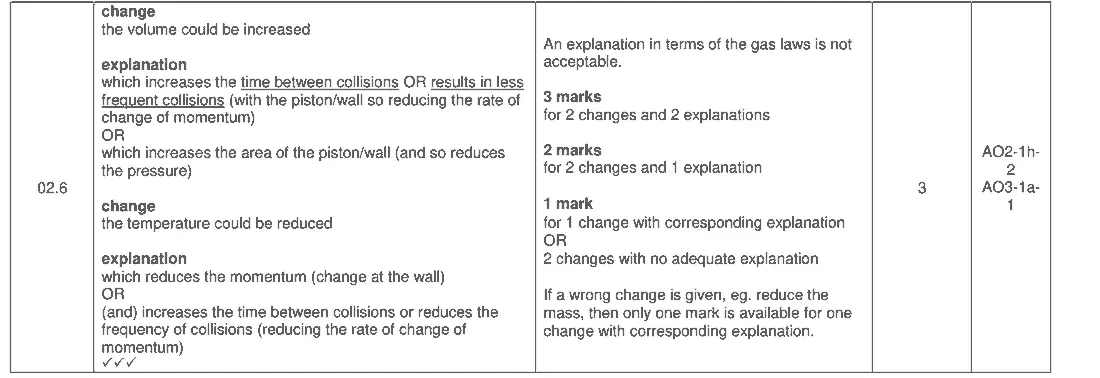
2.6 Most students knew two changes that would reduce the pressure. It was only the less able students that ignored the question and suggested a change that altered the gas in some way. The discrimination of the question was a reflection of the quality of the explanations. Less effective answers just made a reference to a gas law, saying ‘P is inversely proportional to V’. This did not gain credit.
Notes from the mark scheme and report
Increase volume (collisions less frequent, larger area)
reduce temperature (lower speed so smaller momentum change and fewer collisions per second)
explanations via gas laws not credited
June 2019 · Paper 2 · Q71 markMultiple choice
Answer
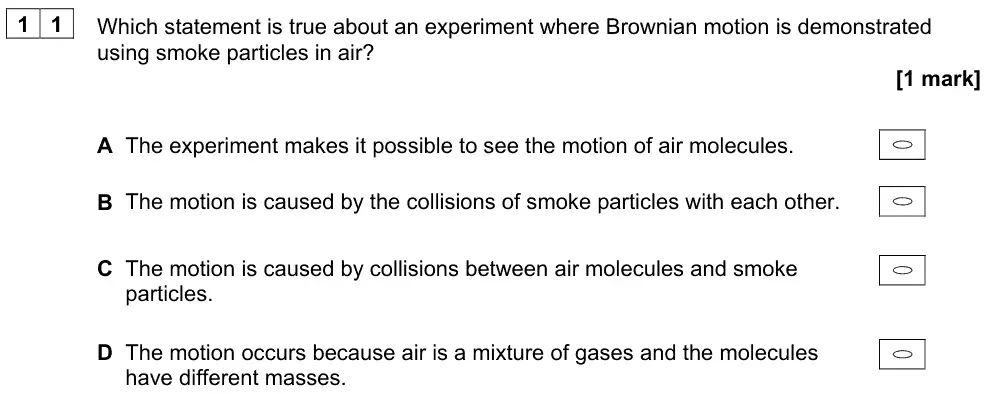
C
Mark scheme
Notes from the mark scheme and report
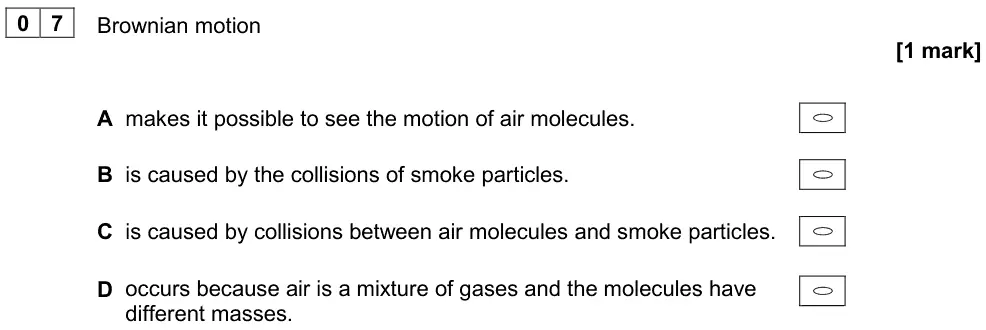
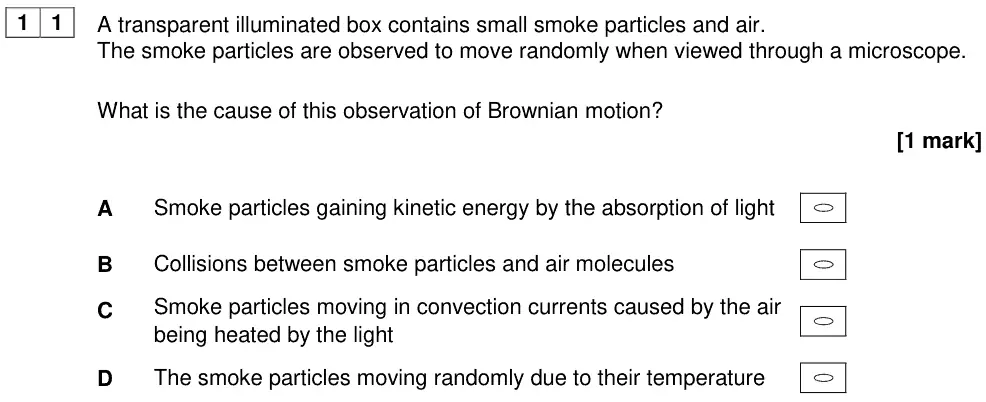
Answer: C
collisions between air molecules and smoke particles, which is the correct answer
June 2019 · Paper 2 · Q251 markMultiple choice
Answer
C
Notes from the mark scheme and report
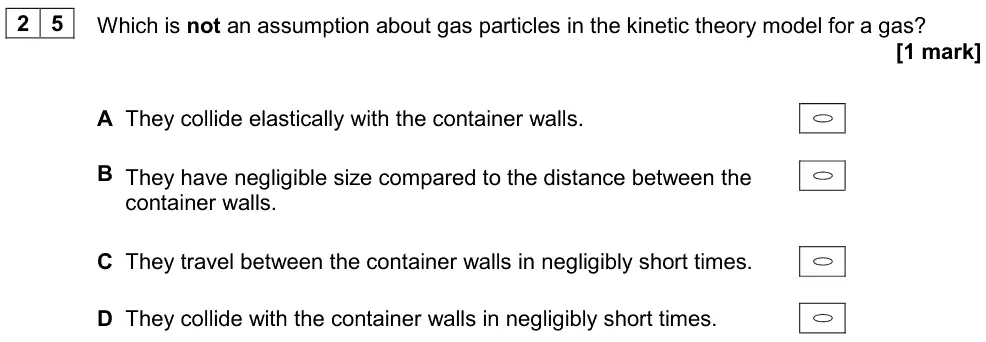
Answer: C
June 2018 · Paper 2 · Q101 markMultiple choice
Answer
C
Notes from the mark scheme and report
Answer: C
Skills: MS2.3 Substitute numerical values into algebraic equations using appropriate units for physical quantities
June 2018 · Paper 2 · Q111 markMultiple choice
Answer
B
Notes from the mark scheme and report
Answer: B
June 2018 · Paper 2 · Q121 markMultiple choiceHard
Answer
B
Examiner's comment
The 25 questions in Section B are summarised in the table below. For each question, the key (correct answer) is provided, along with the percentage of students answering correctly. There was a good range of ‘facility’ across this section; the most accessible question was 13 (answered correctly by 81.4% of students), the least accessible were 12 and 23 (answered correctly by only 15% and 13.3% of students respectively). The overall mean mark achieved by the students for Section B was 15.4 out of 25 (61.6%).
Notes from the mark scheme and report
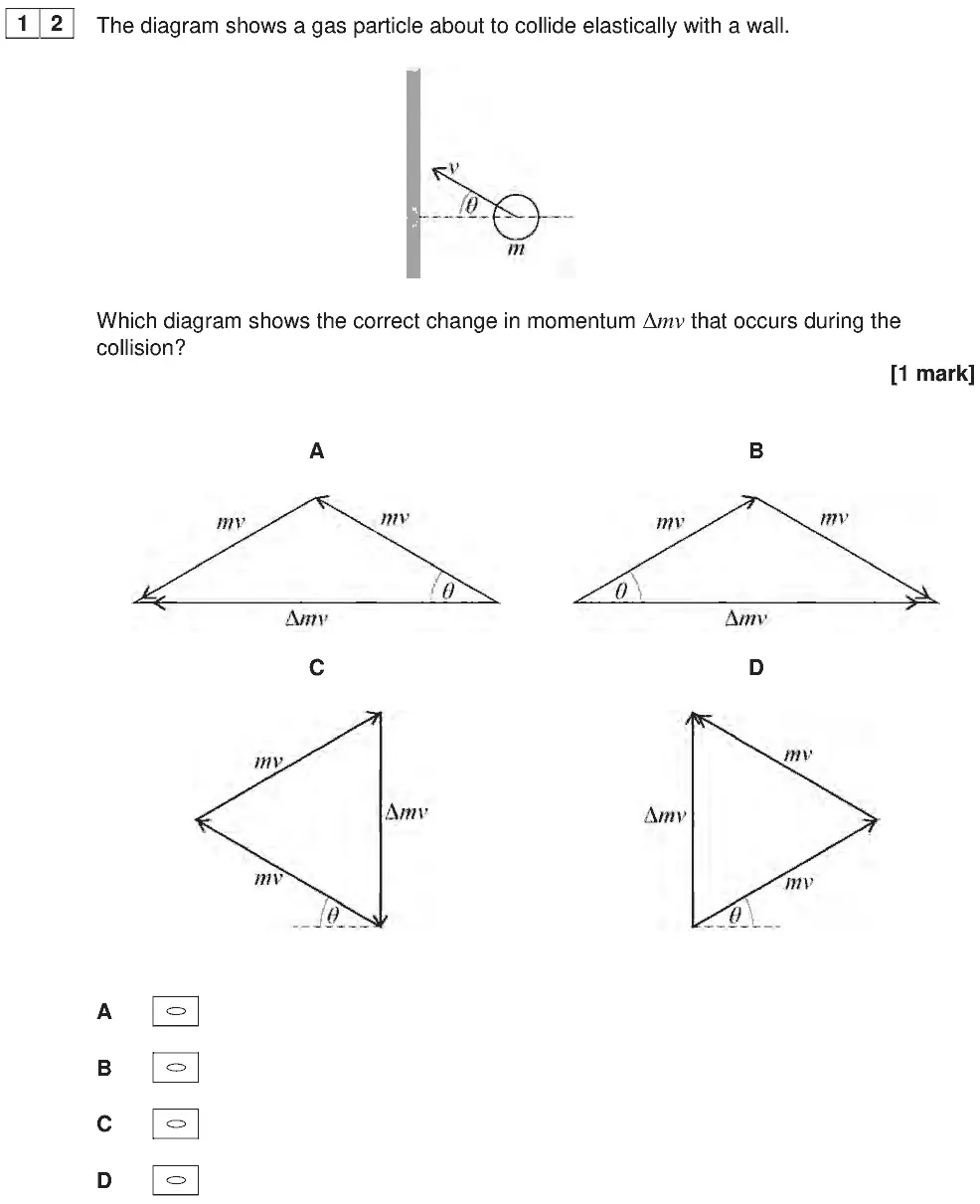
Answer: B
Skills: MS4.2 Visualise and represent 2D and 3D forms including two- dimensional representations of 3D objects
June 2017 · Paper 2 · Q1.11 markShort answer
Mark scheme
Examiner's comment
01.1 Some less able students did not adhere to the limitations of the question, which only required information about the size of molecules. Many simply stated an assumption used in kinetic theory. Apart from this, the question gave good discrimination. The main misconception was that all molecules have to be the same size and the ‘near miss answer’ was to state that molecules must be small without giving any relative measure.
Notes from the mark scheme and report
Volume of the molecules negligible compared with the volume of the gas (point masses)
'all the same size' or 'spherical' not credited
'small' needs a comparison
June 2017 · Paper 2 · Q111 markMultiple choice
Answer
D
Notes from the mark scheme and report
Answer: D
Skills: MS2.3 Substitute numerical values into algebraic equations using appropriate units for physical quantities
Specimen set 1 · Paper 2 · Q3.12 marksShort answer
Mark scheme
Notes from the mark scheme and report
Any two: random motion
elastic collisions
collision time small compared with time between collisions
straight lines between collisions (Newtonian mechanics allowed)
Specimen set 1 · Paper 2 · Q3.23 marksExplanation
Earlier part of question 3 that this part uses
Mark scheme
Notes from the mark scheme and report
p = F/A with F = rate of change of momentum
mean KE / rms speed rises with temperature
more collisions per second with the inside of the ball (greater momentum change per collision allowed)
Specimen set 1 · Paper 2 · Q251 markMultiple choice
Answer
D
Notes from the mark scheme and report
Answer: D
Skills: MS0.3 Use ratios, fractions and percentages
Work with an AQA physics tutor
Dropping marks on calculations, required practicals or the six-markers? Book a trial session with a specialist AQA physics tutor.