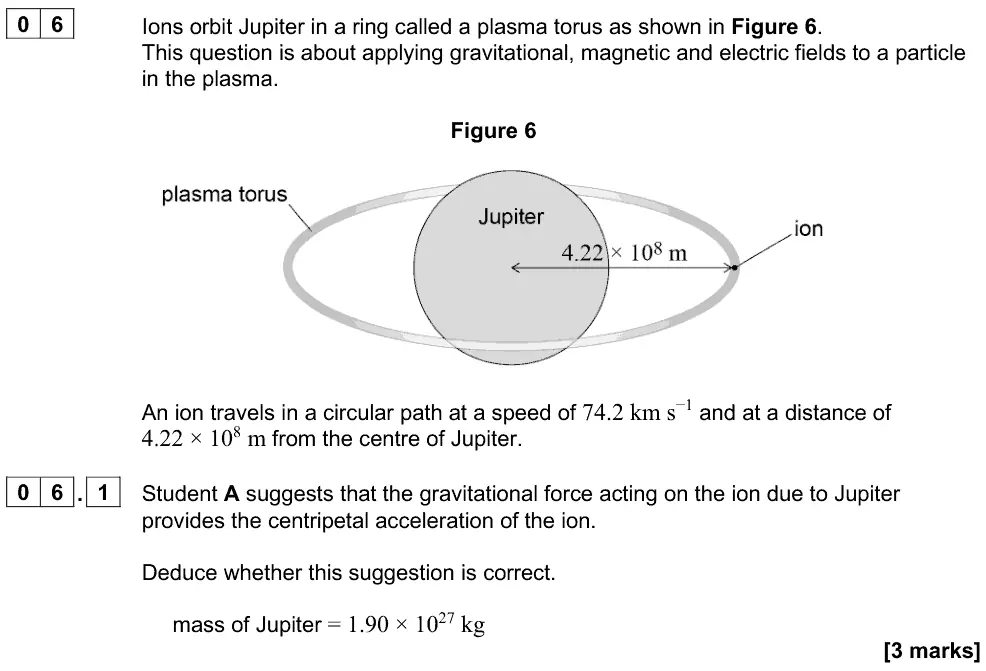
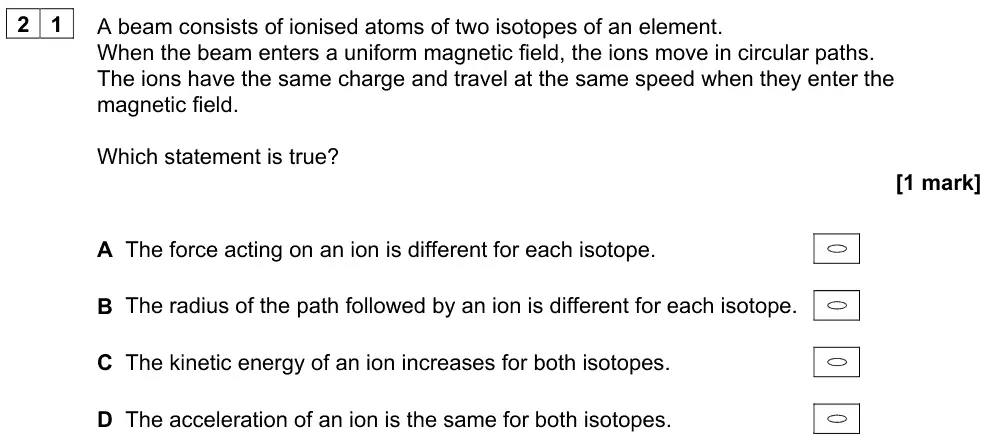
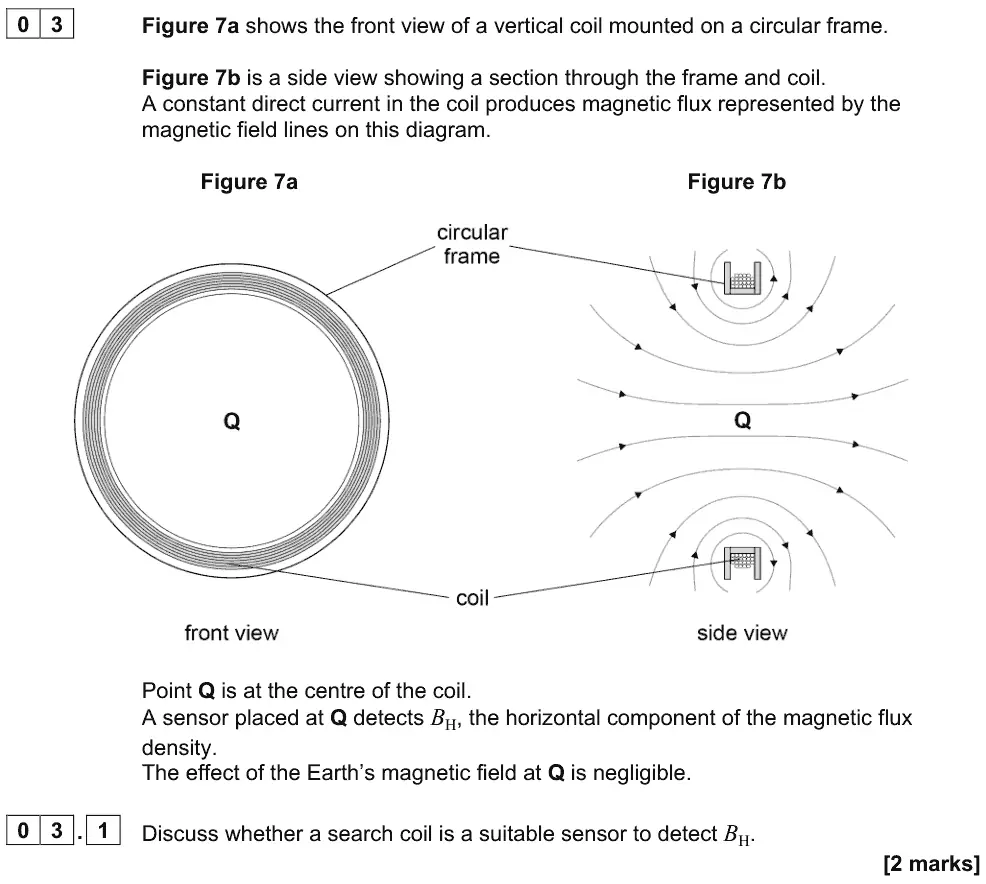
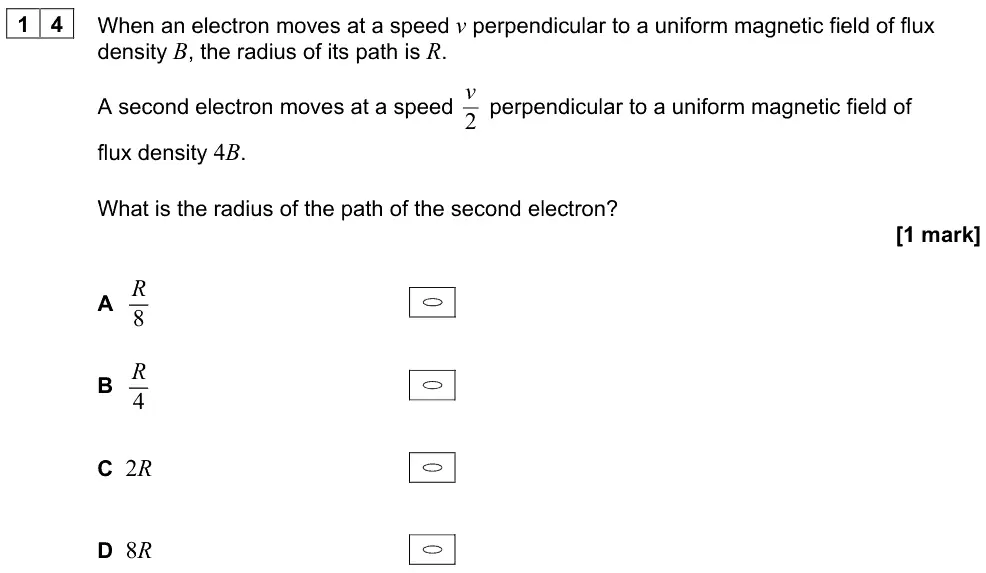
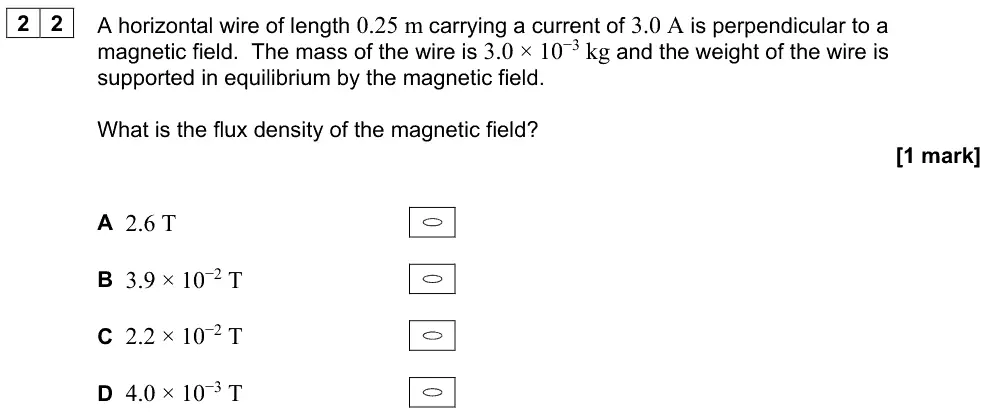
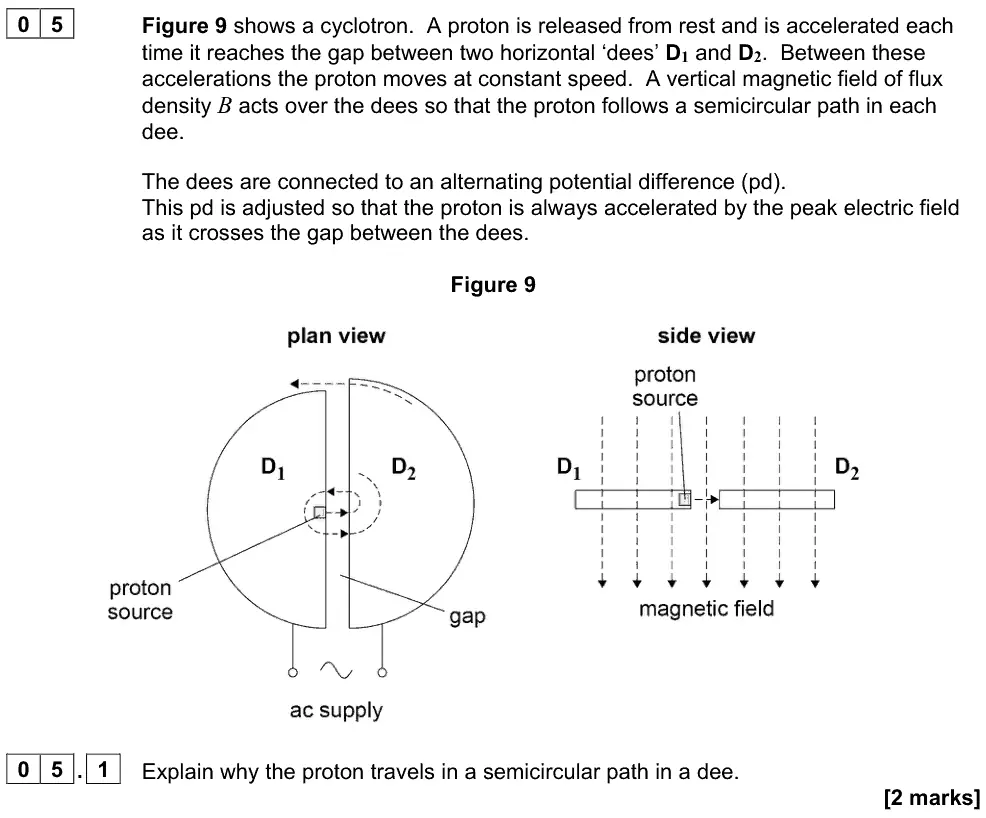
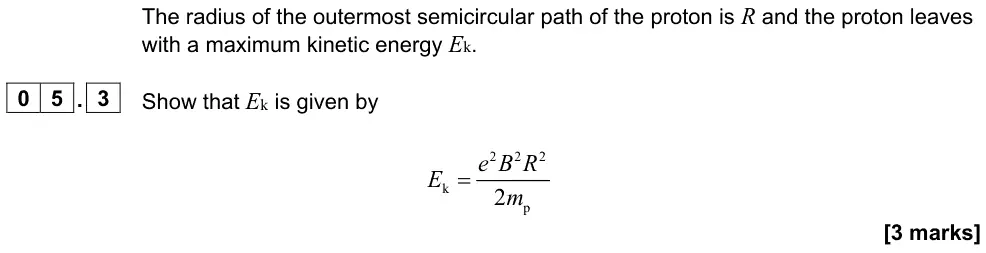
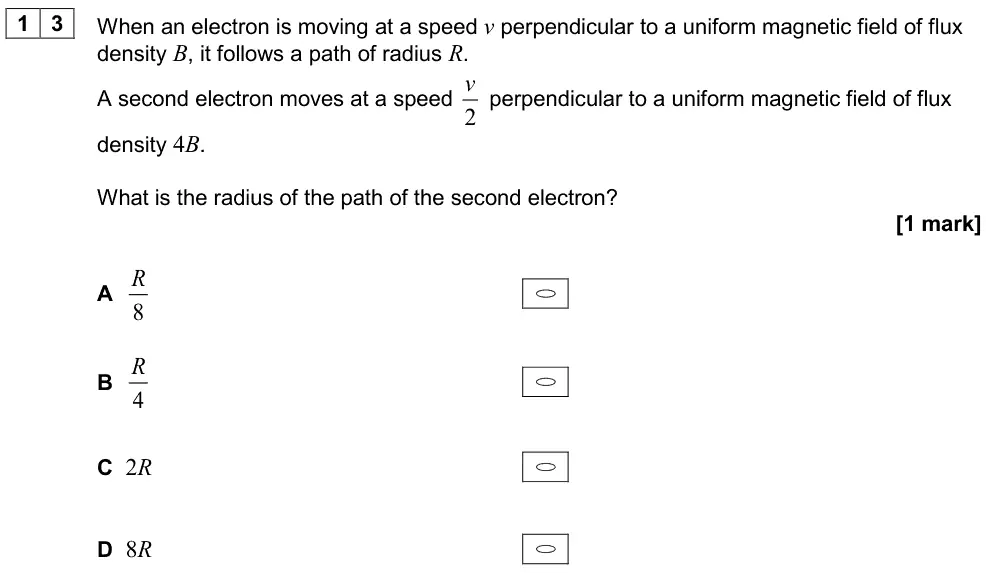
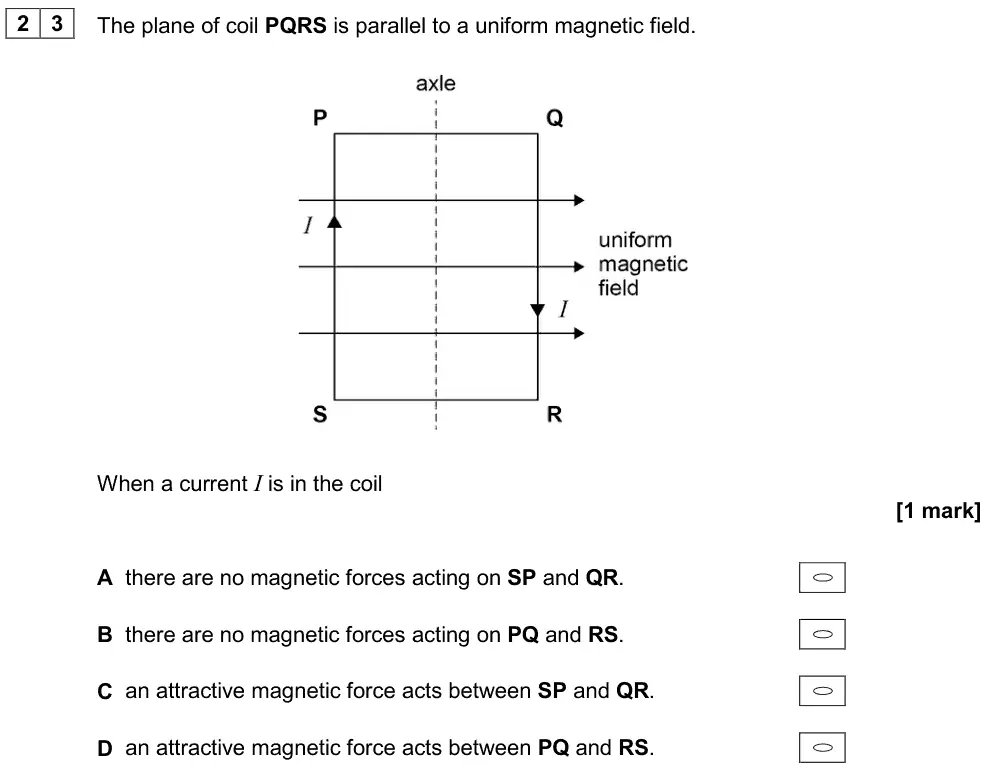
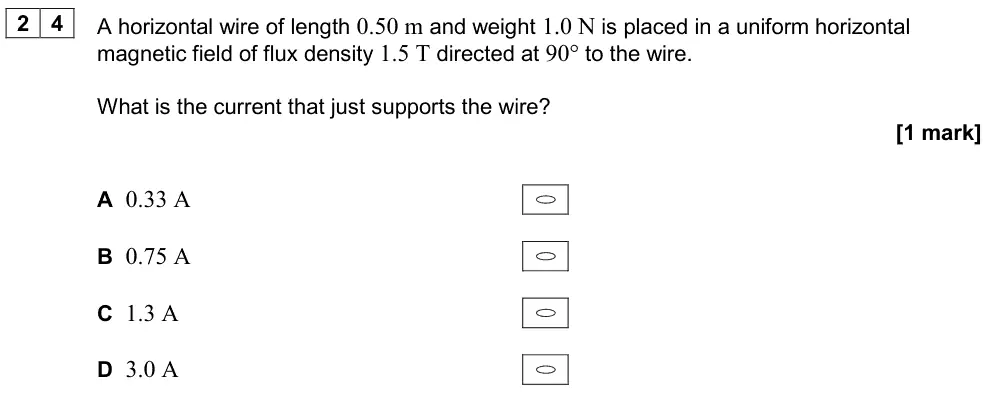
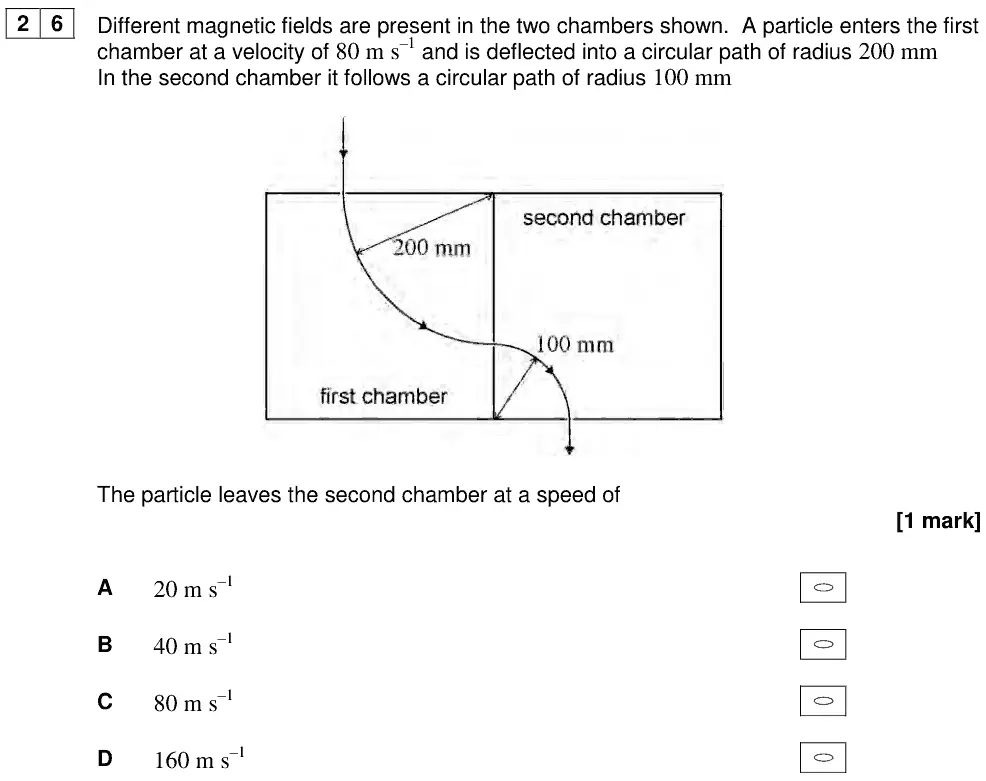
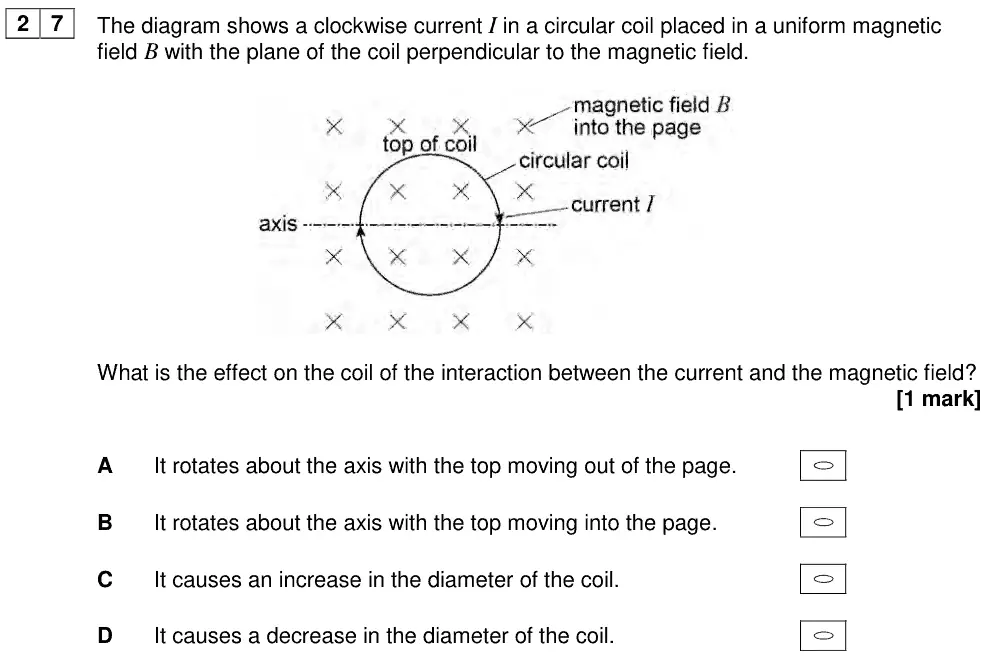
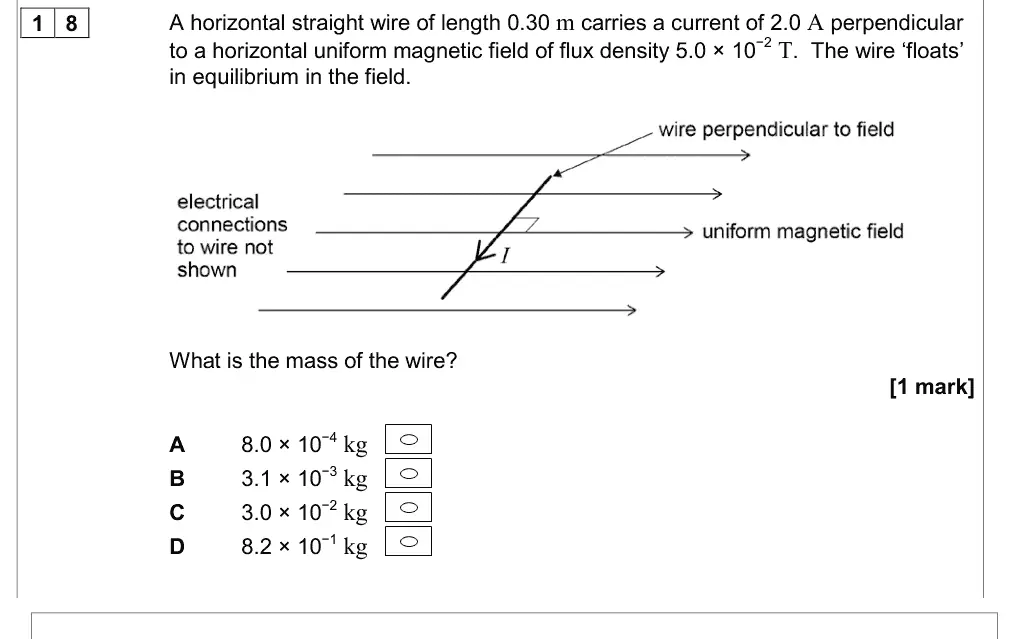
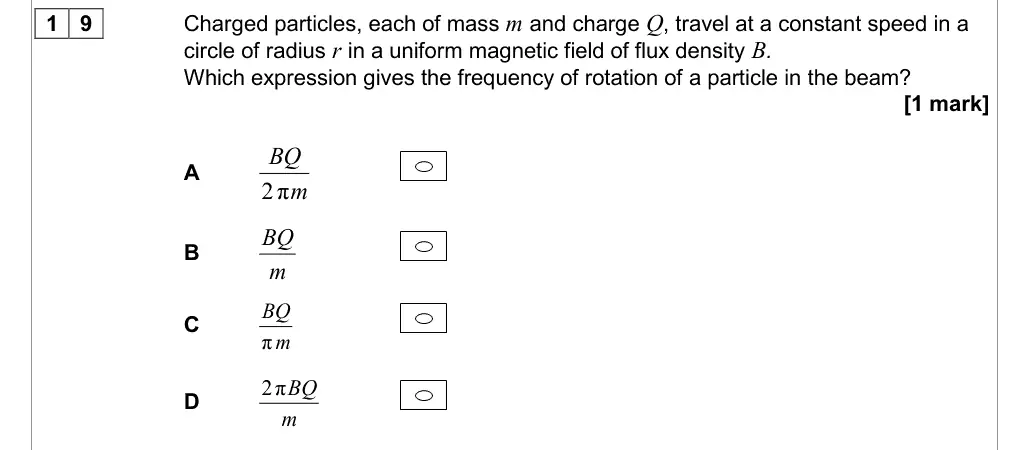
Tap a question to zoom it. Where a part needs a figure, table or graph from earlier in the question, that part folds out above it; the mark scheme and examiner's comment open underneath. Have the AQA data and formulae booklet beside you (see the formula sheet page).
June 2025 · Paper 2 · Q6.21 markAO2=1Diagram or graphHard
Earlier part of question 6 that this part uses
Mark scheme
Examiner's comment
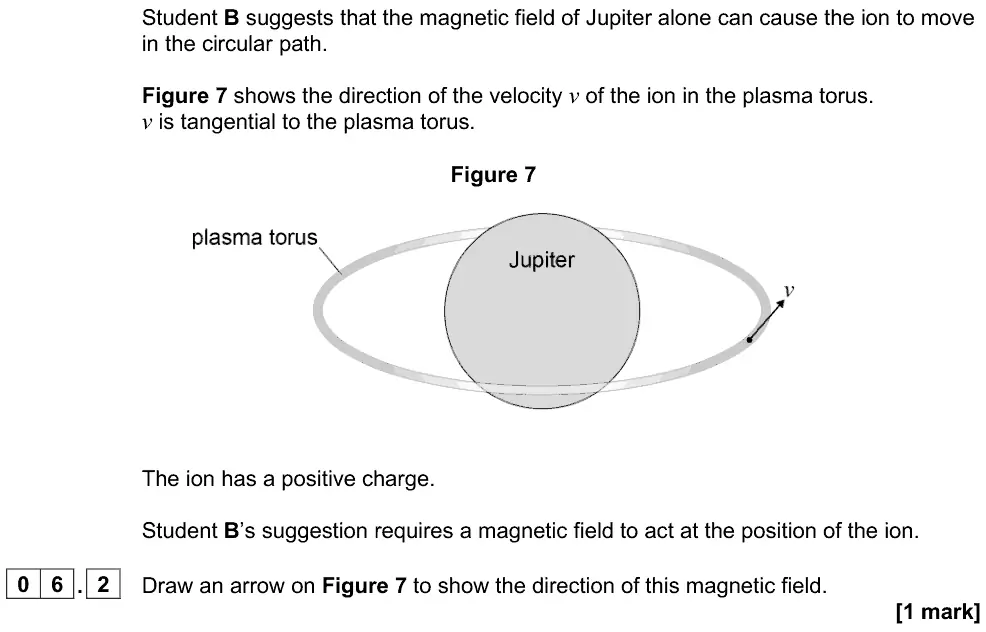
6.2 Drawing the direction of the magnetic field required to make the ion move in a circle proved challenging for many students, with less than a third gaining the mark. The question was a straightforward application of Fleming’s left-hand rule. Allowances were made for the 3D nature of the diagram, so arrows which were not vertical but attempted to take into account the angle of the diagram were rewarded. The most common wrong answer was drawing the arrow towards the centre of the Jupiter. It is unclear whether this was due to incorrectly applying Fleming’s left-hand rule, misreading the question, or mixing up magnetic and gravitational fields. A few students sketched the full magnetic field of Jupiter; provided one of the field lines was close to the ion and in the correct direction, this approach gained the mark. close to the ion.
Notes from the mark scheme and report
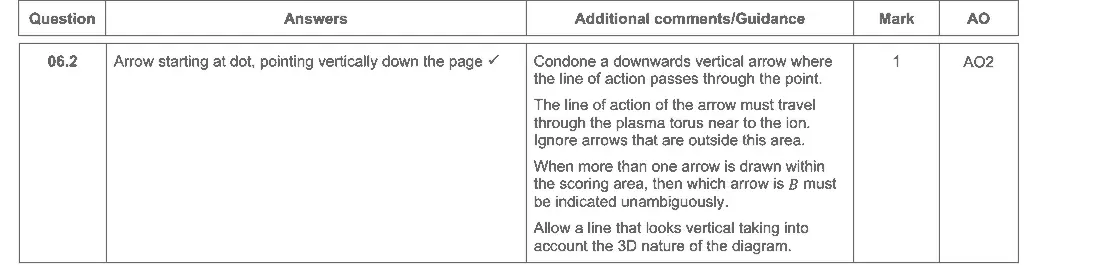
Arrow from the ion pointing vertically down the page (Fleming's left-hand rule with force towards Jupiter)
most common error pointing at Jupiter
Skills: MS4.2 Visualise and represent 2D and 3D forms including two- dimensional representations of 3D objects
June 2025 · Paper 2 · Q6.33 marksAO1=1, AO2=2Calculation
Earlier part of question 6 that this part uses
Mark scheme
Examiner's comment
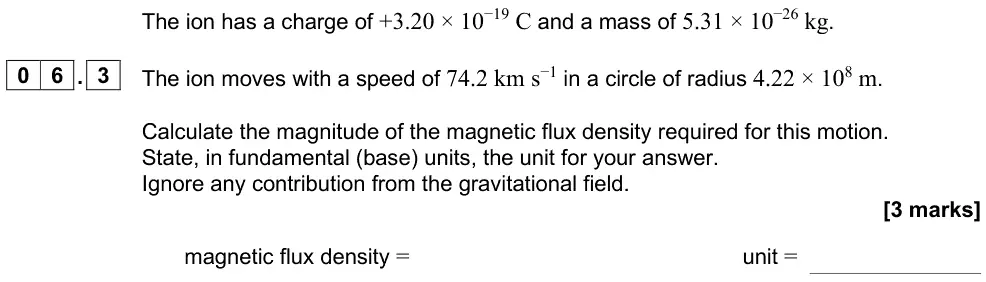
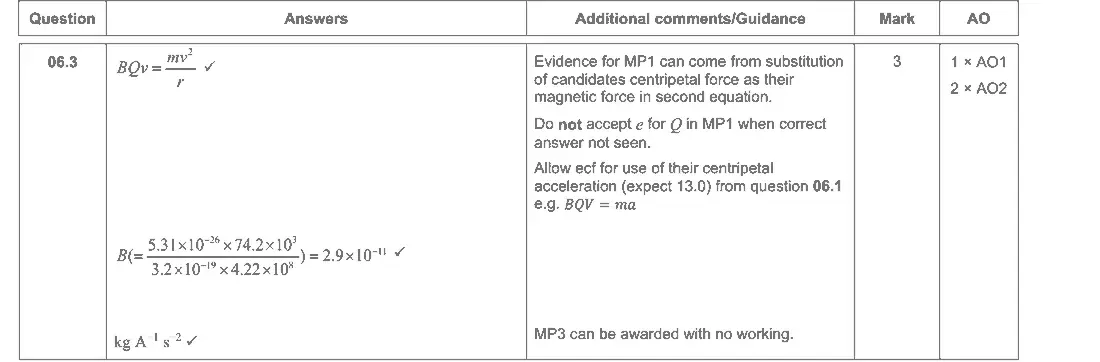
6.3 Around two thirds of students were able to calculate the required magnetic field strength, with only a few making power of ten mistakes. However, providing the unit of magnetic flux density in fundamental base units proved more challenging. Some just quoted the tesla, which was not accepted. There was evidence of both mixing up the units of magnetic flux density and magnetic flux, and thinking that coulombs rather than amperes was the relevant fundamental base unit.
Notes from the mark scheme and report
Answer: 2.9 x 10^-11 T (B = mv/(Qr))
unit kg A^-1 s^-2
around two thirds got the value but base unit was harder (tesla alone not accepted)
Skills: MS2.2 Change the subject of an equation, including non-linear equations; MS2.3 Substitute numerical values into algebraic equations using appropriate units for physical quantities
June 2025 · Paper 2 · Q201 markAO2=1Multiple choiceHard
Answer
D
Mark scheme
Examiner's comment
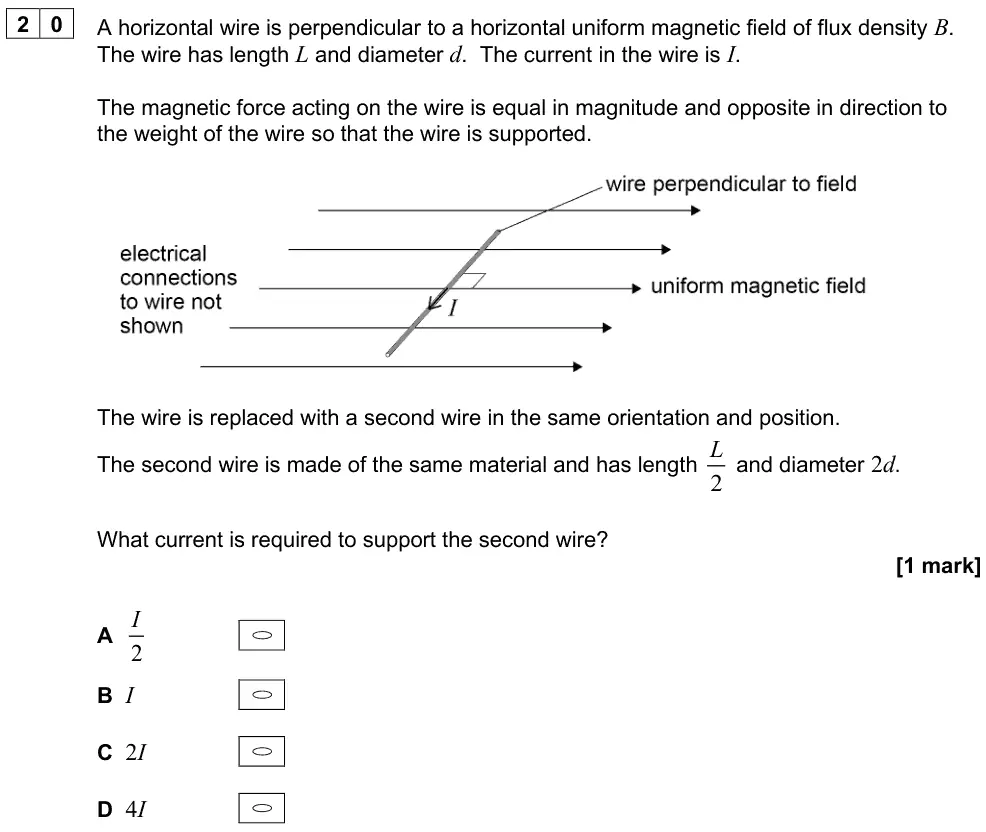
question. This question relies on 𝑚𝑚𝑚𝑚= 𝐵𝐵𝐵𝐵𝐵𝐵 and 𝑚𝑚= 𝜌𝜌𝜌𝜌= = 𝐵𝐵𝐵𝐵𝐵𝐵. Therefore, 𝜌𝜌𝜌𝜌𝑑𝑑2𝐿𝐿 𝜌𝜌𝜌𝜌𝑑𝑑2𝐿𝐿𝐿𝐿 20 This question was very challenging with only around one quarter correctly answering this 4 4 since 𝜌𝜌, 𝑔𝑔 and 𝐵𝐵 are constants and 𝐿𝐿 cancels, 𝐼𝐼∝𝑑𝑑2, the new current required is 4𝐼𝐼. C was the giving
Notes from the mark scheme and report
Answer: D
mg = BIL with m proportional to d^2 L, so I is proportional to d^2
Skills: MS0.3 Use ratios, fractions and percentages
June 2024 · Paper 2 · Q161 markMultiple choice
Answer
D
Mark scheme
Notes from the mark scheme and report
Answer: D
Skills: MS2.2 Change the subject of an equation, including non-linear equations
June 2024 · Paper 3 Section A · Q3.23 marksAO1=1, AO3=2Explanation
Earlier part of question 3 that this part uses
Mark scheme
Examiner's comment
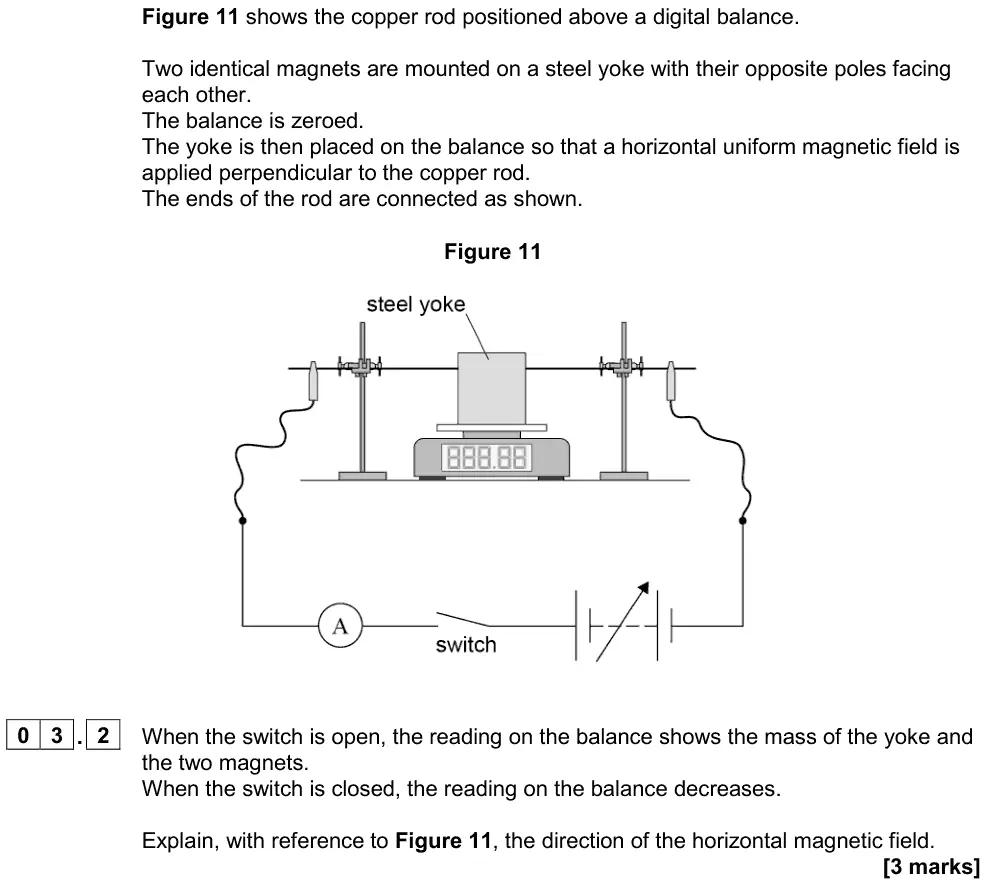
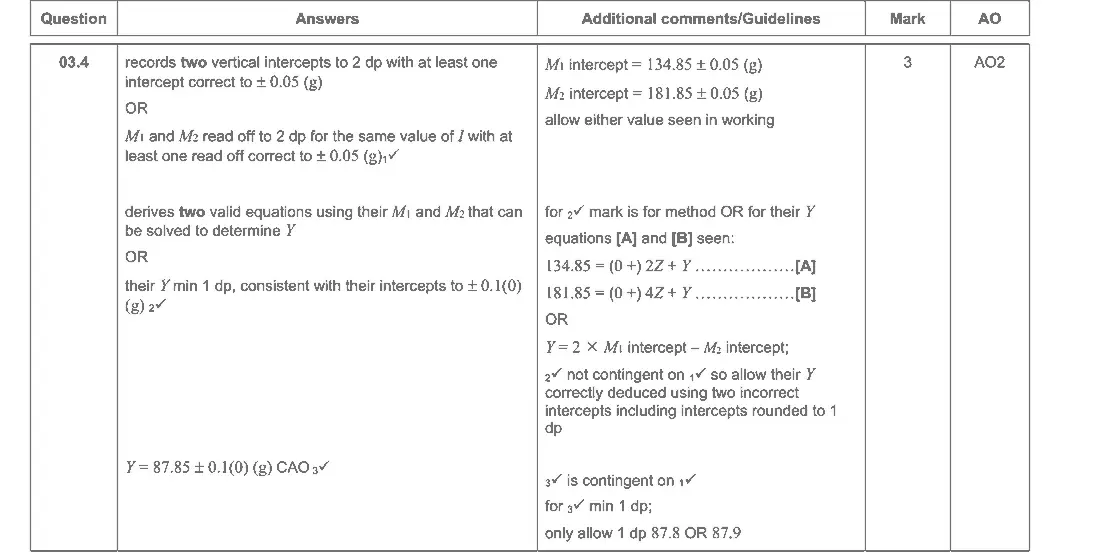
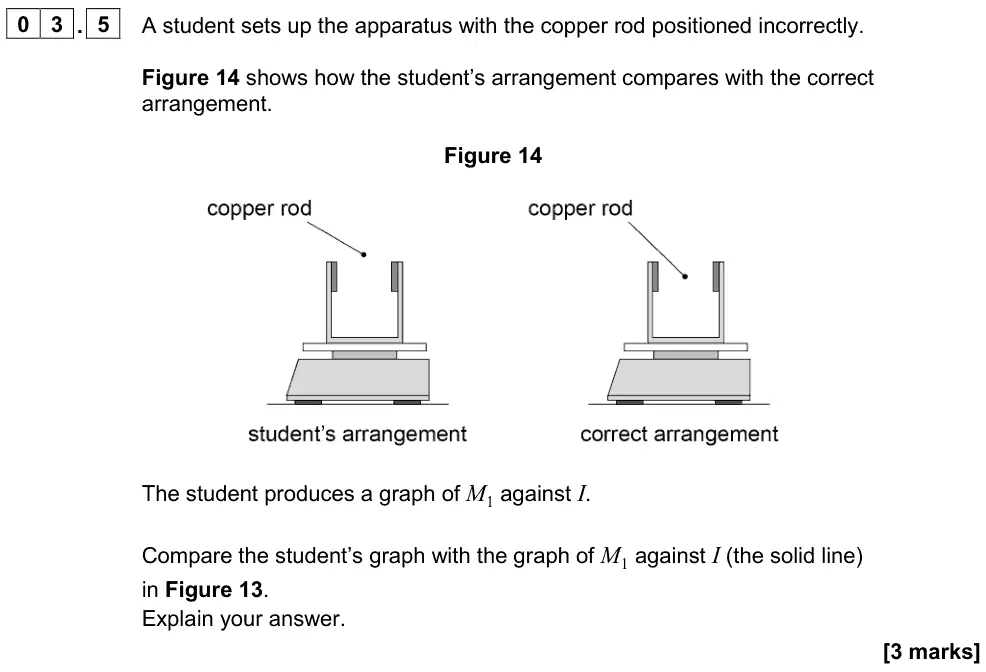
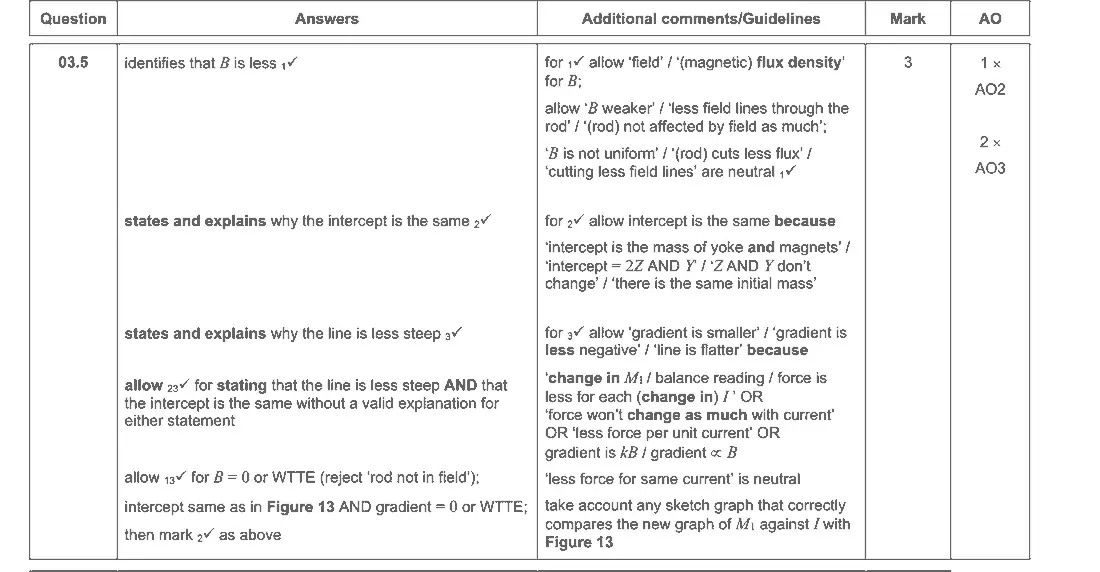
Question 3 was about how the force on a wire varied with current and with flux density. Most students were clearly familiar with the digital-balance approach used in the question. In 03.1 they were asked to explain how to make a copper rod horizontal. We stated that the metre ruler should be involved in their method, but many used it as a vertical datum rather than as a measuring instrument. As is often the case in such questions, some of the unworkable suggestions seen suggest that some students have little experience of setting up apparatus. The 03.2 left-hand rule problem performed as when last tested in 2018. Only the better students correctly realised that when the balance reading decreased, the force on the rod must be downwards. Weaker students struggled with the physics of the situation, forgetting to identify the current direction or to refer to the left-hand rule. Although only 17% correctly deduced the base units for k in 03.3, others were able to make some progress although their attempts could be difficult to follow. The use of simultaneous equations in 03.4 was widespread even though many failed to read the M2 intercept from the correct scale. In 03.5 many understood what the consequences of the misplaced rod would be for the graph, but others seemed to think that electromagnetic induction was involved. We were surprised that some thought the effects of the field between the magnets would not be felt when the rod was positioned just above the yoke.
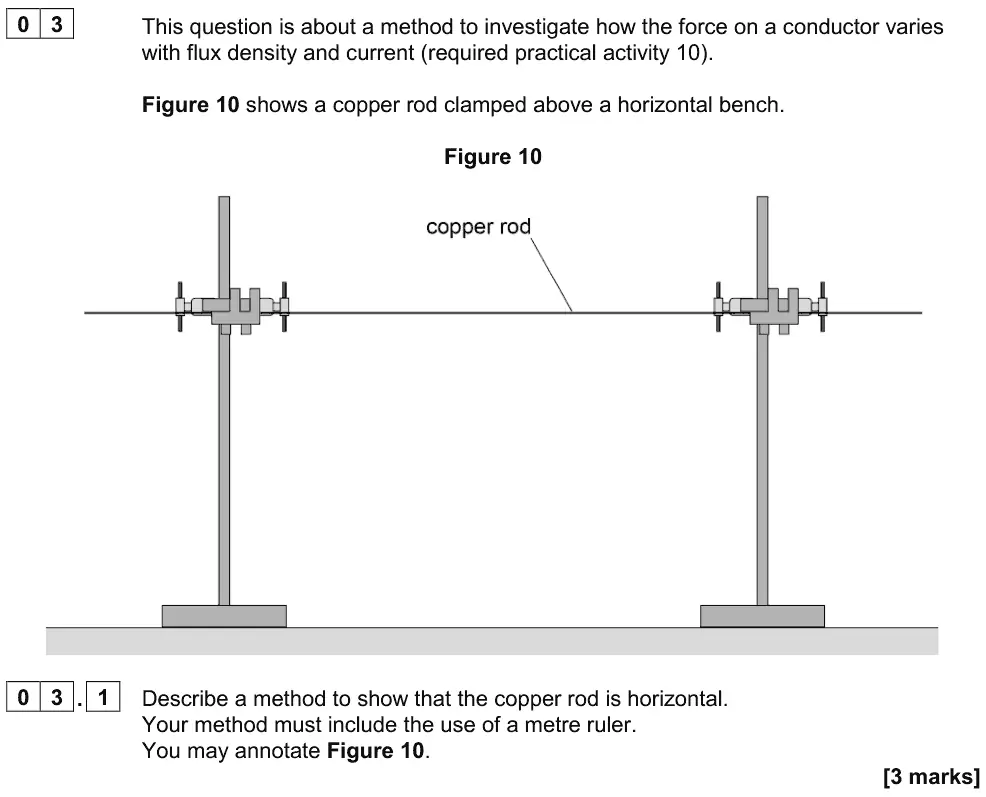
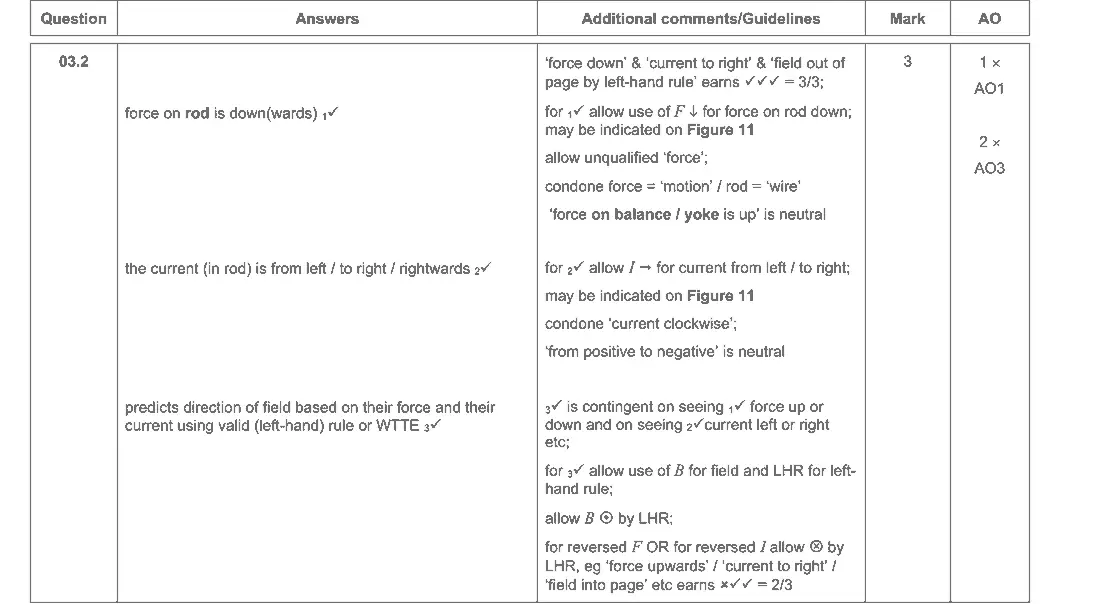
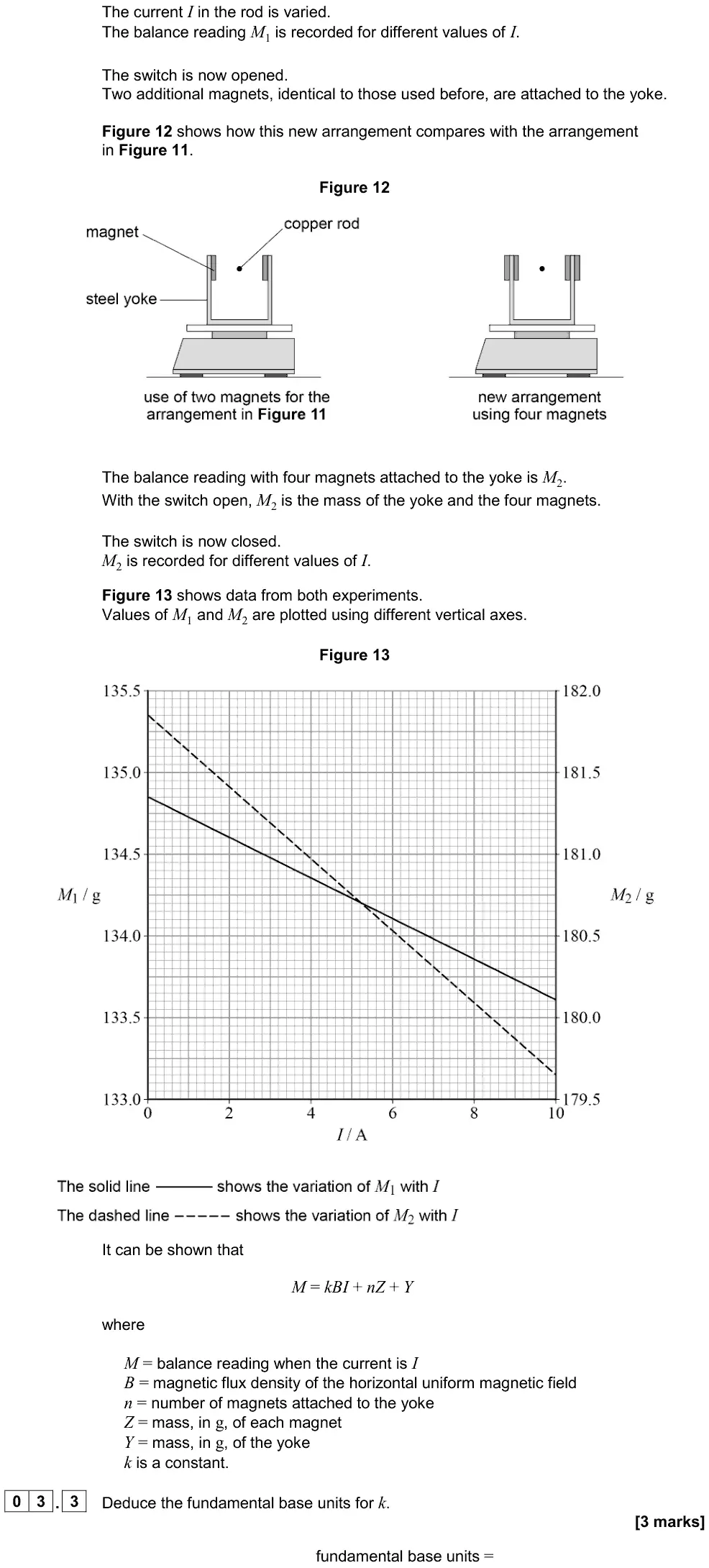
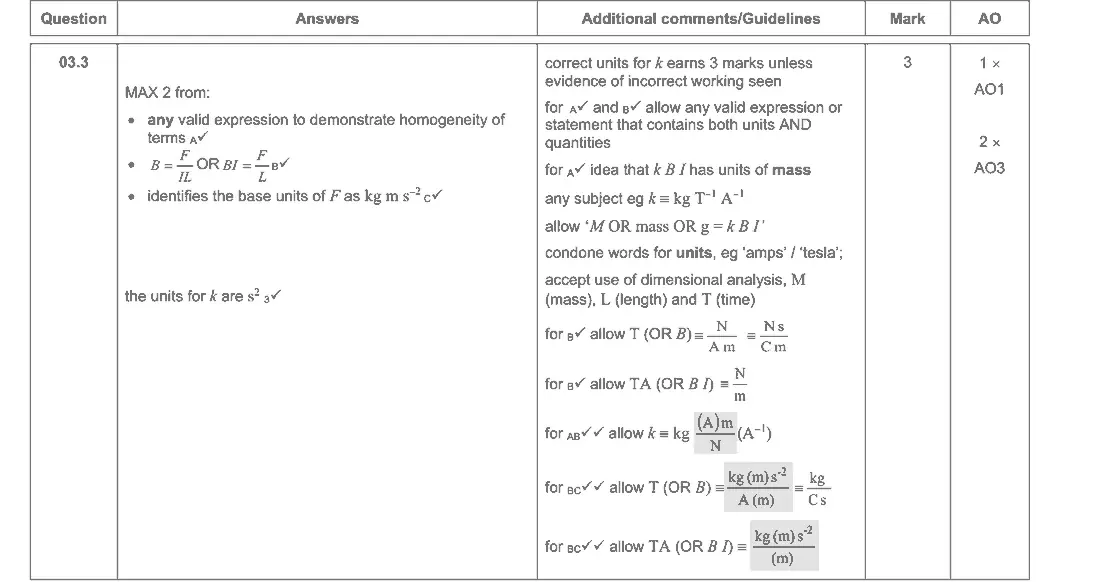
03.1 is a type of question that students with limited practical experience struggle with. Once again, we have to point out that clamp stand rods may not be used as a vertical datum, but benches can be assumed to be horizontal. The question said a metre ruler must be involved in establishing that the rod was horizontal. Some used the ruler to measure between bench and rod at different points and check that the heights were the same. When this idea was combined with an appropriate use of a set-square to make the ruler vertical, usually explained by annotation to Figure 10, all three marks were awarded. Others placed the set square where the vertical ruler met the rod. We did not allow this because a set square is too short to accurately judge whether the rod is horizontal. Good sketches saved those who struggled to explain their methods, but poor sketches condemned others who showed gaps between their set squares and the bench. Most knew what was behind 03.2 but only the better ones were able to identify the direction of the force on the rod. Some good answers went through the action-reaction idea in great detail to make sure the examiner knew what they were thinking. Others just referred to ‘the force’ and assumed it was upwards because the balance reading had decreased when there was a current in the rod. We gave no credit for current ‘from positive to negative’. Those who did not mention a current direction could only get one mark. However, most could predict a suitable magnetic field direction having identified directions for their force and current although we wanted to see the left-hand rule mentioned in justification. The solution to 03.3 was, first, to produce a homogeneous expression involving k, flux density, current and mass; second, to eliminate flux density using force, current and length, then to eliminate force using mass, length and time. We allowed working in which quantities and units were mixed, but many failed to connect the parts of their solutions using equals signs, making the work difficult to assess. 17% reached the correct solution of s2 in a few lines and earned all three marks. Others slipped up at the last stage of re-arrangement to get s−2 which cost one mark. Some deduced a homogeneous expression with non- base units, usually k = kg T−1 A−1 which got one mark. We also saw much ‘kg = kTA + kg + kg’ which the student then tried to simplify by cancelling kg as if performing conventional algebra. Over 60% made some progress and use of F = BIL and N = kg m s−2 were often seen. The use of simultaneous equations to determine Y in 03.4 was widespread. Predictably, the use of the wrong scale to determine the M2 intercept was also common. The M1 and M2 intercepts were usually recorded to 2 decimal places as we required and 16% gave completely correct solutions for three marks. Those reading off M2 incorrectly as 135.35 could still get two marks. Some thought that reading off M1 and M2 intercepts at a particular non-zero current, usually 5.2 A, would allow them to find Y. The majority of these attempts failed because the student did not appreciate that B was different for each of the simultaneous equations so they could not cancel the kB terms. A very small number did recognise that problem and worked out both gradients to arrive at a completely correct value for Y. As in 03.2, the writing in 03.5 often betrayed a poor understanding of how the physics of the current balance worked. Several referred to flux cutting or alluded to induction in other ways. However, the general trend was to spot that B would be smaller so the gradient would be less steep, and the intercept stayed the same. Some saw that the gradient was kB so a smaller B meant a smaller gradient while others saw that the intercept was 2Z + Y and hence independent of B. However, very few rarely put the whole thing together, so we saw lots of two-mark answers but very few with all three. We expected students to know that the field between the magnets was uniform, but it did not end abruptly at the top edges of the yoke, yet some said that B at the rod was undetectable. They concluded that the gradient would be zero and the intercept was unchanged. We allowed one mark for this idea.
Notes from the mark scheme and report
Balance reading falls so force on magnets is up, force on rod is down (Newton 3)
current left to right
Fleming's left-hand rule gives field out of the page
weaker students omitted current direction
Skills: PS1.2 Apply scientific knowledge to practical contexts; RP10 Investigate how the force on a wire varies with flux density, current and length of wire using a top pan balance.
June 2024 · Paper 3 Section A · Q3.33 marksAO1=1, AO3=2Short answerHard
Earlier part of question 3 that this part uses
Mark scheme
Examiner's comment
Question 3 was about how the force on a wire varied with current and with flux density. Most students were clearly familiar with the digital-balance approach used in the question. In 03.1 they were asked to explain how to make a copper rod horizontal. We stated that the metre ruler should be involved in their method, but many used it as a vertical datum rather than as a measuring instrument. As is often the case in such questions, some of the unworkable suggestions seen suggest that some students have little experience of setting up apparatus. The 03.2 left-hand rule problem performed as when last tested in 2018. Only the better students correctly realised that when the balance reading decreased, the force on the rod must be downwards. Weaker students struggled with the physics of the situation, forgetting to identify the current direction or to refer to the left-hand rule. Although only 17% correctly deduced the base units for k in 03.3, others were able to make some progress although their attempts could be difficult to follow. The use of simultaneous equations in 03.4 was widespread even though many failed to read the M2 intercept from the correct scale. In 03.5 many understood what the consequences of the misplaced rod would be for the graph, but others seemed to think that electromagnetic induction was involved. We were surprised that some thought the effects of the field between the magnets would not be felt when the rod was positioned just above the yoke.
03.1 is a type of question that students with limited practical experience struggle with. Once again, we have to point out that clamp stand rods may not be used as a vertical datum, but benches can be assumed to be horizontal. The question said a metre ruler must be involved in establishing that the rod was horizontal. Some used the ruler to measure between bench and rod at different points and check that the heights were the same. When this idea was combined with an appropriate use of a set-square to make the ruler vertical, usually explained by annotation to Figure 10, all three marks were awarded. Others placed the set square where the vertical ruler met the rod. We did not allow this because a set square is too short to accurately judge whether the rod is horizontal. Good sketches saved those who struggled to explain their methods, but poor sketches condemned others who showed gaps between their set squares and the bench. Most knew what was behind 03.2 but only the better ones were able to identify the direction of the force on the rod. Some good answers went through the action-reaction idea in great detail to make sure the examiner knew what they were thinking. Others just referred to ‘the force’ and assumed it was upwards because the balance reading had decreased when there was a current in the rod. We gave no credit for current ‘from positive to negative’. Those who did not mention a current direction could only get one mark. However, most could predict a suitable magnetic field direction having identified directions for their force and current although we wanted to see the left-hand rule mentioned in justification. The solution to 03.3 was, first, to produce a homogeneous expression involving k, flux density, current and mass; second, to eliminate flux density using force, current and length, then to eliminate force using mass, length and time. We allowed working in which quantities and units were mixed, but many failed to connect the parts of their solutions using equals signs, making the work difficult to assess. 17% reached the correct solution of s2 in a few lines and earned all three marks. Others slipped up at the last stage of re-arrangement to get s−2 which cost one mark. Some deduced a homogeneous expression with non- base units, usually k = kg T−1 A−1 which got one mark. We also saw much ‘kg = kTA + kg + kg’ which the student then tried to simplify by cancelling kg as if performing conventional algebra. Over 60% made some progress and use of F = BIL and N = kg m s−2 were often seen. The use of simultaneous equations to determine Y in 03.4 was widespread. Predictably, the use of the wrong scale to determine the M2 intercept was also common. The M1 and M2 intercepts were usually recorded to 2 decimal places as we required and 16% gave completely correct solutions for three marks. Those reading off M2 incorrectly as 135.35 could still get two marks. Some thought that reading off M1 and M2 intercepts at a particular non-zero current, usually 5.2 A, would allow them to find Y. The majority of these attempts failed because the student did not appreciate that B was different for each of the simultaneous equations so they could not cancel the kB terms. A very small number did recognise that problem and worked out both gradients to arrive at a completely correct value for Y. As in 03.2, the writing in 03.5 often betrayed a poor understanding of how the physics of the current balance worked. Several referred to flux cutting or alluded to induction in other ways. However, the general trend was to spot that B would be smaller so the gradient would be less steep, and the intercept stayed the same. Some saw that the gradient was kB so a smaller B meant a smaller gradient while others saw that the intercept was 2Z + Y and hence independent of B. However, very few rarely put the whole thing together, so we saw lots of two-mark answers but very few with all three. We expected students to know that the field between the magnets was uniform, but it did not end abruptly at the top edges of the yoke, yet some said that B at the rod was undetectable. They concluded that the gradient would be zero and the intercept was unchanged. We allowed one mark for this idea.
The students found these questions more accessible than those in 2023 and they were able to score in all parts. It was good to see stronger students accessing more of the upper end of the mark range and we saw some agile minds at work with novel approaches successfully tried in 01.4, 02.8, 03.3 and 03.4.
Question 1 involved a familiar method used to determine the resistivity of a wire. While most could read the micrometre screw gauge correctly, few explained why it should be closed using the ratchet. To calculate resistivity in 01.6 many used a resistance per unit length value in Table 1 rather than their own result from 01.5. A few substituted the screw gauge reading from 01.2 into their resistivity calculation. Students were told to supply an appropriate SI unit for resistivity. Unless we specify that we want fundamental SI base units (as we did in 03.3) we expect the usual (derived) SI unit, which in this case is Ω m. In explaining how to construct a line of maximum gradient some stated they would draw a line from the bottom of the first error bar to the top of the last bar, overlooking the need to make sure the line passed through all the other error bars. Some stated that a line could be drawn through the top of each bar to find the maximum gradient and a similar approach used to obtain the minimum gradient using the bottom of each bar. The use of ‘best fit’ and ‘worst fit’ was accepted but we could not make sense of ‘best worst fit’ which was sometimes seen.
Notes from the mark scheme and report
Answer: s^2 (kBI must be in g, B = F/IL, F in kg m s^-2, so k = kg/(BI) has unit s^2 m^-1 x m = s^2)
only 17% fully correct though over 60% made some progress
Skills: MS0.1 Recognise and make use of appropriate units in calculations; RP10 Investigate how the force on a wire varies with flux density, current and length of wire using a top pan balance.
June 2024 · Paper 3 Section A · Q3.43 marksAO2=3Practical and data analysisHard
Earlier part of question 3 that this part uses
Mark scheme
Examiner's comment
Question 3 was about how the force on a wire varied with current and with flux density. Most students were clearly familiar with the digital-balance approach used in the question. In 03.1 they were asked to explain how to make a copper rod horizontal. We stated that the metre ruler should be involved in their method, but many used it as a vertical datum rather than as a measuring instrument. As is often the case in such questions, some of the unworkable suggestions seen suggest that some students have little experience of setting up apparatus. The 03.2 left-hand rule problem performed as when last tested in 2018. Only the better students correctly realised that when the balance reading decreased, the force on the rod must be downwards. Weaker students struggled with the physics of the situation, forgetting to identify the current direction or to refer to the left-hand rule. Although only 17% correctly deduced the base units for k in 03.3, others were able to make some progress although their attempts could be difficult to follow. The use of simultaneous equations in 03.4 was widespread even though many failed to read the M2 intercept from the correct scale. In 03.5 many understood what the consequences of the misplaced rod would be for the graph, but others seemed to think that electromagnetic induction was involved. We were surprised that some thought the effects of the field between the magnets would not be felt when the rod was positioned just above the yoke.
03.1 is a type of question that students with limited practical experience struggle with. Once again, we have to point out that clamp stand rods may not be used as a vertical datum, but benches can be assumed to be horizontal. The question said a metre ruler must be involved in establishing that the rod was horizontal. Some used the ruler to measure between bench and rod at different points and check that the heights were the same. When this idea was combined with an appropriate use of a set-square to make the ruler vertical, usually explained by annotation to Figure 10, all three marks were awarded. Others placed the set square where the vertical ruler met the rod. We did not allow this because a set square is too short to accurately judge whether the rod is horizontal. Good sketches saved those who struggled to explain their methods, but poor sketches condemned others who showed gaps between their set squares and the bench. Most knew what was behind 03.2 but only the better ones were able to identify the direction of the force on the rod. Some good answers went through the action-reaction idea in great detail to make sure the examiner knew what they were thinking. Others just referred to ‘the force’ and assumed it was upwards because the balance reading had decreased when there was a current in the rod. We gave no credit for current ‘from positive to negative’. Those who did not mention a current direction could only get one mark. However, most could predict a suitable magnetic field direction having identified directions for their force and current although we wanted to see the left-hand rule mentioned in justification. The solution to 03.3 was, first, to produce a homogeneous expression involving k, flux density, current and mass; second, to eliminate flux density using force, current and length, then to eliminate force using mass, length and time. We allowed working in which quantities and units were mixed, but many failed to connect the parts of their solutions using equals signs, making the work difficult to assess. 17% reached the correct solution of s2 in a few lines and earned all three marks. Others slipped up at the last stage of re-arrangement to get s−2 which cost one mark. Some deduced a homogeneous expression with non- base units, usually k = kg T−1 A−1 which got one mark. We also saw much ‘kg = kTA + kg + kg’ which the student then tried to simplify by cancelling kg as if performing conventional algebra. Over 60% made some progress and use of F = BIL and N = kg m s−2 were often seen. The use of simultaneous equations to determine Y in 03.4 was widespread. Predictably, the use of the wrong scale to determine the M2 intercept was also common. The M1 and M2 intercepts were usually recorded to 2 decimal places as we required and 16% gave completely correct solutions for three marks. Those reading off M2 incorrectly as 135.35 could still get two marks. Some thought that reading off M1 and M2 intercepts at a particular non-zero current, usually 5.2 A, would allow them to find Y. The majority of these attempts failed because the student did not appreciate that B was different for each of the simultaneous equations so they could not cancel the kB terms. A very small number did recognise that problem and worked out both gradients to arrive at a completely correct value for Y. As in 03.2, the writing in 03.5 often betrayed a poor understanding of how the physics of the current balance worked. Several referred to flux cutting or alluded to induction in other ways. However, the general trend was to spot that B would be smaller so the gradient would be less steep, and the intercept stayed the same. Some saw that the gradient was kB so a smaller B meant a smaller gradient while others saw that the intercept was 2Z + Y and hence independent of B. However, very few rarely put the whole thing together, so we saw lots of two-mark answers but very few with all three. We expected students to know that the field between the magnets was uniform, but it did not end abruptly at the top edges of the yoke, yet some said that B at the rod was undetectable. They concluded that the gradient would be zero and the intercept was unchanged. We allowed one mark for this idea.
The students found these questions more accessible than those in 2023 and they were able to score in all parts. It was good to see stronger students accessing more of the upper end of the mark range and we saw some agile minds at work with novel approaches successfully tried in 01.4, 02.8, 03.3 and 03.4.
Notes from the mark scheme and report
Answer: Y = 87.9 g (intercepts M1 = 134.85 = 2Z + Y, M2 = 181.85 = 4Z + Y, Z = 23.5 g)
B differs between the two so kB terms cannot cancel - use intercepts
16% fully correct
Skills: MS3.1 Translate information between graphical, numerical and algebraic forms; MS3.4 Determine the slope and intercept of a linear graph; MS2.4 Solve algebraic equations, including quadratic equations; RP10 Investigate how the force on a wire varies with flux density, current and length of wire using a top pan balance.
June 2024 · Paper 3 Section A · Q3.53 marksAO2=1, AO3=2Practical and data analysis
Earlier part of question 3 that this part uses
Mark scheme
Examiner's comment
Question 3 was about how the force on a wire varied with current and with flux density. Most students were clearly familiar with the digital-balance approach used in the question. In 03.1 they were asked to explain how to make a copper rod horizontal. We stated that the metre ruler should be involved in their method, but many used it as a vertical datum rather than as a measuring instrument. As is often the case in such questions, some of the unworkable suggestions seen suggest that some students have little experience of setting up apparatus. The 03.2 left-hand rule problem performed as when last tested in 2018. Only the better students correctly realised that when the balance reading decreased, the force on the rod must be downwards. Weaker students struggled with the physics of the situation, forgetting to identify the current direction or to refer to the left-hand rule. Although only 17% correctly deduced the base units for k in 03.3, others were able to make some progress although their attempts could be difficult to follow. The use of simultaneous equations in 03.4 was widespread even though many failed to read the M2 intercept from the correct scale. In 03.5 many understood what the consequences of the misplaced rod would be for the graph, but others seemed to think that electromagnetic induction was involved. We were surprised that some thought the effects of the field between the magnets would not be felt when the rod was positioned just above the yoke.
03.1 is a type of question that students with limited practical experience struggle with. Once again, we have to point out that clamp stand rods may not be used as a vertical datum, but benches can be assumed to be horizontal. The question said a metre ruler must be involved in establishing that the rod was horizontal. Some used the ruler to measure between bench and rod at different points and check that the heights were the same. When this idea was combined with an appropriate use of a set-square to make the ruler vertical, usually explained by annotation to Figure 10, all three marks were awarded. Others placed the set square where the vertical ruler met the rod. We did not allow this because a set square is too short to accurately judge whether the rod is horizontal. Good sketches saved those who struggled to explain their methods, but poor sketches condemned others who showed gaps between their set squares and the bench. Most knew what was behind 03.2 but only the better ones were able to identify the direction of the force on the rod. Some good answers went through the action-reaction idea in great detail to make sure the examiner knew what they were thinking. Others just referred to ‘the force’ and assumed it was upwards because the balance reading had decreased when there was a current in the rod. We gave no credit for current ‘from positive to negative’. Those who did not mention a current direction could only get one mark. However, most could predict a suitable magnetic field direction having identified directions for their force and current although we wanted to see the left-hand rule mentioned in justification. The solution to 03.3 was, first, to produce a homogeneous expression involving k, flux density, current and mass; second, to eliminate flux density using force, current and length, then to eliminate force using mass, length and time. We allowed working in which quantities and units were mixed, but many failed to connect the parts of their solutions using equals signs, making the work difficult to assess. 17% reached the correct solution of s2 in a few lines and earned all three marks. Others slipped up at the last stage of re-arrangement to get s−2 which cost one mark. Some deduced a homogeneous expression with non- base units, usually k = kg T−1 A−1 which got one mark. We also saw much ‘kg = kTA + kg + kg’ which the student then tried to simplify by cancelling kg as if performing conventional algebra. Over 60% made some progress and use of F = BIL and N = kg m s−2 were often seen. The use of simultaneous equations to determine Y in 03.4 was widespread. Predictably, the use of the wrong scale to determine the M2 intercept was also common. The M1 and M2 intercepts were usually recorded to 2 decimal places as we required and 16% gave completely correct solutions for three marks. Those reading off M2 incorrectly as 135.35 could still get two marks. Some thought that reading off M1 and M2 intercepts at a particular non-zero current, usually 5.2 A, would allow them to find Y. The majority of these attempts failed because the student did not appreciate that B was different for each of the simultaneous equations so they could not cancel the kB terms. A very small number did recognise that problem and worked out both gradients to arrive at a completely correct value for Y. As in 03.2, the writing in 03.5 often betrayed a poor understanding of how the physics of the current balance worked. Several referred to flux cutting or alluded to induction in other ways. However, the general trend was to spot that B would be smaller so the gradient would be less steep, and the intercept stayed the same. Some saw that the gradient was kB so a smaller B meant a smaller gradient while others saw that the intercept was 2Z + Y and hence independent of B. However, very few rarely put the whole thing together, so we saw lots of two-mark answers but very few with all three. We expected students to know that the field between the magnets was uniform, but it did not end abruptly at the top edges of the yoke, yet some said that B at the rod was undetectable. They concluded that the gradient would be zero and the intercept was unchanged. We allowed one mark for this idea.
Notes from the mark scheme and report
Rod not centred between magnets so B is smaller: same intercept (masses unchanged at I = 0) but less steep line (smaller kBI)
Skills: MS3.1 Translate information between graphical, numerical and algebraic forms; PS2.3 Evaluate results and draw conclusions with reference to measurement uncertainties and errors; RP10 Investigate how the force on a wire varies with flux density, current and length of wire using a top pan balance.
June 2023 · Paper 2 · Q201 markMultiple choiceEasy
Answer
B
Mark scheme
Examiner's comment
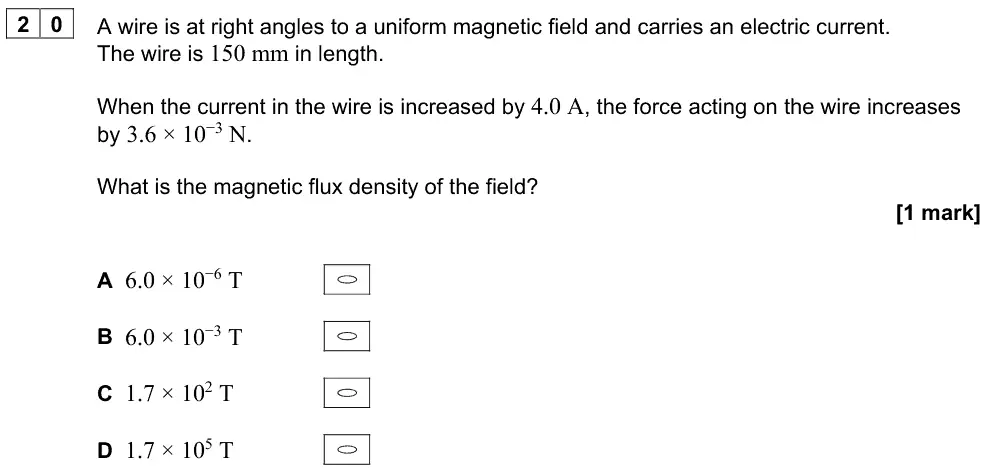
A number of questions were found to be quite straightforward by students. These included B8, B11, B12, B17, B18, B20, B26 and B28 which were all answered correctly by at least 70% of students. The questions found to be the most difficult were B14, B15 and B25 – answered correctly by fewer than 35% of students.
Notes from the mark scheme and report
Answer: B
Skills: MS2.3 Substitute numerical values into algebraic equations using appropriate units for physical quantities
June 2023 · Paper 2 · Q211 markMultiple choice
Answer
B
Mark scheme
Notes from the mark scheme and report
Answer: B
June 2023 · Paper 3 Section A · Q3.62 marksAO1=2Short answer
Earlier part of question 3 that this part uses
Mark scheme
Examiner's comment
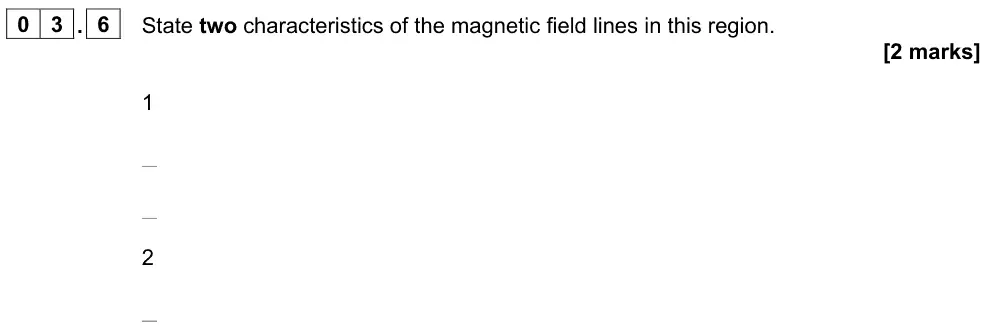
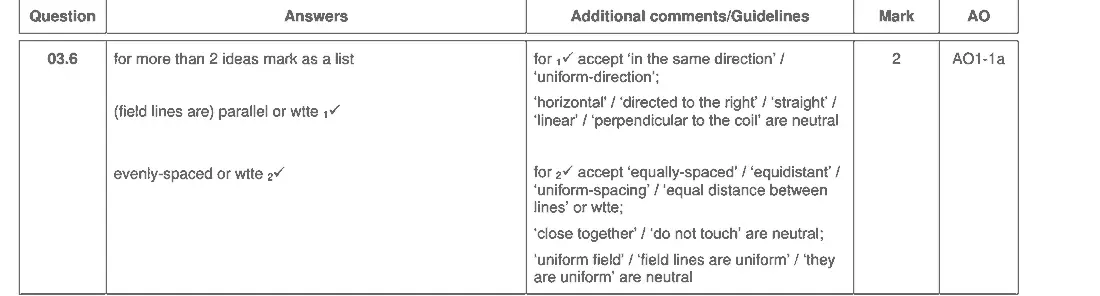
03.6 We hoped to see the “field lines are parallel” and “equally-spaced” ideas but we found too many generalised or imprecise statements such as “from north to south”, “closer together where field is stronger” or “field lines are uniform”.
Most students understood what the command words implied: when invited to “State” (eg 02.2 and 03.6), most gave abbreviated or even one-word responses. When asked to “Suggest” (01.2), “Justify” (03.3) or “Discuss” (02.3 and 03.1) they usually wrote in full sentences. It was rare to find answers that extended beyond the answer lines provided. The quality of writing was mixed; fluent writing was hard to find. In 03.1, only the strongest students used technical vocabulary confidently. Question 03.3 was designed to test understanding of ideas about uncertainties outlined in the Practical Handbook. Better-performing students showed they appreciated that two judgements were required when measuring with a protractor.
Notes from the mark scheme and report
Field lines parallel and equally spaced (uniform field)
'from N to S', 'field lines are uniform' not credited
June 2022 · Paper 2 · Q141 markAO2=1Multiple choice
Answer
A
Mark scheme
Notes from the mark scheme and report
Answer: A
Skills: MS0.3 Use ratios, fractions and percentages
June 2022 · Paper 2 · Q221 markAO2=1Multiple choice
Answer
B
Mark scheme
Notes from the mark scheme and report
Answer: B
Skills: MS2.3 Substitute numerical values into algebraic equations using appropriate units for physical quantities
November 2021 · Paper 2 · Q5.12 marksAO1=2Explanation
Mark scheme
Examiner's comment
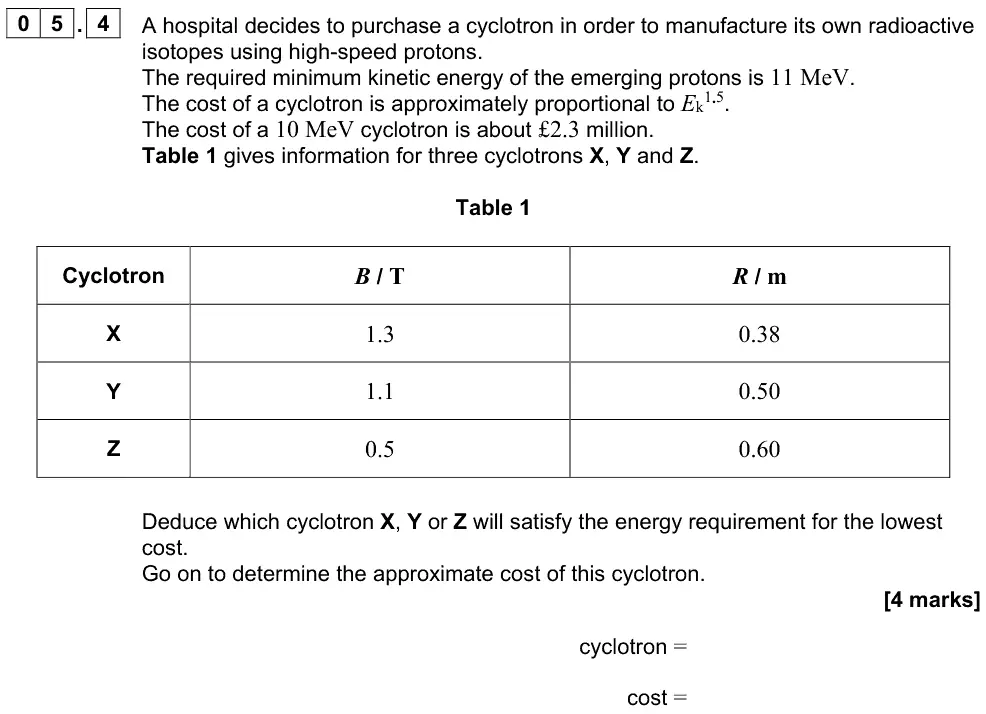
05.1 Generally students did not explain the direction in which the force acts in a clear way. Only a few could identify the magnetic force as centripetal. 05.2 Only a quarter of students determined the correct answer. Others settled at random on various energy equations to attempt an answer. 05.3 About a fifth of the students completed the task in a straightforward way. Others did not seem to know how to start; some of these gained a mark when they had established some clear workable equations in the first place. However, just writing BeV does not constitute a working equation unless there is some appropriate supporting evidence provided by the student. 05.4 Only a minority of students scored highly in this question, with very few attempting the cost calculation. Most could not get beyond the first mark. They could often make headway in calculating the kinetic energy of one cyclotron but then stopped. When it came to the cost calculation, most ignored the power law and simply used a linear relationship between kinetic energy and cost.
Notes from the mark scheme and report
Magnetic force is constant in size and always perpendicular to velocity, so it provides the centripetal force for circular motion
November 2021 · Paper 2 · Q5.33 marksAO2=3Show thatHard
Earlier part of question 5 that this part uses
Mark scheme
Examiner's comment
05.1 Generally students did not explain the direction in which the force acts in a clear way. Only a few could identify the magnetic force as centripetal. 05.2 Only a quarter of students determined the correct answer. Others settled at random on various energy equations to attempt an answer. 05.3 About a fifth of the students completed the task in a straightforward way. Others did not seem to know how to start; some of these gained a mark when they had established some clear workable equations in the first place. However, just writing BeV does not constitute a working equation unless there is some appropriate supporting evidence provided by the student. 05.4 Only a minority of students scored highly in this question, with very few attempting the cost calculation. Most could not get beyond the first mark. They could often make headway in calculating the kinetic energy of one cyclotron but then stopped. When it came to the cost calculation, most ignored the power law and simply used a linear relationship between kinetic energy and cost.
Notes from the mark scheme and report
Bev = mv^2/R gives v = eBR/m
substitute into Ek = mv^2/2 to get e^2 B^2 R^2 / 2m
Skills: MS2.2 Change the subject of an equation, including non-linear equations
November 2021 · Paper 2 · Q5.44 marksCalculation
Earlier part of question 5 that this part uses
Mark scheme
Examiner's comment
05.1 Generally students did not explain the direction in which the force acts in a clear way. Only a few could identify the magnetic force as centripetal. 05.2 Only a quarter of students determined the correct answer. Others settled at random on various energy equations to attempt an answer. 05.3 About a fifth of the students completed the task in a straightforward way. Others did not seem to know how to start; some of these gained a mark when they had established some clear workable equations in the first place. However, just writing BeV does not constitute a working equation unless there is some appropriate supporting evidence provided by the student. 05.4 Only a minority of students scored highly in this question, with very few attempting the cost calculation. Most could not get beyond the first mark. They could often make headway in calculating the kinetic energy of one cyclotron but then stopped. When it came to the cost calculation, most ignored the power law and simply used a linear relationship between kinetic energy and cost.
Notes from the mark scheme and report
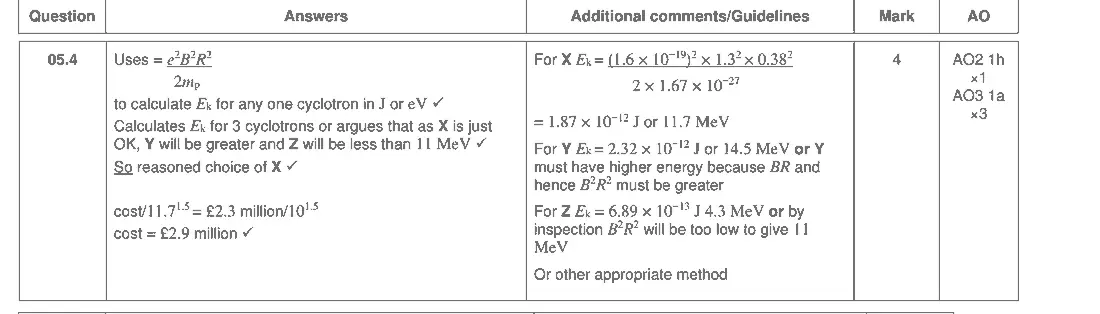
Answer: X, about £2.9 million (Ek for X = 11.7 MeV, Y = 14.5 MeV, Z = 4.3 MeV
cost = 2.3 x (11.7/10)^1.5)
most ignored the 1.5 power
Skills: MS0.5 Use calculators to find and use power, exponential and logarithmic functions; MS0.3 Use ratios, fractions and percentages
November 2021 · Paper 2 · Q211 markMultiple choice
Answer
A
Mark scheme
Notes from the mark scheme and report
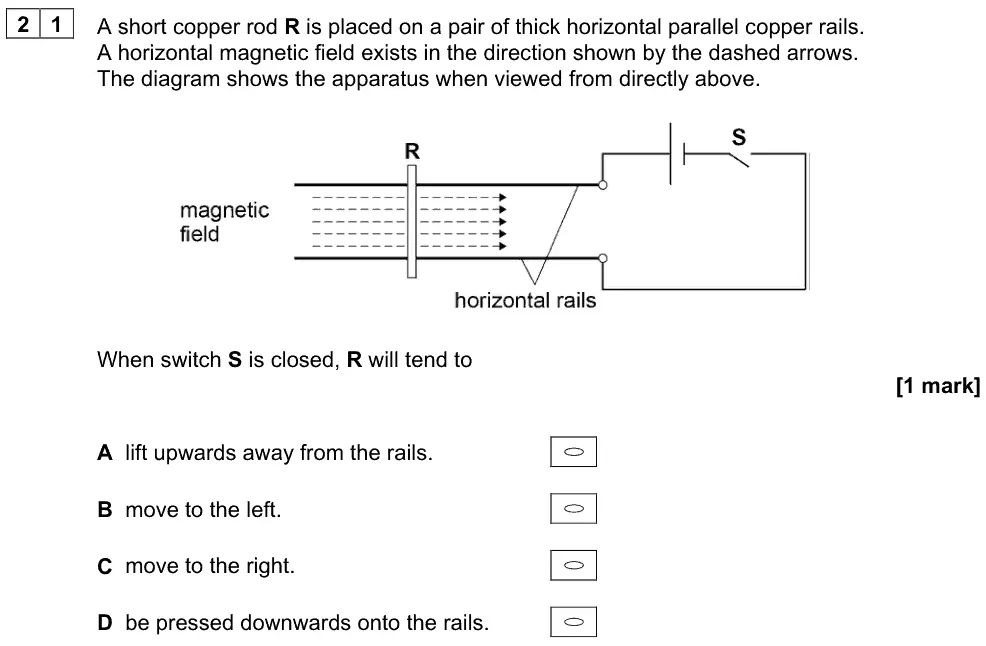
Answer: A
November 2020 · Paper 2 · Q3.11 markAO1=1Diagram or graph
Mark scheme
Examiner's comment
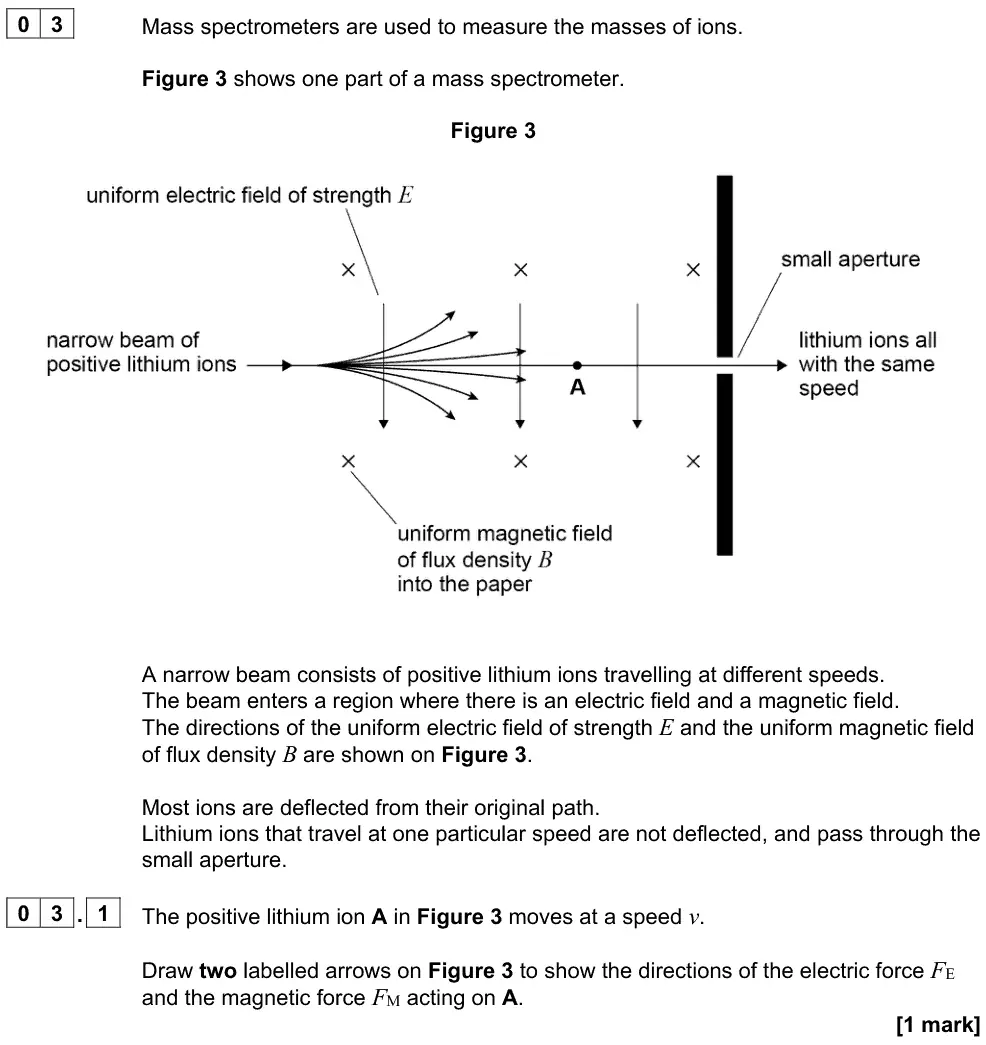
About half of the students did not gain this mark. The main error was a failure to have the forces diametrically opposed to each other. The direction of the magnetic force was the one more likely to be given the wrong direction.
Question 03.1
Notes from the mark scheme and report
Magnetic force FM upwards, electric force FE downwards at A (opposite, balanced)
about half did not gain the mark
November 2020 · Paper 2 · Q3.22 marksCalculation
Earlier part of question 3 that this part uses
Mark scheme
Examiner's comment
A majority of students scored full marks on this straightforward question. However, some students struggled to find the correct equations to use and a smaller number simply made a power of ten error in their calculation.
Question 03.2
Notes from the mark scheme and report
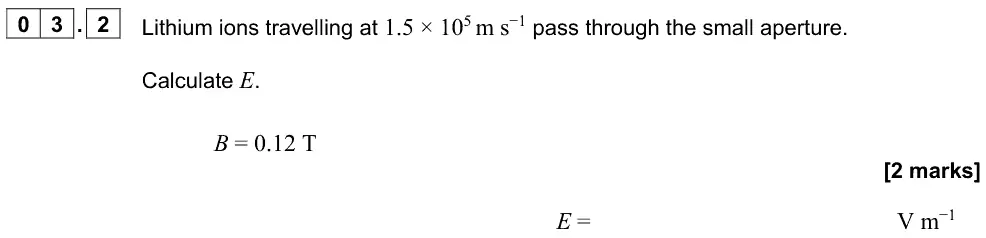
Answer: 1.8 x 10^4 V m^-1 (forces balance so E = vB)
Skills: MS2.3 Substitute numerical values into algebraic equations using appropriate units for physical quantities
November 2020 · Paper 2 · Q3.31 markAO2=1Show that
Earlier part of question 3 that this part uses
Mark scheme
Examiner's comment
Most students answered this question successfully. The others typically failed to write down more than a single equation or they failed to make clear that the expressions they wrote related to a force.
Question 03.3
Notes from the mark scheme and report
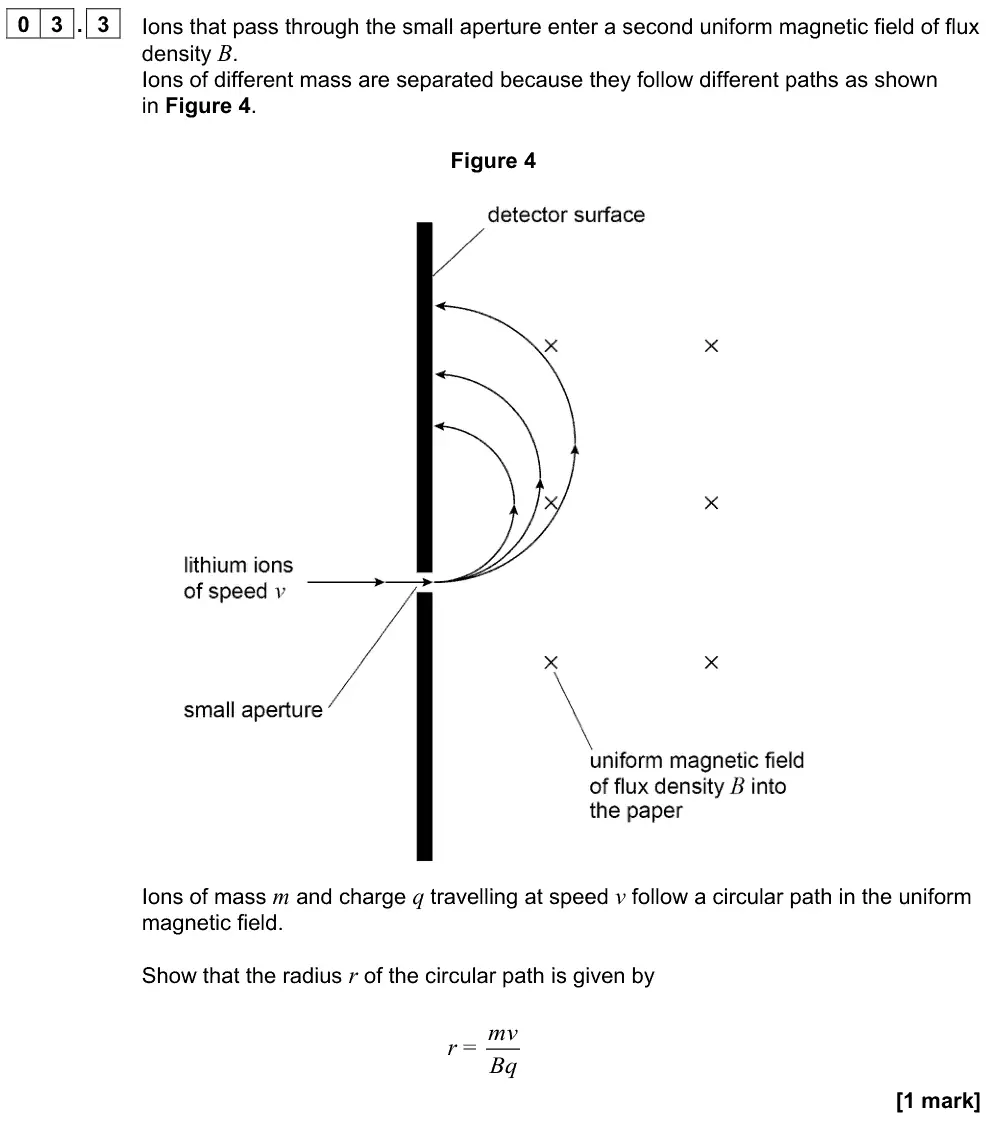
mv^2 / r = Bqv so r = mv / Bq
must show these are forces
Skills: MS2.2 Change the subject of an equation, including non-linear equations
November 2020 · Paper 2 · Q3.42 marksAO1=2Calculation
Earlier part of question 3 that this part uses
Mark scheme
Examiner's comment
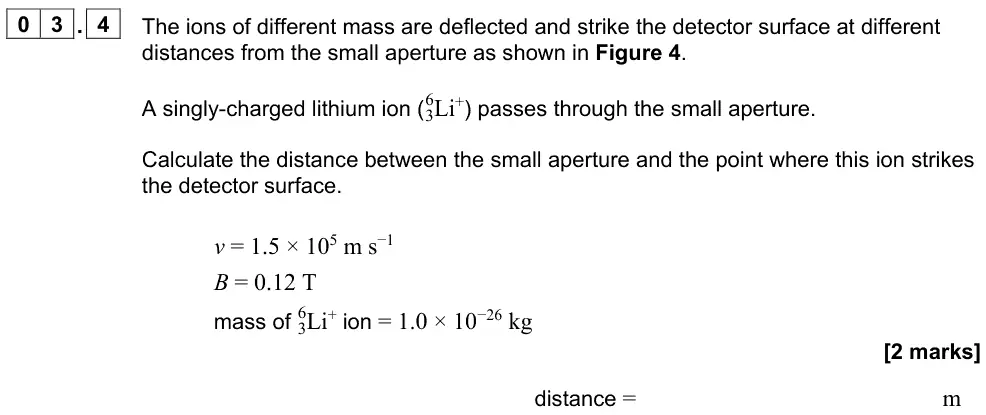
A large number of the students did not use the equation given earlier in the examination paper. Also, some did not appreciate that the ion was singly charged. A majority successfully calculated the radius but fewer students obtained full marks because it was common to double the radius in the final answer.
Question 03.4
Notes from the mark scheme and report
Answer: 0.16 m (r = mv/Bq = 0.078 m with q = 1.6 x 10^-19 C
distance = 2r)
forgetting to double the radius was common
Skills: MS2.3 Substitute numerical values into algebraic equations using appropriate units for physical quantities
November 2020 · Paper 2 · Q231 markMultiple choice
Answer
A
Notes from the mark scheme and report
Answer: A
June 2019 · Paper 2 · Q131 markMultiple choice
Answer
A
Notes from the mark scheme and report
Answer: A
Skills: MS0.3 Use ratios, fractions and percentages
June 2019 · Paper 2 · Q231 markMultiple choice
Answer
B
Notes from the mark scheme and report
Answer: B
June 2019 · Paper 2 · Q241 markMultiple choice
Answer
C
Notes from the mark scheme and report
Answer: C
Skills: MS2.2 Change the subject of an equation, including non-linear equations
June 2018 · Paper 2 · Q261 markMultiple choice
Answer
C
Notes from the mark scheme and report
Answer: C
June 2018 · Paper 2 · Q271 markMultiple choice
Answer
C
Notes from the mark scheme and report
Answer: C
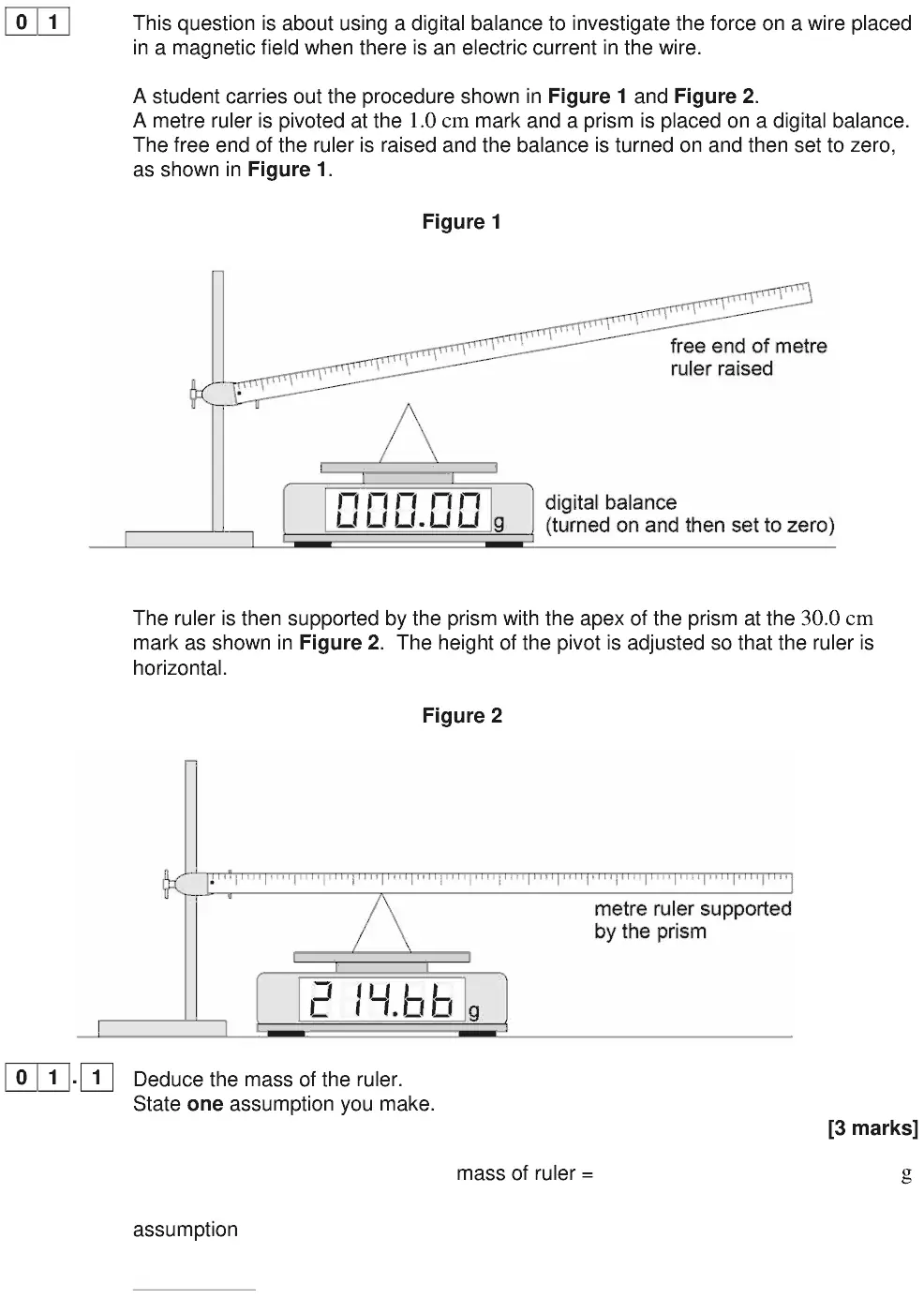
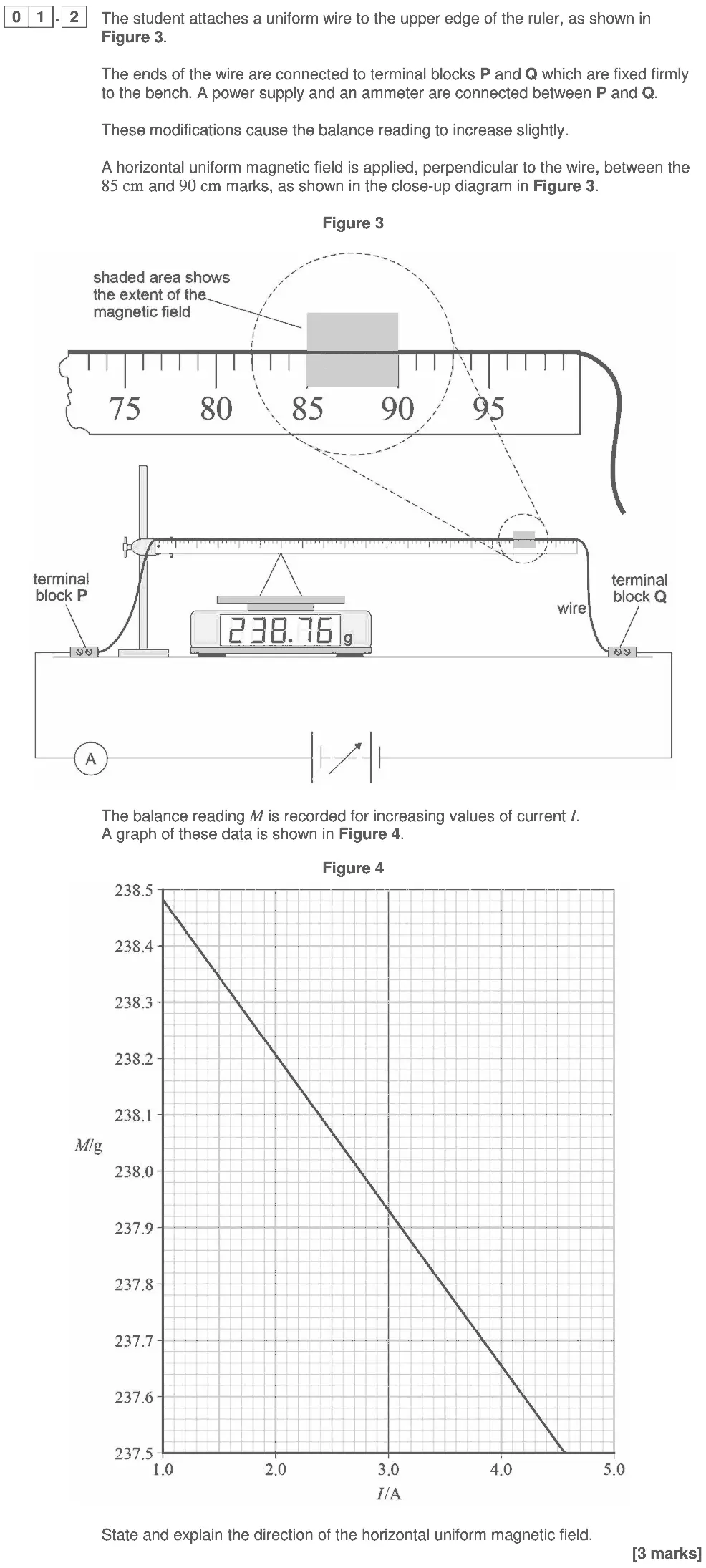
June 2018 · Paper 3 Section A · Q1.23 marksExplanation
Earlier part of question 1 that this part uses
Mark scheme
Examiner's comment
01.1 Much of the working seen convinced examiners that the students had taken moments about the pivot, although some used 30.0 rather than 29.0 in the calculation. A few forfeited a mark by rounding their result to two significant figures. Weaker students attempted a solution based on proportions of the balance reading shown in Figure 2, while others simply copied the balance reading on to the answer line. While some stated the assumption they made was that the ruler was in equilibrium, examiners were looking for a statement implying that the ruler was uniform or that the centre of mass was at the 50 cm mark. Significant numbers of students gave a creditworthy assumption although those that stated “the ruler has uniform density” or “the mass is in the middle” were unsuccessful. Just over two-thirds of students scored at least one mark. 01.2 The key failing of some students here was (surprisingly) that they seemed to think that the current direction was self-evident and not worthy of comment, even if they had correctly deduced the direction of the force (despite some tying themselves in knots with Newton’s third law). Some students relied on the examiners spotting relevant annotation made to Figure 3. Statements that the current was ‘from positive to negative’ or ‘clockwise’ were not accepted. Unless the directions of the force and the current were both stated, no credit was given for stating the direction of the field. Logically correct deductions, based on incorrect force and/or current directions, could score as long as the left-hand rule was mentioned in support. For these reasons, approximately a third of the students scored one of the three marks and nearly another third scored zero. Thankfully, 17.1% gave a detailed, fully-justified and correct response earning full credit.
There were signs that students were realising the intentions of questions better than in 2017. In question 01.2 they spotted the detail needed to deduce the direction of the magnetic field, but in 01.5 the significance of the currents in X and Y having the same magnitude went unnoticed. Too many answers to 02.2 failed to take account of how the diminishing vertical deflection impacted on percentage uncertainty in y.
Notes from the mark scheme and report
Balance reading falls so force on wire is upwards
current P to Q (left to right)
left-hand rule gives B into the page
many omitted the current direction
Skills: RP10 Investigate how the force on a wire varies with flux density, current and length of wire using a top pan balance.
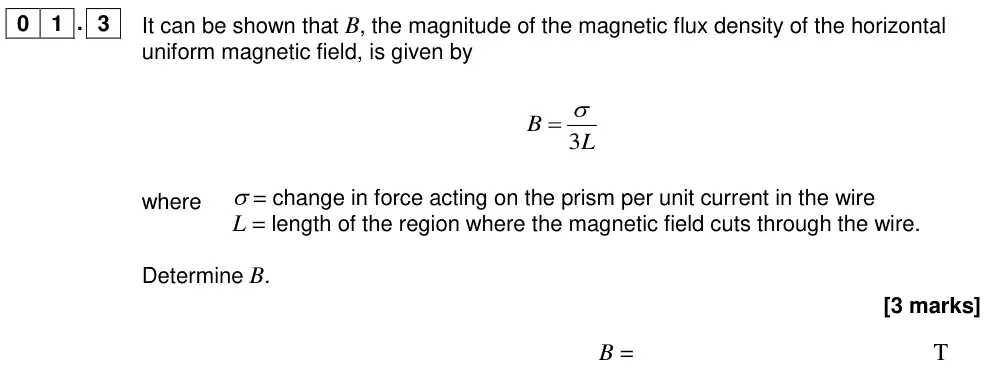
June 2018 · Paper 3 Section A · Q1.33 marksPractical and data analysis
Earlier part of question 1 that this part uses
Mark scheme
Examiner's comment
01.3 Most students recognised that they should find the gradient of the graph in Figure 4 to score the first mark, although a minority predictably failed to spot at least one of the false origins. Some mistakenly thought they should use the information in Figures 2 and 3, and others thought σ was the value of M when the current was 1 A. Correct use of 9.81 earned the second mark for many. While few students failed to correctly insert 5 cm into their calculation for B, most struggled with the various power of ten issues. This discriminated strongly in favour of the better students who could expect to score at least two marks.
More encouragingly, many students wrote in question 01.6 with confidence, structuring logical and coherent responses to the experimental design exercise and, in many cases, earning full credit. In contrast to the work seen in 2017, better solutions to multi-stage calculations were seen, the best example being in question 03.6, although many were also able to make some progress in questions 01.3 and 02.4. However, disappointing numbers of students remain oblivious to what an integer is (question 02.3), or how to express the order of magnitude of a number (question 02.5). Students should be discouraged from showing intermediate results in fractional form as this reduces the transparency of their work. The quality of the graph work in 03.4 was mixed, with many students choosing a poor scale.
Notes from the mark scheme and report
Answer: B = 1.8 x 10^-2 T (range 1.76-1.87
gradient 0.28 g per A from graph with false origins, x 9.81 x 10^-3 for sigma, L = 5.0 cm)
power of ten errors common
Skills: MS3.4 Determine the slope and intercept of a linear graph; MS2.3 Substitute numerical values into algebraic equations using appropriate units for physical quantities; MS0.1 Recognise and make use of appropriate units in calculations; RP10 Investigate how the force on a wire varies with flux density, current and length of wire using a top pan balance.
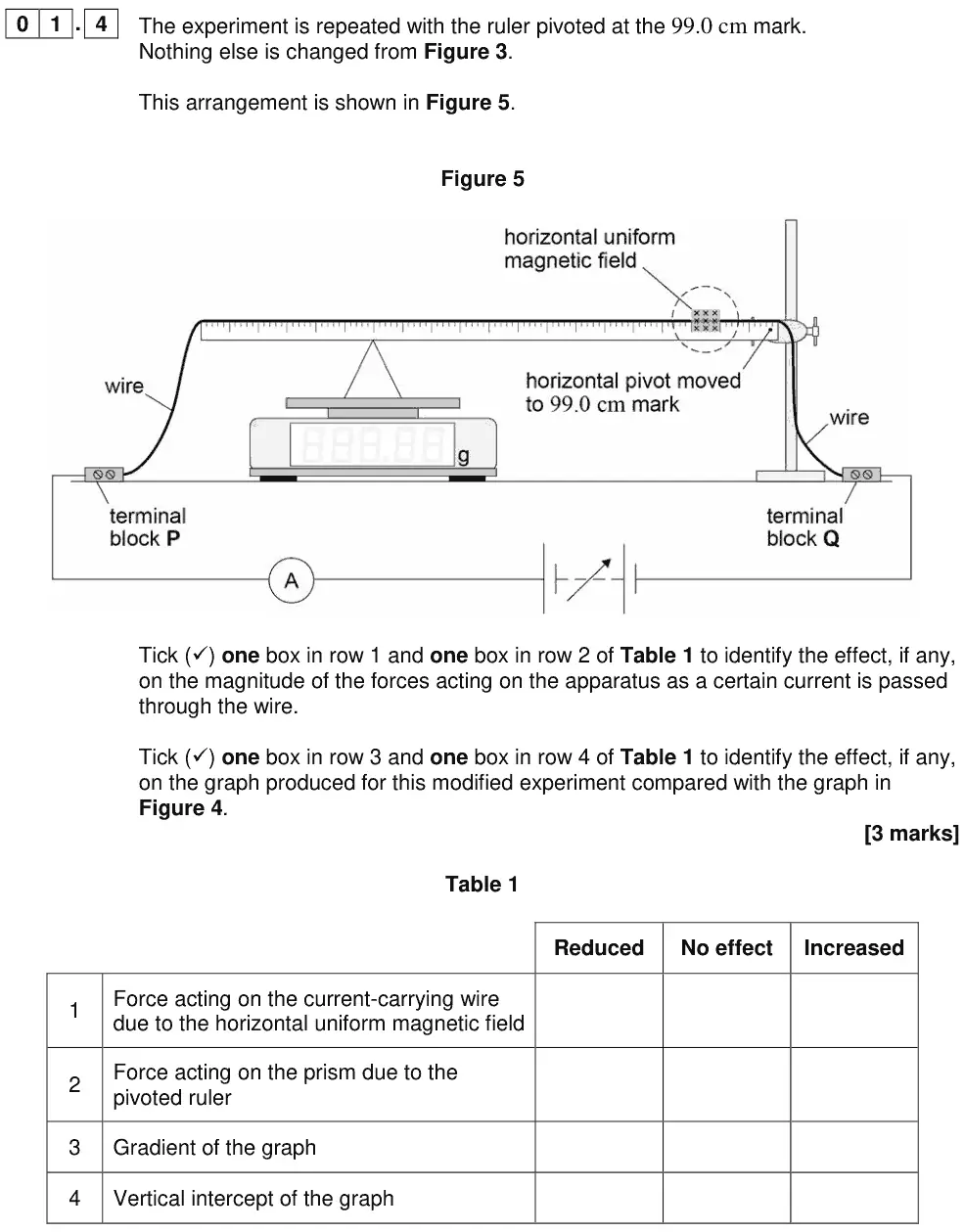
June 2018 · Paper 3 Section A · Q1.43 marksPractical and data analysisHard
Earlier part of question 1 that this part uses
Mark scheme
Examiner's comment
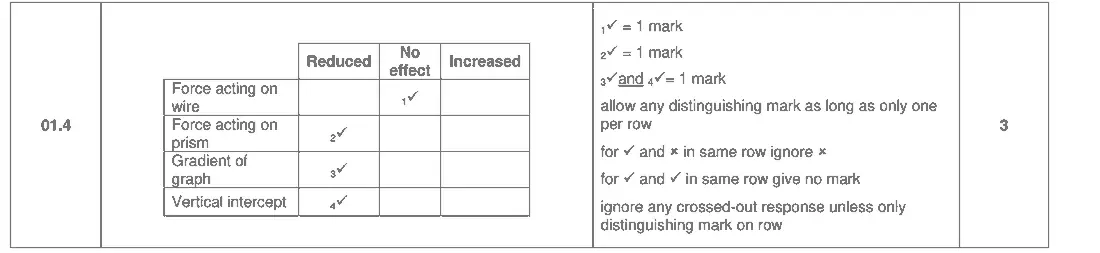
01.4 The first row of Table 1 attracted the most correct responses and thereafter things got patchier. Examiners needed to see correct responses in both row 3 and row 4 to earn the third marking point; this proved beyond all but the most able, with only 11.4% obtaining full credit.
Notes from the mark scheme and report
Row-by-row ticks as the mark scheme (force on wire unchanged
with pivot at 99 cm the lever arms change the force on the prism, gradient and intercept)
rows 3 and 4 both needed for the third mark
Skills: PS1.2 Apply scientific knowledge to practical contexts; RP10 Investigate how the force on a wire varies with flux density, current and length of wire using a top pan balance.
June 2018 · Paper 3 Section A · Q1.65 marksPractical and data analysis
Earlier part of question 1 that this part uses
Mark scheme
Examiner's comment
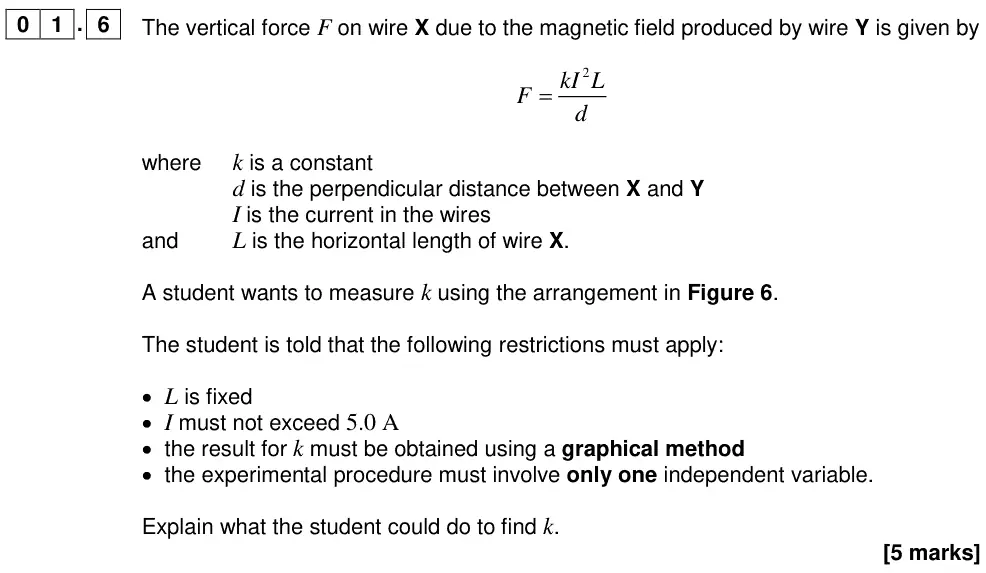
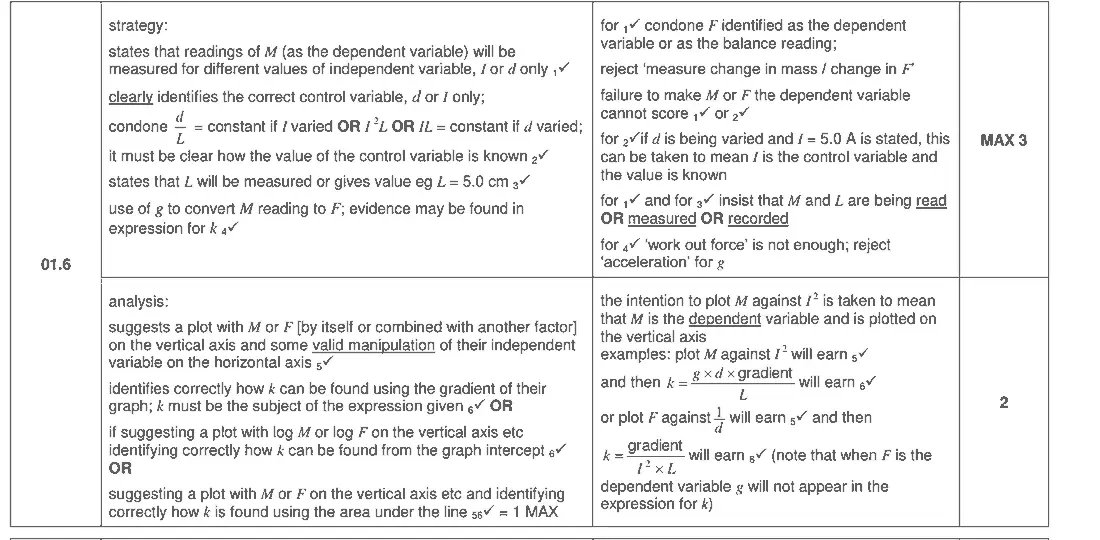
01.6 This was for many the most successful part of the paper, so much so that most students ran out of space in their enthusiasm to set out their solution. There were four marks available for outlining a suitable strategy and students could earn any three of these for maximum credit. In common with the approach on paper 7407/2, examiners insisted on seeing that the dependent variable, correctly identified as m or F, was ‘read’, ‘measured’ or ‘recorded’. These are the terms examiners expect students to use if similar questions are posed in future papers. Students were split on whether the perpendicular distance d or the current I would be the independent variable, but were nearly universal in their conviction that the balance reading would be the dependent variable. Despite being told that the pan of the balance moves a negligible amount during use, a few students decided that in varying I they could make d the dependent variable. Some students penalised themselves by overlooking the need to measure the length L of wire X. Others failed to clearly identify the remaining control variable and to state that this too should be measured. A few students thought the balance read the vertical force F directly, but many correctly saw the need to introduce g. The analyses given were impressive and varied; most could explain a relevant graph with m or F involved somewhere on the vertical axis. Examiners took statements such as “plot F against I 2” to mean that F was the dependent variable and would be plotted on the vertical axis, otherwise the use of the gradient to find k could not be verified. Most students gave an expression to show how their gradient could be manipulated to obtain k; examiners expected k to be the subject of this expression. There was strong representation at each mark for this question, from zero to five; 16% of students obtained full credit for their answer.
However, some of the underlying problems seen on the 2017 paper still persist. Misuse of technical vocabulary is still widespread, with many students referring to balances as ‘scales’ on which mass is ‘weighed’ in question 03.3. In 02.1, many stated that their ruler was ‘straight’ when they should have written ‘vertical’. Elsewhere, slipshod use of basic language proved costly, for example in question 01.6 where some students described a sequence of steps that were probably unintended. Students continue to improvise when required to describe practical procedures, suggesting that their experience of laboratory work is mostly confined to meeting the demands of the 12 required practical activities. In 02.1, few could explain simple steps to measure the sag of the tape measure.
More encouragingly, many students wrote in question 01.6 with confidence, structuring logical and coherent responses to the experimental design exercise and, in many cases, earning full credit. In contrast to the work seen in 2017, better solutions to multi-stage calculations were seen, the best example being in question 03.6, although many were also able to make some progress in questions 01.3 and 02.4. However, disappointing numbers of students remain oblivious to what an integer is (question 02.3), or how to express the order of magnitude of a number (question 02.5). Students should be discouraged from showing intermediate results in fractional form as this reduces the transparency of their work. The quality of the graph work in 03.4 was mixed, with many students choosing a poor scale.
03.3 The direct and the indirect approaches to finding the volumes proved equally popular, but a small minority of students tried unsuccessfully to use some variant of the gas laws. Examiners expected a measuring cylinder to be used for the direct method and wanted students to explain that the reading was taken with the eye level with the bottom of the meniscus to avoid parallax error. Very few could give a completely correct response. For the indirect approach, examiners gave no credit for ‘scales’ rather than ‘balance’ (the instrument had been clearly identified in question 1) and rejected the idea that mass could be ‘weighed’. However, many students gave a sensible way to account for the mass of the flask when determining the mass of water and could explain how the volume was obtained, as the density was known. Examiners did not allow “1 g = 1 cm3”, variants of which were seen rather too frequently. As with question 01.6, students frequently wrote more than they needed to, yet the number scoring all three marks (5.1%) was disappointing.
Notes from the mark scheme and report
Record balance reading M (dependent) for varied I (or d) with the other controlled and measured
measure L
F = Mg
plot F against I^2 (or 1/d), gradient = kL/d (or kI^2L), so find k
Skills: PS2.1 Comment on experimental design and evaluate scientific methods; PS2.4 Identify variables including those that must be controlled; MS3.3 Understand that y = mx + c represents a linear relationship; ATb digital instruments, including multimeters; RP10 Investigate how the force on a wire varies with flux density, current and length of wire using a top pan balance.
June 2017 · Paper 2 · Q2.11 markShort answer
Mark scheme
Examiner's comment
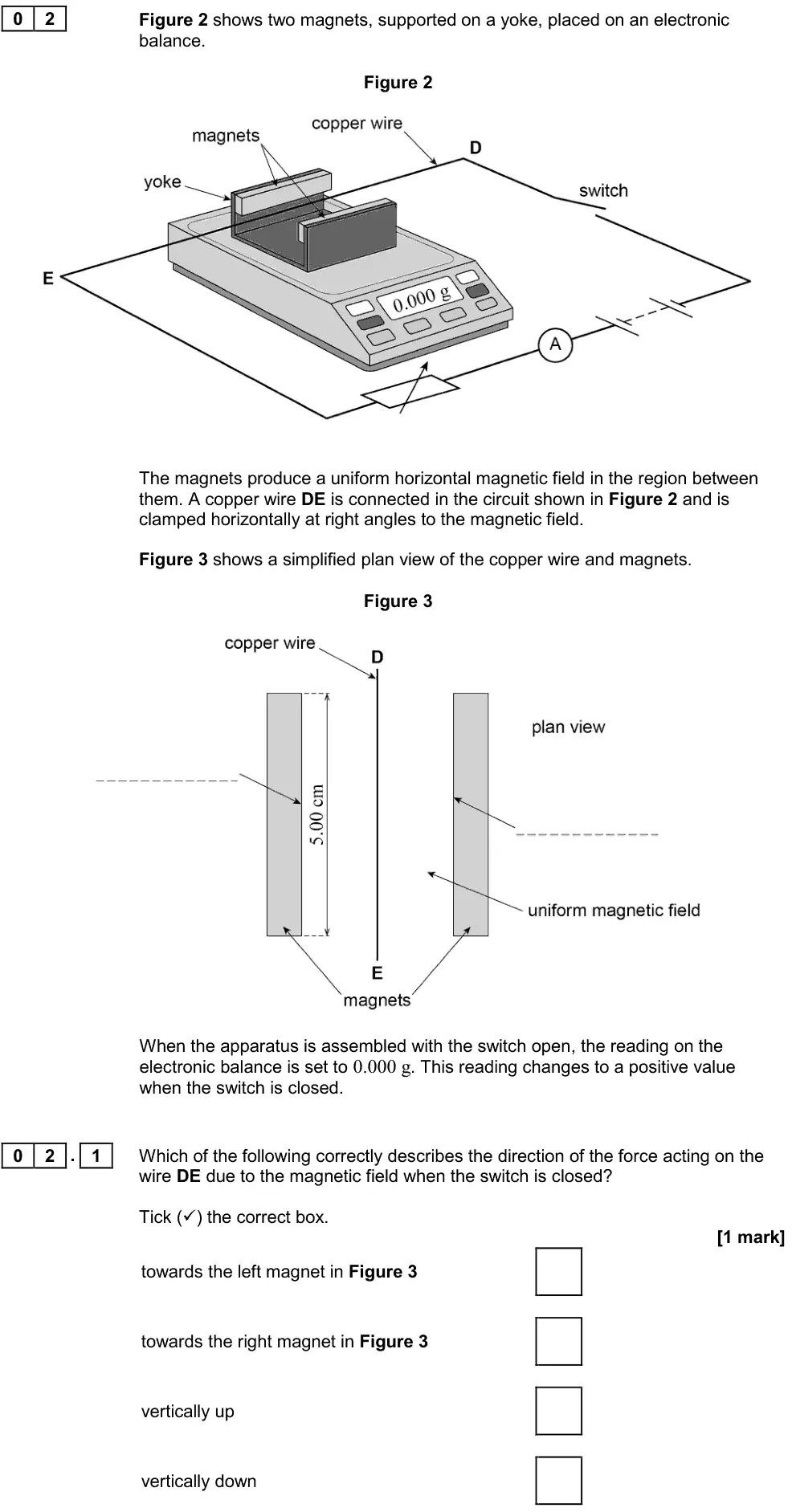
02.1 Many students failed to use the concept of Newton III and incorrectly chose the fourth alternative.
Notes from the mark scheme and report
Answer: vertically up (balance reading rises so force on magnets is down
Newton's third law)
many chose vertically down
Skills: RP10 Investigate how the force on a wire varies with flux density, current and length of wire using a top pan balance.
June 2017 · Paper 2 · Q2.21 markDiagram or graph
Earlier part of question 2 that this part uses
Mark scheme
Examiner's comment
02.2 More students got this incorrect than got it correct. So again it appeared that errors came in the practical use of Newton’s third law. Some students wrote some side notes referring to Fleming’s left hand rule and they still made errors.
Notes from the mark scheme and report
S on the left magnet, N on the right (Fleming's left-hand rule with the force on DE upwards)
more got it wrong than right
Skills: RP10 Investigate how the force on a wire varies with flux density, current and length of wire using a top pan balance.
June 2017 · Paper 2 · Q2.31 markShort answer
Earlier part of question 2 that this part uses
Mark scheme
Examiner's comment
02.3 This was the lowest scoring question on the paper. Most students interpreted the question as, ‘What is a tesla equal to?’ Most answers seen were based on formulae that happen to contain B, the magnetic field strength. So an answer such as, ‘The tesla is the force per unit current per unit length’, was one of the better attempts, but even here the tesla is being described in the wrong units. The least able students did not even get this far and simply gave vague answers such as, “it’s used for magnetic fields”.
Notes from the mark scheme and report
Flux density producing a force of 1 N on 1 m of wire carrying 1 A perpendicular to the field
must include 1 N, 1 A, 1 m
F = BQv definitions not allowed
lowest scoring question on the paper
June 2017 · Paper 2 · Q2.42 marksCalculation
Earlier part of question 2 that this part uses
Mark scheme
Examiner's comment
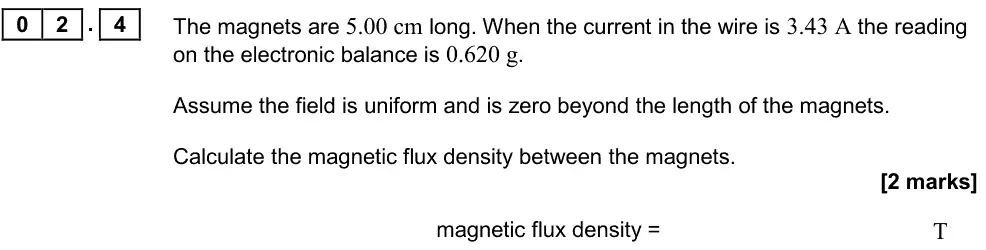
02.4 A majority of students tackled this question with little trouble. The most common error was in failing to convert the mass from g to kg.
Notes from the mark scheme and report
Answer: 0.035 T (B = mg/Il with m = 0.620 x 10^-3 kg, l = 0.0500 m)
failing to convert g to kg
omitting g scores 0
Skills: MS2.2 Change the subject of an equation, including non-linear equations; MS2.3 Substitute numerical values into algebraic equations using appropriate units for physical quantities; RP10 Investigate how the force on a wire varies with flux density, current and length of wire using a top pan balance.
June 2017 · Paper 2 · Q3.11 markExplanation
Mark scheme
Examiner's comment
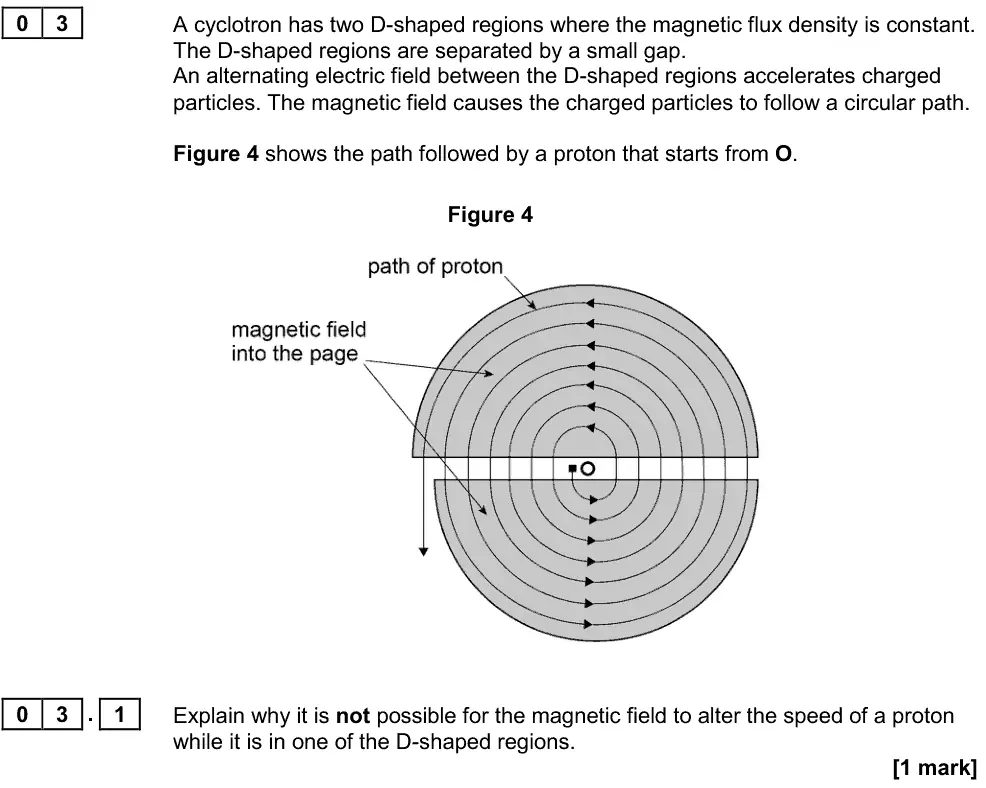
03.1 Most students did not pick-up on the idea that the force is perpendicular to the motion. These students often searched for something to explain the situation, by writing something like, “the magnetic field is static or uniform so it can’t affect the speed”. A few students did know the answer had to do with directions, but only said the magnetic field was perpendicular to the motion, which misses the point.
Notes from the mark scheme and report
Force is perpendicular to the velocity so no work is done and only direction changes
'field perpendicular to motion' misses the point
June 2017 · Paper 2 · Q3.23 marksShow that
Earlier part of question 3 that this part uses
Mark scheme
Examiner's comment
03.2 More than half the students could present the starting equation relating the force due to the magnetic field, to the centripetal force. Many continued to successfully find an expression for the period of motion. However, only some of these referred back to the question to give the time to travel round one semi-circle. Many of the other students got into difficulties if their initial expression for the centripetal force did not involve velocity. From this point on, they often took numerous false trails and the work presented looked very disorganised. Another route taken by some was to reduce their first equation to R = mv / BQ and simply say that this radius does not involve time and is constant. This not only re-writes the question, but misses the point that v is different on each transit.
Notes from the mark scheme and report
BQv = mv^2/r and t = pi r / v give t = pi m / BQ, independent of r
many found the full period and did not halve it
r = mv/BQ alone misses that v changes
Skills: MS2.2 Change the subject of an equation, including non-linear equations
June 2017 · Paper 2 · Q3.32 marksCalculation
Earlier part of question 3 that this part uses
Mark scheme
Examiner's comment
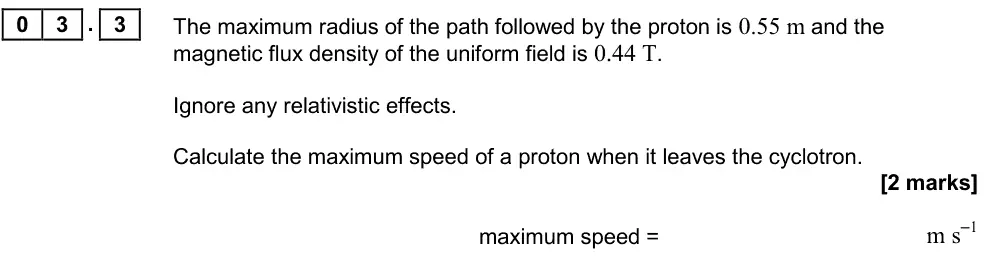
03.3 This calculation was done well by the majority of students. There were also very few errors shown in the numerical calculations. The weaker scripts either showed students producing the wrong equation, or not rearranging the equation correctly.
Notes from the mark scheme and report
Answer: 2.3 x 10^7 m s^-1 (v = BQr/m)
Skills: MS2.3 Substitute numerical values into algebraic equations using appropriate units for physical quantities; MS2.2 Change the subject of an equation, including non-linear equations
Specimen set 1 · Paper 2 · Q181 markMultiple choice
Answer
B
Notes from the mark scheme and report
Answer: B
Skills: MS2.3 Substitute numerical values into algebraic equations using appropriate units for physical quantities
Specimen set 1 · Paper 2 · Q191 markMultiple choice
Answer
A
Notes from the mark scheme and report
Answer: A
Skills: MS2.2 Change the subject of an equation, including non-linear equations
Work with an AQA physics tutor
Dropping marks on calculations, required practicals or the six-markers? Book a trial session with a specialist AQA physics tutor.