Tap a question to zoom it. Where a part needs a figure, table or graph from earlier in the question, that part folds out above it; the mark scheme and examiner's comment open underneath. Have the AQA data and formulae booklet beside you (see the formula sheet page).
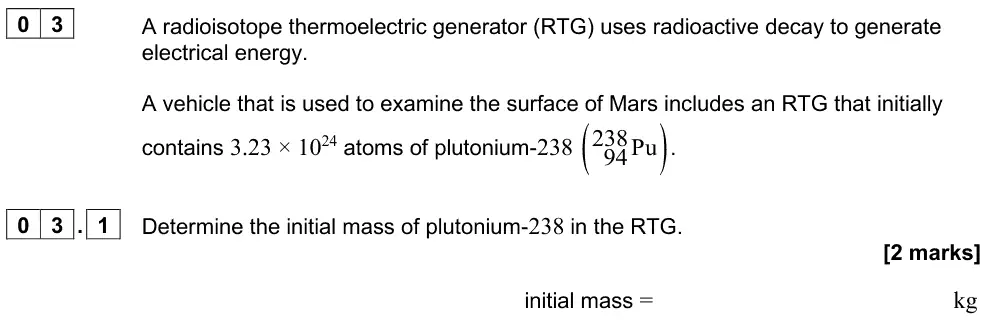
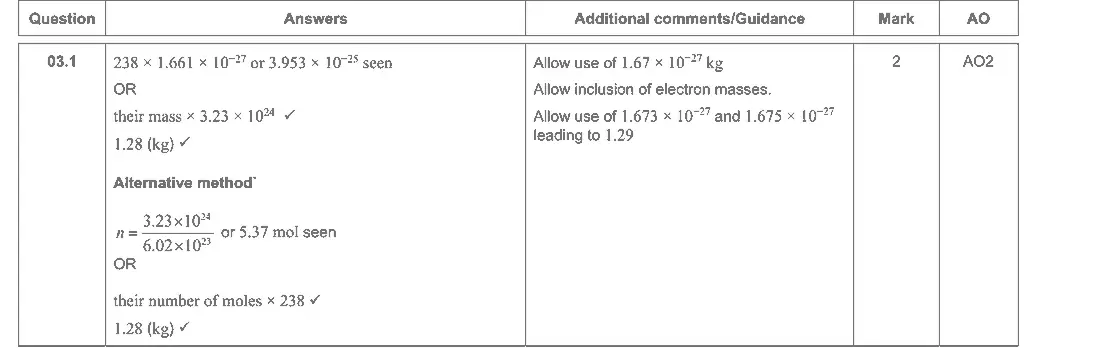
June 2025 · Paper 2 · Q3.12 marksAO2=2Calculation
Mark scheme
Examiner's comment
3.1 Most students were able to determine the initial mass of plutonium from the number of atoms.
Notes from the mark scheme and report
Answer: 1.28 kg (3.23 x 10^24 x 238 x 1.661 x 10^-27 kg, or 5.37 mol x 0.238 kg)
Skills: MS2.3 Substitute numerical values into algebraic equations using appropriate units for physical quantities
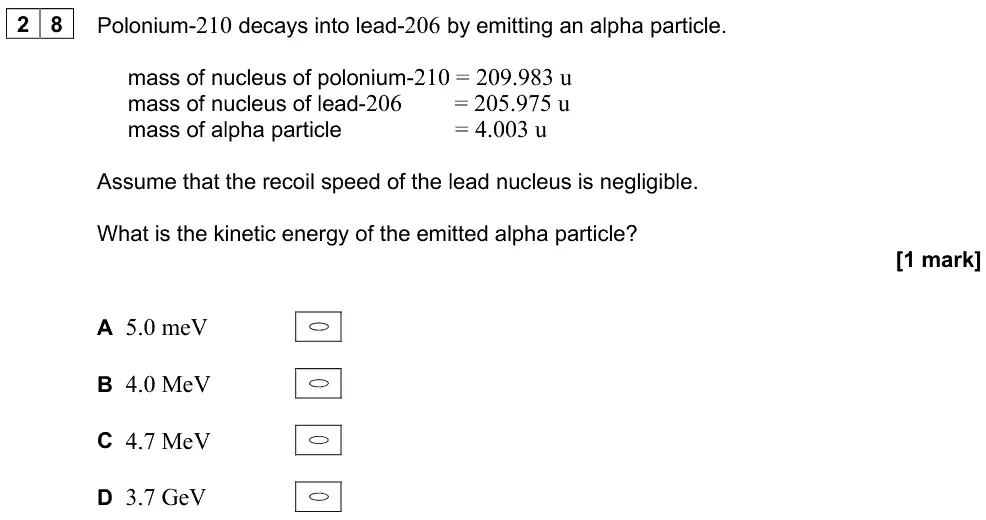
June 2025 · Paper 2 · Q281 markAO2=1Multiple choiceEasy
Answer
C
Mark scheme
Examiner's comment
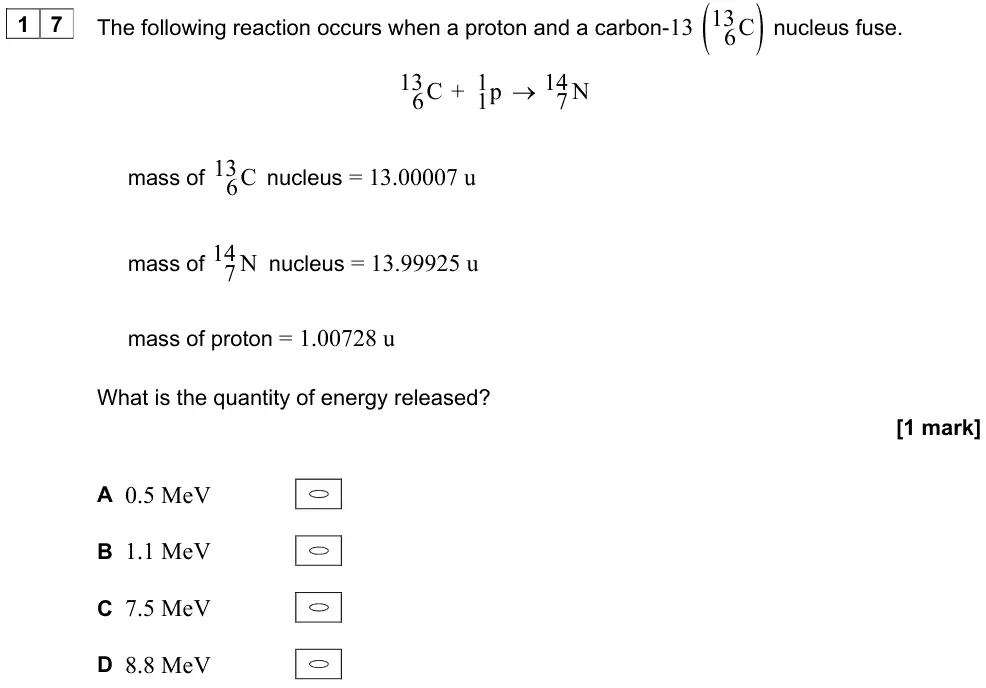
Students found questions 11, 14, 17, 28 and 30 to be very accessible with over two thirds getting these correct.
Notes from the mark scheme and report
Answer: C
Skills: MS2.3 Substitute numerical values into algebraic equations using appropriate units for physical quantities
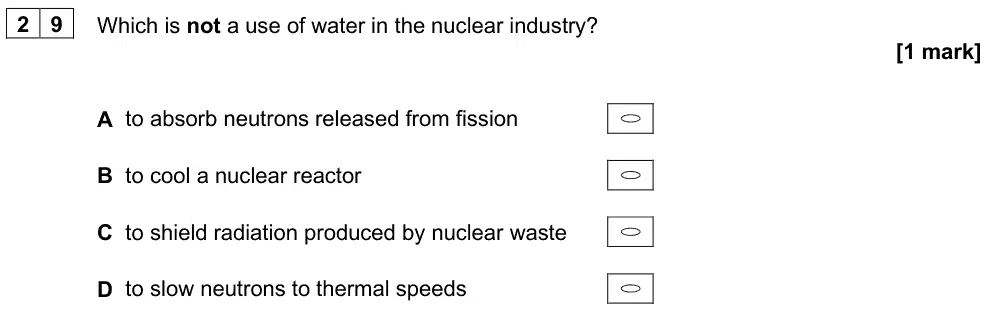
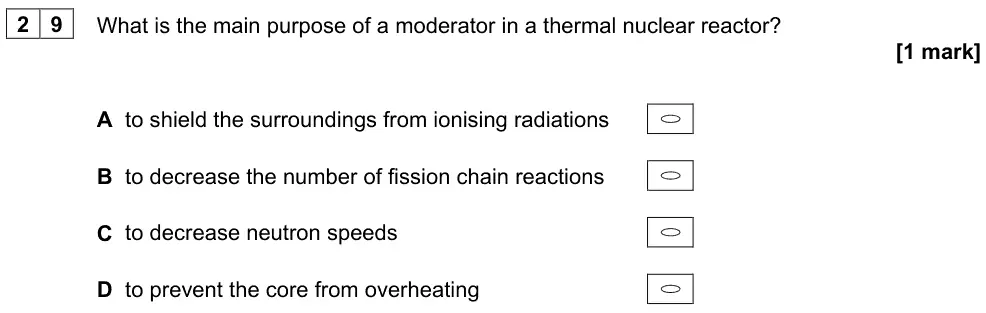
June 2025 · Paper 2 · Q291 markAO1=1Multiple choice
Answer
A
Mark scheme
Notes from the mark scheme and report
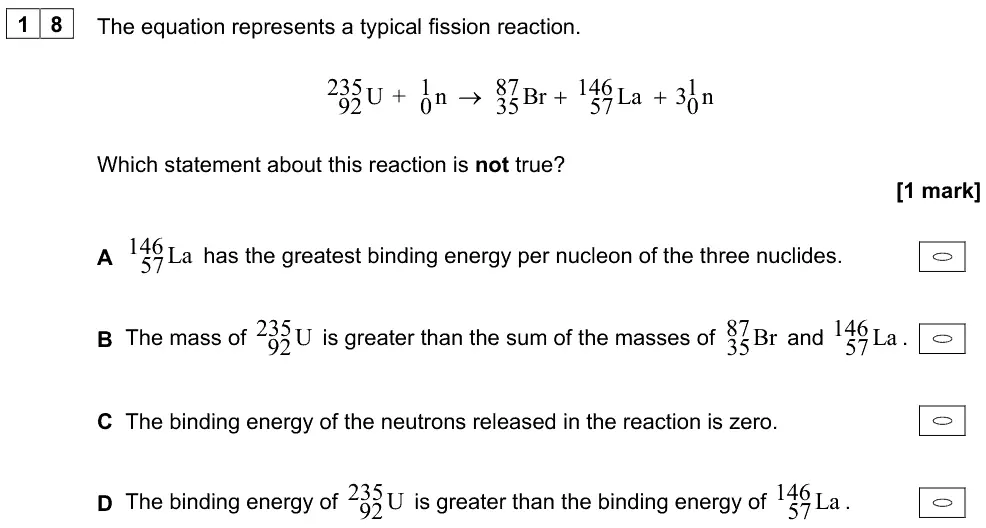
Answer: A
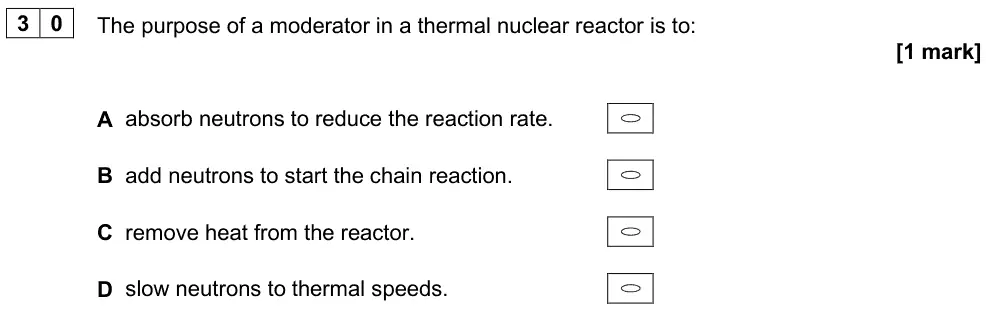
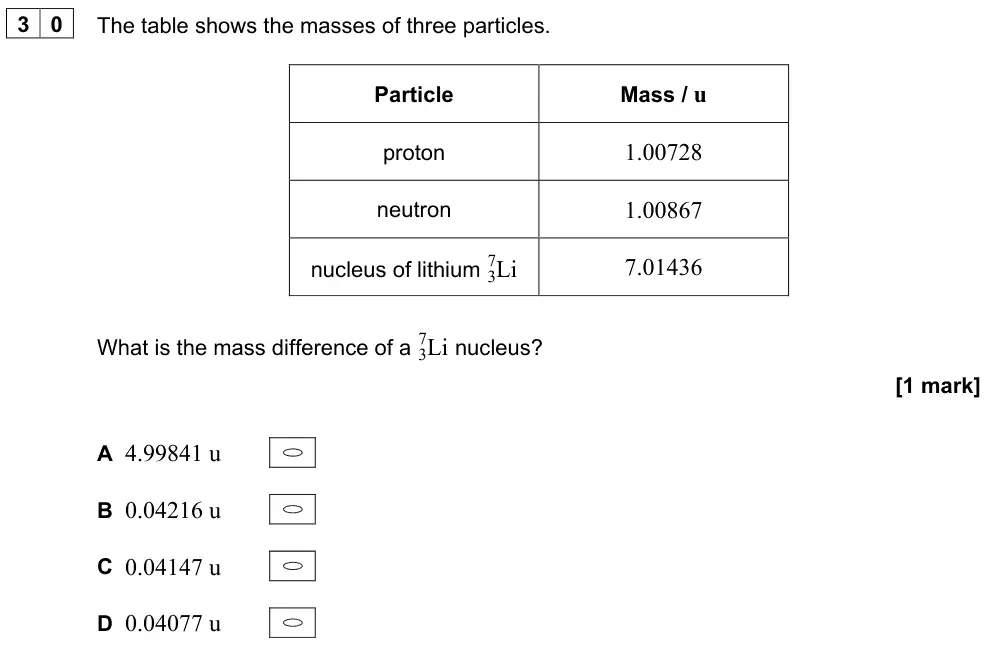
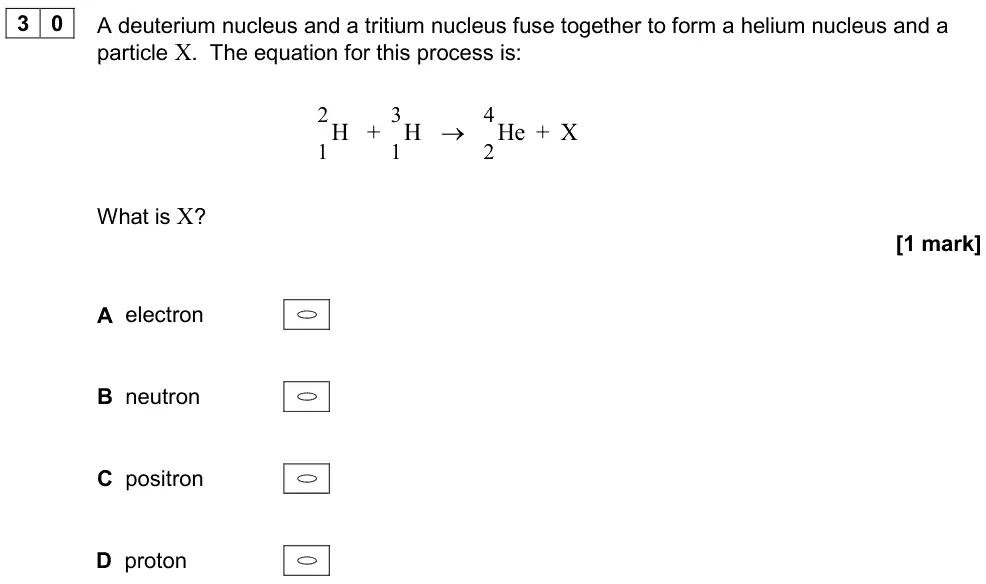
June 2025 · Paper 2 · Q301 markAO1=1Multiple choiceEasy
Answer
D
Mark scheme
Examiner's comment
Students found questions 11, 14, 17, 28 and 30 to be very accessible with over two thirds getting these correct.
22 This question was very challenging with around one quarter of students answering it As a conductor moves through a magnetic field, the induced emf is given by 𝜀𝜀= 𝐵𝐵𝐵𝐵𝐵𝐵, however correctly. The correct answer was only the third most popular response. the students had to identify which distance was 𝑙𝑙. 𝑙𝑙 is the distance that is perpendicular to both the velocity and the magnetic field. The magnetic field is vertical, so 𝑙𝑙 cannot be 10 cm; the velocity is in the same direction as 30 cm, so 𝑙𝑙 must be 5.0 cm. The answer is therefore D. The most common answer was B which corresponded to 𝑙𝑙= 30 cm, the second most common answer was C corresponding to 𝑙𝑙= 10 cm. 23 This question also had the wrong answer as the most common choice, in this case C, with 𝑃𝑃= 𝐼𝐼rms𝑉𝑉rms = = 125 W. Thus, the efficiency is 125 × 100 = 80%. C comes from calculating 5×50 100 only around a third correctly identifying A as the correct answer. Students had to realise that 2 the power from the peak voltages rather than the rms values. inverse square law for radiation, which gives 800𝑑𝑑2 = 600(𝑑𝑑+ 10)2, giving 𝑑𝑑= 64 cm. 25 Around a third of students were able to answer this question correctly. This uses the
Notes from the mark scheme and report
Answer: D
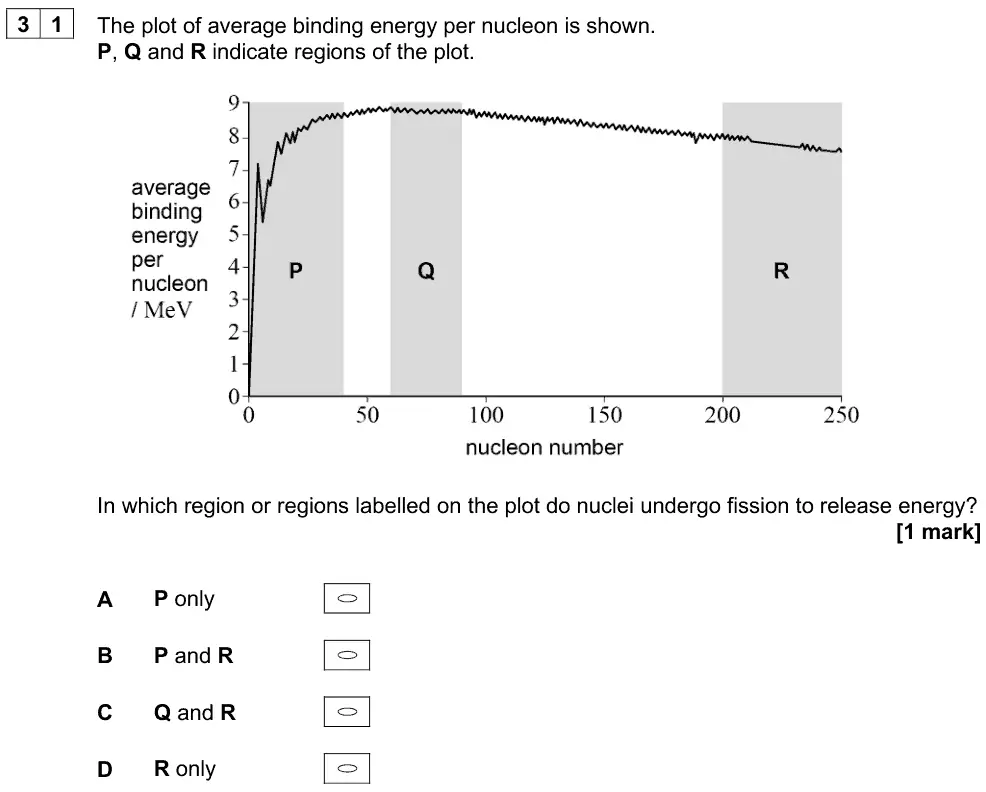
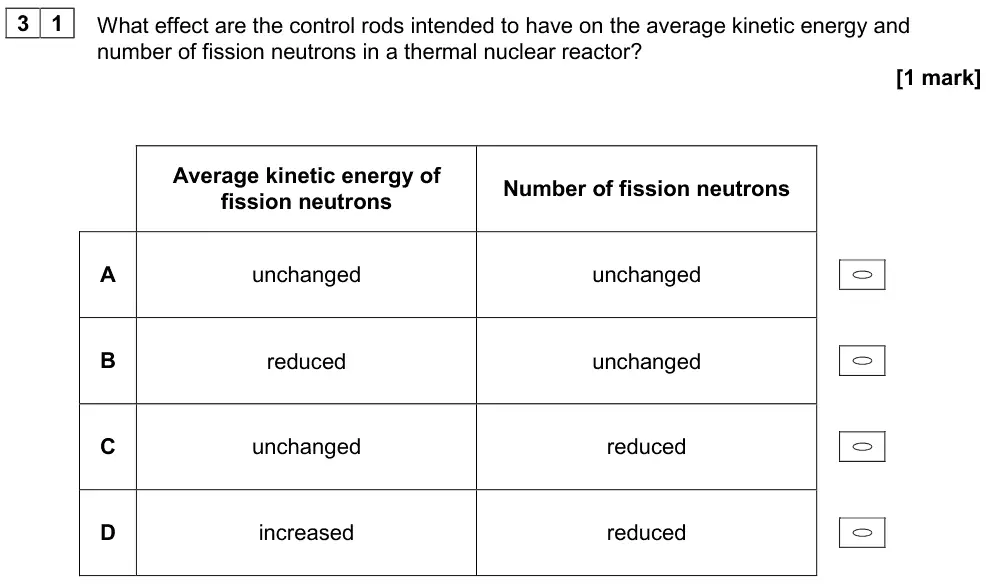
June 2025 · Paper 2 · Q311 markAO1=1Multiple choiceHard
Answer
D
Mark scheme
Examiner's comment
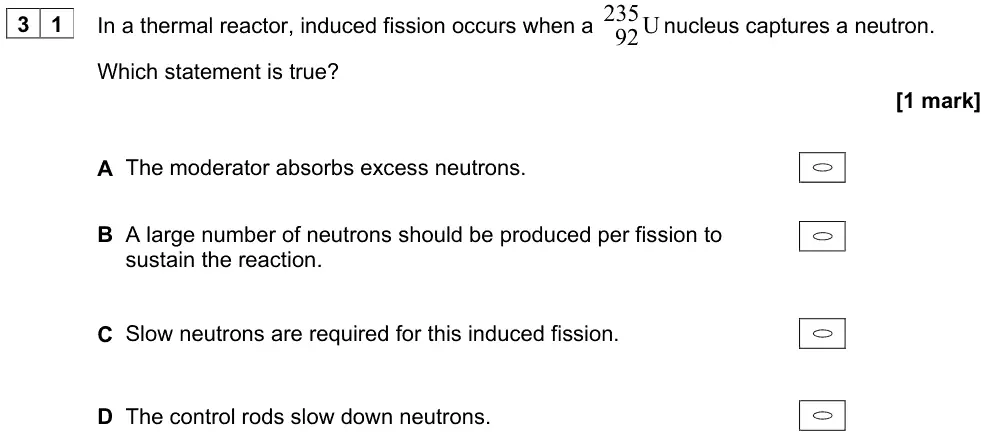
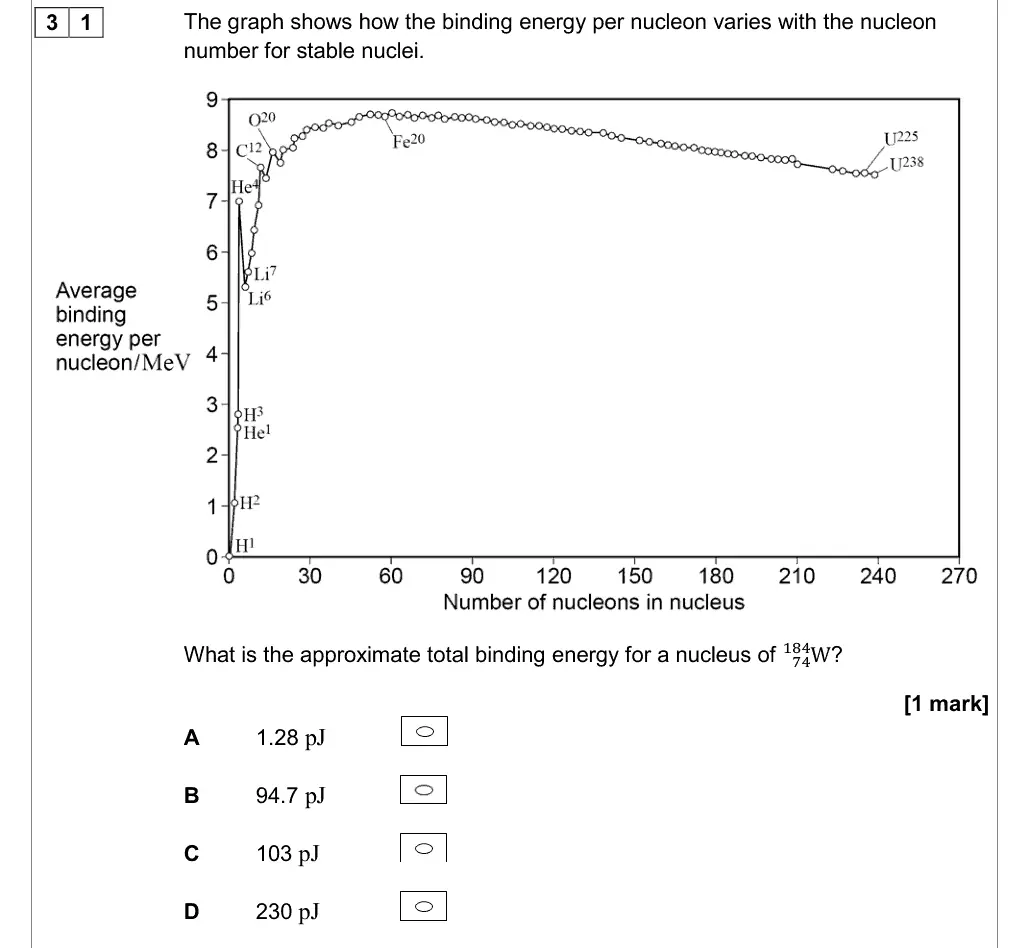
31 The most popular answer to this question was C, with just over half thinking that any fission to the right of the peak will release energy. However, the nuclei with approximately half the nucleon number of the nuclei in region Q have a lower binding energy per nucleon and so would not release energy in fission. Only nuclei with a large nucleon number such as those found in region R will release energy when fissioning. Around a third got this question correct. Grade boundaries and cumulative percentage grades are available on the Results Statistics page of the AQA Website.
Notes from the mark scheme and report
Answer: D
just over half chose C - fission of region-Q nuclei would give lower binding energy per nucleon
June 2024 · Paper 2 · Q4.11 markAO1=1Short answer
Mark scheme
Examiner's comment
04.1 This was the hardest part of question 4 with some students confusing the moderator and the coolant. While water can act as both moderator and coolant in some reactors, the question asked about the function of the coolant, not water in a reactor. There are also many reactors where water is not used, and the coolant and moderator are not the same material.
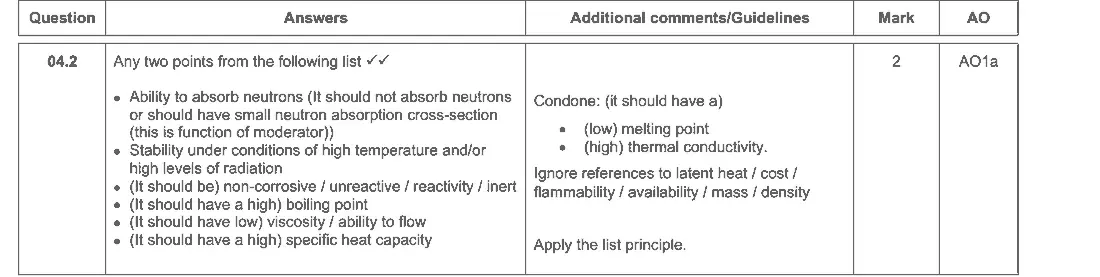
Since the question mentioned the cooling function of the coolant, answers which related to this were not accepted. To gain a mark the answer had to contain the idea of transferring heat energy to either the boiler or the turbine. Those answers which suggested the coolant itself was turned into a gas to turn the turbine were not accepted. 04.2 Most students could name relevant properties of the coolant. This question was answered well, although some students wrote about irrelevant properties. As there is a range of liquid coolants used in nuclear reactors, including sodium, any relevant properties to any of these reactors were accepted. A few students failed to gain marks due to suggesting the wrong value for the property, eg that a low specific heat capacity was desirable rather than a high one. As the question only asked the students to state the properties that should be considered, students did not need to say whether a property required a high or low value, but when that information was supplied it had to be correct.
Notes from the mark scheme and report
Coolant transfers thermal energy from the core to the boiler/turbine via a heat exchanger
coolant turning directly into steam rejected
often confused with moderator
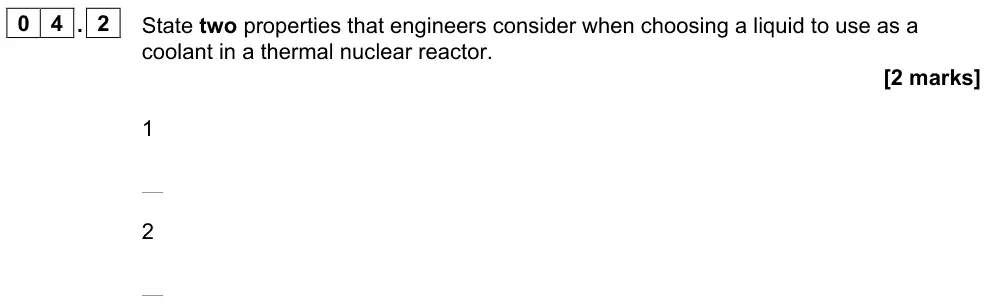
June 2024 · Paper 2 · Q4.22 marksAO1=2Short answer
Earlier part of question 4 that this part uses
Mark scheme
Examiner's comment
Since the question mentioned the cooling function of the coolant, answers which related to this were not accepted. To gain a mark the answer had to contain the idea of transferring heat energy to either the boiler or the turbine. Those answers which suggested the coolant itself was turned into a gas to turn the turbine were not accepted. 04.2 Most students could name relevant properties of the coolant. This question was answered well, although some students wrote about irrelevant properties. As there is a range of liquid coolants used in nuclear reactors, including sodium, any relevant properties to any of these reactors were accepted. A few students failed to gain marks due to suggesting the wrong value for the property, eg that a low specific heat capacity was desirable rather than a high one. As the question only asked the students to state the properties that should be considered, students did not need to say whether a property required a high or low value, but when that information was supplied it had to be correct.
Notes from the mark scheme and report
Any two: low neutron absorption, stable at high temperature/radiation, non-corrosive, high boiling point, low viscosity, high specific heat capacity
wrong direction (low c) penalised
June 2024 · Paper 2 · Q4.32 marksAO1=2Explanation
Earlier part of question 4 that this part uses
Mark scheme
Examiner's comment
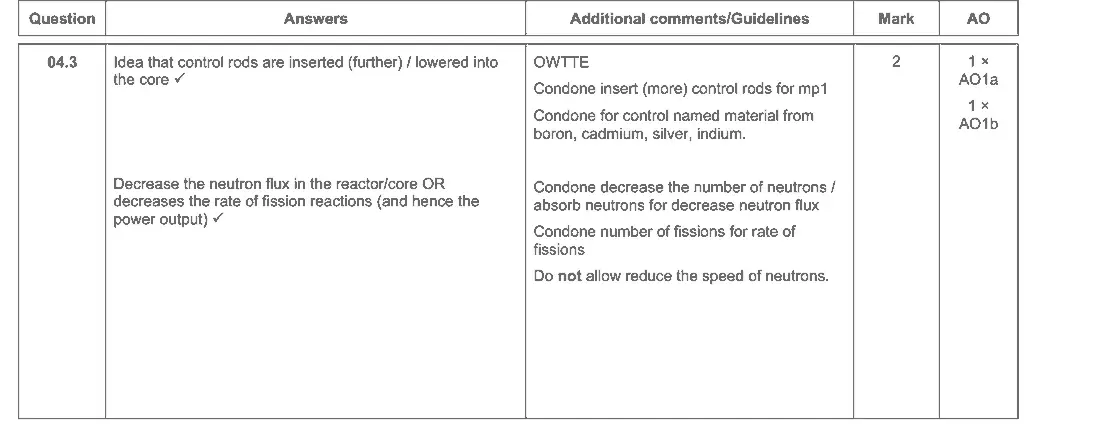
04.3 This question also scored well. Most students knew that control rods were involved, although a small number referred to the moderator here. However, in order to score the first mark, students had to indicate that the control rods were inserted further into the reactor. Various ways of describing this were accepted but simply stating that control rods were used or giving an ambiguous answer such as ‘control rods are raised and lowered’ was not accepted. Most students knew that the job of the control rods was to absorb neutrons and reduce the neutron flux and therefore the number of fission reactions. The idea was looked for rather than a specific wording.
A small minority again mixed up the function with the moderator and thought that slowing down the neutrons would be helpful.
Notes from the mark scheme and report
Control rods inserted further into the core absorb neutrons, reducing neutron flux and the rate of fission
'control rods raised and lowered' ambiguous
slowing neutrons not credited
June 2024 · Paper 2 · Q7.32 marksAO1=1, AO3=1Explanation
Earlier part of question 7 that this part uses
Mark scheme
Examiner's comment
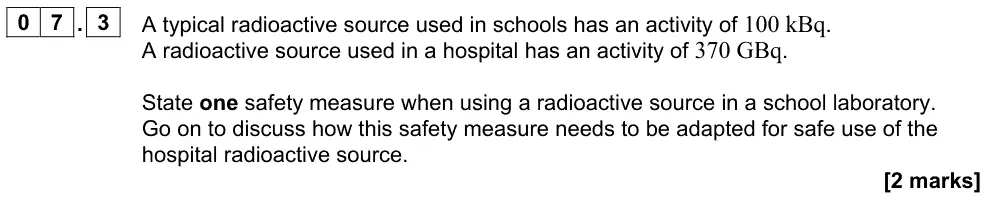
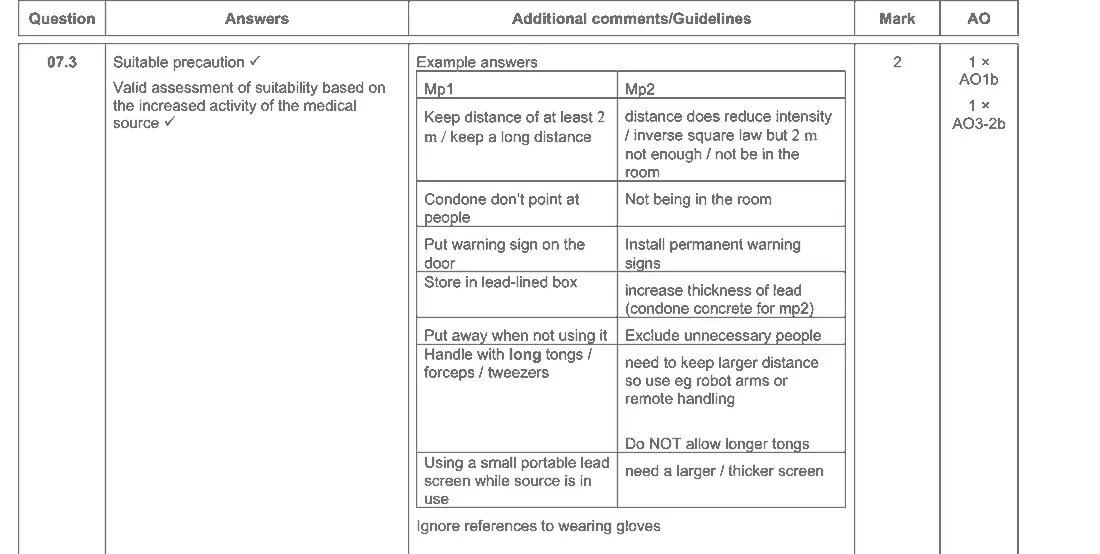
07.3 This question was reasonably accessible. However, many students who wrote about handling the radioactive source with tongs, did not mention that the tongs had to be long. The measures described had to be ones that are relevant to sources used in schools. Students were then asked to consider how their safety measure could be adapted to a much more active source used in a hospital. Students were not expected to be familiar with a hospital setting (although those who were could use this knowledge), but rather to make a reasonable suggestion based on the activity given. Many students were able to make reasonable suggestions here.
Notes from the mark scheme and report
School precaution (long tongs, store in lead box, keep distance) and adaptation for 370 GBq (remote handling/robot arms, thicker shielding, leave the room)
'tongs' must be long
June 2024 · Paper 2 · Q171 markMultiple choice
Answer
C
Mark scheme
Notes from the mark scheme and report
Answer: C
Skills: MS2.3 Substitute numerical values into algebraic equations using appropriate units for physical quantities
June 2024 · Paper 2 · Q181 markMultiple choice
Answer
A
Mark scheme
Notes from the mark scheme and report
Answer: A
June 2024 · Paper 2 · Q191 markMultiple choice
Answer
C
Mark scheme
Notes from the mark scheme and report
Answer: C
Skills: MS2.3 Substitute numerical values into algebraic equations using appropriate units for physical quantities
June 2023 · Paper 2 · Q7.11 markAO1=1Short answer
Mark scheme
Examiner's comment
07.1 Most students gave a correct answer. Some did not read the question fully and gave an answer of graphite. Others obviously confused moderators and control rods to give cadmium or boron as their answer.
Notes from the mark scheme and report
Water (H2O), heavy water (D2O) or beryllium
graphite (given) or control-rod materials (boron, cadmium) not accepted
June 2023 · Paper 2 · Q7.22 marksShort answerHard
Earlier part of question 7 that this part uses
Mark scheme
Examiner's comment
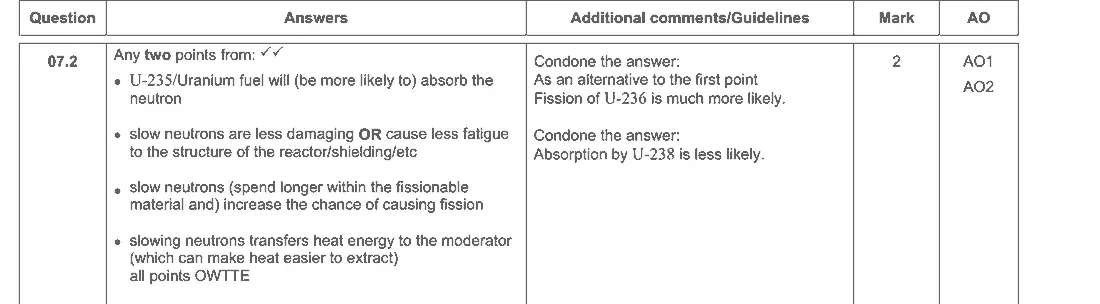
07.2 For a number of different reasons, only less than a third of the students gained marks in this question. Some failed due to missing out details. For example, they just referred to the uranium- 235 as fissile material or more simply as “nuclei”. A significant number who attempted two answers gave almost contradictory answers. For example, “It gives a greater chance of causing fission” alongside “there is a reduced chance of a chain reaction” was seen several times.
Notes from the mark scheme and report
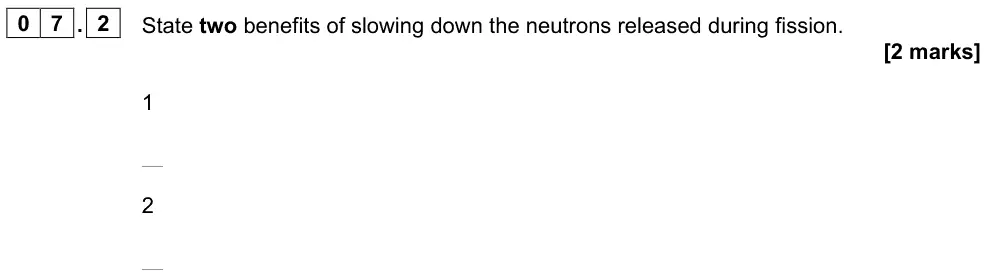
Slow (thermal) neutrons more likely to be absorbed by U-235 and cause fission
less damage to the structure
energy transferred to moderator
answers often vague or contradictory
June 2023 · Paper 2 · Q7.32 marksShow that
Earlier part of question 7 that this part uses
Mark scheme
Examiner's comment
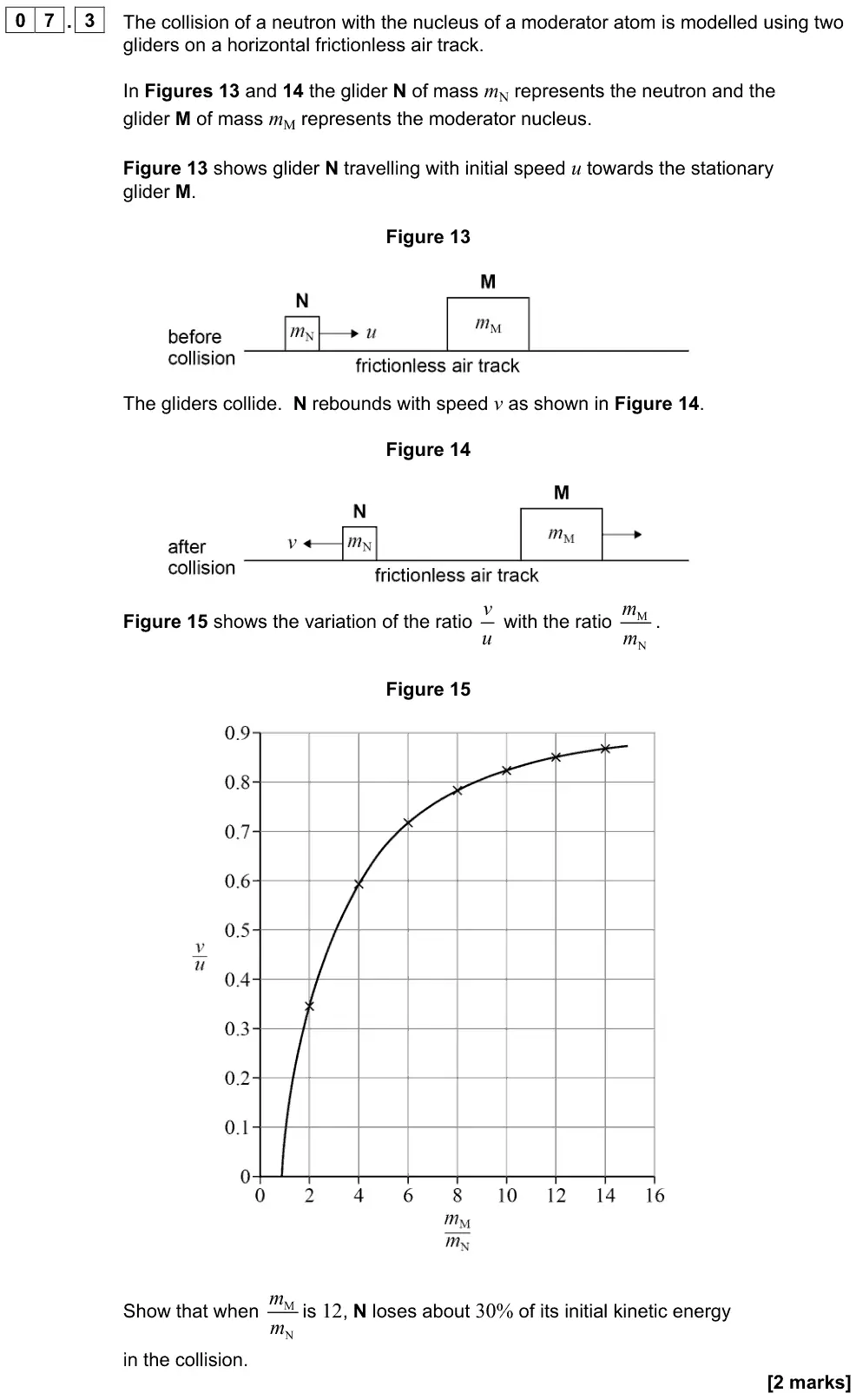
07.3 A significant minority of students did not relate kinetic energy to the information presented in Figure 15 and made little progress. Some tried to find the 30% answer by randomly multiplying the 15% loss in speed by 2. Those who did use the information to find kinetic energies generally scored both marks.
Notes from the mark scheme and report
Answer: about 28% lost (v/u = 0.85 at ratio 12, so KE ratio = 0.85^2 = 0.72)
doubling the 15% speed loss is not a valid method
Skills: MS3.1 Translate information between graphical, numerical and algebraic forms; MS0.3 Use ratios, fractions and percentages
June 2023 · Paper 2 · Q7.43 marksAO2=3Calculation
Earlier part of question 7 that this part uses
Mark scheme
Examiner's comment
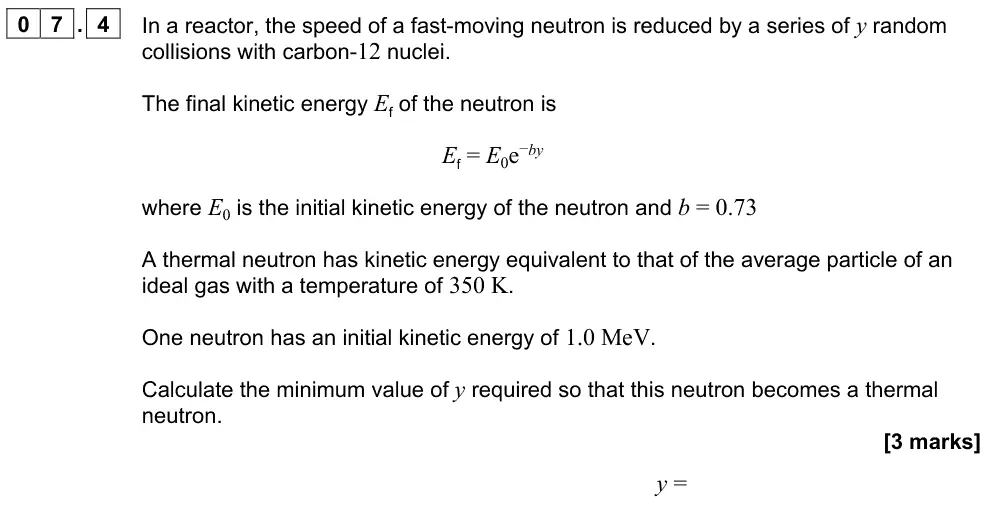
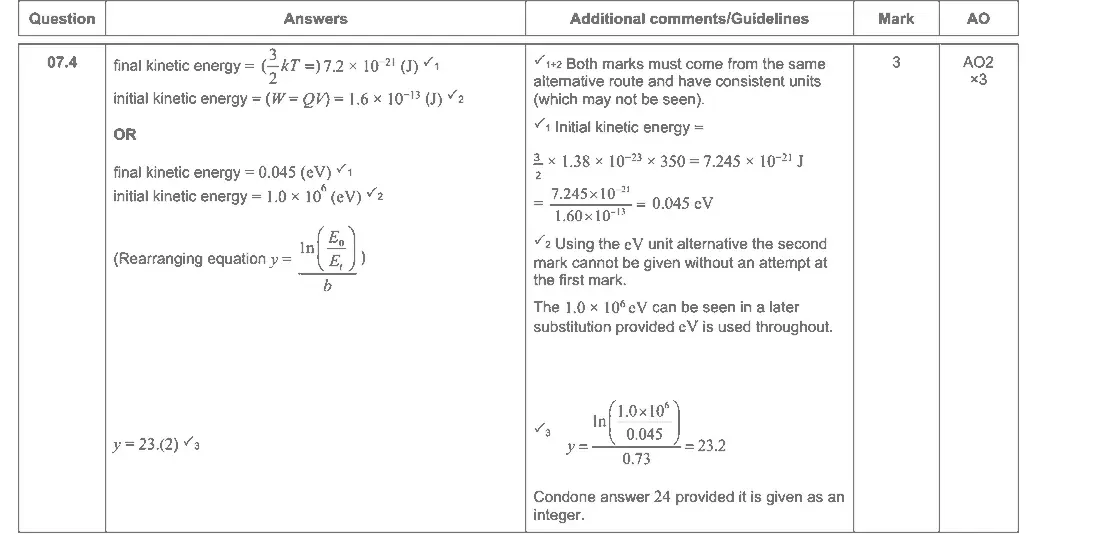
07.4 A majority of students could determine the initial and final kinetic energies in similar units and go on to obtain the correct answer. Re-arranging the equation did not pose much of a difficulty. It was most common for students to work with energies in J. Some of these made errors in converting from eV and some did not use the correct expression for the energy of a thermal neutron. There was also a significant number (nearly 9%) who had no idea how to start.
Notes from the mark scheme and report
Answer: y = 23 (thermal KE = 3/2 kT = 7.2 x 10^-21 J = 0.045 eV
y = ln(E0/Ef)/0.73)
consistent units needed
nearly 9% made no start
Skills: MS0.5 Use calculators to find and use power, exponential and logarithmic functions; MS2.2 Change the subject of an equation, including non-linear equations
June 2023 · Paper 2 · Q7.52 marksAO2=2Explanation
Earlier part of question 7 that this part uses
Mark scheme
Examiner's comment
07.5 Many students did not make any reference to Figure 15 and gave very flimsy answers such as “they will be more stable” and “they are more likely to be hit by a neutron”. Those who did refer to Figure 15 interpreted it incorrectly and thought that having a large nucleon number would be better and contradicted the wording in the question. The second marking point (needing fewer collisions) was rarely seen and only a small number of students scored well on this question.
Notes from the mark scheme and report
Figure 15 shows low mass ratio gives a bigger reduction in neutron speed/KE per collision, so fewer collisions are needed
many misread the graph
June 2023 · Paper 2 · Q251 markMultiple choiceHard
Answer
D
Mark scheme
Examiner's comment
A number of questions were found to be quite straightforward by students. These included B8, B11, B12, B17, B18, B20, B26 and B28 which were all answered correctly by at least 70% of students. The questions found to be the most difficult were B14, B15 and B25 – answered correctly by fewer than 35% of students.
Notes from the mark scheme and report
Answer: D
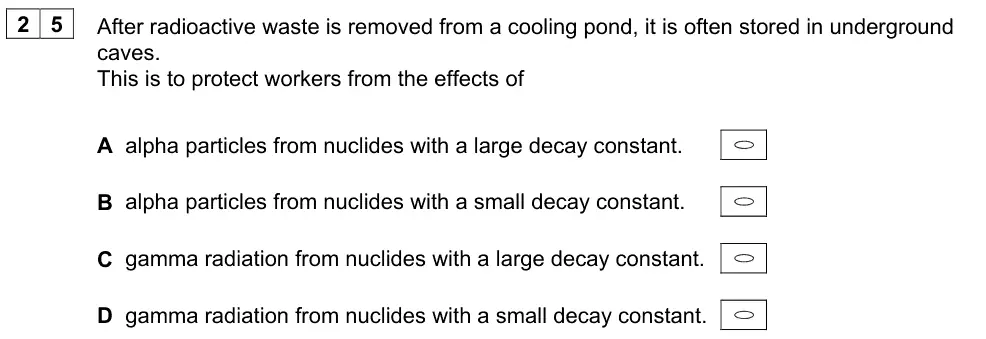
long-lived gamma emitters need shielding
June 2023 · Paper 2 · Q311 markMultiple choice
Answer
B
Mark scheme
Notes from the mark scheme and report
Answer: B
Skills: MS2.3 Substitute numerical values into algebraic equations using appropriate units for physical quantities
June 2022 · Paper 2 · Q6.12 marksAO1=2Short answer
Mark scheme
Examiner's comment
Nearly half of the students found this question relatively easy and most gained full marks. The students who did not do this well mainly failed to gain marks by not using appropriate language rather than through misunderstanding. For this group of students, the words molecules, atoms, nuclei, neutrons and nucleons became almost interchangeable.
Question 06.1
Notes from the mark scheme and report
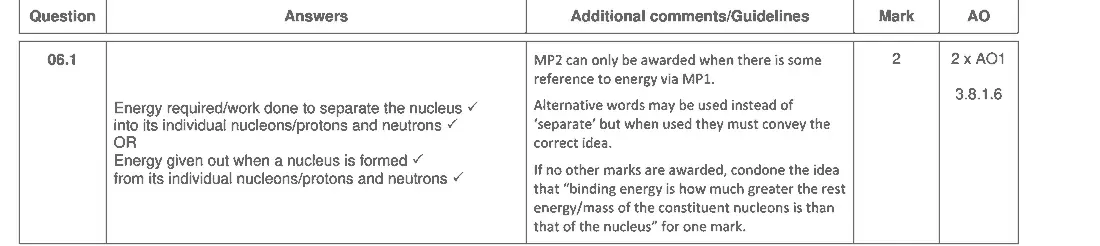
Energy needed to separate a nucleus into its individual nucleons (or released when it forms from them)
careless use of atom/molecule/nucleon loses marks
June 2022 · Paper 2 · Q6.23 marksAO2=3Calculation
Earlier part of question 6 that this part uses
Mark scheme
Examiner's comment
This type of question should be familiar to all students and nearly half of them performed well. However, there was quite a large group who simply calculated the energy equivalent of the mass of the iron nucleus. Weaker students used the approximation that the masses of the neutron and proton were the same and used 1.67 x 10⁻²⁷ kg which was not appropriate when dealing with small differences in mass.
Question 06.2
Notes from the mark scheme and report
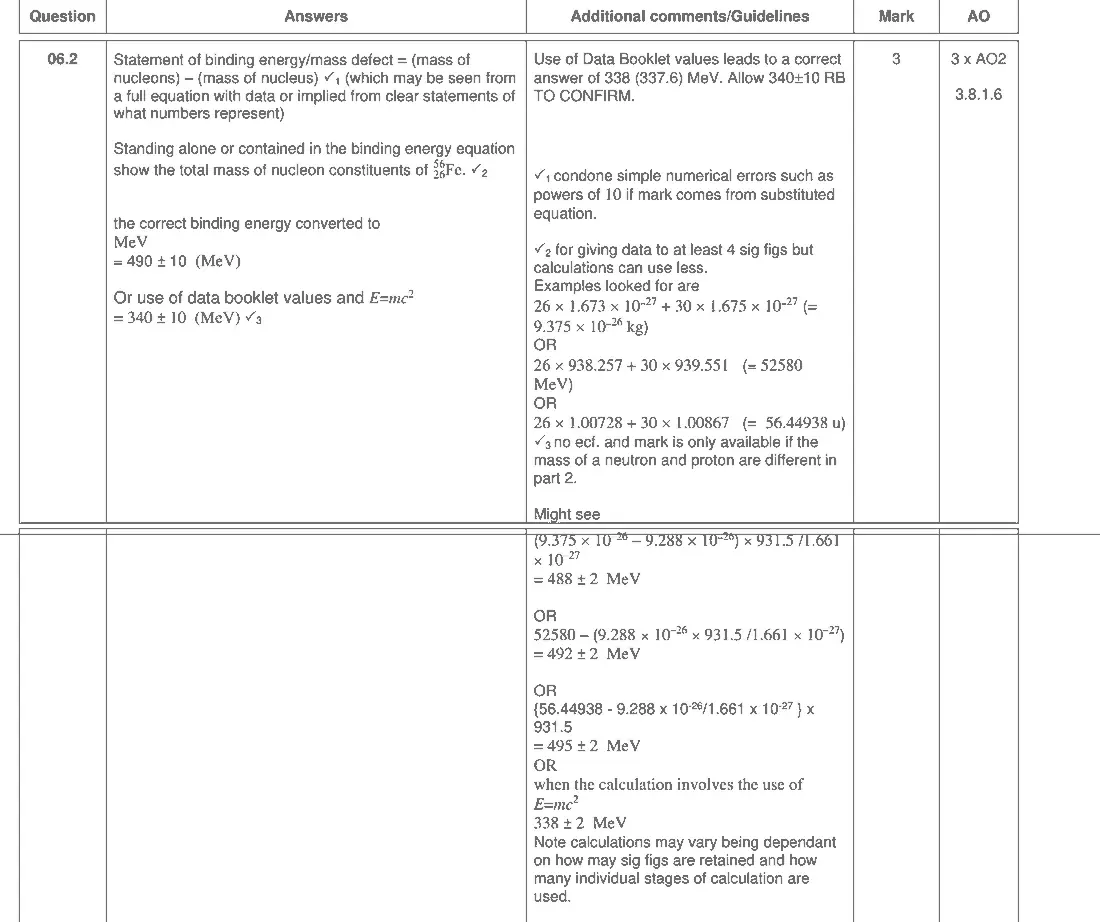
Answer: about 490 MeV (mass defect = 26 m_p + 30 m_n - 9.288 x 10^-26 kg)
proton and neutron masses must differ and be to 4 sf
calculating the energy of the whole nucleus mass was common
Skills: MS2.3 Substitute numerical values into algebraic equations using appropriate units for physical quantities; MS1.1 Use an appropriate number of significant figures
June 2022 · Paper 2 · Q6.32 marksAO2=2Diagram or graph
Earlier part of question 6 that this part uses
Mark scheme
Examiner's comment
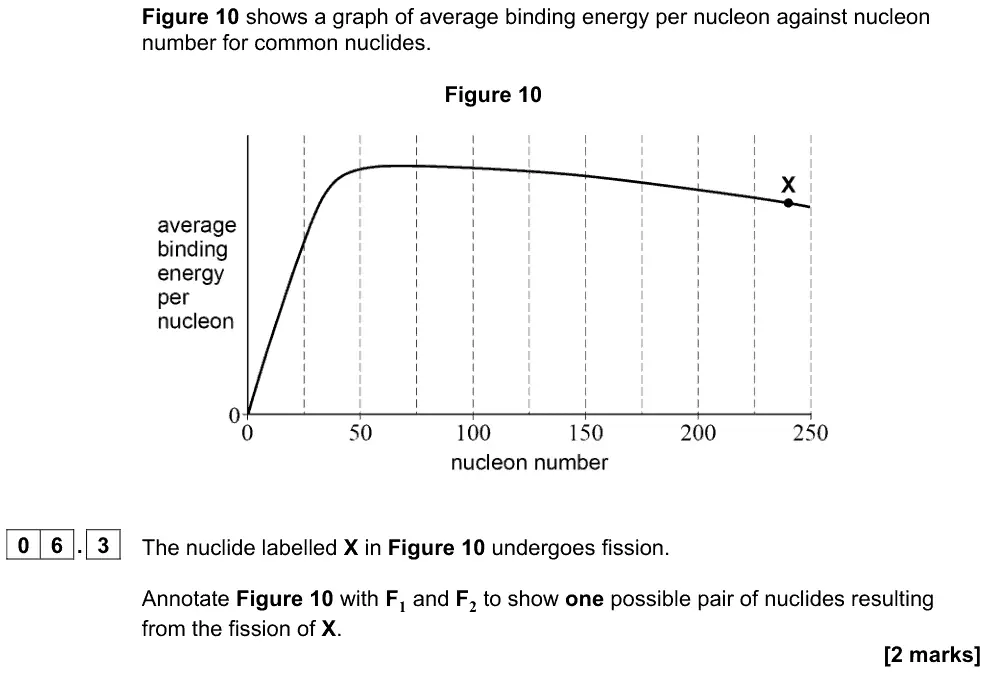
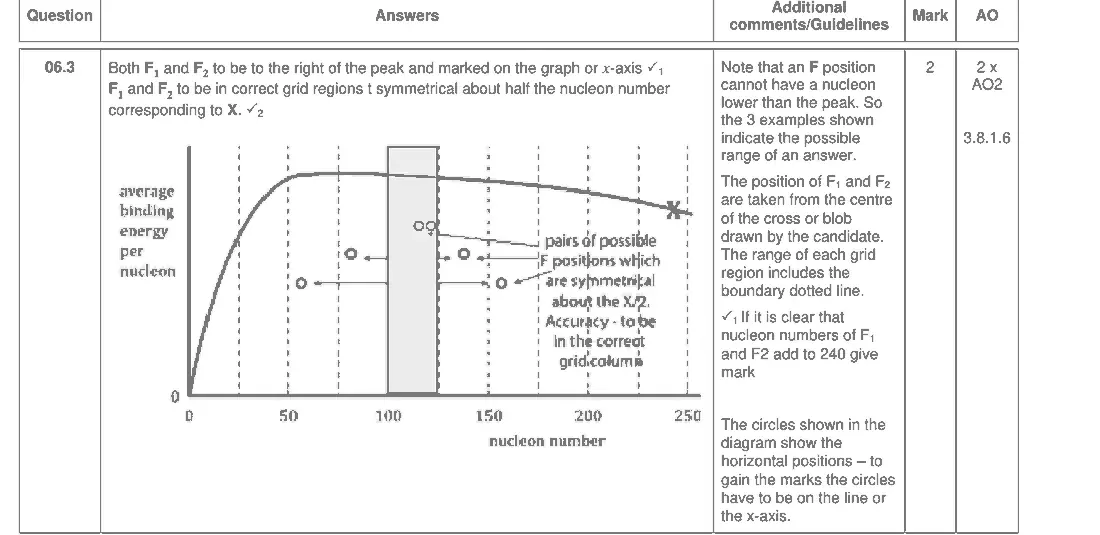
Most students realised that the addition of the nucleon numbers of the fission fragments should add up to 240 or just below, and most indicated acceptable positions for their F1 and F2. The largest error seen was to place one of their F’s to the left of the peak on Figure 10.
Question 06.3
Notes from the mark scheme and report
F1 and F2 both to the right of the peak, nucleon numbers adding to about 240 and roughly symmetrical about 120
placing one left of the peak was the commonest error
June 2022 · Paper 2 · Q311 markAO1=1Multiple choice
Answer
C
Mark scheme
Notes from the mark scheme and report
Answer: C
November 2021 · Paper 2 · Q6.12 marksAO1=2Explanation
Mark scheme
Examiner's comment
06.1 A large number of students did not address the question and spent much of the time explaining binding energy. Most students knew that energy was released in fusion but got the change in binding energy the wrong way round. They often suggested that binding energy is a quantity that can be physically exchanged. 06.2 This was a question on which most students easily scored at least one mark. Some made it much more difficult for themselves by converting each mass separately instead of just converting the final mass difference. 06.3 Most students struggled to find a correct equation. Coulomb’s force equation was often quoted and even when the correct electric potential energy equation was used, candidates added the charges or omitted the electronic-charge factor. 06.4 Students often determined the difference in nucleon number and charge of the nuclei involved but did not go on to discuss the effect this has on the rate of fusion reaction. Some simply discussed the stability of the final fusion product. Answers rarely gave a sense that the reaction takes place in a star where the nuclei move around at various speeds. Few gained marks, therefore, for stating that a particular fusion only occurs at greater kinetic energy or higher pressure. Finally, students frequently confused rate of fusion reaction with the speed of the fusion event.
Notes from the mark scheme and report
Product nucleus has greater binding energy (per nucleon) than the original nuclei, the difference being released
many had the binding energy change the wrong way round
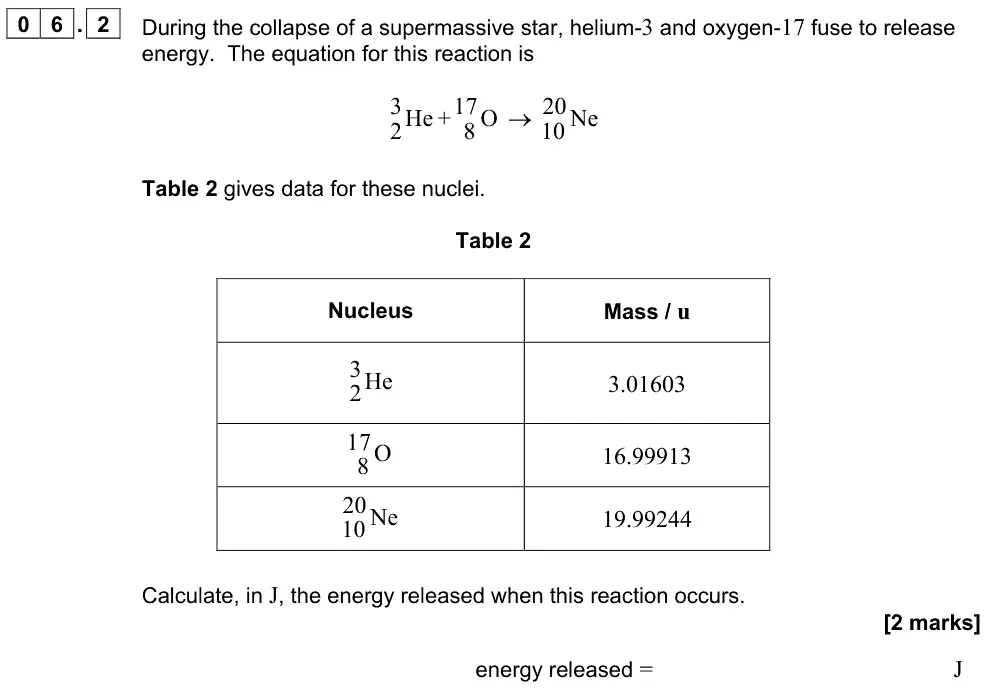
November 2021 · Paper 2 · Q6.22 marksAO2=2Calculation
Earlier part of question 6 that this part uses
Mark scheme
Examiner's comment
06.1 A large number of students did not address the question and spent much of the time explaining binding energy. Most students knew that energy was released in fusion but got the change in binding energy the wrong way round. They often suggested that binding energy is a quantity that can be physically exchanged. 06.2 This was a question on which most students easily scored at least one mark. Some made it much more difficult for themselves by converting each mass separately instead of just converting the final mass difference. 06.3 Most students struggled to find a correct equation. Coulomb’s force equation was often quoted and even when the correct electric potential energy equation was used, candidates added the charges or omitted the electronic-charge factor. 06.4 Students often determined the difference in nucleon number and charge of the nuclei involved but did not go on to discuss the effect this has on the rate of fusion reaction. Some simply discussed the stability of the final fusion product. Answers rarely gave a sense that the reaction takes place in a star where the nuclei move around at various speeds. Few gained marks, therefore, for stating that a particular fusion only occurs at greater kinetic energy or higher pressure. Finally, students frequently confused rate of fusion reaction with the speed of the fusion event.
Notes from the mark scheme and report
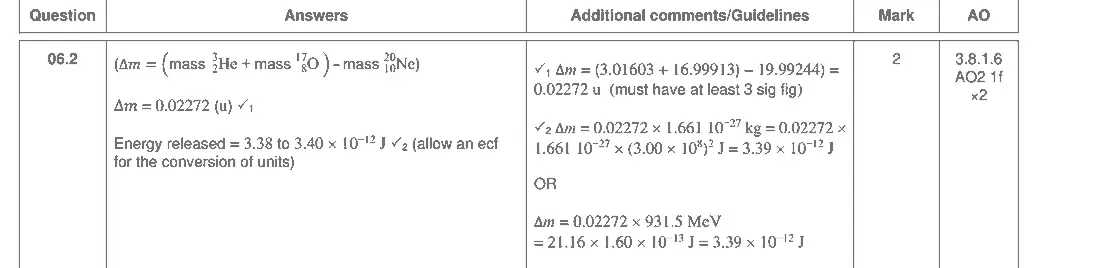
Answer: 3.39 x 10^-12 J (mass difference 0.02272 u x 931.5 MeV = 21.2 MeV)
convert only the final mass difference
Skills: MS2.3 Substitute numerical values into algebraic equations using appropriate units for physical quantities
November 2021 · Paper 2 · Q291 markMultiple choice
Answer
C
Mark scheme
Notes from the mark scheme and report
Answer: C
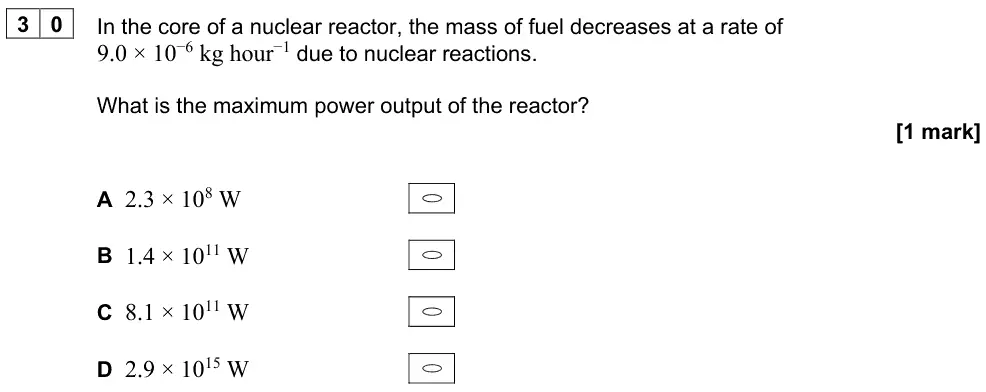
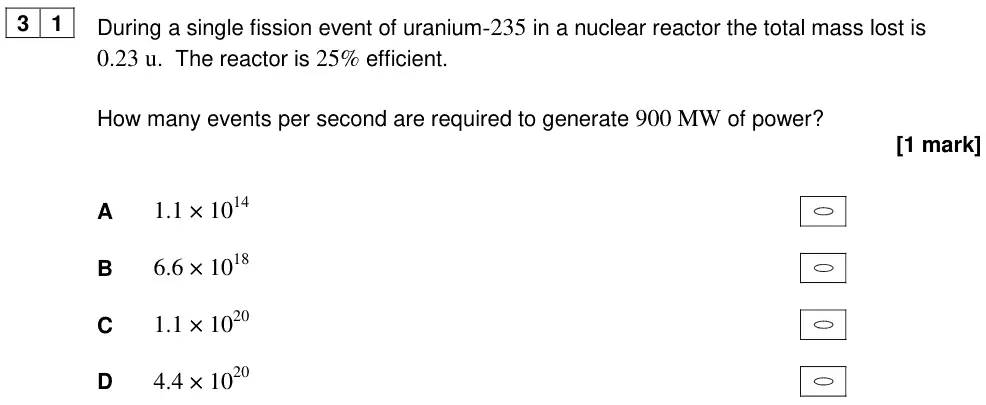
November 2021 · Paper 2 · Q301 markMultiple choice
Answer
A
Mark scheme
Notes from the mark scheme and report
Answer: A
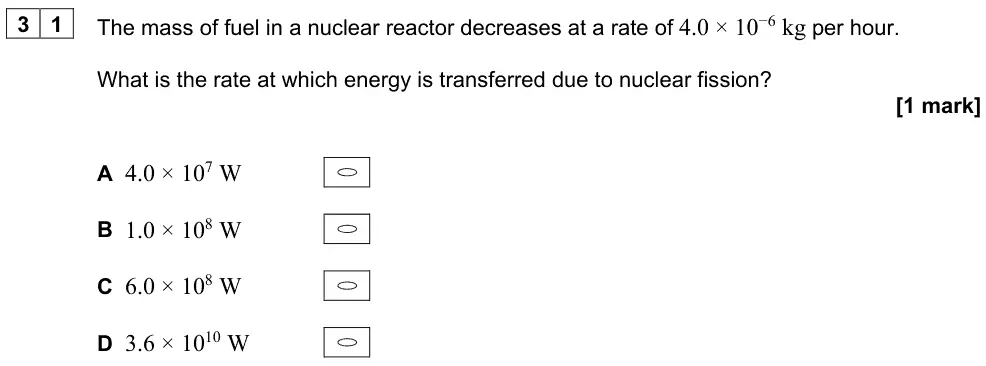
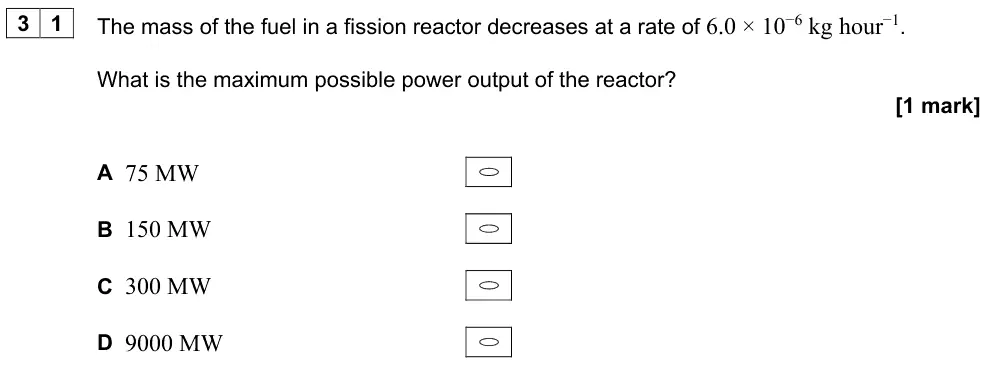
2.3 x 10^8 W - convert hours to seconds
Skills: MS0.1 Recognise and make use of appropriate units in calculations; MS2.3 Substitute numerical values into algebraic equations using appropriate units for physical quantities
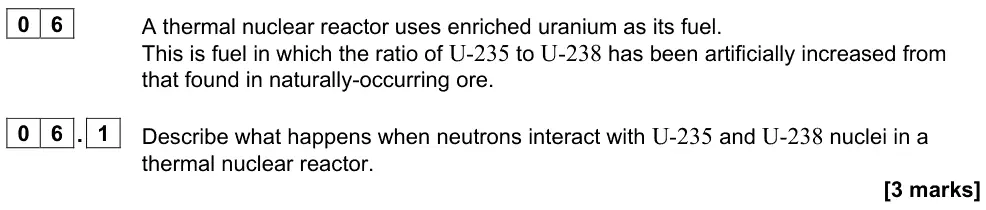
November 2020 · Paper 2 · Q6.13 marksAO2=3Explanation
Mark scheme
Examiner's comment
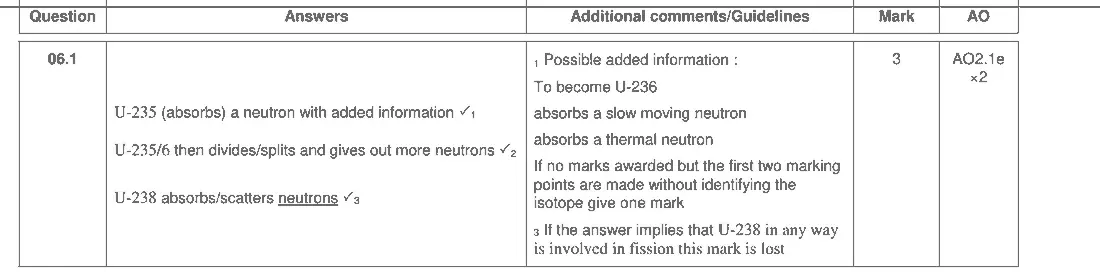
A majority of students thought that fission happens with both U-235 and U-238. Those who correctly identified U-235 as the fissile material often failed to mention U-238. The modal mark for this question was 1 and was normally awarded for a general description of fission using uranium, without identifying the isotope.
Question 06.1
Notes from the mark scheme and report
U-235 absorbs a thermal neutron (becomes U-236), splits into two daughter nuclei releasing more neutrons
U-238 absorbs (or scatters) neutrons without fission
most thought U-238 also undergoes fission
November 2020 · Paper 2 · Q6.31 markCalculation
Earlier part of question 6 that this part uses
Mark scheme
Examiner's comment
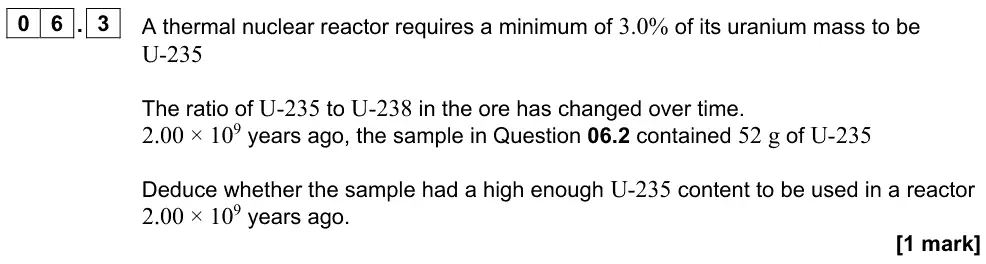
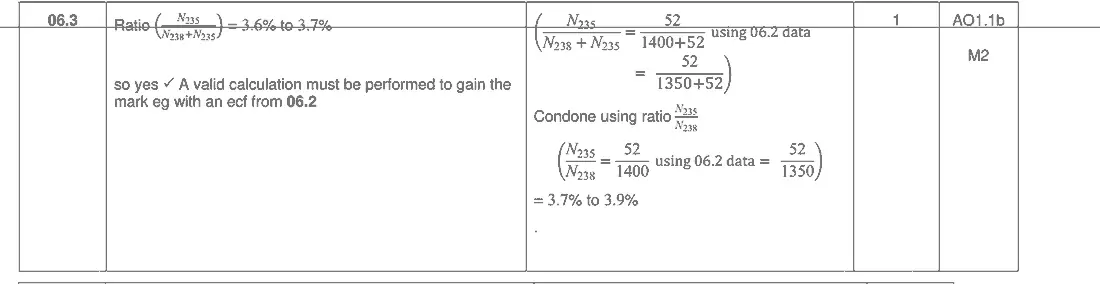
A majority of students obtained this mark. Those who did not usually made no attempt to answer the question.
Concluding Remarks
Question 06.3
Skills: MS0.3 Use ratios, fractions and percentages
November 2020 · Paper 2 · Q301 markMultiple choiceEasy
Answer
B
Examiner's comment
The percentage scores in the multiple-choice questions were much higher than in the written questions. A majority of the questions yielded success rates of between 50 and 75%. Questions B14 and B30 had higher success rates than this. Questions that scored in the region of 30 to 50% correct were B8, B16, B22, B26, B27, B29 and B31. Questions B7 and B24 were found to be particularly difficult with only about 16% of students being successful.
Notes from the mark scheme and report
Answer: B
Skills: MS2.3 Substitute numerical values into algebraic equations using appropriate units for physical quantities
November 2020 · Paper 2 · Q311 markMultiple choice
Answer
B
Examiner's comment
The percentage scores in the multiple-choice questions were much higher than in the written questions. A majority of the questions yielded success rates of between 50 and 75%. Questions B14 and B30 had higher success rates than this. Questions that scored in the region of 30 to 50% correct were B8, B16, B22, B26, B27, B29 and B31. Questions B7 and B24 were found to be particularly difficult with only about 16% of students being successful.
Notes from the mark scheme and report
Answer: B
Skills: MS0.1 Recognise and make use of appropriate units in calculations; MS2.3 Substitute numerical values into algebraic equations using appropriate units for physical quantities
June 2019 · Paper 2 · Q6.11 markShort answerHard
Mark scheme
Examiner's comment
6.1 Answers to this question seemed to fall into three groups of equal size. The first group understood the purpose of slowing down the neutrons and gained the mark. Another group understood the situation but then failed to express their ideas sufficiently well by ignoring the fuel or fission: ‘a neutron absorbed by a fuel rod may not be absorbed by a U-235’. Statements such as this did not receive credit. The third group of students thought that fast neutrons cause the reactor to go out of control and generate too much power. 6.2 This was done well on the whole. Half the students gained full marks. Another 35% could perform the necessary calculations but only scored one mark because they interpreted the loss of 63% as being 63% of the kinetic energy remaining.
Notes from the mark scheme and report
Slow (thermal) neutrons are more likely to be absorbed by U-235 and cause fission
ideas of reactor running out of control not credited
June 2019 · Paper 2 · Q6.22 marksCalculation
Earlier part of question 6 that this part uses
Mark scheme
Examiner's comment
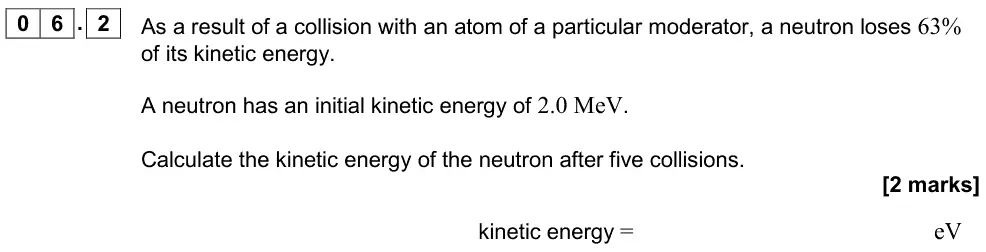
6.1 Answers to this question seemed to fall into three groups of equal size. The first group understood the purpose of slowing down the neutrons and gained the mark. Another group understood the situation but then failed to express their ideas sufficiently well by ignoring the fuel or fission: ‘a neutron absorbed by a fuel rod may not be absorbed by a U-235’. Statements such as this did not receive credit. The third group of students thought that fast neutrons cause the reactor to go out of control and generate too much power. 6.2 This was done well on the whole. Half the students gained full marks. Another 35% could perform the necessary calculations but only scored one mark because they interpreted the loss of 63% as being 63% of the kinetic energy remaining.
Notes from the mark scheme and report
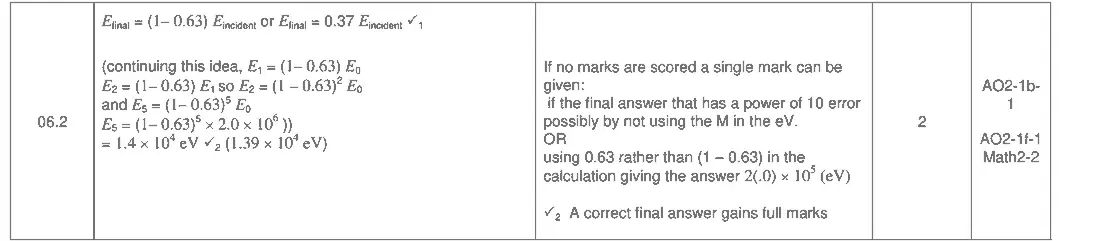
Answer: 1.4 x 10^4 eV (2.0 x 10^6 x 0.37^5)
using 0.63 instead of 0.37 was the common error (35% scored only one mark)
Skills: MS0.3 Use ratios, fractions and percentages; MS0.5 Use calculators to find and use power, exponential and logarithmic functions
June 2019 · Paper 2 · Q6.32 marksExplanation
Earlier part of question 6 that this part uses
Mark scheme
Examiner's comment
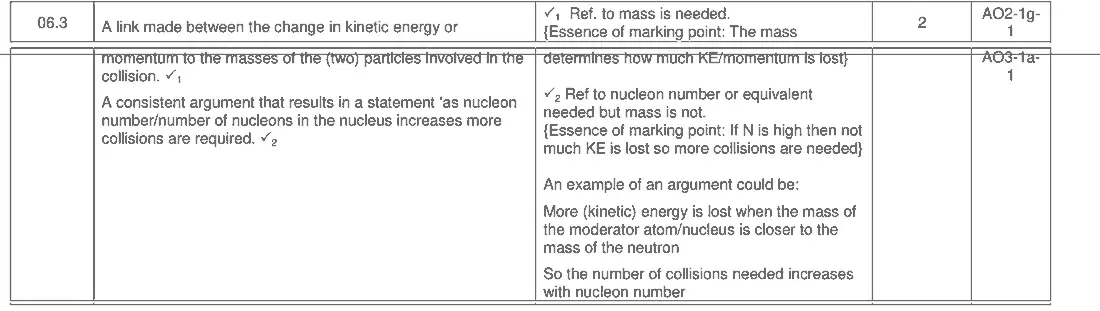
6.3 A vast majority of students were unaware that more kinetic energy is transferred away from the neutron when the mass with which it collides is low and comparable to the mass of the neutron. Most thought that, when a neutron hits a massive object, then the massive object absorbs most of the kinetic energy. They thought this even though they often stated that the collision is elastic.
Notes from the mark scheme and report
Neutron loses most KE in an elastic collision with a nucleus of similar mass
heavier moderator nuclei take less KE per collision so more collisions are needed as nucleon number rises
most thought massive nuclei absorb more KE
June 2019 · Paper 2 · Q6.43 marksCalculationEasy
Earlier part of question 6 that this part uses
Mark scheme
Examiner's comment
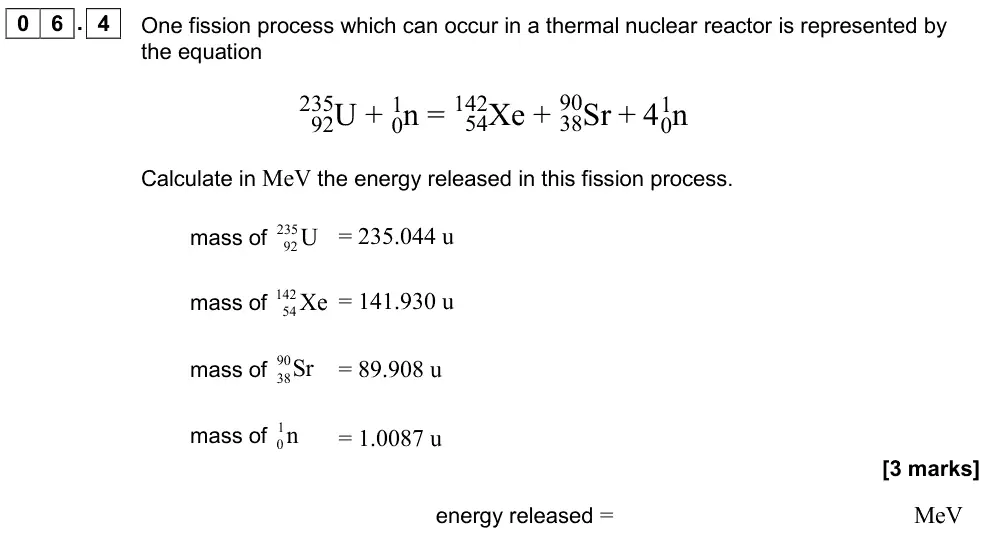
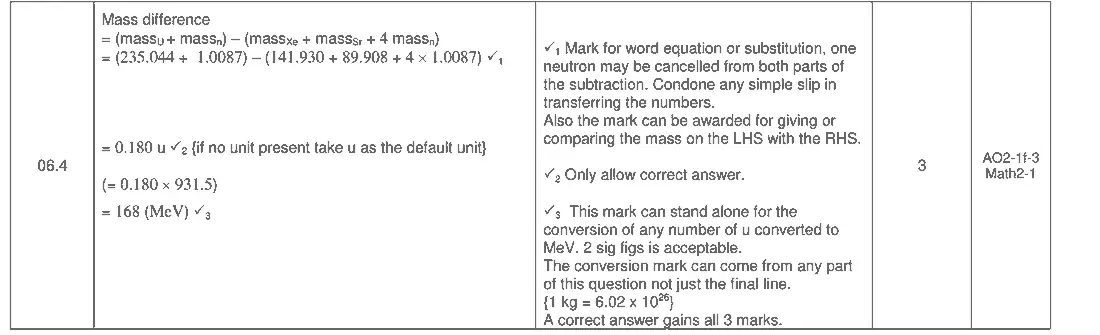
6.4 Very few students did not score some marks on this question. The most straightforward way to gain a mark was to include some valid conversion of the energy units. The next most popular mark was a quotation of the opening mass-difference equation. Only a few students did not include the neutrons correctly. Two-thirds of the students gained full marks by performing the calculations efficiently and simply. Some more able students failed to gain marks by confusing numbers. They chose to convert every mass or energy unit separately and in so doing often made a slip in one of the many calculations.
Notes from the mark scheme and report
Answer: 168 MeV (mass difference 0.180 u x 931.5)
converting each mass separately led to slips
Skills: MS2.3 Substitute numerical values into algebraic equations using appropriate units for physical quantities; MS1.1 Use an appropriate number of significant figures
June 2019 · Paper 2 · Q6.53 marksShort answer
Earlier part of question 6 that this part uses
Mark scheme
Examiner's comment
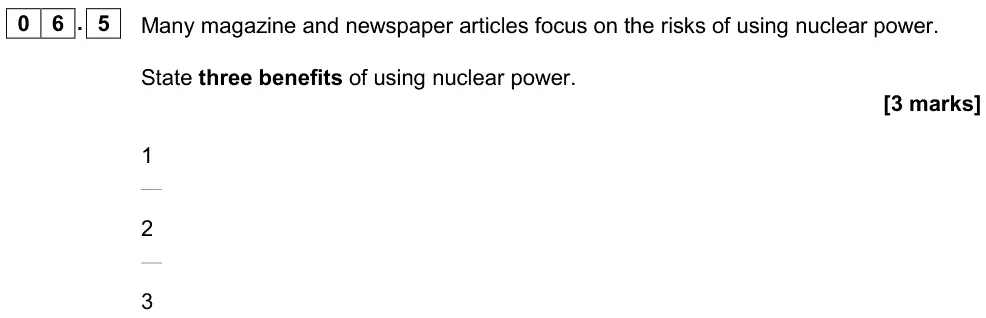
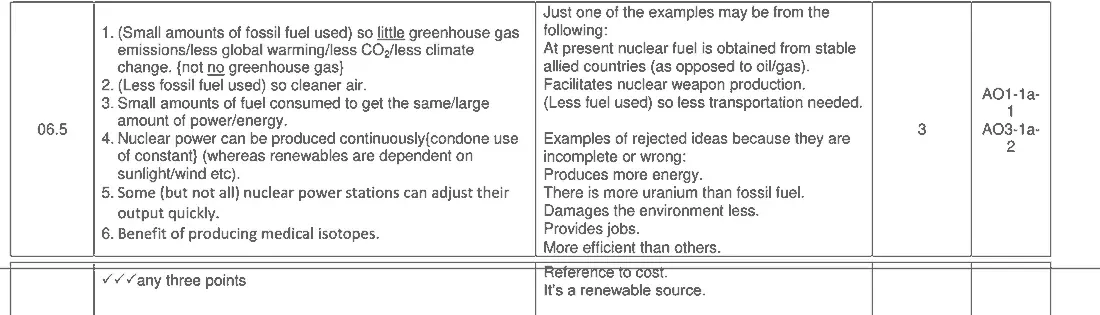
6.5 This was not answered at all well by the students. First, many thought of nuclear power only in terms of the reactor itself and ignored the mining, transport and building work, etc. This led to a number of false statements being made. There were also a number of misconceptions being quoted. These included: ‘a nuclear power station produces more energy than a fossil fuel station’; ‘there are more reserves of U-235 than coal and oil’; ‘the waste does no harm unlike burning coal or oil’; ‘nuclear is renewable’. There were also many answers that were not complete enough to gain a mark. For example ‘nuclear produces more energy’ misses the point that it can produce more energy per mass of fuel used when compared to fossil-fuel reactors.
Notes from the mark scheme and report
Any three: low CO2 / greenhouse emissions
cleaner air
large energy per mass of fuel
continuous (base-load) supply independent of weather
medical isotopes
'more energy', 'renewable', 'cheap' not credited
June 2019 · Paper 2 · Q301 markMultiple choice
Answer
B
Notes from the mark scheme and report
Answer: B
June 2019 · Paper 2 · Q311 markMultiple choice
Answer
C
Notes from the mark scheme and report
Answer: C
June 2018 · Paper 2 · Q311 markMultiple choice
Answer
C
Notes from the mark scheme and report
Answer: C
Skills: MS0.3 Use ratios, fractions and percentages; MS0.2 Recognise and use expressions in decimal and standard form
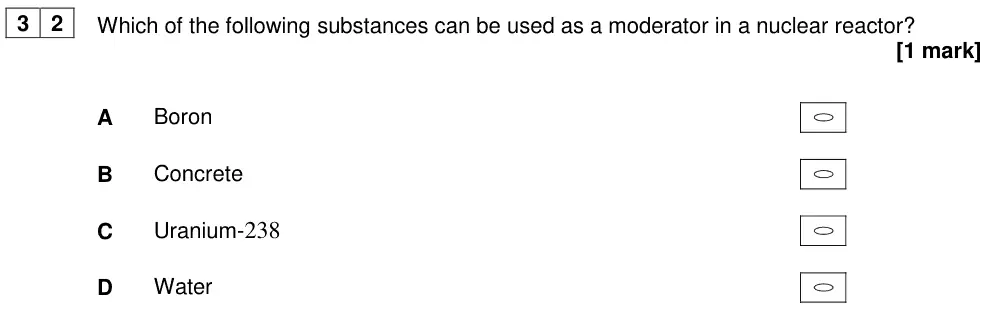
June 2018 · Paper 2 · Q321 markMultiple choice
Answer
D
Notes from the mark scheme and report
Answer: D
June 2017 · Paper 2 · Q4.11 markShort answer
Mark scheme
Examiner's comment
04.1 A significant number of students were too brief in their answers to score a mark. To state “it slows” was not a sufficient answer. It was necessary to add the idea of a collision occurring. The least able students referred to absorption and in some cases fission.
Notes from the mark scheme and report
Neutron makes an elastic collision and slows (loses kinetic energy)
'it slows' without collision not enough
absorption loses the mark
June 2017 · Paper 2 · Q4.21 markShort answer
Earlier part of question 4 that this part uses
Mark scheme
Examiner's comment
04.2 This was a very straightforward question done well by all but the least able students.
Notes from the mark scheme and report
Neutron is absorbed
'stopped' not accepted
June 2017 · Paper 2 · Q4.33 marksExplanation
Earlier part of question 4 that this part uses
Mark scheme
Examiner's comment
04.3 Good students had knowledge of the physical process of fission and could express their ideas coherently. The middle to low ability students often did not express their ideas in a concise manner. The main failing was in not appreciating that the incident neutron was absorbed. Many thought it simply jogged the uranium nucleus in fission. The process of the nucleus splitting was often confused with other radioactive decays, and the ejected neutrons were not always mentioned. This group of students also wasted time trying to explain a chain reaction.
Notes from the mark scheme and report
Neutron absorbed (U-236 formed)
nucleus splits into two daughter nuclei
releasing several fast neutrons (plural)
many missed the absorption step
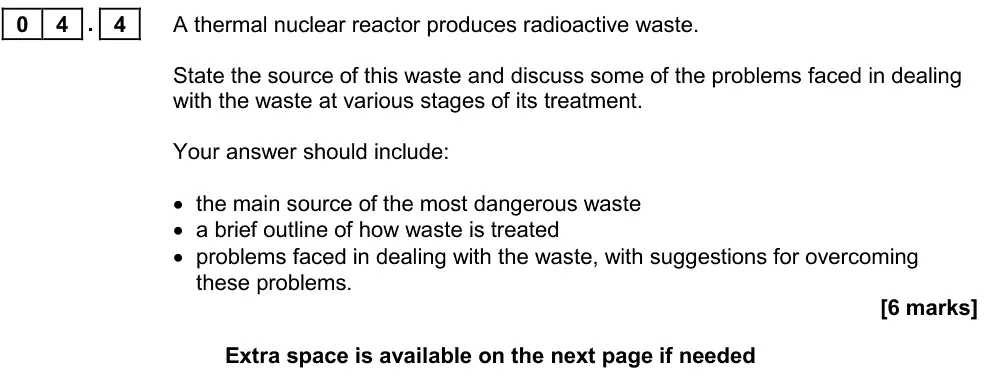
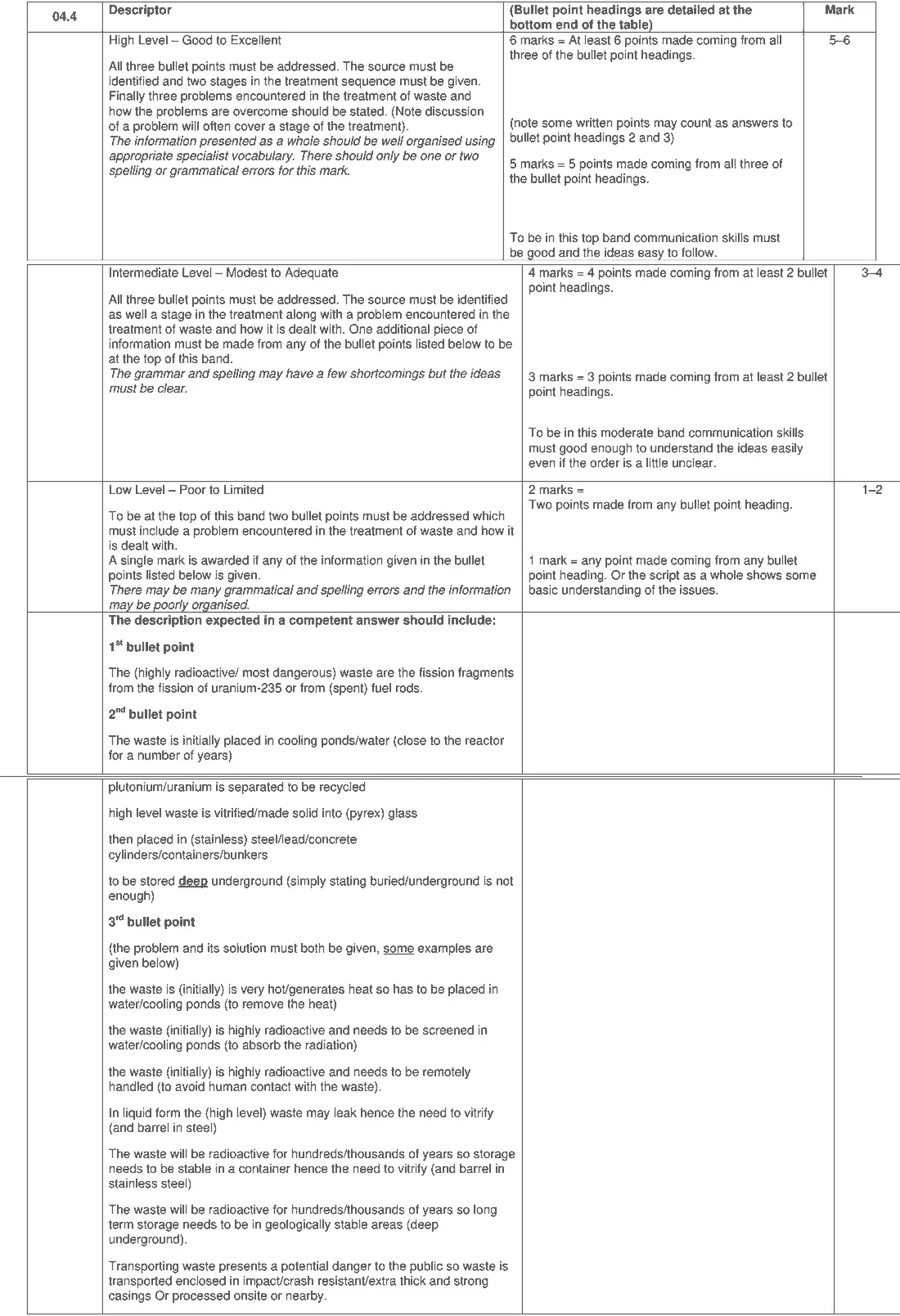
June 2017 · Paper 2 · Q4.46 marks6-mark extended response
Earlier part of question 4 that this part uses
Mark scheme, with the levels and indicative content
Examiner's comment
04.4 It was clear that the vast majority of students did not have knowledge about nuclear waste management. Many just expanded on their reasonably sensible thoughts of ‘keep clear from it, and get rid of it’. For weaker students, this simply meant wearing protective clothing and sending the waste into space. The middle-ability students gave a better solution by suggesting handling the waste remotely, encasing the waste in a named and effective radiation shield, and placing it in a deep mine or trench away from people. It was only about 20% of students who seemed to write with knowledgeable authority. These students knew it was the spent fuel rods that posed the main problem, unlike others who could answer with any item that had to do with the reactor. It was also only these students that knew about waste producing heat or about vitrification. It was rare for any student to refer to reprocessing. In terms of the quality of the writing, it was clear that most students do not give themselves even a brief plan. Often the ideas presented did not follow a logical sequence.
cooling ponds, reprocessing of U/Pu, vitrification, steel/concrete containers deep underground
problems and solutions (heat - cooling
long half-life - secure long-term storage
remote handling, shielding). Very few knew about vitrification or heat output
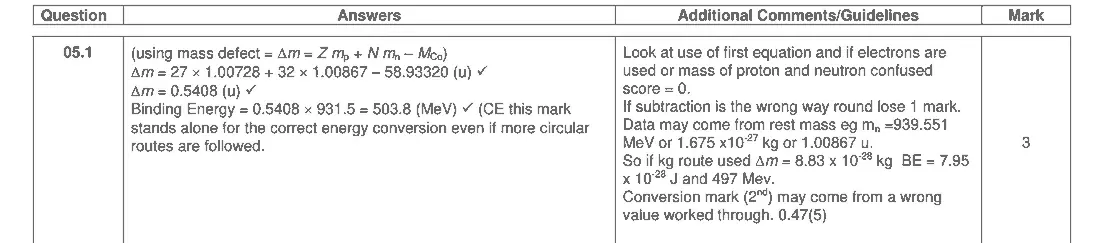
June 2017 · Paper 2 · Q5.13 marksCalculation
Mark scheme
Examiner's comment
05.1 Almost half the students tackled the calculation in a straightforward way as in the mark scheme. Other students’ responses ranged from this fully correct method down to simply trying to convert the nuclear mass of Co-59 to MeV units. The students using approaches in between these two obtained a difference in mass between the nucleons and the complete nucleus, but used a variety of units and data which sometimes did not yield the precision required; for example, using the mass of any nucleon as 1.67 × 10⁻²⁷ kg. A clue about the precision required should have been understood from the number of significant figures used for the nuclear mass given in the question. Some students did pick up a mark for converting the units throughout their calculation, to correctly end up with an answer in MeV.
Notes from the mark scheme and report
Answer: 504 MeV (mass defect = 27 x 1.00728 + 32 x 1.00867 - 58.93320 = 0.5408 u
x 931.5)
using electron masses or imprecise nucleon masses lost marks
Skills: MS2.3 Substitute numerical values into algebraic equations using appropriate units for physical quantities; MS1.1 Use an appropriate number of significant figures
June 2017 · Paper 2 · Q321 markMultiple choice
Answer
C
Notes from the mark scheme and report
Answer: C
Skills: MS0.3 Use ratios, fractions and percentages
Specimen set 1 · Paper 2 · Q311 markMultiple choice
Answer
D
Notes from the mark scheme and report
Answer: D
Skills: MS3.1 Translate information between graphical, numerical and algebraic forms; MS0.2 Recognise and use expressions in decimal and standard form
Work with an AQA physics tutor
Dropping marks on calculations, required practicals or the six-markers? Book a trial session with a specialist AQA physics tutor.