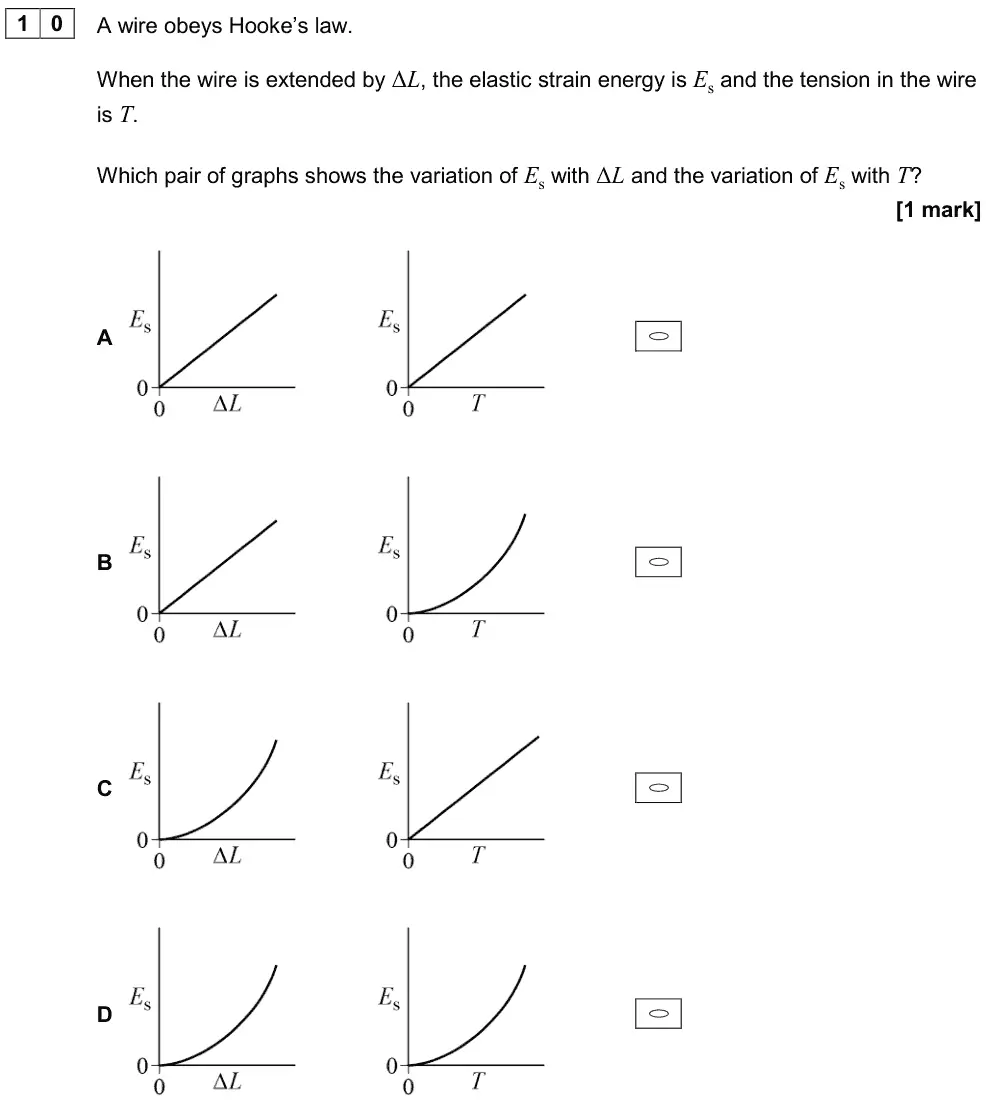
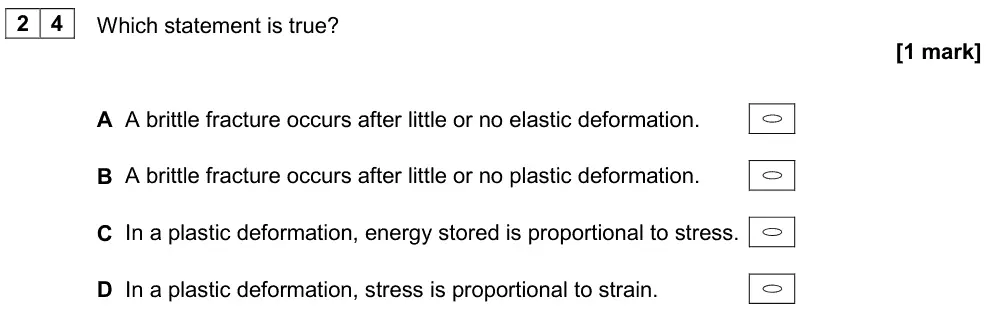
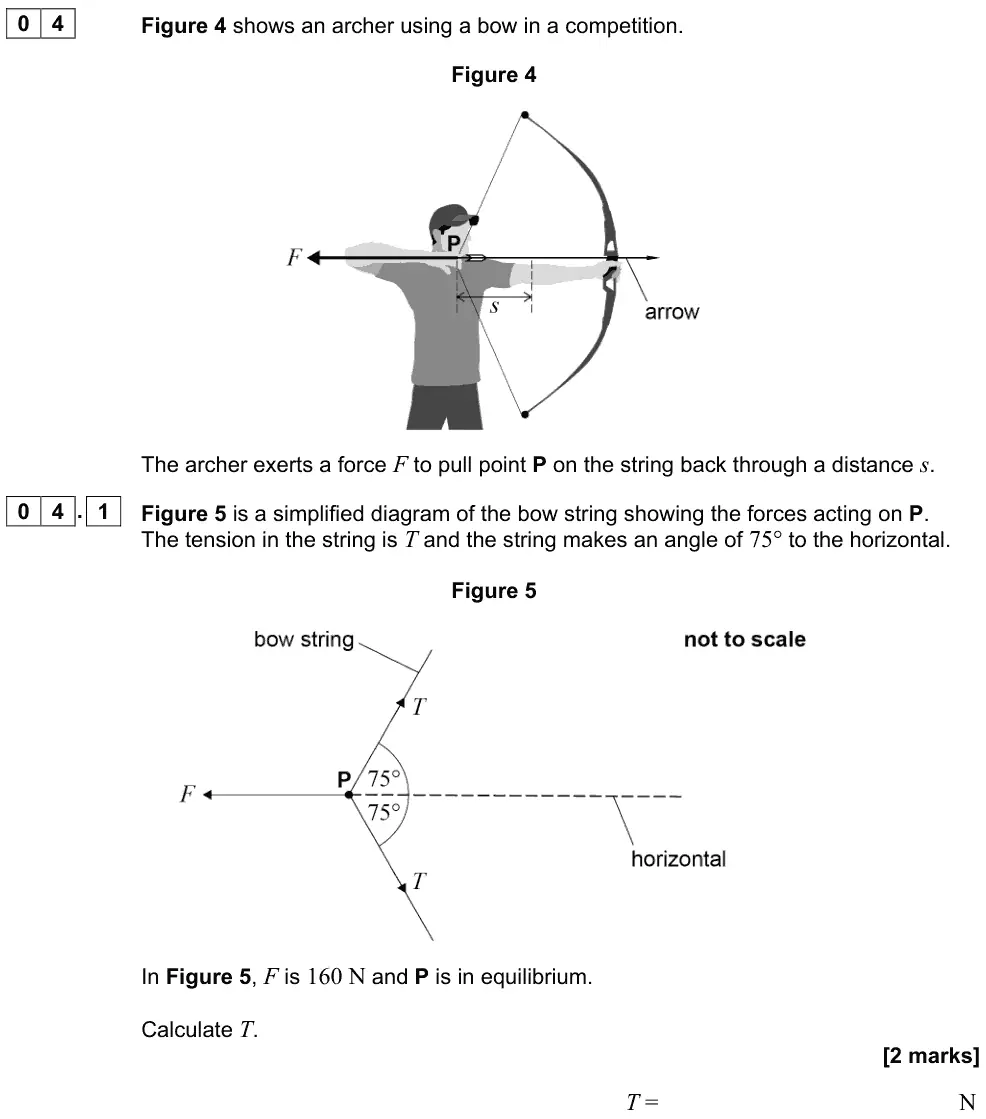
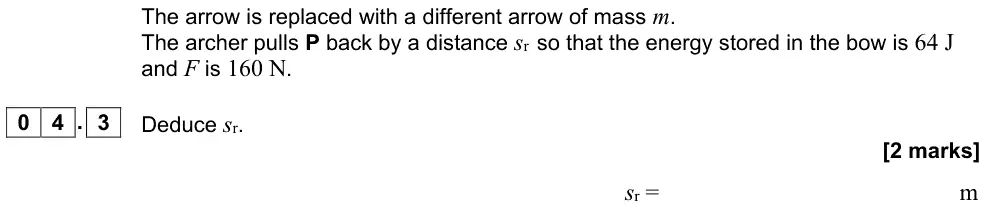
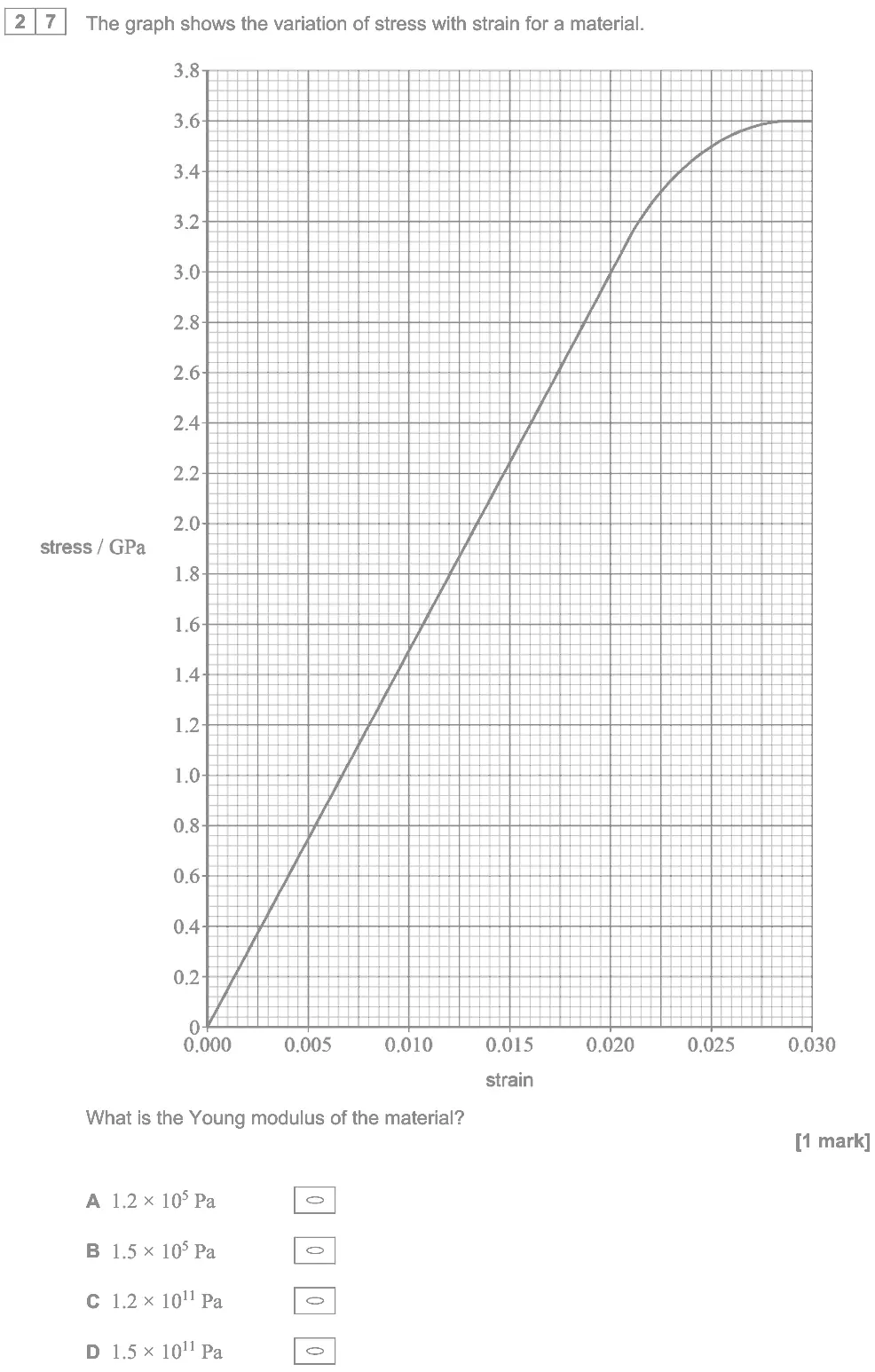
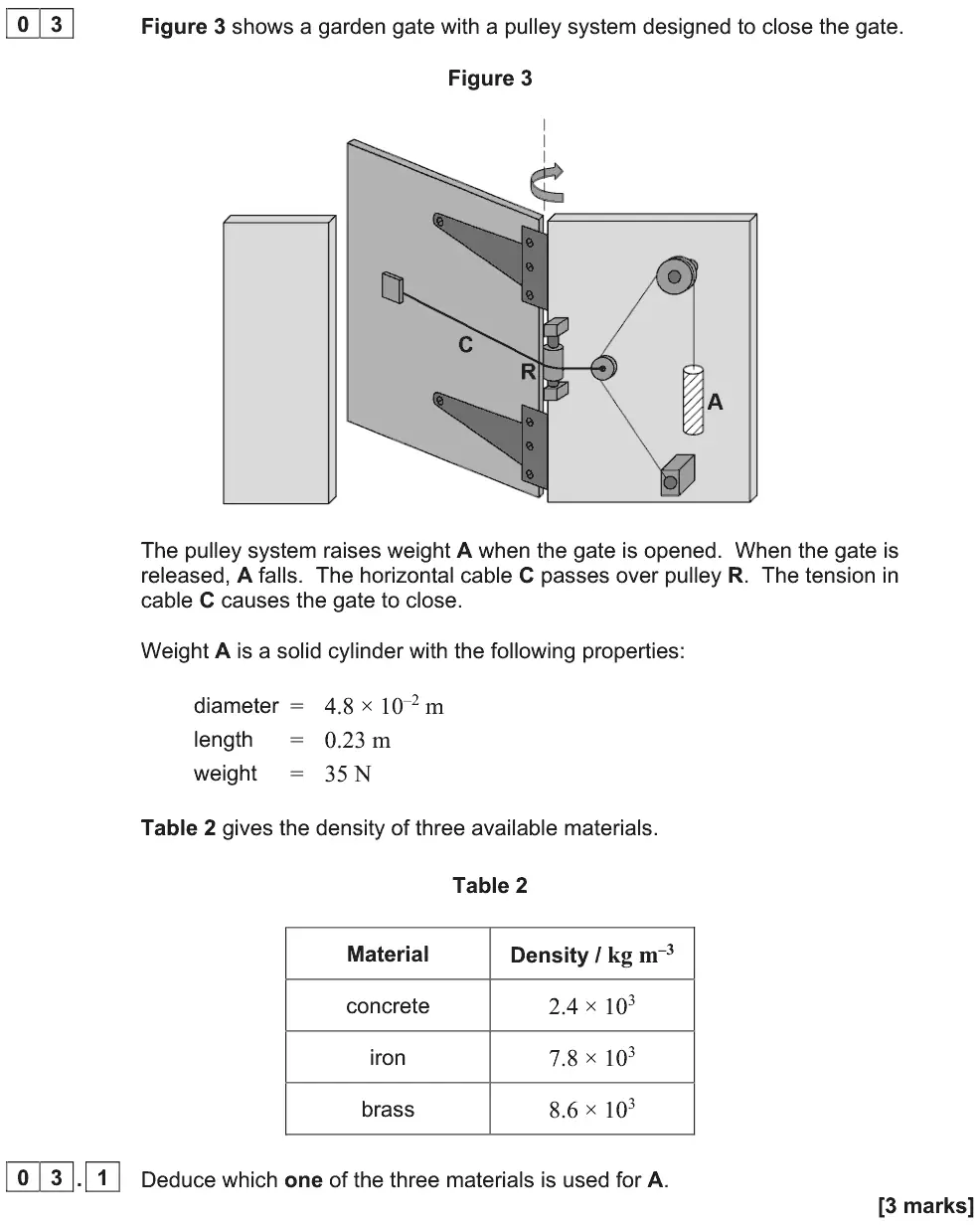
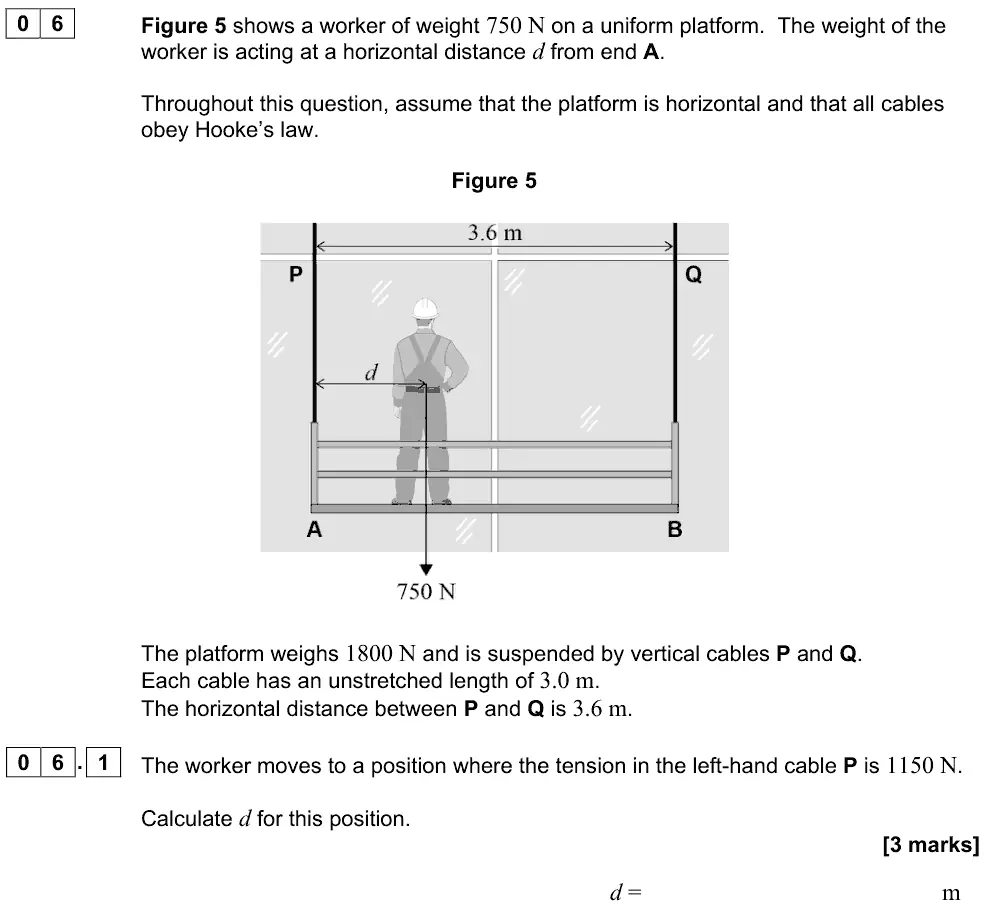
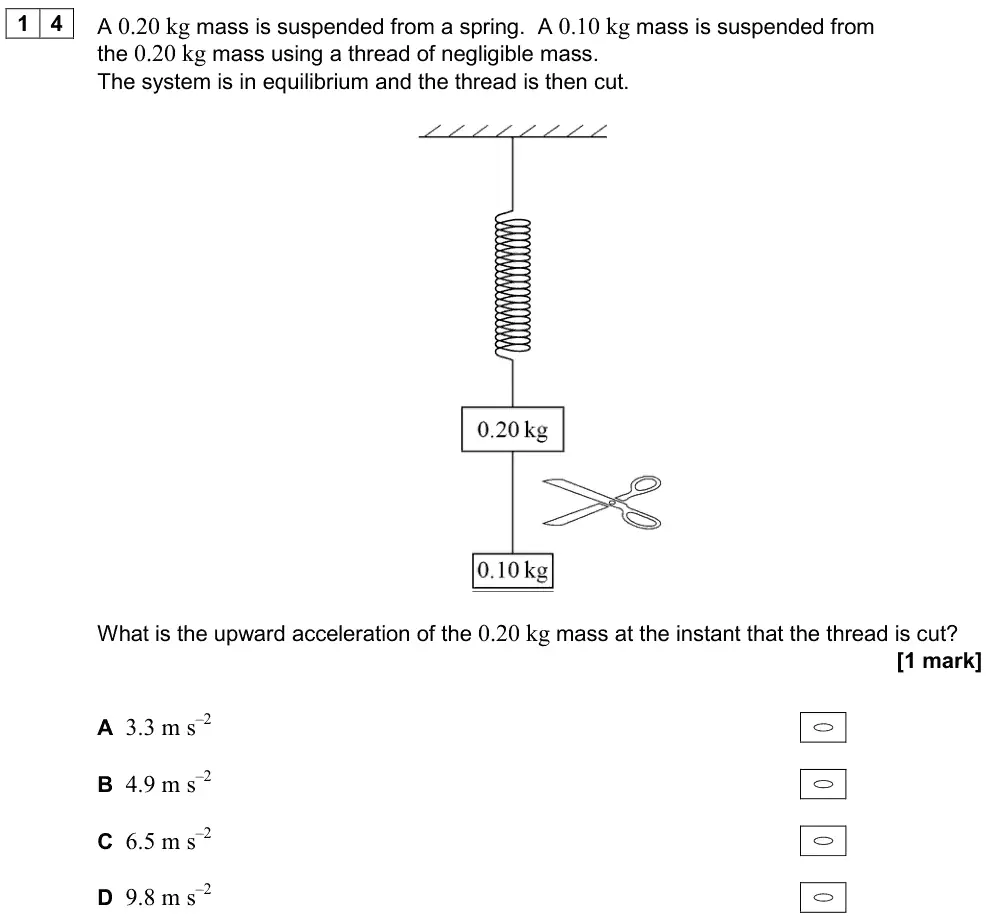
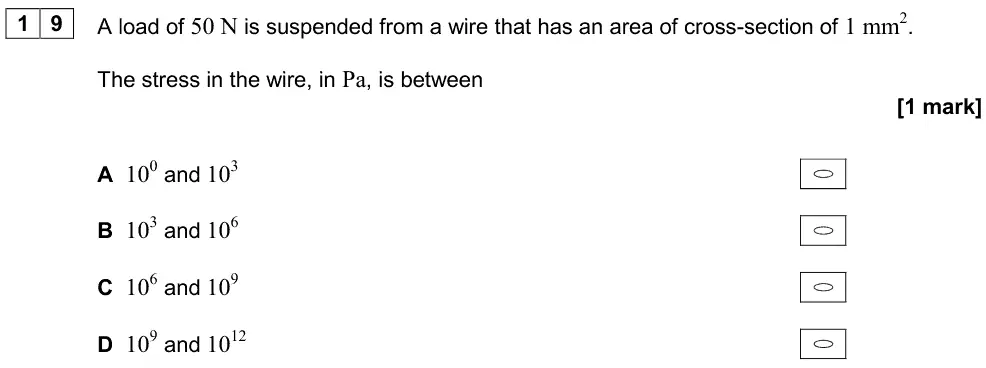
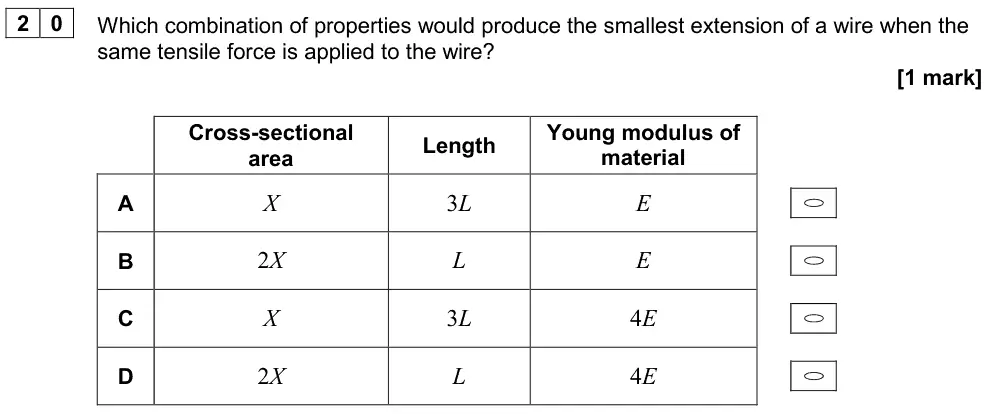
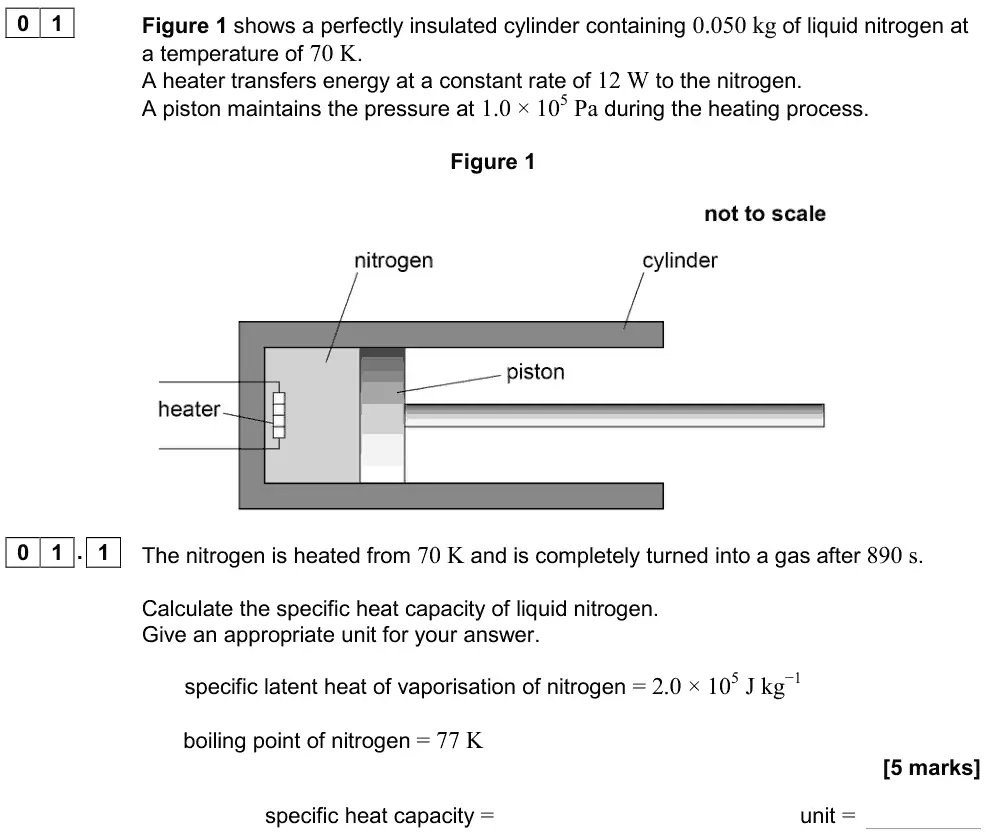
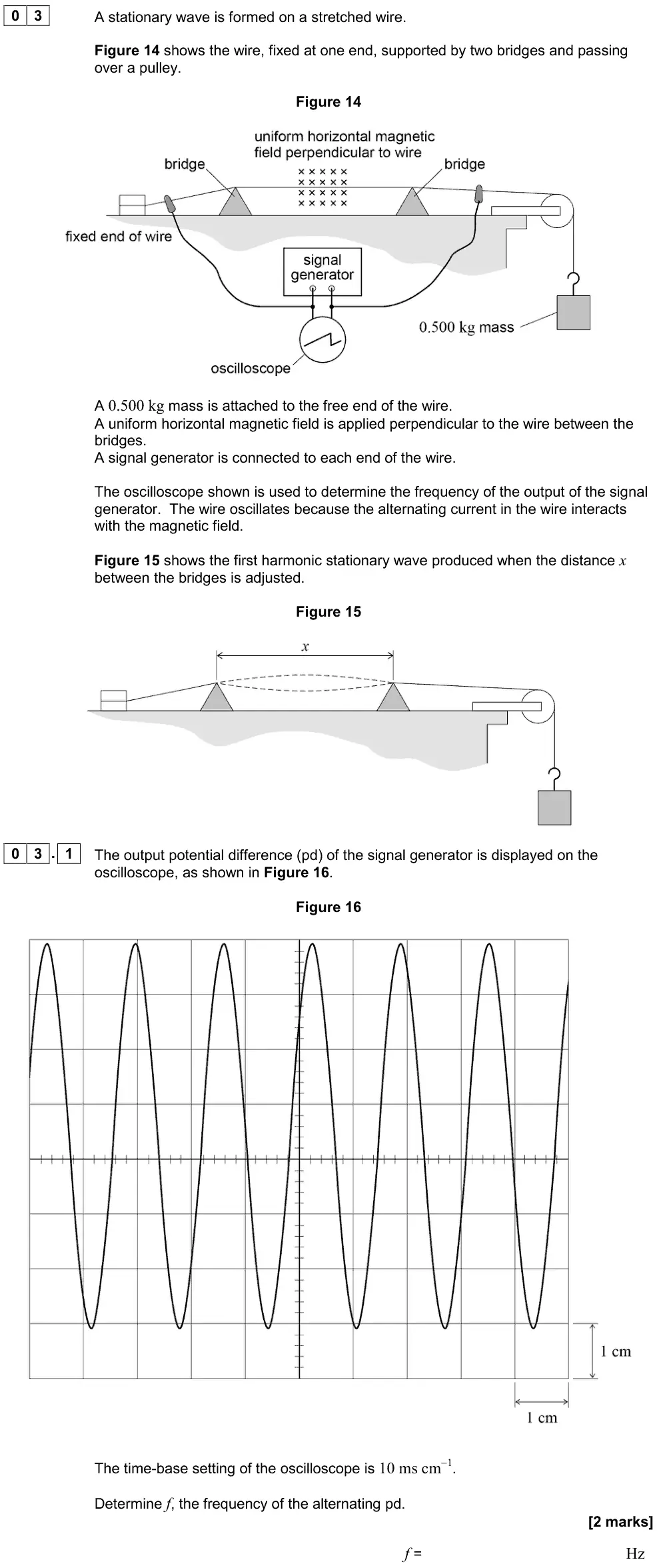
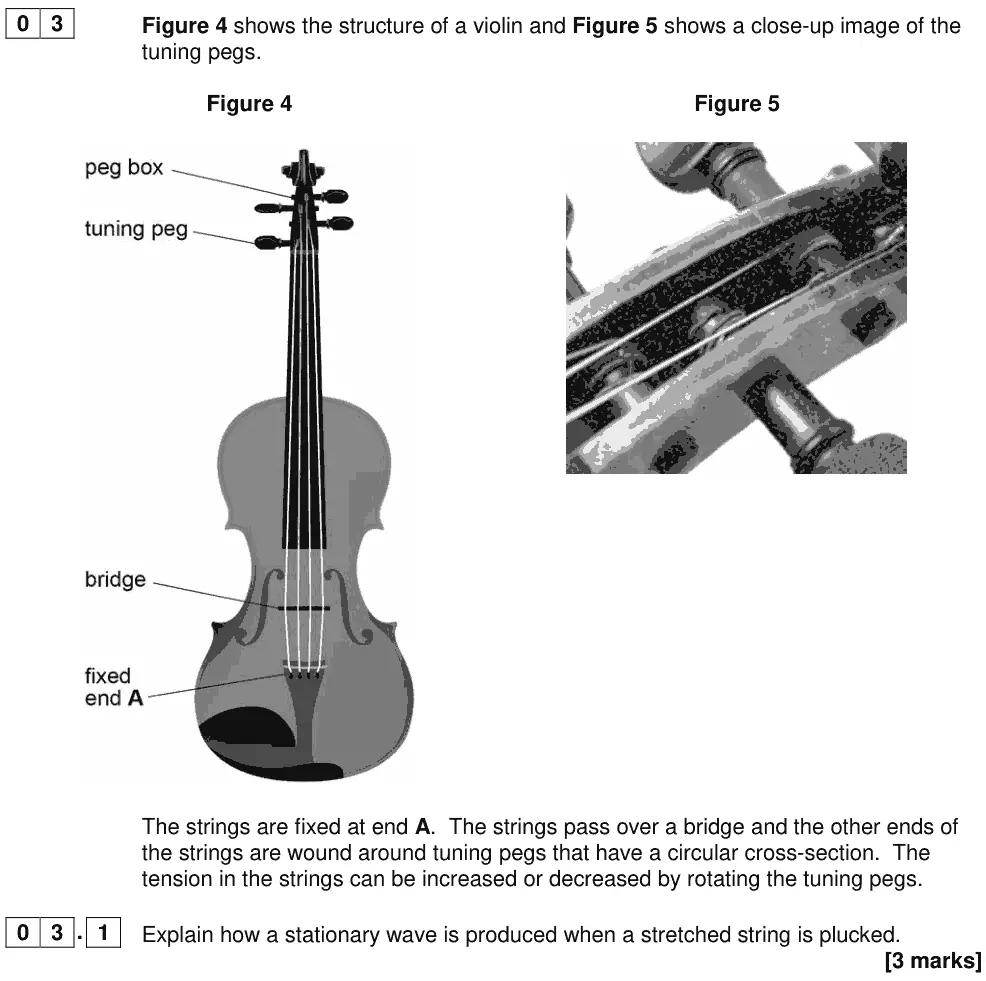
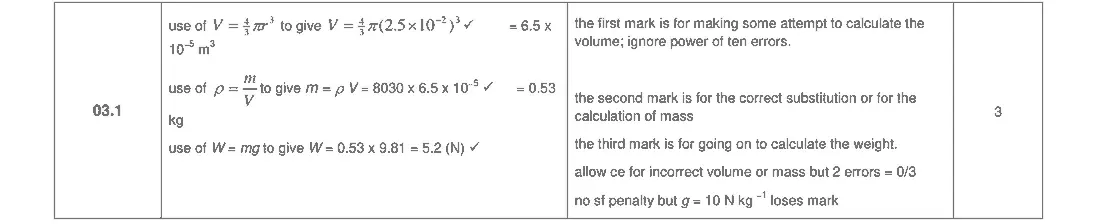
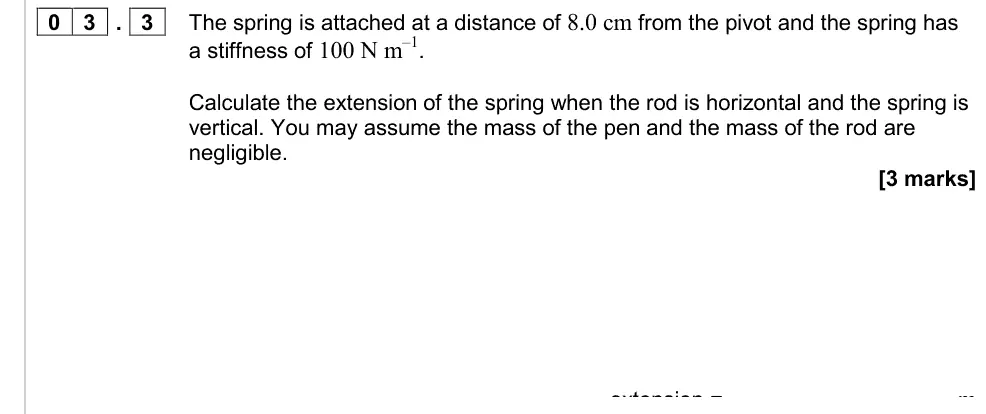
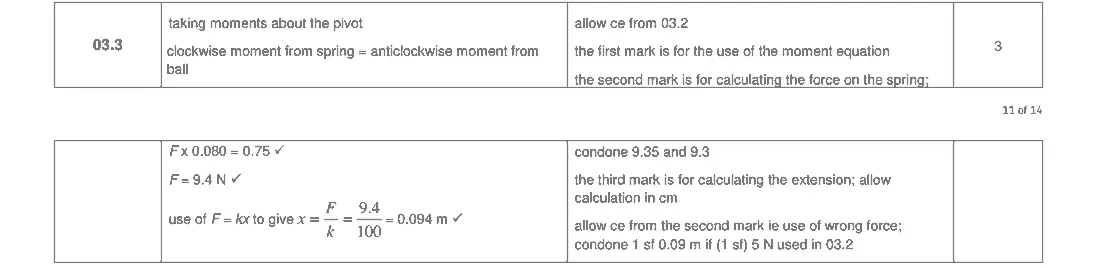
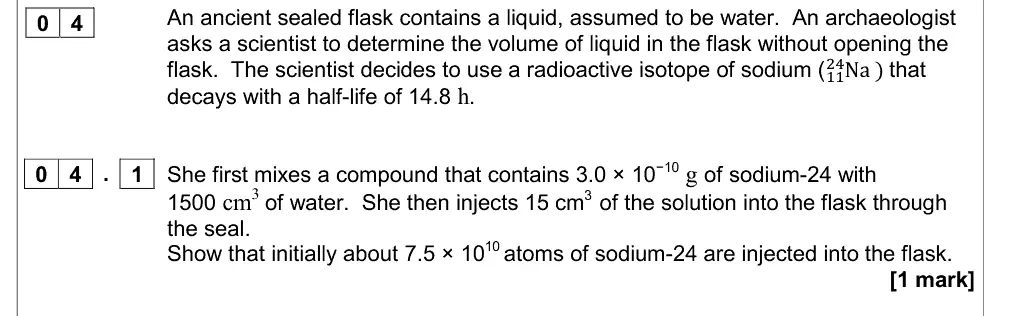
Tap a question to zoom it. Where a part needs a figure, table or graph from earlier in the question, that part folds out above it; the mark scheme and examiner's comment open underneath. Have the AQA data and formulae booklet beside you (see the formula sheet page).
June 2025 · Paper 1 · Q4.11 markAO1=1Short answerEasy
Mark scheme
Examiner's comment
About 60% of students obtained the mark for Question 4.1. Common errors included the idea that breaking stress and Young modulus are the same quantity. Others failed to give the equation for Young modulus or failed to suggest that strain has no units.
Notes from the mark scheme and report
Young modulus = stress/strain and strain has no unit
many said breaking stress and Young modulus are the same quantity
June 2025 · Paper 1 · Q4.23 marksAO3=3CalculationEasy
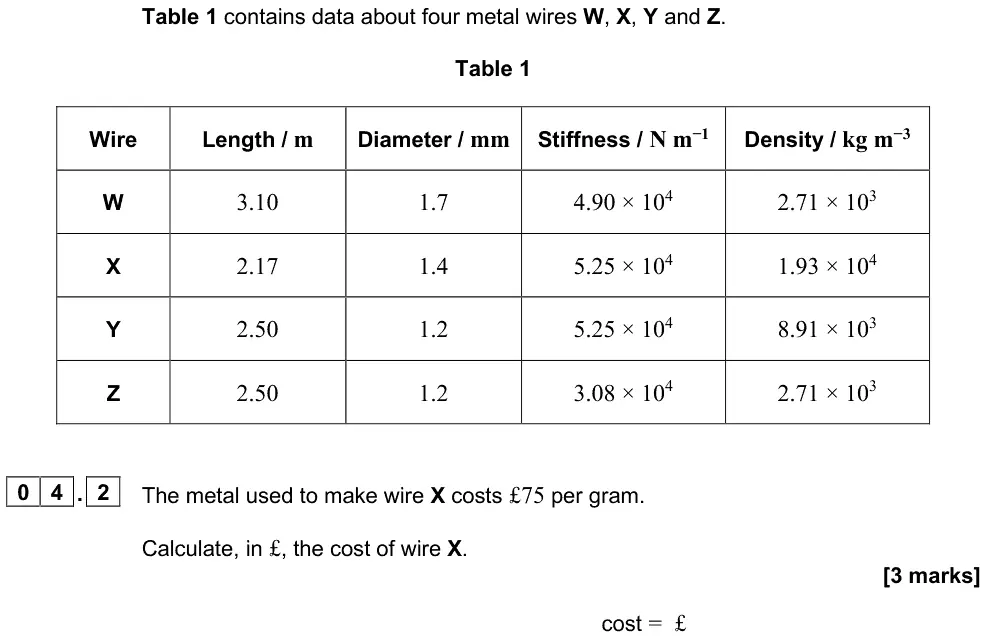
Earlier part of question 4 that this part uses
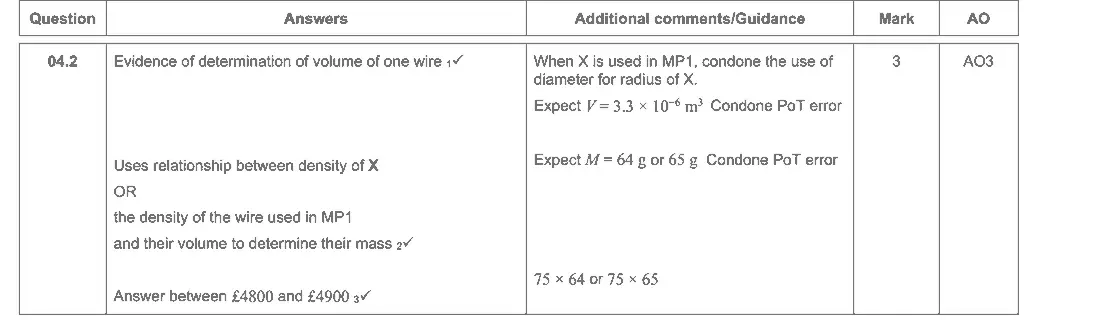
Mark scheme
Examiner's comment
The calculation in 4.2 was very accessible, with almost 70% of students gaining all three marks. Many students calculated their answer based on wire W rather than wire X. The structure of the mark scheme meant that these could receive partial credit provided it was clear what they were doing. Another common error was to use an incorrect formula for the volume of the wire. Power of ten errors were also fairly common.
Notes from the mark scheme and report
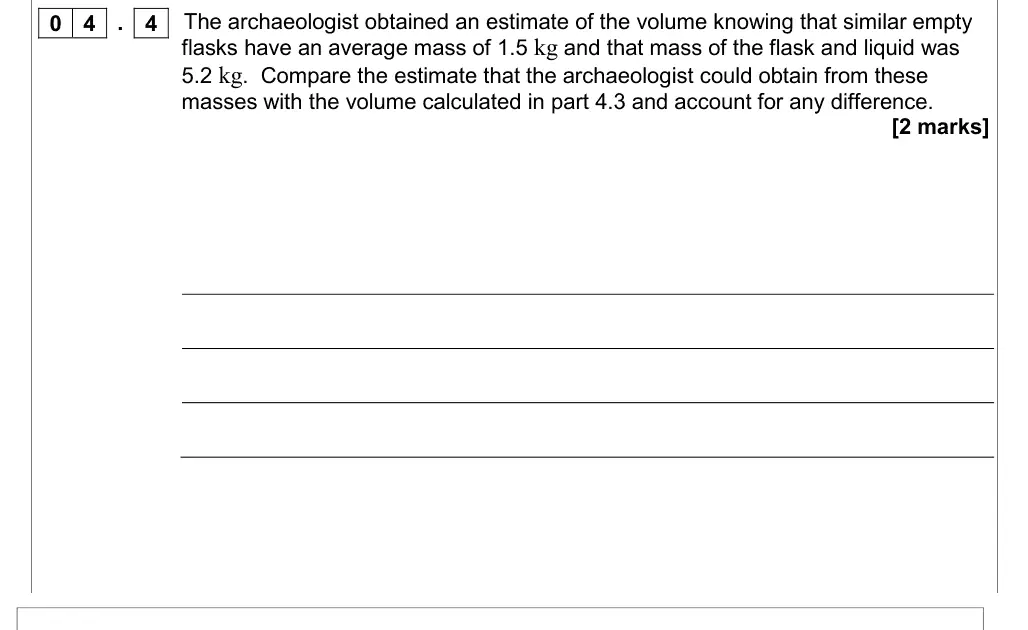
Answer: about £4850 (V = 3.3 x 10^-6 m^3, mass 64-65 g)
allow £4800-£4900
errors: using wire W data, wrong volume formula, power of ten
Skills: MS4.3 Calculate areas of triangles, circumferences and areas of circles, surface areas and volumes of rectangular blocks, cylinders and spheres; MS2.3 Substitute numerical values into algebraic equations using appropriate units for physical quantities
June 2025 · Paper 1 · Q4.31 markAO1=1Short answer
Earlier part of question 4 that this part uses
Mark scheme
Examiner's comment
Only about half of students received the mark for Question 4.3. The most common error was to suggest X and Y were the same because they had the same stiffness. Some students correctly identified W and Z, stating that their Young modulus was the same without supporting evidence.
Notes from the mark scheme and report
W and Z: same density, the only property of the material in the table
X and Y (same stiffness) was the common wrong answer
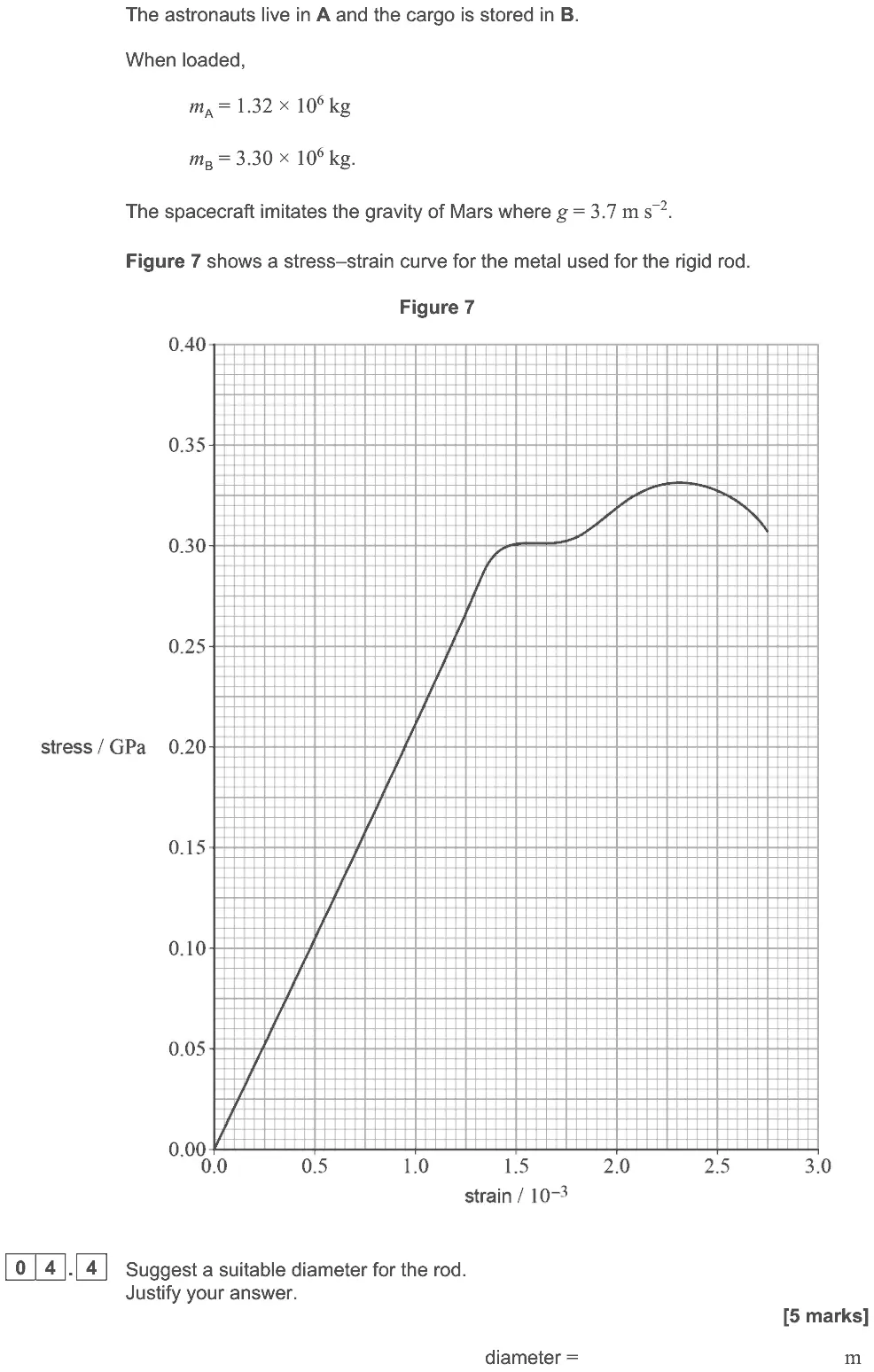
June 2025 · Paper 1 · Q4.44 marksAO3=4Practical and data analysis
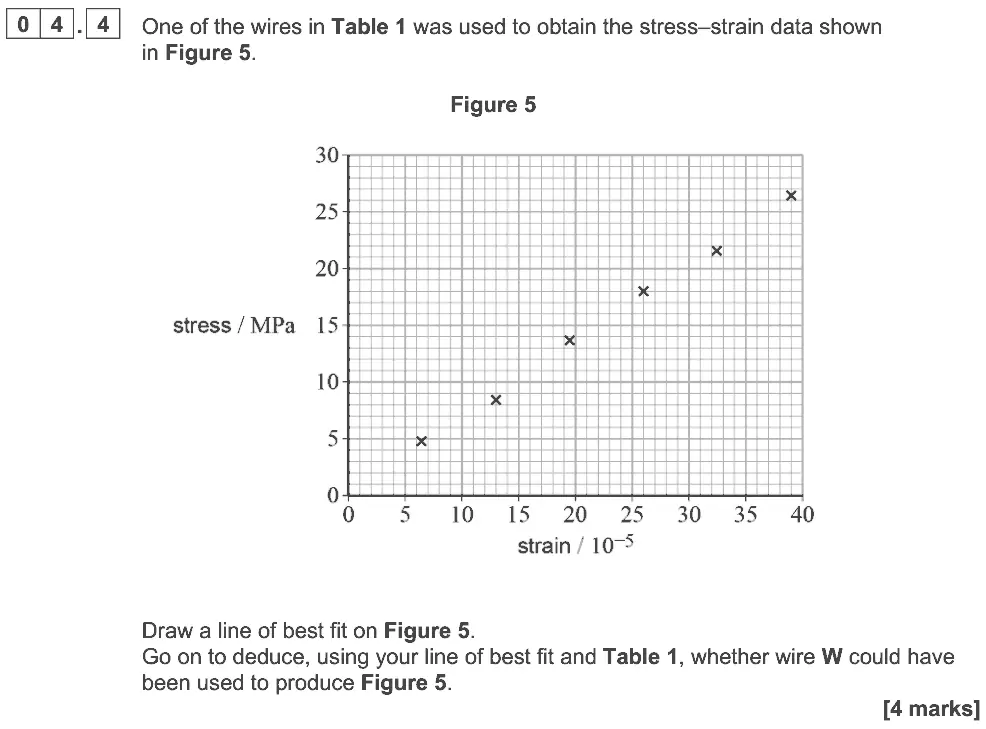
Earlier part of question 4 that this part uses
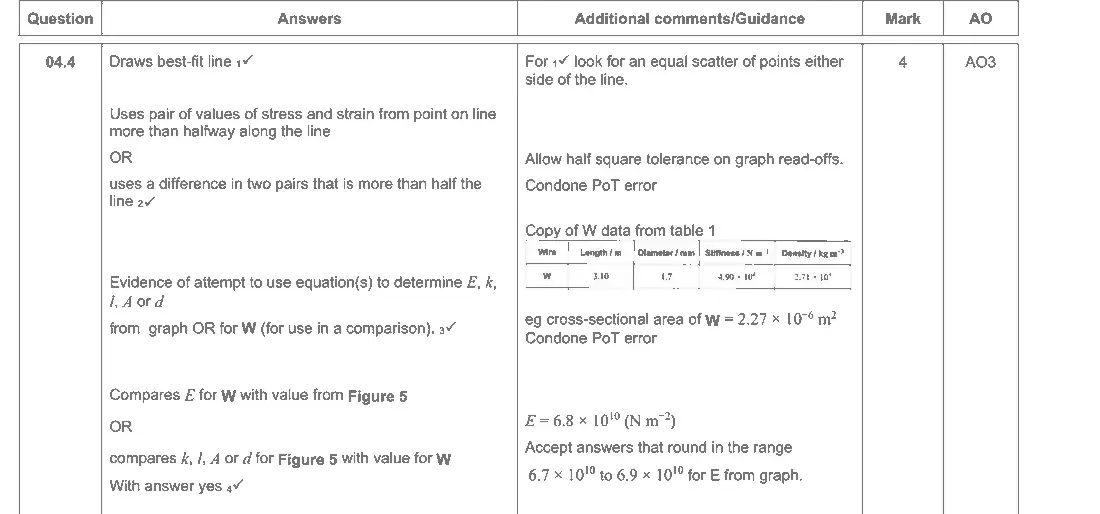
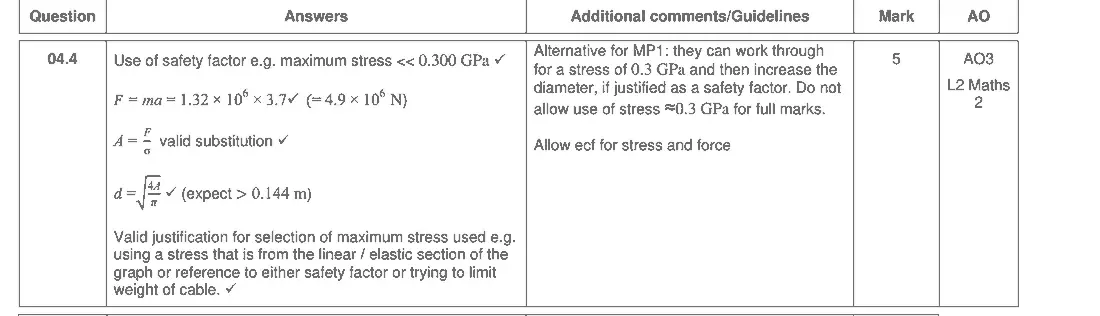
Mark scheme
Examiner's comment
Question 4.4 produced a good spread of marks and discriminated reasonably well, although it was not answered well by the majority of students. There were several routes through the question, all of which gained credit. The most common was to determine the Young modulus for Figure 5, calculate the Young modulus for wire W and then compare the two. Many students successfully chose to compare the stiffness.
Notes from the mark scheme and report
Answer: yes (gradient E = 6.8 x 10^10 Pa
for W, A = 2.27 x 10^-6 m^2 and E = kL/A = 6.7 x 10^10 Pa)
read-offs from more than half the line
comparing stiffness also credited
Skills: MS3.2 Plot two variables from experimental or other data; MS3.4 Determine the slope and intercept of a linear graph; MS4.3 Calculate areas of triangles, circumferences and areas of circles, surface areas and volumes of rectangular blocks, cylinders and spheres; RP4 Determination of the Young modulus by a simple method.
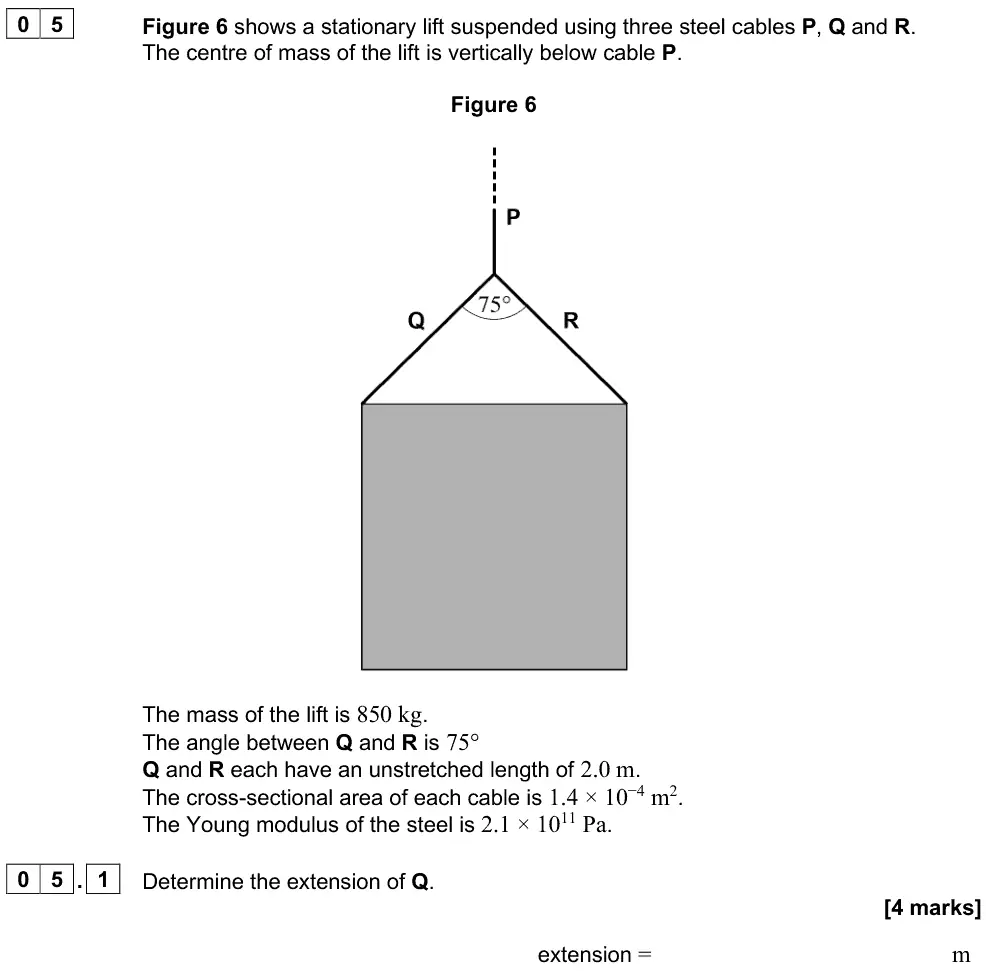
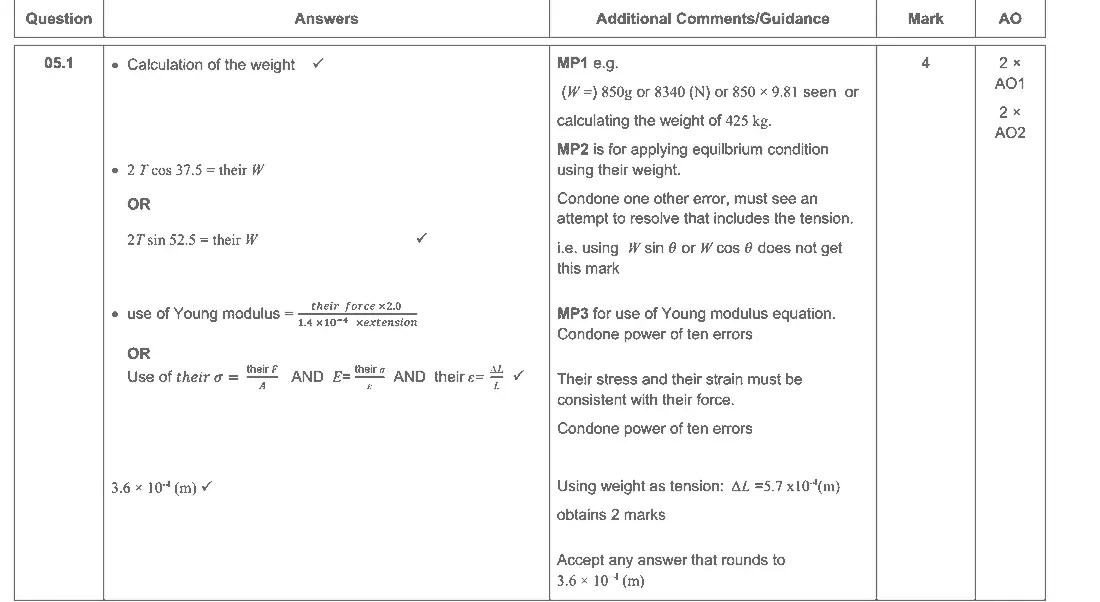
June 2025 · AS Paper 1 · Q5.14 marksAO1=2, AO2=2CalculationHard
Mark scheme
Examiner's comment
05.1 This calculation discriminated well between lower and higher attaining students. Approximately 20% of the students scored 4 marks with 77% gaining at least two marks. Those who scored only two marks typically were unable to correctly determine the tension in the cable and usually set the weight of the lift equal to the tension in the cable.
Notes from the mark scheme and report
Answer: 3.6 x 10^-4 m (W = 8340 N = 2T cos 37.5, T = 5260 N, delta L = FL/AE)
using the weight as the tension gives 5.7 x 10^-4 m for 2 marks
Skills: MS4.5 Use sin, cos and tan in physical problems; MS2.3 Substitute numerical values into algebraic equations using appropriate units for physical quantities
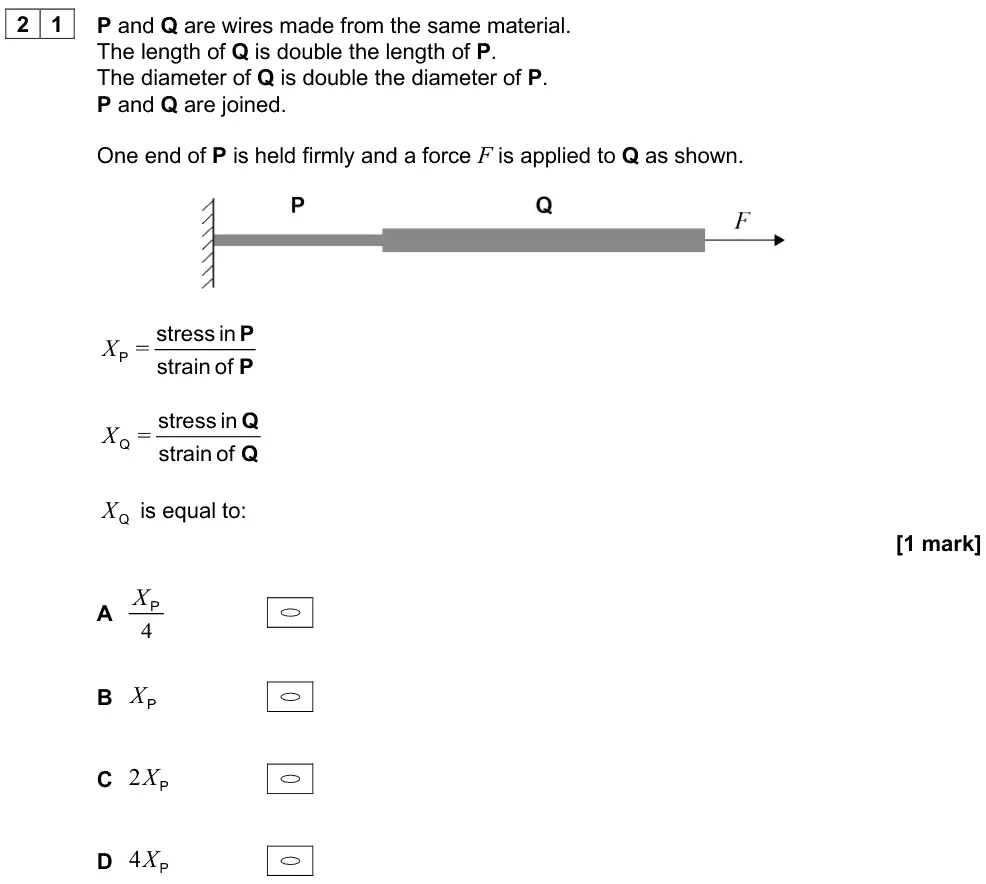
June 2025 · AS Paper 2 · Q211 markAO1=1Multiple choice
Answer
B
Mark scheme
Notes from the mark scheme and report
Answer: B
June 2025 · AS Paper 2 · Q241 markAO2=1Multiple choice
Answer
D
Mark scheme
Notes from the mark scheme and report
Answer: D
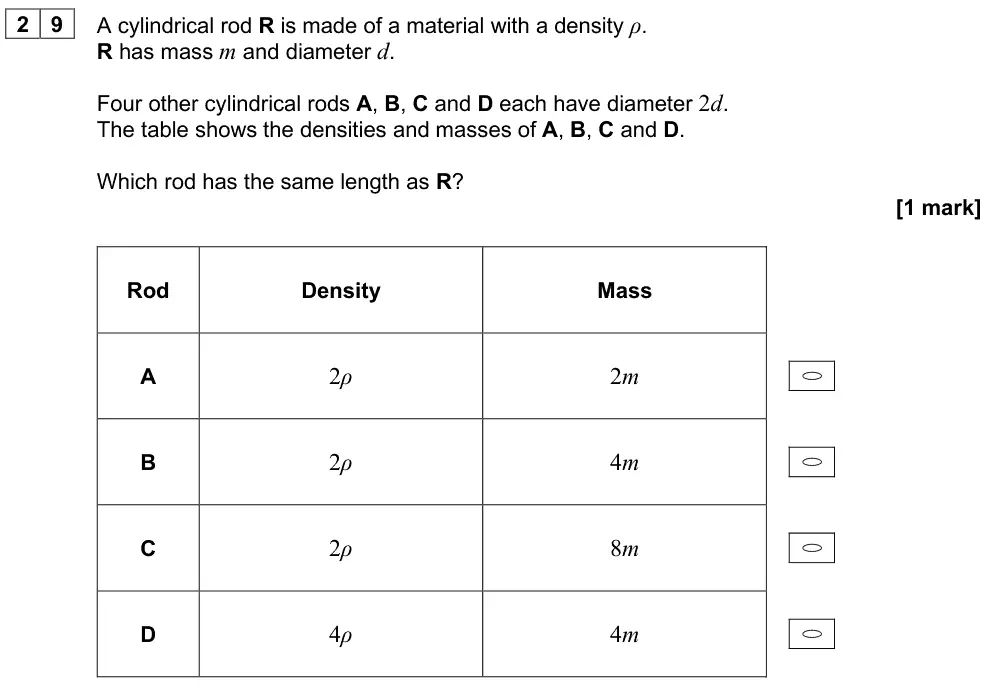
June 2025 · AS Paper 2 · Q291 markAO1=1Multiple choice
Answer
C
Mark scheme
Notes from the mark scheme and report
Answer: C
Skills: MS4.3 Calculate areas of triangles, circumferences and areas of circles, surface areas and volumes of rectangular blocks, cylinders and spheres
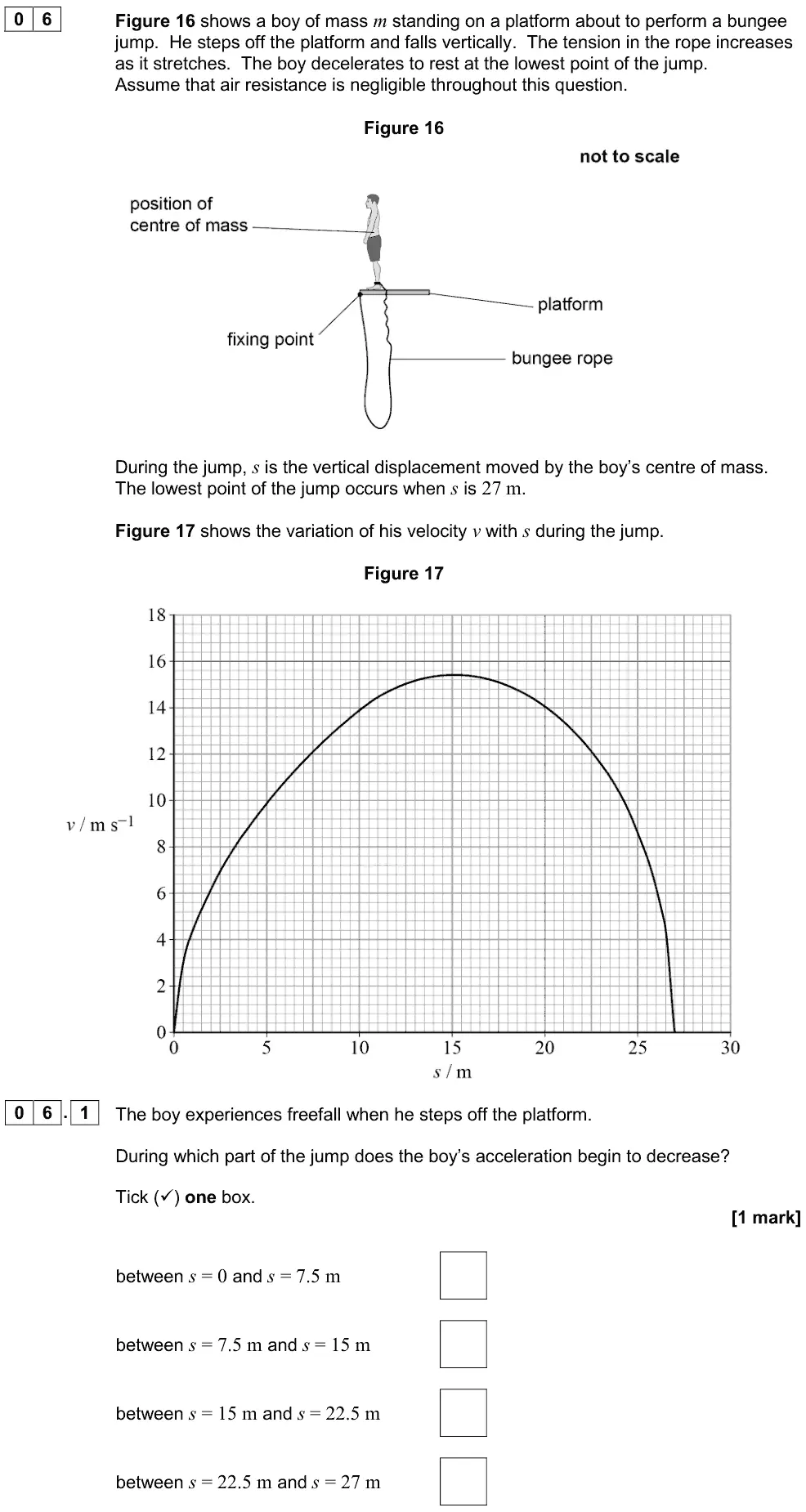
June 2024 · AS Paper 1 · Q6.11 markAO3=1Short answer
Mark scheme
Examiner's comment
06.1
Notes from the mark scheme and report
Between s = 7.5 m and s = 15 m (rope starts stretching where the v-s graph stops being free-fall)
tick-box item
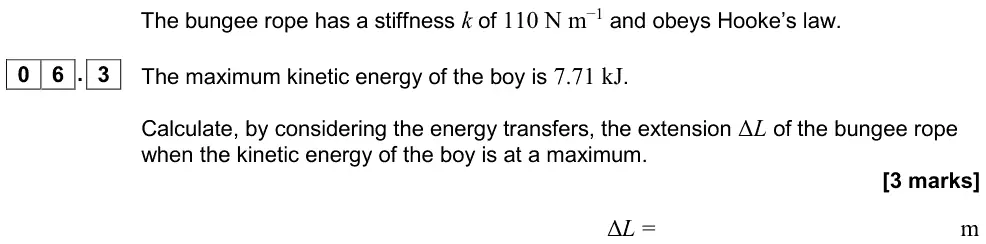
June 2024 · AS Paper 1 · Q6.33 marksAO1=1, AO2=2CalculationHard
Earlier part of question 6 that this part uses
Mark scheme
Examiner's comment
06.3
Notes from the mark scheme and report
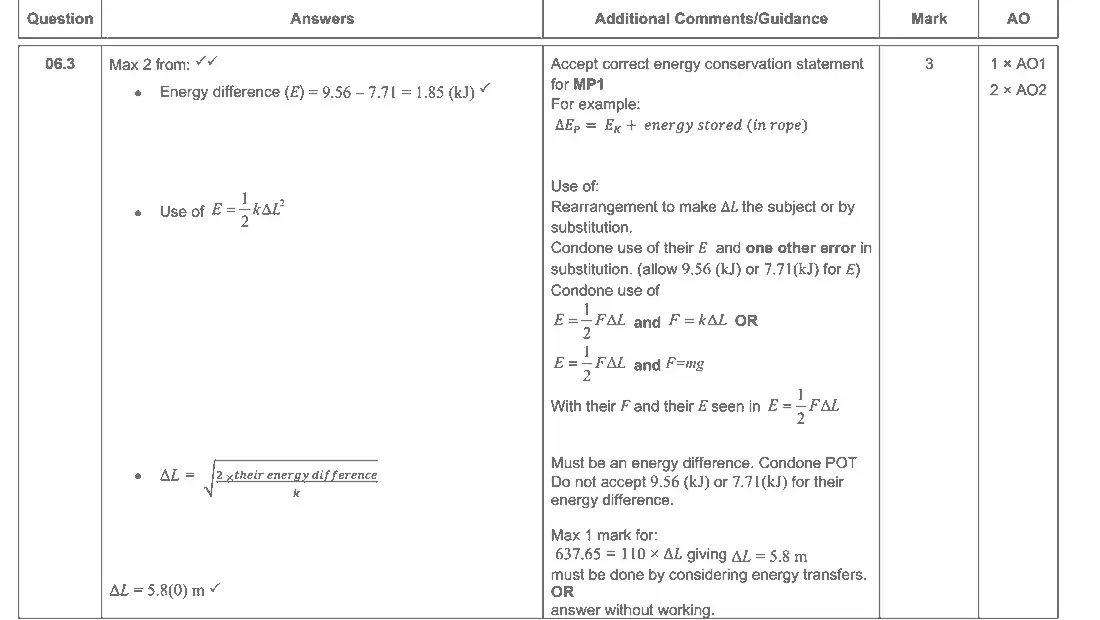
Answer: 5.8 m (elastic energy = 9.56 - 7.71 = 1.85 kJ = 1/2 x 110 x delta L^2)
using 7.71 kJ as the stored energy was the common error
Skills: MS2.2 Change the subject of an equation, including non-linear equations; MS2.3 Substitute numerical values into algebraic equations using appropriate units for physical quantities
June 2024 · AS Paper 1 · Q6.42 marksAO2=1, AO3=1Short answer
Earlier part of question 6 that this part uses
Mark scheme
Examiner's comment
Nearly 10% of students obtained all three marks. This question proved challenging, with many students struggling to understand what was happening in the question. These students typically used 7.71 kJ for the energy stored in the rope. The question required them to realise there were three kinds of energy to consider: Ep, Ek and elastic potential energy. Almost all who realised that elastic potential energy could be found by subtracting Ek from the initial Ep went on to obtain all three marks. 06.4
Notes from the mark scheme and report
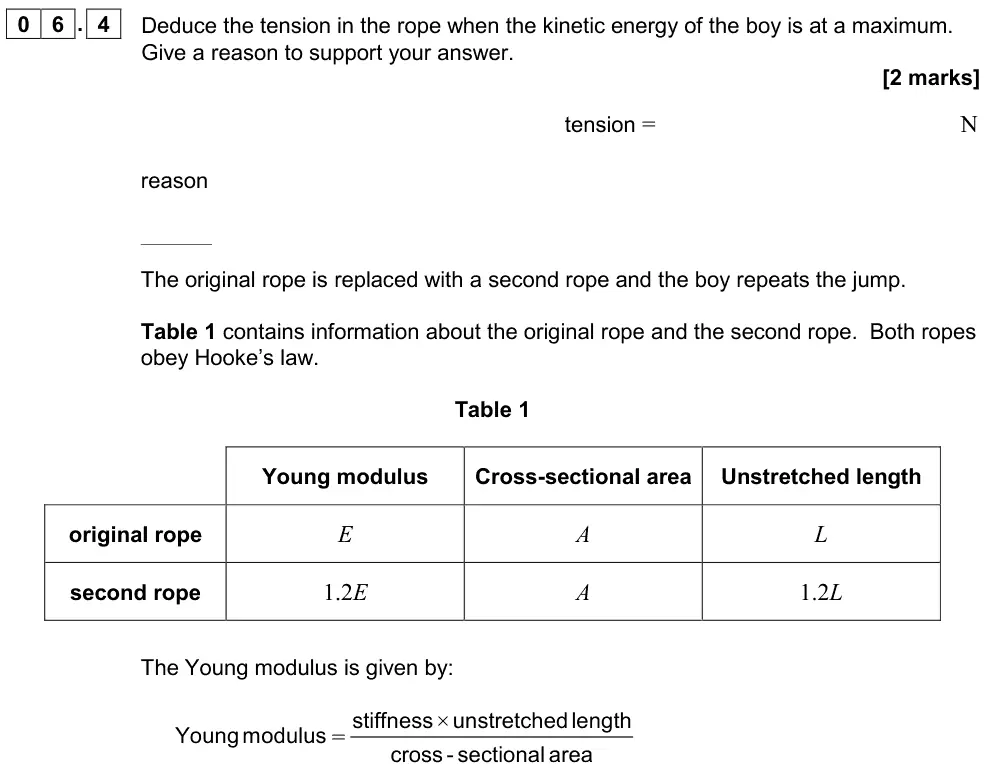
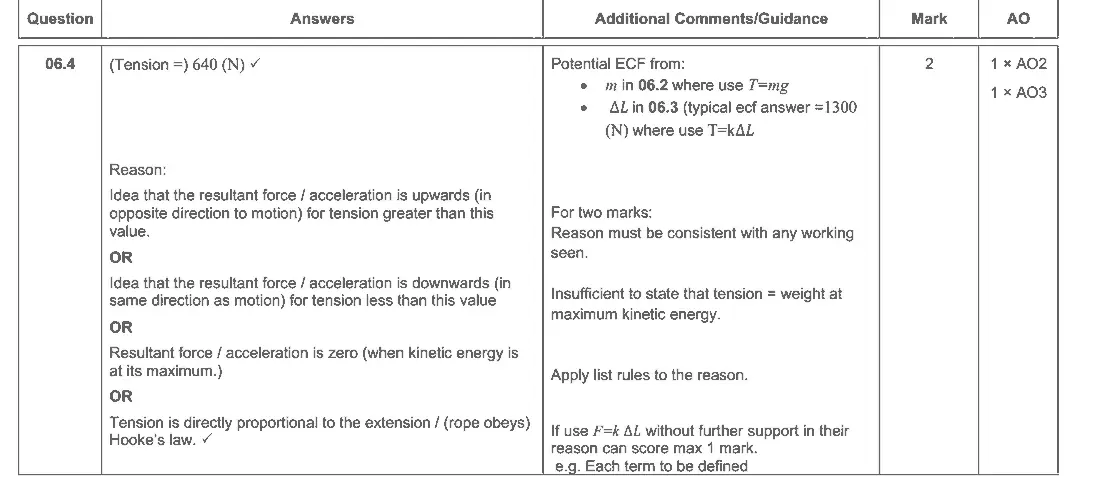
Answer: 640 N (equal to weight 65 x 9.81)
at maximum KE acceleration and resultant force are zero
Skills: MS2.3 Substitute numerical values into algebraic equations using appropriate units for physical quantities
June 2024 · AS Paper 1 · Q6.51 markAO1=1Show that
Earlier part of question 6 that this part uses
Mark scheme
Examiner's comment
06.5
Notes from the mark scheme and report
k = EA/L: 1.2E x A / 1.2L = EA/L, so same stiffness
Skills: MS2.2 Change the subject of an equation, including non-linear equations
June 2024 · AS Paper 1 · Q6.63 marksAO3=3Explanation
Earlier part of question 6 that this part uses
Mark scheme
Examiner's comment
06.6
Notes from the mark scheme and report
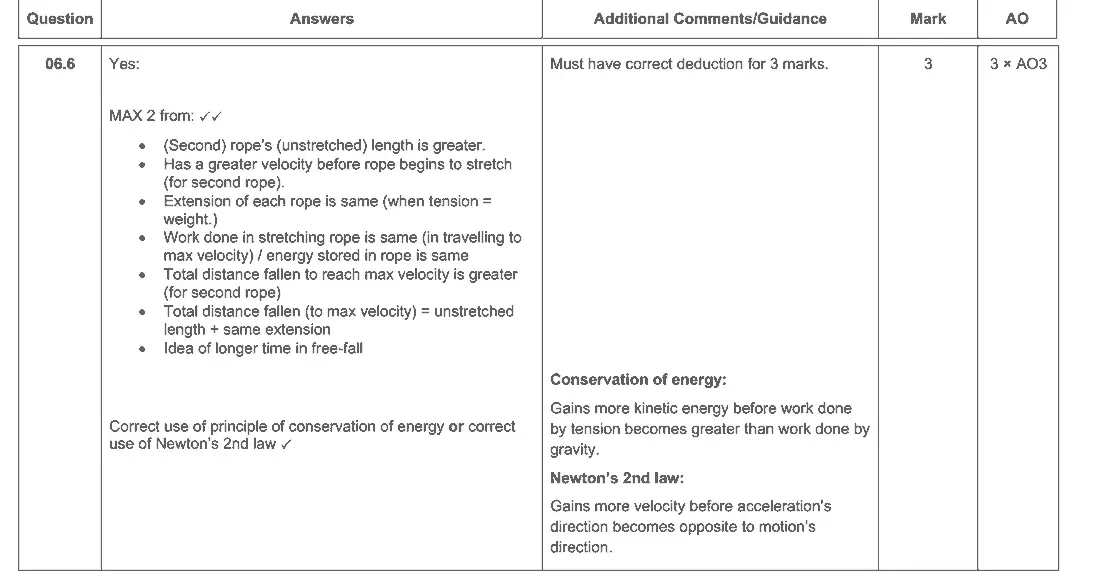
Yes: longer unstretched rope so longer free fall and higher speed before stretching
same stiffness so same extension when tension equals weight
falls further before max velocity so greater max KE
correct deduction needed for 3
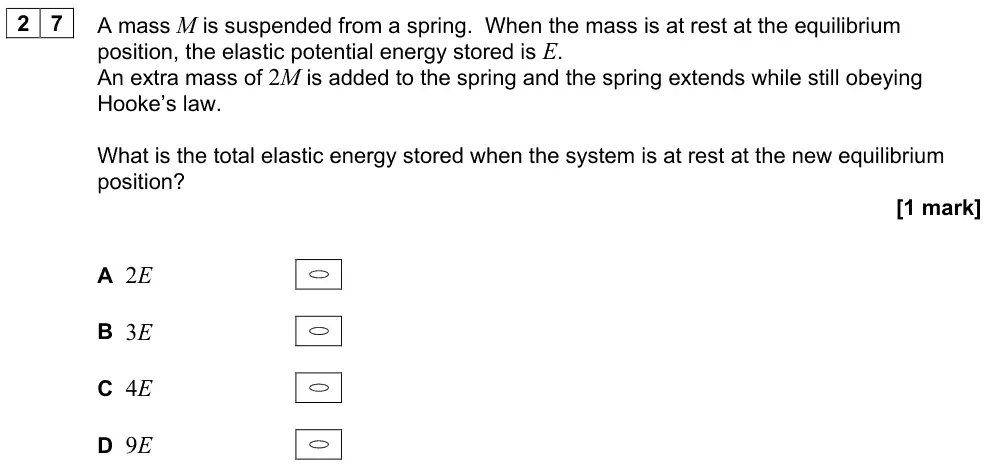
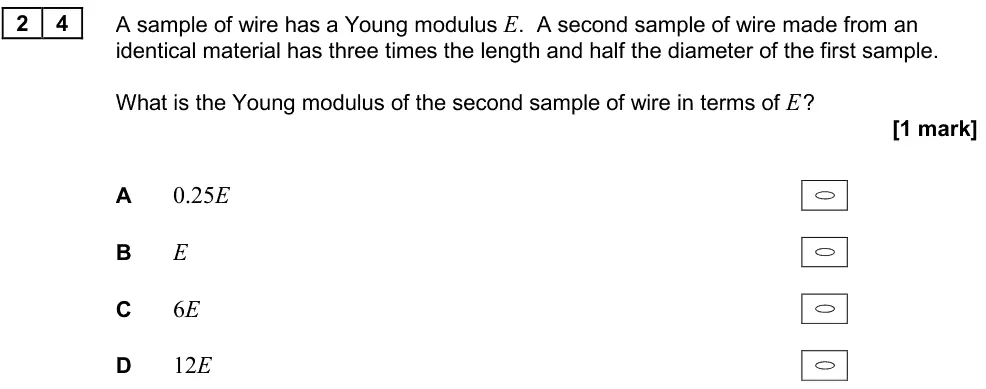
June 2024 · Paper 1 · Q251 markAO2=1Multiple choiceHard
Answer
C
Mark scheme
Examiner's comment
There were two very demanding questions answered correctly by fewer than 12% of students. These were B10 and B25.
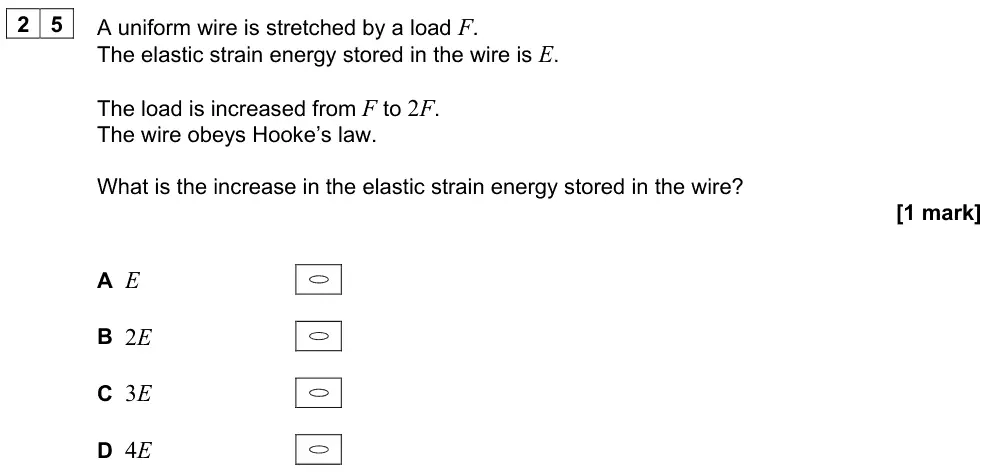
In B25 most students chose option B. In fact, the correct answer was the least popular option. Careful analysis, using a sketch graph for example, would show that the answer is C.
Notes from the mark scheme and report
Answer: C
most chose B and the correct answer was the least popular - a sketch graph shows the increase is 3E
Skills: MS0.3 Use ratios, fractions and percentages
June 2024 · Paper 1 · Q261 markAO2=1Multiple choice
Answer
C
Mark scheme
Notes from the mark scheme and report
Answer: C
June 2024 · AS Paper 2 · Q3.12 marksAO2=2Calculation
Mark scheme
Examiner's comment
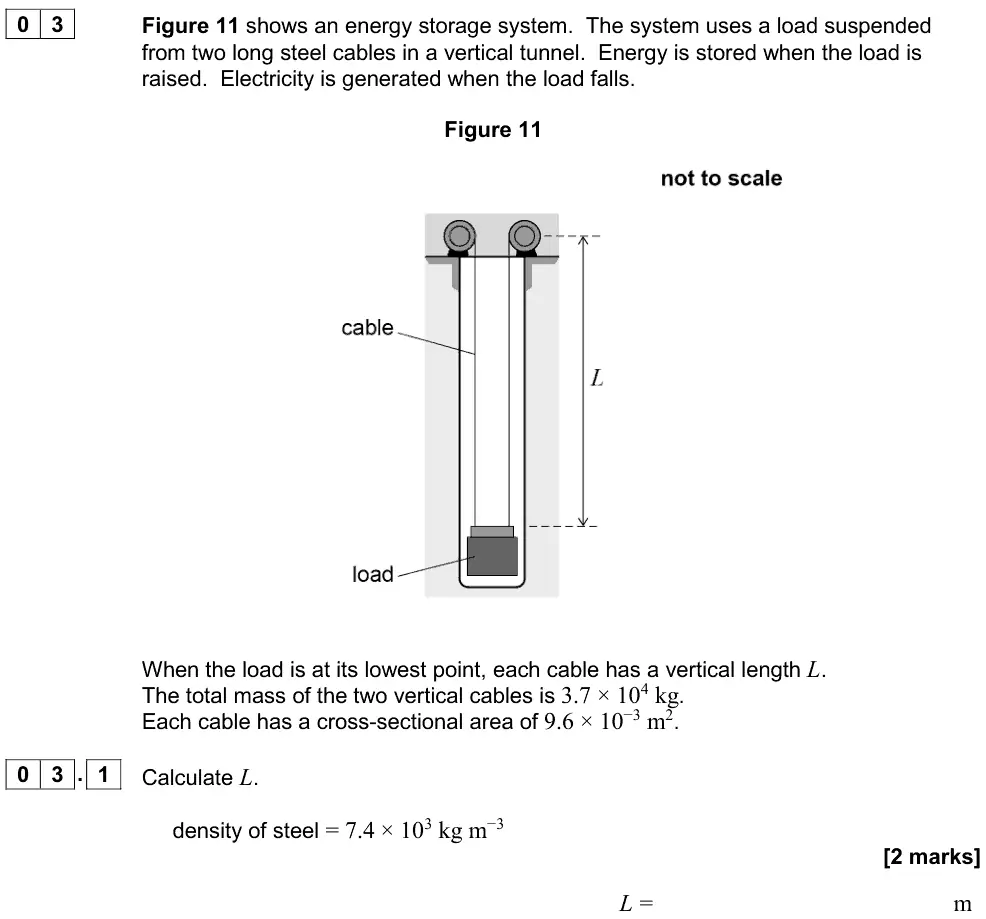
03.1 Nearly 50% of students gained both marks. About 25% achieved one mark, usually for using the total mass of the cables rather than the mass of one. One purpose of this question was to establish that the mass of the cables was significant, a point that needed to be considered in 03.2.
Notes from the mark scheme and report
Answer: 260 m (volume of one cable = 1.85 x 10^4 / 7.4 x 10^3 = 2.5 m^3
L = V/A)
using total mass of both cables gives one mark
Skills: MS2.2 Change the subject of an equation, including non-linear equations; MS2.3 Substitute numerical values into algebraic equations using appropriate units for physical quantities
June 2024 · AS Paper 2 · Q3.32 marksAO3=2Explanation
Earlier part of question 3 that this part uses
Mark scheme
Examiner's comment
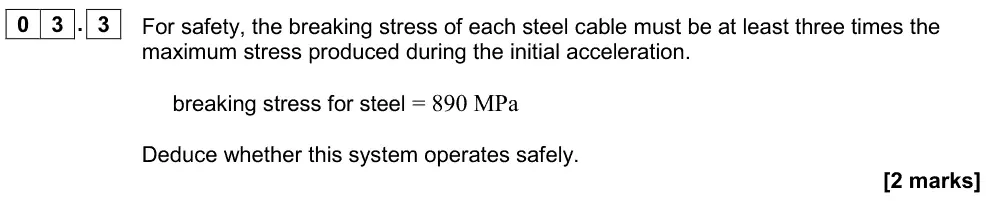
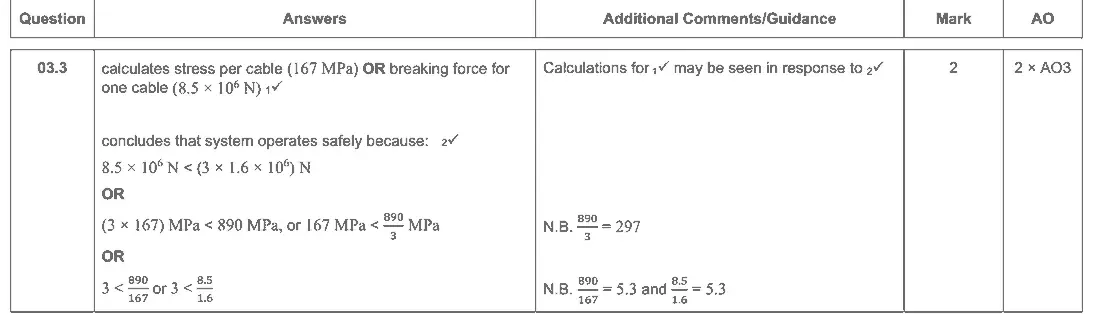
03.3 False comparisons (eg 167 MPa < 890 MPa) or absent conclusions were the main reasons for students failing to gain full credit here. An explicit conclusion is necessary for complete credit in this type of question. For example, “167 × 3 = 500 MPa, which is less than 890 MPa, so the system is safe”. 03.4 Nearly 60% of students gained some credit here but about 25% made no progress. The most common error was working in mixed units of energy, for instance adding values in MJ to values in kW h. A frequent misconception was that powers could be compared. Some students struggled to identify the correct times on Figure 12.
Notes from the mark scheme and report
Stress per cable 1.6 x 10^6 / 9.6 x 10^-3 = 167 MPa
3 x 167 = 500 MPa < 890 MPa so safe
explicit valid comparison and conclusion needed
Skills: MS0.3 Use ratios, fractions and percentages
June 2024 · AS Paper 2 · Q101 markMultiple choice
Answer
D
Mark scheme
Examiner's comment
Question 10: Options A, B and C were equally popular.
Notes from the mark scheme and report
Answer: D
options A, B and C equally popular
Skills: MS3.1 Translate information between graphical, numerical and algebraic forms
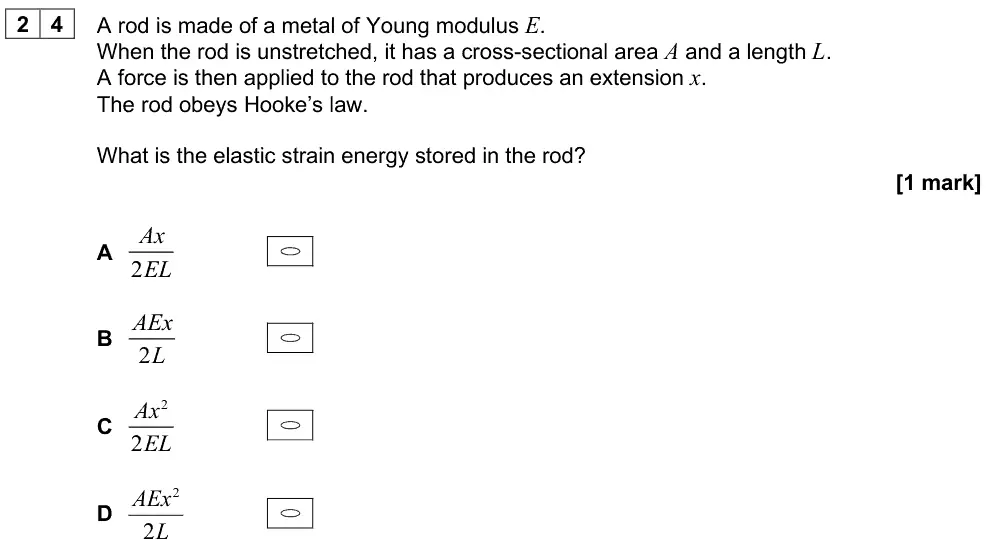
June 2024 · AS Paper 2 · Q241 markMultiple choice
Answer
B
Mark scheme
Notes from the mark scheme and report
Answer: B
June 2023 · AS Paper 1 · Q4.32 marksAO3=2CalculationHard
Earlier part of question 4 that this part uses
Mark scheme
Examiner's comment
04.3 This question proved inaccessible to most students with over 94% of students achieving zero. Many attempted to use W=Fs even though the force was not constant over the distance shown in 1 Figure 6. Another significant proportion of students used W= 2 FΔL, again scoring zero due to the non-linear relationship between F and s shown in Figure 6. 04.4 Over 60% of students achieved at least one mark in this part. Grade A students typically achieved all three marks with grade E students able to make some progress. One mark was usually obtained for a correct conversion of km h–1 to m s–1 but quite often this was the only credit-worthy work seen in the working. Common errors seen included: 1 2 m v2 • incorrect re-arrangement of Ek= • forgetting to use 82% of the available energy as the kinetic energy. Many students attempted to use P=Fv because they thought that efficiency was a reference to power in this context.
Notes from the mark scheme and report
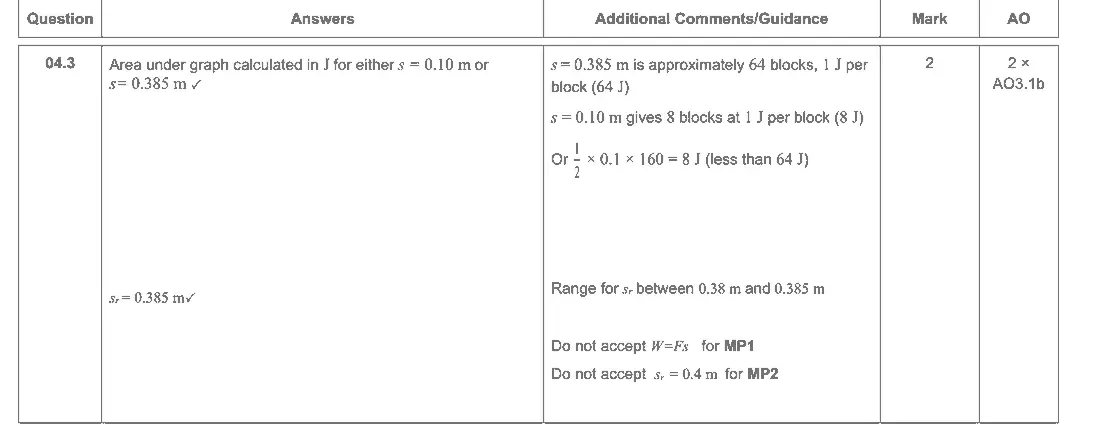
Answer: 0.385 m (area under Figure 6 up to s = 0.385 m is about 64 J
F = 160 N at s = 0.10 m gives only 8 J)
W = Fs or 1/2 F delta L invalid for the non-linear graph
Skills: MS3.8 Understand the possible physical significance of the area between a curve and the x axis and be able to calculate it or estimate it by graphical methods as appropriate
June 2023 · AS Paper 1 · Q5.13 marksShow that
Mark scheme
Examiner's comment
05.1 Students performed well in this part with 47% of students achieving all three marks. Those who made more limited progress were unfamiliar with how to determine the volume of air 4 3 𝜋𝑟3. displaced each second and instead used 2𝜋𝑟ℎ or Here again, realising that this is a “show that” question was crucial; students must ensure that their working clearly demonstrates all the steps they have made to produce the answer. Some students presented a one significant figure answer and this limited them to a maximum of two marks.
Notes from the mark scheme and report
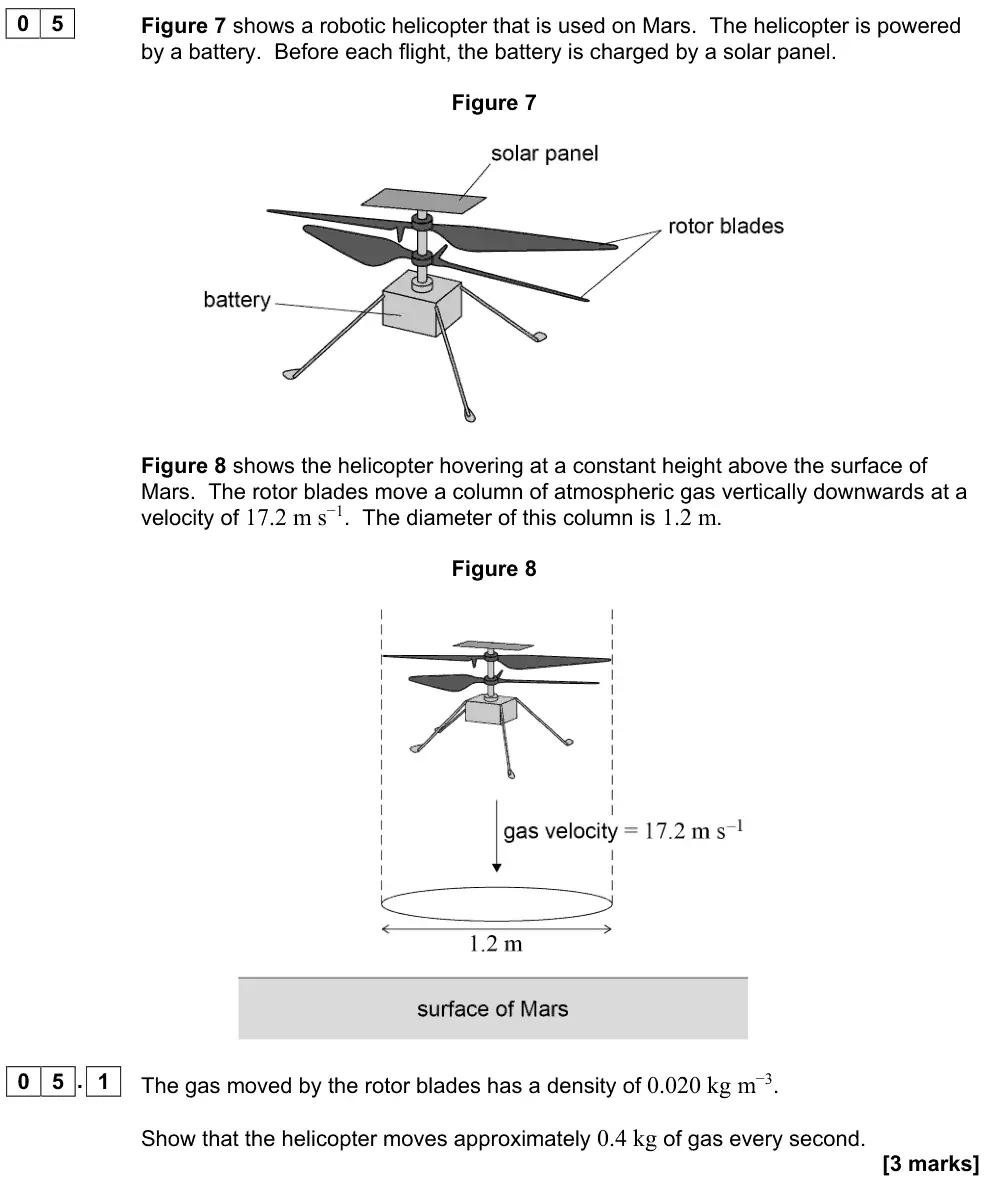
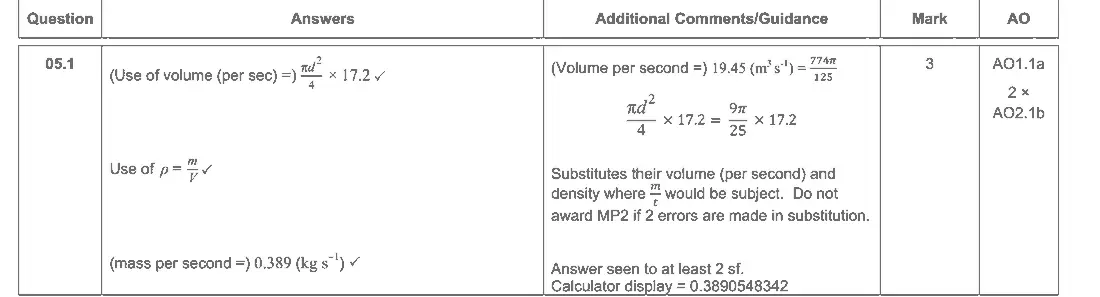
Answer: 0.389 kg s^-1 (volume per second = pi(0.6)^2 x 17.2 = 19.45 m^3 s^-1, times 0.020)
1 s.f. answer max 2
Skills: MS4.3 Calculate areas of triangles, circumferences and areas of circles, surface areas and volumes of rectangular blocks, cylinders and spheres; MS2.3 Substitute numerical values into algebraic equations using appropriate units for physical quantities
June 2023 · Paper 1 · Q5.11 markAO1=1Calculation
Mark scheme
Examiner's comment
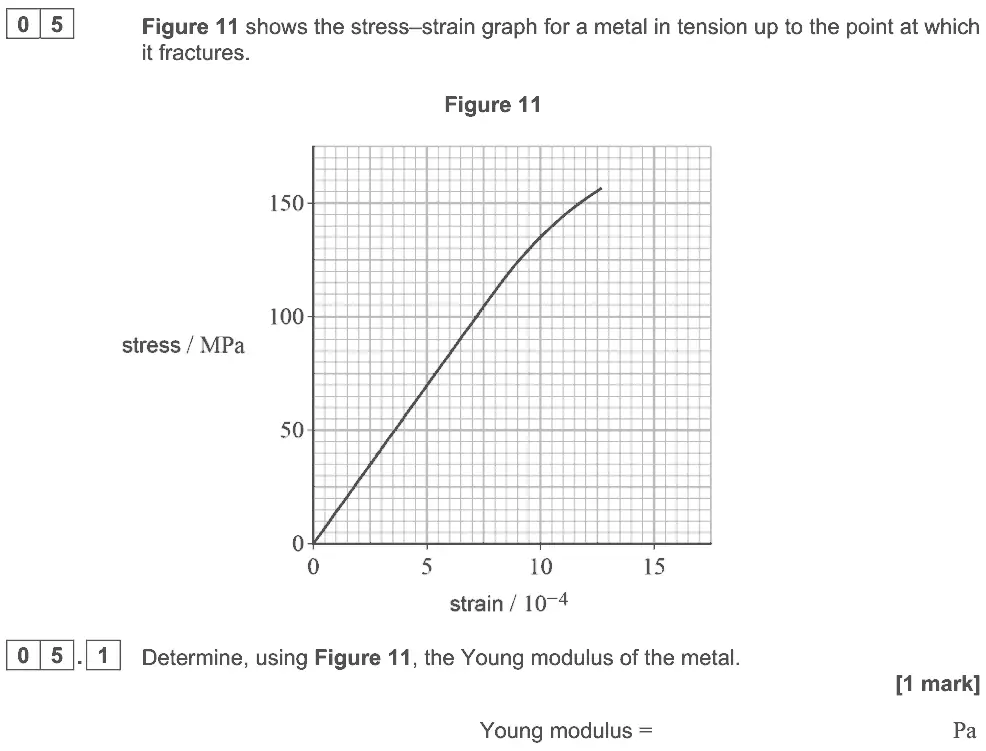
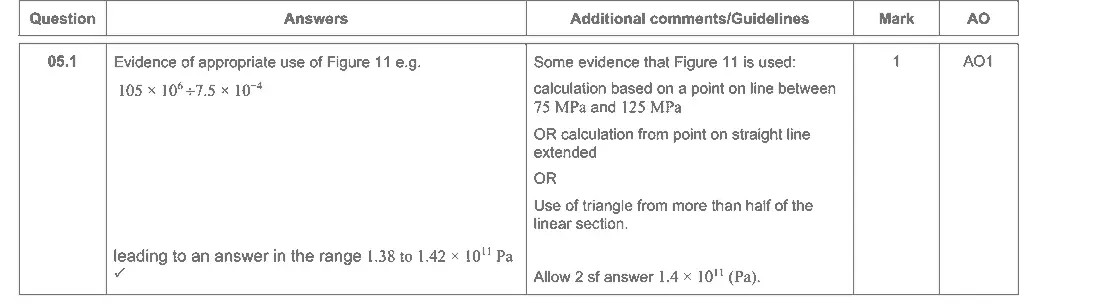
05.1 A straightforward calculation that required students to use an appropriate section of the graph to obtain the Young modulus. Power of ten errors prevented some students obtaining the mark.
Notes from the mark scheme and report
Answer: 1.4 x 10^11 Pa (gradient of linear section, e.g. 105 MPa / 7.5 x 10^-4)
power-of-ten slips
Skills: MS3.4 Determine the slope and intercept of a linear graph; MS0.2 Recognise and use expressions in decimal and standard form
June 2023 · Paper 1 · Q5.21 markAO1=1Short answer
Earlier part of question 5 that this part uses
Mark scheme
Examiner's comment
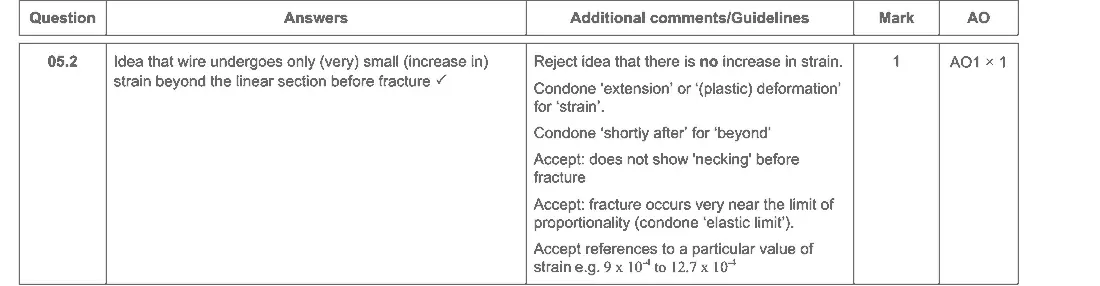
05.2 A range of responses was acceptable but the idea that there was no increase in strain beyond the linear section of the graph did not get the mark. These answers implied that students knew what brittle meant but did not apply it to Figure 11.
Notes from the mark scheme and report
Only a small increase in strain beyond the linear (proportional) region before fracture, no necking
'no increase in strain' not accepted
June 2023 · Paper 1 · Q5.33 marksCalculation
Earlier part of question 5 that this part uses
Mark scheme
Examiner's comment
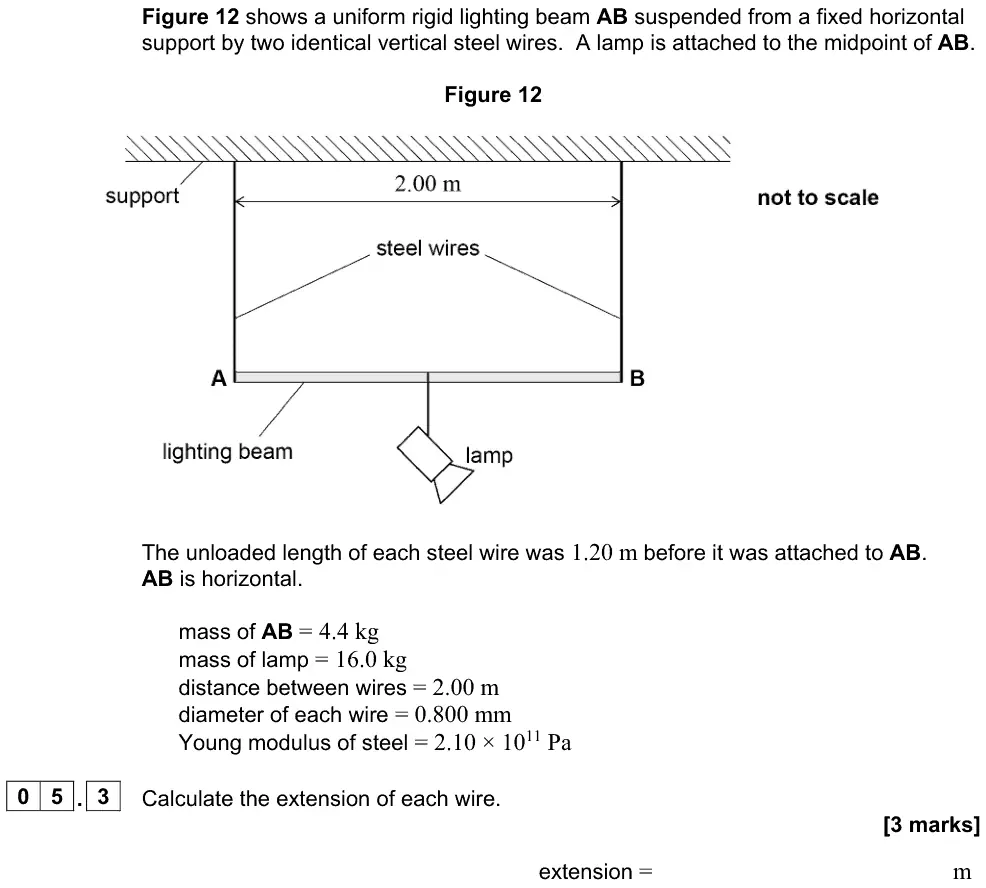
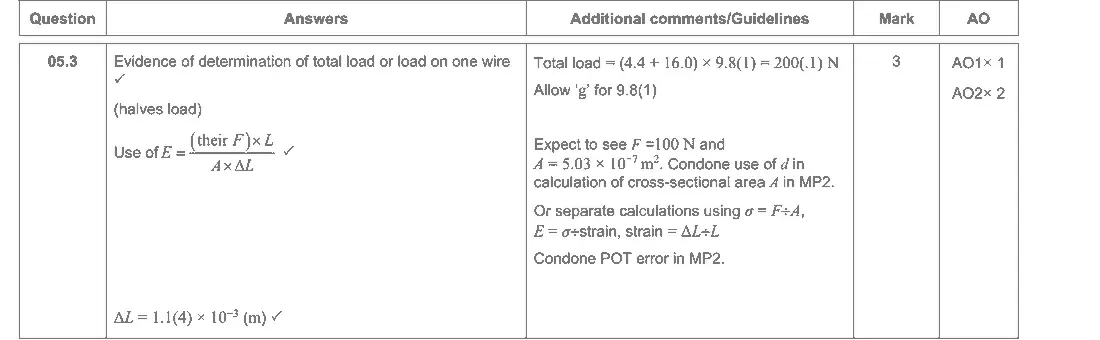
05.3 The calculation was reasonably accessible with nearly half of the students getting full marks. The question discriminated well, giving students who got the wrong value some credit provided their answer was set out sufficiently clearly to show what they were doing. A common error was using 200 N for the load; this gave access to two of the three marks.
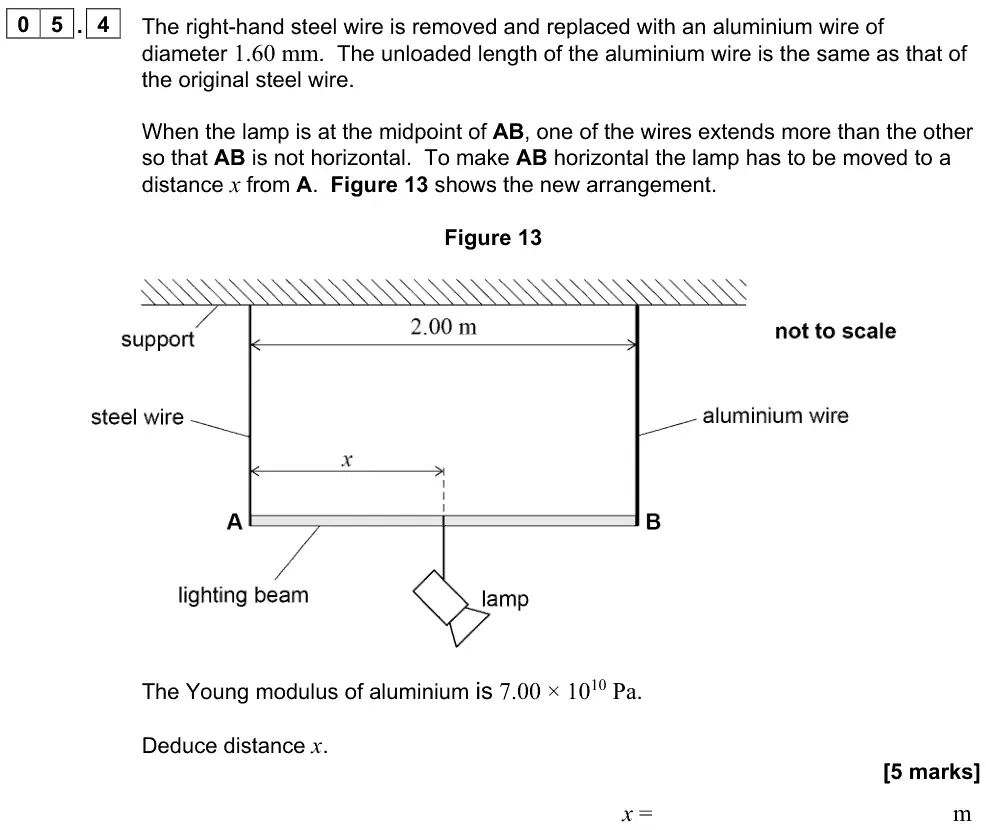
05.4 This was also one of the most discriminating on the paper. Over half of the students were able to get at least one mark, usually for providing evidence of a moment equation. Students who did not see that for AB to be horizontal the extensions of the two wires had to be equal made little further progress. The mark scheme produced a range of marks, rewarding students who set out their work sufficiently clearly to obtain intermediate marks. Using the value of extension from question 05.3 gave partial credit to some of these students.
Notes from the mark scheme and report
Answer: 1.14 x 10^-3 m (load 200 N shared, 100 N per wire, A = 5.03 x 10^-7 m^2, L = 1.20 m)
using 200 N on one wire common
Skills: MS4.3 Calculate areas of triangles, circumferences and areas of circles, surface areas and volumes of rectangular blocks, cylinders and spheres; MS2.2 Change the subject of an equation, including non-linear equations; MS2.3 Substitute numerical values into algebraic equations using appropriate units for physical quantities
June 2023 · Paper 1 · Q5.45 marksAO3=5Calculation
Earlier part of question 5 that this part uses
Mark scheme
Examiner's comment
05.4 This was also one of the most discriminating on the paper. Over half of the students were able to get at least one mark, usually for providing evidence of a moment equation. Students who did not see that for AB to be horizontal the extensions of the two wires had to be equal made little further progress. The mark scheme produced a range of marks, rewarding students who set out their work sufficiently clearly to obtain intermediate marks. Using the value of extension from question 05.3 gave partial credit to some of these students.
Notes from the mark scheme and report
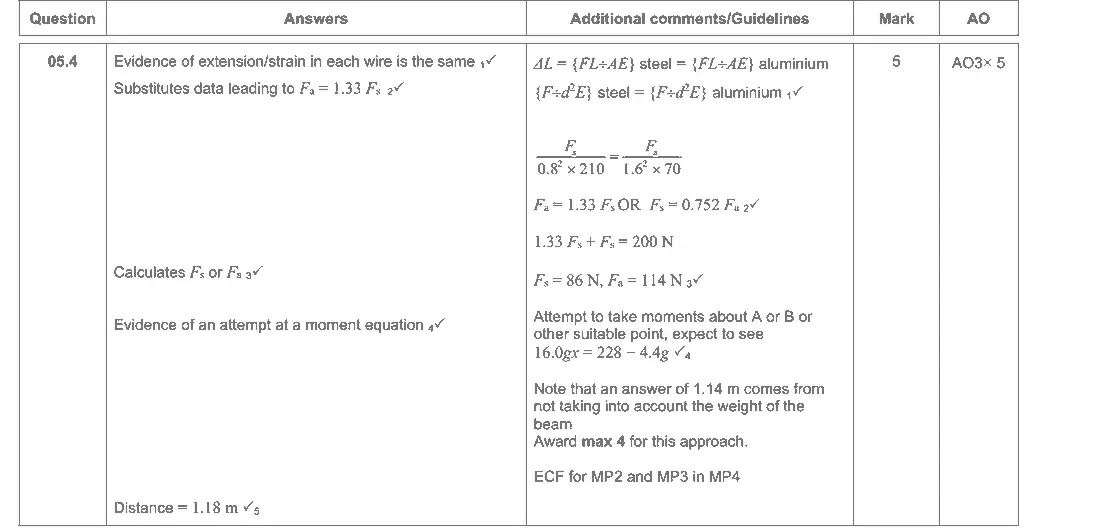
Answer: x = 1.18 m (equal extensions so Fa = 1.33 Fs, Fs = 86 N, Fa = 114 N, moments about A including the beam weight)
ignoring beam weight gives 1.14 m
recognising equal extensions was the key step
Skills: MS2.2 Change the subject of an equation, including non-linear equations; MS2.3 Substitute numerical values into algebraic equations using appropriate units for physical quantities
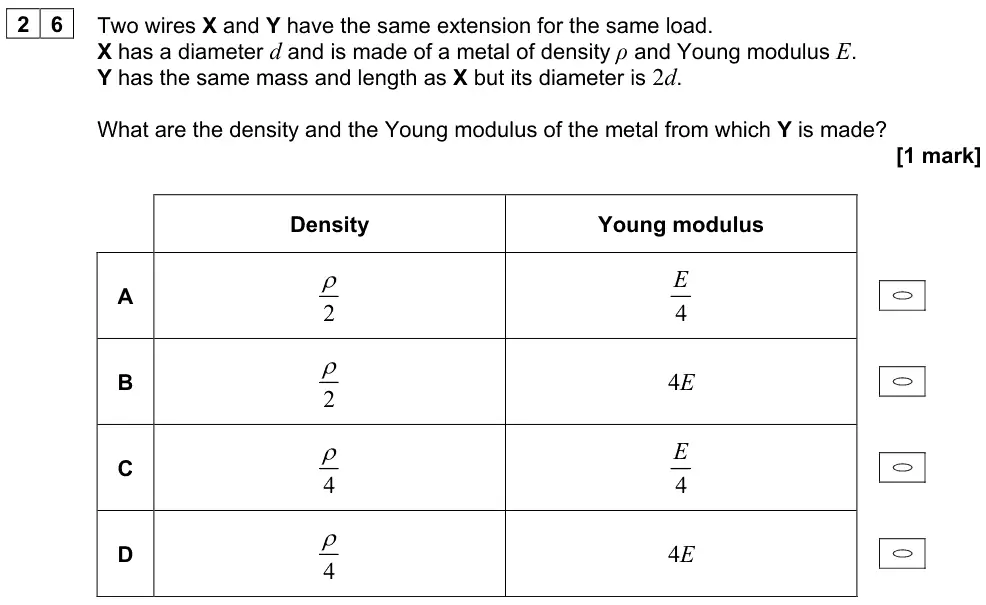
June 2023 · Paper 1 · Q261 markMultiple choiceHard
Answer
D
Mark scheme
Examiner's comment
The multiple choice questions covered parts of the specification not covered in Section A. The distractors in these questions were written with common errors and misconceptions in mind. These questions are therefore an extremely useful resource when preparing students. The easiest questions were 7, 12, 20, 10 and 11, with over 75% of students getting these questions right. The most demanding were 18, 26, 22, 21 and 13; fewer than 40% of students got these right. For several of these the correct answer was not the most popular choice.
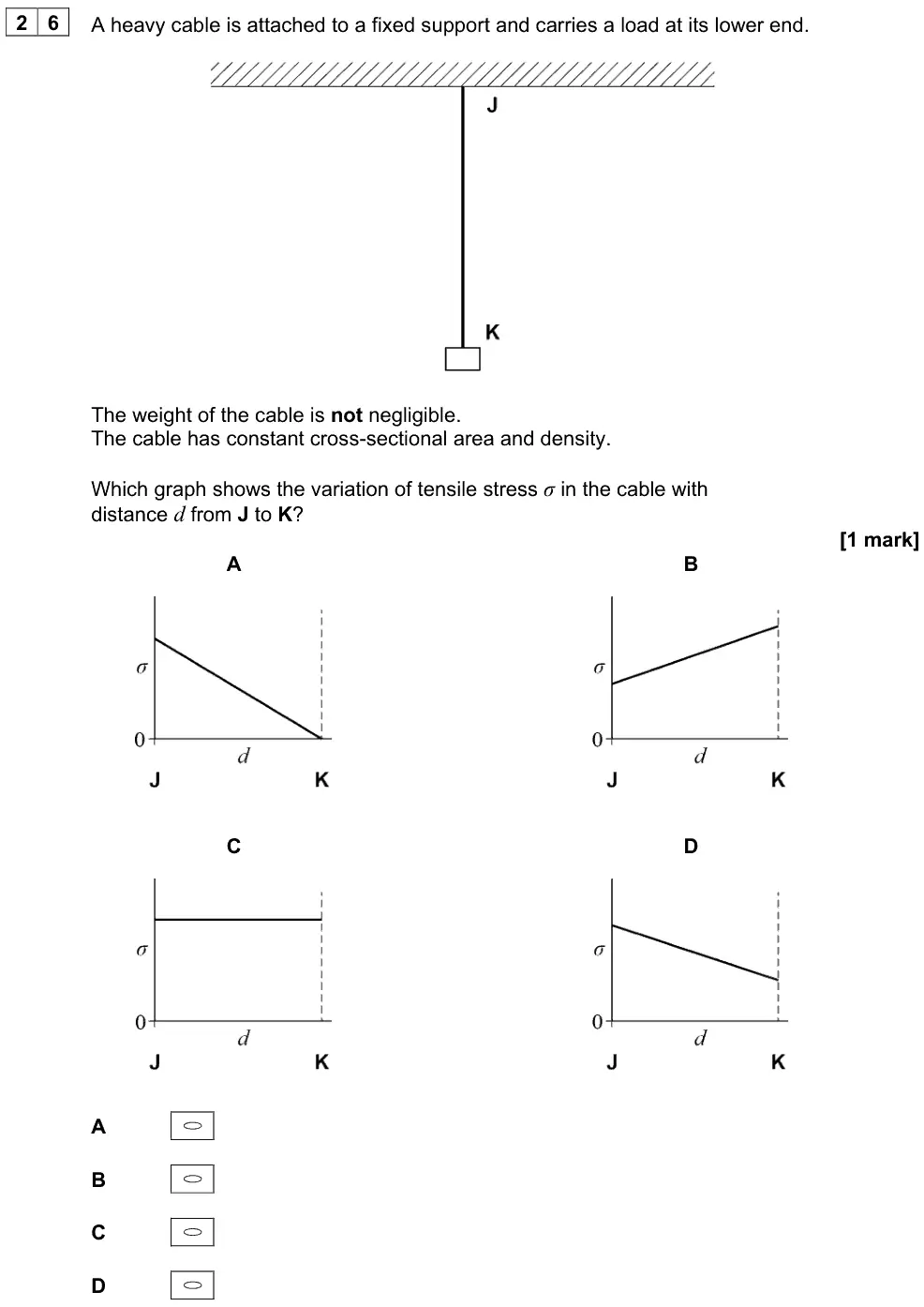
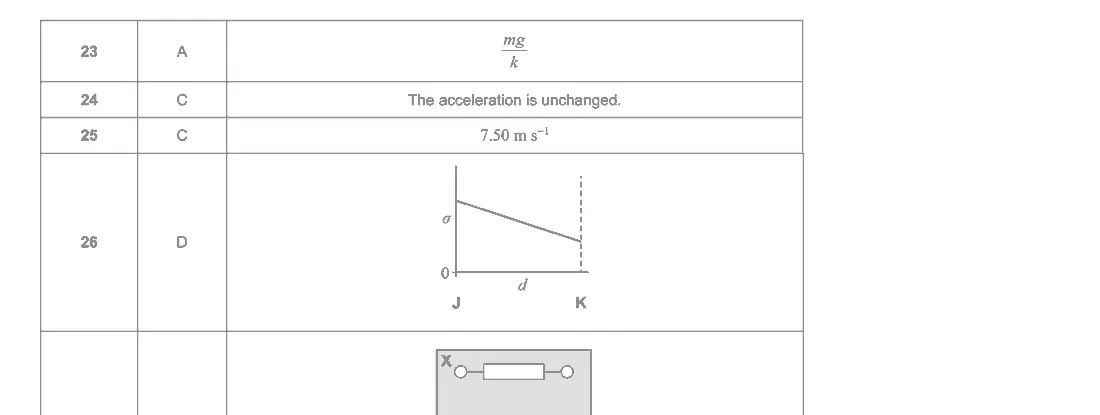
Question 26 was about tensile stress in a heavy cable. The most popular answers were B and C, the latter suggesting that students did not realise that the weight of the cable was not negligible.
Notes from the mark scheme and report
Answer: D
B and C most popular (cable weight ignored)
Skills: MS3.1 Translate information between graphical, numerical and algebraic forms
June 2023 · AS Paper 2 · Q271 markMultiple choiceEasy
Answer
D
Mark scheme
Examiner's comment
Generally, students were more successful in answering questions 9, 15, 16, 19, 25, 27, 28 (these all had a success rate of at least 65%) and were less successful in answering questions 6, 7, 18, 23 and 31 (answered correctly by 35% or fewer).
Notes from the mark scheme and report
Answer: D
Skills: MS3.4 Determine the slope and intercept of a linear graph
June 2022 · Paper 1 · Q3.13 marksAO3=3Calculation
Mark scheme
Examiner's comment
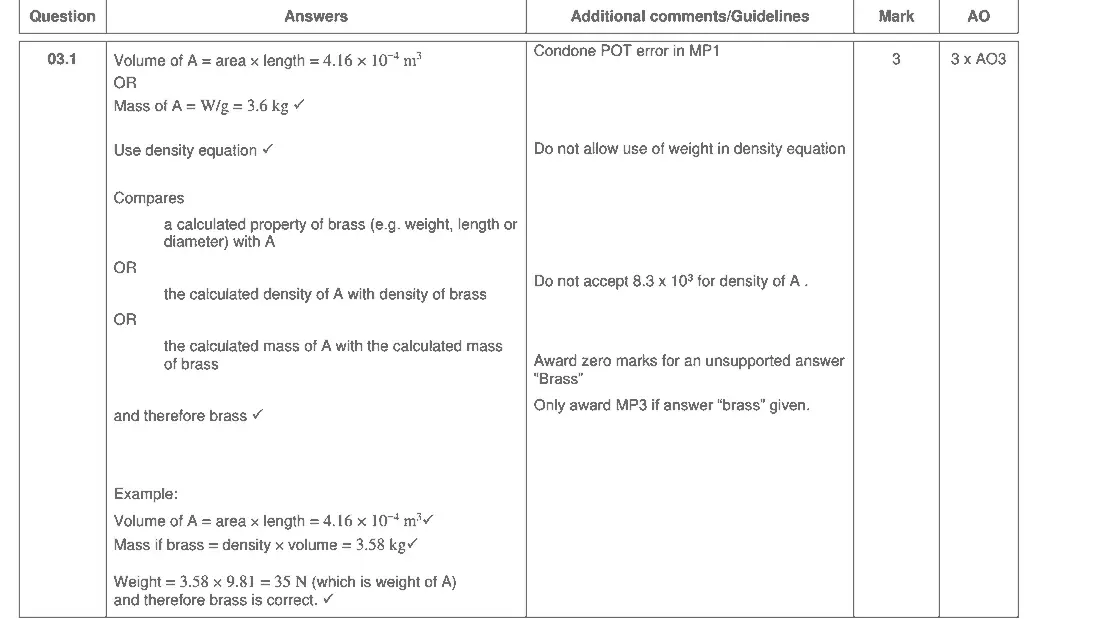
Most students were able to answer 03.1 correctly and obtain full marks. Partial credit was available for students who got the wrong answer, but answers needed to be set out with sufficient clarity for any mark to be awarded. Students should be encouraged to make each step in their calculations clear.
Notes from the mark scheme and report
Answer: brass (volume pi r^2 L = 4.16 x 10^-4 m^3, mass 35/9.81 = 3.6 kg, density 8.6 x 10^3 kg m^-3)
unsupported 'brass' scores 0
Skills: MS4.3 Calculate areas of triangles, circumferences and areas of circles, surface areas and volumes of rectangular blocks, cylinders and spheres; MS2.3 Substitute numerical values into algebraic equations using appropriate units for physical quantities
June 2022 · AS Paper 1 · Q6.22 marksAO1=1, AO2=1Calculation
Earlier part of question 6 that this part uses
Mark scheme
Examiner's comment
06.2 Most students gained at least one mark in this calculation. The reasons seen for failing to gain the second mark included: use of 3.6 m for L, thinking that the extension was the answer, and an inaccurate read-off from Figure 6. These errors reflect a lack of exam technique; students did not cope well in situations where key information was provided in the opening stem of the question.
Students should be encouraged to use a ruler to draw straight lines on diagrams to ensure an appropriate degree of accuracy in reading data from graphs.
Notes from the mark scheme and report
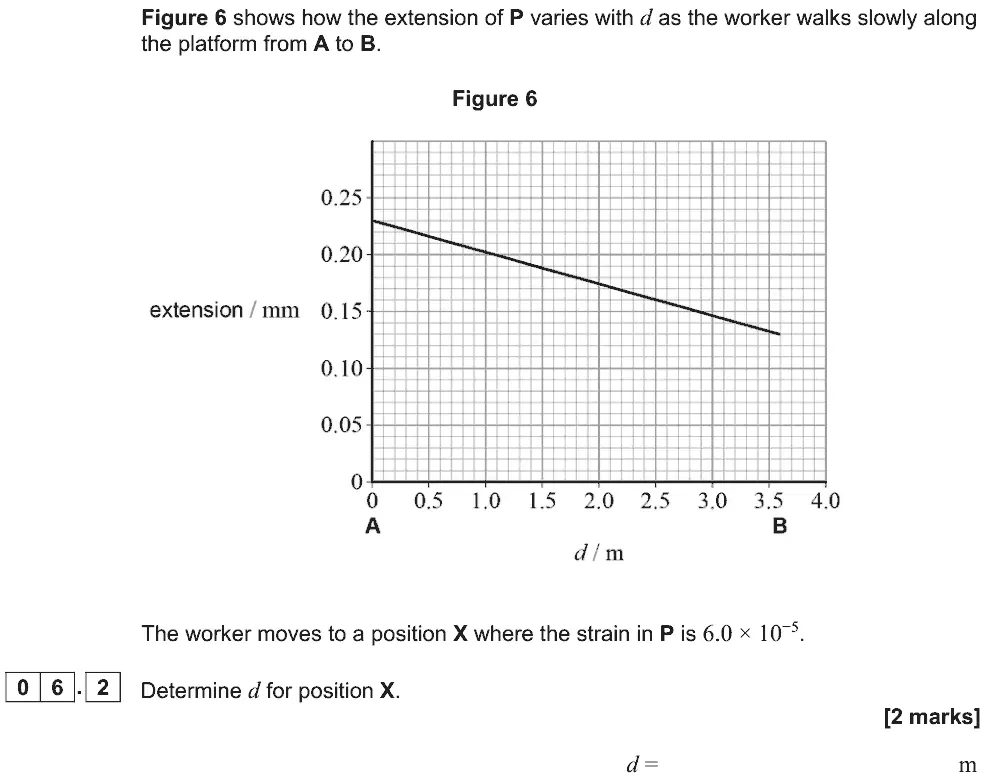
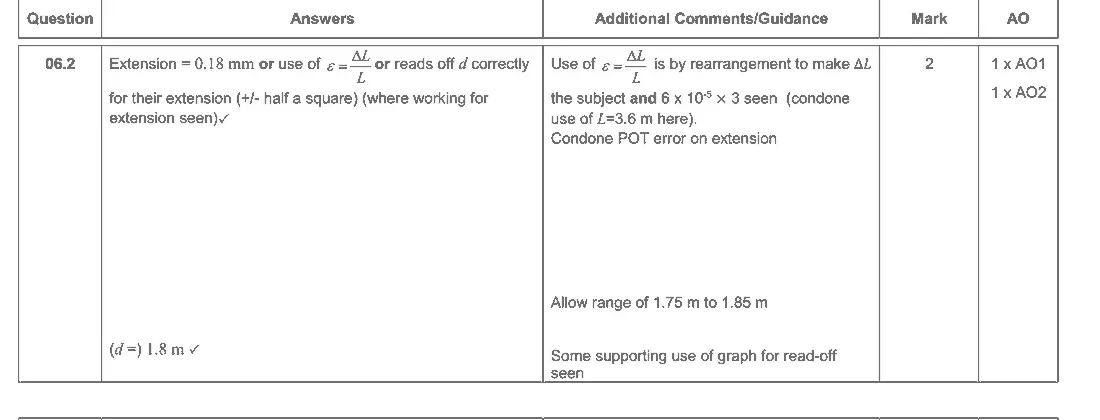
Answer: 1.8 m (extension = 6.0 x 10^-5 x 3.0 m = 0.18 mm, read from Figure 6)
using 3.6 m for L or giving the extension as the answer were errors
Skills: MS3.1 Translate information between graphical, numerical and algebraic forms; MS2.2 Change the subject of an equation, including non-linear equations
June 2022 · AS Paper 1 · Q6.31 markAO1=1CalculationEasy
Earlier part of question 6 that this part uses
Mark scheme
Examiner's comment
06.3 Over 70% of students gained this mark. This calculation was much simpler than the previous question with both pieces of data provided close to the question. The best answers seen typically followed the steps of writing the equation, substituting the data, re-arranging to make the stress the subject, and placing the answer to an appropriate number of significant figures on the answer line.
Notes from the mark scheme and report
Answer: 1.1 x 10^7 N m^-2 (1.9 x 10^11 x 6.0 x 10^-5)
Skills: MS2.3 Substitute numerical values into algebraic equations using appropriate units for physical quantities
June 2022 · AS Paper 1 · Q6.43 marksAO3=3Diagram or graph
Earlier part of question 6 that this part uses
Mark scheme
Examiner's comment
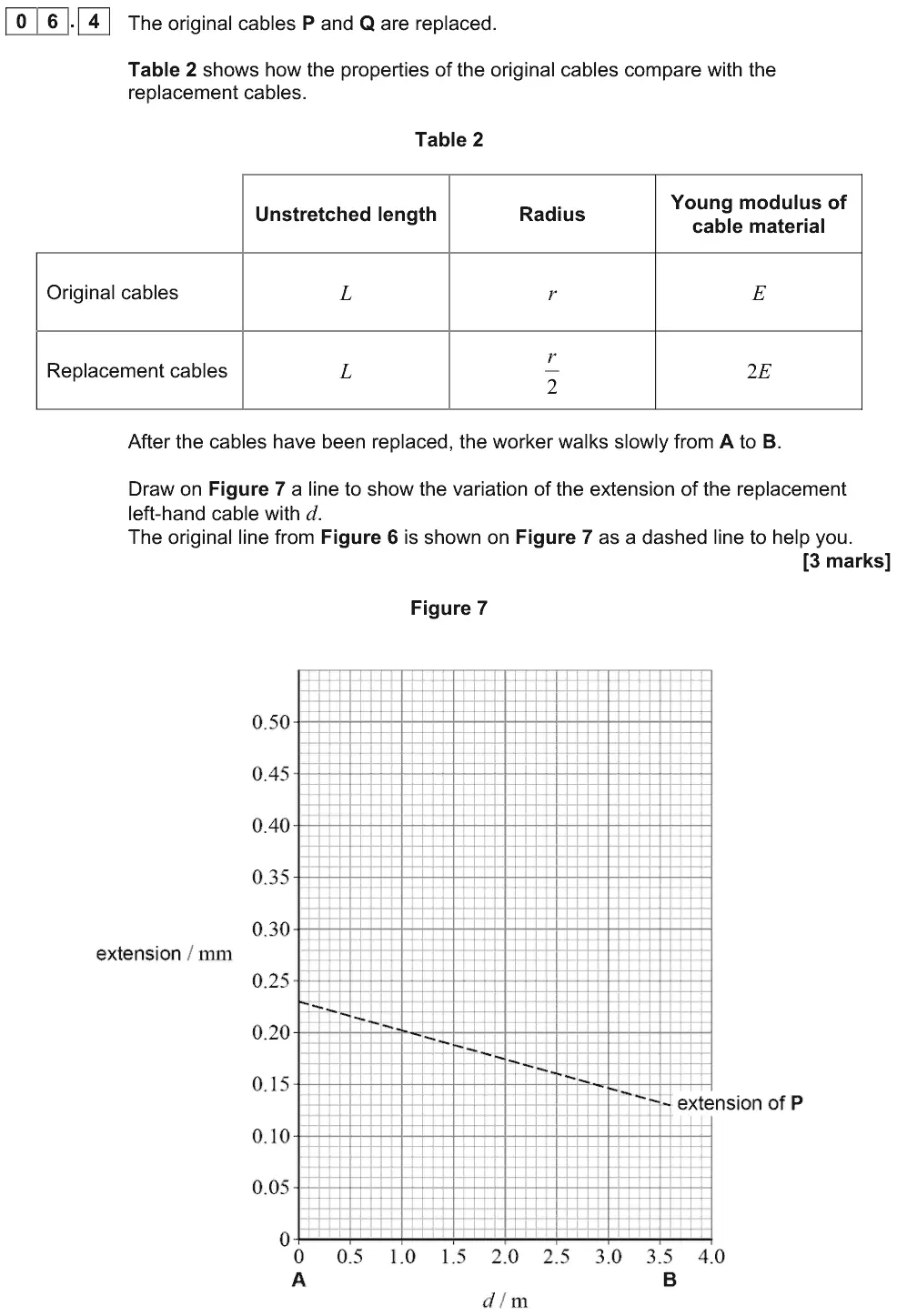
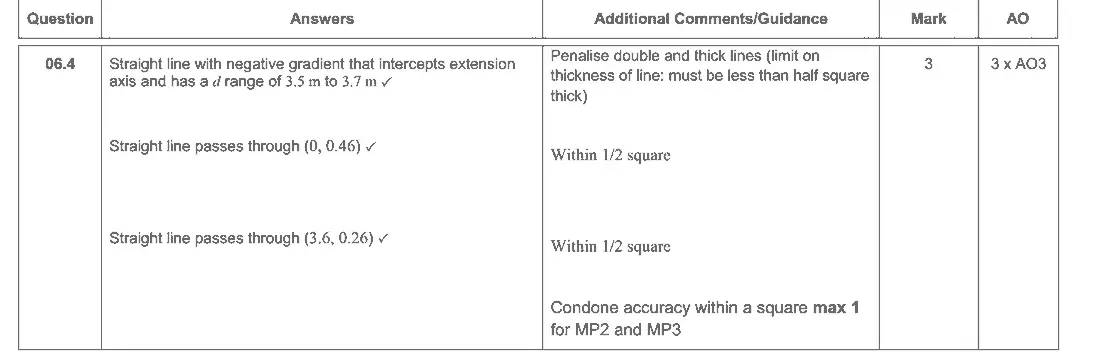
06.4 Most students gained at least one mark by drawing an appropriate line with a negative gradient. Just over 20% gained two marks; these students appreciated that that extension had doubled and were able to determine the new extension for d = 0 but then incorrectly drew a line parallel to the original line.
Notes from the mark scheme and report
Area quartered and E doubled so extension doubles: straight line from (0, 0.46 mm) to (3.6 m, 0.26 mm)
a line parallel to the original was the common error
Skills: MS3.1 Translate information between graphical, numerical and algebraic forms; MS0.3 Use ratios, fractions and percentages
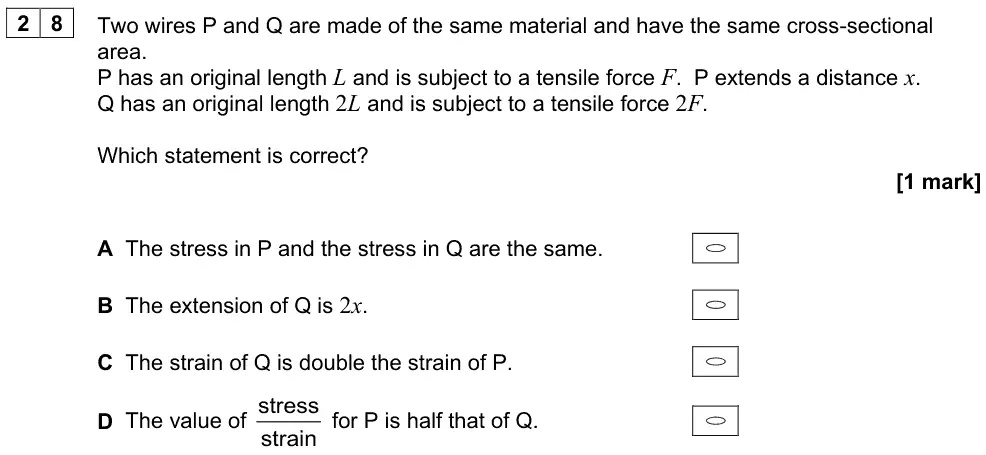
June 2022 · Paper 1 · Q271 markAO1=1Multiple choice
Answer
D
Mark scheme
Notes from the mark scheme and report
Answer: D
Skills: MS0.3 Use ratios, fractions and percentages
June 2022 · Paper 1 · Q281 markAO3=1Multiple choice
Answer
C
Mark scheme
Notes from the mark scheme and report
Answer: C
June 2022 · AS Paper 2 · Q61 markAO3=1Multiple choice
Answer
C
Mark scheme
Notes from the mark scheme and report
Answer: C
Skills: MS1.4 Make order of magnitude calculations
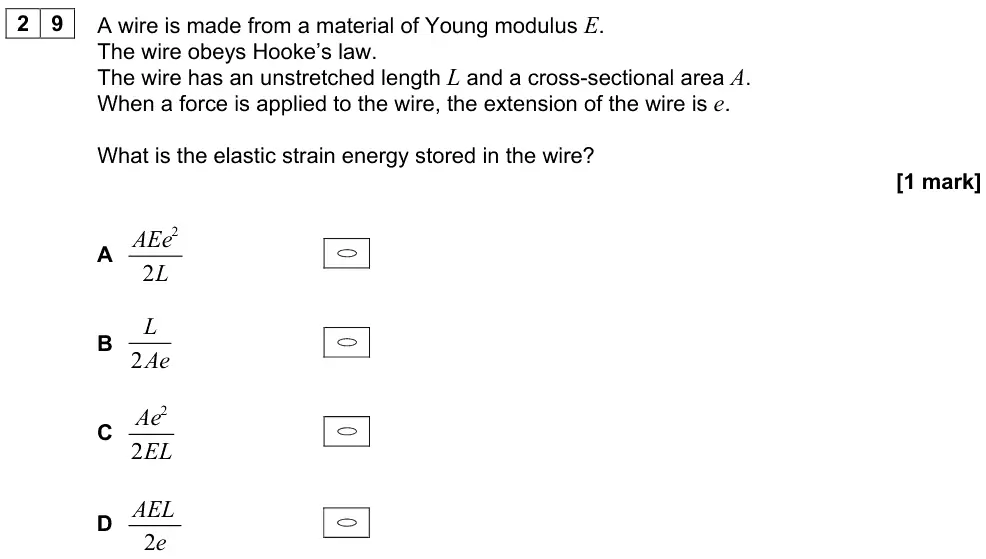
June 2022 · AS Paper 2 · Q291 markAO2=1Multiple choice
Answer
A
Mark scheme
Notes from the mark scheme and report
Answer: A
Skills: MS2.2 Change the subject of an equation, including non-linear equations
June 2022 · Paper 3 Section A · Q2.12 marksAO3=2Practical and data analysis
Mark scheme
Examiner's comment
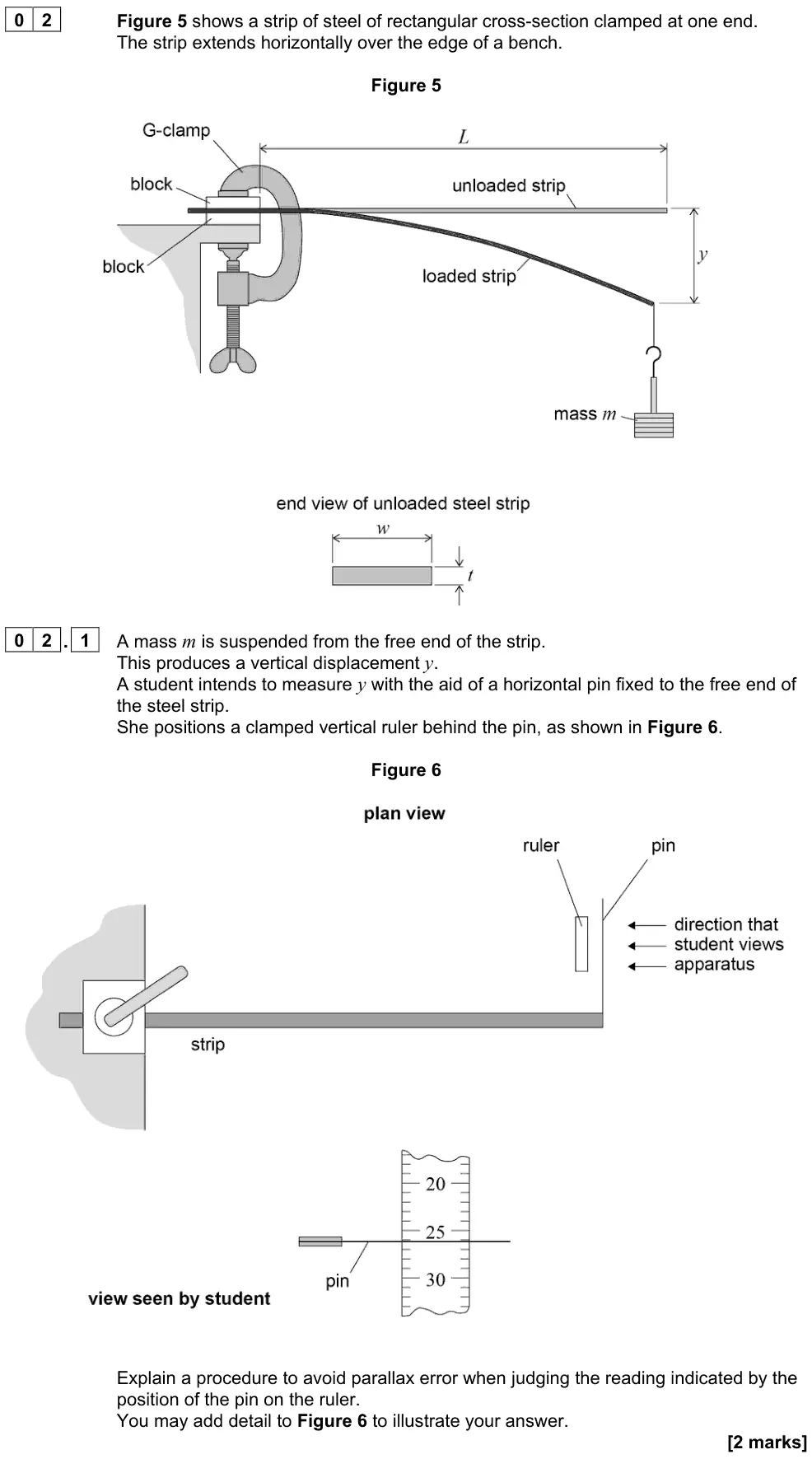
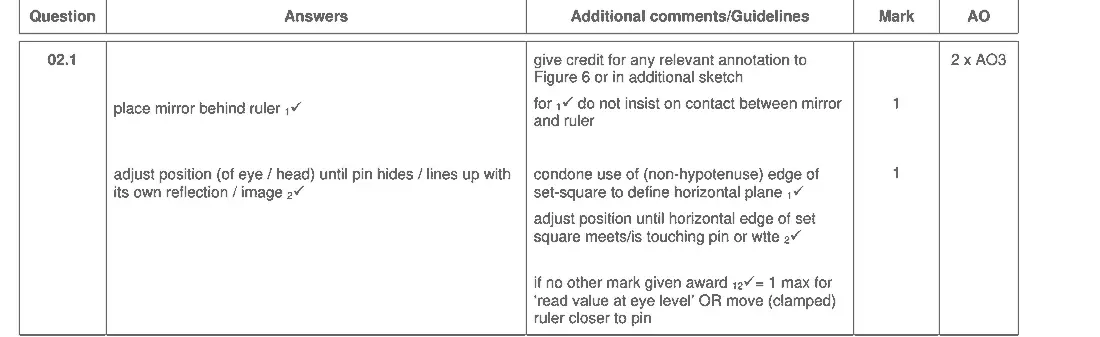
The use of a mirror to avoid parallax error was also tested in November 2021 (question 03.2) when only 10% could answer successfully. In 02.1 few could improve on ‘view at eye level’ or ‘move the ruler closer to pin’. Annotation to Figure 6 enabled some to show how a set-square could be held against the ruler to provide a horizontal reference but it was rare to find answers that earned both marks.
Most parts of the 2022 paper provided opportunities for stronger students to demonstrate their ability while preserving the chances of others to show what they knew. Most marking points were accessible. Exceptions were 02.1, 04.1 and 04.3, as discussed later.
Things students could do better: • spotting the intention of the question: in 04.5 we asked why the gradient confirmed Boyle’s Law but only about half of the students made use of the space provided for a calculation; • check for false origins – many said the intercept in Figure 13 was 1.685; • ‘add detail’ to a Figure to illustrate an answer when prompted to do so – many saved their answer in 02.1 by taking this advice; • refer only to a variable using the symbol or description given in the question; e.g. in 02.2, y is defined as displacement so calling it “extension” or “length” leads to student confusion; • be more concise and targeted with extended writing; consider using bullets or lists; • review recent question papers and marking schemes.
Notes from the mark scheme and report
Place a mirror behind the ruler and move the eye until the pin hides its reflection (or set square edge from the ruler to the pin)
'view at eye level' or 'move ruler closer' max 1
Skills: ATa analogue apparatus to record measurements and interpolate; ATc methods to increase accuracy (timing over many oscillations, fiducial marker, set square, plumb line); PS4.1 Know and understand how to use a wide range of experimental and practical instruments, equipment and techniques; RP4 Determination of the Young modulus by a simple method.
June 2022 · Paper 3 Section A · Q2.25 marksPractical and data analysis
Earlier part of question 2 that this part uses
Mark scheme
Examiner's comment
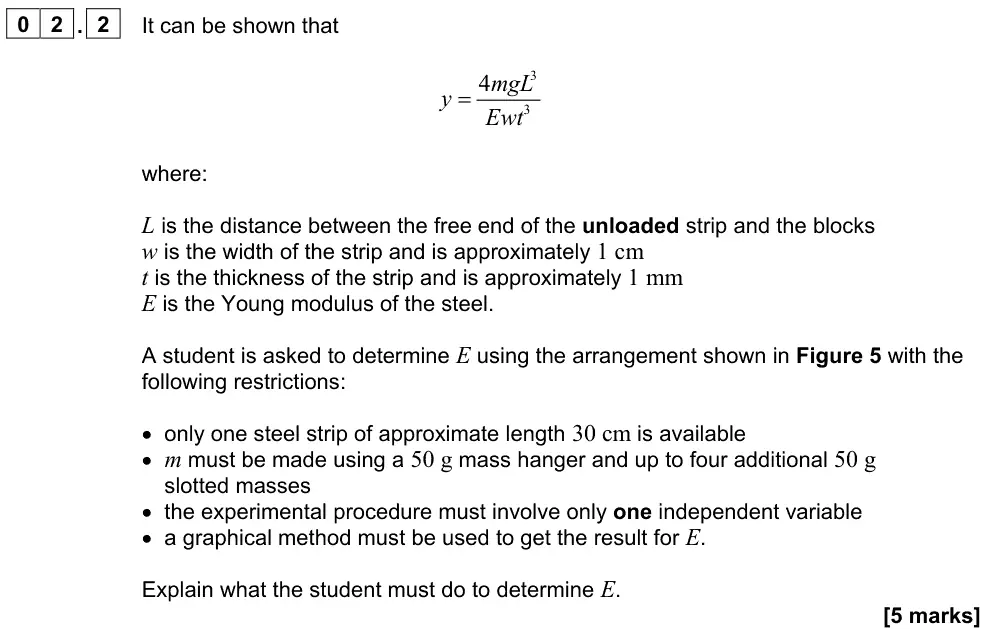
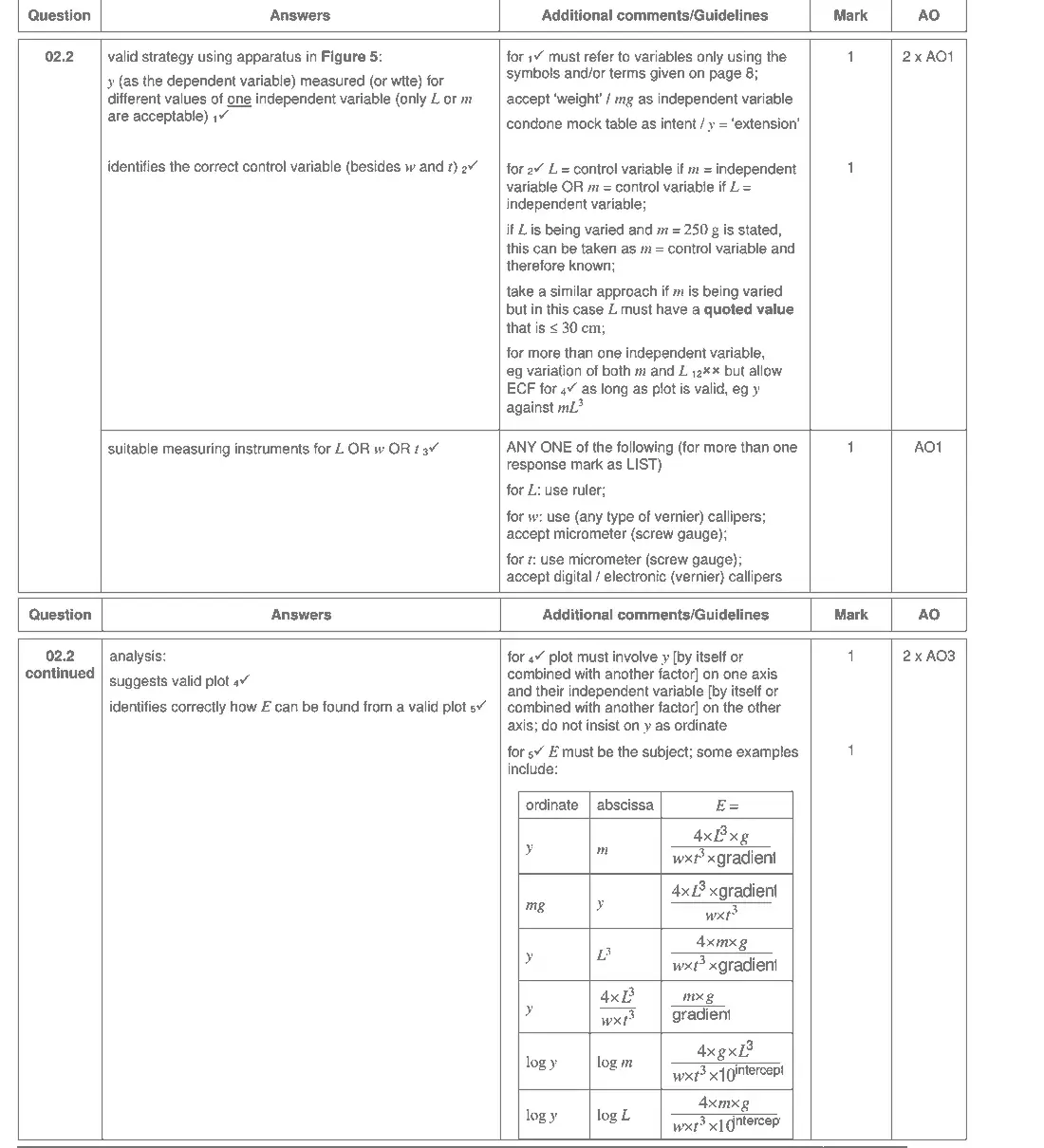
In 02.2 most students outlined a plausible strategy (in which y was the dependent variable) and suggested a valid plot of their data. Although the majority opted to plot y against m, examiners did not insist that y was plotted on the vertical axis of the graph. Many went on to show how they would find the Young modulus using the gradient of their graph. About 25% scored at least 4 of the 5 marks. These students explicitly stated that L was a control variable (providing m was being varied) and/or suggested suitable instruments with which to measure L or w or t. In some cases, where the term ‘extension’ was used (rather than ‘displacement’ or y), students had decided to stretch the strip lengthways. Using w t × for cross- y for strain they said E was the gradient of a stress/strain graph. sectional area and L
The questions were designed to allow students to demonstrate competence in the key techniques and investigative approaches required in three of the twelve assessed practical activities. This cohort showed that when the question provided enough structure to deter them from improvising, they could produce coherent and sensible extended writing, as in 01.3 and 02.2. Question 04.2 was a different story, with some students referring to ‘suction’ and equating pressure with ‘gravity’.
Things students could do better: • spotting the intention of the question: in 04.5 we asked why the gradient confirmed Boyle’s Law but only about half of the students made use of the space provided for a calculation; • check for false origins – many said the intercept in Figure 13 was 1.685; • ‘add detail’ to a Figure to illustrate an answer when prompted to do so – many saved their answer in 02.1 by taking this advice; • refer only to a variable using the symbol or description given in the question; e.g. in 02.2, y is defined as displacement so calling it “extension” or “length” leads to student confusion; • be more concise and targeted with extended writing; consider using bullets or lists; • review recent question papers and marking schemes.
Notes from the mark scheme and report
Measure y (dependent) for m varied in 50 g steps with L fixed (or vary L, fix m)
measure L with a metre ruler, w with vernier callipers and t with a micrometer
plot y against m (or L^3)
gradient = 4gL^3/(E w t^3), solve for E
stretching the strip lengthways is wrong
Skills: PS2.1 Comment on experimental design and evaluate scientific methods; PS2.4 Identify variables including those that must be controlled; MS3.3 Understand that y = mx + c represents a linear relationship; ATa analogue apparatus to record measurements and interpolate; ATe calipers and micrometers; RP4 Determination of the Young modulus by a simple method.
November 2021 · AS Paper 1 · Q3.34 marksCalculation
Earlier part of question 3 that this part uses
Mark scheme
Notes from the mark scheme and report
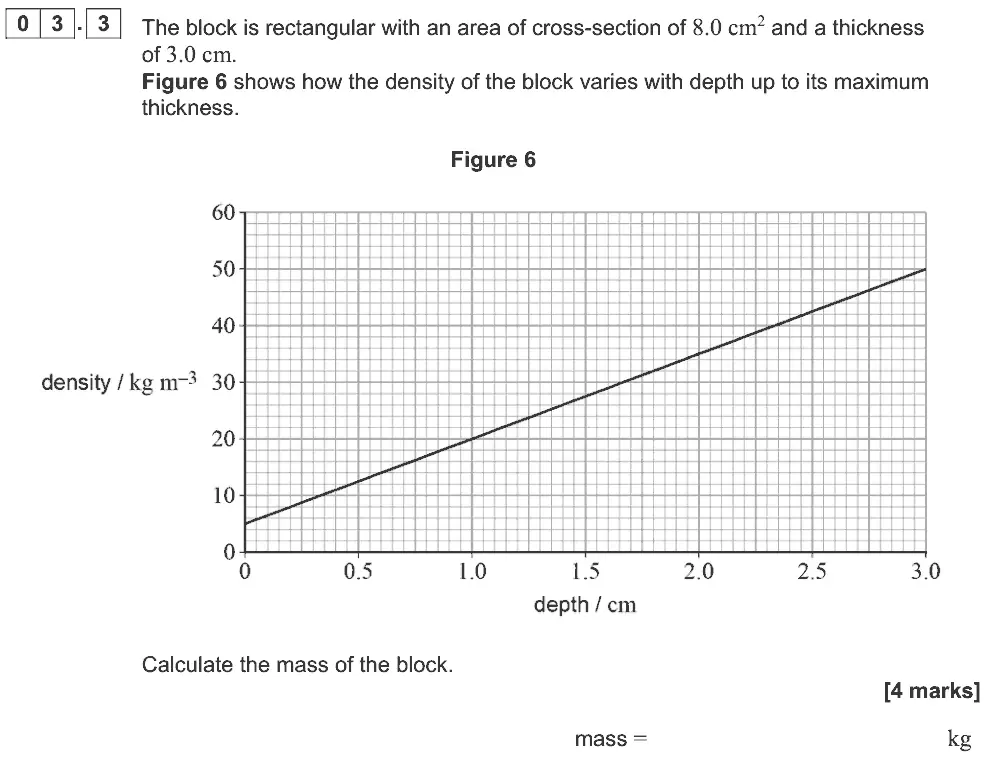
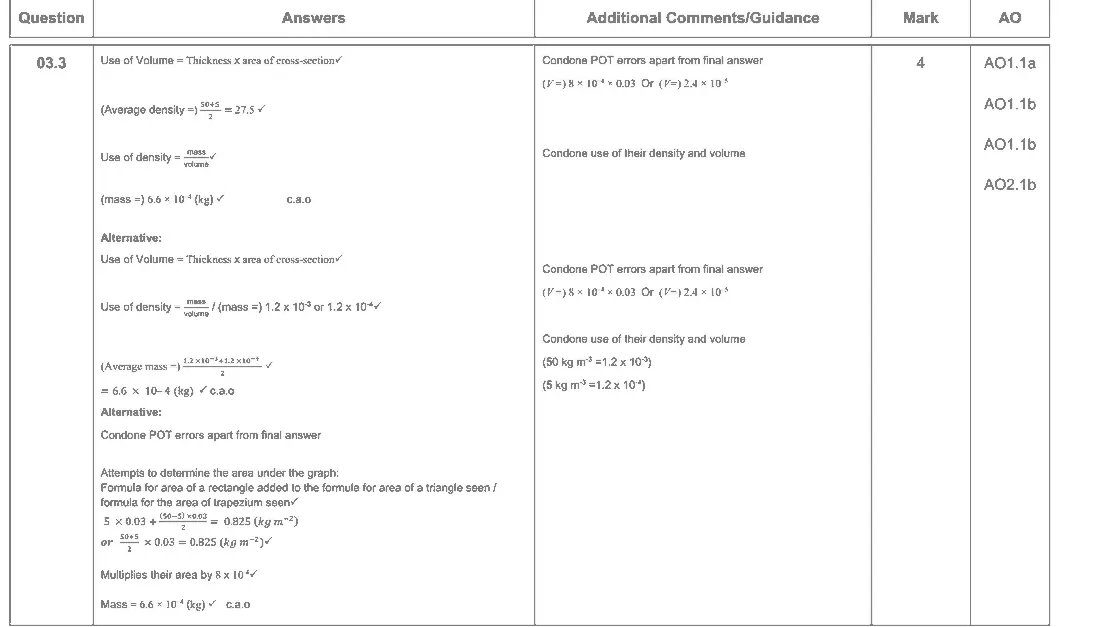
Answer: 6.6 x 10^-4 kg (volume 8.0 x 10^-4 x 0.030 = 2.4 x 10^-5 m^3, mean density (50 + 5)/2 = 27.5 kg m^-3 from Figure 6)
unit conversion of cm2 and cm needed
Skills: MS3.1 Translate information between graphical, numerical and algebraic forms; MS3.8 Understand the possible physical significance of the area between a curve and the x axis and be able to calculate it or estimate it by graphical methods as appropriate; MS0.1 Recognise and make use of appropriate units in calculations
November 2021 · Paper 1 · Q4.45 marksAO3=5Calculation
Earlier part of question 4 that this part uses
Mark scheme
Examiner's comment
Circular motion is a demanding topic for many students. Answers to these questions indicated the difficulties students commonly have with the ideas of reaction force, centripetal force and angular speed. The multi-step calculation in question 04.4 proved too difficult for many students, some of whom did little more than work out the Young Modulus, which was not needed. Some of these students made a little progress when they used their calculated Young Modulus to determine a quantity that they could have simply read from the graph. The idea of a safety factor was usually either missed or not understood.
Notes from the mark scheme and report
Force = mA g = 1.32 x 10^6 x 3.7 = 4.9 x 10^6 N
choose a stress well below 0.30 GPa (in the linear region, safety factor)
A = F / stress, d = root(4A/pi) > 0.144 m
working out the Young modulus not needed
safety factor rarely considered
Skills: MS4.3 Calculate areas of triangles, circumferences and areas of circles, surface areas and volumes of rectangular blocks, cylinders and spheres; MS2.2 Change the subject of an equation, including non-linear equations; MS3.1 Translate information between graphical, numerical and algebraic forms
November 2021 · Paper 1 · Q261 markMultiple choice
Answer
C
Mark scheme
Notes from the mark scheme and report
Answer: C
Skills: MS0.3 Use ratios, fractions and percentages
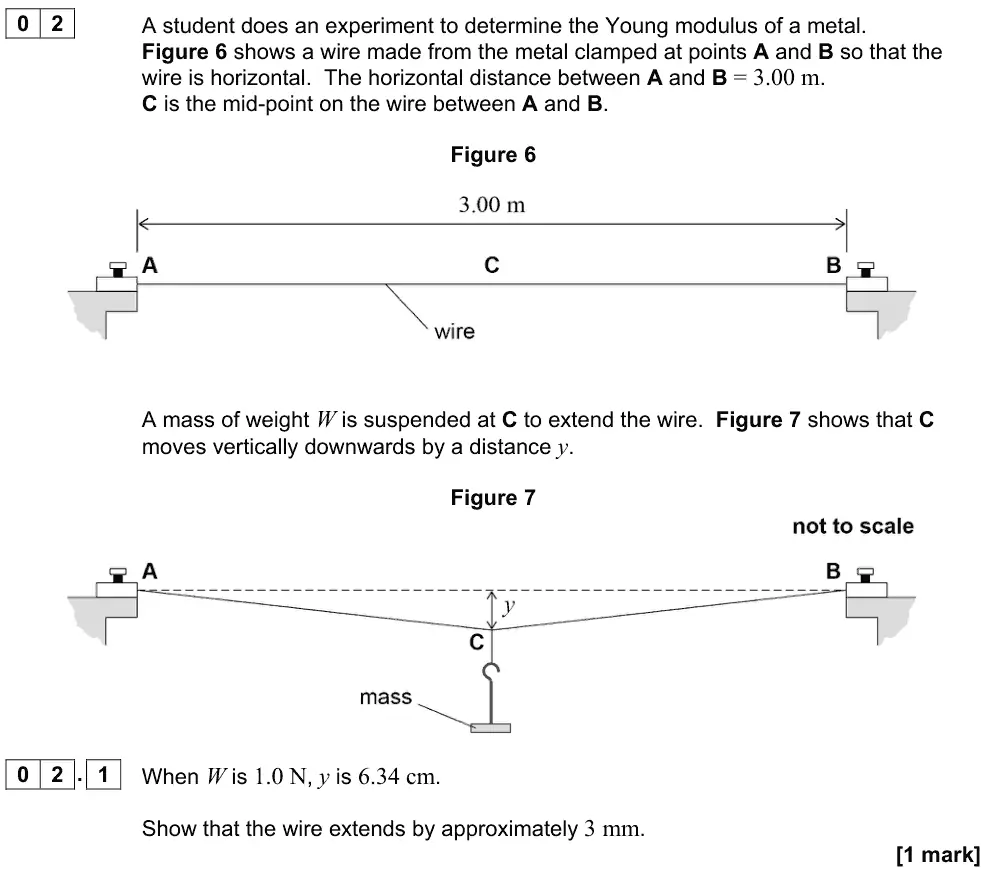
November 2021 · AS Paper 2 · Q2.11 markAO2=1Show that
Mark scheme
Notes from the mark scheme and report
Answer: 2.7 mm (new half-length = sqrt(1.50^2 + 0.0634^2) = 1.50134 m
extension 1.34 mm per half, doubled)
at least 2 sf
Skills: MS4.4 Use Pythagoras’ theorem, and the angle sum of a triangle; MS2.3 Substitute numerical values into algebraic equations using appropriate units for physical quantities
November 2021 · AS Paper 2 · Q2.34 marksPractical and data analysis
Earlier part of question 2 that this part uses
Mark scheme
Notes from the mark scheme and report
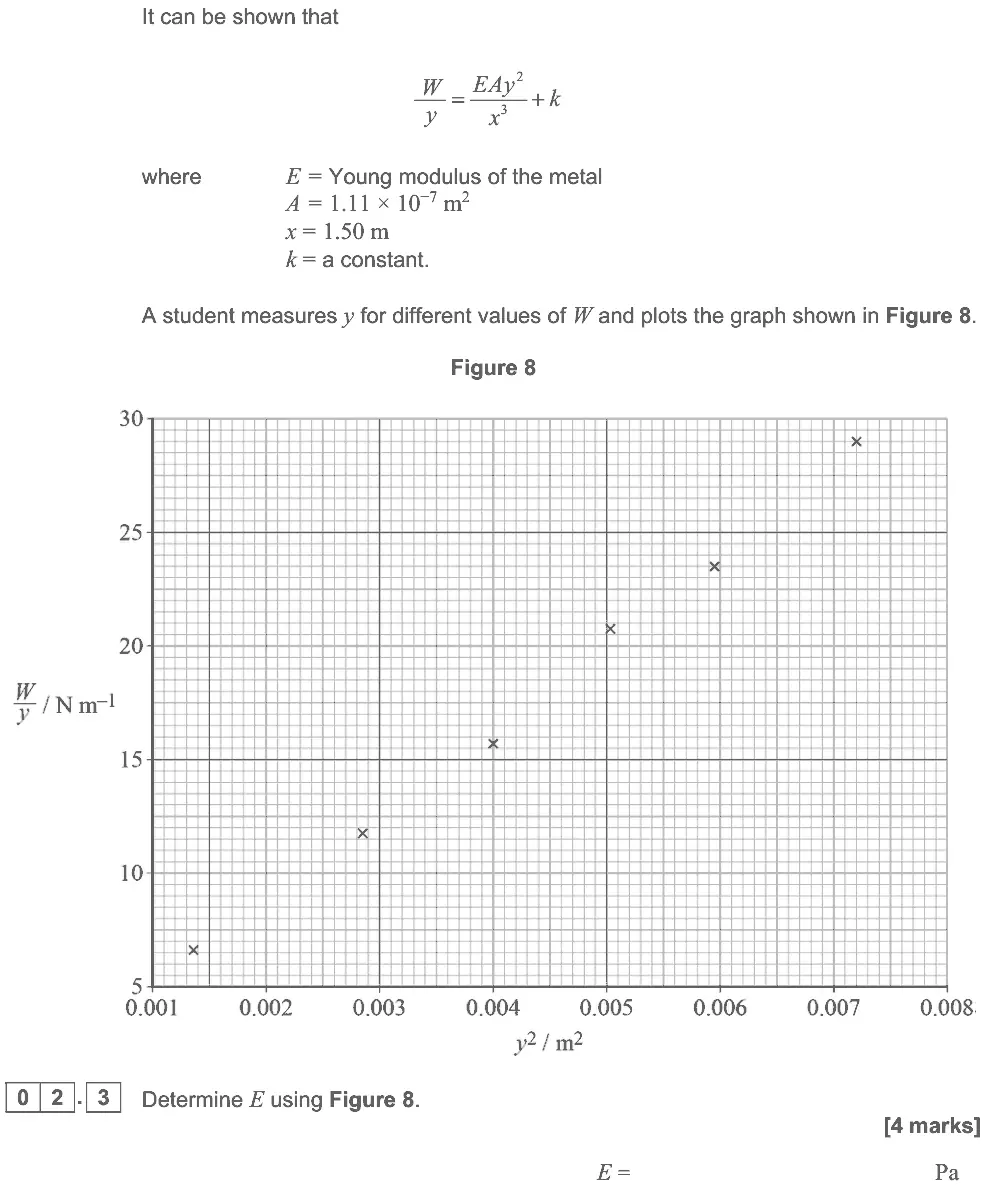
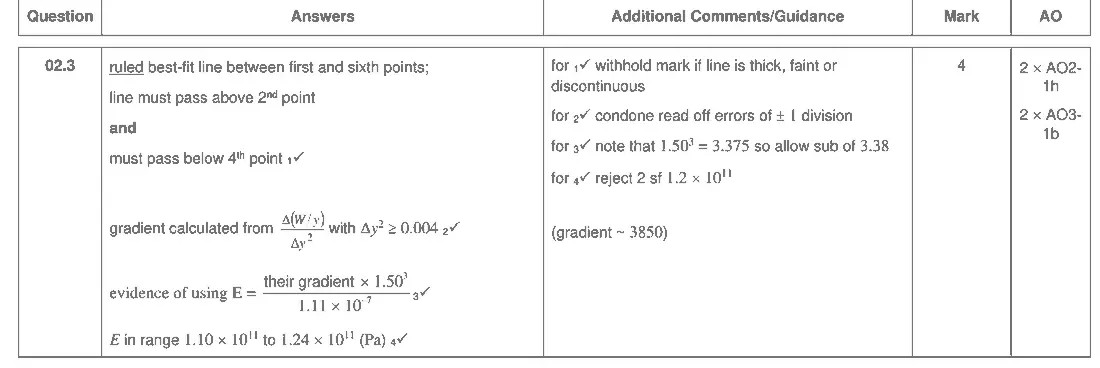
Answer: E = 1.2 x 10^11 Pa (gradient about 3850 N m^-3
E = gradient x 1.50^3 / 1.11 x 10^-7
range 1.10-1.24 x 10^11)
ruled line, gradient triangle delta y^2 at least 0.004
2 sf 1.2 x 10^11 rejected (3 sf)
Skills: MS3.3 Understand that y = mx + c represents a linear relationship; MS3.4 Determine the slope and intercept of a linear graph; MS2.2 Change the subject of an equation, including non-linear equations; PS3.2 Process and analyse data using appropriate mathematical skills; RP4 Determination of the Young modulus by a simple method.
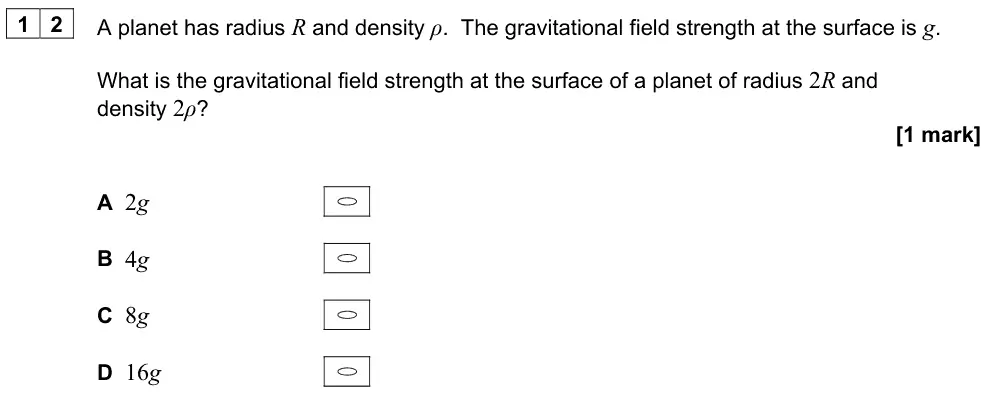
November 2021 · Paper 2 · Q121 markMultiple choice
Answer
B
Mark scheme
Notes from the mark scheme and report
Answer: B
Skills: MS0.3 Use ratios, fractions and percentages
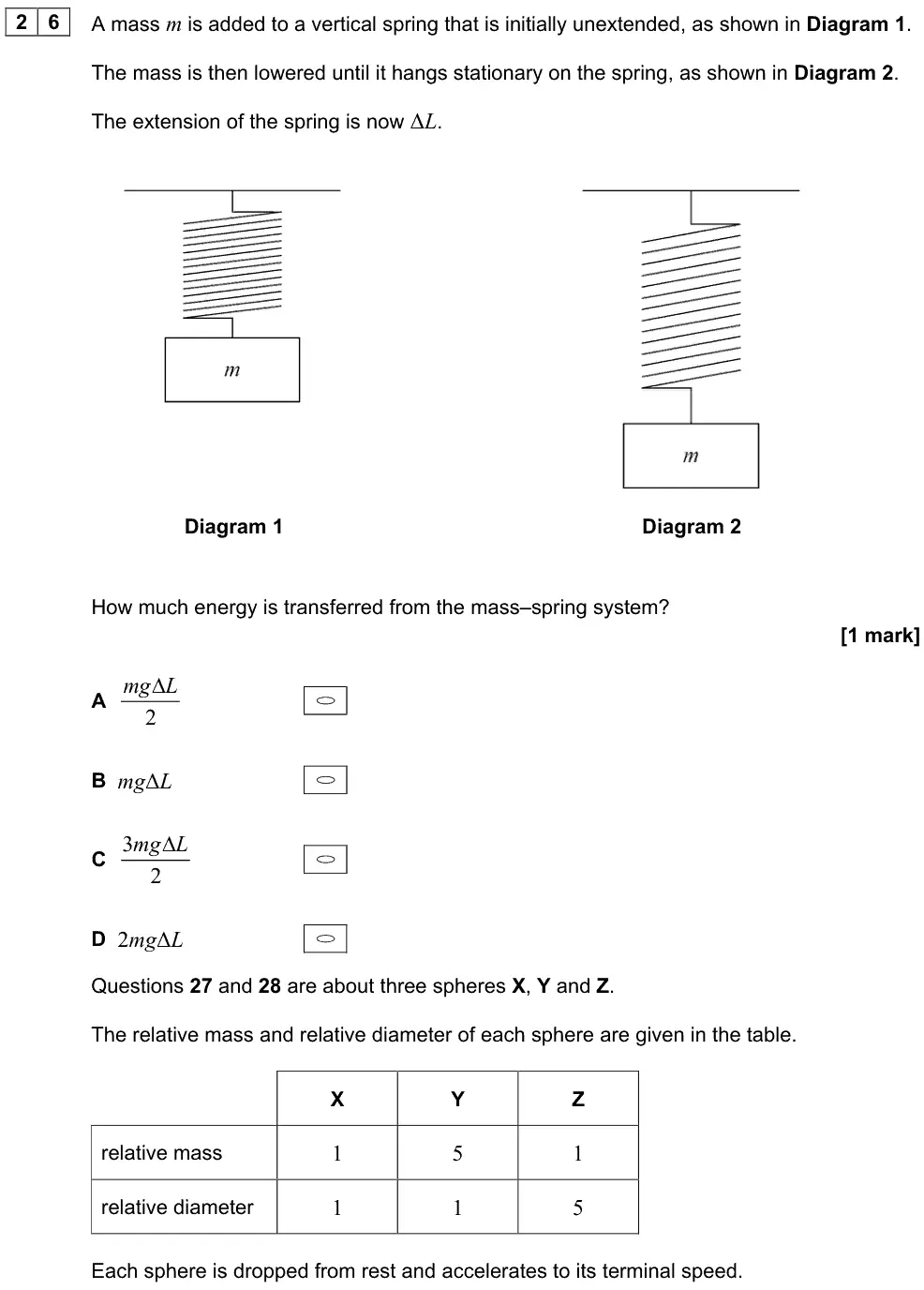
November 2021 · AS Paper 2 · Q261 markMultiple choice
Answer
A
Mark scheme
Notes from the mark scheme and report
Answer: A
GPE lost mg delta L, half stored as strain energy, half transferred
November 2021 · AS Paper 2 · Q321 markMultiple choice
Answer
A
Mark scheme
Notes from the mark scheme and report
Answer: A
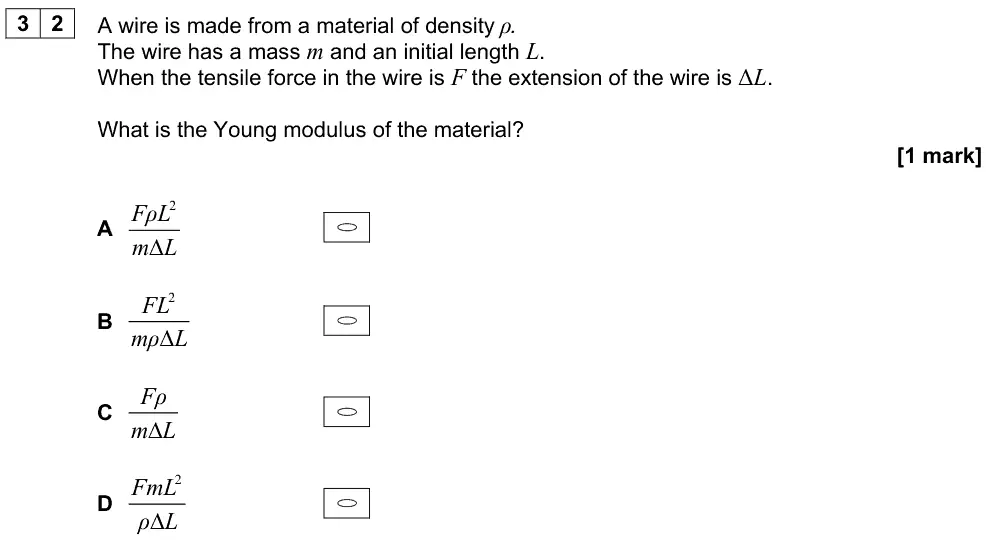
E = F rho L^2 / m delta L
Skills: MS2.2 Change the subject of an equation, including non-linear equations
November 2020 · Paper 1 · Q261 markMultiple choice
Answer
D
Mark scheme
Notes from the mark scheme and report
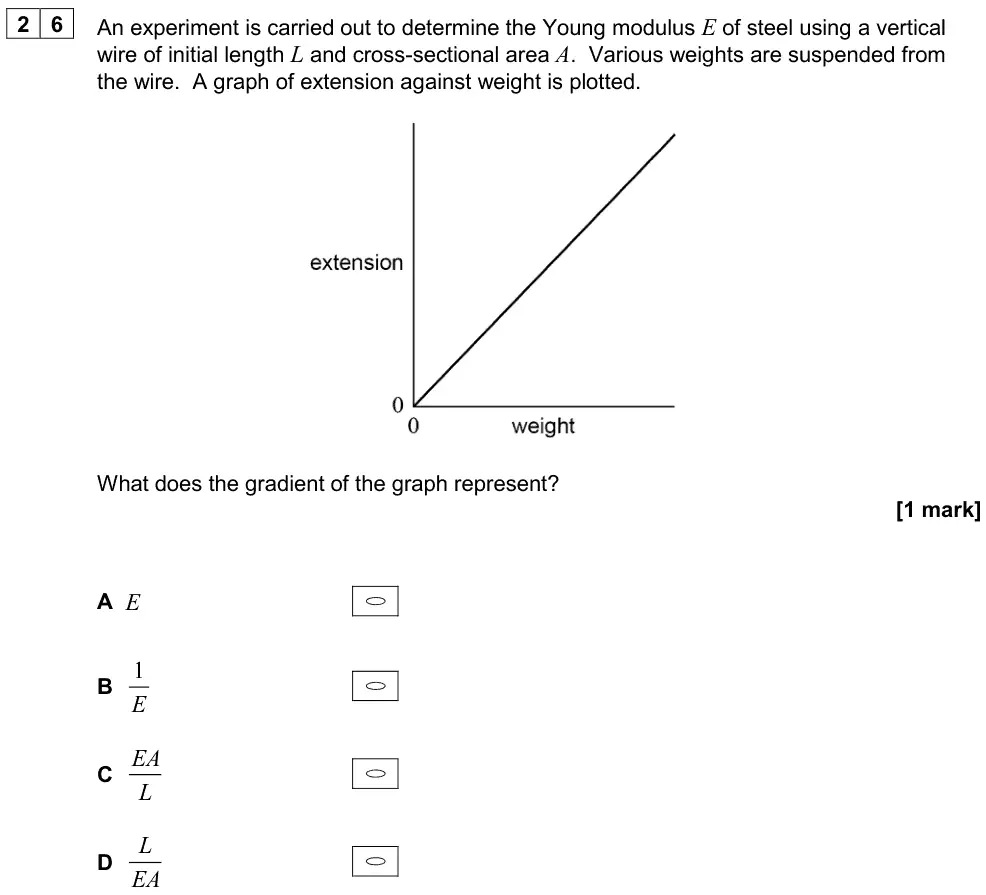
Answer: D
Skills: MS3.4 Determine the slope and intercept of a linear graph
November 2020 · AS Paper 2 · Q3.22 marksCalculation
Earlier part of question 3 that this part uses
Mark scheme
Notes from the mark scheme and report
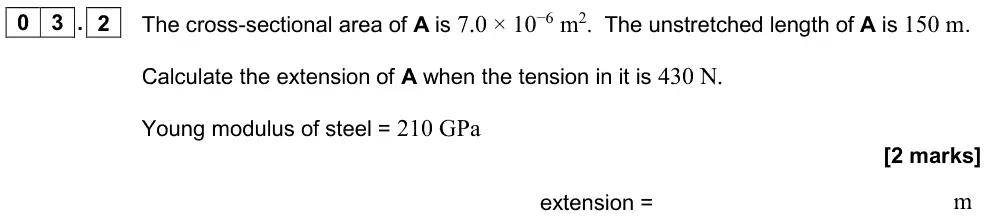
Answer: 4.4 x 10^-2 m (extension = FL/EA = 430 x 150 / (210 x 10^9 x 7.0 x 10^-6))
Skills: MS2.2 Change the subject of an equation, including non-linear equations; MS0.2 Recognise and use expressions in decimal and standard form
November 2020 · AS Paper 2 · Q261 markMultiple choice
Answer
C
Mark scheme
Notes from the mark scheme and report
Answer: C
November 2020 · AS Paper 2 · Q271 markMultiple choice
Answer
D
Mark scheme
Notes from the mark scheme and report
Answer: D
November 2020 · Paper 3 Section A · Q2.33 marksAO3=3Practical and data analysis
Earlier part of question 2 that this part uses
Mark scheme
Examiner's comment
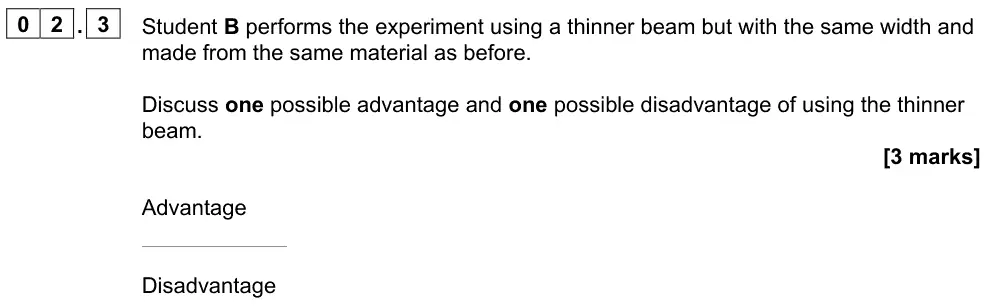
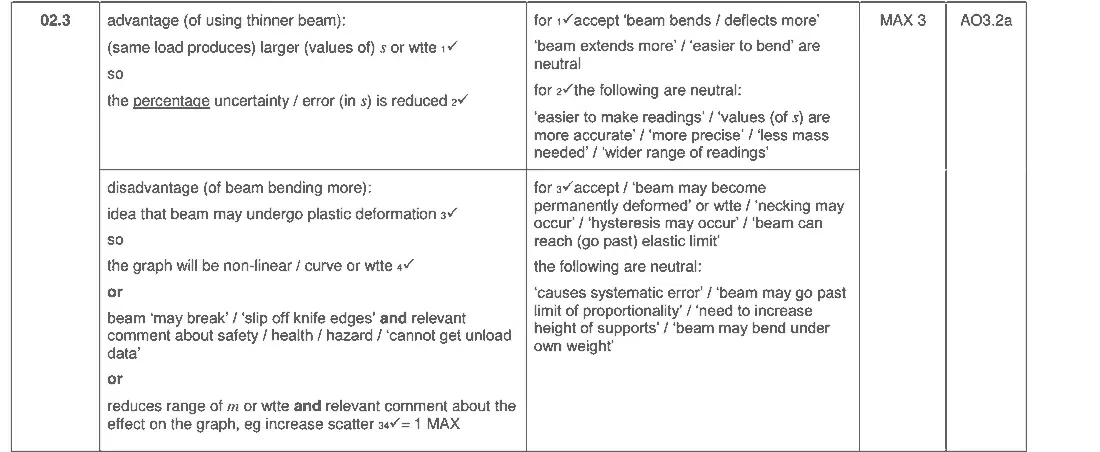
About 70% of students obtained a mark in 02.3 for stating that the thinner beam would deflect more. Some went on to identify correctly that this would reduce the percentage uncertainty in s. The third mark could be earned in a variety of ways, e.g. suggesting that the beam could become permanently deformed. We expected students to understand the distinction between elastic limit and limit of proportionality.
Notes from the mark scheme and report
Advantage: larger deflections so smaller percentage uncertainty in s
disadvantage: beam may deform plastically (non-linear graph) or break/slip
Skills: PS2.1 Comment on experimental design and evaluate scientific methods; PS3.3 Consider margins of error, accuracy and precision of data
November 2020 · Paper 3 Section A · Q2.44 marksPractical and data analysisHard
Earlier part of question 2 that this part uses
Mark scheme
Examiner's comment
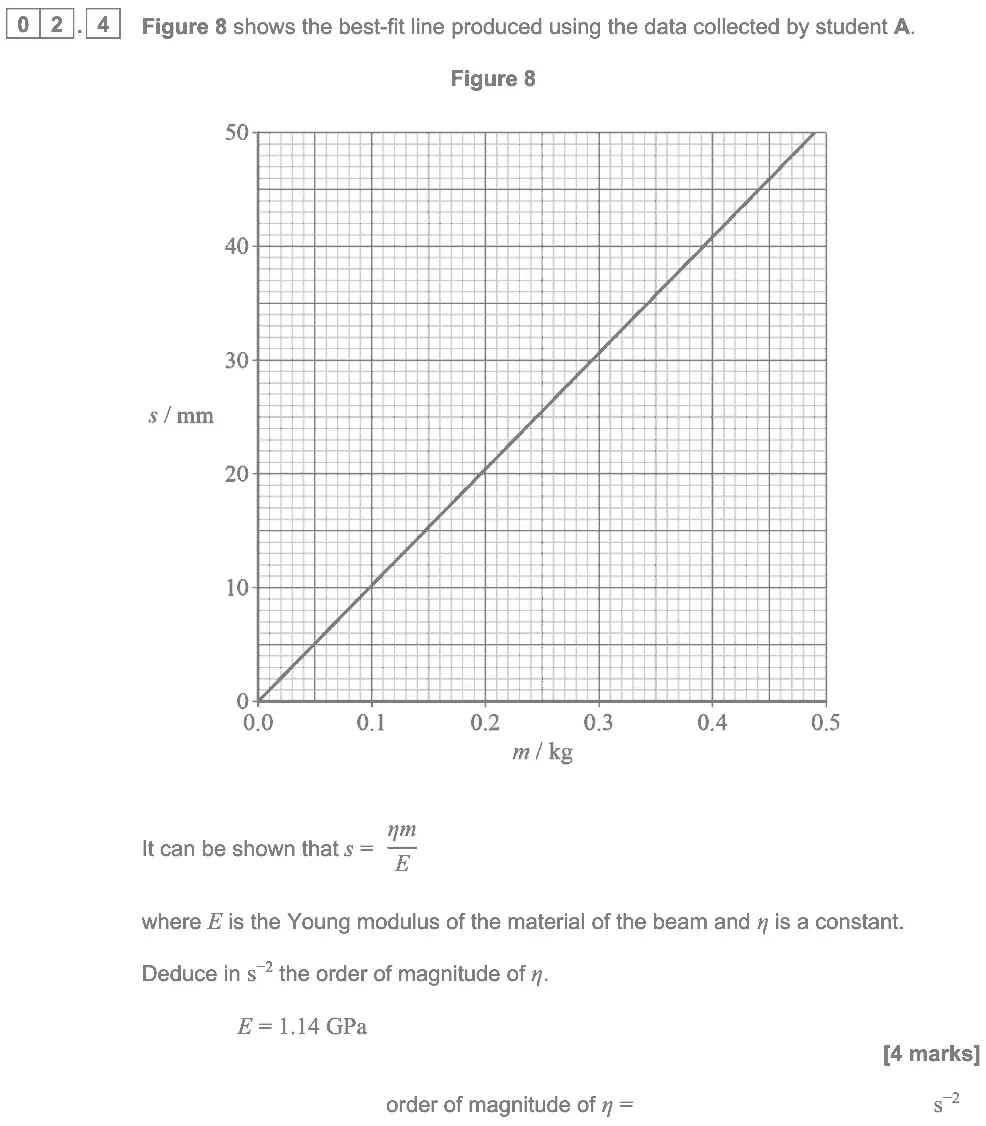
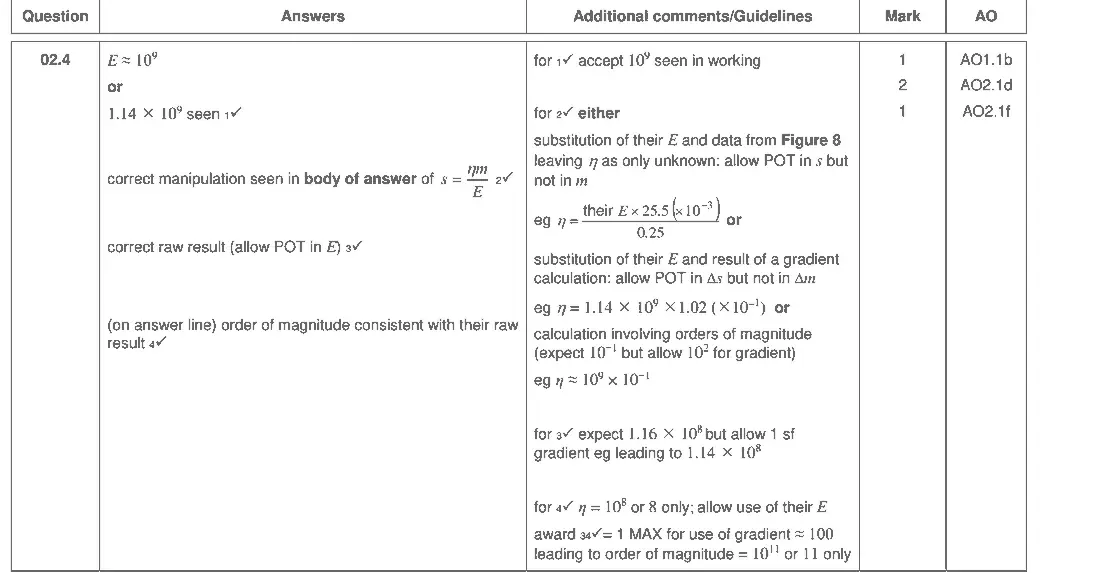
Many knew the meaning of the Giga prefix in the value of Young modulus in 02.4 and could then combine this with data obtained from Figure 8. A common error was failing to notice that s was in millimetres. Many students still do not understand what is required when we ask them to make an order-of-magnitude calculation (specification objective MS 1.4), the majority leaving their raw values for η on the answer line. Only 15% supplied the expected answer 8 or 108; we did not accept 1 108. A worrying number seemed confused by the unit on the answer line and spoiled a perfectly acceptable result by carrying out some additional mathematical operation.
Notes from the mark scheme and report
Answer: order of magnitude 10^8 s^-2 (eta = sE/m = 1.14 x 10^9 x gradient 0.102 m per kg, about 1.16 x 10^8)
s in mm overlooked
1 x 10^8 or raw value not accepted
Skills: MS1.4 Make order of magnitude calculations; MS3.4 Determine the slope and intercept of a linear graph; MS2.2 Change the subject of an equation, including non-linear equations
November 2020 · Paper 3 Section A · Q2.62 marksPractical and data analysis
Earlier part of question 2 that this part uses
Mark scheme
Examiner's comment
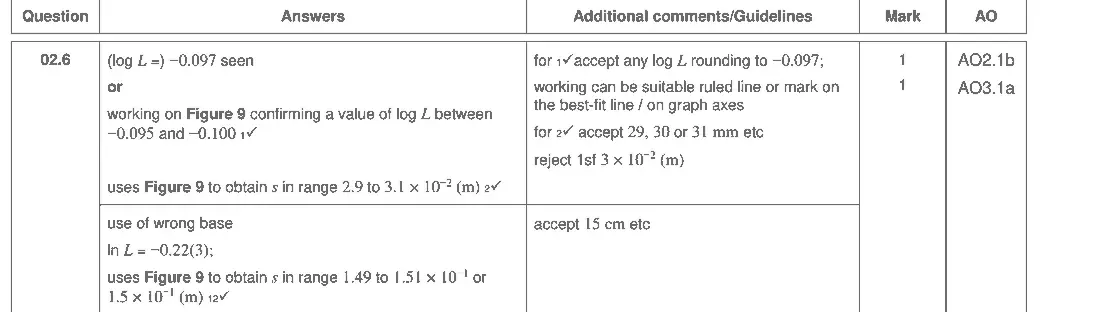
In 02.6, about 75% got as far as identifying log L = −0.097 but some failed to see the next step and used Figure 9 incorrectly.
Students generally engaged with the command word although there is still a reluctance to ‘annotate’, e.g. where we ask them to put detail on a printed Figure. They did not always pay attention to the entirety of the command sentence, e.g. in 02.6 and 03.4 some clearly missed the instruction to use a particular Figure to make their deduction.
Notes from the mark scheme and report
Answer: s = 2.9-3.1 x 10^-2 m (log 0.80 = -0.097, read log s from Figure 9 and take antilog)
Skills: MS2.5 Use logarithms in relation to quantities that range over several orders of magnitude; MS3.1 Translate information between graphical, numerical and algebraic forms
November 2020 · Paper 3 Section A · Q2.71 markAO3=1Practical and data analysis
Earlier part of question 2 that this part uses
Mark scheme
Examiner's comment
Question 02.7 discriminated well in favour of the stronger students, but over 20% did not attempt this part.
Notes from the mark scheme and report
Answer: M = s from 02.6 / gradient of Figure 8 (about 0.3 kg)
over 20% made no attempt
Skills: MS3.4 Determine the slope and intercept of a linear graph; MS3.1 Translate information between graphical, numerical and algebraic forms
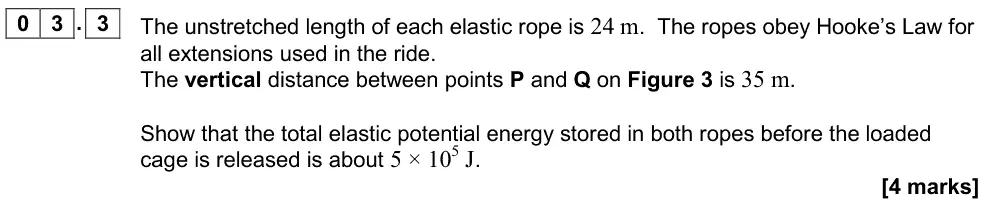
June 2019 · AS Paper 1 · Q3.34 marksShow that
Earlier part of question 3 that this part uses
Mark scheme
Examiner's comment
03.3 This question proved to be slightly more challenging than 03.1. Again, students gained credit for showing clear evidence of any of the steps in this calculation. A common error was to use the force from 03.1 in a Hooke’s Law calculation.
03.4 Around one-third of the cohort gained full credit for this question. As a ‘deduce’ question, there needed to be a conclusion about the justification of the claim. Over 50% of students gained no marks or did not attempt the question at all. Many did not make the connection with 03.3 and failed to consider energy transfers. A large number of students applied suvat (kinematic) equations but the acceleration is not uniform in this situation.
03.6 In this question, students needed to compare their answer to 03.5 to the ‘show that’ value of 03.3. Even though an error was carried forward, many students struggled to give a relevant conclusion.
Notes from the mark scheme and report
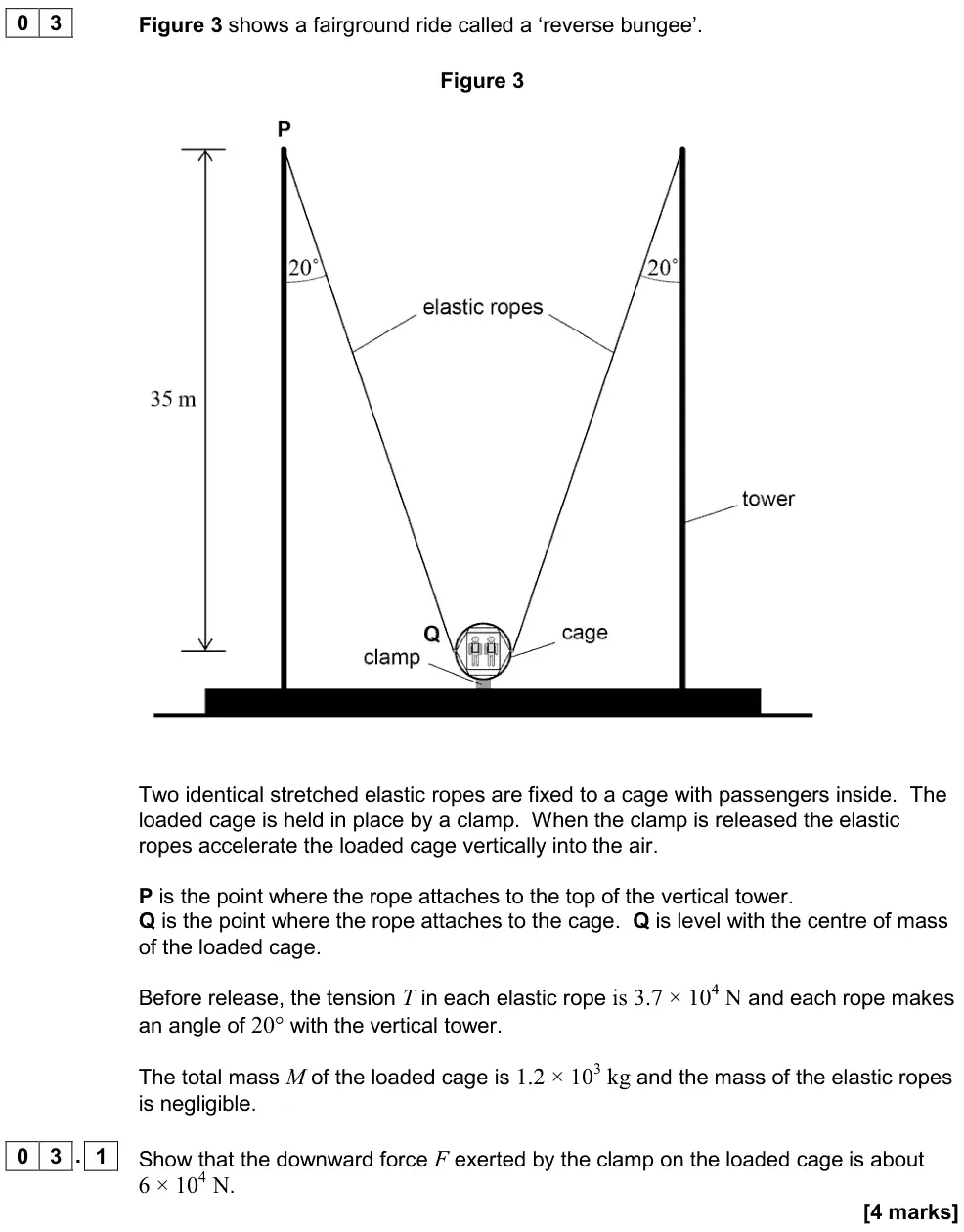
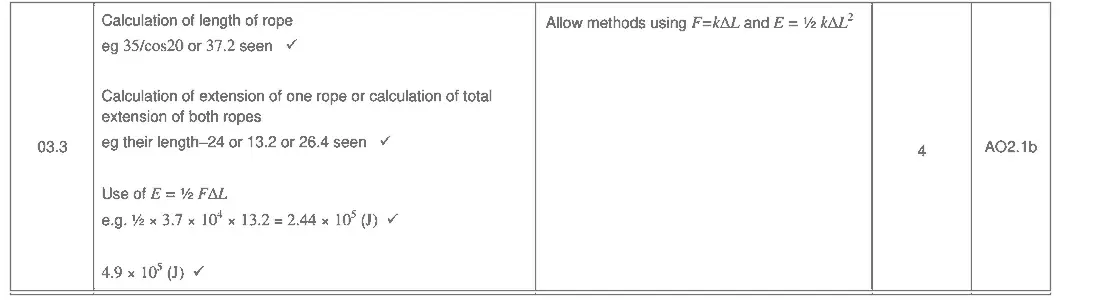
Answer: 4.9 x 10^5 J (rope length 35/cos 20 = 37.2 m, extension 13.2 m, 1/2 x 3.7 x 10^4 x 13.2 per rope, doubled)
using the 03.1 force in Hooke's law was a common error
Skills: MS4.5 Use sin, cos and tan in physical problems; MS2.3 Substitute numerical values into algebraic equations using appropriate units for physical quantities
June 2019 · AS Paper 1 · Q3.43 marksCalculationHard
Earlier part of question 3 that this part uses
Mark scheme
Examiner's comment
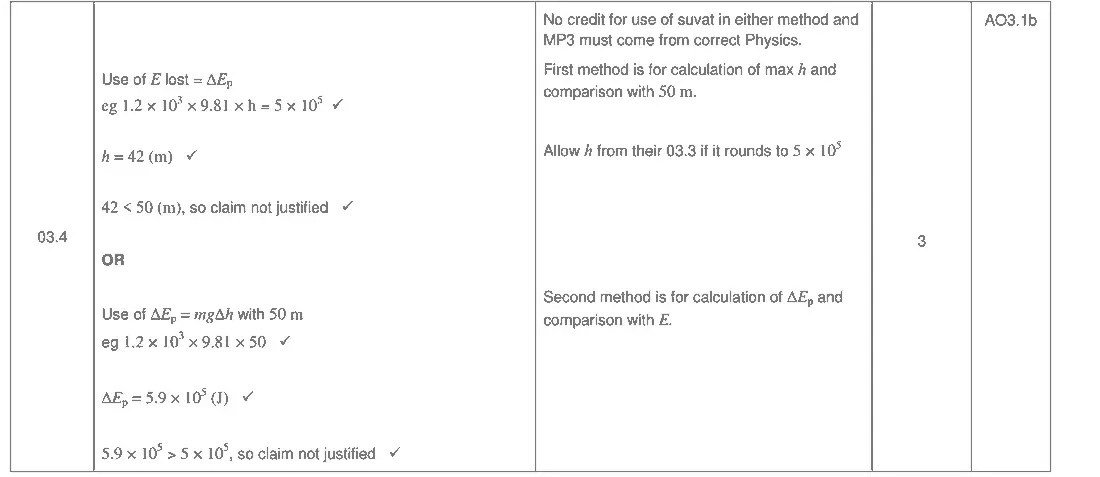
03.4 Around one-third of the cohort gained full credit for this question. As a ‘deduce’ question, there needed to be a conclusion about the justification of the claim. Over 50% of students gained no marks or did not attempt the question at all. Many did not make the connection with 03.3 and failed to consider energy transfers. A large number of students applied suvat (kinematic) equations but the acceleration is not uniform in this situation.
Notes from the mark scheme and report
Answer: h = 42 m (5 x 10^5 J = mgh) < 50 m so claim not justified (or 5.9 x 10^5 J needed)
suvat gets no credit as acceleration is not uniform
over 50% scored zero
Skills: MS2.3 Substitute numerical values into algebraic equations using appropriate units for physical quantities
June 2019 · AS Paper 1 · Q3.61 markShort answer
Earlier part of question 3 that this part uses
Mark scheme
Examiner's comment
03.6 In this question, students needed to compare their answer to 03.5 to the ‘show that’ value of 03.3. Even though an error was carried forward, many students struggled to give a relevant conclusion.
Notes from the mark scheme and report
KE at 90 km h^-1 is less than the 5 x 10^5 J stored, so claim may be justified depending on GPE gained and resistive losses
June 2019 · Paper 1 · Q141 markMultiple choice
Answer
B
Notes from the mark scheme and report
Answer: B
June 2019 · Paper 1 · Q191 markMultiple choice
Answer
C
Notes from the mark scheme and report
Answer: C
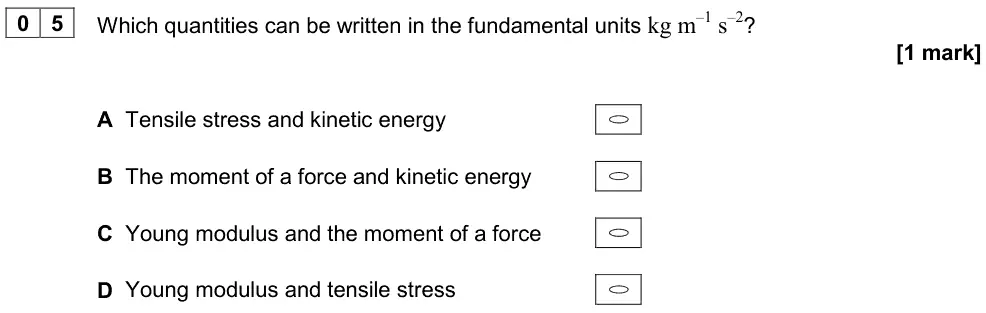
about 25% chose B (mm^2 to m^2 power-of-ten error)
Skills: MS0.2 Recognise and use expressions in decimal and standard form
June 2019 · Paper 1 · Q201 markMultiple choice
Answer
D
Notes from the mark scheme and report
Answer: D
June 2019 · Paper 2 · Q1.24 marksCalculation
Earlier part of question 1 that this part uses
Mark scheme
Examiner's comment
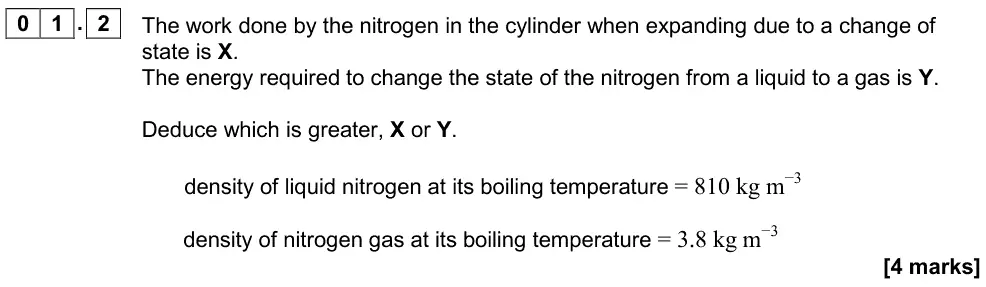
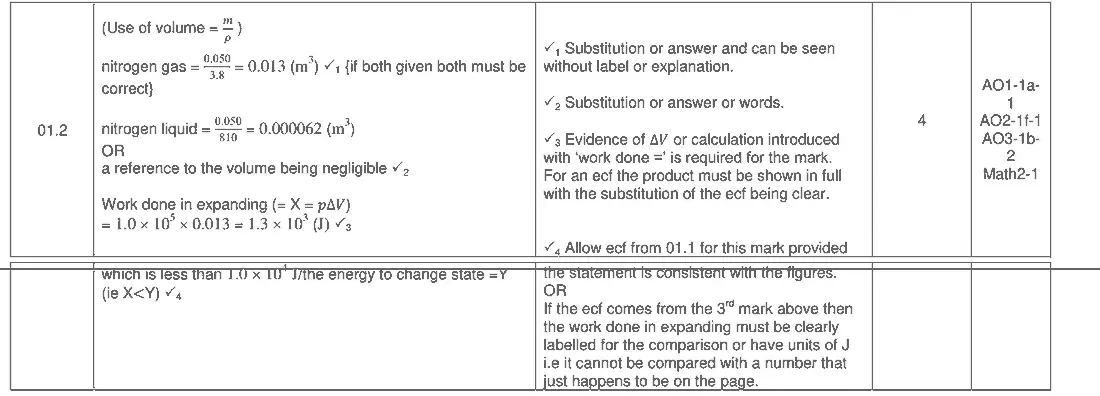
1.2 This was a more difficult calculation, with just over half of the cohort scoring at least 2 out of 4. More successful students typically managed to determine the volumes of the gaseous and liquid forms of nitrogen. The top 30% scored full marks and were able to reference and manipulate the appropriate equation. A significant minority did not understand the nature of the required comparison.
Notes from the mark scheme and report
Answer: Y greater (gas volume 0.013 m^3, liquid volume 6.2 x 10^-5 m^3 negligible
X = p delta V = 1.3 x 10^3 J < Y = 1.0 x 10^4 J)
comparison must be consistent with figures
many did not understand the comparison
Skills: MS2.3 Substitute numerical values into algebraic equations using appropriate units for physical quantities; MS0.3 Use ratios, fractions and percentages
June 2019 · AS Paper 2 · Q51 markMultiple choice
Answer
D
Mark scheme
Notes from the mark scheme and report
Answer: D
June 2019 · AS Paper 2 · Q281 markMultiple choice
Answer
D
Notes from the mark scheme and report
Answer: D
Skills: MS0.3 Use ratios, fractions and percentages
June 2019 · Paper 3 Section A · Q3.73 marksCalculation
Earlier part of question 3 that this part uses
Mark scheme
Examiner's comment
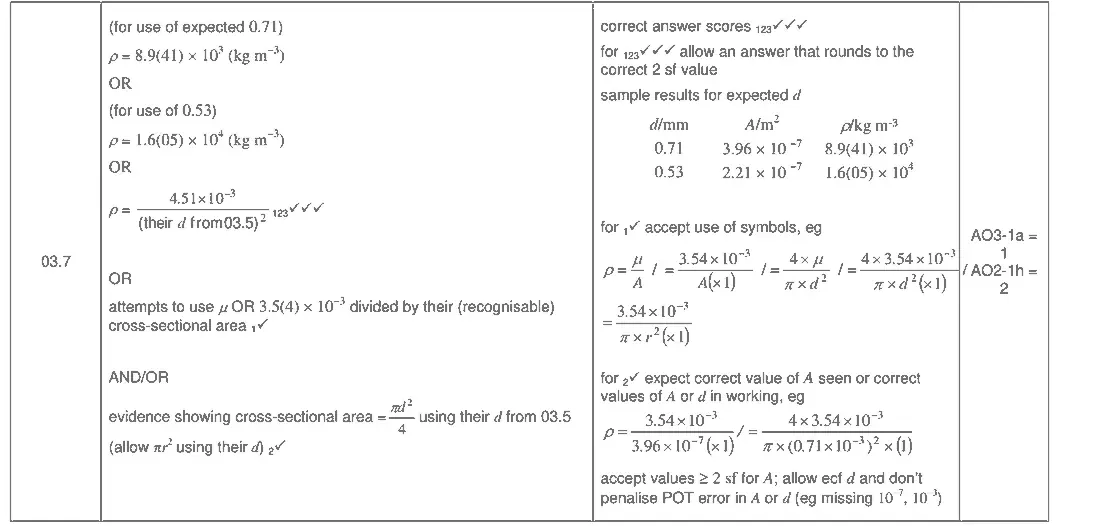
µ ρ = In 03.7, almost half were able to deduce that , and go on to use their 03.5 result to earn full A credit. The most frequent error was to mix units, substituting d in mm while keeping µ in kg m−1.
Students generally showed more confidence with questions that tested their mathematical skills. Many knew how to combine percentage errors correctly. A ‘show that’ problem (02.5) was well- answered, provided students noted that the relevant curve was exponential. Extended working, (eg in 01.6, 02.5 and 03.7), revealed clear work that could be followed without too much difficulty.
Notes from the mark scheme and report
Answer: 8.9 x 10^3 kg m^-3 (rho = mu / (pi d^2/4) with d = 0.71 mm
area 3.96 x 10^-7 m^2)
mixing mm with kg m^-1 common
Skills: MS4.3 Calculate areas of triangles, circumferences and areas of circles, surface areas and volumes of rectangular blocks, cylinders and spheres; MS2.3 Substitute numerical values into algebraic equations using appropriate units for physical quantities; MS0.1 Recognise and make use of appropriate units in calculations
June 2018 · Paper 1 · Q3.44 marksCalculation
Earlier part of question 3 that this part uses
Mark scheme
Examiner's comment
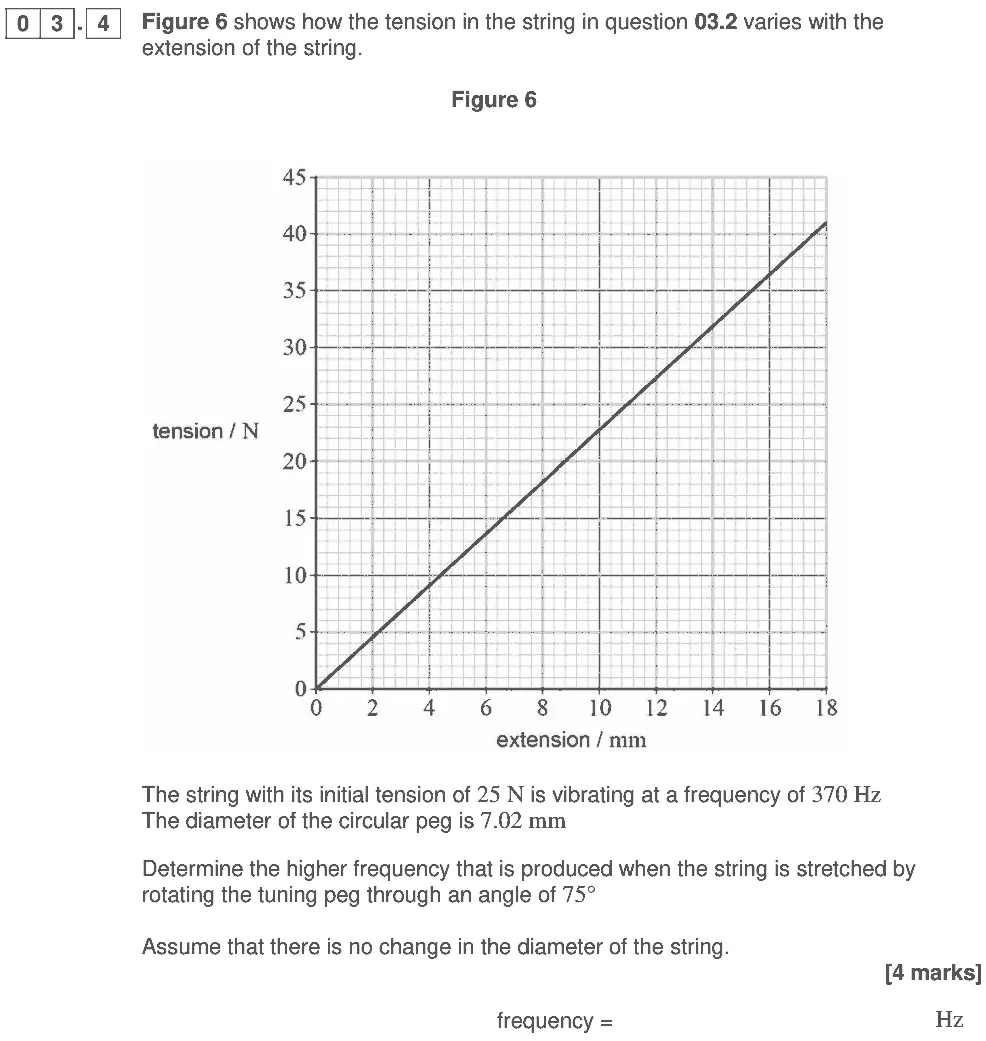
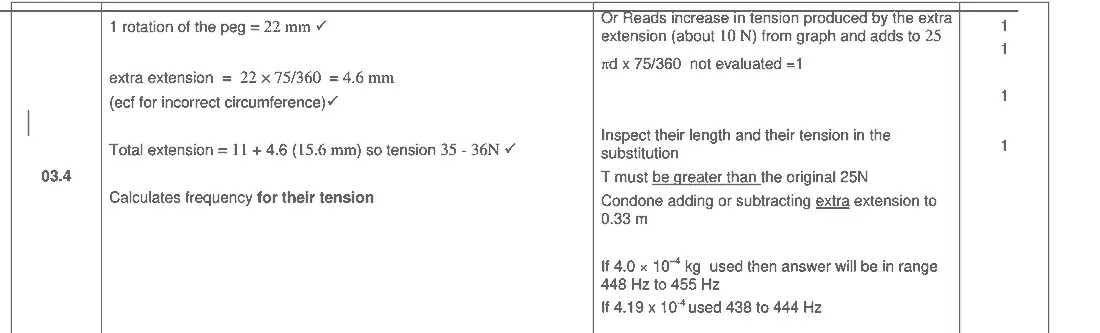
03.4 Most students appeared to appreciate the process that needed to be followed to arrive at an answer and many were able to follow this through to a successful conclusion. In general terms, knowing how to determine circumferences and areas of 2- dimensional objects, and circumference, surface areas and volumes of 3-dimensional objects is fundamental in almost all topics in physics. Those who made little progress did not have this basic understanding. In this question, the circumference of a circle was the basic knowledge needed and how to determine the length of an arc of that circle. The other issue for the first step was to read carefully what information had been provided; in this instance diameter, not radius. In the next step, misreading the scale of the extension axis was a common error. The frequency calculation was then straightforward. Many students did not know what to do about the length, not appreciating that the vibrating length was unchanged when the peg was turned. The extension was added and occasionally subtracted from the length of 0.33 m, but this was condoned as ‘specialist knowledge’.
04.1 The problem that has been discussed in question 03.4 was evident in this question too but there was a high proportion of correct solutions (58.9% scored full marks) to this relatively familiar problem.
Notes from the mark scheme and report
Answer: about 440 Hz (arc = pi x 7.02 mm x 75/360 = 4.6 mm extra extension, about 10 N extra from Figure 6 so T = 35 N, f = 370 root(35/25))
diameter used as radius and misreading extension scale common
vibrating length unchanged
Skills: MS4.3 Calculate areas of triangles, circumferences and areas of circles, surface areas and volumes of rectangular blocks, cylinders and spheres; MS3.1 Translate information between graphical, numerical and algebraic forms; MS2.3 Substitute numerical values into algebraic equations using appropriate units for physical quantities
June 2018 · AS Paper 1 · Q4.53 marksCalculation
Earlier part of question 4 that this part uses
Mark scheme
Examiner's comment
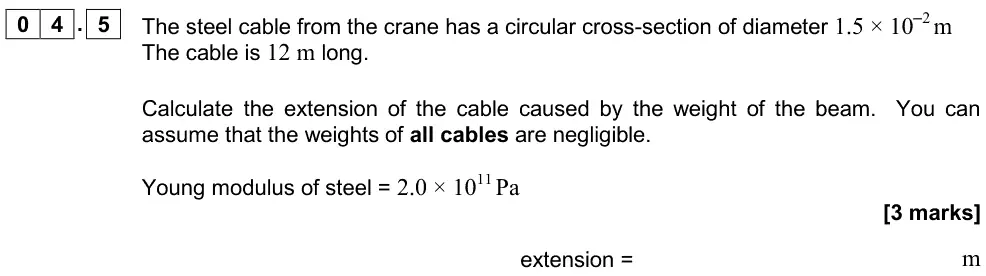
04.5 The calculation in this question proved to be much more accessible and far more students were able to access the marks. Over half managed to score at least two marks. The most common error was failing to calculate the cross-sectional area correctly; the predominant mistake was using the diameter for radius. Weaker students often used surface area of the cable instead of cross-sectional area.
Notes from the mark scheme and report
Answer: 4.1 x 10^-3 m (A = pi(0.75 x 10^-2)^2 = 1.77 x 10^-4 m^2, F = 12000 N)
diameter used as radius was the common error
Skills: MS4.3 Calculate areas of triangles, circumferences and areas of circles, surface areas and volumes of rectangular blocks, cylinders and spheres; MS2.3 Substitute numerical values into algebraic equations using appropriate units for physical quantities
June 2018 · AS Paper 1 · Q5.12 marksCalculationEasy
Mark scheme
Examiner's comment
05.1 The majority of students (74.4%) had few problems with this calculation. Of those who did, conversion from mass to weight was the common problem.
01.5 Over half of the students managed to come up with a reason for many teams being beneficial. However, only a few students (5.1%) were able to come up with more than one reason.
Notes from the mark scheme and report
Answer: 3.6 x 10^-2 N (mass 3.68 x 10^-3 kg)
forgetting g was the common error
Skills: MS2.3 Substitute numerical values into algebraic equations using appropriate units for physical quantities; MS0.2 Recognise and use expressions in decimal and standard form
June 2018 · AS Paper 1 · Q5.21 markCalculation
Earlier part of question 5 that this part uses
Mark scheme
Examiner's comment
05.2 As with the previous question, this was well answered. The only common issue was the use of weight rather than mass in the density formula.
Notes from the mark scheme and report
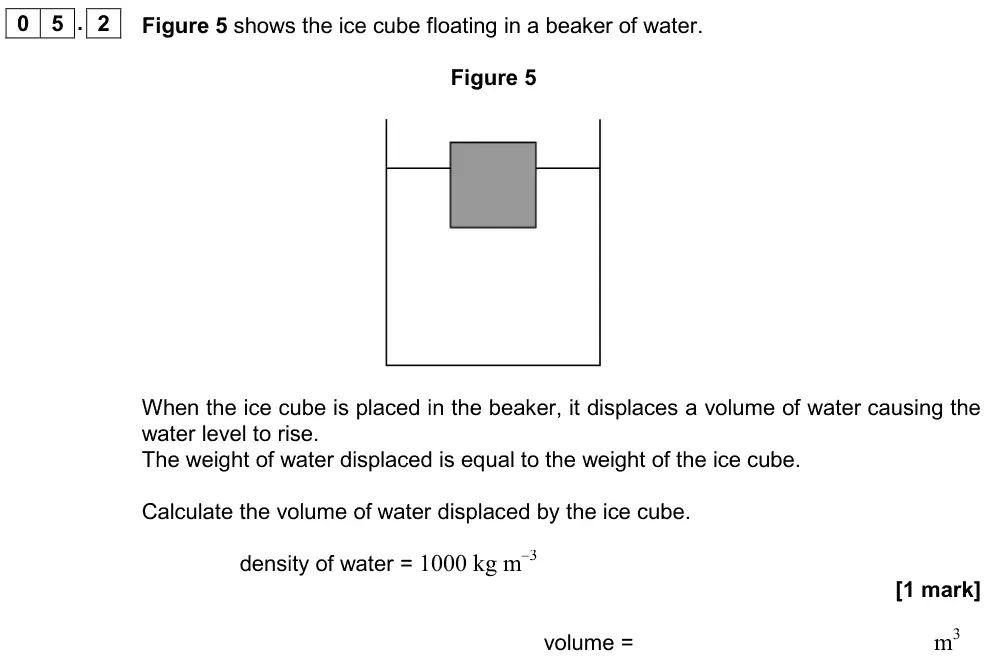
Answer: 3.7 x 10^-6 m^3 (3.68 x 10^-3 kg / 1000)
using weight instead of mass in density was the error
Skills: MS2.3 Substitute numerical values into algebraic equations using appropriate units for physical quantities
June 2018 · AS Paper 1 · Q5.33 marksCalculationHard
Earlier part of question 5 that this part uses
Mark scheme
Examiner's comment
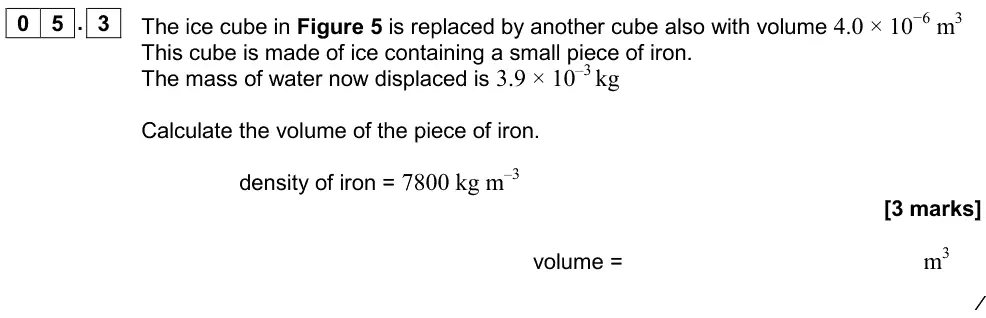
05.3 Students found this question very challenging and only a small minority (4.3%) managed to come up with complete solutions. Setting up an expression that enabled the volume of iron to be calculated is clearly a procedure that is unfamiliar to many students. A reasonable proportion did appreciate that a mass needed to be divided by the density of iron and picked up the first mark, but got no further because they did not appreciate that the volume of the ice is less than the volume of the cube because part of the volume is occupied by the piece of iron.
Notes from the mark scheme and report
Answer: 3.2 x 10^-8 m^3 (7800V + 920(4.0 x 10^-6 - V) = 3.9 x 10^-3)
most missed that the iron reduces the ice volume
Skills: MS2.2 Change the subject of an equation, including non-linear equations; MS2.4 Solve algebraic equations, including quadratic equations
June 2018 · Paper 1 · Q211 markMultiple choice
Answer
D
Notes from the mark scheme and report
Answer: D
Skills: MS2.2 Change the subject of an equation, including non-linear equations
June 2018 · Paper 1 · Q241 markMultiple choice
Answer
D
Notes from the mark scheme and report
Answer: D
Skills: MS0.3 Use ratios, fractions and percentages
June 2018 · AS Paper 2 · Q4.23 marksExplanationHard
Earlier part of question 4 that this part uses
Mark scheme
Examiner's comment
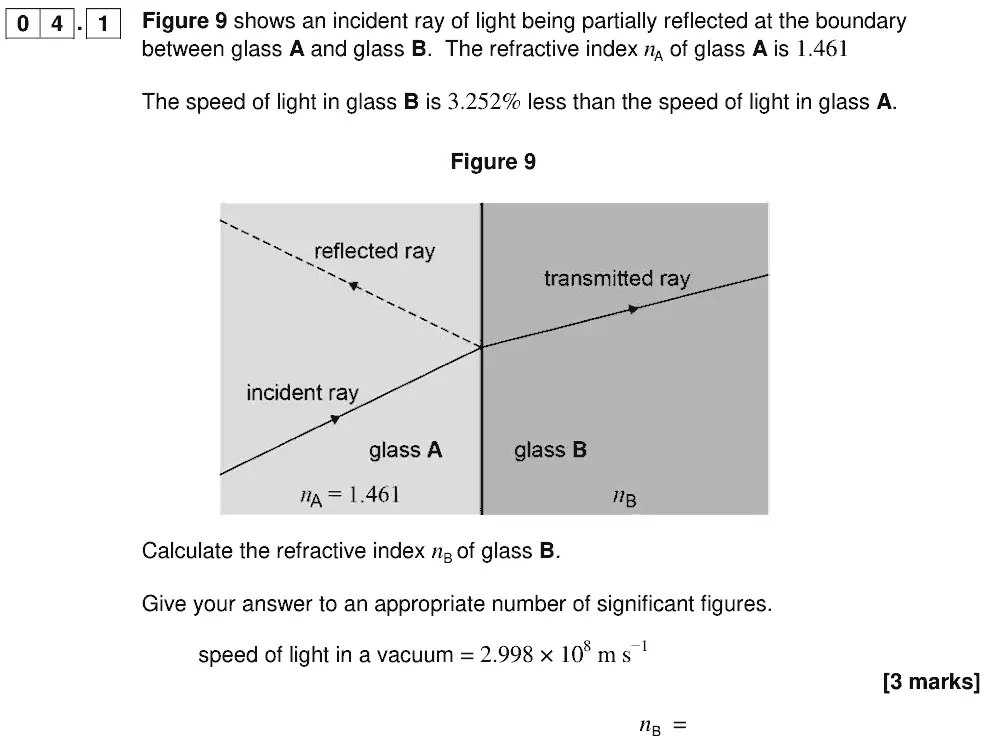
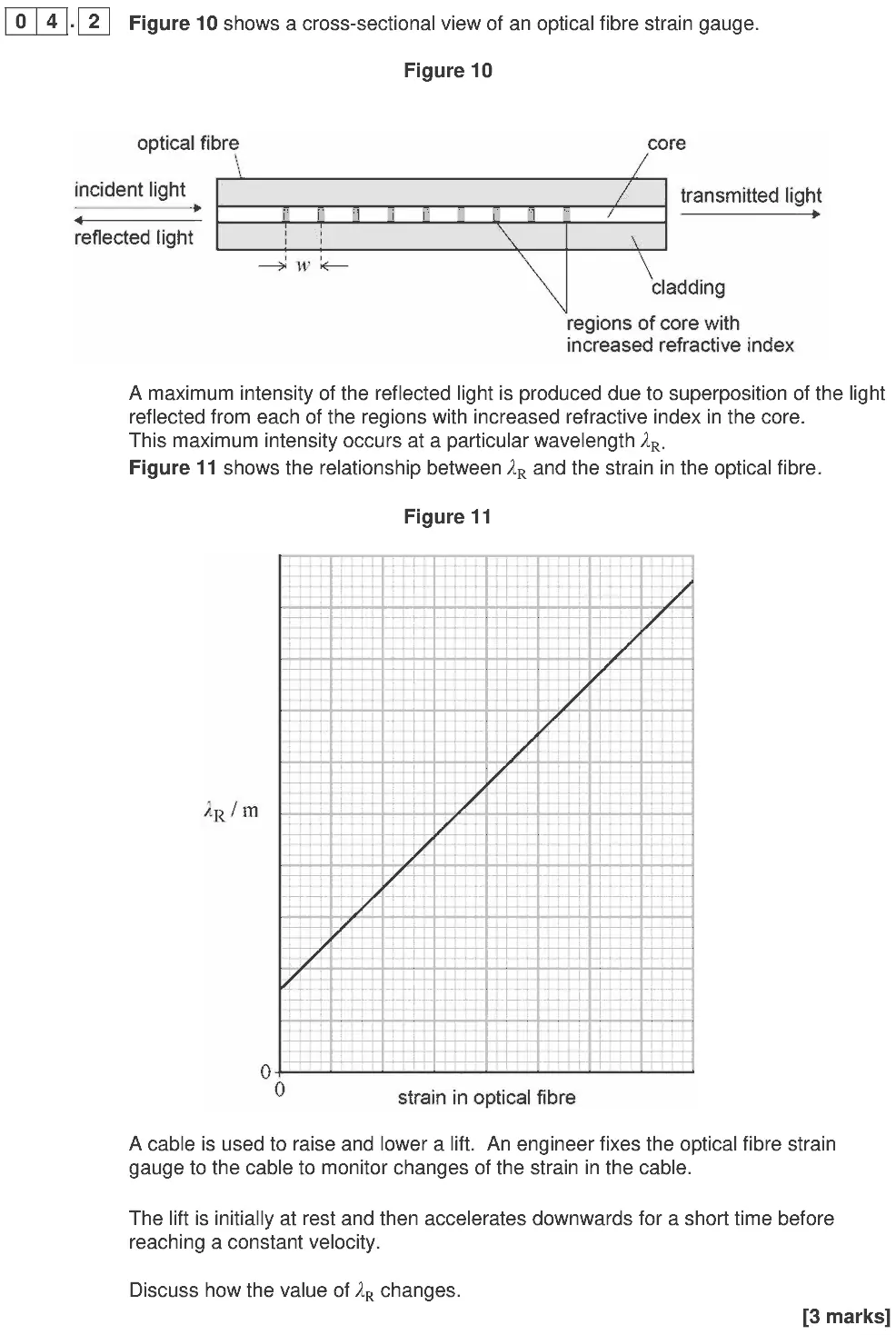
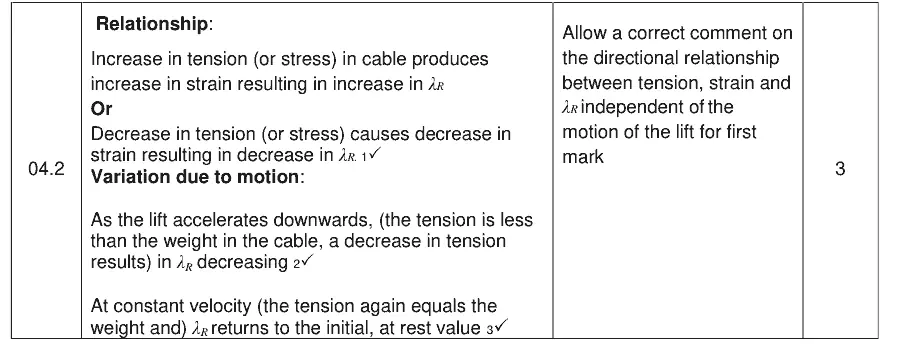
04.1 There were many good examples of work in this part from higher achieving students. On the other hand, lower achieving students had difficulty in following the question structure with many trying to find 97% of the speed of light in a vacuum rather than 97% of the speed of light in glass A. Another common mistake seen was students who simply multiplied na x 1.03252. This was another place in the paper where students failed to gain marks due to incorrect use of significant figures. Just over a third of students failed to gain any marks. relationship between 𝜆𝜆𝑅𝑅 and strain as shown in the graph. They were unable to make the 04.2 Lower achieving students characteristically limited their answers to restating the link between the motion of the lift and its effect on strain and 𝜆𝜆𝑅𝑅. Where students attempted to explain this connection, they often thought that the tension in the cable increased as the lift accelerated downwards. Only 7.4% of students scored two or three marks. 04.3 Many students presented answers that addressed the strength of the cable and its ability to withstand larger stress rather than the ability of the sensor to detect small changes in the acceleration. Two-thirds of students who attempted the question failed to gain any marks here.
The following questions had a significant proportion of non-attempts: Section A 1.5, Section B 3.2, 3.3, 3.4, 3.5, 4.2, 4.3 and Section C 32. It was difficult to ascertain if this was solely due to time management and instead may have been due to students being unable to know where to begin. Students should be encouraged to try and match the question to specification content as a means to unlocking the problem and enabling them to make some progress.
Notes from the mark scheme and report
Tension (stress) and strain linked to lambda_R
accelerating down tension < weight so lambda_R falls
at constant velocity returns to rest value. Many thought tension increased
June 2018 · AS Paper 2 · Q4.32 marksExplanation
Earlier part of question 4 that this part uses
Mark scheme
Examiner's comment
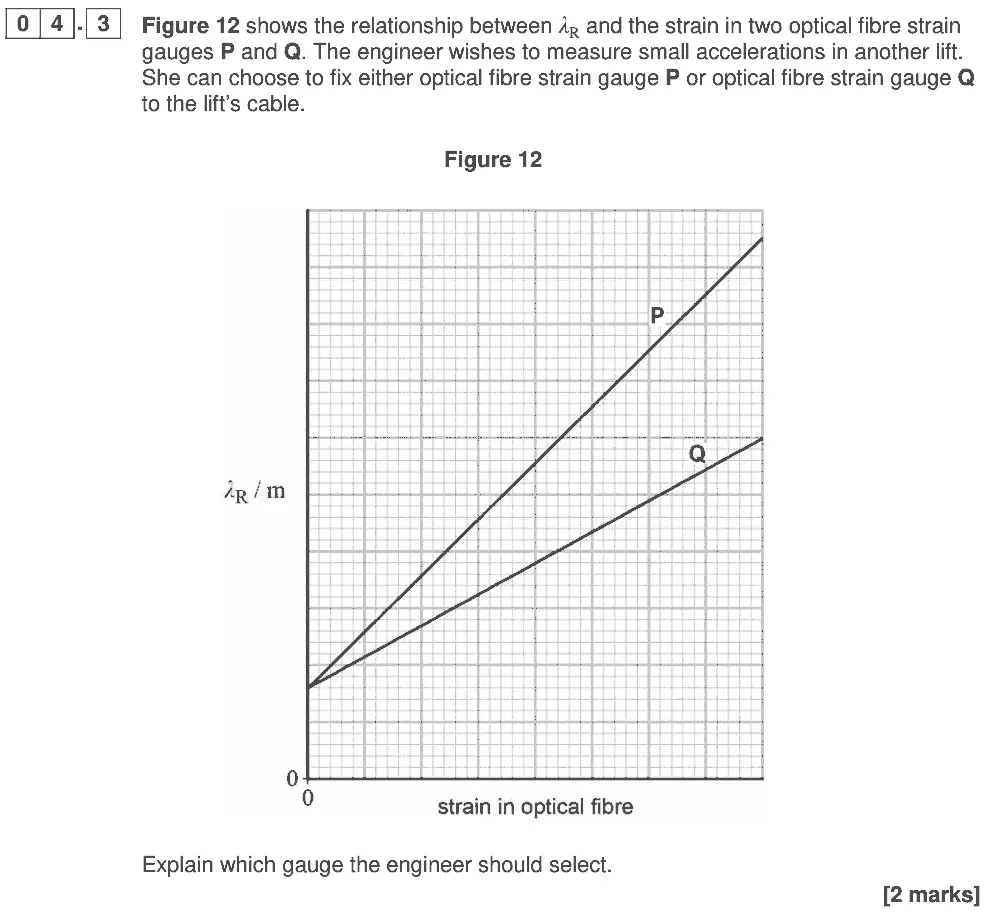
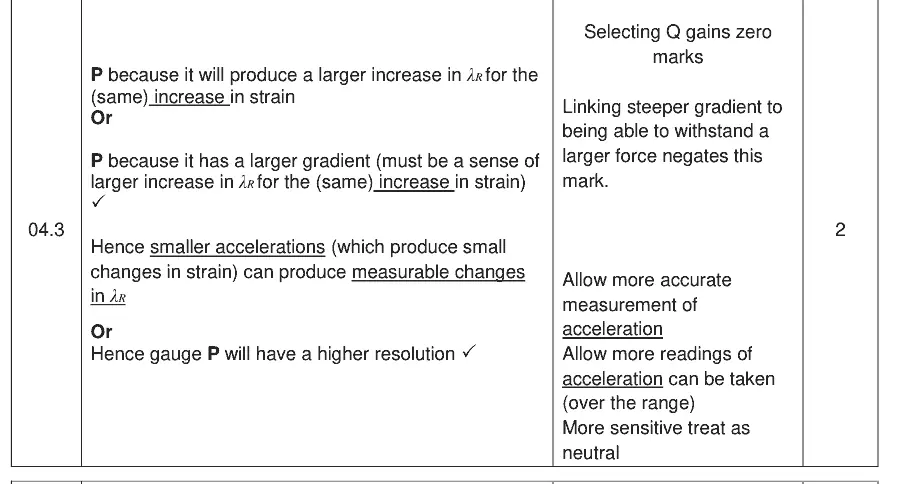
04.1 There were many good examples of work in this part from higher achieving students. On the other hand, lower achieving students had difficulty in following the question structure with many trying to find 97% of the speed of light in a vacuum rather than 97% of the speed of light in glass A. Another common mistake seen was students who simply multiplied na x 1.03252. This was another place in the paper where students failed to gain marks due to incorrect use of significant figures. Just over a third of students failed to gain any marks. relationship between 𝜆𝜆𝑅𝑅 and strain as shown in the graph. They were unable to make the 04.2 Lower achieving students characteristically limited their answers to restating the link between the motion of the lift and its effect on strain and 𝜆𝜆𝑅𝑅. Where students attempted to explain this connection, they often thought that the tension in the cable increased as the lift accelerated downwards. Only 7.4% of students scored two or three marks. 04.3 Many students presented answers that addressed the strength of the cable and its ability to withstand larger stress rather than the ability of the sensor to detect small changes in the acceleration. Two-thirds of students who attempted the question failed to gain any marks here.
The following questions had a significant proportion of non-attempts: Section A 1.5, Section B 3.2, 3.3, 3.4, 3.5, 4.2, 4.3 and Section C 32. It was difficult to ascertain if this was solely due to time management and instead may have been due to students being unable to know where to begin. Students should be encouraged to try and match the question to specification content as a means to unlocking the problem and enabling them to make some progress.
Notes from the mark scheme and report
P: steeper gradient so bigger change in lambda_R per unit strain, small accelerations detectable (higher resolution)
choosing Q scores zero
strength arguments negate
Skills: MS3.4 Determine the slope and intercept of a linear graph
June 2018 · Paper 2 · Q161 markMultiple choice
Answer
B
Notes from the mark scheme and report
Answer: B
Skills: MS0.3 Use ratios, fractions and percentages
June 2018 · Paper 2 · Q191 markMultiple choice
Answer
A
Notes from the mark scheme and report
Answer: A
Skills: MS2.2 Change the subject of an equation, including non-linear equations; MS4.3 Calculate areas of triangles, circumferences and areas of circles, surface areas and volumes of rectangular blocks, cylinders and spheres
June 2018 · AS Paper 2 · Q231 markMultiple choice
Answer
B
Notes from the mark scheme and report
Answer: B
Skills: MS2.2 Change the subject of an equation, including non-linear equations
June 2017 · Paper 1 · Q2.23 marksCalculation
Earlier part of question 2 that this part uses
Mark scheme
Examiner's comment
The calculation in question 02.2 proved to be one of the more challenging in the paper. The main reason for this was a lack of appreciation of how to find the mass per unit length of the nylon string; this did limit them although they were able to pick up a mark for a correct substitution of tension and frequency in the appropriate formula.
Notes from the mark scheme and report
Answer: 0.67 m (mass per unit length = density x area = 2.26 x 10^-4 kg m^-1, T = mg)
finding mass per unit length was the main difficulty
diameter used as radius gives 0.335 m
Skills: MS2.2 Change the subject of an equation, including non-linear equations; MS2.3 Substitute numerical values into algebraic equations using appropriate units for physical quantities; MS4.3 Calculate areas of triangles, circumferences and areas of circles, surface areas and volumes of rectangular blocks, cylinders and spheres; RP1 Investigation into the variation of the frequency of stationary waves on a string with length, tension and mass per unit length of the string.
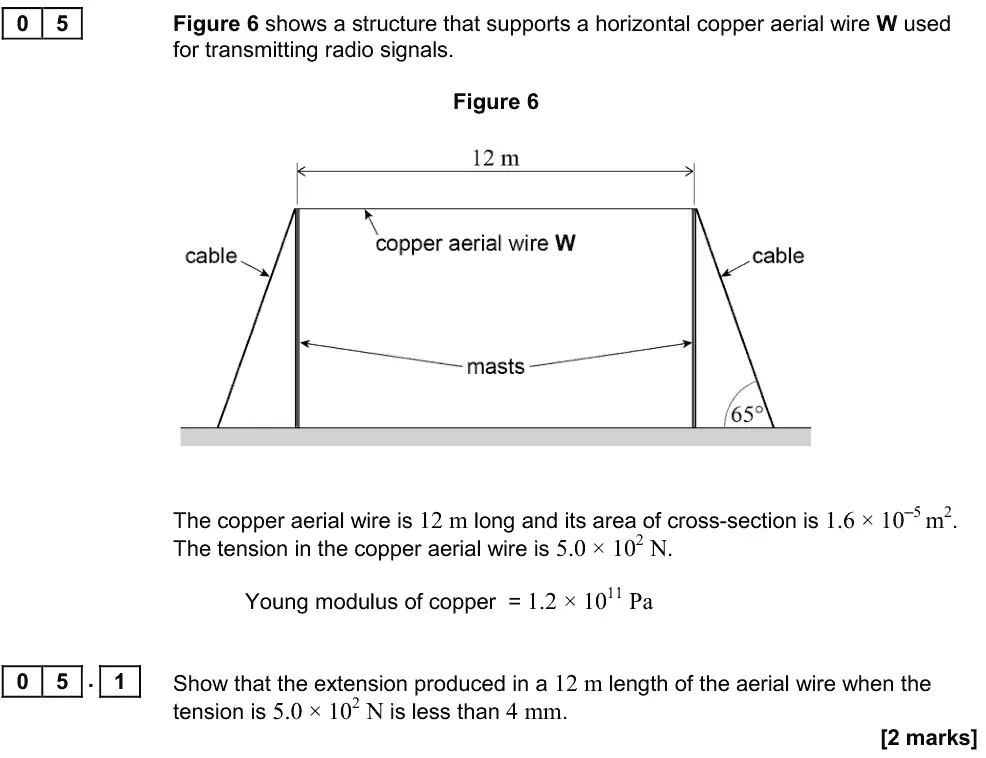
June 2017 · AS Paper 1 · Q5.12 marksShow that
Mark scheme
Examiner's comment
05.1 It is clear from the large proportion of students who obtained both marks for this question that the application of the Young modulus is well understood. This question was made even more accessible by providing the area, and by giving all the data in units that did not require conversion.
Notes from the mark scheme and report
Answer: 3.1 x 10^-3 m (extension = FL/(AE) = 500 x 12 / (1.6 x 10^-5 x 1.2 x 10^11))
Skills: MS2.2 Change the subject of an equation, including non-linear equations; MS2.3 Substitute numerical values into algebraic equations using appropriate units for physical quantities
June 2017 · AS Paper 1 · Q5.41 markCalculation
Earlier part of question 5 that this part uses
Mark scheme
Examiner's comment
05.4 This calculation proved to be very accessible with a large majority of students obtaining the single mark for it.
05.5 However, this calculation proved to be less accessible despite an error for the mass per unit length in 05.4 being carried forward. Credit was also given for students making it clear that the fundamental frequency had to be multiplied by 3.
Notes from the mark scheme and report
Answer: 0.14 kg (8900 x 1.6 x 10^-5 x 1.0)
Skills: MS2.3 Substitute numerical values into algebraic equations using appropriate units for physical quantities
June 2017 · AS Paper 1 · Q5.72 marksExplanation
Earlier part of question 5 that this part uses
Mark scheme
Examiner's comment
05.6 The drawing of three ‘loops’ was generally awarded the mark, unless the length of each loop was too unequal to be acceptable. 05.7 Whilst it was common to see answers that made some attempt to describe what happens to the wire if it is stretched too much, poor use of the correct terminology, such as failure to mention an elastic limit or equivalent, tended to limit the mark awarded to many answers.
This is Paper 1 of the second series of the new AS specification. The paper consists of seven questions from across the AS specification. It makes use of a range of question styles, including multiple choice, short answer, single- and multi-step calculations, data analysis, and extended writing. In general, many students experienced difficulties by missing important details in both the questions and their answers. Calculations were often done well, but many students struggled with answers that required extended writing, particularly those involving some reasoning, such as 02.1, 03.5, 04.3, 05.3, 05.7 and 07.4.
Notes from the mark scheme and report
Wire stretched beyond its elastic limit deforms plastically and does not return to its original length
June 2017 · Paper 1 · Q241 markMultiple choice
Answer
B
Notes from the mark scheme and report
Answer: B
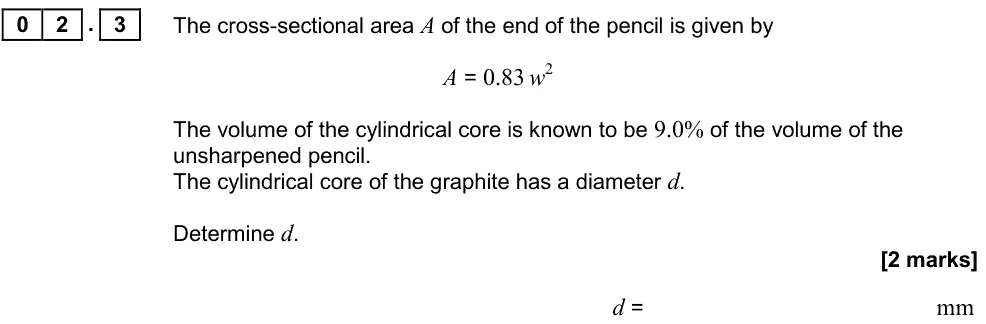
June 2017 · AS Paper 2 · Q2.32 marksPractical and data analysisHard
Earlier part of question 2 that this part uses
Mark scheme
Examiner's comment
02.3 Higher achieving students performed well in this calculation, with 30% of students obtaining 2 marks. The calculations presented by these students were structured in an easy-to-follow way. Lower achieving students were less sure about how to proceed with this calculation but compensatory marks were available for certain partially correct workings shown. Students should be encouraged to set out their working in a way that demonstrates their thinking to the examiner. Marks can only be awarded for working seen on the script.
The term precision was used to describe the resolution of the Vernier scale. This 02.4 / 02.5 term was not used in the manner defined in the Practical Handbook and will not be used in this way again. It is not believed that the use of the term here disadvantaged any student; this is a piece of equipment that uses the type of scale students are expected to have used as described in section 7.1 ATe on page 80 of the specification. Surprisingly, less than 20% of students read the Vernier scales correctly. A very large number of students ignored the zero on the sliding Vernier scale and read off the values as 80.5 mm and 78.3 mm respectively.
Notes from the mark scheme and report
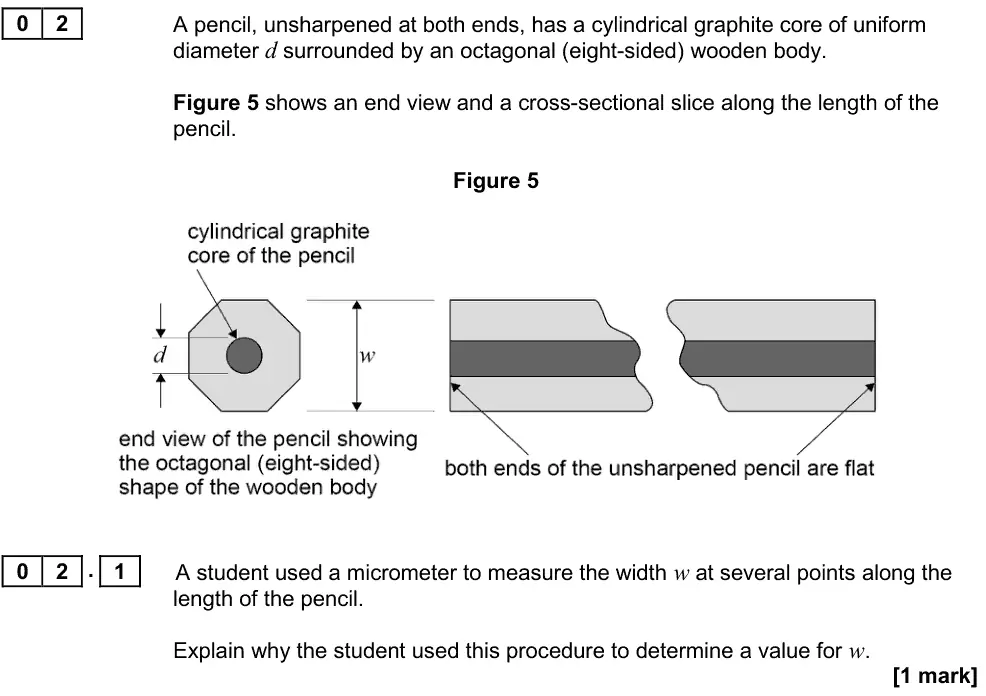
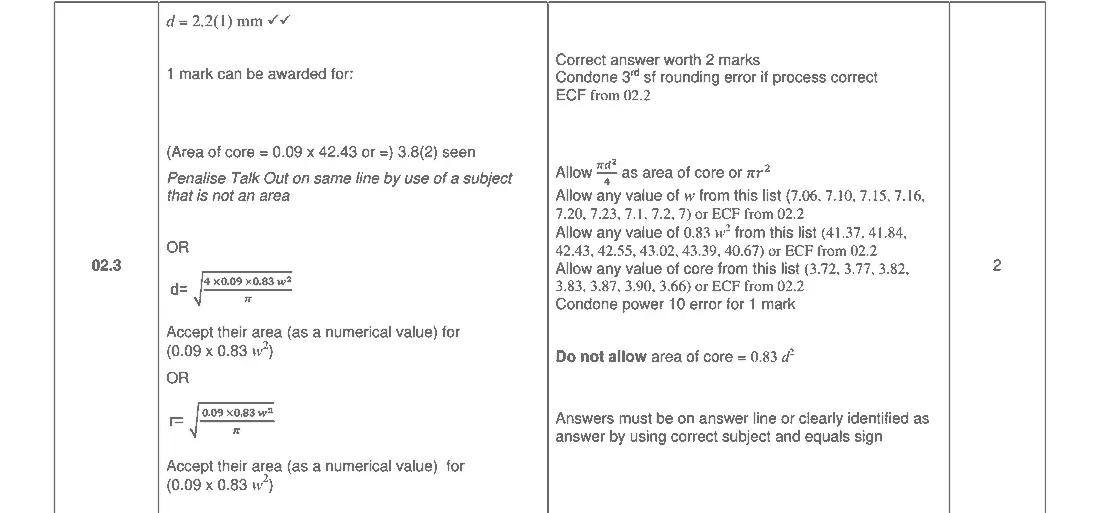
Answer: d = 2.21 mm (end area 0.83 x 7.15^2 = 42.4 mm^2, core area 9% = 3.82 mm^2 = pi d^2/4)
Skills: MS4.3 Calculate areas of triangles, circumferences and areas of circles, surface areas and volumes of rectangular blocks, cylinders and spheres; MS2.2 Change the subject of an equation, including non-linear equations; MS0.3 Use ratios, fractions and percentages
June 2017 · AS Paper 2 · Q171 markMultiple choice
Answer
B
Notes from the mark scheme and report
Answer: B
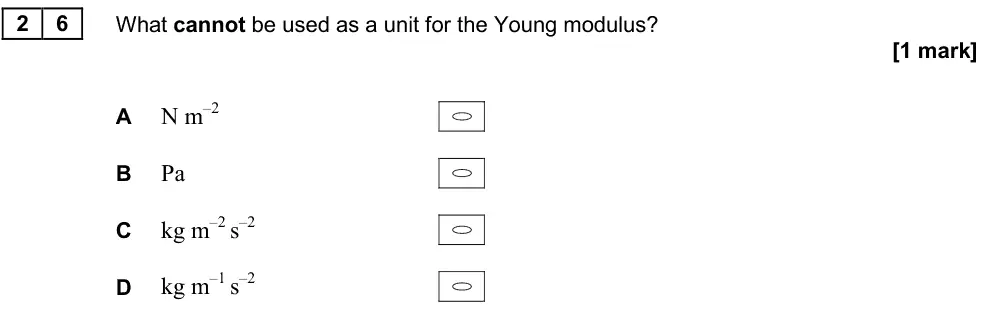
June 2017 · AS Paper 2 · Q261 markMultiple choice
Answer
C
Notes from the mark scheme and report
Answer: C
Skills: MS0.1 Recognise and make use of appropriate units in calculations
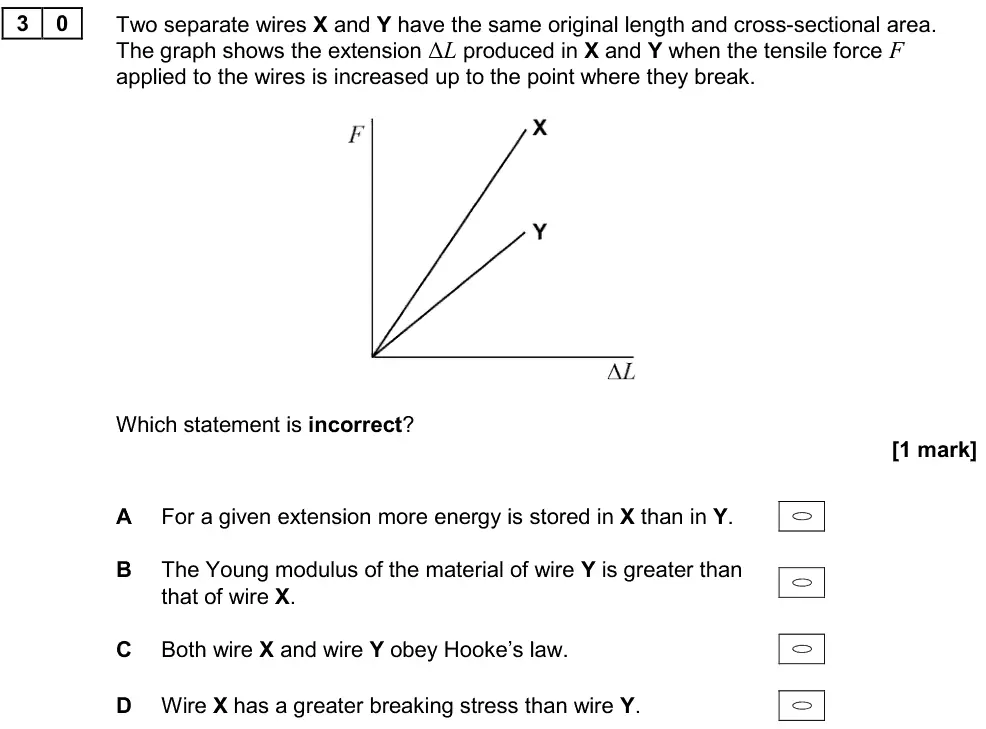
June 2017 · AS Paper 2 · Q301 markMultiple choice
Answer
B
Notes from the mark scheme and report
Answer: B
Specimen set 1 · Paper 1 · Q2.11 markDiagram or graph
Mark scheme
Notes from the mark scheme and report
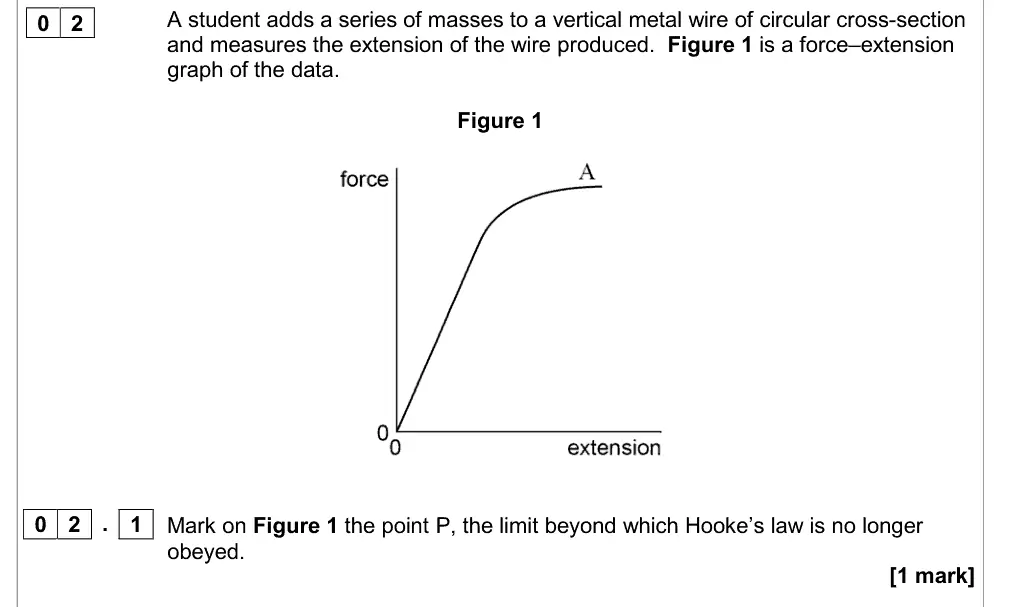
P at the end of the straight (linear) section of Figure 1
Skills: MS3.1 Translate information between graphical, numerical and algebraic forms
Specimen set 1 · Paper 1 · Q2.23 marksExplanation
Earlier part of question 2 that this part uses
Mark scheme
Notes from the mark scheme and report
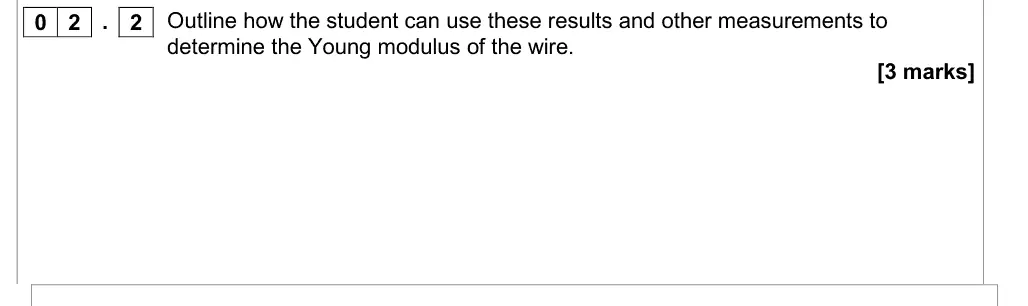
Measure original length and diameter
gradient of linear section gives F/extension
E = gradient x L / (pi d^2/4), or convert to stress-strain and take the gradient
Skills: MS3.4 Determine the slope and intercept of a linear graph; RP4 Determination of the Young modulus by a simple method.
Specimen set 1 · Paper 1 · Q2.31 markDiagram or graph
Earlier part of question 2 that this part uses
Mark scheme
Notes from the mark scheme and report
Line from A parallel to the original straight section, ending on the extension axis (permanent extension)
Skills: MS3.1 Translate information between graphical, numerical and algebraic forms
Specimen set 1 · Paper 1 · Q2.42 marksExplanation
Earlier part of question 2 that this part uses
Mark scheme
Notes from the mark scheme and report
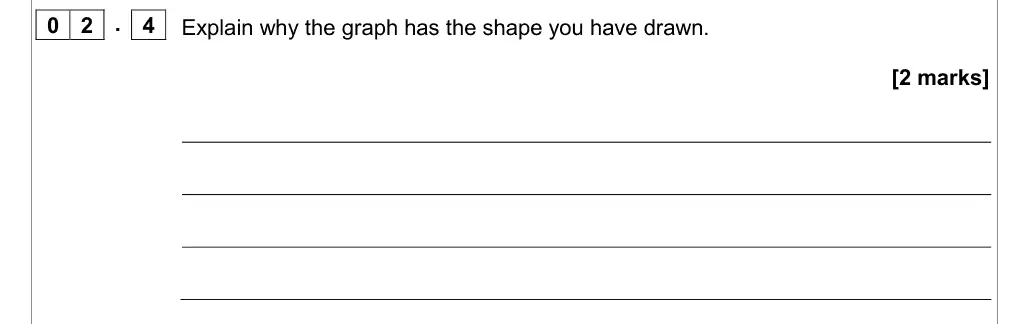
Plastic deformation gives permanent extension so intercept is non-zero
same gradient because the forces between bonds (stiffness) are unchanged
Specimen set 1 · Paper 1 · Q2.53 marksCalculation
Earlier part of question 2 that this part uses
Mark scheme
Notes from the mark scheme and report
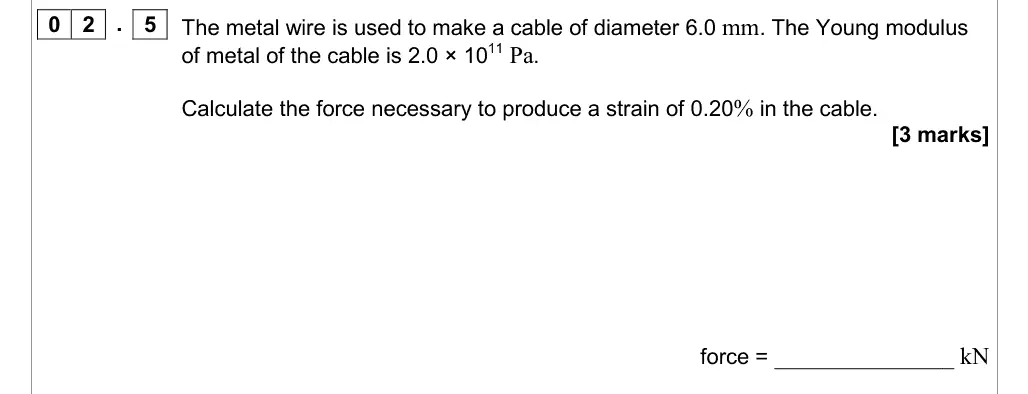
Answer: 11.3 kN (strain 0.002, stress 4 x 10^8 Pa, area of 6.0 mm diameter cable)
Skills: MS0.3 Use ratios, fractions and percentages; MS2.3 Substitute numerical values into algebraic equations using appropriate units for physical quantities; MS4.3 Calculate areas of triangles, circumferences and areas of circles, surface areas and volumes of rectangular blocks, cylinders and spheres
Specimen set 1 · Paper 1 · Q2.73 marksExplanation
Earlier part of question 2 that this part uses
Mark scheme
Notes from the mark scheme and report
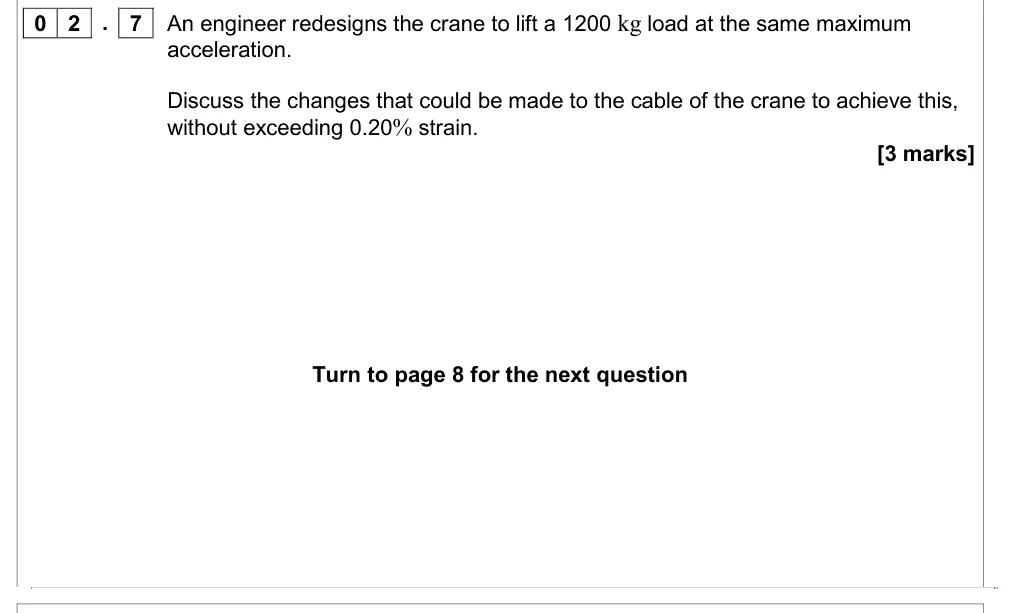
Double load at same acceleration needs double tension
keep strain by doubling cross-sectional area (diameter x root 2) or using a material with double the Young modulus
June 2016 · AS Paper 1 · Q3.12 marksShort answer
Mark scheme
Examiner's comment
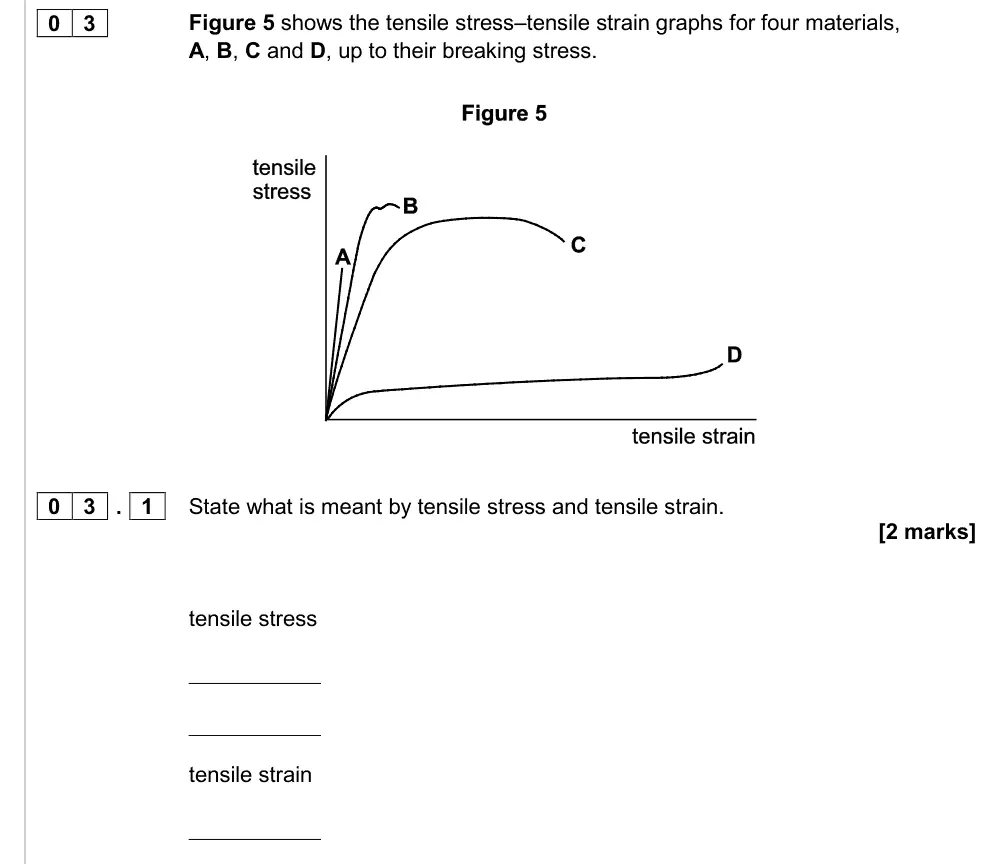
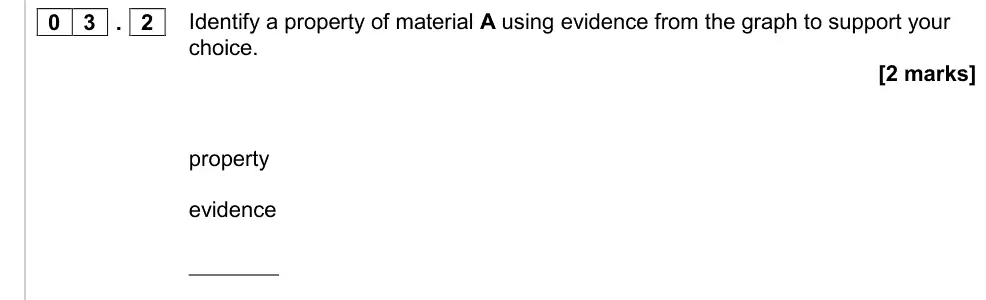
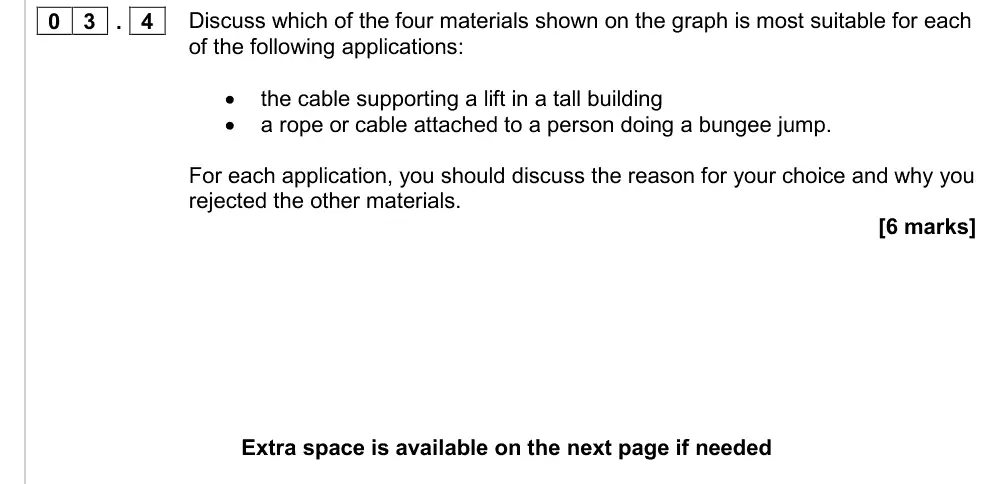
Question 3.1 required students to state the meaning of tensile stress and tensile strain. Marks were frequently lost due to a lack of precision in technical language. For example it was common to see force per unit area rather than cross-sectional area and change in length per length rather than extension per original length. In question 3.2 a significant proportion of students were able to select an appropriate property for material but only about half of those correctly identifying the property were then able to give a suitable explanation. The calculation in question 3.3 was well done with over half the students being awarded full marks. The main errors were an incorrect calculation of cross-sectional area due to using the diameter as a radius or a power of ten error when using GPa. Question 3.4 was a level of response marked question and some very impressive answers were seen. About 30% of students were placed in the top band. Some answers were spoilt when students did not give complete answers. This was because although they correctly identified the material for the applications they did not explain why other materials would be rejected. Generally students were more successful in the selection of material for the lift cable than they were for the rope for bungee jumping. This was in part due to them thinking that in order for a material to be elastic it had to obey Hooke’s law and thus have linear stress strain characteristics. This led them to think that material D was not behaving elastically and therefore should be rejected for both applications. Overall however, this question seemed to generate better answers than has been the case with extended prose questions in previous specifications.
In this question students were required to extract information from an introductory passage. Question 6.1 was a straightforward starter but as with 3.1 a significant proportion of answers were spoilt by a lack of precision. Students were required to mention atoms or nuclei in their responses and a significant proportion did not do this. Question 6.2 required an explanation as to why two photons were produced. A number of students seemed to think this was necessary due to energy conservation. Of those who realised this was due to momentum conservation, a significant proportion then failed to appreciate the importance of the photons travelling in different directions. Question 6.3 was an extended calculation and students were told to calculate the maximum frequency of the photons produced in the annihilation of the two nuclei. Maximum was necessary to indicate that the whole rest energy of the nuclei should be used and excluded the possibility of calculating the frequency of photons produced due to annihilation of individual nucleons within the helium and anti-helium nuclei. It is true that higher frequency photons would be produced if the nuclei had significant kinetic energy but students were told to use information from the passage in which there was no mention of kinetic energy. For full marks students needed to explain how they dealt with two nuclei annihilating and two photons being produced. Questions 6.4 and 6.5 were well answered and the only common error was a failure to identify the positron correctly in the equation.
Notes from the mark scheme and report
Stress = force per cross-sectional area
strain = extension per original length
'per unit area' and 'change in length per length' lost marks
June 2016 · AS Paper 1 · Q3.22 marksShort answer
Earlier part of question 3 that this part uses
Mark scheme
Examiner's comment
Question 3.1 required students to state the meaning of tensile stress and tensile strain. Marks were frequently lost due to a lack of precision in technical language. For example it was common to see force per unit area rather than cross-sectional area and change in length per length rather than extension per original length. In question 3.2 a significant proportion of students were able to select an appropriate property for material but only about half of those correctly identifying the property were then able to give a suitable explanation. The calculation in question 3.3 was well done with over half the students being awarded full marks. The main errors were an incorrect calculation of cross-sectional area due to using the diameter as a radius or a power of ten error when using GPa. Question 3.4 was a level of response marked question and some very impressive answers were seen. About 30% of students were placed in the top band. Some answers were spoilt when students did not give complete answers. This was because although they correctly identified the material for the applications they did not explain why other materials would be rejected. Generally students were more successful in the selection of material for the lift cable than they were for the rope for bungee jumping. This was in part due to them thinking that in order for a material to be elastic it had to obey Hooke’s law and thus have linear stress strain characteristics. This led them to think that material D was not behaving elastically and therefore should be rejected for both applications. Overall however, this question seemed to generate better answers than has been the case with extended prose questions in previous specifications.
Notes from the mark scheme and report
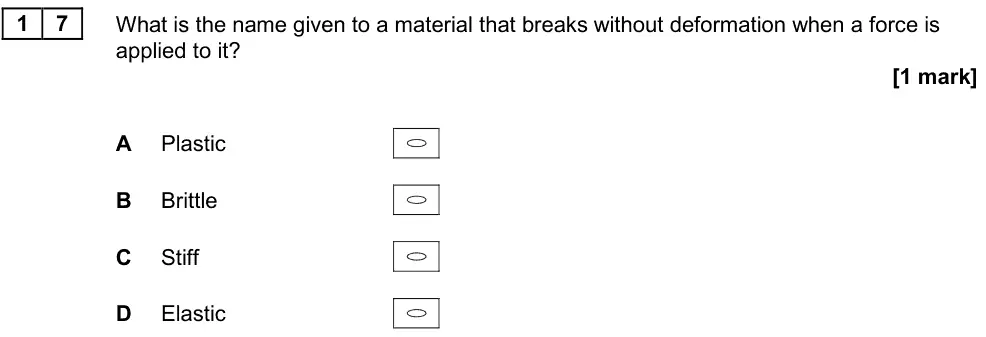
Brittle (straight line to breaking point, no plastic region) or stiff/high Young modulus (steepest gradient)
evidence mark depends on property
June 2016 · AS Paper 1 · Q3.33 marksCalculation
Earlier part of question 3 that this part uses
Mark scheme
Examiner's comment
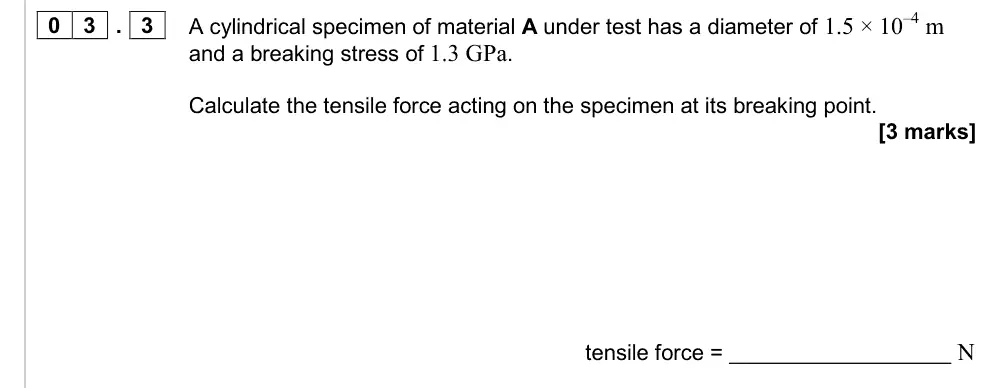
Question 3.1 required students to state the meaning of tensile stress and tensile strain. Marks were frequently lost due to a lack of precision in technical language. For example it was common to see force per unit area rather than cross-sectional area and change in length per length rather than extension per original length. In question 3.2 a significant proportion of students were able to select an appropriate property for material but only about half of those correctly identifying the property were then able to give a suitable explanation. The calculation in question 3.3 was well done with over half the students being awarded full marks. The main errors were an incorrect calculation of cross-sectional area due to using the diameter as a radius or a power of ten error when using GPa. Question 3.4 was a level of response marked question and some very impressive answers were seen. About 30% of students were placed in the top band. Some answers were spoilt when students did not give complete answers. This was because although they correctly identified the material for the applications they did not explain why other materials would be rejected. Generally students were more successful in the selection of material for the lift cable than they were for the rope for bungee jumping. This was in part due to them thinking that in order for a material to be elastic it had to obey Hooke’s law and thus have linear stress strain characteristics. This led them to think that material D was not behaving elastically and therefore should be rejected for both applications. Overall however, this question seemed to generate better answers than has been the case with extended prose questions in previous specifications.
Notes from the mark scheme and report
Answer: 23 N (A = pi d^2/4 = 1.77 x 10^-8 m^2
F = 1.3 x 10^9 x A)
diameter used as radius and GPa power-of-ten errors common
Skills: MS4.3 Calculate areas of triangles, circumferences and areas of circles, surface areas and volumes of rectangular blocks, cylinders and spheres; MS2.3 Substitute numerical values into algebraic equations using appropriate units for physical quantities; MS0.2 Recognise and use expressions in decimal and standard form
June 2016 · AS Paper 1 · Q3.46 marks6-mark extended responseHard
Earlier part of question 3 that this part uses
Mark scheme, with the levels and indicative content
Examiner's comment
Question 3.1 required students to state the meaning of tensile stress and tensile strain. Marks were frequently lost due to a lack of precision in technical language. For example it was common to see force per unit area rather than cross-sectional area and change in length per length rather than extension per original length. In question 3.2 a significant proportion of students were able to select an appropriate property for material but only about half of those correctly identifying the property were then able to give a suitable explanation. The calculation in question 3.3 was well done with over half the students being awarded full marks. The main errors were an incorrect calculation of cross-sectional area due to using the diameter as a radius or a power of ten error when using GPa. Question 3.4 was a level of response marked question and some very impressive answers were seen. About 30% of students were placed in the top band. Some answers were spoilt when students did not give complete answers. This was because although they correctly identified the material for the applications they did not explain why other materials would be rejected. Generally students were more successful in the selection of material for the lift cable than they were for the rope for bungee jumping. This was in part due to them thinking that in order for a material to be elastic it had to obey Hooke’s law and thus have linear stress strain characteristics. This led them to think that material D was not behaving elastically and therefore should be rejected for both applications. Overall however, this question seemed to generate better answers than has been the case with extended prose questions in previous specifications.
This was the first paper for this new award and evidence from scripts suggests that an encouraging proportion of students were well prepared for the exam and were able to cope successfully with the broader scope of the questions and the change in emphasis of the assessment objectives. In general students seemed more confident with quantitative questions and less so with those that required extended written answers. There was a tendency not to present full arguments when applying physics principles: examples of this being questions 1.2, 3.4 and 5.1. The evidence from scripts suggests that students had sufficient time to answer all the questions and few incomplete papers were seen.
Notes from the mark scheme and report
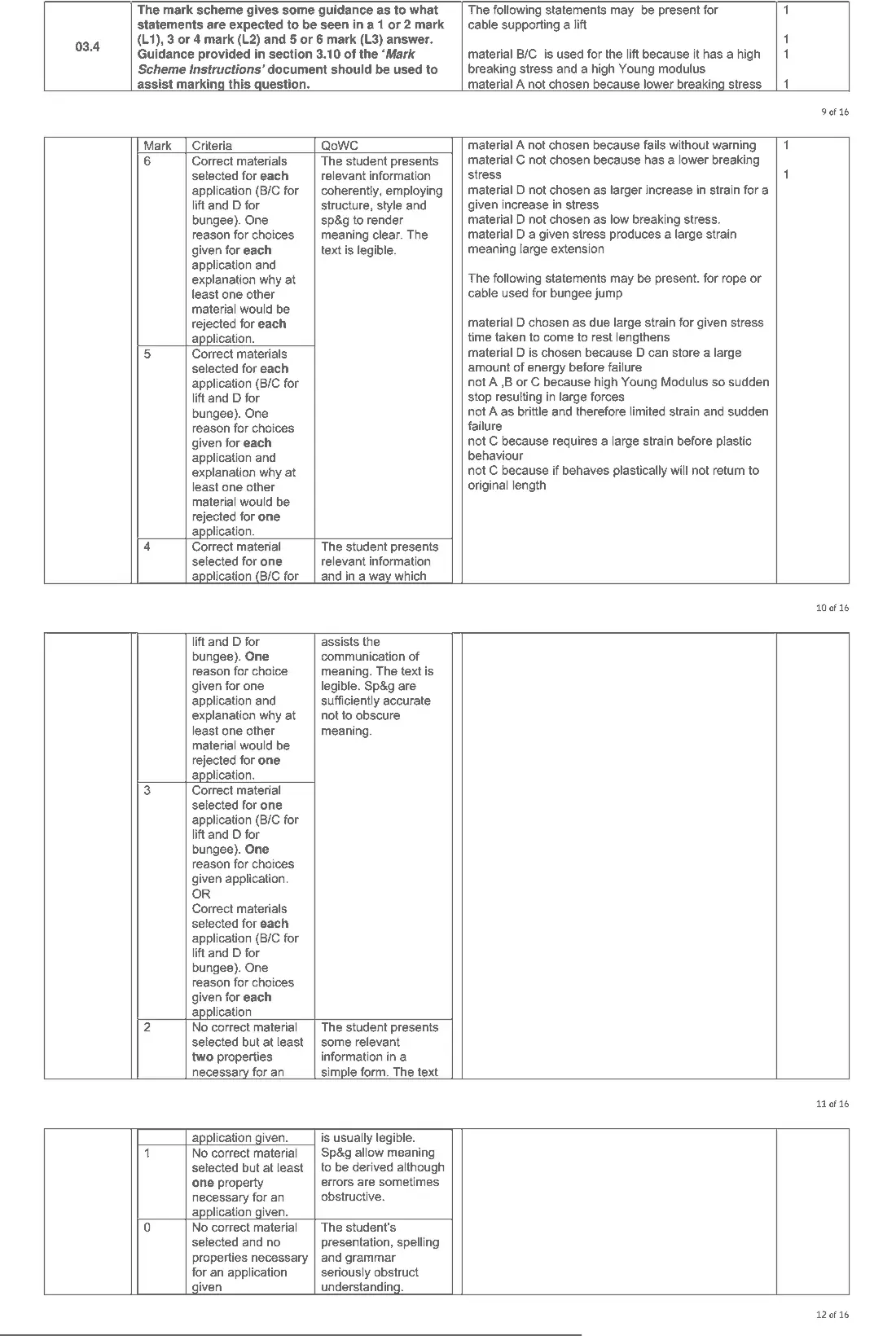
Levels of response: B/C for lift cable (high breaking stress, high Young modulus
not A - brittle, not D - large strain)
D for bungee rope (large strain, stores energy, longer stopping time
reject A, B, C as stiff or brittle)
must say why others rejected
Specimen set 1 · Paper 1 · Q101 markMultiple choice
Answer
C
Notes from the mark scheme and report
Answer: C
June 2016 · AS Paper 2 · Q1.11 markPractical and data analysis
Mark scheme
Examiner's comment
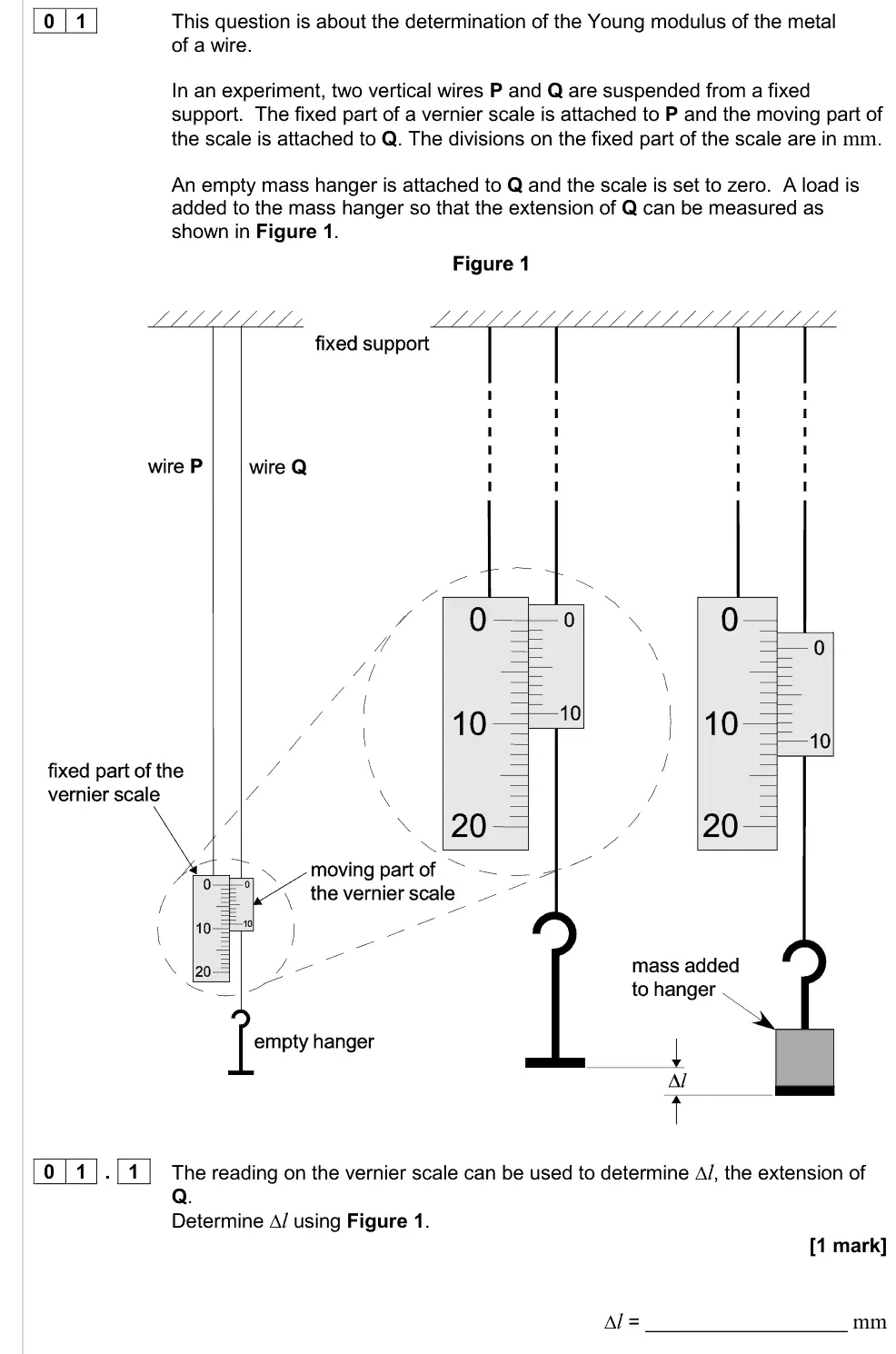
1.1 Vernier scales are a common feature of the equipment used to measure extension in a Young Modulus determination. Many students were unable to give the correct answer, however, with 2.8 mm a fairly common error.
1.2 Students were allowed to carry an error forward from 1.1 and many students were able to read the scale correctly. Where the answer to 1.1 fell outside the graph some students attempted to extrapolate or carry out a y=mx+c calculation; these students may have benefited from checking their answer to 1.1 first.
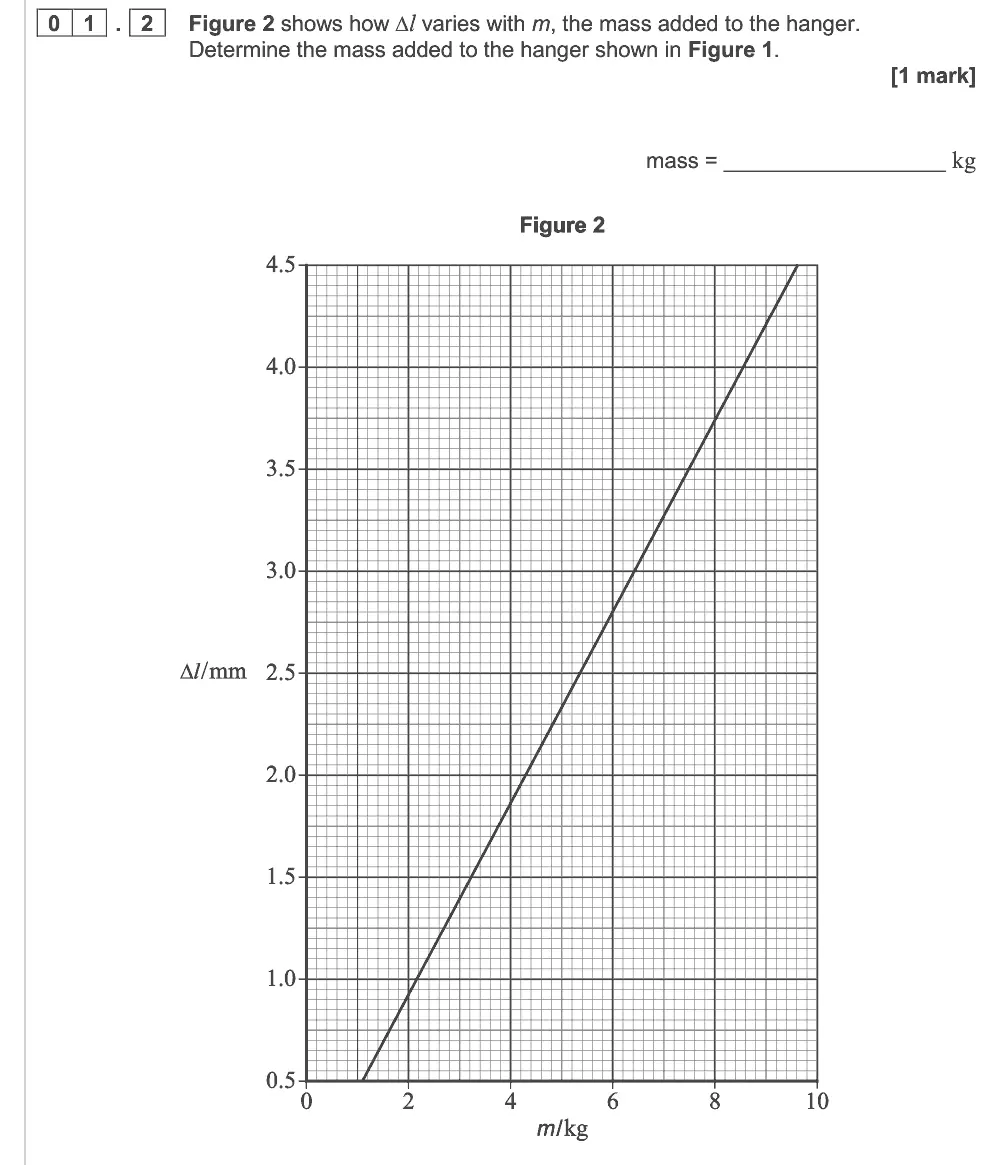
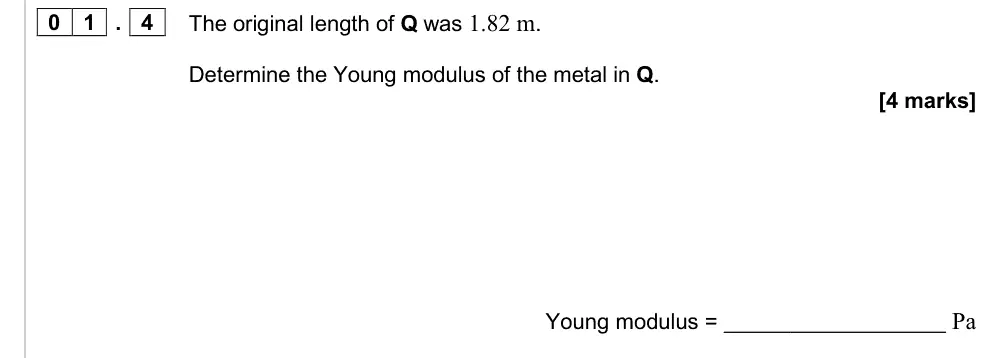
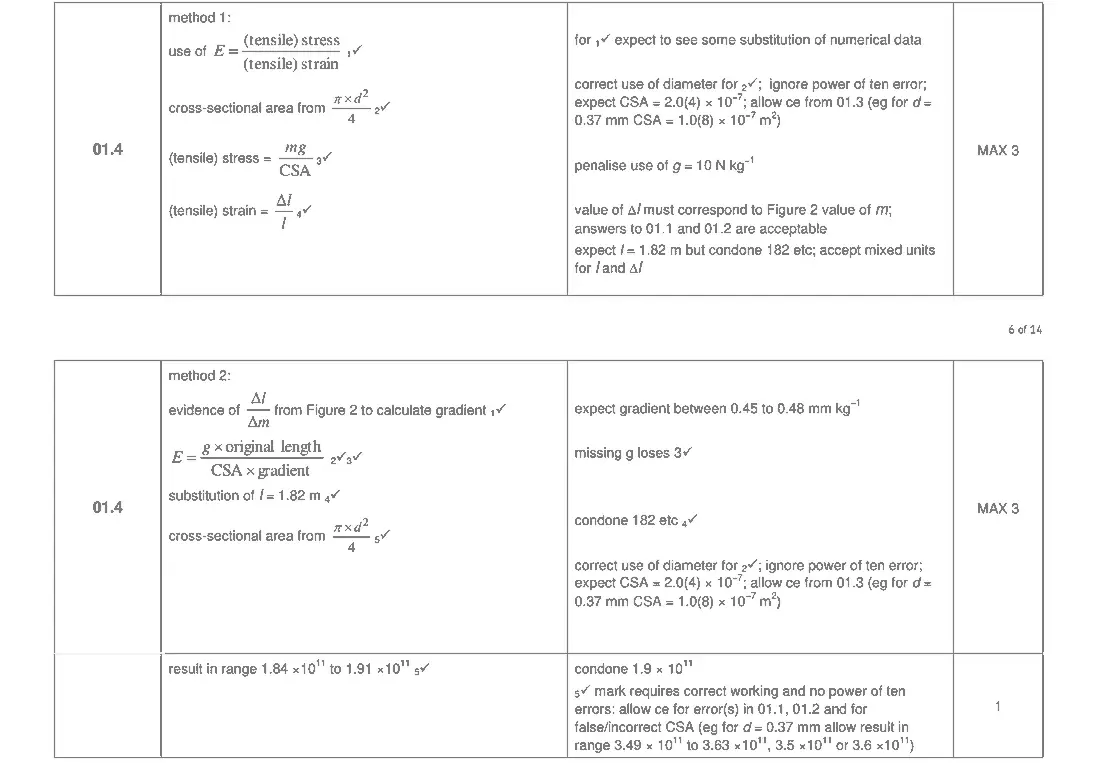
1.4 This calculation was reasonably well carried out with the majority of students getting at least 3 marks out of 4. Although students should be encouraged to use the gradient of figure 2 to help calculate a value of E, the use of individual points was acceptable on this occasion. It was common to see the values obtained in the previous three sections used to work out the cross sectional area, and then the strain and stress separately, before combining them to calculate E. The two common errors in this approach were the use of the diameter for the radius, and missing out "g" in the calculation of the force. Several students also made powers of ten errors in the cross-sectional area calculation, or mixed their units in the calculation of strain. This commonly led to the fourth mark being lost. Students should be encouraged to set out their answers logically so that it is easier to check for errors. Some students inevitably lost marks if they made an error attempting to perform the calculation in one go. Over reliance on the data sheet also led to problems with some students using F=k∆l, and using the Boltzmann constant for k. Any errors from 1.1, 1.2 or 1.3 were carried forward so that no student was denied the opportunity to earn subsequent marks. 1.5 When guiding students with their responses to questions such as this it is important to emphasise the need for clarity in expression, as examiners cannot credit ambiguous or vague answers. To gain credit, answers required an outcome (eg the extension increases) and consequence (the percentage uncertainty in E decreases). It was common for students to miss out the word 'percentage' but on this occasion this was not penalised. There were several different correct approaches but each was accompanied by its own common errors. For example, students who simply stated that the wire would get longer, rather than the extension would increase, failed to get the mark. Students who based an answer on the increased percentage uncertainty in the measurement of the diameter often failed to go on to state how this would affect the percentage uncertainty in the value of E. It was also relatively common to see incorrect physics, for example answers claiming that the value of E would be affected.
Notes from the mark scheme and report
Answer: 2.7 mm read from the vernier in Figure 1
2.8 mm was a common misreading
Skills: PS4.1 Know and understand how to use a wide range of experimental and practical instruments, equipment and techniques; ATa analogue apparatus to record measurements and interpolate; RP4 Determination of the Young modulus by a simple method.
June 2016 · AS Paper 2 · Q1.21 markPractical and data analysis
Earlier part of question 1 that this part uses
Mark scheme
Examiner's comment
1.2 Students were allowed to carry an error forward from 1.1 and many students were able to read the scale correctly. Where the answer to 1.1 fell outside the graph some students attempted to extrapolate or carry out a y=mx+c calculation; these students may have benefited from checking their answer to 1.1 first.
1.4 This calculation was reasonably well carried out with the majority of students getting at least 3 marks out of 4. Although students should be encouraged to use the gradient of figure 2 to help calculate a value of E, the use of individual points was acceptable on this occasion. It was common to see the values obtained in the previous three sections used to work out the cross sectional area, and then the strain and stress separately, before combining them to calculate E. The two common errors in this approach were the use of the diameter for the radius, and missing out "g" in the calculation of the force. Several students also made powers of ten errors in the cross-sectional area calculation, or mixed their units in the calculation of strain. This commonly led to the fourth mark being lost. Students should be encouraged to set out their answers logically so that it is easier to check for errors. Some students inevitably lost marks if they made an error attempting to perform the calculation in one go. Over reliance on the data sheet also led to problems with some students using F=k∆l, and using the Boltzmann constant for k. Any errors from 1.1, 1.2 or 1.3 were carried forward so that no student was denied the opportunity to earn subsequent marks. 1.5 When guiding students with their responses to questions such as this it is important to emphasise the need for clarity in expression, as examiners cannot credit ambiguous or vague answers. To gain credit, answers required an outcome (eg the extension increases) and consequence (the percentage uncertainty in E decreases). It was common for students to miss out the word 'percentage' but on this occasion this was not penalised. There were several different correct approaches but each was accompanied by its own common errors. For example, students who simply stated that the wire would get longer, rather than the extension would increase, failed to get the mark. Students who based an answer on the increased percentage uncertainty in the measurement of the diameter often failed to go on to state how this would affect the percentage uncertainty in the value of E. It was also relatively common to see incorrect physics, for example answers claiming that the value of E would be affected.
Notes from the mark scheme and report
Answer: 5.8 kg (read from Figure 2 at their 01.1 extension, +/- 0.1 kg)
Skills: MS3.1 Translate information between graphical, numerical and algebraic forms; PS3.1 Plot and interpret graphs; RP4 Determination of the Young modulus by a simple method.
June 2016 · AS Paper 2 · Q1.44 marksPractical and data analysis
Earlier part of question 1 that this part uses
Mark scheme
Examiner's comment
1.4 This calculation was reasonably well carried out with the majority of students getting at least 3 marks out of 4. Although students should be encouraged to use the gradient of figure 2 to help calculate a value of E, the use of individual points was acceptable on this occasion. It was common to see the values obtained in the previous three sections used to work out the cross sectional area, and then the strain and stress separately, before combining them to calculate E. The two common errors in this approach were the use of the diameter for the radius, and missing out "g" in the calculation of the force. Several students also made powers of ten errors in the cross-sectional area calculation, or mixed their units in the calculation of strain. This commonly led to the fourth mark being lost. Students should be encouraged to set out their answers logically so that it is easier to check for errors. Some students inevitably lost marks if they made an error attempting to perform the calculation in one go. Over reliance on the data sheet also led to problems with some students using F=k∆l, and using the Boltzmann constant for k. Any errors from 1.1, 1.2 or 1.3 were carried forward so that no student was denied the opportunity to earn subsequent marks. 1.5 When guiding students with their responses to questions such as this it is important to emphasise the need for clarity in expression, as examiners cannot credit ambiguous or vague answers. To gain credit, answers required an outcome (eg the extension increases) and consequence (the percentage uncertainty in E decreases). It was common for students to miss out the word 'percentage' but on this occasion this was not penalised. There were several different correct approaches but each was accompanied by its own common errors. For example, students who simply stated that the wire would get longer, rather than the extension would increase, failed to get the mark. Students who based an answer on the increased percentage uncertainty in the measurement of the diameter often failed to go on to state how this would affect the percentage uncertainty in the value of E. It was also relatively common to see incorrect physics, for example answers claiming that the value of E would be affected.
Notes from the mark scheme and report
Answer: 1.84-1.91 x 10^11 Pa (CSA = pi(0.255 x 10^-3)^2 = 2.04 x 10^-7 m^2, gradient of Figure 2 about 0.46 mm kg^-1, E = gL/(gradient x A))
diameter for radius, missing g and power-of-ten errors were common
Skills: MS4.3 Calculate areas of triangles, circumferences and areas of circles, surface areas and volumes of rectangular blocks, cylinders and spheres; MS3.4 Determine the slope and intercept of a linear graph; MS2.3 Substitute numerical values into algebraic equations using appropriate units for physical quantities; PS3.2 Process and analyse data using appropriate mathematical skills; RP4 Determination of the Young modulus by a simple method.
June 2016 · AS Paper 2 · Q3.13 marksShow that
Mark scheme
Examiner's comment
3.1 This was a multi-step calculation that most students found fairly straight forward. The common errors seen were wrong substitution of diameter (or use of a wrong formula for volume) and power of ten errors arising from calculation of volume in cm3. Students who have difficulty converting between cm3 and m3 would be better advised to work in m from the outset. Generally “show that” questions are used to provide unsuccessful students the data they would need to complete further parts of the question. Students should be reminded to provide at least 1 sf more than the “show that” value, and they should be discouraged from trying to calculate an answer backwards. Another error is forcing their answer to be near the “show that” value: many students were denied consequential error marks when, having made an error, they attempted to manipulate their answer to obtain a numerical value near 5. For example, students who used 5 cm for the radius could obtain a value of 4.2 kg for the mass. Many would then miss out the step (multiplying by g) to determine the weight, as they had already reached a value near to 5 perhaps. Many modern calculators generate results as fractions or surds. No credit is given for final answers given in such a form or with recurring notation but there is no penalty for this with intermediate results. However students should be discouraged from doing this because it makes the work less transparent and inhibits error-checking. The rounding down of intermediate results compromises the chance of full credit; any rounding down, eg to the same significant figures as that of the least accurate data should not be done until the final stage is complete.
3.2. There were two potential errors in answers that often led students to lose at least one mark. Many students did not take the centre of mass of the ball into account, and therefore did not include the radius when calculating the distance to the pivot. Some students worked through their answers in cm, but wrote the moment unit as Nm. 3.3 Many good answers were seen to this multi-step calculation and this was a good discriminator. Some students were unable to suggest much beyond picking F=5 N and rearranging F = k∆l (given on the data sheet) to produce ∆l = 0.05 m. Spotting that this was a 3 mark question may have led some of them to realise that a more complicated calculation was needed. Others tried to calculate the extension by dividing turning moment by stiffness or by multiplying distance from the pivot by stiffness. A number of students did not attempt this question.
Notes from the mark scheme and report
Answer: 5.2 N (V = 4/3 pi (0.025)^3 = 6.5 x 10^-5 m^3, m = 0.53 kg)
diameter used as radius and cm^3 conversion errors were common
give one more s.f. than the show-that value
Skills: MS4.3 Calculate areas of triangles, circumferences and areas of circles, surface areas and volumes of rectangular blocks, cylinders and spheres; MS2.3 Substitute numerical values into algebraic equations using appropriate units for physical quantities
June 2016 · AS Paper 2 · Q3.33 marksCalculation
Earlier part of question 3 that this part uses
Mark scheme
Examiner's comment
3.2. There were two potential errors in answers that often led students to lose at least one mark. Many students did not take the centre of mass of the ball into account, and therefore did not include the radius when calculating the distance to the pivot. Some students worked through their answers in cm, but wrote the moment unit as Nm. 3.3 Many good answers were seen to this multi-step calculation and this was a good discriminator. Some students were unable to suggest much beyond picking F=5 N and rearranging F = k∆l (given on the data sheet) to produce ∆l = 0.05 m. Spotting that this was a 3 mark question may have led some of them to realise that a more complicated calculation was needed. Others tried to calculate the extension by dividing turning moment by stiffness or by multiplying distance from the pivot by stiffness. A number of students did not attempt this question.
Notes from the mark scheme and report
Answer: 0.094 m (moments: F x 0.080 = 0.75 so F = 9.4 N
delta L = F/k with k = 100 N m^-1)
using 5 N directly in F = k delta L was common
Skills: MS2.2 Change the subject of an equation, including non-linear equations; MS2.3 Substitute numerical values into algebraic equations using appropriate units for physical quantities
Specimen set 1 · Paper 2 · Q4.42 marksShort answer
Earlier part of question 4 that this part uses
Mark scheme
Notes from the mark scheme and report
Mass method gives about 3700 cm^3 (3.7 kg of water) compared with about 3500 cm^3
flask heavier than average or liquid not water (different density)
Skills: MS0.4 Estimate results
Work with an AQA physics tutor
Dropping marks on calculations, required practicals or the six-markers? Book a trial session with a specialist AQA physics tutor.