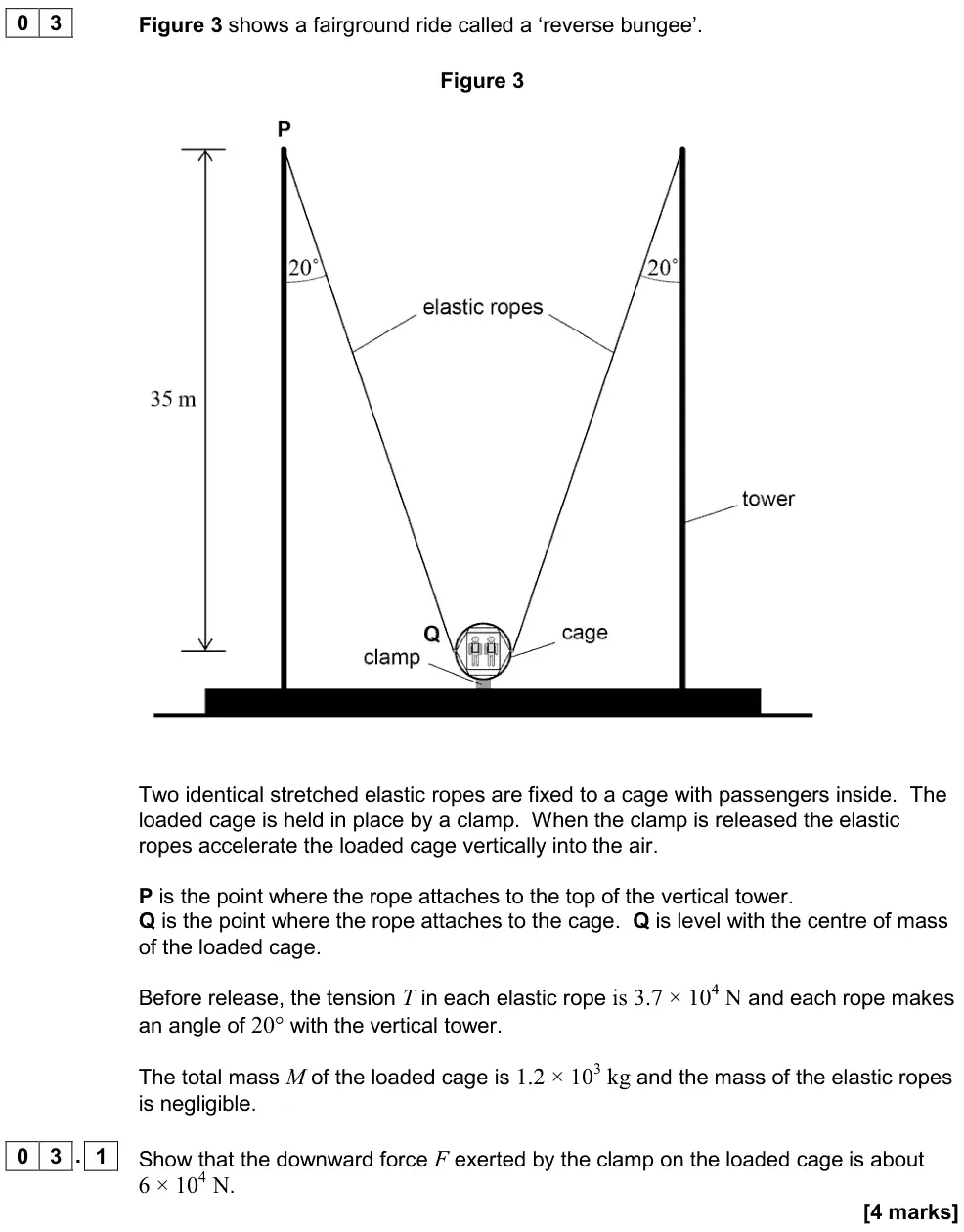
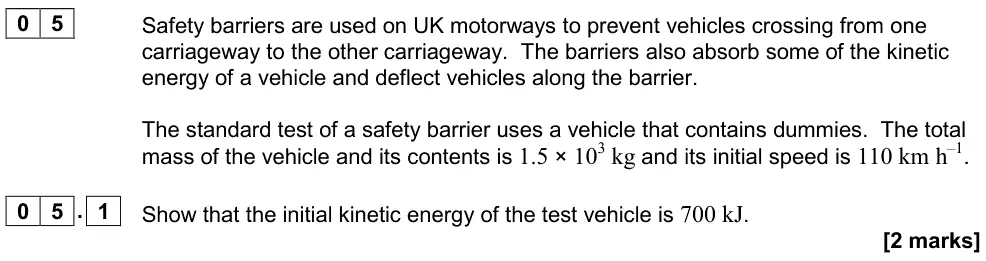
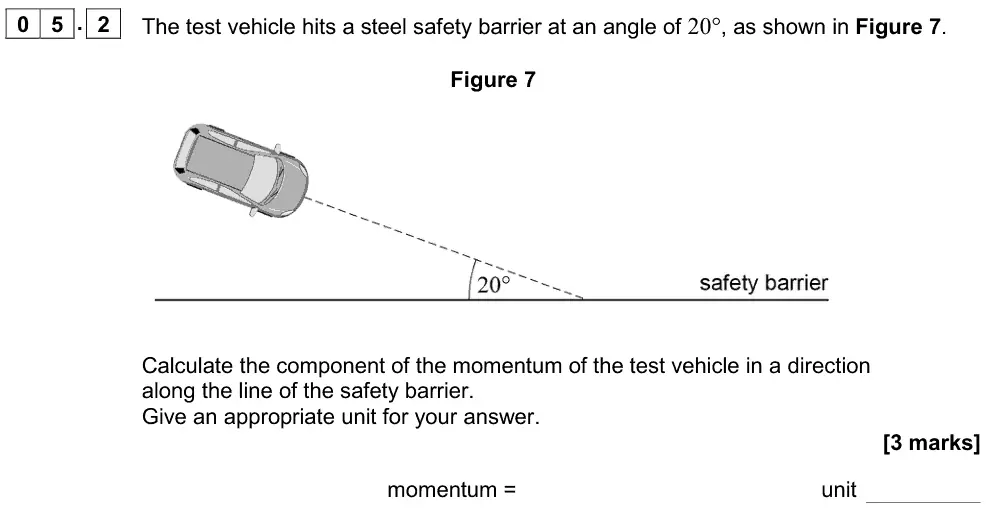
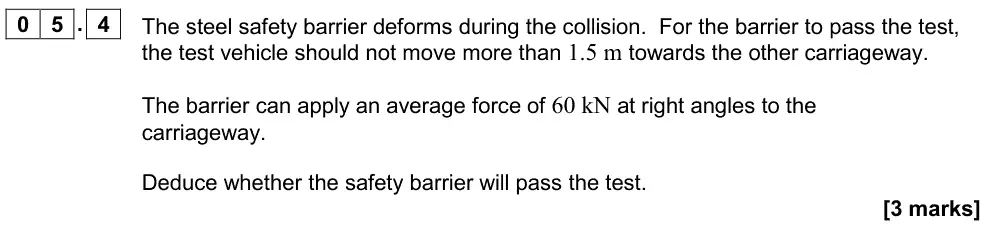
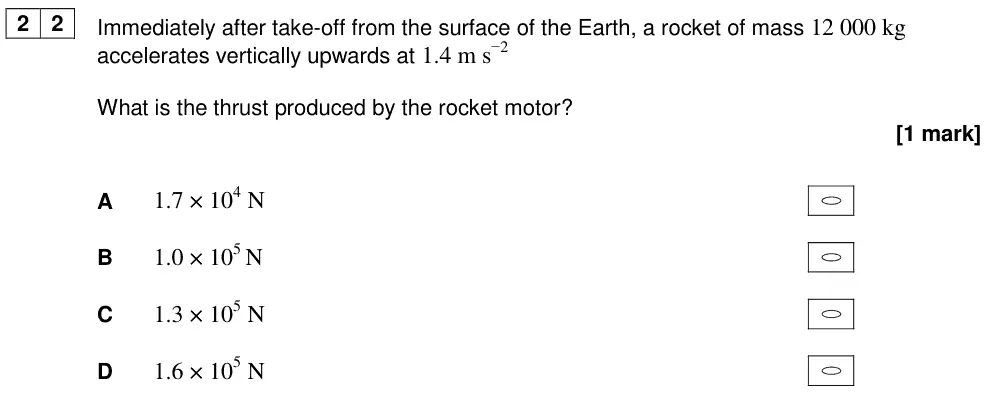
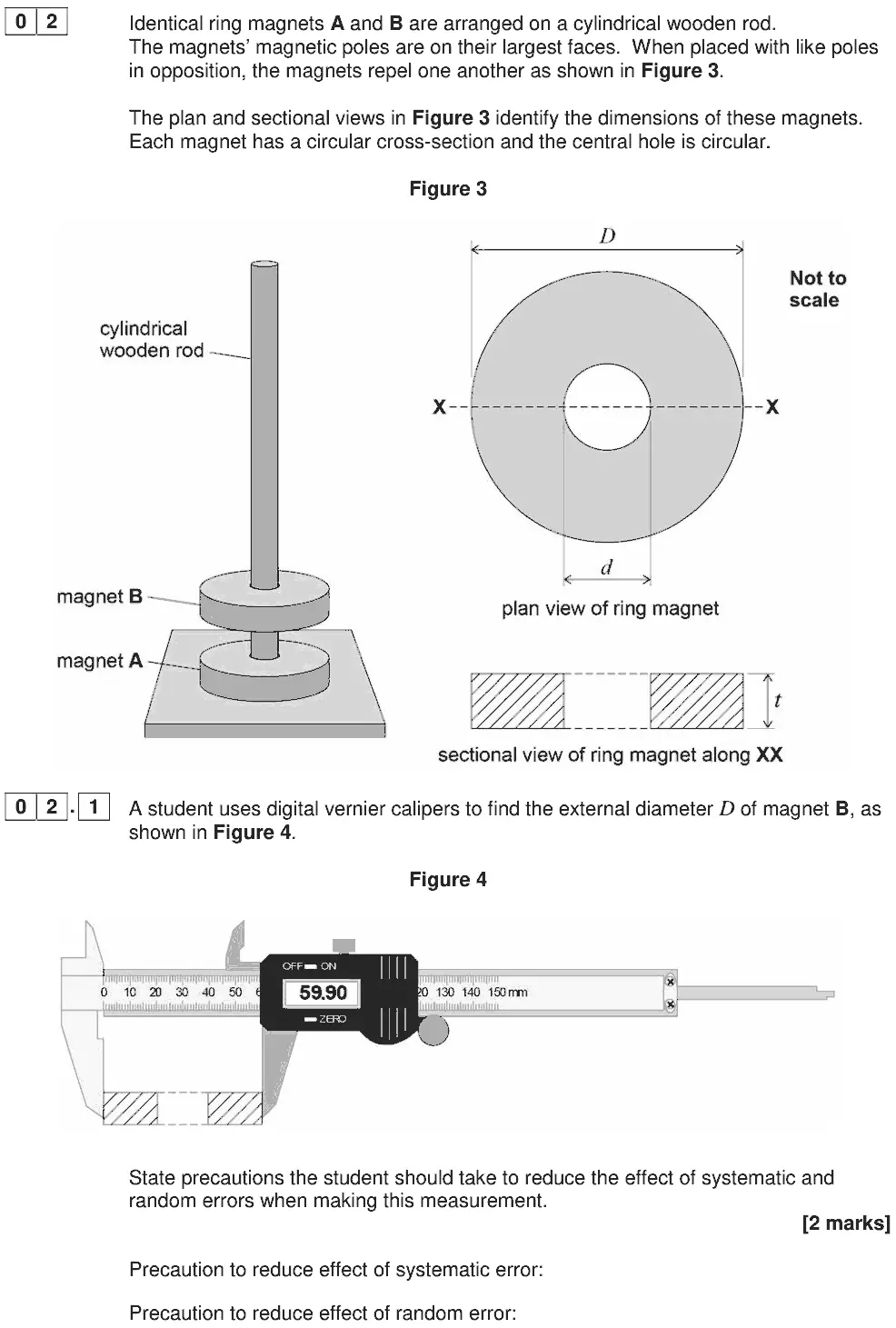
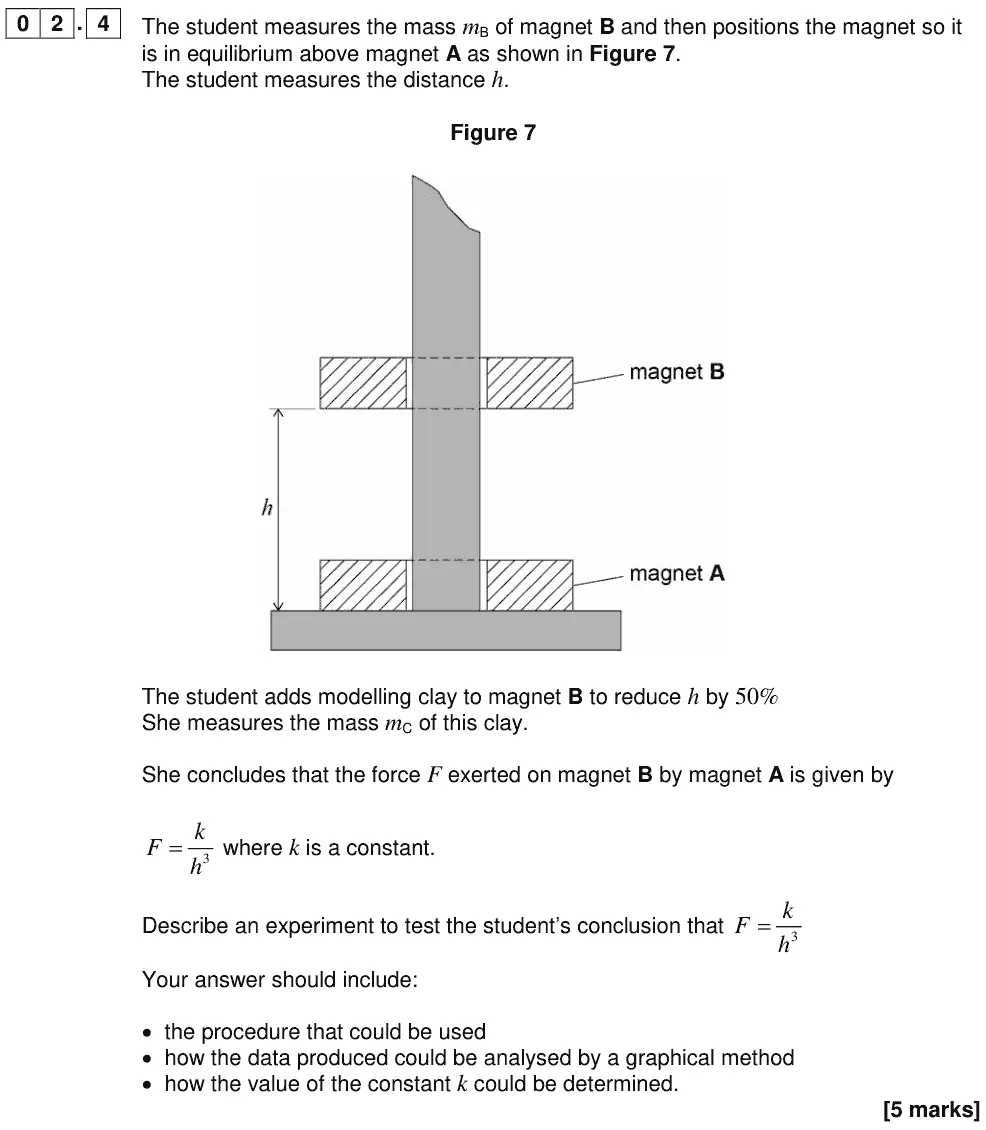
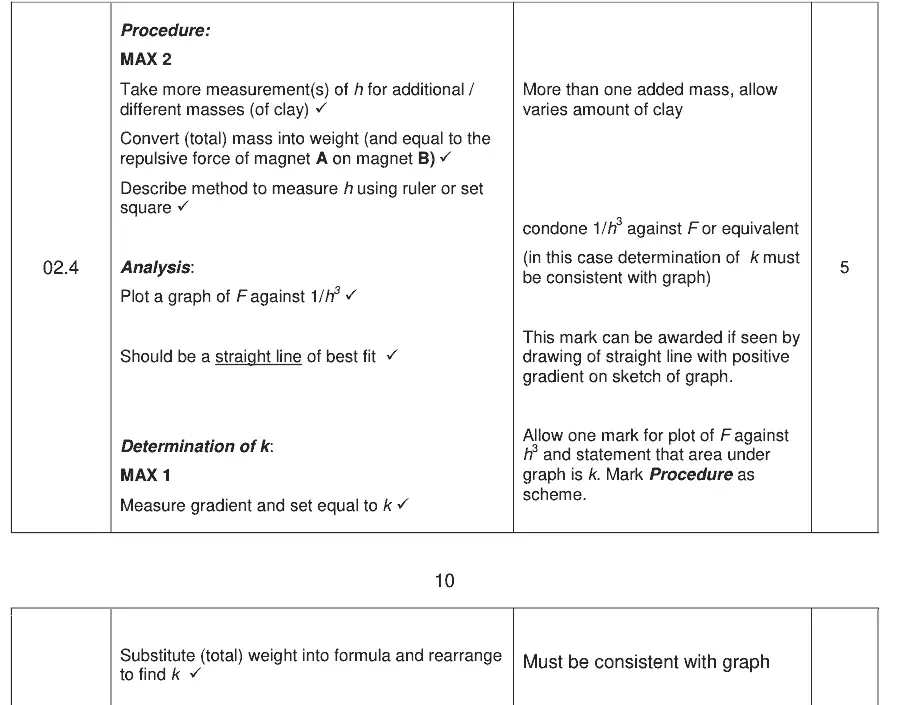
Notes and key-term cards for this topic are being written by our tutors. The past-paper questions below are ready now.
Specification statements
Show the 10 statements from the specification
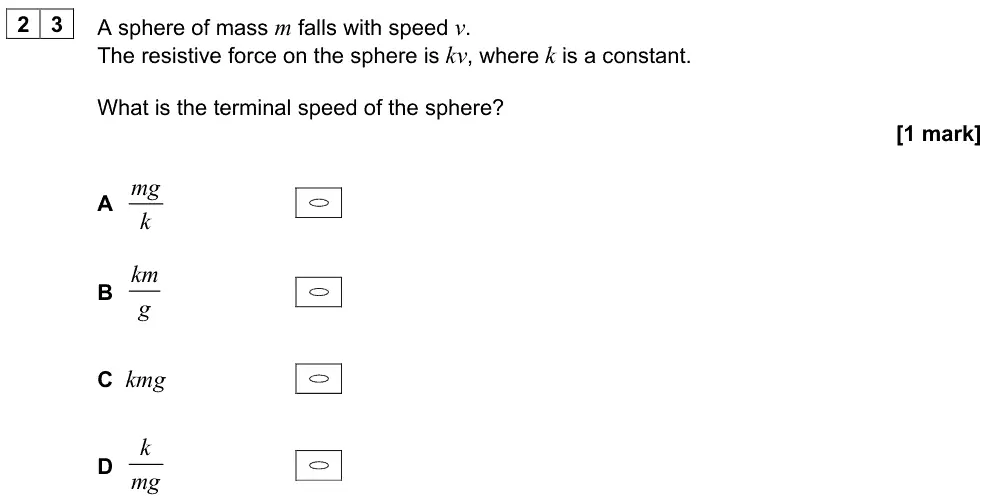
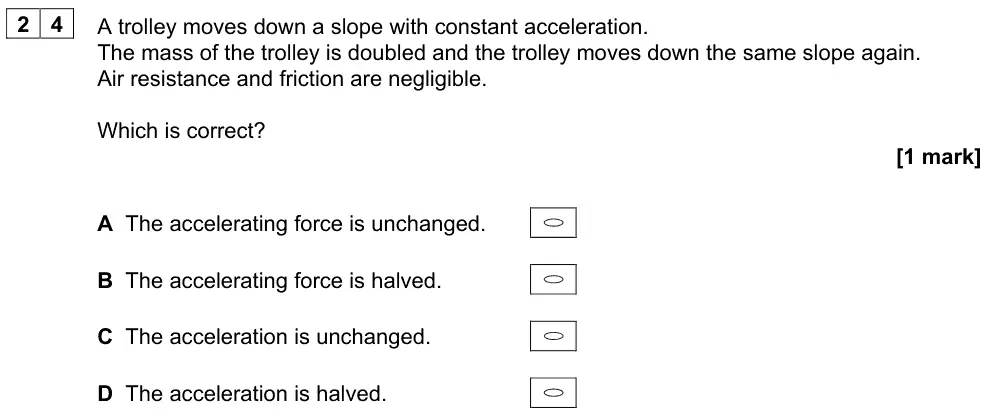
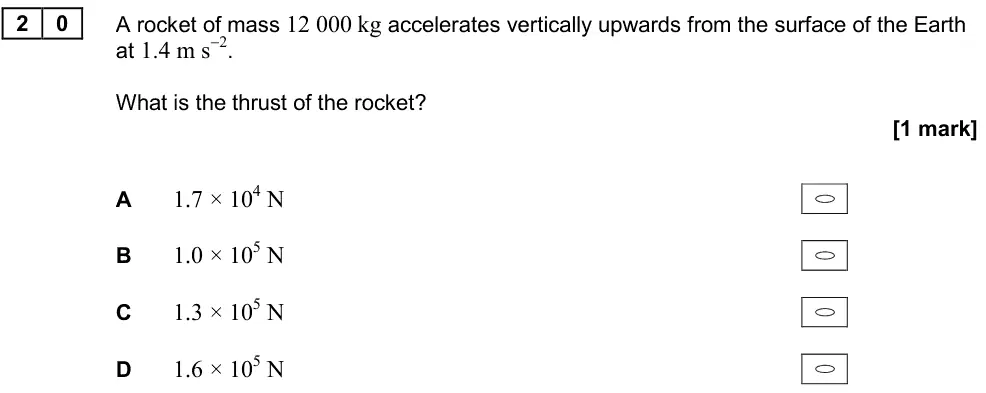
3.4.1.5-01 Knowledge and application of the three laws of motion in appropriate situations. F = ma for situations where the mass is constant.
3.4.1.6-01 momentum = mass × velocity
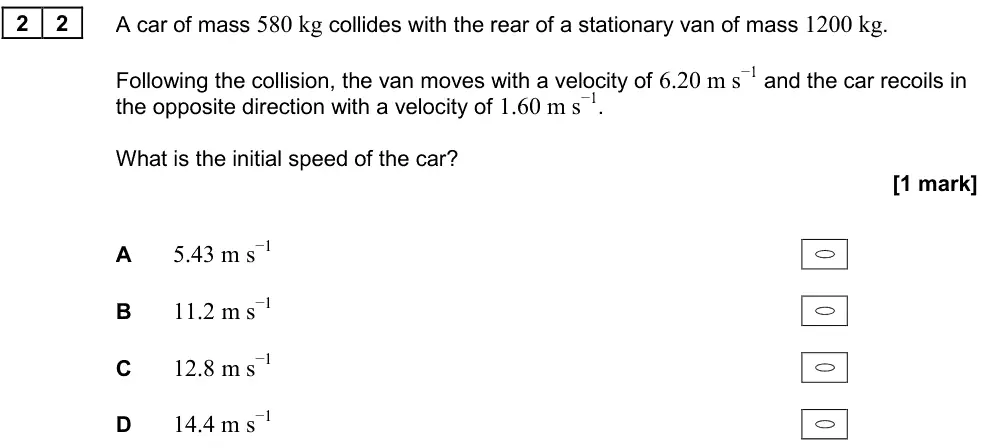
3.4.1.6-02 Conservation of linear momentum.
3.4.1.6-03 Principle applied quantitatively to problems in one dimension.
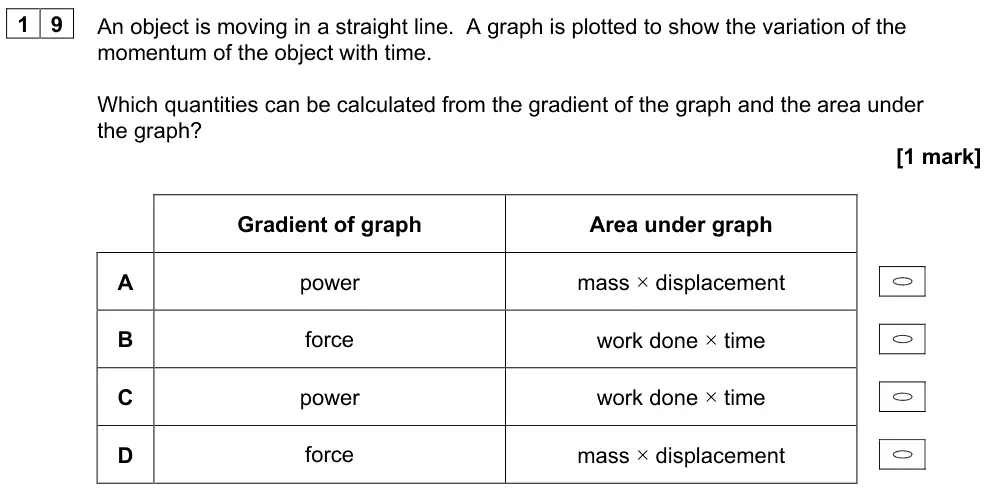
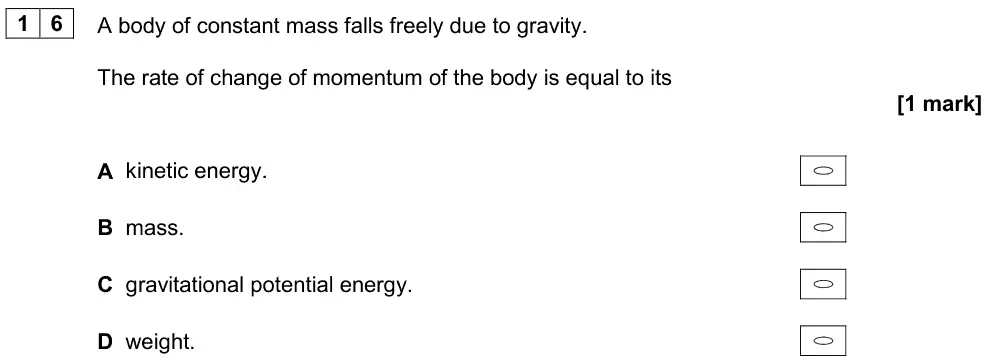
3.4.1.6-04 Force as the rate of change of momentum, F = ∆mv ∆t
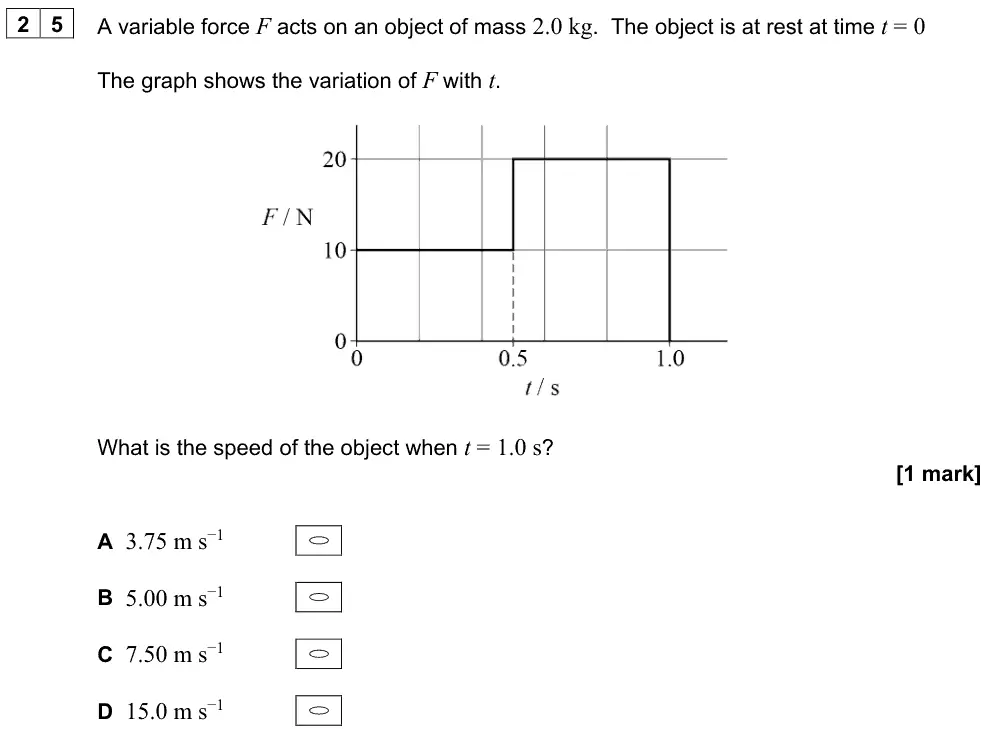
3.4.1.6-05 Impulse = change in momentum F∆t = ∆mv , where F is constant.
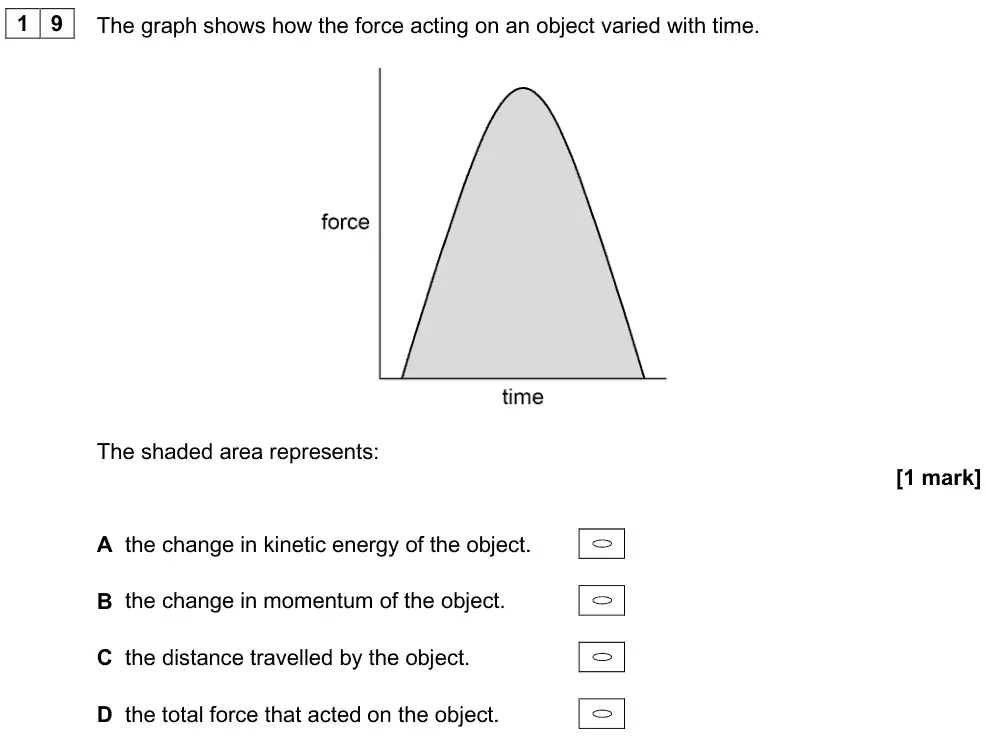
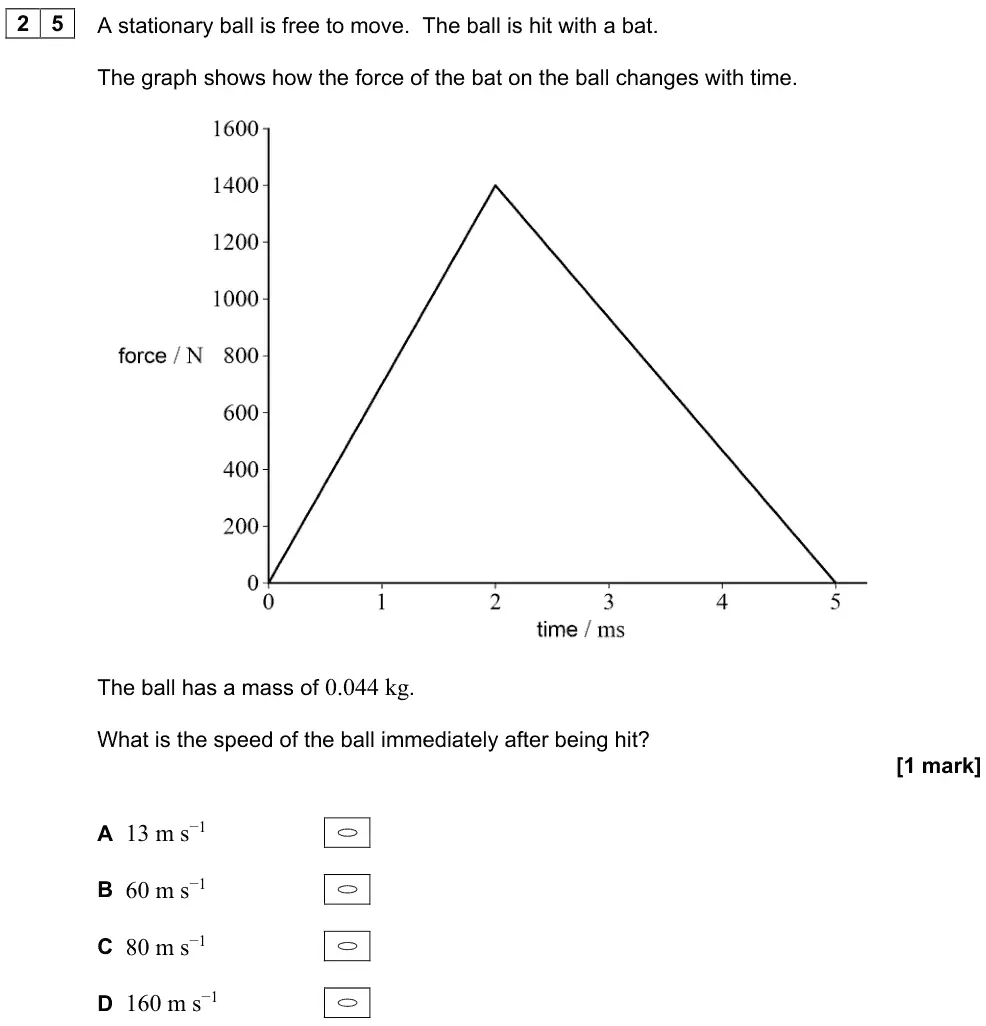
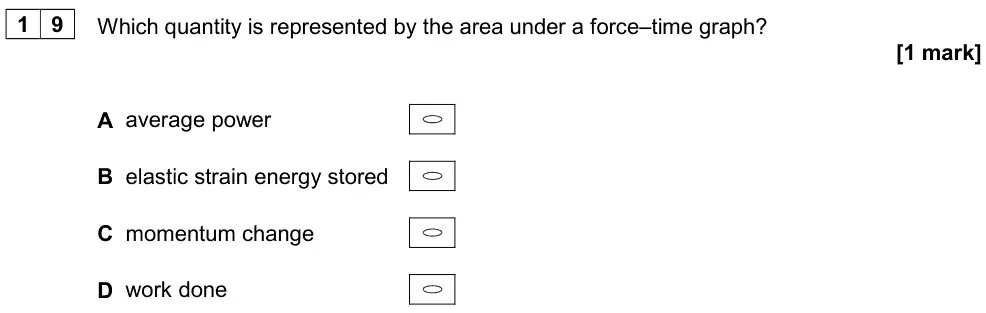
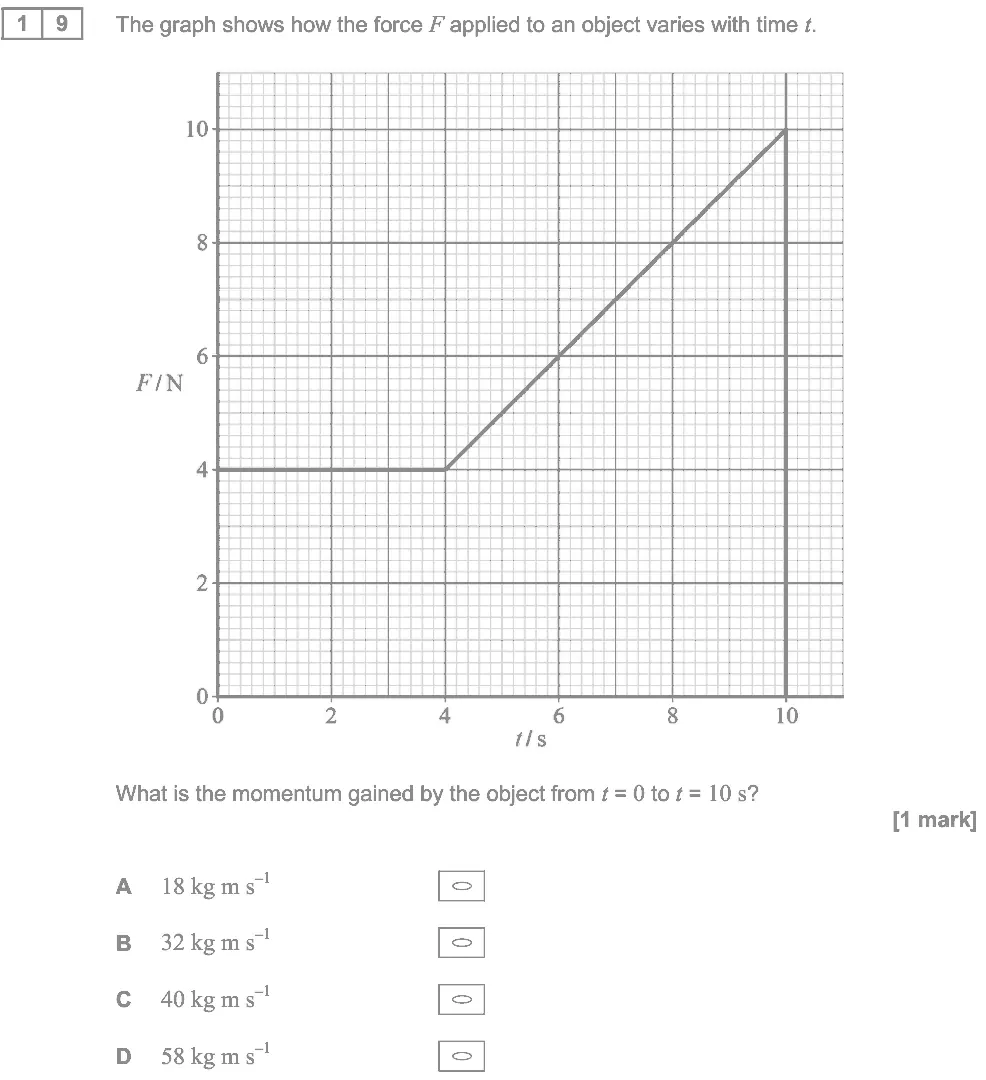
3.4.1.6-06 Significance of the area under a force–time graph.
3.4.1.6-07 Quantitative questions may be set on forces that vary with time. Impact forces are related to contact times (eg kicking a football, crumple zones, packaging).
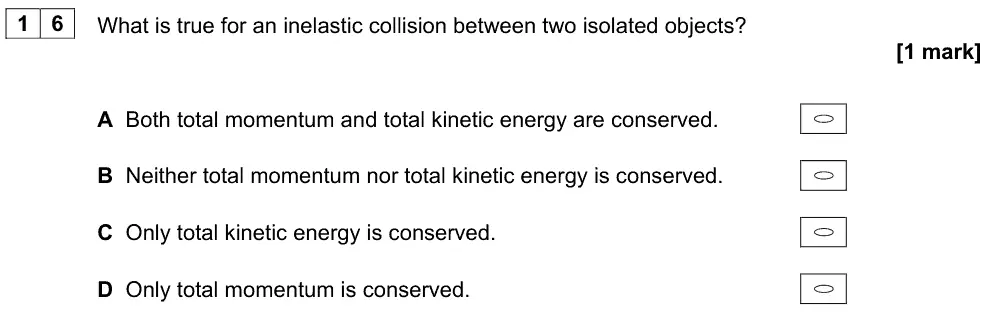
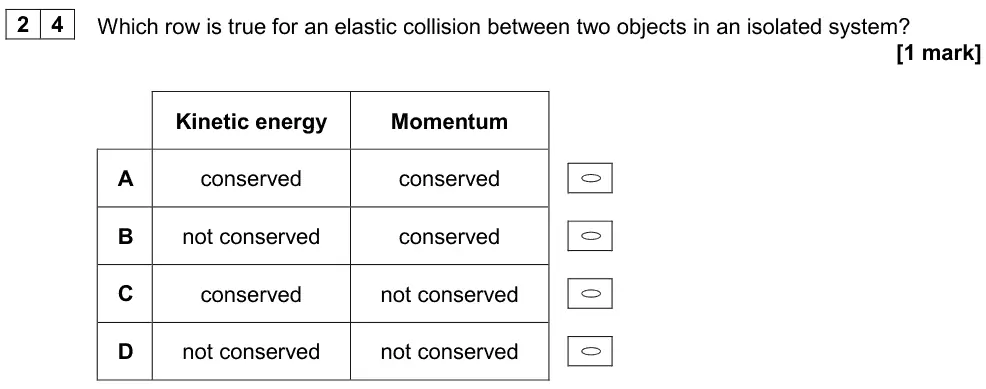
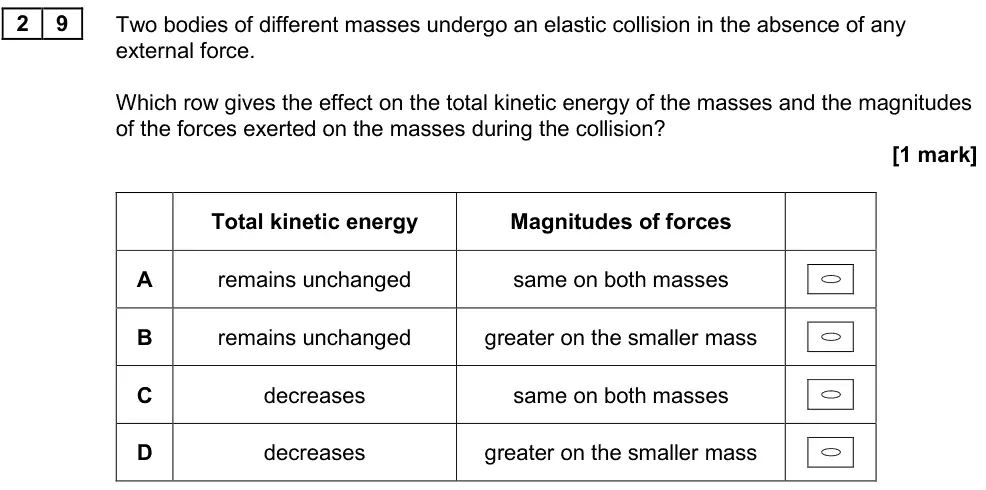
3.4.1.6-08 Elastic and inelastic collisions; explosions.
3.4.1.6-09 Appreciation of momentum conservation issues in the context of ethical transport design.
Tap a question to zoom it. Where a part needs a figure, table or graph from earlier in the question, that part folds out above it; the mark scheme and examiner's comment open underneath. Have the AQA data and formulae booklet beside you (see the formula sheet page).
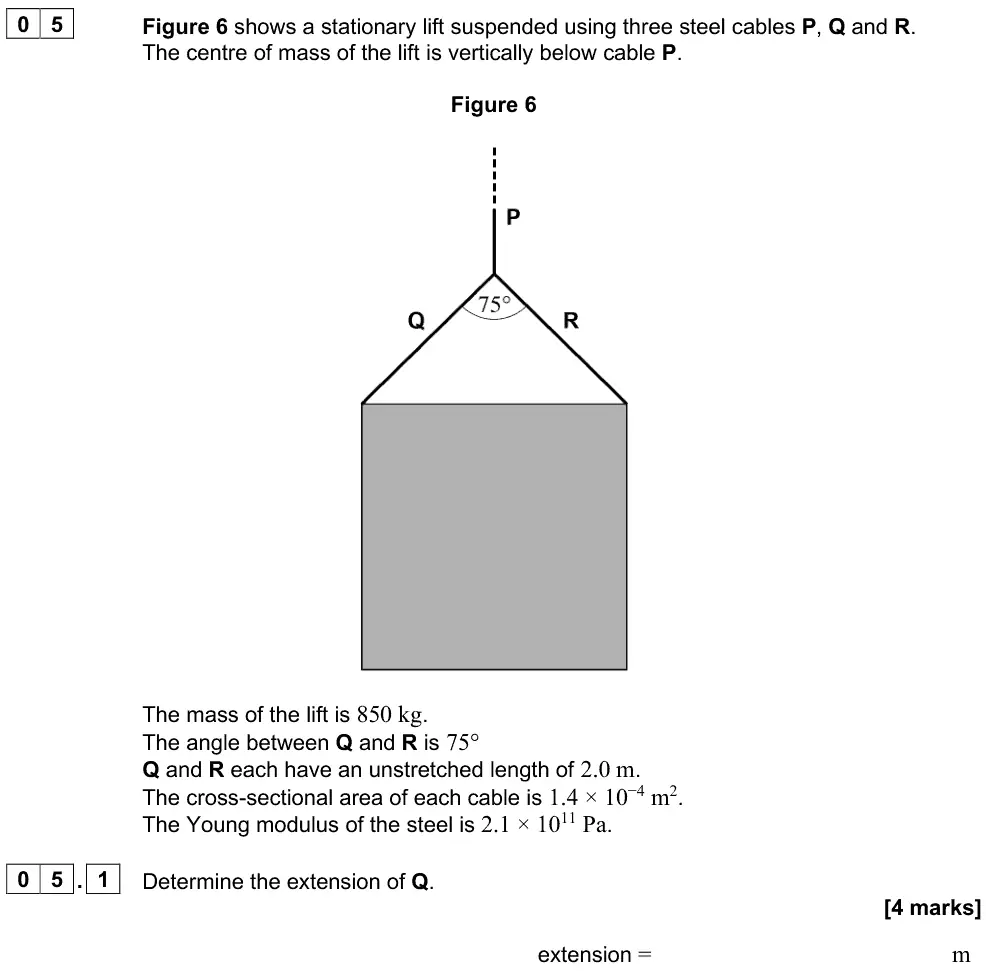
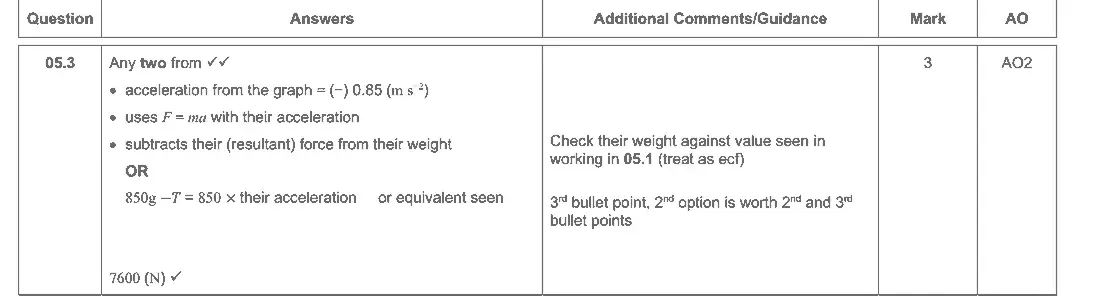
June 2025 · AS Paper 1 · Q5.33 marksAO2=3Calculation
Earlier part of question 5 that this part uses
Mark scheme
Notes from the mark scheme and report
Answer: 7600 N (deceleration 0.85 m s^-2 from gradient, 850g - T = 850 x 0.85)
Skills: MS3.5 Calculate rate of change from a graph showing a linear relationship; MS2.3 Substitute numerical values into algebraic equations using appropriate units for physical quantities
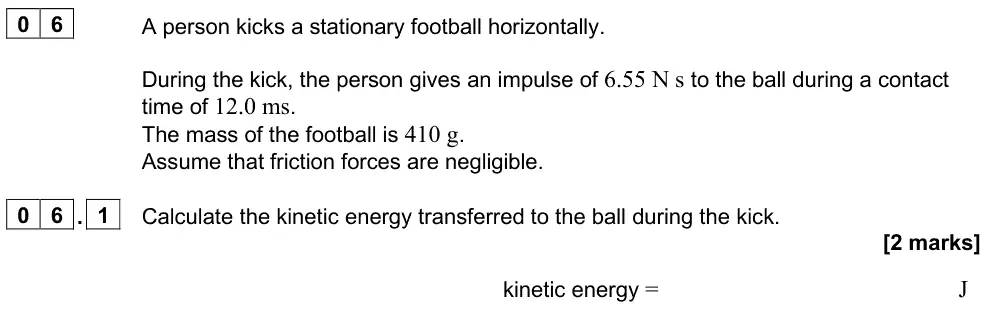
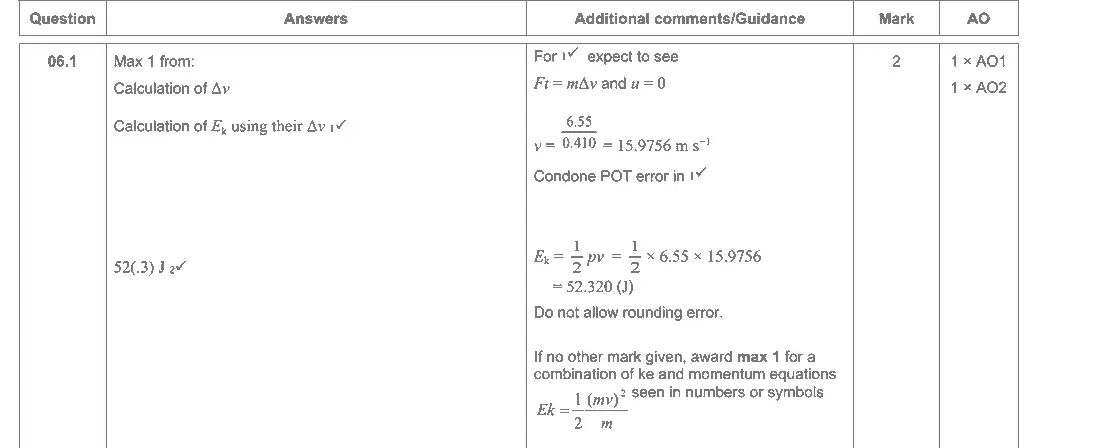
June 2025 · Paper 1 · Q6.12 marksAO1=1, AO2=1CalculationEasy
Mark scheme
Examiner's comment
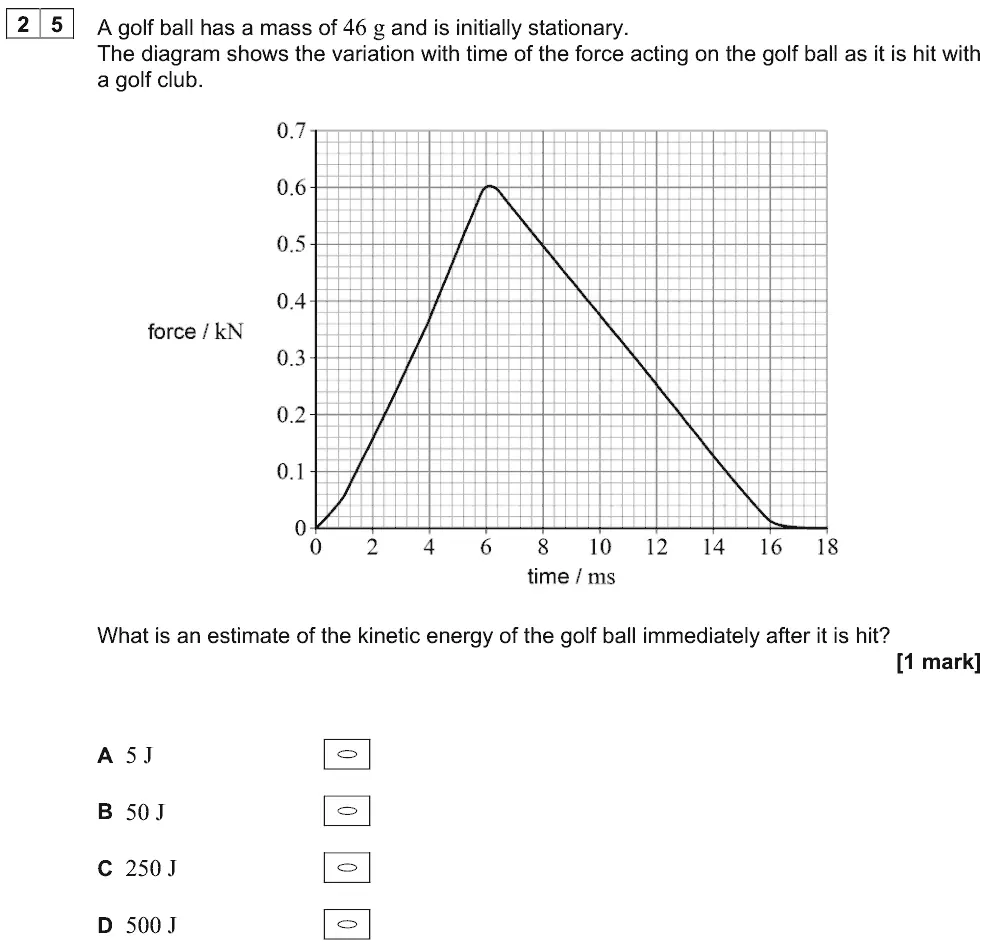
Question 6.1 was answered correctly by 65% of students. Common errors included interpreting impulse as force and therefore getting an incorrect value for the speed. This led to a very small value for the kinetic energy. Students should be encouraged to check their work if they arrive at an unlikely answer.
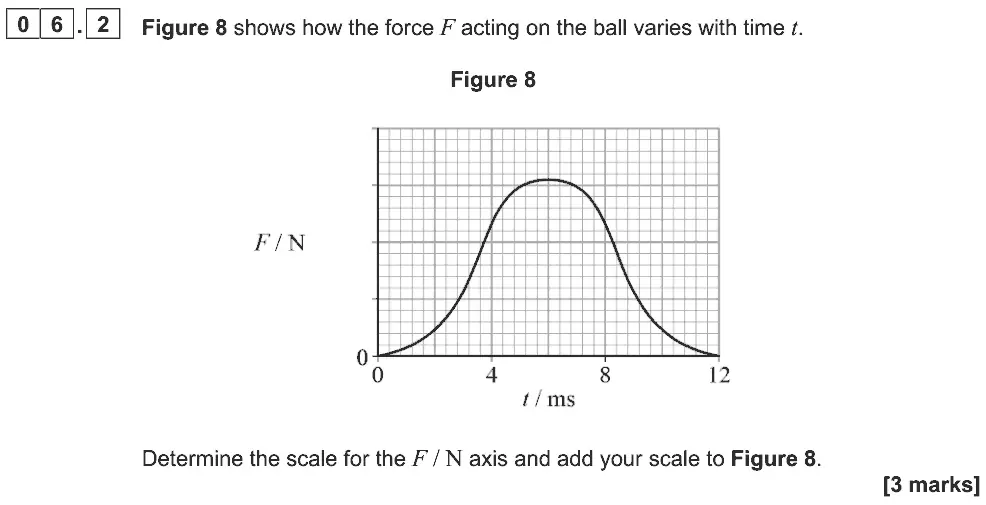
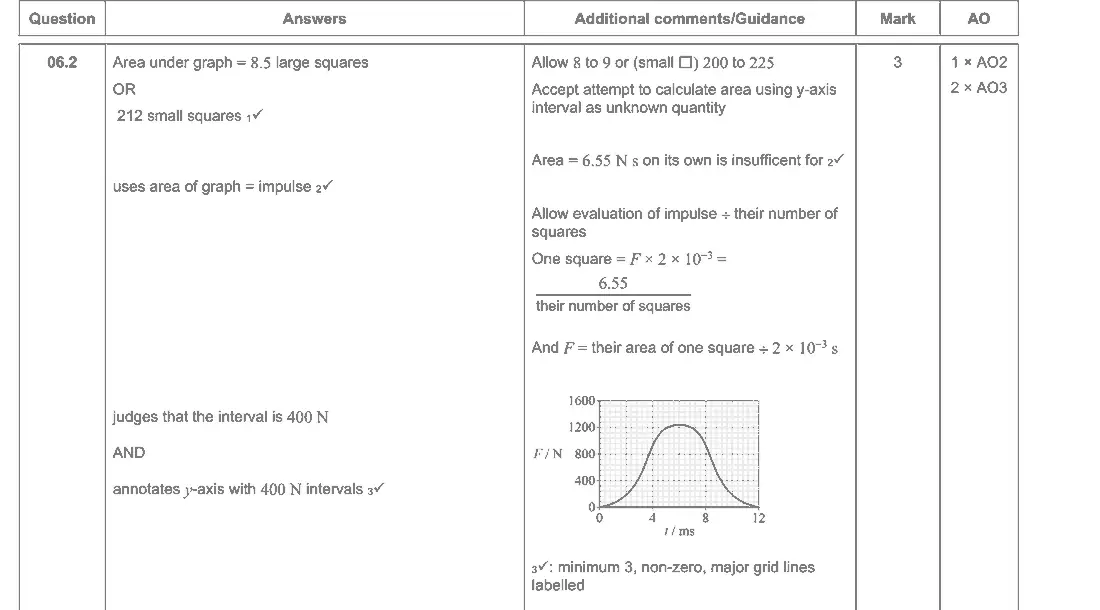
Only about 25% of students obtained any marks at all for Question 6.2. Those who realised that the area under the graph was the impulse often made no effort to arrive at value for the force. The most successful answers introduced an unknown, such as x, for one unit on the Force axis. They then determined an area in terms of x and related it to the impulse. Solving for x and rounding gave a value for the scale. Some students followed this or a similar path but missed out on full marks because of a power of ten error, arising from the millisecond unit on the time scale. A common incorrect approach was to relate the peak value of F to the impulse in some form.
Most students completed the calculation in Question 6.3 correctly. Some incorrectly used the horizontal component of the velocity or used 18. Many students had problems using a consistent sign convention or choosing an appropriate constant acceleration equation. Although calculators often solve quadratics directly, students should still be encouraged to set out their answers so that intermediate marks can be given.
Notes from the mark scheme and report
Answer: 52 J (v = 6.55/0.410 = 16.0 m s^-1)
treating impulse as force gave tiny answers
Skills: MS2.3 Substitute numerical values into algebraic equations using appropriate units for physical quantities; MS2.2 Change the subject of an equation, including non-linear equations
June 2025 · Paper 1 · Q6.23 marksAO2=1, AO3=2Diagram or graphHard
Earlier part of question 6 that this part uses
Mark scheme
Examiner's comment
Only about 25% of students obtained any marks at all for Question 6.2. Those who realised that the area under the graph was the impulse often made no effort to arrive at value for the force. The most successful answers introduced an unknown, such as x, for one unit on the Force axis. They then determined an area in terms of x and related it to the impulse. Solving for x and rounding gave a value for the scale. Some students followed this or a similar path but missed out on full marks because of a power of ten error, arising from the millisecond unit on the time scale. A common incorrect approach was to relate the peak value of F to the impulse in some form.
Notes from the mark scheme and report
Answer: 400 N per major grid line (area about 8.5 large squares = 6.55 N s, each large square 2 ms wide)
ms to s power-of-ten errors
relating peak force to impulse wrong
Skills: MS3.8 Understand the possible physical significance of the area between a curve and the x axis and be able to calculate it or estimate it by graphical methods as appropriate; MS3.1 Translate information between graphical, numerical and algebraic forms
June 2025 · Paper 1 · Q7.42 marksAO1=1, AO2=1Diagram or graph
Earlier part of question 7 that this part uses
Mark scheme
Examiner's comment
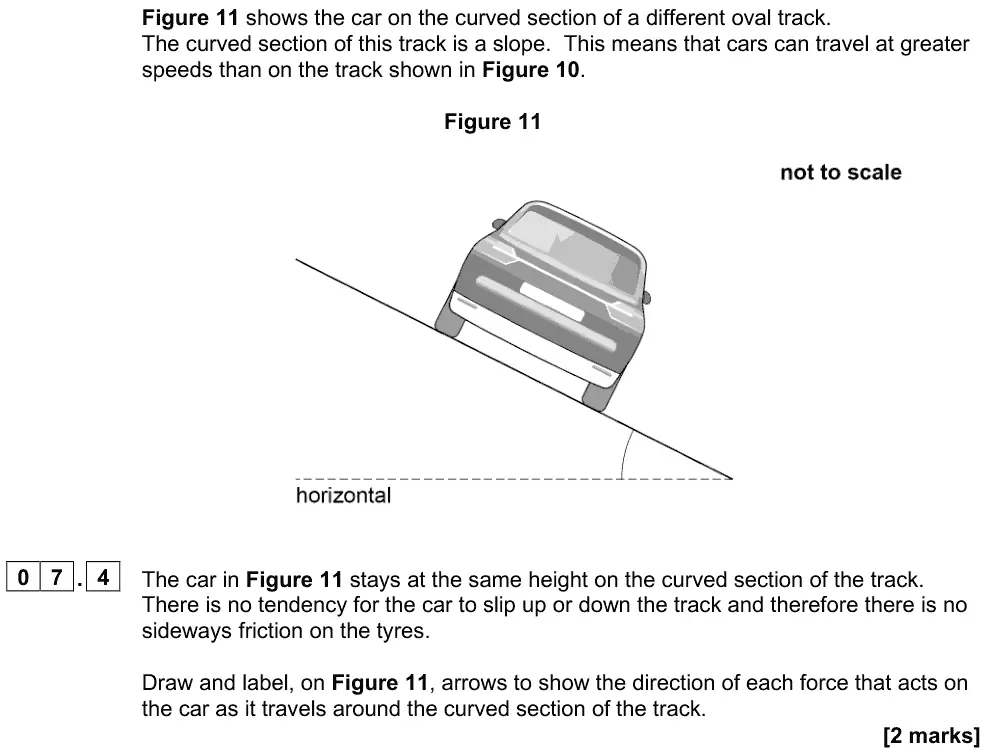
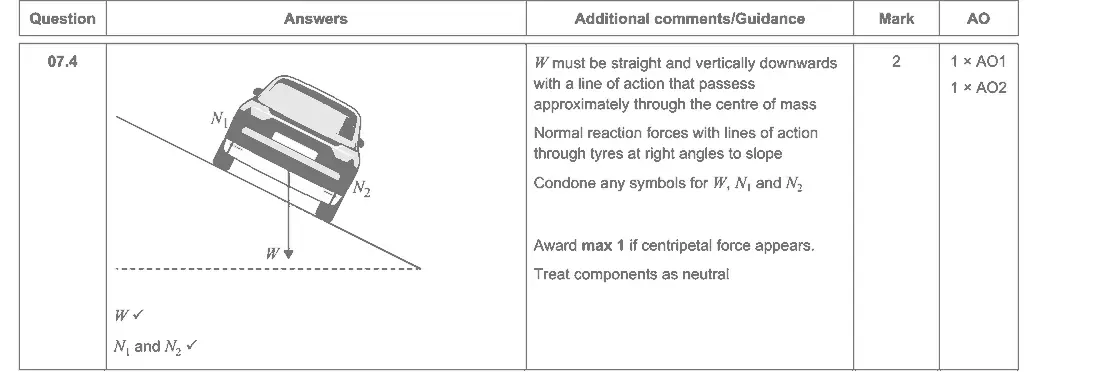
Most students obtained 1 mark for Question 7.4 by labelling the weight. It was expected that this would pass through the centre of mass of the car. Whilst some leeway was given, answers that showed a wobbly line or did not pass through a point near the centre of the car were not credited. Very few students labelled the two reaction forces that act through the wheels. A very common error was to see a centripetal force drawn, as though this was an extra force Students should be encouraged to use a ruler whenever drawing forces on a diagram. They should give attention to the line of action of these forces. It should also be stressed that a centripetal force gives rise to circular motion, and not the other way round.
Notes from the mark scheme and report
Weight vertically down through centre of mass
normal reactions at the tyres perpendicular to the slope
max 1 if a centripetal force is drawn
use a ruler
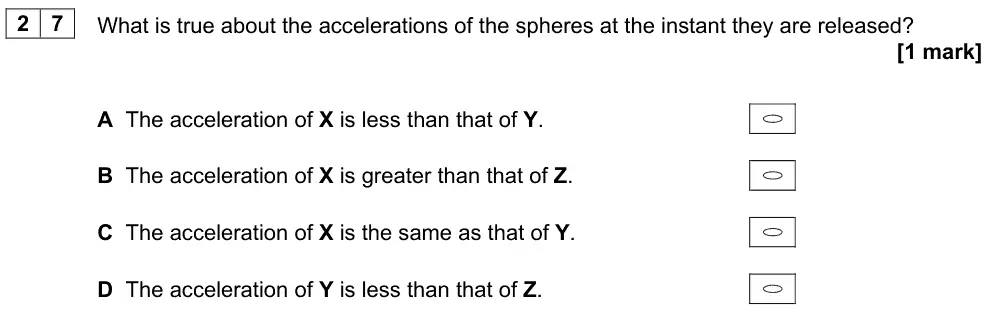
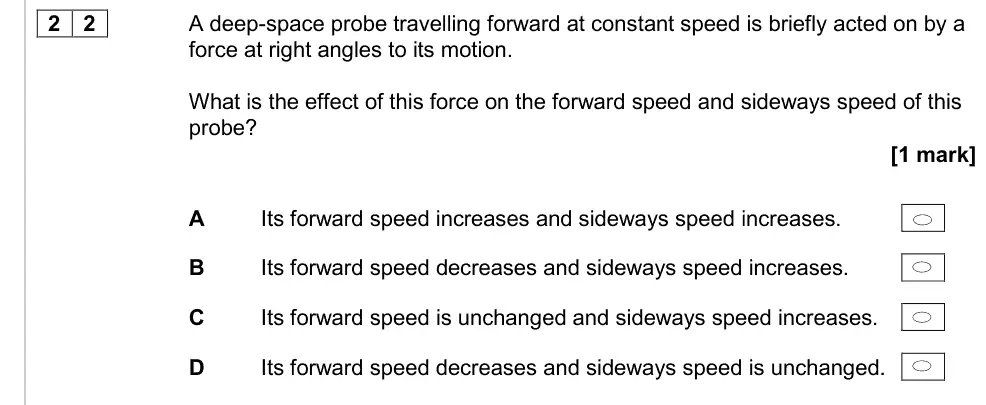
June 2025 · Paper 1 · Q211 markAO2=1Multiple choice
Answer
B
Mark scheme
Notes from the mark scheme and report
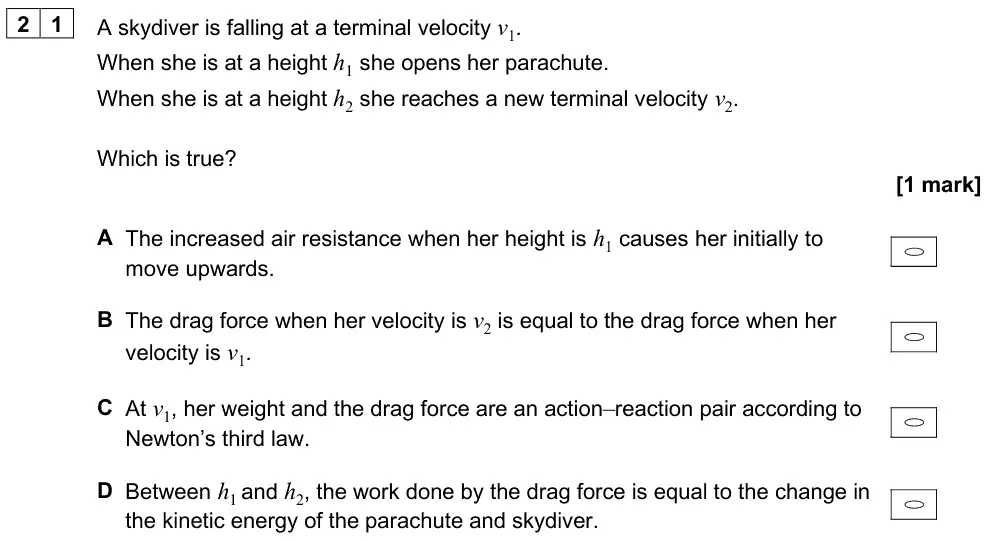
Answer: B
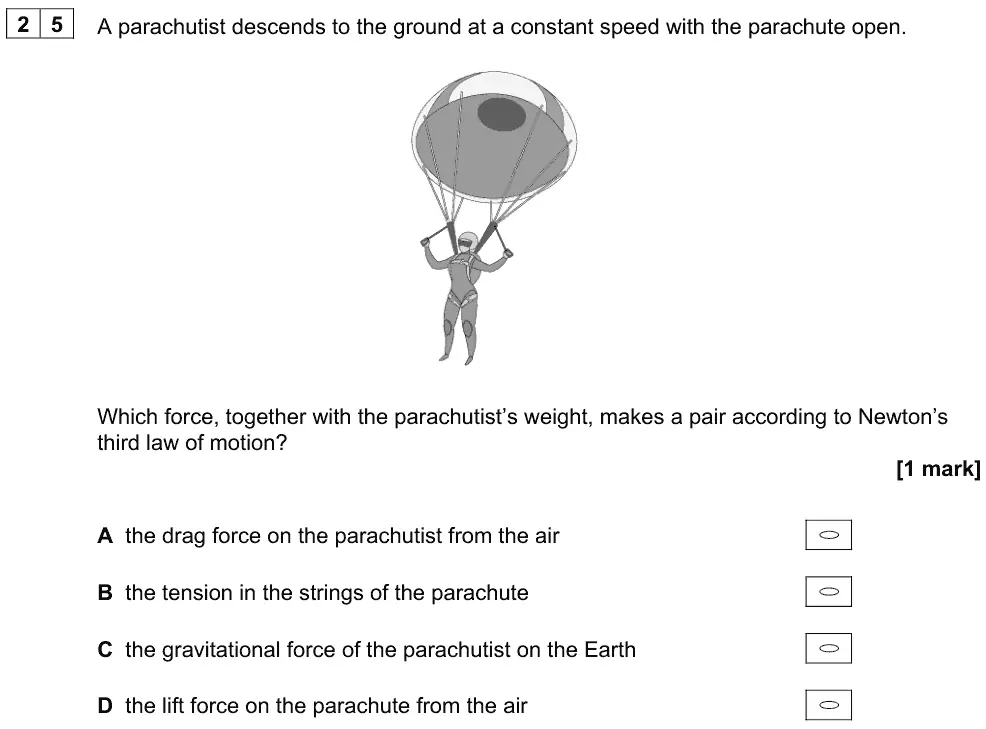
the correct answer was the least popular - most chose C (third-law pairs must be the same type of force acting on different objects)
17% chose A
June 2025 · AS Paper 2 · Q191 markAO1=1Multiple choice
Answer
B
Mark scheme
Examiner's comment
Students were more successful in answering questions 6, 11, 14, 19, 22, 28, and were less successful in answering questions 10, 15, 21, 25, 29.
Notes from the mark scheme and report
Answer: B
June 2024 · Paper 1 · Q4.12 marksAO3=2Show that
Mark scheme
Examiner's comment
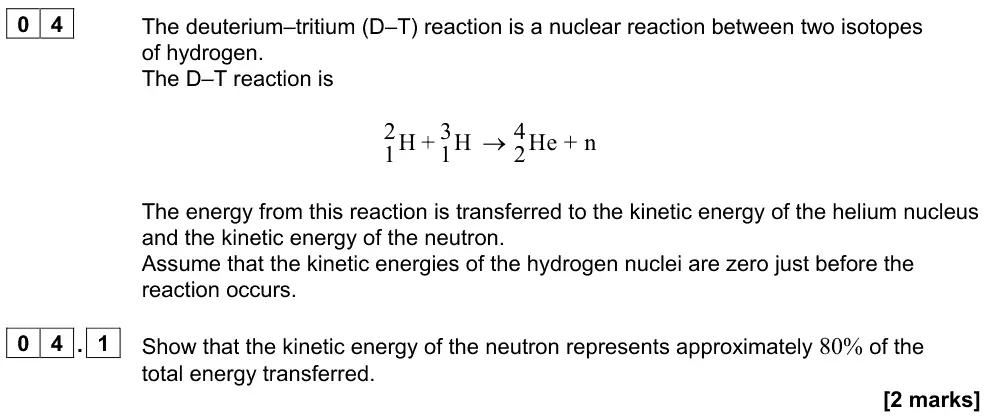
In question 04.1 many students attempted to work out a difference in rest masses between the particles, without success. Several other students identified the difference in masses of the products and used this to explain the 80% without any reference to conservation of momentum or to kinetic energy. Almost 50% of students obtained both marks for question 04.2. The most common error was for students to use the combined energy as the energy of the neutron.
Notes from the mark scheme and report
Equal and opposite momenta with KE = p^2/2m gives neutron KE = 4 x helium KE
mass-difference arguments gained nothing. Fusion is the context only
Skills: MS0.3 Use ratios, fractions and percentages; MS2.2 Change the subject of an equation, including non-linear equations
June 2024 · AS Paper 1 · Q4.22 marksAO1=1, AO2=1Calculation
Earlier part of question 4 that this part uses
Mark scheme
Examiner's comment
04.2
Over 40% of students gained this mark. Many students converted 6.7 eV into 1.1 × 10⁻¹⁸ J and gave this as their answer. Others then used W=QV with W equal to 1.1 × 10⁻¹⁸ (J) to determine the potential difference V. Very few had a direct approach of recognising that 6.7 eV of work on the electron requires a potential difference of 6.7 V. Many students divided 6.7 (eV) by the charge on an electron and presented 4.2 × 10¹⁹ as their answer.
Notes from the mark scheme and report
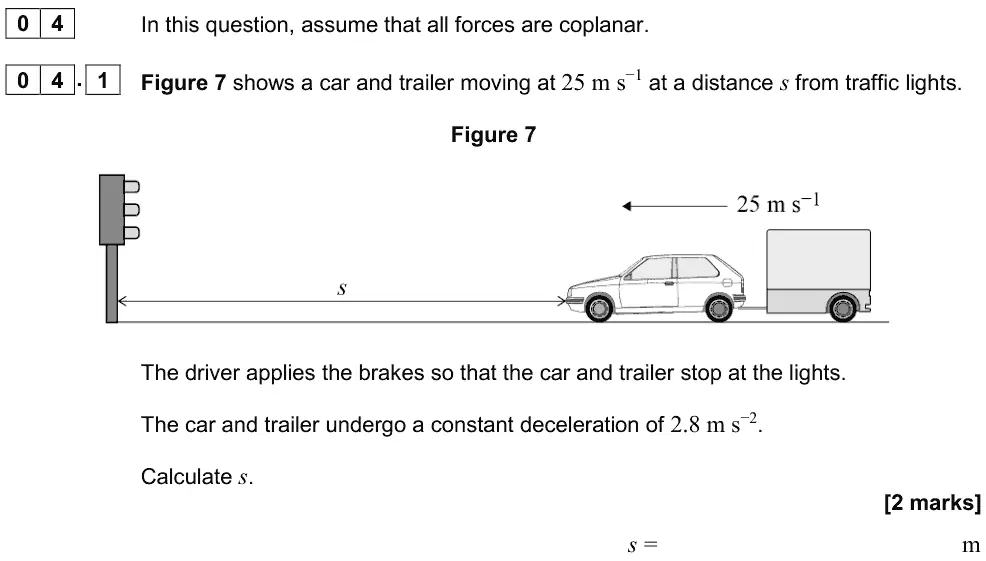
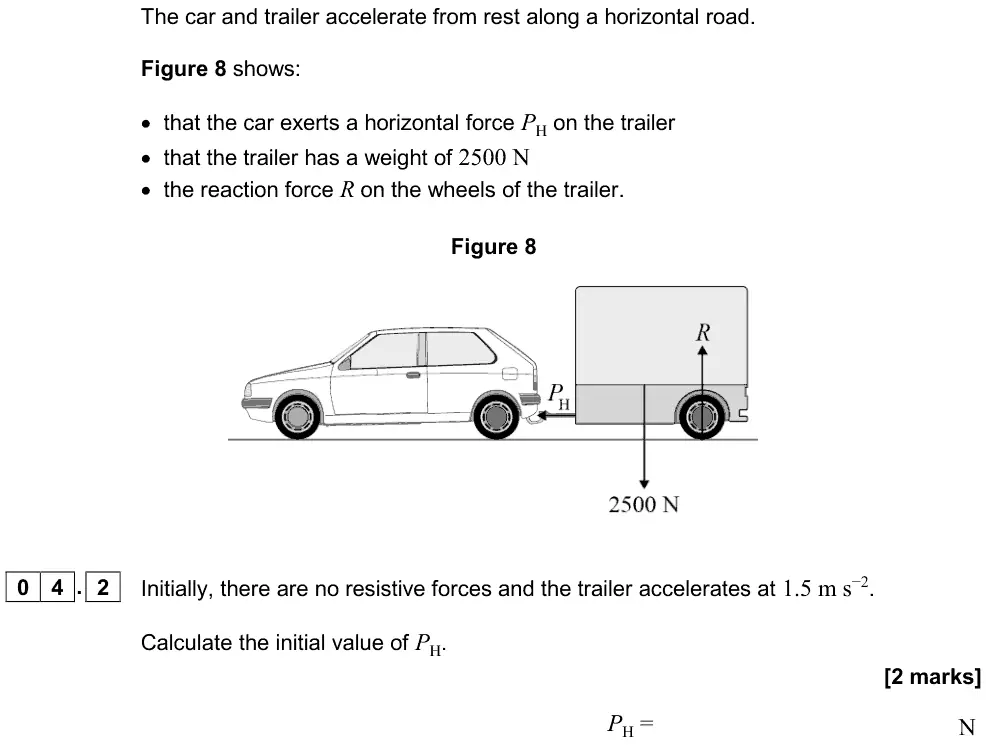
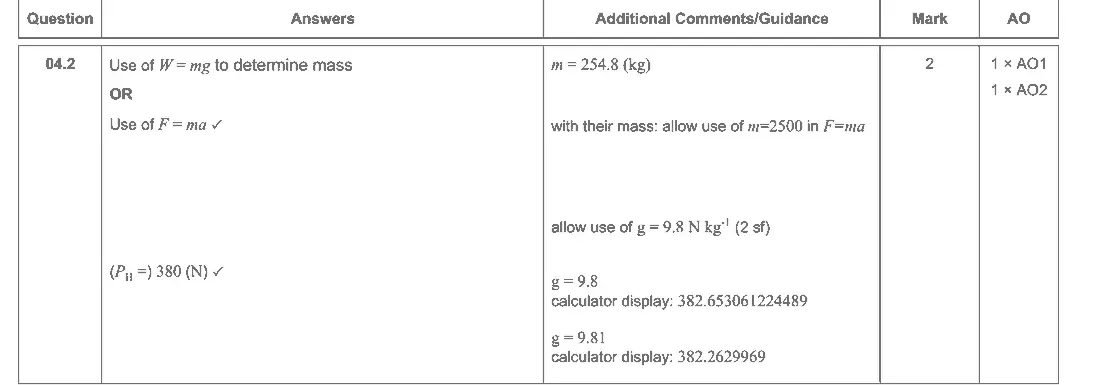
Answer: 380 N (m = 2500/9.81 = 255 kg, F = ma)
Skills: MS2.3 Substitute numerical values into algebraic equations using appropriate units for physical quantities
June 2024 · AS Paper 1 · Q4.63 marksAO2=3Explanation
Earlier part of question 4 that this part uses
Mark scheme
Examiner's comment
04.6
Notes from the mark scheme and report
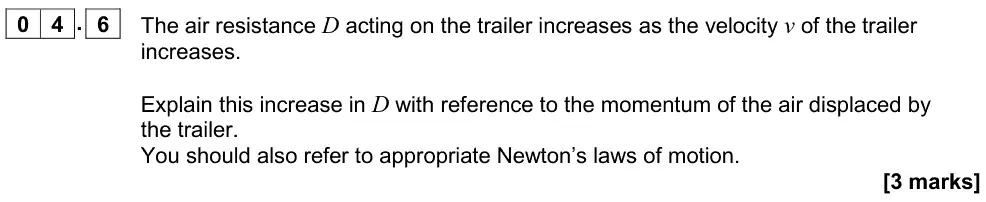
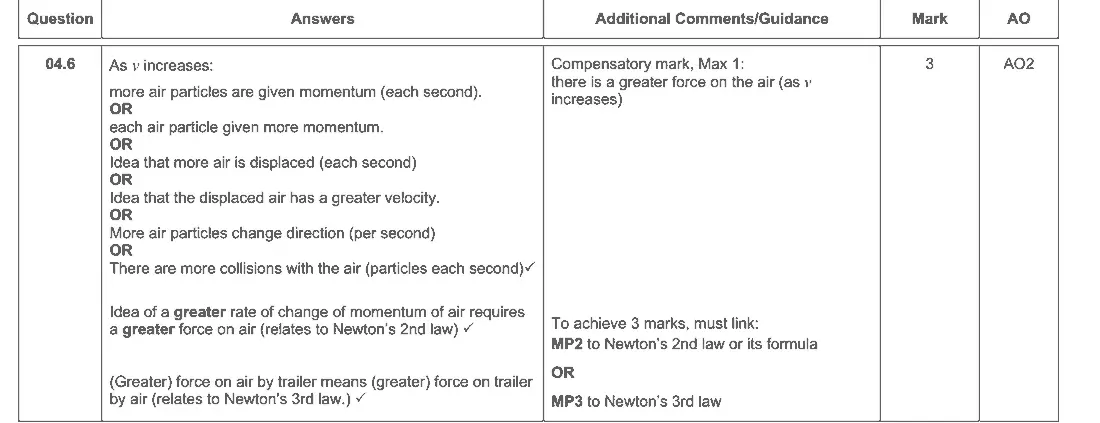
Faster trailer gives more air more momentum per second
greater rate of change of momentum needs greater force on the air (N2)
the air pushes back equally on the trailer (N3)
June 2024 · AS Paper 1 · Q4.73 marksAO1=1, AO2=2Calculation
Earlier part of question 4 that this part uses
Mark scheme
Examiner's comment
04.7
Notes from the mark scheme and report
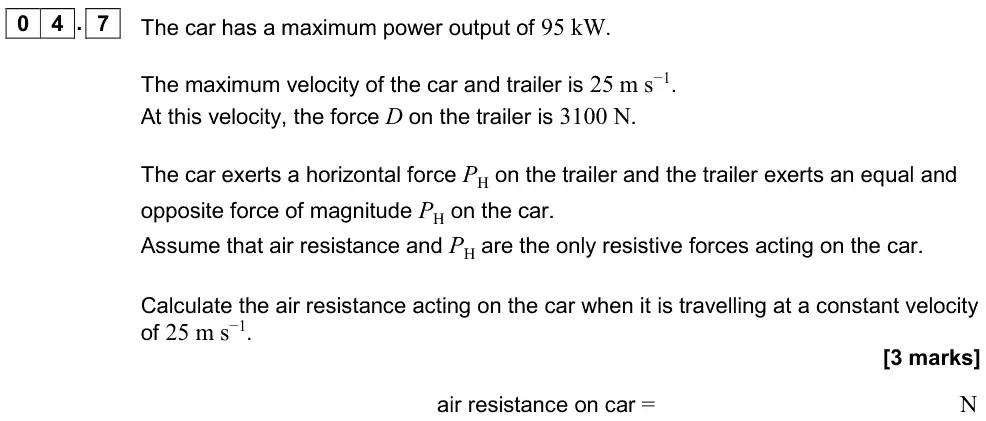
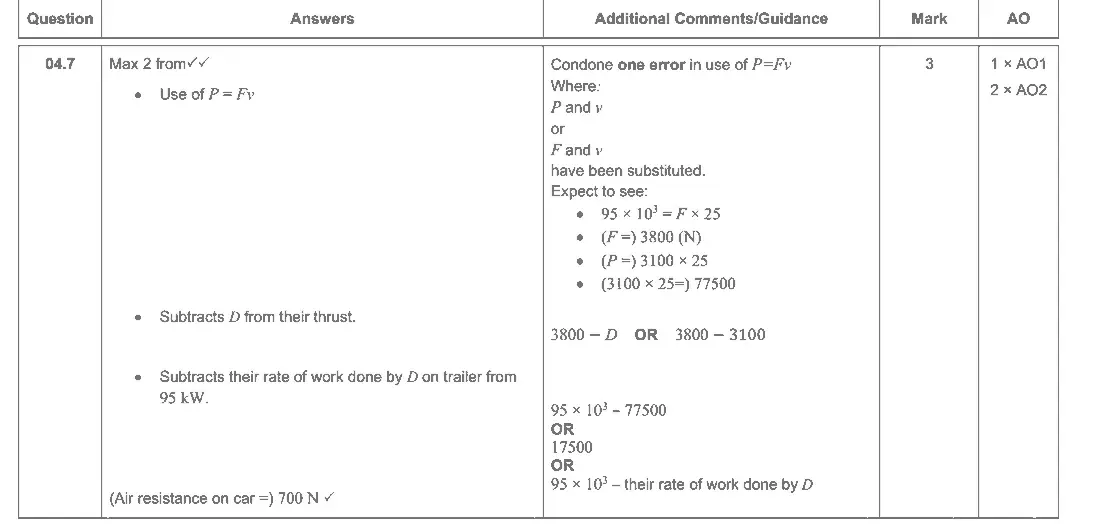
Answer: 700 N (driving force 95000/25 = 3800 N, minus PH = D = 3100 N)
Skills: MS2.3 Substitute numerical values into algebraic equations using appropriate units for physical quantities
June 2024 · Paper 1 · Q5.33 marksAO3=3Explanation
Earlier part of question 5 that this part uses
Mark scheme
Examiner's comment
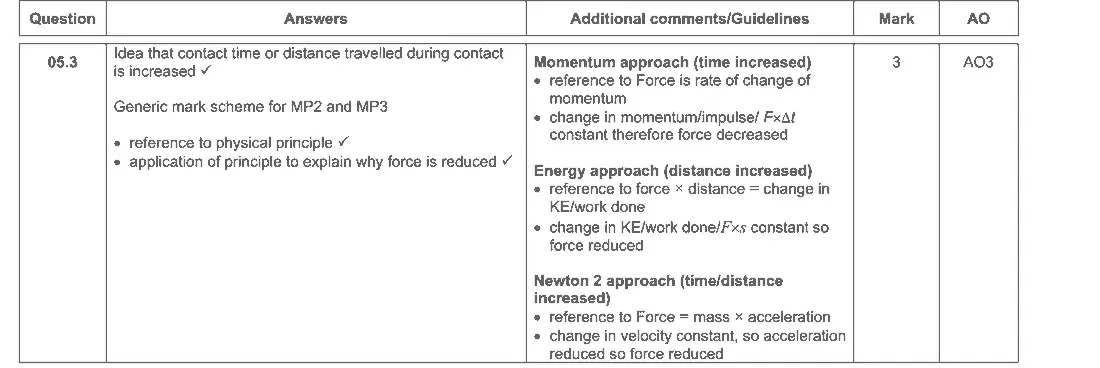
Question 05.3 has been asked several times before in other contexts, but surprisingly few students could give complete answers. Too many answers were based on vague references to soft materials and absorbing impact. The best answers made it clear which physical principle was being used and applied it fully. The step in these answers that was missed by some was to state what was being kept constant. Many students suggested that the impulse changed for example.
Notes from the mark scheme and report
Contact time (or stopping distance) increased
name the principle (F = rate of change of momentum, or work done = F x d) and say what stays constant so force is smaller. 'Absorbs impact' not enough
June 2024 · AS Paper 1 · Q6.42 marksAO2=1, AO3=1Short answer
Earlier part of question 6 that this part uses
Mark scheme
Examiner's comment
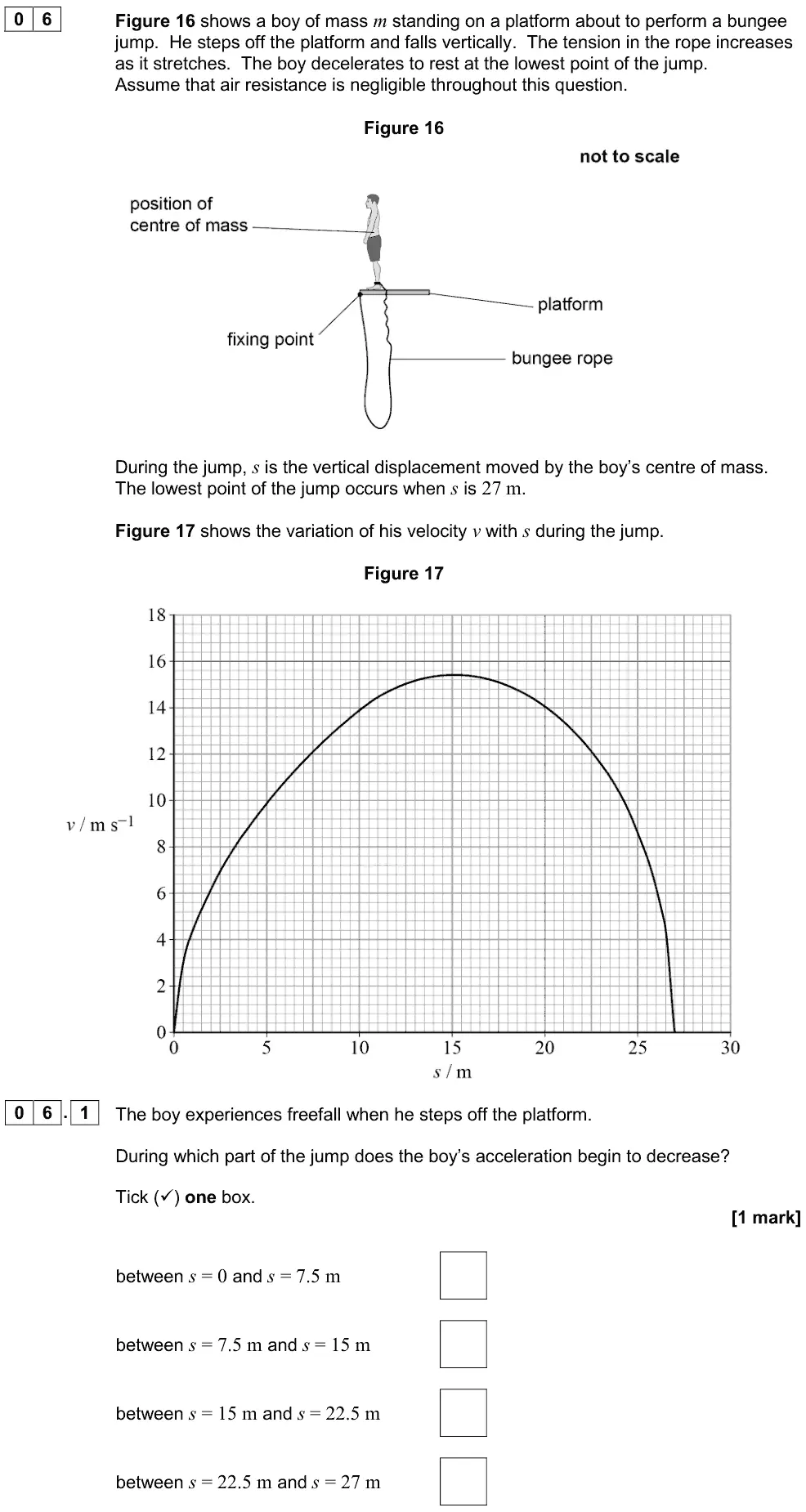
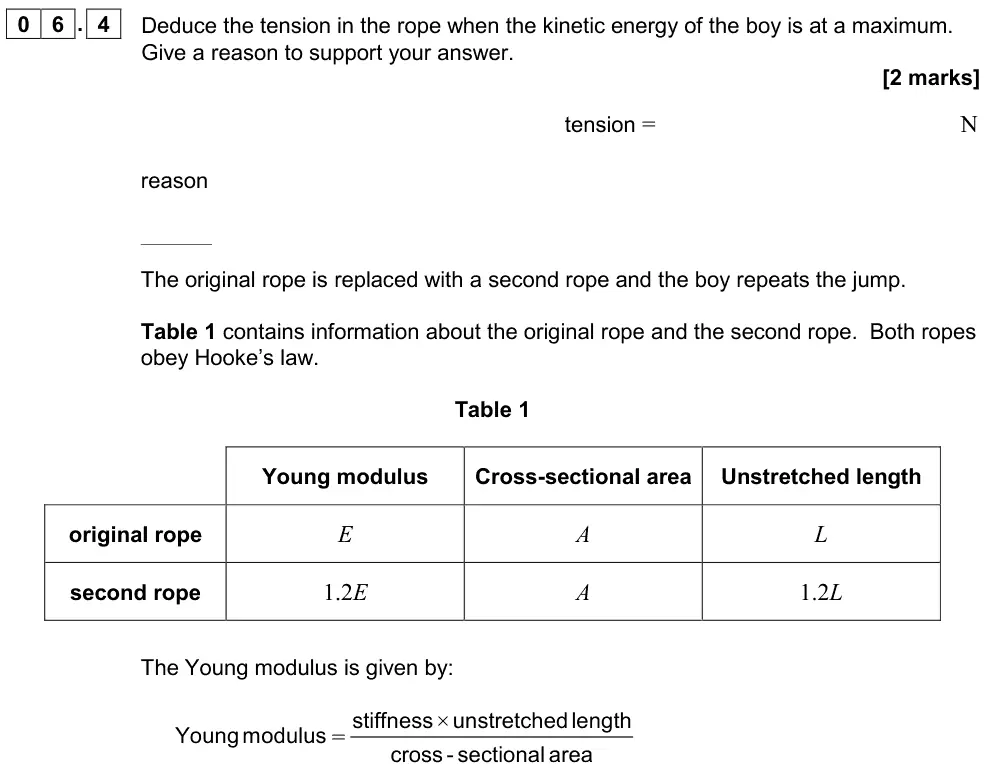
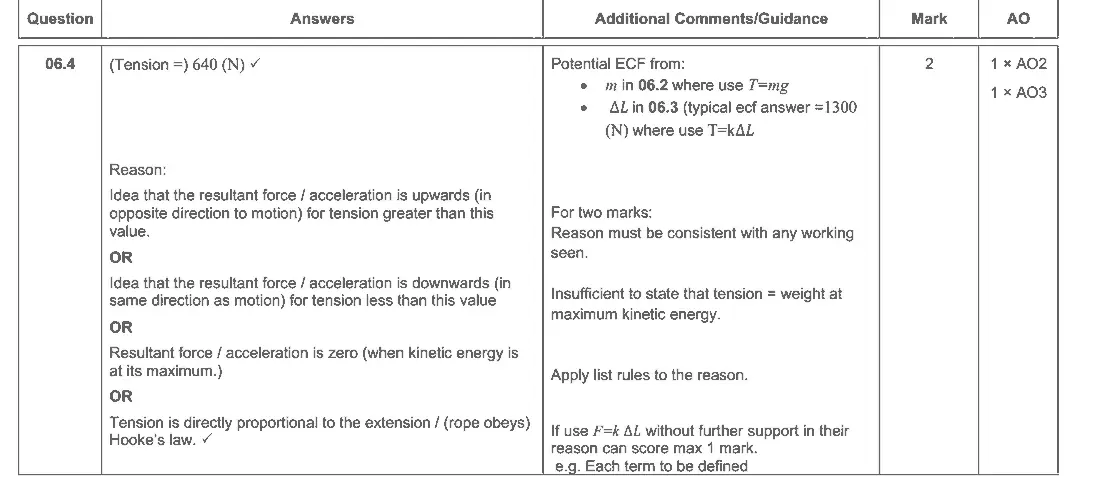
Nearly 10% of students obtained all three marks. This question proved challenging, with many students struggling to understand what was happening in the question. These students typically used 7.71 kJ for the energy stored in the rope. The question required them to realise there were three kinds of energy to consider: Ep, Ek and elastic potential energy. Almost all who realised that elastic potential energy could be found by subtracting Ek from the initial Ep went on to obtain all three marks. 06.4
Notes from the mark scheme and report
Answer: 640 N (equal to weight 65 x 9.81)
at maximum KE acceleration and resultant force are zero
Skills: MS2.3 Substitute numerical values into algebraic equations using appropriate units for physical quantities
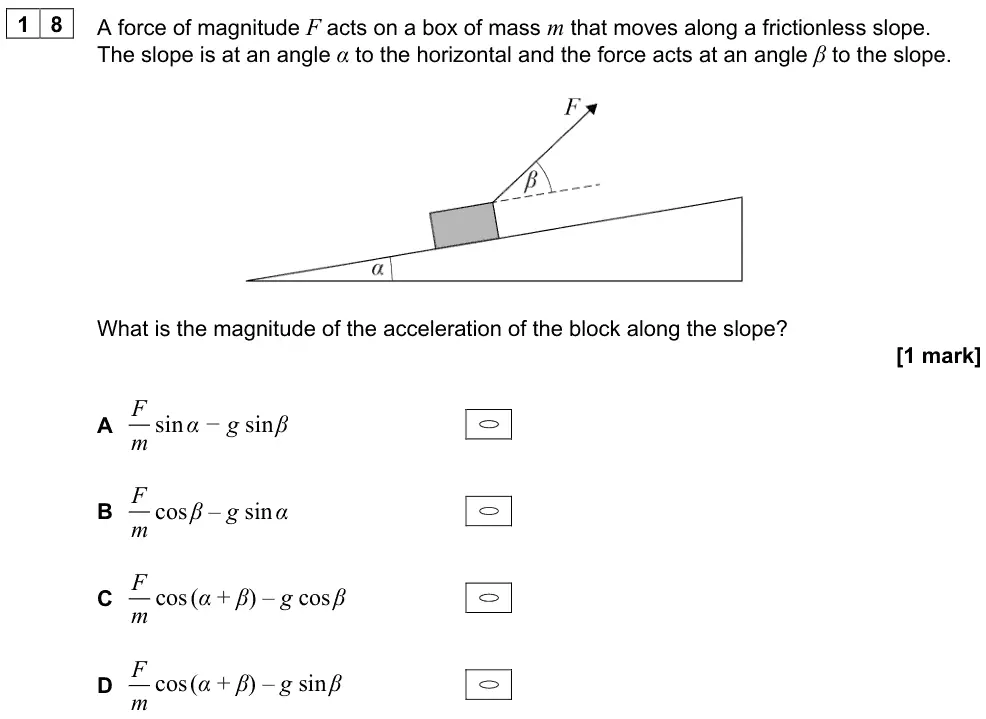
June 2024 · Paper 1 · Q181 markAO1=1Multiple choiceEasy
Answer
B
Mark scheme
Examiner's comment
There were five very accessible questions that were correctly answered by more than 70% of students. These were B12, B18, B14, B27 and B29.
Notes from the mark scheme and report
Answer: B
Skills: MS4.5 Use sin, cos and tan in physical problems
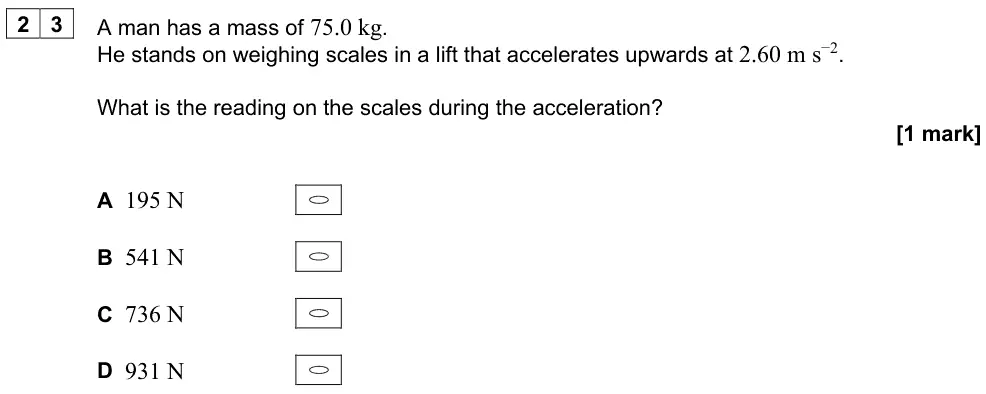
June 2024 · Paper 1 · Q231 markAO2=1Multiple choice
Answer
D
Mark scheme
Notes from the mark scheme and report
Answer: D
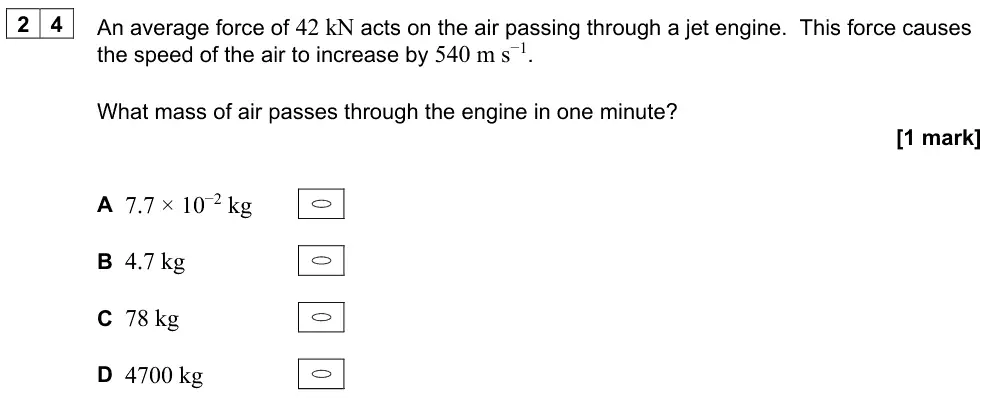
June 2024 · Paper 1 · Q241 markAO2=1Multiple choice
Answer
D
Mark scheme
Notes from the mark scheme and report
Answer: D
Skills: MS0.1 Recognise and make use of appropriate units in calculations
June 2024 · AS Paper 2 · Q1.72 marksAO3=2Explanation
Earlier part of question 1 that this part uses
Mark scheme
Examiner's comment
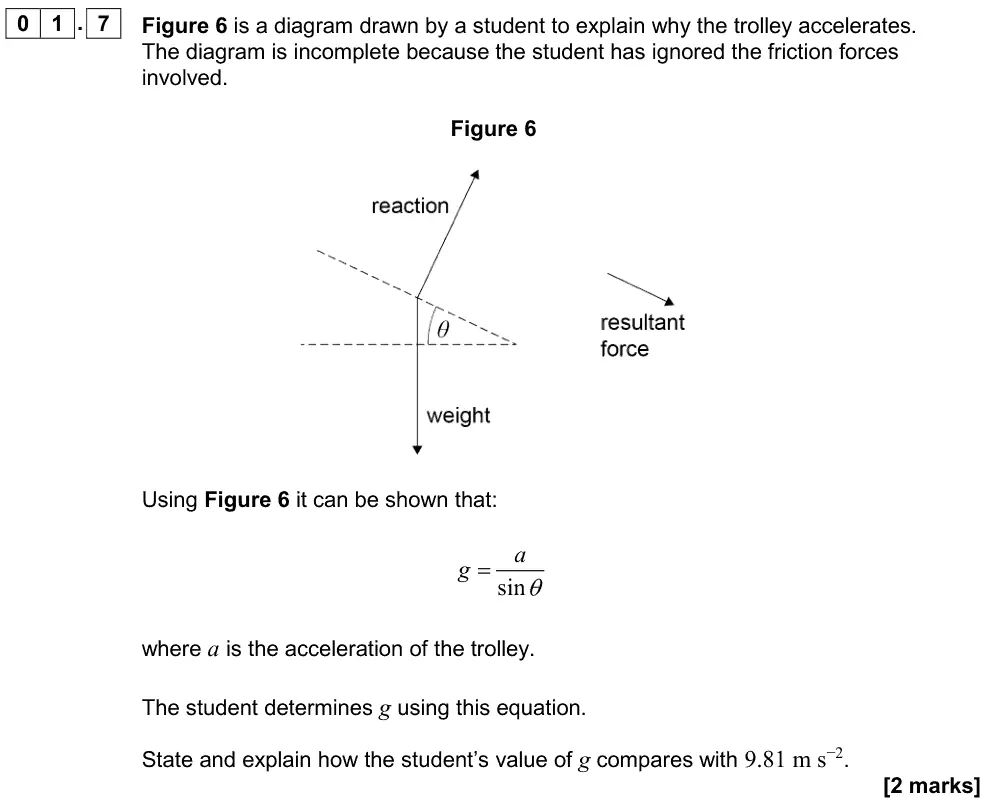
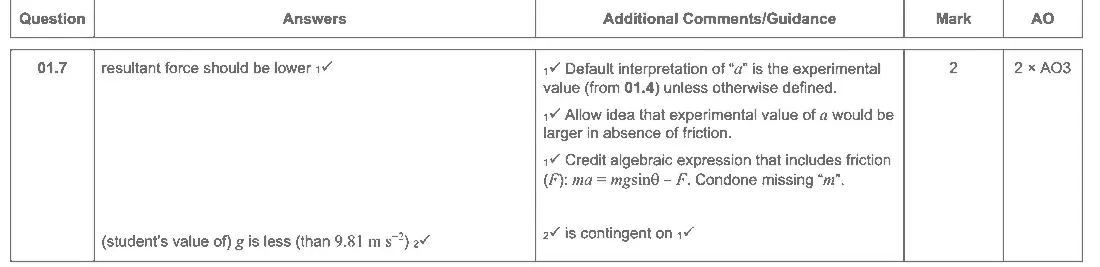
01.7 Students found this combination of theory and practice to be extremely challenging. Many suggested that the experiment had been performed in the absence of friction, rather than appreciating that the analysis ignored friction. By this logic, students argued that friction would reduce the acceleration and so the value of g would be smaller. A common misconception was that the value of g would be less than 9.81 m s-2 because the trolley was not falling vertically.
Notes from the mark scheme and report
Friction ignored in g = a / sin theta, so measured a (and resultant force) is lower than without friction
student's g is less than 9.81 m s^-2
many thought friction absent or that g is smaller because the trolley is not falling vertically
June 2024 · AS Paper 2 · Q3.24 marksAO2=4Calculation
Earlier part of question 3 that this part uses
Mark scheme
Examiner's comment
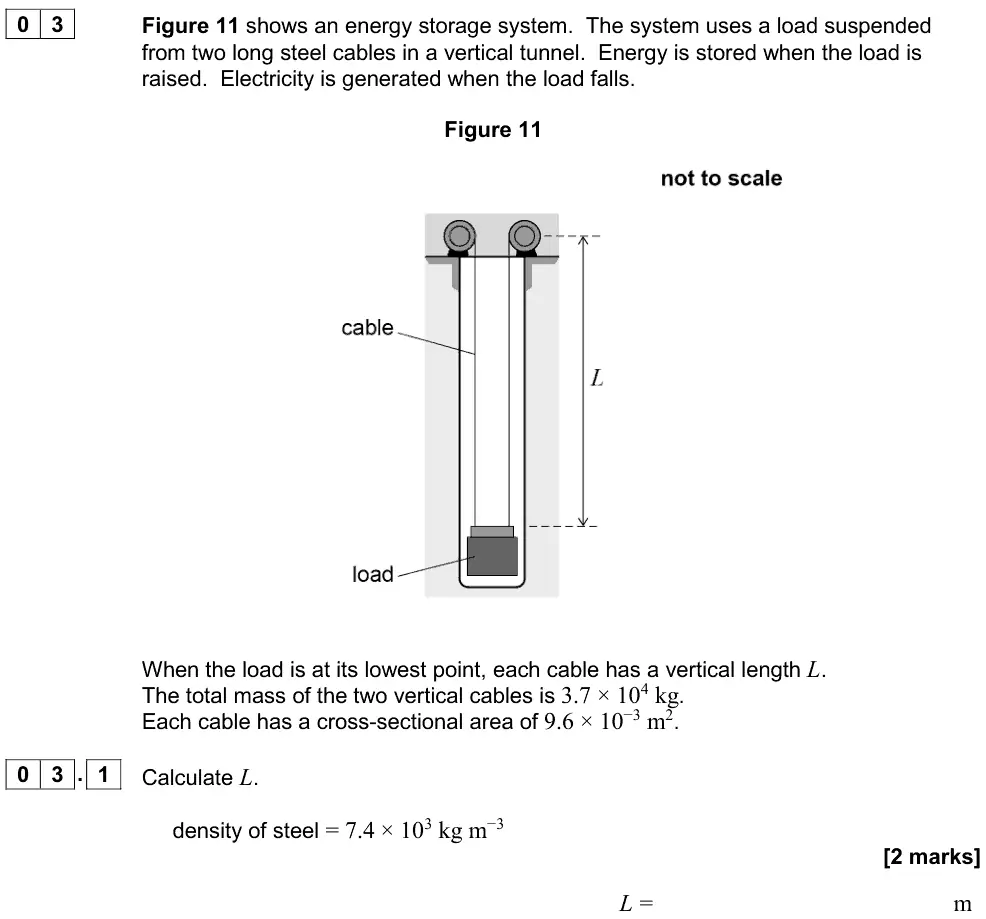
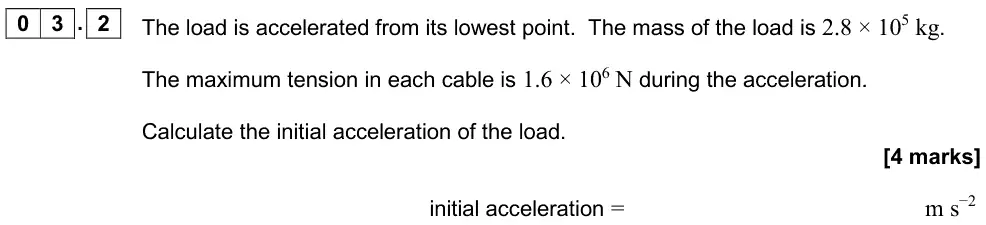
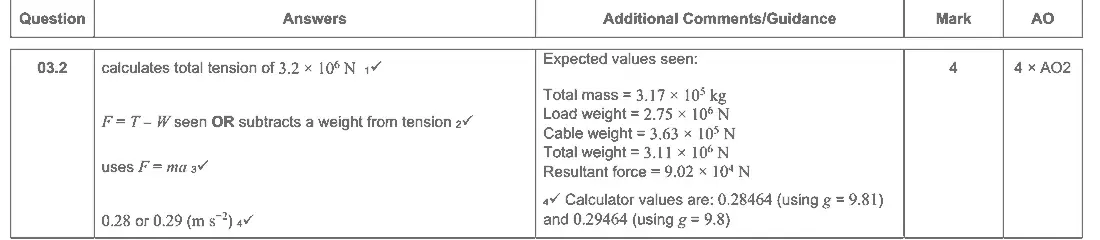
03.2 This question discriminated well with a large majority of students gaining some marks. The mark scheme allowed credit for the separate cognitive steps involved. A significant number of students who gained three marks were unsure what value of mass to use with their resultant force. Another point of confusion related to the maximum tension. The mass of the cables is significant in this context, so the maximum tension is at the top of each cable.
03.1 Nearly 50% of students gained both marks. About 25% achieved one mark, usually for using the total mass of the cables rather than the mass of one. One purpose of this question was to establish that the mass of the cables was significant, a point that needed to be considered in 03.2.
Notes from the mark scheme and report
Answer: 0.28-0.29 m s^-2 (total tension 3.2 x 10^6 N minus total weight 3.11 x 10^6 N including cables = 9.0 x 10^4 N
divide by total mass 3.17 x 10^5 kg)
max tension is at top of cable
Skills: MS2.3 Substitute numerical values into algebraic equations using appropriate units for physical quantities
June 2024 · AS Paper 2 · Q201 markMultiple choice
Answer
C
Mark scheme
Notes from the mark scheme and report
Answer: C
June 2024 · AS Paper 2 · Q221 markMultiple choice
Answer
D
Mark scheme
Examiner's comment
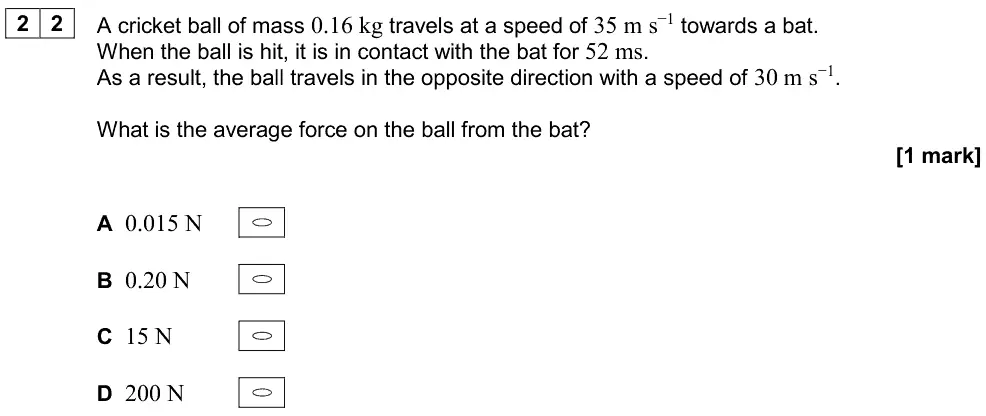
Question 22: Option C (15 N) was the most popular response. This is obtained using a change in velocity of 5 m s–1.
Notes from the mark scheme and report
Answer: D
most chose C (15 N), using a velocity change of 5 m s^-1 instead of 65
Skills: MS0.1 Recognise and make use of appropriate units in calculations
June 2024 · AS Paper 2 · Q291 markMultiple choice
Answer
B
Mark scheme
Notes from the mark scheme and report
Answer: B
June 2024 · Paper 3 Section A · Q3.23 marksAO1=1, AO3=2Explanation
Earlier part of question 3 that this part uses
Mark scheme
Examiner's comment
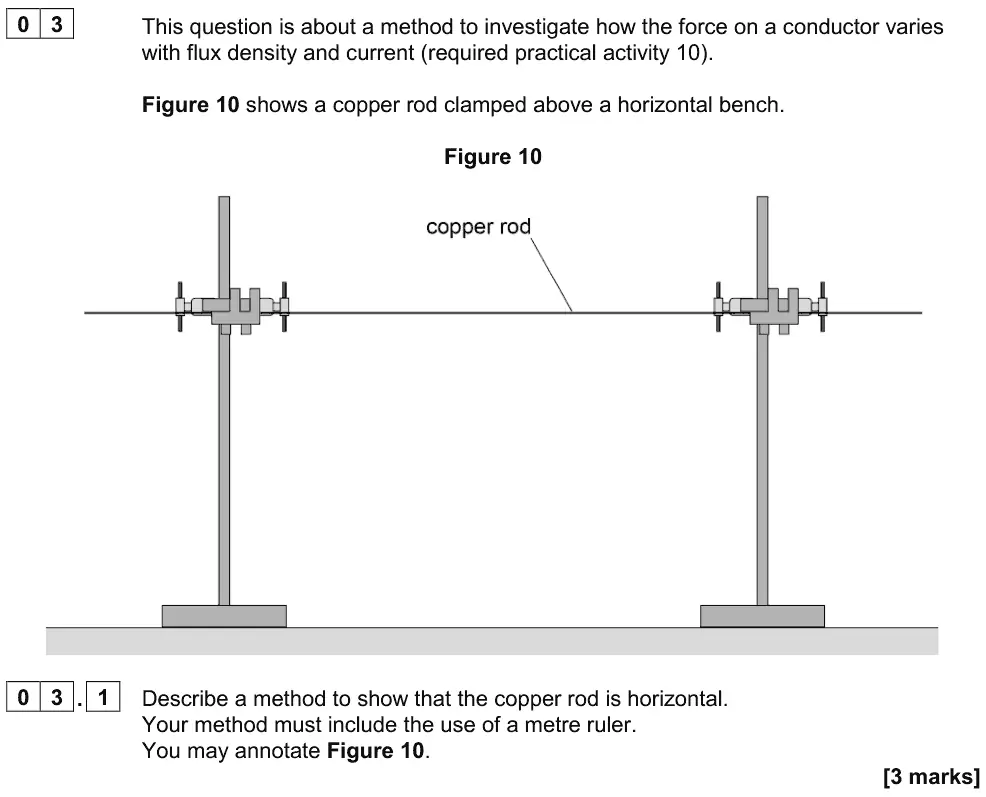
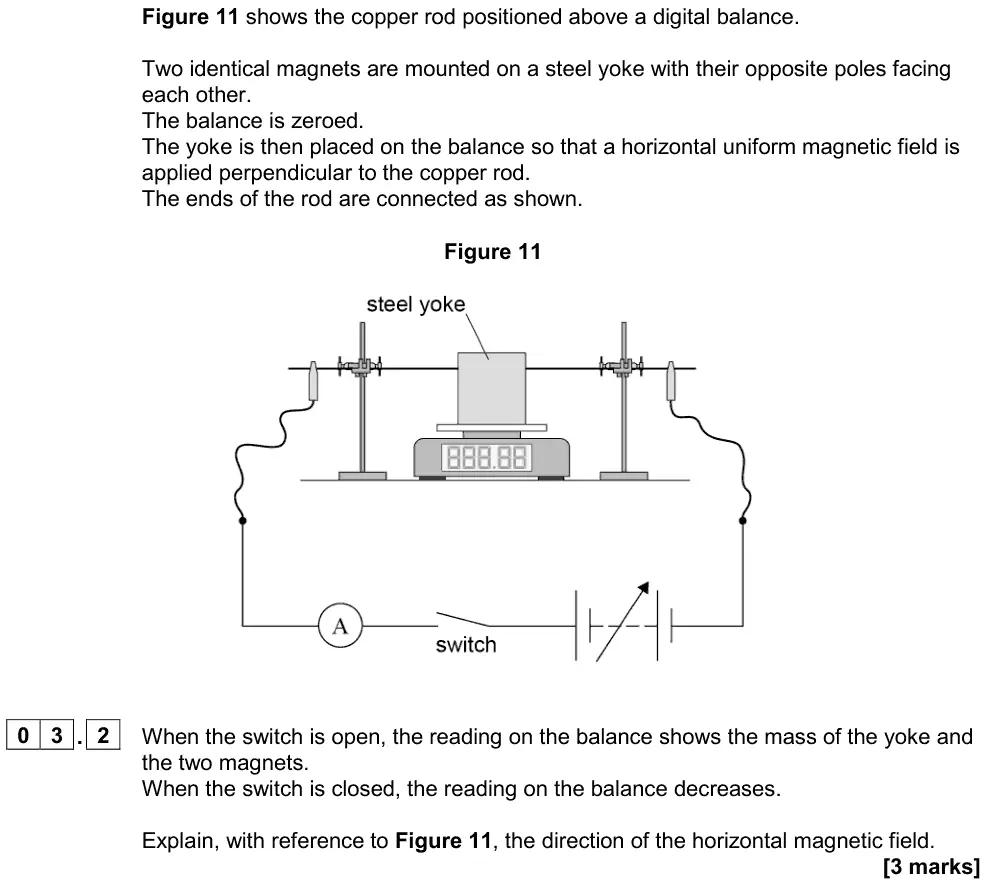
Question 3 was about how the force on a wire varied with current and with flux density. Most students were clearly familiar with the digital-balance approach used in the question. In 03.1 they were asked to explain how to make a copper rod horizontal. We stated that the metre ruler should be involved in their method, but many used it as a vertical datum rather than as a measuring instrument. As is often the case in such questions, some of the unworkable suggestions seen suggest that some students have little experience of setting up apparatus. The 03.2 left-hand rule problem performed as when last tested in 2018. Only the better students correctly realised that when the balance reading decreased, the force on the rod must be downwards. Weaker students struggled with the physics of the situation, forgetting to identify the current direction or to refer to the left-hand rule. Although only 17% correctly deduced the base units for k in 03.3, others were able to make some progress although their attempts could be difficult to follow. The use of simultaneous equations in 03.4 was widespread even though many failed to read the M2 intercept from the correct scale. In 03.5 many understood what the consequences of the misplaced rod would be for the graph, but others seemed to think that electromagnetic induction was involved. We were surprised that some thought the effects of the field between the magnets would not be felt when the rod was positioned just above the yoke.
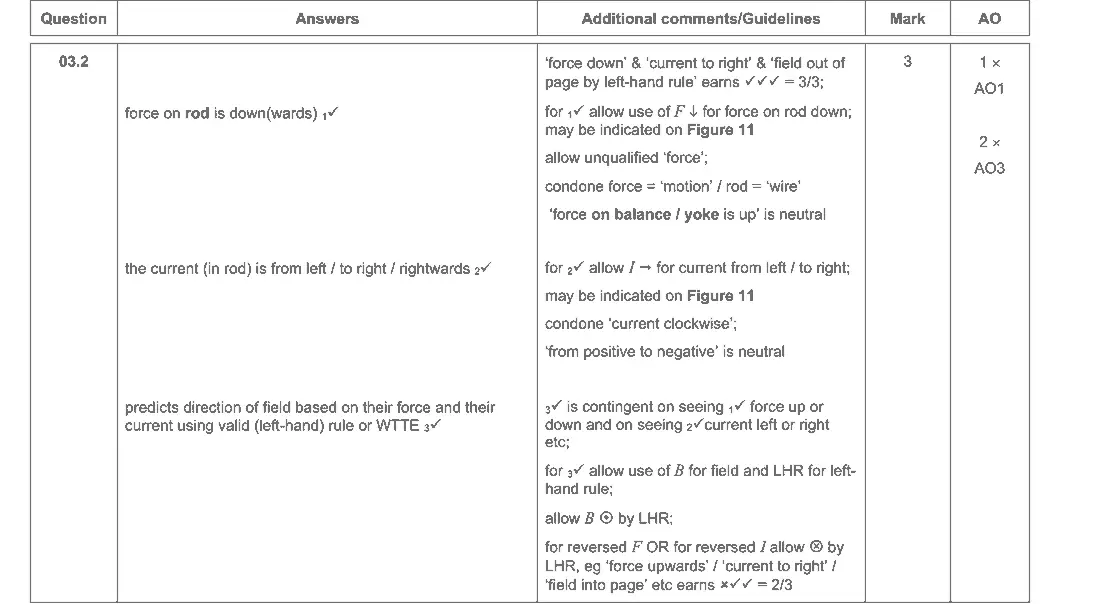
03.1 is a type of question that students with limited practical experience struggle with. Once again, we have to point out that clamp stand rods may not be used as a vertical datum, but benches can be assumed to be horizontal. The question said a metre ruler must be involved in establishing that the rod was horizontal. Some used the ruler to measure between bench and rod at different points and check that the heights were the same. When this idea was combined with an appropriate use of a set-square to make the ruler vertical, usually explained by annotation to Figure 10, all three marks were awarded. Others placed the set square where the vertical ruler met the rod. We did not allow this because a set square is too short to accurately judge whether the rod is horizontal. Good sketches saved those who struggled to explain their methods, but poor sketches condemned others who showed gaps between their set squares and the bench. Most knew what was behind 03.2 but only the better ones were able to identify the direction of the force on the rod. Some good answers went through the action-reaction idea in great detail to make sure the examiner knew what they were thinking. Others just referred to ‘the force’ and assumed it was upwards because the balance reading had decreased when there was a current in the rod. We gave no credit for current ‘from positive to negative’. Those who did not mention a current direction could only get one mark. However, most could predict a suitable magnetic field direction having identified directions for their force and current although we wanted to see the left-hand rule mentioned in justification. The solution to 03.3 was, first, to produce a homogeneous expression involving k, flux density, current and mass; second, to eliminate flux density using force, current and length, then to eliminate force using mass, length and time. We allowed working in which quantities and units were mixed, but many failed to connect the parts of their solutions using equals signs, making the work difficult to assess. 17% reached the correct solution of s2 in a few lines and earned all three marks. Others slipped up at the last stage of re-arrangement to get s−2 which cost one mark. Some deduced a homogeneous expression with non- base units, usually k = kg T−1 A−1 which got one mark. We also saw much ‘kg = kTA + kg + kg’ which the student then tried to simplify by cancelling kg as if performing conventional algebra. Over 60% made some progress and use of F = BIL and N = kg m s−2 were often seen. The use of simultaneous equations to determine Y in 03.4 was widespread. Predictably, the use of the wrong scale to determine the M2 intercept was also common. The M1 and M2 intercepts were usually recorded to 2 decimal places as we required and 16% gave completely correct solutions for three marks. Those reading off M2 incorrectly as 135.35 could still get two marks. Some thought that reading off M1 and M2 intercepts at a particular non-zero current, usually 5.2 A, would allow them to find Y. The majority of these attempts failed because the student did not appreciate that B was different for each of the simultaneous equations so they could not cancel the kB terms. A very small number did recognise that problem and worked out both gradients to arrive at a completely correct value for Y. As in 03.2, the writing in 03.5 often betrayed a poor understanding of how the physics of the current balance worked. Several referred to flux cutting or alluded to induction in other ways. However, the general trend was to spot that B would be smaller so the gradient would be less steep, and the intercept stayed the same. Some saw that the gradient was kB so a smaller B meant a smaller gradient while others saw that the intercept was 2Z + Y and hence independent of B. However, very few rarely put the whole thing together, so we saw lots of two-mark answers but very few with all three. We expected students to know that the field between the magnets was uniform, but it did not end abruptly at the top edges of the yoke, yet some said that B at the rod was undetectable. They concluded that the gradient would be zero and the intercept was unchanged. We allowed one mark for this idea.
Notes from the mark scheme and report
Balance reading falls so force on magnets is up, force on rod is down (Newton 3)
current left to right
Fleming's left-hand rule gives field out of the page
weaker students omitted current direction
Skills: PS1.2 Apply scientific knowledge to practical contexts; RP10 Investigate how the force on a wire varies with flux density, current and length of wire using a top pan balance.
June 2023 · AS Paper 1 · Q4.22 marksCalculation
Earlier part of question 4 that this part uses
Mark scheme
Examiner's comment
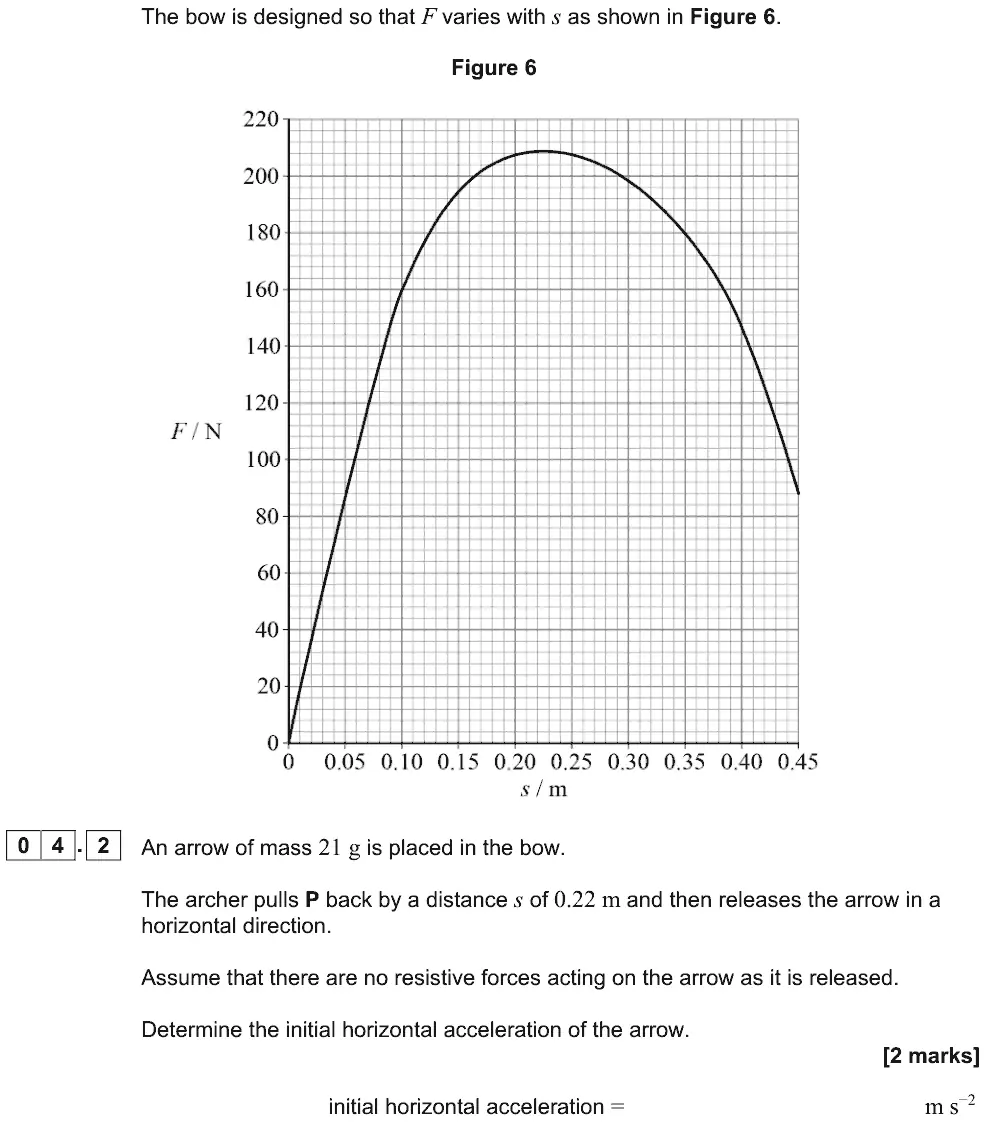
04.2 51% of students obtained two marks with a further 33% obtaining one mark. Many students did not score the second mark because they: • did not change the mass into kg • converted the mass into weight. Some students attempted to use an equation of motion due to their inability to assimilate the information provided in the question. This showed a limited development of exam technique through limited awareness of the purpose of the stimuli provided in the question.
Notes from the mark scheme and report
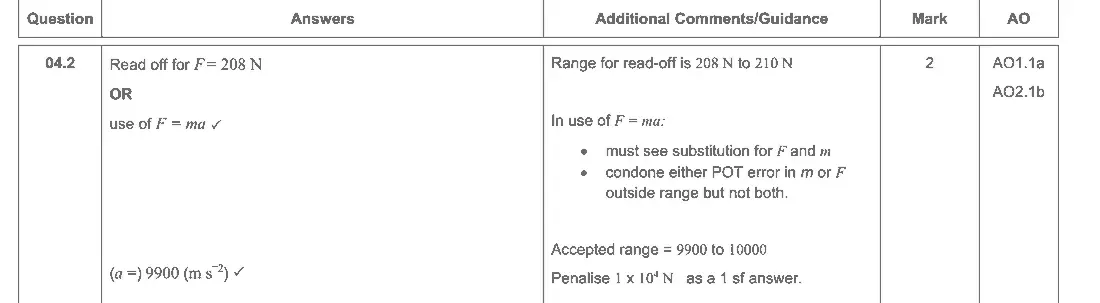
Answer: 9900 m s^-2 (F = 208 N read at 0.22 m, m = 0.021 kg)
not converting g to kg or using weight lost the second mark
Skills: MS3.1 Translate information between graphical, numerical and algebraic forms; MS0.1 Recognise and make use of appropriate units in calculations
June 2023 · AS Paper 1 · Q5.23 marksCalculationHard
Earlier part of question 5 that this part uses
Mark scheme
Examiner's comment
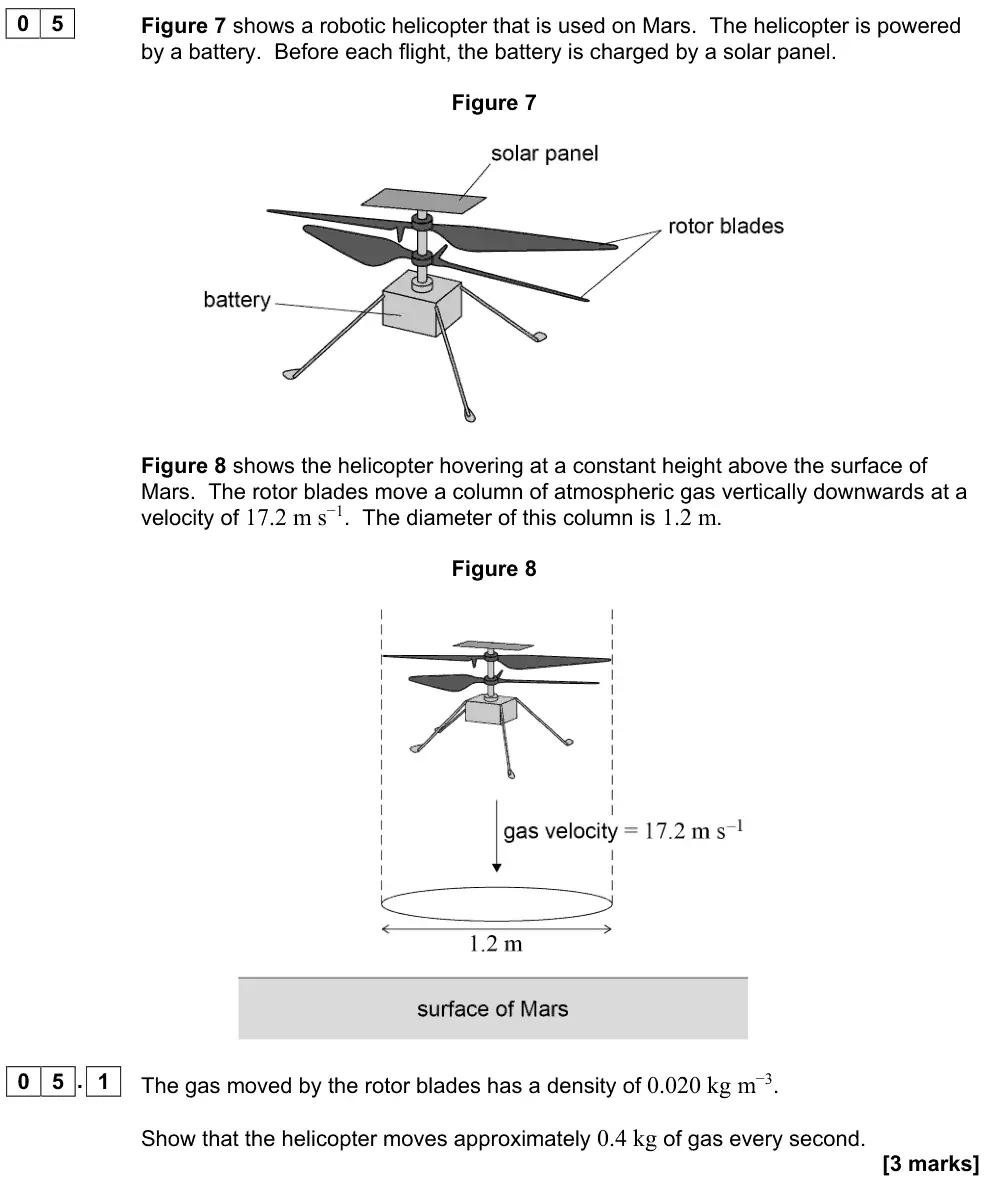
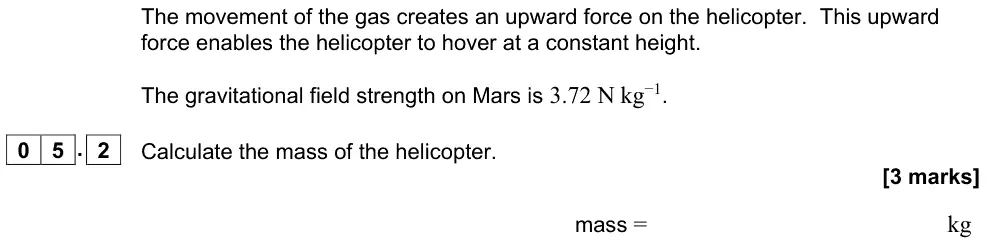
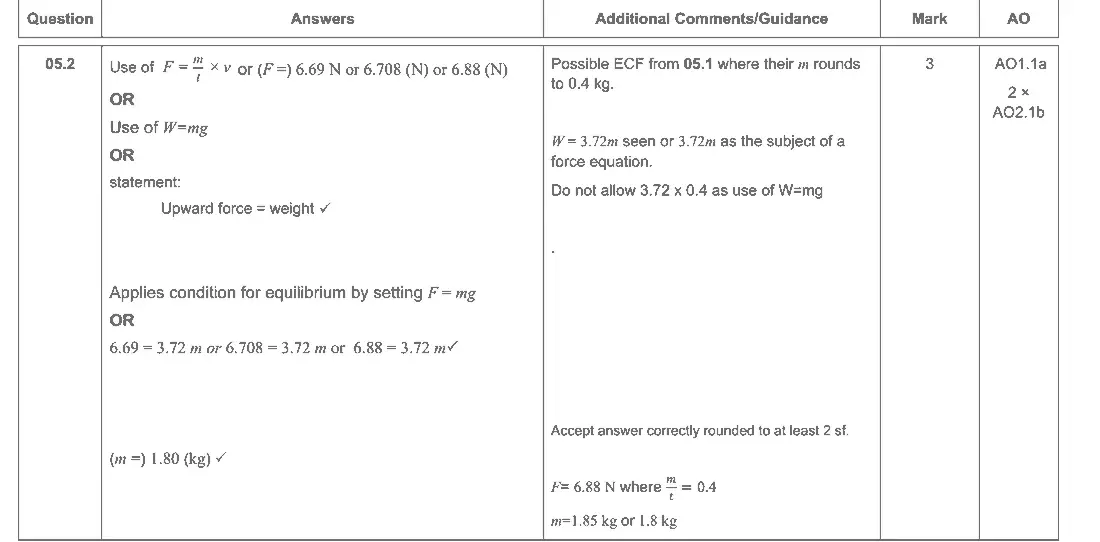
05.2 This part of the question expected students to appreciate that the displacement of the gas produced an upwards force equal to the weight of the helicopter. This was beyond the knowledge and understanding of most. Fewer than 16% of students scored three marks and certainly demonstrated A-grade performance. Over 70% of students scored zero in this part. Many students thought that the mass of gas displaced per second was equal to the mass of the helicopter. Many attempted to use conservation of energy to obtain an answer by setting gravitational potential energy equal to kinetic energy. It was very common to see 0.4 3.72 as the only working presented.
Notes from the mark scheme and report
Answer: 1.80 kg (F = rate of change of momentum = 0.389 x 17.2 = 6.69 N = 3.72m)
many equated mass of gas per second to the helicopter's mass
Skills: MS2.3 Substitute numerical values into algebraic equations using appropriate units for physical quantities
June 2023 · AS Paper 1 · Q5.43 marksAO3=3ExplanationHard
Earlier part of question 5 that this part uses
Mark scheme
Examiner's comment
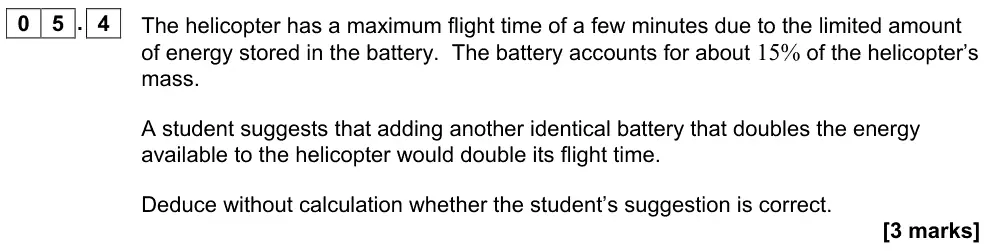
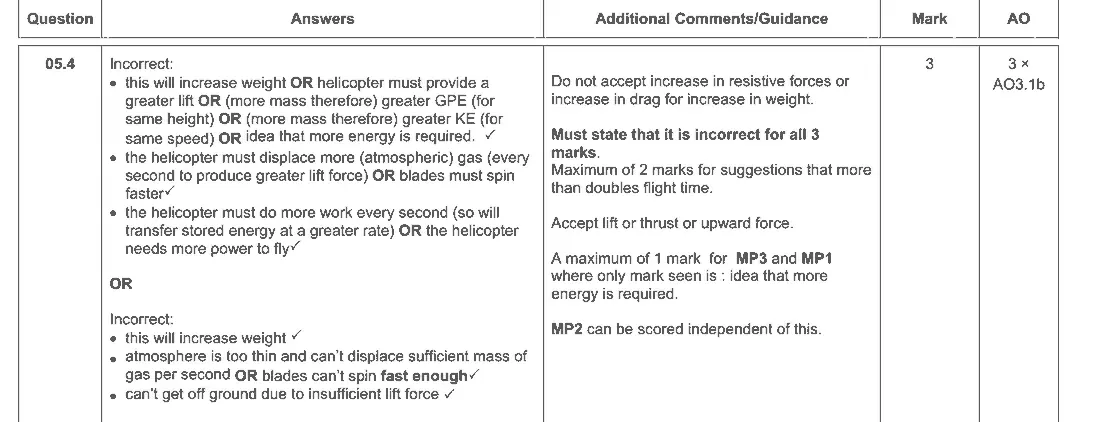
05.4 Almost 60% of students were able to score at least one mark. However, fewer than 10% of students were able to make further progress and not even 1% scored all three marks. Most realised that the helicopter was now heavier and that more work was required to keep it in the air. However, they were unable to describe how the helicopter produces the extra lift required. Also, they were unable to connect the increased amount of work done to power and therefore were unable to explain why the flight time would not double. Students would often make statements without being able to support them with an explanation that demonstrated their knowledge and understanding of the underlying physics. 05.5 58% of students obtained both marks. Almost 8% did not even attempt this calculation. Mistakes seen included dividing the acceleration by the change in velocity and using an inappropriate equation of motion.
Notes from the mark scheme and report
Incorrect: extra battery increases weight so more lift needed, more gas displaced per second, more power so energy used faster - flight time does not double
must say 'incorrect' for 3
June 2023 · AS Paper 1 · Q5.72 marksExplanation
Earlier part of question 5 that this part uses
Mark scheme
Examiner's comment
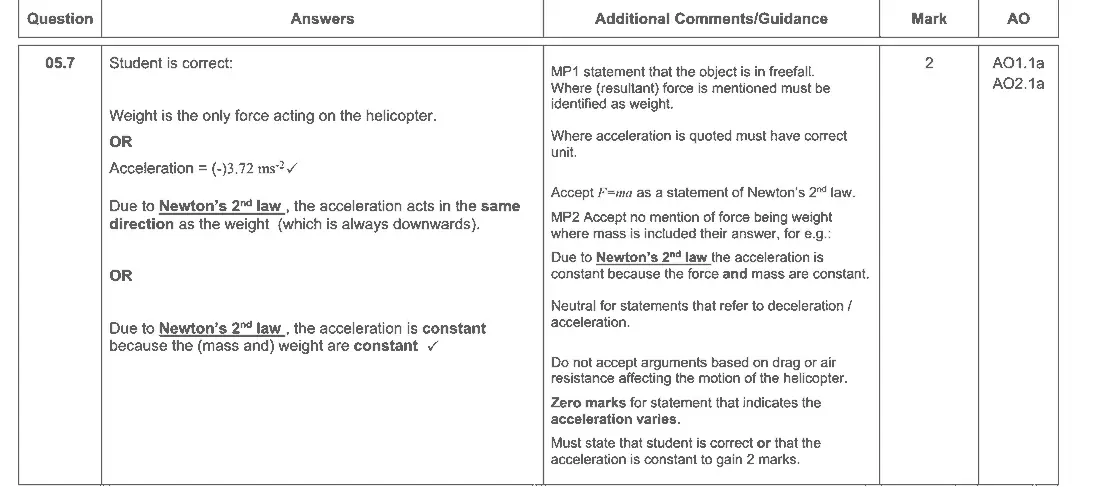
05.7 The lack of quality of the students’ technical language was often the reason for limited progress in this part. Many thought that constant acceleration was the same as constant velocity and developed arguments based on acquisition of a terminal velocity. Many others offered Newton’s third law as a reason to support equilibrium and Newton’s first law.
Notes from the mark scheme and report
Correct: weight is the only force and is constant, so by N2 acceleration is constant (3.72 m s^-2 downwards) throughout
confusing constant acceleration with constant velocity was common
June 2023 · Paper 1 · Q191 markMultiple choice
Answer
D
Mark scheme
Notes from the mark scheme and report
Answer: D
Skills: MS3.8 Understand the possible physical significance of the area between a curve and the x axis and be able to calculate it or estimate it by graphical methods as appropriate
June 2023 · Paper 1 · Q231 markMultiple choice
Answer
A
Notes from the mark scheme and report
Answer: A
June 2023 · Paper 1 · Q241 markMultiple choice
Answer
C
Notes from the mark scheme and report
Answer: C
June 2023 · Paper 1 · Q251 markMultiple choice
Answer
C
Notes from the mark scheme and report
Answer: C
Skills: MS3.8 Understand the possible physical significance of the area between a curve and the x axis and be able to calculate it or estimate it by graphical methods as appropriate
June 2023 · Paper 2 · Q1.21 markAO1=1Explanation
Earlier part of question 1 that this part uses
Mark scheme
Examiner's comment
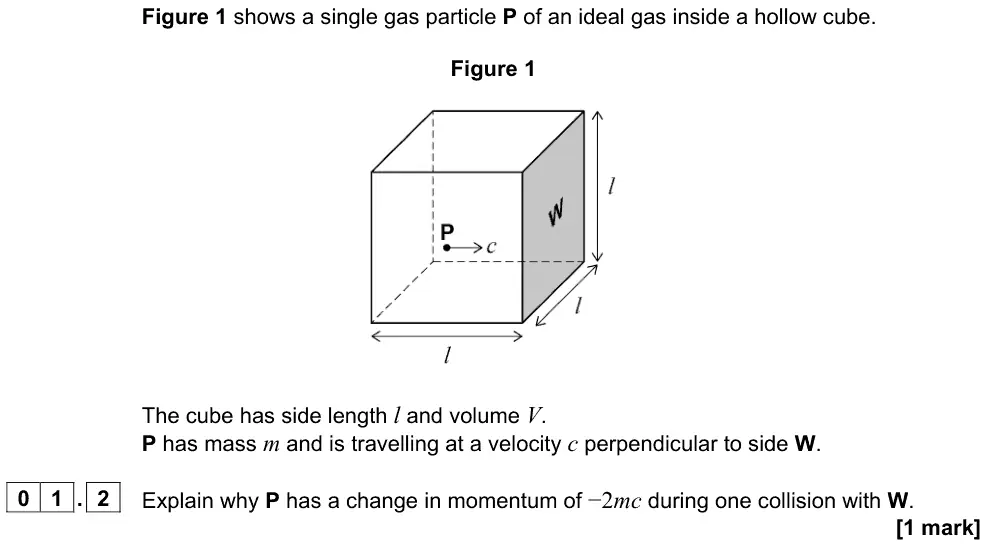
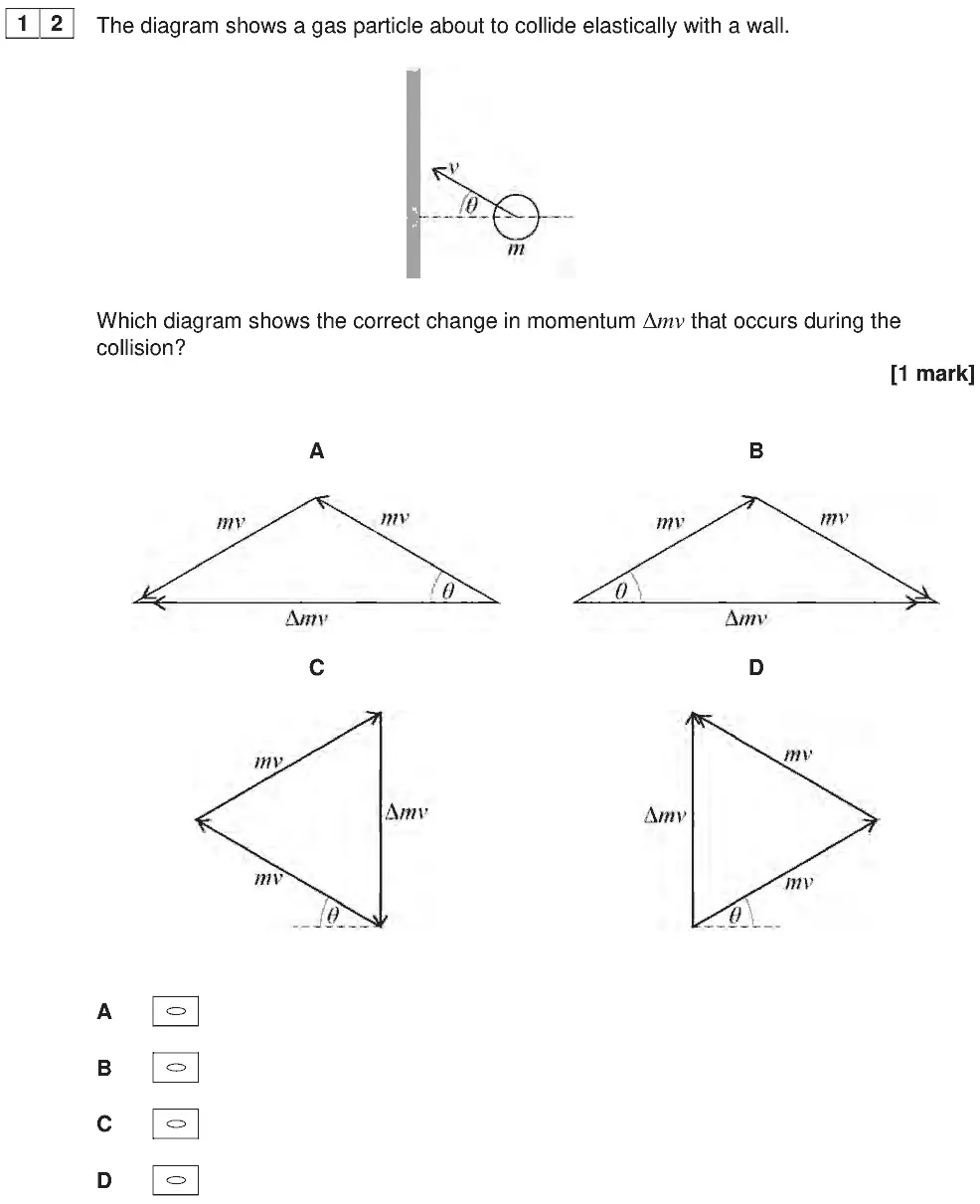
01.2 Most students did not explain the sign convention by, for example, stating that the initial momentum was mc. Simply giving an answer – mc – mc = –2mc did not explain the situation. Some did add that the collision was elastic and that the speed remains the same but this was not a complete explanation. The statement that “momentum is conserved” was ignored.
Notes from the mark scheme and report
Initial momentum +mc, final -mc (elastic, same speed), so change = -mc - mc = -2mc
sign convention must be explained
'momentum is conserved' ignored
June 2023 · Paper 2 · Q1.42 marksAO1=2Explanation
Earlier part of question 1 that this part uses
Mark scheme
Examiner's comment
01.4 This question was tackled in a straightforward way by fewer than half of the students; the remainder did not know how to start their answer even though it covers a small stage in a standard proof. It was common to see an absence of any reference to a Newton law.
Notes from the mark scheme and report
F = rate of change of momentum (Newton II) = 2mc x c/2l = mc^2/l
p = F/A = mc^2/l^3 = mc^2/V
a Newton law must be referenced
Skills: MS2.2 Change the subject of an equation, including non-linear equations
June 2023 · AS Paper 2 · Q81 markMultiple choice
Answer
A
Mark scheme
Notes from the mark scheme and report
Answer: A
June 2022 · Paper 1 · Q5.42 marksAO1=2Explanation
Earlier part of question 5 that this part uses
Mark scheme
Examiner's comment
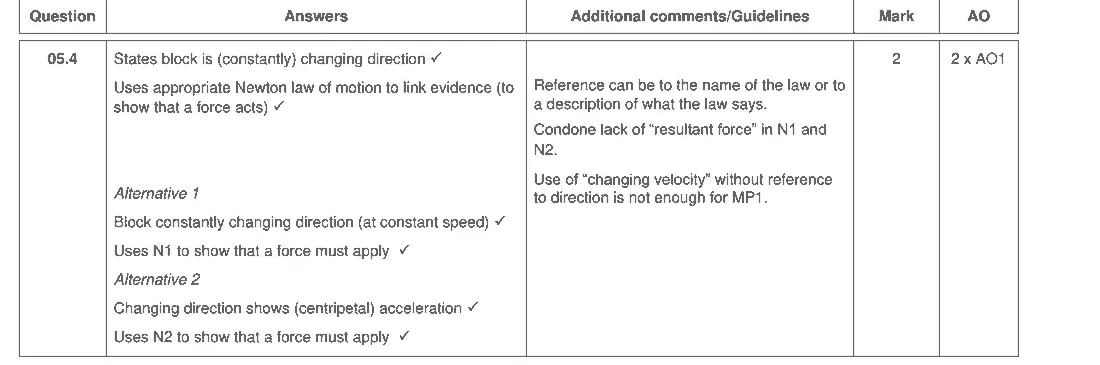
In order to answer 05.4 correctly students had to be clear about the evidence on which their answer was based. Stating that the velocity is changing, without any mention of direction, was not interpreted by examiners as evidence. Many students invoked Newton’s 3rd law without success.
Notes from the mark scheme and report
Block constantly changes direction, so by N1 (or N2 via centripetal acceleration) a resultant force acts
'changing velocity' without direction and N3 not credited
June 2022 · Paper 1 · Q241 markAO2=1Multiple choice
Answer
B
Mark scheme
Notes from the mark scheme and report
Answer: B
Skills: MS2.3 Substitute numerical values into algebraic equations using appropriate units for physical quantities
June 2022 · Paper 1 · Q251 markAO1=1Multiple choice
Answer
C
Mark scheme
Notes from the mark scheme and report
Answer: C
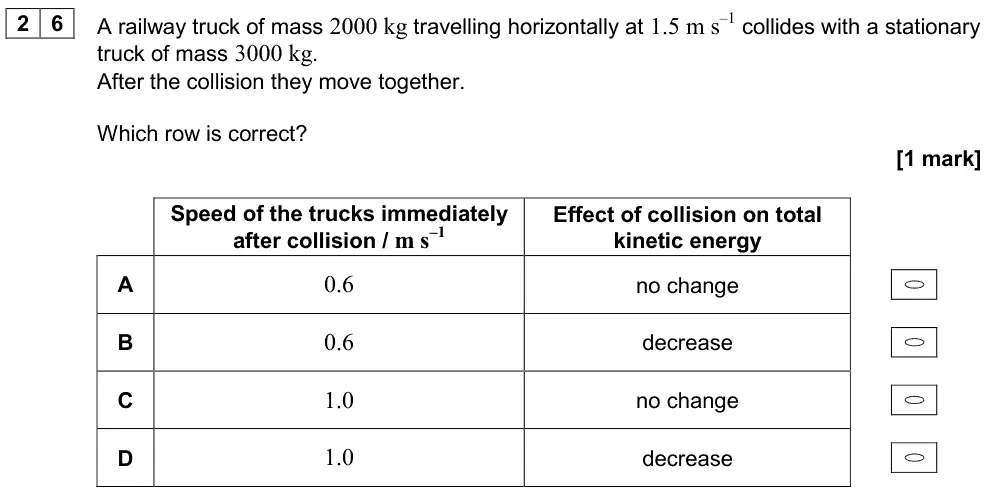
June 2022 · Paper 1 · Q261 markAO2=1Multiple choice
Answer
D
Mark scheme
Examiner's comment
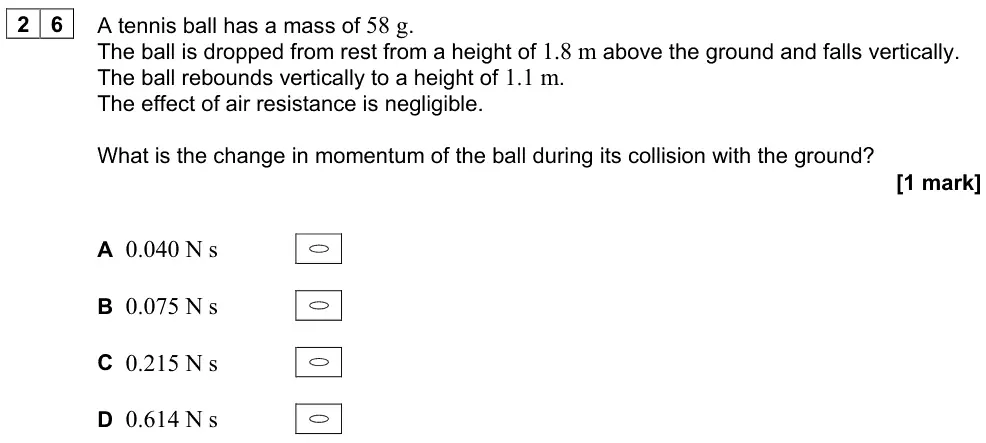
Question 26 was a difficult multi-step calculation. Most students chose B, and the next most popular was D, the correct answer.
Notes from the mark scheme and report
Answer: D
most chose B (ignoring the change of direction), D next most popular
Skills: MS2.3 Substitute numerical values into algebraic equations using appropriate units for physical quantities
June 2022 · Paper 2 · Q2.23 marksAO2=3Explanation
Earlier part of question 2 that this part uses
Mark scheme
Examiner's comment
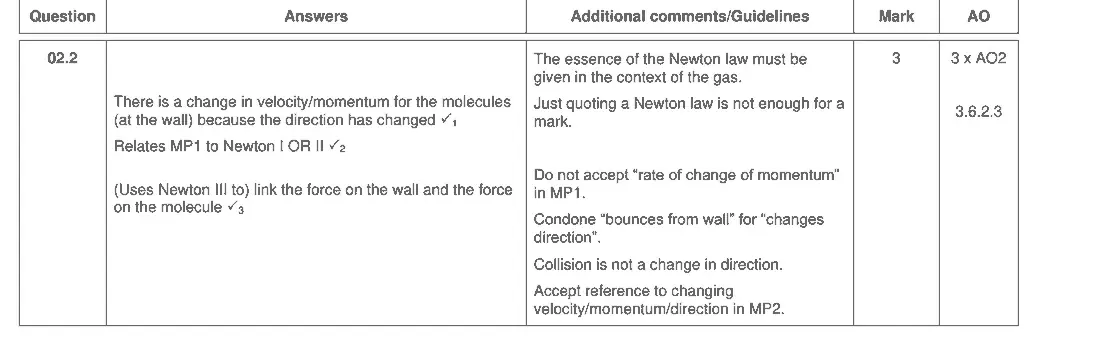
Students at all levels of ability had some problems in answering this question. Newton’s laws are a familiar topic introduced before A-level, so examiners expect that students should raise the standard of their answers above this first introduction; just quoting a Newton’s law was not sufficient – it had to be related to a particular event or situation. Weaker students ignored the Newton’s law reference and were content to write about the kinetic energy of the molecule giving it a force as it hits the wall. More able students tried to use Newton I but only wrote about molecules hitting the wall and failed to state that the velocity or momentum changes. In terms of Newton II, many students did not refer to rate of change when discussing the momentum. A more subtle error was to regard the wall as being given the force even though it was the molecule that had the rate of change of momentum. The forces are obviously related but the order of events was not made clear. The main failure was to quote the law in isolation and not refer to the wall and molecule.
Question 02.2
Notes from the mark scheme and report
Momentum/velocity of molecule changes at the wall (direction change)
link to Newton I or II
Newton III links force on molecule to force on wall
quoting a law without applying it to the molecule and wall scores nothing
June 2022 · AS Paper 2 · Q4.11 markAO2=1Show that
Mark scheme
Examiner's comment
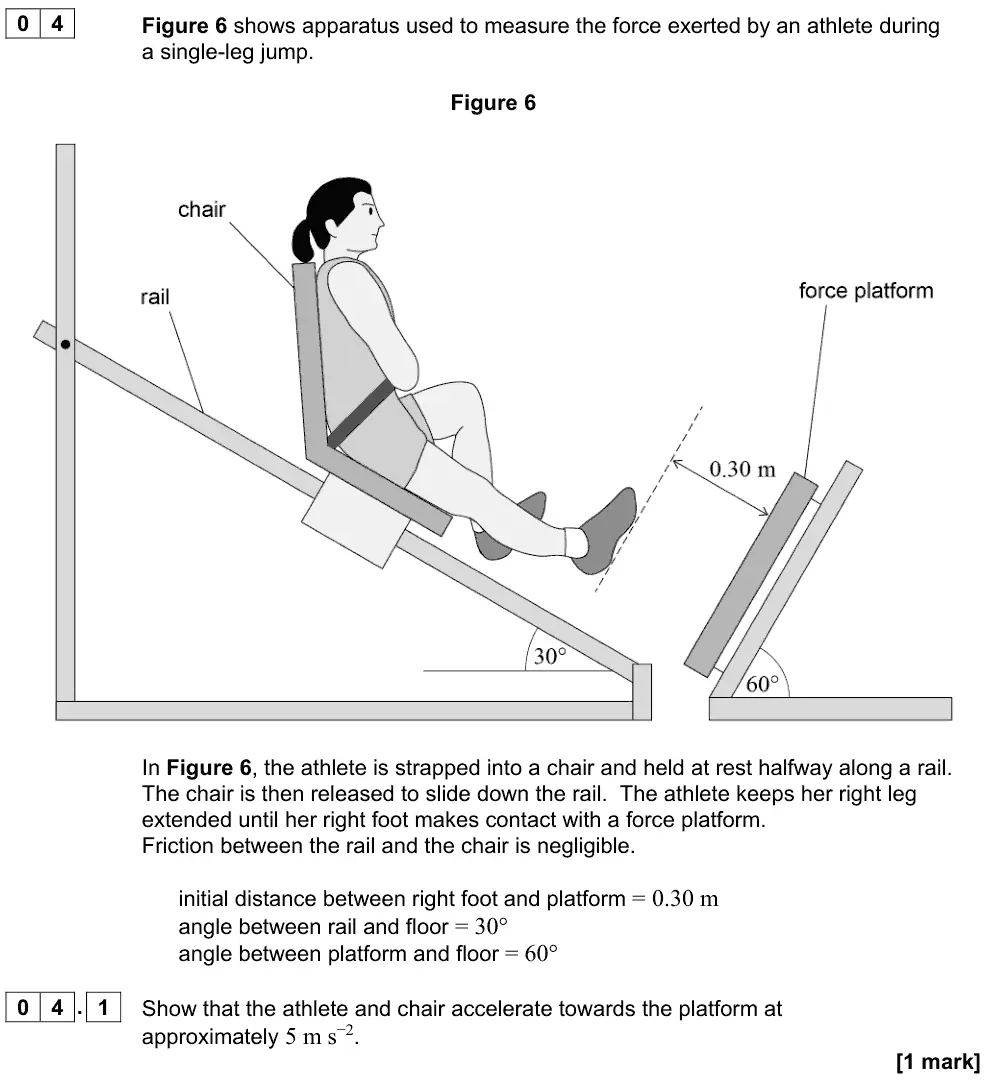
04.1 A surprisingly large number of students struggled with this relatively simple ‘show that’ question. This was used to establish that the motion down, and up, the rail occurred under the condition of constant acceleration.
Notes from the mark scheme and report
Answer: 4.9 m s^-2 (a = g sin 30)
Skills: MS4.5 Use sin, cos and tan in physical problems
June 2022 · AS Paper 2 · Q4.32 marksAO2=1, AO3=1Calculation
Earlier part of question 4 that this part uses
Mark scheme
Examiner's comment
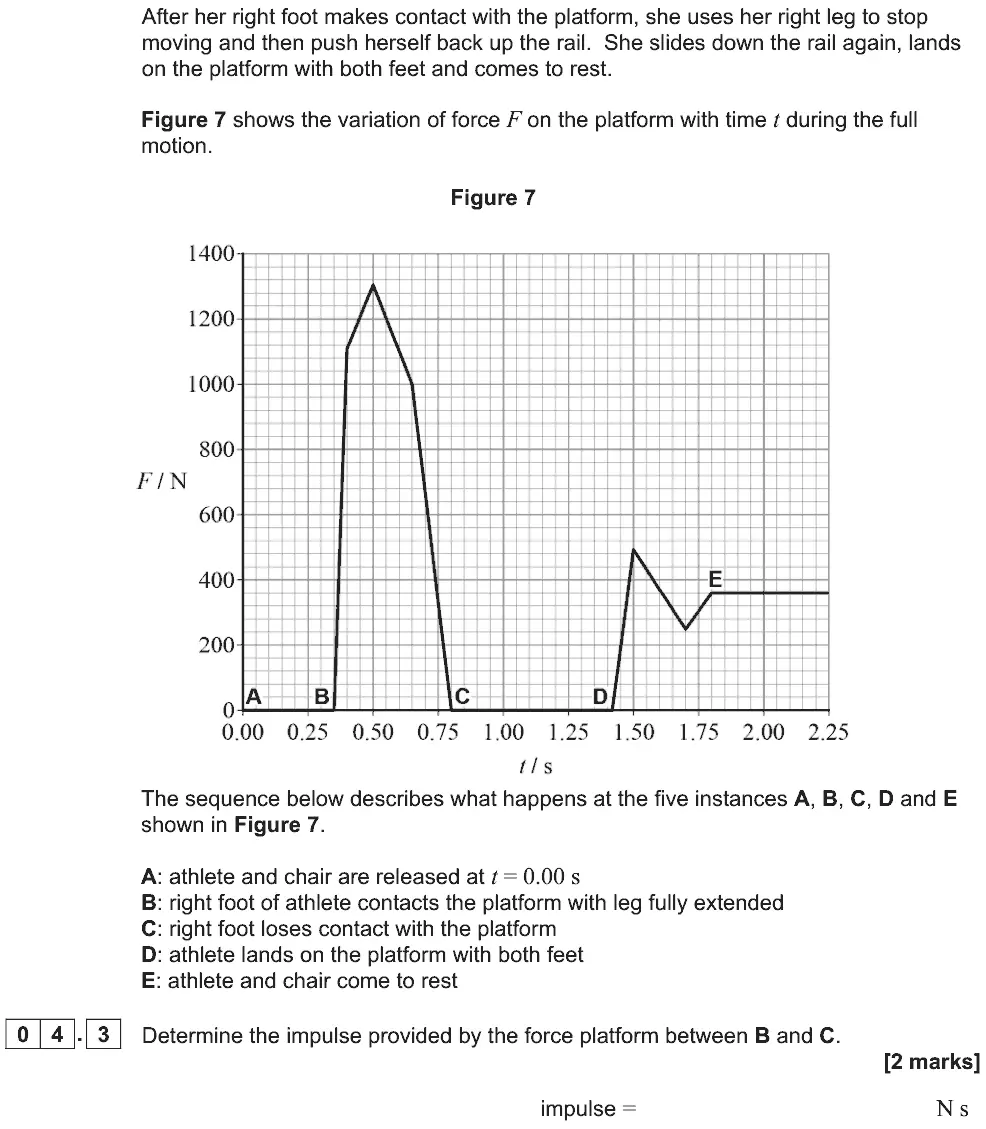
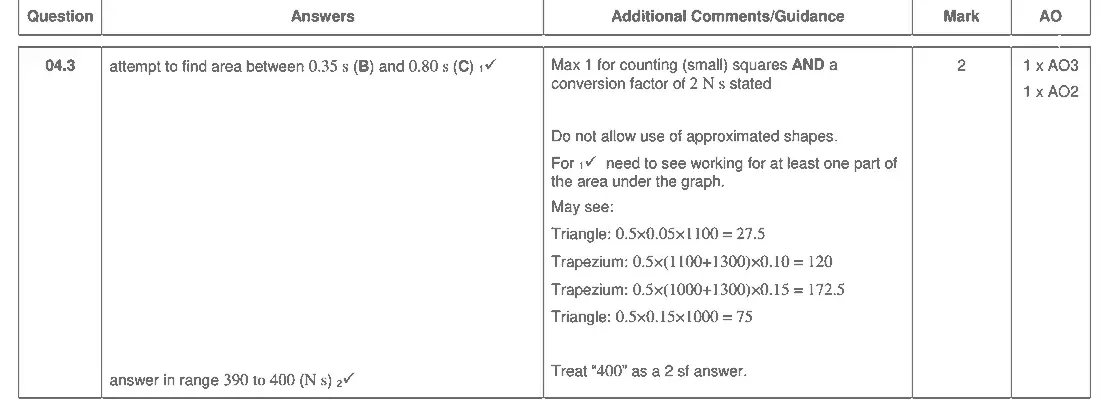
04.3 Most students knew that they needed to obtain the area of the graph between B and C. The graph was deliberately constructed without curves so that students could obtain this area by geometry. Crude attempts to count the squares were not rewarded. A significant number of students thought they could use F∆t, even though the value of F varies throughout the time period.
Notes from the mark scheme and report
Answer: 390-400 N s (area between B and C by triangles and trapezia)
F delta t with one F and crude square counting not credited
Skills: MS3.8 Understand the possible physical significance of the area between a curve and the x axis and be able to calculate it or estimate it by graphical methods as appropriate
June 2022 · AS Paper 2 · Q251 markAO2=1Multiple choice
Answer
A
Mark scheme
Notes from the mark scheme and report
Answer: A
June 2022 · AS Paper 2 · Q261 markAO2=1Multiple choice
Answer
C
Mark scheme
Notes from the mark scheme and report
Answer: C
June 2022 · Paper 3 Section A · Q4.23 marksAO3=3Explanation
Earlier part of question 4 that this part uses
Mark scheme
Examiner's comment
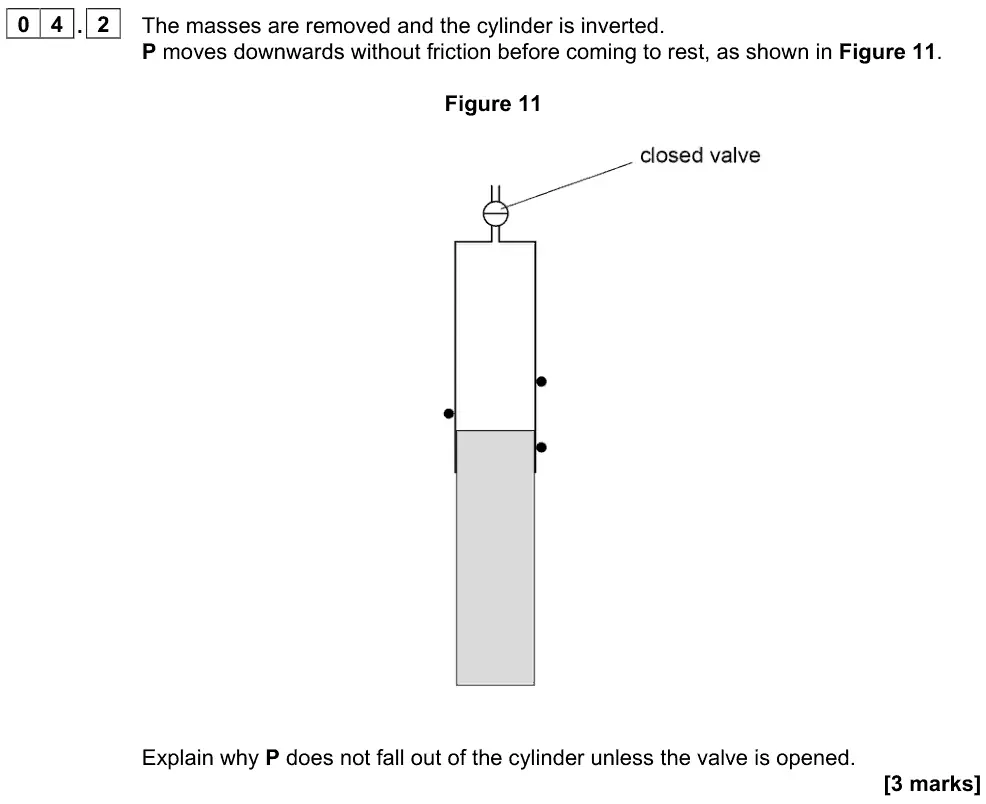
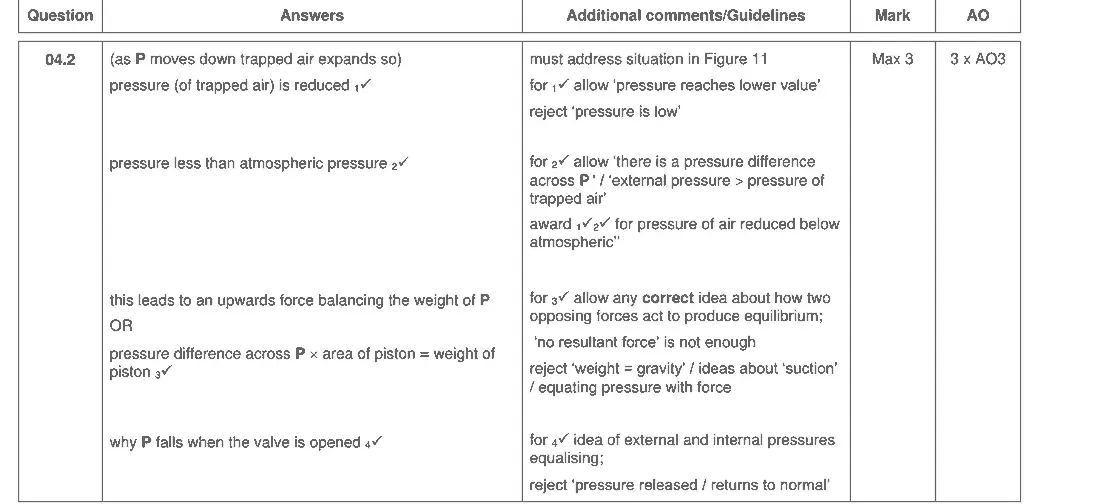
In 04.2 students needed to explain how the pressure inside the cylinder changed as P moved downwards, how this led to P coming to rest and why P fell out of the cylinder when the valve was opened. Misconceptions seen included saying that P came to rest when the internal and external pressures were the same. Some thought pressure could be equated with force or suggested that there was a ‘suction’ effect on P. Others said that, when the valve was opened, air rushed into the cylinder and pushed P downwards. Many struggled to make progress and 60% were unable to score.
The questions were designed to allow students to demonstrate competence in the key techniques and investigative approaches required in three of the twelve assessed practical activities. This cohort showed that when the question provided enough structure to deter them from improvising, they could produce coherent and sensible extended writing, as in 01.3 and 02.2. Question 04.2 was a different story, with some students referring to ‘suction’ and equating pressure with ‘gravity’.
The main misconceptions seen were thinking that: • experimental data will always perfectly confirm a theory; students must provide a reasoned judgement before they accept or reject such evidence, e.g. in 04.1; • pressure can be equated with force, e.g. 04.2; • a best-fit line must be a straight line, e.g. 04.3.
Notes from the mark scheme and report
As P moves down, trapped air expands so its pressure falls below atmospheric
pressure difference x area gives an upward force balancing P's weight
opening the valve equalises pressure so P falls
'suction' or equating pressure with force rejected
Skills: RP8 Investigation of Boyle's law (constant temperature) and Charles’s law (constant pressure) for a gas.
November 2021 · AS Paper 1 · Q5.12 marksCalculation
Mark scheme
Notes from the mark scheme and report
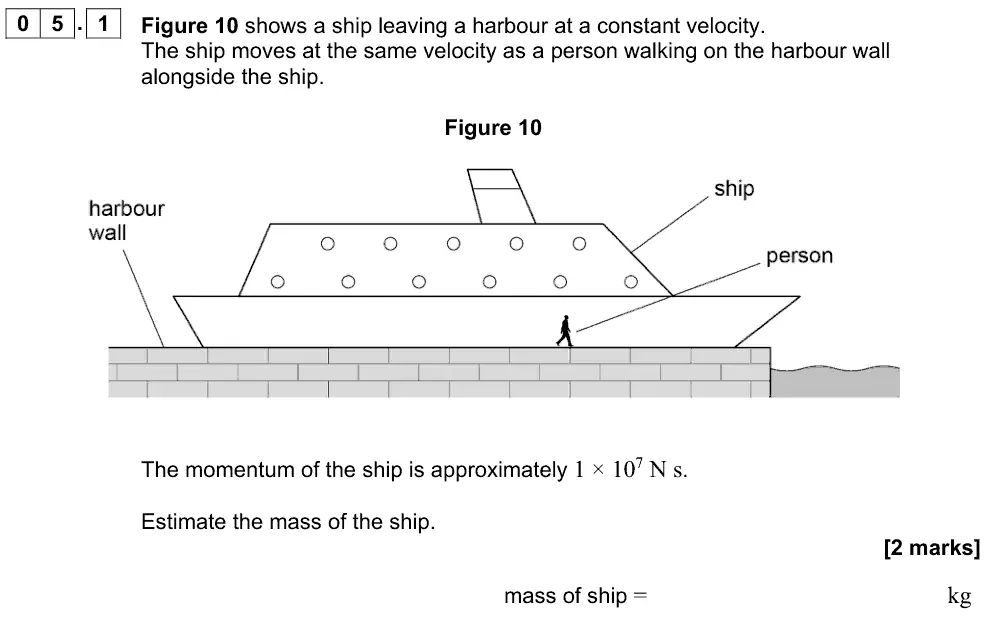
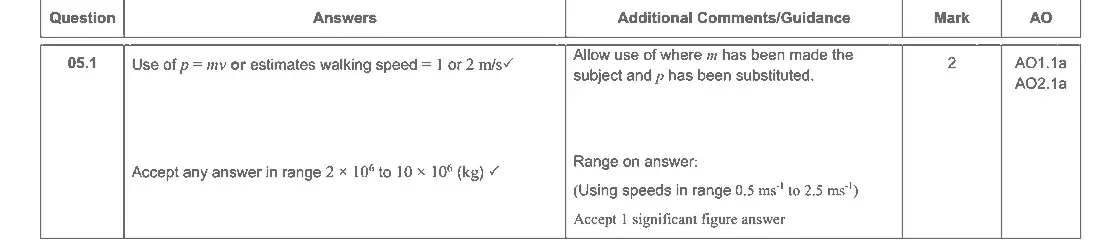
Answer: about 5 x 10^6 kg (walking speed 1-2 m s^-1
range 2-10 x 10^6 kg accepted)
Skills: MS0.4 Estimate results; MS1.4 Make order of magnitude calculations
November 2021 · AS Paper 1 · Q5.24 marksAO2=4Explanation
Earlier part of question 5 that this part uses
Mark scheme
Notes from the mark scheme and report
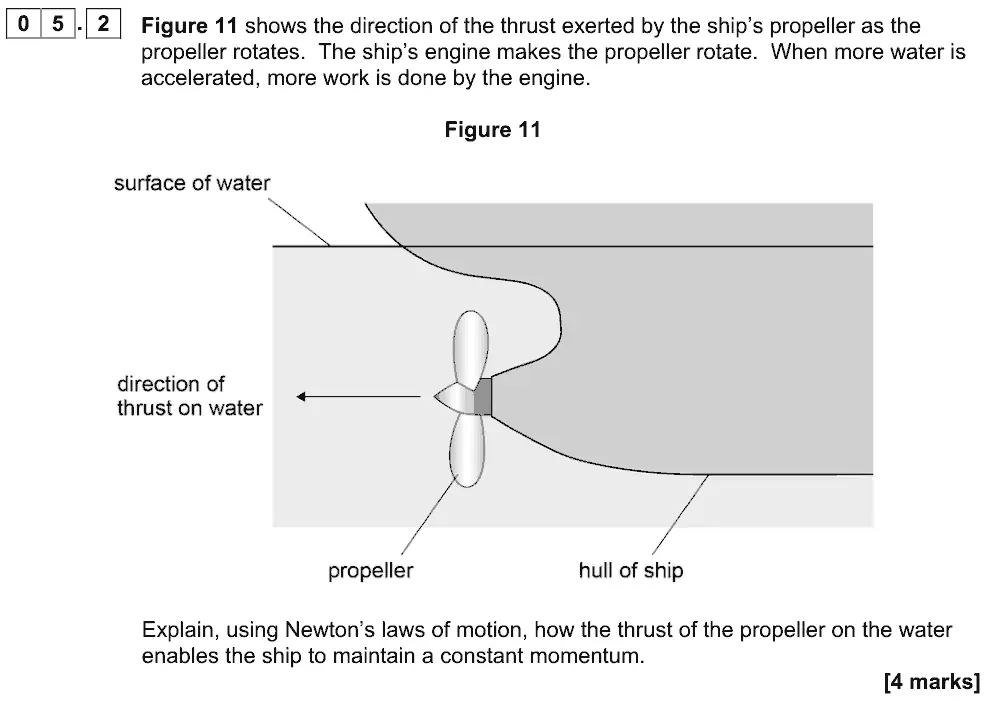
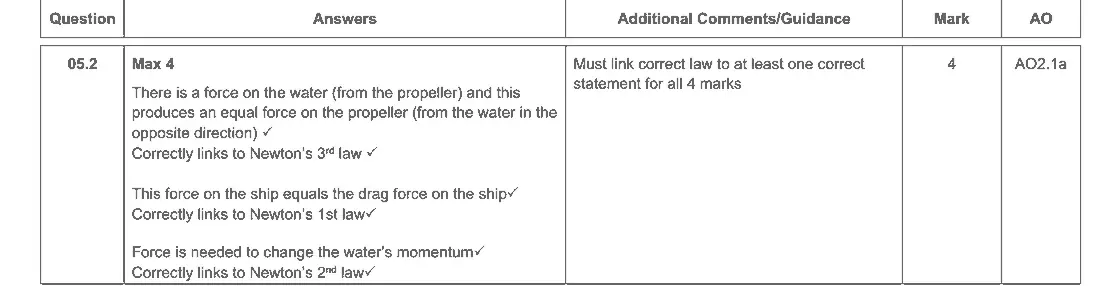
Propeller pushes water backwards, water pushes ship forward (N3)
force needed to change water's momentum (N2)
thrust equals drag so no resultant force, constant velocity (N1)
each law must be linked to a correct statement
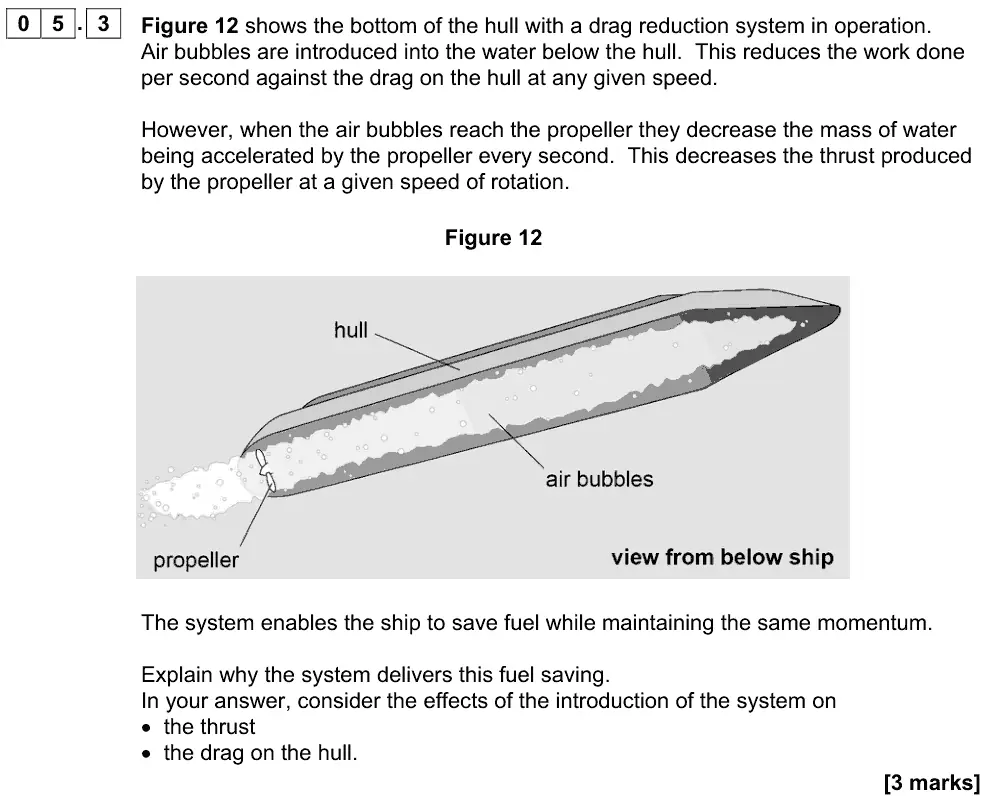
November 2021 · AS Paper 1 · Q5.33 marksAO3=3Explanation
Earlier part of question 5 that this part uses
Mark scheme
Notes from the mark scheme and report
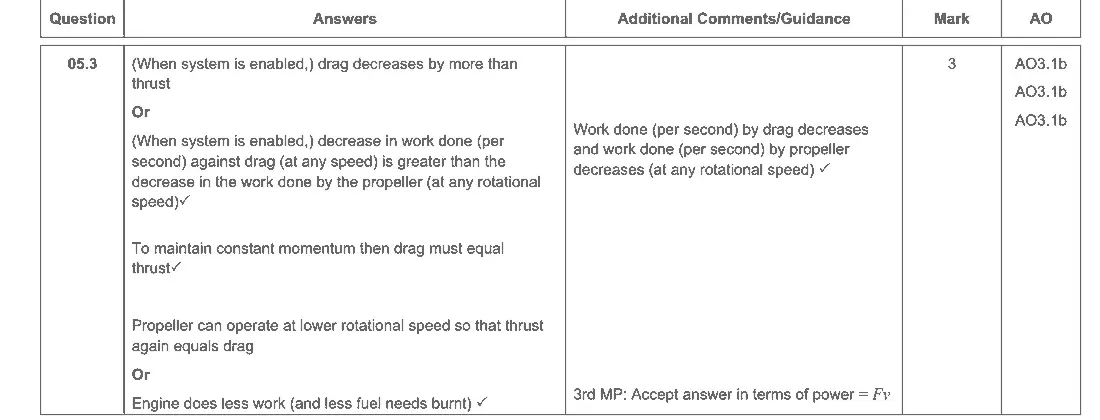
Drag falls by more than thrust
constant momentum needs thrust = drag, so propeller can turn more slowly
engine does less work per second so less fuel used
November 2021 · Paper 1 · Q231 markMultiple choice
Answer
C
Mark scheme
Notes from the mark scheme and report
Answer: C
November 2021 · Paper 1 · Q241 markMultiple choice
Answer
A
Mark scheme
Notes from the mark scheme and report
Answer: A
November 2021 · Paper 1 · Q251 markMultiple choice
Answer
C
Mark scheme
Notes from the mark scheme and report
Answer: C
Skills: MS3.8 Understand the possible physical significance of the area between a curve and the x axis and be able to calculate it or estimate it by graphical methods as appropriate; MS0.4 Estimate results
November 2021 · AS Paper 2 · Q4.33 marksAO2=3Calculation
Earlier part of question 4 that this part uses
Mark scheme
Notes from the mark scheme and report
Answer: 85 N (accelerating force m delta v / delta t = 12 N added to 72.8 N from 04.2)
Skills: MS2.3 Substitute numerical values into algebraic equations using appropriate units for physical quantities
November 2021 · AS Paper 2 · Q161 markMultiple choice
Answer
D
Mark scheme
Notes from the mark scheme and report
Answer: D
November 2021 · AS Paper 2 · Q241 markMultiple choice
Answer
D
Mark scheme
Notes from the mark scheme and report
Answer: D
November 2021 · AS Paper 2 · Q251 markMultiple choice
Answer
C
Mark scheme
Notes from the mark scheme and report
Answer: C
Skills: MS3.8 Understand the possible physical significance of the area between a curve and the x axis and be able to calculate it or estimate it by graphical methods as appropriate
November 2021 · Paper 2 · Q261 markMultiple choice
Answer
A
Mark scheme
Notes from the mark scheme and report
Answer: A
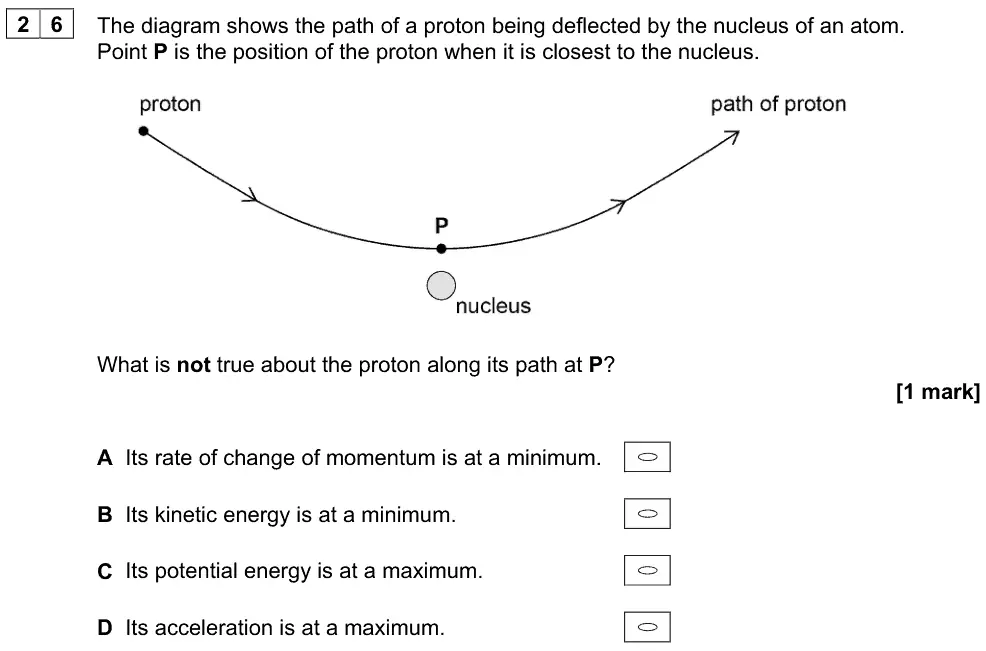
rate of change of momentum is a maximum, not a minimum, at P
November 2021 · AS Paper 2 · Q271 markMultiple choice
Answer
C
Mark scheme
Notes from the mark scheme and report
Answer: C
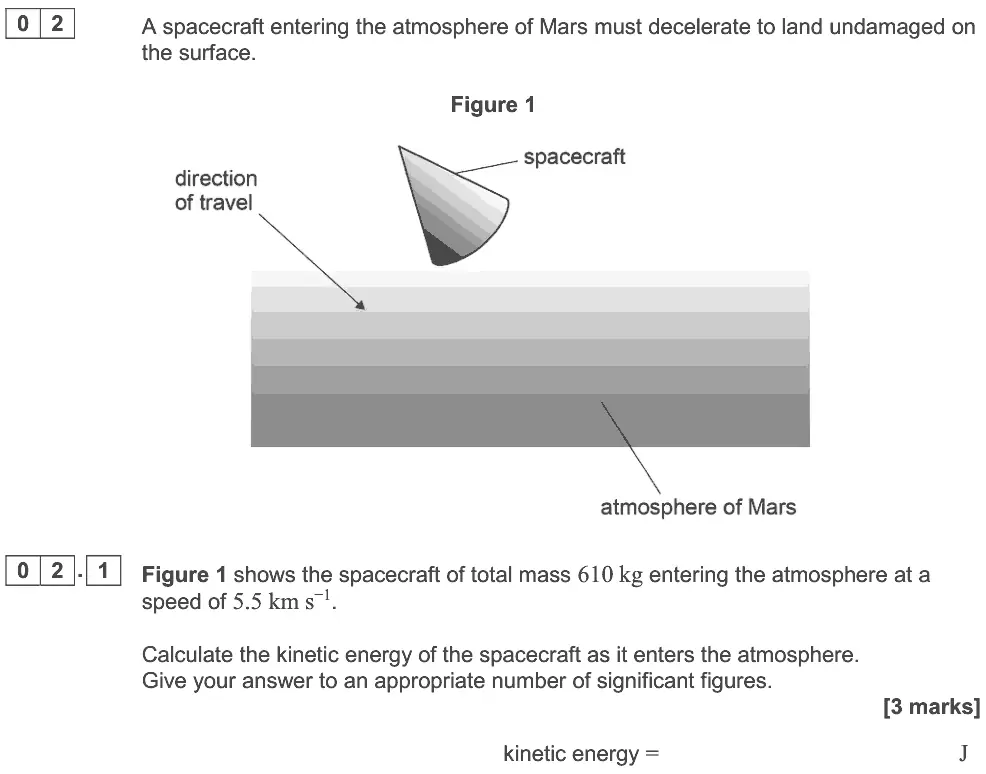
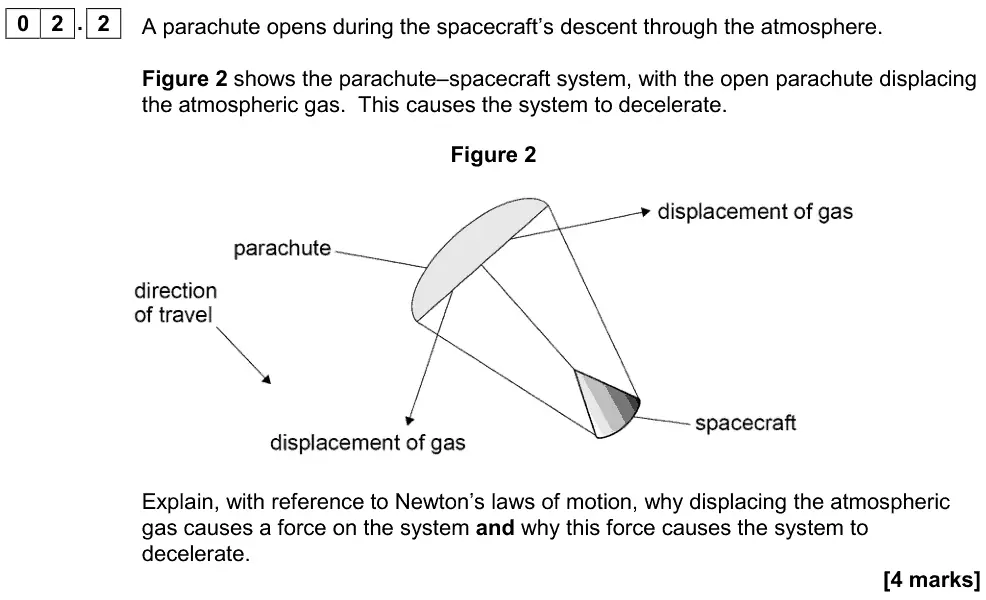
November 2020 · AS Paper 1 · Q2.24 marksExplanation
Earlier part of question 2 that this part uses
Mark scheme
Notes from the mark scheme and report
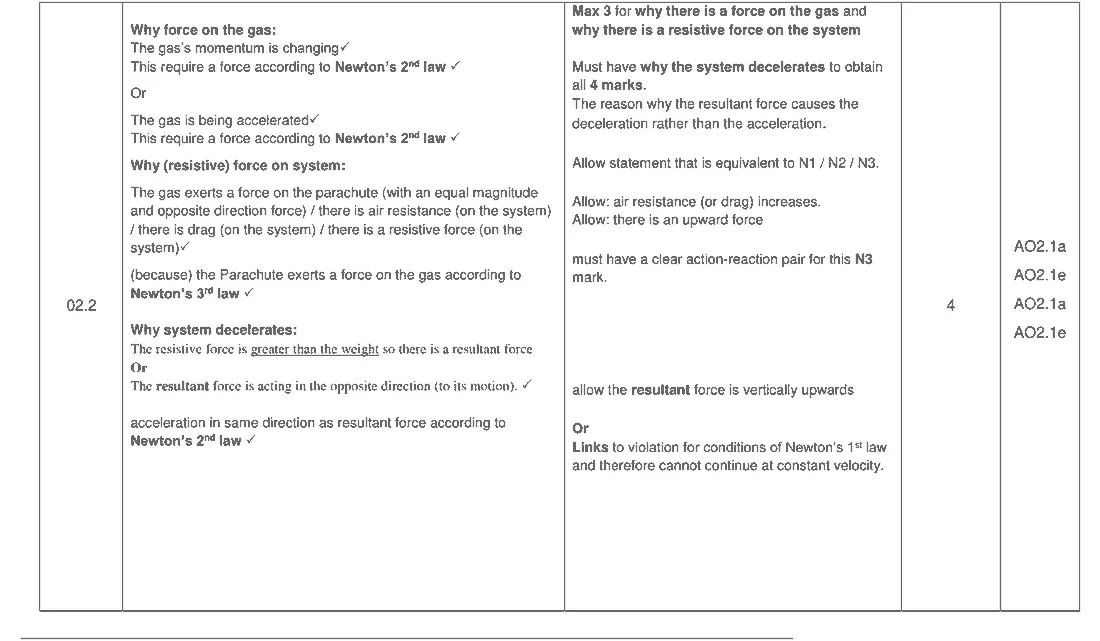
Gas's momentum changes so a force acts on it (N2)
gas pushes back on the parachute (N3 pair)
resistive force exceeds weight so resultant force opposes motion and system decelerates (N2)
November 2020 · AS Paper 1 · Q2.43 marksExplanation
Earlier part of question 2 that this part uses
Mark scheme
Notes from the mark scheme and report
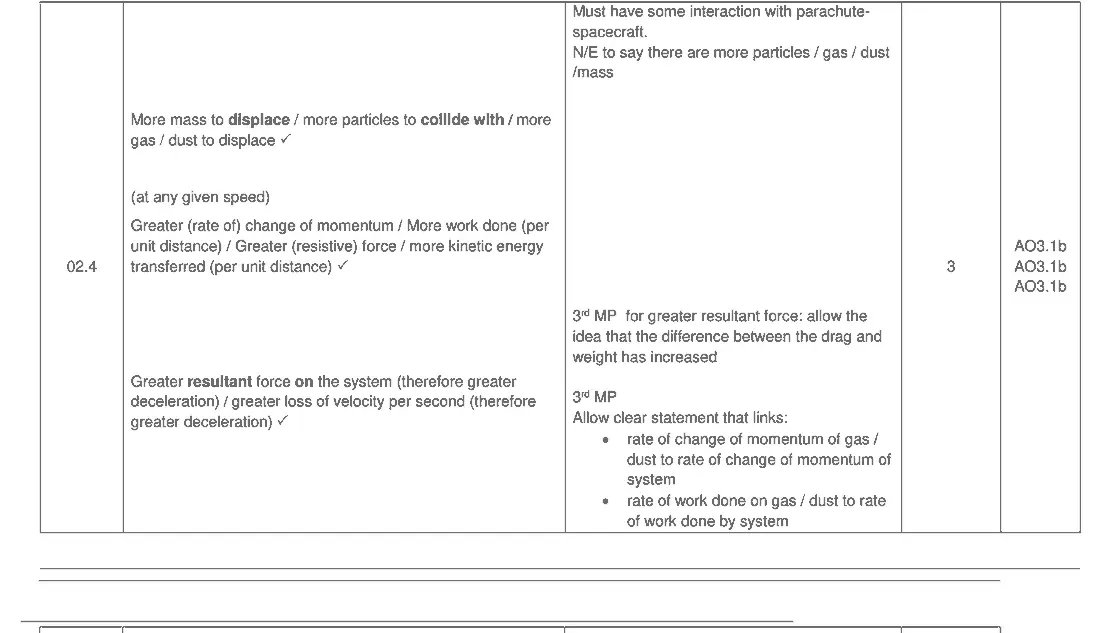
More mass displaced per second, so greater rate of change of momentum / greater drag
greater resultant force so greater deceleration
must link to the parachute-spacecraft interaction
November 2020 · Paper 1 · Q4.34 marksCalculation
Earlier part of question 4 that this part uses
Mark scheme
Examiner's comment
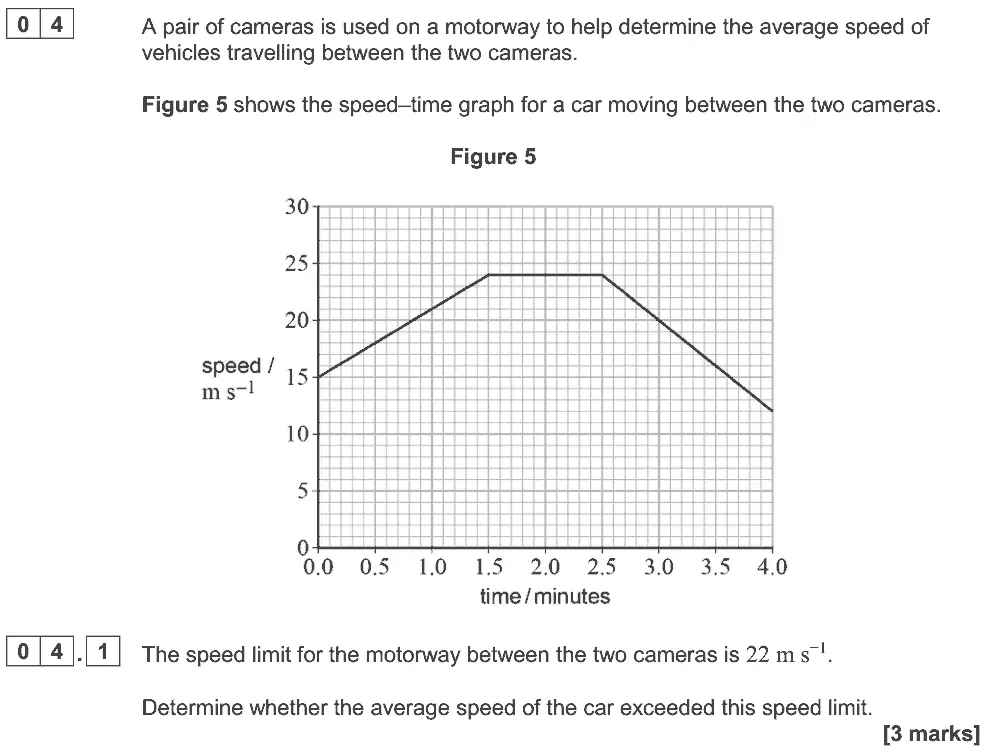
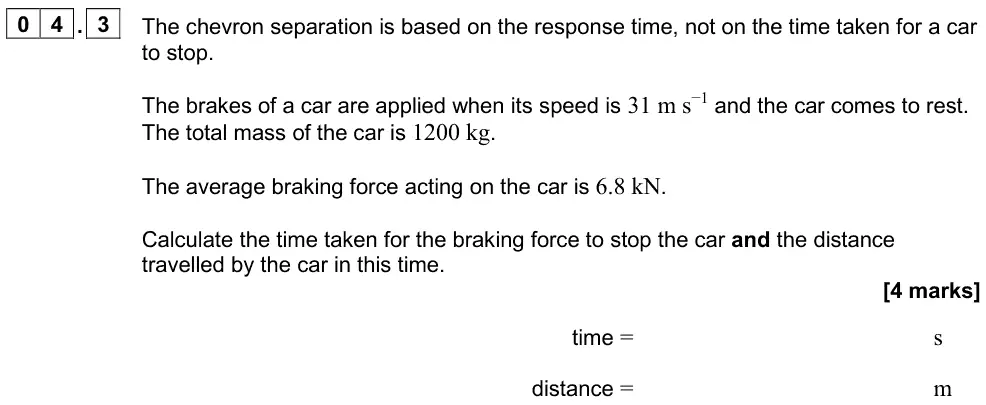
Much of the work on motion in this question was relatively straightforward and, in a typical series, students would be expected to score well on it. Although the average scores on most of the question parts were higher than the paper average, a large number of errors in basic understanding were seen. In 04.1, for example, many students struggled to work out the area, or suggested that the average speed was the average of the speeds of the three sections. In 04.2, a surprisingly large number of students did not identify the slower response time as the appropriate one for the calculation. Many careless errors in the use of suvat equations were also seen in 04.3. It was pleasing to note in 04.4 that several students understood the premise of the question and indicated that the chevrons would be too far apart and therefore people would ignore them or that the car in front would also take some distance to come to rest. Very few fully correct answers were seen in 04.5. Although most students attempted to apply ideas of circular motion, the angle of the slope was largely ignored. Many answers suggesting N mg = , or applying the equation of circular motion down the slope rather than horizontally, were seen.
Notes from the mark scheme and report
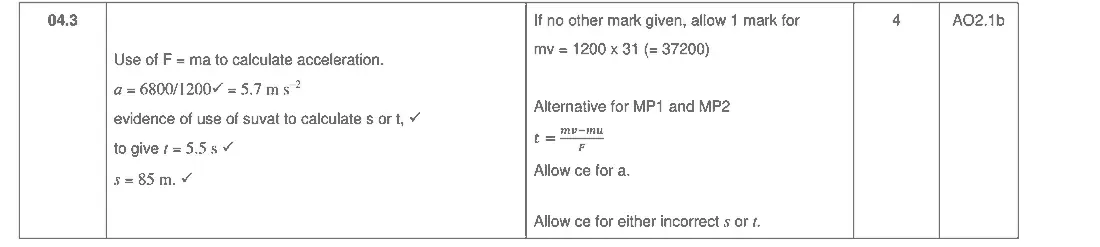
Answer: t = 5.5 s, s = 85 m (a = 6800/1200 = 5.7 m s^-2)
careless suvat errors
Skills: MS2.3 Substitute numerical values into algebraic equations using appropriate units for physical quantities; MS2.2 Change the subject of an equation, including non-linear equations
November 2020 · Paper 1 · Q221 markMultiple choice
Answer
A
Mark scheme
Notes from the mark scheme and report
Answer: A
Skills: MS2.3 Substitute numerical values into algebraic equations using appropriate units for physical quantities
November 2020 · Paper 2 · Q3.62 marksExplanation
Earlier part of question 3 that this part uses
Mark scheme
Examiner's comment
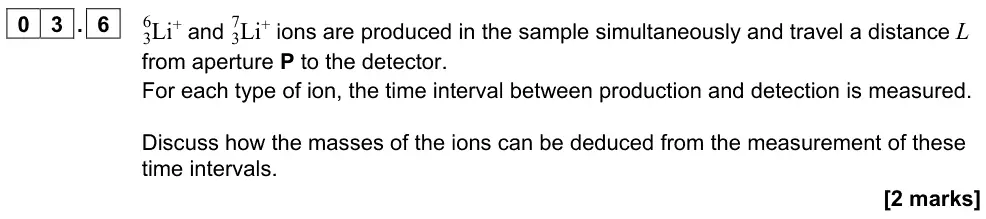
A number of students did not address the mass issue satisfactorily and focussed on the deduction distance velocity = was not detailed enough when the ions are of velocity. Simply stating time initially accelerated and then drift in a field-free region. Generally, students underperformed because they gave very general answers, such as ‘the more massive ions take longer’. Explanations were very thin on the ground. Also, technical language was poor. ‘Bigger’ was used instead of ‘larger mass’. ‘Gets quicker’ was used by students to mean both that the acceleration is larger and the time interval is smaller.
Question 03.6
Notes from the mark scheme and report
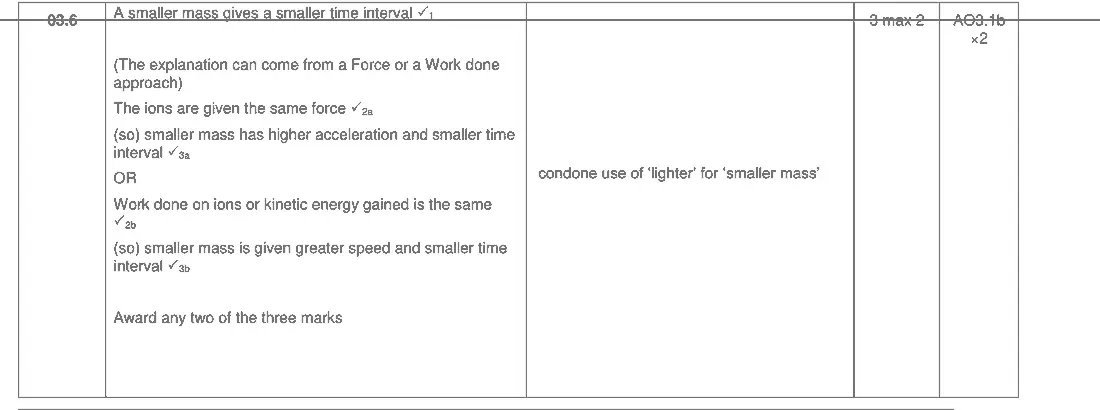
Same force (or same work / KE) on both ions so the smaller mass has greater acceleration / speed and shorter time interval
general 'heavier ions take longer' not enough
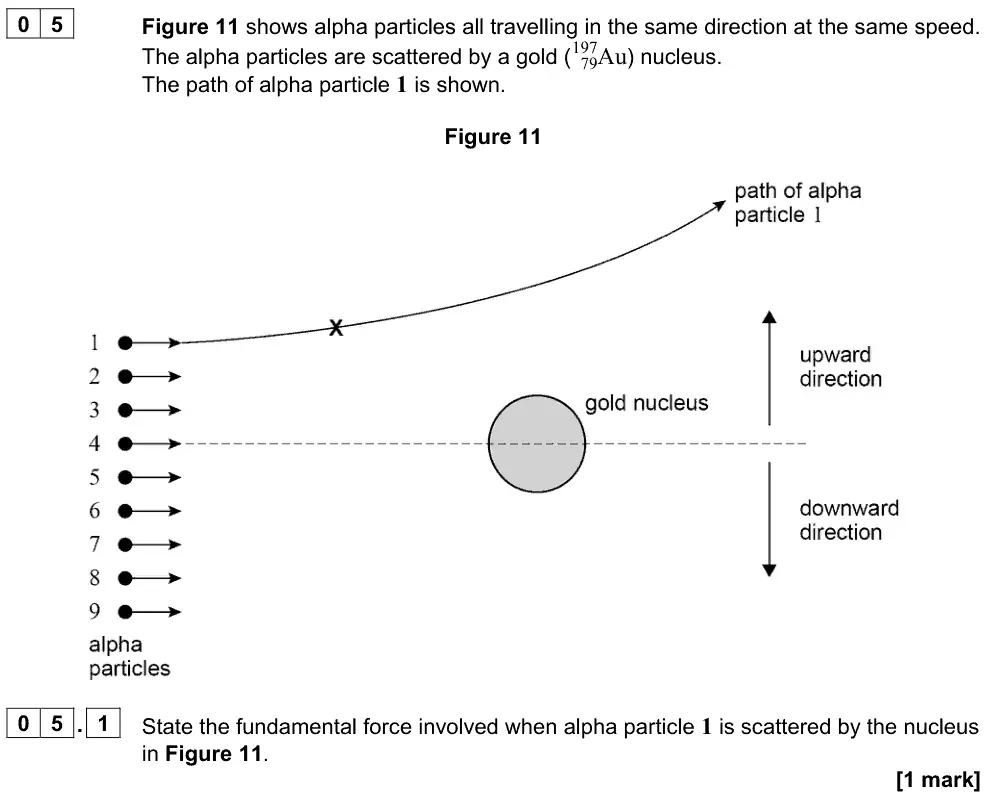
November 2020 · Paper 2 · Q5.21 markAO1=1Diagram or graph
Earlier part of question 5 that this part uses
Mark scheme
Examiner's comment
Very few students answered this correctly. Most scripts showed an arrow either in a vague upward direction (possibly normal to the path) or an arrow pointed tangentially along the path. It was clear that most students did not connect ‘rate of change of momentum’ with a force.
Question 05.2
Notes from the mark scheme and report
Arrow at X radially away from the centre of the gold nucleus (direction of the force)
tangential or vague upward arrows common
November 2020 · AS Paper 2 · Q191 markMultiple choice
Answer
C
Mark scheme
Notes from the mark scheme and report
Answer: C
November 2020 · AS Paper 2 · Q231 markMultiple choice
Answer
D
Mark scheme
Notes from the mark scheme and report
Answer: D
Skills: MS4.5 Use sin, cos and tan in physical problems
November 2020 · AS Paper 2 · Q241 markMultiple choice
Answer
A
Mark scheme
Notes from the mark scheme and report
Answer: A
June 2019 · AS Paper 1 · Q3.22 marksCalculationEasy
Earlier part of question 3 that this part uses
Mark scheme
Examiner's comment
03.2 This question tested an understanding of Newton’s laws. Over 60% of students achieved both marks. Many students understood that they needed to use F ma = but did not appreciate, from Newton’s third law, that the force given in 03.1 was needed. Students should be aware that a ‘show that’ question often provides a value that will be used subsequently.
Notes from the mark scheme and report
Answer: 50 m s^-2 (6 x 10^4 / 1.2 x 10^3
48 allowed)
use the 03.1 force (Newton's third law)
Skills: MS2.3 Substitute numerical values into algebraic equations using appropriate units for physical quantities
June 2019 · Paper 1 · Q5.23 marksCalculation
Earlier part of question 5 that this part uses
Mark scheme
Examiner's comment
5.2 This calculation was slightly more demanding, with some students attempting to use the energy given to them in the previous calculation. This approach, whilst unnecessarily long, did gain full credit when carried out correctly. One common error was the use of sine rather than cosine when calculating the momentum, or omitting the mass altogether. Another common error was the use of N m for the unit, suggesting some confusion with energy.
Notes from the mark scheme and report
Answer: 4.4 x 10^4 kg m s^-1 (or N s) using 1500 x 31 cos20
sine instead of cosine and unit N m were common errors
Skills: MS4.5 Use sin, cos and tan in physical problems; MS0.1 Recognise and make use of appropriate units in calculations
June 2019 · Paper 1 · Q5.43 marksCalculation
Earlier part of question 5 that this part uses
Mark scheme
Examiner's comment
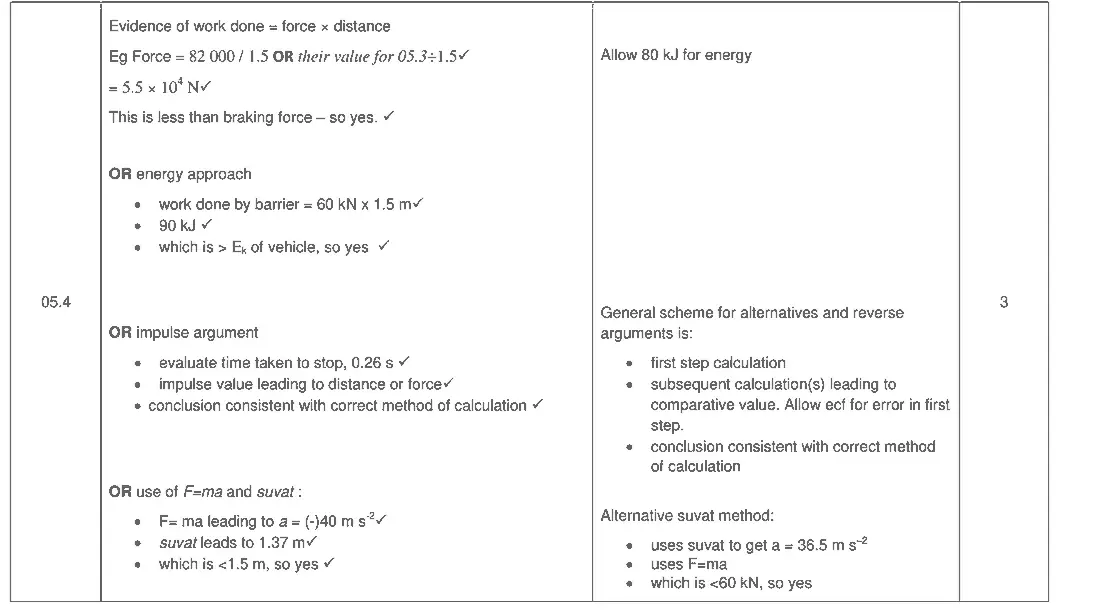
5.3 Students managed to find some very different approaches to what is essentially a straightforward multi-step calculation. Answers that appeared to be taking a component of the kinetic energy, and therefore treating it as a vector, did not gain full credit. 5.4 AO3 questions of the type in question 5.4 leave students free to choose the approach they wish to take. Each approach was treated on merit and was awarded full marks if correct. The most common, and successful, approach was a consideration of the work done by the barrier and therefore the average force that needed to be applied by the barrier to remove the perpendicular component of the car’s velocity. Occasional errors were related to incorrect physics, for example using the wrong suvat (kinematic) equation, or errors in algebra and computation. Unfortunately, many students were unable to see a way through this question that gave them any credit. This may have been due to students giving up or to them being unable to achieve the ‘show that’ values given in previous parts. Students should be encouraged to make use of the ‘show that’ values in these instances as they are there to allow access to later questions.
Notes from the mark scheme and report
Passes: work done by barrier 60 kN x 1.5 m = 90 kJ > 82 kJ (or average force needed 55 kN < 60 kN, or F = ma and suvat gives 1.37 m < 1.5 m)
many found no route
use show-that values
Skills: MS2.3 Substitute numerical values into algebraic equations using appropriate units for physical quantities
June 2019 · Paper 1 · Q5.52 marksExplanation
Earlier part of question 5 that this part uses
Mark scheme
Examiner's comment
5.5 This question had several routes to the correct answer, the most popular being the consideration of time and an impulse route, or the consideration of distance and a work done route. Less commonly a route involving Newton’s second Law of Motion was seen. A failure to express ideas clearly was the most common reason why students did not achieve full credit here.
Notes from the mark scheme and report
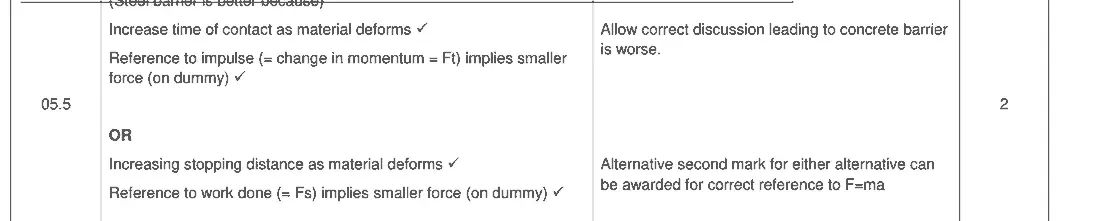
Deforming steel barrier increases contact time (impulse, F = change in momentum / t) or stopping distance (work = Fs), so smaller force on dummies
clarity was the main issue
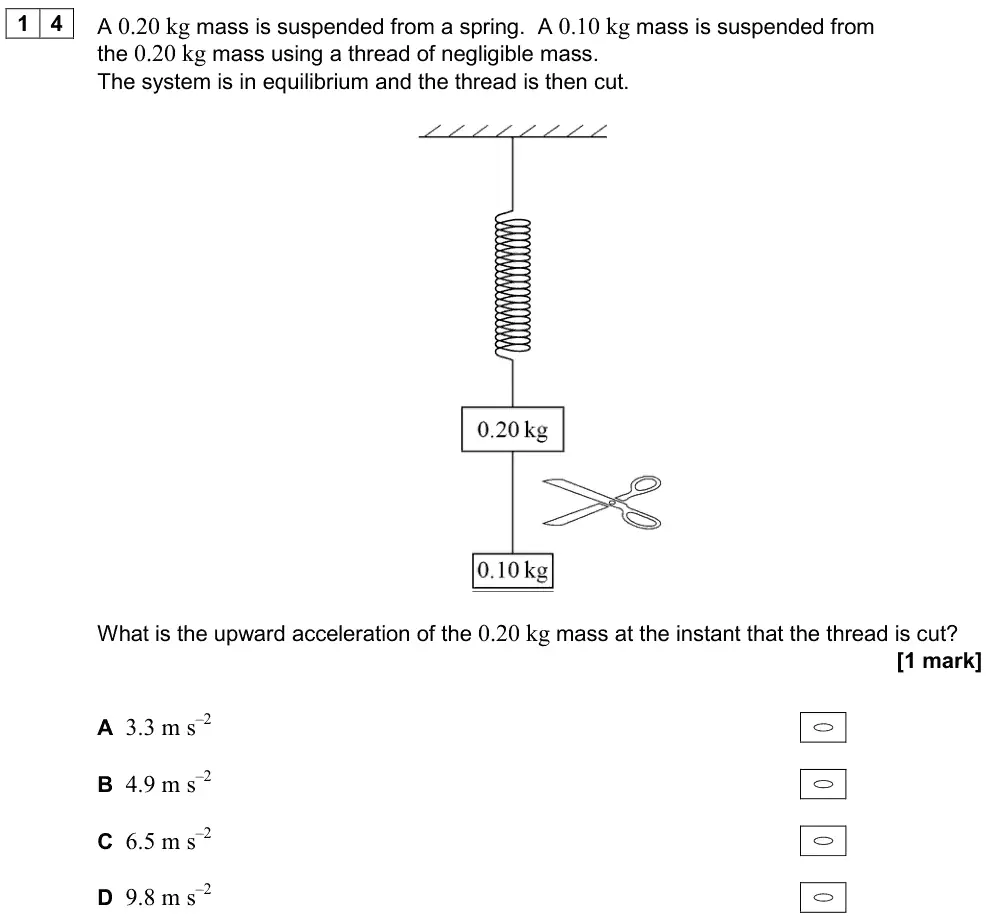
June 2019 · Paper 1 · Q141 markMultiple choice
Answer
B
Notes from the mark scheme and report
Answer: B
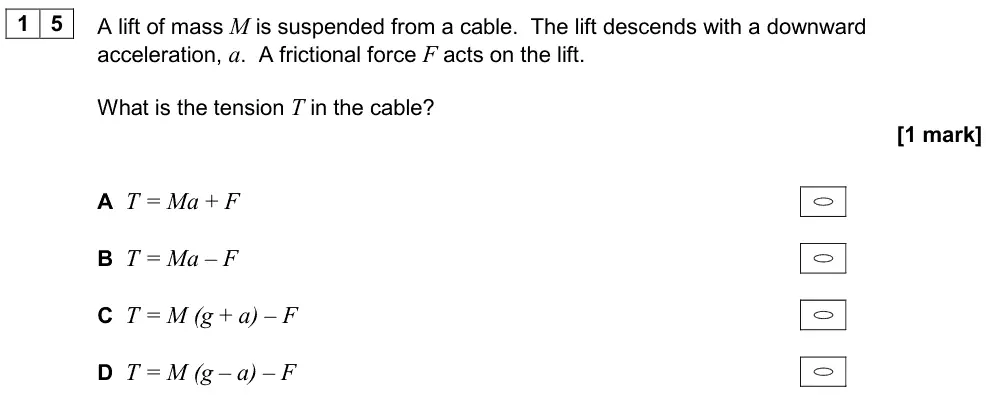
June 2019 · Paper 1 · Q151 markMultiple choice
Answer
D
Notes from the mark scheme and report
Answer: D
fewer than half correct, C the popular distractor
a force diagram helps with the signs
June 2019 · Paper 1 · Q161 markMultiple choice
Answer
D
Notes from the mark scheme and report
Answer: D
June 2019 · Paper 1 · Q171 markMultiple choice
Answer
B
Notes from the mark scheme and report
Answer: B
June 2019 · AS Paper 2 · Q3.42 marksExplanation
Earlier part of question 3 that this part uses
Mark scheme
Examiner's comment
3.3 / 3.4 Over 80% of students were able to select the appropriate detector. They were familiar with the fact that two photons would be produced in the annihilation event. The most effective answers contained detailed explanations supporting the conclusion. 3.5 Many students gained some credit for attempting to determine the gradient of the graph. Common mistakes included: failure to appreciate that the velocity axis had a false origin, failure to convert the time from hours correctly, leaving the velocity in mm s−1, and failure to read-off accurately from the graph.
Notes from the mark scheme and report
Two photons produced moving in opposite directions along the same line, equal and opposite momentum so total momentum zero is conserved
June 2019 · AS Paper 2 · Q3.62 marksExplanation
Earlier part of question 3 that this part uses
Mark scheme
Examiner's comment
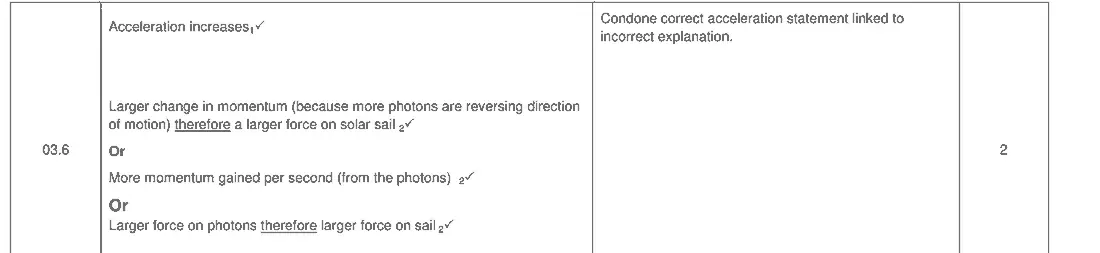
3.6 Many students were able to state that the acceleration would increase. Only the most able students were able to provide a good explanation of why this was the case. A significant number of students thought that the acceleration would decrease because ‘less of the photon’s energy was absorbed’.
Notes from the mark scheme and report
Acceleration increases: reflected photons reverse, larger momentum change per second so larger force on sail
'less energy absorbed so decreases' was a common wrong idea
June 2019 · AS Paper 2 · Q261 markMultiple choice
Answer
B
Notes from the mark scheme and report
Answer: B
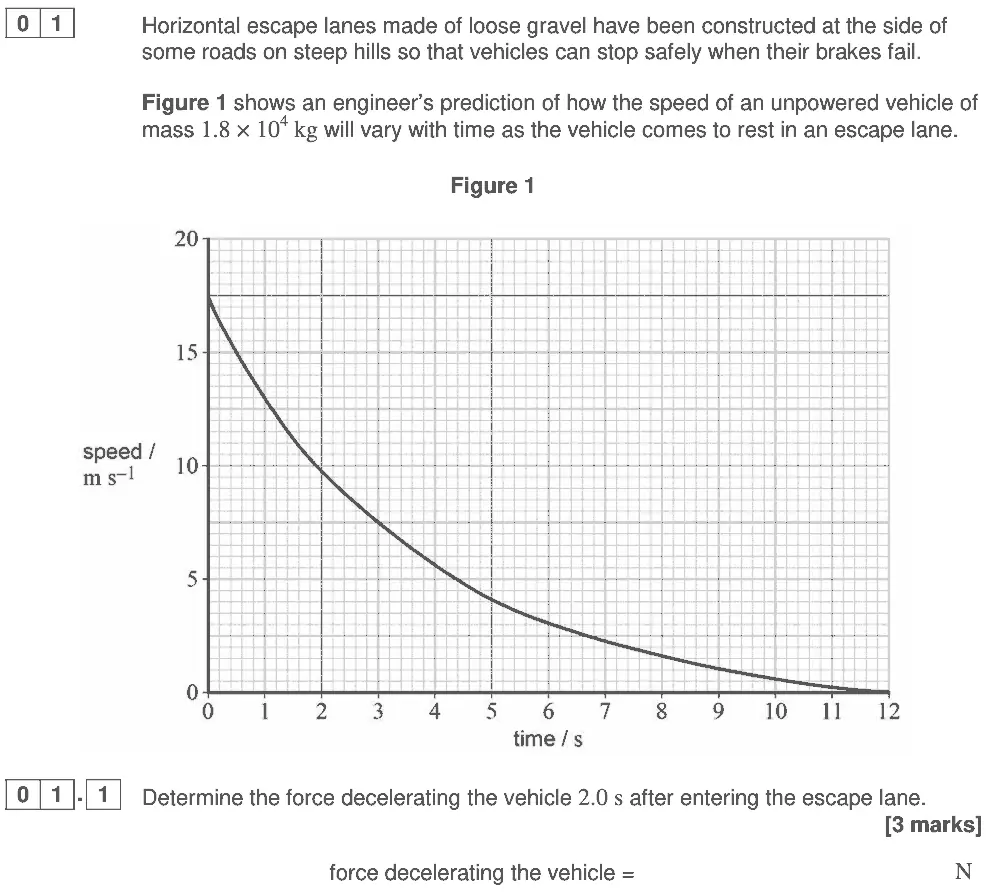
June 2018 · Paper 1 · Q1.13 marksCalculationHard
Mark scheme
Examiner's comment
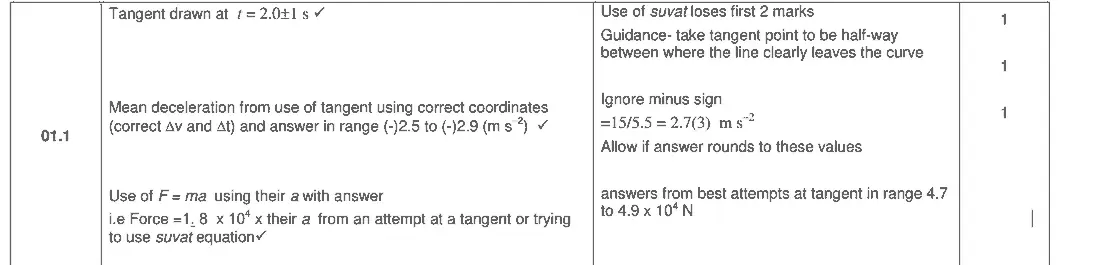
01.1 It was important to realise that this was not uniform deceleration so that application of the suvat equation was not appropriate. Many students unfortunately used this approach and therefore could only access the final mark for application of F = ma. A significant proportion used the instantaneous values at 2 s to find acceleration and these students were denied access to the final mark. Students who realised that a tangent was required were able to progress and were rewarded, provided that the tangent was not at a point too far from 2.0 s. The accepted range was determined to allow for the acceptable limits. Just over 30% of students scored all three marks.
Notes from the mark scheme and report
Answer: about 4.8 x 10^4 N (tangent at 2.0 s gives deceleration 2.5-2.9 m s^-2, F = ma with m = 1.8 x 10^4 kg)
deceleration not uniform so suvat loses the first two marks
reading v/t at 2 s was common
Skills: MS3.6 Draw and use the slope of a tangent to a curve as a measure of rate of change; MS3.7 Distinguish between instantaneous rate of change and average rate of change; MS2.3 Substitute numerical values into algebraic equations using appropriate units for physical quantities
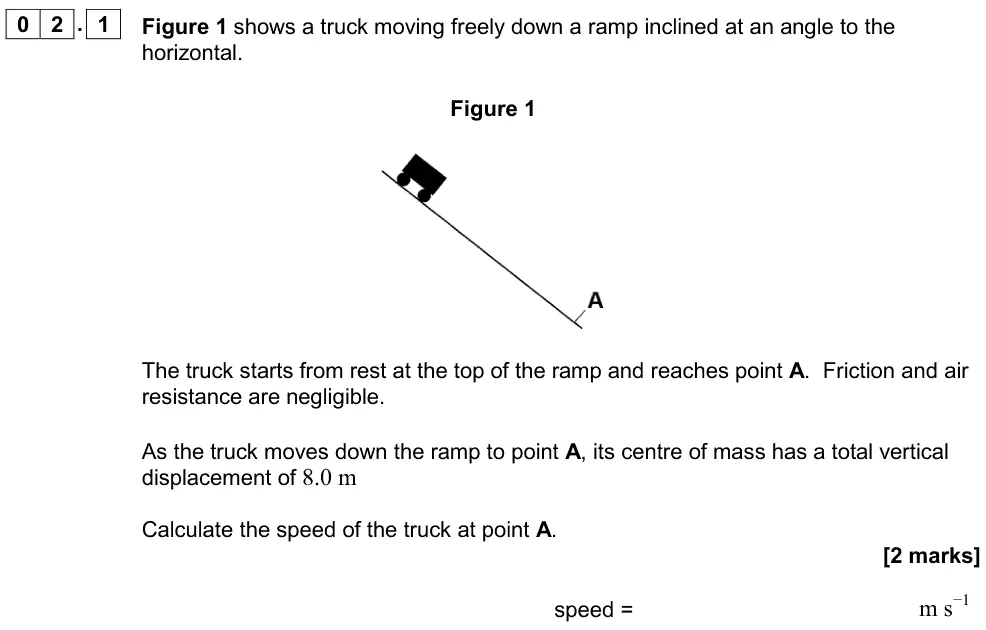
June 2018 · AS Paper 1 · Q2.23 marksExplanationHard
Earlier part of question 2 that this part uses
Mark scheme
Examiner's comment
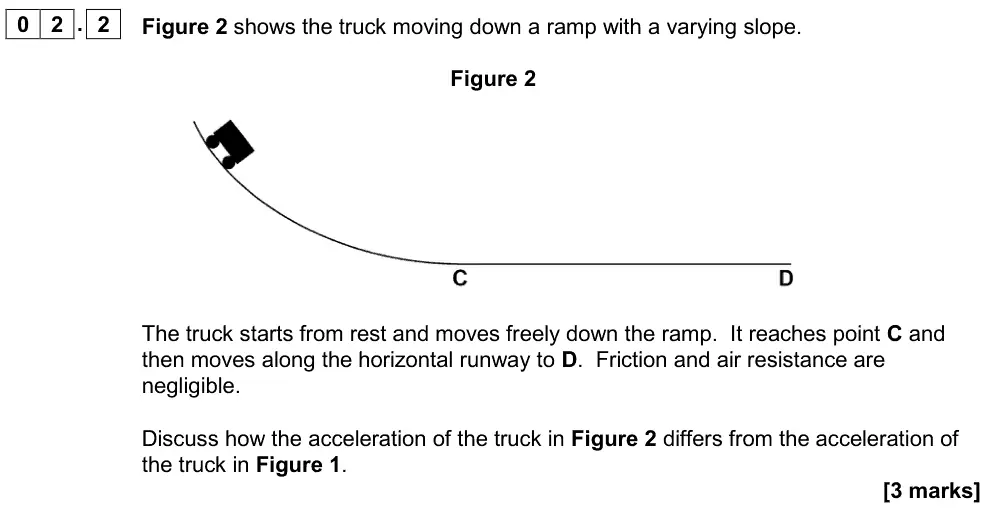
02.2 Some good responses were seen to this question although it was not uncommon for contradictory statements to be made. Most students were able to state that acceleration was constant in figure 1 but analysis of figure 2 proved more of a challenge. It was quite common to see answers that referred to speed rather than acceleration decreasing as the truck moved down the ramp. Also, a significant proportion of students thought that the truck decelerated between C and D. A quarter of students managed to gain all three marks.
Notes from the mark scheme and report
Figure 1 constant acceleration
Figure 2 greatest at the top, decreasing, zero from C to D, because the component of weight along the slope changes
many described speed not acceleration or said it decelerates from C to D
June 2018 · AS Paper 1 · Q2.43 marksExplanationHard
Earlier part of question 2 that this part uses
Mark scheme
Examiner's comment
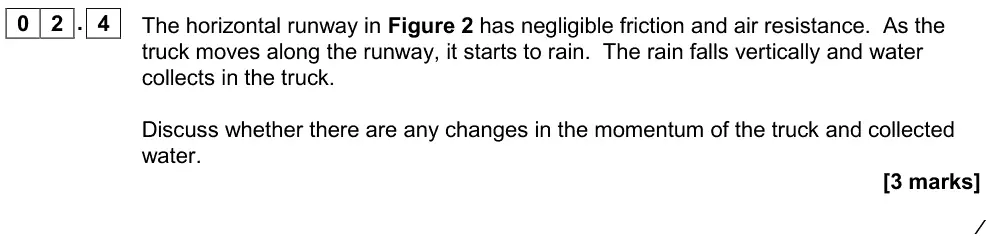
02.4 This was a challenging question that required a good understanding of momentum conservation in closed systems and also the importance of direction in momentum considerations. Very few students managed to give complete discussions. The commonest answer was that as mass went up momentum increased, with students failing to appreciate that with no external horizontal forces acting, this could not be the case. Better students did appreciate that the total horizontal momentum remains constant and so as mass increases speed must decrease. It was very rare for there to be a discussion of how the momentum of the rain water changes from vertical to horizontal. Nearly three- quarters of students failed to score on this question.
Notes from the mark scheme and report
Rain has no horizontal momentum
no external horizontal force so horizontal momentum of truck plus water is constant
mass increases so speed decreases
commonest error: more mass so more momentum
June 2018 · Paper 1 · Q6.11 markShort answerEasy
Mark scheme
Examiner's comment
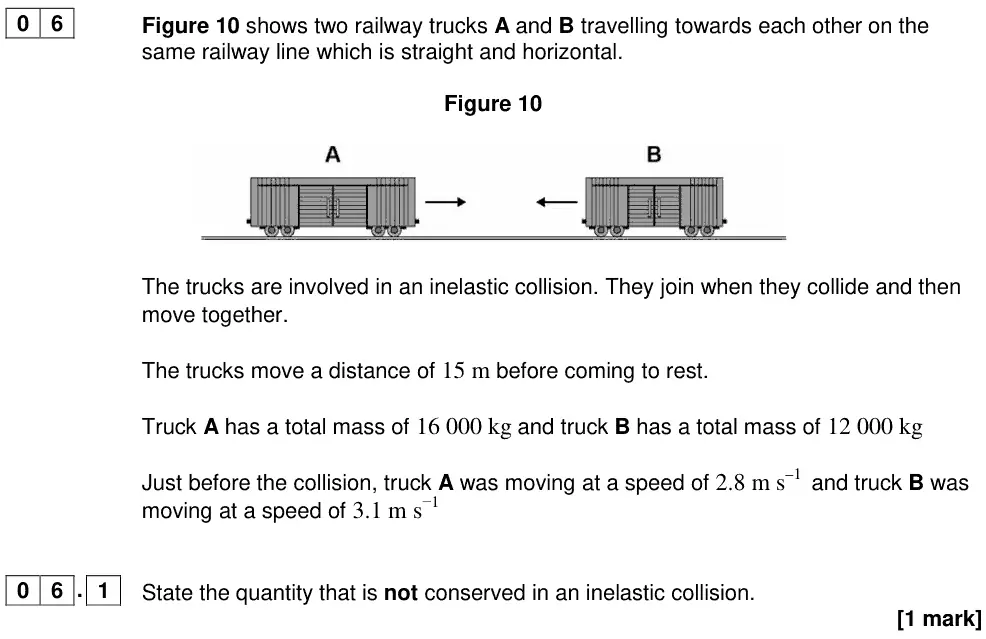
06.1 That kinetic energy would be conserved in an elastic collision was well known (64.5% correct).
Notes from the mark scheme and report
Kinetic energy
June 2018 · Paper 1 · Q6.23 marksShow thatEasy
Earlier part of question 6 that this part uses
Mark scheme
Examiner's comment
06.2 Most students knew how to arrive at the answer (75.3% fully correct), but responses were often completely unstructured and consisted of a mass of figures and calculations with no indication of what the calculation represented. In questions where the command word is ‘calculate’ this may often be accepted, but in ‘show that’ items communication of the processing of data needs to be clear.
Notes from the mark scheme and report
16000 x 2.8 - 12000 x 3.1 = 28000 v gives v = 0.27 m s^-1
signs must be right and every step shown for a show that
Skills: MS2.3 Substitute numerical values into algebraic equations using appropriate units for physical quantities
June 2018 · Paper 1 · Q6.32 marksCalculation
Earlier part of question 6 that this part uses
Mark scheme
Examiner's comment
06.3 The same impulse on each of the trucks is equal and opposite so students needed to focus on one or other of the trucks involved. There were many who misread the data and associated the initial velocities with the wrong trucks. Many gave the impulse as the difference between the final momenta of the two trucks.
Notes from the mark scheme and report
Answer: 4.0 x 10^4 N s (16000 x (2.8 - 0.271) or 12000 x (3.1 + 0.271))
velocities attached to wrong trucks and differences of final momenta were common
Skills: MS0.1 Recognise and make use of appropriate units in calculations; MS2.3 Substitute numerical values into algebraic equations using appropriate units for physical quantities
June 2018 · Paper 1 · Q6.42 marksExplanation
Earlier part of question 6 that this part uses
Mark scheme
Examiner's comment
06.4 It was necessary here to have a qualitative appreciation of the application of conservation of momentum and kinetic energy in the elastic collision. It is not possible to conserve both unless the trucks travel in opposite directions after the collision, and many appreciated this point. Many students, however, went on to state that the speed of each truck would be the same as before but in the opposite direction; others wrote that B would have the speed that A had and vice versa. The first conserves kinetic energy but not momentum (total momentum would be reversed) and the second would only be true if they had the same mass. If A were to stop, as suggested by many students, then to conserve momentum B would need to travel at a lower speed than either of the trucks (since the initial total momentum was 7600 Ns to the right, B’s speed would need to be 0.63 Ns). This would not conserve kinetic energy. 38.5% of students were successful here.
Notes from the mark scheme and report
Trucks rebound in opposite directions and B (lower mass) moves faster
swapping speeds or A stopping does not conserve both momentum and KE
June 2018 · Paper 1 · Q71 markMultiple choice
Answer
B
Notes from the mark scheme and report
Answer: B
June 2018 · Paper 1 · Q221 markMultiple choice
Answer
C
Notes from the mark scheme and report
Answer: C
Skills: MS2.3 Substitute numerical values into algebraic equations using appropriate units for physical quantities
June 2018 · AS Paper 2 · Q2.45 marksPractical and data analysis
Earlier part of question 2 that this part uses
Mark scheme
Examiner's comment
02.4 The students often made little headway in this question. The plans seen lacked details on how to vary the mass and how to record the value of h. Many students did not know how to process the data to obtain a straight-line graph for F = k h-3. Just over 40% of students managed to score at least two marks here.
Notes from the mark scheme and report
Vary added mass, weight = repulsive force, measure h with ruler/set square
plot F against 1/h^3, straight line through origin, k = gradient
few could linearise the relationship
Skills: MS3.3 Understand that y = mx + c represents a linear relationship; PS2.1 Comment on experimental design and evaluate scientific methods; PS3.1 Plot and interpret graphs
June 2018 · Paper 2 · Q2.42 marksExplanation
Earlier part of question 2 that this part uses
Mark scheme
Examiner's comment
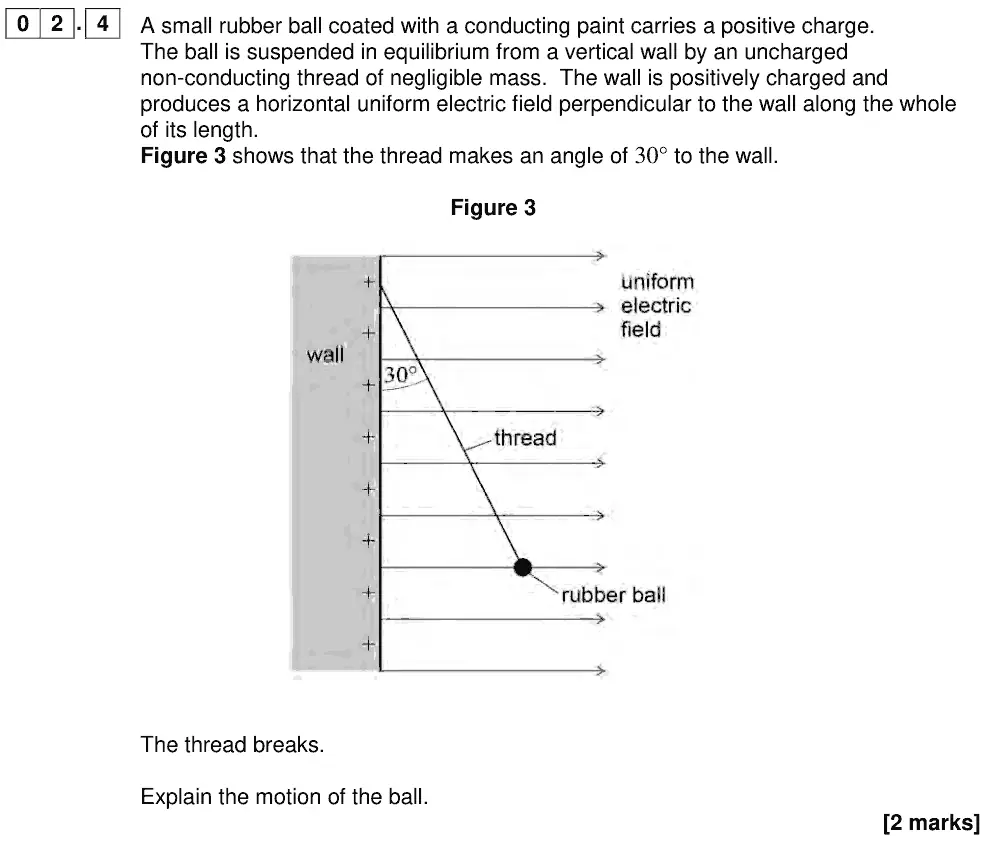
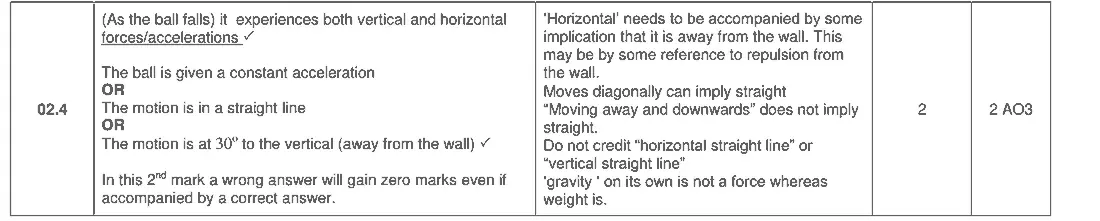
02.3 Most students showed a weakness in their understanding in this topic. The fact that the resultant electric field was zero at P, and they rightly concluded that the field was zero at infinity, made it too tempting to conclude the line between P and infinity must be an equipotential, which was obviously wrong. Only about a third of the students thought about the work that must be done in moving a proton to a region close to two positive charges. Also very few referred to the potential being zero at infinity. 60.7% of students scored zero. 02.4 This was another question done badly, with 61.1% failing to score. The common answers fell into two groups. The first just regarded the ball being released as if it were thrown and therefore following a parabolic path. The second group ignored gravity all together and wrote about the ball travelling away horizontally. Very few students analysed the situation by considering the forces and then the resulting accelerations in the horizontal and vertical directions. In fact, many students did not mention force or acceleration but kept to generalities such as “it moves away from the wall and falls”.
Notes from the mark scheme and report
Constant horizontal (electric) and vertical (weight) forces give constant acceleration, so a straight line at 30 degrees to the vertical away from the wall
parabolic path or horizontal motion common errors
61.1% failed to score
June 2018 · AS Paper 2 · Q4.23 marksExplanationHard
Earlier part of question 4 that this part uses
Mark scheme
Examiner's comment
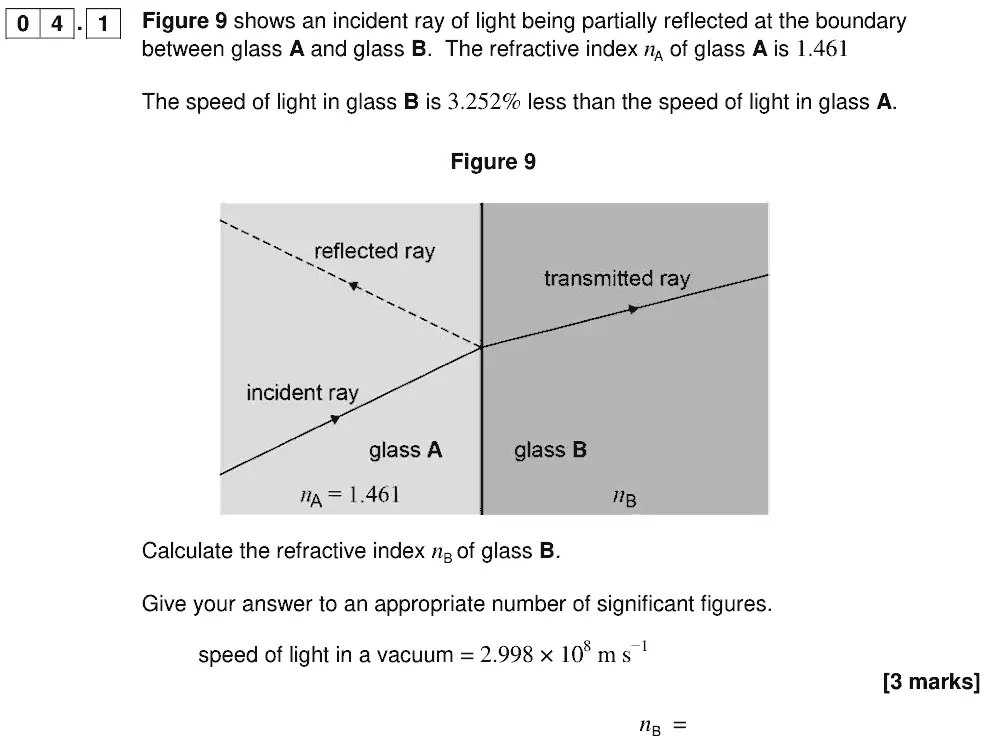
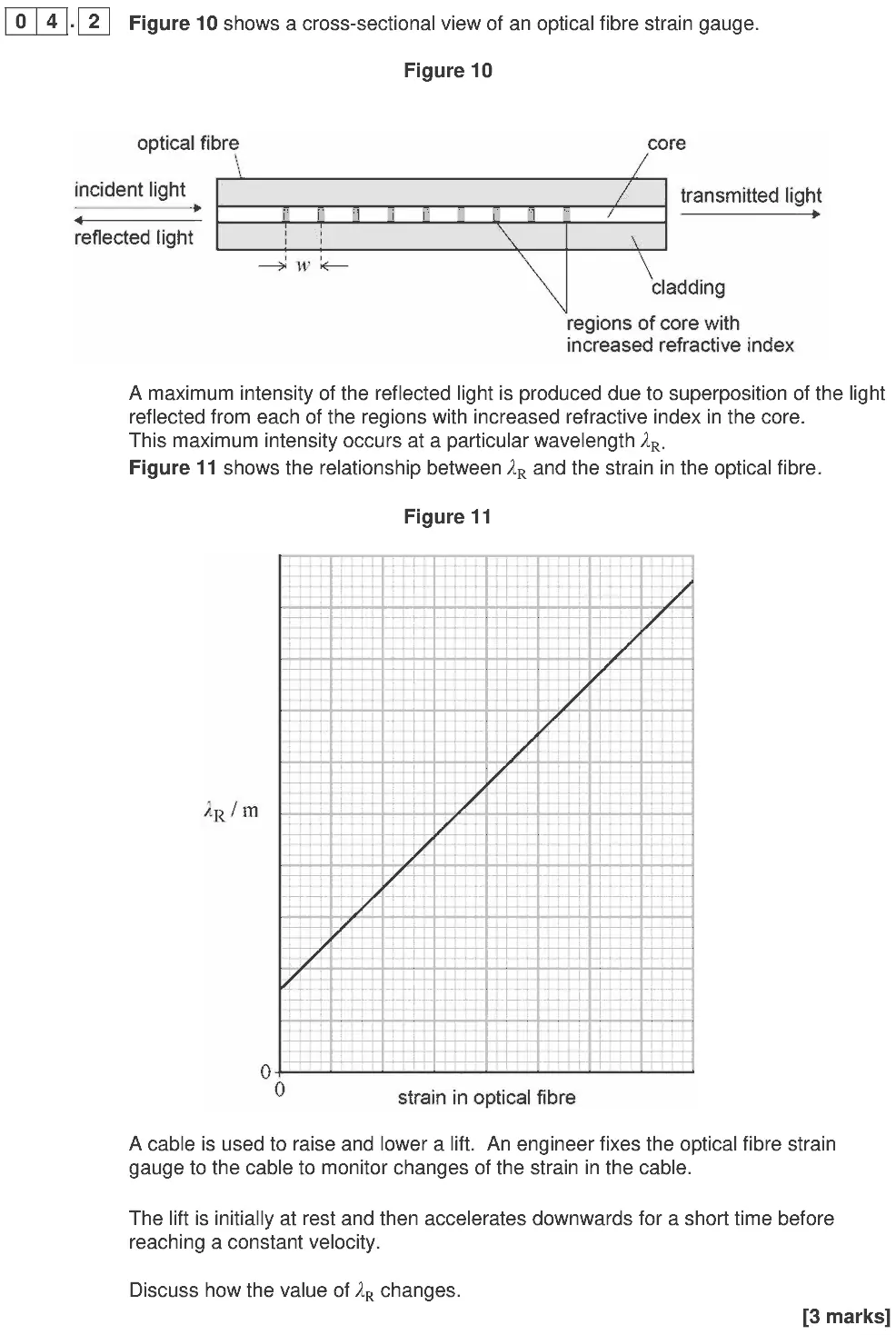
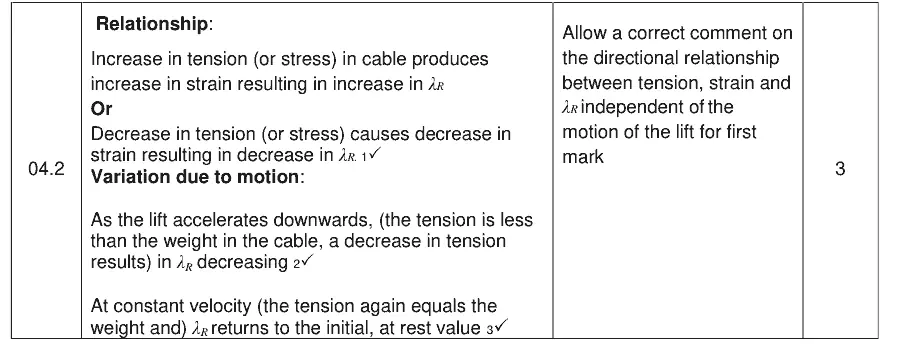
04.1 There were many good examples of work in this part from higher achieving students. On the other hand, lower achieving students had difficulty in following the question structure with many trying to find 97% of the speed of light in a vacuum rather than 97% of the speed of light in glass A. Another common mistake seen was students who simply multiplied na x 1.03252. This was another place in the paper where students failed to gain marks due to incorrect use of significant figures. Just over a third of students failed to gain any marks. relationship between 𝜆𝜆𝑅𝑅 and strain as shown in the graph. They were unable to make the 04.2 Lower achieving students characteristically limited their answers to restating the link between the motion of the lift and its effect on strain and 𝜆𝜆𝑅𝑅. Where students attempted to explain this connection, they often thought that the tension in the cable increased as the lift accelerated downwards. Only 7.4% of students scored two or three marks. 04.3 Many students presented answers that addressed the strength of the cable and its ability to withstand larger stress rather than the ability of the sensor to detect small changes in the acceleration. Two-thirds of students who attempted the question failed to gain any marks here.
The following questions had a significant proportion of non-attempts: Section A 1.5, Section B 3.2, 3.3, 3.4, 3.5, 4.2, 4.3 and Section C 32. It was difficult to ascertain if this was solely due to time management and instead may have been due to students being unable to know where to begin. Students should be encouraged to try and match the question to specification content as a means to unlocking the problem and enabling them to make some progress.
Notes from the mark scheme and report
Tension (stress) and strain linked to lambda_R
accelerating down tension < weight so lambda_R falls
at constant velocity returns to rest value. Many thought tension increased
June 2018 · Paper 2 · Q121 markMultiple choiceHard
Answer
B
Examiner's comment
The 25 questions in Section B are summarised in the table below. For each question, the key (correct answer) is provided, along with the percentage of students answering correctly. There was a good range of ‘facility’ across this section; the most accessible question was 13 (answered correctly by 81.4% of students), the least accessible were 12 and 23 (answered correctly by only 15% and 13.3% of students respectively). The overall mean mark achieved by the students for Section B was 15.4 out of 25 (61.6%).
Notes from the mark scheme and report
Answer: B
Skills: MS4.2 Visualise and represent 2D and 3D forms including two- dimensional representations of 3D objects
June 2018 · AS Paper 2 · Q221 markMultiple choice
Answer
B
Notes from the mark scheme and report
Answer: B
June 2018 · AS Paper 2 · Q261 markMultiple choice
Answer
D
Notes from the mark scheme and report
Answer: D
Skills: MS3.8 Understand the possible physical significance of the area between a curve and the x axis and be able to calculate it or estimate it by graphical methods as appropriate
June 2018 · AS Paper 2 · Q271 markMultiple choice
Answer
A
Notes from the mark scheme and report
Answer: A
Skills: MS0.3 Use ratios, fractions and percentages
June 2017 · AS Paper 1 · Q3.42 marksCalculation
Earlier part of question 3 that this part uses
Mark scheme
Examiner's comment
03.4 The fact that a large number of students did not attempt this question is partly related to the need to use information from 03.2, which was not well answered. It could also suggest that students expect calculations involving speed (or velocity) to require the use of the “suvat” equations, for example, and that they are therefore confused when none of the familiar information is provided. However, it is acknowledged that this is a conceptually demanding question, requiring students to appreciate that, at the maximum speed, the driving force = the total friction/drag force for example, and then apply that to P=Fv.
Notes from the mark scheme and report
Answer: 0.61 m s^-1 (total resistive force 92 + 73 = 165 N at max speed
v = P/F)
many did not attempt
Skills: MS2.3 Substitute numerical values into algebraic equations using appropriate units for physical quantities
June 2017 · Paper 1 · Q6.22 marksShow that
Earlier part of question 6 that this part uses
Mark scheme
Examiner's comment
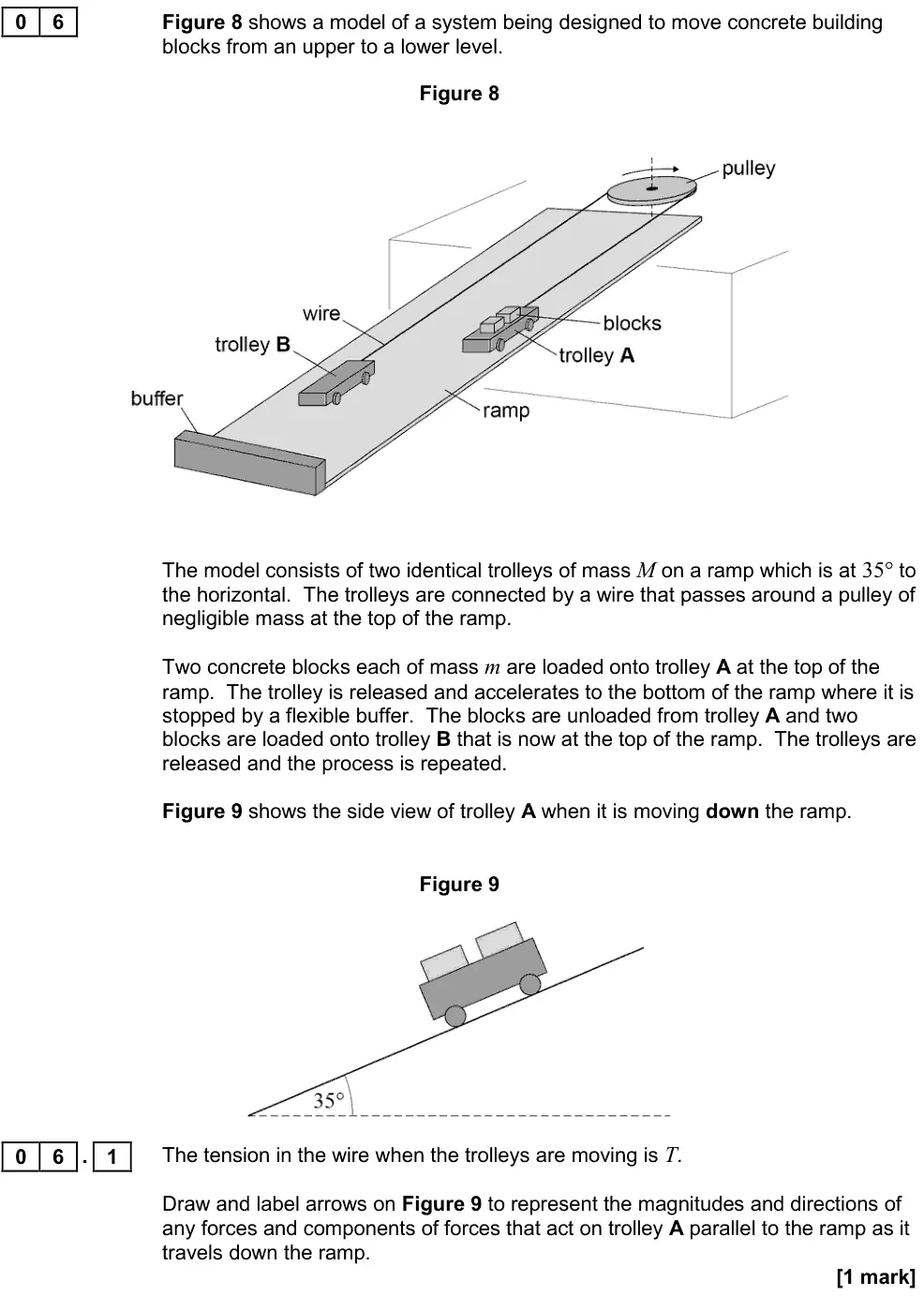
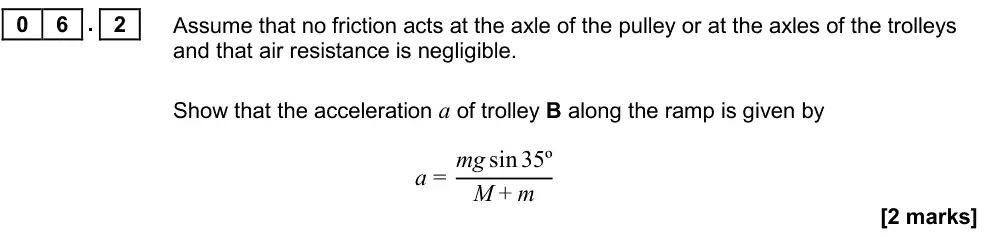
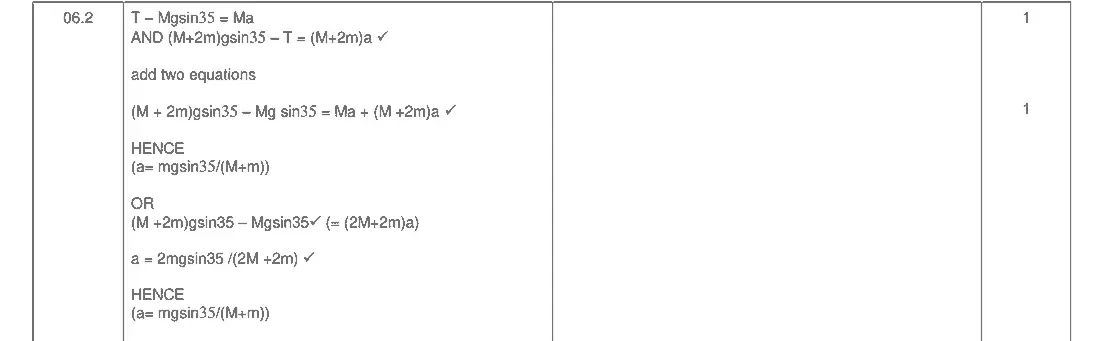
Question 06.2 involved an algebraic derivation of the acceleration of the trolley – this proved quite a challenge for some and responses had to be scrutinised carefully to see if they were valid. Many provided a correct formula for the resultant force on trolley A but then incorrectly stated that the tension was equal to the component of trolley B’s weight along the slope. The more successful answers treated the trollies as a system with a resultant force acting equal to (M+2m) gsin35 – Mgsin35 and a combined mass of 2M +2m.
There was a typographical error in question 6.3 which led candidates to assume that loaded trolley A was being compared with loaded trolley B. The question originally intended to ask students to compare loaded trolley A with unloaded trolley B (as shown in Figure 8). We judged that both interpretations should be allowed and revised the mark scheme to permit the two different approaches. Either approach could achieve 0, 1 or 2 marks according to the accuracy of the answer. Student responses to this question were carefully scrutinised to assess the impact of the typographical error, and there was no evidence that students were unable to generate meaningful responses to this question.
The conclusion mark of how the momenta compared was then conditional on the first mark being awarded. The multi-step calculations in 06.4 and 06.5 were well done, with a high proportion of students scoring at least 3 of the 5 marks available.
Notes from the mark scheme and report
Treat trolleys as one system: resultant (M + 2m)g sin35 - Mg sin35 on mass 2M + 2m
many wrongly set T equal to B's weight component
Skills: MS2.2 Change the subject of an equation, including non-linear equations; MS4.5 Use sin, cos and tan in physical problems
June 2017 · Paper 1 · Q6.32 marksExplanation
Earlier part of question 6 that this part uses
Mark scheme
Examiner's comment
There was a typographical error in question 6.3 which led candidates to assume that loaded trolley A was being compared with loaded trolley B. The question originally intended to ask students to compare loaded trolley A with unloaded trolley B (as shown in Figure 8). We judged that both interpretations should be allowed and revised the mark scheme to permit the two different approaches. Either approach could achieve 0, 1 or 2 marks according to the accuracy of the answer. Student responses to this question were carefully scrutinised to assess the impact of the typographical error, and there was no evidence that students were unable to generate meaningful responses to this question.
Notes from the mark scheme and report
Same speed (same magnitude of acceleration) and same mass so equal-magnitude momenta in opposite directions
typo in the question so the alternative comparison (unloaded B) also accepted
second mark conditional on first
June 2017 · Paper 1 · Q6.43 marksCalculation
Earlier part of question 6 that this part uses
Mark scheme
Examiner's comment
The conclusion mark of how the momenta compared was then conditional on the first mark being awarded. The multi-step calculations in 06.4 and 06.5 were well done, with a high proportion of students scoring at least 3 of the 5 marks available.
Notes from the mark scheme and report
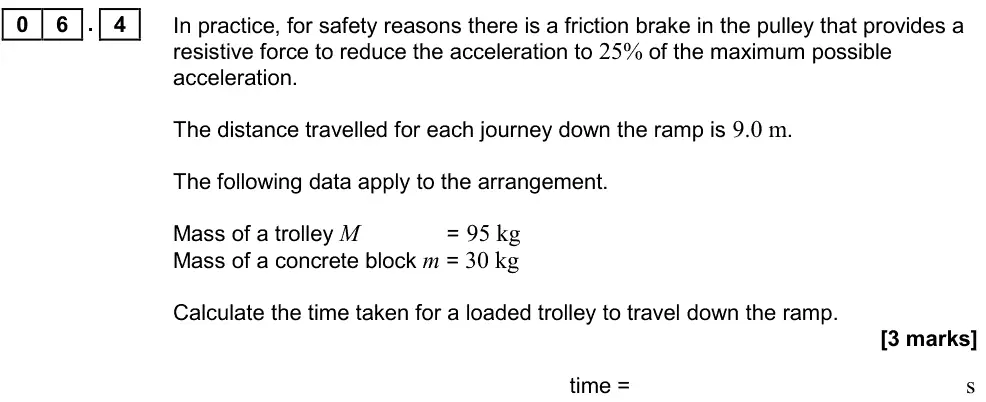
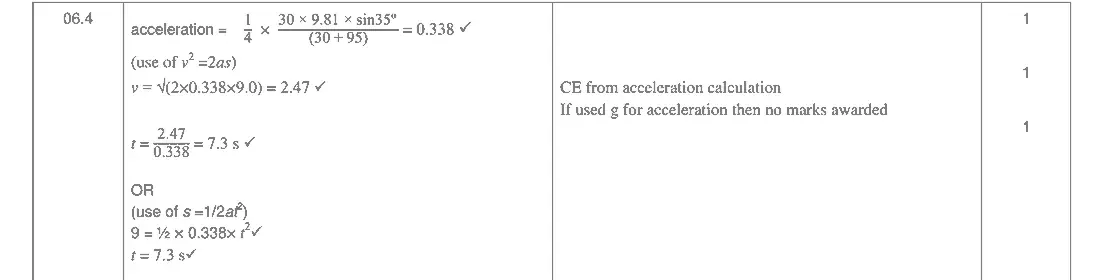
Answer: 7.3 s (a = 0.25 x 30 x 9.81 sin35 / 125 = 0.338 m s^-2, s = 9.0 m)
using g gains nothing
Skills: MS2.3 Substitute numerical values into algebraic equations using appropriate units for physical quantities; MS4.5 Use sin, cos and tan in physical problems; MS0.3 Use ratios, fractions and percentages
June 2017 · Paper 1 · Q201 markMultiple choice
Answer
C
Notes from the mark scheme and report
Answer: C
Skills: MS2.3 Substitute numerical values into algebraic equations using appropriate units for physical quantities
June 2017 · Paper 1 · Q221 markMultiple choice
Answer
B
Notes from the mark scheme and report
Answer: B
Skills: MS2.3 Substitute numerical values into algebraic equations using appropriate units for physical quantities
June 2017 · Paper 2 · Q2.11 markShort answer
Mark scheme
Examiner's comment
02.1 Many students failed to use the concept of Newton III and incorrectly chose the fourth alternative.
Notes from the mark scheme and report
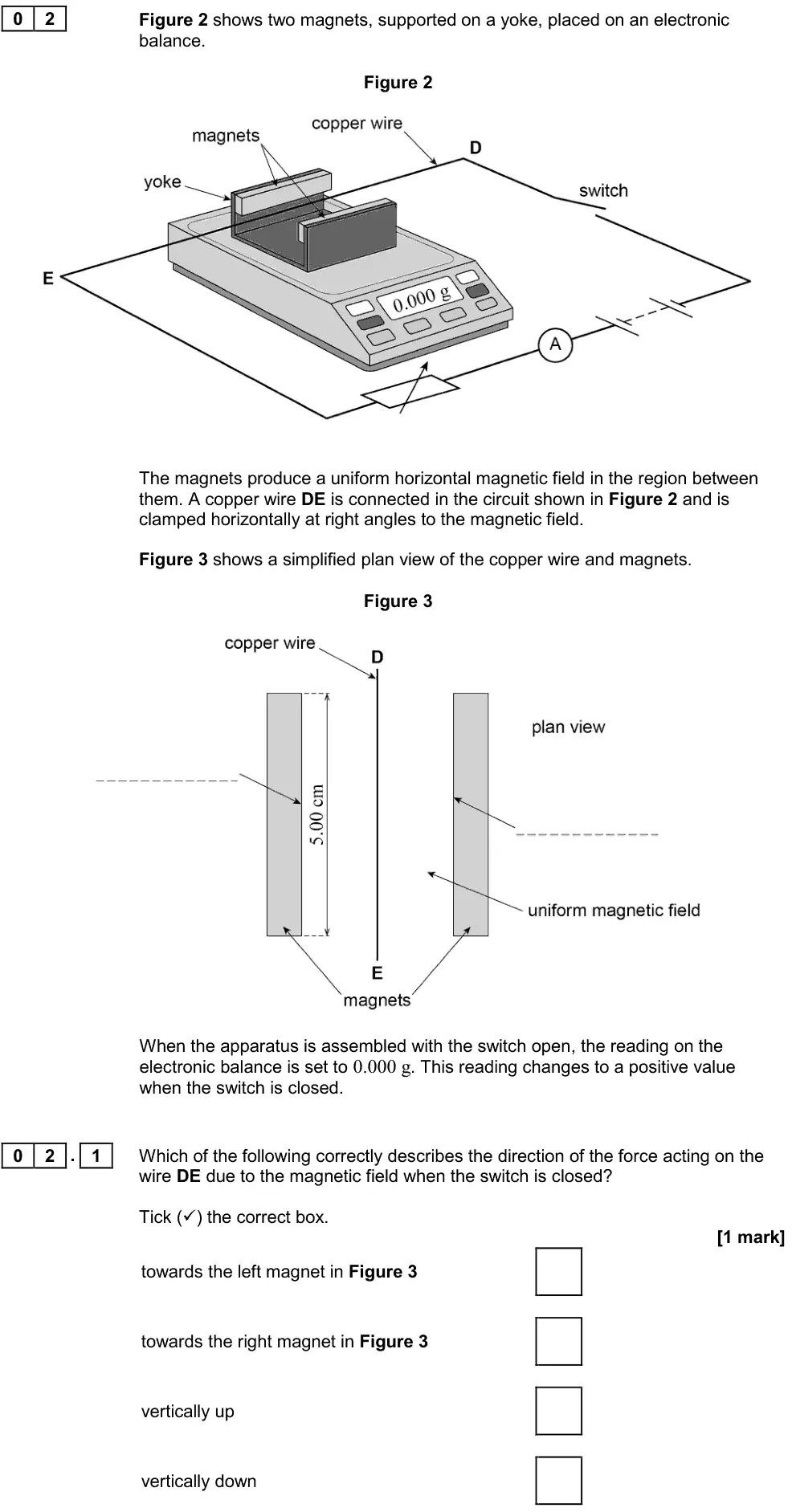
Answer: vertically up (balance reading rises so force on magnets is down
Newton's third law)
many chose vertically down
Skills: RP10 Investigate how the force on a wire varies with flux density, current and length of wire using a top pan balance.
June 2017 · AS Paper 2 · Q4.43 marksExplanation
Earlier part of question 4 that this part uses
Mark scheme
Examiner's comment
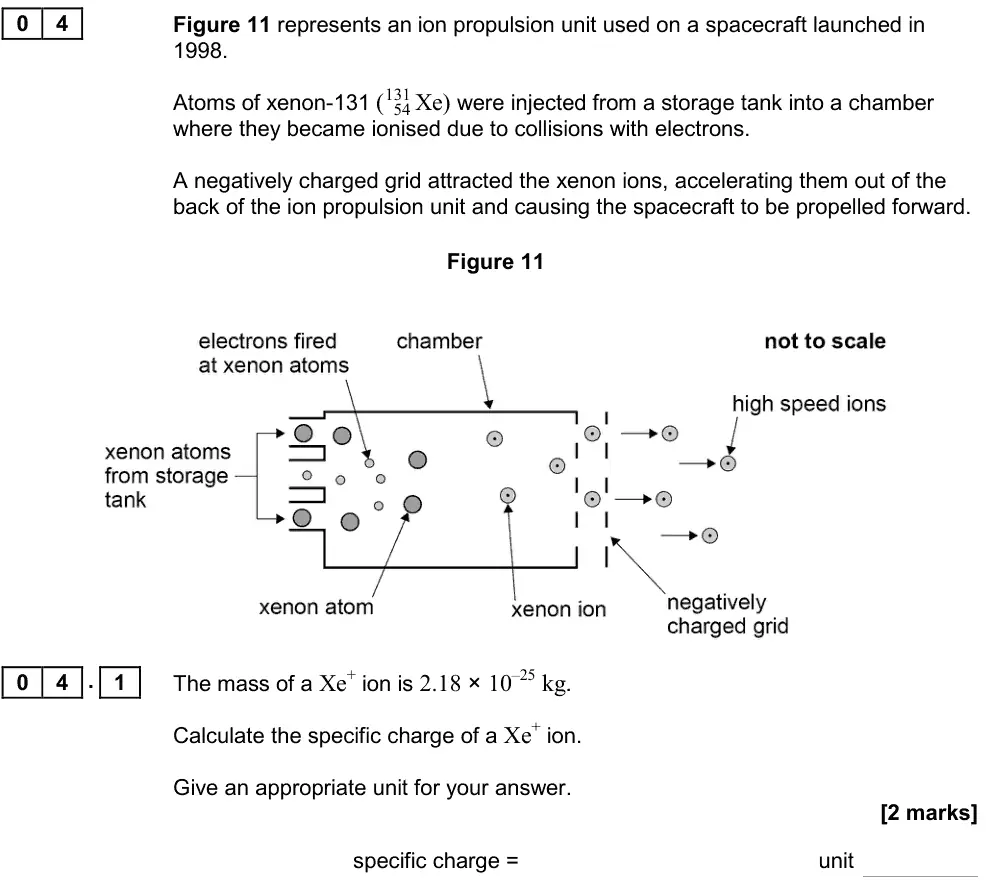
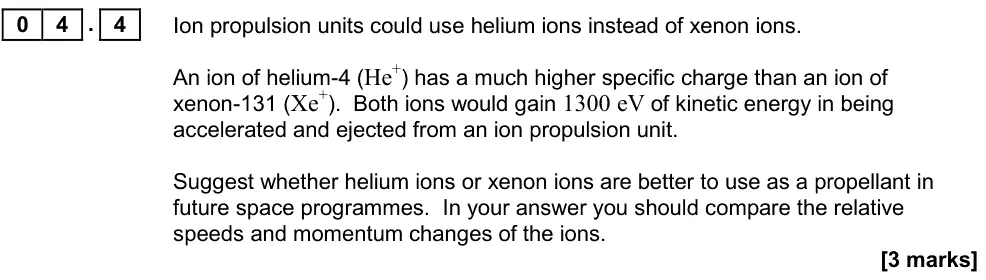
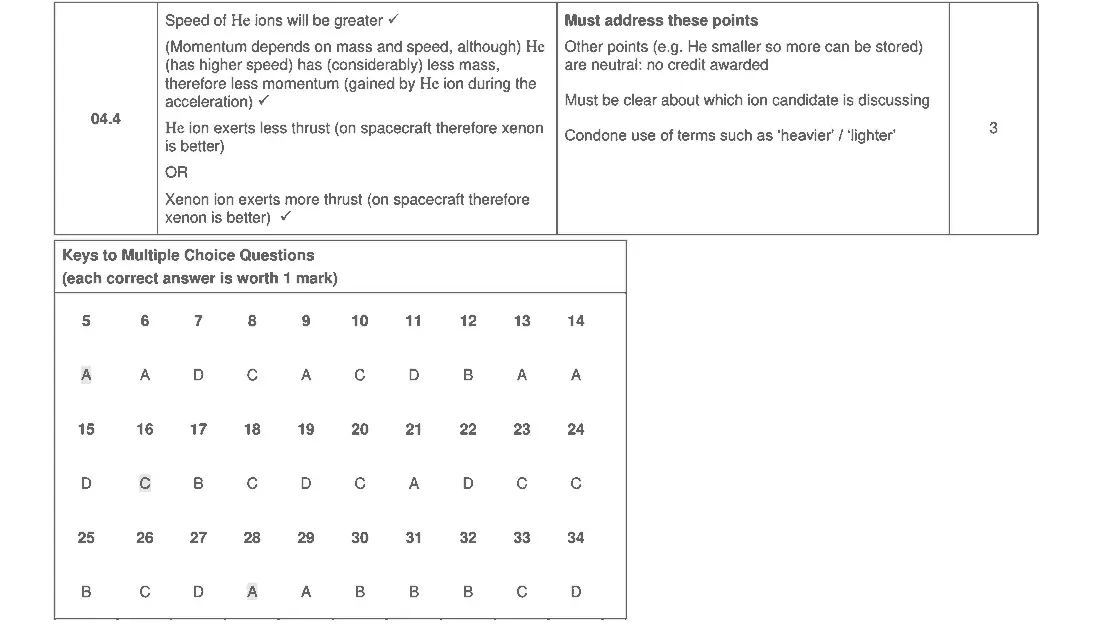
04.4 Some students thought that the helium ion had more charge than the xenon ion because helium had a higher specific charge. On this basis, they stated that the helium ion had a greater speed. Getting the correct relationship between specific charge and mass was a sign of quality. Others thought that helium’s greater specific charge meant it had a greater mass than xenon. Despite this error, students were still awarded the higher speed mark for helium. Other students confused specific charge with activation energy and gave answers in terms of combustion rates. Students often confused the terms speed and acceleration. A common error was to state that the acceleration of the helium ion was greater, without linking this to a greater speed. Better students made reasoned arguments regarding the relationship between energy, speed and momentum. Frequently, they stopped short of linking this to the thrust exerted on the space craft. In these cases, the students would limit their answer to momentum change of the propellant rather than relating this to the effect on the spacecraft.
Notes from the mark scheme and report
Same KE so lighter He ions travel faster but carry much less momentum (p = sqrt(2mE)), so less thrust on the craft
xenon better
must link to thrust
June 2017 · AS Paper 2 · Q91 markMultiple choice
Answer
A
Notes from the mark scheme and report
Answer: A
Skills: MS2.3 Substitute numerical values into algebraic equations using appropriate units for physical quantities
June 2017 · Paper 2 · Q161 markMultiple choice
Answer
A
Notes from the mark scheme and report
Answer: A
Skills: MS2.2 Change the subject of an equation, including non-linear equations
June 2017 · AS Paper 2 · Q191 markMultiple choice
Answer
D
Notes from the mark scheme and report
Answer: D
Skills: MS3.8 Understand the possible physical significance of the area between a curve and the x axis and be able to calculate it or estimate it by graphical methods as appropriate
June 2017 · AS Paper 2 · Q291 markMultiple choice
Answer
A
Notes from the mark scheme and report
Answer: A
June 2016 · AS Paper 1 · Q1.11 markShort answer
Mark scheme
Examiner's comment
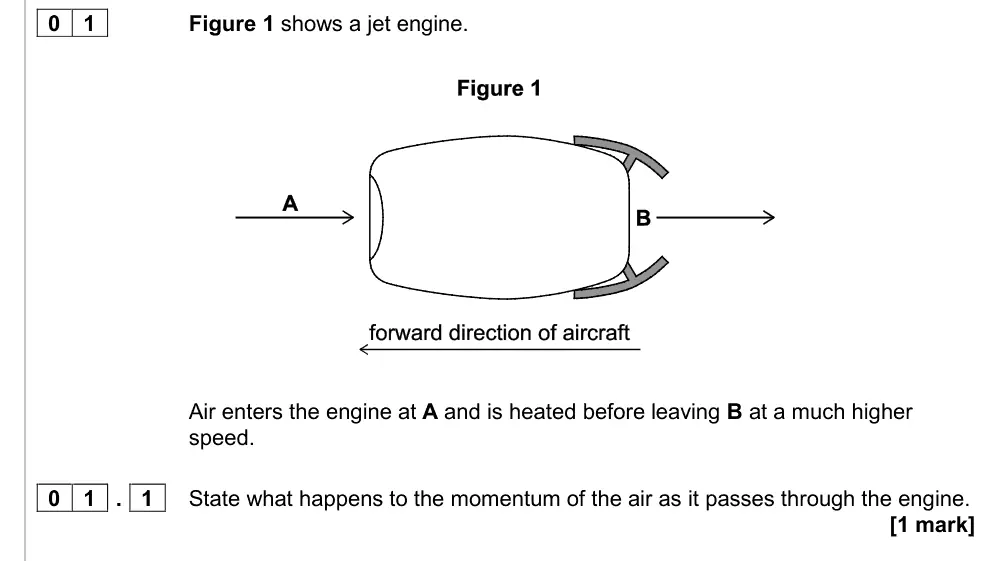
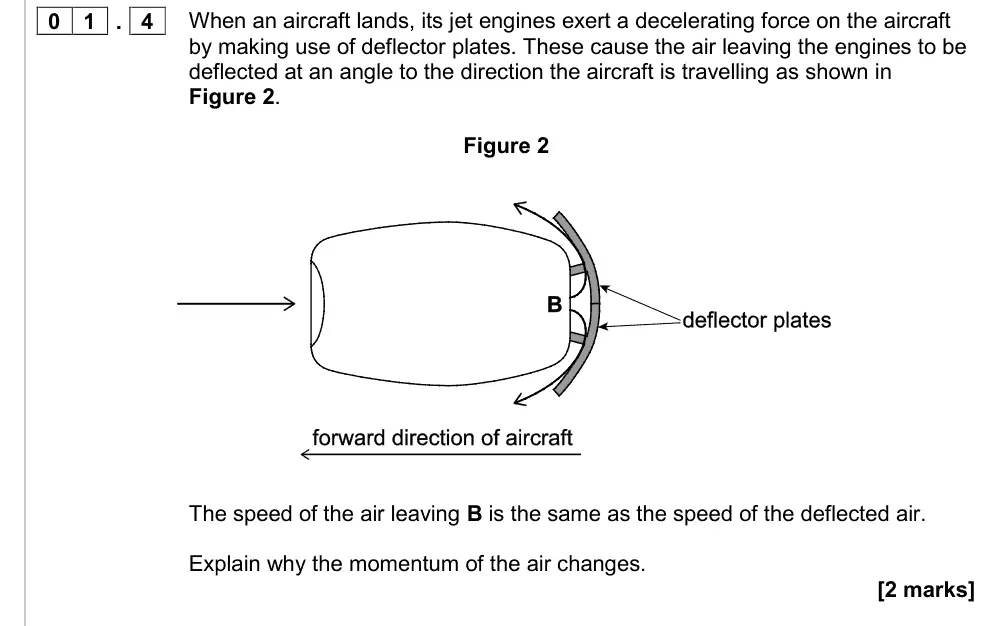
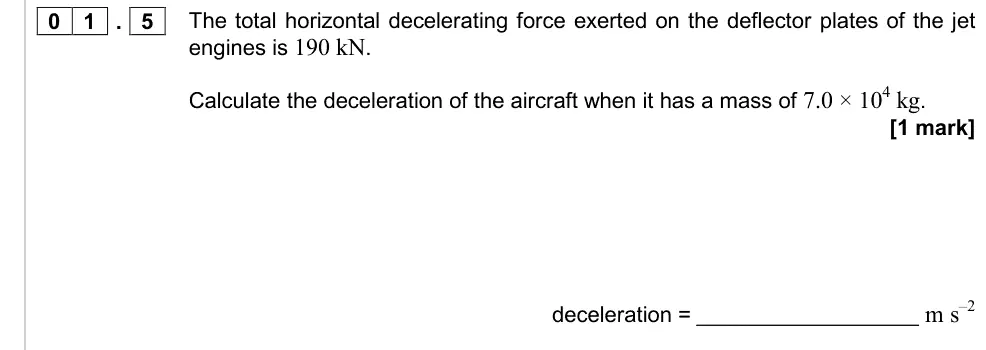
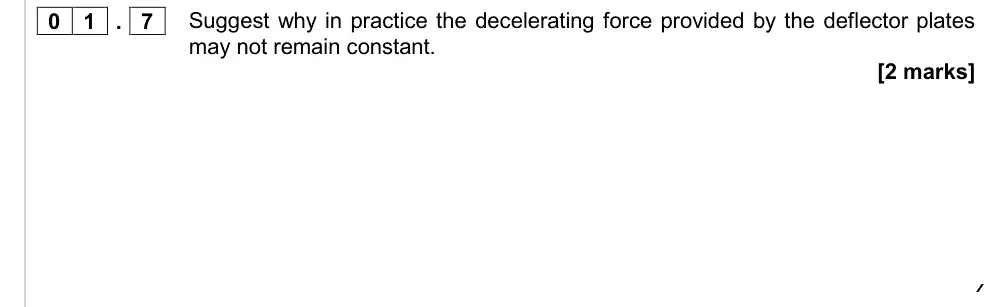
This question required students to apply their knowledge and understanding of mechanics to analyse the principles involved in the operation of a jet engine. Students for the most part were able to apply the appropriate physics ideas in their answers. In question 1.1 the vast majority of students appreciated that momentum increased. Question 1.2 in contrast, resulted in a much greater variation of response. Many students appreciated that Newton’s third law was important here and were able to quote it correctly. However, they did not often produce complete answers, missing out important detail such as the engine exerts a force on the air or that the air exerts a force equal in magnitude on the engine. Weaker responses tended to try and involve air resistance in their explanations of why there was a forward force acting on the engine. The calculations required to answer questions 1.3, 1.5 and 1.6 were well done with full credit being commonly achieved. The only major mistake seen in question 1.6 was confusion between initial velocity and final velocity. Question 1.4 required an explanation of why the momentum had changed when the deflector plates were deployed. The majority of students did appreciate this was because the direction of the air’s velocity had changed but did not then give a full answer by explaining that momentum and velocity are vector quantities. Question 1.7 was quite challenging and only the strongest responses were able to suggest that this might be due to the decrease in the mass of air entering the engine per second.
Notes from the mark scheme and report
Momentum of the air increases (speed increases)
June 2016 · AS Paper 1 · Q1.23 marksExplanation
Earlier part of question 1 that this part uses
Mark scheme
Examiner's comment
This question required students to apply their knowledge and understanding of mechanics to analyse the principles involved in the operation of a jet engine. Students for the most part were able to apply the appropriate physics ideas in their answers. In question 1.1 the vast majority of students appreciated that momentum increased. Question 1.2 in contrast, resulted in a much greater variation of response. Many students appreciated that Newton’s third law was important here and were able to quote it correctly. However, they did not often produce complete answers, missing out important detail such as the engine exerts a force on the air or that the air exerts a force equal in magnitude on the engine. Weaker responses tended to try and involve air resistance in their explanations of why there was a forward force acting on the engine. The calculations required to answer questions 1.3, 1.5 and 1.6 were well done with full credit being commonly achieved. The only major mistake seen in question 1.6 was confusion between initial velocity and final velocity. Question 1.4 required an explanation of why the momentum had changed when the deflector plates were deployed. The majority of students did appreciate this was because the direction of the air’s velocity had changed but did not then give a full answer by explaining that momentum and velocity are vector quantities. Question 1.7 was quite challenging and only the strongest responses were able to suggest that this might be due to the decrease in the mass of air entering the engine per second.
This was the first paper for this new award and evidence from scripts suggests that an encouraging proportion of students were well prepared for the exam and were able to cope successfully with the broader scope of the questions and the change in emphasis of the assessment objectives. In general students seemed more confident with quantitative questions and less so with those that required extended written answers. There was a tendency not to present full arguments when applying physics principles: examples of this being questions 1.2, 3.4 and 5.1. The evidence from scripts suggests that students had sufficient time to answer all the questions and few incomplete papers were seen.
Notes from the mark scheme and report
Engine changes the air's momentum so exerts a backward force on the air (Newton 2)
air exerts an equal and opposite (forward) force on the engine (Newton 3)
answers often incomplete or wrongly used air resistance
June 2016 · AS Paper 1 · Q1.31 markCalculation
Earlier part of question 1 that this part uses
Mark scheme
Examiner's comment
This question required students to apply their knowledge and understanding of mechanics to analyse the principles involved in the operation of a jet engine. Students for the most part were able to apply the appropriate physics ideas in their answers. In question 1.1 the vast majority of students appreciated that momentum increased. Question 1.2 in contrast, resulted in a much greater variation of response. Many students appreciated that Newton’s third law was important here and were able to quote it correctly. However, they did not often produce complete answers, missing out important detail such as the engine exerts a force on the air or that the air exerts a force equal in magnitude on the engine. Weaker responses tended to try and involve air resistance in their explanations of why there was a forward force acting on the engine. The calculations required to answer questions 1.3, 1.5 and 1.6 were well done with full credit being commonly achieved. The only major mistake seen in question 1.6 was confusion between initial velocity and final velocity. Question 1.4 required an explanation of why the momentum had changed when the deflector plates were deployed. The majority of students did appreciate this was because the direction of the air’s velocity had changed but did not then give a full answer by explaining that momentum and velocity are vector quantities. Question 1.7 was quite challenging and only the strongest responses were able to suggest that this might be due to the decrease in the mass of air entering the engine per second.
Notes from the mark scheme and report
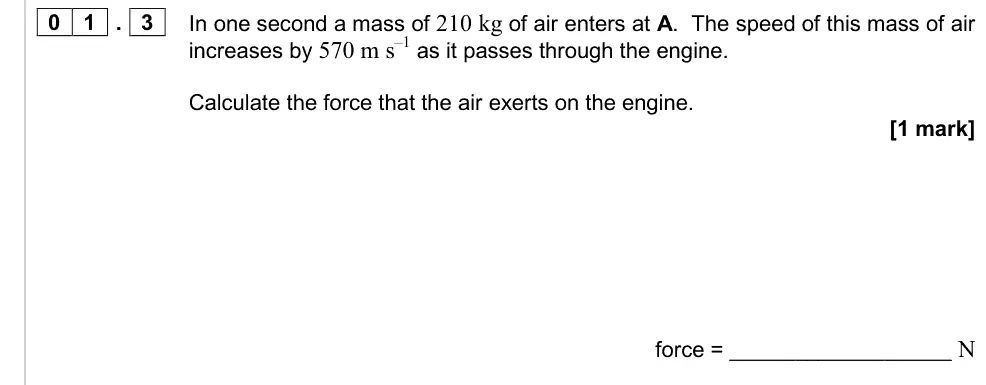
Answer: 1.2 x 10^5 N (F = rate of change of momentum = 210 x 570)
Skills: MS2.3 Substitute numerical values into algebraic equations using appropriate units for physical quantities
June 2016 · AS Paper 1 · Q1.42 marksExplanation
Earlier part of question 1 that this part uses
Mark scheme
Examiner's comment
This question required students to apply their knowledge and understanding of mechanics to analyse the principles involved in the operation of a jet engine. Students for the most part were able to apply the appropriate physics ideas in their answers. In question 1.1 the vast majority of students appreciated that momentum increased. Question 1.2 in contrast, resulted in a much greater variation of response. Many students appreciated that Newton’s third law was important here and were able to quote it correctly. However, they did not often produce complete answers, missing out important detail such as the engine exerts a force on the air or that the air exerts a force equal in magnitude on the engine. Weaker responses tended to try and involve air resistance in their explanations of why there was a forward force acting on the engine. The calculations required to answer questions 1.3, 1.5 and 1.6 were well done with full credit being commonly achieved. The only major mistake seen in question 1.6 was confusion between initial velocity and final velocity. Question 1.4 required an explanation of why the momentum had changed when the deflector plates were deployed. The majority of students did appreciate this was because the direction of the air’s velocity had changed but did not then give a full answer by explaining that momentum and velocity are vector quantities. Question 1.7 was quite challenging and only the strongest responses were able to suggest that this might be due to the decrease in the mass of air entering the engine per second.
Notes from the mark scheme and report
Momentum (velocity) is a vector and the air's direction changes, so momentum changes even at the same speed
vector point often omitted
June 2016 · AS Paper 1 · Q1.51 markCalculation
Earlier part of question 1 that this part uses
Mark scheme
Examiner's comment
This question required students to apply their knowledge and understanding of mechanics to analyse the principles involved in the operation of a jet engine. Students for the most part were able to apply the appropriate physics ideas in their answers. In question 1.1 the vast majority of students appreciated that momentum increased. Question 1.2 in contrast, resulted in a much greater variation of response. Many students appreciated that Newton’s third law was important here and were able to quote it correctly. However, they did not often produce complete answers, missing out important detail such as the engine exerts a force on the air or that the air exerts a force equal in magnitude on the engine. Weaker responses tended to try and involve air resistance in their explanations of why there was a forward force acting on the engine. The calculations required to answer questions 1.3, 1.5 and 1.6 were well done with full credit being commonly achieved. The only major mistake seen in question 1.6 was confusion between initial velocity and final velocity. Question 1.4 required an explanation of why the momentum had changed when the deflector plates were deployed. The majority of students did appreciate this was because the direction of the air’s velocity had changed but did not then give a full answer by explaining that momentum and velocity are vector quantities. Question 1.7 was quite challenging and only the strongest responses were able to suggest that this might be due to the decrease in the mass of air entering the engine per second.
Notes from the mark scheme and report
Answer: 2.7 m s^-2 (190 000 / 7.0 x 10^4)
Skills: MS2.3 Substitute numerical values into algebraic equations using appropriate units for physical quantities
June 2016 · AS Paper 1 · Q1.72 marksExplanation
Earlier part of question 1 that this part uses
Mark scheme
Examiner's comment
This question required students to apply their knowledge and understanding of mechanics to analyse the principles involved in the operation of a jet engine. Students for the most part were able to apply the appropriate physics ideas in their answers. In question 1.1 the vast majority of students appreciated that momentum increased. Question 1.2 in contrast, resulted in a much greater variation of response. Many students appreciated that Newton’s third law was important here and were able to quote it correctly. However, they did not often produce complete answers, missing out important detail such as the engine exerts a force on the air or that the air exerts a force equal in magnitude on the engine. Weaker responses tended to try and involve air resistance in their explanations of why there was a forward force acting on the engine. The calculations required to answer questions 1.3, 1.5 and 1.6 were well done with full credit being commonly achieved. The only major mistake seen in question 1.6 was confusion between initial velocity and final velocity. Question 1.4 required an explanation of why the momentum had changed when the deflector plates were deployed. The majority of students did appreciate this was because the direction of the air’s velocity had changed but did not then give a full answer by explaining that momentum and velocity are vector quantities. Question 1.7 was quite challenging and only the strongest responses were able to suggest that this might be due to the decrease in the mass of air entering the engine per second.
Notes from the mark scheme and report
As the aircraft slows, less mass of air enters per second so the rate of change of momentum (force) falls
air-resistance argument gets 1 mark, not friction
only strongest answers
Specimen set 1 · Paper 1 · Q2.63 marksCalculation
Earlier part of question 2 that this part uses
Mark scheme
Notes from the mark scheme and report
Answer: 9.0 m s^-2 (max tension 11300 N, weight 5886 N, resultant 5423 N)
Skills: MS2.3 Substitute numerical values into algebraic equations using appropriate units for physical quantities
Specimen set 1 · Paper 1 · Q2.73 marksExplanation
Earlier part of question 2 that this part uses
Mark scheme
Notes from the mark scheme and report
Double load at same acceleration needs double tension
keep strain by doubling cross-sectional area (diameter x root 2) or using a material with double the Young modulus
Specimen set 1 · Paper 1 · Q4.14 marksCalculation
Mark scheme
Notes from the mark scheme and report
Answer: about 180 m s^-1 (GPE 2.84 J, block speed 3.51 m s^-1, momentum 1.61 kg m s^-1 divided by 8.80 g)
method marks at each step, one ecf allowed
Skills: MS2.3 Substitute numerical values into algebraic equations using appropriate units for physical quantities; MS2.2 Change the subject of an equation, including non-linear equations
Specimen set 1 · Paper 1 · Q4.24 marksExplanation
Earlier part of question 4 that this part uses
Mark scheme
Notes from the mark scheme and report
Rebounding pellet has a larger change of momentum so the block gains more momentum, greater initial speed and KE, so the steel block rises higher than 0.63 m
Specimen set 1 · Paper 1 · Q4.32 marksExplanation
Earlier part of question 4 that this part uses
Mark scheme
Notes from the mark scheme and report
Steel method needs the collision assumed elastic to find the momentum change
unlikely (pellet deforms, sound), so the wooden block (perfectly inelastic) is more accurate
Specimen set 1 · Paper 1 · Q241 markMultiple choice
Answer
C
Notes from the mark scheme and report
Answer: C
Specimen set 1 · Paper 1 · Q271 markMultiple choice
Answer
A
Notes from the mark scheme and report
Answer: A (resultant force follows the gradient of the v-t graph)
Skills: MS3.6 Draw and use the slope of a tangent to a curve as a measure of rate of change
Specimen set 1 · Paper 2 · Q1.42 marksExplanation
Earlier part of question 1 that this part uses
Mark scheme
Notes from the mark scheme and report
Gravitational force = mg so vertical acceleration = g for all masses
time to fall depends only on distance and acceleration (t = root(2s/g))
June 2016 · AS Paper 2 · Q3.42 marksExplanation
Earlier part of question 3 that this part uses
Mark scheme
Examiner's comment
3.4 This was a fairly demanding question that aimed to get students to think about the reason for having the heavy ball in the seismometer. Successful answers were able suggest that, in the very short length of time involved, the ball would barely move and therefore the arm holding the pen would pivot about the ball, causing the upwards line. Many incorrect answers were seen: some students were convinced there was a third law or conservation of momentum explanation while others said the spring, having become compressed, then pulled the arm up. It seemed that many felt that the downwards accelerating seismometer took the ball with it and so the line went downwards. No credit was earned for saying the pen or the arm did not move, likewise any suggestion of an ‘up and down’ motion of the pen (although ‘up then down’ could earn a mark).
Notes from the mark scheme and report
Line moves up: the heavy ball (inertia) barely moves while the frame and drum accelerate down
'up and down' or third-law arguments not credited
June 2016 · AS Paper 2 · Q221 markMultiple choiceEasy
Answer
C
Examiner's comment
22 68% of students identified the correct answer to this question. The most popular distractor was B, given by students believing that the sideways force must somehow reduce the forward speed.
Notes from the mark scheme and report
Answer: C
B the main distractor
June 2016 · AS Paper 2 · Q231 markMultiple choice
Answer
C
Examiner's comment
23 The correct answer was given by 43% of students. Unsurprisingly perhaps, A was the most popular distractor.
Notes from the mark scheme and report
Answer: C
A the main distractor
Work with an AQA physics tutor
Dropping marks on calculations, required practicals or the six-markers? Book a trial session with a specialist AQA physics tutor.