Tap a question to zoom it. Where a part needs a figure, table or graph from earlier in the question, that part folds out above it; the mark scheme and examiner's comment open underneath. Have the AQA data and formulae booklet beside you (see the formula sheet page).
June 2025 · Paper 2 · Q1.13 marksAO2=3Calculation
Mark scheme
Examiner's comment
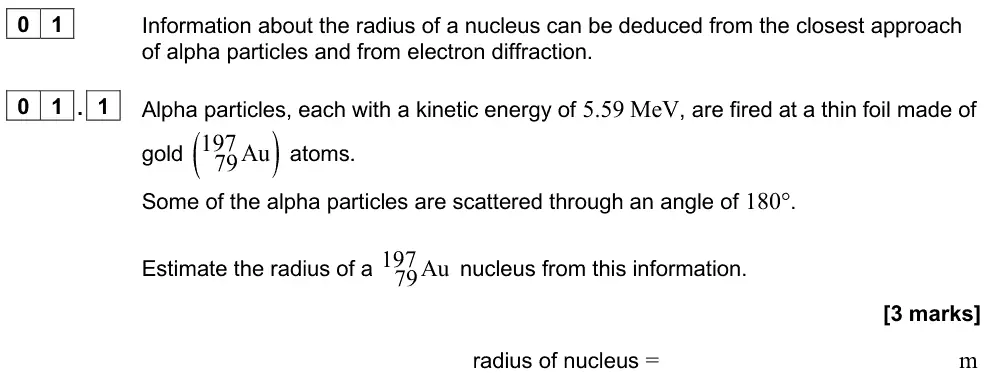
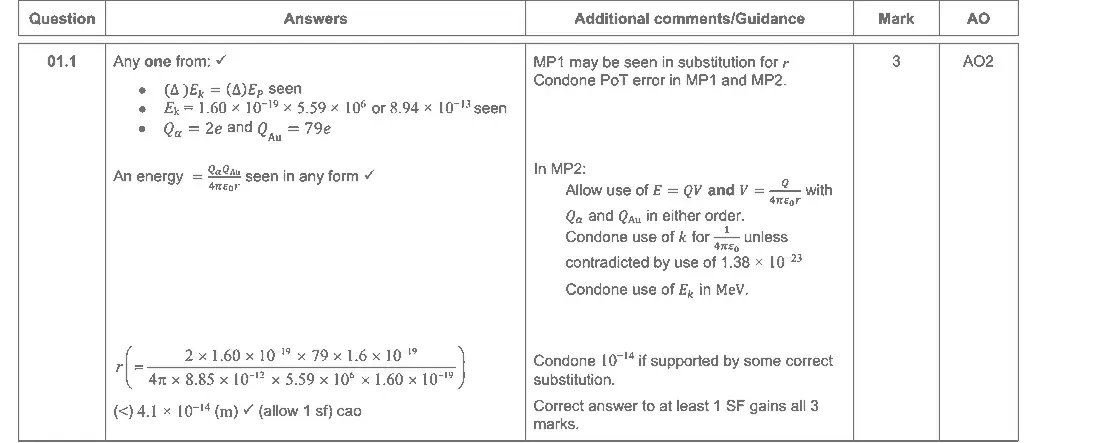
1.1 In the first part of the question students were asked to estimate the radius of the gold nucleus 𝑄𝑄𝛼𝛼𝑄𝑄Au using the distance of closest approach. This required the students to equate the alpha 4𝜋𝜋𝜀𝜀0𝑟𝑟 with its kinetic energy converted into joules. As particle’s electrostatic potential energy the formula for the electrostatic potential energy has to be deduced, this gained a mark if it was seen. A small number of students knew the approach but incorrectly used the mass number instead of the proton number when calculating the charge of the alpha or gold nucleus.
2 𝑚𝑚𝑉𝑉2 = 𝐸𝐸𝐾𝐾 or included using 𝑅𝑅= 𝑅𝑅0𝐴𝐴 3, mixing up velocity 𝑣𝑣 and potential 𝑉𝑉, and using 1 Many students seemed unfamiliar with this approach. Common incorrect approaches 1 squaring the radius so the kinetic energy is effectively equated to force rather than potential energy.
The most common mark gained was for converting the kinetic energy to joules, although some did not attempt this.
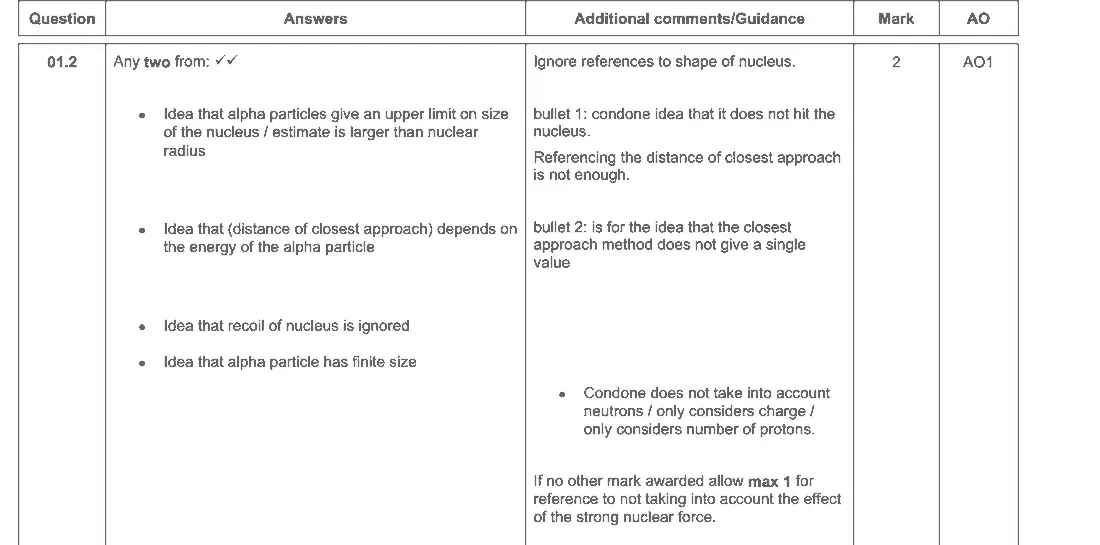
1.2 Students had to explain why their answer to question 1.1 was an estimate. Very few students provided two reasons and the majority were therefore limited to 1 mark. This required students to apply their knowledge of the comparison between the distance of closest approach and electron diffraction. Ideally students should express the idea that the distance of closest approach depends on the energy of the alpha particle, or only depends on the number of protons not the actual number of nucleons; however other ideas such as it being an upper limit, the recoil of the nucleus being ignored, or the alpha particle having a finite size were allowed, although in practice they have a much smaller effect. The idea that it was based on the distance of closest approach was given in the question and therefore did not gain a mark; however, a deduction from this, e.g. the alpha particle does not touch or hit the nucleus, was condoned. electron diffraction is the preferred method, although the question specifically asked about the estimate in 1.1, which is an order of magnitude too large for the range of the strong nuclear force.
Notes from the mark scheme and report
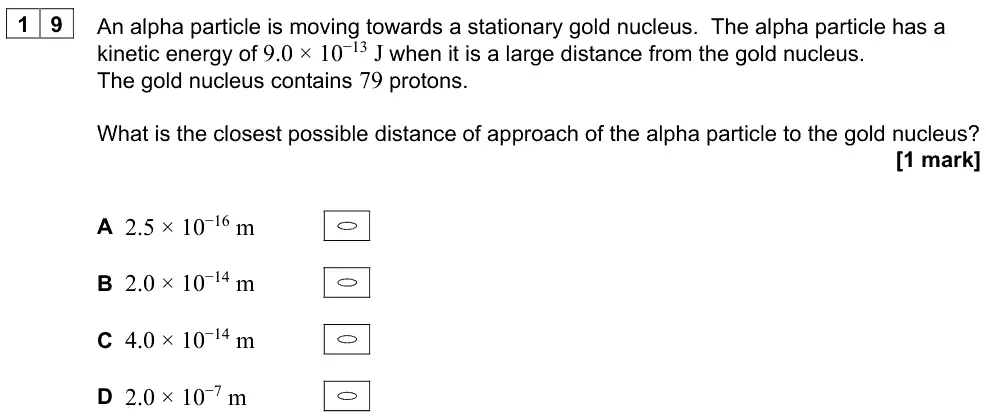
Answer: about 4.1 x 10^-14 m (KE 8.94 x 10^-13 J = (2e)(79e)/(4 pi e0 r))
using mass number for charge, squaring r (force not energy) or R = R0 A^1/3 were common errors
Skills: MS2.3 Substitute numerical values into algebraic equations using appropriate units for physical quantities; MS2.2 Change the subject of an equation, including non-linear equations
June 2025 · Paper 2 · Q1.22 marksAO1=2Explanation
Earlier part of question 1 that this part uses
Mark scheme
Examiner's comment
1.2 Students had to explain why their answer to question 1.1 was an estimate. Very few students provided two reasons and the majority were therefore limited to 1 mark. This required students to apply their knowledge of the comparison between the distance of closest approach and electron diffraction. Ideally students should express the idea that the distance of closest approach depends on the energy of the alpha particle, or only depends on the number of protons not the actual number of nucleons; however other ideas such as it being an upper limit, the recoil of the nucleus being ignored, or the alpha particle having a finite size were allowed, although in practice they have a much smaller effect. The idea that it was based on the distance of closest approach was given in the question and therefore did not gain a mark; however, a deduction from this, e.g. the alpha particle does not touch or hit the nucleus, was condoned. electron diffraction is the preferred method, although the question specifically asked about the estimate in 1.1, which is an order of magnitude too large for the range of the strong nuclear force.
Responses which referred to the non-spherical nucleus were not rewarded as this is not a significant factor in this experiment.
Notes from the mark scheme and report
Any two: closest approach is an upper limit (alpha does not reach the nucleus)
value depends on alpha energy
nucleus recoil ignored
alpha has finite size
very few gave two reasons
June 2025 · Paper 2 · Q1.32 marksAO1=2Diagram or graph
Earlier part of question 1 that this part uses
Mark scheme
Examiner's comment
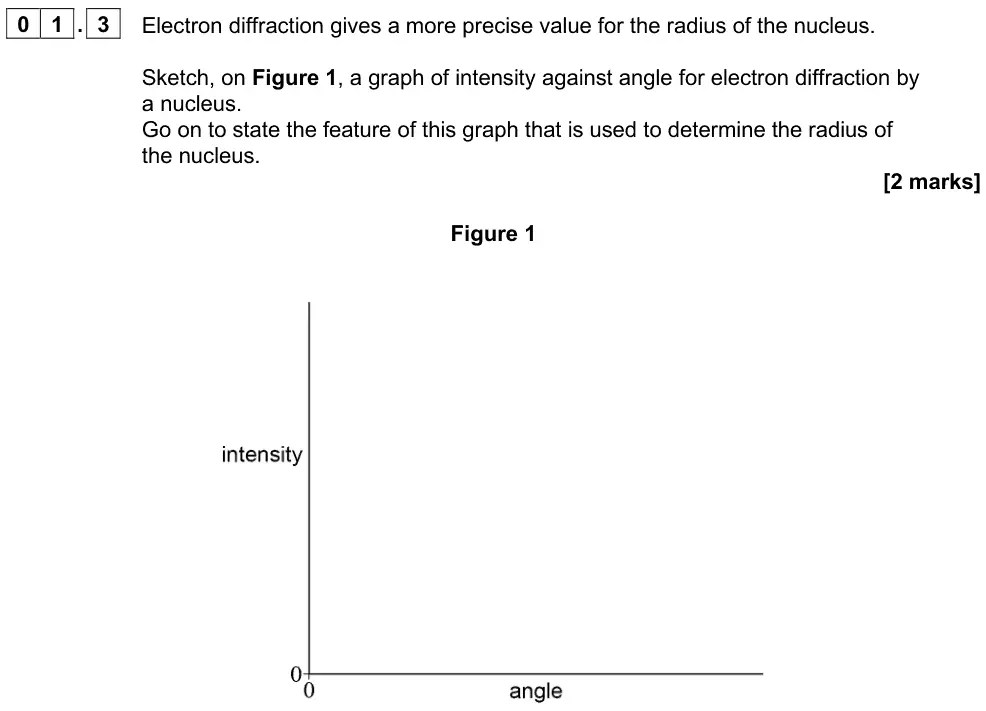
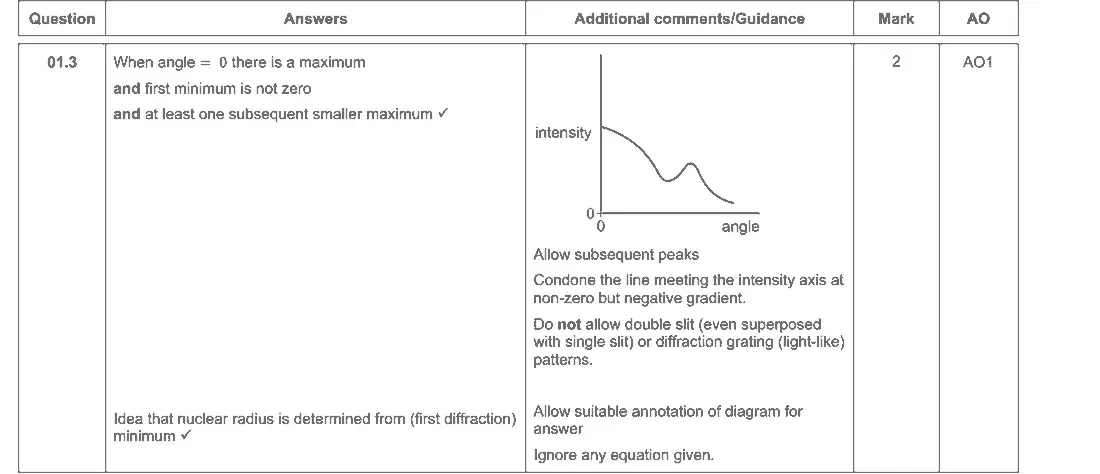
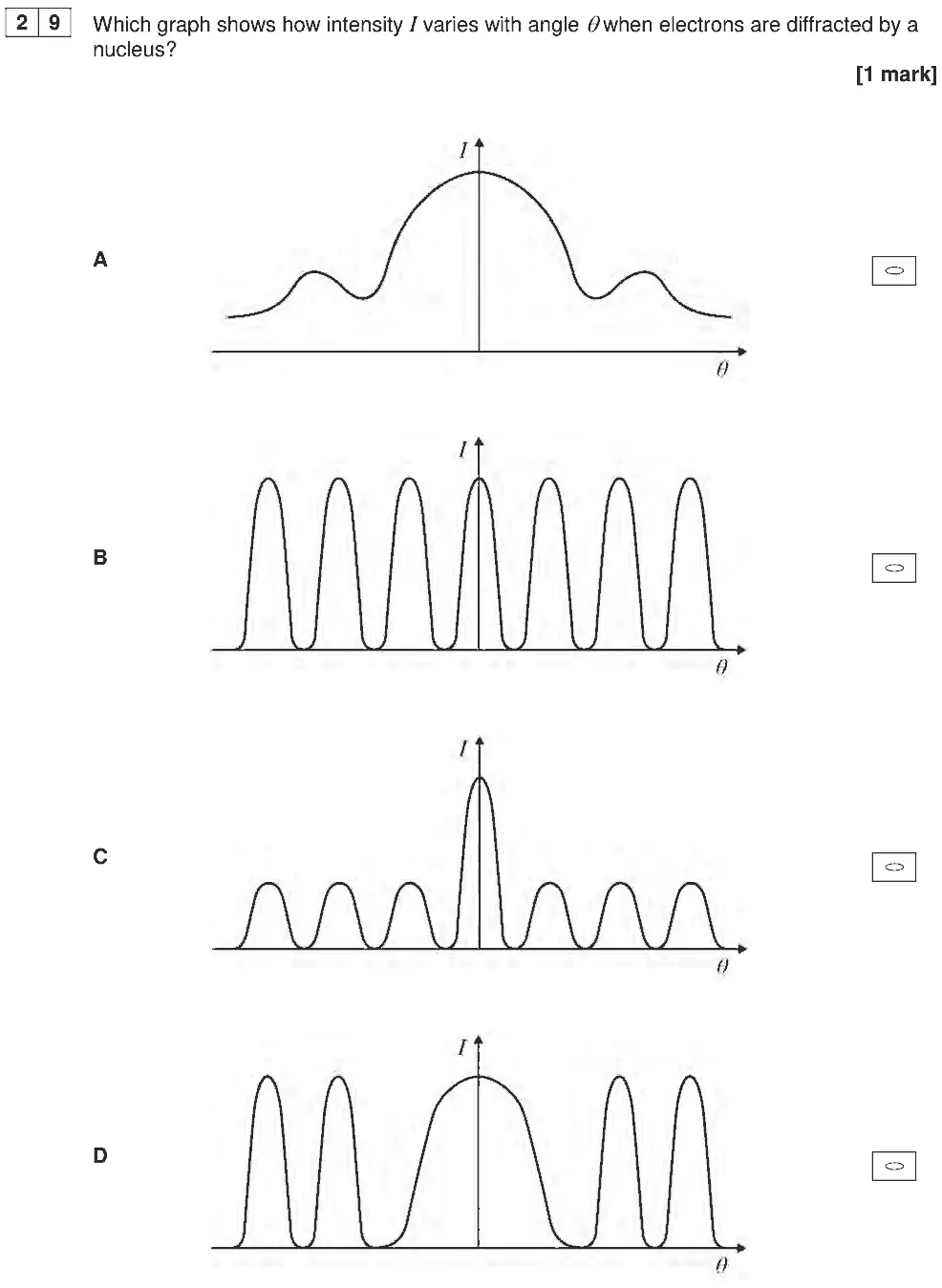
1.3 Many students seem unfamiliar with the intensity angle graph for electron diffraction, with many drawing single or double slit light diffraction patterns instead. The mark scheme for this series was was generous and focused on a central peak with a subsequent non-zero minimum. Some students did know that the first minimum was used but many did not; incorrect responses included the maxima, the gradient or the area under the graph.
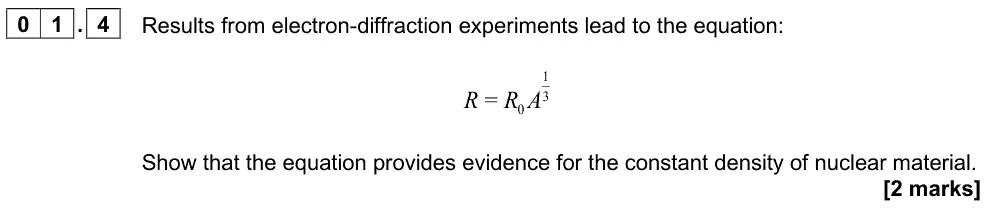
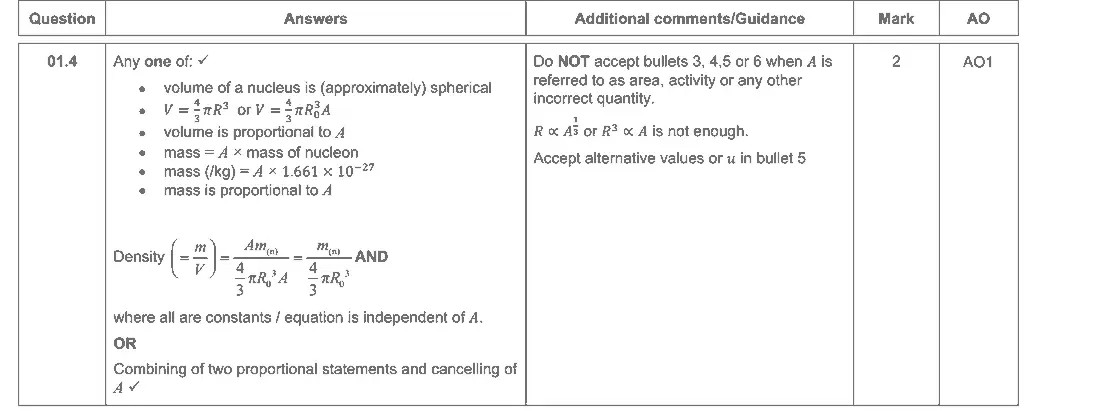
Students were asked to show that the equation 𝑅𝑅= 𝑅𝑅0𝐴𝐴 1.4 1 3 provided evidence for the constant density of nuclear material. While many students knew that the nucleus was spherical and the given equation for 𝑅𝑅 into these formulae, then use it in the density equation and cancel were able to use the equation for the volume of a sphere, only a few of these could substitute
terms in the equation were constant or did not depend on 𝑅𝑅. Since nuclear density being a the A’s. Only a small number were then able to comment on the fact that all of the remaining
constant was mentioned in the question, responses had to refer to the quantities rather than the equation itself being constant.
Notes from the mark scheme and report
Central maximum at zero angle, non-zero first minimum, smaller subsequent maximum
radius found from the first minimum
many drew slit/grating light patterns
June 2025 · Paper 2 · Q1.42 marksAO1=2Show that
Earlier part of question 1 that this part uses
Mark scheme
Examiner's comment
Students were asked to show that the equation 𝑅𝑅= 𝑅𝑅0𝐴𝐴 1.4 1 3 provided evidence for the constant density of nuclear material. While many students knew that the nucleus was spherical and the given equation for 𝑅𝑅 into these formulae, then use it in the density equation and cancel were able to use the equation for the volume of a sphere, only a few of these could substitute
Notes from the mark scheme and report
Volume = 4/3 pi R0^3 A and mass = A x nucleon mass, so density = 3m/(4 pi R0^3) independent of A
few cancelled the A's and commented
Skills: MS2.2 Change the subject of an equation, including non-linear equations
June 2024 · Paper 2 · Q201 markMultiple choice
Answer
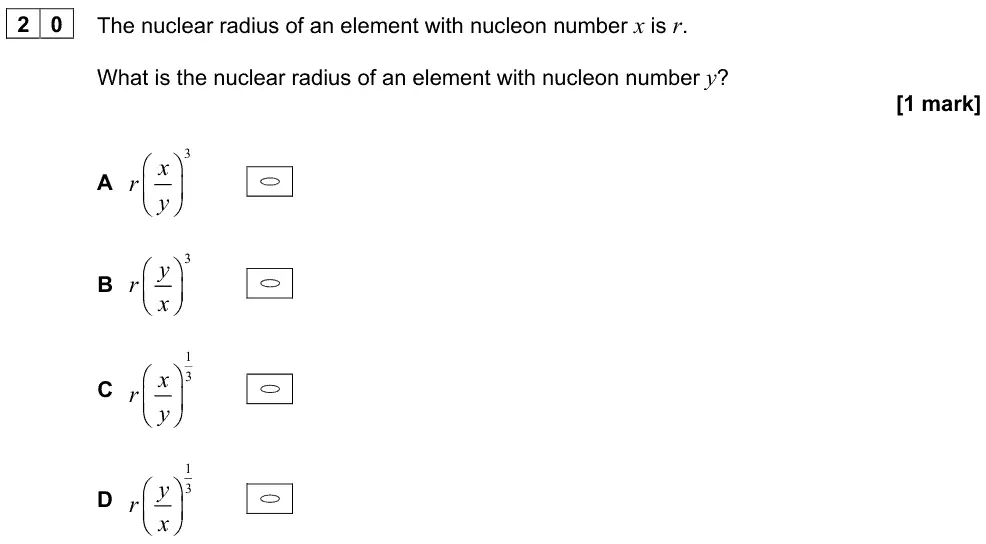
D
Mark scheme
Notes from the mark scheme and report
Answer: D
Skills: MS0.3 Use ratios, fractions and percentages
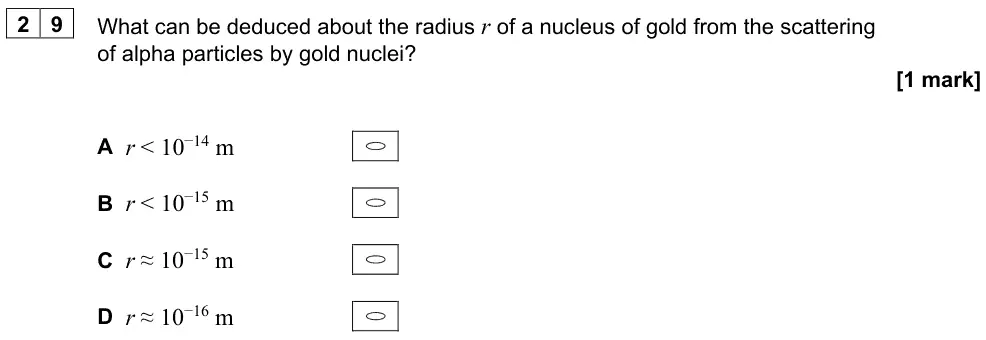
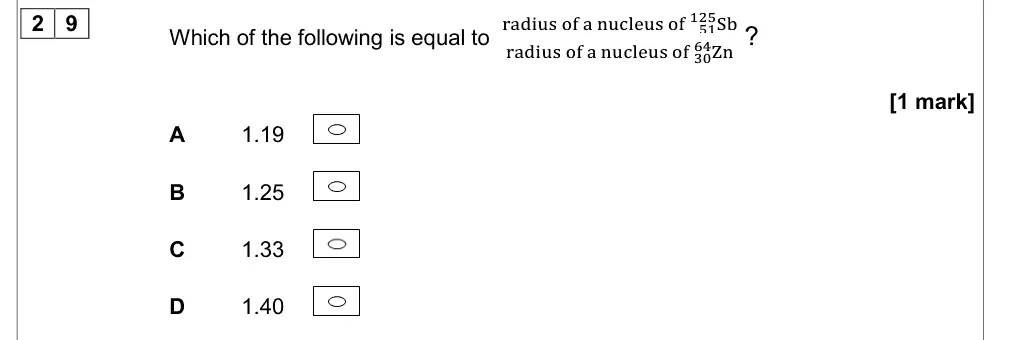
June 2024 · Paper 2 · Q291 markMultiple choice
Answer
A
Mark scheme
Notes from the mark scheme and report
Answer: A
most chose C - closest approach is an upper limit to the radius
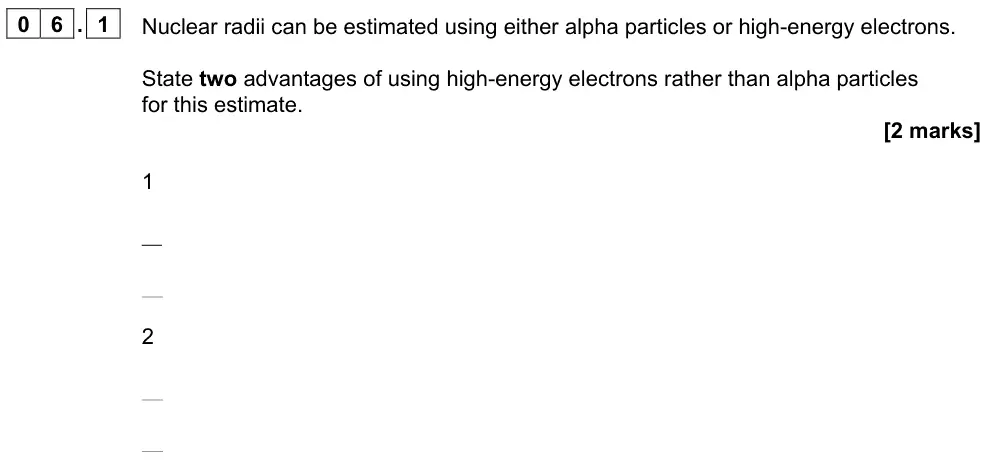
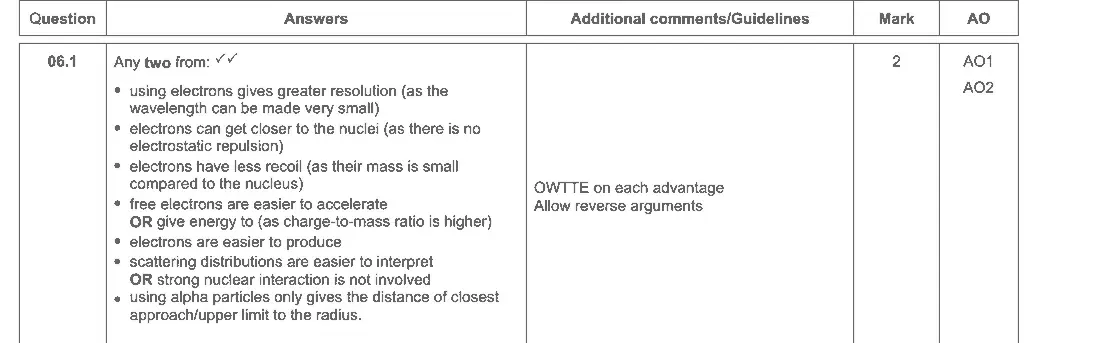
June 2023 · Paper 2 · Q6.12 marksShort answer
Mark scheme
Examiner's comment
06.1 Many of the answers given contained correct facts that, unfortunately, did not answer the question. Also, some words used by students did not describe the situation that was intended. For example, “accurate” was often used when “precise” or “greater resolution” would have been more appropriate. The most common correct answer was that using alpha particles leads to an over- estimate of the nuclear radius. The reason for this was misunderstood by some students who thought this was because of electromagnetic repulsion.
Notes from the mark scheme and report
Any two: better resolution (small wavelength), no electrostatic repulsion so get closer, little recoil, not affected by the strong force, alpha only gives closest approach (upper limit)
'accurate' misused
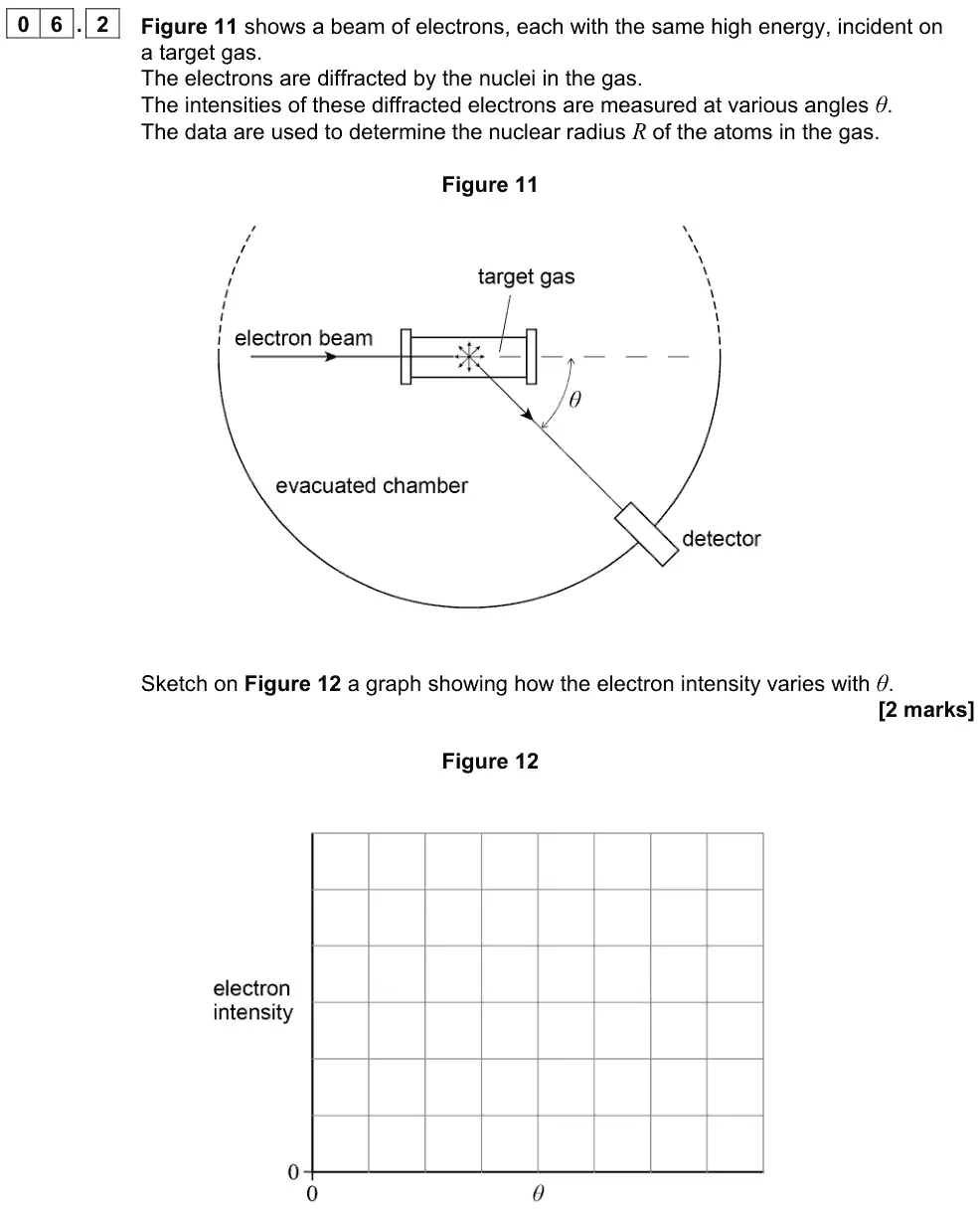
June 2023 · Paper 2 · Q6.22 marksAO1=2Diagram or graph
Earlier part of question 6 that this part uses
Mark scheme
Examiner's comment
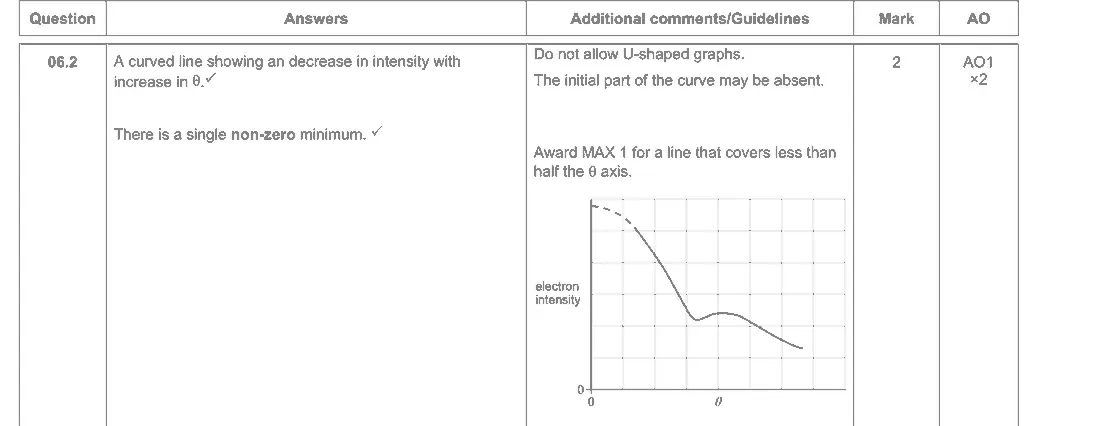
06.2 A variety of distributions were seen. A general shape with the intensity falling with angle was given by a majority. However, showing the non-zero minimum was rarely seen and few gained both marks for this question.
Notes from the mark scheme and report
Intensity falls with increasing angle with a single non-zero minimum
U-shapes not allowed
few showed the non-zero minimum
June 2023 · Paper 2 · Q6.32 marksShow that
Earlier part of question 6 that this part uses
Mark scheme
Examiner's comment
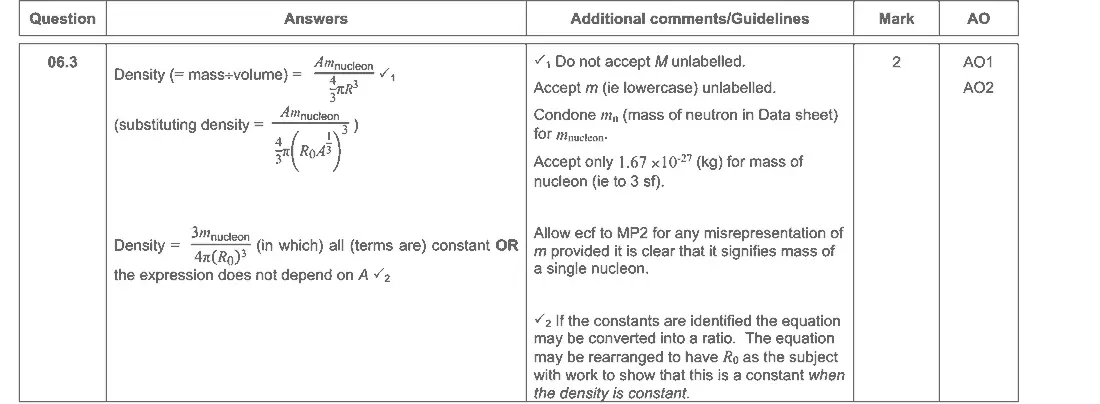
06.3 A number of students simply tried to justify the constant density with only the equation given in the question. Not all the students started with the simple equation for density. Once this equation was given, the next error made was usually in the mass substitution; often the mass did not contain the nucleon number. In other cases, the mass of a nucleon was not made clear. 06.4 This question gave rise to a wide spread of answers. The common correct answers were: the nucleus is not a perfect sphere; it does not have uniform density; the mass of a proton is not the same as the mass of a neutron. The most common incorrect answer was to focus on the lack of accurate experimental data.
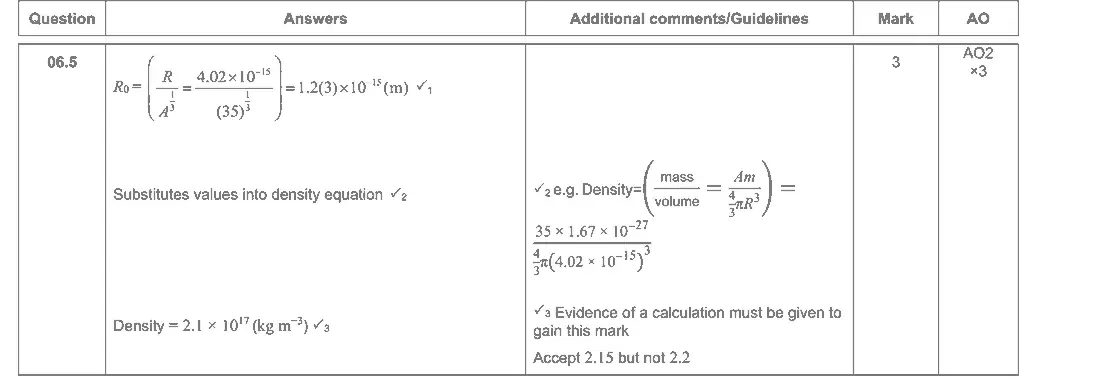
06.5 Although this question covered the same material as in question 06.3, students were much more successful in answering this question, probably because it was more specific. A majority gained the first mark by completing the radius calculation; the next two marks were more difficult to obtain. When substituting into the density equation some were uncertain whether R0 or the nuclear radius should be used. Others used the total nuclear mass instead of A multiplied by the nucleon mass.
Notes from the mark scheme and report
Density = A m_nucleon / (4/3 pi R0^3 A) = 3 m_nucleon / (4 pi R0^3), independent of A
mass must include A
Skills: MS2.2 Change the subject of an equation, including non-linear equations
June 2023 · Paper 2 · Q6.41 markAO3=1Short answer
Earlier part of question 6 that this part uses
Mark scheme
Examiner's comment
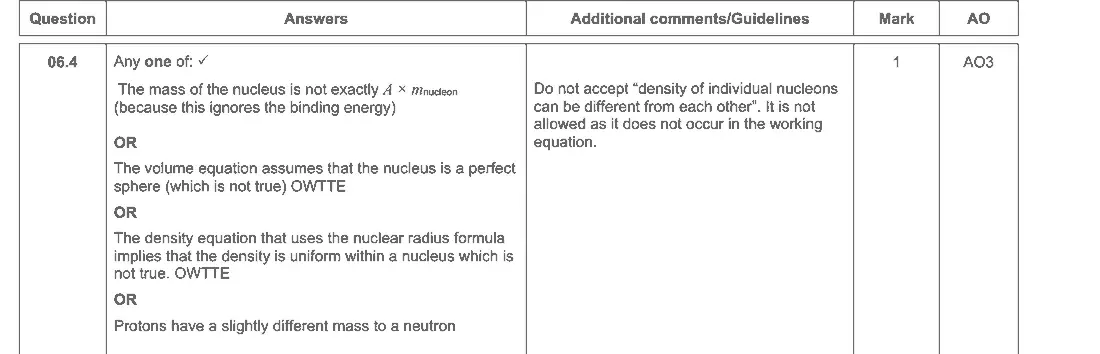
06.3 A number of students simply tried to justify the constant density with only the equation given in the question. Not all the students started with the simple equation for density. Once this equation was given, the next error made was usually in the mass substitution; often the mass did not contain the nucleon number. In other cases, the mass of a nucleon was not made clear. 06.4 This question gave rise to a wide spread of answers. The common correct answers were: the nucleus is not a perfect sphere; it does not have uniform density; the mass of a proton is not the same as the mass of a neutron. The most common incorrect answer was to focus on the lack of accurate experimental data.
Notes from the mark scheme and report
Nucleus not a perfect sphere, density not uniform, proton and neutron masses differ, or mass is not A x nucleon mass (binding energy)
'inaccurate data' not credited
June 2023 · Paper 2 · Q6.53 marksAO2=3Calculation
Earlier part of question 6 that this part uses
Mark scheme
Examiner's comment
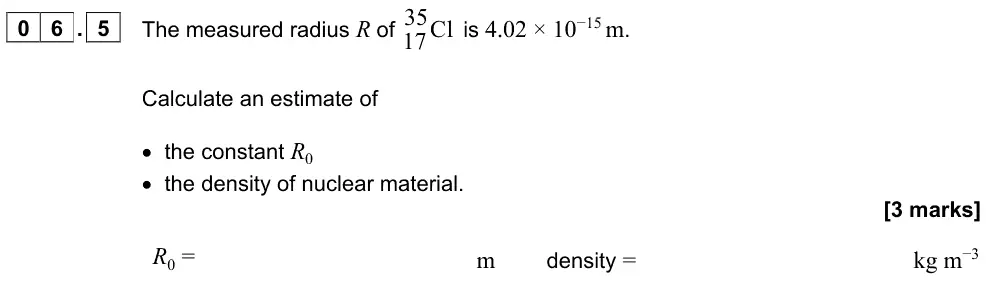
06.5 Although this question covered the same material as in question 06.3, students were much more successful in answering this question, probably because it was more specific. A majority gained the first mark by completing the radius calculation; the next two marks were more difficult to obtain. When substituting into the density equation some were uncertain whether R0 or the nuclear radius should be used. Others used the total nuclear mass instead of A multiplied by the nucleon mass.
Notes from the mark scheme and report
Answer: R0 = 1.2 x 10^-15 m
density = 2.1 x 10^17 kg m^-3 (mass 35 x 1.67 x 10^-27 kg in a sphere of radius 4.02 fm)
using R0 for R was common
Skills: MS2.3 Substitute numerical values into algebraic equations using appropriate units for physical quantities; MS0.5 Use calculators to find and use power, exponential and logarithmic functions
June 2023 · Paper 2 · Q191 markMultiple choice
Answer
C
Mark scheme
Notes from the mark scheme and report
Answer: C
Skills: MS2.3 Substitute numerical values into algebraic equations using appropriate units for physical quantities
November 2021 · Paper 2 · Q6.32 marksAO2=2Calculation
Earlier part of question 6 that this part uses
Mark scheme
Examiner's comment
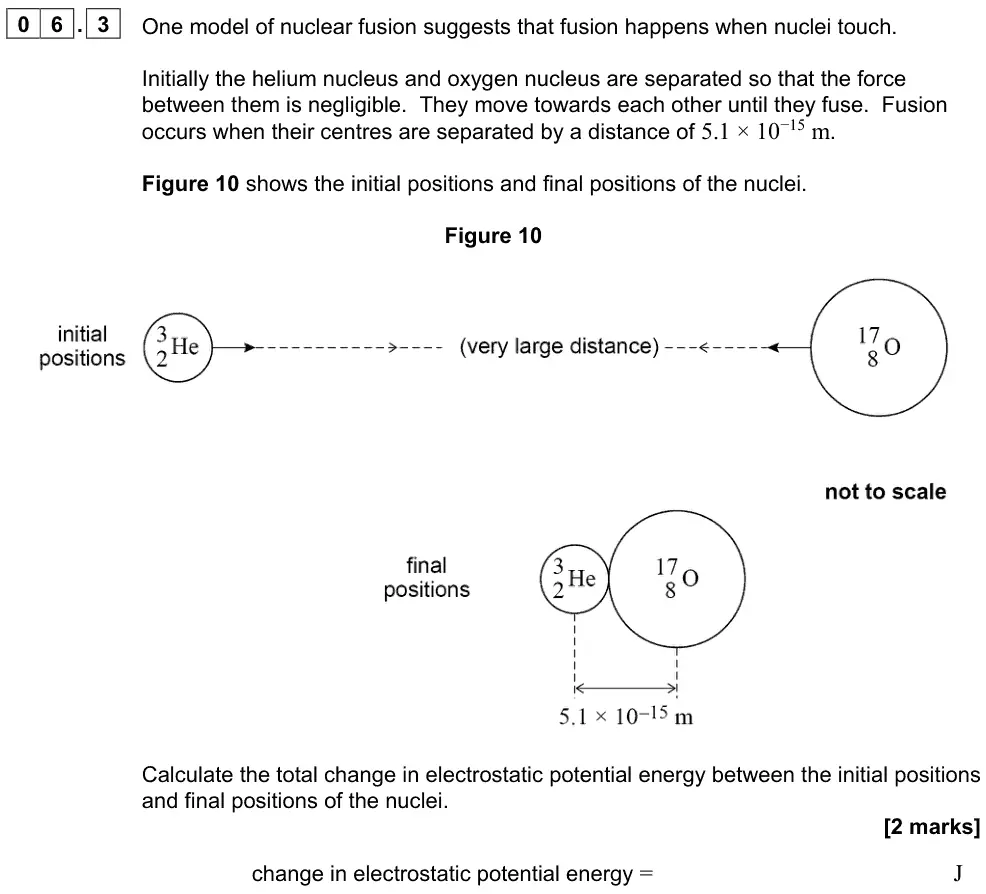
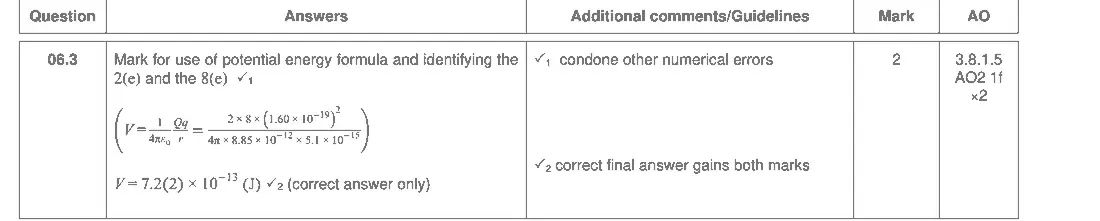
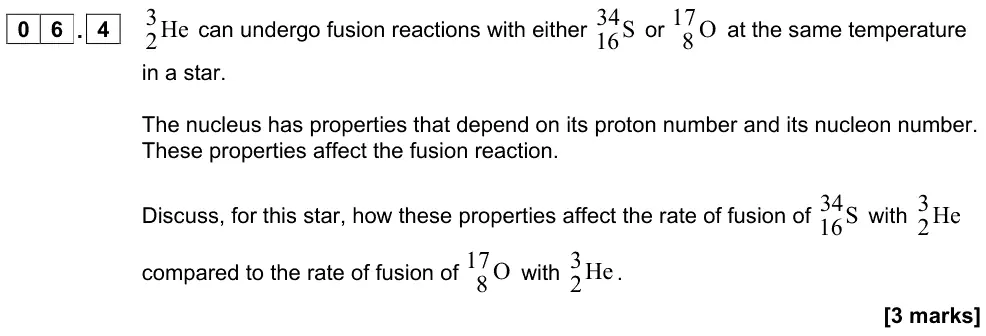
06.1 A large number of students did not address the question and spent much of the time explaining binding energy. Most students knew that energy was released in fusion but got the change in binding energy the wrong way round. They often suggested that binding energy is a quantity that can be physically exchanged. 06.2 This was a question on which most students easily scored at least one mark. Some made it much more difficult for themselves by converting each mass separately instead of just converting the final mass difference. 06.3 Most students struggled to find a correct equation. Coulomb’s force equation was often quoted and even when the correct electric potential energy equation was used, candidates added the charges or omitted the electronic-charge factor. 06.4 Students often determined the difference in nucleon number and charge of the nuclei involved but did not go on to discuss the effect this has on the rate of fusion reaction. Some simply discussed the stability of the final fusion product. Answers rarely gave a sense that the reaction takes place in a star where the nuclei move around at various speeds. Few gained marks, therefore, for stating that a particular fusion only occurs at greater kinetic energy or higher pressure. Finally, students frequently confused rate of fusion reaction with the speed of the fusion event.
Notes from the mark scheme and report
Answer: 7.2 x 10^-13 J (2e x 8e / (4 pi epsilon0 x 5.1 x 10^-15 m))
Coulomb force used by many
adding charges or omitting e were errors
Skills: MS2.3 Substitute numerical values into algebraic equations using appropriate units for physical quantities
November 2021 · Paper 2 · Q6.43 marksExplanation
Earlier part of question 6 that this part uses
Mark scheme
Examiner's comment
06.1 A large number of students did not address the question and spent much of the time explaining binding energy. Most students knew that energy was released in fusion but got the change in binding energy the wrong way round. They often suggested that binding energy is a quantity that can be physically exchanged. 06.2 This was a question on which most students easily scored at least one mark. Some made it much more difficult for themselves by converting each mass separately instead of just converting the final mass difference. 06.3 Most students struggled to find a correct equation. Coulomb’s force equation was often quoted and even when the correct electric potential energy equation was used, candidates added the charges or omitted the electronic-charge factor. 06.4 Students often determined the difference in nucleon number and charge of the nuclei involved but did not go on to discuss the effect this has on the rate of fusion reaction. Some simply discussed the stability of the final fusion product. Answers rarely gave a sense that the reaction takes place in a star where the nuclei move around at various speeds. Few gained marks, therefore, for stating that a particular fusion only occurs at greater kinetic energy or higher pressure. Finally, students frequently confused rate of fusion reaction with the speed of the fusion event.
Notes from the mark scheme and report
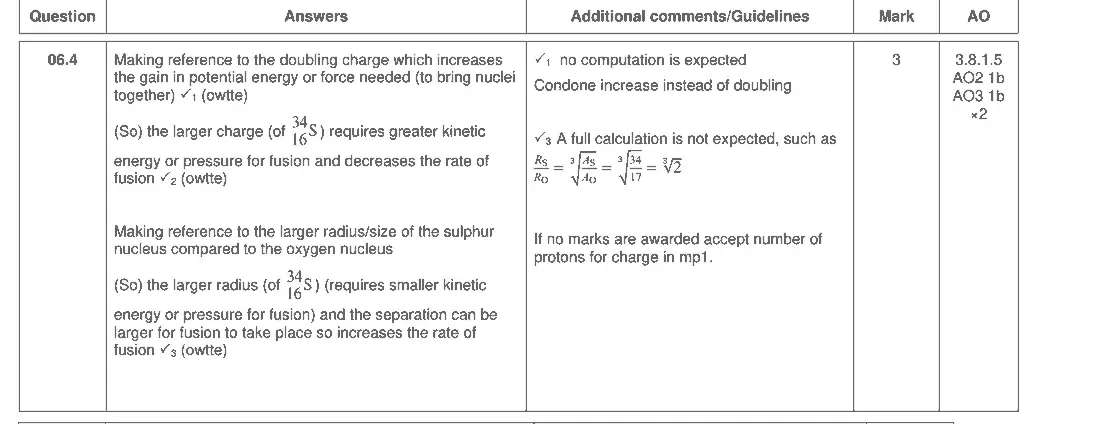
S-34 has double the charge so greater repulsion / energy needed, reducing the rate
larger S radius means fusion at larger separation, which partly increases the rate
must relate to rate in a star
November 2020 · Paper 2 · Q5.43 marksCalculation
Earlier part of question 5 that this part uses
Mark scheme
Examiner's comment
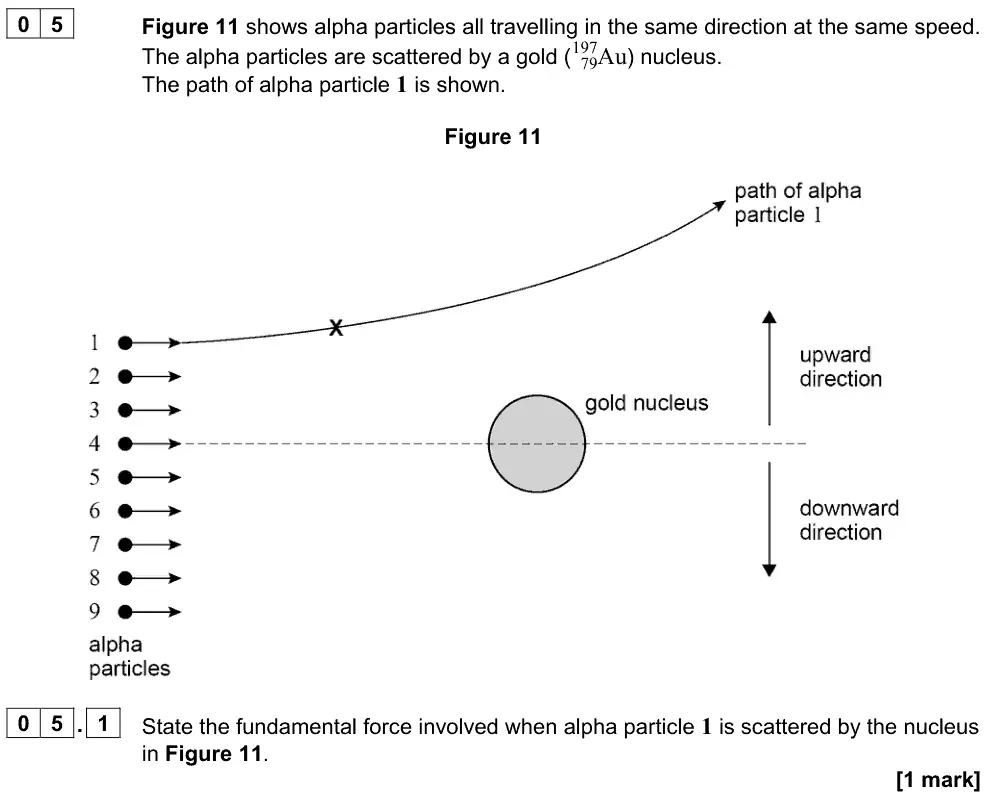
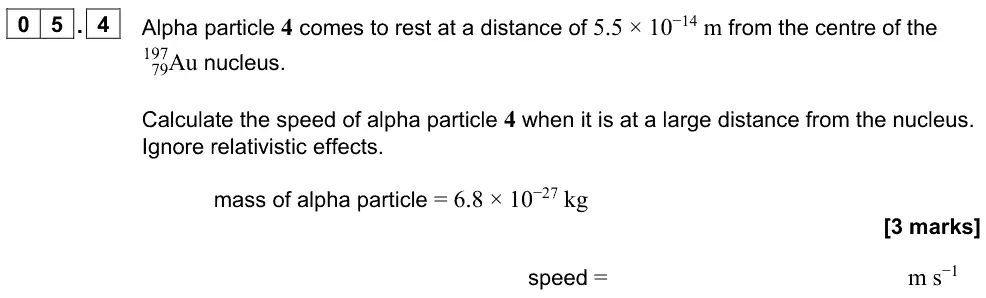
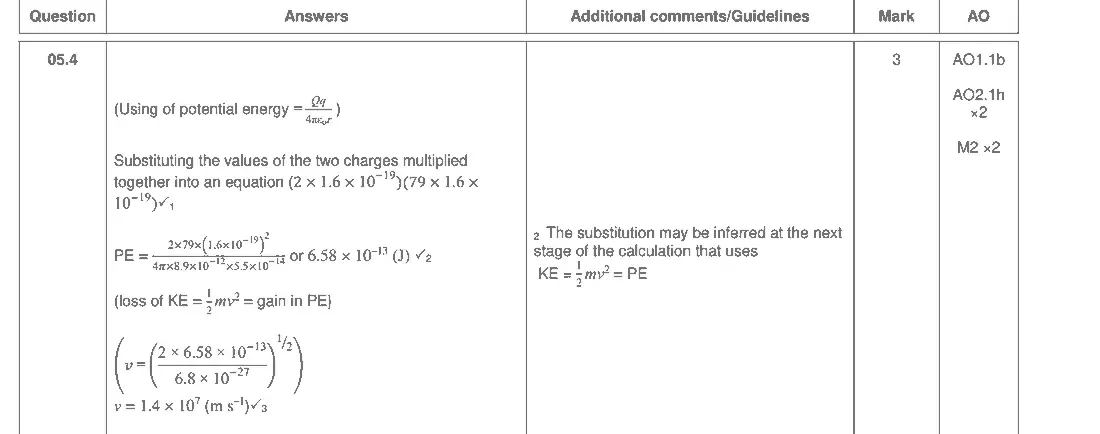
Only a minority were fully successful in answering this question because few started with the correct equation that related the loss in kinetic energy to the gain in potential energy. Many confused an expression for force with one for potential energy. Many other students either made no attempt or presented one or two equations that bore no relation to the problem.
Question 05.4
Notes from the mark scheme and report
Answer: 1.4 x 10^7 m s^-1 (PE = 2 x 79 x (1.6 x 10^-19)^2 / (4 pi epsilon0 x 5.5 x 10^-14) = 6.6 x 10^-13 J = mv^2/2)
using a force expression for energy was common
Skills: MS2.3 Substitute numerical values into algebraic equations using appropriate units for physical quantities; MS2.2 Change the subject of an equation, including non-linear equations
November 2020 · Paper 2 · Q5.52 marksCalculation
Earlier part of question 5 that this part uses
Mark scheme
Examiner's comment
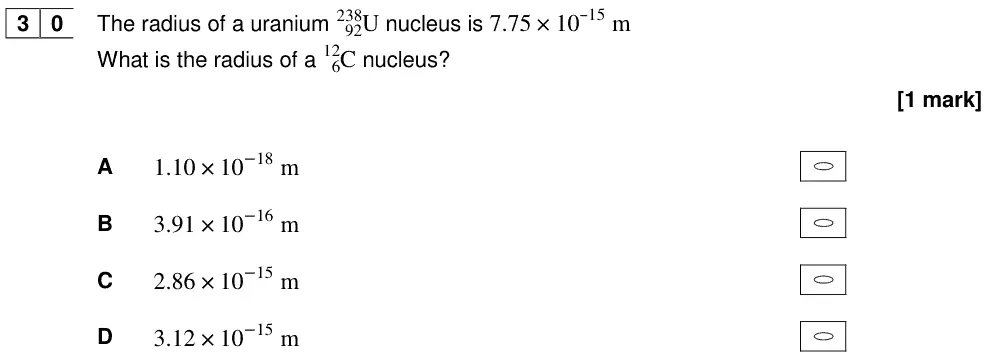
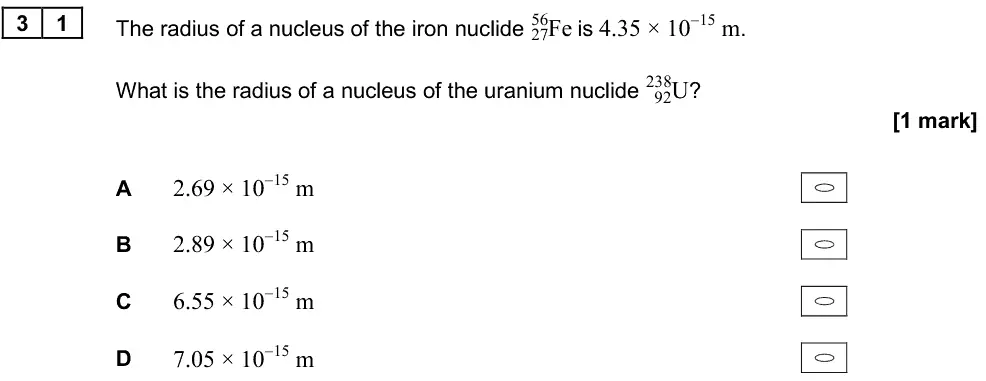
Although more than one third of students performed well, a large number could not evaluate a computation that involved fractional indices. Some other students did not use the appropriate equation or thought that the radius was proportional to the nucleon number.
Question 05.5
Notes from the mark scheme and report
Answer: 5.7 x 10^-15 m (R = 6.98 x 10^-15 x (107/197)^(1/3))
assuming R proportional to A was an error
Skills: MS0.5 Use calculators to find and use power, exponential and logarithmic functions
November 2020 · Paper 2 · Q5.61 markShort answer
Earlier part of question 5 that this part uses
Mark scheme
Examiner's comment
Most answers were correct and normally focussed on suggesting that nucleons have similar mass or volume. There was a significant number of answers that did not focus on the question and gave statements that were almost self-evident, for example ‘more nucleons give a larger radius’.
Question 05.6
Notes from the mark scheme and report
Nucleons are incompressible / have constant separation / protons and neutrons have similar mass and volume
June 2018 · Paper 2 · Q291 markMultiple choice
Answer
A
Notes from the mark scheme and report
Answer: A
June 2018 · Paper 2 · Q301 markMultiple choice
Answer
C
Notes from the mark scheme and report
Answer: C
Skills: MS0.5 Use calculators to find and use power, exponential and logarithmic functions
June 2017 · Paper 2 · Q311 markMultiple choice
Answer
D
Notes from the mark scheme and report
Answer: D
Skills: MS0.5 Use calculators to find and use power, exponential and logarithmic functions
Specimen set 1 · Paper 2 · Q291 markMultiple choice
Answer
B
Notes from the mark scheme and report
Answer: B
Skills: MS0.5 Use calculators to find and use power, exponential and logarithmic functions
Work with an AQA physics tutor
Dropping marks on calculations, required practicals or the six-markers? Book a trial session with a specialist AQA physics tutor.