Notes and key-term cards for this topic are being written by our tutors. The past-paper questions below are ready now.
Specification statements
Show the 12 statements from the specification
3.2.1.3-01 For every type of particle, there is a corresponding antiparticle.
3.2.1.3-02 Comparison of particle and antiparticle masses, charge and rest energy in MeV.
3.2.1.3-03 Students should know that the positron, antiproton, antineutron and antineutrino are the antiparticles of the electron, proton, neutron and neutrino respectively.
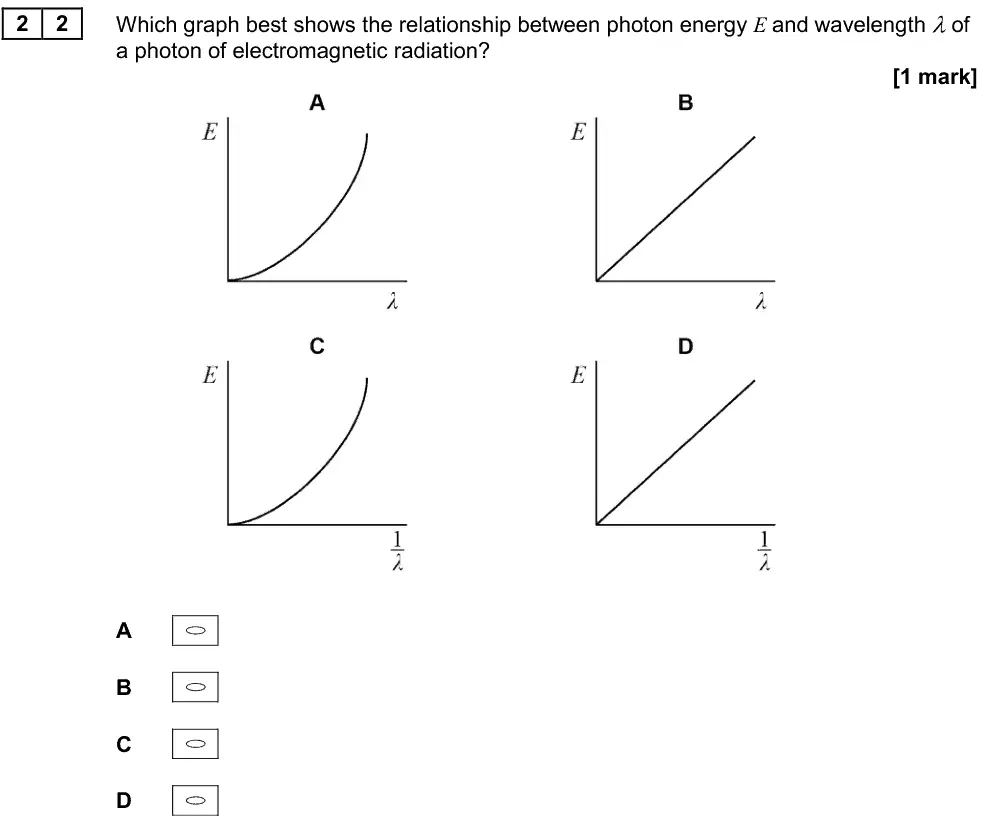
3.2.1.3-04 Photon model of electromagnetic radiation, the Planck constant. E = h f = hc λ
3.2.1.3-05 Knowledge of annihilation and pair production and the energies involved.
3.2.1.3-06 The use of E = mc 2 is not required in calculations.
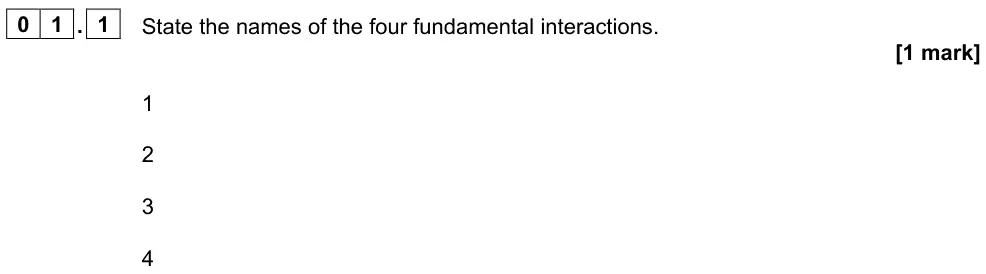
3.2.1.4-01 Four fundamental interactions: gravity, electromagnetic, weak nuclear, strong nuclear. (The strong nuclear force may be referred to as the strong interaction.)
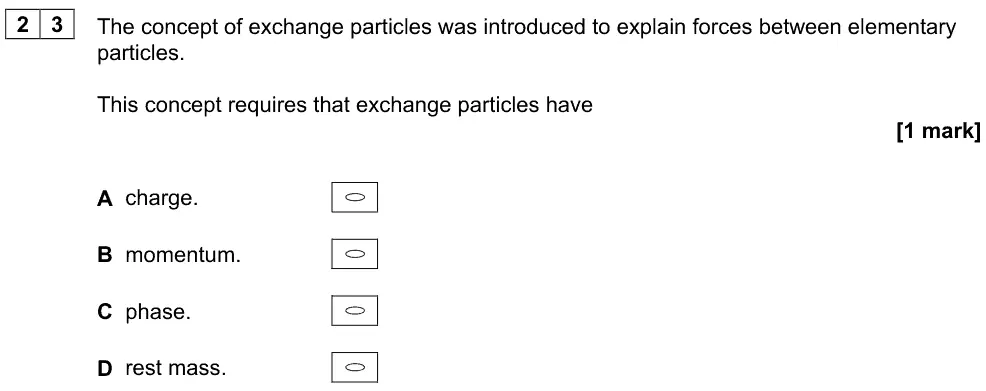
3.2.1.4-02 The concept of exchange particles to explain forces between elementary particles.
3.2.1.4-03 Knowledge of the gluon, Z 0 and graviton will not be tested.
3.2.1.4-04 The electromagnetic force; virtual photons as the exchange particle.
3.2.1.4-05 The weak interaction limited to β−and β + decay, electron capture and electron–proton collisions; W + and W − as the exchange particles.
3.2.1.4-06 Simple diagrams to represent the above reactions or interactions in terms of incoming and outgoing particles and exchange particles.
Six-mark extended response questions on this topic
Tap a question to zoom it. Where a part needs a figure, table or graph from earlier in the question, that part folds out above it; the mark scheme and examiner's comment open underneath. Have the AQA data and formulae booklet beside you (see the formula sheet page).
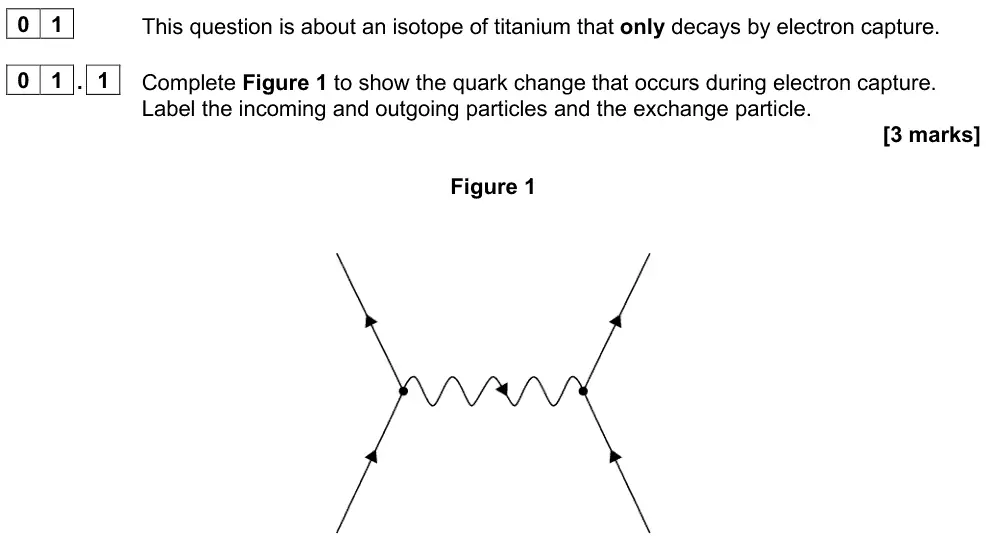
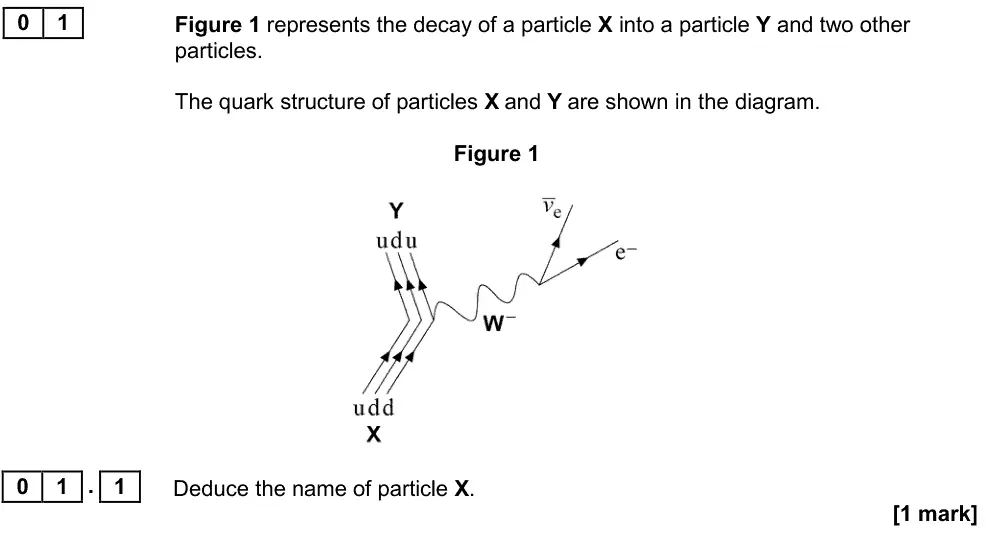
June 2025 · Paper 1 · Q1.13 marksAO2=3Diagram or graphHard
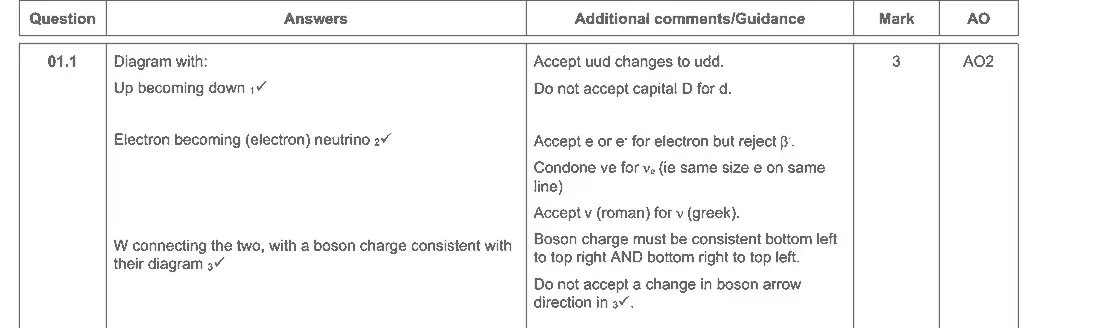
Mark scheme
Examiner's comment
Only about 25% of students obtained all three marks for Question 1.1. Many students did not read the question and labelled a proton and neutron instead of up and down. Many students also gave an antineutrino as one of the particles, or the gamma photon as the exchange particle.
Notes from the mark scheme and report
Up quark becomes down quark, electron becomes electron neutrino, W+ / W- boson joining them with charge consistent with the diagram
common errors: labelling proton and neutron instead of quarks, antineutrino, photon as exchange particle
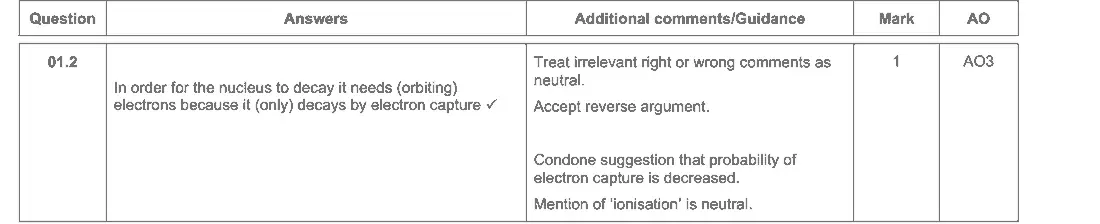
June 2025 · Paper 1 · Q1.21 markAO3=1Explanation
Earlier part of question 1 that this part uses
Mark scheme
Examiner's comment
The best answers to Question 1.2 referred to electron capture as the decay process and explained why a nucleus with no orbiting electrons would find this difficult. Many students made vague statements about nuclear stability in terms of neutrons or suggested that somehow orbiting electrons cause nuclear instability through an electromagnetic interaction.
Notes from the mark scheme and report
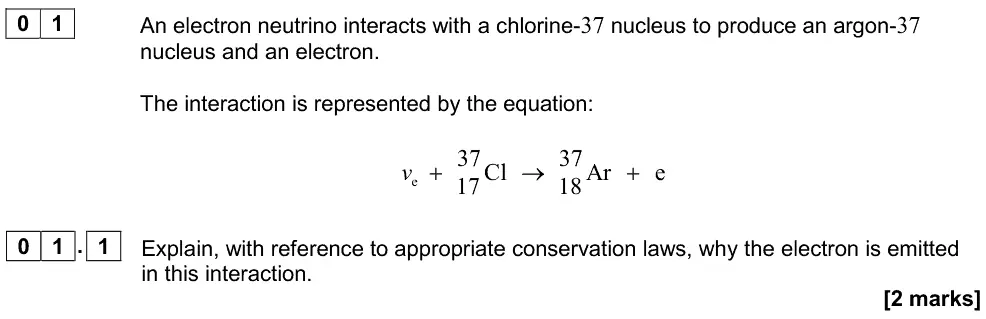
Electron capture needs orbiting electrons, so a bare nucleus cannot decay
vague comments about neutron numbers or electromagnetic instability gained nothing
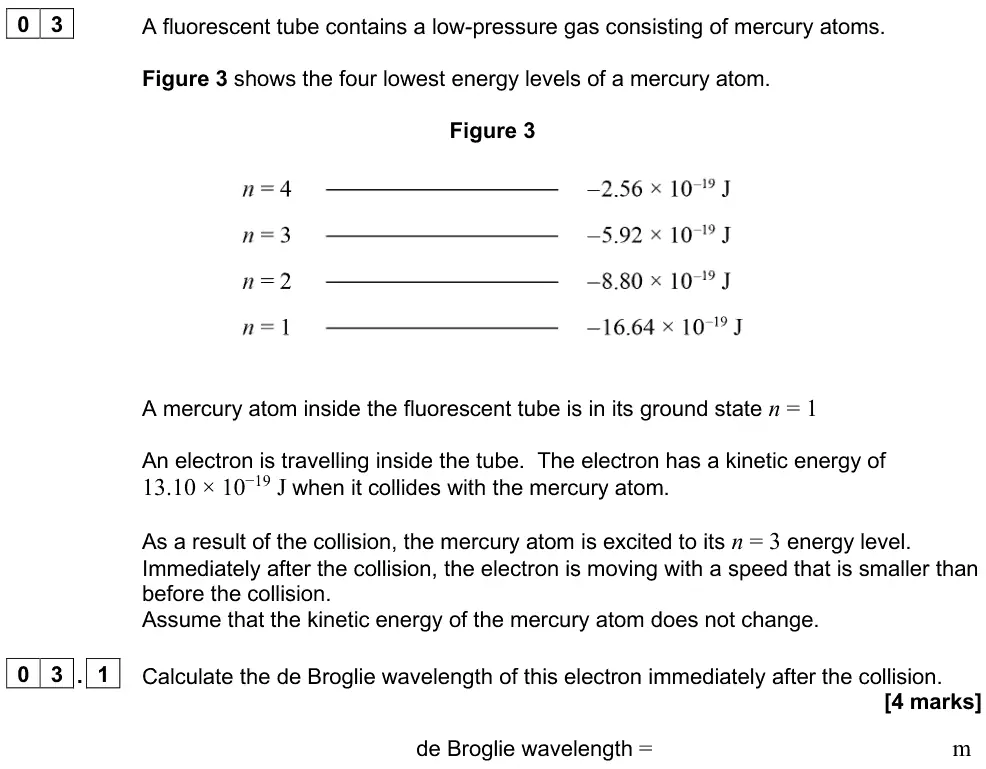
June 2025 · AS Paper 1 · Q3.22 marksAO1=1, AO2=1CalculationEasy
Earlier part of question 3 that this part uses
Mark scheme
Examiner's comment
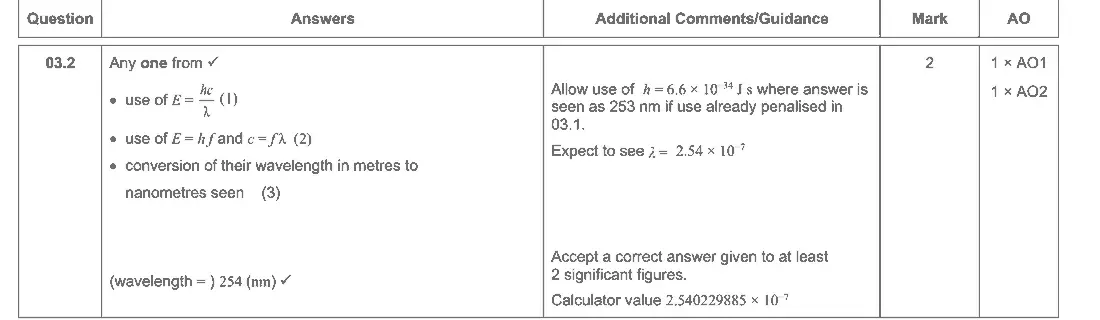
03.1 Again, this multi-step calculation effectively differentiated between student ability levels. Approximately 30% gained all four marks with 20 % gaining three marks, a further 20% gained 2 marks and 15 % one mark. High achieving students typically obtained all 4marks and presented their working in a clear manner that demonstrated their understanding of the context. The most common ways in which students obtained partial marks included: using 13.1 x 10⁻¹⁹ J as the kinetic energy of the electron yielding a value of 4.3 x 10⁻¹⁰ m • for the de Broglie wavelength. determining the kinetic energy of the scattered electron but no knowing how to • ℎ𝑐𝑐 proceed. 𝜆𝜆 to determine a wavelength. setting their kinetic energy equal to • 03.2 63% of students gained both marks while 25% gained one mark. Most students could deal with this less onerous calculation. Where a mark was lost, it was very commonly due an incorrect conversion of their wavelength in metres into nanometres or leaving their answer in metres (2.54 x 10⁻⁷ m).
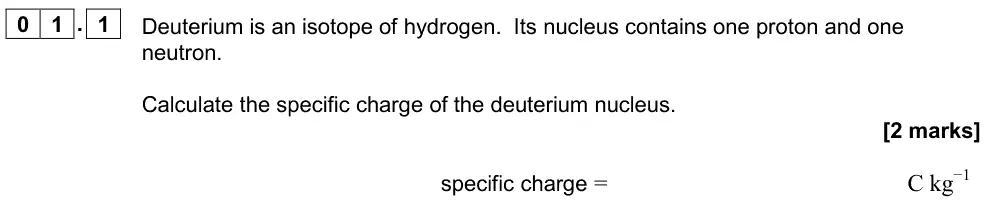
01.1 Most students performed well in this straightforward calculation, with over 65% achieving full marks and a further 20% securing one mark. Common misconceptions included: reversing the required ratio by dividing mass by charge, despite the unit (C kg–1 ) • provided on the answer line. incorrectly using the relative mass and charge values of 1 for a proton rather than the • actual values. misjudging the magnitude; some students incorrectly rewrote 3.2 × 10⁷ as 3.2 × 10⁻⁷ , • believing the initial result was implausibly large. 01.2 Over 80% of students gained at least one mark, though only about 40% were able to produce an answer that gained both marks. Common deficiencies in answers included: discussing differences in mass between isotopes without noting that the charge • remains constant. identifying that isotopes have different numbers of neutrons but neglecting to deduce, • either from previous knowledge or the information in the question, that hydrogen-3 has more neutrons. not recognising hydrogen-1 as an isotope limiting their comparisons to hydrogen-3 and • hydrogen-2 (although these students were able to gain both marks where appropriate working that mentioned charge and mass was seen). 01.3 Approximately 40% of students correctly deduced and justified the quark structure of this neutral kaon (s̅d). A further 20% gained two marks, typically by: stating the correct structure but neglecting to provide the supporting reasoning. • correctly identifying the presence of a strange quark but omitting the understanding • that a kaon is a meson. 01.4 Higher performing students (approximately 40%) were able to answer this question by realising that conservation of lepton number occurs within each generation and that particle A must be an antilepton due to it carrying a positive charge. stating that charge must be conserved. • a general statement that lepton number is conserved without realising that this is true • within each lepton generation.
Notes from the mark scheme and report
Answer: 254 nm (hc/E = 2.54 x 10^-7 m)
metre-to-nm conversion was the usual slip
Skills: MS2.3 Substitute numerical values into algebraic equations using appropriate units for physical quantities; MS0.1 Recognise and make use of appropriate units in calculations
June 2025 · AS Paper 1 · Q3.32 marksAO1=1, AO2=1Calculation
Earlier part of question 3 that this part uses
Mark scheme
Examiner's comment
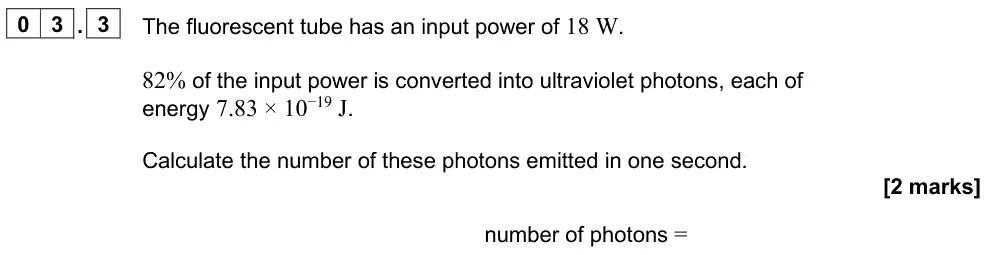
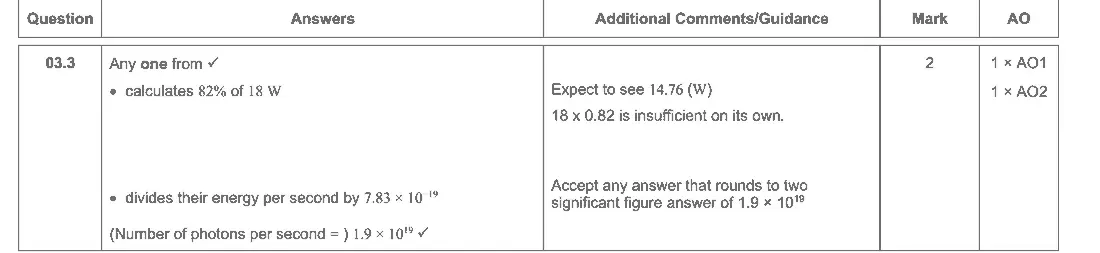
03.3 Most students (almost 85%) were able to calculate 82% of the input power. Those students who lost a mark typically reversed the required ratio and divided the photon energy by their power.
Notes from the mark scheme and report
Answer: 1.9 x 10^19 photons per second (0.82 x 18 = 14.76 W divided by 7.83 x 10^-19 J)
inverting the ratio was the common error
Skills: MS0.3 Use ratios, fractions and percentages; MS0.2 Recognise and use expressions in decimal and standard form
June 2025 · Paper 1 · Q8.43 marksAO1=1, AO2=2CalculationEasy
Earlier part of question 8 that this part uses
Mark scheme
Examiner's comment
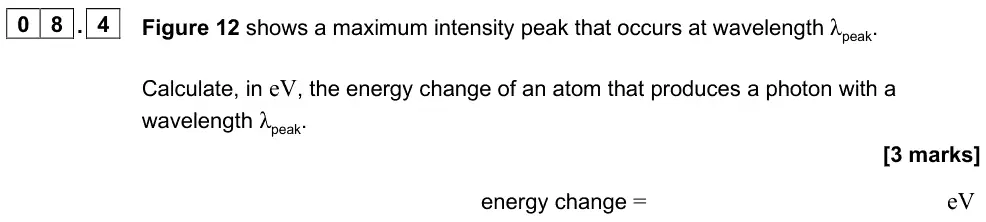
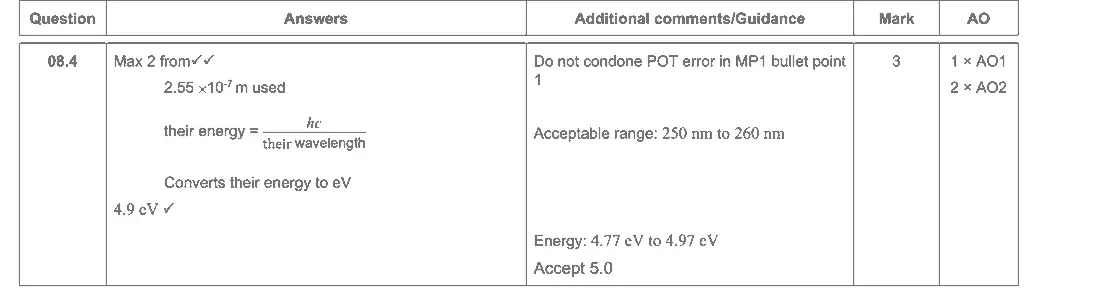
More than 70% of students obtained all three marks for Question 8.4. Common errors included misreading the graph, not converting nm to m correctly and failing to convert to eV. The final mark was withheld from students who gave the answer ‘5’ as this is a 1sf answer. The most straightforward multiple-choice questions were B11 and B13. Both were answered correctly by more than 90% of students.
Notes from the mark scheme and report
Answer: 4.9 eV (lambda peak 2.55 x 10^-7 m, E = hc/lambda = 7.8 x 10^-19 J)
'5' (1 sf) lost the last mark
misreading graph and nm conversion errors
Skills: MS3.1 Translate information between graphical, numerical and algebraic forms; MS2.3 Substitute numerical values into algebraic equations using appropriate units for physical quantities; MS1.1 Use an appropriate number of significant figures
June 2025 · AS Paper 2 · Q81 markAO1=1Multiple choice
Answer
D
Mark scheme
Notes from the mark scheme and report
Answer: D
June 2024 · Paper 1 · Q1.11 markAO1=1Short answerEasy
Mark scheme
Examiner's comment
More than 75% of students were able to answer question 01.1 correctly. The most common error was to write ‘electrostatic’ for ‘electromagnetic’.
Notes from the mark scheme and report
All four needed for the mark
'electrostatic' for 'electromagnetic' was the commonest error
June 2024 · AS Paper 1 · Q1.34 marksAO3=4Explanation
Earlier part of question 1 that this part uses
Mark scheme
Examiner's comment
01.3
Notes from the mark scheme and report
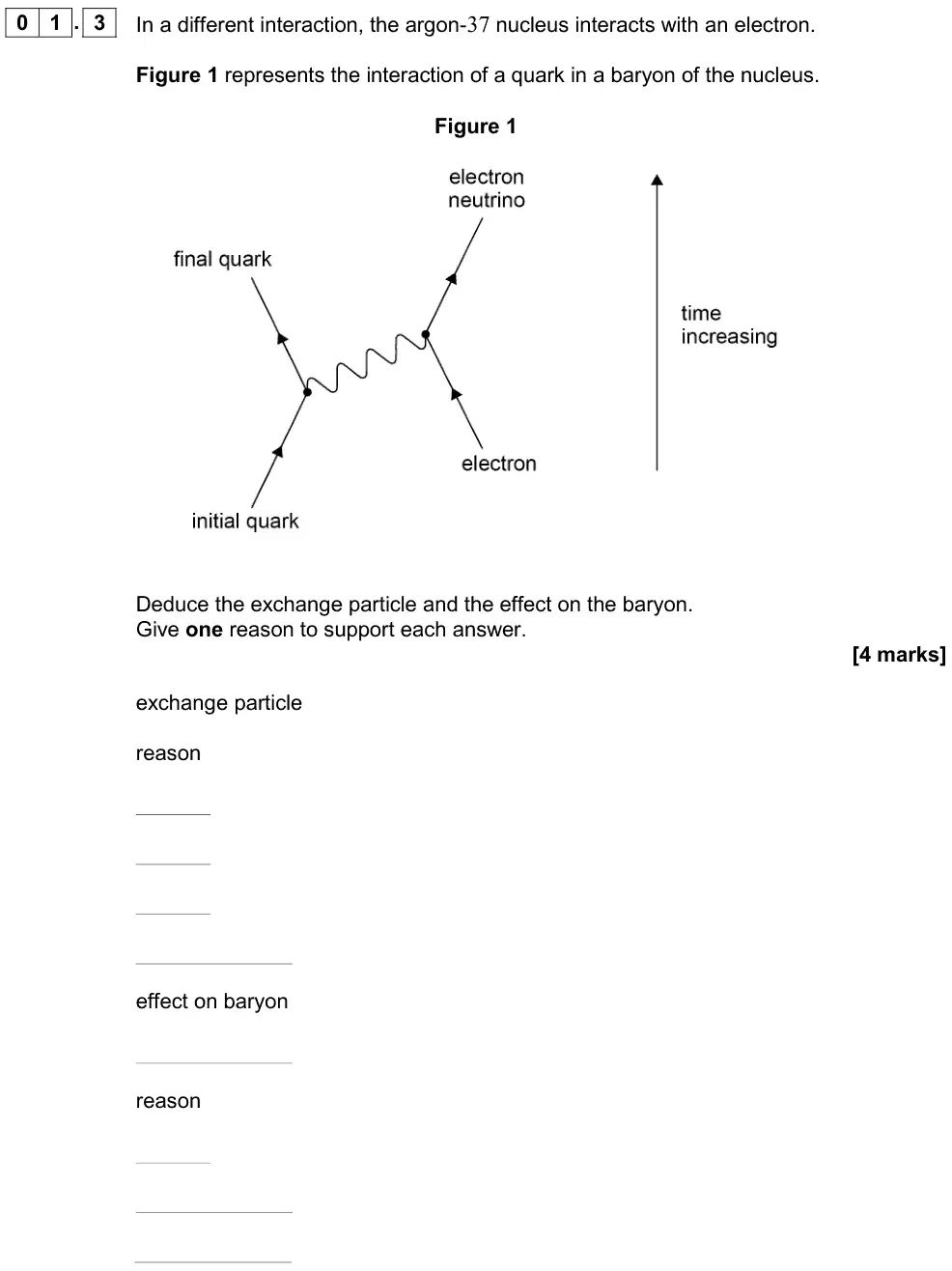
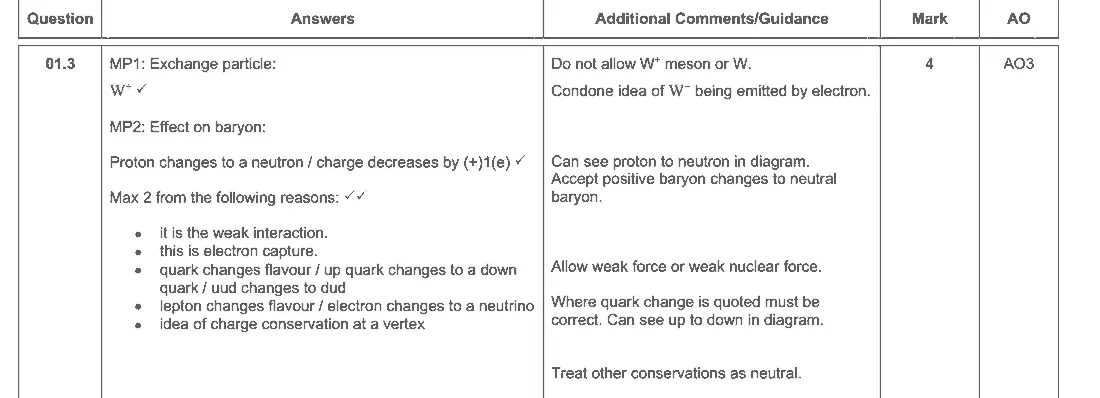
Exchange particle W+ (weak interaction / electron capture)
proton changes to a neutron (up quark becomes down)
one reason each
many thought a neutron became a proton
June 2024 · Paper 1 · Q1.32 marksAO1=2Explanation
Earlier part of question 1 that this part uses
Mark scheme
Examiner's comment
In question 01.3, most students were able to identify the weak interaction as the one responsible for neutron decay. Many failed to obtain the second mark by giving weak or irrelevant answers. The best answers made a clear reference to leptons or the change in quark flavour.
Notes from the mark scheme and report
Mark 2 (leptons involved OR change of quark flavour) only if weak interaction named
June 2024 · AS Paper 1 · Q1.46 marksAO1=66-mark extended response
Earlier part of question 1 that this part uses
Mark scheme, with the levels and indicative content
Examiner's comment
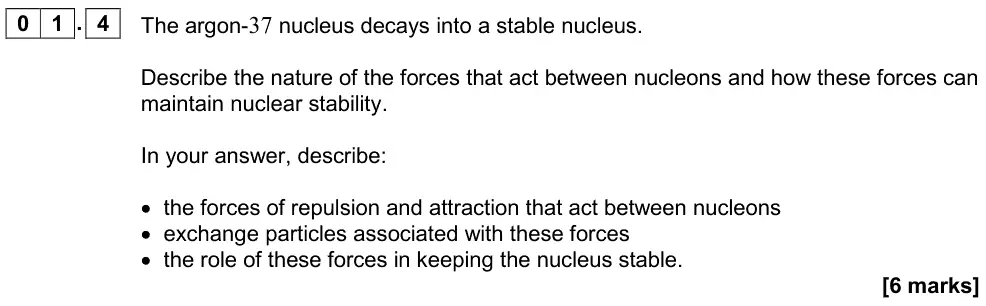
Many students thought that a neutron changed into a proton in this interaction and found it difficult to access more than two marks. Others commented on the effect the interaction had on the baryon number rather than on the baryon. Typically, higher attaining students presented work that was easy to follow and clearly linked their reason to the appropriate deduction. 01.4
Notes from the mark scheme and report
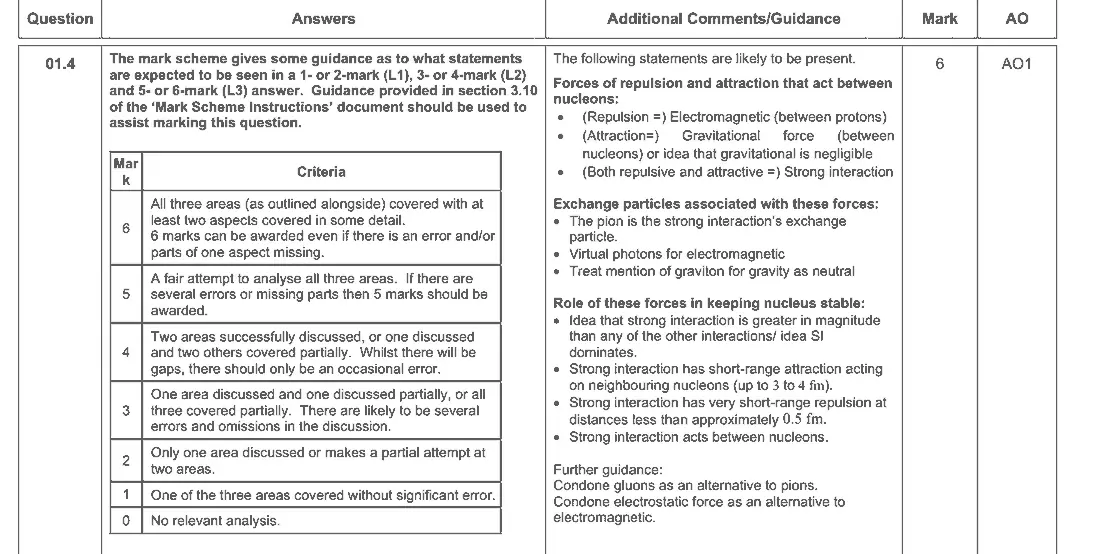
Levels of response: electromagnetic repulsion between protons (virtual photon), negligible gravity, strong interaction attractive to about 3 fm and repulsive below 0.5 fm (pion exchange), strong interaction dominates between neighbouring nucleons
June 2024 · Paper 1 · Q1.43 marksAO1=3Explanation
Earlier part of question 1 that this part uses
Mark scheme
Examiner's comment
The most common mark awarded in question 01.4 was for identifying the virtual photon as the exchange particle. Very few students went on to explain the change in paths in terms of conservation of momentum. This is clearly a part of the specification that is poorly understood. The question did discriminate quite well, however.
Notes from the mark scheme and report
Virtual photon as exchange particle
photon carries momentum
conservation of momentum changes the paths. Few got beyond naming the photon
June 2024 · AS Paper 1 · Q2.23 marksAO1=2, AO2=1Calculation
Earlier part of question 2 that this part uses
Mark scheme
Examiner's comment
02.2
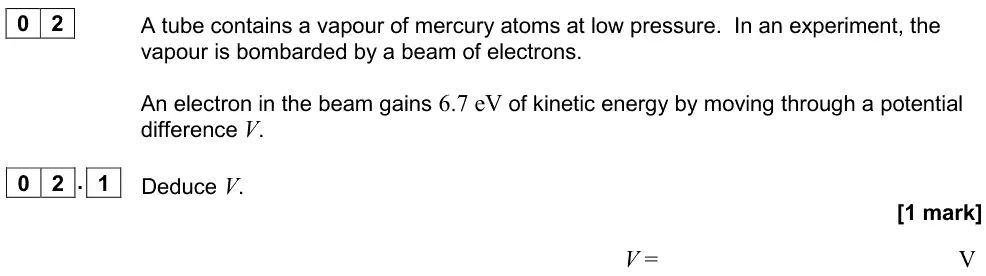
This is another question that worked well in discriminating between students. Over 10% of students gained three marks or more whereas approximately 50% gained at least two marks. Typically, students scoring two marks only answered the absorption aspect of the question. They described how the atomic electron accepted the 18.4 eV and moved from ground state to level B and then stopped, thinking that they had completely answered the question. Some attempted to describe the emission of the visible photon but chose the wrong transition suggesting that the electron moved directly from B to the ground state and that the 18.4 eV photon was visible. The most able students identified the transition from B to A as being responsible for the emission of a visible photon. They calculated the wavelength of this light and knew that this wavelength lay inside the visible range. Very few referred to the information given in the stem above 02.2; the 6.7 eV photon was identified as a photon of ultraviolet radiation. They could have made a comparison of the photon energies of the transitions B to A, A to ground state, and B to ground state with 6.7 eV to decide which transition was responsible for the photon of visible light.
Well over 90% of students gained at least one mark with over 25% gaining both marks. Most students who gained one mark obtained the resistance of the lamp as 2.2 Ω and presented this as their final answer. They determined the resistance by either using V=IR or reading-off the resistance from Figure 13. Of those who realised that more was required, they mostly chose to determine the total mark through arithmetic errors such as 9 – 3.3 = 6.7 instead of 5.7. resistance in the circuit and subtract the lamp’s resistance to find R’s resistance. Some lost the second
Notes from the mark scheme and report
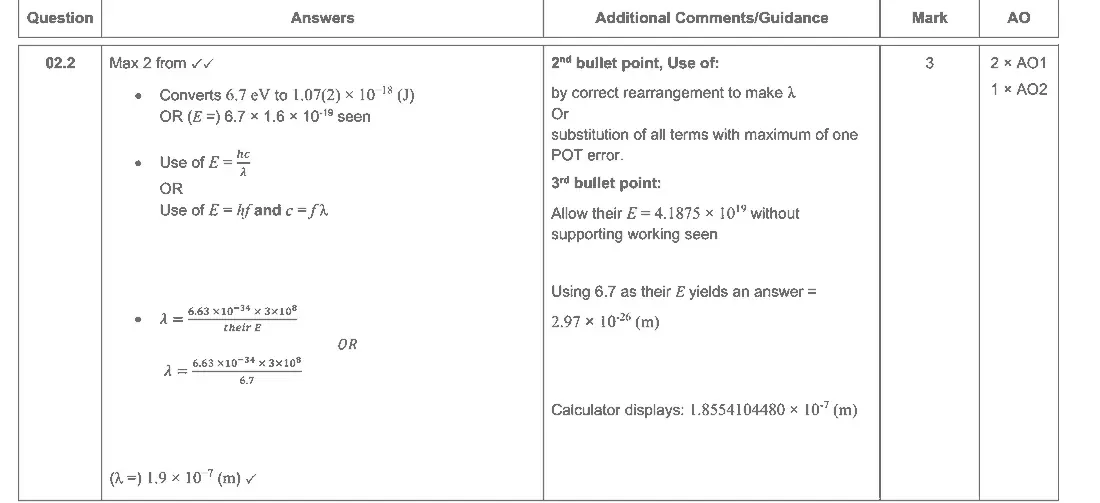
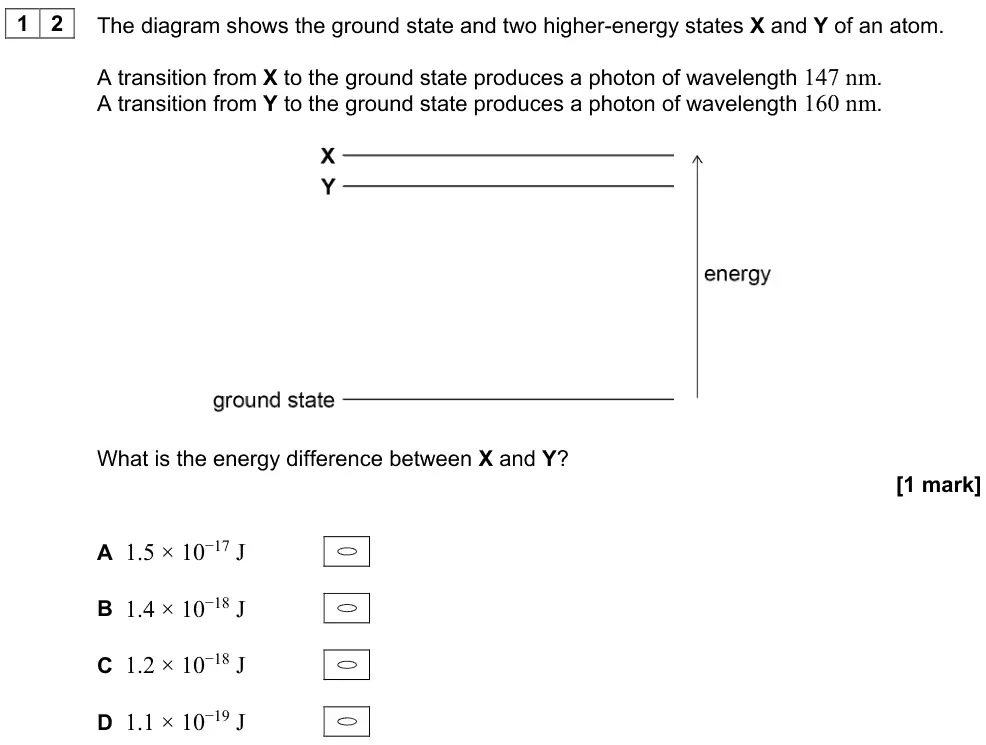
Answer: 1.9 x 10^-7 m (6.7 eV = 1.07 x 10^-18 J, lambda = hc/E)
Skills: MS2.3 Substitute numerical values into algebraic equations using appropriate units for physical quantities; MS0.2 Recognise and use expressions in decimal and standard form
June 2024 · Paper 1 · Q2.32 marksAO1=2Short answer
Earlier part of question 2 that this part uses
Mark scheme
Examiner's comment
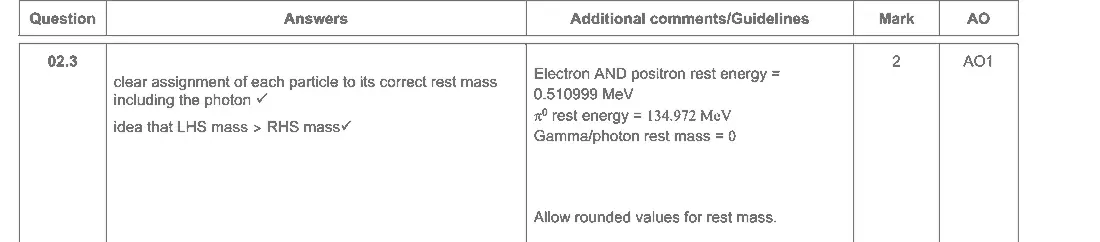
Question 02.3 required students to look up data in the data and formulae booklet and most managed to do this. Problems arose with the rest mass of the photon. Many students identified the difference in rest mass between the pion and positron/electron pair and assumed it was ‘given’ to the photon. The best answers made it clear that the photon rest mass is zero and that the difference in rest masses would be seen in the kinetic energies of the products. Surprisingly fewer than 35% of students identified annihilation of the positron with an electron as the source of more gamma photons in question 02.4.
Notes from the mark scheme and report
Values from the data booklet (electron/positron 0.510999 MeV, pion 134.972 MeV)
photon rest energy is zero - many gave the mass difference to the photon
June 2024 · Paper 1 · Q2.41 markAO1=1Short answerHard
Earlier part of question 2 that this part uses
Mark scheme
Examiner's comment
Question 02.3 required students to look up data in the data and formulae booklet and most managed to do this. Problems arose with the rest mass of the photon. Many students identified the difference in rest mass between the pion and positron/electron pair and assumed it was ‘given’ to the photon. The best answers made it clear that the photon rest mass is zero and that the difference in rest masses would be seen in the kinetic energies of the products. Surprisingly fewer than 35% of students identified annihilation of the positron with an electron as the source of more gamma photons in question 02.4.
Notes from the mark scheme and report
Annihilation of the positron with an electron
'elimination' not accepted
June 2024 · AS Paper 2 · Q161 markMultiple choice
Answer
C
Mark scheme
Notes from the mark scheme and report
Answer: C
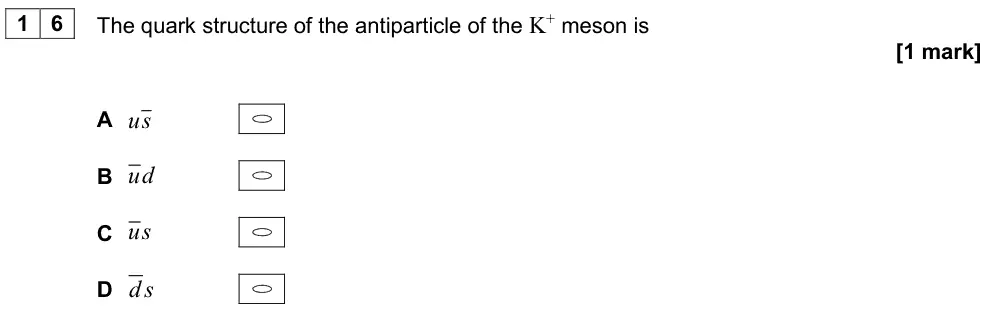
most chose A, the K+ itself
June 2023 · AS Paper 1 · Q1.22 marksAO1=2Calculation
Earlier part of question 1 that this part uses
Mark scheme
Examiner's comment
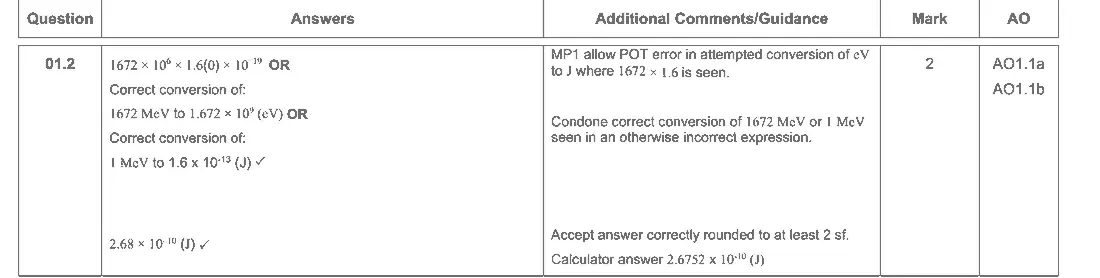
01.2 51% of students scored two marks. Power of ten errors were common, with a significant proportion of students either ignoring the prefix or dividing by 106 rather than multiplying by it. Many students divided by 1.6 × 10⁻¹⁹ rather than multiplying by this factor. Alternatively, they multiplied by the Planck constant.
This question proved the most accessible question in the paper for E grade students. Most students were able to gain some marks in parts 01.1 and 01.2. However, successful attempts at parts 01.3 and 01.4 were less common and usually indicative of grade A performance.
Notes from the mark scheme and report
Answer: 2.68 x 10^-10 J (1672 x 10^6 x 1.60 x 10^-19)
prefix and dividing by 1.6 x 10^-19 errors common
Skills: MS0.2 Recognise and use expressions in decimal and standard form; MS0.1 Recognise and make use of appropriate units in calculations
June 2023 · AS Paper 1 · Q1.32 marksExplanation
Earlier part of question 1 that this part uses
Mark scheme
Examiner's comment
01.3 Over 50% of students scored zero in this part. Many students misinterpreted this question, thinking that it was equivalent to energy conservation in beta minus decay. These students stated that another particle is produced that carries away the missing energy even though the energy of the products had increased. Others attempted to refer to conservation of charge, baryon number and strangeness as evidence that energy must also be conserved, without any reference to the rest energies of the particles. Better performing students typically produced statements that answered the question in a clear and concise manner.
This question proved the most accessible question in the paper for E grade students. Most students were able to gain some marks in parts 01.1 and 01.2. However, successful attempts at parts 01.3 and 01.4 were less common and usually indicative of grade A performance.
Notes from the mark scheme and report
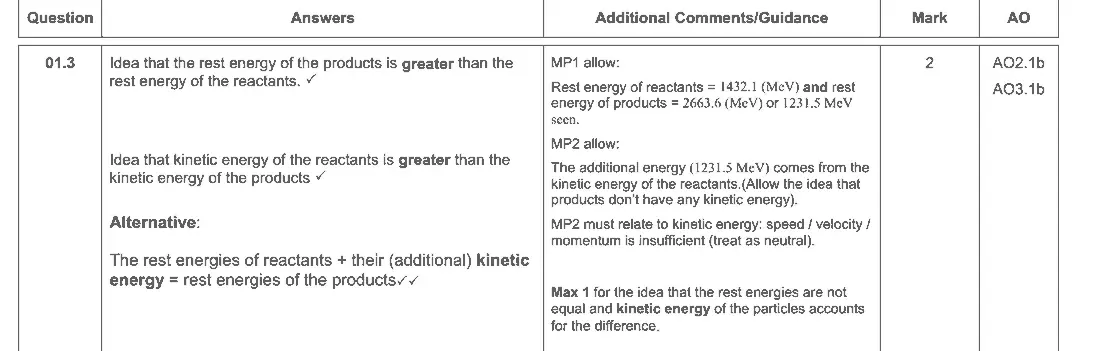
Products' rest energy (2663.6 MeV) exceeds reactants' (1432.1 MeV)
the difference comes from the reactants' kinetic energy (more KE before than after)
many wrongly argued a missing particle as in beta decay
June 2023 · Paper 1 · Q1.31 markAO1=1Short answer
Earlier part of question 1 that this part uses
Mark scheme
Examiner's comment
01.3 Just over half of the students gave the correct answer. Ambiguous and contradictory answers were relatively common. Students should be advised to make their answer clear in order to get credit.
Notes from the mark scheme and report
Antineutron
answer in quarks only or ambiguous answers not credited
just over half correct
June 2023 · Paper 1 · Q1.41 markAO1=1Calculation
Earlier part of question 1 that this part uses
Mark scheme
Examiner's comment
01.4 This straightforward calculation caused little problem for the majority of students. There were some who had difficulty with the unit conversion, being unsure about whether to multiply or divide by the charge on the electron. With only one mark available, no marks were given for partially correct answers.
Notes from the mark scheme and report
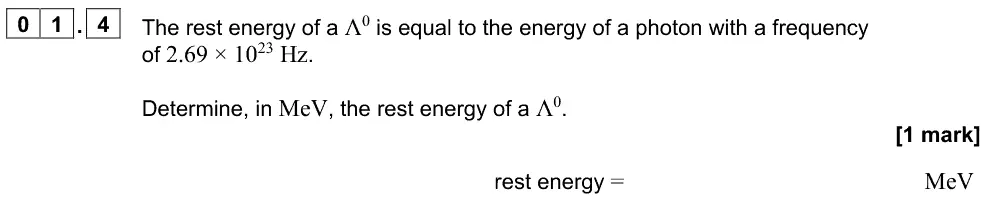
Answer: 1.11 x 10^3 MeV (E = hf = 1.78 x 10^-10 J, divide by 1.6 x 10^-13)
multiply/divide by e confusion
Skills: MS0.2 Recognise and use expressions in decimal and standard form
June 2023 · AS Paper 1 · Q1.52 marksCalculationEasy
Earlier part of question 1 that this part uses
Mark scheme
Examiner's comment
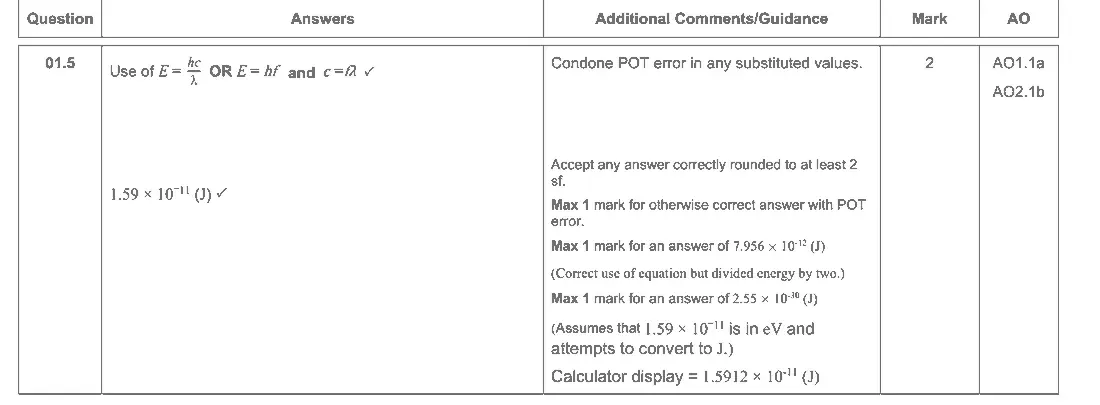
01.5 Almost 80% of students scored both marks. Common errors included: • substituting the wavelength into E=hf instead of the frequency h c • forgetting about c when substituting into E= λ • lack of awareness that the values of h and c could be found on the Data and formulae sheet.
Notes from the mark scheme and report
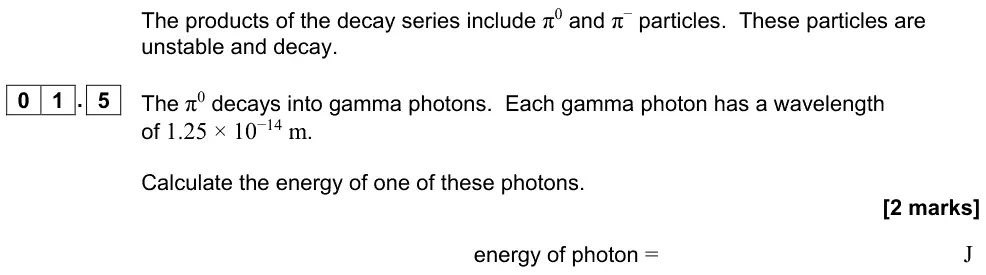
Answer: 1.59 x 10^-11 J (hc/lambda)
using lambda in E = hf was a common error
Skills: MS2.3 Substitute numerical values into algebraic equations using appropriate units for physical quantities; MS0.2 Recognise and use expressions in decimal and standard form
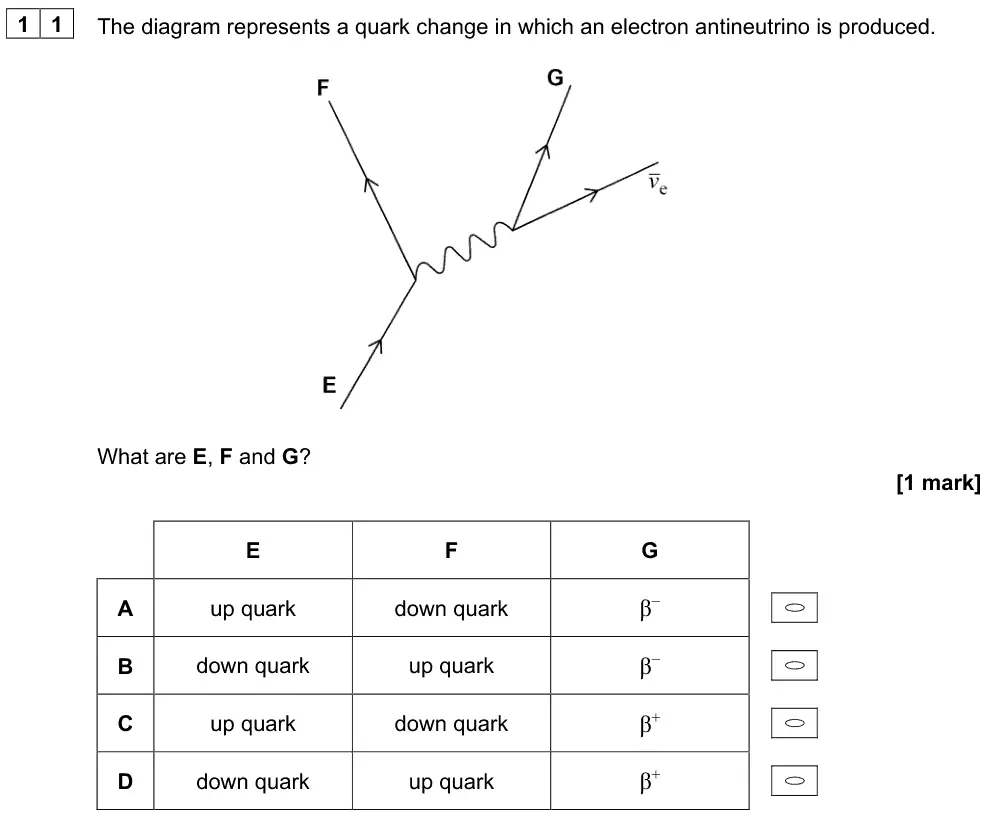
June 2023 · Paper 1 · Q111 markMultiple choiceEasy
Answer
B
Mark scheme
Examiner's comment
The multiple choice questions covered parts of the specification not covered in Section A. The distractors in these questions were written with common errors and misconceptions in mind. These questions are therefore an extremely useful resource when preparing students. The easiest questions were 7, 12, 20, 10 and 11, with over 75% of students getting these questions right. The most demanding were 18, 26, 22, 21 and 13; fewer than 40% of students got these right. For several of these the correct answer was not the most popular choice.
Notes from the mark scheme and report
Answer: B
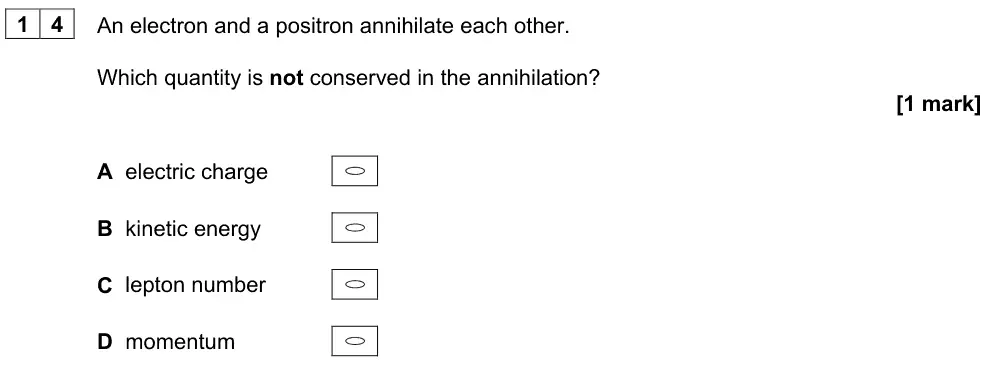
June 2023 · AS Paper 2 · Q141 markMultiple choice
Answer
B
Mark scheme
Notes from the mark scheme and report
Answer: B
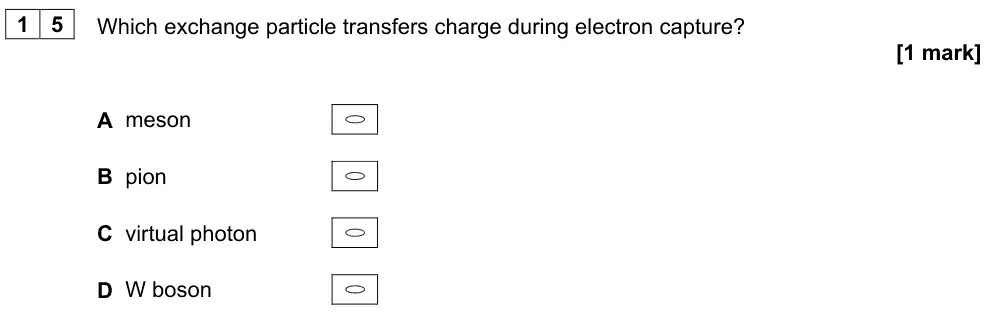
June 2023 · AS Paper 2 · Q151 markMultiple choice
Answer
D
Mark scheme
Notes from the mark scheme and report
Answer: D
June 2023 · AS Paper 2 · Q231 markMultiple choiceHard
Answer
B
Mark scheme
Examiner's comment
Generally, students were more successful in answering questions 9, 15, 16, 19, 25, 27, 28 (these all had a success rate of at least 65%) and were less successful in answering questions 6, 7, 18, 23 and 31 (answered correctly by 35% or fewer).
Notes from the mark scheme and report
Answer: B
June 2022 · Paper 1 · Q1.22 marksAO2=1, AO3=1Explanation
Earlier part of question 1 that this part uses
Mark scheme
Examiner's comment
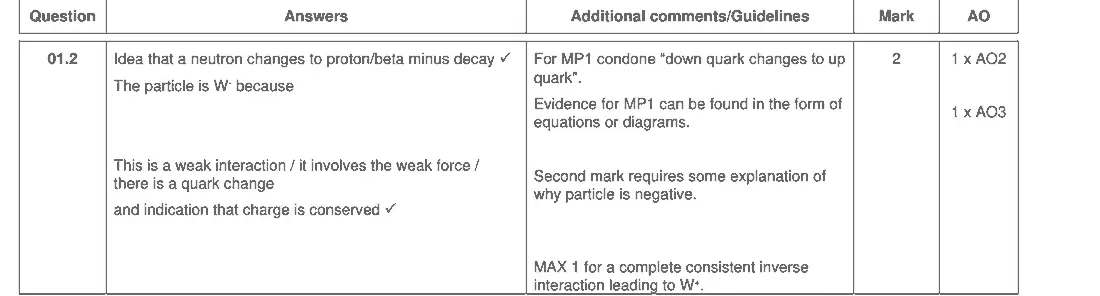
01.2 proved to be much more challenging. Most students were able to access the first mark, but few went on to explain fully why the boson was the W–, often missing out any consideration of the significance of the charge.
Notes from the mark scheme and report
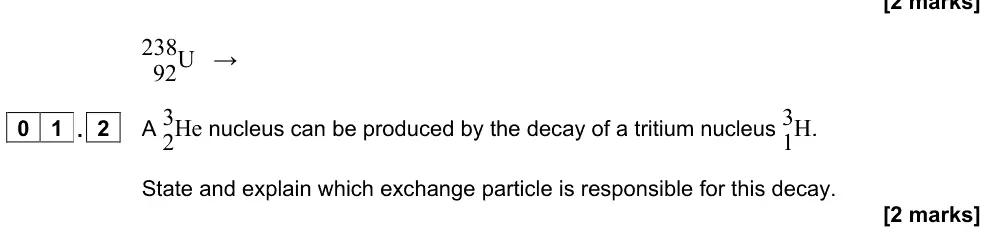
Tritium decay is beta-minus (neutron to proton, d to u), a weak interaction
exchange particle W- because charge must be conserved
the charge reasoning was usually missing
June 2022 · Paper 1 · Q2.43 marksAO3=3Calculation
Earlier part of question 2 that this part uses
Mark scheme
Examiner's comment
02.4 produced a good spread of marks and discriminated very well. Most students were able to pick up one mark for the energy calculation. Fewer went on to work out explicitly the energy of one photon. Fewer still saw that this was a minimum energy as it assumed that the particles were stationary.
Notes from the mark scheme and report
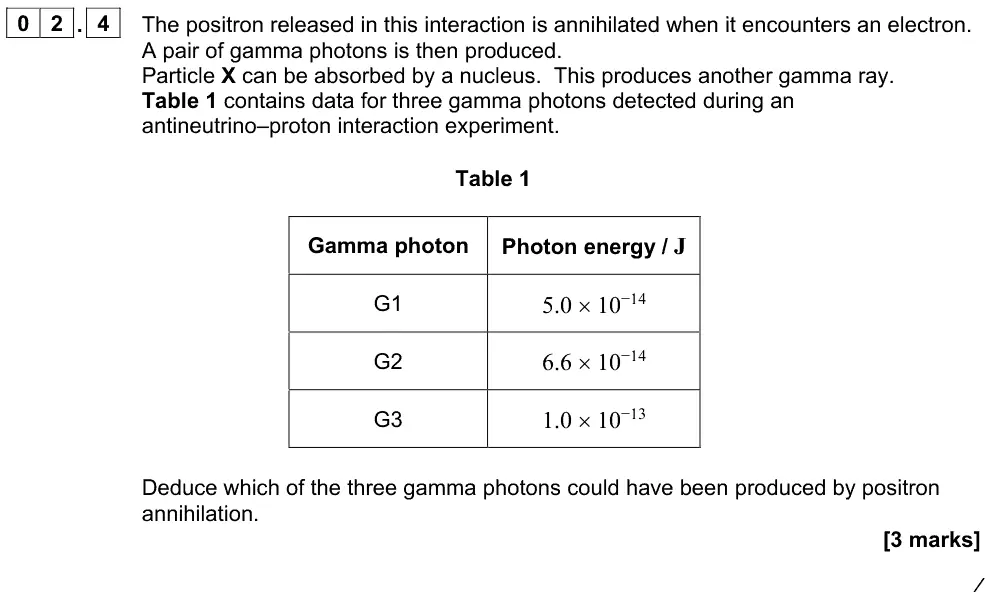
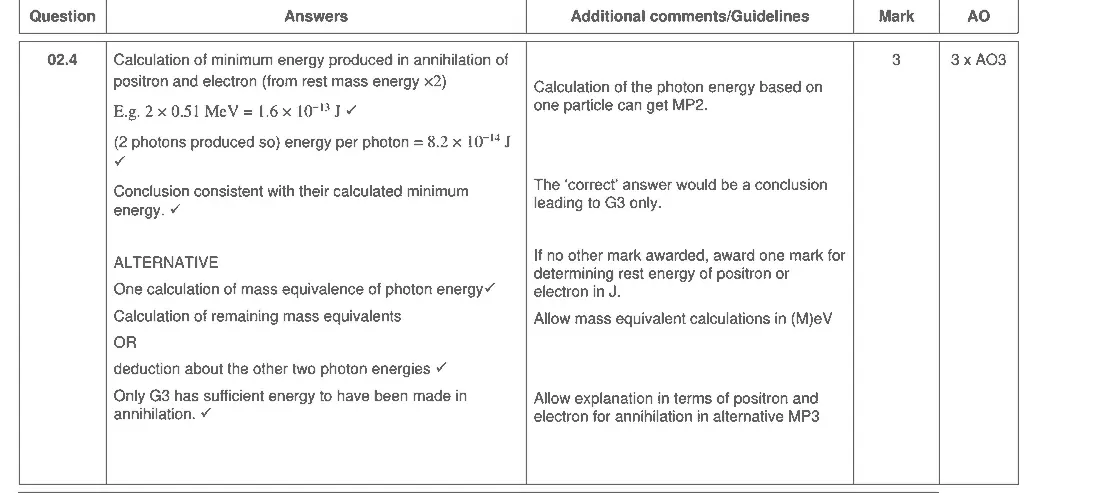
Minimum annihilation energy 2 x 0.511 MeV = 1.6 x 10^-13 J, so at least 8.2 x 10^-14 J per photon
only G3 qualifies
few saw it is a minimum because the particles may be moving
Skills: MS2.3 Substitute numerical values into algebraic equations using appropriate units for physical quantities; MS0.2 Recognise and use expressions in decimal and standard form
June 2022 · AS Paper 2 · Q81 markAO1=1Multiple choice
Answer
A
Mark scheme
Notes from the mark scheme and report
Answer: A
June 2022 · AS Paper 2 · Q121 markAO1=1Multiple choice
Answer
D
Mark scheme
Notes from the mark scheme and report
Answer: D
Skills: MS0.2 Recognise and use expressions in decimal and standard form
November 2021 · AS Paper 1 · Q1.52 marksAO2=2Short answer
Earlier part of question 1 that this part uses
Mark scheme
Notes from the mark scheme and report
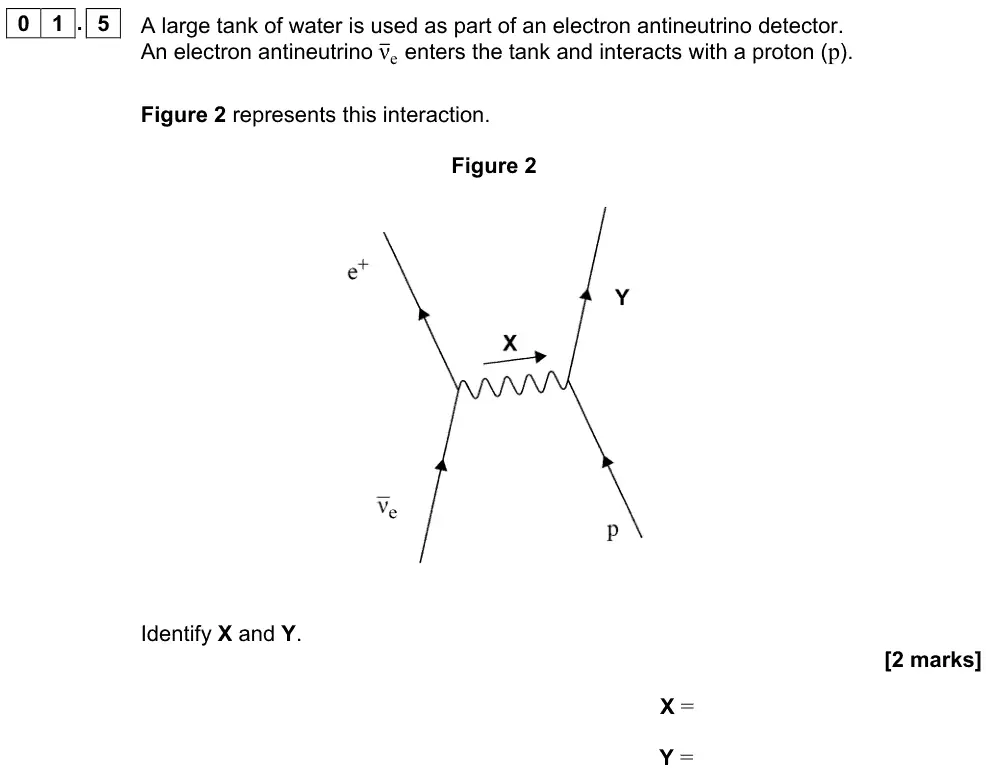
X = W- boson, Y = neutron
November 2021 · AS Paper 1 · Q1.63 marksExplanation
Earlier part of question 1 that this part uses
Mark scheme
Notes from the mark scheme and report
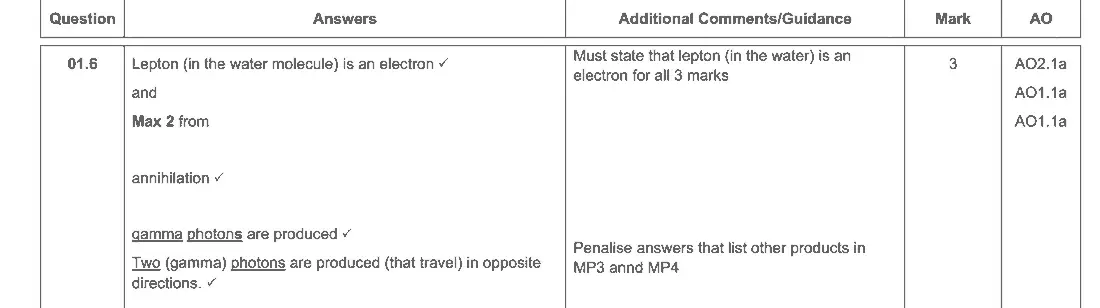
Lepton is an electron (needed for all 3 marks)
annihilation
two gamma photons produced travelling in opposite directions
November 2021 · AS Paper 1 · Q1.73 marksAO3=3Explanation
Earlier part of question 1 that this part uses
Mark scheme
Notes from the mark scheme and report
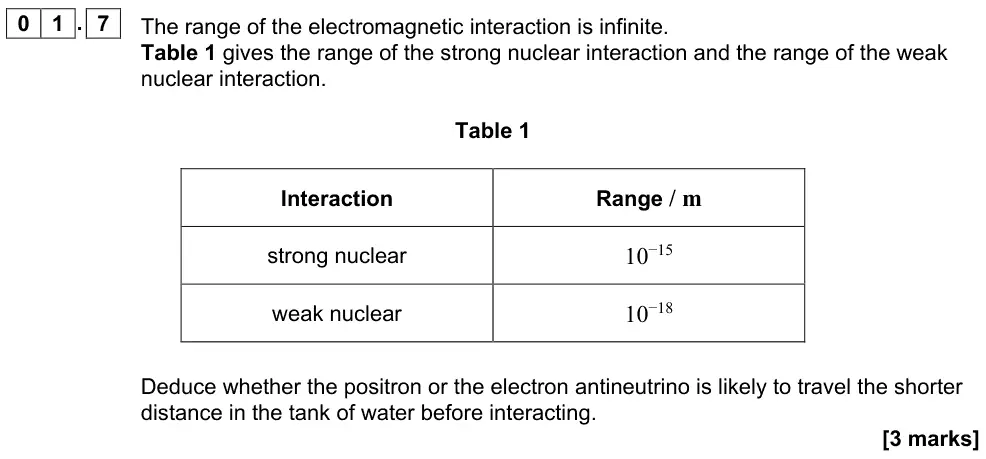
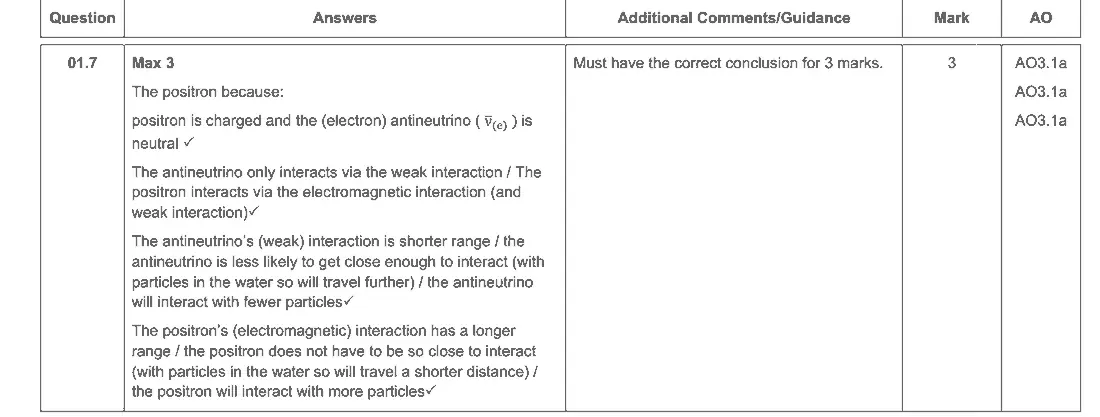
Positron is charged so interacts electromagnetically (infinite range)
antineutrino is neutral and only feels the very short-range weak interaction
so the positron travels the shorter distance (conclusion needed for 3)
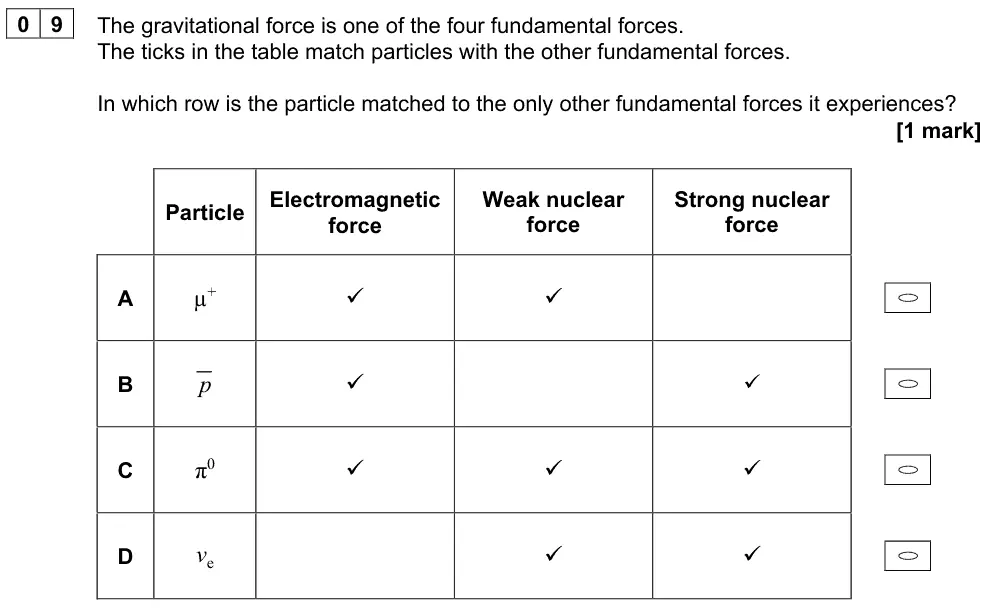
November 2021 · Paper 1 · Q91 markMultiple choice
Answer
A
Mark scheme
Notes from the mark scheme and report
Answer: A
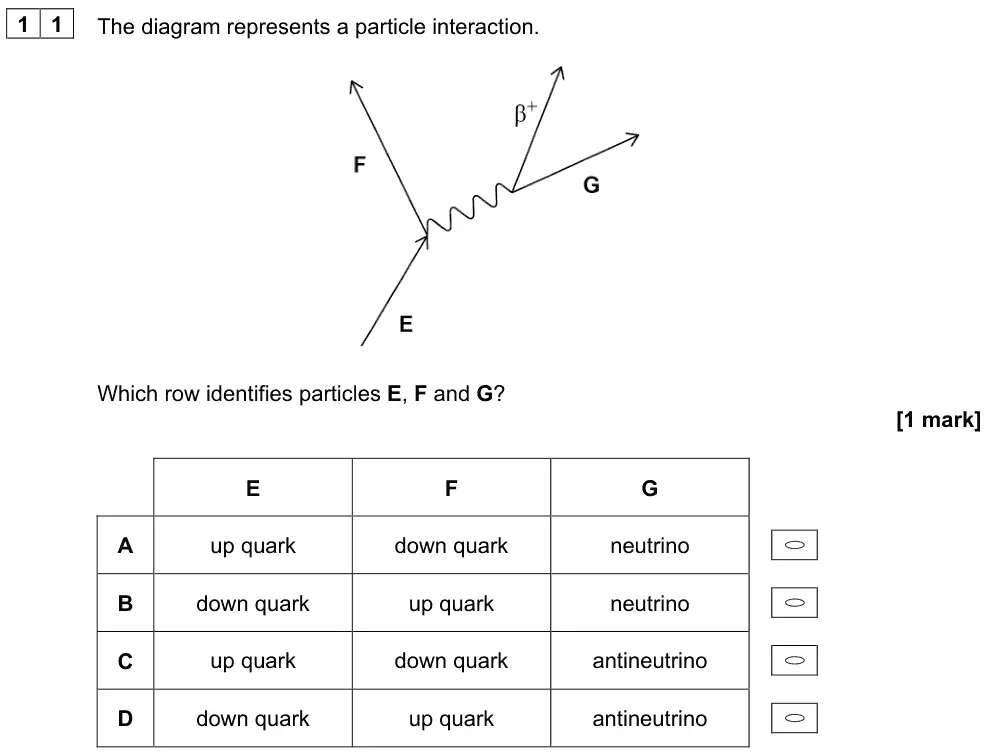
November 2021 · Paper 1 · Q111 markMultiple choice
Answer
A
Mark scheme
Notes from the mark scheme and report
Answer: A
November 2021 · AS Paper 2 · Q5.12 marksAO2=2Show that
Mark scheme
Notes from the mark scheme and report
Answer: 0.0136 W (E = hc/lambda = 4.5 x 10^-19 J x 3.0 x 10^16 s^-1)
Skills: MS2.3 Substitute numerical values into algebraic equations using appropriate units for physical quantities
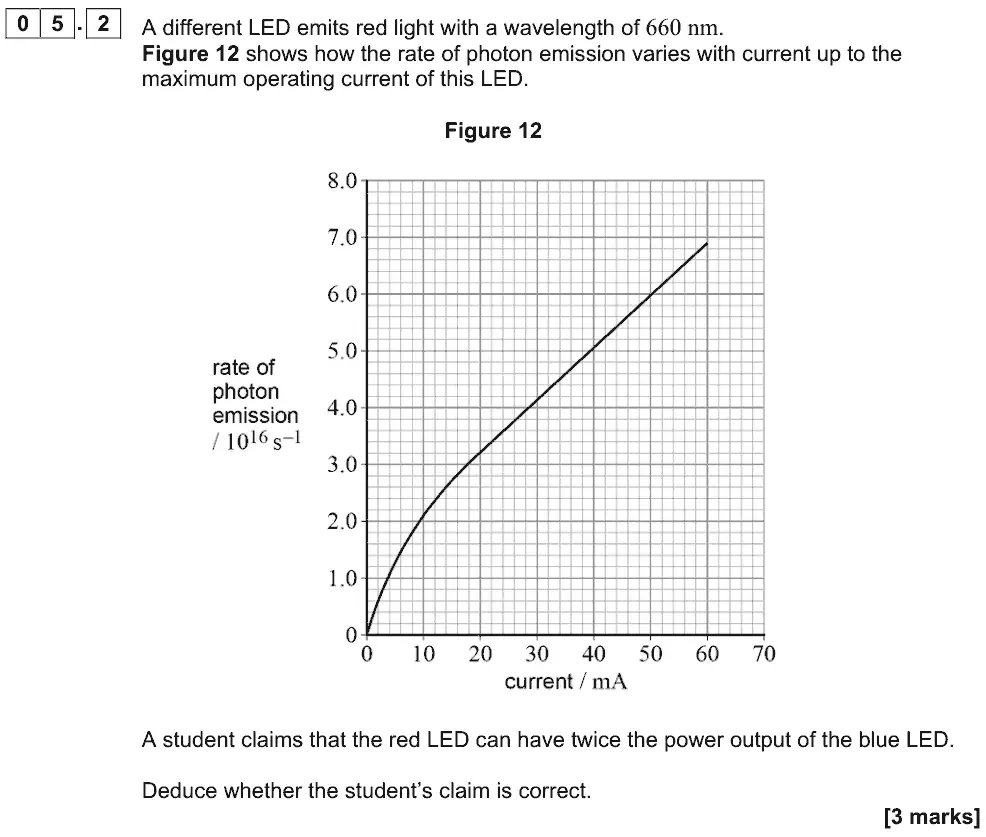
November 2021 · AS Paper 2 · Q5.23 marksAO3=3Explanation
Earlier part of question 5 that this part uses
Mark scheme
Notes from the mark scheme and report
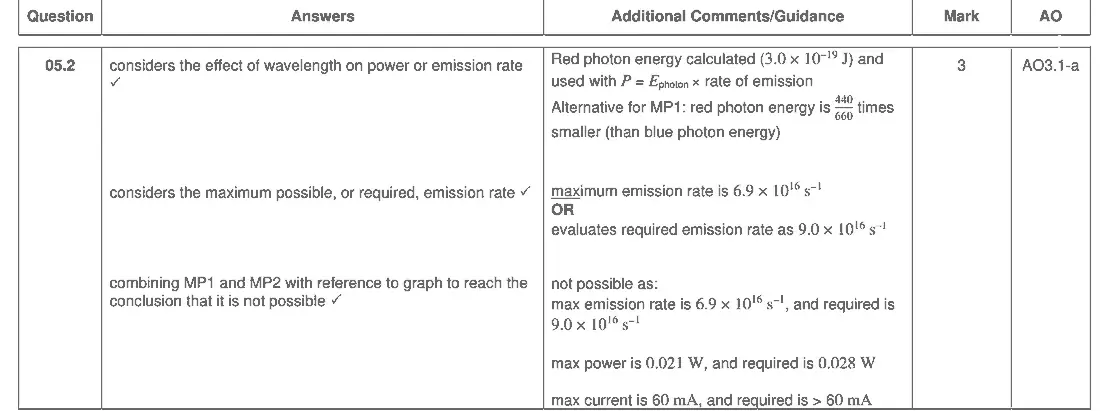
Claim incorrect: red photon 3.0 x 10^-19 J
max emission rate 6.9 x 10^16 s^-1 at 60 mA gives 0.021 W, but 0.028 W needs 9.0 x 10^16 s^-1
Skills: MS3.1 Translate information between graphical, numerical and algebraic forms; MS0.3 Use ratios, fractions and percentages
November 2021 · AS Paper 2 · Q71 markMultiple choice
Answer
D
Mark scheme
Notes from the mark scheme and report
Answer: D
November 2021 · AS Paper 2 · Q91 markMultiple choice
Answer
B
Mark scheme
Notes from the mark scheme and report
Answer: B
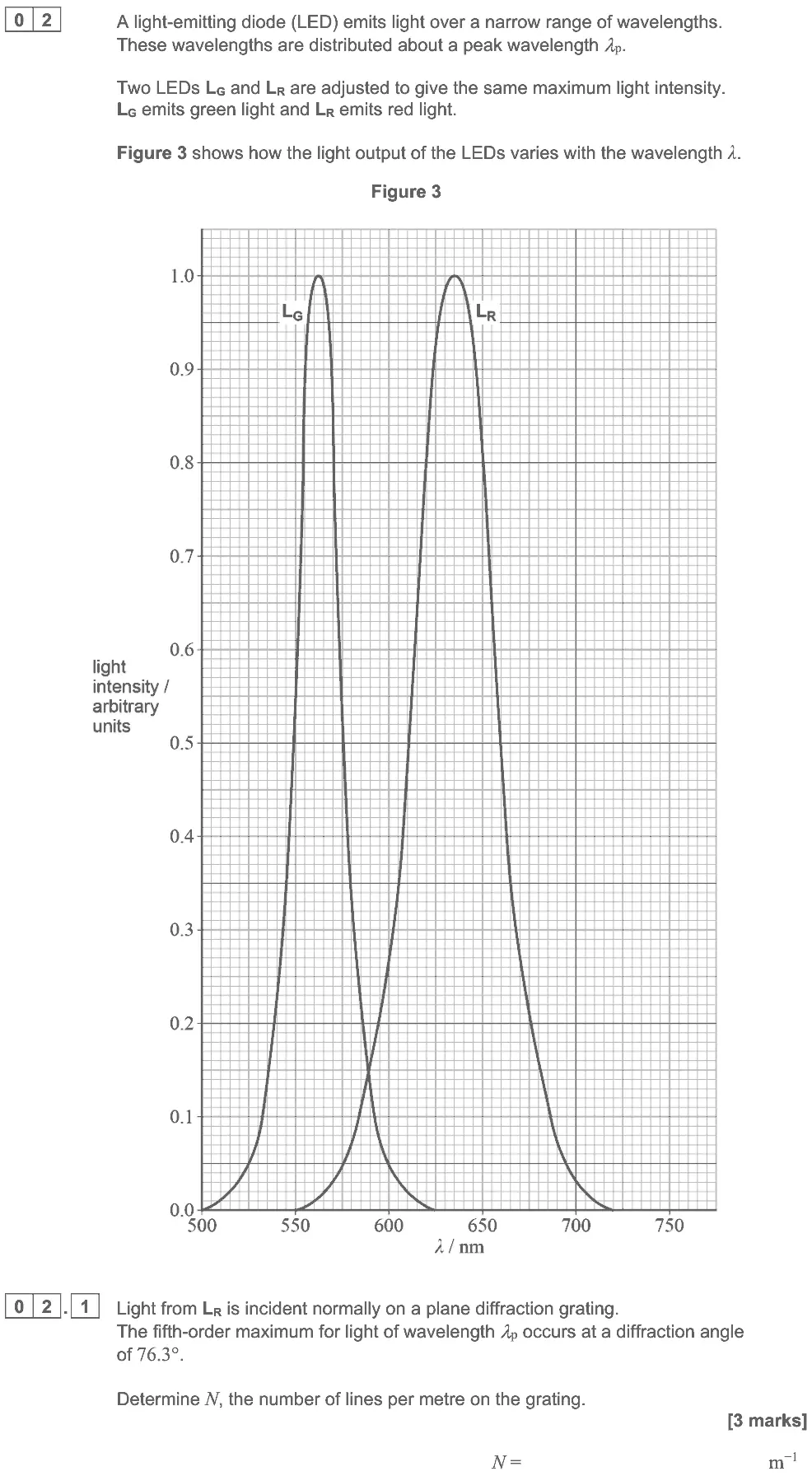
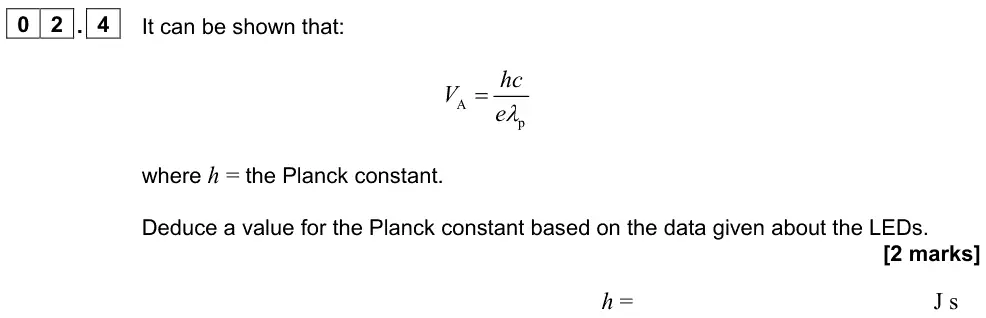
November 2021 · Paper 3 Section A · Q2.42 marksCalculationHard
Earlier part of question 2 that this part uses
Mark scheme
Examiner's comment
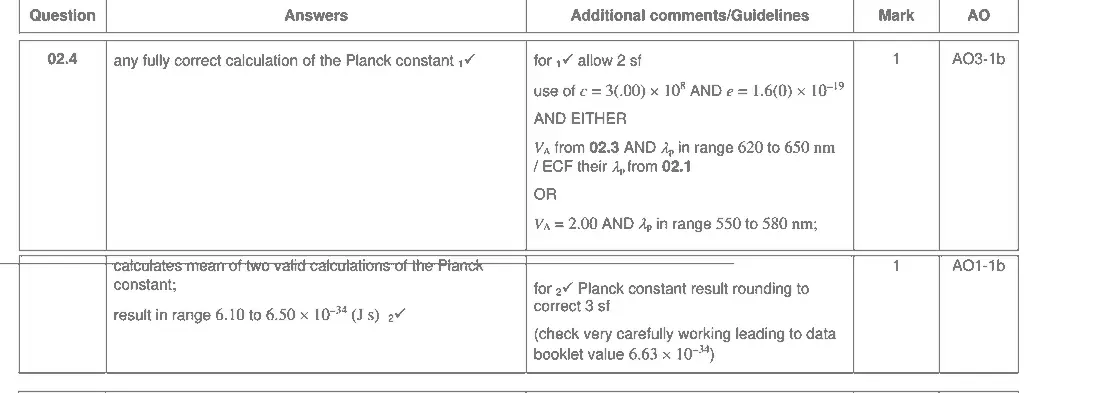
In question 02.4 only 3% of the students successfully used data about both LEDs; some engineered an answer that duplicated the value in the Formulae and Data booklet. All students realised that c is the speed of light but not all recognised that e is the electronic charge and used 2.718 in their calculation.
Notes from the mark scheme and report
h = e VA lambda_p / c for each LED (VA 1.92 V with 635 nm
2.00 V with 560 nm), mean 6.1-6.5 x 10^-34 J s
using e = 2.718 or engineering the data-booklet value penalised
Skills: MS2.2 Change the subject of an equation, including non-linear equations; MS1.2 Find arithmetic means
November 2020 · Paper 1 · Q131 markMultiple choice
Answer
A
Mark scheme
Notes from the mark scheme and report
Answer: A
Skills: MS3.1 Translate information between graphical, numerical and algebraic forms
November 2020 · Paper 1 · Q141 markMultiple choice
Answer
D
Mark scheme
Notes from the mark scheme and report
Answer: D
November 2020 · AS Paper 2 · Q4.22 marksCalculation
Earlier part of question 4 that this part uses
Mark scheme
Notes from the mark scheme and report
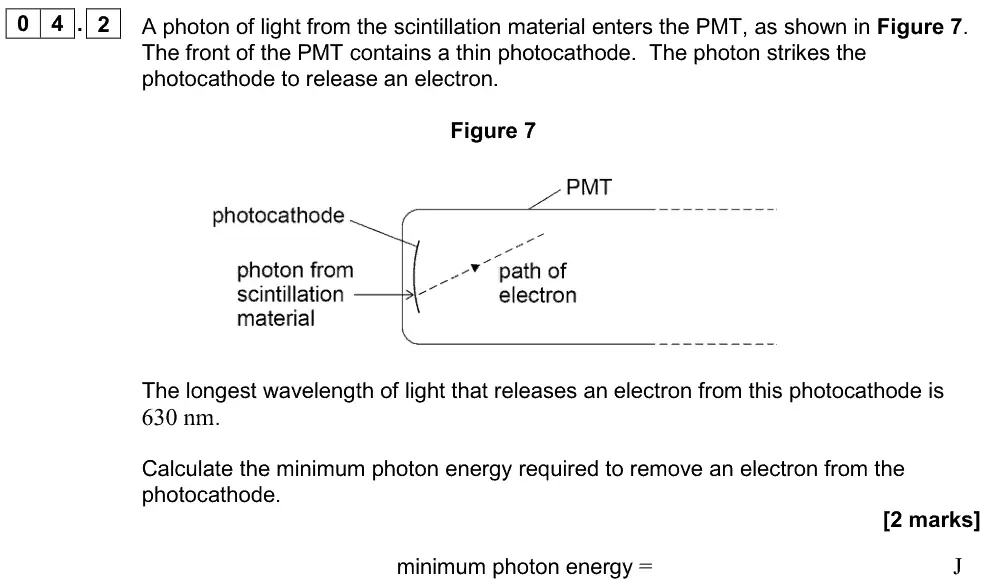
Answer: 3.2 x 10^-19 J (E = hc/lambda with 630 nm)
Skills: MS2.3 Substitute numerical values into algebraic equations using appropriate units for physical quantities
November 2020 · Paper 2 · Q5.11 markAO1=1Short answerHard
Mark scheme
Examiner's comment
About one third of students answered with the correct ‘electromagnetic force’ which is one of the fundamental forces. ‘Electrostatic force’ was given by many other students. More surprisingly, and just as often, ‘strong force’ was written.
Question 05.1
Notes from the mark scheme and report
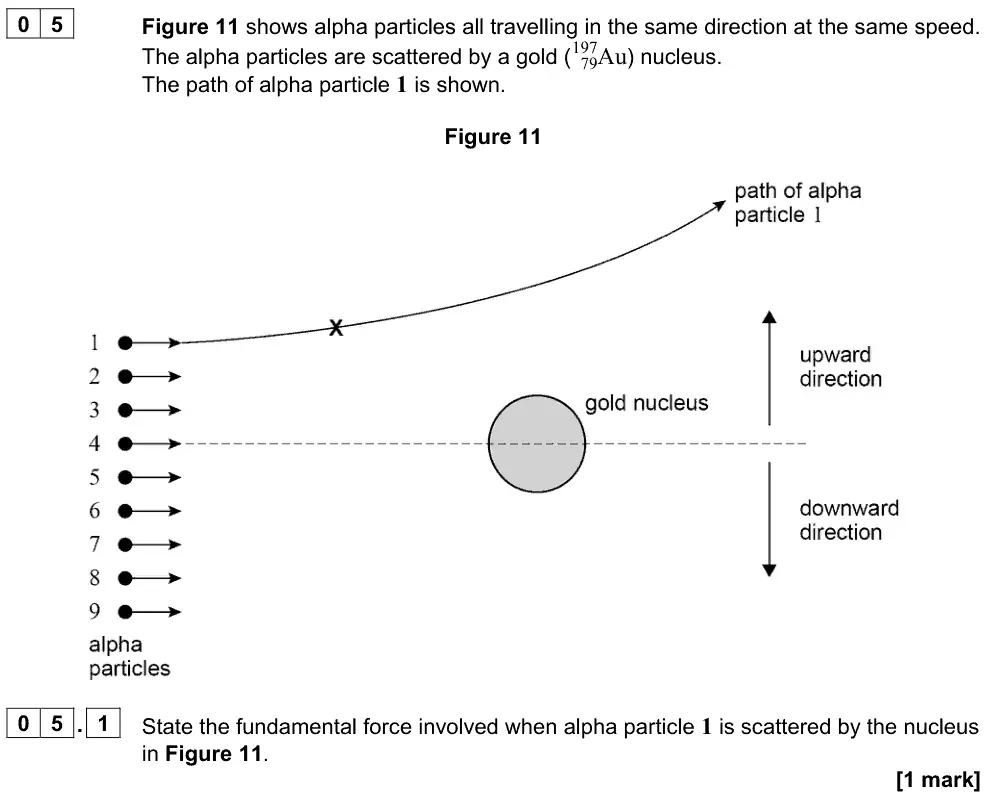
Electromagnetic
'electrostatic' rejected as not a fundamental force
'strong' common
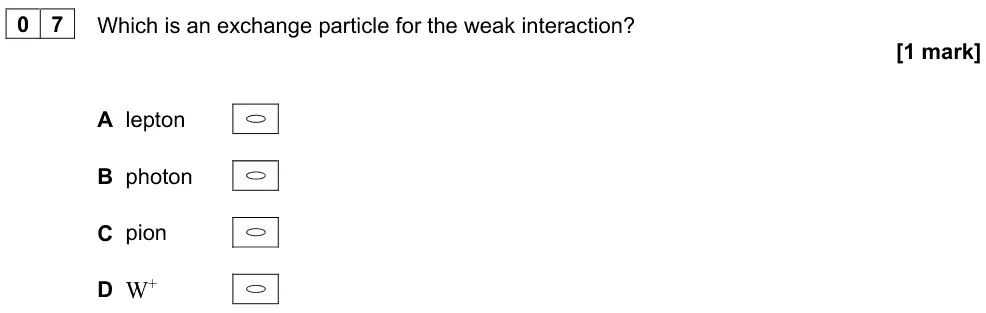
November 2020 · AS Paper 2 · Q61 markMultiple choice
Answer
A
Mark scheme
Notes from the mark scheme and report
Answer: A
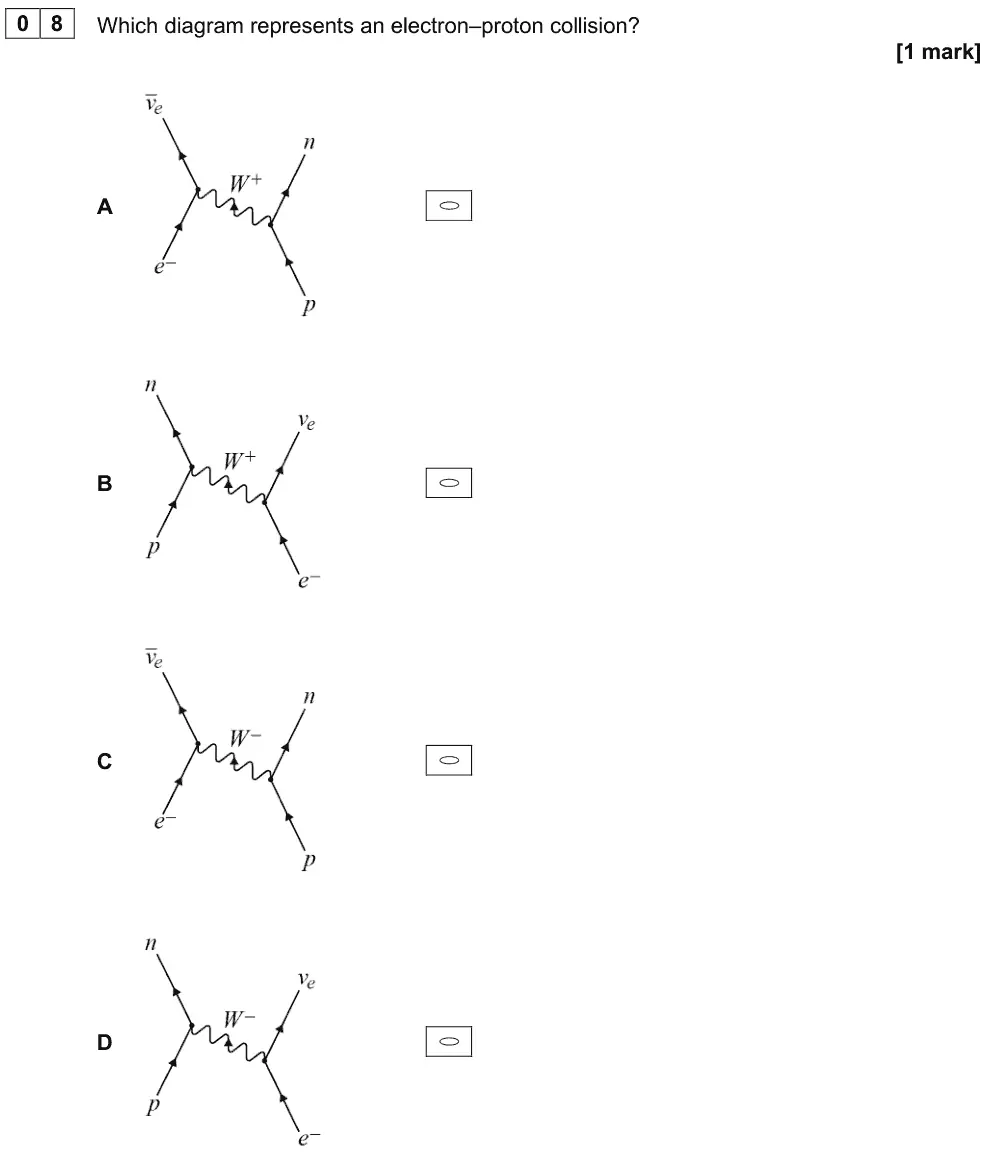
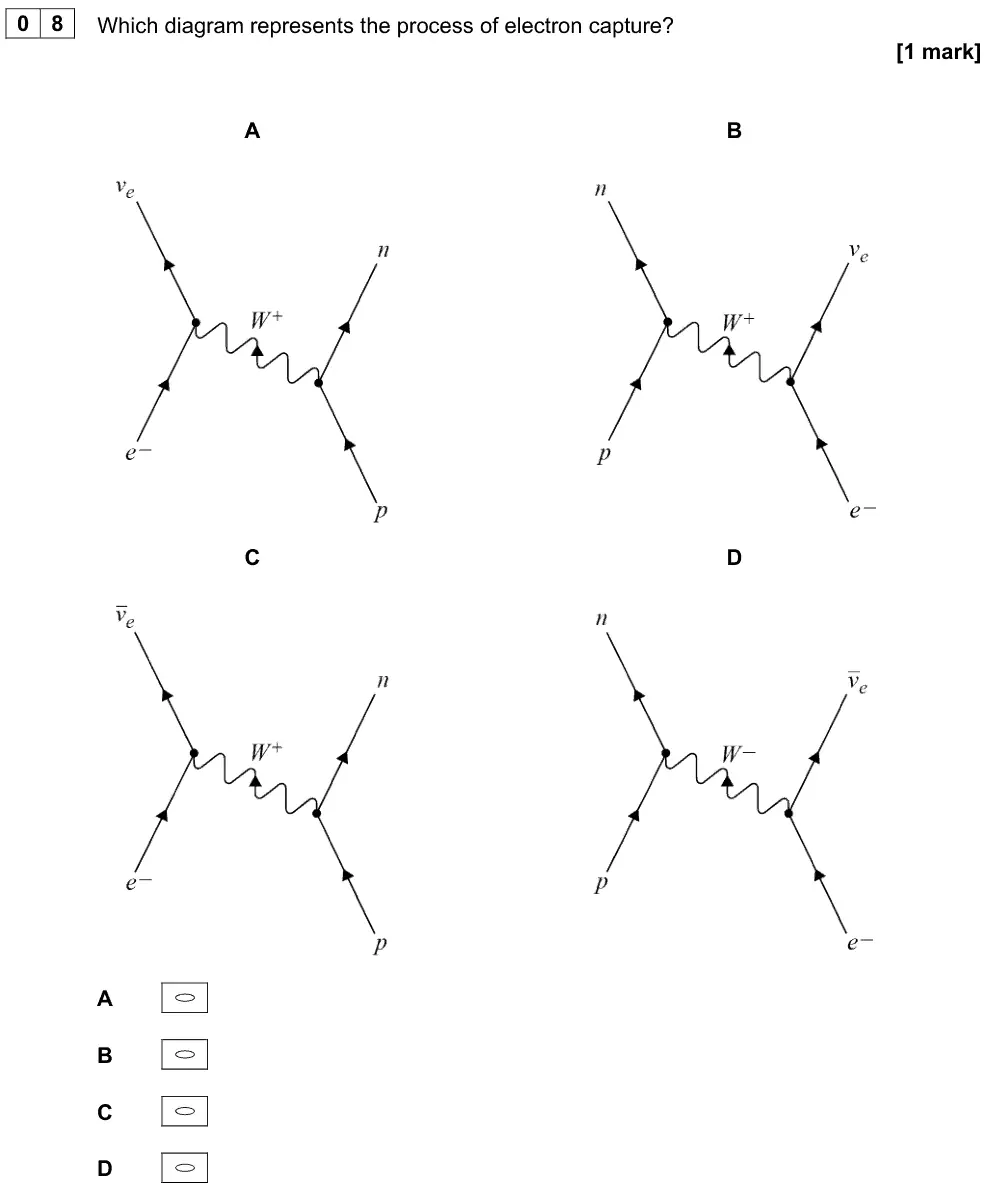
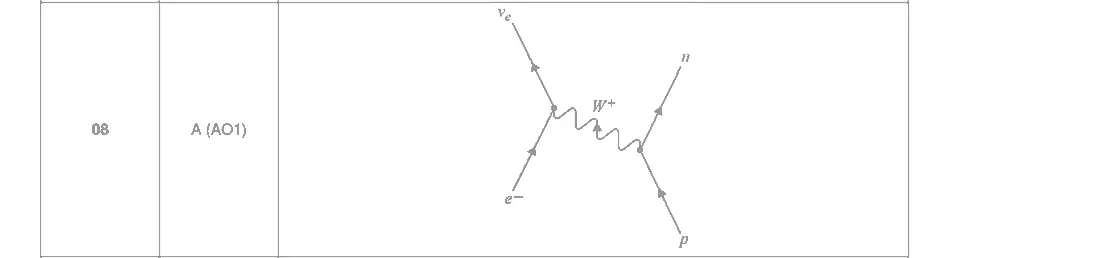
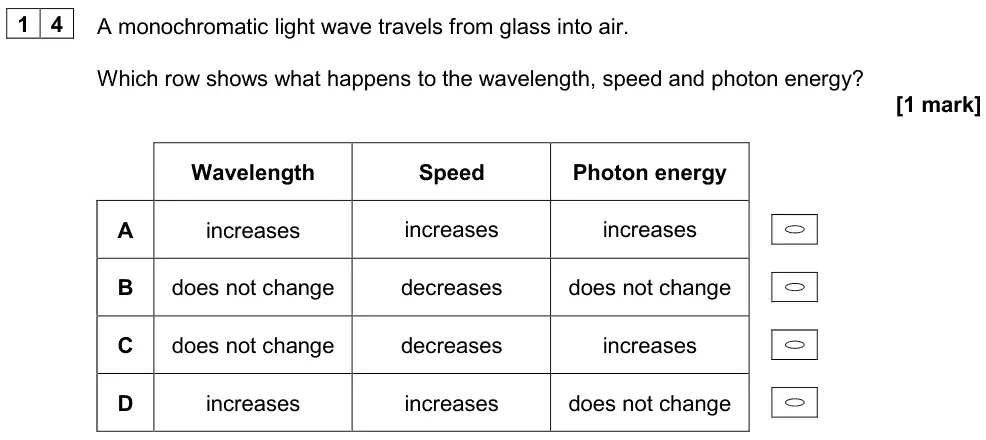
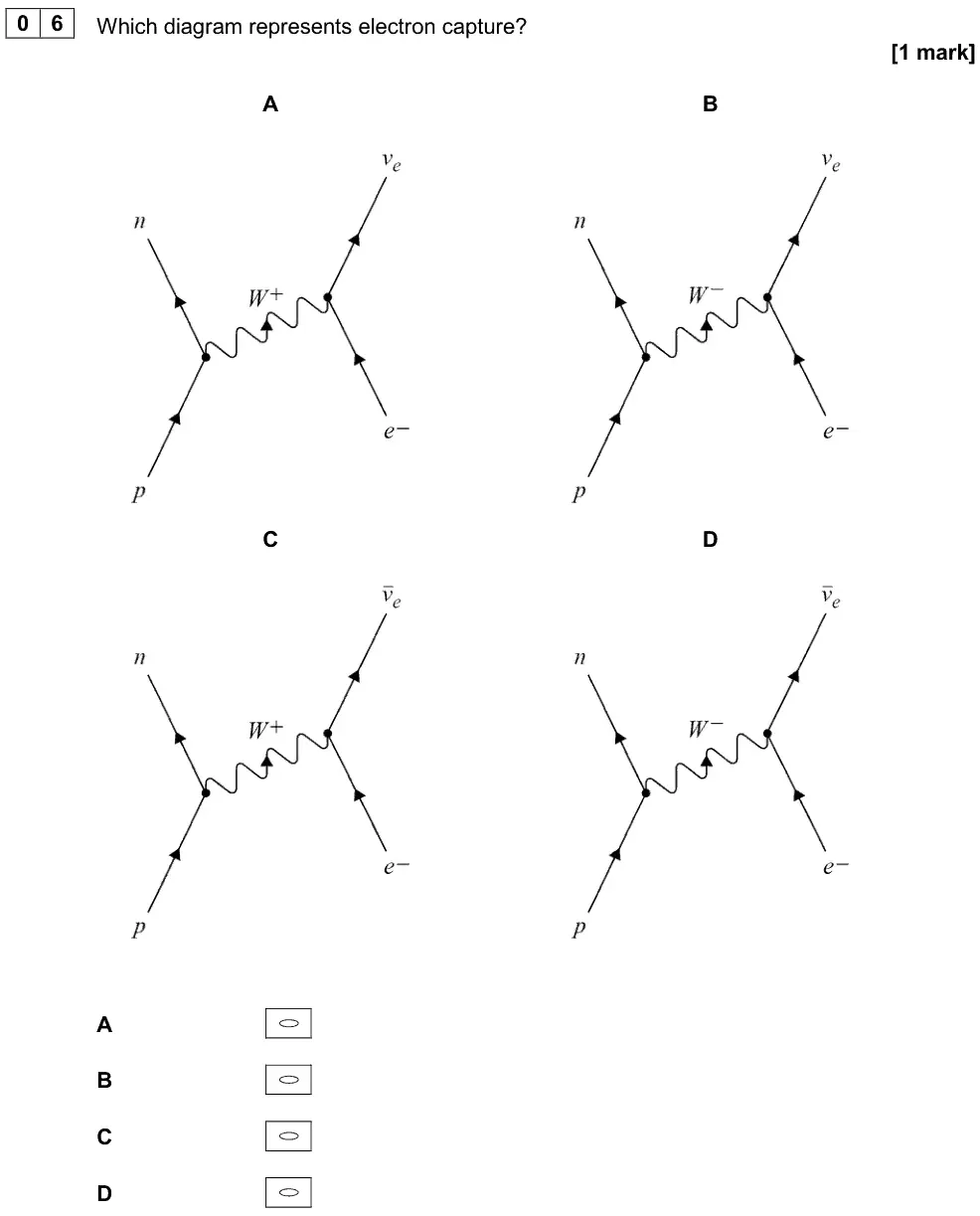
p + e- -> n + electron neutrino via W+
June 2019 · Paper 1 · Q1.32 marksShort answer
Earlier part of question 1 that this part uses
Mark scheme
Examiner's comment
1.3 Many students demonstrated a good understanding of electron capture and so obtained full marks. There was some evidence of confusion with beta decay, however. A surprising number of students referred to changes in the number of electrons within the nucleus and answers of this kind rarely gained any credit. The clearest responses referenced the nucleus clearly and stated what happened to the number of protons and neutrons. Vague answers tended to be unclear about which nucleus did what.
Notes from the mark scheme and report
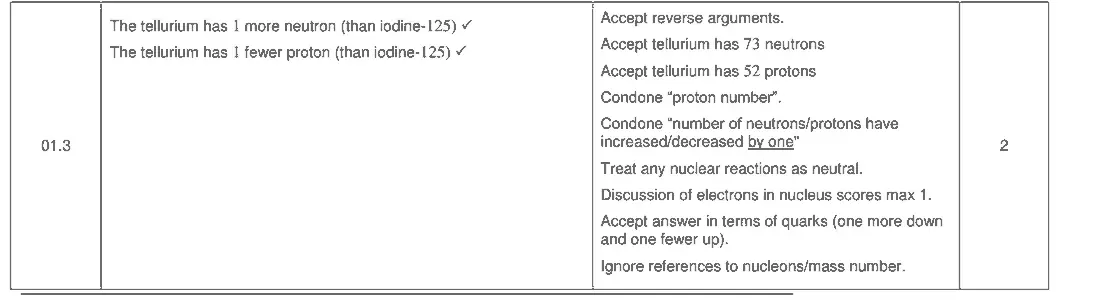
Tellurium has one more neutron and one fewer proton (or one more down, one fewer up quark)
talk of electrons in the nucleus scores max 1
June 2019 · AS Paper 1 · Q1.43 marksExplanation
Earlier part of question 1 that this part uses
Mark scheme
Examiner's comment
01.4 This question discriminated well, with some well-structured answers seen. Lack of a clear conclusion was a common feature of answers that gained partial credit.
Notes from the mark scheme and report
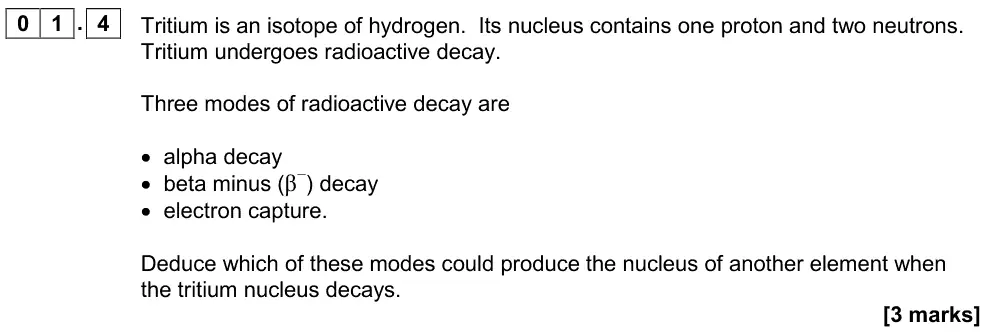
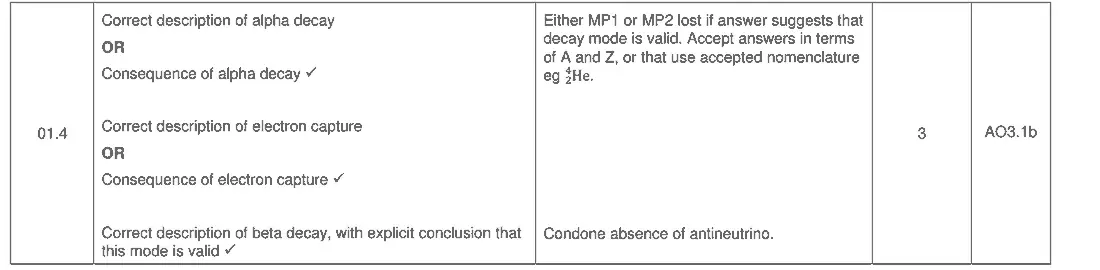
Alpha impossible (only 3 nucleons), electron capture impossible (only one proton, would give 3 neutrons), beta-minus gives helium-3 so it is the valid mode
an explicit conclusion is needed
June 2019 · Paper 1 · Q1.43 marksExplanation
Earlier part of question 1 that this part uses
Mark scheme
Examiner's comment
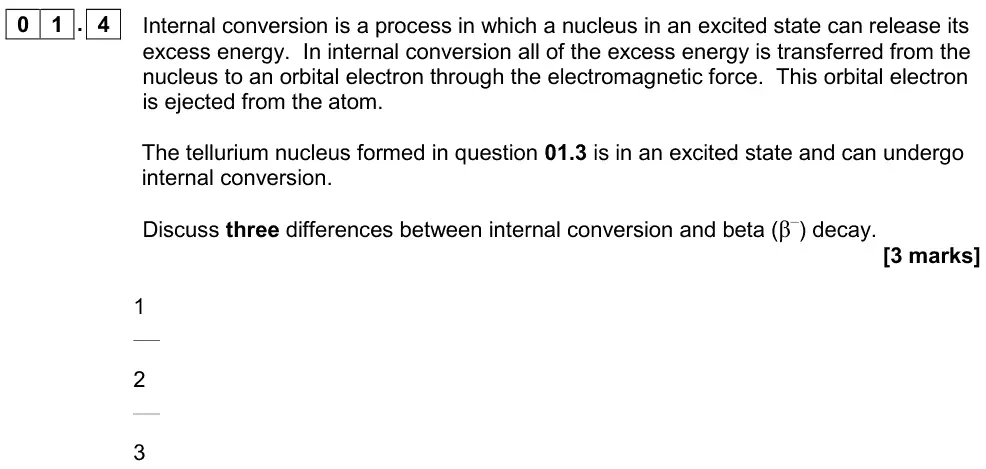
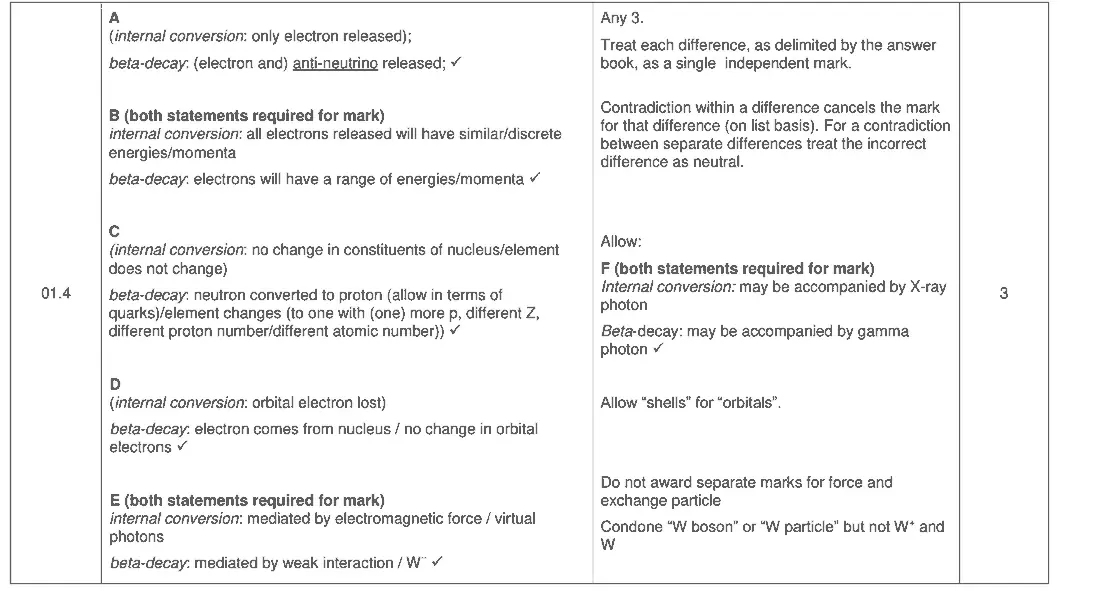
1.4 This question tested students’ ability to apply their knowledge and understanding to an unfamiliar context. It was pleasing to note that half of the students were able to provide information on at least two differences. References to both processes were expected for each difference, although a missing reference was condoned in situations where no change occurred. Occasionally students gave the mediating particle and the fundamental force involved as separate answers, but this was only credited as one difference.
Notes from the mark scheme and report
Any 3 paired differences: beta releases an antineutrino
beta electrons have a range of energies
beta changes the element (n to p)
beta electron comes from the nucleus not an orbital
weak (W-) vs electromagnetic (virtual photon)
force and exchange particle count once
unfamiliar context
June 2019 · AS Paper 1 · Q6.12 marksShort answer
Mark scheme
Examiner's comment
06.1 Just over 50% of students gave two specific properties of an antiparticle. Students should understand that ‘different’ does not mean the same as ‘opposite’ when describing charge.
Notes from the mark scheme and report
Same rest mass/energy, opposite charge (or baryon/lepton number)
'different' charge not accepted
June 2019 · AS Paper 1 · Q6.22 marksShort answer
Earlier part of question 6 that this part uses
Mark scheme
Examiner's comment
06.2 This recall question was well answered.
2 E mc = 06.3 even though this equation This question discriminated well. Many students applied is not included in specification. Full credit was allowed for this approach. A difficulty for many students was converting the rest energies from MeV to J. 06.4 Few students could describe the formation of a line-emission spectrum concisely. Most began by explaining the process of atomic excitation, which gained no credit. Students should be guided to consider the number of marks available and the specific question. In this case there were three marks and three parts: Why is it a line (rather than continuous) spectrum? Why is it an emission (rather than absorption) spectrum? Why is it a spectrum?
Notes from the mark scheme and report
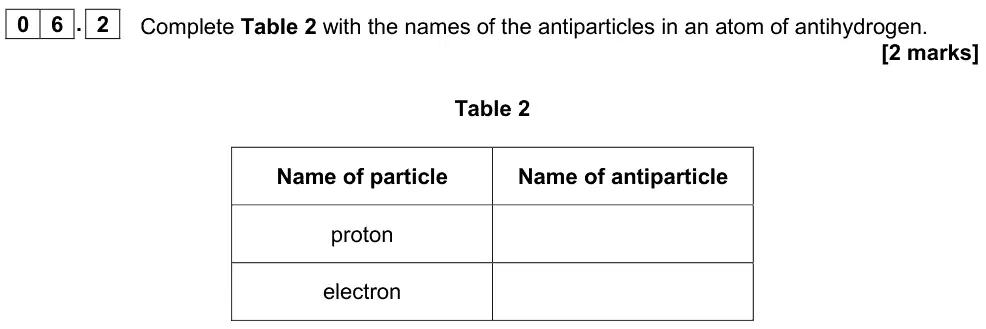
Antiproton and positron
'antielectron' not accepted
June 2019 · AS Paper 1 · Q6.33 marksCalculation
Earlier part of question 6 that this part uses
Mark scheme
Examiner's comment
2 E mc = 06.3 even though this equation This question discriminated well. Many students applied is not included in specification. Full credit was allowed for this approach. A difficulty for many students was converting the rest energies from MeV to J. 06.4 Few students could describe the formation of a line-emission spectrum concisely. Most began by explaining the process of atomic excitation, which gained no credit. Students should be guided to consider the number of marks available and the specific question. In this case there were three marks and three parts: Why is it a line (rather than continuous) spectrum? Why is it an emission (rather than absorption) spectrum? Why is it a spectrum?
Notes from the mark scheme and report
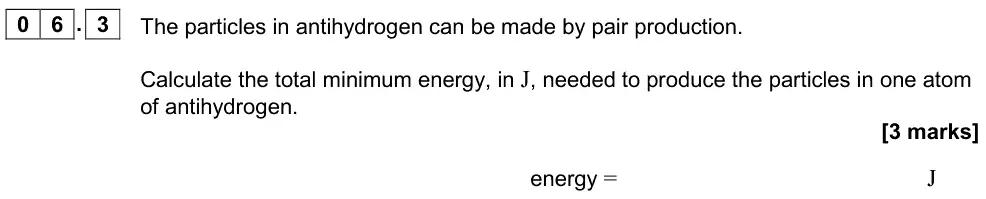
Answer: 1.5 x 10^-10 J (938.257 + 0.510999 = 938.768 MeV converted to J)
3.0 x 10^-10 J accepted for producing proton-antiproton and electron-positron pairs
MeV to J conversion was the difficulty
Skills: MS2.3 Substitute numerical values into algebraic equations using appropriate units for physical quantities; MS0.2 Recognise and use expressions in decimal and standard form
June 2019 · Paper 1 · Q81 markMultiple choice
Answer
A
Notes from the mark scheme and report
Answer: A
June 2019 · Paper 1 · Q101 markMultiple choice
Answer
C
Notes from the mark scheme and report
Answer: C
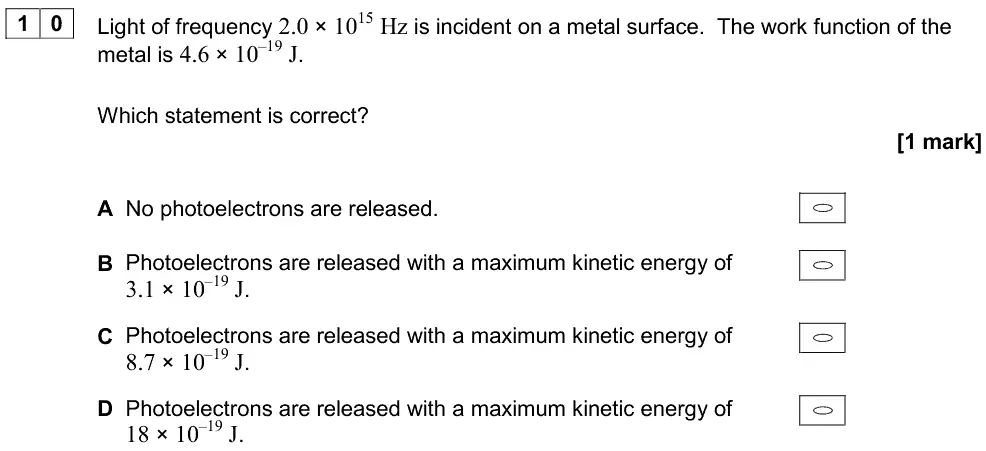
Skills: MS2.3 Substitute numerical values into algebraic equations using appropriate units for physical quantities
June 2019 · Paper 1 · Q111 markMultiple choice
Answer
C
Notes from the mark scheme and report
Answer: C
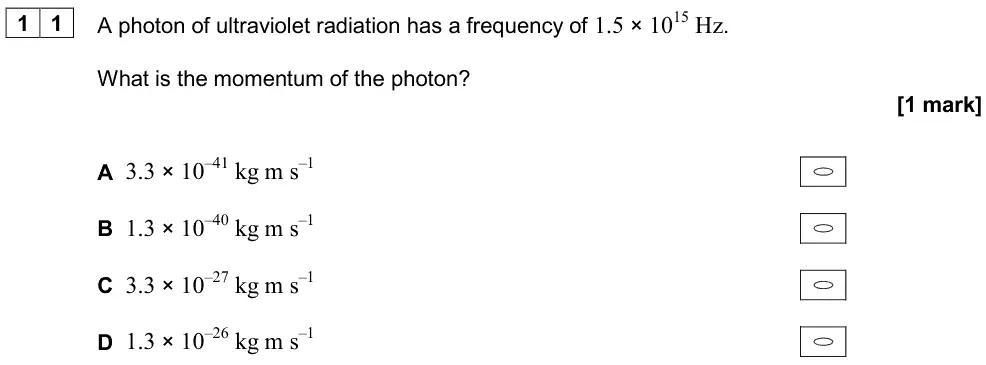
Skills: MS2.3 Substitute numerical values into algebraic equations using appropriate units for physical quantities
June 2019 · AS Paper 2 · Q3.12 marksExplanation
Mark scheme
Examiner's comment
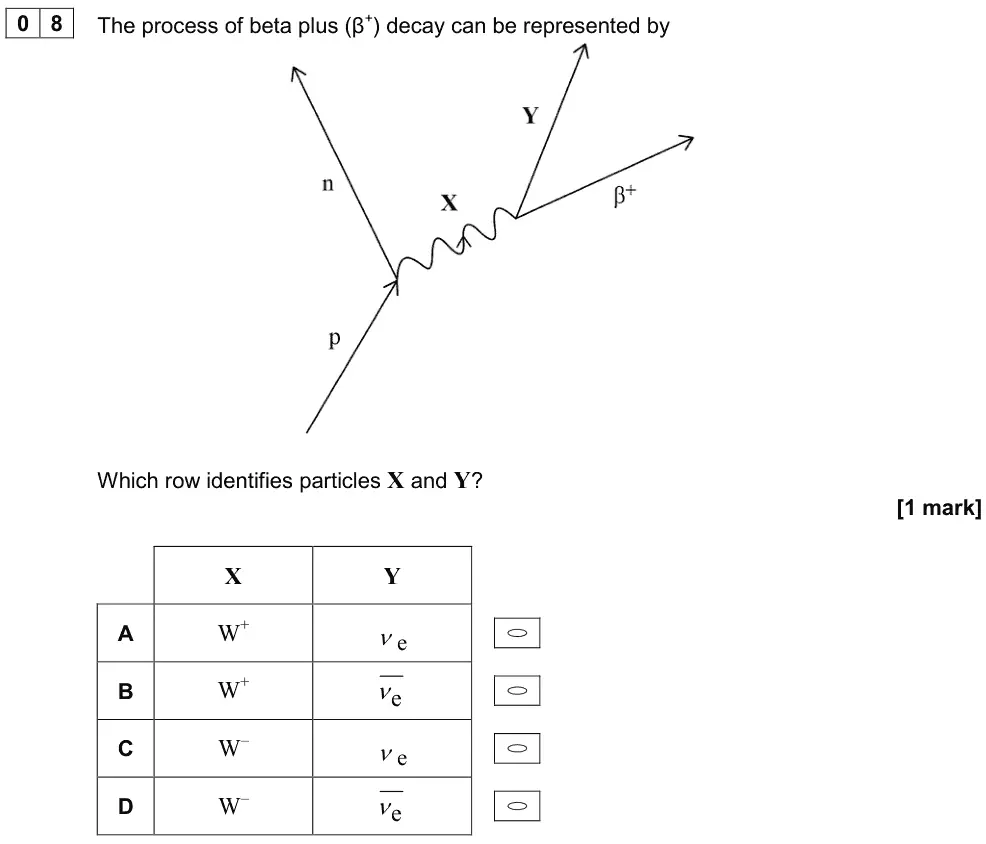
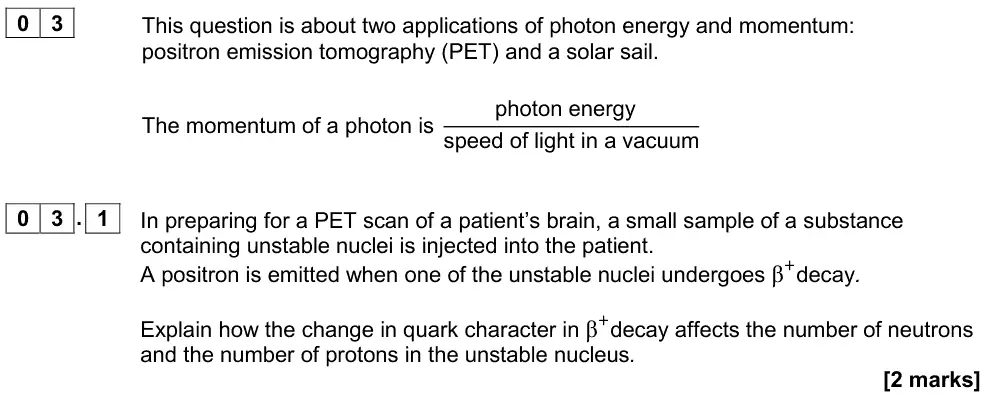
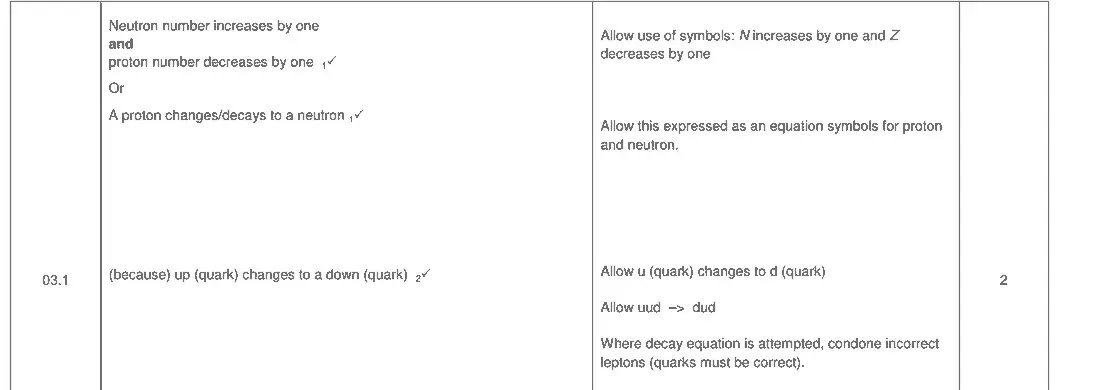
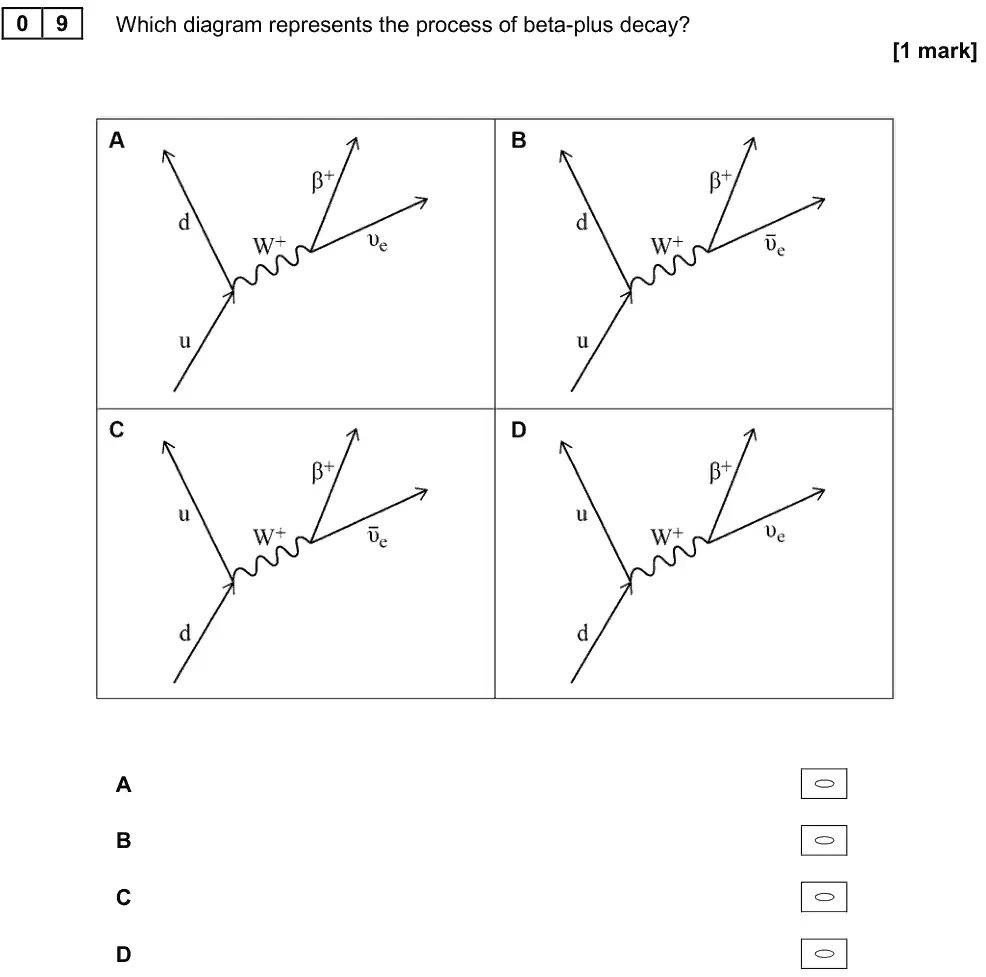
3.1 Almost half of students achieved both marks. However, over 30% scored zero. Students gaining 1 mark did so by correctly identifying this proton–neutron conversion. Students gaining more than 1 went on to describe correctly how the quark character changed. Students scoring zero usually thought that a neutron converted to a proton in beta-plus decay.
Notes from the mark scheme and report
Proton changes to neutron (N up by one, Z down by one) because an up quark changes to a down quark
many reversed it as in beta-minus
June 2019 · AS Paper 2 · Q3.22 marksCalculation
Earlier part of question 3 that this part uses
Mark scheme
Examiner's comment
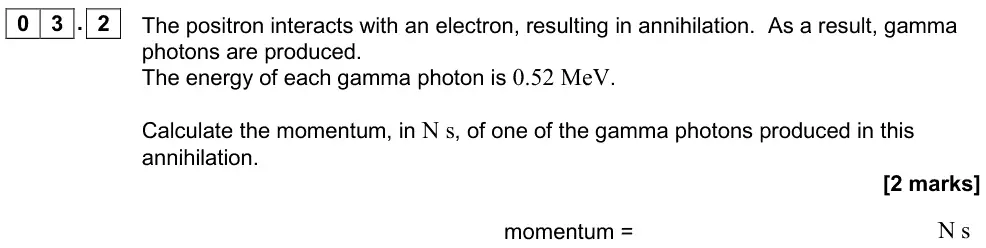
3.2 Students need to take more care in reading the opening stem to a question. The required equation was provided and any use of this obtained credit. Many students were unable to convert 0.52 MeV to joule. This conversion is a key skill expected of AS physics students and should be treated as such.
Notes from the mark scheme and report
Answer: 2.8 x 10^-22 N s (E = 8.32 x 10^-14 J, p = E/c given in stem)
MeV to J conversion was the main failure
Skills: MS2.3 Substitute numerical values into algebraic equations using appropriate units for physical quantities; MS0.2 Recognise and use expressions in decimal and standard form
June 2019 · AS Paper 2 · Q3.31 markDiagram or graphEasy
Earlier part of question 3 that this part uses
Mark scheme
Examiner's comment
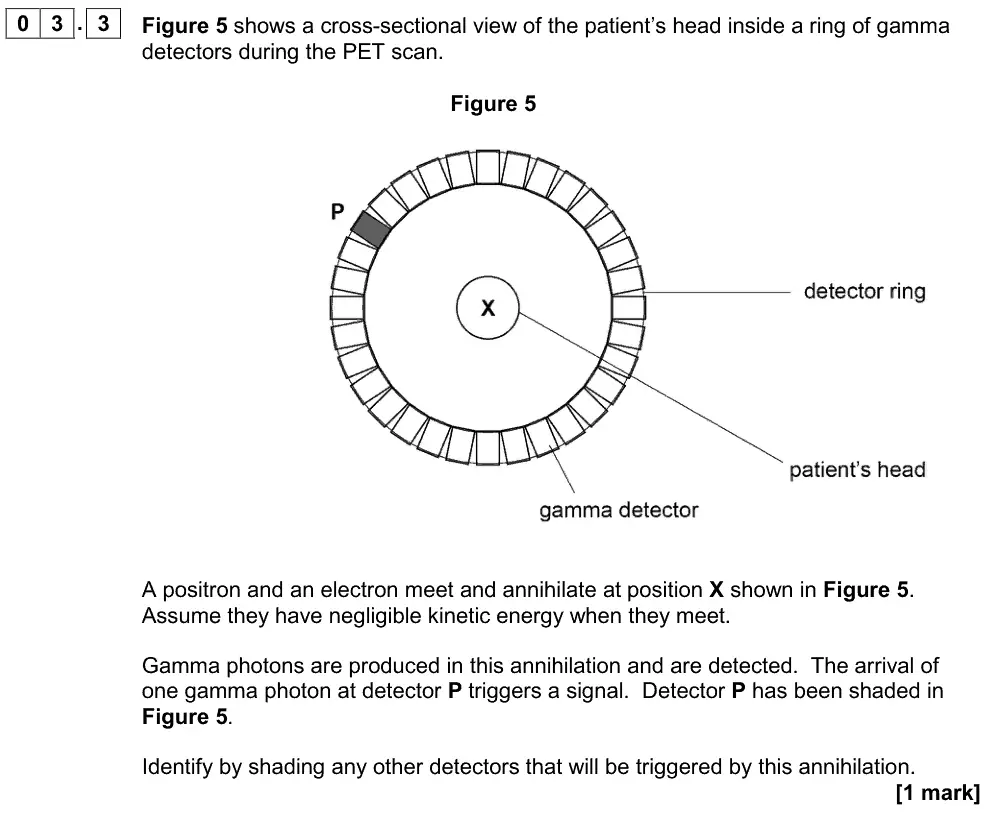
3.3 / 3.4 Over 80% of students were able to select the appropriate detector. They were familiar with the fact that two photons would be produced in the annihilation event. The most effective answers contained detailed explanations supporting the conclusion. 3.5 Many students gained some credit for attempting to determine the gradient of the graph. Common mistakes included: failure to appreciate that the velocity axis had a false origin, failure to convert the time from hours correctly, leaving the velocity in mm s−1, and failure to read-off accurately from the graph.
Notes from the mark scheme and report
Shade the detector diametrically opposite P (through X)
only one box
June 2019 · AS Paper 2 · Q3.42 marksExplanation
Earlier part of question 3 that this part uses
Mark scheme
Examiner's comment
3.3 / 3.4 Over 80% of students were able to select the appropriate detector. They were familiar with the fact that two photons would be produced in the annihilation event. The most effective answers contained detailed explanations supporting the conclusion. 3.5 Many students gained some credit for attempting to determine the gradient of the graph. Common mistakes included: failure to appreciate that the velocity axis had a false origin, failure to convert the time from hours correctly, leaving the velocity in mm s−1, and failure to read-off accurately from the graph.
Notes from the mark scheme and report
Two photons produced moving in opposite directions along the same line, equal and opposite momentum so total momentum zero is conserved
June 2019 · AS Paper 2 · Q141 markMultiple choice
Answer
C
Mark scheme
Notes from the mark scheme and report
Answer: C
June 2018 · Paper 1 · Q101 markMultiple choice
Answer
C
Notes from the mark scheme and report
Answer: C
Skills: MS0.2 Recognise and use expressions in decimal and standard form
June 2018 · AS Paper 2 · Q71 markMultiple choice
Answer
B
Notes from the mark scheme and report
Answer: B
June 2017 · Paper 1 · Q1.12 marksShort answer
Mark scheme
Examiner's comment
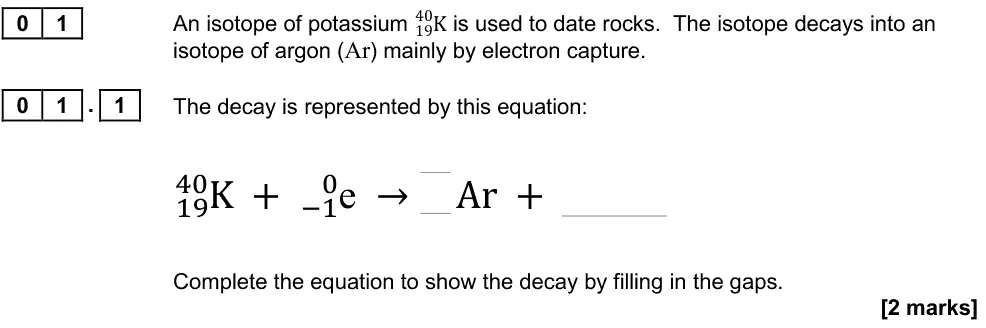
This question was generally well answered. In question 01.1, students had to complete the electron capture equation. While the majority were able to correctly identify the mass number and atomic number for argon, they were less successful at identifying the electron neutrino, with responses giving the particle as a neutron or gamma photon being quite common.
Notes from the mark scheme and report
Answer: Ar-40 with Z = 18 plus an electron neutrino
neutron or gamma photon given for the neutrino was common
antineutrino bar or negative sign loses the mark
June 2017 · AS Paper 1 · Q1.21 markShort answer
Earlier part of question 1 that this part uses
Mark scheme
Examiner's comment
01.2 Although this was also correctly answered by the majority of students, there was some confusion concerning the word ‘interaction’, with ‘beta decay’ being a popular incorrect answer. Correct answers that included references to beta decay were credited with the mark.
Notes from the mark scheme and report
Weak interaction
'beta decay' a common incorrect answer
June 2017 · Paper 1 · Q1.22 marksExplanation
Earlier part of question 1 that this part uses
Mark scheme
Notes from the mark scheme and report
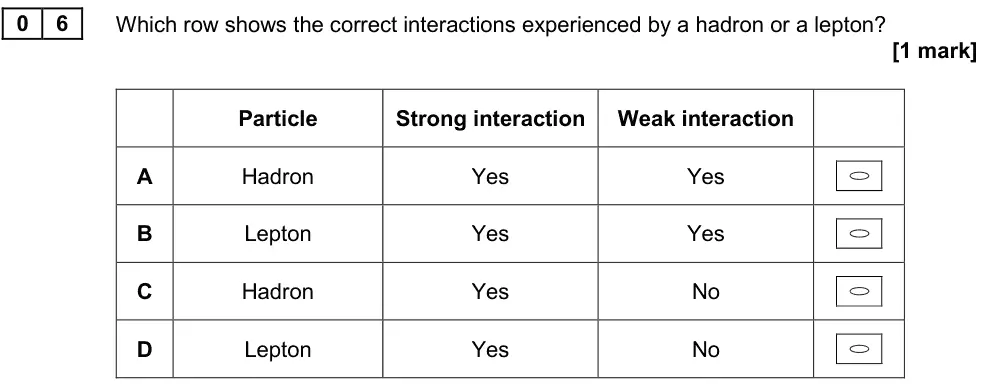
Weak interaction, because leptons and hadrons are involved or quark flavour changes (up to down)
June 2017 · AS Paper 1 · Q1.31 markShort answer
Earlier part of question 1 that this part uses
Mark scheme
Examiner's comment
01.3 Most students were familiar with the term ‘boson’ or gave the answer ‘exchange particle’. Other answers appeared to be the random naming of a familiar particle, such as pion, muon, etc.
Notes from the mark scheme and report
Bosons (exchange particles)
'force mediator' not allowed
June 2017 · Paper 1 · Q1.33 marksCalculationEasy
Earlier part of question 1 that this part uses
Mark scheme
Examiner's comment
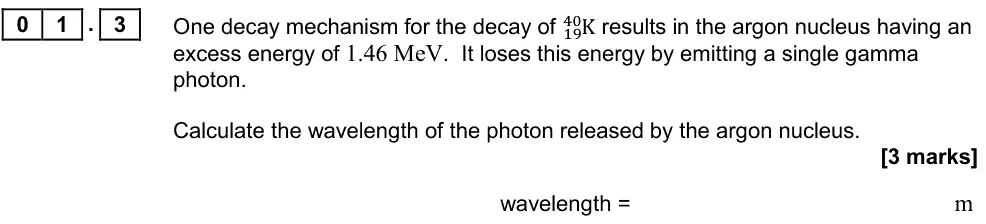
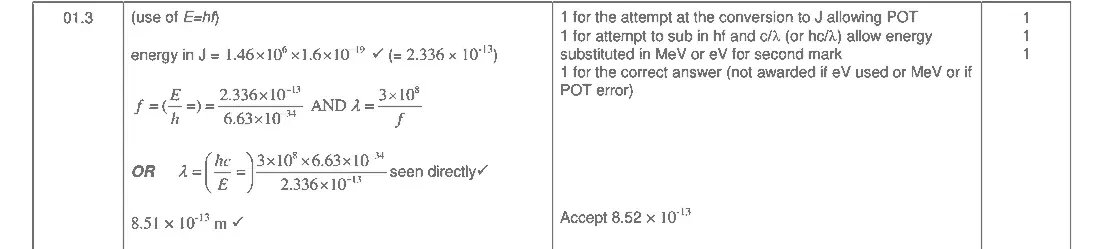
The calculation in question 01.3 was well answered and over two-thirds of students scored full marks. The common errors for those who did not were either failing to convert energy to joules, or a power of ten mistake.
Notes from the mark scheme and report
Answer: 8.51 x 10^-13 m (1.46 MeV = 2.34 x 10^-13 J)
failing to convert to joules or power-of-ten slips were the common errors
Skills: MS0.2 Recognise and use expressions in decimal and standard form; MS2.3 Substitute numerical values into algebraic equations using appropriate units for physical quantities
June 2017 · AS Paper 1 · Q7.13 marksCalculation
Mark scheme
Examiner's comment
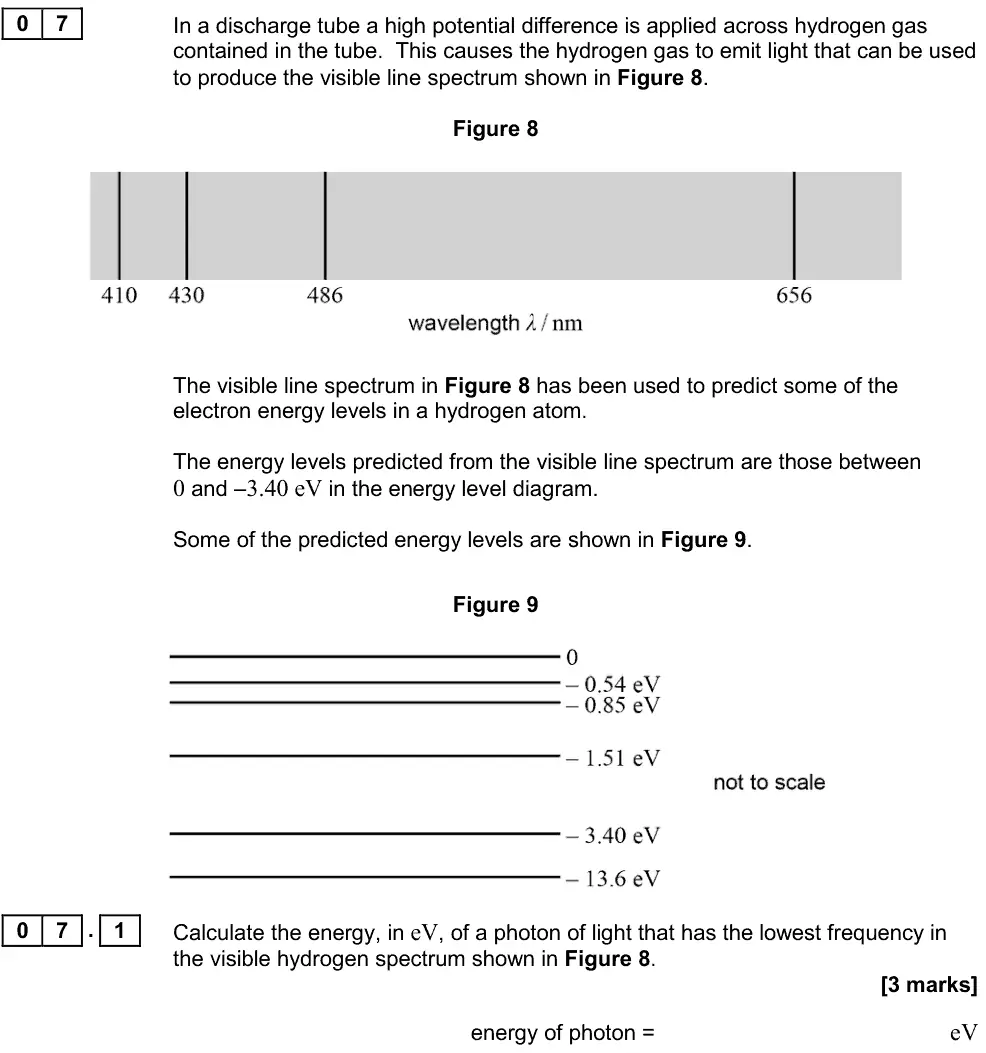
07.1 Difficulties choosing the correct wavelength proved to be an obstacle for many students. The award of the final mark was made without reference to the method. Some credit was also awarded for students who made an error calculating the energy. The conversion to eV proved difficult for some who decided to multiply rather than divide by the charge on the electron.
Notes from the mark scheme and report
Answer: 1.9 eV (lowest frequency = longest wavelength 656 nm
E = hc/lambda = 3.0 x 10^-19 J, divide by 1.6 x 10^-19)
Skills: MS2.3 Substitute numerical values into algebraic equations using appropriate units for physical quantities; MS0.2 Recognise and use expressions in decimal and standard form
June 2017 · AS Paper 1 · Q7.56 marks6-mark extended response
Earlier part of question 7 that this part uses
Mark scheme, with the levels and indicative content
Examiner's comment
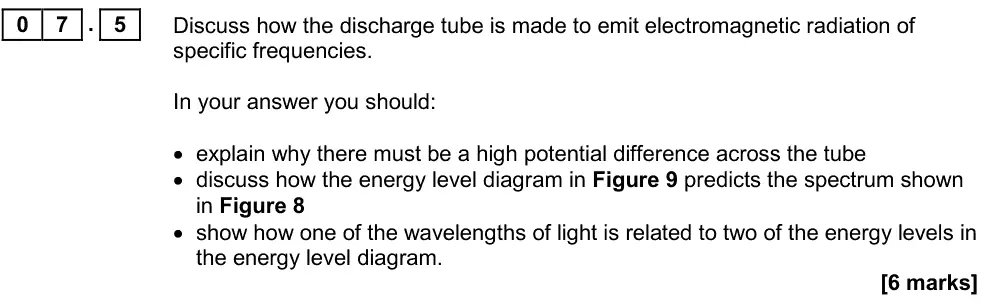
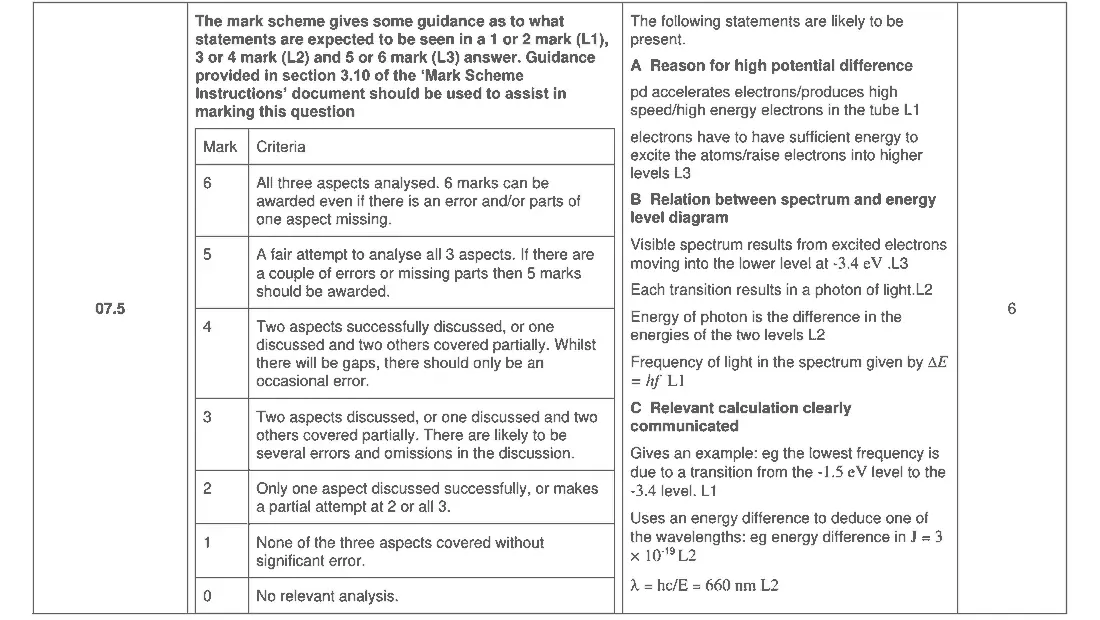
07.5 Despite the extended writing question being the last on the paper, there was no indication that students ran out of time or space. Generally, attempts to explain the reason for high potential difference were often vague so that electrons being accelerated and those within the atoms became confused. On the whole, better attempts were made to link the spectrum and energy level diagrams. Several students used previously analysed data to help answer the final part of this question. Common errors were seen with the introduction of the photoelectric effect or fluorescent tube into the answer.
Notes from the mark scheme and report
Levels of response: high pd accelerates electrons to excite atoms
excited electrons fall to -3.40 eV emitting photons with energy equal to the level difference (hf), giving discrete lines
e.g. -1.51 to -3.40 eV gives 3.0 x 10^-19 J, about 660 nm
June 2017 · Paper 1 · Q91 markMultiple choice
Answer
A
Notes from the mark scheme and report
Answer: A
June 2017 · Paper 2 · Q5.43 marksCalculation
Earlier part of question 5 that this part uses
Mark scheme
Examiner's comment
05.4 Only the bottom 10% of students could make no headway in this question. A majority could obtain the equation relating wavelength to energy, and could perform the numerical calculation. It was choosing the incorrect energy gap that let many students down.
Notes from the mark scheme and report
Answer: 8.6 x 10^-12 m (smallest gap 2.29 - 2.06 = 0.23 x 10^-13 J
lambda = hc/E)
choosing the wrong energy gap was the main error
Skills: MS2.3 Substitute numerical values into algebraic equations using appropriate units for physical quantities
June 2017 · AS Paper 2 · Q61 markMultiple choice
Answer
A
Notes from the mark scheme and report
Answer: A
June 2017 · AS Paper 2 · Q221 markMultiple choice
Answer
D
Notes from the mark scheme and report
Answer: D
Skills: MS3.3 Understand that y = mx + c represents a linear relationship
June 2017 · Paper 3B Medical physics · Q3.42 marksExplanation
Earlier part of question 3 that this part uses
Mark scheme
Examiner's comment
Part 03.4 on the process on annihilation was well answered with many students getting both marks.
Notes from the mark scheme and report
Positron annihilates with an electron
mass converted to two gamma photons in opposite directions (momentum conservation)
well answered
June 2016 · AS Paper 1 · Q6.22 marksExplanation
Earlier part of question 6 that this part uses
Mark scheme
Examiner's comment
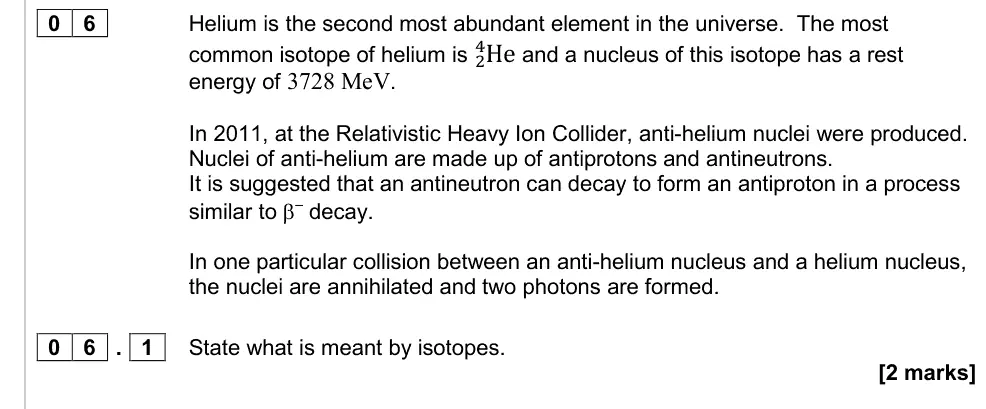
In this question students were required to extract information from an introductory passage. Question 6.1 was a straightforward starter but as with 3.1 a significant proportion of answers were spoilt by a lack of precision. Students were required to mention atoms or nuclei in their responses and a significant proportion did not do this. Question 6.2 required an explanation as to why two photons were produced. A number of students seemed to think this was necessary due to energy conservation. Of those who realised this was due to momentum conservation, a significant proportion then failed to appreciate the importance of the photons travelling in different directions. Question 6.3 was an extended calculation and students were told to calculate the maximum frequency of the photons produced in the annihilation of the two nuclei. Maximum was necessary to indicate that the whole rest energy of the nuclei should be used and excluded the possibility of calculating the frequency of photons produced due to annihilation of individual nucleons within the helium and anti-helium nuclei. It is true that higher frequency photons would be produced if the nuclei had significant kinetic energy but students were told to use information from the passage in which there was no mention of kinetic energy. For full marks students needed to explain how they dealt with two nuclei annihilating and two photons being produced. Questions 6.4 and 6.5 were well answered and the only common error was a failure to identify the positron correctly in the equation.
Notes from the mark scheme and report
Momentum must be conserved (initial momentum about zero), so two photons travelling in opposite directions
energy-conservation arguments not enough
June 2016 · AS Paper 1 · Q6.34 marksCalculation
Earlier part of question 6 that this part uses
Mark scheme
Examiner's comment
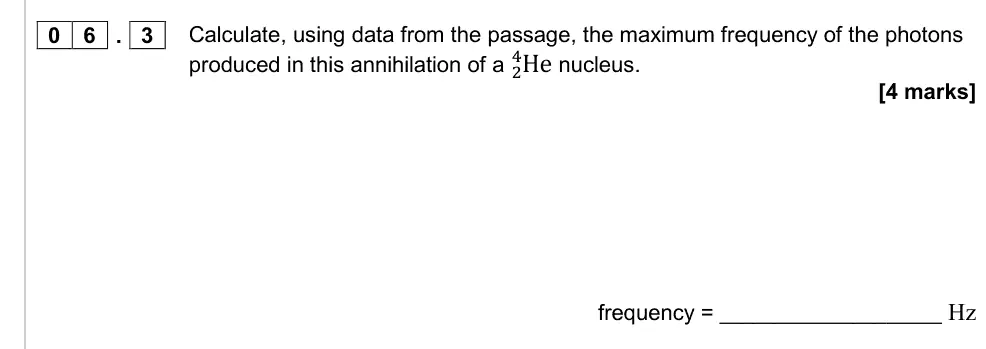
In this question students were required to extract information from an introductory passage. Question 6.1 was a straightforward starter but as with 3.1 a significant proportion of answers were spoilt by a lack of precision. Students were required to mention atoms or nuclei in their responses and a significant proportion did not do this. Question 6.2 required an explanation as to why two photons were produced. A number of students seemed to think this was necessary due to energy conservation. Of those who realised this was due to momentum conservation, a significant proportion then failed to appreciate the importance of the photons travelling in different directions. Question 6.3 was an extended calculation and students were told to calculate the maximum frequency of the photons produced in the annihilation of the two nuclei. Maximum was necessary to indicate that the whole rest energy of the nuclei should be used and excluded the possibility of calculating the frequency of photons produced due to annihilation of individual nucleons within the helium and anti-helium nuclei. It is true that higher frequency photons would be produced if the nuclei had significant kinetic energy but students were told to use information from the passage in which there was no mention of kinetic energy. For full marks students needed to explain how they dealt with two nuclei annihilating and two photons being produced. Questions 6.4 and 6.5 were well answered and the only common error was a failure to identify the positron correctly in the equation.
Notes from the mark scheme and report
Answer: 9.0 x 10^23 Hz (2 x 3728 MeV = 1.193 x 10^-9 J shared between two photons
f = E/h)
must show doubling and halving
Skills: MS2.3 Substitute numerical values into algebraic equations using appropriate units for physical quantities; MS0.2 Recognise and use expressions in decimal and standard form
June 2016 · AS Paper 1 · Q6.42 marksShort answer
Earlier part of question 6 that this part uses
Mark scheme
Examiner's comment
In this question students were required to extract information from an introductory passage. Question 6.1 was a straightforward starter but as with 3.1 a significant proportion of answers were spoilt by a lack of precision. Students were required to mention atoms or nuclei in their responses and a significant proportion did not do this. Question 6.2 required an explanation as to why two photons were produced. A number of students seemed to think this was necessary due to energy conservation. Of those who realised this was due to momentum conservation, a significant proportion then failed to appreciate the importance of the photons travelling in different directions. Question 6.3 was an extended calculation and students were told to calculate the maximum frequency of the photons produced in the annihilation of the two nuclei. Maximum was necessary to indicate that the whole rest energy of the nuclei should be used and excluded the possibility of calculating the frequency of photons produced due to annihilation of individual nucleons within the helium and anti-helium nuclei. It is true that higher frequency photons would be produced if the nuclei had significant kinetic energy but students were told to use information from the passage in which there was no mention of kinetic energy. For full marks students needed to explain how they dealt with two nuclei annihilating and two photons being produced. Questions 6.4 and 6.5 were well answered and the only common error was a failure to identify the positron correctly in the equation.
Notes from the mark scheme and report
Antineutron -> antiproton + positron (0/+1 e) + electron neutrino
positron often wrongly identified
June 2016 · AS Paper 1 · Q6.51 markShort answer
Earlier part of question 6 that this part uses
Mark scheme
Examiner's comment
In this question students were required to extract information from an introductory passage. Question 6.1 was a straightforward starter but as with 3.1 a significant proportion of answers were spoilt by a lack of precision. Students were required to mention atoms or nuclei in their responses and a significant proportion did not do this. Question 6.2 required an explanation as to why two photons were produced. A number of students seemed to think this was necessary due to energy conservation. Of those who realised this was due to momentum conservation, a significant proportion then failed to appreciate the importance of the photons travelling in different directions. Question 6.3 was an extended calculation and students were told to calculate the maximum frequency of the photons produced in the annihilation of the two nuclei. Maximum was necessary to indicate that the whole rest energy of the nuclei should be used and excluded the possibility of calculating the frequency of photons produced due to annihilation of individual nucleons within the helium and anti-helium nuclei. It is true that higher frequency photons would be produced if the nuclei had significant kinetic energy but students were told to use information from the passage in which there was no mention of kinetic energy. For full marks students needed to explain how they dealt with two nuclei annihilating and two photons being produced. Questions 6.4 and 6.5 were well answered and the only common error was a failure to identify the positron correctly in the equation.
Notes from the mark scheme and report
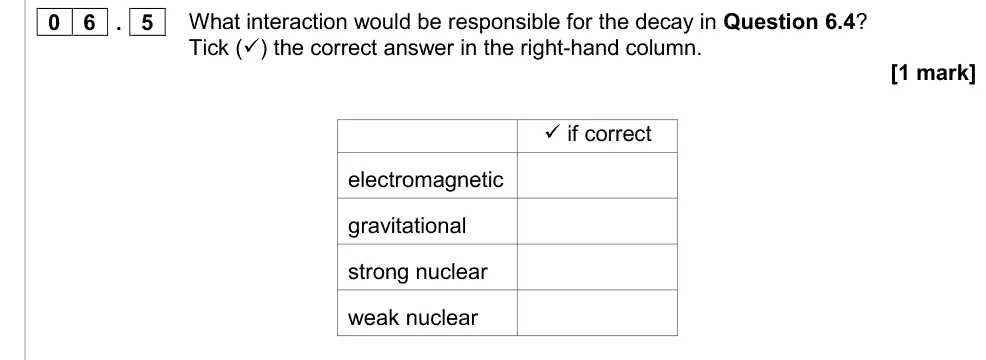
Weak nuclear
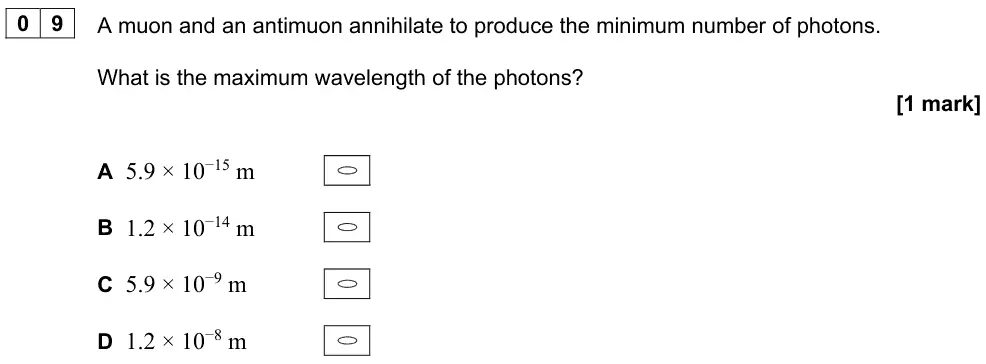
June 2016 · AS Paper 2 · Q61 markMultiple choiceEasy
Answer
B
Examiner's comment
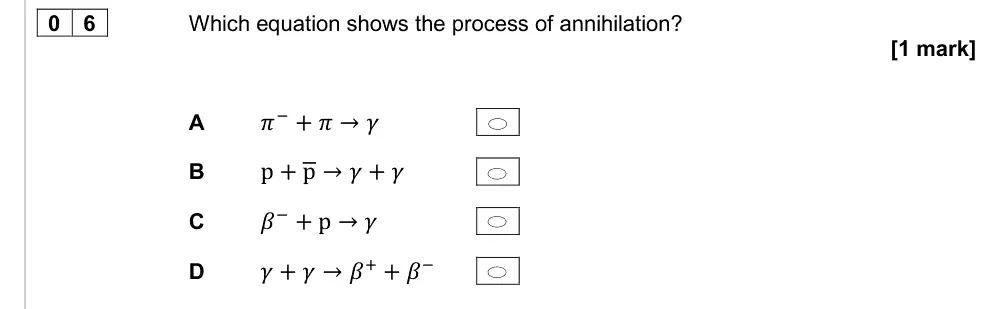
6 Students generally find most aspects of the particle physics topic fairly straightforward. This question was no exception with 83% of students remembering the need for two gamma photons to be produced. A was the most common distractor, chosen by students who forgot this important point perhaps.
Notes from the mark scheme and report
Answer: B
A chosen by those forgetting two photons are needed
Work with an AQA physics tutor
Dropping marks on calculations, required practicals or the six-markers? Book a trial session with a specialist AQA physics tutor.