Tap a question to zoom it. Where a part needs a figure, table or graph from earlier in the question, that part folds out above it; the mark scheme and examiner's comment open underneath. Have the AQA data and formulae booklet beside you (see the formula sheet page).
June 2025 · AS Paper 1 · Q7.12 marksAO1=2Short answerEasy
Mark scheme
Examiner's comment
06.2 Over 50% of students gained full marks in this question. Common misconceptions included: determining the total resistance in the circuit by dividing 10 V by 1mA and presenting • this as the answer. determining the potential difference across R and presenting this as the answer. • applying the emf and terminal pd equation with an internal resistance of zero and • thinking that R (the total external resistance) was the answer. 07.1 Approximately 60% of students gained two marks in this question. This was another ‘recall of knowledge’ question used to introduce the question context. Frequent deficiencies seen in students’ answers included: referring to the minimum energy of the radiation without linking this to the minimum • frequency. expressing the idea of a certain frequency at which the photoelectric effect occurs • rather than the minimum frequency. restating information given in the question without adding detail about what this • process might be. describing bond breaking or freeing of electrons without including information about • the emission from the surface.
Notes from the mark scheme and report
Minimum frequency of radiation needed for electrons to be emitted from the surface
June 2025 · AS Paper 1 · Q7.21 markAO1=1Calculation
Earlier part of question 7 that this part uses
Mark scheme
Examiner's comment
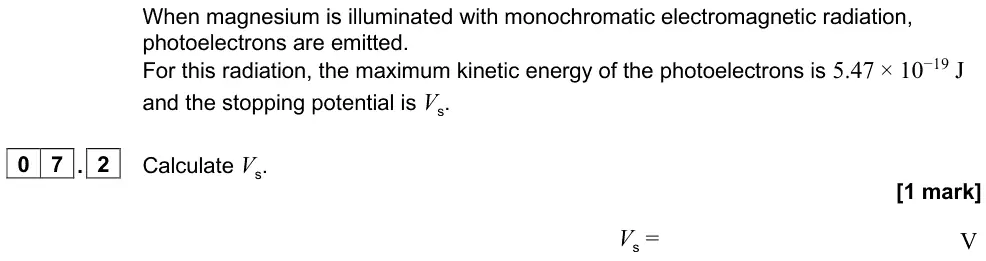
07.2 This question proved very challenging with approximately 50% of students gaining this mark. 14% of students made no attempt at the question. A very similar question on work done crossing a potential difference was asked on this paper in June 2024 (Q2.1).
Notes from the mark scheme and report
Answer: 3.42 V (5.47 x 10^-19 J / 1.6 x 10^-19 C)
14% made no attempt
Skills: MS2.2 Change the subject of an equation, including non-linear equations
June 2025 · AS Paper 1 · Q7.32 marksAO2=2CalculationEasy
Earlier part of question 7 that this part uses
Mark scheme
Examiner's comment
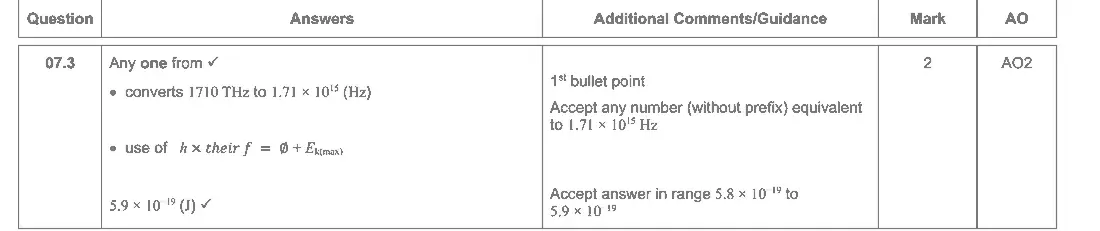
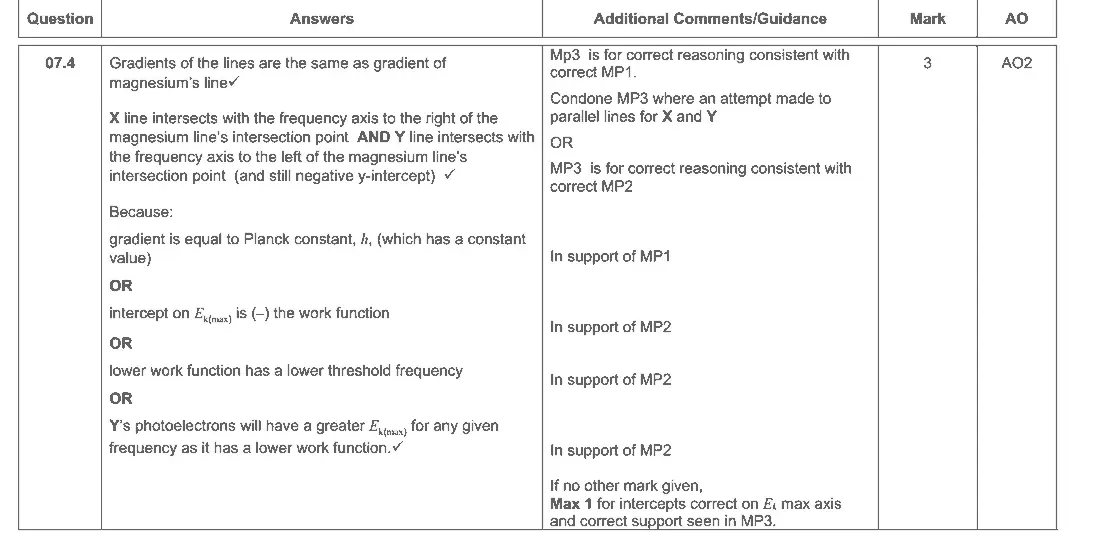
07.3 Students enjoyed more success with this question with approximately 60% gaining full marks and a further 24% gaining one mark. Common deficiencies seen included: working out the photon energy and presenting this as the answer. Students should be • made aware that an allocation of 3 marks for a calculation is unlikely to be a single-step calculation even where there are prefixes to convert. incorrect conversion of THz to Hz. There are two examples of prefix conversions on this • paper and these conversions seemed to cause problems for lower attaining students. Students would do well to learn the conversion factors for these prefixes as they will always feature in AS physics exams. being unaware of the photoelectric equation and dividing their photon energy by the • maximum kinetic energy of the photoelectrons arriving at an answer of 2.1 J. 07.4 This question discriminated well between students of varying ability. Over 25% of students gained 3 marks with 20% gaining 2 marks and 15% gaining 1 mark. Almost 13% of students did not make any attempt at this question. Common misconceptions centred on a greater work function having a more negative y- intercept. Many students interpreted X as having a greater work function by having a less negative y-intercept. Students who scored two marks generally scored these marks for drawing X and Y lines parallel to the magnesium line and giving the reason that the gradient equals the work function. • Reinforce key concepts such as Lepton family conservation, quark composition, moments, and energy transformations. Include opportunities to develop skills in calculations that incorporate Multistep • Reasoning. Guide students through logical sequences in multi-mark questions. Practise converting between SI prefixes and using units to check plausibility of the • numerical answer. Develop students’ skills in the interpretation of graphs especially in the context of • motion and the photoelectric effect. Target misconceptions explicitly by use past-paper examples in classroom discussions • and model answers. Ensure students use terminology accurately particularly in recall questions where • these are used as an easy introduction to set the question’s context.
Conclusion This paper presented a balanced challenge, offering opportunities for students across the attainment spectrum.
While quantitative skills remain a relative strength, conceptual understanding, scientific communication, and response structure continue to be areas for targeted development.
Systematic practice and feedback, particularly using past-paper questions, will be key to supporting future success.
Notes from the mark scheme and report
Answer: 5.9 x 10^-19 J (hf = 6.63 x 10^-34 x 1.71 x 10^15 = 1.13 x 10^-18 J minus 5.47 x 10^-19 J)
THz conversion and giving the photon energy were errors
Skills: MS0.2 Recognise and use expressions in decimal and standard form; MS2.3 Substitute numerical values into algebraic equations using appropriate units for physical quantities
June 2025 · AS Paper 1 · Q7.43 marksAO2=3Diagram or graph
Earlier part of question 7 that this part uses
Mark scheme
Examiner's comment
07.3 Students enjoyed more success with this question with approximately 60% gaining full marks and a further 24% gaining one mark. Common deficiencies seen included: working out the photon energy and presenting this as the answer. Students should be • made aware that an allocation of 3 marks for a calculation is unlikely to be a single-step calculation even where there are prefixes to convert. incorrect conversion of THz to Hz. There are two examples of prefix conversions on this • paper and these conversions seemed to cause problems for lower attaining students. Students would do well to learn the conversion factors for these prefixes as they will always feature in AS physics exams. being unaware of the photoelectric equation and dividing their photon energy by the • maximum kinetic energy of the photoelectrons arriving at an answer of 2.1 J. 07.4 This question discriminated well between students of varying ability. Over 25% of students gained 3 marks with 20% gaining 2 marks and 15% gaining 1 mark. Almost 13% of students did not make any attempt at this question. Common misconceptions centred on a greater work function having a more negative y- intercept. Many students interpreted X as having a greater work function by having a less negative y-intercept. Students who scored two marks generally scored these marks for drawing X and Y lines parallel to the magnesium line and giving the reason that the gradient equals the work function. • Reinforce key concepts such as Lepton family conservation, quark composition, moments, and energy transformations. Include opportunities to develop skills in calculations that incorporate Multistep • Reasoning. Guide students through logical sequences in multi-mark questions. Practise converting between SI prefixes and using units to check plausibility of the • numerical answer. Develop students’ skills in the interpretation of graphs especially in the context of • motion and the photoelectric effect. Target misconceptions explicitly by use past-paper examples in classroom discussions • and model answers. Ensure students use terminology accurately particularly in recall questions where • these are used as an easy introduction to set the question’s context.
Notes from the mark scheme and report
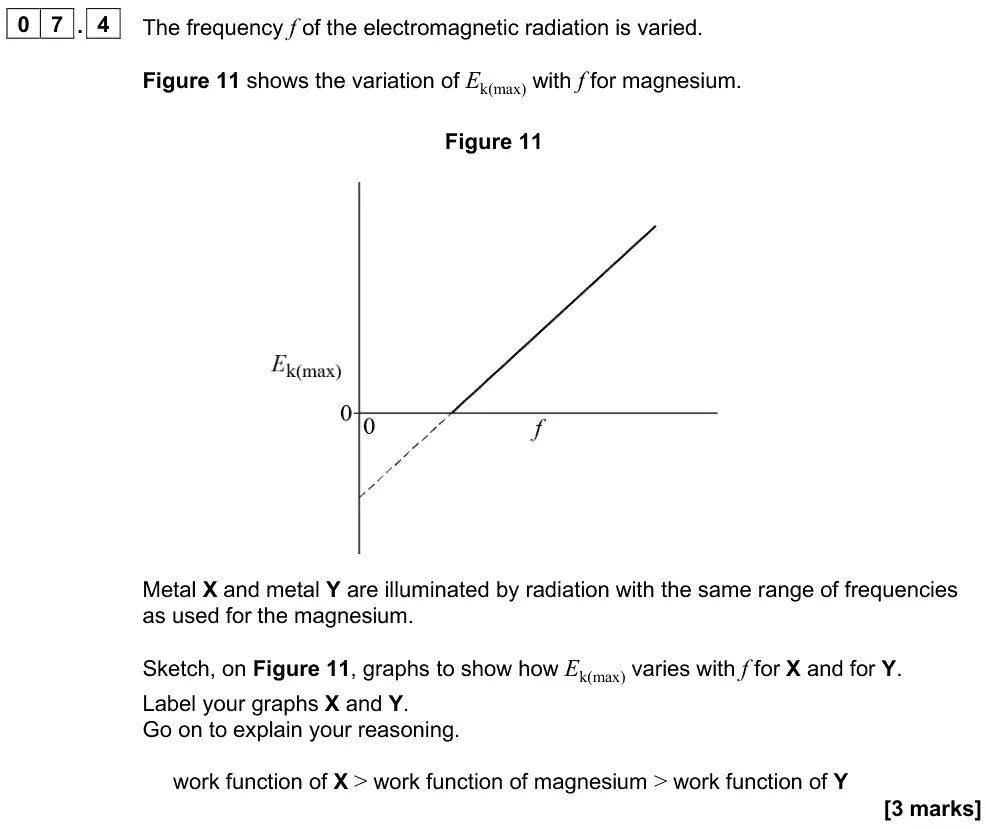
Lines X and Y parallel to magnesium (gradient = h)
X crosses the f axis to the right (higher threshold), Y to the left
y-intercept is minus the work function, so X more negative
Skills: MS3.3 Understand that y = mx + c represents a linear relationship; MS3.1 Translate information between graphical, numerical and algebraic forms
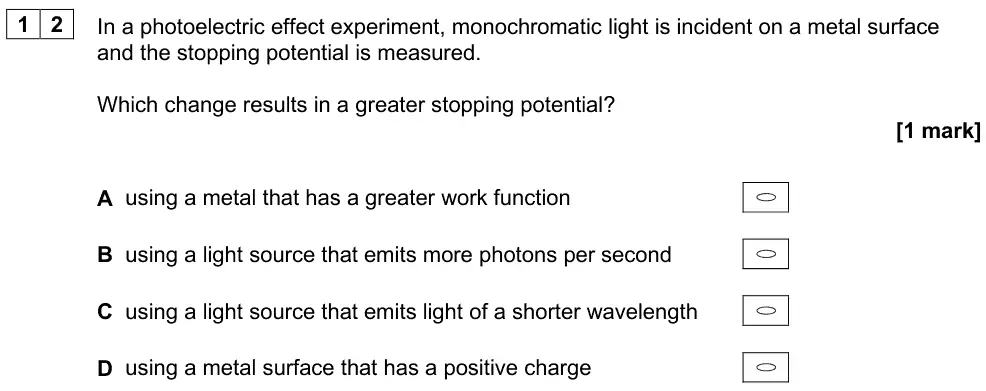
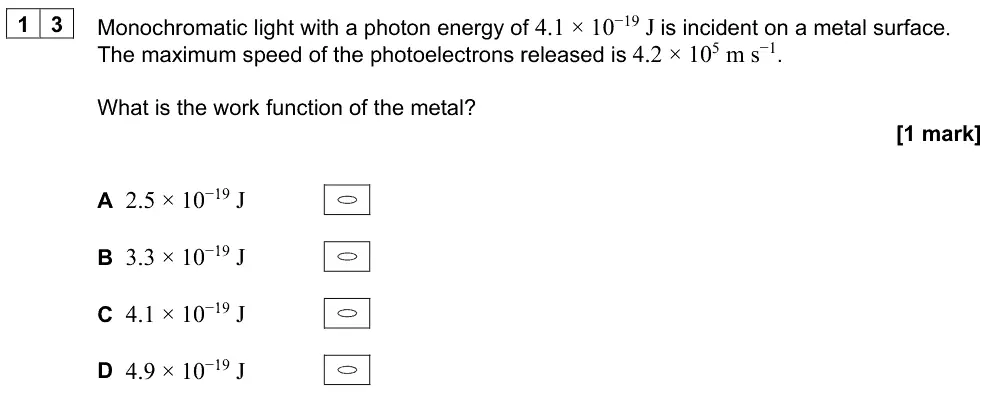
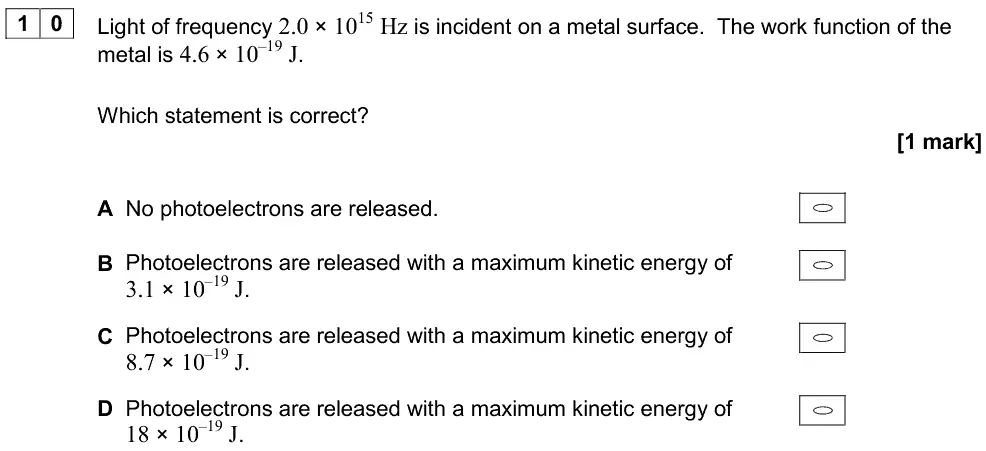
June 2025 · Paper 1 · Q121 markAO1=1Multiple choice
Answer
C
Mark scheme
Notes from the mark scheme and report
Answer: C
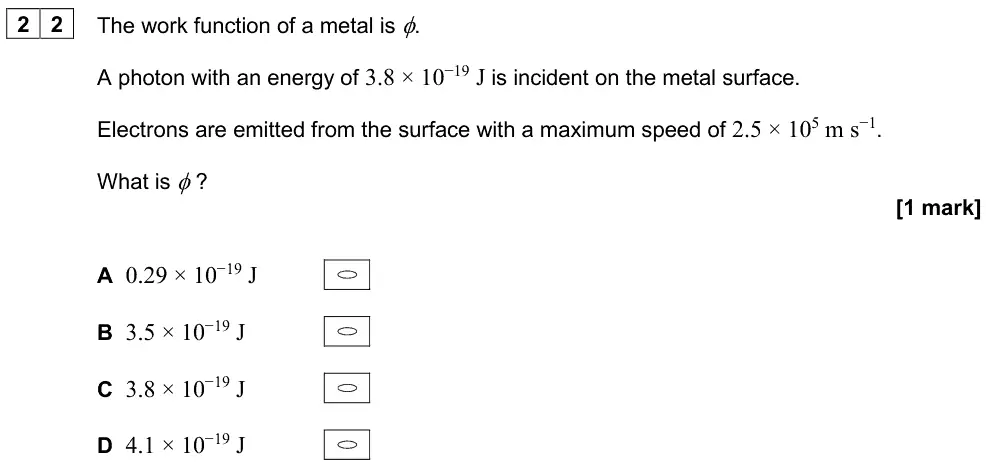
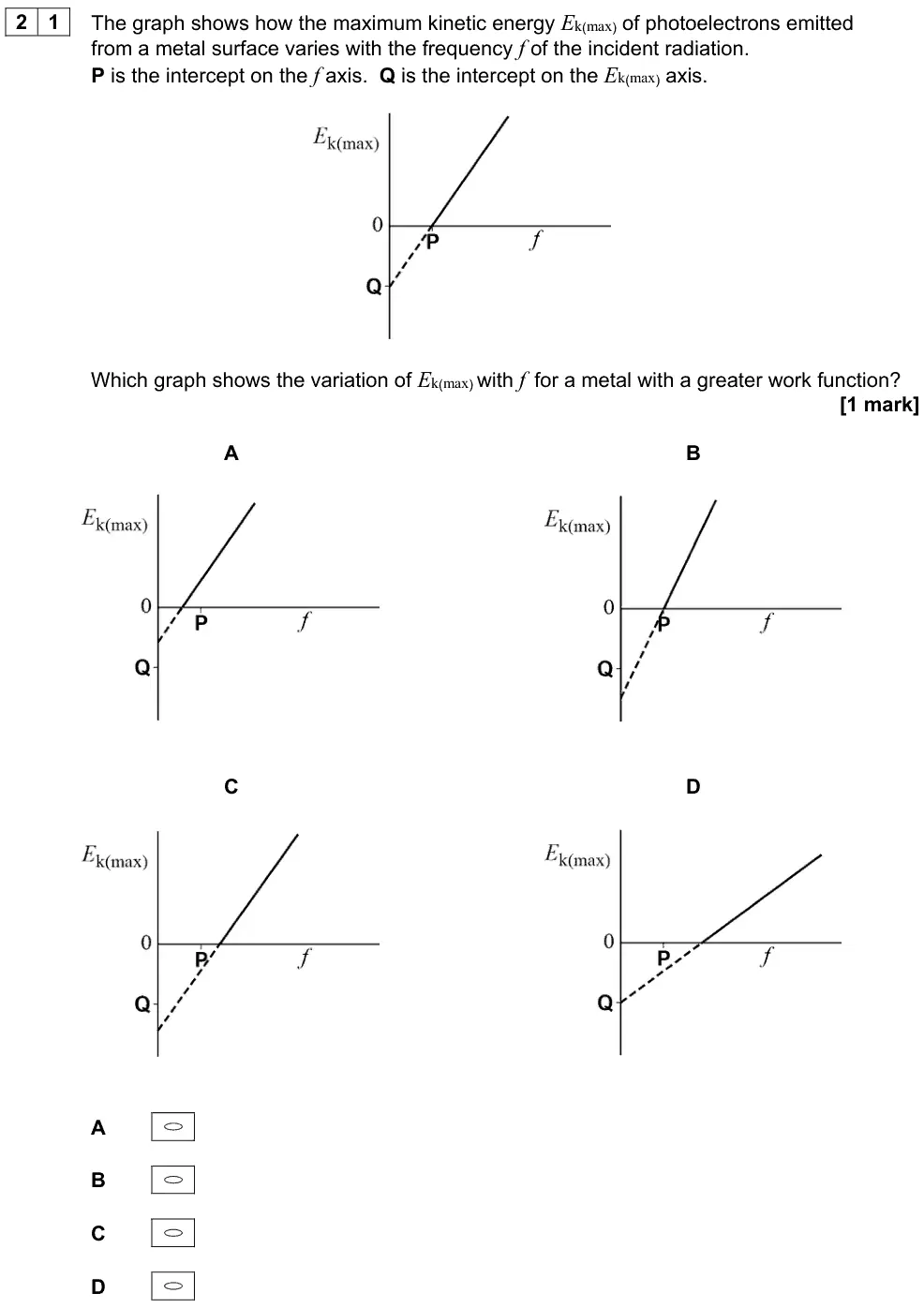
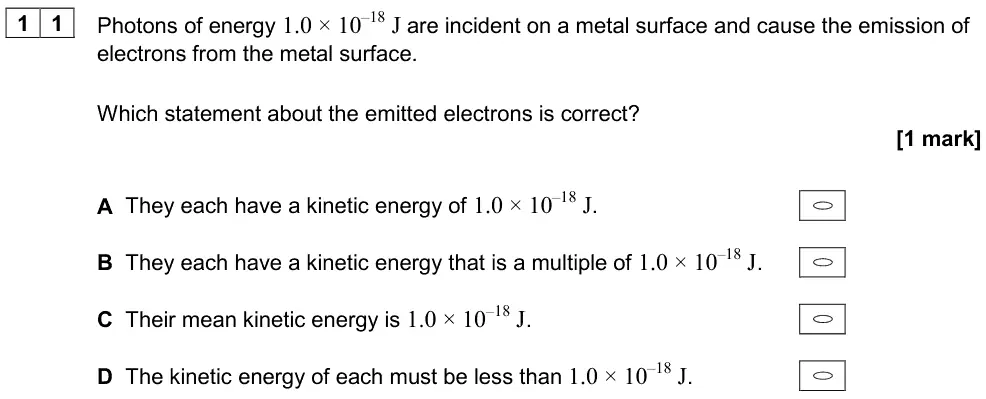
June 2025 · Paper 1 · Q221 markAO2=1Multiple choice
Answer
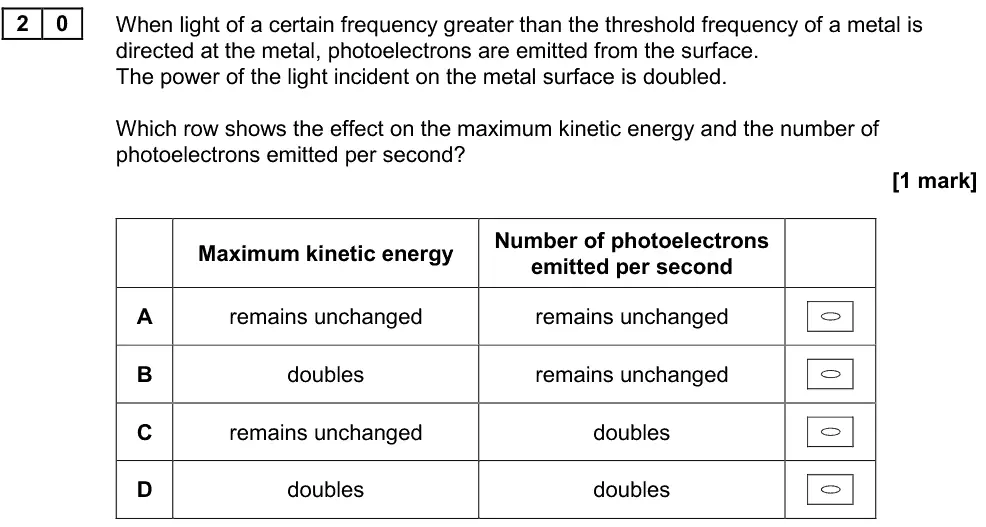
B
Mark scheme
Notes from the mark scheme and report
Answer: B
Skills: MS2.3 Substitute numerical values into algebraic equations using appropriate units for physical quantities
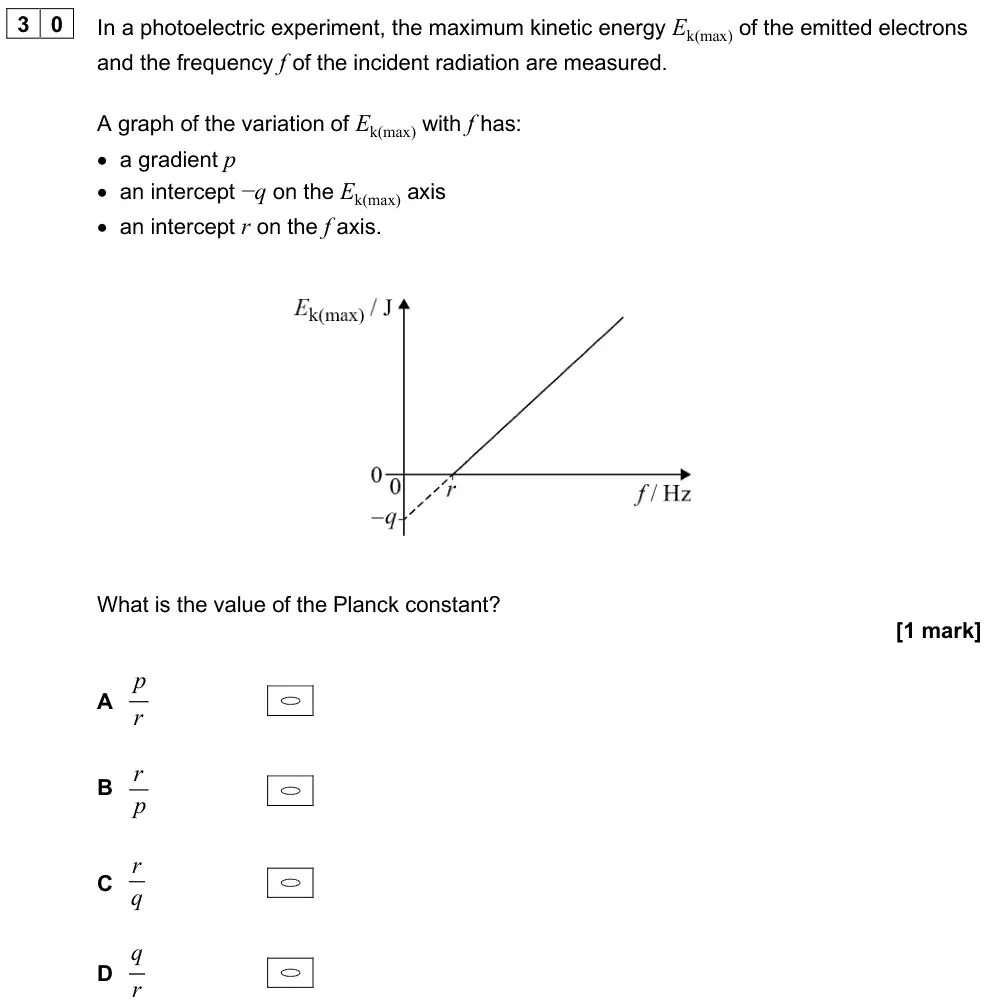
June 2025 · Paper 1 · Q301 markAO1=1Multiple choice
Answer
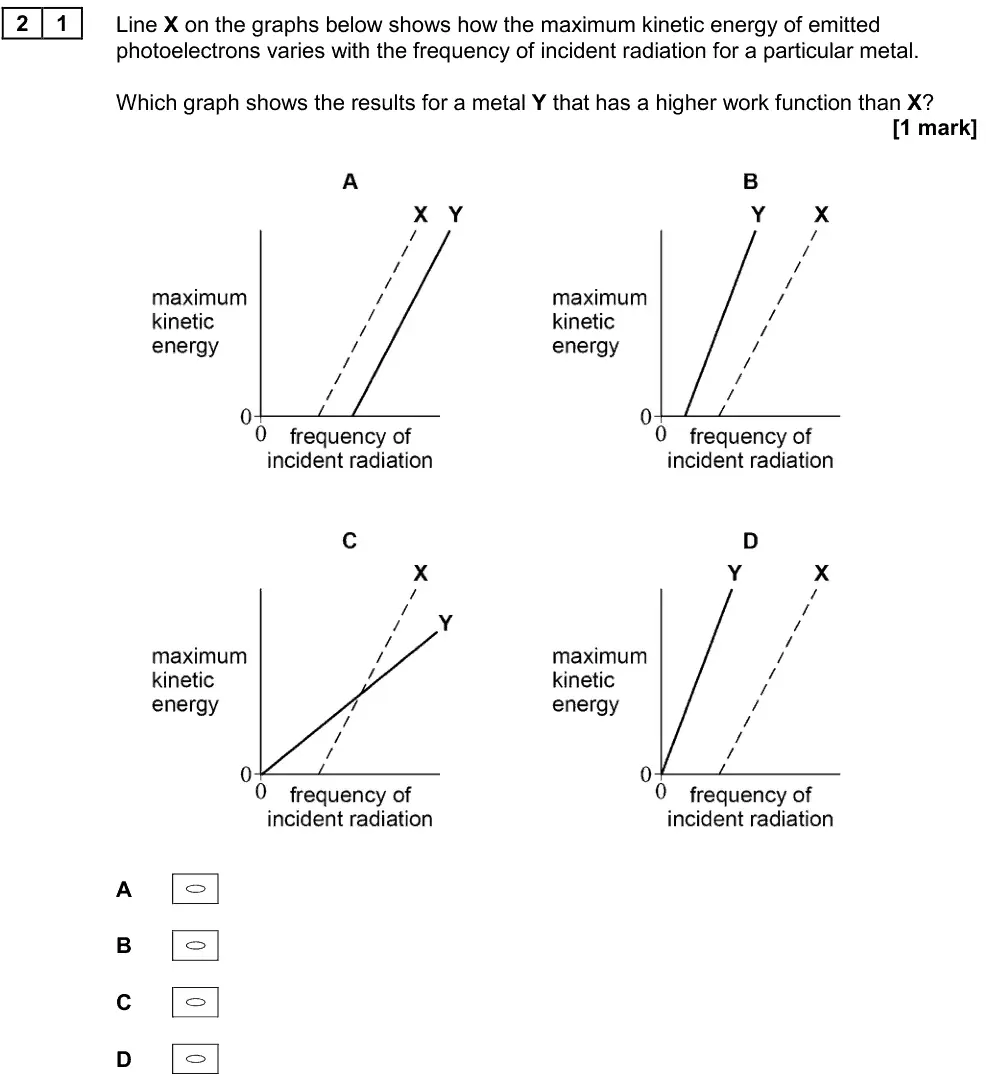
D
Mark scheme
Notes from the mark scheme and report
Answer: D
Skills: MS3.4 Determine the slope and intercept of a linear graph; MS3.3 Understand that y = mx + c represents a linear relationship
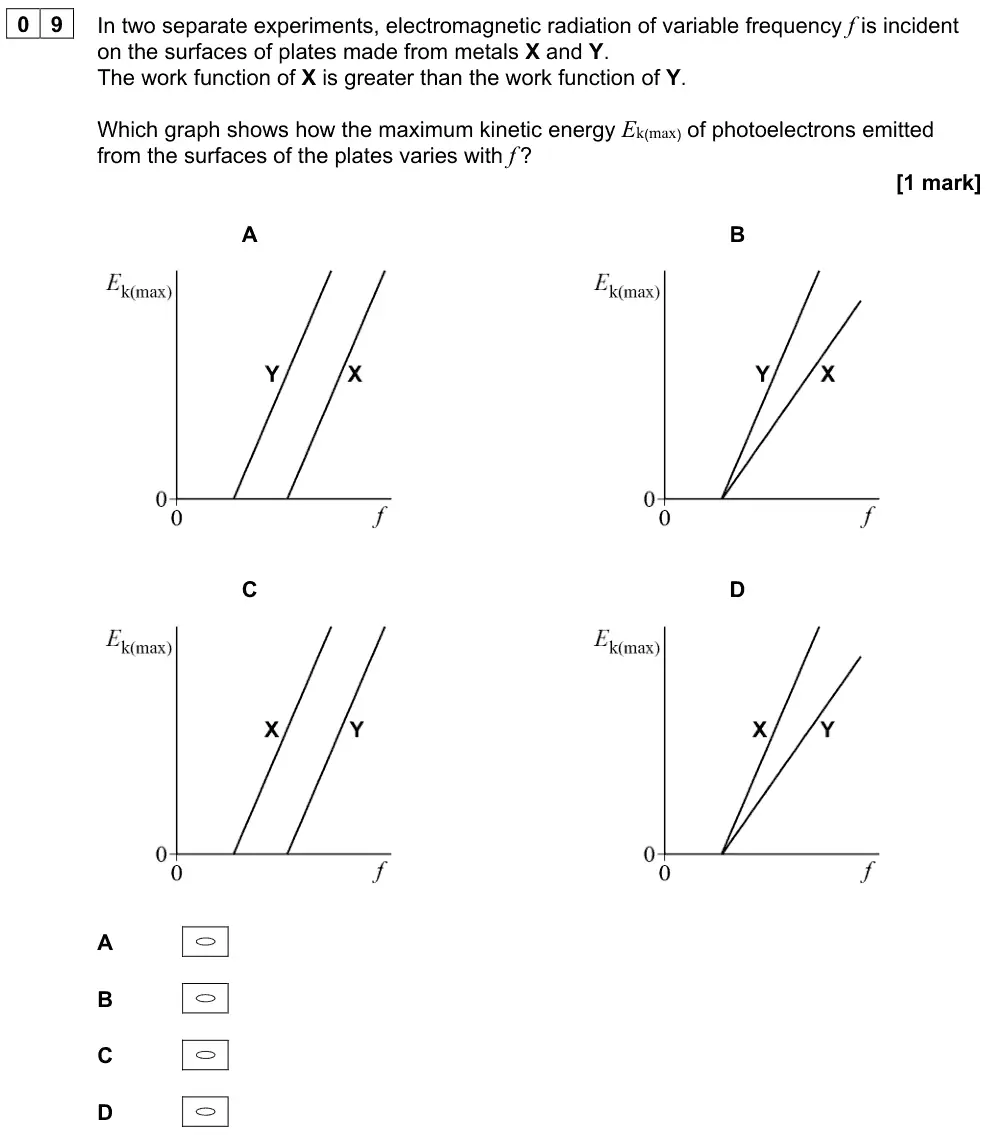
June 2024 · Paper 1 · Q91 markAO1=1Multiple choice
Answer
A
Mark scheme
Notes from the mark scheme and report
Answer: A
Skills: MS3.1 Translate information between graphical, numerical and algebraic forms
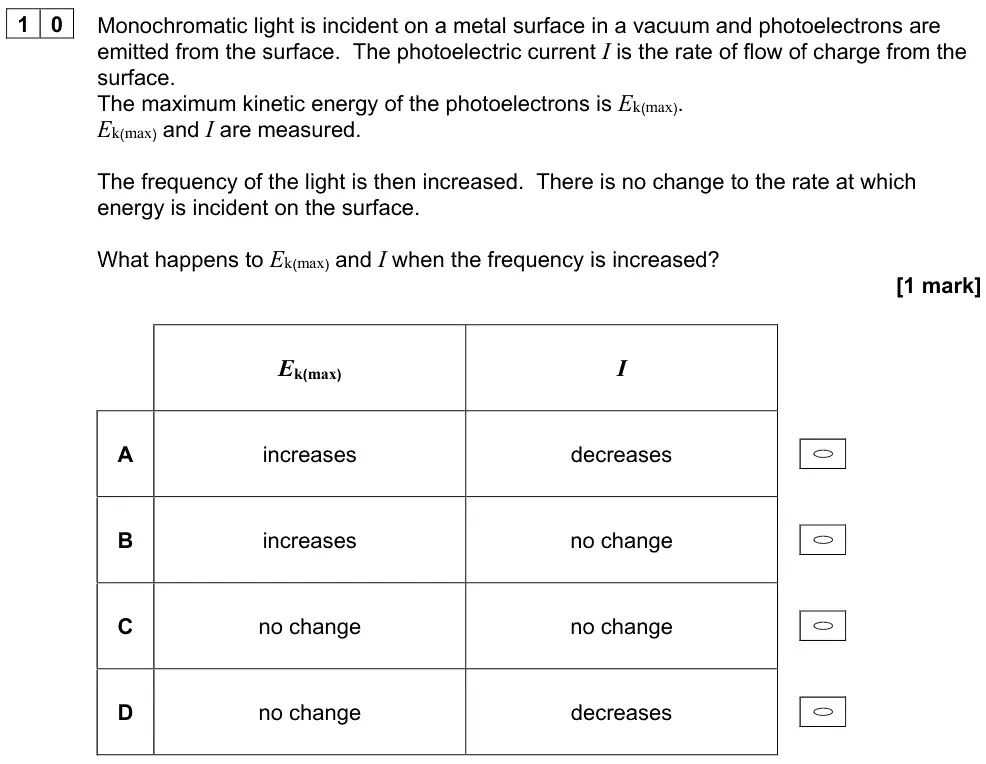
June 2024 · Paper 1 · Q101 markAO2=1Multiple choiceHard
Answer
A
Mark scheme
Examiner's comment
There were two very demanding questions answered correctly by fewer than 12% of students. These were B10 and B25.
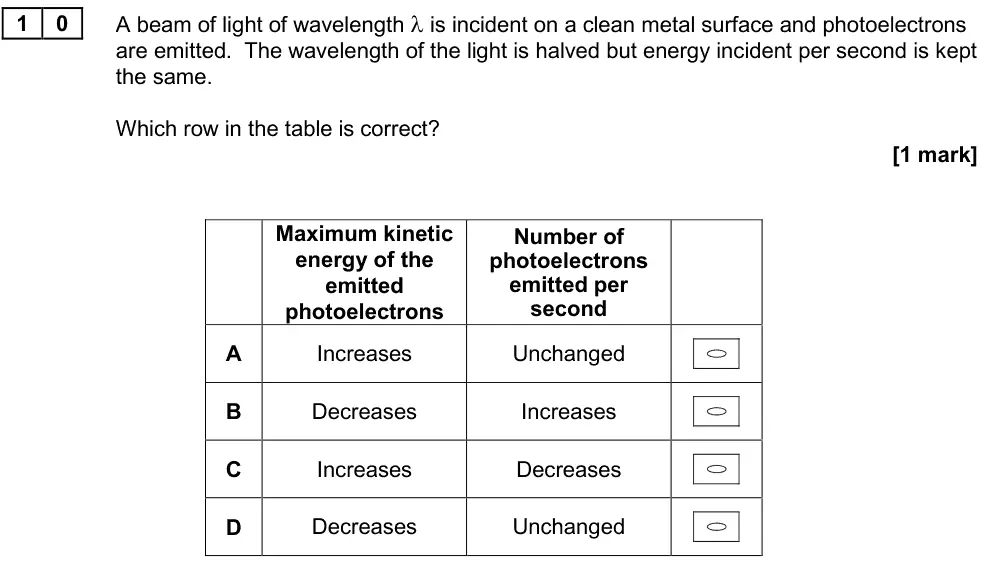
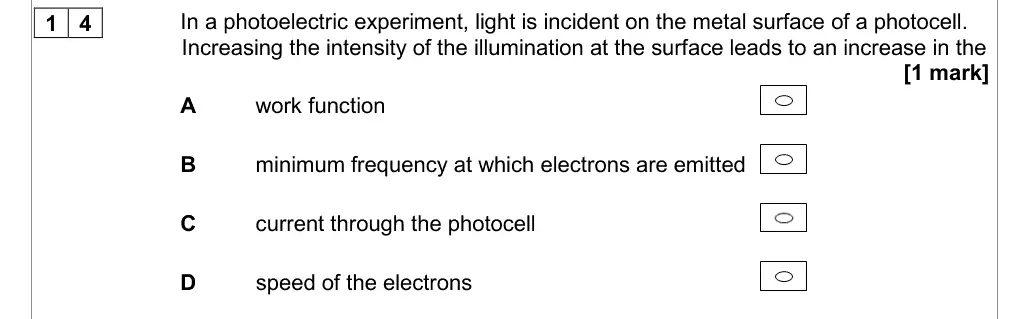
In B10 most students chose option B. This suggests that they did not realise that, when the energy transfer rate stays the same, using light of higher frequency means fewer photons per second and therefore a lower current.
Notes from the mark scheme and report
Answer: A
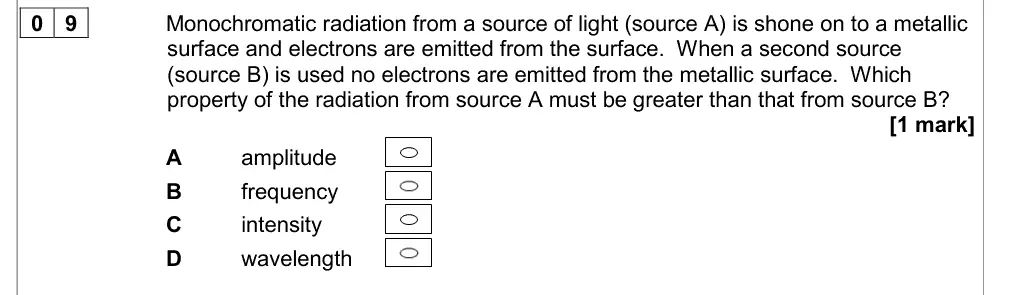
most chose B - same energy rate at higher frequency means fewer photons per second, so lower current
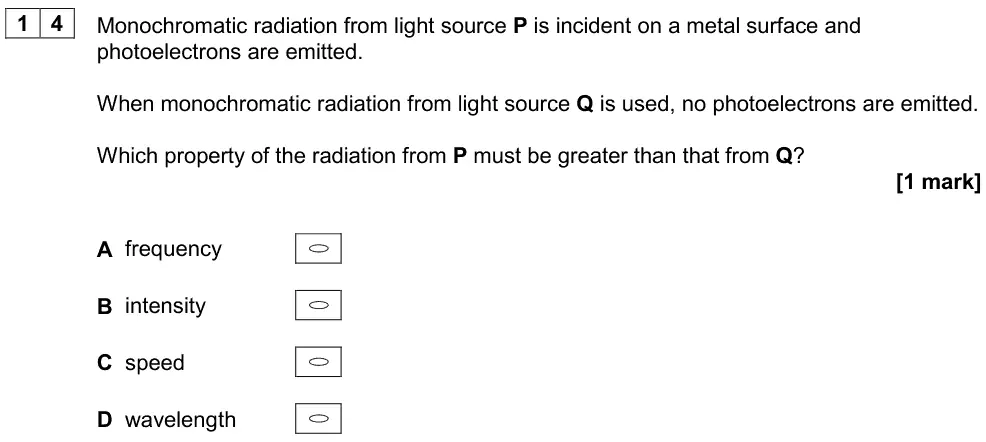
June 2024 · AS Paper 2 · Q141 markMultiple choice
Answer
A
Mark scheme
Examiner's comment
Generally, students were more successful in answering questions 5, 6, 7, 11, 14, 17 and were less successful in answering questions 9, 10, 12, 13, 15, 16, 18, 21, 22, 23.
Notes from the mark scheme and report
Answer: A
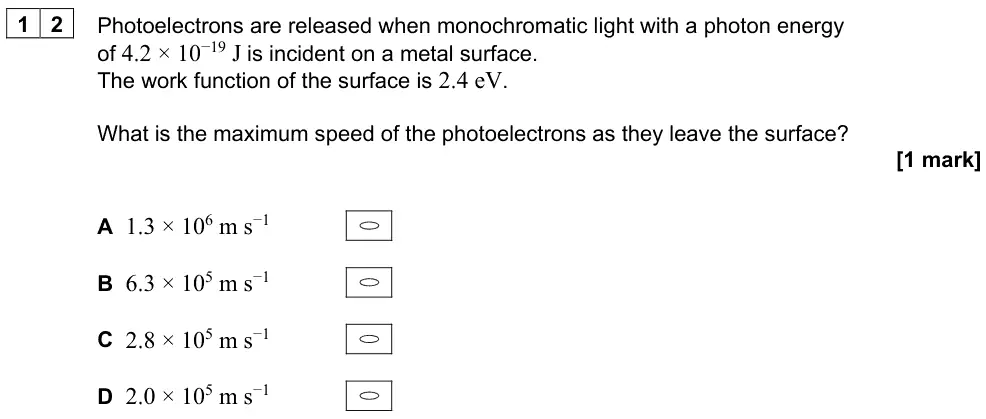
June 2023 · Paper 1 · Q121 markMultiple choiceEasy
Answer
C
Mark scheme
Examiner's comment
The multiple choice questions covered parts of the specification not covered in Section A. The distractors in these questions were written with common errors and misconceptions in mind. These questions are therefore an extremely useful resource when preparing students. The easiest questions were 7, 12, 20, 10 and 11, with over 75% of students getting these questions right. The most demanding were 18, 26, 22, 21 and 13; fewer than 40% of students got these right. For several of these the correct answer was not the most popular choice.
Notes from the mark scheme and report
Answer: C
Skills: MS2.3 Substitute numerical values into algebraic equations using appropriate units for physical quantities
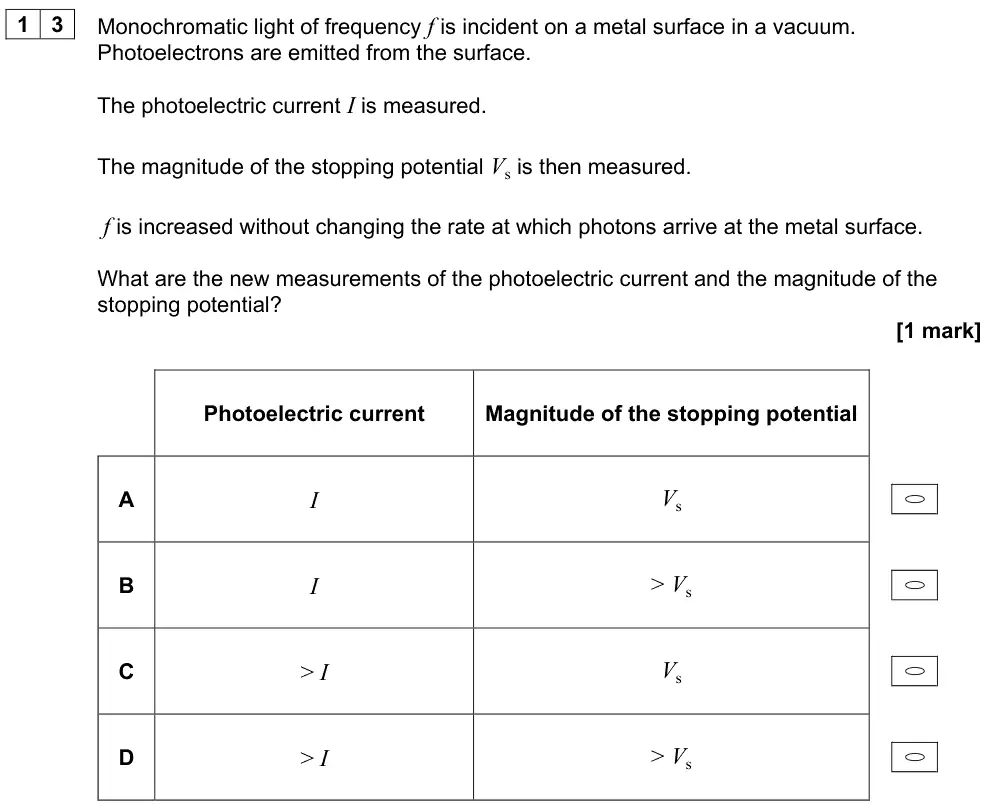
June 2023 · AS Paper 2 · Q131 markMultiple choice
Answer
B
Mark scheme
Notes from the mark scheme and report
Answer: B
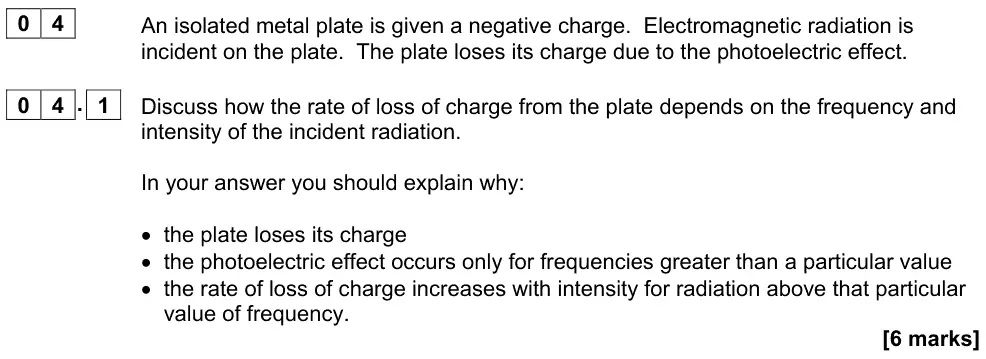
June 2022 · AS Paper 1 · Q4.16 marksAO1=4, AO2=26-mark extended responseHard
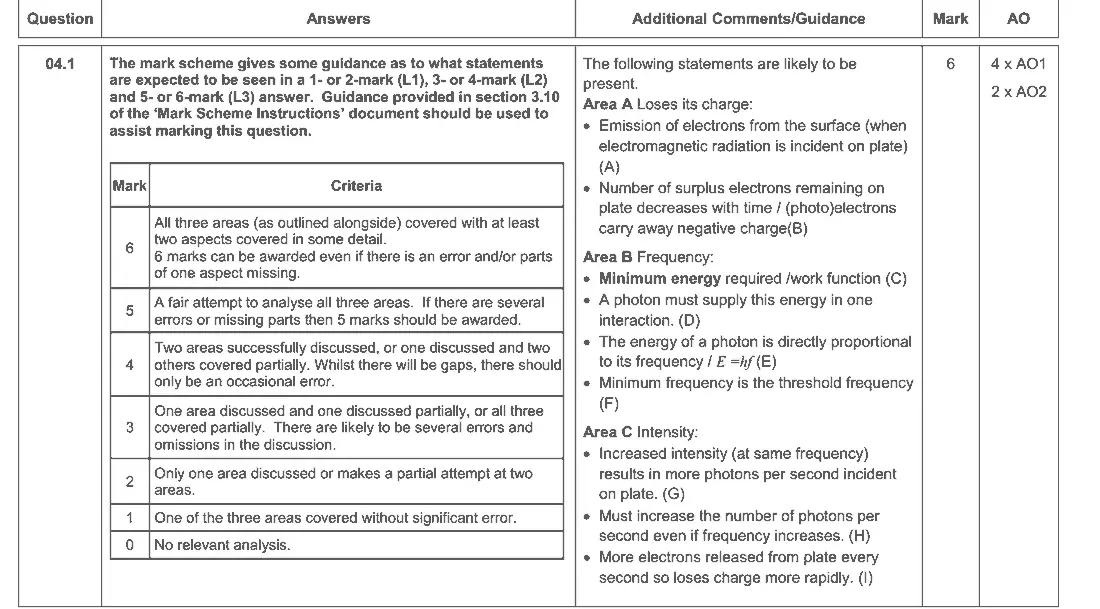
Mark scheme, with the levels and indicative content
Examiner's comment
04.1 This question was well answered with almost a quarter of students gaining at least five marks. These students typically produced coherent answers that addressed each of the bullet points in sufficient detail. Such answers used appropriate technical language to demonstrate a good understanding of the photoelectric effect.
Common errors included a limited use of appropriate technical language such as confusing threshold frequency with work function, and describing electrons as being ionised instead of released from the surface. Other students showed very limited knowledge and could only tentatively suggest that electrons were emitted when the electromagnetic radiation was incident on the metal. 04.2 Most students performed well in this calculation with over 60% gaining both marks. The mismatch of units in the photoelectric equation was a common error with students substituting the photon energy in joules and the kinetic energy in electron volts. Other students failed to gain marks due to forgetting to convert their answer in joules back into electron volts.
Notes from the mark scheme and report
Levels of response: electrons emitted carry negative charge away
one photon gives all its energy in one interaction and must exceed the work function, E = hf so a threshold frequency
higher intensity means more photons per second so more electrons per second
confusing threshold frequency with work function common
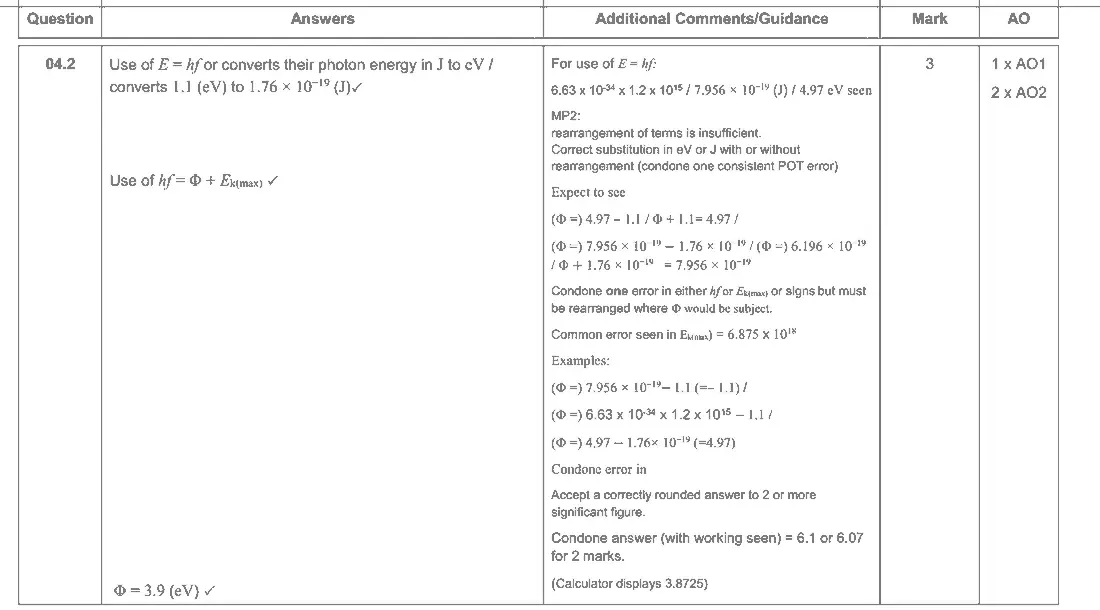
June 2022 · AS Paper 1 · Q4.23 marksAO1=1, AO2=2CalculationEasy
Earlier part of question 4 that this part uses
Mark scheme
Examiner's comment
Common errors included a limited use of appropriate technical language such as confusing threshold frequency with work function, and describing electrons as being ionised instead of released from the surface. Other students showed very limited knowledge and could only tentatively suggest that electrons were emitted when the electromagnetic radiation was incident on the metal. 04.2 Most students performed well in this calculation with over 60% gaining both marks. The mismatch of units in the photoelectric equation was a common error with students substituting the photon energy in joules and the kinetic energy in electron volts. Other students failed to gain marks due to forgetting to convert their answer in joules back into electron volts.
Notes from the mark scheme and report
Answer: 3.9 eV (hf = 7.96 x 10^-19 J = 4.97 eV, minus 1.1 eV)
mixing J and eV in the photoelectric equation was the common error
Skills: MS2.3 Substitute numerical values into algebraic equations using appropriate units for physical quantities; MS2.2 Change the subject of an equation, including non-linear equations
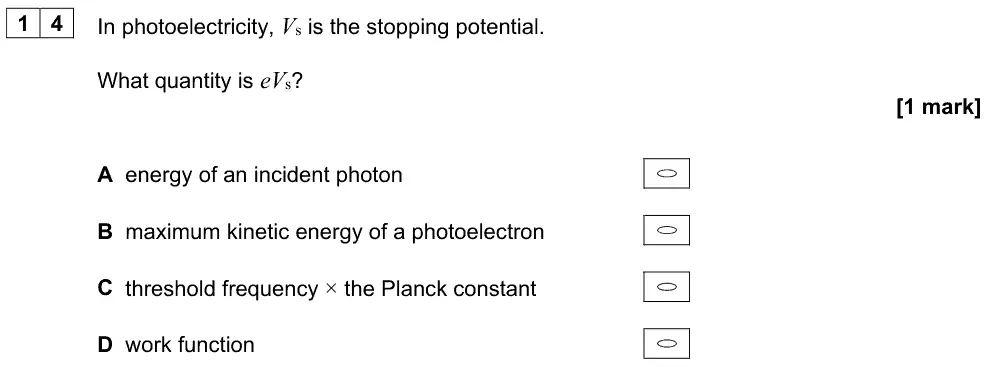
June 2022 · Paper 1 · Q141 markAO2=1Multiple choice
Answer
B
Mark scheme
Notes from the mark scheme and report
Answer: B
November 2021 · Paper 1 · Q131 markMultiple choice
Answer
B
Mark scheme
Notes from the mark scheme and report
Answer: B
Skills: MS2.3 Substitute numerical values into algebraic equations using appropriate units for physical quantities
November 2021 · AS Paper 2 · Q211 markMultiple choice
Answer
C
Mark scheme
Notes from the mark scheme and report
Answer: C
Skills: MS3.1 Translate information between graphical, numerical and algebraic forms
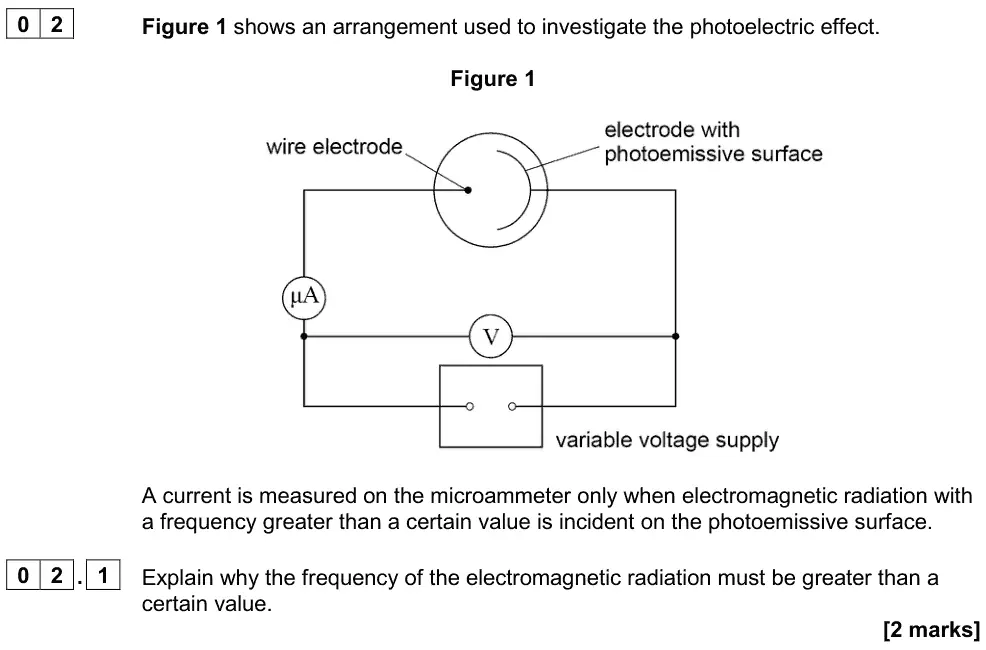
November 2020 · Paper 1 · Q2.12 marksExplanation
Mark scheme
Examiner's comment
This question about the photoelectric effect proved to be very challenging to a significant number of students. In 02.1, many merely mentioned the threshold frequency without further explanation. Power of ten errors when reading the graph were common in 02.2. Parts 02.3, 02.4 and 02.5 were very poorly answered by the majority of students. A significant number attempted to answer the questions based on simple electricity andV IR = , for example. Answers indicated that many students were unfamiliar with the idea of stopping potential and there was a lot of confusion with work function.
Notes from the mark scheme and report
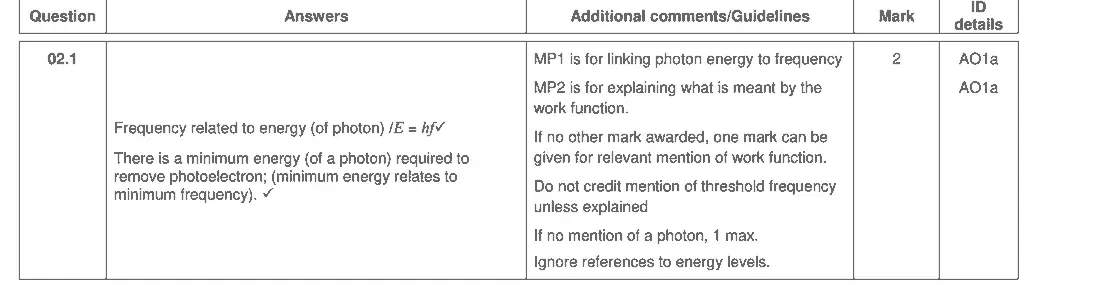
Photon energy E = hf
a minimum energy (work function) is needed to release an electron, so minimum frequency
'threshold frequency' without explanation not credited
November 2020 · Paper 1 · Q2.32 marksExplanation
Earlier part of question 2 that this part uses
Mark scheme
Examiner's comment
This question about the photoelectric effect proved to be very challenging to a significant number of students. In 02.1, many merely mentioned the threshold frequency without further explanation. Power of ten errors when reading the graph were common in 02.2. Parts 02.3, 02.4 and 02.5 were very poorly answered by the majority of students. A significant number attempted to answer the questions based on simple electricity andV IR = , for example. Answers indicated that many students were unfamiliar with the idea of stopping potential and there was a lot of confusion with work function.
Notes from the mark scheme and report
Rate of photoelectron release fixed by intensity (photons per second), not pd
current saturates when all emitted photoelectrons reach the anode
V = IR arguments wrong
November 2020 · Paper 1 · Q2.43 marksExplanation
Earlier part of question 2 that this part uses
Mark scheme
Examiner's comment
This question about the photoelectric effect proved to be very challenging to a significant number of students. In 02.1, many merely mentioned the threshold frequency without further explanation. Power of ten errors when reading the graph were common in 02.2. Parts 02.3, 02.4 and 02.5 were very poorly answered by the majority of students. A significant number attempted to answer the questions based on simple electricity andV IR = , for example. Answers indicated that many students were unfamiliar with the idea of stopping potential and there was a lot of confusion with work function.
Notes from the mark scheme and report
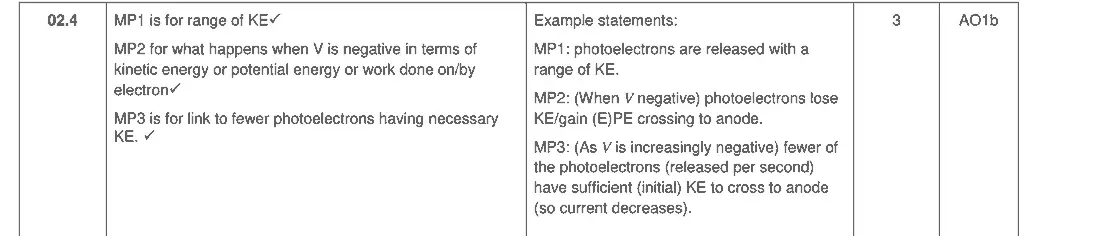
Photoelectrons emitted with a range of KE
negative V means they lose KE crossing to the anode
as V becomes more negative fewer have enough KE so current falls
stopping potential poorly understood
November 2020 · Paper 1 · Q2.53 marksExplanation
Earlier part of question 2 that this part uses
Mark scheme
Examiner's comment
This question about the photoelectric effect proved to be very challenging to a significant number of students. In 02.1, many merely mentioned the threshold frequency without further explanation. Power of ten errors when reading the graph were common in 02.2. Parts 02.3, 02.4 and 02.5 were very poorly answered by the majority of students. A significant number attempted to answer the questions based on simple electricity andV IR = , for example. Answers indicated that many students were unfamiliar with the idea of stopping potential and there was a lot of confusion with work function.
Notes from the mark scheme and report
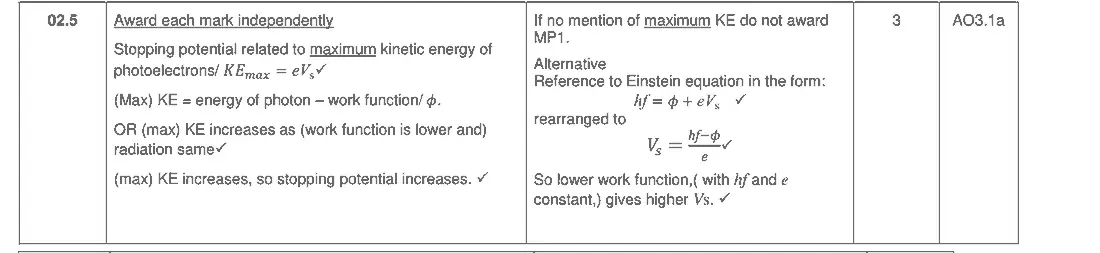
eVs = KE max = hf - work function
smaller work function with same radiation gives larger KE max so stopping potential increases
very poorly answered
November 2020 · AS Paper 2 · Q4.22 marksCalculation
Earlier part of question 4 that this part uses
Mark scheme
Notes from the mark scheme and report
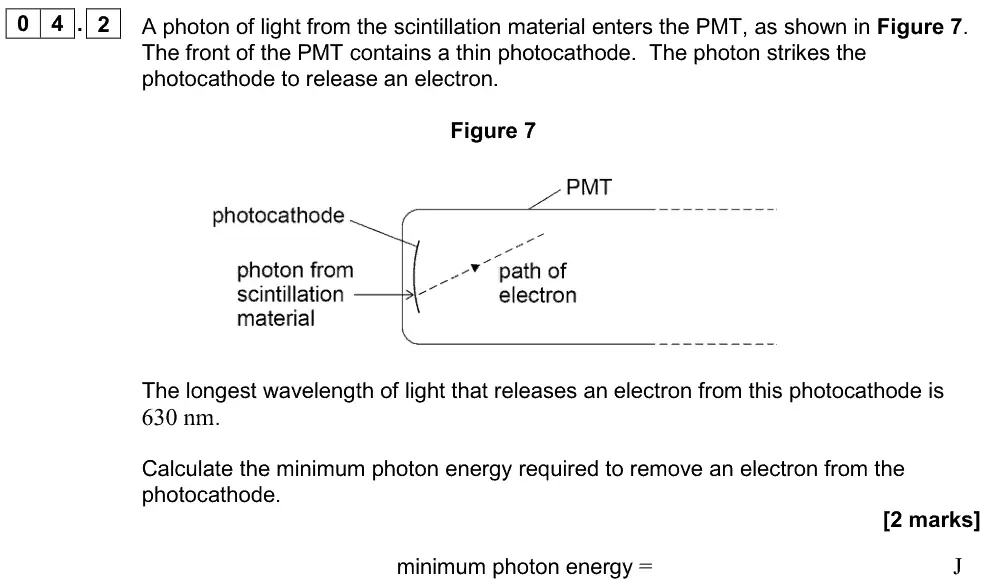
Answer: 3.2 x 10^-19 J (E = hc/lambda with 630 nm)
Skills: MS2.3 Substitute numerical values into algebraic equations using appropriate units for physical quantities
June 2019 · Paper 1 · Q101 markMultiple choice
Answer
C
Notes from the mark scheme and report
Answer: C
Skills: MS2.3 Substitute numerical values into algebraic equations using appropriate units for physical quantities
June 2019 · AS Paper 2 · Q111 markMultiple choice
Answer
D
Mark scheme
Notes from the mark scheme and report
Answer: D
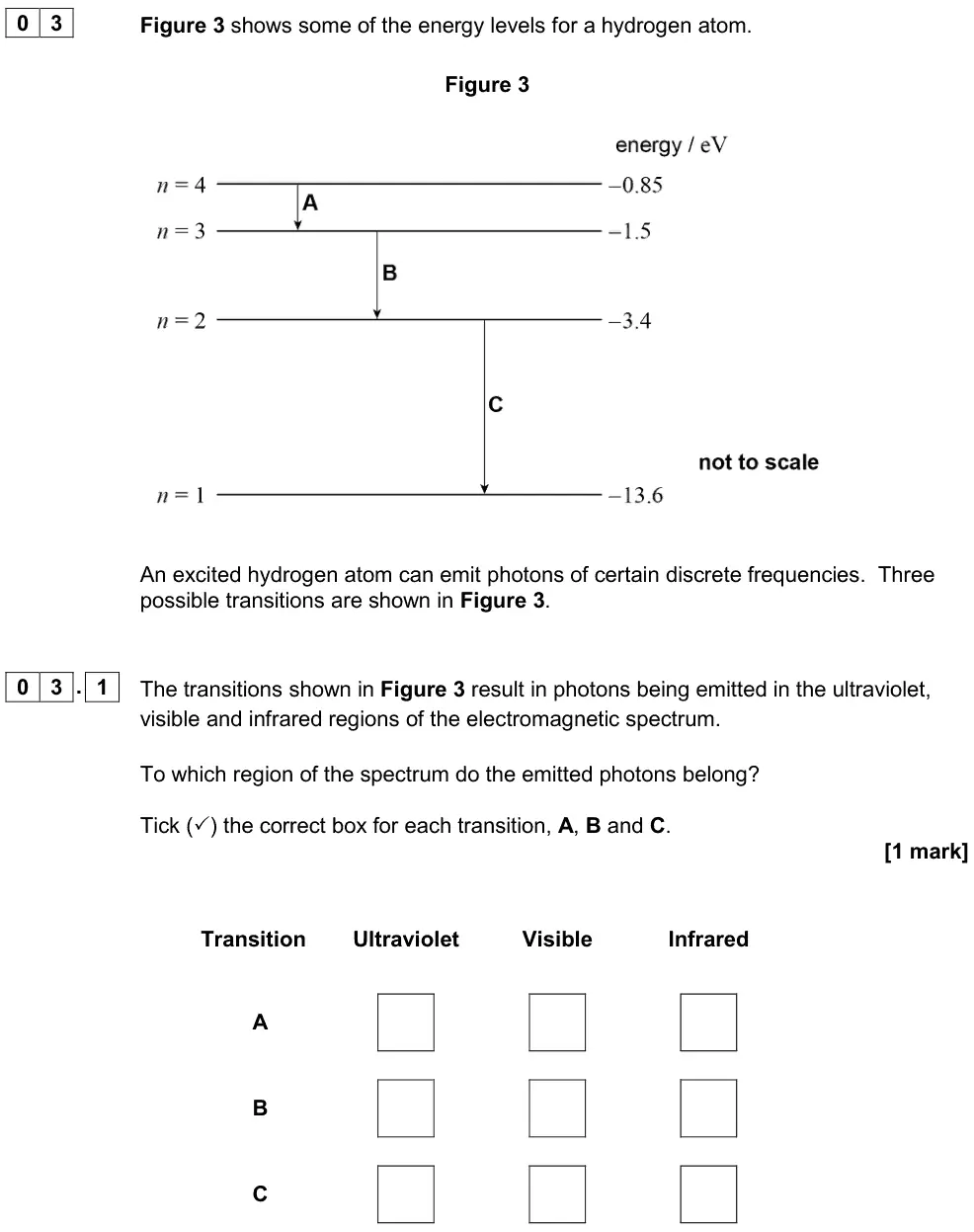
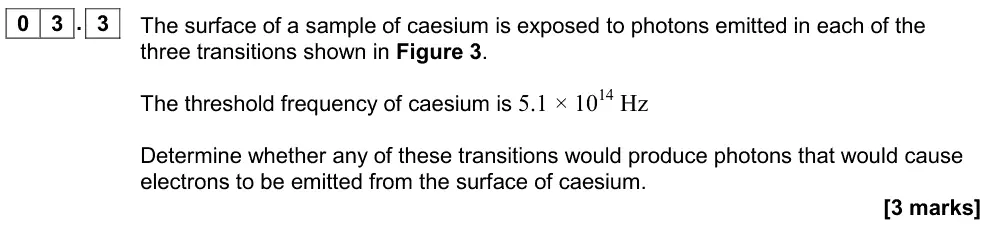
June 2018 · AS Paper 1 · Q3.33 marksCalculation
Earlier part of question 3 that this part uses
Mark scheme
Examiner's comment
03.3 This question was well done with nearly half the students scoring full marks.
Notes from the mark scheme and report
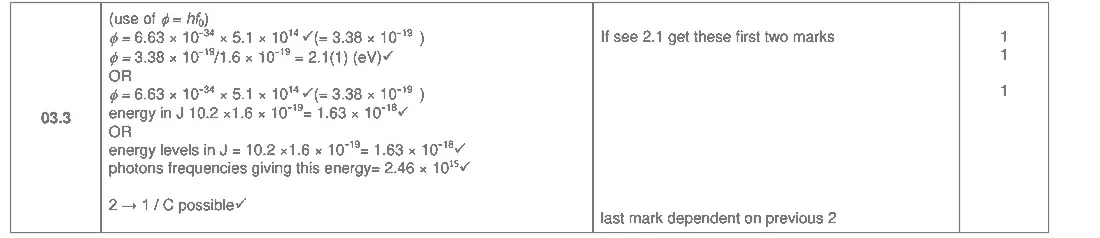
Answer: only C (2 to 1, 10.2 eV) emits electrons
work function hf0 = 3.38 x 10^-19 J = 2.1 eV, larger than A and B photon energies
Skills: MS2.3 Substitute numerical values into algebraic equations using appropriate units for physical quantities
June 2018 · AS Paper 1 · Q3.43 marksCalculation
Earlier part of question 3 that this part uses
Mark scheme
Examiner's comment
03.4 Performance in this multi-step calculation was disappointing, with over half the students failing to score any marks. The photoelectric equation did seem well known but substitution was a real issue for many. Students had to extract data from different sources and this clearly caused them problems. A common error was a failure to convert the photon energy to joule.
Notes from the mark scheme and report
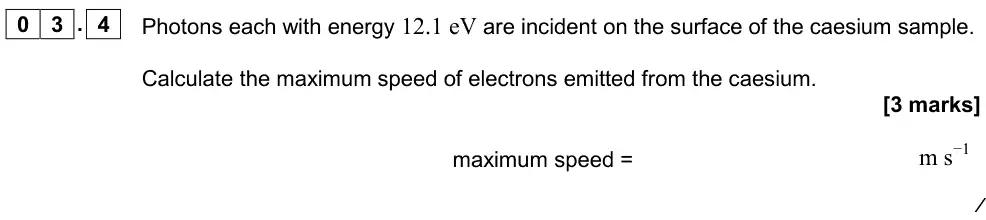
Answer: 1.9 x 10^6 m s^-1 (Ek = 12.1 - 2.1 = 10 eV = 1.6 x 10^-18 J)
photoelectric equation must be used
failing to convert eV to J was the common error
over half scored zero
Skills: MS2.3 Substitute numerical values into algebraic equations using appropriate units for physical quantities; MS2.2 Change the subject of an equation, including non-linear equations
June 2018 · Paper 1 · Q141 markMultiple choice
Answer
A
Notes from the mark scheme and report
Answer: A
Skills: MS2.3 Substitute numerical values into algebraic equations using appropriate units for physical quantities
June 2018 · AS Paper 2 · Q91 markMultiple choice
Answer
C
Notes from the mark scheme and report
Answer: C
Skills: MS3.1 Translate information between graphical, numerical and algebraic forms
June 2017 · Paper 1 · Q101 markMultiple choice
Answer
C
Notes from the mark scheme and report
Answer: C
June 2017 · AS Paper 2 · Q201 markMultiple choice
Answer
C
Notes from the mark scheme and report
Answer: C
June 2017 · AS Paper 2 · Q211 markMultiple choice
Answer
A
Notes from the mark scheme and report
Answer: A
Skills: MS3.3 Understand that y = mx + c represents a linear relationship
June 2016 · AS Paper 1 · Q5.13 marksExplanation
Mark scheme
Examiner's comment
Answers given to this question on the photoelectric effect provided evidence of the tendency of some students to not present full arguments when applying physics principles. In question 5.1 most students identified that electrons needed to leave the surface but the linking of this to the frequency of the radiation was quite vague. Responses that failed to mention photons were common and many did not emphasise the importance of the work function. It was not unusual to see discussions that confused the photoelectric effect with the excitation and ionisation of electrons in individual atoms. It was a similar story in question 5.2 where the majority of students realised that the current would increase but then failed to explain why in terms of the increased number of photons striking the metal surface per second. The calculation in question 5.3 was generally well done with nearly three-quarters of students scoring full marks. Surprisingly, far fewer were then able to use their correct answer from 5.3 to calculate the stopping potential in 5.4. Question 5.5 was another example of incomplete arguments. The majority did appreciate that the stopping potential would increase but were unable to give complete explanations for this effect. Better responses did link this increase to maximum kinetic energy but it was very rare to see answers explaining that this was due to greater energy transfer by photons.
This was the first paper for this new award and evidence from scripts suggests that an encouraging proportion of students were well prepared for the exam and were able to cope successfully with the broader scope of the questions and the change in emphasis of the assessment objectives. In general students seemed more confident with quantitative questions and less so with those that required extended written answers. There was a tendency not to present full arguments when applying physics principles: examples of this being questions 1.2, 3.4 and 5.1. The evidence from scripts suggests that students had sufficient time to answer all the questions and few incomplete papers were seen.
Notes from the mark scheme and report
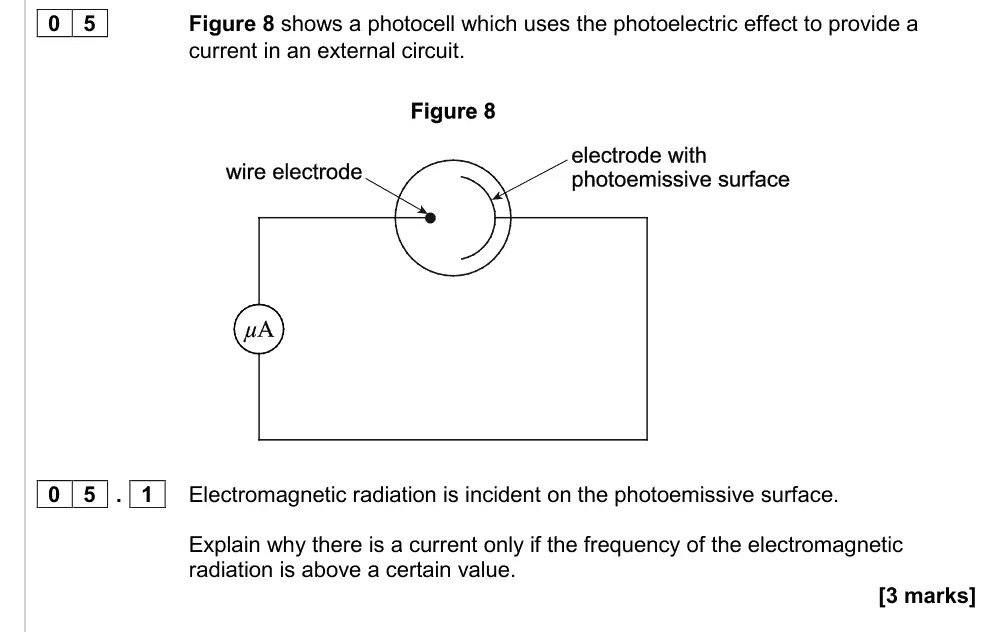
One photon per electron
photon energy hf must exceed the work function for emission, so a threshold frequency exists
many omitted photons/work function
June 2016 · AS Paper 1 · Q5.22 marksExplanation
Earlier part of question 5 that this part uses
Mark scheme
Examiner's comment
Answers given to this question on the photoelectric effect provided evidence of the tendency of some students to not present full arguments when applying physics principles. In question 5.1 most students identified that electrons needed to leave the surface but the linking of this to the frequency of the radiation was quite vague. Responses that failed to mention photons were common and many did not emphasise the importance of the work function. It was not unusual to see discussions that confused the photoelectric effect with the excitation and ionisation of electrons in individual atoms. It was a similar story in question 5.2 where the majority of students realised that the current would increase but then failed to explain why in terms of the increased number of photons striking the metal surface per second. The calculation in question 5.3 was generally well done with nearly three-quarters of students scoring full marks. Surprisingly, far fewer were then able to use their correct answer from 5.3 to calculate the stopping potential in 5.4. Question 5.5 was another example of incomplete arguments. The majority did appreciate that the stopping potential would increase but were unable to give complete explanations for this effect. Better responses did link this increase to maximum kinetic energy but it was very rare to see answers explaining that this was due to greater energy transfer by photons.
Notes from the mark scheme and report
More photons per second so more electrons emitted per second and current increases
June 2016 · AS Paper 1 · Q5.33 marksCalculationEasy
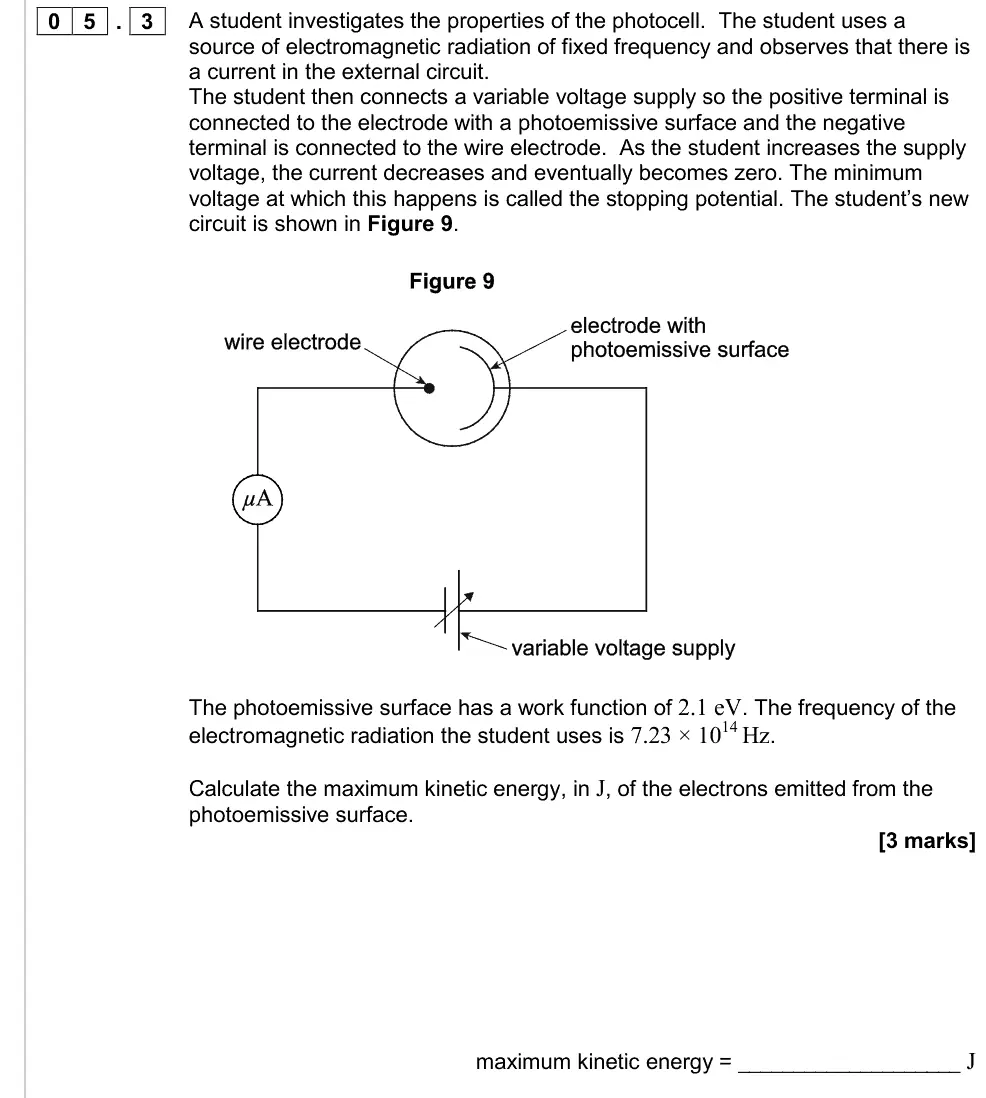
Earlier part of question 5 that this part uses
Mark scheme
Examiner's comment
Answers given to this question on the photoelectric effect provided evidence of the tendency of some students to not present full arguments when applying physics principles. In question 5.1 most students identified that electrons needed to leave the surface but the linking of this to the frequency of the radiation was quite vague. Responses that failed to mention photons were common and many did not emphasise the importance of the work function. It was not unusual to see discussions that confused the photoelectric effect with the excitation and ionisation of electrons in individual atoms. It was a similar story in question 5.2 where the majority of students realised that the current would increase but then failed to explain why in terms of the increased number of photons striking the metal surface per second. The calculation in question 5.3 was generally well done with nearly three-quarters of students scoring full marks. Surprisingly, far fewer were then able to use their correct answer from 5.3 to calculate the stopping potential in 5.4. Question 5.5 was another example of incomplete arguments. The majority did appreciate that the stopping potential would increase but were unable to give complete explanations for this effect. Better responses did link this increase to maximum kinetic energy but it was very rare to see answers explaining that this was due to greater energy transfer by photons.
Notes from the mark scheme and report
Answer: 1.4 x 10^-19 J (hf = 4.79 x 10^-19 J minus phi = 2.1 x 1.6 x 10^-19 = 3.36 x 10^-19 J)
Skills: MS2.3 Substitute numerical values into algebraic equations using appropriate units for physical quantities; MS0.2 Recognise and use expressions in decimal and standard form
June 2016 · AS Paper 1 · Q5.41 markCalculation
Earlier part of question 5 that this part uses
Mark scheme
Examiner's comment
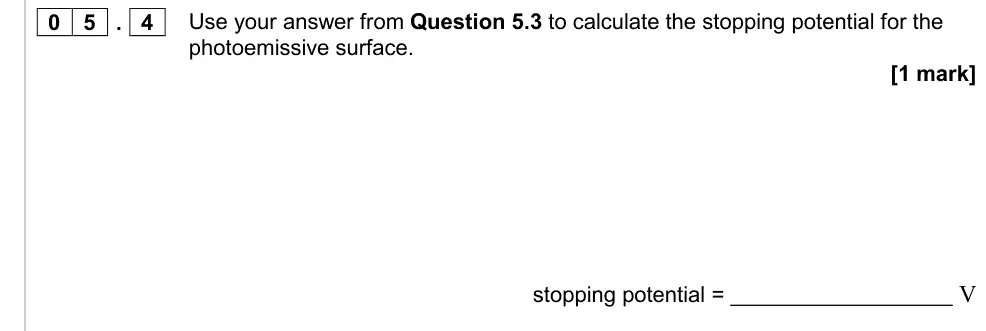
Answers given to this question on the photoelectric effect provided evidence of the tendency of some students to not present full arguments when applying physics principles. In question 5.1 most students identified that electrons needed to leave the surface but the linking of this to the frequency of the radiation was quite vague. Responses that failed to mention photons were common and many did not emphasise the importance of the work function. It was not unusual to see discussions that confused the photoelectric effect with the excitation and ionisation of electrons in individual atoms. It was a similar story in question 5.2 where the majority of students realised that the current would increase but then failed to explain why in terms of the increased number of photons striking the metal surface per second. The calculation in question 5.3 was generally well done with nearly three-quarters of students scoring full marks. Surprisingly, far fewer were then able to use their correct answer from 5.3 to calculate the stopping potential in 5.4. Question 5.5 was another example of incomplete arguments. The majority did appreciate that the stopping potential would increase but were unable to give complete explanations for this effect. Better responses did link this increase to maximum kinetic energy but it was very rare to see answers explaining that this was due to greater energy transfer by photons.
Notes from the mark scheme and report
Answer: 0.89 V (Vs = Ek(max)/e)
fewer used 05.3 correctly
Skills: MS2.3 Substitute numerical values into algebraic equations using appropriate units for physical quantities
June 2016 · AS Paper 1 · Q5.53 marksExplanation
Earlier part of question 5 that this part uses
Mark scheme
Examiner's comment
Answers given to this question on the photoelectric effect provided evidence of the tendency of some students to not present full arguments when applying physics principles. In question 5.1 most students identified that electrons needed to leave the surface but the linking of this to the frequency of the radiation was quite vague. Responses that failed to mention photons were common and many did not emphasise the importance of the work function. It was not unusual to see discussions that confused the photoelectric effect with the excitation and ionisation of electrons in individual atoms. It was a similar story in question 5.2 where the majority of students realised that the current would increase but then failed to explain why in terms of the increased number of photons striking the metal surface per second. The calculation in question 5.3 was generally well done with nearly three-quarters of students scoring full marks. Surprisingly, far fewer were then able to use their correct answer from 5.3 to calculate the stopping potential in 5.4. Question 5.5 was another example of incomplete arguments. The majority did appreciate that the stopping potential would increase but were unable to give complete explanations for this effect. Better responses did link this increase to maximum kinetic energy but it was very rare to see answers explaining that this was due to greater energy transfer by photons.
Notes from the mark scheme and report
Stopping potential increases because photon energy increases so maximum kinetic energy of photoelectrons increases
Specimen set 1 · Paper 1 · Q81 markMultiple choice
Answer
D
Notes from the mark scheme and report
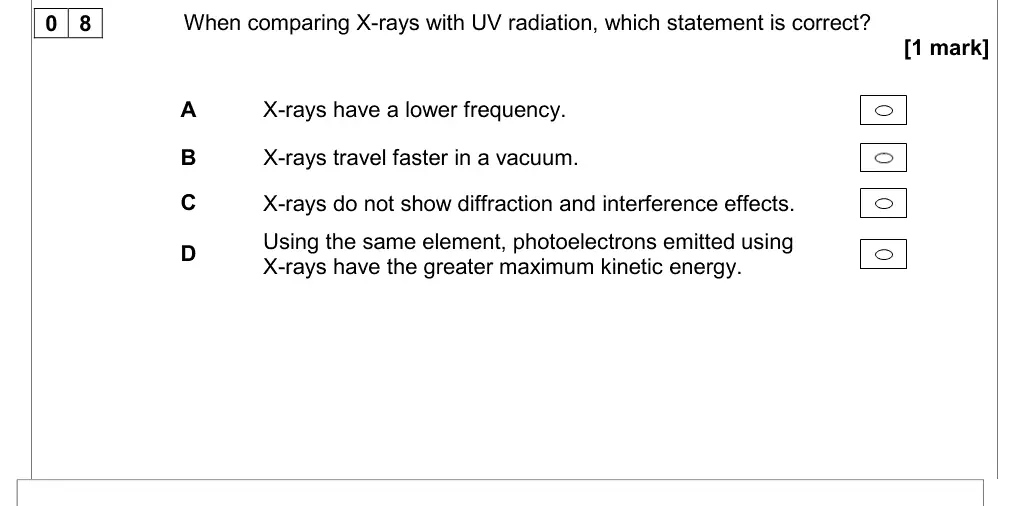
Answer: D
Specimen set 1 · Paper 1 · Q91 markMultiple choice
Answer
B
Notes from the mark scheme and report
Answer: B
Specimen set 1 · Paper 1 · Q141 markMultiple choice
Answer
C
Notes from the mark scheme and report
Answer: C
Work with an AQA physics tutor
Dropping marks on calculations, required practicals or the six-markers? Book a trial session with a specialist AQA physics tutor.