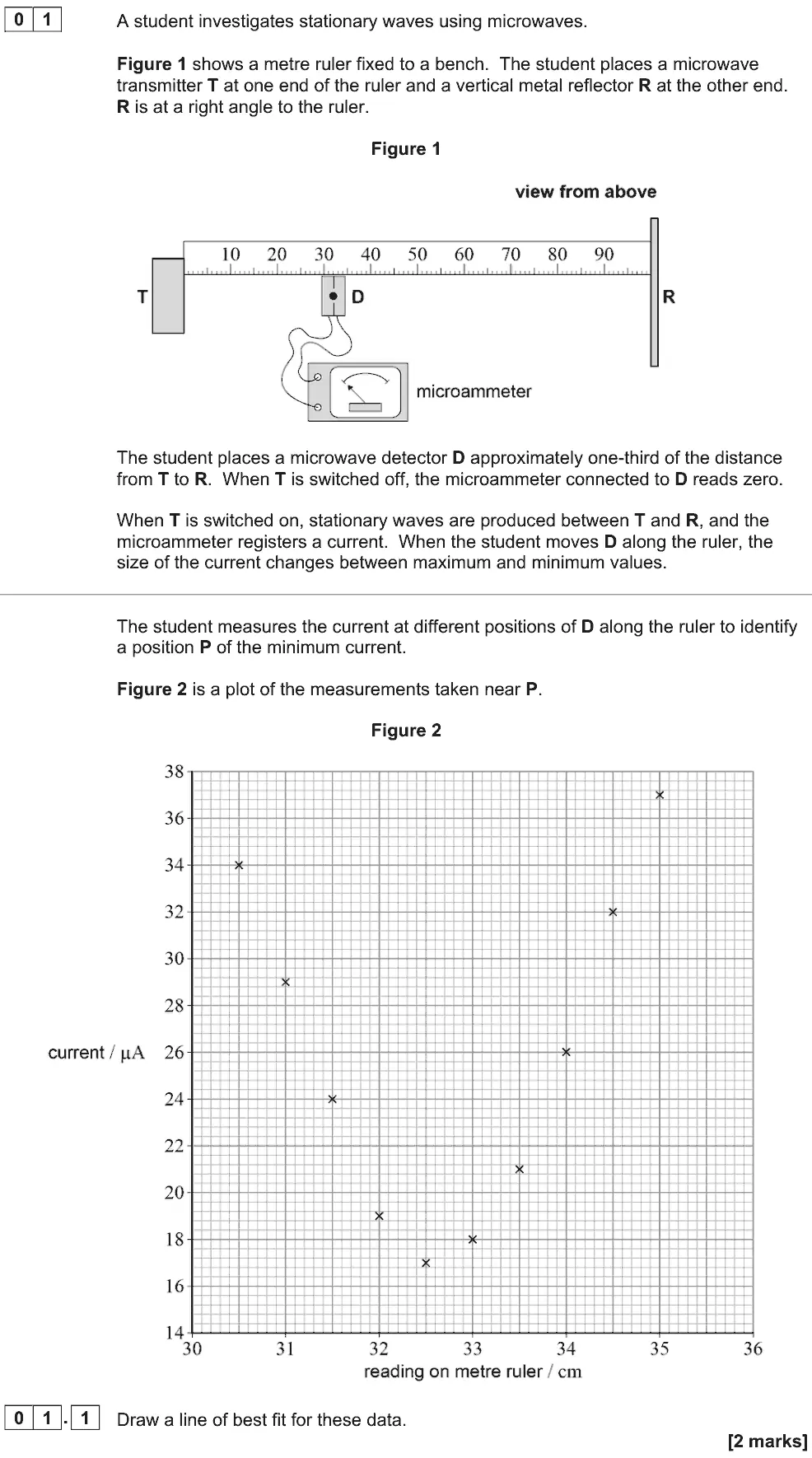
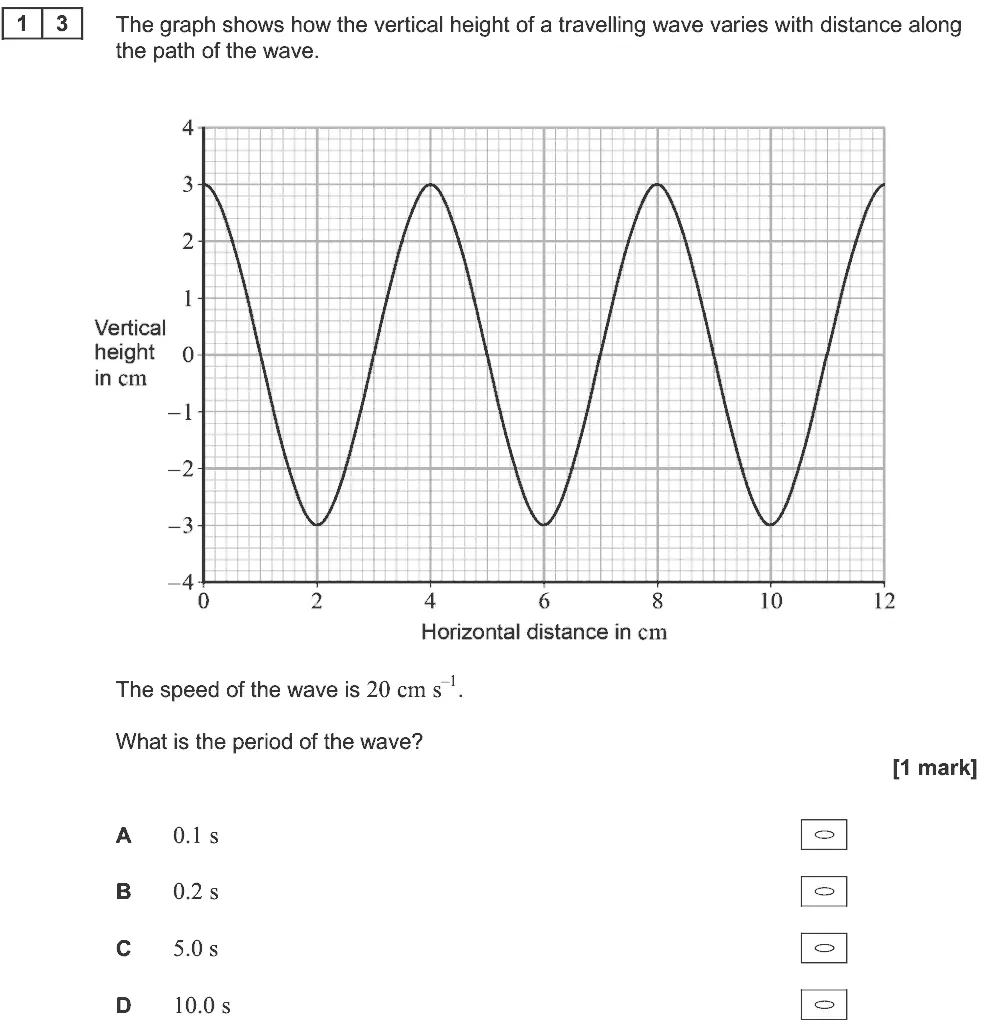
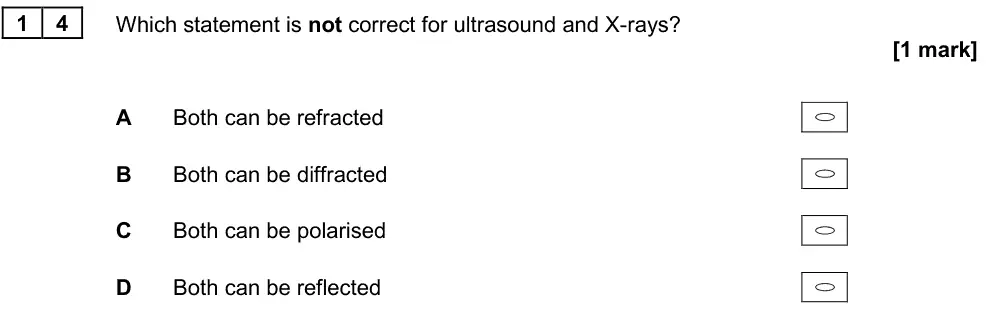
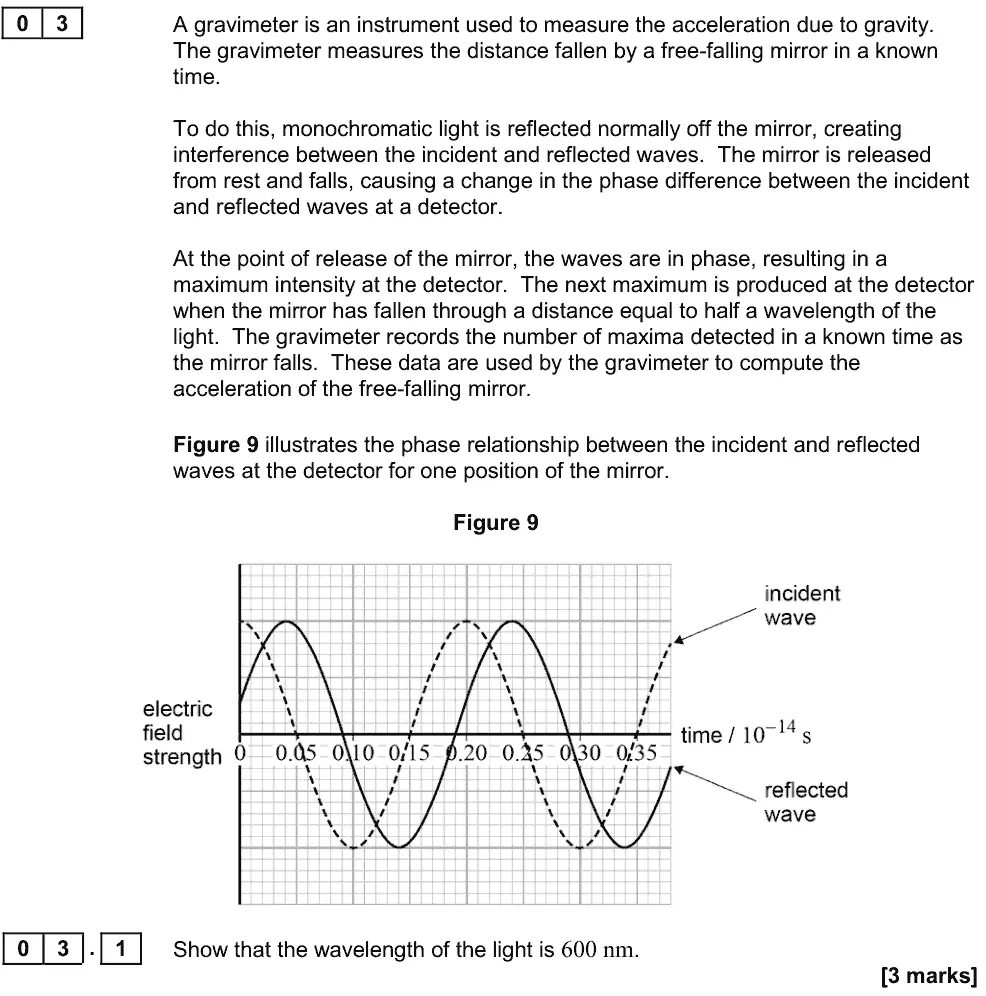
Notes and key-term cards for this topic are being written by our tutors. The past-paper questions below are ready now.
Specification statements
Show the 9 statements from the specification
3.3.1.1-01 Oscillation of the particles of the medium;
3.3.1.1-02 amplitude, frequency, wavelength, speed, phase, phase difference, c = f λ f = 1 T
3.3.1.1-03 Phase difference may be measured as angles (radians and degrees) or as fractions of a cycle.
3.3.1.2-01 Nature of longitudinal and transverse waves.
3.3.1.2-02 Examples to include: sound, electromagnetic waves, and waves on a string.
3.3.1.2-03 Students will be expected to know the direction of displacement of particles/fields relative to the direction of energy propagation and that all electromagnetic waves travel at the same speed in a vacuum.
3.3.1.2-04 Polarisation as evidence for the nature of transverse waves.
3.3.1.2-05 Applications of polarisers to include Polaroid material and the alignment of aerials for transmission and reception.
3.3.1.2-06 Malus’s law will not be expected.
Six-mark extended response questions on this topic
Tap a question to zoom it. Where a part needs a figure, table or graph from earlier in the question, that part folds out above it; the mark scheme and examiner's comment open underneath. Have the AQA data and formulae booklet beside you (see the formula sheet page).
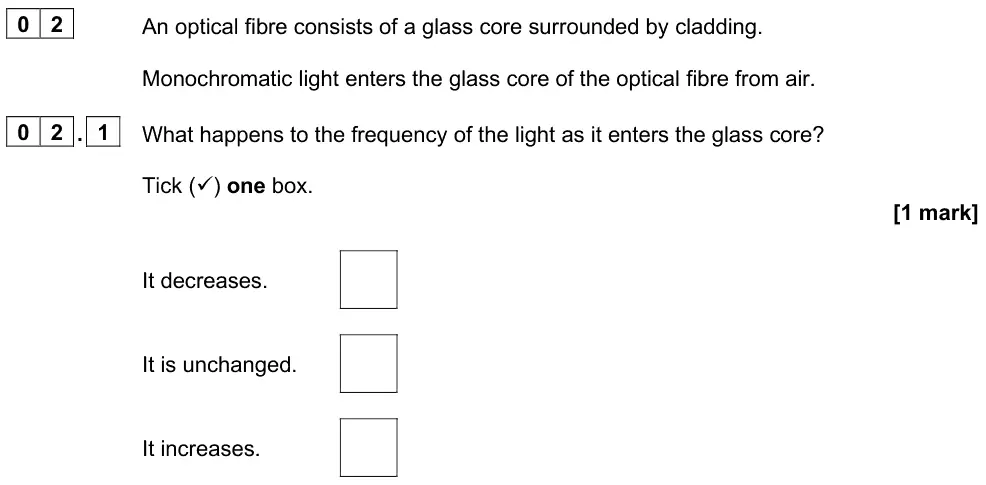
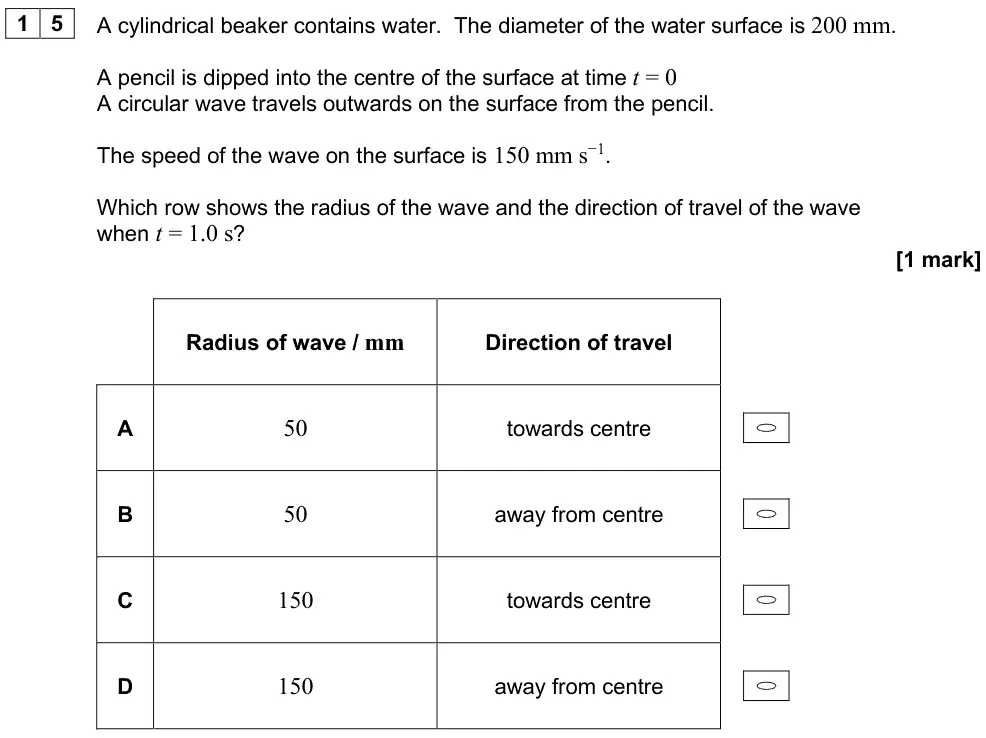
June 2025 · AS Paper 1 · Q2.11 markAO1=1Short answerEasy
Mark scheme
Examiner's comment
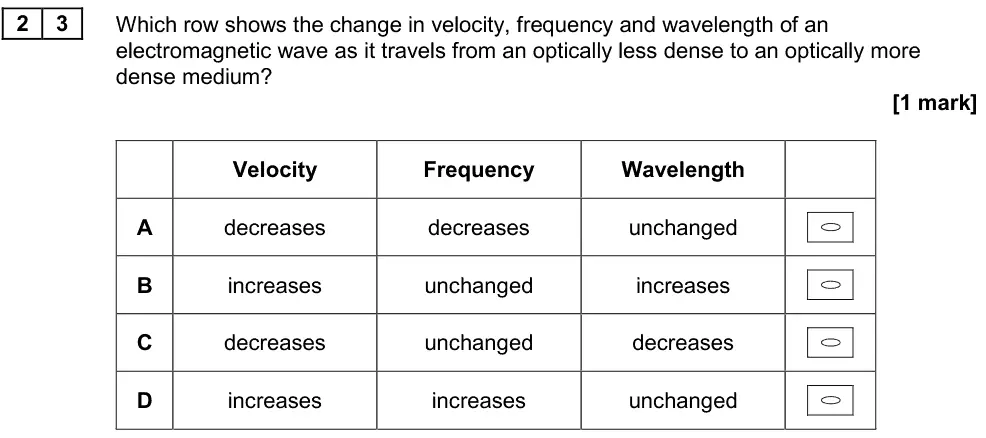
02.1 Approximately 60% of students were able to recall that frequency of light is unchanged when it travels from air into glass. The most common incorrect answer (approximately 30% of students) selected that frequency decreases. These students seemed to know that the speed of light decreases and thought this meant that frequency decreases too.
07.2 This question proved very challenging with approximately 50% of students gaining this mark. 14% of students made no attempt at the question. A very similar question on work done crossing a potential difference was asked on this paper in June 2024 (Q2.1).
07.3 Students enjoyed more success with this question with approximately 60% gaining full marks and a further 24% gaining one mark. Common deficiencies seen included: working out the photon energy and presenting this as the answer. Students should be • made aware that an allocation of 3 marks for a calculation is unlikely to be a single-step calculation even where there are prefixes to convert. incorrect conversion of THz to Hz. There are two examples of prefix conversions on this • paper and these conversions seemed to cause problems for lower attaining students. Students would do well to learn the conversion factors for these prefixes as they will always feature in AS physics exams. being unaware of the photoelectric equation and dividing their photon energy by the • maximum kinetic energy of the photoelectrons arriving at an answer of 2.1 J. 07.4 This question discriminated well between students of varying ability. Over 25% of students gained 3 marks with 20% gaining 2 marks and 15% gaining 1 mark. Almost 13% of students did not make any attempt at this question. Common misconceptions centred on a greater work function having a more negative y- intercept. Many students interpreted X as having a greater work function by having a less negative y-intercept. Students who scored two marks generally scored these marks for drawing X and Y lines parallel to the magnesium line and giving the reason that the gradient equals the work function. • Reinforce key concepts such as Lepton family conservation, quark composition, moments, and energy transformations. Include opportunities to develop skills in calculations that incorporate Multistep • Reasoning. Guide students through logical sequences in multi-mark questions. Practise converting between SI prefixes and using units to check plausibility of the • numerical answer. Develop students’ skills in the interpretation of graphs especially in the context of • motion and the photoelectric effect. Target misconceptions explicitly by use past-paper examples in classroom discussions • and model answers. Ensure students use terminology accurately particularly in recall questions where • these are used as an easy introduction to set the question’s context.
Notes from the mark scheme and report
It is unchanged (second box)
about 30% chose 'decreases' confusing speed with frequency
tick-box item
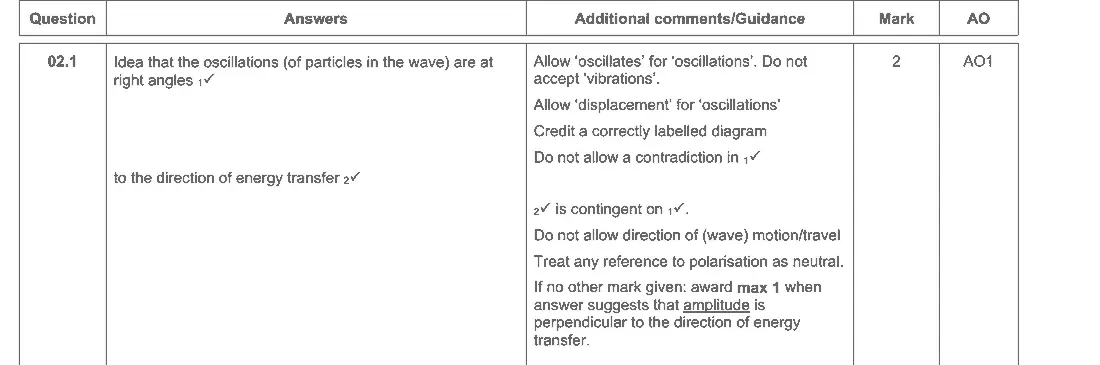
June 2025 · Paper 1 · Q2.12 marksAO1=2Short answer
Mark scheme
Examiner's comment
More than half of students obtained both marks for Question 2.1. A common error was to refer to the direction of motion or travel rather than energy transfer. Others did not refer to the oscillating nature of the waves.
Notes from the mark scheme and report
Oscillations perpendicular to the direction of energy transfer
'direction of travel/motion' and 'vibrations' not accepted
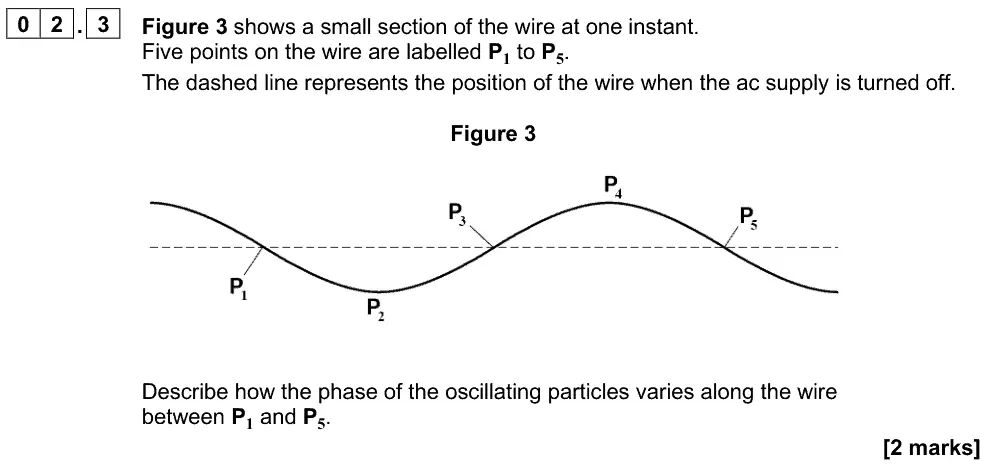
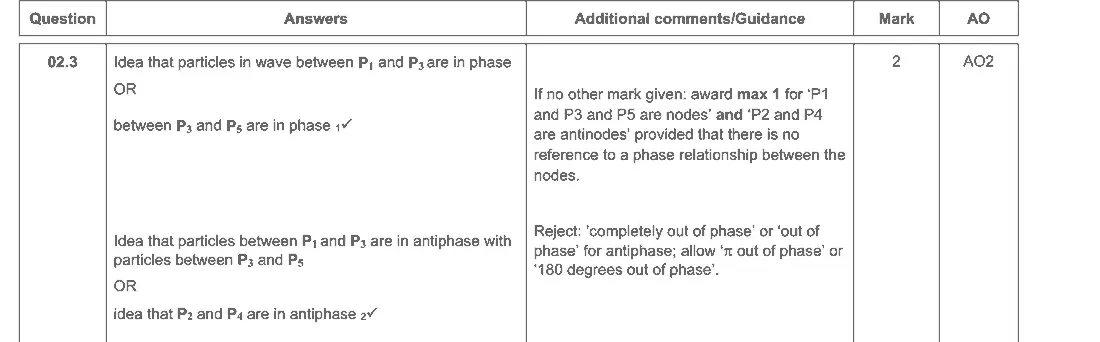
June 2025 · Paper 1 · Q2.32 marksAO2=2Explanation
Earlier part of question 2 that this part uses
Mark scheme
Examiner's comment
Many students misunderstood Question 2.3 and only referred to the labelled points, writing answers consistent with a progressive rather than a stationary wave. The most common mark awarded was for stating that P2 and P4 were in antiphase. Note that ‘out of phase’ or ‘interfere destructively’ were not accepted for antiphase. Answers that allocated a phase relationship between stationary points rarely gained much credit.
Notes from the mark scheme and report
Particles between adjacent nodes (P1-P3, P3-P5) are in phase
the two loops are in antiphase
'out of phase' rejected
many answered as for a progressive wave
Skills: RP1 Investigation into the variation of the frequency of stationary waves on a string with length, tension and mass per unit length of the string.
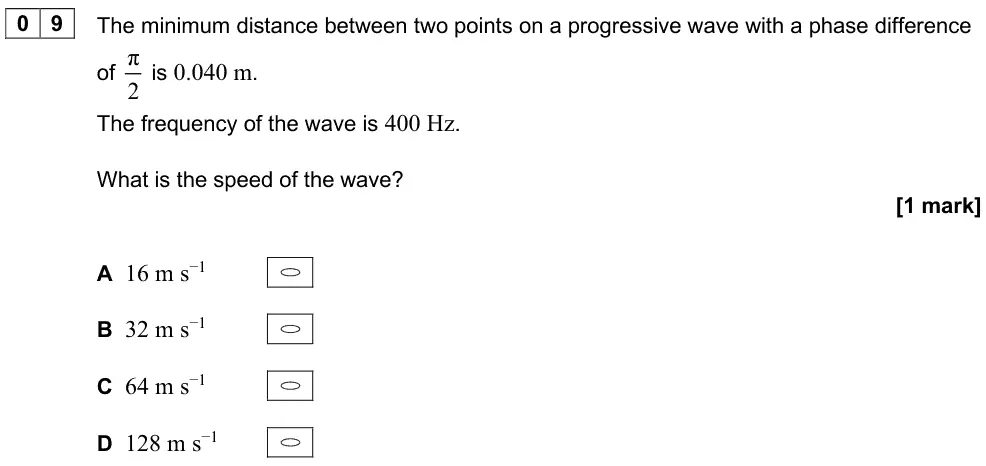
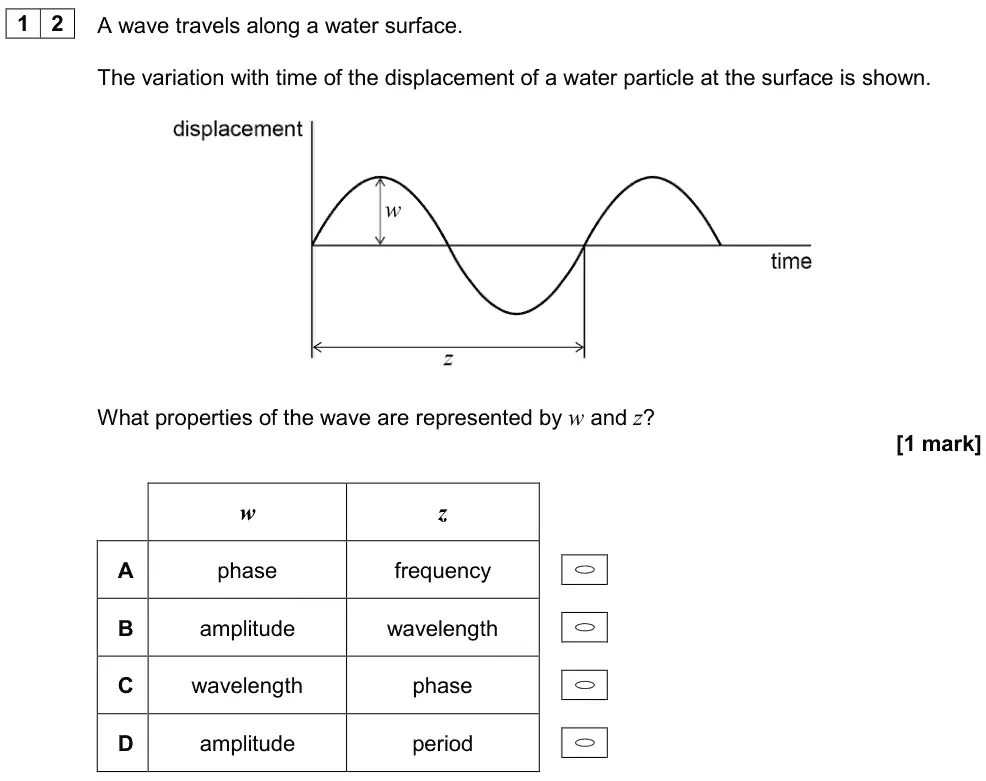
June 2025 · AS Paper 2 · Q91 markAO1=1Multiple choice
Answer
C
Mark scheme
Notes from the mark scheme and report
Answer: C
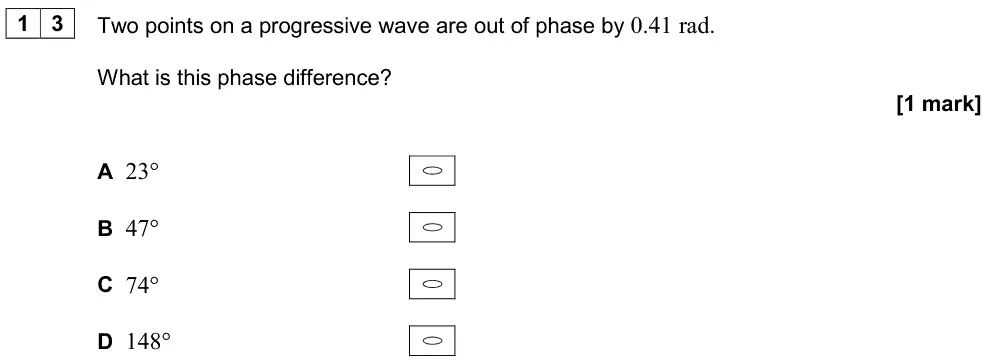
Skills: MS4.7 Understand the relationship between degrees and radians and translate from one to the other
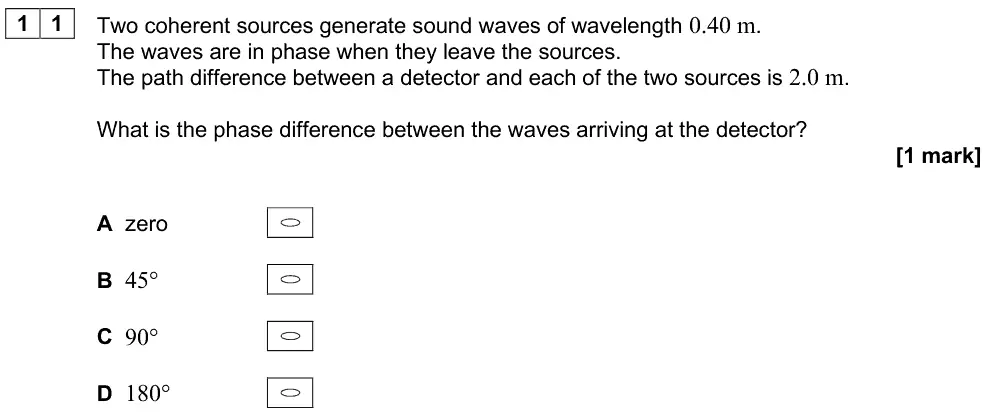
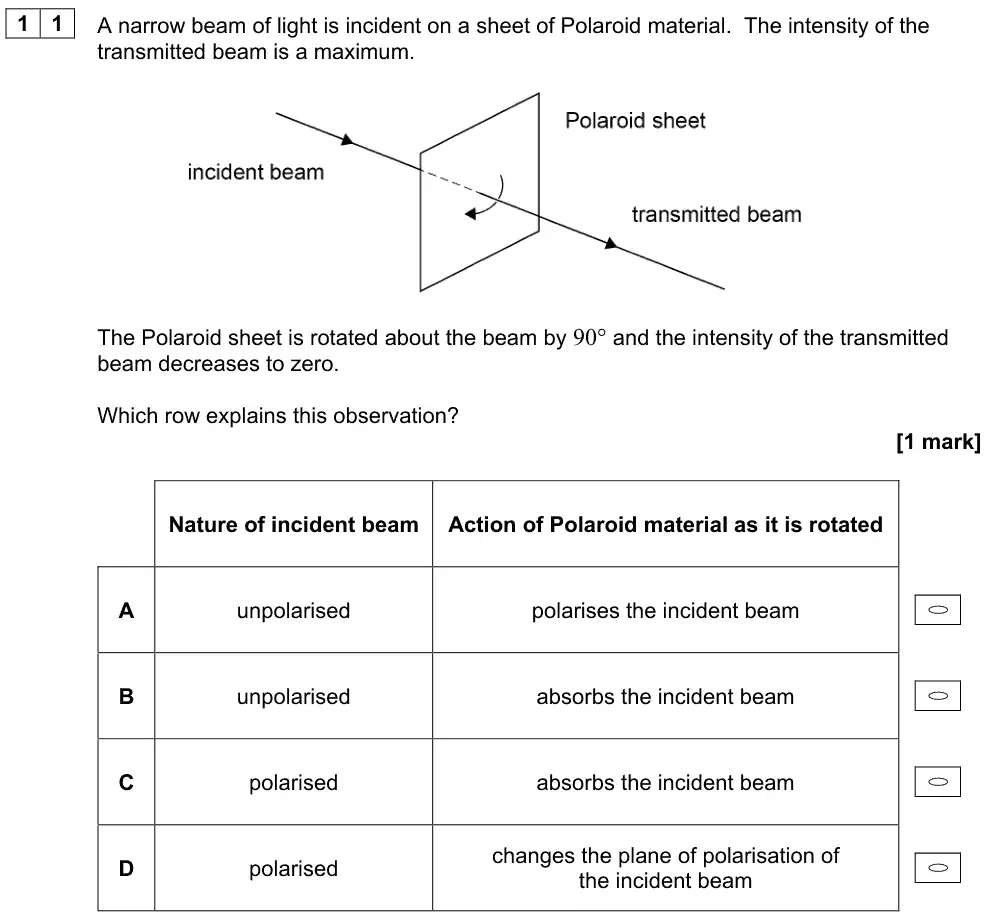
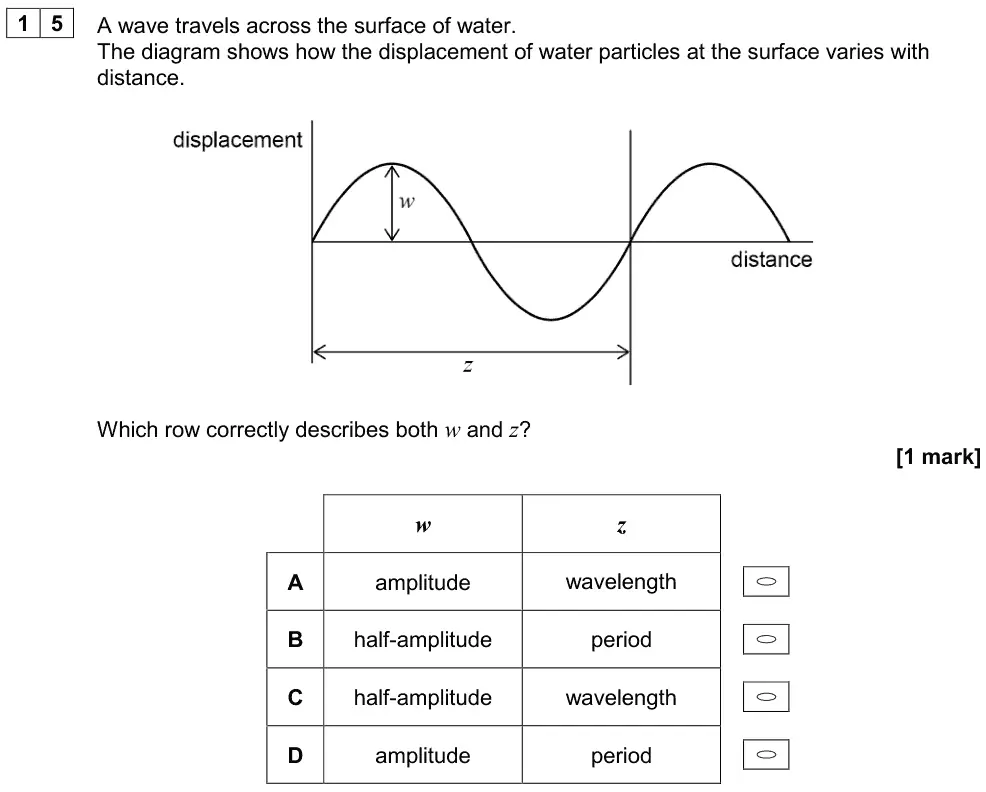
June 2025 · AS Paper 2 · Q111 markAO2=1Multiple choice
Answer
A
Mark scheme
Examiner's comment
Students were more successful in answering questions 6, 11, 14, 19, 22, 28, and were less successful in answering questions 10, 15, 21, 25, 29.
Notes from the mark scheme and report
Answer: A
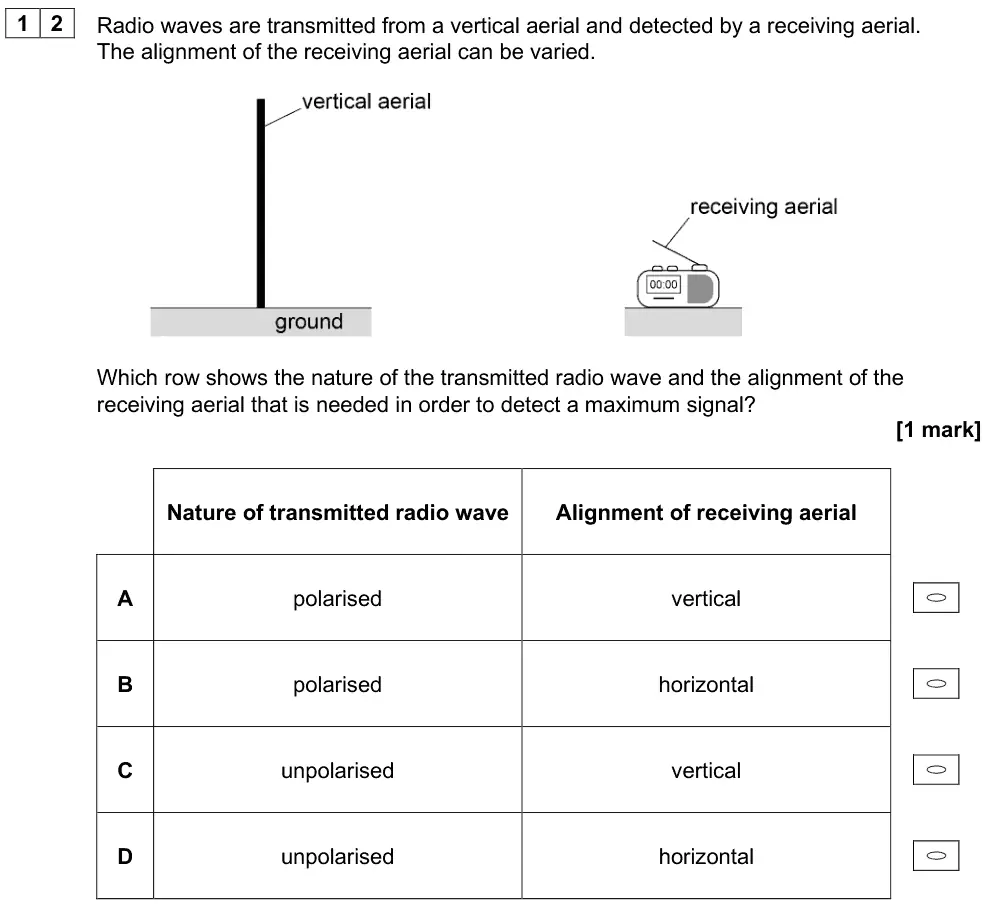
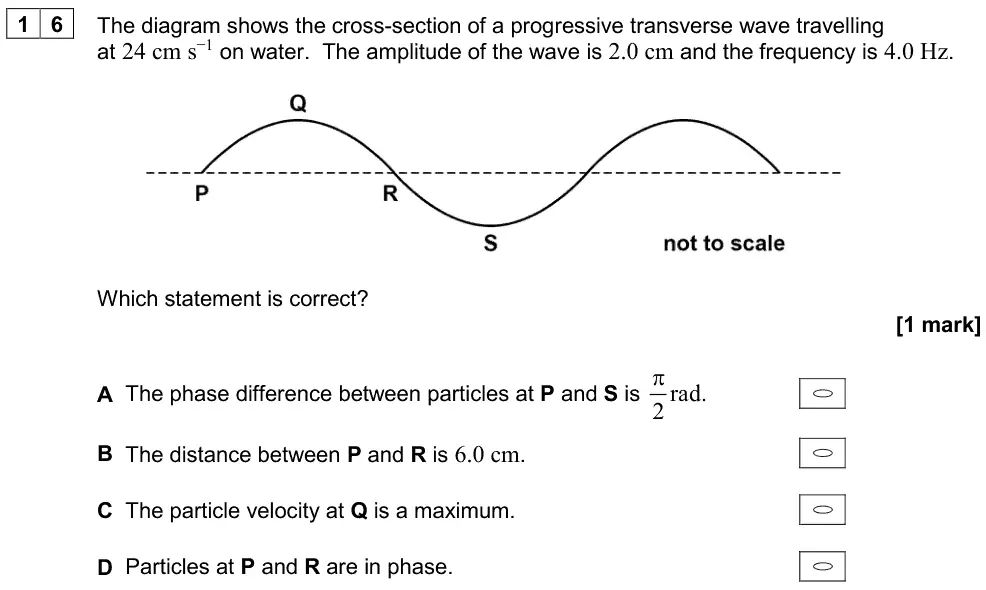
June 2025 · AS Paper 2 · Q121 markAO1=1Multiple choice
Answer
A
Mark scheme
Notes from the mark scheme and report
Answer: A
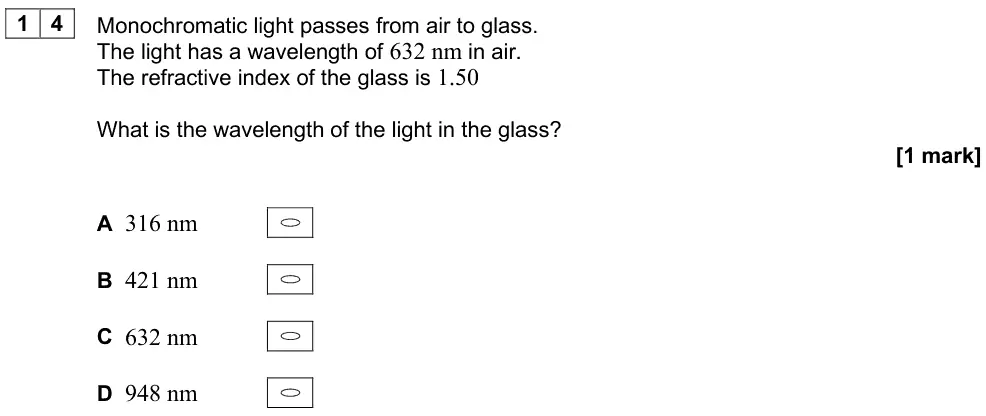
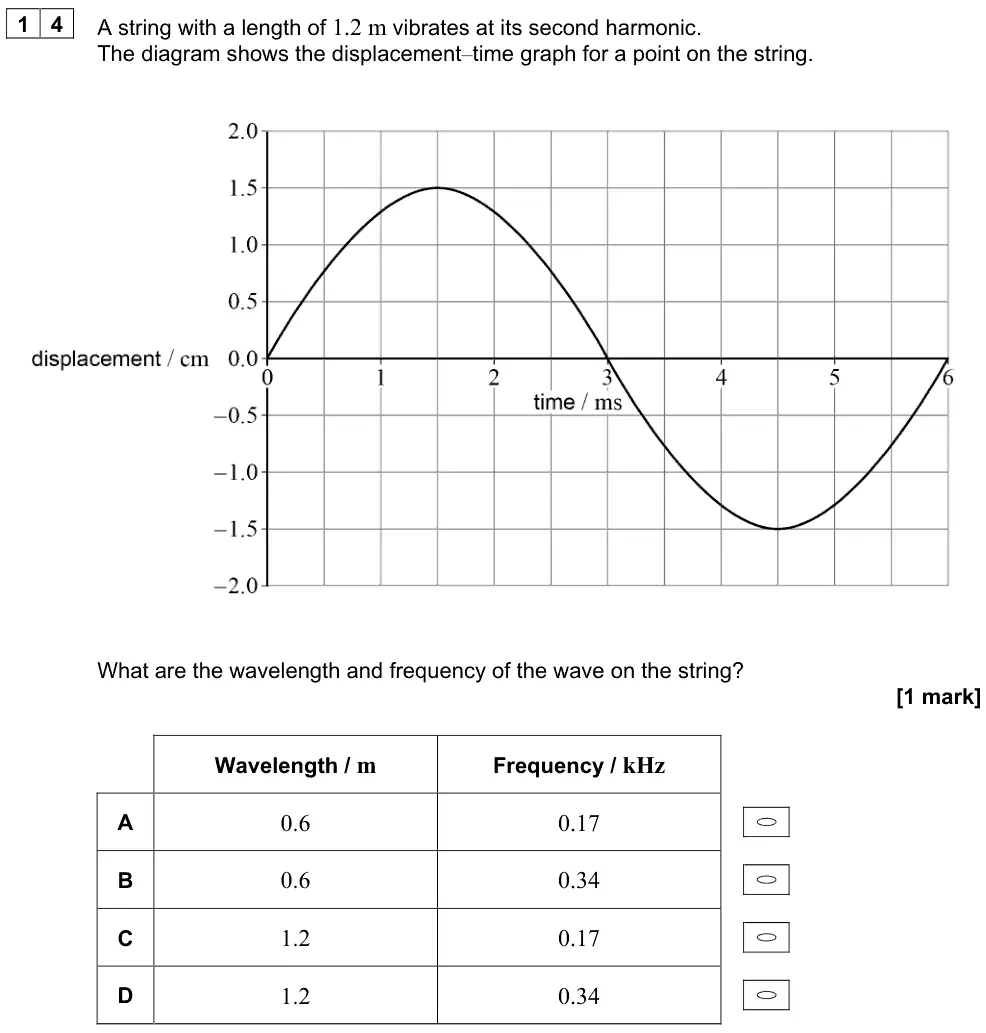
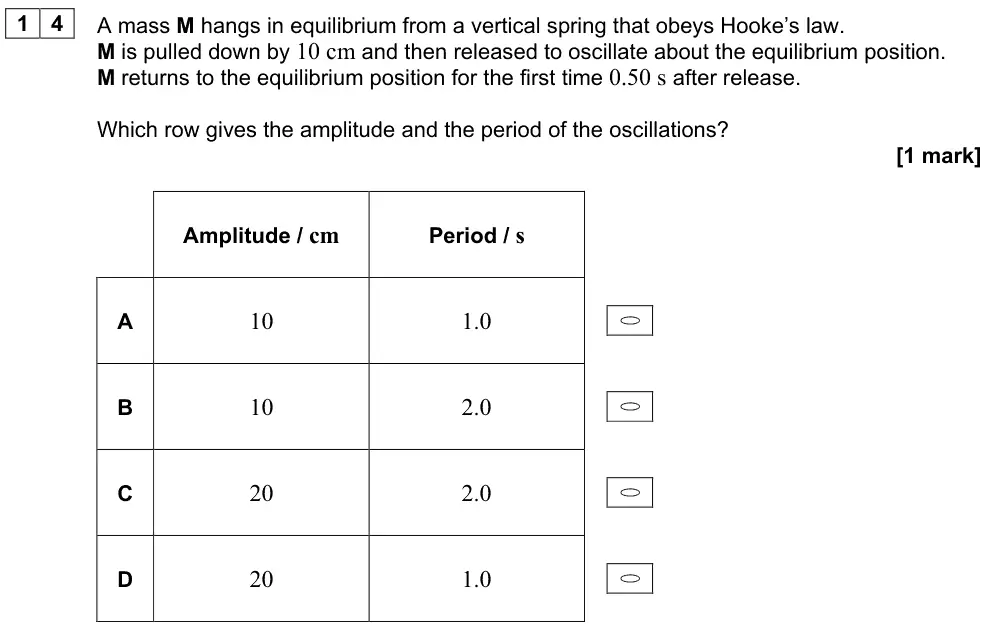
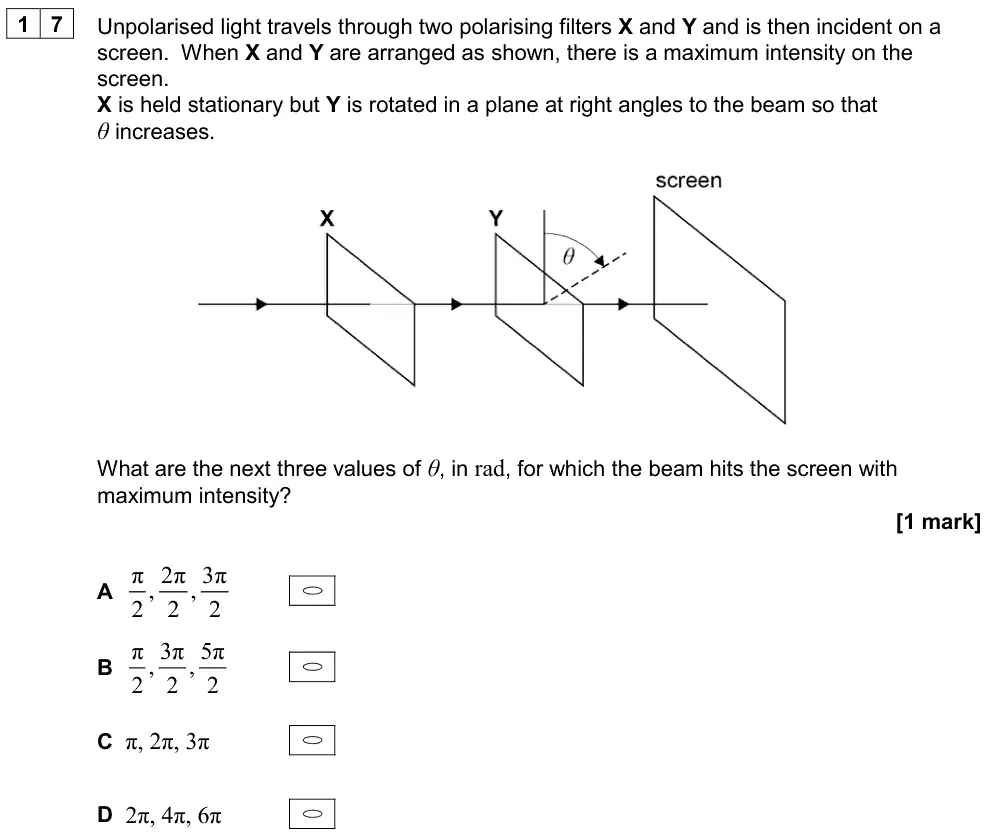
June 2025 · AS Paper 2 · Q141 markAO1=1Multiple choice
Answer
B
Mark scheme
Examiner's comment
Students were more successful in answering questions 6, 11, 14, 19, 22, 28, and were less successful in answering questions 10, 15, 21, 25, 29.
Notes from the mark scheme and report
Answer: B
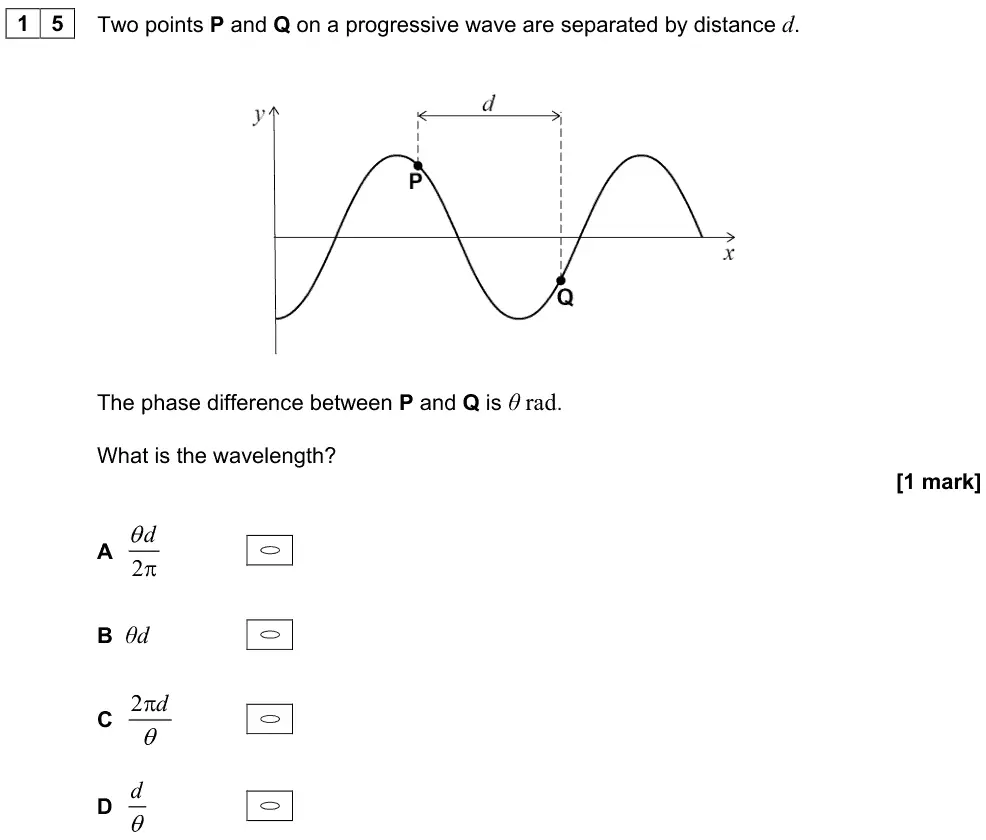
June 2025 · AS Paper 2 · Q151 markAO2=1Multiple choice
Answer
A
Mark scheme
Notes from the mark scheme and report
Answer: A
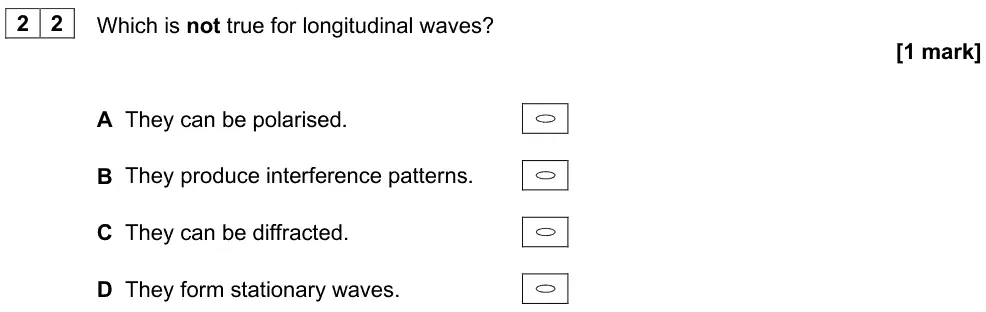
June 2025 · AS Paper 2 · Q221 markAO1=1Multiple choice
Answer
A
Mark scheme
Examiner's comment
Students were more successful in answering questions 6, 11, 14, 19, 22, 28, and were less successful in answering questions 10, 15, 21, 25, 29.
Notes from the mark scheme and report
Answer: A
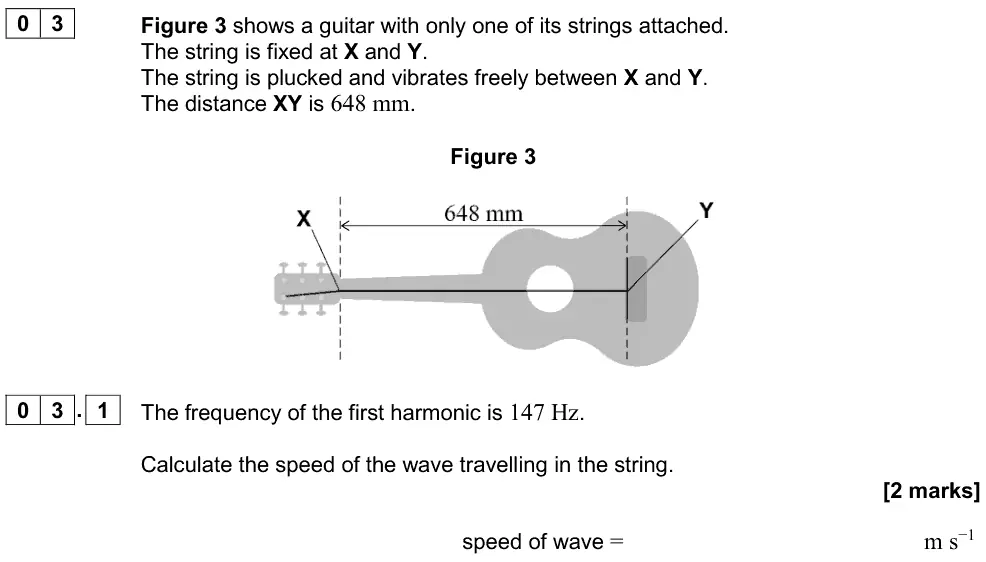
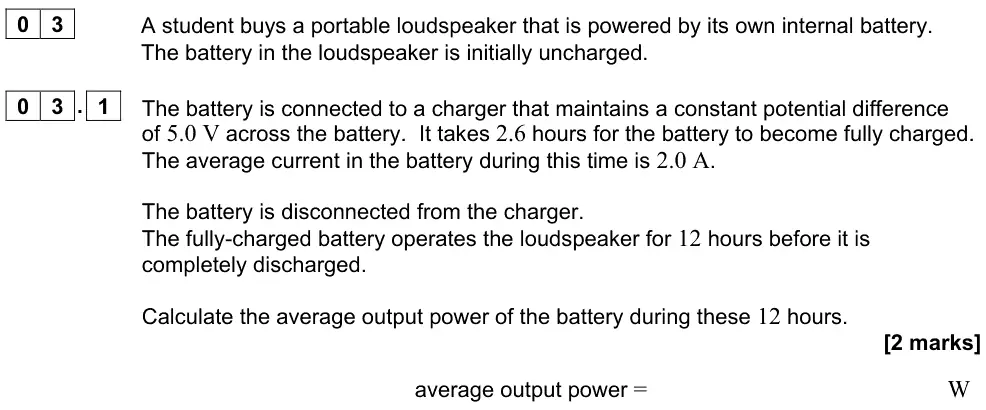
June 2024 · AS Paper 1 · Q3.12 marksAO1=1, AO2=1Calculation
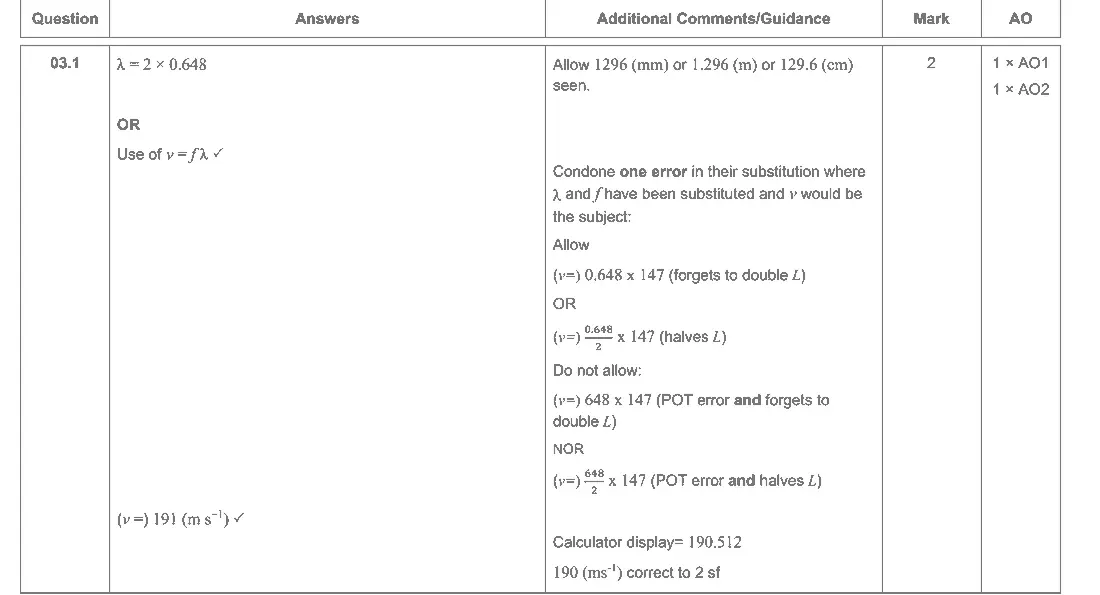
Mark scheme
Examiner's comment
03.1
Notes from the mark scheme and report
Answer: 191 m s^-1 (lambda = 2 x 0.648 = 1.296 m, f = 147 Hz)
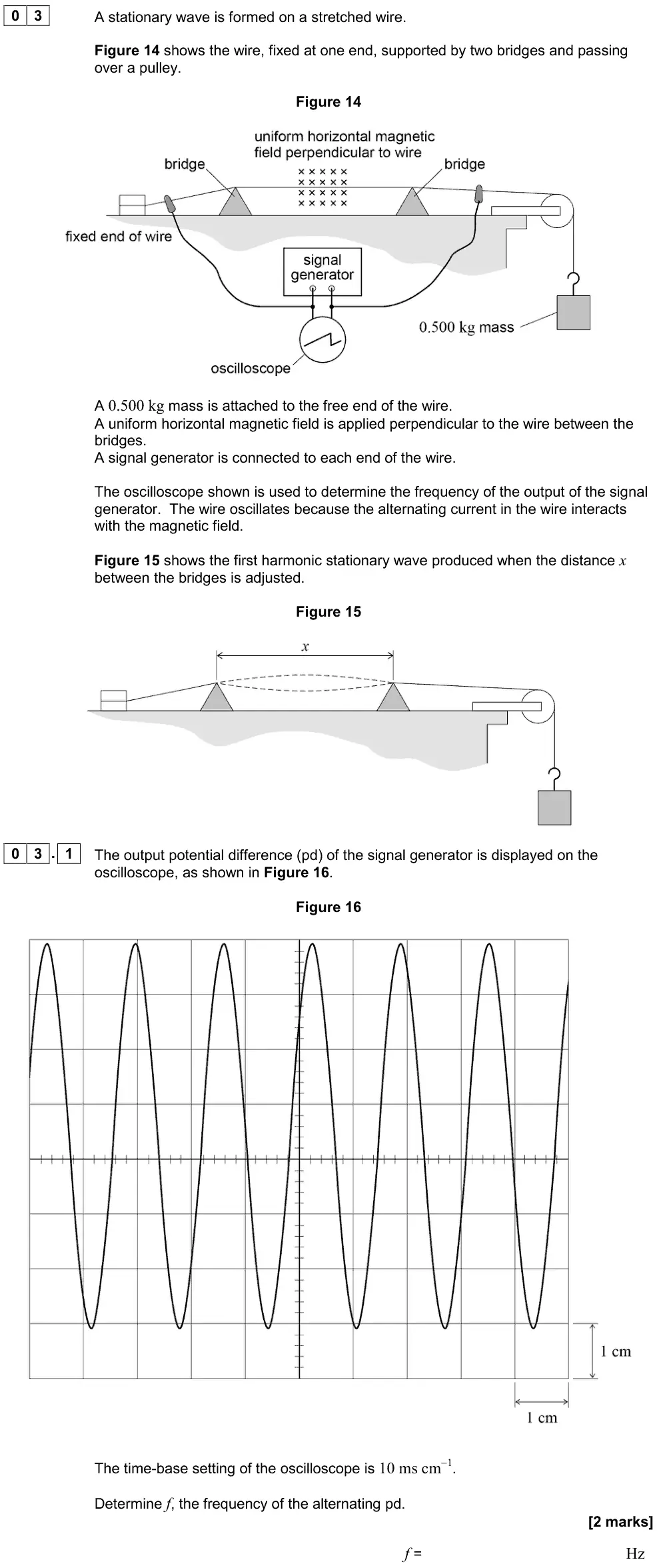
Skills: MS2.3 Substitute numerical values into algebraic equations using appropriate units for physical quantities; RP1 Investigation into the variation of the frequency of stationary waves on a string with length, tension and mass per unit length of the string.
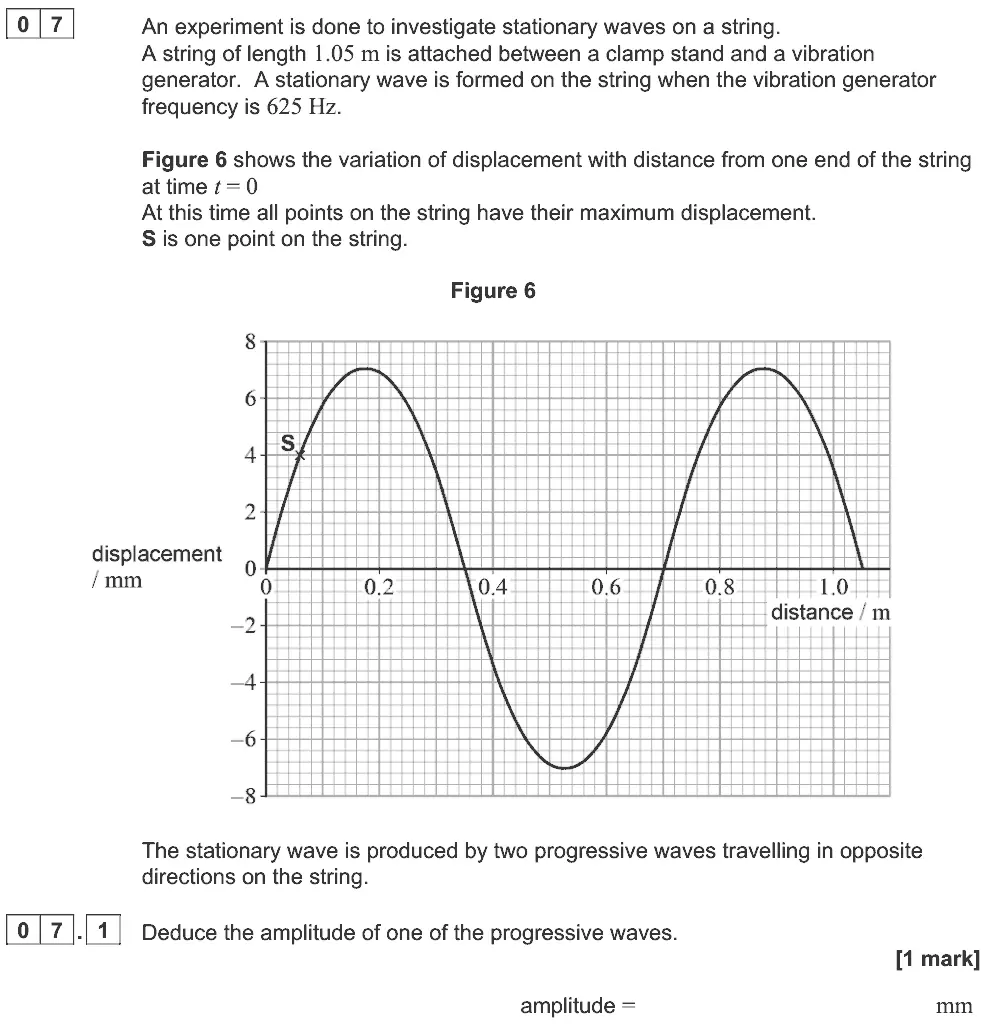
June 2024 · Paper 1 · Q7.22 marksAO3=2CalculationEasy
Earlier part of question 7 that this part uses
Mark scheme
Examiner's comment
The calculation in question 07.2 was answered correctly by over 75% of students. Answers using a distance divided by time approach, rather than the wave equation, were not credited.
Notes from the mark scheme and report
Answer: 440 m s^-1 (wavelength 0.70 m from Figure 6, f = 625 Hz)
distance/time methods not credited
Skills: MS3.1 Translate information between graphical, numerical and algebraic forms; MS2.3 Substitute numerical values into algebraic equations using appropriate units for physical quantities; RP1 Investigation into the variation of the frequency of stationary waves on a string with length, tension and mass per unit length of the string.
June 2024 · Paper 1 · Q7.31 markAO1=1Short answer
Earlier part of question 7 that this part uses
Mark scheme
Examiner's comment
Students were split almost 50:50 between those who thought the phase difference in question 07.3 was zero and those who thought it was π rad.
Notes from the mark scheme and report
In phase (0, 2pi, 360 degrees)
about half answered pi rad
Skills: RP1 Investigation into the variation of the frequency of stationary waves on a string with length, tension and mass per unit length of the string.
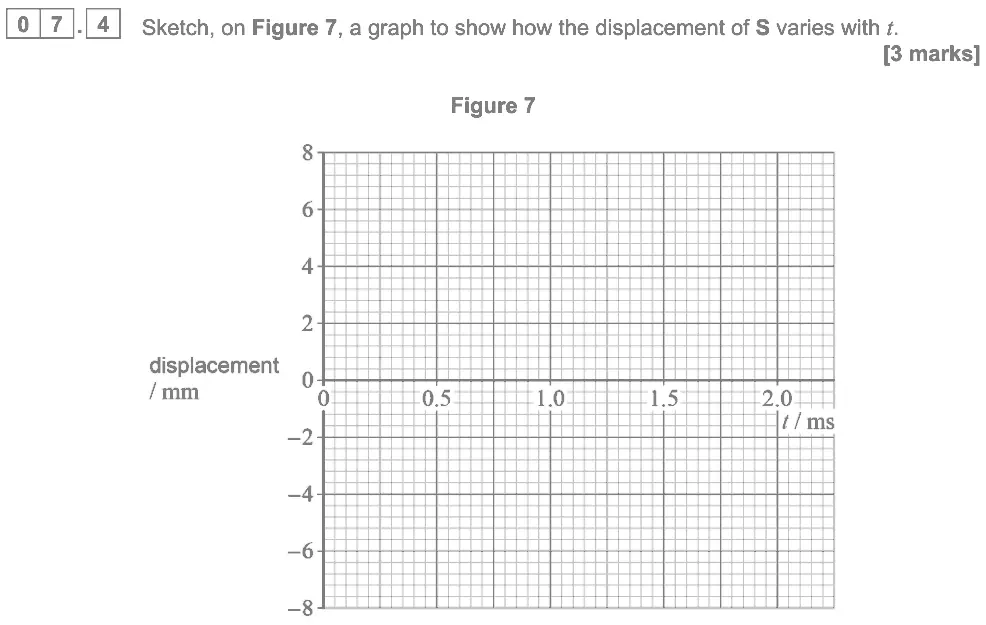
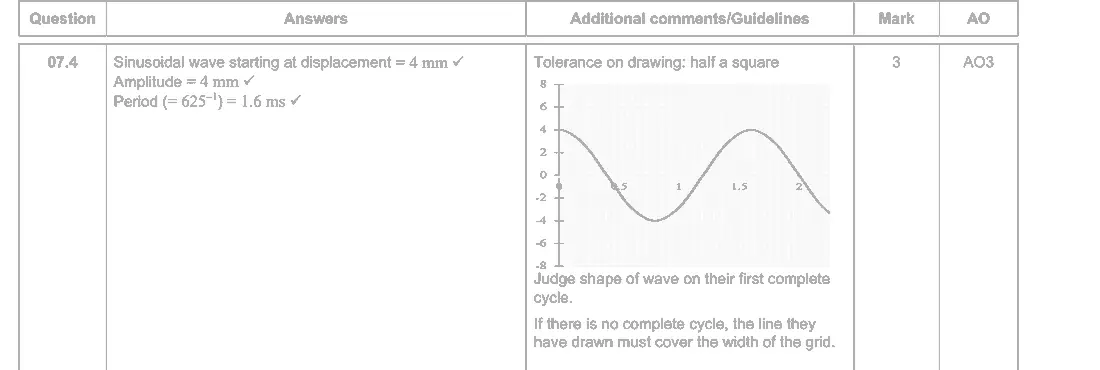
June 2024 · Paper 1 · Q7.43 marksAO3=3Diagram or graph
Earlier part of question 7 that this part uses
Mark scheme
Examiner's comment
Many students found question 07.4 quite difficult. There were three clear marking points which meant the question produced a spread of marks and discriminated quite well. A major issue for many students was the poor quality of the sine wave. Most students understood that the period was 1.6 ms but far fewer recognised that the amplitude was 4 mm.
Notes from the mark scheme and report
Sinusoid starting at +4 mm, amplitude 4 mm, period 1.6 ms (1/625 s)
tolerance half a square
many poor sine curves and wrong amplitude
Skills: MS3.1 Translate information between graphical, numerical and algebraic forms; RP1 Investigation into the variation of the frequency of stationary waves on a string with length, tension and mass per unit length of the string.
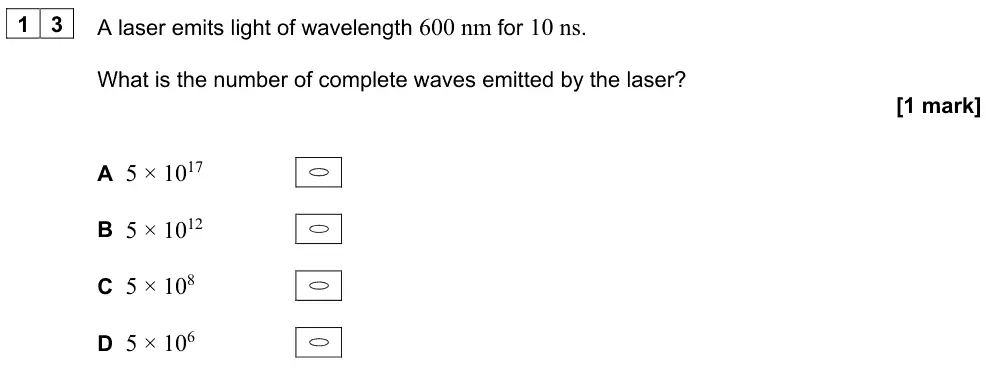
June 2024 · Paper 1 · Q131 markAO2=1Multiple choice
Answer
D
Mark scheme
Notes from the mark scheme and report
Answer: D
Skills: MS0.2 Recognise and use expressions in decimal and standard form
June 2024 · Paper 1 · Q141 markAO1=1Multiple choiceEasy
Answer
A
Mark scheme
Examiner's comment
There were five very accessible questions that were correctly answered by more than 70% of students. These were B12, B18, B14, B27 and B29.
Notes from the mark scheme and report
Answer: A
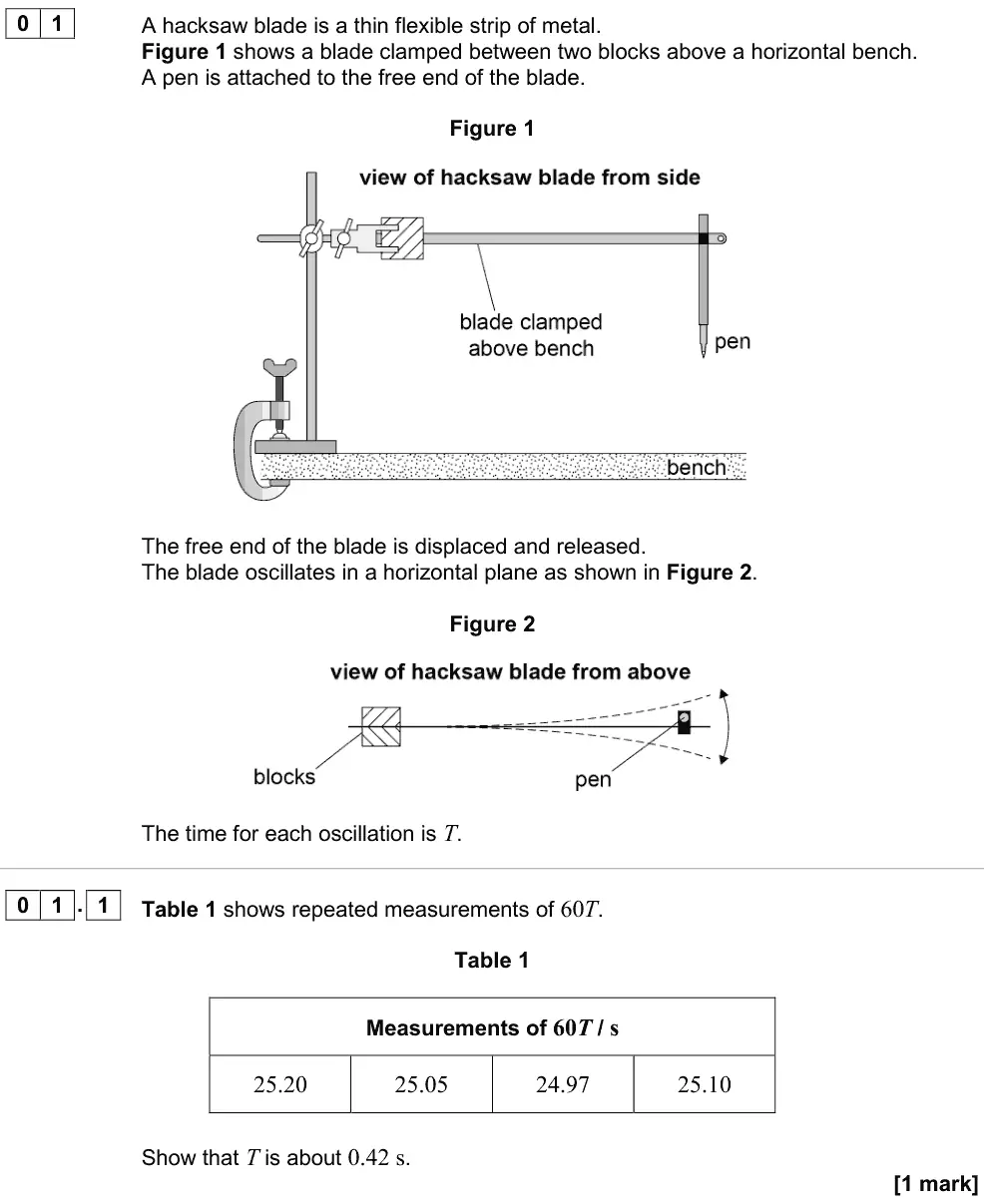
June 2024 · AS Paper 2 · Q1.11 markAO2=1Show thatEasy
Mark scheme
Examiner's comment
01.1 Approximately 80% of students gained this mark by showing sufficient working. A common error was to treat one of the values as an anomaly.
Notes from the mark scheme and report
Answer: T = 0.418 s (mean of all four 60T values 25.08 s divided by 60)
treating one value as anomalous was the common error
Skills: MS1.2 Find arithmetic means
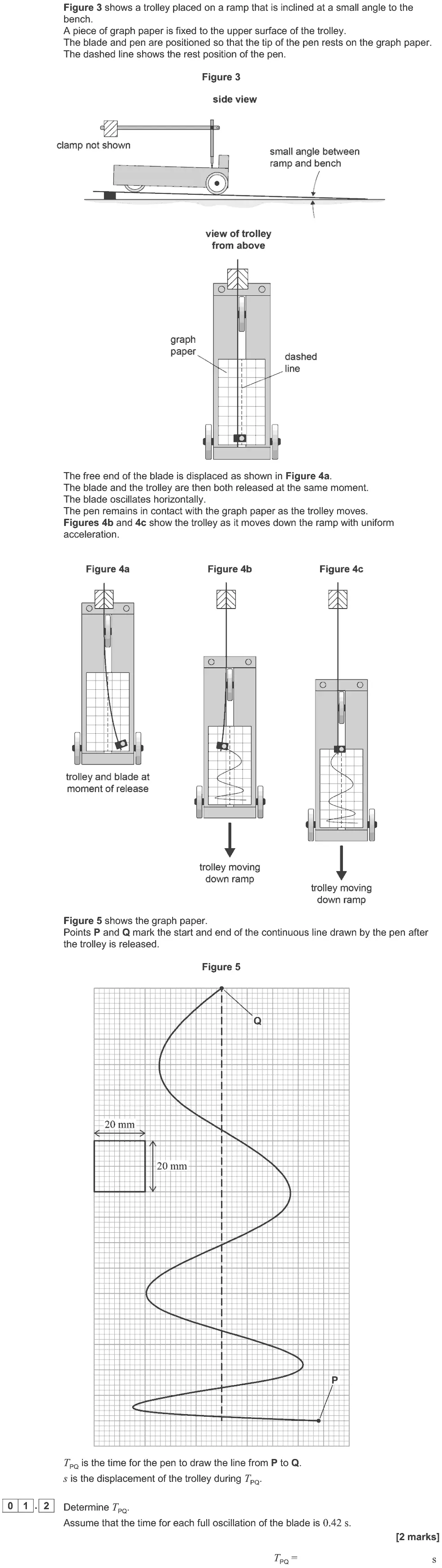
June 2024 · AS Paper 2 · Q1.22 marksAO3=2Calculation
Earlier part of question 1 that this part uses
Mark scheme
Examiner's comment
01.2 This question discriminated well. Many students gained 1 mark through using an incorrect number of cycles. The most common incorrect value seen was 2.5 cycles.
Notes from the mark scheme and report
Answer: 1.15-1.2 s (2.75 cycles between P and Q x 0.42 s)
2.5 cycles was the common wrong count
Skills: MS3.1 Translate information between graphical, numerical and algebraic forms
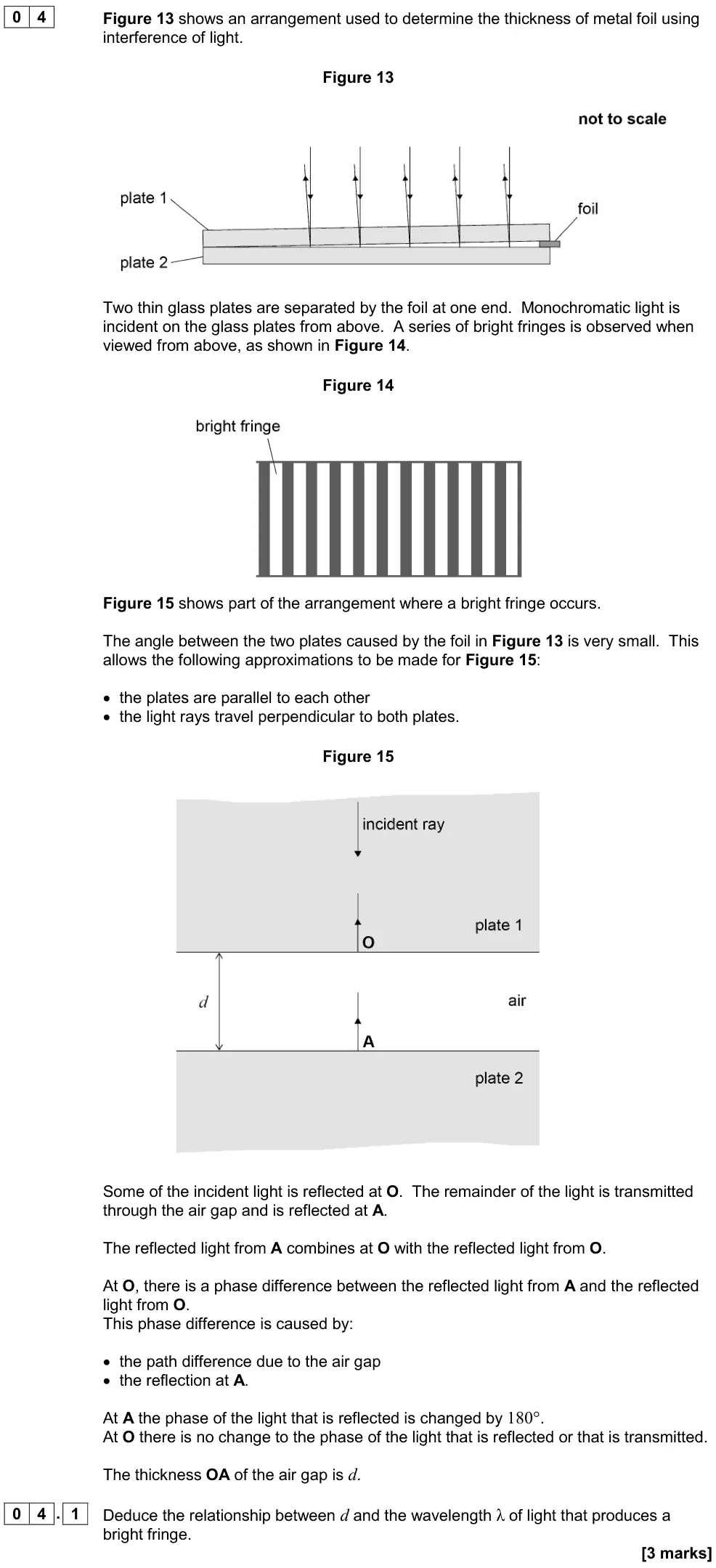
June 2024 · AS Paper 2 · Q4.13 marksAO2=2, AO3=1Explanation
Mark scheme
Examiner's comment
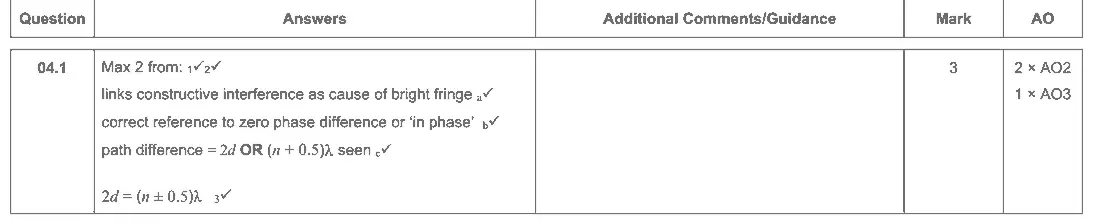
04.1 Most students achieved little success in this question about constructive interference. Many struggled with the meaning of “relationship” and often gave an answer in terms of a correlation, eg “as d increases …”. Answers that invoked the equations for a diffraction grating or two– source interference were frequently given, with no connection to the physics of the arrangement.
Notes from the mark scheme and report
Bright fringe = constructive interference, waves in phase
path difference 2d plus 180 degree phase change at A so 2d = (n + 0.5) lambda
diffraction-grating/double-slit equations not credited
June 2024 · AS Paper 2 · Q4.33 marksAO1=1, AO2=1, AO3=1Explanation
Earlier part of question 4 that this part uses
Mark scheme
Examiner's comment
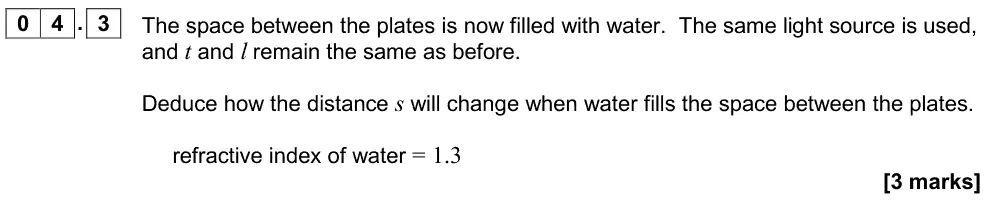
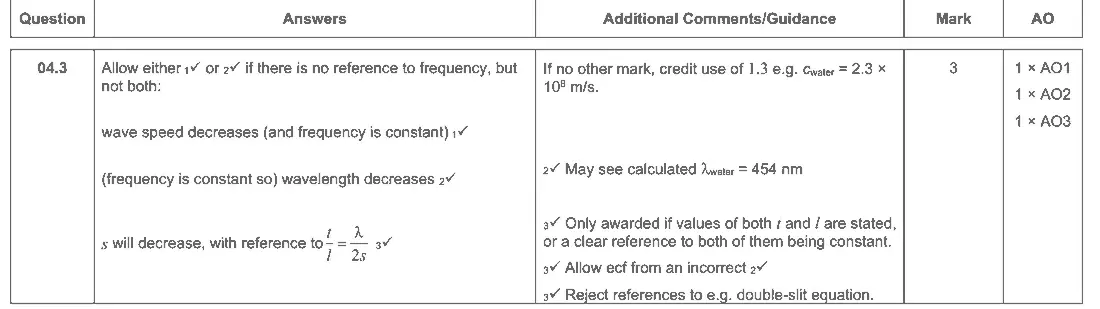
04.3 Most students incorrectly responded to this question with a Snell’s law approach and argued in terms of a changing angle of refraction causing a change in the fringe spacing. This was incorrect as the lights rays are almost incident along the normal to the plates.
Students who gained one mark made a relevant statement about the decrease in wave speed or wavelength but did not clearly reference the constant frequency. It was surprising how many students, having appreciated that the wavelength decreased, did not use the equation to deduce the consequential decrease in s.
Notes from the mark scheme and report
Wave speed and wavelength decrease in water (frequency constant, lambda = 454 nm)
with t and l constant s decreases since s = lambda l / 2t
Snell's-law angle arguments wrong as rays are normal
June 2024 · Paper 2 · Q141 markMultiple choice
Answer
D
Mark scheme
Notes from the mark scheme and report
Answer: D
Skills: MS3.1 Translate information between graphical, numerical and algebraic forms
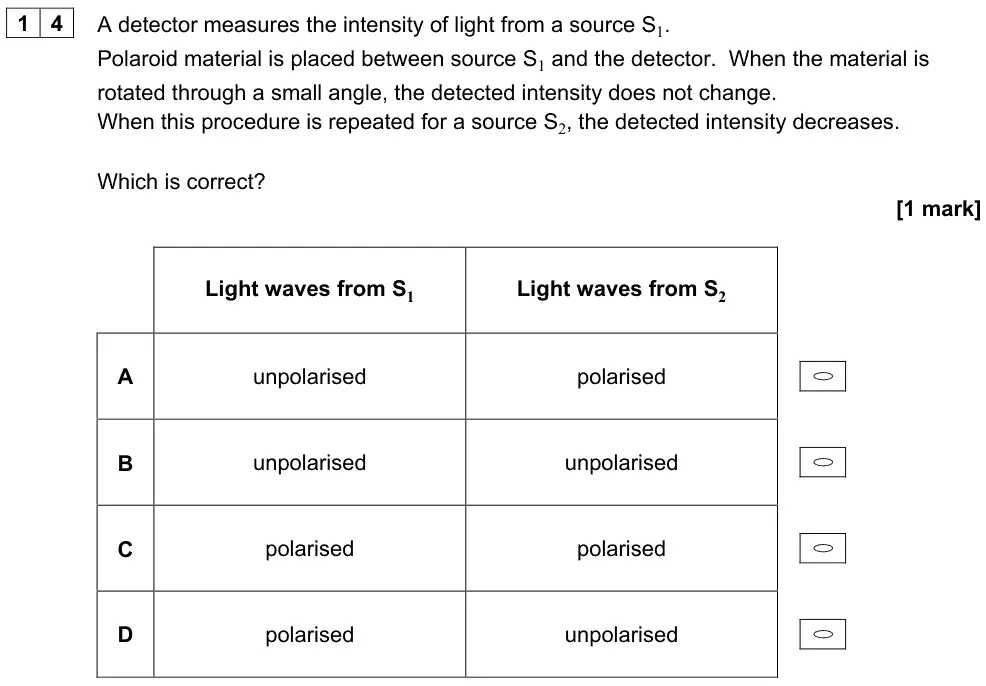
June 2024 · AS Paper 2 · Q301 markMultiple choice
Answer
D
Mark scheme
Examiner's comment
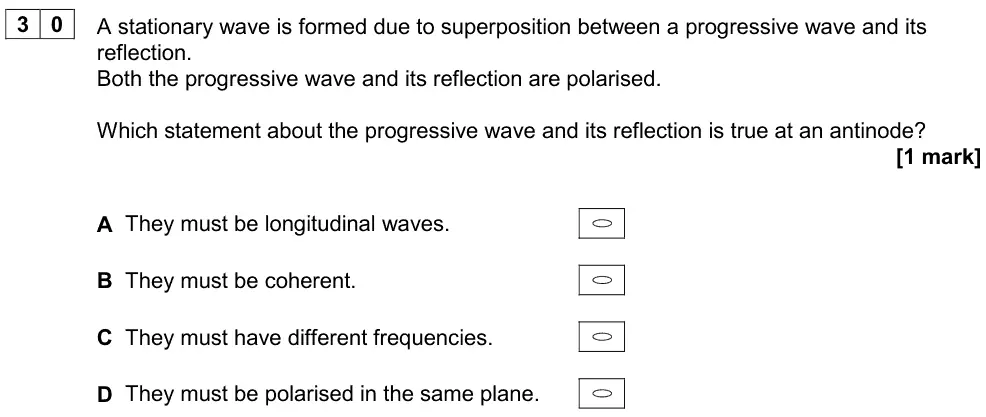
Question 30: Option B was the most popular response.
Notes from the mark scheme and report
Answer: D
most chose B
June 2024 · AS Paper 2 · Q321 markMultiple choice
Answer
C
Mark scheme
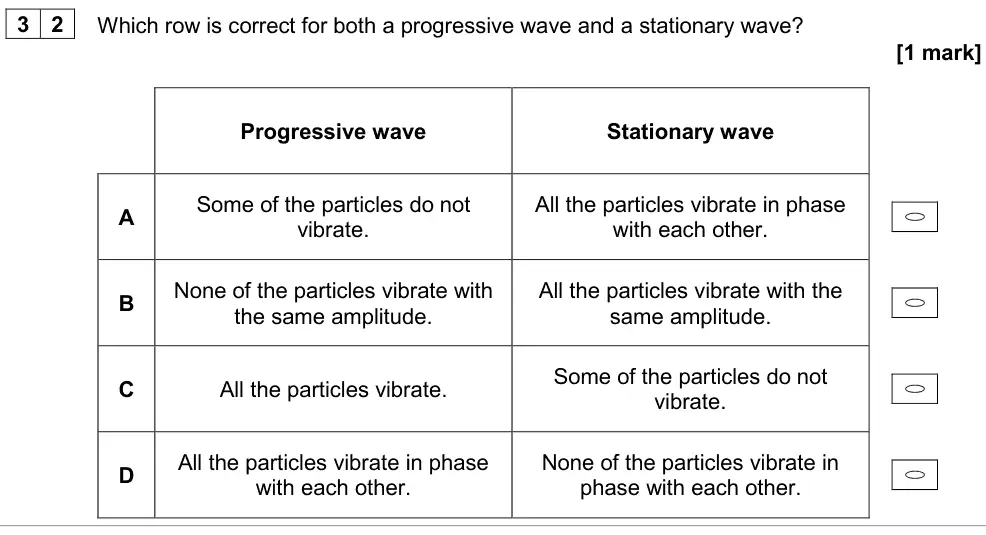
Notes from the mark scheme and report
Answer: C
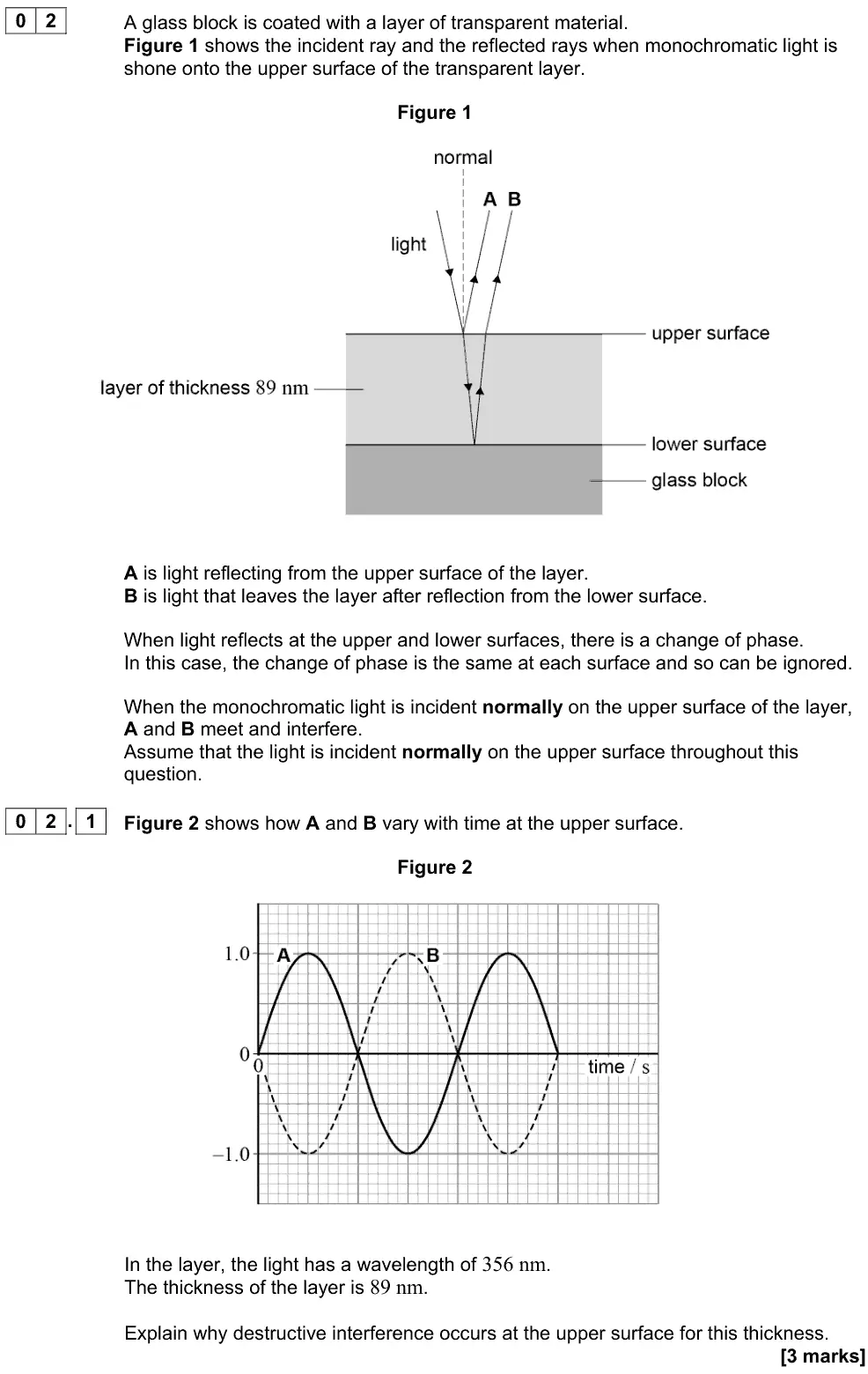
June 2023 · AS Paper 1 · Q2.13 marksAO2=3ExplanationHard
Mark scheme
Examiner's comment
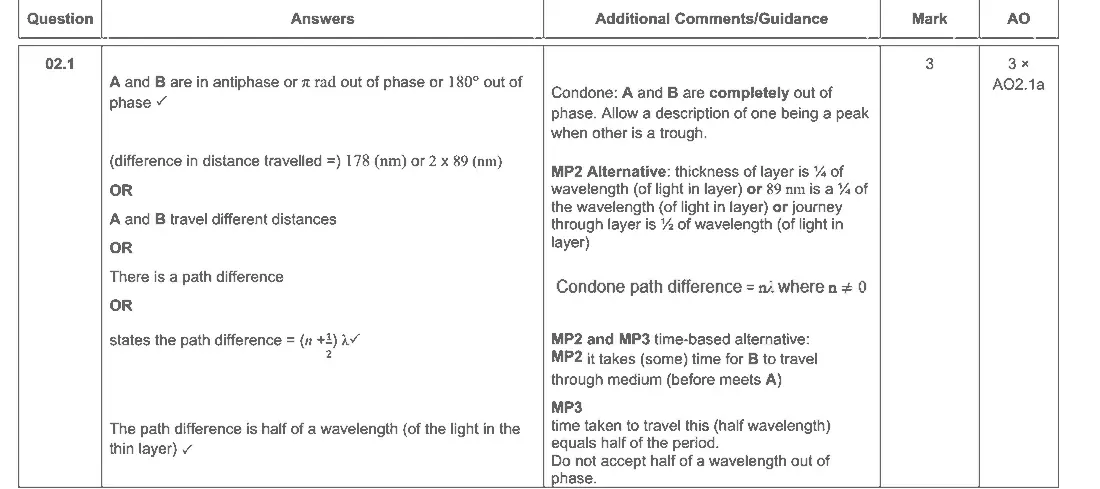
02.1 Almost 60% of students scored at least one mark whereas just over 5% scored all three marks. Grade E students typically stated that the waves were in antiphase but could not explain why this had occurred. Many students scoring zero attempted to describe antiphase but had used ‘out of phase’ instead of ‘completely out of phase’. Many students were able to describe how the path difference led to the phase difference. They often confused path difference and phase difference by stating that the waves were ‘half a wavelength out of phase’.
Notes from the mark scheme and report
A and B in antiphase (pi rad)
B travels an extra 2 x 89 = 178 nm, half a wavelength in the layer (356 nm)
'half a wavelength out of phase' confuses path and phase difference
June 2023 · AS Paper 1 · Q2.22 marksCalculationHard
Earlier part of question 2 that this part uses
Mark scheme
Examiner's comment
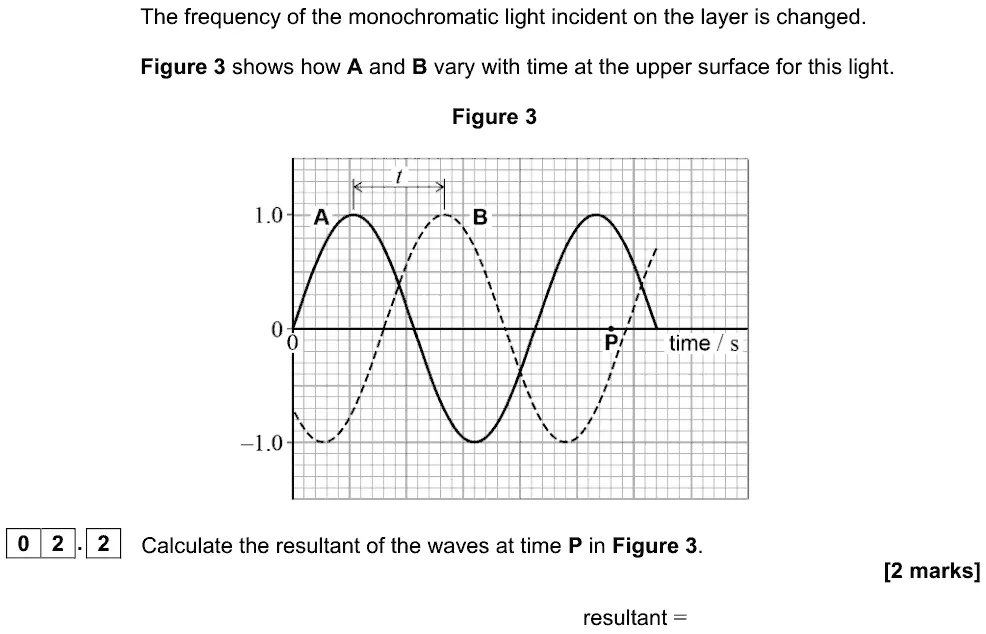
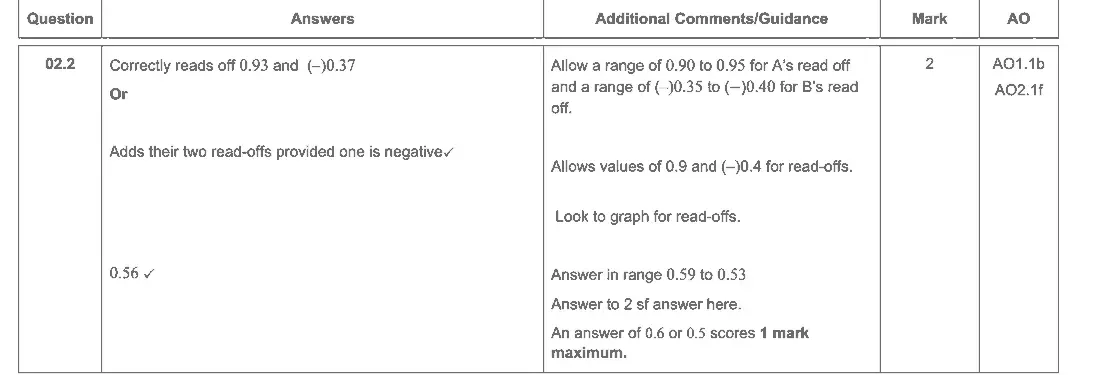
02.2 Over 10% of students did not attempt this part. Fewer than 10% gained both marks. Almost 50% of students obtained one mark for finding the difference between 0.9 and 0.4 and obtaining an answer of 0.5 to one significant figure. These students could have obtained both marks by attempting to read-off the values with more regard to accuracy.
Notes from the mark scheme and report
Answer: 0.56 (0.93 + (-0.37) read from Figure 3)
0.5 from rough read-offs scores 1
Skills: MS3.1 Translate information between graphical, numerical and algebraic forms
June 2023 · AS Paper 1 · Q2.33 marksShow thatHard
Earlier part of question 2 that this part uses
Mark scheme
Examiner's comment
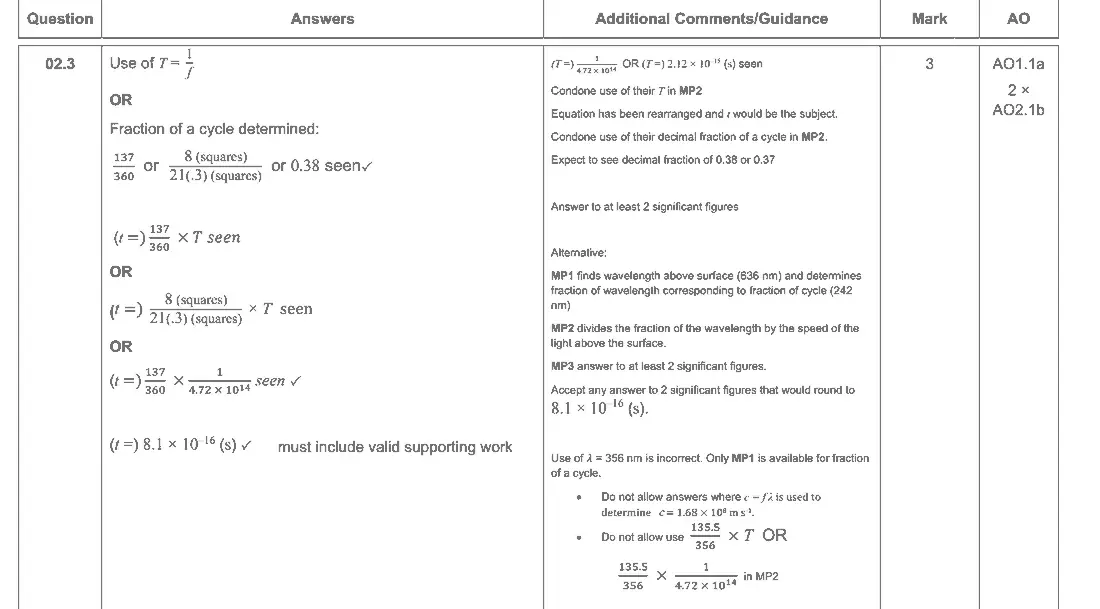
02.3 Better performing students did well in this question with 33% obtaining three marks. Almost 60% of students were able to achieve at least one mark. Lower attaining students were able to determine the period or the fraction of the cycle but did not know how to make further progress. Students should be aware that in “show that” questions the onus is on them to demonstrate their clear working towards the answer. Performance could be improved by ensuring that all equations used have an appropriate subject and that each stage in the calculation is shown with equals signs being used correctly.
Notes from the mark scheme and report
Answer: 8.1 x 10^-16 s (T = 1/4.72 x 10^14 = 2.12 x 10^-15 s, times 137/360)
show each step
Skills: MS0.3 Use ratios, fractions and percentages; MS2.3 Substitute numerical values into algebraic equations using appropriate units for physical quantities
June 2023 · AS Paper 1 · Q2.44 marksAO2=2, AO3=2CalculationHard
Earlier part of question 2 that this part uses
Mark scheme
Examiner's comment
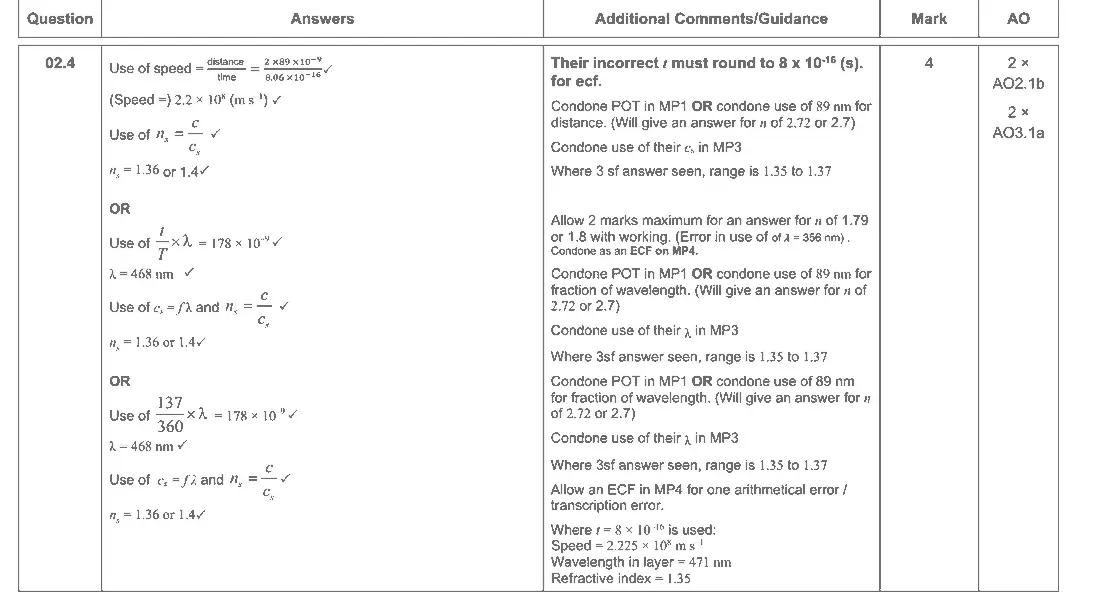
02.4 This was a challenging multi-step calculation that was beyond most of the students. Just over 30% of students scored any marks at all, with 6% of students scoring all four marks. Many students attempted to apply Snell’s law of refraction for a boundary using 137° as the angle of incidence. Others did not appreciate that the wavelength had changed when the frequency had changed and continued to use 356 nm for the wavelength in the layer. These students were able to achieve some of the compensatory marks, however.
Notes from the mark scheme and report
Answer: 1.36 (speed = 178 nm / 8.06 x 10^-16 s = 2.2 x 10^8 m s^-1, n = c/c_s
or wavelength 468 nm)
Snell's law with 137 degrees or reusing 356 nm were common errors
Skills: MS2.3 Substitute numerical values into algebraic equations using appropriate units for physical quantities; MS2.2 Change the subject of an equation, including non-linear equations
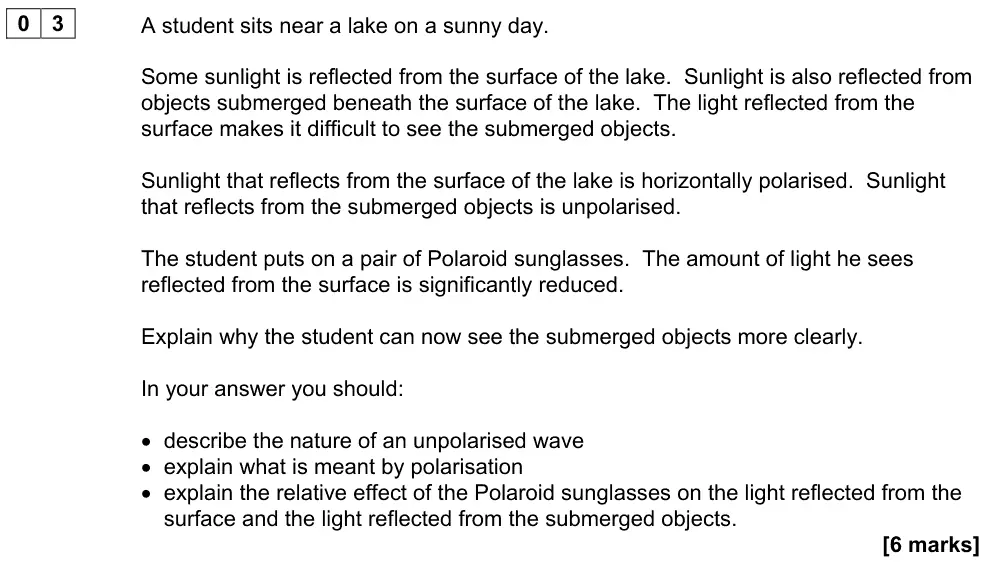
June 2023 · AS Paper 1 · Q36 marksAO1=4, AO3=26-mark extended response
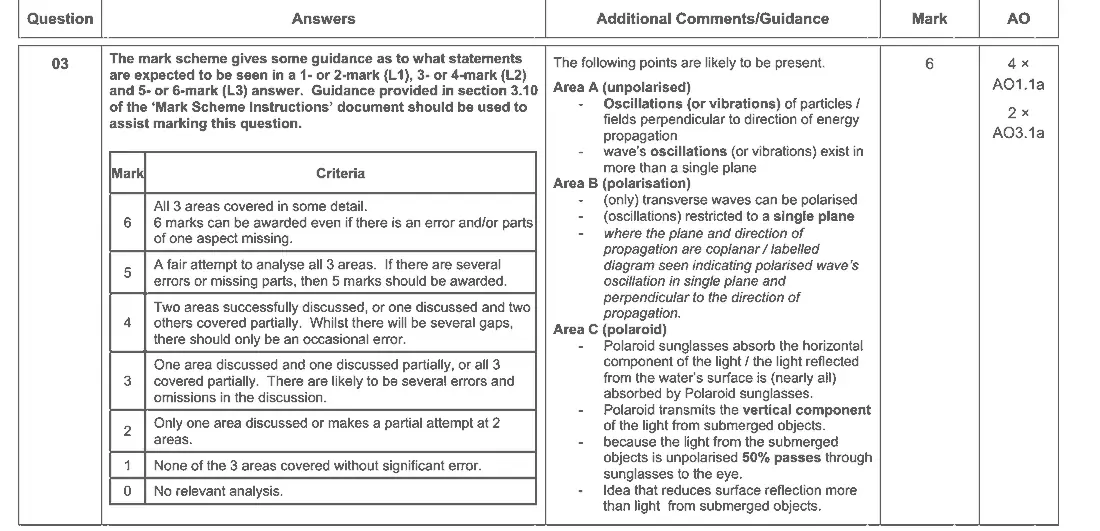
Mark scheme, with the levels and indicative content
Examiner's comment
40% of students scored at least three marks in this question. Many students were unable to provide a satisfactory description of an unpolarised wave or indeed to explain what is meant by polarisation. These students typically described the process of collimation rather than polarisation. This mostly occurred due to their inability to describe what is meant by a transverse wave with, many confusing planes of oscillation with directions of travel. Some other students demonstrated a little more knowledge of electromagnetic waves, describing the E and B components, but thought that polarisation was the removal of one of these components. Others thought that the sunglasses acted as a filter which allowed unpolarised light to pass through unaffected while blocking incident polarised light.
Notes from the mark scheme and report
Levels of response: unpolarised = transverse oscillations in many planes perpendicular to propagation
polarised = oscillations in one plane
Polaroid absorbs the horizontally polarised surface glare but transmits the vertical component (about half) of unpolarised light from submerged objects
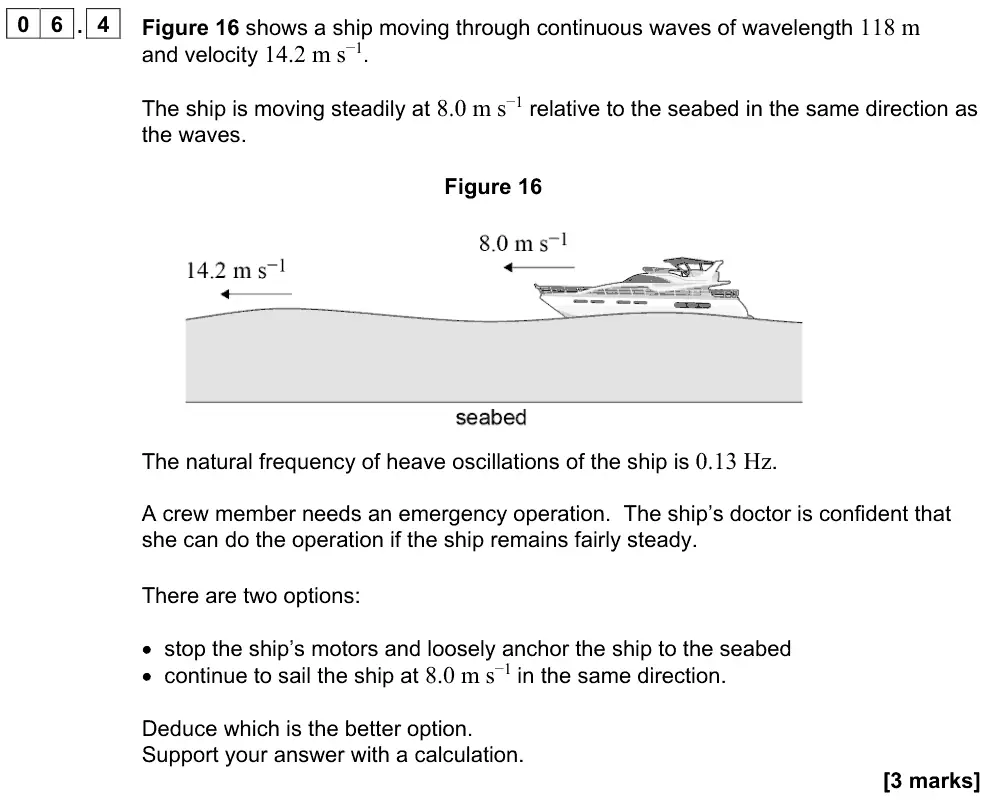
June 2023 · Paper 1 · Q6.43 marksAO3=3Calculation
Earlier part of question 6 that this part uses
Mark scheme
Examiner's comment
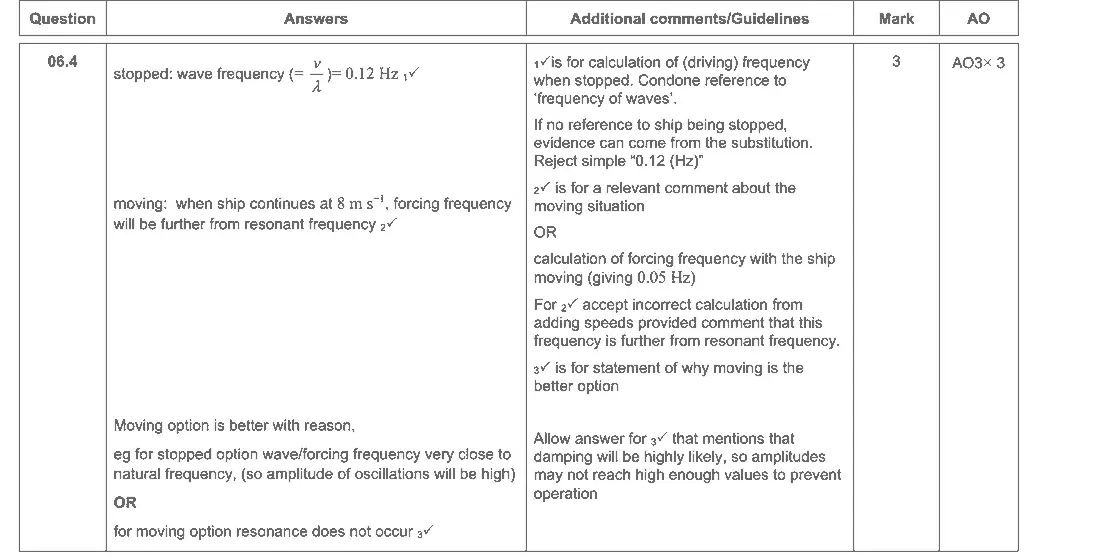
06.4 A question that discriminated very well. More than 60% of students were able to get at least one mark, usually for working out the wave frequency. Nearly 40% of students were able to go further, often for stating that this was close to the natural frequency and therefore the boat should move. Full marks were given for those who also made some reference to what happened to the driving frequency when the boat was moving. This is another example of a question that tests assessment objective AO3. Students should be encouraged to practise answering questions of this kind in preparation for this examination in the future.
Notes from the mark scheme and report
Stopped: wave frequency 14.2/118 = 0.12 Hz, close to the 0.13 Hz natural frequency so resonance
moving: relative speed gives about 0.05 Hz, far from resonance, so keep sailing
Skills: MS2.3 Substitute numerical values into algebraic equations using appropriate units for physical quantities
June 2023 · Paper 1 · Q141 markMultiple choice
Answer
C
Mark scheme
Notes from the mark scheme and report
Answer: C
Skills: MS3.1 Translate information between graphical, numerical and algebraic forms
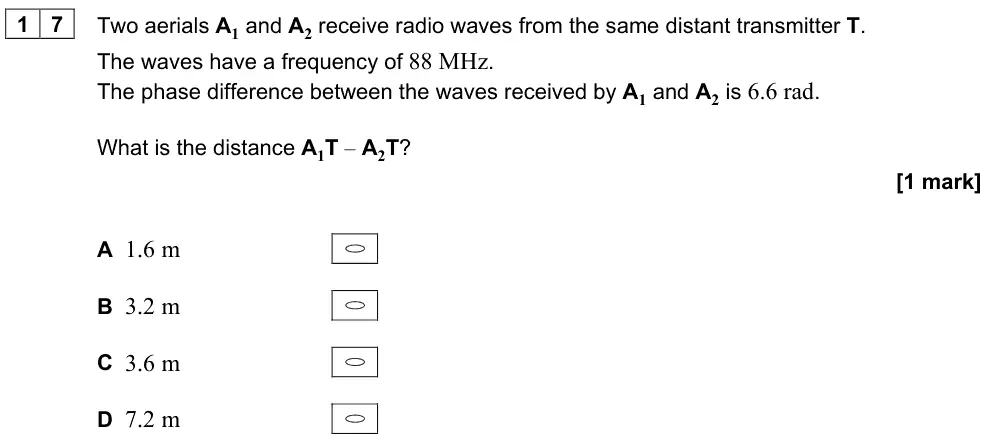
June 2023 · AS Paper 2 · Q171 markMultiple choice
Answer
C
Notes from the mark scheme and report
Answer: C
Skills: MS4.7 Understand the relationship between degrees and radians and translate from one to the other
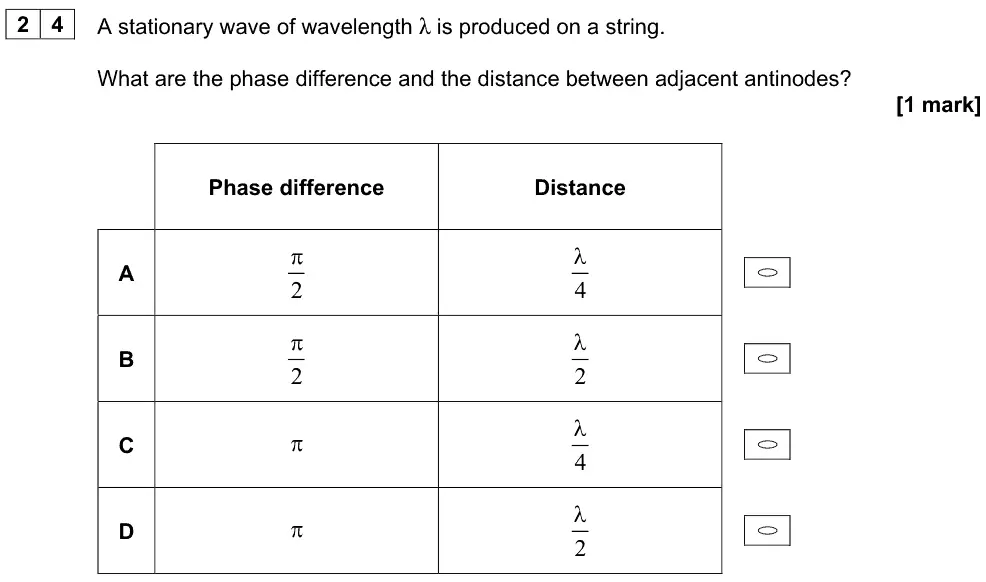
June 2023 · AS Paper 2 · Q241 markMultiple choice
Answer
D
Mark scheme
Notes from the mark scheme and report
Answer: D
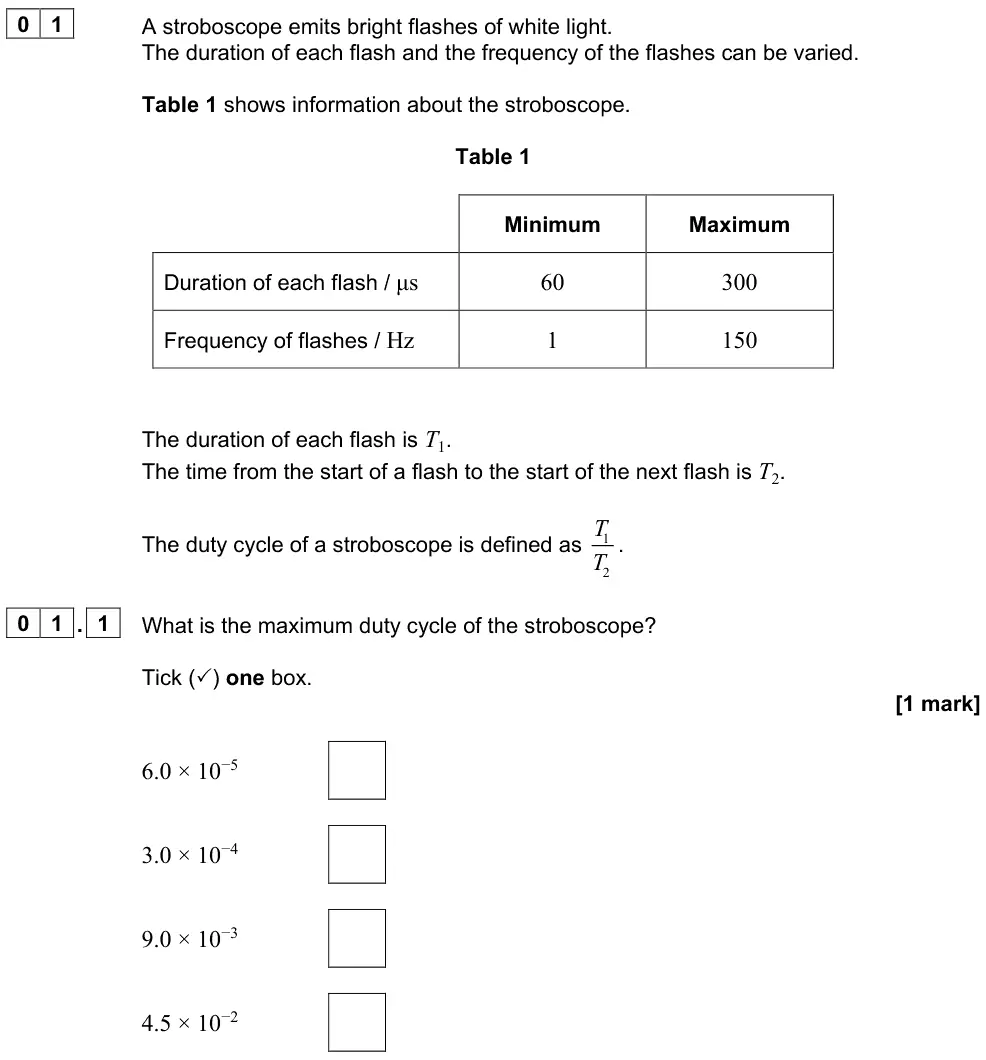
June 2023 · Paper 3 Section A · Q1.11 markAO2=1Short answer
Mark scheme
Examiner's comment
01.1 Over half of the students gave the correct response.
Notes from the mark scheme and report
Answer: 4.5 x 10^-2 (300 us x 150 Hz, both maxima from Table 1)
just over half correct
Skills: MS0.3 Use ratios, fractions and percentages; MS0.2 Recognise and use expressions in decimal and standard form
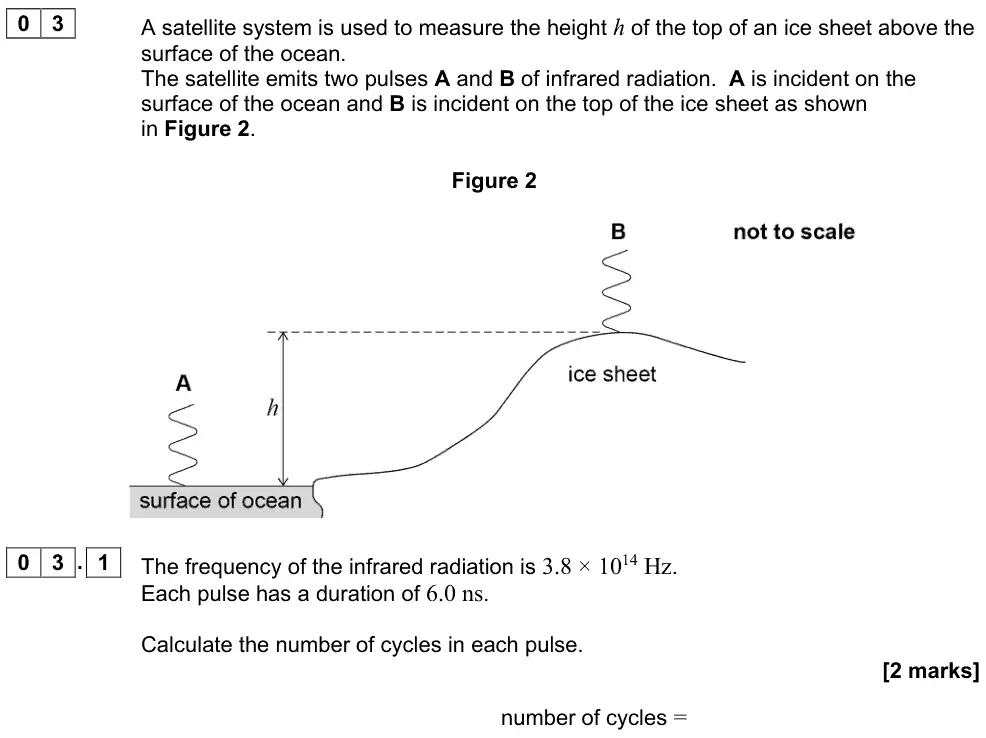
June 2022 · AS Paper 1 · Q3.12 marksAO1=1, AO2=1Calculation
Mark scheme
Examiner's comment
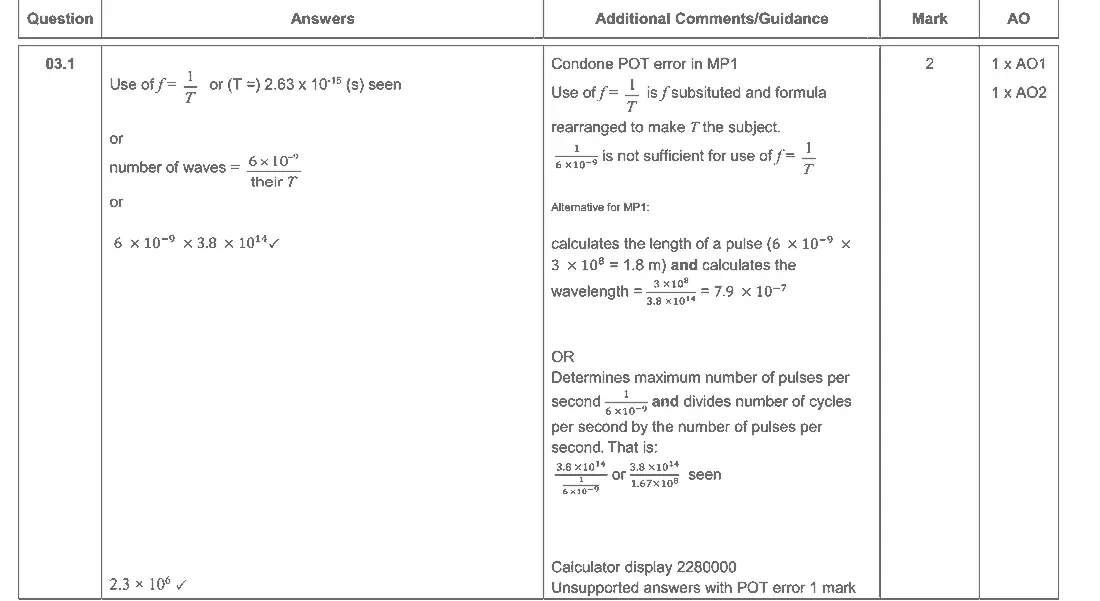
03.1 Almost 50% of students scored both marks. The best answers showed convincing working leading to a correct answer. Common errors included dividing the frequency by the pulse duration and incorrect conversion of 6.0 ns.
Notes from the mark scheme and report
Answer: 2.3 x 10^6 cycles (6.0 x 10^-9 s x 3.8 x 10^14 Hz)
dividing f by duration and ns conversion were the errors
Skills: MS0.2 Recognise and use expressions in decimal and standard form; MS2.3 Substitute numerical values into algebraic equations using appropriate units for physical quantities
June 2022 · AS Paper 1 · Q3.42 marksAO1=1, AO2=1Calculation
Earlier part of question 3 that this part uses
Mark scheme
Examiner's comment
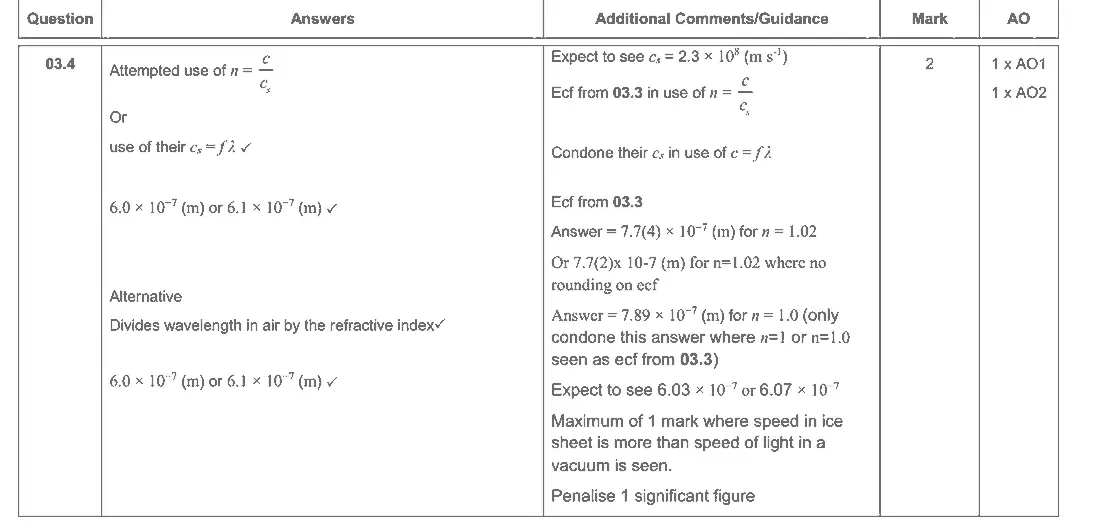
03.4 This was a good example of a multi-step calculation that was an indicator of higher level use of c=f𝜆𝜆 without any attempt to determine the speed of the infrared in the ice. performance with just over 40% of students gaining both marks. The most common error was the
Notes from the mark scheme and report
Answer: 6.0 x 10^-7 m (c_s = 2.3 x 10^8 m s^-1 then lambda = c_s/f, or 7.9 x 10^-7 m / 1.31)
using c = f lambda in air was the common error
Skills: MS2.3 Substitute numerical values into algebraic equations using appropriate units for physical quantities
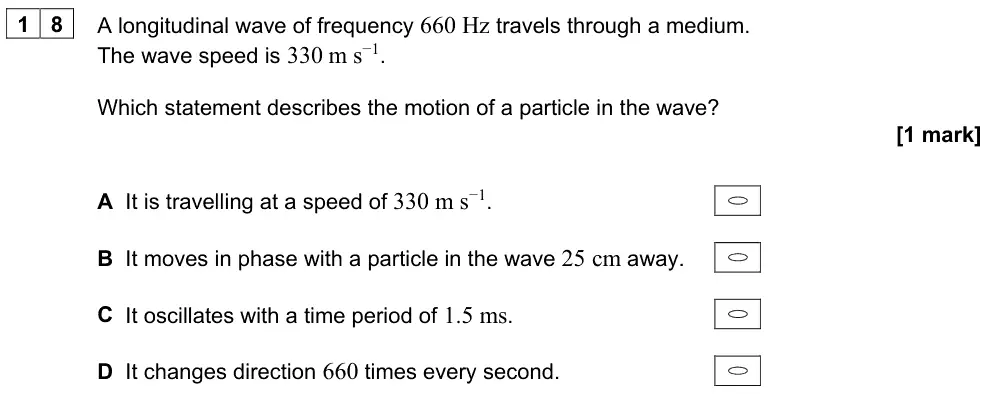
June 2022 · Paper 1 · Q181 markAO2=1Multiple choice
Answer
C
Mark scheme
Notes from the mark scheme and report
Answer: C
Skills: MS0.2 Recognise and use expressions in decimal and standard form
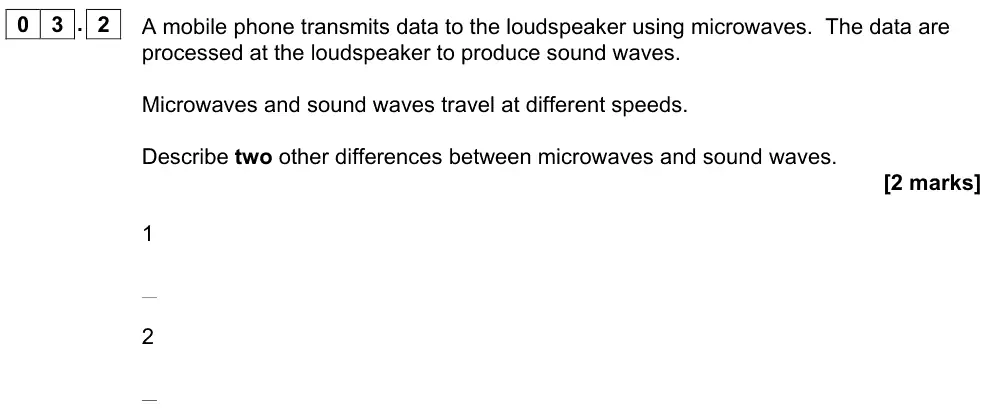
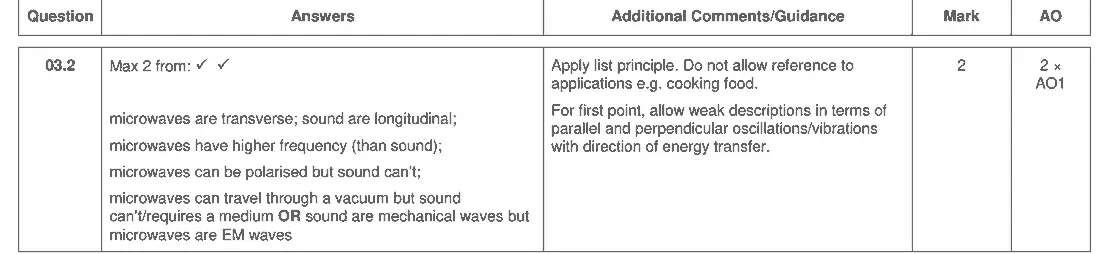
June 2022 · AS Paper 2 · Q3.22 marksAO1=2Short answer
Earlier part of question 3 that this part uses
Mark scheme
Examiner's comment
03.2 The most common differences given between microwaves and sound waves were in terms of transverse vs longitudinal, and polarisability. “Microwaves are part of the electromagnetic spectrum, but sound waves aren’t” was a common response that contains insufficient detail.
Notes from the mark scheme and report
Two of: microwaves transverse/sound longitudinal
microwaves polarisable
microwaves travel through vacuum, sound needs a medium
higher frequency
'EM spectrum' alone insufficient
June 2022 · AS Paper 2 · Q3.52 marksAO2=2Calculation
Earlier part of question 3 that this part uses
Mark scheme
Examiner's comment
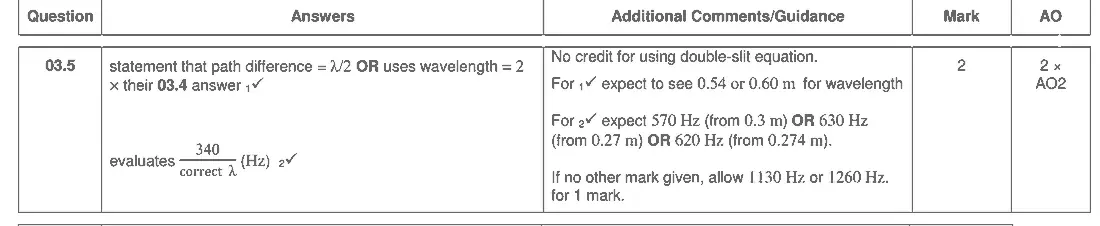
03.5 Students should also appreciate that a ‘show that’ question is usually followed by a question requiring use of the value given. Very few students made the connection between the path difference (leading to a minimum intensity) and the wavelength.
Notes from the mark scheme and report
Answer: about 630 Hz (first minimum so path difference = lambda/2, lambda = 0.54 m
570 Hz from 0.3 m accepted)
Skills: MS2.3 Substitute numerical values into algebraic equations using appropriate units for physical quantities
June 2022 · AS Paper 2 · Q111 markAO1=1Multiple choice
Answer
C
Mark scheme
Notes from the mark scheme and report
Answer: C
June 2022 · AS Paper 2 · Q141 markAO1=1Multiple choice
Answer
B
Mark scheme
Notes from the mark scheme and report
Answer: B
June 2022 · AS Paper 2 · Q151 markAO2=1Multiple choice
Answer
C
Mark scheme
Notes from the mark scheme and report
Answer: C
Skills: MS4.7 Understand the relationship between degrees and radians and translate from one to the other
June 2022 · AS Paper 2 · Q161 markAO2=1Multiple choice
Answer
A
Mark scheme
Notes from the mark scheme and report
Answer: A
June 2022 · Paper 3 Section A · Q1.23 marksAO2=3Practical and data analysis
Earlier part of question 1 that this part uses
Mark scheme
Examiner's comment
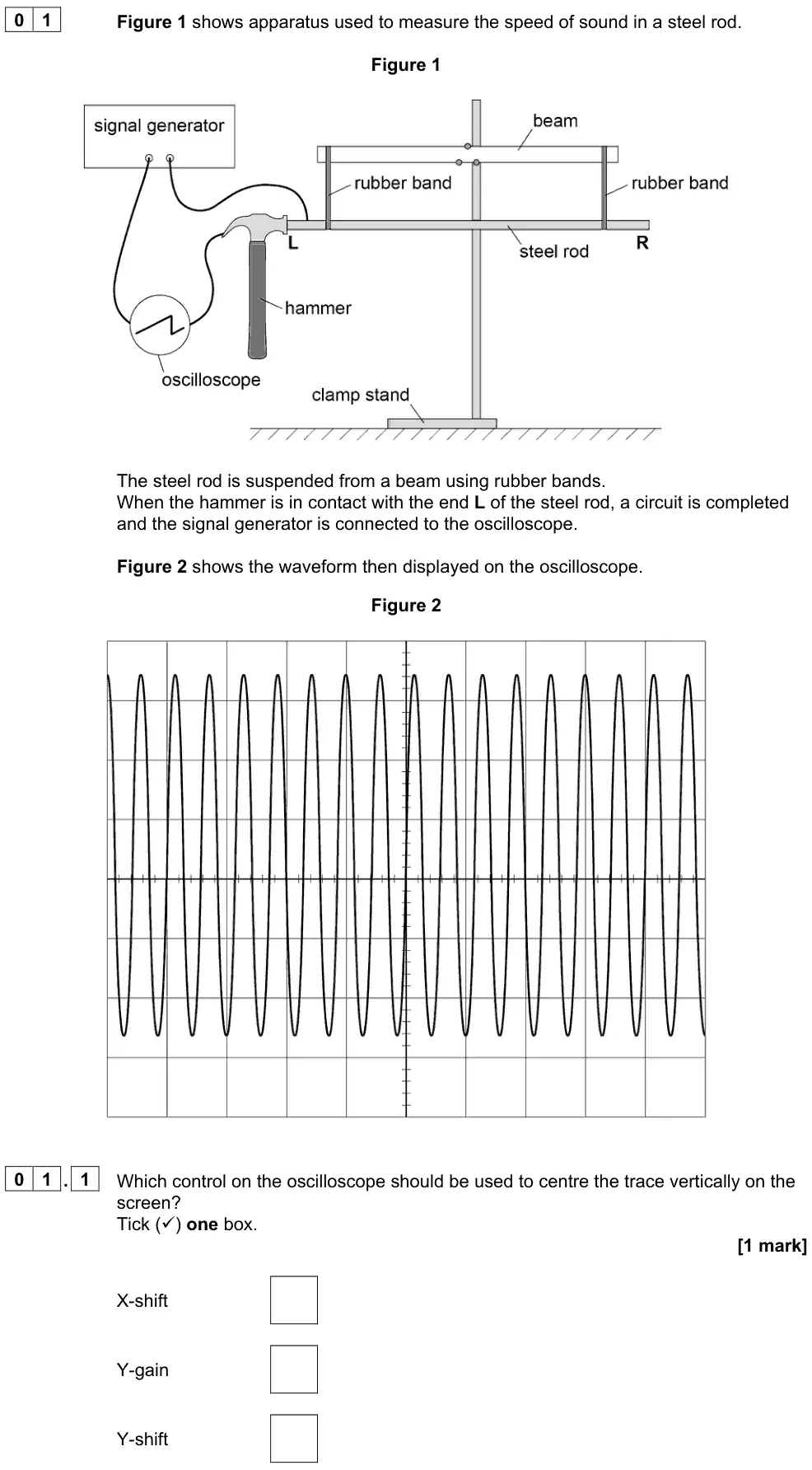
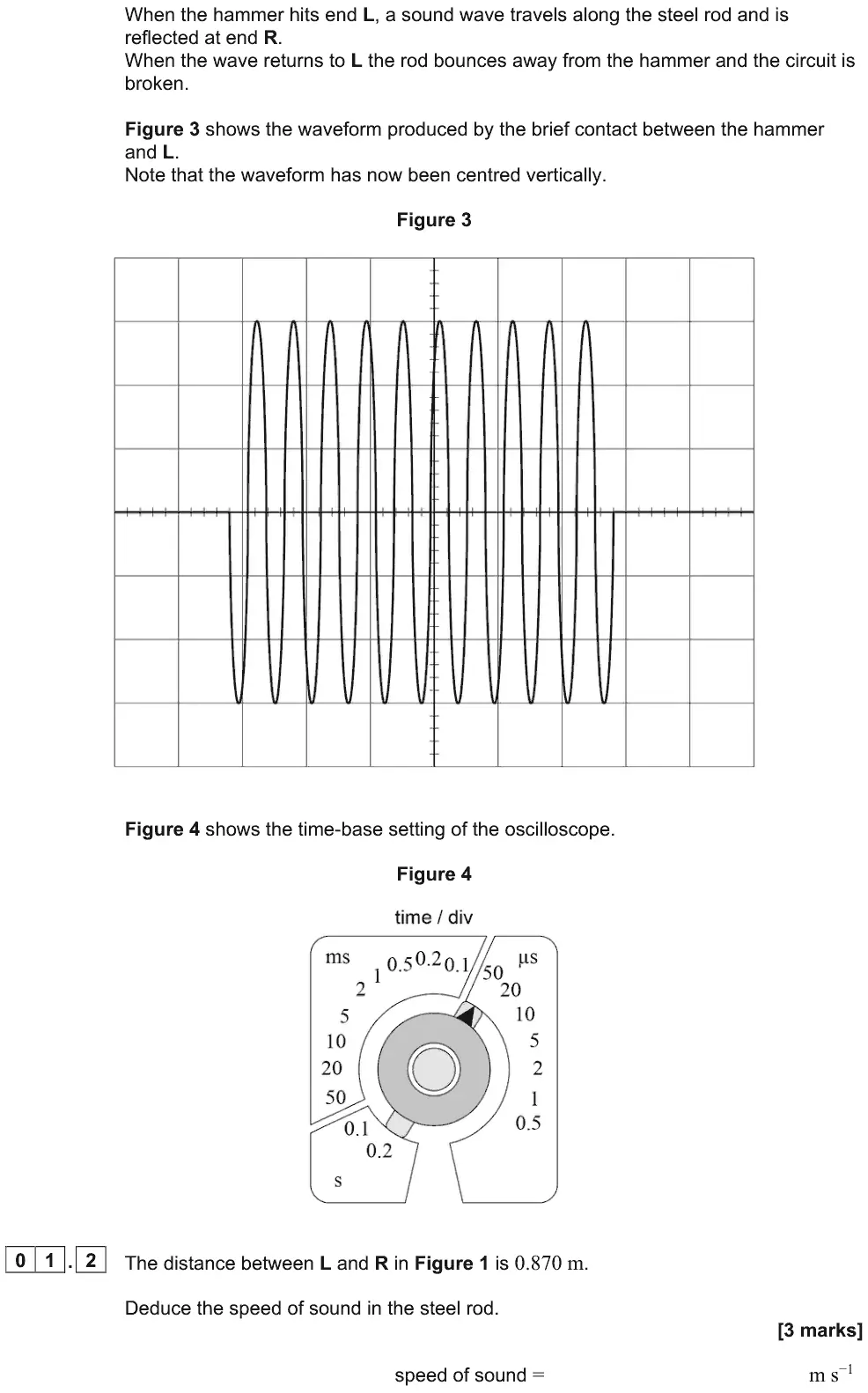
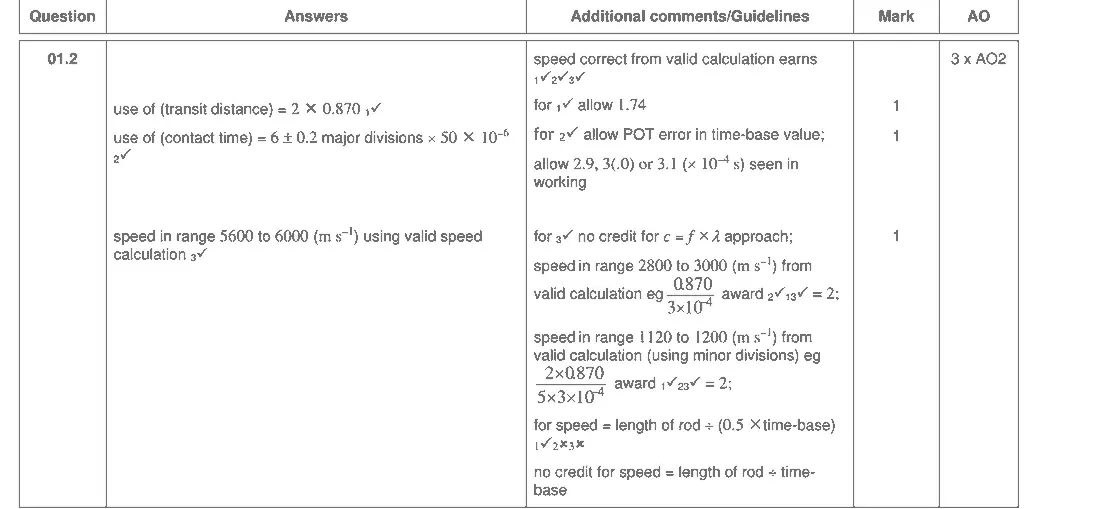
2 length of rod × speed . For full credit in 01.2, examiners wanted to see use of = contact time Some students missed the factor of 2 or assumed that the time-base setting referred to minor divisions. It was disappointing that more than half of the students could not score.
Calculations were usually easy to follow but in 01.2 and 04.6 relevant details were sometimes spread across the answer space with little connective reasoning. Students found question 4 significantly harder than the rest of the paper; students of E-grade standard might only score marks in 04.4 and 04.7.
Notes from the mark scheme and report
Answer: 5600-6000 m s^-1 (distance 2 x 0.870 m
contact time 6 divisions x 50 microseconds = 3.0 x 10^-4 s)
missing the factor 2 or using minor divisions were common
more than half could not score
Skills: ATh signal generator and oscilloscope; MS2.3 Substitute numerical values into algebraic equations using appropriate units for physical quantities
June 2022 · Paper 3 Section A · Q1.34 marksAO1=2, AO3=2Practical and data analysis
Earlier part of question 1 that this part uses
Mark scheme
Examiner's comment
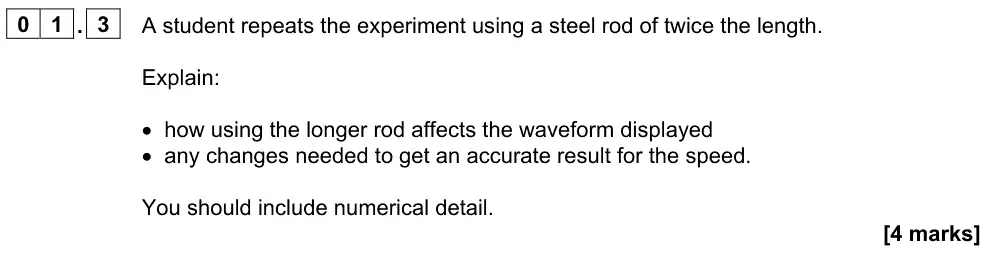
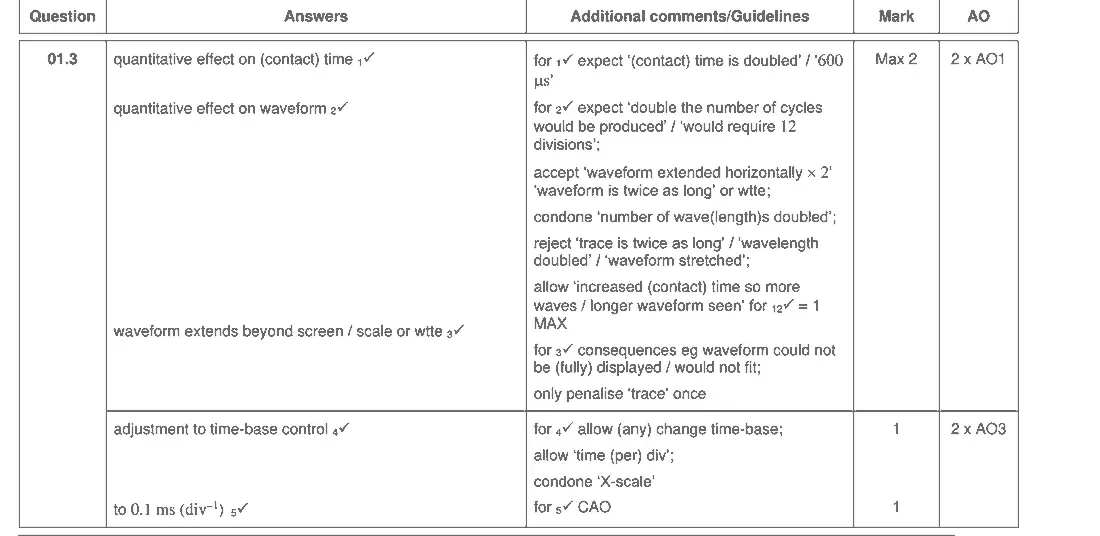
In 01.3 there was strong representation at each mark. Better students took note that they should add quantitative detail. Once it was clear that the new waveform would have twice the number of cycles and would therefore no longer be fully visible, most could correctly identify that the time- base should be adjusted. ‘X-gain’ was accepted for time-base and many correctly suggested changing the setting to 0.1 ms div−1. Some wrote that, when a rod of twice the length was used, the period / wavelength / frequency / speed of the waves would change.
The questions were designed to allow students to demonstrate competence in the key techniques and investigative approaches required in three of the twelve assessed practical activities. This cohort showed that when the question provided enough structure to deter them from improvising, they could produce coherent and sensible extended writing, as in 01.3 and 02.2. Question 04.2 was a different story, with some students referring to ‘suction’ and equating pressure with ‘gravity’.
04.1 is a similar question to 01.3 in November 2021. While half could perform calculations that could lead to a conclusion, nearly all then stated that their ‘M y values were different.’ Random error will inevitably affect real data so students were required to make a reasoned comment about the extent of the discrepancy. Some seemed to think they were being asked to test for an exponential relationship while others, sowing the seeds of the downfall in 04.3, said the points in Figure 10 lay on a straight line.
Notes from the mark scheme and report
Contact time doubles (600 microseconds) so twice as many cycles, needing 12 divisions - waveform no longer fits the screen
change time-base to 0.1 ms per division
Skills: ATh signal generator and oscilloscope; PS2.1 Comment on experimental design and evaluate scientific methods
November 2021 · Paper 1 · Q2.13 marksAO1=3Explanation
Mark scheme
Examiner's comment
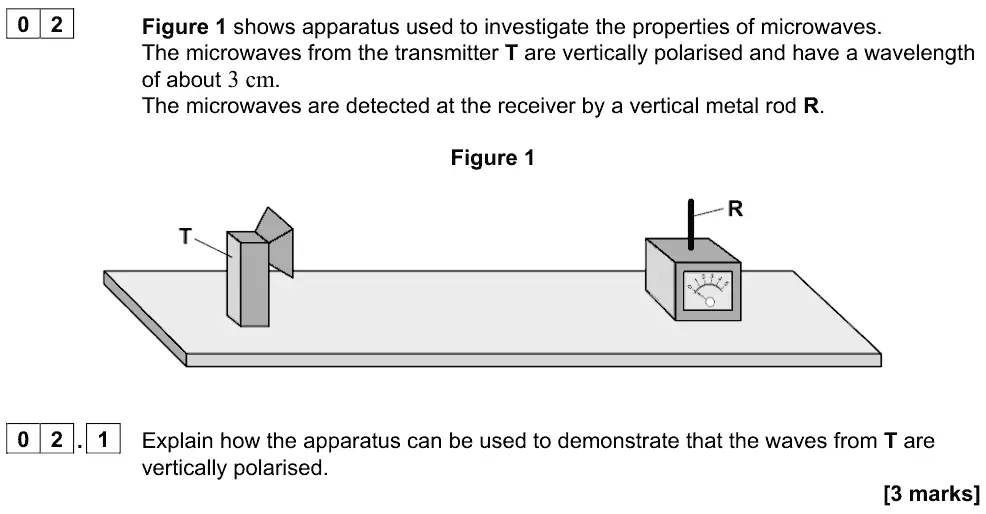
Answers to questions 02.1 and 02.2 were often vague and incomplete, lacking the detail necessary at A-level. This meant that very few students scored full marks on either question. Question 02.3 proved to be one of the least accessible on the paper. Only the occasional student demonstrated any awareness of the assumptions associated with Young’s slits. There are several situations involving two-source interference where the Young double-slit equation is invalid and students should be able to identify them. Despite being told that the equation could not be used, most students ignored this when attempting to answer question 02.4. This meant they could only obtain a maximum of 2 marks for this question.
Notes from the mark scheme and report
Rotate the receiving aerial in a vertical plane: maximum signal when vertical, minimum when horizontal, because maximum occurs when aerial is aligned with the plane of polarisation
answers vague, very few full marks
November 2021 · Paper 1 · Q171 markMultiple choice
Answer
D
Mark scheme
Notes from the mark scheme and report
Answer: D
Skills: MS3.1 Translate information between graphical, numerical and algebraic forms
November 2021 · AS Paper 2 · Q1.43 marksCalculation
Earlier part of question 1 that this part uses
Mark scheme
Notes from the mark scheme and report
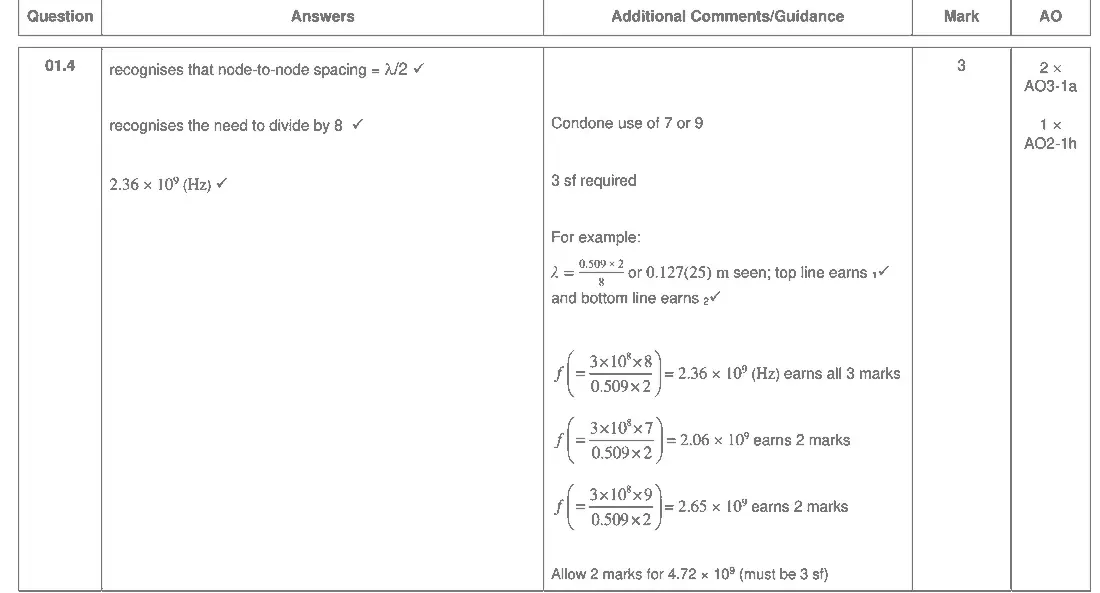
Answer: 2.36 x 10^9 Hz (node spacing = lambda/2 so 8 spacings = 4 lambda
lambda = 0.127 m
f = c/lambda)
3 sf
using 7 or 9 spacings scores 2
Skills: MS2.3 Substitute numerical values into algebraic equations using appropriate units for physical quantities; MS1.1 Use an appropriate number of significant figures
November 2021 · AS Paper 2 · Q1.51 markAO1=1Short answer
Earlier part of question 1 that this part uses
Mark scheme
Notes from the mark scheme and report
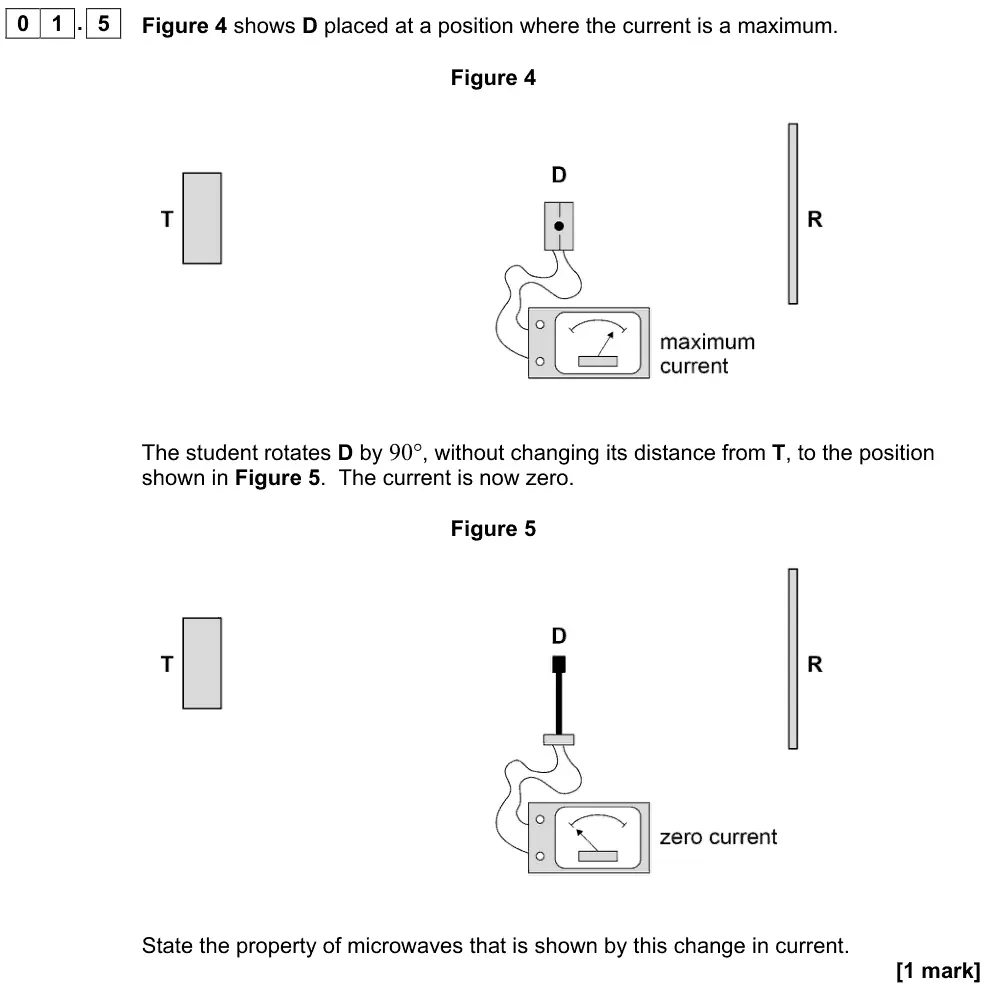
Microwaves are polarised (transverse)
November 2021 · AS Paper 2 · Q151 markMultiple choice
Answer
B
Mark scheme
Notes from the mark scheme and report
Answer: B
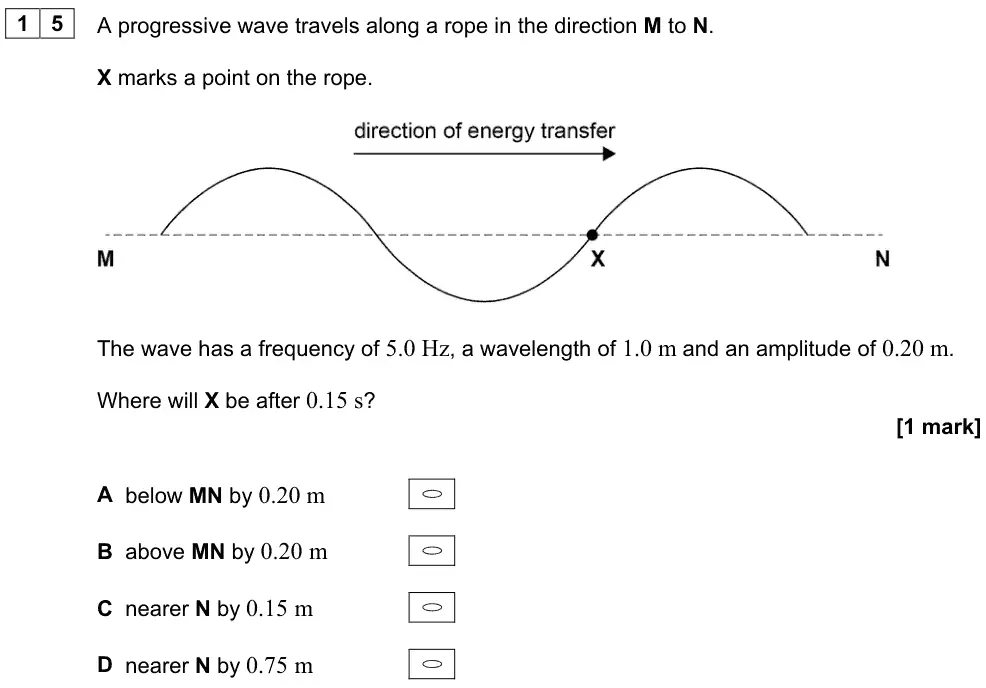
0.15 s = 3T/4, X moves down first then reaches the crest
November 2020 · Paper 1 · Q3.41 markCalculation
Earlier part of question 3 that this part uses
Mark scheme
Examiner's comment
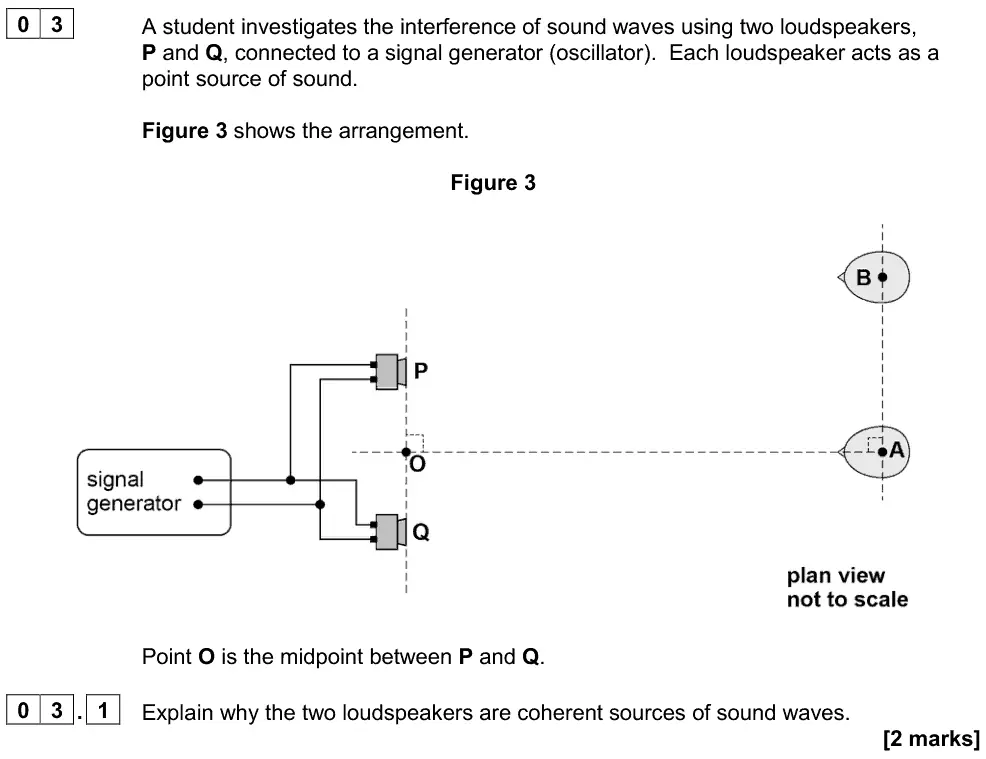
This question dealt with the ideas behind double-slit interference using the context of sound waves. It was pleasing to note that many students understood what was meant by coherence, but some failed to gain the mark for stating that the phase rather than the frequency was the same. In part 03.2, many students demonstrated an awareness of constructive and destructive interference without explaining how they come about. There was also a lot of confusion between phase difference and path difference. In 03.3, the best answers were by students who realised that the Young slit equation should not be used, and who worked out the path difference from first principles. In 03.4, a surprisingly large number of students failed to identify their answer to 03.3 as the wavelength of the sound. In 03.5, although the question specifically asked for a discussion of the amplitude, many students simply referred to a change in pitch. A large number of students also incorrectly suggested that the speed of the sound waves would change.
Notes from the mark scheme and report
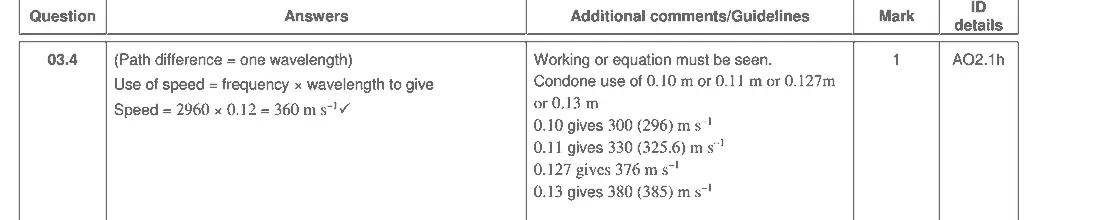
Answer: 360 m s^-1 (path difference at B is one wavelength, 2960 x 0.12)
many did not identify 03.3 as the wavelength
Skills: MS2.3 Substitute numerical values into algebraic equations using appropriate units for physical quantities
November 2020 · Paper 1 · Q3.53 marksExplanation
Earlier part of question 3 that this part uses
Mark scheme
Examiner's comment
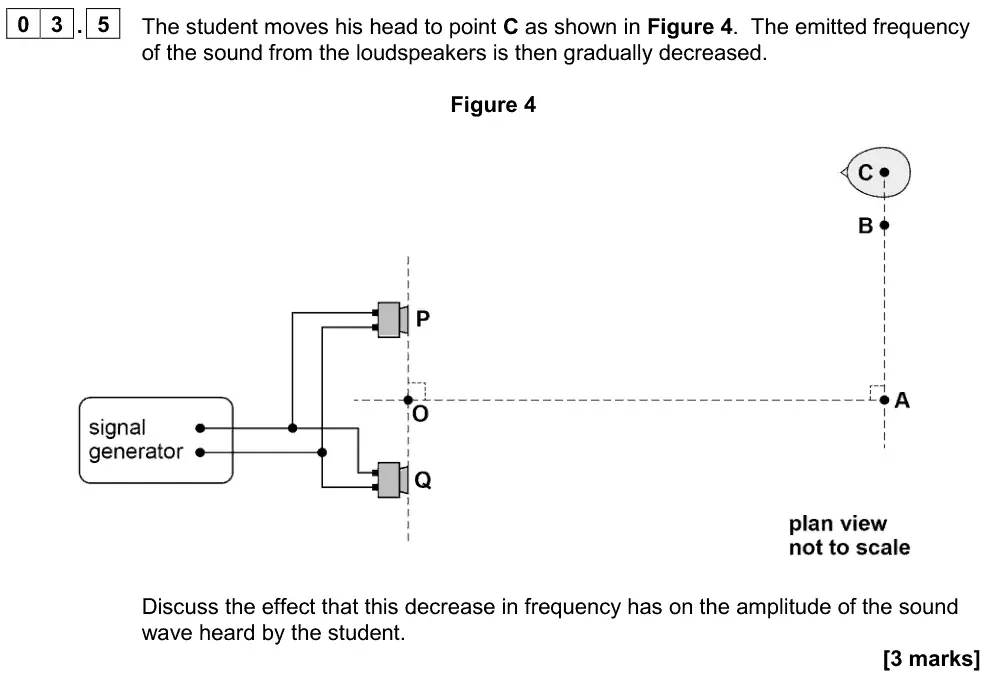
This question dealt with the ideas behind double-slit interference using the context of sound waves. It was pleasing to note that many students understood what was meant by coherence, but some failed to gain the mark for stating that the phase rather than the frequency was the same. In part 03.2, many students demonstrated an awareness of constructive and destructive interference without explaining how they come about. There was also a lot of confusion between phase difference and path difference. In 03.3, the best answers were by students who realised that the Young slit equation should not be used, and who worked out the path difference from first principles. In 03.4, a surprisingly large number of students failed to identify their answer to 03.3 as the wavelength of the sound. In 03.5, although the question specifically asked for a discussion of the amplitude, many students simply referred to a change in pitch. A large number of students also incorrectly suggested that the speed of the sound waves would change.
Notes from the mark scheme and report
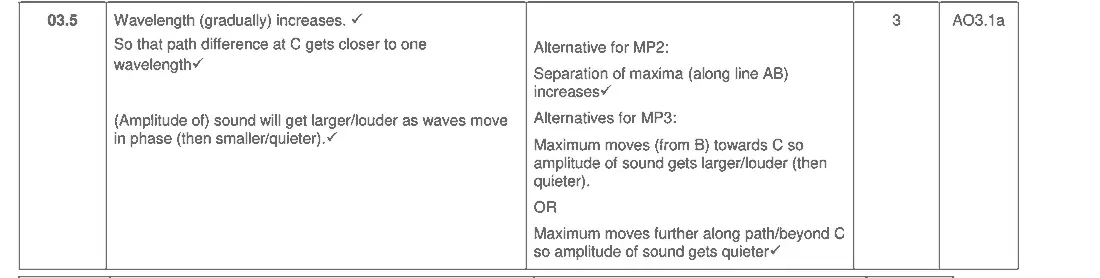
Lower frequency means longer wavelength, maxima spread out
path difference at C approaches one wavelength so sound gets louder (then quieter)
pitch or speed-change answers not credited
November 2020 · AS Paper 1 · Q6.12 marksShort answer
Mark scheme
Notes from the mark scheme and report
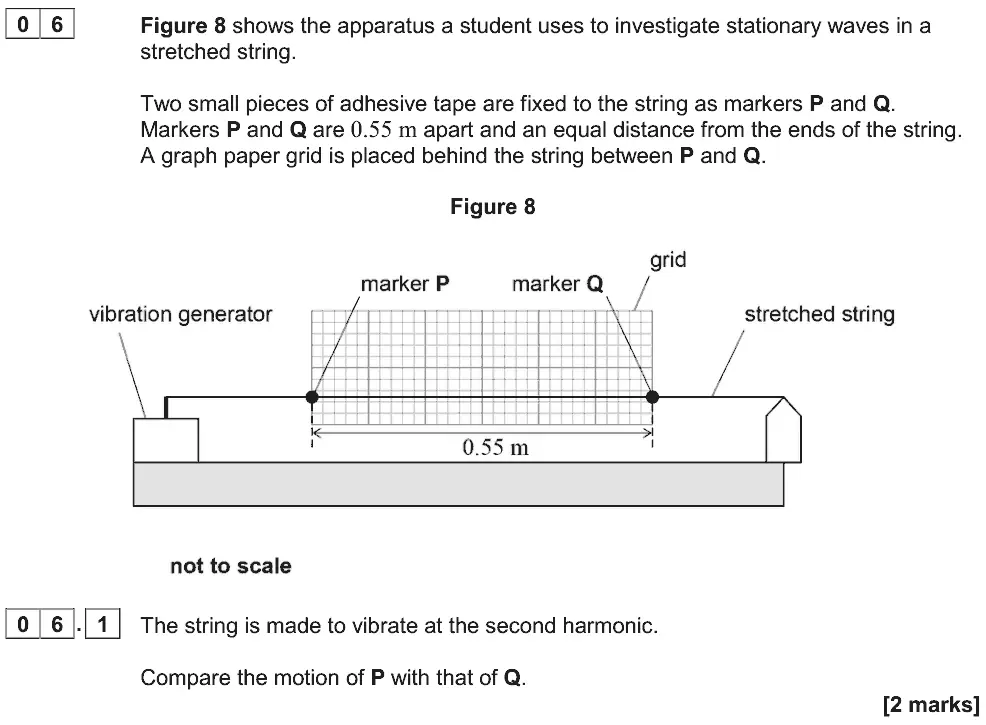
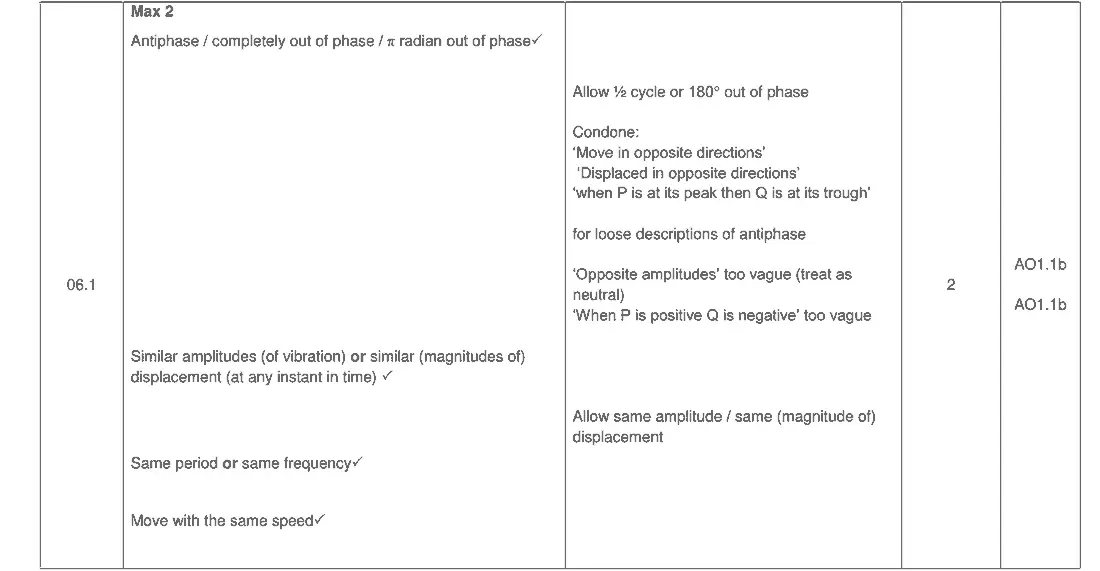
P and Q in antiphase (pi rad)
same amplitude and frequency
Skills: RP1 Investigation into the variation of the frequency of stationary waves on a string with length, tension and mass per unit length of the string.
November 2020 · AS Paper 1 · Q6.22 marksCalculation
Earlier part of question 6 that this part uses
Mark scheme
Notes from the mark scheme and report
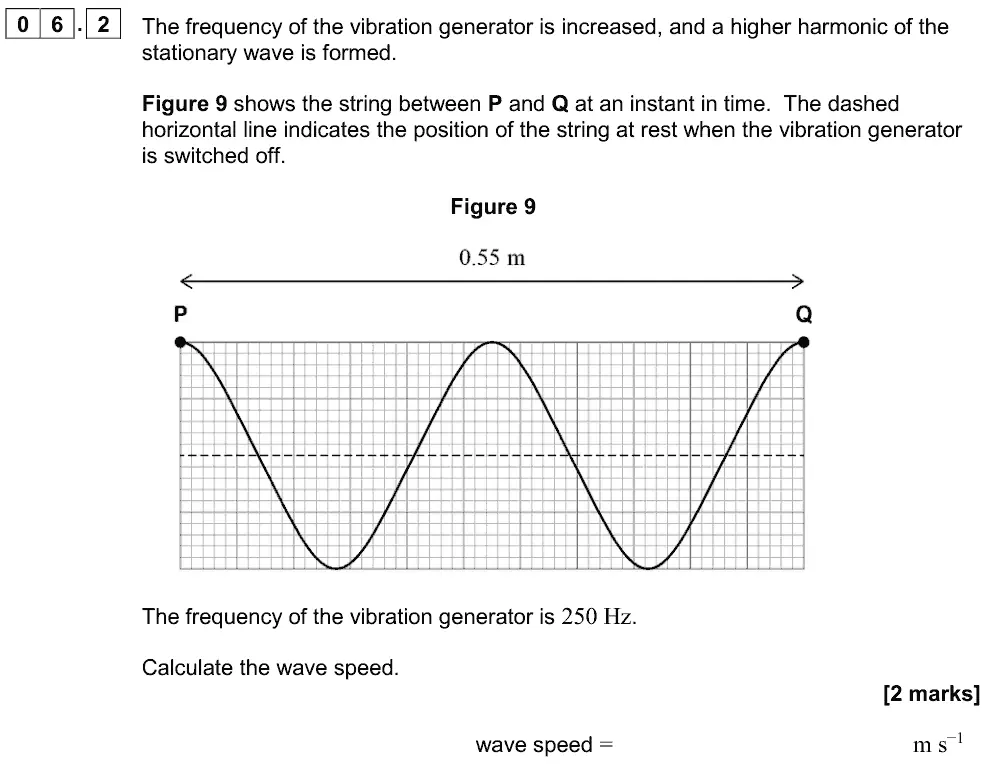
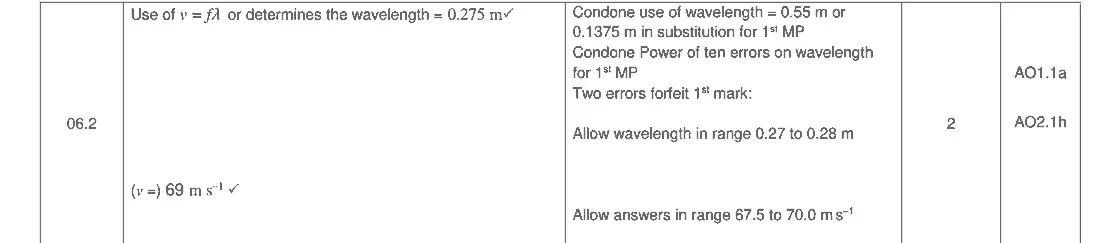
Answer: 69 m s^-1 (wavelength 0.275 m from Figure 9, f = 250 Hz)
Skills: MS3.1 Translate information between graphical, numerical and algebraic forms; MS2.3 Substitute numerical values into algebraic equations using appropriate units for physical quantities; RP1 Investigation into the variation of the frequency of stationary waves on a string with length, tension and mass per unit length of the string.
November 2020 · Paper 1 · Q151 markMultiple choice
Answer
A
Mark scheme
Notes from the mark scheme and report
Answer: A
November 2020 · Paper 1 · Q161 markMultiple choice
Answer
A
Mark scheme
Notes from the mark scheme and report
Answer: A
Skills: MS2.3 Substitute numerical values into algebraic equations using appropriate units for physical quantities
November 2020 · Paper 1 · Q171 markMultiple choice
Answer
C
Mark scheme
Notes from the mark scheme and report
Answer: C
November 2020 · AS Paper 2 · Q121 markMultiple choice
Answer
D
Mark scheme
Notes from the mark scheme and report
Answer: D
Skills: MS3.1 Translate information between graphical, numerical and algebraic forms
November 2020 · AS Paper 2 · Q131 markMultiple choice
Answer
A
Mark scheme
Notes from the mark scheme and report
Answer: A
Skills: MS4.7 Understand the relationship between degrees and radians and translate from one to the other
June 2019 · AS Paper 1 · Q4.62 marksShort answerHard
Earlier part of question 4 that this part uses
Mark scheme
Examiner's comment
04.6 The demand of this question is not beyond GCSE level but, nevertheless, the question discriminated very well. About one-third of the cohort gave fully accurate descriptions of both waves. A further third of students gained one mark. The common mistake limiting students to one mark was a failure to reference explicitly the direction of the energy transfer. One-third of candidates attempted the question but gained no credit.
Notes from the mark scheme and report
Transverse: oscillations perpendicular to the direction of energy transfer
longitudinal: parallel
must reference energy transfer direction explicitly
June 2019 · Paper 1 · Q6.31 markShort answer
Earlier part of question 6 that this part uses
Mark scheme
Notes from the mark scheme and report
Longitudinal
particles oscillate parallel to (along) the direction of energy transfer
both needed
'move in the direction of propagation' not enough
June 2019 · AS Paper 2 · Q151 markMultiple choice
Answer
B
Mark scheme
Notes from the mark scheme and report
Answer: B
Skills: MS0.2 Recognise and use expressions in decimal and standard form
June 2019 · AS Paper 2 · Q161 markMultiple choice
Answer
A
Mark scheme
Notes from the mark scheme and report
Answer: A
June 2019 · Paper 3 Section A · Q3.12 marksPractical and data analysisHard
Mark scheme
Examiner's comment
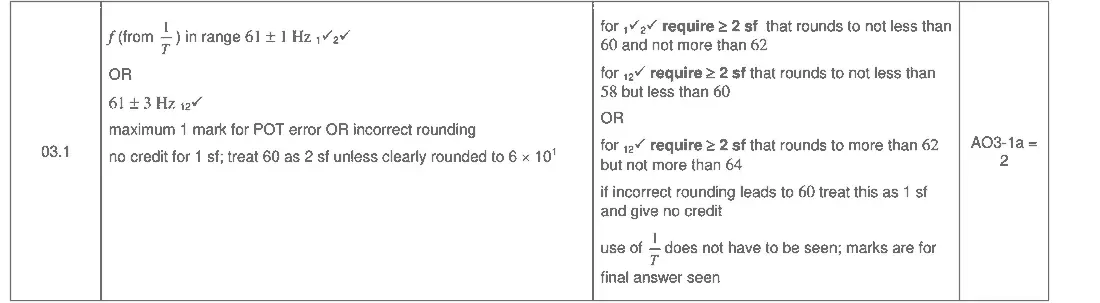
In 03.1, students without recent experience of the CRO struggled. However, about a quarter overcame the problem of the vertically displaced trace and obtained between 60 and 62 Hz for full credit. Students who rounded (correctly or otherwise) to 1 sf obtained no credit, as the rubric states ‘an answer to 1 sf will not normally be acceptable, unless the answer is an integer, eg a number of objects’. Students found this the most challenging part of questions 03.1 to 03.4.
Notes from the mark scheme and report
Answer: about 61 Hz (60-62
period from several cycles at 10 ms per cm)
1 sf answers get no credit
vertically displaced trace confused many
Skills: ATh signal generator and oscilloscope; MS1.1 Use an appropriate number of significant figures; RP1 Investigation into the variation of the frequency of stationary waves on a string with length, tension and mass per unit length of the string.
June 2019 · Paper 3 Section A · Q3.31 markCalculationEasy
Earlier part of question 3 that this part uses
Mark scheme
Examiner's comment
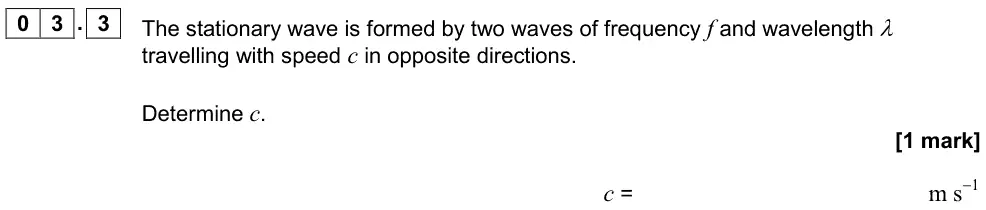
Of the 20% of the students who were unable to score in 03.3, some were unsuccessful because the answer they obtained was not a result of their working in v f λ = . T In 03.4, a small number used and rearranged for µ, substituting their answer for 03.3. c = µ
The general issue of rounding of data requires some comment. An example is seen in question 03.2, where many correctly deduced that the length of the wire was 0.578 m, but then felt obliged to give the wavelength as 1.16 m, (presumably to preserve significant figures). This was allowed, as it was also in 02.3 (where some truncated their final answer of 19.8% to 20%). However, in such a problem the preservation of significant figures should not apply to the number of figures in the number as a whole, but only to figures after the decimal place. Secondly, students who truncated their result in 03.2 then had to decide which result to use in 03.3 and in 03.4. Provided working is transparent the examiners can give credit, but it is a different matter when students show a value 1.16 in the substitution whereas the outcome shows that they must have used 1.156.
This question tested experimental design, interpretation of logarithmic scales and the mathematics of an exponential process. The expected method was to collect water (using a measuring cylinder) in a certain time (measured with a stopwatch) and to determine the flow rate from volume . time The idea of timing the collection of a certain volume was rejected by examiners due to the problem of the very slow flow rate suggested by Figure 8. In 02.1, we found that some students had misinterpreted the intention of the question. Instead, they gave a long and detailed description of how the internal volume of tube T could be determined. Many went on to explain that Q was this internal volume, divided by the time taken for T to empty. The expected approach was to measure the volume of water leaving T in a fixed time. We did not accept the suggestion of recording the increasing volume at regular intervals and finding Q from the gradient of a graph of the variation of volume with time. Use of a measuring cylinder to collect the water was popular, although some wrote more vaguely about using measuring beakers. We accepted an indirect approach to finding the volume, eg by measuring the mass of water collected using a balance. Most who took this approach remembered to tare the balance beforehand. The need to use a stopwatch to measure a time interval was sometimes overlooked. More effective responses from students gave relevant detail about reading the volume in the measuring cylinder; this suggested that question 03.3 from 2018 had not gone unnoticed. Many explained that extending the time over which water was collected reduced the percentage uncertainty (in the time). However, some students continue to limit themselves through their incorrect use of technical vocabulary, or ambiguous statements such as ‘Q = volume collected over the time taken.’ The question discriminated well in favour of the more able students.
Notes from the mark scheme and report
Answer: about 70.5 m s^-1 (c = f x lambda, 61 x 1.156)
Skills: MS2.3 Substitute numerical values into algebraic equations using appropriate units for physical quantities; RP1 Investigation into the variation of the frequency of stationary waves on a string with length, tension and mass per unit length of the string.
June 2018 · Paper 1 · Q3.31 markCalculation
Earlier part of question 3 that this part uses
Mark scheme
Examiner's comment
03.2 This was answered very well by a great majority (81.1%) of the students. 03.3 All the data needed to do this were readily available to substitute in v = fλ. Determining the correct value for λ (0.33 m and 0.165 m were often seen) led to most incorrect answers.
Notes from the mark scheme and report
Answer: 240 m s^-1 (244
wavelength 0.66 m = 2l)
0.33 m and 0.165 m wavelengths caused most errors
June 2018 · Paper 1 · Q151 markMultiple choice
Answer
C
Notes from the mark scheme and report
Answer: C
Skills: MS0.3 Use ratios, fractions and percentages
June 2018 · AS Paper 2 · Q191 markMultiple choice
Answer
A
Notes from the mark scheme and report
Answer: A
Skills: MS4.7 Understand the relationship between degrees and radians and translate from one to the other
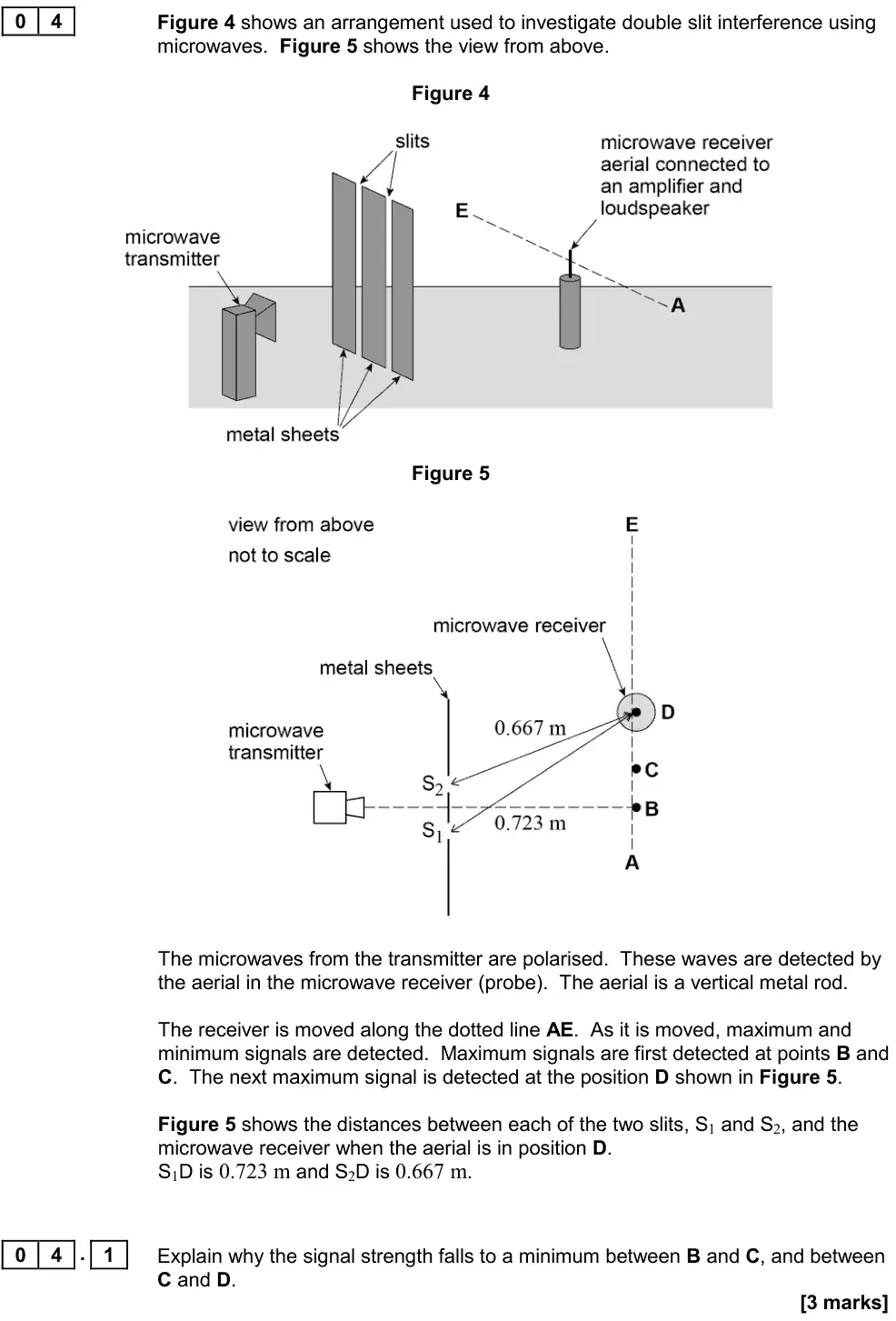
June 2017 · AS Paper 1 · Q4.23 marksCalculation
Earlier part of question 4 that this part uses
Mark scheme
Examiner's comment
04.1 It was common to see answers referring to a simple line of sight issue related to the three metal plates, despite references to double slit interference in the stem. This may suggest that students fail to read the stem of a question with sufficient care, a problem that may be alleviated if students were in the habit of underlining key words as they read. Students who understood the context often lost marks by confusing path difference and phase difference. Being familiar with the difference, and relationship, between these two is fundamental to an understanding of interference in waves. 4.2 This is a fairly demanding multi-step problem that many found difficult. In order to answer this question, students were required to relate the data in the diagram to the path difference of the waves, specifically 2 x the wavelength. They also had to apply the wave equation to the answer they obtained. Those who managed to make some attempt at an answer commonly missed the double wavelength, or made an arithmetical error in the use of speed = frequency x wavelength.
Notes from the mark scheme and report
Answer: 1.1 x 10^10 Hz (path difference 0.056 m = 2 wavelengths at second maximum D
lambda = 0.028 m
f = c/lambda)
Skills: MS2.3 Substitute numerical values into algebraic equations using appropriate units for physical quantities
June 2017 · AS Paper 1 · Q4.43 marksExplanation
Earlier part of question 4 that this part uses
Mark scheme
Examiner's comment
4.4 Most students were able to make an attempt to link the phenomenon described in this question to the polarisation of the waves. Some students interpreted the line AE as another sequence of slits and suggested that the microwaves were being blocked. Many had difficulties expressing their answer in terms of the orientation of the microwave and aerial, with some stating that the signal would increase as the aerial was aligned with the maxima.
Notes from the mark scheme and report
Microwaves are polarised
signal falls to zero when the aerial is at 90 degrees to the plane of polarisation
June 2017 · Paper 1 · Q131 markMultiple choice
Answer
B
Notes from the mark scheme and report
Answer: B
Skills: MS3.1 Translate information between graphical, numerical and algebraic forms
June 2017 · Paper 1 · Q141 markMultiple choice
Answer
C
Notes from the mark scheme and report
Answer: C
June 2017 · AS Paper 2 · Q3.13 marksShow that
Mark scheme
Examiner's comment
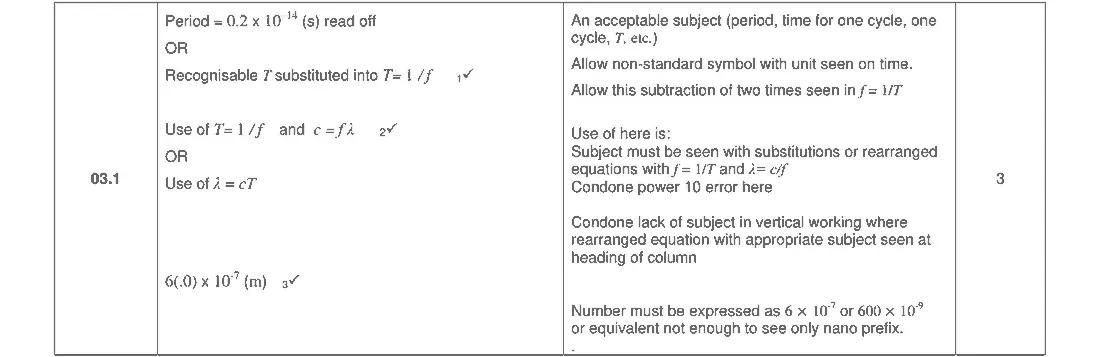
03.1 A question asking a student to “Show that” is asking the student to demonstrate clearly their logic in arriving at the provided answer. The marks are awarded for clear communication of the steps taken in the working. Where lapses occur, such as no ‘subject’, no formula, or no rearrangement of terms, then the student is not demonstrating that logic with sufficient detail. Students should be encouraged to pay attention to the way their working is laid out in this type of question. Many students were awarded 3 marks by having unambiguous, explicit working.
Notes from the mark scheme and report
Answer: 6.0 x 10^-7 m (period read from Figure 9 = 0.2 x 10^-14 s, lambda = cT)
show each step with a subject
Skills: MS3.1 Translate information between graphical, numerical and algebraic forms; MS2.3 Substitute numerical values into algebraic equations using appropriate units for physical quantities
June 2017 · AS Paper 2 · Q3.22 marksCalculation
Earlier part of question 3 that this part uses
Mark scheme
Examiner's comment
03.2 Typically, high performing students demonstrated clear understanding through the working presented in the determination of the phase difference. However, other students were very determined the time difference to be 0.05 × 10⁻¹⁴ instead of 0.04 × 10⁻¹⁴ . Students need unsure of how to use Figure 9 to find the phase difference. Some of these students
to take care when reading off data from graphs to ensure that such readings are sufficiently accurate.
Notes from the mark scheme and report
Answer: 2 pi/5 = 1.26 rad (time offset 0.04 x 10^-14 s of a 0.2 x 10^-14 s period
8 pi/5 allowed)
0.05 misread common
Skills: MS3.1 Translate information between graphical, numerical and algebraic forms; MS0.3 Use ratios, fractions and percentages
June 2017 · AS Paper 2 · Q101 markMultiple choice
Answer
C
Notes from the mark scheme and report
Answer: C
June 2017 · AS Paper 2 · Q111 markMultiple choice
Answer
D
Notes from the mark scheme and report
Answer: D
June 2017 · AS Paper 2 · Q141 markMultiple choice
Answer
A
Notes from the mark scheme and report
Answer: A
June 2017 · AS Paper 2 · Q231 markMultiple choice
Answer
C
Notes from the mark scheme and report
Answer: C
June 2017 · Paper 3 Section A · Q1.11 markShort answer
Mark scheme
Examiner's comment
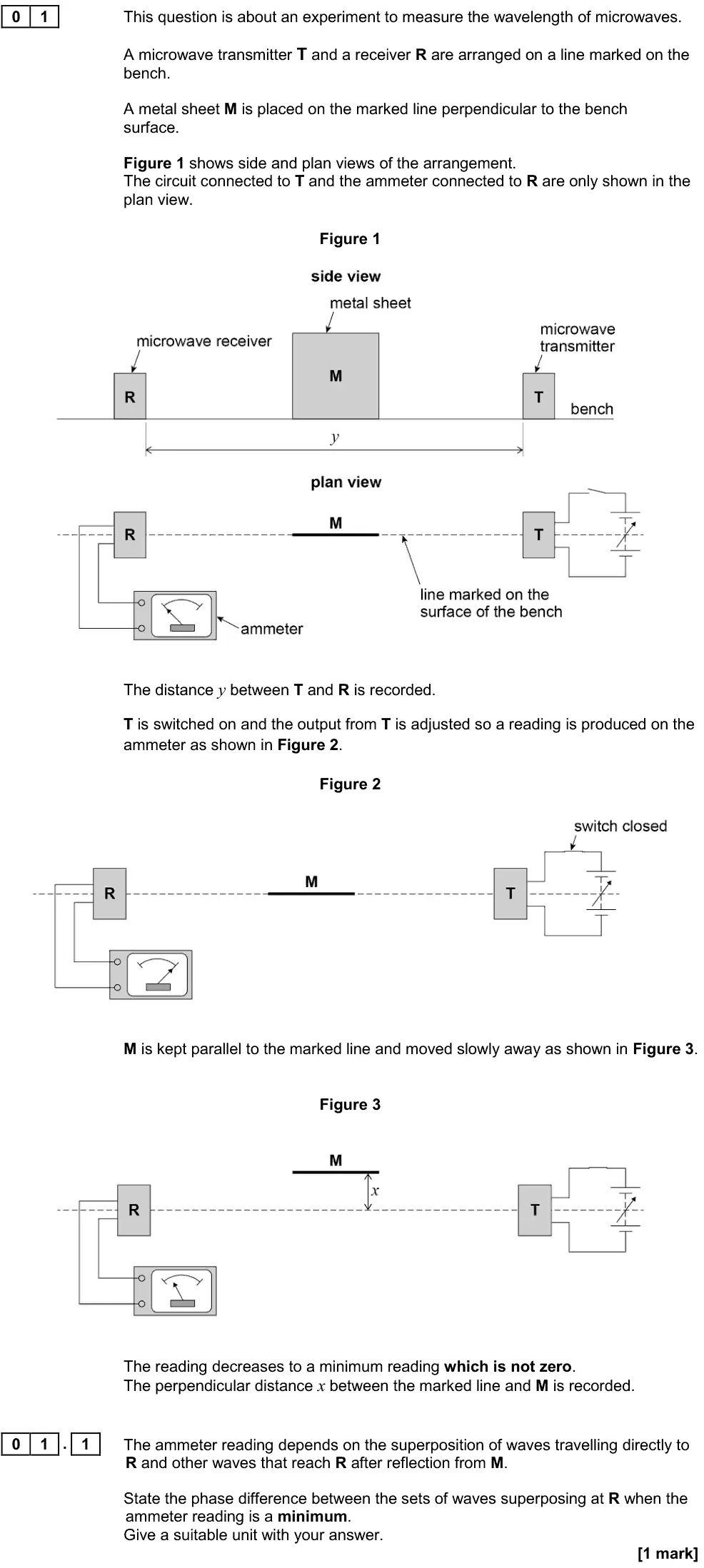
Questions 01.1 and 01.2 exposed poor understanding of superposition. Although there were plenty of correct answers to 01.1 and very few students forgot to supply any unit (we expected π radians or 180°), there were a variety of unsuccessful alternatives and some students clearly confused path difference with phase difference. Most students seemed to think that the resultant amplitude depended only on the phase difference between the sets of superposing waves, and very few considered the possibility that the waves travelling via M would arrive at R with less amplitude than those travelling directly from T. A small but significant number of students blamed microwave background radiation for the non-zero minimum reading on the ammeter.
Examiners found that many students ‘improvised’ their answer to question 01.3. Developing strategies for encouraging students to think about the practicalities of arranging apparatus, and challenging their reasoning, would pay dividends in future. A simple approach such as measuring, at different points, the distance between M and the line between T and R, and checking these were equal could earn 1 mark; the sensible use of a set-square earned the second mark. Frequent suggestions that non-standard science equipment, such as tri-squares could be used, perhaps indicated that some students had only had limited opportunities to perform practical work. A common misconception was that the ends of rulers can be assumed to be square; several students stated that aligning the end of the ruler, or the graduations along the edge, with the line between T and R, ensured that perpendicular distances would be measured. One really positive aspect of the work seen was the good standard of sketches students used to illustrate their answers; some of these, by themselves, were sufficient to earn both marks. Answers to question 01.4 were much stronger, with many students demonstrating an understanding of how the error bars could be used to establish the maximum and minimum gradients. Most knew they should use large steps for the gradient calculations, and recognised in question 01.5 that their mean gradient gave λ.
In question 01.6, many students appeared to have taken a guess, often based on the size of the error bars, about the uncertainty they should use. The better students used a variety of valid ways, based around ‘best gradient − worst gradient’, of judging the uncertainty. However, full credit proved elusive because the final answer was often compromised by the truncation, in 01.4, of the values for maximum and minimum gradients.
Many students seemed to have rushed question 01.7, thinking they were being asked to explain that y was the vertical intercept. However, examiners wanted to know how Figure 4, which did not allow a direct measurement, should be used. Suggesting a calculation method could earn a mark, but this was denied when any suggested algebra was wrong; otherwise, some consideration of an average of the maximum and minimum intercepts also gained credit.
Notes from the mark scheme and report
Pi radians or 180 degrees (unit required)
path difference confused with phase difference by some
Skills: RP2 Investigation of interference effects to include the Young’s slit experiment and interference by a diffraction grating.
June 2017 · Paper 3 Section A · Q2.22 marksPractical and data analysis
Earlier part of question 2 that this part uses
Mark scheme
Examiner's comment
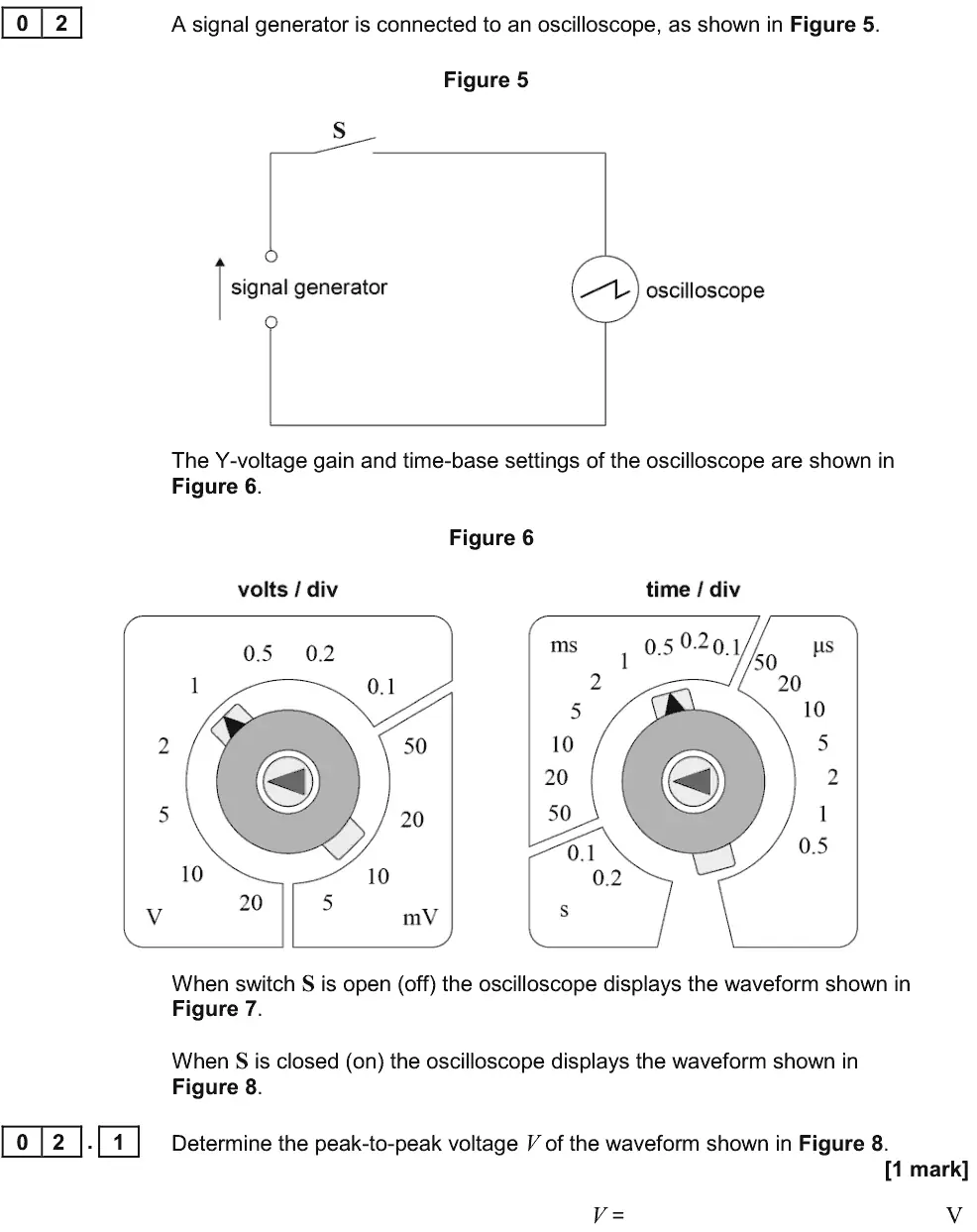
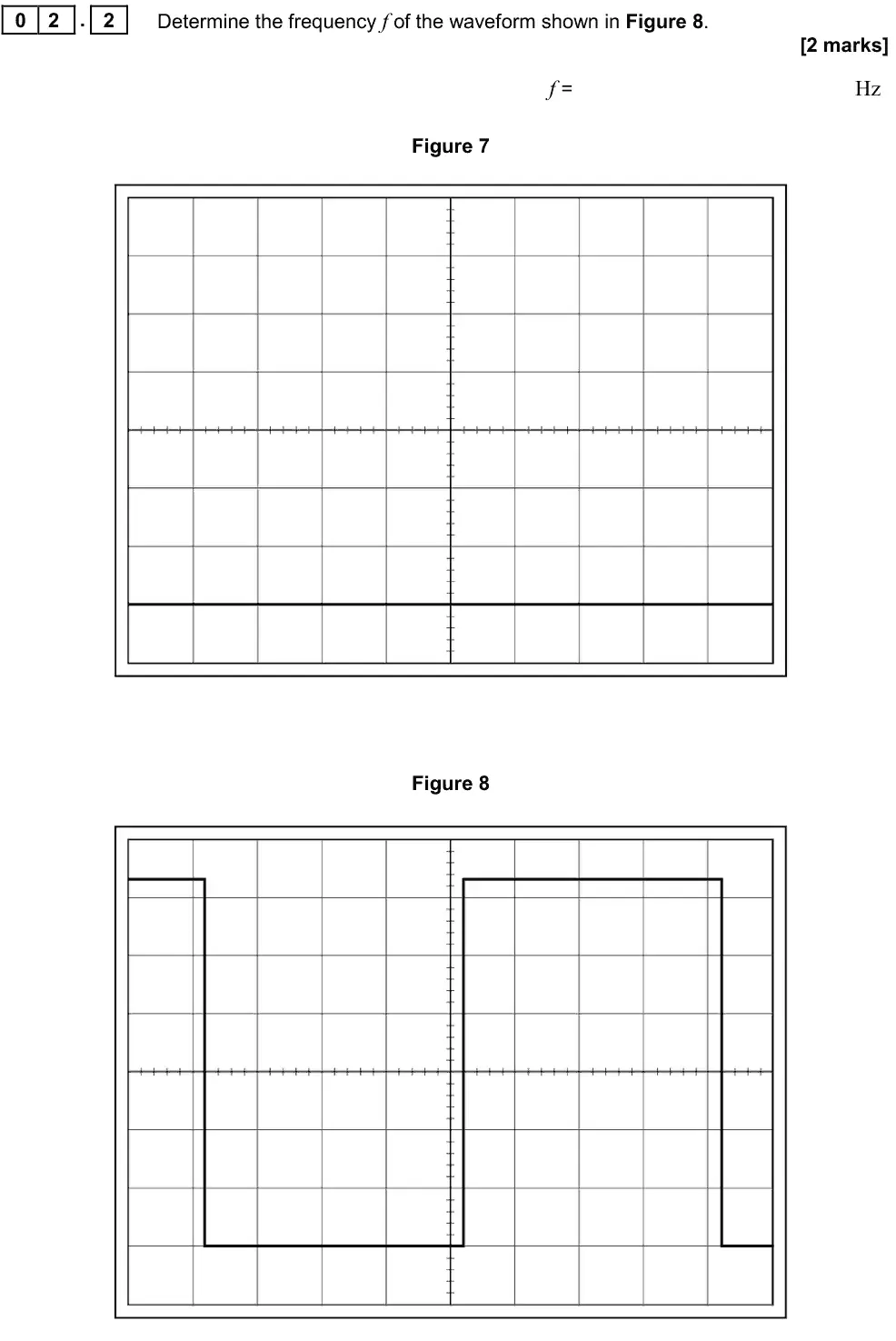
Even if some students thought the waveform shown in Figure 8 showed an ac signal, the instruction to determine the peak to peak voltage should have made question 02.1 straightforward. However, a disappointing number of students found a variety of ways to get this wrong and were similarly unsuccessful with question 02.2.
Notes from the mark scheme and report
Answer: 250 Hz (period 8 divisions x 0.5 ms = 4 ms)
Skills: MS0.1 Recognise and make use of appropriate units in calculations; ATh signal generator and oscilloscope
June 2016 · AS Paper 1 · Q2.35 marksCalculation
Earlier part of question 2 that this part uses
Mark scheme
Examiner's comment
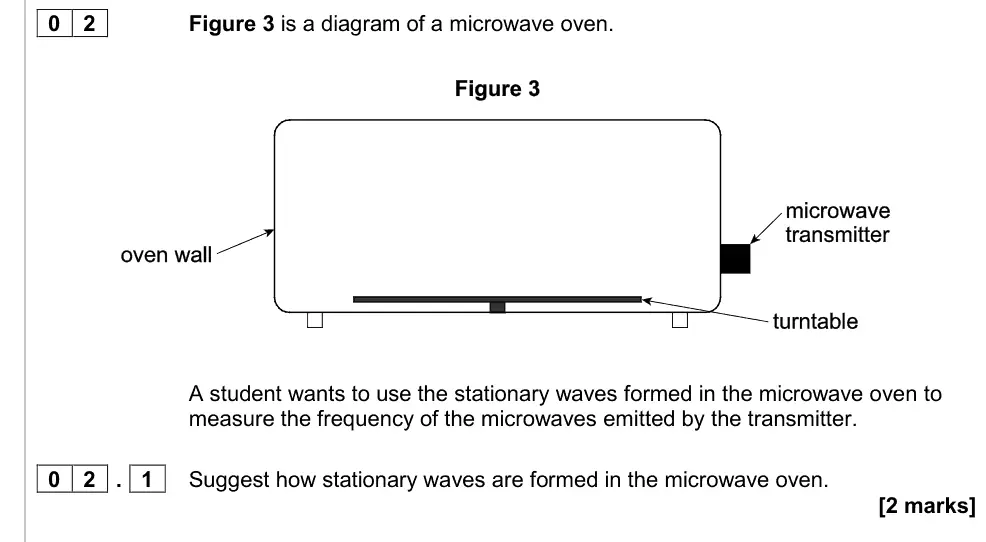
This question about the formation of stationary waves in a microwave oven was answered well by a good proportion of students. In question 2.1 the idea of reflection taking place was clearly stated in the majority of answers. The second marking point explaining how this resulted in the reflected and incident wave superposing was more discriminating. A significant proportion of students stated that the waves superimposed rather than superposed. Question 2.2 was only fully answered by those students who, having identified the melted chocolate positions as antinodes were then able to explain that this is where the amplitude of the wave was a maximum. Weaker responses tended to identify these positions as nodes or did not link the melted chocolate to stationary waves at all. Question 2.3 was a five mark calculation and this produced very good discrimination. About a third of students were awarded 4 or 5 marks. To obtain full marks students were required to give a clear indication, either on the diagram or in their working, that they had measured the distance between the first and third dot rather than measuring from the first to second dot and then doubling. It was sometimes hard to establish exactly what students had measured and it should be appreciated that showing full working in these extended calculations is very important. A lot of vague answers were seen to question 2.4 and it was the physics that needed to be explained. A common response was ‘to cook the food evenly’ and this was not seen as a physics explanation.
Notes from the mark scheme and report
Answer: 2.5 x 10^9 Hz (first to third antinode 0.118 m = wavelength
f = c / lambda)
must show first-to-third measurement
using 330 m s^-1 loses 2 marks
about a third scored 4 or 5
Skills: MS3.1 Translate information between graphical, numerical and algebraic forms; MS2.3 Substitute numerical values into algebraic equations using appropriate units for physical quantities
Specimen set 1 · Paper 1 · Q6.42 marksExplanation
Earlier part of question 6 that this part uses
Mark scheme
Notes from the mark scheme and report
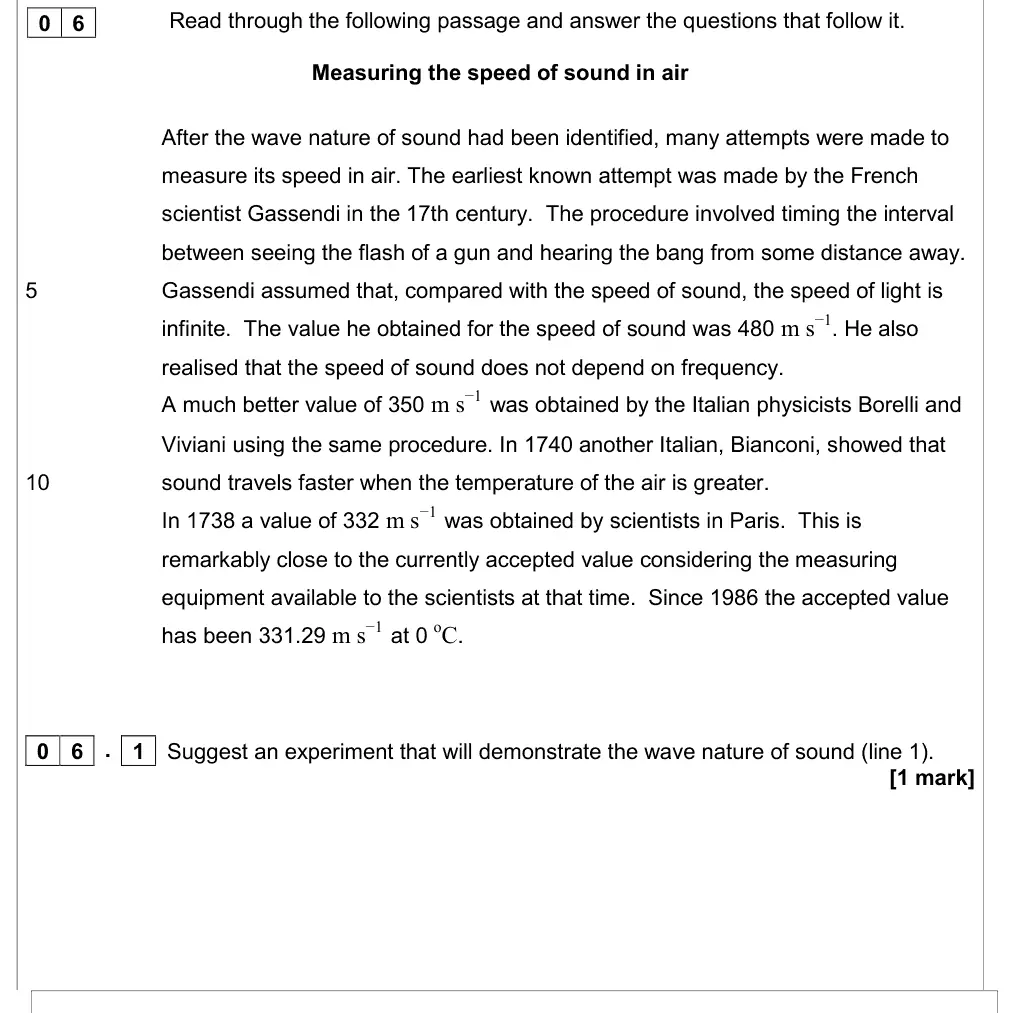
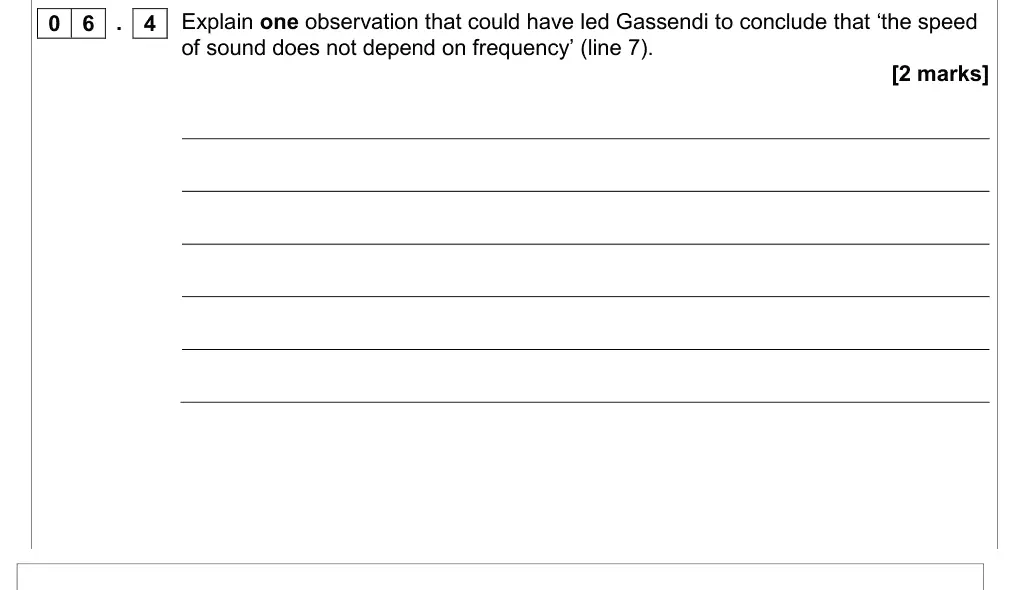
Gun sound is a mixture of frequencies that all arrive at the same time (the bang sounds the same near and far)
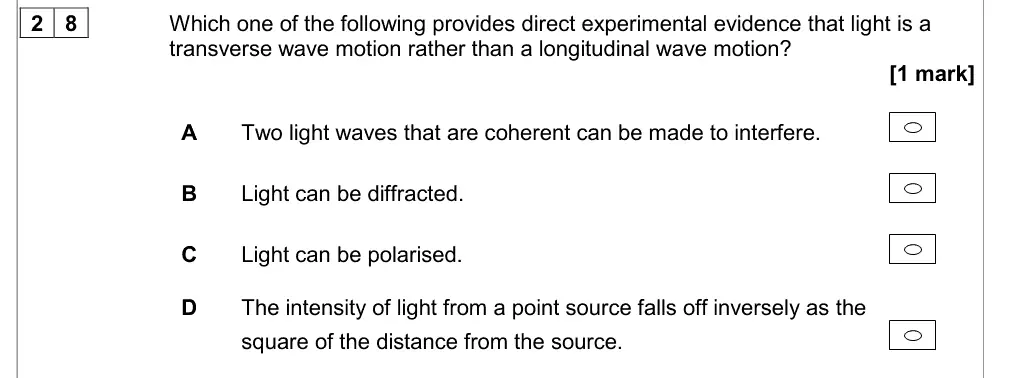
Specimen set 1 · Paper 1 · Q281 markMultiple choice
Answer
C
Notes from the mark scheme and report
Answer: C
Specimen set 1 · Paper 2 · Q6.33 marksShow that
Earlier part of question 6 that this part uses
Mark scheme
Notes from the mark scheme and report
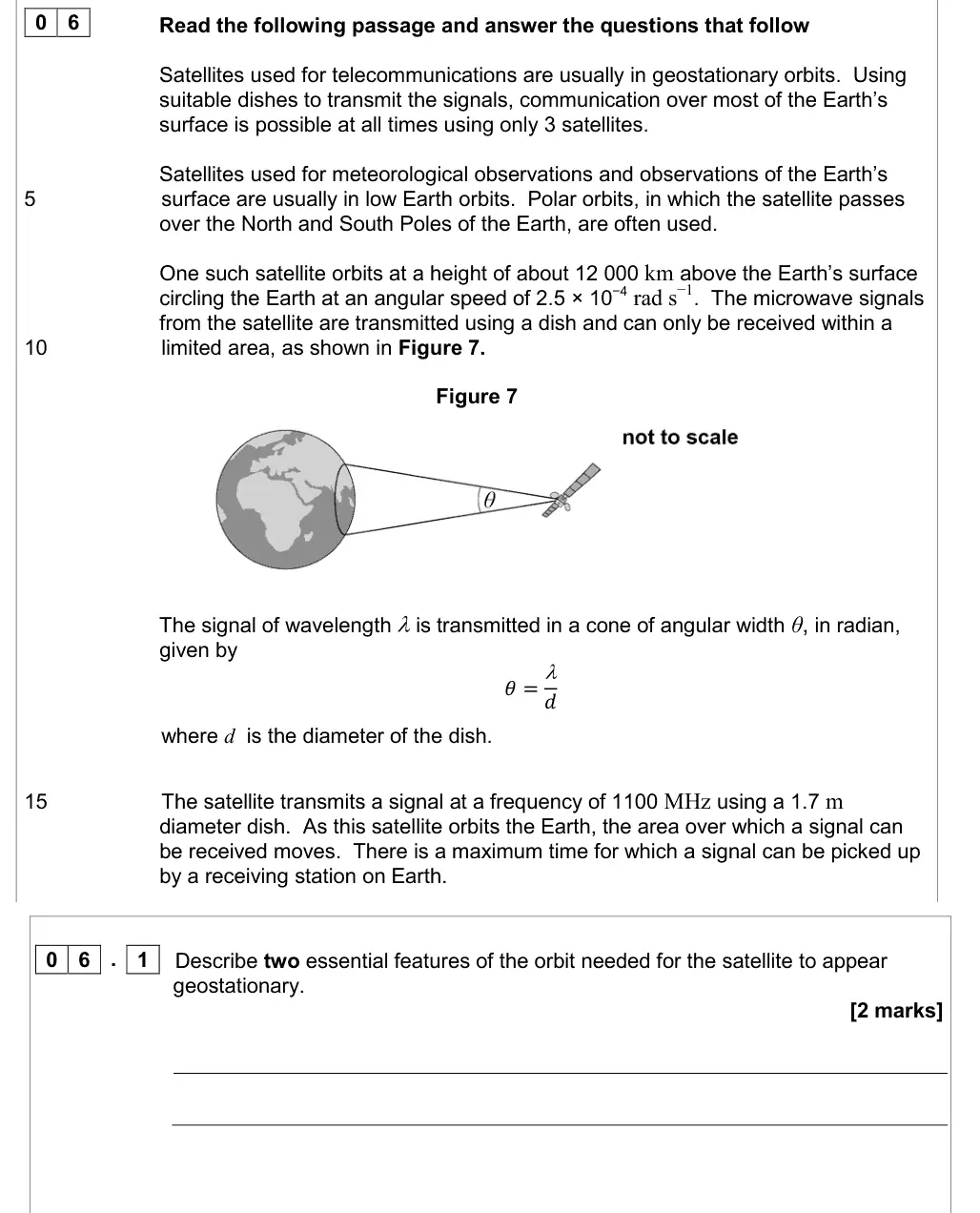
Answer: 1.9 x 10^3 km (lambda = c/f = 0.273 m, theta = lambda/d = 0.161 rad, width = 12 000 km x theta)
Skills: MS2.3 Substitute numerical values into algebraic equations using appropriate units for physical quantities; MS4.6 Use of small angle approximations including sinθ ≈θ, tanθ ≈θ, cosθ ≈1 for small θ where appropriate
June 2016 · AS Paper 2 · Q121 markMultiple choice
Answer
C
Examiner's comment
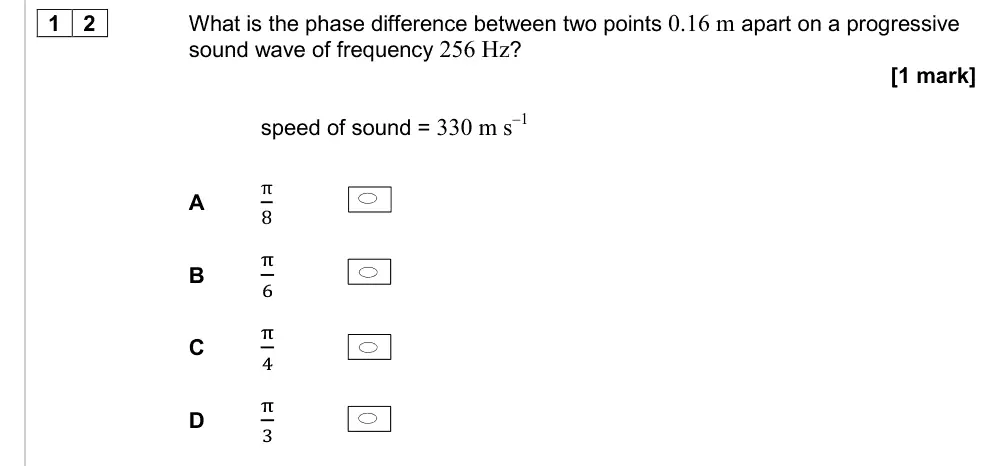
12 This question required students to work out the wavelength of the sound wave, and then calculate the phase difference of two parts a certain distance apart. 45% of students correctly identified the correct answer. Approximately 35% thought A was correct, using π, rather than 2π, as the phase difference for two points a whole wavelength apart, perhaps.
Notes from the mark scheme and report
Answer: C
about 35% chose A, using pi for a whole wavelength
Skills: MS2.3 Substitute numerical values into algebraic equations using appropriate units for physical quantities; MS0.3 Use ratios, fractions and percentages
Work with an AQA physics tutor
Dropping marks on calculations, required practicals or the six-markers? Book a trial session with a specialist AQA physics tutor.