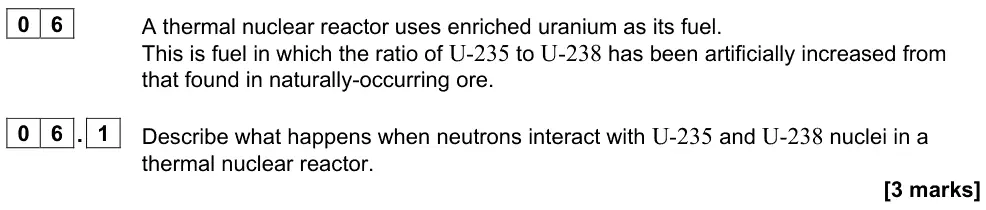
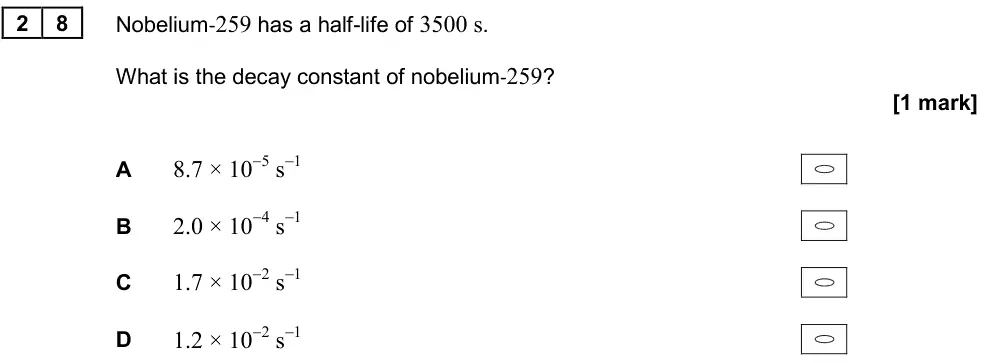
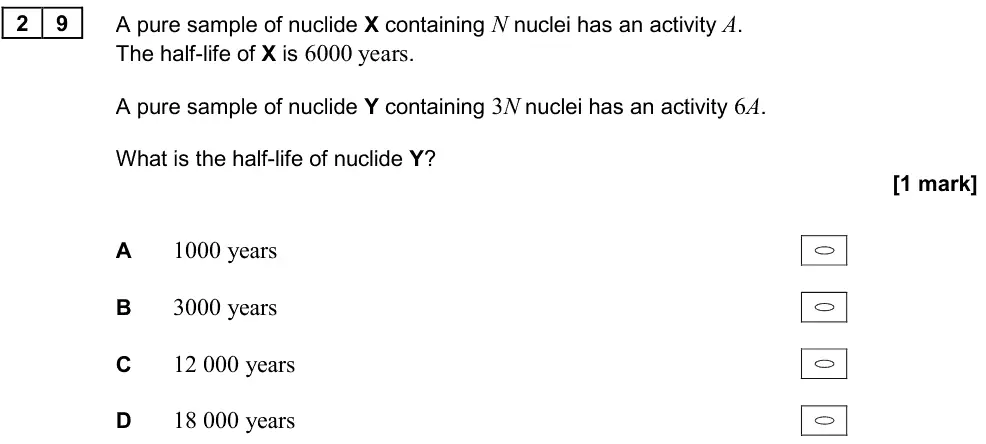
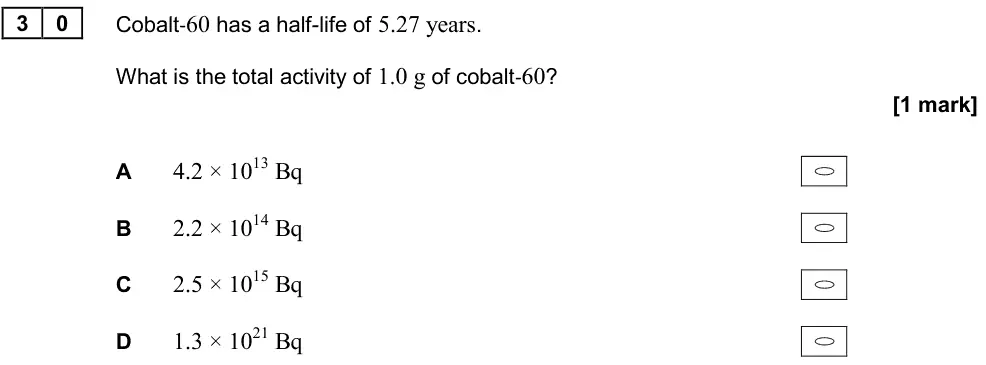
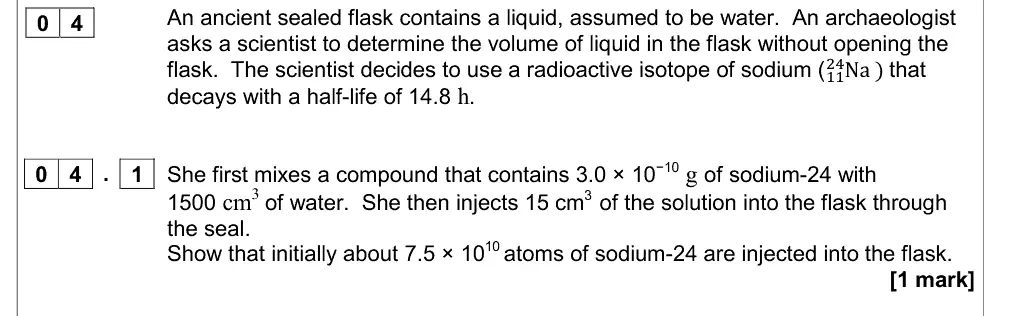
Tap a question to zoom it. Where a part needs a figure, table or graph from earlier in the question, that part folds out above it; the mark scheme and examiner's comment open underneath. Have the AQA data and formulae booklet beside you (see the formula sheet page).
June 2025 · Paper 2 · Q3.12 marksAO2=2Calculation
Mark scheme
Examiner's comment
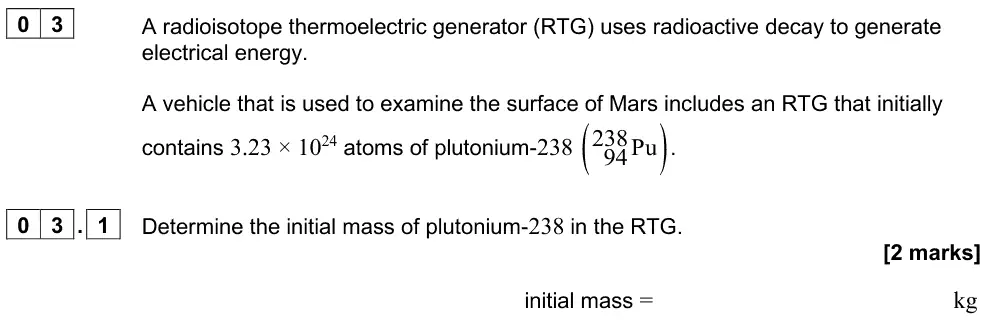
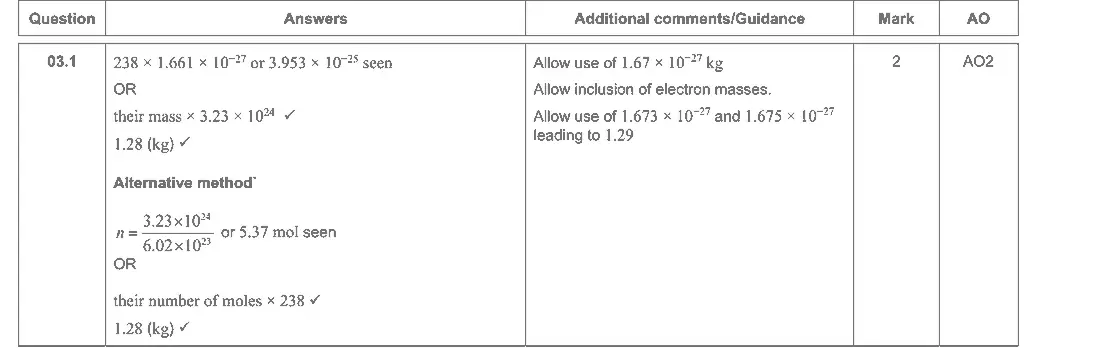
3.1 Most students were able to determine the initial mass of plutonium from the number of atoms.
Notes from the mark scheme and report
Answer: 1.28 kg (3.23 x 10^24 x 238 x 1.661 x 10^-27 kg, or 5.37 mol x 0.238 kg)
Skills: MS2.3 Substitute numerical values into algebraic equations using appropriate units for physical quantities
June 2025 · Paper 2 · Q3.25 marksAO2=5Calculation
Earlier part of question 3 that this part uses
Mark scheme
Examiner's comment
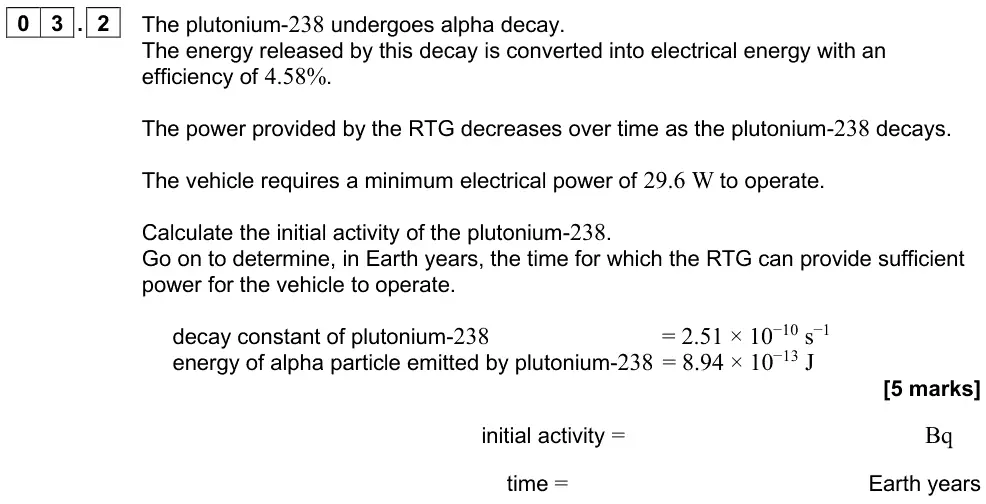
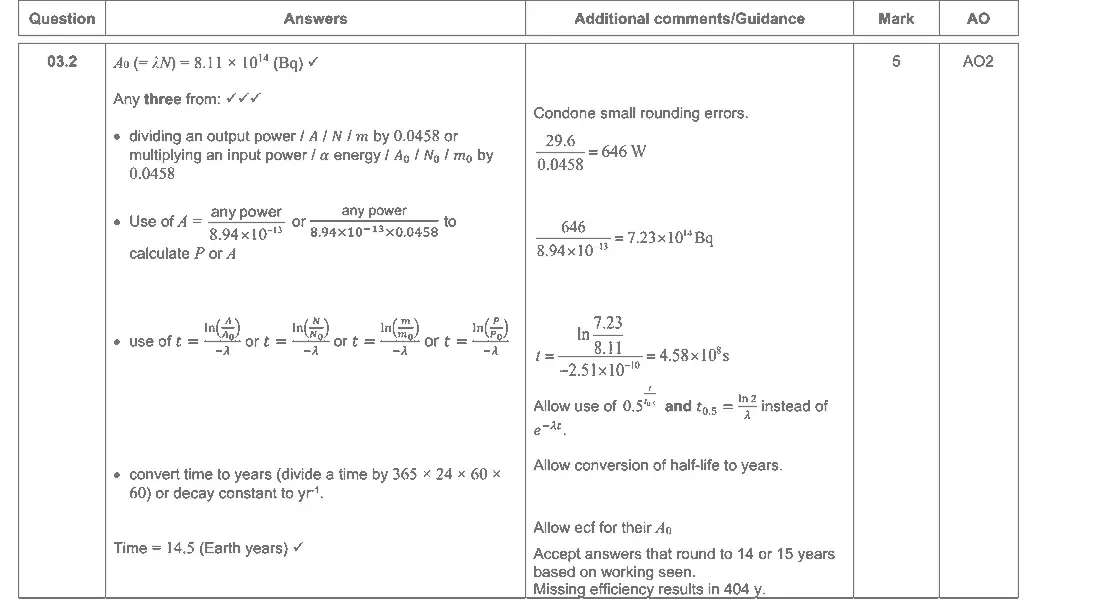
3.2 The context of an RTG has been examined before and this 5 mark calculation was accessible, with the majority of students able to score some marks. The steps could be undertaken in any order with multiple different routes to the answer. This meant that most students were able to use at least some of the data in the question correctly and make some progress, while only the higher achieving students were able to gain full marks.
kinetic energy of the 𝛼𝛼 to determine an activity correctly using the efficiency, using the decay Marks were awarded for determining the initial activity, dividing an output power by the
to years or the decay constant to yr−1. equation for activities, number of nuclei, masses or powers, and for converting either the time
A common mistake was for students to use 𝐸𝐸= 𝑚𝑚𝑐𝑐2 and assume that all of the mass of the up the number of undecayed nuclei 𝑁𝑁, in the equation 𝐴𝐴= 𝜆𝜆𝜆𝜆 with the nucleon number and alpha or the plutonium was converted into energy. Another mistake was for students to mix multiply 𝜆𝜆 by 238. 3.3 This 4 mark calculation proved very accessible with about three quarters scoring at least 3 out of 4. The sublimation of carbon dioxide did not seem to pose a significant challenge to most including heating the melted water to 100 °C in their calculation. students, with only a very small number missing out the latent heat of fusion of ice or comparing this to the heat required to raise the temperature of the ice, melt the ice and the time taken and comparing this with 3.0 s, or calculating a mass that could be vapourised vaporise the ice. However, other approaches were possible, with some students calculating by the laser in 3.0 s. Again, a small minority of students did not get full marks because, after completing a correct calculation, they did not include an explicit comparison. Only a very small minority correctly completed the calculation and gave an incorrect comparison. Most of the marks lost were due to power of ten issues with the calculation.
Notes from the mark scheme and report
Answer: A0 = 8.11 x 10^14 Bq
time = 14.5 years (input power needed 29.6/0.0458 = 646 W, activity 7.23 x 10^14 Bq, t = ln(A0/A)/lambda)
E = mc^2 of the whole mass, or multiplying lambda by 238, were common errors
Skills: MS0.5 Use calculators to find and use power, exponential and logarithmic functions; MS0.3 Use ratios, fractions and percentages; MS2.2 Change the subject of an equation, including non-linear equations
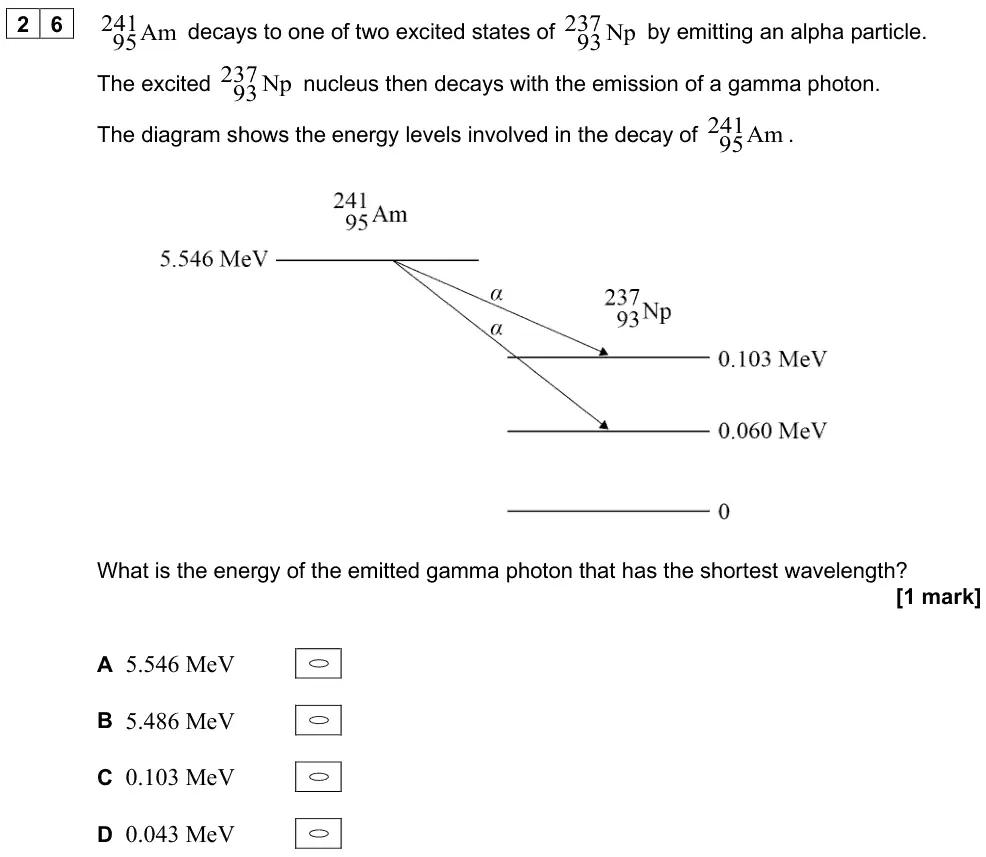
June 2025 · Paper 2 · Q261 markAO2=1Multiple choice
Answer
C
Mark scheme
Notes from the mark scheme and report
Answer: C
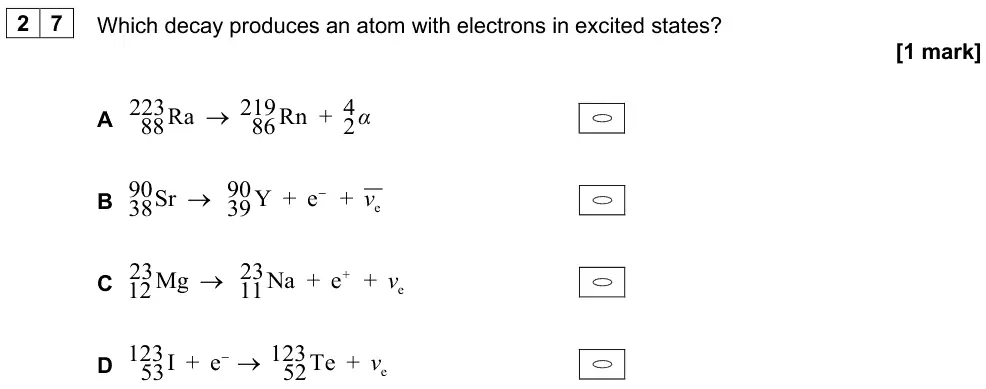
June 2025 · Paper 2 · Q271 markAO1=1Multiple choice
Answer
D
Mark scheme
Notes from the mark scheme and report
Answer: D
June 2024 · Paper 2 · Q7.11 markAO1=1Short answer
Mark scheme
Examiner's comment
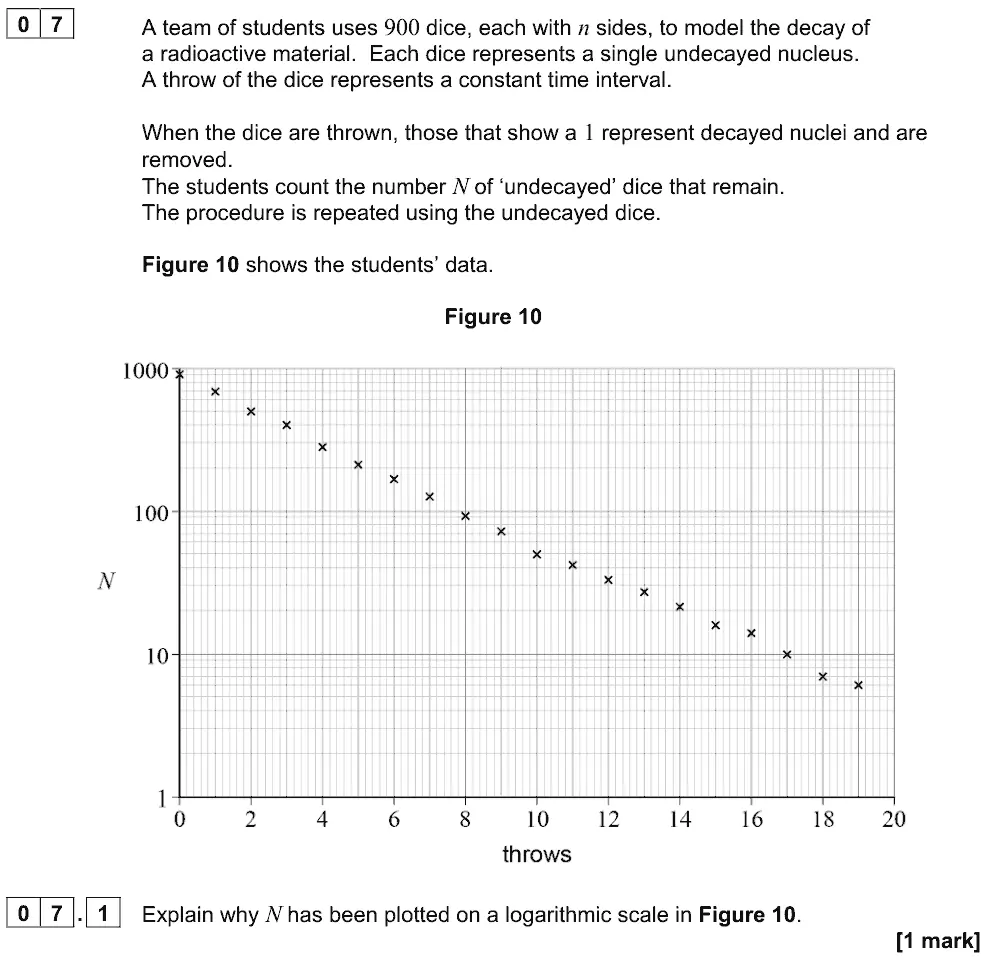
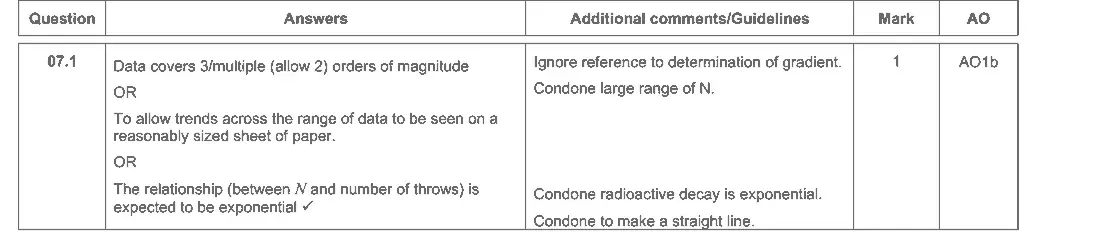
07.1 The best approach to this question about the use of logarithmic graph paper was to recognise that three orders of magnitude were represented in the data, which could not be shown effectively on a linear scale. However, comments about the decay being exponential or allowing the creation of a linear graph were accepted. This proved to be accessible.
Notes from the mark scheme and report
Data cover about three orders of magnitude (or decay is exponential so log scale gives a straight line)
Skills: MS3.11 Use logarithmic plots to test exponential and power law variations; MS2.5 Use logarithms in relation to quantities that range over several orders of magnitude
June 2024 · Paper 2 · Q7.25 marksAO2=3, AO3=2Practical and data analysis
Earlier part of question 7 that this part uses
Mark scheme
Examiner's comment
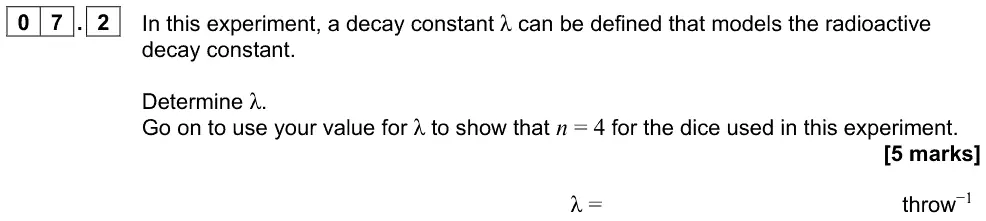
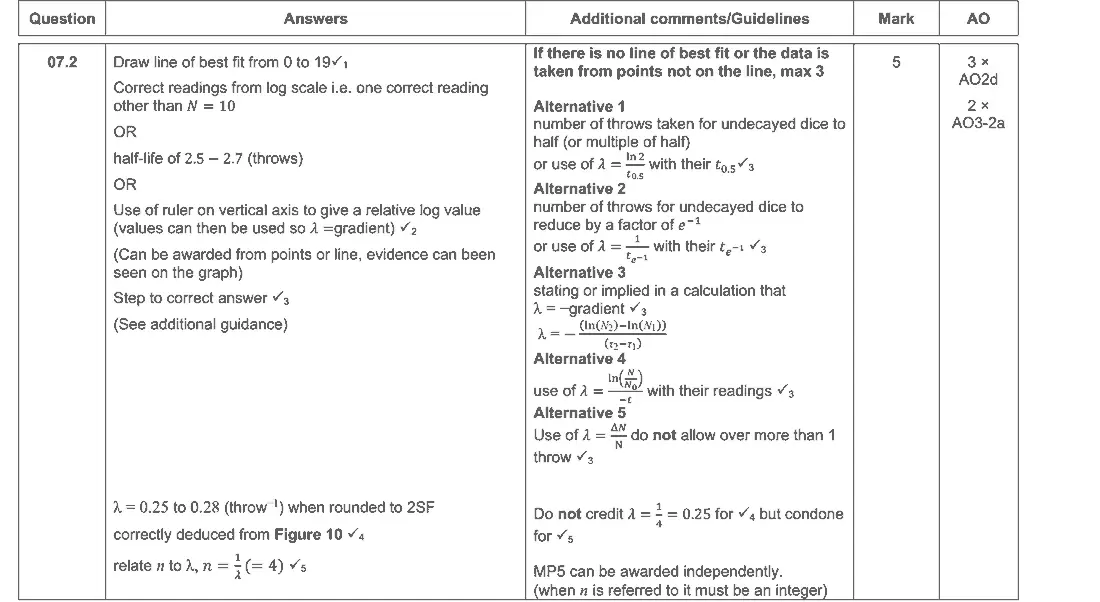
07.2 This question was also accessible although only a small number were able to score full marks. Many students did not score full marks because they did not draw a line on the graph and attempted to use the points to get their data. It is important that students realise that when provided with points on a graph it is expected that a line is drawn from which to take data. There were various approaches to determining 𝜆𝜆 from the graph. Two points could be used with the equation 𝑁𝑁= 𝑁𝑁0𝑒𝑒−𝜆𝜆𝜆𝜆 or the half-life could be used with 𝜆𝜆= ln 2 𝑡𝑡1 . Some students realised that 𝜆𝜆 = –gradient of a log 𝑁𝑁 against 𝑡𝑡 graph. However, most who used this method did not realise that using 2 a log scale did not form the logarithm of the values. They were able to score three marks for this method, Only a few took logs (either base 10 or base 𝑒𝑒) and scored full marks using this method. Those who used one for the line, one for reading values off the scale and one for realising the significance of the gradient. 𝐴𝐴= −𝜆𝜆𝜆𝜆 generally did not realise that as the activity depended on the number of “undecayed” dice, this was only valid for one throw and not over an extended range.
For the last mark the determined value had to be compared with 0.25 to justify a four-sided dice.
Notes from the mark scheme and report
Answer: lambda = 0.25-0.28 per throw (half-life 2.5-2.7 throws, lambda = ln2/T1/2), n = 1/lambda = 4
must draw a line of best fit
reading log-scale values as logs was common
Skills: MS3.11 Use logarithmic plots to test exponential and power law variations; MS3.4 Determine the slope and intercept of a linear graph; MS0.5 Use calculators to find and use power, exponential and logarithmic functions
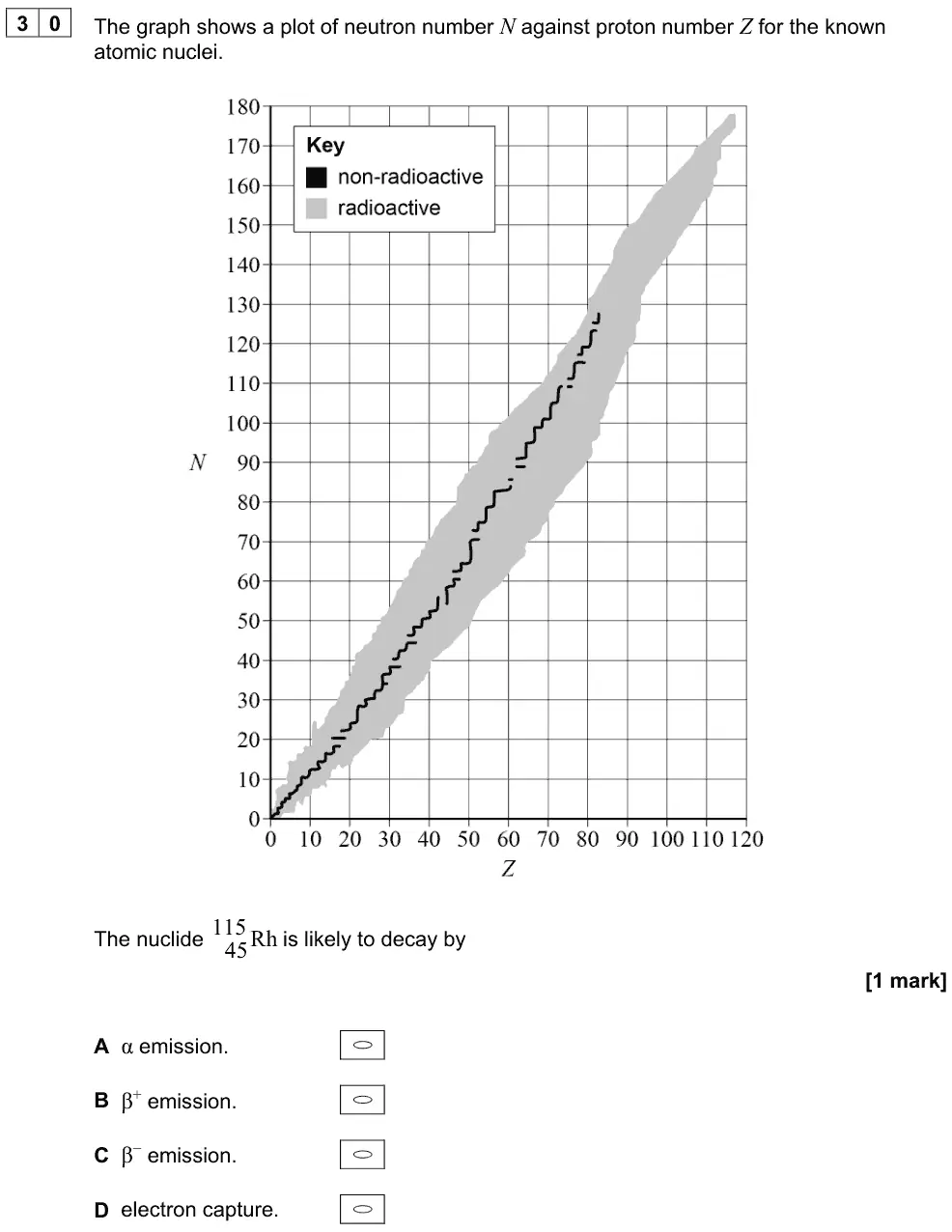
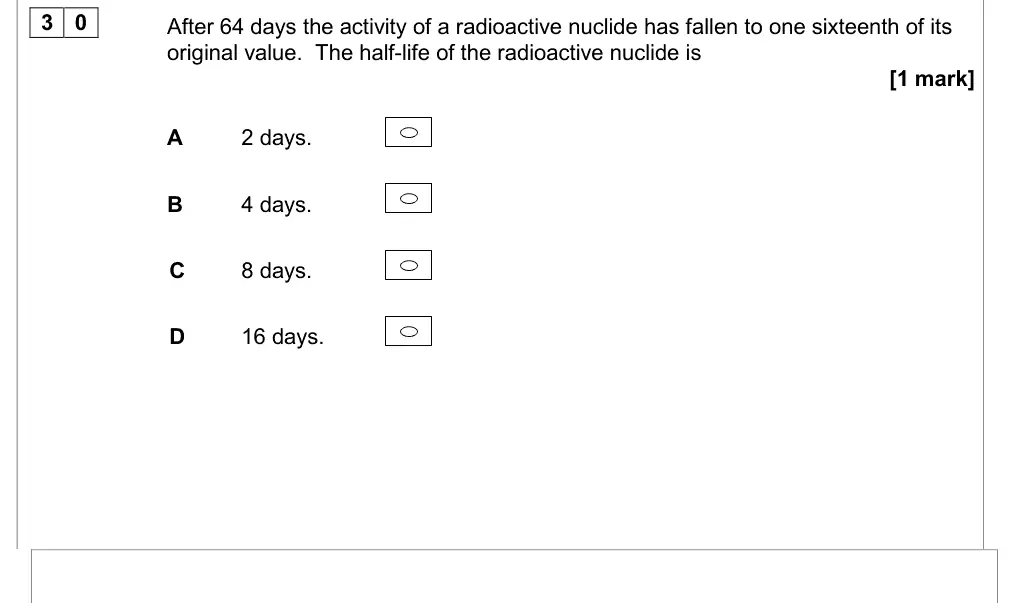
June 2024 · Paper 2 · Q301 markMultiple choice
Answer
C
Mark scheme
Notes from the mark scheme and report
Answer: C
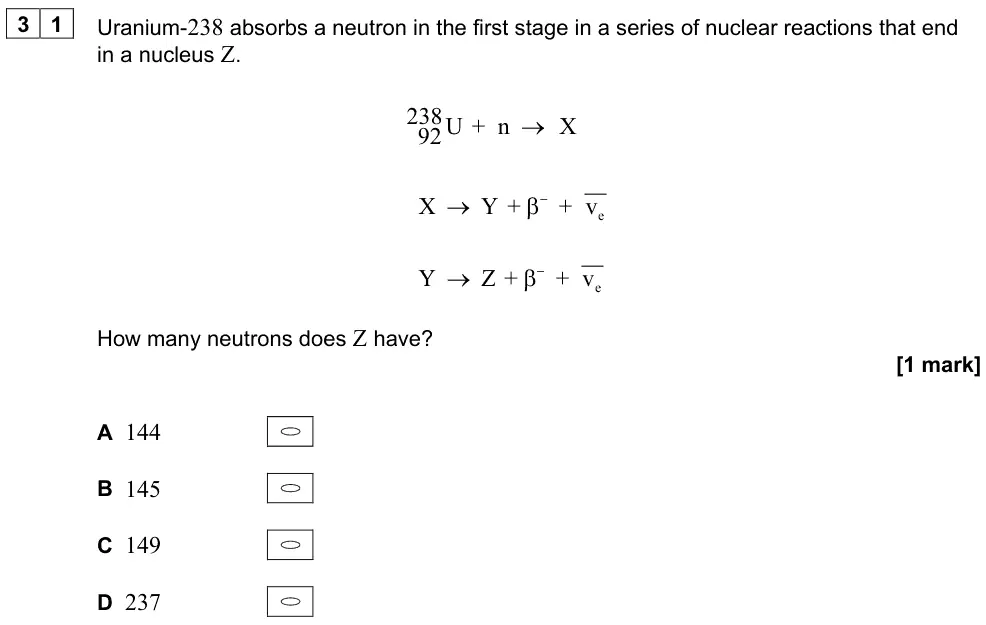
June 2024 · Paper 2 · Q311 markMultiple choice
Answer
B
Mark scheme
Notes from the mark scheme and report
Answer: B
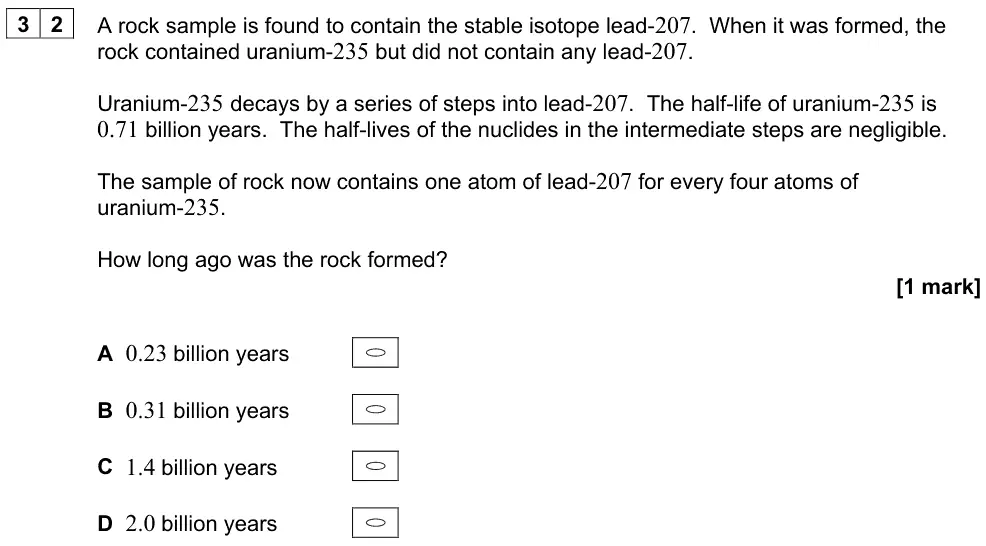
June 2024 · Paper 2 · Q321 markMultiple choice
Answer
A
Mark scheme
Notes from the mark scheme and report
Answer: A
most forgot that the lead atoms were originally uranium (N0 = 5, N = 4)
Skills: MS0.5 Use calculators to find and use power, exponential and logarithmic functions
June 2024 · Paper 3 Section A · Q2.72 marksAO1=2Practical and data analysis
Earlier part of question 2 that this part uses
Mark scheme
Examiner's comment
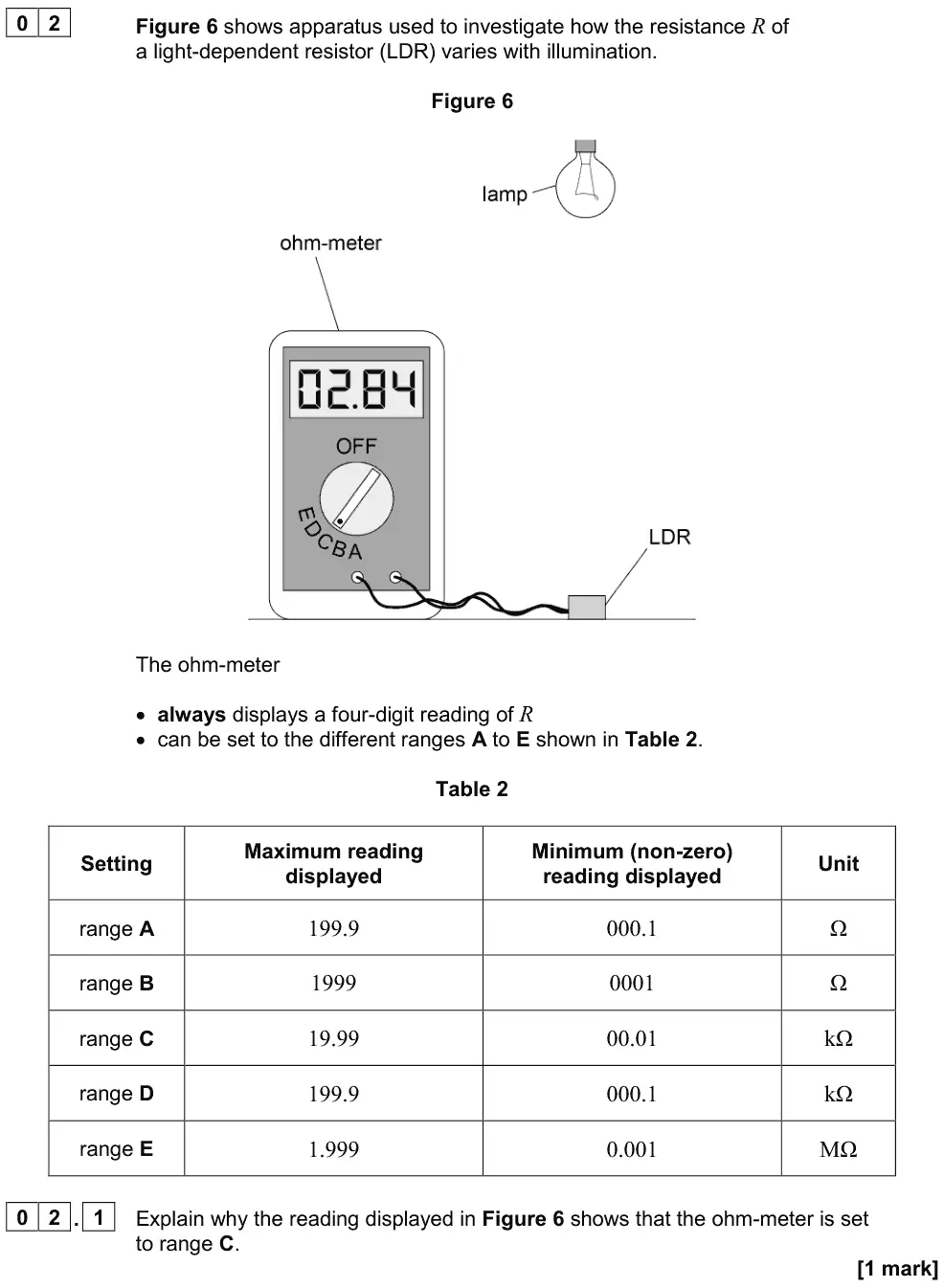
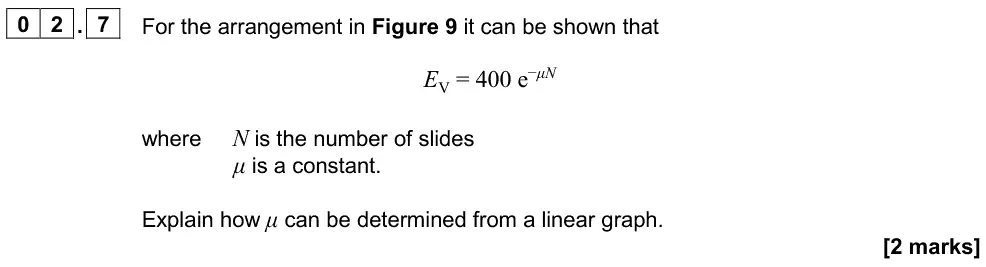
In 02.1 most wrote something sensible about the display, as the question said they should, although a few said that the selector switch in Figure 6 was shown set to range C. In 02.2 65% got both marks and only a few did not use logs to base 10 or substitute 2840 correctly. However, some solutions were overlong, extending beyond the usual answer space. In 02.3 many said they would obtain EV and x data from Figure 7 and show that these gave similar values of EV × x2. We wanted these data to be from more than two points but only a few thought to mention this detail. We didn’t allow the use of ‘multiple points’. An alternative approach was to plot EV against x2 or plot log EV against log x and this could get full credit as long as the expected outcome was explained for each graph. The idea behind 02.3 was developed in 02.4 and many calculated a suitable value of x when EV = 130 lx. Some penalised themselves by rounding their final answer to 630 or 640 mm. In 02.5 most correctly supplied 1645 and 1.73 then used information from their completed Table 3 to justify why range B should be used to determine R. Some tried the idea that resolution of range B was superior but were unsure whether they should say that the resolution was ‘smaller’, ‘greater’ (we accepted either) or ‘better’ (we rejected this). Students are well aware of what a control variable is, but they are not always able to identify suitable examples. In 02.6 they often made generic suggestions such as temperature or the length of the connecting wires, but we wanted things that, if changed, would have a more obvious impact such as background illumination, lamp brightness or slide thickness. Most students can find the unknowns in decay problems. In 02.7 about half knew that µ would be found by calculating the negative reciprocal of the gradient of an ln EV against N graph. A handful correctly explained how to obtain µ using a log EV against N graph. In 02.8, once again about half correctly deduced that eight slides would be the minimum needed to reduce EV by 50%. Some tried trial and improvement, but credit depended on showing that N = 7 did not work while N = 8 did. A common error was to use EV = 0.5 which led to N = 74.3 but we allowed one mark if this was then rounded to 75.
Notes from the mark scheme and report
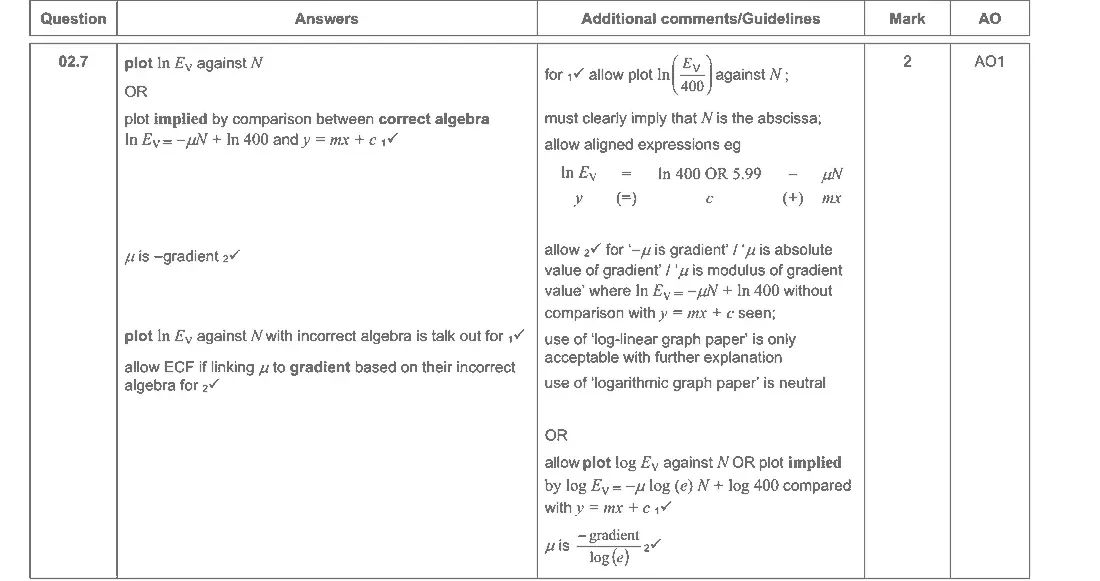
Plot ln EV against N (ln EV = -mu N + ln 400)
mu = -gradient
about half correct
Skills: MS3.11 Use logarithmic plots to test exponential and power law variations; MS3.3 Understand that y = mx + c represents a linear relationship; MS0.5 Use calculators to find and use power, exponential and logarithmic functions
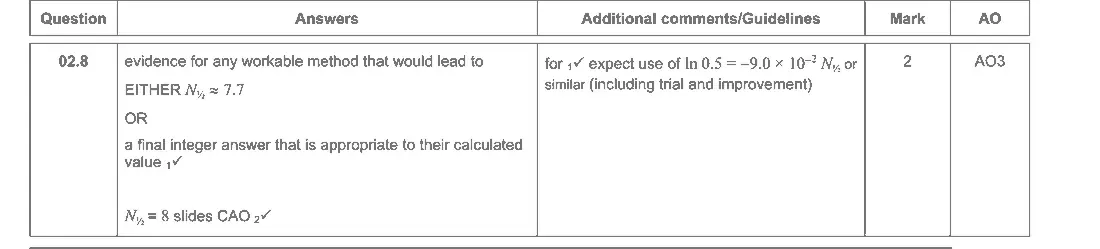
June 2024 · Paper 3 Section A · Q2.82 marksAO3=2Calculation
Earlier part of question 2 that this part uses
Mark scheme
Examiner's comment
In 02.1 most wrote something sensible about the display, as the question said they should, although a few said that the selector switch in Figure 6 was shown set to range C. In 02.2 65% got both marks and only a few did not use logs to base 10 or substitute 2840 correctly. However, some solutions were overlong, extending beyond the usual answer space. In 02.3 many said they would obtain EV and x data from Figure 7 and show that these gave similar values of EV × x2. We wanted these data to be from more than two points but only a few thought to mention this detail. We didn’t allow the use of ‘multiple points’. An alternative approach was to plot EV against x2 or plot log EV against log x and this could get full credit as long as the expected outcome was explained for each graph. The idea behind 02.3 was developed in 02.4 and many calculated a suitable value of x when EV = 130 lx. Some penalised themselves by rounding their final answer to 630 or 640 mm. In 02.5 most correctly supplied 1645 and 1.73 then used information from their completed Table 3 to justify why range B should be used to determine R. Some tried the idea that resolution of range B was superior but were unsure whether they should say that the resolution was ‘smaller’, ‘greater’ (we accepted either) or ‘better’ (we rejected this). Students are well aware of what a control variable is, but they are not always able to identify suitable examples. In 02.6 they often made generic suggestions such as temperature or the length of the connecting wires, but we wanted things that, if changed, would have a more obvious impact such as background illumination, lamp brightness or slide thickness. Most students can find the unknowns in decay problems. In 02.7 about half knew that µ would be found by calculating the negative reciprocal of the gradient of an ln EV against N graph. A handful correctly explained how to obtain µ using a log EV against N graph. In 02.8, once again about half correctly deduced that eight slides would be the minimum needed to reduce EV by 50%. Some tried trial and improvement, but credit depended on showing that N = 7 did not work while N = 8 did. A common error was to use EV = 0.5 which led to N = 74.3 but we allowed one mark if this was then rounded to 75.
The students found these questions more accessible than those in 2023 and they were able to score in all parts. It was good to see stronger students accessing more of the upper end of the mark range and we saw some agile minds at work with novel approaches successfully tried in 01.4, 02.8, 03.3 and 03.4.
Notes from the mark scheme and report
Answer: 8 slides (N = ln 2/0.090 = 7.7, round up)
about half correct
Skills: MS0.5 Use calculators to find and use power, exponential and logarithmic functions; MS2.2 Change the subject of an equation, including non-linear equations
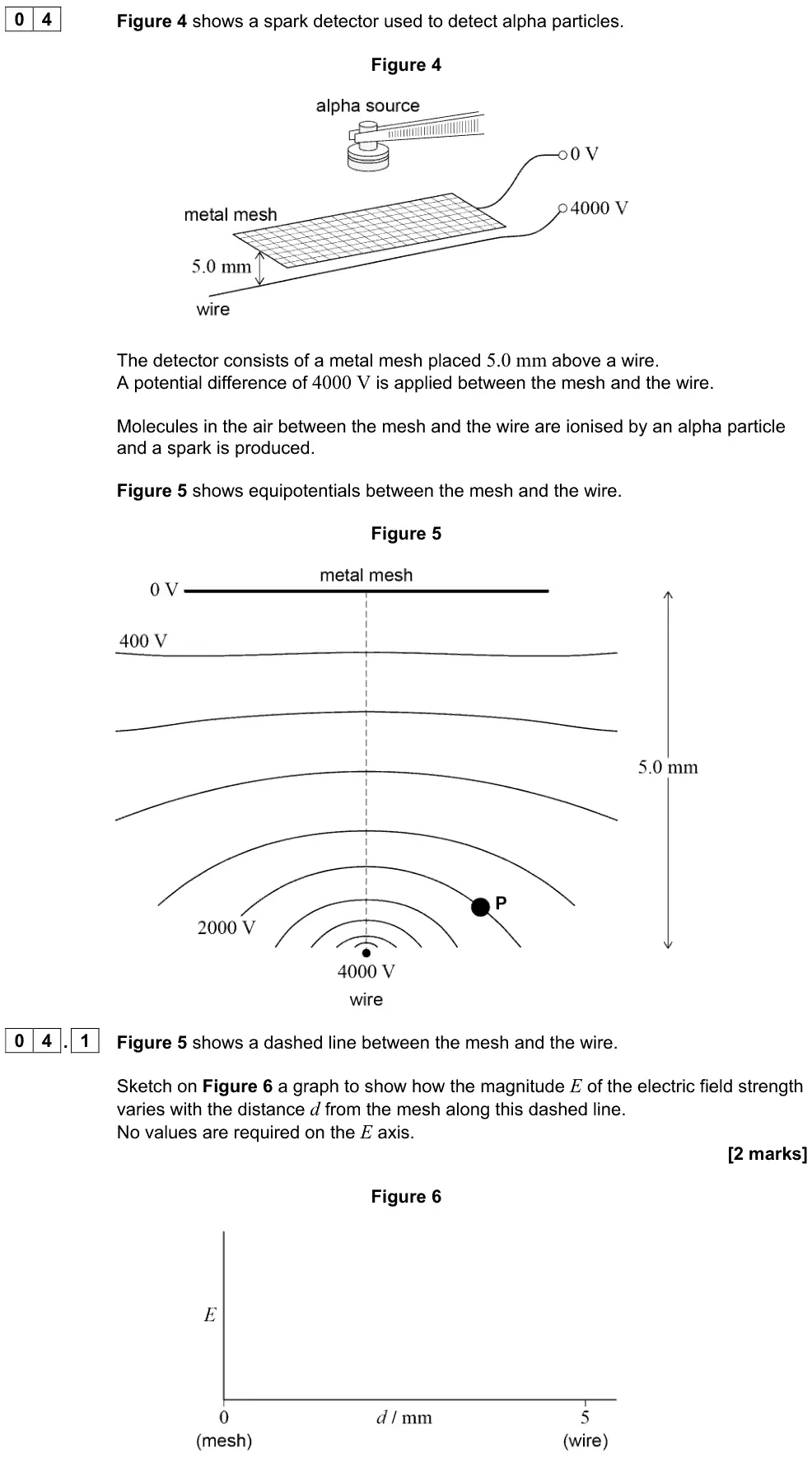
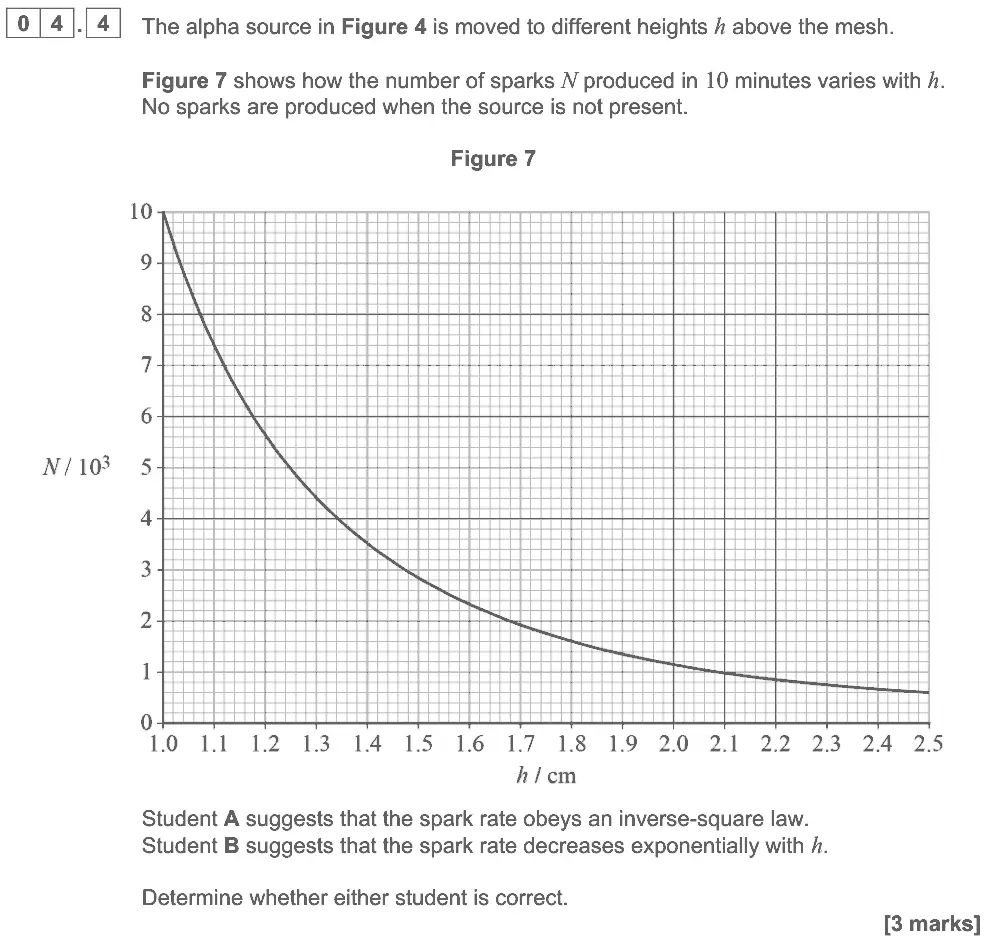
June 2023 · Paper 2 · Q4.43 marksAO3=3Practical and data analysis
Earlier part of question 4 that this part uses
Mark scheme
Examiner's comment
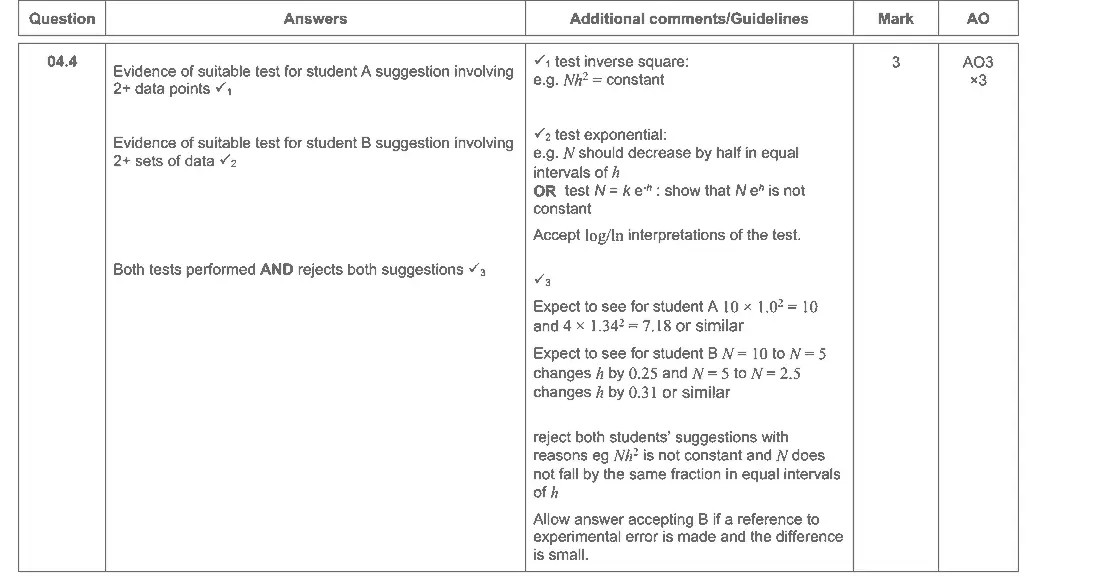
04.3 A majority thought that the argon ion would slow down more but then gave an inadequate reason. Many suggested that “it is because it’s bigger”. Only a few mentioned collisions in their answers. Several who were on route to gaining the mark spoiled their answer by stating the ratio is smaller. 04.4 Most students knew how to analyse the graph to see whether it followed an inverse-square relationship. It was not common, however, to see this work presented in a clear or logical order. Only a minority showed a method to determine whether the graph followed an exponential relationship; those who did used a variety of acceptable methods. Looking for a variation in the half-distance was the most common. An unexpected number thought that an exponential relationship was the same as a reciprocal relationship and used a wrong test. For the last mark, many thought they had to suggest one of A or B as being correct which was not implied by the question.
Notes from the mark scheme and report
Test inverse square (N h^2 constant?) and exponential (constant halving distance?) with 2+ data points each
both fail so neither student correct
reciprocal confused with exponential by many
Skills: MS3.1 Translate information between graphical, numerical and algebraic forms; MS0.3 Use ratios, fractions and percentages
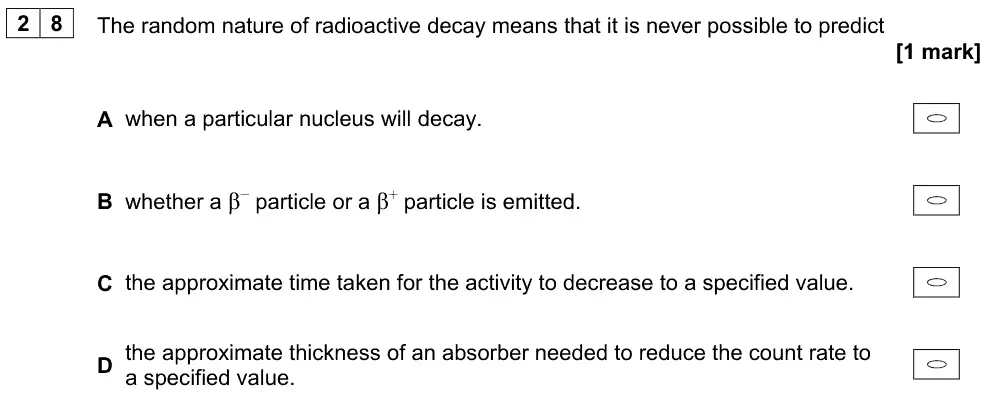
June 2023 · Paper 2 · Q281 markMultiple choiceEasy
Answer
A
Mark scheme
Examiner's comment
A number of questions were found to be quite straightforward by students. These included B8, B11, B12, B17, B18, B20, B26 and B28 which were all answered correctly by at least 70% of students. The questions found to be the most difficult were B14, B15 and B25 – answered correctly by fewer than 35% of students.
Notes from the mark scheme and report
Answer: A
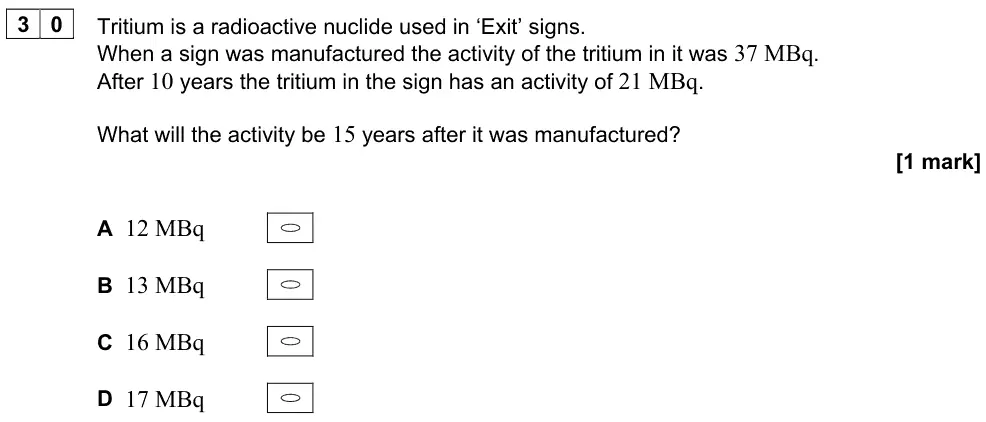
June 2023 · Paper 2 · Q301 markMultiple choice
Answer
C
Mark scheme
Notes from the mark scheme and report
Answer: C
Skills: MS0.5 Use calculators to find and use power, exponential and logarithmic functions
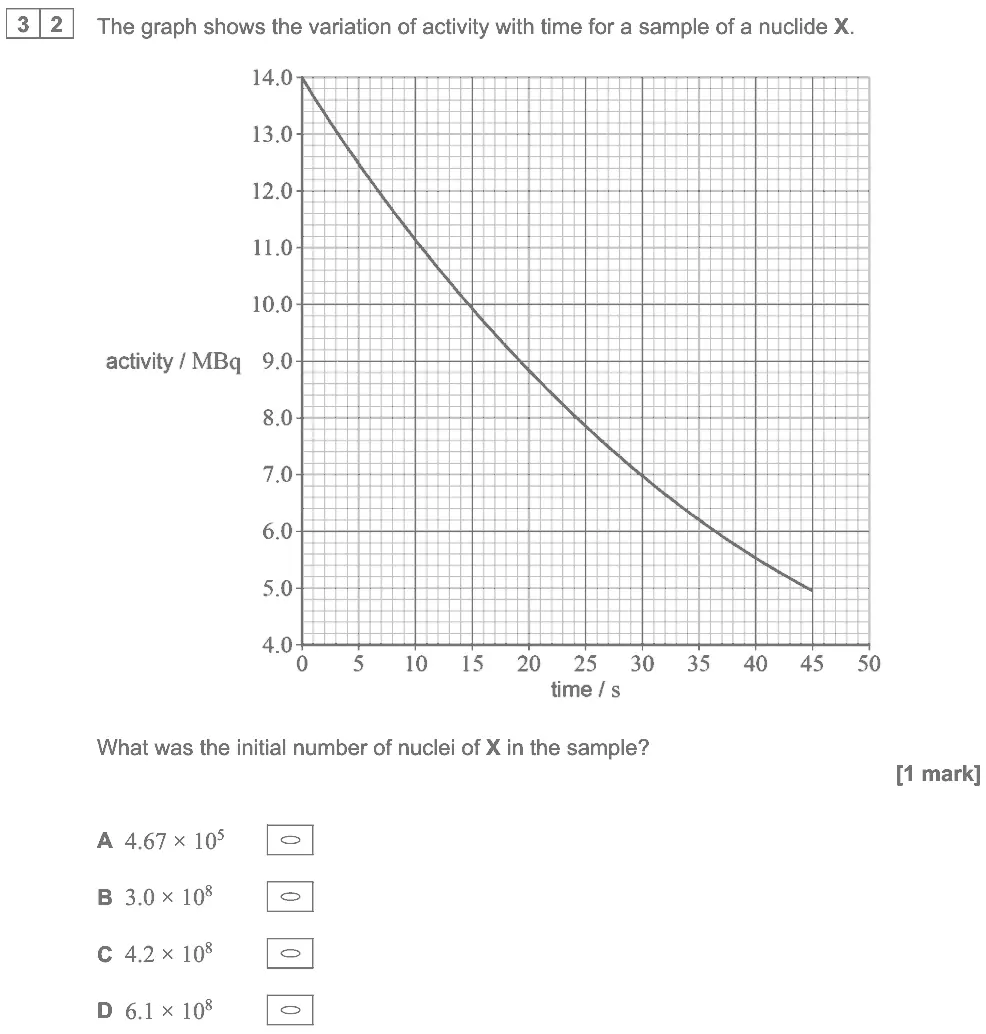
June 2023 · Paper 2 · Q321 markMultiple choice
Answer
D
Mark scheme
Notes from the mark scheme and report
Answer: D
Skills: MS3.1 Translate information between graphical, numerical and algebraic forms
June 2022 · Paper 2 · Q6.43 marksAO1=1, AO3=2Explanation
Earlier part of question 6 that this part uses
Mark scheme
Examiner's comment
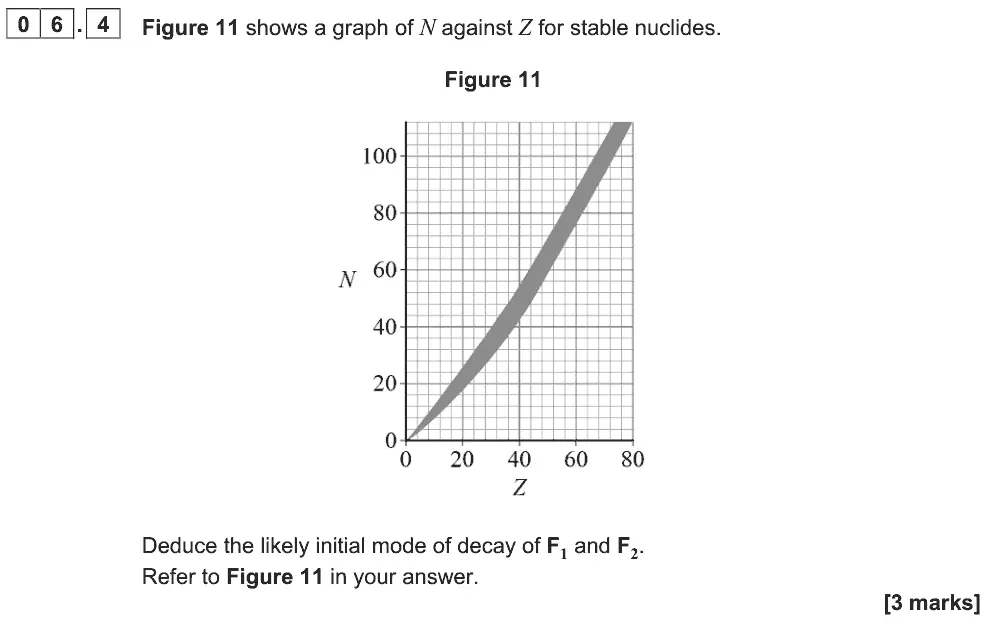
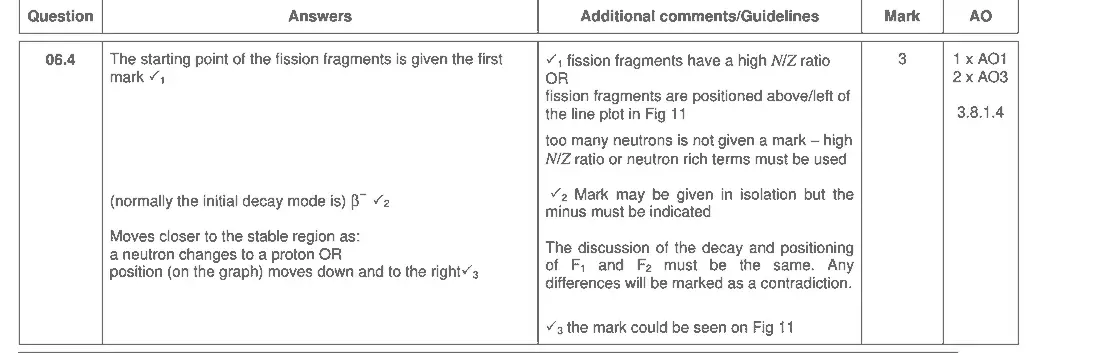
Only a minority of students understood why the fission products would be neutron-rich. Even the ones who did sometimes failed to gain this mark by simply stating they had more neutrons than protons. Then there was a lack of knowledge by many about what radiation would result from this fact. Also many thought the initial decay of the two fission products would be different. Finally, only about half the students made any reference to Figure 11 even though this was requested in the question.
Question 06.4
Notes from the mark scheme and report
Fission fragments have high N/Z (lie above the stability band)
beta-minus decay
neutron becomes proton, moving down and right towards the band
'more neutrons than protons' not enough
must refer to Figure 11
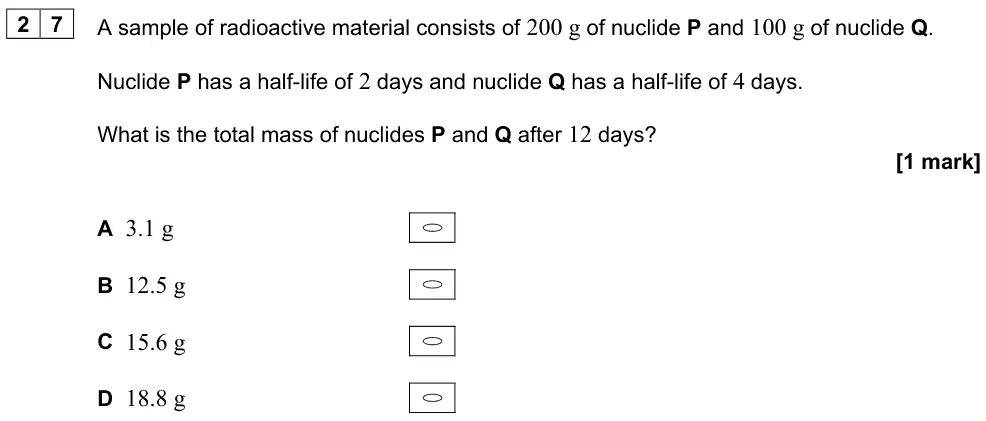
June 2022 · Paper 2 · Q271 markAO2=1Multiple choice
Answer
C
Mark scheme
Notes from the mark scheme and report
Answer: C
Skills: MS0.3 Use ratios, fractions and percentages
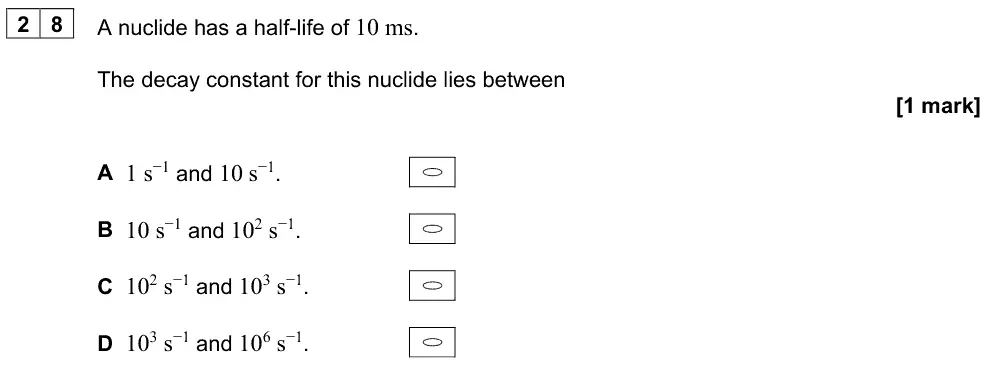
June 2022 · Paper 2 · Q281 markAO2=1Multiple choice
Answer
B
Mark scheme
Notes from the mark scheme and report
Answer: B
Skills: MS1.4 Make order of magnitude calculations
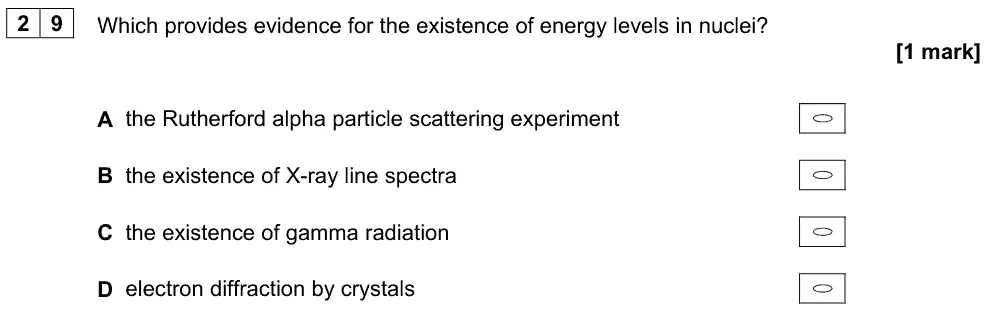
June 2022 · Paper 2 · Q291 markAO1=1Multiple choice
Answer
C
Mark scheme
Examiner's comment
There was a good spread in the performance on the multiple-choice section. Questions 16, 17, 24, 25 and 29 received correct answers from less than 40% of students. For question 24 it was less than 20%.
Notes from the mark scheme and report
Answer: C
fewer than 40% correct
November 2021 · Paper 2 · Q281 markMultiple choice
Answer
B
Mark scheme
Notes from the mark scheme and report
Answer: B
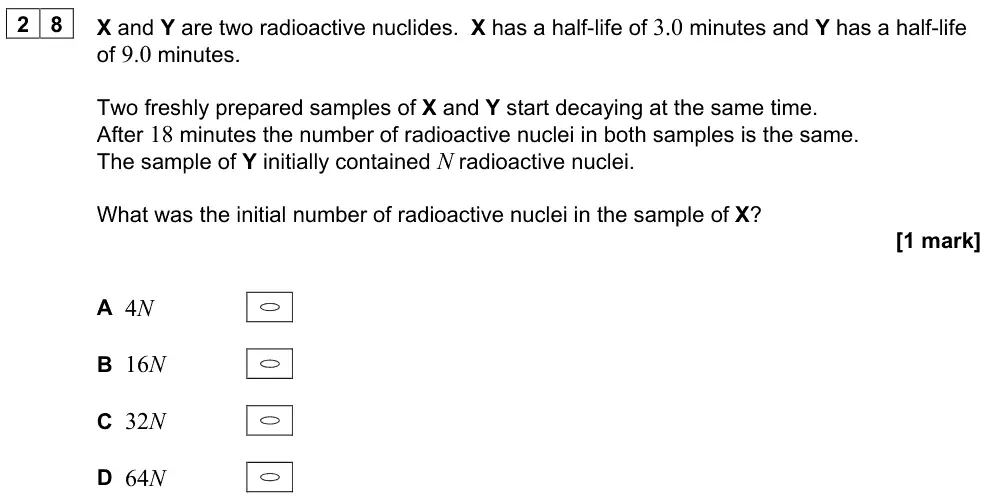
16N: X has 6 half-lives, Y 2 half-lives
Skills: MS0.3 Use ratios, fractions and percentages
November 2021 · Paper 2 · Q311 markMultiple choice
Answer
C
Mark scheme
Notes from the mark scheme and report
Answer: C
November 2021 · Paper 3 Section A · Q1.82 marksAO1=2Explanation
Earlier part of question 1 that this part uses
Mark scheme
Examiner's comment
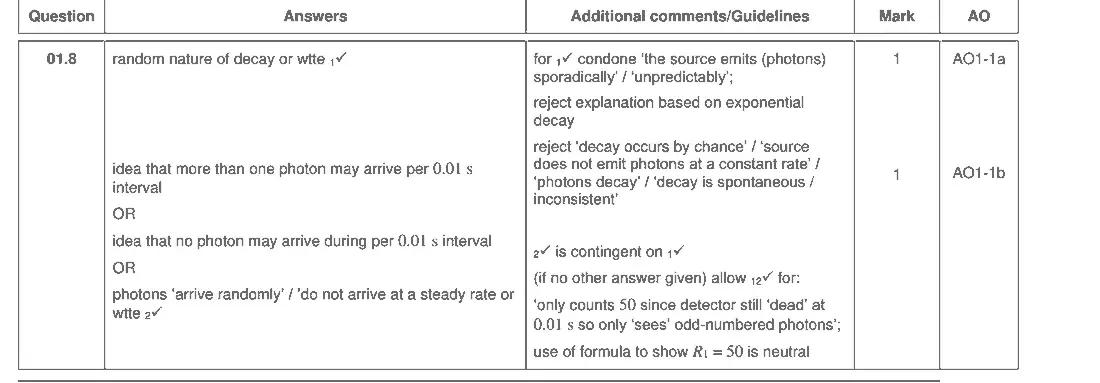
In question 01.8, about 40% referred to the random nature of radioactive decay, scoring the first mark, although some thought that the question concerned exponential decay. Some of the attempts to explain why all 100 photons would not be detected were tortuous to read.
Notes from the mark scheme and report
Decay is random, so photons do not arrive at a steady rate: two may arrive within one 0.01 s dead time (or none in another)
explanations based on exponential decay rejected
November 2020 · Paper 2 · Q6.22 marksAO2=2Show that
Earlier part of question 6 that this part uses
Mark scheme
Examiner's comment
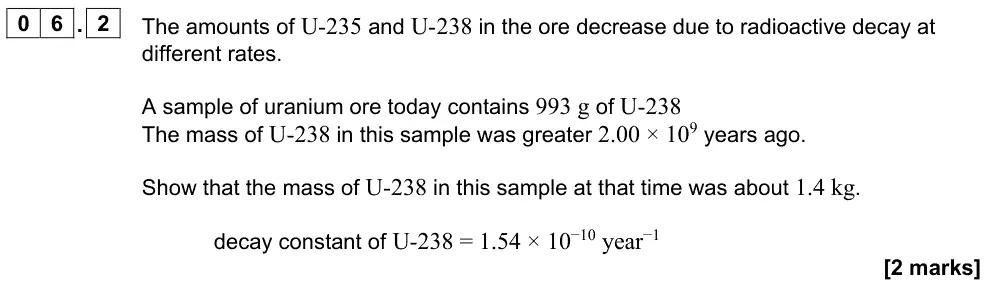
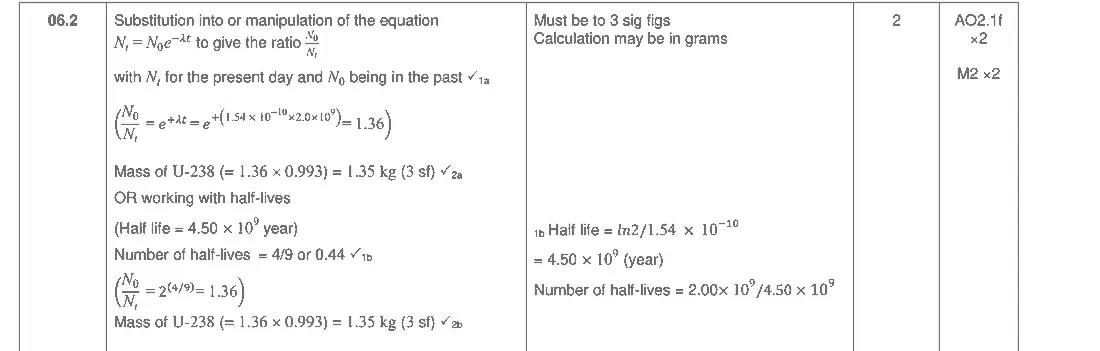
Most students could rearrange the decay equation and obtain the correct answer. Some made the calculation much more difficult for themselves by converting to the number of nucleons, performing the calculation, and then converting back to mass. Only a small percentage of the students who used the half-life method managed to complete the full calculation. There were a number of weaker students who simply did not understand what was required and floundered from the start.
Question 06.2
Notes from the mark scheme and report
Answer: 1.35 kg (993 g x e^(1.54 x 10^-10 x 2.00 x 10^9) = 993 x 1.36)
3 sf required
Skills: MS0.5 Use calculators to find and use power, exponential and logarithmic functions; MS1.1 Use an appropriate number of significant figures
November 2020 · Paper 2 · Q6.31 markCalculation
Earlier part of question 6 that this part uses
Mark scheme
Examiner's comment
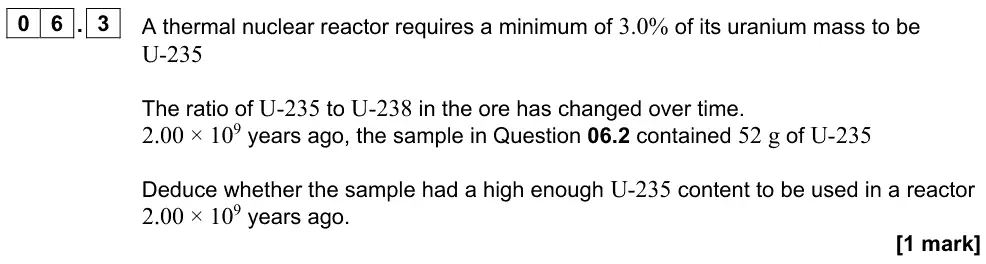
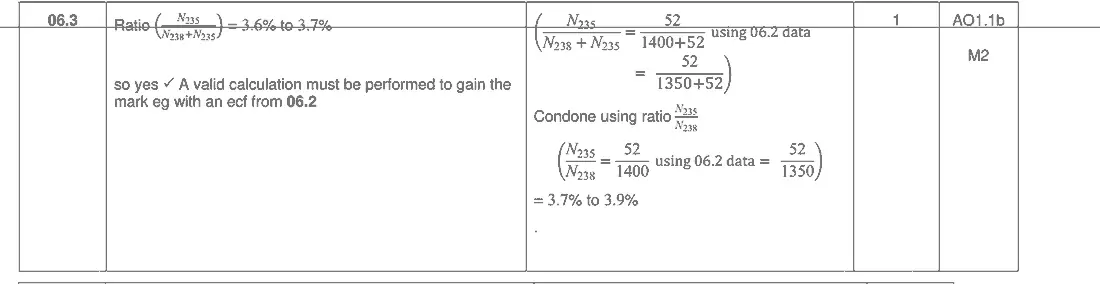
A majority of students obtained this mark. Those who did not usually made no attempt to answer the question.
Concluding Remarks
Question 06.3
Skills: MS0.3 Use ratios, fractions and percentages
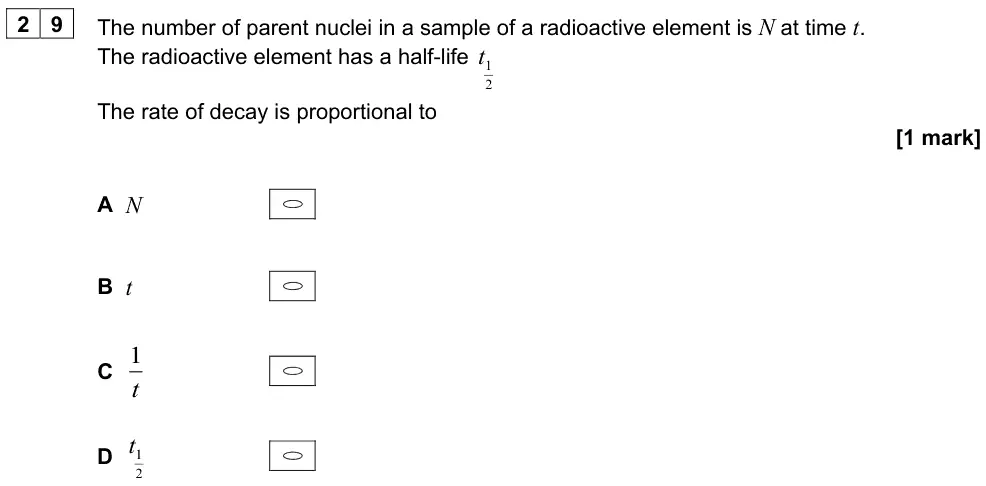
November 2020 · Paper 2 · Q291 markMultiple choice
Answer
A
Examiner's comment
The percentage scores in the multiple-choice questions were much higher than in the written questions. A majority of the questions yielded success rates of between 50 and 75%. Questions B14 and B30 had higher success rates than this. Questions that scored in the region of 30 to 50% correct were B8, B16, B22, B26, B27, B29 and B31. Questions B7 and B24 were found to be particularly difficult with only about 16% of students being successful.
Notes from the mark scheme and report
Answer: A
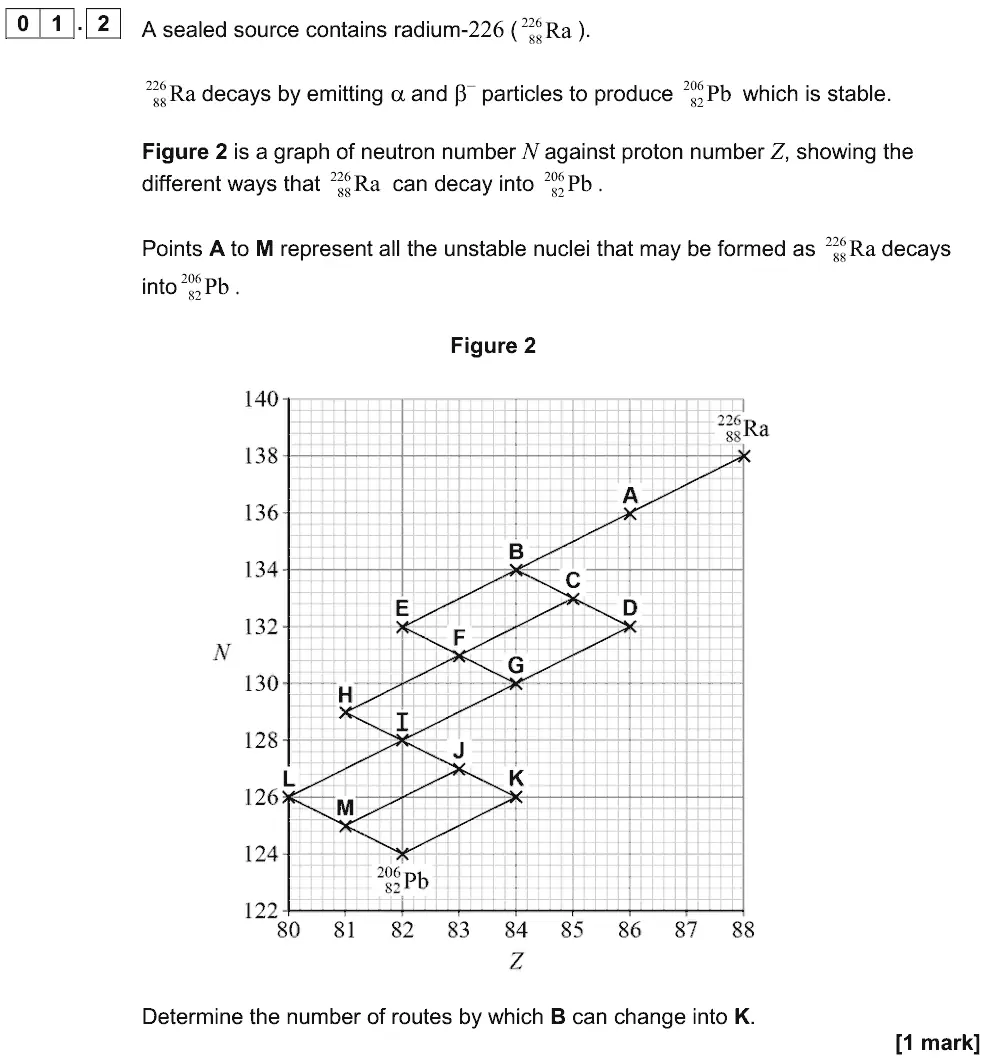
June 2019 · Paper 3 Section A · Q1.21 markShort answer
Earlier part of question 1 that this part uses
Mark scheme
Examiner's comment
In 01.2 the correct answer was given by more than 50% of students. In 01.3, well over half supplied all of A, B and I to earn full credit.
In 03.2, examiners almost always saw the expected read-off figures earning the first mark. About a third missed out on the second mark by failing to multiply the difference between their read-offs by 2, by leaving their result in cm, or by truncating to 1.2.
Notes from the mark scheme and report
Answer: 5 routes from B to K on the N-Z chart
Skills: PS1.2 Apply scientific knowledge to practical contexts
June 2019 · Paper 3 Section A · Q1.33 marksShort answer
Earlier part of question 1 that this part uses
Mark scheme
Examiner's comment
In 01.2 the correct answer was given by more than 50% of students. In 01.3, well over half supplied all of A, B and I to earn full credit.
Notes from the mark scheme and report
A (Rn-222), B (Po-218) and I (Pb-210) lie on every route
each extra wrong answer cancels a correct one
June 2019 · Paper 3 Section A · Q2.52 marksShow that
Earlier part of question 2 that this part uses
Mark scheme
Examiner's comment
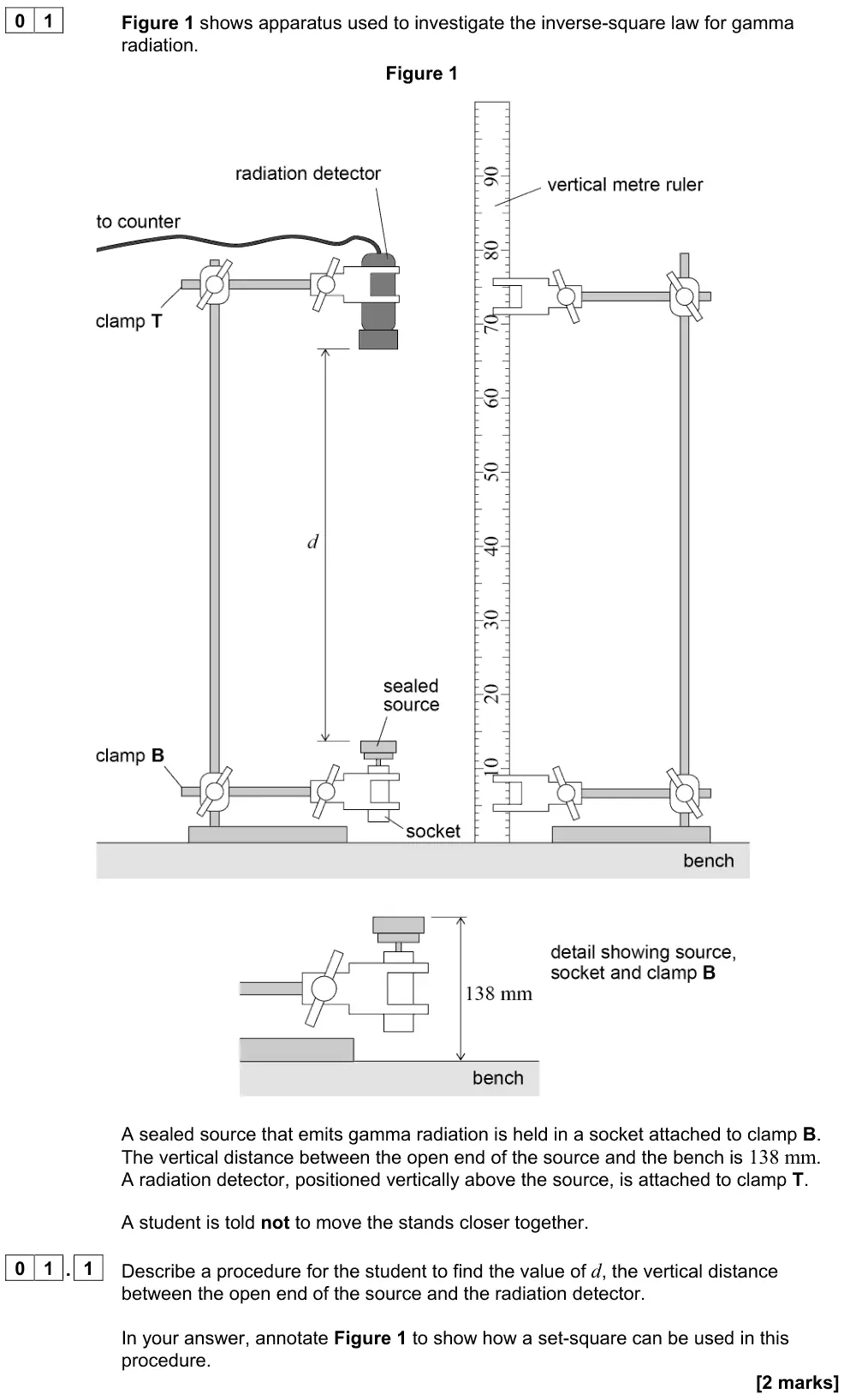
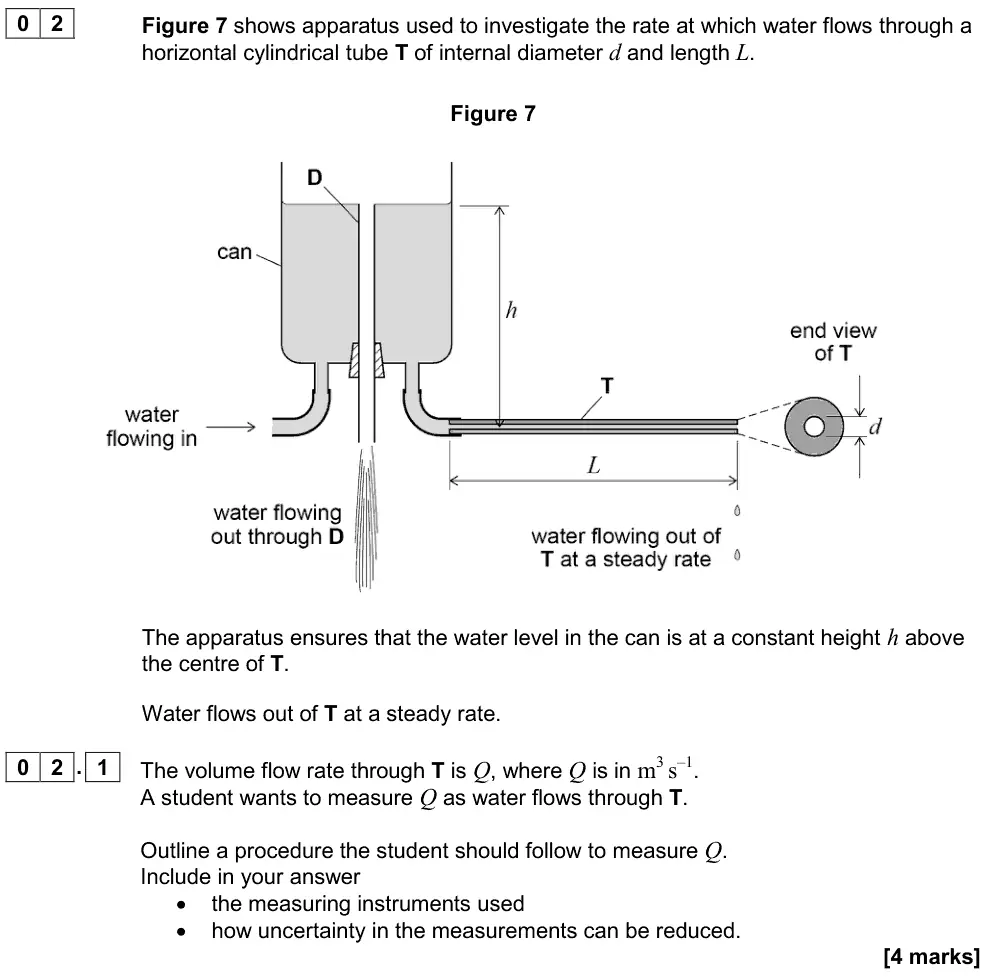
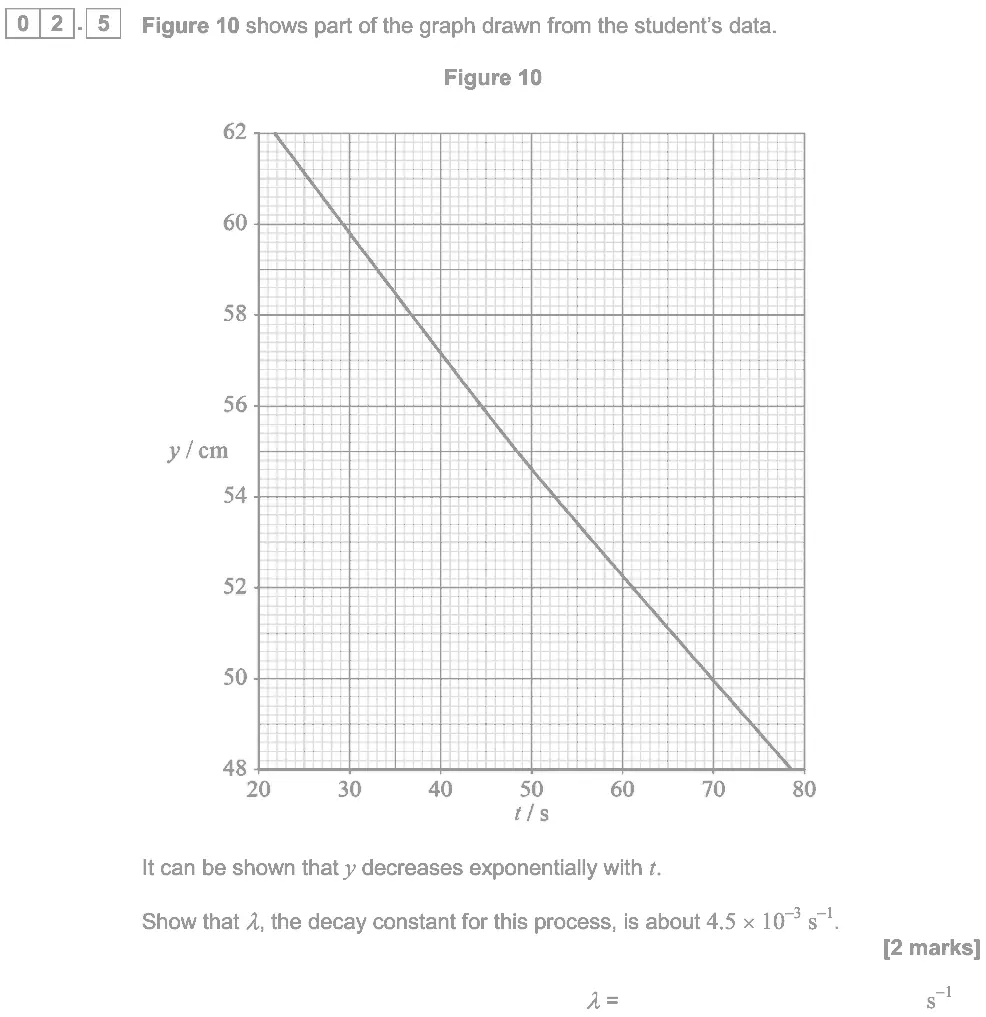
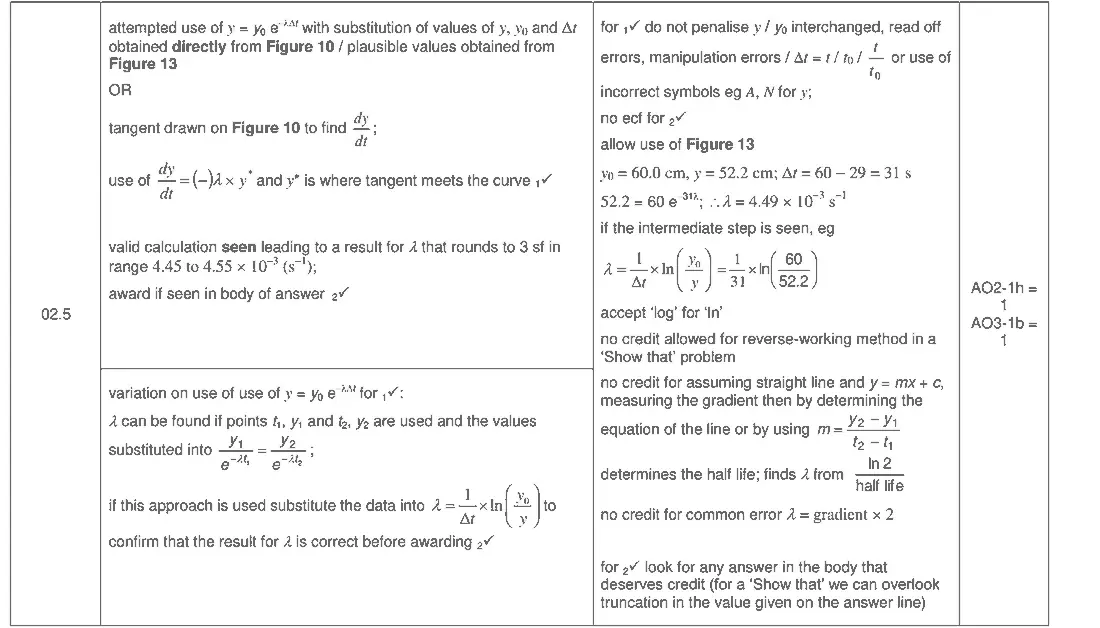
In 02.4, students identified appropriate techniques, although the suggestion that they illustrate their idea with a sketch was, as noted in previous reports, too often ignored. The use of a set square was very popular. However, if students were going by what they could see in Figure 9 and if the square was used in contact with the bench and by itself, it had to be truly enormous to do the job. Here, a sketch was required to satisfy examiners. Otherwise, a metre ruler was needed to extend the vertical edge alongside the tube. We did not allow the suggestion that a set square could be placed on tube T because this will disturb the tube. The use of a plumb line or spirit level was also frequently seen, but credit was withheld in the absence of a clear description. At the risk of repetition, even a basic sketch helps the student to score the mark. ‘Use of a spirit level’ sounds plausible until an examiner has seen sketches with a spirit level placed horizontally on the open end of the tube! Inevitably, there were students insufficiently prepared for this type of problem. Such students suggested that the tube can be compared with the rod of a clamp stand, or invented methods in which the meniscus is compared with graduations on the tube. Just below half of the students scored the mark for this question. In 02.5, students were told that Figure 10 showed an exponential curve. This did not deter some from treating it as a straight line, measuring the gradient, using y = mx + c to find the half-life (thereby predicting 02.6), before working backwards to obtain λ. This method did not produce an acceptable result and no credit could be earned. dy y = − λ Use of was seen occasionally, and could score providing the tangent to the curve drawn dt on Figure 10 was well judged. About a quarter of the students chose to use an approach based on t y e λ − y = , extracting the data they needed from two points on the graph. This approach was 0 almost always successful. In a ‘show that’ question, students must produce a result to at least one more significant figure than the question value, in this case 4.5 × 10⁻³.
Students generally showed more confidence with questions that tested their mathematical skills. Many knew how to combine percentage errors correctly. A ‘show that’ problem (02.5) was well- answered, provided students noted that the relevant curve was exponential. Extended working, (eg in 01.6, 02.5 and 03.7), revealed clear work that could be followed without too much difficulty.
Notes from the mark scheme and report
lambda about 4.5 x 10^-3 s^-1 from y = y0 e^-lambda t using two points on the curve (or tangent, or half-life with ln2)
treating the graph as linear gains nothing
Skills: MS0.5 Use calculators to find and use power, exponential and logarithmic functions; MS3.1 Translate information between graphical, numerical and algebraic forms; MS3.11 Use logarithmic plots to test exponential and power law variations
June 2019 · Paper 3 Section A · Q2.61 markCalculation
Earlier part of question 2 that this part uses
Mark scheme
Examiner's comment
In 02.4, students identified appropriate techniques, although the suggestion that they illustrate their idea with a sketch was, as noted in previous reports, too often ignored. The use of a set square was very popular. However, if students were going by what they could see in Figure 9 and if the square was used in contact with the bench and by itself, it had to be truly enormous to do the job. Here, a sketch was required to satisfy examiners. Otherwise, a metre ruler was needed to extend the vertical edge alongside the tube. We did not allow the suggestion that a set square could be placed on tube T because this will disturb the tube. The use of a plumb line or spirit level was also frequently seen, but credit was withheld in the absence of a clear description. At the risk of repetition, even a basic sketch helps the student to score the mark. ‘Use of a spirit level’ sounds plausible until an examiner has seen sketches with a spirit level placed horizontally on the open end of the tube! Inevitably, there were students insufficiently prepared for this type of problem. Such students suggested that the tube can be compared with the rod of a clamp stand, or invented methods in which the meniscus is compared with graduations on the tube. Just below half of the students scored the mark for this question. In 02.5, students were told that Figure 10 showed an exponential curve. This did not deter some from treating it as a straight line, measuring the gradient, using y = mx + c to find the half-life (thereby predicting 02.6), before working backwards to obtain λ. This method did not produce an acceptable result and no credit could be earned. dy y = − λ Use of was seen occasionally, and could score providing the tangent to the curve drawn dt on Figure 10 was well judged. About a quarter of the students chose to use an approach based on t y e λ − y = , extracting the data they needed from two points on the graph. This approach was 0 almost always successful. In a ‘show that’ question, students must produce a result to at least one more significant figure than the question value, in this case 4.5 × 10⁻³.
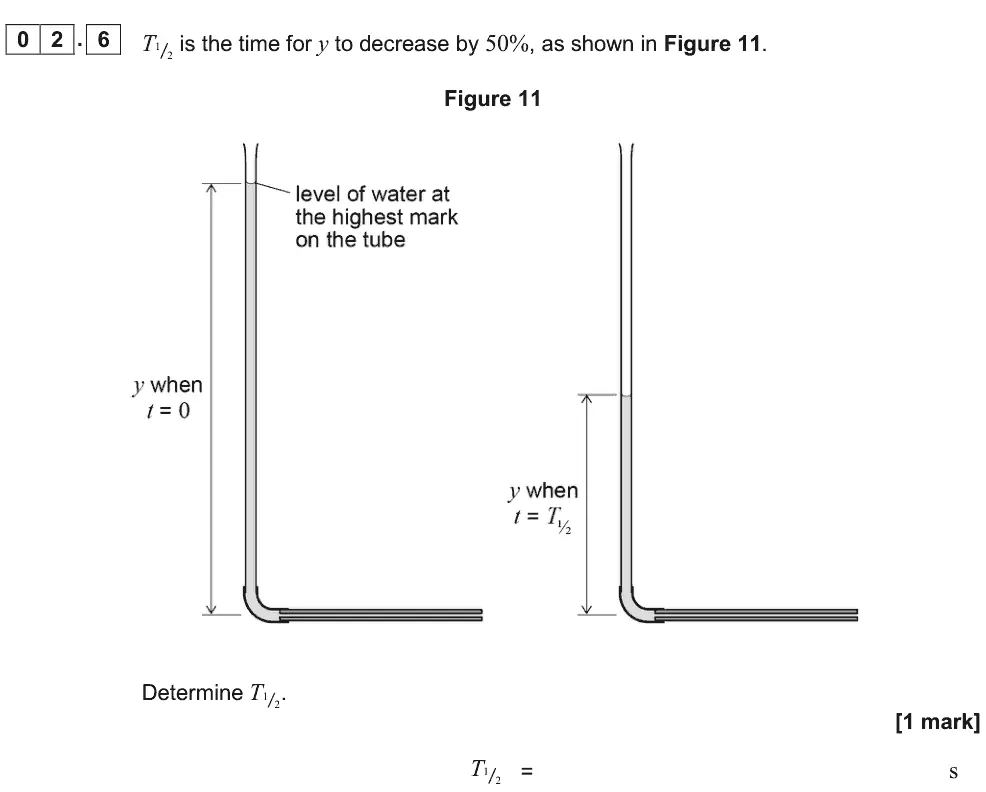
Most found 02.6 very straightforward and the wide range of acceptable values ensured that more than 60% earned credit, even with a slightly errant value for λ.
Skills: MS0.5 Use calculators to find and use power, exponential and logarithmic functions
June 2018 · Paper 2 · Q6.11 markShort answer
Mark scheme
Examiner's comment
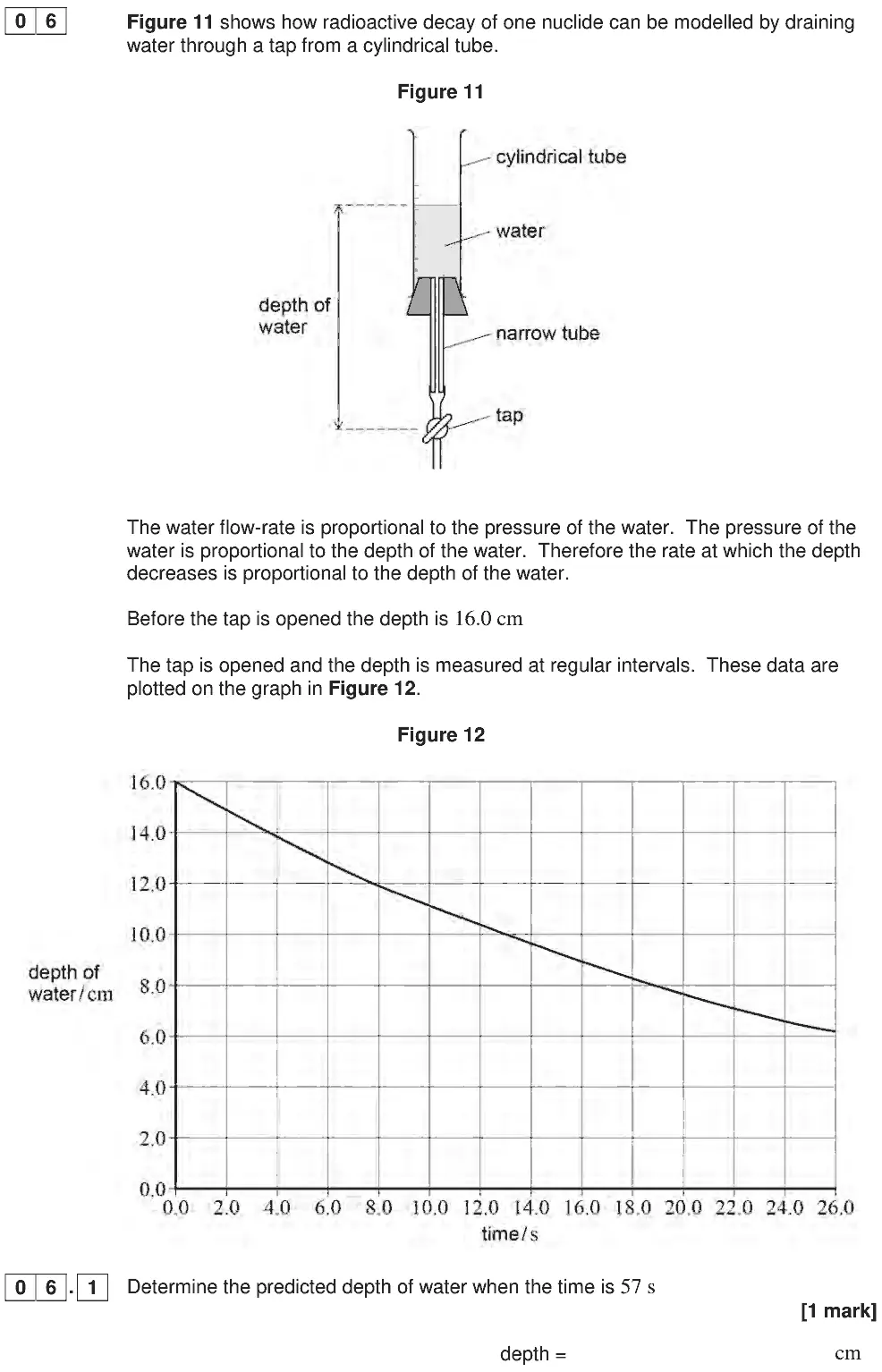
06.1 Nearly half of the students (44.6%) could produce the answer without too much trouble because they spotted that the half-life was 19 s. Other students either made a small error in reading off the graph and got close to the correct answer, or they did not spot the half-life approach and made a difficult question for themselves by trying to fit the exponential decay equation to the graph. Most of these students made mistakes.
Notes from the mark scheme and report
Answer: 2.0 cm (depth halves every 19 s
57 s = 3 half-lives)
44.6% correct
Skills: MS3.1 Translate information between graphical, numerical and algebraic forms; MS0.3 Use ratios, fractions and percentages
June 2018 · Paper 2 · Q6.21 markShort answerEasy
Earlier part of question 6 that this part uses
Mark scheme
Examiner's comment
06.2 62.4% of students found this to be an accessible question and gained the mark. The ‘near- miss’ answer put forward by many others was to write about increasing the volume of the cylindrical tube. The problem here is that it was not made clear that the height and not the diameter occupied by the water needs to be altered.
Notes from the mark scheme and report
More water (greater depth) in the same cylinder
'bigger cylinder' too vague
June 2018 · Paper 2 · Q6.31 markShort answerHard
Earlier part of question 6 that this part uses
Mark scheme
Examiner's comment
06.3 Most students did realise that the water should take longer to empty if the decay constant represented was smaller. Some of these students suggested changing the geometry of one of the tubes but they did not make it clear which one they were referencing. The students who focussed on the tap scored the mark more often than not. A final error point seen frequently was to treat ‘density’ as having the same meaning as ‘viscosity’. 34.7% of students wrote a sufficiently detailed answer to gain the mark.
Notes from the mark scheme and report
Make it drain more slowly: close the tap more, use a more viscous liquid, a wider cylinder or a narrower outlet tube
tube must be identified
density is not viscosity
June 2018 · Paper 2 · Q6.41 markCalculationEasy
Earlier part of question 6 that this part uses
Mark scheme
Examiner's comment
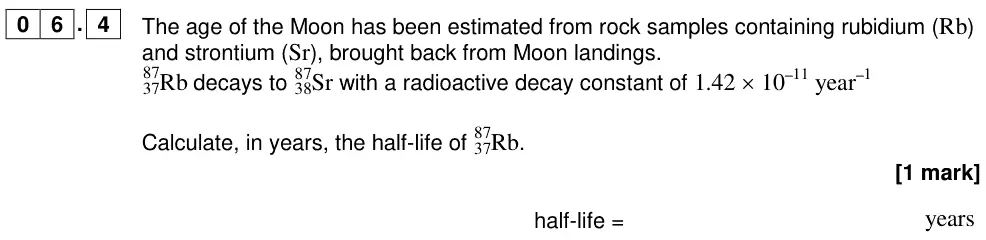
06.4 This calculation was performed well by nearly 90% of the students. Most knew the relevant physics and errors only occurred in arithmetic items such as getting the wrong power of 10.
Notes from the mark scheme and report
Answer: 4.9 x 10^10 years (ln 2 / 1.42 x 10^-11)
Skills: MS2.3 Substitute numerical values into algebraic equations using appropriate units for physical quantities
June 2018 · Paper 2 · Q6.53 marksCalculation
Earlier part of question 6 that this part uses
Mark scheme
Examiner's comment
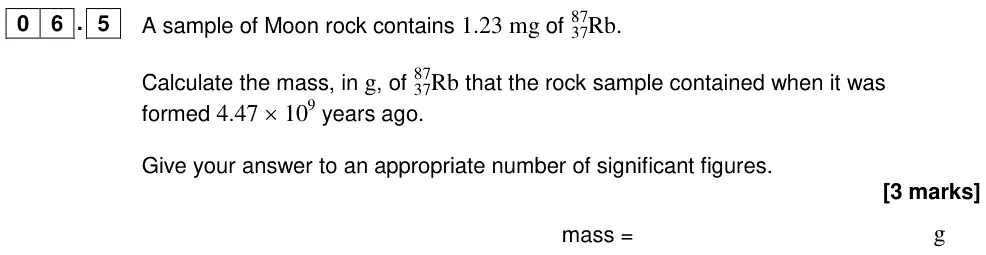
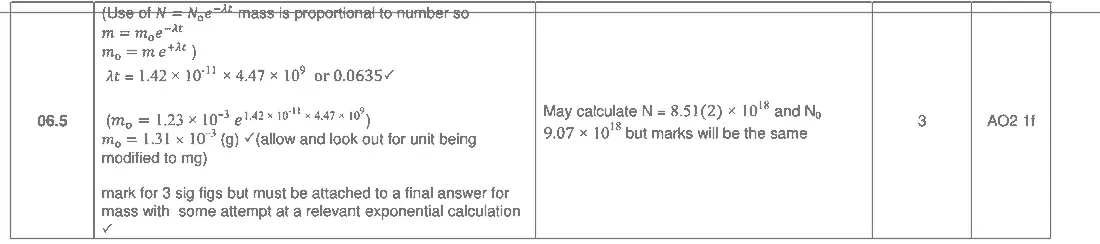
06.5 This was another reasonably difficult question that about half of the students could do very well (45.3% scored all three marks). The most common approach was to use the exponential decay in the mass, but others successfully used the exponential decay in the number of molecules. A very small proportion of students calculated the number of half- lives that must have occurred and deduced the mass in this way. Most of these, unfortunately, did not retain three significant figures and so failed to gain one of the marks available. As expected in this type of question, a significant number of students made powers of ten errors and a similar number did not give their answer to three significant figures. 25% of students failed to score.
Notes from the mark scheme and report
Answer: 1.31 x 10^-3 g (m0 = m e^(lambda t), lambda t = 0.0635)
3 sf required
power-of-ten errors common
45.3% full marks
Skills: MS0.5 Use calculators to find and use power, exponential and logarithmic functions; MS1.1 Use an appropriate number of significant figures
June 2018 · Paper 2 · Q6.63 marksCalculation
Earlier part of question 6 that this part uses
Mark scheme
Examiner's comment
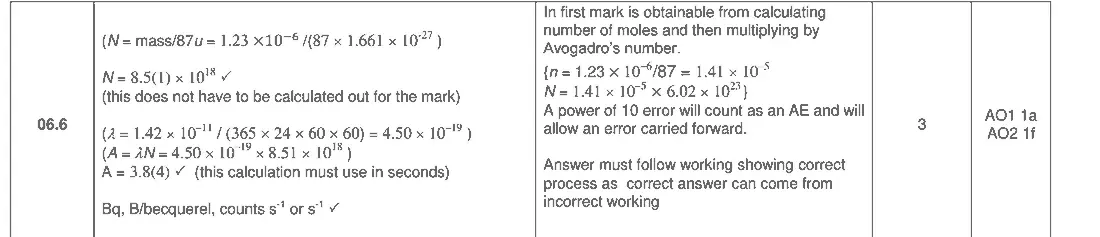
06.6 This calculation caused far more problems for students than the previous calculation. Many attempted to work the activity out in counts per year, which was not accepted. So, the calculation was marked in essentially three independent parts: the number of molecules involved, the calculation giving an answer in becquerel, and finally the unit. Of the 68% of students who scored at least one mark, about one third, but not always the same one third, scored each mark.
Notes from the mark scheme and report
Answer: 3.8 Bq (N = 8.5 x 10^18, lambda = 4.50 x 10^-19 s^-1)
lambda must be in s^-1 - counts per year not accepted
unit Bq or s^-1
Skills: MS0.2 Recognise and use expressions in decimal and standard form; MS2.3 Substitute numerical values into algebraic equations using appropriate units for physical quantities; MS0.1 Recognise and make use of appropriate units in calculations
June 2018 · Paper 2 · Q7.12 marksDiagram or graph
Mark scheme
Examiner's comment
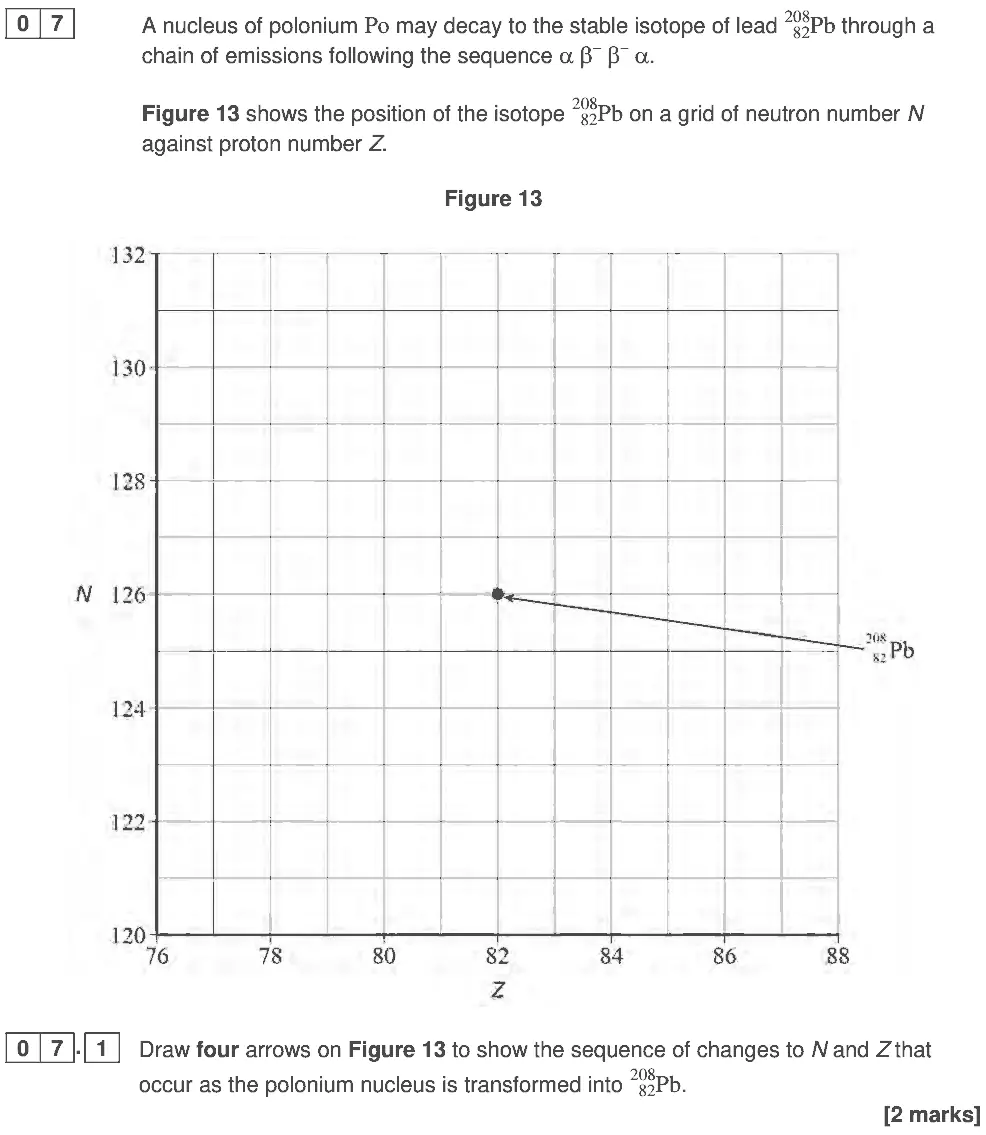
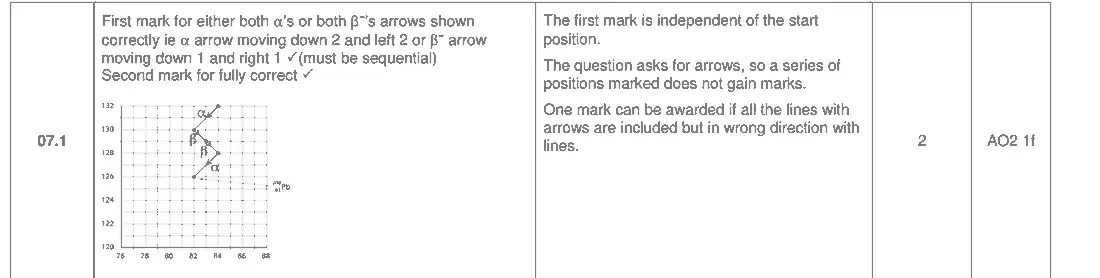
07.1 Nearly one third of the students drew the sequence on the grid totally correctly and scored two marks. Many students started on the final isotope and drew the sequence of decays; these could score one mark only. The other group scoring one mark usually got the two alpha decay arrows following the correct lines but, because they started in the wrong position, just drew two beta arrows to finish in the correct position. About two thirds of the students scored at least one mark.
Notes from the mark scheme and report
Arrows in sequence: alpha (Z -2, N -2), beta- (Z +1, N -1), beta- (Z +1, N -1), alpha, ending at Pb-208 (start Z = 82, N = 130)
starting at Pb-208 and working backwards gained 1
Skills: MS3.1 Translate information between graphical, numerical and algebraic forms
June 2018 · Paper 2 · Q7.24 marksExplanation
Earlier part of question 7 that this part uses
Mark scheme
Examiner's comment
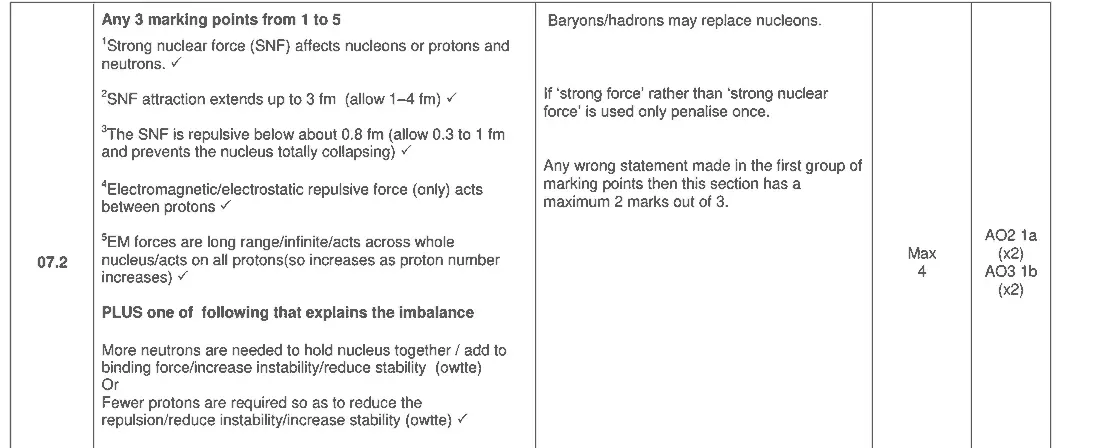
07.2 This question discriminated very well; there was a very good spread from zero to four marks. It was only the very weak students who did not understand that the question was about describing the contributions made by the strong nuclear force and the electromagnetic force. These students introduced the weak nuclear force and gravity as having some influence on the situation. Most students scored marks by knowing that the electromagnetic force is repulsive for protons in the nucleus and that the SNF is attractive between nucleons at short range. The variation in the marks came from students giving different amounts of detail, which could be about the specific ranges involved and the fact that the SNF is repulsive at very short range. Only the best students appreciated how the main forces lead to the requirement for more neutrons.
Notes from the mark scheme and report
SNF acts on all nucleons, attractive to about 3 fm, repulsive below about 0.5 fm
electrostatic repulsion only between protons and acts across the whole nucleus
so extra neutrons add attraction without repulsion
June 2018 · Paper 2 · Q7.31 markShort answer
Earlier part of question 7 that this part uses
Mark scheme
Examiner's comment
07.3 Just over half of the students made some mistake in writing down the equation. The most common error was to write the wrong proton number for thallium, followed closely by students thinking an antineutrino was emitted.
Notes from the mark scheme and report
Pb-205 (Z 82) + e- -> Tl-205 (Z 81) + electron neutrino
wrong proton number for Tl and antineutrino were common errors
June 2018 · Paper 2 · Q7.42 marksExplanationHard
Earlier part of question 7 that this part uses
Mark scheme
Examiner's comment
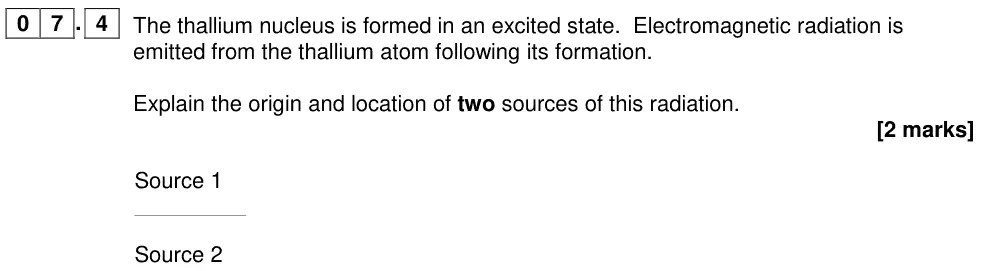
07.4 A good number of students, approaching half, either gave the source of radiation as coming from orbiting electrons or coming from an excited nucleus. Only a few (9.4%) gave two sources. A large number of answers were not specific enough to award marks. “The electrons give off radiation” and “the thallium atom gives off radiation” are examples. It was evident that some students did not fully understand the question and simply quoted situations when radiation is emitted.
Notes from the mark scheme and report
Orbital electrons fall to fill the vacancy left by the captured inner electron (X-ray photons)
the excited nucleus de-excites emitting gamma
vague 'electrons give off radiation' not credited
June 2018 · Paper 2 · Q7.52 marksExplanation
Earlier part of question 7 that this part uses
Mark scheme
Examiner's comment
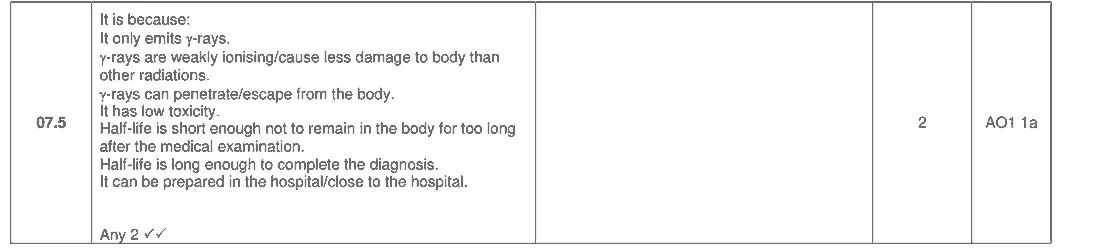
07.5 Many students had problems in avoiding absolute statements that disqualified them from a potential mark. Some examples are “It does not ionise, so causes no harm to the body” and “It has a short half-life so is not dangerous at all”. Many students did know that this source gave off gamma rays, but not that these were alone. Also, there were just as many references to the half-life being long as there were to it being short. These references only gained marks if the benefit was explained, for example ‘long enough to complete the investigation’.
Notes from the mark scheme and report
Any two: pure gamma emitter
gamma penetrates out of the body and is weakly ionising
half-life long enough for diagnosis but short enough to limit dose
made on site
absolute statements ('causes no harm') penalised
June 2017 · Paper 2 · Q5.22 marksCalculation
Earlier part of question 5 that this part uses
Mark scheme
Examiner's comment
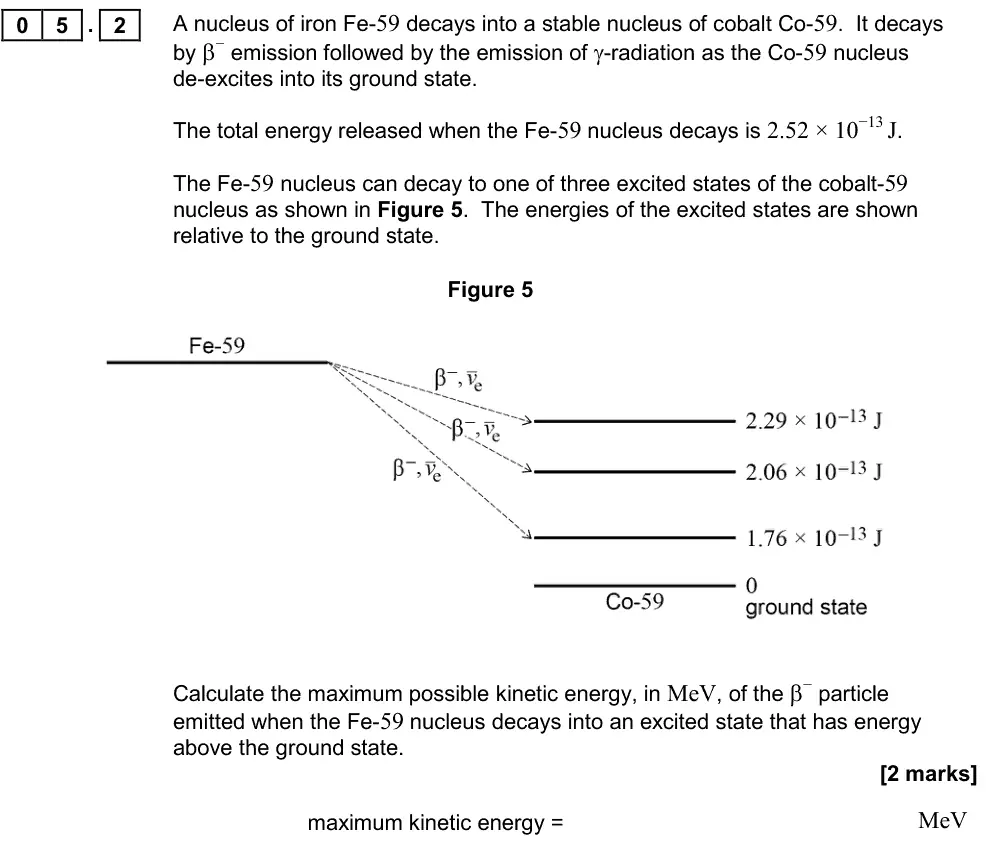
05.2 A majority of students understood the situation and performed the calculation without error. A significant number of others missed seeing the longest energy gap between iron and cobalt. Many of these gave a variety of calculations using energy gaps that did not correspond to beta energies.
Notes from the mark scheme and report
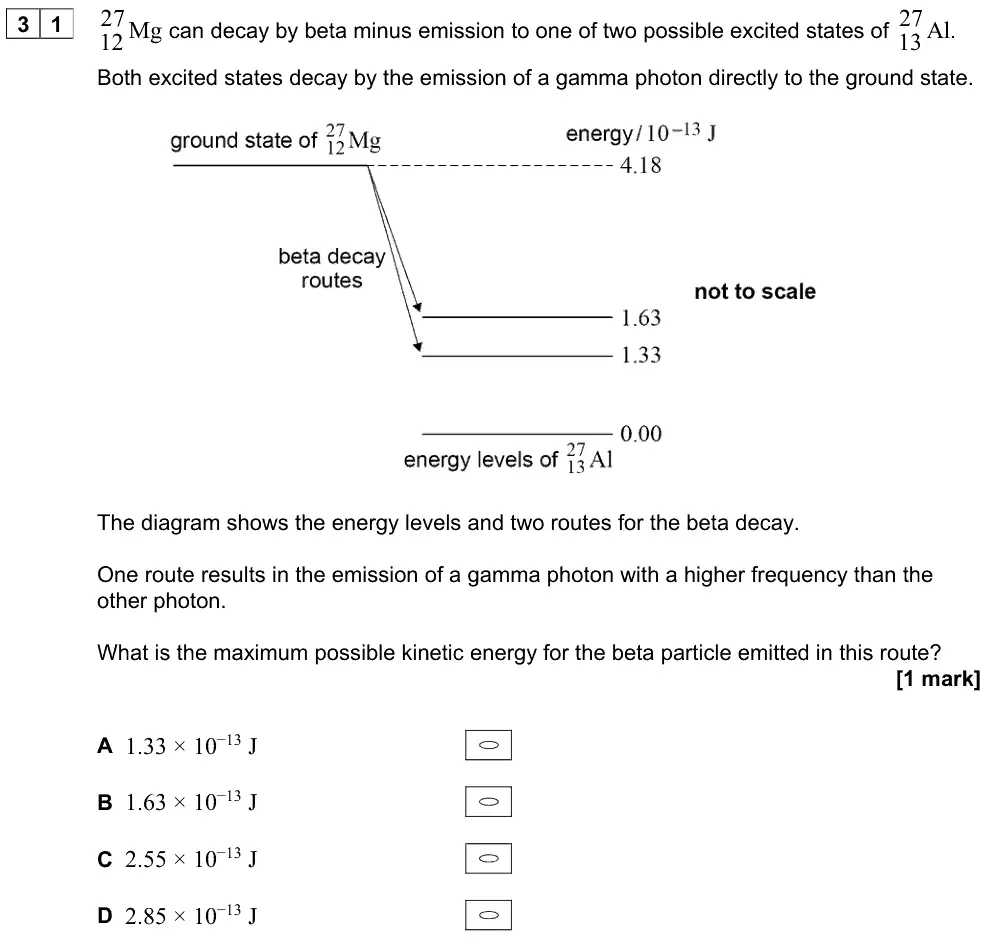
Answer: 0.48 MeV ((2.52 - 1.76) x 10^-13 J = 7.6 x 10^-14 J)
must choose the largest gap from Fe-59 to an excited state
Skills: MS2.3 Substitute numerical values into algebraic equations using appropriate units for physical quantities
June 2017 · Paper 2 · Q5.31 markShort answer
Earlier part of question 5 that this part uses
Mark scheme
Examiner's comment
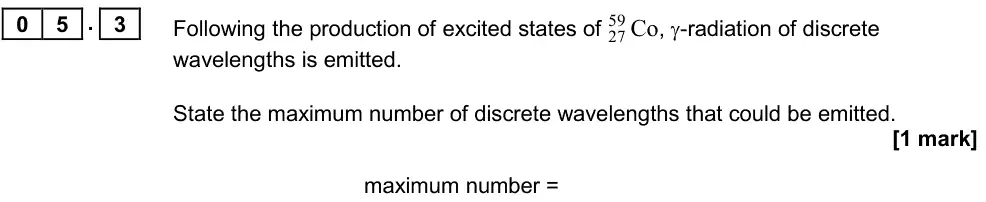
05.3 Only 50% of students got the correct answer of 6 and the answer 3 featured regularly.
Notes from the mark scheme and report
Answer: 6 (all transitions between four levels)
3 was a common wrong answer
only 50% correct
June 2017 · Paper 2 · Q5.43 marksCalculation
Earlier part of question 5 that this part uses
Mark scheme
Examiner's comment
05.4 Only the bottom 10% of students could make no headway in this question. A majority could obtain the equation relating wavelength to energy, and could perform the numerical calculation. It was choosing the incorrect energy gap that let many students down.
Notes from the mark scheme and report
Answer: 8.6 x 10^-12 m (smallest gap 2.29 - 2.06 = 0.23 x 10^-13 J
lambda = hc/E)
choosing the wrong energy gap was the main error
Skills: MS2.3 Substitute numerical values into algebraic equations using appropriate units for physical quantities
June 2017 · Paper 2 · Q281 markMultiple choice
Answer
B
Notes from the mark scheme and report
Answer: B
Skills: MS2.3 Substitute numerical values into algebraic equations using appropriate units for physical quantities
June 2017 · Paper 2 · Q291 markMultiple choice
Answer
B
Notes from the mark scheme and report
Answer: B
Skills: MS0.3 Use ratios, fractions and percentages
June 2017 · Paper 2 · Q301 markMultiple choice
Answer
A
Notes from the mark scheme and report
Answer: A
Skills: MS0.2 Recognise and use expressions in decimal and standard form
Specimen set 1 · Paper 2 · Q4.11 markShow that
Mark scheme
Notes from the mark scheme and report
Answer: 7.5 x 10^10 atoms ((3.0 x 10^-10 / 24) x 6.02 x 10^23 = 7.52 x 10^12 atoms mixed, 1/100 of the solution injected)
Skills: MS0.2 Recognise and use expressions in decimal and standard form; MS0.3 Use ratios, fractions and percentages
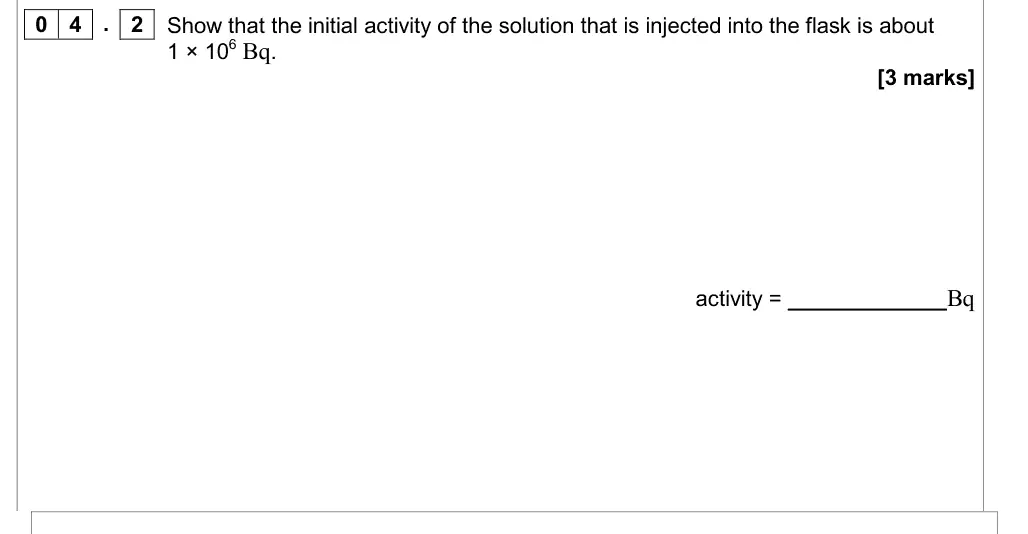
Specimen set 1 · Paper 2 · Q4.23 marksShow that
Earlier part of question 4 that this part uses
Mark scheme
Notes from the mark scheme and report
Answer: 9.75 x 10^5 Bq (lambda = 0.693 / (14.8 x 3600 s) = 1.3 x 10^-5 s^-1
A = lambda N)
half-life must be converted to s
Skills: MS2.3 Substitute numerical values into algebraic equations using appropriate units for physical quantities; MS0.1 Recognise and make use of appropriate units in calculations
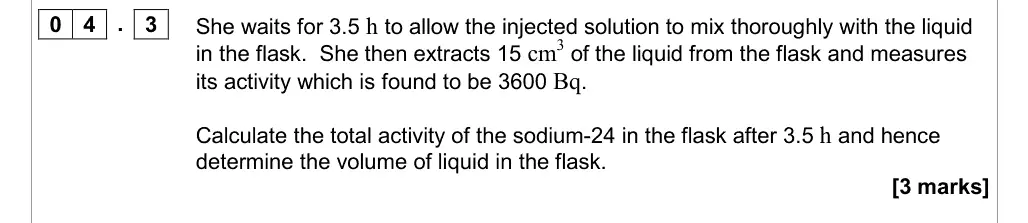
Specimen set 1 · Paper 2 · Q4.33 marksCalculation
Earlier part of question 4 that this part uses
Mark scheme
Notes from the mark scheme and report
Answer: 8.3 x 10^5 Bq after 3.5 h (A = A0 e^-lambda t, lambda = 0.0466 h^-1)
volume = (8.33 x 10^5 / 3600) x 15 = 3470 cm^3
Skills: MS0.5 Use calculators to find and use power, exponential and logarithmic functions; MS0.3 Use ratios, fractions and percentages
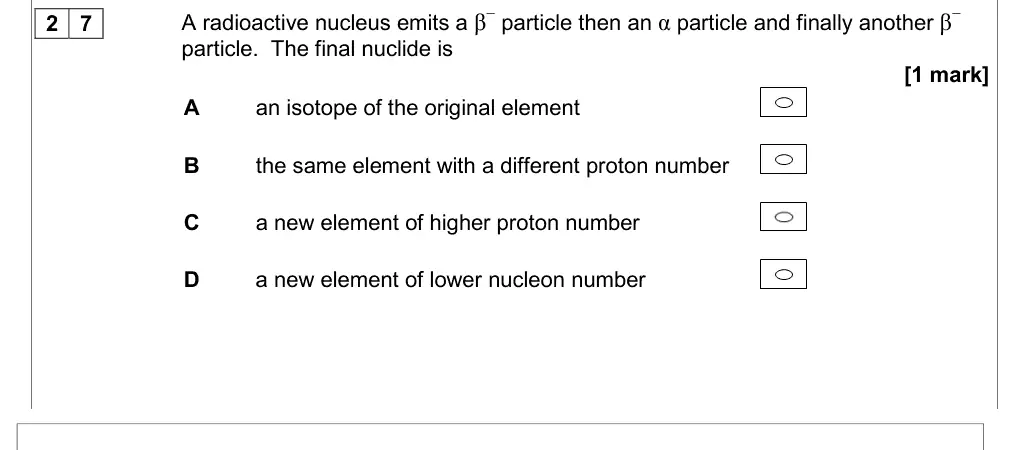
Specimen set 1 · Paper 2 · Q271 markMultiple choice
Answer
A
Notes from the mark scheme and report
Answer: A
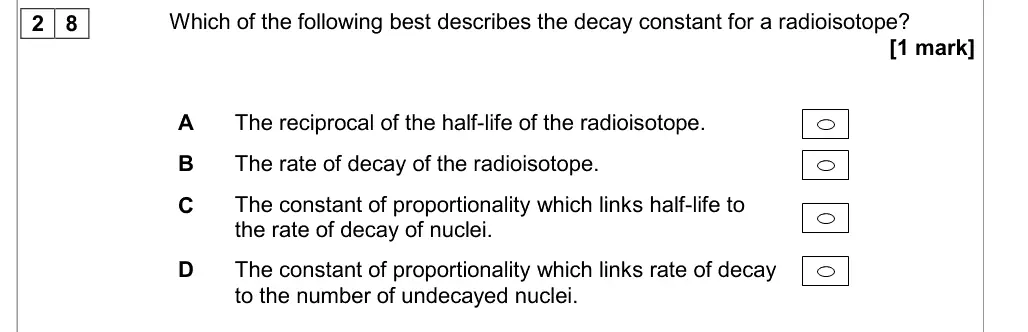
Specimen set 1 · Paper 2 · Q281 markMultiple choice
Answer
D
Notes from the mark scheme and report
Answer: D
Specimen set 1 · Paper 2 · Q301 markMultiple choice
Answer
D
Notes from the mark scheme and report
Answer: D
Skills: MS0.3 Use ratios, fractions and percentages
Work with an AQA physics tutor
Dropping marks on calculations, required practicals or the six-markers? Book a trial session with a specialist AQA physics tutor.