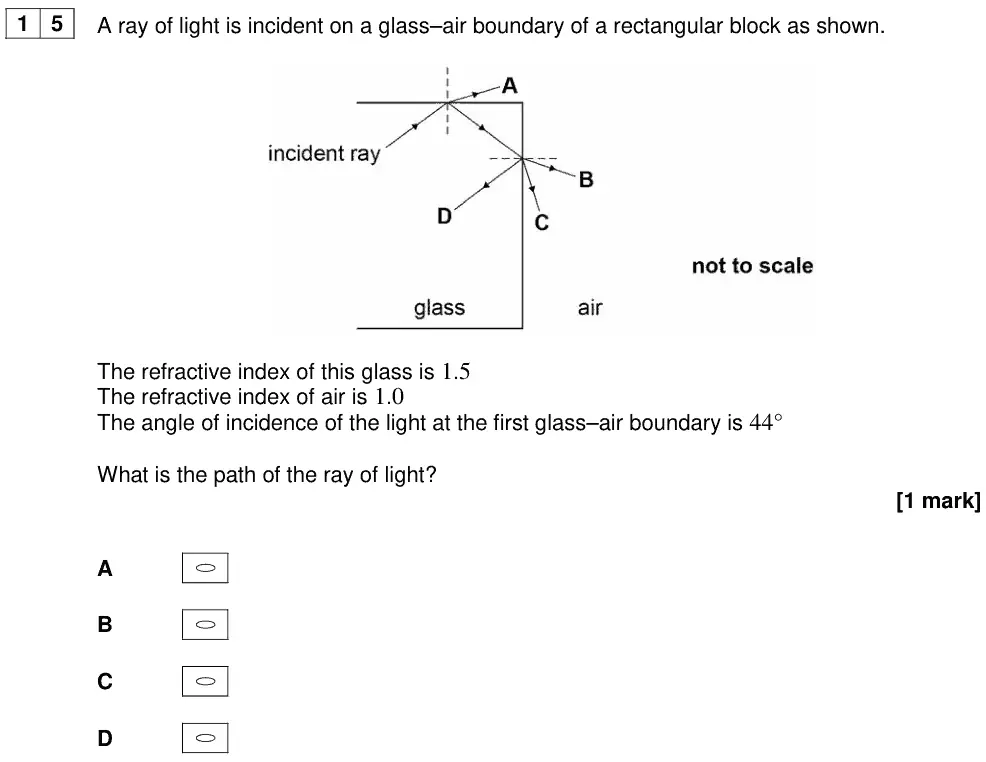
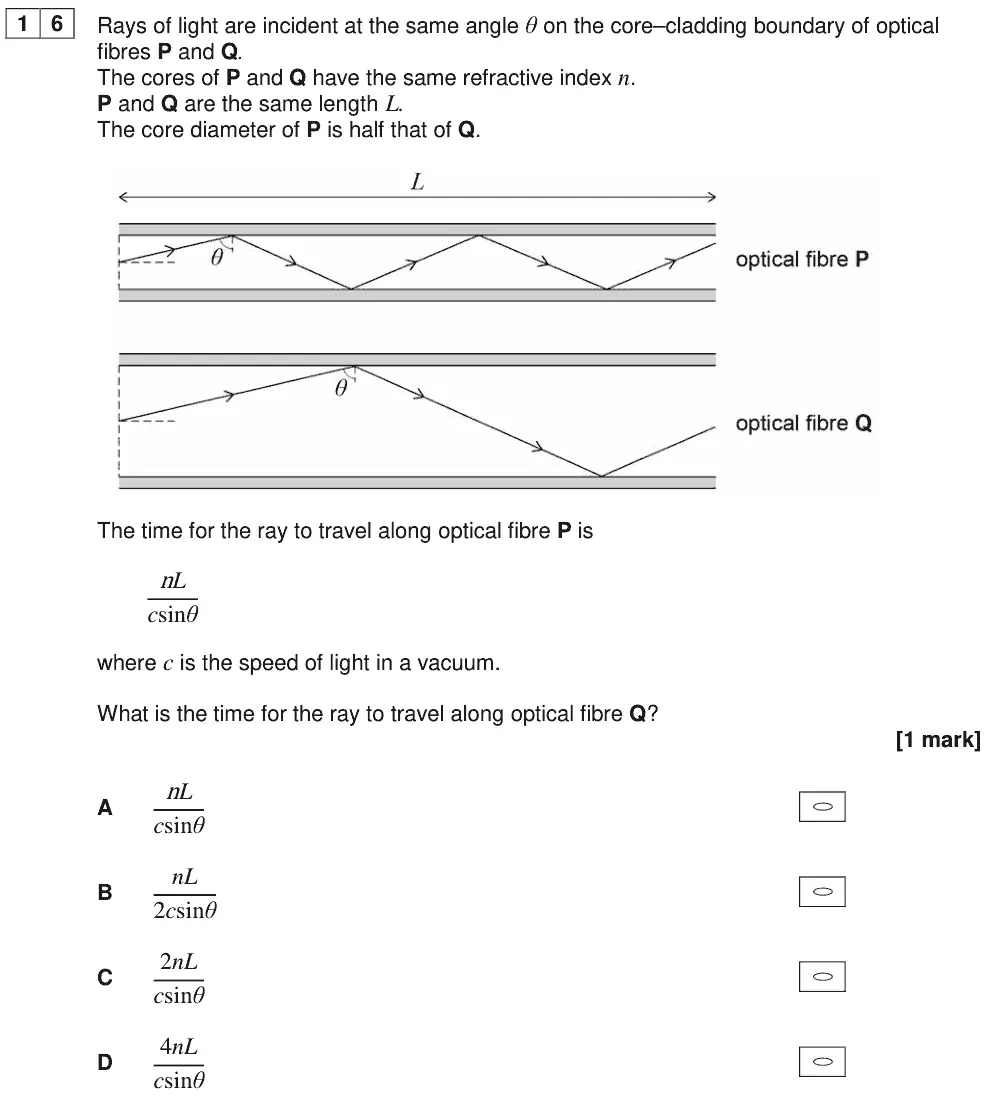
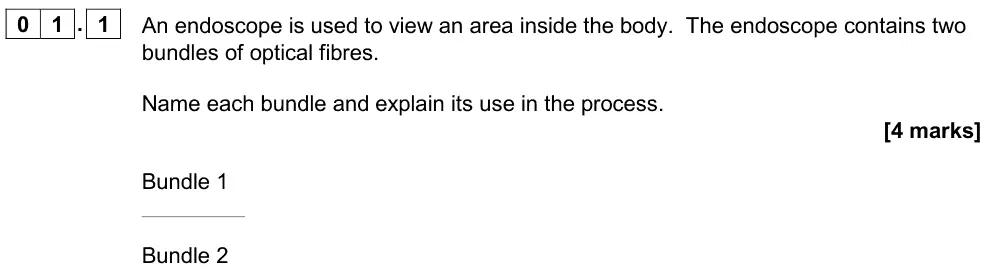
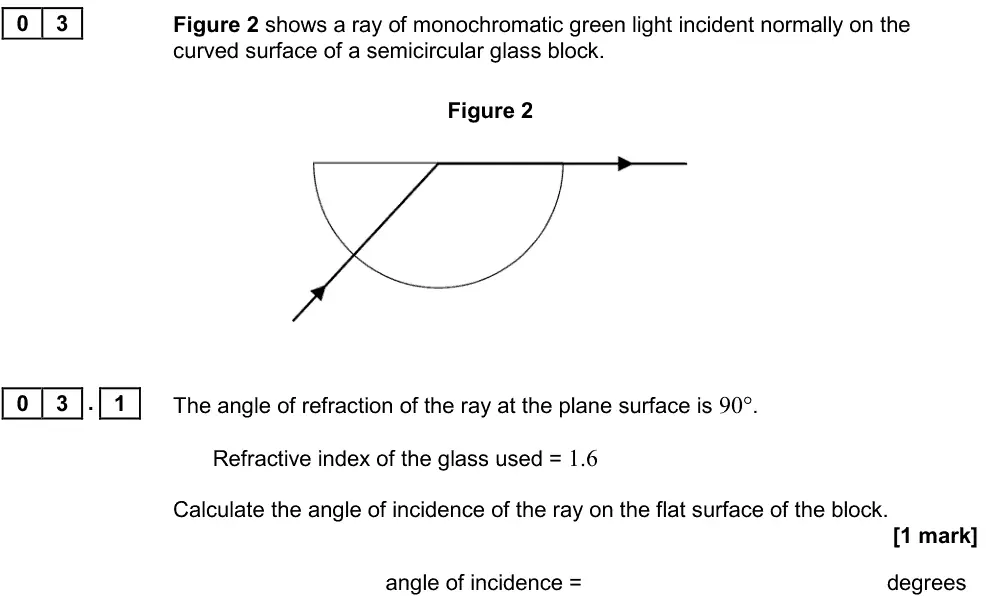
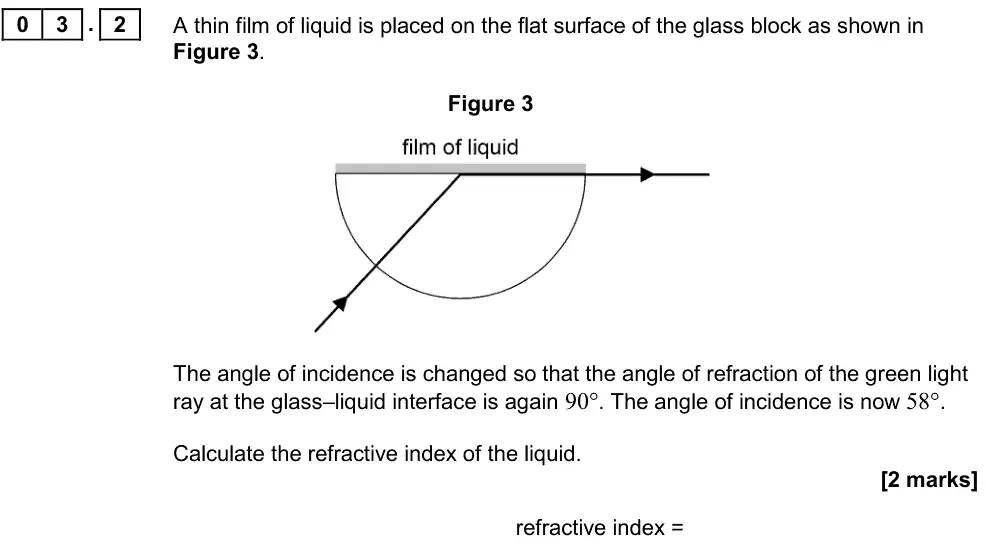
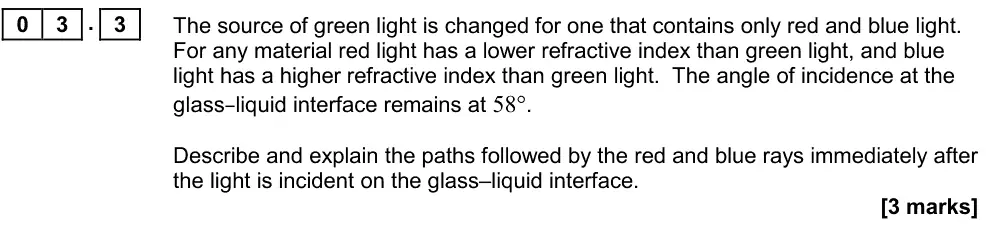
Tap a question to zoom it. Where a part needs a figure, table or graph from earlier in the question, that part folds out above it; the mark scheme and examiner's comment open underneath. Have the AQA data and formulae booklet beside you (see the formula sheet page).
June 2025 · AS Paper 1 · Q2.11 markAO1=1Short answerEasy
Mark scheme
Examiner's comment
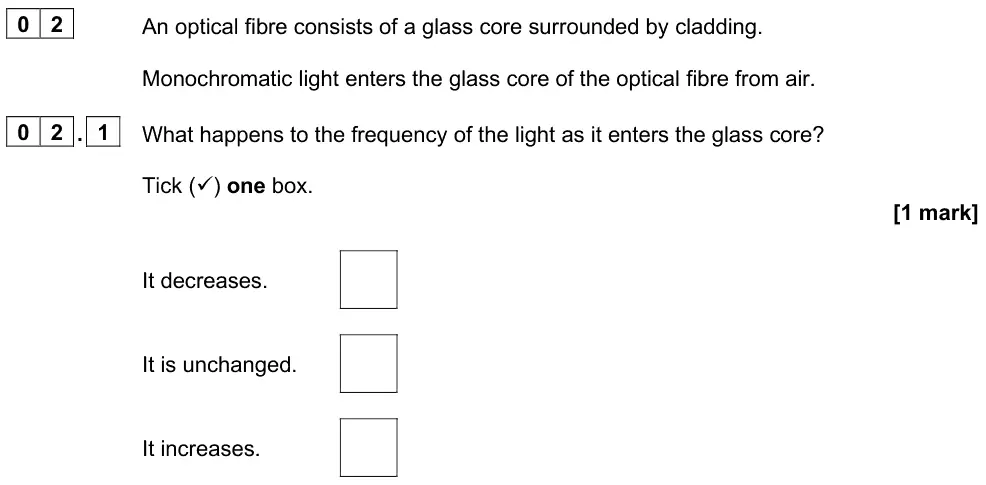
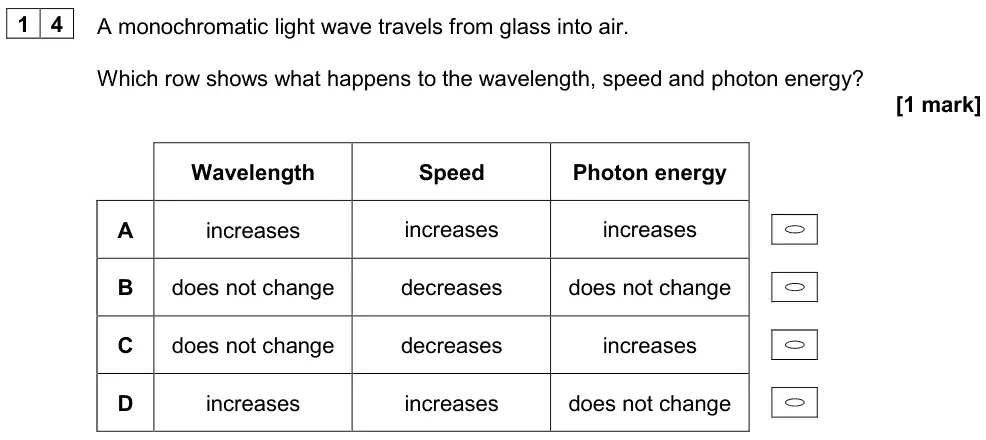
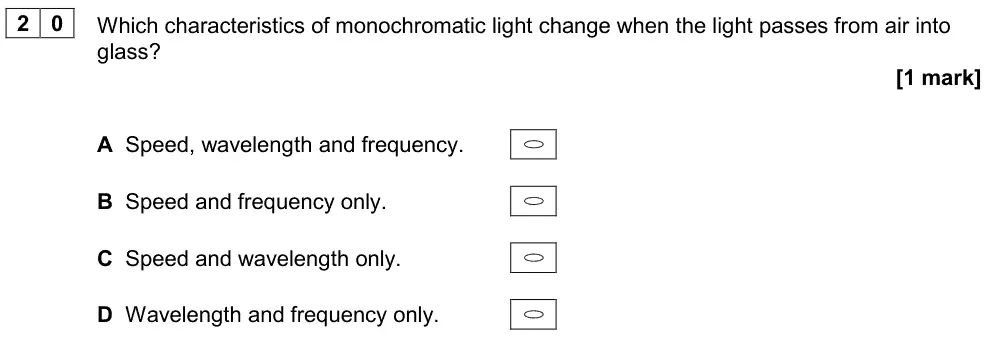
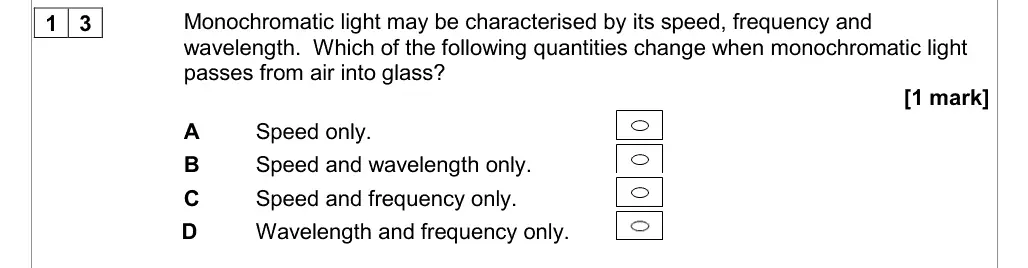
02.1 Approximately 60% of students were able to recall that frequency of light is unchanged when it travels from air into glass. The most common incorrect answer (approximately 30% of students) selected that frequency decreases. These students seemed to know that the speed of light decreases and thought this meant that frequency decreases too.
07.2 This question proved very challenging with approximately 50% of students gaining this mark. 14% of students made no attempt at the question. A very similar question on work done crossing a potential difference was asked on this paper in June 2024 (Q2.1).
07.3 Students enjoyed more success with this question with approximately 60% gaining full marks and a further 24% gaining one mark. Common deficiencies seen included: working out the photon energy and presenting this as the answer. Students should be • made aware that an allocation of 3 marks for a calculation is unlikely to be a single-step calculation even where there are prefixes to convert. incorrect conversion of THz to Hz. There are two examples of prefix conversions on this • paper and these conversions seemed to cause problems for lower attaining students. Students would do well to learn the conversion factors for these prefixes as they will always feature in AS physics exams. being unaware of the photoelectric equation and dividing their photon energy by the • maximum kinetic energy of the photoelectrons arriving at an answer of 2.1 J. 07.4 This question discriminated well between students of varying ability. Over 25% of students gained 3 marks with 20% gaining 2 marks and 15% gaining 1 mark. Almost 13% of students did not make any attempt at this question. Common misconceptions centred on a greater work function having a more negative y- intercept. Many students interpreted X as having a greater work function by having a less negative y-intercept. Students who scored two marks generally scored these marks for drawing X and Y lines parallel to the magnesium line and giving the reason that the gradient equals the work function. • Reinforce key concepts such as Lepton family conservation, quark composition, moments, and energy transformations. Include opportunities to develop skills in calculations that incorporate Multistep • Reasoning. Guide students through logical sequences in multi-mark questions. Practise converting between SI prefixes and using units to check plausibility of the • numerical answer. Develop students’ skills in the interpretation of graphs especially in the context of • motion and the photoelectric effect. Target misconceptions explicitly by use past-paper examples in classroom discussions • and model answers. Ensure students use terminology accurately particularly in recall questions where • these are used as an easy introduction to set the question’s context.
Notes from the mark scheme and report
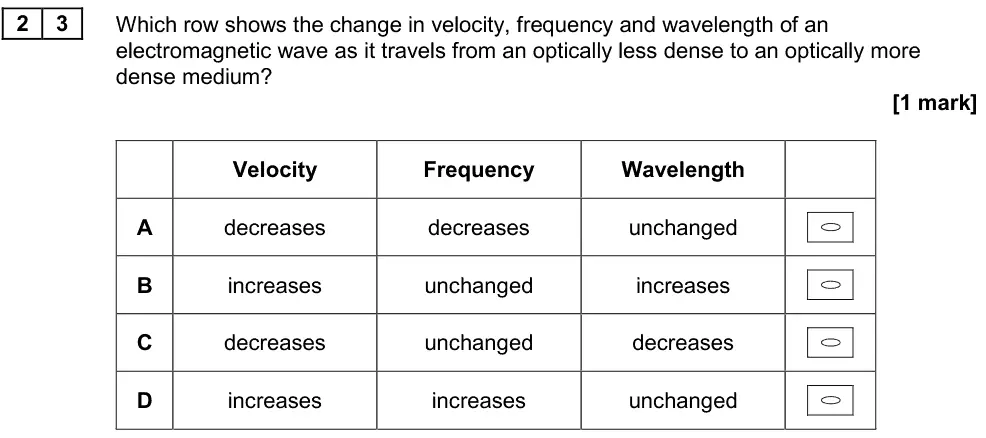
It is unchanged (second box)
about 30% chose 'decreases' confusing speed with frequency
tick-box item
June 2025 · AS Paper 1 · Q2.22 marksAO1=1, AO2=1CalculationEasy
Earlier part of question 2 that this part uses
Mark scheme
Examiner's comment
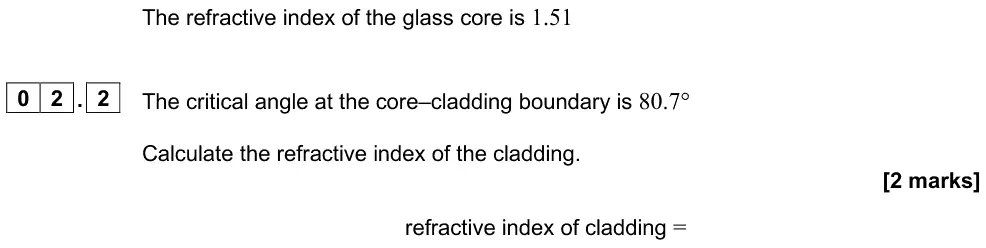
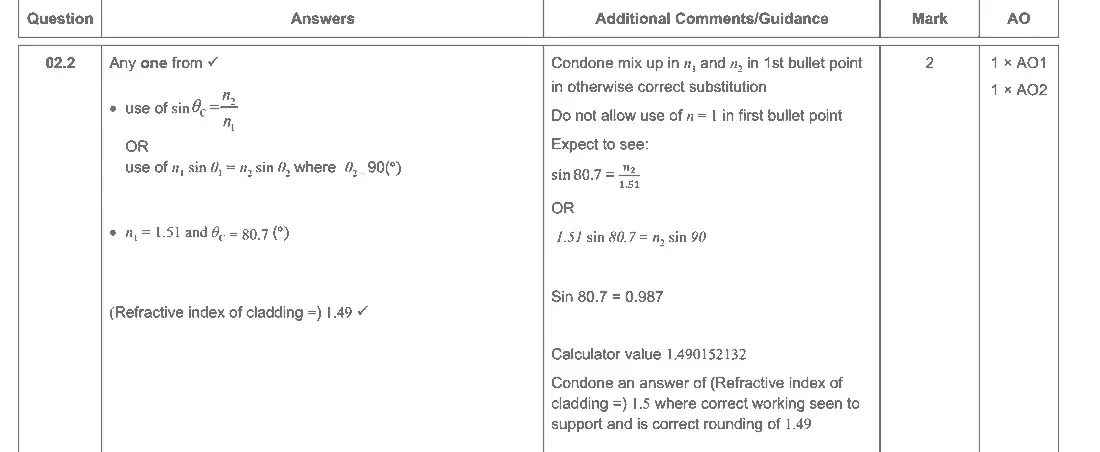
02.2 This was a straight-forward calculation with approximately 70% of students gaining both marks. The most common incorrect answer seen was a refractive index of 1.53 for the cladding. This occurred because these students mixed up n1 and n2 in their attempt to use either n θ = 2 or n1 sin θ1 = n2 sin θ2 . This error demonstrated the student’s lack of awareness sin C n 1 that n2 must be less than n1 for total internal reflection to occur.
02.3 This was another straight-forward calculation with approximately 70% of students gaining both marks. Some students misinterpreted the question and treated θB as a critical angle. Others used the incorrect value for the refractive index of the core using 1.49 rather than 1.53. These students could have improved their exam performance by realising that the refractive index of the core being given as a mini stem above 02.2 indicated that this piece of information was relevant to more than 02.2.
Notes from the mark scheme and report
Answer: 1.49 (1.51 sin 80.7)
1.53 from swapping n1 and n2 was the common wrong answer
Skills: MS0.6 Use calculators to handle sin x, cos x, tan x when x is expressed in degrees or radians; MS2.2 Change the subject of an equation, including non-linear equations
June 2025 · AS Paper 1 · Q2.32 marksAO1=1, AO2=1CalculationEasy
Earlier part of question 2 that this part uses
Mark scheme
Examiner's comment
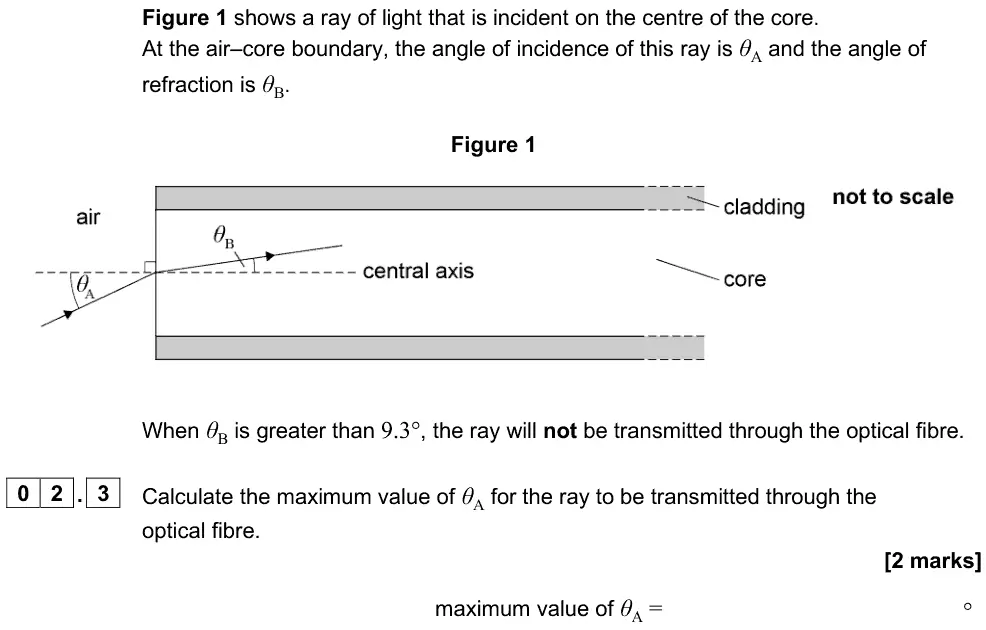
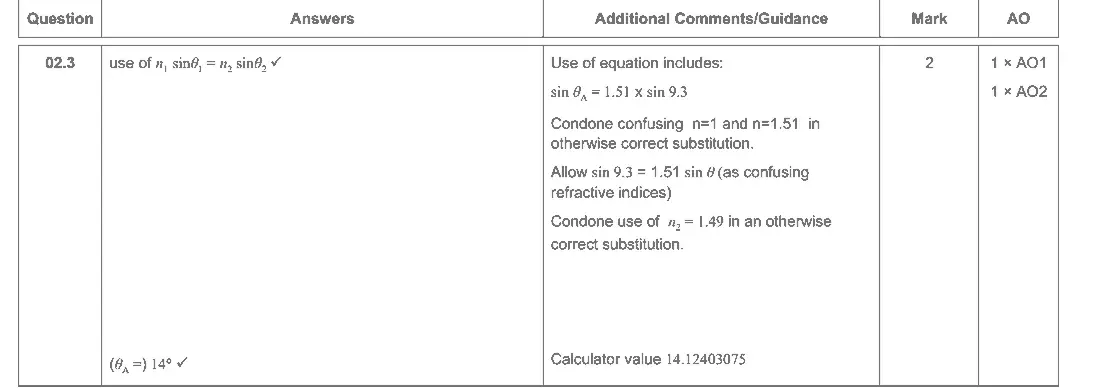
02.3 This was another straight-forward calculation with approximately 70% of students gaining both marks. Some students misinterpreted the question and treated θB as a critical angle. Others used the incorrect value for the refractive index of the core using 1.49 rather than 1.53. These students could have improved their exam performance by realising that the refractive index of the core being given as a mini stem above 02.2 indicated that this piece of information was relevant to more than 02.2.
Notes from the mark scheme and report
Answer: 14 degrees (sin theta A = 1.51 sin 9.3)
treating theta B as a critical angle or using 1.49 were errors
Skills: MS0.6 Use calculators to handle sin x, cos x, tan x when x is expressed in degrees or radians; MS2.3 Substitute numerical values into algebraic equations using appropriate units for physical quantities
June 2025 · AS Paper 1 · Q2.43 marksAO3=3CalculationHard
Earlier part of question 2 that this part uses
Mark scheme
Examiner's comment
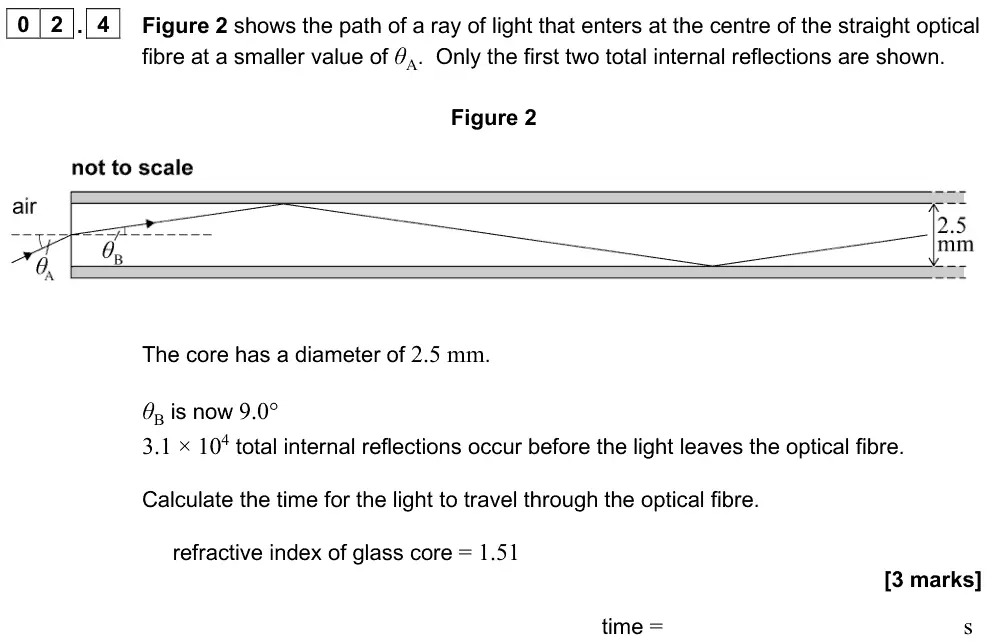
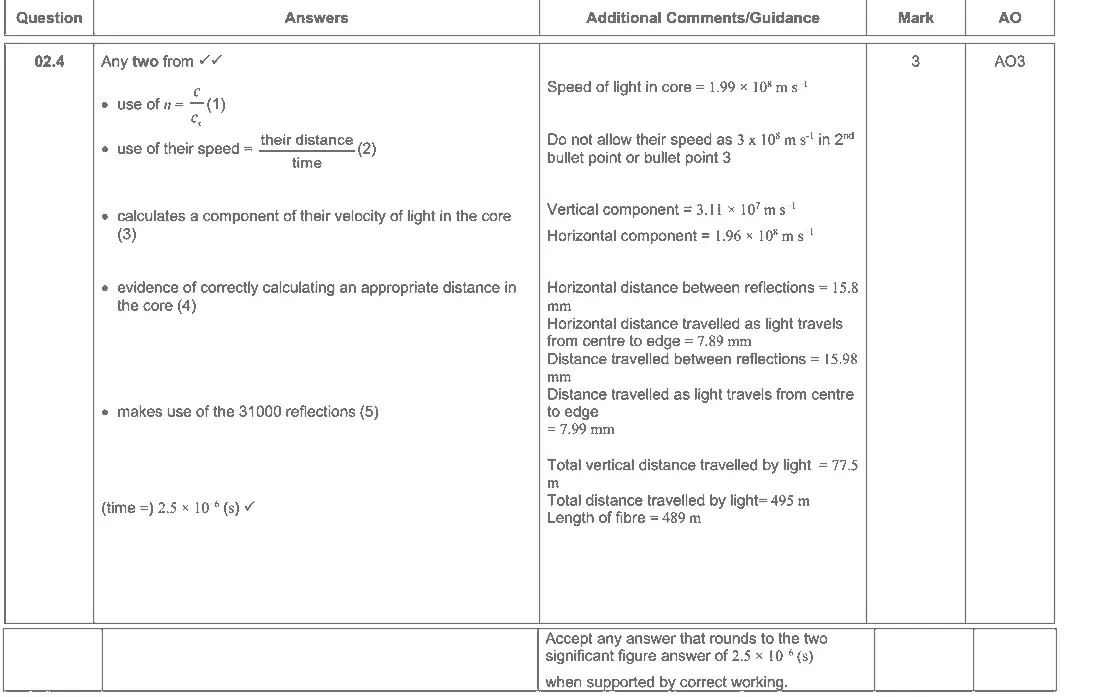
02.4 This question discriminated well between lower and higher attaining students. Just over 20% of students gained 3 marks with another 28% gaining 2 marks and 18% gaining 1 mark. Certainly, any student gaining all 3 marks demonstrated a high-level of understanding and was able to perform the multi-step calculation in a clear and coherent way. Any student who didn’t recognise that the speed of light was no longer 3 x 10⁸ ms-1 typically didn’t score more than one mark. towards the answer.
The most common correct method seen was: calculates the speed of light in the core. • determines the total distance travelled by the light inside the core. • use of speed and total distance to calculate the time. •
Notes from the mark scheme and report
Answer: 2.5 x 10^-6 s (speed in core 1.99 x 10^8 m s^-1
path between reflections 15.98 mm, total about 495 m)
using 3 x 10^8 m s^-1 limited marks
Skills: MS4.5 Use sin, cos and tan in physical problems; MS2.3 Substitute numerical values into algebraic equations using appropriate units for physical quantities
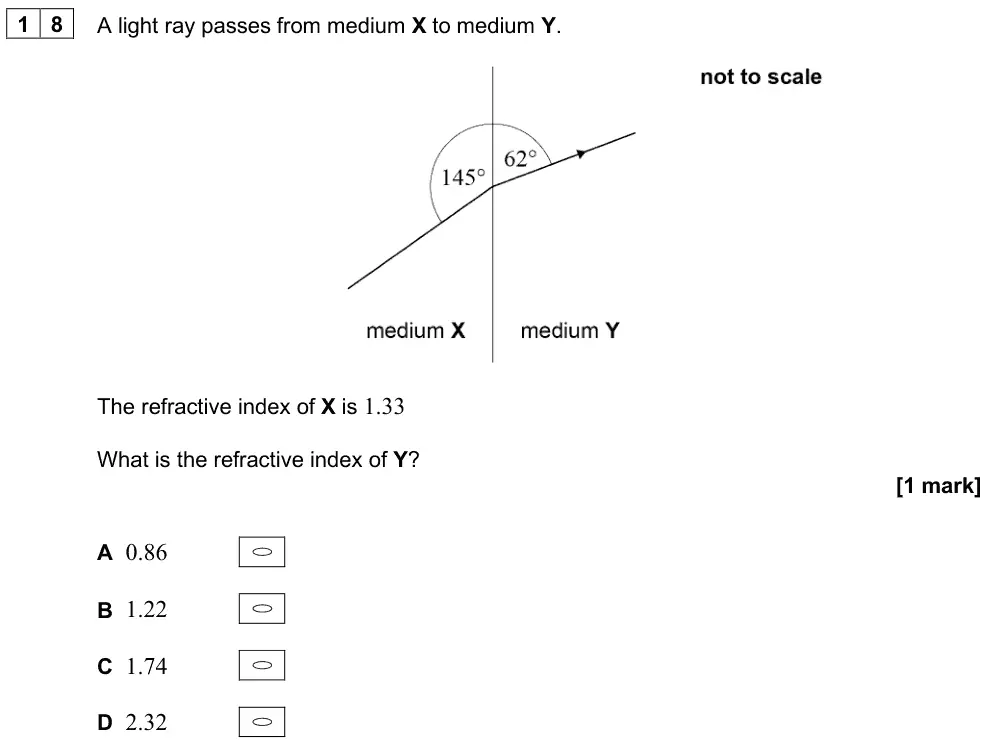
June 2025 · Paper 1 · Q181 markAO2=1Multiple choice
Answer
D
Mark scheme
Notes from the mark scheme and report
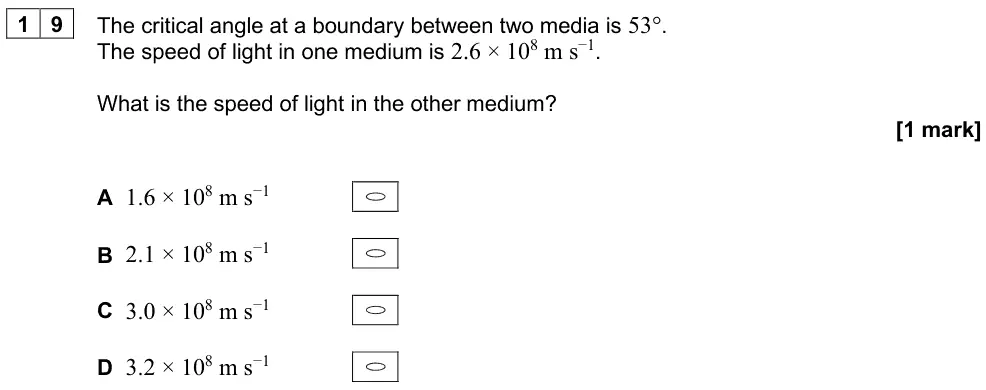
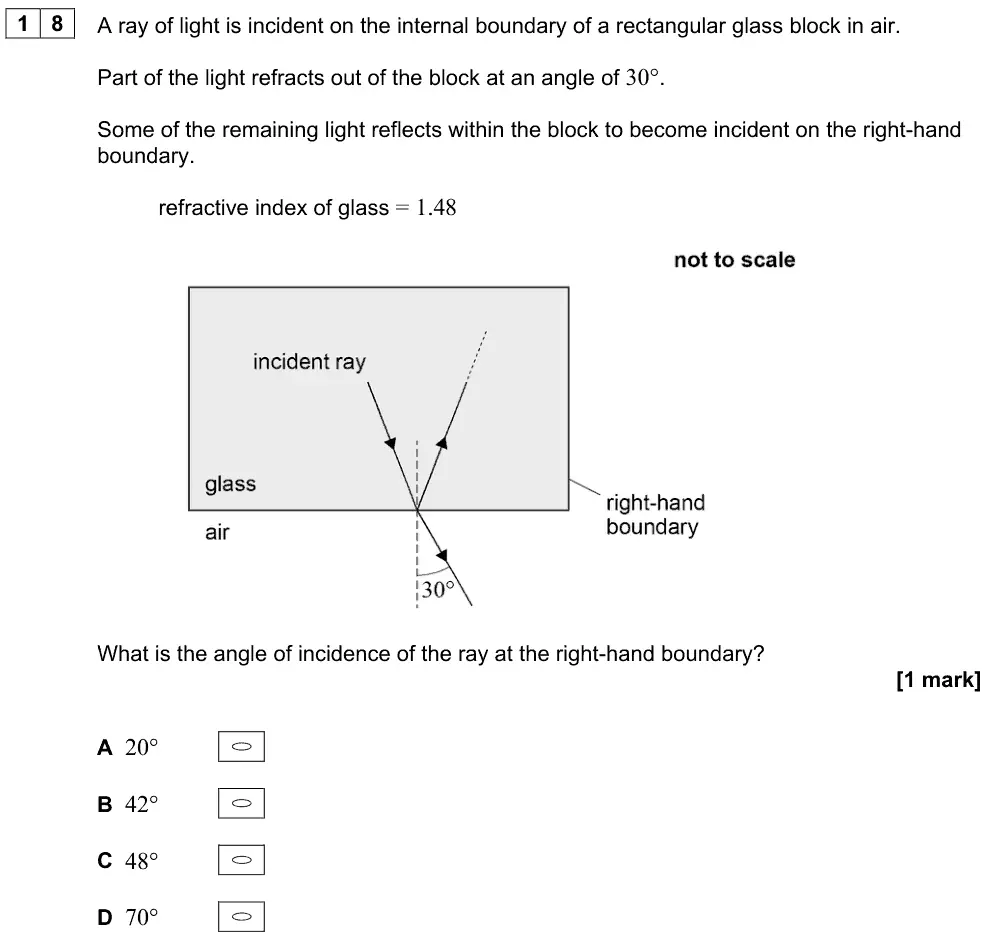
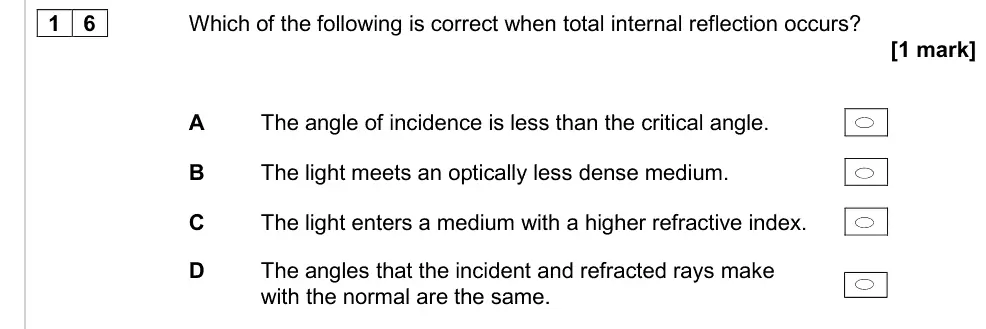
Answer: D
Skills: MS0.6 Use calculators to handle sin x, cos x, tan x when x is expressed in degrees or radians; MS4.1 Use angles in regular 2D and 3D structures
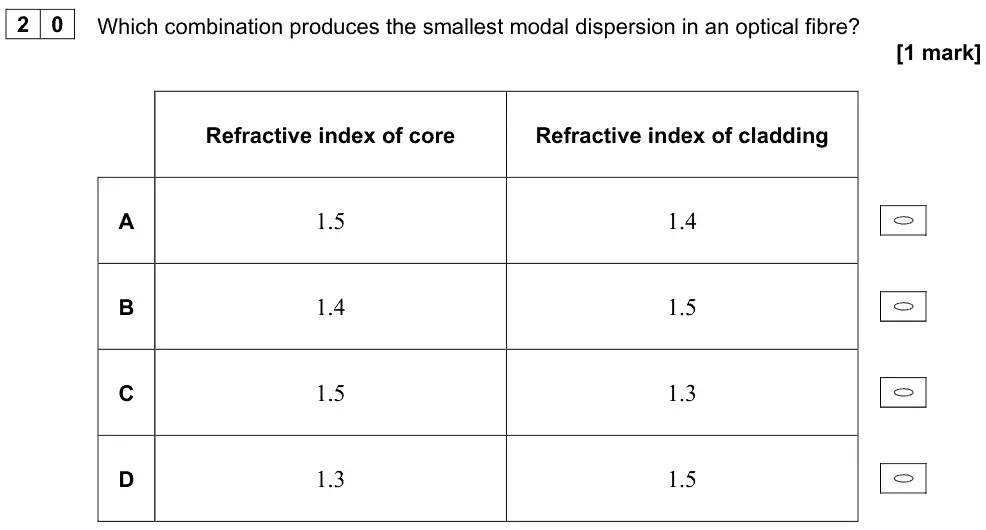
June 2025 · Paper 1 · Q191 markAO2=1Multiple choice
Answer
B
Mark scheme
Notes from the mark scheme and report
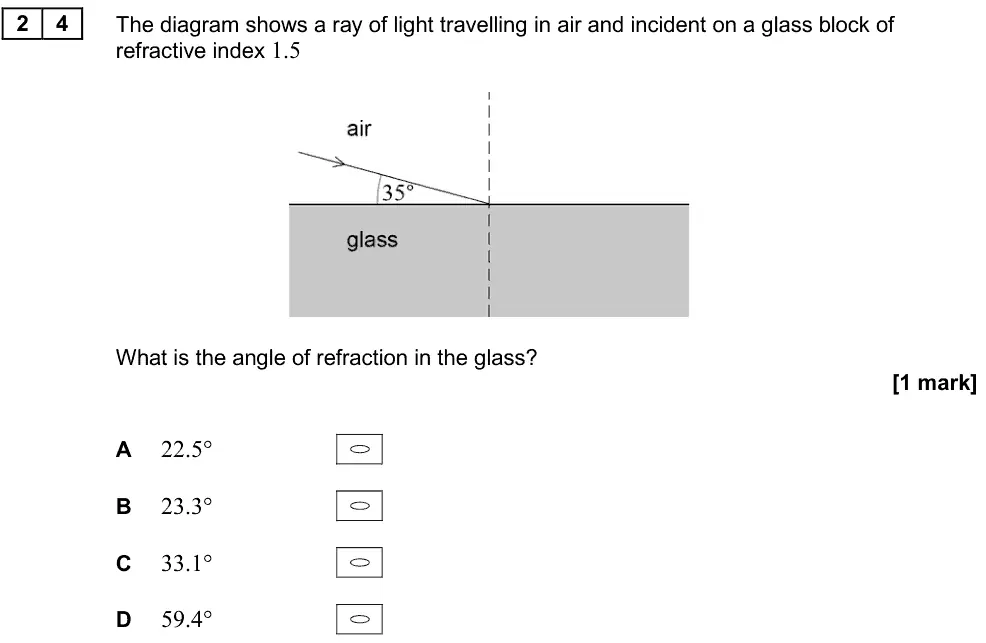
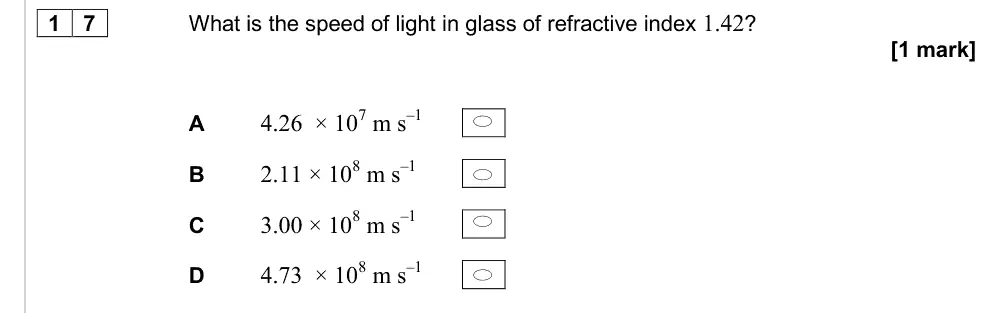
Answer: B
Skills: MS0.6 Use calculators to handle sin x, cos x, tan x when x is expressed in degrees or radians
June 2025 · AS Paper 2 · Q141 markAO1=1Multiple choice
Answer
B
Mark scheme
Examiner's comment
Students were more successful in answering questions 6, 11, 14, 19, 22, 28, and were less successful in answering questions 10, 15, 21, 25, 29.
Notes from the mark scheme and report
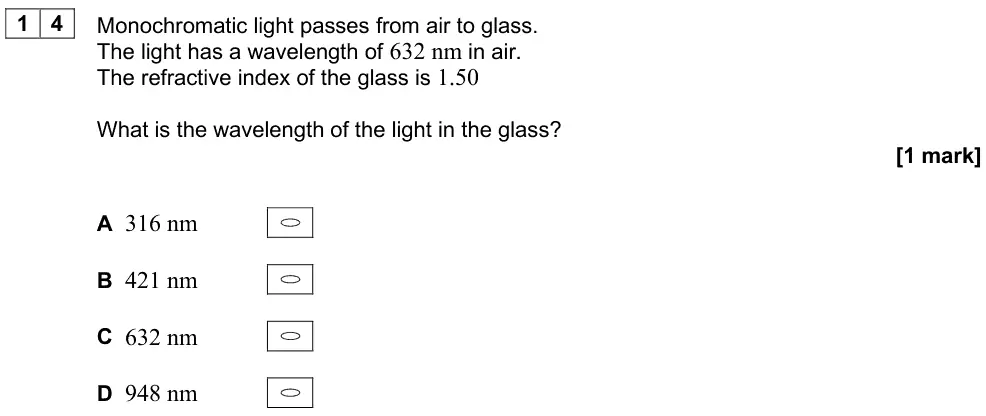
Answer: B
June 2024 · Paper 1 · Q3.11 markAO2=1Diagram or graph
Mark scheme
Examiner's comment
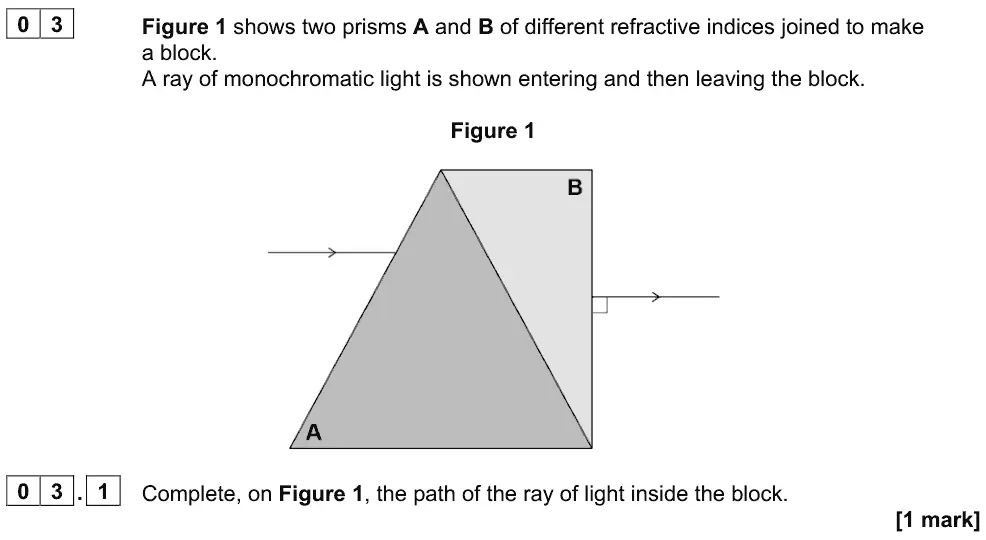
The complex prism in Figure 1 is designed to separate out light into its different wavelengths whilst keeping the rays horizontal. The ray diagram in question 03.1 was drawn correctly by almost 50% of students. These spotted that the exit ray leaving normally means that the ray in B must be horizontal. Completing the diagram then simply requires joining the ray entering A to the one in B. Many untidy diagrams were seen, and students should be encouraged to use a ruler when drawing ray diagrams of this kind.
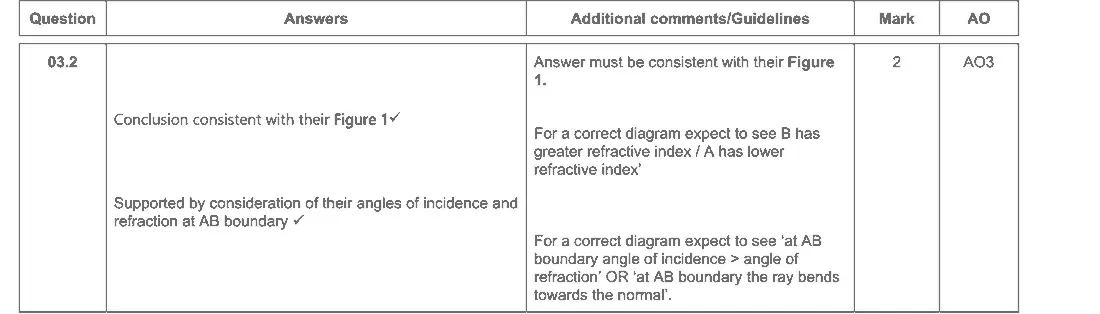
Question 03.2 was marked according to the student’s answer to 03.1. This meant that both marks for this question could be given even if 03.1 was incorrect. Students who referred to angles, without stating the boundary they were referring to, were not awarded the mark for their reasoning.
Notes from the mark scheme and report
Ray in B horizontal (exit ray leaves along the normal) and joined to the ray in A
use a ruler
June 2024 · Paper 1 · Q3.22 marksAO3=2Explanation
Earlier part of question 3 that this part uses
Mark scheme
Examiner's comment
Question 03.2 was marked according to the student’s answer to 03.1. This meant that both marks for this question could be given even if 03.1 was incorrect. Students who referred to angles, without stating the boundary they were referring to, were not awarded the mark for their reasoning.
Notes from the mark scheme and report
Marked consistently with the student's own Figure 1
must say which boundary the angles refer to
June 2024 · AS Paper 2 · Q4.33 marksAO1=1, AO2=1, AO3=1Explanation
Earlier part of question 4 that this part uses
Mark scheme
Examiner's comment
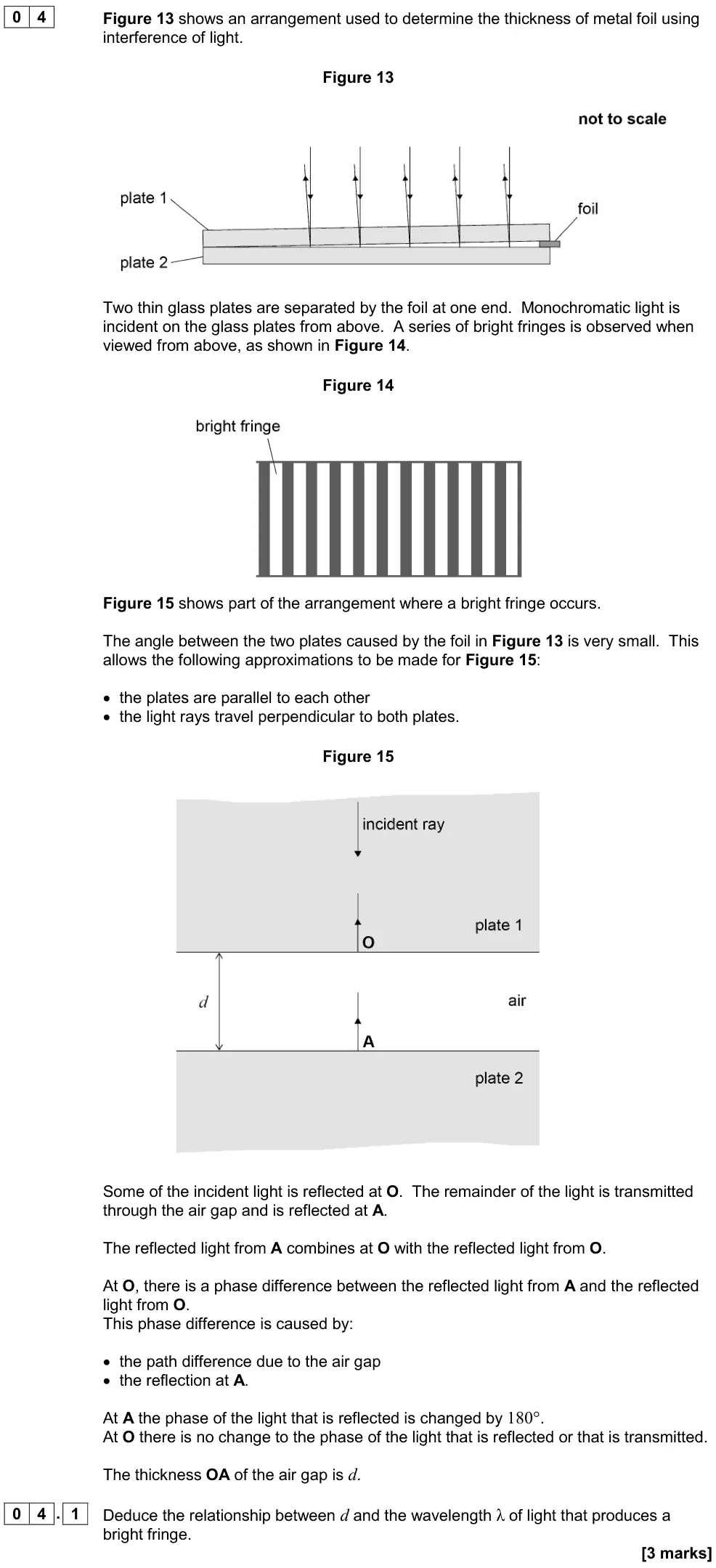
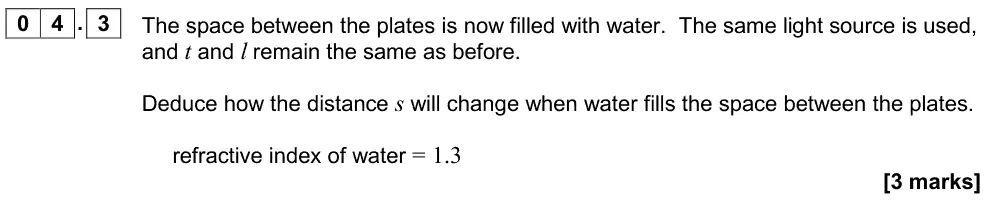
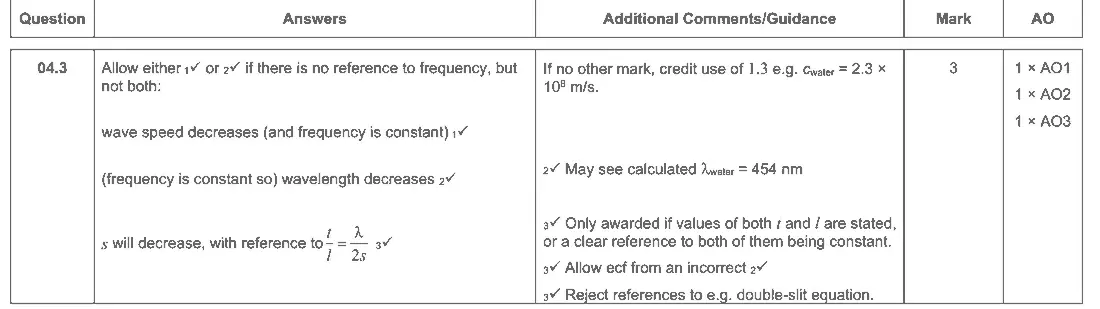
04.3 Most students incorrectly responded to this question with a Snell’s law approach and argued in terms of a changing angle of refraction causing a change in the fringe spacing. This was incorrect as the lights rays are almost incident along the normal to the plates.
Students who gained one mark made a relevant statement about the decrease in wave speed or wavelength but did not clearly reference the constant frequency. It was surprising how many students, having appreciated that the wavelength decreased, did not use the equation to deduce the consequential decrease in s.
Notes from the mark scheme and report
Wave speed and wavelength decrease in water (frequency constant, lambda = 454 nm)
with t and l constant s decreases since s = lambda l / 2t
Snell's-law angle arguments wrong as rays are normal
June 2024 · AS Paper 2 · Q211 markMultiple choice
Answer
C
Mark scheme
Examiner's comment
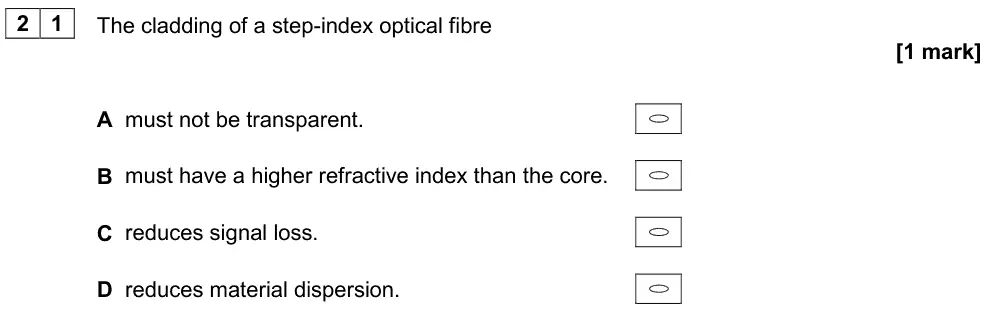
Question 21: Option B was the most popular response.
Notes from the mark scheme and report
Answer: C
most chose B
June 2023 · AS Paper 1 · Q2.44 marksAO2=2, AO3=2CalculationHard
Earlier part of question 2 that this part uses
Mark scheme
Examiner's comment
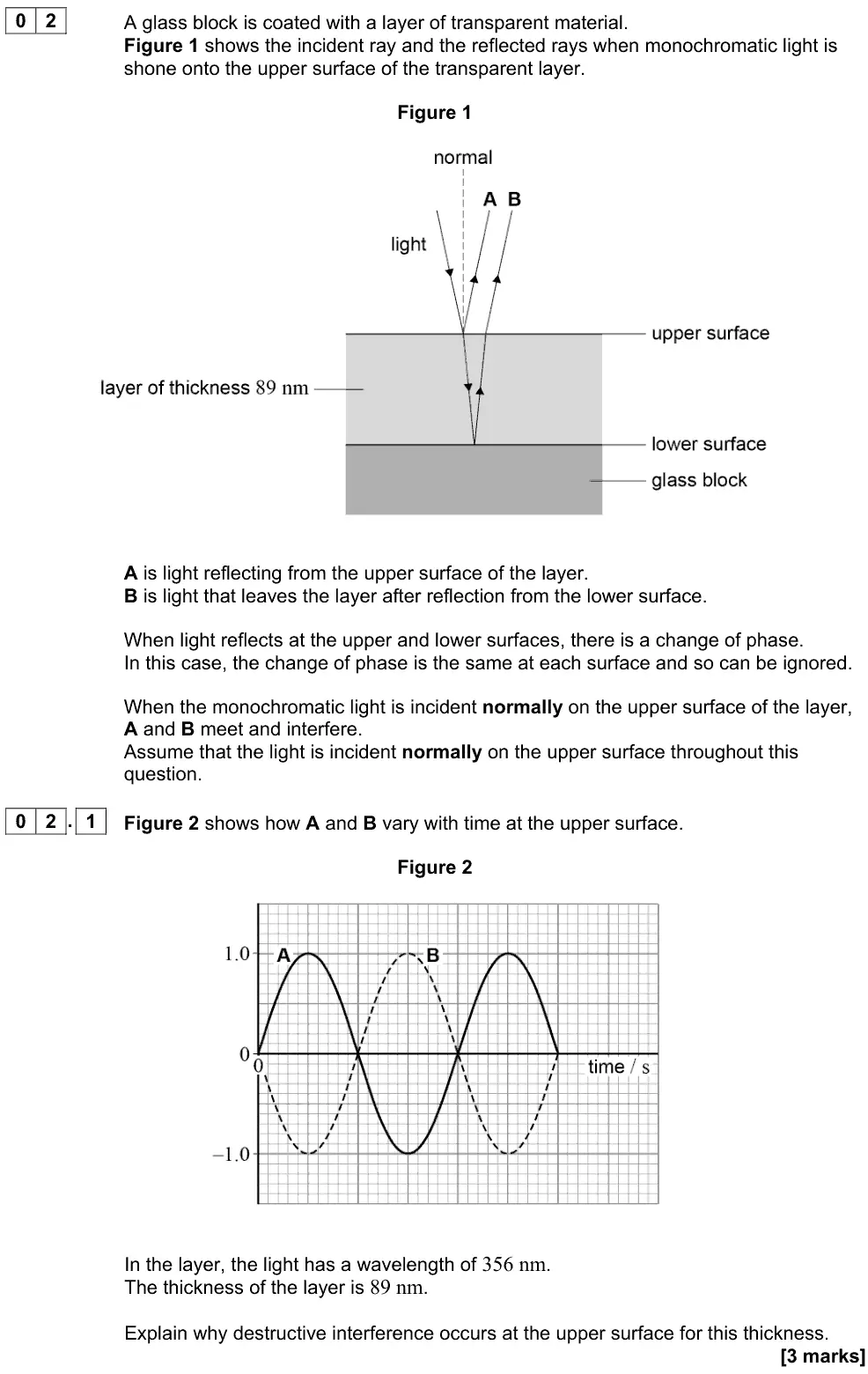
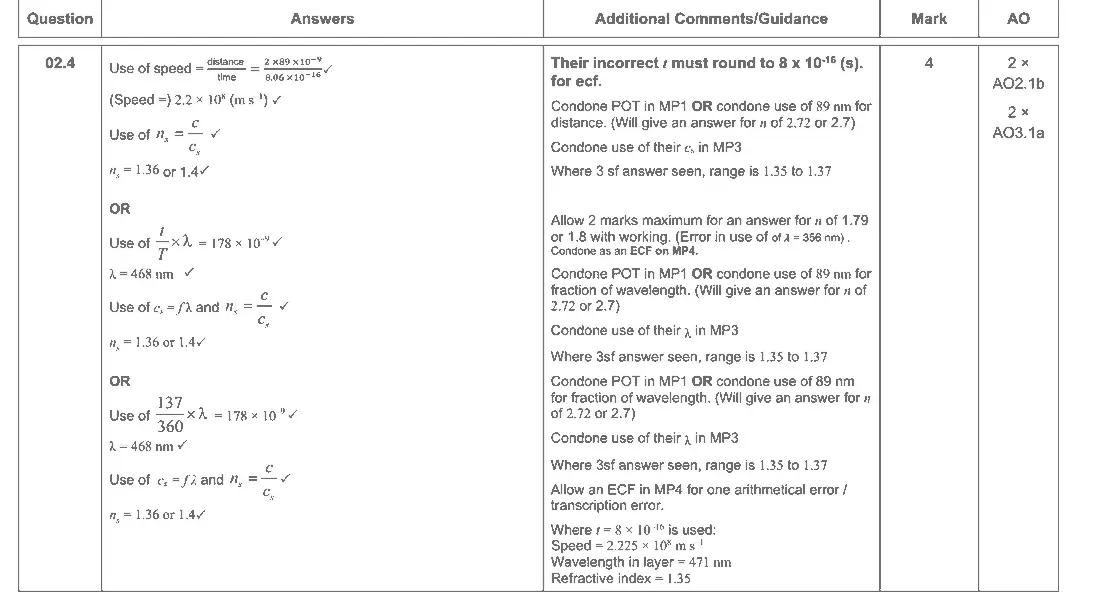
02.4 This was a challenging multi-step calculation that was beyond most of the students. Just over 30% of students scored any marks at all, with 6% of students scoring all four marks. Many students attempted to apply Snell’s law of refraction for a boundary using 137° as the angle of incidence. Others did not appreciate that the wavelength had changed when the frequency had changed and continued to use 356 nm for the wavelength in the layer. These students were able to achieve some of the compensatory marks, however.
Notes from the mark scheme and report
Answer: 1.36 (speed = 178 nm / 8.06 x 10^-16 s = 2.2 x 10^8 m s^-1, n = c/c_s
or wavelength 468 nm)
Snell's law with 137 degrees or reusing 356 nm were common errors
Skills: MS2.3 Substitute numerical values into algebraic equations using appropriate units for physical quantities; MS2.2 Change the subject of an equation, including non-linear equations
June 2023 · Paper 1 · Q4.11 markAO1=1Show thatEasy
Mark scheme
Examiner's comment
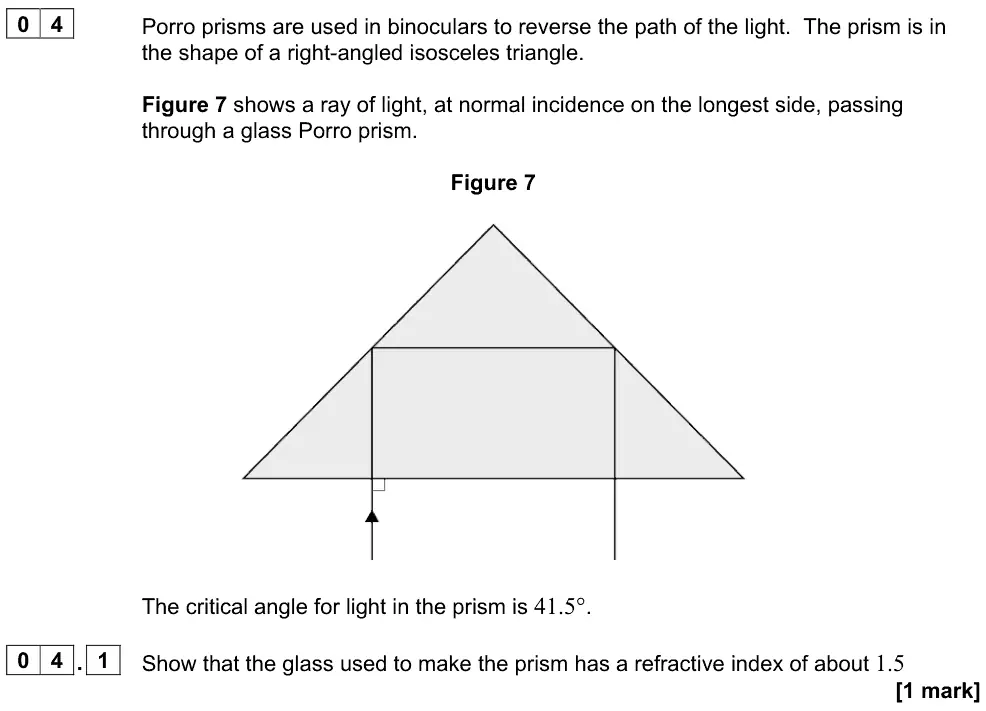
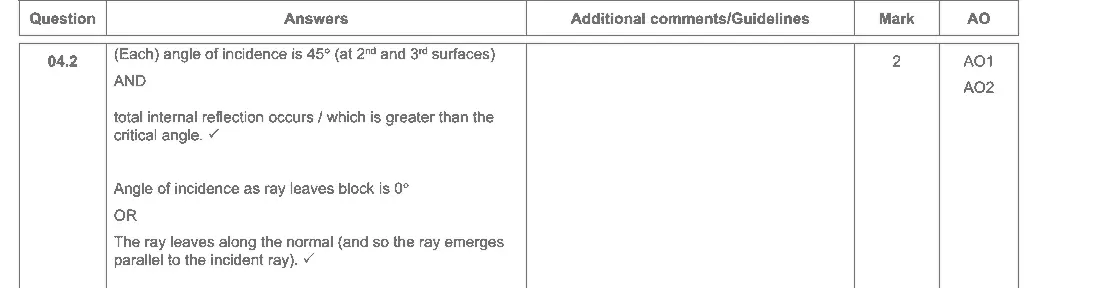
04.1 A straightforward calculation that over 80% of students completed successfully. Transcription errors when writing down the angle were common with students who did not get the mark. 04.2 This question proved to be much more difficult than 04.1. The best answers correctly identified the process of total internal reflection and could explain why it happened in terms of the incident and critical angles. They then went on to explain why the ray was undeviated as it left the prism. Many answers missed out the second marking point, or failed to identify the angle of incidence. Other answers often described the changes in direction without any explanation.
Notes from the mark scheme and report
n = 1/sin41.5 = 1.51 (3 sf, working shown)
Skills: MS0.6 Use calculators to handle sin x, cos x, tan x when x is expressed in degrees or radians
June 2023 · Paper 1 · Q4.22 marksExplanation
Earlier part of question 4 that this part uses
Mark scheme
Examiner's comment
04.1 A straightforward calculation that over 80% of students completed successfully. Transcription errors when writing down the angle were common with students who did not get the mark. 04.2 This question proved to be much more difficult than 04.1. The best answers correctly identified the process of total internal reflection and could explain why it happened in terms of the incident and critical angles. They then went on to explain why the ray was undeviated as it left the prism. Many answers missed out the second marking point, or failed to identify the angle of incidence. Other answers often described the changes in direction without any explanation.
Notes from the mark scheme and report
Angle of incidence 45 degrees at each short face exceeds the critical angle so TIR twice
ray leaves along the normal (incidence 0) so emerges parallel
the second point was often missed
June 2023 · Paper 1 · Q4.33 marksAO2=3Diagram or graph
Earlier part of question 4 that this part uses
Mark scheme
Examiner's comment
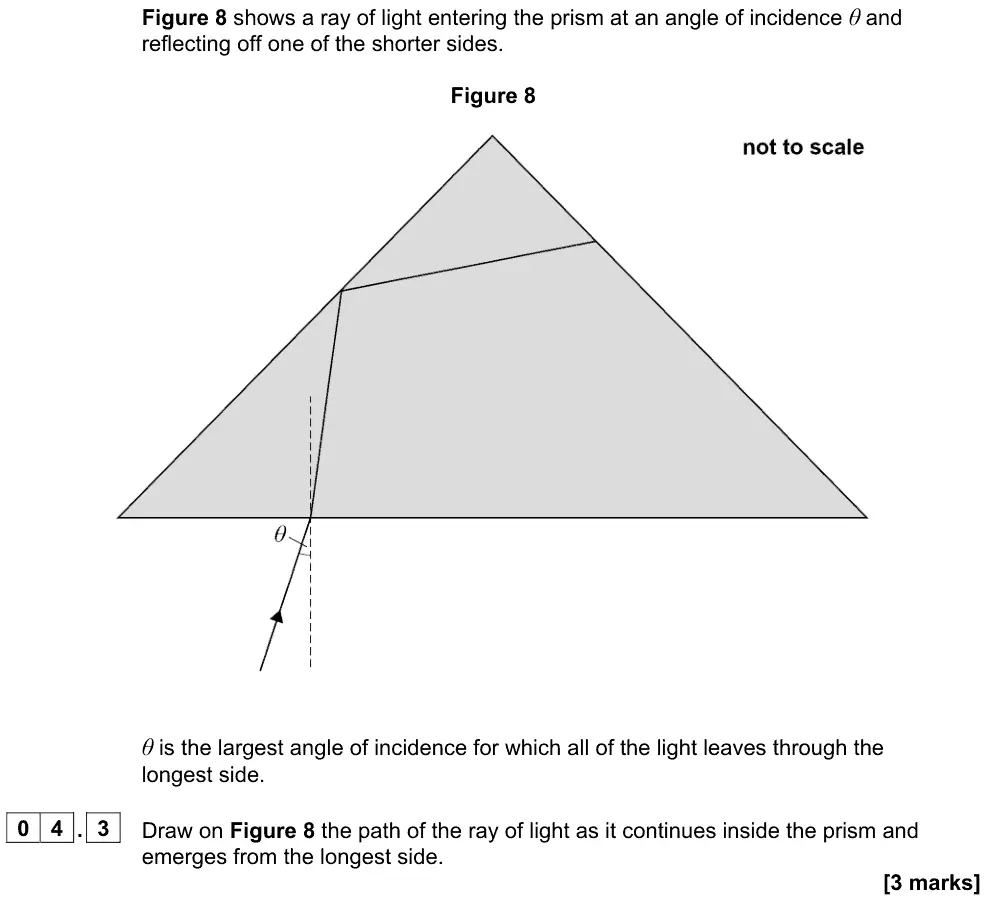
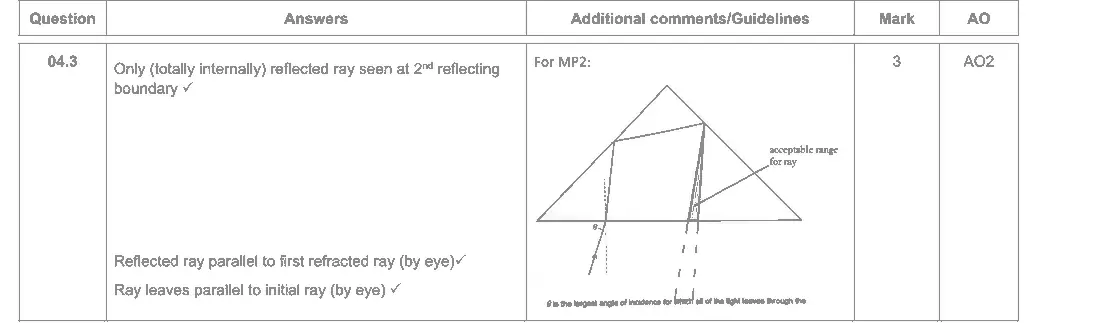
04.3 Nearly 90% of students managed to get at least one mark on this question. This mark was usually given for showing that the ray remains within the prism. Students who used a protractor for the reflected ray were more likely to get the second mark. There was some leniency for students who chose to draw the ray by eye, however. The third mark was for a ray that left parallel to the incident ray. Those who had read the question carefully and those with a good understanding of refraction were most likely to obtain this mark. Students should be encouraged to read the question carefully: for example, the stem of the question stated that the prism acted so as to “reverse the path of the light”. A carefully-drawn, reflected ray would be clearly parallel to the refracted ray, which would also have provided a hint for the third marking point. Each mark was awarded independently. Over one-third of students obtained two marks whilst about one in eight students managed to get all three.
Notes from the mark scheme and report
Second reflection is total internal reflection
reflected ray parallel to the first refracted ray
ray emerges parallel to the incident ray
use a protractor
June 2023 · Paper 1 · Q4.44 marksAO1=4Show that
Earlier part of question 4 that this part uses
Mark scheme
Examiner's comment
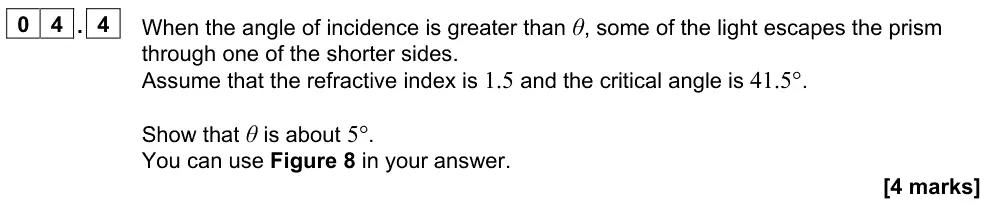
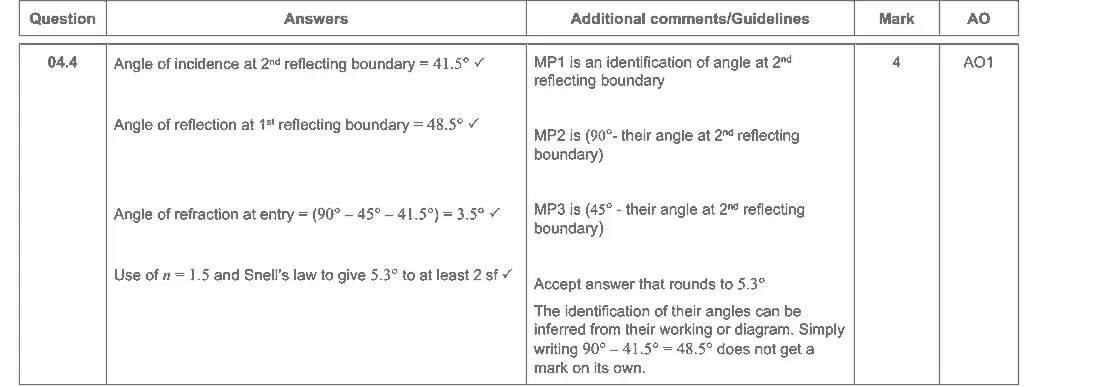
04.4 This was one of the most discriminating questions on the paper. The most successful answers either used Figure 8 on the facing page, as was suggested, or re-drew Figure 8, and labelled the angles. A common error was misidentifying the critical angle as either the angle between the ray and the surface at the second boundary or the incident ray at the first, despite these angles being clearly greater than the 45o in Figure 7. Students were told that Figure 8 was ‘not to scale’ so that they did not attempt to take measurements from the diagram. Simply using Snell’s Law with the critical angle was common. Other incorrect answers showed a negative value for the refracted angle and students who took this route often did not go back to check what they had done wrong.
Notes from the mark scheme and report
Incidence at second face = critical angle 41.5, so reflection at first face 48.5, refraction at entry 45 - 41.5 = 3.5 degrees
1.5 sin3.5 gives theta = 5.3 degrees
label angles on Figure 8
one of the most discriminating parts
Skills: MS4.1 Use angles in regular 2D and 3D structures; MS0.6 Use calculators to handle sin x, cos x, tan x when x is expressed in degrees or radians
June 2023 · Paper 1 · Q4.54 marksAO3=4Explanation
Earlier part of question 4 that this part uses
Mark scheme
Examiner's comment
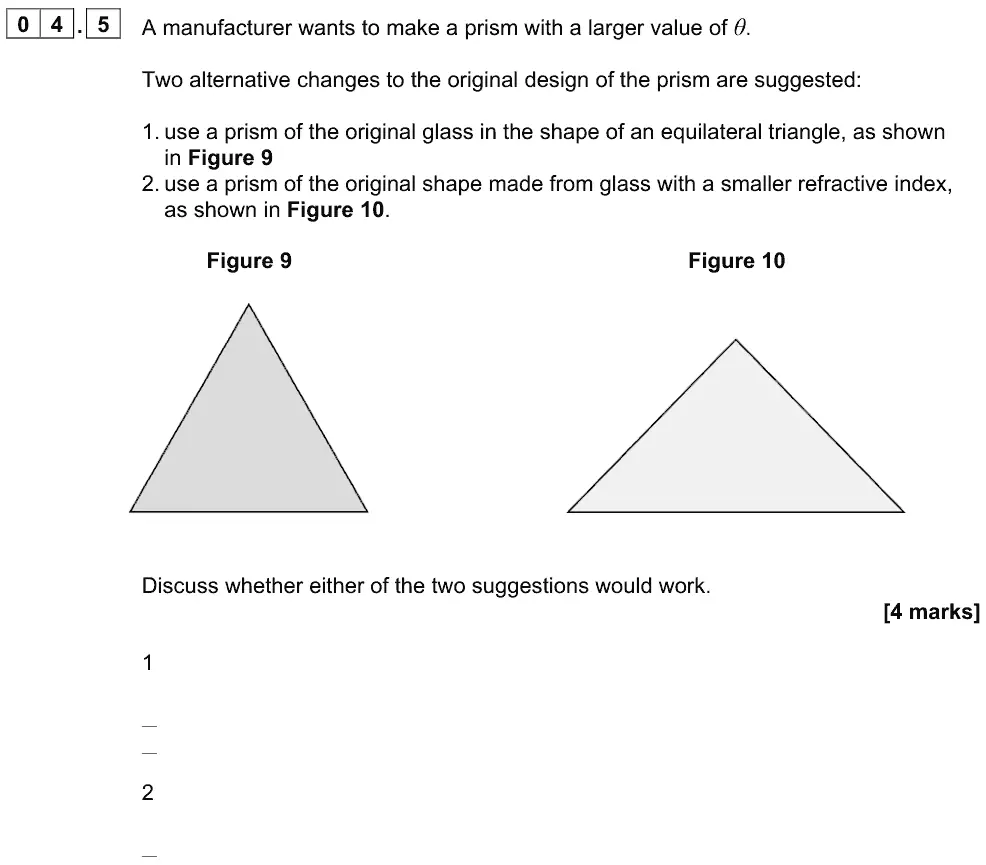
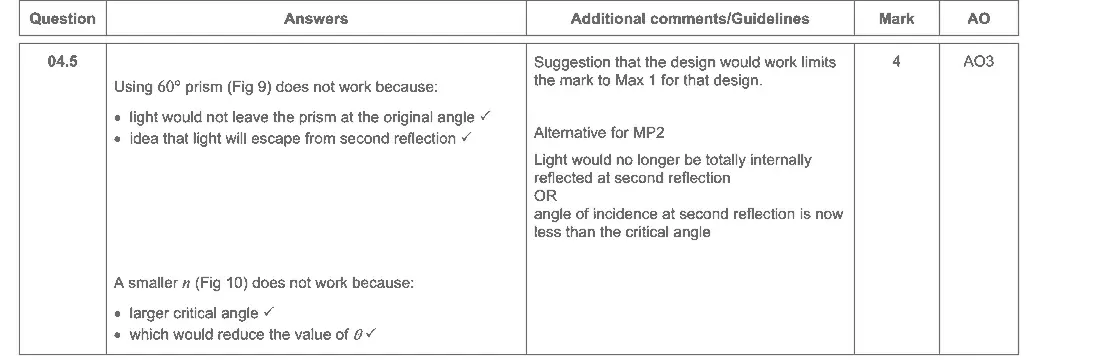
04.5 This tested the assessment objective AO3. More than half of the students managed to get at least one mark, usually for identifying that the critical angle in Figure 10 would be greater. The best answers showed some understanding of the context and realised that in Figure 9 the prism would no longer function as required as the path of the ray would no longer be reversed, whatever the value of .
Notes from the mark scheme and report
Equilateral prism fails: ray no longer reversed and escapes at the second reflection
smaller n fails: larger critical angle so theta gets smaller
saying a design works limits that design to 1 mark
June 2023 · AS Paper 2 · Q4.11 markAO1=1Short answer
Mark scheme
Examiner's comment
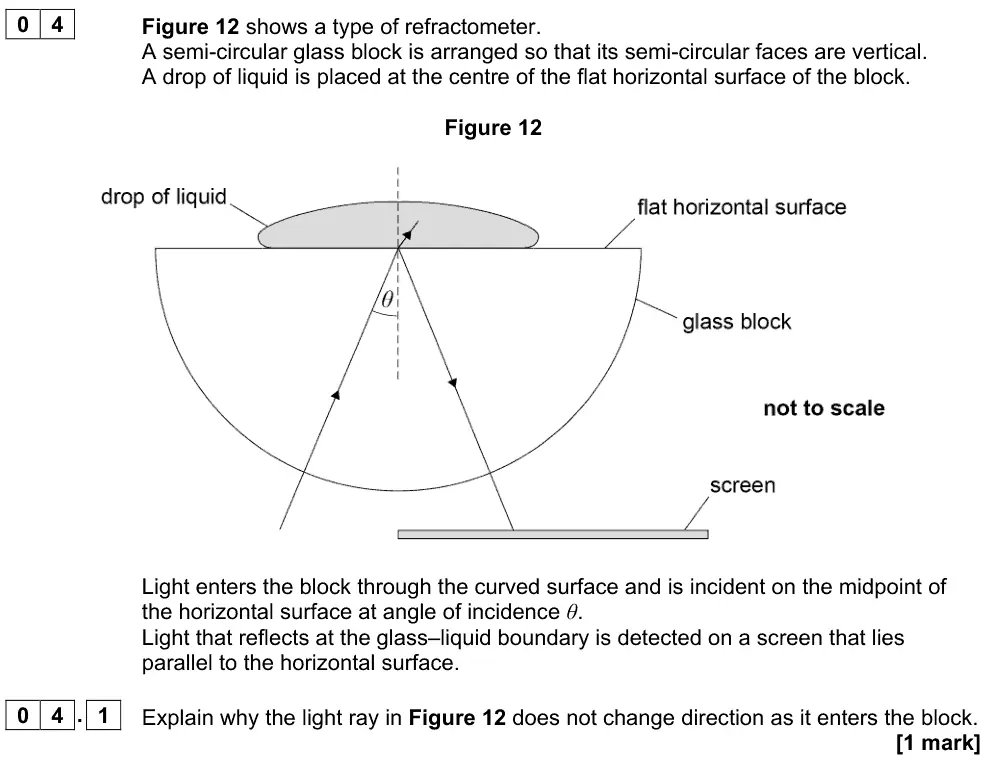
04.1 There was near enough a 50:50 split in the mark distribution for this question about a lack of deviation during refraction.
Notes from the mark scheme and report
Ray enters along the normal (radius) to the curved surface, angle of incidence zero
'towards the normal' rejected
June 2023 · AS Paper 2 · Q4.22 marksAO2=2CalculationEasy
Earlier part of question 4 that this part uses
Mark scheme
Examiner's comment
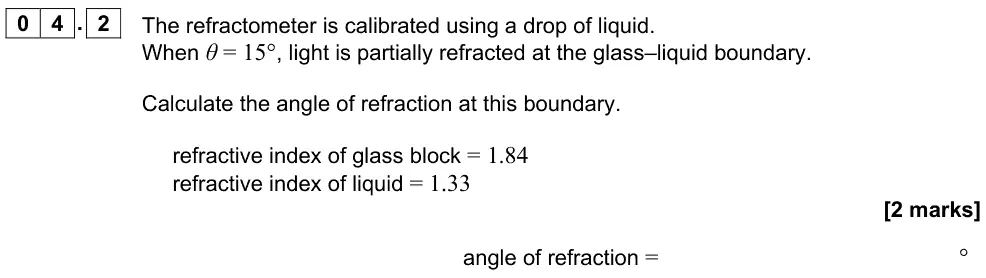
04.2 Over 77% of students gained both marks for this Snell’s Law calculation.
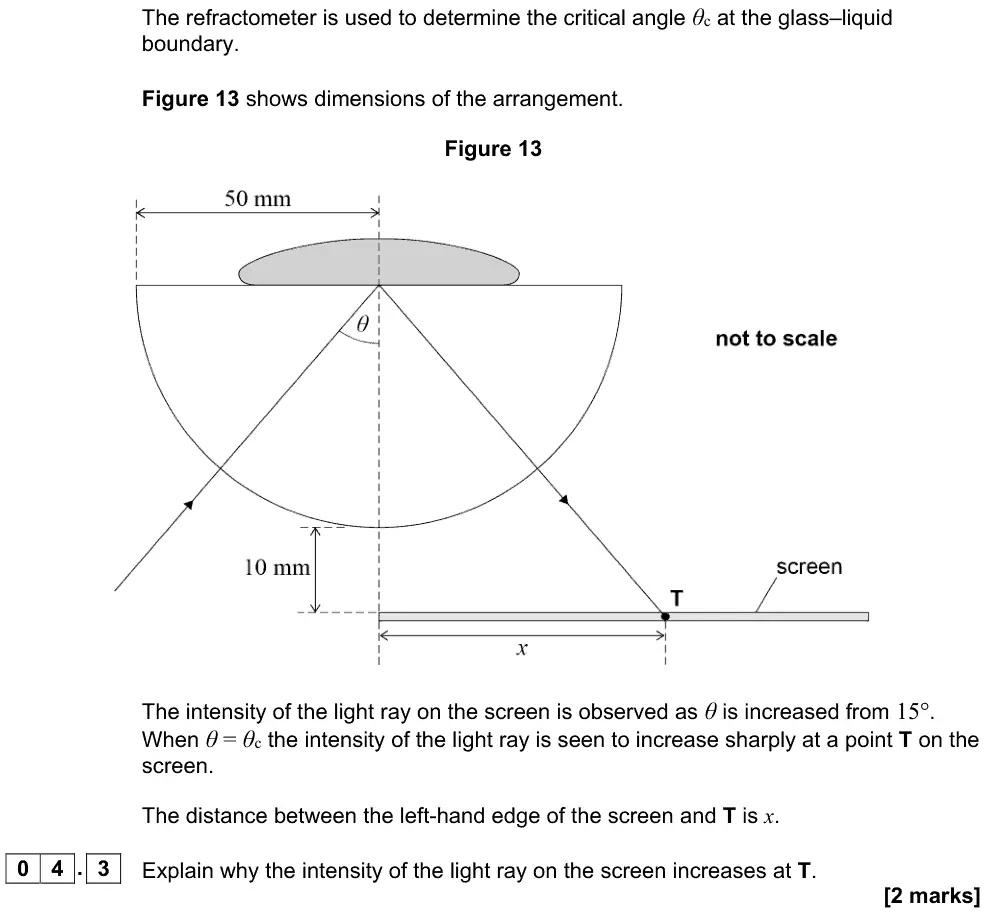
04.3 About 40% of the cohort gained one mark for explaining that total internal reflection would occur at T (and beyond). Few students addressed the reason, for a second mark, why the intensity was lower to the left of T. Students were told in question 04.2 that there was partial refraction, so repeating this information was not creditworthy. Their answer needed to be in terms of partial reflection.
Notes from the mark scheme and report
Answer: 21 degrees (1.84 sin 15 = 1.33 sin theta)
Skills: MS0.6 Use calculators to handle sin x, cos x, tan x when x is expressed in degrees or radians; MS2.2 Change the subject of an equation, including non-linear equations
June 2023 · AS Paper 2 · Q4.32 marksAO2=2Explanation
Earlier part of question 4 that this part uses
Mark scheme
Examiner's comment
04.3 About 40% of the cohort gained one mark for explaining that total internal reflection would occur at T (and beyond). Few students addressed the reason, for a second mark, why the intensity was lower to the left of T. Students were told in question 04.2 that there was partial refraction, so repeating this information was not creditworthy. Their answer needed to be in terms of partial reflection.
Notes from the mark scheme and report
At T theta reaches the critical angle so total internal reflection
to the left of T light is only partially reflected (part refracts into liquid) so intensity lower
'more TIR' rejected
June 2023 · AS Paper 2 · Q4.42 marksAO2=2Explanation
Earlier part of question 4 that this part uses
Mark scheme
Examiner's comment
04.4 Those students who grasped what to do in this question generally went on to gain full credit. However, more than half of the cohort did not make the connection between the refractive index and the change in critical angle.
Notes from the mark scheme and report
Critical angle increases (n2/n1 closer to 1) so T moves right, x increases
June 2023 · AS Paper 2 · Q4.53 marksAO3=3CalculationHard
Earlier part of question 4 that this part uses
Mark scheme
Examiner's comment
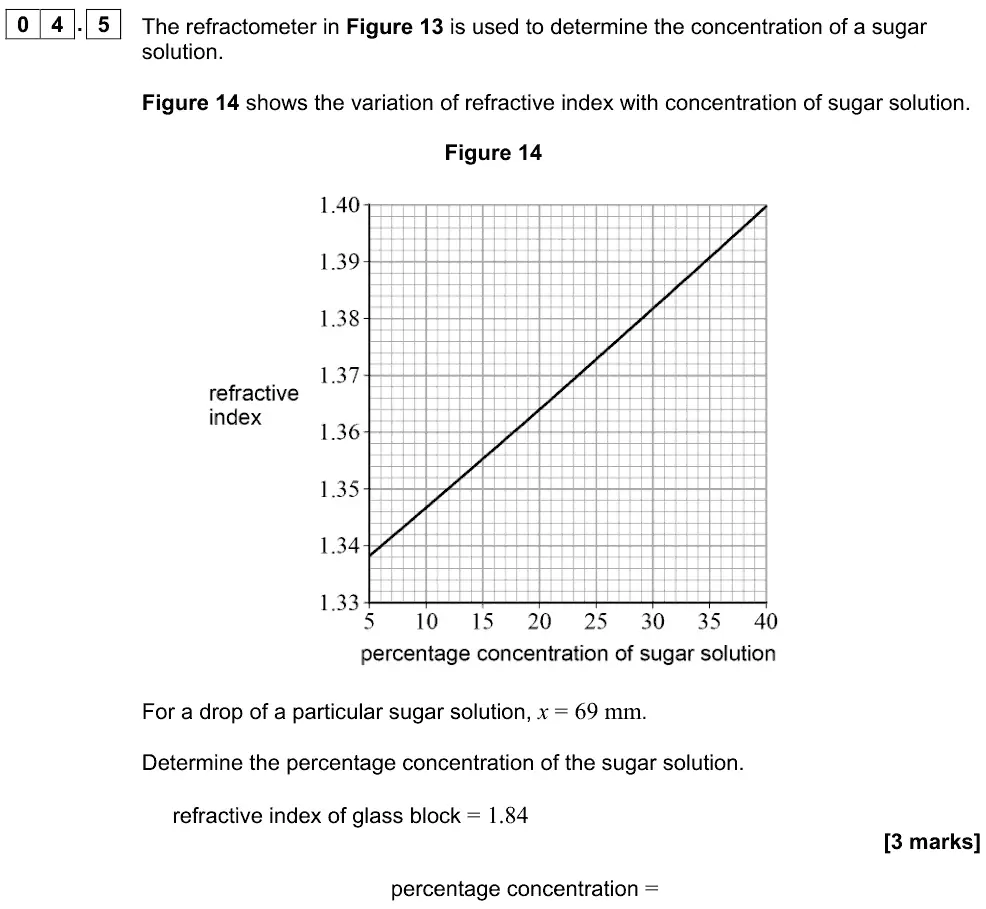
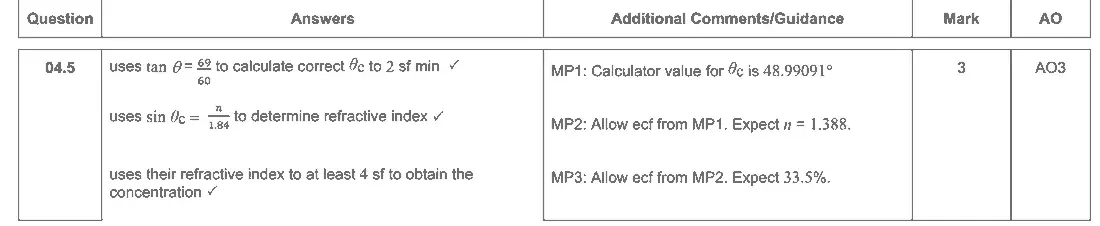
04.5 Nearly one-fifth of students gained full marks in this question but the rest struggled to make much progress. Some determined the angle of 49° but did not realise that this was the critical angle. Students who correctly calculated the refractive index needed to use the value to three significant figures, to correspond to the scale of the y-axis in Figure 14.
Skills: MS4.5 Use sin, cos and tan in physical problems; MS0.6 Use calculators to handle sin x, cos x, tan x when x is expressed in degrees or radians; MS3.1 Translate information between graphical, numerical and algebraic forms
June 2022 · AS Paper 1 · Q3.32 marksAO1=1, AO2=1Calculation
Earlier part of question 3 that this part uses
Mark scheme
Examiner's comment
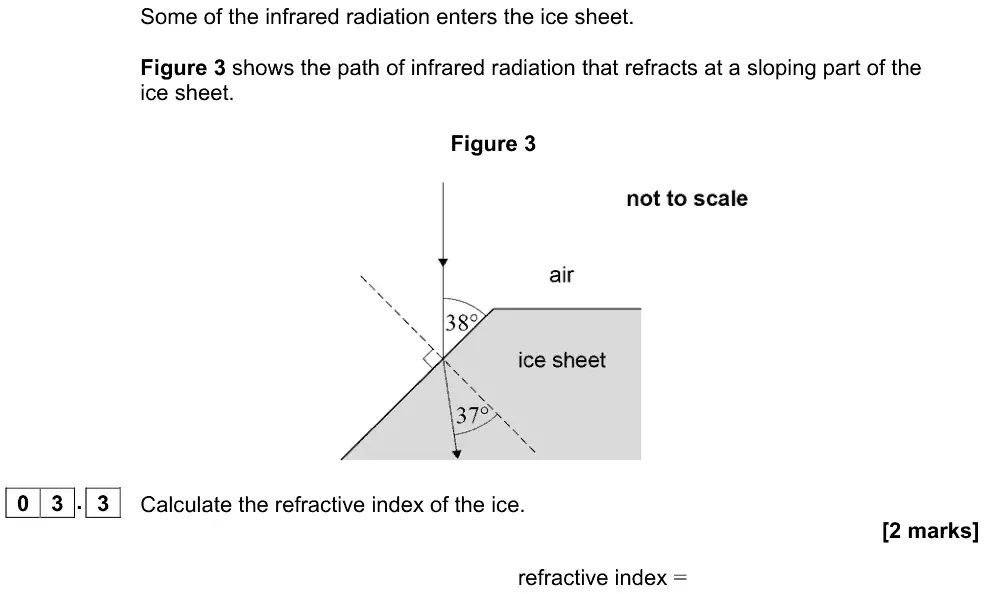
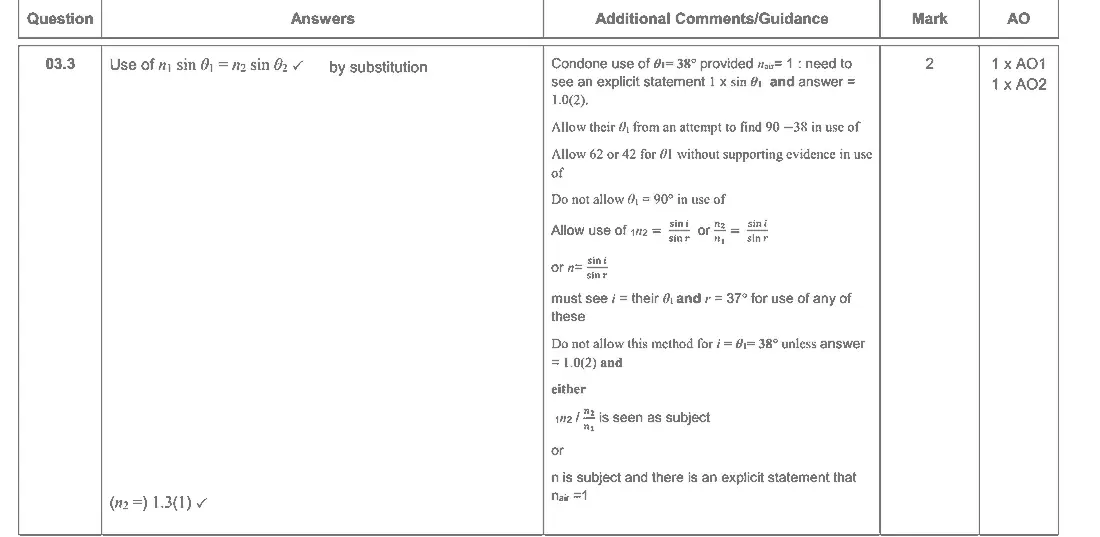
03.3 Just under 60% of students gained at least one mark in this calculation. The most common mistake seen was a use of 38 ° as the angle of incidence.
Notes from the mark scheme and report
Answer: 1.31 (angle of incidence 90 - 38 = 52 degrees to the normal, refraction 37 degrees)
using 38 degrees as the incidence angle was the commonest error
Skills: MS0.6 Use calculators to handle sin x, cos x, tan x when x is expressed in degrees or radians; MS4.1 Use angles in regular 2D and 3D structures
June 2022 · AS Paper 1 · Q3.42 marksAO1=1, AO2=1Calculation
Earlier part of question 3 that this part uses
Mark scheme
Examiner's comment
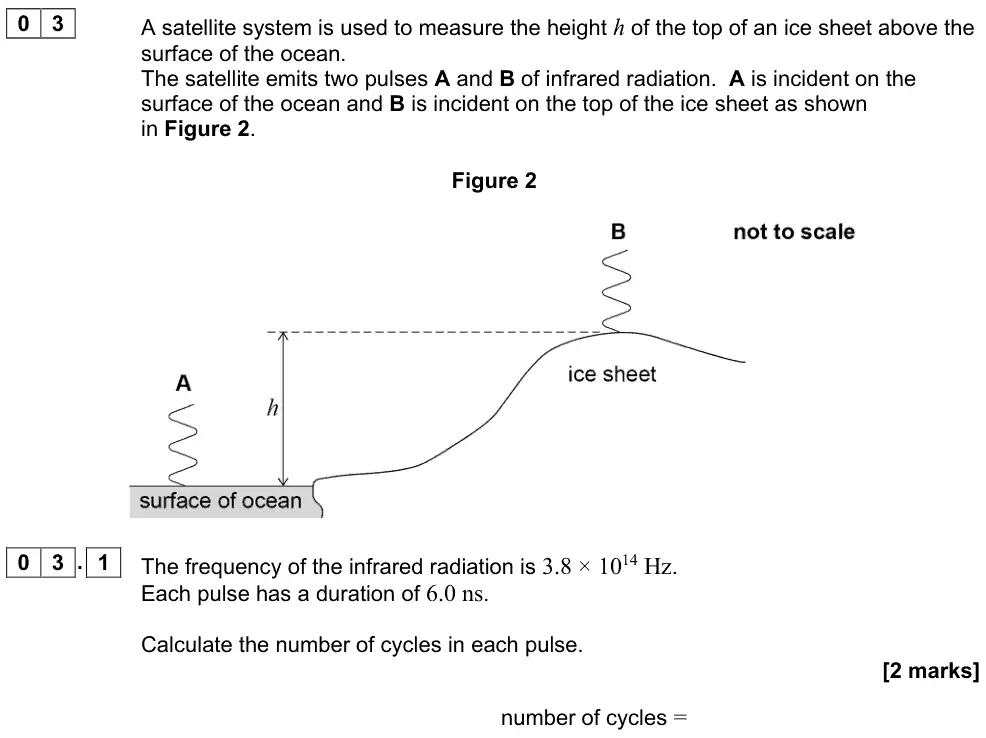
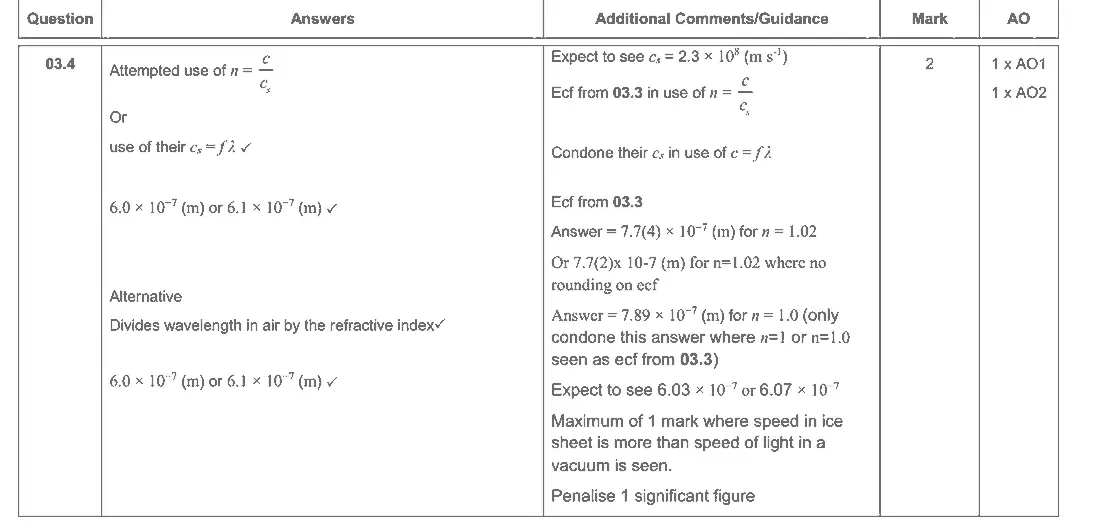
03.4 This was a good example of a multi-step calculation that was an indicator of higher level use of c=f𝜆𝜆 without any attempt to determine the speed of the infrared in the ice. performance with just over 40% of students gaining both marks. The most common error was the
Notes from the mark scheme and report
Answer: 6.0 x 10^-7 m (c_s = 2.3 x 10^8 m s^-1 then lambda = c_s/f, or 7.9 x 10^-7 m / 1.31)
using c = f lambda in air was the common error
Skills: MS2.3 Substitute numerical values into algebraic equations using appropriate units for physical quantities
June 2022 · Paper 1 · Q6.11 markAO1=1Short answer
Mark scheme
Examiner's comment
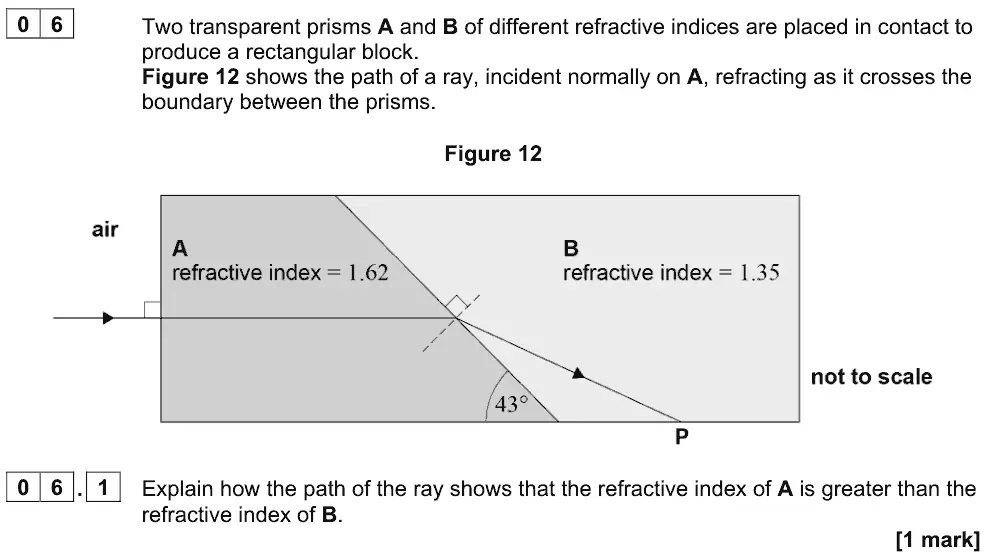
In order to earn the mark in 06.1 students had to make it clear why a ray bending away from the normal indicates an increase in refractive index. The best answers were supported either by a discussion of Snell’s Law or by a consideration of the change in speed.
Notes from the mark scheme and report
Ray bends away from the normal (angle of refraction > angle of incidence), so by Snell's law n of A > n of B (or light speeds up)
June 2022 · Paper 1 · Q6.22 marksAO2=2Show that
Earlier part of question 6 that this part uses
Mark scheme
Examiner's comment
The calculation in 06.2 was more straightforward but many students struggled to identify the angle of incidence. Rounding errors were also relatively common.
Notes from the mark scheme and report
Angle of incidence 90 - 43 = 47 degrees
1.62 sin47 = 1.35 sin r gives r = 61 degrees
identifying the incidence angle was the main difficulty
Skills: MS0.6 Use calculators to handle sin x, cos x, tan x when x is expressed in degrees or radians; MS4.1 Use angles in regular 2D and 3D structures
June 2022 · Paper 1 · Q6.33 marksAO3=3Diagram or graph
Earlier part of question 6 that this part uses
Mark scheme
Examiner's comment
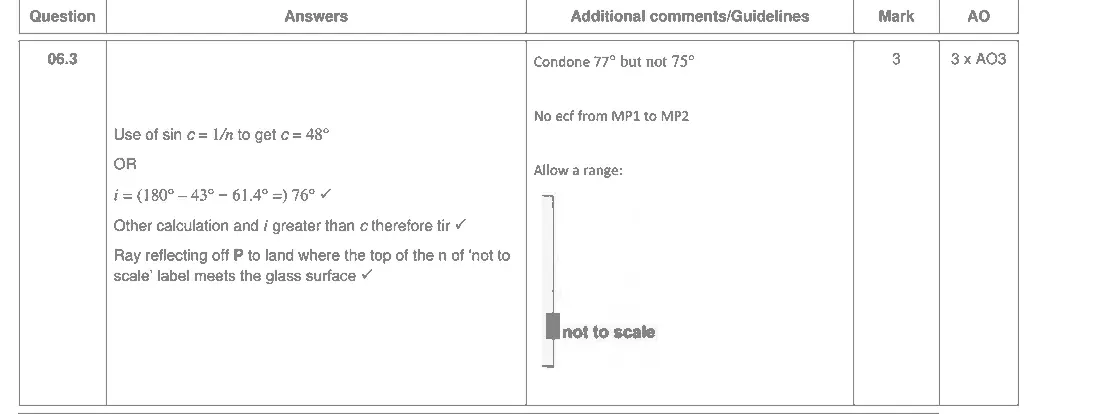
It is clear from the rubric to the examination paper that students are expected to have a protractor. It is expected, therefore, that students should be able to draw reflected rays accurately. Many students realised that total internal reflection was taking place in 06.3, but drew rays that were obviously incorrect. This question discriminated very well, with only the most able students likely to get all three marks.
Notes from the mark scheme and report
Critical angle sin^-1(1/1.35) = 48 degrees
angle of incidence at P is 180 - 43 - 61 = 76 degrees > 48, so TIR
draw the reflected ray accurately with a protractor
only the most able scored all three
Skills: MS0.6 Use calculators to handle sin x, cos x, tan x when x is expressed in degrees or radians; MS4.1 Use angles in regular 2D and 3D structures
June 2022 · AS Paper 2 · Q201 markAO2=1Multiple choice
Answer
A
Mark scheme
Notes from the mark scheme and report
Answer: A
November 2021 · Paper 1 · Q3.11 markAO1=1Calculation
Mark scheme
Examiner's comment
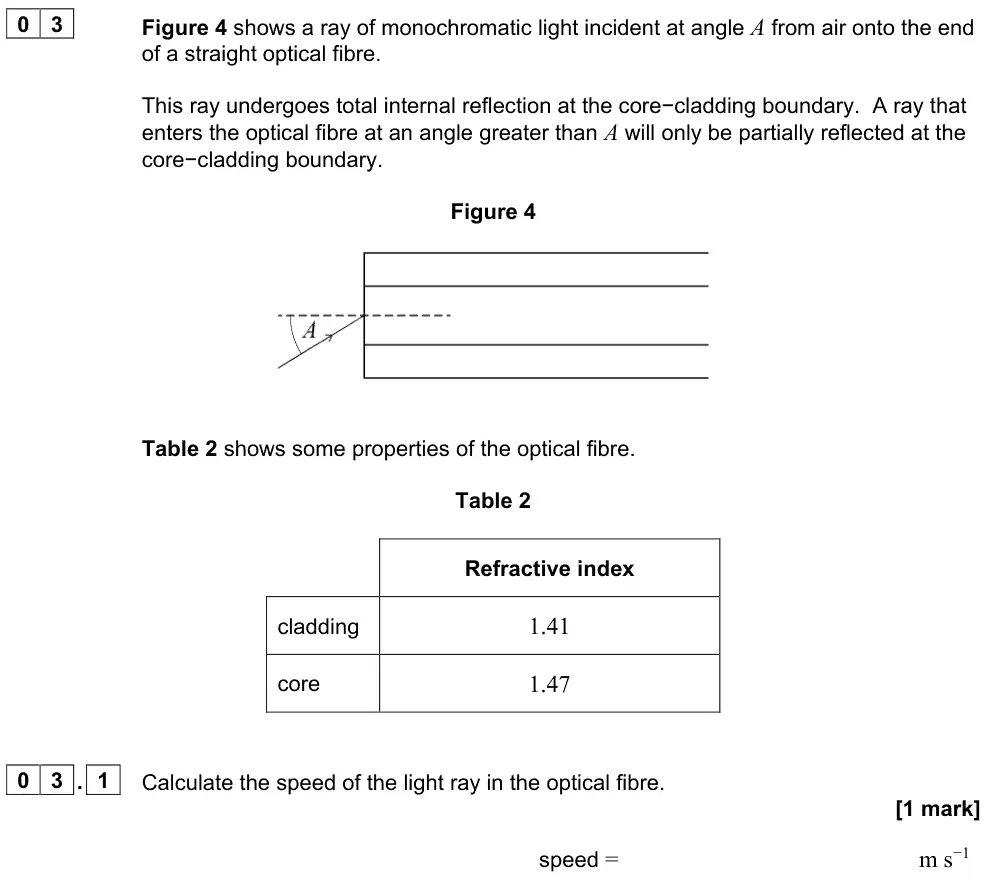
The speed calculation in question 03.1 was completed correctly by the majority of students. It was evident from the answers to question 03.2 that many students failed to grasp the geometry of the situation, or the significance of angle A. Although many students were able to use Snell’s Law to determine the critical angle, the mark was withheld when they indicated that they believed that the angle being calculated was A. Similar issues with the behaviour of light in an optical fibre were seen in question 03.4. Even those students who realised that light escaped the core at the boundary failed to get credit by omitting the partially reflected ray or drawing the transmitted ray closer to the normal.
Notes from the mark scheme and report
Answer: 2.0 x 10^8 m s^-1 (3.0 x 10^8 / 1.47)
1 sf not accepted
Skills: MS2.3 Substitute numerical values into algebraic equations using appropriate units for physical quantities
November 2021 · Paper 1 · Q3.23 marksAO2=3Calculation
Earlier part of question 3 that this part uses
Mark scheme
Examiner's comment
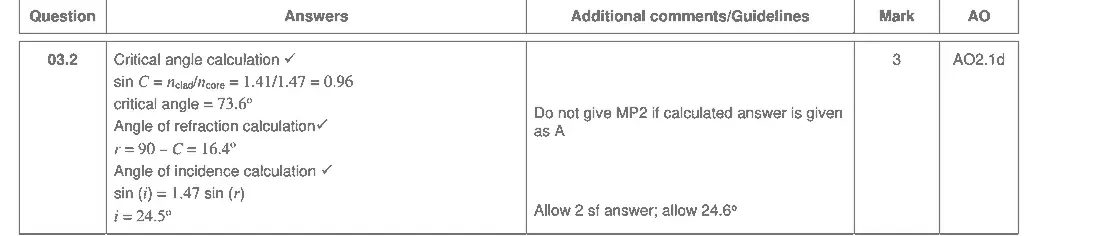
The speed calculation in question 03.1 was completed correctly by the majority of students. It was evident from the answers to question 03.2 that many students failed to grasp the geometry of the situation, or the significance of angle A. Although many students were able to use Snell’s Law to determine the critical angle, the mark was withheld when they indicated that they believed that the angle being calculated was A. Similar issues with the behaviour of light in an optical fibre were seen in question 03.4. Even those students who realised that light escaped the core at the boundary failed to get credit by omitting the partially reflected ray or drawing the transmitted ray closer to the normal.
Notes from the mark scheme and report
Answer: A = 24.5 degrees (critical angle sin^-1(1.41/1.47) = 73.6, refraction angle 90 - 73.6 = 16.4, sin A = 1.47 sin 16.4)
many took the critical angle as A
Skills: MS0.6 Use calculators to handle sin x, cos x, tan x when x is expressed in degrees or radians; MS4.1 Use angles in regular 2D and 3D structures; MS2.2 Change the subject of an equation, including non-linear equations
November 2021 · Paper 1 · Q3.33 marksAO3=3Diagram or graph
Earlier part of question 3 that this part uses
Mark scheme
Notes from the mark scheme and report
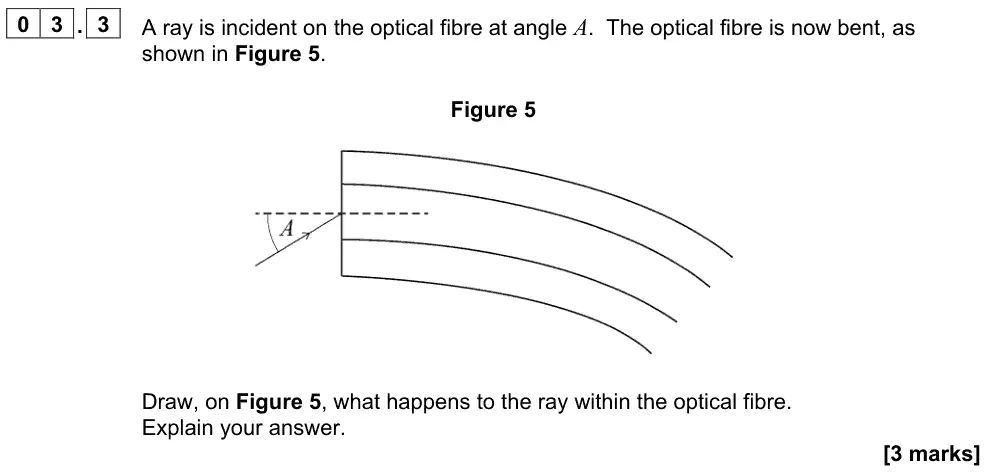
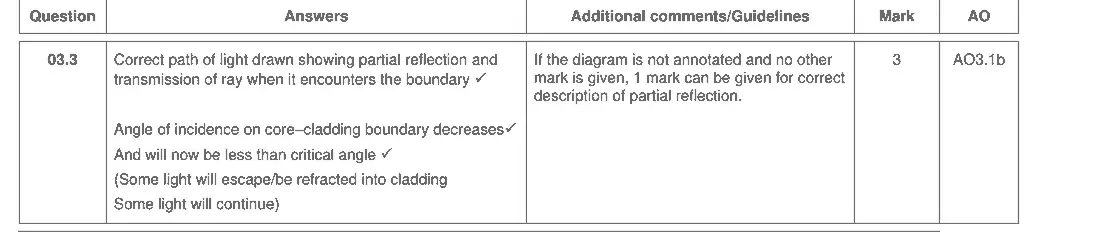
Draw partial reflection plus refraction into the cladding at the bend
bending reduces the angle of incidence at the core-cladding boundary below the critical angle so some light escapes
November 2021 · AS Paper 1 · Q7.12 marksAO1=2Short answer
Mark scheme
Notes from the mark scheme and report
Pulse broadening because rays take different paths (enter at different angles) and so take different times
material dispersion not credited
November 2021 · AS Paper 1 · Q7.33 marksCalculation
Earlier part of question 7 that this part uses
Mark scheme
Notes from the mark scheme and report
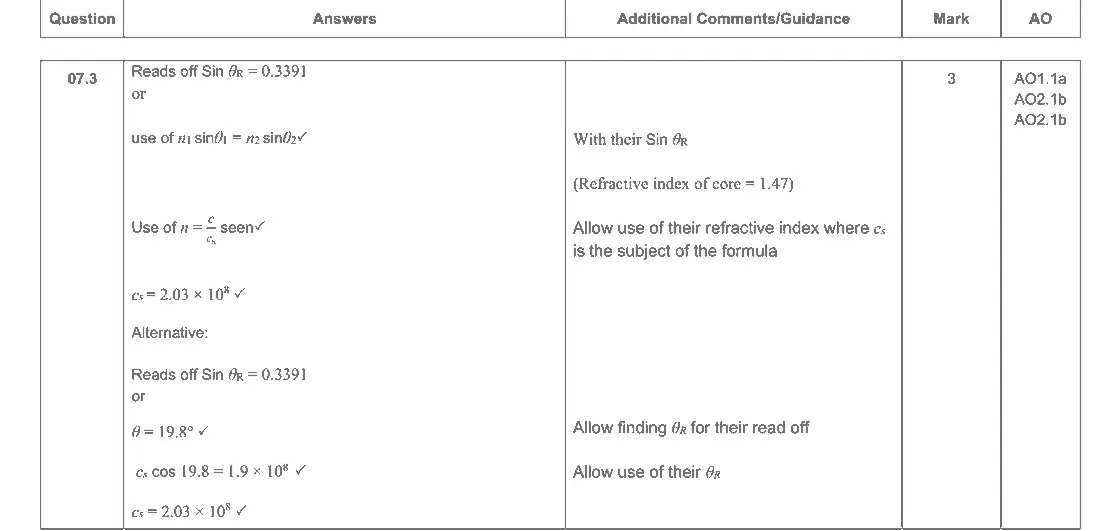
Answer: 2.03 x 10^8 m s^-1 (sin theta R = 0.3391 at 720 THz from Figure 16, n = 0.5/0.3391 = 1.47)
Skills: MS3.1 Translate information between graphical, numerical and algebraic forms; MS0.6 Use calculators to handle sin x, cos x, tan x when x is expressed in degrees or radians; MS2.3 Substitute numerical values into algebraic equations using appropriate units for physical quantities
November 2021 · AS Paper 1 · Q7.42 marksExplanation
Earlier part of question 7 that this part uses
Mark scheme
Notes from the mark scheme and report
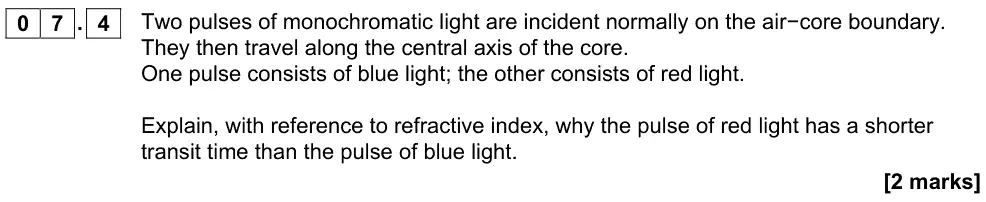
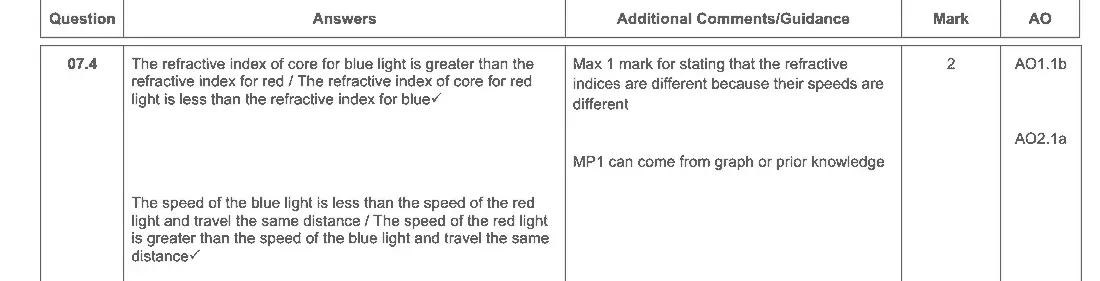
Refractive index of the core is smaller for red than blue, so red travels faster over the same distance and arrives first
November 2021 · AS Paper 1 · Q7.51 markAO2=1Short answer
Earlier part of question 7 that this part uses
Mark scheme
Notes from the mark scheme and report
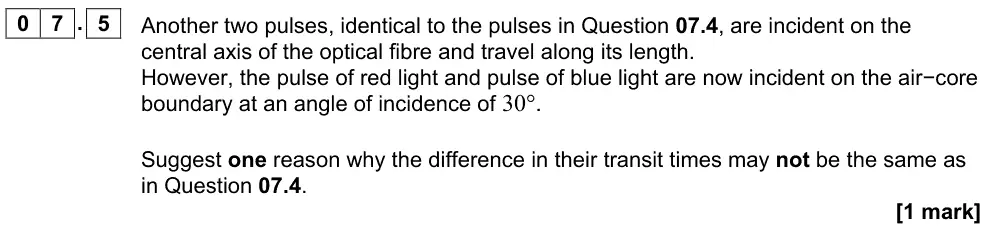
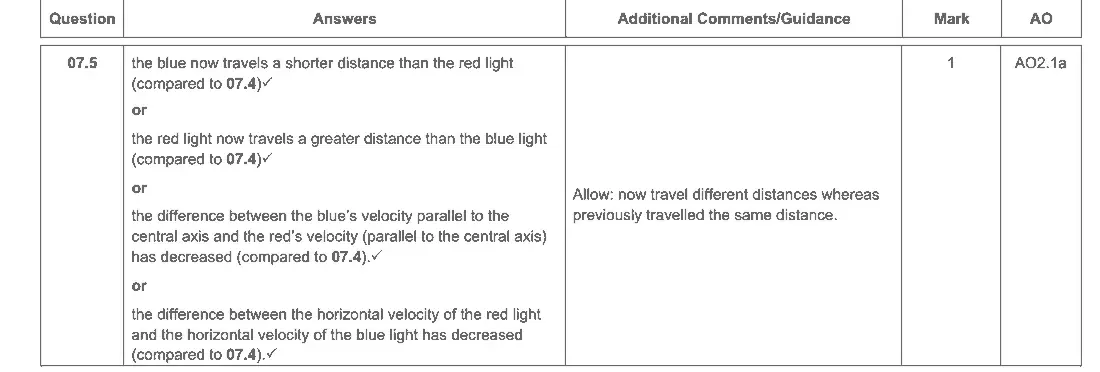
At 30 degrees the colours refract by different angles so travel different path lengths (blue shorter) and their velocity components along the axis differ less
November 2021 · AS Paper 2 · Q181 markMultiple choice
Answer
D
Mark scheme
Notes from the mark scheme and report
Answer: D
Skills: MS0.6 Use calculators to handle sin x, cos x, tan x when x is expressed in degrees or radians; MS4.1 Use angles in regular 2D and 3D structures
November 2020 · Paper 1 · Q141 markMultiple choice
Answer
D
Mark scheme
Notes from the mark scheme and report
Answer: D
November 2020 · AS Paper 2 · Q1.11 markShort answer
Mark scheme
Notes from the mark scheme and report
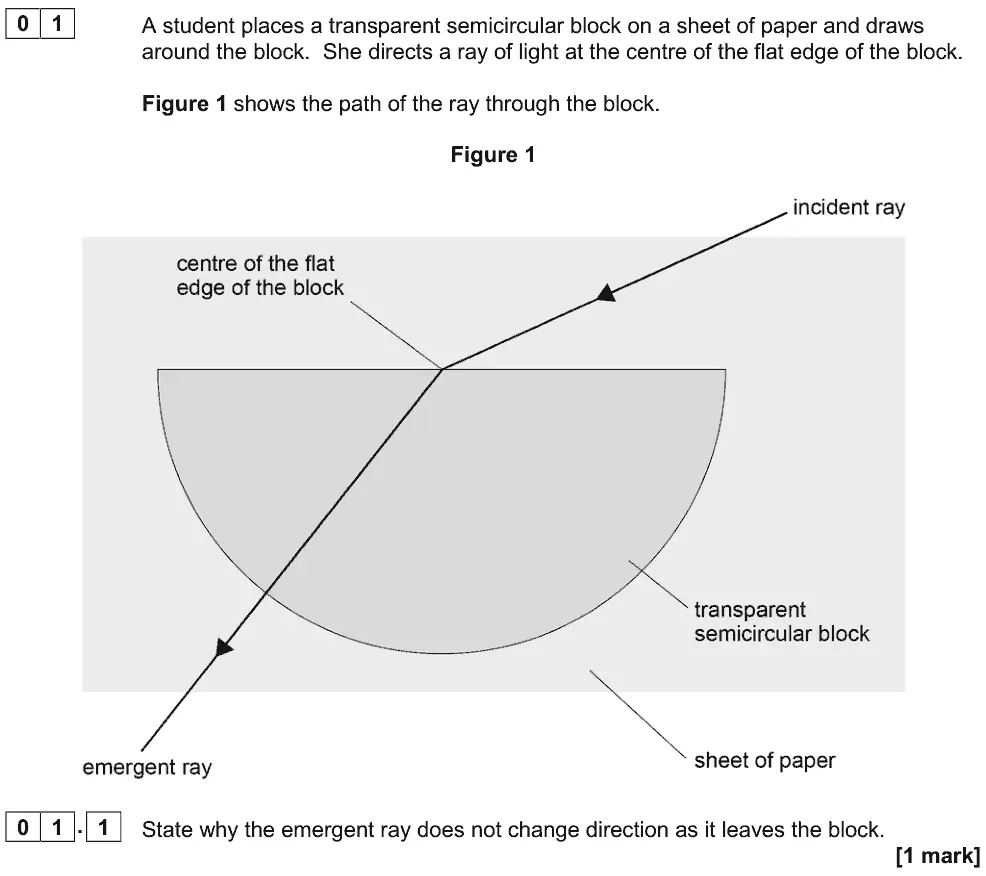
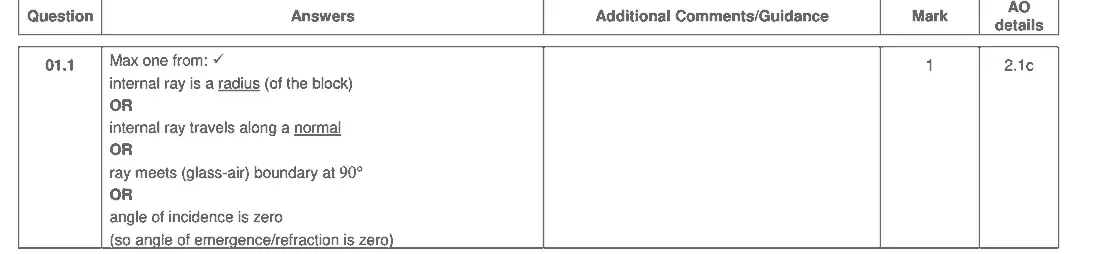
Ray inside travels along a radius (normal) so meets the curved boundary at 90 degrees
angle of incidence zero so no refraction
November 2020 · AS Paper 2 · Q1.24 marksPractical and data analysis
Earlier part of question 1 that this part uses
Mark scheme
Notes from the mark scheme and report
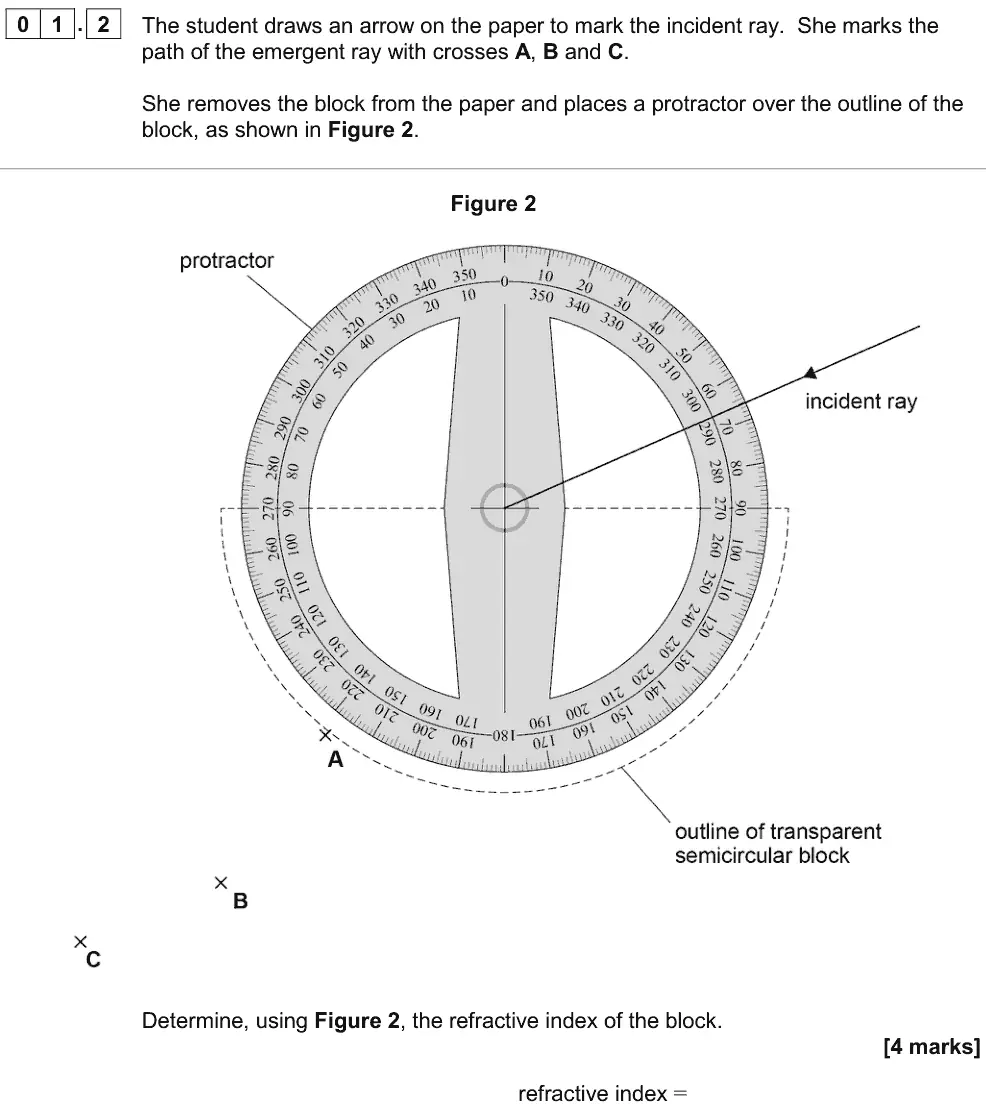
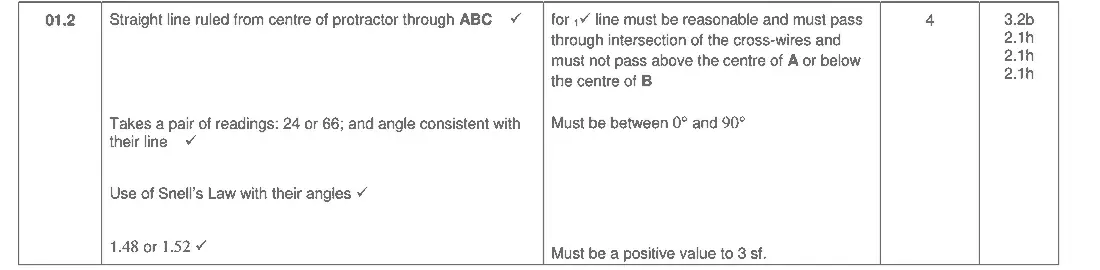
Answer: 1.48 or 1.52 (3 sf)
rule a line from protractor centre through A, B, C
read angles 24 and 66 degrees to the normal
apply Snell's law
Skills: MS0.6 Use calculators to handle sin x, cos x, tan x when x is expressed in degrees or radians; MS4.1 Use angles in regular 2D and 3D structures; ATa analogue apparatus to record measurements and interpolate; PS3.2 Process and analyse data using appropriate mathematical skills
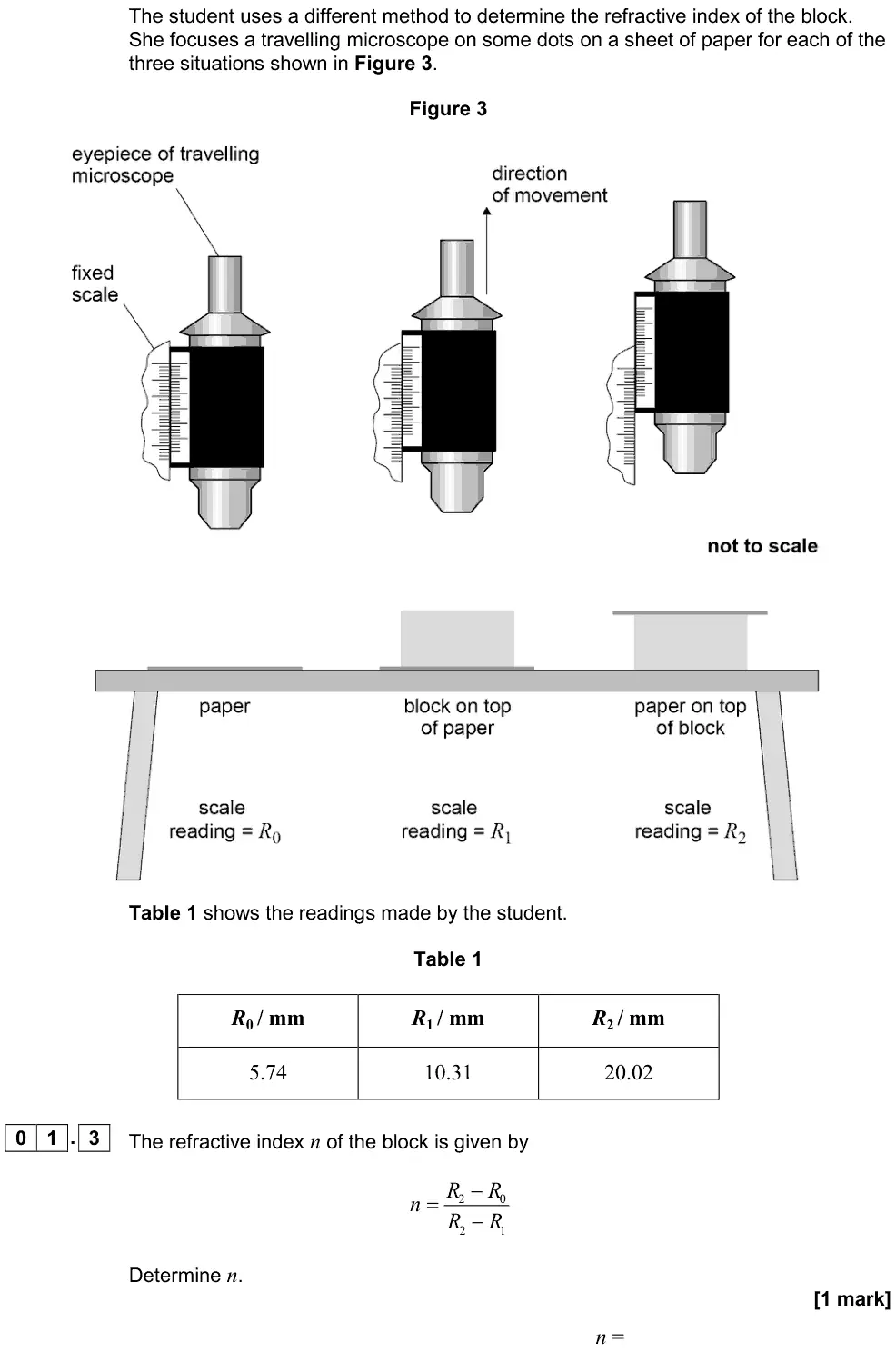
November 2020 · AS Paper 2 · Q1.31 markCalculation
Earlier part of question 1 that this part uses
Mark scheme
Notes from the mark scheme and report
Answer: 1.47 (14.28 / 9.71)
1.5 rejected
Skills: MS2.3 Substitute numerical values into algebraic equations using appropriate units for physical quantities; MS1.1 Use an appropriate number of significant figures
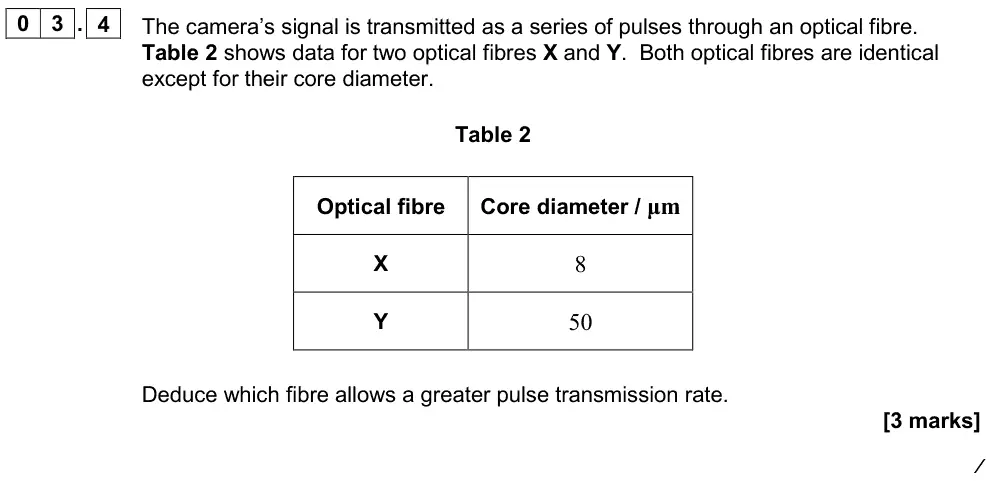
November 2020 · AS Paper 2 · Q3.43 marksExplanation
Earlier part of question 3 that this part uses
Mark scheme
Notes from the mark scheme and report
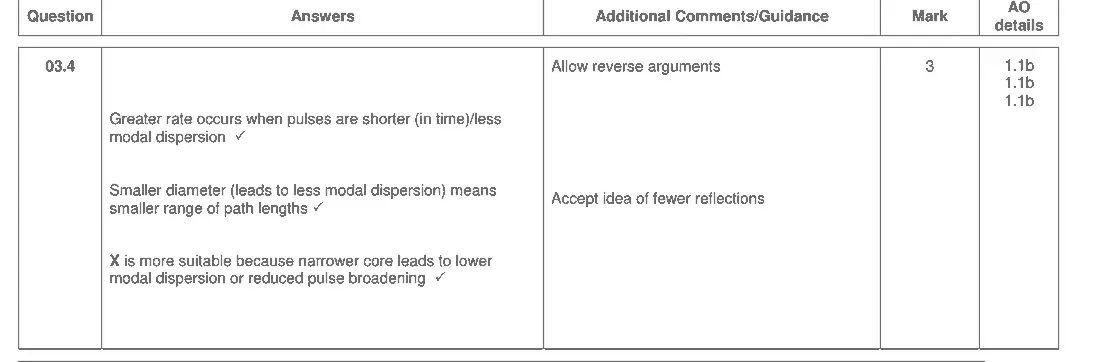
X (8 micrometre core): smaller range of path lengths so less modal dispersion and less pulse broadening, shorter pulses allow greater transmission rate
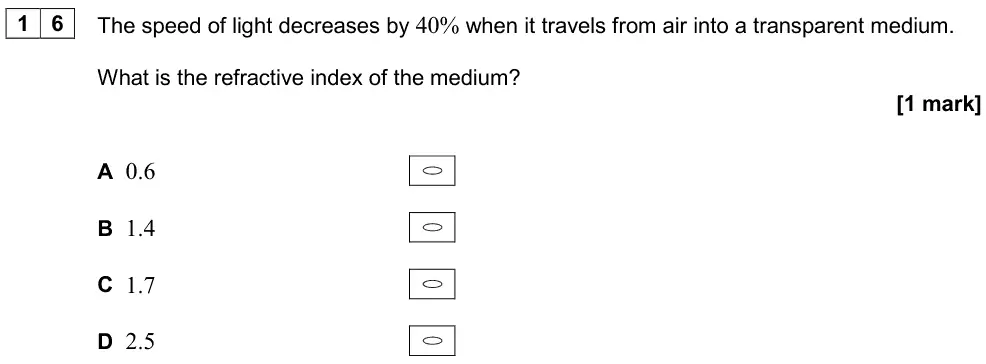
November 2020 · AS Paper 2 · Q161 markMultiple choice
Answer
C
Mark scheme
Notes from the mark scheme and report
Answer: C
Skills: MS0.3 Use ratios, fractions and percentages
June 2019 · Paper 1 · Q2.11 markShort answer
Mark scheme
Examiner's comment
2.1 Here the students were expected to refer to the normal, or to explain what the normal is. Answers that referred to the prism rather than the surface of the prism did not gain the mark.
Notes from the mark scheme and report
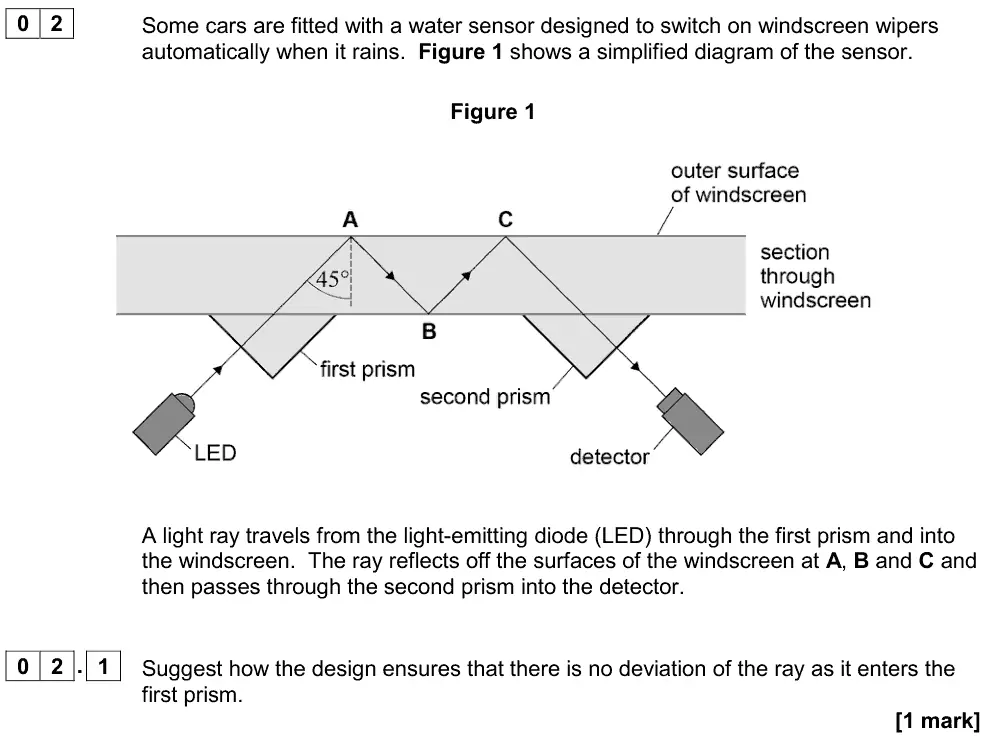
Ray enters the prism along the normal (angle of incidence 0) to the surface, not just 'the prism'
June 2019 · Paper 1 · Q2.22 marksShort answer
Earlier part of question 2 that this part uses
Mark scheme
Examiner's comment
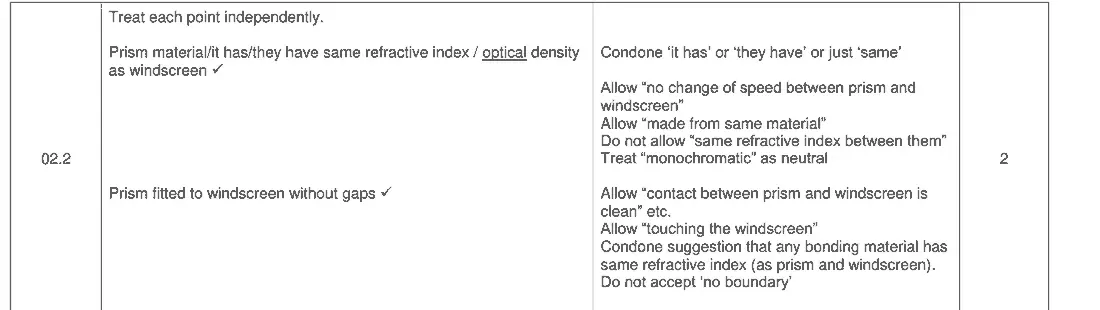
2.2 A common error was to refer to the density of the material rather than to the optical density or refractive index; this prevented students from gaining the first mark. Answers that implied that there was material between the prism and windscreen did not gain the second mark, unless it was clear that this material also had the same refractive index.
Notes from the mark scheme and report
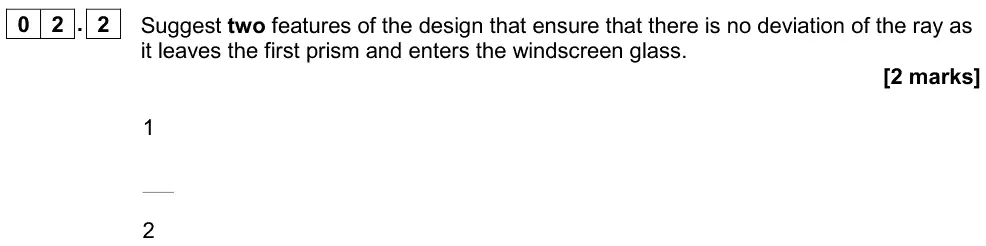
Prism has the same refractive index (optical density, not density) as the windscreen
prism fitted with no gap (or any bonding material has the same n)
June 2019 · Paper 1 · Q2.32 marksExplanation
Earlier part of question 2 that this part uses
Mark scheme
Examiner's comment
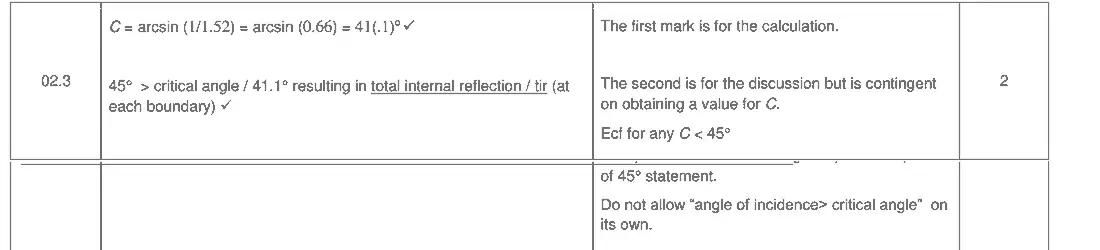
2.3 Most students correctly calculated the critical angle for the first mark. Students did not gain further credit when it was unclear which angle had to be larger than the critical angle for total internal reflection to occur.
Notes from the mark scheme and report
Critical angle sin^-1(1/1.52) = 41 degrees
45 degrees incidence exceeds it so TIR at each surface
must say which angle exceeds the critical angle
Skills: MS0.6 Use calculators to handle sin x, cos x, tan x when x is expressed in degrees or radians
June 2019 · Paper 1 · Q2.42 marksExplanation
Earlier part of question 2 that this part uses
Mark scheme
Examiner's comment
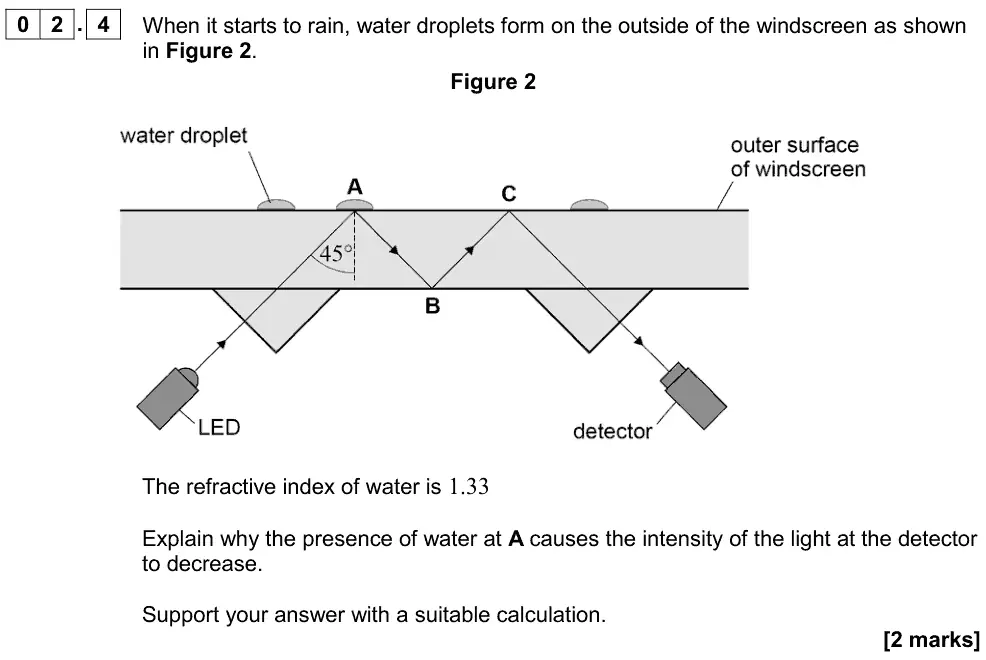
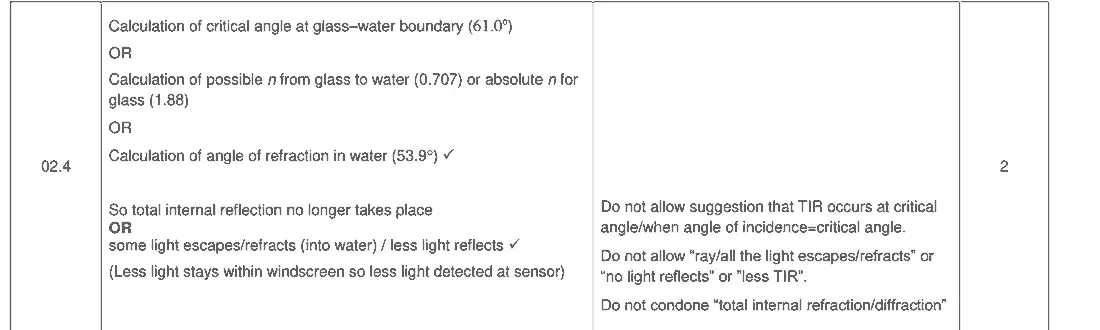
2.4 There were several routes through this question and all of them were seen. Most commonly, students demonstrated the idea that 45° was no longer larger than the critical angle. Some suggested that, with water present, not all light underwent total internal reflection (TIR) rather than referring to partial internal reflection; this prevented the award of the second mark. The suggestion that TIR occurred at the critical angle was similarly not rewarded. Incorrect answers referring to refraction and diffraction were seen but were rare.
Notes from the mark scheme and report
Critical angle at glass-water boundary is 61 degrees (> 45) so TIR no longer occurs, some light refracts into the water and less reaches the detector
'all light escapes' or 'TIR at the critical angle' not allowed
Skills: MS0.6 Use calculators to handle sin x, cos x, tan x when x is expressed in degrees or radians
June 2019 · Paper 1 · Q2.52 marksExplanation
Earlier part of question 2 that this part uses
Mark scheme
Examiner's comment
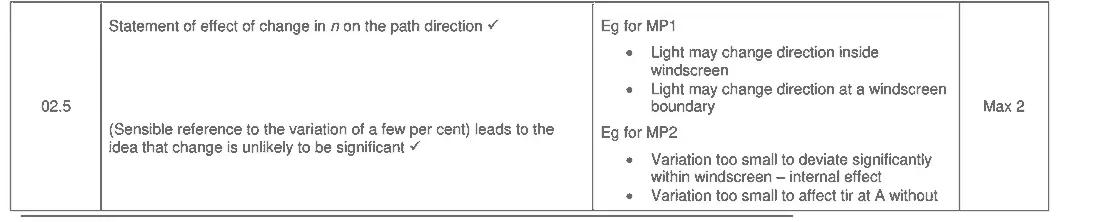
2.5 A relatively common error in this question was the idea that the thickness of the glass varied, rather than the refractive index. The mark scheme allowed several routes to the first mark, with students either considering a change in direction within the glass or an effect at the boundary. However, some students suggested that the angle of reflection would be changed and, without reference to the angle of incidence, this did not gain credit. The second mark proved to be much more challenging and students rarely referred to the effect of the ‘few percent’ change in the question.
Notes from the mark scheme and report
Change of n can change ray direction inside the glass or at a boundary
a few per cent is too small to matter significantly (second mark rarely scored)
thickness variation is not the point
June 2019 · Paper 1 · Q2.62 marksExplanation
Earlier part of question 2 that this part uses
Mark scheme
Examiner's comment
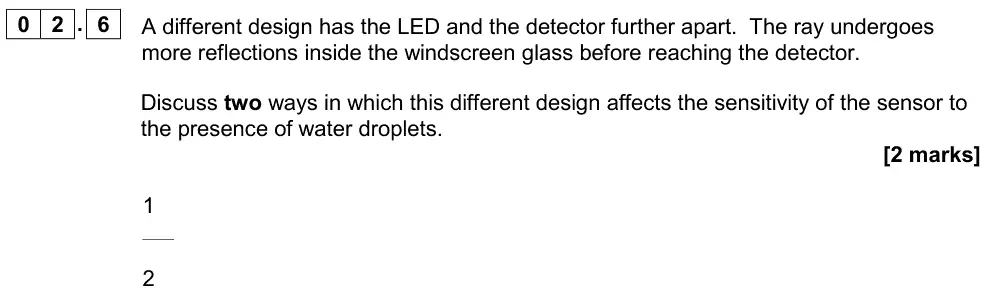
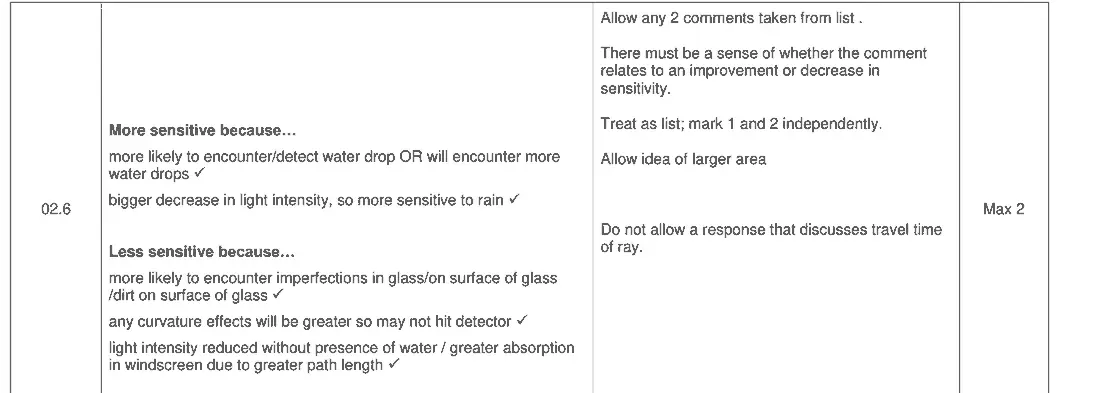
2.6 This question required students to make a judgement about the effect of the change on the sensitivity of the detector, and therefore answers that made no reference to sensitivity gained no credit. Many students were able to explain that, with multiple reflections, the ray was more likely to hit a drop. Students found the second mark point harder to access, often because of their answers were not expressed clearly.
Notes from the mark scheme and report
More sensitive: more reflections so more likely to meet a drop
less sensitive: more absorption, dirt or imperfections over a longer path
answers must relate to sensitivity
June 2019 · AS Paper 1 · Q4.12 marksExplanation
Mark scheme
Examiner's comment
04.1 Around 40% gained two marks and around 30% gained one mark in this question. Some students gave three explanations in their answer. Students should be aware that two marks will require two valid points. Giving more points than required, when incorrect, will negate previous valid answers.
Notes from the mark scheme and report
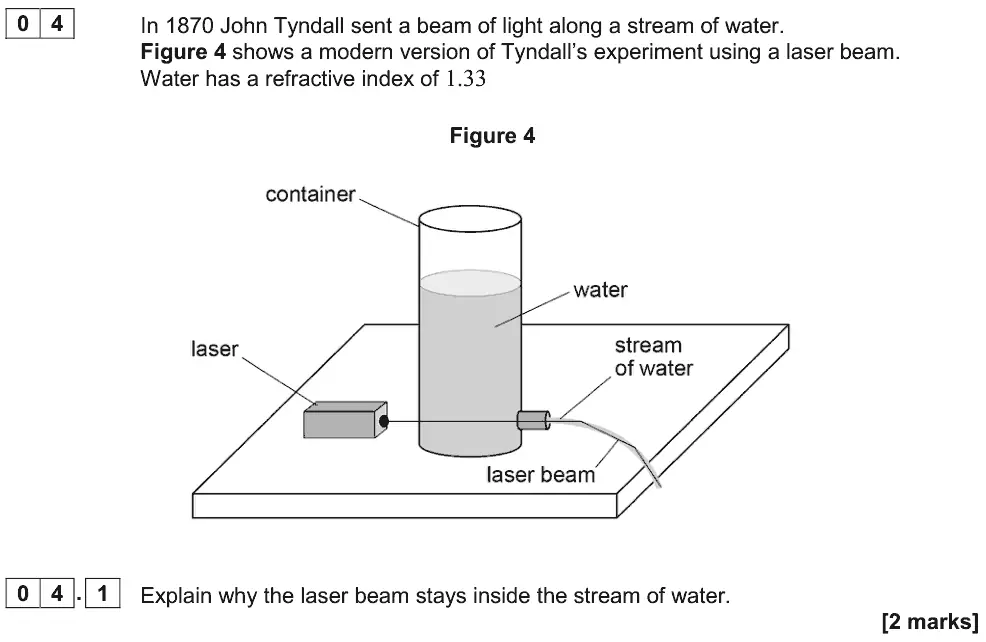
Refractive index of water greater than air
angle of incidence greater than the critical angle
total internal reflection
extra wrong points negate correct ones
June 2019 · AS Paper 1 · Q4.23 marksCalculation
Earlier part of question 4 that this part uses
Mark scheme
Examiner's comment
04.2 About 80% of students could do this calculation, but only around 50% correctly chose the appropriate number of significant figures.
Notes from the mark scheme and report
Answer: 2.26 x 10^8 m s^-1 (3.00 x 10^8 / 1.33)
3 s.f. needed for the third mark
only about half chose the right number of s.f.
Skills: MS1.1 Use an appropriate number of significant figures; MS2.3 Substitute numerical values into algebraic equations using appropriate units for physical quantities
June 2019 · AS Paper 1 · Q4.31 markCalculationEasy
Earlier part of question 4 that this part uses
Mark scheme
Examiner's comment
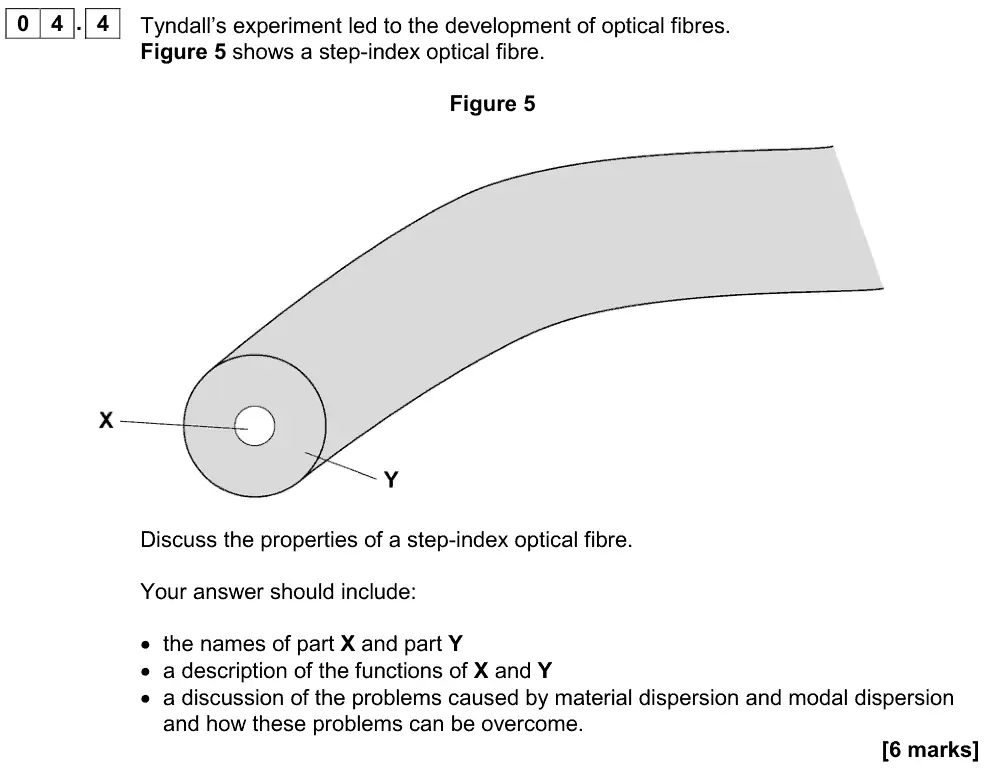
04.3 Again, about 80% of students could carry out this calculation successfully. 04.4 The extended-writing question showed good discrimination; three levels of response were used in assessing it. At the lowest level, the term ‘cladding’ seemed to be known better than ‘core’. Many students scored in the middle level by giving good descriptions of the functions of the core and the cladding. The understanding of dispersion mechanisms was often unclear or muddled. Only about 15% of students had a good understanding of at least one of the dispersion mechanisms and thereby gained credit at the highest level. A common misconception was that material dispersion was to do with the cladding either breaking or distorting the signal.
Notes from the mark scheme and report
Answer: 49 degrees (sin c = 1/1.33)
1 s.f. answer not allowed
Skills: MS0.6 Use calculators to handle sin x, cos x, tan x when x is expressed in degrees or radians
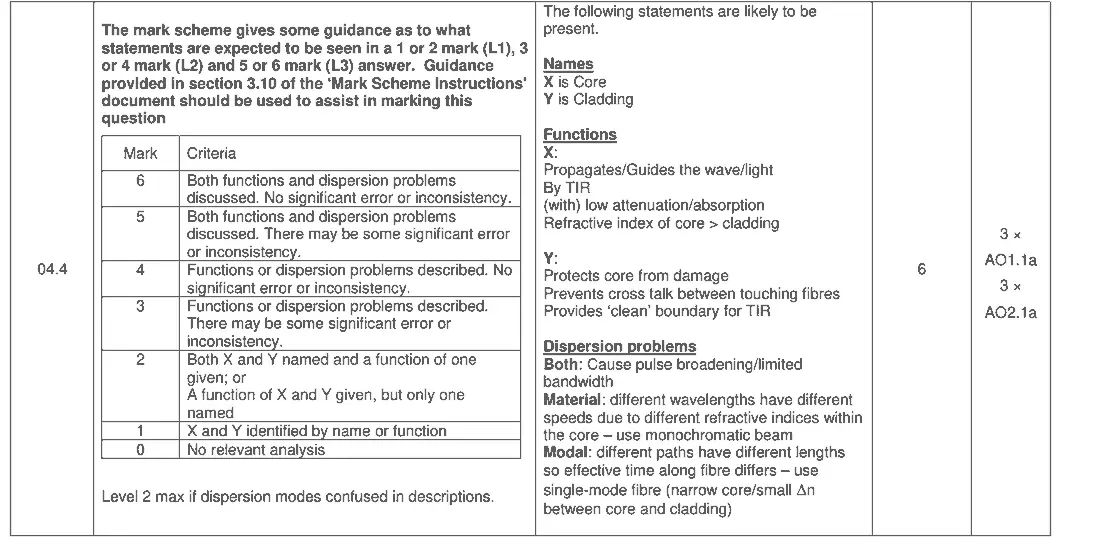
June 2019 · AS Paper 1 · Q4.46 marks6-mark extended responseHard
Earlier part of question 4 that this part uses
Mark scheme, with the levels and indicative content
Examiner's comment
04.3 Again, about 80% of students could carry out this calculation successfully. 04.4 The extended-writing question showed good discrimination; three levels of response were used in assessing it. At the lowest level, the term ‘cladding’ seemed to be known better than ‘core’. Many students scored in the middle level by giving good descriptions of the functions of the core and the cladding. The understanding of dispersion mechanisms was often unclear or muddled. Only about 15% of students had a good understanding of at least one of the dispersion mechanisms and thereby gained credit at the highest level. A common misconception was that material dispersion was to do with the cladding either breaking or distorting the signal.
Notes from the mark scheme and report
Levels of response: X core, Y cladding
core guides light by TIR (core n > cladding n), cladding protects, prevents crossover
material dispersion (wavelengths travel at different speeds, use monochromatic light) and modal dispersion (different path lengths, use narrow core)
both cause pulse broadening
dispersion types confused caps at level 2
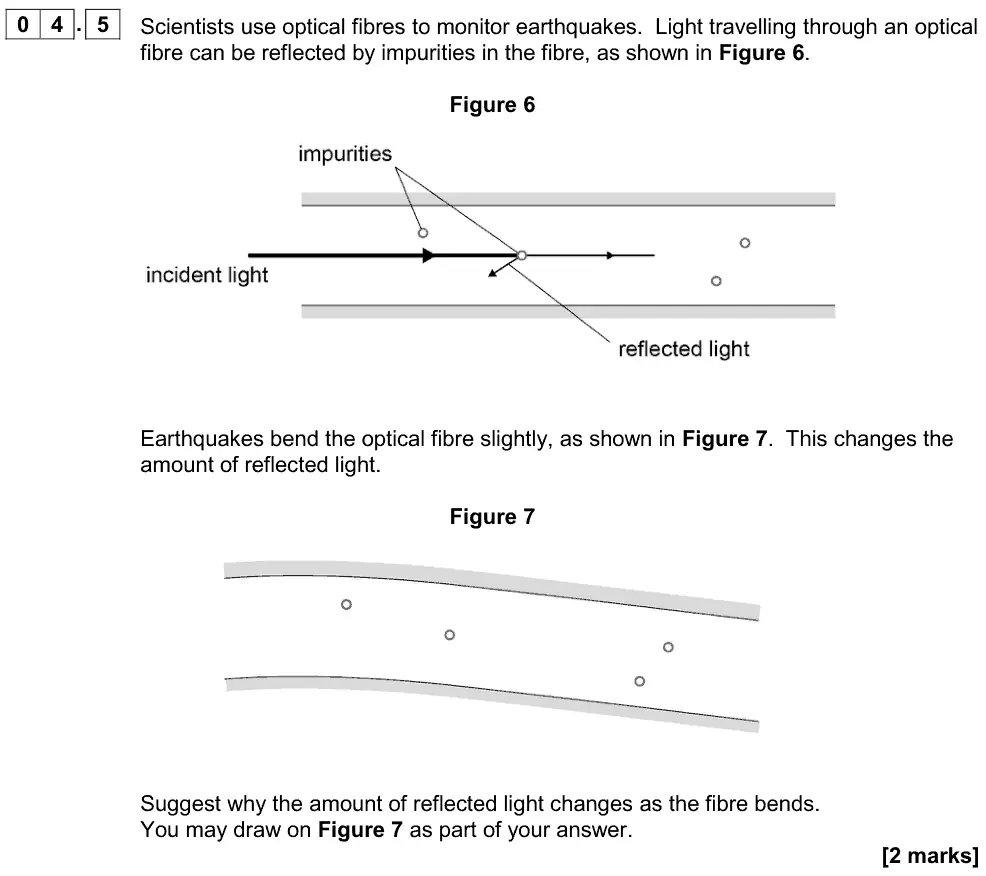
June 2019 · AS Paper 1 · Q4.52 marksShort answer
Earlier part of question 4 that this part uses
Mark scheme
Examiner's comment
04.5 This question asked students to suggest reasons for changes in an unfamiliar context. Almost 60% of students could give one plausible suggestion, which was usually a comment about a change in the way the light ray interacted with the impurities.
Notes from the mark scheme and report
Two from: light meets impurities at different angles/positions or different numbers of impurities, angle of incidence may fall below the critical angle, light refracted out
'critical angle changes' not accepted
June 2019 · AS Paper 2 · Q201 markMultiple choice
Answer
C
Mark scheme
Notes from the mark scheme and report
Answer: C
June 2018 · Paper 1 · Q181 markMultiple choiceEasy
Answer
D
Examiner's comment
The 25 questions in Section B are summarised in the table below. For each question, the key (correct answer) is provided, along with the percentage of students answering correctly. There was a good range of ‘facility’ across this section; the most accessible questions were 12 and 18 (both answered correctly by 89.2% of students), the least accessible was 20 (answered correctly by only 38.1% of students). The overall mean mark achieved by the students for Section B was 15.7 out of 25 (62.8%).
Notes from the mark scheme and report
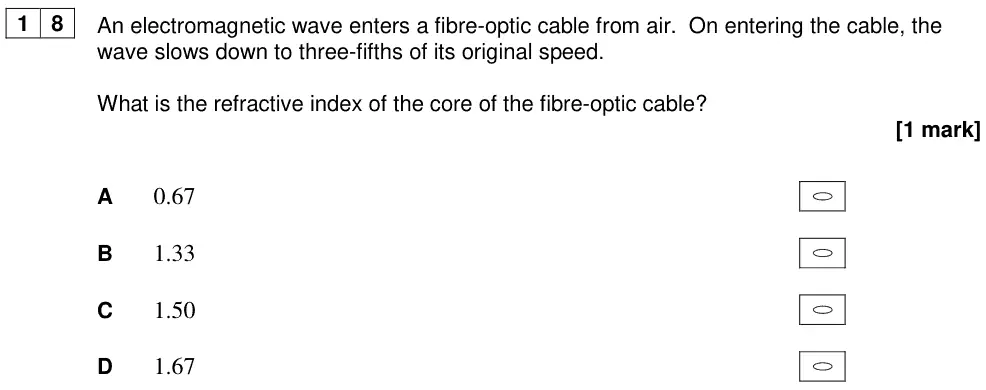
Answer: D
Skills: MS0.3 Use ratios, fractions and percentages
June 2018 · Paper 1 · Q191 markMultiple choice
Answer
D
Notes from the mark scheme and report
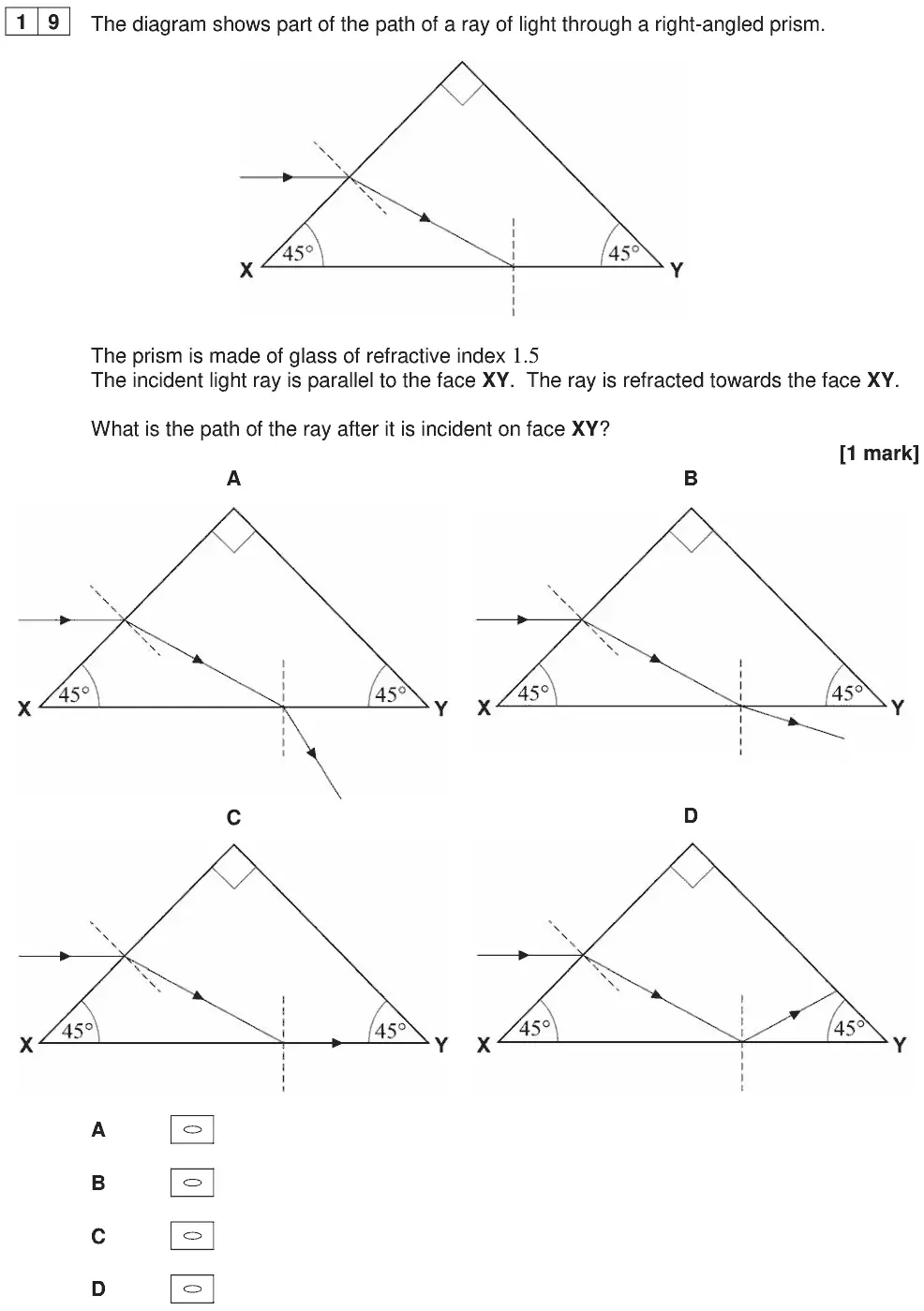
Answer: D (incidence 60 degrees on XY exceeds the 42 degree critical angle, so TIR)
Skills: MS4.1 Use angles in regular 2D and 3D structures
June 2018 · AS Paper 2 · Q4.13 marksCalculation
Mark scheme
Examiner's comment
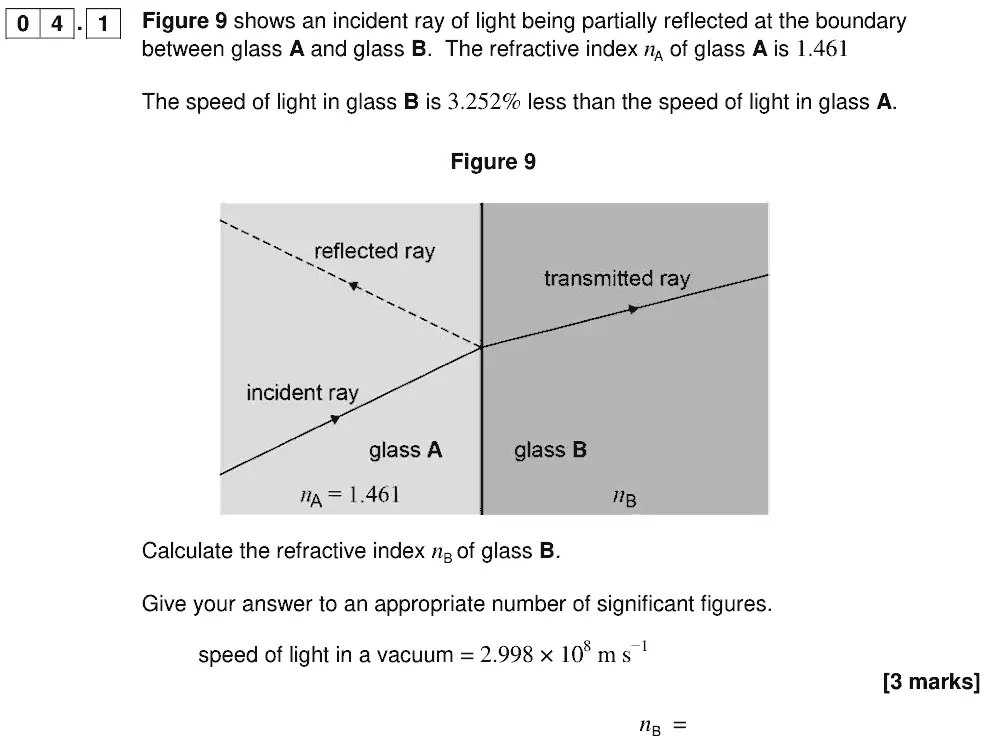
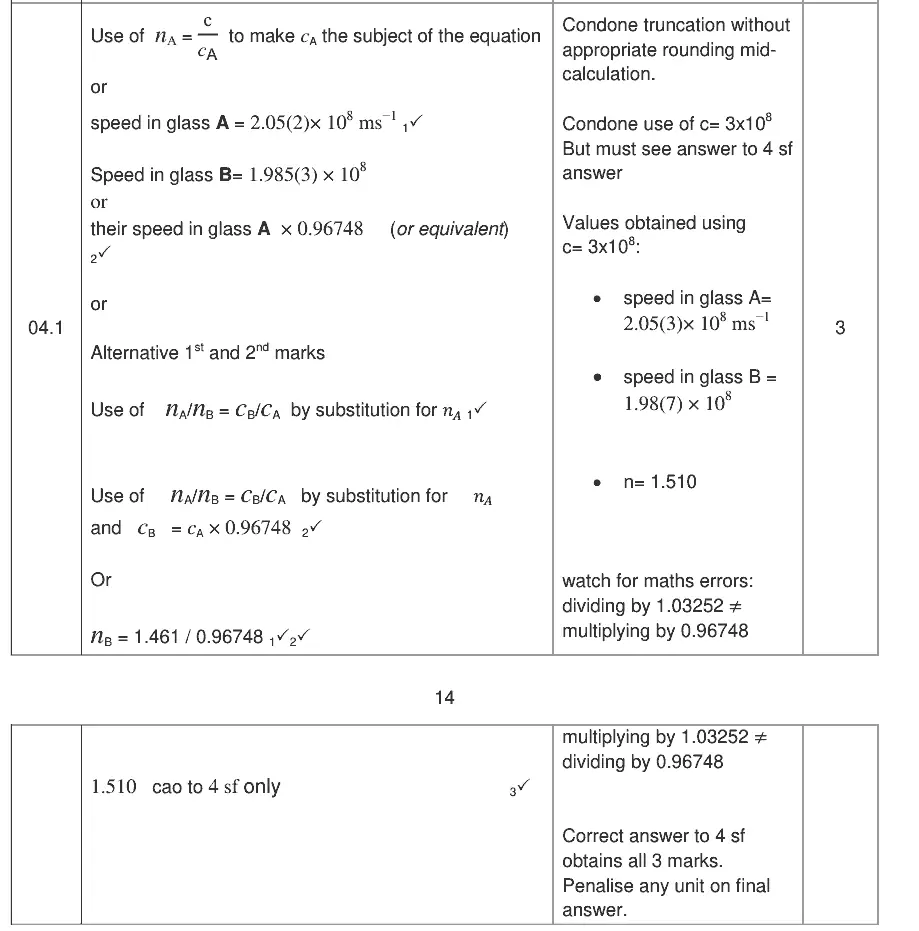
04.1 There were many good examples of work in this part from higher achieving students. On the other hand, lower achieving students had difficulty in following the question structure with many trying to find 97% of the speed of light in a vacuum rather than 97% of the speed of light in glass A. Another common mistake seen was students who simply multiplied na x 1.03252. This was another place in the paper where students failed to gain marks due to incorrect use of significant figures. Just over a third of students failed to gain any marks. relationship between 𝜆𝜆𝑅𝑅 and strain as shown in the graph. They were unable to make the 04.2 Lower achieving students characteristically limited their answers to restating the link between the motion of the lift and its effect on strain and 𝜆𝜆𝑅𝑅. Where students attempted to explain this connection, they often thought that the tension in the cable increased as the lift accelerated downwards. Only 7.4% of students scored two or three marks. 04.3 Many students presented answers that addressed the strength of the cable and its ability to withstand larger stress rather than the ability of the sensor to detect small changes in the acceleration. Two-thirds of students who attempted the question failed to gain any marks here.
Notes from the mark scheme and report
Answer: nB = 1.510 (cA = 2.052 x 10^8, cB = 1.985 x 10^8 m s^-1)
4 sf needed
errors: 97% of c in vacuum, multiplying nA by 1.03252
Skills: MS0.3 Use ratios, fractions and percentages; MS1.1 Use an appropriate number of significant figures; MS2.2 Change the subject of an equation, including non-linear equations
June 2018 · AS Paper 2 · Q151 markMultiple choice
Answer
D
Notes from the mark scheme and report
Answer: D
Skills: MS0.6 Use calculators to handle sin x, cos x, tan x when x is expressed in degrees or radians
June 2018 · AS Paper 2 · Q161 markMultiple choice
Answer
A
Notes from the mark scheme and report
Answer: A
Skills: MS4.5 Use sin, cos and tan in physical problems
June 2018 · Paper 3B Medical physics · Q1.22 marksDiagram or graph
Earlier part of question 1 that this part uses
Mark scheme
Examiner's comment
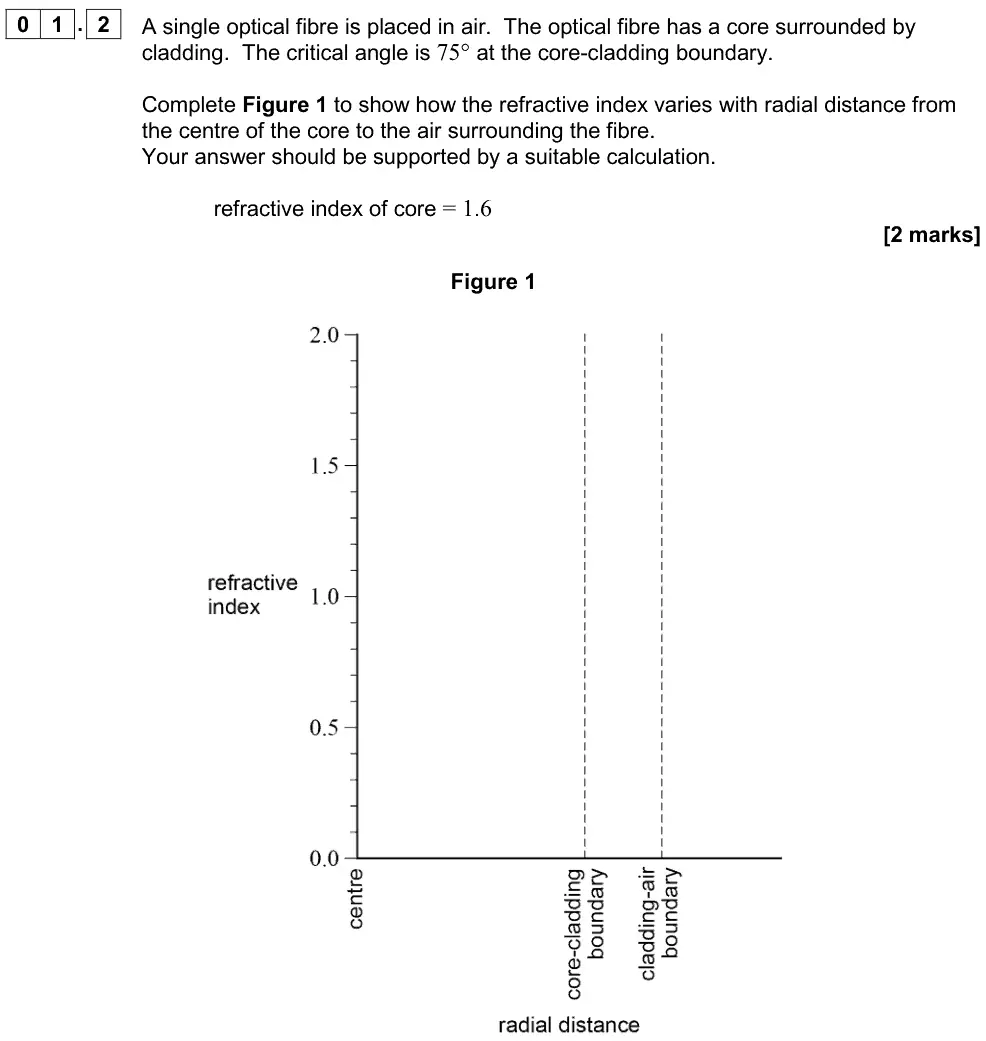
Part 01.2 required a simple drawing showing how the refractive index varied from the core into air. It was a requirement to do a calculation to work out the refractive index of the cladding – good students did this well. When the calculation was not shown, the marks could still be awarded for accurately drawn lines on the diagram. All types of lines were seen from curves to slopes, but better students were able to draw the series of steps as required.
Notes from the mark scheme and report
Cladding n = 1.6 sin 75 = 1.55
plot horizontal steps: core 1.6, cladding 1.55, air 1.0
curves or slopes not credited
Skills: MS4.5 Use sin, cos and tan in physical problems; MS3.1 Translate information between graphical, numerical and algebraic forms
June 2017 · Paper 1 · Q3.11 markCalculation
Mark scheme
Notes from the mark scheme and report
Answer: 39 degrees (critical angle, sin^-1 1/1.6)
Skills: MS0.6 Use calculators to handle sin x, cos x, tan x when x is expressed in degrees or radians
June 2017 · Paper 1 · Q3.22 marksCalculation
Earlier part of question 3 that this part uses
Mark scheme
Notes from the mark scheme and report
Answer: 1.4 (1.36
sin 58 = n/1.6)
Skills: MS0.6 Use calculators to handle sin x, cos x, tan x when x is expressed in degrees or radians; MS2.2 Change the subject of an equation, including non-linear equations
June 2017 · Paper 1 · Q3.33 marksExplanation
Earlier part of question 3 that this part uses
Mark scheme
Notes from the mark scheme and report
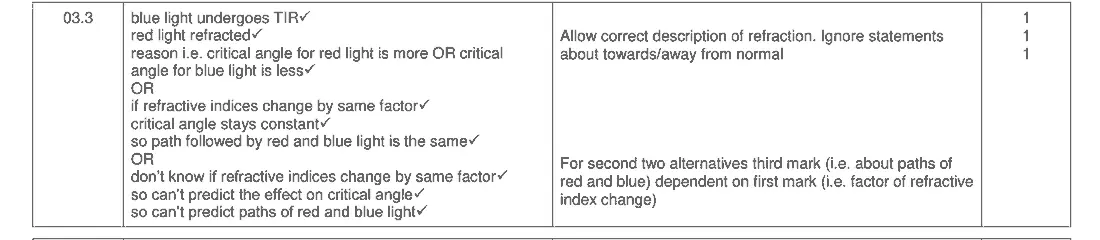
Blue totally internally reflected, red refracted out because critical angle for red is larger (or argue about refractive indices changing by the same factor)
June 2017 · AS Paper 2 · Q231 markMultiple choice
Answer
C
Notes from the mark scheme and report
Answer: C
June 2017 · AS Paper 2 · Q241 markMultiple choice
Answer
C
Notes from the mark scheme and report
Answer: C
Skills: MS0.6 Use calculators to handle sin x, cos x, tan x when x is expressed in degrees or radians
Specimen set 1 · Paper 1 · Q5.13 marksExplanation
Mark scheme
Notes from the mark scheme and report
Core carries light by total internal reflection
cladding has lower refractive index so TIR occurs, and protects the core boundary from scratches
labelled diagram can score
Specimen set 1 · Paper 1 · Q5.22 marksExplanation
Earlier part of question 5 that this part uses
Mark scheme
Notes from the mark scheme and report
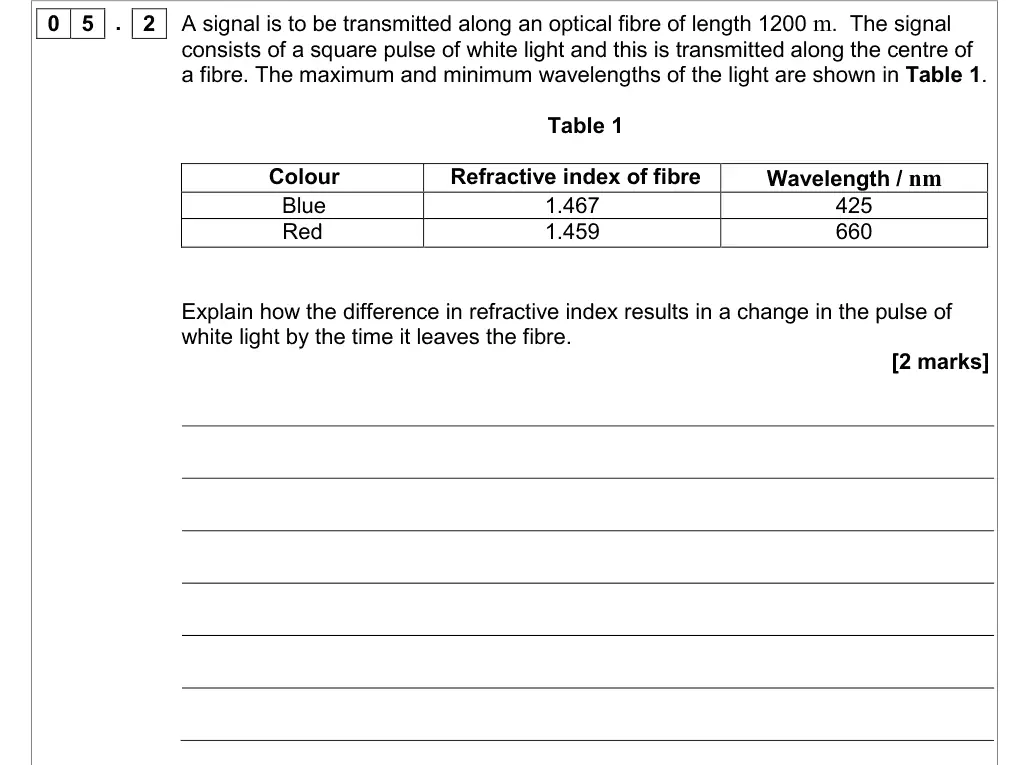
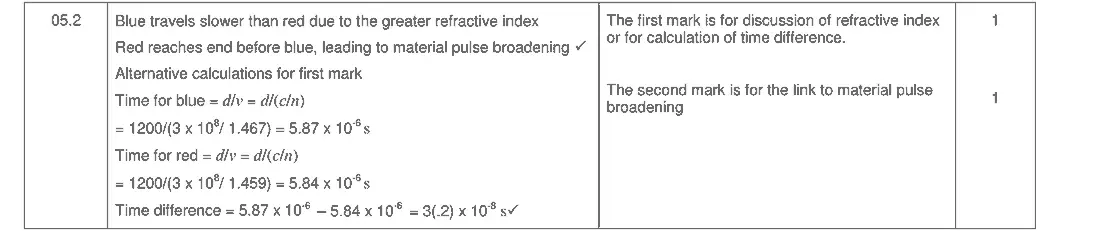
Blue slower than red (greater refractive index) so red arrives first and the pulse broadens (material dispersion)
time difference about 3 x 10^-8 s accepted for mark 1
Specimen set 1 · Paper 1 · Q5.32 marksExplanation
Earlier part of question 5 that this part uses
Mark scheme
Notes from the mark scheme and report
Any two: monochromatic source, shorter distance between repeaters, monomode fibre
must distinguish modal from material dispersion
Specimen set 1 · Paper 1 · Q131 markMultiple choice
Answer
B
Notes from the mark scheme and report
Answer: B
June 2016 · AS Paper 2 · Q161 markMultiple choice
Answer
B
Examiner's comment
16 This question proved to be quite demanding, with 40% of the students giving the correct answer. Nearly 30% chose D, confusing angles of reflection and refraction perhaps.
Notes from the mark scheme and report
Answer: B
nearly 30% chose D
June 2016 · AS Paper 2 · Q171 markMultiple choiceEasy
Answer
B
Examiner's comment
17 This straightforward calculation proved to be very accessible with 85% of the answers correct. It is worth pointing out that only about 2% of students chose D, an answer greater than the speed of light in a vacuum.
Notes from the mark scheme and report
Answer: B
Skills: MS2.3 Substitute numerical values into algebraic equations using appropriate units for physical quantities
Specimen set 1 · Paper 3 Section A · Q3.11 markPractical and data analysis
Mark scheme
Notes from the mark scheme and report
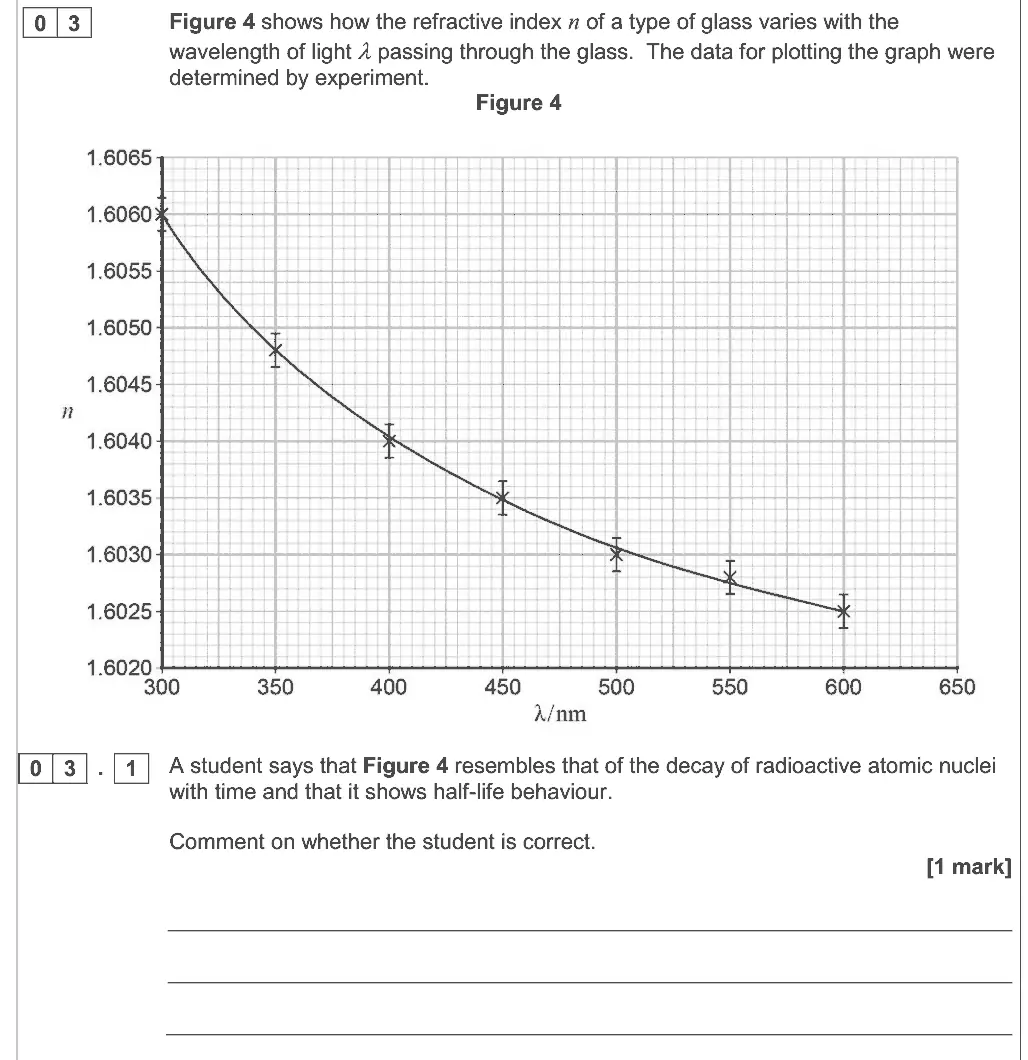
Not half-life behaviour: false origin on n axis so n does not halve in equal intervals (changes 4, 2, 1 units refer to the offset only)
Skills: MS3.1 Translate information between graphical, numerical and algebraic forms; PS3.1 Plot and interpret graphs
Specimen set 1 · Paper 3 Section A · Q3.23 marksPractical and data analysis
Earlier part of question 3 that this part uses
Mark scheme
Notes from the mark scheme and report
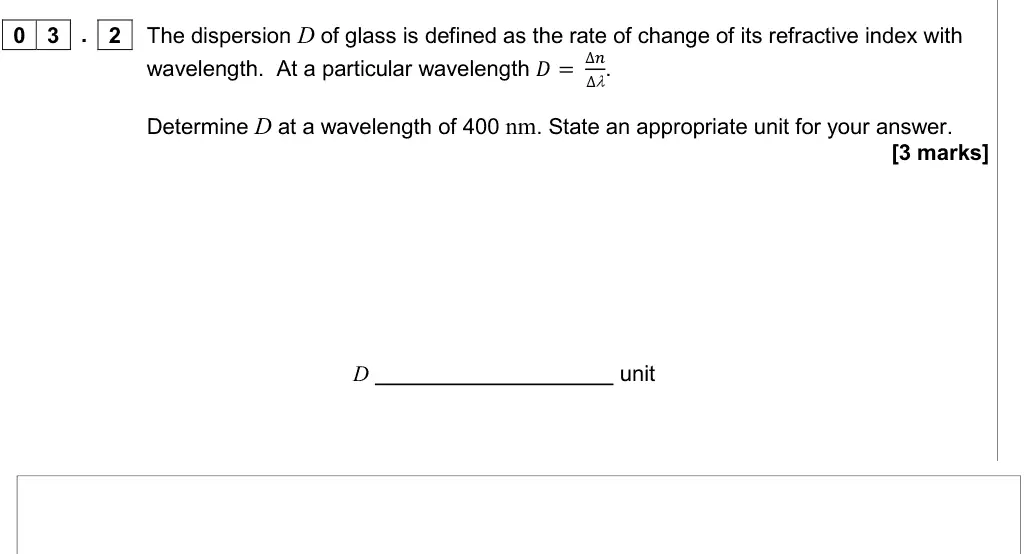
Answer: D = -(1.5 plus or minus 0.2) x 10^4 m^-1
long tangent (over 8 cm) at 400 nm with a large triangle
Skills: MS3.6 Draw and use the slope of a tangent to a curve as a measure of rate of change; MS0.1 Recognise and make use of appropriate units in calculations
Specimen set 1 · Paper 3 Section A · Q3.33 marksPractical and data analysis
Earlier part of question 3 that this part uses
Mark scheme
Notes from the mark scheme and report
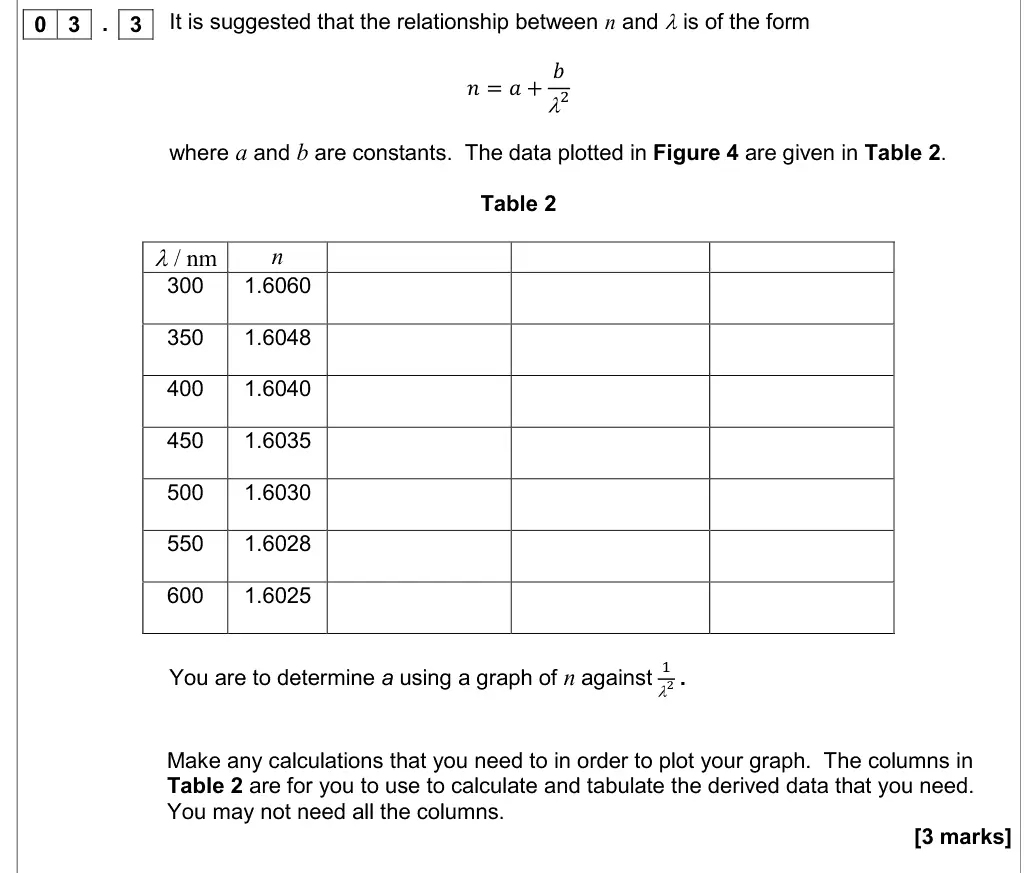
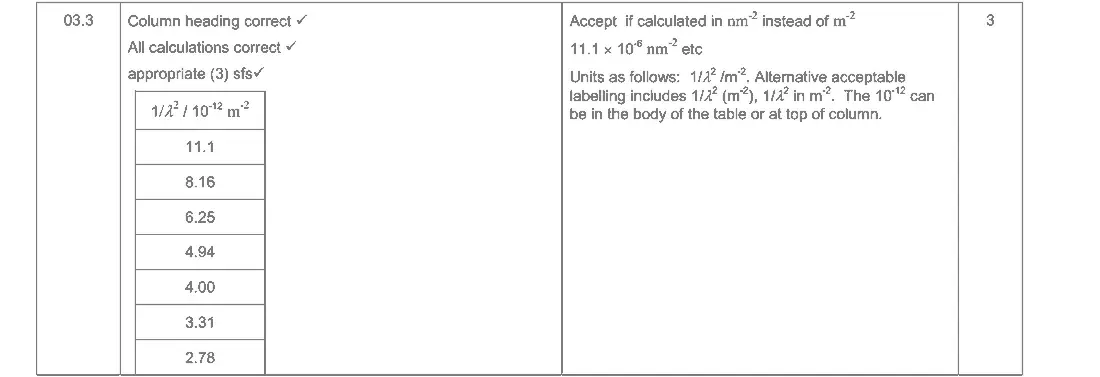
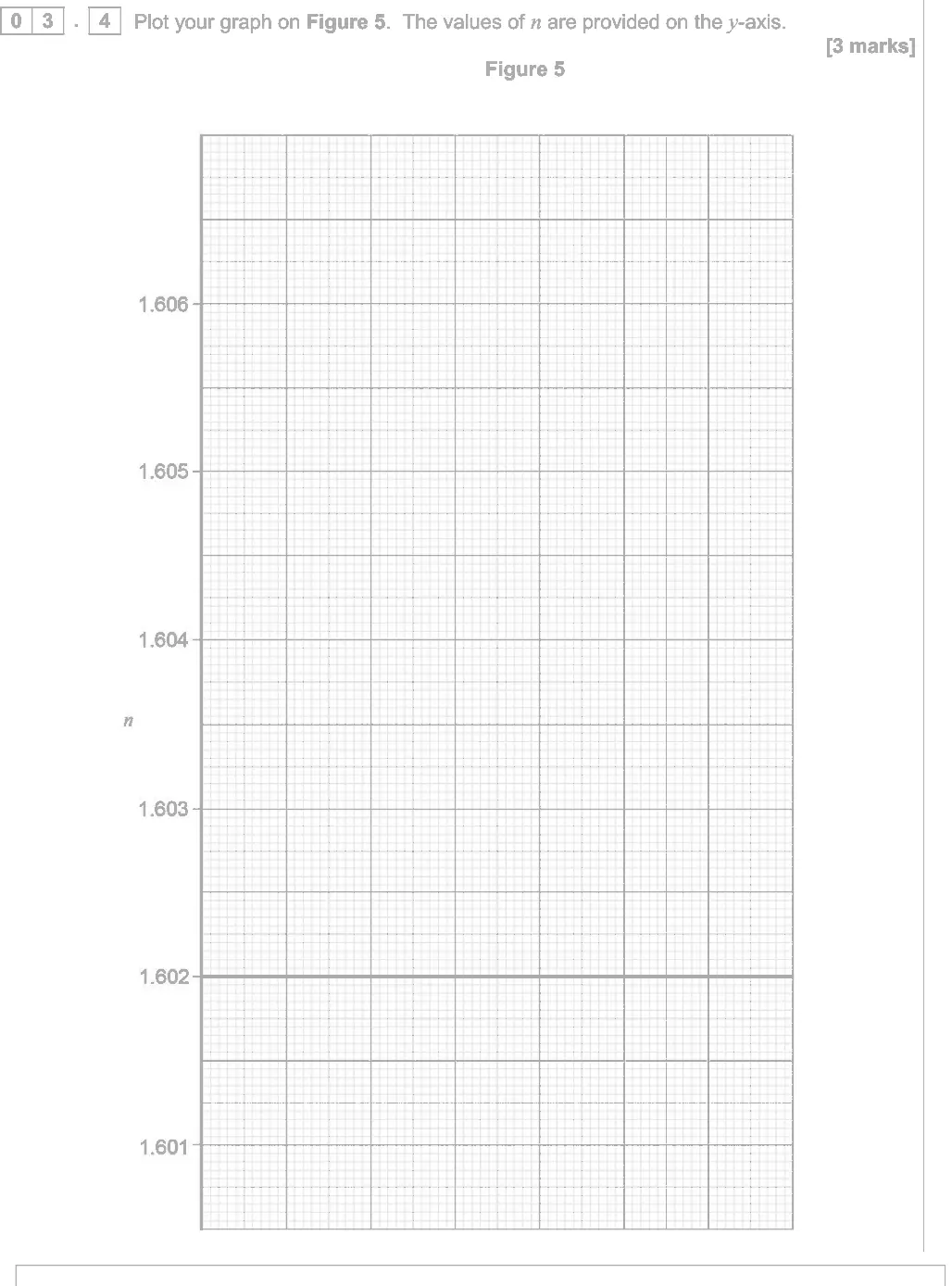
Column heading 1/lambda^2 / 10^12 m^-2 with values 11.1, 8.16, 6.25, 4.94, 4.00, 3.31, 2.78 to 3 sf
Skills: MS3.3 Understand that y = mx + c represents a linear relationship; PS2.2 Present data in appropriate ways; MS1.1 Use an appropriate number of significant figures
Specimen set 1 · Paper 3 Section A · Q3.43 marksDiagram or graph
Earlier part of question 3 that this part uses
Mark scheme
Notes from the mark scheme and report
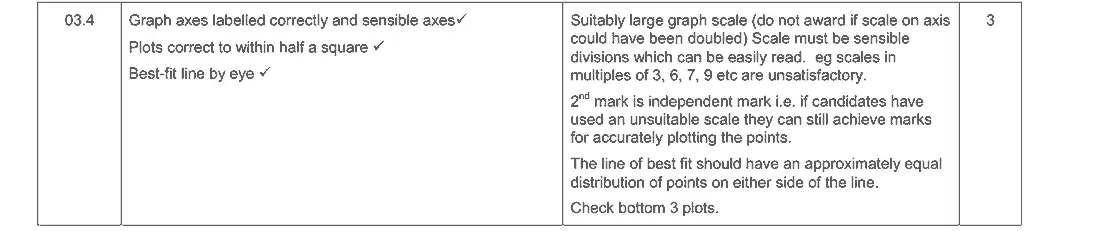
Labelled axes, sensible scale (not doubled-able, no awkward multiples), points within half a square, best-fit line by eye
Skills: MS3.2 Plot two variables from experimental or other data; PS2.2 Present data in appropriate ways
Specimen set 1 · Paper 3 Section A · Q3.51 markPractical and data analysis
Earlier part of question 3 that this part uses
Mark scheme
Notes from the mark scheme and report
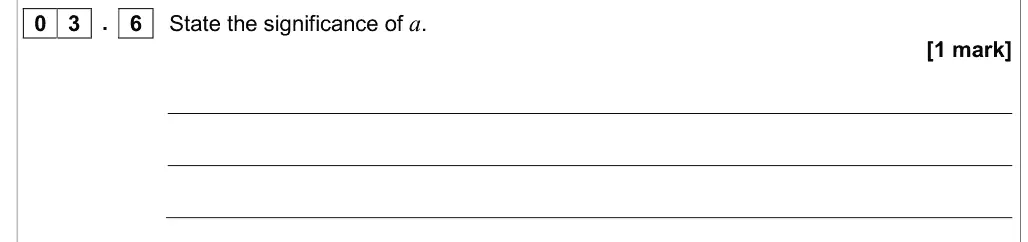
Answer: a = 1.6014 (intercept at 1/lambda^2 = 0)
Skills: MS3.4 Determine the slope and intercept of a linear graph; MS3.3 Understand that y = mx + c represents a linear relationship
Specimen set 1 · Paper 3 Section A · Q3.61 markShort answer
Earlier part of question 3 that this part uses
Mark scheme
Notes from the mark scheme and report
a is the refractive index at infinite (very long) wavelength
Skills: MS3.3 Understand that y = mx + c represents a linear relationship
Specimen set 1 · Paper 3 Section A · Q3.73 marksPractical and data analysis
Earlier part of question 3 that this part uses
Mark scheme
Notes from the mark scheme and report
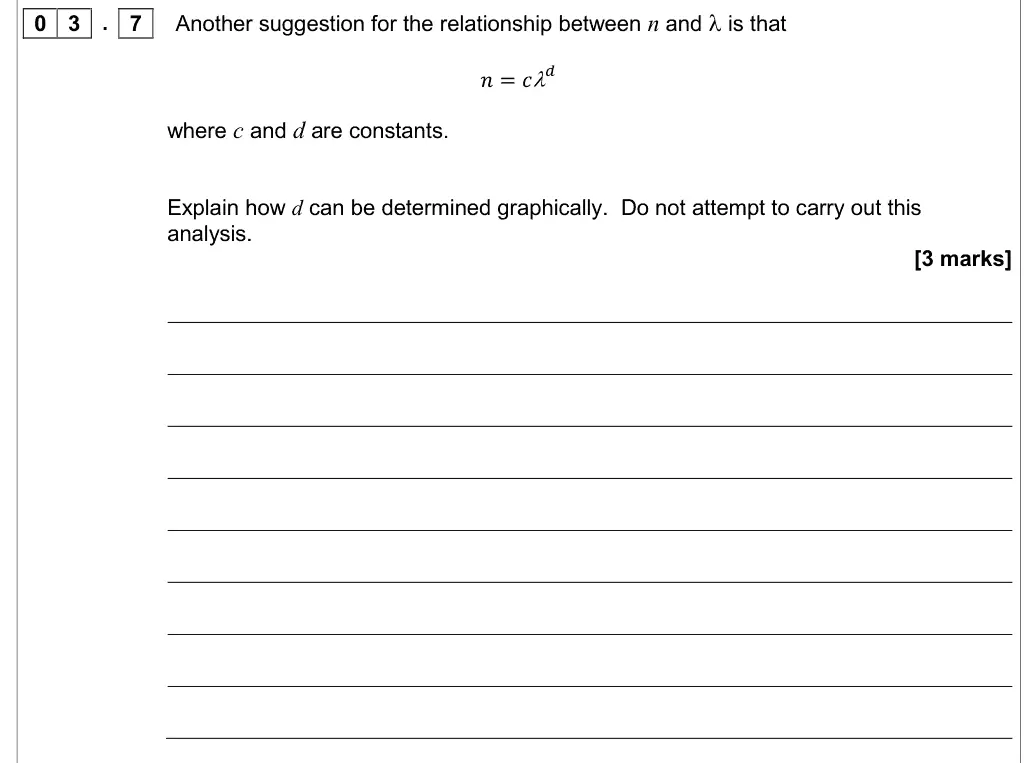
log n = log c + d log lambda
plot log n against log lambda
d is the gradient
Skills: MS3.11 Use logarithmic plots to test exponential and power law variations; MS3.3 Understand that y = mx + c represents a linear relationship; MS2.5 Use logarithms in relation to quantities that range over several orders of magnitude
Work with an AQA physics tutor
Dropping marks on calculations, required practicals or the six-markers? Book a trial session with a specialist AQA physics tutor.