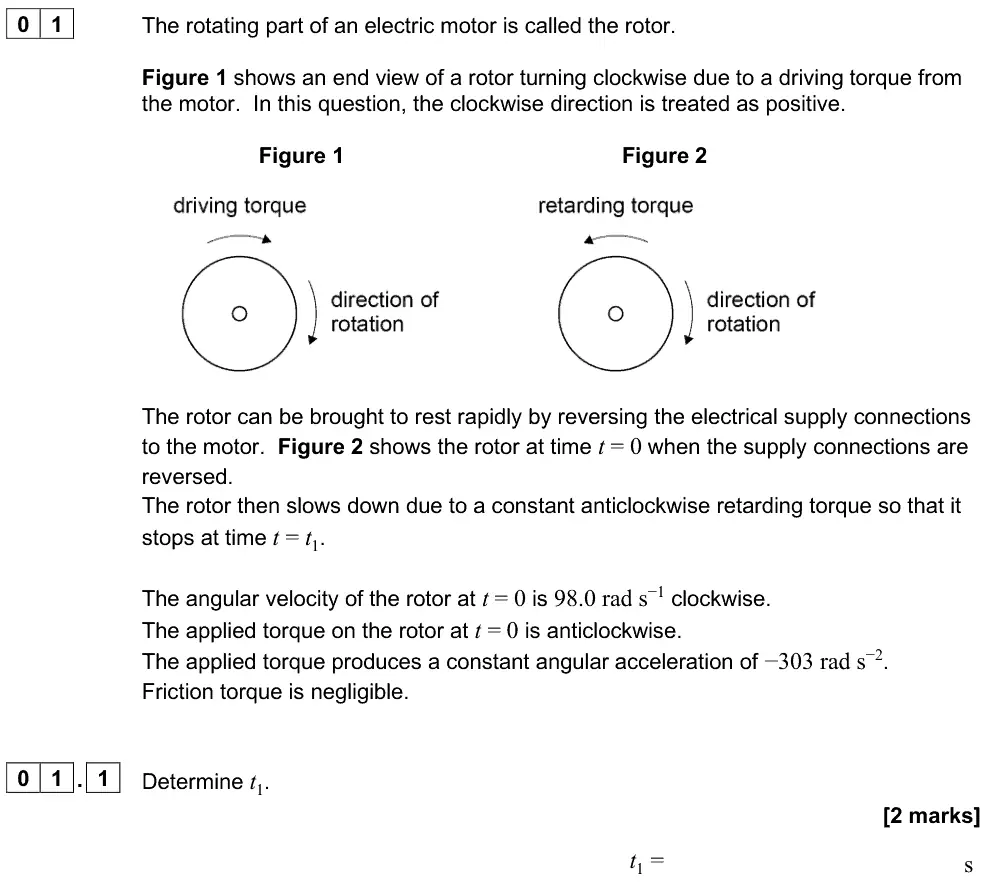
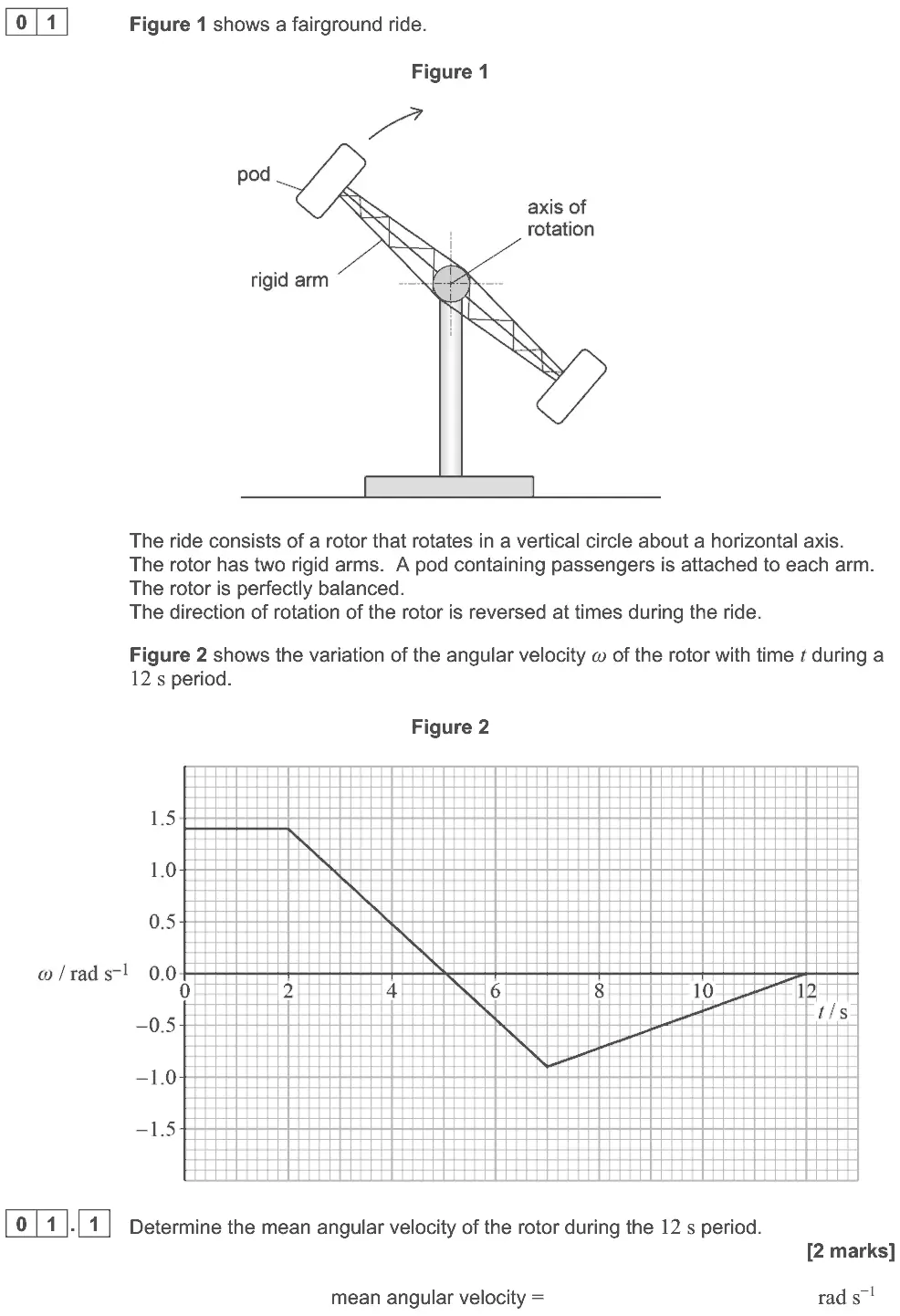
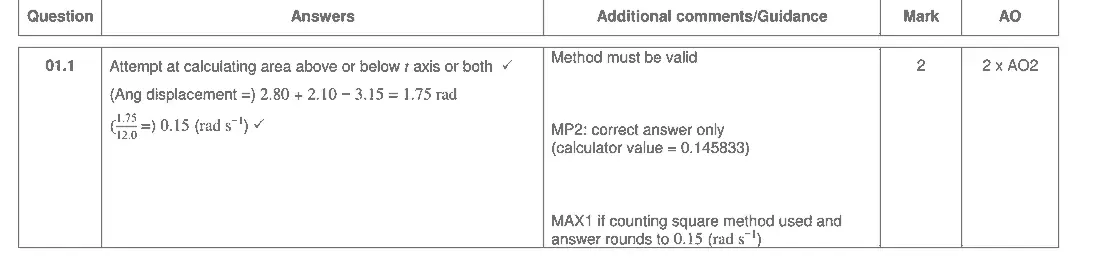
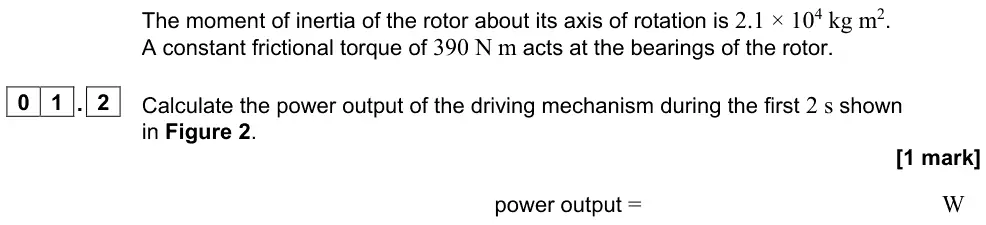
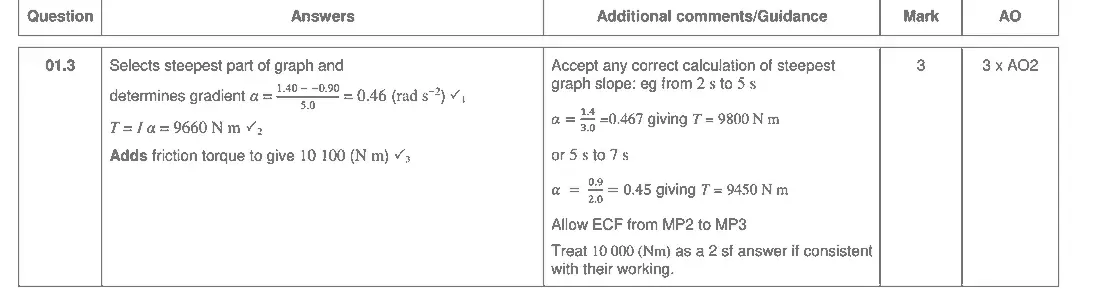
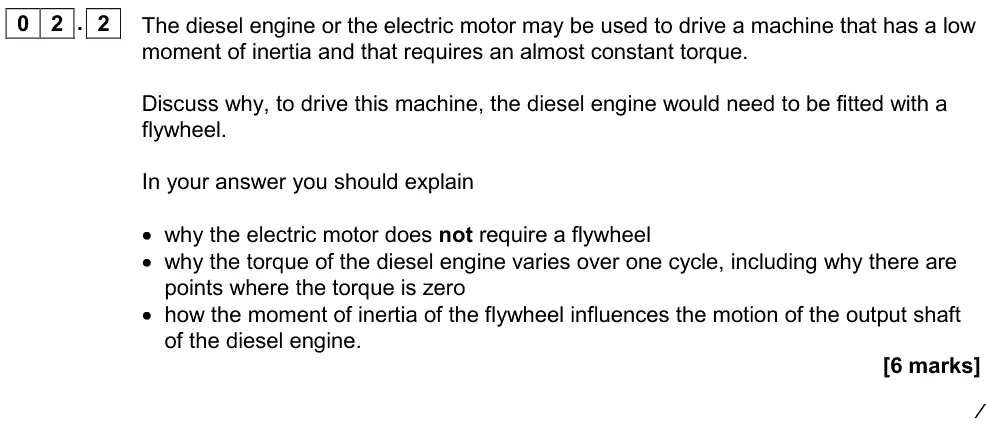
Tap a question to zoom it. Where a part needs a figure, table or graph from earlier in the question, that part folds out above it; the mark scheme and examiner's comment open underneath. Have the AQA data and formulae booklet beside you (see the formula sheet page).
June 2025 · Paper 3B Engineering physics · Q1.12 marksAO2=2CalculationEasy
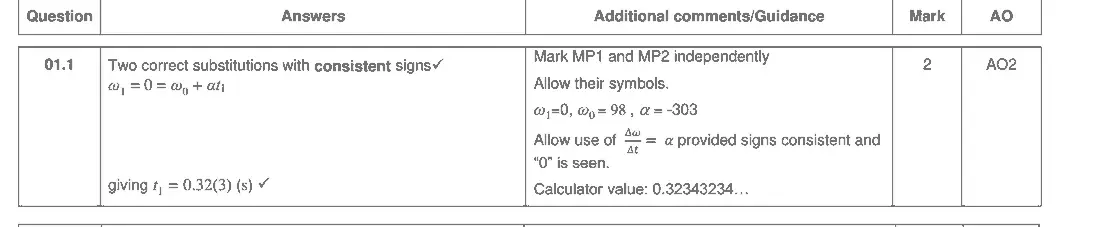
Mark scheme
Examiner's comment
Question 1.1 was answered correctly by more than 75% of students. To gain full credit, students needed to make use of a consistent sign convention. Many students only received one mark because they did not set out their answer clearly, or because their answer would have led to a negative value for time.
Just over half of students obtained both marks in question 1.2. Answers that made use of a single step rotational motion equation were most likely to gain full credit. Some students lost the mark for incorrect rounding or for using the incorrect change in angular velocity.
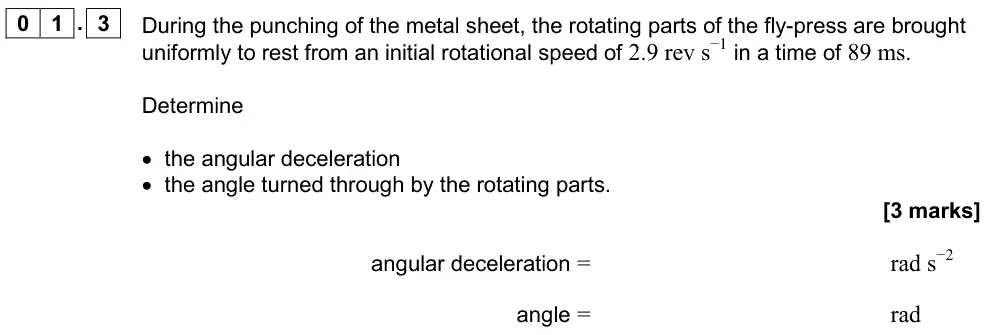
The calculation in 1.3 was very accessible, with over 60% of students getting the mark. The mark scheme allowed credit for the various steps in the calculation, and this meant that it discriminated well.
Notes from the mark scheme and report
Answer: 0.323 s (0 = 98.0 - 303 t1)
consistent sign convention needed
answers implying negative time lost a mark
Skills: MS2.3 Substitute numerical values into algebraic equations using appropriate units for physical quantities; MS2.2 Change the subject of an equation, including non-linear equations
June 2025 · Paper 3B Engineering physics · Q1.22 marksAO2=2Calculation
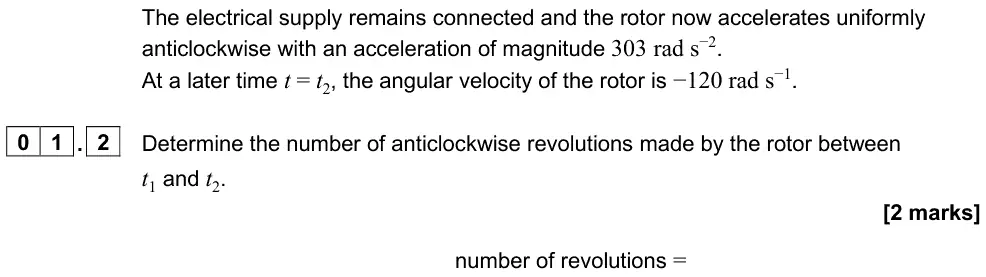
Earlier part of question 1 that this part uses
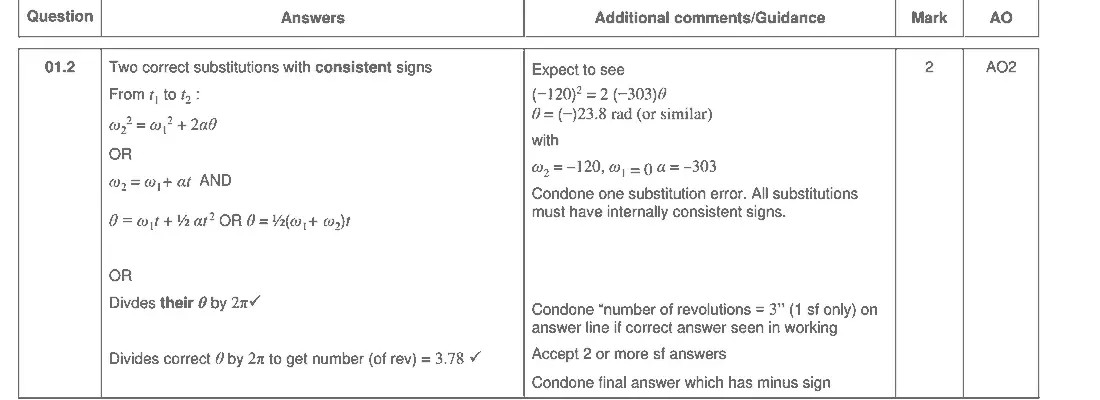
Mark scheme
Examiner's comment
Just over half of students obtained both marks in question 1.2. Answers that made use of a single step rotational motion equation were most likely to gain full credit. Some students lost the mark for incorrect rounding or for using the incorrect change in angular velocity.
Notes from the mark scheme and report
Answer: 3.78 revolutions (from rest, (-120)^2 = 2 x (-303) theta gives theta = 23.8 rad
divide by 2pi)
wrong change in omega or rounding lost marks
just over half full marks
Skills: MS2.3 Substitute numerical values into algebraic equations using appropriate units for physical quantities; MS2.2 Change the subject of an equation, including non-linear equations
June 2025 · Paper 3B Engineering physics · Q1.31 markAO2=1CalculationEasy
Earlier part of question 1 that this part uses
Mark scheme
Examiner's comment
The calculation in 1.3 was very accessible, with over 60% of students getting the mark. The mark scheme allowed credit for the various steps in the calculation, and this meant that it discriminated well.
Notes from the mark scheme and report
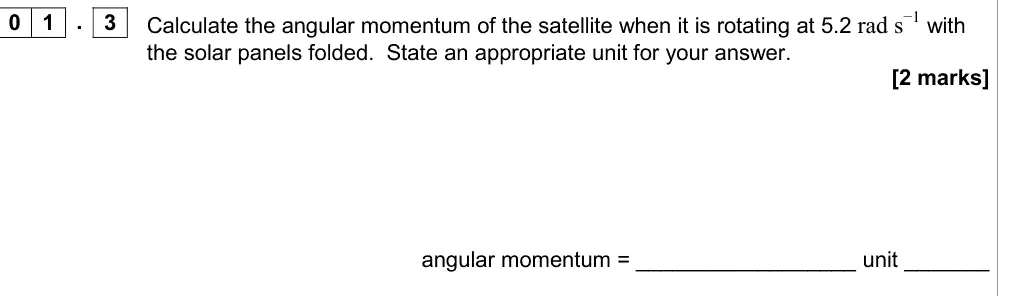
Answer: 21 N m s (9.60 x 10^-2 x (-120 - 98))
Skills: MS2.3 Substitute numerical values into algebraic equations using appropriate units for physical quantities
June 2025 · Paper 3B Engineering physics · Q1.43 marksAO3=3CalculationHard
Earlier part of question 1 that this part uses
Mark scheme
Examiner's comment
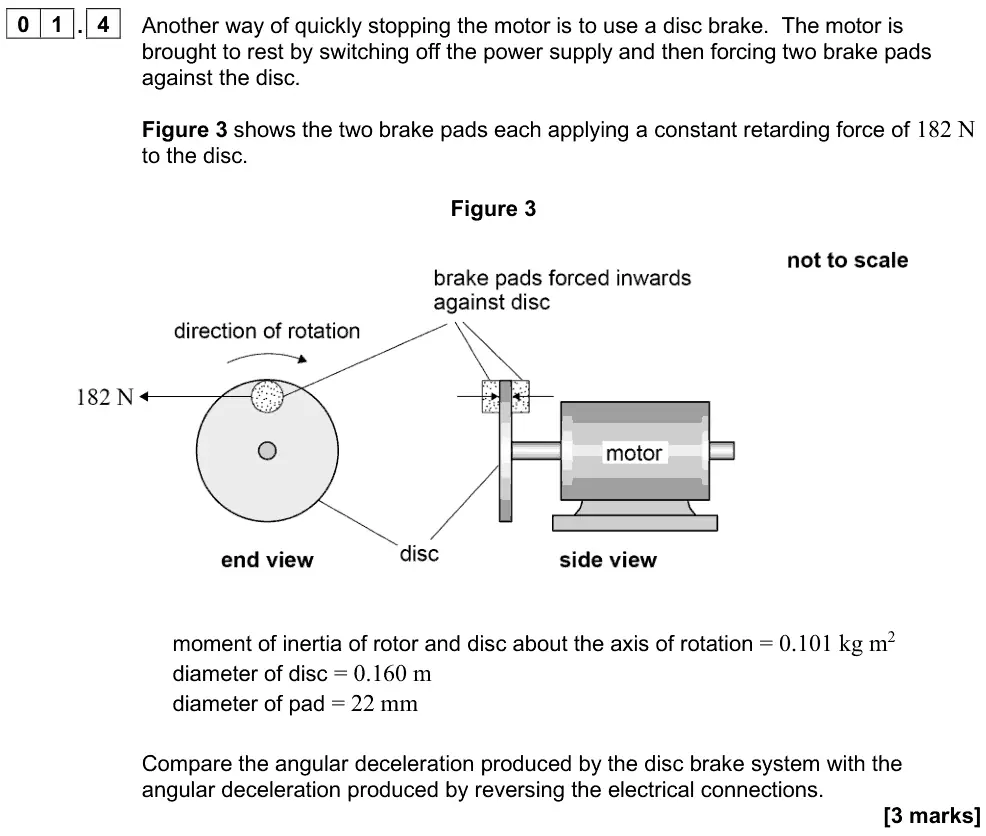
Question 1.4 was much more demanding, with less than 20% of students gaining full marks. The most common difficulty was determining the distance between the centre of rotation and the line of action of the frictional force. Many students also failed to recognise that there were two brake pads acting on the disc and that the force had to be doubled. The mark scheme rewarded intermediate steps, provided students made it clear what they were doing.
Notes from the mark scheme and report
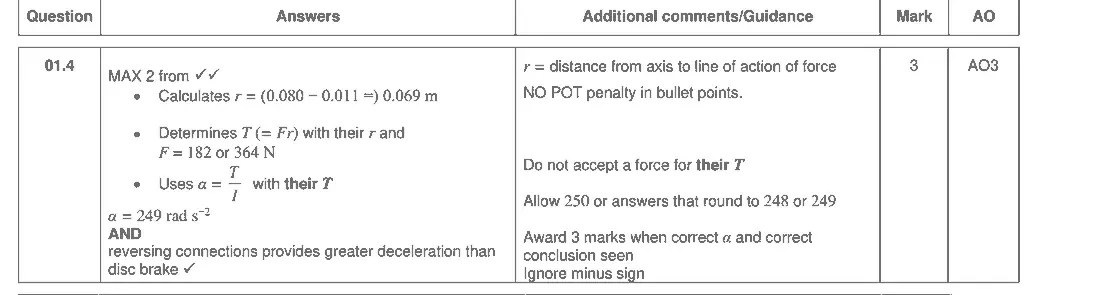
Answer: alpha = 249 rad s^-2 (r = 0.080 - 0.011 = 0.069 m to the pad centre
T = 2 x 182 x 0.069 = 25.1 N m
alpha = T/I), less than 303 rad s^-2 so reversing the supply decelerates faster
missing the second pad or using the disc radius were common
Skills: MS2.3 Substitute numerical values into algebraic equations using appropriate units for physical quantities; MS0.3 Use ratios, fractions and percentages
June 2025 · Paper 3B Engineering physics · Q2.13 marksAO1=1, AO2=2Show that
Mark scheme
Examiner's comment
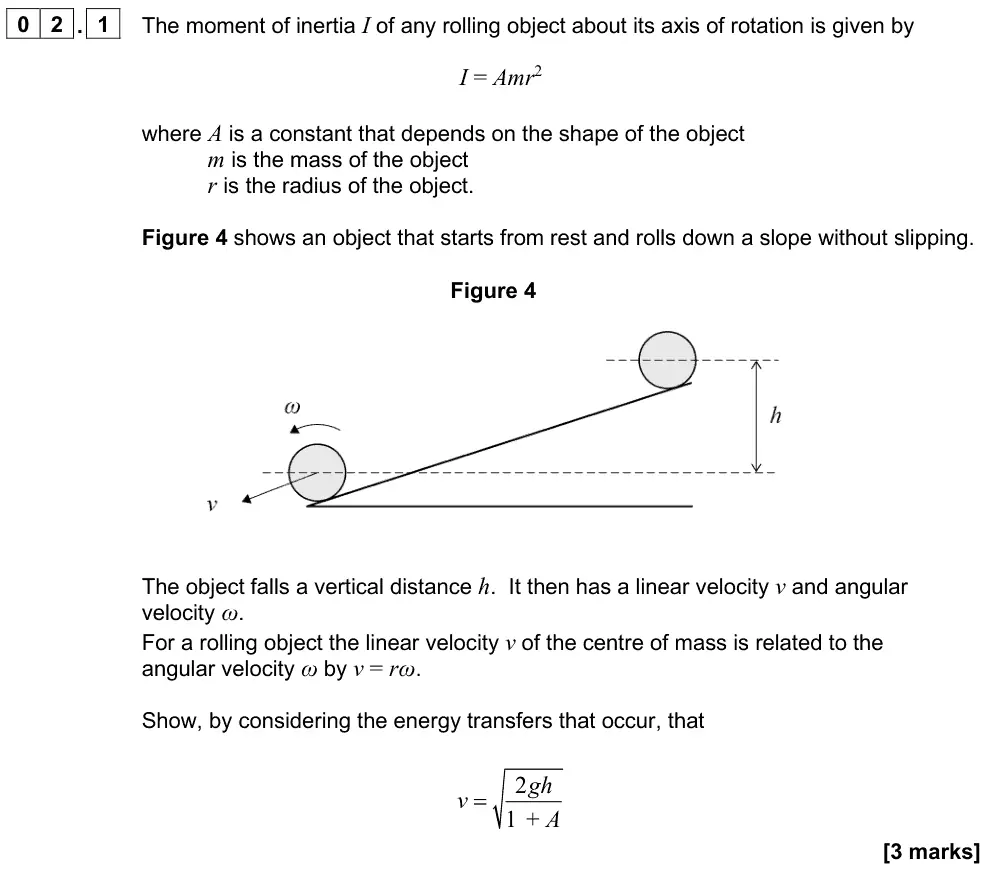
Students who missed out the rotational kinetic energy in 2.1 could make no progress with this question. Partial credit was given to students who included the rotational kinetic energy but missed out the translational kinetic energy. Many of these students were prevented from gaining a second mark because they incorrectly arrived at the required equation, despite this being inconsistent with their working. The best answers set out each step very clearly so that each mark could be rewarded.
Notes from the mark scheme and report
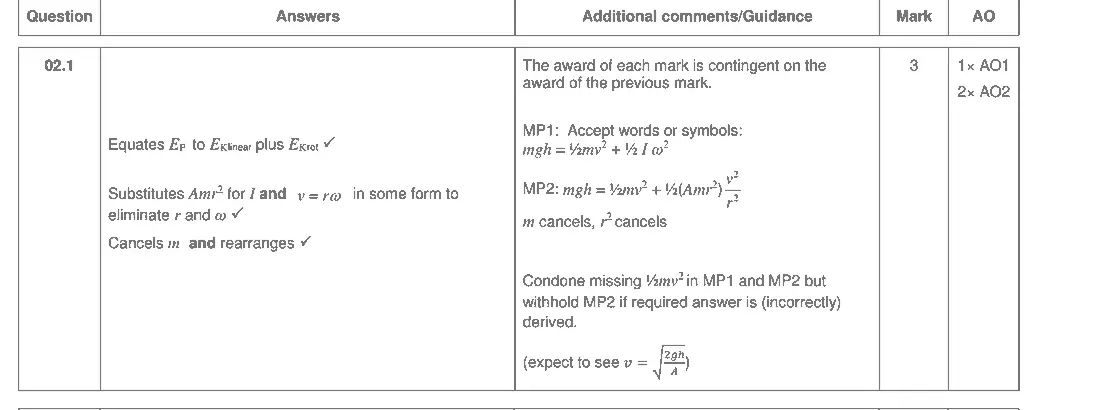
mgh = 0.5 m v^2 + 0.5 (A m r^2)(v/r)^2, cancel m and r^2 to give v = sqrt(2gh/(1 + A))
omitting rotational KE made no progress
each mark depends on the previous
Skills: MS2.2 Change the subject of an equation, including non-linear equations; MS2.3 Substitute numerical values into algebraic equations using appropriate units for physical quantities
June 2025 · Paper 3B Engineering physics · Q2.21 markAO1=1Short answerEasy
Earlier part of question 2 that this part uses
Mark scheme
Examiner's comment
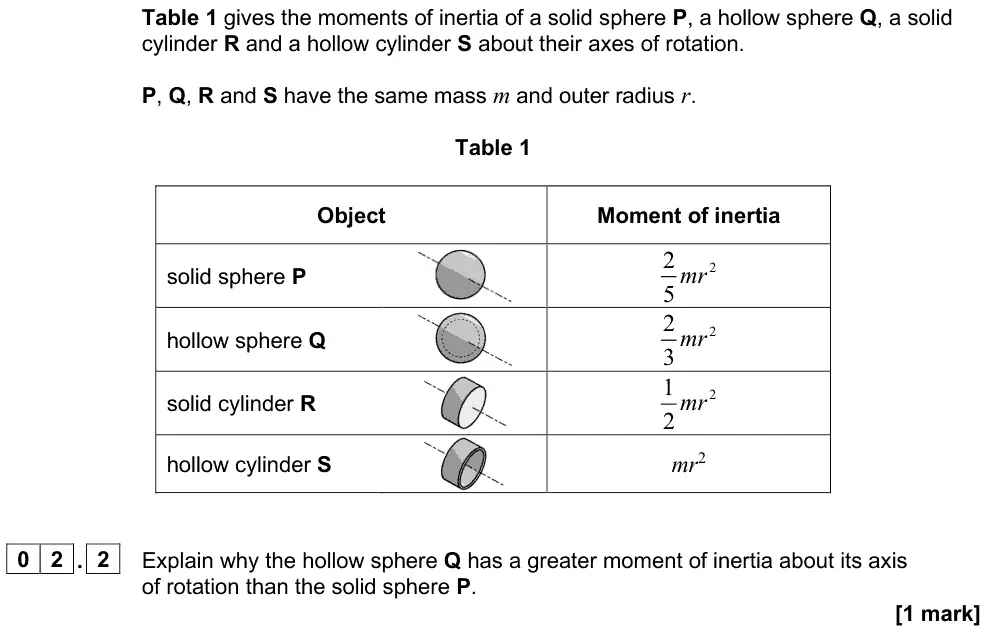
About 65% of students gained the mark for Question 2.2. Those who missed out often suggested that the mass or the radius of Q was greater than that of P. It was difficult to see whether this was due to a lack of understanding or a failure to express the answer clearly.
Notes from the mark scheme and report
More of Q's mass is further from the axis
'more mass' or 'larger radius' not accepted
June 2025 · Paper 3B Engineering physics · Q2.33 marksAO2=2, AO3=1Explanation
Earlier part of question 2 that this part uses
Mark scheme
Examiner's comment
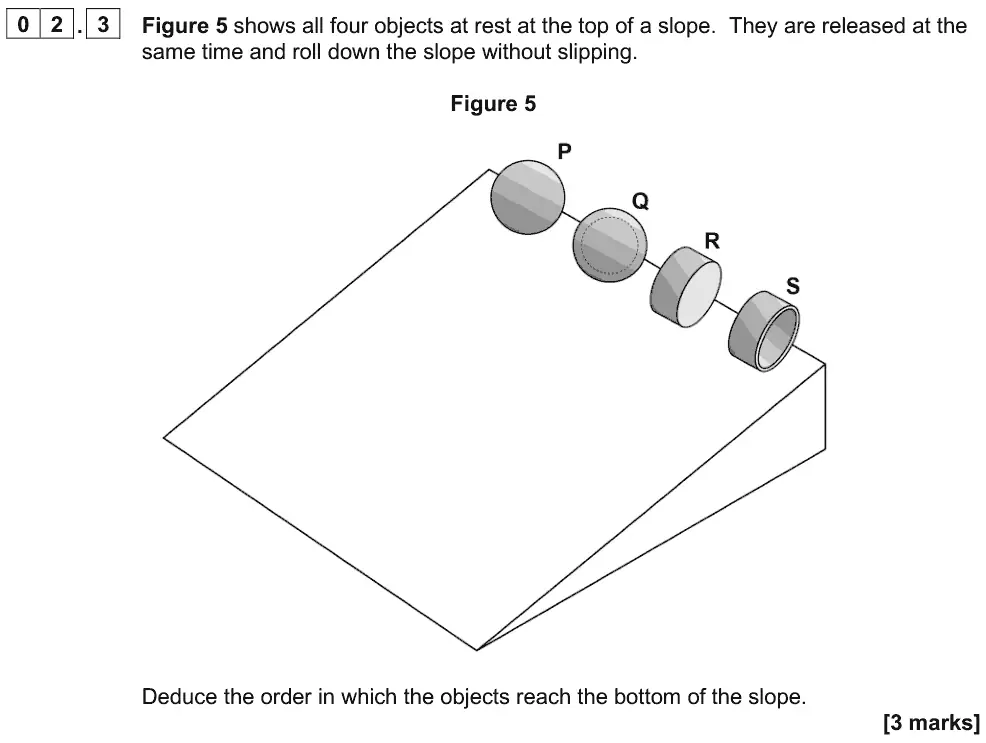
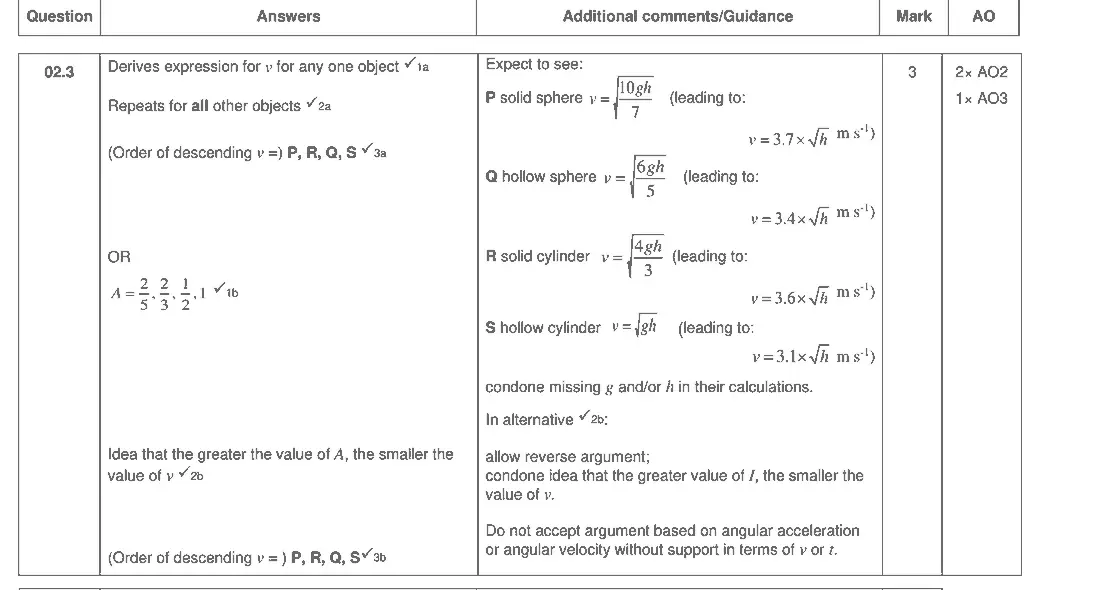
Many students were able to suggest the correct order in Question 2.3. Far fewer were able to support their answer with correct physics. To obtain full credit, students had to make the relationship between the moment of inertia and the linear speed clear. Some students tried to arrive at an answer in terms of angular speed or angular acceleration, and this rarely gained full marks.
Notes from the mark scheme and report
Larger A gives smaller v at each height, so order P (A = 2/5), R (1/2), Q (2/3), S (1)
order without physics or arguments via angular speed rarely gained full marks
Skills: MS2.3 Substitute numerical values into algebraic equations using appropriate units for physical quantities; MS0.3 Use ratios, fractions and percentages
June 2024 · Paper 3B Engineering physics · Q1.13 marksExplanation
Mark scheme
Examiner's comment
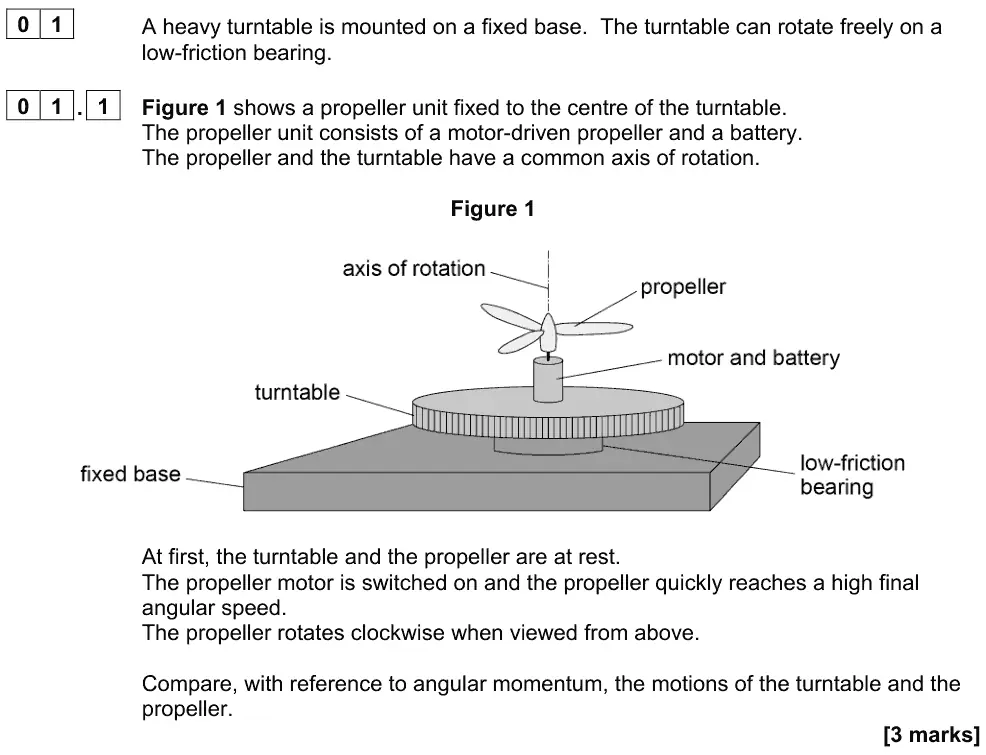
Nearly 70% of students were able to score one or more marks. There were some good answers which showed a sound understanding of how the law of conservation of angular momentum applied to the propeller and turntable. Many answers went further than the expected mark scheme by giving reasons for the different moments of inertia of the turntable and propeller.
Most of those who scored two marks missed the idea that the turntable must rotate in the opposite direction to the propeller for angular momentum to be conserved. Those who simply wrote that the turntable rotates anticlockwise 'due to' conservation of angular momentum did not get the mark for this. A statement about the equal and opposite momentums was required.
Some students filled the answer space with an explanation that failed to mention angular momentum, despite the instruction in the question. Some wrote that the angular momentum of the propeller and/or turntable 'must be constant' instead of 'must be conserved'.
Common misconceptions were:
• the turntable must have greater angular momentum than the propeller because its moment of inertia is greater • the turntable and propeller both rotate clockwise to conserve angular momentum.
As in previous years, some students were sloppy with terminology, referring to 'inertia' instead of 'moment of inertia', and 'momentum' instead of 'angular momentum'.
Question 01.1
Notes from the mark scheme and report
Total angular momentum stays zero (no external torque)
turntable gains equal and opposite angular momentum so rotates anticlockwise
larger I so it rotates more slowly
'mass' for I not accepted
misconception that turntable has more angular momentum
June 2024 · Paper 3B Engineering physics · Q1.26 marks6-mark extended response
Earlier part of question 1 that this part uses
Mark scheme, with the levels and indicative content
Examiner's comment
This was the levels of response question, with a mark allocation of six marks. On the whole it was a well- answered question. About one-quarter of students gave a level three (5 or 6 marks) answer. Three- quarters of students scored two marks or more.
It was pleasing to see many thorough answers which showed a good understanding of both the practical and theoretical aspects of the question.
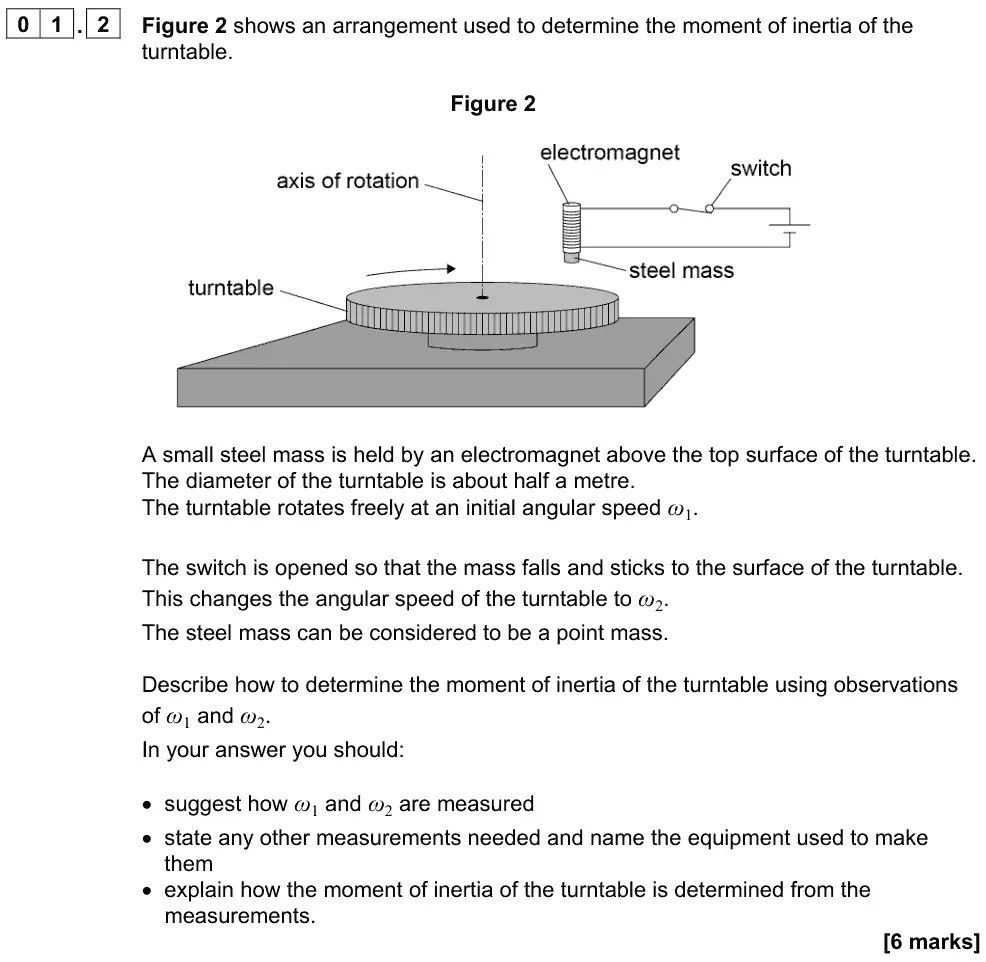
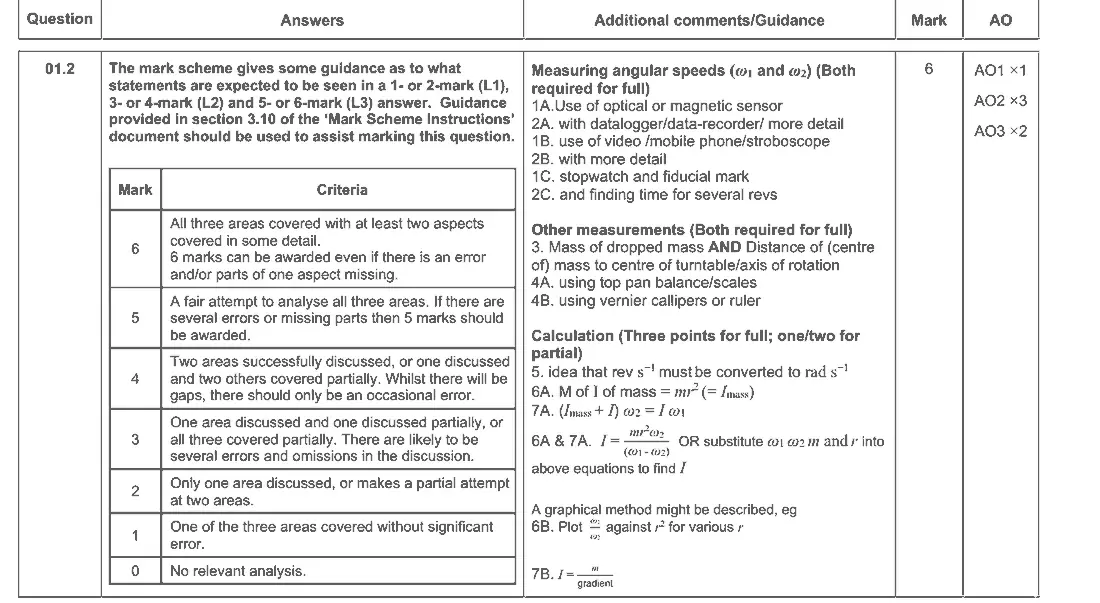
Examiners were looking for answers to cover three areas: 1. measuring the angular speeds 2. the other measurements needed 3. how the moment of inertia of the turntable would be determined.
The most common answer for area 1 was to use a fiducial mark and timer or stop clock, although some failed to include both. Any indication of making a mark or marks to enable rotations to be counted would do. Cameras, light gates and various sensors were also suggested. For these other means, further practical details for finding angular speed were often missing.
This area could not be considered to be fully covered if students suggested that one rotation only should be timed or filmed, or if they thought the number of rotations should be counted in a given time (ignoring the necessity to measure part rotations).
Most students explained how rev s-1 should be converted to rad s-1.
In area 2 it was not uncommon for answers mistakenly to include a measurement of the radius (or diameter) and mass of the turntable. They would go on to state the moment of inertia of the turntable could be calculated using I = mr2 or 0.5 mr2, thereby negating the whole point of the experiment.
One problem for examiners was the interpretation of students' use of the word 'radius' in relation to the steel mass. It had to be clear that the measurement needed was the distance, or radius, of the steel mass to the axis of rotation (or centre of turntable). 'The radius of the steel mass' was insufficient, especially when a micrometer was suggested for its measurement. The use of a ruler was expected for this.
In area 3 the application of conservation of angular momentum to the situation was covered confidently by many. A small minority thought the application of conservation of energy (including the initial gravitational potential energy of the steel mass) was needed.
The questions that proved most difficult were those designed to test assessment objective 3 (AO3). These questions require students to analyse, interpret or evaluate information, and often to go on and make a judgement. The mainly AO3 questions were 02.2, 02.3, 03.3, and 04.2. Parts of 01.2 and 03.1 were also AO3, but students seemed to manage these better, even though the context of 03.1 was likely to be very unfamiliar.
Question 01.2
Notes from the mark scheme and report
Levels of response: omega1, omega2 from timing several revolutions with a fiducial mark and stopwatch (or light gate/datalogger, video), convert to rad s^-1
mass of steel (balance) and its distance from the axis (ruler)
I omega1 = (I + m r^2) omega2 so I = m r^2 omega2/(omega1 - omega2)
measuring turntable mass and radius defeats the purpose
about a quarter reached Level 3
Skills: PS2.1 Comment on experimental design and evaluate scientific methods; PS2.2 Present data in appropriate ways
June 2024 · Paper 3B Engineering physics · Q2.13 marksAO2=3Show that
Mark scheme
Examiner's comment
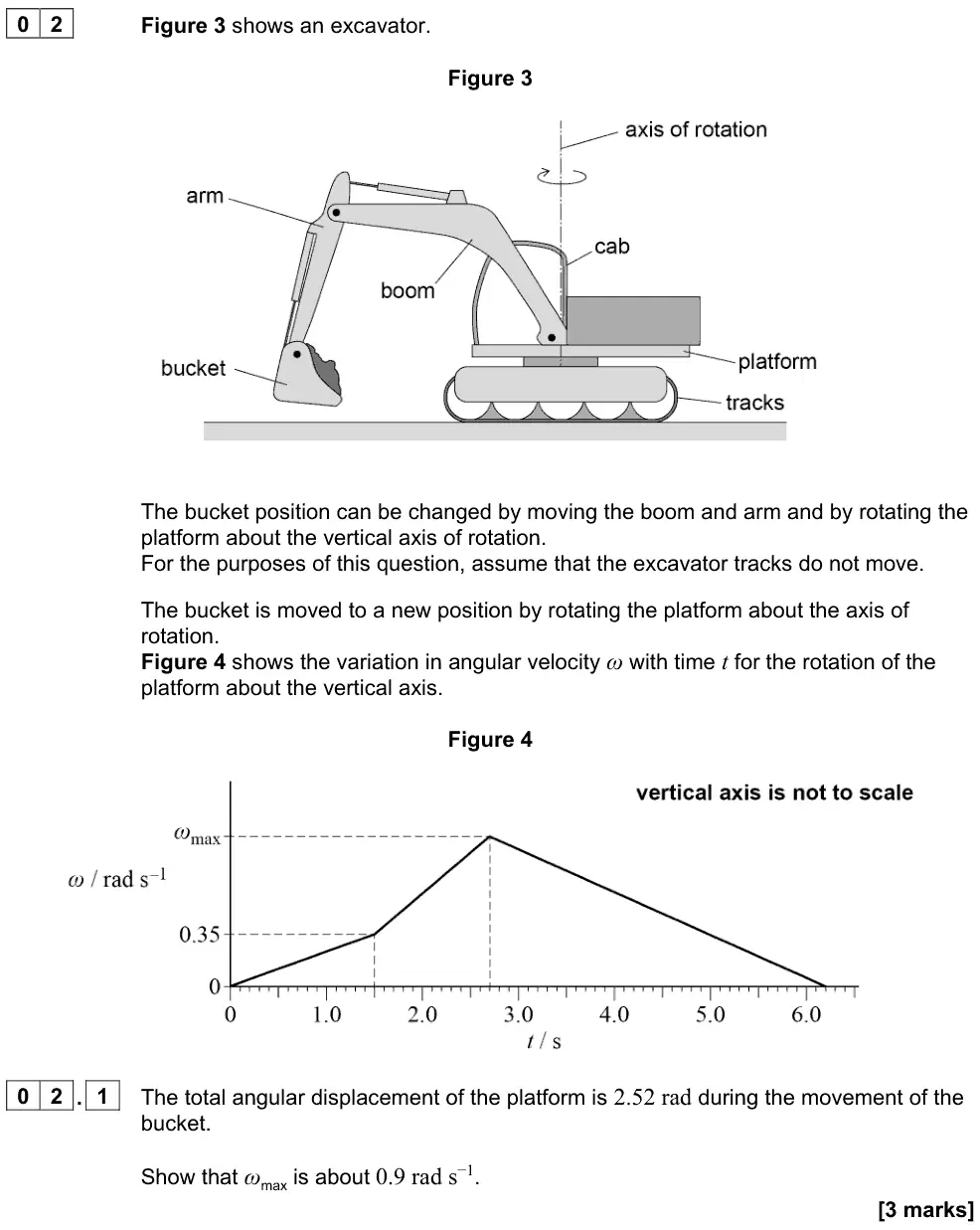
Nearly 60% of students scored full marks, but nearly one-fifth scored no marks at all. The specification asks for an understanding of 'representation of graphical methods of uniform and non-uniform angular acceleration'.
Many answers showed that students were able to find the area of the angular velocity against time graph in terms of ωmax. This was usually done by splitting the graph in Figure 4 into two triangles and a trapezium or three triangles and a rectangle. Some tried more complicated methods. Many students missed the final mark because they had misread a time interval from the graph. This was treated as an arithmetic error.
About 20% of students scored the one mark for calculating the torque at 2.1 s, probably because the question directed them to this time. They did not go on to consider that they needed to show that the torque was lower at the other peaks in order to deduce that torque was a maximum at 2.1 s.
The answer required an analysis of Figures 4 and 5 and reference to P = Iαω, whilst appreciating that after 2.1 s: • the moment of inertia decreased slightly • the angular acceleration remained the same • the angular speed increased. The conclusion could then be made that the power is greater at a time closer to 2.7 s.
Those who successfully used the calculation route found the angular speed at 2.1 s and multiplied it by their torque from 02.2. This gave one mark. They then found the power near or at 2.7 s by multiplying the moment of inertia at 2.7 s (or just before) by the angular acceleration and by ωmax.
Question 02.1
Notes from the mark scheme and report
Answer: 0.87 rad s^-1 (area under omega-t graph = 2.52 rad: 0.5 x 1.5 x 0.35 + 0.5 x (omega + 0.35) x 1.2 + 0.5 x 3.5 x omega)
misread time intervals
nearly one fifth scored zero
Skills: MS3.8 Understand the possible physical significance of the area between a curve and the x axis and be able to calculate it or estimate it by graphical methods as appropriate; MS2.2 Change the subject of an equation, including non-linear equations
June 2024 · Paper 3B Engineering physics · Q2.23 marksShow that
Earlier part of question 2 that this part uses
Mark scheme
Examiner's comment
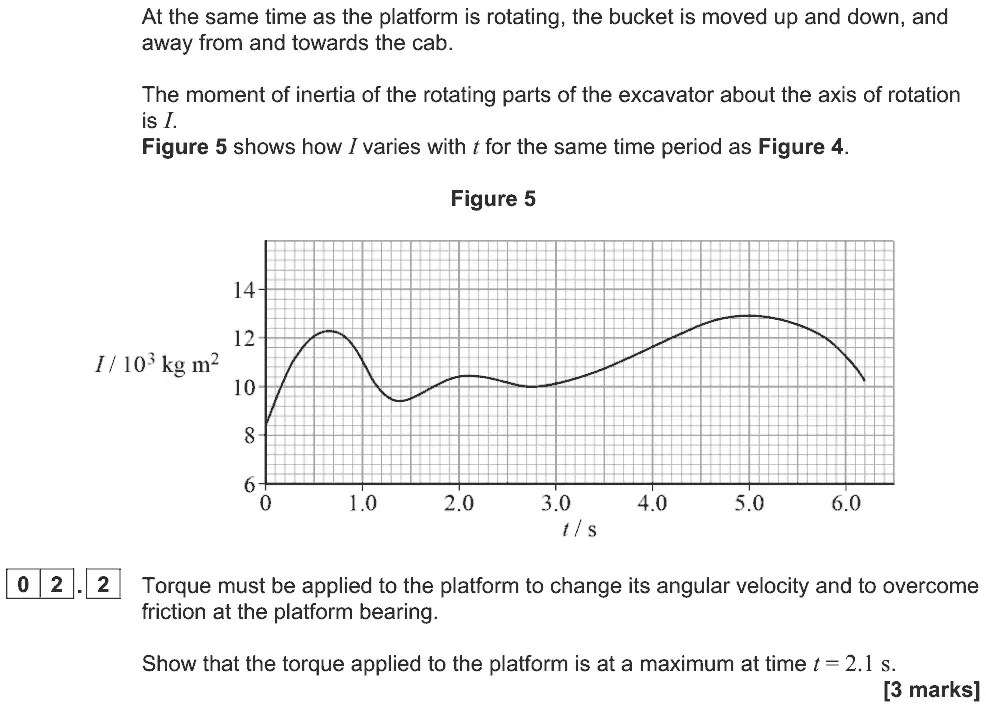
Students had to realise that they needed to calculate the torques for the three peaks shown in Figure 5. To do this they needed the angular accelerations for the three stages shown in Figure 4.
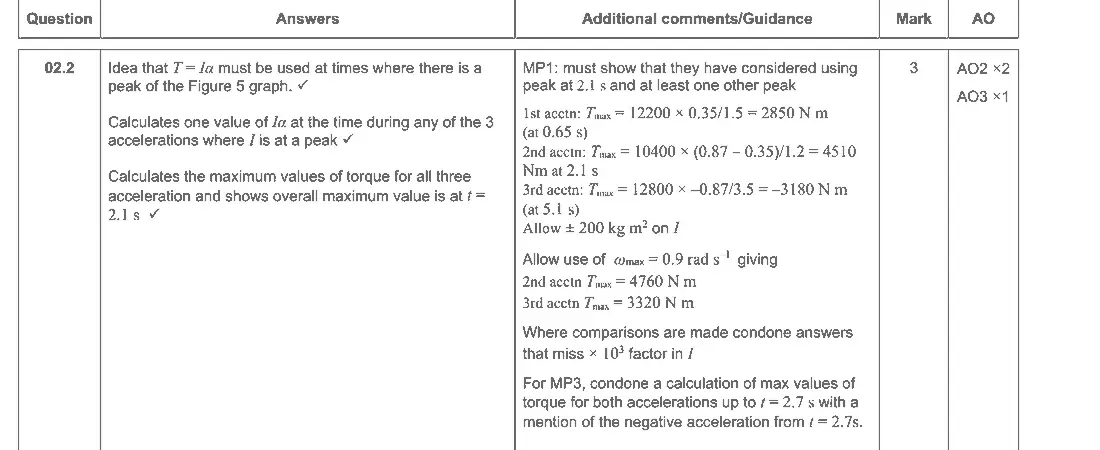
About 20% of students scored the one mark for calculating the torque at 2.1 s, probably because the question directed them to this time. They did not go on to consider that they needed to show that the torque was lower at the other peaks in order to deduce that torque was a maximum at 2.1 s.
Those who calculated the torque for two peaks scored two marks. A few students discounted the peak at 5.0 s because they saw from Figure 4 that the acceleration was negative. If they mentioned this as the reason for discounting the torque there, they could get three marks provided they also calculated the torques at the first two peaks. This was condoned because the torque would be a braking torque with friction assisting the platform in decelerating.
Where comparisons were made, the mark scheme condoned the dropping of the factor (× 103) in values of moment of inertia, and hence torque.
The question proved difficult, with about half the students scoring no marks at all and nearly 4% not even attempting it. It tested AO2 and AO3.
Those who successfully used the calculation route found the angular speed at 2.1 s and multiplied it by their torque from 02.2. This gave one mark. They then found the power near or at 2.7 s by multiplying the moment of inertia at 2.7 s (or just before) by the angular acceleration and by ωmax.
The questions that proved most difficult were those designed to test assessment objective 3 (AO3). These questions require students to analyse, interpret or evaluate information, and often to go on and make a judgement. The mainly AO3 questions were 02.2, 02.3, 03.3, and 04.2. Parts of 01.2 and 03.1 were also AO3, but students seemed to manage these better, even though the context of 03.1 was likely to be very unfamiliar.
Question 02.2
Notes from the mark scheme and report
T = I alpha at each peak of I: 2850 N m at 0.65 s, 4510 N m at 2.1 s, -3180 N m at 5.1 s, so maximum at 2.1 s
must compare at least two peaks
about half scored zero
Skills: MS3.1 Translate information between graphical, numerical and algebraic forms; MS3.4 Determine the slope and intercept of a linear graph; MS2.3 Substitute numerical values into algebraic equations using appropriate units for physical quantities
June 2024 · Paper 3B Engineering physics · Q2.32 marksAO3=2ExplanationHard
Earlier part of question 2 that this part uses
Mark scheme
Examiner's comment
This question was aimed to test assessment objective AO3. It required students to make a judgement about where the maximum power was likely to be. Only around one third of students scored at least one of the marks. A measure of the perceived difficulty of the question is reflected in the roughly 10% of students who did not attempt it.
It could be tackled in one of two ways, by a written explanation or by calculation. Those who chose the calculation route were generally more successful.
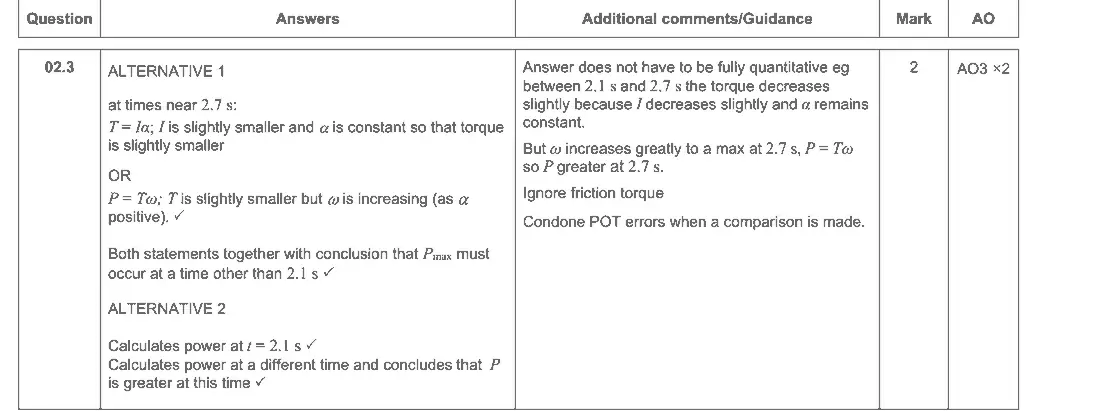
The answer required an analysis of Figures 4 and 5 and reference to P = Iαω, whilst appreciating that after 2.1 s: • the moment of inertia decreased slightly • the angular acceleration remained the same • the angular speed increased. The conclusion could then be made that the power is greater at a time closer to 2.7 s.
Those who successfully used the calculation route found the angular speed at 2.1 s and multiplied it by their torque from 02.2. This gave one mark. They then found the power near or at 2.7 s by multiplying the moment of inertia at 2.7 s (or just before) by the angular acceleration and by ωmax.
The questions that proved most difficult were those designed to test assessment objective 3 (AO3). These questions require students to analyse, interpret or evaluate information, and often to go on and make a judgement. The mainly AO3 questions were 02.2, 02.3, 03.3, and 04.2. Parts of 01.2 and 03.1 were also AO3, but students seemed to manage these better, even though the context of 03.1 was likely to be very unfamiliar.
Question 02.3
Notes from the mark scheme and report
P = T omega: after 2.1 s torque falls only slightly (I slightly less, alpha constant) while omega rises to its maximum at 2.7 s, so maximum power is near 2.7 s not 2.1 s
Skills: MS3.1 Translate information between graphical, numerical and algebraic forms; MS2.3 Substitute numerical values into algebraic equations using appropriate units for physical quantities
June 2023 · Paper 3B Engineering physics · Q1.12 marksAO1=2Short answerEasy
Mark scheme
Examiner's comment
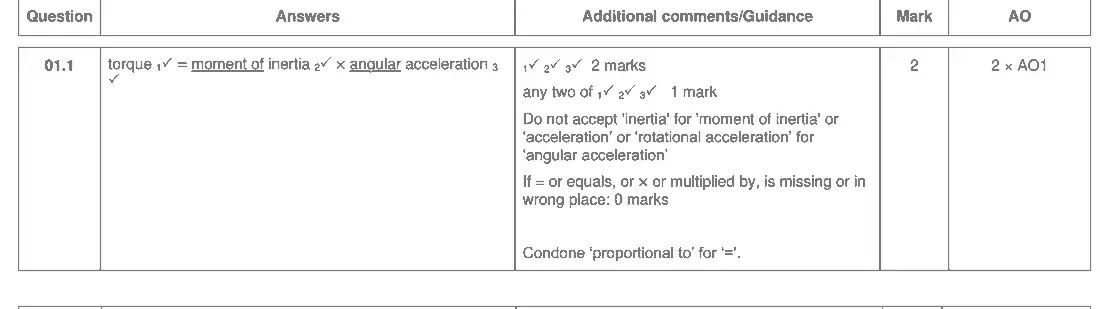
Nearly 70% of students were able to write the analogous equation correctly. Marks were not awarded for writing • 'inertia' for 'moment of inertia' • 'rotational acceleration' or just 'acceleration' for 'angular acceleration' • 'force' for 'torque' We condoned the use of 'proportional to' for 'equals' or '=' A few answers were well off the mark, and included angular momentum, energy, or mass.
Question 01.1
Notes from the mark scheme and report
Torque = moment of inertia x angular acceleration in words
'inertia', 'acceleration' or 'rotational acceleration' not accepted
June 2023 · Paper 3B Engineering physics · Q1.22 marksAO1=2ExplanationHard
Earlier part of question 1 that this part uses
Mark scheme
Examiner's comment
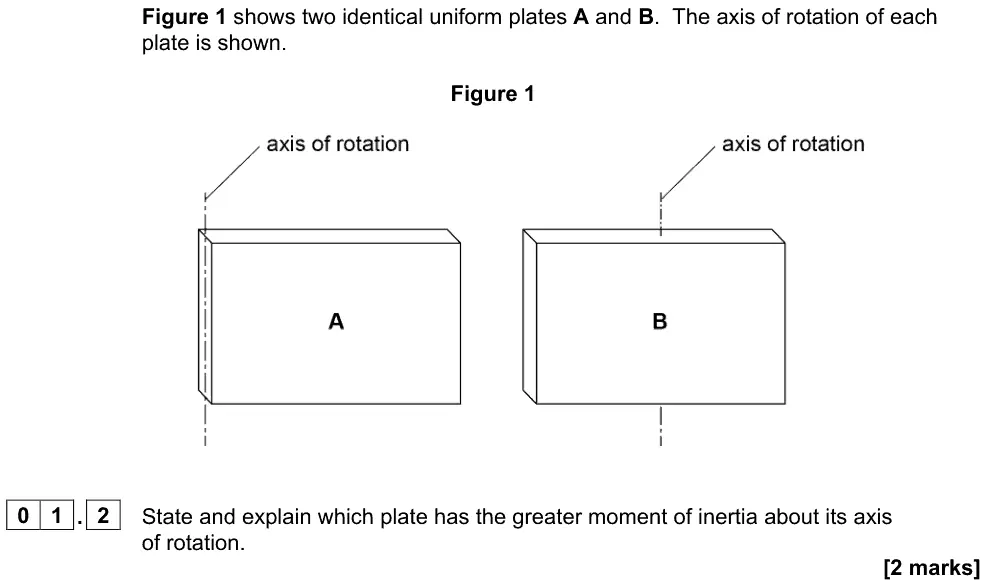
An 'easy' first mark was given for I = Σmr2 . It was common to see I = mr2 instead, and no credit was given for this. For the second mark, examiners were looking for an understanding that the moment of inertia depends on how the mass is distributed around the axis of rotation. Too many answers referred simply to 'r' being greater for plate A than for plate B, without defining 'r', and often not referring to mass. Answers also referred to the distances of 'centres of mass' of the plates from the axis of rotation, not realising that the centre of mass of plate B is on the axis. Only about one quarter of students scored 2 marks.
Question 01.2
Notes from the mark scheme and report
I = sum of m r^2
plate A because more of its mass is further from the axis
'I = mr^2' alone or 'r greater' without mass not credited
centre of mass arguments wrong
June 2023 · Paper 3B Engineering physics · Q1.32 marksAO3=2Diagram or graph
Earlier part of question 1 that this part uses
Mark scheme
Examiner's comment
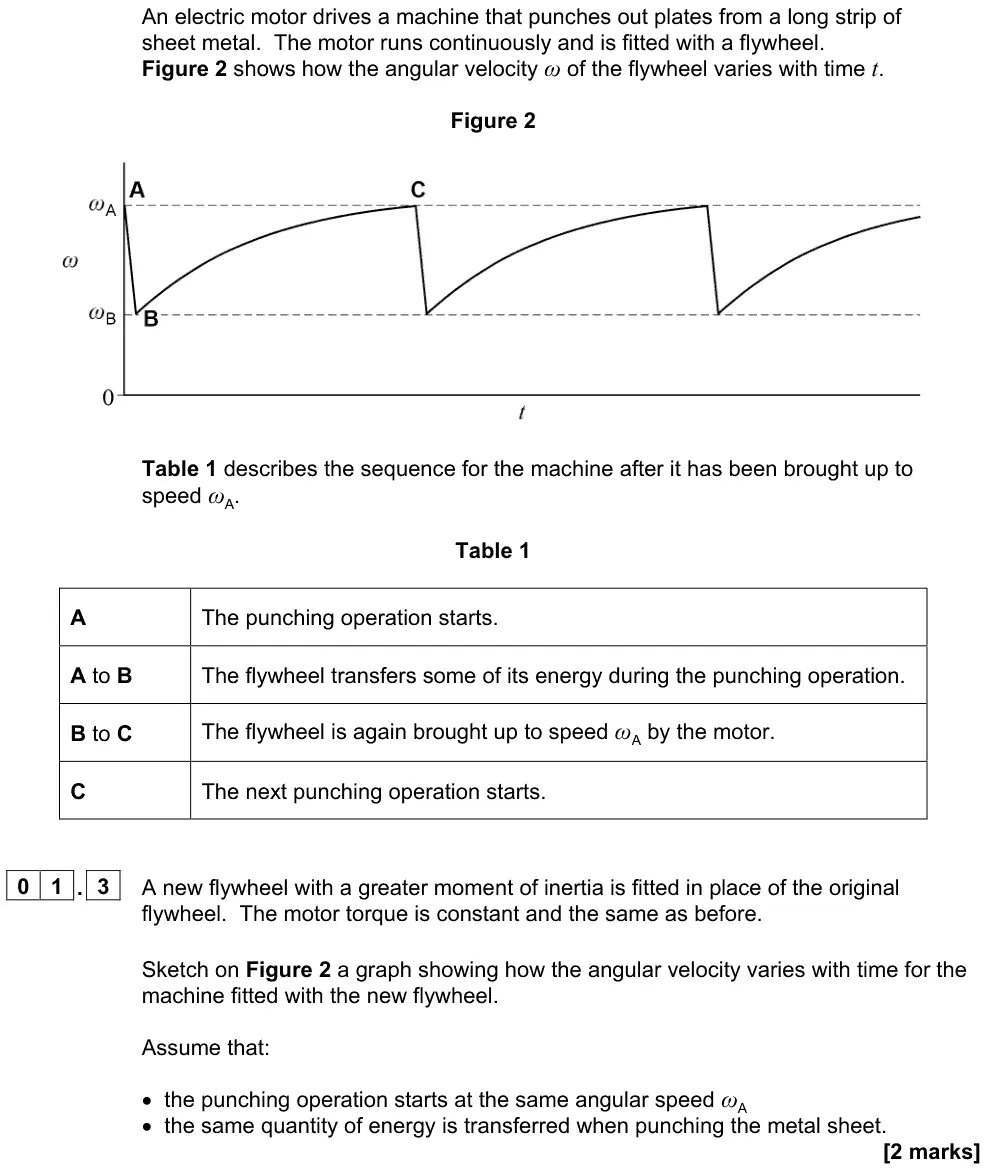
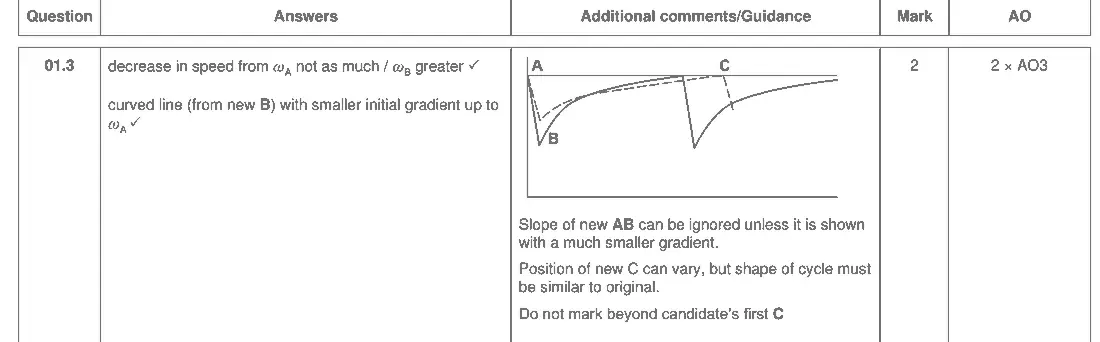
Students were asked to sketch how the ω - t graph would change for the punching machine when fitted with a flywheel with a greater moment of inertia. About 60% of students scored at least 1 mark. The mark scheme required two features:
• a smaller fall in angular speed from A to B • a smaller initial gradient after B.
Other features, eg the slope of A to B or the position of C, were ignored. There was not enough information in the question to predict the changes. It helped if the sketches were carefully drawn. In many it was difficult to see any difference between the initial gradient from their B to C and the original gradient, so a mark was not awarded. It was common to see the new ωB as lower than the original.
Question 01.3
Notes from the mark scheme and report
Smaller fall in omega from A to B (higher omega B) and smaller initial gradient of the recovery curve after B
many drew omega B lower
June 2023 · Paper 3B Engineering physics · Q1.41 markAO3=1Short answerHard
Earlier part of question 1 that this part uses
Mark scheme
Examiner's comment
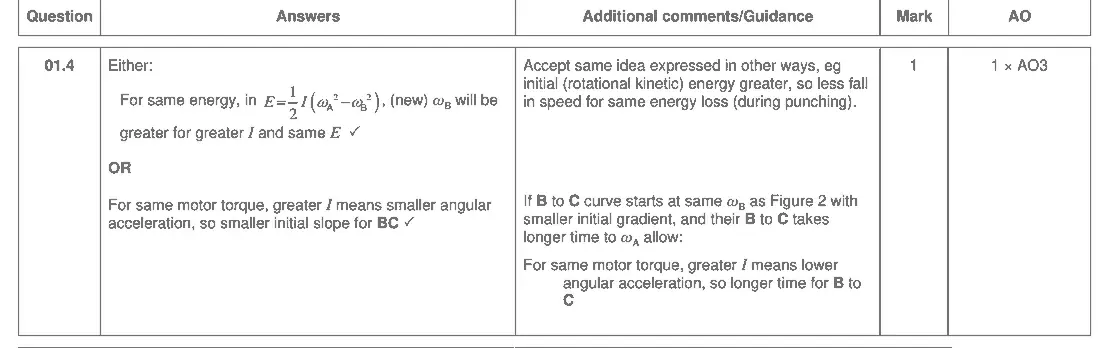
This question was allocated 1 mark for explaining a difference between their graph and the original graph. Many simply stated a difference without giving a reason. Only about one quarter of the students scored the mark.
Sometimes the difference described did not match their sketch graph. There were many clear and concise answers that referred to how the increased moment of inertia for the same energy led to a smaller drop in angular velocity. Those who described the lower initial gradient after B using T = I α also usually expressed themselves well.
Question 01.4
Students are well-practised with calculations on pVϒ = c and PV/T = c , with 56% scoring 3 marks and 26% scoring 2 marks. Many correctly calculated the pressure, but not the temperature. A fairly common answer was 293 K, ie they treated the compression as isothermal. ECF was given for using an incorrectly calculated p2 to calculate T2. Despite the powers of ten, and a power of 1.4, there were relatively few numerical errors.
Notes from the mark scheme and report
Same energy removed from larger I gives smaller drop in omega (E = 0.5 I (omegaA^2 - omegaB^2))
or same motor torque with larger I gives smaller angular acceleration
many gave a difference without a reason
June 2023 · Paper 3B Engineering physics · Q2.12 marksAO2=2Explanation
Mark scheme
Examiner's comment
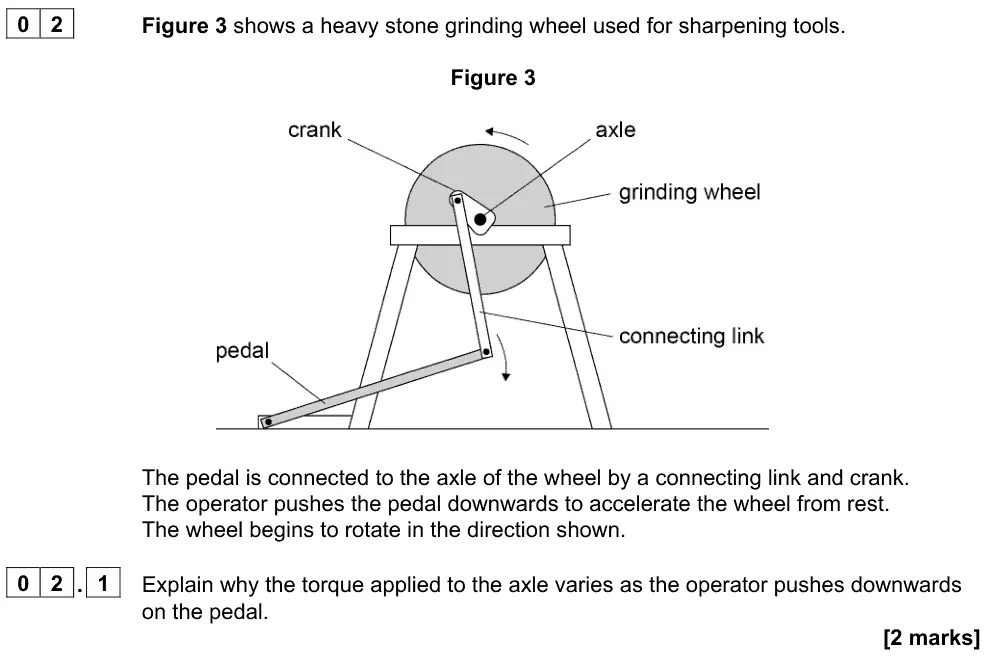
It is unlikely that students will have ever used a treadle-operated machine such as that shown in Figure 3. This did not seem to pose a problem for most students as answers showed they understood the mechanism. About half scored at least 1 mark.
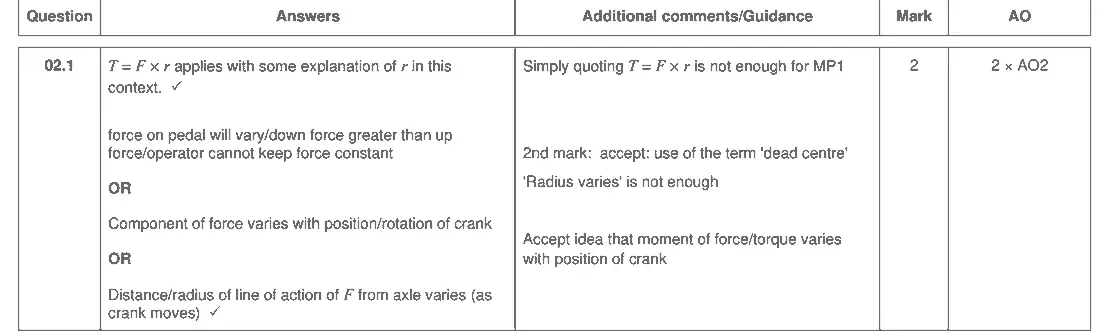
The first mark was for T = F × r in words or symbols, with some explanation of what they understood r to be in the context of the crank and connecting link mechanism. The best answers referred to some, but not necessarily all, of the following:
• the line of action of the force and its distance from the axle • the fact that the connecting link was always nearly vertical • meaning that the force transmitted would be at an angle to the crank • torque would be zero when the crank was at the dead centre and a maximum when parallel to the ground (and to the left) • the operator's inability to maintain a constant force
Answers which did not score marks were those couched in terms of kinetic energy, conservation of angular momentum or of varying angular acceleration causing the torque to vary. Many mixed up the terminology, eg by confusing the crank with the axle, or treating them as the same thing.
Question 02.1
Notes from the mark scheme and report
T = F x r with r the perpendicular distance from the axle to the line of action of the link force, which varies as the crank turns (zero at dead centre)
force from the operator also varies
June 2023 · Paper 3B Engineering physics · Q2.22 marksAO2=2ExplanationHard
Earlier part of question 2 that this part uses
Mark scheme
Examiner's comment
Over one third of students could not score marks on this, despite the question referring to angular impulse and the equation being in the data and formulae booklet.
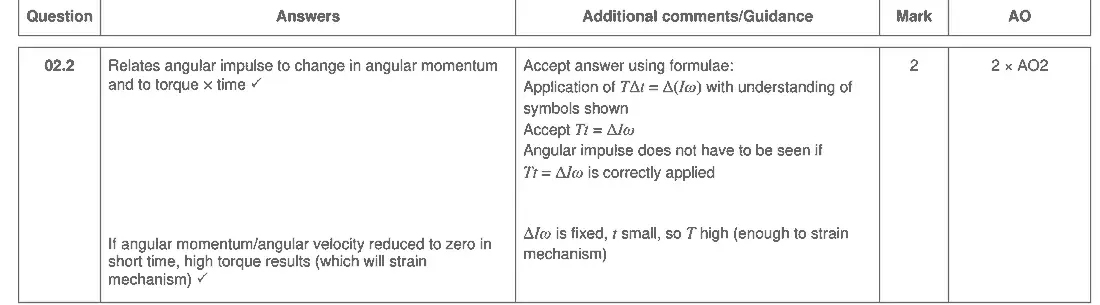
The 2 marks were awarded if students used both elements of angular impulse (TΔt and Δ(Iω) or, in this case IΔω). Some students referred only to either TΔt or Δ(Iω) without linking them. We expected answers to refer to Δt being small , rather than "it happens quickly" or "suddenly", leading to a large torque. 30% of students scored 2 marks.
Question 02.2
Notes from the mark scheme and report
Angular impulse T dt = change in I omega
large angular momentum removed in a short time needs a large torque that strains the mechanism
must link both sides
June 2023 · Paper 3B Engineering physics · Q2.32 marksAO2=2CalculationEasy
Earlier part of question 2 that this part uses
Mark scheme
Examiner's comment
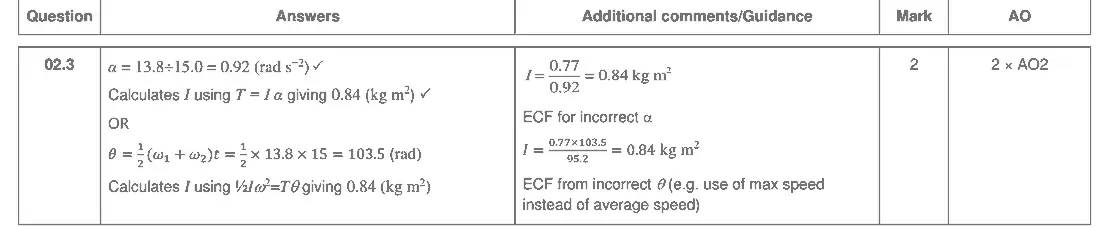
This was a straightforward calculation using α = Δω/t and T=I α. There was an alternative route using ½Iω2 = Tθ, with θ found from an equation of motion. This question was answered well, with nearly 90% scoring both marks.
Question 02.3
Notes from the mark scheme and report
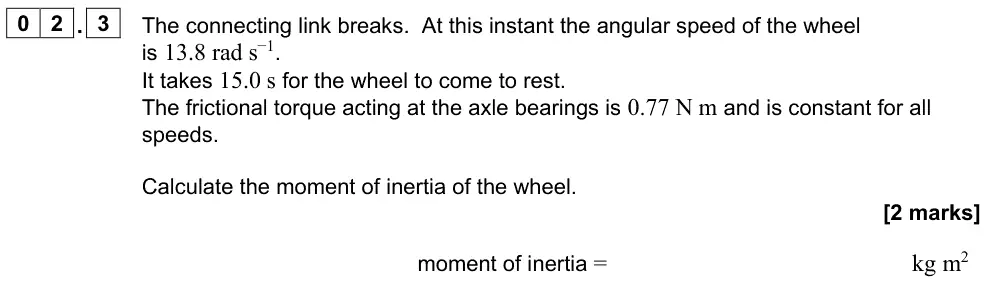
Answer: 0.84 kg m^2 (alpha = 13.8/15.0 = 0.92 rad s^-2
I = 0.77/0.92)
Skills: MS2.3 Substitute numerical values into algebraic equations using appropriate units for physical quantities; MS2.2 Change the subject of an equation, including non-linear equations
June 2023 · Paper 3B Engineering physics · Q2.42 marksAO2=2CalculationEasy
Earlier part of question 2 that this part uses
Mark scheme
Examiner's comment
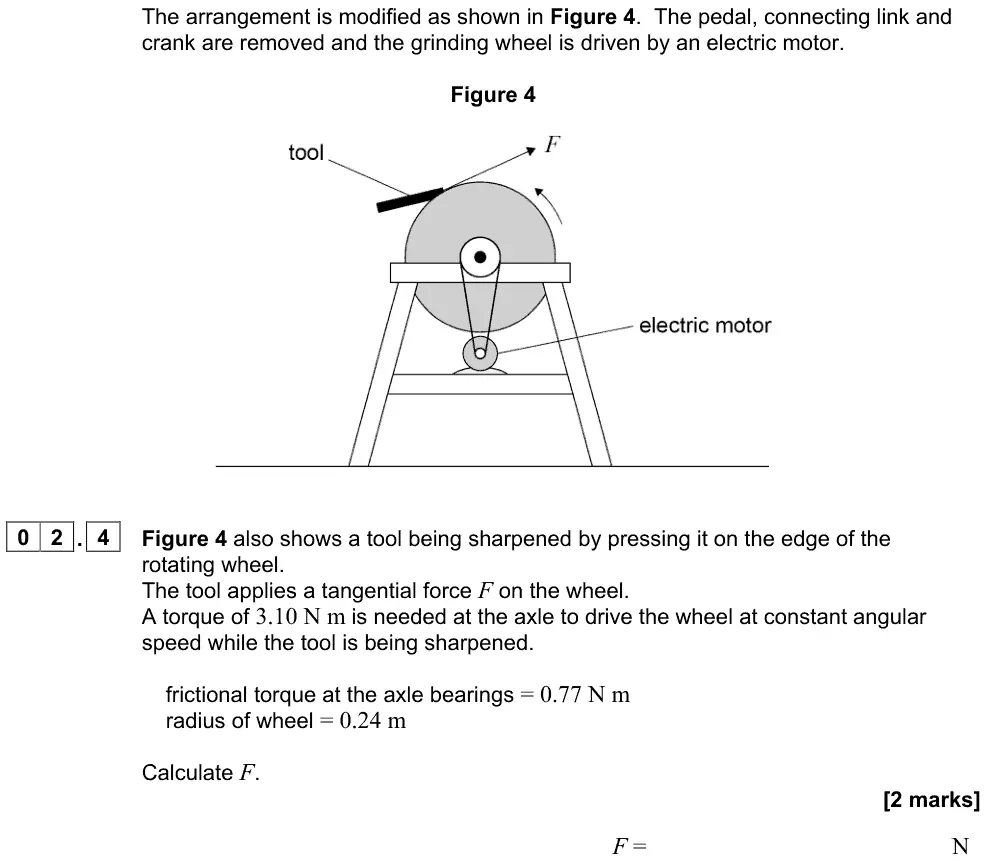
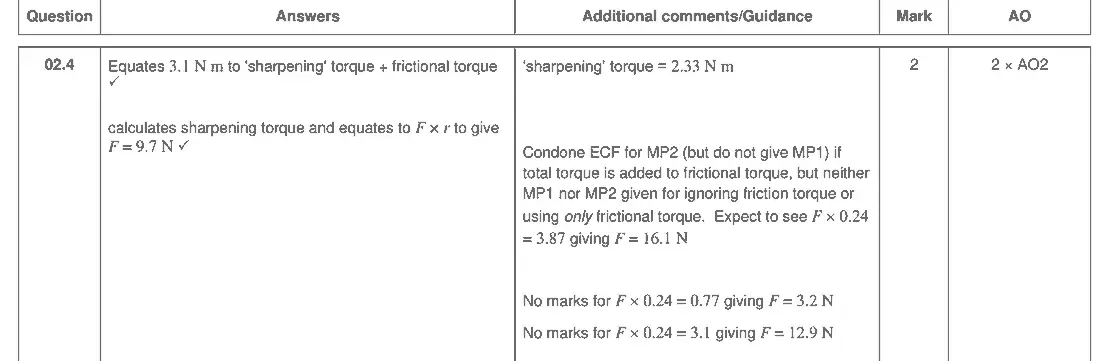
Students had to contend with three torques in this question: friction torque at the bearing, 'sharpening' torque at the tool, and driving torque. Those who missed out friction torque altogether scored no marks.
It was pleasing to see that the majority of students knew to subtract friction torque from driving torque to get sharpening torque, and went on to score two marks. Those who added friction torque to the driving torque were awarded a generous ECF (error carried forward) for the second mark point: they had at least tried to take the friction torque into account.
Around 60% scored two marks, and about 20% scored 1 mark.
Question 02.4
Notes from the mark scheme and report
Answer: 9.7 N (sharpening torque = 3.10 - 0.77 = 2.33 N m = F x 0.24)
ignoring friction scores zero
Skills: MS2.3 Substitute numerical values into algebraic equations using appropriate units for physical quantities; MS2.2 Change the subject of an equation, including non-linear equations
June 2023 · Paper 3B Engineering physics · Q2.53 marksAO3=3Calculation
Earlier part of question 2 that this part uses
Mark scheme
Examiner's comment
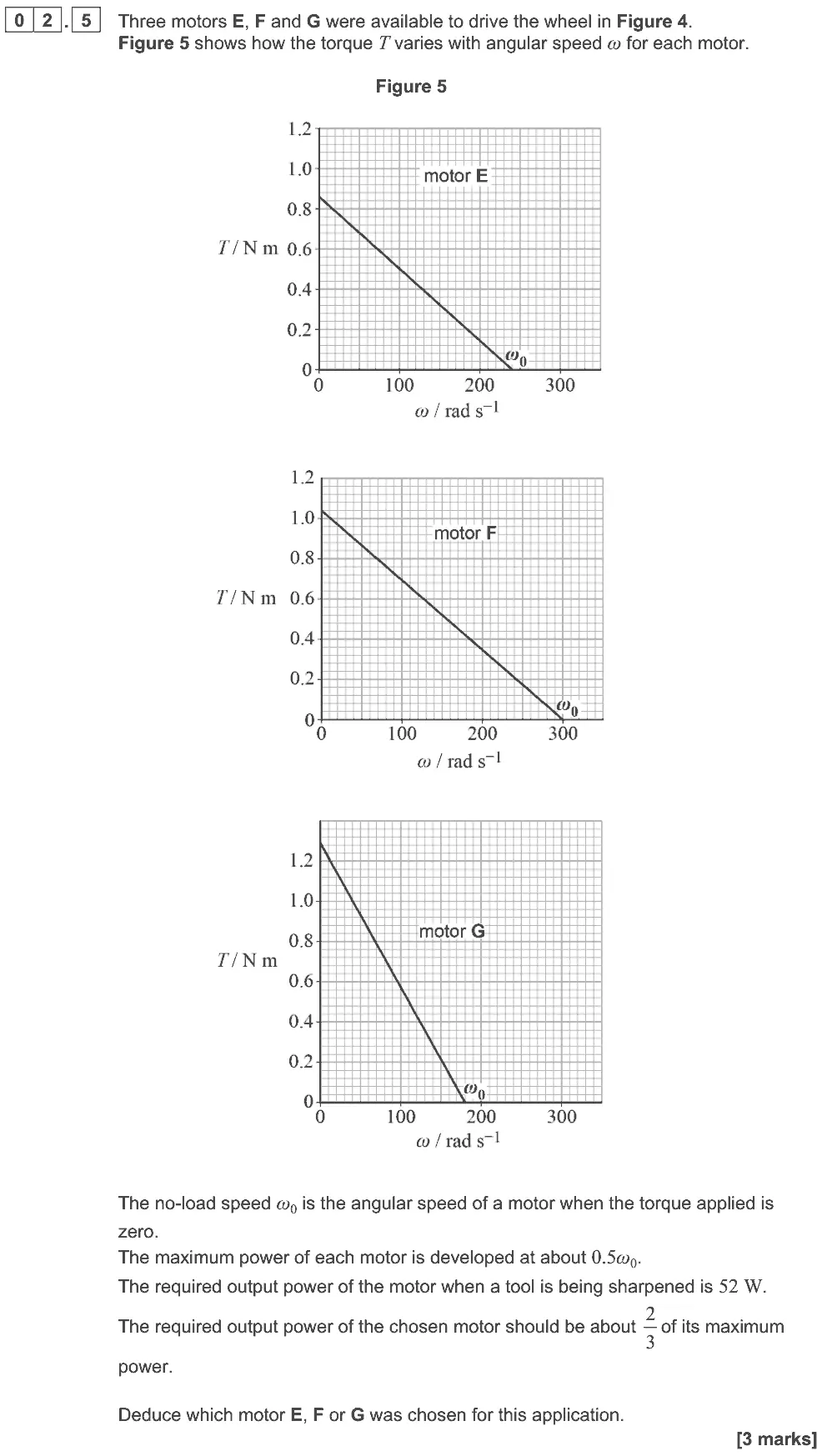
This was an unusual question, designed to test AO3. Students were asked to deduce which of three electric motors was chosen to drive the grinding wheel, given their T - ω characteristics.
The second sentence of the data given below Figure 5 states: "The maximum power of each motor is developed at about 0.5ω0." A problem not predicted by the setters of the question was that students would skim over this and read it as: "The maximum power of each motor is about 0.5ω0."
For example, these students would give the power output of motor E as 0.5 × 240 or 120 W. As a result many students went on to score only 1 or 0 marks out of 3.
Another common error was to think that the maximum power is equal to the area under the graph.
On the other hand, there were some excellent, well-argued answers. Nearly 40% of students scored 3/3. Some put their information clearly in a table, eg with headings of ω0, 0.5ω0, T, Pmax, ⅔ Pmax.
Examiners were not expecting students to spend much time reading the graphs to 0.01 N m or 0.02 N m, hence the "about" in the criteria. Some leeway was given.
Question 02.5
Notes from the mark scheme and report
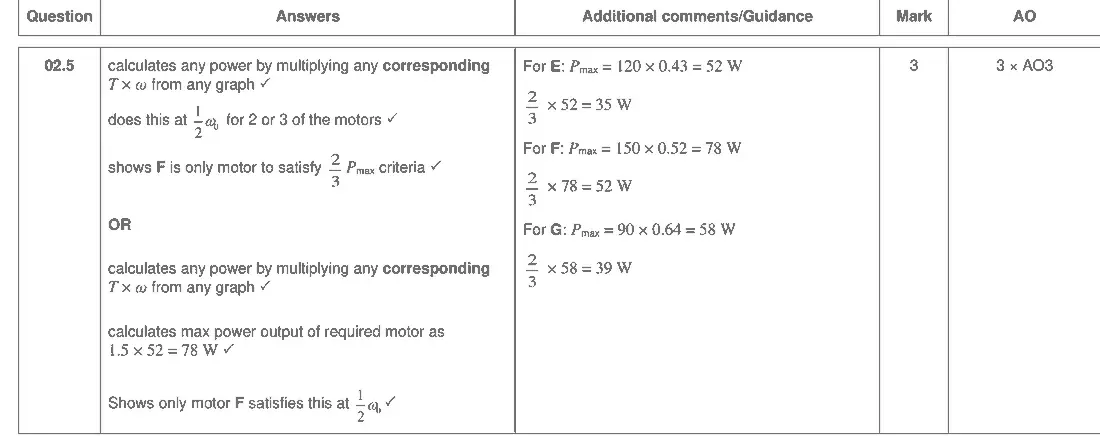
P = T omega at 0.5 omega0: E 52 W, F 78 W, G 58 W
2/3 of 78 W = 52 W so motor F
misreading 0.5 omega0 as the power and using area under the graph were common
Skills: MS3.1 Translate information between graphical, numerical and algebraic forms; MS2.3 Substitute numerical values into algebraic equations using appropriate units for physical quantities
June 2022 · Paper 3B Engineering physics · Q1.12 marksAO2=2Calculation
Mark scheme
Examiner's comment
About two-thirds of students scored the first mark for an attempt to find the angular displacement of the rotor. Many of these were unable to do this accurately enough for the second mark. Some added the areas without taking the negative angular velocity into account. A very small number of students tried to answer by averaging ordinates from the graph or by counting squares, but were unsuccessful.
Students did better on the rotational dynamics questions (Q1 and Q2) than the thermodynamics questions (Q3 and Q4). The concept of the reversed heat engine (Q4) is still not well understood. As in previous years, calculations were answered with more confidence than the questions which required qualitative answers. This is borne out by relatively high mean marks for questions 01.1 to 01.4, 02.1, and 03.2.
Question 01.1
It was pleasing to see many confident answers, with students showing the steps in their calculations. In fact, more students were able to deal with the maths involved here than were able to calculate areas of triangles in question 01.1. About three-quarters of students showed a correct substitution of data into p1V1ϒ = p2V2ϒ . Some of these were then let down by not knowing either how to deal with the maths or how to use their calculator. A few used (pV)ϒ = c or pV = c.
Notes from the mark scheme and report
Answer: 0.15 rad s^-1 (net angular displacement 2.80 + 2.10 - 3.15 = 1.75 rad over 12 s)
areas below the axis must be subtracted
square counting max 1
Skills: MS3.8 Understand the possible physical significance of the area between a curve and the x axis and be able to calculate it or estimate it by graphical methods as appropriate; MS3.1 Translate information between graphical, numerical and algebraic forms
June 2022 · Paper 3B Engineering physics · Q1.21 markAO2=1CalculationEasy
Earlier part of question 1 that this part uses
Mark scheme
Examiner's comment
This was answered well with about 80% of students gaining the mark.
Question 01.2
Notes from the mark scheme and report
Answer: 546 W (P = T omega = 390 x 1.40
driving torque only balances friction at constant speed)
Skills: MS2.3 Substitute numerical values into algebraic equations using appropriate units for physical quantities; MS3.1 Translate information between graphical, numerical and algebraic forms
June 2022 · Paper 3B Engineering physics · Q1.33 marksAO2=3Calculation
Earlier part of question 1 that this part uses
Mark scheme
Examiner's comment
The question required a calculation of maximum angular acceleration from the graph in Figure 2, a determination of the torque to give this acceleration, and then a final addition of the friction torque. Common errors were using the 7 s to 12 s part of the graph, and omitting the friction torque altogether.
Question 01.3
Notes from the mark scheme and report
Answer: 10 100 N m (steepest gradient alpha = 2.30/5.0 = 0.46 rad s^-2
I alpha = 9660 N m plus 390 N m friction)
using the 7-12 s section or omitting friction were common errors
Skills: MS3.4 Determine the slope and intercept of a linear graph; MS2.3 Substitute numerical values into algebraic equations using appropriate units for physical quantities
June 2022 · Paper 3B Engineering physics · Q1.41 markAO2=1CalculationEasy
Earlier part of question 1 that this part uses
Mark scheme
Examiner's comment
About 60% achieved the one mark for this question. This is not surprising as the equation is in the Data and Formulae booklet. Two routes could be used:
• using torque × time but only with the correct torque i.e. before friction torque is added. A minority used the friction torque alone here. using I ×∆ ω . ω ∆ • was invariably calculated correctly.
Students did better on the rotational dynamics questions (Q1 and Q2) than the thermodynamics questions (Q3 and Q4). The concept of the reversed heat engine (Q4) is still not well understood. As in previous years, calculations were answered with more confidence than the questions which required qualitative answers. This is borne out by relatively high mean marks for questions 01.1 to 01.4, 02.1, and 03.2.
Question 01.4
Notes from the mark scheme and report
Answer: 4.8 x 10^4 N m s (I x change in omega = 2.1 x 10^4 x 2.30, or net torque x 5.0 s, not including friction)
Skills: MS2.3 Substitute numerical values into algebraic equations using appropriate units for physical quantities; MS3.1 Translate information between graphical, numerical and algebraic forms
June 2022 · Paper 3B Engineering physics · Q1.51 markAO3=1Short answerEasy
Earlier part of question 1 that this part uses
Mark scheme
Examiner's comment
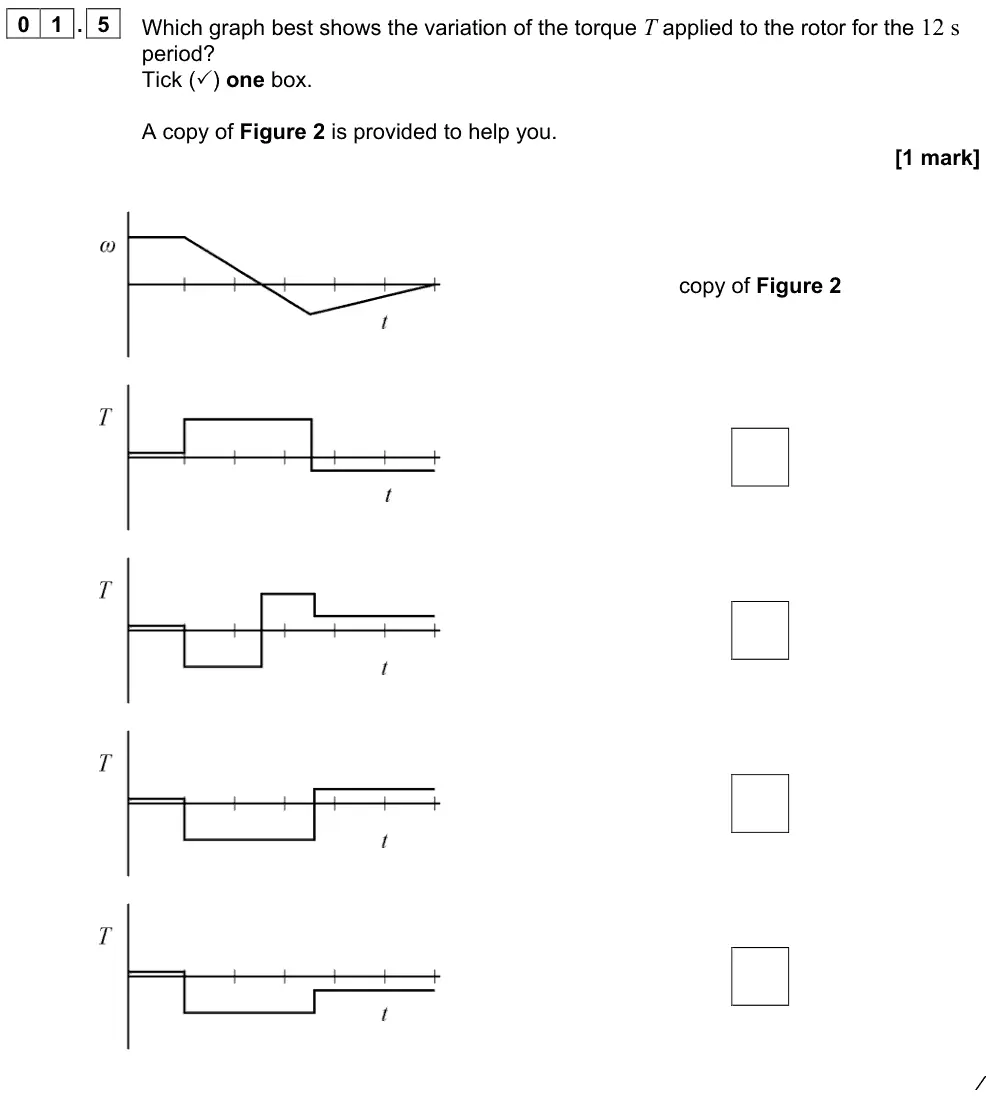
Approximately 70% of students were able to select the graph showing the correct variation of torque with time for the rotor.
Question 01.5
Notes from the mark scheme and report
Answer: third graph (small positive torque against friction for 0-2 s, large negative while decelerating and reversing, then positive)
Skills: MS3.1 Translate information between graphical, numerical and algebraic forms
June 2022 · Paper 3B Engineering physics · Q2.13 marksAO2=3Calculation
Mark scheme
Examiner's comment
Students did better on the rotational dynamics questions (Q1 and Q2) than the thermodynamics questions (Q3 and Q4). The concept of the reversed heat engine (Q4) is still not well understood. As in previous years, calculations were answered with more confidence than the questions which required qualitative answers. This is borne out by relatively high mean marks for questions 01.1 to 01.4, 02.1, and 03.2.
Question 02.1
Notes from the mark scheme and report
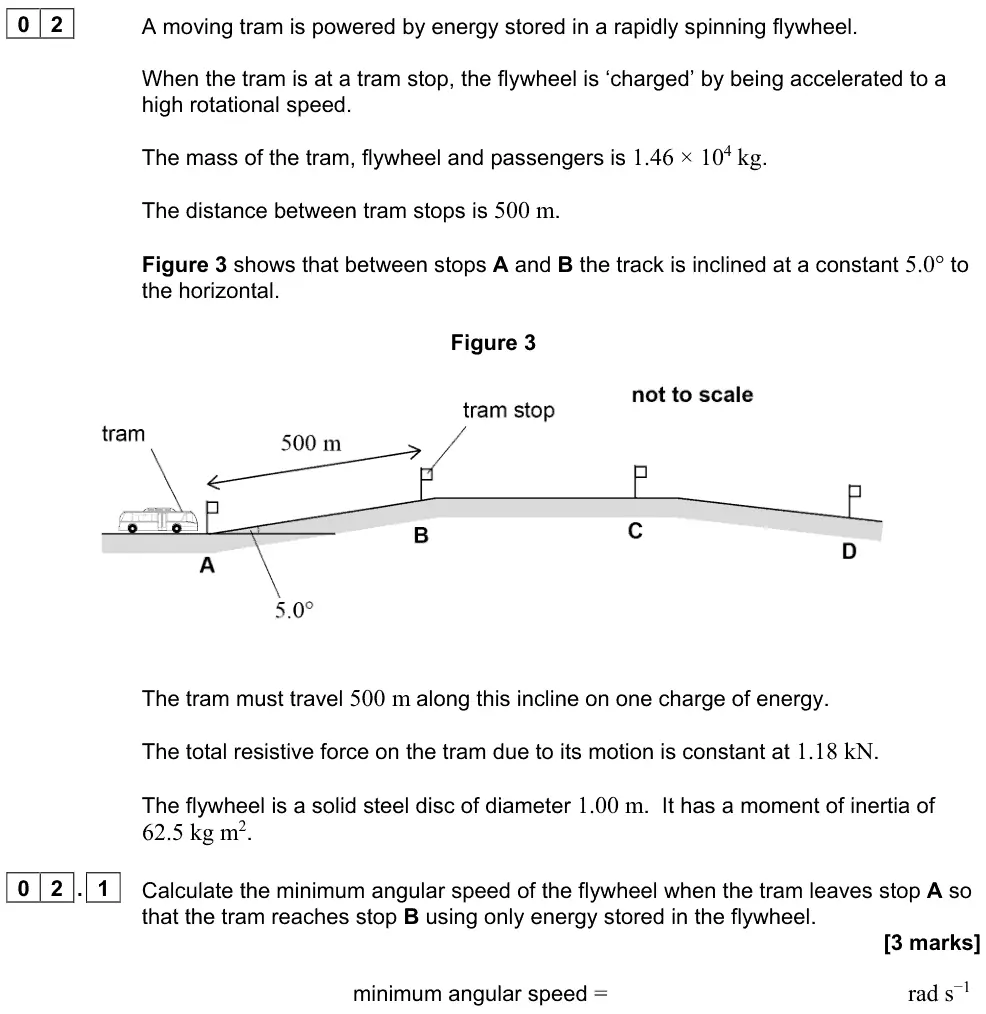
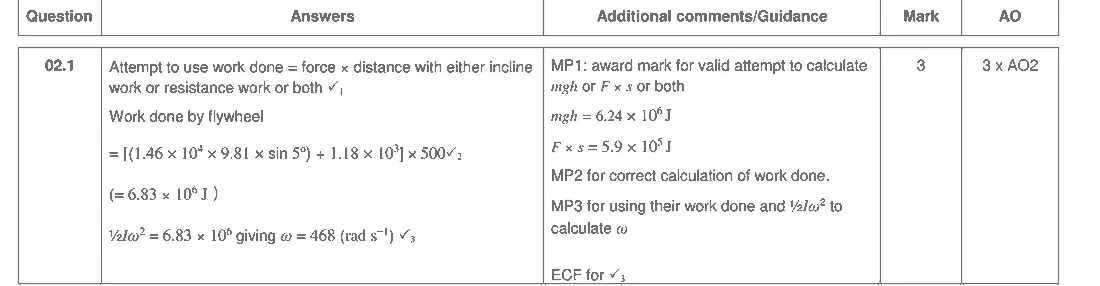
Answer: 468 rad s^-1 (work = (1.46 x 10^4 x 9.81 x sin 5 deg + 1180) x 500 = 6.83 x 10^6 J = 0.5 I omega^2)
Skills: MS2.3 Substitute numerical values into algebraic equations using appropriate units for physical quantities; MS4.5 Use sin, cos and tan in physical problems; MS2.2 Change the subject of an equation, including non-linear equations
June 2022 · Paper 3B Engineering physics · Q2.22 marksAO3=2Short answerHard
Earlier part of question 2 that this part uses
Mark scheme
Examiner's comment
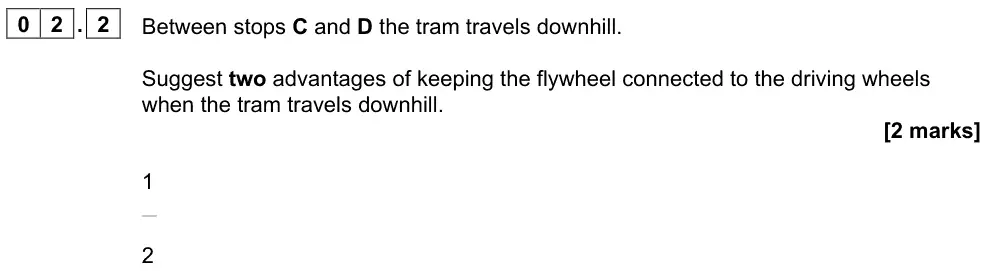
The two marks for this question were aimed at Assessment Objective 3 and required a good understanding of the context of the question i.e. the flywheel-powered tram travelling downhill.
There were some good answers which showed that students understood the principle of regenerative braking and the idea of saving energy with the flywheel connected for the downhill journey. A high proportion of answers, however, did not go far enough.
They
• simply stated that the flywheel gets charged up or stores energy, whereas the mark scheme required some mention of later use of this energy, or less energy needed at the next stop • stated that the tram would slow down or not travel so fast, but without referring to energy changes or saving on braking.
Many answers referred to the flywheel smoothing the motion of the tram down the track. They remembered that flywheels smooth rotational motion, and thought it applied here. No credit was given.
Around 40% of students scored 1 mark, but only 10% scored both marks.
Questions targeted at Assessment Objective 3 require students to analyse or evaluate information or ideas and make judgements. Questions 02.2 and 4 were questions that only addressed this AO, and students found them difficult.
Question 02.2
Notes from the mark scheme and report
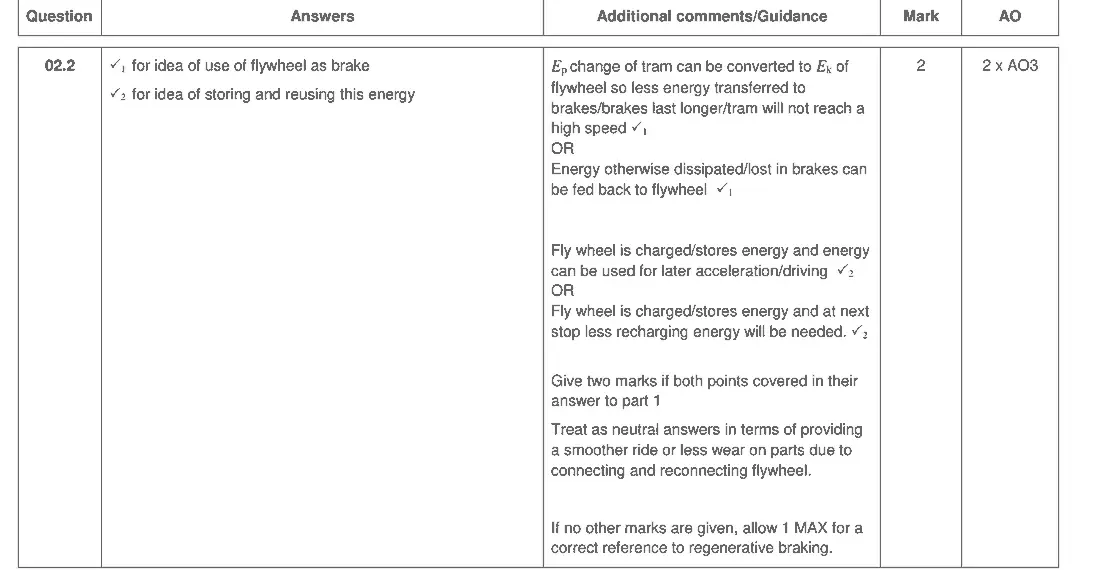
Flywheel acts as a brake, taking GPE so less is wasted in brakes
stored energy reused later or less recharging at the next stop
'smooths the motion' not credited
June 2022 · Paper 3B Engineering physics · Q2.36 marksAO1=4, AO2=1, AO3=16-mark extended response
Earlier part of question 2 that this part uses
Mark scheme, with the levels and indicative content
Examiner's comment
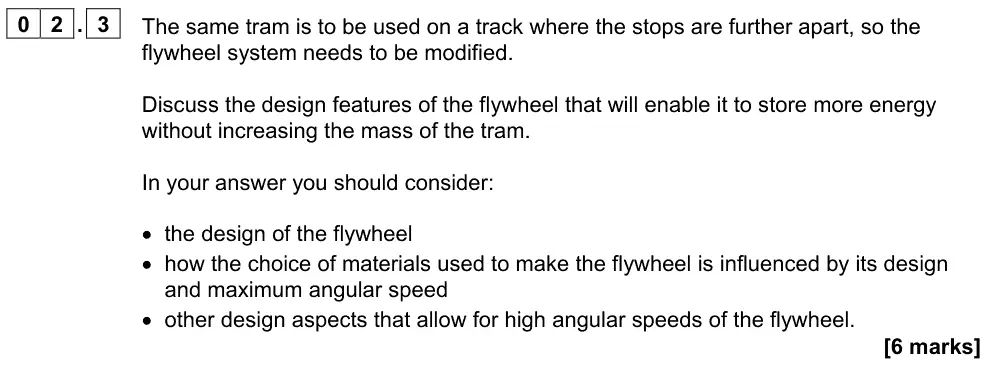
This levels of response question had a six-mark allocation. About half the students scored 3 or more, but only a small minority were able to give the detail needed to reach the third response level. Students seem to have a good awareness of how moment of inertia depends on the distribution of mass about the axis, and suggested spokes or a thin inner disc (of low density material) and a heavy rim (of high density) to achieve this. Despite being told the mass of the tram should not increase, many suggested increasing the mass of the flywheel. Some enhanced their answers with explanatory sketches.
Many answers were strong on one or two of the three areas. It was pleasing to see references to centripetal force, breaking stress, means of reducing friction at the bearings, and means of reducing air resistance. Many students gave examples of suitable materials.
Misconceptions were that:
• reducing the moment of inertia of the flywheel would increase energy stored because it would accelerate more quickly to obtain a higher speed angular momentum is conserved, so reducing I would increase ω and hence energy stored. •
Some students wrote "inertia" for "moment of inertia", and many used vague terms like “heavier”, ”durable”, “robust” or “sturdy” when referring to material properties. A command of appropriate terminology is expected at A-level.
Question 02.3
Notes from the mark scheme and report
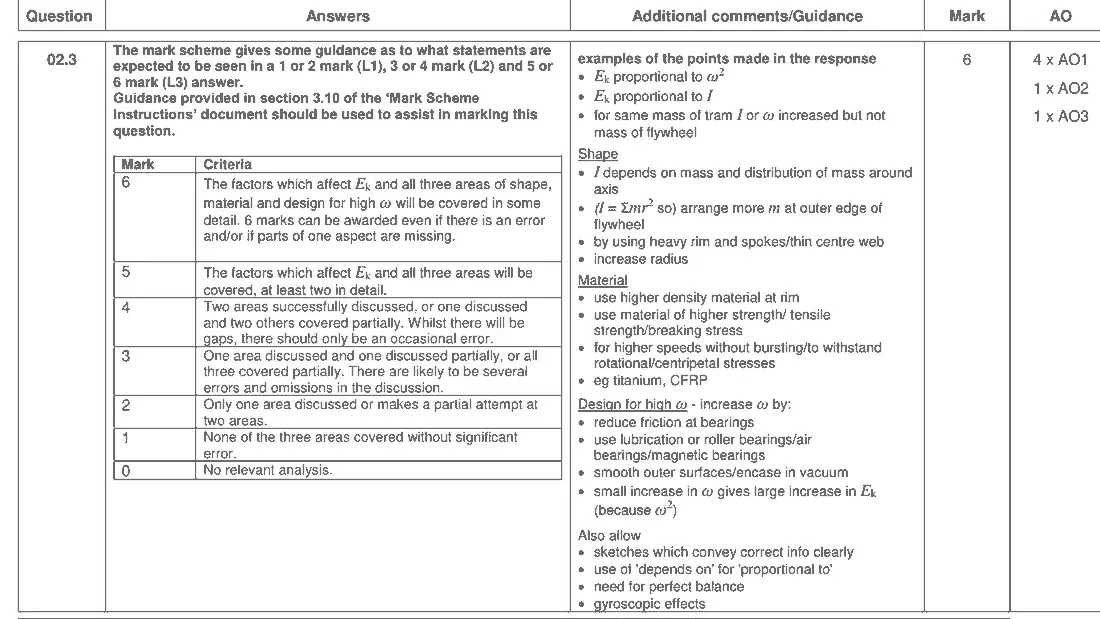
Levels of response: Ek = 0.5 I omega^2
mass concentrated at a heavy rim with spokes or thin web, larger radius
high-strength (high breaking stress) material to withstand centripetal stress at high omega
low-friction or magnetic bearings, vacuum enclosure
misconceptions about reducing I
vague 'heavier', 'sturdy' terms
November 2021 · Paper 3B Engineering physics · Q1.13 marksAO1=3Explanation
Mark scheme
Notes from the mark scheme and report
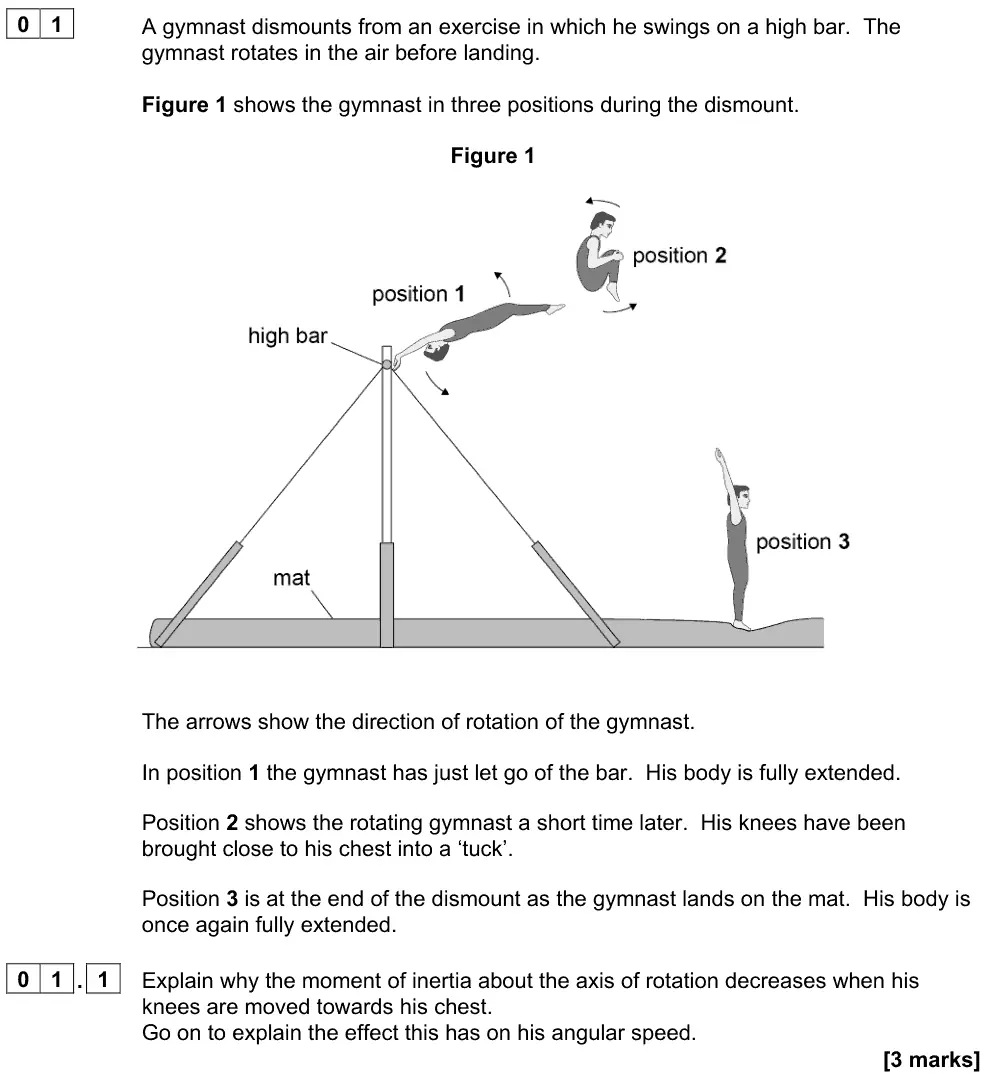
Mass moves closer to the axis so I decreases
angular momentum I omega conserved (no external torque) so omega increases
'radius decreases' alone not enough
KE conservation argument loses mark 3
November 2021 · Paper 3B Engineering physics · Q1.21 markCalculation
Earlier part of question 1 that this part uses
Mark scheme
Notes from the mark scheme and report
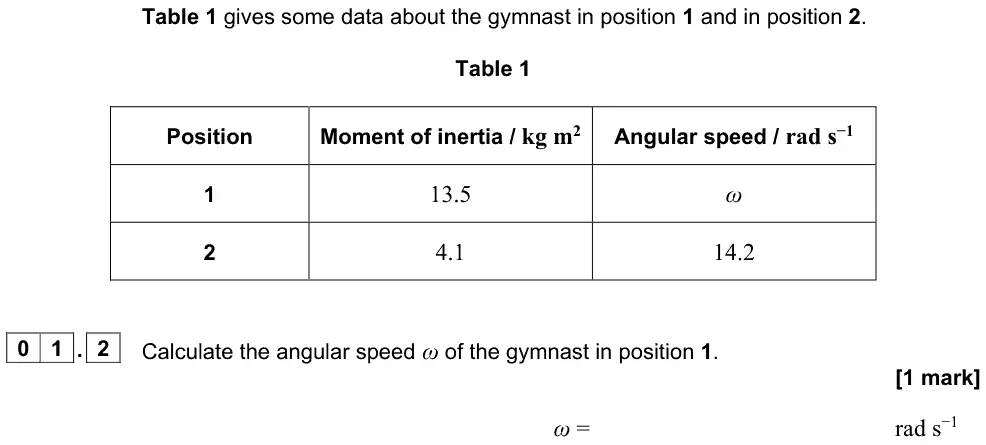
Answer: 4.3 rad s^-1 (13.5 omega = 4.1 x 14.2)
Skills: MS2.3 Substitute numerical values into algebraic equations using appropriate units for physical quantities; MS2.2 Change the subject of an equation, including non-linear equations
November 2021 · Paper 3B Engineering physics · Q1.32 marksAO2=2Calculation
Earlier part of question 1 that this part uses
Mark scheme
Notes from the mark scheme and report
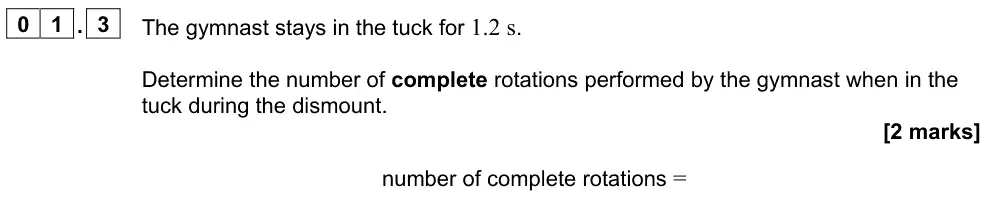
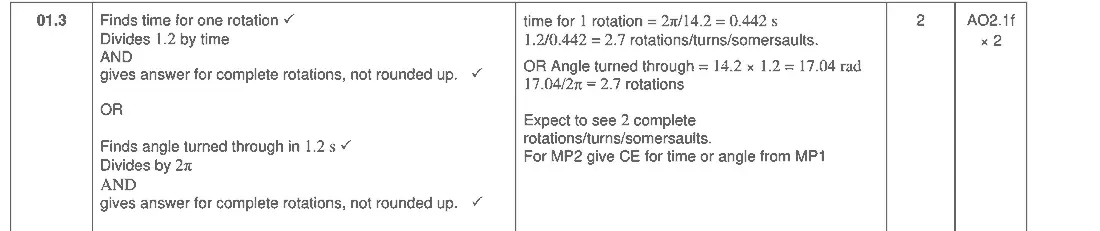
Answer: 2 complete rotations (14.2 x 1.2 = 17.0 rad = 2.7 turns
must not round up)
Skills: MS2.3 Substitute numerical values into algebraic equations using appropriate units for physical quantities
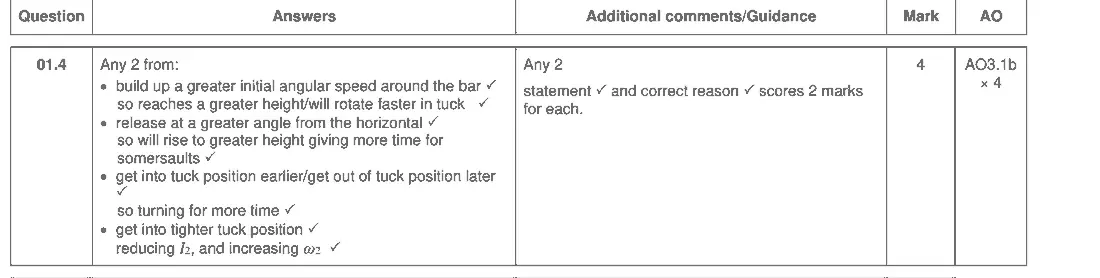
November 2021 · Paper 3B Engineering physics · Q1.44 marksAO3=4Explanation
Earlier part of question 1 that this part uses
Mark scheme
Notes from the mark scheme and report
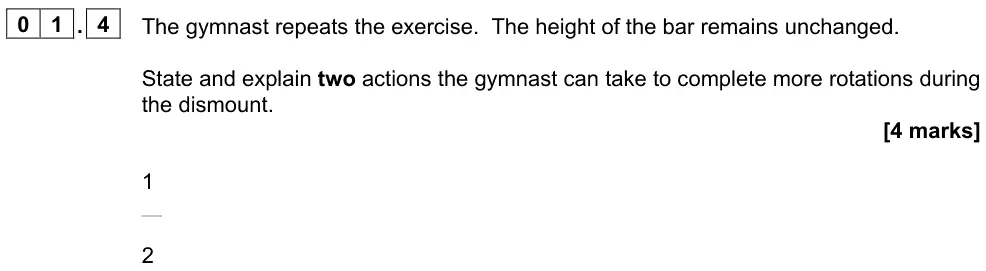
Any two with reasons: greater angular speed on the bar (higher, faster), release higher (more time), tuck earlier or untuck later (longer at high omega), tighter tuck (smaller I, larger omega)
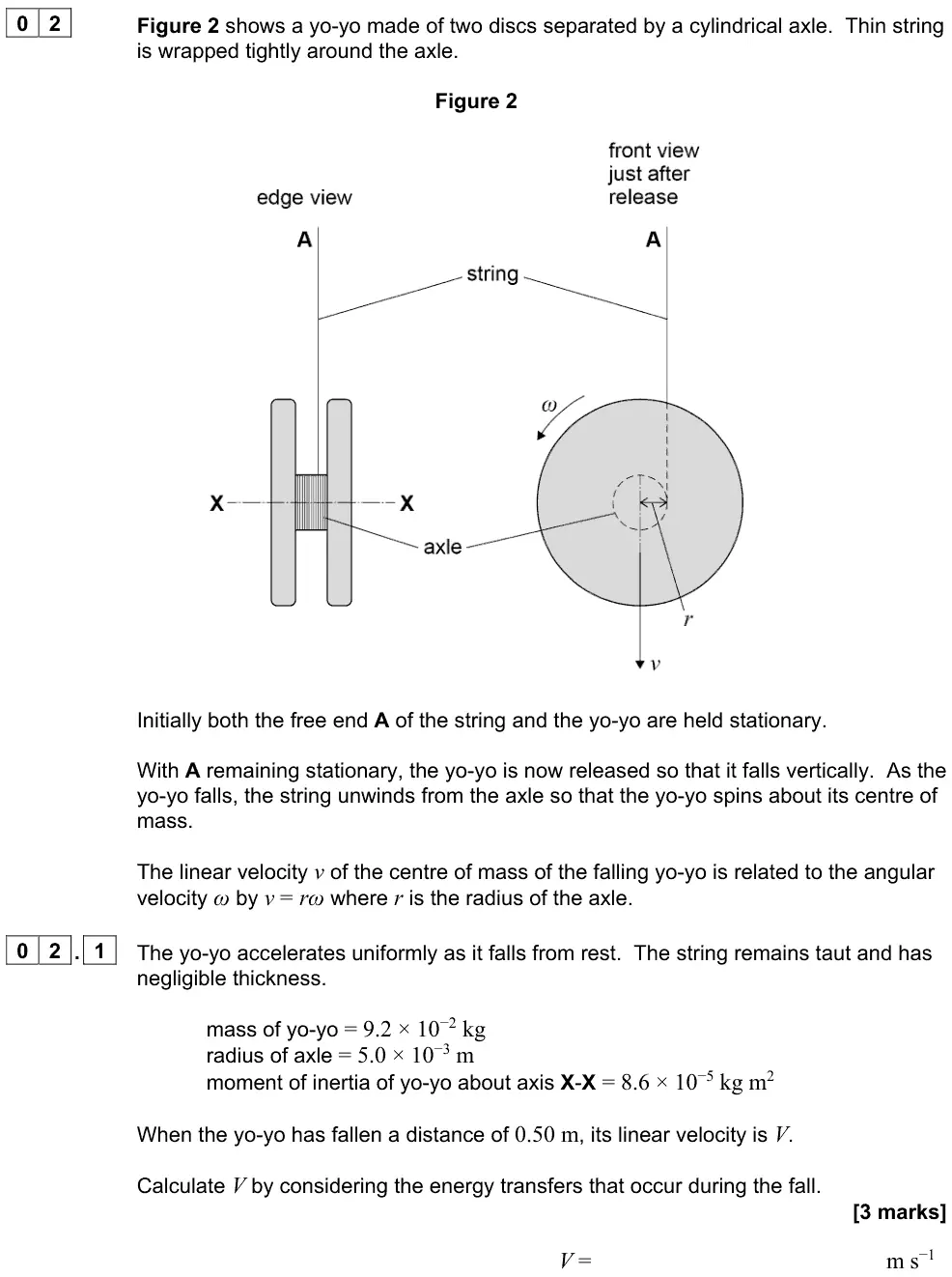
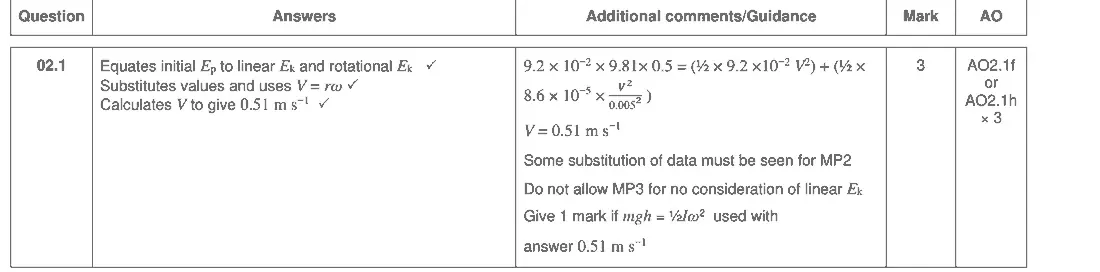
November 2021 · Paper 3B Engineering physics · Q2.13 marksAO2=3Calculation
Mark scheme
Notes from the mark scheme and report
Answer: 0.51 m s^-1 (mgh = 0.5 m V^2 + 0.5 I (V/r)^2)
ignoring linear KE gets only 1 mark
Skills: MS2.3 Substitute numerical values into algebraic equations using appropriate units for physical quantities; MS2.2 Change the subject of an equation, including non-linear equations
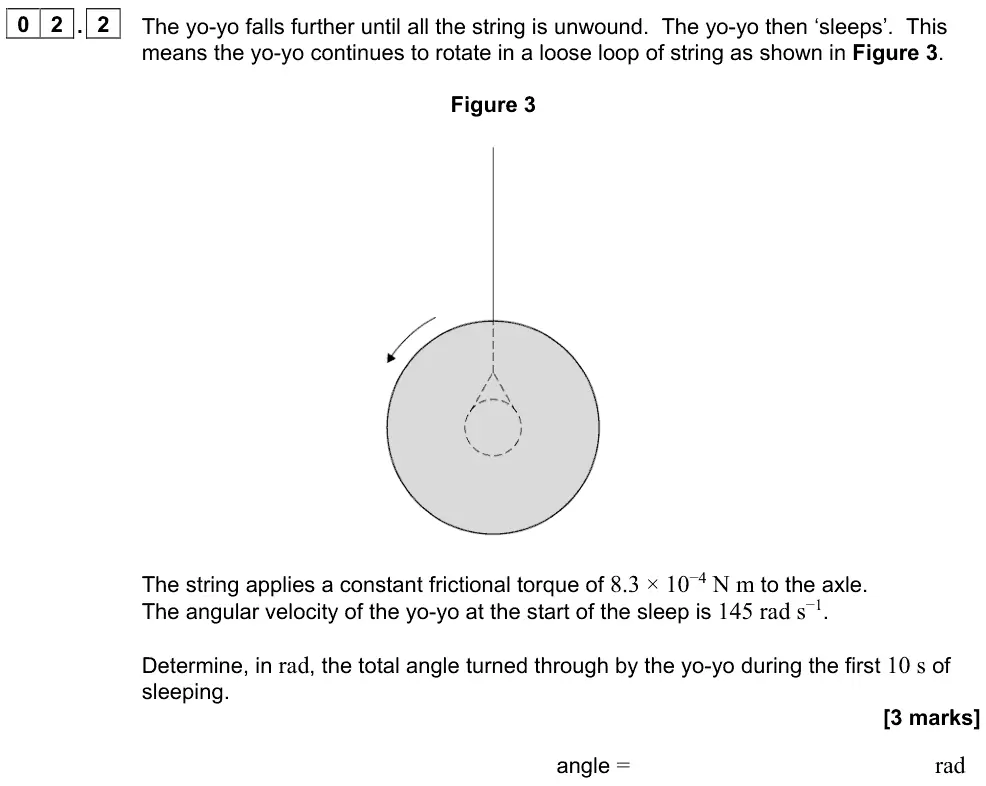
November 2021 · Paper 3B Engineering physics · Q2.23 marksAO2=3Calculation
Earlier part of question 2 that this part uses
Mark scheme
Notes from the mark scheme and report
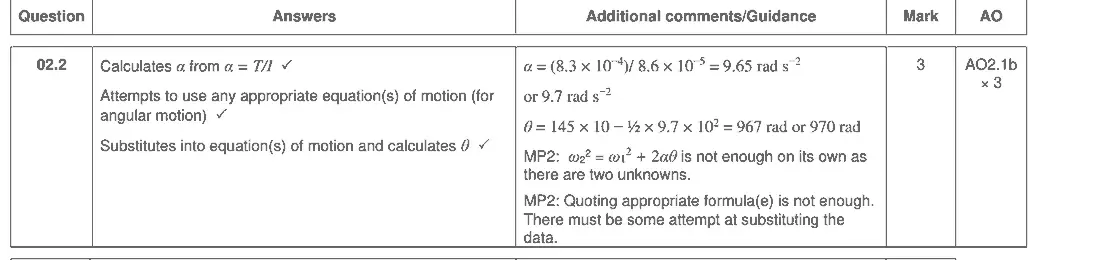
Answer: 970 rad (alpha = 8.3 x 10^-4 / 8.6 x 10^-5 = 9.7 rad s^-2
theta = 145 x 10 - 0.5 x 9.7 x 10^2)
quoting formulae without substitution not credited
Skills: MS2.3 Substitute numerical values into algebraic equations using appropriate units for physical quantities; MS2.2 Change the subject of an equation, including non-linear equations
November 2021 · Paper 3B Engineering physics · Q3.22 marksExplanation
Earlier part of question 3 that this part uses
Mark scheme
Notes from the mark scheme and report
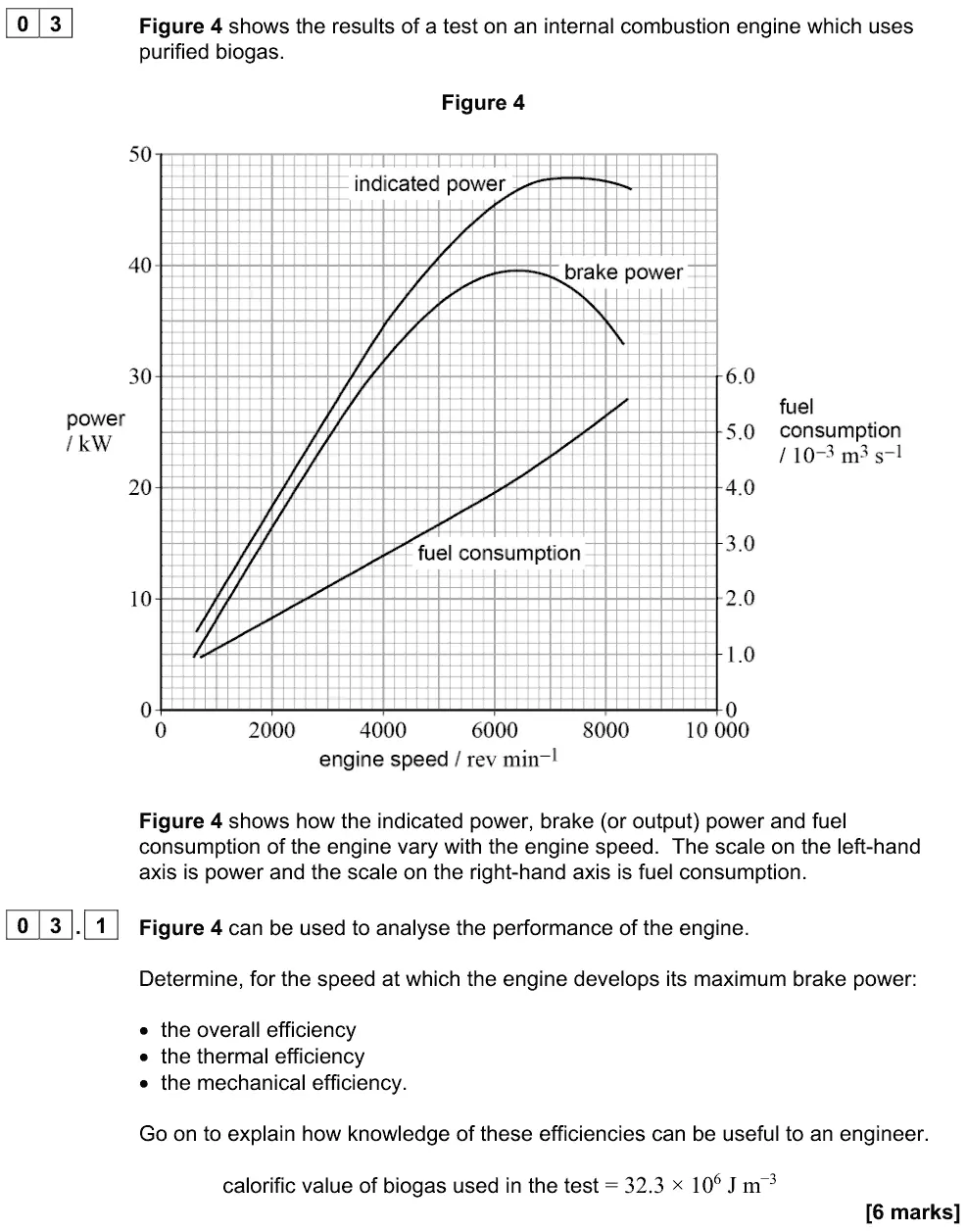
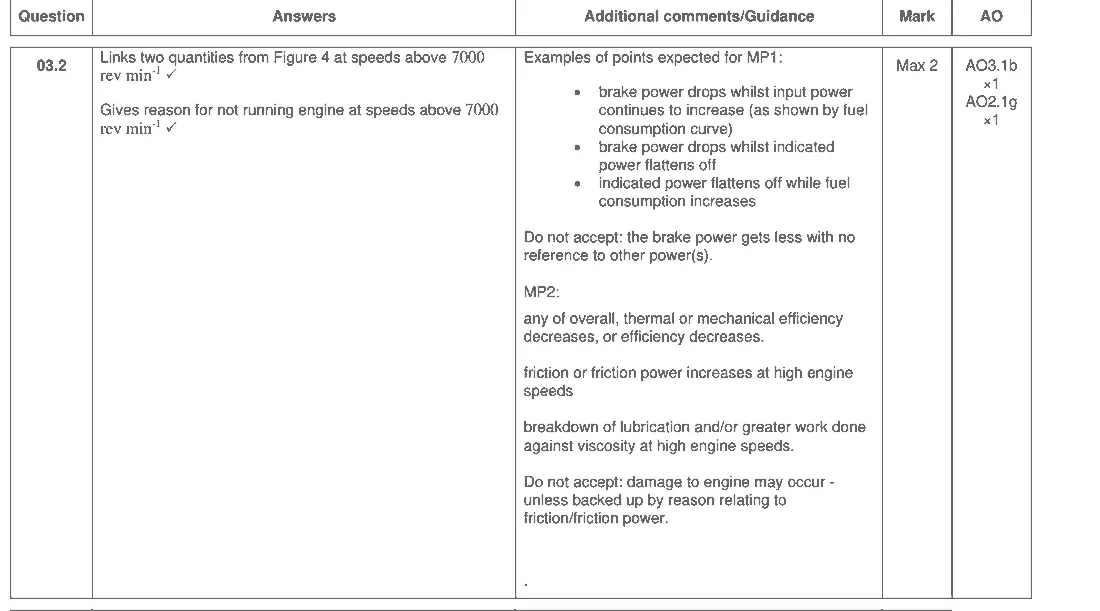
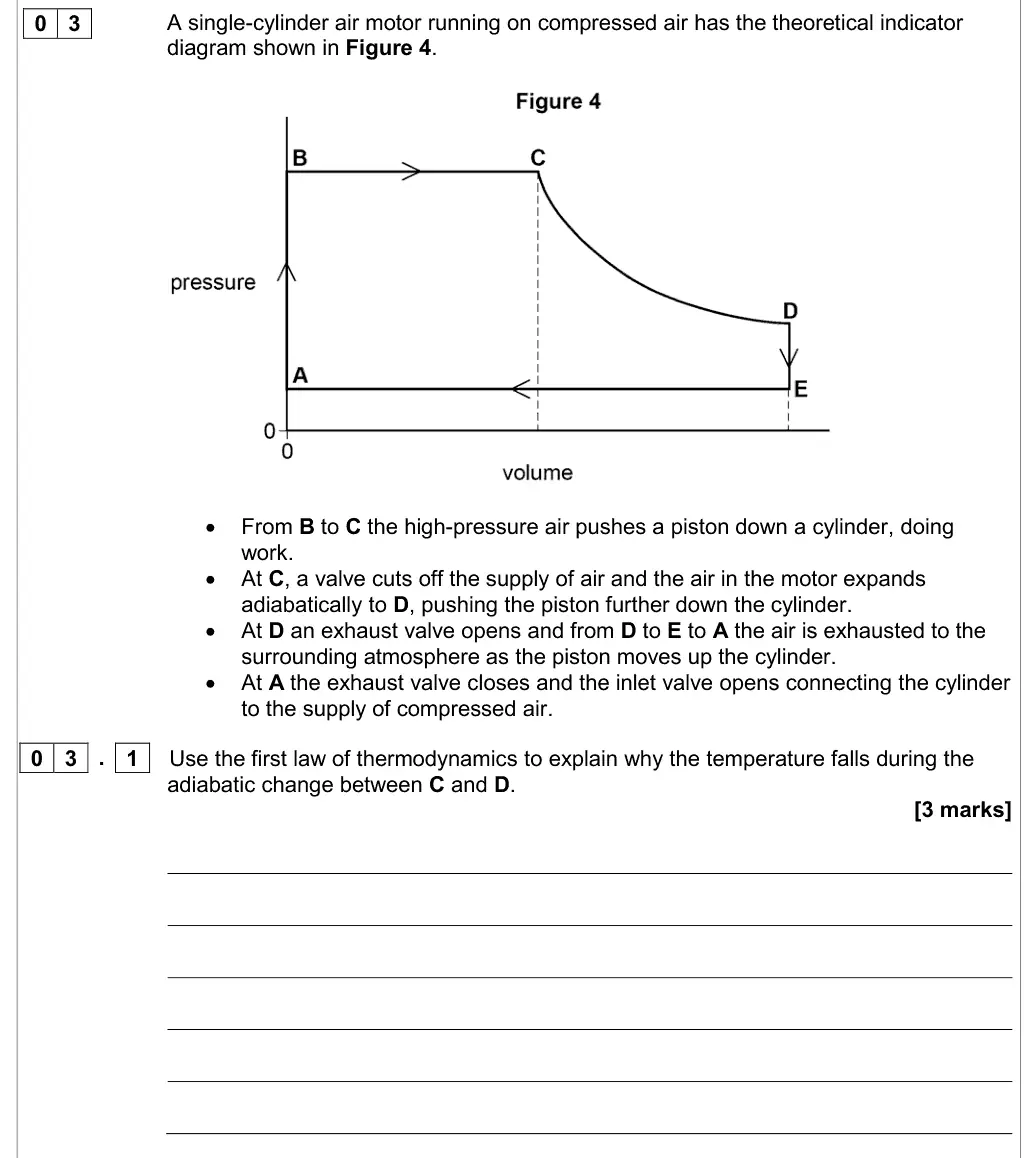
Above 7000 rev min^-1 brake power falls while fuel consumption (input power) keeps rising, so efficiency falls
friction power rises, lubrication breaks down
'brake power falls' alone not enough
Skills: MS3.1 Translate information between graphical, numerical and algebraic forms
November 2020 · Paper 3B Engineering physics · Q1.11 markAO1=1Short answer
Mark scheme
Notes from the mark scheme and report
Sum of each constituent mass x (distance from axis)^2, or sum of m r^2 with terms defined
November 2020 · Paper 3B Engineering physics · Q1.24 marksAO2=4Show that
Earlier part of question 1 that this part uses
Mark scheme
Notes from the mark scheme and report
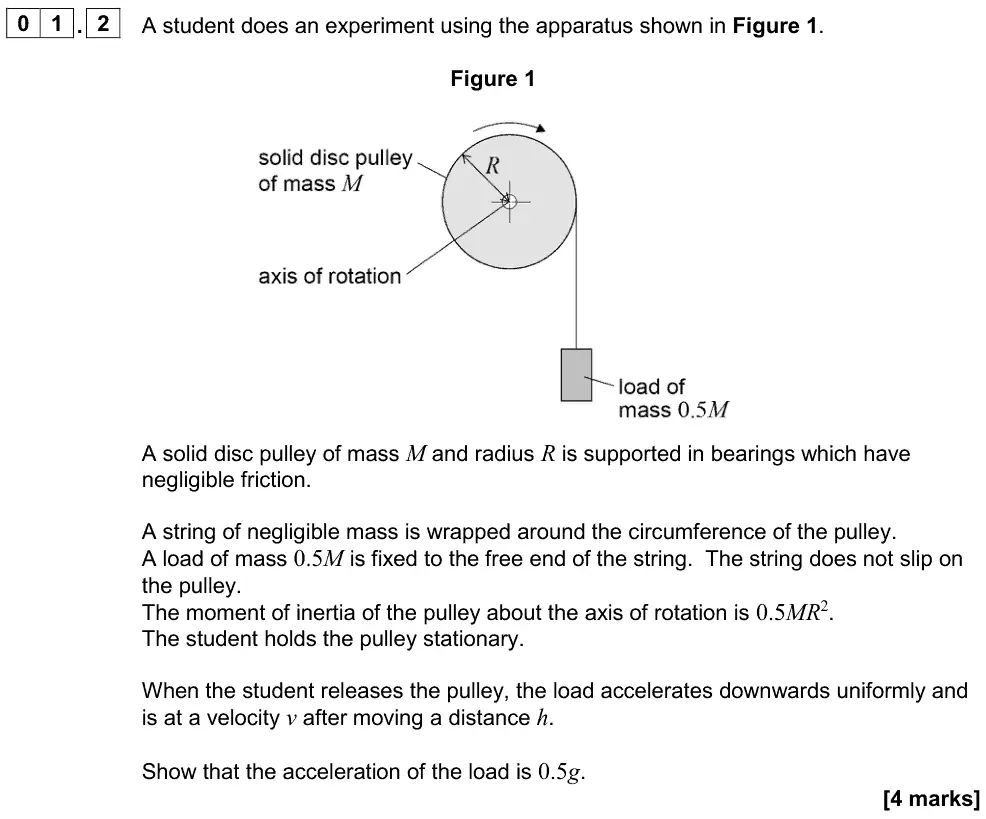
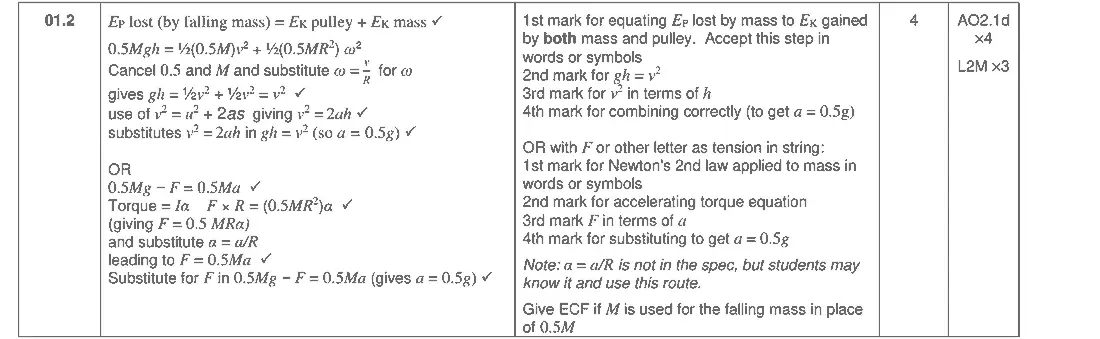
Answer: a = 0.5g (energy: 0.5Mgh = 0.5(0.5M)v^2 + 0.5(0.5MR^2)(v/R)^2 gives gh = v^2, with v^2 = 2ah
or Newton's second law on load plus T = I alpha)
ecf if M used for the load
Skills: MS2.2 Change the subject of an equation, including non-linear equations; MS2.3 Substitute numerical values into algebraic equations using appropriate units for physical quantities
November 2020 · Paper 3B Engineering physics · Q1.33 marksAO3=3Explanation
Earlier part of question 1 that this part uses
Mark scheme
Notes from the mark scheme and report
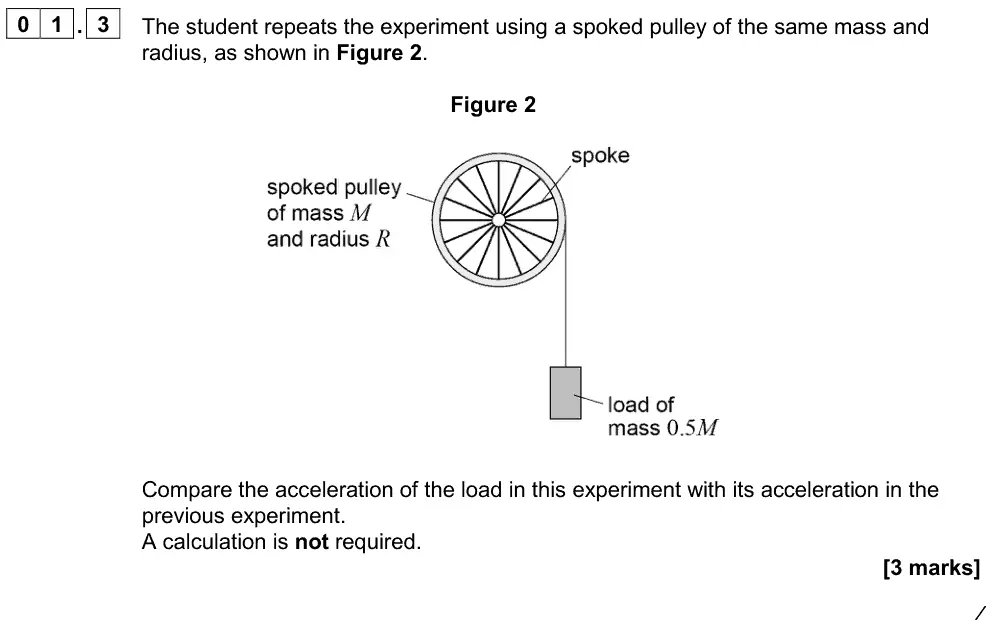
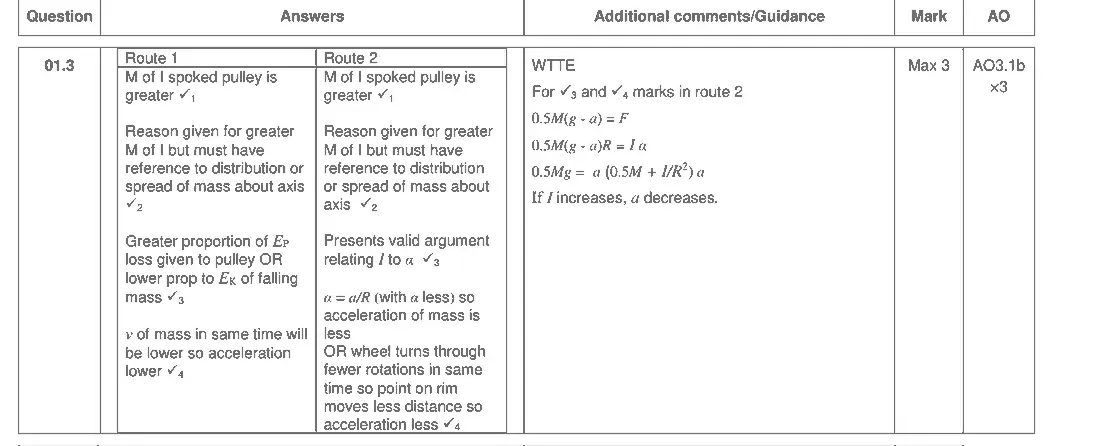
Spoked pulley has greater I as more mass is at the rim
larger share of lost GPE goes to the pulley (or smaller alpha for same torque) so the load's acceleration is less
must refer to mass distribution
November 2020 · Paper 3B Engineering physics · Q2.11 markAO1=1Short answer
Mark scheme
Notes from the mark scheme and report
No net external torque acts on the system
'force' not accepted
November 2020 · Paper 3B Engineering physics · Q2.23 marksAO2=3Show that
Earlier part of question 2 that this part uses
Mark scheme
Notes from the mark scheme and report
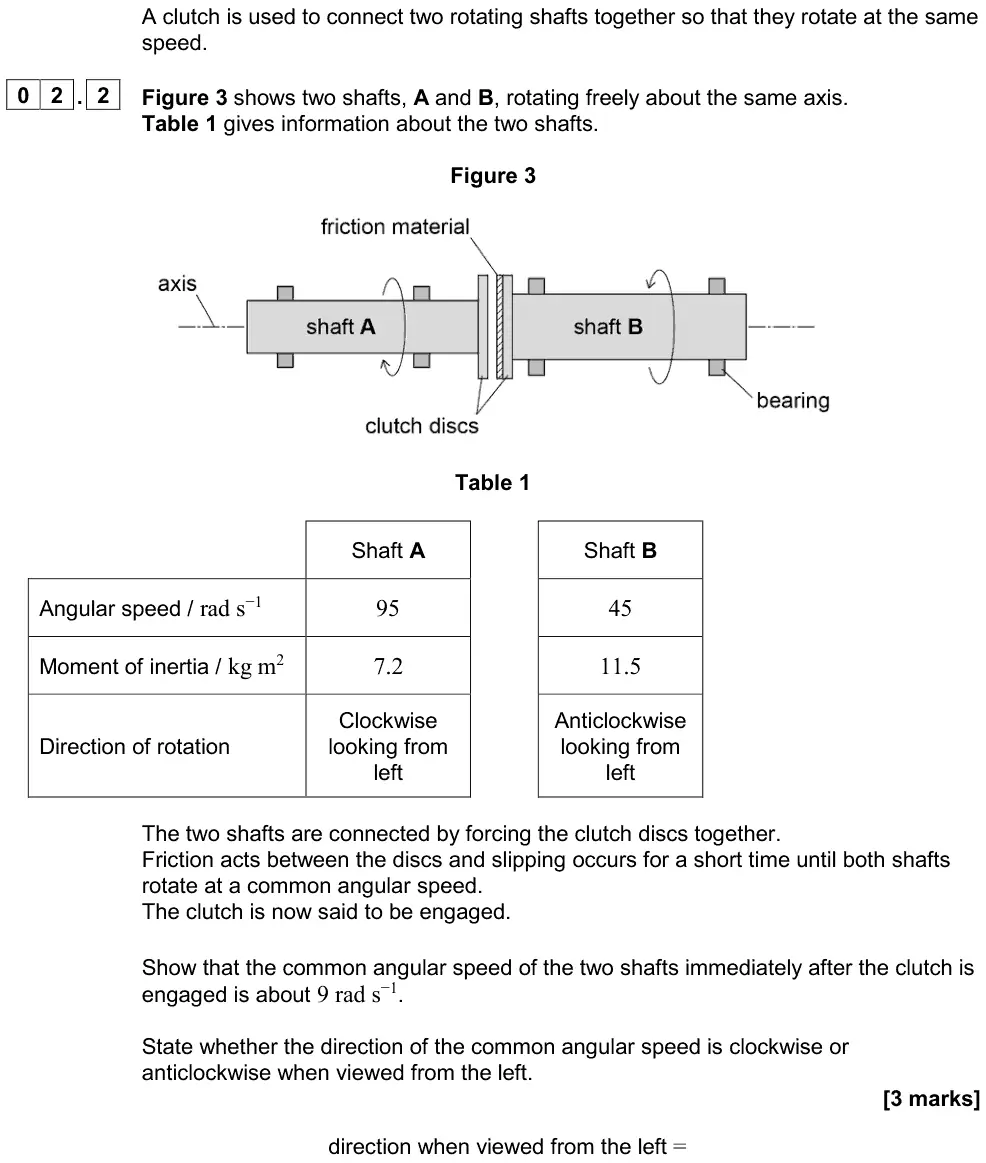
Answer: 8.9 rad s^-1 clockwise (7.2 x 95 - 11.5 x 45 = 18.7 omega)
direction mark needs a consistent sign convention
Skills: MS2.3 Substitute numerical values into algebraic equations using appropriate units for physical quantities; MS2.2 Change the subject of an equation, including non-linear equations
November 2020 · Paper 3B Engineering physics · Q2.33 marksAO3=3Calculation
Earlier part of question 2 that this part uses
Mark scheme
Notes from the mark scheme and report
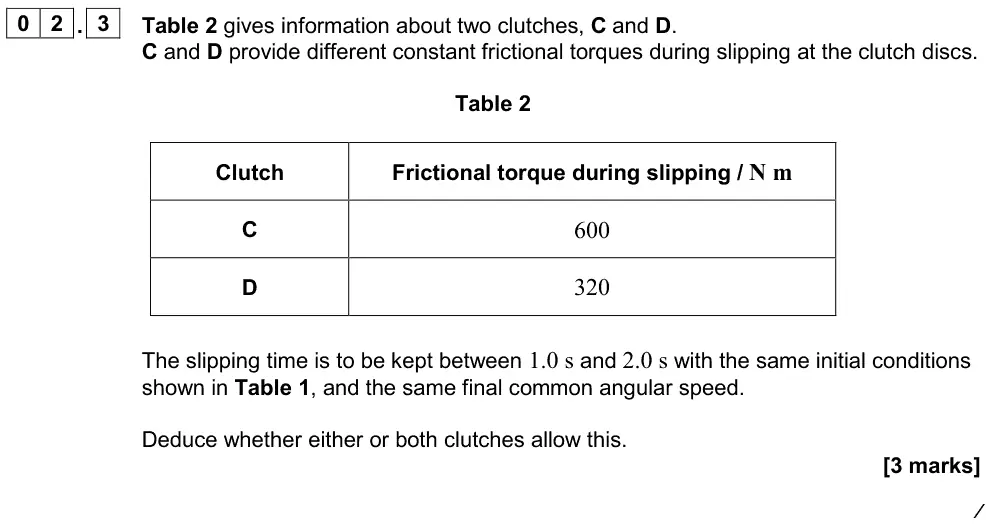
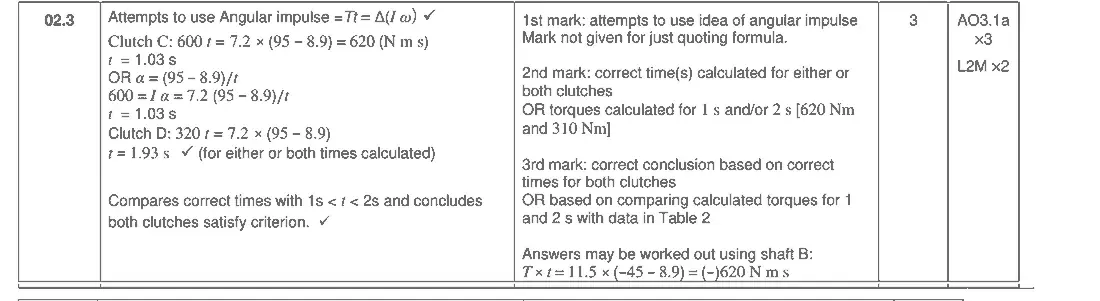
Angular impulse T t = change in I omega = 7.2 x (95 - 8.9) = 620 N m s
clutch C t = 1.03 s, clutch D t = 1.93 s, so both are within 1.0-2.0 s
Skills: MS2.3 Substitute numerical values into algebraic equations using appropriate units for physical quantities; MS2.2 Change the subject of an equation, including non-linear equations
June 2019 · Paper 3B Engineering physics · Q1.12 marksCalculationEasy
Mark scheme
Examiner's comment
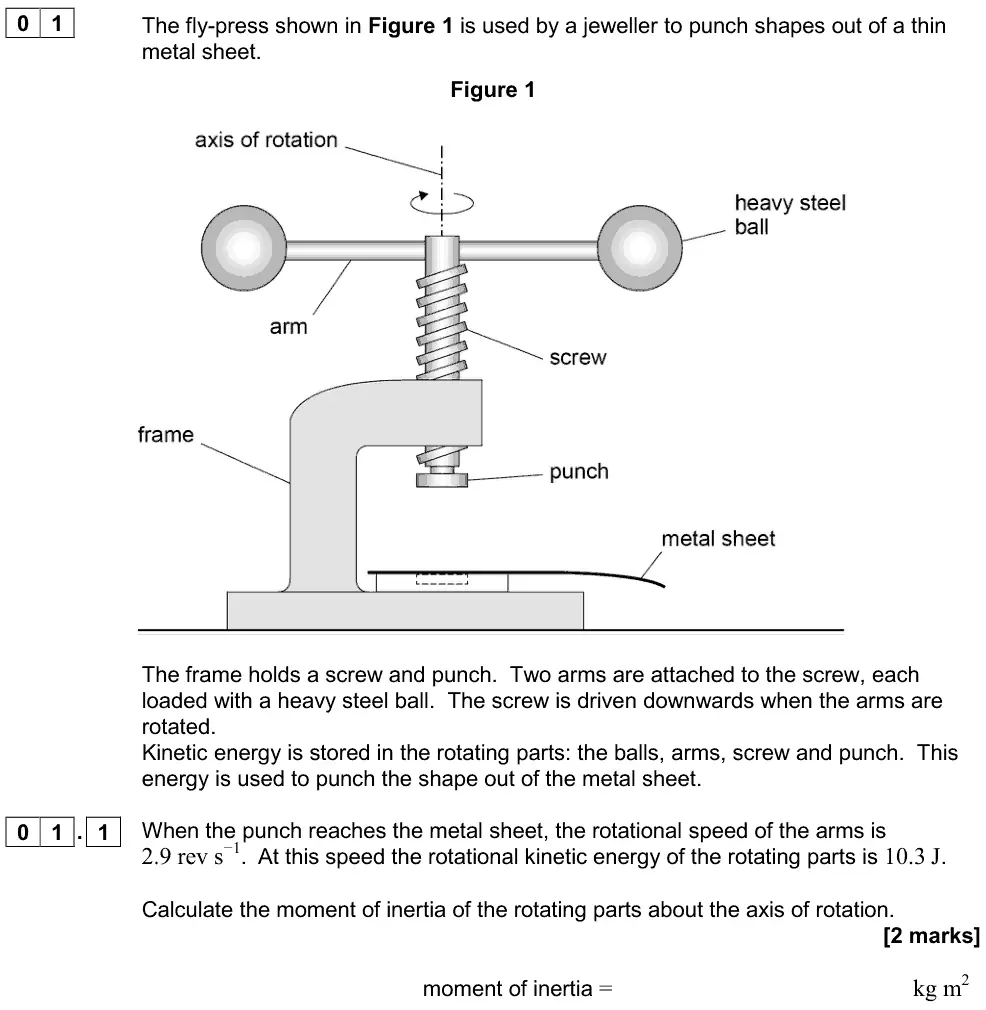
Students were asked to calculate the moment of inertia of the rotating parts of a fly-press given the rotational speed and rotational kinetic energy. About 60% of students scored both marks, the majority of the remainder either making no attempt to convert rev s−1 to rad s−1, or by dividing 8.9 rev s−1 by 2π or 60 or both.
This was answered well, with more than 70% scoring 3 marks and only around 4% scoring no marks at all. Students could gain full credit if they used the incorrect value of ω1 that they used in 1.1 and carried it through. Most were adept in handling the equations of motion. Only a few made an error in the time, some reading 89 ms as 89 s.
There were questions on which nearly all students were able to gain some credit, and, it is hoped, achieve some confidence. The high mean marks for questions 1.1, 1.3, 3.1 and 3.2 suggest that students generally seemed more comfortable with the calculations than the qualitative questions.
Question 1.1
Notes from the mark scheme and report
Answer: 6.2 x 10^-2 kg m^2 (omega = 2pi x 2.9 = 18.2 rad s^-1
I = 2Ek/omega^2)
not converting rev s^-1 to rad s^-1 was the main error
not to 1 sf
Skills: MS2.2 Change the subject of an equation, including non-linear equations; MS2.3 Substitute numerical values into algebraic equations using appropriate units for physical quantities; MS4.7 Understand the relationship between degrees and radians and translate from one to the other
June 2019 · Paper 3B Engineering physics · Q1.22 marksExplanation
Earlier part of question 1 that this part uses
Mark scheme
Examiner's comment
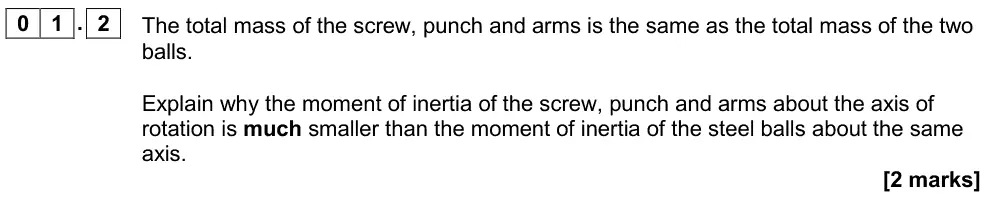
In order to explain why the moment of inertia of the screw, punch and arms was much smaller about the axis of rotation than that of the balls, students were expected to show they had some idea of the meaning of moment of inertia. For the first mark, students had to make some reference to how the masses are distributed. Too many simply stated that the radius of the balls (meaning the distance from the axis) was greater than the radius of the other rotating components, without =∑ (often without the ∑) without any clear 2 I mr mentioning mass at all, or they quoted explanation of how it applied in this situation. A minority did not read the question carefully and referred to the balls being heavier, hence a greater moment of inertia. The second mark was more discriminating and students were credited for explaining the word much in the question. If they emphasised the fact that the distance (of the mass from the axis) is squared and that this greatly affected the moment of inertia, they scored the mark. Around 37% of students scored no marks at all.
Question 1.2
Notes from the mark scheme and report
I depends on how mass is distributed about the axis
same mass of screw, punch and arms much closer to the axis
I depends on r^2 so much smaller
'radius' without mass or 'balls heavier' not credited
about 37% scored zero
June 2019 · Paper 3B Engineering physics · Q1.33 marksCalculationEasy
Earlier part of question 1 that this part uses
Mark scheme
Examiner's comment
This was answered well, with more than 70% scoring 3 marks and only around 4% scoring no marks at all. Students could gain full credit if they used the incorrect value of ω1 that they used in 1.1 and carried it through. Most were adept in handling the equations of motion. Only a few made an error in the time, some reading 89 ms as 89 s.
There were questions on which nearly all students were able to gain some credit, and, it is hoped, achieve some confidence. The high mean marks for questions 1.1, 1.3, 3.1 and 3.2 suggest that students generally seemed more comfortable with the calculations than the qualitative questions.
Question 1.3
Notes from the mark scheme and report
Answer: alpha = -205 rad s^-2 (18.2 rad s^-1 to 0 in 0.089 s)
theta = 0.81 rad
ecf from 01.1 omega
misreading 89 ms as 89 s
Skills: MS2.3 Substitute numerical values into algebraic equations using appropriate units for physical quantities; MS2.2 Change the subject of an equation, including non-linear equations
June 2019 · Paper 3B Engineering physics · Q1.43 marksExplanationHard
Earlier part of question 1 that this part uses
Mark scheme
Examiner's comment
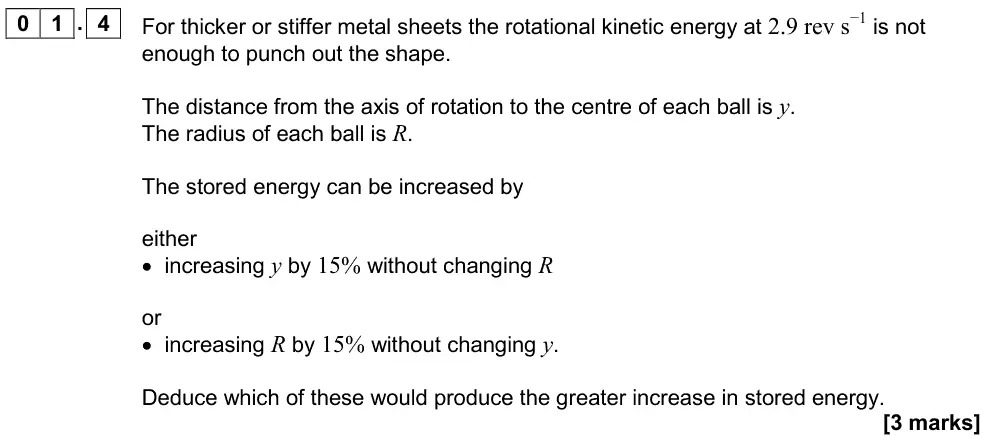
In this question, students had to decide which of two options would enable the fly-press to store more rotational kinetic energy. When they realised that the moment of inertia (and hence energy) increased by y2 and by R3 they were well on the way to a full answer. Approximately half of the students were not able to make any headway. About 22% of students scored the full 3 marks, with many answers clearly expressed, both in the calculations and the concluding statement. Of the others, too many thought that increasing the radius of the balls would hardly influence the moment of inertia and hence energy stored. The dimensions y and R were clearly explained in the question, but it was difficult to interpret some answers, as students used r or y + R for the distance defined as y.
Question 1.4
Notes from the mark scheme and report
I proportional to y^2 (x 1.32) but to R^3 via ball mass (x 1.52), so increasing R gives the larger increase in I and Ek
many thought ball radius hardly matters
about half made no headway
Skills: MS0.3 Use ratios, fractions and percentages; MS4.3 Calculate areas of triangles, circumferences and areas of circles, surface areas and volumes of rectangular blocks, cylinders and spheres
June 2019 · Paper 3B Engineering physics · Q1.51 markShort answer
Earlier part of question 1 that this part uses
Mark scheme
Examiner's comment
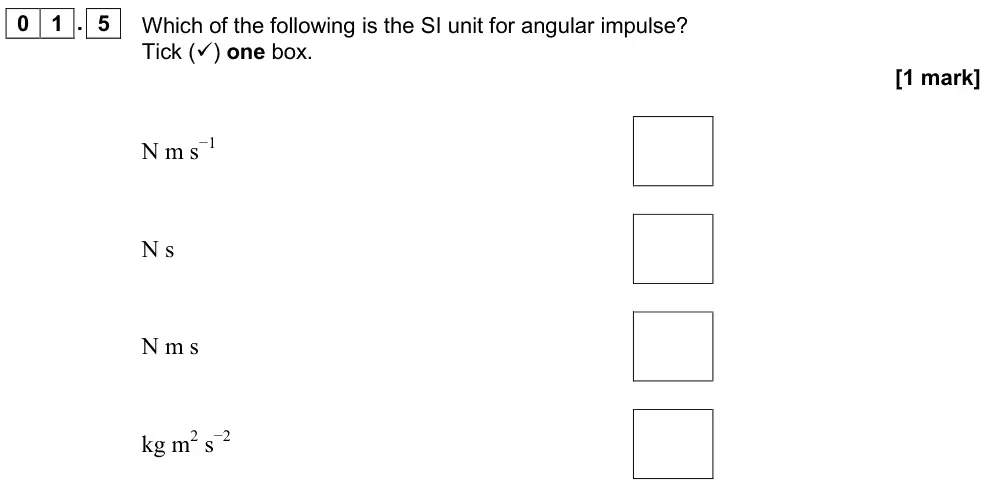
Despite the equation for angular impulse being in the Data and Formulae Booklet, only just over half of the students scored the mark for correctly identifying the unit.
Question 1.5
Notes from the mark scheme and report
Answer: N m s
just over half correct despite the equation being in the data booklet
June 2019 · Paper 3B Engineering physics · Q2.11 markShort answerEasy
Mark scheme
Examiner's comment
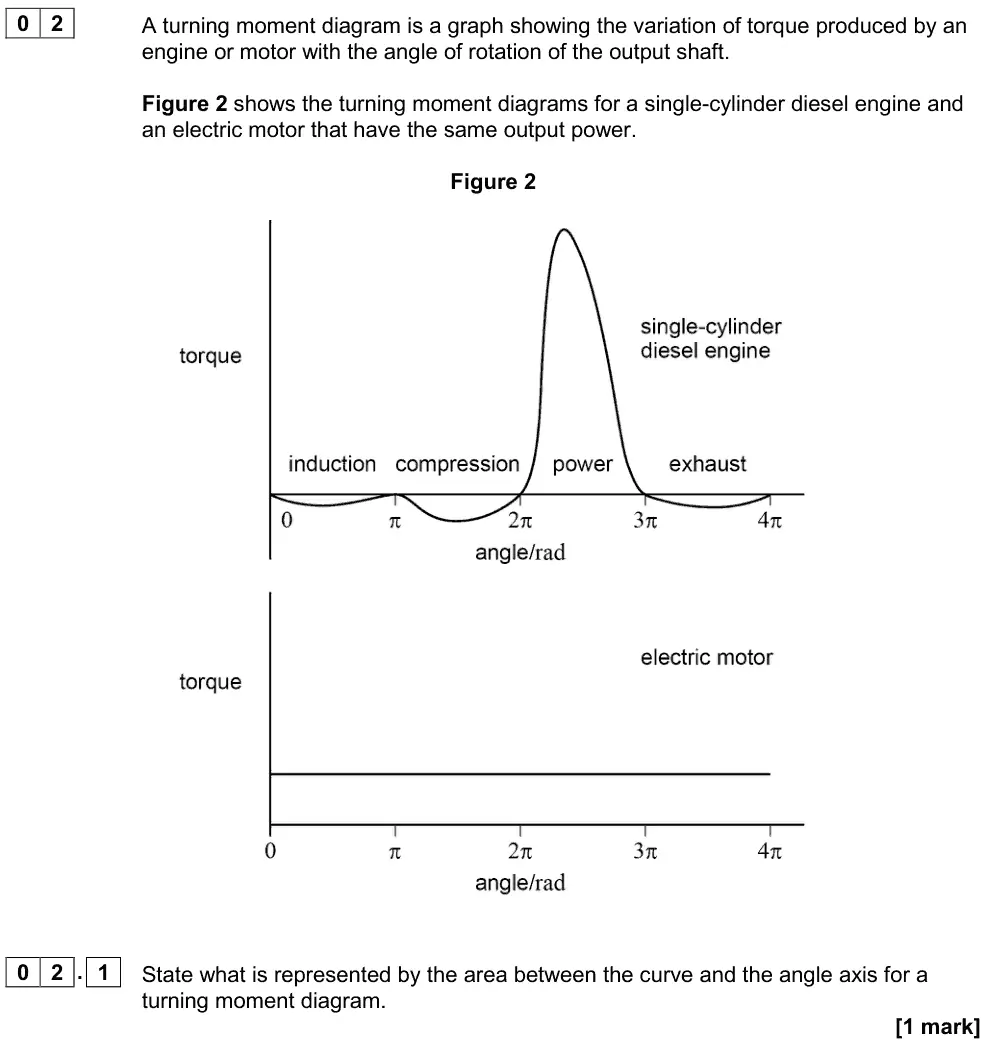
Over 80% of students were able to state that the area under the torque–angle curve represented work done. Some students gave a choice such as work done/energy and received no credit. A very small minority failed to gain marks when elaborating their answer, for example by writing 'work done against friction' which is clearly not what the area represents.
Question 2.1
Notes from the mark scheme and report
Work done
'work done/energy' choices or 'work done against friction' not credited
June 2019 · Paper 3B Engineering physics · Q2.26 marks6-mark extended response
Earlier part of question 2 that this part uses
Mark scheme, with the levels and indicative content
Examiner's comment
This was the extended response question, worth 6 marks. Unusually, it cut across both the rotational dynamics and thermodynamics sections of the option. About 10% of students gave several sensible and appropriate statements covering the three bullet points in the question and scored 5 or 6 marks. The most effective answers showed a clear understanding of why a flywheel is required for the diesel engine, but not for the motor. It was pleasing to see answers which matched the diesel engine or electric motor to the load (described as 'a machine' in the question). The majority of students neglected the load altogether. Marking was generous at the lower end; only three of the many answer points in the mark scheme were needed to score 2 marks. Even so, fewer than half of students managed to score 3 or more marks. Many described everything they knew about diesel engines in their answer, but not much was relevant. Examiners expected to see answers in which the varying torque was explained in terms of the changing force or pressure on the piston, but only a small number of students approached the question in this way. All too often they thought the torque was a consequence of the work done, rather than the other way round. Some students confused torque, power and work, or used these words as if they had the same meaning. Other misconceptions were:
• there is zero force on the piston when at the dead centres • the greater the moment of inertia of the flywheel, the slower the engine will rotate • when the piston is momentarily stationary (at a dead centre) the output shaft is not rotating.
Question 2.2
Notes from the mark scheme and report
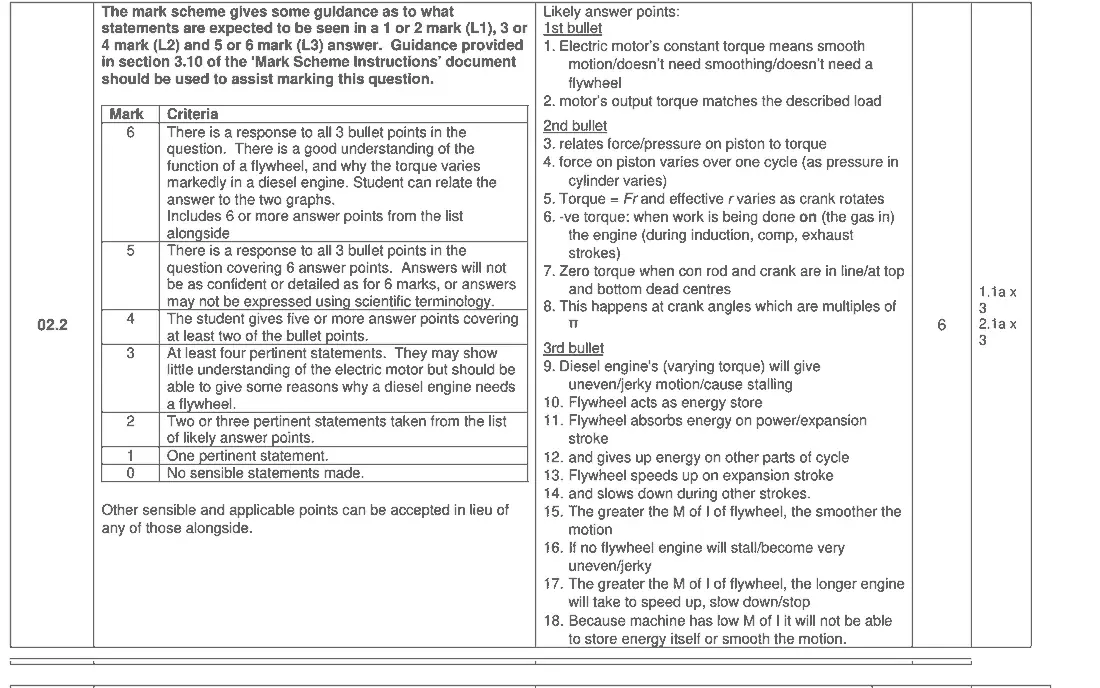
Levels of response: motor's constant torque needs no smoothing
diesel torque varies because force on piston and effective crank radius vary, negative on non-power strokes, zero at dead centres
flywheel stores energy on the power stroke and releases it on others, larger I gives smoother motion
only about 10% scored 5-6, fewer than half scored 3 or more
June 2018 · Paper 3B Engineering physics · Q1.11 markShort answer
Mark scheme
Examiner's comment
Questions 01.1 and 03.3 required students to recall basic definitions. More students than expected were not prepared for this. For an option specialising in rotational dynamics and thermodynamics, students should give definitions that use correct terminology.
Answers showed that students were more confident with rotational dynamics than with thermodynamics. The mean mark as a percentage of the maximum mark was between 72 and 74% in 01.3, 01.4, 02.1 and 02.2. In the calculations, students usually took care to show the stages in their working, but a minority wrote down numbers without giving any evidence of where they came from. They might have held intermediate stages in their heads or their calculators until a final step. Examiners will try to give credit where they can, but a number or answer seemingly plucked out of thin air may not get a mark. Students cannot expect the examiners to make a link or fill a gap.
A minority of students were let down by poor handwriting. Examiners try to interpret words that are difficult to read by using the gist of a sentence, but it is impossible to do this with poorly-written numbers. Students should be advised to write and display calculations clearly.
01.1 Only 41.4% of students scored the one mark for this question. Nearly all answers referred to angular momentum remaining constant, but many failed to include the proviso that there must be no external torque acting. Many wrote 'force' for 'torque' and so failed to gain the mark. Examiners accepted momentum 'before' and 'after', even though students did not say what the before or after referred to. A significant number of students did not take the hint suggested by 01.1 that the whole of question 1 might be about conservation of angular momentum, and went on to answer 01.3 and 01.4 in terms of conservation of rotational kinetic energy.
Notes from the mark scheme and report
Total angular momentum constant provided no external torque acts
omitting the no-external-torque condition or writing 'force' lost the mark
only 41.4% scored
June 2018 · Paper 3B Engineering physics · Q1.22 marksShow thatEasy
Earlier part of question 1 that this part uses
Mark scheme
Examiner's comment
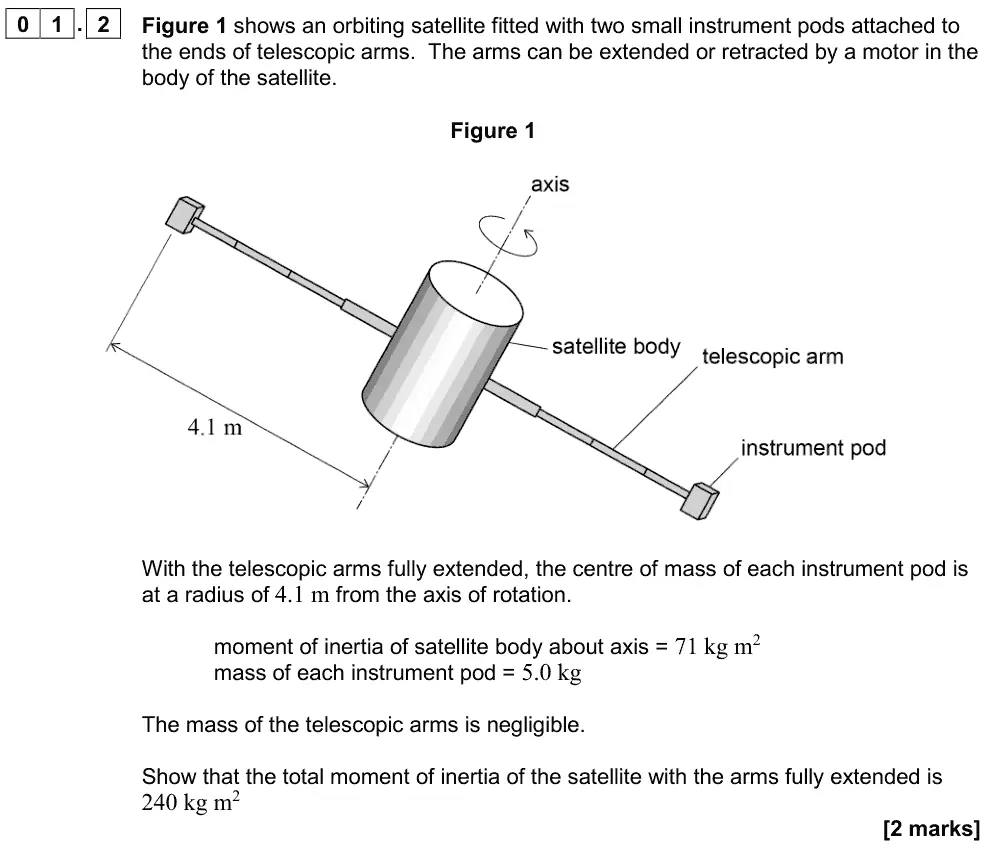
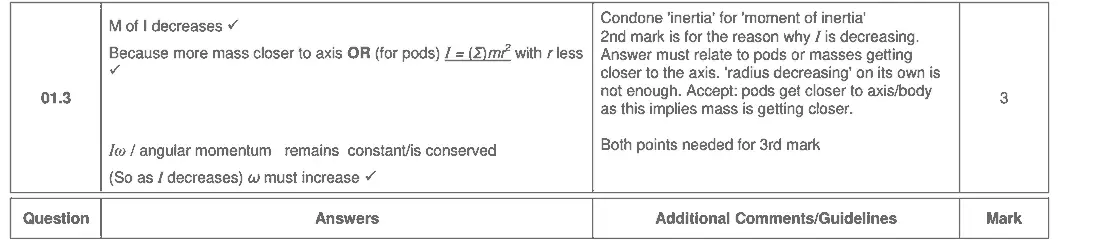
01.2 Students were well-prepared for this; 95.1% scored the full two marks. The 2.6% who scored one mark are likely to have missed out '239' and gone straight from the calculation to the 'show that' answer of 240 (kg m2). 01.3 There were some excellent answers (47.1% of students gained all three marks), but although nearly all students knew that the moment of inertia would decrease, a number did not get the second mark for explaining the decrease. It was not enough to simply state that the radius was decreasing. Examiners were looking for reference to the change in distribution of the mass of the pods, not just the arms. (Students were told the mass of the arms was negligible.) It was possible to score the third mark by reference to conservation of angular momentum, without scoring the second. A small number of students explained the change in angular speed as being a consequence of conservation of kinetic energy, and so failed to gain the last mark.
Notes from the mark scheme and report
Answer: 239 kg m^2 (71 + 2 x 5.0 x 4.1^2)
239 must be seen
Skills: MS2.3 Substitute numerical values into algebraic equations using appropriate units for physical quantities
June 2018 · Paper 3B Engineering physics · Q1.33 marksExplanationEasy
Earlier part of question 1 that this part uses
Mark scheme
Examiner's comment
Answers showed that students were more confident with rotational dynamics than with thermodynamics. The mean mark as a percentage of the maximum mark was between 72 and 74% in 01.3, 01.4, 02.1 and 02.2. In the calculations, students usually took care to show the stages in their working, but a minority wrote down numbers without giving any evidence of where they came from. They might have held intermediate stages in their heads or their calculators until a final step. Examiners will try to give credit where they can, but a number or answer seemingly plucked out of thin air may not get a mark. Students cannot expect the examiners to make a link or fill a gap.
01.1 Only 41.4% of students scored the one mark for this question. Nearly all answers referred to angular momentum remaining constant, but many failed to include the proviso that there must be no external torque acting. Many wrote 'force' for 'torque' and so failed to gain the mark. Examiners accepted momentum 'before' and 'after', even though students did not say what the before or after referred to. A significant number of students did not take the hint suggested by 01.1 that the whole of question 1 might be about conservation of angular momentum, and went on to answer 01.3 and 01.4 in terms of conservation of rotational kinetic energy.
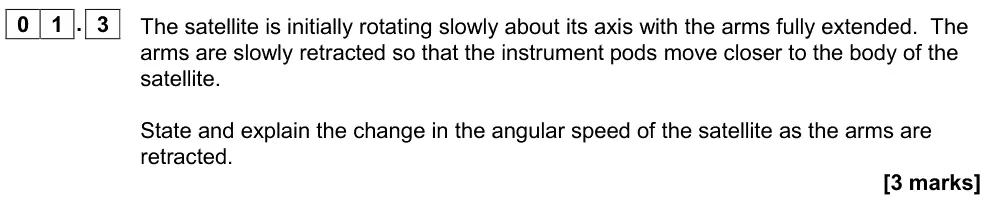
01.2 Students were well-prepared for this; 95.1% scored the full two marks. The 2.6% who scored one mark are likely to have missed out '239' and gone straight from the calculation to the 'show that' answer of 240 (kg m2). 01.3 There were some excellent answers (47.1% of students gained all three marks), but although nearly all students knew that the moment of inertia would decrease, a number did not get the second mark for explaining the decrease. It was not enough to simply state that the radius was decreasing. Examiners were looking for reference to the change in distribution of the mass of the pods, not just the arms. (Students were told the mass of the arms was negligible.) It was possible to score the third mark by reference to conservation of angular momentum, without scoring the second. A small number of students explained the change in angular speed as being a consequence of conservation of kinetic energy, and so failed to gain the last mark.
Notes from the mark scheme and report
I decreases as pod mass moves closer to the axis
angular momentum I omega conserved so omega increases
'radius decreases' alone not enough
KE conservation arguments lost the last mark
June 2018 · Paper 3B Engineering physics · Q1.43 marksCalculationEasy
Earlier part of question 1 that this part uses
Mark scheme
Examiner's comment
Questions 01.4, 03.2 and, to some extent, question 4 asked the students to analyse, interpret and evaluate data and come to a conclusion or make a judgement or decision. These questions tested Assessment Objective 3 (AO3) of the specification. The majority of students made clear concluding statements following their calculations, but a small minority let themselves down by writing a one-word answer such as "yes".
The levels-of-response question (question 4) was set in an unusual context, but most students were able to pick up marks by analysing the problem and making sensible points. This question was set not only to test specification content, but also to cover some of the wider aims - for example, students are expected to "consider applications and implications of science and evaluate their associated benefits and risks". (See pages 68 and 69 of the specification booklet.)
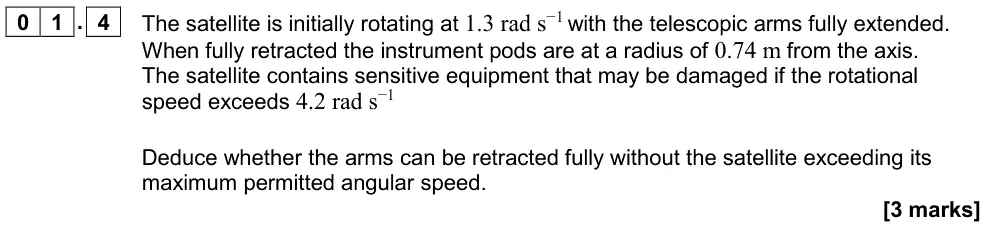
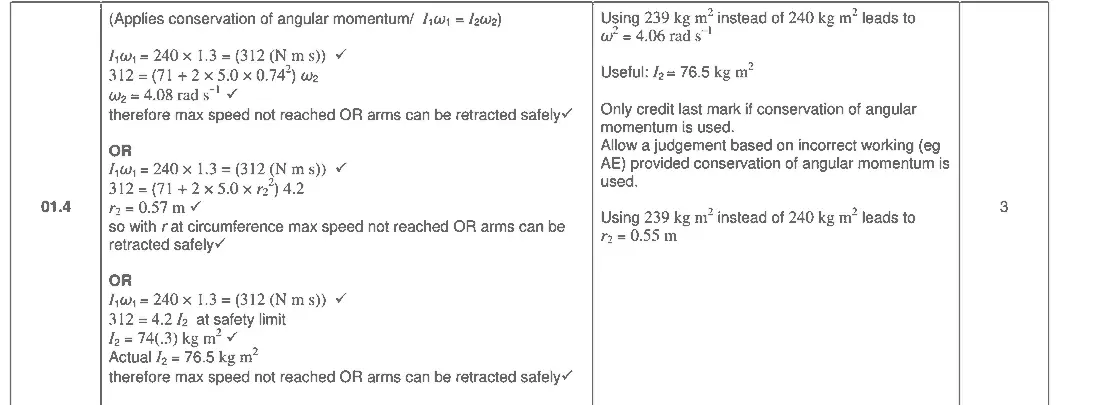
01.4 The calculations here were usually done well, and most came to a sensible written conclusion. Those who used the conservation of kinetic energy could score no marks for this question (just over one fifth of the students).
Answers showed that students were more confident with rotational dynamics than with thermodynamics. The mean mark as a percentage of the maximum mark was between 72 and 74% in 01.3, 01.4, 02.1 and 02.2. In the calculations, students usually took care to show the stages in their working, but a minority wrote down numbers without giving any evidence of where they came from. They might have held intermediate stages in their heads or their calculators until a final step. Examiners will try to give credit where they can, but a number or answer seemingly plucked out of thin air may not get a mark. Students cannot expect the examiners to make a link or fill a gap.
01.1 Only 41.4% of students scored the one mark for this question. Nearly all answers referred to angular momentum remaining constant, but many failed to include the proviso that there must be no external torque acting. Many wrote 'force' for 'torque' and so failed to gain the mark. Examiners accepted momentum 'before' and 'after', even though students did not say what the before or after referred to. A significant number of students did not take the hint suggested by 01.1 that the whole of question 1 might be about conservation of angular momentum, and went on to answer 01.3 and 01.4 in terms of conservation of rotational kinetic energy.
Notes from the mark scheme and report
Answer: omega = 4.08 rad s^-1 < 4.2 so arms can be retracted (I2 = 71 + 2 x 5.0 x 0.74^2 = 76.5 kg m^2
L = 312 N m s)
using KE conservation scored zero (just over a fifth)
Skills: MS2.3 Substitute numerical values into algebraic equations using appropriate units for physical quantities; MS2.2 Change the subject of an equation, including non-linear equations
June 2018 · Paper 3B Engineering physics · Q2.11 markShort answerEasy
Mark scheme
Examiner's comment
02.1 The question asked for one function of a flywheel. Only a brief answer was required and 73.5% of students were able to score the mark. Storing energy was the most common answer, followed by the smoothing out of torque. Answers which only gave an application of a flywheel (for example, kinetic energy recovery systems or a potter's wheel) were not credited.
Answers showed that students were more confident with rotational dynamics than with thermodynamics. The mean mark as a percentage of the maximum mark was between 72 and 74% in 01.3, 01.4, 02.1 and 02.2. In the calculations, students usually took care to show the stages in their working, but a minority wrote down numbers without giving any evidence of where they came from. They might have held intermediate stages in their heads or their calculators until a final step. Examiners will try to give credit where they can, but a number or answer seemingly plucked out of thin air may not get a mark. Students cannot expect the examiners to make a link or fill a gap.
Notes from the mark scheme and report
Smooth rotational speed or torque, or store rotational KE
an application alone not credited
June 2018 · Paper 3B Engineering physics · Q2.23 marksShow that
Earlier part of question 2 that this part uses
Mark scheme
Examiner's comment
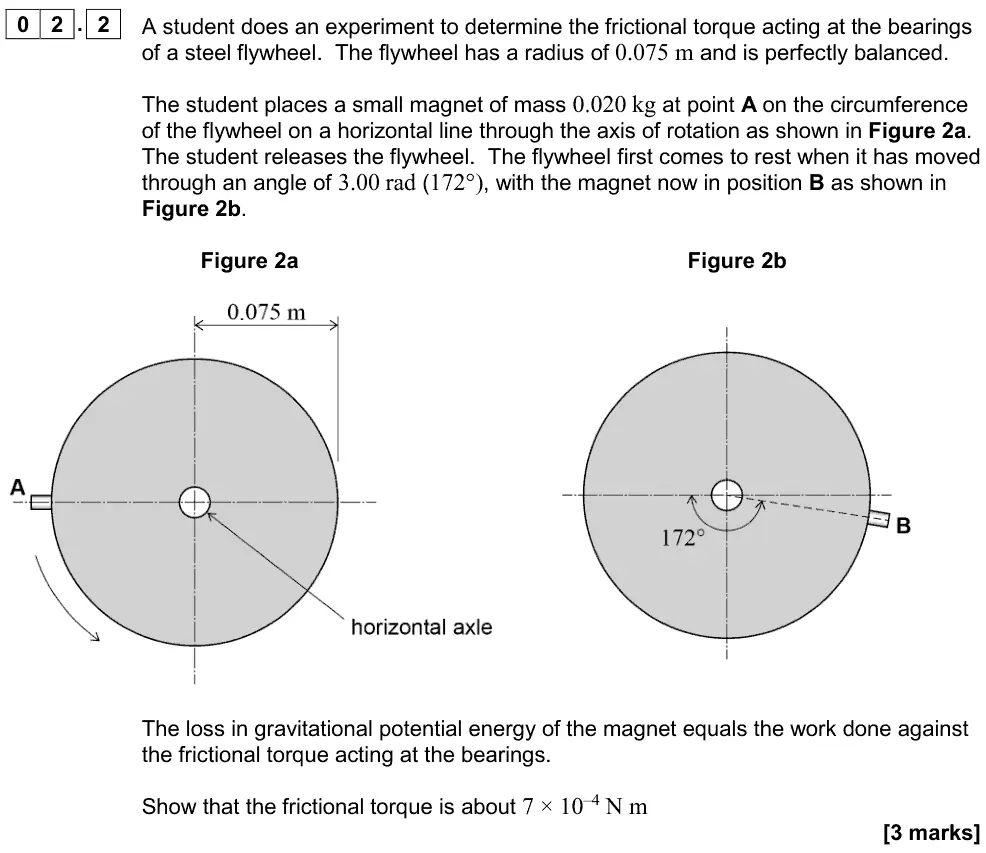
02.2 In this question, students were asked to work out the frictional torque acting on a flywheel by first finding the loss in potential energy of a magnet attached to the rim. Despite the heavy hints given in the question, 36.9% of students scored no marks. Students who knew how to start usually ended up with three or two marks. It was expected that students would use r sin8º to calculate the vertical distance of position B below the horizontal. Because the angle was small, the first mark was also awarded to those who used r tan8º or the arc length for an angle of 8º. The next step was to calculate the loss in gravitational potential energy corresponding to this distance; about 56% of students were able to do this. In the use of T = mgh/θ for the last step, it was not uncommon to find students converting 172 º to radians, despite 3.00 rad being given in the stem of the question.
Answers showed that students were more confident with rotational dynamics than with thermodynamics. The mean mark as a percentage of the maximum mark was between 72 and 74% in 01.3, 01.4, 02.1 and 02.2. In the calculations, students usually took care to show the stages in their working, but a minority wrote down numbers without giving any evidence of where they came from. They might have held intermediate stages in their heads or their calculators until a final step. Examiners will try to give credit where they can, but a number or answer seemingly plucked out of thin air may not get a mark. Students cannot expect the examiners to make a link or fill a gap.
Notes from the mark scheme and report
Answer: 6.8 x 10^-4 N m (h = 0.075 sin 8 deg = 1.04 x 10^-2 m
mgh = 2.04 x 10^-3 J = T x 3.00 rad)
answer to more than 1 sf
36.9% scored zero
Skills: MS4.5 Use sin, cos and tan in physical problems; MS2.3 Substitute numerical values into algebraic equations using appropriate units for physical quantities; MS4.7 Understand the relationship between degrees and radians and translate from one to the other
June 2018 · Paper 3B Engineering physics · Q2.33 marksCalculation
Earlier part of question 2 that this part uses
Mark scheme
Examiner's comment
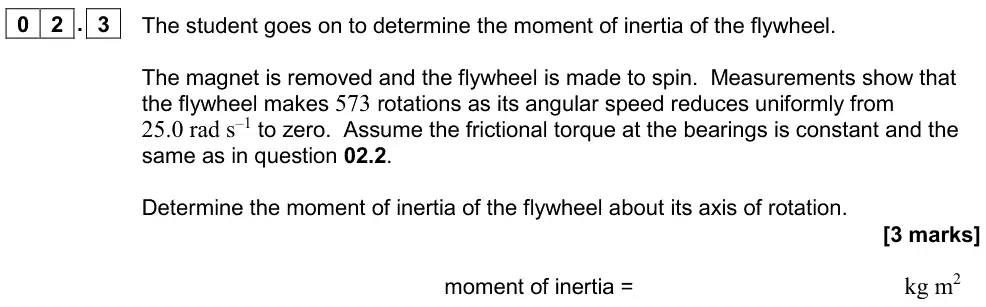
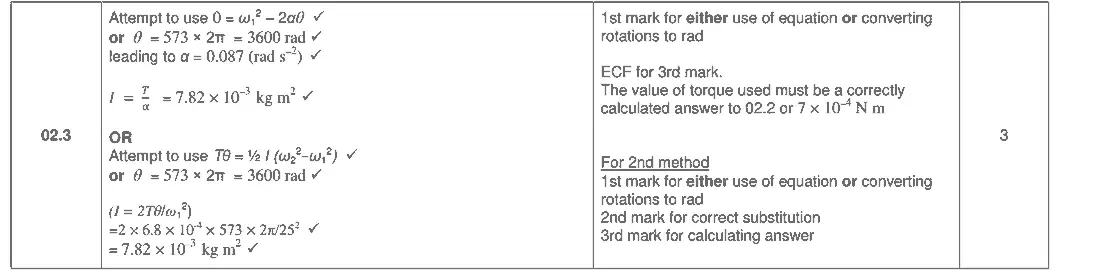
02.3 Students usually cope well with the angular versions of the equations of motion and this 2 = ω1 2 − 2αθ or not question was no exception. Common errors were not squaring ω1 in ω2 converting 573 rev to radian correctly (or not even attempting to). Students were allowed an error carried forward in their calculation of the moment of inertia for the last mark. Pleasingly, 57.2% of students gained maximum marks here.
Notes from the mark scheme and report
Answer: 7.8 x 10^-3 kg m^2 (theta = 573 x 2pi = 3600 rad
alpha = 0.087 rad s^-2
I = T/alpha)
not squaring omega or not converting revolutions to radians were common
57.2% full marks
Skills: MS2.3 Substitute numerical values into algebraic equations using appropriate units for physical quantities; MS2.2 Change the subject of an equation, including non-linear equations; MS4.7 Understand the relationship between degrees and radians and translate from one to the other
June 2017 · Paper 3B Engineering physics · Q1.12 marksShort answer
Mark scheme
Examiner's comment
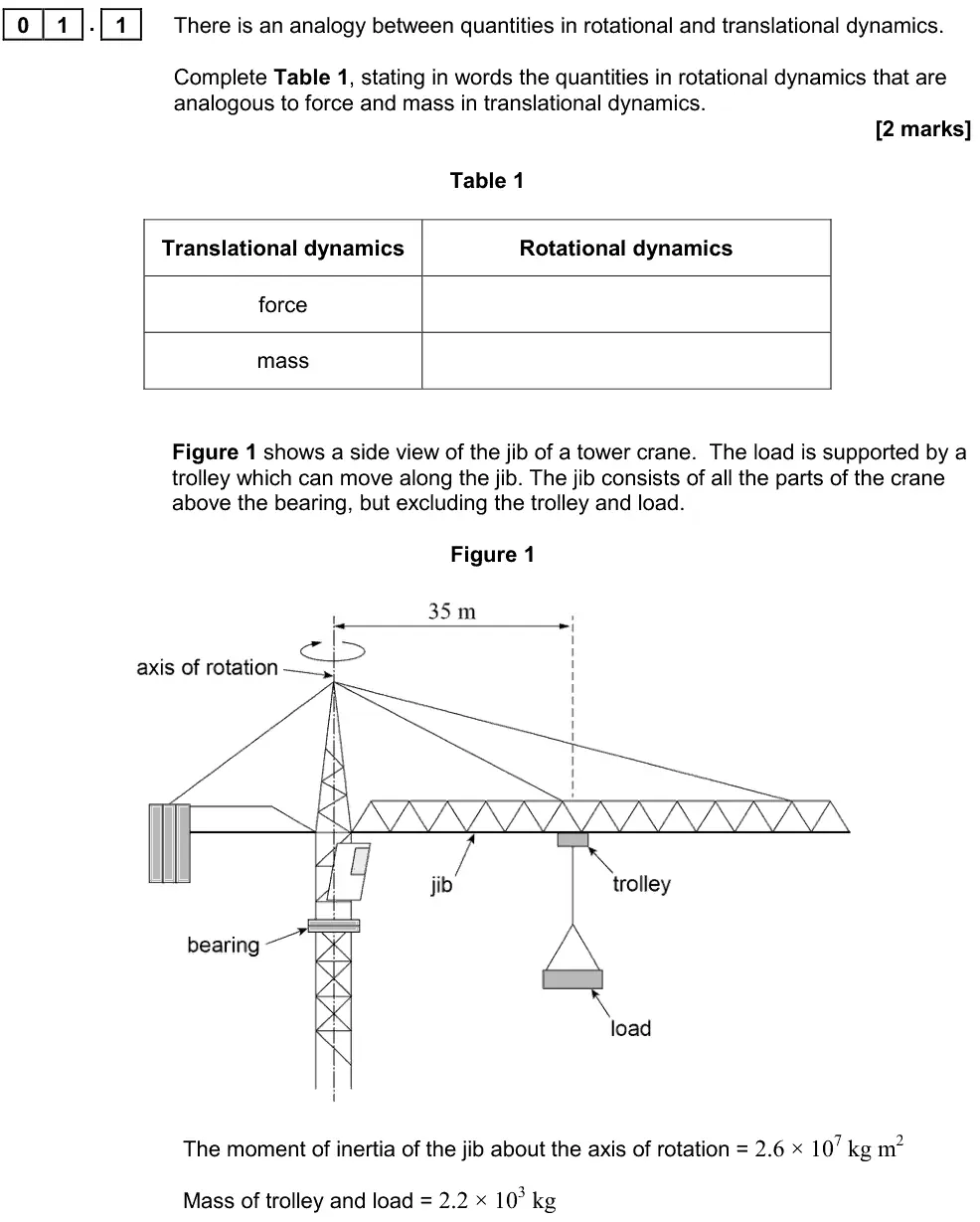
01.1 About half of all students scored 2 marks here. The rest mainly wrote 'inertia' instead of 'moment of inertia' as being analogous to mass.
Notes from the mark scheme and report
Torque for force
moment of inertia for mass
'inertia' alone not allowed and was the main error
about half scored 2
June 2017 · Paper 3B Engineering physics · Q1.21 markShow that
Earlier part of question 1 that this part uses
Mark scheme
Examiner's comment
01.2 The majority of students were successful here. Those who did not get the mark either calculated only the moment of inertia of the trolley and load, or failed to square the 35 m.
If this question had been set in a linear context, with a velocity-time graph in place of an 01.3 angular velocity against time graph, it is likely to have been answered well. Only about 60% of students scored any marks at all. A common error was to oversimplify the situation and use average angular speed = total angular displacement / total time.
Notes from the mark scheme and report
Answer: 2.9 x 10^7 kg m^2 (2.6 x 10^7 + 2.2 x 10^3 x 35^2)
must be given to more than 1 sf
forgetting the jib or not squaring r were the errors
Skills: MS2.3 Substitute numerical values into algebraic equations using appropriate units for physical quantities
June 2017 · Paper 3B Engineering physics · Q1.32 marksCalculation
Earlier part of question 1 that this part uses
Mark scheme
Examiner's comment
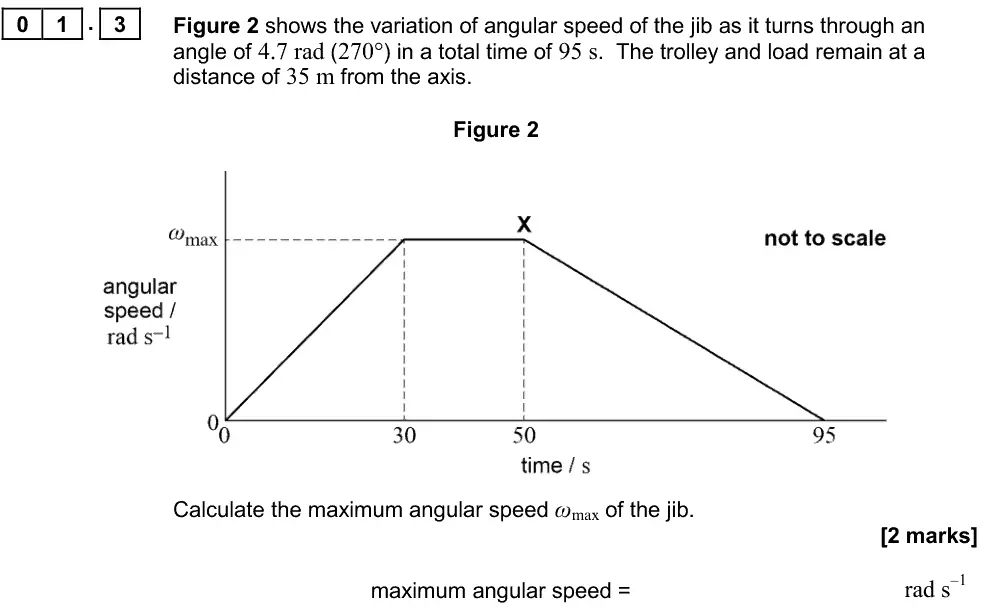
If this question had been set in a linear context, with a velocity-time graph in place of an 01.3 angular velocity against time graph, it is likely to have been answered well. Only about 60% of students scored any marks at all. A common error was to oversimplify the situation and use average angular speed = total angular displacement / total time.
Notes from the mark scheme and report
Answer: 0.082 rad s^-1 (area under omega-t graph = 4.7 rad: omega max x (15 + 20 + 22.5) = 4.7)
using 4.7/95 as the maximum was the common error
only about 60% scored
Skills: MS3.8 Understand the possible physical significance of the area between a curve and the x axis and be able to calculate it or estimate it by graphical methods as appropriate; MS2.2 Change the subject of an equation, including non-linear equations
June 2017 · Paper 3B Engineering physics · Q1.43 marksExplanation
Earlier part of question 1 that this part uses
Mark scheme
Examiner's comment
01.4 The majority of students scored the first mark for stating that the moment of inertia increases as the trolley moves away from the axis, but that is as far as they went. There were good answers using T = Iα with T constant and I increasing, but many tried to use conservation of either angular momentum or kinetic energy.
Assessment Objective 3 in the new specification requires students to analyse, interpret or evaluate information, and make a judgement or come to a conclusion. Questions 01.4, 02.2, 02.4 and 03.3 were of this nature, and they proved to be demanding. In questions 01.4, 02.2 and 03.3 no hints were given as to how the questions should be approached.
Notes from the mark scheme and report
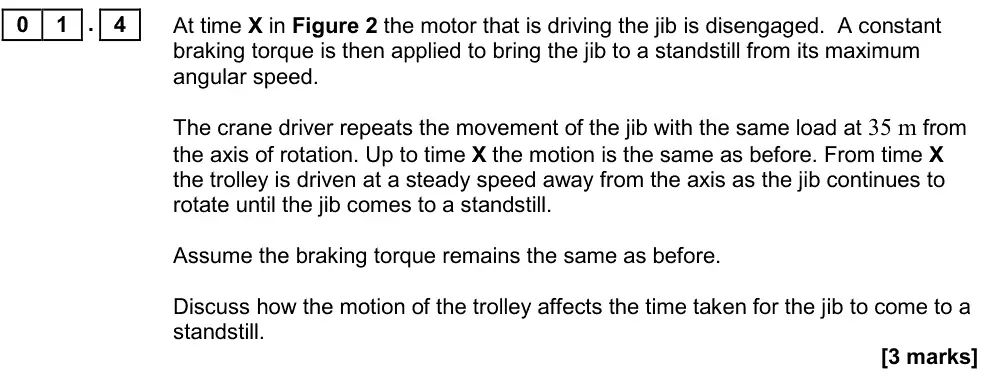
I increases as the trolley moves out
T = I alpha with T constant so deceleration smaller and the stopping time longer
arguments from conservation of angular momentum or KE gained little
June 2017 · Paper 3B Engineering physics · Q2.11 markCalculation
Mark scheme
Examiner's comment
02.1 This was a straightforward calculation of torque which was answered well.
Notes from the mark scheme and report
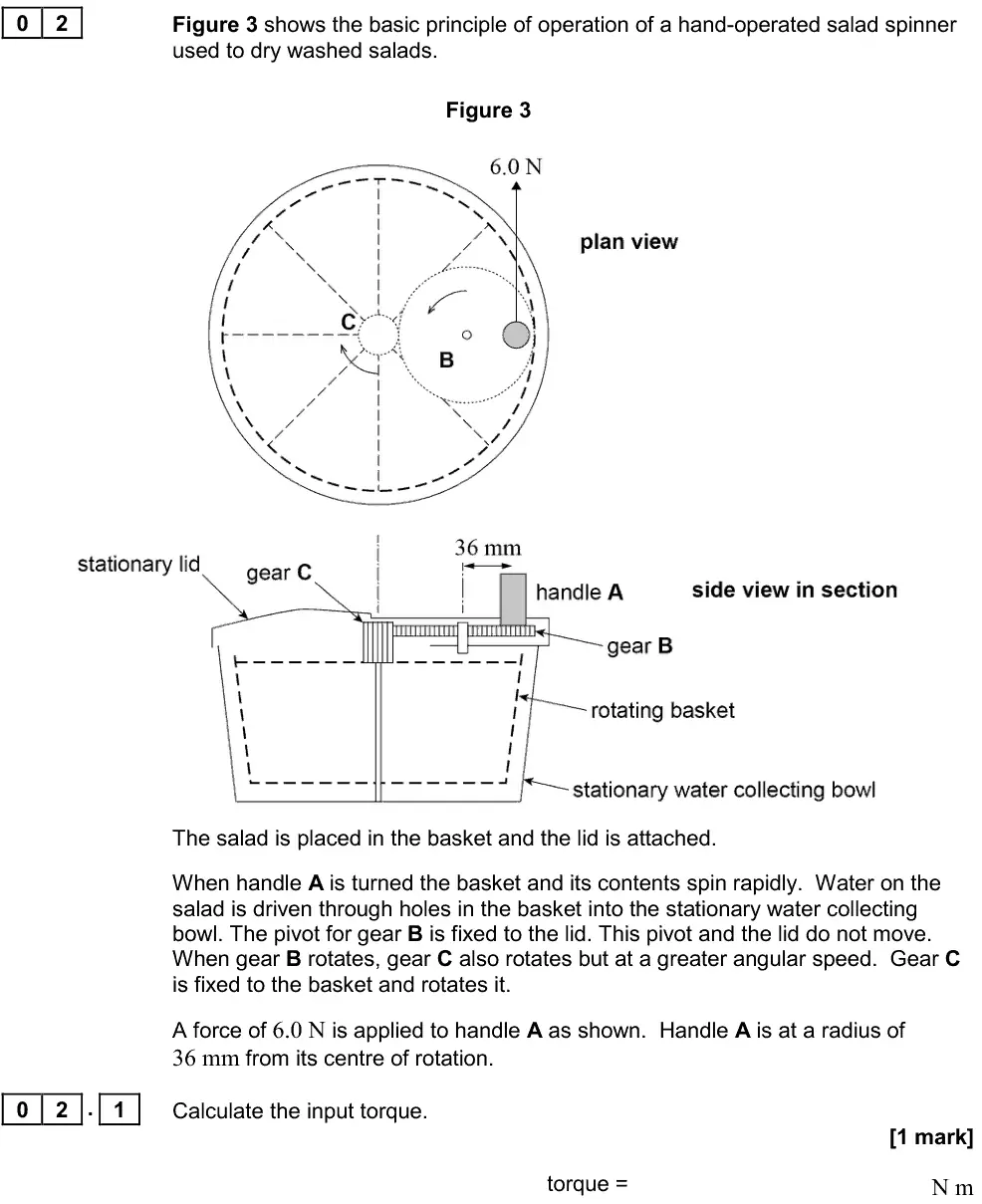
Answer: 0.22 N m (6.0 x 0.036)
Skills: MS2.3 Substitute numerical values into algebraic equations using appropriate units for physical quantities
June 2017 · Paper 3B Engineering physics · Q2.22 marksExplanationHard
Earlier part of question 2 that this part uses
Mark scheme
Examiner's comment
02.2 This question, however, proved much more demanding, with only just over one quarter of students gaining any marks. Gears are not on the specification, but the scene was set carefully, and all relevant information was given. Students who realised that power (Tω) or work (Tθ) is transferred from gear B to gear C, or that the force on the meshing teeth of gears B and C was the same, gained marks. Many students tried to use T = Iα and got side-tracked into relative accelerations or moments of inertia of gears B and C.
Assessment Objective 3 in the new specification requires students to analyse, interpret or evaluate information, and make a judgement or come to a conclusion. Questions 01.4, 02.2, 02.4 and 03.3 were of this nature, and they proved to be demanding. In questions 01.4, 02.2 and 03.3 no hints were given as to how the questions should be approached.
Notes from the mark scheme and report
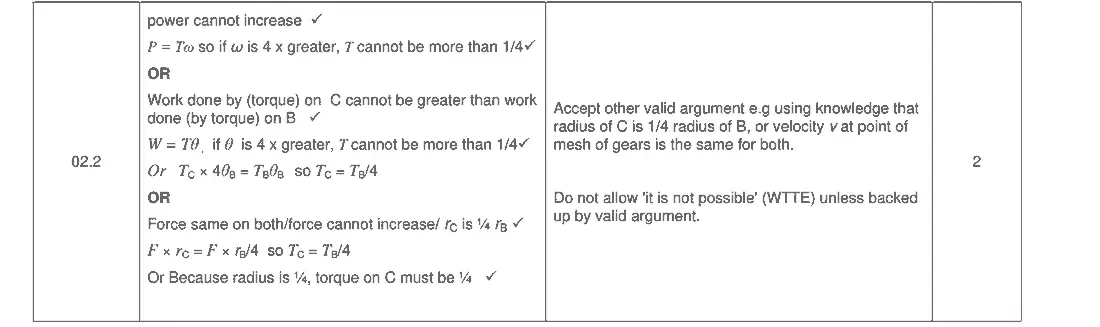
Power cannot increase: P = T omega so if omega x4 then T at most 1/4 (or W = T theta, or same force at the meshing teeth with radius 1/4)
T = I alpha arguments went nowhere
June 2017 · Paper 3B Engineering physics · Q2.32 marksCalculation
Earlier part of question 2 that this part uses
Mark scheme
Examiner's comment
02.3 The calculations for this question were done well.
Notes from the mark scheme and report
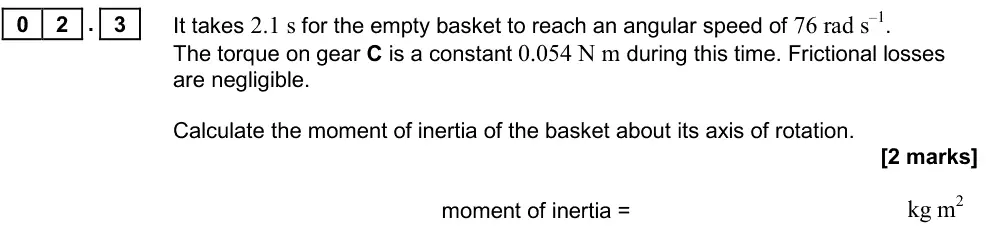
Answer: 1.5 x 10^-3 kg m^2 (alpha = 76/2.1 = 36 rad s^-2
I = T/alpha)
Skills: MS2.3 Substitute numerical values into algebraic equations using appropriate units for physical quantities; MS2.2 Change the subject of an equation, including non-linear equations
June 2017 · Paper 3B Engineering physics · Q2.43 marksExplanation
Earlier part of question 2 that this part uses
Mark scheme
Examiner's comment
02.4 Students were asked to refer to 'angular impulse', and an easy mark could be scored simply by defining angular impulse as change in angular momentum. There were some good answers, but some students got as far as saying there would be a high torque, then failed to go on to relate this high torque to a high force for the last mark.
Assessment Objective 3 in the new specification requires students to analyse, interpret or evaluate information, and make a judgement or come to a conclusion. Questions 01.4, 02.2, 02.4 and 03.3 were of this nature, and they proved to be demanding. In questions 01.4, 02.2 and 03.3 no hints were given as to how the questions should be approached.
Notes from the mark scheme and report
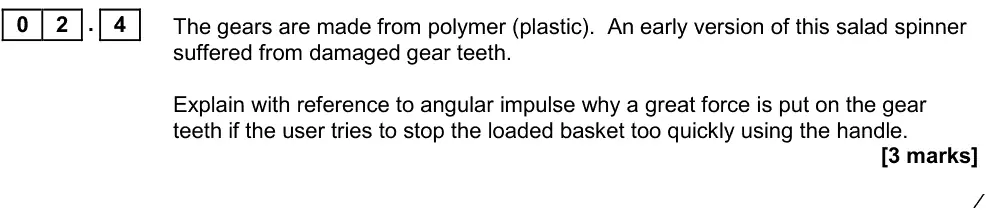
Angular impulse T dt = change in angular momentum
large change in I omega in a short time needs a large torque
T = F r so large force on the teeth
many stopped at large torque
Specimen set 1 · Paper 3B Engineering physics · Q1.11 markShort answer
Mark scheme
Notes from the mark scheme and report
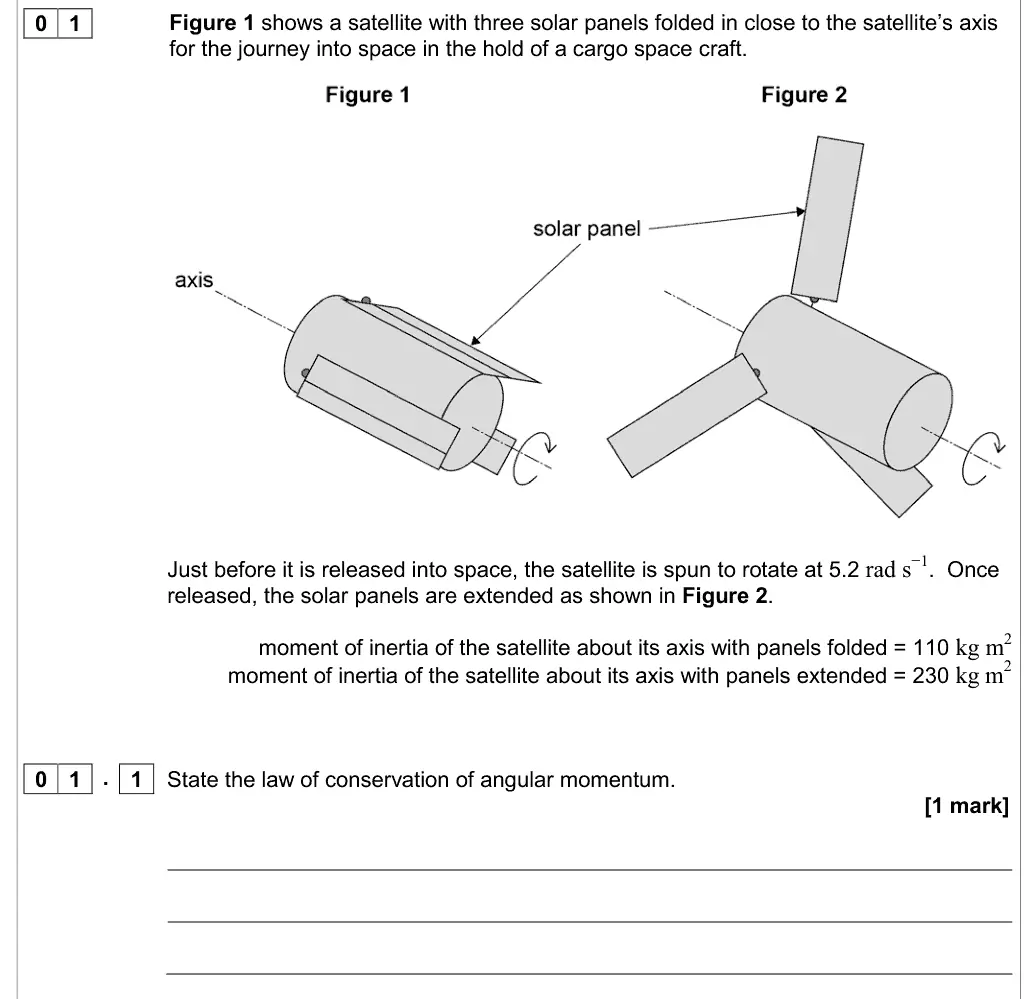
Total angular momentum of a system stays constant provided no external torque acts
'force' for 'torque' not accepted
Specimen set 1 · Paper 3B Engineering physics · Q1.23 marksExplanation
Earlier part of question 1 that this part uses
Mark scheme
Notes from the mark scheme and report
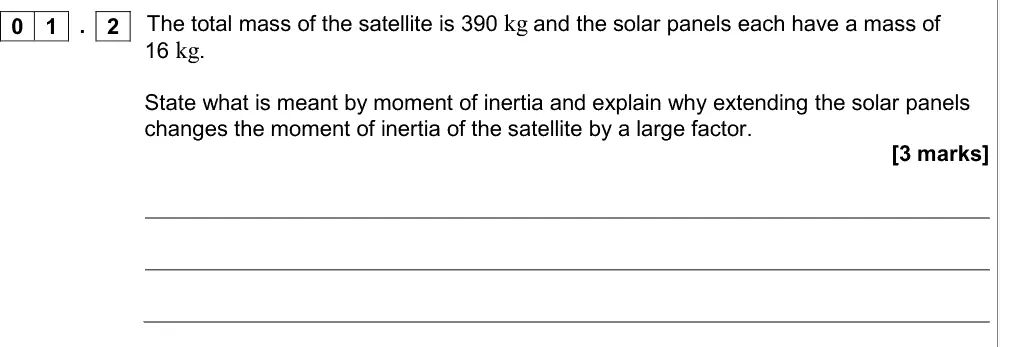
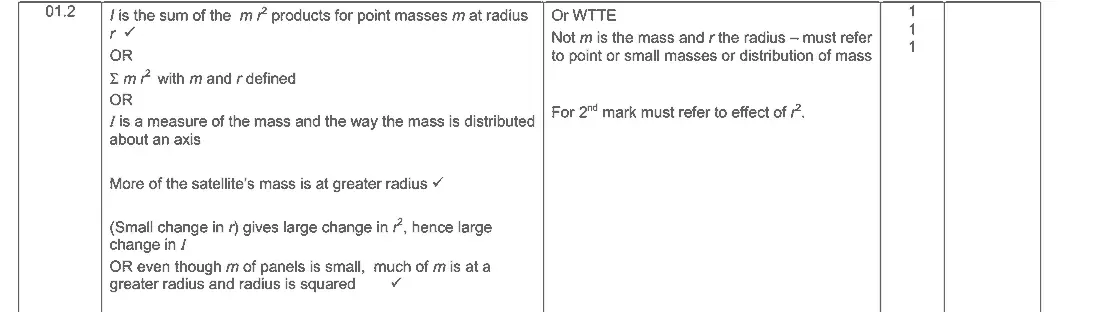
I = sum of m r^2 for point masses (or depends on mass distribution about the axis)
extending panels puts mass at larger r and r is squared, so I rises by a large factor
'm is mass, r is radius' alone not enough
Specimen set 1 · Paper 3B Engineering physics · Q1.32 marksCalculation
Earlier part of question 1 that this part uses
Mark scheme
Notes from the mark scheme and report
Answer: 572 N m s (or kg m^2 s^-1) from 110 x 5.2
Skills: MS2.3 Substitute numerical values into algebraic equations using appropriate units for physical quantities; MS0.1 Recognise and make use of appropriate units in calculations
Specimen set 1 · Paper 3B Engineering physics · Q1.42 marksCalculation
Earlier part of question 1 that this part uses
Mark scheme
Notes from the mark scheme and report
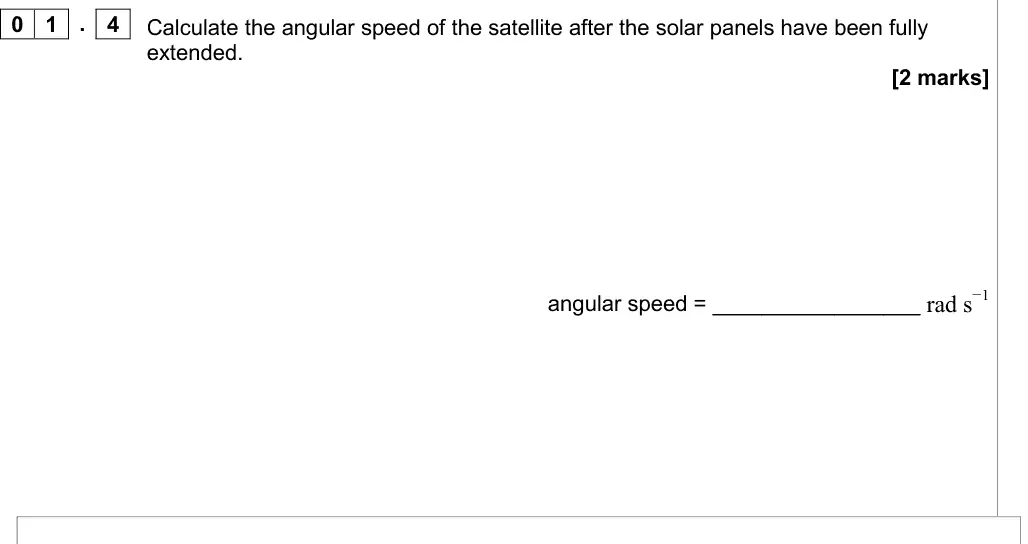
Answer: 2.49 rad s^-1 (572 = 230 x omega)
Skills: MS2.2 Change the subject of an equation, including non-linear equations; MS2.3 Substitute numerical values into algebraic equations using appropriate units for physical quantities
Specimen set 1 · Paper 3B Engineering physics · Q2.12 marksShort answer
Mark scheme
Notes from the mark scheme and report
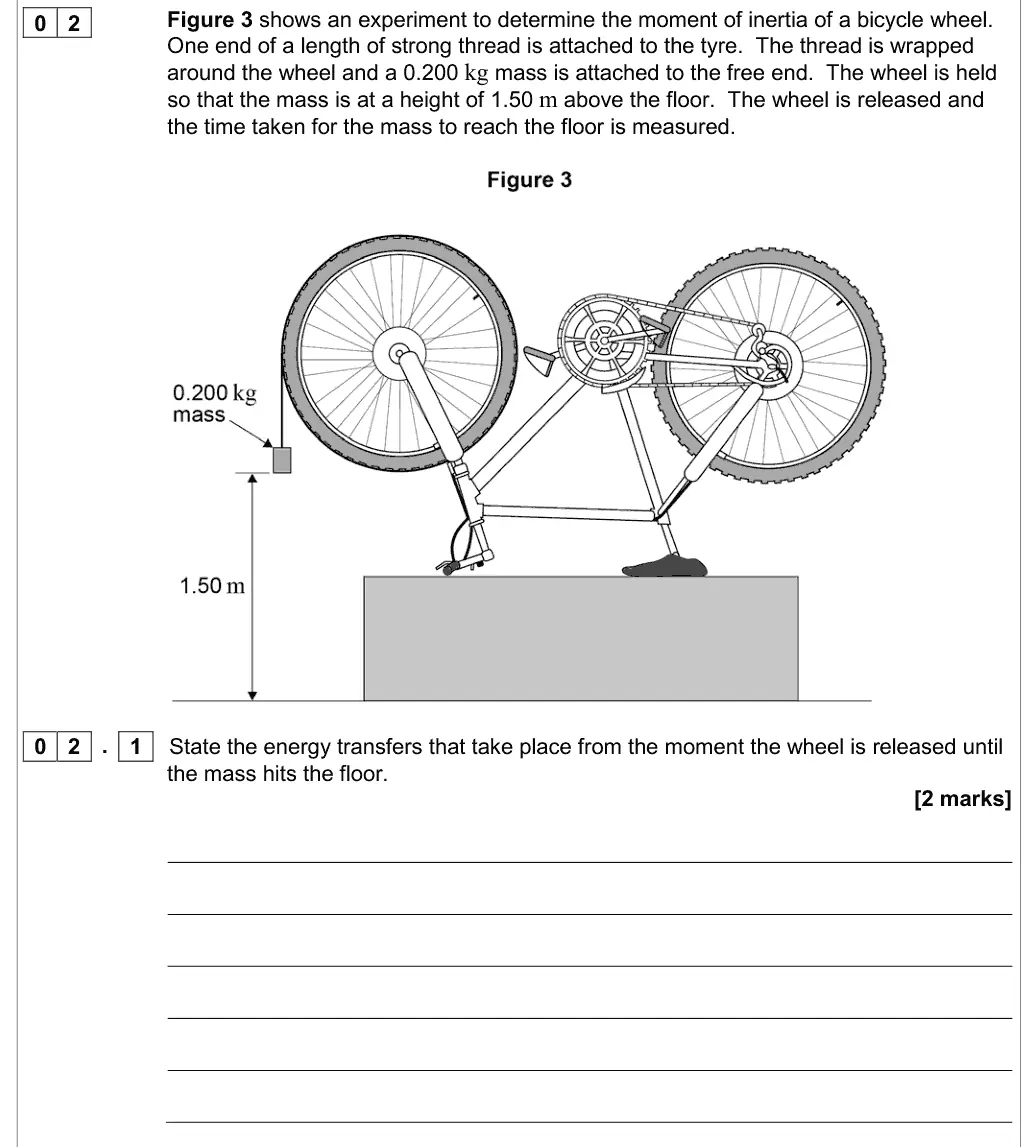
GPE of the falling mass to translational KE of the mass, rotational KE of the wheel and internal energy from friction in the bearings
Specimen set 1 · Paper 3B Engineering physics · Q2.23 marksShow that
Earlier part of question 2 that this part uses
Mark scheme
Notes from the mark scheme and report
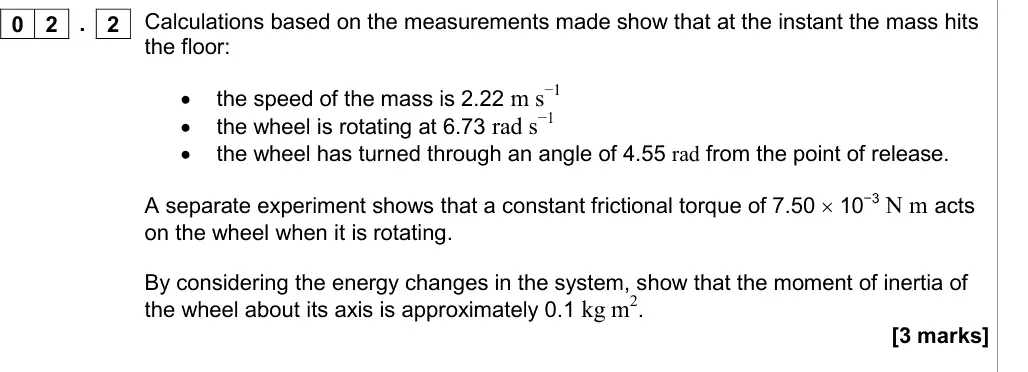
Answer: I = 0.107 kg m^2 (mgh = 2.94 J = 0.493 J KE of mass + 0.5 I x 6.73^2 + T theta 0.0728 J)
omitting friction work max 2 marks
Skills: MS2.3 Substitute numerical values into algebraic equations using appropriate units for physical quantities; MS2.2 Change the subject of an equation, including non-linear equations
Specimen set 1 · Paper 3B Engineering physics · Q2.32 marksCalculation
Earlier part of question 2 that this part uses
Mark scheme
Notes from the mark scheme and report
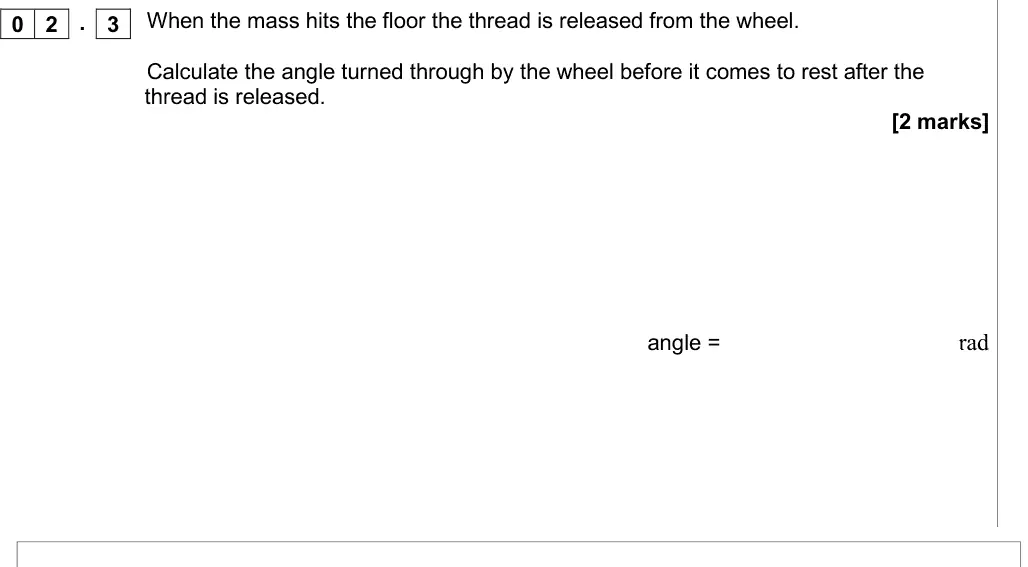
Answer: 323 rad (alpha = T/I = 0.0701 rad s^-2 then omega^2 = 2 alpha theta, or 0.5 I omega^2 = T theta)
Skills: MS2.3 Substitute numerical values into algebraic equations using appropriate units for physical quantities; MS2.2 Change the subject of an equation, including non-linear equations
Specimen set 1 · Paper 3B Engineering physics · Q3.41 markShort answer
Earlier part of question 3 that this part uses
Mark scheme
Notes from the mark scheme and report
Indicated power ignores friction losses in bearings, between piston and cylinder or in valves
must say where friction acts
Work with an AQA physics tutor
Dropping marks on calculations, required practicals or the six-markers? Book a trial session with a specialist AQA physics tutor.