Notes and key-term cards for this topic are being written by our tutors. The past-paper questions below are ready now.
Specification statements
Show the 10 statements from the specification
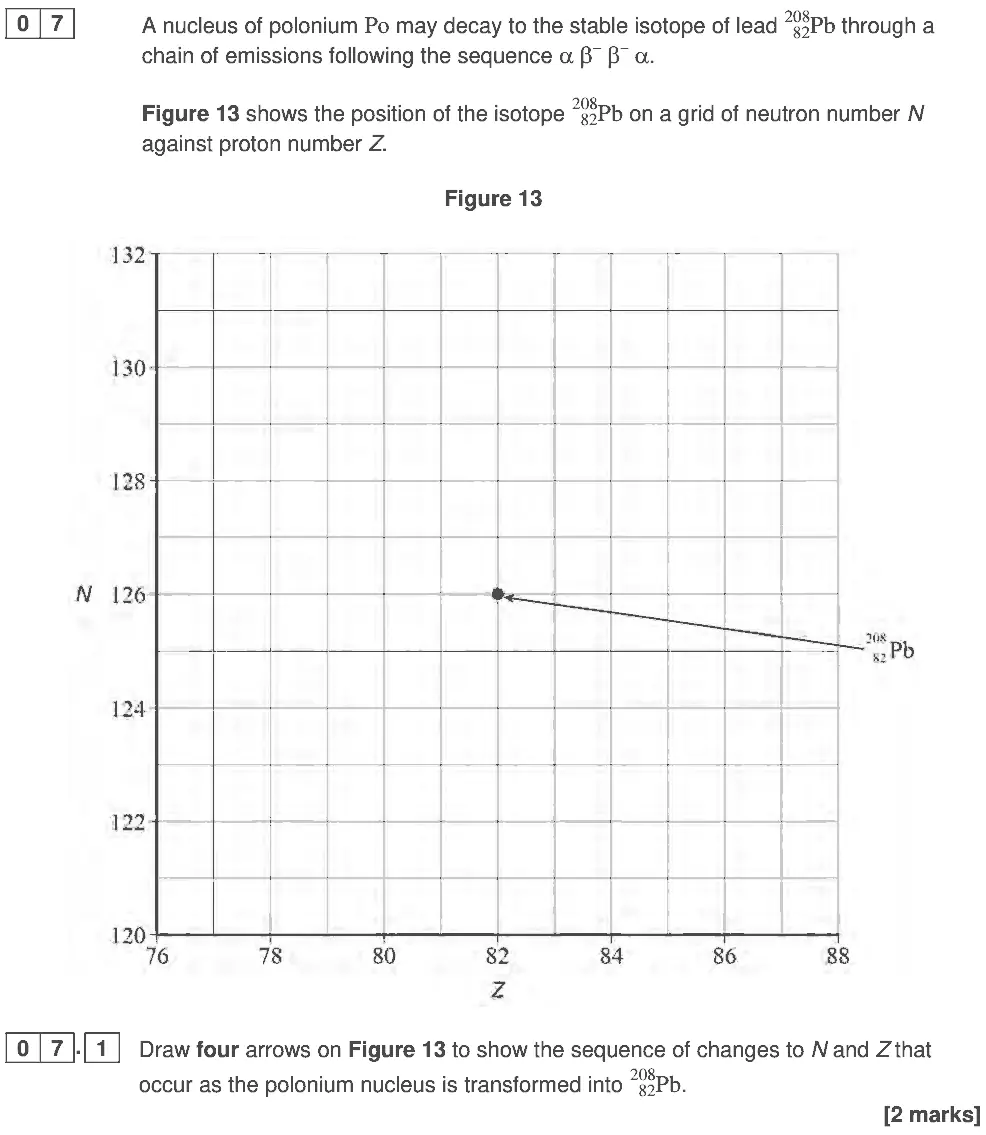
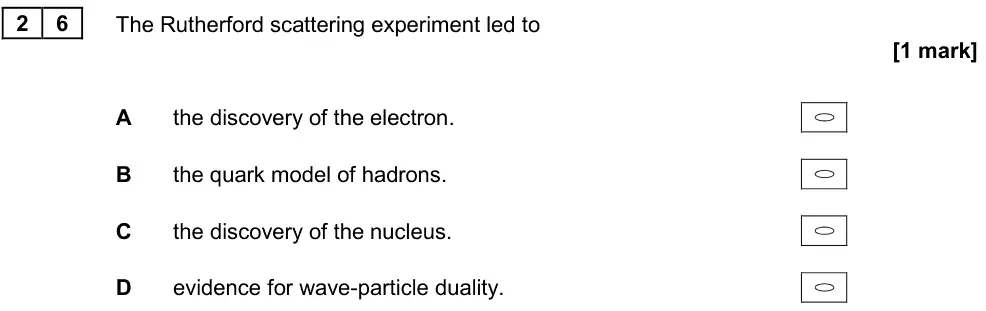
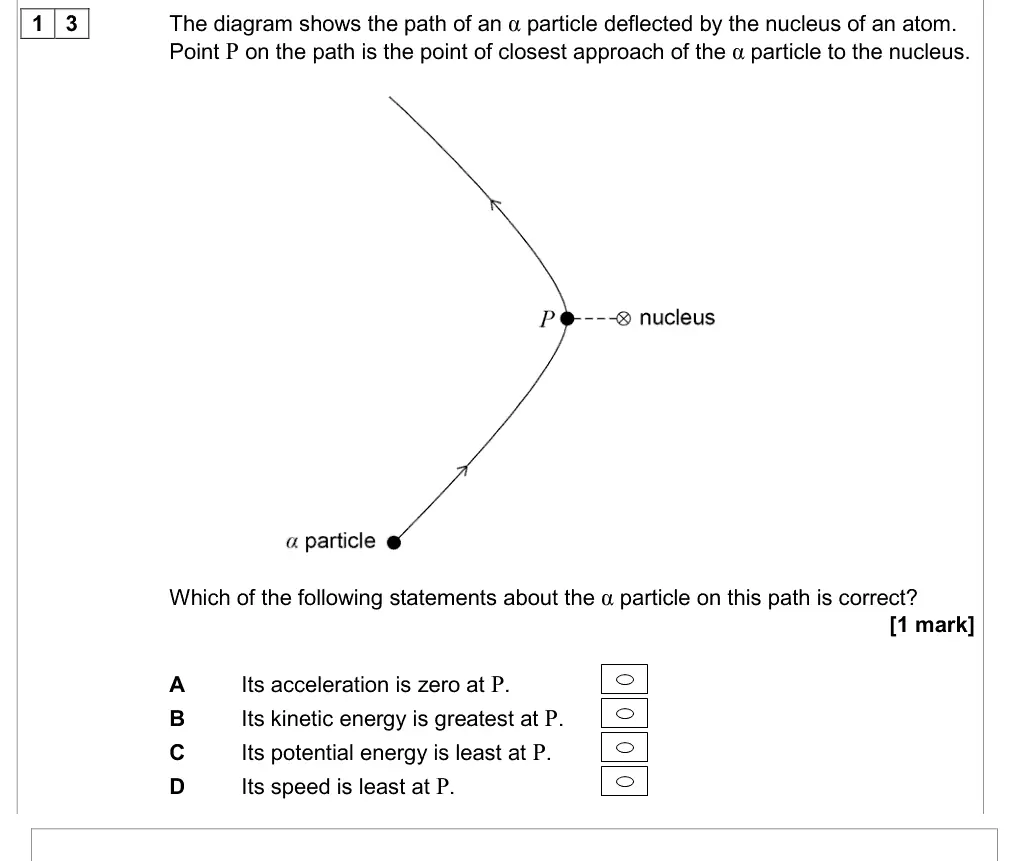
3.8.1.1-01 Qualitative study of Rutherford scattering.
3.8.1.1-02 Appreciation of how knowledge and understanding of the structure of the nucleus has changed over time.
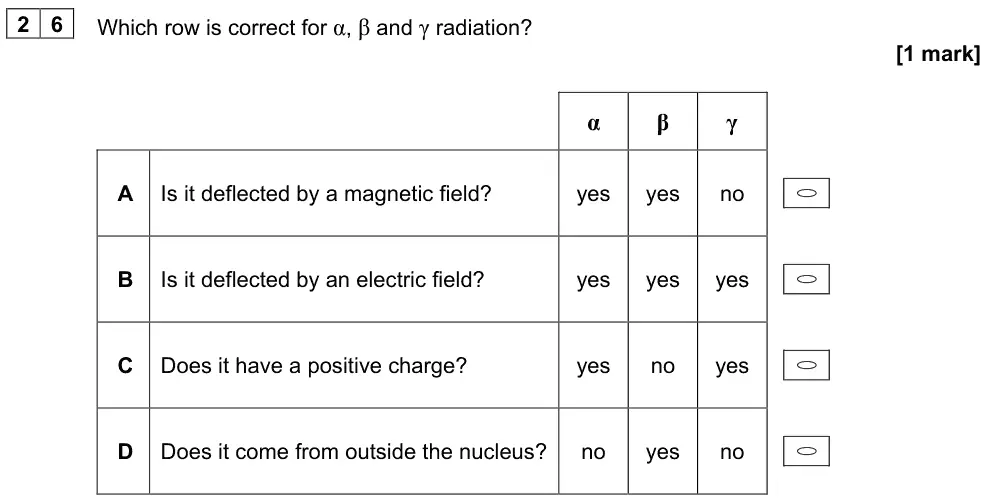
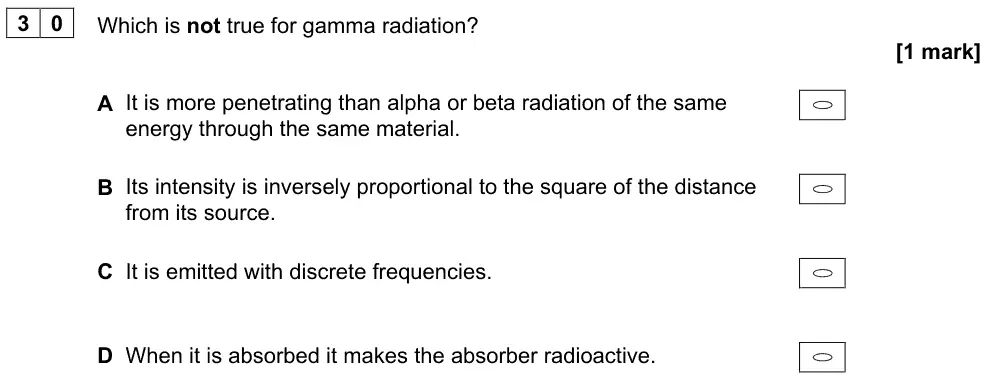
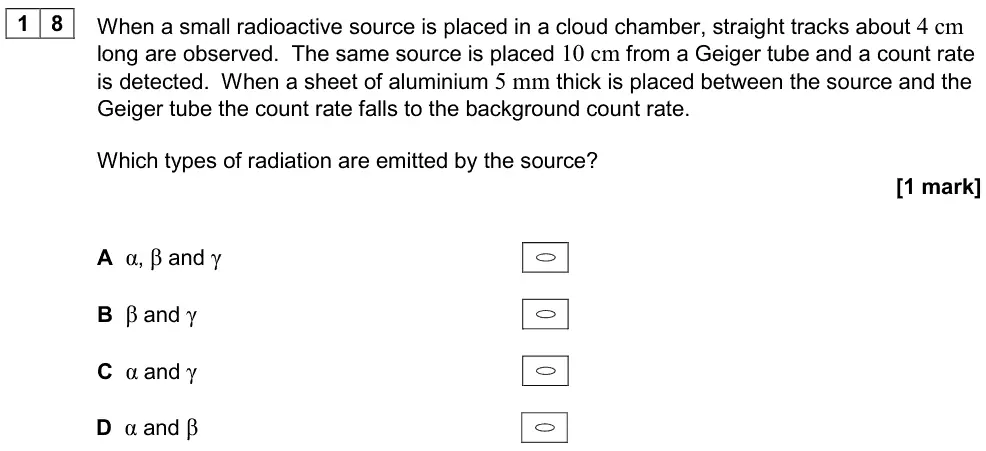
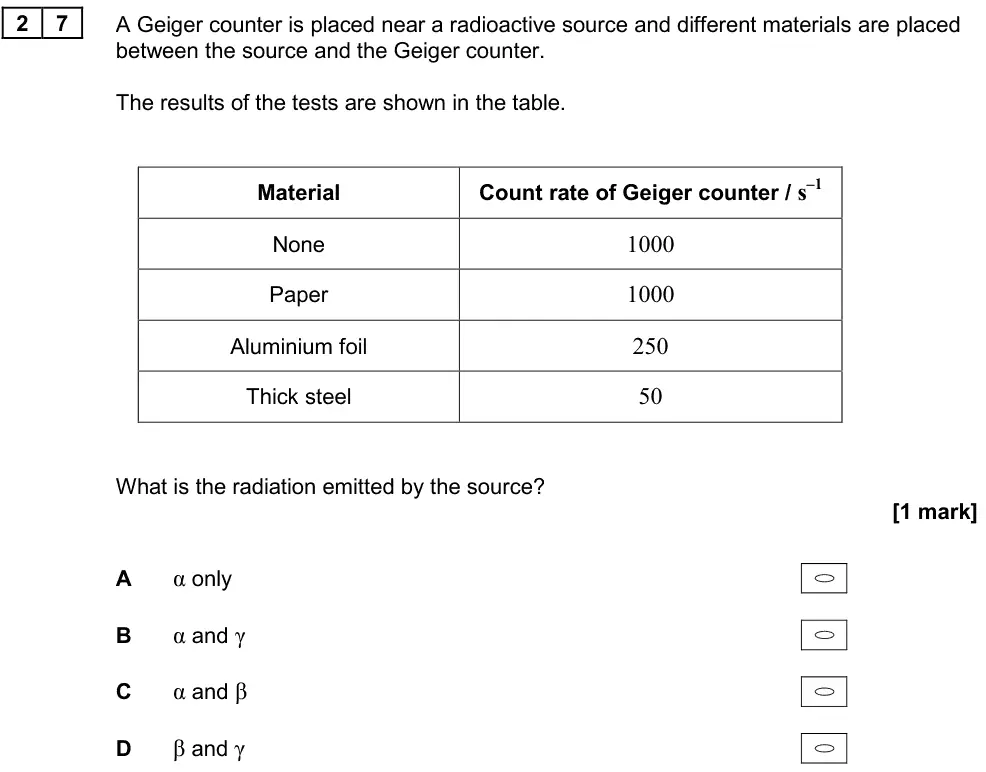
3.8.1.1-03 Their properties and experimental identification using simple absorption experiments; applications eg to relative hazards of exposure to humans.
3.8.1.1-04 Applications also include thickness measurements of aluminium foil paper and steel.
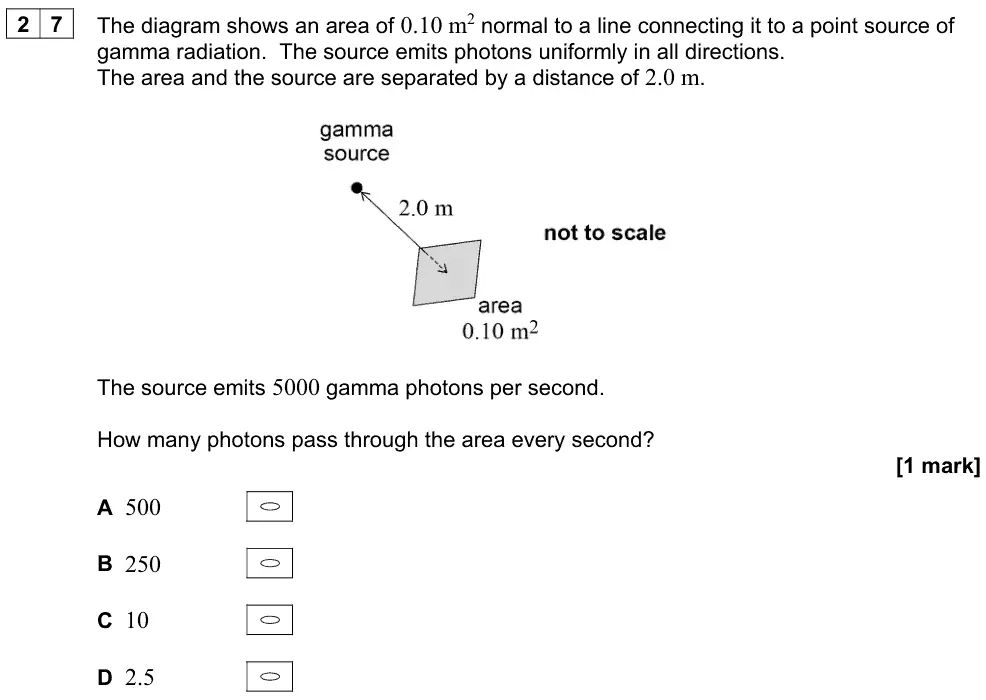
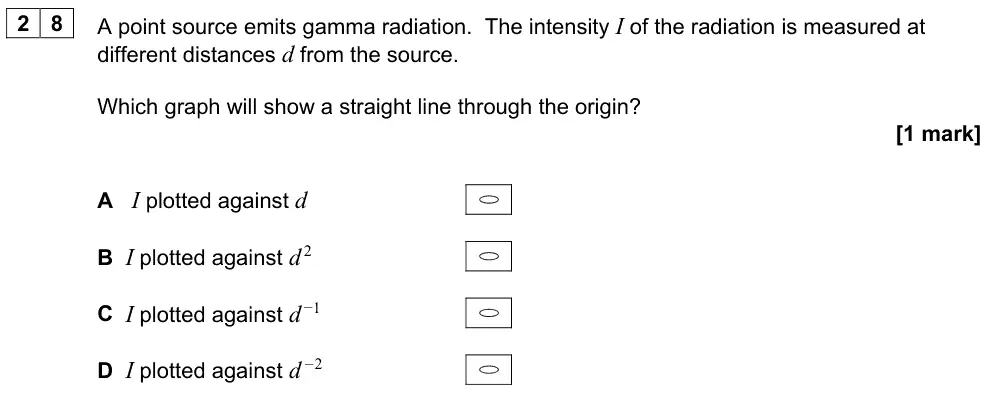
3.8.1.1-05 Inverse-square law for γ radiation: I = k x2
3.8.1.1-06 Experimental verification of inverse-square law.
3.8.1.1-07 Applications eg to safe handling of radioactive sources.
3.8.1.1-08 Background radiation; examples of its origins and experimental elimination from calculations.
3.8.1.1-09 Appreciation of balance between risk and benefits in the uses of radiation in medicine.
3.8.1.1-10 Required practical 12: Investigation of the inverse- square law for gamma radiation.
Tap a question to zoom it. Where a part needs a figure, table or graph from earlier in the question, that part folds out above it; the mark scheme and examiner's comment open underneath. Have the AQA data and formulae booklet beside you (see the formula sheet page).
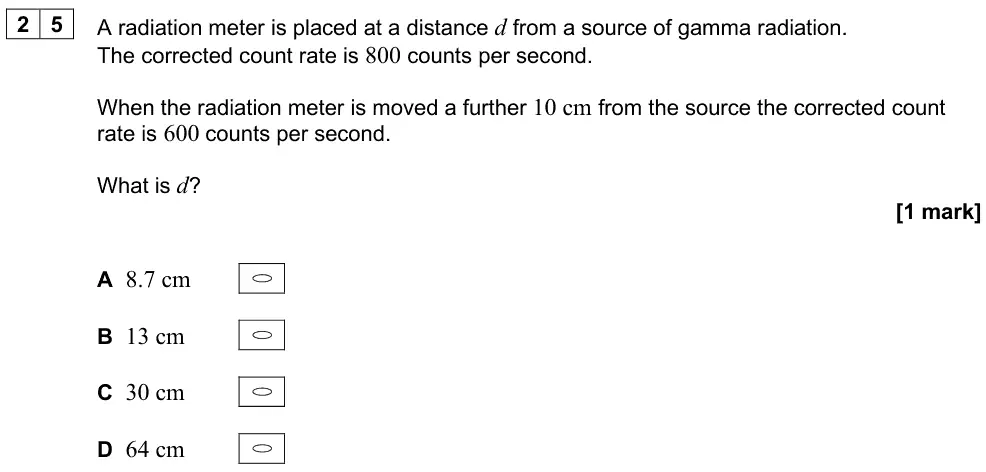
June 2025 · Paper 2 · Q251 markAO2=1Multiple choice
Answer
D
Mark scheme
Examiner's comment
22 This question was very challenging with around one quarter of students answering it As a conductor moves through a magnetic field, the induced emf is given by 𝜀𝜀= 𝐵𝐵𝐵𝐵𝐵𝐵, however correctly. The correct answer was only the third most popular response. the students had to identify which distance was 𝑙𝑙. 𝑙𝑙 is the distance that is perpendicular to both the velocity and the magnetic field. The magnetic field is vertical, so 𝑙𝑙 cannot be 10 cm; the velocity is in the same direction as 30 cm, so 𝑙𝑙 must be 5.0 cm. The answer is therefore D. The most common answer was B which corresponded to 𝑙𝑙= 30 cm, the second most common answer was C corresponding to 𝑙𝑙= 10 cm. 23 This question also had the wrong answer as the most common choice, in this case C, with 𝑃𝑃= 𝐼𝐼rms𝑉𝑉rms = = 125 W. Thus, the efficiency is 125 × 100 = 80%. C comes from calculating 5×50 100 only around a third correctly identifying A as the correct answer. Students had to realise that 2 the power from the peak voltages rather than the rms values. inverse square law for radiation, which gives 800𝑑𝑑2 = 600(𝑑𝑑+ 10)2, giving 𝑑𝑑= 64 cm. 25 Around a third of students were able to answer this question correctly. This uses the
Notes from the mark scheme and report
Answer: D
Skills: MS0.3 Use ratios, fractions and percentages; MS2.2 Change the subject of an equation, including non-linear equations
June 2024 · Paper 2 · Q7.32 marksAO1=1, AO3=1Explanation
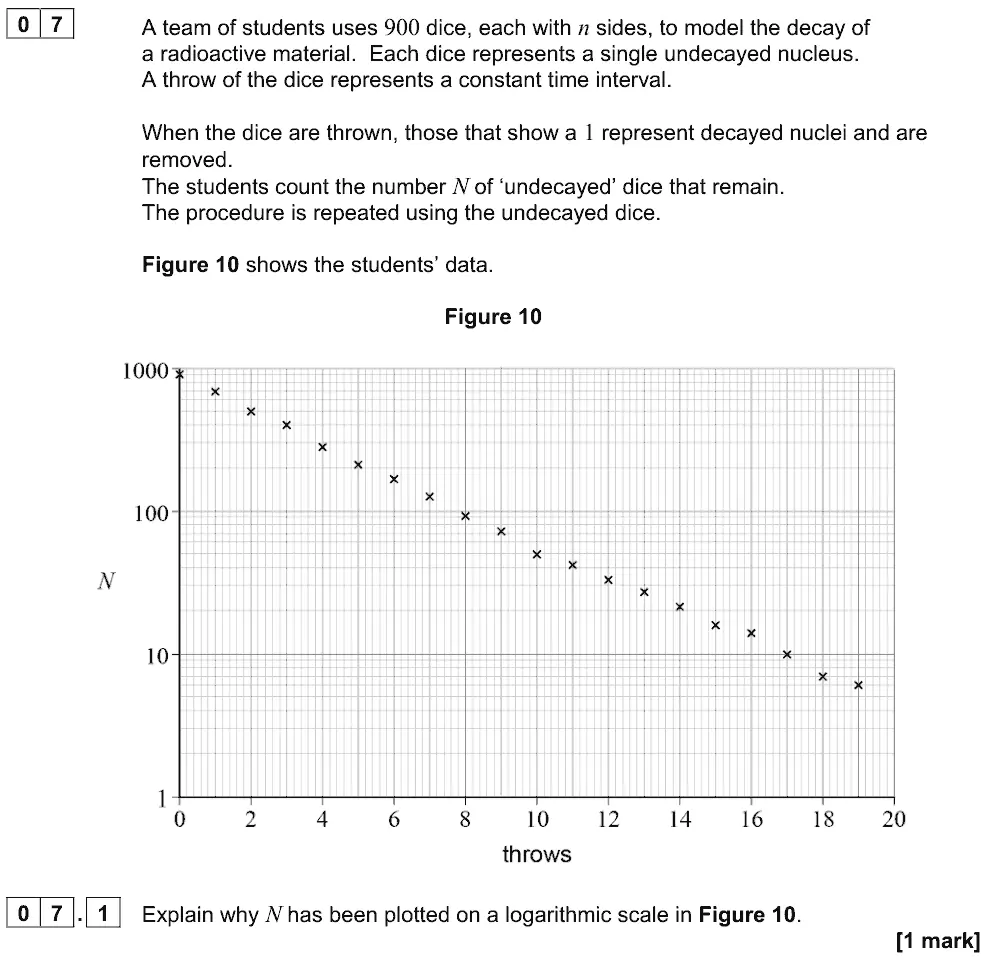
Earlier part of question 7 that this part uses
Mark scheme
Examiner's comment
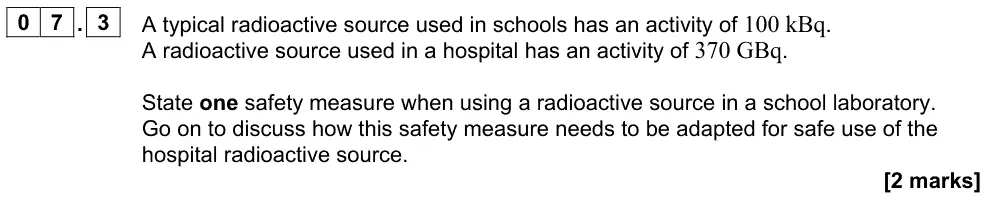
07.3 This question was reasonably accessible. However, many students who wrote about handling the radioactive source with tongs, did not mention that the tongs had to be long. The measures described had to be ones that are relevant to sources used in schools. Students were then asked to consider how their safety measure could be adapted to a much more active source used in a hospital. Students were not expected to be familiar with a hospital setting (although those who were could use this knowledge), but rather to make a reasonable suggestion based on the activity given. Many students were able to make reasonable suggestions here.
Notes from the mark scheme and report
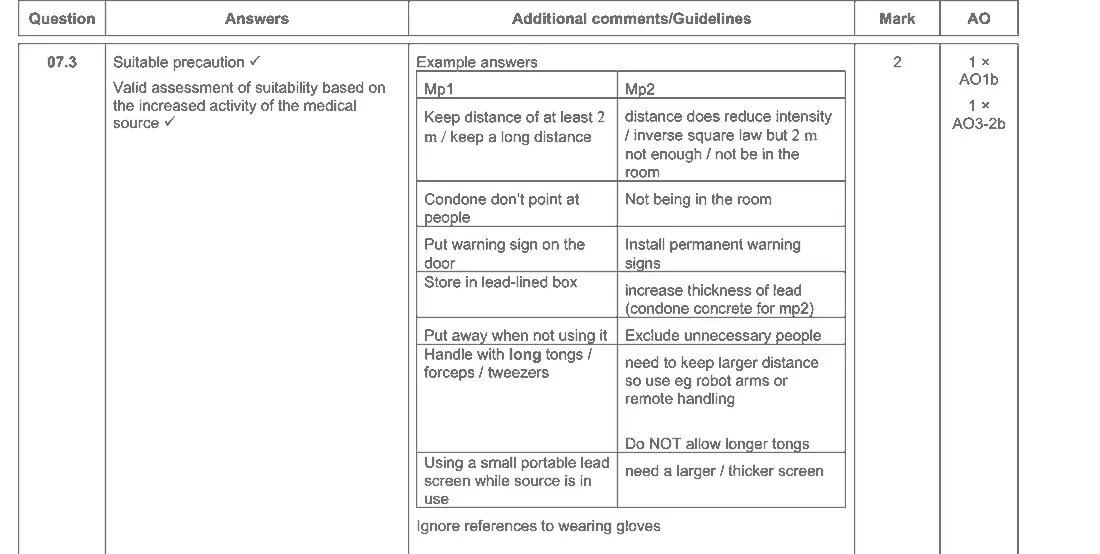
School precaution (long tongs, store in lead box, keep distance) and adaptation for 370 GBq (remote handling/robot arms, thicker shielding, leave the room)
'tongs' must be long
June 2024 · Paper 2 · Q7.42 marksAO1=2Explanation
Earlier part of question 7 that this part uses
Mark scheme
Examiner's comment
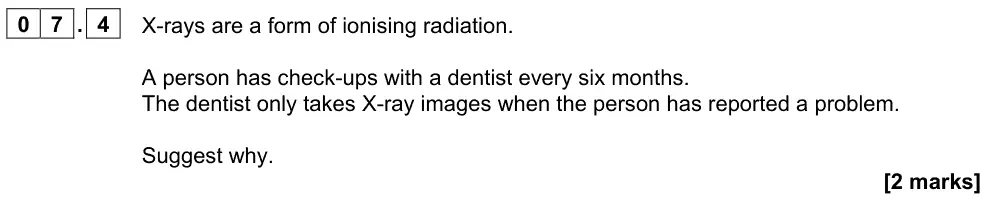
07.4 This question was also accessible although misconceptions about radiation were still seen, with a small minority expressing wrong ideas about X-rays remaining in the body or causing the body to become radioactive.
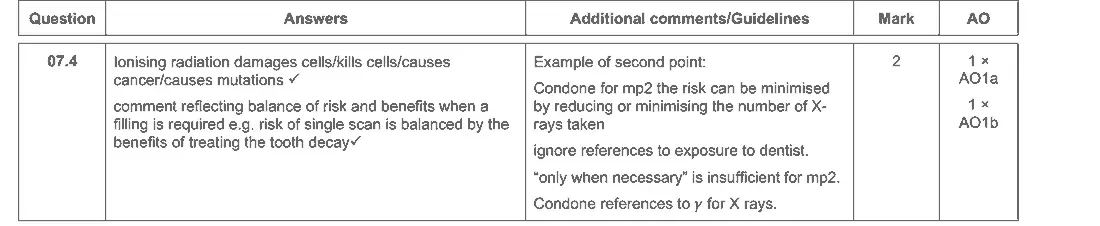
The first mark was for students recognising that X-rays were ionising radiation and linking that to a concrete example such as damaging or killing cells or causing cancer. The second mark was for recognising the balance between risk and benefit in the use of radiation in medicine. Few students were sufficiently explicit about balancing risk and benefit, so answers which only mentioned minimising risk were condoned.
Multiple Choice Questions 8-32
The multiple-choice questions covered parts of the specification not covered in Section A. The distractors in these questions were written with common errors and misconceptions in mind. These questions are therefore an extremely useful resource when preparing students.
The multiple-choice questions proved challenging. However, a number of questions were found to be straightforward by students. These included B9, B17 and B30 which were all answered correctly by at least 60% of students.
The questions found to be the most difficult were B12, B21, B24, B29 and B32 – answered correctly by fewer than 35% of students.
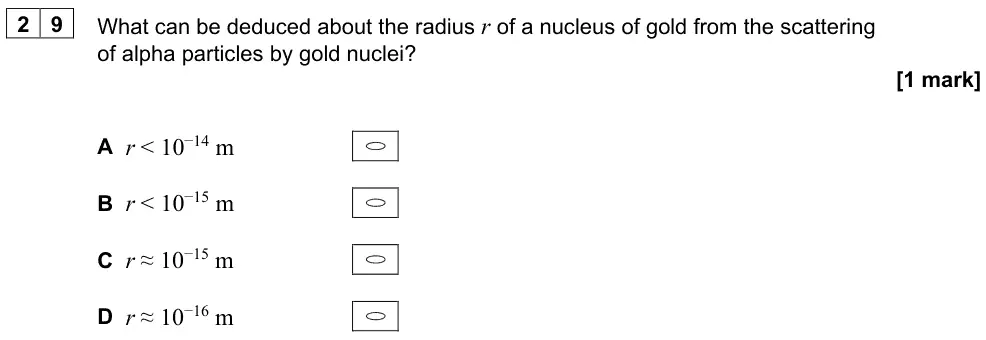
The most common answer was not the correct answer in the following questions. 12 – the most common answer to increasing the efficiency of the transformer was increasing the thickness of the iron layers in the core, perhaps mixing up the core with the coil. The correct answer of decreasing the frequency (to increase the time for the change in flux and therefore decrease the eddy currents in the core) was the second most popular option. 21 – when considering the radius of a synchronous orbit for a planet with twice the mass of the Earth and 24 – the most common answer to what was equal to 𝜀𝜀0 confused the permittivity and relative one quarter of the day length, the correct answer was the third most popular answer. permittivity, although among the other answers based on equations that contained 𝜀𝜀0 the correct answer was most common. most common answer was that it was about 10−15 m; students failed to realise that this was an estimate 29 – when asked about what could be deduced about the size of the nucleus from alpha scattering, the
for the distance of closest approach and therefore bigger than the radius of the nucleus. The next most popular answer did recognise this aspect but associated it with the actual radius of the nucleus rather correct answer (< 10−14 m) was the third most popular choice. than the distance of closest approach or they mixed up the size order of negative powers of ten. The
32 – the most common answer to working out the age of the rock did not include the nuclei that had decayed into lead as coming from uranium originally and did not therefore add the number of lead nuclei to the current number of uranium nuclei to get the original number of nuclei.
Notes from the mark scheme and report
X-rays ionise and damage cells/cause cancer
risk only justified when the benefit (treating a problem) outweighs it
misconceptions about X-rays making the body radioactive seen
June 2024 · Paper 2 · Q291 markMultiple choice
Answer
A
Mark scheme
Notes from the mark scheme and report
Answer: A
most chose C - closest approach is an upper limit to the radius
June 2024 · Paper 3 Section A · Q2.32 marksAO1=2Practical and data analysis
Earlier part of question 2 that this part uses
Mark scheme
Examiner's comment
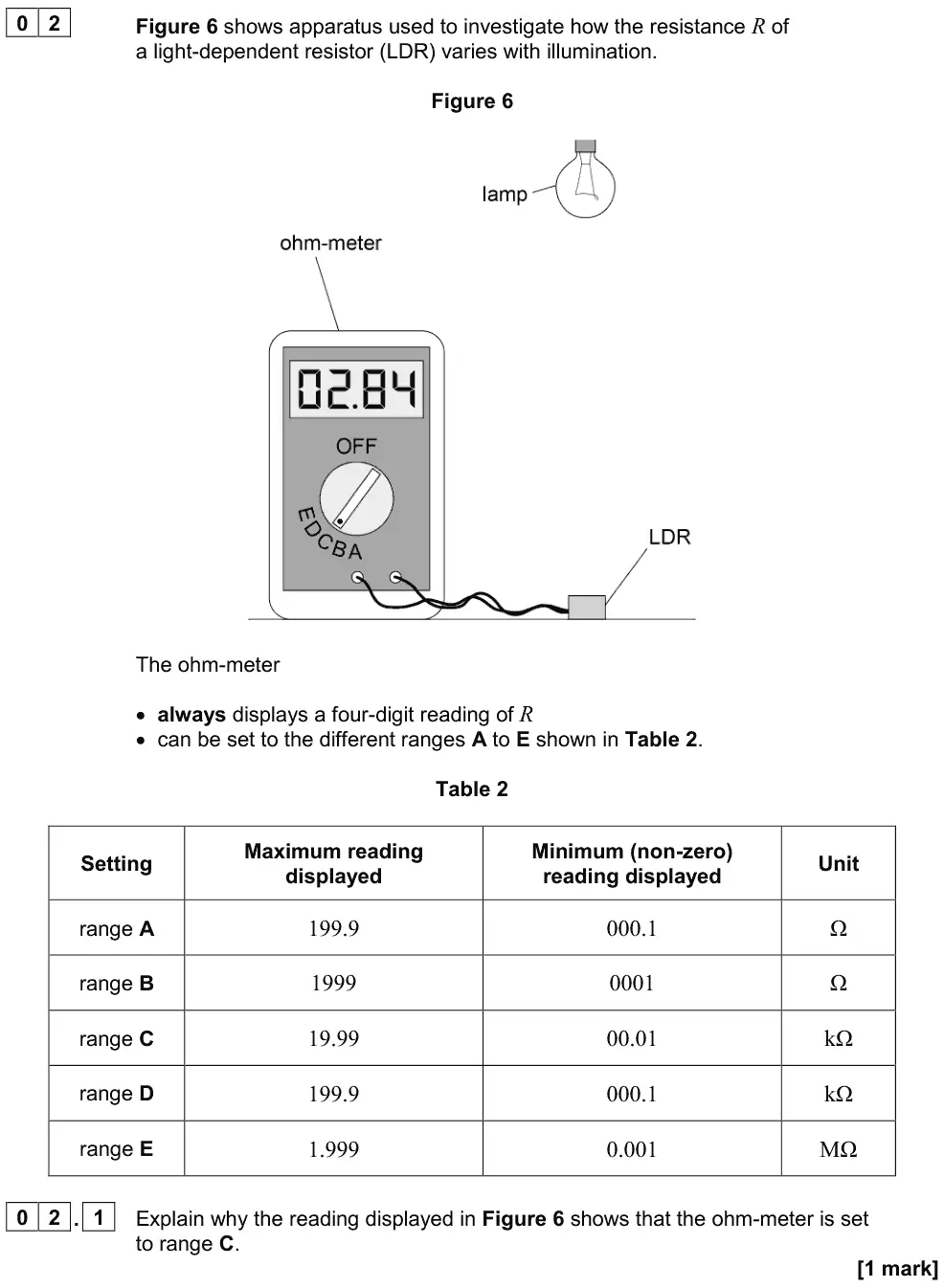
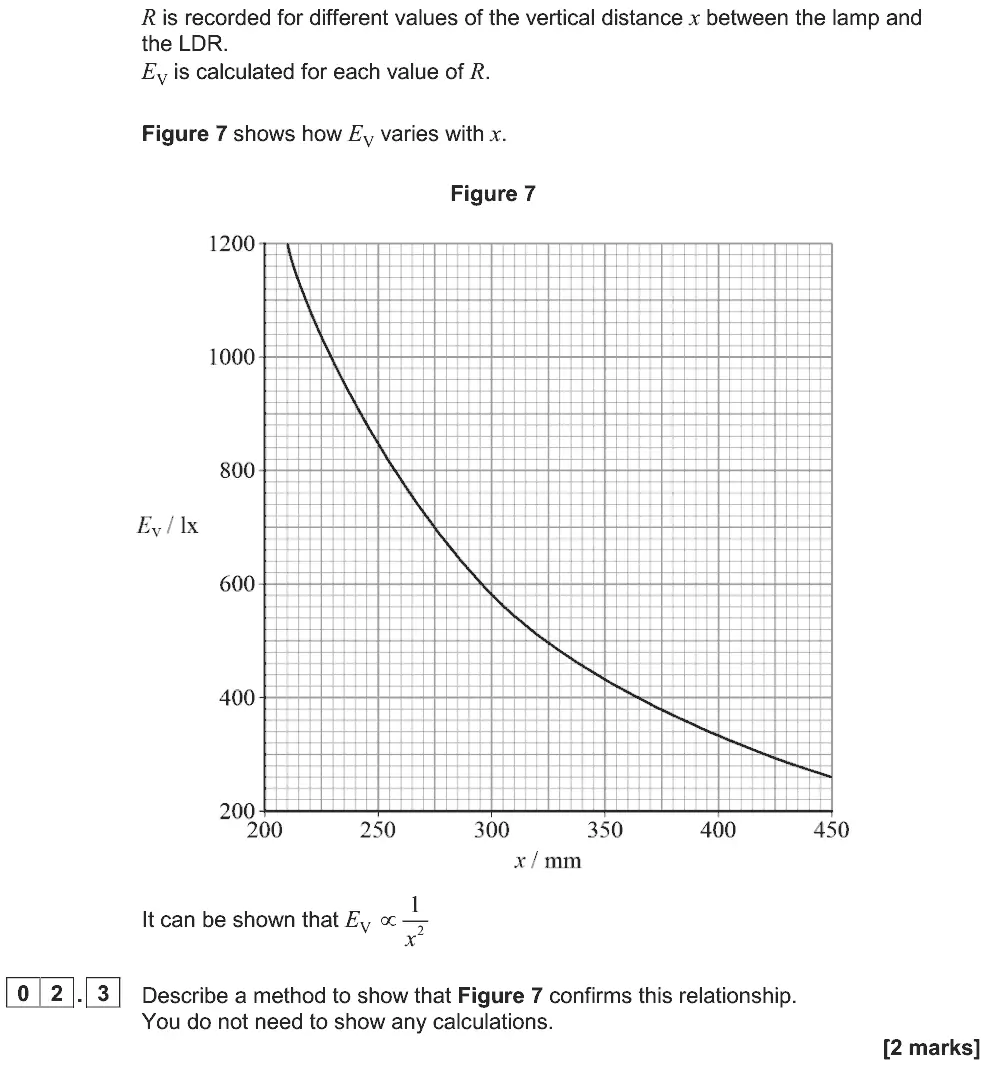
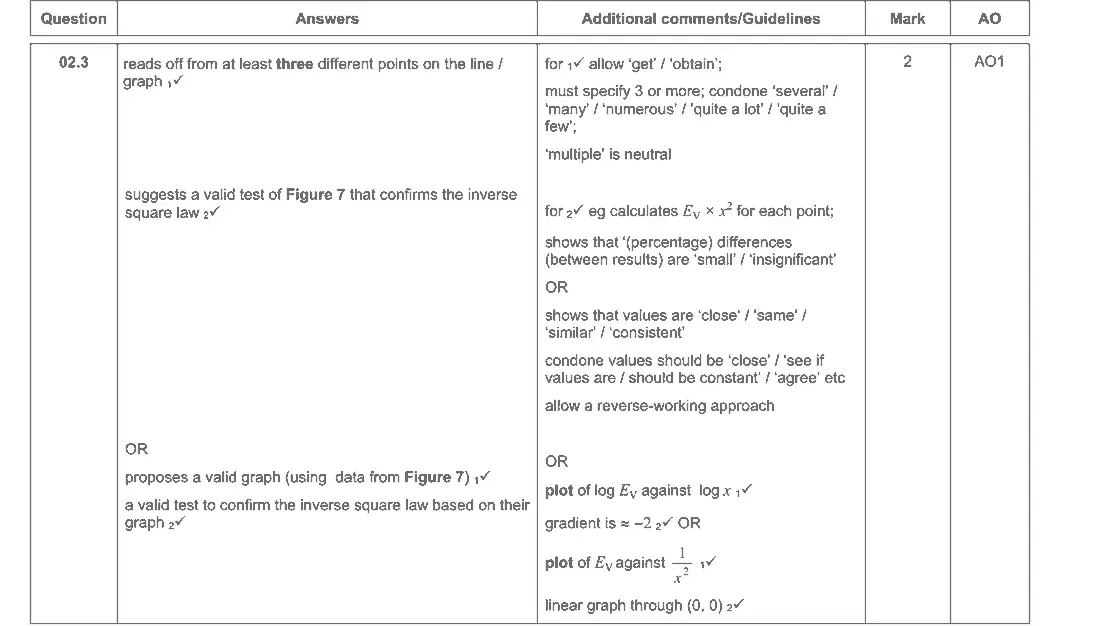
In 02.1 most wrote something sensible about the display, as the question said they should, although a few said that the selector switch in Figure 6 was shown set to range C. In 02.2 65% got both marks and only a few did not use logs to base 10 or substitute 2840 correctly. However, some solutions were overlong, extending beyond the usual answer space. In 02.3 many said they would obtain EV and x data from Figure 7 and show that these gave similar values of EV × x2. We wanted these data to be from more than two points but only a few thought to mention this detail. We didn’t allow the use of ‘multiple points’. An alternative approach was to plot EV against x2 or plot log EV against log x and this could get full credit as long as the expected outcome was explained for each graph. The idea behind 02.3 was developed in 02.4 and many calculated a suitable value of x when EV = 130 lx. Some penalised themselves by rounding their final answer to 630 or 640 mm. In 02.5 most correctly supplied 1645 and 1.73 then used information from their completed Table 3 to justify why range B should be used to determine R. Some tried the idea that resolution of range B was superior but were unsure whether they should say that the resolution was ‘smaller’, ‘greater’ (we accepted either) or ‘better’ (we rejected this). Students are well aware of what a control variable is, but they are not always able to identify suitable examples. In 02.6 they often made generic suggestions such as temperature or the length of the connecting wires, but we wanted things that, if changed, would have a more obvious impact such as background illumination, lamp brightness or slide thickness. Most students can find the unknowns in decay problems. In 02.7 about half knew that µ would be found by calculating the negative reciprocal of the gradient of an ln EV against N graph. A handful correctly explained how to obtain µ using a log EV against N graph. In 02.8, once again about half correctly deduced that eight slides would be the minimum needed to reduce EV by 50%. Some tried trial and improvement, but credit depended on showing that N = 7 did not work while N = 8 did. A common error was to use EV = 0.5 which led to N = 74.3 but we allowed one mark if this was then rounded to 75.
Notes from the mark scheme and report
Read at least three points and show EV x^2 constant, or plot EV against 1/x^2 (straight line through origin) or log-log (gradient -2)
only two points or 'multiple points' not credited
Skills: MS3.1 Translate information between graphical, numerical and algebraic forms; MS3.11 Use logarithmic plots to test exponential and power law variations; PS3.1 Plot and interpret graphs
June 2024 · Paper 3 Section A · Q2.42 marksAO2=2Practical and data analysis
Earlier part of question 2 that this part uses
Mark scheme
Examiner's comment
In 02.1 most wrote something sensible about the display, as the question said they should, although a few said that the selector switch in Figure 6 was shown set to range C. In 02.2 65% got both marks and only a few did not use logs to base 10 or substitute 2840 correctly. However, some solutions were overlong, extending beyond the usual answer space. In 02.3 many said they would obtain EV and x data from Figure 7 and show that these gave similar values of EV × x2. We wanted these data to be from more than two points but only a few thought to mention this detail. We didn’t allow the use of ‘multiple points’. An alternative approach was to plot EV against x2 or plot log EV against log x and this could get full credit as long as the expected outcome was explained for each graph. The idea behind 02.3 was developed in 02.4 and many calculated a suitable value of x when EV = 130 lx. Some penalised themselves by rounding their final answer to 630 or 640 mm. In 02.5 most correctly supplied 1645 and 1.73 then used information from their completed Table 3 to justify why range B should be used to determine R. Some tried the idea that resolution of range B was superior but were unsure whether they should say that the resolution was ‘smaller’, ‘greater’ (we accepted either) or ‘better’ (we rejected this). Students are well aware of what a control variable is, but they are not always able to identify suitable examples. In 02.6 they often made generic suggestions such as temperature or the length of the connecting wires, but we wanted things that, if changed, would have a more obvious impact such as background illumination, lamp brightness or slide thickness. Most students can find the unknowns in decay problems. In 02.7 about half knew that µ would be found by calculating the negative reciprocal of the gradient of an ln EV against N graph. A handful correctly explained how to obtain µ using a log EV against N graph. In 02.8, once again about half correctly deduced that eight slides would be the minimum needed to reduce EV by 50%. Some tried trial and improvement, but credit depended on showing that N = 7 did not work while N = 8 did. A common error was to use EV = 0.5 which led to N = 74.3 but we allowed one mark if this was then rounded to 75.
Rounding during a multi-part calculation, as in 01.4, cost marks and some gave their final answer to more than 4 significant figures (sf) which we did not accept. Students should understand that in a ‘show that’ such as 02.2, we expect the final answer to be to one more sf than the sf quoted in the question. They must also remember that a final answer needs to be to the same sf as the least accurate data. In 02.4 many rounded at the answer line to 630 or 640 but these are still 3 sf numbers, as are all the contributing data in the calculation because only leading zeros are not significant.
Notes from the mark scheme and report
Answer: 634-639 mm (e.g. EV x^2 constant from a point on Figure 7)
630 or 640 accepted for one mark
Skills: MS3.1 Translate information between graphical, numerical and algebraic forms; MS0.3 Use ratios, fractions and percentages
June 2023 · Paper 2 · Q4.43 marksAO3=3Practical and data analysis
Earlier part of question 4 that this part uses
Mark scheme
Examiner's comment
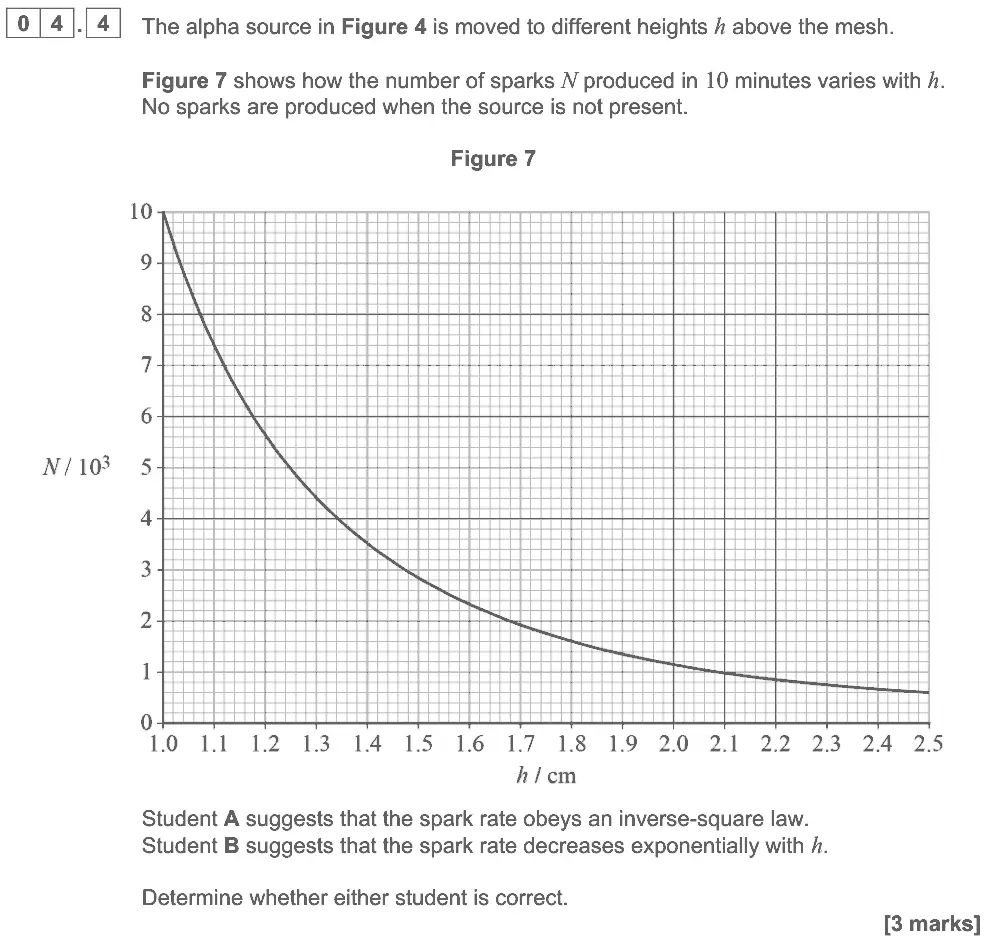
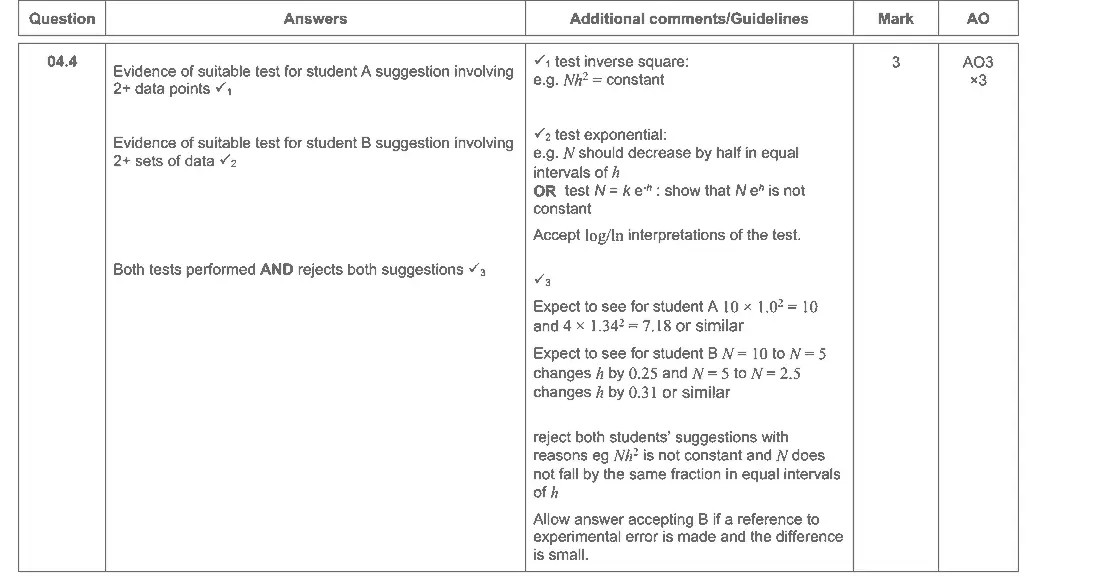
04.3 A majority thought that the argon ion would slow down more but then gave an inadequate reason. Many suggested that “it is because it’s bigger”. Only a few mentioned collisions in their answers. Several who were on route to gaining the mark spoiled their answer by stating the ratio is smaller. 04.4 Most students knew how to analyse the graph to see whether it followed an inverse-square relationship. It was not common, however, to see this work presented in a clear or logical order. Only a minority showed a method to determine whether the graph followed an exponential relationship; those who did used a variety of acceptable methods. Looking for a variation in the half-distance was the most common. An unexpected number thought that an exponential relationship was the same as a reciprocal relationship and used a wrong test. For the last mark, many thought they had to suggest one of A or B as being correct which was not implied by the question.
Notes from the mark scheme and report
Test inverse square (N h^2 constant?) and exponential (constant halving distance?) with 2+ data points each
both fail so neither student correct
reciprocal confused with exponential by many
Skills: MS3.1 Translate information between graphical, numerical and algebraic forms; MS0.3 Use ratios, fractions and percentages
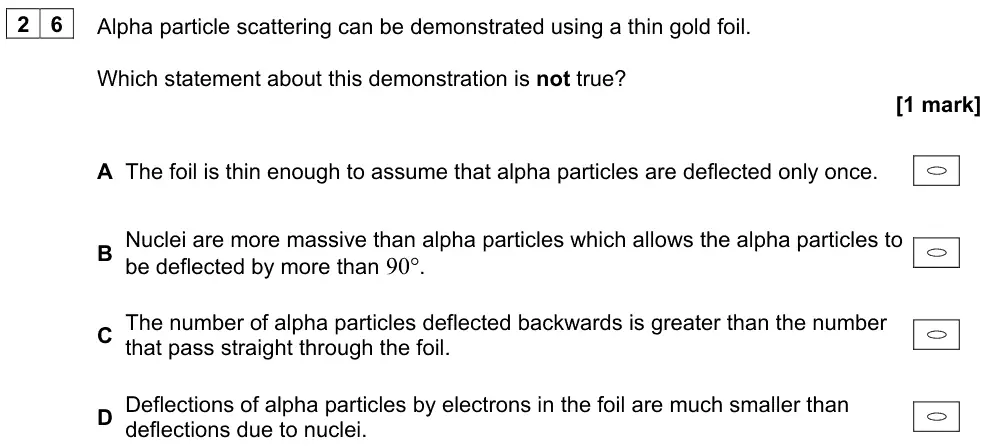
June 2023 · Paper 2 · Q261 markMultiple choiceEasy
Answer
C
Mark scheme
Examiner's comment
A number of questions were found to be quite straightforward by students. These included B8, B11, B12, B17, B18, B20, B26 and B28 which were all answered correctly by at least 70% of students. The questions found to be the most difficult were B14, B15 and B25 – answered correctly by fewer than 35% of students.
Notes from the mark scheme and report
Answer: C
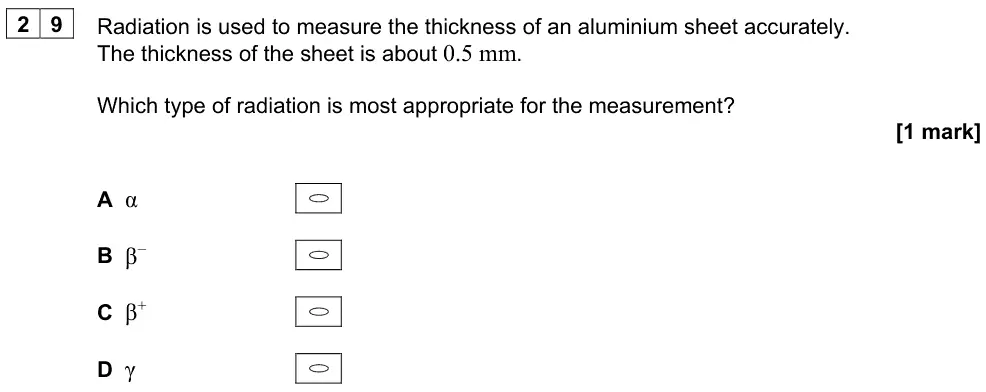
June 2023 · Paper 2 · Q291 markMultiple choice
Answer
B
Mark scheme
Notes from the mark scheme and report
Answer: B
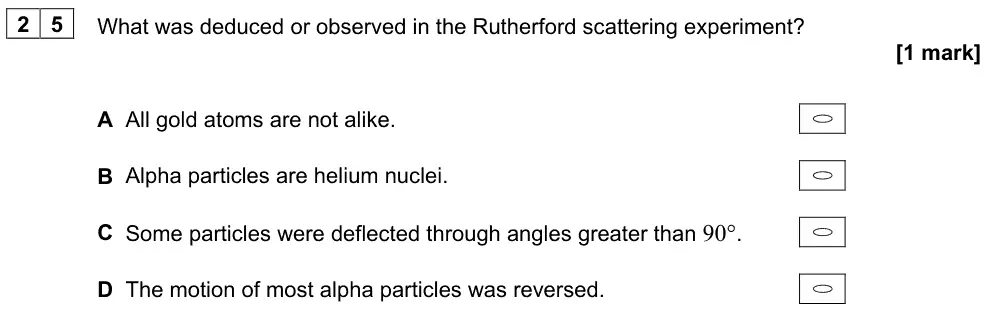
June 2022 · Paper 2 · Q251 markAO1=1Multiple choice
Answer
C
Mark scheme
Examiner's comment
There was a good spread in the performance on the multiple-choice section. Questions 16, 17, 24, 25 and 29 received correct answers from less than 40% of students. For question 24 it was less than 20%.
Notes from the mark scheme and report
Answer: C
fewer than 40% correct
June 2022 · Paper 2 · Q261 markAO1=1Multiple choice
Answer
A
Mark scheme
Notes from the mark scheme and report
Answer: A
June 2022 · Paper 2 · Q301 markAO1=1Multiple choice
Answer
D
Mark scheme
Notes from the mark scheme and report
Answer: D
November 2021 · Paper 2 · Q261 markMultiple choice
Answer
A
Mark scheme
Notes from the mark scheme and report
Answer: A
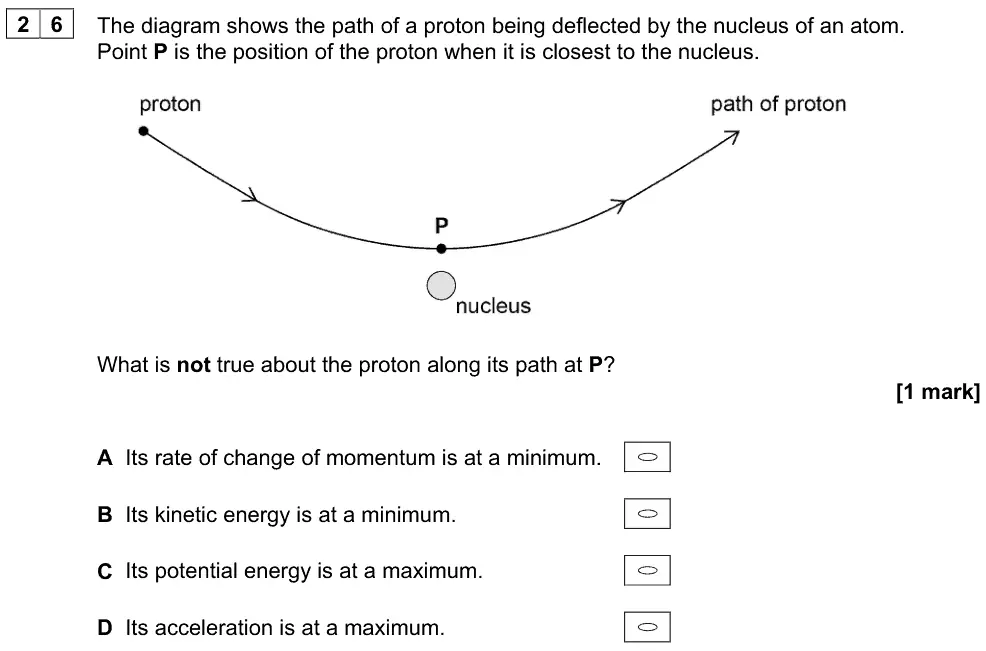
rate of change of momentum is a maximum, not a minimum, at P
November 2021 · Paper 2 · Q271 markMultiple choice
Answer
C
Mark scheme
Notes from the mark scheme and report
Answer: C
Skills: MS4.3 Calculate areas of triangles, circumferences and areas of circles, surface areas and volumes of rectangular blocks, cylinders and spheres; MS0.3 Use ratios, fractions and percentages
November 2021 · Paper 3 Section A · Q1.12 marksAO2=2Practical and data analysis
Mark scheme
Examiner's comment
Some of the work seen in questions 01.1 and 03.2 show that, while students know about parallax error, they are not always aware of techniques used to limit its effect. This is an area we will continue to test and the best way to acquire knowledge of such techniques is by direct practical experience.
Notes from the mark scheme and report
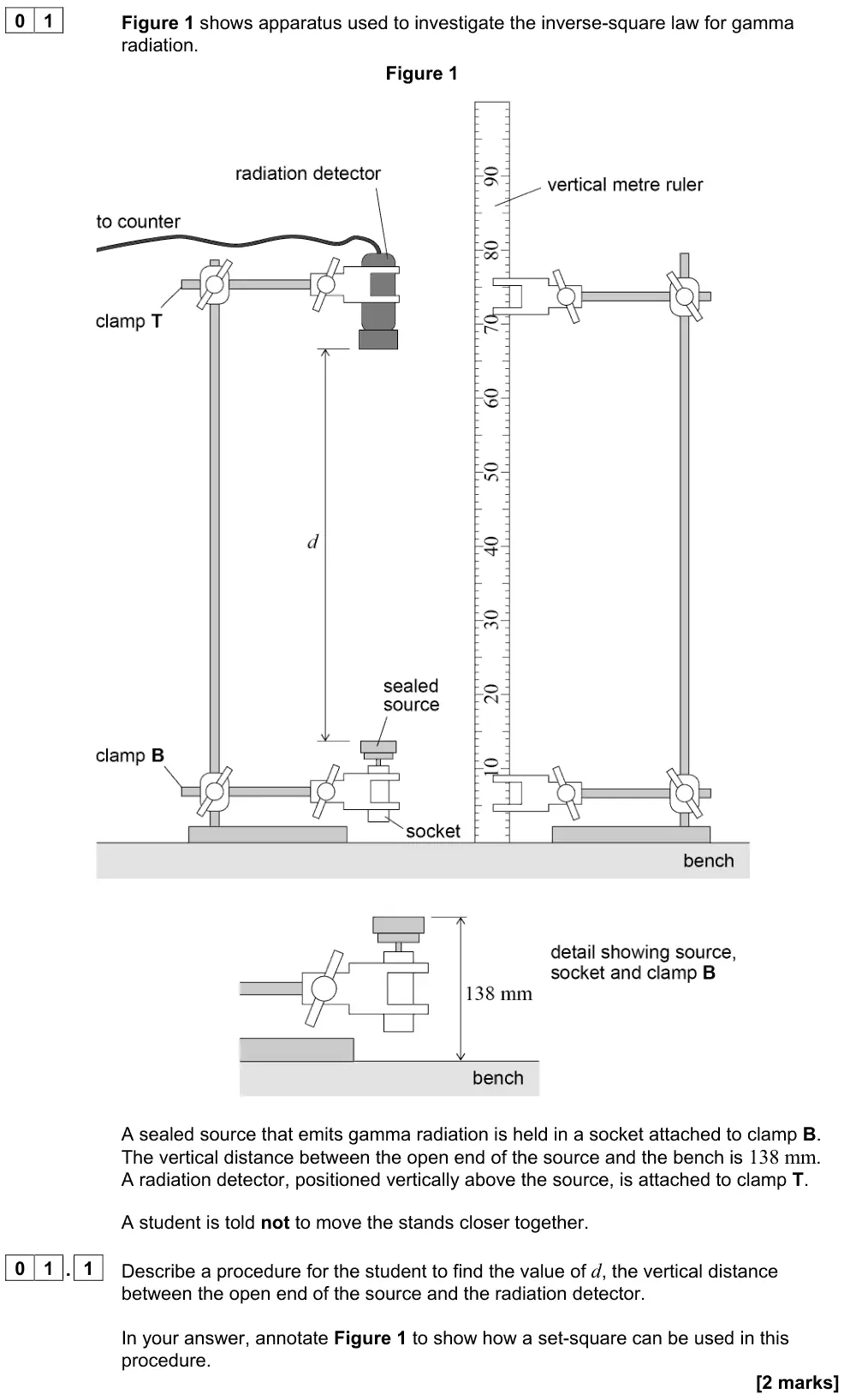
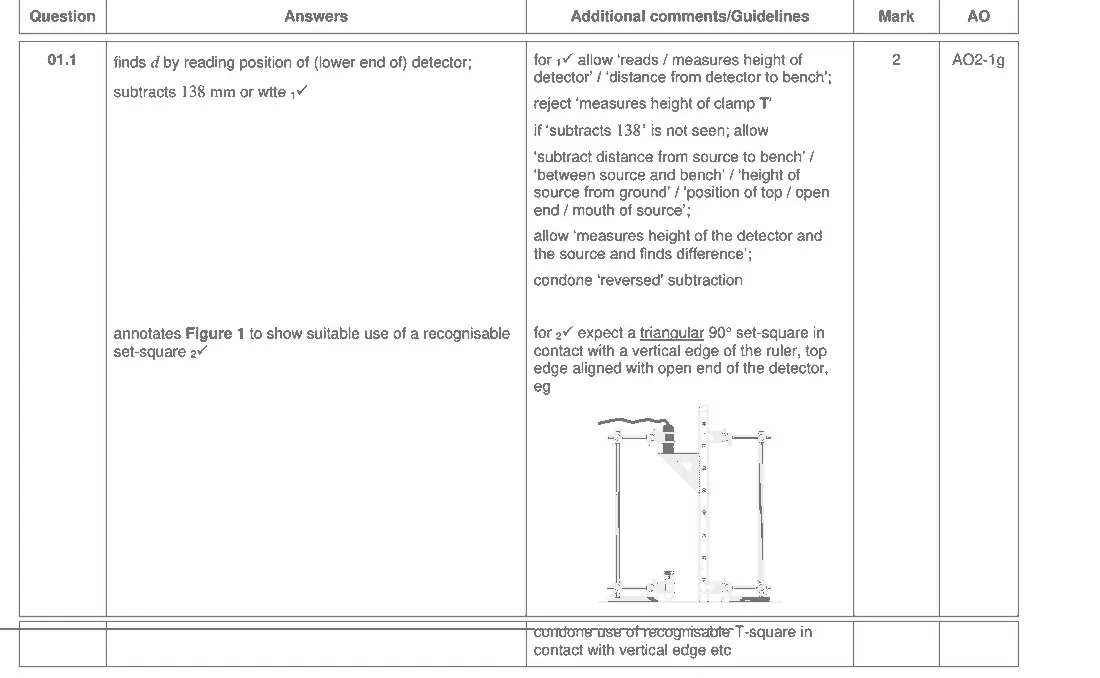
Read the position of the lower end of the detector on the vertical metre ruler and subtract 138 mm
set square against the ruler's vertical edge aligned with the detector to avoid parallax (annotate figure)
Skills: ATa analogue apparatus to record measurements and interpolate; ATc methods to increase accuracy (timing over many oscillations, fiducial marker, set square, plumb line); PS4.1 Know and understand how to use a wide range of experimental and practical instruments, equipment and techniques; RP12 Investigation of the inverse- square law for gamma radiation.
November 2021 · Paper 3 Section A · Q1.22 marksShow thatEasy
Earlier part of question 1 that this part uses
Mark scheme
Examiner's comment
The demand of question 01.2 was not much beyond GCSE so it was unsurprising that the mean mark (75% of the maximum) was much higher than for any other part.
At the other end of the spectrum we saw evidence of calculators set to read angles in radians (in question 02.1) and misguided attempts to use the Boltzmann constant (in question 01.3). Aside from questions 01.2, 01.3, 02.1 and 03.3, students at about the E boundary found marks difficult to obtain.
Notes from the mark scheme and report
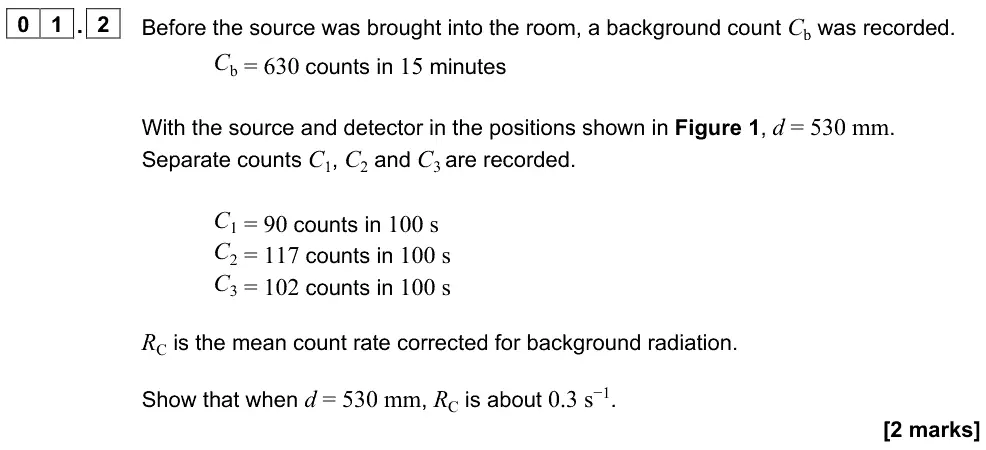
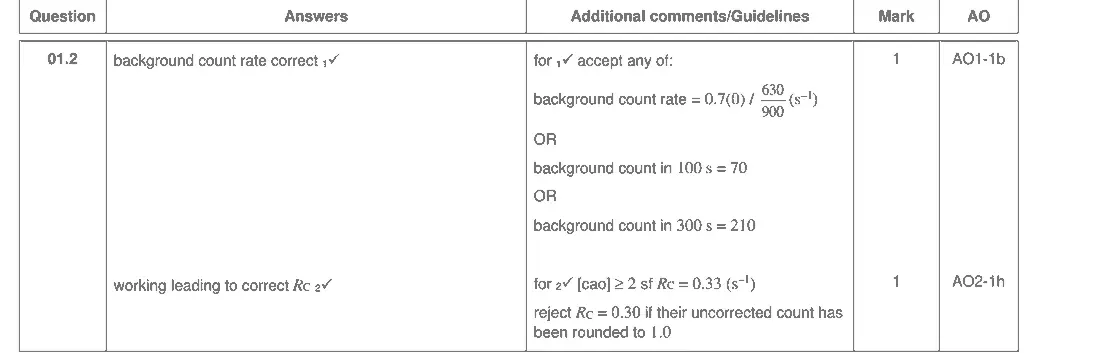
Background 630/900 = 0.70 s^-1
mean count rate (90 + 117 + 102)/300 = 1.03 s^-1
corrected RC = 0.33 s^-1
Skills: MS1.2 Find arithmetic means; MS0.3 Use ratios, fractions and percentages; RP12 Investigation of the inverse- square law for gamma radiation.
November 2021 · Paper 3 Section A · Q1.32 marksAO3=2Practical and data analysisHard
Earlier part of question 1 that this part uses
Mark scheme
Examiner's comment
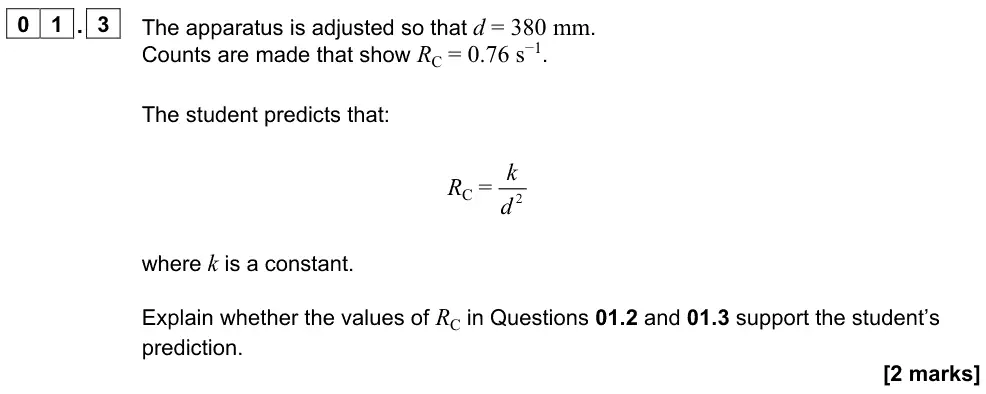
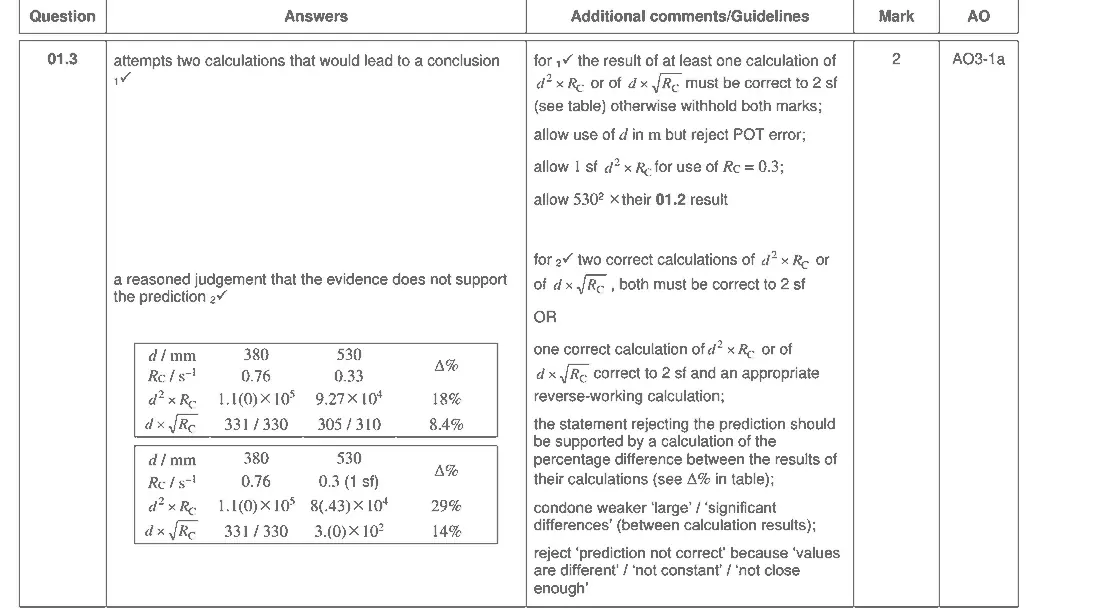
In question 01.3 we asked students to explain whether the data indicate an inverse-square relationship. It was encouraging that 75% could suggest calculations that would lead to a conclusion. However, in rejecting the prediction, only 6% of students earned full credit by providing more than the obvious comment that their ‘RC d2 values are different.’
At the other end of the spectrum we saw evidence of calculators set to read angles in radians (in question 02.1) and misguided attempts to use the Boltzmann constant (in question 01.3). Aside from questions 01.2, 01.3, 02.1 and 03.3, students at about the E boundary found marks difficult to obtain.
Students should be made aware of the expectations behind the different command words used in the questions. When we use ‘Explain’ we expect a reasoned justification to be included and when, as in question 01.3, they are basing a decision based on a numerical outcome, the justification should be quantitative, eg a percentage-difference calculation.
Notes from the mark scheme and report
RC d^2 = 1.10 x 10^5 at 380 mm vs 9.3 x 10^4 at 530 mm (18% different), so data do not support the prediction
justification should be quantitative (percentage difference)
Skills: MS0.3 Use ratios, fractions and percentages; PS2.3 Evaluate results and draw conclusions with reference to measurement uncertainties and errors; RP12 Investigation of the inverse- square law for gamma radiation.
November 2021 · Paper 3 Section A · Q1.42 marksPractical and data analysisHard
Earlier part of question 1 that this part uses
Mark scheme
Examiner's comment
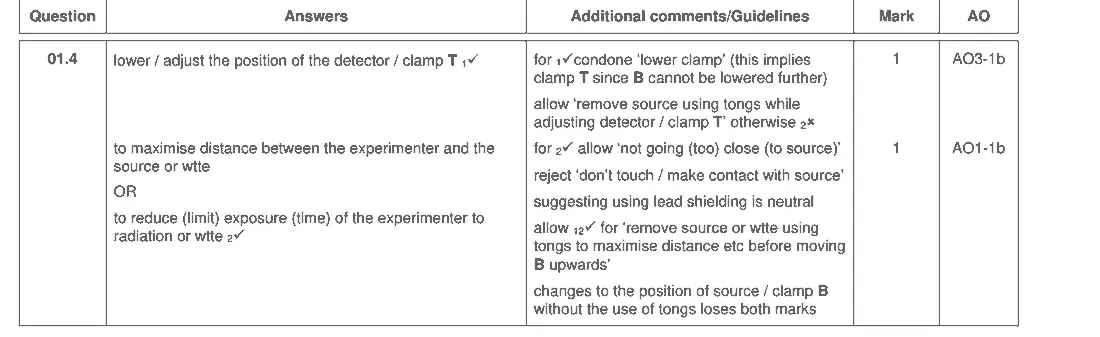
In the 2019 paper the students were told that the sealed source depicted emitted three types of radiation. This meant that for α and β radiation the source could be thought of as directional. Later in that question, an aluminium absorber was placed in front of the open end of the source so that only γ radiation could be detected. However this radiation is emitted in all directions regardless of which way the open end of the source is pointing. It seemed that in the 2021 paper many students overlooked this when answering question 01.4. We expected them to state that the detector would be moved towards the source (about 40% did), but less than 15% explained that this maximised the distance between themselves and the source. This question discriminated in favour of those with direct experience of using a sealed source.
Work seen in question 01.4 suggests that some students wrongly assume that sealed sources emit γ radiation only through the open end of the source.
Notes from the mark scheme and report
Lower the detector (clamp T) rather than raising the source, to keep the experimenter far from the source / limit exposure
gamma is emitted in all directions
Skills: ATl ionising radiation, including detectors; RP12 Investigation of the inverse- square law for gamma radiation.
November 2021 · Paper 3 Section A · Q1.52 marksAO3=2Practical and data analysis
Earlier part of question 1 that this part uses
Mark scheme
Notes from the mark scheme and report
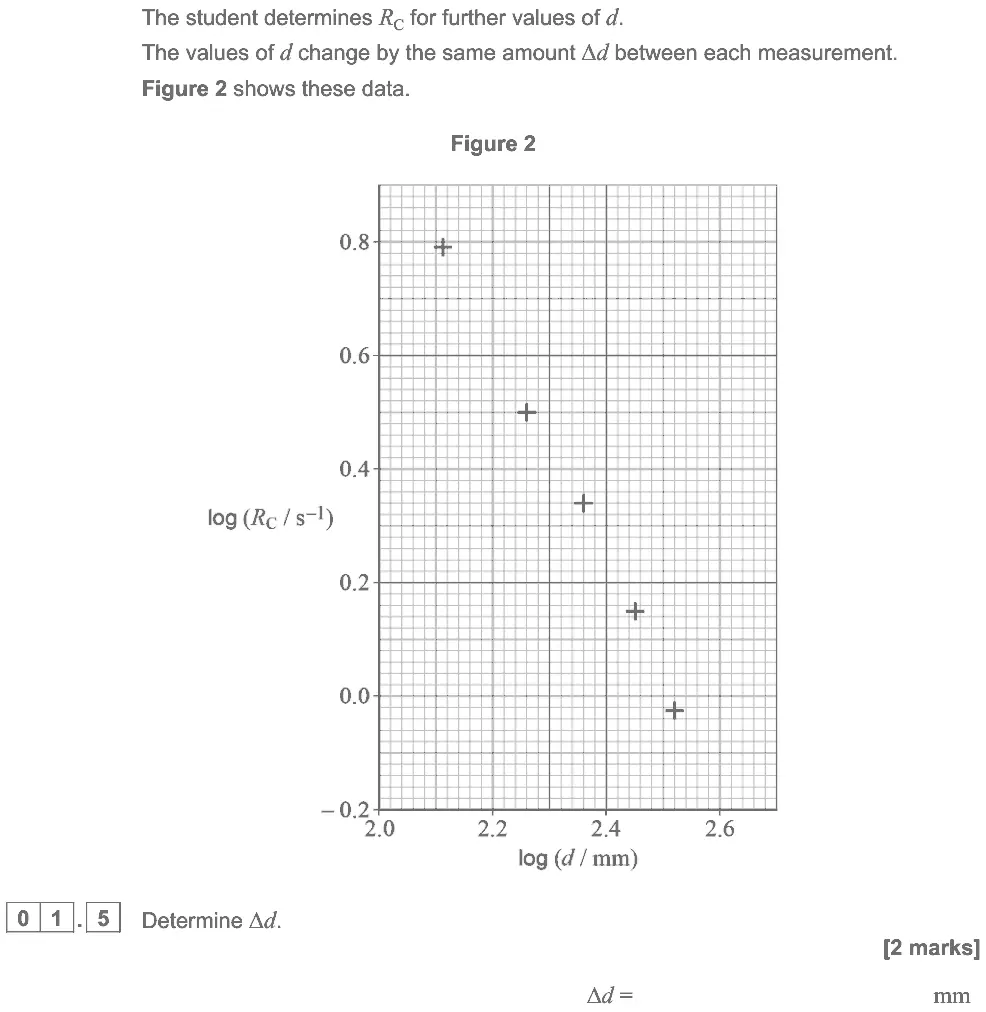
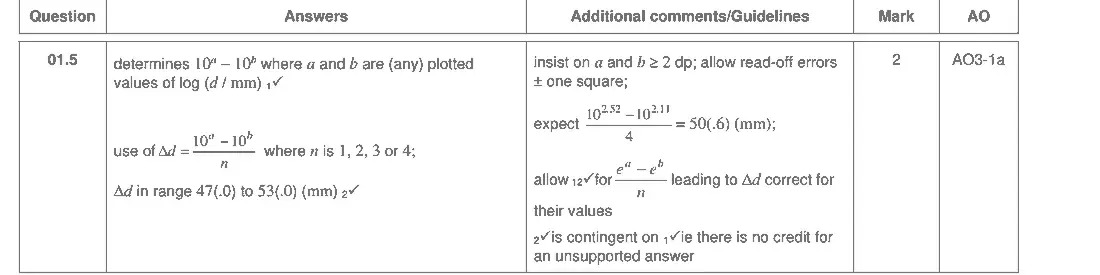
Answer: about 50 mm (47-53
antilog of two log d readings, difference divided by number of steps, e.g. (10^2.52 - 10^2.11)/4)
Skills: MS2.5 Use logarithms in relation to quantities that range over several orders of magnitude; MS3.1 Translate information between graphical, numerical and algebraic forms; RP12 Investigation of the inverse- square law for gamma radiation.
November 2021 · Paper 3 Section A · Q1.63 marksAO3=3Practical and data analysisHard
Earlier part of question 1 that this part uses
Mark scheme
Examiner's comment
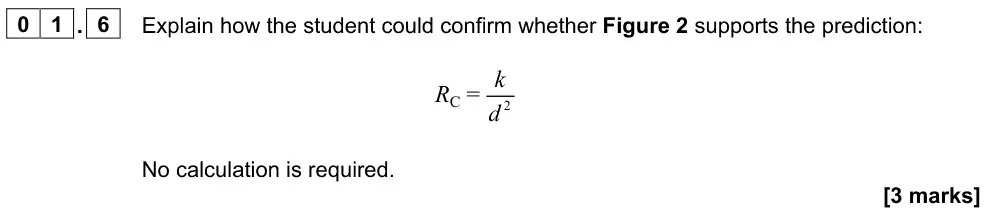
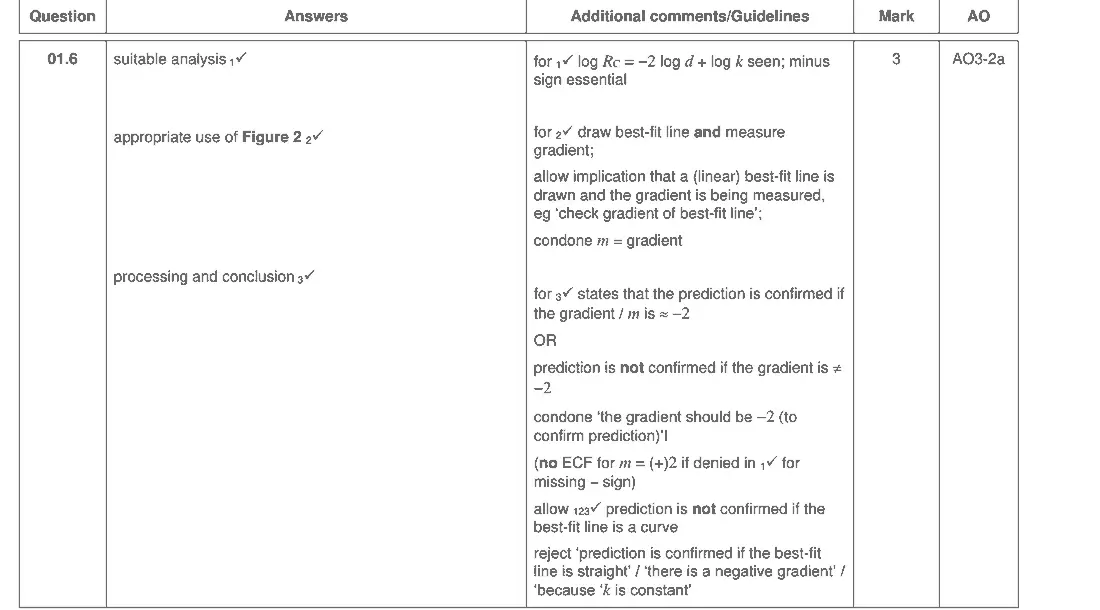
In question 01.6, only 30% of students gave the analysis (log RC = −2 log d + log k) that was the gateway to further progress in this straightforward question.
There is always scope in this paper to test the Maths Skills listed in section 6 of the specification. Question 01.6 exposed weak understanding about the use of logarithmic plots to test power law variations (MS3.11).
Notes from the mark scheme and report
log RC = -2 log d + log k
draw best-fit line and measure gradient
prediction confirmed if gradient = -2 (not if curved or not -2)
'straight line' alone not enough
Skills: MS3.11 Use logarithmic plots to test exponential and power law variations; MS3.3 Understand that y = mx + c represents a linear relationship; MS3.4 Determine the slope and intercept of a linear graph; RP12 Investigation of the inverse- square law for gamma radiation.
November 2021 · Paper 3 Section A · Q1.71 markAO2=1Calculation
Earlier part of question 1 that this part uses
Mark scheme
Notes from the mark scheme and report
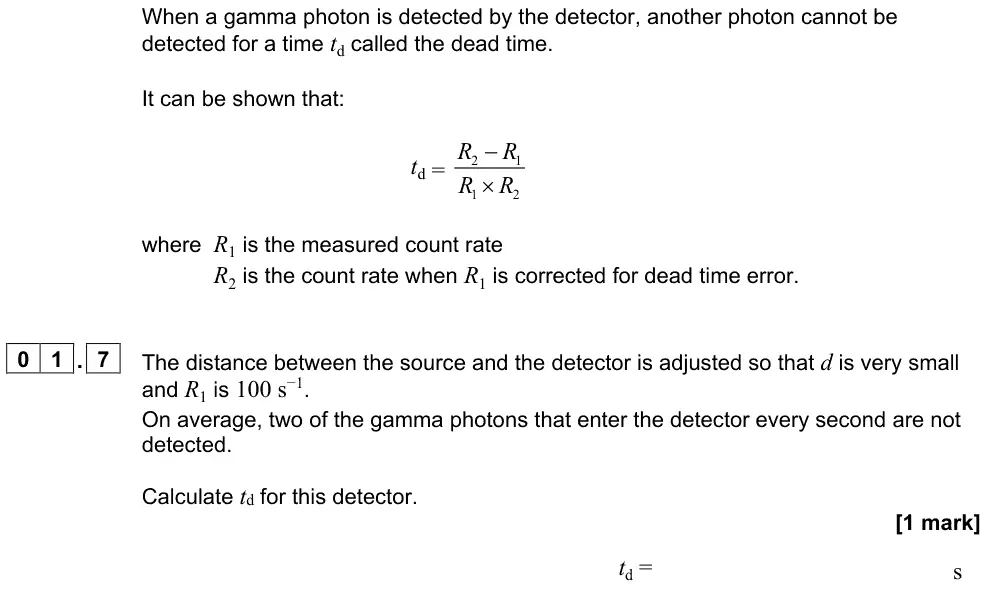
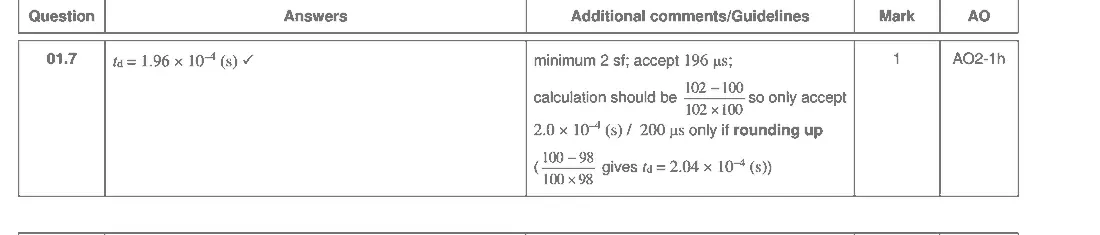
Answer: td = (102 - 100)/(100 x 102) = 1.96 x 10^-4 s
Skills: MS2.3 Substitute numerical values into algebraic equations using appropriate units for physical quantities; RP12 Investigation of the inverse- square law for gamma radiation.
November 2020 · Paper 2 · Q5.11 markAO1=1Short answerHard
Mark scheme
Examiner's comment
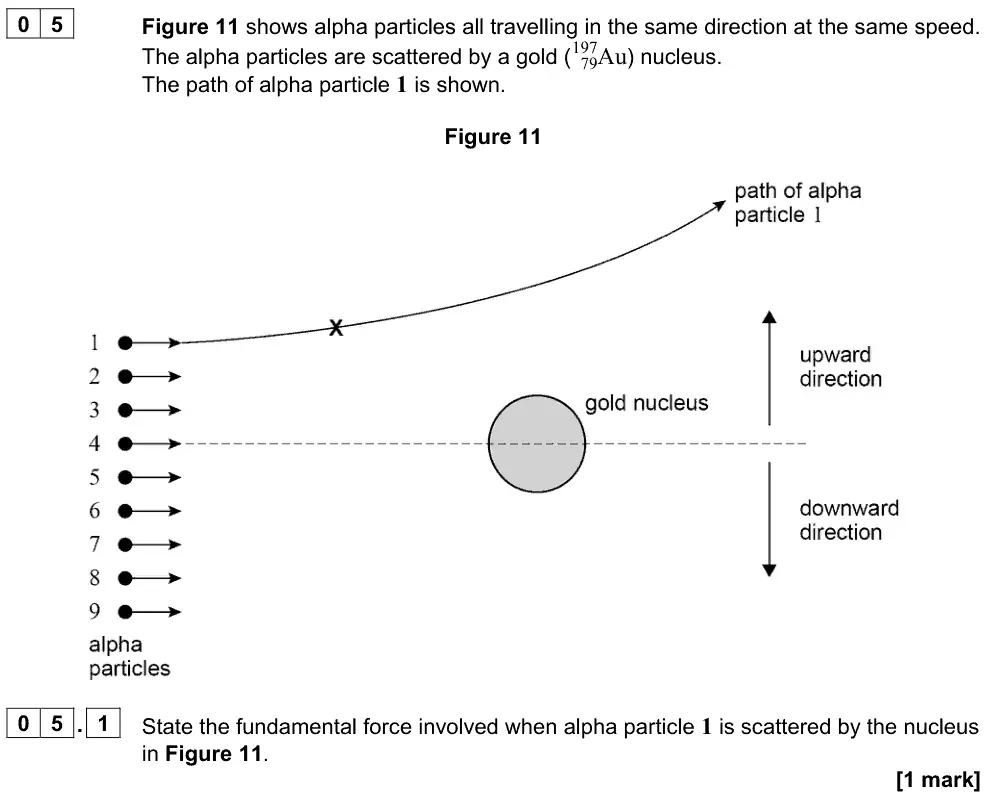
About one third of students answered with the correct ‘electromagnetic force’ which is one of the fundamental forces. ‘Electrostatic force’ was given by many other students. More surprisingly, and just as often, ‘strong force’ was written.
Question 05.1
Notes from the mark scheme and report
Electromagnetic
'electrostatic' rejected as not a fundamental force
'strong' common
November 2020 · Paper 2 · Q5.32 marksExplanation
Earlier part of question 5 that this part uses
Mark scheme
Examiner's comment
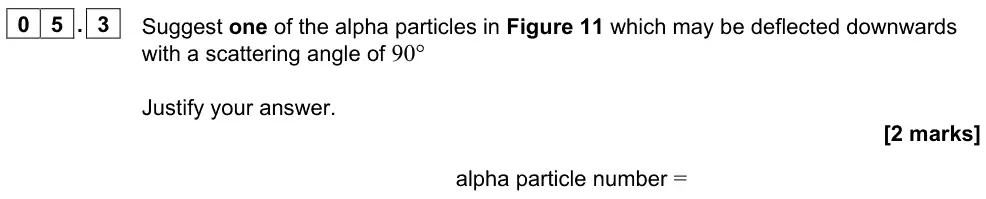
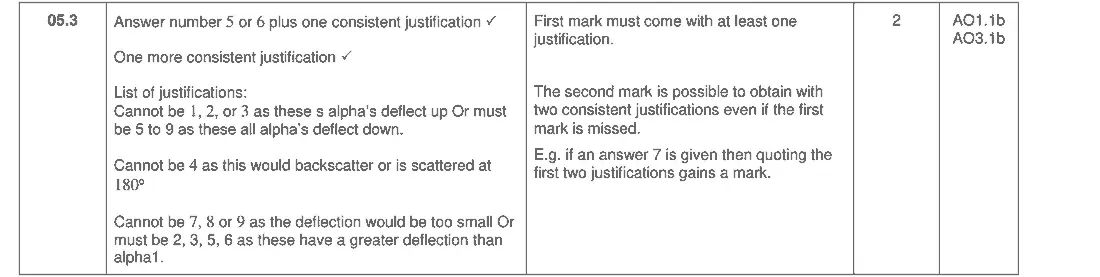
A very small number of the students who correctly chose alpha particle 5 or alpha particle 6 adequately explained their choice. Many described how the alpha particle hits the sphere of the nucleus and reflects off it. They seem to consider the diagram to be a scale drawing showing colliding balls. The answer alpha particle 4 was given frequently because it would get close enough to have a large scattering angle. Some students expressed the idea that 90° was the maximum possible scattering angle.
Question 05.3
Notes from the mark scheme and report
Particle 5 or 6, justified: 1-3 deflect upwards, 4 is back-scattered at 180 degrees, 7-9 pass too far away for a large deflection
November 2020 · Paper 2 · Q281 markMultiple choice
Answer
D
Notes from the mark scheme and report
Answer: D
Skills: MS3.3 Understand that y = mx + c represents a linear relationship
June 2019 · Paper 2 · Q181 markMultiple choice
Answer
D
Notes from the mark scheme and report
Answer: D
June 2019 · Paper 3 Section A · Q1.12 marksShort answer
Mark scheme
Examiner's comment
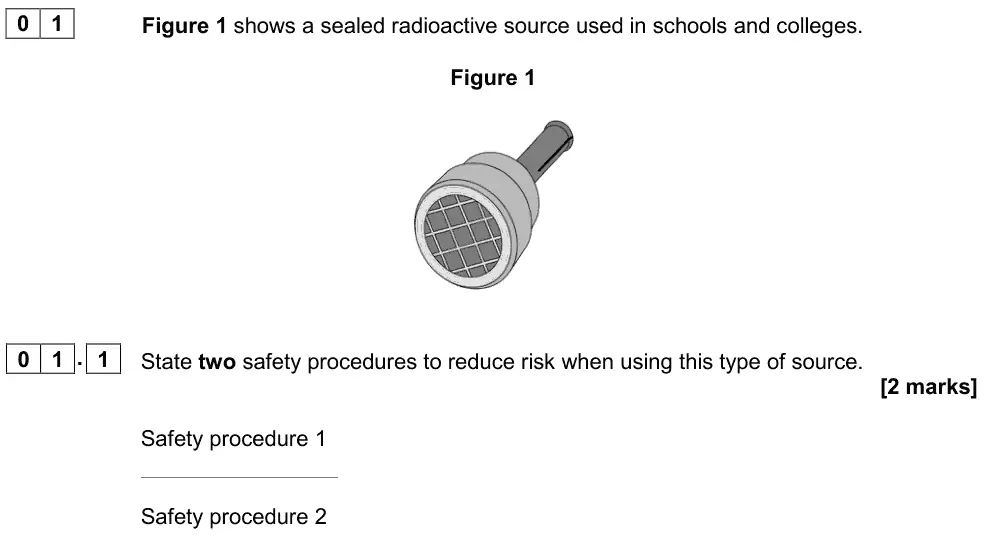
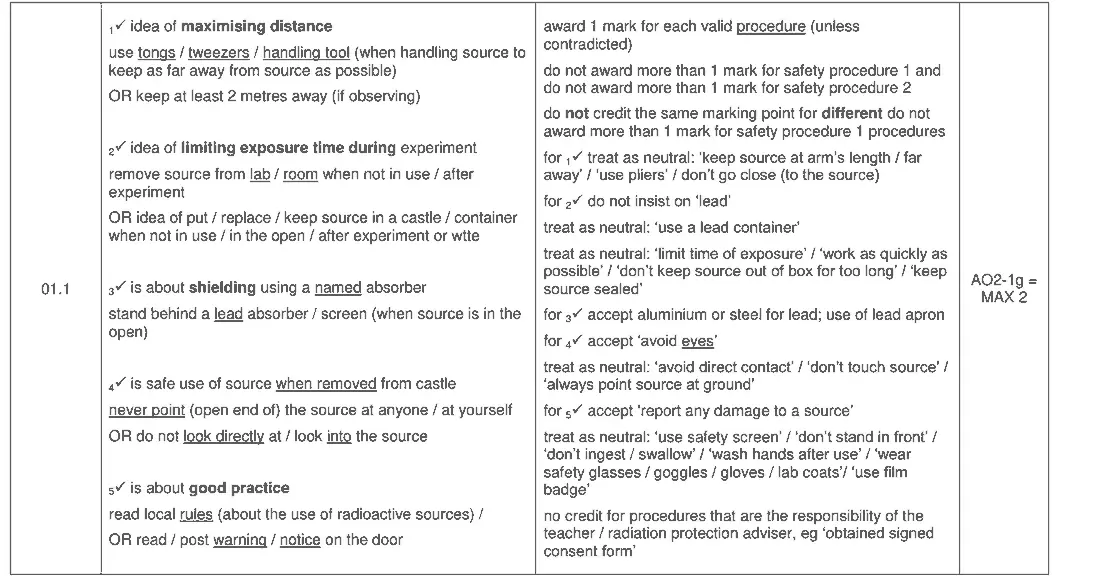
The impression in 01.1 was that most students had at least seen a sealed source. We wanted students to write about the safety procedures that they would employ when working with such sources. No credit was given for describing any responsibilities that belonged to a teacher or radiation protection supervisor. The use of tongs and ‘do not point the source at anyone’ were the most popular ideas. ‘Replacing the source in the castle after the experiment’ was another well- known procedure. Generalised comments such as ‘wear a lab coat’ did not score, nor did vague ideas such as ‘stay a safe distance away’. This question discriminated very well.
Notes from the mark scheme and report
Any two personal procedures: long tongs/handling tool (distance), return to castle when not in use (time), lead screen, never point at anyone
'stay a safe distance' and 'wear a lab coat' not credited
Skills: ATl ionising radiation, including detectors; RP12 Investigation of the inverse- square law for gamma radiation.
June 2019 · Paper 3 Section A · Q1.43 marksPractical and data analysis
Earlier part of question 1 that this part uses
Mark scheme
Examiner's comment
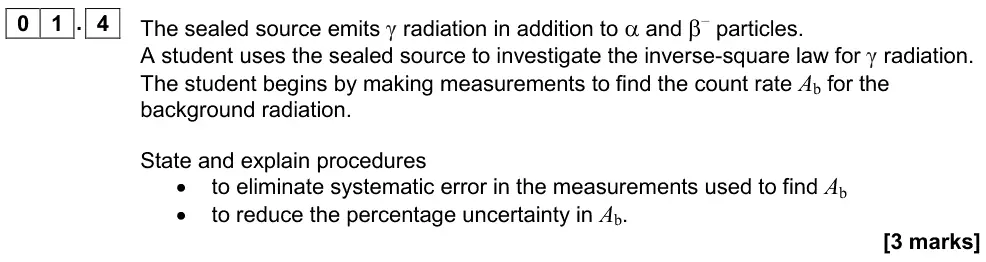
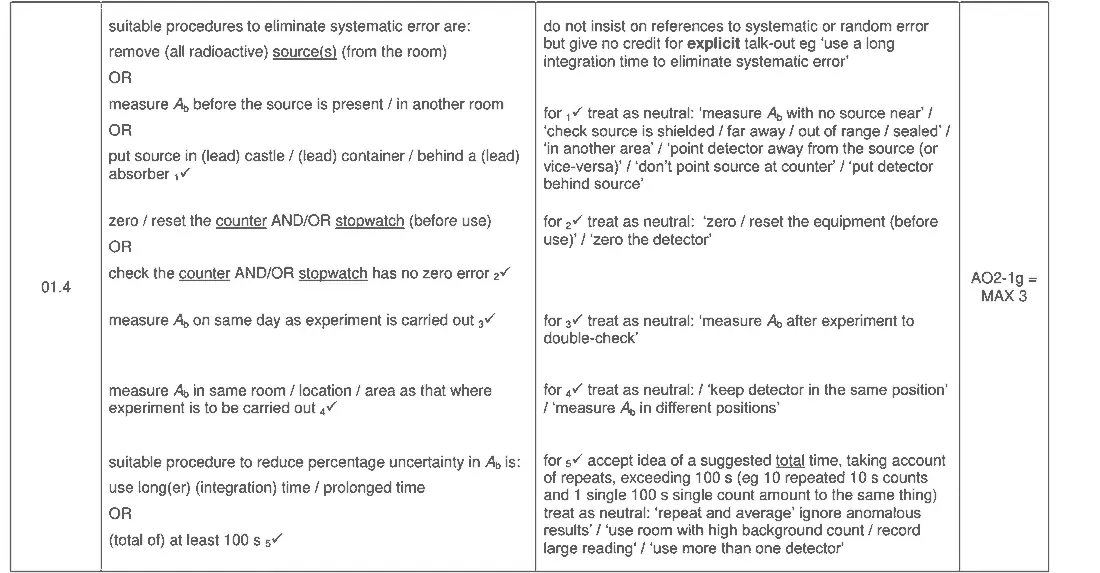
In 01.4 we expected students to know that the background count rate should be measured, with the source effectively removed to eliminate the key source of systematic error. We also hoped that they know enough about the random nature of background radiation to appreciate that a long integration time can reduce percentage uncertainty. These provided the main thrust in many of the arguments put forward, but sometimes examiners found that the expression of these ideas was too vague. We wanted students to return the source to its castle or to remove it entirely from the laboratory; comments such as ‘put the source far away’ were not acceptable. Less popular, but viable, suggestions were to carry out the measurement in the same place (or on the same day) as that of the main experiment. Some students suggested that anomalies should be rejected when determining background count rate. These students need to re-examine their understanding of the nature of radioactive decay. Comments such as ‘check the tube is zeroed’ and ‘use a counter with greater resolution’ gained no credit. A number of students erroneously assumed that Ab was the rate during the test of the inverse-square law. The majority scored no more than 1/3 and only very few scored 3/3.
The paper proved to be the most accessible so far, with a mean mark just below 50% of the maximum. These questions also proved more discriminating than those in the 2018 paper, with students finding almost every mark to be accessible. The only exception was in question 01.4, where very few could score all three marks.
Notes from the mark scheme and report
Systematic: remove the source from the room or return it to its castle, measure in the same place/day, zero counter
uncertainty: count for a long time (at least 100 s)
'put source far away' too vague
rejecting anomalies misunderstands randomness
Skills: PS2.3 Evaluate results and draw conclusions with reference to measurement uncertainties and errors; PS3.3 Consider margins of error, accuracy and precision of data; ATl ionising radiation, including detectors; RP12 Investigation of the inverse- square law for gamma radiation.
June 2019 · Paper 3 Section A · Q1.53 marksPractical and data analysis
Earlier part of question 1 that this part uses
Mark scheme
Examiner's comment
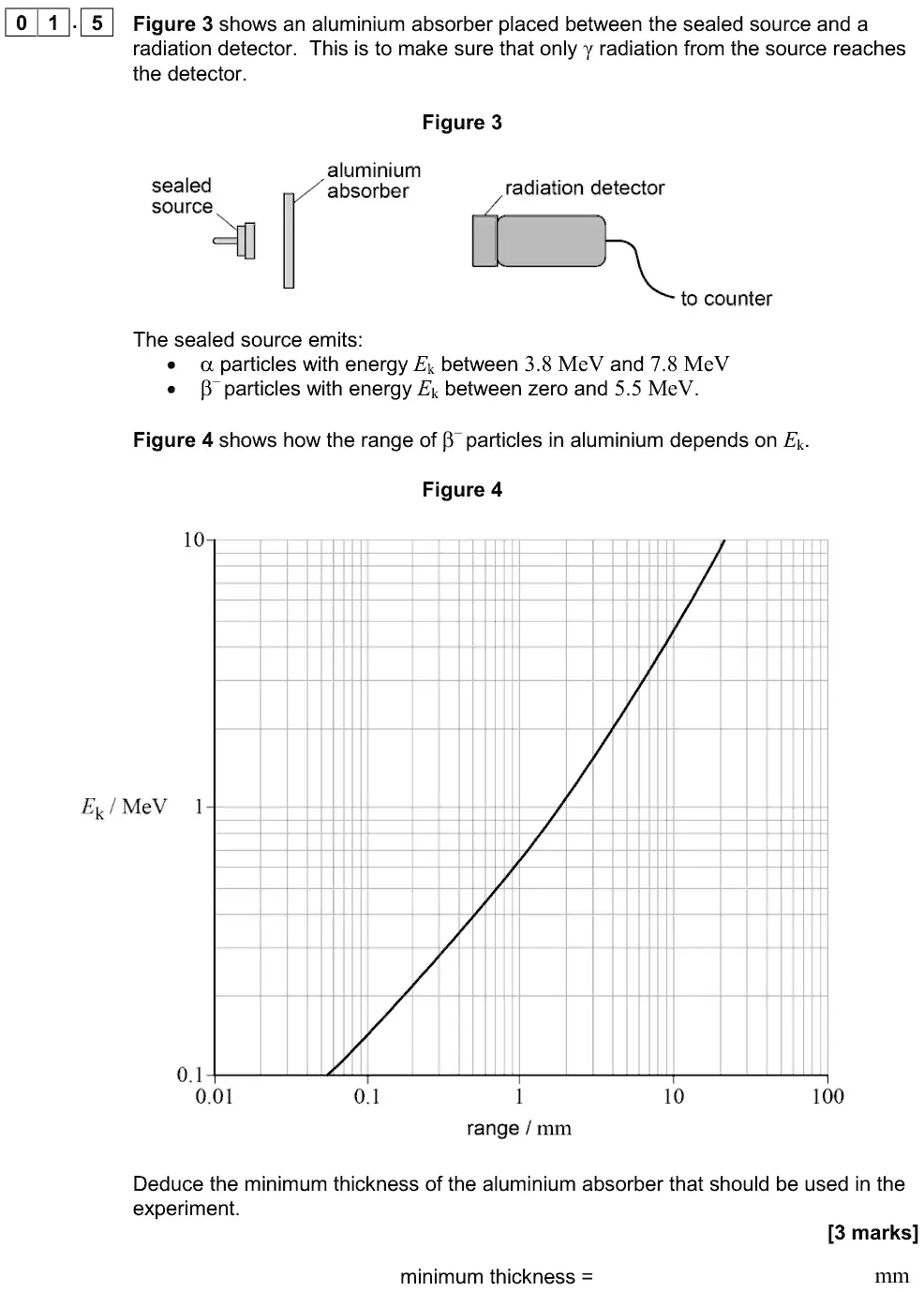
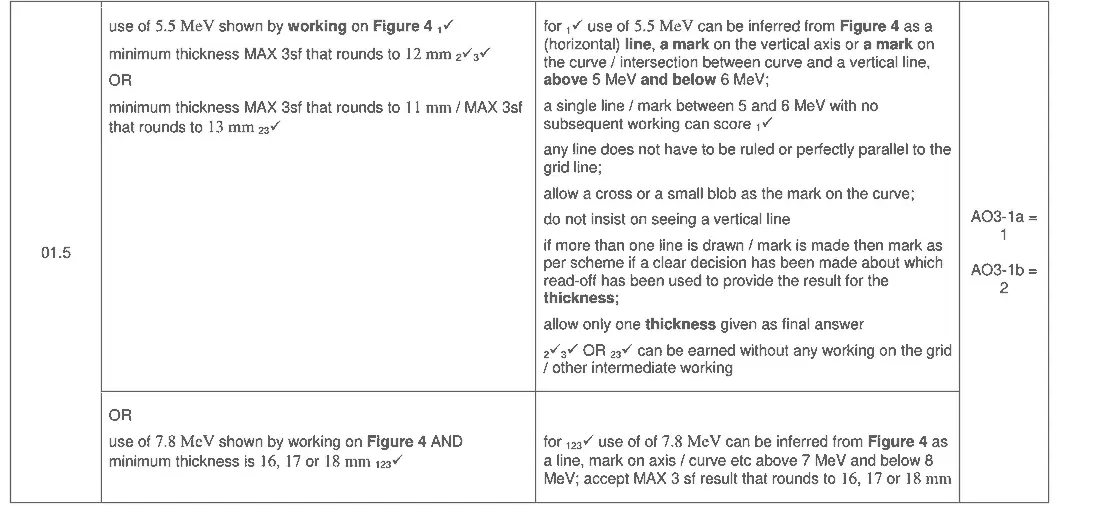
In 01.5, the working seen on Figure 4 confirmed that the minimum thickness most students were looking for required the use of 5.5 MeV. However, many then appeared to think that the scale was linear between the gridlines, often producing a result of 11 mm or 13 mm for the thickness. Others, having correctly identified 12 mm as the thickness corresponding to 5.5 MeV, ignored the instruction to deduce the minimum thickness. They then rounded up to 20 mm to provide a margin of error. There was strong representation at each mark.
Notes from the mark scheme and report
Answer: 12 mm (range of 5.5 MeV beta, the most penetrating, read from log-log graph)
treating log scale as linear gave 11 or 13 mm
adding a safety margin (20 mm) ignores 'minimum'
Skills: MS3.1 Translate information between graphical, numerical and algebraic forms; MS2.5 Use logarithms in relation to quantities that range over several orders of magnitude; RP12 Investigation of the inverse- square law for gamma radiation.
June 2019 · Paper 3 Section A · Q1.65 marksPractical and data analysis
Earlier part of question 1 that this part uses
Mark scheme
Examiner's comment
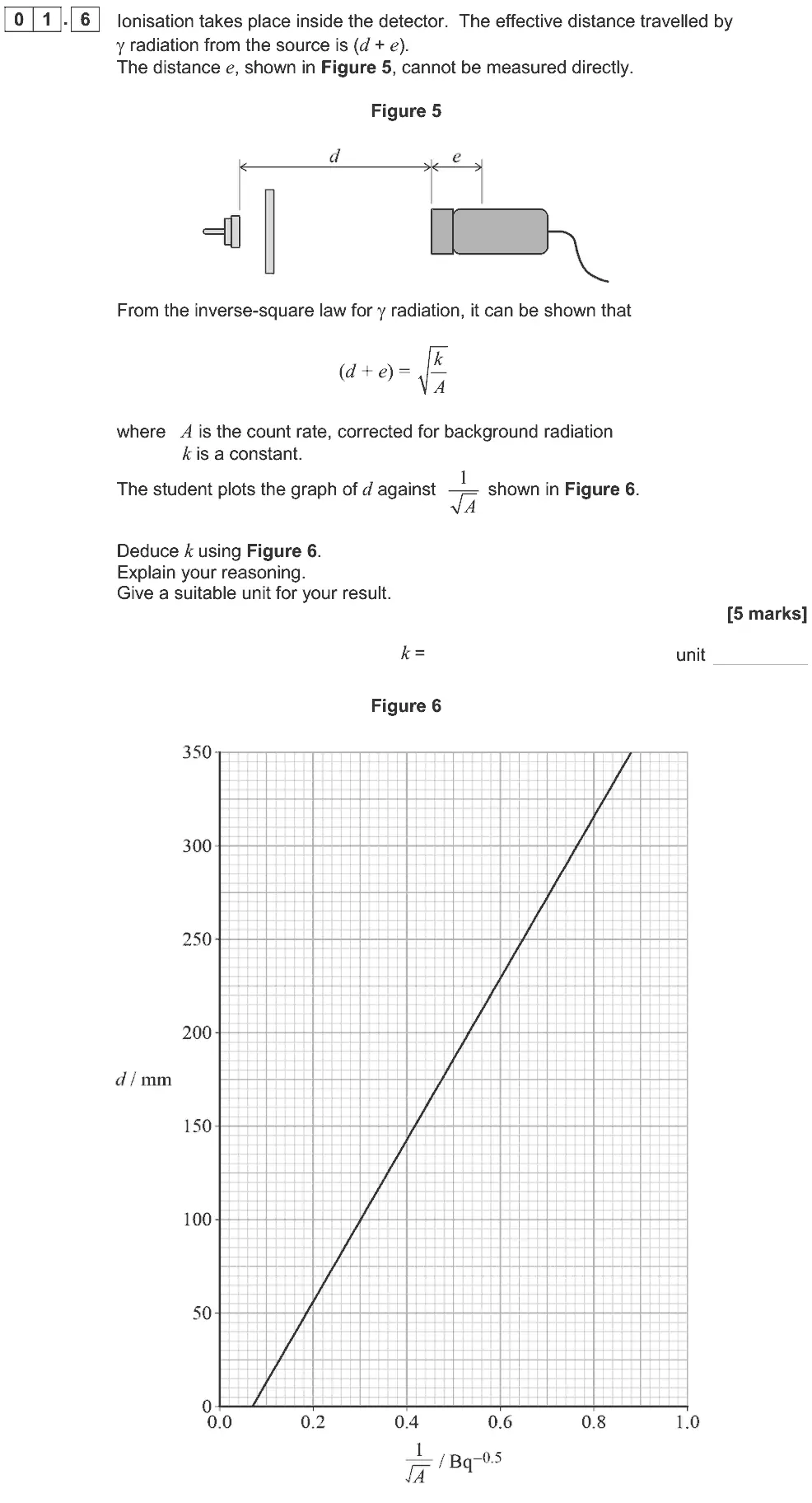
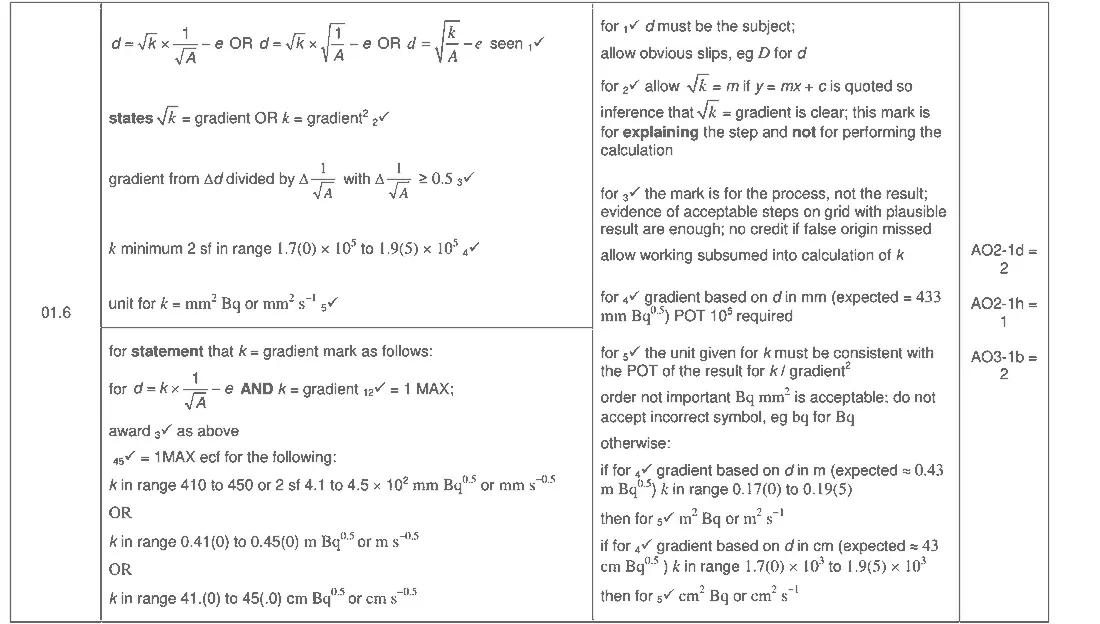
In recent years, students have become used to questions (01.6) that test an understanding of the equation y mx c = + . The majority gave clear reasoning to justify k = (gradient)2 and went on to provide a successful numerical answer, exactly in line with examiners’ expectations. The problem for many was providing a correct unit with their result; mm Bq0.5 was often seen. Students performed very well in this question, with about 40% scoring at least 5/6.
Students generally showed more confidence with questions that tested their mathematical skills. Many knew how to combine percentage errors correctly. A ‘show that’ problem (02.5) was well- answered, provided students noted that the relevant curve was exponential. Extended working, (eg in 01.6, 02.5 and 03.7), revealed clear work that could be followed without too much difficulty.
Notes from the mark scheme and report
d = square root k x (1/square root A) - e, so gradient = square root k (about 433 mm Bq^0.5)
k = gradient^2 = 1.7-1.95 x 10^5 mm^2 Bq (or mm^2 s^-1)
unit was the commonest loss (mm Bq^0.5 given)
Skills: MS3.3 Understand that y = mx + c represents a linear relationship; MS3.4 Determine the slope and intercept of a linear graph; MS0.1 Recognise and make use of appropriate units in calculations; RP12 Investigation of the inverse- square law for gamma radiation.
June 2019 · Paper 3 Section A · Q1.72 marksPractical and data analysisHard
Earlier part of question 1 that this part uses
Mark scheme
Examiner's comment
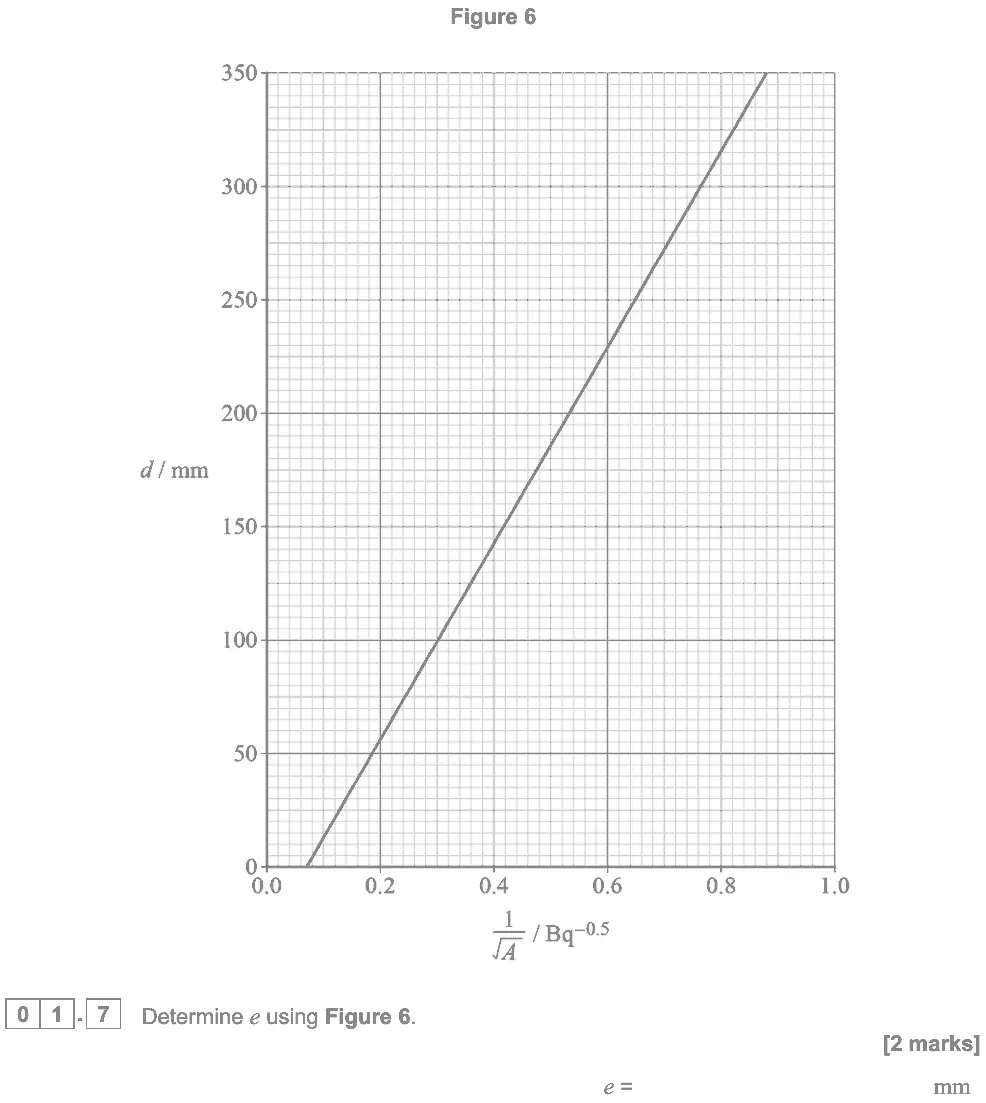
In 01.7 it was possible to predict with reasonable certainty what the value of e should be, so we needed a convincing calculation. Several creditable approaches were seen, but scale drawing ideas and extrapolation off the grid were rejected. One common error was the incorrect substitution k 1 = 0.6, students wrote d e , so, if using a point on the line eg d = 230 mm, of data into = − A A k e . Another frequent mistake was to mix units for k and d. Due to such errors, over 230 = − . 0 6 half the students failed to score anything; nearly a third of the cohort, however, obtained full credit.
Notes from the mark scheme and report
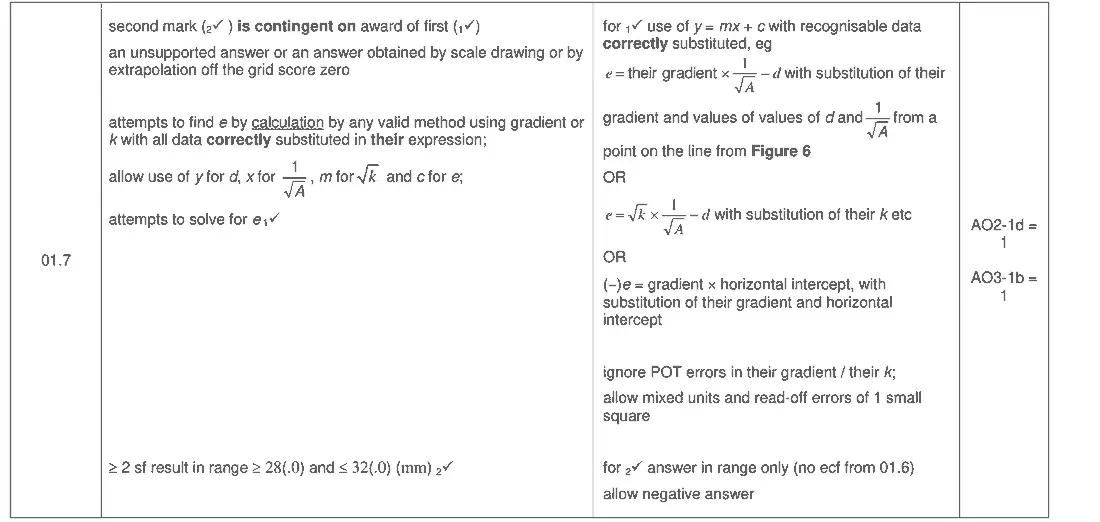
Answer: e = 28-32 mm by calculation (y = mx + c with a point on the line, or gradient x horizontal intercept)
scale drawing or extrapolation off the grid scores zero
mixing units common
Skills: MS3.3 Understand that y = mx + c represents a linear relationship; MS2.2 Change the subject of an equation, including non-linear equations; RP12 Investigation of the inverse- square law for gamma radiation.
June 2018 · Paper 2 · Q5.11 markShort answerHard
Mark scheme
Examiner's comment
05.1 About half of the students knew that gamma radiation was to be used. However, only 19.6% actually gained a mark because they did not know why gamma radiation was to be used. They either left out the reason or simply wrote something they knew about gamma radiation, whether it was relevant or not. “It is least ionising” or “it kills germs” are examples of statements that did not gain marks.
Notes from the mark scheme and report
Gamma, because it is the most penetrating (reaches all surfaces, works through packaging)
naming gamma without a valid reason scores 0
about half named gamma
June 2018 · Paper 2 · Q5.21 markShort answerHard
Earlier part of question 5 that this part uses
Mark scheme
Examiner's comment
05.2 It was clear that over 90% of students were not aware of how materials can become radioactive. There were extremely few references to nuclei. Students mainly wrote that the induced radioactivity was “too small to be of harm” or “has a short half-life” or “is only ionised a bit, so can be ignored”.
Notes from the mark scheme and report
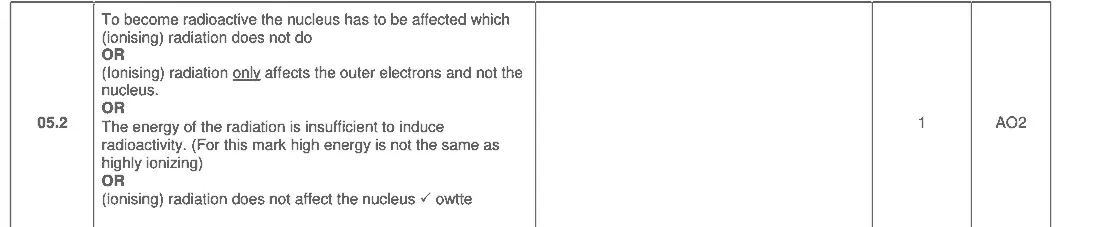
Ionising radiation affects only orbital electrons, not the nucleus, so cannot make the material radioactive
very few referred to nuclei
June 2018 · Paper 2 · Q5.32 marksPractical and data analysis
Earlier part of question 5 that this part uses
Mark scheme
Examiner's comment
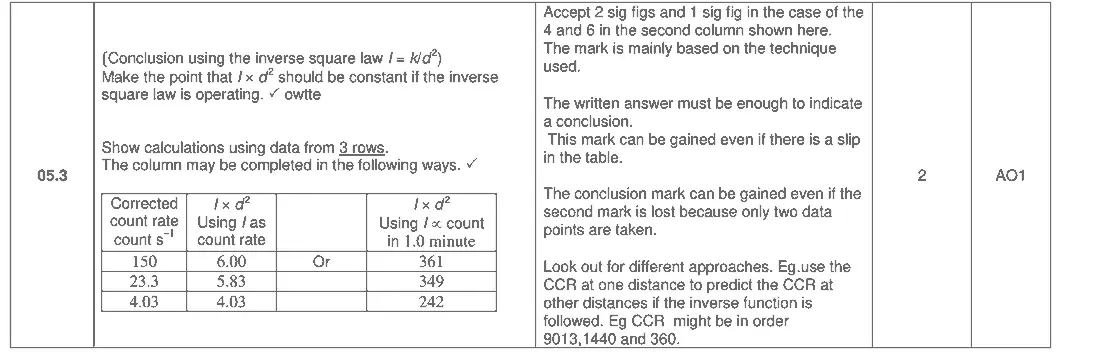
05.3 More than half of the students (56.1%) gained full marks and they established that the constant of proportionality was not constant when an inverse square of distance relationship was used. Other students put the square on the count rate rather than the distance and did not gain any marks. Others only compared two rows of data rather than three, but these could score one of the marks.
Notes from the mark scheme and report
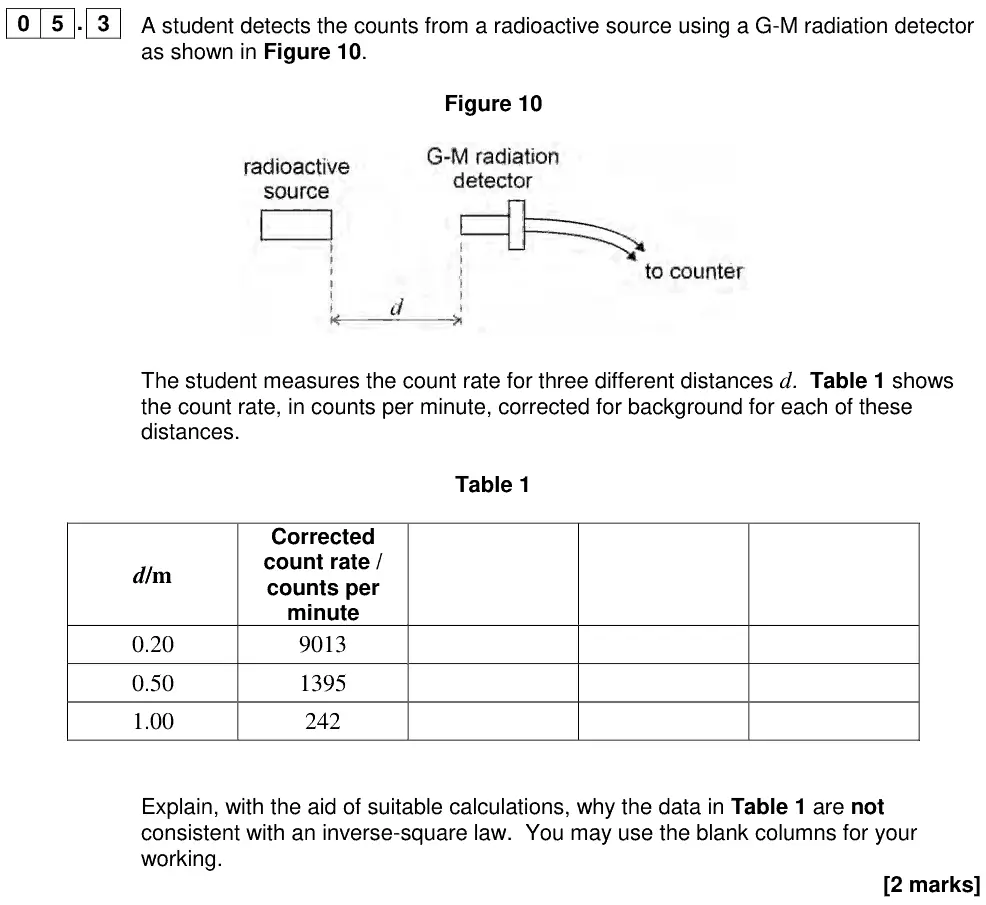
I x d^2 should be constant but gives about 361, 349, 242 counts per min m^2 (use all three rows)
squaring the count rate scores 0
two rows only max 1
56.1% full marks
Skills: MS3.1 Translate information between graphical, numerical and algebraic forms; MS0.3 Use ratios, fractions and percentages; RP12 Investigation of the inverse- square law for gamma radiation.
June 2018 · Paper 2 · Q5.42 marksShort answer
Earlier part of question 5 that this part uses
Mark scheme
Examiner's comment
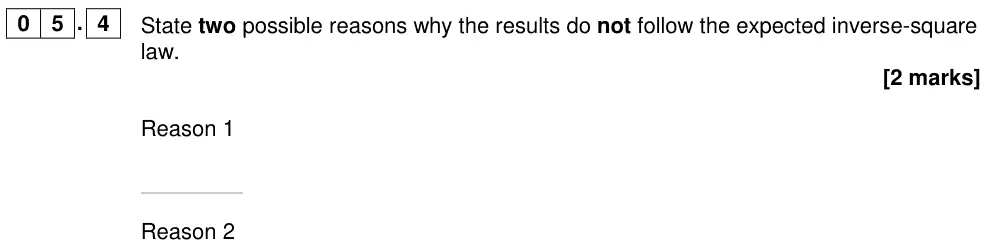
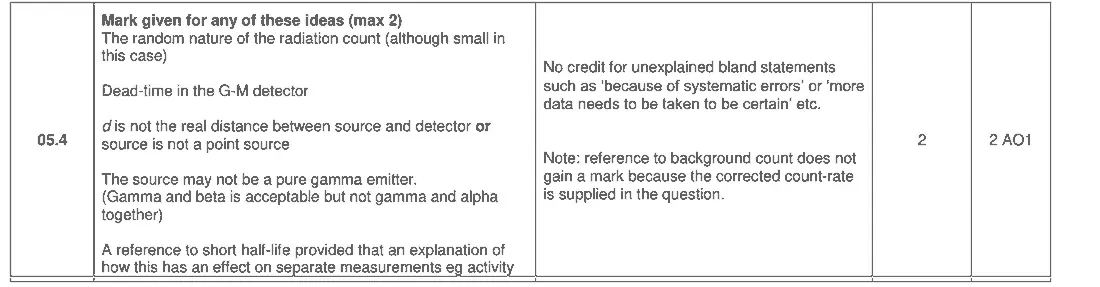
05.4 A great number of weak answers simply stated that the measurements were taken wrongly in some way because of human error. Examples included “the readings were copied wrongly” and “the GM tube was old and faulty”. The most common answer was to state that the background reading was changing or not accurate. It was also obvious that some students did not know how the inverse square law comes about, since they wrote “the detector captures fewer radiations as it moves away from the source”. Approximately one third of students could give one acceptable answer; 59.5% failed to score.
Notes from the mark scheme and report
Any two: random nature of decay
G-M dead time
d not the true source-detector distance or source not a point
not a pure gamma emitter
absorption in air
background not credited (already corrected)
59.5% failed to score
Skills: PS2.3 Evaluate results and draw conclusions with reference to measurement uncertainties and errors; RP12 Investigation of the inverse- square law for gamma radiation.
June 2018 · Paper 2 · Q7.52 marksExplanation
Earlier part of question 7 that this part uses
Mark scheme
Examiner's comment
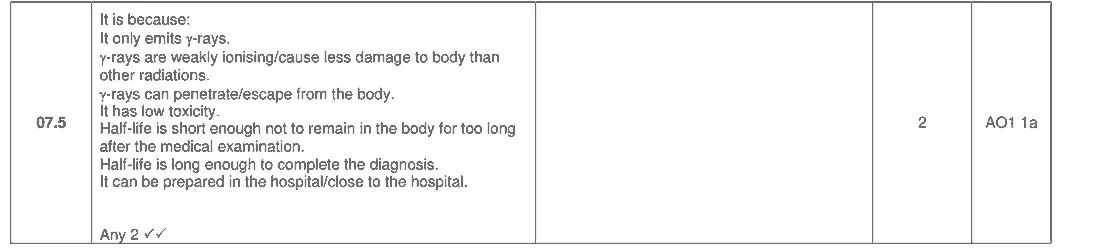
07.5 Many students had problems in avoiding absolute statements that disqualified them from a potential mark. Some examples are “It does not ionise, so causes no harm to the body” and “It has a short half-life so is not dangerous at all”. Many students did know that this source gave off gamma rays, but not that these were alone. Also, there were just as many references to the half-life being long as there were to it being short. These references only gained marks if the benefit was explained, for example ‘long enough to complete the investigation’.
Notes from the mark scheme and report
Any two: pure gamma emitter
gamma penetrates out of the body and is weakly ionising
half-life long enough for diagnosis but short enough to limit dose
made on site
absolute statements ('causes no harm') penalised
June 2017 · Paper 2 · Q261 markMultiple choice
Answer
C
Notes from the mark scheme and report
Answer: C
June 2017 · Paper 2 · Q271 markMultiple choice
Answer
D
Notes from the mark scheme and report
Answer: D
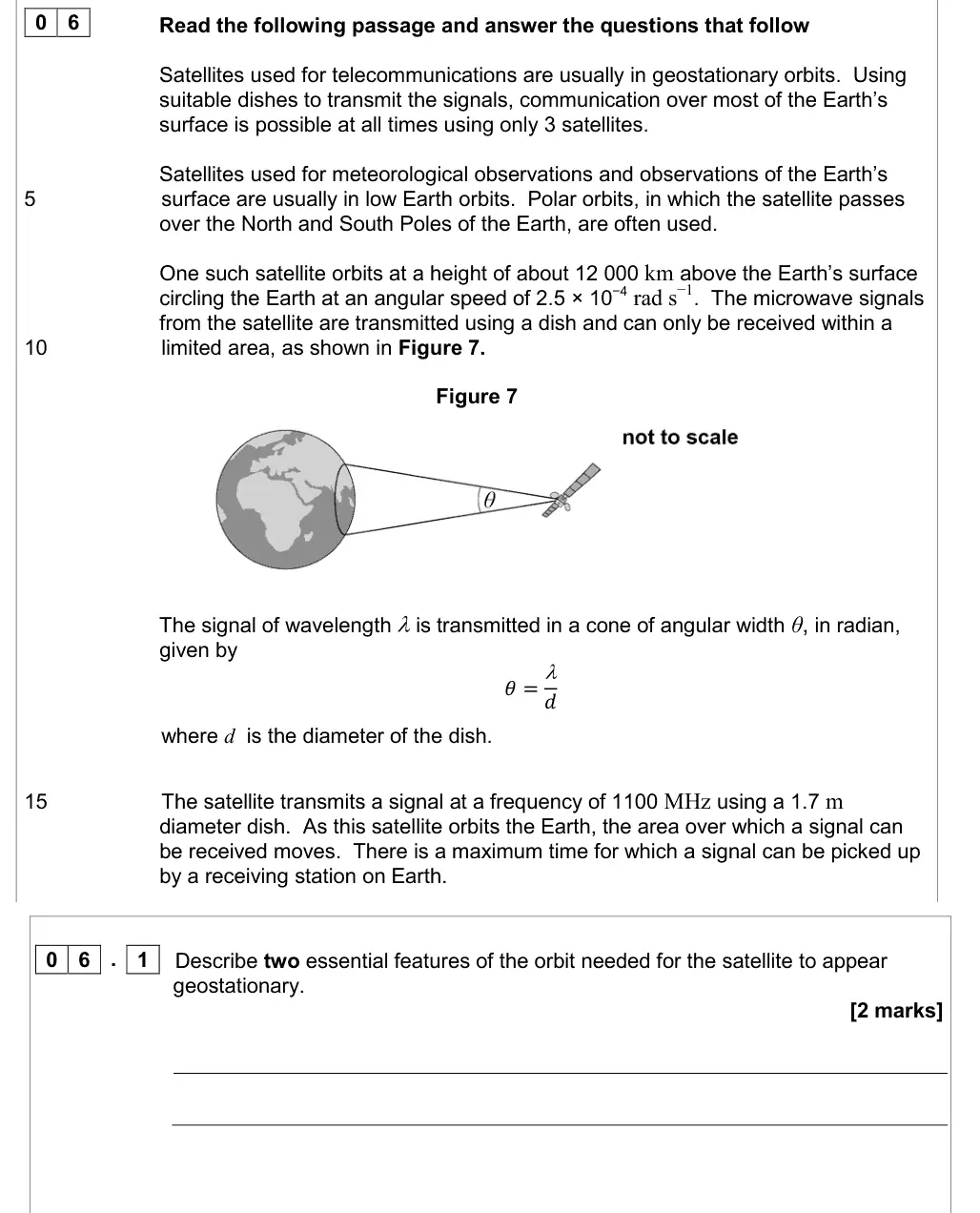
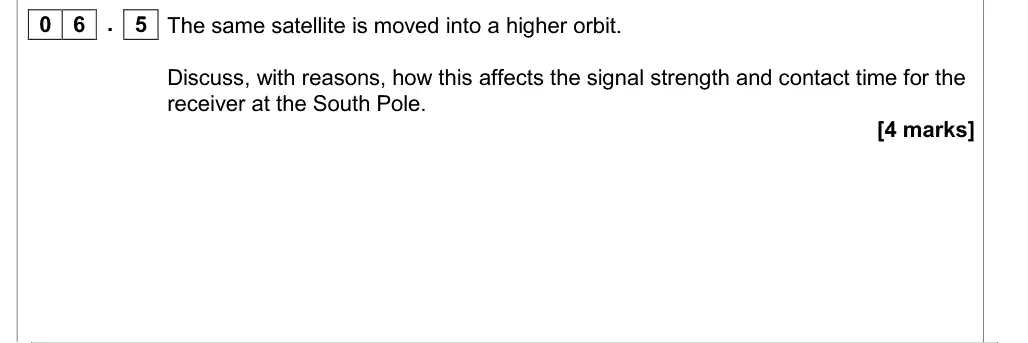
Specimen set 1 · Paper 2 · Q6.54 marksExplanation
Earlier part of question 6 that this part uses
Mark scheme
Notes from the mark scheme and report
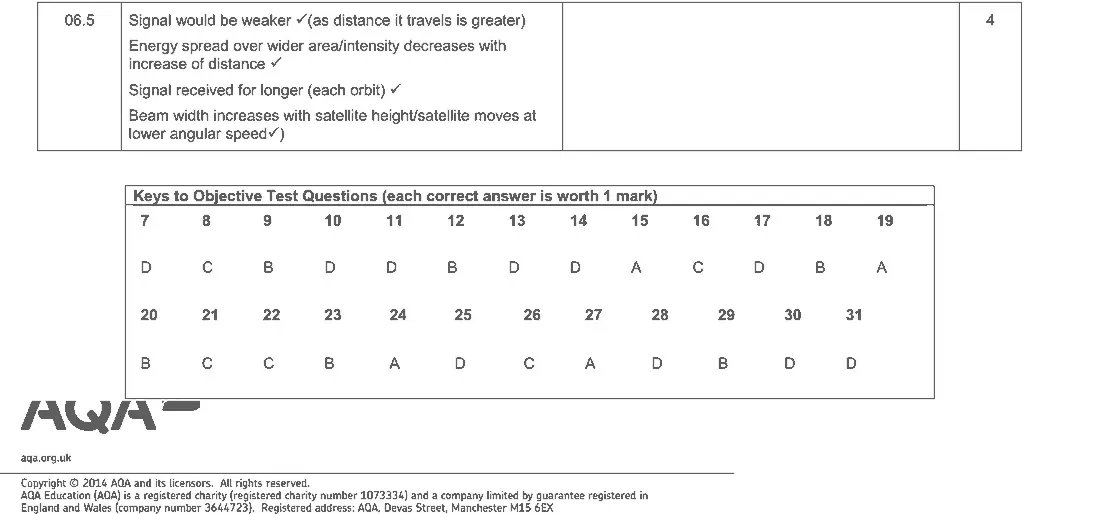
Signal weaker: greater distance, energy spread over a larger area (intensity falls)
contact time longer: wider beam and lower angular speed in a higher orbit
Specimen set 1 · Paper 2 · Q131 markMultiple choice
Answer
D
Notes from the mark scheme and report
Answer: D
Work with an AQA physics tutor
Dropping marks on calculations, required practicals or the six-markers? Book a trial session with a specialist AQA physics tutor.