Notes and key-term cards for this topic are being written by our tutors. The past-paper questions below are ready now.
Specification statements
Show the 16 statements from the specification
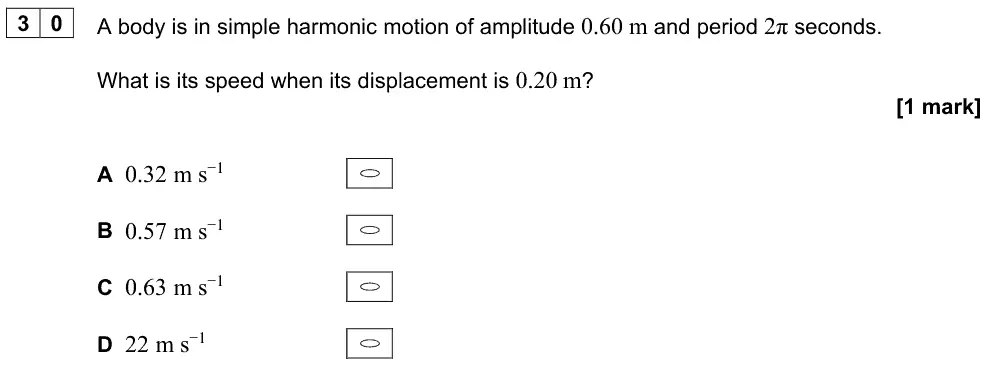
3.6.1.2-01 Analysis of characteristics of simple harmonic motion (SHM).
3.6.1.2-02 Condition for SHM: a ∝−x
3.6.1.2-03 Defining equation: a = −ω 2x x = Acosωt and v = ± ω A 2 −x 2
3.6.1.2-04 Graphical representations linking the variations of x, v and a with time.
3.6.1.2-05 Appreciation that the v −t graph is derived from the gradient of the x −t graph and that the a −t graph is derived from the gradient of the v −t graph.
3.6.1.2-06 Maximum speed = ωA
3.6.1.2-07 Maximum acceleration = ω 2A
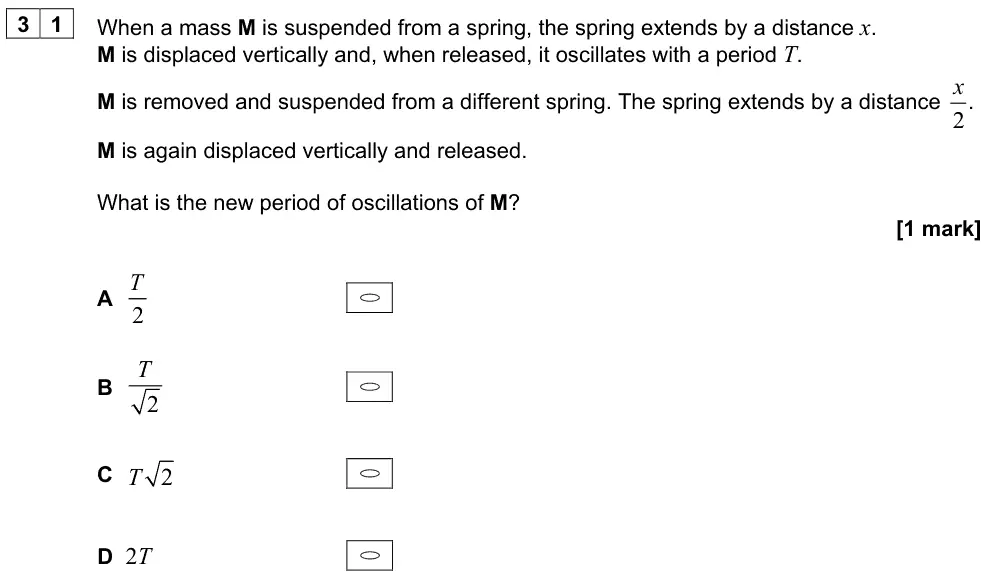
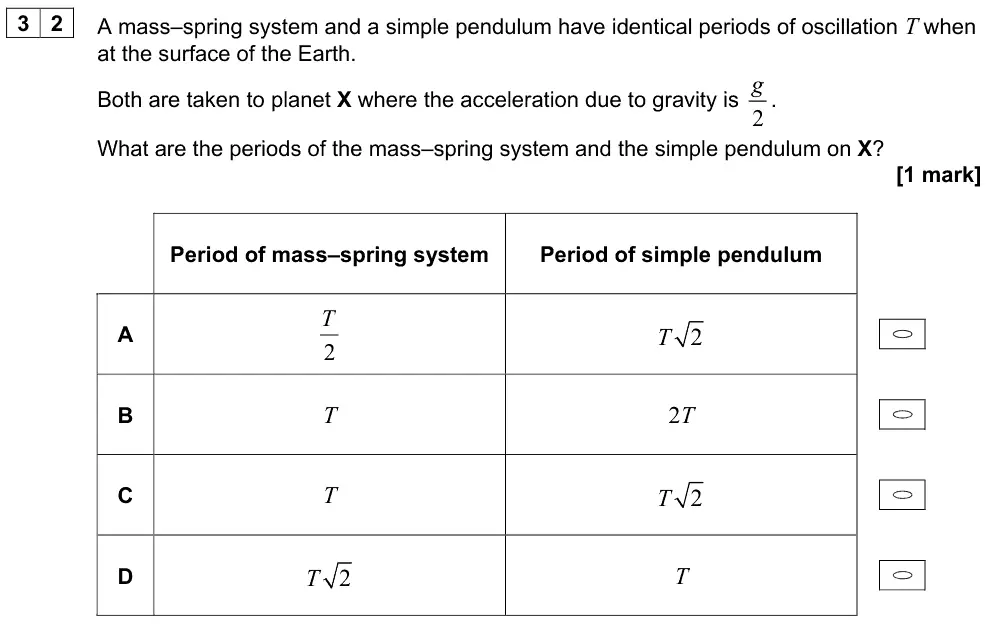
3.6.1.3-01 Study of mass-spring system: T = 2π m k
3.6.1.3-02 Study of simple pendulum: T = 2π g l
3.6.1.3-03 Questions may involve other harmonic oscillators (eg liquid in U-tube) but full information will be provided in questions where necessary.
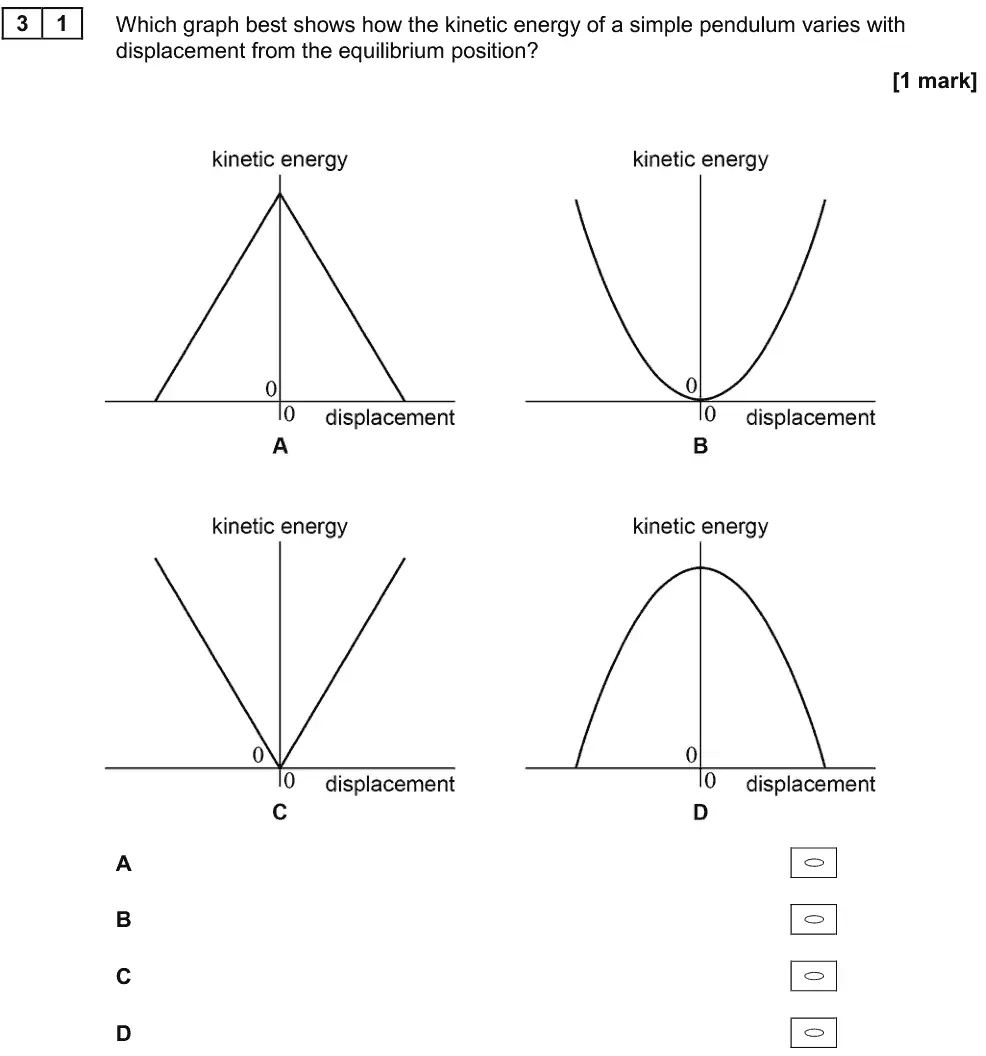
3.6.1.3-04 Variation of Ek, Ep, and total energy with both displacement and time.
3.6.1.3-05 Effects of damping on oscillations.
3.6.1.3-06 Required practical 7: Investigation into simple harmonic motion using a mass–spring system and a simple pendulum.
3.6.1.4-01 Qualitative treatment of free and forced vibrations.
3.6.1.4-02 Resonance and the effects of damping on the sharpness of resonance.
3.6.1.4-03 Examples of these effects in mechanical systems and situations involving stationary waves.
Tap a question to zoom it. Where a part needs a figure, table or graph from earlier in the question, that part folds out above it; the mark scheme and examiner's comment open underneath. Have the AQA data and formulae booklet beside you (see the formula sheet page).
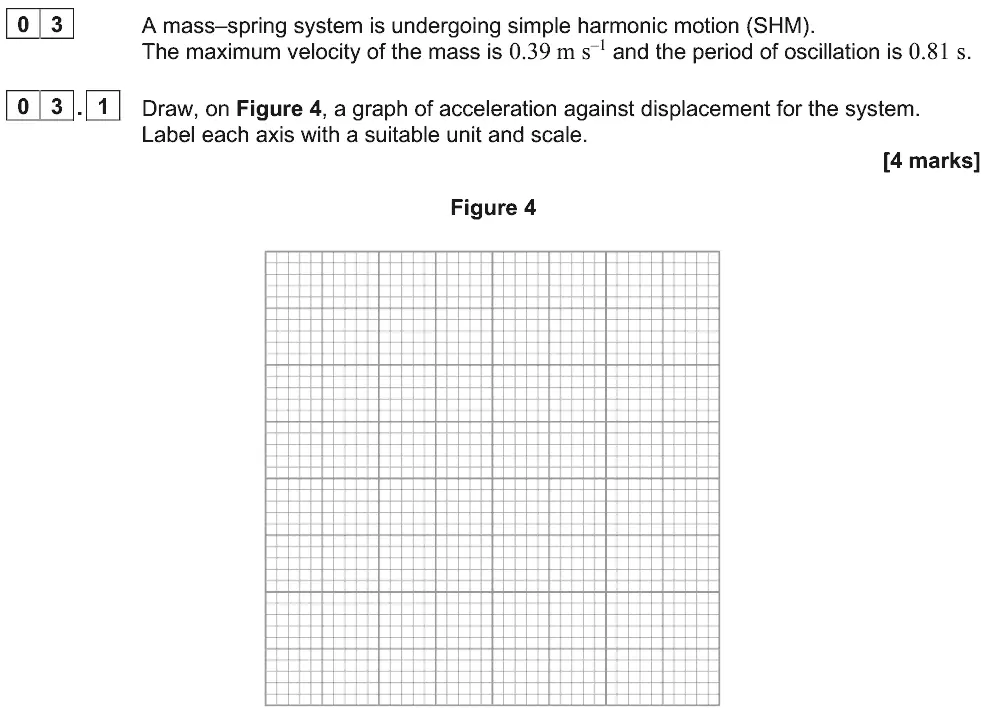
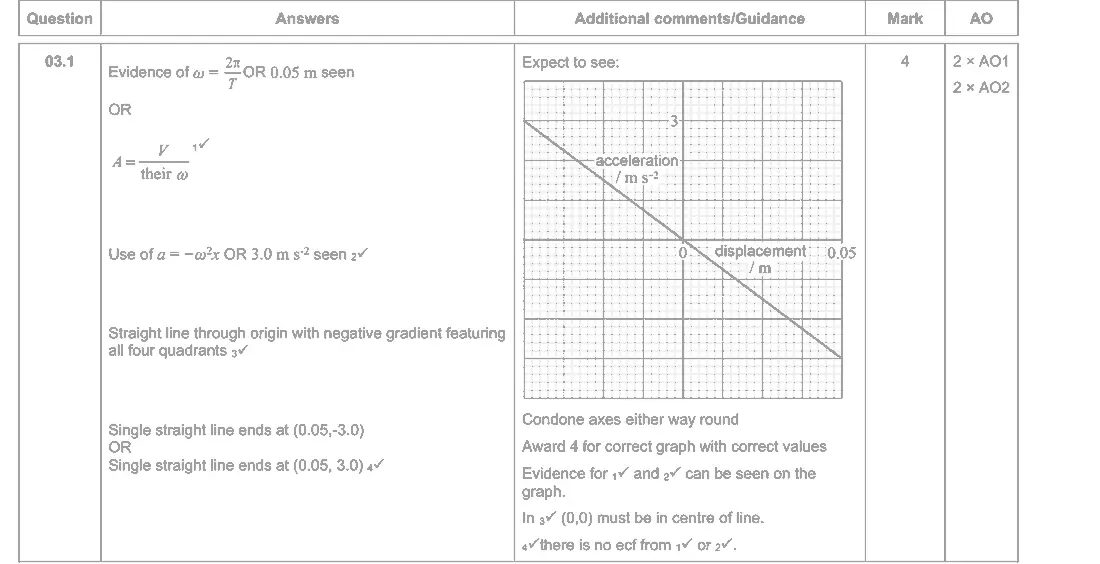
June 2025 · Paper 1 · Q3.14 marksAO1=2, AO2=2Diagram or graph
Mark scheme
Examiner's comment
Question 3.2 was the hardest one on the paper. Only those who had a straight line in 3.1 had much chance of gaining this mark. For these students the most common error was to label the point halfway along the line.
Question 2.4 discriminated well and gave a good spread of marks. Over 20% gained all five marks for this question. Common errors included using 2m for L, or thinking that W was the weight of the wire. Correct answers worked out the mass per unit length for both wires, calculated the first and fifth harmonics for all combinations, and showed that the combination of wire B and 1N produced both harmonics between 1Hz and 50Hz. Many students missed out on the fourth marking point as they did not make an explicit comparison. Alternative approaches, using the wavelength of the standing wave for example, were seen and given full credit if correct. Question 3.1 discriminated well and produced a good spread of marks. Many students were able to calculate the amplitude and maximum acceleration. Much fewer went on to draw the correct line. Sine curves were the most common incorrect answer. Even those who drew a straight line often only used one quadrant or had a positive slope.
Notes from the mark scheme and report
Answer: straight line through origin with negative gradient from (-0.05 m, 3.0 m s^-2) to (0.05 m, -3.0 m s^-2) (omega = 7.76 rad s^-1, A = 0.050 m, a max = 3.0 m s^-2)
sine curves and one-quadrant or positive-slope lines were common
Skills: MS3.1 Translate information between graphical, numerical and algebraic forms; MS2.3 Substitute numerical values into algebraic equations using appropriate units for physical quantities
June 2025 · Paper 1 · Q3.21 markAO1=1Diagram or graph
Earlier part of question 3 that this part uses
Mark scheme
Examiner's comment
Question 3.2 was the hardest one on the paper. Only those who had a straight line in 3.1 had much chance of gaining this mark. For these students the most common error was to label the point halfway along the line.
Notes from the mark scheme and report
P at x = A/root 2 = 3.54 x 10^-2 m (a = 2.1 m s^-2)
commonest error was marking the halfway point
hardest question on the paper
Skills: MS3.1 Translate information between graphical, numerical and algebraic forms
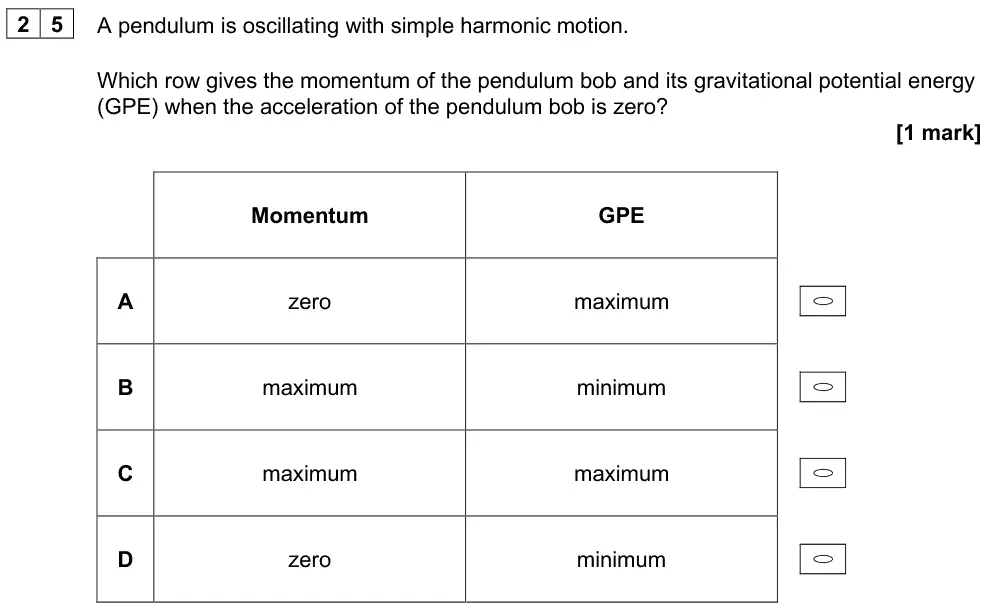
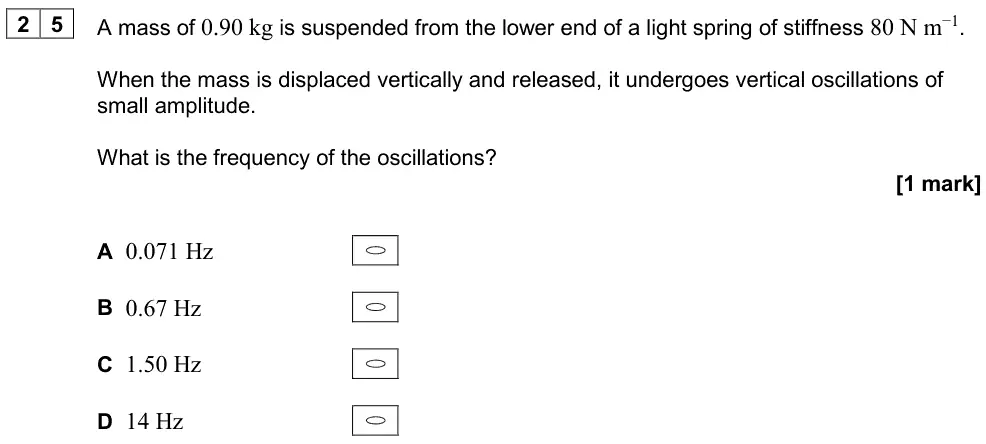
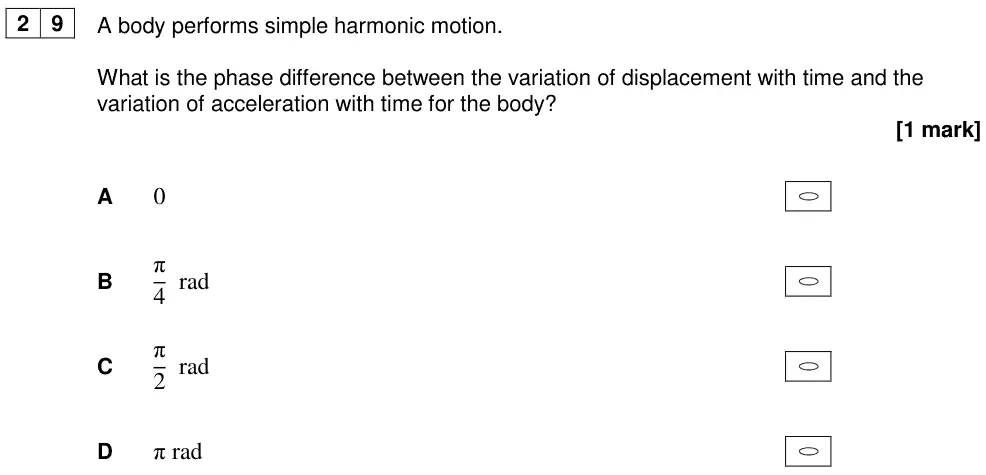
June 2025 · Paper 1 · Q251 markAO1=1Multiple choice
Answer
B
Mark scheme
Notes from the mark scheme and report
Answer: B
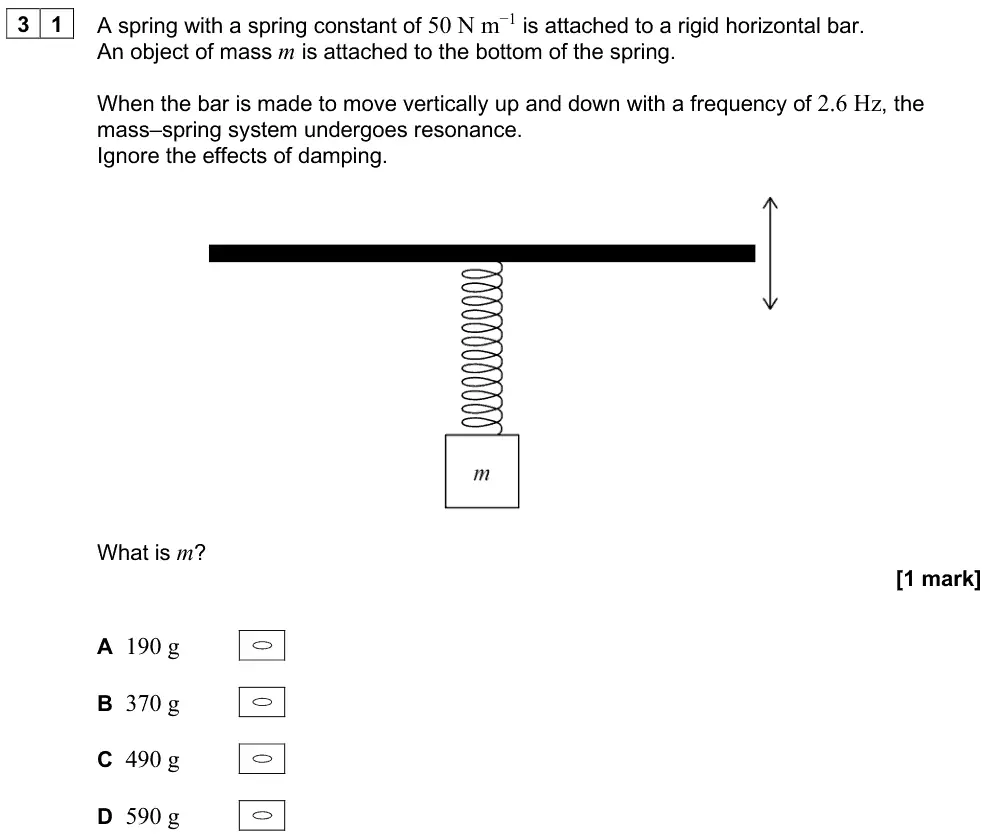
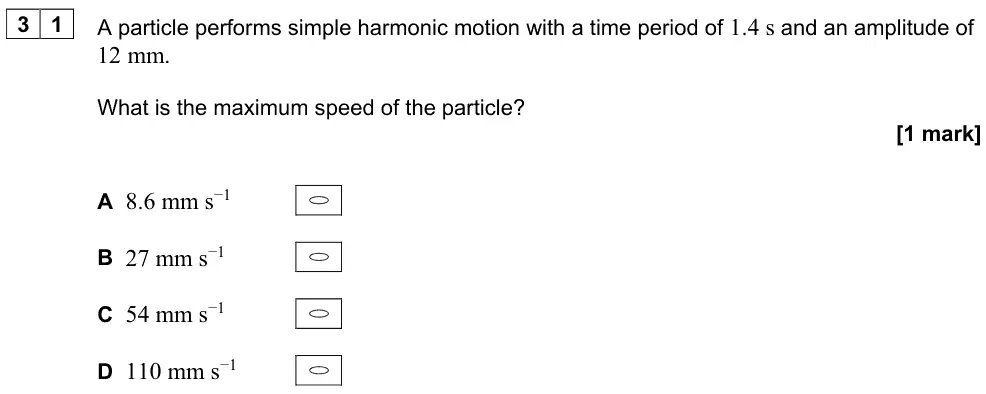
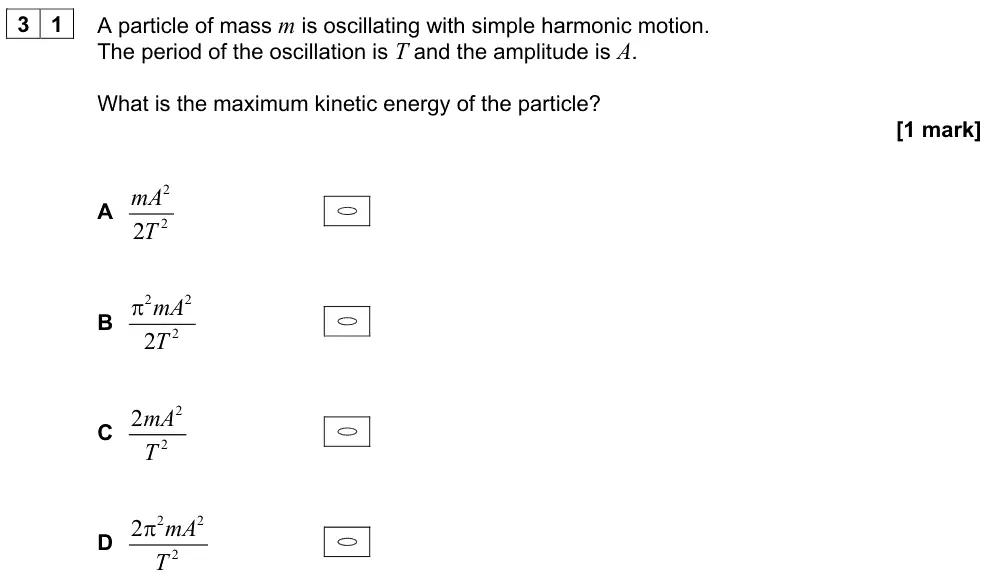
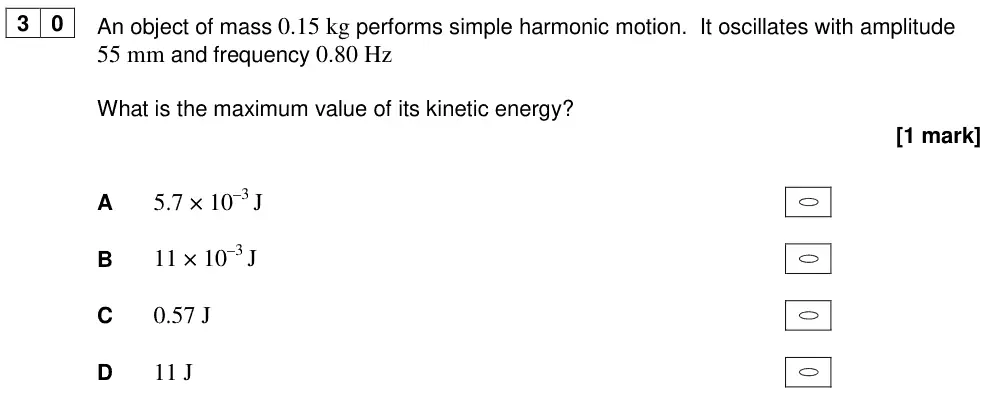
June 2025 · Paper 1 · Q311 markAO2=1Multiple choice
Answer
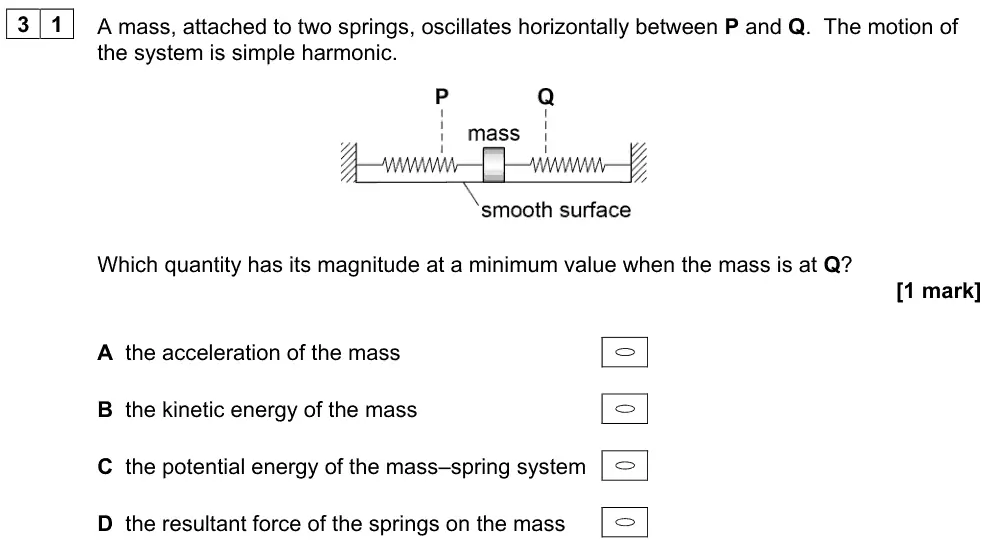
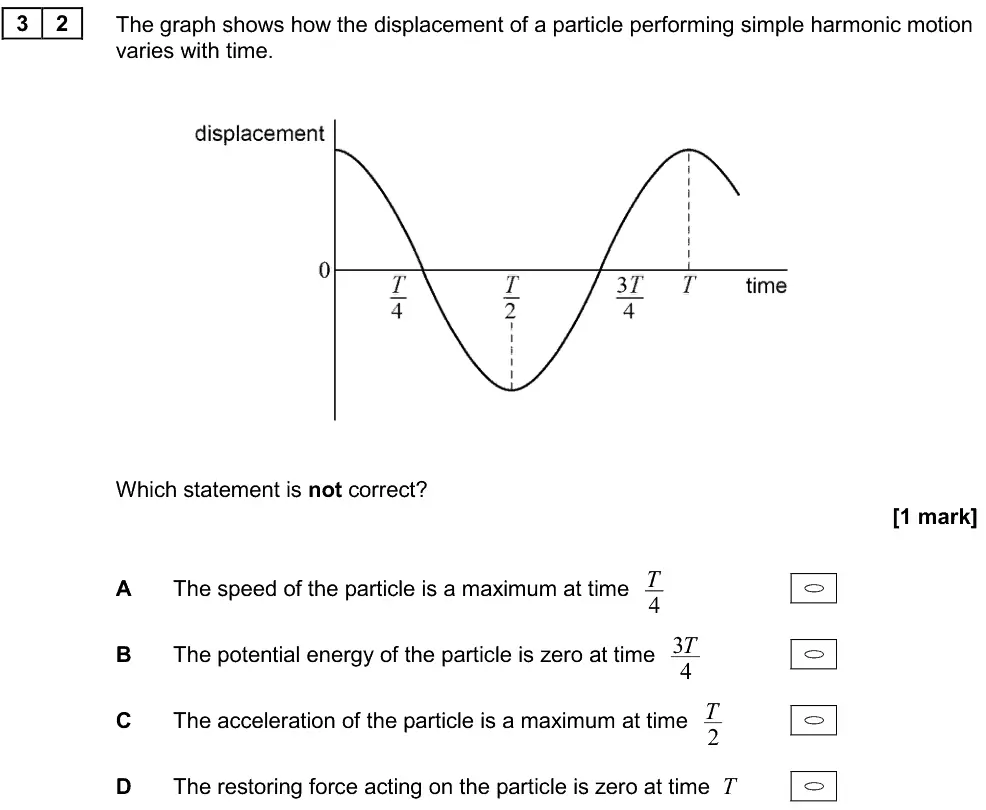
A
Mark scheme
Notes from the mark scheme and report
Answer: A
Skills: MS2.2 Change the subject of an equation, including non-linear equations
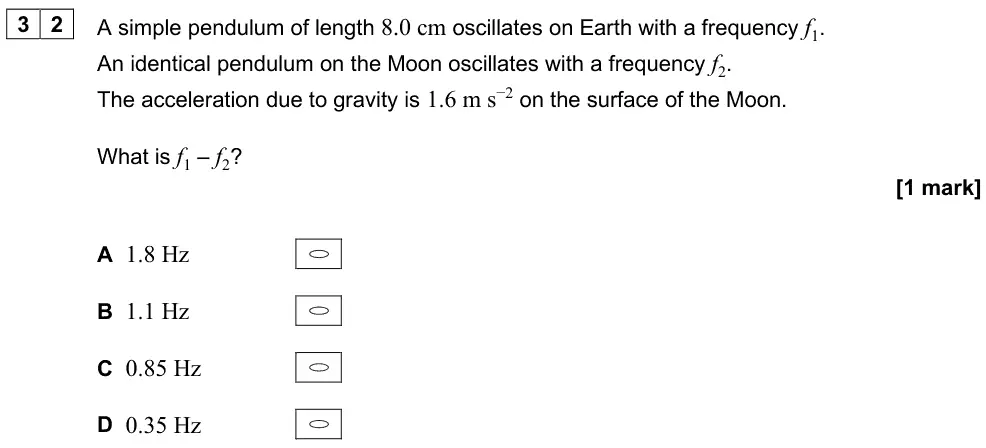
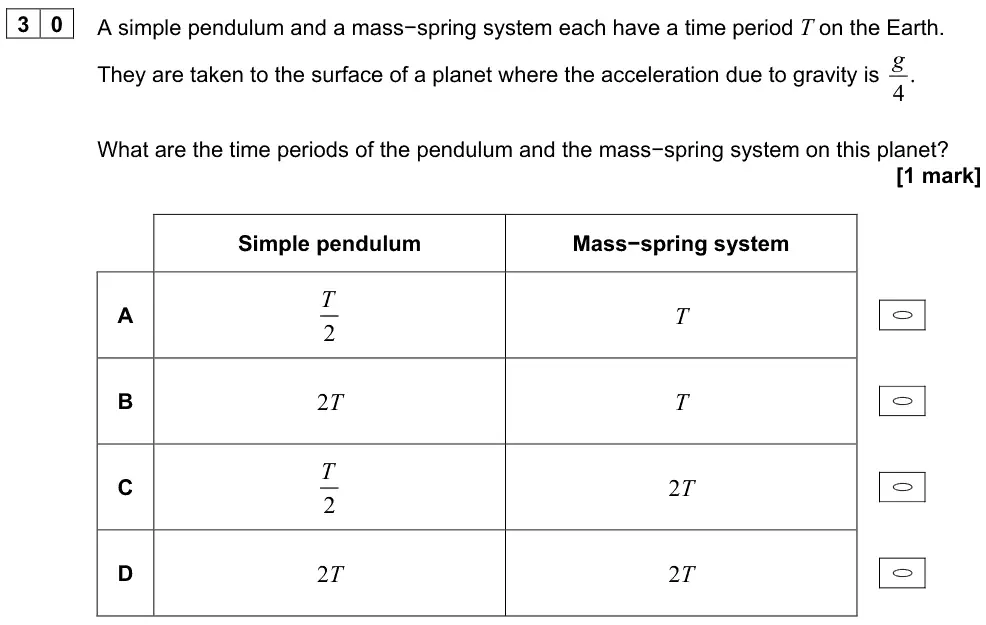
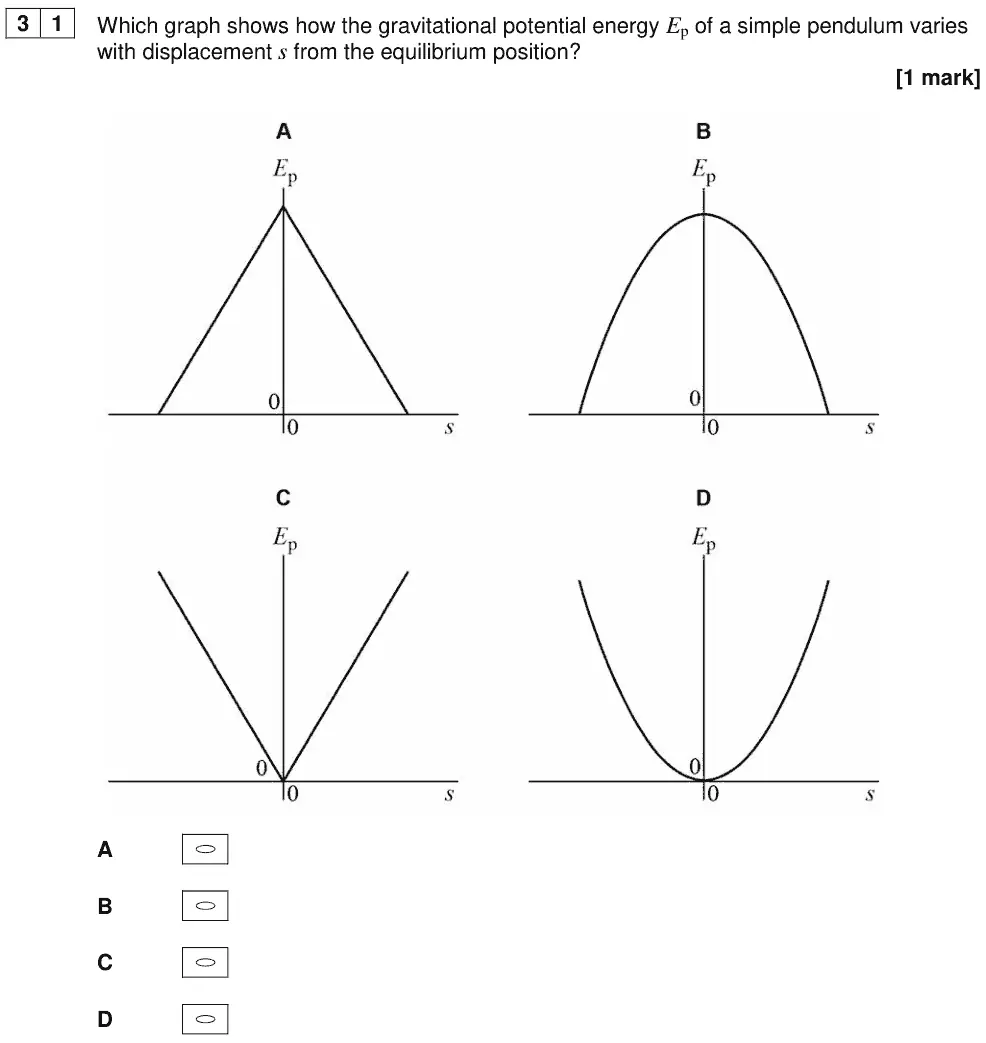
June 2025 · Paper 1 · Q321 markAO2=1Multiple choice
Answer
B
Mark scheme
Notes from the mark scheme and report
Answer: B
Skills: MS2.3 Substitute numerical values into algebraic equations using appropriate units for physical quantities
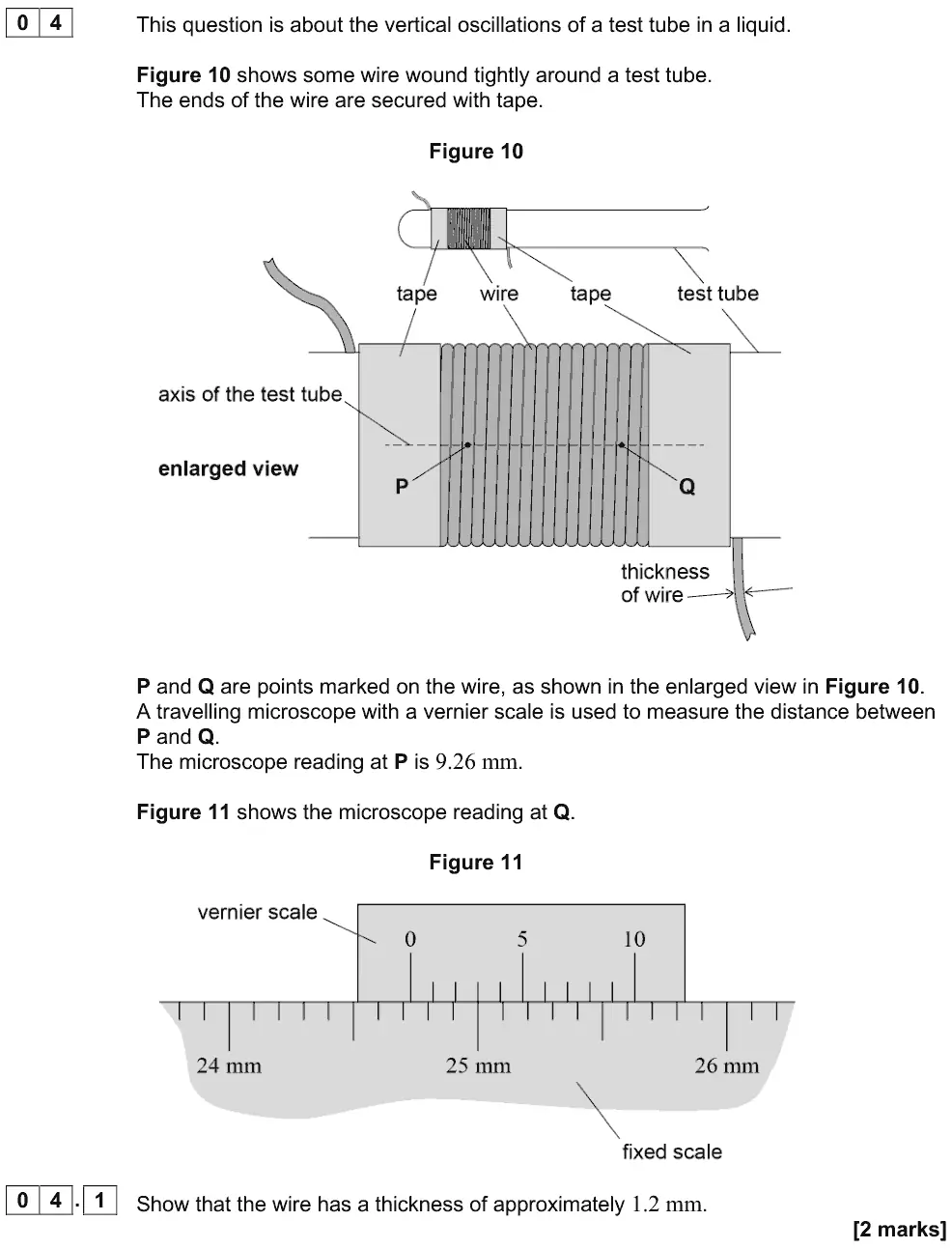
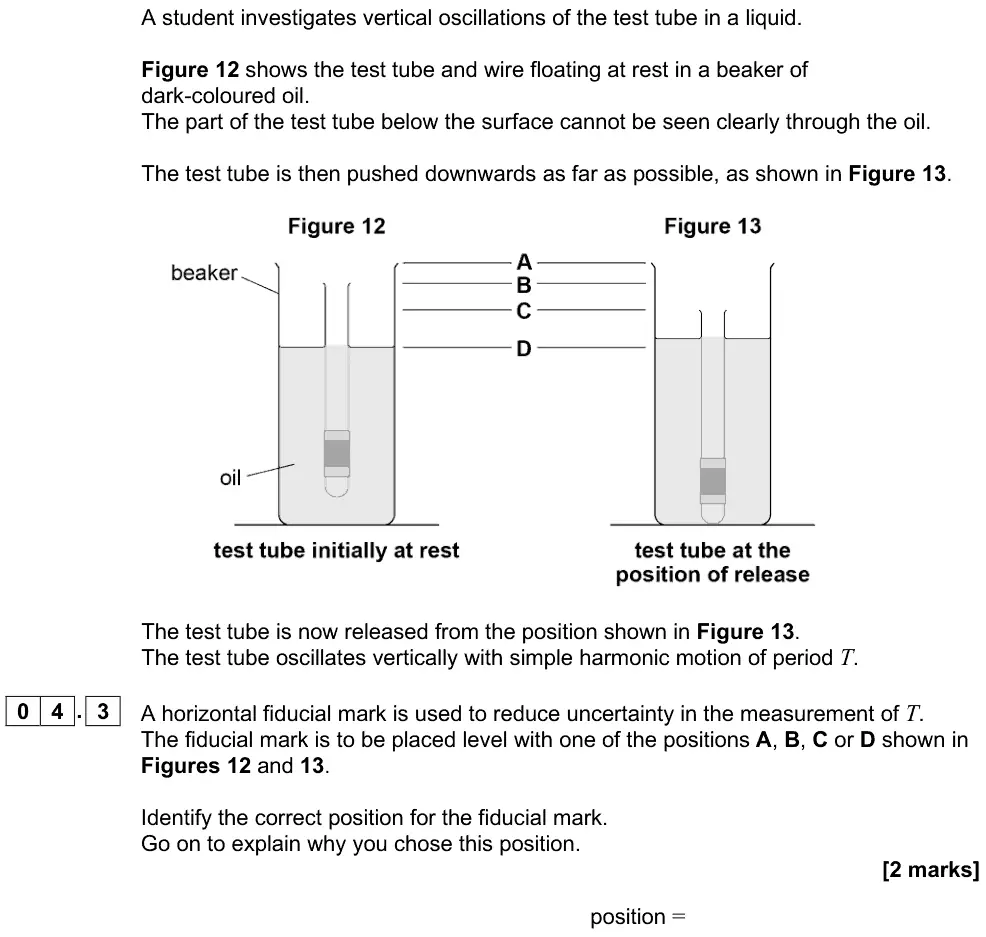
June 2025 · Paper 3 Section A · Q4.32 marksAO1=2Practical and data analysis
Earlier part of question 4 that this part uses
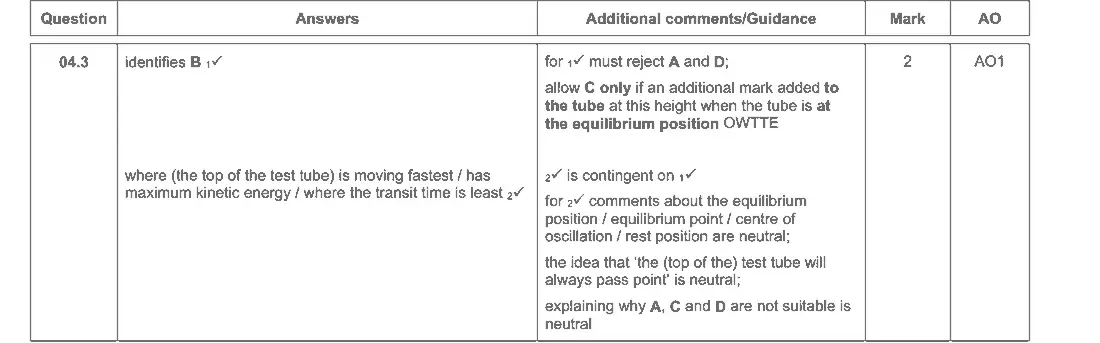
Mark scheme
Examiner's comment
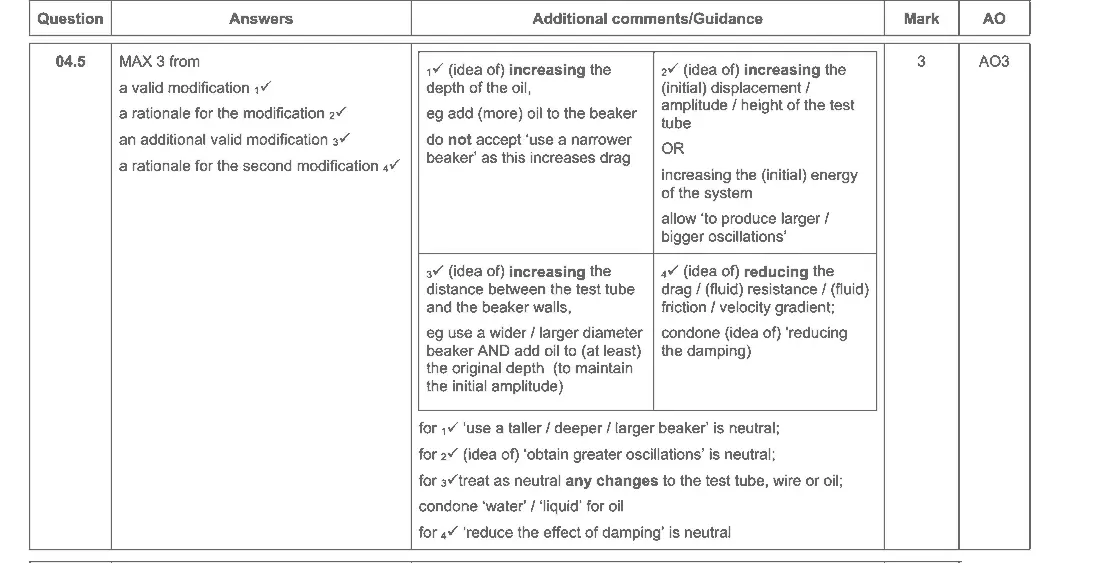
In 04.3 less than 50% correctly identified position B as the correct position for the fiducial mark. 04.4 was a simple problem and over 60% got fully correct answers. Part 04.5 presented a tricky problem. Many realised that to produce more oscillations the initial amplitude should be larger. However, the test tube was already in contact with the bottom of the beaker as it was released. This tempted some to suggest using a deeper beaker but that would not change the depth of the test tube when at rest. Others thought the beaker could be made narrower which would increase the depth at which the test tube floated, however that would increase the drag on the test tube due to the proximity of the walls. Therefore, to increase the initial amplitude the only available solution was to add more liquid.
Students knew what a fiducial mark is, but in part 04.3 only those who identified B could get a second mark for explaining their choice. We did not accept ‘B is at the equilibrium position’ since each of the four positions shown in Figure 12 was level with a point on the test tube that was in equilibrium. Only part 04.5 proved harder than 04.3. Students found the easiest parts to be 03.3 and 04.4.
Notes from the mark scheme and report
B, the equilibrium position, where the tube moves fastest so the timing judgement is most precise
less than 50% correct
Skills: ATc methods to increase accuracy (timing over many oscillations, fiducial marker, set square, plumb line); PS4.1 Know and understand how to use a wide range of experimental and practical instruments, equipment and techniques
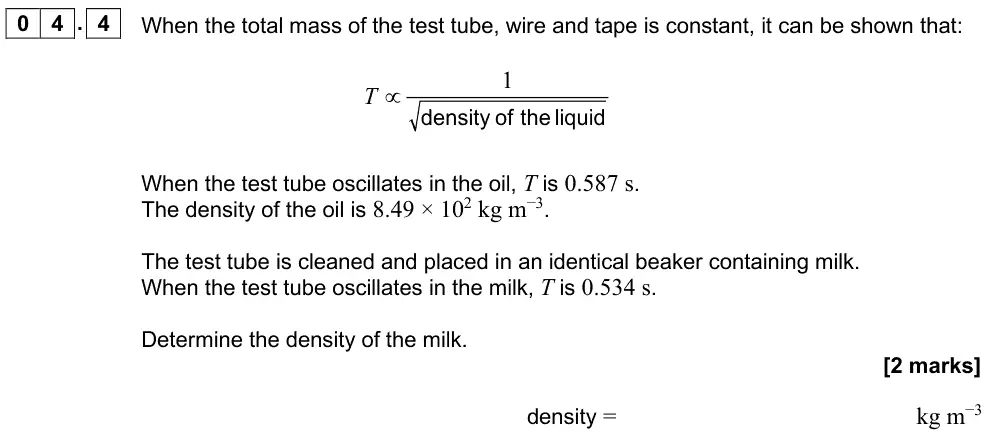
June 2025 · Paper 3 Section A · Q4.42 marksAO1=1, AO2=1CalculationEasy
Earlier part of question 4 that this part uses
Mark scheme
Examiner's comment
In 04.3 less than 50% correctly identified position B as the correct position for the fiducial mark. 04.4 was a simple problem and over 60% got fully correct answers. Part 04.5 presented a tricky problem. Many realised that to produce more oscillations the initial amplitude should be larger. However, the test tube was already in contact with the bottom of the beaker as it was released. This tempted some to suggest using a deeper beaker but that would not change the depth of the test tube when at rest. Others thought the beaker could be made narrower which would increase the depth at which the test tube floated, however that would increase the drag on the test tube due to the proximity of the walls. Therefore, to increase the initial amplitude the only available solution was to add more liquid.
The maths skills utilised in the AO2 parts 01.3, 02.3, 03.1 and 04.4 were mostly sound and particularly strong in 02.4 where we saw a lot of completely correct solutions that were easy to follow. Less well-organised students tended to have multiple threads to their arguments and spread their work haphazardly across the answer space; their grip on the algebra tended to quickly fall apart.
Most students showed their working and, in several parts, e.g. 01.3 and 04.4, we saw evidence to award 1 mark even when a final answer could not score. AQA expect that when the command words Deduce and Determine are used, correct working must be shown, whereas for Calculate only the final answer is required. It is recommended that working is shown at all times, however.
Students knew what a fiducial mark is, but in part 04.3 only those who identified B could get a second mark for explaining their choice. We did not accept ‘B is at the equilibrium position’ since each of the four positions shown in Figure 12 was level with a point on the test tube that was in equilibrium. Only part 04.5 proved harder than 04.3. Students found the easiest parts to be 03.3 and 04.4.
Notes from the mark scheme and report
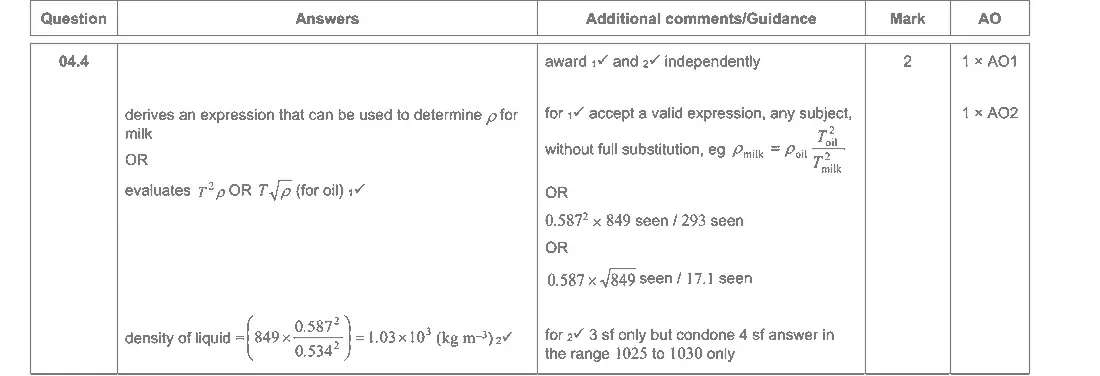
Answer: 1.03 x 10^3 kg m^-3 (rho_milk = 849 x (0.587/0.534)^2)
over 60% fully correct
Skills: MS0.3 Use ratios, fractions and percentages; MS2.2 Change the subject of an equation, including non-linear equations
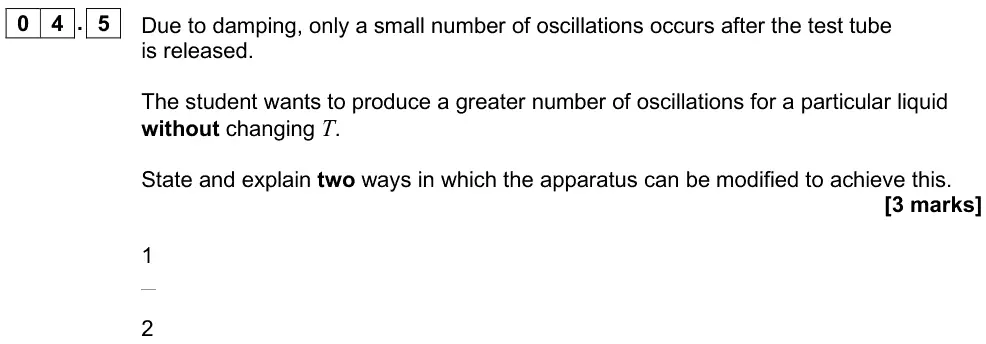
June 2025 · Paper 3 Section A · Q4.53 marksAO3=3Practical and data analysis
Earlier part of question 4 that this part uses
Mark scheme
Examiner's comment
In 04.3 less than 50% correctly identified position B as the correct position for the fiducial mark. 04.4 was a simple problem and over 60% got fully correct answers. Part 04.5 presented a tricky problem. Many realised that to produce more oscillations the initial amplitude should be larger. However, the test tube was already in contact with the bottom of the beaker as it was released. This tempted some to suggest using a deeper beaker but that would not change the depth of the test tube when at rest. Others thought the beaker could be made narrower which would increase the depth at which the test tube floated, however that would increase the drag on the test tube due to the proximity of the walls. Therefore, to increase the initial amplitude the only available solution was to add more liquid.
Stronger students were able to confirm their ability in AO3 parts 01.5, 02.5, 04.2 and 04.5 where they had to think more imaginatively about the problems. The better-prepared knew how to deal with AO1 parts 02.1, 02.2 and 04.1 that tested familiar practical procedures, but the struggles of others suggest they may have had limited opportunities to carry out practical work.
Students knew what a fiducial mark is, but in part 04.3 only those who identified B could get a second mark for explaining their choice. We did not accept ‘B is at the equilibrium position’ since each of the four positions shown in Figure 12 was level with a point on the test tube that was in equilibrium. Only part 04.5 proved harder than 04.3. Students found the easiest parts to be 03.3 and 04.4.
Notes from the mark scheme and report
Add more oil (deeper) so a larger initial amplitude/energy is possible
use a wider beaker (filled to at least the same depth) to reduce drag near the walls
narrower beaker increases drag
T must not change
Skills: PS2.1 Comment on experimental design and evaluate scientific methods; PS1.1 Solve problems set in practical contexts
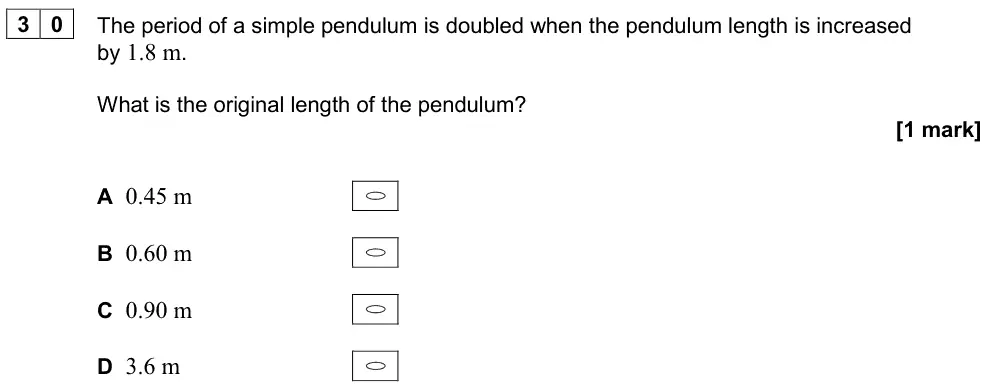
June 2024 · Paper 1 · Q301 markAO1=1Multiple choice
Answer
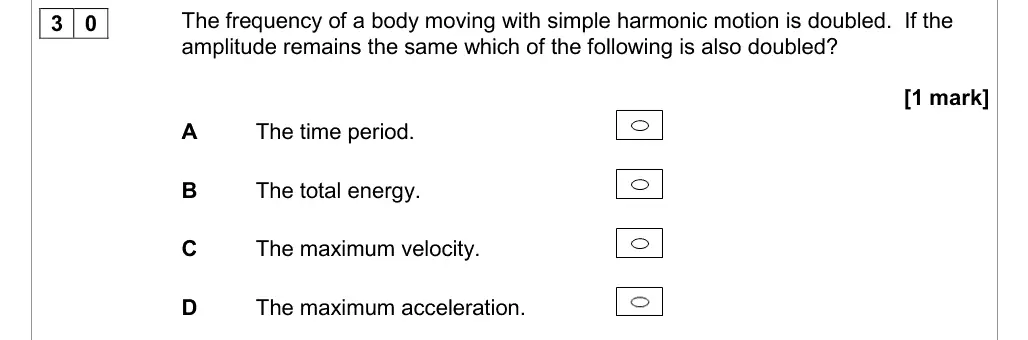
B
Mark scheme
Notes from the mark scheme and report
Answer: B
June 2024 · Paper 1 · Q311 markAO2=1Multiple choice
Answer
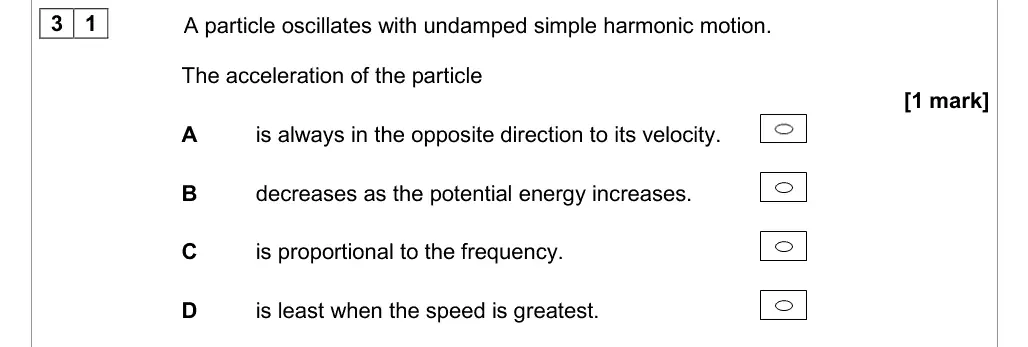
B
Mark scheme
Notes from the mark scheme and report
Answer: B
Skills: MS0.3 Use ratios, fractions and percentages
June 2024 · Paper 1 · Q321 markAO2=1Multiple choice
Answer
C
Mark scheme
Notes from the mark scheme and report
Answer: C
Skills: MS0.3 Use ratios, fractions and percentages
June 2023 · Paper 1 · Q6.12 marksShow that
Mark scheme
Examiner's comment
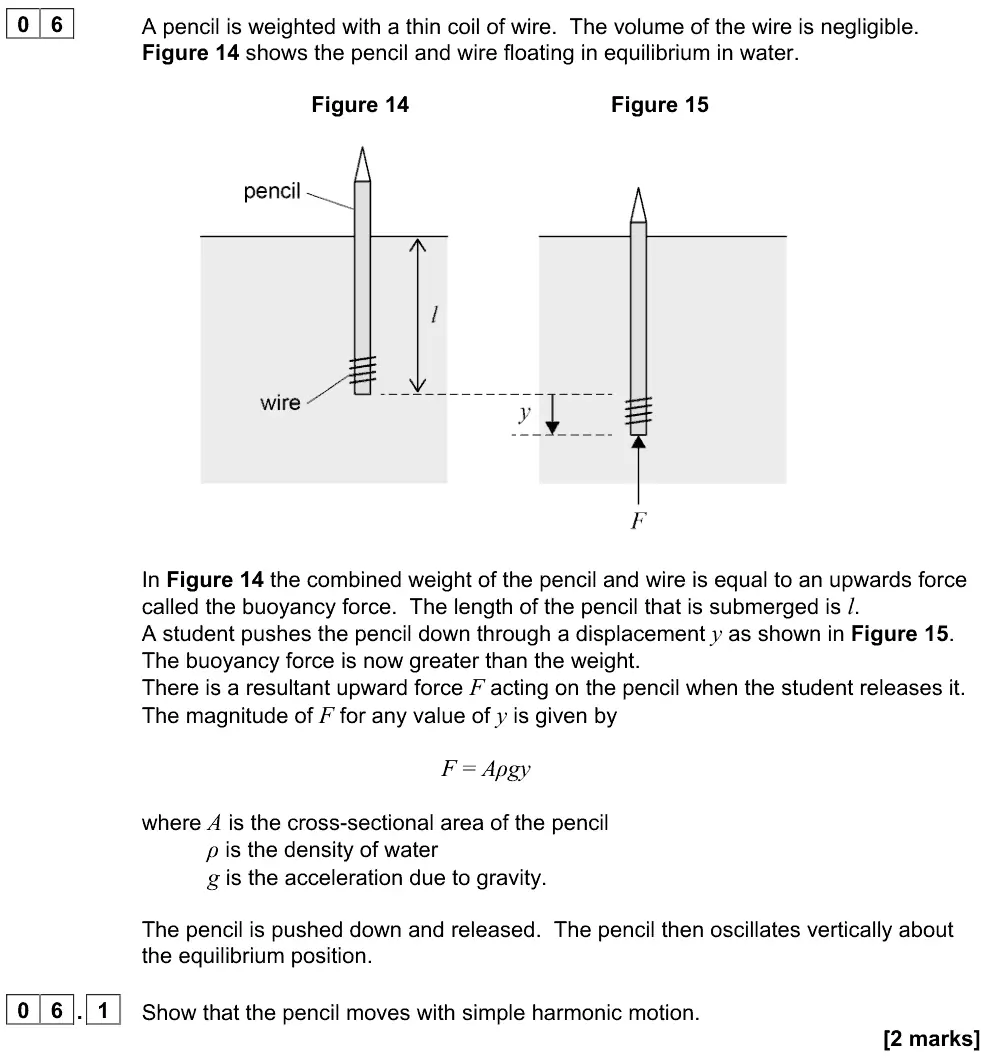
06.1 It was clear that many students had little idea about how the equation for SHM can be obtained. Having the force equation on page 20 of the question paper gave some students a starting point, but relating it to the acceleration with a negative sign, or stating which factors were constant, was rarely seen. Commonly students simply stated the conditions for SHM without relating it to the context.
Notes from the mark scheme and report
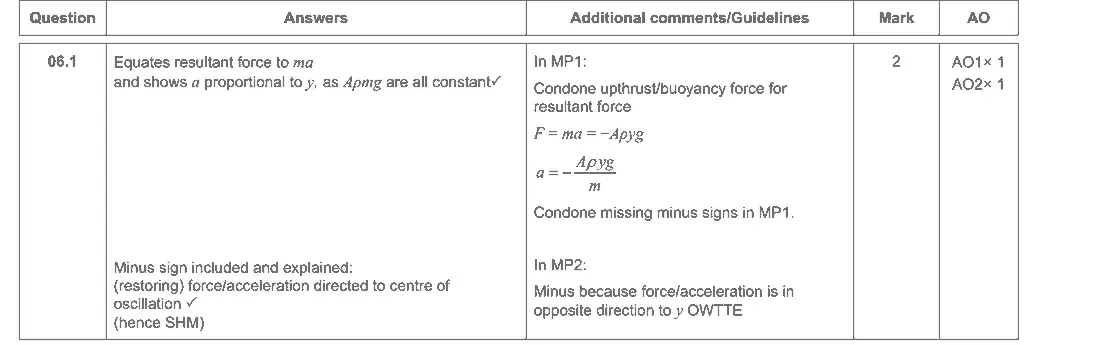
ma = -A rho g y so a is proportional to -y (A, rho, g, m constant)
minus sign because acceleration is towards equilibrium
stating SHM conditions without the context gained little
Skills: MS2.2 Change the subject of an equation, including non-linear equations
June 2023 · Paper 1 · Q6.22 marksCalculation
Earlier part of question 6 that this part uses
Mark scheme
Examiner's comment
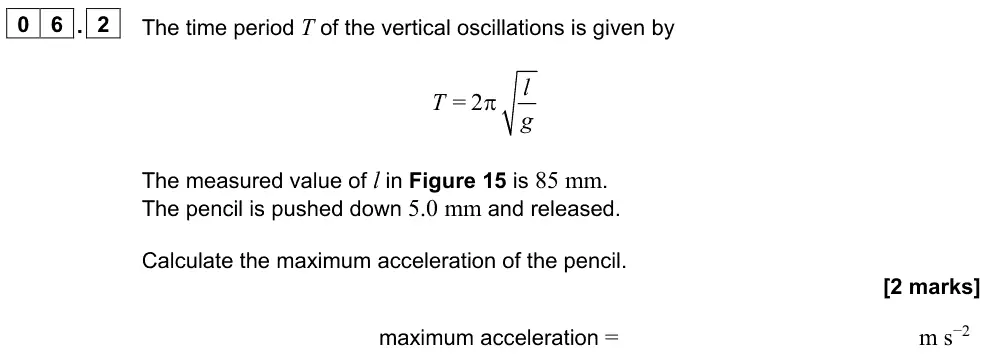
06.2 The calculation was much more straightforward with over half of students getting both marks. The mark scheme allowed those who could go no further to gain one mark for using a value of or similar. Common errors included adding the amplitude when calculating the period, or using the total distance submerged as the amplitude when calculating the acceleration.
adding amplitude to l or using l as amplitude were errors
Skills: MS2.3 Substitute numerical values into algebraic equations using appropriate units for physical quantities; MS0.2 Recognise and use expressions in decimal and standard form
June 2023 · Paper 1 · Q6.32 marksAO1=2Short answer
Earlier part of question 6 that this part uses
Mark scheme
Examiner's comment
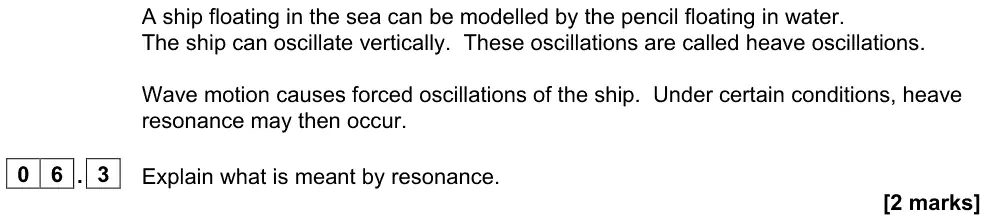
06.3 This proved to be quite challenging. Students who made no reference to the amplitude being a maximum at resonance were limited to one mark. Other answers showed some difficulty with the idea of driving frequency. Some good answers were seen that made use of a labelled sketch graph.
Notes from the mark scheme and report
Driving (forcing) frequency equals natural frequency and amplitude is a maximum
labelled amplitude-frequency sketch accepted
June 2023 · Paper 1 · Q6.43 marksAO3=3Calculation
Earlier part of question 6 that this part uses
Mark scheme
Examiner's comment
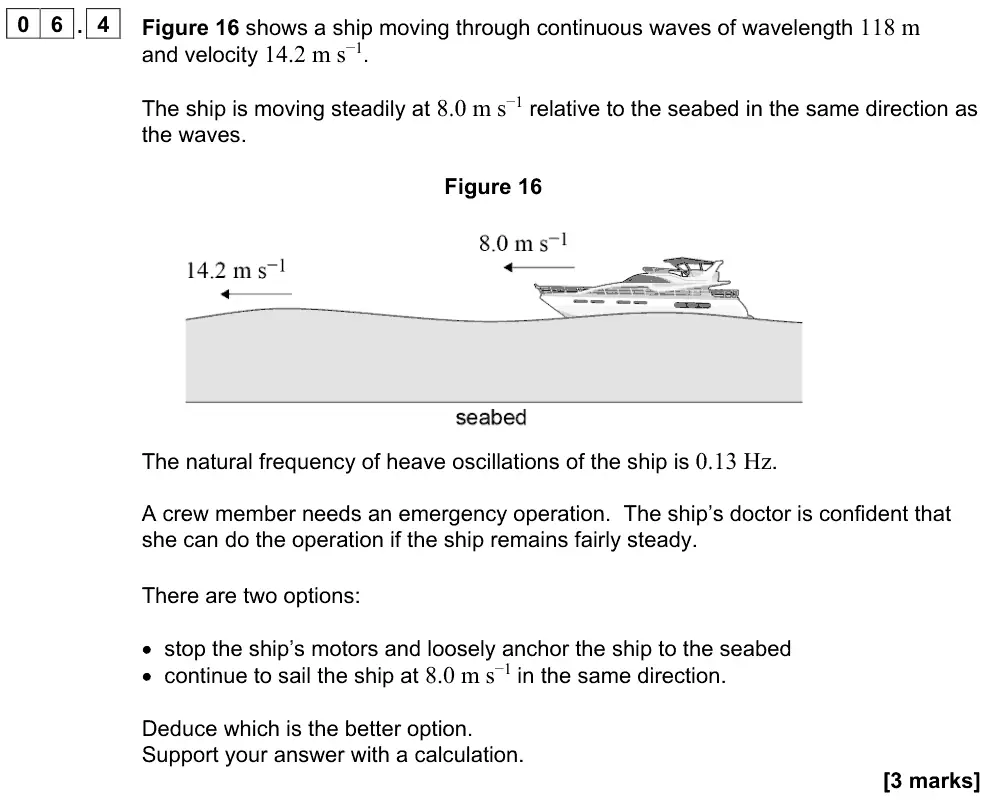
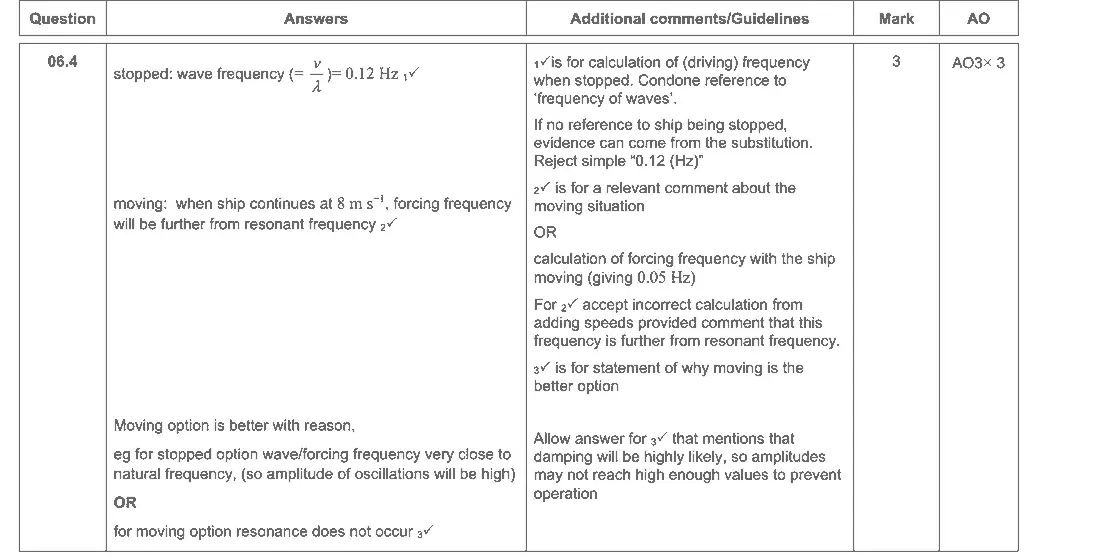
06.4 A question that discriminated very well. More than 60% of students were able to get at least one mark, usually for working out the wave frequency. Nearly 40% of students were able to go further, often for stating that this was close to the natural frequency and therefore the boat should move. Full marks were given for those who also made some reference to what happened to the driving frequency when the boat was moving. This is another example of a question that tests assessment objective AO3. Students should be encouraged to practise answering questions of this kind in preparation for this examination in the future.
Notes from the mark scheme and report
Stopped: wave frequency 14.2/118 = 0.12 Hz, close to the 0.13 Hz natural frequency so resonance
moving: relative speed gives about 0.05 Hz, far from resonance, so keep sailing
Skills: MS2.3 Substitute numerical values into algebraic equations using appropriate units for physical quantities
June 2023 · Paper 1 · Q311 markMultiple choice
Answer
B
Mark scheme
Notes from the mark scheme and report
Answer: B
June 2022 · Paper 1 · Q5.52 marksAO1=2Calculation
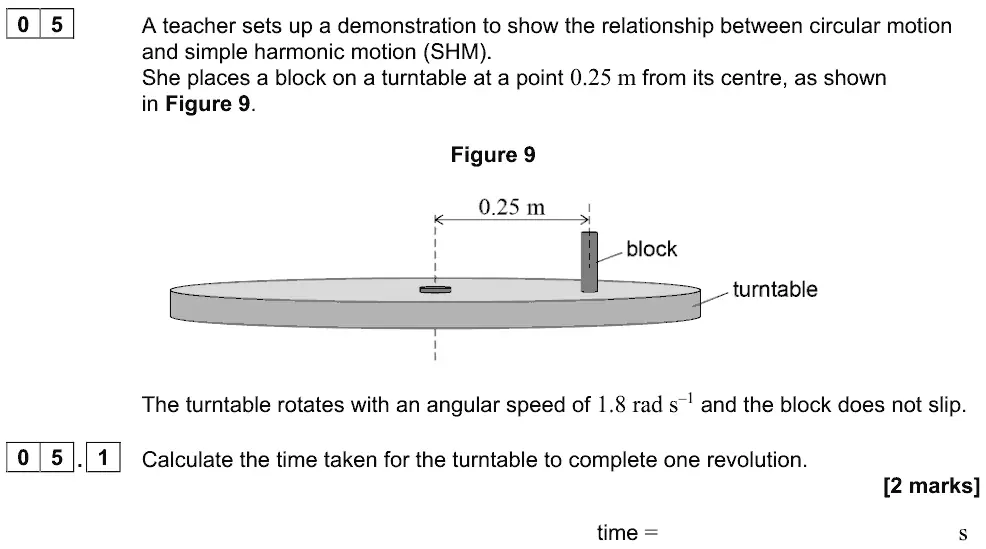
Earlier part of question 5 that this part uses
Mark scheme
Examiner's comment
The calculations in 05.1, 05.3 and 05.5 were very straightforward and caused little trouble for most students. 05.2 was more challenging. Examiners were lenient in their interpretation of the arrow, but several students lost the mark through carelessness. When drawing a direction such as this students should use a ruler and avoid ambiguity in the construction.
Notes from the mark scheme and report
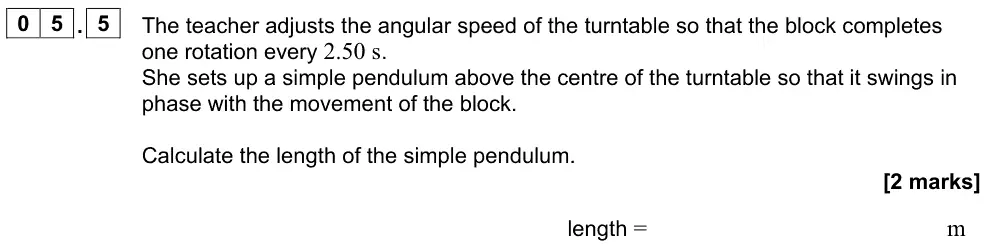
Answer: 1.55 m (T = 2.50 s in T = 2 pi root(l/g))
g = 10 gives 1.58 m, not allowed
Skills: MS2.2 Change the subject of an equation, including non-linear equations; MS2.3 Substitute numerical values into algebraic equations using appropriate units for physical quantities
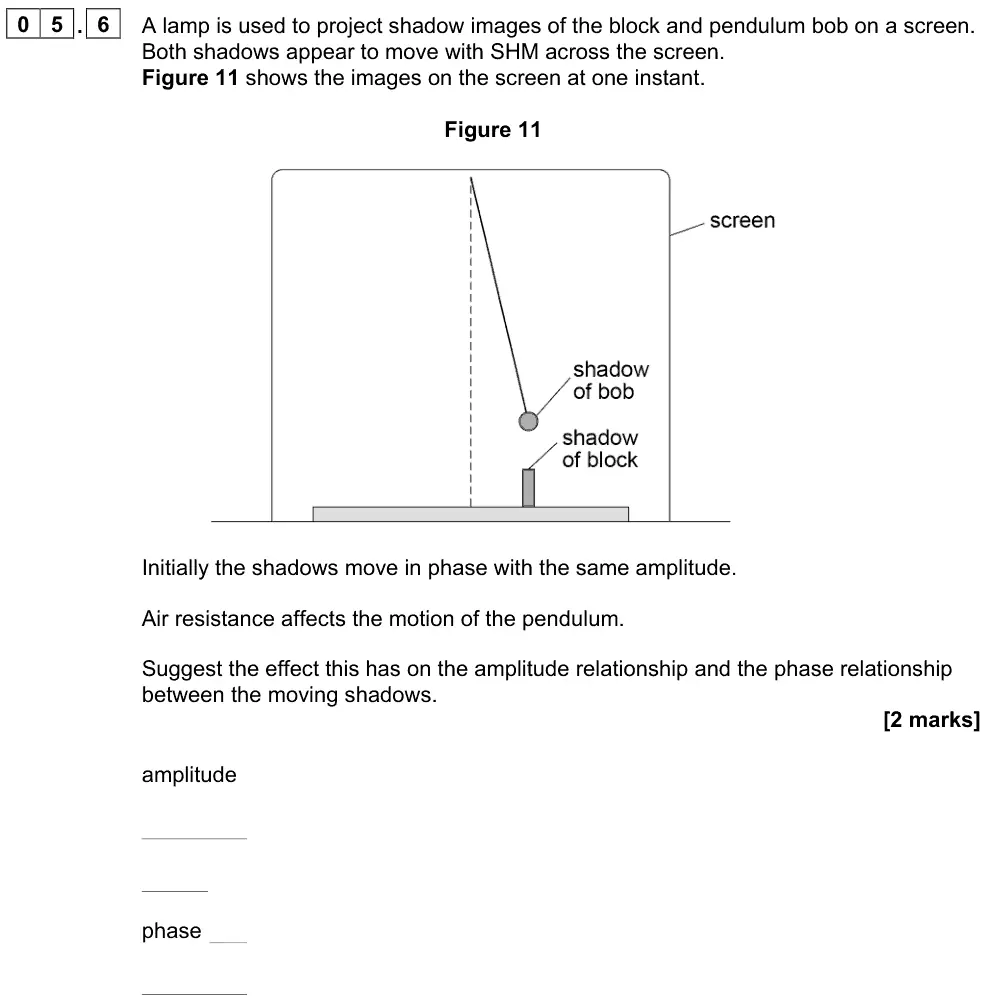
June 2022 · Paper 1 · Q5.62 marksAO3=2Explanation
Earlier part of question 5 that this part uses
Mark scheme
Examiner's comment
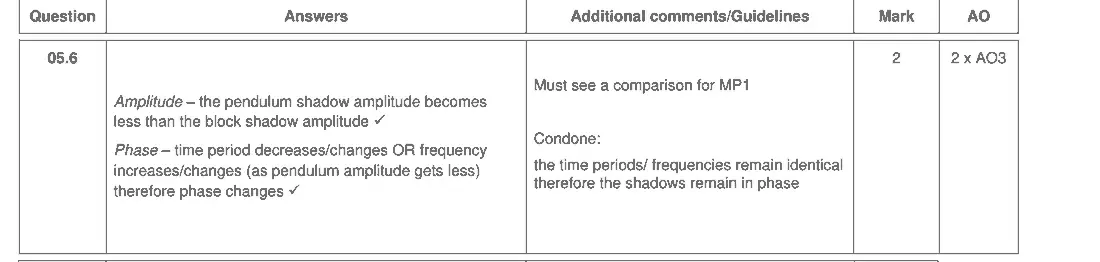
Answers to 05.6 were often incomplete. Examiners were expecting to see a comparison, but many students only discussed the effect on the pendulum. In order to gain the phase mark some supporting discussion was needed. This was partly because both no change and an in-phase change were acceptable, depending on the depth of the student’s discussion.
Notes from the mark scheme and report
Pendulum shadow amplitude becomes smaller than the block's
period/frequency changes slightly with damping so the phase drifts (or stays in phase if period unchanged, with reasoning)
a comparison is needed
June 2022 · Paper 1 · Q311 markAO2=1Multiple choice
Answer
C
Mark scheme
Notes from the mark scheme and report
Answer: C
Skills: MS2.3 Substitute numerical values into algebraic equations using appropriate units for physical quantities
November 2021 · Paper 1 · Q301 markMultiple choice
Answer
B
Mark scheme
Notes from the mark scheme and report
Answer: B
November 2021 · Paper 1 · Q311 markMultiple choice
Answer
D
Mark scheme
Notes from the mark scheme and report
Answer: D
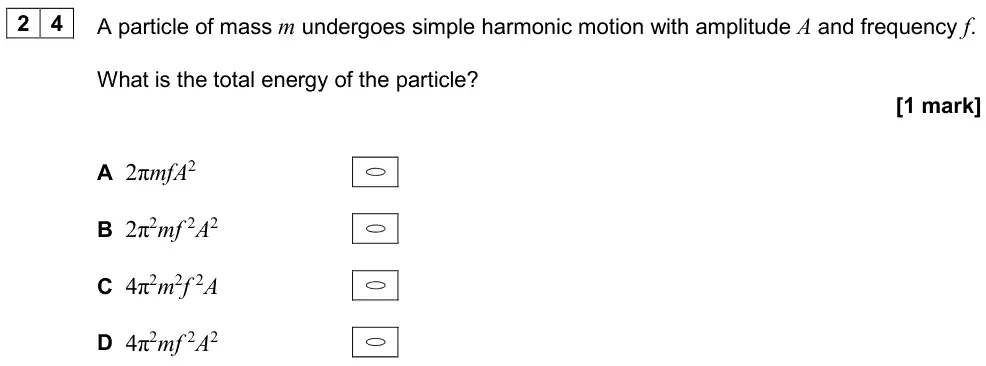
November 2020 · Paper 1 · Q241 markMultiple choice
Answer
B
Mark scheme
Notes from the mark scheme and report
Answer: B
November 2020 · Paper 1 · Q251 markMultiple choice
Answer
C
Mark scheme
Notes from the mark scheme and report
Answer: C
Skills: MS2.3 Substitute numerical values into algebraic equations using appropriate units for physical quantities
November 2020 · Paper 1 · Q301 markMultiple choice
Answer
B
Mark scheme
Notes from the mark scheme and report
Answer: B
Skills: MS2.2 Change the subject of an equation, including non-linear equations
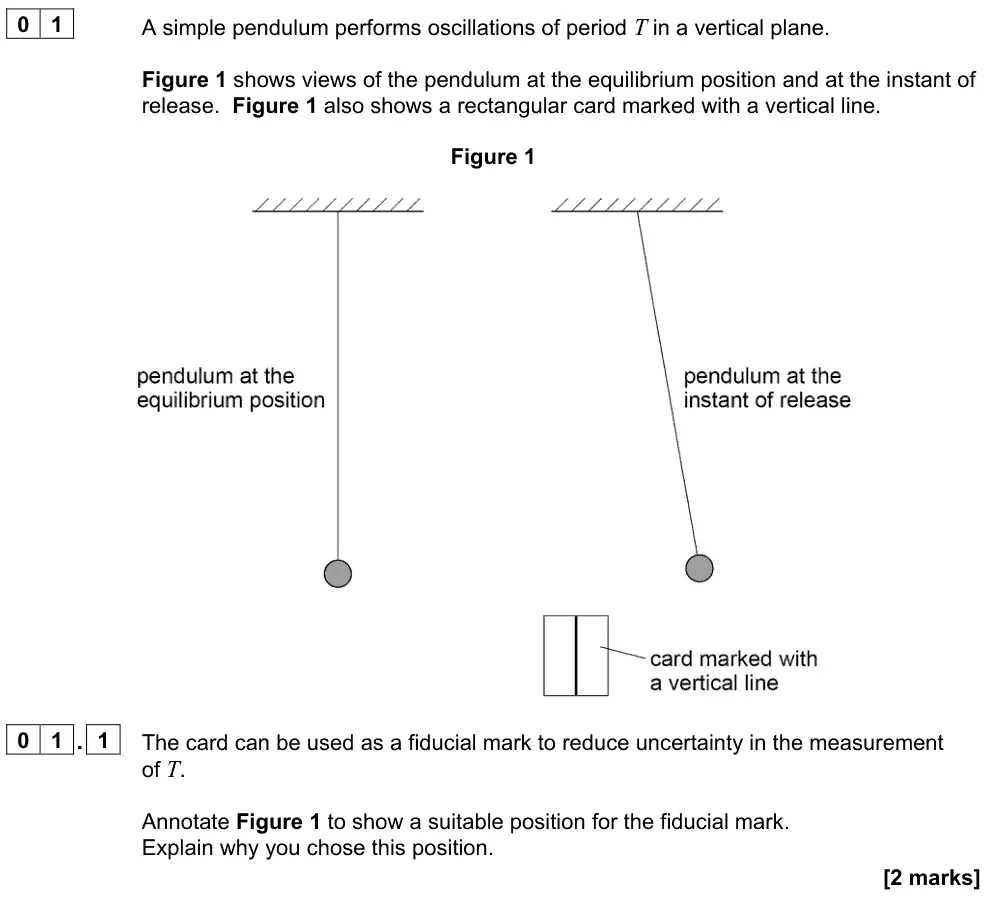
November 2020 · Paper 3 Section A · Q1.12 marksAO1=2Practical and data analysis
Mark scheme
Examiner's comment
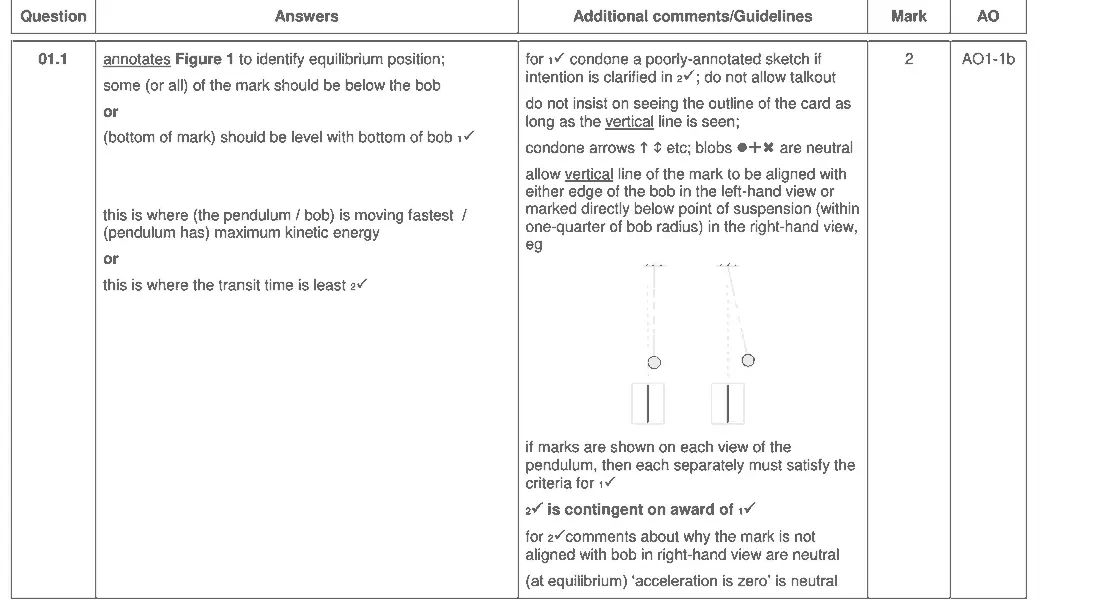
About half the students knew the mark should be at the equilibrium position in 01.1, but disappointingly few of them could explain why this was so.
Notes from the mark scheme and report
Fiducial mark at the equilibrium position (directly below suspension) because the bob moves fastest there so transit time is least
few explained why
Skills: ATc methods to increase accuracy (timing over many oscillations, fiducial marker, set square, plumb line); PS4.1 Know and understand how to use a wide range of experimental and practical instruments, equipment and techniques; RP7 Investigation into simple harmonic motion using a mass–spring system and a simple pendulum.
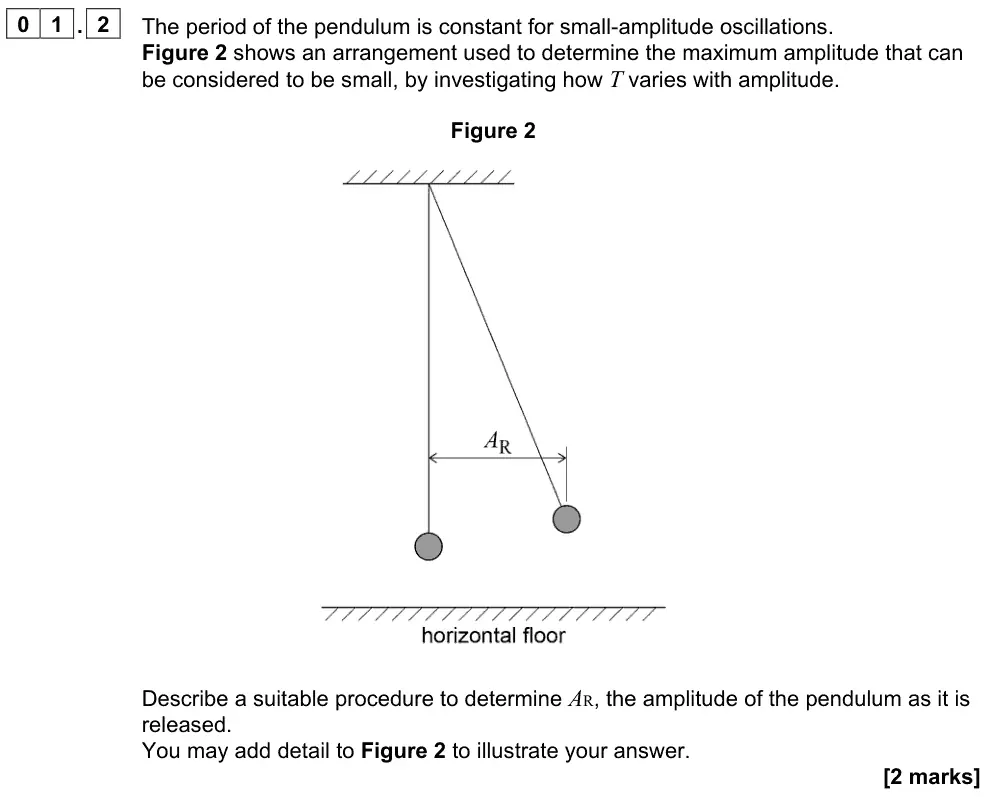
November 2020 · Paper 3 Section A · Q1.22 marksAO3=2Practical and data analysis
Earlier part of question 1 that this part uses
Mark scheme
Examiner's comment
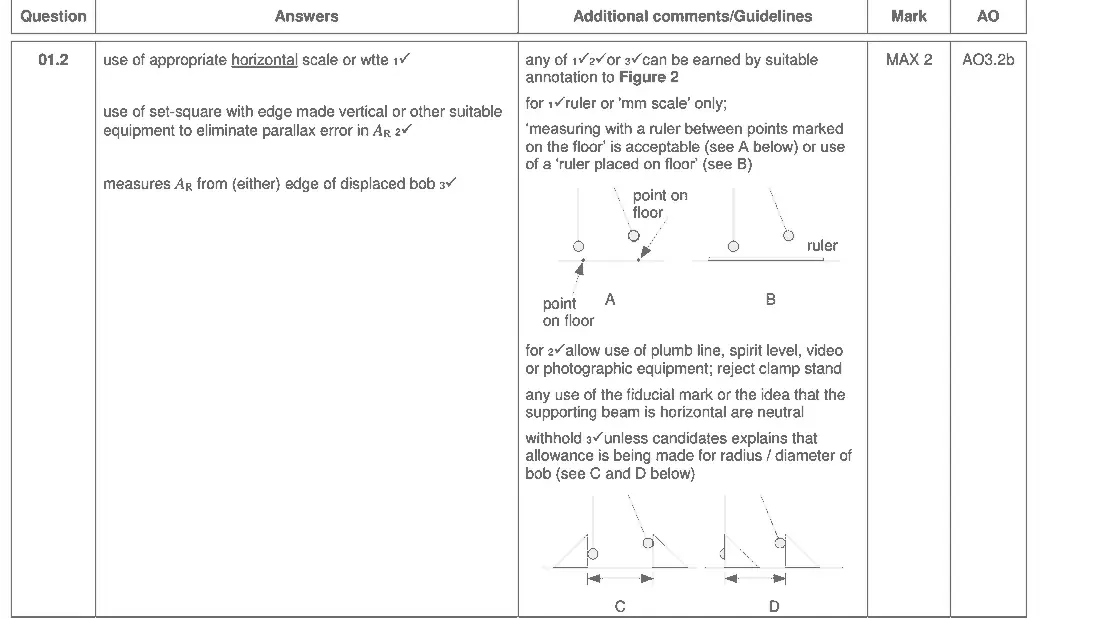
In 01.2, some thought they were measuring the period and not the amplitude. Too many described trigonometric methods based on an angle measurement.
Notes from the mark scheme and report
Horizontal mm scale (ruler on floor)
set square or plumb line to avoid parallax
measure from the same edge of the bob at rest and displaced
angle/trig methods and period-timing answers missed the point
Skills: ATa analogue apparatus to record measurements and interpolate; ATc methods to increase accuracy (timing over many oscillations, fiducial marker, set square, plumb line); PS4.1 Know and understand how to use a wide range of experimental and practical instruments, equipment and techniques; RP7 Investigation into simple harmonic motion using a mass–spring system and a simple pendulum.
November 2020 · Paper 3 Section A · Q1.33 marksPractical and data analysis
Earlier part of question 1 that this part uses
Mark scheme
Examiner's comment
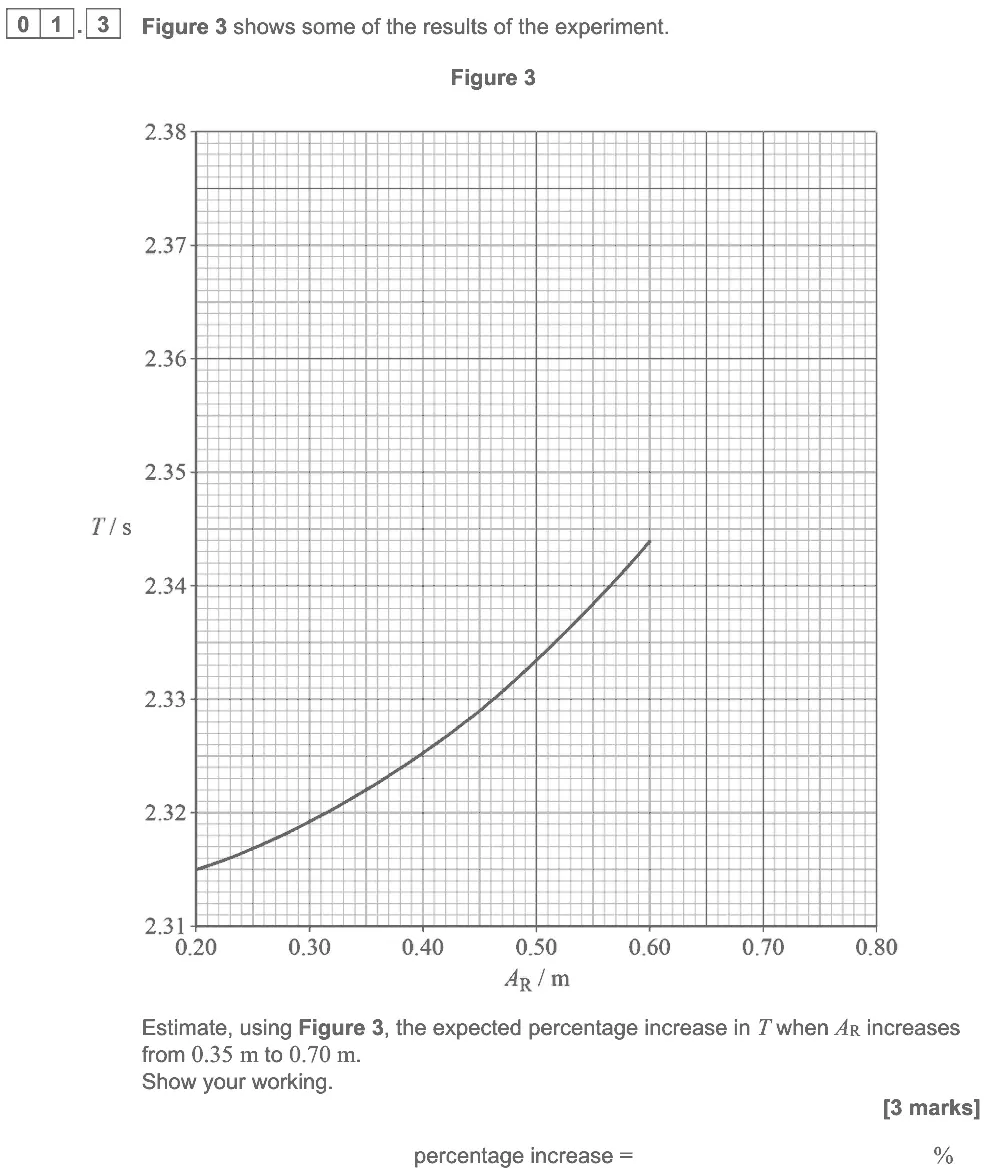
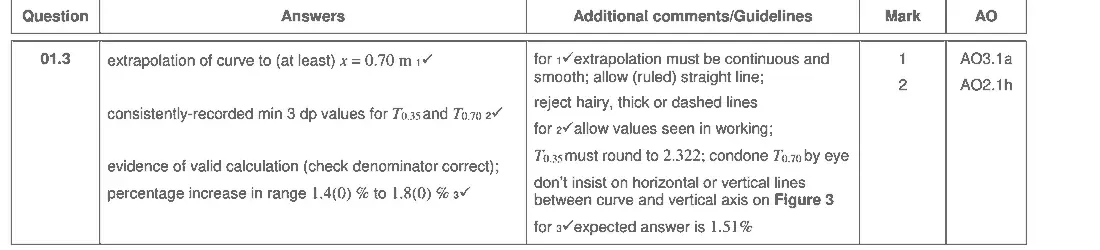
To determine the percentage increase in 01.3, some tried a mathematical approach based on the average rate of increase shown in Figure 3. We expected students to extrapolate the curve and those that did could usually proceed smoothly. Over half scored at least 2 out of 3 marks.
Notes from the mark scheme and report
Answer: about 1.5% (1.4-1.8
extrapolate curve to 0.70 m, T0.35 = 2.322 s, readings to 3 dp)
using the average rate from the graph instead of extrapolating was common
Skills: MS3.1 Translate information between graphical, numerical and algebraic forms; MS0.3 Use ratios, fractions and percentages; MS1.1 Use an appropriate number of significant figures; RP7 Investigation into simple harmonic motion using a mass–spring system and a simple pendulum.
November 2020 · Paper 3 Section A · Q1.51 markAO1=1Practical and data analysisEasy
Earlier part of question 1 that this part uses
Mark scheme
Examiner's comment
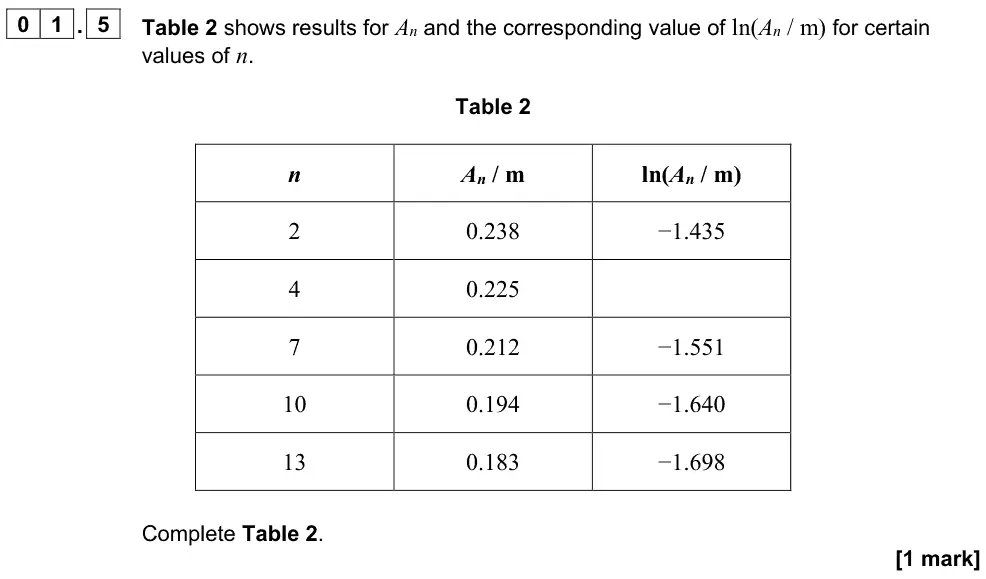
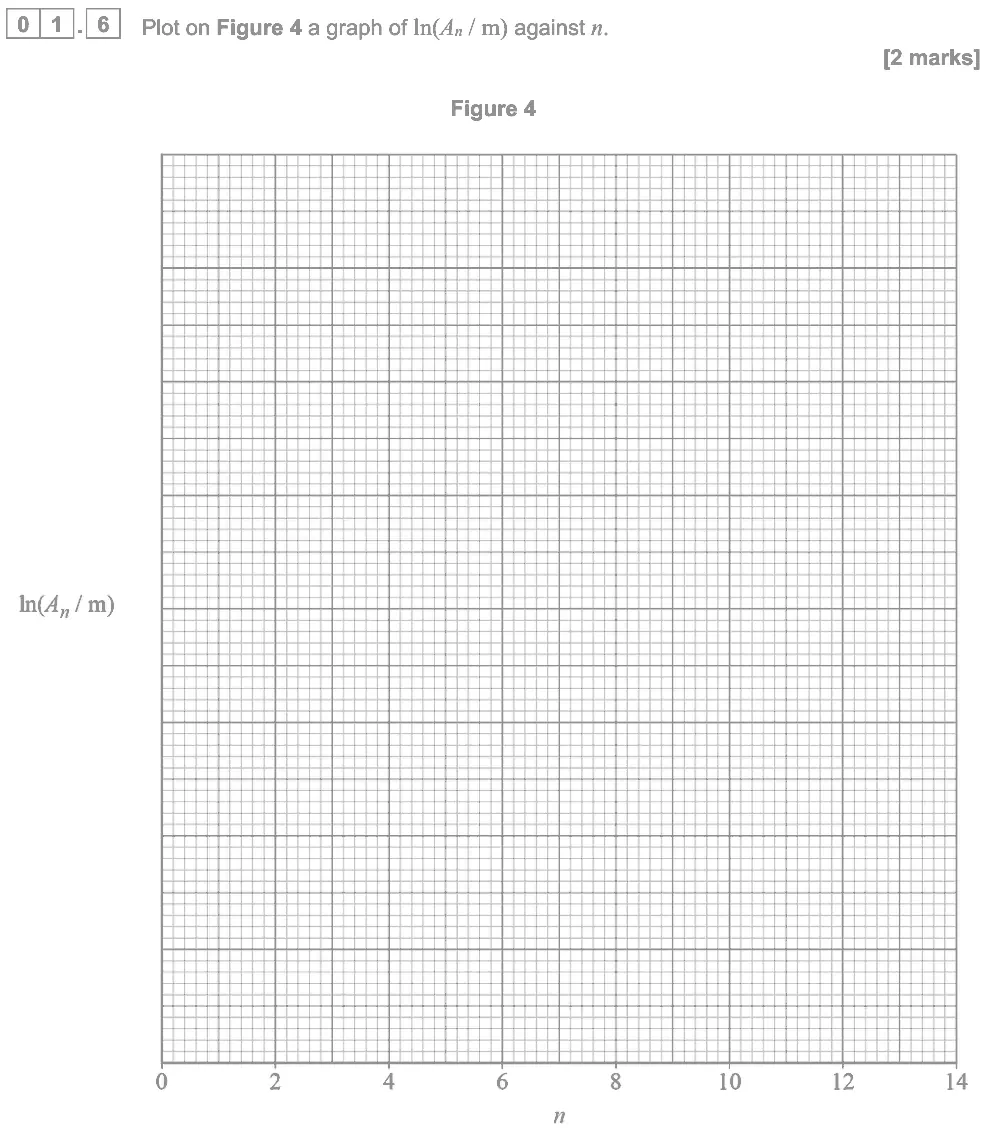
The key in 01.4 was to calculate the average having rejected the anomalous data, then determine the uncertainty from half the resulting range. About a third of the students were able to follow one or both of these steps. It was hard to find many solutions to 01.5 and 01.6 that indicated work of A-grade standard and even the correct completion of Table 2 proved beyond nearly 10% of the cohort. Both in data tabulation and in the labels marked on graph axes, we expect consistency in decimal places. We saw far too many reversed scales that produced upwards-sloping lines and compressed scales that produced shallow lines. Less than 20% of students produced completely correct solutions to this routine problem.
Notes from the mark scheme and report
Answer: ln(0.225) = -1.492 to 3 dp
Skills: MS0.5 Use calculators to find and use power, exponential and logarithmic functions; MS1.1 Use an appropriate number of significant figures; RP7 Investigation into simple harmonic motion using a mass–spring system and a simple pendulum.
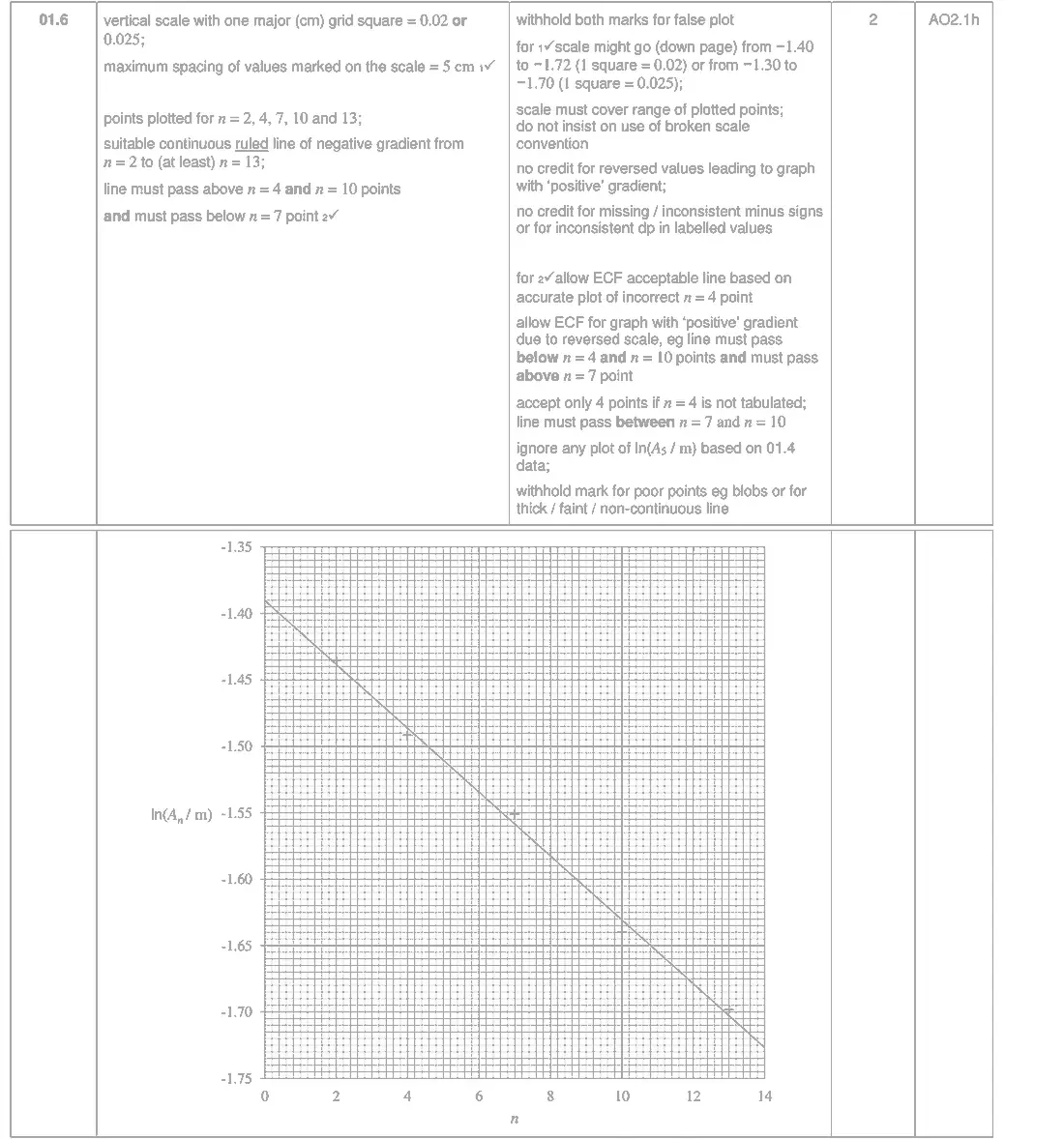
November 2020 · Paper 3 Section A · Q1.62 marksAO2=2Diagram or graphHard
Earlier part of question 1 that this part uses
Mark scheme
Examiner's comment
The key in 01.4 was to calculate the average having rejected the anomalous data, then determine the uncertainty from half the resulting range. About a third of the students were able to follow one or both of these steps. It was hard to find many solutions to 01.5 and 01.6 that indicated work of A-grade standard and even the correct completion of Table 2 proved beyond nearly 10% of the cohort. Both in data tabulation and in the labels marked on graph axes, we expect consistency in decimal places. We saw far too many reversed scales that produced upwards-sloping lines and compressed scales that produced shallow lines. Less than 20% of students produced completely correct solutions to this routine problem.
Questions testing the AO2 criteria are also a mixed bag: in 01.4 the uncertainty calculations were often done well but the graph scaling/plotting in 01.6 was patchy.
Notes from the mark scheme and report
Vertical scale 0.02 or 0.025 per cm with consistent dp and minus signs
five points
ruled line of negative gradient
reversed or compressed scales common
Skills: MS3.2 Plot two variables from experimental or other data; PS2.2 Present data in appropriate ways; RP7 Investigation into simple harmonic motion using a mass–spring system and a simple pendulum.
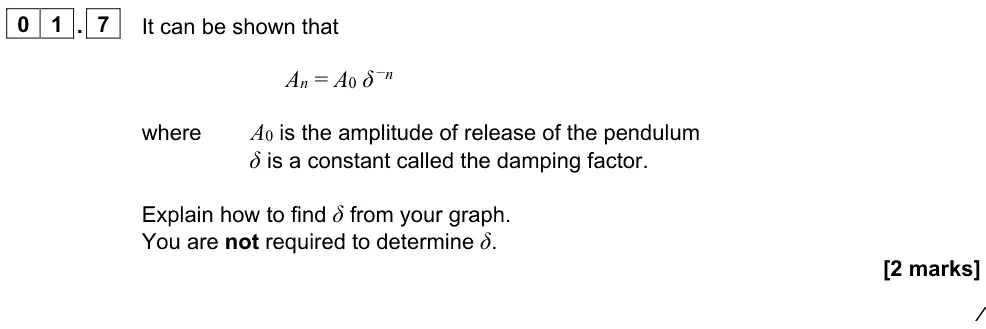
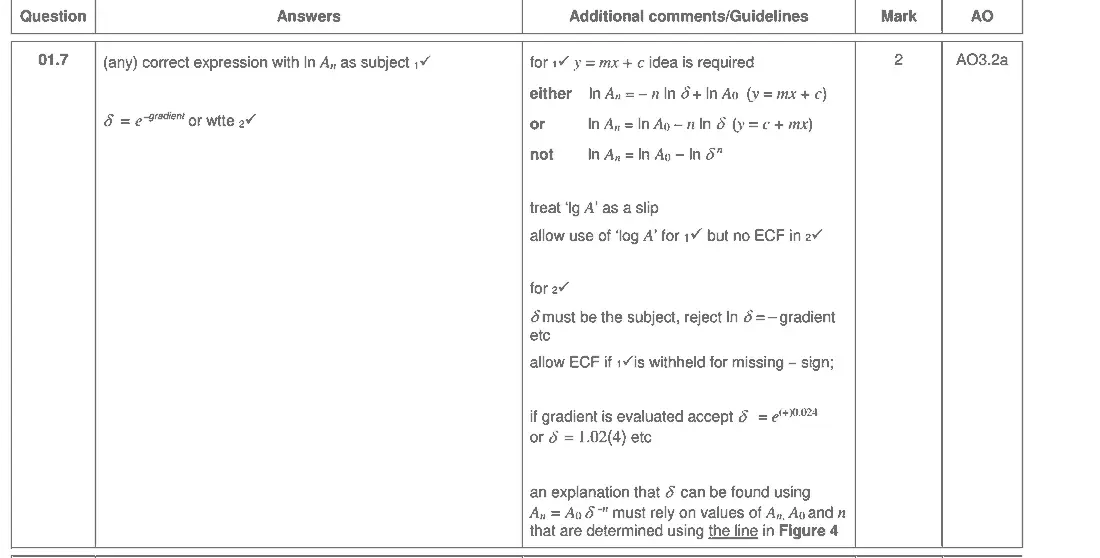
November 2020 · Paper 3 Section A · Q1.72 marksAO3=2Practical and data analysis
Earlier part of question 1 that this part uses
Mark scheme
Examiner's comment
01.7 discriminated well in favour of the stronger students who manipulated the equation to produce an expression of the form y = mx + c and went on to deduce that δ = e−gradient. A novel approach seen was to deduce A0 from the intercept and then obtain a value of An from a convenient point on A0 the line, e.g. at n = 2. Going on to explain that earned full credit. δ = A n
Notes from the mark scheme and report
ln An = ln A0 - n ln delta, so gradient = -ln delta and delta = e^-gradient
Skills: MS3.3 Understand that y = mx + c represents a linear relationship; MS3.11 Use logarithmic plots to test exponential and power law variations; MS0.5 Use calculators to find and use power, exponential and logarithmic functions; RP7 Investigation into simple harmonic motion using a mass–spring system and a simple pendulum.
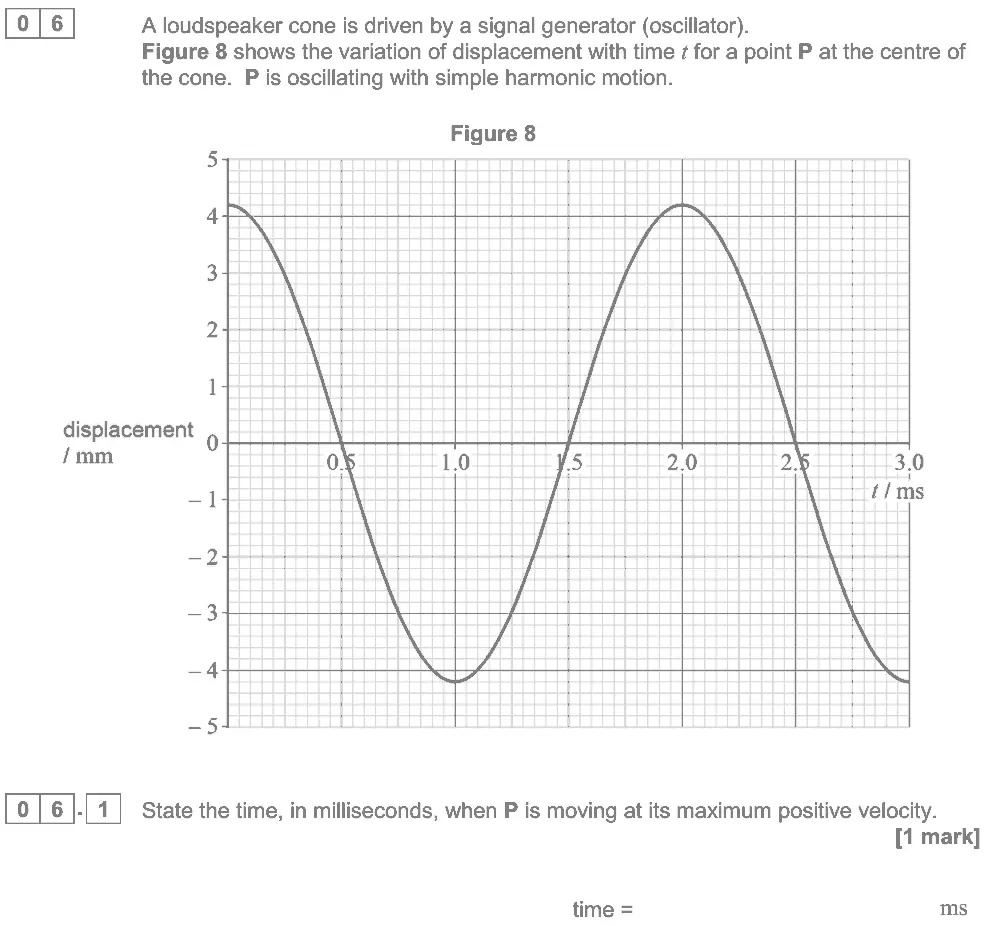
June 2019 · Paper 1 · Q6.11 markShort answer
Mark scheme
Examiner's comment
6.1 This question caused no problems for the majority of students. Common errors were confusing the negative and positive velocities (giving an answer of 0.5 ms), or treating Figure 8 as a v-t graph (giving an answer of 2.0 ms).
Notes from the mark scheme and report
Answer: 1.5 ms (steepest positive gradient)
0.5 ms (negative velocity) and 2.0 ms (read as v-t graph) were common errors
Skills: MS3.6 Draw and use the slope of a tangent to a curve as a measure of rate of change
June 2019 · Paper 1 · Q6.23 marksCalculation
Earlier part of question 6 that this part uses
Mark scheme
Examiner's comment
6.2 Students who did not obtain full marks on this question tended to make mistakes reading the axes, for example using 4.1 mm for the displacement, or using the wrong power of ten in the final calculation. A surprisingly large number of students simply divided the maximum displacement by the time and received no credit.
Notes from the mark scheme and report
Answer: 4.1 x 10^4 m s^-2 (A = 4.2 mm, T = 2.0 ms, a = omega^2 A)
misreading 4.1 mm, power-of-ten slips, or dividing displacement by time
Skills: MS3.1 Translate information between graphical, numerical and algebraic forms; MS0.2 Recognise and use expressions in decimal and standard form; MS2.3 Substitute numerical values into algebraic equations using appropriate units for physical quantities
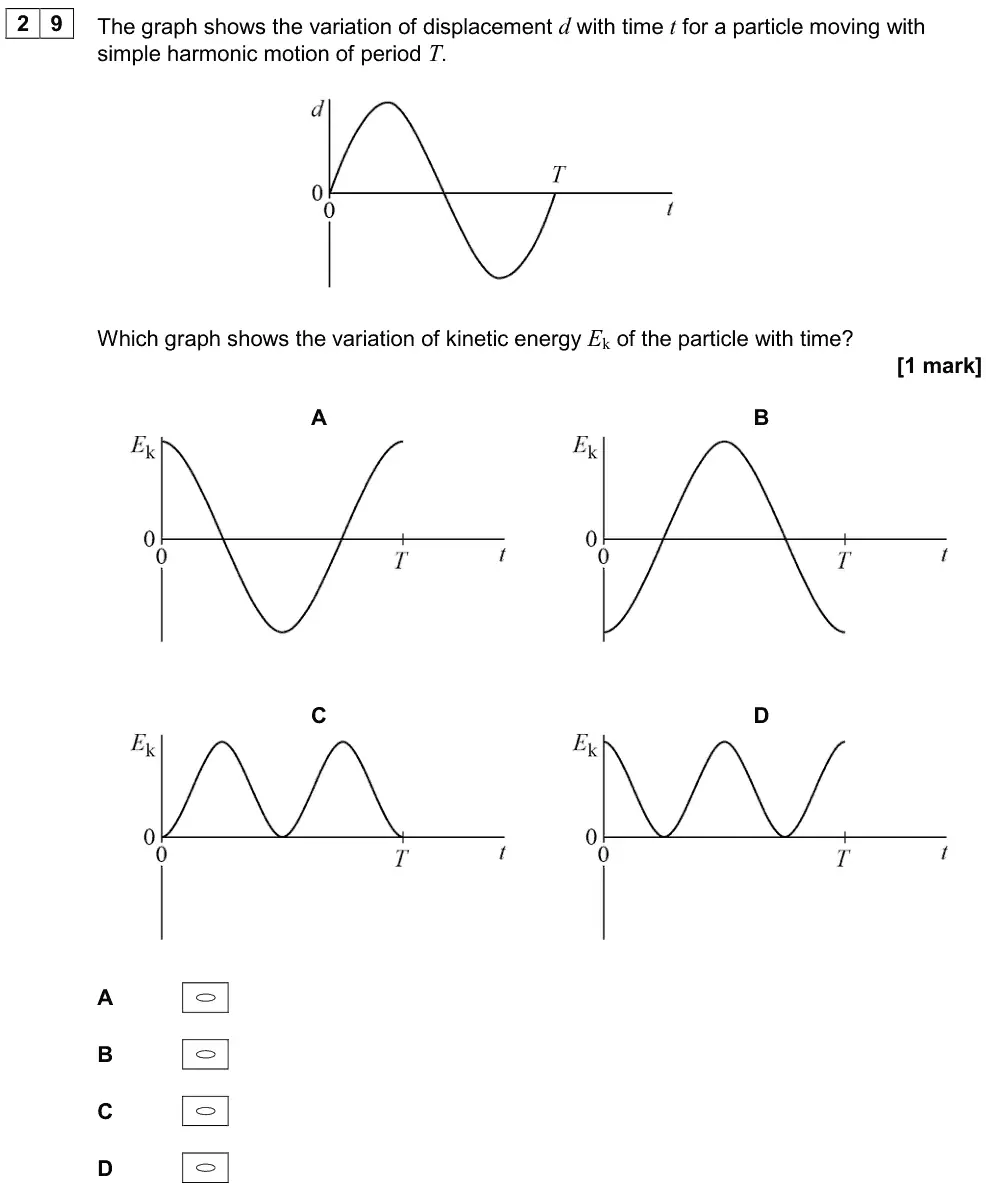
June 2019 · Paper 1 · Q291 markMultiple choice
Answer
D
Notes from the mark scheme and report
Answer: D
Skills: MS3.1 Translate information between graphical, numerical and algebraic forms
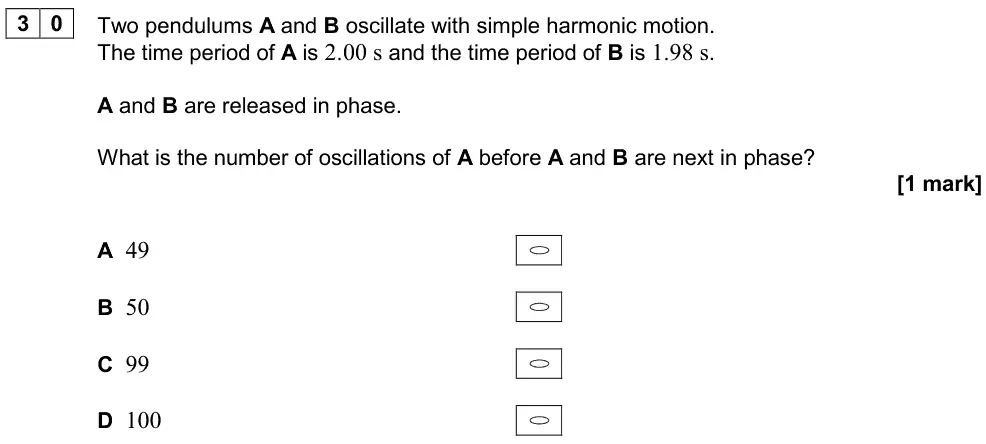
June 2019 · Paper 1 · Q301 markMultiple choice
Answer
C
Notes from the mark scheme and report
Answer: C
fewer than half correct, D the popular distractor (oscillations of B)
Skills: MS0.3 Use ratios, fractions and percentages
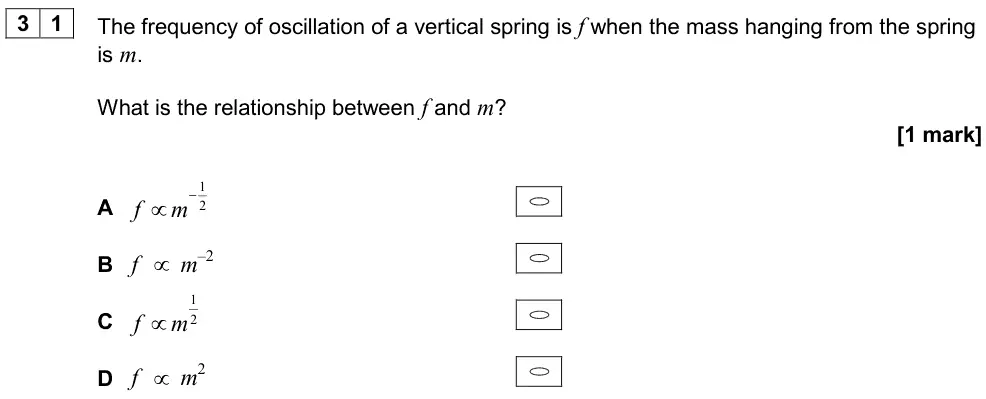
June 2019 · Paper 1 · Q311 markMultiple choice
Answer
A
Notes from the mark scheme and report
Answer: A
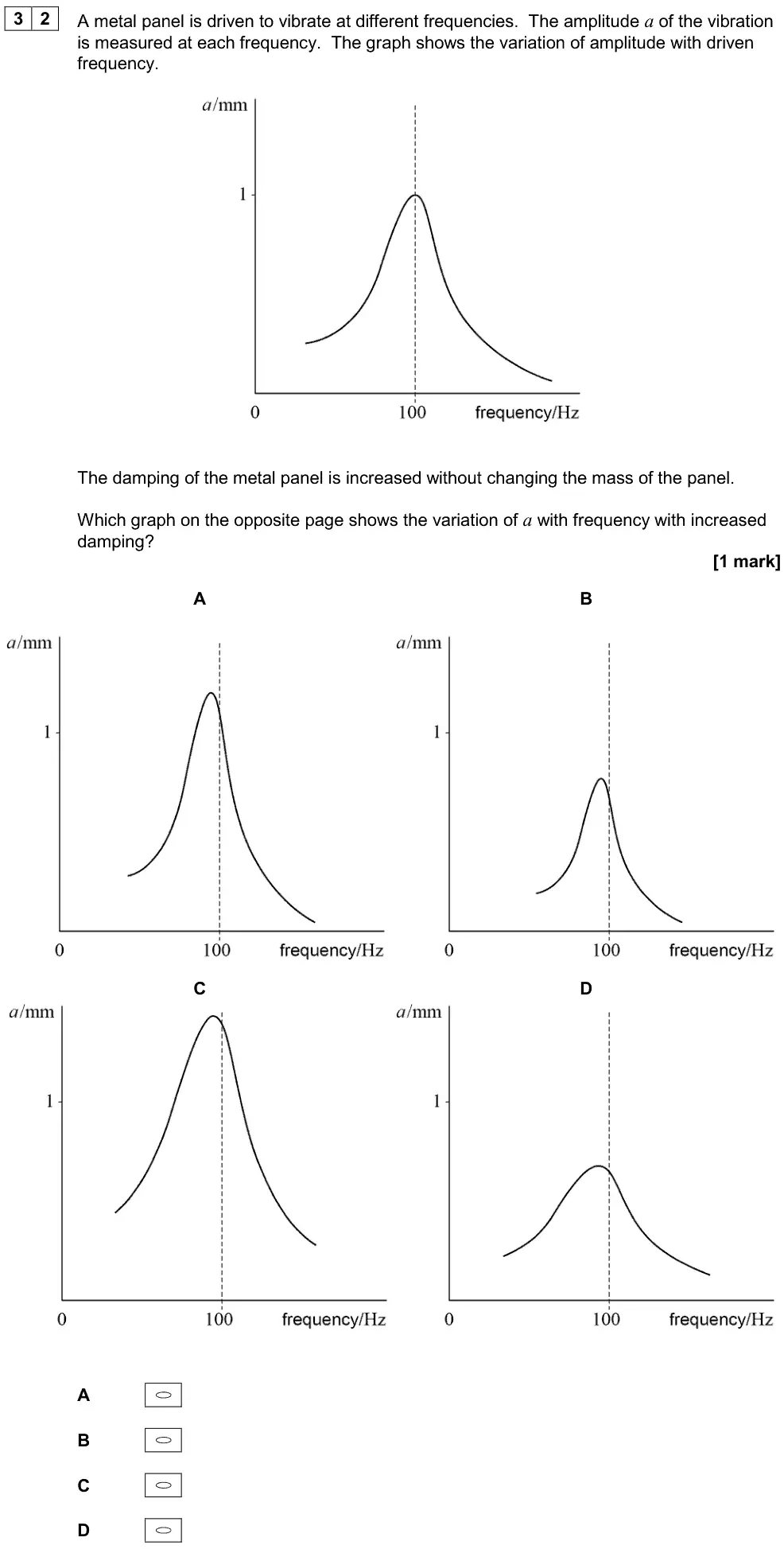
June 2019 · Paper 1 · Q321 markMultiple choice
Answer
D
Notes from the mark scheme and report
Answer: D
about 25% chose B (amplitude lower but ignored broadening)
June 2018 · Paper 1 · Q291 markMultiple choice
Answer
D
Notes from the mark scheme and report
Answer: D
June 2018 · Paper 1 · Q301 markMultiple choice
Answer
A
Notes from the mark scheme and report
Answer: A
Skills: MS2.3 Substitute numerical values into algebraic equations using appropriate units for physical quantities; MS0.2 Recognise and use expressions in decimal and standard form
June 2018 · Paper 1 · Q311 markMultiple choice
Answer
D
Notes from the mark scheme and report
Answer: D
Skills: MS3.1 Translate information between graphical, numerical and algebraic forms
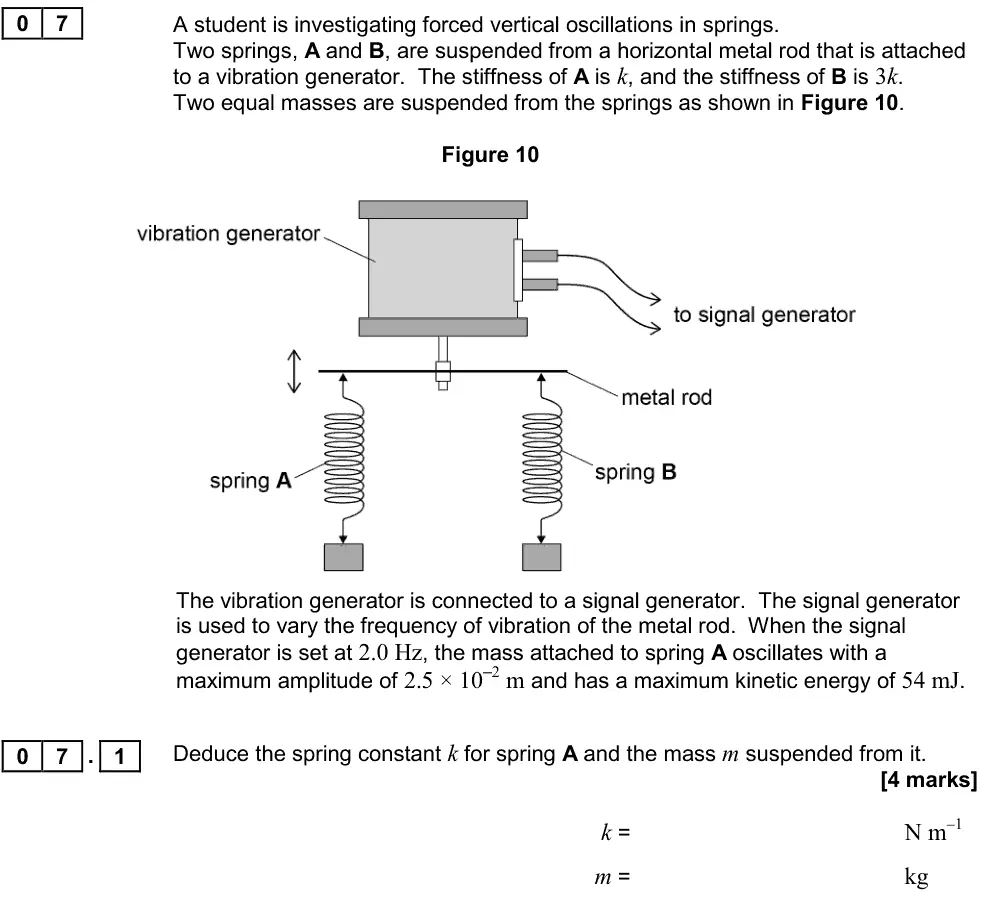
June 2017 · Paper 1 · Q7.14 marksCalculation
Mark scheme
Examiner's comment
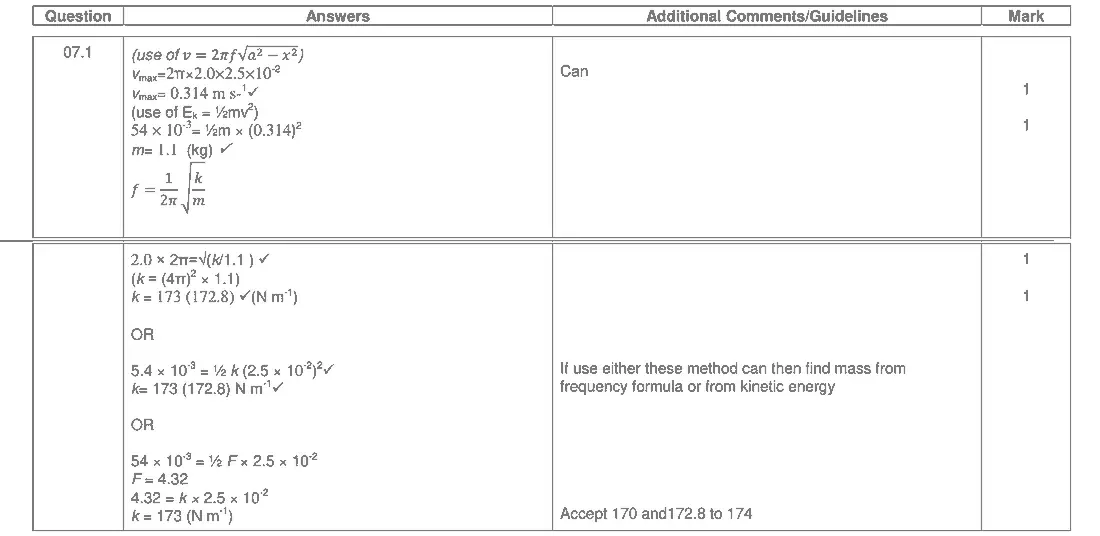
Question 07.1 was an extended calculation and 60% of students were able to calculate the mass or spring constant. The ‘consequential error’ principle was applied and so an incorrect value could be used to calculate the other value for full credit.
The next part also resulted in many good answers and although students did not need to use their values, full credit was given for correct calculations using calculated mass and spring constant, even if one or both of these were incorrect.
Notes from the mark scheme and report
Answer: m = 1.1 kg (vmax = 2 pi f A = 0.314 m s^-1, KE = 54 mJ), k = 173 N m^-1
ecf between the two values
60% could find one of them
Skills: MS2.2 Change the subject of an equation, including non-linear equations; MS2.3 Substitute numerical values into algebraic equations using appropriate units for physical quantities
June 2017 · Paper 1 · Q7.22 marksCalculation
Earlier part of question 7 that this part uses
Mark scheme
Notes from the mark scheme and report
Answer: 3.5 Hz (2.0 x root 3, same mass, stiffness 3k)
ecf from 07.1
Skills: MS0.3 Use ratios, fractions and percentages; MS2.3 Substitute numerical values into algebraic equations using appropriate units for physical quantities
June 2017 · Paper 1 · Q7.34 marksExplanation
Earlier part of question 7 that this part uses
Mark scheme
Examiner's comment
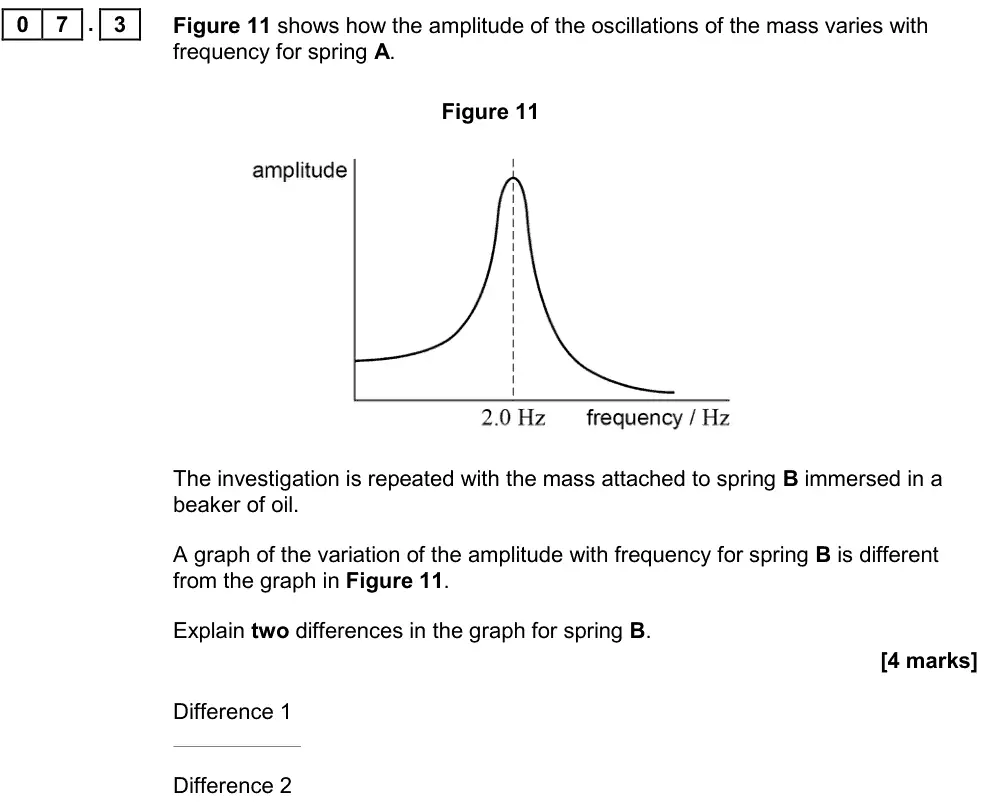
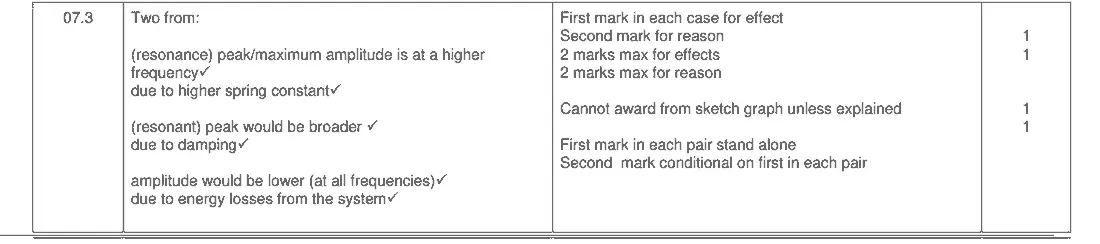
Question 07.3 required students to identify two differences that would occur when the mass attached to spring B oscillated in oil. Identifying the differences proved to be straightforward but giving the reason for this far less so. The most common difference given was the decrease in amplitude, with the next most popular being the shift in the peak amplitude to a higher frequency.
Notes from the mark scheme and report
Two of: peak at higher frequency (stiffer spring), broader peak (damping), lower amplitude (energy loss to oil)
each effect needs its reason
reasons were the weak part
June 2017 · Paper 1 · Q311 markMultiple choice
Answer
D
Notes from the mark scheme and report
Answer: D
Skills: MS3.1 Translate information between graphical, numerical and algebraic forms
June 2017 · Paper 1 · Q321 markMultiple choice
Answer
D
Notes from the mark scheme and report
Answer: D
Skills: MS3.1 Translate information between graphical, numerical and algebraic forms
Specimen set 1 · Paper 1 · Q301 markMultiple choice
Answer
C
Notes from the mark scheme and report
Answer: C
Specimen set 1 · Paper 1 · Q311 markMultiple choice
Answer
D
Notes from the mark scheme and report
Answer: D
Specimen set 1 · Paper 2 · Q211 markMultiple choice
Answer
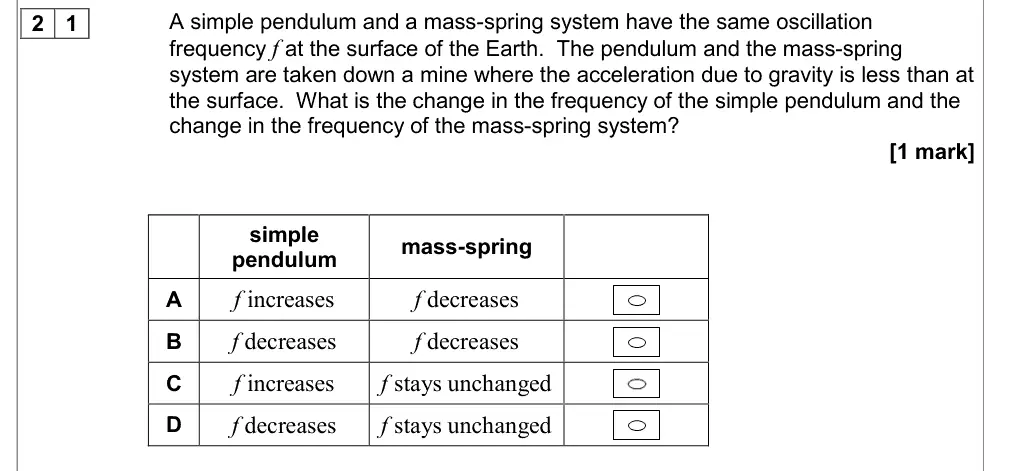
C
Notes from the mark scheme and report
Answer: C (key as printed in the specimen mark scheme)
the physics gives D - pendulum f falls with g, mass-spring f is independent of g - check this key
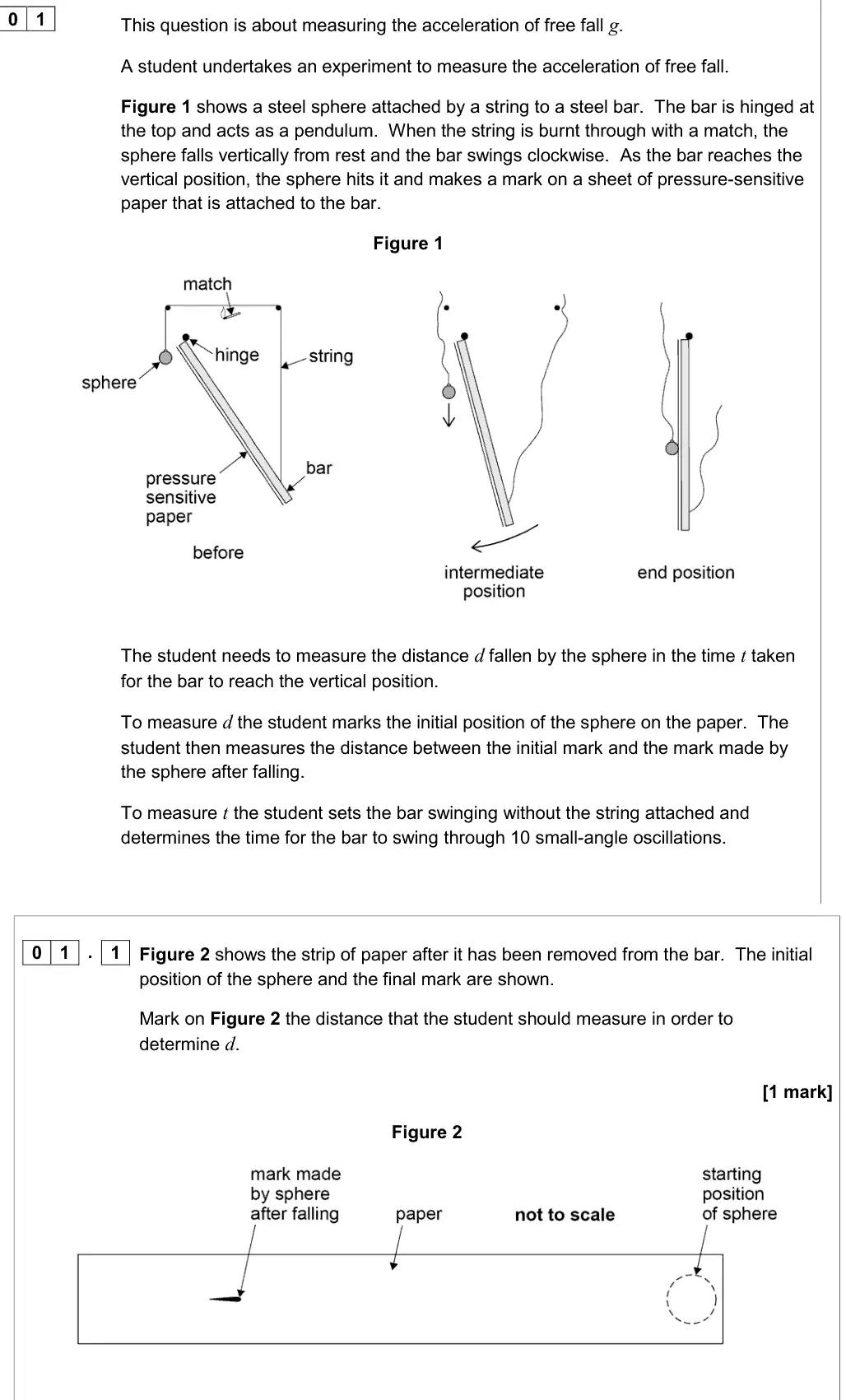
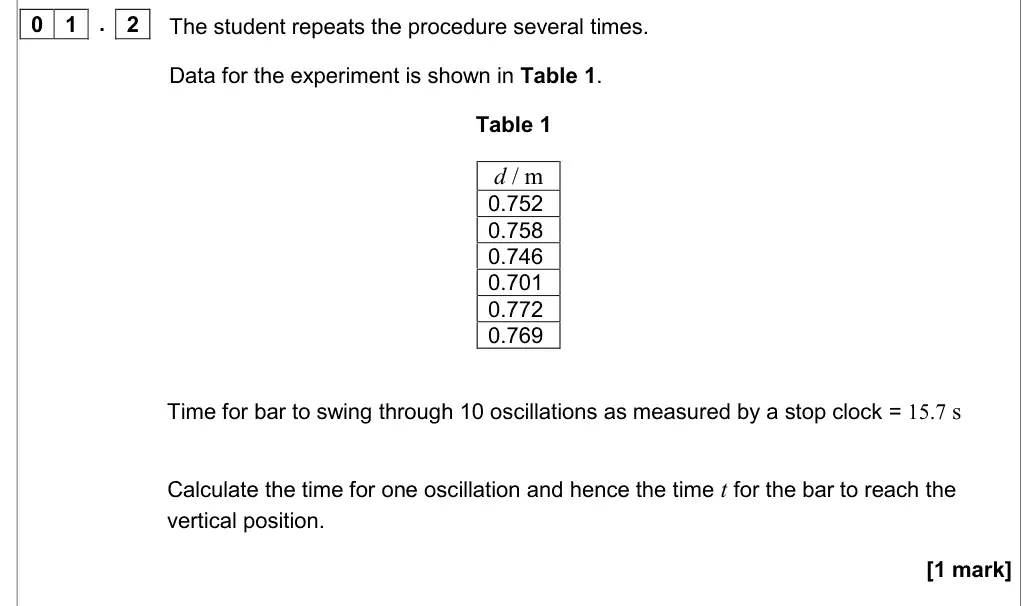
Specimen set 1 · Paper 3 Section A · Q1.21 markPractical and data analysis
Earlier part of question 1 that this part uses
Mark scheme
Notes from the mark scheme and report
Answer: 0.393 s (period 1.57 s from 15.7 s / 10
bar reaches vertical after a quarter period)
Skills: MS0.3 Use ratios, fractions and percentages; PS3.2 Process and analyse data using appropriate mathematical skills; ATc methods to increase accuracy (timing over many oscillations, fiducial marker, set square, plumb line); RP3 Determination of g by a freefall method.
Work with an AQA physics tutor
Dropping marks on calculations, required practicals or the six-markers? Book a trial session with a specialist AQA physics tutor.