Notes and key-term cards for this topic are being written by our tutors. The past-paper questions below are ready now.
Specification statements
Show the 13 statements from the specification
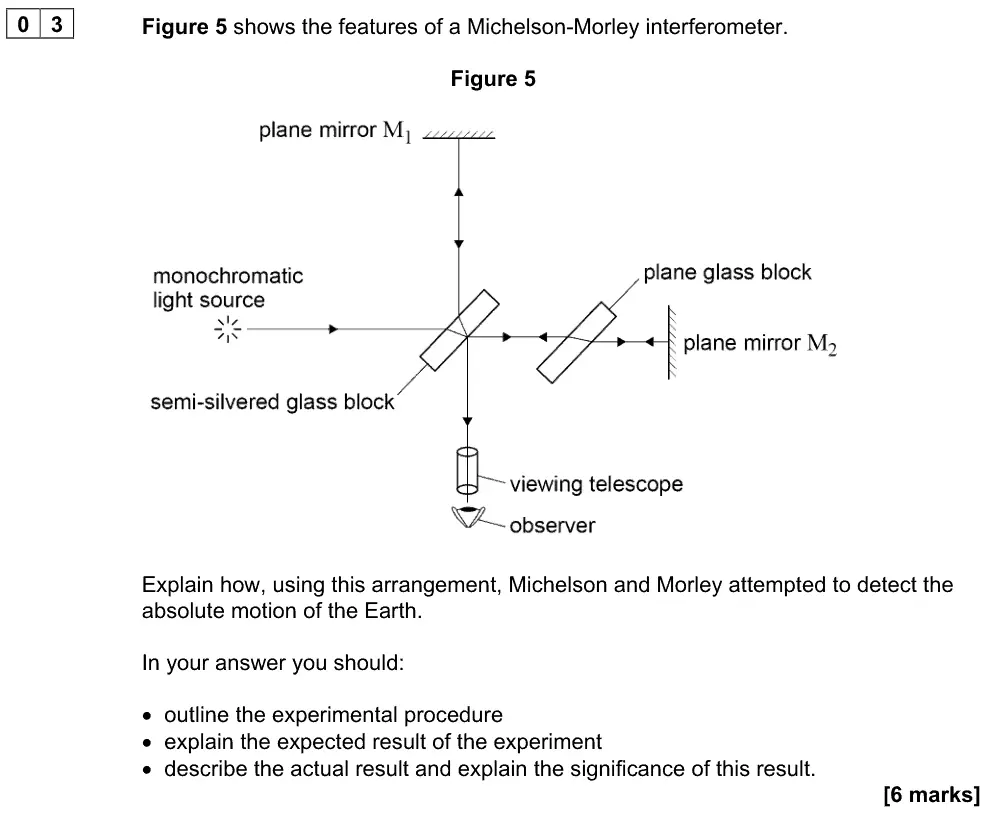
3.12.3.1-01 Principle of the Michelson-Morley interferometer.
3.12.3.1-02 Outline of the experiment as a means of detecting absolute motion.
3.12.3.1-03 Significance of the failure to detect absolute motion.
3.12.3.1-04 The invariance of the speed of light.
3.12.3.2-01 The concept of an inertial frame of reference.
3.12.3.2-02 The two postulates of Einstein’s theory of special relativity: 1. physical laws have the same form in all inertial frames 2. the speed of light in free space is invariant.
3.12.3.3-01 Proper time and time dilation as a consequence of special relativity.
3.12.3.3-02 Time dilation: t = 1 −v2 t0 c2
3.12.3.3-03 Evidence for time dilation from muon decay.
3.12.3.4-01 Length of an object having a speed v l = l0 1 −v2 c2
3.12.3.5-01 Equivalence of mass and energy, E = mc 2 ; E = 1 −v2 m0c2 c2
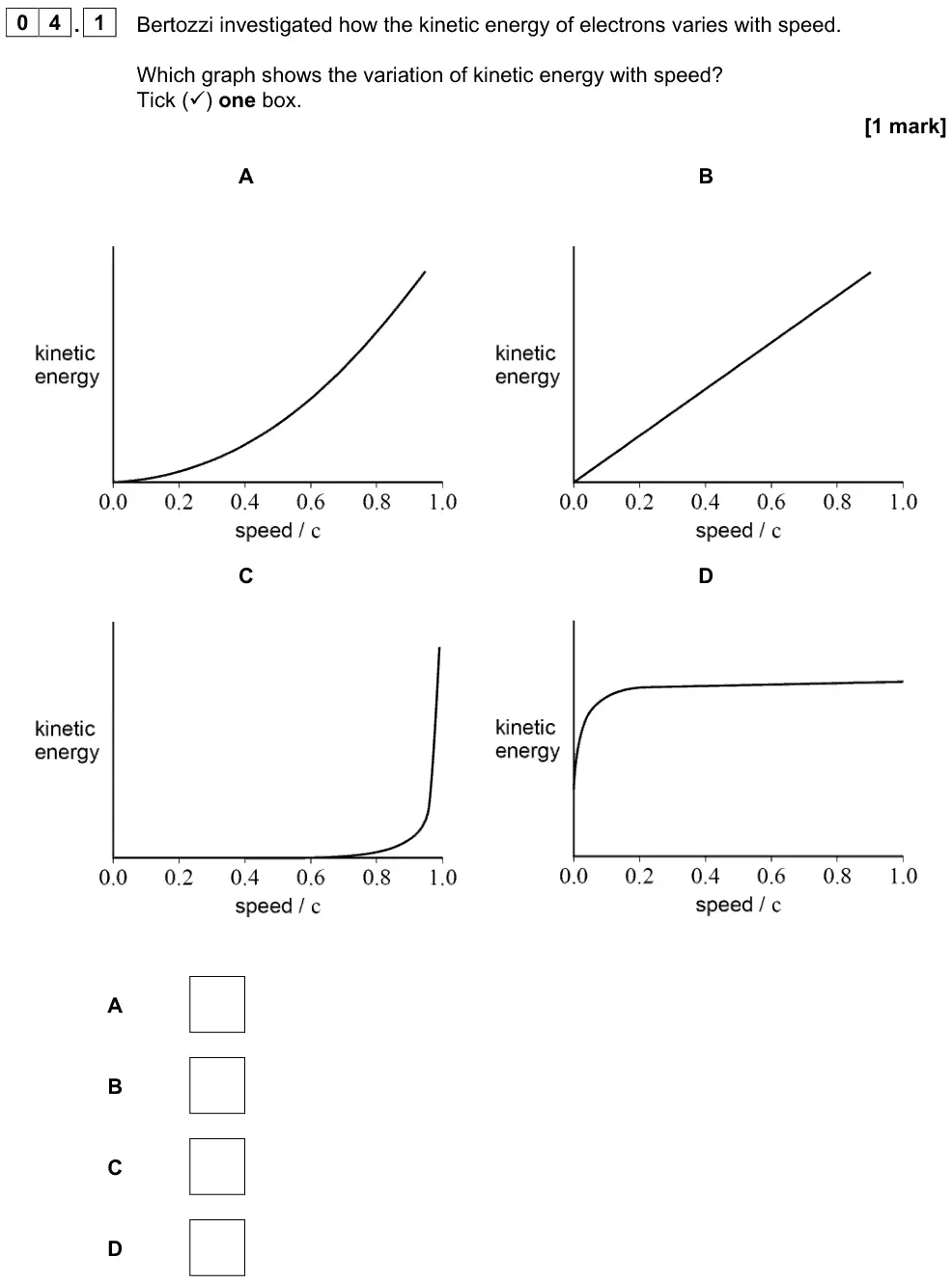
3.12.3.5-02 Graphs of variation of mass and kinetic energy with speed.
3.12.3.5-03 Bertozzi’s experiment as direct evidence for the variation of kinetic energy with speed.
Six-mark extended response questions on this topic
Tap a question to zoom it. Where a part needs a figure, table or graph from earlier in the question, that part folds out above it; the mark scheme and examiner's comment open underneath. Have the AQA data and formulae booklet beside you (see the formula sheet page).
June 2025 · Paper 3B Turning points · Q4.14 marksAO3=4Calculation
Mark scheme
Examiner's comment
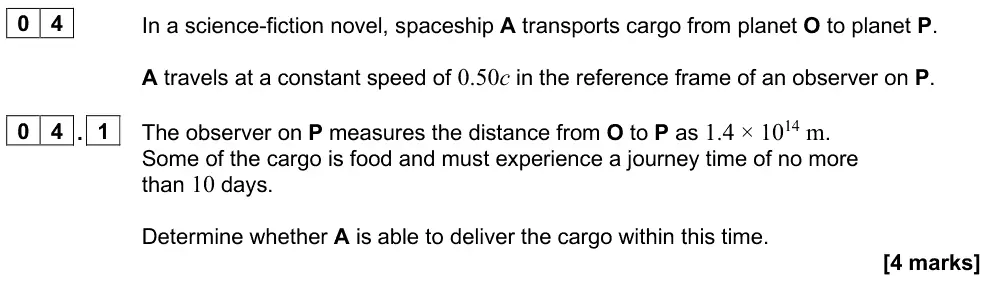
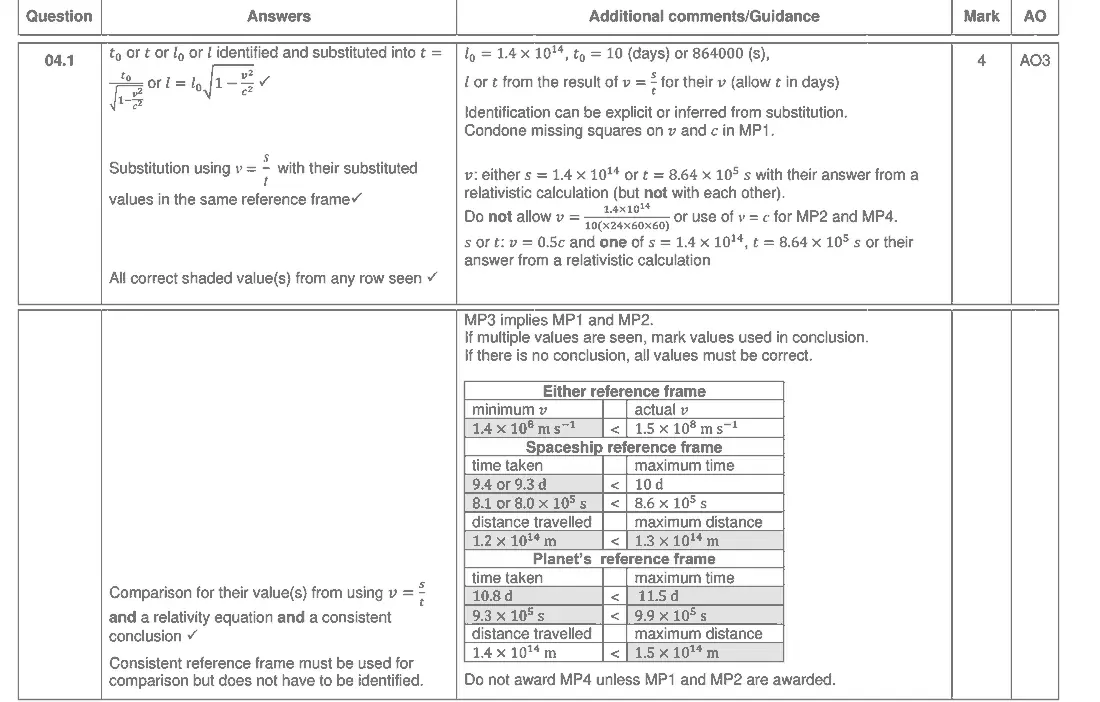
04.1 Most students were able to make some progress and gain some marks, with around a third achieving full marks and over half gaining at least 3 marks. The question gave a maximum time that must be experienced by the cargo, a speed of the spaceship and the distance to be relativity calculation so that data in the same reference frame could be compared, and a 𝑣𝑣= 𝑠𝑠 travelled. The distance and time were in different reference frames, so students had to use a 𝑡𝑡 calculation so that the same quantities could be compared. There were at least 7 possible comparisons of quantities: comparing speeds, distances in either reference frame or times in seconds or days in either reference frame. The first mark was for students correctly identifying 1.4 × 10¹⁴ as 𝑙𝑙0 or 10 days as 𝑡𝑡0 and substituting into a relativity equation. This could also be gained by using the results of a 𝑣𝑣= 𝑠𝑠 𝑡𝑡 calculation as 𝑙𝑙 or 𝑡𝑡. The second mark was carrying out a 𝑣𝑣= 𝑠𝑠 𝑡𝑡 with their substituted values in the same references frame. As 𝑣𝑣 was the same in both reference frames, only those who used 𝑠𝑠= 1.4 × 10¹⁴ and 𝑡𝑡= 10 (days) or 864000 (s) or who used 𝑣𝑣 as the speed of light did not gain this mark for the use of 𝑣𝑣= 𝑠𝑠 𝑡𝑡. The third mark was for correctly completing a relativity and a 𝑣𝑣= 𝑠𝑠 𝑡𝑡 calculation. If these were carried out in sequence, then one answer was required. However, students could also carry out two independent calculations, the results of which were compared with each other, in which case two answers were required.
The fourth answer was for a numerical comparison and a correct conclusion. Students who correct physics, so answers mixing up 𝑡𝑡 and 𝑡𝑡0 or 𝑙𝑙 and 𝑙𝑙0 could not get this mark. had made calculation or power of ten errors could gain this mark, but it was only awarded for
Students generally found the relativity calculations much more accessible than the relativity questions in previous years. While most students realised that 04.1 and 04.2 required an explicit numerical comparison, a minority did not provide this and were not able to gain the last mark in either question.
Notes from the mark scheme and report
Answer: yes - e.g. time in ship frame 9.3 days < 10 days (planet frame 10.8 days
l0 = 1.4 x 10^14 m, t0 = 10 days)
must compare quantities in the same frame with a conclusion
Skills: MS2.3 Substitute numerical values into algebraic equations using appropriate units for physical quantities; MS0.3 Use ratios, fractions and percentages
June 2025 · Paper 3B Turning points · Q4.24 marksAO3=4Calculation
Earlier part of question 4 that this part uses
Mark scheme
Examiner's comment
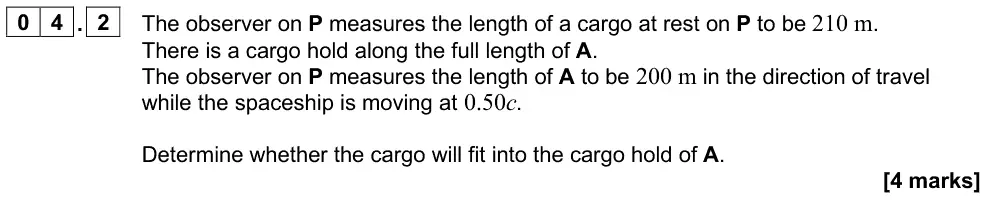
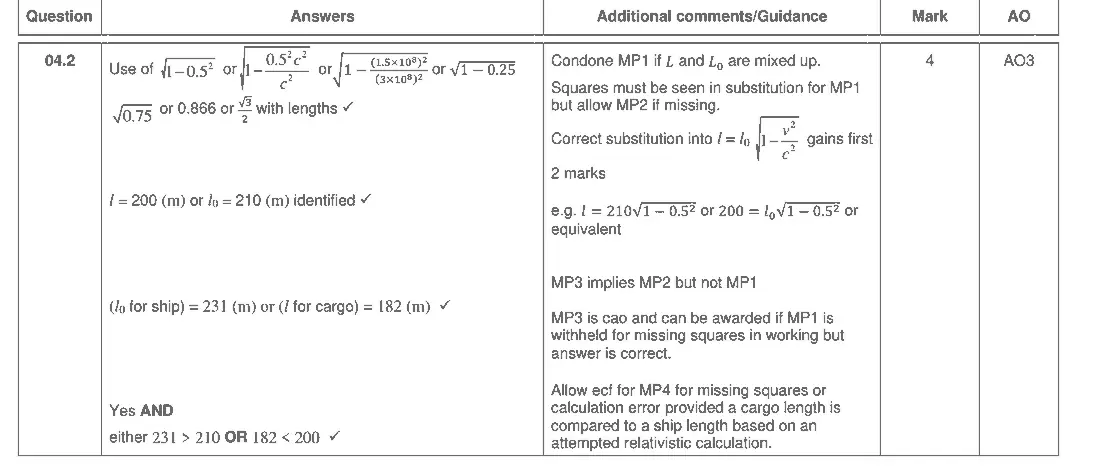
04.2 full marks and over two thirds gaining 3 out of 4. Most students correctly identified 200 as 𝑙𝑙 or This question was the more accessible of the two relativity calculations, with over 40% scoring 210 as 𝑙𝑙0 and were able to use the equation 𝑙𝑙= 𝑙𝑙0ට1 − 𝑣𝑣2 𝑐𝑐2 successfully. However, a minority of students dropped the squares on the speeds or squared the speed of light but not 0.5. Sometimes this was just in their working but the calculation was correct, in which case they missed out the squares. Some students truncated the length of the cargo as 181 rather than did not gain the first mark but did get the third, while in other cases the calculation also rounding to 182 and did not gain the third mark. significance of the numbers and said that the cargo would not fit in the spaceship. A small number of students did not know whether 200 (or 210) was 𝑙𝑙 or 𝑙𝑙0 and provided both calculations. This was regarded as a contradiction and so they were only able to score the first mark.
Students generally found the relativity calculations much more accessible than the relativity questions in previous years. While most students realised that 04.1 and 04.2 required an explicit numerical comparison, a minority did not provide this and were not able to gain the last mark in either question.
Notes from the mark scheme and report
Answer: yes - ship proper length 231 m > 210 m (or moving cargo 182 m < 200 m)
squares on v and c needed
giving both l and l0 interpretations was a contradiction
Skills: MS2.3 Substitute numerical values into algebraic equations using appropriate units for physical quantities; MS2.2 Change the subject of an equation, including non-linear equations
June 2025 · Paper 3B Turning points · Q4.31 markAO2=1Short answer
Earlier part of question 4 that this part uses
Mark scheme
Examiner's comment
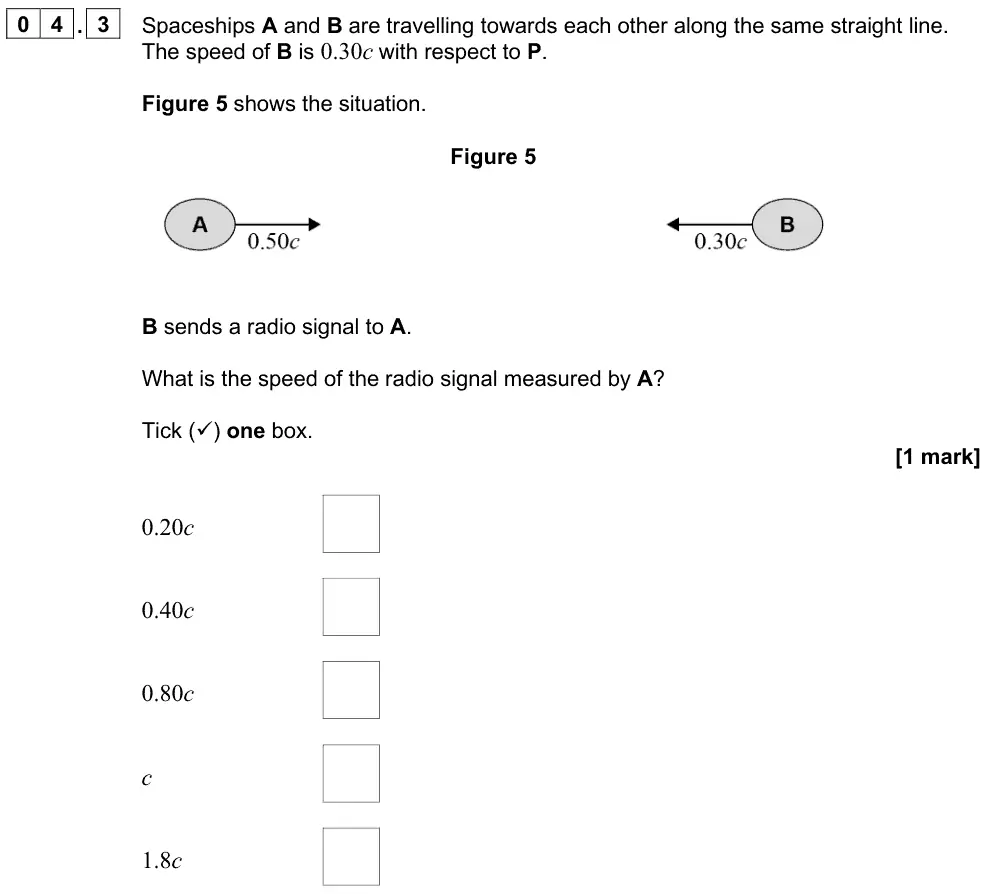
04.3 This question proved surprisingly challenging with just under 50% getting the mark. While most students can quote Einstein’s postulate “the speed of light in free space is invariant” or “the speed of the light in free space is the same regardless of the speed of the observer or electromagnetic wave, would have to be measured as travelling at 𝑐𝑐 by all observers, including source,” only around half could apply it to this context. The radio wave, as a form of
those on spaceship B. The most common wrong answers were 0.80𝑐𝑐 (the spaceships’ speeds added together, or the difference in speeds subtracted from 𝑐𝑐), and 0.20𝑐𝑐 (the difference between the spaceships’ speeds, or the sum of the spaceships’ speeds subtracted from 𝑐𝑐). Grade boundaries and cumulative percentage grades are available on the Results Statistics page of the AQA Website.
Notes from the mark scheme and report
Answer: c - speed of light independent of source and observer
commonest wrong answers 0.80c and 0.20c
just under half correct
June 2024 · Paper 3B Turning points · Q4.11 markAO1=1Show that
Mark scheme
Examiner's comment
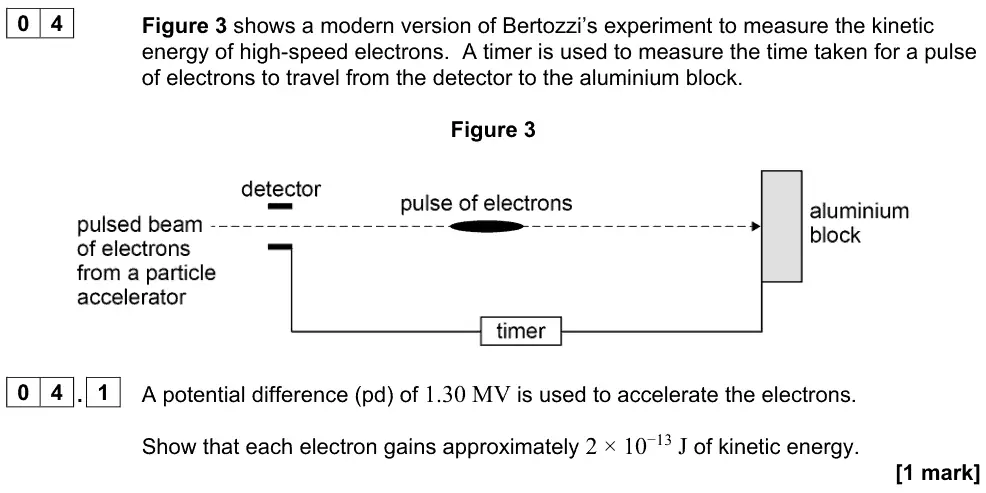
04.1 As in other ‘show that’ questions, the answer must be given to more significant figures than the approximate value given in the question, in this case a minimum of 2 sf. A full substitution including the correct powers of ten was required to gain the mark. Most students were able to score here.
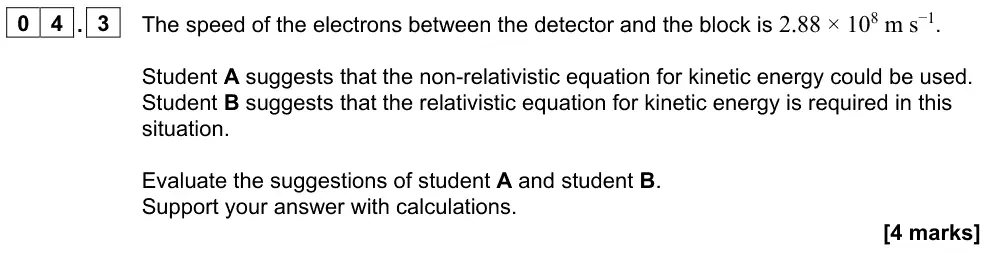
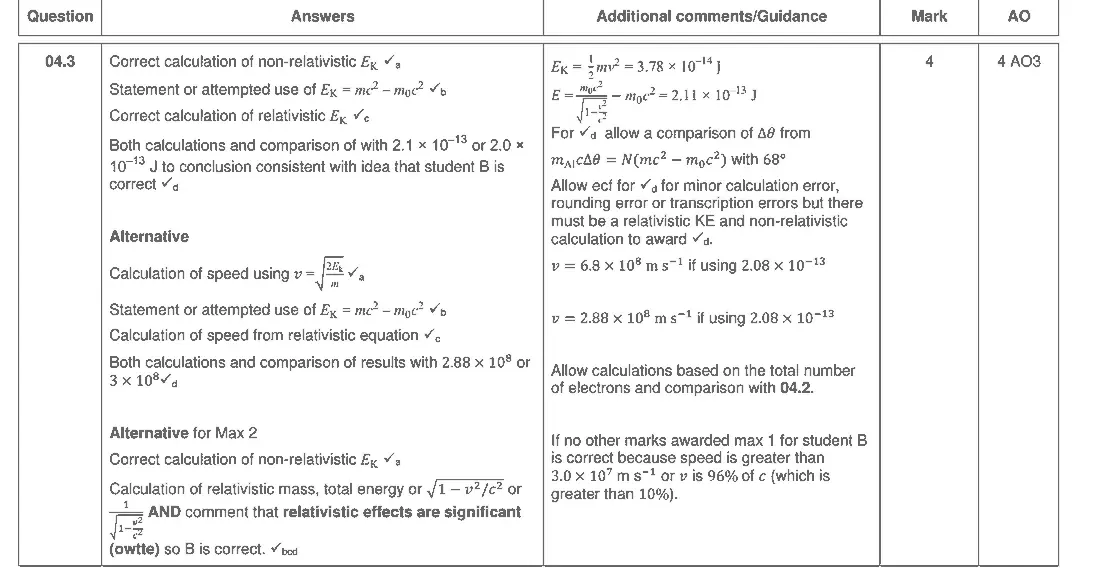
2 𝑚𝑚𝑣𝑣2 they tried to use 𝑚𝑚𝑐𝑐2 using the velocity of the particles instead of the 1 there was also a significant minority who could not calculate the non-relativistic kinetic energy; instead of calculating speed of light. Students were expected to compare the two kinetic energies with their answer to 04.1 and comment that the relativistic equation was correct. In order to score this mark students needed to have calculated values using the correct equation, although minor rounding or calculation errors were tolerated. However, some students opted instead to calculate the speed using the two equations route and could also gain full marks. A small minority of students used the energy here to calculate either a rise in temperature for the aluminium block or an accelerating pd. This again could gain full marks.
Notes from the mark scheme and report
Answer: 2.08 x 10^-13 J (eV with V = 1.30 MV)
at least 2 sf
Skills: MS2.3 Substitute numerical values into algebraic equations using appropriate units for physical quantities
June 2024 · Paper 3B Turning points · Q4.22 marksAO3=2Calculation
Earlier part of question 4 that this part uses
Mark scheme
Examiner's comment
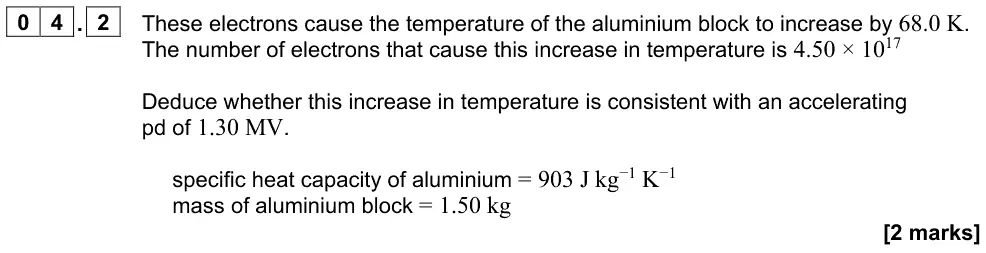
04.2 This question was also very accessible with most students scoring. Correct answers had to complete two calculations with a comparison to realise that this decrease in temperature was consistent with the accelerating potential difference given. Answers which noticed a small difference or made a calculation error and said they were inconsistent were not able to gain full marks. temperature of the aluminium by 68.0 K and then calculate the energy of the beam by multiplying The most straightforward way to do this question was to calculate the energy required to raise the
the kinetic energy of one electron by the number of electrons. However, any valid comparison could be used, and some compared the energy per electron, the rise in temperature or the mass of aluminium. commonly students confused the total energy 𝑚𝑚𝑐𝑐2 with the kinetic energy 𝑚𝑚𝑐𝑐2 −𝑚𝑚0𝑐𝑐2. However, 04.3 As is usually the case, students found the calculation of relativistic kinetic energy difficult. Most
2 𝑚𝑚𝑣𝑣2 they tried to use 𝑚𝑚𝑐𝑐2 using the velocity of the particles instead of the 1 there was also a significant minority who could not calculate the non-relativistic kinetic energy; instead of calculating speed of light. Students were expected to compare the two kinetic energies with their answer to 04.1 and comment that the relativistic equation was correct. In order to score this mark students needed to have calculated values using the correct equation, although minor rounding or calculation errors were tolerated. However, some students opted instead to calculate the speed using the two equations route and could also gain full marks. A small minority of students used the energy here to calculate either a rise in temperature for the aluminium block or an accelerating pd. This again could gain full marks.
2 𝑚𝑚𝑣𝑣2 and a calculation of the relativistic mass, ට1 − Those who did not recall the relativistic kinetic energy could still get two marks for the correct use 1 𝑣𝑣2 1 𝑐𝑐2, ට1−𝑣𝑣2 of or the total energy with a suitable 𝑐𝑐2 comment about their significance, for example “the total energy is significantly different from the rest energy and therefore relativity applies”.
Some answers gained one mark by calculating the speed as a fraction of the speed of light and saying that this was close enough to the speed of light to require relativity.
Notes from the mark scheme and report
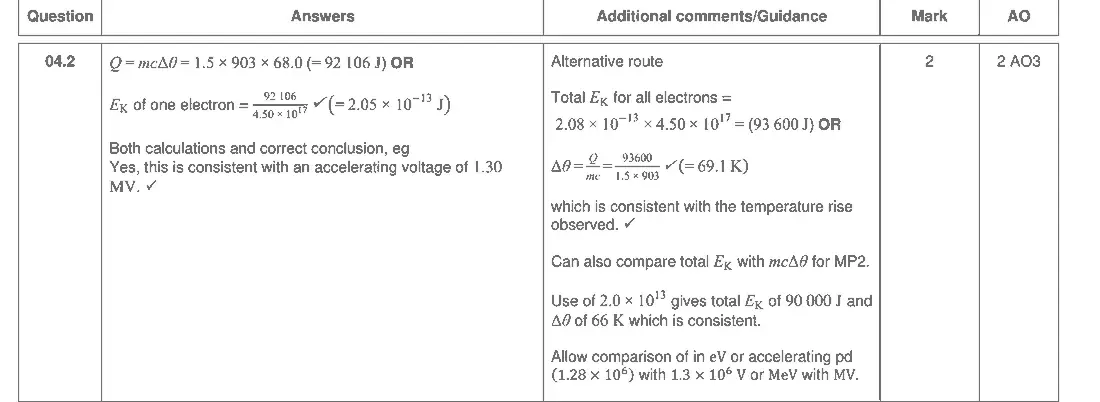
Answer: mc delta theta = 92 100 J, i.e. 2.05 x 10^-13 J per electron, consistent with 1.30 MV
both calculations and a conclusion needed
Skills: MS2.3 Substitute numerical values into algebraic equations using appropriate units for physical quantities
June 2024 · Paper 3B Turning points · Q4.34 marksAO3=4Calculation
Earlier part of question 4 that this part uses
Mark scheme
Examiner's comment
the kinetic energy of one electron by the number of electrons. However, any valid comparison could be used, and some compared the energy per electron, the rise in temperature or the mass of aluminium. commonly students confused the total energy 𝑚𝑚𝑐𝑐2 with the kinetic energy 𝑚𝑚𝑐𝑐2 −𝑚𝑚0𝑐𝑐2. However, 04.3 As is usually the case, students found the calculation of relativistic kinetic energy difficult. Most
Notes from the mark scheme and report
Answer: non-relativistic Ek = 3.78 x 10^-14 J
relativistic Ek = mc^2 - m0c^2 = 2.11 x 10^-13 J, matching 2.1 x 10^-13 J so student B correct
total energy mc^2 often confused with Ek
Skills: MS2.3 Substitute numerical values into algebraic equations using appropriate units for physical quantities
June 2024 · Paper 3B Turning points · Q4.41 markAO2=1Short answerEasy
Earlier part of question 4 that this part uses
Mark scheme
Examiner's comment
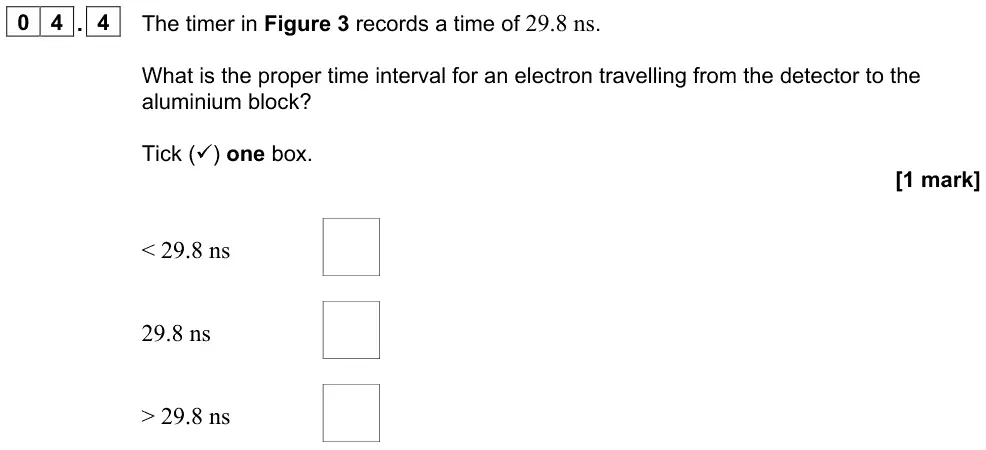
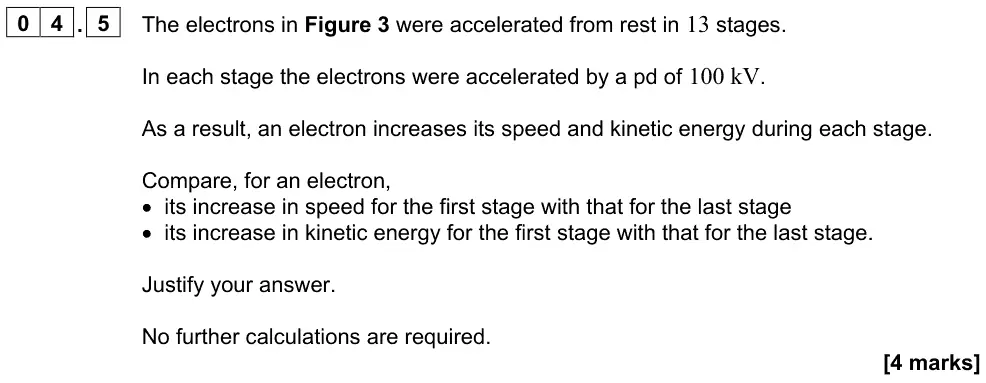
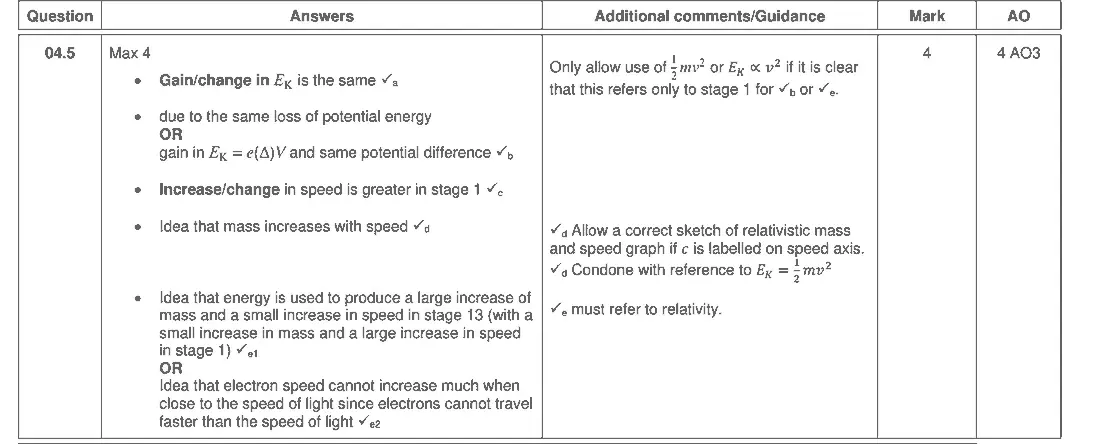
04.4 Nearly two-thirds of students gave the correct response. 04.5 Students found this question to be very challenging, although most students were able to gain some marks. Only a few students were able to gain full marks, although some students gave very well explained answers. The fact that the increase in kinetic energy was fixed, due to 𝐸𝐸𝑘𝑘= 𝑒𝑒𝑒𝑒, proved to be the most challenging part of the question. Very few answers scored these marks. The idea that the increase in speed was greater in the first stage was more widely recognised but often lacked the correct physics to explain this.
Many students were able to recognise that the mass increased with speed. However, fewer were to larger increase in 𝐸𝐸𝑘𝑘 rather than a constant increase in 𝐸𝐸𝑘𝑘 leading to a smaller increase in speed. able to apply this successfully to this scenario. Most thought that a constant change in speed leads
Some stated that it would take more energy to increase the speed by the same amount. While this would be true for a small increase in speed, most who took this route did not appreciate that the speed could not be increased by the same amount no matter how much energy was used, since this would exceed the speed of light. Some students tried to explain with a reference to the 𝐸𝐸𝑘𝑘 against 𝑣𝑣 graph. However, while many referred to the graph said that as 𝐸𝐸𝑘𝑘 tended to infinity the increase in 𝐸𝐸𝑘𝑘 must get bigger, incorrectly could recall the shape of the graph, they struggled to apply the graph to this question. Many who referred to the graph, referred to the larger increase in 𝐸𝐸𝑘𝑘 for the same increase in 𝑣𝑣, not realising implying that in each stage it moved the same distance along the line of the graph. Some who that it was the same increase in 𝐸𝐸𝑘𝑘 which produced a smaller increase in 𝑣𝑣. Some stated that the acceleration would be the same in all stages, since the potential difference was the same. While the field and therefore the force and acceleration would be the same assuming the distance was constant and relativity did not apply, this does not mean they would produce the same change in speed, since the acceleration would apply for a shorter time when the electron was travelling faster. While the rules of special relativity can be applied to the acceleration of the electron, especially in the non-accelerating reference frame of the lab, to do so is beyond the scope of this course and was not required.
A few were let down by their ability to describe motion correctly, the increase in speed was reduced, however the increase did not get slower. A smaller group confused the change in speed with the speed.
Notes from the mark scheme and report
Proper time is less than 29.8 ns (electron's own frame)
June 2024 · Paper 3B Turning points · Q4.54 marksAO3=4Explanation
Earlier part of question 4 that this part uses
Mark scheme
Examiner's comment
04.4 Nearly two-thirds of students gave the correct response. 04.5 Students found this question to be very challenging, although most students were able to gain some marks. Only a few students were able to gain full marks, although some students gave very well explained answers. The fact that the increase in kinetic energy was fixed, due to 𝐸𝐸𝑘𝑘= 𝑒𝑒𝑒𝑒, proved to be the most challenging part of the question. Very few answers scored these marks. The idea that the increase in speed was greater in the first stage was more widely recognised but often lacked the correct physics to explain this.
Notes from the mark scheme and report
Same gain in Ek each stage (Ek = eV with same pd)
speed increase larger in stage 1 because mass increases with speed and speed cannot exceed c
very few saw the Ek gain is fixed
only a few gained full marks
June 2023 · Paper 3B Turning points · Q4.12 marksAO1=1, AO3=1Explanation
Mark scheme
Examiner's comment
04.1
Notes from the mark scheme and report
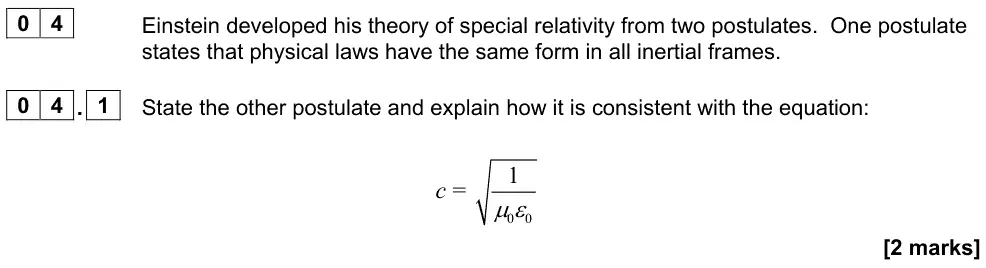
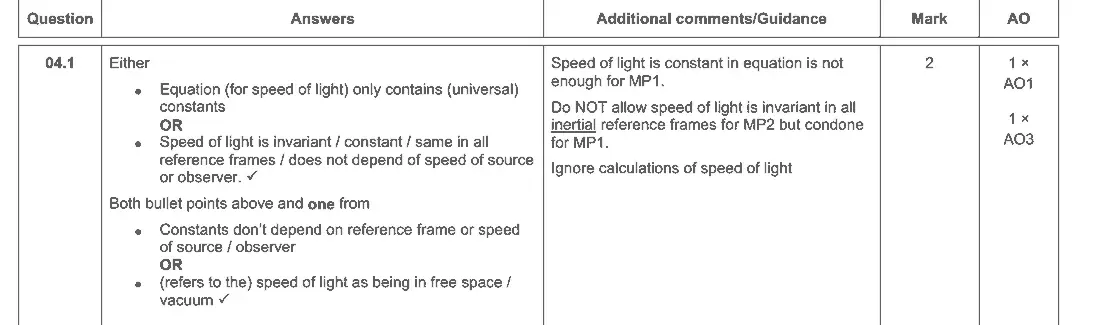
Speed of light in free space is invariant
equation contains only universal constants which do not depend on the frame of reference or speed of source/observer
June 2023 · Paper 3B Turning points · Q4.22 marksAO2=2Calculation
Earlier part of question 4 that this part uses
Mark scheme
Examiner's comment
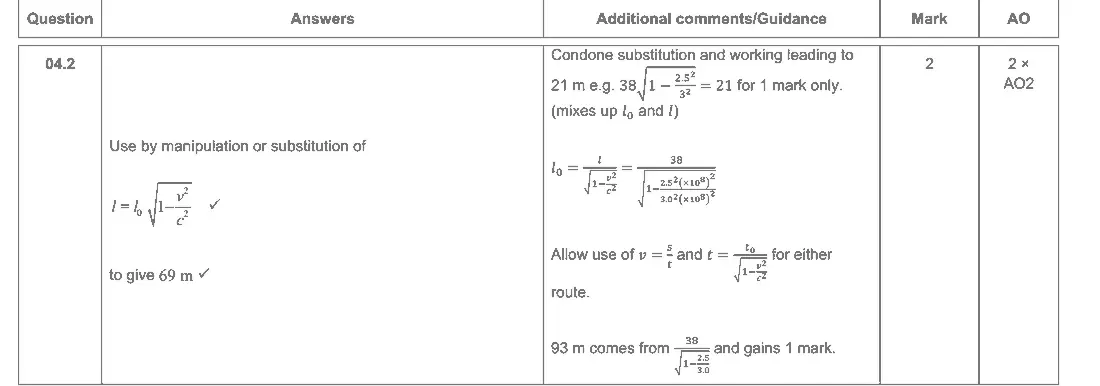
04.2
Notes from the mark scheme and report
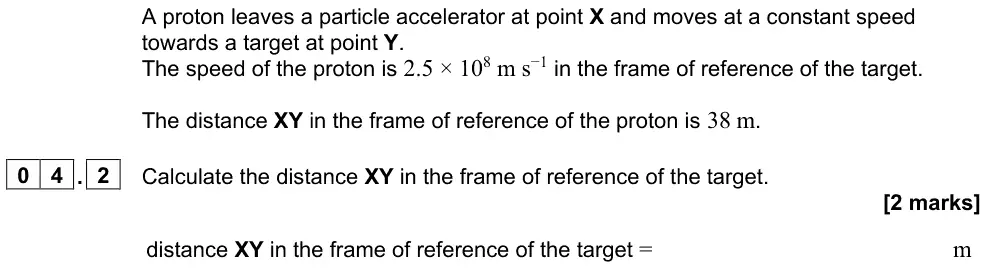
Answer: 69 m (38 m is the contracted length
l0 = l / sqrt(1 - v^2/c^2))
21 m (l0 and l swapped) gets 1 mark
Skills: MS2.3 Substitute numerical values into algebraic equations using appropriate units for physical quantities; MS2.2 Change the subject of an equation, including non-linear equations
June 2023 · Paper 3B Turning points · Q4.33 marksAO2=3Show that
Earlier part of question 4 that this part uses
Mark scheme
Examiner's comment
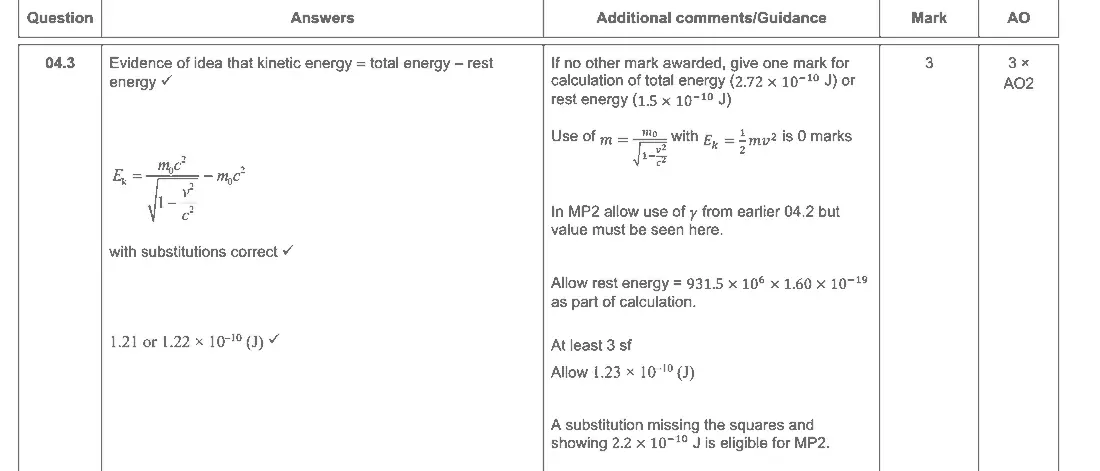
04.3
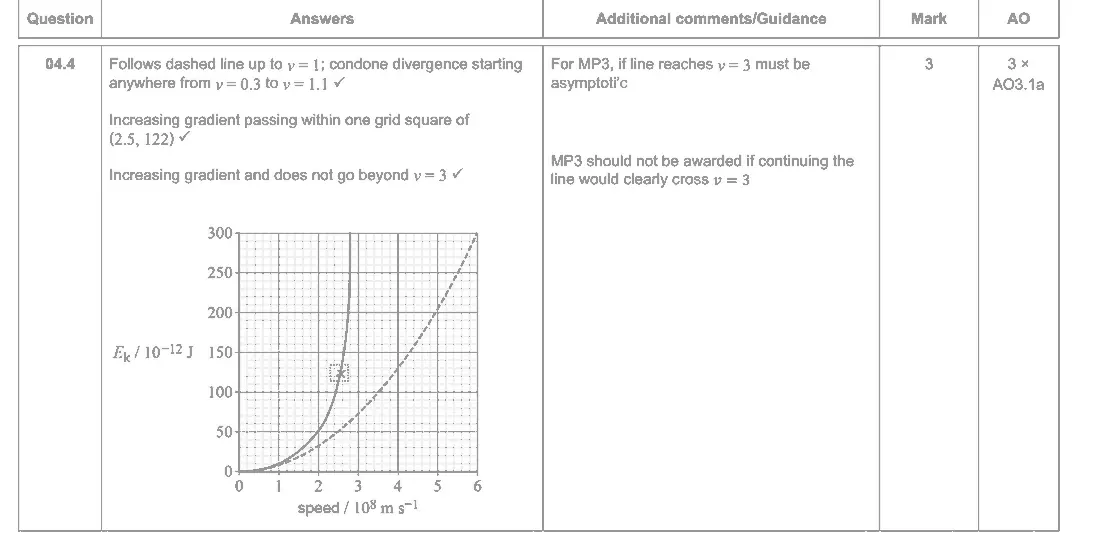
divergence was from 0.3 × 10⁸ to 1.1 × 10⁸ m s−1. The second mark was for going through the point established in question 04.3, (2.5 × 10⁸, 122 × 10−12) to within one square. In order to score this mark, the curve drawn had to show an increasing gradient, straight lines drawn through this point did not score.
Notes from the mark scheme and report
Answer: 1.21 x 10^-10 J (total energy 2.72 x 10^-10 J minus rest energy 1.50 x 10^-10 J)
1/2 mv^2 with relativistic mass scores 0
at least 3 sf
Skills: MS2.3 Substitute numerical values into algebraic equations using appropriate units for physical quantities
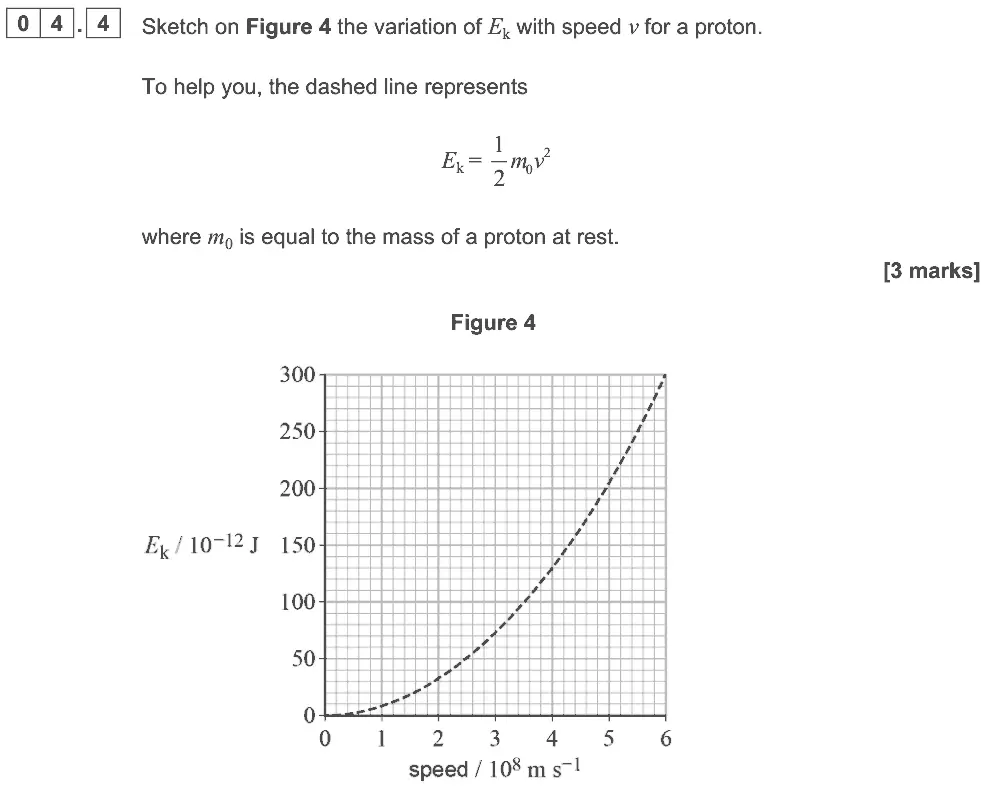
June 2023 · Paper 3B Turning points · Q4.43 marksAO3=3Diagram or graph
Earlier part of question 4 that this part uses
Mark scheme
Examiner's comment
04.4
Notes from the mark scheme and report
Follows the dashed 1/2 m0 v^2 line at low speed, then increasing gradient through (2.5 x 10^8, 122 x 10^-12 J) within one square, never reaching c (asymptotic)
straight lines through the point did not score
Skills: MS3.1 Translate information between graphical, numerical and algebraic forms
June 2022 · Paper 3B Turning points · Q4.11 markAO1=1Short answer
Mark scheme
Examiner's comment
Most students correctly identified the graph in 04.1.
Notes from the mark scheme and report
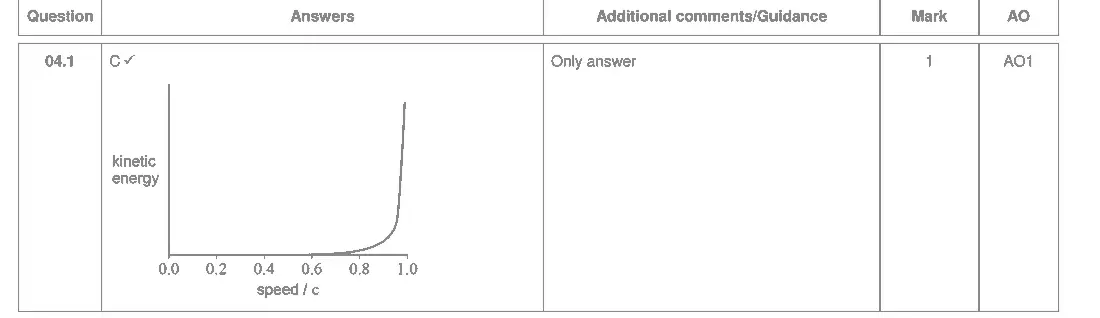
Answer: C (Ek near zero rising steeply as v approaches c)
most correct
June 2022 · Paper 3B Turning points · Q4.23 marksAO2=3Calculation
Earlier part of question 4 that this part uses
Mark scheme
Examiner's comment
04.2 proved to be much more challenging, with some students attempting to use the non-relativistic kinetic energy formula and using a speed greater than that of light.
The relationship between energy and mass is an important one in relativity and in 04.3 examiners expected to see some awareness of the implications of that relationship. This was rarely seen, even in a basic form.
Notes from the mark scheme and report
Answer: 2.6 x 10^8 m s^-1 (0.87c: Ek = m0c^2 means gamma = 2, sqrt(1 - v^2/c^2) = 0.5)
non-relativistic KE gave speeds above c
Skills: MS2.2 Change the subject of an equation, including non-linear equations; MS2.3 Substitute numerical values into algebraic equations using appropriate units for physical quantities
June 2022 · Paper 3B Turning points · Q4.32 marksAO3=2Explanation
Earlier part of question 4 that this part uses
Mark scheme
Examiner's comment
The relationship between energy and mass is an important one in relativity and in 04.3 examiners expected to see some awareness of the implications of that relationship. This was rarely seen, even in a basic form.
Notes from the mark scheme and report
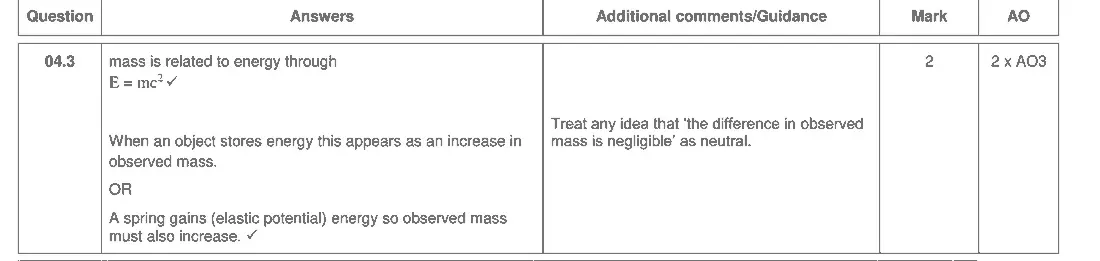
E = mc^2: stretched spring stores elastic potential energy so its observed mass increases (by a negligible amount)
rarely seen
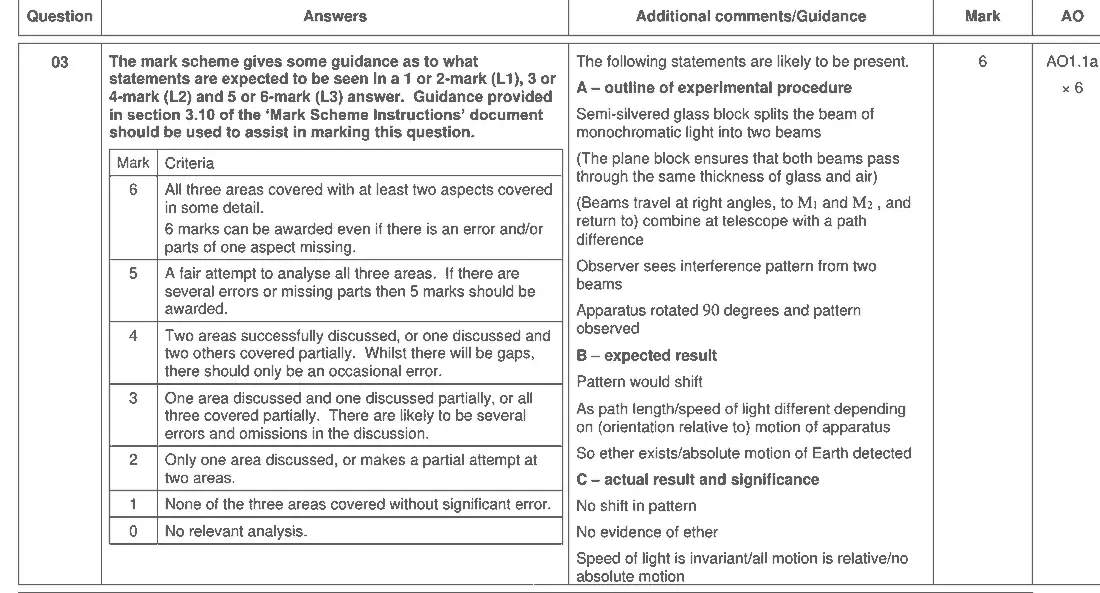
November 2021 · Paper 3B Turning points · Q36 marksAO1=66-mark extended response
Mark scheme, with the levels and indicative content
Examiner's comment
As usual the levels of response question produced a range of marks and discriminated very well. Few students were able to pick up all six marks, however. There was much confusion between this experiment and the one used to determine the speed of light.
Notes from the mark scheme and report
Levels of response: semi-silvered block splits monochromatic light into perpendicular beams that recombine to form fringes
apparatus rotated by 90 degrees
ether motion expected to change travel times and shift fringes
no shift seen, so no ether / no absolute motion, speed of light invariant
often confused with speed-of-light experiments
November 2021 · Paper 3B Turning points · Q4.11 markAO1=1Short answer
Mark scheme
Notes from the mark scheme and report
A frame moving at constant velocity (in which Newton's first law holds)
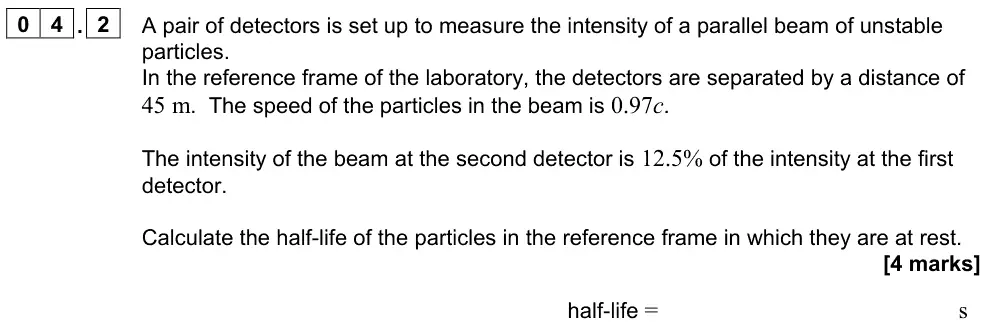
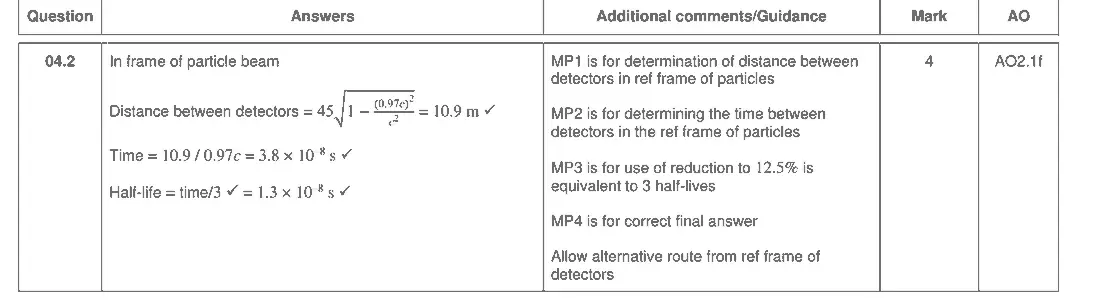
November 2021 · Paper 3B Turning points · Q4.24 marksAO2=4Calculation
Earlier part of question 4 that this part uses
Mark scheme
Notes from the mark scheme and report
Answer: 1.3 x 10^-8 s (contracted distance 45 x sqrt(1 - 0.97^2) = 10.9 m
time 10.9/0.97c = 3.8 x 10^-8 s = 3 half-lives since 12.5% remains)
Skills: MS2.3 Substitute numerical values into algebraic equations using appropriate units for physical quantities; MS0.3 Use ratios, fractions and percentages; MS0.5 Use calculators to find and use power, exponential and logarithmic functions
November 2021 · Paper 3B Turning points · Q4.31 markAO2=1Short answer
Earlier part of question 4 that this part uses
Mark scheme
Notes from the mark scheme and report
Proper time is the 3.8 x 10^-8 s for the beam to travel between detectors measured in the particles' rest frame
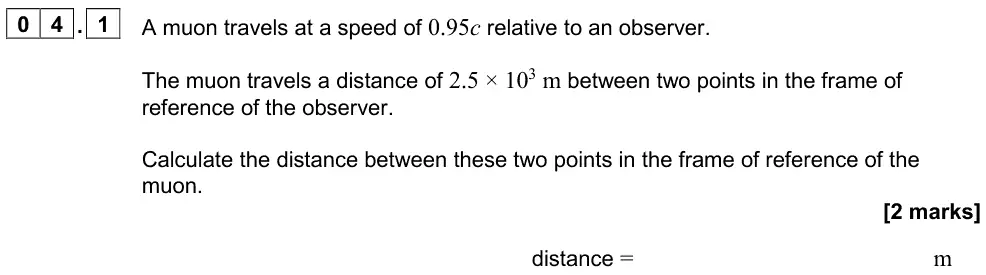
November 2020 · Paper 3B Turning points · Q4.12 marksCalculation
Mark scheme
Examiner's comment
This question dealt with special relativity and the behaviour of muons. It was disappointing to see how many students attempted to answer 04.1 without any reference to relativity at all. Many of the students who made use of the correct equation unfortunately confused L0 and L . Similarly, answers to 04.2 indicated that many students were not familiar with the muon-decay experiment, with answers frequently suggesting that the speed or the time taken were measured directly. Many answers to 04.3 either made no reference to relativity or suggested that the muons were decelerating so that the theory of relativity no longer applied. The best answers focused on one frame of reference, either the muon or the observer, and made a clear argument in terms of length contraction or time dilation. A common error was the suggestion that the half-life of the muons changed.
Notes from the mark scheme and report
Answer: 780 m (2500 x sqrt(1 - 0.95^2))
many ignored relativity or confused L and L0
Skills: MS2.3 Substitute numerical values into algebraic equations using appropriate units for physical quantities
November 2020 · Paper 3B Turning points · Q4.22 marksShort answer
Earlier part of question 4 that this part uses
Mark scheme
Examiner's comment
This question dealt with special relativity and the behaviour of muons. It was disappointing to see how many students attempted to answer 04.1 without any reference to relativity at all. Many of the students who made use of the correct equation unfortunately confused L0 and L . Similarly, answers to 04.2 indicated that many students were not familiar with the muon-decay experiment, with answers frequently suggesting that the speed or the time taken were measured directly. Many answers to 04.3 either made no reference to relativity or suggested that the muons were decelerating so that the theory of relativity no longer applied. The best answers focused on one frame of reference, either the muon or the observer, and made a clear argument in terms of length contraction or time dilation. A common error was the suggestion that the half-life of the muons changed.
Notes from the mark scheme and report
Count muons per second at altitude and at ground level
far more reach the ground than expected from their half-life without time dilation
speed or time are not measured directly
November 2020 · Paper 3B Turning points · Q4.33 marksExplanation
Earlier part of question 4 that this part uses
Mark scheme
Examiner's comment
This question dealt with special relativity and the behaviour of muons. It was disappointing to see how many students attempted to answer 04.1 without any reference to relativity at all. Many of the students who made use of the correct equation unfortunately confused L0 and L . Similarly, answers to 04.2 indicated that many students were not familiar with the muon-decay experiment, with answers frequently suggesting that the speed or the time taken were measured directly. Many answers to 04.3 either made no reference to relativity or suggested that the muons were decelerating so that the theory of relativity no longer applied. The best answers focused on one frame of reference, either the muon or the observer, and made a clear argument in terms of length contraction or time dilation. A common error was the suggestion that the half-life of the muons changed.
Notes from the mark scheme and report
Slower muons take longer and time dilation (or length contraction) is smaller, so more decay before reaching the ground and the detection rate falls
must keep one frame consistent
'half-life changes' wrong
June 2019 · Paper 3B Turning points · Q4.12 marksCalculation
Mark scheme
Examiner's comment
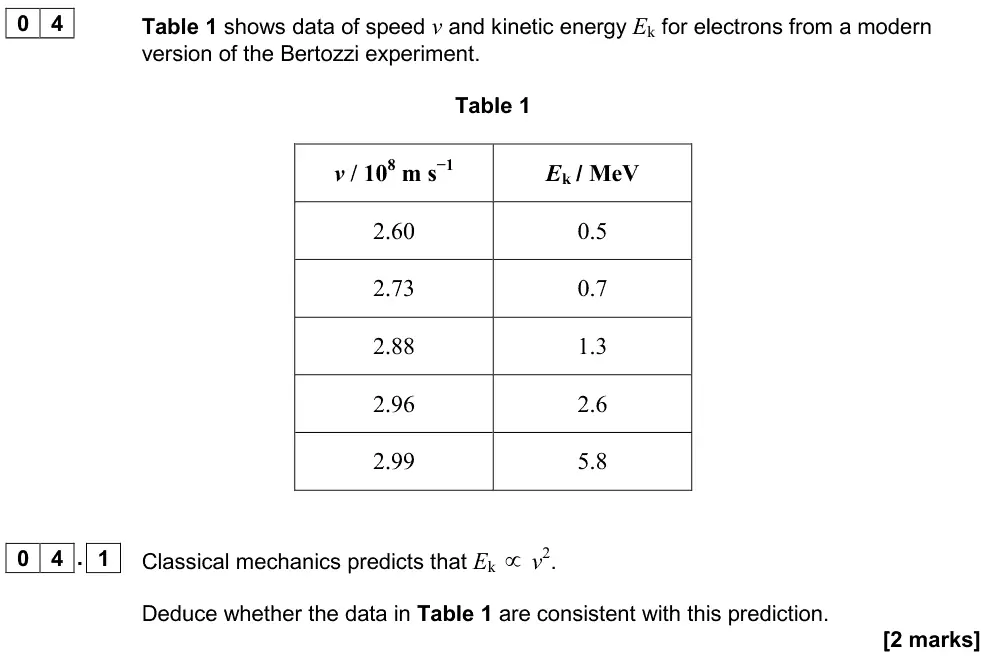
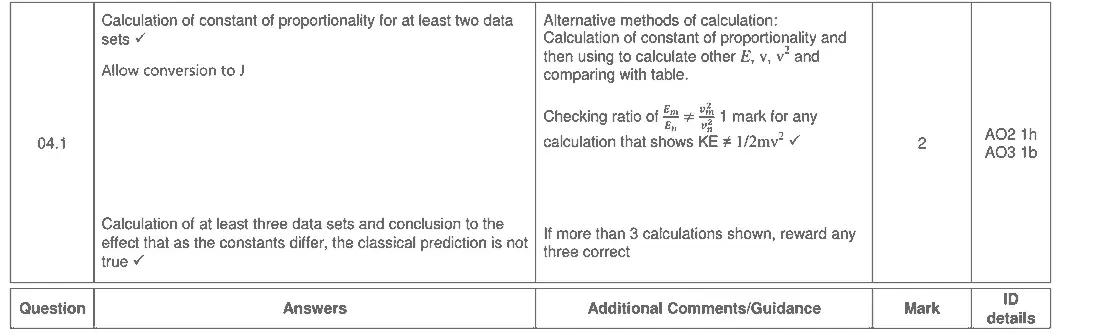
4.1 Examiners saw many different correct solutions to this question, all of which scored. In order to gain both marks, examiners required three or more data pairs to be tested. As with other AO3 questions, a relevant statement or conclusion was also needed to gain the second mark.
Notes from the mark scheme and report
Ek/v^2 not constant for at least three data pairs, so the classical prediction fails
conclusion needed
Skills: MS0.3 Use ratios, fractions and percentages; MS3.1 Translate information between graphical, numerical and algebraic forms
June 2019 · Paper 3B Turning points · Q4.24 marksExplanation
Earlier part of question 4 that this part uses
Mark scheme
Examiner's comment
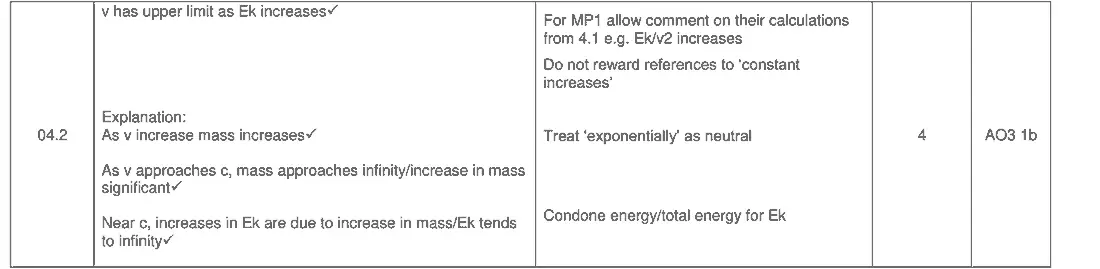
4.2 Very few students obtained all four marks for this question. Answers were often too general or vague with some simply stating the two postulates, and therefore getting no credit. A clear reference to the data in Table 1 was needed for the first mark, and this was often missed. The idea that ‘an increase in v also led to an increase in m’ was the most common mark awarded. More rarely, responses referred to the limit in v, with m tending to infinity, or discussed a link between this and the increase in kinetic energy (k.e.). A common statement that showed little extra understanding of this area was that the k.e. increases as v increases. This was perhaps another example of students falling back on their knowledge and understanding from the core curriculum.
There is clear evidence that students are being prepared well for this paper. They show familiarity with calculations and demonstrate recall of the general ideas. Difficulties arise when students are expected to reach a judgement. This is related to the testing of Assessment Objective 3 (AO3) and this report highlights where they occur. There is also evidence to suggest that, when faced with less familiar questions, some students resort to their knowledge of the core content of the specification. This can be seen particularly in questions 1.3, 3.1, 4.2 and 4.3. Because of the overlap between this option and the core content, mark schemes will continue to require students to demonstrate knowledge and understanding of content relevant to this option in order to gain full credit.
Notes from the mark scheme and report
Data show v approaching a limit (c) while Ek rises steeply
mass increases with speed, tending to infinity as v approaches c, so extra energy mostly increases mass
quoting the postulates gained nothing
very few scored 4
June 2019 · Paper 3B Turning points · Q4.33 marksCalculation
Earlier part of question 4 that this part uses
Mark scheme
Examiner's comment
4.3 This calculation proved more difficult than the other calculations in this paper. A common error was the use of 0.95c in the calculation of E0. There was also evidence of students 1 2 2 mv . taking no account of relativistic effects and simply calculating
There is clear evidence that students are being prepared well for this paper. They show familiarity with calculations and demonstrate recall of the general ideas. Difficulties arise when students are expected to reach a judgement. This is related to the testing of Assessment Objective 3 (AO3) and this report highlights where they occur. There is also evidence to suggest that, when faced with less familiar questions, some students resort to their knowledge of the core content of the specification. This can be seen particularly in questions 1.3, 3.1, 4.2 and 4.3. Because of the overlap between this option and the core content, mark schemes will continue to require students to demonstrate knowledge and understanding of content relevant to this option in order to gain full credit.
Notes from the mark scheme and report
Answer: 1.8 x 10^-13 J (E0 = 8.2 x 10^-14 J
E = E0 / sqrt(1 - 0.95^2) = 2.6 x 10^-13 J
Ek = E - E0)
using 0.95c in E0 or 0.5mv^2 were errors
Skills: MS2.3 Substitute numerical values into algebraic equations using appropriate units for physical quantities; MS0.5 Use calculators to find and use power, exponential and logarithmic functions
June 2018 · Paper 3B Turning points · Q4.16 marks6-mark extended response
Mark scheme, with the levels and indicative content
Examiner's comment
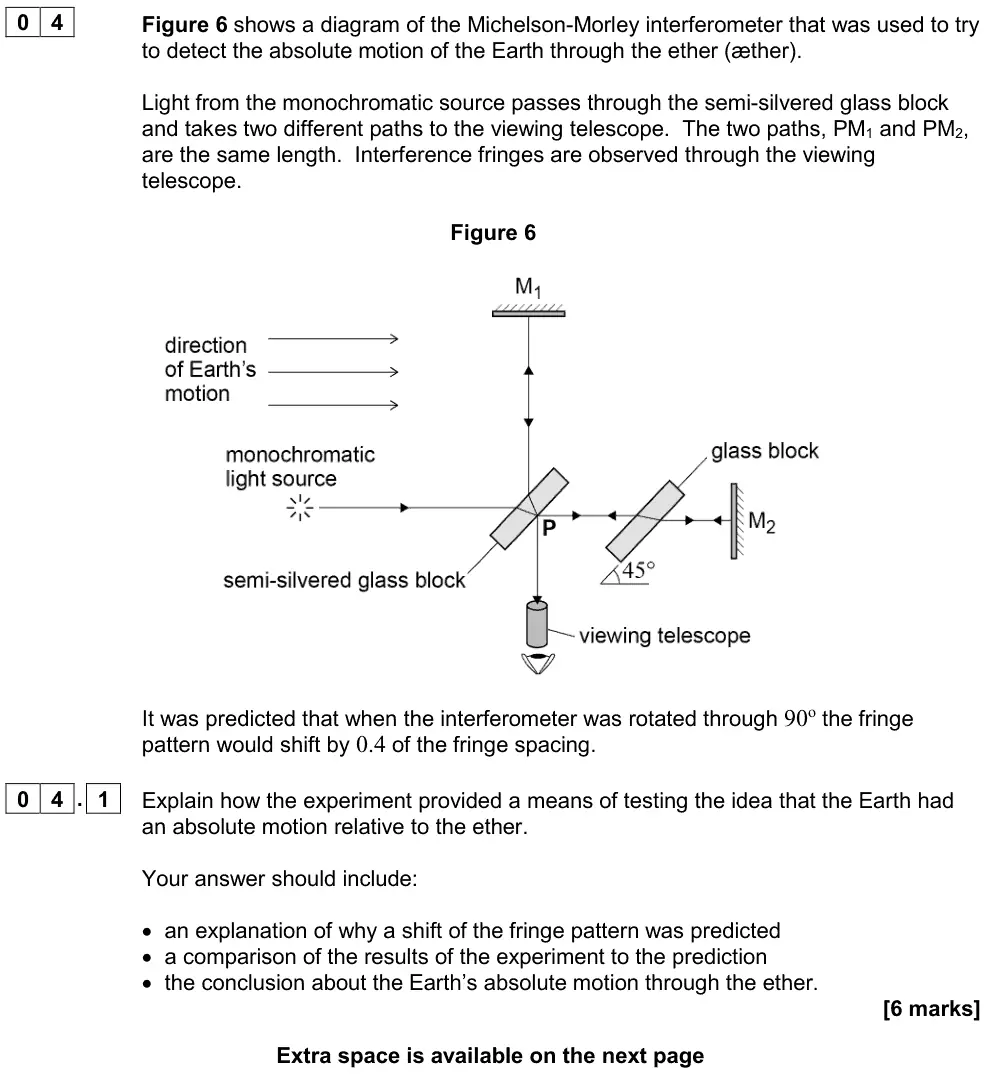
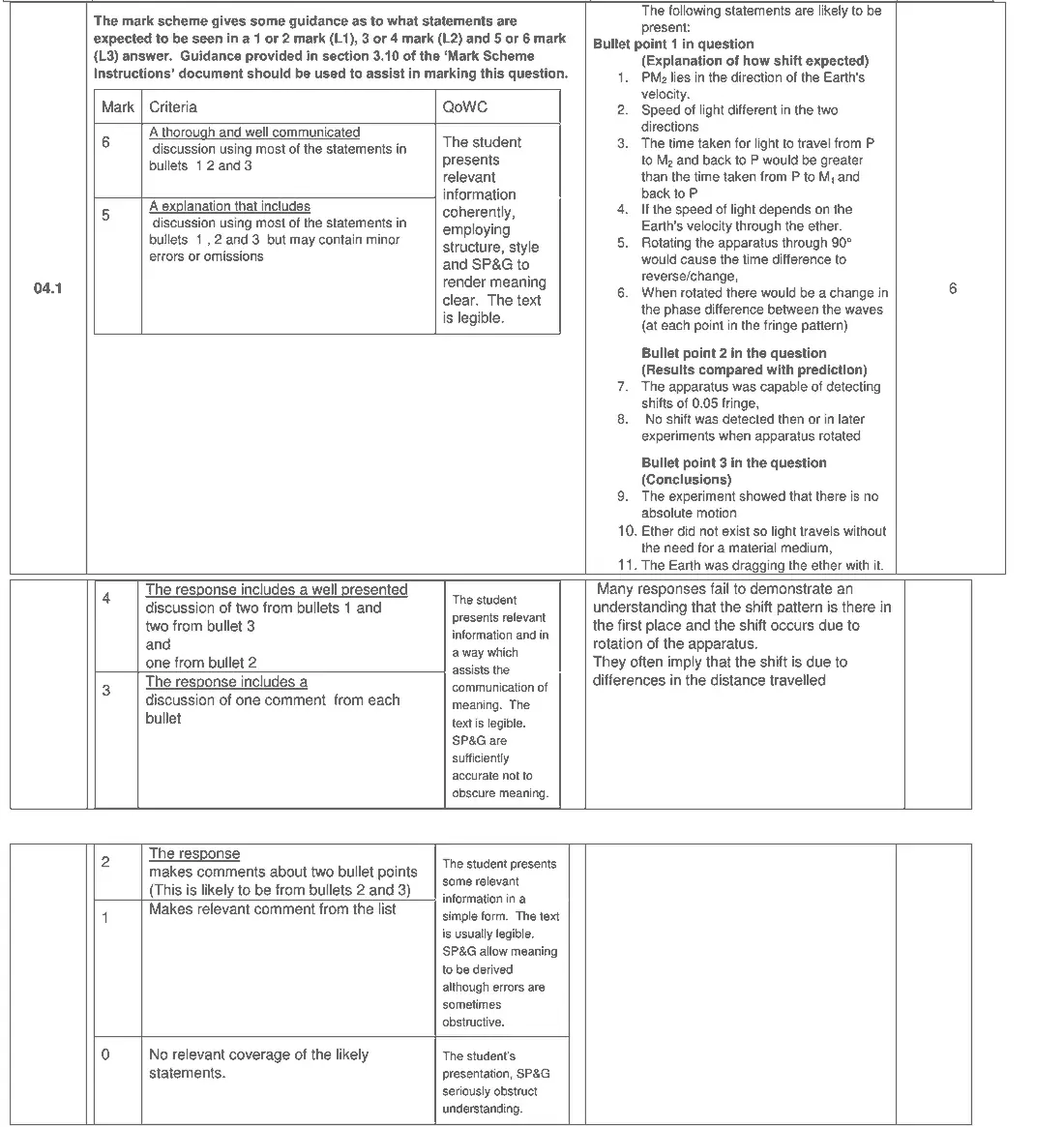
04.1 Students needed to demonstrate a clear understanding of the prediction, the experiment itself and the conclusions, as outlined in the bullet points in the question. Even the better students rarely addressed the first bullet point in the question with any conviction, so were limited to a mark in the middle level. Many responses showed only a superficial understanding of the experiment, with many appreciating no more than that rotating the apparatus was expected to produce a fringe shift and as there wasn’t one, there is no ether. Those who had more knowledge of the experiment itself often failed to provide adequate detail in their responses, particularly the detail relating to anticipated effect of the ether, the change in times of travel for the light waves, and the expected changes in phase difference when the apparatus was rotated. Responses from many students indicated a lack of understanding of how fringes were formed and no appreciation that there would be fringes seen whatever the orientation of the apparatus. For full notes on the experiment see: http://filestore.aqa.org.uk/resources/physics/AQA-7407-7408-TG-TPIP.PDF
Apart from question 3, most parts of each question proved to be accessible to many/most students. Apart from part 03.1, which was answered quite well, a majority of the students had insufficient understanding of the experimental arrangement in question 3 to deal successfully with the questions asked. The question is dealt with in more detail below. The other part that presented particular difficulties was the 6-mark question, 04.1, in which relatively few students were able to give a convincing discussion that was worthy of a mark in Level 3. The other parts that were answered surprisingly poorly were 04.2 and 04.3 where the statements of the postulates were frequently incorrect or incomplete.
Notes from the mark scheme and report
Levels of response: ether motion would make light travel times along the two arms differ
rotating by 90 degrees reverses the time difference, changing phase difference so fringes shift
apparatus could detect 0.05 fringe but no shift seen
no absolute motion, no ether (or ether dragged)
few explained the predicted shift
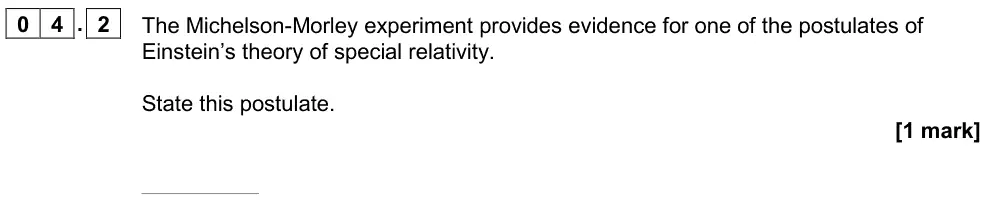
June 2018 · Paper 3B Turning points · Q4.21 markShort answerHard
Earlier part of question 4 that this part uses
Mark scheme
Examiner's comment
04.2 Those who failed to gain the mark (72% of students) usually did not state the speed invariant in free space.
Apart from question 3, most parts of each question proved to be accessible to many/most students. Apart from part 03.1, which was answered quite well, a majority of the students had insufficient understanding of the experimental arrangement in question 3 to deal successfully with the questions asked. The question is dealt with in more detail below. The other part that presented particular difficulties was the 6-mark question, 04.1, in which relatively few students were able to give a convincing discussion that was worthy of a mark in Level 3. The other parts that were answered surprisingly poorly were 04.2 and 04.3 where the statements of the postulates were frequently incorrect or incomplete.
Notes from the mark scheme and report
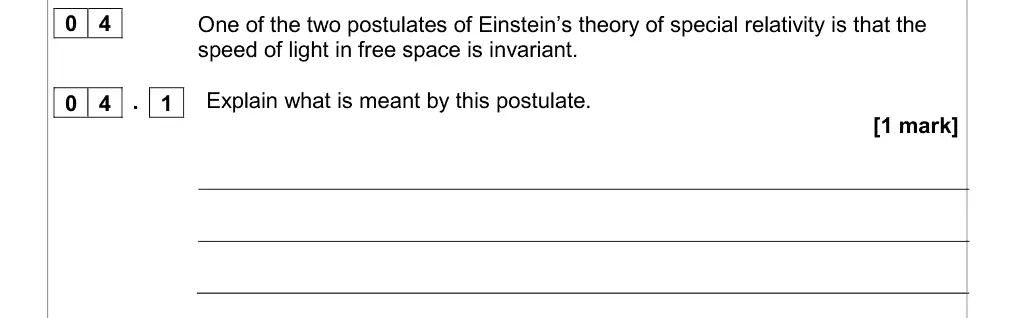
Speed of light in free space is invariant (same for all observers)
'free space' often omitted
June 2018 · Paper 3B Turning points · Q4.31 markShort answerHard
Earlier part of question 4 that this part uses
Mark scheme
Examiner's comment
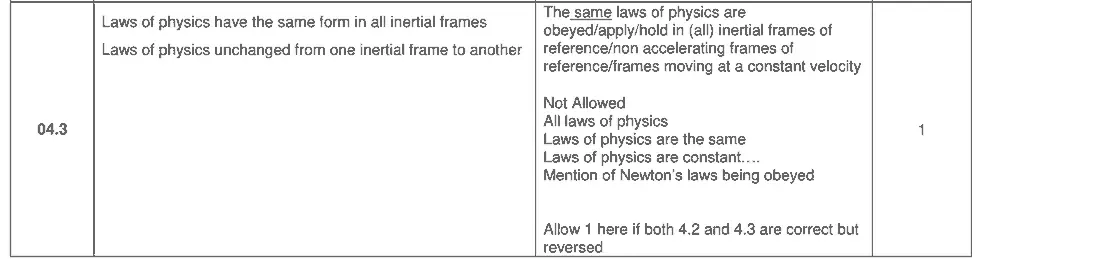
04.3 Approximately 30% gave an acceptable form of the other postulate.
Apart from question 3, most parts of each question proved to be accessible to many/most students. Apart from part 03.1, which was answered quite well, a majority of the students had insufficient understanding of the experimental arrangement in question 3 to deal successfully with the questions asked. The question is dealt with in more detail below. The other part that presented particular difficulties was the 6-mark question, 04.1, in which relatively few students were able to give a convincing discussion that was worthy of a mark in Level 3. The other parts that were answered surprisingly poorly were 04.2 and 04.3 where the statements of the postulates were frequently incorrect or incomplete.
Notes from the mark scheme and report
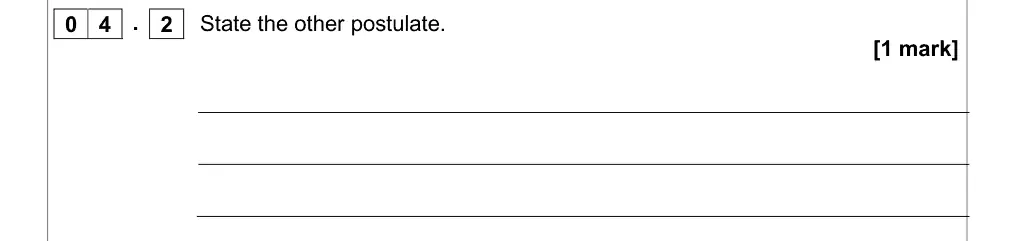
Laws of physics have the same form in all inertial frames of reference
'laws of physics are the same' alone not accepted
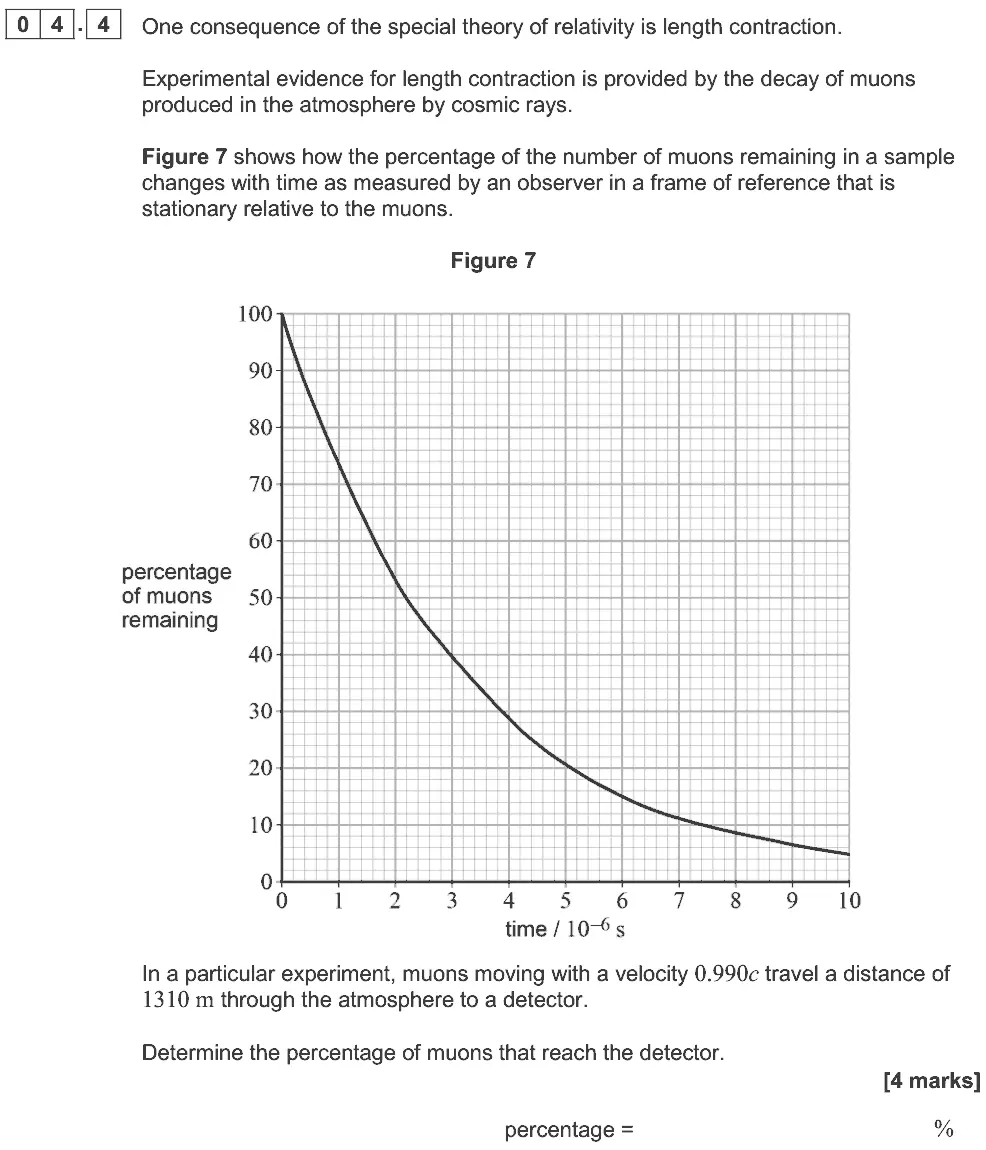
June 2018 · Paper 3B Turning points · Q4.44 marksCalculation
Earlier part of question 4 that this part uses
Mark scheme
Examiner's comment
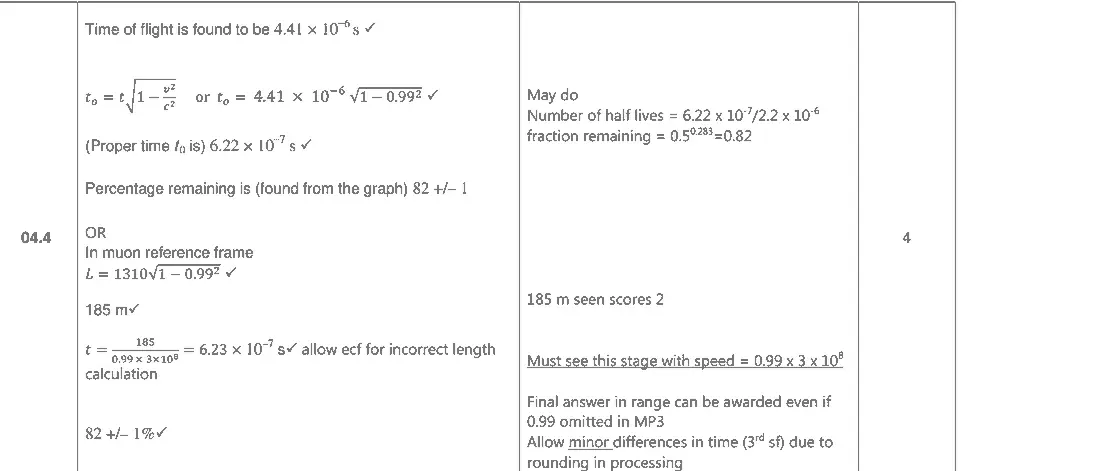
04.4 This was answered well, with just over 50% of students gaining three or four marks. Both approaches attracted roughly equal numbers of students. A read-off from the graph was adequate for the final step, but many did correct but unnecessary calculations of the number left. There was a significant minority of students who gave the number that decayed as their final answer having correctly determined the number remaining.
Notes from the mark scheme and report
Answer: 82% (lab time 1310 / (0.990c) = 4.41 x 10^-6 s
proper time 6.22 x 10^-7 s
or contracted length 185 m
read Figure 7)
some gave the percentage decayed
Skills: MS2.3 Substitute numerical values into algebraic equations using appropriate units for physical quantities; MS3.1 Translate information between graphical, numerical and algebraic forms; MS0.5 Use calculators to find and use power, exponential and logarithmic functions
June 2017 · Paper 3B Turning points · Q4.14 marksCalculation
Mark scheme
Examiner's comment
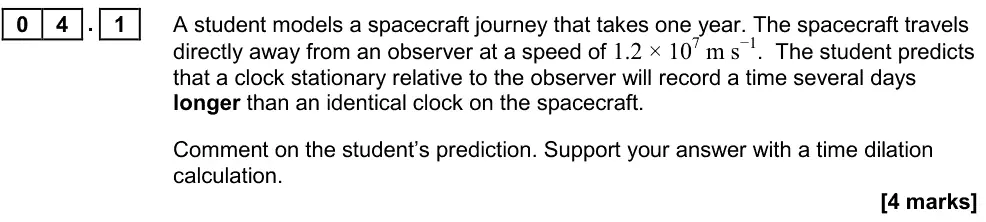
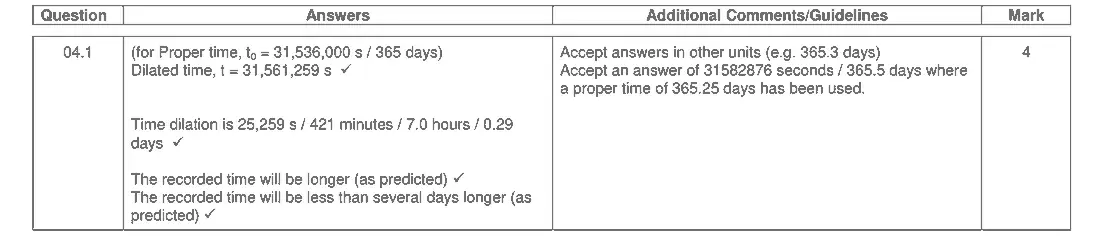
04.1 A significant number of answers to this question scored full marks. Some students neglected the instruction to support their answer with a time-dilation calculation. In addition, where students’ strategy was sound but marks were lost, this tended to be for not fully answering the question which required a judgement on both aspects of the student’s prediction, i.e. the time being longer and the magnitude of several days.
Notes from the mark scheme and report
Answer: dilated time 31 561 259 s, about 25 000 s (0.29 day) longer than one year
clock does read longer but by far less than several days
judge both parts of the prediction
Skills: MS2.3 Substitute numerical values into algebraic equations using appropriate units for physical quantities; MS0.5 Use calculators to find and use power, exponential and logarithmic functions
June 2017 · Paper 3B Turning points · Q4.22 marksExplanation
Earlier part of question 4 that this part uses
Mark scheme
Examiner's comment
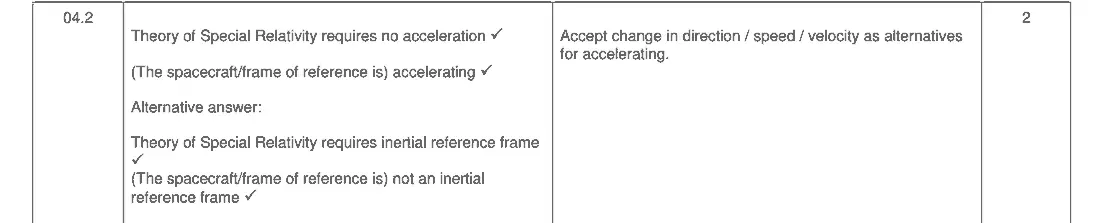
04.2 The answers given often showed a sound level of knowledge and understanding. Many students identified that the spacecraft would be accelerating, and a requirement of Special Relativity is that the frames of reference are not accelerating. Other students who scored full credit stated that the spacecraft is not an inertial frame of reference, and inertial reference frames are a requirement for Special Relativity. A commonly seen answer that scored partial credit explained what an inertial reference frame was, but did not go on to explicitly state that this was a requirement for the application of Special Relativity.
Notes from the mark scheme and report
Special relativity applies only to inertial (non-accelerating) frames
the spacecraft changes speed or direction so is accelerating
must state the requirement explicitly
June 2017 · Paper 3B Turning points · Q53 marksCalculation
Mark scheme
Examiner's comment
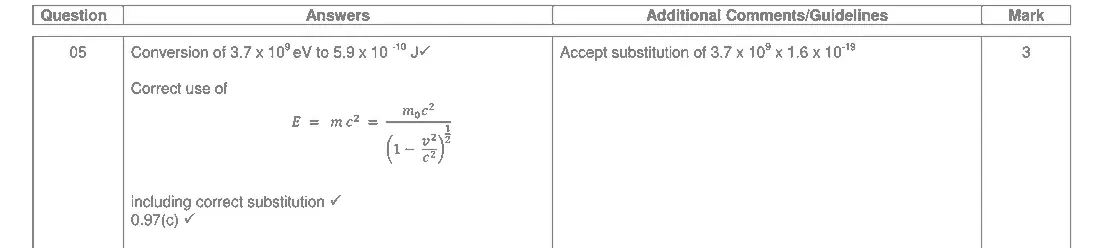
Nearly all students were able to convert the energy given in eV into J. A good number of students went on to complete the calculation successfully. A common error was the incorrect use of the EK = mc2 – moc2 equation.
Notes from the mark scheme and report
Answer: 0.97c (3.7 x 10^9 eV = 5.9 x 10^-10 J = m0 c^2 / sqrt(1 - v^2/c^2))
misusing Ek = mc^2 - m0c^2 was the common error
Skills: MS2.3 Substitute numerical values into algebraic equations using appropriate units for physical quantities; MS2.2 Change the subject of an equation, including non-linear equations
Specimen set 1 · Paper 3B Turning points · Q4.11 markShort answer
Mark scheme
Notes from the mark scheme and report
Speed of light in free space is the same for all observers, independent of the motion of the source and the observer
Specimen set 1 · Paper 3B Turning points · Q4.21 markShort answer
Earlier part of question 4 that this part uses
Mark scheme
Notes from the mark scheme and report
Physical laws have the same form in all inertial frames of reference
Specimen set 1 · Paper 3B Turning points · Q4.31 markCalculation
Earlier part of question 4 that this part uses
Mark scheme
Notes from the mark scheme and report
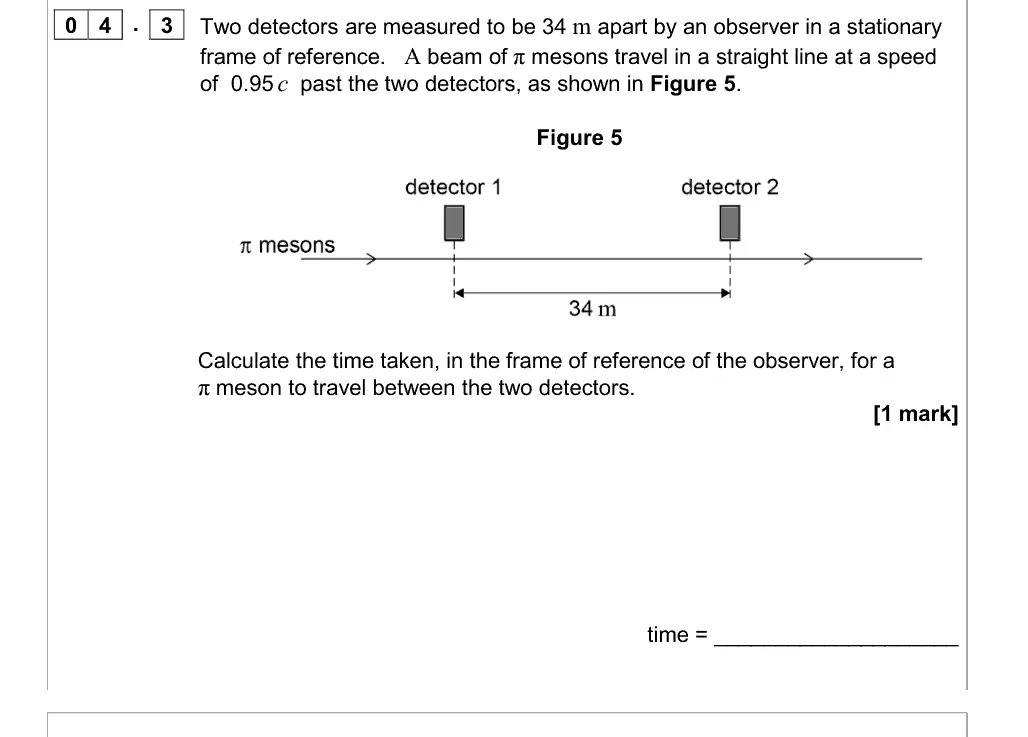
Answer: 1.2 x 10^-7 s (34 / (0.95 x 3.0 x 10^8))
Skills: MS2.3 Substitute numerical values into algebraic equations using appropriate units for physical quantities
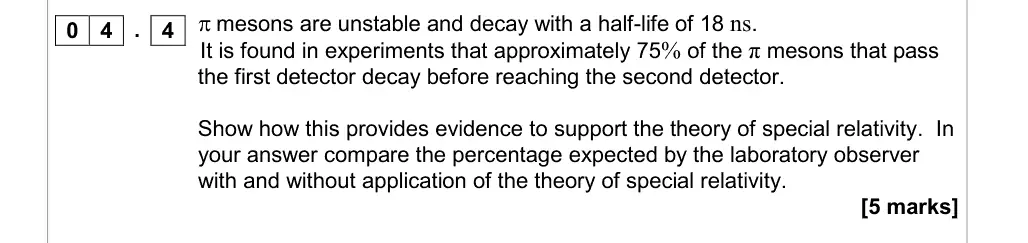
Specimen set 1 · Paper 3B Turning points · Q4.45 marksCalculation
Earlier part of question 4 that this part uses
Mark scheme
Notes from the mark scheme and report
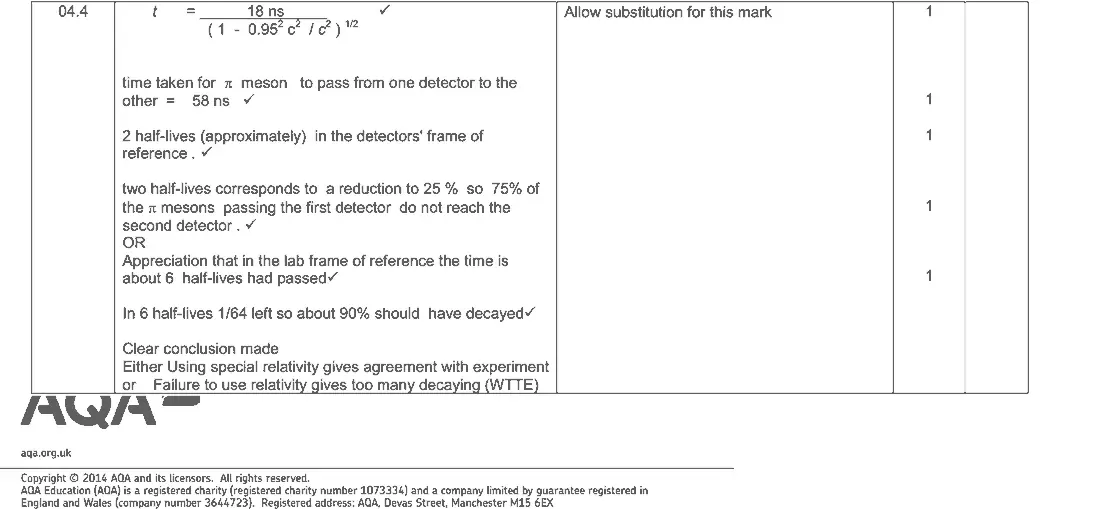
Dilated half-life 18 ns / sqrt(1 - 0.95^2) = 58 ns, so about 2 half-lives in the lab, leaving 25% (75% decayed) as observed
without relativity about 6.6 half-lives, about 99% decayed
agreement supports special relativity
Skills: MS2.3 Substitute numerical values into algebraic equations using appropriate units for physical quantities; MS0.3 Use ratios, fractions and percentages; MS0.5 Use calculators to find and use power, exponential and logarithmic functions
Work with an AQA physics tutor
Dropping marks on calculations, required practicals or the six-markers? Book a trial session with a specialist AQA physics tutor.