Notes and key-term cards for this topic are being written by our tutors. The past-paper questions below are ready now.
Specification statements
Show the 7 statements from the specification
3.3.1.3-01 Stationary waves.
3.3.1.3-02 Nodes and antinodes on strings. f = 1 2l T μ for first harmonic.
3.3.1.3-03 The formation of stationary waves by two waves of the same frequency travelling in opposite directions.
3.3.1.3-04 A graphical explanation of formation of stationary waves will be expected.
3.3.1.3-05 Stationary waves formed on a string and those produced with microwaves and sound waves should be considered.
3.3.1.3-06 Stationary waves on strings will be described in terms of harmonics. The terms fundamental (for first harmonic) and overtone will not be used.
3.3.1.3-07 Required practical 1: Investigation into the variation of the frequency of stationary waves on a string with length, tension and mass per unit length of the string.
Tap a question to zoom it. Where a part needs a figure, table or graph from earlier in the question, that part folds out above it; the mark scheme and examiner's comment open underneath. Have the AQA data and formulae booklet beside you (see the formula sheet page).
June 2025 · Paper 1 · Q2.21 markAO1=1Explanation
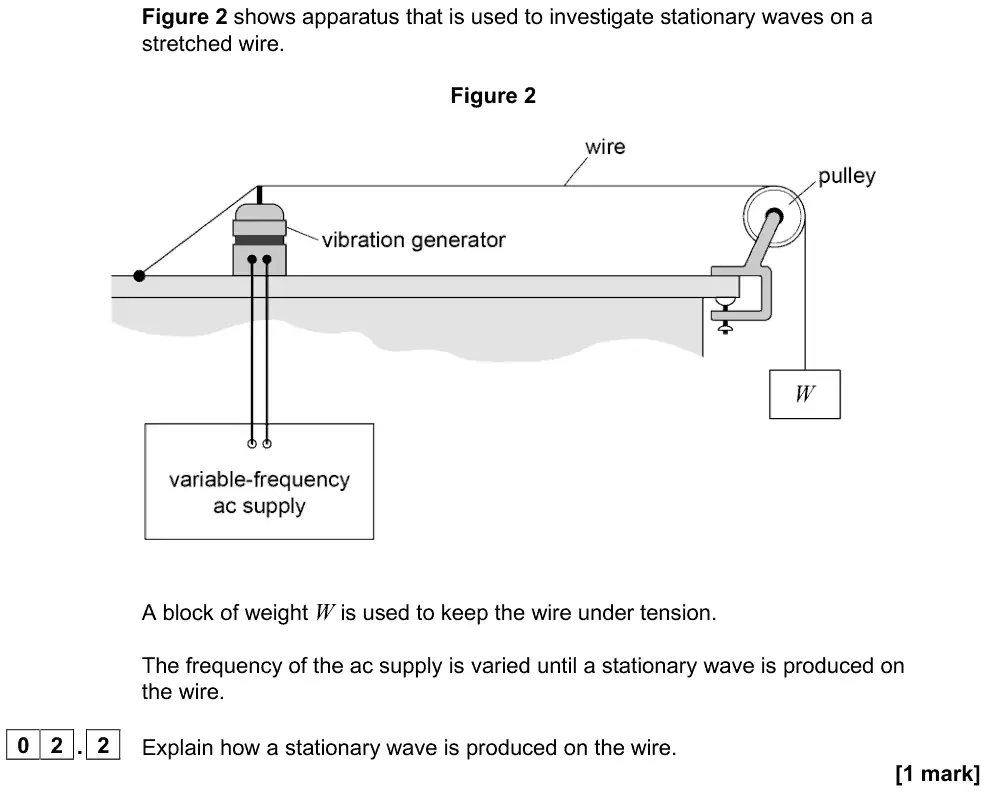
Earlier part of question 2 that this part uses
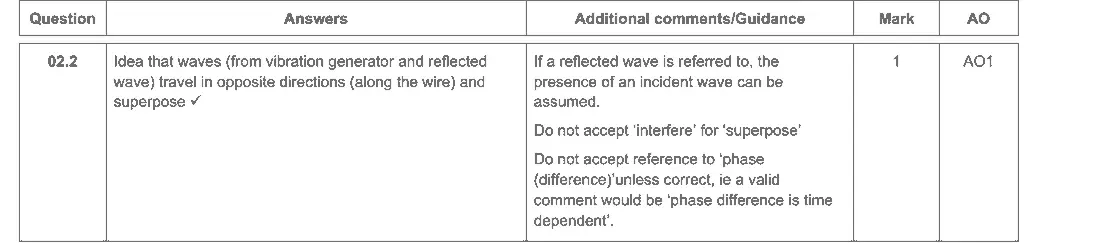
Mark scheme
Examiner's comment
Answers to Question 2.2 highlighted several misconceptions related to stationary waves. Many students suggested that the two waves are coherent or have a constant phase relationship. Several suggested they interfere, as though they are two waves meeting at a single point. Many alternative spellings for “superpose” were seen. These were tolerated on this occasion, but it may be that in future the correct word will be required.
Notes from the mark scheme and report
Waves travelling in opposite directions (incident and reflected) superpose
'interfere', 'coherent' and constant phase relationship were common misconceptions
Skills: RP1 Investigation into the variation of the frequency of stationary waves on a string with length, tension and mass per unit length of the string.
June 2025 · Paper 1 · Q2.32 marksAO2=2Explanation
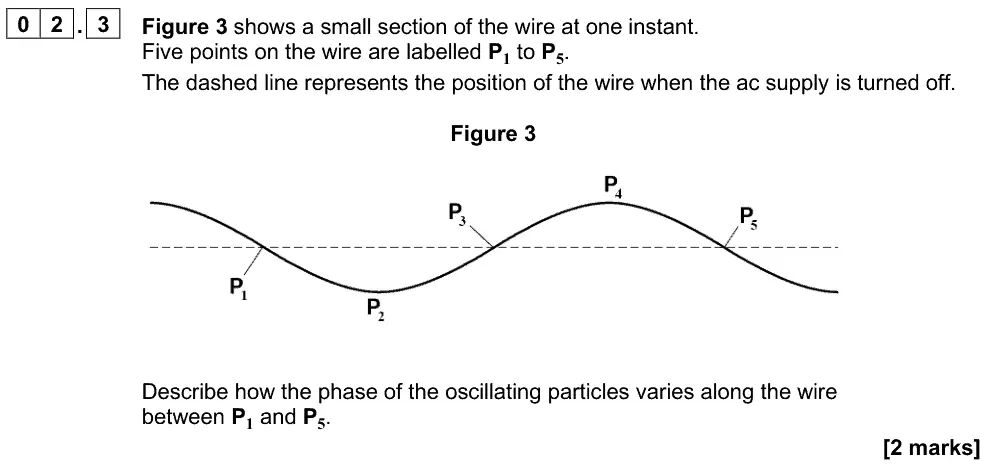
Earlier part of question 2 that this part uses
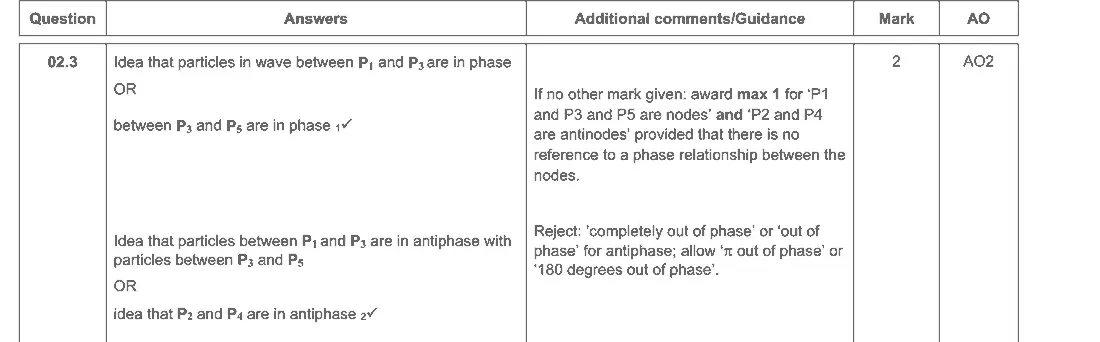
Mark scheme
Examiner's comment
Many students misunderstood Question 2.3 and only referred to the labelled points, writing answers consistent with a progressive rather than a stationary wave. The most common mark awarded was for stating that P2 and P4 were in antiphase. Note that ‘out of phase’ or ‘interfere destructively’ were not accepted for antiphase. Answers that allocated a phase relationship between stationary points rarely gained much credit.
Notes from the mark scheme and report
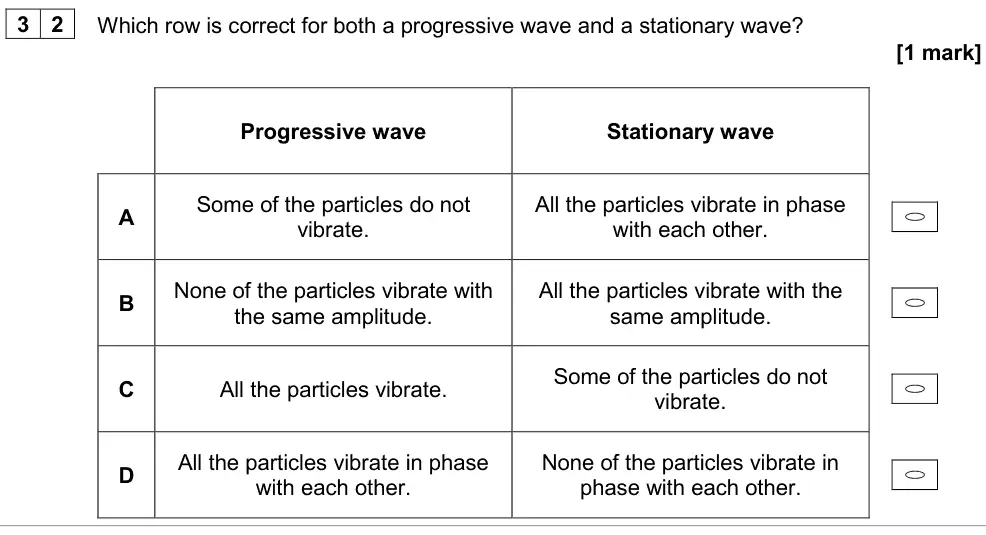
Particles between adjacent nodes (P1-P3, P3-P5) are in phase
the two loops are in antiphase
'out of phase' rejected
many answered as for a progressive wave
Skills: RP1 Investigation into the variation of the frequency of stationary waves on a string with length, tension and mass per unit length of the string.
June 2025 · Paper 1 · Q2.45 marksAO1=1, AO3=4Calculation
Earlier part of question 2 that this part uses
Mark scheme
Examiner's comment
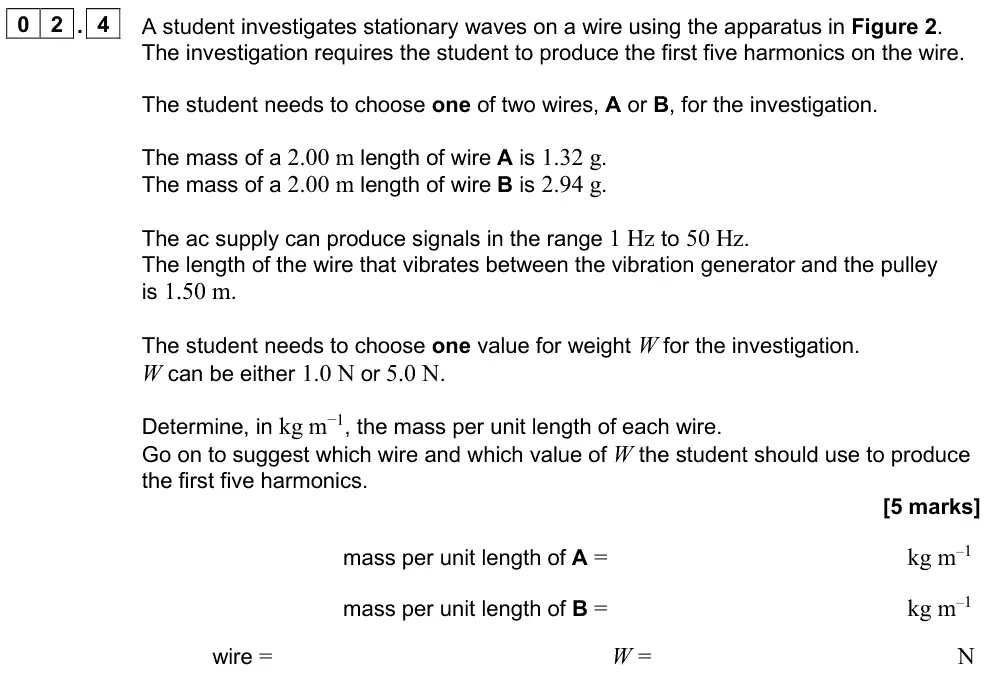
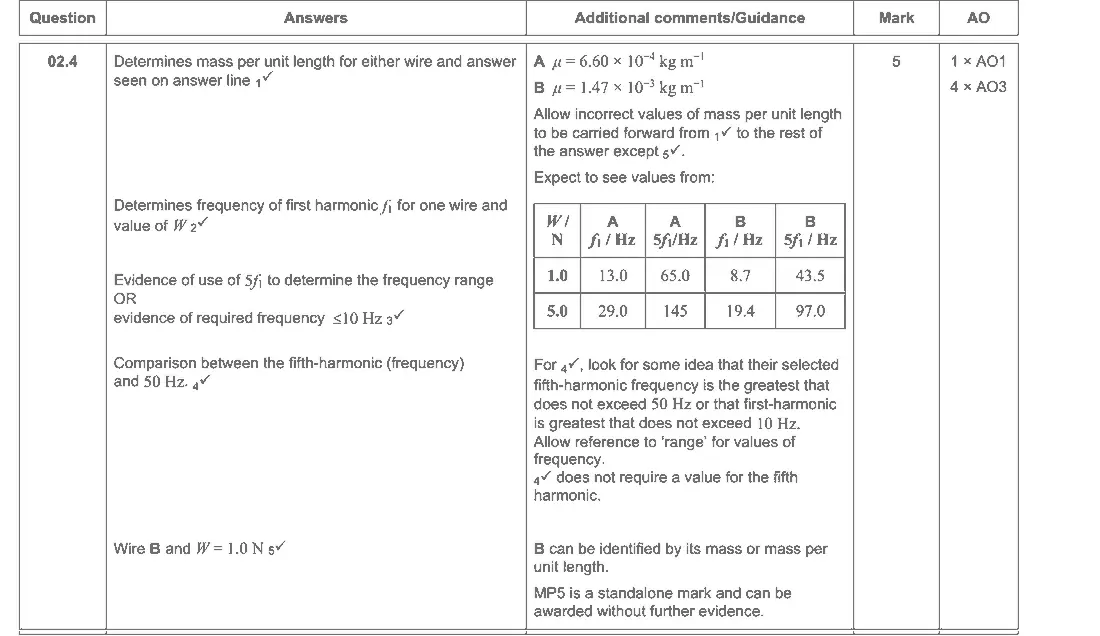
Question 2.4 discriminated well and gave a good spread of marks. Over 20% gained all five marks for this question. Common errors included using 2m for L, or thinking that W was the weight of the wire. Correct answers worked out the mass per unit length for both wires, calculated the first and fifth harmonics for all combinations, and showed that the combination of wire B and 1N produced both harmonics between 1Hz and 50Hz. Many students missed out on the fourth marking point as they did not make an explicit comparison. Alternative approaches, using the wavelength of the standing wave for example, were seen and given full credit if correct. Question 3.1 discriminated well and produced a good spread of marks. Many students were able to calculate the amplitude and maximum acceleration. Much fewer went on to draw the correct line. Sine curves were the most common incorrect answer. Even those who drew a straight line often only used one quadrant or had a positive slope.
Notes from the mark scheme and report
Answer: mu A = 6.60 x 10^-4 kg m^-1, mu B = 1.47 x 10^-3 kg m^-1
wire B with W = 1.0 N (f1 = 8.7 Hz, 5f1 = 43.5 Hz below 50 Hz)
must make an explicit comparison with 50 Hz
errors: L = 2 m, W taken as weight of wire
Skills: MS2.3 Substitute numerical values into algebraic equations using appropriate units for physical quantities; MS0.3 Use ratios, fractions and percentages; RP1 Investigation into the variation of the frequency of stationary waves on a string with length, tension and mass per unit length of the string.
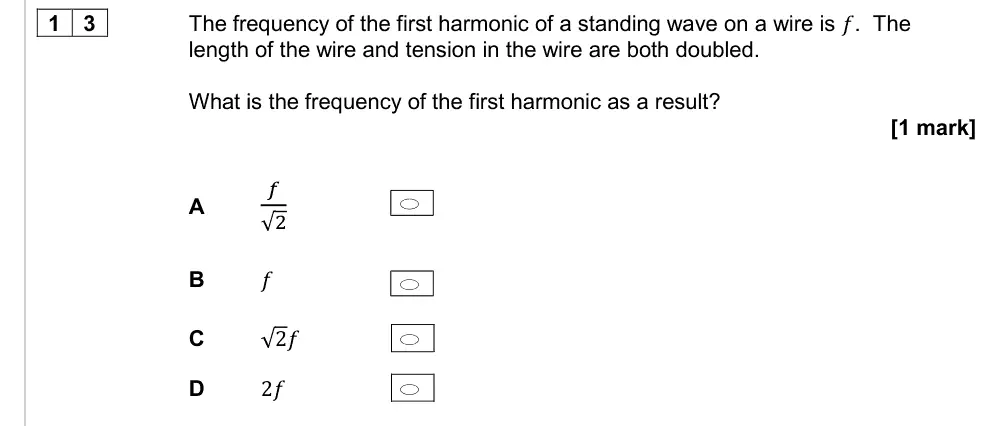
June 2025 · Paper 1 · Q141 markAO1=1Multiple choice
Answer
A
Mark scheme
Notes from the mark scheme and report
Answer: A
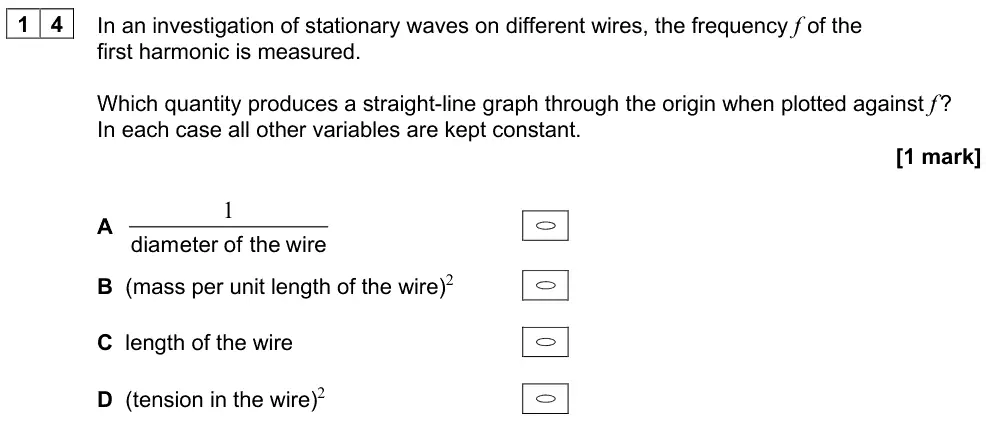
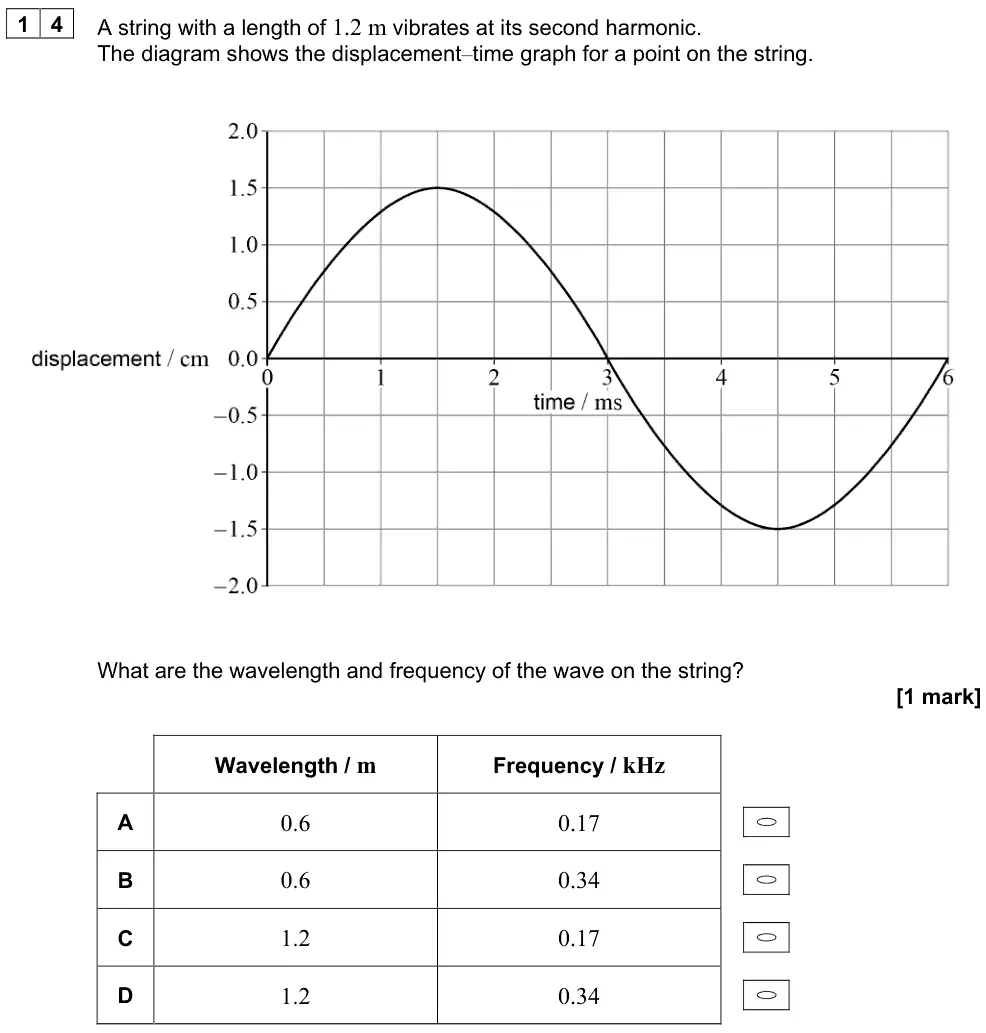
almost 60% chose D, confusing squares and square roots
Skills: MS3.1 Translate information between graphical, numerical and algebraic forms; MS2.2 Change the subject of an equation, including non-linear equations; RP1 Investigation into the variation of the frequency of stationary waves on a string with length, tension and mass per unit length of the string.
June 2025 · AS Paper 2 · Q51 markAO2=1Multiple choice
Answer
C
Mark scheme
Notes from the mark scheme and report
Answer: C
Skills: MS0.3 Use ratios, fractions and percentages
June 2025 · AS Paper 2 · Q161 markAO2=1Multiple choice
Answer
B
Mark scheme
Notes from the mark scheme and report
Answer: B
Skills: MS2.4 Solve algebraic equations, including quadratic equations
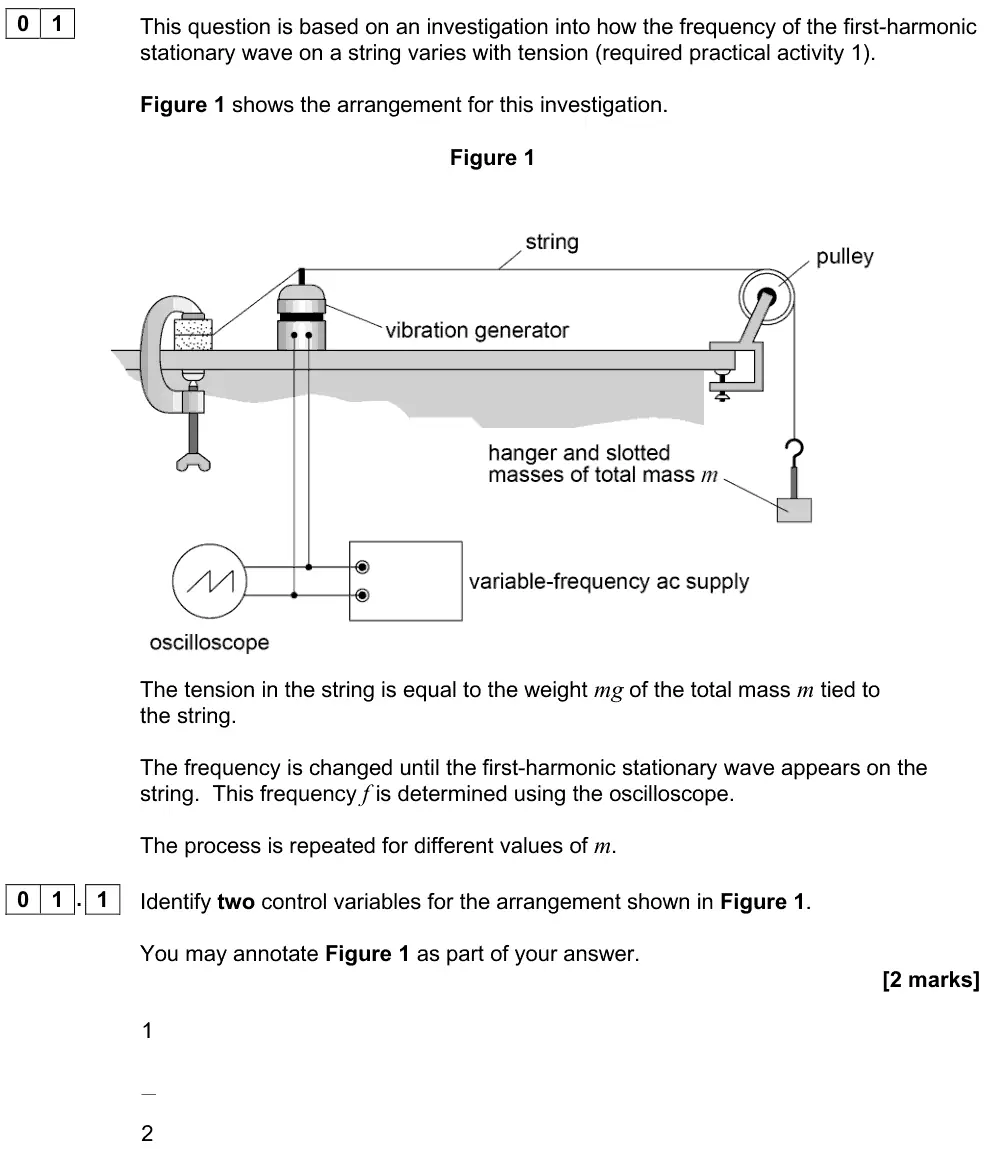
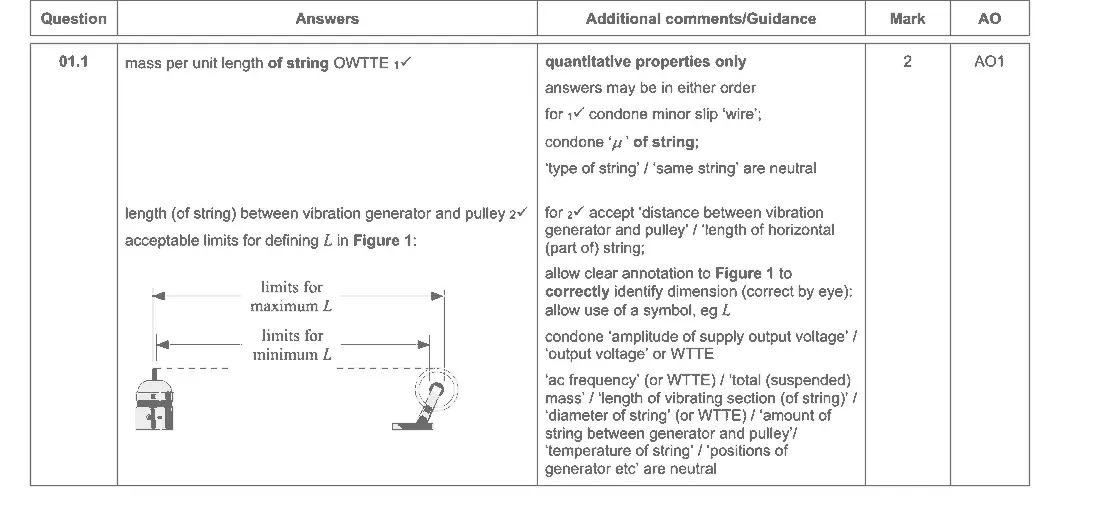
June 2025 · Paper 3 Section A · Q1.12 marksAO1=2Practical and data analysisHard
Mark scheme
Examiner's comment
In part 01.1 what should have been a straightforward opening question proved tricky and only 17% obtained both marks. No credit was given for a careless annotation to Figure 1 to identify the length of string that should be controlled.
In part 01.1 many struggled to correctly identify two control variables. We saw too many suggestions such as ‘use the same string’; we expect control variables to be quantitative in this situation. We also saw ‘keep the frequency constant’; the first few words of the question established that frequency was the dependent variable.
Notes from the mark scheme and report
Mass per unit length of string (same string) and vibrating length between generator and pulley
careless annotation of the length not credited
only 17% both marks
Skills: PS2.4 Identify variables including those that must be controlled; RP1 Investigation into the variation of the frequency of stationary waves on a string with length, tension and mass per unit length of the string.
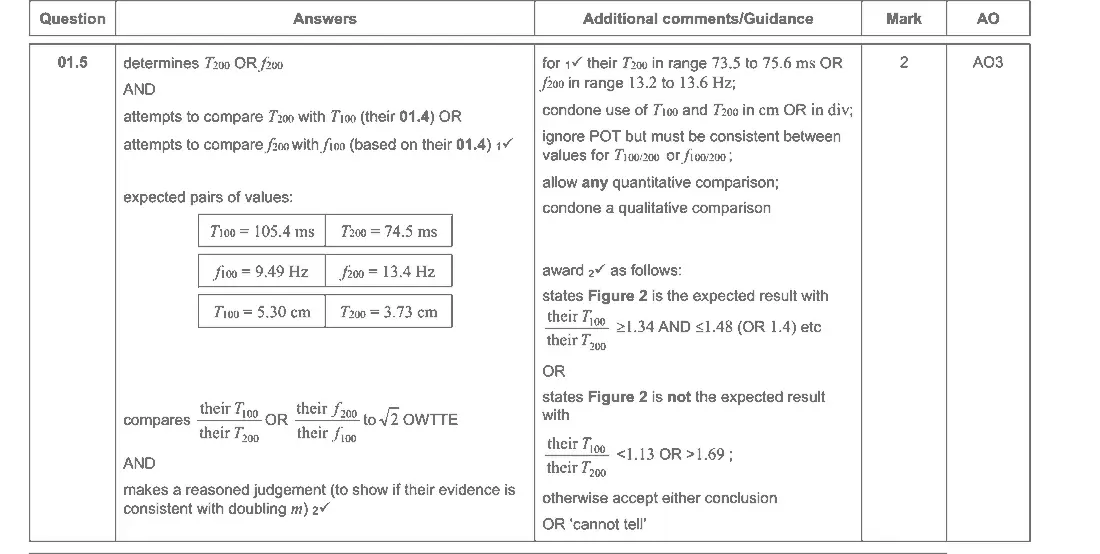
June 2025 · Paper 3 Section A · Q1.52 marksAO3=2Practical and data analysis
Earlier part of question 1 that this part uses
Mark scheme
Examiner's comment
A majority saw the intention of part 01.5 and made the expected quantitative comparison between the waveforms in Figure 2.
Stronger students were able to confirm their ability in AO3 parts 01.5, 02.5, 04.2 and 04.5 where they had to think more imaginatively about the problems. The better-prepared knew how to deal with AO1 parts 02.1, 02.2 and 04.1 that tested familiar practical procedures, but the struggles of others suggest they may have had limited opportunities to carry out practical work.
The students found lots of things in the paper that they could do. In parts 01.4 and 01.5, many determined accurate values for the periods of the waveforms and could then show that Figure 2 confirmed the expected result of doubling m.
Notes from the mark scheme and report
T100 = 105 ms, T200 = 74.5 ms (f 9.5 Hz to 13.4 Hz)
f proportional to root T so ratio should be root 2 = 1.41 - matches, so yes
Skills: MS0.3 Use ratios, fractions and percentages; MS3.1 Translate information between graphical, numerical and algebraic forms; ATh signal generator and oscilloscope; RP1 Investigation into the variation of the frequency of stationary waves on a string with length, tension and mass per unit length of the string.
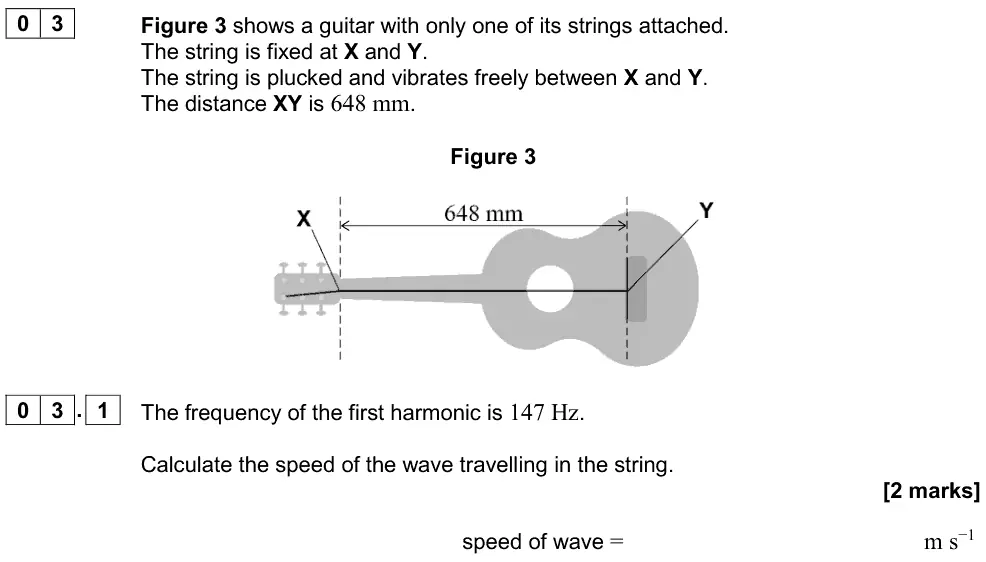
June 2024 · AS Paper 1 · Q3.12 marksAO1=1, AO2=1Calculation
Mark scheme
Examiner's comment
03.1
Notes from the mark scheme and report
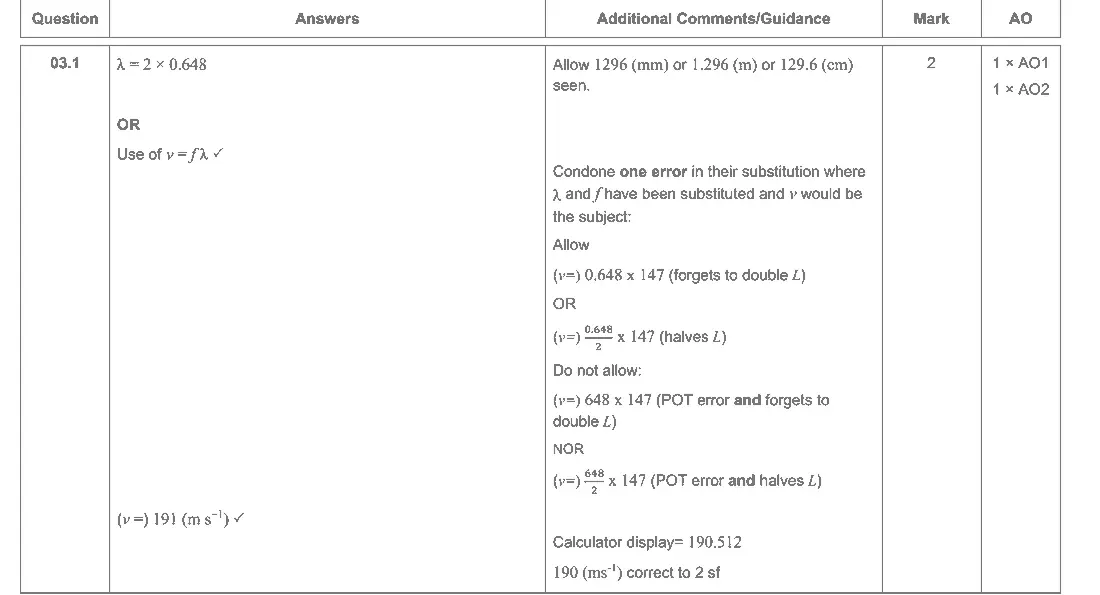
Answer: 191 m s^-1 (lambda = 2 x 0.648 = 1.296 m, f = 147 Hz)
Skills: MS2.3 Substitute numerical values into algebraic equations using appropriate units for physical quantities; RP1 Investigation into the variation of the frequency of stationary waves on a string with length, tension and mass per unit length of the string.
June 2024 · AS Paper 1 · Q3.23 marksAO1=1, AO2=2Calculation
Earlier part of question 3 that this part uses
Mark scheme
Examiner's comment
03.2
Notes from the mark scheme and report
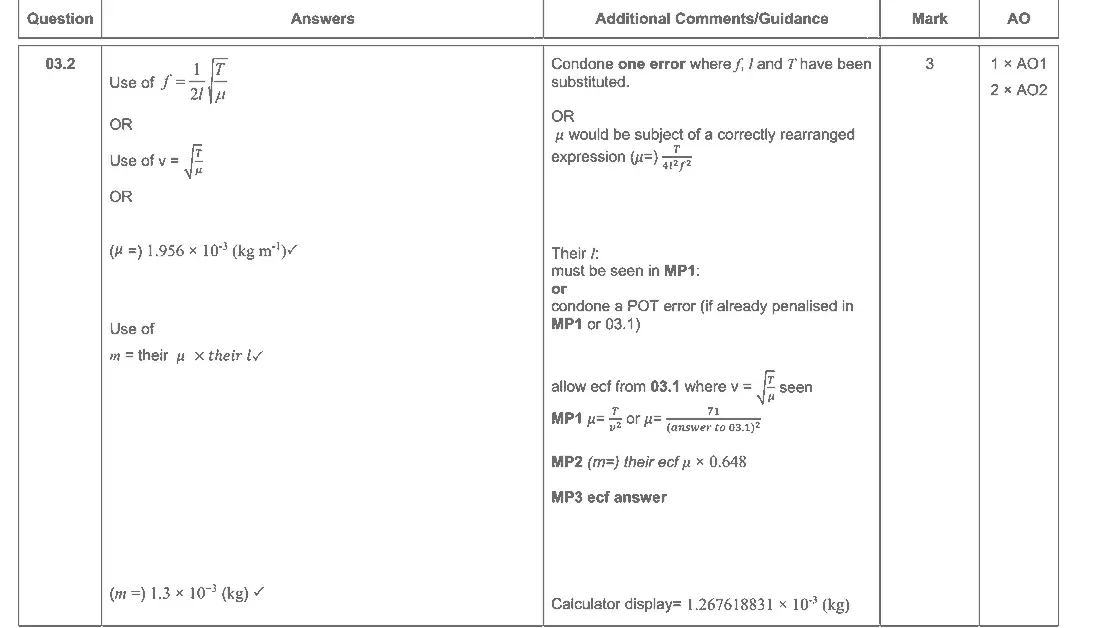
Answer: 1.3 x 10^-3 kg (mu = T/v^2 = 1.96 x 10^-3 kg m^-1, times 0.648 m)
Skills: MS2.2 Change the subject of an equation, including non-linear equations; MS2.3 Substitute numerical values into algebraic equations using appropriate units for physical quantities; RP1 Investigation into the variation of the frequency of stationary waves on a string with length, tension and mass per unit length of the string.
June 2024 · AS Paper 1 · Q3.33 marksAO1=1, AO2=1, AO3=1Diagram or graphHard
Earlier part of question 3 that this part uses
Mark scheme
Examiner's comment
03.3
Well over 90% of students gained at least one mark with over 25% gaining both marks. Most students who gained one mark obtained the resistance of the lamp as 2.2 Ω and presented this as their final answer. They determined the resistance by either using V=IR or reading-off the resistance from Figure 13. Of those who realised that more was required, they mostly chose to determine the total mark through arithmetic errors such as 9 – 3.3 = 6.7 instead of 5.7. resistance in the circuit and subtract the lamp’s resistance to find R’s resistance. Some lost the second
Notes from the mark scheme and report
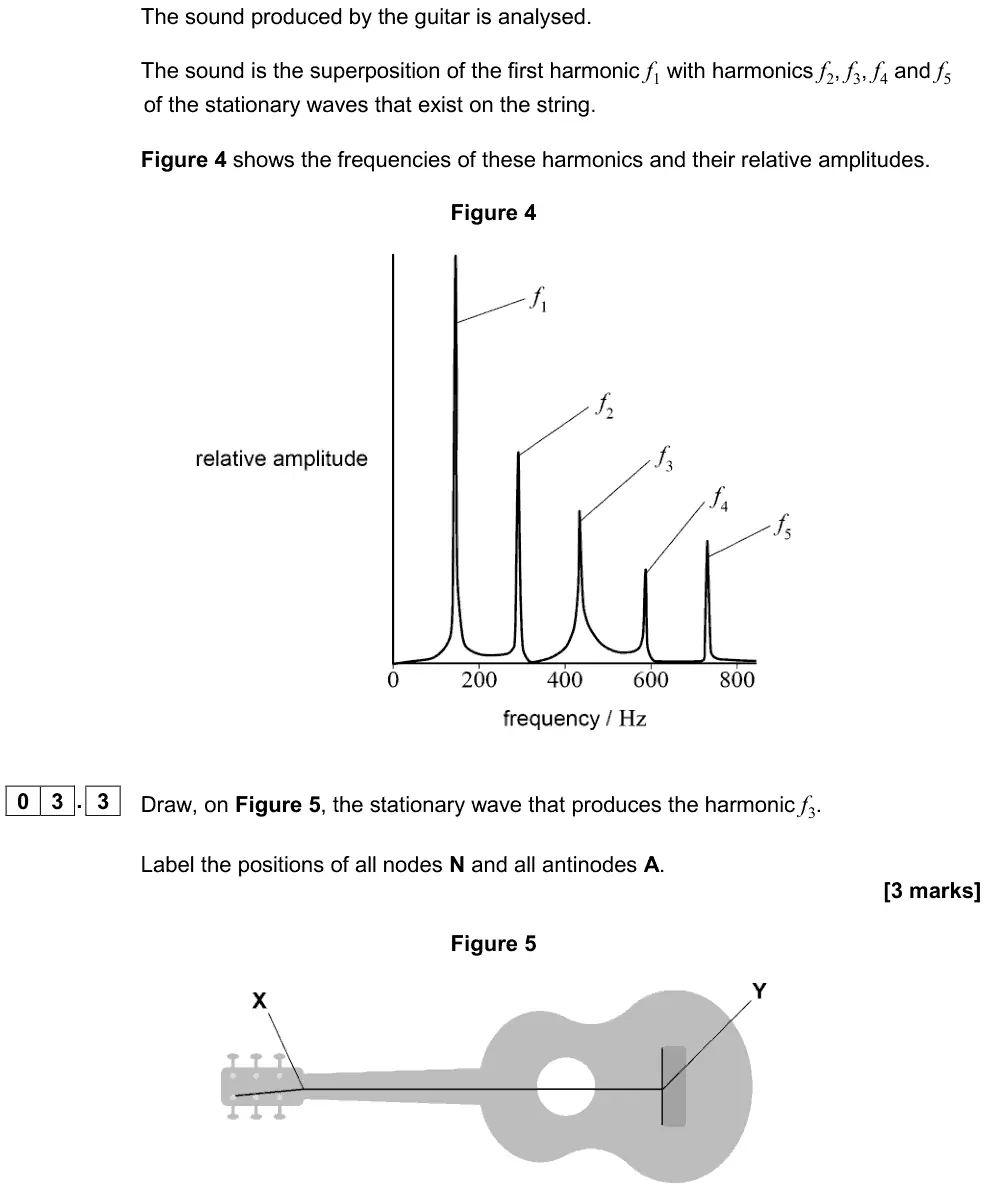
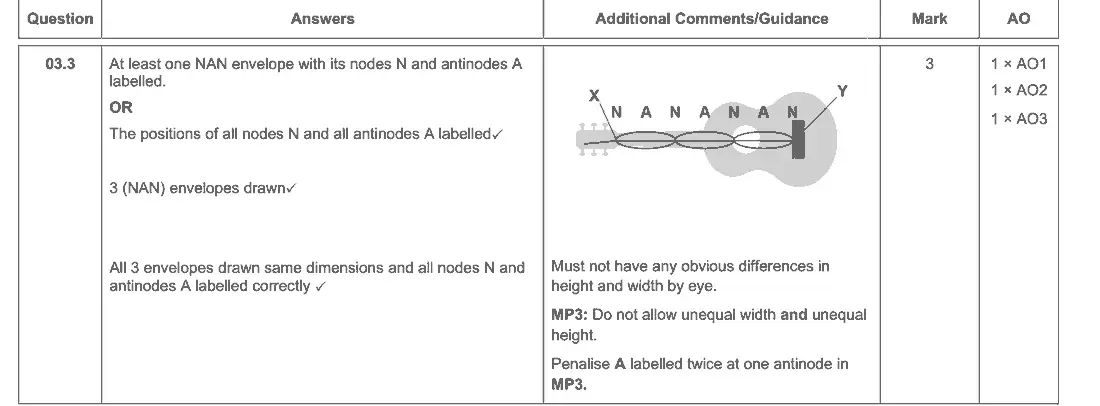
Three equal loops between X and Y
4 nodes (including X and Y) and 3 antinodes labelled
unequal loops or two A's per loop lose MP3
June 2024 · AS Paper 1 · Q3.43 marksAO3=3Explanation
Earlier part of question 3 that this part uses
Mark scheme
Examiner's comment
Nearly 20% of students gained all three marks. Their stationary wave had been drawn correctly with the appropriate attention to detail ensuring: • the envelopes were similar in width and height • all nodes and antinodes were correctly indicated. Students who drew uneven loops did not obtain the third marking point. Other students lost the third mark for labelling the antinode at two positions on one loop. They confused the antinode, the position where maximum displacement occurs, with the position of minimum displacement. Lower attaining students drew the incorrect number of envelopes, they did not understand how f3 was related to the fundamental f1. Some, having drawn some envelopes, were unable to identify correctly the position of any nodes or antinodes. 03.4
Notes from the mark scheme and report
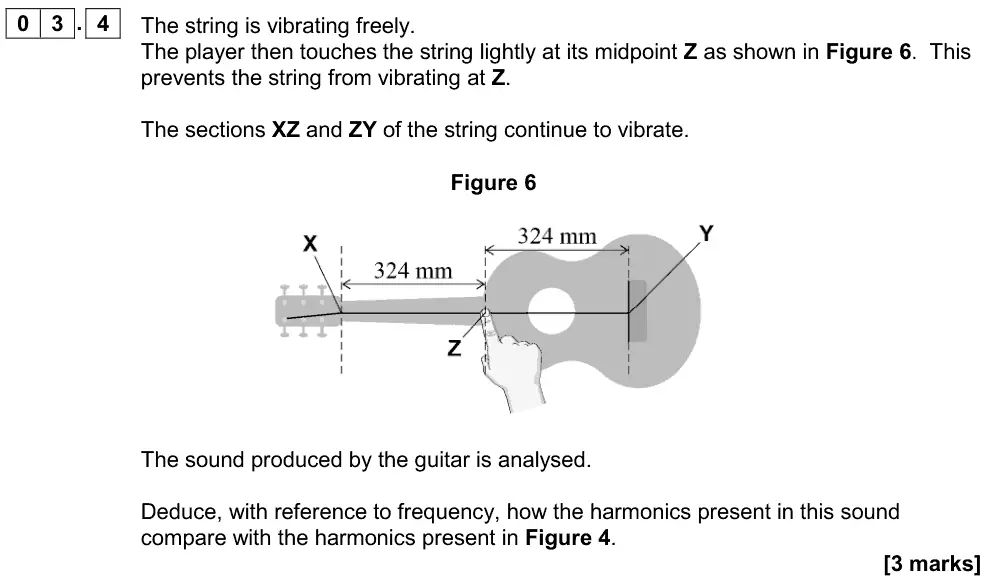
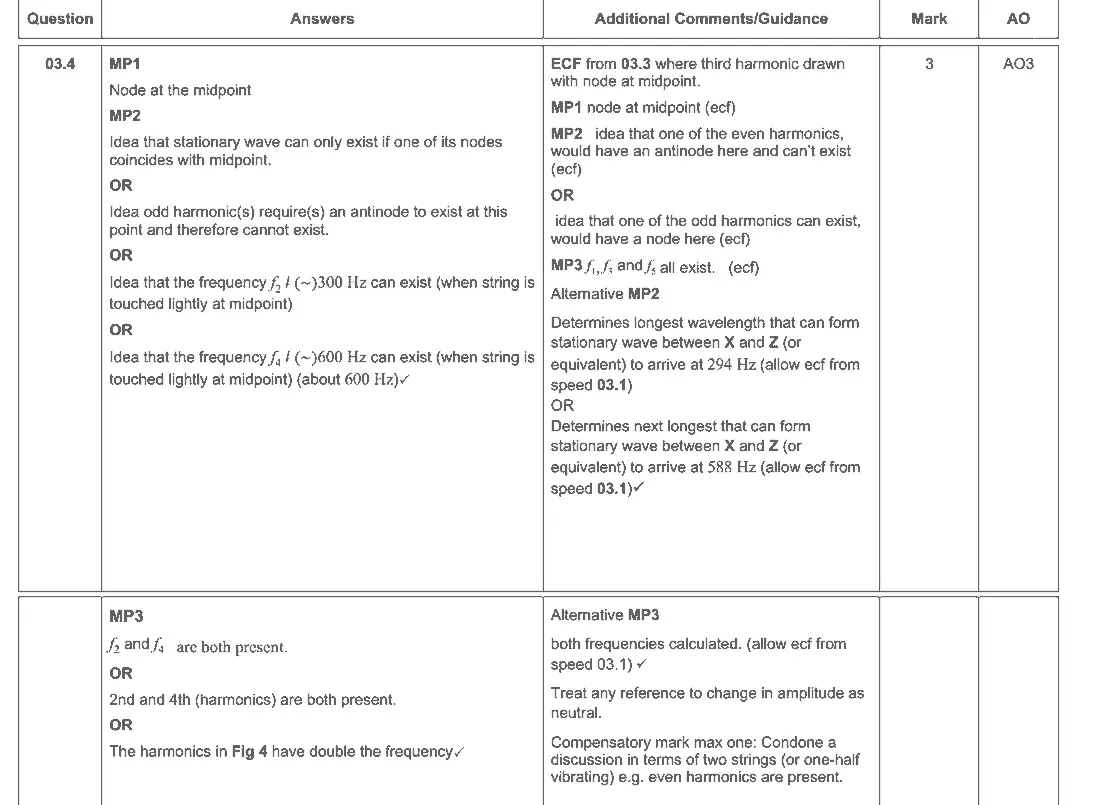
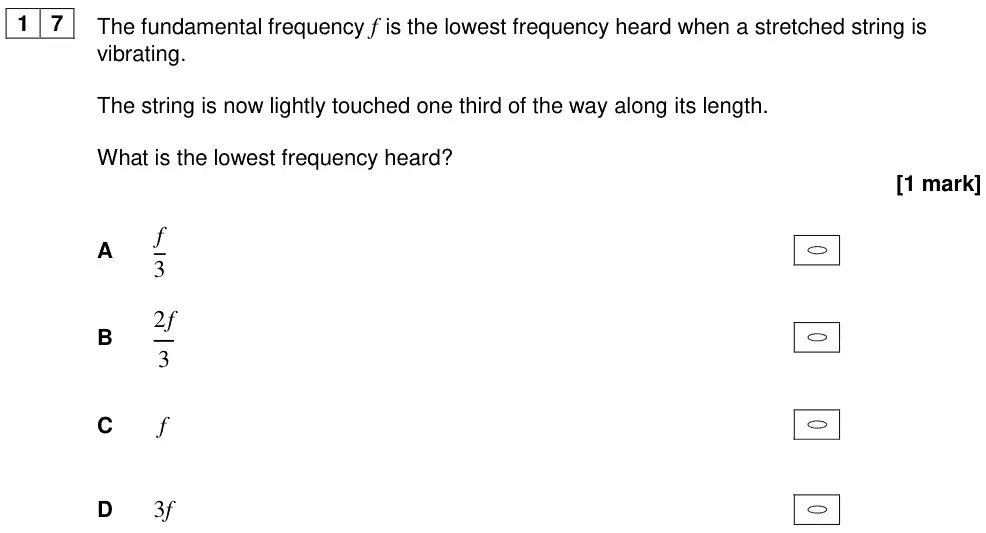
Touching Z forces a node at the midpoint
odd harmonics f1, f3, f5 need an antinode there so are removed
only even harmonics f2 (about 294 Hz) and f4 (about 588 Hz) remain
June 2024 · Paper 1 · Q7.11 markAO3=1Short answer
Mark scheme
Examiner's comment
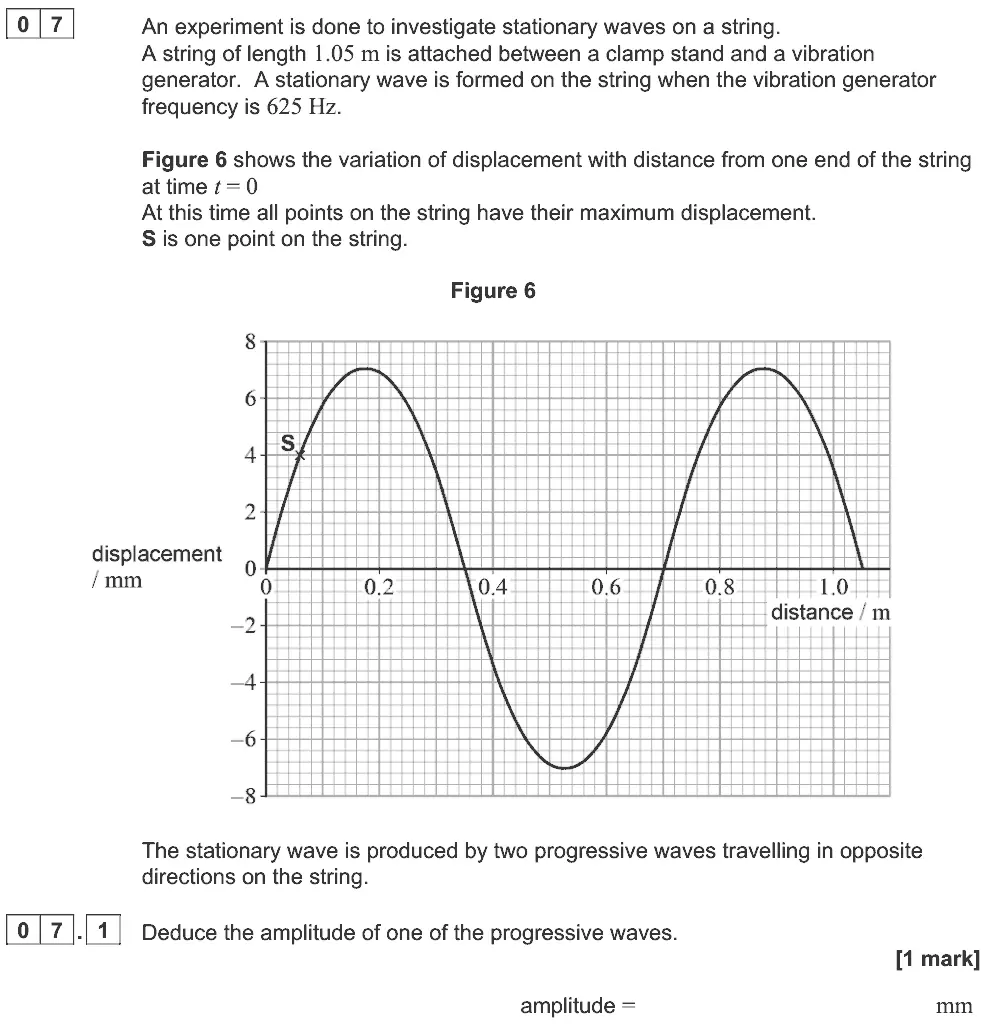
Most students who did not get the mark for question 07.1 assumed that the amplitude of the stationary wave and progressive waves were the same.
Notes from the mark scheme and report
Answer: 3.5 mm (half the 7.0 mm antinode amplitude in Figure 6
3.4-3.6 accepted)
common error was taking the progressive-wave amplitude equal to the stationary-wave amplitude
Skills: MS3.1 Translate information between graphical, numerical and algebraic forms; RP1 Investigation into the variation of the frequency of stationary waves on a string with length, tension and mass per unit length of the string.
June 2024 · Paper 1 · Q7.22 marksAO3=2CalculationEasy
Earlier part of question 7 that this part uses
Mark scheme
Examiner's comment
The calculation in question 07.2 was answered correctly by over 75% of students. Answers using a distance divided by time approach, rather than the wave equation, were not credited.
Notes from the mark scheme and report
Answer: 440 m s^-1 (wavelength 0.70 m from Figure 6, f = 625 Hz)
distance/time methods not credited
Skills: MS3.1 Translate information between graphical, numerical and algebraic forms; MS2.3 Substitute numerical values into algebraic equations using appropriate units for physical quantities; RP1 Investigation into the variation of the frequency of stationary waves on a string with length, tension and mass per unit length of the string.
June 2024 · Paper 1 · Q7.31 markAO1=1Short answer
Earlier part of question 7 that this part uses
Mark scheme
Examiner's comment
Students were split almost 50:50 between those who thought the phase difference in question 07.3 was zero and those who thought it was π rad.
Notes from the mark scheme and report
In phase (0, 2pi, 360 degrees)
about half answered pi rad
Skills: RP1 Investigation into the variation of the frequency of stationary waves on a string with length, tension and mass per unit length of the string.
June 2024 · Paper 1 · Q7.43 marksAO3=3Diagram or graph
Earlier part of question 7 that this part uses
Mark scheme
Examiner's comment
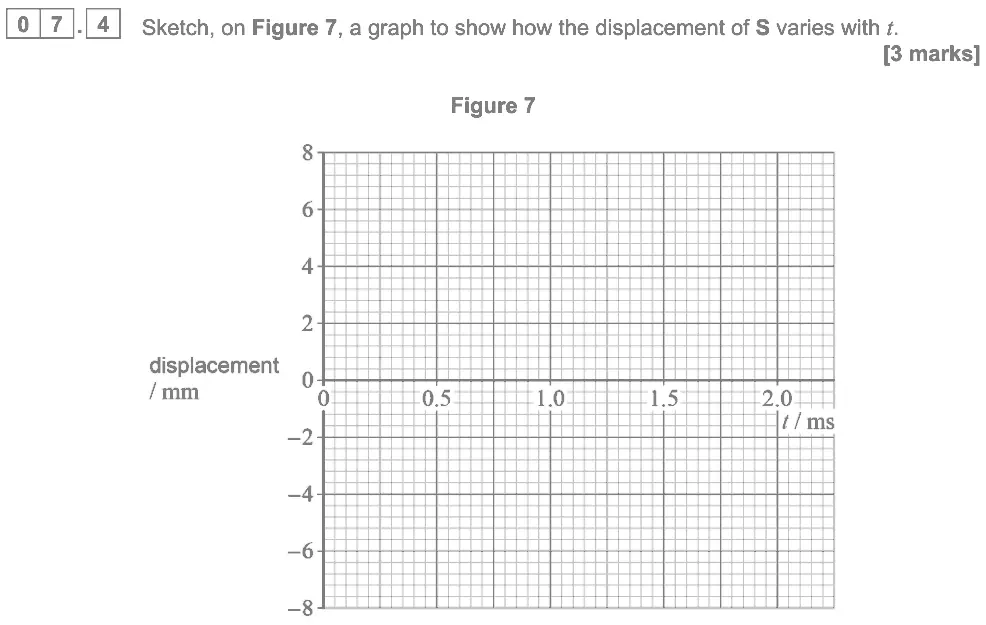
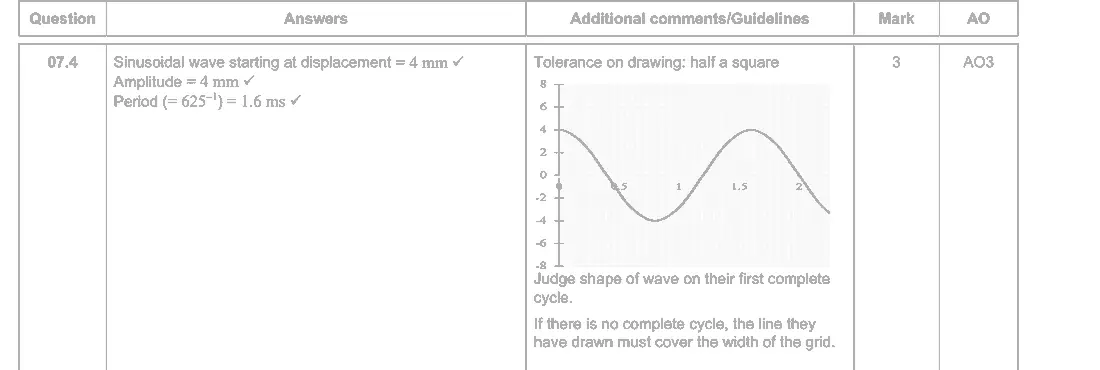
Many students found question 07.4 quite difficult. There were three clear marking points which meant the question produced a spread of marks and discriminated quite well. A major issue for many students was the poor quality of the sine wave. Most students understood that the period was 1.6 ms but far fewer recognised that the amplitude was 4 mm.
Notes from the mark scheme and report
Sinusoid starting at +4 mm, amplitude 4 mm, period 1.6 ms (1/625 s)
tolerance half a square
many poor sine curves and wrong amplitude
Skills: MS3.1 Translate information between graphical, numerical and algebraic forms; RP1 Investigation into the variation of the frequency of stationary waves on a string with length, tension and mass per unit length of the string.
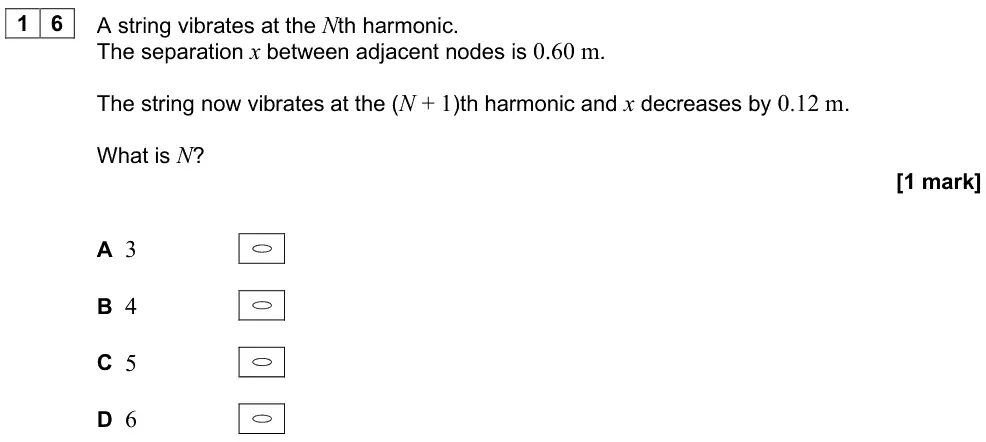
June 2024 · Paper 1 · Q151 markAO1=1Multiple choice
Answer
D
Mark scheme
Examiner's comment
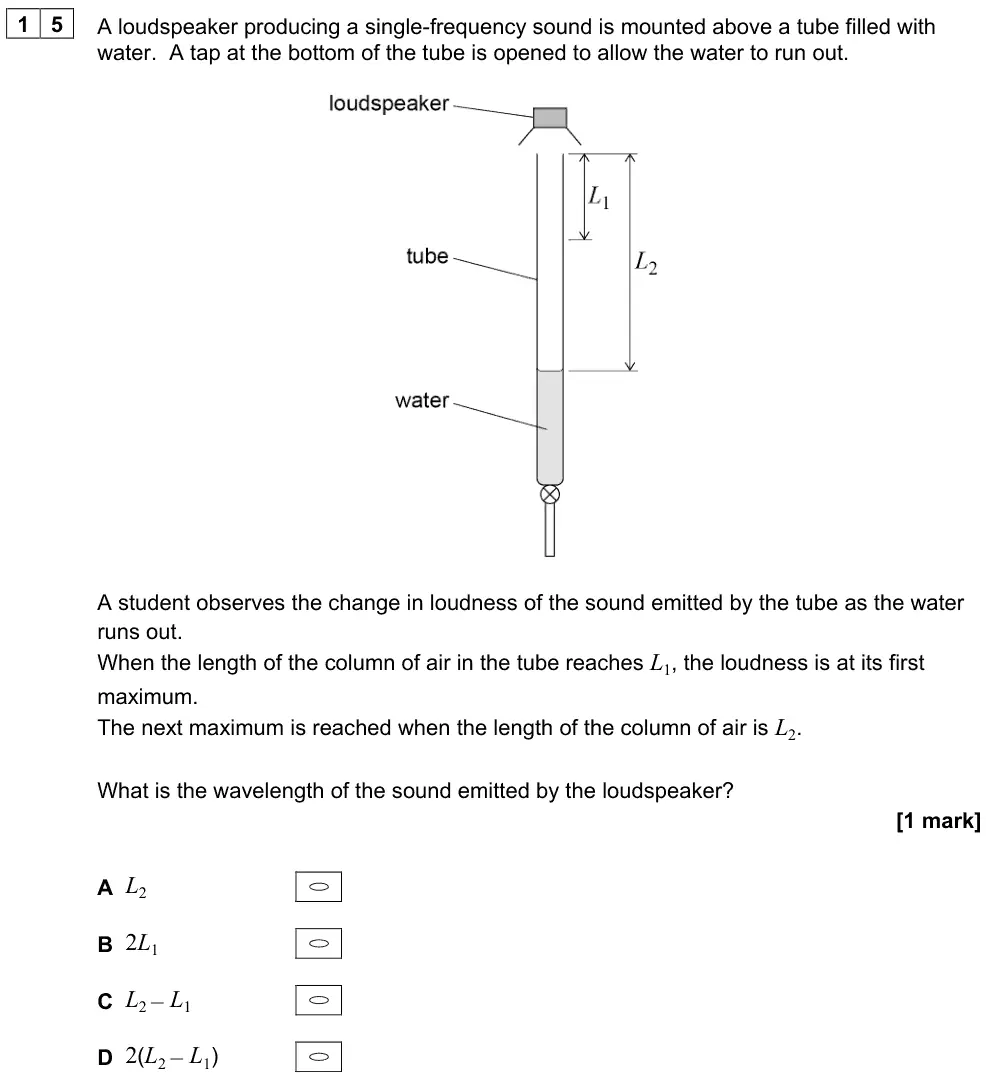
In B15 most students chose C, which is the distance between two nodes, or half the wavelength. In B20 most students chose B, presumably because they did not take into account the increased time of flight. In B22 most students chose D, despite a terminal speed being mentioned in the stem of the question.
Notes from the mark scheme and report
Answer: D
most chose C (L2 - L1 is the node-to-node distance, half a wavelength)
June 2024 · AS Paper 2 · Q301 markMultiple choice
Answer
D
Mark scheme
Examiner's comment
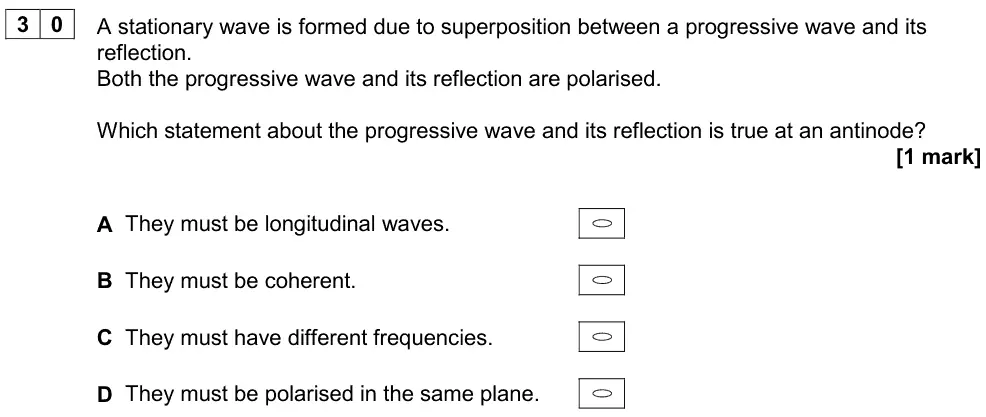
Question 30: Option B was the most popular response.
Notes from the mark scheme and report
Answer: D
most chose B
June 2024 · AS Paper 2 · Q321 markMultiple choice
Answer
C
Mark scheme
Notes from the mark scheme and report
Answer: C
June 2023 · Paper 1 · Q141 markMultiple choice
Answer
C
Mark scheme
Notes from the mark scheme and report
Answer: C
Skills: MS3.1 Translate information between graphical, numerical and algebraic forms
June 2023 · Paper 1 · Q151 markMultiple choice
Answer
B
Mark scheme
Notes from the mark scheme and report
Answer: B
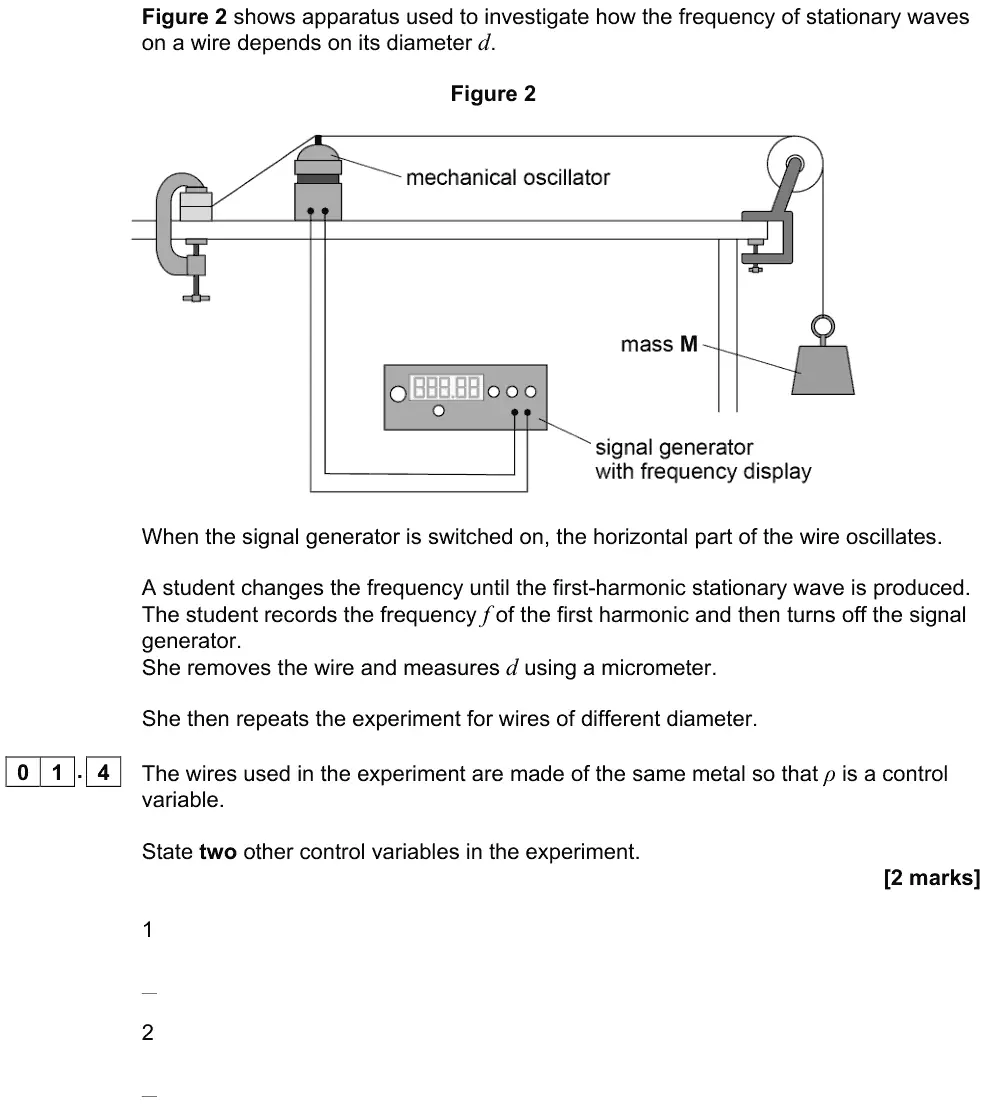
June 2023 · AS Paper 2 · Q1.42 marksAO3=2Practical and data analysisHard
Earlier part of question 1 that this part uses
Mark scheme
Examiner's comment
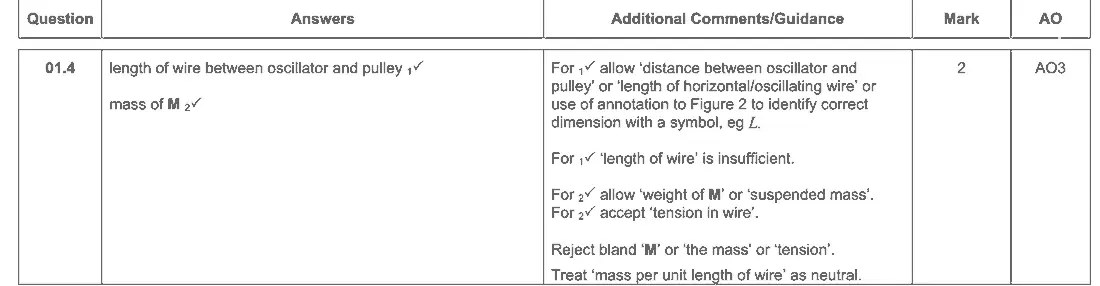
01.4 Barely 10% of students gave two appropriate control variables for this experiment. Students should be advised to give specific answers. For example, “length of wire” was a common example of an insufficiently detailed response.
Notes from the mark scheme and report
Length of wire between oscillator and pulley, and mass M (tension)
'length of wire' and bland 'mass' insufficient
Skills: PS2.1 Comment on experimental design and evaluate scientific methods; RP1 Investigation into the variation of the frequency of stationary waves on a string with length, tension and mass per unit length of the string.
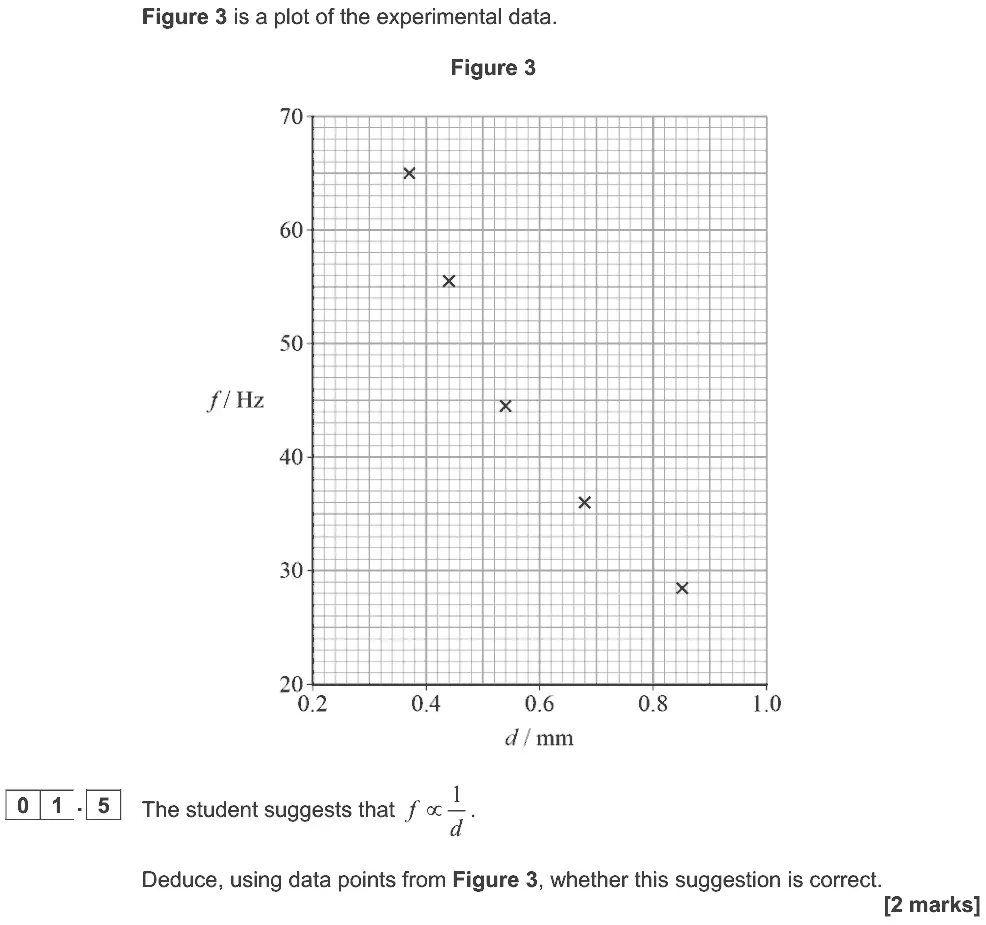
June 2023 · AS Paper 2 · Q1.52 marksAO3=2Practical and data analysisHard
Earlier part of question 1 that this part uses
Mark scheme
Examiner's comment
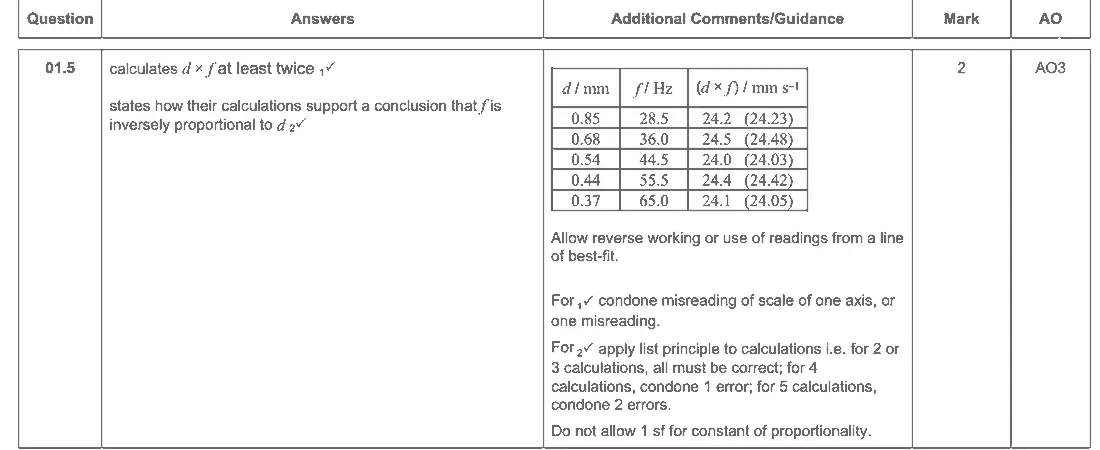
01.5 Most students struggled with this question with fewer than 20% gaining any credit. Those who correctly obtained a constant of proportionality often concluded that the suggestion was not correct. This was based on a comparison at more than two significant figures. The data from the graph did not warrant scrutiny at that precision. A common misinterpretation was to expect that 1 calculated values of 𝑑 would directly equal the corresponding f. A disappointing number of students expected a linear relationship.
Notes from the mark scheme and report
Calculate d x f for at least two points (about 24 mm s^-1 each, e.g. 0.85 x 28.5, 0.37 x 65.0) - constant so f proportional to 1/d
data do not justify more than 2 sf comparison
Skills: MS3.1 Translate information between graphical, numerical and algebraic forms; MS0.3 Use ratios, fractions and percentages; PS3.2 Process and analyse data using appropriate mathematical skills; RP1 Investigation into the variation of the frequency of stationary waves on a string with length, tension and mass per unit length of the string.
June 2023 · AS Paper 2 · Q1.62 marksAO3=2Explanation
Earlier part of question 1 that this part uses
Mark scheme
Examiner's comment
01.6 There was frequent confusion in this question over the factors that would be affected by the added mass. Many students considered it to increase the mass per unit length of the wire, and so concluded that the frequency decreased. Others failed to connect the mass to the tension in the wire.
Notes from the mark scheme and report
Tension doubled so each f increases by a factor sqrt2 (points move up)
not a change in mu or d
Skills: MS0.3 Use ratios, fractions and percentages; RP1 Investigation into the variation of the frequency of stationary waves on a string with length, tension and mass per unit length of the string.
June 2023 · AS Paper 2 · Q71 markMultiple choiceHard
Answer
C
Mark scheme
Examiner's comment
Generally, students were more successful in answering questions 9, 15, 16, 19, 25, 27, 28 (these all had a success rate of at least 65%) and were less successful in answering questions 6, 7, 18, 23 and 31 (answered correctly by 35% or fewer).
Notes from the mark scheme and report
Answer: C
June 2023 · AS Paper 2 · Q241 markMultiple choice
Answer
D
Mark scheme
Notes from the mark scheme and report
Answer: D
June 2022 · Paper 1 · Q191 markAO1=1Multiple choice
Answer
A
Mark scheme
Notes from the mark scheme and report
Answer: A
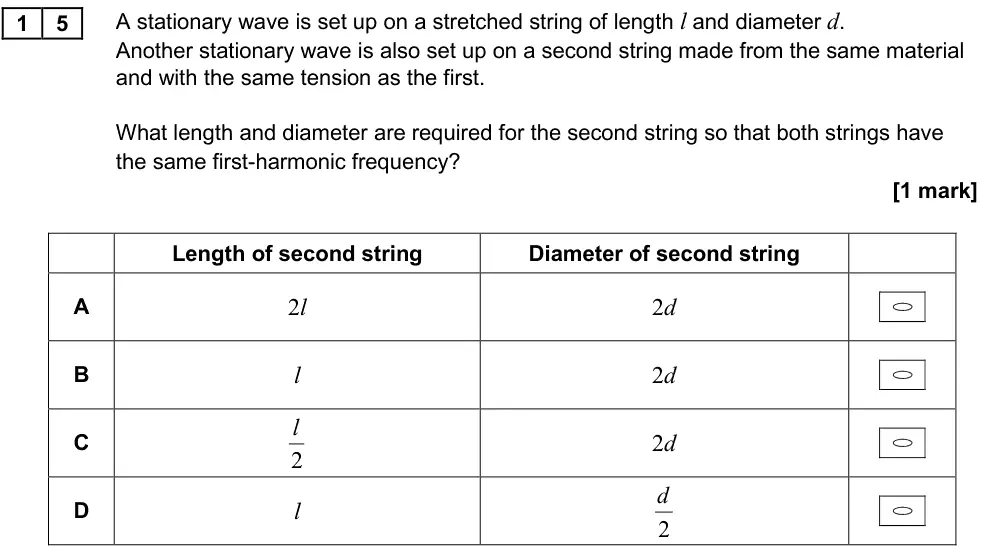
June 2022 · AS Paper 2 · Q171 markAO1=1Multiple choice
Answer
B
Mark scheme
Notes from the mark scheme and report
Answer: B
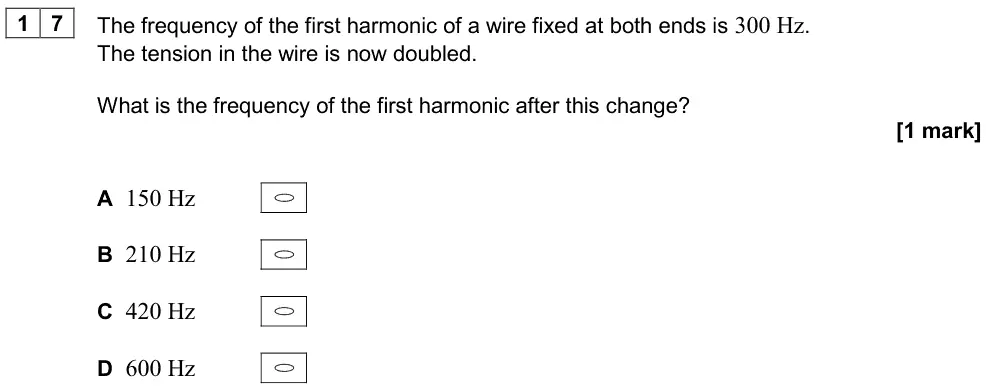
Skills: MS0.3 Use ratios, fractions and percentages
June 2022 · AS Paper 2 · Q181 markAO1=1Multiple choice
Answer
C
Mark scheme
Notes from the mark scheme and report
Answer: C
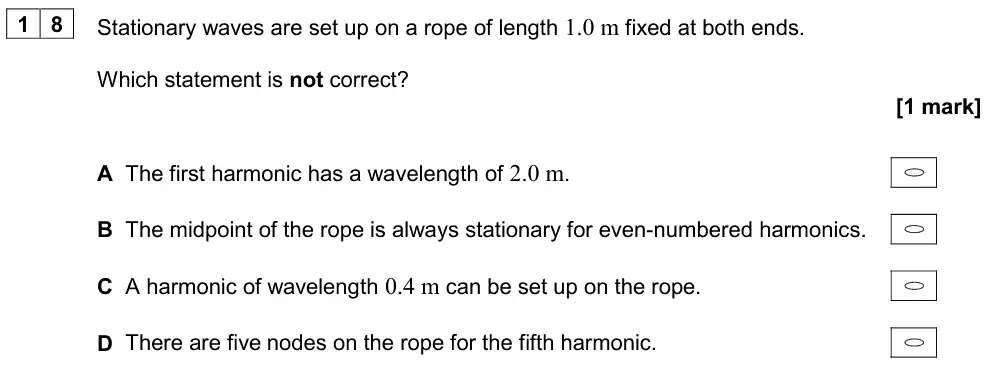
November 2021 · Paper 1 · Q181 markMultiple choice
Answer
A
Mark scheme
Examiner's comment
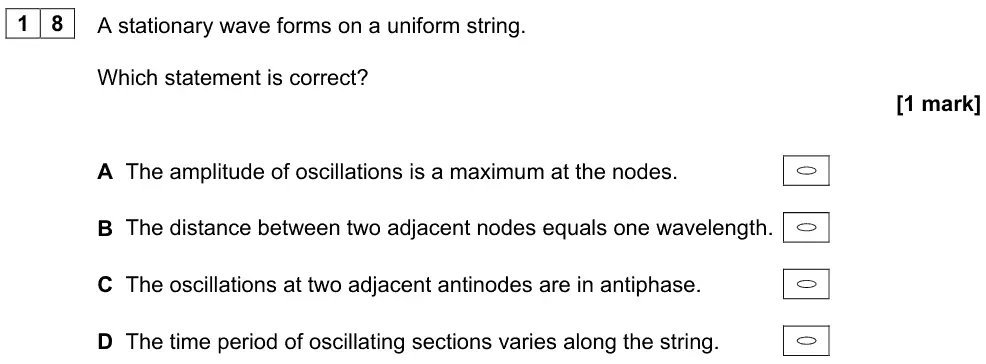
Several of the multiple-choice questions proved to be extremely difficult. In particular, questions 20, 27 and 29 were answered correctly by fewer than 30% of the students. In question 20 more students opted for B and for C than for the correct answer (D), indicating a lack of familiarity with scale diagrams. In question 27 the most popular answer was B, indicating the difficulties students have with combining resistors, and the second most popular was C, suggesting that students did not understand the difference between open and short circuits. The most popular answer to question 18 was D, probably because the students did not spot that this was a stationary, rather than progressive, wave. The most accessible questions were 10 and 16, both of which were answered correctly by over 70% of the students.
Notes from the mark scheme and report
Answer: A
D was most popular, treating it as a progressive wave
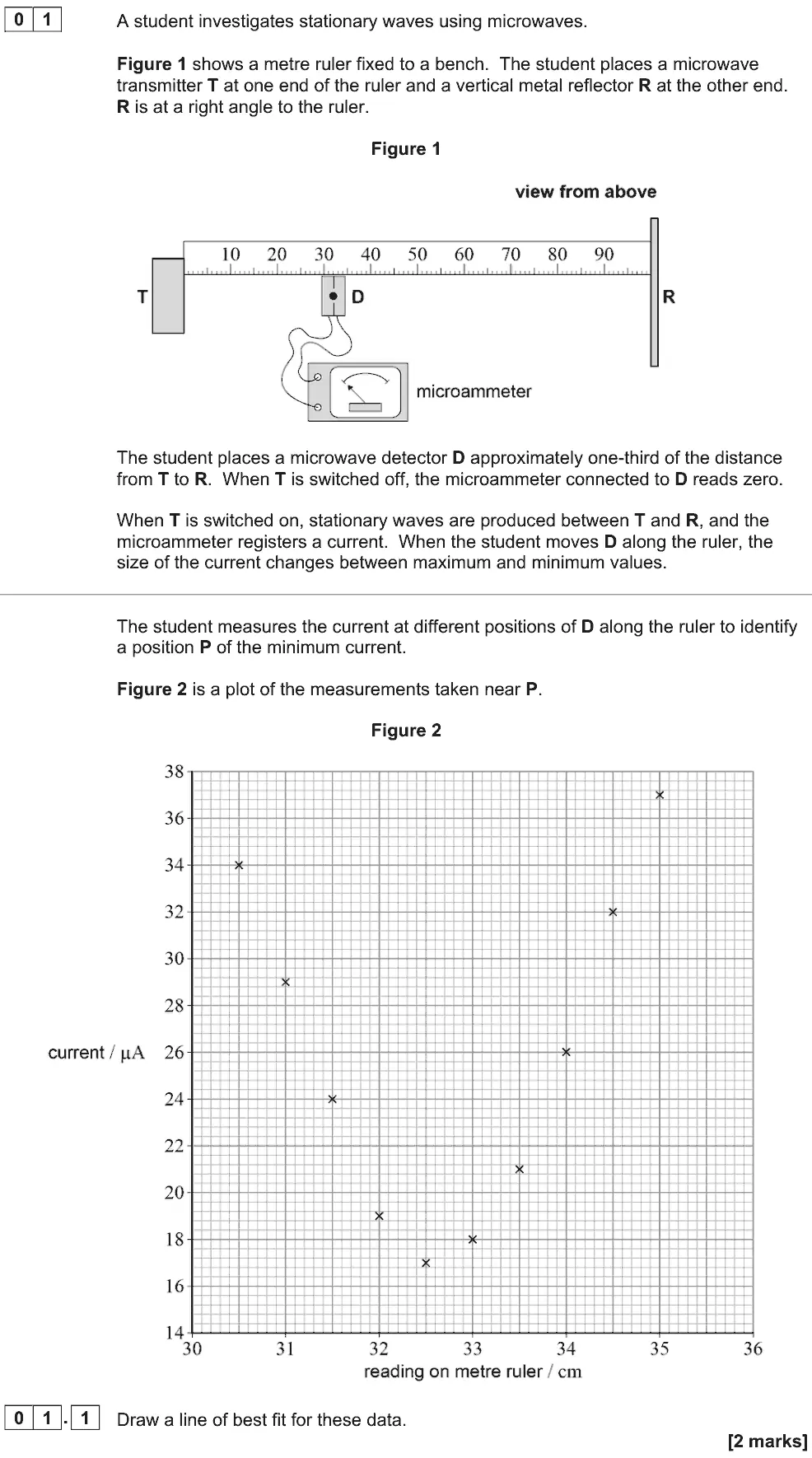
November 2021 · AS Paper 2 · Q1.12 marksAO3=2Diagram or graph
Mark scheme
Notes from the mark scheme and report
Smooth curve within half a grid square of the points with its minimum between 32.6 and 32.8 cm
Skills: MS3.2 Plot two variables from experimental or other data; PS3.1 Plot and interpret graphs
November 2021 · AS Paper 2 · Q1.21 markAO3=1Practical and data analysis
Earlier part of question 1 that this part uses
Mark scheme
Notes from the mark scheme and report
Answer: about 32.7 cm (their minimum, within half a grid square)
Skills: MS3.1 Translate information between graphical, numerical and algebraic forms; PS3.1 Plot and interpret graphs
November 2021 · AS Paper 2 · Q1.43 marksCalculation
Earlier part of question 1 that this part uses
Mark scheme
Notes from the mark scheme and report
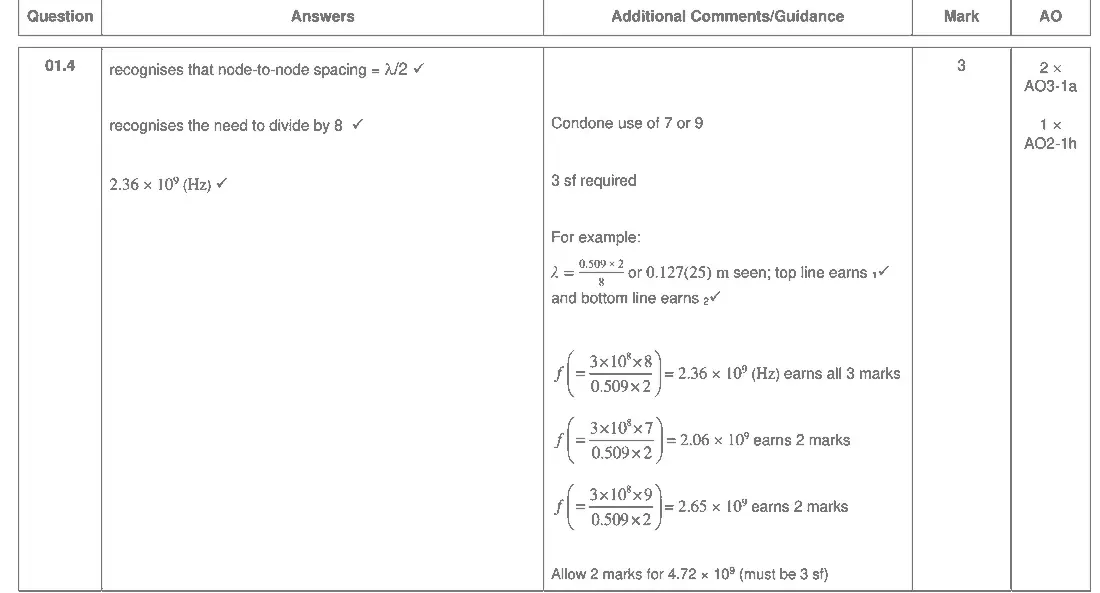
Answer: 2.36 x 10^9 Hz (node spacing = lambda/2 so 8 spacings = 4 lambda
lambda = 0.127 m
f = c/lambda)
3 sf
using 7 or 9 spacings scores 2
Skills: MS2.3 Substitute numerical values into algebraic equations using appropriate units for physical quantities; MS1.1 Use an appropriate number of significant figures
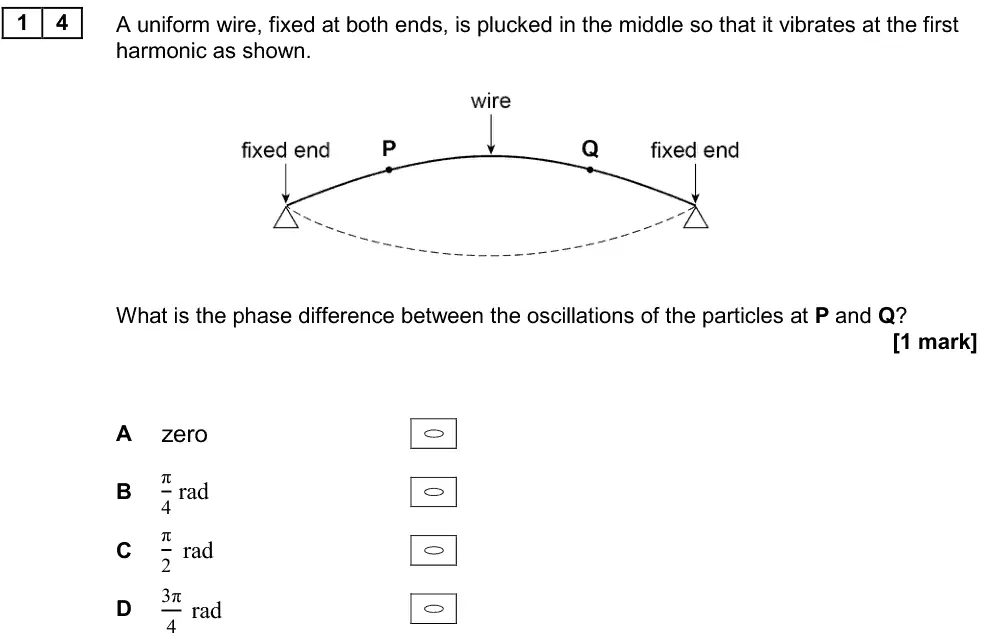
November 2021 · AS Paper 2 · Q171 markMultiple choice
Answer
B
Mark scheme
Notes from the mark scheme and report
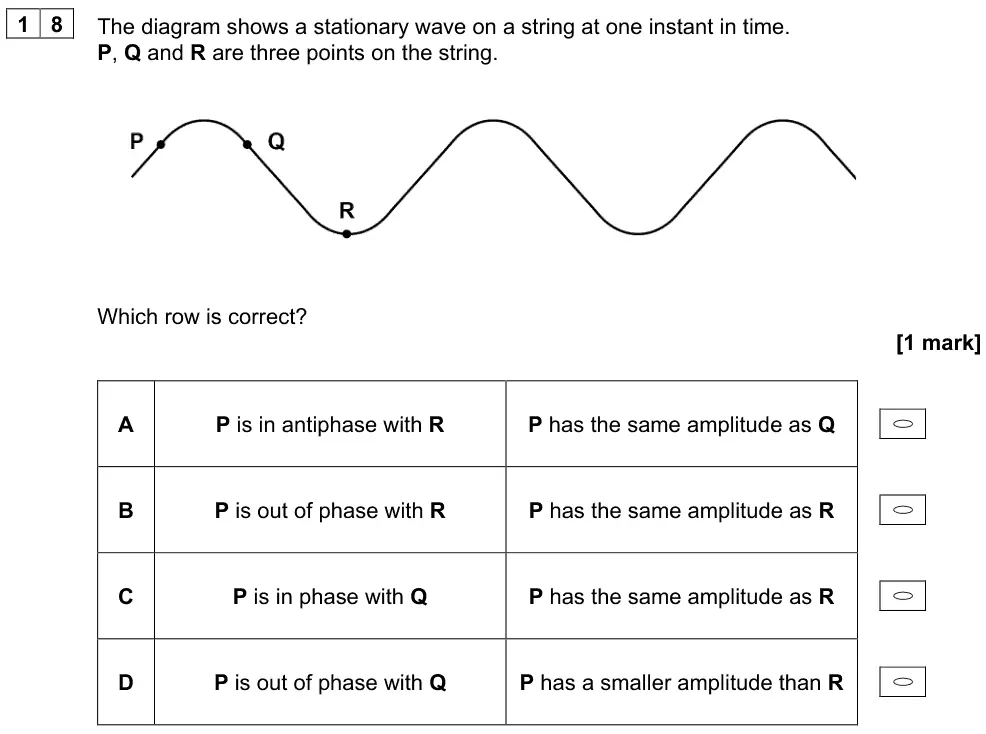
Answer: B
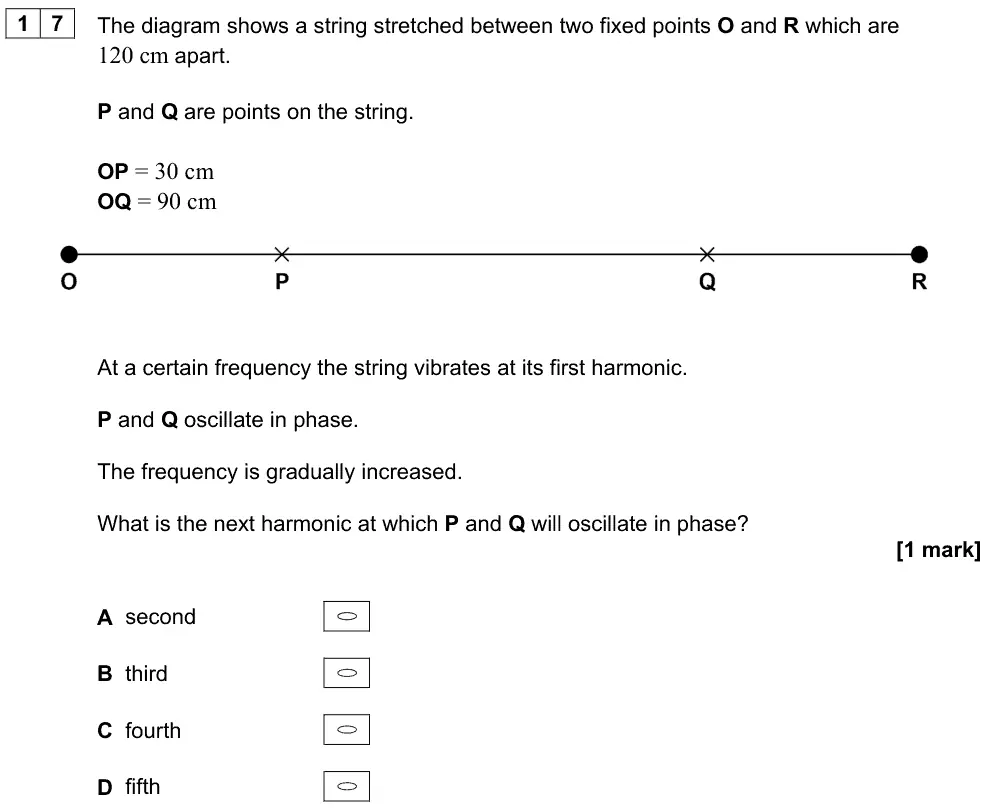
third harmonic: P in first loop, Q in third loop
November 2020 · AS Paper 1 · Q6.12 marksShort answer
Mark scheme
Notes from the mark scheme and report
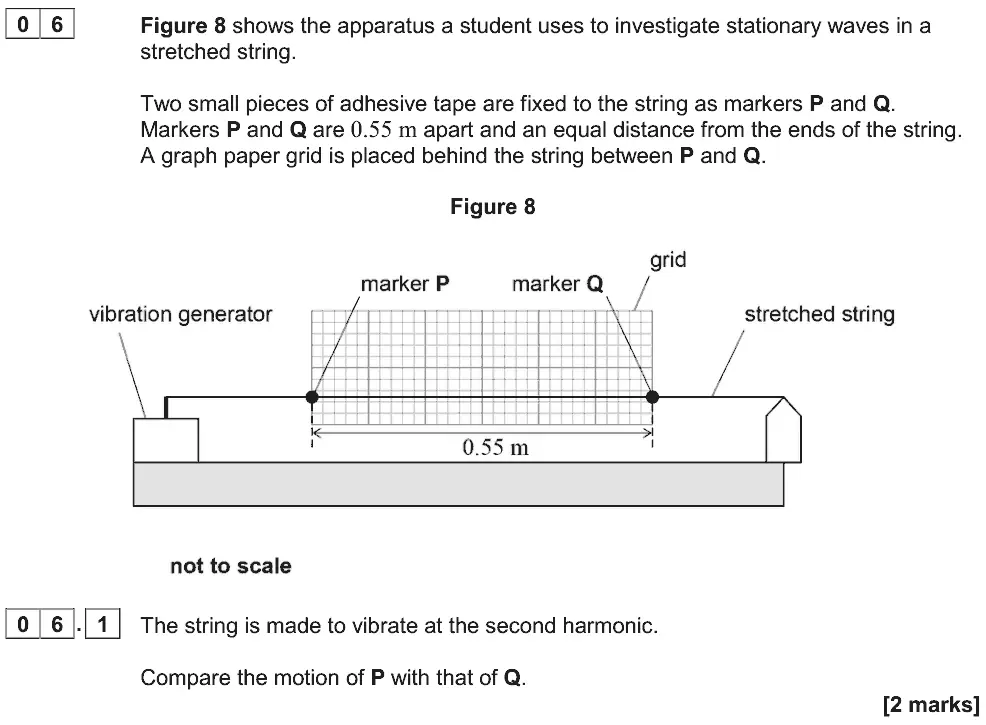
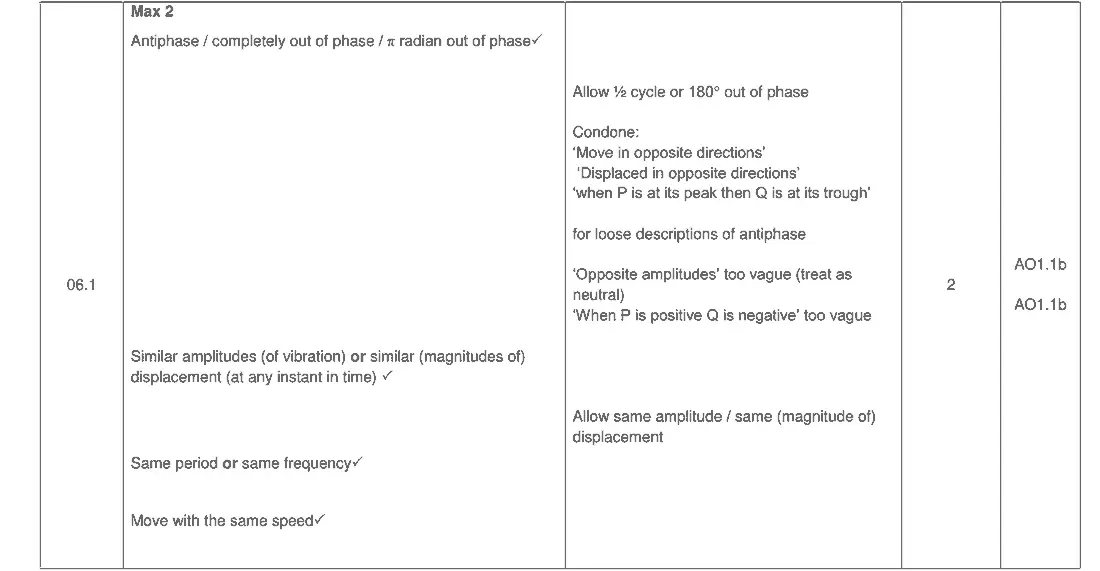
P and Q in antiphase (pi rad)
same amplitude and frequency
Skills: RP1 Investigation into the variation of the frequency of stationary waves on a string with length, tension and mass per unit length of the string.
November 2020 · AS Paper 1 · Q6.22 marksCalculation
Earlier part of question 6 that this part uses
Mark scheme
Notes from the mark scheme and report
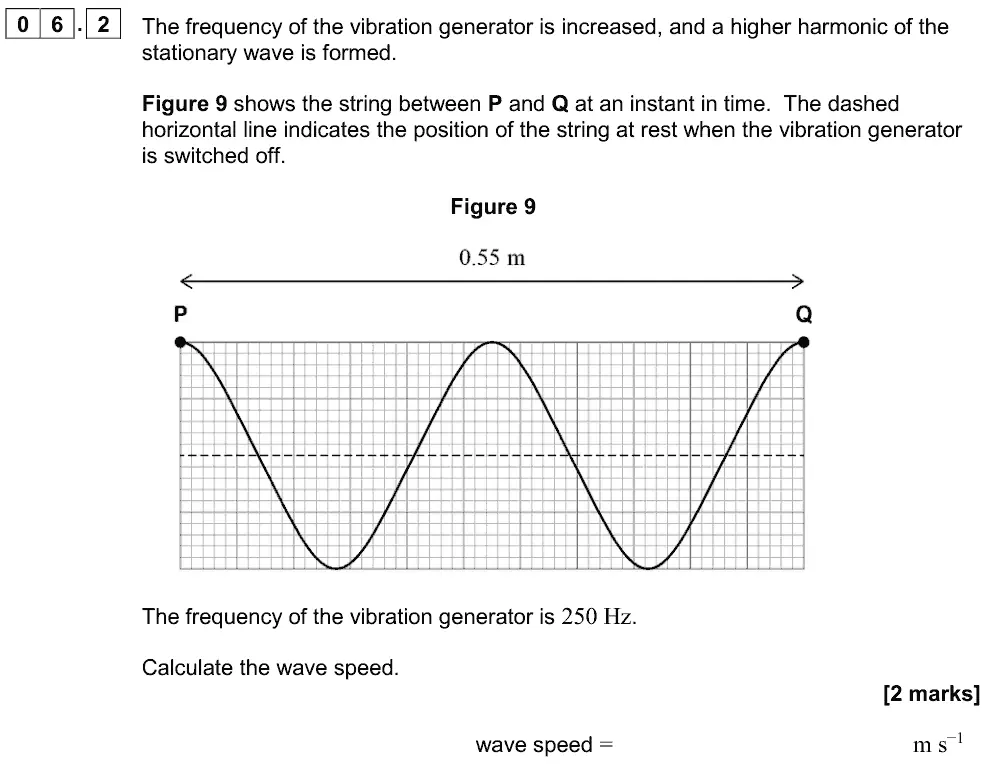
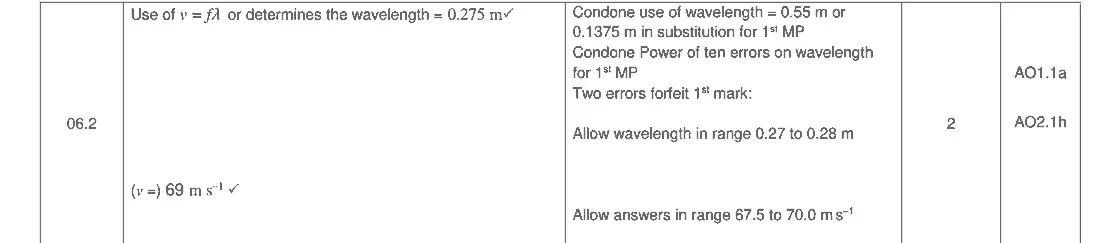
Answer: 69 m s^-1 (wavelength 0.275 m from Figure 9, f = 250 Hz)
Skills: MS3.1 Translate information between graphical, numerical and algebraic forms; MS2.3 Substitute numerical values into algebraic equations using appropriate units for physical quantities; RP1 Investigation into the variation of the frequency of stationary waves on a string with length, tension and mass per unit length of the string.
November 2020 · AS Paper 1 · Q6.33 marksShort answer
Earlier part of question 6 that this part uses
Mark scheme
Notes from the mark scheme and report
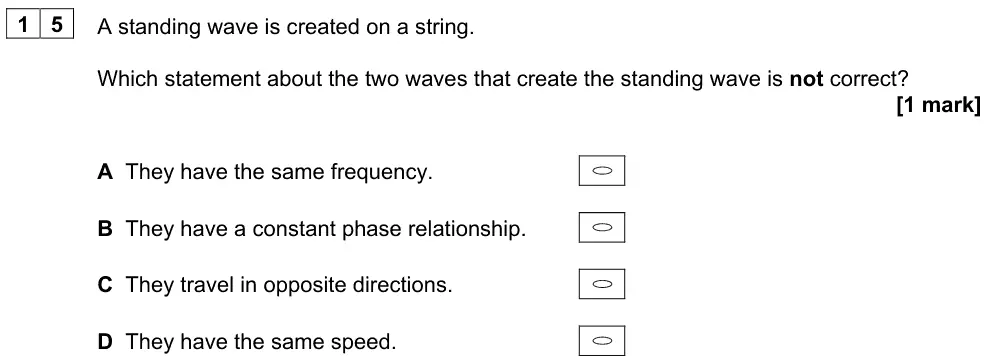
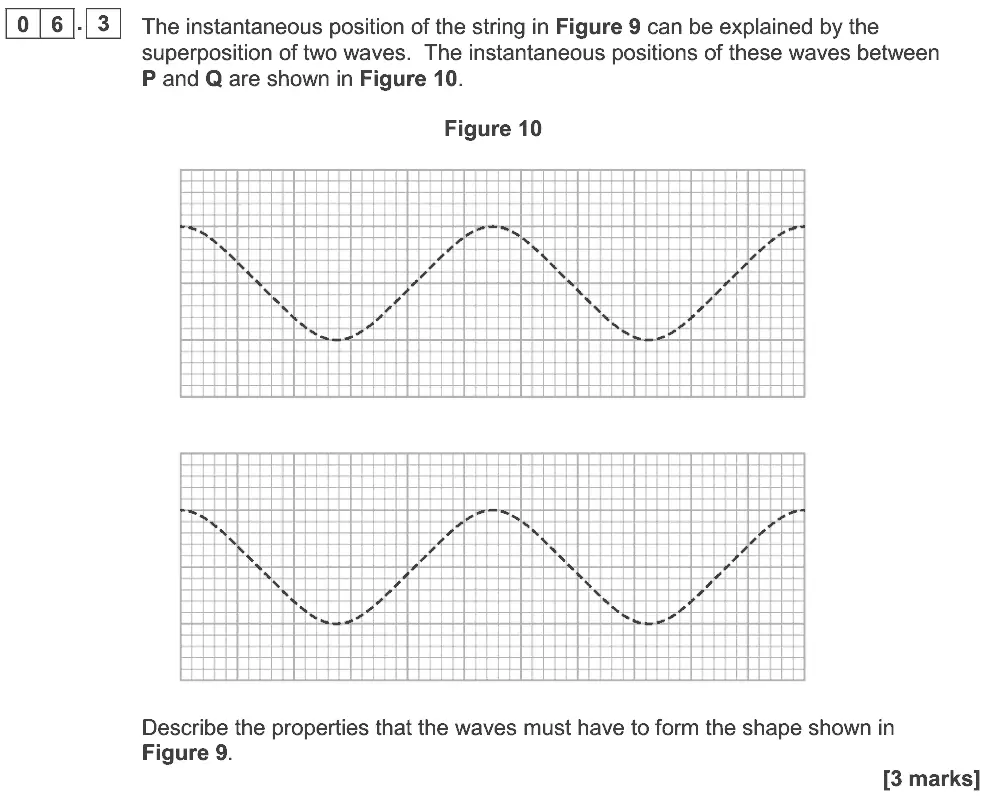
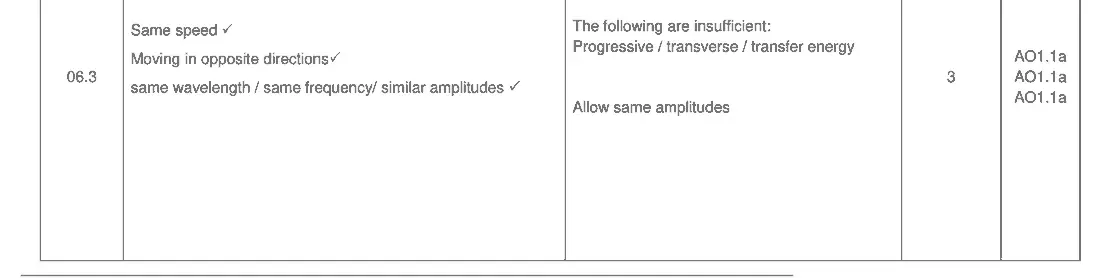
Same speed, travelling in opposite directions, same frequency/wavelength and similar amplitude
'progressive' or 'transverse' insufficient
November 2020 · AS Paper 1 · Q6.41 markDiagram or graph
Earlier part of question 6 that this part uses
Mark scheme
Notes from the mark scheme and report
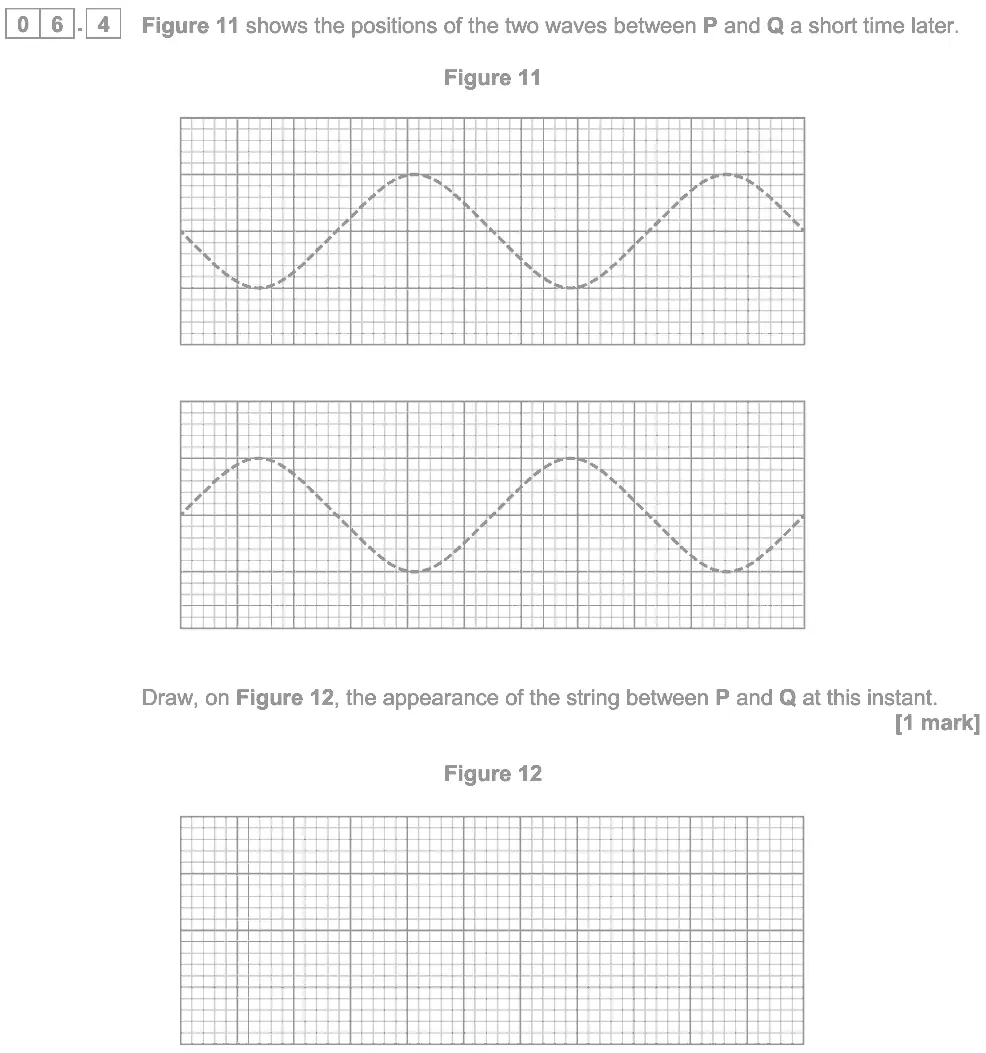
Horizontal straight line from P to Q (waves cancel at this instant)
November 2020 · AS Paper 1 · Q6.52 marksDiagram or graph
Earlier part of question 6 that this part uses
Mark scheme
Notes from the mark scheme and report
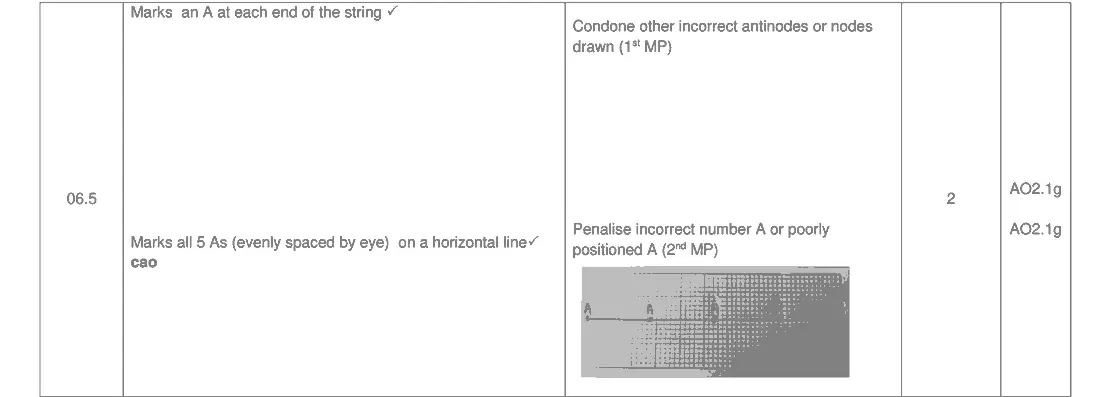
A at each end, then all five A's evenly spaced on the line
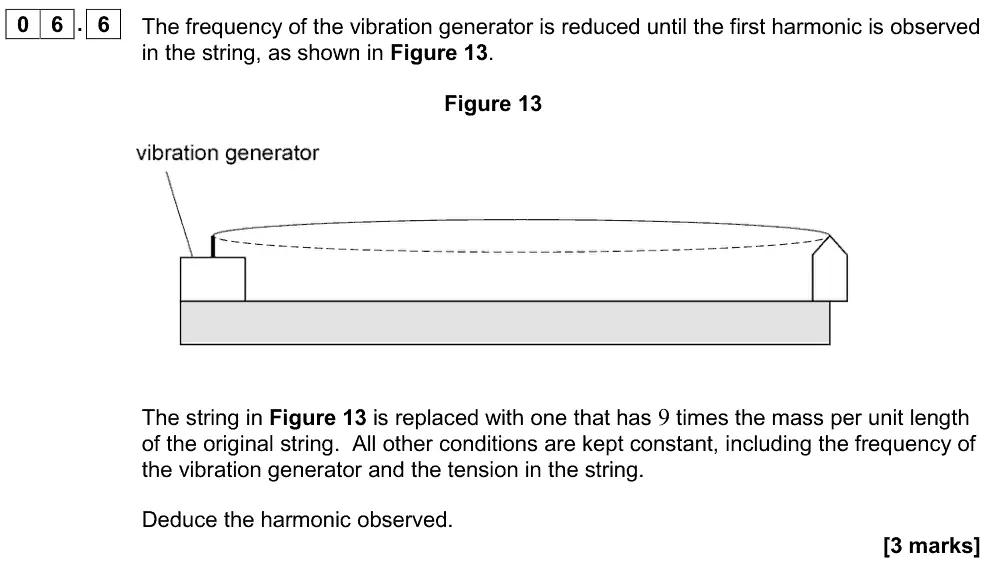
November 2020 · AS Paper 1 · Q6.63 marksExplanation
Earlier part of question 6 that this part uses
Mark scheme
Notes from the mark scheme and report
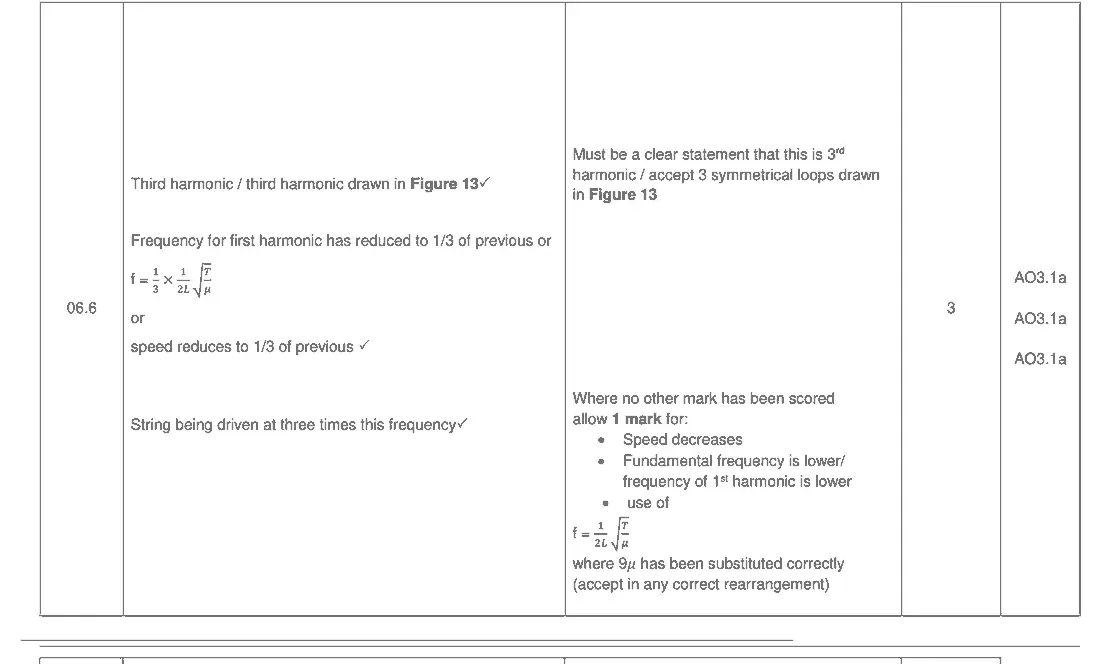
Answer: third harmonic
9 x mass per unit length makes wave speed (and first-harmonic frequency) one third, so the generator drives at three times the new fundamental
Skills: MS2.3 Substitute numerical values into algebraic equations using appropriate units for physical quantities; MS0.3 Use ratios, fractions and percentages; RP1 Investigation into the variation of the frequency of stationary waves on a string with length, tension and mass per unit length of the string.
November 2020 · Paper 1 · Q181 markMultiple choice
Answer
D
Mark scheme
Notes from the mark scheme and report
Answer: D
June 2019 · AS Paper 2 · Q171 markMultiple choice
Answer
C
Mark scheme
Notes from the mark scheme and report
Answer: C
Skills: MS0.3 Use ratios, fractions and percentages
June 2019 · Paper 3 Section A · Q3.22 marksPractical and data analysis
Earlier part of question 3 that this part uses
Mark scheme
Examiner's comment
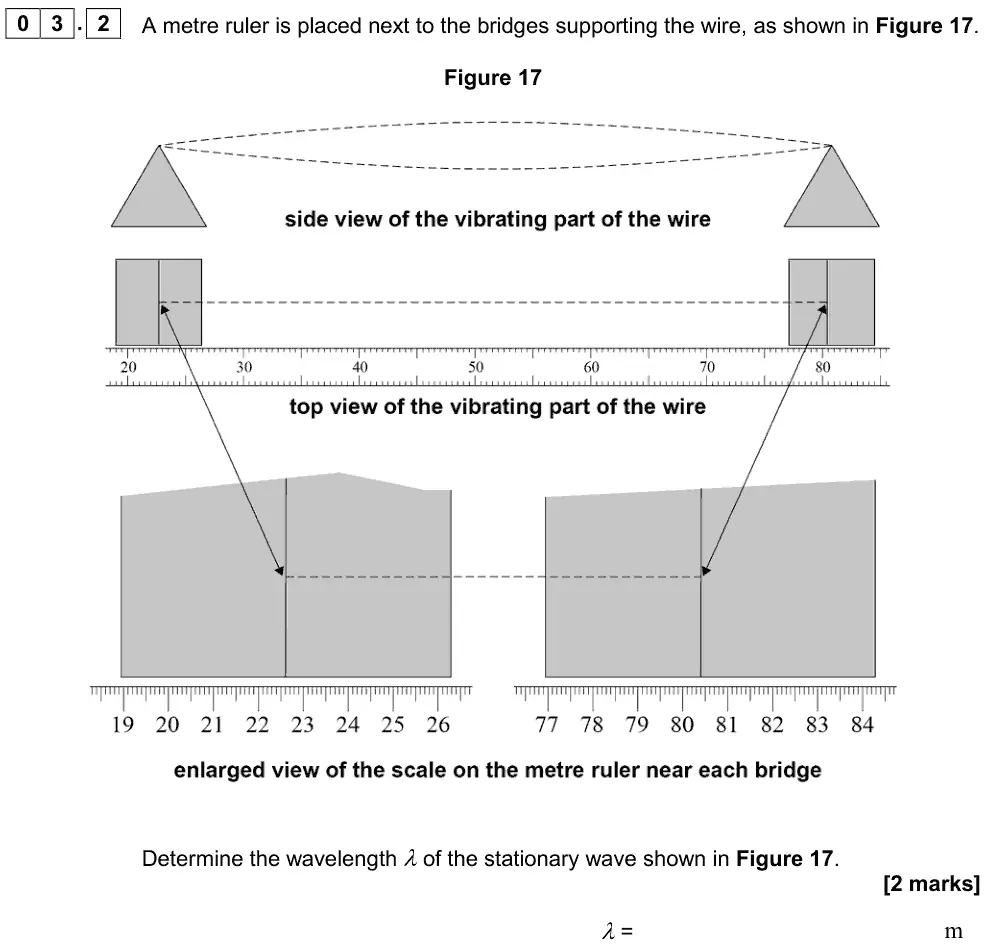
In 03.2, examiners almost always saw the expected read-off figures earning the first mark. About a third missed out on the second mark by failing to multiply the difference between their read-offs by 2, by leaving their result in cm, or by truncating to 1.2.
The general issue of rounding of data requires some comment. An example is seen in question 03.2, where many correctly deduced that the length of the wire was 0.578 m, but then felt obliged to give the wavelength as 1.16 m, (presumably to preserve significant figures). This was allowed, as it was also in 02.3 (where some truncated their final answer of 19.8% to 20%). However, in such a problem the preservation of significant figures should not apply to the number of figures in the number as a whole, but only to figures after the decimal place. Secondly, students who truncated their result in 03.2 then had to decide which result to use in 03.3 and in 03.4. Provided working is transparent the examiners can give credit, but it is a different matter when students show a value 1.16 in the substitution whereas the outcome shows that they must have used 1.156.
Notes from the mark scheme and report
Answer: 1.156 m (readings 804 and 226 mm
first harmonic so wavelength = 2 x 0.578 m)
forgetting the factor 2 or leaving in cm
Skills: ATa analogue apparatus to record measurements and interpolate; RP1 Investigation into the variation of the frequency of stationary waves on a string with length, tension and mass per unit length of the string.
June 2019 · Paper 3 Section A · Q3.42 marksCalculation
Earlier part of question 3 that this part uses
Mark scheme
Examiner's comment
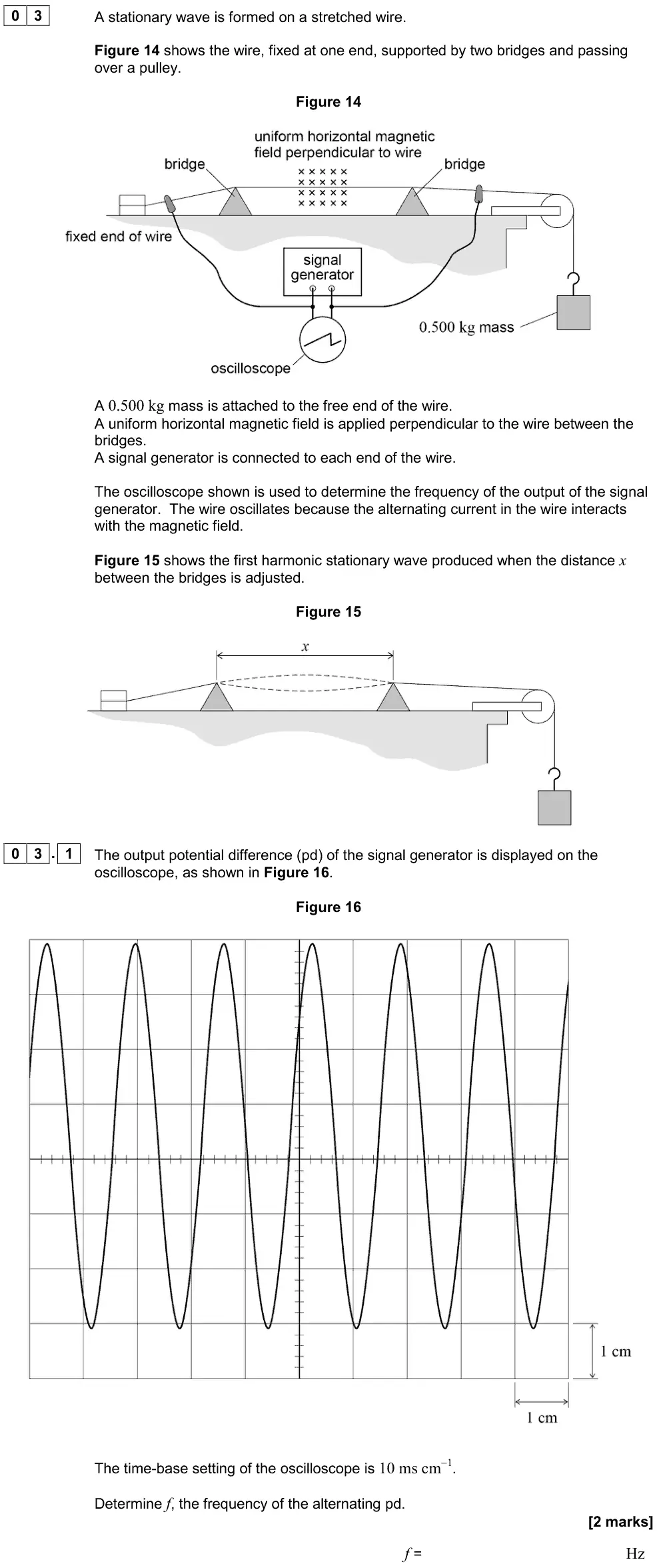
In 03.1, students without recent experience of the CRO struggled. However, about a quarter overcame the problem of the vertically displaced trace and obtained between 60 and 62 Hz for full credit. Students who rounded (correctly or otherwise) to 1 sf obtained no credit, as the rubric states ‘an answer to 1 sf will not normally be acceptable, unless the answer is an integer, eg a number of objects’. Students found this the most challenging part of questions 03.1 to 03.4.
Of the 20% of the students who were unable to score in 03.3, some were unsuccessful because the answer they obtained was not a result of their working in v f λ = . T In 03.4, a small number used and rearranged for µ, substituting their answer for 03.3. c = µ
The general issue of rounding of data requires some comment. An example is seen in question 03.2, where many correctly deduced that the length of the wire was 0.578 m, but then felt obliged to give the wavelength as 1.16 m, (presumably to preserve significant figures). This was allowed, as it was also in 02.3 (where some truncated their final answer of 19.8% to 20%). However, in such a problem the preservation of significant figures should not apply to the number of figures in the number as a whole, but only to figures after the decimal place. Secondly, students who truncated their result in 03.2 then had to decide which result to use in 03.3 and in 03.4. Provided working is transparent the examiners can give credit, but it is a different matter when students show a value 1.16 in the substitution whereas the outcome shows that they must have used 1.156.
Notes from the mark scheme and report
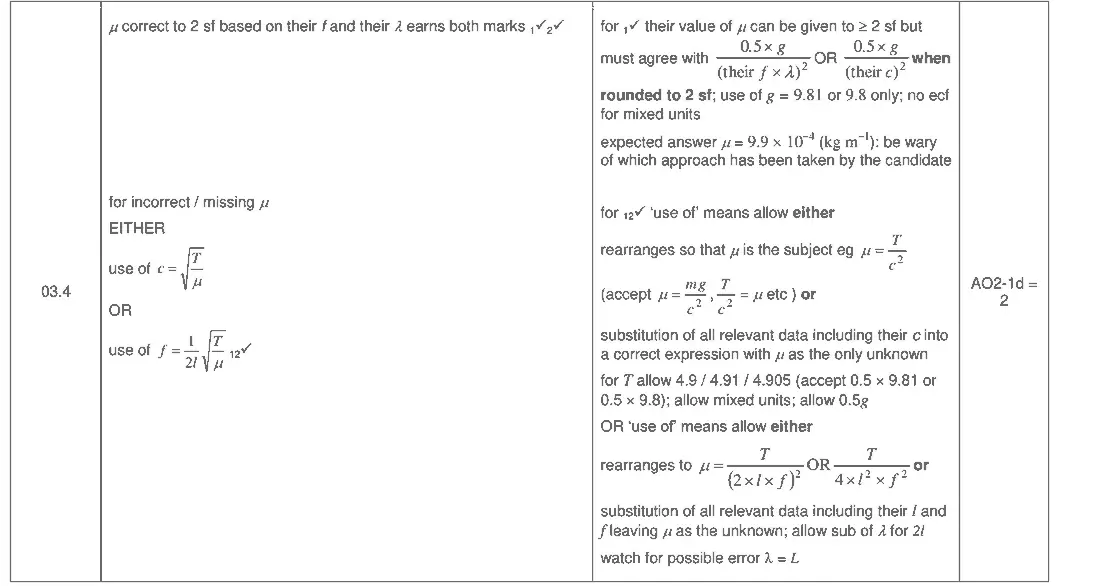
Answer: mu = 9.9 x 10^-4 kg m^-1 (c = square root of T/mu with T = 0.500 x 9.81 N, or f = (1/2l) square root T/mu)
using the CRO period for T or 0.5 kg / length were errors
Skills: MS2.2 Change the subject of an equation, including non-linear equations; MS2.3 Substitute numerical values into algebraic equations using appropriate units for physical quantities; RP1 Investigation into the variation of the frequency of stationary waves on a string with length, tension and mass per unit length of the string.
June 2018 · Paper 1 · Q3.13 marksExplanation
Mark scheme
Examiner's comment
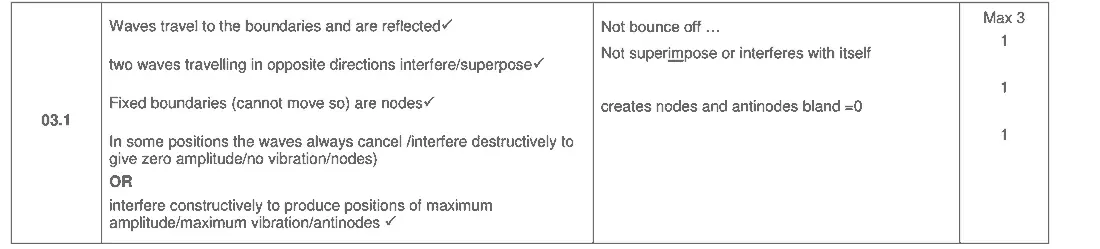
03.1 This was well answered by many students (47.5% gained at least two marks here), but there were also many responses that presented ambiguous or unclear statements. Those students who only referred to reflection of the wave at one of the fixed points had difficulty expressing clearly that there are two waves moving in opposite directions that superpose. The clearest answers referred to the wave produced by plucking travelling to both fixed ends of the string where they are reflected and then superpose, followed by an explanation of the interference ideas that produce nodes and antinodes.
Notes from the mark scheme and report
Waves reflect at the fixed ends
two waves travelling in opposite directions superpose
03.2 This was answered very well by a great majority (81.1%) of the students. 03.3 All the data needed to do this were readily available to substitute in v = fλ. Determining the correct value for λ (0.33 m and 0.165 m were often seen) led to most incorrect answers.
Notes from the mark scheme and report
Answer: mass per unit length 4.2 x 10^-4 kg m^-1 from f = (1/2l) root(T/mu)
Skills: MS2.2 Change the subject of an equation, including non-linear equations; MS2.3 Substitute numerical values into algebraic equations using appropriate units for physical quantities; RP1 Investigation into the variation of the frequency of stationary waves on a string with length, tension and mass per unit length of the string.
June 2018 · Paper 1 · Q3.31 markCalculation
Earlier part of question 3 that this part uses
Mark scheme
Examiner's comment
03.2 This was answered very well by a great majority (81.1%) of the students. 03.3 All the data needed to do this were readily available to substitute in v = fλ. Determining the correct value for λ (0.33 m and 0.165 m were often seen) led to most incorrect answers.
Notes from the mark scheme and report
Answer: 240 m s^-1 (244
wavelength 0.66 m = 2l)
0.33 m and 0.165 m wavelengths caused most errors
June 2018 · Paper 1 · Q3.44 marksCalculation
Earlier part of question 3 that this part uses
Mark scheme
Examiner's comment
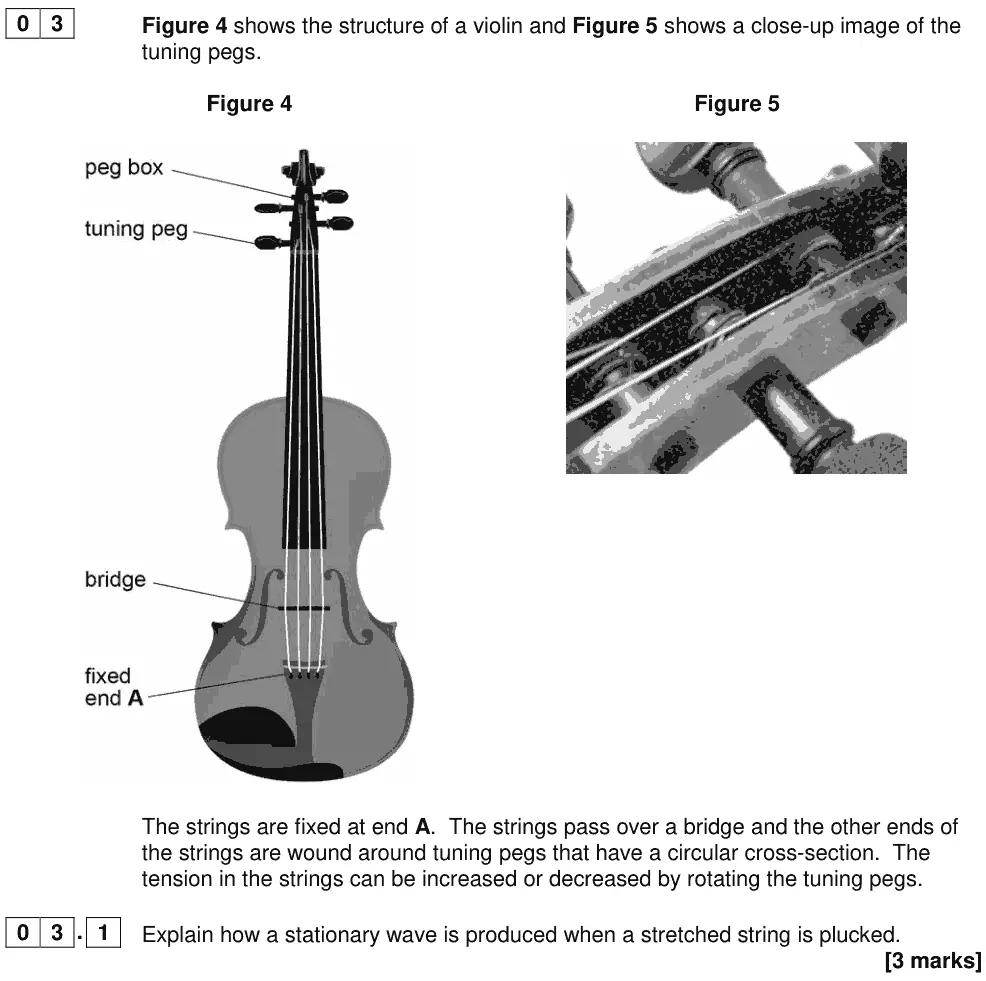
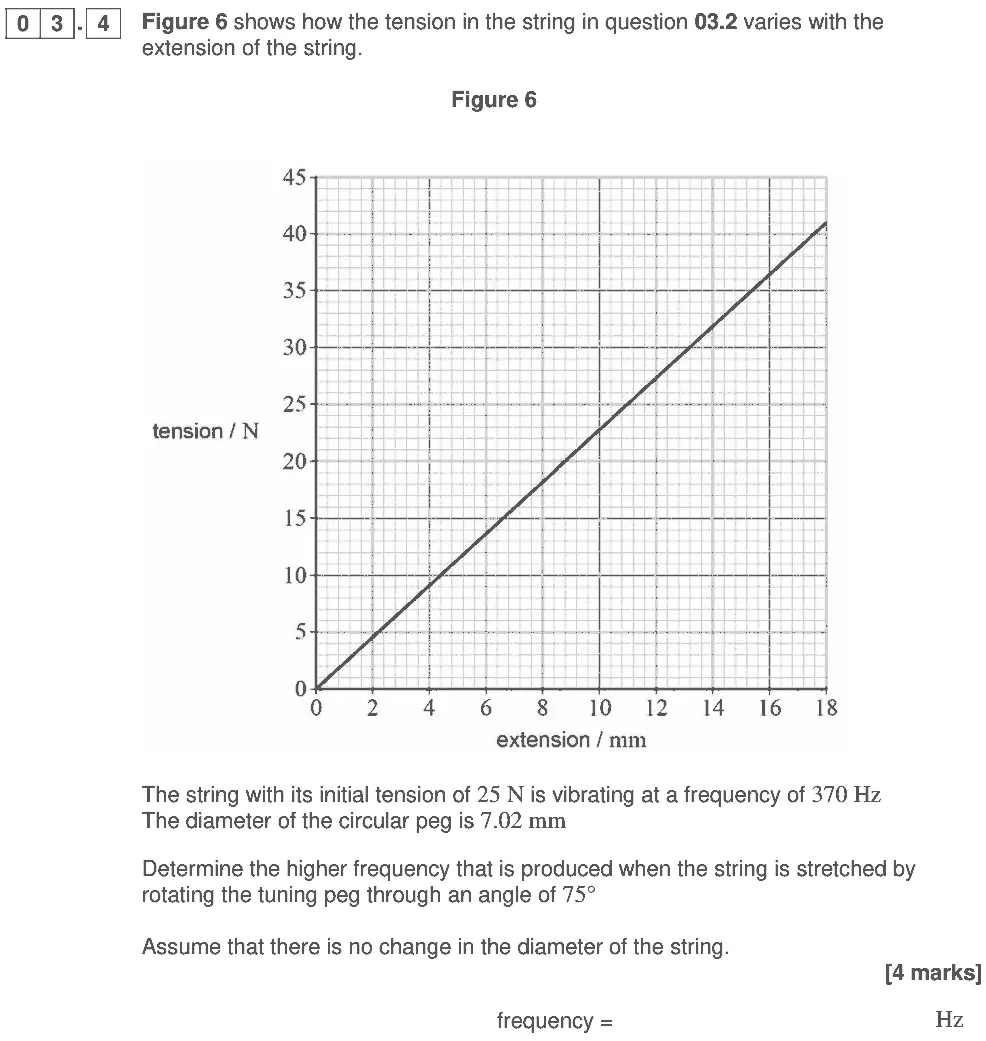
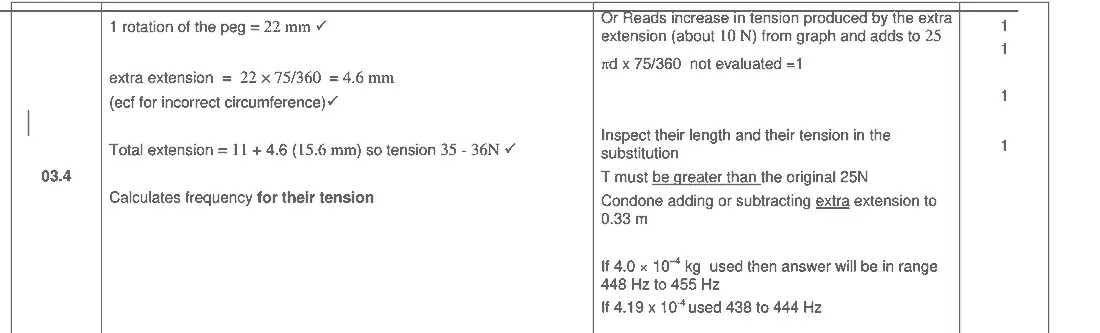
03.4 Most students appeared to appreciate the process that needed to be followed to arrive at an answer and many were able to follow this through to a successful conclusion. In general terms, knowing how to determine circumferences and areas of 2- dimensional objects, and circumference, surface areas and volumes of 3-dimensional objects is fundamental in almost all topics in physics. Those who made little progress did not have this basic understanding. In this question, the circumference of a circle was the basic knowledge needed and how to determine the length of an arc of that circle. The other issue for the first step was to read carefully what information had been provided; in this instance diameter, not radius. In the next step, misreading the scale of the extension axis was a common error. The frequency calculation was then straightforward. Many students did not know what to do about the length, not appreciating that the vibrating length was unchanged when the peg was turned. The extension was added and occasionally subtracted from the length of 0.33 m, but this was condoned as ‘specialist knowledge’.
04.1 The problem that has been discussed in question 03.4 was evident in this question too but there was a high proportion of correct solutions (58.9% scored full marks) to this relatively familiar problem.
Notes from the mark scheme and report
Answer: about 440 Hz (arc = pi x 7.02 mm x 75/360 = 4.6 mm extra extension, about 10 N extra from Figure 6 so T = 35 N, f = 370 root(35/25))
diameter used as radius and misreading extension scale common
vibrating length unchanged
Skills: MS4.3 Calculate areas of triangles, circumferences and areas of circles, surface areas and volumes of rectangular blocks, cylinders and spheres; MS3.1 Translate information between graphical, numerical and algebraic forms; MS2.3 Substitute numerical values into algebraic equations using appropriate units for physical quantities
June 2018 · AS Paper 2 · Q171 markMultiple choice
Answer
D
Notes from the mark scheme and report
Answer: D
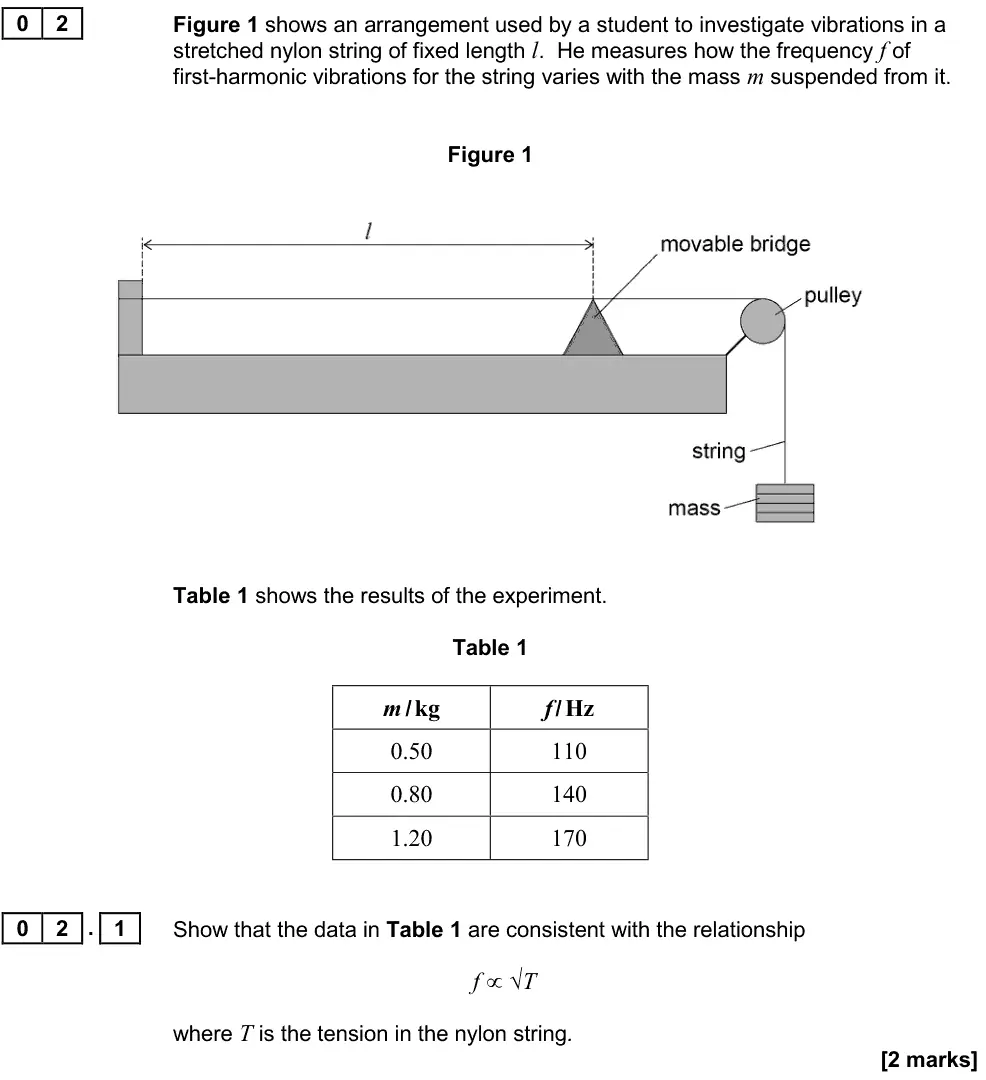
June 2017 · Paper 1 · Q2.12 marksShow that
Mark scheme
Examiner's comment
Question 02.1 required students to analyse the data given and demonstrate that it was consistent with the given relationship. Just over half of students were able to do this. Common errors were confusion between linear and proportional relationships, and attempts to derive the expression algebraically without using the data.
The calculation in question 02.2 proved to be one of the more challenging in the paper. The main reason for this was a lack of appreciation of how to find the mass per unit length of the nylon string; this did limit them although they were able to pick up a mark for a correct substitution of tension and frequency in the appropriate formula.
The explanation, required in 02.3, of why the result might be different if much larger masses were used, was not well answered. The majority did not appreciate that the nylon would get thinner and this would reduce the mass per unit length. Common responses tried to invoke Hooke’s law notwithstanding the fact that nylon does not obey this law.
Notes from the mark scheme and report
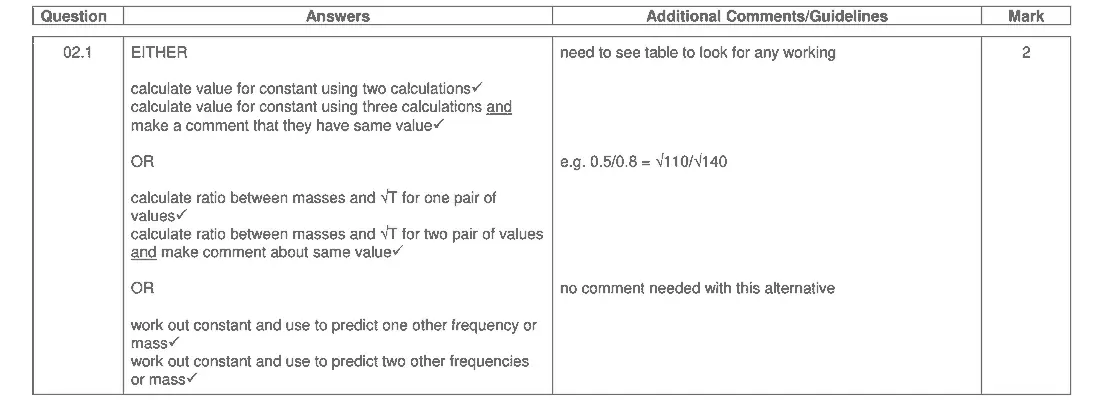
Show f/root m (or ratios) is constant for all three rows of Table 1 and comment
just over half managed it
linear confused with proportional, algebraic derivations without data
Skills: MS0.3 Use ratios, fractions and percentages; MS3.1 Translate information between graphical, numerical and algebraic forms; RP1 Investigation into the variation of the frequency of stationary waves on a string with length, tension and mass per unit length of the string.
June 2017 · Paper 1 · Q2.23 marksCalculation
Earlier part of question 2 that this part uses
Mark scheme
Examiner's comment
The calculation in question 02.2 proved to be one of the more challenging in the paper. The main reason for this was a lack of appreciation of how to find the mass per unit length of the nylon string; this did limit them although they were able to pick up a mark for a correct substitution of tension and frequency in the appropriate formula.
Notes from the mark scheme and report
Answer: 0.67 m (mass per unit length = density x area = 2.26 x 10^-4 kg m^-1, T = mg)
finding mass per unit length was the main difficulty
diameter used as radius gives 0.335 m
Skills: MS2.2 Change the subject of an equation, including non-linear equations; MS2.3 Substitute numerical values into algebraic equations using appropriate units for physical quantities; MS4.3 Calculate areas of triangles, circumferences and areas of circles, surface areas and volumes of rectangular blocks, cylinders and spheres; RP1 Investigation into the variation of the frequency of stationary waves on a string with length, tension and mass per unit length of the string.
June 2017 · Paper 1 · Q2.32 marksExplanation
Earlier part of question 2 that this part uses
Mark scheme
Examiner's comment
The explanation, required in 02.3, of why the result might be different if much larger masses were used, was not well answered. The majority did not appreciate that the nylon would get thinner and this would reduce the mass per unit length. Common responses tried to invoke Hooke’s law notwithstanding the fact that nylon does not obey this law.
Notes from the mark scheme and report
String gets thinner when stretched, so mass per unit length falls and frequency is higher than predicted
Hooke's law answers gained nothing
Skills: RP1 Investigation into the variation of the frequency of stationary waves on a string with length, tension and mass per unit length of the string.
June 2017 · AS Paper 1 · Q5.34 marksExplanation
Earlier part of question 5 that this part uses
Mark scheme
Examiner's comment
05.3 It is clear that many students learn about the formation of standing waves in general terms and answers focusing on this were incomplete in several respects. In particular, many students missed out the initial formation of the wave, and many failed to adequately explain the reason for production of specific frequencies. Consequently it was common to see answers obtaining only 2 of the 4 marks.
This is Paper 1 of the second series of the new AS specification. The paper consists of seven questions from across the AS specification. It makes use of a range of question styles, including multiple choice, short answer, single- and multi-step calculations, data analysis, and extended writing. In general, many students experienced difficulties by missing important details in both the questions and their answers. Calculations were often done well, but many students struggled with answers that required extended writing, particularly those involving some reasoning, such as 02.1, 03.5, 04.3, 05.3, 05.7 and 07.4.
Notes from the mark scheme and report
Wind starts a wave travelling along the wire
it reflects at the ends and superposes with the incident wave
fixed ends must be nodes so only certain frequencies fit
formation of the initial wave often omitted
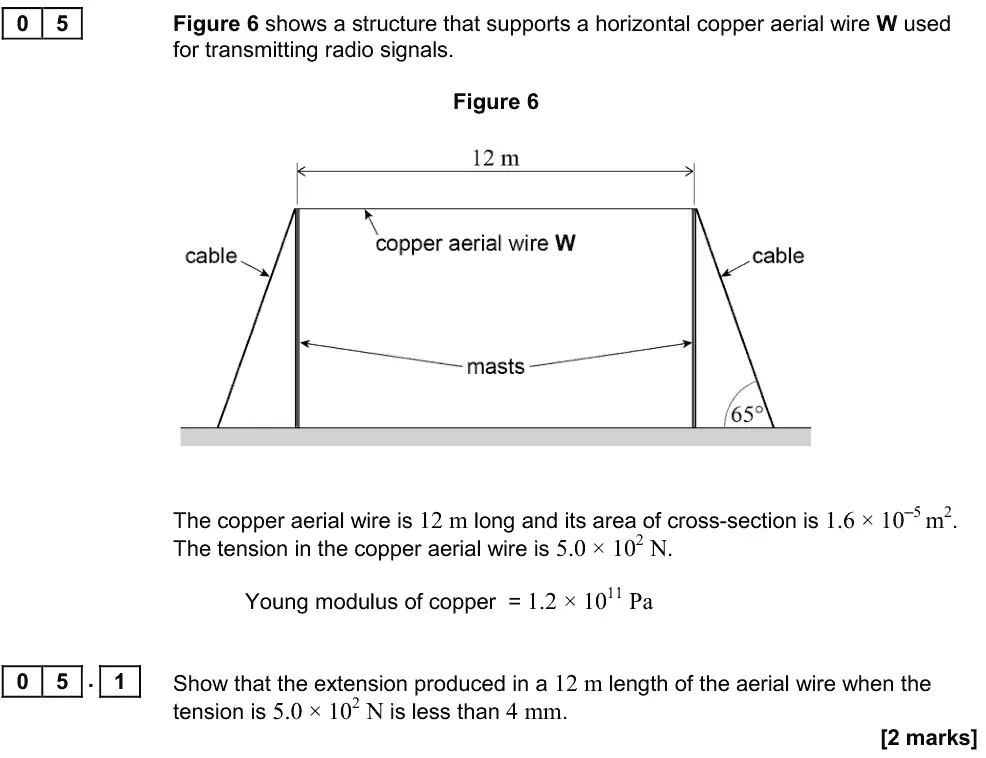
June 2017 · AS Paper 1 · Q5.52 marksCalculation
Earlier part of question 5 that this part uses
Mark scheme
Examiner's comment
05.5 However, this calculation proved to be less accessible despite an error for the mass per unit length in 05.4 being carried forward. Credit was also given for students making it clear that the fundamental frequency had to be multiplied by 3.
Notes from the mark scheme and report
Answer: 7.4 Hz (fundamental 1/(2 x 12) sqrt(500/0.142) = 2.47 Hz, times 3)
Skills: MS2.3 Substitute numerical values into algebraic equations using appropriate units for physical quantities
June 2017 · AS Paper 1 · Q5.61 markDiagram or graph
Earlier part of question 5 that this part uses
Mark scheme
Examiner's comment
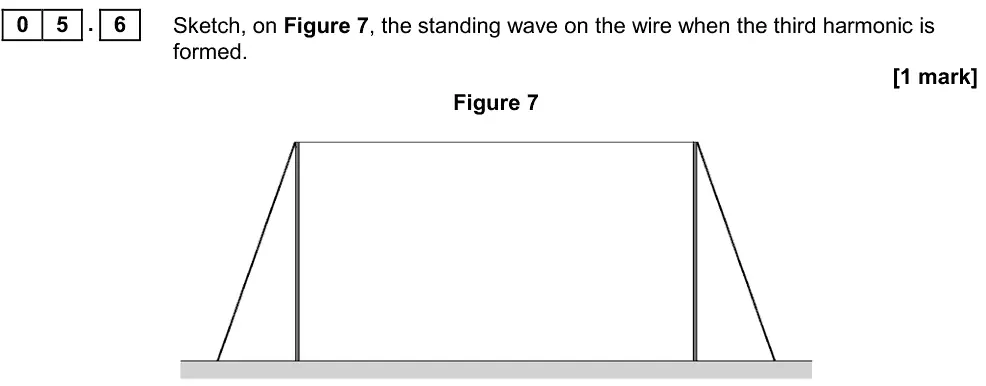
05.6 The drawing of three ‘loops’ was generally awarded the mark, unless the length of each loop was too unequal to be acceptable. 05.7 Whilst it was common to see answers that made some attempt to describe what happens to the wire if it is stretched too much, poor use of the correct terminology, such as failure to mention an elastic limit or equivalent, tended to limit the mark awarded to many answers.
Notes from the mark scheme and report
Three roughly equal loops between the masts (nodes at the ends)
June 2017 · Paper 1 · Q151 markMultiple choice
Answer
C
Notes from the mark scheme and report
Answer: C
Skills: MS0.3 Use ratios, fractions and percentages
June 2017 · AS Paper 2 · Q141 markMultiple choice
Answer
A
Notes from the mark scheme and report
Answer: A
June 2016 · AS Paper 1 · Q2.12 marksExplanation
Mark scheme
Examiner's comment
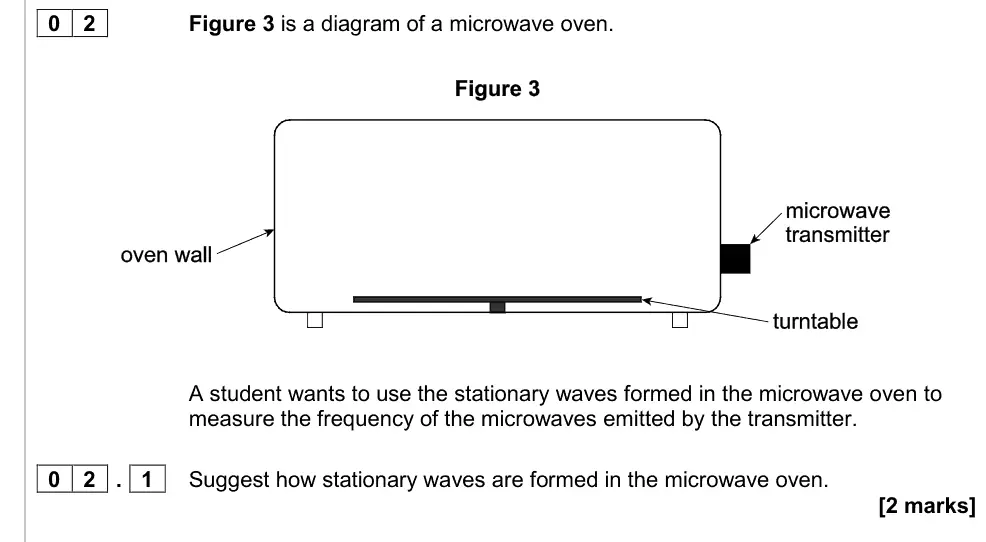
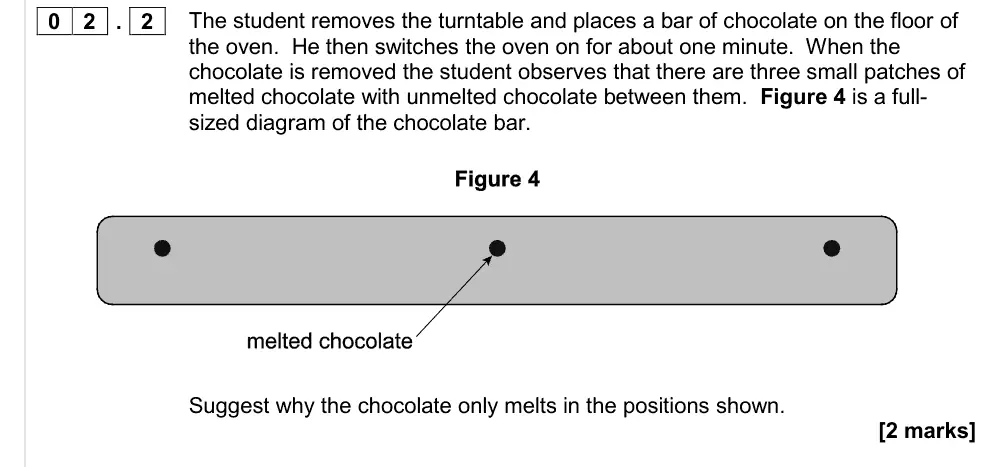
This question about the formation of stationary waves in a microwave oven was answered well by a good proportion of students. In question 2.1 the idea of reflection taking place was clearly stated in the majority of answers. The second marking point explaining how this resulted in the reflected and incident wave superposing was more discriminating. A significant proportion of students stated that the waves superimposed rather than superposed. Question 2.2 was only fully answered by those students who, having identified the melted chocolate positions as antinodes were then able to explain that this is where the amplitude of the wave was a maximum. Weaker responses tended to identify these positions as nodes or did not link the melted chocolate to stationary waves at all. Question 2.3 was a five mark calculation and this produced very good discrimination. About a third of students were awarded 4 or 5 marks. To obtain full marks students were required to give a clear indication, either on the diagram or in their working, that they had measured the distance between the first and third dot rather than measuring from the first to second dot and then doubling. It was sometimes hard to establish exactly what students had measured and it should be appreciated that showing full working in these extended calculations is very important. A lot of vague answers were seen to question 2.4 and it was the physics that needed to be explained. A common response was ‘to cook the food evenly’ and this was not seen as a physics explanation.
Notes from the mark scheme and report
Microwaves reflect off the oven wall and superpose with the incident waves travelling in the opposite direction
'superimpose' not accepted
June 2016 · AS Paper 1 · Q2.22 marksExplanation
Earlier part of question 2 that this part uses
Mark scheme
Examiner's comment
This question about the formation of stationary waves in a microwave oven was answered well by a good proportion of students. In question 2.1 the idea of reflection taking place was clearly stated in the majority of answers. The second marking point explaining how this resulted in the reflected and incident wave superposing was more discriminating. A significant proportion of students stated that the waves superimposed rather than superposed. Question 2.2 was only fully answered by those students who, having identified the melted chocolate positions as antinodes were then able to explain that this is where the amplitude of the wave was a maximum. Weaker responses tended to identify these positions as nodes or did not link the melted chocolate to stationary waves at all. Question 2.3 was a five mark calculation and this produced very good discrimination. About a third of students were awarded 4 or 5 marks. To obtain full marks students were required to give a clear indication, either on the diagram or in their working, that they had measured the distance between the first and third dot rather than measuring from the first to second dot and then doubling. It was sometimes hard to establish exactly what students had measured and it should be appreciated that showing full working in these extended calculations is very important. A lot of vague answers were seen to question 2.4 and it was the physics that needed to be explained. A common response was ‘to cook the food evenly’ and this was not seen as a physics explanation.
Notes from the mark scheme and report
Melted spots are at antinodes where amplitude (energy) is maximum
nodes was a common wrong answer
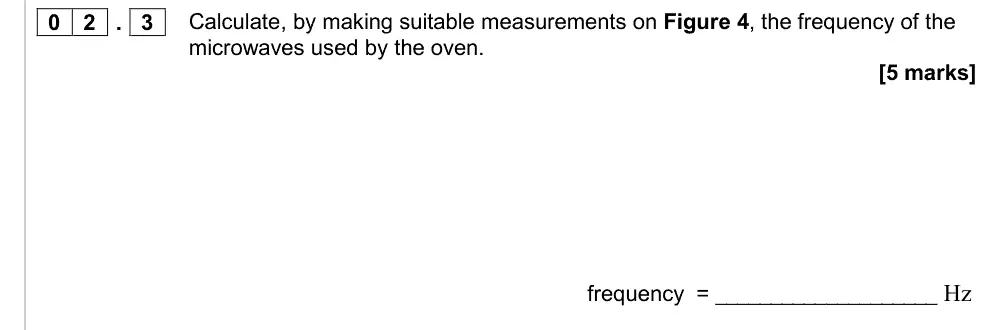
June 2016 · AS Paper 1 · Q2.35 marksCalculation
Earlier part of question 2 that this part uses
Mark scheme
Examiner's comment
This question about the formation of stationary waves in a microwave oven was answered well by a good proportion of students. In question 2.1 the idea of reflection taking place was clearly stated in the majority of answers. The second marking point explaining how this resulted in the reflected and incident wave superposing was more discriminating. A significant proportion of students stated that the waves superimposed rather than superposed. Question 2.2 was only fully answered by those students who, having identified the melted chocolate positions as antinodes were then able to explain that this is where the amplitude of the wave was a maximum. Weaker responses tended to identify these positions as nodes or did not link the melted chocolate to stationary waves at all. Question 2.3 was a five mark calculation and this produced very good discrimination. About a third of students were awarded 4 or 5 marks. To obtain full marks students were required to give a clear indication, either on the diagram or in their working, that they had measured the distance between the first and third dot rather than measuring from the first to second dot and then doubling. It was sometimes hard to establish exactly what students had measured and it should be appreciated that showing full working in these extended calculations is very important. A lot of vague answers were seen to question 2.4 and it was the physics that needed to be explained. A common response was ‘to cook the food evenly’ and this was not seen as a physics explanation.
Notes from the mark scheme and report
Answer: 2.5 x 10^9 Hz (first to third antinode 0.118 m = wavelength
f = c / lambda)
must show first-to-third measurement
using 330 m s^-1 loses 2 marks
about a third scored 4 or 5
Skills: MS3.1 Translate information between graphical, numerical and algebraic forms; MS2.3 Substitute numerical values into algebraic equations using appropriate units for physical quantities
June 2016 · AS Paper 1 · Q2.41 markShort answer
Earlier part of question 2 that this part uses
Mark scheme
Examiner's comment
This question about the formation of stationary waves in a microwave oven was answered well by a good proportion of students. In question 2.1 the idea of reflection taking place was clearly stated in the majority of answers. The second marking point explaining how this resulted in the reflected and incident wave superposing was more discriminating. A significant proportion of students stated that the waves superimposed rather than superposed. Question 2.2 was only fully answered by those students who, having identified the melted chocolate positions as antinodes were then able to explain that this is where the amplitude of the wave was a maximum. Weaker responses tended to identify these positions as nodes or did not link the melted chocolate to stationary waves at all. Question 2.3 was a five mark calculation and this produced very good discrimination. About a third of students were awarded 4 or 5 marks. To obtain full marks students were required to give a clear indication, either on the diagram or in their working, that they had measured the distance between the first and third dot rather than measuring from the first to second dot and then doubling. It was sometimes hard to establish exactly what students had measured and it should be appreciated that showing full working in these extended calculations is very important. A lot of vague answers were seen to question 2.4 and it was the physics that needed to be explained. A common response was ‘to cook the food evenly’ and this was not seen as a physics explanation.
Notes from the mark scheme and report
Rotating moves the food through the fixed antinodes (maximum energy positions) so it heats evenly
'cook evenly' alone not physics
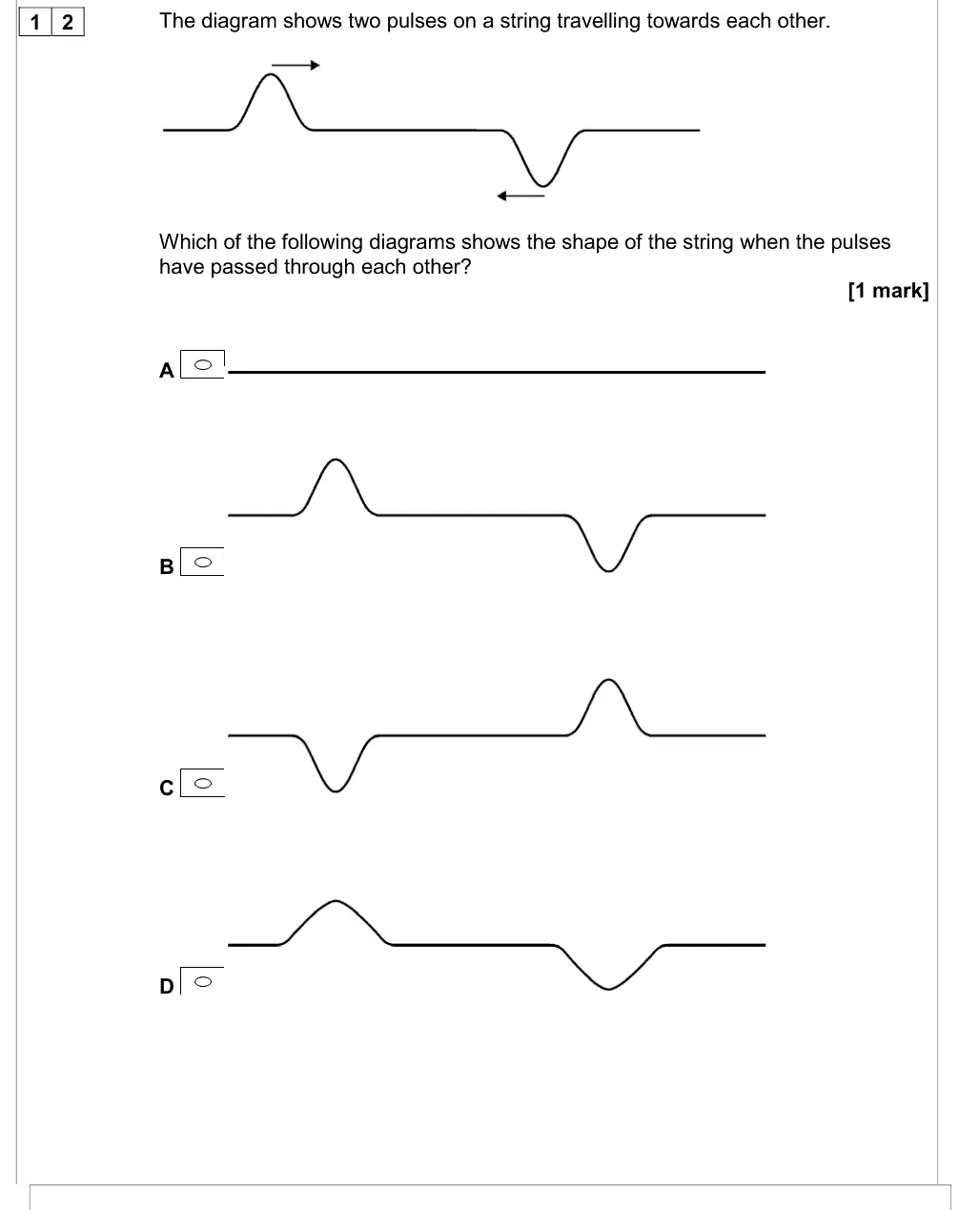
Specimen set 1 · Paper 1 · Q121 markMultiple choice
Answer
C
Notes from the mark scheme and report
Answer: C (pulses pass through each other unchanged)
June 2016 · AS Paper 2 · Q131 markMultiple choice
Answer
A
Notes from the mark scheme and report
Answer: A
Skills: MS0.3 Use ratios, fractions and percentages
Work with an AQA physics tutor
Dropping marks on calculations, required practicals or the six-markers? Book a trial session with a specialist AQA physics tutor.