Notes and key-term cards for this topic are being written by our tutors. The past-paper questions below are ready now.
Specification statements
Show the 13 statements from the specification
3.9.1.1-01 Ray diagram to show the image formation in normal adjustment.
3.9.1.1-02 Angular magnification in normal adjustment. M = angle subtended by object at unaided eye angle subtended by image at eye
3.9.1.1-03 Focal lengths of the lenses. M = f o f e
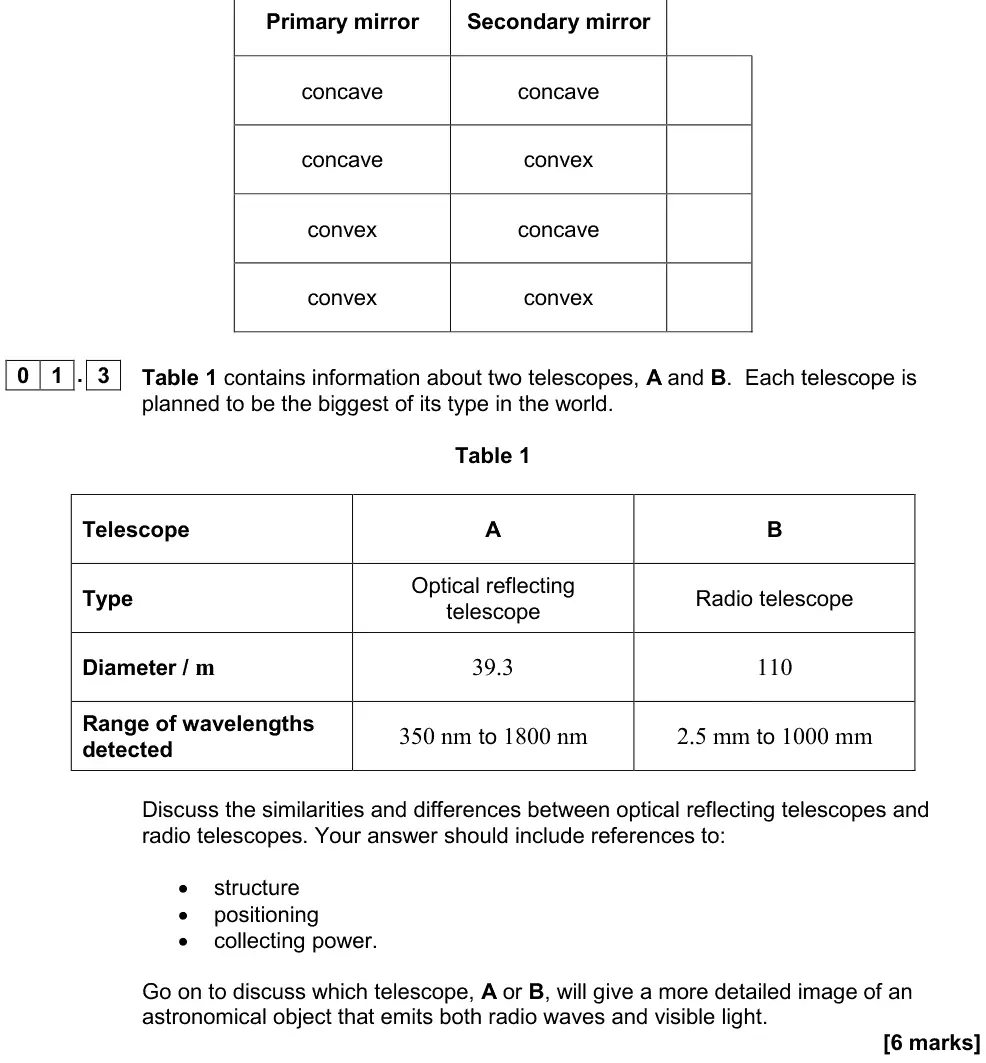
3.9.1.2-01 Cassegrain arrangement using a parabolic concave primary mirror and convex secondary mirror.
3.9.1.2-02 Ray diagram to show path of rays through the telescope up to the eyepiece.
3.9.1.2-03 Relative merits of reflectors and refractors including a qualitative treatment of spherical and chromatic aberration.
3.9.1.3-01 Similarities and differences of radio telescopes compared to optical telescopes. Discussion should include structure, positioning and use, together with comparisons of resolving and collecting powers.
3.9.1.4-01 Minimum angular resolution of telescope.
3.9.1.4-02 Rayleigh criterion, θ ≈λ D
3.9.1.4-03 Collecting power is proportional to diameter2.
3.9.1.4-04 Students should be familiar with the rad as the unit of angle.
3.9.1.4-05 Comparison of the eye and CCD as detectors in terms of quantum efficiency, resolution, and convenience of use.
3.9.1.4-06 No knowledge of the structure of the CCD is required.
Six-mark extended response questions on this topic
Tap a question to zoom it. Where a part needs a figure, table or graph from earlier in the question, that part folds out above it; the mark scheme and examiner's comment open underneath. Have the AQA data and formulae booklet beside you (see the formula sheet page).
June 2025 · Paper 3B Astrophysics · Q2.12 marksAO1=2Diagram or graph
Mark scheme
Examiner's comment
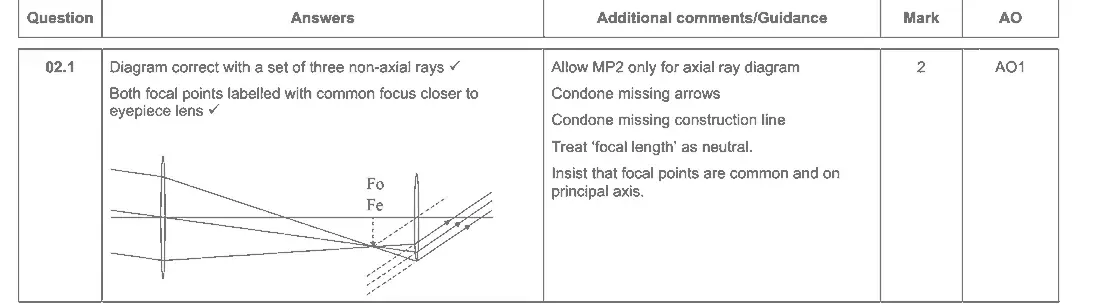
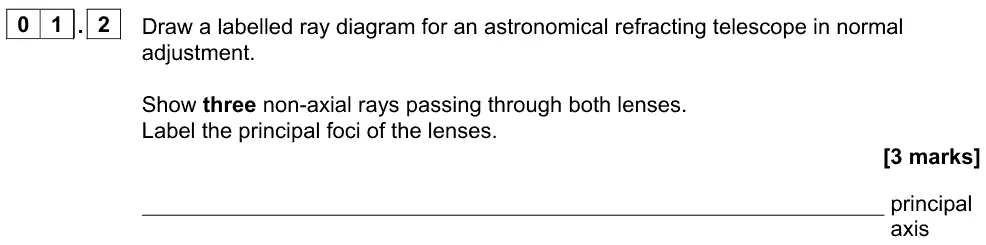
2.1 The majority of students were able to construct a sensible ray diagram. However, there were a significant number of students who did not use a ruler to produce their rays meaning that their diagrams were unsuitable. Some students also did not include a principal axis or only labelled the focal lengths rather than the location of the principal foci.
Notes from the mark scheme and report
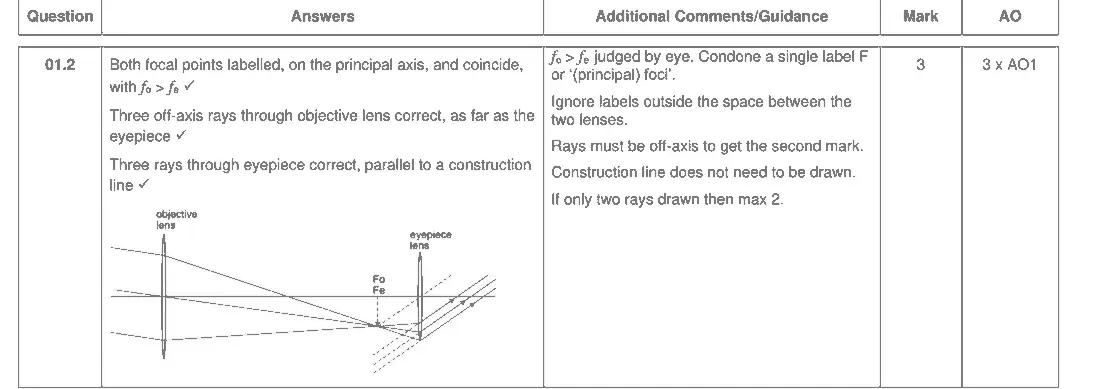
Three non-axial parallel rays through objective, through the common focus (closer to the eyepiece), emerging parallel
both principal foci labelled
Skills: MS4.2 Visualise and represent 2D and 3D forms including two- dimensional representations of 3D objects
June 2025 · Paper 3B Astrophysics · Q2.26 marksAO1=2, AO2=3, AO3=16-mark extended response
Earlier part of question 2 that this part uses
Mark scheme, with the levels and indicative content
Examiner's comment
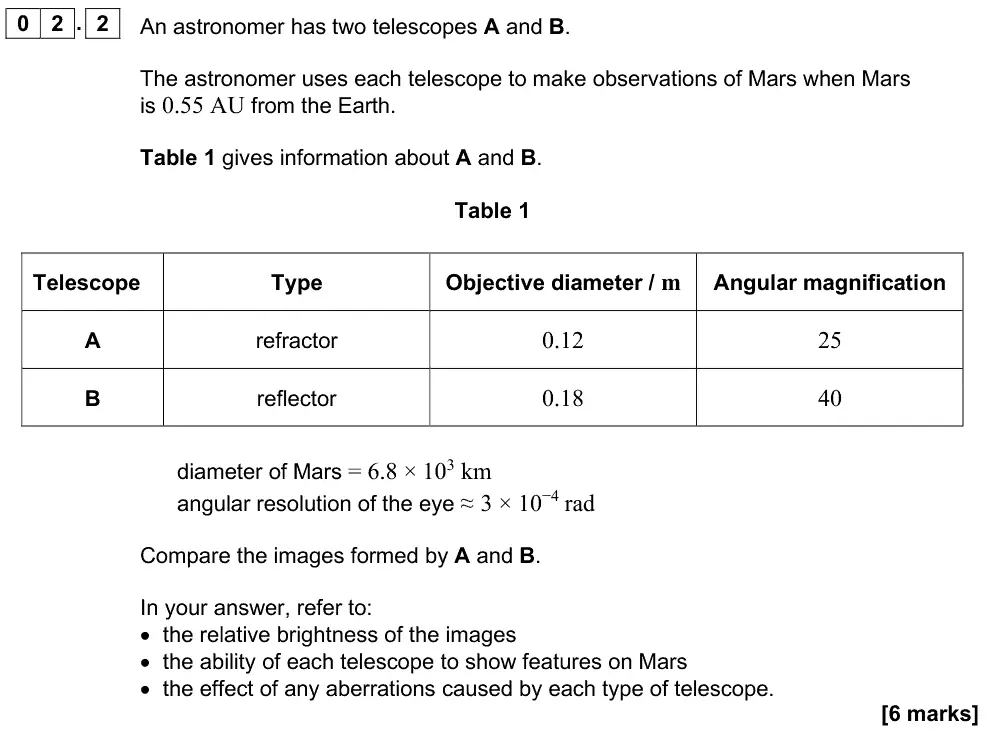
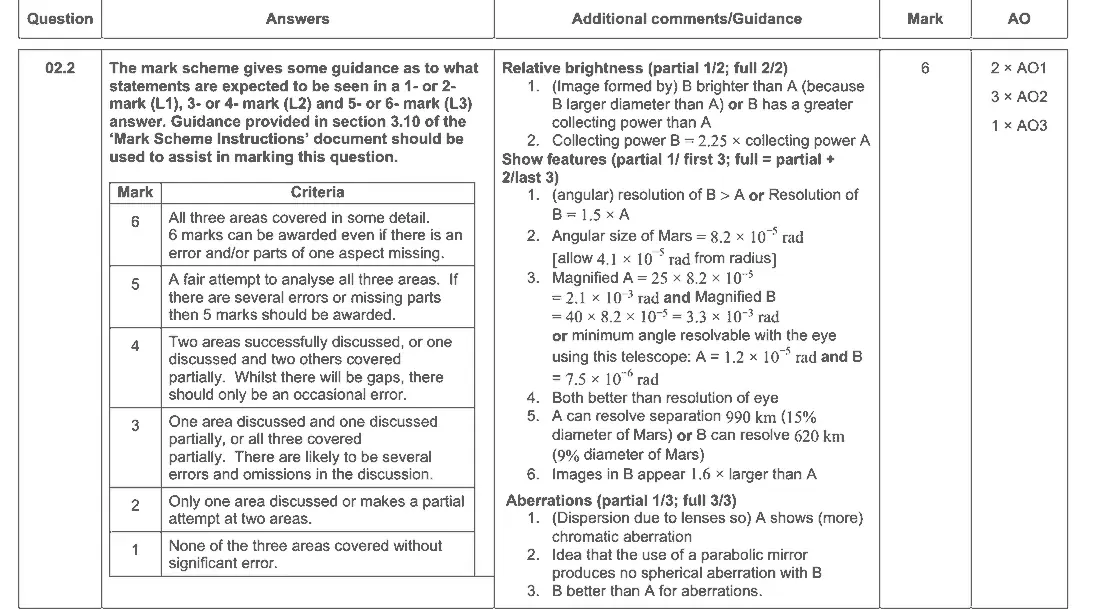
2.2 Generally a well done question with almost 80% of students able to access at least 2 of the marks. Very few students were able to access all 6 marks, however. Students often were quite generalised in their discussions rather than using the data given to calculate specific values to use in their answers. The main point of the question was a comparison of the images formed by A and B and students often did not make these comparisons.
Notes from the mark scheme and report
Levels of response. B brighter (collecting power 2.25 x A)
B better resolution (1.5 x)
Mars subtends 8.2 x 10^-5 rad, magnified to 2.1 x 10^-3 rad (A) and 3.3 x 10^-3 rad (B), both above eye's 3 x 10^-4 rad
A refractor suffers chromatic aberration, B (mirror) only spherical
almost 80% at least 2 marks
Skills: MS0.3 Use ratios, fractions and percentages; MS4.6 Use of small angle approximations including sinθ ≈θ, tanθ ≈θ, cosθ ≈1 for small θ where appropriate
June 2025 · Paper 3B Astrophysics · Q2.32 marksAO1=2Explanation
Earlier part of question 2 that this part uses
Mark scheme
Examiner's comment
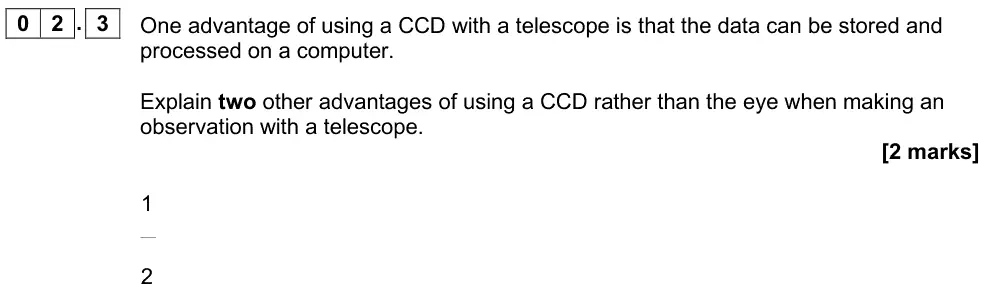
2.3 The “explain” command word was not appreciated by a large proportion of students who simply stated two benefits rather than giving an explanation for why these are benefits. Some students focused on the data analysis that is done by the computer more than the CCD itself but this was information that was given in the question.
Notes from the mark scheme and report
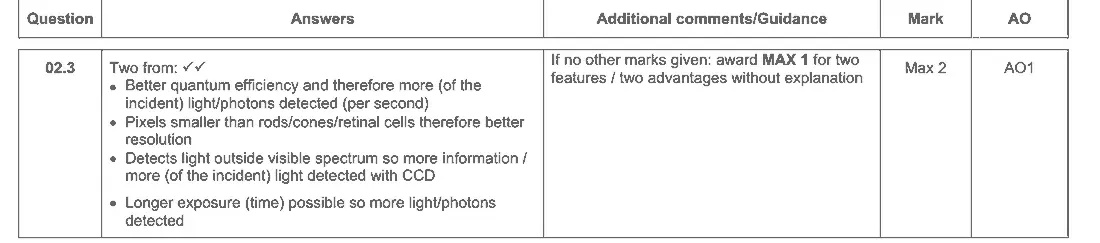
Two of: higher quantum efficiency so more photons detected
smaller pixels than retinal cells give better resolution
detects beyond the visible
long exposure
June 2024 · Paper 3B Astrophysics · Q1.12 marksAO2=2Calculation
Mark scheme
Examiner's comment
The mark scheme in question 01.1 was designed to give partial credit to students who could do one step in the calculation but not complete it. Over half of the students were awarded both marks. Common errors included mixing up the two lenses, getting the magnification the wrong way round, or not including the focal length of the eyepiece.
Notes from the mark scheme and report
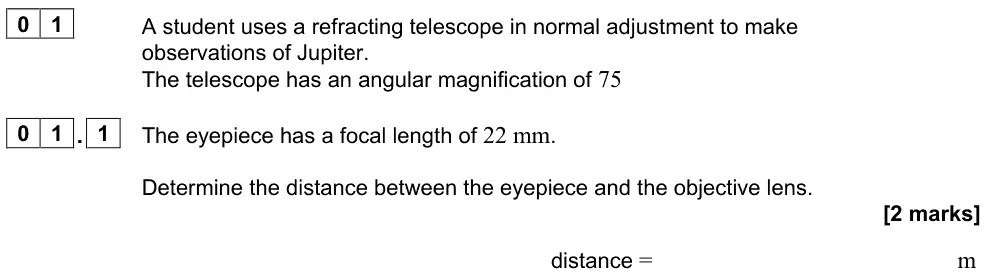
Answer: 1.67 m (fo = 75 x 0.022 = 1.65 m, add fe)
errors: swapping lenses, inverting M, omitting fe
over half both marks
Skills: MS2.2 Change the subject of an equation, including non-linear equations; MS0.1 Recognise and make use of appropriate units in calculations
June 2024 · Paper 3B Astrophysics · Q1.22 marksAO2=2Calculation
Earlier part of question 1 that this part uses
Mark scheme
Examiner's comment
Question 01.2 was much more demanding. There was evidence of much careless work, failing to take the magnification into account or using the radius rather than the diameter of Jupiter in the calculation. Many students appeared to have no idea of how to approach the question, invoking any equation available to evaluate distance in astronomy, including the magnitudes equation and Hubble’s law.
Notes from the mark scheme and report
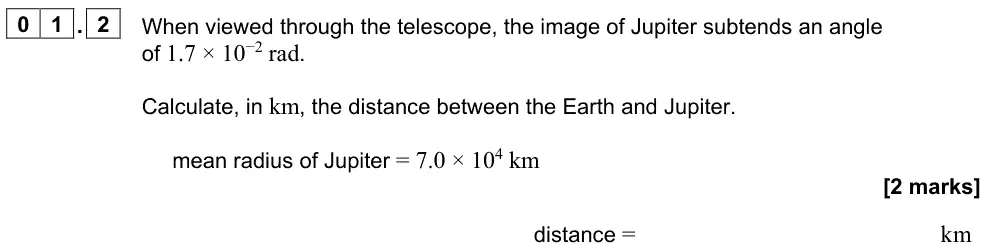
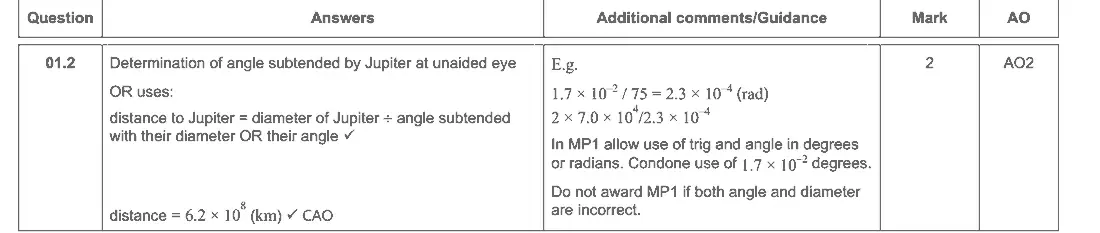
Answer: 6.2 x 10^8 km (unaided angle 1.7 x 10^-2/75 = 2.3 x 10^-4 rad
distance = diameter 1.4 x 10^5 km / angle)
using radius or ignoring M were common
many had no approach
Skills: MS4.6 Use of small angle approximations including sinθ ≈θ, tanθ ≈θ, cosθ ≈1 for small θ where appropriate; MS2.3 Substitute numerical values into algebraic equations using appropriate units for physical quantities
June 2024 · Paper 3B Astrophysics · Q1.33 marksAO1=1, AO3=2Explanation
Earlier part of question 1 that this part uses
Mark scheme
Examiner's comment
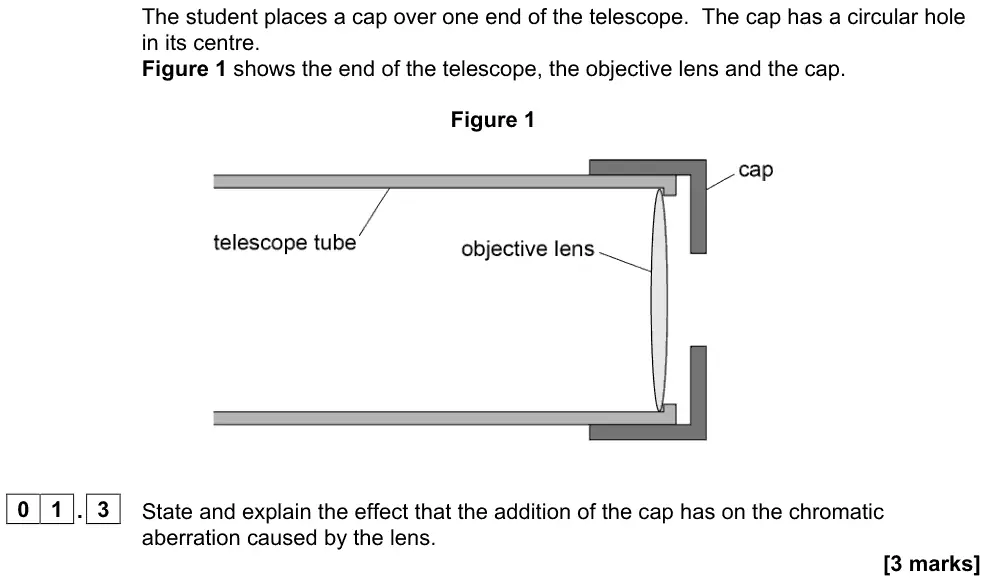
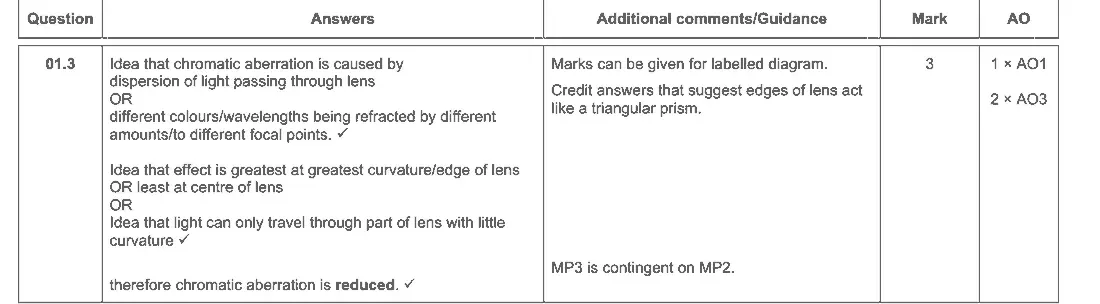
Question 01.3 also proved to be challenging for most students. There was much confusion between diffraction and refraction, for example. Many students also thought that the cap would behave as a filter blocking out some wavelengths and not others. The best answers demonstrated an understanding of the nature of chromatic aberration, and why it affects light entering the edge of the lens the most.
Notes from the mark scheme and report
Chromatic aberration from different wavelengths refracted by different amounts
greatest at the edge (most curved) of the lens
cap blocks the edge so chromatic aberration reduced
not a colour filter, not diffraction
June 2024 · Paper 3B Astrophysics · Q1.44 marksAO3=4Explanation
Earlier part of question 1 that this part uses
Mark scheme
Examiner's comment
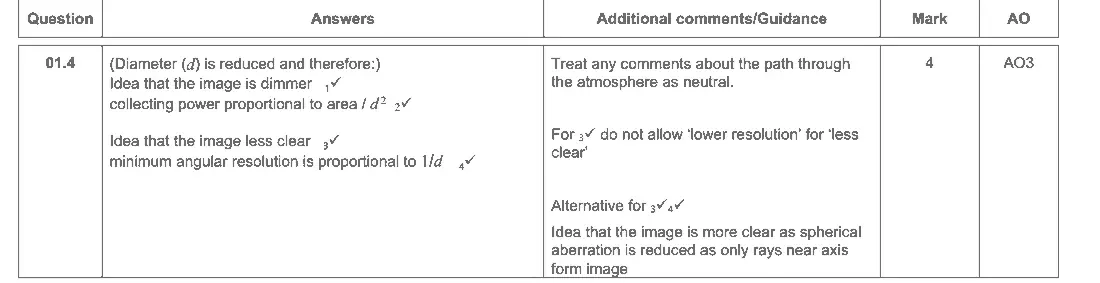
Question 01.4 asked about the effect on the image of Jupiter. Most students identified that the image would become dimmer but did not explain their answer in sufficient detail. Some students mentioned reduced resolution without explaining how it was caused or the effect it would have on the image. Some students identified a reduced amount of spherical aberration, which gained credit provided they gave a clear account of what was happening. Some students attempted to say that the image would be both clearer and less clear, referring to resolution and spherical aberration, without realising the contradiction in their answer.
Notes from the mark scheme and report
Smaller aperture: dimmer image (collecting power proportional to d^2)
less detail (minimum angular resolution proportional to 1/d)
reduced spherical aberration also credited if explained
June 2023 · Paper 3B Astrophysics · Q2.11 markAO1=1Short answer
Mark scheme
Examiner's comment
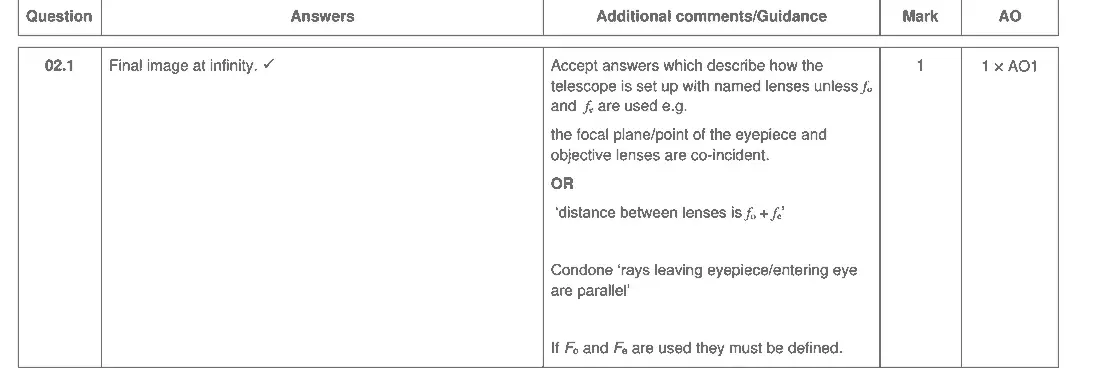
02.1 Although other answers were accepted, some of the best answers showed an understanding that the final image formed by the telescope is at infinity and therefore the eye is behaving in the same way as it is when viewing the object unaided. Answers that referred to the length of the telescope as the sum of the focal lengths or referred to Fo and Fe without definition did not get the mark. Many answers that also were given no credit used the angular-magnification equation given in the data booklet. 02.2 Nearly two-thirds of students got this right. Many other students preferred the third response, showing that they were unfamiliar with the types of lens used in the telescope.
Notes from the mark scheme and report
Final image at infinity (or focal points of objective and eyepiece coincide)
'length = fo + fe' without definition not credited
June 2023 · Paper 3B Astrophysics · Q2.21 markAO1=1Short answerEasy
Earlier part of question 2 that this part uses
Mark scheme
Examiner's comment
02.1 Although other answers were accepted, some of the best answers showed an understanding that the final image formed by the telescope is at infinity and therefore the eye is behaving in the same way as it is when viewing the object unaided. Answers that referred to the length of the telescope as the sum of the focal lengths or referred to Fo and Fe without definition did not get the mark. Many answers that also were given no credit used the angular-magnification equation given in the data booklet. 02.2 Nearly two-thirds of students got this right. Many other students preferred the third response, showing that they were unfamiliar with the types of lens used in the telescope.
Notes from the mark scheme and report
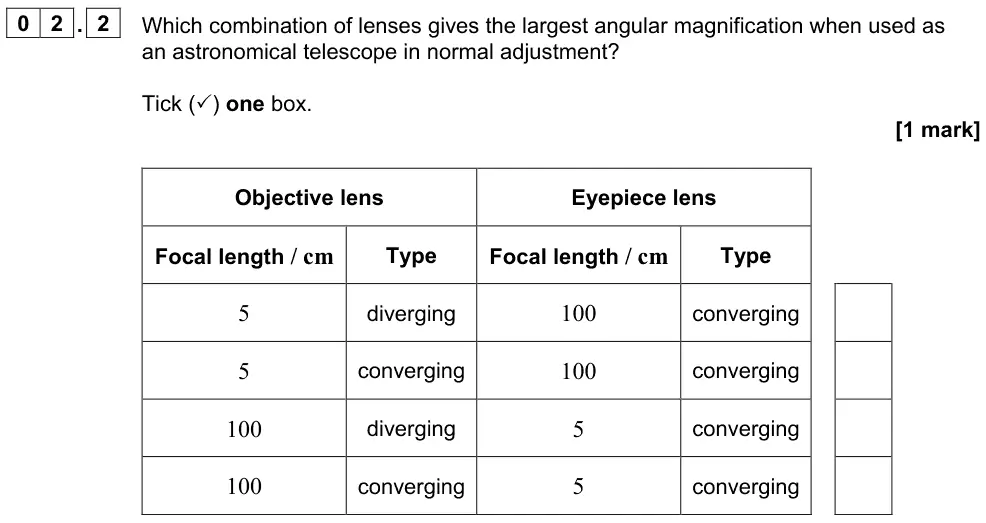
Answer: objective 100 cm converging, eyepiece 5 cm converging (M = fo/fe = 20)
many chose a diverging lens
nearly two-thirds correct
June 2023 · Paper 3B Astrophysics · Q2.42 marksAO3=2Calculation
Earlier part of question 2 that this part uses
Mark scheme
Examiner's comment
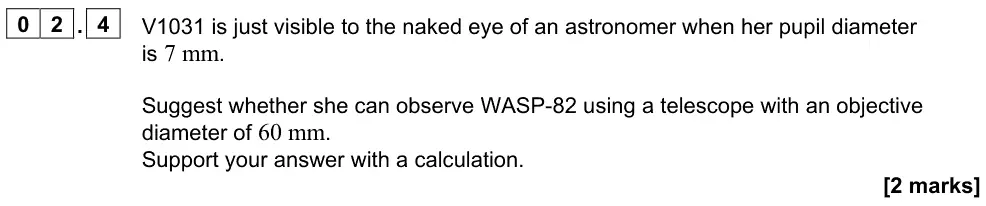
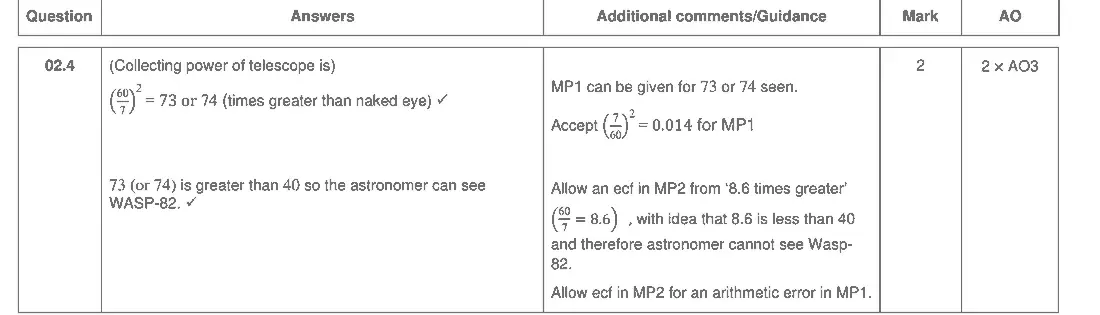
02.4 Many students approached the question from a resolution perspective rather than from collecting power. One mark was available for this error when the answer was otherwise correct. Many of those who used the collecting power did not compare their answer with the value of 40 from the stem of the question and were therefore also restricted to one mark.
Notes from the mark scheme and report
Collecting power ratio (60/7)^2 = 73, greater than 40 so WASP-82 visible
resolution arguments and not comparing with 40 limited to 1 mark
Skills: MS0.3 Use ratios, fractions and percentages
June 2023 · Paper 3B Astrophysics · Q2.53 marksAO1=3Explanation
Earlier part of question 2 that this part uses
Mark scheme
Examiner's comment
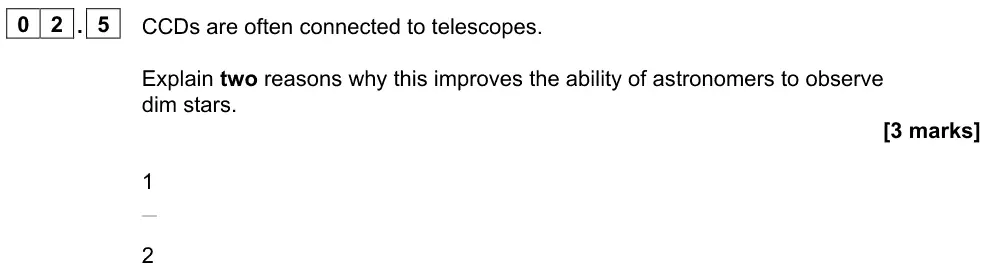
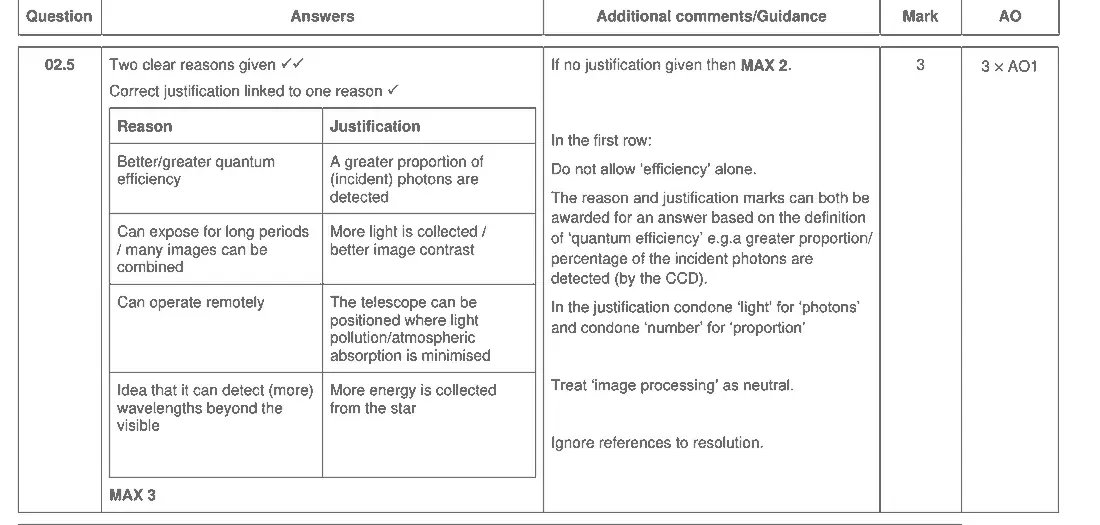
02.5 Answers contained many misconceptions about the CCD. Many of the best answers explained the difference in quantum efficiency of the CCD and the eye in some detail. Some answers that did not get the mark mentioned the idea that the CCD allows an image to be stored without any idea of why that would allow dimmer objects to be seen. Others discussed resolution, again failing to take into account the context of the question.
long exposure / combined images collect more light
storage alone or resolution not credited
June 2023 · Paper 3B Astrophysics · Q3.24 marksAO3=4Calculation
Earlier part of question 3 that this part uses
Mark scheme
Examiner's comment
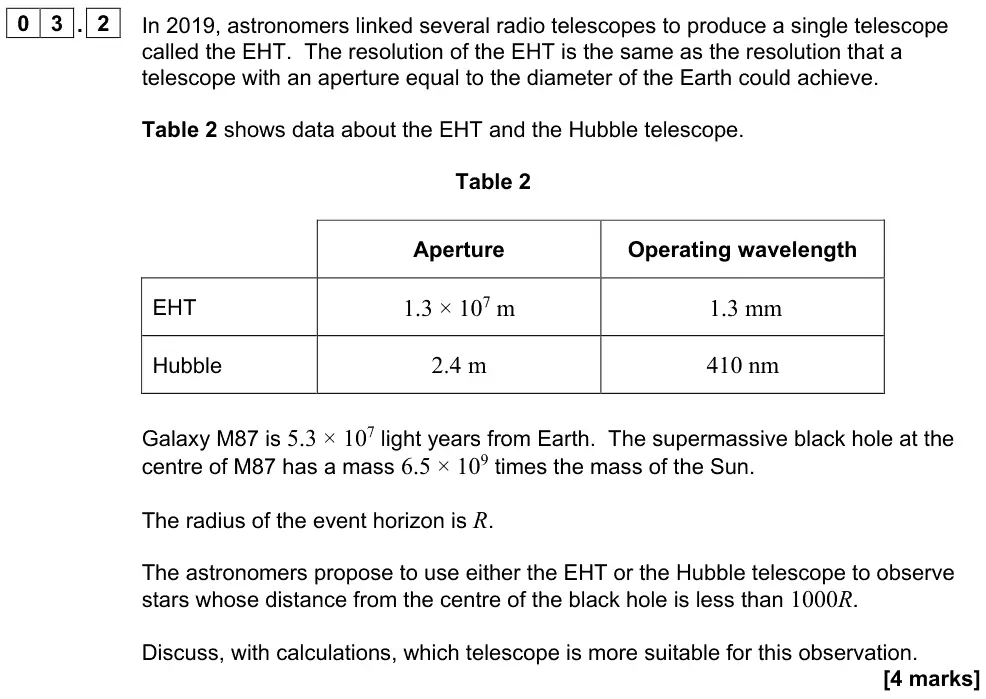
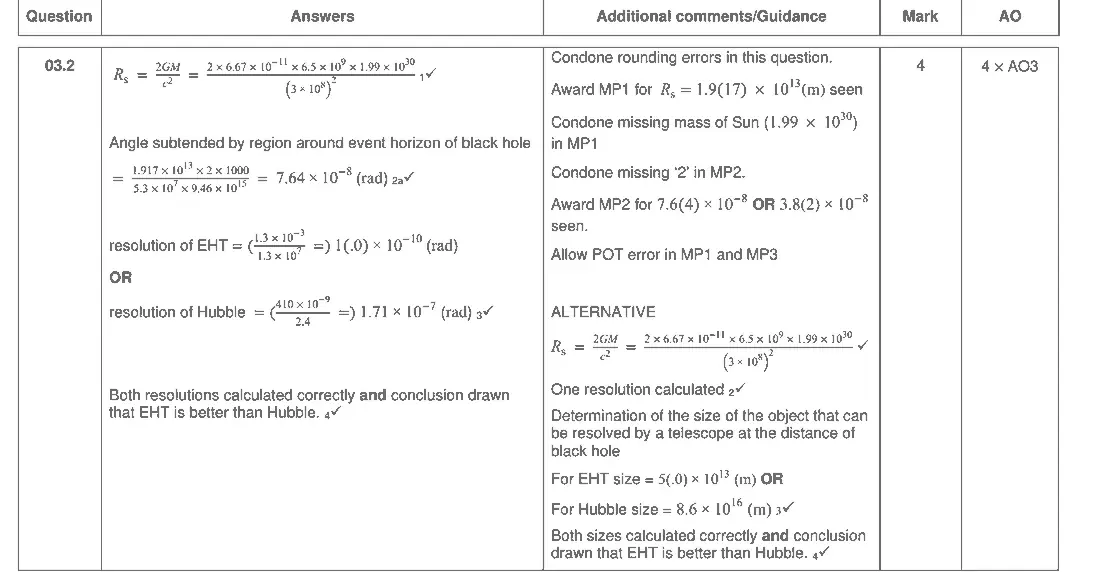
03.2 This was one of two questions that provided the best discrimination on the paper. The best answers worked out the resolution of each telescope, and showed an understanding of angular resolution in their discussion. They also included calculations of the angle between the stars and the black hole to show that the EHT would be able to resolve them but that the Hubble would not. Problems with powers of ten and other arithmetic errors were quite common.
This question was marked using a levels of response mark scheme. Along with 03.2 it was the best discriminating question on the paper.
Notes from the mark scheme and report
Rs = 1.9 x 10^13 m
1000R region subtends 7.6 x 10^-8 rad at 5.3 x 10^7 ly
EHT resolution 1.0 x 10^-10 rad, Hubble 1.7 x 10^-7 rad
only EHT can resolve
best discriminator
Skills: MS2.3 Substitute numerical values into algebraic equations using appropriate units for physical quantities; MS4.6 Use of small angle approximations including sinθ ≈θ, tanθ ≈θ, cosθ ≈1 for small θ where appropriate; MS0.2 Recognise and use expressions in decimal and standard form
June 2022 · Paper 3B Astrophysics · Q1.11 markAO1=1Diagram or graph
Mark scheme
Examiner's comment
1.1 There were a few excellent diagrams which showed a good understanding. Unfortunately many students drew ray diagrams for a mirror, a simple case of not reading the question carefully.
Notes from the mark scheme and report
Parallel rays at different distances from the axis come to different foci
outer rays focus closer to the lens
Skills: MS4.2 Visualise and represent 2D and 3D forms including two- dimensional representations of 3D objects
June 2022 · Paper 3B Astrophysics · Q1.23 marksAO1=3Diagram or graph
Earlier part of question 1 that this part uses
Mark scheme
Examiner's comment
1.2 There were many excellent diagrams for this question which students had learnt well. A common mistake was for the principal foci to be placed where the rays crossed rather than on the principal axis. Those students who scored less well appeared to be trying to reproduce a diagram they had seen but did not understand. The best way to teach this is to lead students through drawing the ray diagram.
Notes from the mark scheme and report
Foci of both lenses on the axis and coincident with fo > fe
three non-axial parallel rays through objective to a point in the focal plane
emerge from eyepiece parallel (use a construction line)
Skills: MS4.2 Visualise and represent 2D and 3D forms including two- dimensional representations of 3D objects
June 2022 · Paper 3B Astrophysics · Q1.32 marksAO2=2Calculation
Earlier part of question 1 that this part uses
Mark scheme
Examiner's comment
1.3 A large proportion of students scored full marks on this question. Those who did not often just divided the length of the telescope by 750. This gives the same answer to 3 significant figures, but scored no marks.
Notes from the mark scheme and report
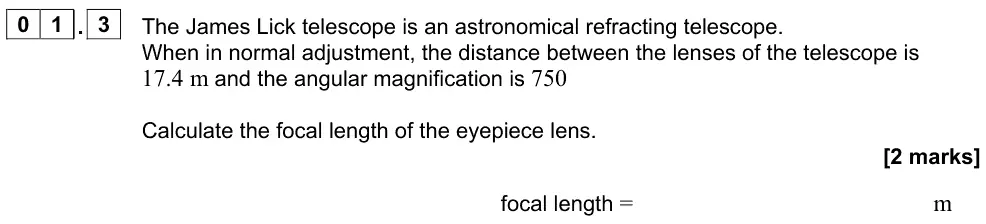
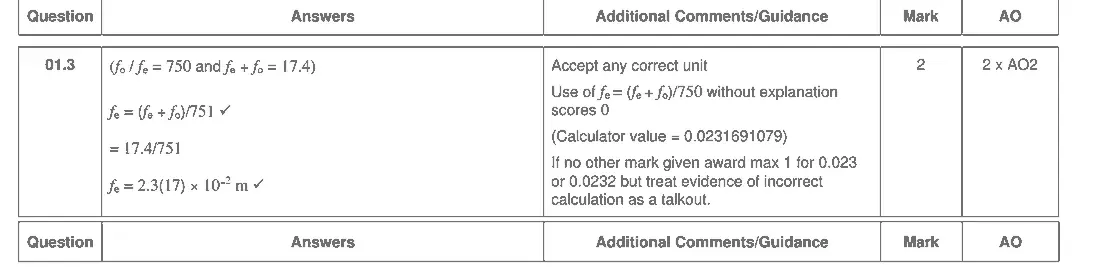
Answer: 2.3 x 10^-2 m (fo + fe = 17.4 m, fo = 750 fe, so fe = 17.4/751)
using /750 without explanation scores 0
Skills: MS2.2 Change the subject of an equation, including non-linear equations; MS2.4 Solve algebraic equations, including quadratic equations
June 2022 · Paper 3B Astrophysics · Q1.43 marksAO3=3Explanation
Earlier part of question 1 that this part uses
Mark scheme
Examiner's comment
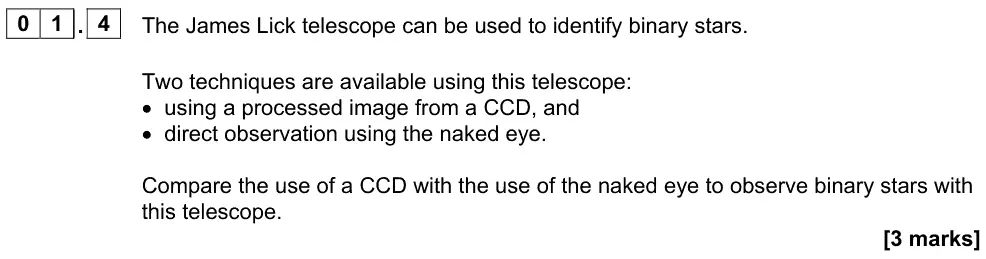
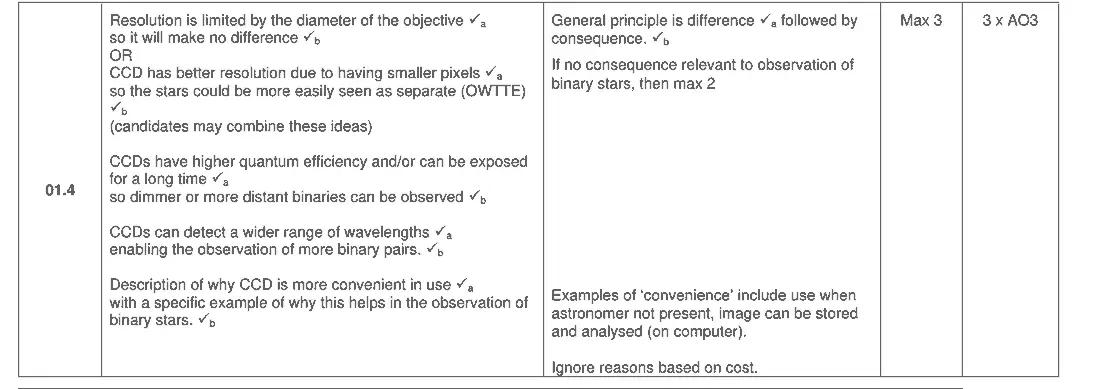
1.4 Many students scored one or two marks on this question as they had a good knowledge of how a CCD works and the advantages it has over the naked eye. They rarely scored the third mark, however, as there was no attempt to link this knowledge to the situation in this question. A significant number of students did not seem to understand that the CCD was attached to the same telescope as was used with the naked eye.
Notes from the mark scheme and report
Resolution limited by objective diameter so no difference (or CCD smaller pixels resolve better)
CCD higher quantum efficiency / long exposure shows fainter stars
CCD image can be stored/processed
eye convenient, real time
November 2021 · Paper 3B Astrophysics · Q5.12 marksAO1=2Explanation
Mark scheme
Examiner's comment
5.1 Few students scored marks on this question though versions of it have appeared many times and it is simple recall. One of the key words is ‘minimum’; this was often missed.
Notes from the mark scheme and report
Minimum angle at which two objects can be resolved: central maximum of one diffraction pattern coincides with the first minimum of the other
November 2021 · Paper 3B Astrophysics · Q5.23 marksExplanation
Earlier part of question 5 that this part uses
Mark scheme
Examiner's comment
5.2 Over half of students scored at least one mark on this question. Some thought that water vapour absorbs ultra-violet, though it actually absorbs infra-red radiation.
Notes from the mark scheme and report
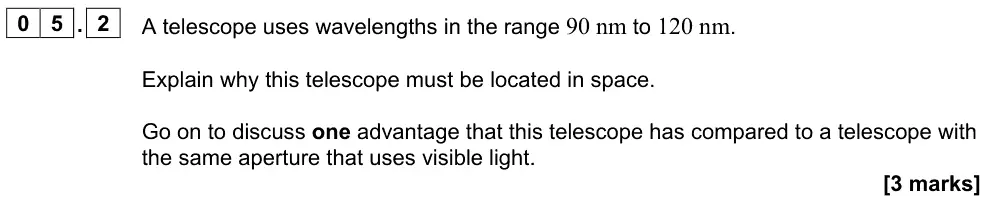
Detects ultraviolet, absorbed by (ozone in) the atmosphere so must be in space
shorter wavelength gives smaller lambda/D so better resolution
over half scored at least one mark
November 2021 · Paper 3B Astrophysics · Q5.33 marksAO3=3Explanation
Earlier part of question 5 that this part uses
Mark scheme
Examiner's comment
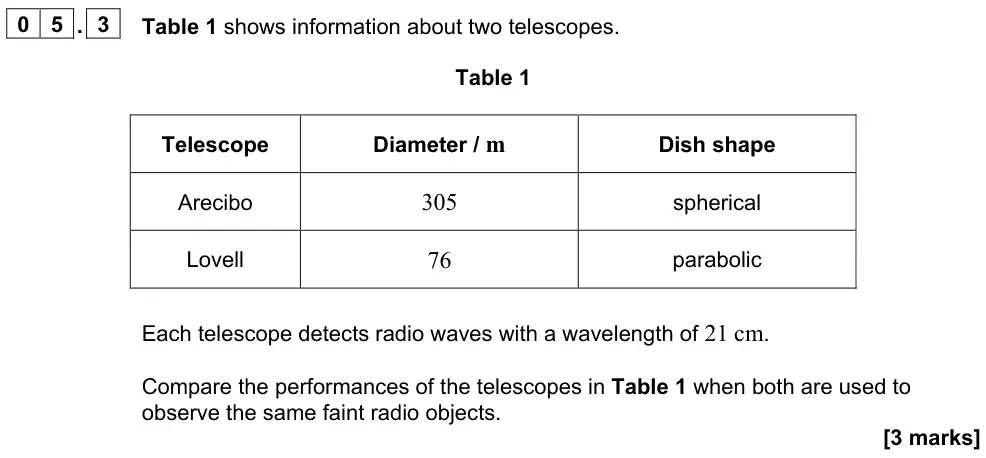
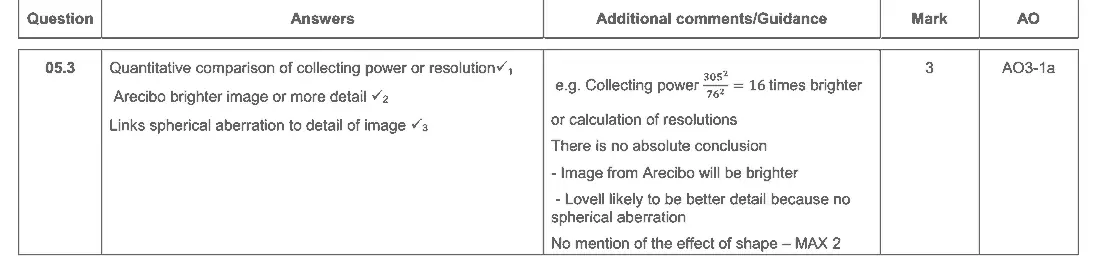
5.3 Over half of students gained at least one mark on this question. Many failed to make any reference to the fact that the Arecibo telescope has spherical curvature.
Concluding Remarks
This paper was similar in difficulty to those of previous years (including 2020). Questions 1.1 and 4.2 should have been familiar to students. Question 3 approached the topic from an unusual angle, so it was pleasing that a number of students gave good answers.
Notes from the mark scheme and report
Collecting power (305/76)^2 = 16 times greater for Arecibo (brighter image) and better resolution (lambda/D)
Skills: MS0.3 Use ratios, fractions and percentages
November 2020 · Paper 3B Astrophysics · Q1.12 marksAO1=2Diagram or graph
Mark scheme
Examiner's comment
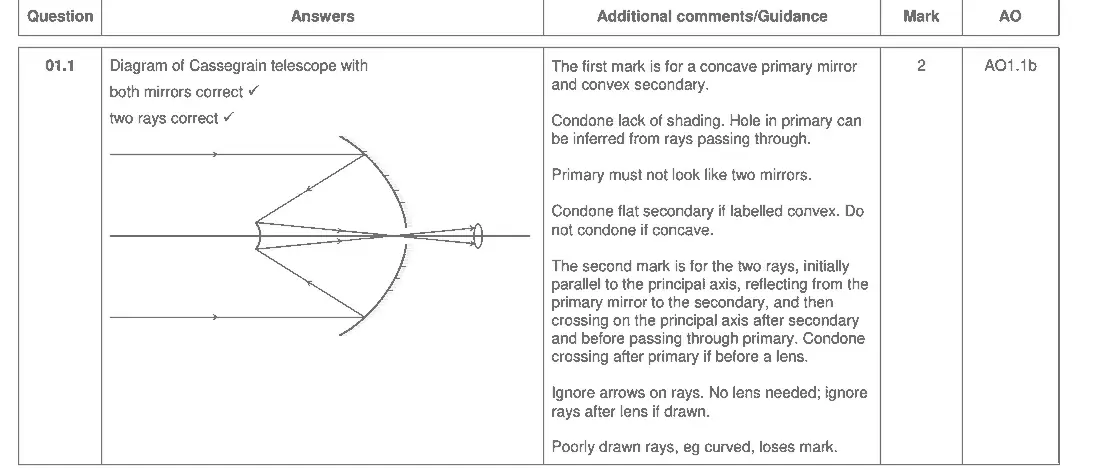
There were some excellent diagrams which showed a good understanding of how the telescope works. Other students appeared to be trying to remember a diagram without understanding it. This led to the primary mirror appearing as two separate mirrors, together with rays that did not cross at the correct place. A surprising number of students attempted to draw a ray diagram for an astronomical refracting telescope rather than a reflector with a Cassegrain mounting.
Question 01.1
This paper was broadly similar in difficulty to previous years. There were questions which have appeared in the same or similar forms in previous years (e.g. 01.1 and 02.5), along with questions on familiar topics which have been in the specification for a long time (e.g. 03.3). Question 04.2 tested knowledge of Gamma Ray Bursts (which was added to the specification at the latest revision) and most students did not know this.
Notes from the mark scheme and report
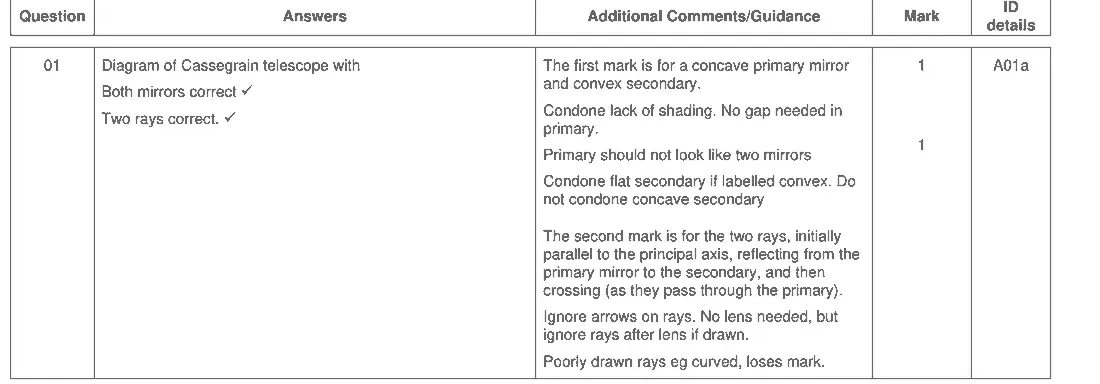
Concave primary with hole and convex secondary
two parallel rays reflected by both mirrors through the hole to the eyepiece
primary must not look like two mirrors
Skills: MS4.2 Visualise and represent 2D and 3D forms including two- dimensional representations of 3D objects
November 2020 · Paper 3B Astrophysics · Q1.23 marksAO3=3Calculation
Earlier part of question 1 that this part uses
Mark scheme
Examiner's comment
Most students realised they had to calculate the resolution of the instrument and did so accurately. Many then either calculated the angle subtended by the crater or the smallest detail that could be resolved by the telescope. Only a few explained that it was suitable to study detail in the crater because the resolution was much smaller than the crater. Some students thought that the telescope would be inappropriate because it could only ‘see’ objects up to 27m across and so would not ‘see’ the crater.
There were many good answers to this question where students clearly knew what they were doing and calculated a ratio. Others thought the collecting power was proportional to diameter and scored no marks. Some students tried to use resolving power to answer the question and stated that the telescope in Question 01.2 had better collecting power.
Question 01.2
Notes from the mark scheme and report
Resolution 450 x 10^-9/0.21 = 2.1 x 10^-6 rad
smallest detail 2.1 x 10^-6 x 1.25 x 10^7 m = 27 m (or crater subtends 8.0 x 10^-5 rad), so 1/40 of the crater - suitable
Skills: MS2.3 Substitute numerical values into algebraic equations using appropriate units for physical quantities; MS4.6 Use of small angle approximations including sinθ ≈θ, tanθ ≈θ, cosθ ≈1 for small θ where appropriate
November 2020 · Paper 3B Astrophysics · Q1.32 marksAO2=2Calculation
Earlier part of question 1 that this part uses
Mark scheme
Examiner's comment
There were many good answers to this question where students clearly knew what they were doing and calculated a ratio. Others thought the collecting power was proportional to diameter and scored no marks. Some students tried to use resolving power to answer the question and stated that the telescope in Question 01.2 had better collecting power.
Question 01.3
Notes from the mark scheme and report
Collecting power proportional to area (D^2)
ratio (2.4/0.21)^2 = 130
Skills: MS0.3 Use ratios, fractions and percentages
November 2020 · Paper 3B Astrophysics · Q1.43 marksAO3=3Explanation
Earlier part of question 1 that this part uses
Mark scheme
Examiner's comment
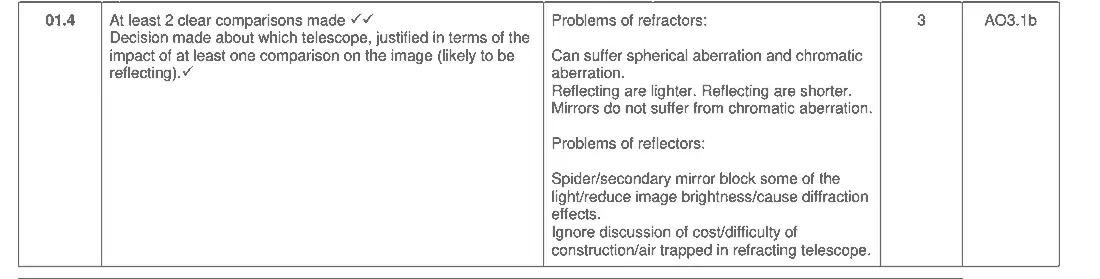
Many students focussed on the fact that reflecting telescopes can be made larger; this is not relevant for the small telescope on the spacecraft. A number of students failed to separate chromatic and spherical aberration. Discussion of cost was treated as neutral.
Question 01.4
Notes from the mark scheme and report
Two comparisons (refractors suffer chromatic aberration, heavier, longer, lens sag
mirrors supported from behind, no chromatic aberration) and a justified choice, likely reflecting
June 2019 · Paper 3B Astrophysics · Q1.11 markDiagram or graph
Mark scheme
Examiner's comment
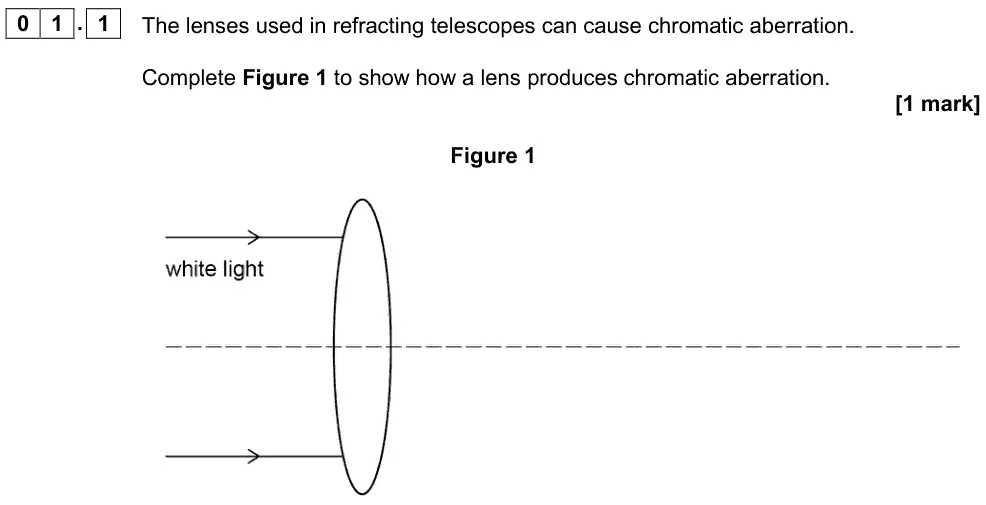
1.1 Just under 50% of students scored the mark. Rays were often poorly drawn (a ruler is recommended), or colours were incorrectly labelled or unlabelled.
Notes from the mark scheme and report
Rays split: blue/violet focus on the axis closer to the lens than red
just under 50% scored
Skills: MS4.2 Visualise and represent 2D and 3D forms including two- dimensional representations of 3D objects
June 2019 · Paper 3B Astrophysics · Q1.21 markShort answer
Earlier part of question 1 that this part uses
Mark scheme
Examiner's comment
1.2 Most students knew the mirrors used in a Cassegrain telescope.
Notes from the mark scheme and report
Answer: primary concave, secondary convex
June 2019 · Paper 3B Astrophysics · Q1.36 marks6-mark extended response
Earlier part of question 1 that this part uses
Mark scheme, with the levels and indicative content
Examiner's comment
1.3 This question was the most discriminating, with the full range of marks seen. Only a small percentage of students scored no marks. Most students could describe the structure of both types of telescope and positioning was also often well discussed. Some made no distinction between the two telescopes in terms of positioning and structure; for example, they planned to put both telescopes in space. It was common to find students who did not distinguish between nm and mm and so thought telescope B was better because it could access a wider range of wavelengths. There was no direct mention of a need for calculations in the question. It is not possible to discuss the detail of an image without calculations of resolution, but many students did not offer this. Many students failed to gain marks because they answered a different question from that asked. Some discussed radio and optical telescopes in general, so, for example, planned to put a telescope in space despite its 40m diameter. There was much discussion of putting radio telescopes in arrays which again is not relevant to this telescope. Students need to read the question carefully and decide what they need to do to answer it.
Notes from the mark scheme and report
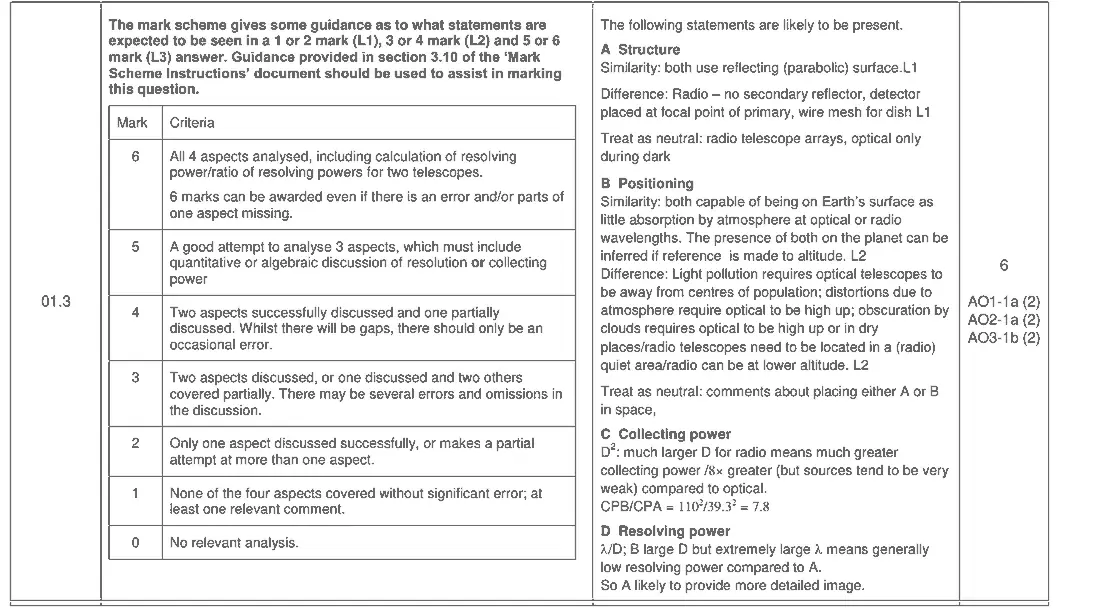
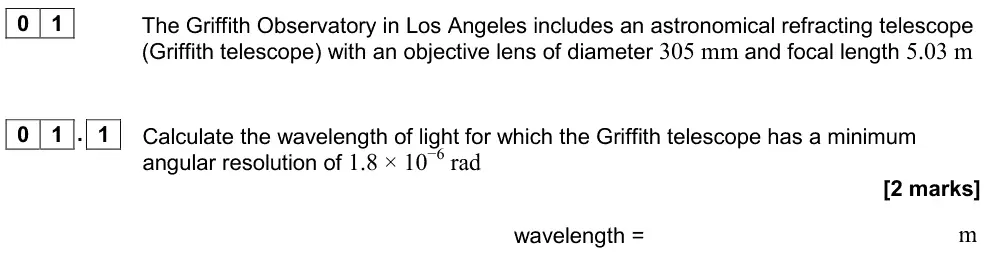
Levels of response. Both parabolic dishes/reflectors
optical needs high, dry, dark sites away from light pollution, radio can be at low altitude in radio-quiet areas
collecting power ratio (110/39.3)^2 = 7.8
resolution lambda/D: optical about 8.9 x 10^-9 rad vs radio far larger, so A gives the more detailed image
Skills: MS0.3 Use ratios, fractions and percentages; MS2.3 Substitute numerical values into algebraic equations using appropriate units for physical quantities
June 2018 · Paper 3B Astrophysics · Q1.12 marksCalculationEasy
Mark scheme
Examiner's comment
01.1 This was answered well by the vast majority of students, with 82.9% gaining both marks. Those who did not gain both marks usually confused D and f, made a power of ten error, or rearranged their equation incorrectly.
Notes from the mark scheme and report
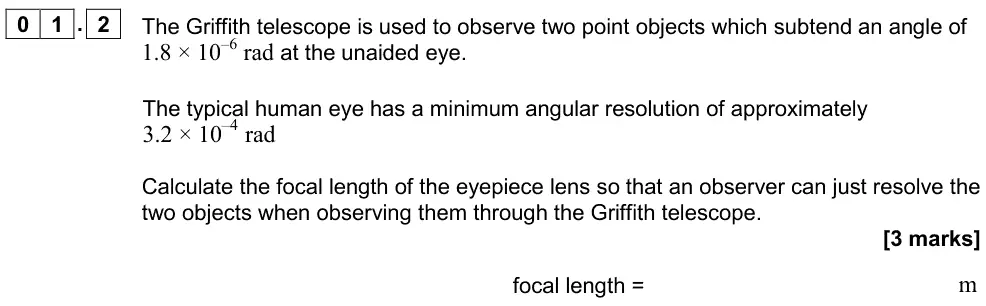
Answer: 5.5 x 10^-7 m (theta x D with D = 0.305 m
4.5 x 10^-7 m with 1.22 also accepted)
errors: using f for D, power of ten
82.9% both marks
Skills: MS2.2 Change the subject of an equation, including non-linear equations; MS2.3 Substitute numerical values into algebraic equations using appropriate units for physical quantities
June 2018 · Paper 3B Astrophysics · Q1.23 marksCalculationEasy
Earlier part of question 1 that this part uses
Mark scheme
Examiner's comment
01.2 This question proved to be slightly more demanding. Although it can be seen as a two-step calculation, many students chose to combine the equations to provide the answer in one go. Students should always be encouraged to set out their answers clearly as marks can often be awarded for evidence of correct working even if the their final answer is incorrect. 62.4% of students gained all three marks.
Notes from the mark scheme and report
Answer: 0.028 m (M = 3.2 x 10^-4 / 1.8 x 10^-6 = 178, fe = 5.03/178)
0.03 not credited
62.4% full marks
Skills: MS2.2 Change the subject of an equation, including non-linear equations; MS2.3 Substitute numerical values into algebraic equations using appropriate units for physical quantities
June 2018 · Paper 3B Astrophysics · Q1.33 marksCalculationHard
Earlier part of question 1 that this part uses
Mark scheme
Examiner's comment
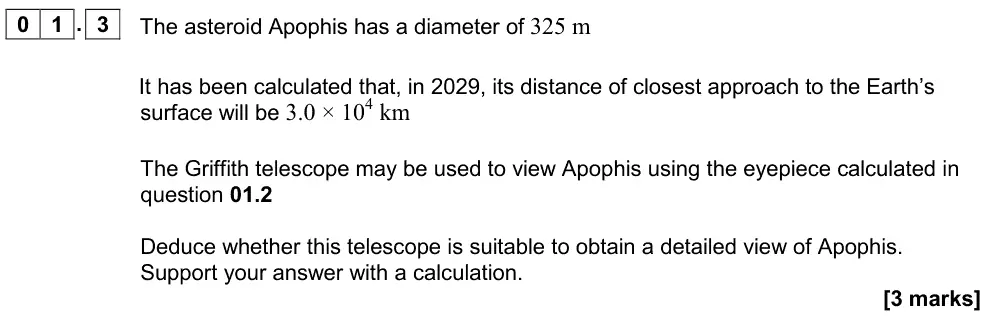
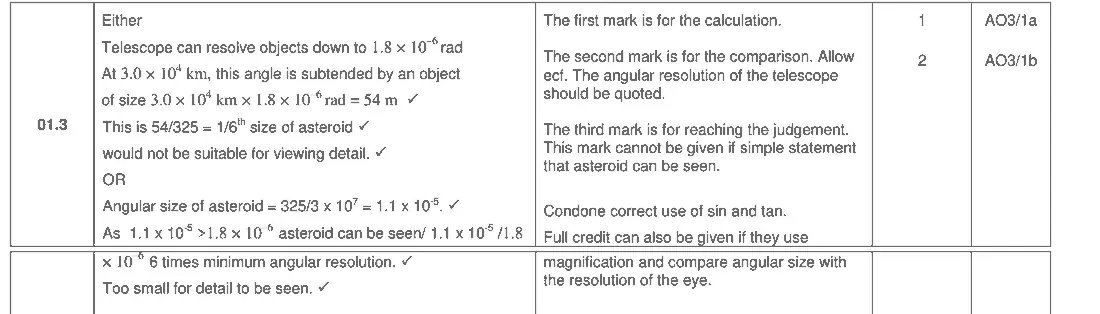
01.3 This question required students to make a judgement to demonstrate their understanding of the Rayleigh criterion as a limit. Many answers were seen that compared the angular size of the asteroid with the resolution of the telescope correctly, but then simply stated that the asteroid could be seen without any comment about the level of detail. Students who calculated the separation of objects that could be just resolved at the distance of the asteroid made better progress, but an answer that went on to suggest that this would not allow detail to be seen were rare. Only 3% of students scored all three marks; the proportion failing to gain even a single mark was 43.6%. Surprisingly, 9.4% of students made no attempt at all at this question.
Notes from the mark scheme and report
Smallest resolvable detail at 3.0 x 10^7 m is 54 m, only 1/6 of the 325 m asteroid (or angular size 1.1 x 10^-5 rad only 6 x resolution), so not suitable for detail
must judge level of detail, not just 'can be seen'
only 3% full marks
Skills: MS4.6 Use of small angle approximations including sinθ ≈θ, tanθ ≈θ, cosθ ≈1 for small θ where appropriate; MS2.3 Substitute numerical values into algebraic equations using appropriate units for physical quantities
June 2017 · Paper 3B Astrophysics · Q12 marksDiagram or graph
Mark scheme
Examiner's comment
Much of the work on ray diagrams has been removed from the specification but the two main types of telescope remain. Most students were able to draw this ray diagram without difficulty. However, a large number of refracting telescopes were seen. Other issues included drawing a convex or flat secondary mirror, or drawing the primary as two curves so they look like two mirrors, rather one continuous curve, with or without a gap. Problems with the rays tended to be related to where they cross with several students drawing them so they crossed before the secondary mirror rather than after, or drawing them so that they meet at the eyepiece.
Notes from the mark scheme and report
Concave (parabolic) primary with central hole and convex secondary
two parallel rays reflected off both mirrors through the hole to the eyepiece
Skills: MS4.2 Visualise and represent 2D and 3D forms including two- dimensional representations of 3D objects
June 2017 · Paper 3B Astrophysics · Q2.13 marksCalculation
Mark scheme
Examiner's comment
02.1 Many students correctly chose the correct answer, but failed to explain why. It should be noted that, in a simple choice like this, any unsupported answer does not gain credit. Other common errors included using the resolving power or calculating the area using the equation for a sphere. A number of students incorrectly maintained that A was the correct answer as the image would be smaller and therefore the light from it would be concentrated into a smaller area. Students had a choice of approaches regarding the calculation, an example of the expectation that students will be able to make a judgement about their approach, rather than be directed to perform a specific calculation.
Notes from the mark scheme and report
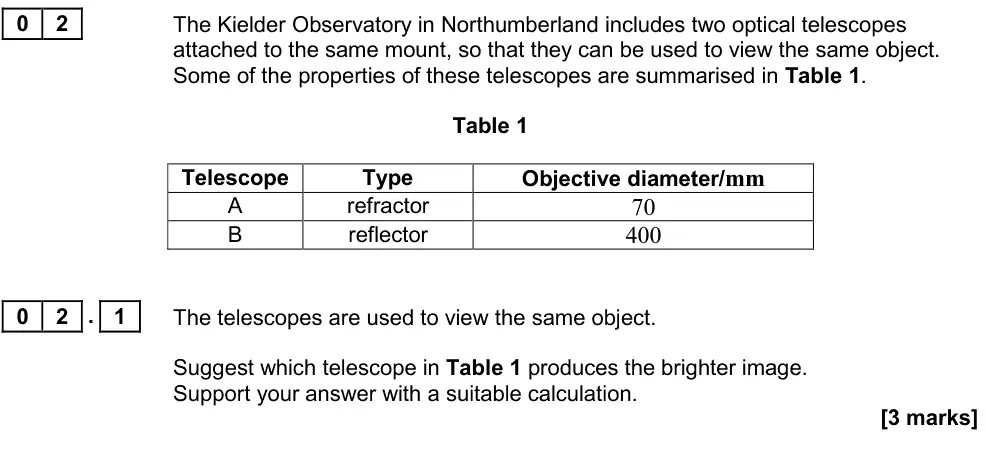
B (reflector) brighter: collecting power proportional to D^2, ratio (400/70)^2 = 33
unsupported answer scores nothing
resolving-power or sphere-area arguments wrong
Skills: MS0.3 Use ratios, fractions and percentages; MS4.3 Calculate areas of triangles, circumferences and areas of circles, surface areas and volumes of rectangular blocks, cylinders and spheres
June 2017 · Paper 3B Astrophysics · Q2.22 marksExplanation
Earlier part of question 2 that this part uses
Mark scheme
Examiner's comment
02.2 This question proved to be significantly more demanding with few students showing anything other than a rudimentary knowledge of the Rayleigh criteria. Specifically, many students simply quoted the equation or talked in general terms about seeing two objects close together. Those that made more progress in terms of the diffraction patterns often failed to gain marks due to lack of clarity, mentioning a maximum (rather than the central maximum) or suggesting that the two central maxima need to be fully separated. For example those that mentioned the Airy disc needed to make it clear that the centre and edge of the discs are significant. Some good answers were seen that made use of a graph of intensity against angle for the two sources.
Notes from the mark scheme and report
Two objects just resolved when the first minimum of one diffraction pattern coincides with the central maximum of the other
quoting the formula gains nothing
few could explain
June 2017 · Paper 3B Astrophysics · Q2.32 marksExplanation
Earlier part of question 2 that this part uses
Mark scheme
Examiner's comment
02.3 A common error that prevented students from getting both marks was to make general statements (bigger diameter means the resolving power is better), rather than more specifically referring to the correct equation or the inverse relationship. It was pleasing to note how many students dealt with the fact that a smaller angle is better without problem.
Notes from the mark scheme and report
B, larger diameter
minimum resolvable angle proportional to lambda/D (1/D)
general 'bigger is better' not enough
Specimen set 1 · Paper 3B Astrophysics · Q1.12 marksDiagram or graph
Mark scheme
Notes from the mark scheme and report
Concave mirror with parallel rays
rays further from the principal axis focus nearer the mirror
Skills: MS4.2 Visualise and represent 2D and 3D forms including two- dimensional representations of 3D objects
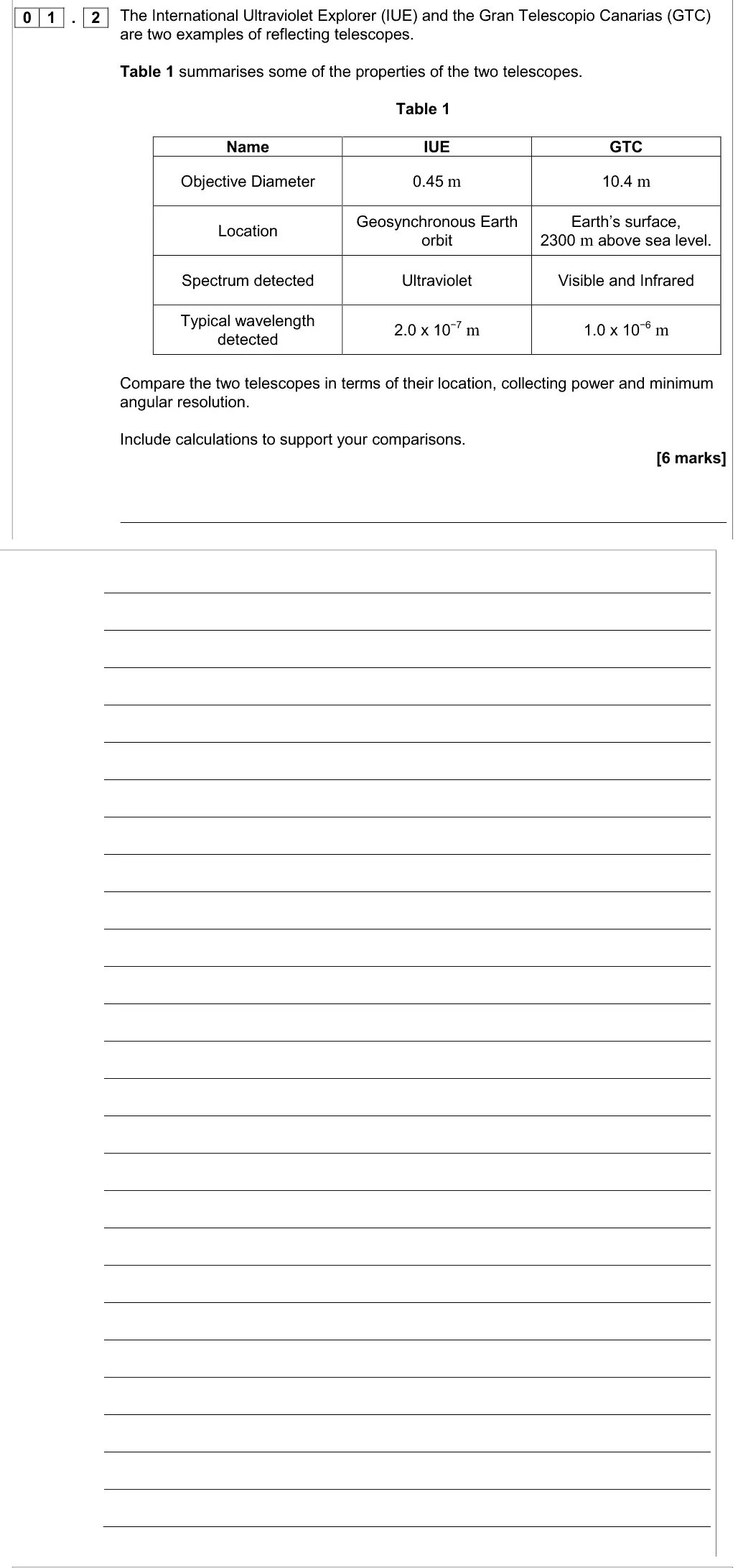
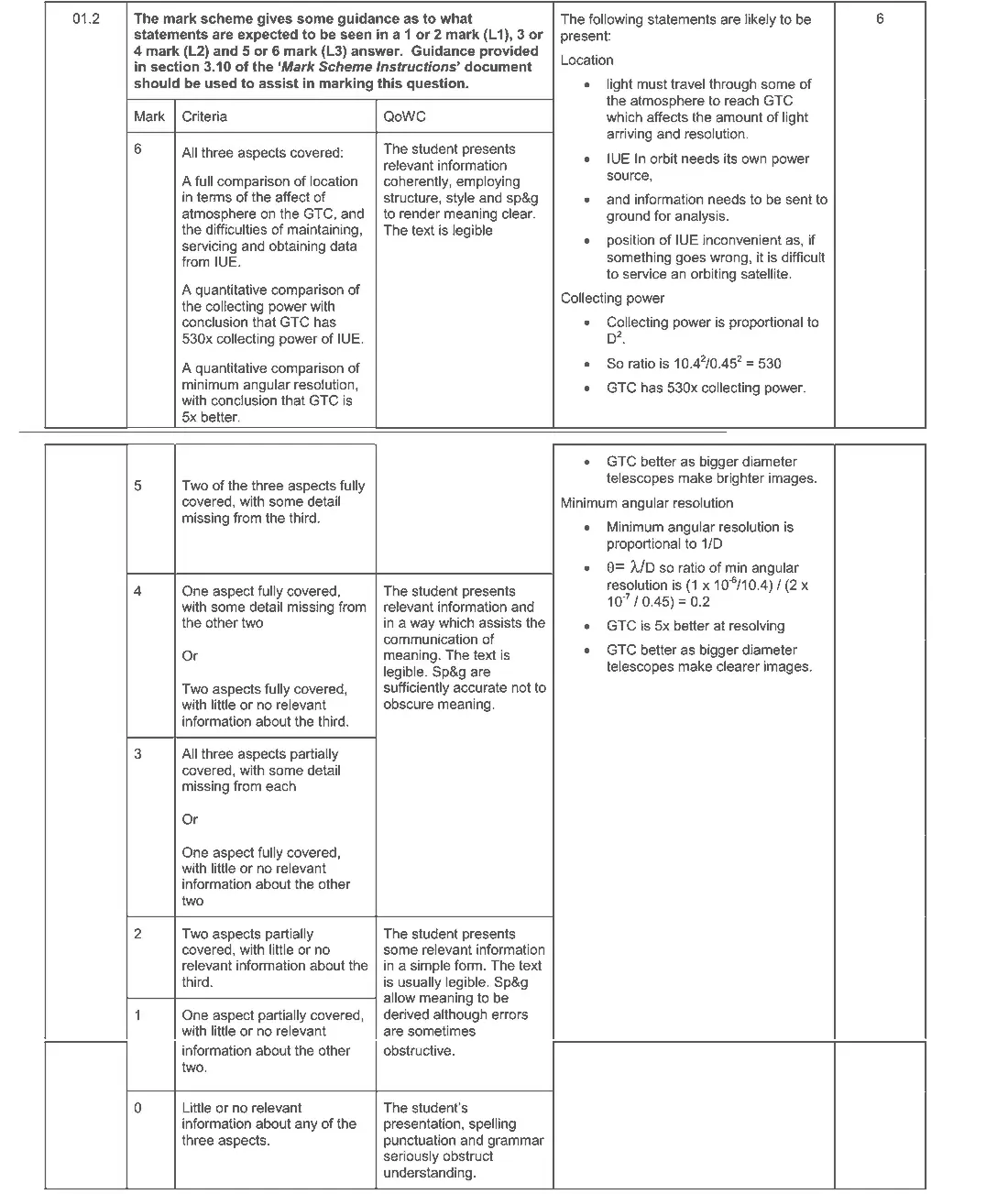
Specimen set 1 · Paper 3B Astrophysics · Q1.26 marks6-mark extended response
Earlier part of question 1 that this part uses
Mark scheme, with the levels and indicative content
Notes from the mark scheme and report
Levels of response. Collecting power ratio (10.4/0.45)^2 = 530
resolution IUE 2.0 x 10^-7/0.45 = 4.4 x 10^-7 rad, GTC 1.0 x 10^-6/10.4 = 9.6 x 10^-8 rad (GTC better)
UV absorbed by atmosphere so IUE in orbit
GTC high altitude, above clouds, less atmospheric absorption/turbulence
Skills: MS0.3 Use ratios, fractions and percentages; MS2.3 Substitute numerical values into algebraic equations using appropriate units for physical quantities
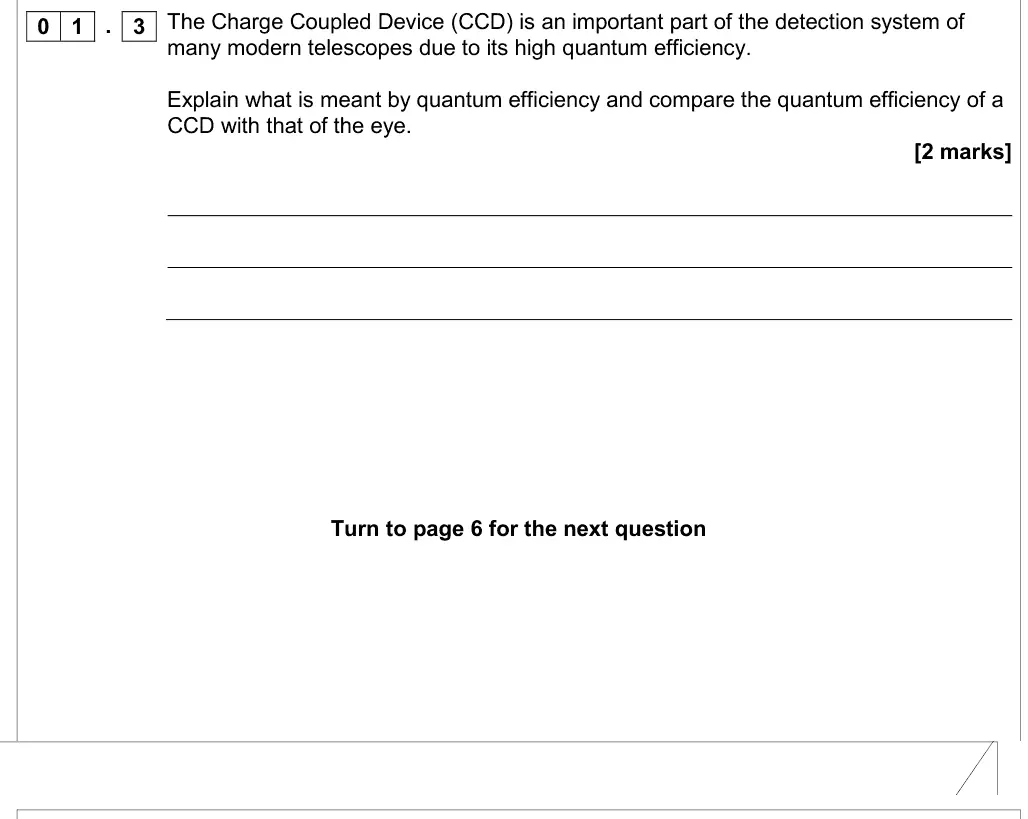
Specimen set 1 · Paper 3B Astrophysics · Q1.32 marksShort answer
Earlier part of question 1 that this part uses
Mark scheme
Notes from the mark scheme and report
QE = photons detected / photons incident
CCD about 80% or more, eye about 1% - both needed
Work with an AQA physics tutor
Dropping marks on calculations, required practicals or the six-markers? Book a trial session with a specialist AQA physics tutor.