Notes and key-term cards for this topic are being written by our tutors. The past-paper questions below are ready now.
Specification statements
Show the 12 statements from the specification
3.6.2.1-01 Internal energy is the sum of the randomly distributed kinetic energies and potential energies of the particles in a body.
3.6.2.1-02 The internal energy of a system is increased when energy is transferred to it by heating or when work is done on it (and vice versa), eg a qualitative treatment of the first law of thermodynamics.
3.6.2.1-03 Appreciation that during a change of state the potential energies of the particle ensemble are changing but not the kinetic energies. Calculations involving transfer of energy.
3.6.2.1-04 For a change of temperature: Q = mc ∆θ where c is specific heat capacity.
3.6.2.1-05 Calculations including continuous flow.
3.6.2.1-06 For a change of state Q = ml where l is the specific latent heat.
3.6.2.2-01 Gas laws as experimental relationships between p, V, T and the mass of the gas.
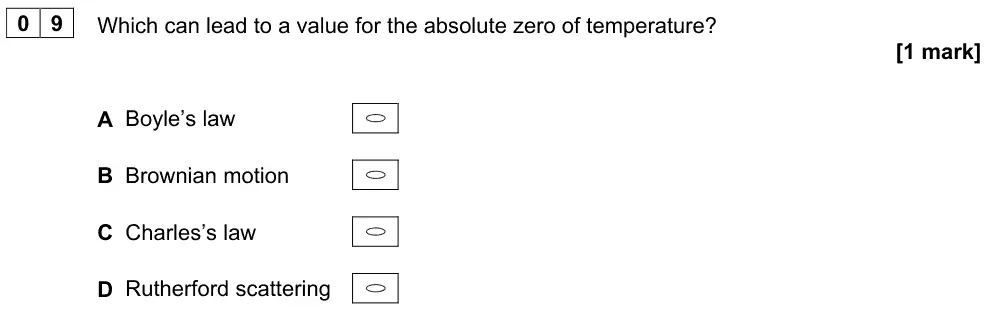
3.6.2.2-02 Concept of absolute zero of temperature.
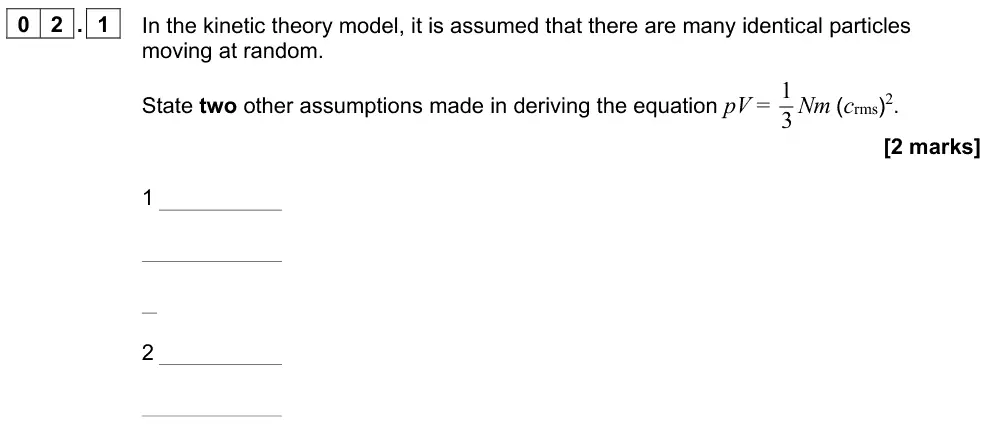
3.6.2.2-03 Ideal gas equation: pV = nRT for n moles and pV = NkT for N molecules. Work done = p∆V
3.6.2.2-04 Avogadro constant NA, molar gas constant R, Boltzmann constant k
3.6.2.2-05 Molar mass and molecular mass.
3.6.2.2-06 Required practical 8: Investigation of Boyle's law (constant temperature) and Charles’s law (constant pressure) for a gas.
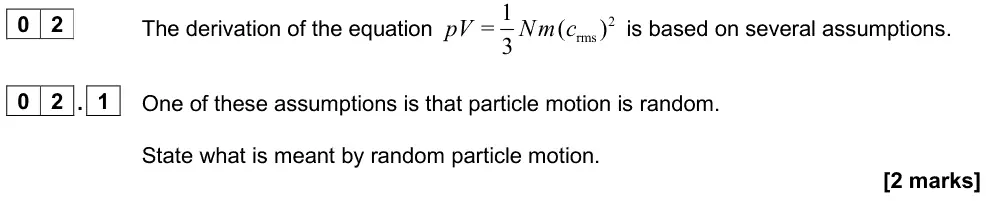
Tap a question to zoom it. Where a part needs a figure, table or graph from earlier in the question, that part folds out above it; the mark scheme and examiner's comment open underneath. Have the AQA data and formulae booklet beside you (see the formula sheet page).
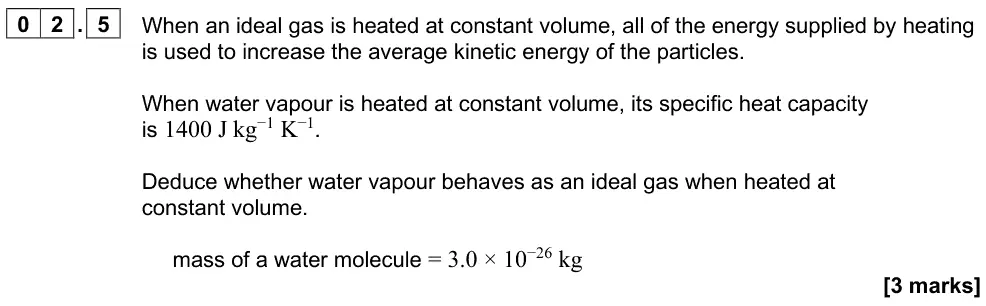
June 2025 · Paper 2 · Q2.53 marksAO3=3Calculation
Earlier part of question 2 that this part uses
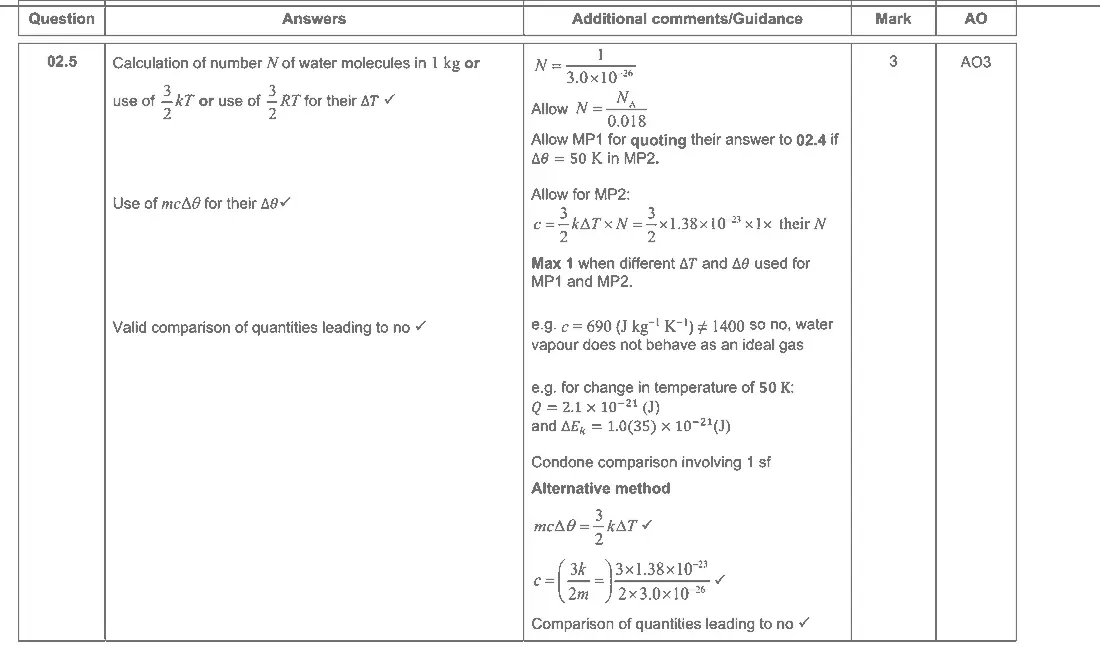
Mark scheme
Examiner's comment
2.5 This was generally well answered and proved much more accessible that the earlier written parts of the question, despite being the only part of the question to address an unfamiliar context. Most students calculated the energy required to raise the temperature of 1 molecular mass of water by 50K and compared their answer to question 2.4, concluding that water vapour does not behave like an ideal gas. However, any mass and temperature was possible and many possible routes were allowed, molecules and comparing to 1400 J kg−1 K−1 or comparing differences in temperature or including determining a specific heat capacity based on the increase in kinetic energy of the
masses.
A small minority of students did not use the specific heat capacity for water vapour and used the value of liquid water.
Some students did not gain the last mark as there was no explicit comparison between quantities. Ideally, an answer should compare the values, state what those values mean and give a conclusion.
Notes from the mark scheme and report
Ideal-gas c = 3k/(2m) = 690 J kg^-1 K^-1, not 1400, so water vapour is not ideal (or compare energies for 50 K: 2.1 x 10^-21 J vs 1.0 x 10^-21 J)
explicit comparison needed
Skills: MS2.3 Substitute numerical values into algebraic equations using appropriate units for physical quantities; MS0.3 Use ratios, fractions and percentages
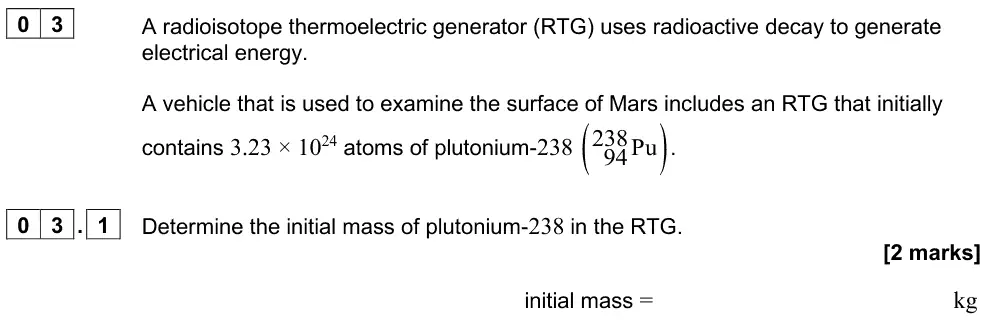
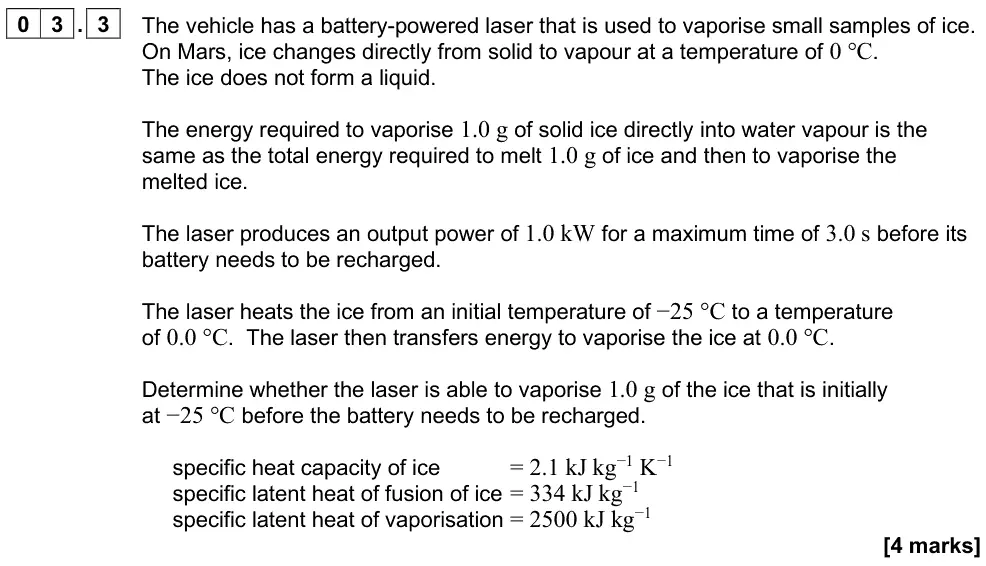
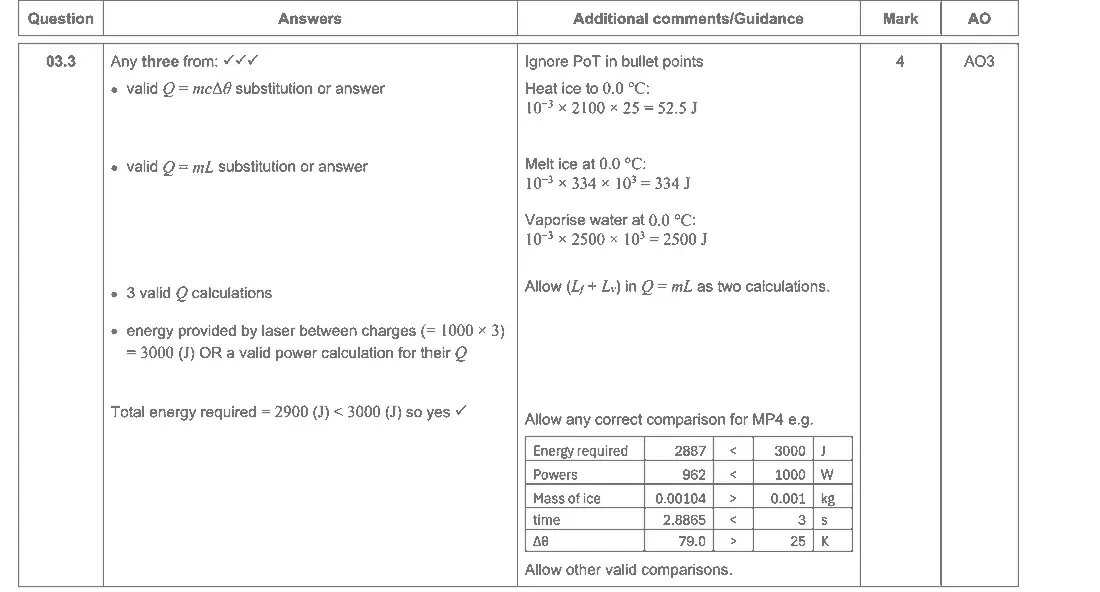
June 2025 · Paper 2 · Q3.34 marksAO3=4CalculationEasy
Earlier part of question 3 that this part uses
Mark scheme
Examiner's comment
A common mistake was for students to use 𝐸𝐸= 𝑚𝑚𝑐𝑐2 and assume that all of the mass of the up the number of undecayed nuclei 𝑁𝑁, in the equation 𝐴𝐴= 𝜆𝜆𝜆𝜆 with the nucleon number and alpha or the plutonium was converted into energy. Another mistake was for students to mix multiply 𝜆𝜆 by 238. 3.3 This 4 mark calculation proved very accessible with about three quarters scoring at least 3 out of 4. The sublimation of carbon dioxide did not seem to pose a significant challenge to most including heating the melted water to 100 °C in their calculation. students, with only a very small number missing out the latent heat of fusion of ice or comparing this to the heat required to raise the temperature of the ice, melt the ice and the time taken and comparing this with 3.0 s, or calculating a mass that could be vapourised vaporise the ice. However, other approaches were possible, with some students calculating by the laser in 3.0 s. Again, a small minority of students did not get full marks because, after completing a correct calculation, they did not include an explicit comparison. Only a very small minority correctly completed the calculation and gave an incorrect comparison. Most of the marks lost were due to power of ten issues with the calculation.
Notes from the mark scheme and report
Answer: yes - energy needed about 2.9 kJ (mc x 25 K = 52.5 J, plus m(334 + 2500) kJ kg^-1) is less than 3.0 kJ supplied in 3.0 s
must state a conclusion after comparing
mark scheme text is missing in the packet
Skills: MS2.3 Substitute numerical values into algebraic equations using appropriate units for physical quantities
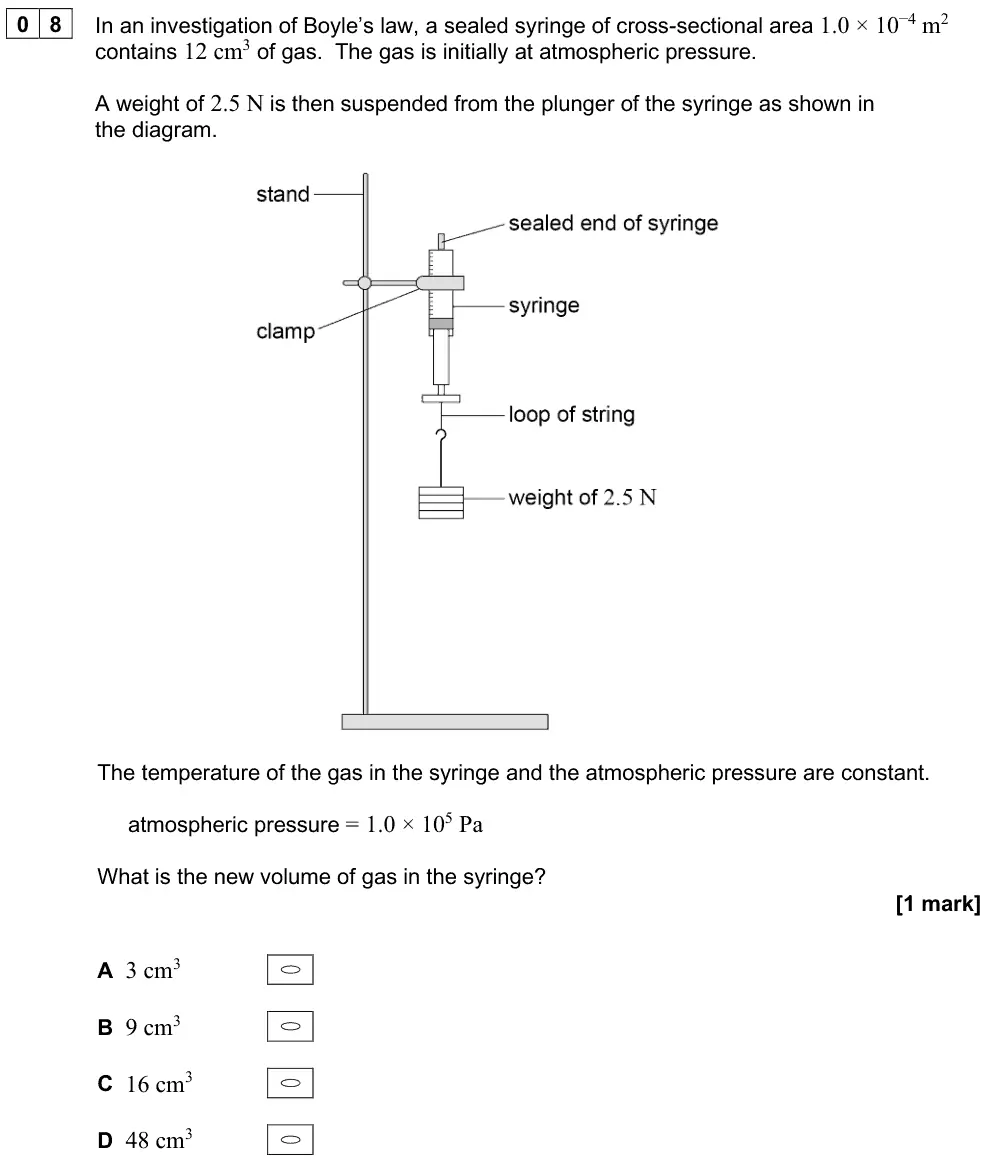
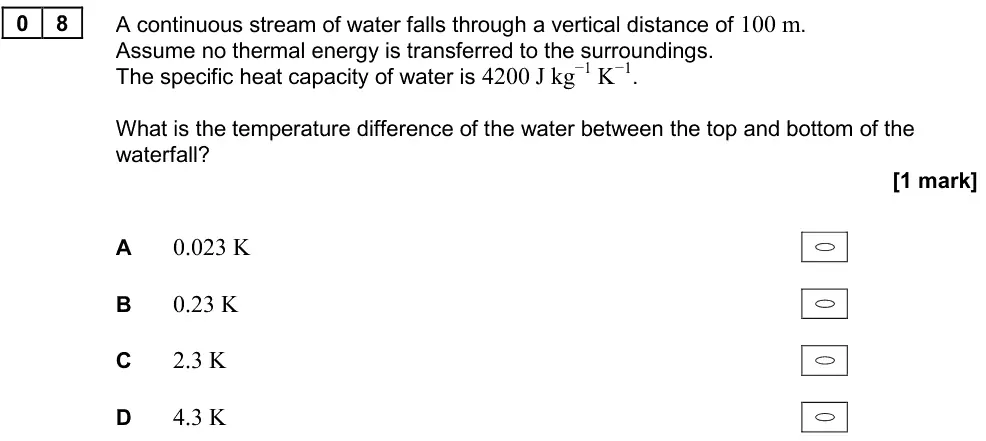
June 2025 · Paper 2 · Q81 markAO2=1Multiple choice
Answer
C
Mark scheme
Notes from the mark scheme and report
Answer: C
Skills: MS0.3 Use ratios, fractions and percentages; RP8 Investigation of Boyle's law (constant temperature) and Charles’s law (constant pressure) for a gas.
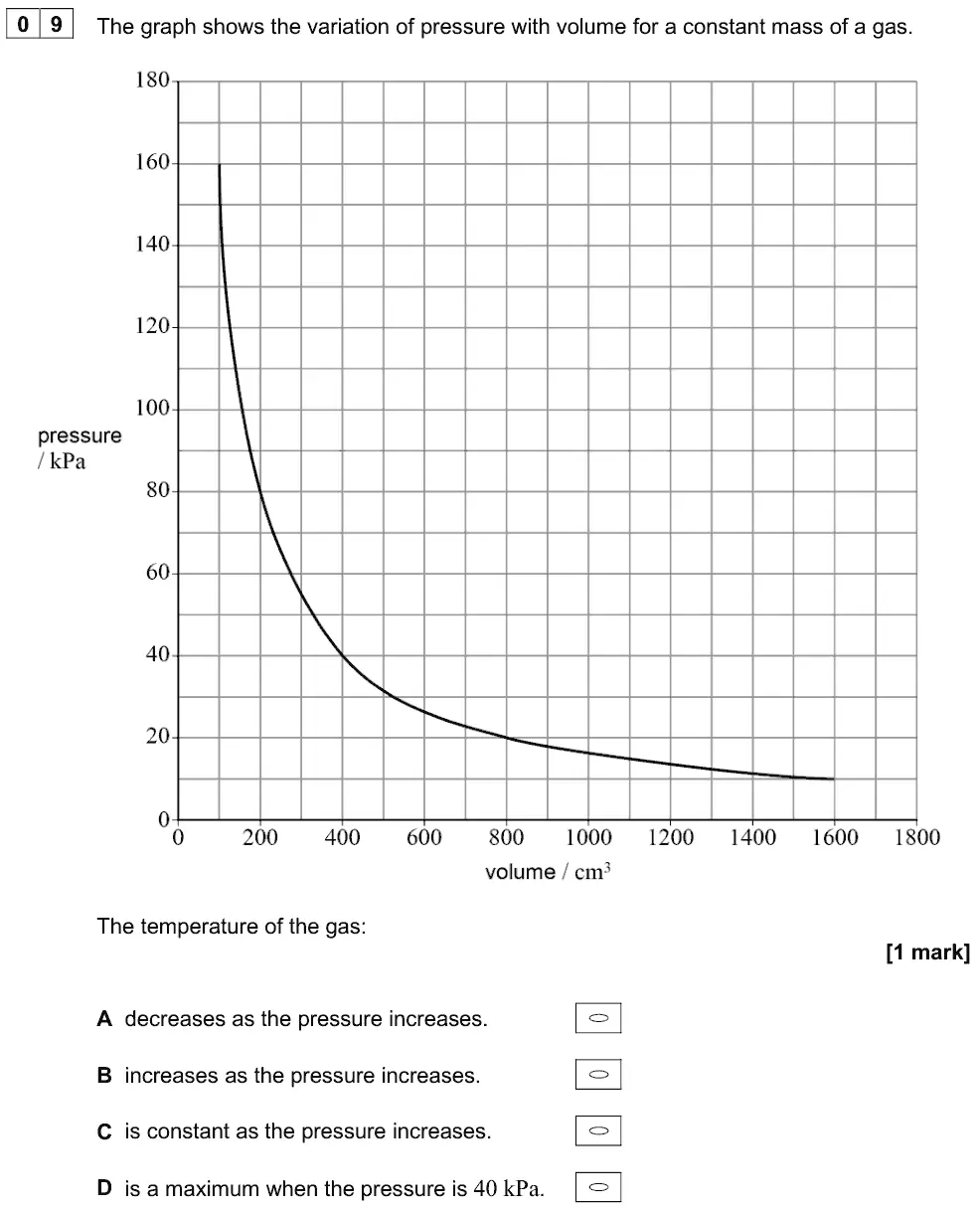
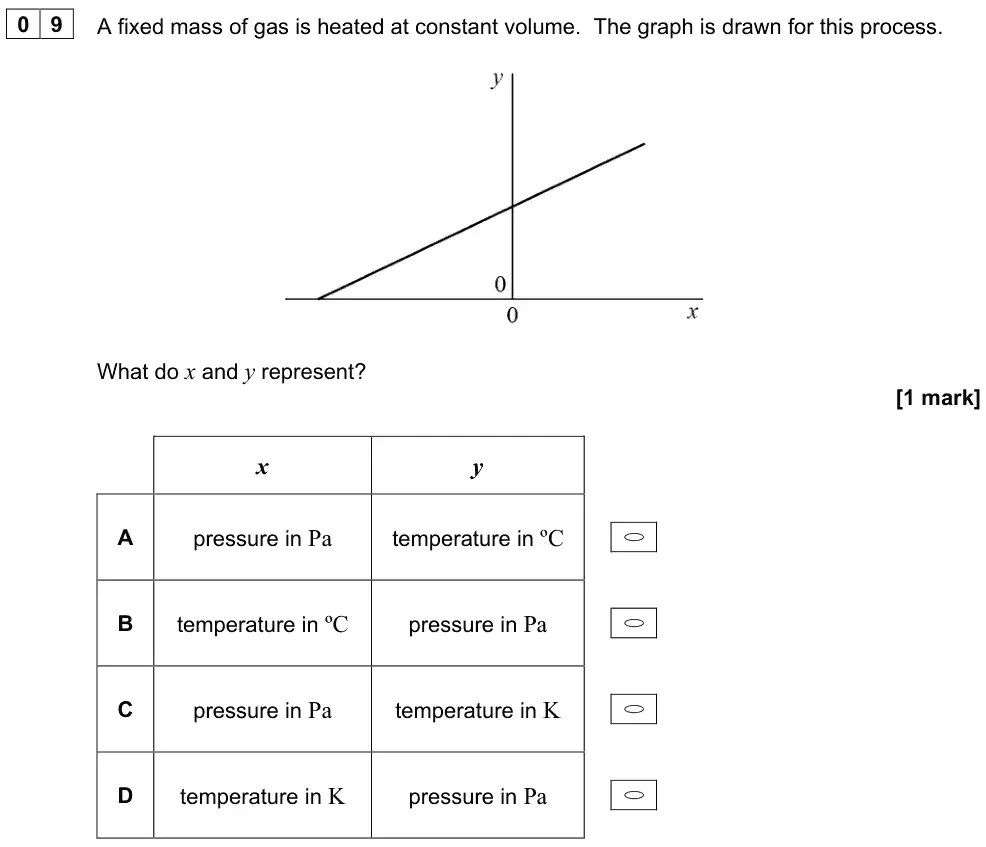
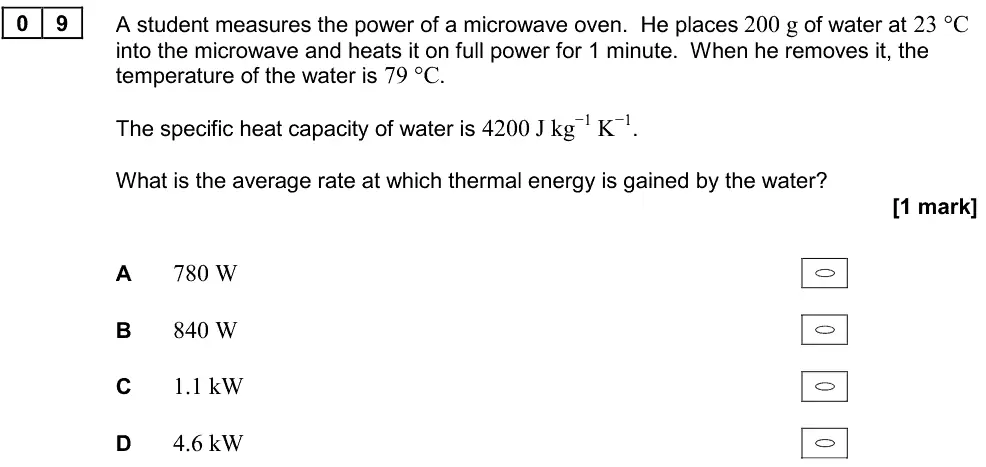
June 2025 · Paper 2 · Q91 markAO2=1Multiple choice
Answer
C
Mark scheme
Notes from the mark scheme and report
Answer: C
Skills: MS3.1 Translate information between graphical, numerical and algebraic forms
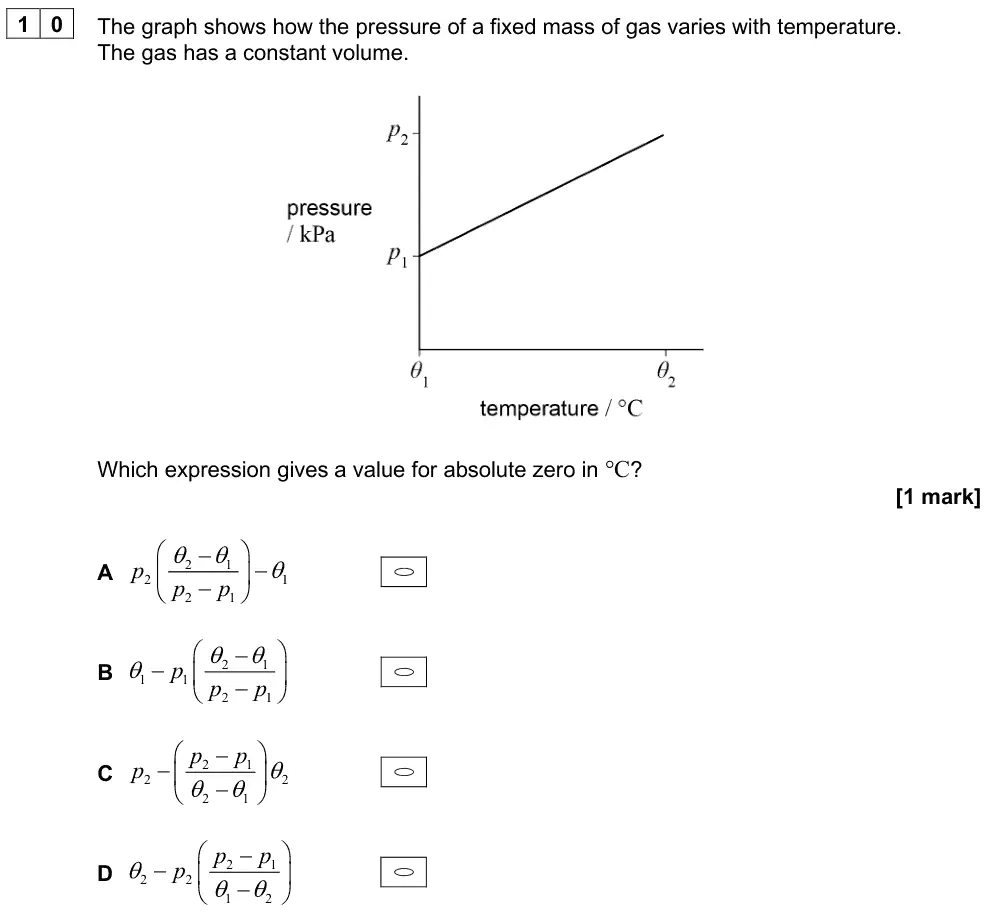
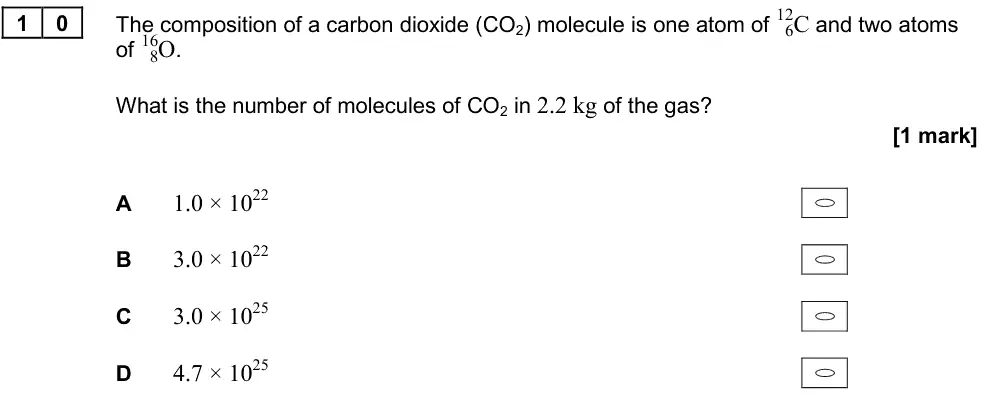
June 2025 · Paper 2 · Q101 markAO2=1Multiple choice
Answer
B
Mark scheme
Notes from the mark scheme and report
Answer: B
Skills: MS3.3 Understand that y = mx + c represents a linear relationship
June 2024 · Paper 2 · Q1.11 markAO1=1Show that
Mark scheme
Examiner's comment
01.1 Most students were able to answer this question successfully. A few students made an arithmetic error or did not provide the answer to at least 2 significant figures (sf).
01.2 There were many different routes through this question and most students found this very challenging, although 2 of the 3 marks were easily accessible. The first mark was for some relevant calculations and depended on which value the students used for 𝑛𝑛 from question 01.1, different answers were accepted the last for the correct number of significant figures. Since the value used for the significant figures based on the value of 𝑛𝑛 seen. For those who chose a route that did not require 𝑛𝑛, then an answer to 3 sf was correct. If 𝑛𝑛 was calculated to 2 or 3 sf, then the number of significant figures in 𝑛𝑛 determined the correct answer. If the value of 40 was used and the student had not calculated a correct value in 01.1, correct value of 𝑛𝑛 should have recognised that 40 was therefore to 1 sf. then either 1 or 2 sf was accepted since 40 is ambiguous. Students who identified 43 or 43.1 as the 3 𝑁𝑁𝑁𝑁(𝑐𝑐rms)2 or 2 𝑚𝑚(𝑐𝑐rms)2 Many students were unsure about which mass to use in the equation 𝑝𝑝𝑝𝑝= 1 1 with many confusing the mass of the particle with the mass of the gas. Most students realised that absolute temperature was directly proportional to (𝑐𝑐rms)2 and therefore that 01.3
Notes from the mark scheme and report
Answer: 43.1 mol (n = pV/RT with T = 293 K)
at least 2 sf needed
Skills: MS2.3 Substitute numerical values into algebraic equations using appropriate units for physical quantities; MS1.1 Use an appropriate number of significant figures
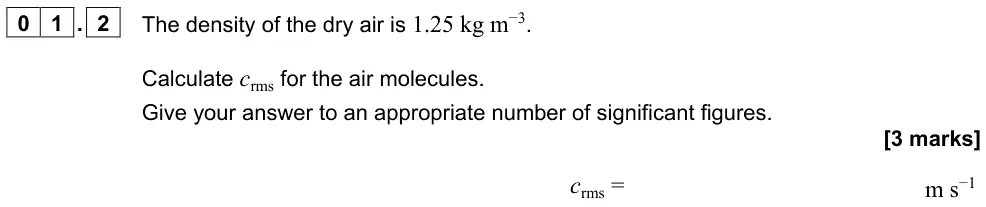
June 2024 · Paper 2 · Q1.23 marksAO2=3Calculation
Earlier part of question 1 that this part uses
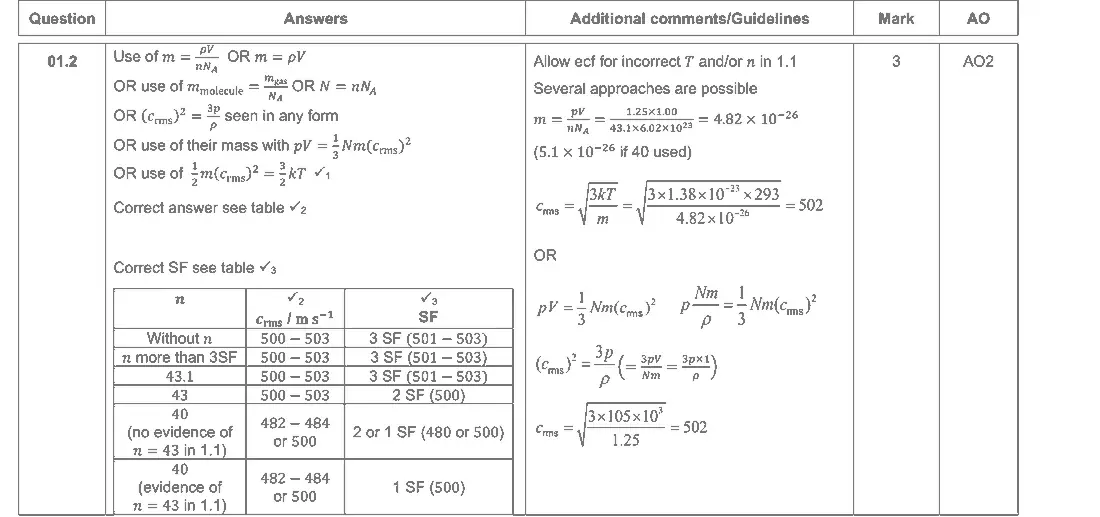
Mark scheme
Examiner's comment
01.2 There were many different routes through this question and most students found this very challenging, although 2 of the 3 marks were easily accessible. The first mark was for some relevant calculations and depended on which value the students used for 𝑛𝑛 from question 01.1, different answers were accepted the last for the correct number of significant figures. Since the value used for the significant figures based on the value of 𝑛𝑛 seen. For those who chose a route that did not require 𝑛𝑛, then an answer to 3 sf was correct. If 𝑛𝑛 was calculated to 2 or 3 sf, then the number of significant figures in 𝑛𝑛 determined the correct answer. If the value of 40 was used and the student had not calculated a correct value in 01.1, correct value of 𝑛𝑛 should have recognised that 40 was therefore to 1 sf. then either 1 or 2 sf was accepted since 40 is ambiguous. Students who identified 43 or 43.1 as the 3 𝑁𝑁𝑁𝑁(𝑐𝑐rms)2 or 2 𝑚𝑚(𝑐𝑐rms)2 Many students were unsure about which mass to use in the equation 𝑝𝑝𝑝𝑝= 1 1 with many confusing the mass of the particle with the mass of the gas. Most students realised that absolute temperature was directly proportional to (𝑐𝑐rms)2 and therefore that 01.3
the new temperature was the old temperature multiplied by four. Some failed to recognise that the 2 𝑚𝑚(𝑐𝑐rms)2 = those students who calculated the new temperature by doubling 𝑐𝑐rms and using 2 𝑘𝑘𝑘𝑘 they 1 3 question asked for the change in temperature, so the original temperature had to be subtracted. For
were also able to gain full marks. When they had used the wrong mass in question 01.2 and the same mass was used here, the mass cancelled out – giving the correct answer. If another mistake was made in question 01.2 then full credit cold be awarded here with an error carried forward (ecf). A small number of students rounded their intermediate calculations which led to small errors in the final answer. While this is usually penalised, in this case this was felt to be unduly harsh as they were used. Only a very small number of students did not convert the temperature to K from °C. demonstrating good understanding of the physics involved, and so a range of acceptable answers was
Notes from the mark scheme and report
Answer: about 502 m s^-1 to 3 sf (c_rms^2 = 3p/rho)
sf must match the data (2 sf if n = 43 used)
confusion over which mass to use in pV = 1/3 Nm c_rms^2
Skills: MS2.2 Change the subject of an equation, including non-linear equations; MS2.3 Substitute numerical values into algebraic equations using appropriate units for physical quantities; MS1.1 Use an appropriate number of significant figures
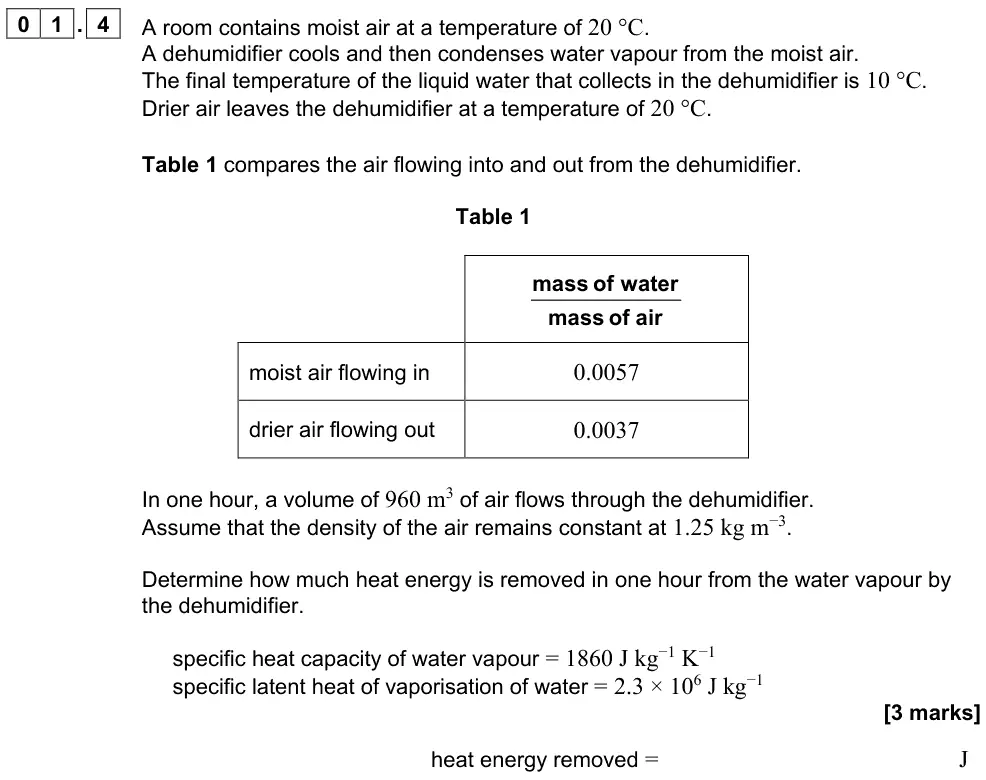
June 2024 · Paper 2 · Q1.43 marksAO2=2, AO3=1Calculation
Earlier part of question 1 that this part uses
Mark scheme
Examiner's comment
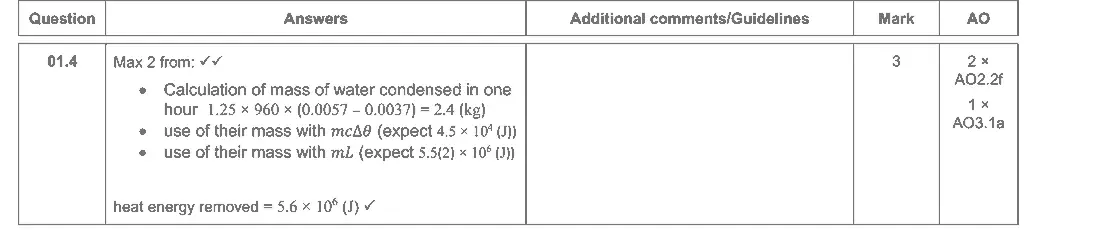
01.4 Most students found the specific heat capacity and specific latent heat calculations straightforward and were able to gain two marks. However, most students were unable to calculate the correct mass of the water in the air accurately.
Notes from the mark scheme and report
Answer: 5.6 x 10^6 J (water condensed = 1.25 x 960 x 0.0020 = 2.4 kg
mc x 10 K = 4.5 x 10^4 J plus ml = 5.52 x 10^6 J)
most could not find the mass of water
Skills: MS0.3 Use ratios, fractions and percentages; MS2.3 Substitute numerical values into algebraic equations using appropriate units for physical quantities
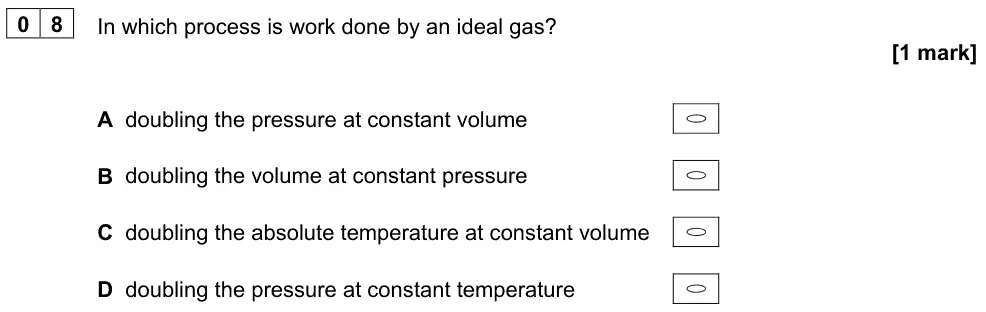
June 2024 · Paper 2 · Q81 markMultiple choice
Answer
B
Mark scheme
Notes from the mark scheme and report
Answer: B
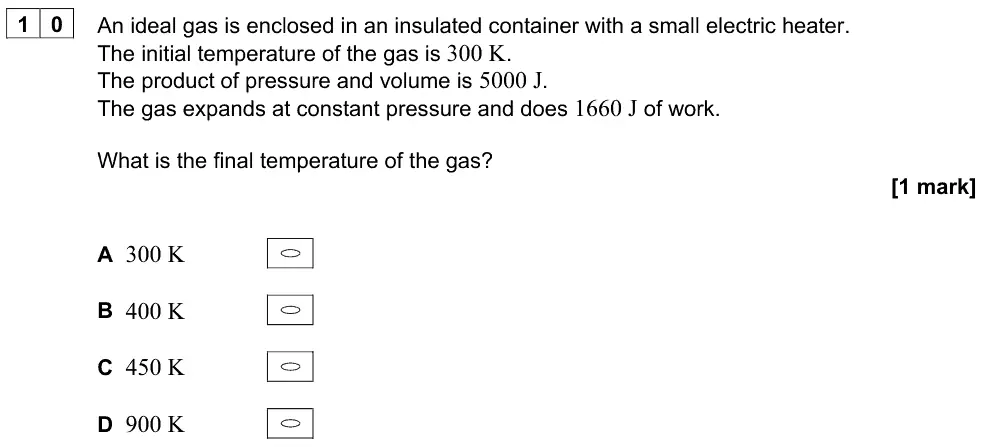
June 2024 · Paper 2 · Q101 markMultiple choice
Answer
B
Mark scheme
Notes from the mark scheme and report
Answer: B
Skills: MS0.3 Use ratios, fractions and percentages
June 2023 · Paper 2 · Q1.11 markAO1=1Short answer
Mark scheme
Examiner's comment
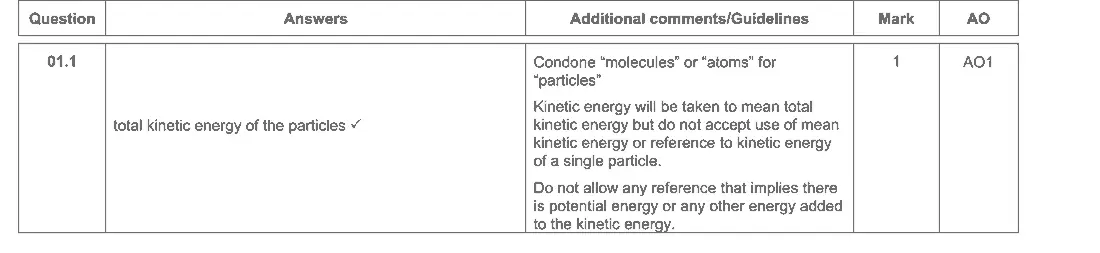
01.1 Most students did not pick up the point that the gas is ideal. Potential energy was often added to the kinetic energy in answers. Only very few students went on to state that, in this case, potential energy is zero. Those who appreciated that kinetic energy alone was the expected answer sometimes spoiled the point by referring to a mean kinetic energy.
Notes from the mark scheme and report
Total kinetic energy of the particles (no potential energy in an ideal gas)
adding potential energy or giving mean kinetic energy loses the mark
June 2023 · Paper 2 · Q2.15 marksCalculation
Mark scheme
Examiner's comment
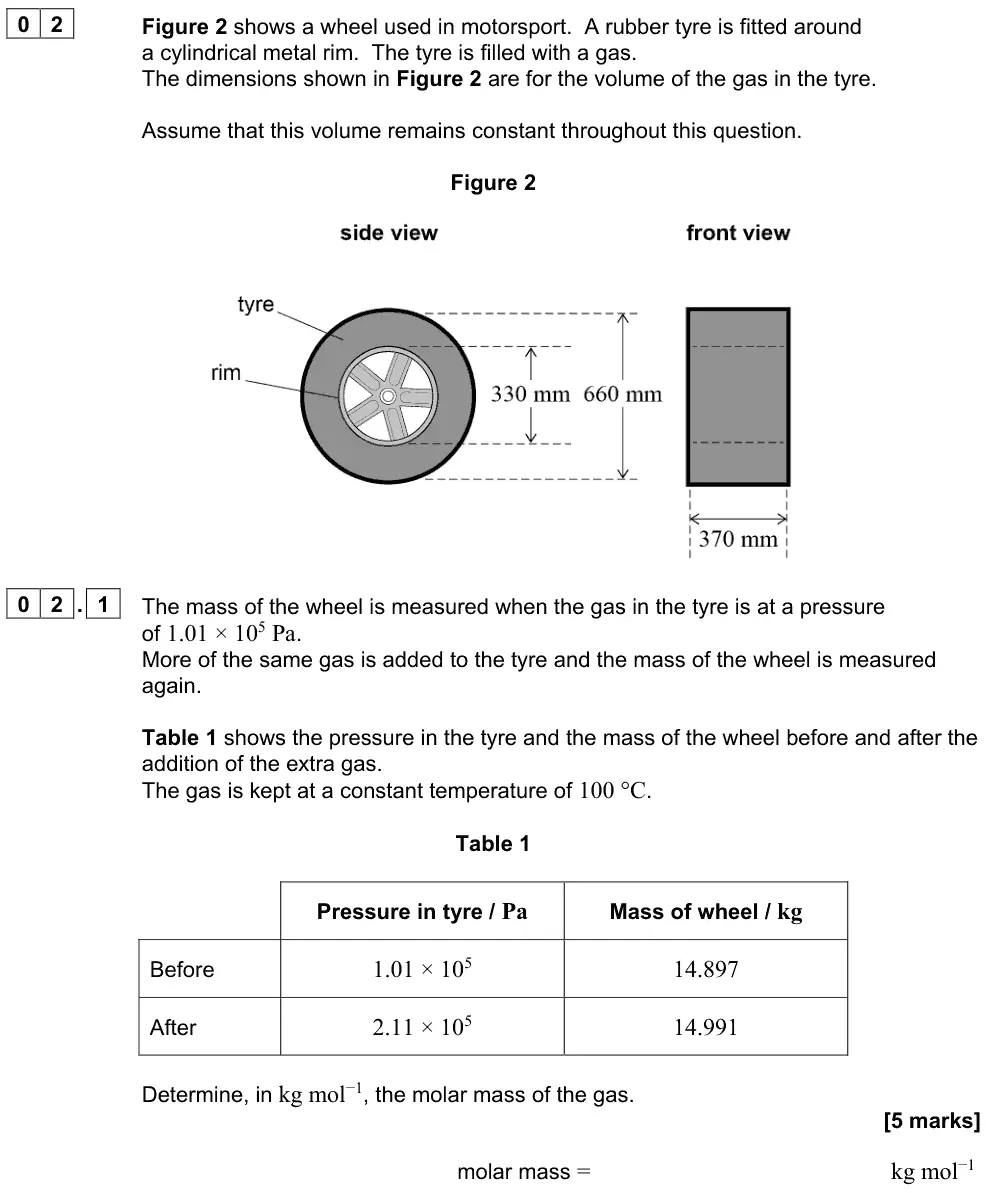
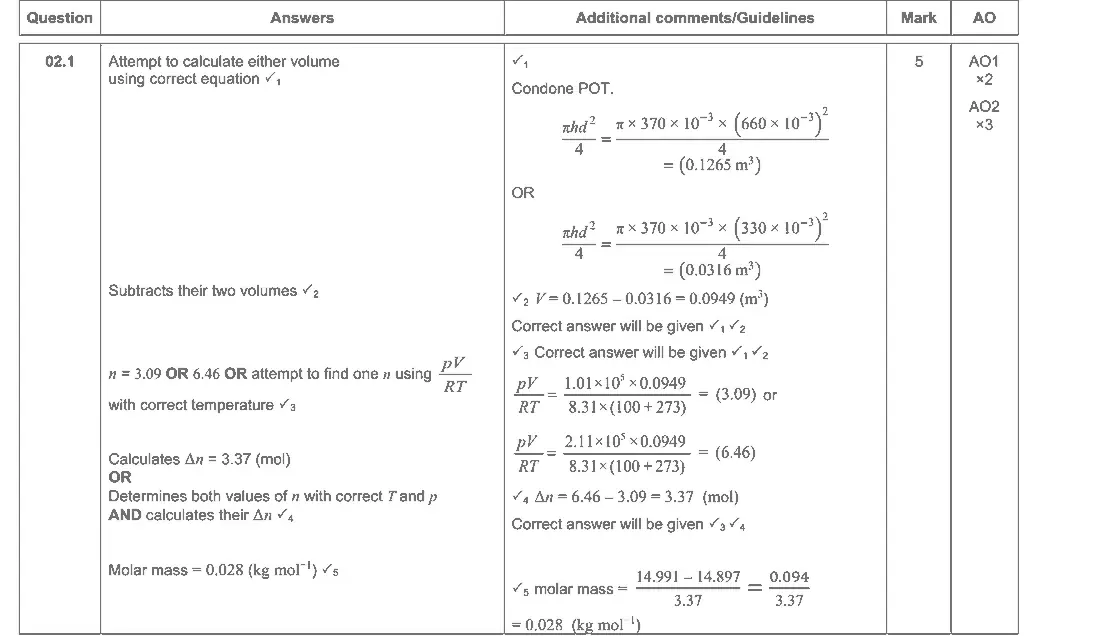
02.1 Most students failed to get to the end of this determination; they tripped up at various points. The weakest answers used the wrong equation to find the volume of the gas, then some used the temperature in Celsius when calculating the number of moles. Only the better students found the number of moles present in the tyre at both pressures. Most who got to this stage used a single molar value to calculate a molar mass.
wrong volume equation and Celsius temperature common
Skills: MS4.3 Calculate areas of triangles, circumferences and areas of circles, surface areas and volumes of rectangular blocks, cylinders and spheres; MS2.3 Substitute numerical values into algebraic equations using appropriate units for physical quantities; MS2.2 Change the subject of an equation, including non-linear equations
June 2023 · Paper 2 · Q2.22 marksAO2=2Explanation
Earlier part of question 2 that this part uses
Mark scheme
Examiner's comment
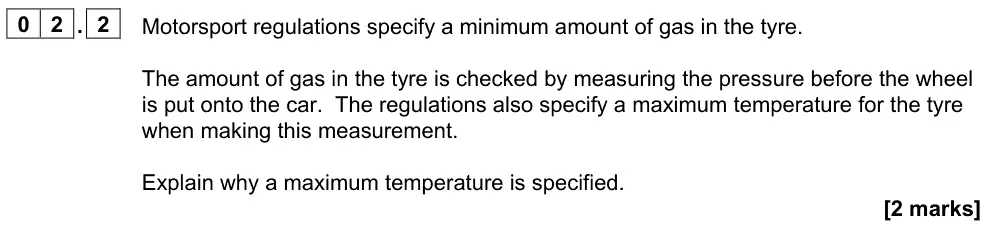
02.2 Many students made the link between temperature and pressure to gain the first mark. Many then failed to obtain the second mark because they suggested that the tyre might explode. Only a minority of students understood that the tyre could produce the appropriate pressure with less gas at an elevated temperature.
Notes from the mark scheme and report
Higher temperature raises pressure, so the tyre could pass the check with less gas
'tyre might explode' not credited
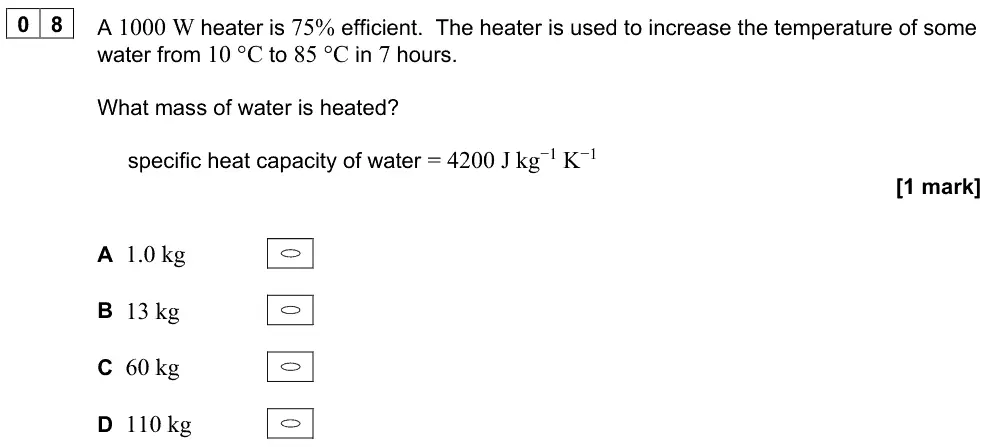
June 2023 · Paper 2 · Q81 markMultiple choiceEasy
Answer
C
Mark scheme
Examiner's comment
A number of questions were found to be quite straightforward by students. These included B8, B11, B12, B17, B18, B20, B26 and B28 which were all answered correctly by at least 70% of students. The questions found to be the most difficult were B14, B15 and B25 – answered correctly by fewer than 35% of students.
Notes from the mark scheme and report
Answer: C
Skills: MS2.3 Substitute numerical values into algebraic equations using appropriate units for physical quantities
June 2023 · Paper 2 · Q91 markMultiple choice
Answer
C
Mark scheme
Notes from the mark scheme and report
Answer: C
June 2022 · Paper 2 · Q1.12 marksAO2=2Calculation
Mark scheme
Examiner's comment
This question was answered well by most students but many made a significant error because they correctly evaluated the temperature difference in oC but then converted the value to K by adding 273. These students did not appreciate that temperature changes are the same in both oC and K. Other errors seen included an incorrect re-arrangement when combining the two equations, and power of ten errors in the evaluation.
Question 01.1
Notes from the mark scheme and report
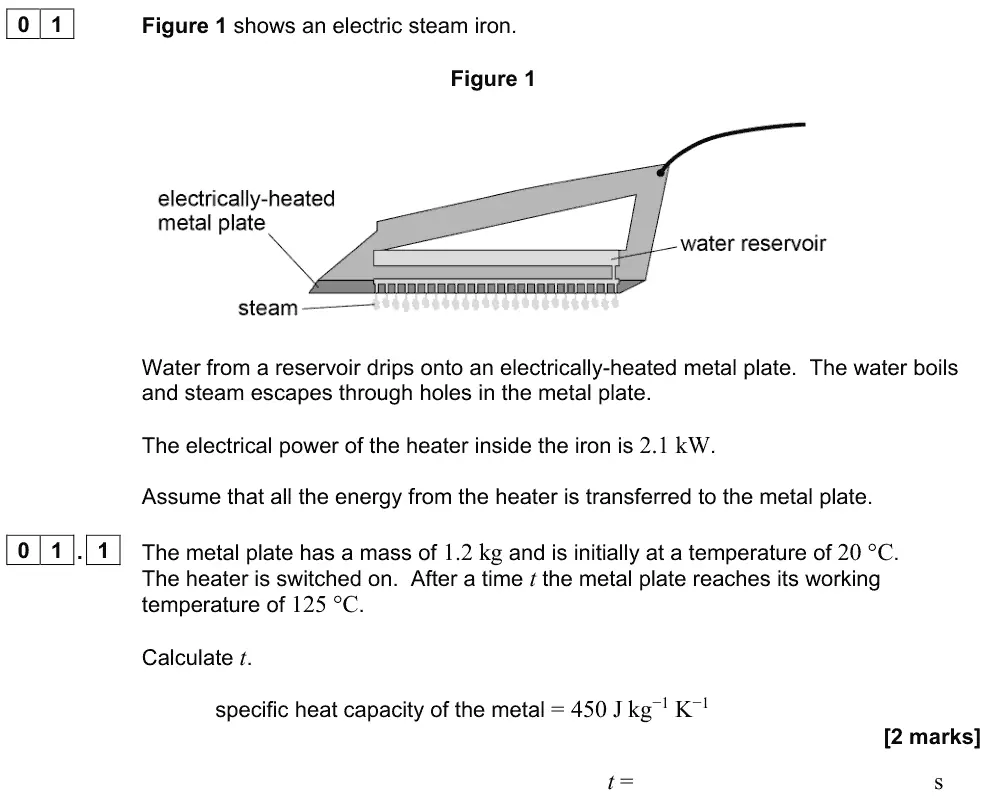
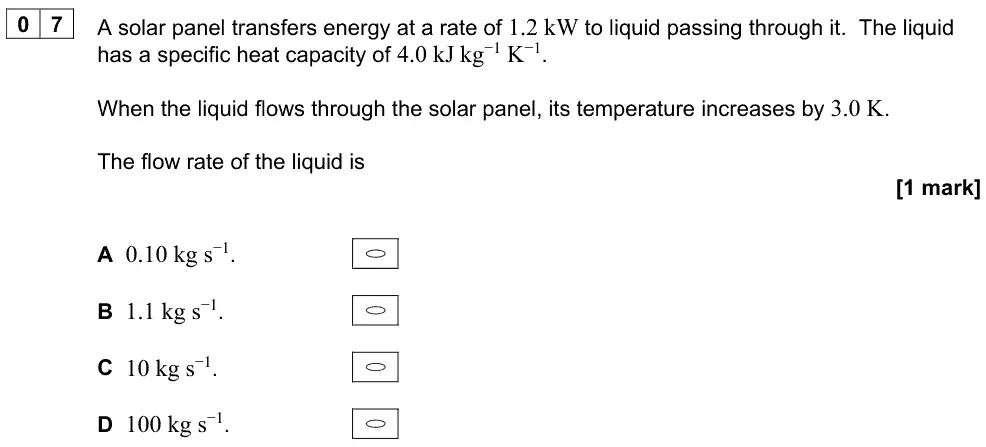
Answer: 27 s (Q = Pt = mc x temperature change, 1.2 x 450 x 105 / 2100)
temperature change is the same in C and K - adding 273 to the difference was the common error
Skills: MS2.2 Change the subject of an equation, including non-linear equations; MS2.3 Substitute numerical values into algebraic equations using appropriate units for physical quantities
June 2022 · Paper 2 · Q1.23 marksAO1=1, AO3=2Calculation
Earlier part of question 1 that this part uses
Mark scheme
Examiner's comment
Nearly half of the students scored full marks on this question by having a clear initial approach to the problem. All the routes given in the mark scheme were used successfully by students. Students who did not plan their approach made a variety of errors. Some only considered the process of converting the water to steam and forgot about raising its temperature to 100 oC. Others tried to equate the energy to raise the temperature with the energy to turn the water to steam. There were others who used data referencing the metal instead of water or who thought that the water temperature rose by 125 oC.
Question 01.2
Notes from the mark scheme and report
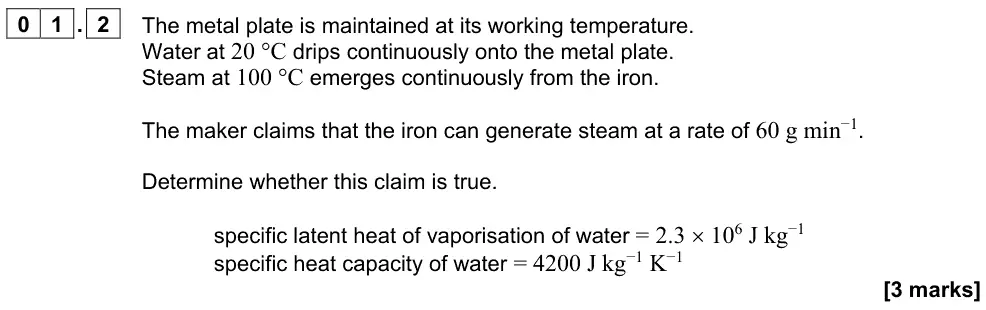
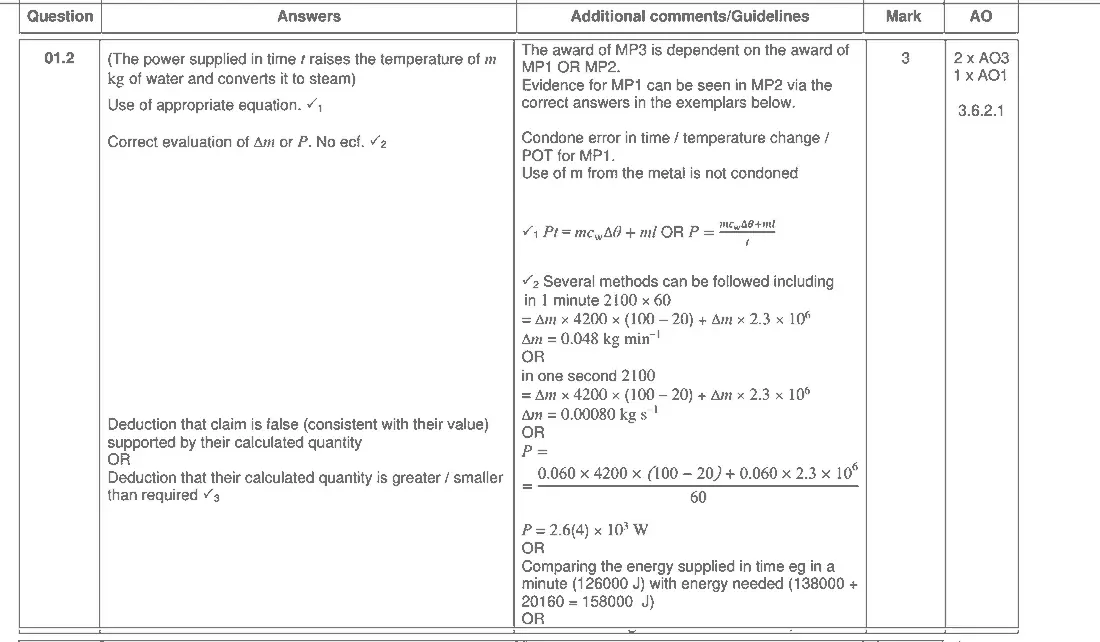
Answer: claim false
0.048 kg per minute (or 2.6 kW needed, more than 2.1 kW)
water must be heated 20 to 100 C AND vaporised
conclusion needs MP1 or MP2
using the metal's c or leaving out the heating were common errors
Skills: MS2.3 Substitute numerical values into algebraic equations using appropriate units for physical quantities; MS0.3 Use ratios, fractions and percentages
June 2022 · Paper 2 · Q2.33 marksAO1=1, AO2=2Calculation
Earlier part of question 2 that this part uses
Mark scheme
Examiner's comment
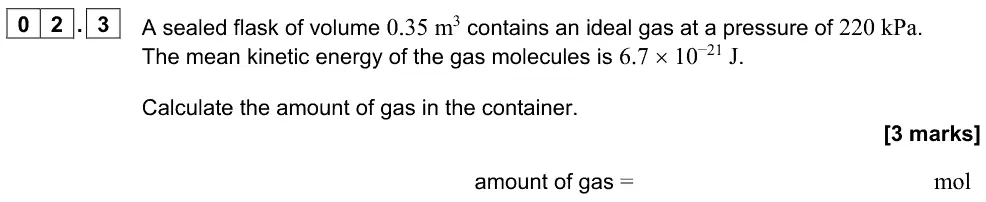
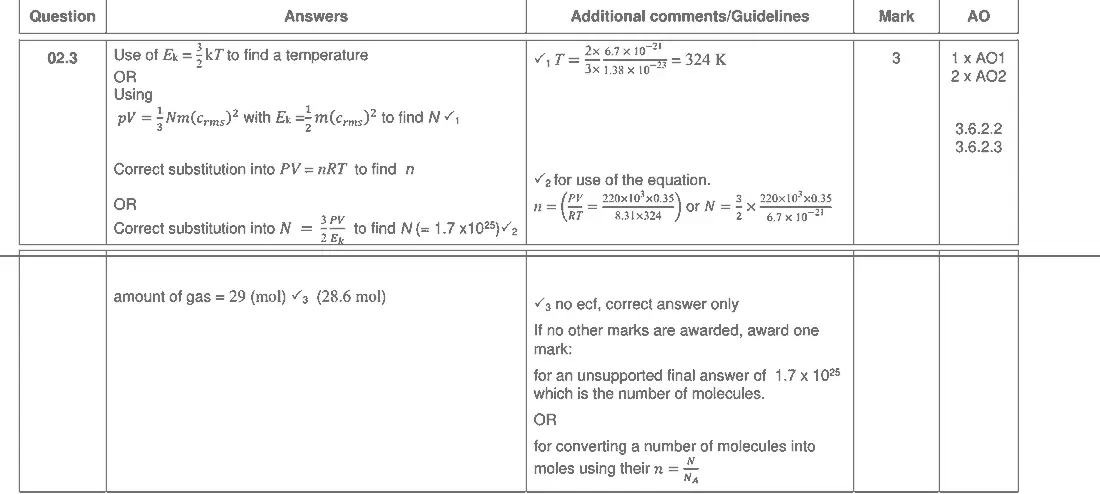
Students who realised that two equations were necessary to solve this problem generally obtained the correct answer. Others went down this route but confused the number of molecules N with the number of moles n. Many others tried to obtain an answer using only the energy equation or just the ideal gas equation and got nowhere.
Question 02.3
Notes from the mark scheme and report
Answer: 29 mol (T = 324 K from Ek = 3/2 kT, then n = pV/RT
or N = 1.7 x 10^25 then divide by NA)
confusing N with n, or using only one equation, were common
Skills: MS2.2 Change the subject of an equation, including non-linear equations; MS2.3 Substitute numerical values into algebraic equations using appropriate units for physical quantities
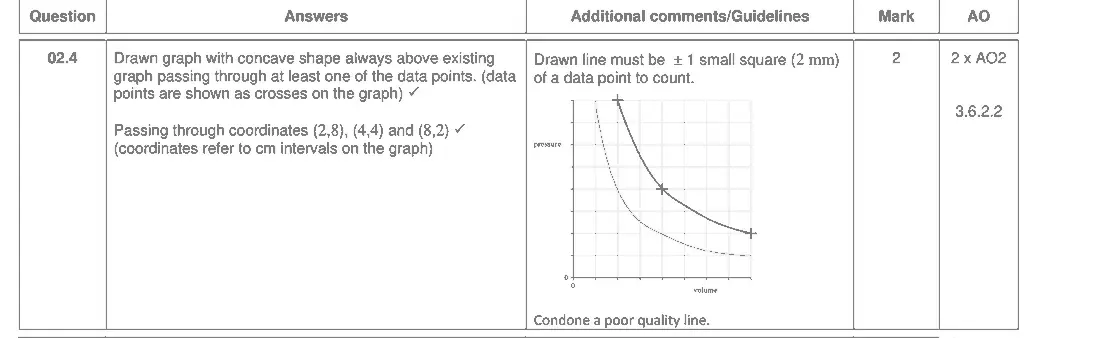
June 2022 · Paper 2 · Q2.42 marksAO2=2Diagram or graph
Earlier part of question 2 that this part uses
Mark scheme
Examiner's comment
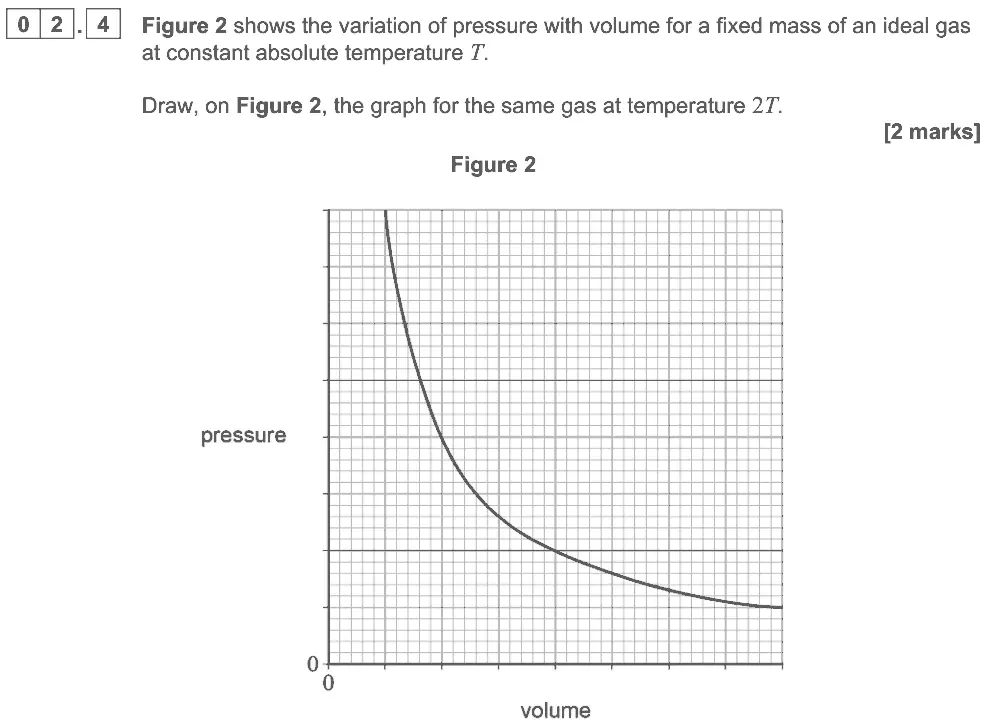
Most students scored at least one mark by drawing the correct basic shape that passed correctly through one data point. It was very common for students to miss the second mark through lack of care and by failing to use other useful data points for their graph. Students who failed to score usually drew the correct general shape but did not locate the graph correctly, with some even drawing the graph below the printed given line.
Question 02.4
In a similar way to question 02.4, students failed to gain marks by not searching for specific data points to follow. Many just drew the basic shape they expected. A significant number of students did not know what shape to expect so peaks and other shapes were seen.
Notes from the mark scheme and report
Curve above the original (pV doubled) through grid points (2,8), (4,4), (8,2)
many drew the right shape but missed the data points
Skills: MS3.1 Translate information between graphical, numerical and algebraic forms
June 2022 · Paper 2 · Q71 markAO2=1Multiple choice
Answer
A
Mark scheme
Notes from the mark scheme and report
Answer: A
Skills: MS0.3 Use ratios, fractions and percentages
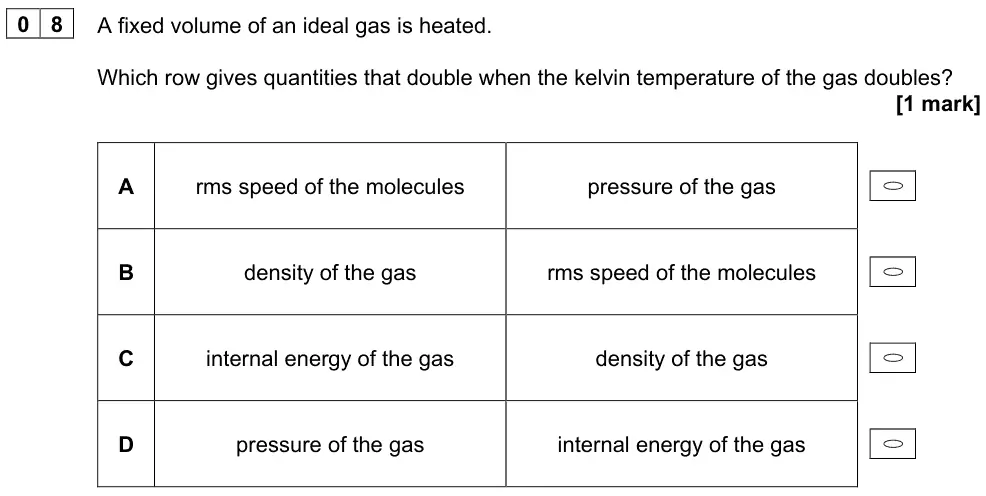
June 2022 · Paper 2 · Q81 markAO2=1Multiple choice
Answer
D
Mark scheme
Notes from the mark scheme and report
Answer: D
June 2022 · Paper 3 Section A · Q4.12 marksAO1=1, AO2=1Practical and data analysis
Mark scheme
Examiner's comment
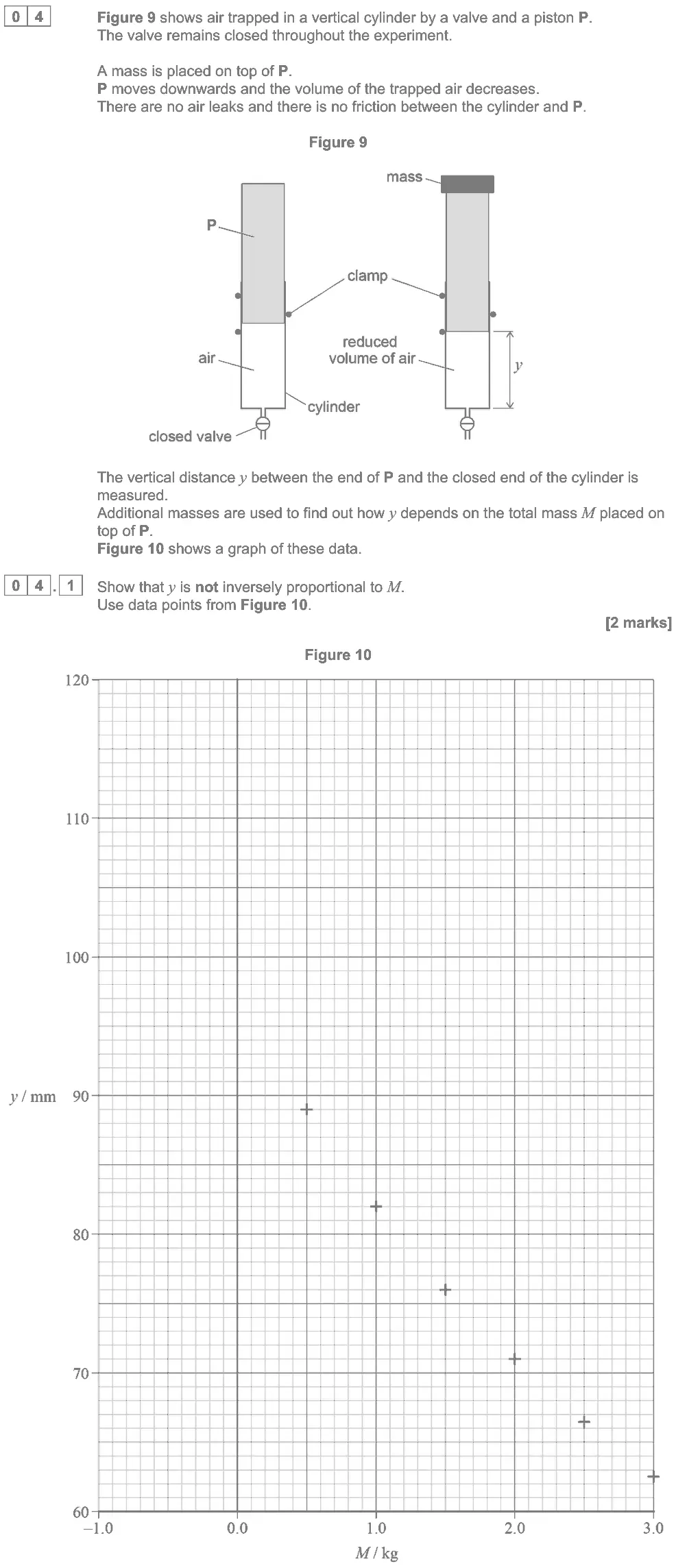
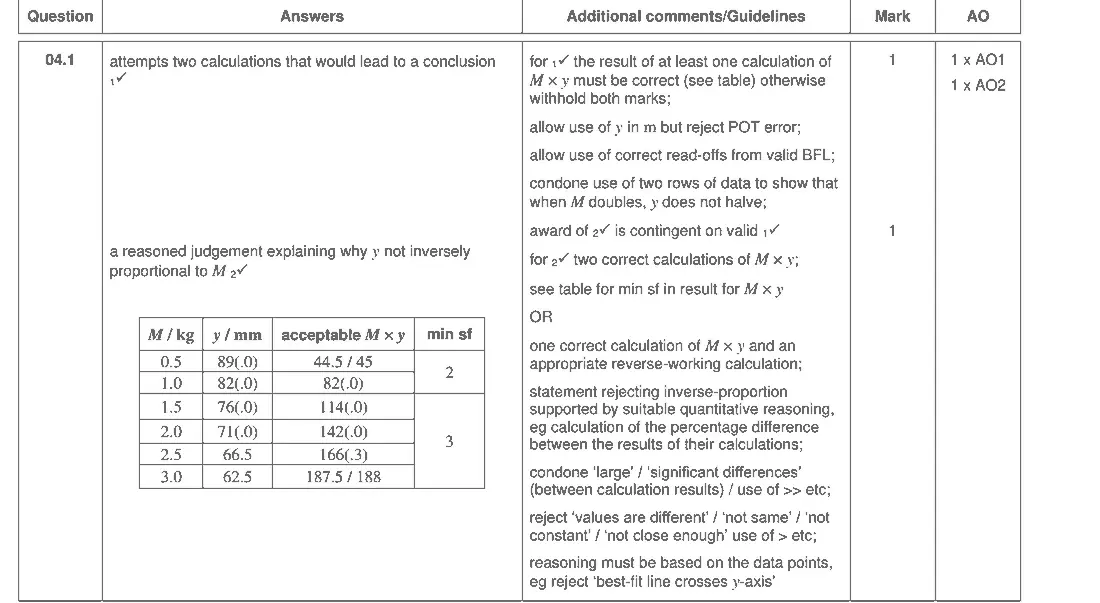
04.1 is a similar question to 01.3 in November 2021. While half could perform calculations that could lead to a conclusion, nearly all then stated that their ‘M y values were different.’ Random error will inevitably affect real data so students were required to make a reasoned comment about the extent of the discrepancy. Some seemed to think they were being asked to test for an exponential relationship while others, sowing the seeds of the downfall in 04.3, said the points in Figure 10 lay on a straight line.
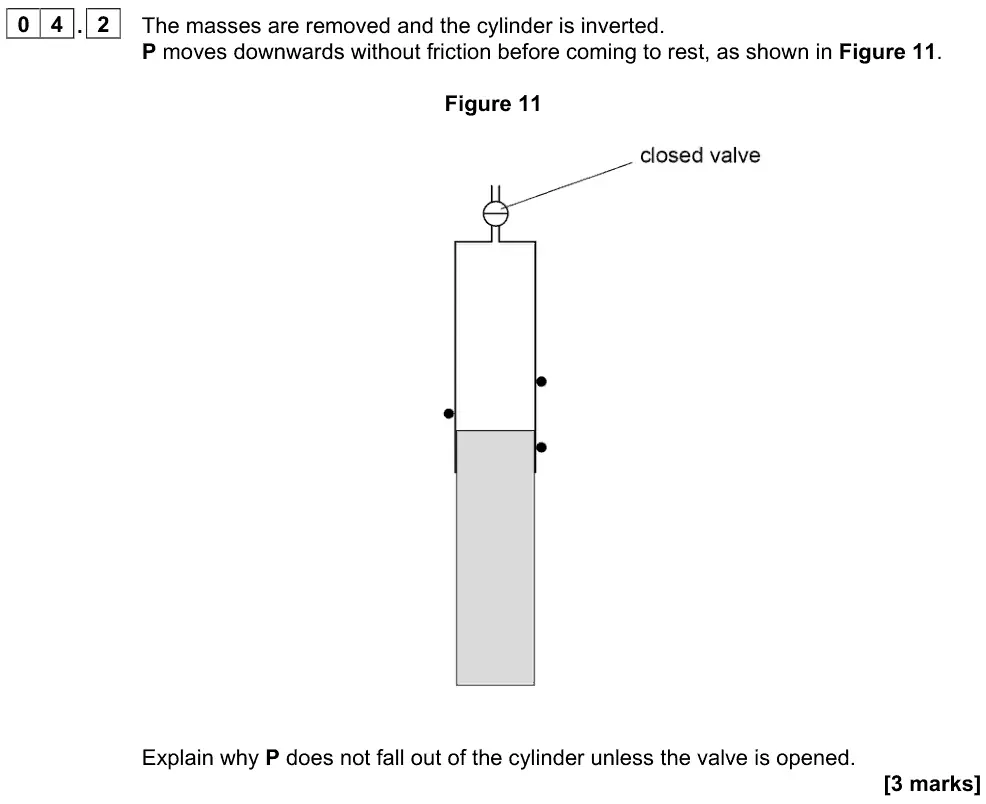
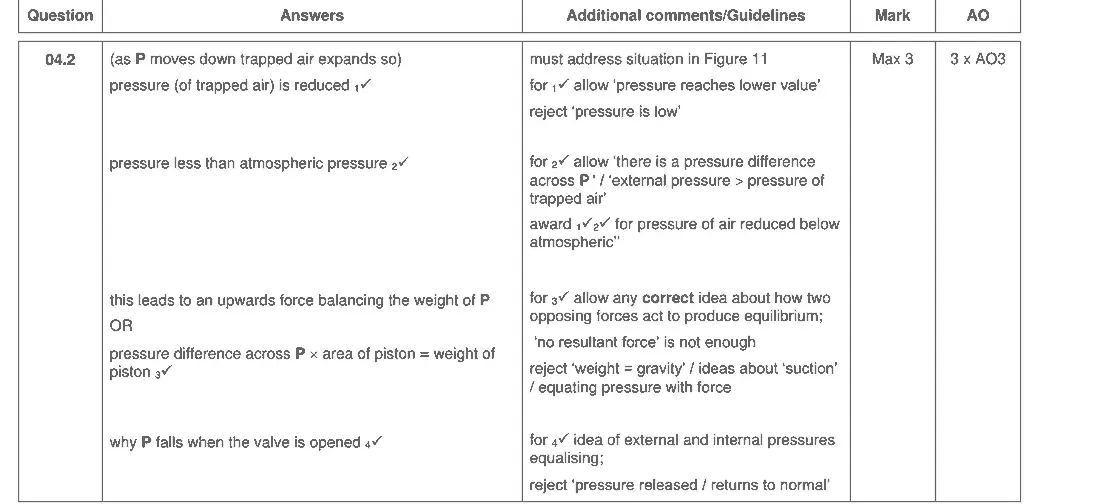
In 04.2 students needed to explain how the pressure inside the cylinder changed as P moved downwards, how this led to P coming to rest and why P fell out of the cylinder when the valve was opened. Misconceptions seen included saying that P came to rest when the internal and external pressures were the same. Some thought pressure could be equated with force or suggested that there was a ‘suction’ effect on P. Others said that, when the valve was opened, air rushed into the cylinder and pushed P downwards. Many struggled to make progress and 60% were unable to score.
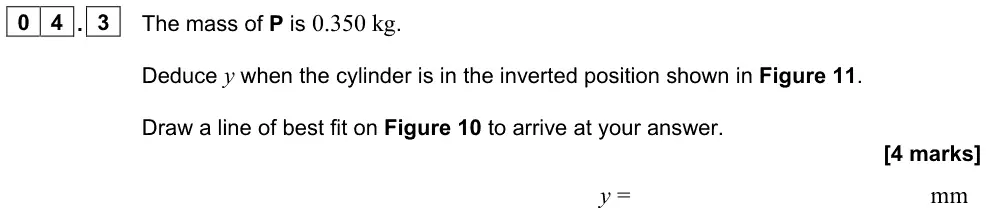
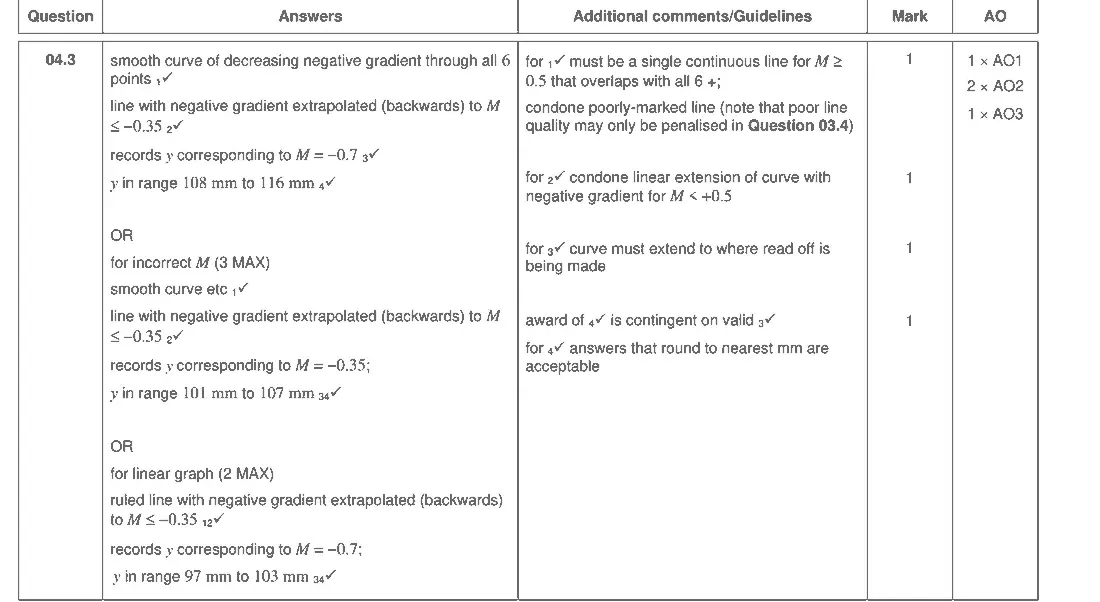
The instruction in 04.3 to ‘Draw a best fit line on Figure 10’ seems to have persuaded many to draw a straight line. Only a quarter of students drew a smooth curve following the obvious trend of the points. Many realised they should extrapolate their line to deduce y for the inverted cylinder but nearly all read off at M = −0.35. Since M did not include the mass of P, the y read-off should have been made at M = −0.70.
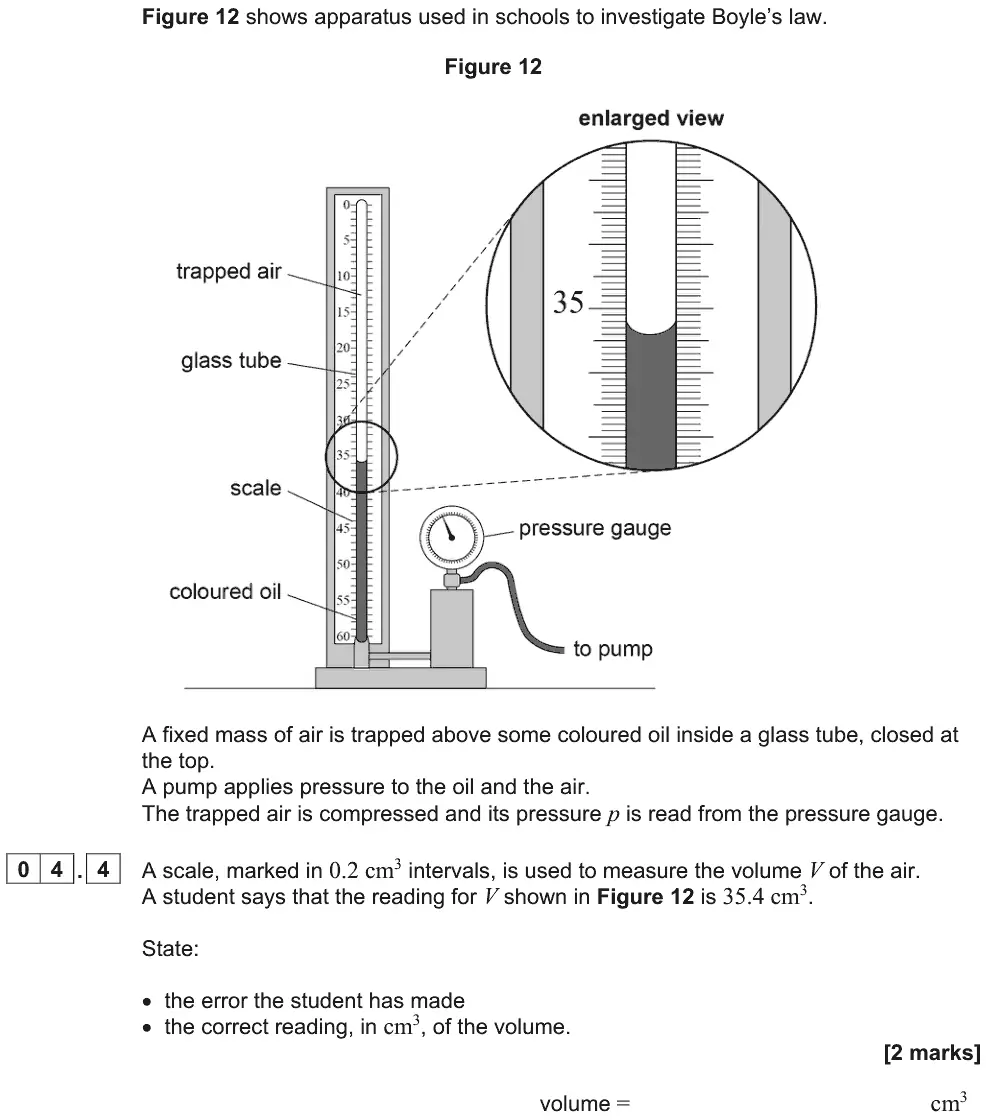
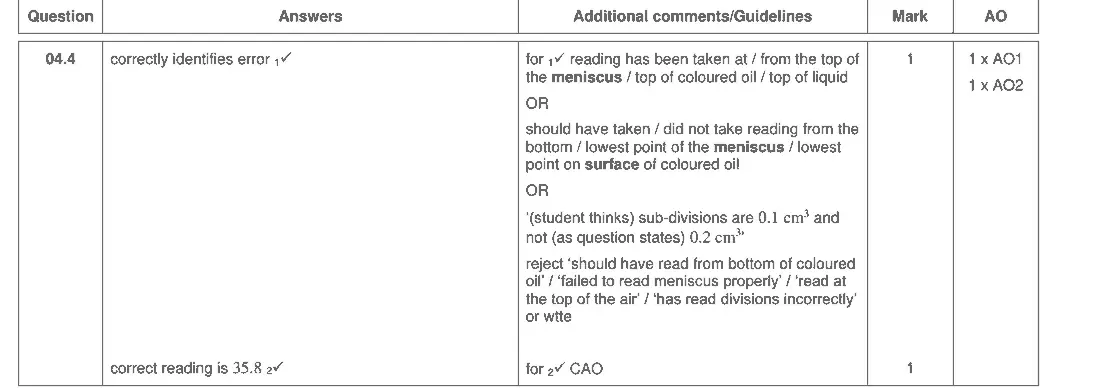
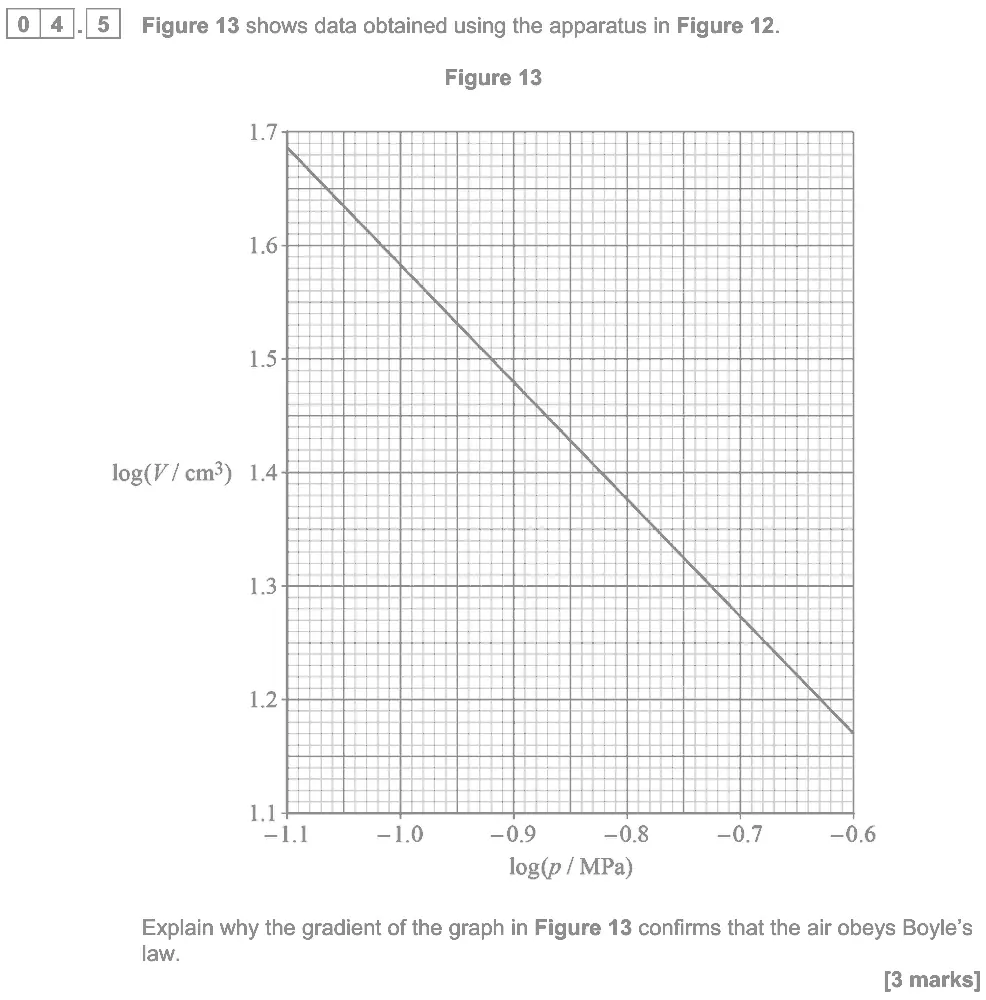
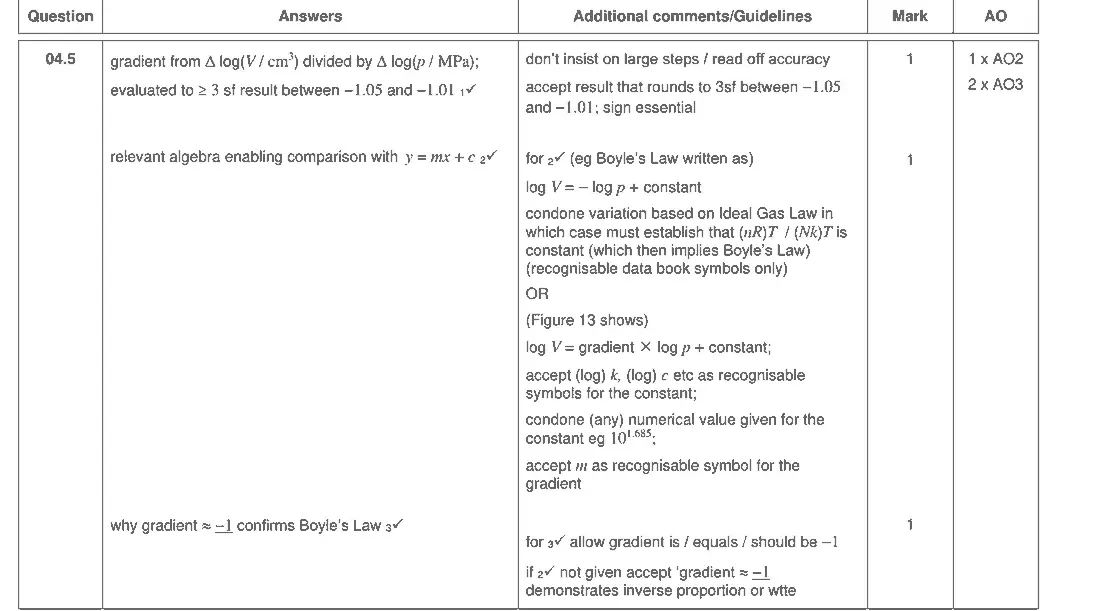
Meniscus is a term for the curved surface of a liquid. In 04.4 many used the term appropriately in explaining the error made by the student. Others earned this mark with a sketch. The alternative suggestion that the student thought the sub-divisions were at 0.1 cm3 intervals was accepted. At least a quarter failed to record 35.8 as the correct reading. In 04.5 students were asked to explain why the gradient in Figure 13 confirmed Boyle’s Law. A calculation to show the gradient was approximately −1 and relevant algebra to explain the y = mx + c form of Figure 13 were expected. Some did not use the blank space provided for a calculation and just said the line had a negative slope.
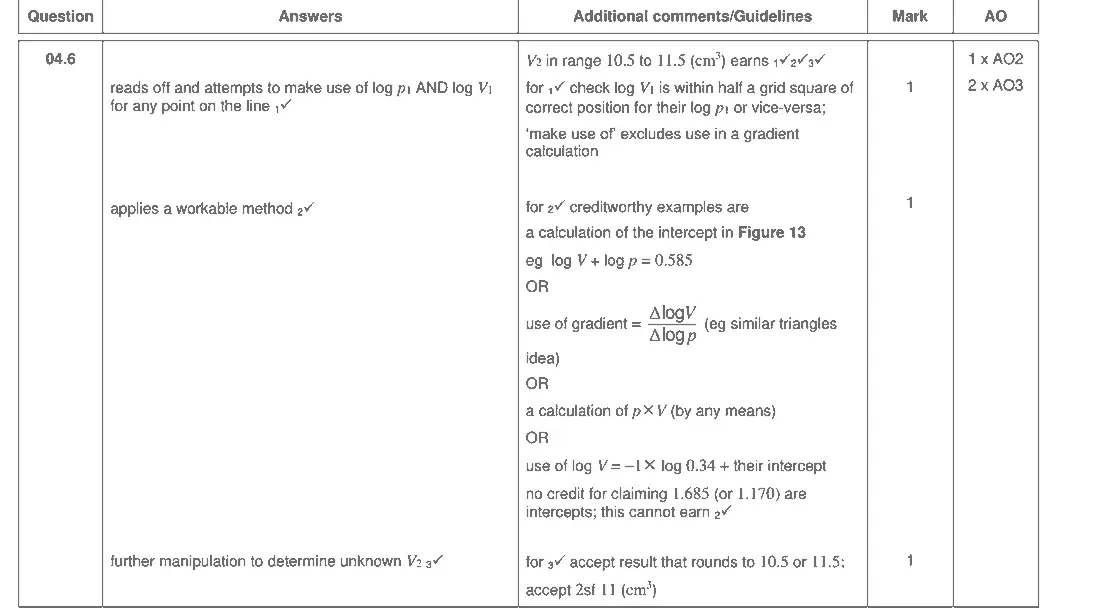
In 04.6 students were required to make use of a point on the line in Figure 13 in their solution. Gradient calculations were not accepted as part of the working here. Many decided to substitute their data into the equation for the line in Figure 13. This required a calculation of the intercept but many claimed the value to be 1.685. Others ignored the intercept altogether and stated that log V = the gradient log 0.34. It was possible to solve this problem in two or three lines but keeping more complex working error- free was often an insurmountable problem.
Students found 04.5 and 04.6 to be very challenging and only a third of them were able to make progress in either part.
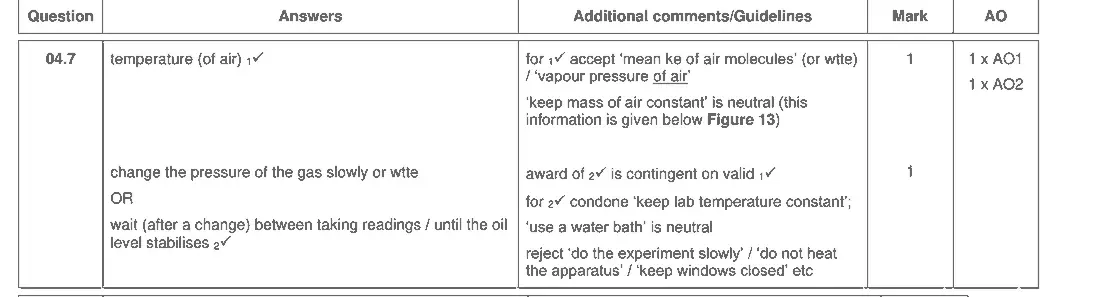
In 04.7 keeping temperature constant was correctly identified by over 80%. About half of these added the second mark by saying they would change the pressure slowly, showing good recall of the required practical. Examiners did not allow ‘carry out the experiment at room temperature’.
This question was about methods to confirm Boyle’s Law (required practical activity 8). The method described in parts 04.1 to 04.3 was for a loaded gas syringe. In parts 04.4 to 04.7 the method was the familiar version in which pressure is applied to air trapped above a column of oil.
Most parts of the 2022 paper provided opportunities for stronger students to demonstrate their ability while preserving the chances of others to show what they knew. Most marking points were accessible. Exceptions were 02.1, 04.1 and 04.3, as discussed later.
The main misconceptions seen were thinking that: • experimental data will always perfectly confirm a theory; students must provide a reasoned judgement before they accept or reject such evidence, e.g. in 04.1; • pressure can be equated with force, e.g. 04.2; • a best-fit line must be a straight line, e.g. 04.3.
Notes from the mark scheme and report
M x y not constant (e.g. 44.5 at 0.5 kg vs 82 at 1.0 kg) - a large, quantified discrepancy beyond random error, so not inverse proportion
'values are different' alone not enough
Skills: MS3.1 Translate information between graphical, numerical and algebraic forms; MS0.3 Use ratios, fractions and percentages; PS2.3 Evaluate results and draw conclusions with reference to measurement uncertainties and errors; RP8 Investigation of Boyle's law (constant temperature) and Charles’s law (constant pressure) for a gas.
June 2022 · Paper 3 Section A · Q4.23 marksAO3=3Explanation
Earlier part of question 4 that this part uses
Mark scheme
Examiner's comment
In 04.2 students needed to explain how the pressure inside the cylinder changed as P moved downwards, how this led to P coming to rest and why P fell out of the cylinder when the valve was opened. Misconceptions seen included saying that P came to rest when the internal and external pressures were the same. Some thought pressure could be equated with force or suggested that there was a ‘suction’ effect on P. Others said that, when the valve was opened, air rushed into the cylinder and pushed P downwards. Many struggled to make progress and 60% were unable to score.
The questions were designed to allow students to demonstrate competence in the key techniques and investigative approaches required in three of the twelve assessed practical activities. This cohort showed that when the question provided enough structure to deter them from improvising, they could produce coherent and sensible extended writing, as in 01.3 and 02.2. Question 04.2 was a different story, with some students referring to ‘suction’ and equating pressure with ‘gravity’.
The main misconceptions seen were thinking that: • experimental data will always perfectly confirm a theory; students must provide a reasoned judgement before they accept or reject such evidence, e.g. in 04.1; • pressure can be equated with force, e.g. 04.2; • a best-fit line must be a straight line, e.g. 04.3.
Notes from the mark scheme and report
As P moves down, trapped air expands so its pressure falls below atmospheric
pressure difference x area gives an upward force balancing P's weight
opening the valve equalises pressure so P falls
'suction' or equating pressure with force rejected
Skills: RP8 Investigation of Boyle's law (constant temperature) and Charles’s law (constant pressure) for a gas.
June 2022 · Paper 3 Section A · Q4.34 marksPractical and data analysisHard
Earlier part of question 4 that this part uses
Mark scheme
Examiner's comment
This question was about methods to confirm Boyle’s Law (required practical activity 8). The method described in parts 04.1 to 04.3 was for a loaded gas syringe. In parts 04.4 to 04.7 the method was the familiar version in which pressure is applied to air trapped above a column of oil.
04.1 is a similar question to 01.3 in November 2021. While half could perform calculations that could lead to a conclusion, nearly all then stated that their ‘M y values were different.’ Random error will inevitably affect real data so students were required to make a reasoned comment about the extent of the discrepancy. Some seemed to think they were being asked to test for an exponential relationship while others, sowing the seeds of the downfall in 04.3, said the points in Figure 10 lay on a straight line.
The instruction in 04.3 to ‘Draw a best fit line on Figure 10’ seems to have persuaded many to draw a straight line. Only a quarter of students drew a smooth curve following the obvious trend of the points. Many realised they should extrapolate their line to deduce y for the inverted cylinder but nearly all read off at M = −0.35. Since M did not include the mass of P, the y read-off should have been made at M = −0.70.
Most parts of the 2022 paper provided opportunities for stronger students to demonstrate their ability while preserving the chances of others to show what they knew. Most marking points were accessible. Exceptions were 02.1, 04.1 and 04.3, as discussed later.
The main misconceptions seen were thinking that: • experimental data will always perfectly confirm a theory; students must provide a reasoned judgement before they accept or reject such evidence, e.g. in 04.1; • pressure can be equated with force, e.g. 04.2; • a best-fit line must be a straight line, e.g. 04.3.
Notes from the mark scheme and report
Answer: 108-116 mm (smooth curve through all six points extrapolated back to M = -0.70 kg
inverting P changes the load on the air by twice its own mass)
a straight line or M = -0.35 kg earns less
Skills: MS3.1 Translate information between graphical, numerical and algebraic forms; MS3.2 Plot two variables from experimental or other data; RP8 Investigation of Boyle's law (constant temperature) and Charles’s law (constant pressure) for a gas.
June 2022 · Paper 3 Section A · Q4.42 marksAO1=1, AO2=1Practical and data analysis
Earlier part of question 4 that this part uses
Mark scheme
Examiner's comment
This question was about methods to confirm Boyle’s Law (required practical activity 8). The method described in parts 04.1 to 04.3 was for a loaded gas syringe. In parts 04.4 to 04.7 the method was the familiar version in which pressure is applied to air trapped above a column of oil.
Meniscus is a term for the curved surface of a liquid. In 04.4 many used the term appropriately in explaining the error made by the student. Others earned this mark with a sketch. The alternative suggestion that the student thought the sub-divisions were at 0.1 cm3 intervals was accepted. At least a quarter failed to record 35.8 as the correct reading. In 04.5 students were asked to explain why the gradient in Figure 13 confirmed Boyle’s Law. A calculation to show the gradient was approximately −1 and relevant algebra to explain the y = mx + c form of Figure 13 were expected. Some did not use the blank space provided for a calculation and just said the line had a negative slope.
Calculations were usually easy to follow but in 01.2 and 04.6 relevant details were sometimes spread across the answer space with little connective reasoning. Students found question 4 significantly harder than the rest of the paper; students of E-grade standard might only score marks in 04.4 and 04.7.
Notes from the mark scheme and report
Student read from the top of the meniscus (or took sub-divisions as 0.1 cm^3)
correct reading 35.8 cm^3 from the bottom of the meniscus
Skills: ATa analogue apparatus to record measurements and interpolate; PS4.1 Know and understand how to use a wide range of experimental and practical instruments, equipment and techniques; RP8 Investigation of Boyle's law (constant temperature) and Charles’s law (constant pressure) for a gas.
June 2022 · Paper 3 Section A · Q4.53 marksAO2=1, AO3=2Practical and data analysisHard
Earlier part of question 4 that this part uses
Mark scheme
Examiner's comment
Meniscus is a term for the curved surface of a liquid. In 04.4 many used the term appropriately in explaining the error made by the student. Others earned this mark with a sketch. The alternative suggestion that the student thought the sub-divisions were at 0.1 cm3 intervals was accepted. At least a quarter failed to record 35.8 as the correct reading. In 04.5 students were asked to explain why the gradient in Figure 13 confirmed Boyle’s Law. A calculation to show the gradient was approximately −1 and relevant algebra to explain the y = mx + c form of Figure 13 were expected. Some did not use the blank space provided for a calculation and just said the line had a negative slope.
Students found 04.5 and 04.6 to be very challenging and only a third of them were able to make progress in either part.
Things students could do better: • spotting the intention of the question: in 04.5 we asked why the gradient confirmed Boyle’s Law but only about half of the students made use of the space provided for a calculation; • check for false origins – many said the intercept in Figure 13 was 1.685; • ‘add detail’ to a Figure to illustrate an answer when prompted to do so – many saved their answer in 02.1 by taking this advice; • refer only to a variable using the symbol or description given in the question; e.g. in 02.2, y is defined as displacement so calling it “extension” or “length” leads to student confusion; • be more concise and targeted with extended writing; consider using bullets or lists; • review recent question papers and marking schemes.
Notes from the mark scheme and report
Gradient of log V against log p is -1.01 to -1.05 (3 sf)
log V = -log p + constant is Boyle's law (pV constant)
'negative slope' alone not enough
Skills: MS3.11 Use logarithmic plots to test exponential and power law variations; MS3.4 Determine the slope and intercept of a linear graph; MS3.3 Understand that y = mx + c represents a linear relationship; RP8 Investigation of Boyle's law (constant temperature) and Charles’s law (constant pressure) for a gas.
June 2022 · Paper 3 Section A · Q4.63 marksAO2=1, AO3=2Practical and data analysisHard
Earlier part of question 4 that this part uses
Mark scheme
Examiner's comment
In 04.6 students were required to make use of a point on the line in Figure 13 in their solution. Gradient calculations were not accepted as part of the working here. Many decided to substitute their data into the equation for the line in Figure 13. This required a calculation of the intercept but many claimed the value to be 1.685. Others ignored the intercept altogether and stated that log V = the gradient log 0.34. It was possible to solve this problem in two or three lines but keeping more complex working error- free was often an insurmountable problem.
Students found 04.5 and 04.6 to be very challenging and only a third of them were able to make progress in either part.
Calculations were usually easy to follow but in 01.2 and 04.6 relevant details were sometimes spread across the answer space with little connective reasoning. Students found question 4 significantly harder than the rest of the paper; students of E-grade standard might only score marks in 04.4 and 04.7.
Notes from the mark scheme and report
Answer: 10.5-11.5 cm^3 (pV constant from a point on the line, or log V + log p = 0.585 with p = 0.34 MPa)
1.685 is not the intercept (false origin)
Skills: MS2.5 Use logarithms in relation to quantities that range over several orders of magnitude; MS3.1 Translate information between graphical, numerical and algebraic forms; MS3.3 Understand that y = mx + c represents a linear relationship; RP8 Investigation of Boyle's law (constant temperature) and Charles’s law (constant pressure) for a gas.
June 2022 · Paper 3 Section A · Q4.72 marksAO1=1, AO2=1Practical and data analysis
Earlier part of question 4 that this part uses
Mark scheme
Examiner's comment
This question was about methods to confirm Boyle’s Law (required practical activity 8). The method described in parts 04.1 to 04.3 was for a loaded gas syringe. In parts 04.4 to 04.7 the method was the familiar version in which pressure is applied to air trapped above a column of oil.
In 04.7 keeping temperature constant was correctly identified by over 80%. About half of these added the second mark by saying they would change the pressure slowly, showing good recall of the required practical. Examiners did not allow ‘carry out the experiment at room temperature’.
Calculations were usually easy to follow but in 01.2 and 04.6 relevant details were sometimes spread across the answer space with little connective reasoning. Students found question 4 significantly harder than the rest of the paper; students of E-grade standard might only score marks in 04.4 and 04.7.
Notes from the mark scheme and report
Temperature must stay constant
change the pressure slowly / wait for the oil level to settle before reading
'room temperature' or 'do it slowly' not accepted
Skills: PS2.4 Identify variables including those that must be controlled; RP8 Investigation of Boyle's law (constant temperature) and Charles’s law (constant pressure) for a gas.
November 2021 · Paper 2 · Q3.33 marksCalculation
Earlier part of question 3 that this part uses
Mark scheme
Examiner's comment
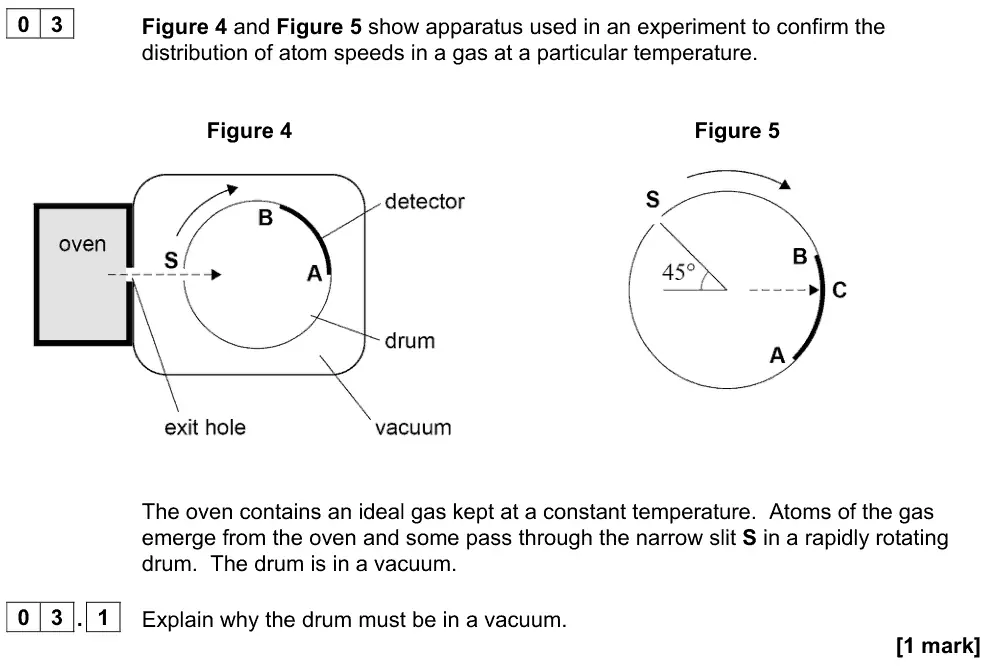
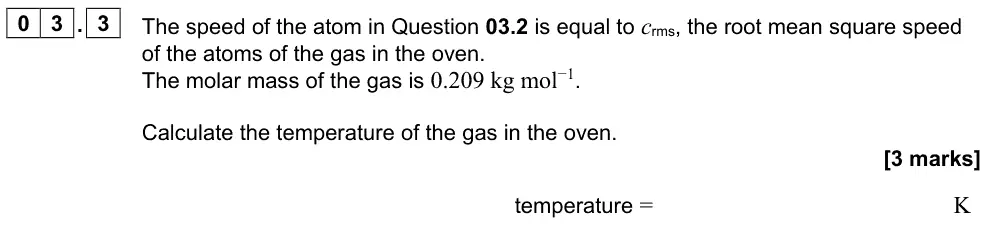
03.1 In the main, students thought it was sufficient to explain that in a vacuum a collision would not occur. Only about a fifth of them went on to explain how collisions might affect the speed distribution of the atoms emerging from the oven. 03.2 Half of the students sailed easily through this question. There was a significant number, however, who failed to identify the time and then could not make any progress. 03.3 A significant number of students went wrong at an early stage by not knowing the difference between mass and molar mass. In general, the students who could evaluate the mass of a single atom had no difficulty in completing the whole question. 03.4 Almost all students made reference to having fewer atoms in the oven. Several different types of errors then occurred: • a number of students failed to discuss any kinetic motion, instead these students chose to rely incorrectly on the gas laws; • a failure to discuss the rate of collision with the oven wall even when it was these collisions that were recognised to be of importance; • poor use of technical language. It was not always clear whether described momentum changes referred to single atoms or the whole ensemble. The first of these should be described as being, on average, constant whereas the total momentum change would decrease. 03.5 A majority of students did not have enough knowledge or experience of the gas equations to make any progress. Most attempted an answer using inappropriate equations. 03.6 Most students understood the situation but many did not always describe the motion of the atoms with sufficient clarity in writing about the new detector. A number thought the detector would darken more because it was hit harder and did not focus on the number of colliding atoms.
Notes from the mark scheme and report
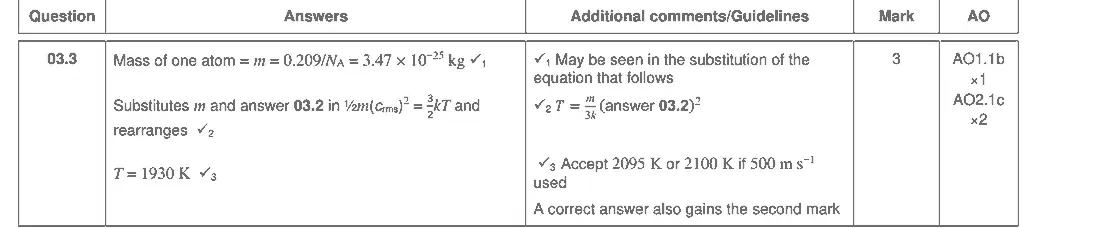
Answer: 1930 K (m = 0.209 / NA = 3.47 x 10^-25 kg
T = m crms^2 / 3k
2100 K if 500 m s^-1 used)
confusing molar and atomic mass
Skills: MS2.2 Change the subject of an equation, including non-linear equations; MS2.3 Substitute numerical values into algebraic equations using appropriate units for physical quantities
November 2021 · Paper 2 · Q3.51 markAO2=1Calculation
Earlier part of question 3 that this part uses
Mark scheme
Examiner's comment
03.1 In the main, students thought it was sufficient to explain that in a vacuum a collision would not occur. Only about a fifth of them went on to explain how collisions might affect the speed distribution of the atoms emerging from the oven. 03.2 Half of the students sailed easily through this question. There was a significant number, however, who failed to identify the time and then could not make any progress. 03.3 A significant number of students went wrong at an early stage by not knowing the difference between mass and molar mass. In general, the students who could evaluate the mass of a single atom had no difficulty in completing the whole question. 03.4 Almost all students made reference to having fewer atoms in the oven. Several different types of errors then occurred: • a number of students failed to discuss any kinetic motion, instead these students chose to rely incorrectly on the gas laws; • a failure to discuss the rate of collision with the oven wall even when it was these collisions that were recognised to be of importance; • poor use of technical language. It was not always clear whether described momentum changes referred to single atoms or the whole ensemble. The first of these should be described as being, on average, constant whereas the total momentum change would decrease. 03.5 A majority of students did not have enough knowledge or experience of the gas equations to make any progress. Most attempted an answer using inappropriate equations. 03.6 Most students understood the situation but many did not always describe the motion of the atoms with sufficient clarity in writing about the new detector. A number thought the detector would darken more because it was hit harder and did not focus on the number of colliding atoms.
Notes from the mark scheme and report
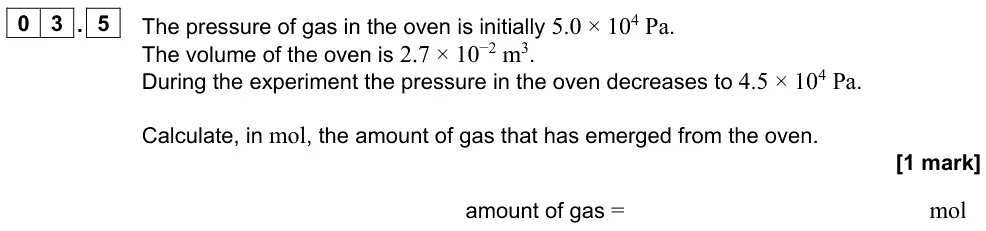
Answer: 8.4 x 10^-3 mol (n = V delta p / RT with T = 1930 K from 03.3)
most used inappropriate equations
Skills: MS2.3 Substitute numerical values into algebraic equations using appropriate units for physical quantities
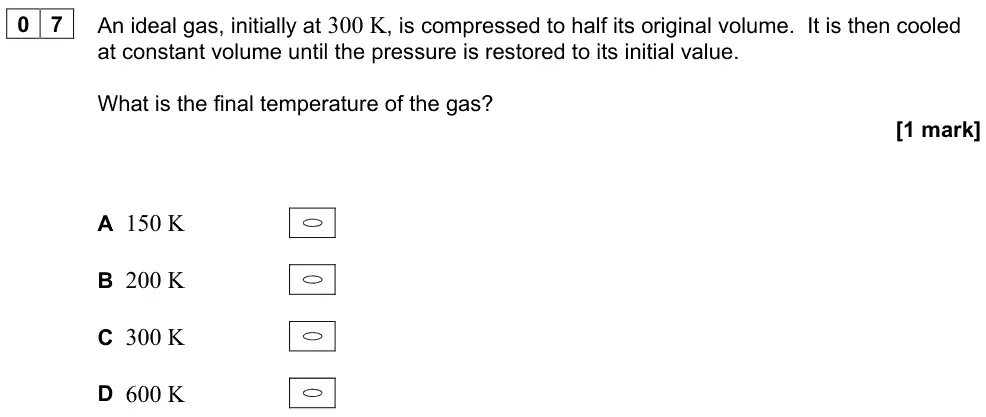
November 2021 · Paper 2 · Q71 markMultiple choice
Answer
A
Mark scheme
Examiner's comment
Questions 7 – 31 The success rate on almost all the multiple-choice questions was between 25% and 55%. Questions that were noticeably more straightforward than this were B7, B14, B19 and B29. Only questions B22 and B23 proved to be accessible to less than 25% of students.
Notes from the mark scheme and report
Answer: A
Skills: MS2.2 Change the subject of an equation, including non-linear equations
November 2021 · Paper 2 · Q91 markMultiple choice
Answer
B
Mark scheme
Notes from the mark scheme and report
Answer: B
Skills: MS3.3 Understand that y = mx + c represents a linear relationship
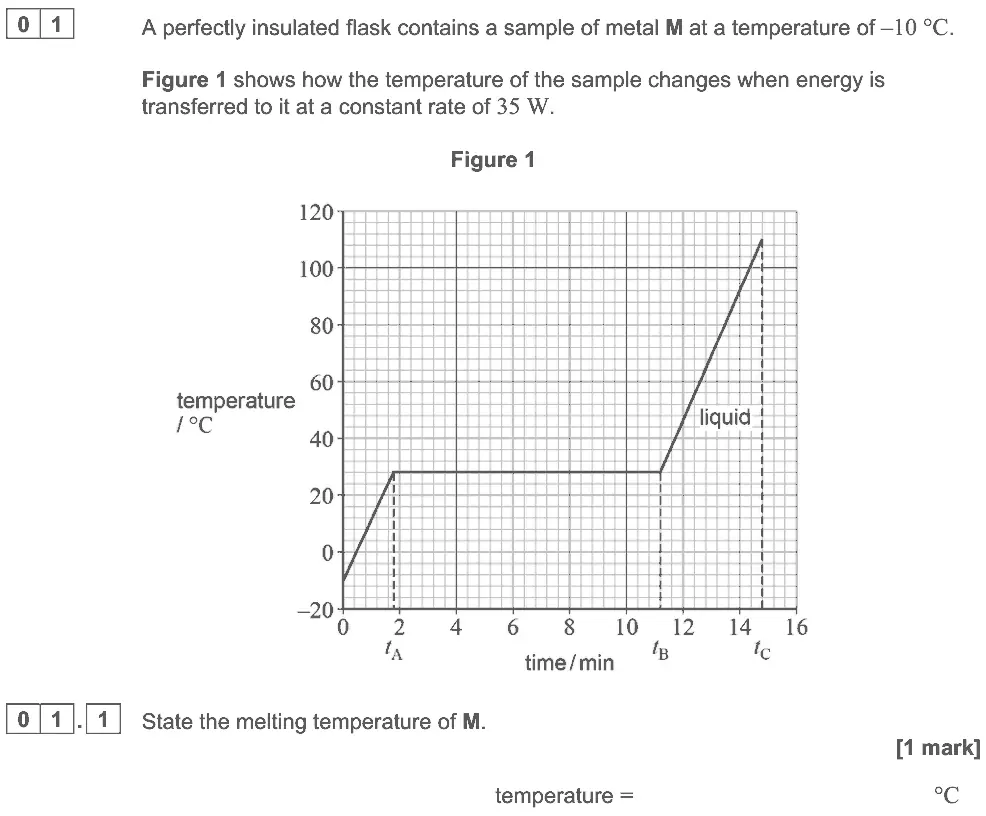
November 2020 · Paper 2 · Q1.11 markShort answer
Mark scheme
Examiner's comment
The graphical information appeared to be well understood by a vast majority of the students.
Question 01.1
Notes from the mark scheme and report
Answer: 28 C (flat section of Figure 1)
Skills: MS3.1 Translate information between graphical, numerical and algebraic forms
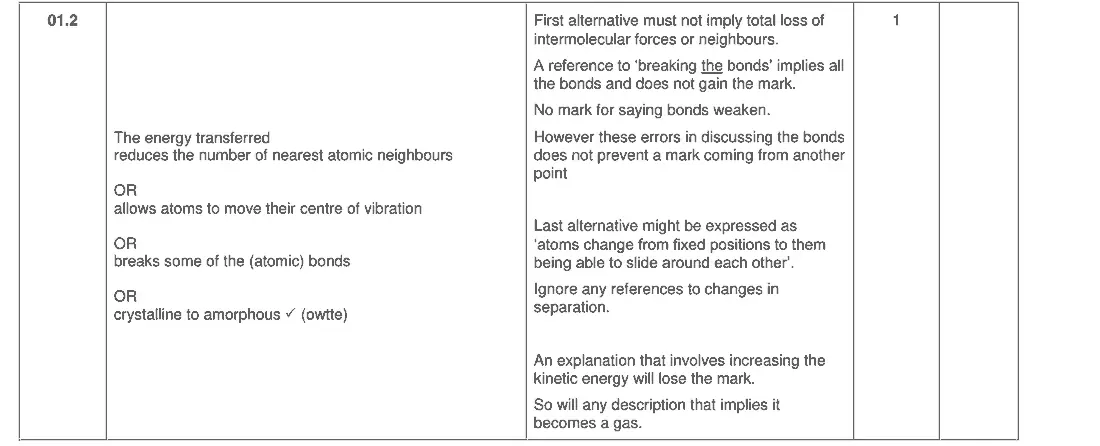
November 2020 · Paper 2 · Q1.21 markShort answer
Earlier part of question 1 that this part uses
Mark scheme
Examiner's comment
Most students were aware of the changes taking place but many failed to gain marks when expressing the changes. It was common to see the statement, ‘the structure changes from an ordered one to one where atoms are free to move’. This could easily be a reference to a gas and so failed to gain the mark. Students also failed to gain the mark when their wording implied that all bonds between atoms are broken or intermolecular forces are made weaker. Less accomplished students described an increase in kinetic energy or presented only a macroscopic description.
Question 01.2
Notes from the mark scheme and report
Energy breaks some bonds / reduces the number of nearest neighbours so atoms can slide past each other (crystalline to amorphous)
'all bonds broken', 'free to move' (sounds like a gas) or increased KE lose the mark
November 2020 · Paper 2 · Q1.32 marksShort answer
Earlier part of question 1 that this part uses
Mark scheme
Examiner's comment
There was a very mixed bag of responses seen. The choice of rise or fall in kinetic energy or potential energy seemed to be random. Only a minority gave the correct answers. The ‘average’ student held to the incorrect idea that ‘energy is being supplied so kinetic energy must increase’.
Question 01.3
Notes from the mark scheme and report
Kinetic energy constant
potential energy increases
many wrongly thought KE must rise because energy is supplied
November 2020 · Paper 2 · Q1.41 markShort answer
Earlier part of question 1 that this part uses
Mark scheme
Examiner's comment
Only a tiny fraction of students made any reference to ‘mean’ or ‘average’. Also, when the answer involved ‘speed’ a number of students used the term ‘velocity’. At this level the correct technical language is essential.
Question 01.4
Notes from the mark scheme and report
Mean speed (mean kinetic energy) of the atoms increases
'mean' and 'speed' (not velocity) needed
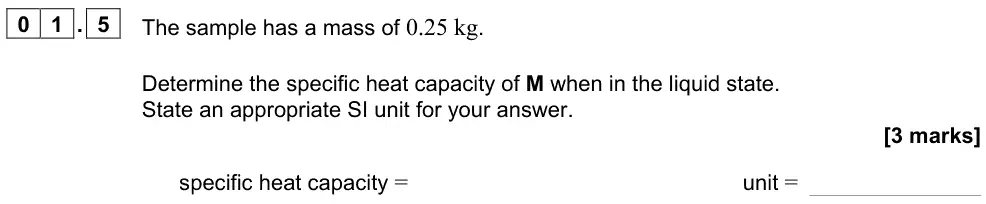
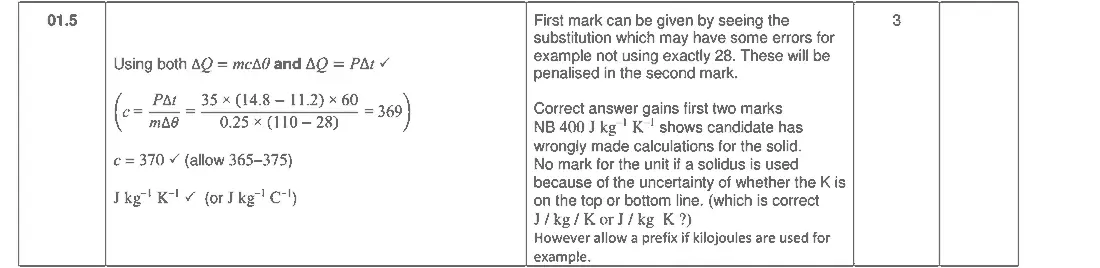
November 2020 · Paper 2 · Q1.53 marksCalculation
Earlier part of question 1 that this part uses
Mark scheme
Examiner's comment
This question was answered well by students and many obtained full marks. The most common error was to equate heat energy to power. A host of other errors appeared in rather smaller numbers; these included poor equation manipulation, not using the time data in minutes, or (surprisingly) mixing the symbols for time and change of temperature.
Question 01.5
Notes from the mark scheme and report
Answer: 370 J kg^-1 K^-1 (35 x (14.8 - 11.2) x 60 / (0.25 x (110 - 28)))
minutes must be converted
400 means the solid section was used
solidus units not accepted
Skills: MS3.1 Translate information between graphical, numerical and algebraic forms; MS2.2 Change the subject of an equation, including non-linear equations; MS0.1 Recognise and make use of appropriate units in calculations
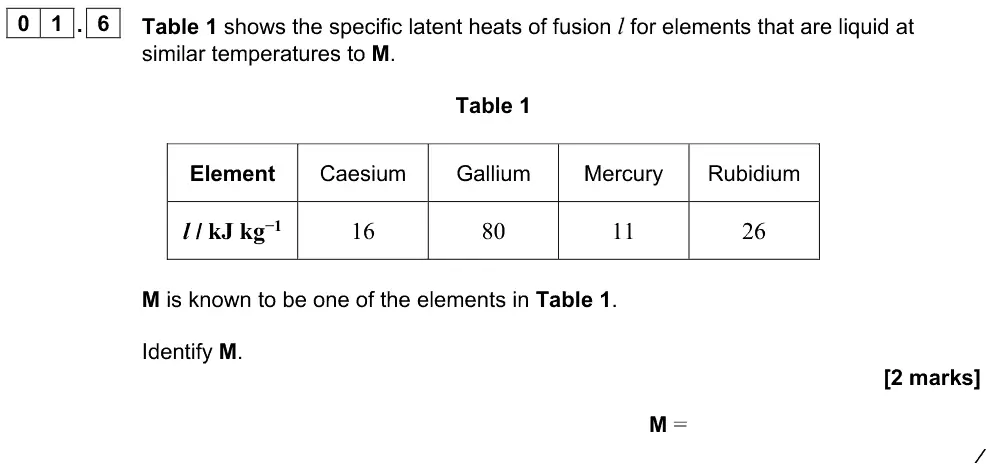
November 2020 · Paper 2 · Q1.62 marksCalculation
Earlier part of question 1 that this part uses
Mark scheme
Examiner's comment
Less than half the students could determine the specific heat capacity and identify the element. The most successful students were those who showed their working in full. The last mark in the question could be awarded even when an error was carried forward from a slip in the calculation. In practice this was rarely awarded, because these students did not show enough working to confirm whether the slip was in arithmetic or transposition rather than an error in physics.
Question 01.6
Notes from the mark scheme and report
Answer: l = 79 kJ kg^-1 so M is gallium (35 x (11.2 - 1.8) x 60 / 0.25)
valid calculation needed
less than half succeeded
Skills: MS3.1 Translate information between graphical, numerical and algebraic forms; MS2.2 Change the subject of an equation, including non-linear equations
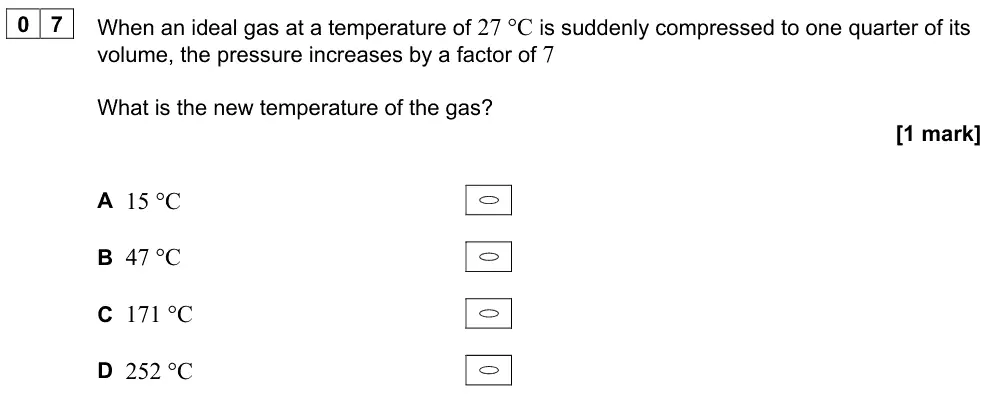
November 2020 · Paper 2 · Q71 markMultiple choiceHard
Answer
D
Examiner's comment
The percentage scores in the multiple-choice questions were much higher than in the written questions. A majority of the questions yielded success rates of between 50 and 75%. Questions B14 and B30 had higher success rates than this. Questions that scored in the region of 30 to 50% correct were B8, B16, B22, B26, B27, B29 and B31. Questions B7 and B24 were found to be particularly difficult with only about 16% of students being successful.
Notes from the mark scheme and report
Answer: D
T = 300 x 7/4 = 525 K - must use kelvin
Skills: MS0.3 Use ratios, fractions and percentages
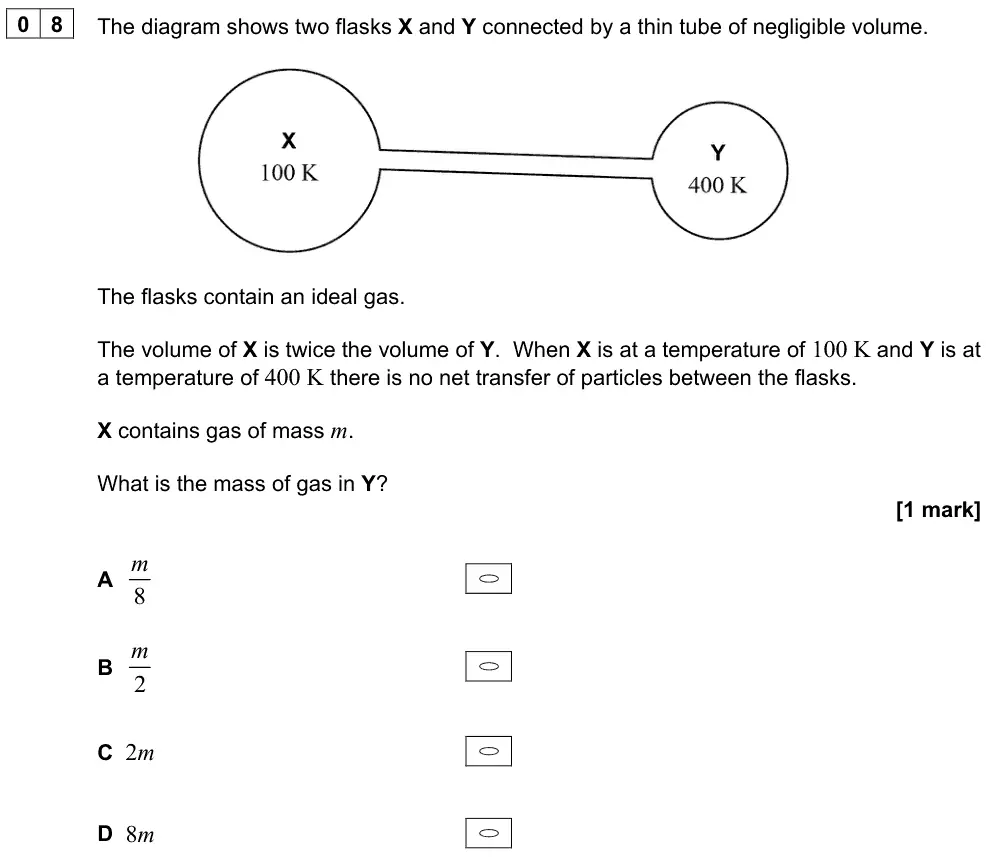
November 2020 · Paper 2 · Q81 markMultiple choice
Answer
A
Examiner's comment
The percentage scores in the multiple-choice questions were much higher than in the written questions. A majority of the questions yielded success rates of between 50 and 75%. Questions B14 and B30 had higher success rates than this. Questions that scored in the region of 30 to 50% correct were B8, B16, B22, B26, B27, B29 and B31. Questions B7 and B24 were found to be particularly difficult with only about 16% of students being successful.
Notes from the mark scheme and report
Answer: A
Skills: MS0.3 Use ratios, fractions and percentages
June 2019 · Paper 2 · Q1.15 marksCalculation
Mark scheme
Examiner's comment
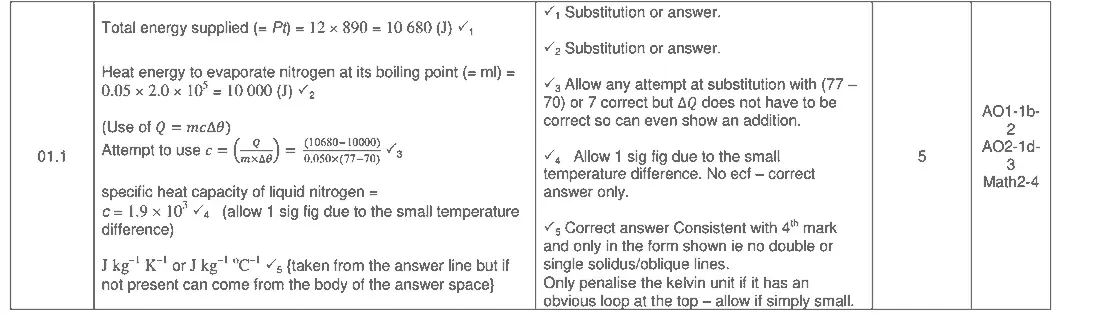
1.1 This question was found to be very accessible, with more than half of the students scoring full marks. The main problems were the choice of correct heat energy value in the Q mc θ = ∆ equation and errors with units.
Notes from the mark scheme and report
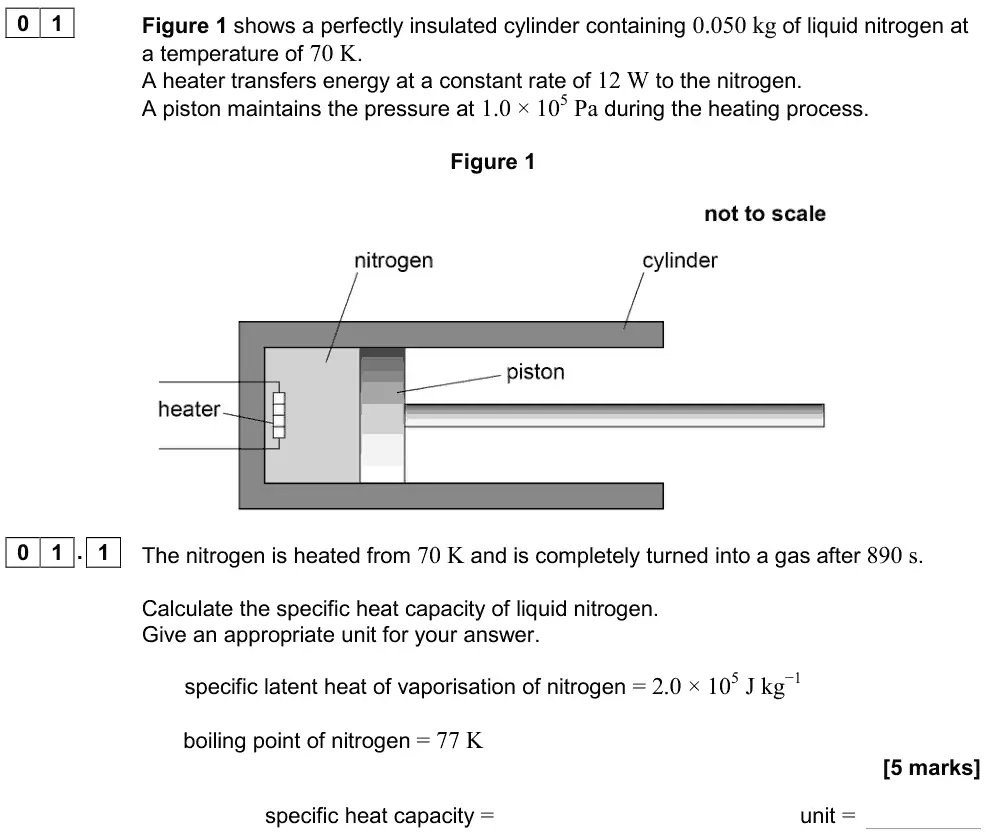
Answer: about 1900 J kg^-1 K^-1 (energy supplied 12 x 890 = 10 680 J
latent heat 0.050 x 2.0 x 10^5 = 10 000 J
680 J raises liquid by 7 K)
choosing the wrong energy for Q = mc delta theta and unit errors were common
Skills: MS2.2 Change the subject of an equation, including non-linear equations; MS2.3 Substitute numerical values into algebraic equations using appropriate units for physical quantities; MS0.1 Recognise and make use of appropriate units in calculations
June 2019 · Paper 2 · Q1.24 marksCalculation
Earlier part of question 1 that this part uses
Mark scheme
Examiner's comment
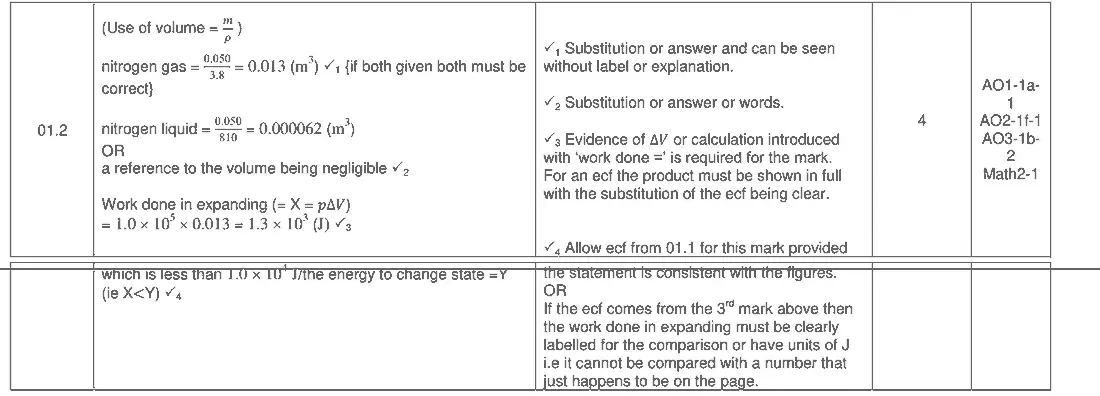
1.2 This was a more difficult calculation, with just over half of the cohort scoring at least 2 out of 4. More successful students typically managed to determine the volumes of the gaseous and liquid forms of nitrogen. The top 30% scored full marks and were able to reference and manipulate the appropriate equation. A significant minority did not understand the nature of the required comparison.
Notes from the mark scheme and report
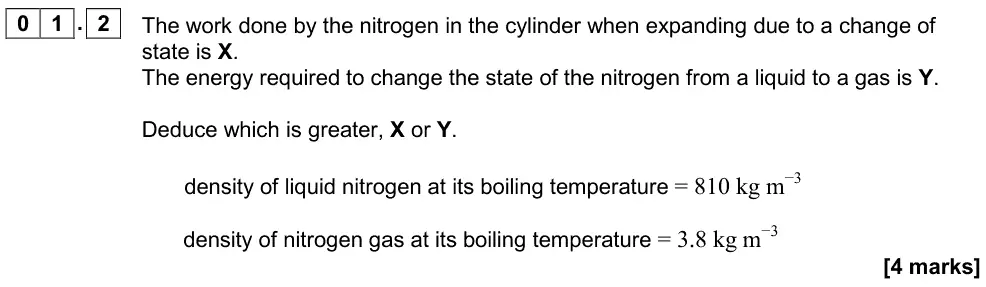
Answer: Y greater (gas volume 0.013 m^3, liquid volume 6.2 x 10^-5 m^3 negligible
X = p delta V = 1.3 x 10^3 J < Y = 1.0 x 10^4 J)
comparison must be consistent with figures
many did not understand the comparison
Skills: MS2.3 Substitute numerical values into algebraic equations using appropriate units for physical quantities; MS0.3 Use ratios, fractions and percentages
June 2019 · Paper 2 · Q2.12 marksShort answerEasy
Mark scheme
Examiner's comment
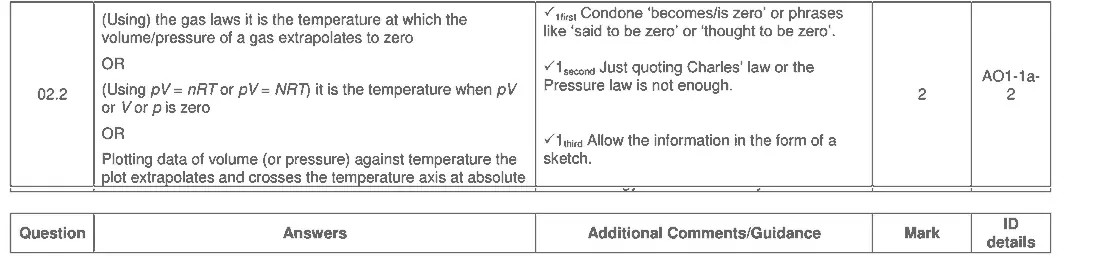
2.1 At least one of the two marks was scored by 75% of the students. A lack of detail in the answer generally meant the student failed to gain the second mark. References to total energy or particles/atoms were sometimes missing.
Notes from the mark scheme and report
Sum of the (randomly distributed) kinetic and potential energies of the particles
an average energy is not internal energy
reference to kinetic energy earns mark 2
June 2019 · Paper 2 · Q2.22 marksShort answer
Earlier part of question 2 that this part uses
Mark scheme
Examiner's comment
2.2 Most answers were correct but sometimes only one interpretation was given. A significant number of scripts referred incorrectly to the vibration of the gas molecules. This affected the score when the student suggested that at absolute zero the molecules stopped vibrating; examiners did not take this to mean ‘stationary’. Some students simply gave a value of absolute zero in degrees Celsius or they simply described it as the lowest possible temperature. Overall, half the students scored full marks.
Notes from the mark scheme and report
Gas laws: temperature at which p (or V) of an ideal gas extrapolates to zero
kinetic theory: temperature at which random motion stops / mean KE is zero
'stop vibrating' not accepted
half scored full marks
June 2019 · Paper 2 · Q2.33 marksCalculationHard
Earlier part of question 2 that this part uses
Mark scheme
Examiner's comment
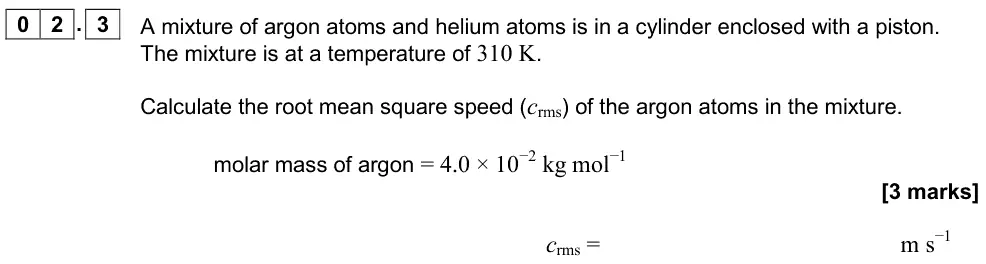
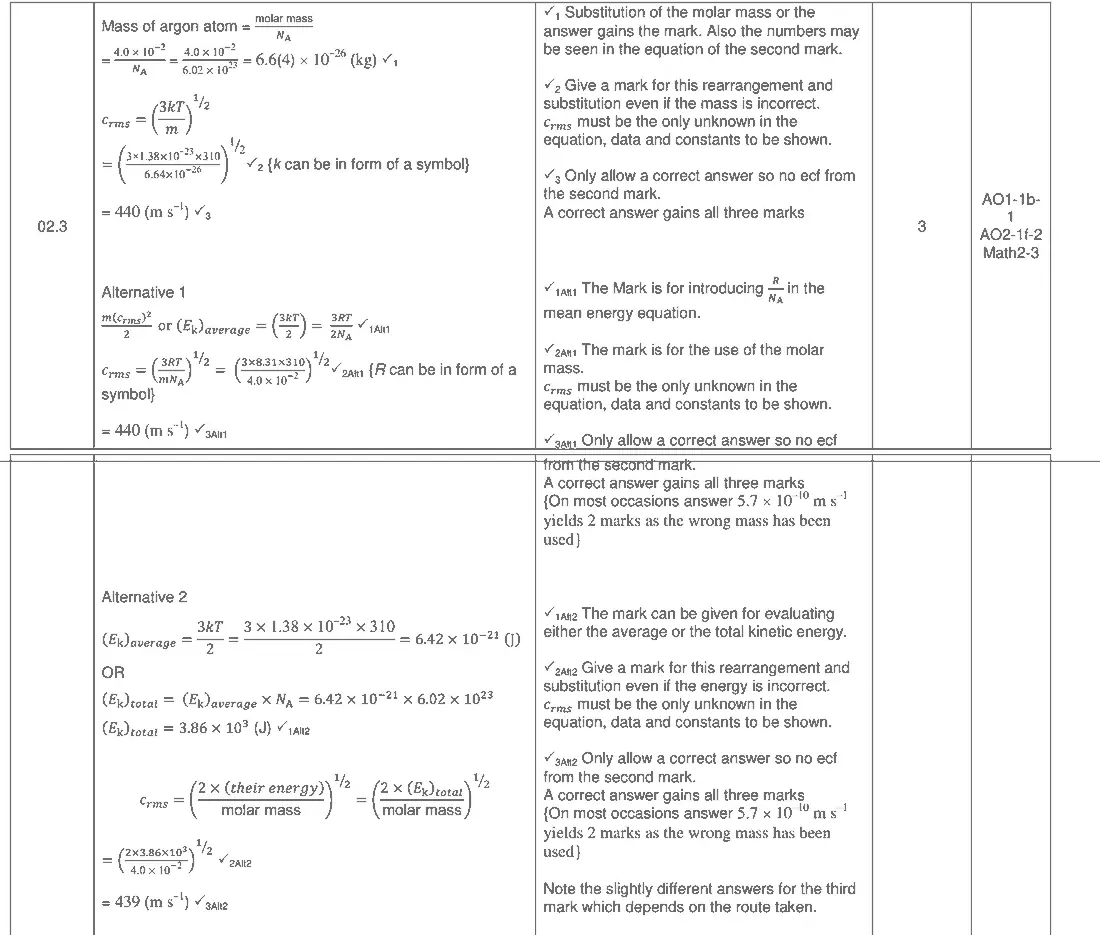
2.3 This question discriminated well. About a fifth of the students did not know a correct version of an equation involving crms that could be used to solve the problem. However, one third of the students scored full marks. Between these two extremes, scripts would show a correct working equation but data were not substituted into it correctly. Often there was a confusion between molecular and molar masses.
Notes from the mark scheme and report
Answer: 440 m s^-1 (m = 0.040 / 6.02 x 10^23 = 6.64 x 10^-26 kg
crms = root(3kT/m))
confusion of molar and molecular mass
about a fifth knew no correct equation
Skills: MS2.2 Change the subject of an equation, including non-linear equations; MS2.3 Substitute numerical values into algebraic equations using appropriate units for physical quantities
June 2018 · Paper 2 · Q1.12 marksShort answer
Mark scheme
Examiner's comment
01.1 Most students seemed to be completely aware of what was being asked but their answers commonly fell short because of missing details. Less than half referred to the absence of a change in temperature and many also missed stating which change of state was occurring and that a unit mass was involved.
Notes from the mark scheme and report
Energy needed to change 1 kg (unit mass) from solid to liquid, without change of temperature
fewer than half mentioned no temperature change
many omitted unit mass or which change of state
June 2018 · Paper 2 · Q1.23 marksCalculationEasy
Earlier part of question 1 that this part uses
Mark scheme
Examiner's comment
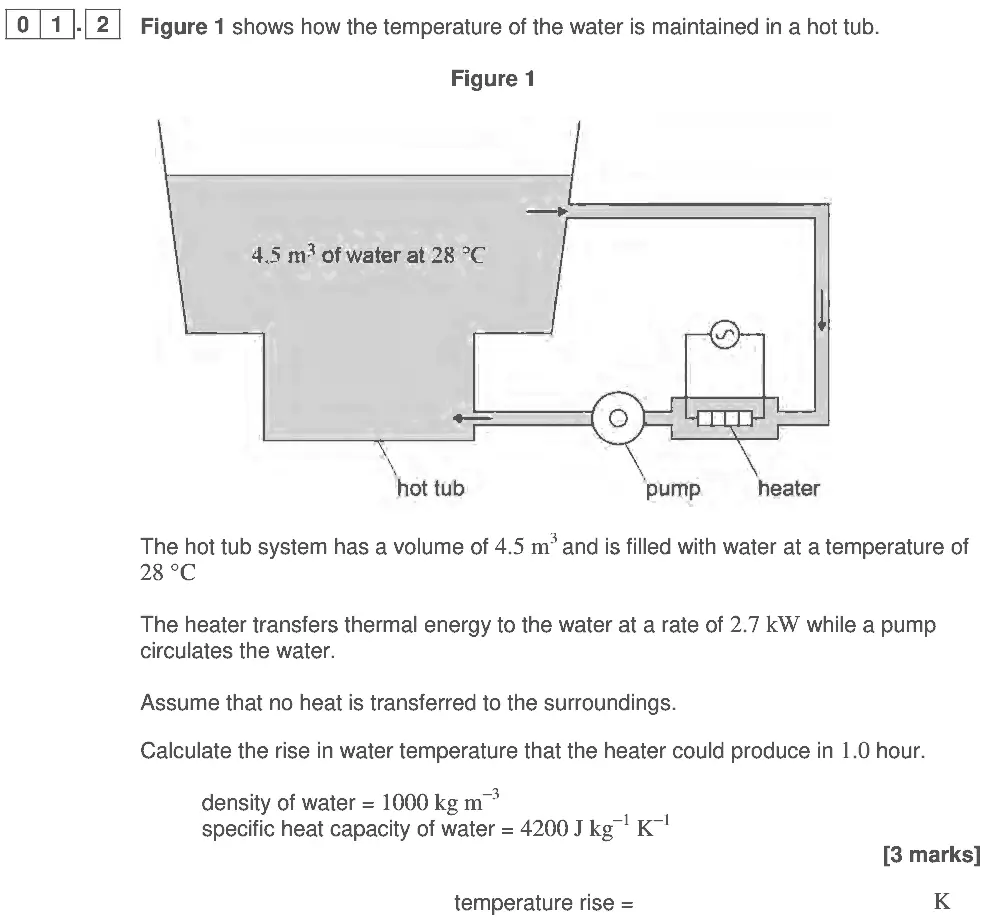
01.2 A majority performed this calculation well and with a good degree of clarity (64.5% of students scored all three marks). One error made by normally competent students was to give the final temperature rather than the rise in temperature. The other and more common fault was to quote an answer to only one significant figure. Only the very weak students made faults in re-arranging the equations.
Notes from the mark scheme and report
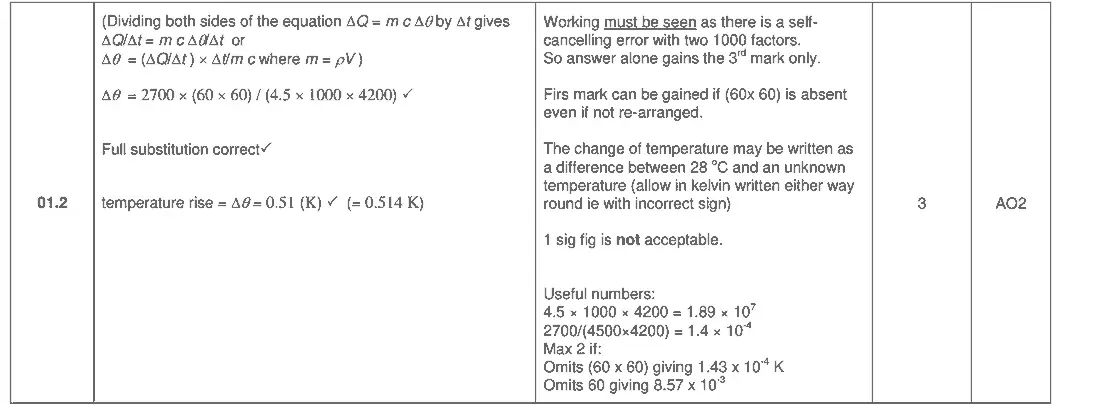
Answer: 0.51 K (2700 x 3600 / (4.5 x 1000 x 4200))
working needed
giving the final temperature or 1 sf answers lost marks
Skills: MS2.2 Change the subject of an equation, including non-linear equations; MS2.3 Substitute numerical values into algebraic equations using appropriate units for physical quantities; MS1.1 Use an appropriate number of significant figures
June 2018 · Paper 2 · Q1.32 marksExplanationHard
Earlier part of question 1 that this part uses
Mark scheme
Examiner's comment
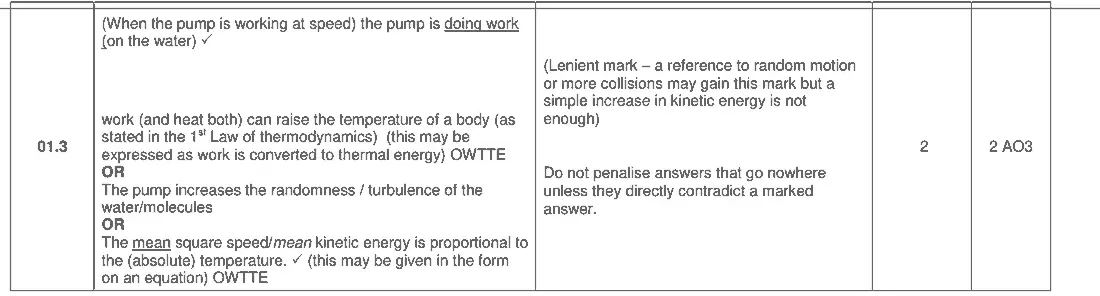
01.3 It was a common misconception that the time it took for the water to pass the heater had an effect on the average rise in temperature. This could have been a possibility if the question had not said that heat was not lost to the surroundings. The other error seen was for students to relate kinetic energy of the whole body of water to the temperature. It is the mean kinetic energy of the random motion of molecules that is related to temperature. In addition, very few students picked up on the idea that work done, as well as heating, can raise the temperature. Nearly three-quarters of students failed to score.
Notes from the mark scheme and report
Pump does work on the water
work as well as heating raises internal energy and temperature (more random molecular motion)
time near the heater and bulk KE of water were common misconceptions
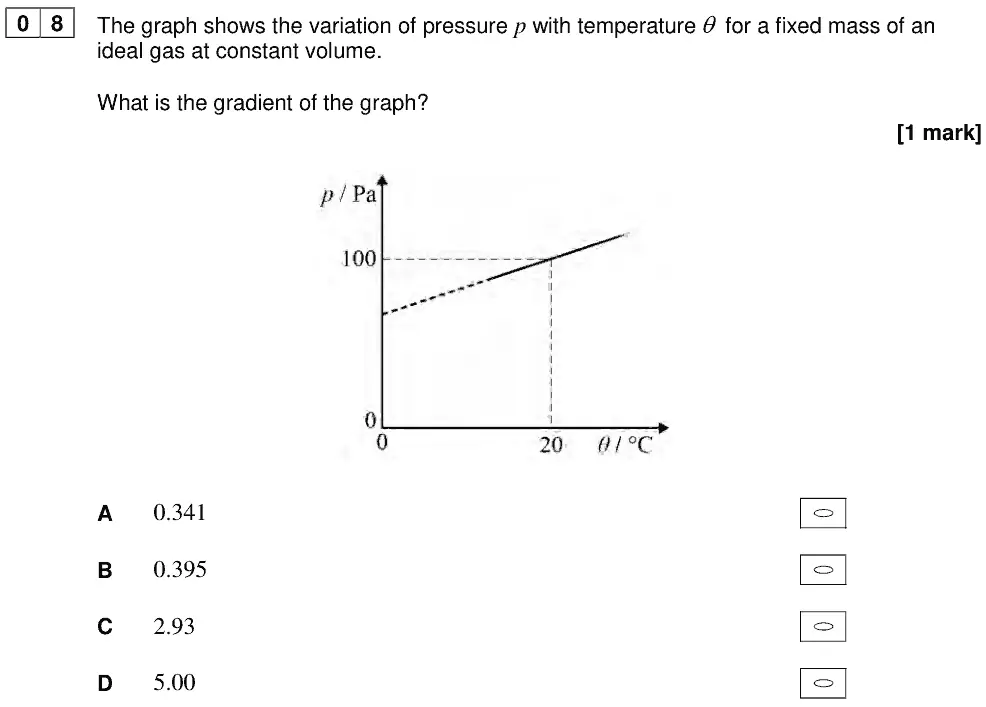
June 2018 · Paper 2 · Q81 markMultiple choice
Answer
A
Notes from the mark scheme and report
Answer: A
Skills: MS3.4 Determine the slope and intercept of a linear graph
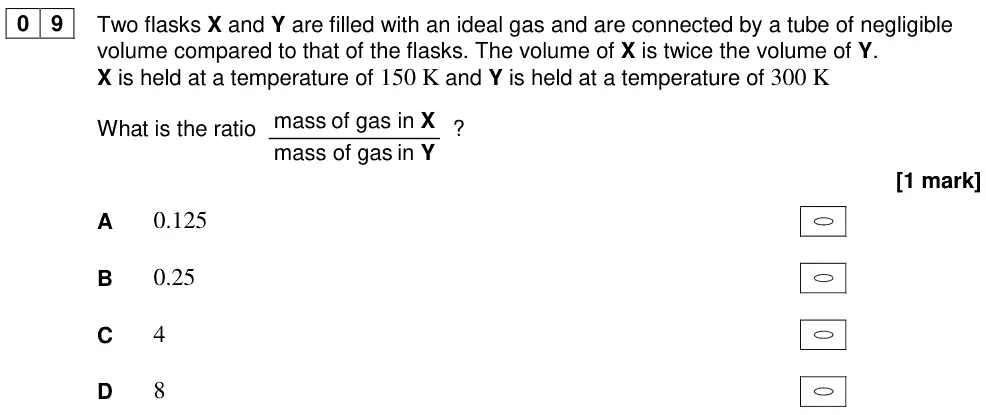
June 2018 · Paper 2 · Q91 markMultiple choice
Answer
C
Notes from the mark scheme and report
Answer: C
Skills: MS0.3 Use ratios, fractions and percentages
June 2018 · Paper 3 Section A · Q3.12 marksExplanationHard
Mark scheme
Examiner's comment
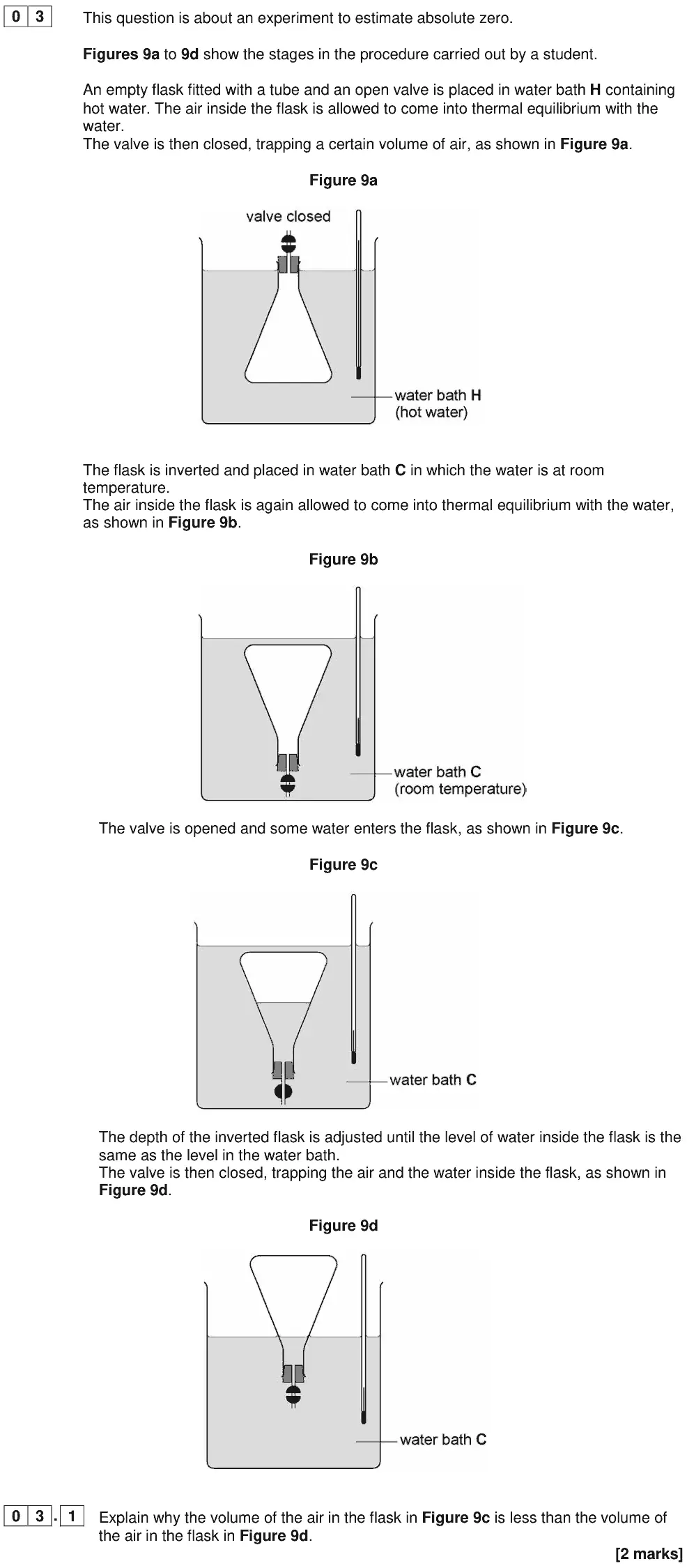
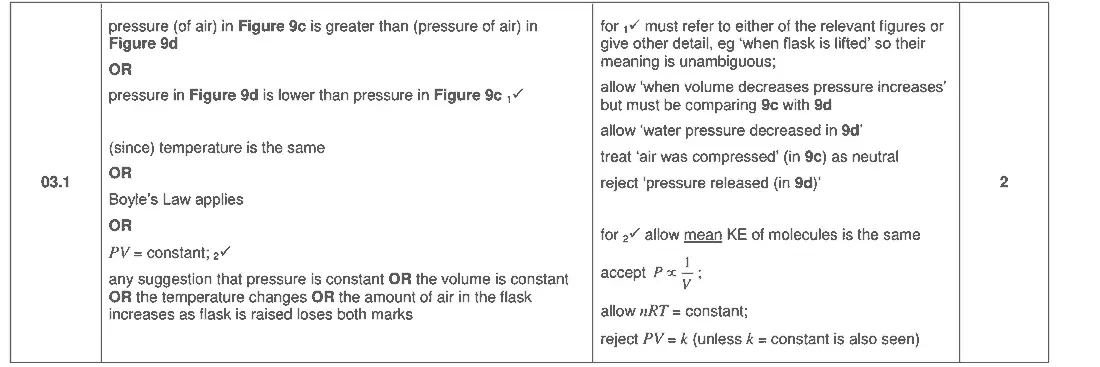
03.1 Many students stated that the volume of air in 9c was less because water had entered the flask, but the better students realised that the expected response was that the pressure of the air had increased. Only 16% qualified their answer by adding that the temperature was the same for the situations in 9c and 9d, or that Boyle’s Law could be applied. Some disqualified themselves by stating that air entered the flask as it was raised. Knowledge of the gas laws seemed generally patchy, with only approximately 40% of students making progress with this question or with 03.2.
Notes from the mark scheme and report
Pressure of trapped air is greater in 9c than 9d at the same temperature, so by Boyle's law (pV constant) volume is smaller
Skills: RP8 Investigation of Boyle's law (constant temperature) and Charles’s law (constant pressure) for a gas.
June 2018 · Paper 3 Section A · Q3.22 marksExplanationHard
Earlier part of question 3 that this part uses
Mark scheme
Examiner's comment
03.2 Many answers suggested that Charles’s Law was even less well understood than Boyle’s Law. Only the better students realised that they were being asked to give two conditions that should be met if Charles’s Law is to apply. While some correctly stated that pressure must remain the same, only 7% added that the mass of gas must be constant.
03.1 Many students stated that the volume of air in 9c was less because water had entered the flask, but the better students realised that the expected response was that the pressure of the air had increased. Only 16% qualified their answer by adding that the temperature was the same for the situations in 9c and 9d, or that Boyle’s Law could be applied. Some disqualified themselves by stating that air entered the flask as it was raised. Knowledge of the gas laws seemed generally patchy, with only approximately 40% of students making progress with this question or with 03.2.
The students’ knowledge of most of the core physics was generally sound. Most knew the assumption examiners were looking for in 01.1, although few could give both conditions to justify the application of Charles’s Law in 03.2.
Notes from the mark scheme and report
Same pressure (water levels equal, atmospheric) and same mass of air
Skills: RP8 Investigation of Boyle's law (constant temperature) and Charles’s law (constant pressure) for a gas.
June 2018 · Paper 3 Section A · Q3.33 marksPractical and data analysisHard
Earlier part of question 3 that this part uses
Mark scheme
Examiner's comment
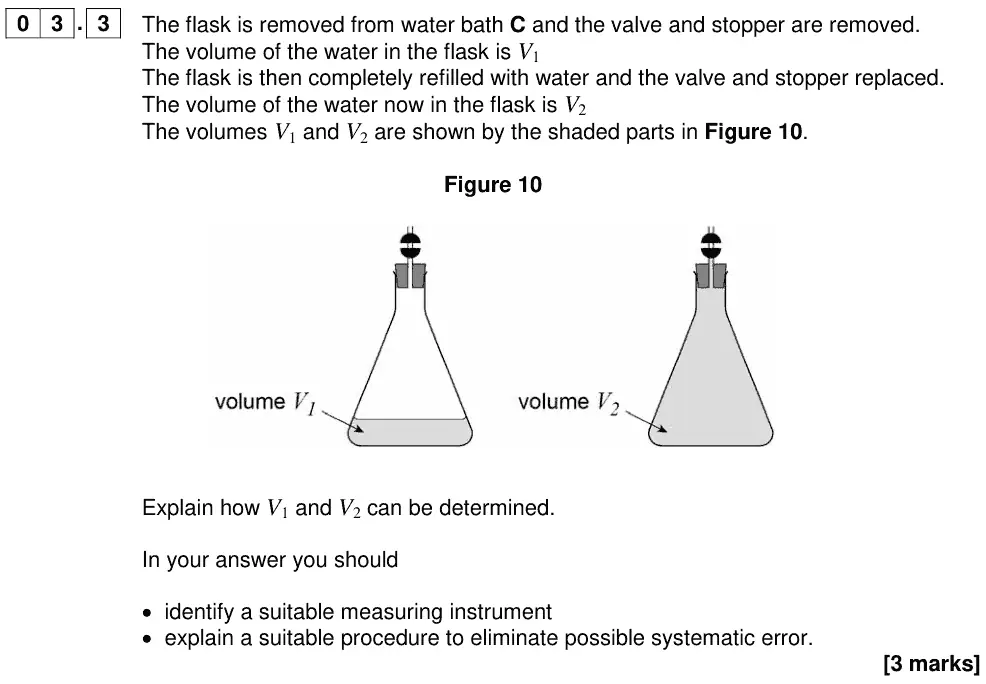
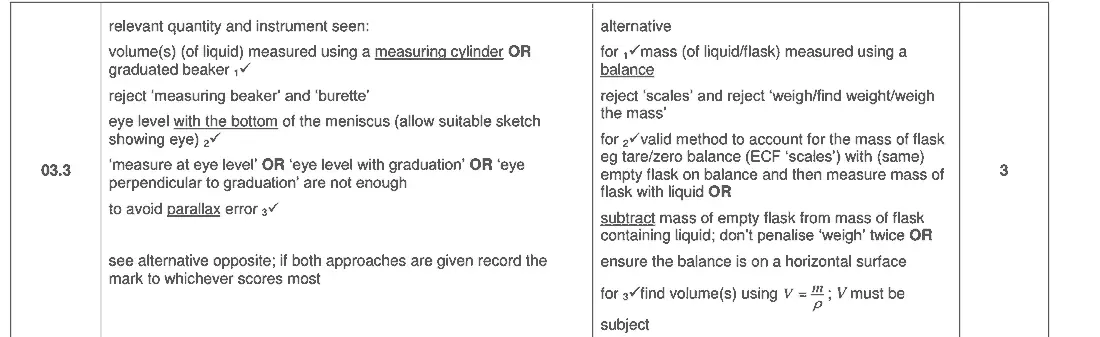
03.3 The direct and the indirect approaches to finding the volumes proved equally popular, but a small minority of students tried unsuccessfully to use some variant of the gas laws. Examiners expected a measuring cylinder to be used for the direct method and wanted students to explain that the reading was taken with the eye level with the bottom of the meniscus to avoid parallax error. Very few could give a completely correct response. For the indirect approach, examiners gave no credit for ‘scales’ rather than ‘balance’ (the instrument had been clearly identified in question 1) and rejected the idea that mass could be ‘weighed’. However, many students gave a sensible way to account for the mass of the flask when determining the mass of water and could explain how the volume was obtained, as the density was known. Examiners did not allow “1 g = 1 cm3”, variants of which were seen rather too frequently. As with question 01.6, students frequently wrote more than they needed to, yet the number scoring all three marks (5.1%) was disappointing.
However, some of the underlying problems seen on the 2017 paper still persist. Misuse of technical vocabulary is still widespread, with many students referring to balances as ‘scales’ on which mass is ‘weighed’ in question 03.3. In 02.1, many stated that their ruler was ‘straight’ when they should have written ‘vertical’. Elsewhere, slipshod use of basic language proved costly, for example in question 01.6 where some students described a sequence of steps that were probably unintended. Students continue to improvise when required to describe practical procedures, suggesting that their experience of laboratory work is mostly confined to meeting the demands of the 12 required practical activities. In 02.1, few could explain simple steps to measure the sag of the tape measure.
02.5 The work seen here was sometimes very good and two-thirds of students could at least produce a suitable value for A. The problem for many was identifying the order of magnitude (most simply copied their result for A onto the answer line). To a lesser extent, many struggled to identify the unit, particularly when a non-integer was given for n. For a typical value of A, using the top row in Table 2, a result of 1.99 × 10⁻⁷ was routinely obtained. Examiners accepted −7 or 10−7 for the order of magnitude and cm−3 for the unit. A non-integer n such as 3.3 would produce A = 6.09 × 10⁻⁶ so the order of magnitude is −5 and the unit cm−2.3. As with question 02.4, all the marking points were accessible, but it was unusual to see all scored together; just less than 10% gained full credit.
Notes from the mark scheme and report
Measuring cylinder read with eye level with the bottom of the meniscus (parallax)
or balance, tare with empty flask, then V = m/rho
'scales' and '1 g = 1 cm^3' rejected
Skills: PS4.1 Know and understand how to use a wide range of experimental and practical instruments, equipment and techniques; PS2.3 Evaluate results and draw conclusions with reference to measurement uncertainties and errors; ATa analogue apparatus to record measurements and interpolate; RP8 Investigation of Boyle's law (constant temperature) and Charles’s law (constant pressure) for a gas.
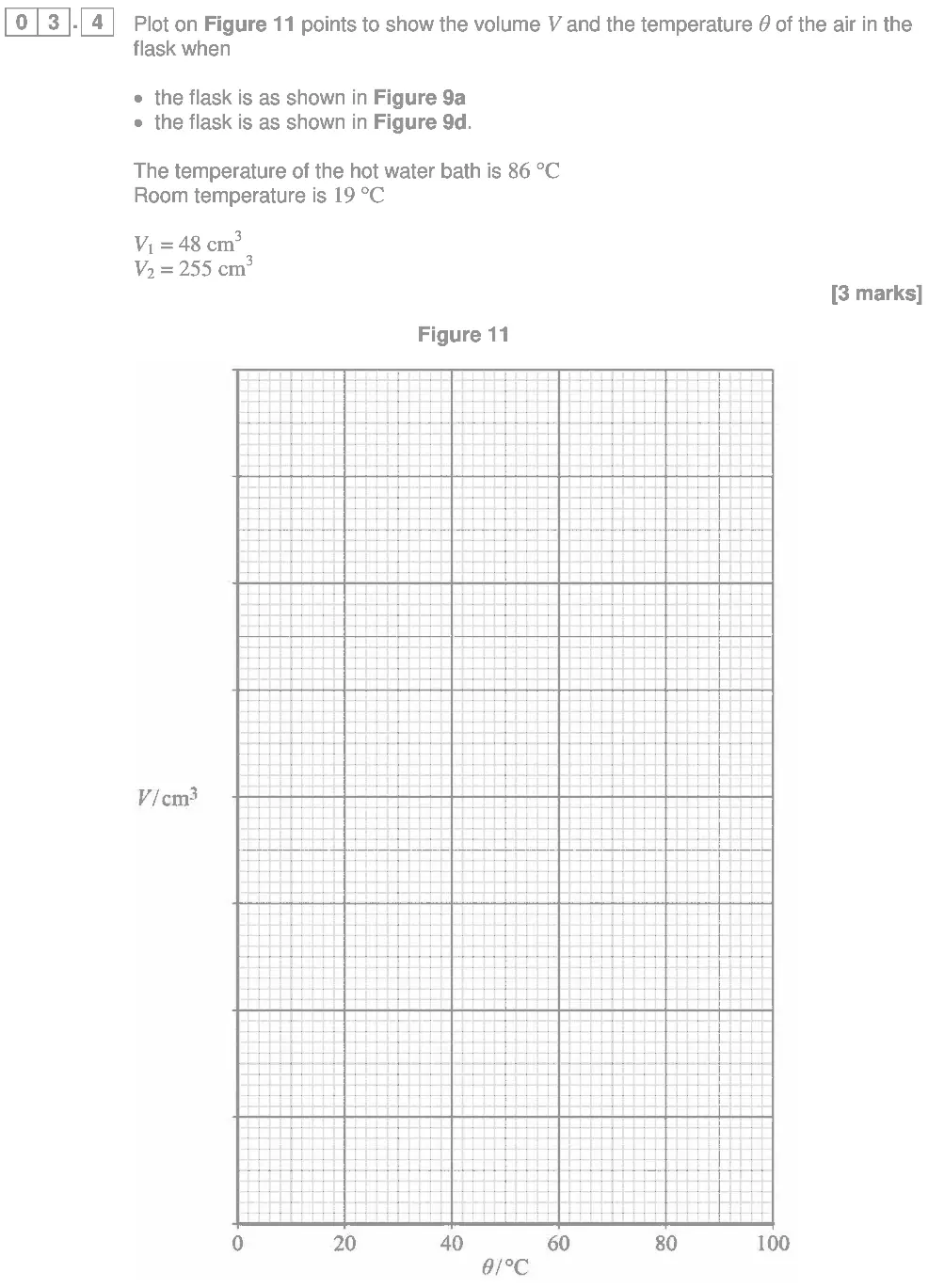
June 2018 · Paper 3 Section A · Q3.43 marksDiagram or graph
Earlier part of question 3 that this part uses
Mark scheme
Examiner's comment
03.4 Many students plotted (19, 48) which probably saved the graph scaling mark but ruined their chances of earning full credit in question 03.6. Those plotting the correct (19, 207) and (86, 255) often chose to include the origin, compressing the scale. A minority plotted (19, 255) and (86, 48), producing a graph with a negative gradient. Nearly 60% of the students scored at least two marks.
03.6 The work here was sometimes very good and usually easy to follow. Even when the line had been drawn to pass through (19, 207), producing a small positive value for absolute zero, the students tried a logical approach to the problem and duly gained some credit. Clearly at this point, the students who had produced a graph with a negative gradient should have been asking themselves some serious questions, so it was disappointing to see how few revisited question 03.4 rather than optimistically writing down −273. Students need to be reminded they should inspect their work before moving on. Those who did everything right but omitted the minus sign with their result would be annoyed by their oversight. Over half of the students made some progress and more than 20% obtained full credit.
More encouragingly, many students wrote in question 01.6 with confidence, structuring logical and coherent responses to the experimental design exercise and, in many cases, earning full credit. In contrast to the work seen in 2017, better solutions to multi-stage calculations were seen, the best example being in question 03.6, although many were also able to make some progress in questions 01.3 and 02.4. However, disappointing numbers of students remain oblivious to what an integer is (question 02.3), or how to express the order of magnitude of a number (question 02.5). Students should be discouraged from showing intermediate results in fractional form as this reduces the transparency of their work. The quality of the graph work in 03.4 was mixed, with many students choosing a poor scale.
Notes from the mark scheme and report
Plot (19, 207) and (86, 255): air volume at 19 C is V2 - V1 = 207 cm^3
false origin on V axis with sensible scale
plotting (19, 48) was common
Skills: MS3.2 Plot two variables from experimental or other data; PS2.2 Present data in appropriate ways; RP8 Investigation of Boyle's law (constant temperature) and Charles’s law (constant pressure) for a gas.
June 2018 · Paper 3 Section A · Q3.51 markDiagram or graph
Earlier part of question 3 that this part uses
Mark scheme
Examiner's comment
03.5 The lines drawn were of mixed quality. Unfortunately, some students forced the line through the origin. Examiners expected the line to pass through both plotted points, yet over 40% of students were unable to score.
Notes from the mark scheme and report
Ruled line through both points (not forced through the origin)
Skills: MS3.2 Plot two variables from experimental or other data; RP8 Investigation of Boyle's law (constant temperature) and Charles’s law (constant pressure) for a gas.
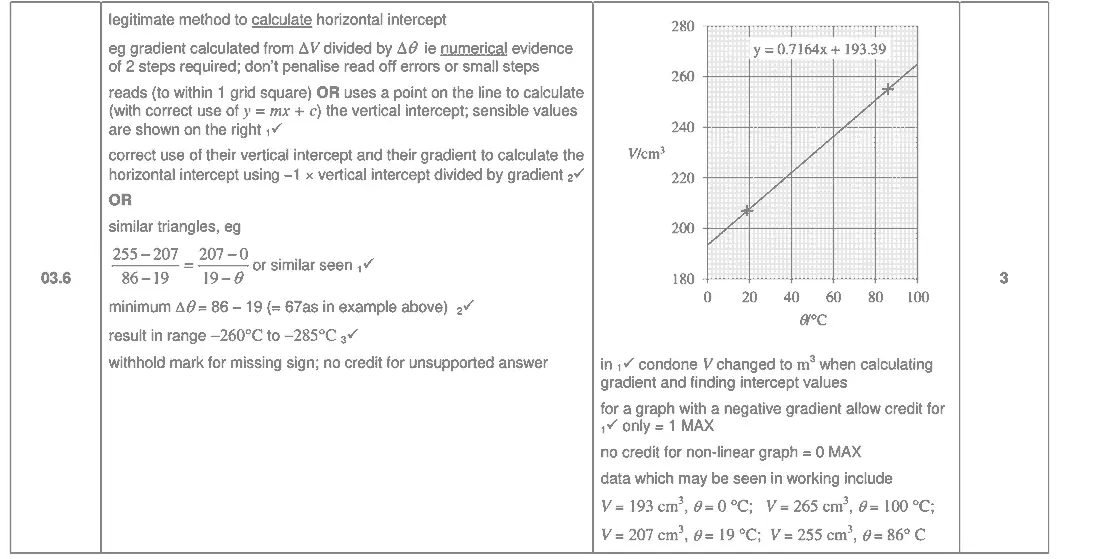
June 2018 · Paper 3 Section A · Q3.63 marksPractical and data analysis
Earlier part of question 3 that this part uses
Mark scheme
Examiner's comment
03.6 The work here was sometimes very good and usually easy to follow. Even when the line had been drawn to pass through (19, 207), producing a small positive value for absolute zero, the students tried a logical approach to the problem and duly gained some credit. Clearly at this point, the students who had produced a graph with a negative gradient should have been asking themselves some serious questions, so it was disappointing to see how few revisited question 03.4 rather than optimistically writing down −273. Students need to be reminded they should inspect their work before moving on. Those who did everything right but omitted the minus sign with their result would be annoyed by their oversight. Over half of the students made some progress and more than 20% obtained full credit.
03.4 Many students plotted (19, 48) which probably saved the graph scaling mark but ruined their chances of earning full credit in question 03.6. Those plotting the correct (19, 207) and (86, 255) often chose to include the origin, compressing the scale. A minority plotted (19, 255) and (86, 48), producing a graph with a negative gradient. Nearly 60% of the students scored at least two marks.
More encouragingly, many students wrote in question 01.6 with confidence, structuring logical and coherent responses to the experimental design exercise and, in many cases, earning full credit. In contrast to the work seen in 2017, better solutions to multi-stage calculations were seen, the best example being in question 03.6, although many were also able to make some progress in questions 01.3 and 02.4. However, disappointing numbers of students remain oblivious to what an integer is (question 02.3), or how to express the order of magnitude of a number (question 02.5). Students should be discouraged from showing intermediate results in fractional form as this reduces the transparency of their work. The quality of the graph work in 03.4 was mixed, with many students choosing a poor scale.
Notes from the mark scheme and report
Answer: about -270 C (range -260 to -285
gradient about 0.72 cm^3 per C, V-intercept 193 cm^3, theta = -intercept/gradient)
missing minus sign penalised
Skills: MS3.4 Determine the slope and intercept of a linear graph; MS3.3 Understand that y = mx + c represents a linear relationship; RP8 Investigation of Boyle's law (constant temperature) and Charles’s law (constant pressure) for a gas.
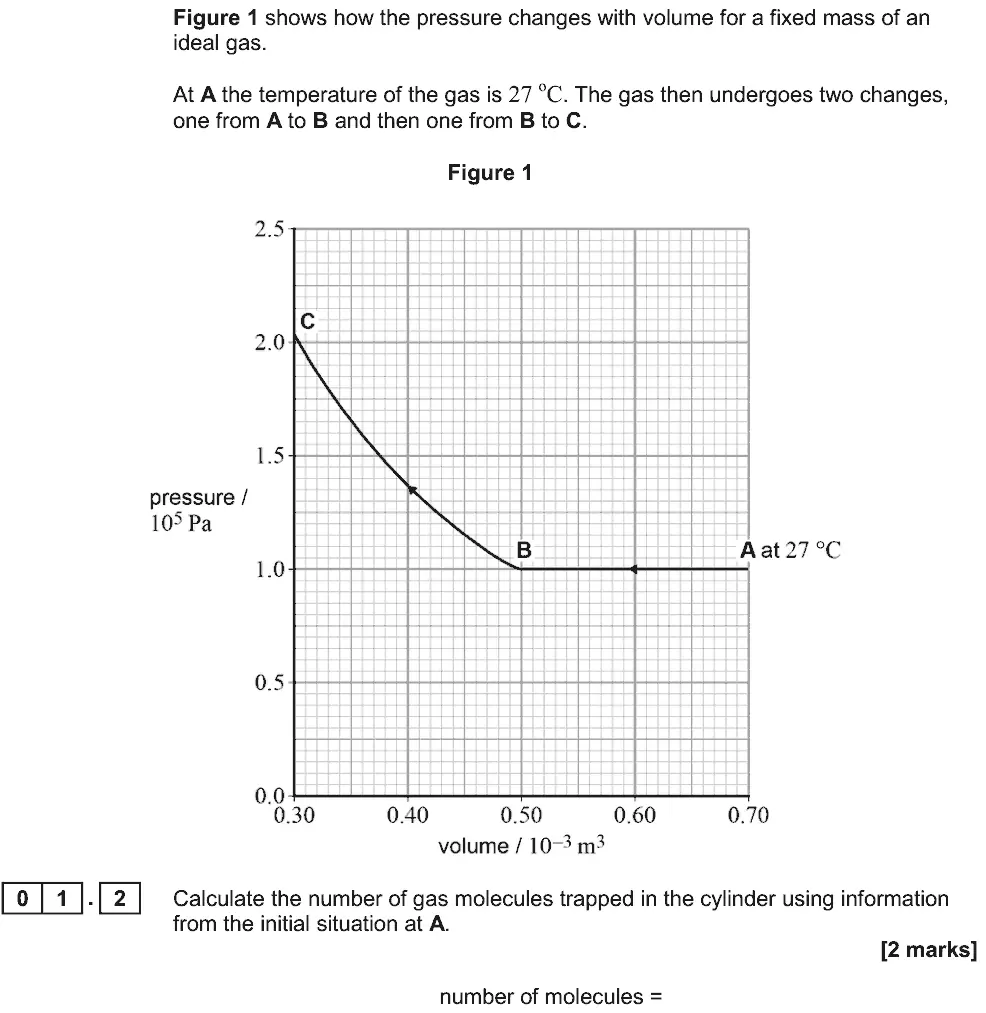
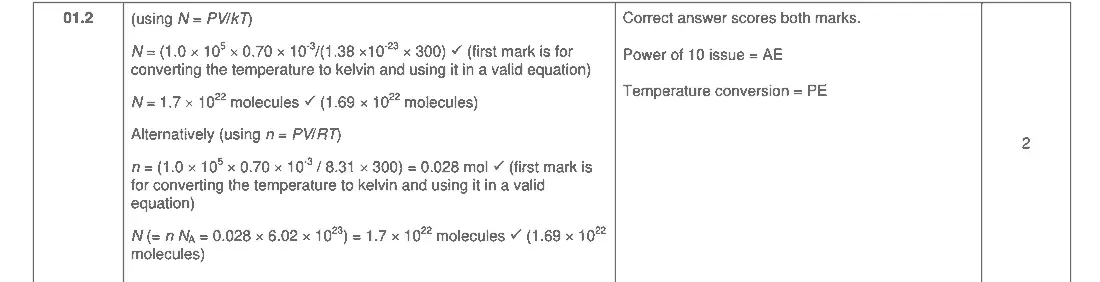
June 2017 · Paper 2 · Q1.22 marksCalculation
Earlier part of question 1 that this part uses
Mark scheme
Examiner's comment
01.2 It was only the less able students who failed to get full marks in this calculation. The main errors were to use the temperature in Celsius when Kelvin should have been used, or to have arithmetic errors. Also some scripts showed an obvious confusion between n moles and N molecules.
Notes from the mark scheme and report
Answer: 1.7 x 10^22 molecules (N = pV/kT with T = 300 K, V = 0.70 x 10^-3 m^3, p = 1.0 x 10^5 Pa)
using Celsius, confusing n and N
Skills: MS2.3 Substitute numerical values into algebraic equations using appropriate units for physical quantities; MS3.1 Translate information between graphical, numerical and algebraic forms
June 2017 · Paper 2 · Q1.32 marksCalculation
Earlier part of question 1 that this part uses
Mark scheme
Examiner's comment
01.3 Here, again, the majority of students found the question straightforward and either used the proportionality between volume and pressure, or used the ideal gas equation to calculate the new temperature. Other students seemed to make up their own equations or, again, had trouble over which temperature units to use.
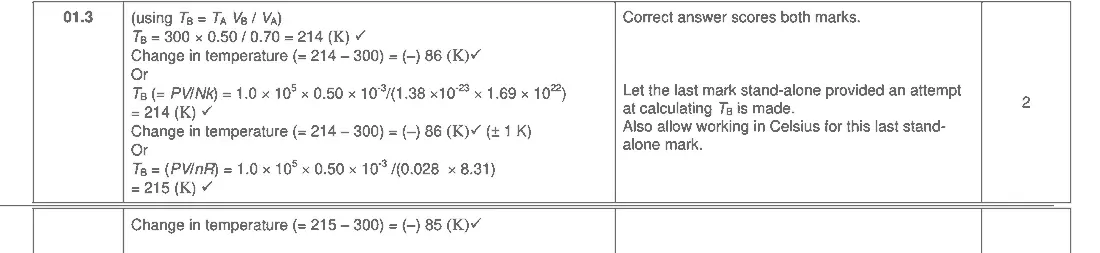
Notes from the mark scheme and report
Answer: (-)86 K (constant pressure: TB = 300 x 0.50/0.70 = 214 K)
Skills: MS0.3 Use ratios, fractions and percentages; MS3.1 Translate information between graphical, numerical and algebraic forms
June 2017 · Paper 2 · Q1.42 marksCalculation
Earlier part of question 1 that this part uses
Mark scheme
Examiner's comment
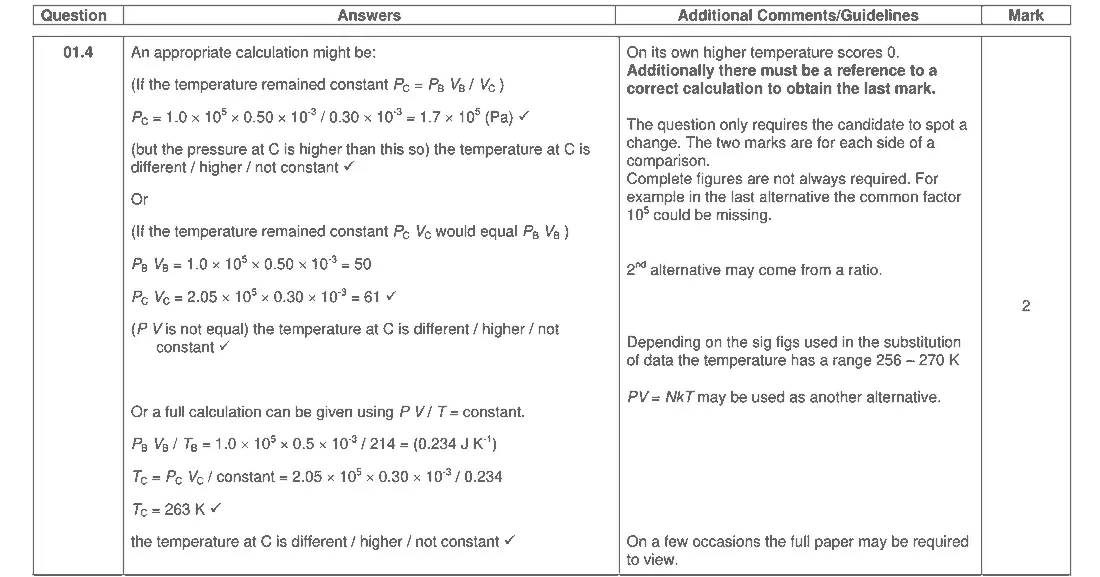
01.4 This turned out to be a discriminating question. What distinguished the more able student was not only to have the knowledge to calculate the new temperature, but the ability to deduce what must remain constant if the temperature was constant. They then could interpret their calculations in a clear fashion. They could provide a statement as simple as, ‘if the temperature were constant then PV would be constant, which is not the case’. Less able students tended to give an array of numbers with very little calculation. They also showed errors in substituting the wrong data.
07.4 The students who took the very straightforward approach and calculated the escape velocity were very successful in this question. However, a majority of students made errors. Many did not know the escape velocity equation or could not get to it from the conservation of energy. Other students referred to the top of the graph, Figure 8, at a potential of -1.4 × 10⁵ J kg-1 as being the point at which the ice escapes, which is a physics error.
Notes from the mark scheme and report
If T were constant pV would be constant: pB VB = 50 J but pC VC = 61 J (or pC would be 1.7 x 10^5 Pa), so T changes (TC about 263 K)
'higher temperature' without a calculation scores 0
Skills: MS3.1 Translate information between graphical, numerical and algebraic forms; MS2.3 Substitute numerical values into algebraic equations using appropriate units for physical quantities
June 2017 · Paper 2 · Q1.53 marksCalculationHard
Earlier part of question 1 that this part uses
Mark scheme
Examiner's comment
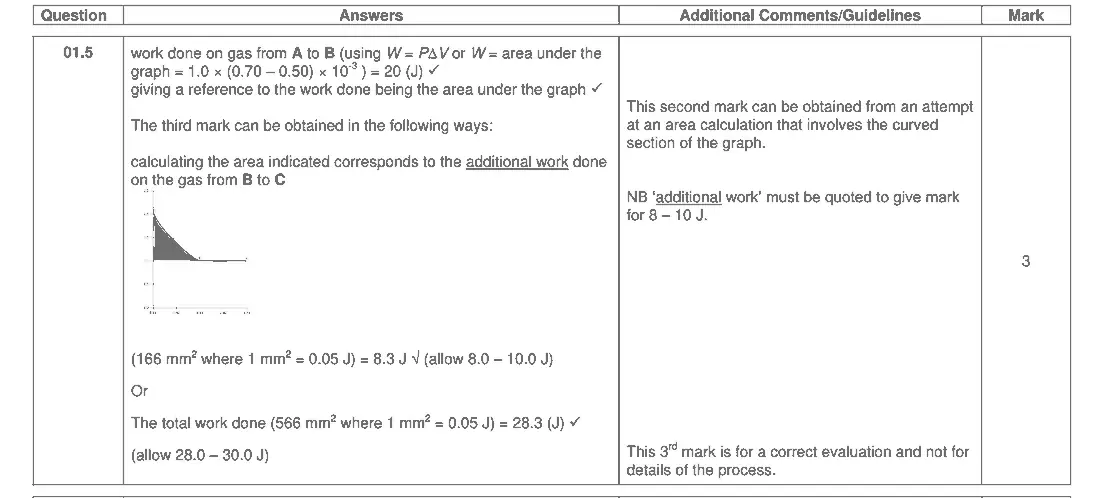
01.5 Students found this question very difficult, with only about one third scoring any marks. A majority did not have the knowledge even to perform the first task that involved W = P∆V. Many launched into ‘internal energy of a gas’ equations. As a result, some of these thought that negative work was done on the gas, because the temperature falls between A and B. Not many students were aware of the connection between work done on the gas and the area under a P – V graph. Even the students who did know, calculated the area from B to C incorrectly by only considering the increase in area.
Notes from the mark scheme and report
Answer: A to B 20 J (p delta V, area under graph)
B to C about 28 J (8-10 J more)
must link work done to area under the p-V graph
many used internal-energy ideas or only the extra area
Skills: MS3.8 Understand the possible physical significance of the area between a curve and the x axis and be able to calculate it or estimate it by graphical methods as appropriate; MS3.1 Translate information between graphical, numerical and algebraic forms
June 2017 · Paper 2 · Q81 markMultiple choice
Answer
B
Notes from the mark scheme and report
Answer: B
Skills: MS2.3 Substitute numerical values into algebraic equations using appropriate units for physical quantities
June 2017 · Paper 2 · Q91 markMultiple choice
Answer
A
Notes from the mark scheme and report
Answer: A
Skills: MS2.3 Substitute numerical values into algebraic equations using appropriate units for physical quantities
June 2017 · Paper 2 · Q101 markMultiple choice
Answer
C
Notes from the mark scheme and report
Answer: C
Skills: MS0.2 Recognise and use expressions in decimal and standard form
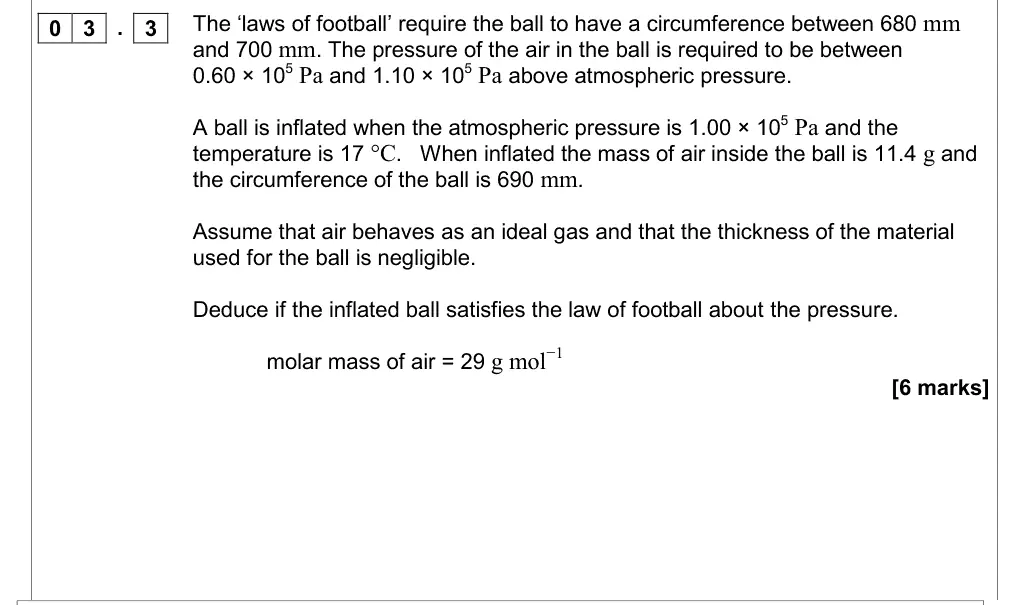
Specimen set 1 · Paper 2 · Q3.36 marksCalculation
Earlier part of question 3 that this part uses
Mark scheme
Notes from the mark scheme and report
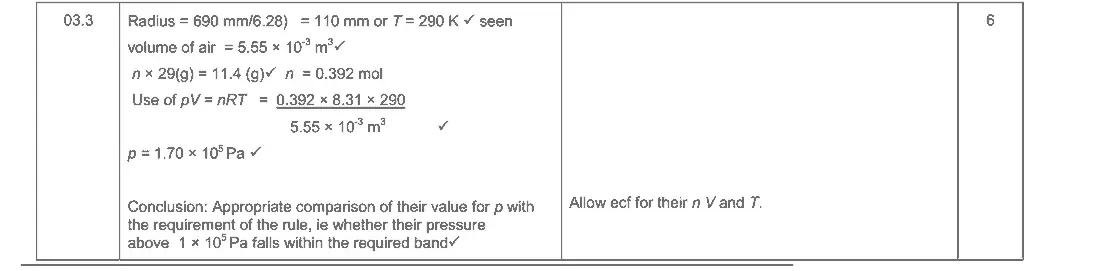
Answer: p = 1.70 x 10^5 Pa, i.e. 0.70 x 10^5 Pa above atmospheric so the ball satisfies the law (r = 0.110 m, V = 5.55 x 10^-3 m^3, n = 0.392 mol, T = 290 K)
conclusion must compare the excess pressure with the 0.60-1.10 x 10^5 Pa band
ecf allowed
Skills: MS4.3 Calculate areas of triangles, circumferences and areas of circles, surface areas and volumes of rectangular blocks, cylinders and spheres; MS2.3 Substitute numerical values into algebraic equations using appropriate units for physical quantities; MS0.2 Recognise and use expressions in decimal and standard form
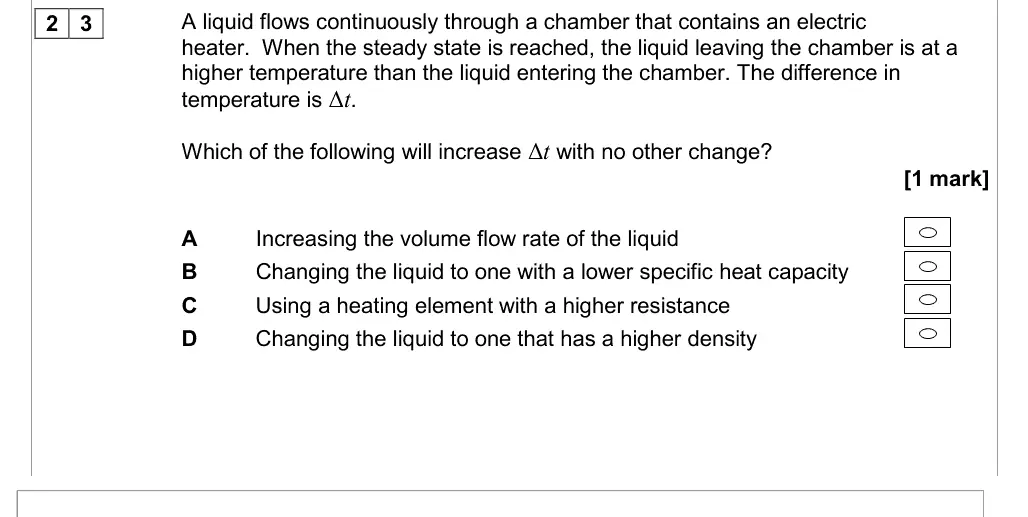
Specimen set 1 · Paper 2 · Q231 markMultiple choice
Answer
B
Notes from the mark scheme and report
Answer: B
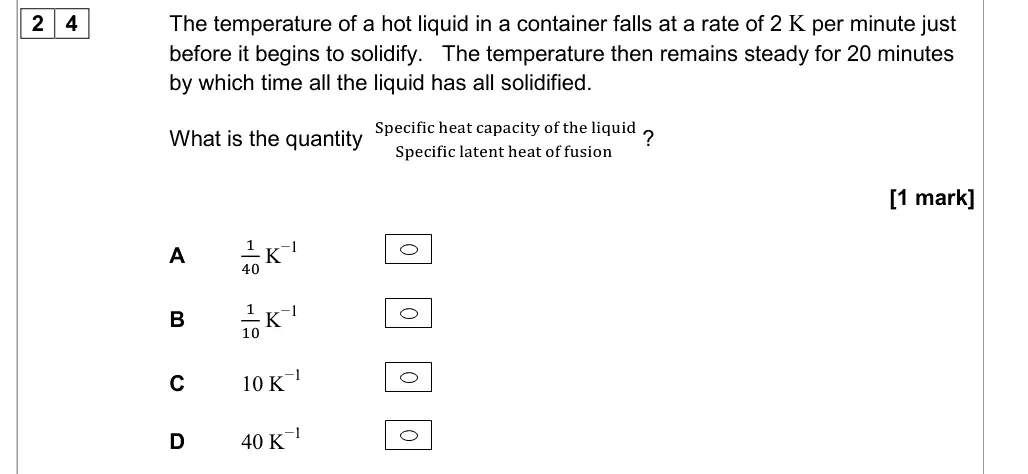
Specimen set 1 · Paper 2 · Q241 markMultiple choice
Answer
A
Notes from the mark scheme and report
Answer: A
Skills: MS0.3 Use ratios, fractions and percentages
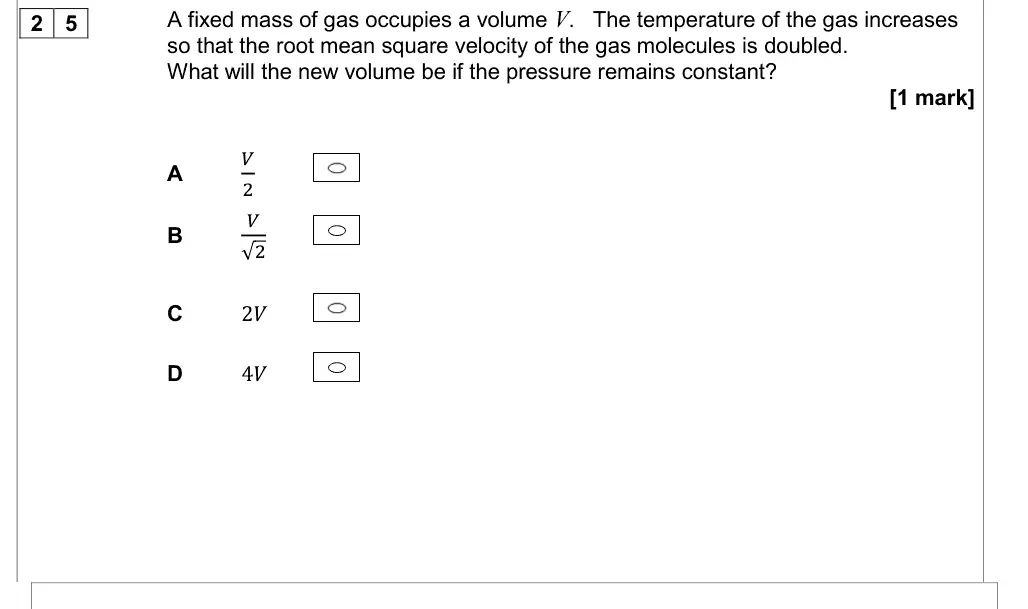
Specimen set 1 · Paper 2 · Q251 markMultiple choice
Answer
D
Notes from the mark scheme and report
Answer: D
Skills: MS0.3 Use ratios, fractions and percentages
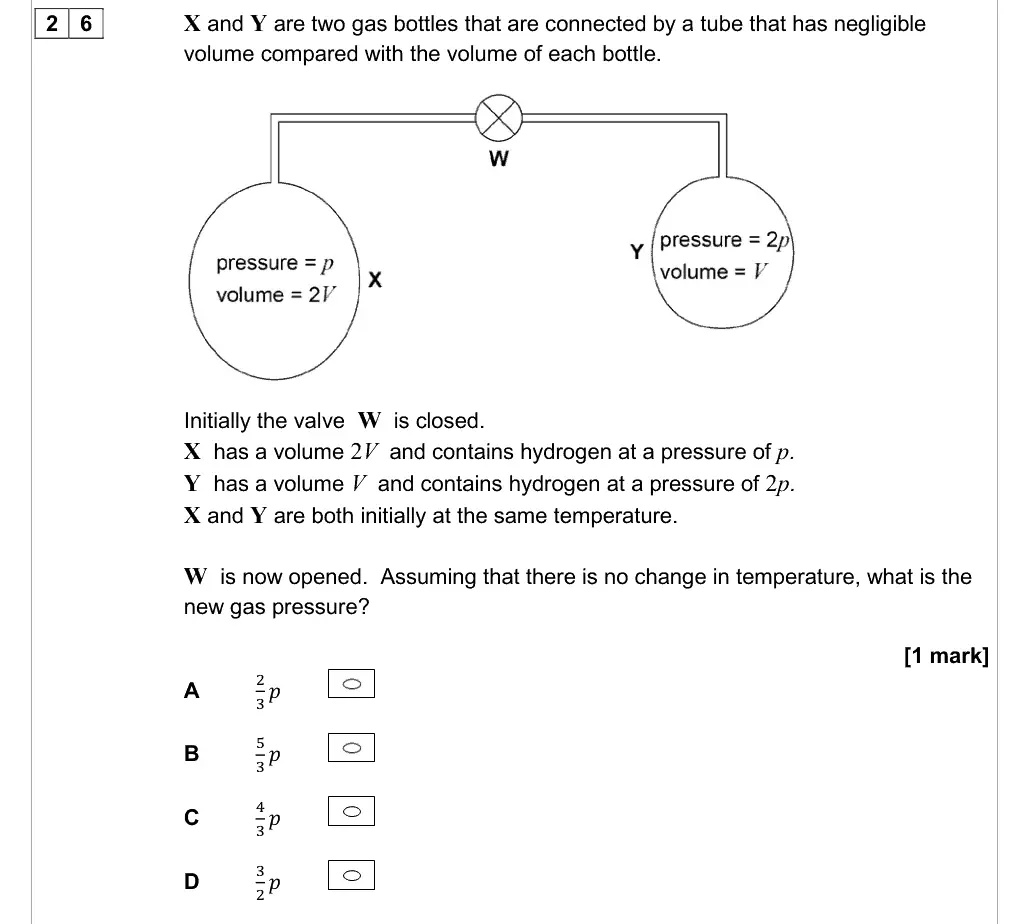
Specimen set 1 · Paper 2 · Q261 markMultiple choice
Answer
C
Notes from the mark scheme and report
Answer: C
Skills: MS0.3 Use ratios, fractions and percentages
Work with an AQA physics tutor
Dropping marks on calculations, required practicals or the six-markers? Book a trial session with a specialist AQA physics tutor.