3.11.2.2-05 Application of first law of thermodynamics to the above processes.
3.11.2.3-01 Representation of processes on p–V diagram.
3.11.2.3-02 Estimation of work done in terms of area below the graph.
3.11.2.3-03 Extension to cyclic processes: work done per cycle = area of loop
3.11.2.3-04 Expressions for work done are not required except for the constant pressure case, W = pΔV
3.11.2.4-01 Understanding of a four-stroke petrol engine cycle and a diesel engine cycle, and of the corresponding indicator diagrams.
3.11.2.4-02 Comparison with the theoretical diagrams for these cycles; use of indicator diagrams for predicting and measuring power and efficiency input power = calorific value × fuel flow rate
3.11.2.4-03 Indicated power as area of p−V loop × no. of cycles per second × no. of cylinders
3.11.2.4-04 Output or brake power, P = Tω friction power = indicated power – brake power
3.11.2.4-05 Engine efficiency; overall, thermal and mechanical efficiencies. Overall efficiency = brake power input power Thermal efficiency = indicated power input power Mechanical efficiency = indicated power brake power
3.11.2.4-06 A knowledge of engine constructional details is not required.
3.11.2.4-07 Questions may be set on other cycles, but they will be interpretative and all essential information will be given.
3.11.2.5-01 Impossibility of an engine working only by the First Law.
3.11.2.5-02 Second Law of Thermodynamics expressed as the need for a heat engine to operate between a source and a sink. efficiency = W QH = QH −QC QH maximum theoretical efficiency = TH − TC TH
3.11.2.5-03 Reasons for the lower efficiencies of practical engines.
3.11.2.5-04 Maximising use of W and QH for example in combined heat and power schemes.
3.11.2.6-01 Basic principles and uses of heat pumps and refrigerators.
3.11.2.6-02 A knowledge of practical heat pumps or refrigerator cycles and devices is not required.
3.11.2.6-03 Coefficients of performance: refrigerator: COPref = QC W = QH −QC = QC TH −TC TC
Tap a question to zoom it. Where a part needs a figure, table or graph from earlier in the question, that part folds out above it; the mark scheme and examiner's comment open underneath. Have the AQA data and formulae booklet beside you (see the formula sheet page).
June 2025 · Paper 3B Engineering physics · Q3.11 markAO1=1Short answer
Mark scheme
Examiner's comment
In 3.1, many students stated that an isothermal change involved no change in internal energy. Whilst this is true for an ideal gas, it does not take into account a change of state, for example. The required answer was that an isothermal change involves no change in temperature. More than half of the students gained this mark. To gain full marks for the calculation in 3.2, students had to match a temperature with a point on Figure 6. Students who used the incorrect temperature could still gain partial credit. Using the differences in temperature, volume or pressure meant a student gained no marks.
Notes from the mark scheme and report
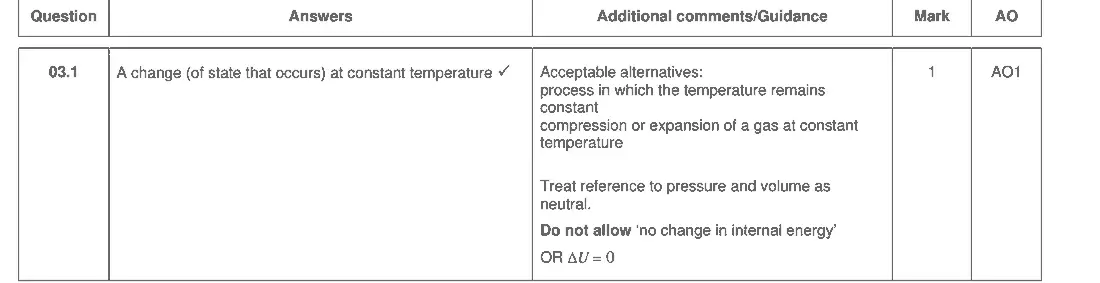
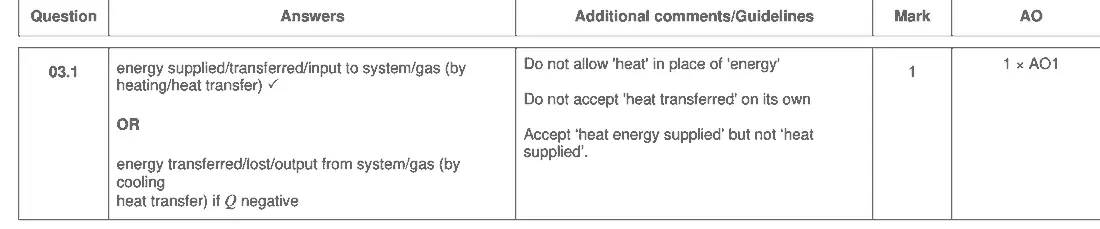
Change at constant temperature
'no change in internal energy' not accepted
more than half correct
June 2025 · Paper 3B Engineering physics · Q3.22 marksAO1=2Calculation
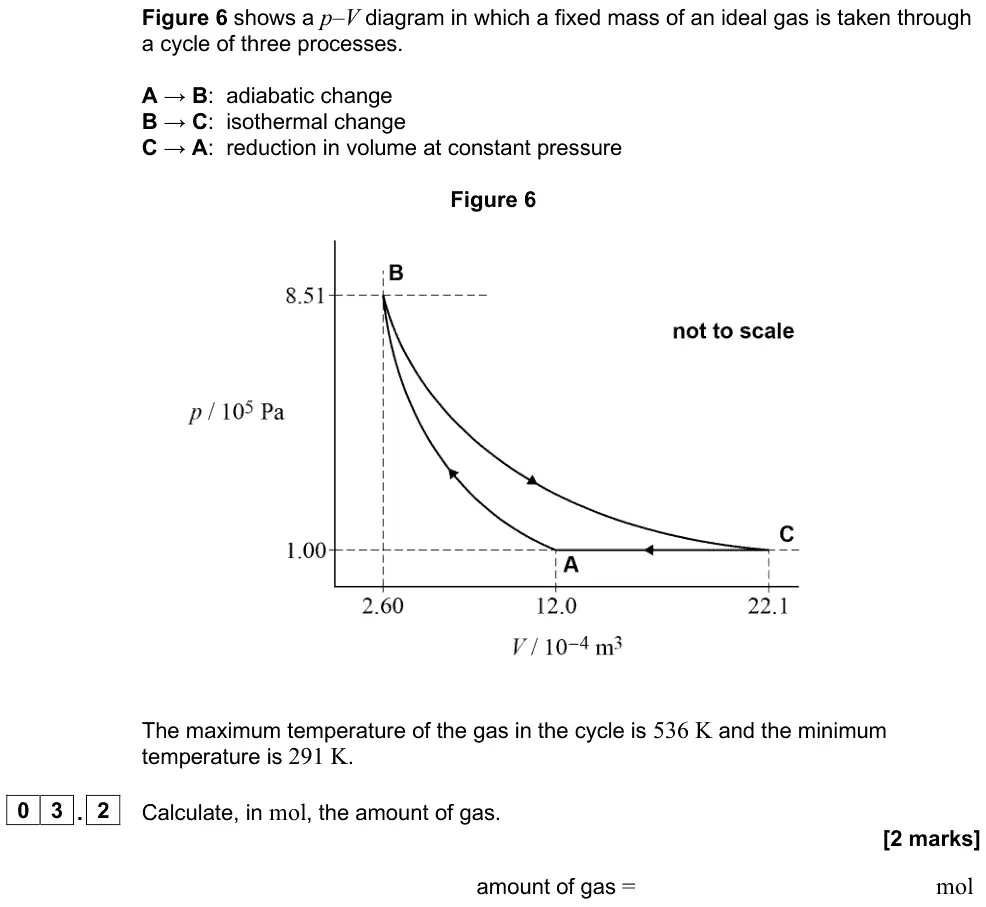
Earlier part of question 3 that this part uses
Mark scheme
Examiner's comment
In 3.1, many students stated that an isothermal change involved no change in internal energy. Whilst this is true for an ideal gas, it does not take into account a change of state, for example. The required answer was that an isothermal change involves no change in temperature. More than half of the students gained this mark. To gain full marks for the calculation in 3.2, students had to match a temperature with a point on Figure 6. Students who used the incorrect temperature could still gain partial credit. Using the differences in temperature, volume or pressure meant a student gained no marks.
Notes from the mark scheme and report
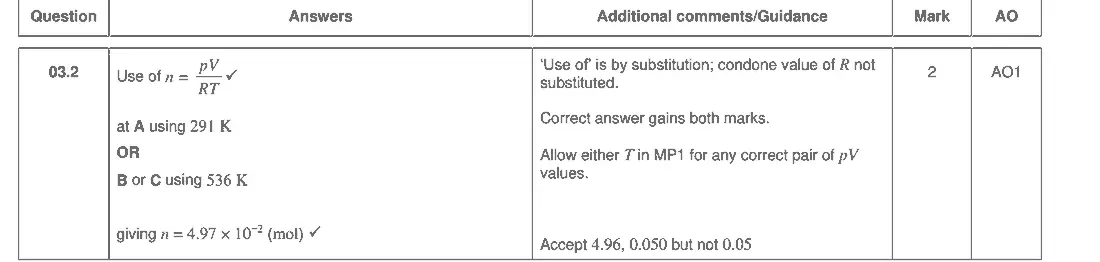
Answer: 4.97 x 10^-2 mol (pV/RT at A with 291 K or at B or C with 536 K)
using differences in T, p or V scored zero
Skills: MS2.3 Substitute numerical values into algebraic equations using appropriate units for physical quantities; MS3.1 Translate information between graphical, numerical and algebraic forms
June 2025 · Paper 3B Engineering physics · Q3.31 markAO1=1Show that
Earlier part of question 3 that this part uses
Mark scheme
Examiner's comment
Question 3.3 was the easiest one on the paper. Although a substituted equation was sufficient on this occasion, students should be made aware that in the future the correct equation followed by substitution may be required for the mark.
Notes from the mark scheme and report
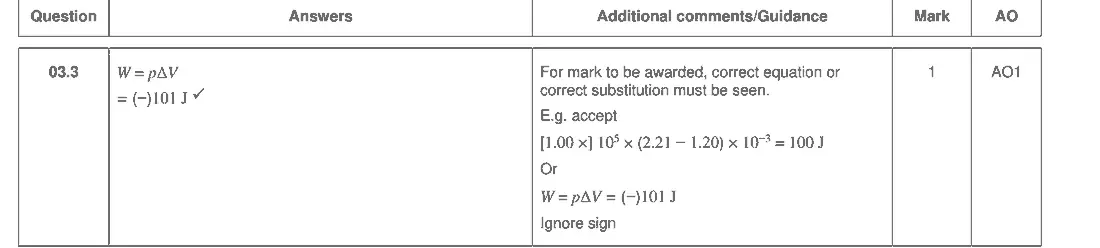
Answer: 101 J (1.00 x 10^5 x (22.1 - 12.0) x 10^-4 m^3)
the easiest item on the paper
Skills: MS2.3 Substitute numerical values into algebraic equations using appropriate units for physical quantities; MS3.1 Translate information between graphical, numerical and algebraic forms
June 2025 · Paper 3B Engineering physics · Q3.43 marksAO1=1, AO2=1, AO3=1Calculation
Earlier part of question 3 that this part uses
Mark scheme
Examiner's comment
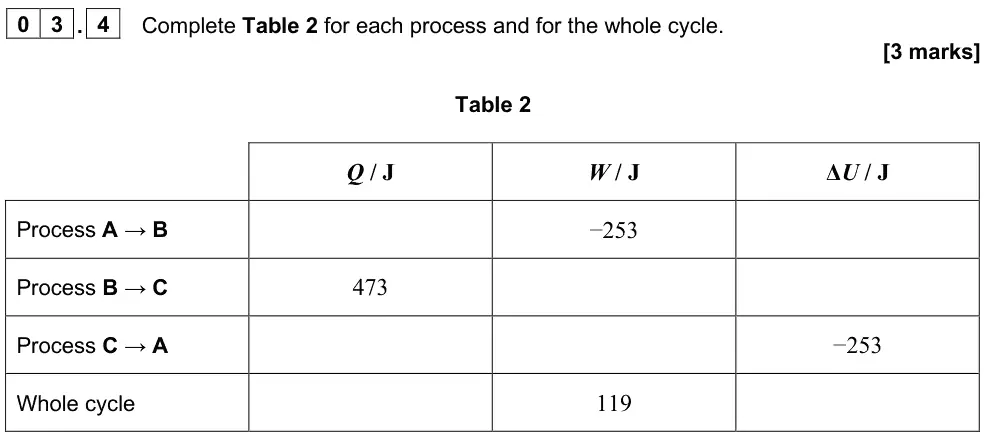
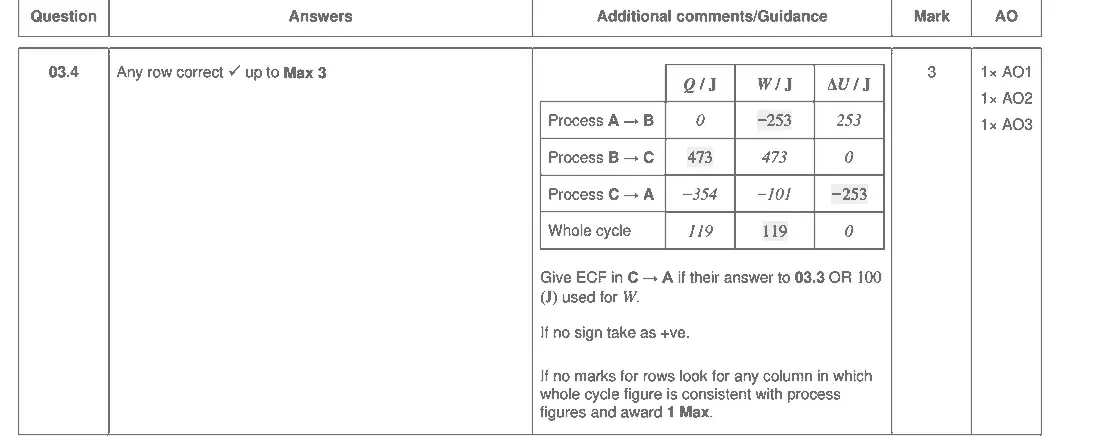
Question 3.4 discriminated well and produced a good spread of marks. About half of students obtained all three marks. It was clear, however, that many students did not know how to apply the first law of thermodynamics in this situation. This was also evident in later question parts.
Notes from the mark scheme and report
A to B: 0, -253, +253
B to C: 473, 473, 0
C to A: -354, -101, -253
whole cycle: 119, 119, 0
about half full marks
Skills: MS2.3 Substitute numerical values into algebraic equations using appropriate units for physical quantities
June 2025 · Paper 3B Engineering physics · Q3.52 marksAO1=1, AO3=1Explanation
Earlier part of question 3 that this part uses
Mark scheme
Examiner's comment
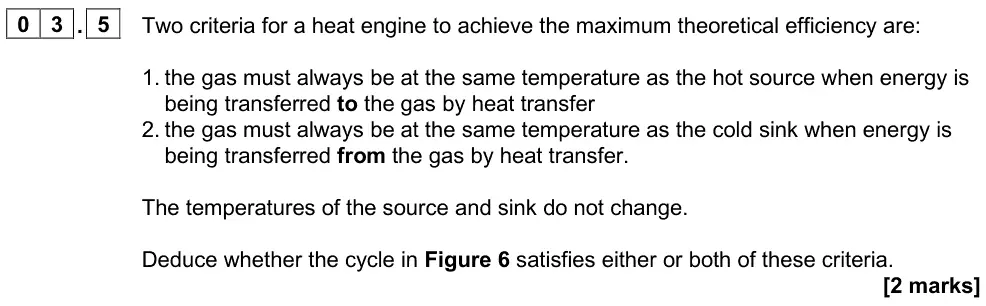
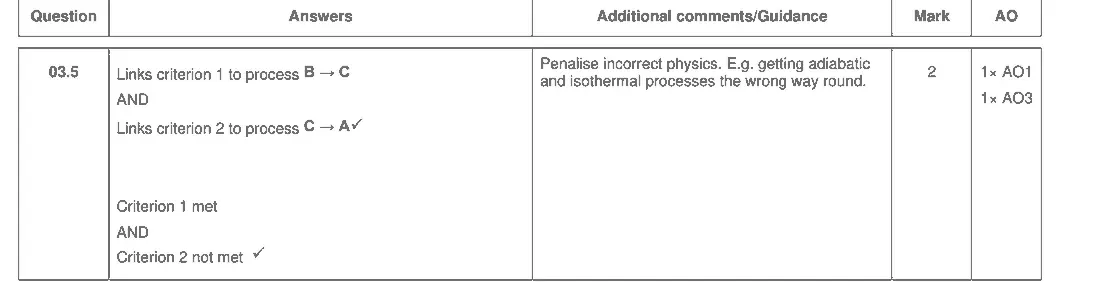
Question 3.5 was one of the hardest on the paper. Many students did not understand which process was isothermal and which adiabatic. Others did not realise in which process energy was being transferred to or from the gas by heat transfer.
Notes from the mark scheme and report
Heat input only in isothermal B to C at source temperature, so criterion 1 met
heat rejected in constant-pressure C to A while temperature falls, so criterion 2 not met
one of the hardest items
June 2025 · Paper 3B Engineering physics · Q3.66 marksAO1=1, AO2=2, AO3=36-mark extended response
Earlier part of question 3 that this part uses
Mark scheme, with the levels and indicative content
Examiner's comment
Question 3.6 was the level of response question. Despite there being many marking points available, very few students obtained full marks. This was usually due to a failure to address the third bullet point sufficiently well. Often answers were restricted to those seen in previous papers without any attempt to apply it to this particular situation. A surprisingly large number of students obtained a theoretical efficiency of 100% for the cycle. This prevented much progress in the first bullet point. The best answered section was the second bullet point, with students making comments similar to those seen in previous mark schemes on this topic.
Notes from the mark scheme and report
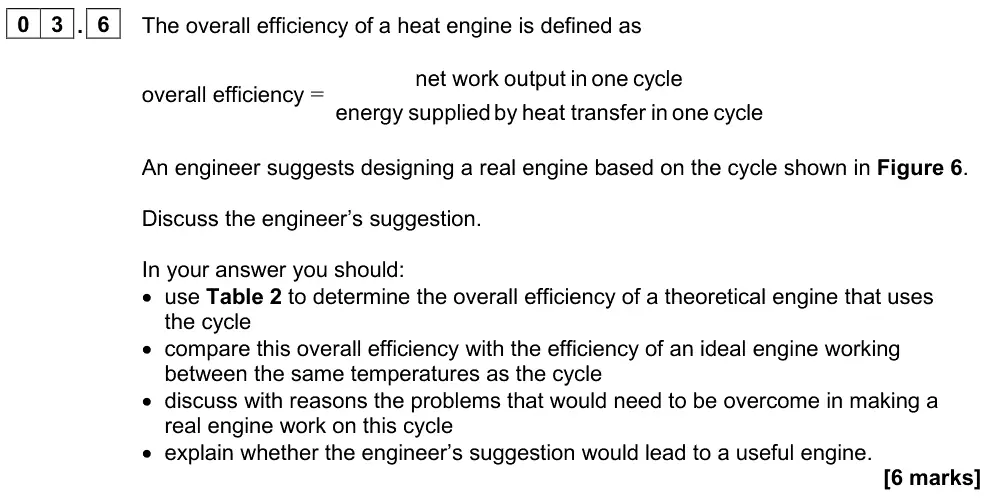
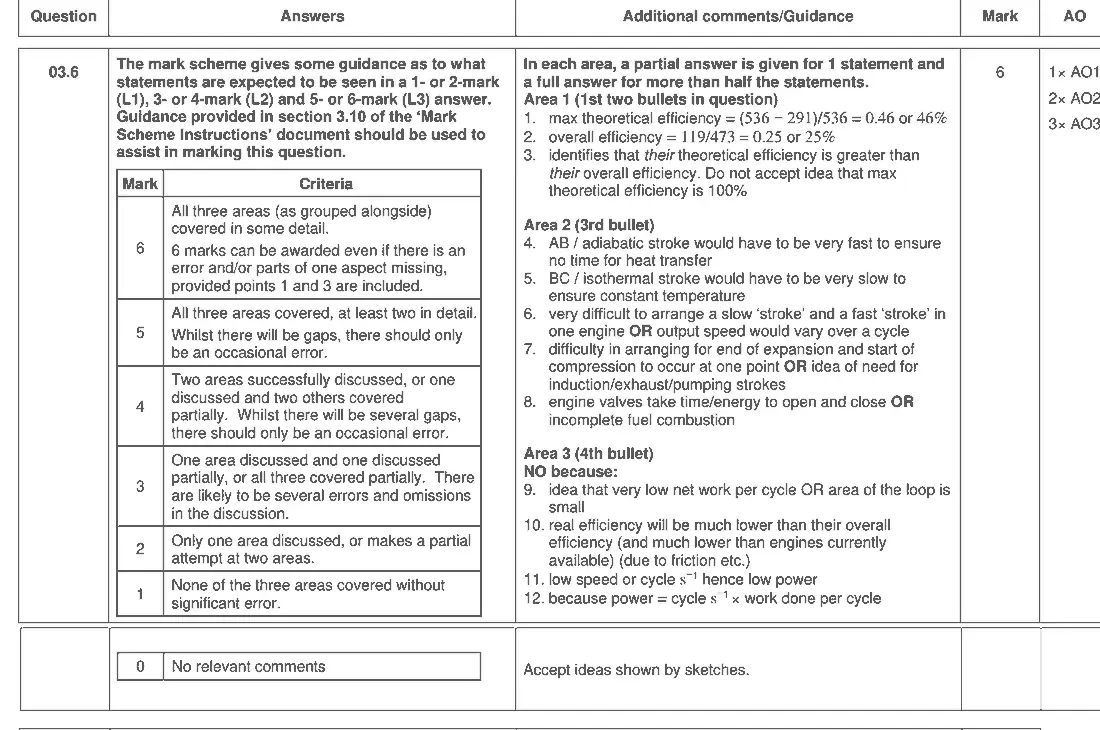
Levels of response: overall efficiency 119/473 = 25% vs ideal (536 - 291)/536 = 46%
fast adiabatic and slow isothermal strokes in one engine, pumping/valves
small net work per cycle and low speed so low power, real efficiency far lower, so not useful
many wrongly took ideal efficiency as 100%
June 2025 · Paper 3B Engineering physics · Q4.11 markAO1=1Short answerHard
Mark scheme
Examiner's comment
Only about 20% of students obtained the mark for Question 4.1. Answers were often vague statements about efficiency. Many of those who made some attempt at the ratio were not sufficiently clear about the direction of the heat transfer or incorrectly stated that it was to the cold space.
Notes from the mark scheme and report
Ratio of energy delivered to the hot space to the work input
direction of transfer needed
vague 'efficiency' answers common
June 2025 · Paper 3B Engineering physics · Q4.23 marksAO1=1, AO3=2Explanation
Earlier part of question 4 that this part uses
Mark scheme
Examiner's comment
Question 4.2 discriminated reasonably well. A common error was to fail to link the answer to the salesperson’s claims. It was judged that these did not answer the question and therefore the mark was limited to one. Several students left both temperatures in oC and therefore could not be given the first marking point.
Notes from the mark scheme and report
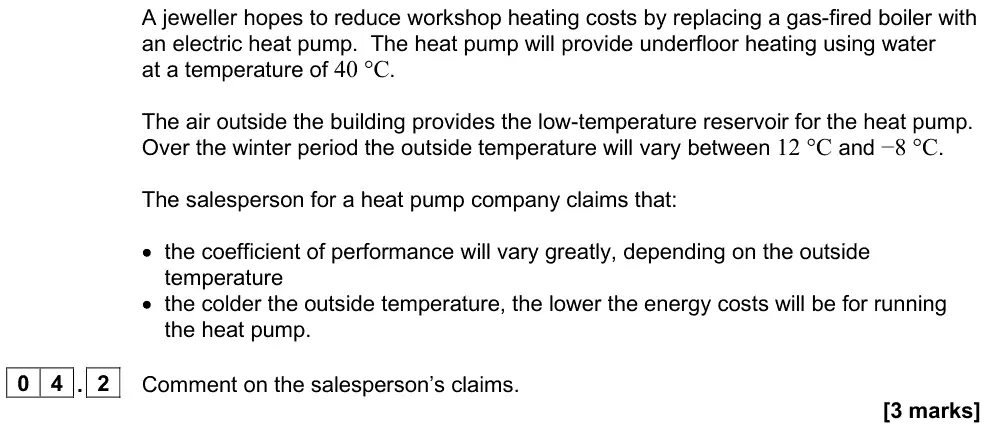
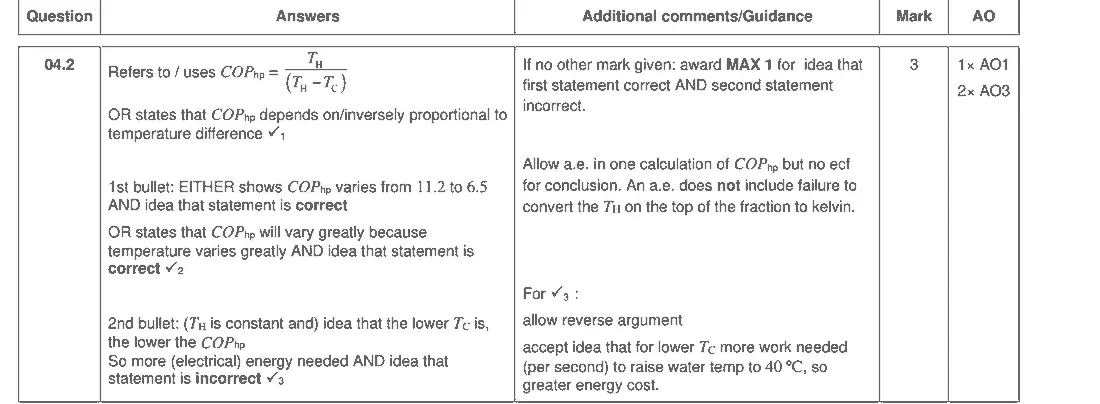
COPhp = TH/(TH - TC) varies from 11.2 (12 C) to 6.5 (-8 C), so claim 1 correct
colder outside gives lower COP and higher running cost, so claim 2 wrong
must link to the claims and use kelvin
Skills: MS2.3 Substitute numerical values into algebraic equations using appropriate units for physical quantities; MS0.1 Recognise and make use of appropriate units in calculations
June 2025 · Paper 3B Engineering physics · Q4.31 markAO2=1Short answerEasy
Earlier part of question 4 that this part uses
Mark scheme
Examiner's comment
Question 4.3 was answered correctly by about 60% of students. Grade boundaries and cumulative percentage grades are available on the Results Statistics page of the AQA Website.
Notes from the mark scheme and report
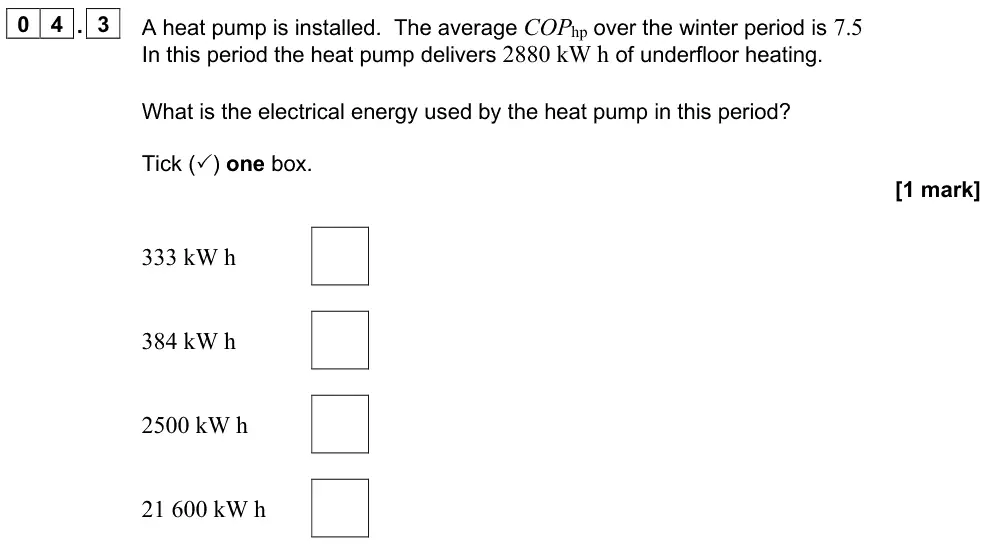
Answer: 384 kW h (2880/7.5)
Skills: MS2.3 Substitute numerical values into algebraic equations using appropriate units for physical quantities
June 2024 · Paper 3B Engineering physics · Q3.15 marksCalculation
Mark scheme
Examiner's comment
Despite all this, 03.1 proved to be very accessible. Although only around 10% of students scored five marks, 60% scored three or more marks, and only about 6% scored zero.
The questions that proved most difficult were those designed to test assessment objective 3 (AO3). These questions require students to analyse, interpret or evaluate information, and often to go on and make a judgement. The mainly AO3 questions were 02.2, 02.3, 03.3, and 04.2. Parts of 01.2 and 03.1 were also AO3, but students seemed to manage these better, even though the context of 03.1 was likely to be very unfamiliar.
Question 03.1
The mark scheme used the definitions that are given in the specification, and because of this marking was strict. When they had only one correct out of the three, they scored zero. The definition of Q was required in Q 03.1 on the 2023 paper. This year students made the same mistakes as outlined in last year's Examiner Report. We wanted three elements: energy transfer/ to /the system. We did not accept 'heat' or 'to or from'.
Notes from the mark scheme and report
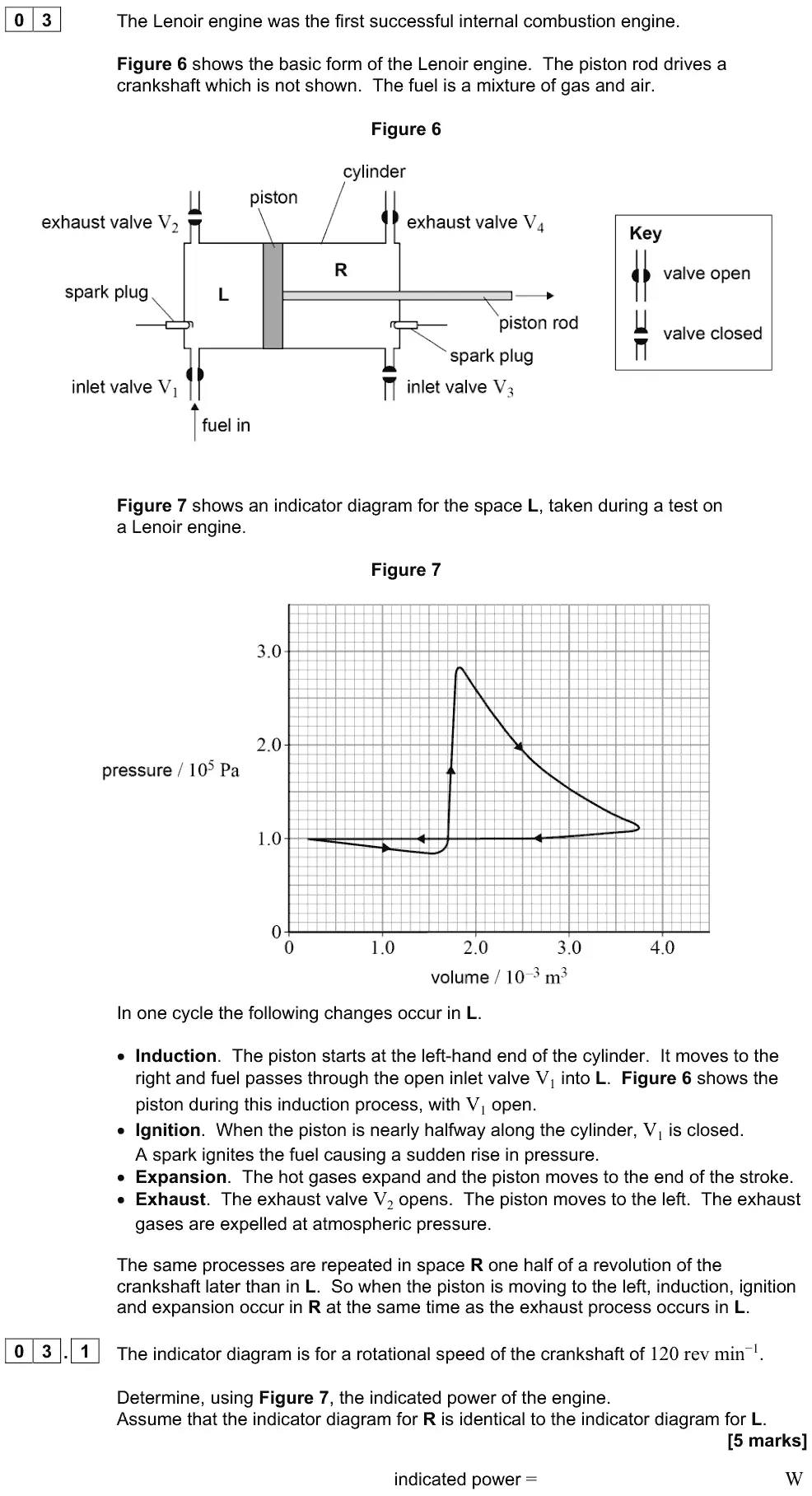
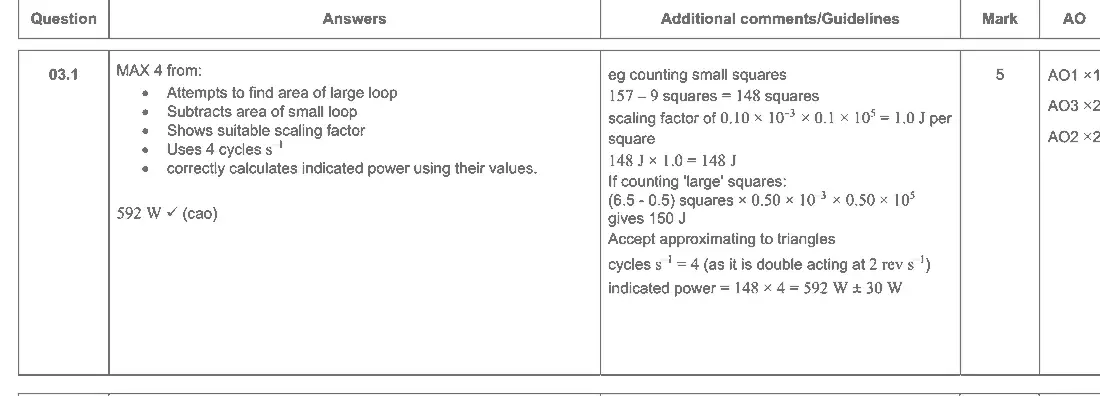
Answer: 592 W (large loop minus pumping loop = 148 small squares x 1.0 J = 148 J
double acting at 2 rev s^-1 gives 4 cycles s^-1)
about 10% full marks, 60% three or more
Skills: MS3.8 Understand the possible physical significance of the area between a curve and the x axis and be able to calculate it or estimate it by graphical methods as appropriate; MS0.1 Recognise and make use of appropriate units in calculations
June 2024 · Paper 3B Engineering physics · Q3.22 marksAO1=2CalculationEasy
Earlier part of question 3 that this part uses
Mark scheme
Examiner's comment
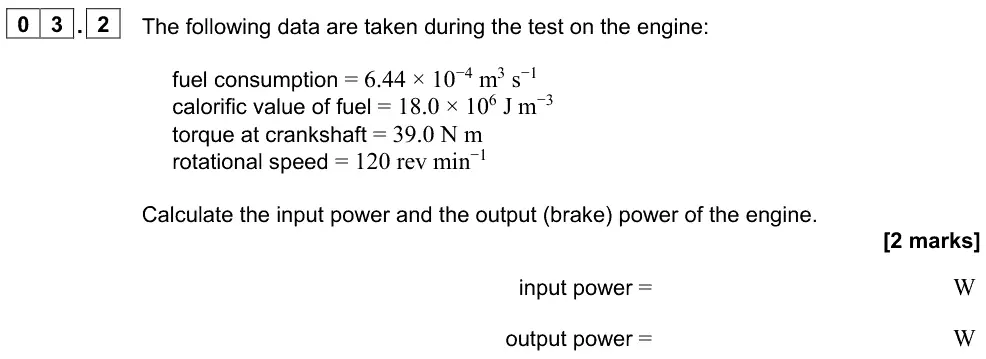
A very straightforward question requiring substitution of given data into the formulae for input and output power. Both formulae are in the data and formulae booklet. About 60 % calculated both powers correctly, with one third calculating one of the two powers. Common errors were: • incorrect powers of ten in input power • using output power = 39 × 120 • using output power = torque × rev s–1 = 39 × 2
Question 03.2
Notes from the mark scheme and report
Answer: input 1.16 x 10^4 W (6.44 x 10^-4 x 18.0 x 10^6)
output 490 W (39.0 x 2 x 2pi)
using 39 x 120 or not converting rev s^-1 to rad s^-1 were common
Skills: MS2.3 Substitute numerical values into algebraic equations using appropriate units for physical quantities; MS0.2 Recognise and use expressions in decimal and standard form
June 2024 · Paper 3B Engineering physics · Q3.32 marksAO3=2Short answerHard
Earlier part of question 3 that this part uses
Mark scheme
Examiner's comment
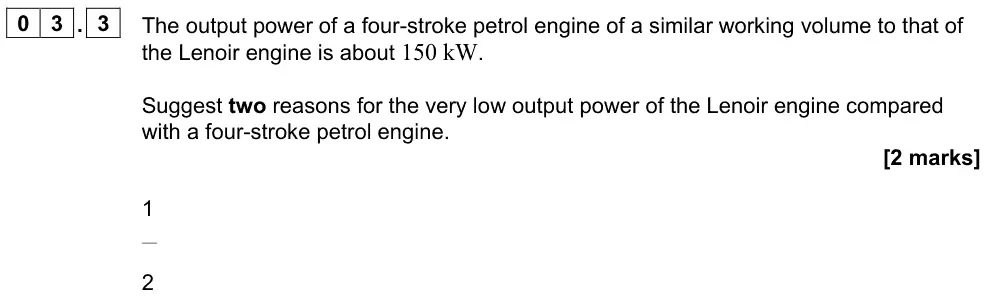
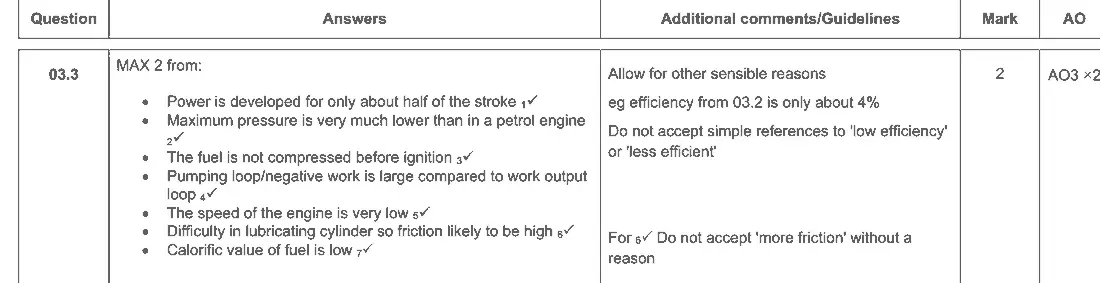
This question was further evidence for students struggling with questions designed to test AO3. They were asked to give two reasons for the Lenoir engine having a much lower output power than a four- stroke petrol engine. The mark scheme had seven reasons listed, some of which might seem fairly obvious, but students were not able to make the comparison between the Lenoir engine and a petrol engine.
About one third of students were able to give one appropriate reason, but only around 6% gave two. The most obvious and common correct answer was the very low speed of the Lenoir engine.
Far too many students tried to use their knowledge of the differences between ideal and real internal- combustion engines, or between diesel and petrol engines rather than use the information in the question.
Some of the answers considered unsatisfactory were:
• high friction of the Lenoir engine (with no reference to lubrication or combustion on both sides of the piston) • greater numbers of valves in the Lenoir engine and more cylinders in a petrol engine • differences in output torque • the Lenoir engine is an old design.
Answers which referred simply to low efficiency or the smaller area of the p-V loop for the Lenoir engine were not awarded a mark. The examiners were looking for the reasons for low efficiency or the smaller area, and these are the points listed in the mark scheme.
The questions that proved most difficult were those designed to test assessment objective 3 (AO3). These questions require students to analyse, interpret or evaluate information, and often to go on and make a judgement. The mainly AO3 questions were 02.2, 02.3, 03.3, and 04.2. Parts of 01.2 and 03.1 were also AO3, but students seemed to manage these better, even though the context of 03.1 was likely to be very unfamiliar.
Question 03.3
Notes from the mark scheme and report
Two of: power only over about half the stroke, low peak pressure, no compression before ignition, large pumping loop, very low speed, lubrication difficulties, low calorific value
'less efficient' alone not credited
June 2024 · Paper 3B Engineering physics · Q3.41 markAO1=1Short answerEasy
Earlier part of question 3 that this part uses
Mark scheme
Examiner's comment
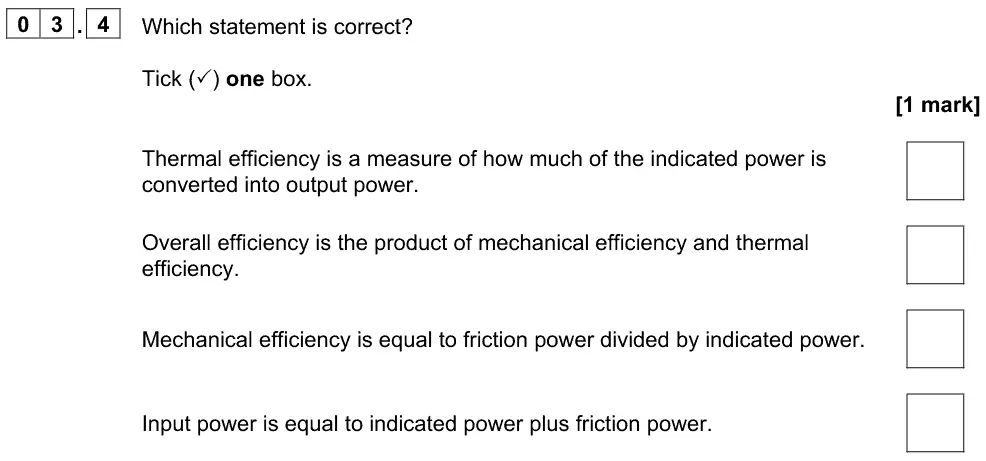
Approximately two-thirds of the students scored the one mark here for identifying the correct statement about different powers and efficiencies.
Question 03.4
Notes from the mark scheme and report
Answer: overall efficiency is the product of mechanical and thermal efficiency
June 2024 · Paper 3B Engineering physics · Q4.12 marksAO1=2Short answerHard
Mark scheme
Examiner's comment
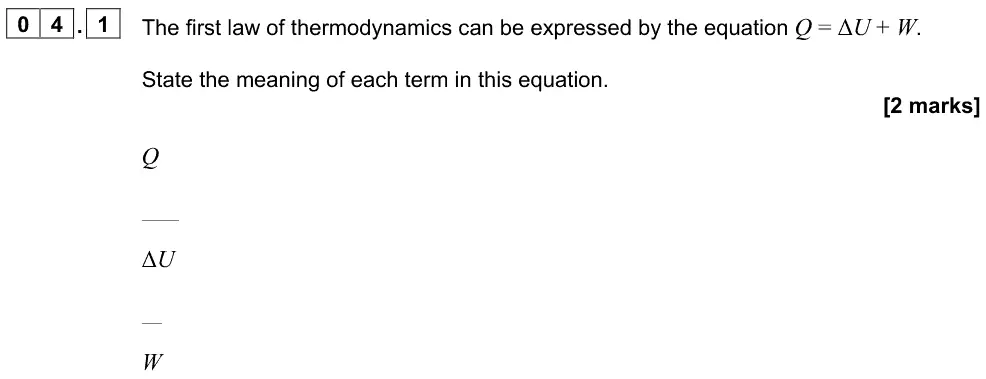
Students were asked to define Q, ΔU and W in the equation for the first law of thermodynamics.
The mark scheme used the definitions that are given in the specification, and because of this marking was strict. When they had only one correct out of the three, they scored zero. The definition of Q was required in Q 03.1 on the 2023 paper. This year students made the same mistakes as outlined in last year's Examiner Report. We wanted three elements: energy transfer/ to /the system. We did not accept 'heat' or 'to or from'.
It was fairly common to see very brief answers such as 'heat transferred' for Q, 'internal energy' for ΔU and 'work done' for W.
Only about 9 % of students scored two marks here.
Question 04.1
Notes from the mark scheme and report
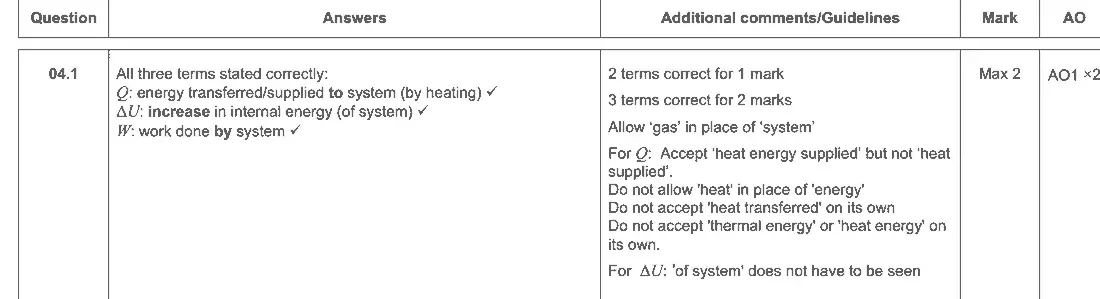
Q energy transferred to the system by heating, dU increase in internal energy, W work done by the system
2 terms for 1 mark
'heat transferred', 'internal energy', 'work done' alone too vague
June 2024 · Paper 3B Engineering physics · Q4.23 marksExplanationHard
Earlier part of question 4 that this part uses
Mark scheme
Examiner's comment
In previous papers questions on the first law have usually been calculations and students generally cope well with them. The specification (section 3.11.2.1) states 'Applications of first law of thermodynamics' and this includes both qualitative and quantitative applications.
This year students were asked to apply the first law to a room containing a working refrigerator, but it is clear that the majority were not prepared for a descriptive explanation. Answers showed little understanding of how Q, ΔU and W fitted the scenario. For example, many thought W = 0 because the volume of the room did not change.
Many did not make any reference to the first law, and some referred to the second law. Few treated the room as a system, concentrating instead on the working of a refrigerator. Too many answers made reference to hot and cold air, to heat sources and sinks, and to changes in temperature rather than internal energy.
Nearly 80% of students failed to score any marks at all.
The questions that proved most difficult were those designed to test assessment objective 3 (AO3). These questions require students to analyse, interpret or evaluate information, and often to go on and make a judgement. The mainly AO3 questions were 02.2, 02.3, 03.3, and 04.2. Parts of 01.2 and 03.1 were also AO3, but students seemed to manage these better, even though the context of 03.1 was likely to be very unfamiliar.
Question 04.2
Notes from the mark scheme and report
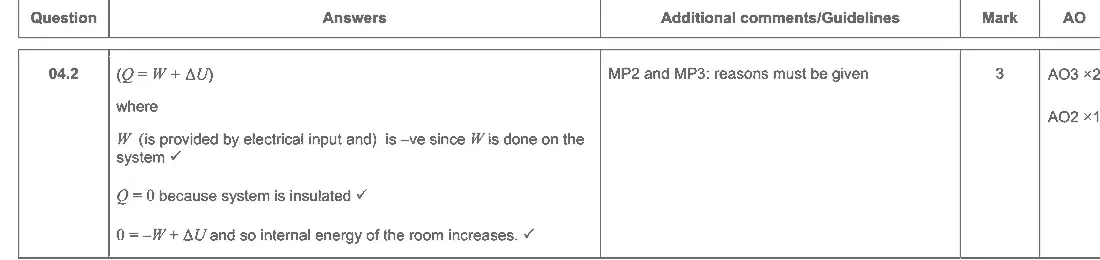
Room is the system: Q = 0 (insulated), electrical work is done on the system (W negative), so dU = +W and internal energy rises
many thought W = 0 or discussed hot and cold air
June 2024 · Paper 3B Engineering physics · Q4.31 markAO1=1Diagram or graph
Earlier part of question 4 that this part uses
Mark scheme
Examiner's comment
For one mark, examiners were looking for a downwards arrowed line to a labelled low-temperature (or cold) sink. Various words were accepted as an alternative to 'sink', but not 'source'. About half of all answers scored the mark.
Question 04.3
Notes from the mark scheme and report
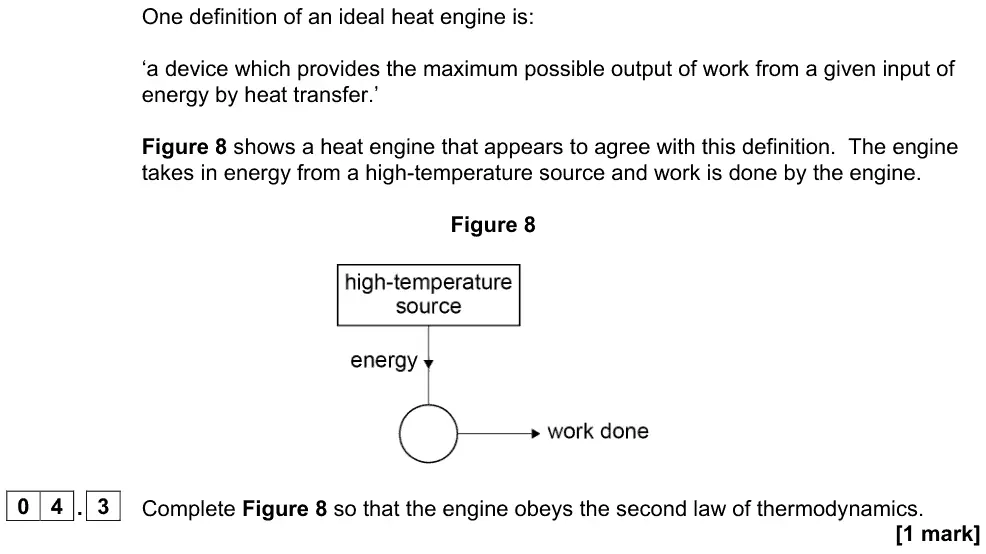
Add a labelled cold (low-temperature) sink with a downward arrow from the engine
'sink' alone or 'cold source' not enough
about half scored
June 2024 · Paper 3B Engineering physics · Q4.42 marksAO1=2Explanation
Earlier part of question 4 that this part uses
Mark scheme
Examiner's comment
This was a straightforward 'bookwork' question testing AO1. The equation for maximum thermal efficiency is in the formulae and data booklet, and the mark scheme expected this to be referenced. Many answers went straight to the second mark point about the impossibility of having a sink at absolute zero.
It was decided to give a maximum of one mark to those who used the idea of Q C going to the sink, so W could not equal Q H. For this mark, the answer had to include a definition of efficiency.
Question 04.4
Notes from the mark scheme and report
Maximum efficiency = (TH - TC)/TH, which is 100% only if TC = 0 K, which is impossible
QC to sink argument max 1
June 2023 · Paper 3B Engineering physics · Q3.11 markAO1=1Short answer
Mark scheme
Examiner's comment
Just over a third of students were able to recall/define Q in the first law for 1 mark for this question. Three elements were required: energy transfer / to / the system. We did not accept 'heat' or 'to or from'. The definition is clearly stated in the specification for the option.
Question 03.1
Notes from the mark scheme and report
Energy transferred to the system by heating
'heat' or 'heat transferred' alone not accepted
just over a third correct
June 2023 · Paper 3B Engineering physics · Q3.21 markAO1=1Short answerEasy
Earlier part of question 3 that this part uses
Mark scheme
Examiner's comment
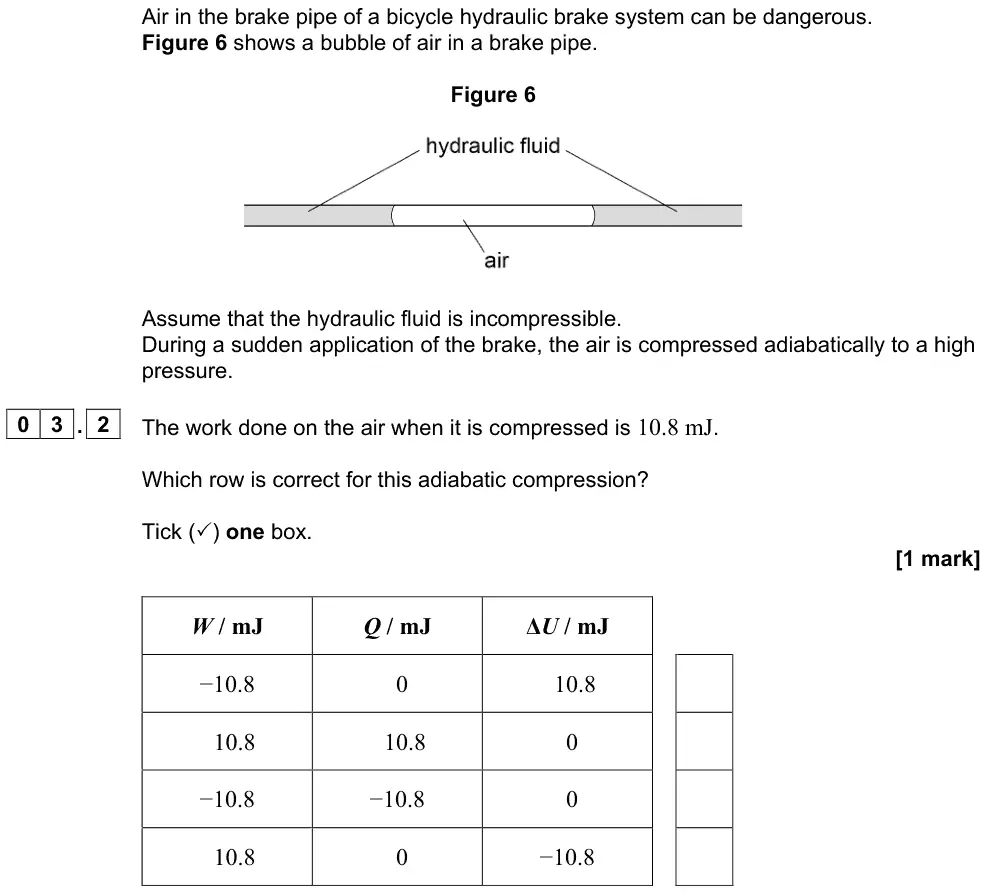
Nearly two-thirds of students were successfully able to apply the first law of thermodynamics to the adiabatic compression of the air bubble.
Question 03.2
Notes from the mark scheme and report
Answer: W = -10.8 mJ, Q = 0, dU = +10.8 mJ (top row)
June 2023 · Paper 3B Engineering physics · Q3.33 marksAO2=3Calculation
Earlier part of question 3 that this part uses
Mark scheme
Examiner's comment
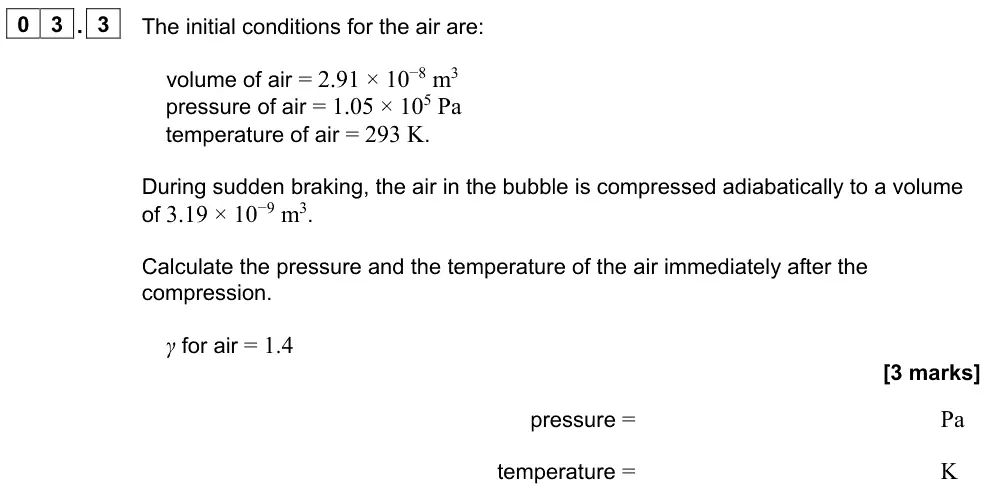
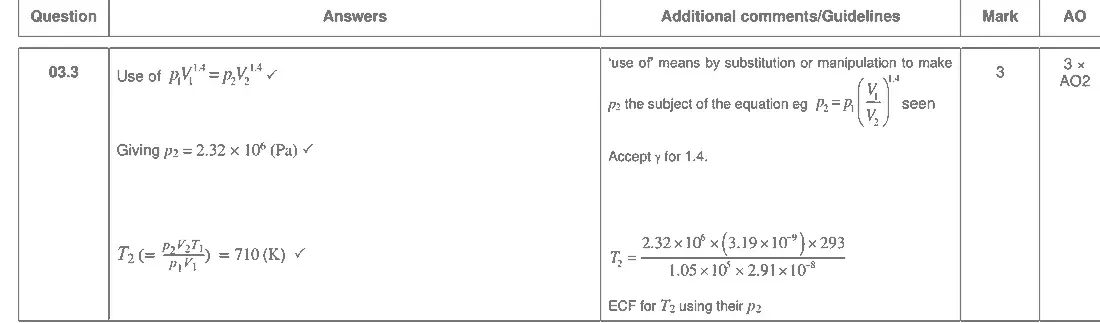
Students are well-practised with calculations on pVϒ = c and PV/T = c , with 56% scoring 3 marks and 26% scoring 2 marks. Many correctly calculated the pressure, but not the temperature. A fairly common answer was 293 K, ie they treated the compression as isothermal. ECF was given for using an incorrectly calculated p2 to calculate T2. Despite the powers of ten, and a power of 1.4, there were relatively few numerical errors.
Question 03.3
Notes from the mark scheme and report
Answer: 2.32 x 10^6 Pa and 710 K (pV^1.4 constant then pV/T constant)
293 K from treating it as isothermal
56% full marks
Skills: MS0.5 Use calculators to find and use power, exponential and logarithmic functions; MS2.3 Substitute numerical values into algebraic equations using appropriate units for physical quantities; MS2.2 Change the subject of an equation, including non-linear equations
June 2023 · Paper 3B Engineering physics · Q3.42 marksAO3=2ExplanationHard
Earlier part of question 3 that this part uses
Mark scheme
Examiner's comment
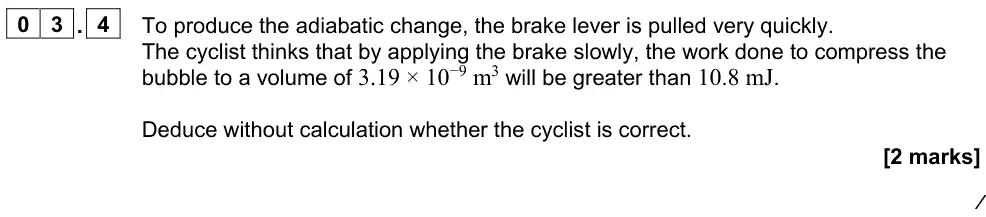
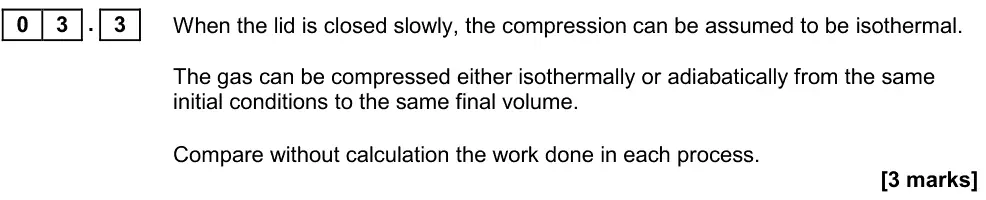
This was another AO3 question. Students were asked to make a judgement about the work done when the air bubble is compressed slowly rather than quickly.
Common misconceptions were:
• the same brake force is applied for longer so the work done must be greater • the volume change is the same so, from W = pΔV, the work done will be the same • for an isothermal compression the p-V curve is less steep so the area under it is greater • there is heat transfer in a slow compression, so more work has to be done to transfer the heat.
Many students tried to use the first law of thermodynamics, and showed a misunderstanding of the symbols or how they could apply in the situation. Many thought the work done would remain the same and gave ingenious arguments in support.
Nearly half of the students scored the first mark for associating a slow compression with an isothermal compression. About 17% scored the full 2 marks. Full answers linked work done to some or all of:
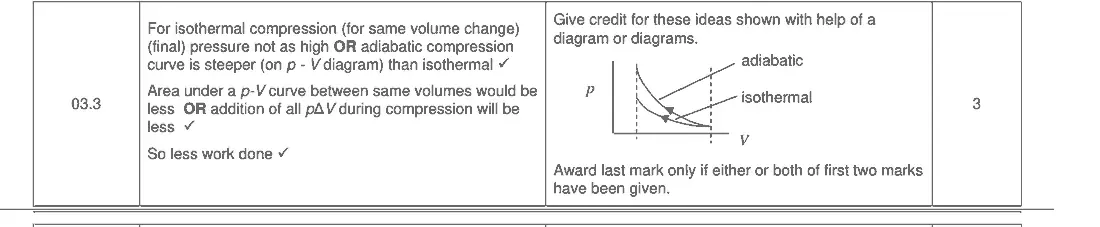
• the steepness of adiabatic and isothermal curves on a p-V diagram • the area under the adiabatic and isothermal curves on a p-V diagram • the lower pressures attained in an isothermal compression.
It was pleasing to see some answers accompanied by a sketch of the adiabatic and isothermal compressions on a p-V graph.
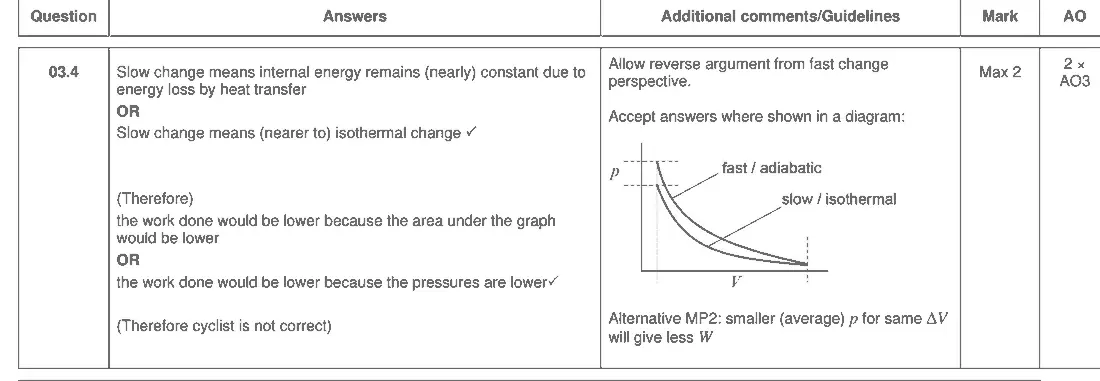
Question 03.4
Notes from the mark scheme and report
Slow compression is (nearly) isothermal
lower pressures throughout so smaller area under p-V curve and less work
cyclist wrong
misconceptions about longer force or same pdV
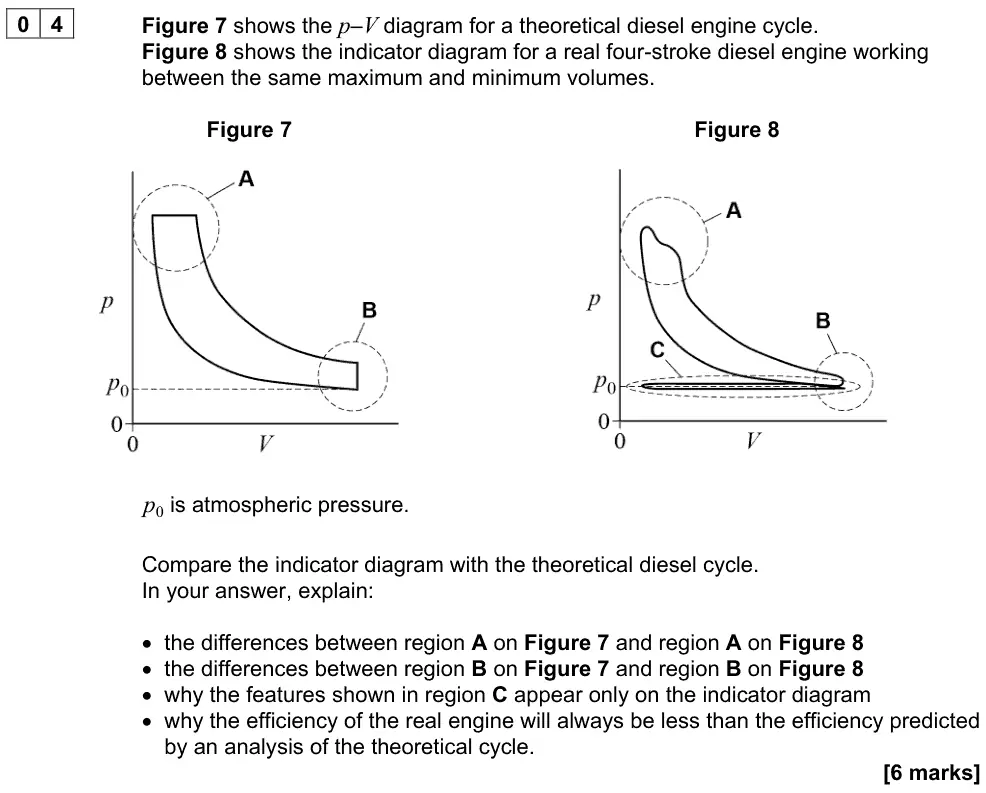
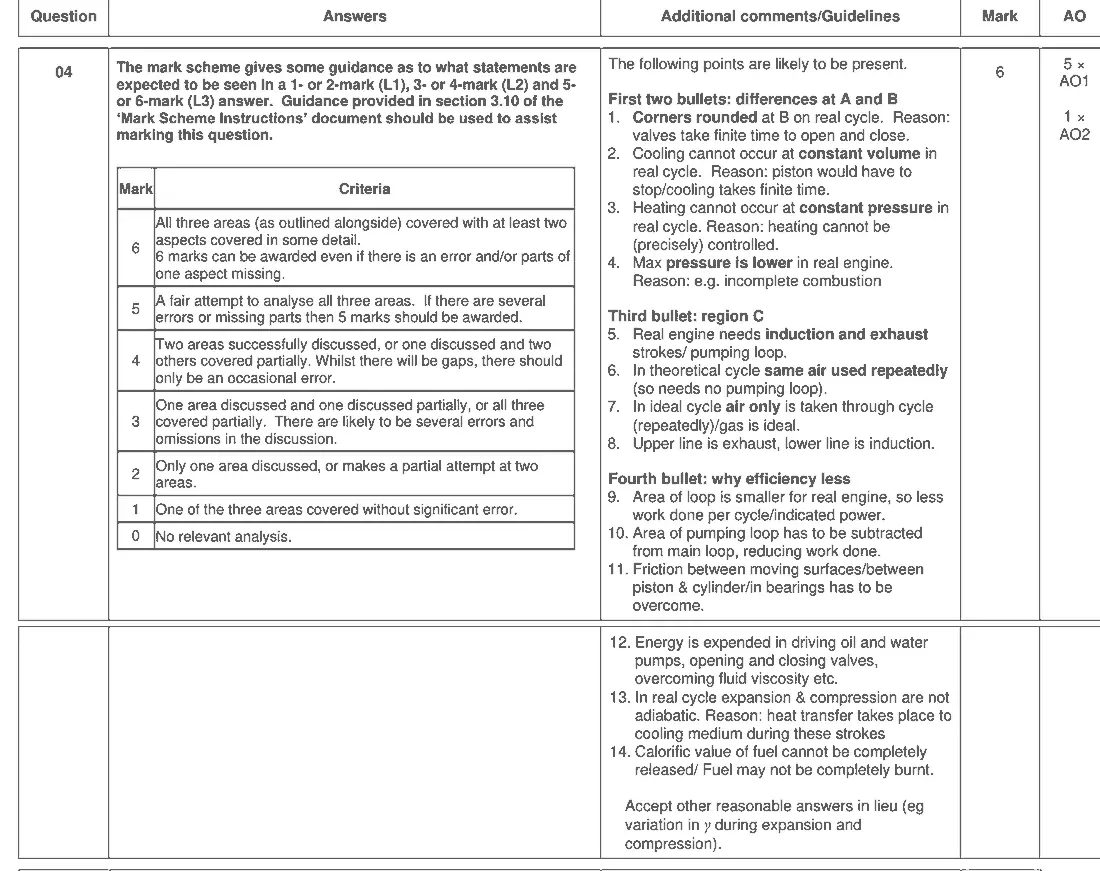
June 2023 · Paper 3B Engineering physics · Q46 marksAO1=5, AO2=16-mark extended response
Mark scheme, with the levels and indicative content
Examiner's comment
This levels-of-response question had a mark allocation of 6 marks. It was a straightforward question on engines, requiring mainly recall or bookwork.
The question tested assessment objective AO1 – knowledge and understanding of ideas and processes. Careful revision should have helped students to be able to cover several of the mark points. Despite this, many students were only able to achieve 0 or 1, sometimes from over a page of writing.
The specification clearly requires an understanding of a diesel engine indicator diagram and comparison with the theoretical diesel engine cycle.
For marking, the mark points in the additional comments column of the mark scheme were grouped into 3 'areas'. These were: • regions A and B • region C • efficiency.
For 5 or 6 marks all three areas had to be covered, with the answer giving some, but not all, of the mark points. About 10% of students scored 5 or 6, showing a good knowledge of the differences between the theoretical and real diesel engine cycles. They were able to give at least three reasons for the lower efficiency of the real engine.
Many students were able to cover one or two areas well, but their answers on the other area(s) may only have covered one mark point per area.
It was common to see differences described but no reasons, or incorrect reasons, given. A wide variety of dubious reasons were given for the heating not being at constant pressure in Figure 8. All that was required was that heating at constant pressure is very difficult to control (given the conditions under which combustion occurs).
The need for region C in the real engine and not the theoretical, was generally well understood.
Common errors were that: • in region A the rounded corners were due to valves opening and closing (whereas of course in this region all valves remain closed) • all processes in the theoretical cycle are instantaneous • induction and exhaust strokes take place in the theoretical cycle but at atmospheric pressure so need not be shown • the induction stroke introduces fuel, or air-fuel mixture, into the engine • the smaller area of the indicator diagram cycle is due to friction in the engine (Friction was, of course, accepted as a reason for the lower efficiency of a real engine.) • the theoretical cycle is 100% efficient • the efficiency of the real engine is lower because there is heat transfer to the surroundings • diesel engines require a spark.
Nearly 20% of students scored no marks at all. They may have shown some knowledge of thermodynamics or engines but they did not answer the question set.
Notes from the mark scheme and report
Levels of response: region A rounded, heating not at constant pressure, lower peak (combustion not controllable)
region B rounded and not constant-volume (valve timing)
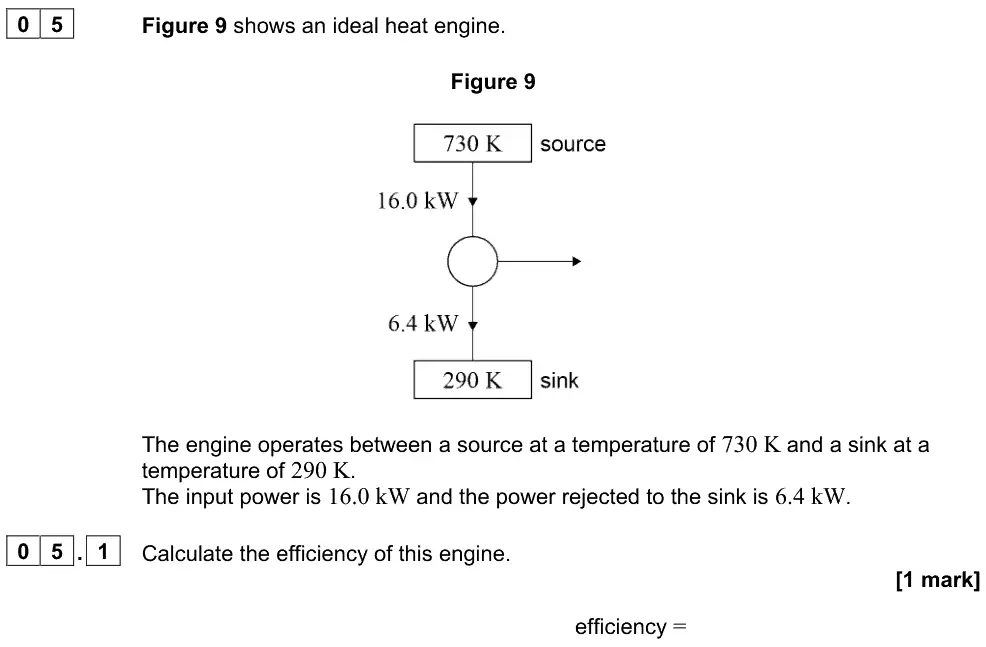
June 2023 · Paper 3B Engineering physics · Q5.11 markAO1=1CalculationEasy
Mark scheme
Examiner's comment
This was answered well. Either the temperatures or the powers could be used. 86% of students scored the mark. Most incorrect answers calculated the efficiency as 6.4/16.0 = 0.40.
Question 05.1
Notes from the mark scheme and report
Answer: 0.60 ((730 - 290)/730 or (16.0 - 6.4)/16.0)
0.40 the common wrong answer
Skills: MS2.3 Substitute numerical values into algebraic equations using appropriate units for physical quantities
June 2023 · Paper 3B Engineering physics · Q5.23 marksAO3=3CalculationHard
Earlier part of question 5 that this part uses
Mark scheme
Examiner's comment
Mathematically, the analysis of ideal engines should not pose too many problems. Many answers showed a lack of conceptual understanding of the two ideal engines.
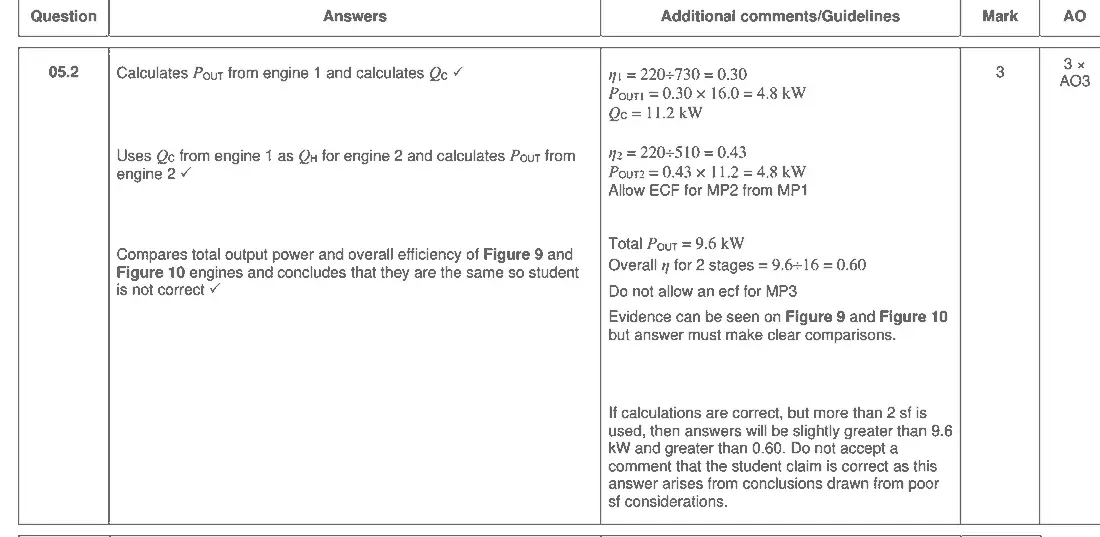
About 30% of answers had the efficiencies and output powers of each of the two engines correctly calculated (for 2 marks).
In two-thirds of these answers they were not able to go on and score the third mark because they calculated the overall efficiency as (0.30 + 0.43) or (0.30 x 0.43). Or they wrote a conclusion that compared only the overall output powers or the overall efficiencies, and not both.
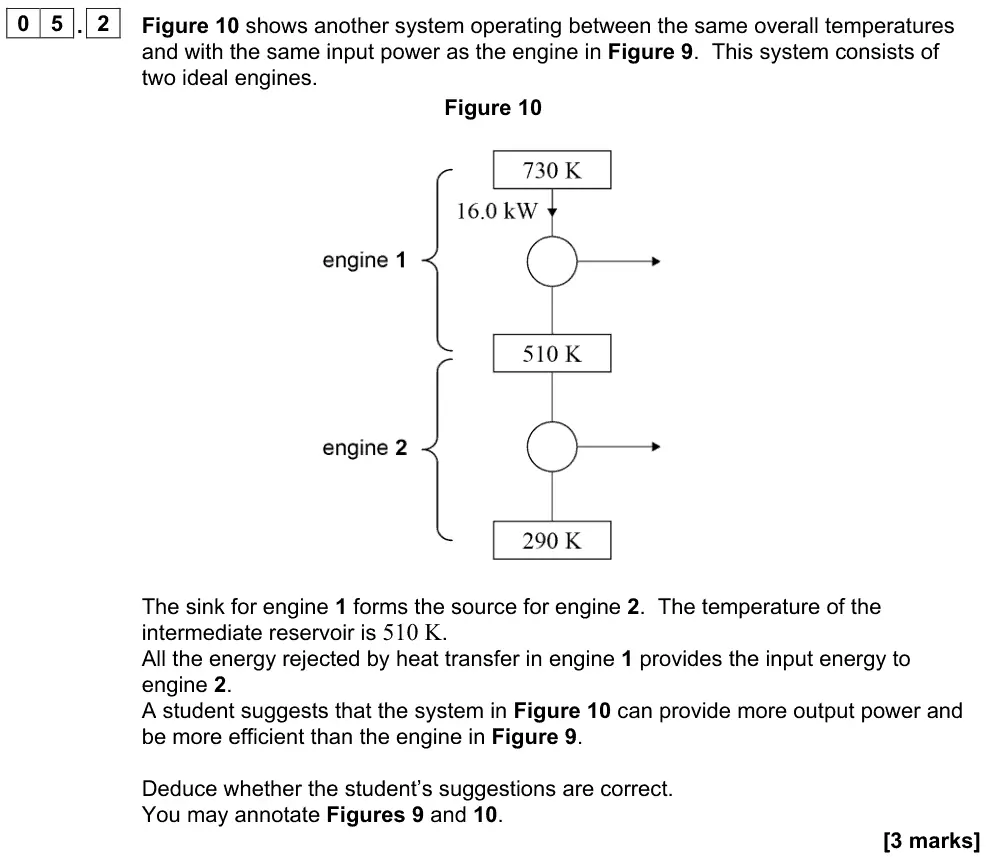
It was good to see work from students who had followed the advice to annotate Figure 10. They clearly wrote on Figure 10 the input and output powers and the powers to the cold spaces.
A fairly common error was to confuse the output power with the power rejected to the cold space.
Question 05.2
total 9.6 kW and 0.60, same as the single engine so student wrong
adding or multiplying efficiencies wrong
Skills: MS2.3 Substitute numerical values into algebraic equations using appropriate units for physical quantities; MS0.3 Use ratios, fractions and percentages
June 2022 · Paper 3B Engineering physics · Q3.11 markAO1=1Short answer
Mark scheme
Examiner's comment
The question required a definition of an adiabatic change. The examiners required the question to discriminate between those who had a sound thermodynamic understanding and those who knew something about an adiabatic change. It required the three elements of • heat or energy transfer • to or from • a gas, or substance or system Common answers which failed to score were those that • quoted the first law of thermodynamics applied to an adiabatic change, often without explaining the symbols • only referred to energy transfer to, and not from, the system (or vice versa) referred only to the equation for an adiabatic change pVϒ = c •
There were other answers that showed very little or no understanding, including those that confused an adiabatic change with an isothermal one.
Question 03.1
Notes from the mark scheme and report
No energy transfer by heating to or from the gas
needs both directions and the system
quoting pV^gamma alone or confusing with isothermal not credited
June 2022 · Paper 3B Engineering physics · Q3.22 marksAO2=2Calculation
Earlier part of question 3 that this part uses
Mark scheme
Examiner's comment
It was pleasing to see many confident answers, with students showing the steps in their calculations. In fact, more students were able to deal with the maths involved here than were able to calculate areas of triangles in question 01.1. About three-quarters of students showed a correct substitution of data into p1V1ϒ = p2V2ϒ . Some of these were then let down by not knowing either how to deal with the maths or how to use their calculator. A few used (pV)ϒ = c or pV = c.
Students did better on the rotational dynamics questions (Q1 and Q2) than the thermodynamics questions (Q3 and Q4). The concept of the reversed heat engine (Q4) is still not well understood. As in previous years, calculations were answered with more confidence than the questions which required qualitative answers. This is borne out by relatively high mean marks for questions 01.1 to 01.4, 02.1, and 03.2.
Question 03.2
Notes from the mark scheme and report
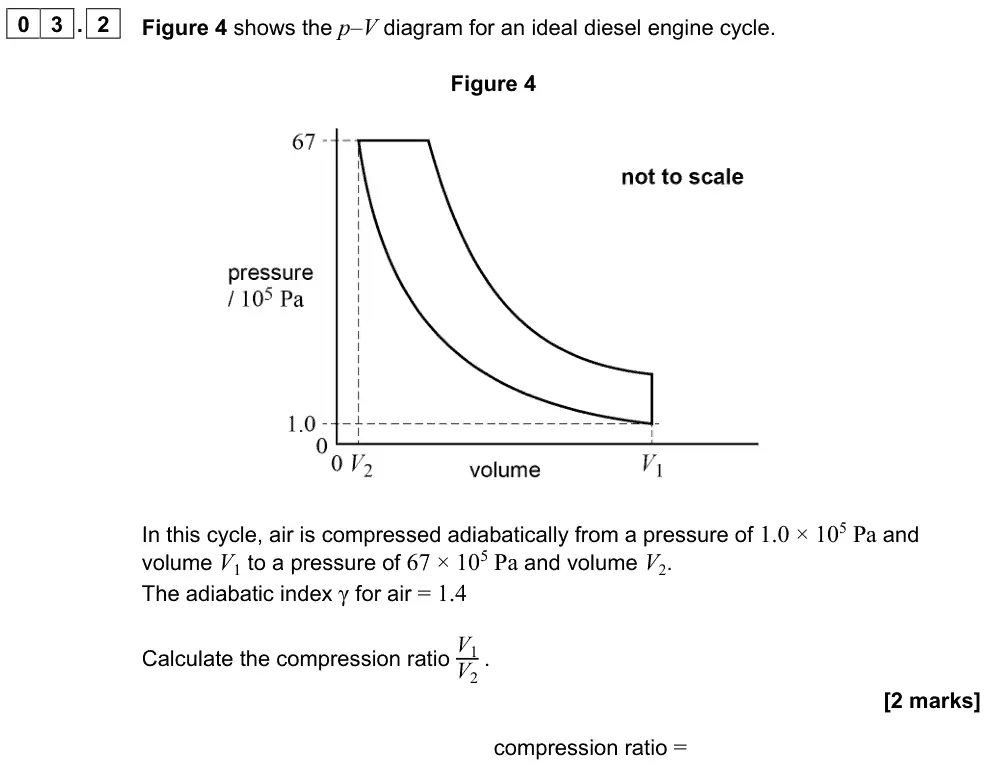
Answer: 20 (V1/V2 = 67^(1/1.4))
errors with powers on the calculator
some used (pV)^gamma
Skills: MS0.5 Use calculators to find and use power, exponential and logarithmic functions; MS2.2 Change the subject of an equation, including non-linear equations; MS2.3 Substitute numerical values into algebraic equations using appropriate units for physical quantities
June 2022 · Paper 3B Engineering physics · Q3.32 marksAO1=2ExplanationHard
Earlier part of question 3 that this part uses
Mark scheme
Examiner's comment
This required knowledge of how compression ratio influences the ignition of fuel in diesel and petrol engines. There were some very good answers but they were rare, with only about 10% of students scoring both marks. It was not enough to simply refer to a spark in the petrol engine, and high pressure in the diesel engine. The high compression ratio in a diesel engine results in a temperature that is high enough for the fuel to self-ignite. A high pressure was not enough to score the mark and neither were the terms high thermal energy or high heat. For the petrol engine, the spark needed to be related to a lower temperature, though we allowed lower pressure here instead.
Question 03.3
Notes from the mark scheme and report
Diesel needs high compression so air temperature is high enough for the fuel to self-ignite
petrol-air mixture is ignited by a spark at lower temperature
'high pressure' alone not enough
June 2022 · Paper 3B Engineering physics · Q3.42 marksAO1=1, AO3=1Diagram or graph
Earlier part of question 3 that this part uses
Mark scheme
Examiner's comment
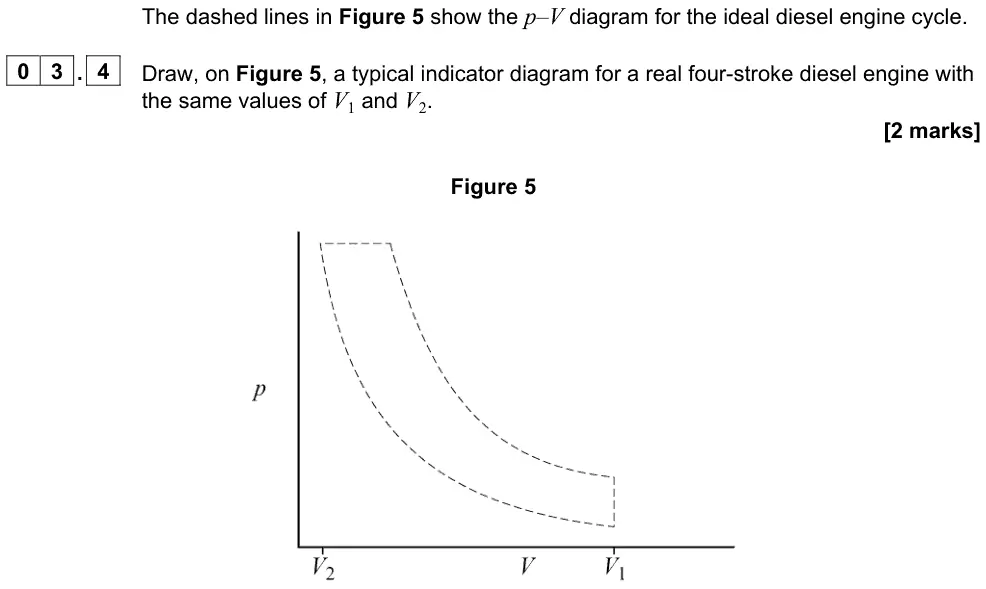
It is surprising that one in seven students made no attempt to draw any form of indicator diagram. Only about half of the students scored any marks at all. Judging from students' answers, many seemed unused to drawing indicator diagrams. Errors seen were: • drawing a loop that was larger than and/or outside the ideal cycle • drawing induction/exhaust lines that were too far apart or of unequal length • showing induction/exhaust line(s) that went right up to the pressure axis, or were too short • missing out the induction/exhaust line(s) altogether • taking the maximum pressure far above the ideal cycle.
Question 03.4
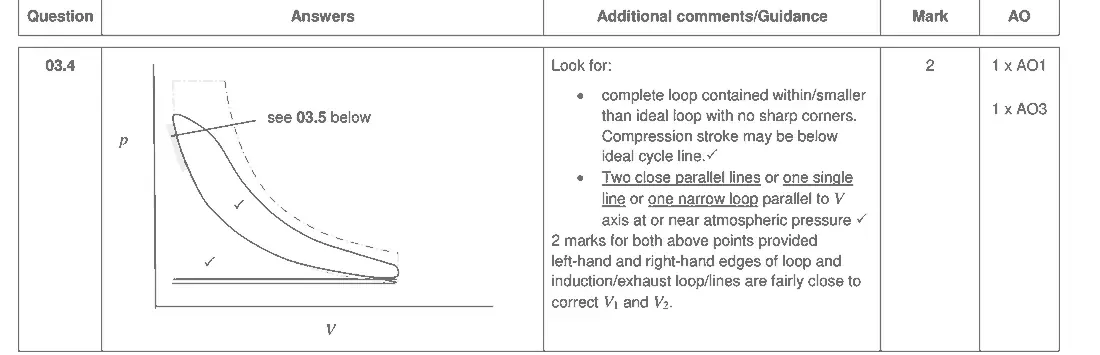
Notes from the mark scheme and report
Loop inside the ideal cycle with rounded corners plus a narrow induction/exhaust loop or line near atmospheric pressure between V2 and V1
one in seven made no attempt
June 2022 · Paper 3B Engineering physics · Q3.51 markAO1=1Diagram or graphHard
Earlier part of question 3 that this part uses
Mark scheme
Examiner's comment
Students were asked to place an X on the indicator diagram at the point of fuel injection. Only about one student in eight was able to do this correctly. Many students placed their X at the start or end of the induction or exhaust stroke. Others placed it at the very end of the compression stroke. This would mean that the piston would be on its way down the cylinder by the time combustion had taken hold, leading to loss of power.
Question 03.5
Notes from the mark scheme and report
X near but before the top end of the compression stroke on the real diagram, not on the ideal cycle
June 2022 · Paper 3B Engineering physics · Q3.62 marksAO1=2Explanation
Earlier part of question 3 that this part uses
Mark scheme
Examiner's comment
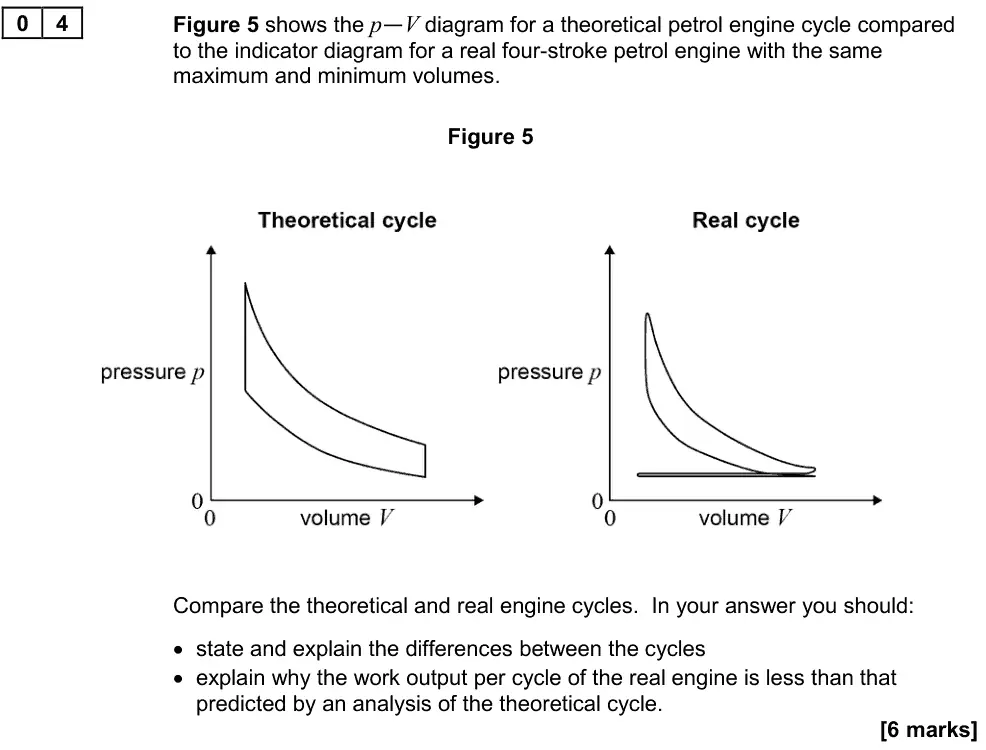
The question involved a topic firmly on the specification, which asks for a comparison of indicator diagrams with theoretical cycles. Students did not find it difficult to describe two differences between a diesel-engine indicator diagram and the theoretical diesel cycle. Many, however, failed to give reasons. Some described the differences but gave the wrong reasons for the differences. A very common misunderstanding was to think that friction accounted for a difference in the area enclosed by the loops in the diagrams, not realising that an indicator diagram is taken before frictional losses are accounted for. A little over half the students scored no marks on this question.
Question 03.6
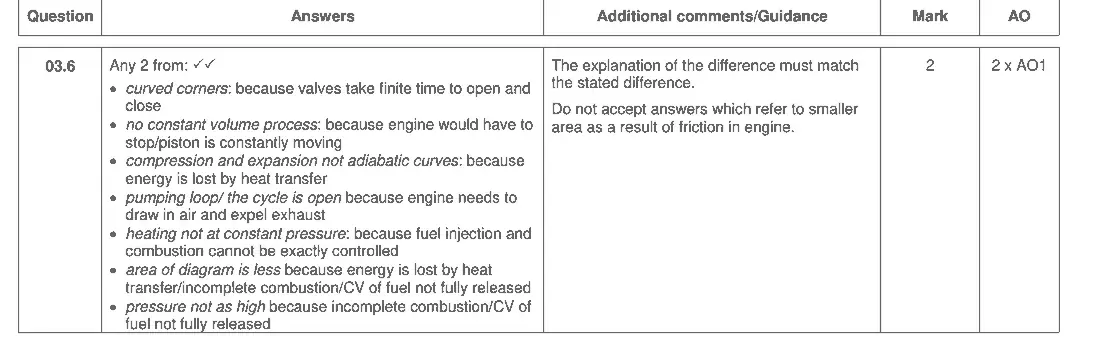
Notes from the mark scheme and report
Two differences with matching reasons: rounded corners (finite valve times), not adiabatic (heat transfer), pumping loop (air drawn in and exhausted), heating not at constant pressure, smaller area or lower peak (incomplete combustion)
friction does not reduce indicator-diagram area
June 2022 · Paper 3B Engineering physics · Q4.14 marksAO3=4CalculationHard
Mark scheme
Examiner's comment
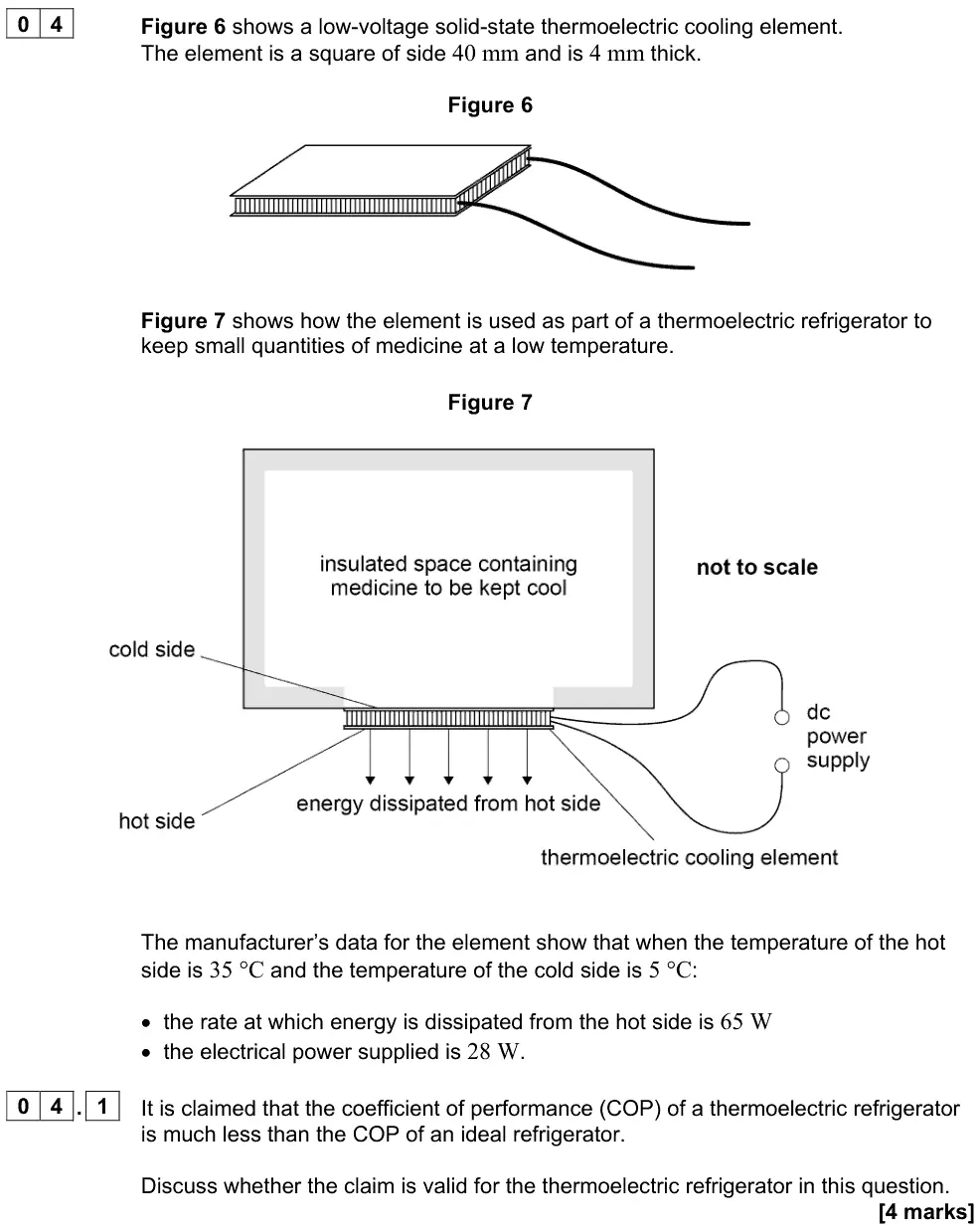
This question (and 04.2) was aimed at Assessment Objective 3, where students had to analyse and evaluate the application of a thermoelectric cooling element in a small refrigerator. The majority of students struggled with the concepts required, especially as they were given both temperatures and powers. The COPref euqation is in the Data and Formulae booklet, but not the equation in terms of temperature. Common errors were: thinking QC = 65 W • • not converting temperatures to kelvin. On the other hand, about 20% of students gave confident answers, with all steps in the calculations of the two COPs clearly stated. Those who were able to calculate the COPs correctly went on to score the last mark for their statement about the validity of the claim. In previous years, students often gave very terse concluding answers to questions where they had to make a deduction or a judgement about a claim, but that was not the case this year.
Question 04.1
Notes from the mark scheme and report
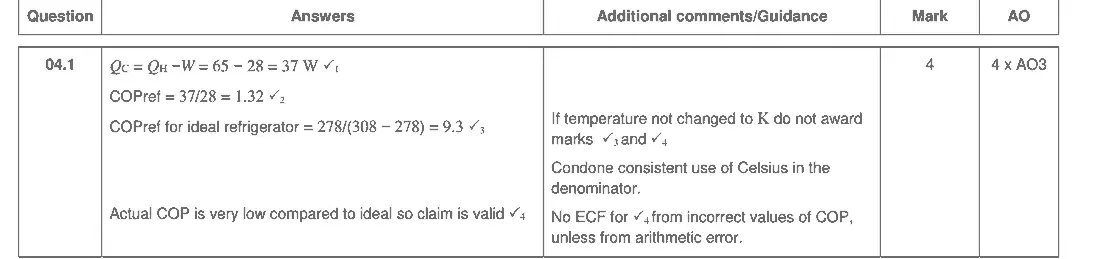
QC = 65 - 28 = 37 W
COP = 37/28 = 1.3
ideal COP = 278/30 = 9.3
actual much lower so claim valid
taking QC = 65 W and not converting to kelvin were common
Skills: MS2.3 Substitute numerical values into algebraic equations using appropriate units for physical quantities; MS0.1 Recognise and make use of appropriate units in calculations
June 2022 · Paper 3B Engineering physics · Q4.22 marksAO3=2Short answer
Earlier part of question 4 that this part uses
Mark scheme
Examiner's comment
Students scored one mark when they were able to give any advantage of the use of the thermoelectric cooling element for the refrigerator described. About half the students were successful in this. The second mark required an appreciation of the trade-off between the low COP (with its consequent increase of input power per QC) and the convenience or use of the solid state refrigerator. There were some good answers, but they were rare.
This question (and 04.2) was aimed at Assessment Objective 3, where students had to analyse and evaluate the application of a thermoelectric cooling element in a small refrigerator. The majority of students struggled with the concepts required, especially as they were given both temperatures and powers. The COPref euqation is in the Data and Formulae booklet, but not the equation in terms of temperature. Common errors were: thinking QC = 65 W • • not converting temperatures to kelvin. On the other hand, about 20% of students gave confident answers, with all steps in the calculations of the two COPs clearly stated. Those who were able to calculate the COPs correctly went on to score the last mark for their statement about the validity of the claim. In previous years, students often gave very terse concluding answers to questions where they had to make a deduction or a judgement about a claim, but that was not the case this year.
Question 04.2
Notes from the mark scheme and report
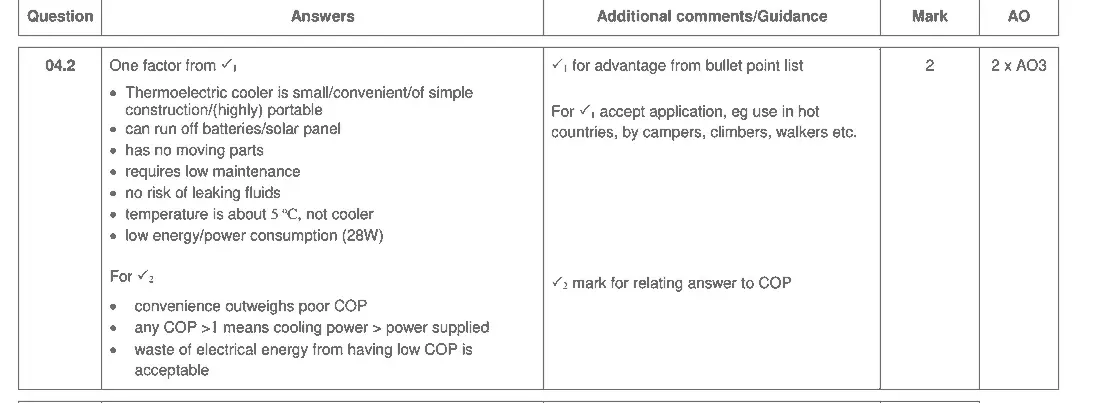
Advantage such as small, portable, battery powered, no moving parts or fluids, only 28 W
convenience outweighs poor COP (COP > 1 still gives more cooling than power in)
about half gained the first mark
November 2021 · Paper 3B Engineering physics · Q3.16 marks6-mark extended response
Mark scheme, with the levels and indicative content
Notes from the mark scheme and report
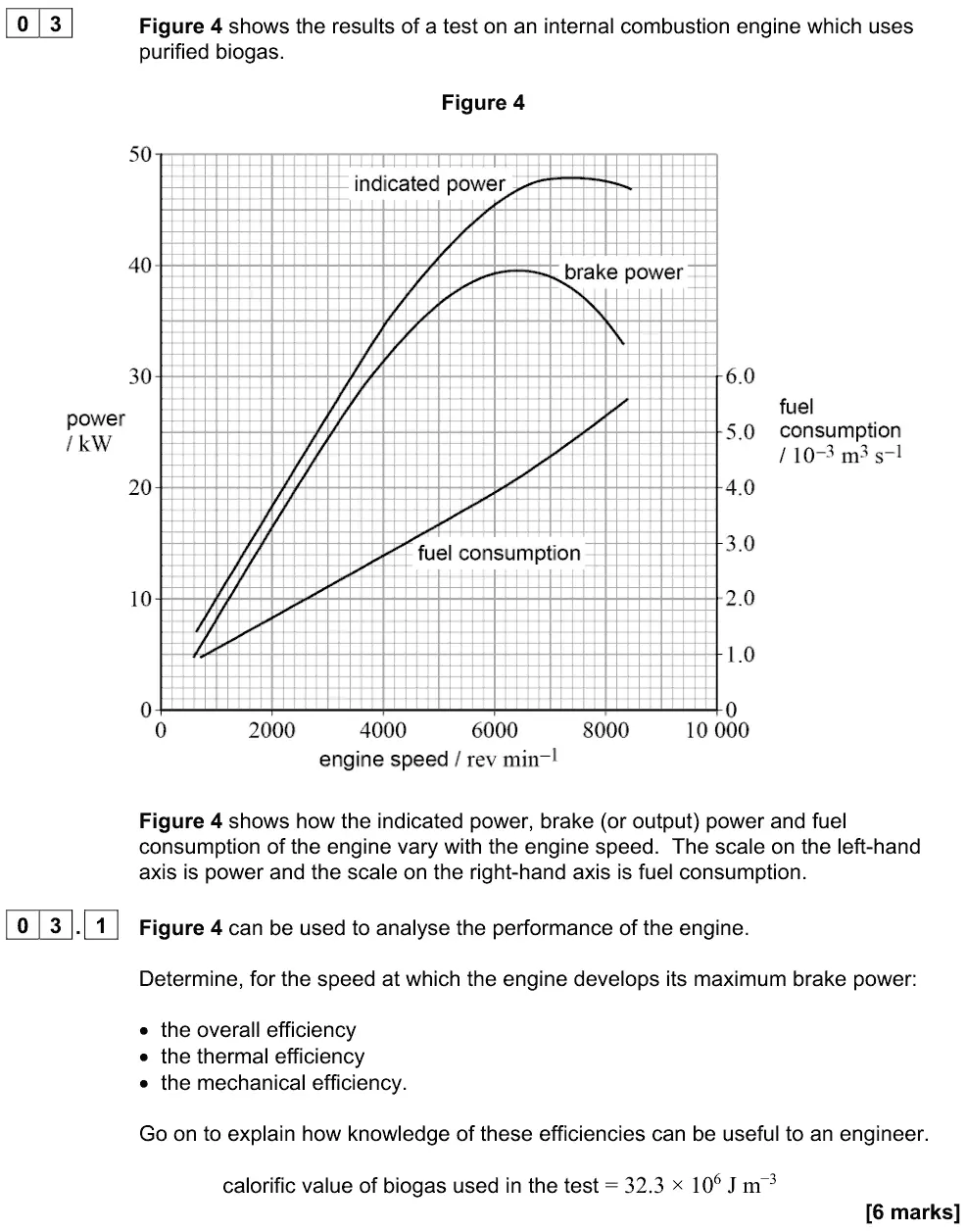
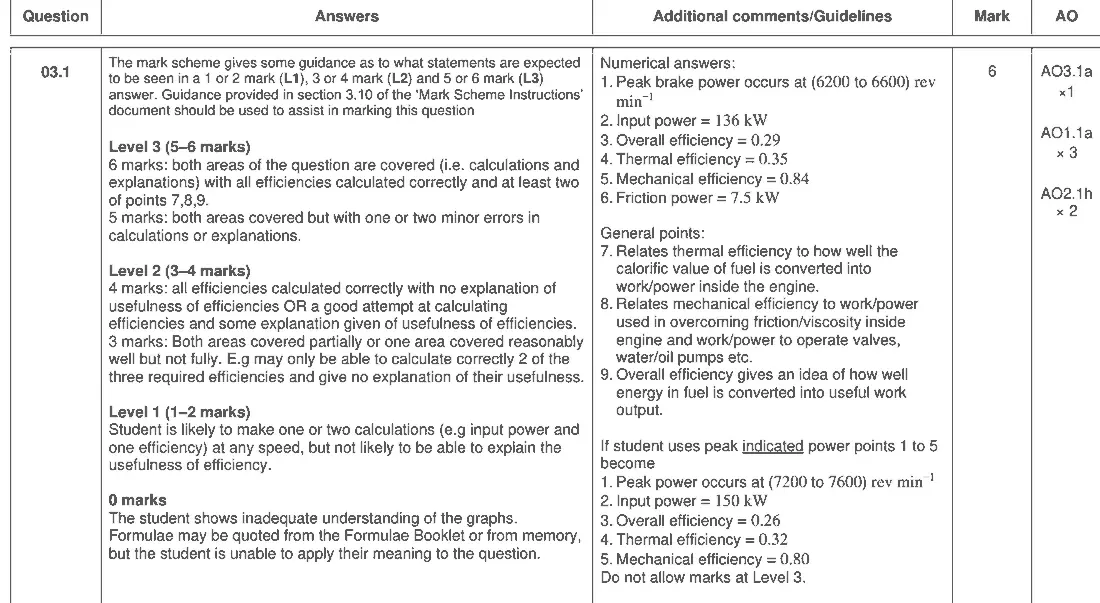
Levels of response: peak brake power about 39.5 kW at 6200-6600 rev min^-1
input power 136 kW
overall 0.29, thermal 0.35, mechanical 0.84, friction power 7.5 kW
explain what each efficiency tells an engineer
using peak indicated power capped below Level 3
Skills: MS3.1 Translate information between graphical, numerical and algebraic forms; MS2.3 Substitute numerical values into algebraic equations using appropriate units for physical quantities; MS0.3 Use ratios, fractions and percentages
November 2021 · Paper 3B Engineering physics · Q3.22 marksExplanation
Earlier part of question 3 that this part uses
Mark scheme
Notes from the mark scheme and report
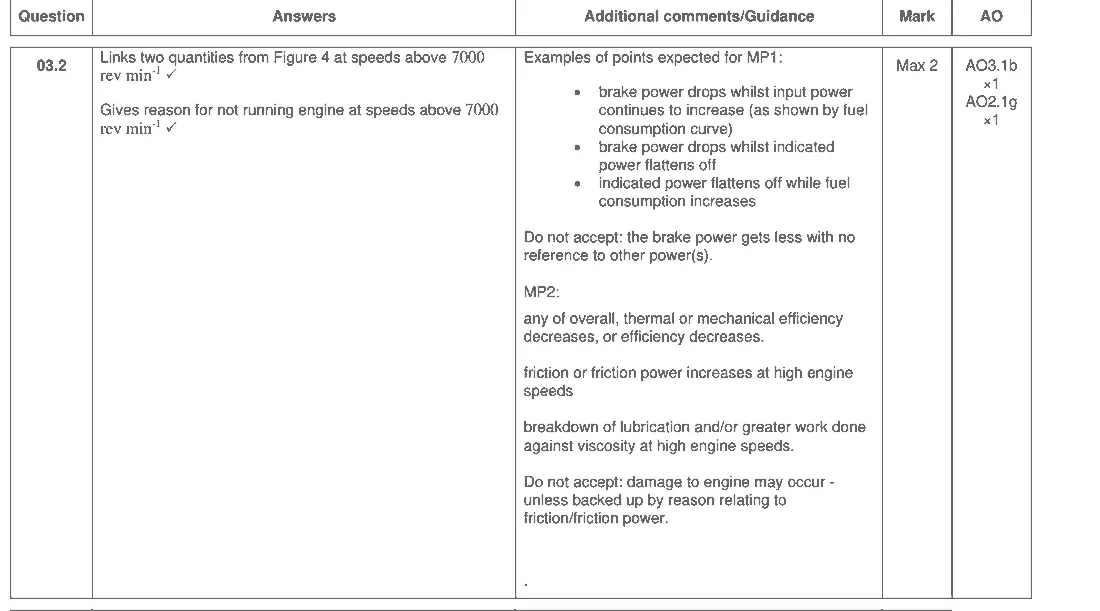
Above 7000 rev min^-1 brake power falls while fuel consumption (input power) keeps rising, so efficiency falls
friction power rises, lubrication breaks down
'brake power falls' alone not enough
Skills: MS3.1 Translate information between graphical, numerical and algebraic forms
November 2021 · Paper 3B Engineering physics · Q4.15 marksCalculation
Mark scheme
Notes from the mark scheme and report
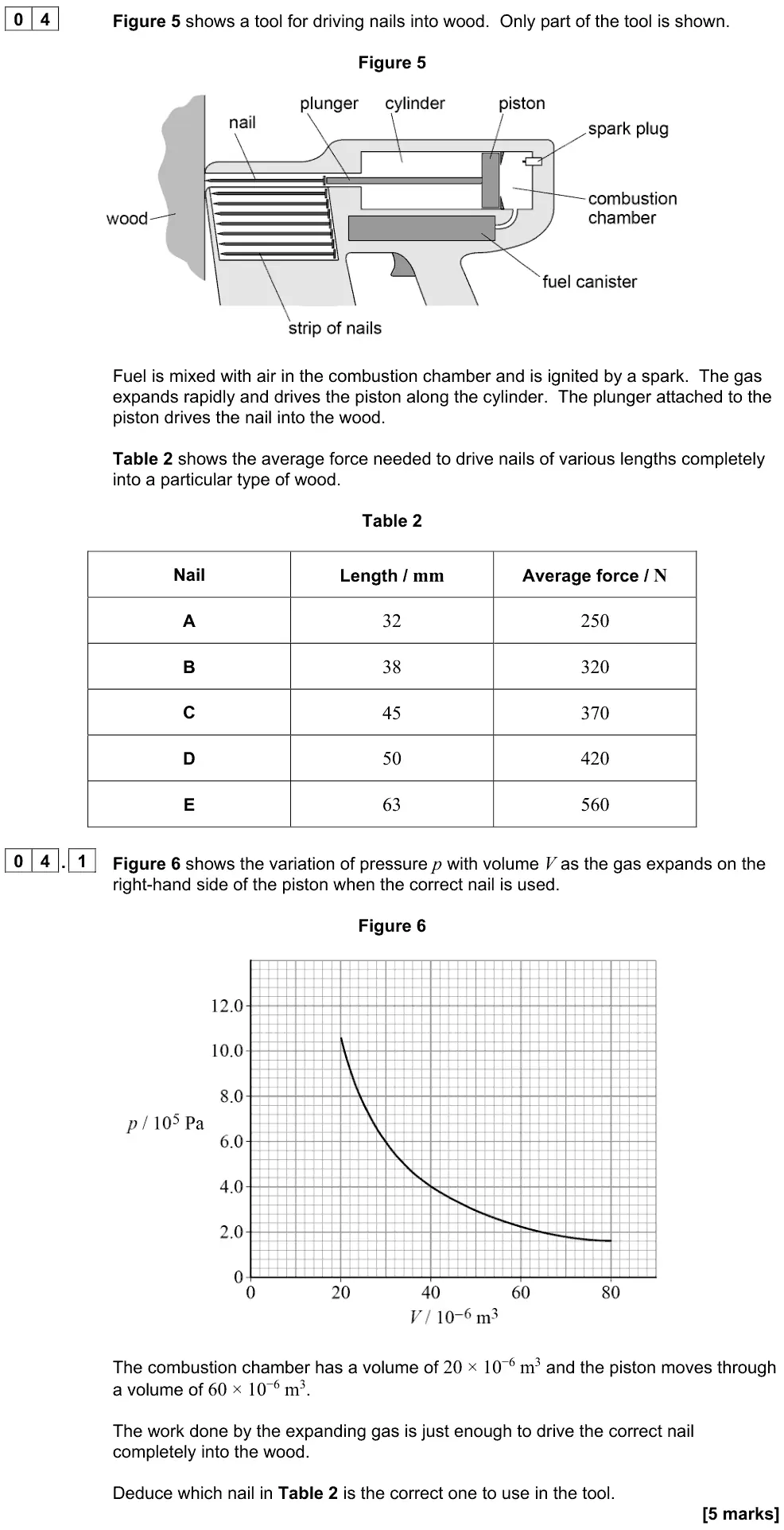
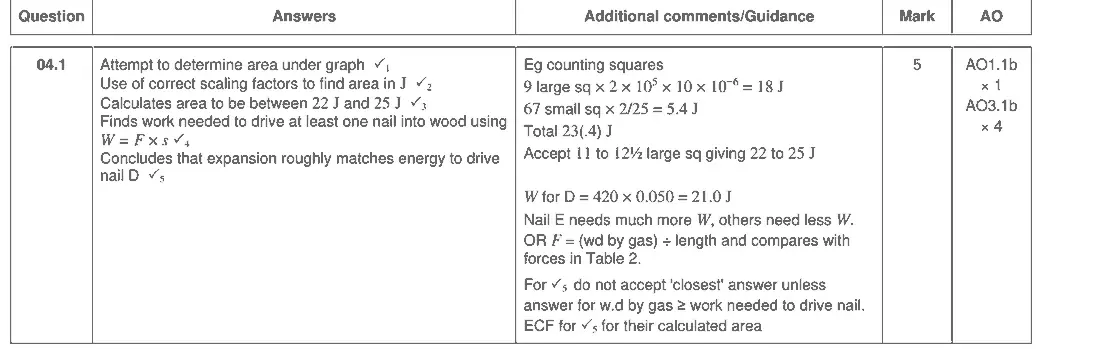
Area under p-V curve 22-25 J (about 23 J by counting squares)
nail D needs 420 x 0.050 = 21 J, E needs 35 J, so D
'closest' not accepted unless gas work at least the nail work
Skills: MS3.8 Understand the possible physical significance of the area between a curve and the x axis and be able to calculate it or estimate it by graphical methods as appropriate; MS2.3 Substitute numerical values into algebraic equations using appropriate units for physical quantities
November 2021 · Paper 3B Engineering physics · Q4.23 marksExplanation
Earlier part of question 4 that this part uses
Mark scheme
Notes from the mark scheme and report
Isothermal needs slow expansion so energy can be transferred to keep temperature (internal energy) constant
at 180 nails per minute each firing takes under 1/3 s, too quick for heat transfer
November 2021 · Paper 3B Engineering physics · Q5.11 markAO1=1Short answer
Mark scheme
Notes from the mark scheme and report
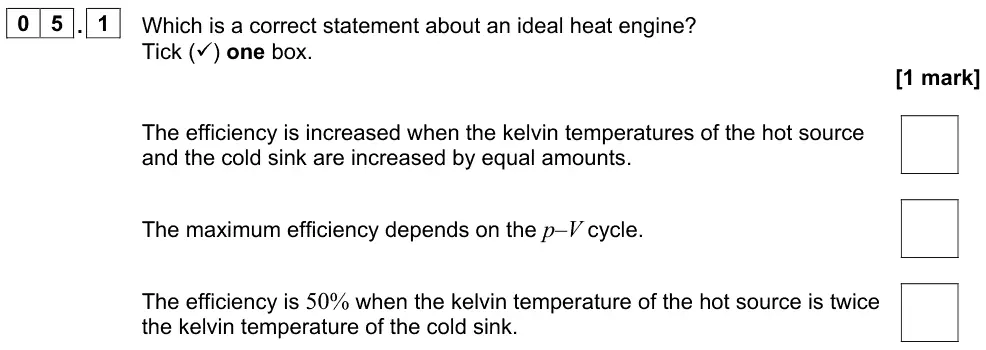
Answer: efficiency is 50% when the hot source kelvin temperature is twice that of the cold sink
November 2021 · Paper 3B Engineering physics · Q5.22 marksAO1=2Calculation
Earlier part of question 5 that this part uses
Mark scheme
Notes from the mark scheme and report
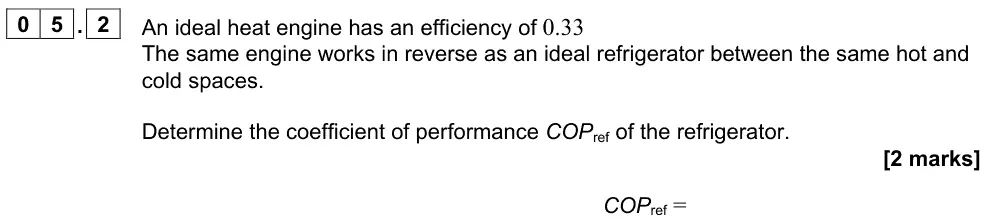
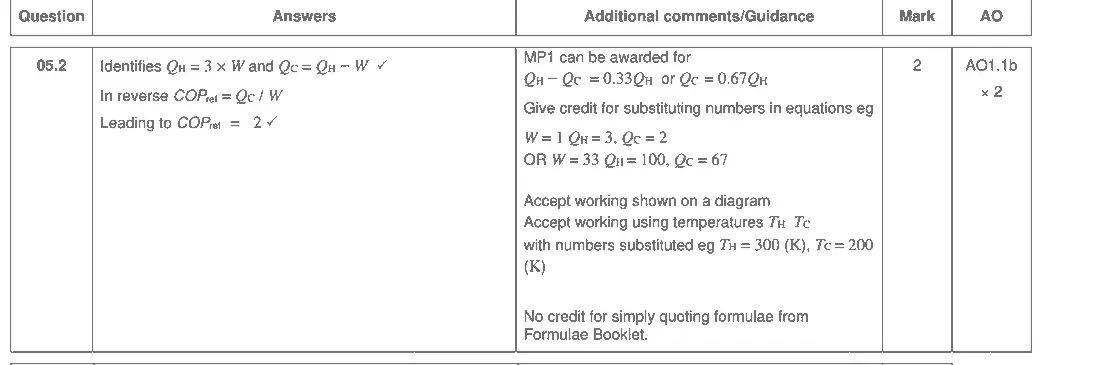
Answer: COPref = 2 (W = 0.33 QH so QC = 0.67 QH
COPref = QC/W)
Skills: MS2.3 Substitute numerical values into algebraic equations using appropriate units for physical quantities; MS0.3 Use ratios, fractions and percentages
November 2020 · Paper 3B Engineering physics · Q36 marks6-mark extended response
Mark scheme, with the levels and indicative content
Notes from the mark scheme and report
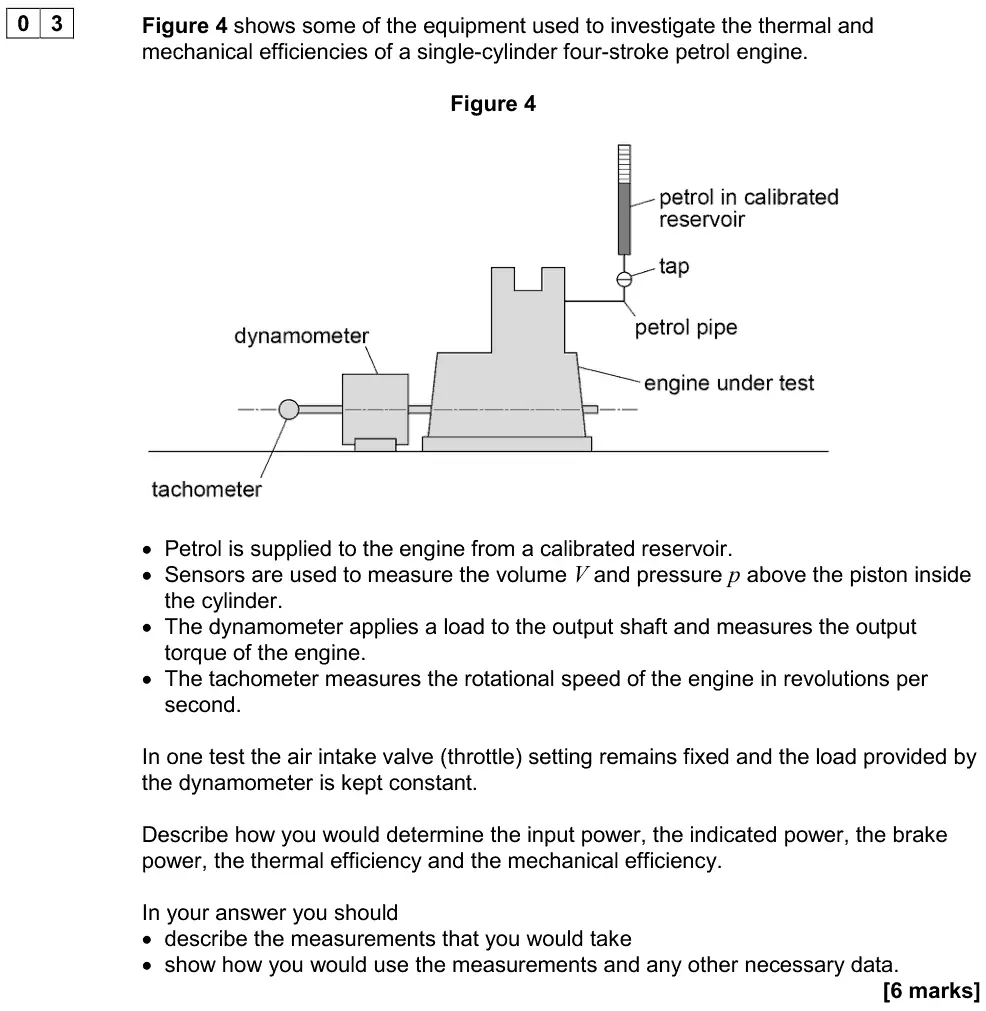
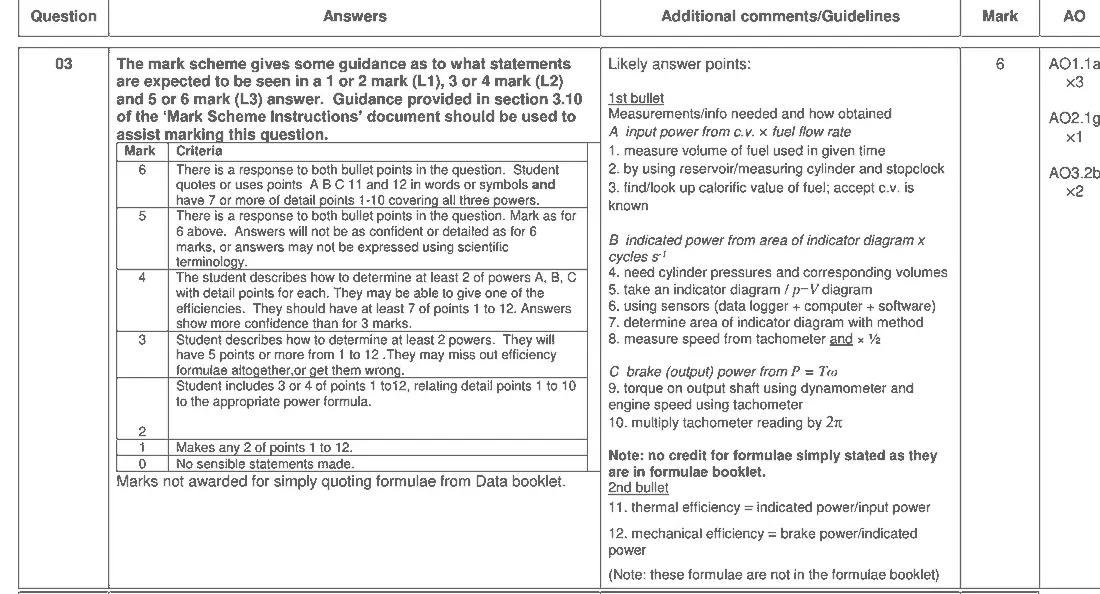
Levels of response: input power = calorific value x fuel flow rate (volume used in a timed interval from the reservoir)
indicated power = indicator-diagram area from p and V sensors x cycles per second (half the rev/s for a four-stroke)
brake power = T omega from dynamometer and tachometer x 2pi
November 2020 · Paper 3B Engineering physics · Q4.11 markAO1=1Short answer
Mark scheme
Notes from the mark scheme and report
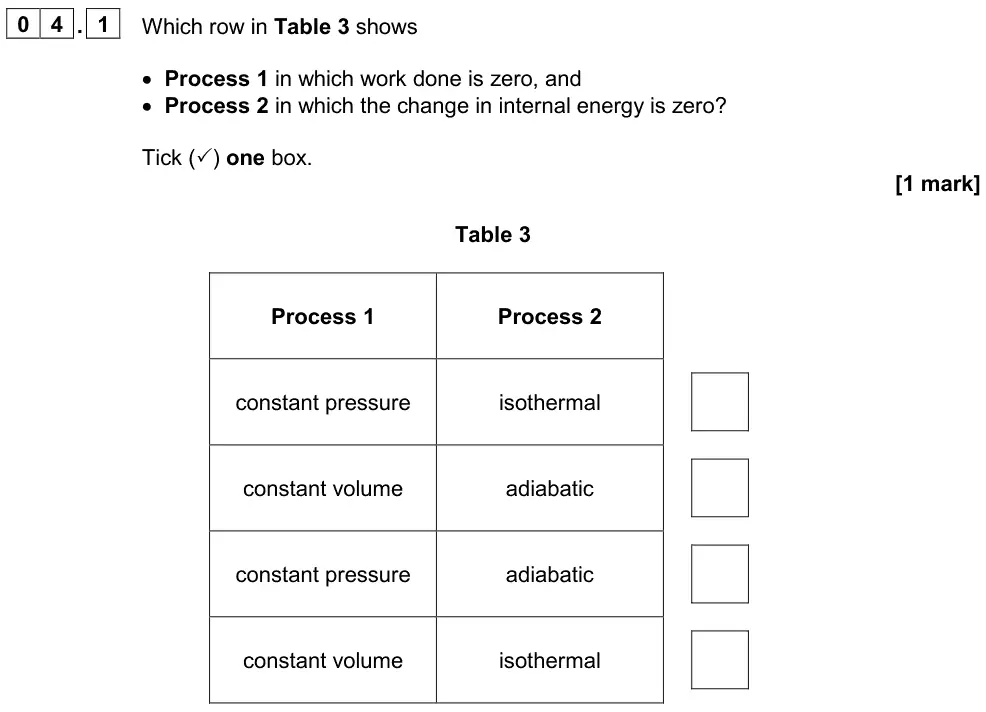
Answer: constant volume (W = 0) and isothermal (dU = 0)
November 2020 · Paper 3B Engineering physics · Q4.23 marksAO2=3Calculation
Earlier part of question 4 that this part uses
Mark scheme
Notes from the mark scheme and report
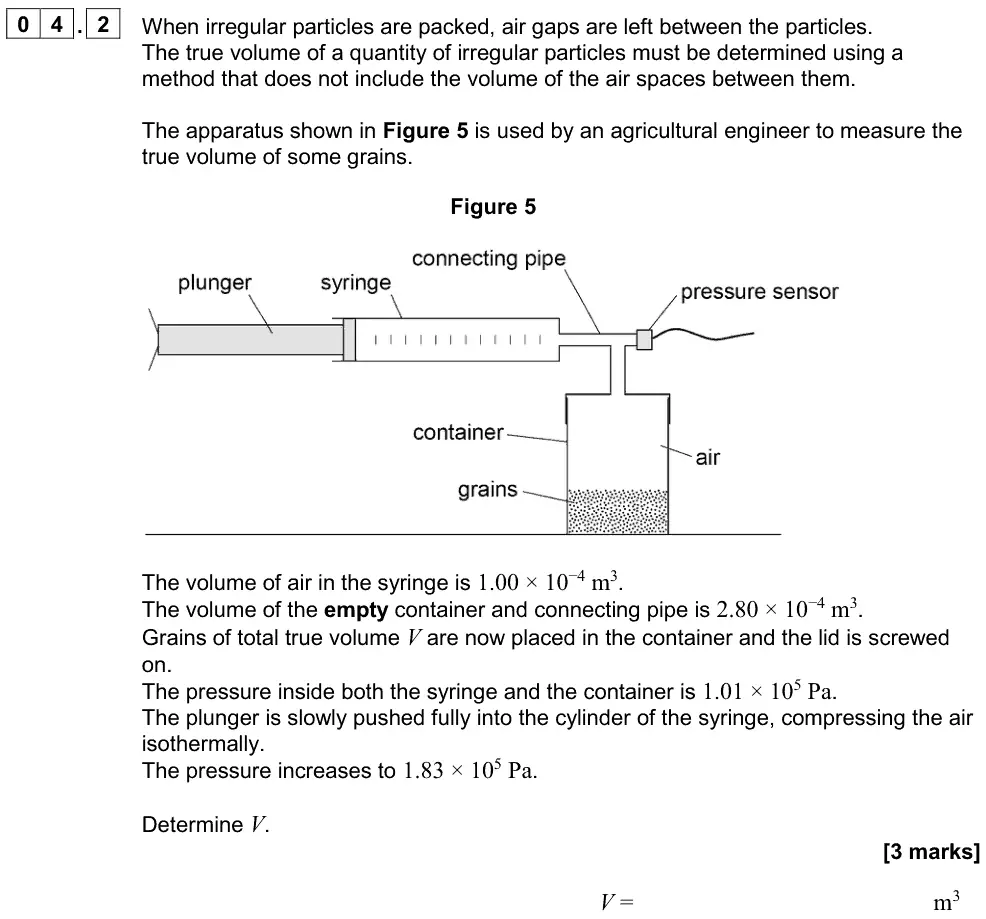
Answer: V = 1.57 x 10^-4 m^3 (1.01 x 10^5 x (3.80 x 10^-4 - V) = 1.83 x 10^5 x (2.80 x 10^-4 - V))
Skills: MS2.3 Substitute numerical values into algebraic equations using appropriate units for physical quantities; MS2.4 Solve algebraic equations, including quadratic equations
November 2020 · Paper 3B Engineering physics · Q4.32 marksDiagram or graph
Earlier part of question 4 that this part uses
Mark scheme
Notes from the mark scheme and report
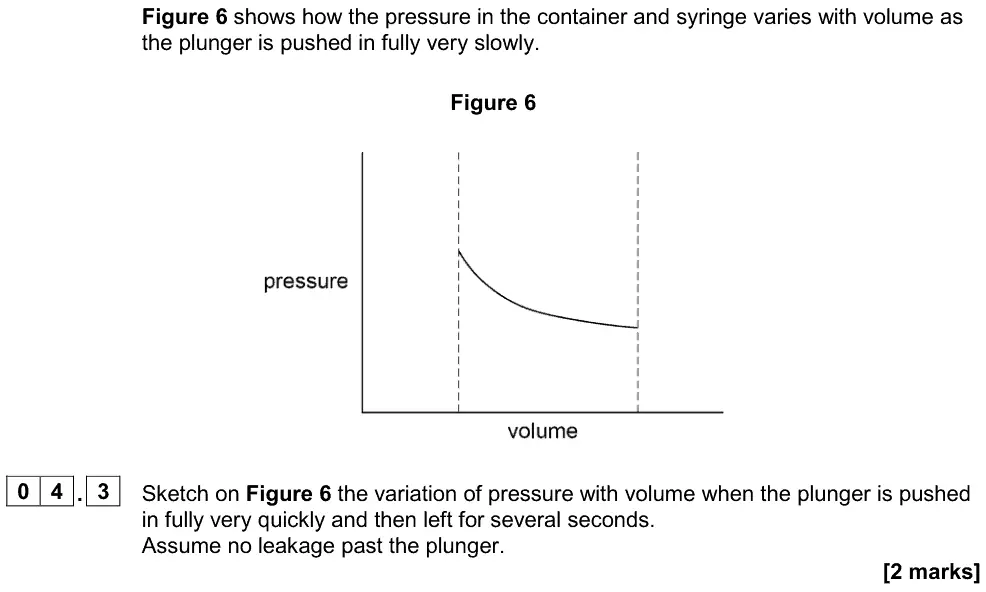
Steeper (adiabatic) curve to the final volume then a vertical line down as the gas cools at constant volume
Skills: MS3.1 Translate information between graphical, numerical and algebraic forms
November 2020 · Paper 3B Engineering physics · Q4.42 marksAO1=2Explanation
Earlier part of question 4 that this part uses
Mark scheme
Notes from the mark scheme and report
For constant internal energy energy must be transferred out by heating
slow compression gives time for this transfer
first-law symbols alone not enough
November 2020 · Paper 3B Engineering physics · Q5.12 marksAO1=2Explanation
Mark scheme
Notes from the mark scheme and report
Engine must work between a hot source and a cold sink and must reject some energy to the sink, so W < QH (or 100% would need TC = 0 K)
November 2020 · Paper 3B Engineering physics · Q5.24 marksCalculation
Earlier part of question 5 that this part uses
Mark scheme
Notes from the mark scheme and report
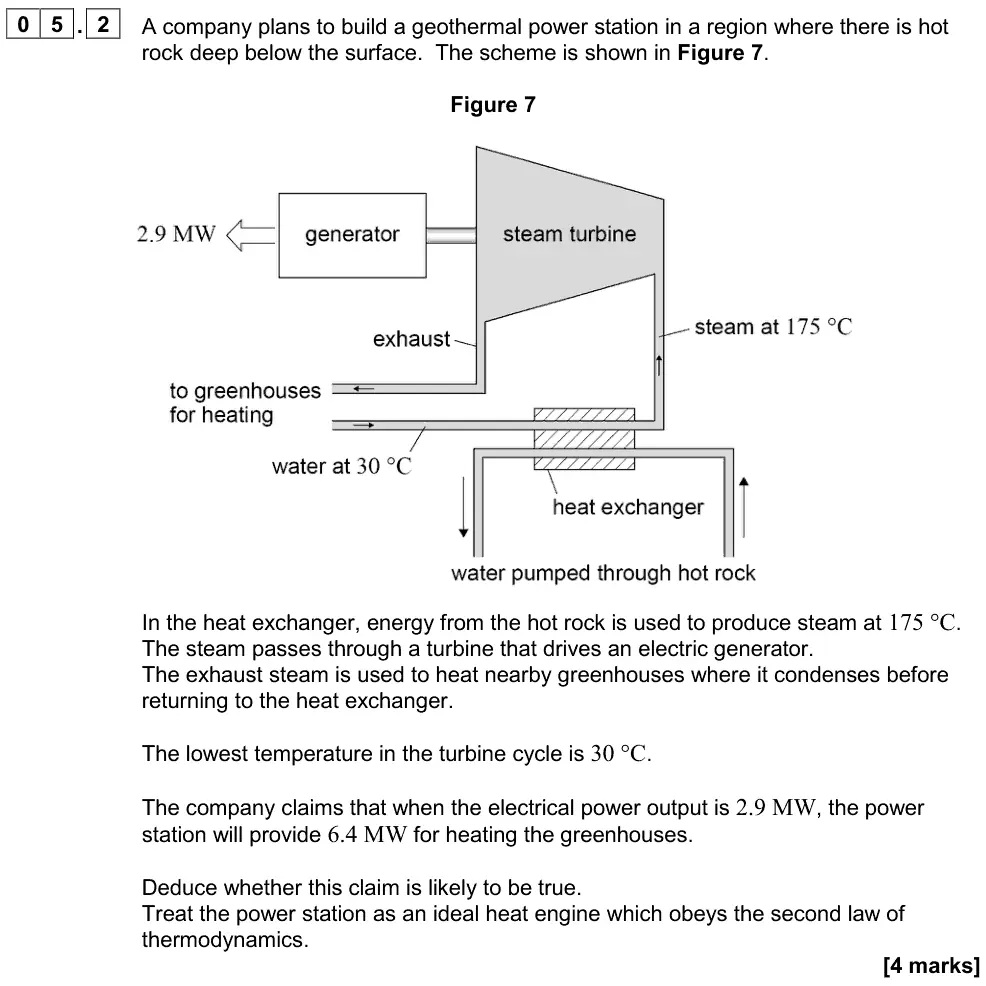
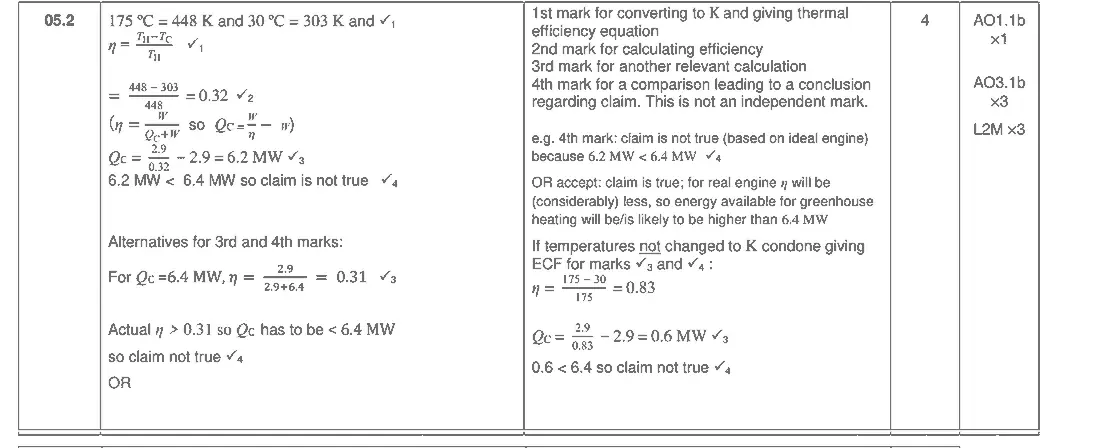
Ideal efficiency (448 - 303)/448 = 0.32
QC = 2.9/0.32 - 2.9 = 6.2 MW < 6.4 MW so claim not true for an ideal engine (credit also for arguing a real, less efficient engine would reject more)
kelvin conversion needed
Skills: MS2.3 Substitute numerical values into algebraic equations using appropriate units for physical quantities; MS0.3 Use ratios, fractions and percentages; MS0.1 Recognise and make use of appropriate units in calculations
June 2019 · Paper 3B Engineering physics · Q3.11 markShow thatEasy
Mark scheme
Examiner's comment
More than 90 per cent of students achieved the mark for a simple application of pV = constant to the isothermal process A → B.
There were questions on which nearly all students were able to gain some credit, and, it is hoped, achieve some confidence. The high mean marks for questions 1.1, 1.3, 3.1 and 3.2 suggest that students generally seemed more comfortable with the calculations than the qualitative questions.
Question 3.1
Notes from the mark scheme and report
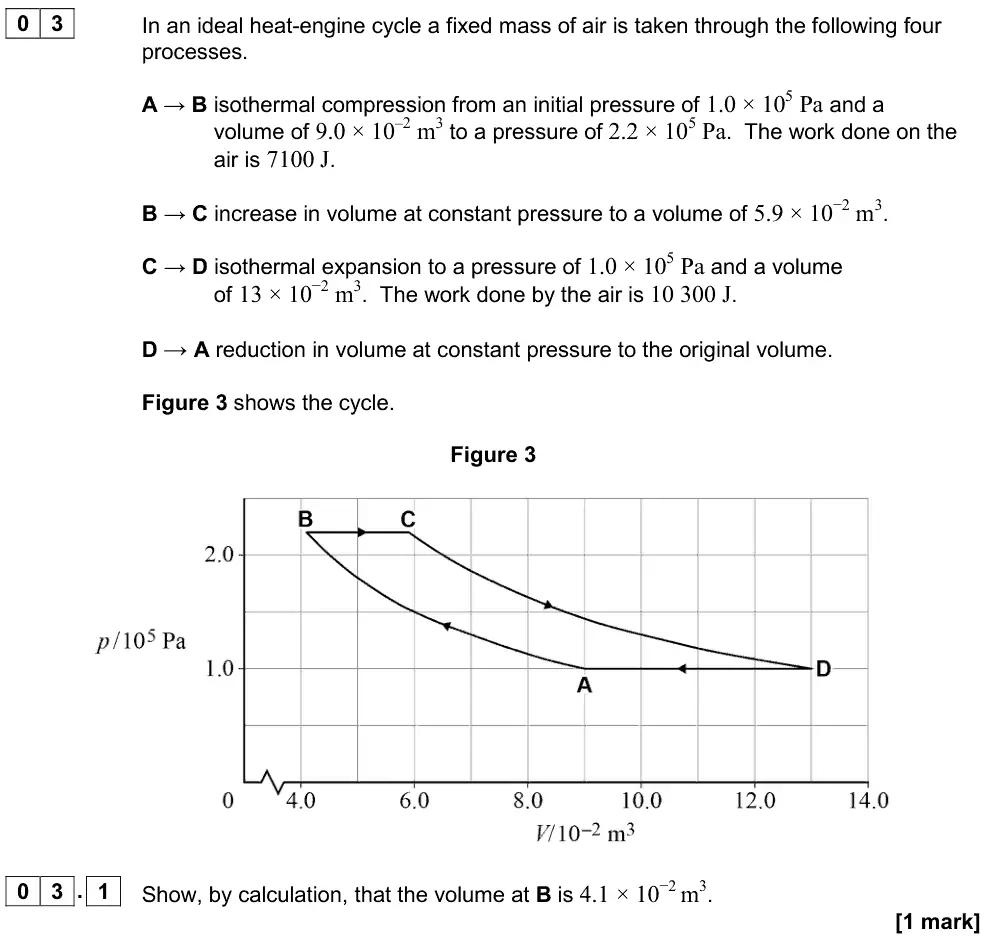
Answer: 4.1 x 10^-2 m^3 (pAVA = pBVB)
Skills: MS2.3 Substitute numerical values into algebraic equations using appropriate units for physical quantities; MS2.2 Change the subject of an equation, including non-linear equations
June 2019 · Paper 3B Engineering physics · Q3.22 marksShow thatEasy
Earlier part of question 3 that this part uses
Mark scheme
Examiner's comment
This question was also answered well, with about 75% of students scoring 2 marks. The most pV V constant constant = T = common approach was to apply (or ) to points B and C in the cycle. T Some took a more laborious approach and worked out n or nR using pV nRT = for point B and V substituted into pV nRT constant = T = for point C. Some students mistakenly applied to points with two different pressures, eg points A and C.
There were questions on which nearly all students were able to gain some credit, and, it is hoped, achieve some confidence. The high mean marks for questions 1.1, 1.3, 3.1 and 3.2 suggest that students generally seemed more comfortable with the calculations than the qualitative questions.
Question 3.2
Notes from the mark scheme and report
Answer: 425 K (V/T constant from B to C at constant pressure)
at least 3 sf
applying V/T constant between points at different pressures was an error
Skills: MS2.3 Substitute numerical values into algebraic equations using appropriate units for physical quantities; MS2.2 Change the subject of an equation, including non-linear equations
June 2019 · Paper 3B Engineering physics · Q3.32 marksShort answerHard
Earlier part of question 3 that this part uses
Mark scheme
Examiner's comment
This proved to be difficult, with around half of the students failing to gain any marks. Just over one- fifth of the students scored the two marks. There were many answers where the magnitude of the work done in process D to A was correctly calculated, but students missed the minus sign to show work is done on the air. A careful reading of the question should have informed students that the energy transfer in process B → C is the same as the energy transfer in process D → A, but of opposite sign. Many missed this.
About one-third of students scored only 1 mark out of 3, and this is likely to have been for calculating the maximum possible efficiency of the cycle, but this was as far as they could get. To calculate the actual efficiency, they needed to add the figures in their W column of Table 1 to find the net work done and then divide by 10300 J. ‘Error carried forward’ was given for their W for process D → A. An alternative route for finding the work done was to find the area of the loop in Figure 3, but few used this method. All the information required, including the energy provided by heat transfer from an external source, was in the stem of 03.3 and Table 1. Perhaps students did not realise the importance of going back over earlier parts of the question to locate the appropriate information. Provided they had correctly calculated the efficiencies, students then needed to come to a sensible conclusion for three marks; only around 11% of students scored 3 marks. A surprising number of students wrote a conclusion without having done any calculations at all, or based only on the maximum theoretical efficiency. About 7% of students made no attempt to answer the question.
Question 3.3
Notes from the mark scheme and report
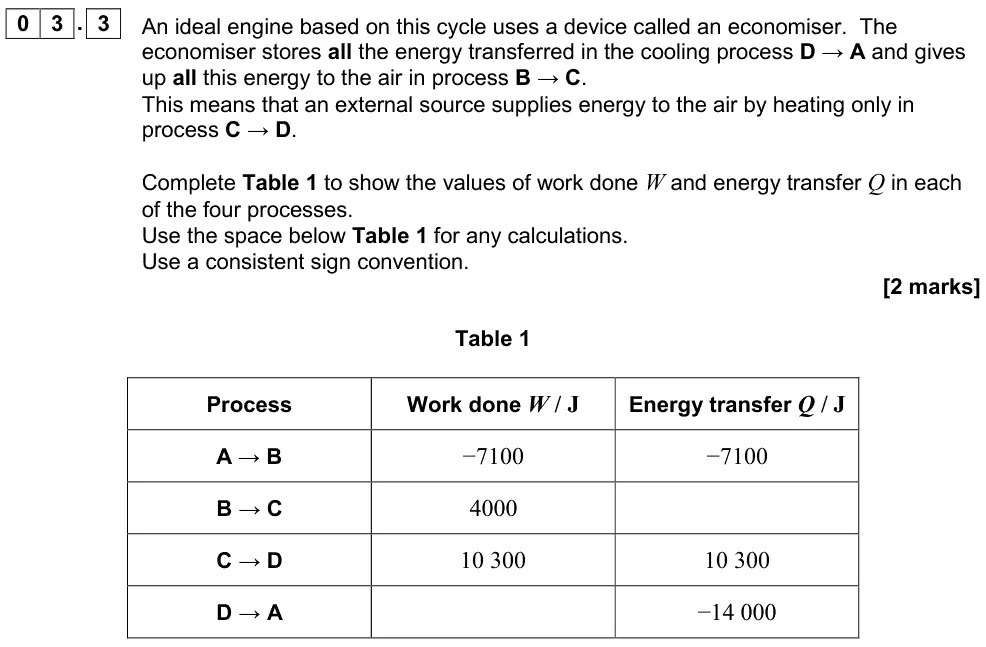
B to C: Q = +14 000 J
D to A: W = -4000 J (p dV = 1.0 x 10^5 x 4.0 x 10^-2 m^3)
minus sign for work done on air often missed
Skills: MS2.3 Substitute numerical values into algebraic equations using appropriate units for physical quantities
June 2019 · Paper 3B Engineering physics · Q3.42 marksExplanation
Earlier part of question 3 that this part uses
Mark scheme
Examiner's comment
Students were fairly confident in the application of the first law of thermodynamics, and about 75% of students scored 1 or 2 marks. The most common reason for not scoring 2 marks was confusing ΔU and U, with students giving the statements 'ΔU is constant' or 'U equals zero'. Students who wrote Q = ΔU + W , and then showed a misunderstanding of what the symbols meant, failed to gain one or both marks.
Question 3.4
Notes from the mark scheme and report
First law Q = dU + W
isothermal so dU = 0 and Q = W
confusing dU with U
June 2019 · Paper 3B Engineering physics · Q3.53 marksCalculationHard
Earlier part of question 3 that this part uses
Mark scheme
Examiner's comment
About one-third of students scored only 1 mark out of 3, and this is likely to have been for calculating the maximum possible efficiency of the cycle, but this was as far as they could get. To calculate the actual efficiency, they needed to add the figures in their W column of Table 1 to find the net work done and then divide by 10300 J. ‘Error carried forward’ was given for their W for process D → A. An alternative route for finding the work done was to find the area of the loop in Figure 3, but few used this method. All the information required, including the energy provided by heat transfer from an external source, was in the stem of 03.3 and Table 1. Perhaps students did not realise the importance of going back over earlier parts of the question to locate the appropriate information. Provided they had correctly calculated the efficiencies, students then needed to come to a sensible conclusion for three marks; only around 11% of students scored 3 marks. A surprising number of students wrote a conclusion without having done any calculations at all, or based only on the maximum theoretical efficiency. About 7% of students made no attempt to answer the question.
Question 3.5
Notes from the mark scheme and report
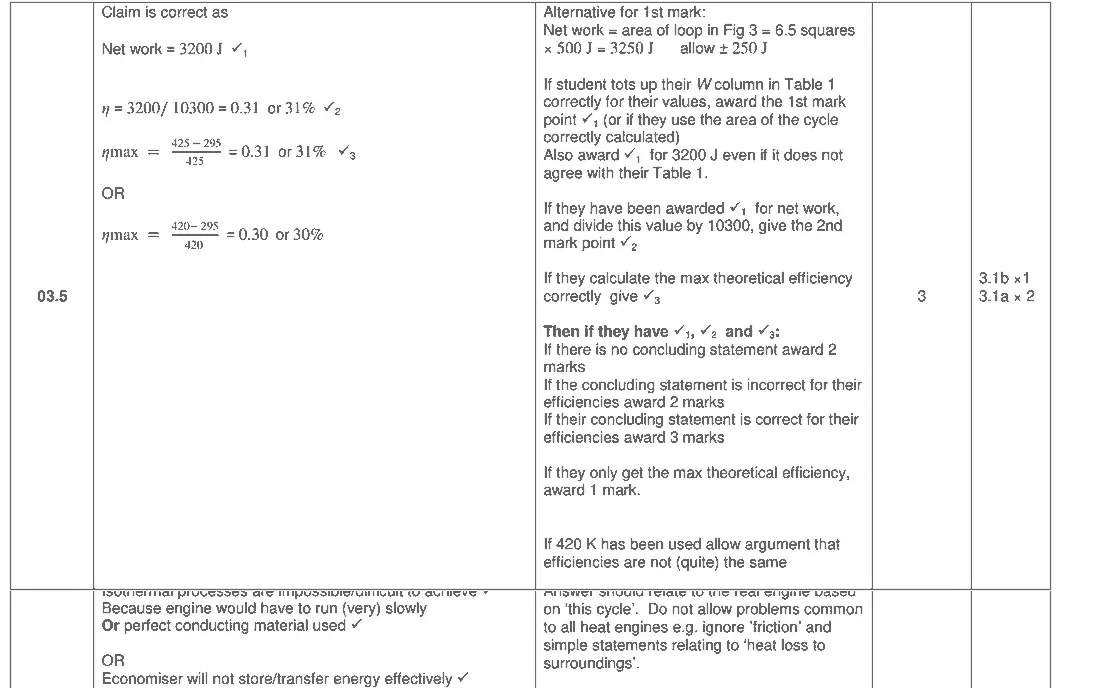
Net work 3200 J (sum of W column or loop area)
efficiency 3200/10 300 = 31%
max (425 - 295)/425 = 31%, so claim true
many stopped at the maximum efficiency
Skills: MS0.3 Use ratios, fractions and percentages; MS2.3 Substitute numerical values into algebraic equations using appropriate units for physical quantities
June 2019 · Paper 3B Engineering physics · Q3.62 marksExplanationHard
Earlier part of question 3 that this part uses
Mark scheme
Examiner's comment
The most effective answers were those that discussed the practical difficulties of achieving isothermal processes, or making an economiser that would store or transfer energy effectively. For 2 marks the answer had to relate to the working of a real engine based on the cycle described in the question. Most answers applied to any engine, with references to friction and/or heat loss to surroundings, or the rounding of the corners of the indicator diagram. No credit was given for such answers. Only about one-third of students scored one or both marks.
Question 3.6
Notes from the mark scheme and report
Isothermal processes need very slow running or perfect conduction
economiser cannot store and return all the energy
tiny power output for engine size
generic friction or heat-loss answers not credited
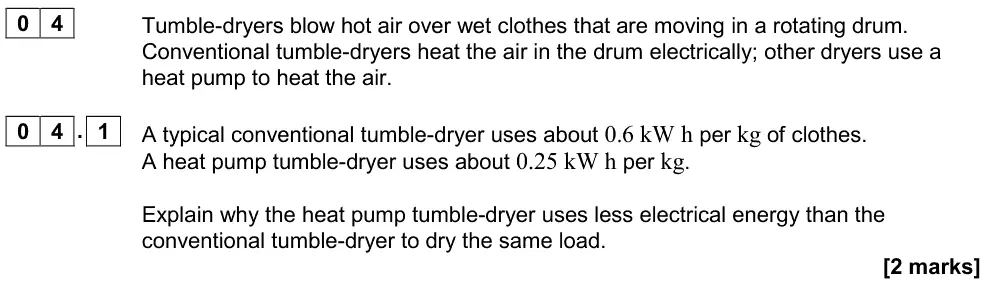
June 2019 · Paper 3B Engineering physics · Q4.12 marksExplanationHard
Mark scheme
Examiner's comment
Reversed heat engines are still not understood well by the majority of students. The first mark was awarded for knowing that a heat pump tumble dryer takes some of its energy from a cold space. About one-quarter of students scored this mark. Many students thought that the heat pump transferred air from the cold space to the hot space. The second mark was for developing this to explain why the heat pump tumble dryer uses less electrical energy than a conventional tumble dryer, but only approximately 16% of students were able to give a clearly thought-out answer.
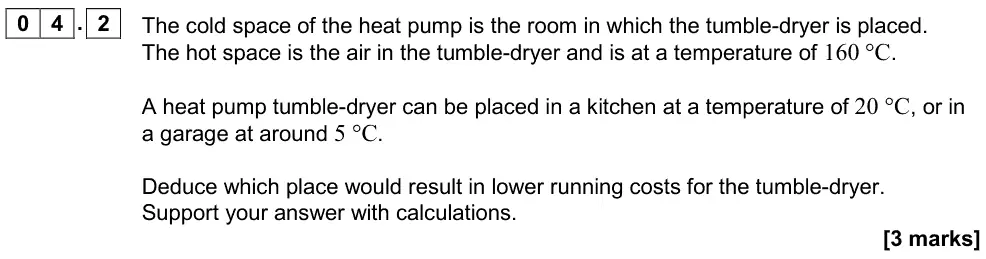
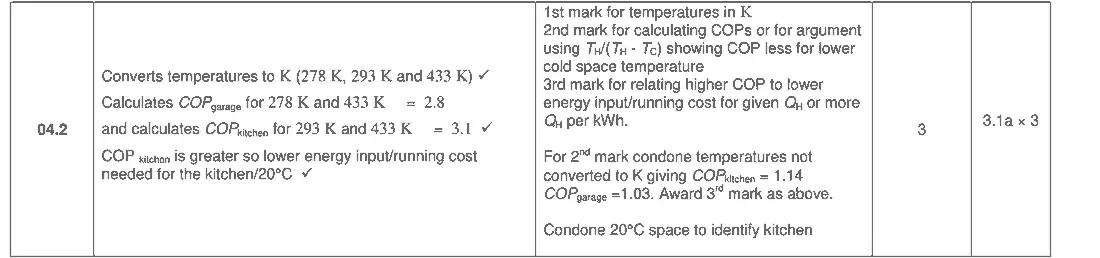
Answers to this question were better than for 4.1, with about half the students scoring 2 or 3 marks. T H . In this case, Normally, we would not reward students for using ºC in the equation ( ) T T − H C however, coefficient of performance was not mentioned in the question, and the equation in terms of temperature is not in the Data and Formulae booklet, although it is in the specification. Since the students had to realise that both the coefficient of performance and the use of the temperature equation were needed, it was decided to condone the use of ºC, thereby allowing a maximum mark of 2. A considerable number of students did not convert to Kelvin. Those who were able to calculate the coefficients of performance (or correctly argue that the CoP for the kitchen was higher) usually went on to correctly deduce that placing the tumble dryer in the kitchen would give the lower running costs. A significant number of students calculated the efficiency of the tumble dryer as if it was a heat engine using ( ) T T − H C . Some calculated CoPs, but referred to them as efficiencies. T H
Question 4.1
Notes from the mark scheme and report
Heat pump extracts energy from the cold space (room), so QH = W + QC and less electrical work is needed for the same heat delivered
many thought air is moved from cold to hot space
June 2019 · Paper 3B Engineering physics · Q4.23 marksCalculation
Earlier part of question 4 that this part uses
Mark scheme
Examiner's comment
Answers to this question were better than for 4.1, with about half the students scoring 2 or 3 marks. T H . In this case, Normally, we would not reward students for using ºC in the equation ( ) T T − H C however, coefficient of performance was not mentioned in the question, and the equation in terms of temperature is not in the Data and Formulae booklet, although it is in the specification. Since the students had to realise that both the coefficient of performance and the use of the temperature equation were needed, it was decided to condone the use of ºC, thereby allowing a maximum mark of 2. A considerable number of students did not convert to Kelvin. Those who were able to calculate the coefficients of performance (or correctly argue that the CoP for the kitchen was higher) usually went on to correctly deduce that placing the tumble dryer in the kitchen would give the lower running costs. A significant number of students calculated the efficiency of the tumble dryer as if it was a heat engine using ( ) T T − H C . Some calculated CoPs, but referred to them as efficiencies. T H
Question 4.2
Skills: MS2.3 Substitute numerical values into algebraic equations using appropriate units for physical quantities; MS0.1 Recognise and make use of appropriate units in calculations
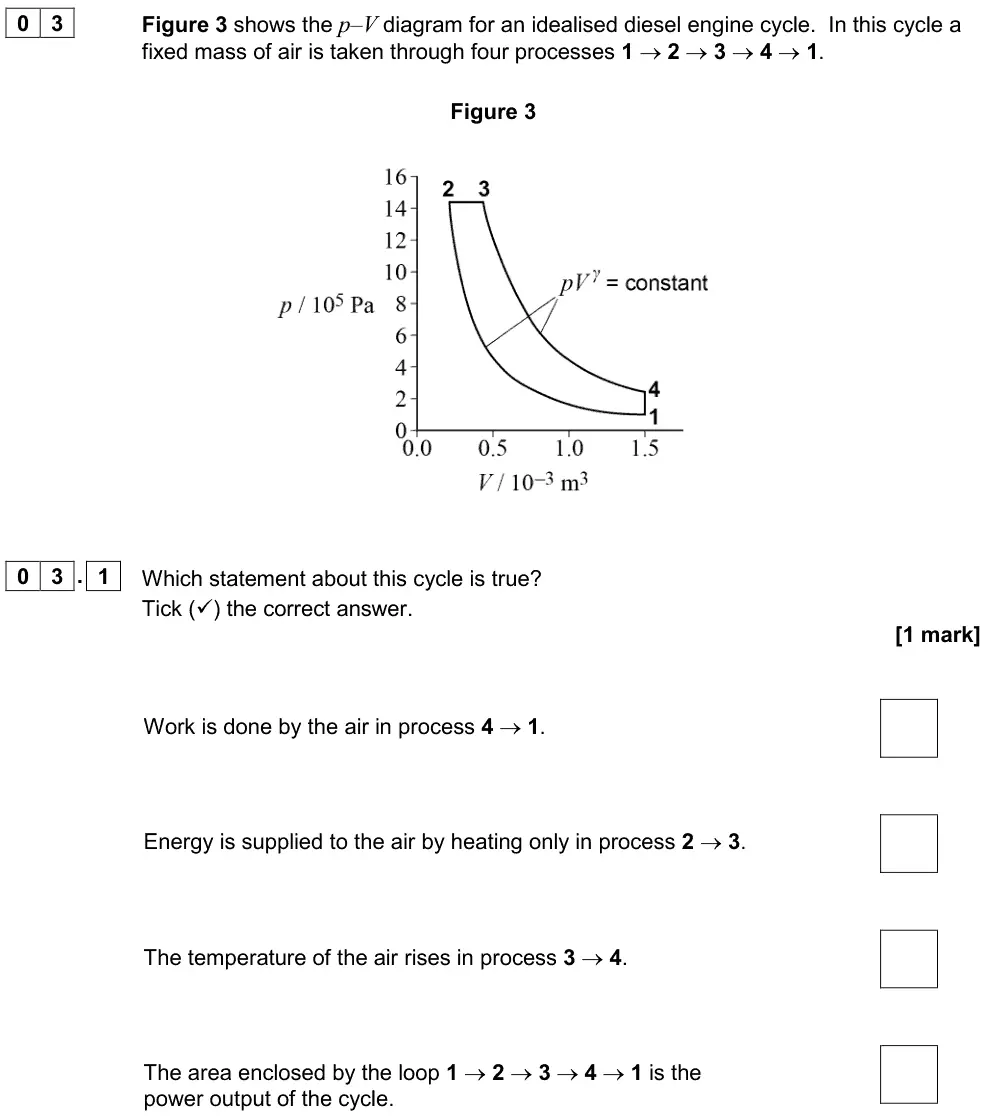
June 2018 · Paper 3B Engineering physics · Q3.11 markShort answer
Mark scheme
Examiner's comment
03.1 The mark was scored by 47.1% of the students.
Notes from the mark scheme and report
Answer: energy is supplied to the air by heating only in process 2 to 3
47.1% correct
June 2018 · Paper 3B Engineering physics · Q3.25 marksCalculationHard
Earlier part of question 3 that this part uses
Mark scheme
Examiner's comment
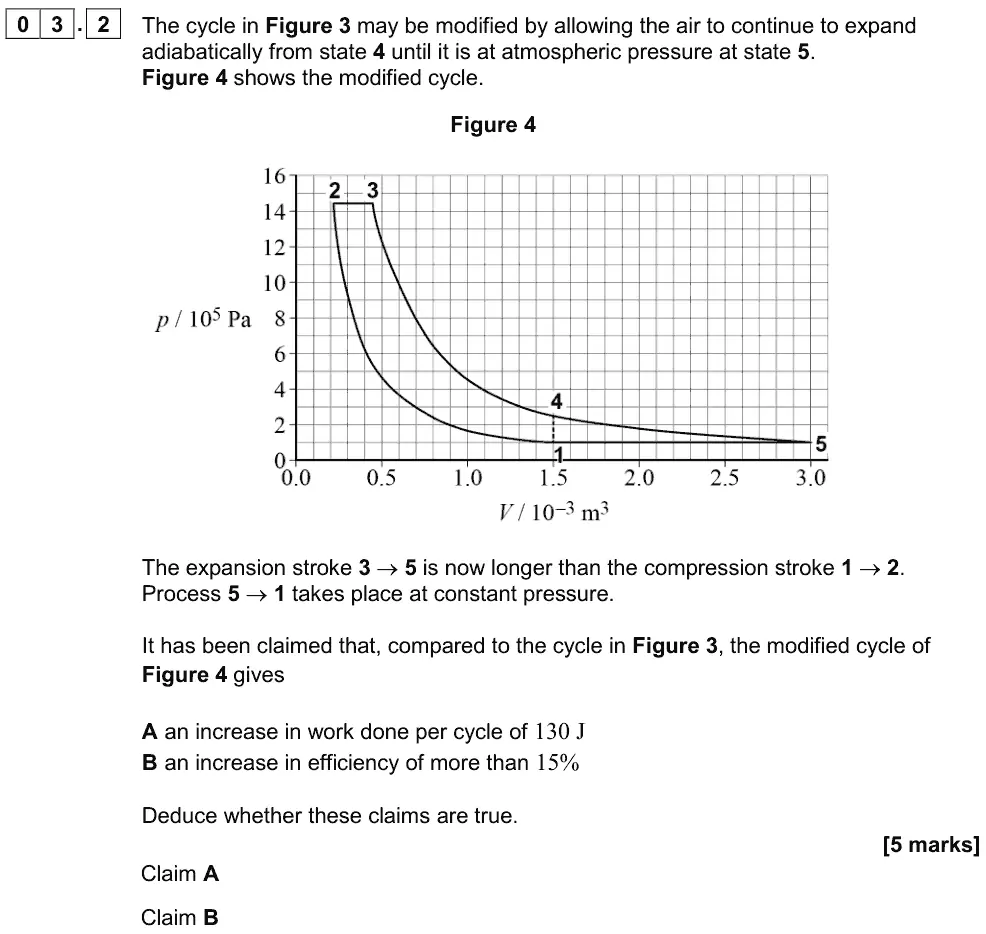
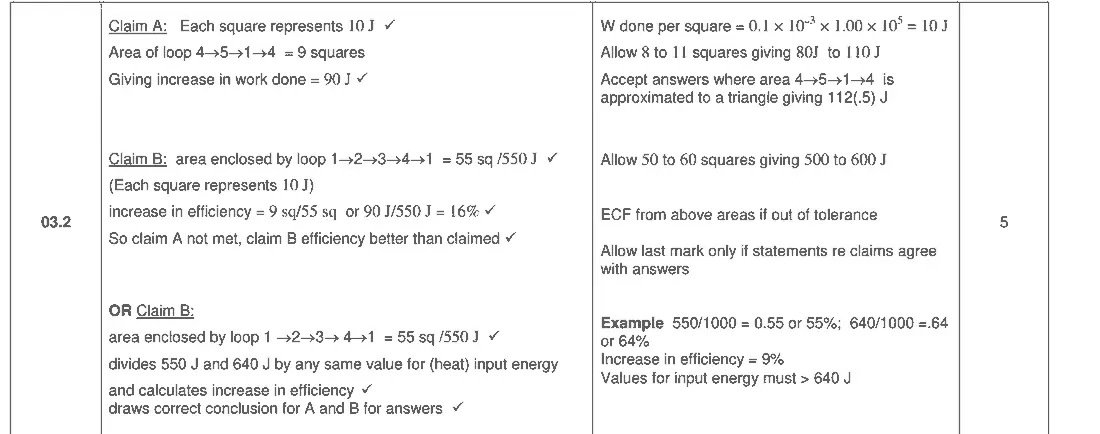
03.2 This question concerned the work done and efficiency of a modified ideal diesel engine cycle. Students were asked to make judgements about the two claims given in the question. Estimating the extra work done for Claim A caused few problems for most students. Counting squares was the most common method but, as an alternative, full credit for the calculation could be gained by approximating the area 1→4→5→1 to a triangle. Of those who knew what they were doing in Claim B, many failed to gain a mark by under- estimating the area of the loop 1→2→3→4→1. This did not, however, prevent them from scoring subsequent marks. The examiners accept that there was some ambiguity in the question. An alternative mark scheme was prepared to account for those who attempted to calculate separate efficiencies for both cycles, and then found the increase. The question should have given either the efficiency of the first cycle, or its input energy. Only a minority of students tried this approach, and examiners took pains to ensure no students were disadvantaged. 30.5% of students scored four or five marks; 51.2% scored one, two or three marks. Teachers of this option might like to know that this question was about an Atkinson cycle, a variation of which is used in some modern car engines to improve fuel consumption.
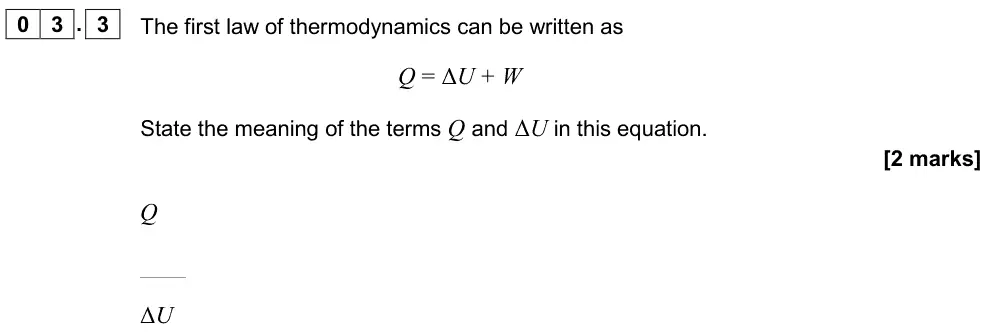
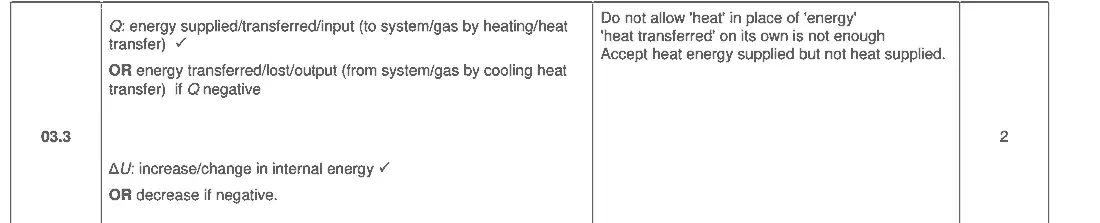
There were many disappointing answers to this question. All too often, Q was defined as 03.3 “heat”, “heat flow” or “heat transfer”, with no mention of the word 'energy'. It is to be expected that students taking an option specialising in thermodynamics would have a strong understanding of the first law of thermodynamics, and not be sloppy in their definitions. Some wrote "total energy", probably because it was the sum of two entities, ΔU and W. About 39% scored one mark out of the two, mainly because their understanding of the meaning of ΔU was much better. 18.4% of the students scored no marks at all. There were instances where the terms internal energy, heat and temperature were used as if they meant the same thing.
Questions 01.4, 03.2 and, to some extent, question 4 asked the students to analyse, interpret and evaluate data and come to a conclusion or make a judgement or decision. These questions tested Assessment Objective 3 (AO3) of the specification. The majority of students made clear concluding statements following their calculations, but a small minority let themselves down by writing a one-word answer such as "yes".
Notes from the mark scheme and report
Claim A: extra loop 4-5-1 about 9 squares x 10 J = 90 J, so not met
Claim B: 90/550 = 16% increase, so met
under-estimating loop 1-2-3-4-1 common
Atkinson cycle context
Skills: MS3.8 Understand the possible physical significance of the area between a curve and the x axis and be able to calculate it or estimate it by graphical methods as appropriate; MS0.3 Use ratios, fractions and percentages
June 2018 · Paper 3B Engineering physics · Q3.32 marksShort answer
Earlier part of question 3 that this part uses
Mark scheme
Examiner's comment
There were many disappointing answers to this question. All too often, Q was defined as 03.3 “heat”, “heat flow” or “heat transfer”, with no mention of the word 'energy'. It is to be expected that students taking an option specialising in thermodynamics would have a strong understanding of the first law of thermodynamics, and not be sloppy in their definitions. Some wrote "total energy", probably because it was the sum of two entities, ΔU and W. About 39% scored one mark out of the two, mainly because their understanding of the meaning of ΔU was much better. 18.4% of the students scored no marks at all. There were instances where the terms internal energy, heat and temperature were used as if they meant the same thing.
03.4 Answers here reinforced the examiners' view (from 03.3) that the first law is not fully understood. 21.5% of students scored both marks, but another 35.8% could only score the one mark for calculating the work done in process 5→1 (with or without the minus sign). This is work done on the air, so must be negative in Q = ΔU + W. The calculations “−374 J + 150 J = −224 J”, or “374 J −150 J = 224 J”, were commonly seen.
Questions 01.1 and 03.3 required students to recall basic definitions. More students than expected were not prepared for this. For an option specialising in rotational dynamics and thermodynamics, students should give definitions that use correct terminology.
Notes from the mark scheme and report
Q = energy transferred to the gas by heating
dU = increase in internal energy
'heat' or 'heat flow' without 'energy' not accepted
18.4% scored zero
June 2018 · Paper 3B Engineering physics · Q3.42 marksCalculationHard
Earlier part of question 3 that this part uses
Mark scheme
Examiner's comment
03.4 Answers here reinforced the examiners' view (from 03.3) that the first law is not fully understood. 21.5% of students scored both marks, but another 35.8% could only score the one mark for calculating the work done in process 5→1 (with or without the minus sign). This is work done on the air, so must be negative in Q = ΔU + W. The calculations “−374 J + 150 J = −224 J”, or “374 J −150 J = 224 J”, were commonly seen.
It was pleasing to see answers from students who were able to think around the problem and who came up with arguments concerning the economics of the scheme (capital, installation, maintenance and staffing costs) and reliability. The marking was generous at the lower end. Students could score a mark for practically any sensible reason for low efficiency of a heat engine, even though the question related to maximum theoretical efficiency. Some wrote half a page on reasons for low efficiency of 4 stroke engines, which were not relevant here. The concept of efficiency is in the main part of the specification (Section 3.4.1.7) and in the option, but a significant number of students showed a lack of understanding. For example, the output power of the generator was given in the question as 60 MW, but this did not stop students calculating the output as 60 × 0.36 or 21.6 MW. A common recommendation was to use the National Grid because it could easily supply all the power needed, completely missing the idea of making use of energy that would otherwise be wasted. Just over three-quarters of the students were awarded at least two out of the six marks available; however, only 4% gained full credit.
Notes from the mark scheme and report
Answer: 524 J (W = p dV = 1.0 x 10^5 x 1.50 x 10^-3 = -150 J as work done on the air
Q = -374 - 150)
sign errors gave 224 J
Skills: MS2.3 Substitute numerical values into algebraic equations using appropriate units for physical quantities; MS3.1 Translate information between graphical, numerical and algebraic forms
June 2018 · Paper 3B Engineering physics · Q3.53 marksCalculation
Earlier part of question 3 that this part uses
Mark scheme
Examiner's comment
03.5 The majority of students who judged correctly that the highest temperature in the cycle was at point 3 were able to score full marks (45.8% of students), but some failed to gain the last mark by not reading accurately enough the pressure and volume at point 3 on Figure 4. The first mark was an 'easy' mark for attempting to use pV =nRT, for example by using any point in the cycle. Despite this, nearly 10% of the students scored zero, and 8.2% did not attempt the question. Many students had no idea which point in the cycle corresponded to maximum temperature, so were unable to access the second and third marks.
Notes from the mark scheme and report
Answer: 1310 K (maximum T at point 3: p = 14.5 x 10^5 Pa, V = 0.45 x 10^-3 m^3, n = 0.060 mol)
many did not identify point 3 as the hottest
Skills: MS3.1 Translate information between graphical, numerical and algebraic forms; MS2.3 Substitute numerical values into algebraic equations using appropriate units for physical quantities; MS2.2 Change the subject of an equation, including non-linear equations
June 2018 · Paper 3B Engineering physics · Q46 marks6-mark extended response
Mark scheme, with the levels and indicative content
Examiner's comment
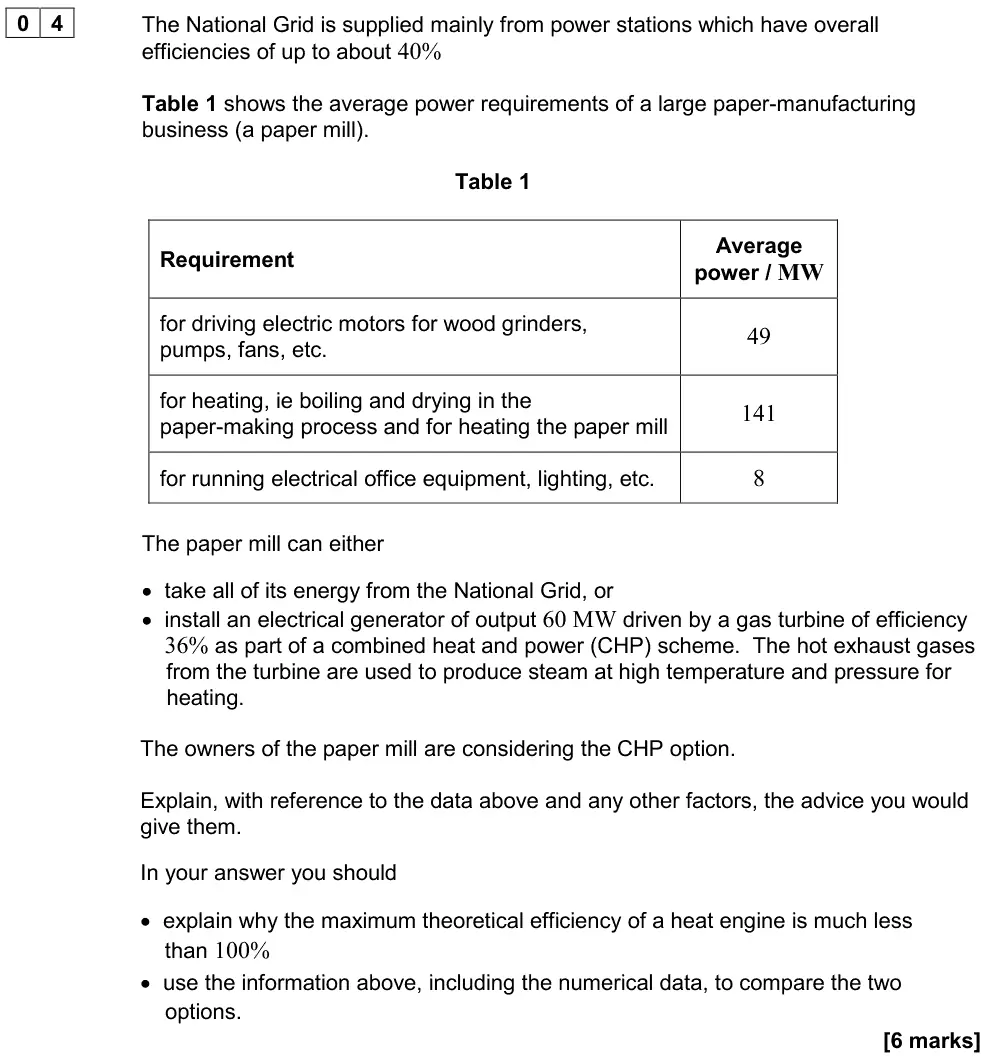
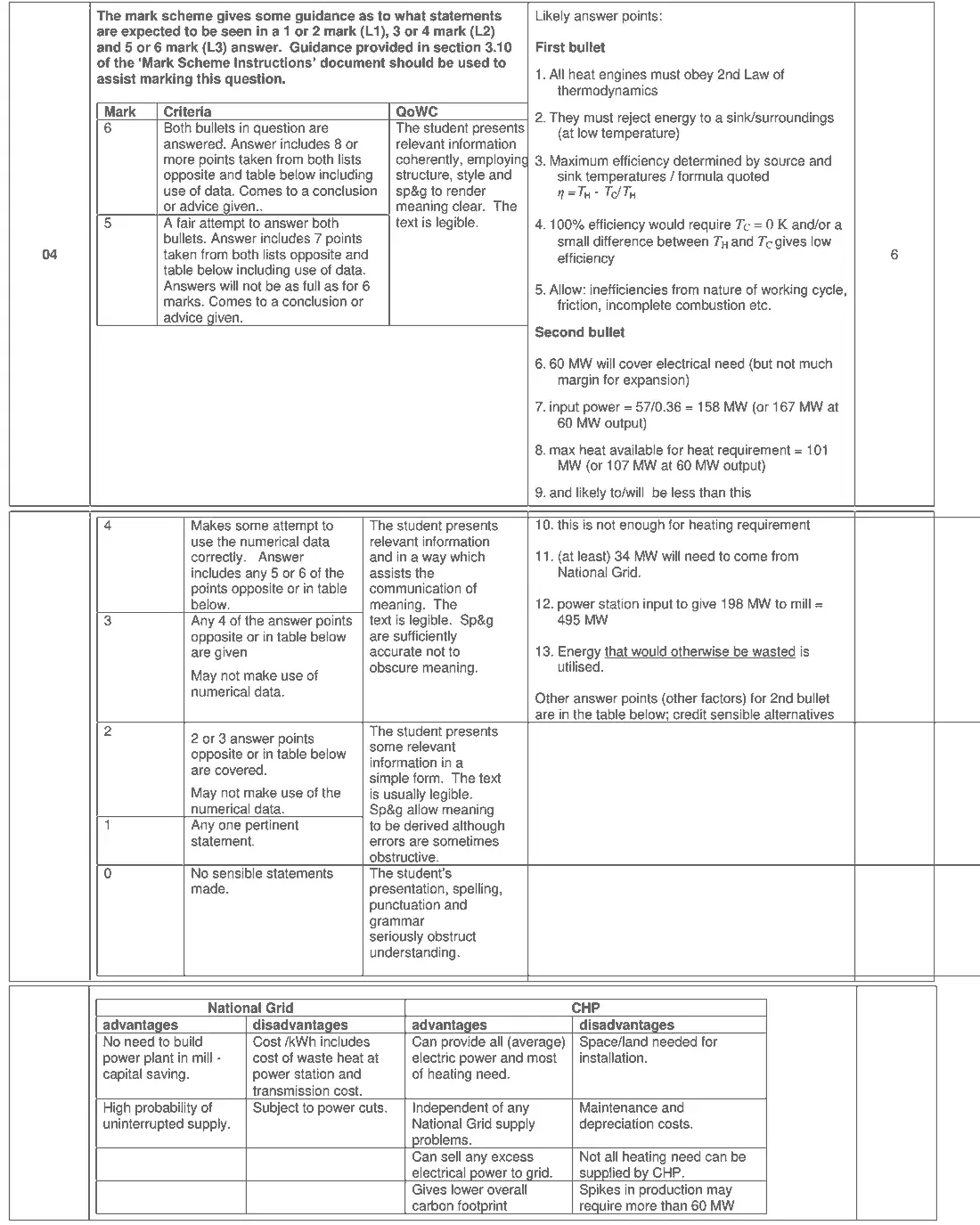
This question was answered well by those students who had a good understanding of the meaning of efficiency and who had previously come across the idea of combined heat and power (CHP). These students were able to explain the upper limit of efficiency of a heat engine, often quoting (TH − TC)/TH and sometimes mentioning the second law of thermodynamics. They then went on to address the paper mill CHP scheme using the data given. The most common points made using the data were that: • when all the energy required by the mill came from the National Grid, the corresponding input energy would be 495 MW; the input energy to the generator is 158 MW or 167 MW (depending on whether they used • a generator output of 57 or 60 MW); the energy in the exhaust gases (101 or 107 MW) is not enough to provide all 141 MW for • process heating; the generator can provide the 57 MW load for all the electrical equipment and offices. •
It was pleasing to see answers from students who were able to think around the problem and who came up with arguments concerning the economics of the scheme (capital, installation, maintenance and staffing costs) and reliability. The marking was generous at the lower end. Students could score a mark for practically any sensible reason for low efficiency of a heat engine, even though the question related to maximum theoretical efficiency. Some wrote half a page on reasons for low efficiency of 4 stroke engines, which were not relevant here. The concept of efficiency is in the main part of the specification (Section 3.4.1.7) and in the option, but a significant number of students showed a lack of understanding. For example, the output power of the generator was given in the question as 60 MW, but this did not stop students calculating the output as 60 × 0.36 or 21.6 MW. A common recommendation was to use the National Grid because it could easily supply all the power needed, completely missing the idea of making use of energy that would otherwise be wasted. Just over three-quarters of the students were awarded at least two out of the six marks available; however, only 4% gained full credit.
Notes from the mark scheme and report
Levels of response: max efficiency (TH - TC)/TH needs TC = 0 K
CHP input 158-167 MW, waste heat 101-107 MW not enough for 141 MW heating so about 34 MW still from Grid
Grid needs about 495 MW input
CHP uses otherwise wasted energy
costs and reliability
only 4% full marks, three-quarters scored at least 2
June 2017 · Paper 3B Engineering physics · Q3.14 marksCalculation
Mark scheme
Examiner's comment
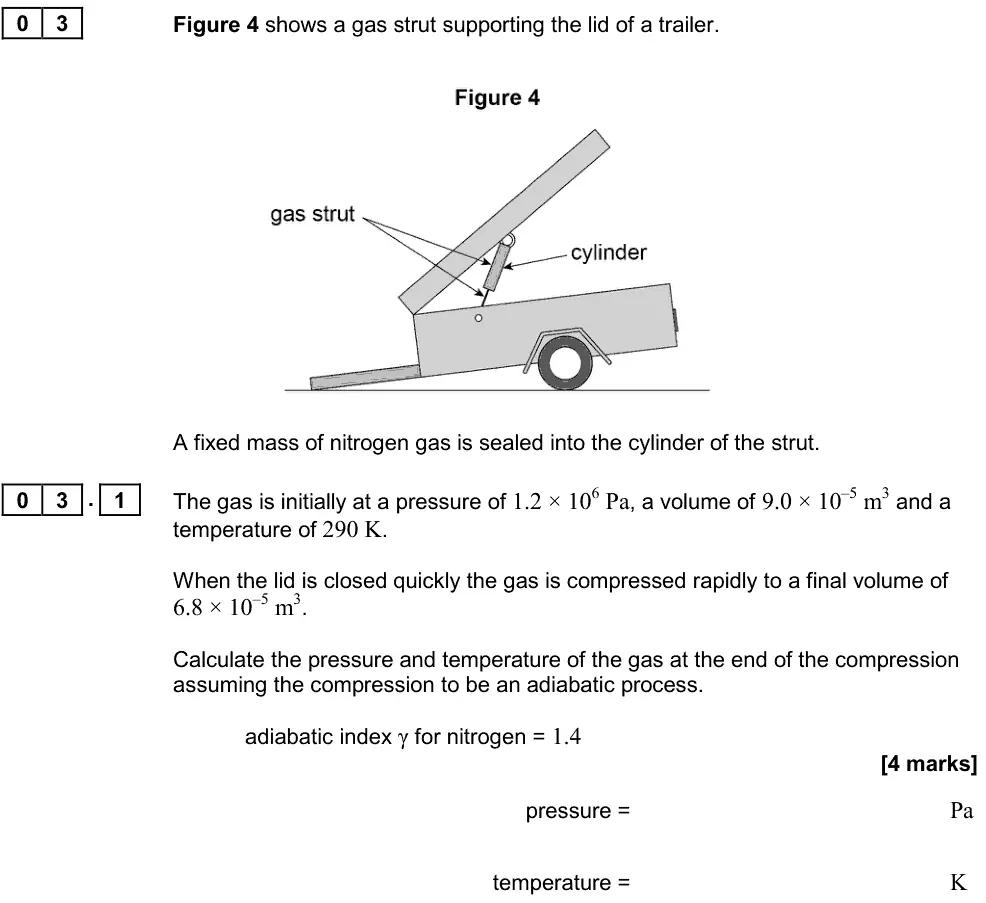
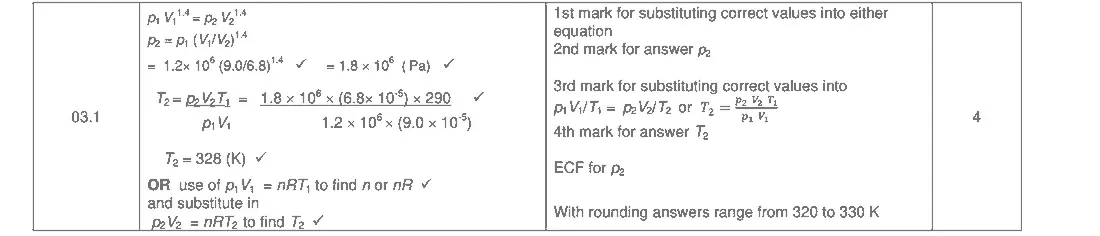
03.1 The majority of students scored 2 marks here for calculating the final pressure, but the calculation of final temperature proved more difficult. A minority of students thought the temperature remained constant. The expected route to the temperature was to use PV/T = constant, but a very small number of students used T×Vγ-1 = constant, which is correct, but more likely to incur an arithmetical error.
Notes from the mark scheme and report
Answer: 1.8 x 10^6 Pa and 328 K (pV^1.4 constant, then pV/T constant
320-330 K accepted)
some assumed constant temperature
Skills: MS0.5 Use calculators to find and use power, exponential and logarithmic functions; MS2.3 Substitute numerical values into algebraic equations using appropriate units for physical quantities; MS2.2 Change the subject of an equation, including non-linear equations
June 2017 · Paper 3B Engineering physics · Q3.22 marksExplanationHard
Earlier part of question 3 that this part uses
Mark scheme
Examiner's comment
03.2 Here, the mark scheme required students to define an adiabatic process and then state that there was little time for heat transfer to take place when the pressure is rapid. Only 30% of students scored both marks.
Notes from the mark scheme and report
Adiabatic means no heat transfer (Q = 0)
rapid compression leaves no time for heat transfer
June 2017 · Paper 3B Engineering physics · Q3.33 marksExplanation
Earlier part of question 3 that this part uses
Mark scheme
Examiner's comment
03.3 Students who wrote the best answers to this question took the hint from the space given above the answer lines to draw a p - V diagram, clearly showing adiabatic and isothermal curves for compression, through a fixed volume change, starting from a common point. In their written answers they then referred to the areas under the curves. All too many students tried to argue their way through this by applying the first law of thermodynamics to both processes, and got nowhere.
Assessment Objective 3 in the new specification requires students to analyse, interpret or evaluate information, and make a judgement or come to a conclusion. Questions 01.4, 02.2, 02.4 and 03.3 were of this nature, and they proved to be demanding. In questions 01.4, 02.2 and 03.3 no hints were given as to how the questions should be approached.
Notes from the mark scheme and report
Adiabatic curve steeper so pressure higher throughout
area under p-V curve (work done on gas) less for isothermal
best answers sketched both curves from a common point
first-law arguments got nowhere
June 2017 · Paper 3B Engineering physics · Q46 marks6-mark extended response
Mark scheme, with the levels and indicative content
Examiner's comment
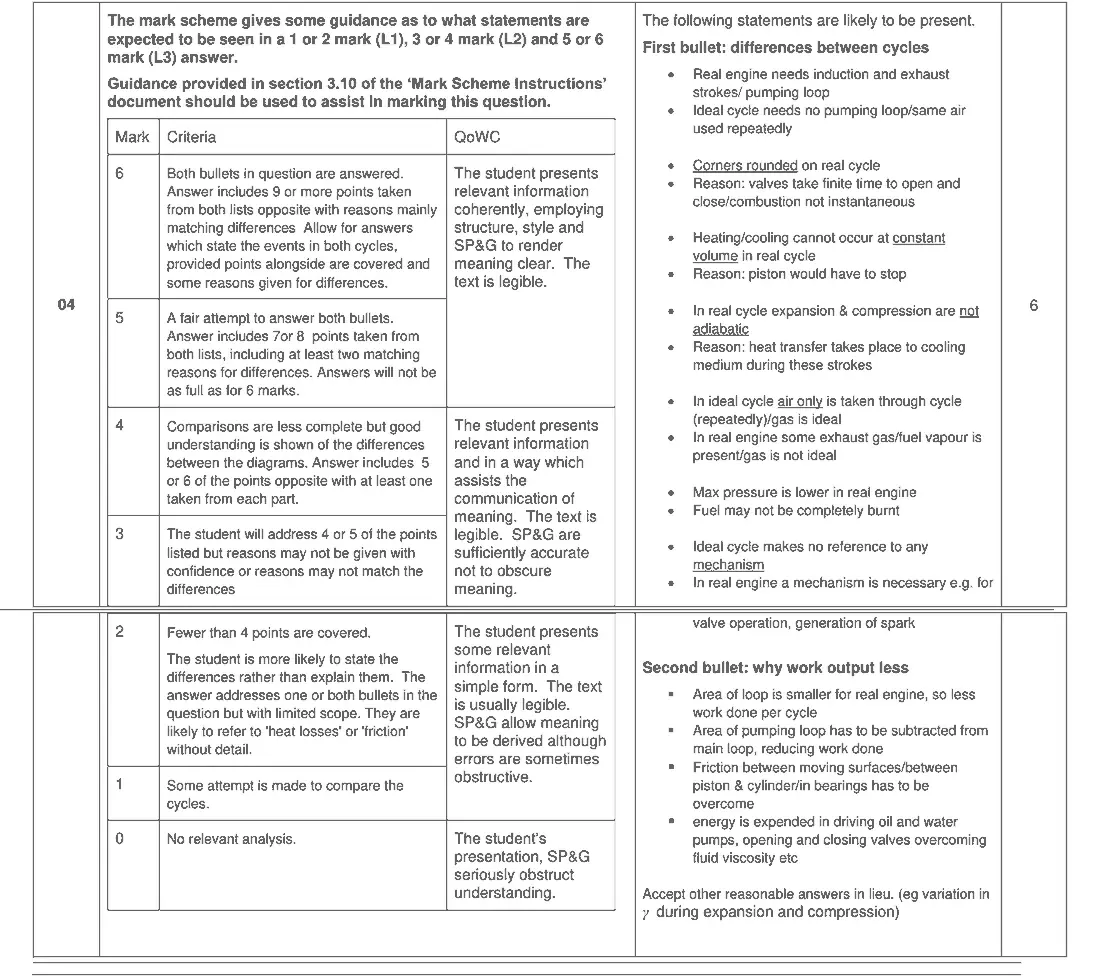
In this level-of-response question, students were asked to compare a theoretical Otto cycle with a real petrol engine cycle. Just under half of all students scored 4, 5 or 6 marks, indicating a good understanding of the differences and the reasons for the differences, and also an understanding of why the work output is lower than the theoretical cycle predicts. It is likely that these students and/or their teachers had read the Engineering Physics teaching guide to be found on the AQA website.
For level 3, the differences between the cycles needed to be given matching reasons, but for levels 1 and 2, candidates could pick up marks for any points taken from the lists given in the mark scheme. There were some excellent answers at the top end, but at level 1 some students concentrated on what went on in the cycles rather than comparing them. Simply by noting the lower peak pressure, the induction/exhaust loop, the rounded corners and the smaller area, students could achieve credit. Common misconceptions were: • the theoretical cycle is 100% efficient; • the theoretical cycle doesn't lose heat, whereas a real engine does.
Notes from the mark scheme and report
Levels of response: rounded corners (finite valve and combustion times), no constant-volume heating, non-adiabatic strokes, lower peak pressure, real gas/fuel mixture, pumping loop subtracts from work, friction and auxiliary losses
misconceptions that the theoretical cycle is 100% efficient
June 2017 · Paper 3B Engineering physics · Q5.11 markShort answer
Mark scheme
Examiner's comment
05.1 Half of all students scored the 1 mark for this question.
Notes from the mark scheme and report
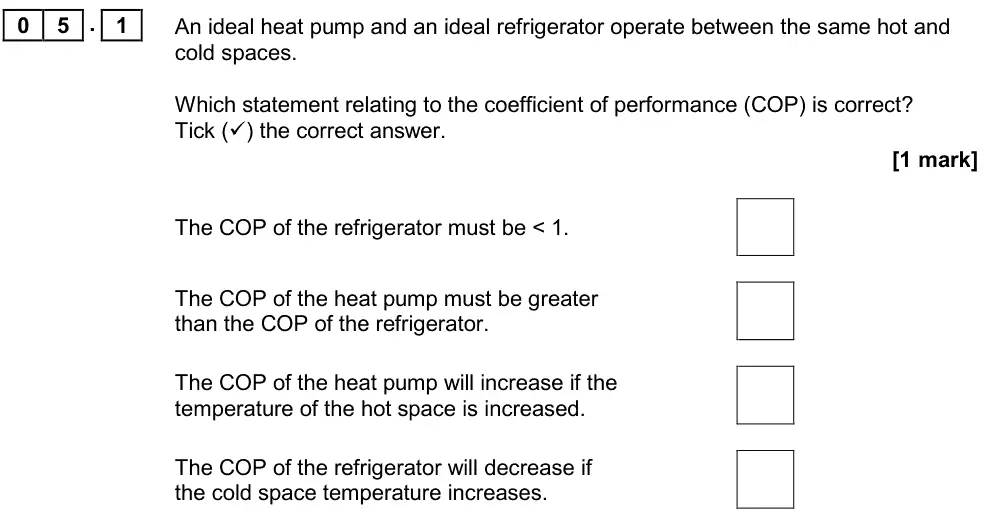
Answer: B (COP of heat pump must be greater than COP of refrigerator, since COPhp = COPref + 1)
half correct
June 2017 · Paper 3B Engineering physics · Q5.23 marksCalculationHard
Earlier part of question 5 that this part uses
Mark scheme
Examiner's comment
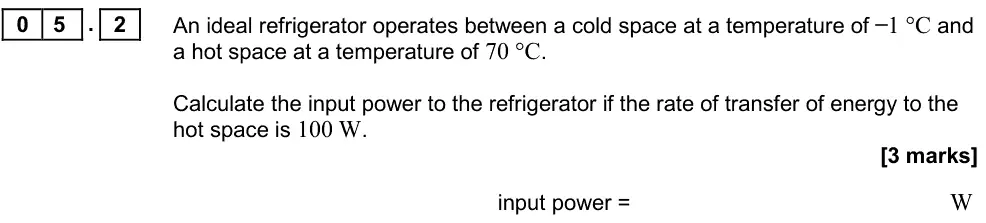
05.2 Only about one third of all students scored any marks at all for this question. Of these, many were able to calculate the COPref from the absolute temperatures, but could get no further because they had little idea of the meanings of QC, QH, and W in the equations in the specification and Data Booklet. Common errors were: • not changing temperatures from °C to K when calculating the COP; • using the formula for the maximum efficiency of a heat engine rather than the idea of COP; • to find the input power, multiplying the COPref by 100 or dividing 100 by the COPref; • mixing temperature and energy in the same equation e.g. W = 272/COPref. Some students may not have been aware that the formula for calculating the COP using temperatures is in the specification, but not in the Data Booklet.
Notes from the mark scheme and report
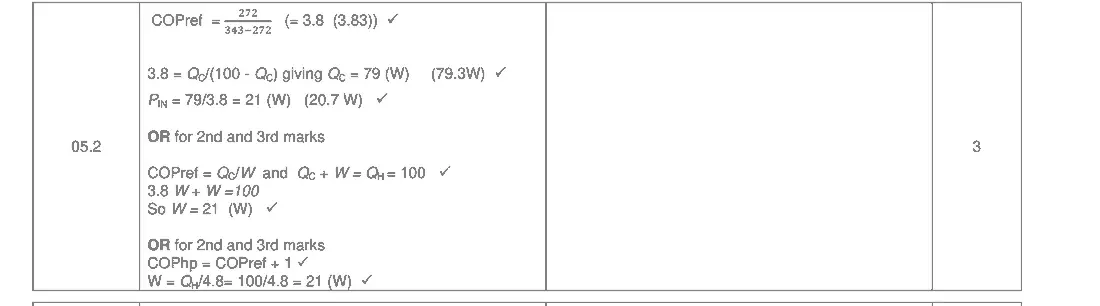
Answer: 21 W (COPref = 272/71 = 3.8
QC + W = 100 W)
failing to convert to kelvin, using heat-engine efficiency, multiplying 100 by COP were common errors
Skills: MS2.3 Substitute numerical values into algebraic equations using appropriate units for physical quantities; MS2.2 Change the subject of an equation, including non-linear equations; MS0.1 Recognise and make use of appropriate units in calculations
Specimen set 1 · Paper 3B Engineering physics · Q3.13 marksExplanation
Mark scheme
Notes from the mark scheme and report
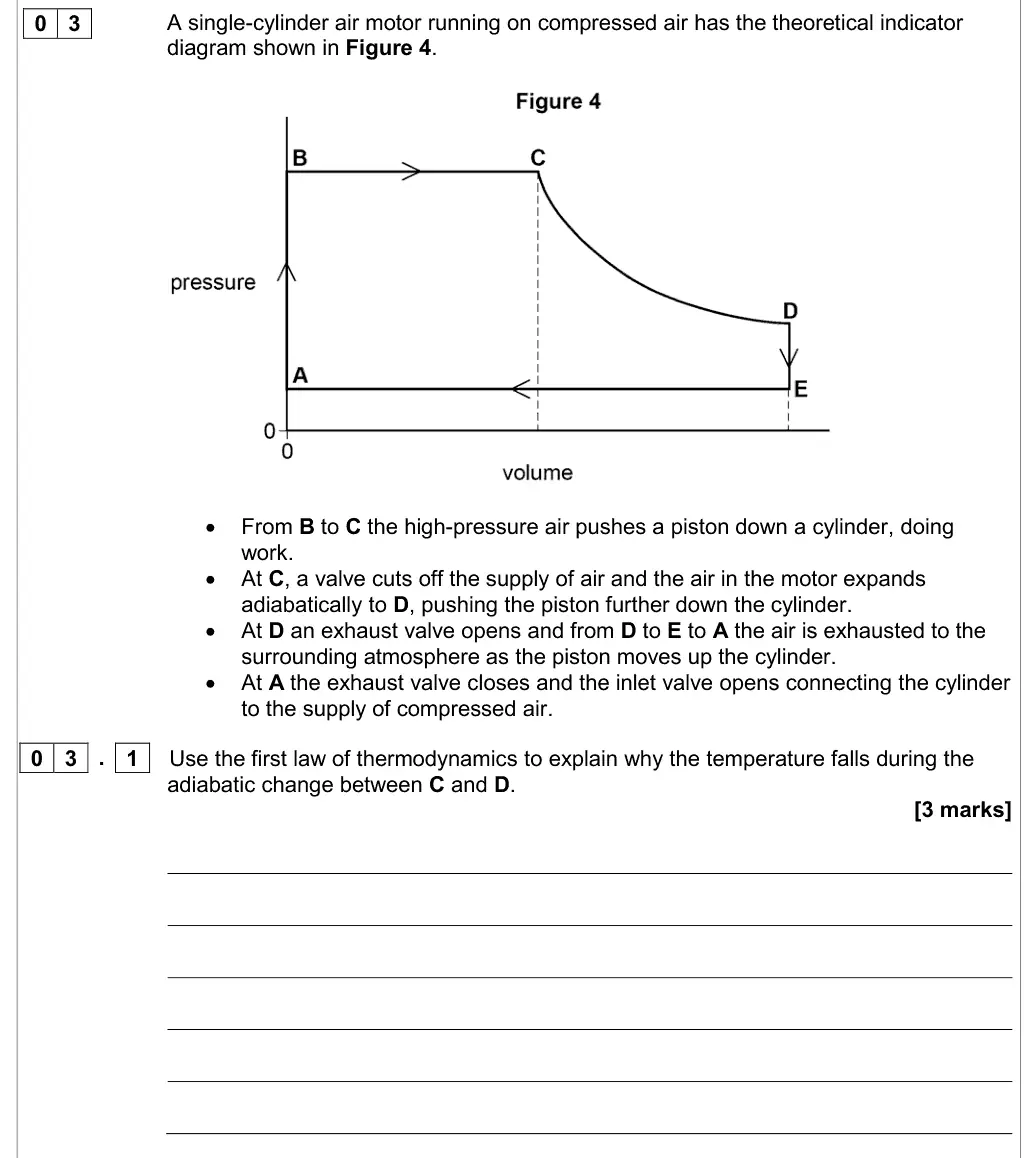
Adiabatic so Q = 0, W = -dU
gas does work so internal energy and hence temperature fall
Specimen set 1 · Paper 3B Engineering physics · Q3.26 marks6-mark extended response
Earlier part of question 3 that this part uses
Mark scheme, with the levels and indicative content
Notes from the mark scheme and report
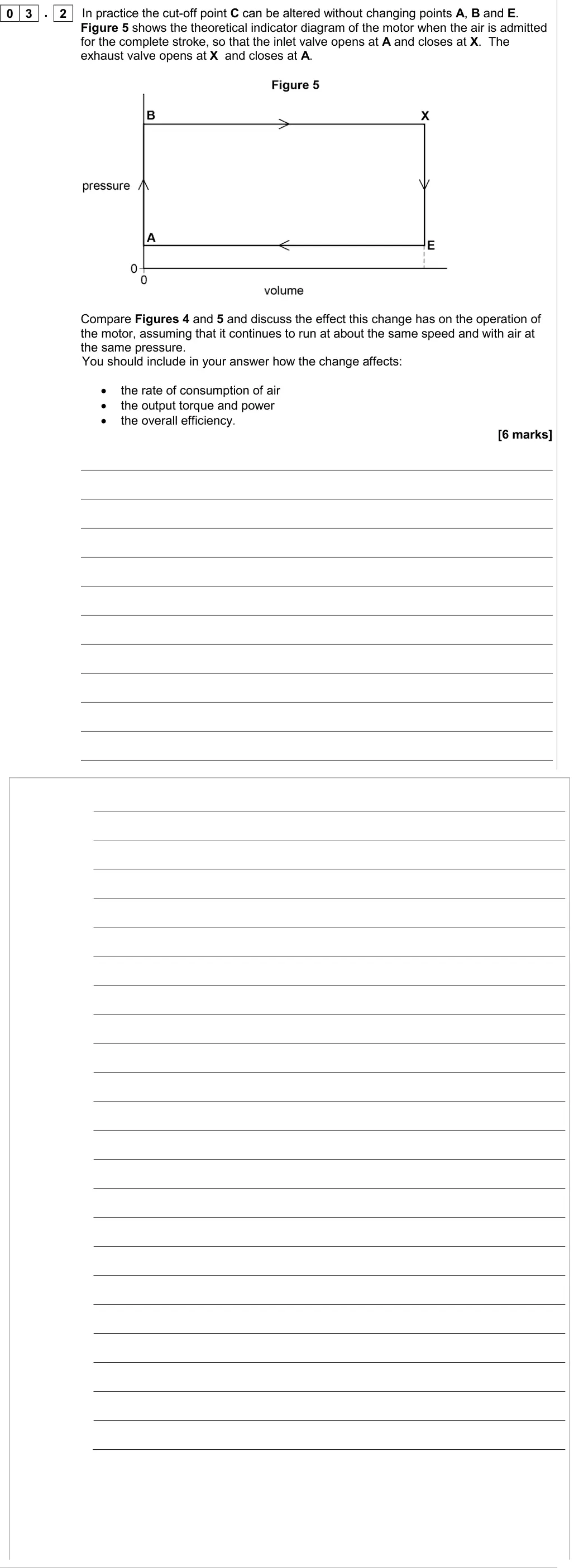
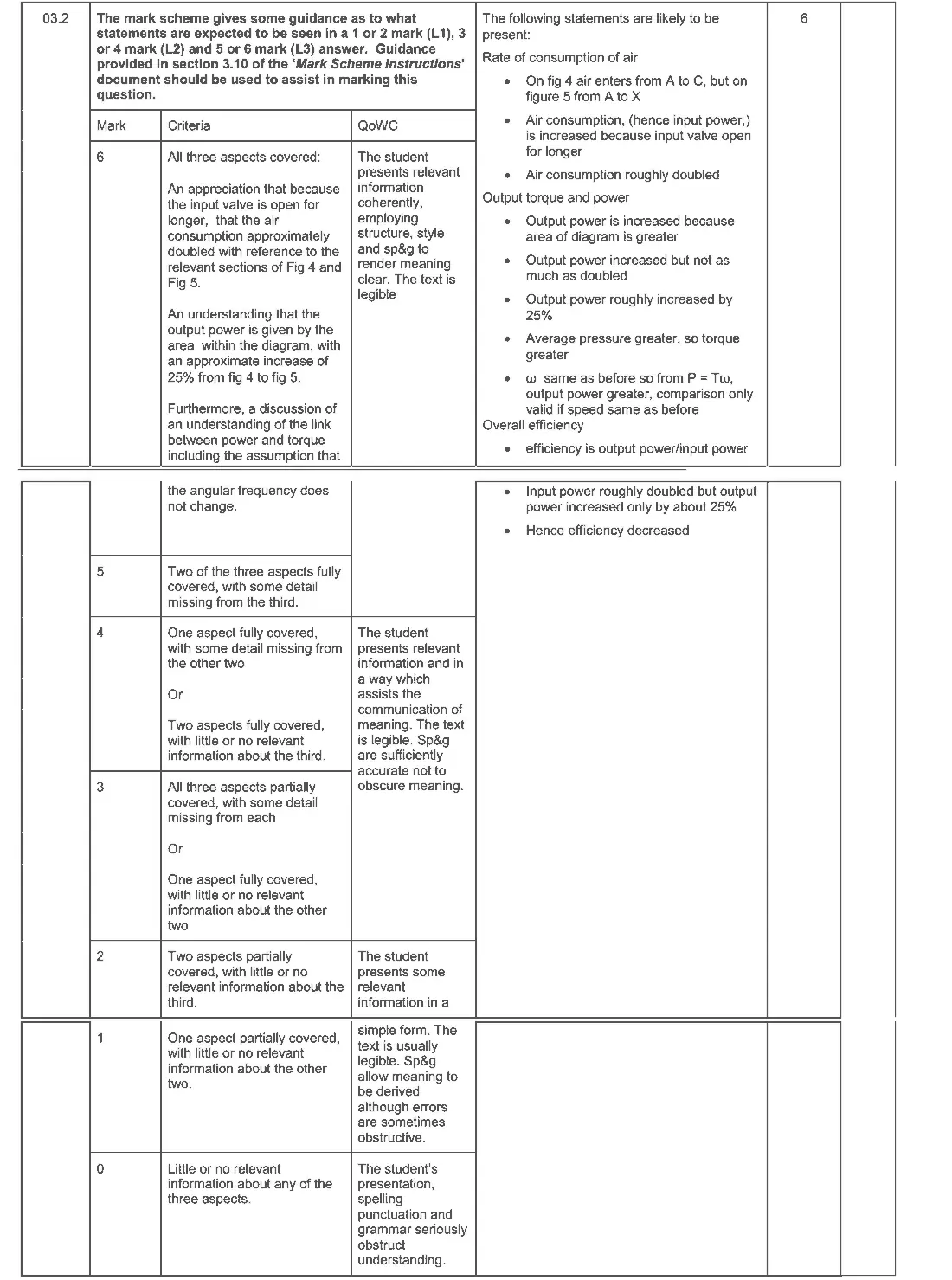
Levels of response: air admitted A to X so consumption (input power) about doubles
loop area and output power rise by only about 25%
higher mean pressure gives more torque at the same speed (P = T omega)
efficiency = output/input falls
Specimen set 1 · Paper 3B Engineering physics · Q3.34 marksCalculation
Earlier part of question 3 that this part uses
Mark scheme
Notes from the mark scheme and report
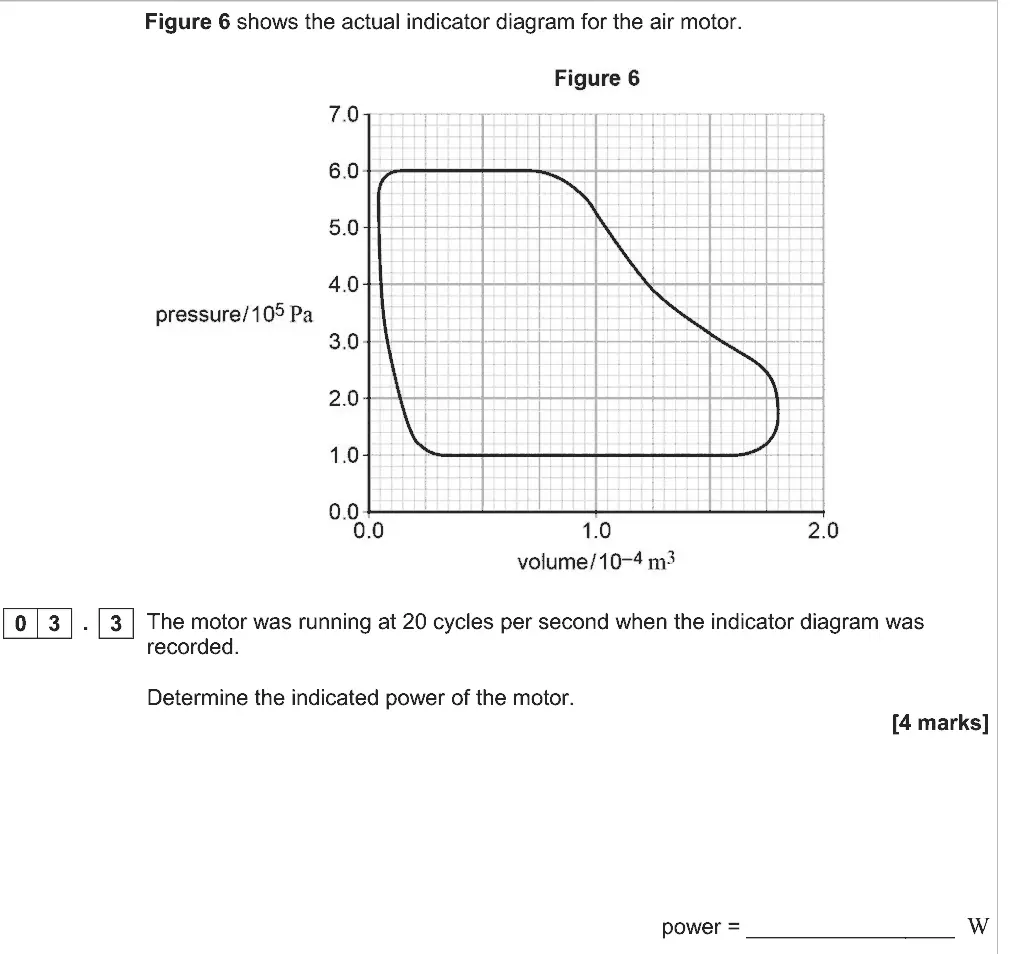
Answer: 1280 W (loop area 64 +/- 5 J by counting squares, 1 small square = 0.1 J, x 20 cycles per second)
Skills: MS3.8 Understand the possible physical significance of the area between a curve and the x axis and be able to calculate it or estimate it by graphical methods as appropriate; MS0.1 Recognise and make use of appropriate units in calculations
Specimen set 1 · Paper 3B Engineering physics · Q3.41 markShort answer
Earlier part of question 3 that this part uses
Mark scheme
Notes from the mark scheme and report
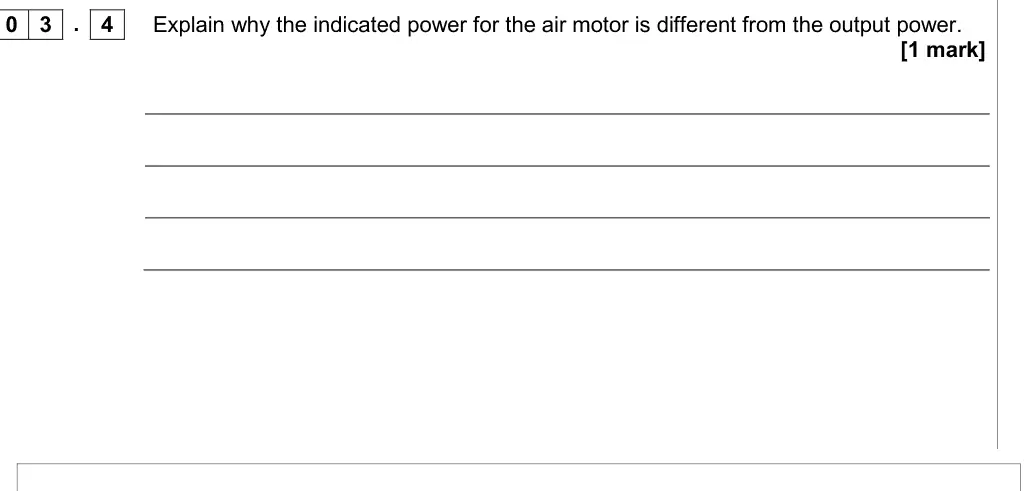
Indicated power ignores friction losses in bearings, between piston and cylinder or in valves
must say where friction acts
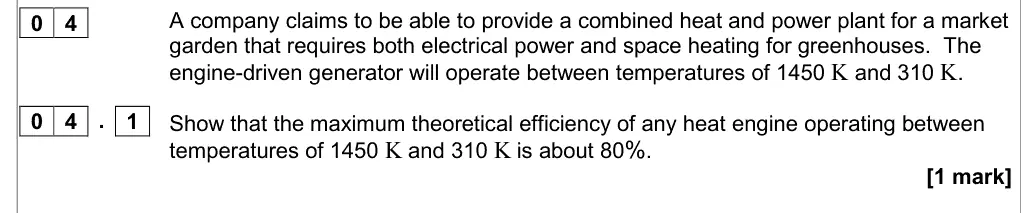
Specimen set 1 · Paper 3B Engineering physics · Q4.11 markShow that
Mark scheme
Notes from the mark scheme and report
Answer: 0.79 (79%) from (1450 - 310)/1450
Skills: MS2.3 Substitute numerical values into algebraic equations using appropriate units for physical quantities; MS0.3 Use ratios, fractions and percentages
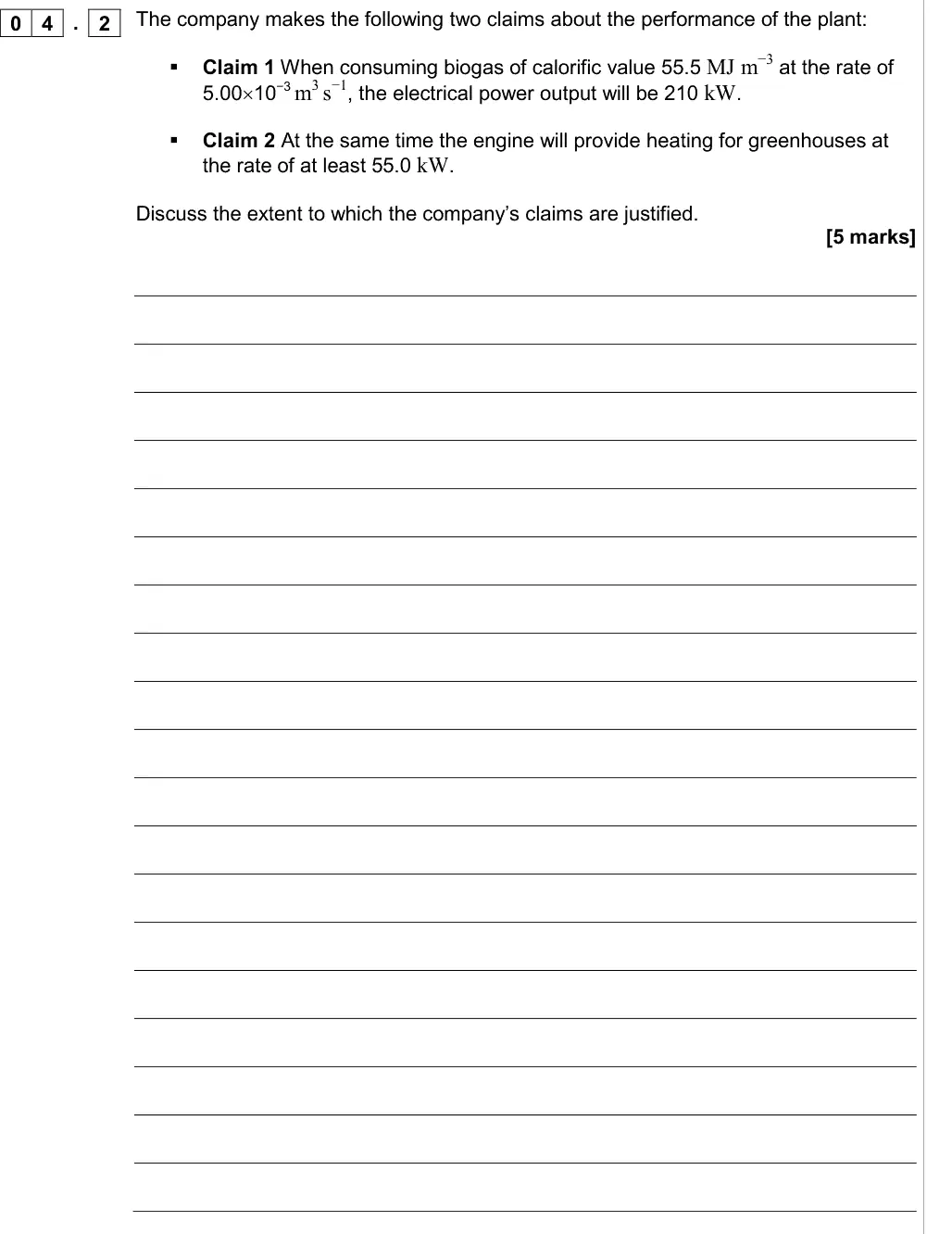
Specimen set 1 · Paper 3B Engineering physics · Q4.25 marksExplanation
Earlier part of question 4 that this part uses
Mark scheme
Notes from the mark scheme and report
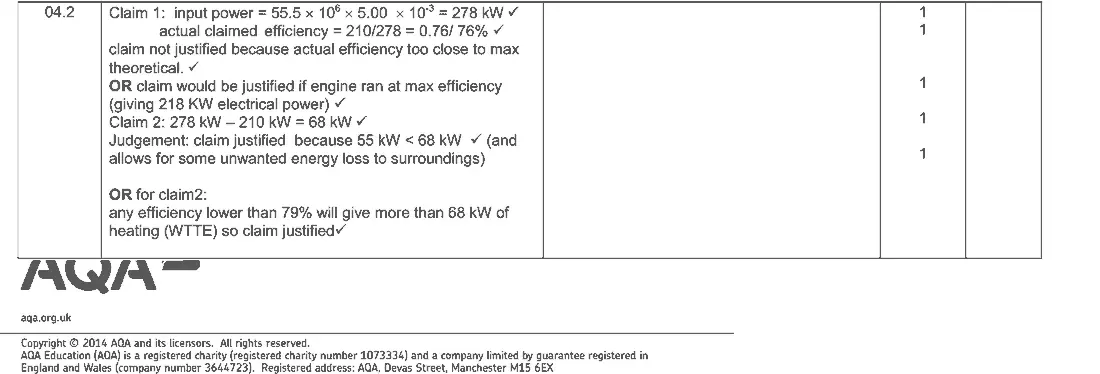
Input power 55.5 x 10^6 x 5.00 x 10^-3 = 278 kW
claimed efficiency 76% too close to the 79% maximum so claim 1 not justified
278 - 210 = 68 kW > 55 kW so claim 2 justified
Skills: MS2.3 Substitute numerical values into algebraic equations using appropriate units for physical quantities; MS0.3 Use ratios, fractions and percentages
Work with an AQA physics tutor
Dropping marks on calculations, required practicals or the six-markers? Book a trial session with a specialist AQA physics tutor.