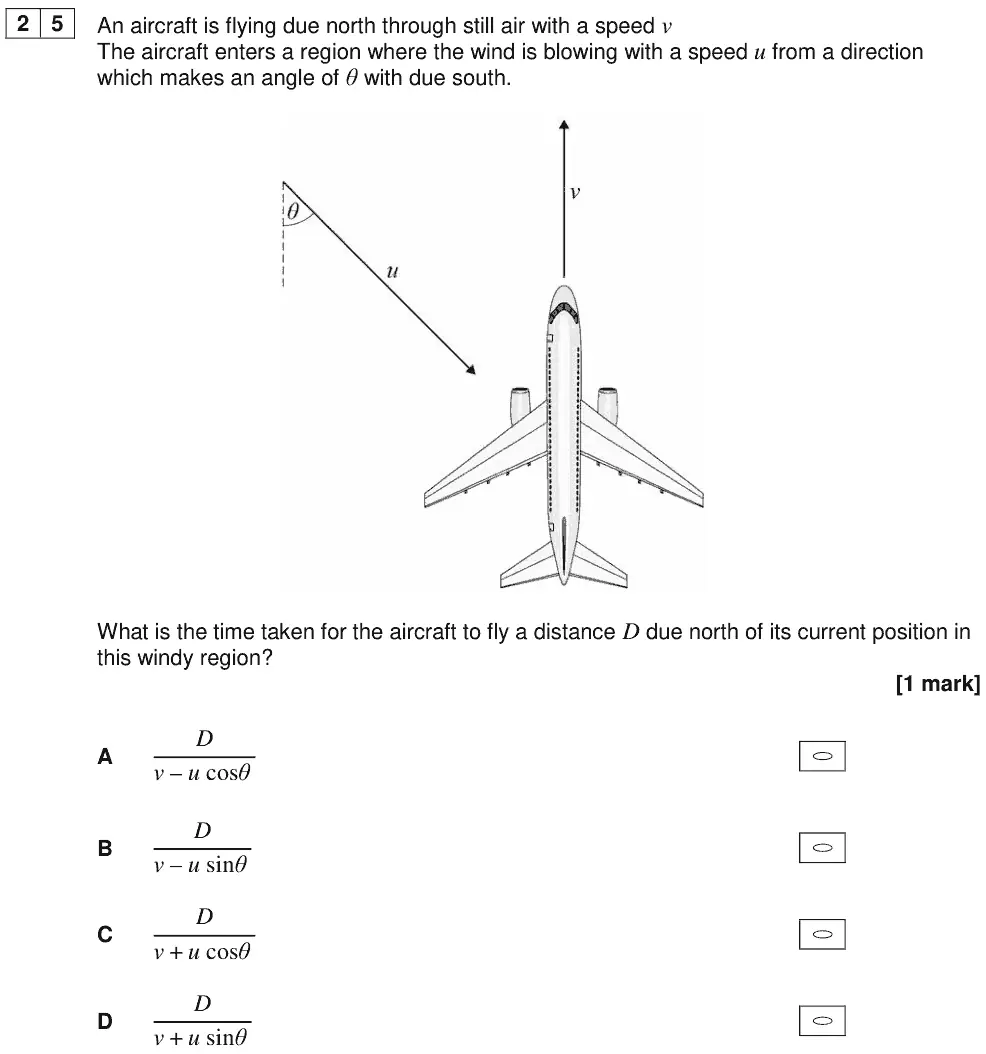
3.4.1.1-04 Addition of vectors by calculation or scale drawing.
3.4.1.1-05 Calculations will be limited to two vectors at right angles. Scale drawings may involve vectors at angles other than 90°.
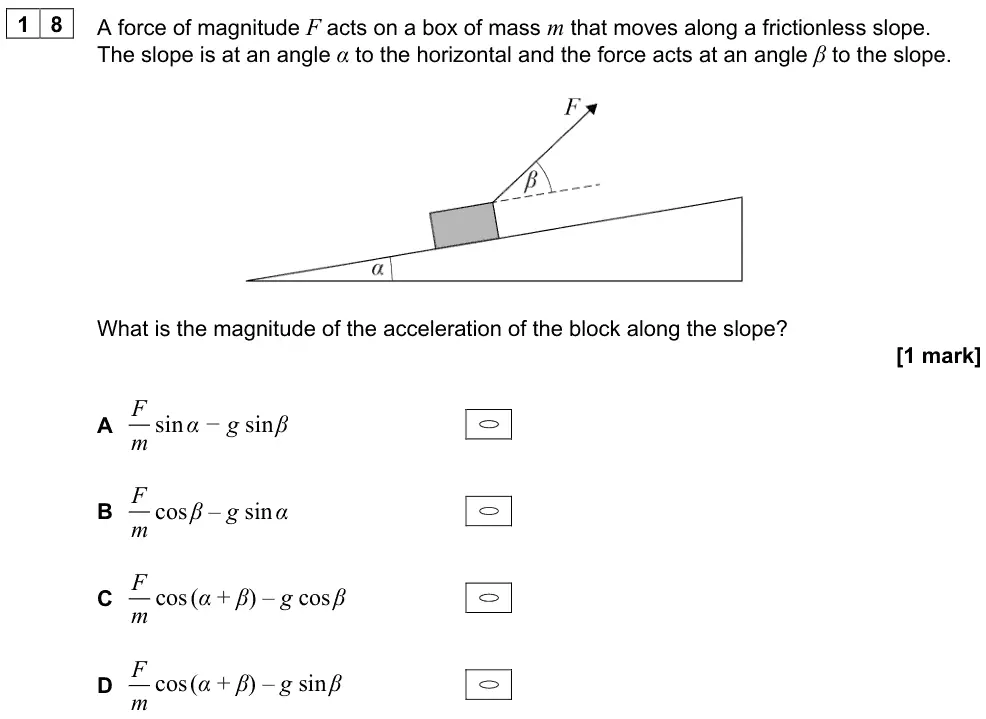
3.4.1.1-06 Resolution of vectors into two components at right angles to each other.
3.4.1.1-07 Examples should include components of forces along and perpendicular to an inclined plane.
3.4.1.1-08 Problems may be solved either by the use of resolved forces or the use of a closed triangle.
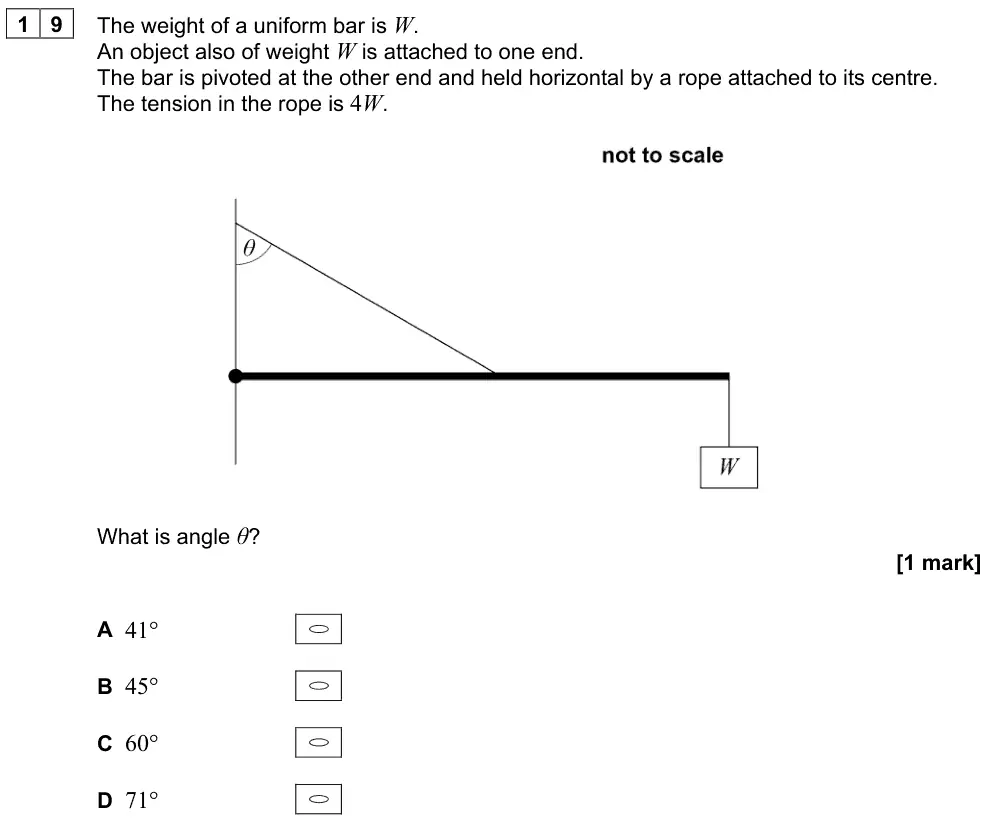
3.4.1.1-09 Conditions for equilibrium for two or three coplanar forces acting at a point. Appreciation of the meaning of equilibrium in the context of an object at rest or moving with constant velocity.
3.4.1.2-01 Moment of a force about a point.
3.4.1.2-02 Moment defined as force × perpendicular distance from the point to the line of action of the force.
3.4.1.2-03 Couple as a pair of equal and opposite coplanar forces.
3.4.1.2-04 Moment of couple defined as force × perpendicular distance between the lines of action of the forces.
3.4.1.2-05 Principle of moments.
3.4.1.2-06 Centre of mass.
3.4.1.2-07 Knowledge that the position of the centre of mass of uniform regular solid is at its centre.
Tap a question to zoom it. Where a part needs a figure, table or graph from earlier in the question, that part folds out above it; the mark scheme and examiner's comment open underneath. Have the AQA data and formulae booklet beside you (see the formula sheet page).
June 2025 · AS Paper 1 · Q4.12 marksAO1=2Short answer
Mark scheme
Examiner's comment
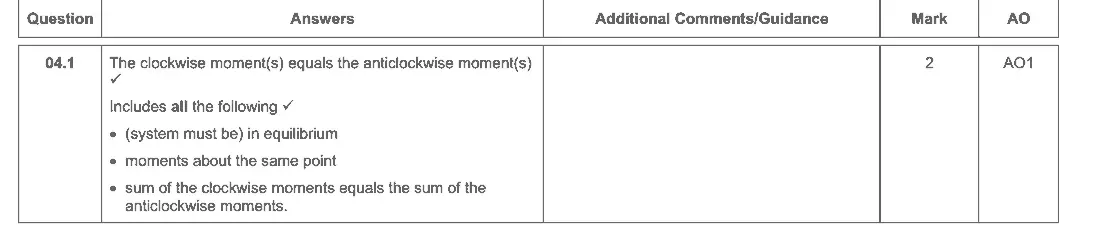
03.4 This question proved very challenging to all but the most able students with approximately 10% gaining 3 marks or more. Lower performing students typically devoted most of their answer to restating information given in the question or describing the workings of the mercury vapour in the fluorescent tube without ever getting to a consideration of the coating and its role in generating white light. Students who made progress typically scored the first two marks in the mark scheme without being able to describe why white light was being produced or why there were more photons of visible light emitted than uv photons. 04.1 This part of the question was one of the few parts of the paper that was designated as pure recall (AO1). Most students were only able to produce very limited statements that lacked the appropriate level of technical language expected at AS. This resulted in most students gaining 1 mark for a ‘clockwise moments = anticlockwise moments’ statement without being able to communicate the conditions under which the principle operates. Approximately 35% of students gained zero; of these, most attempted to define a moment rather than give a statement of the principle of moments.
Notes from the mark scheme and report
For a body in equilibrium, sum of clockwise moments = sum of anticlockwise moments about the same point
most gave only the bare statement
about 35% scored zero
June 2025 · AS Paper 1 · Q4.23 marksAO1=1, AO2=2CalculationEasy
Earlier part of question 4 that this part uses
Mark scheme
Examiner's comment
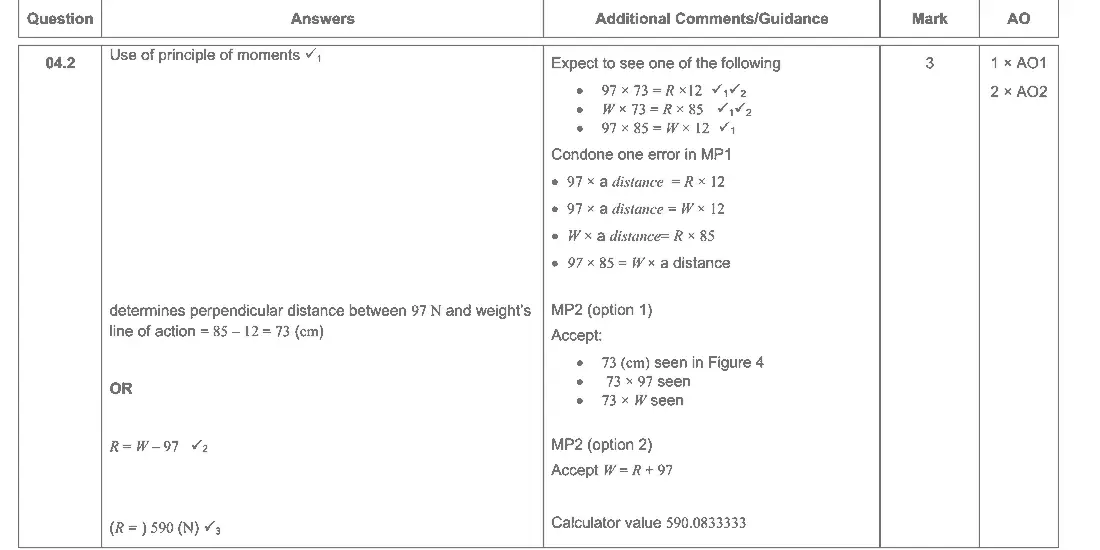
04.2 Over 60% of students gained all 3 marks. The most common approach seen was to take moments about the centre of mass. Lower attaining students had difficulty applying moments and would score one or two marks for determining the distance between W’s line of action and the front wheels or for attempting to apply the principle of moments.
Notes from the mark scheme and report
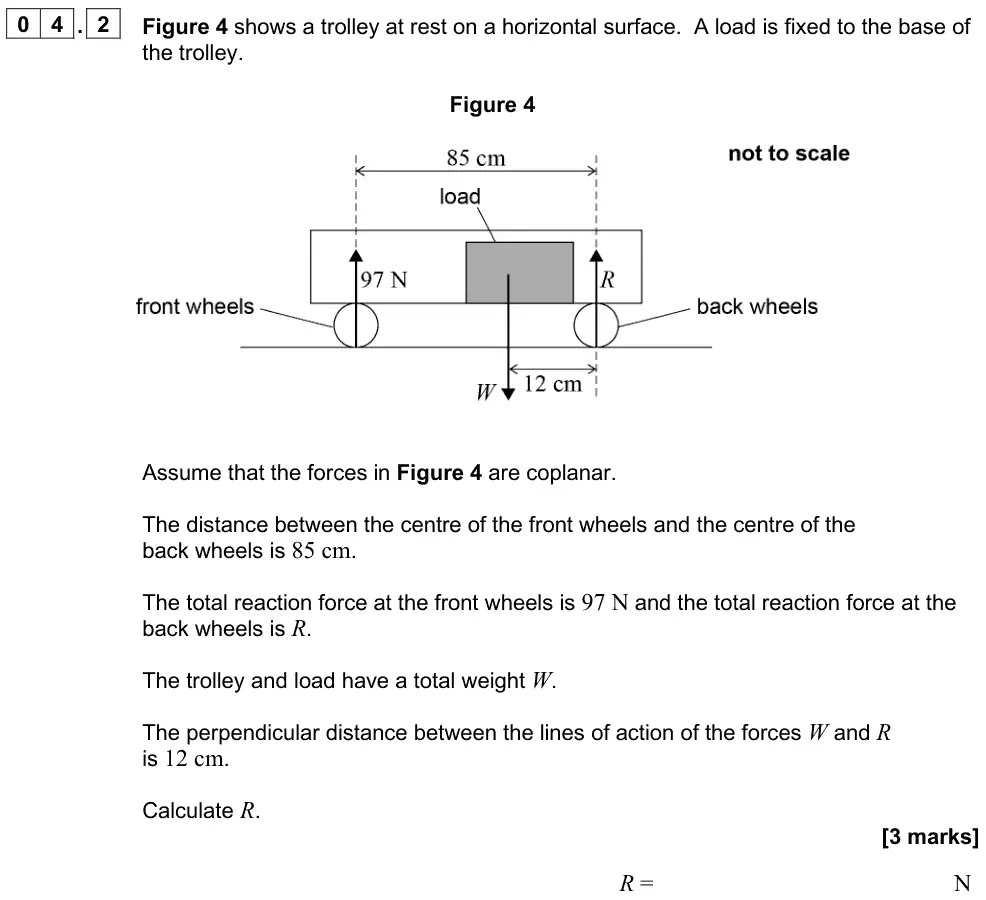
Answer: 590 N (moments about W: 97 x 73 cm = R x 12 cm)
Skills: MS2.3 Substitute numerical values into algebraic equations using appropriate units for physical quantities; MS2.2 Change the subject of an equation, including non-linear equations
June 2025 · AS Paper 1 · Q4.31 markAO1=1Short answerHard
Earlier part of question 4 that this part uses
Mark scheme
Examiner's comment
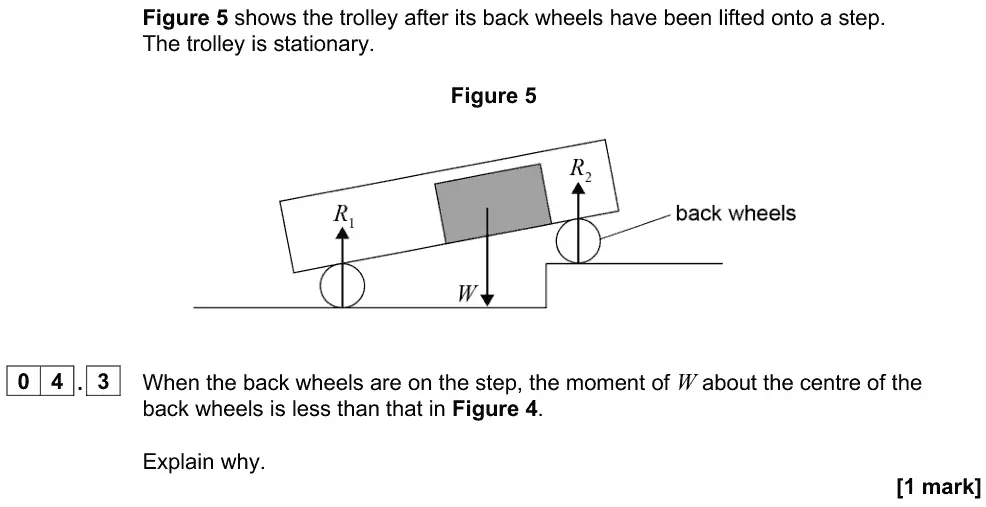
04.3 and 04.4 These parts proved to be very inaccessible to the vast majority of students. Approximately 20% of students scored the mark in 04.3 and this lack of progress had a knock- on effect on performance in 04.4. Most students thought that the magnitude of R1 had increased. Very few students attempted to apply the principle of moments to this question.
03.1 Again, this multi-step calculation effectively differentiated between student ability levels. Approximately 30% gained all four marks with 20 % gaining three marks, a further 20% gained 2 marks and 15 % one mark. High achieving students typically obtained all 4marks and presented their working in a clear manner that demonstrated their understanding of the context. The most common ways in which students obtained partial marks included: using 13.1 x 10⁻¹⁹ J as the kinetic energy of the electron yielding a value of 4.3 x 10⁻¹⁰ m • for the de Broglie wavelength. determining the kinetic energy of the scattered electron but no knowing how to • ℎ𝑐𝑐 proceed. 𝜆𝜆 to determine a wavelength. setting their kinetic energy equal to • 03.2 63% of students gained both marks while 25% gained one mark. Most students could deal with this less onerous calculation. Where a mark was lost, it was very commonly due an incorrect conversion of their wavelength in metres into nanometres or leaving their answer in metres (2.54 x 10⁻⁷ m).
Notes from the mark scheme and report
Perpendicular distance from the back wheel to the line of action of W decreases when tilted
June 2025 · AS Paper 1 · Q4.43 marksAO2=1, AO3=2Explanation
Earlier part of question 4 that this part uses
Mark scheme
Examiner's comment
04.3 and 04.4 These parts proved to be very inaccessible to the vast majority of students. Approximately 20% of students scored the mark in 04.3 and this lack of progress had a knock- on effect on performance in 04.4. Most students thought that the magnitude of R1 had increased. Very few students attempted to apply the principle of moments to this question.
Notes from the mark scheme and report
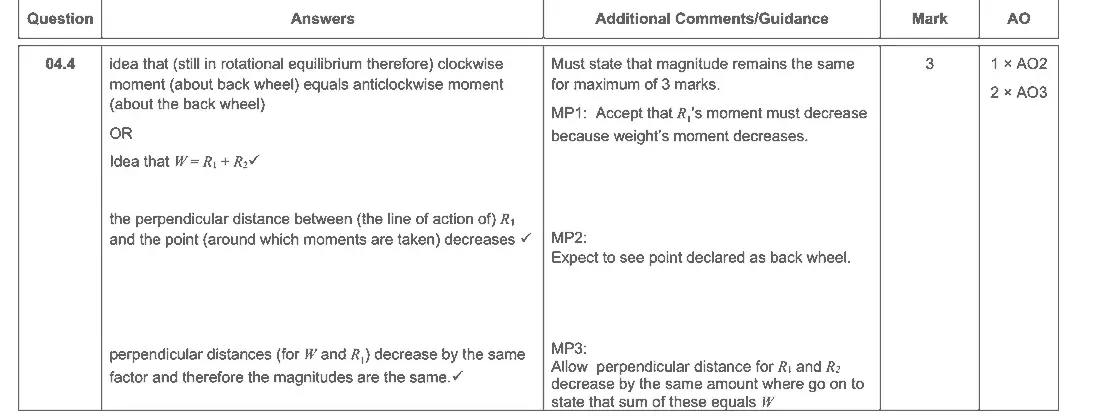
Unchanged at 97 N: moments about back wheel still balance and the perpendicular distances of W and R1 shrink by the same factor
most wrongly said R1 increased
June 2025 · AS Paper 1 · Q5.14 marksAO1=2, AO2=2CalculationHard
Mark scheme
Examiner's comment
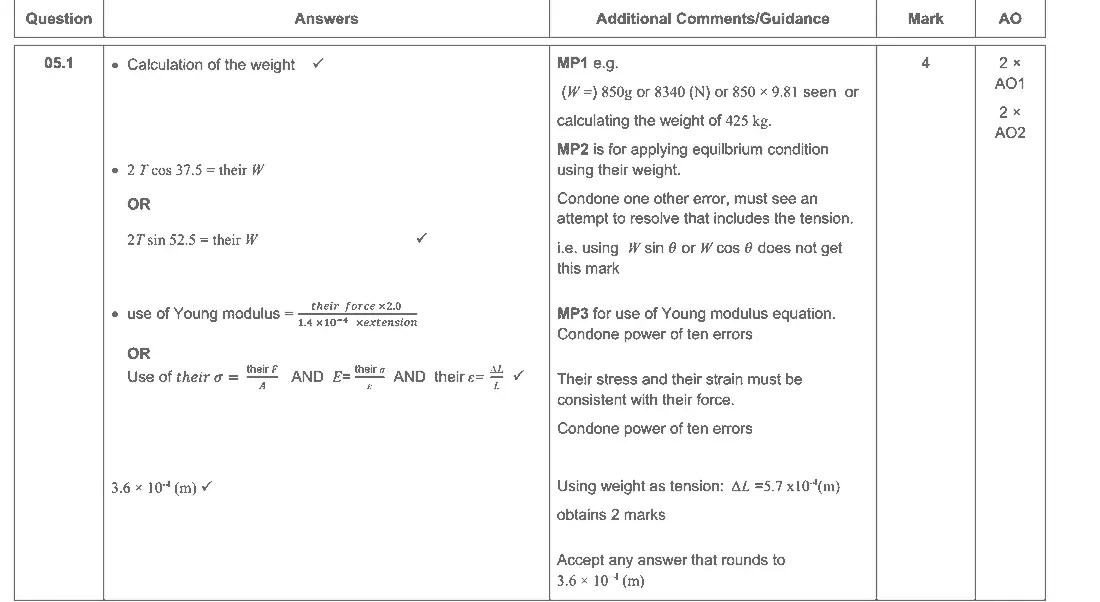
05.1 This calculation discriminated well between lower and higher attaining students. Approximately 20% of the students scored 4 marks with 77% gaining at least two marks. Those who scored only two marks typically were unable to correctly determine the tension in the cable and usually set the weight of the lift equal to the tension in the cable.
Notes from the mark scheme and report
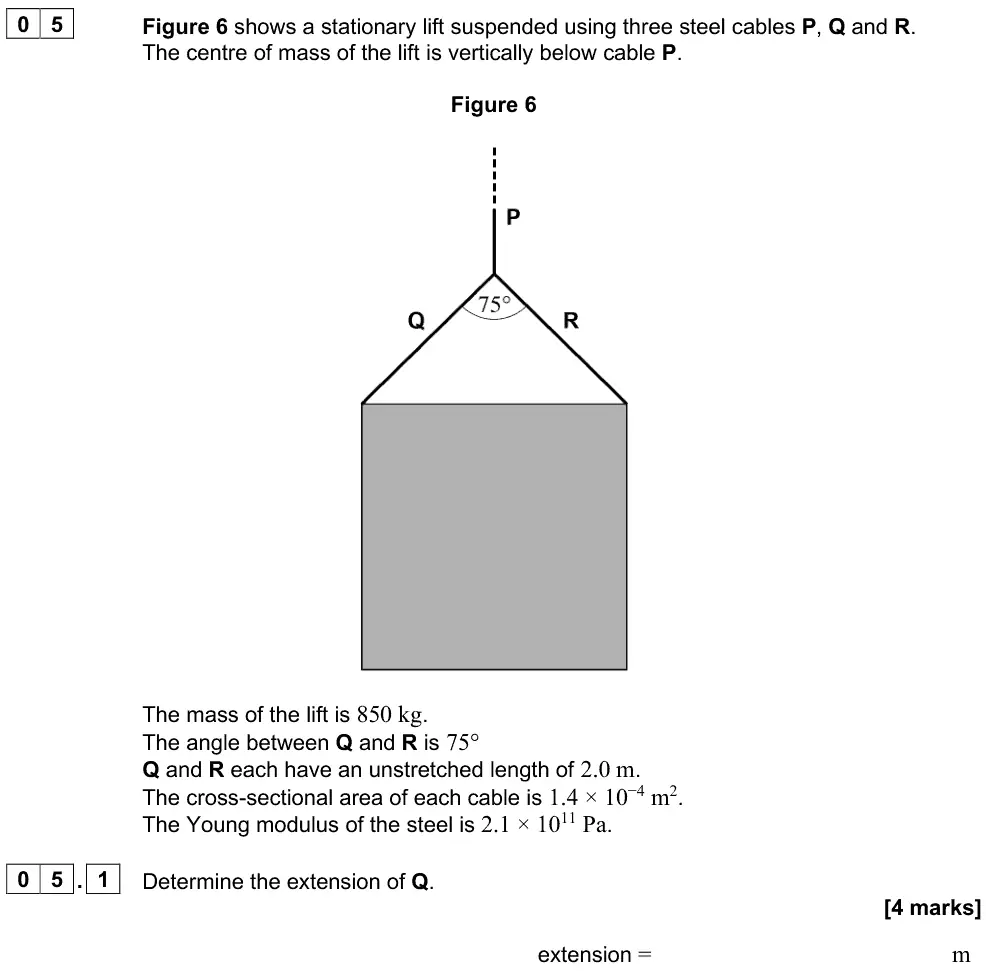
Answer: 3.6 x 10^-4 m (W = 8340 N = 2T cos 37.5, T = 5260 N, delta L = FL/AE)
using the weight as the tension gives 5.7 x 10^-4 m for 2 marks
Skills: MS4.5 Use sin, cos and tan in physical problems; MS2.3 Substitute numerical values into algebraic equations using appropriate units for physical quantities
June 2025 · Paper 1 · Q7.52 marksAO3=2Explanation
Earlier part of question 7 that this part uses
Mark scheme
Examiner's comment
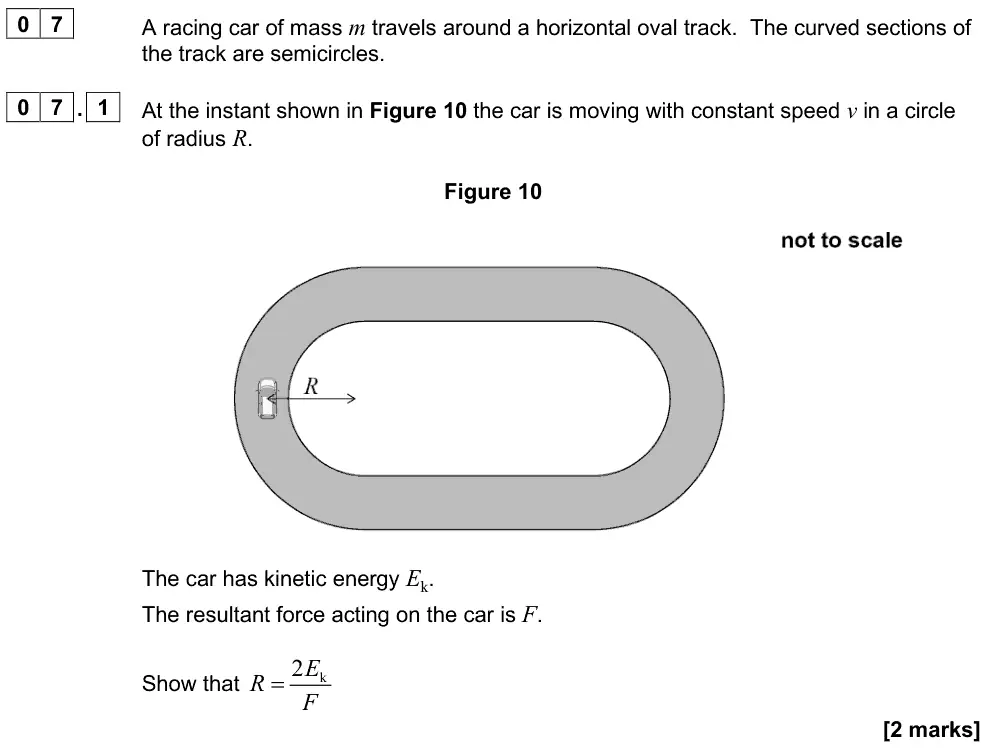
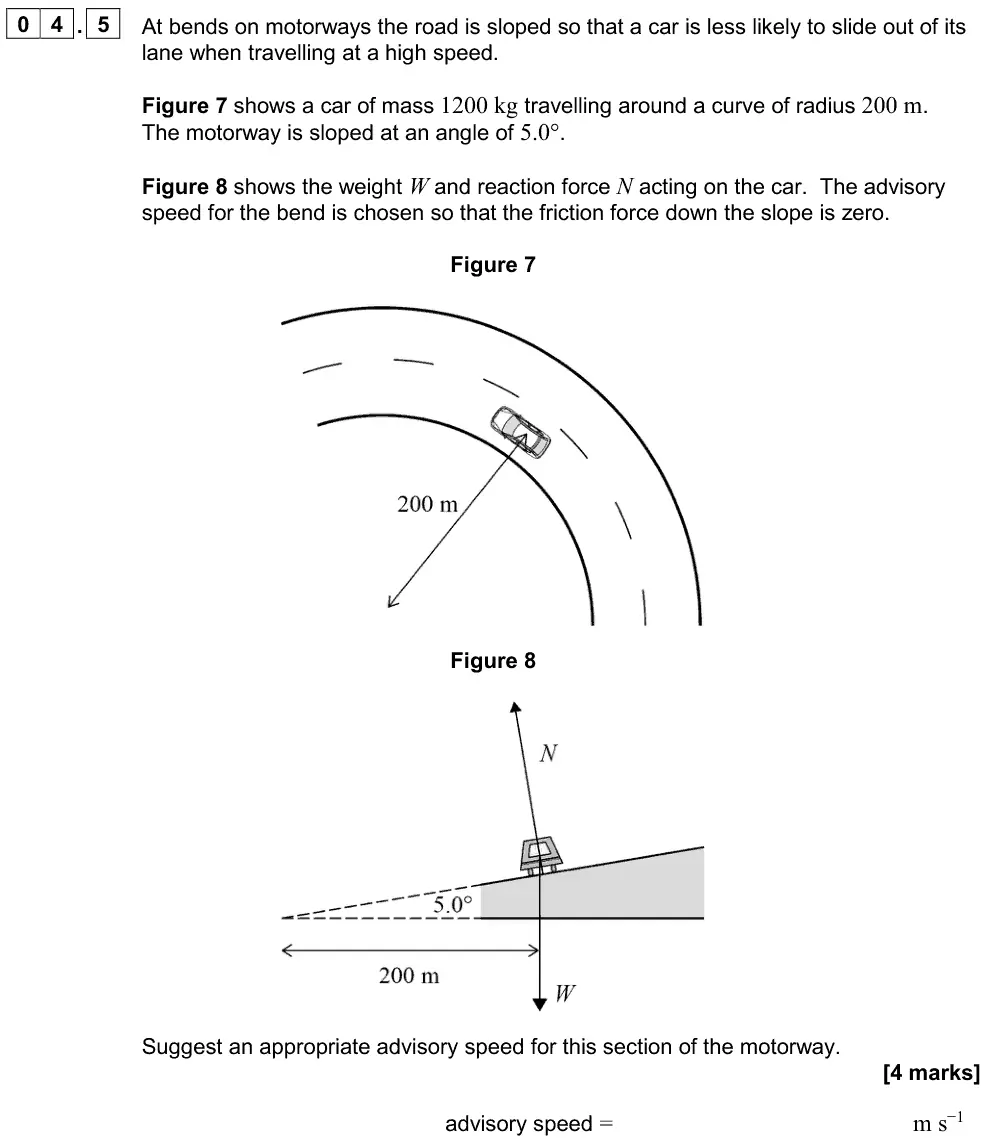
Question 7.5 proved to be more difficult than expected. A common error was to suggest that the weight of the car had a horizontal component because of the slope.
Notes from the mark scheme and report
Horizontal component of the normal reaction adds to the centripetal force, so v can be larger for the same R
many wrongly gave weight a horizontal component
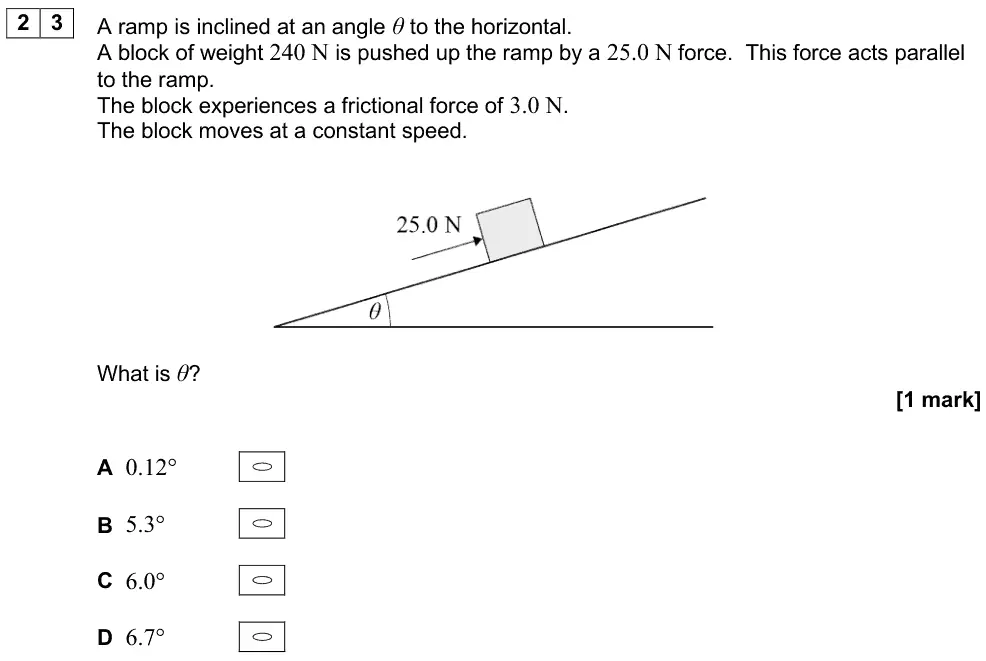
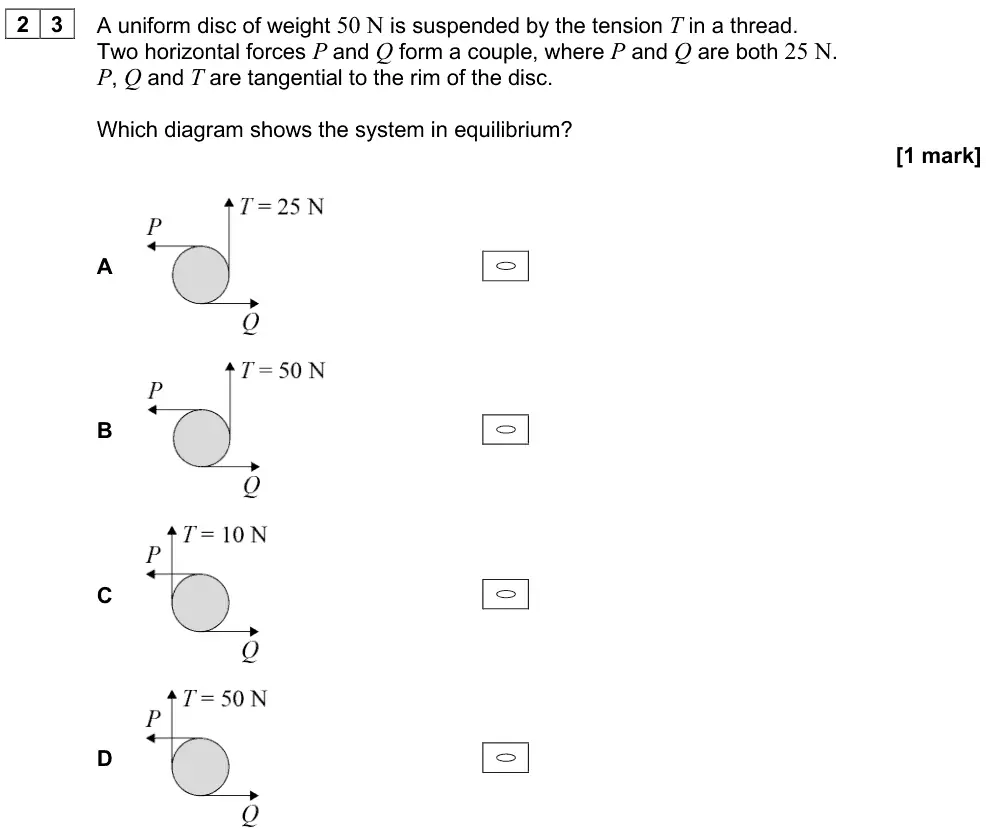
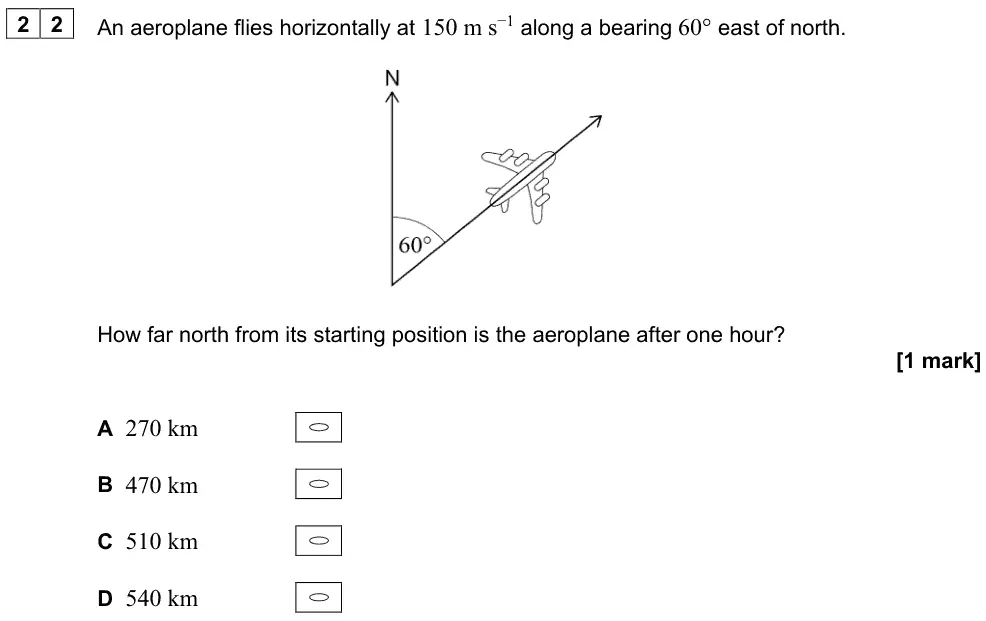
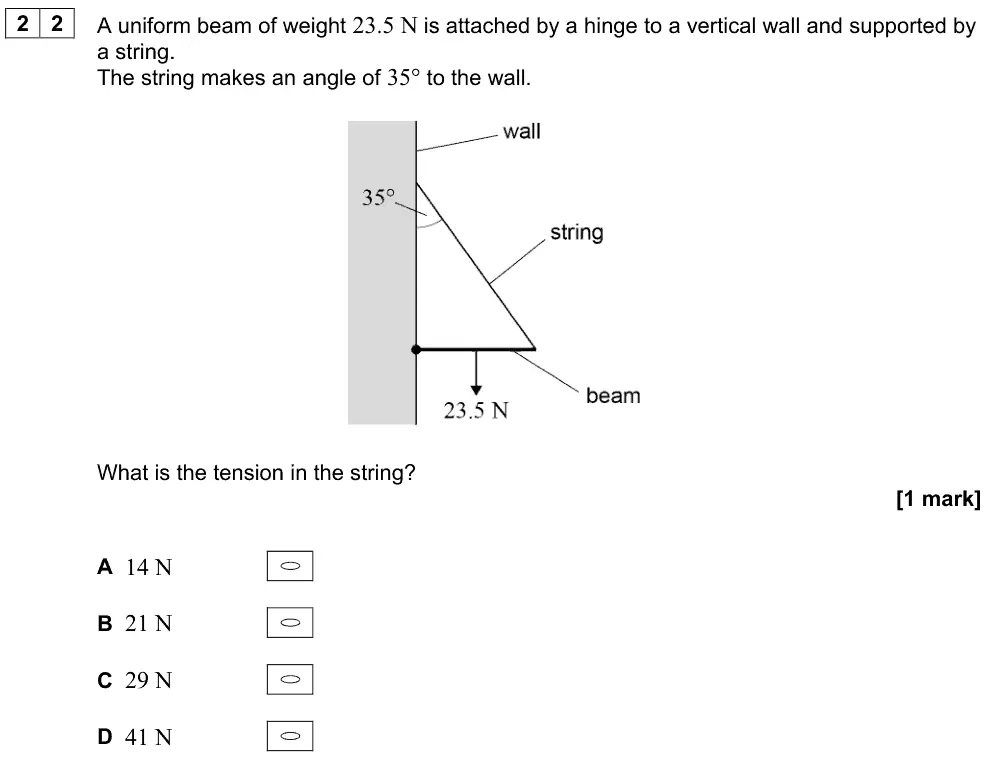
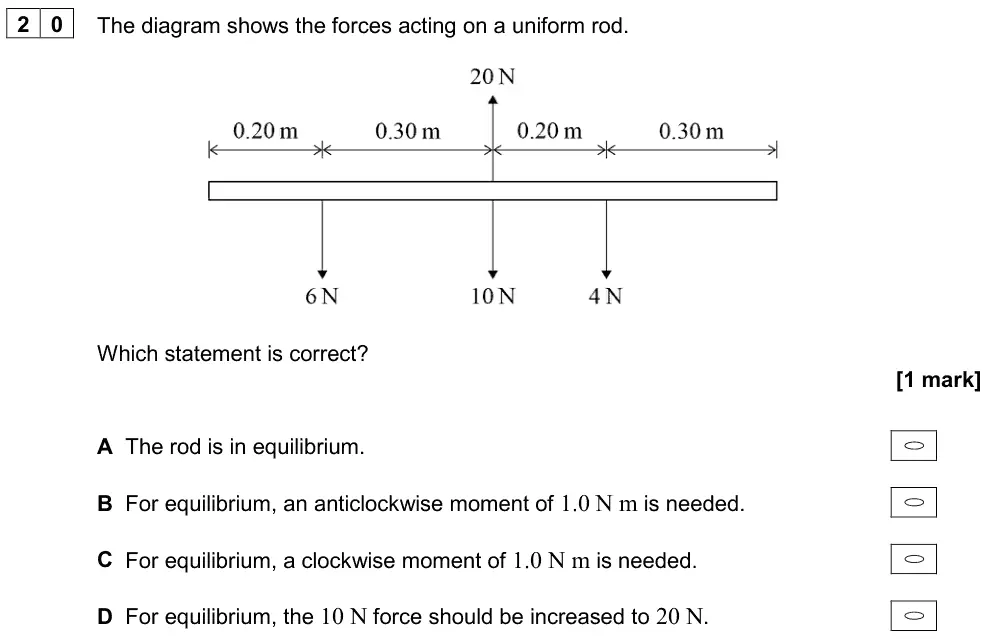
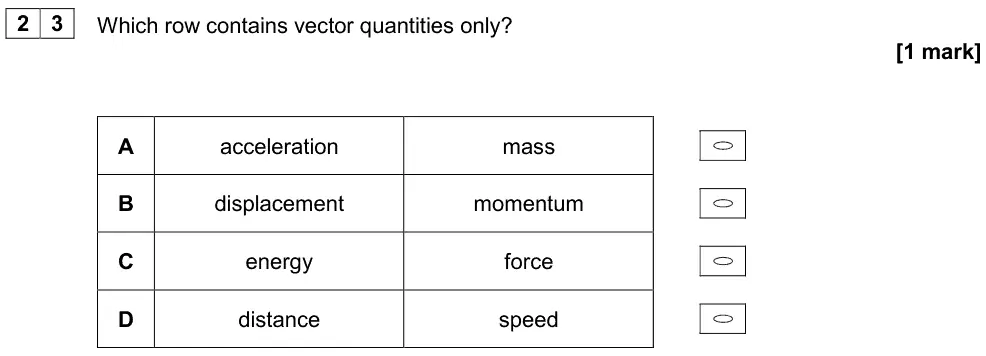
June 2025 · Paper 1 · Q231 markAO2=1Multiple choice
Answer
B
Mark scheme
Notes from the mark scheme and report
Answer: B
Skills: MS4.5 Use sin, cos and tan in physical problems
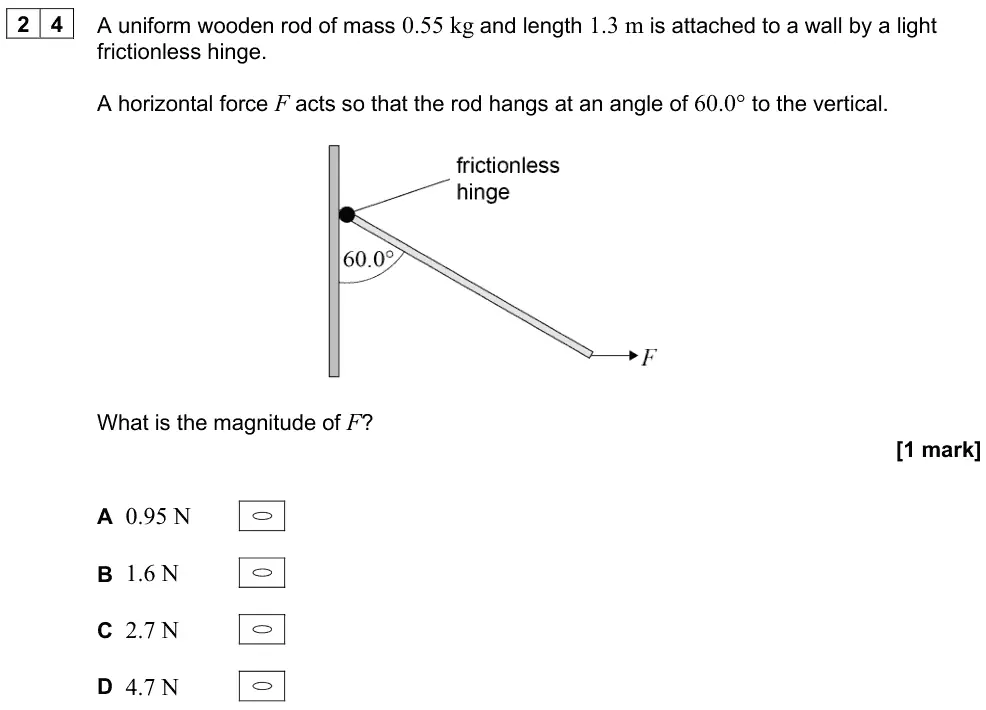
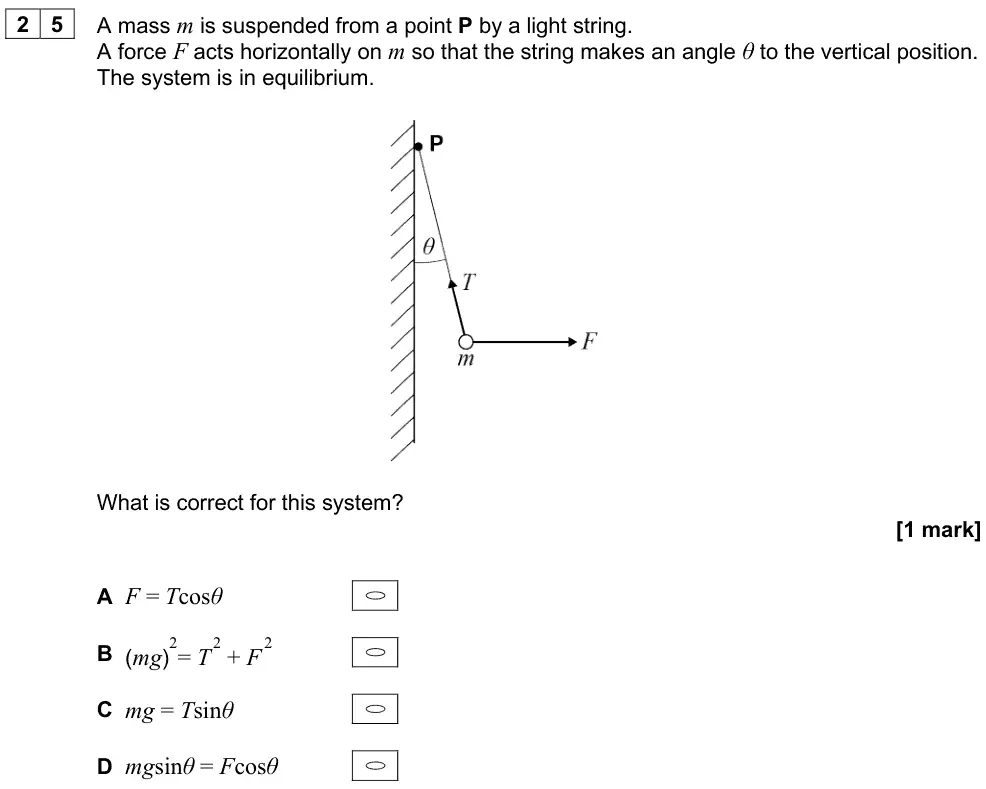
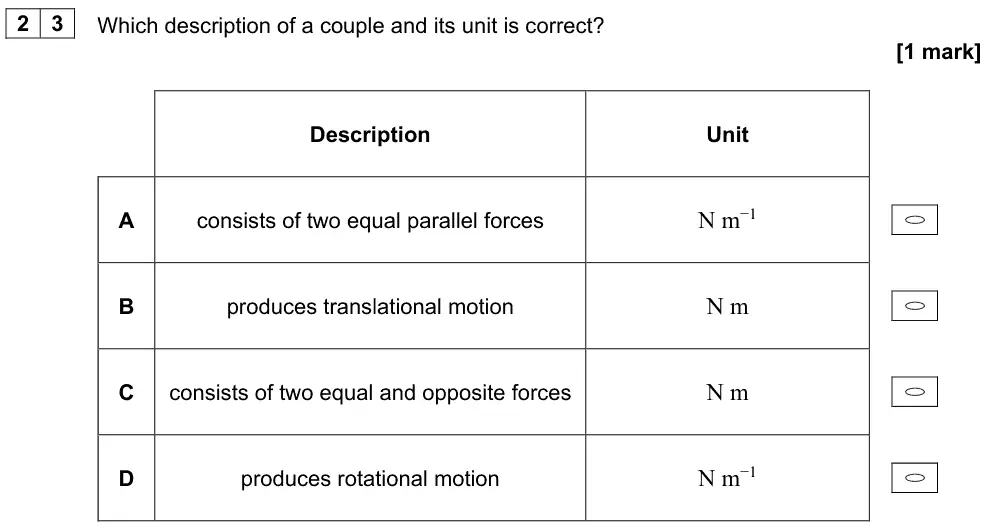
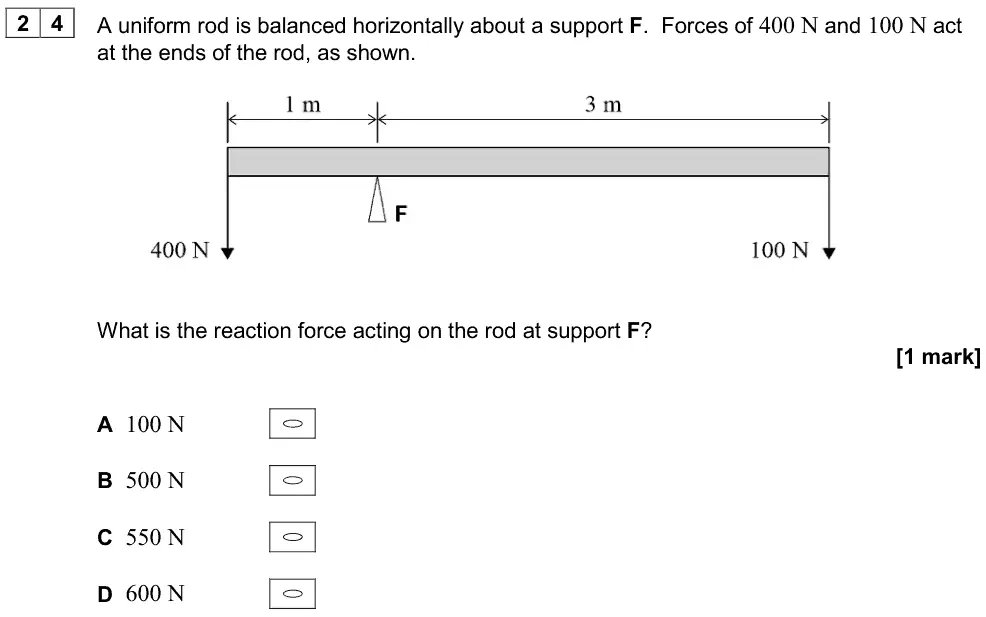
June 2025 · Paper 1 · Q241 markAO2=1Multiple choice
Answer
D
Mark scheme
Notes from the mark scheme and report
Answer: D
Skills: MS4.5 Use sin, cos and tan in physical problems
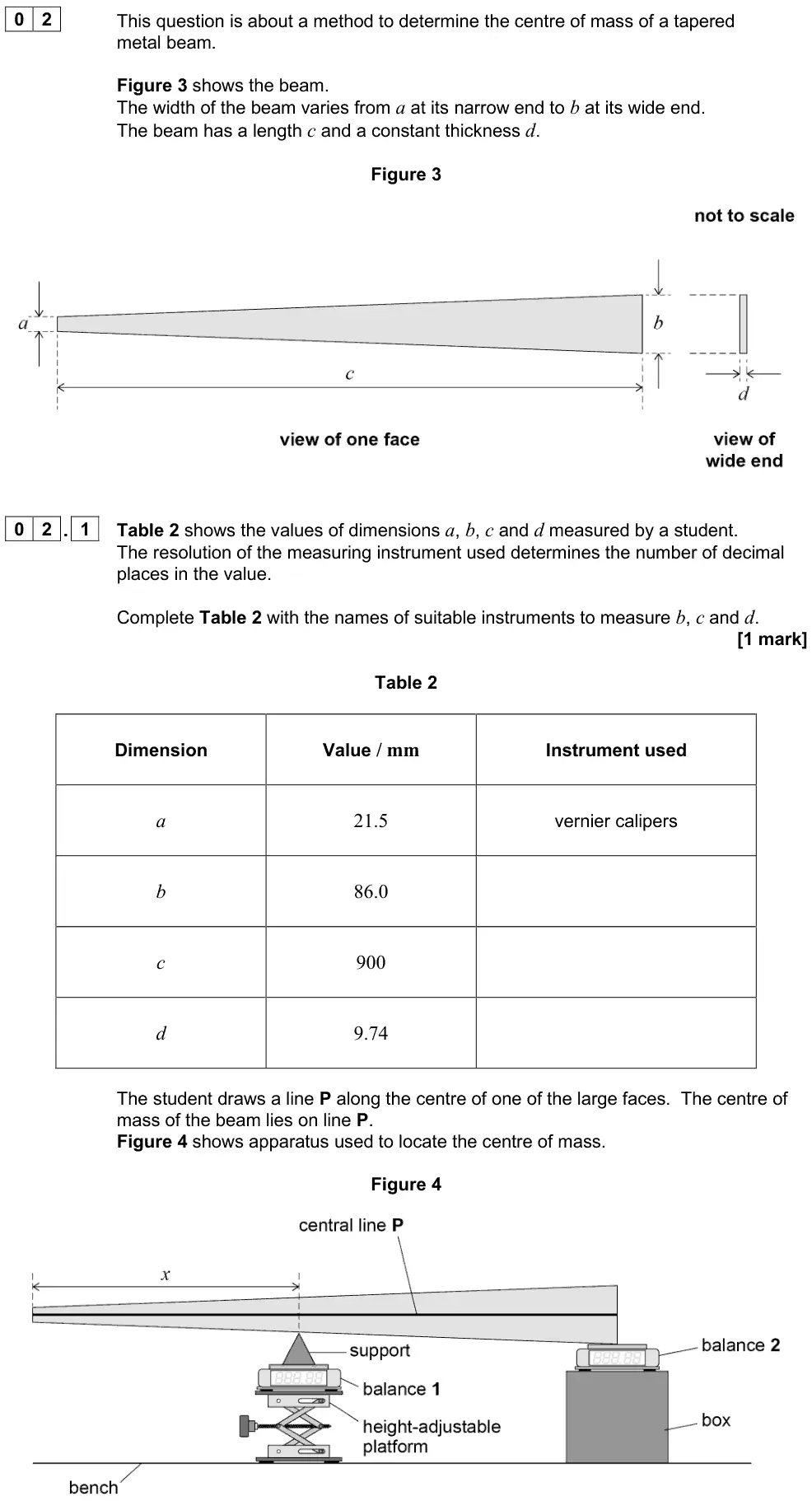
June 2025 · AS Paper 2 · Q2.22 marksAO1=2Practical and data analysisHard
Earlier part of question 2 that this part uses
Mark scheme
Examiner's comment
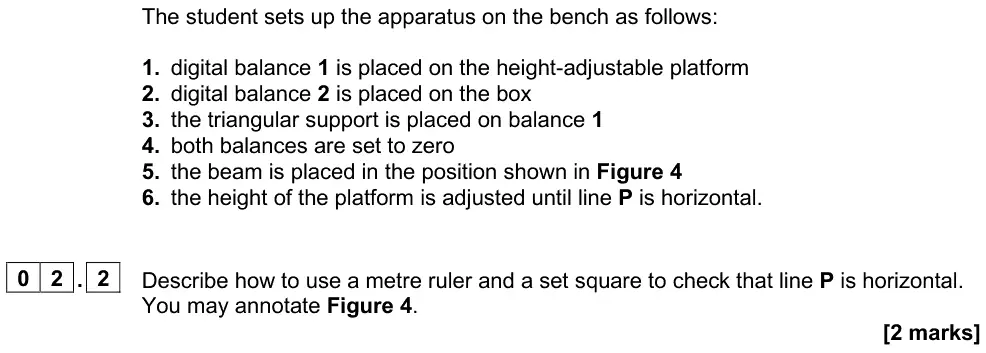
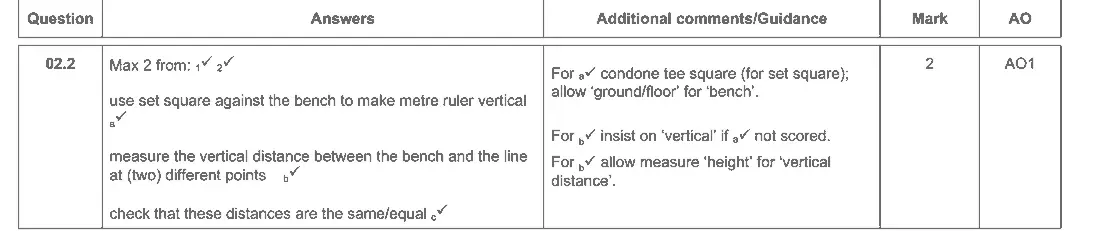
02.2 Barely one-fifth of the cohort gained any marks for a correct method to check that the line P was horizontal. A common suggestion was to place the set square on balance 2 to make the ruler horizontal and then compare line P with the ruler. Others suggested holding the ruler (vertically) and placing the set square against the ruler to see if line P was horizontal. A large number of students seemed, from their sketches, to be totally unfamiliar with the shape terms “vertical” and “horizontal”.
Notes from the mark scheme and report
Use set square on bench to hold metre ruler vertical
measure height of line P above bench at two points
equal heights mean horizontal
Skills: ATa analogue apparatus to record measurements and interpolate; PS2.1 Comment on experimental design and evaluate scientific methods
June 2025 · AS Paper 2 · Q2.32 marksAO2=2Diagram or graphEasy
Earlier part of question 2 that this part uses
Mark scheme
Examiner's comment
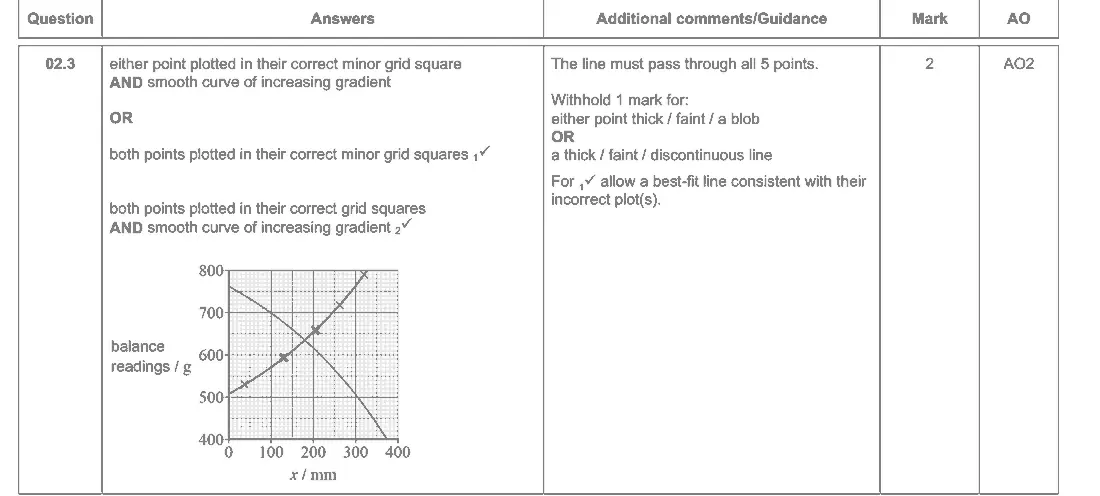
02.3 Nearly 90% of students gained some success in this question. A frequently seen mistake was a straight line of best-fit.
Notes from the mark scheme and report
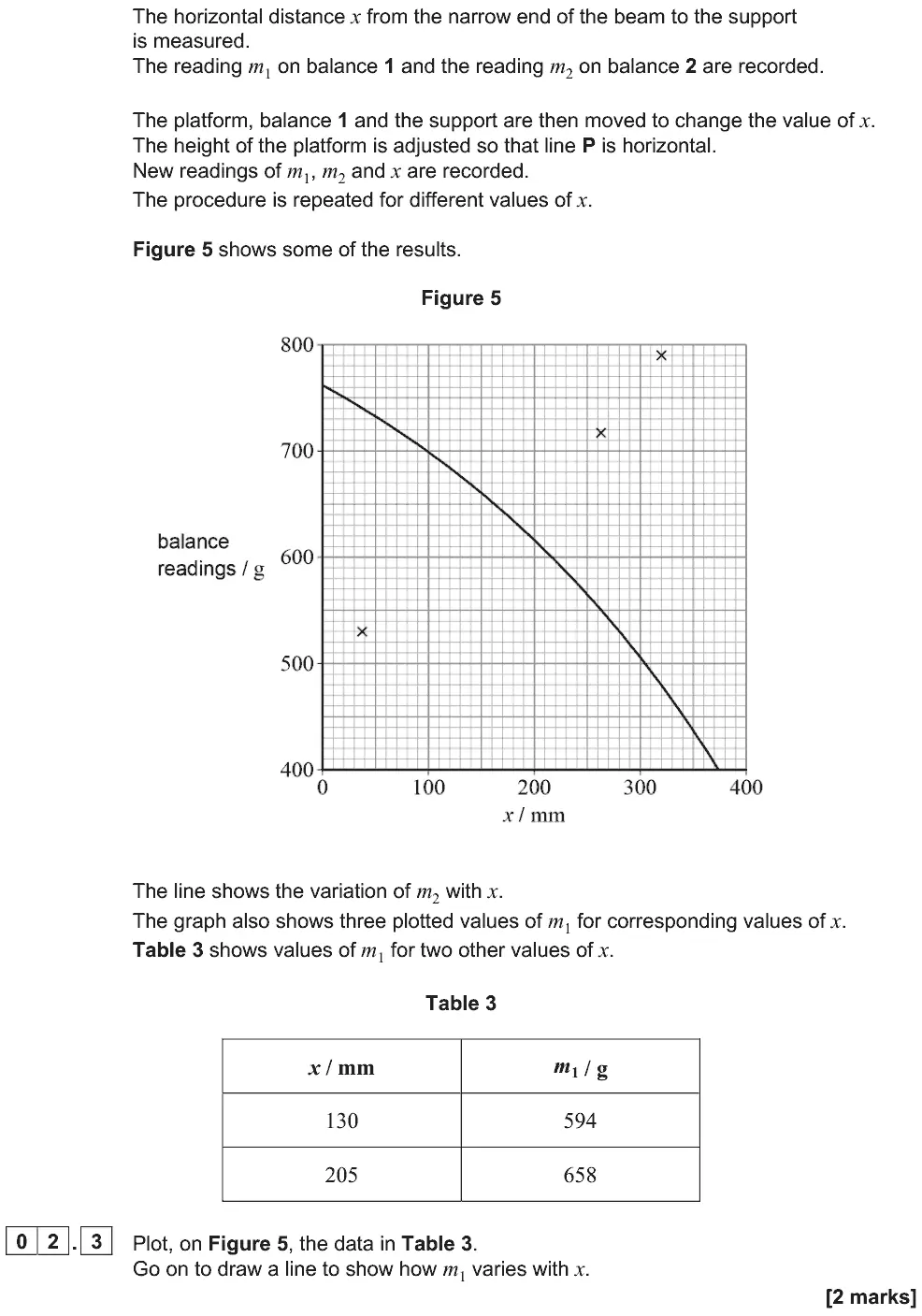
Plot (130, 594) and (205, 658) in correct minor squares
smooth curve of increasing gradient through all 5 points
straight line was the common error
Skills: MS3.2 Plot two variables from experimental or other data
June 2025 · AS Paper 2 · Q2.42 marksAO3=2Practical and data analysisHard
Earlier part of question 2 that this part uses
Mark scheme
Examiner's comment
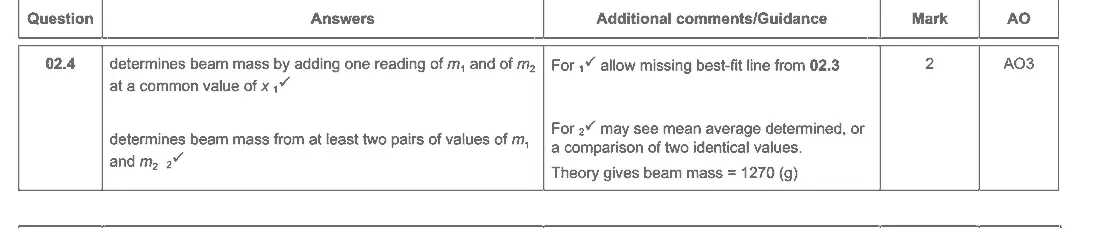
02.4 Only one-third of students gained any marks here. The value of the intersection of Figure 5 was often quoted as the answer, without doubling the value. Few addressed the “accurate” part of the question and attempted at least two determinations.
Notes from the mark scheme and report
Answer: about 1270 g (m1 + m2 at a common x, at least two pairs for accuracy)
many quoted the intersection value without doubling
Skills: MS3.1 Translate information between graphical, numerical and algebraic forms
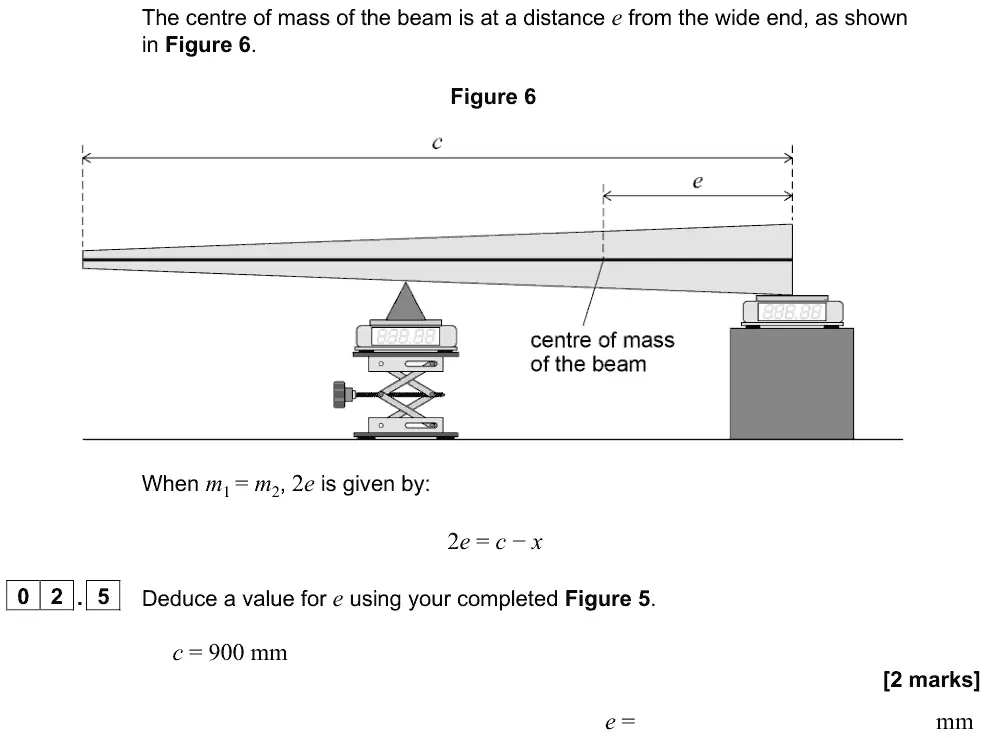
June 2025 · AS Paper 2 · Q2.52 marksAO3=2Practical and data analysisEasy
Earlier part of question 2 that this part uses
Mark scheme
Examiner's comment
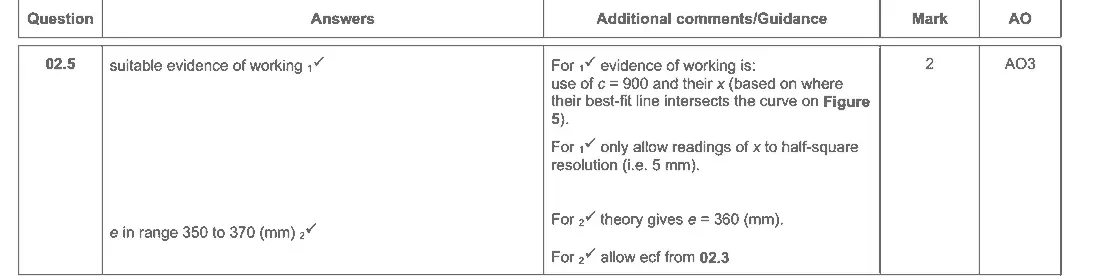
02.5 Over 60% of students gained both marks for this deduction. A common error by students was to take a value from the “balance readings” axis.
Notes from the mark scheme and report
Answer: e = 350-370 mm (x at intersection of m1 and m2 curves, 2e = 900 - x
theory 360 mm)
reading from the balance-readings axis was the common error
Skills: MS3.1 Translate information between graphical, numerical and algebraic forms; MS2.3 Substitute numerical values into algebraic equations using appropriate units for physical quantities
June 2025 · AS Paper 2 · Q2.72 marksAO3=2Practical and data analysis
Earlier part of question 2 that this part uses
Mark scheme
Examiner's comment
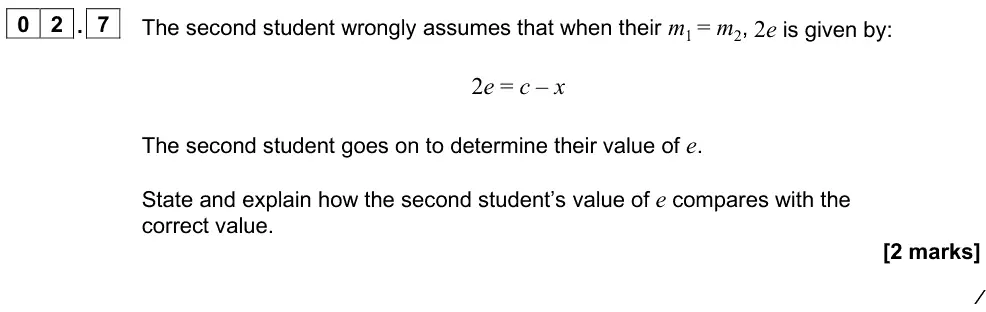
02.7 This question gave a good distribution of marks. For full credit, students needed to refer to the graph for the reason that e would be larger.
02.6 Many students identified that all values of the graph would increase but did not state why. Credit was allowed for this realisation if it was stated in 02.7.
Notes from the mark scheme and report
Lines for m1 and m2 now intersect at a smaller x, so their e (= (c - x)/2) is larger than the correct value
Skills: PS3.3 Consider margins of error, accuracy and precision of data
June 2025 · AS Paper 2 · Q4.12 marksAO2=2Calculation
Mark scheme
Examiner's comment
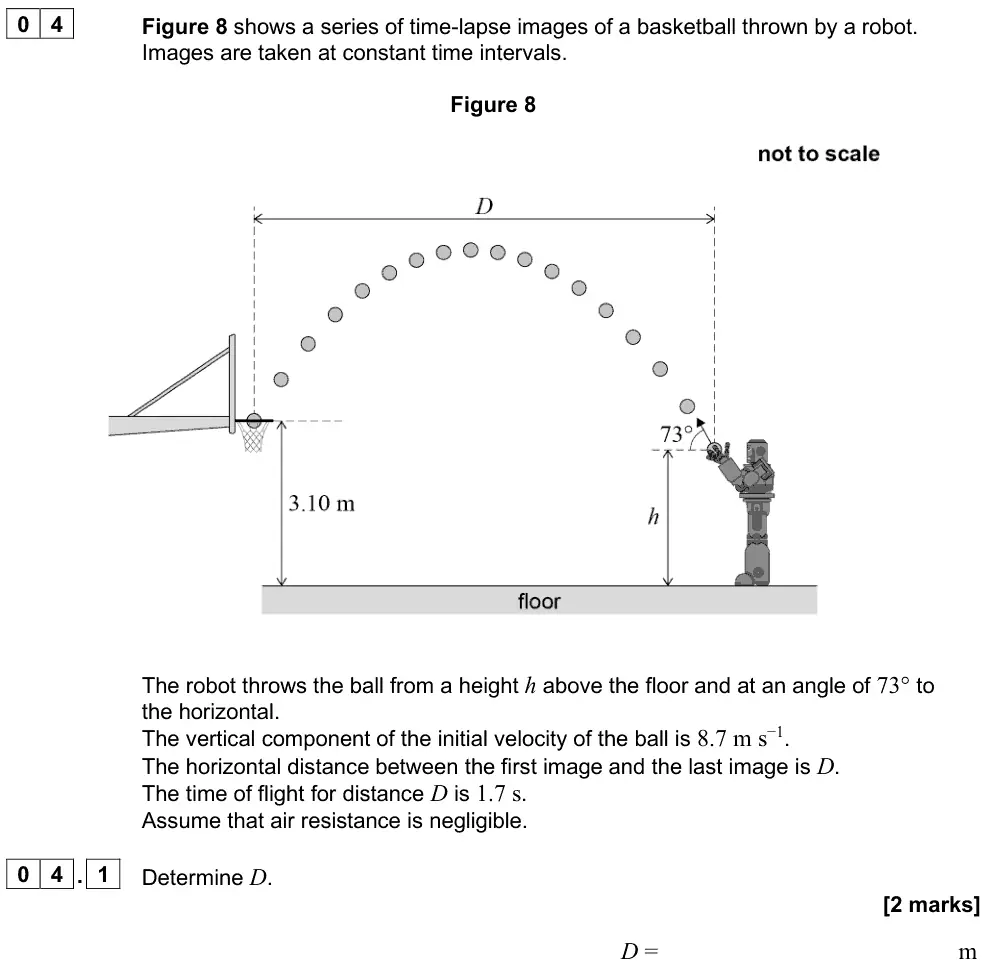
03.4 This question proved to be very challenging to students, with only 10% gaining more than one mark. The analysis of the change to the circuit rarely went beyond the standard of GCSE. A surprising number of students thought the resistance of X decreased as the diameter decreased. Credit was allowed for subsequent correct deductions whichever change in resistance was claimed. However, these deductions were often limited. A common error was stating that the decrease in current in X meant an increase in current in Y because the current was shared in a parallel circuit. This line of argument ignored the fact that the total current decreased. Almost all students did not consider the internal resistance and the effect on the terminal pd due to the decrease in current. A frequently seen misconception was that the total resistance of X and Y decreased when the resistance of X increased. 04.1 Nearly 50% of students achieved both marks. Those who gained only one mark often struggled to identify the correct velocity to use when multiplying by 1.7 s.
Notes from the mark scheme and report
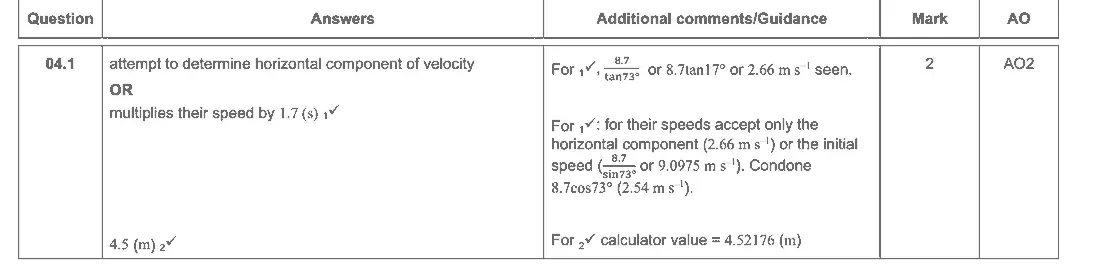
Answer: 4.5 m (horizontal component 8.7 / tan 73 = 2.66 m s^-1 x 1.7 s)
Skills: MS4.5 Use sin, cos and tan in physical problems
June 2025 · AS Paper 2 · Q4.32 marksAO3=2Explanation
Earlier part of question 4 that this part uses
Mark scheme
Examiner's comment
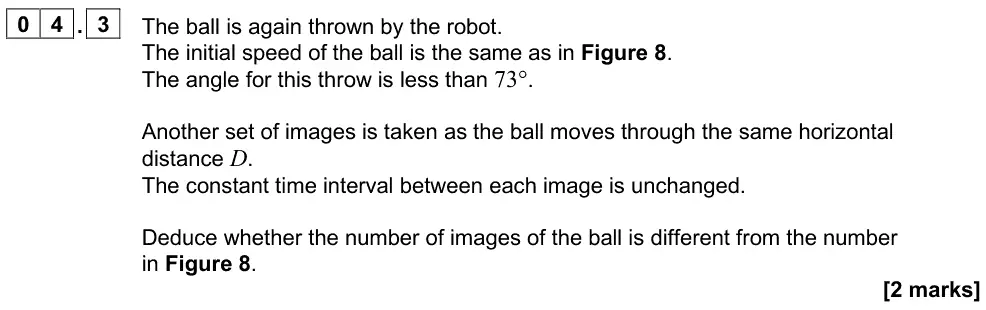
04.3 This question discriminated well. Shortcomings were often in the language used. For instance, “arrives faster” is not the same as “arrives sooner”. (The ball actually arrives at the basket at the same speed regardless of the launch angle.)
Notes from the mark scheme and report
Lower angle: larger horizontal (smaller vertical) velocity component, so shorter time to cover D and fewer images
'arrives faster' is not 'arrives sooner'
June 2025 · Paper 2 · Q6.53 marksAO2=3CalculationHard
Earlier part of question 6 that this part uses
Mark scheme
Examiner's comment
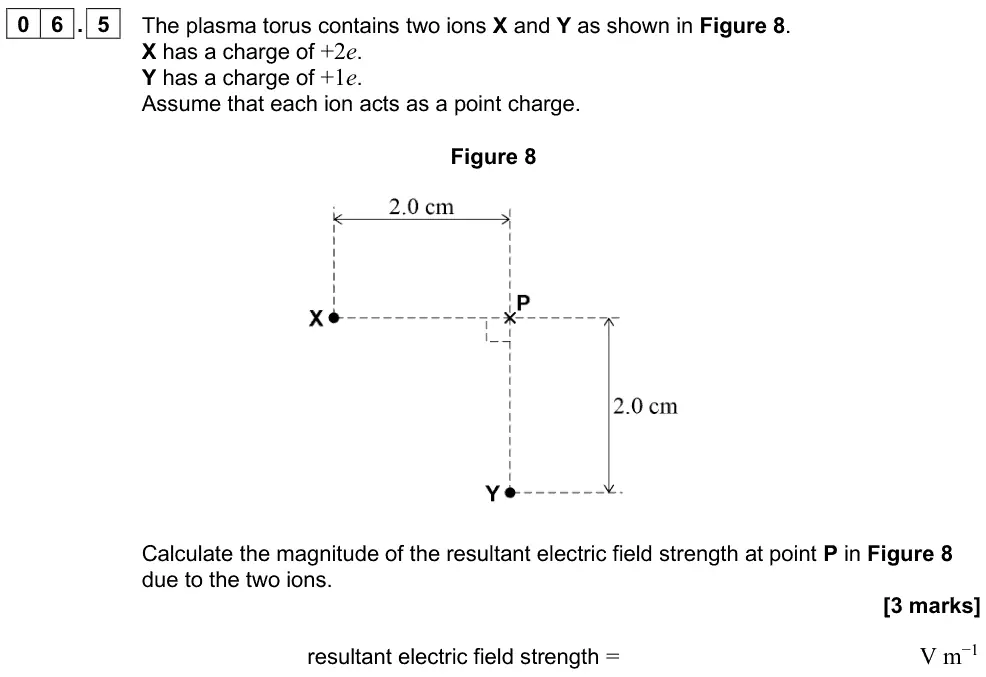
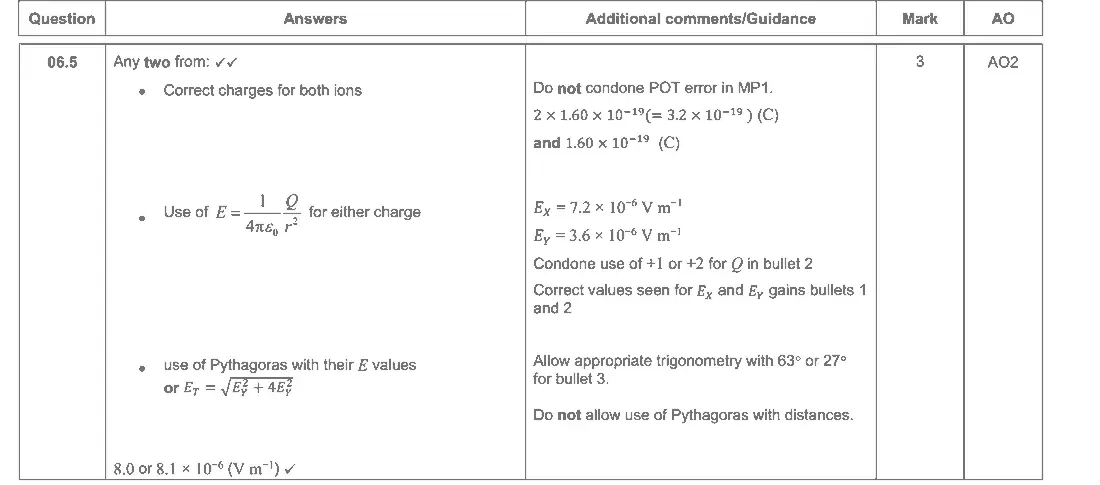
6.5 This question was context free, yet proved challenging for students, with only around a quarter able to gain full marks. Students had to calculate the electric field at P for X and for Y and then combine them as vectors using either Pythagoras or trigonometry.
Common mistakes were: students calculating the force exerted by the charge on each other using coulombs law, determining the field at the location of the other charge rather than P, mixing up the field and the potential, and treating the field as a scalar and simply adding or subtracting the two electric fields. Those students who treated the fields as scalars and who did the algebra before substituting in the values at the end, often scored 0 marks, because they did not write down either charge correctly, did not have a valid substitution into an electric field equation and did not combine the electric fields as vectors. Had they substituted earlier they could have gained 2 marks. This significantly lowered the mean mark for the question.
Notes from the mark scheme and report
Answer: 8.0-8.1 x 10^-6 V m^-1 (E_X = 7.2 x 10^-6, E_Y = 3.6 x 10^-6 at right angles, combined by Pythagoras)
adding fields as scalars or using Coulomb force were common errors
Skills: MS2.3 Substitute numerical values into algebraic equations using appropriate units for physical quantities; MS4.4 Use Pythagoras’ theorem, and the angle sum of a triangle
June 2025 · AS Paper 2 · Q231 markAO2=1Multiple choice
Answer
D
Mark scheme
Notes from the mark scheme and report
Answer: D
June 2025 · AS Paper 2 · Q251 markAO2=1Multiple choice
Answer
D
Mark scheme
Notes from the mark scheme and report
Answer: D
Skills: MS4.5 Use sin, cos and tan in physical problems
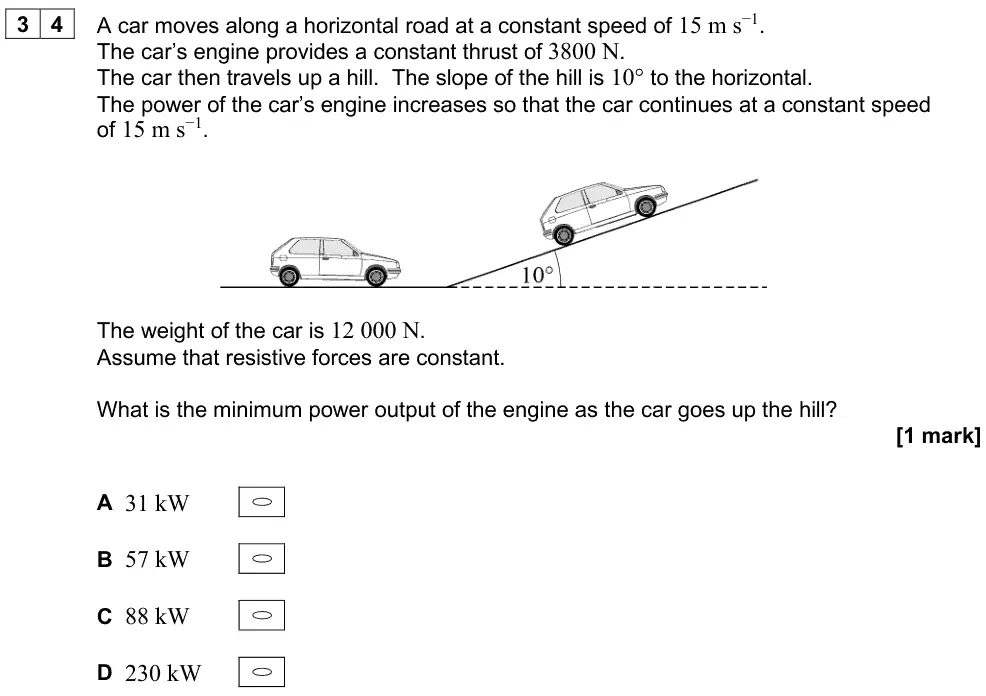
June 2025 · AS Paper 2 · Q341 markAO2=1Multiple choice
Answer
C
Mark scheme
Notes from the mark scheme and report
Answer: C
Skills: MS4.5 Use sin, cos and tan in physical problems
June 2024 · AS Paper 1 · Q4.33 marksAO2=2, AO3=1Calculation
Earlier part of question 4 that this part uses
Mark scheme
Examiner's comment
04.3
Notes from the mark scheme and report
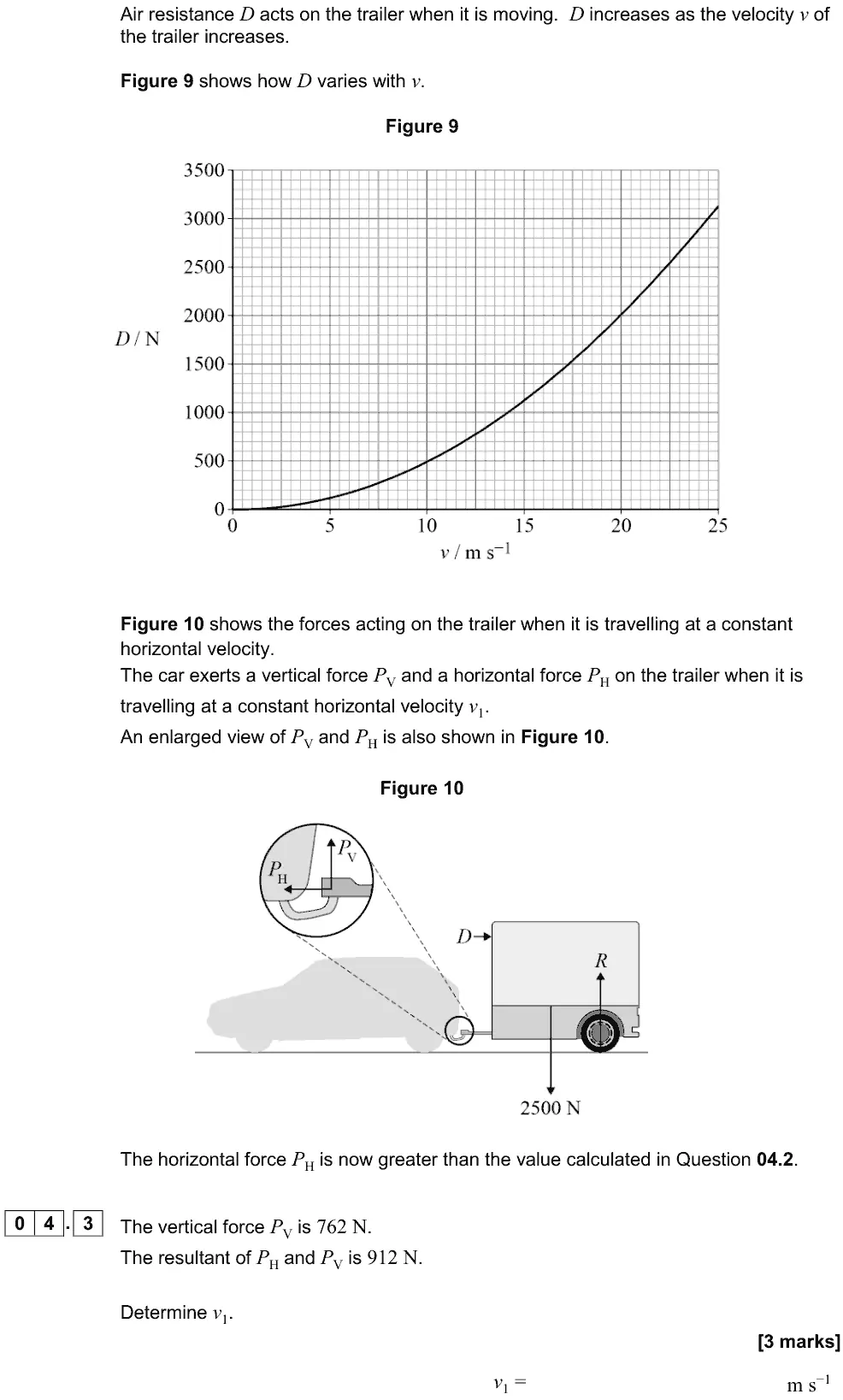
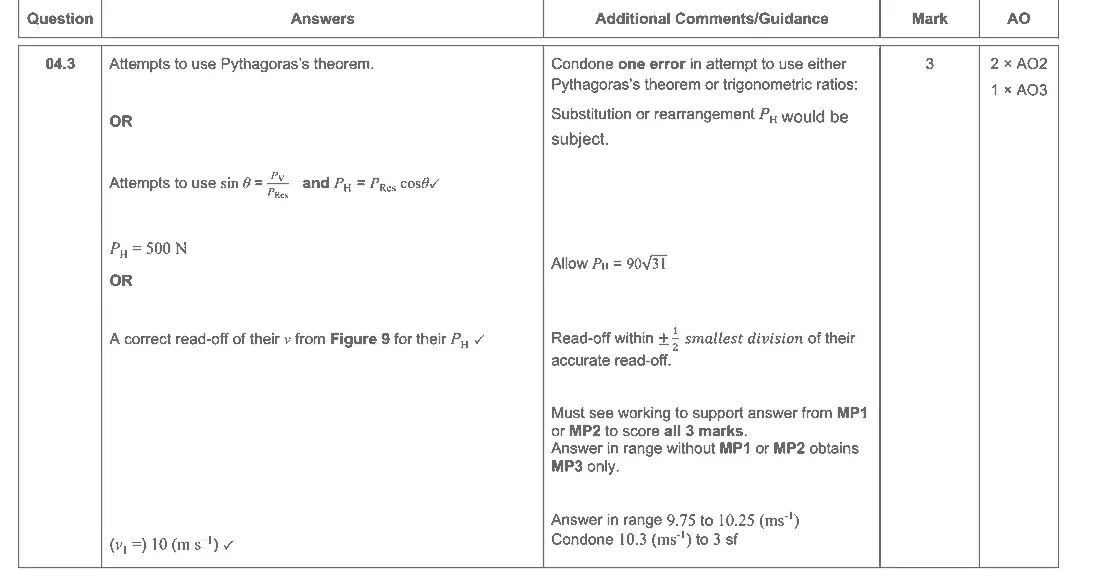
Answer: 10 m s^-1 (PH = sqrt(912^2 - 762^2) = 500 N = D at constant velocity, read from Figure 9)
Skills: MS4.4 Use Pythagoras’ theorem, and the angle sum of a triangle; MS3.1 Translate information between graphical, numerical and algebraic forms
June 2024 · AS Paper 1 · Q4.41 markAO1=1Short answer
Earlier part of question 4 that this part uses
Mark scheme
Examiner's comment
04.4
Only the higher attaining students were able to make much progress here. Almost 20% of students gained three marks whereas almost 70% scored zero. Just over 30% of students didn’t even make any attempt at this question. Those who applied the principle of moments generally went on to gain all three marks. One of the purposes of question 04.4 was to introduce moments to the students and act as a stimulus for 04.5. That hint proved too subtle for all but the best students.
Notes from the mark scheme and report
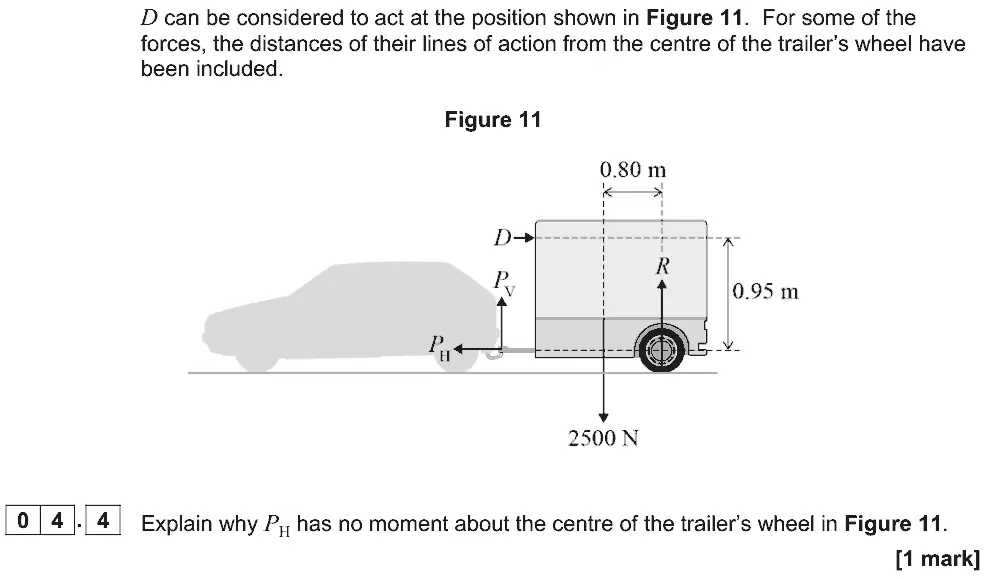
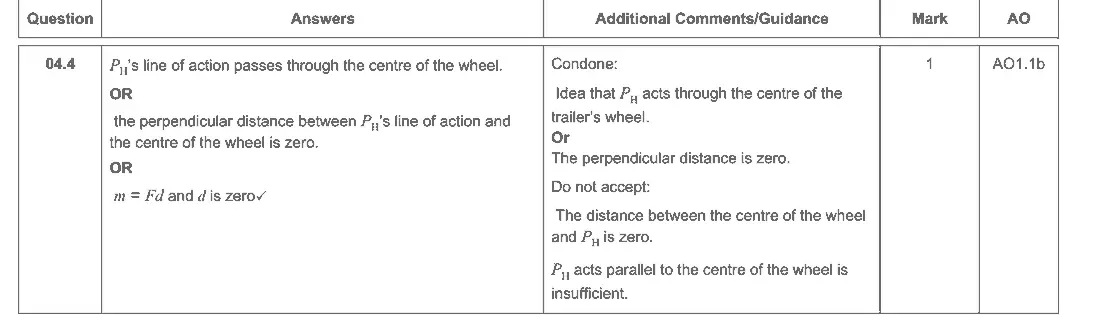
PH's line of action passes through the wheel centre, so the perpendicular distance is zero
June 2024 · AS Paper 1 · Q4.53 marksAO1=1, AO2=1, AO3=1CalculationHard
Earlier part of question 4 that this part uses
Mark scheme
Examiner's comment
04.5
Only the higher attaining students were able to make much progress here. Almost 20% of students gained three marks whereas almost 70% scored zero. Just over 30% of students didn’t even make any attempt at this question. Those who applied the principle of moments generally went on to gain all three marks. One of the purposes of question 04.4 was to introduce moments to the students and act as a stimulus for 04.5. That hint proved too subtle for all but the best students.
Notes from the mark scheme and report
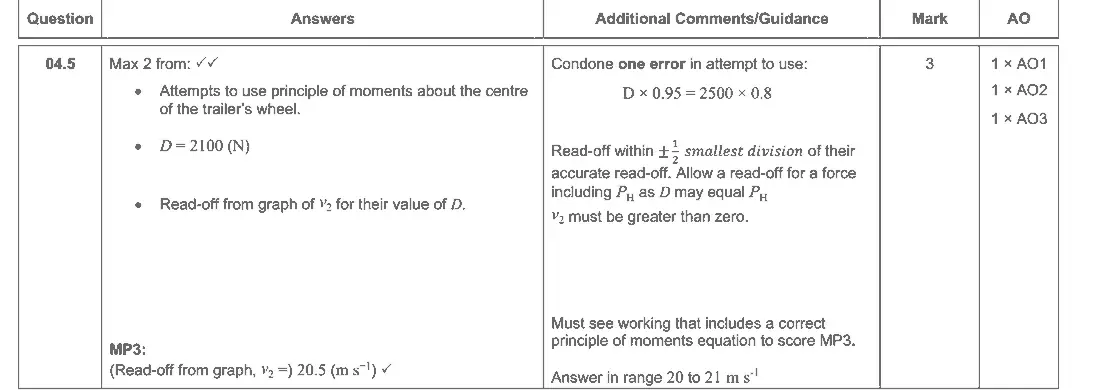
Answer: 20.5 m s^-1 (moments about wheel centre: D x 0.95 = 2500 x 0.80, D = 2100 N, read from Figure 9)
just over 30% made no attempt
Skills: MS2.3 Substitute numerical values into algebraic equations using appropriate units for physical quantities; MS3.1 Translate information between graphical, numerical and algebraic forms
June 2024 · Paper 1 · Q5.14 marksAO3=4Diagram or graph
Mark scheme
Examiner's comment
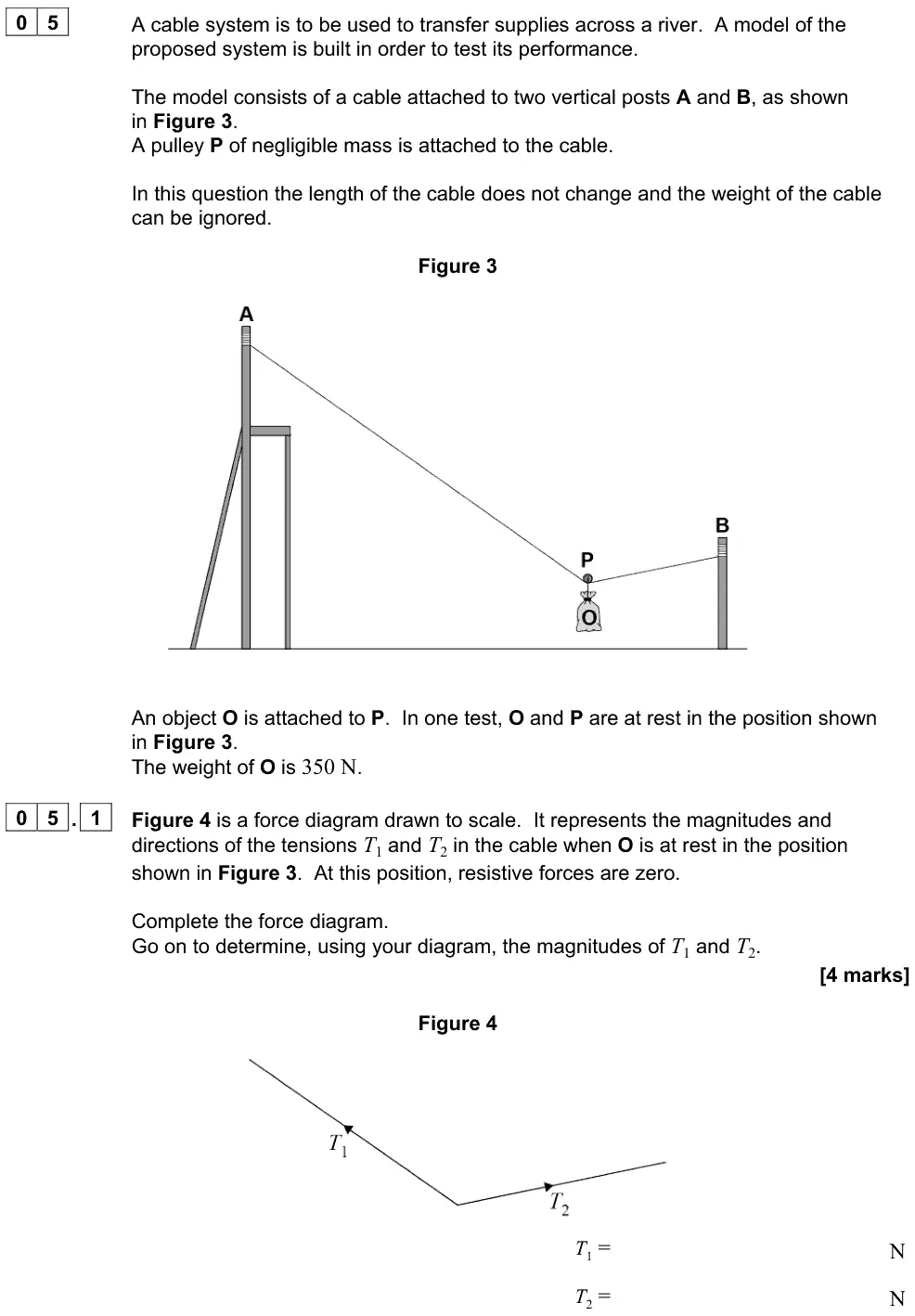
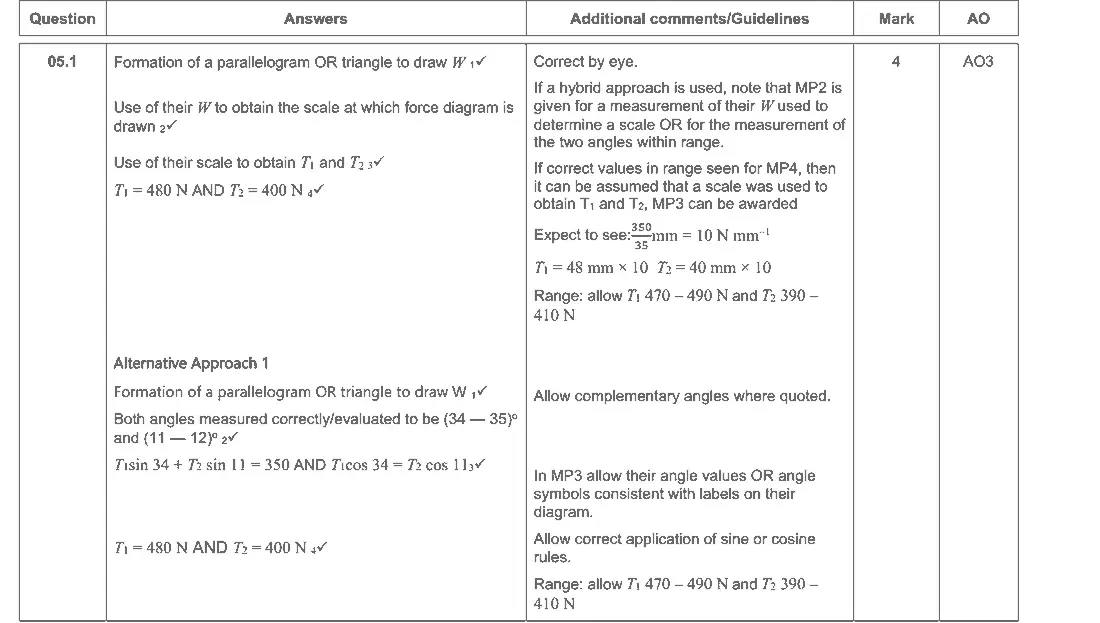
In question 05.1 students were given a scale diagram of the two tension forces. It was expected that students would add the weight to complete the diagram and therefore work out the scale and hence the two tensions. This was rarely done. Many students attempted to measure the angles. This gained partial success, depending on the accuracy of the student’s measurement. The first marking point was only given to students who successfully completed the diagram, however.
Notes from the mark scheme and report
Answer: T1 = 480 N, T2 = 400 N
mark 1 needs W drawn (parallelogram or triangle) and the scale found from W = 350 N
measuring angles gave partial credit
Skills: MS0.3 Use ratios, fractions and percentages; MS4.5 Use sin, cos and tan in physical problems
June 2024 · Paper 1 · Q181 markAO1=1Multiple choiceEasy
Answer
B
Mark scheme
Examiner's comment
There were five very accessible questions that were correctly answered by more than 70% of students. These were B12, B18, B14, B27 and B29.
Notes from the mark scheme and report
Answer: B
Skills: MS4.5 Use sin, cos and tan in physical problems
June 2024 · Paper 1 · Q191 markAO2=1Multiple choice
Answer
A
Mark scheme
Notes from the mark scheme and report
Answer: A
Skills: MS4.5 Use sin, cos and tan in physical problems
June 2024 · AS Paper 2 · Q1.72 marksAO3=2Explanation
Earlier part of question 1 that this part uses
Mark scheme
Examiner's comment
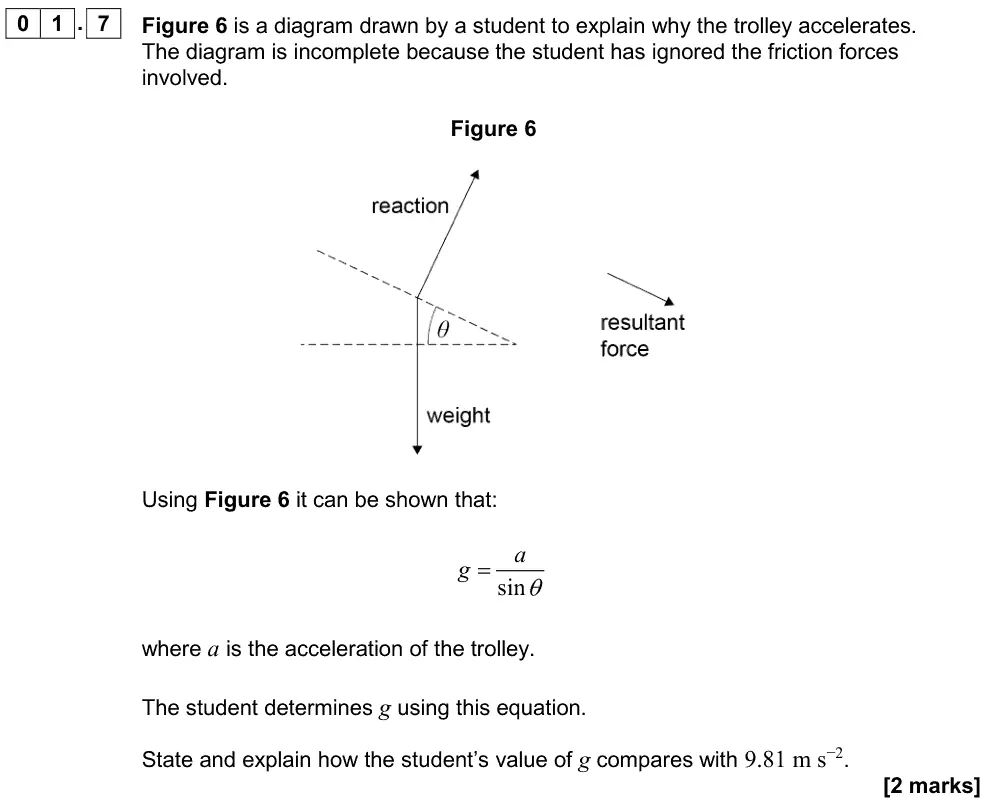
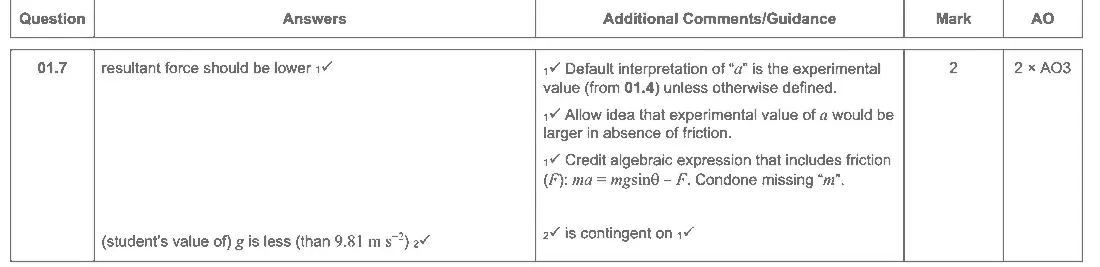
01.7 Students found this combination of theory and practice to be extremely challenging. Many suggested that the experiment had been performed in the absence of friction, rather than appreciating that the analysis ignored friction. By this logic, students argued that friction would reduce the acceleration and so the value of g would be smaller. A common misconception was that the value of g would be less than 9.81 m s-2 because the trolley was not falling vertically.
Notes from the mark scheme and report
Friction ignored in g = a / sin theta, so measured a (and resultant force) is lower than without friction
student's g is less than 9.81 m s^-2
many thought friction absent or that g is smaller because the trolley is not falling vertically
June 2024 · AS Paper 2 · Q251 markMultiple choice
Answer
D
Mark scheme
Notes from the mark scheme and report
Answer: D
Skills: MS4.5 Use sin, cos and tan in physical problems
June 2024 · AS Paper 2 · Q311 markMultiple choice
Answer
C
Mark scheme
Notes from the mark scheme and report
Answer: C
June 2023 · AS Paper 1 · Q4.12 marksAO2=2Calculation
Mark scheme
Examiner's comment
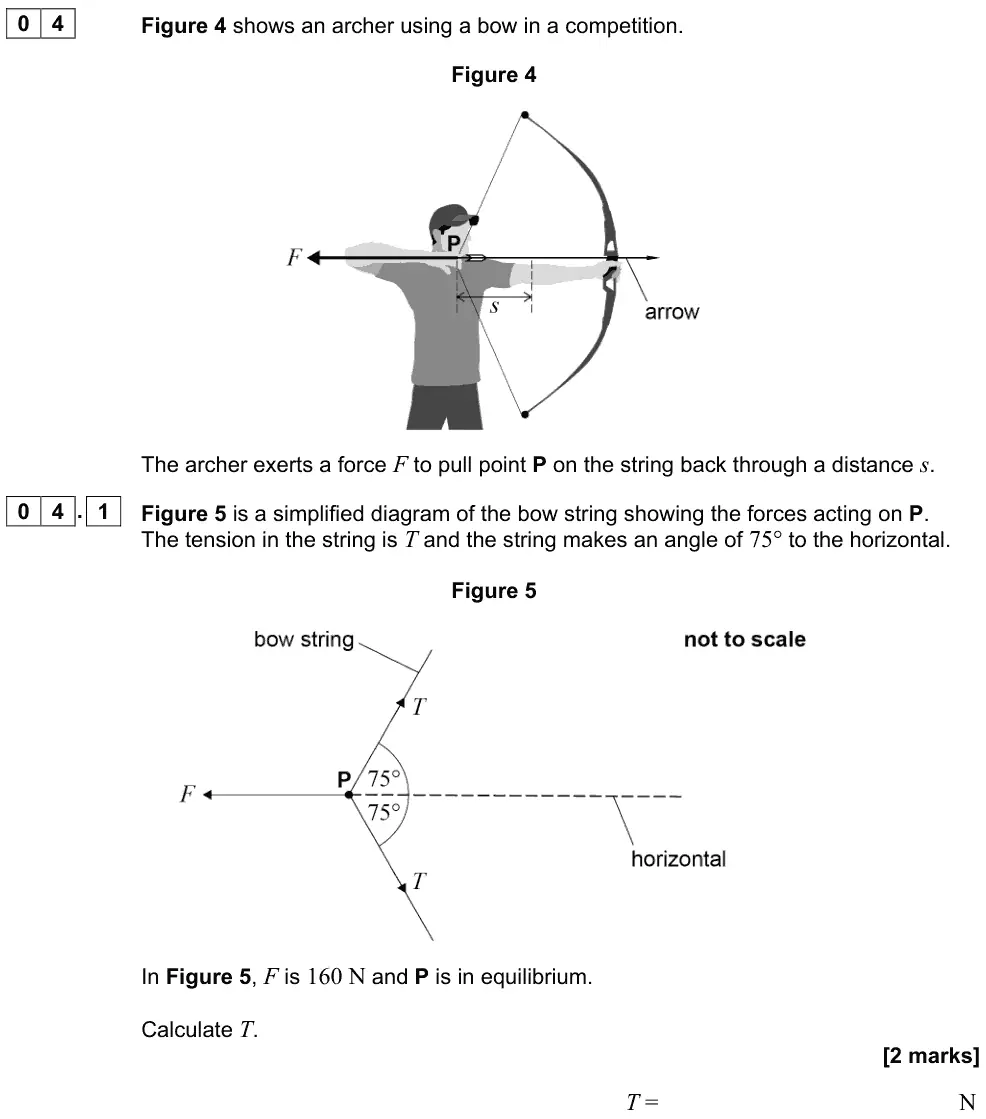
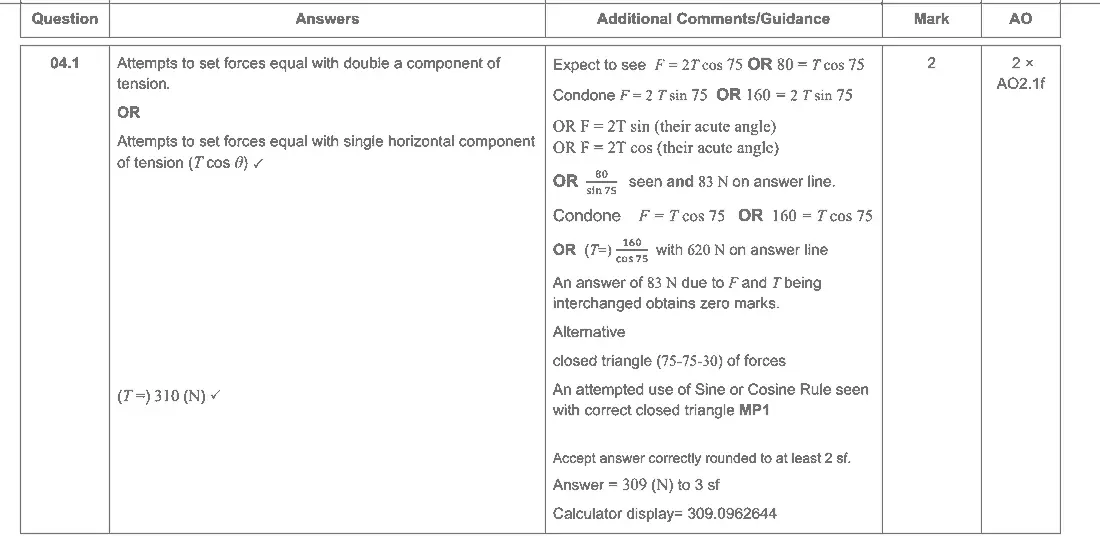
04.1 43% of students scored two marks with a further 20% gaining one mark. Many students tried to resolve 160 N rather than T; this made the calculation considerably more challenging, and these students typically scored zero marks. Many were unsure whether to use sine or cosine or failed to appreciate that F was shared between the two horizontal components of the tensions acting at P.
Notes from the mark scheme and report
Answer: 310 N (F = 2T cos 75)
resolving F instead of T, or one component only, were common errors
Skills: MS4.5 Use sin, cos and tan in physical problems
June 2023 · Paper 1 · Q5.45 marksAO3=5Calculation
Earlier part of question 5 that this part uses
Mark scheme
Examiner's comment
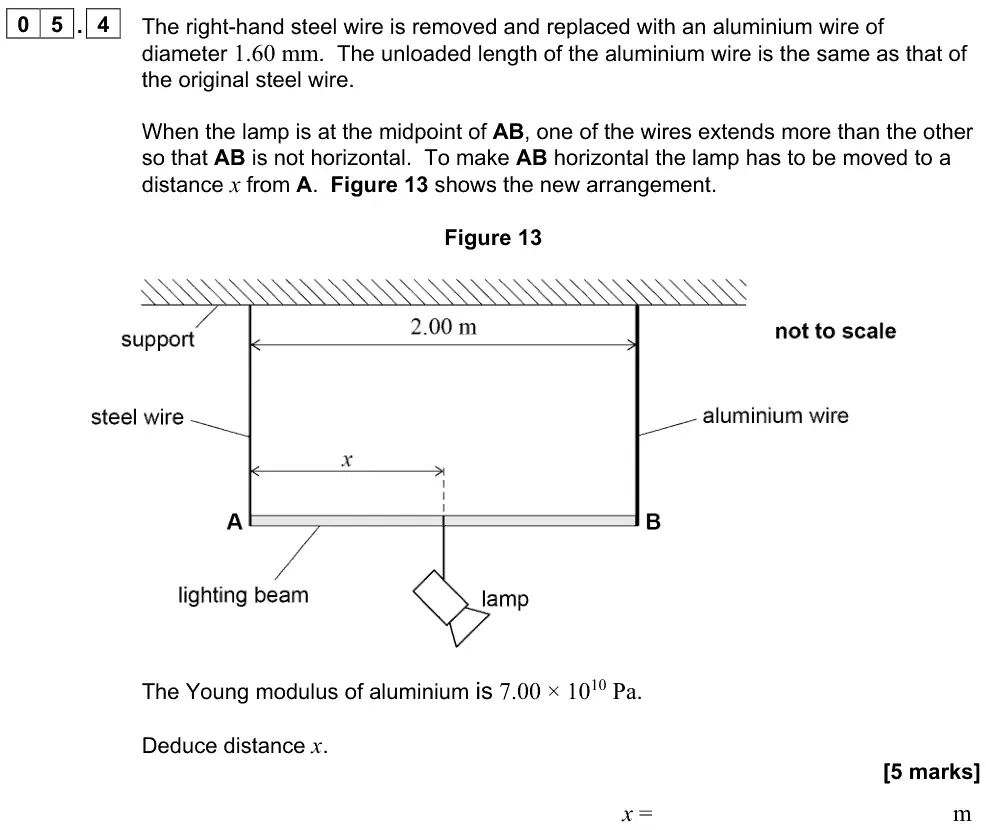
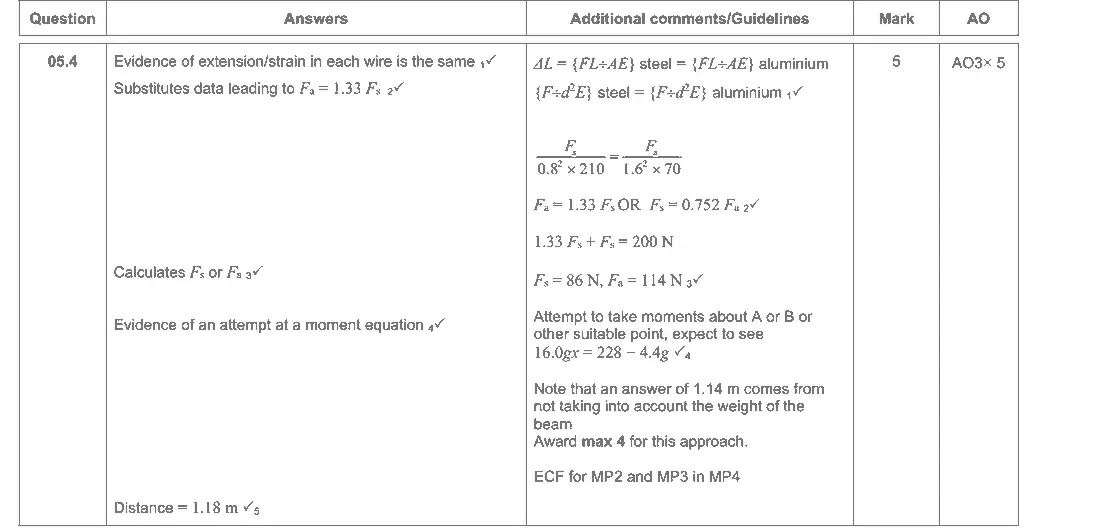
05.4 This was also one of the most discriminating on the paper. Over half of the students were able to get at least one mark, usually for providing evidence of a moment equation. Students who did not see that for AB to be horizontal the extensions of the two wires had to be equal made little further progress. The mark scheme produced a range of marks, rewarding students who set out their work sufficiently clearly to obtain intermediate marks. Using the value of extension from question 05.3 gave partial credit to some of these students.
Notes from the mark scheme and report
Answer: x = 1.18 m (equal extensions so Fa = 1.33 Fs, Fs = 86 N, Fa = 114 N, moments about A including the beam weight)
ignoring beam weight gives 1.14 m
recognising equal extensions was the key step
Skills: MS2.2 Change the subject of an equation, including non-linear equations; MS2.3 Substitute numerical values into algebraic equations using appropriate units for physical quantities
June 2023 · Paper 1 · Q201 markMultiple choiceEasy
Answer
C
Mark scheme
Examiner's comment
The multiple choice questions covered parts of the specification not covered in Section A. The distractors in these questions were written with common errors and misconceptions in mind. These questions are therefore an extremely useful resource when preparing students. The easiest questions were 7, 12, 20, 10 and 11, with over 75% of students getting these questions right. The most demanding were 18, 26, 22, 21 and 13; fewer than 40% of students got these right. For several of these the correct answer was not the most popular choice.
Notes from the mark scheme and report
Answer: C
June 2023 · Paper 1 · Q221 markMultiple choiceHard
Answer
B
Mark scheme
Examiner's comment
The multiple choice questions covered parts of the specification not covered in Section A. The distractors in these questions were written with common errors and misconceptions in mind. These questions are therefore an extremely useful resource when preparing students. The easiest questions were 7, 12, 20, 10 and 11, with over 75% of students getting these questions right. The most demanding were 18, 26, 22, 21 and 13; fewer than 40% of students got these right. For several of these the correct answer was not the most popular choice.
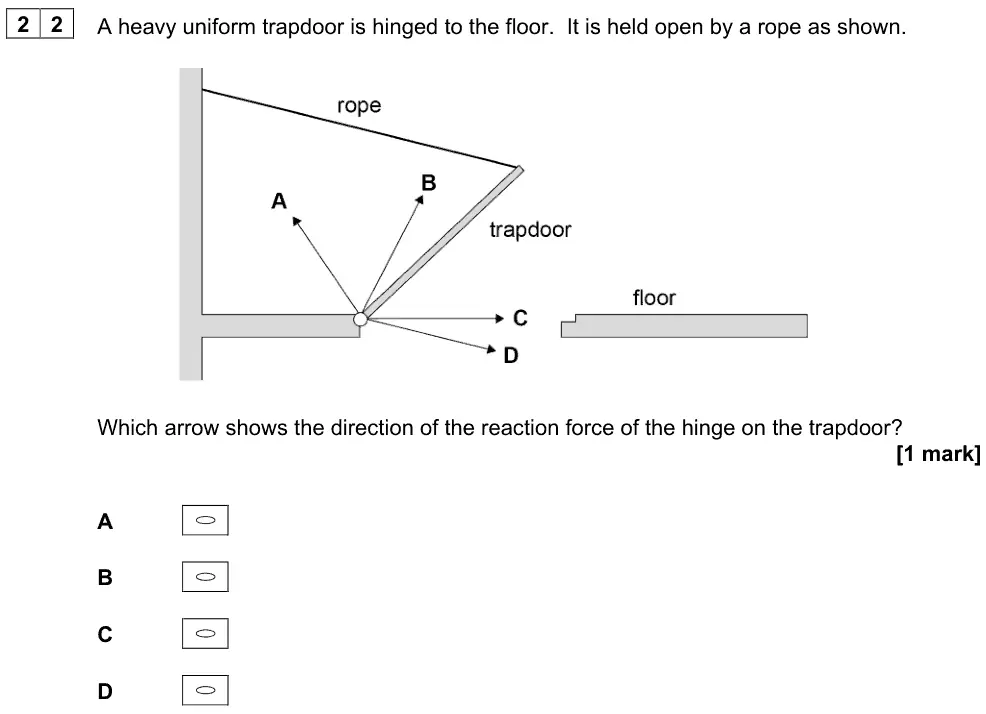
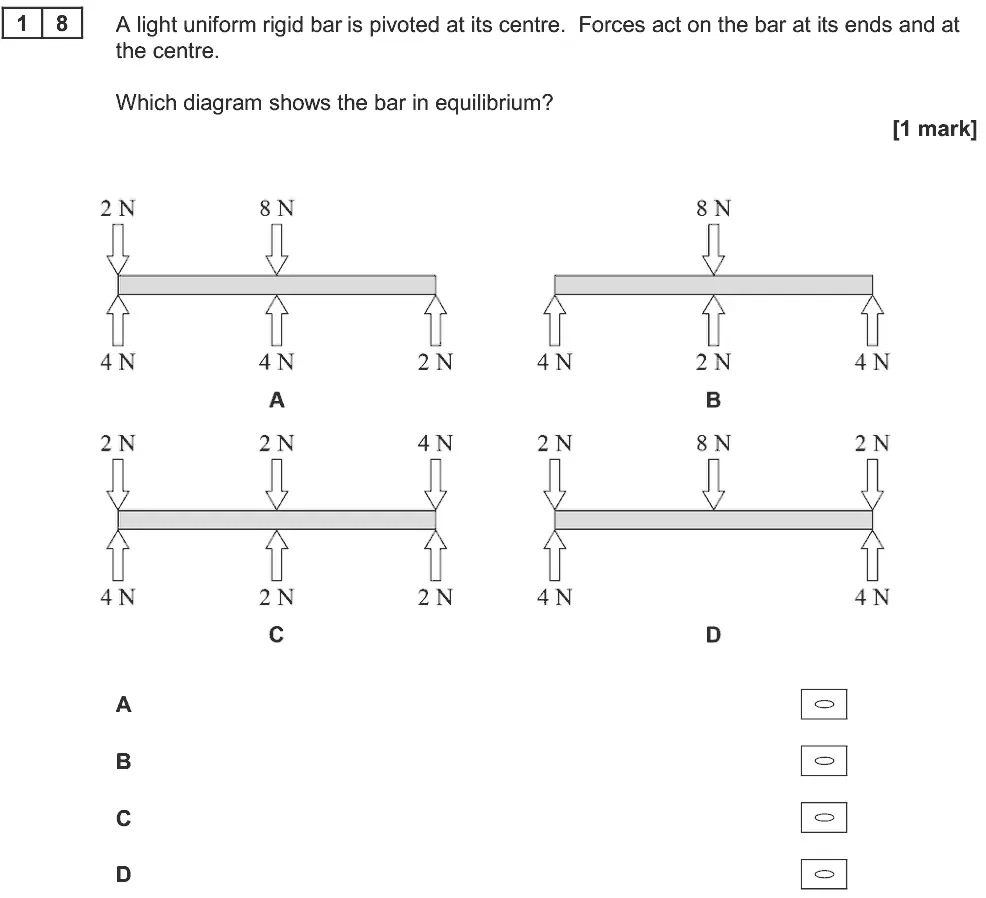
Question 22 was about the equilibrium of forces. The most popular answer was A. Drawing the weight of the trapdoor and the tension in the rope on the diagram would have shown their lines of action. This would have indicated B as the only force with a line of action that would pass through a common point and therefore give no turning effect.
Notes from the mark scheme and report
Answer: B
A most popular - the three lines of action must meet at one point
June 2023 · Paper 1 · Q241 markMultiple choice
Answer
C
Notes from the mark scheme and report
Answer: C
June 2023 · Paper 1 · Q301 markMultiple choice
Answer
D
Mark scheme
Notes from the mark scheme and report
Answer: D
Skills: MS4.5 Use sin, cos and tan in physical problems
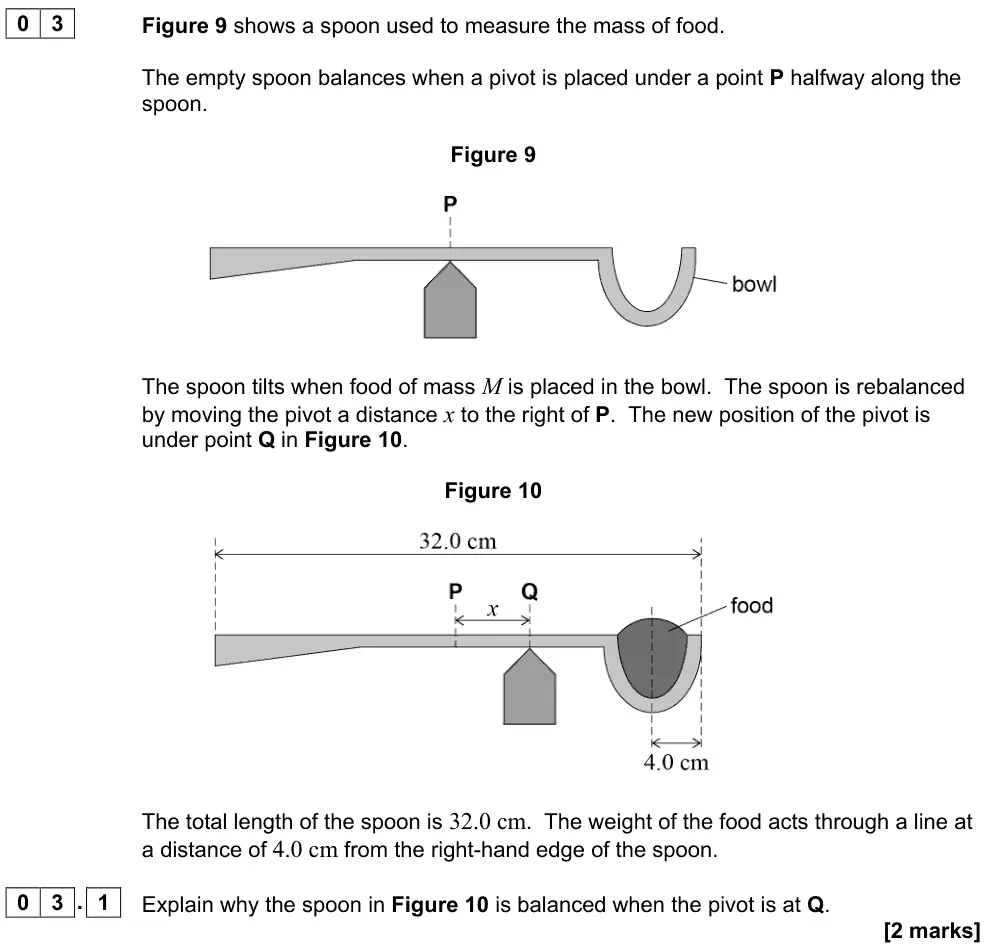
June 2023 · AS Paper 2 · Q3.12 marksAO1=2Explanation
Mark scheme
Examiner's comment
03.1 Students struggled to make comments about moments that related specifically to this context. Generic statements about balanced moments were insufficient. Students regularly failed to comment on the relevant forces, eg weight of the food, when describing moments.
Notes from the mark scheme and report
No resultant moment about Q because the combined centre of mass (line of action of total weight) is now at Q
must relate to food/spoon weight
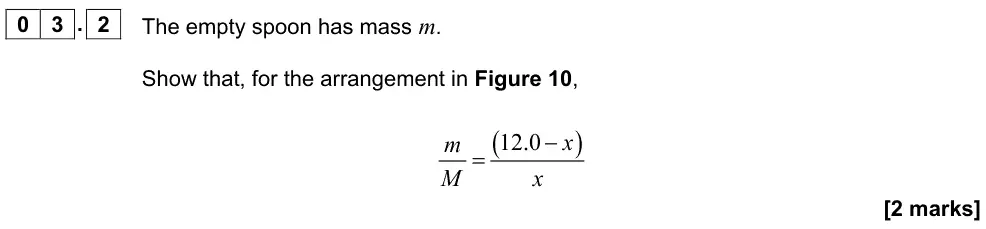
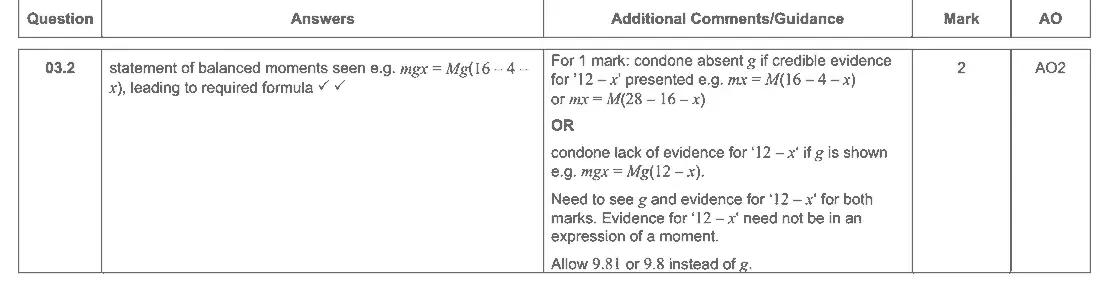
June 2023 · AS Paper 2 · Q3.22 marksAO2=2Show that
Earlier part of question 3 that this part uses
Mark scheme
Examiner's comment
03.2 This relatively simple derivation was not attempted well by a large majority of the cohort. Few students started with an expression of moments and commonly omitted g in their working.
Notes from the mark scheme and report
mgx = Mg(16 - 4 - x) leading to m/M = (12.0 - x)/x
spoon's weight acts at P (centre of mass)
many omitted g
Skills: MS2.2 Change the subject of an equation, including non-linear equations
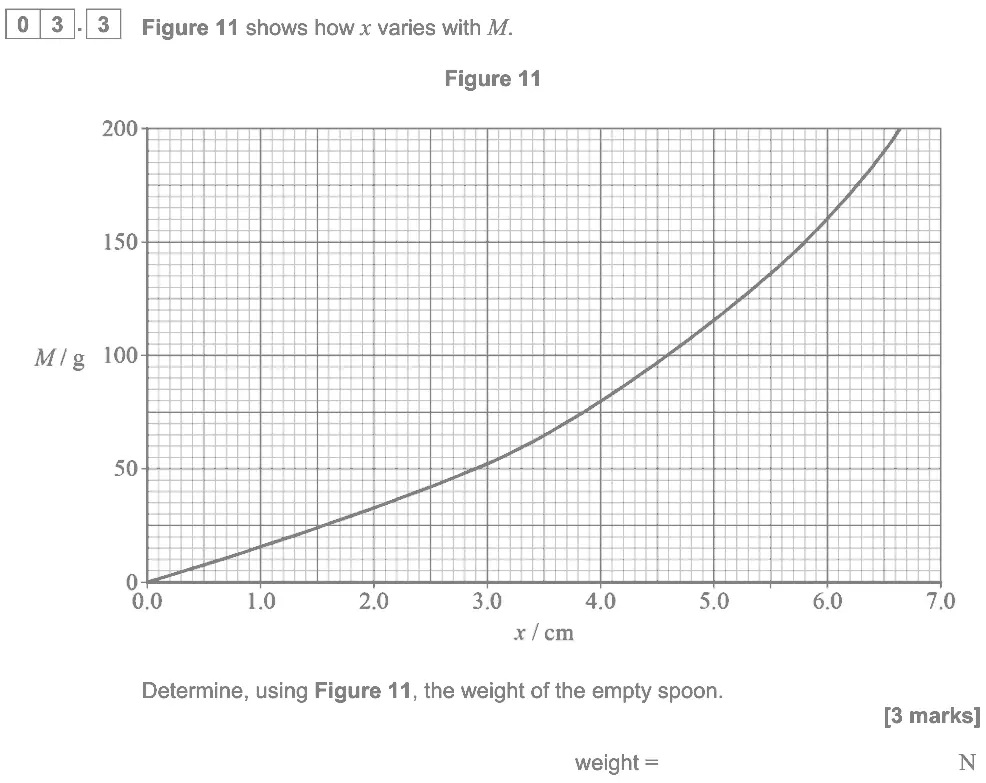
June 2023 · AS Paper 2 · Q3.33 marksAO1=3Calculation
Earlier part of question 3 that this part uses
Mark scheme
Examiner's comment
03.3 There was a good spread of marks in this question, although many students failed to connect the equation from the previous question and therefore gained no credit. A large number tried to obtain a gradient. 03.4 Very few students gained any credit in this question. Most students presented arguments in terms of a percentage uncertainty. This, they argued, would decrease as M increased because the absolute uncertainty in M would be constant. This is not the case: the absolute uncertainty in a value of x is constant but, as Figure 11 shows, this leads to an increasing uncertainty in M.
Notes from the mark scheme and report
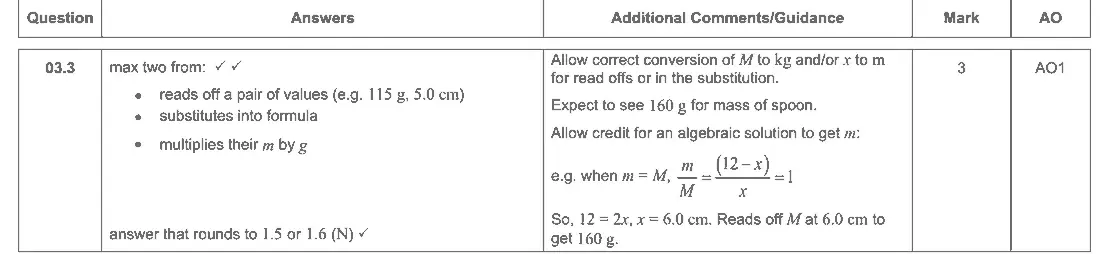
Answer: 1.5-1.6 N (m = 160 g
e.g. at x = 6.0 cm m = M = 160 g, or read 115 g at 5.0 cm and substitute)
many tried a gradient
Skills: MS3.1 Translate information between graphical, numerical and algebraic forms; MS2.3 Substitute numerical values into algebraic equations using appropriate units for physical quantities
June 2023 · AS Paper 2 · Q91 markMultiple choiceEasy
Answer
D
Mark scheme
Examiner's comment
Generally, students were more successful in answering questions 9, 15, 16, 19, 25, 27, 28 (these all had a success rate of at least 65%) and were less successful in answering questions 6, 7, 18, 23 and 31 (answered correctly by 35% or fewer).
Notes from the mark scheme and report
Answer: D
June 2023 · Paper 3 Section A · Q3.22 marksAO2=2CalculationHard
Earlier part of question 3 that this part uses
Mark scheme
Examiner's comment
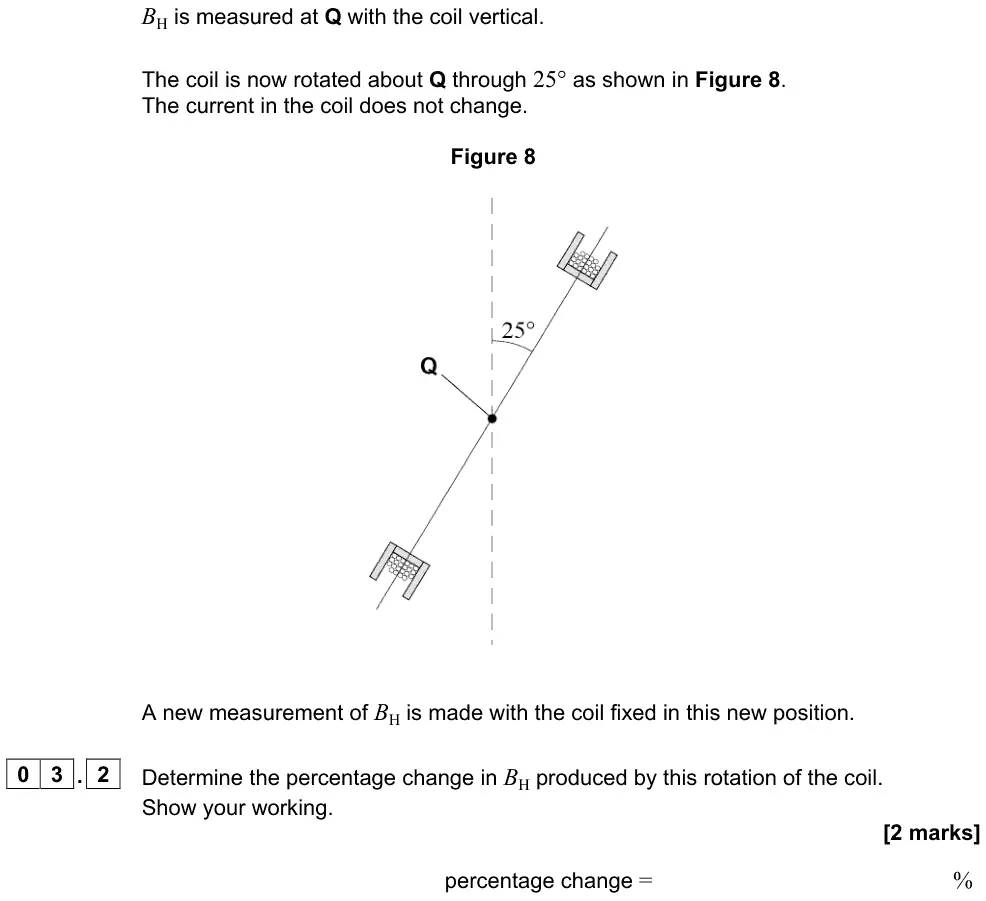
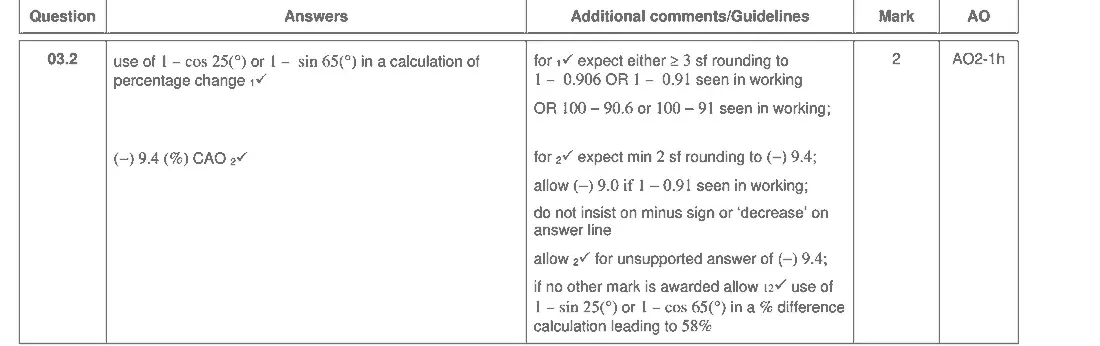
03.2 Many recognised that cos 25 was involved in the calculation but to get credit we needed to see this used in a valid percentage-difference calculation. About a third of the students gave fully correct solutions.
Notes from the mark scheme and report
Answer: (-)9.4% (1 - cos 25)
about a third fully correct
Skills: MS4.5 Use sin, cos and tan in physical problems; MS0.3 Use ratios, fractions and percentages
June 2022 · Paper 1 · Q3.22 marksAO2=2Calculation
Earlier part of question 3 that this part uses
Mark scheme
Examiner's comment
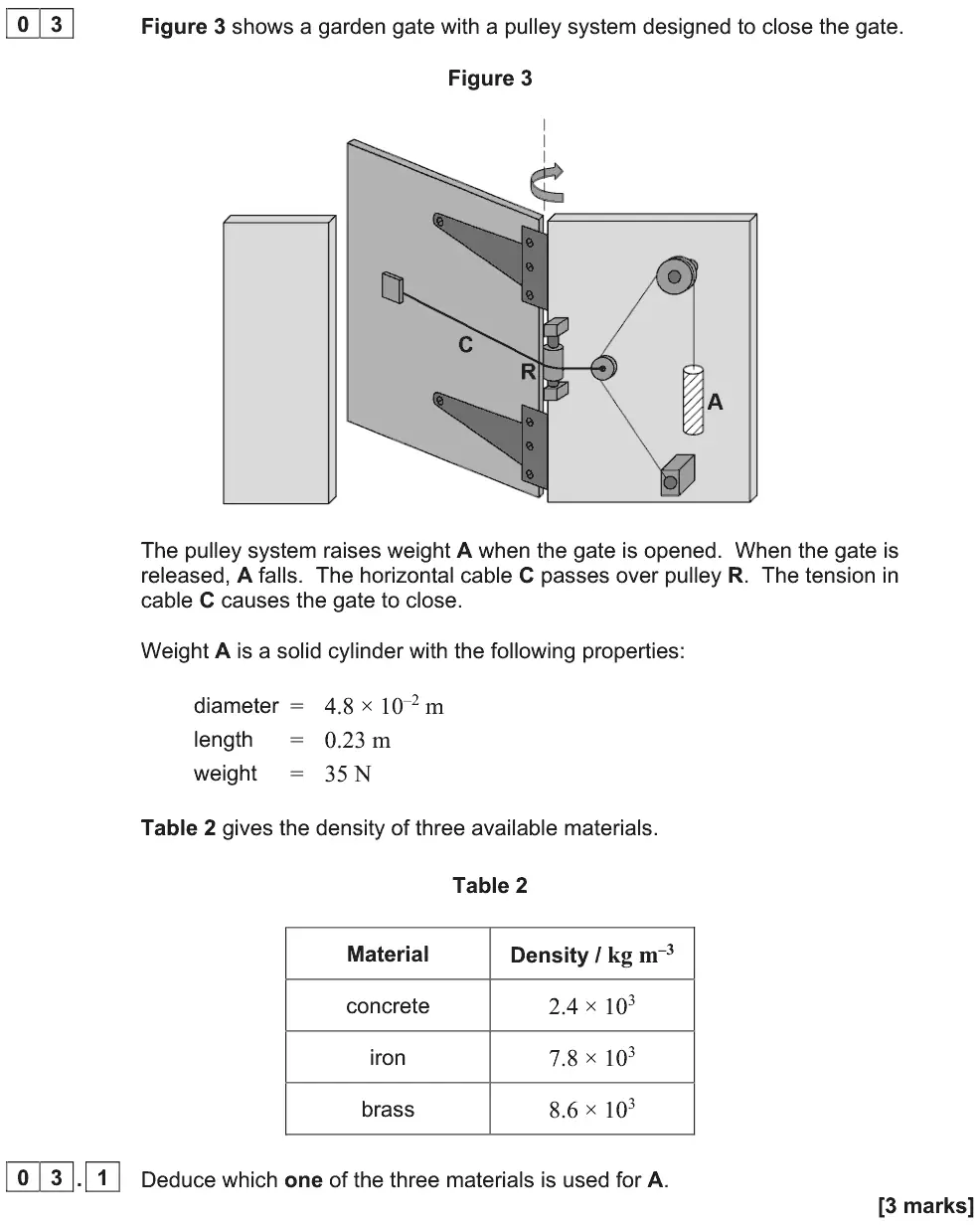
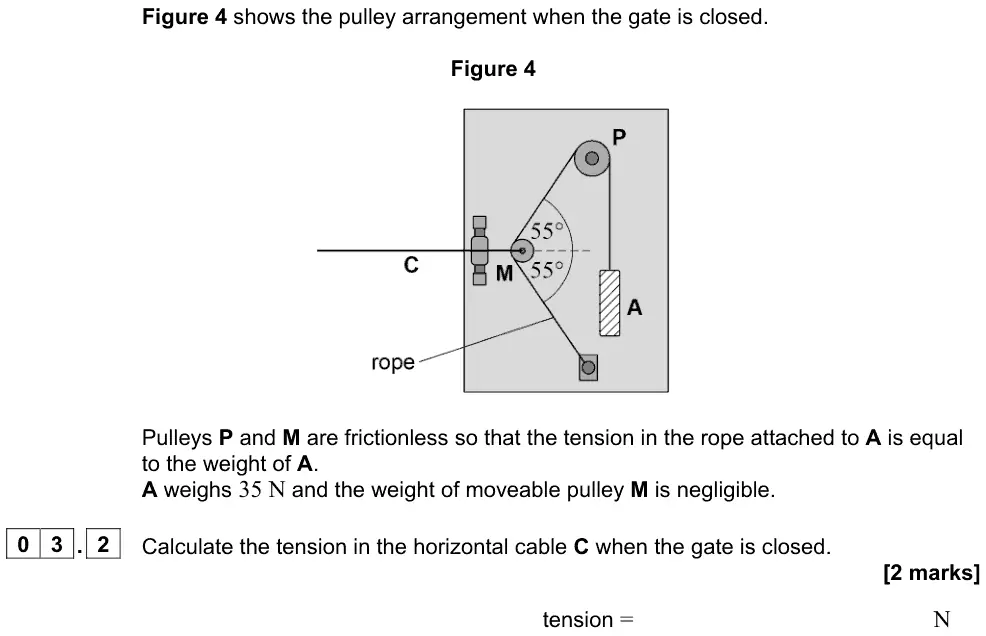
The relatively poor performance of students in 03.2 and 03.3 demonstrated much misunderstanding about the components of forces. It was made clear in the question that the tension in the rope was the same throughout, but many students showed little awareness of this.
Notes from the mark scheme and report
Answer: 40 N (two rope sections each 35 cos55 horizontally)
rope tension same throughout often ignored
Skills: MS4.5 Use sin, cos and tan in physical problems
June 2022 · Paper 1 · Q3.32 marksAO2=2Explanation
Earlier part of question 3 that this part uses
Mark scheme
Examiner's comment
The relatively poor performance of students in 03.2 and 03.3 demonstrated much misunderstanding about the components of forces. It was made clear in the question that the tension in the rope was the same throughout, but many students showed little awareness of this.
Notes from the mark scheme and report
Rope angle to the horizontal decreases while rope tension stays 35 N, so horizontal components increase
saying rope tension increases loses MP2
June 2022 · Paper 1 · Q3.42 marksAO2=2Calculation
Earlier part of question 3 that this part uses
Mark scheme
Examiner's comment
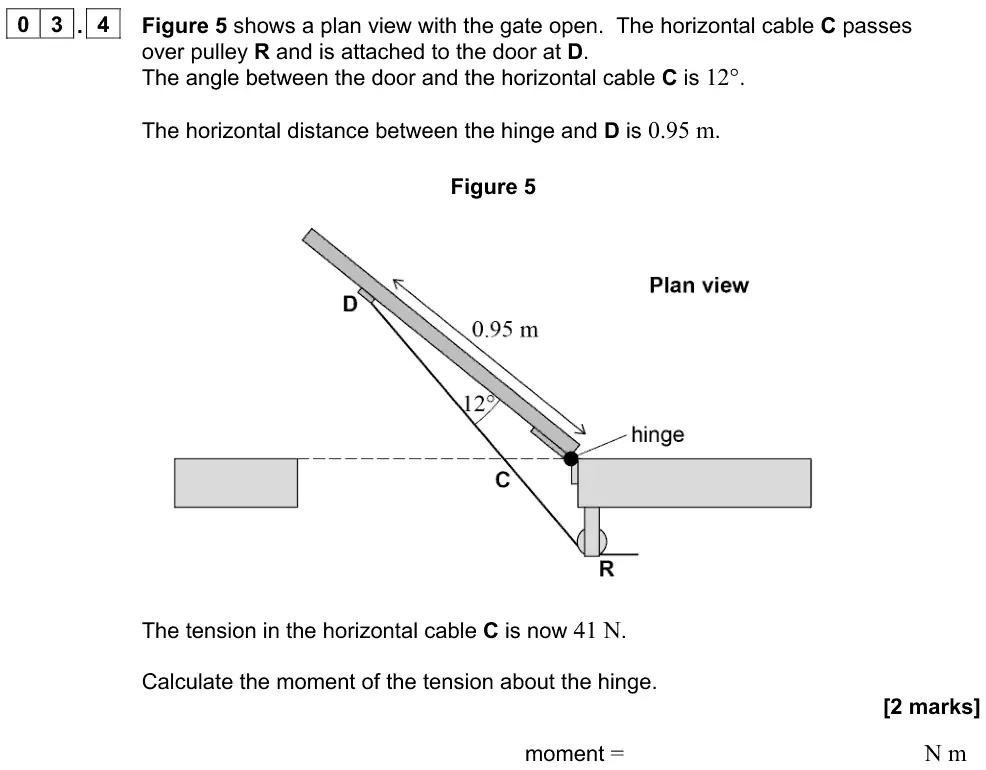
The moment calculation in 03.4 proved to be much more accessible. Partial credit was available to students who made one error in their answer.
Notes from the mark scheme and report
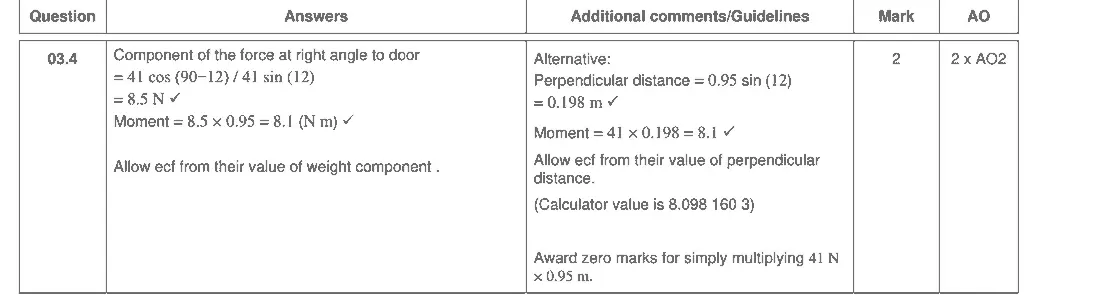
Answer: 8.1 N m (perpendicular component 41 sin12 = 8.5 N times 0.95 m)
41 x 0.95 scores 0
Skills: MS4.5 Use sin, cos and tan in physical problems
June 2022 · Paper 1 · Q3.54 marksAO3=4Explanation
Earlier part of question 3 that this part uses
Mark scheme
Examiner's comment
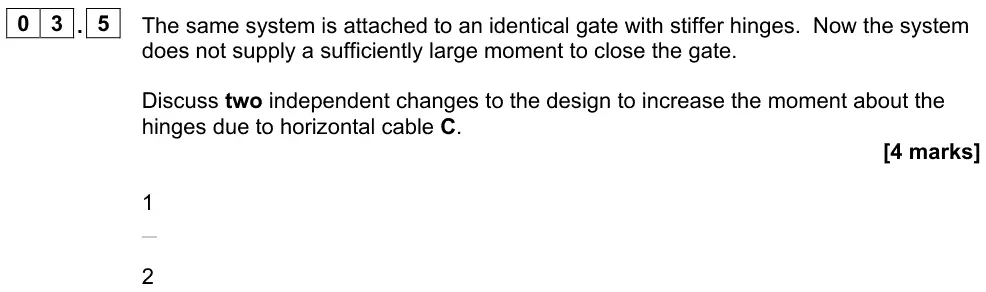
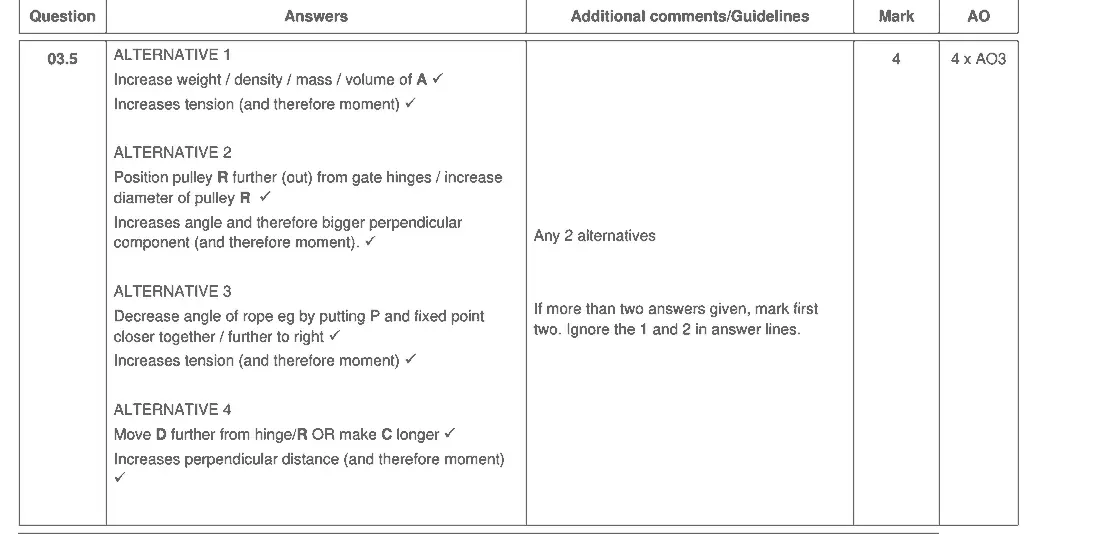
There were many alternative answers to 03.5 and all of them were given credit. Students often failed to gain marks by making vague statements that failed to set out clearly the physics behind their suggestions. Several students suggested, incorrectly, that shortening the rope so that A was higher would make a difference.
Notes from the mark scheme and report
Any two with reasons: heavier A (more tension)
move R further out (larger perpendicular component)
smaller rope angle (larger tension in C)
attach D further from the hinge (larger perpendicular distance)
shortening the rope wrongly suggested
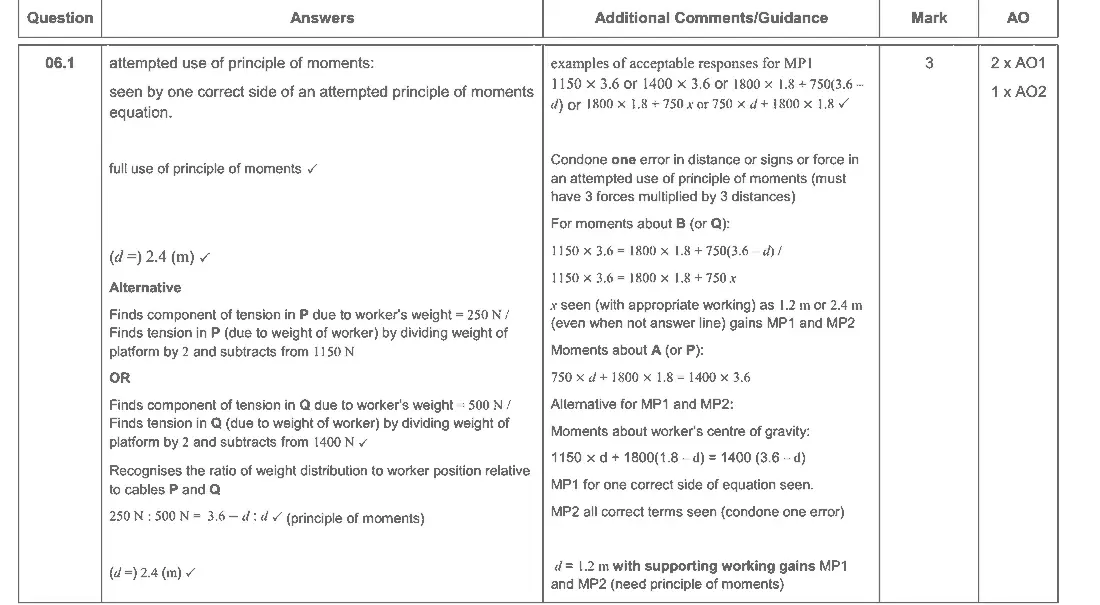
June 2022 · AS Paper 1 · Q6.13 marksAO1=2, AO2=1CalculationHard
Mark scheme
Examiner's comment
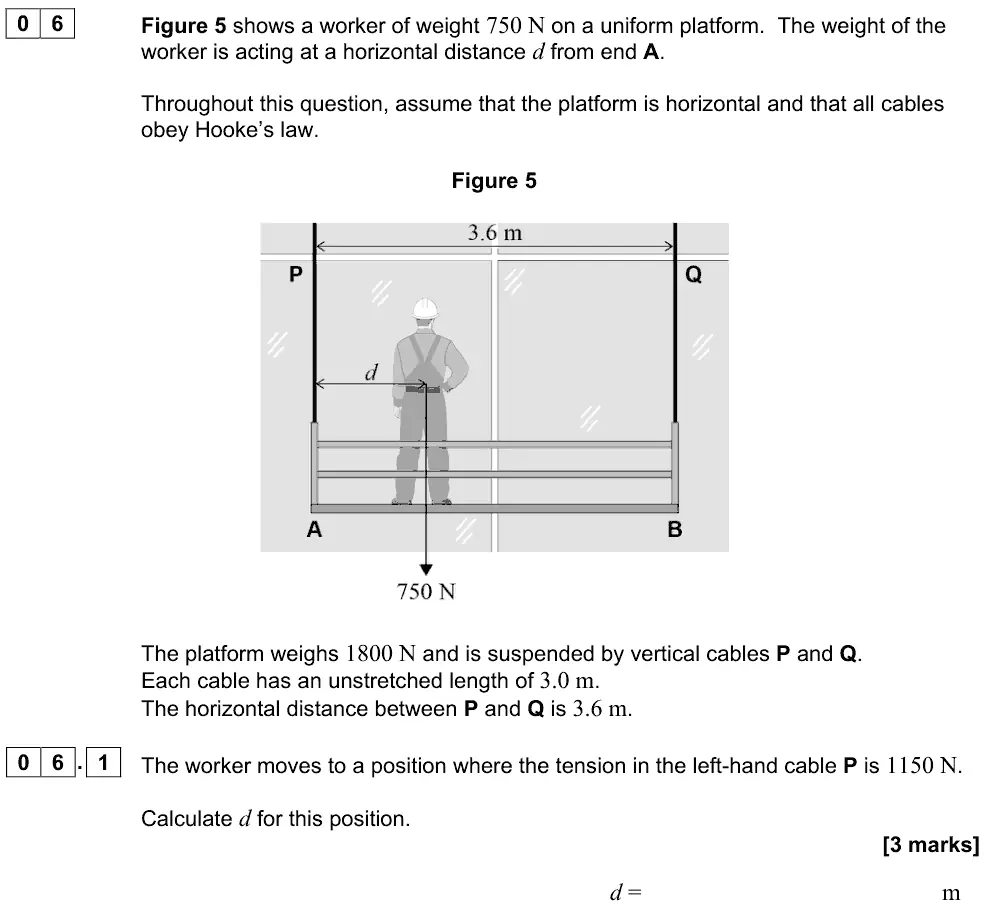
06.1 Over 25% of the students obtained all three marks. Many of these students had labelled Figure 5 with distances and forces and gave clear working that was easy to follow. A common incorrect answer was 1.2 m. This was usually caused by incorrect use of d in the moments equation.
Notes from the mark scheme and report
Answer: d = 2.4 m (moments about B: 1150 x 3.6 = 1800 x 1.8 + 750(3.6 - d))
1.2 m from misusing d was the common wrong answer
Skills: MS2.3 Substitute numerical values into algebraic equations using appropriate units for physical quantities; MS2.2 Change the subject of an equation, including non-linear equations
June 2022 · Paper 1 · Q71 markAO1=1Multiple choice
Answer
C
Mark scheme
Notes from the mark scheme and report
Answer: C
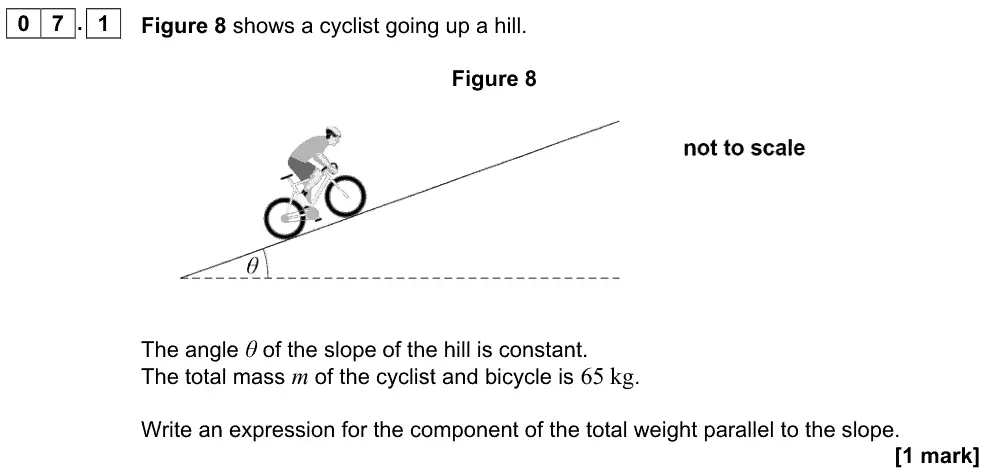
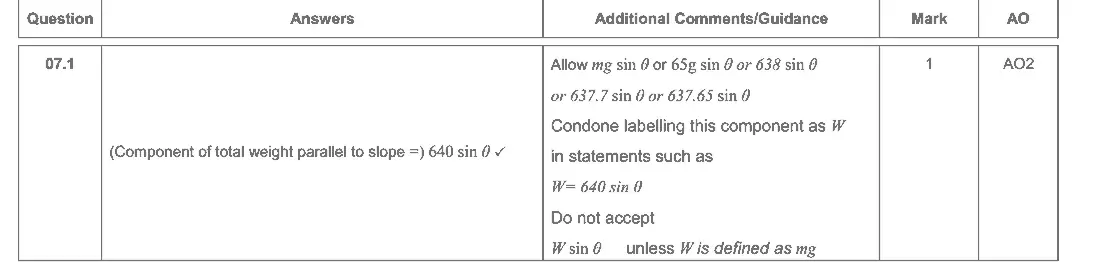
June 2022 · AS Paper 1 · Q7.11 markAO2=1Short answer
Mark scheme
Examiner's comment
07.1 and 07.2 Almost 40% of students scored one mark in 07.1 and 36% scored two marks in 07.2. A significant number of students who could not do 07.1 were able to do the calculation in 07.2. This suggests that these students knew the process involved in determining the component of the weight parallel to the slope but were unaware of the technical term used to describe it. Many students were able to use P=Fv in question 07.2 to determine the force but were unable to relate this force to the component of the weight parallel to the slope.
07.3. Less than 10% of the cohort obtained two or more marks. Students did not seem to have any real-world appreciation of this ‘zig-zag’ path being easier than the direct path in Figure 8. They thought that the cyclist had travelled further, had encountered more resistive forces, and had done more work with a greater power output. These students offered efficiency-type arguments to explain why they thought that the useful power output had changed. Many of those who did appreciate that the effective angle had been diminished thought that the power output had increased by omitting the idea that the cyclist maintained the same steady speed.
Notes from the mark scheme and report
640 sin theta (mg sin theta) N
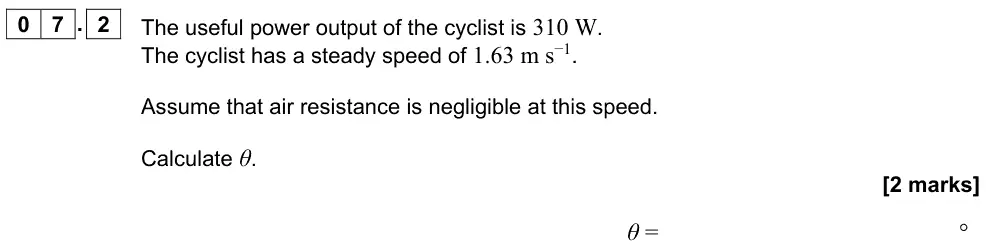
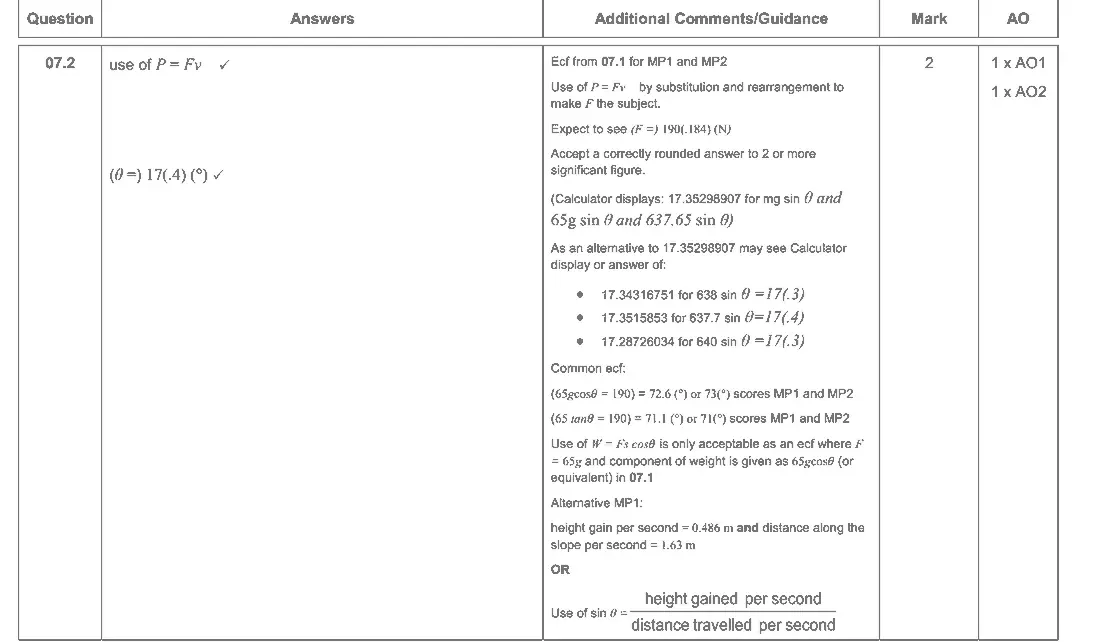
June 2022 · AS Paper 1 · Q7.22 marksAO1=1, AO2=1Calculation
Earlier part of question 7 that this part uses
Mark scheme
Examiner's comment
07.1 and 07.2 Almost 40% of students scored one mark in 07.1 and 36% scored two marks in 07.2. A significant number of students who could not do 07.1 were able to do the calculation in 07.2. This suggests that these students knew the process involved in determining the component of the weight parallel to the slope but were unaware of the technical term used to describe it. Many students were able to use P=Fv in question 07.2 to determine the force but were unable to relate this force to the component of the weight parallel to the slope.
Notes from the mark scheme and report
Answer: 17 degrees (F = P/v = 190 N = 65g sin theta)
Skills: MS2.3 Substitute numerical values into algebraic equations using appropriate units for physical quantities; MS0.6 Use calculators to handle sin x, cos x, tan x when x is expressed in degrees or radians
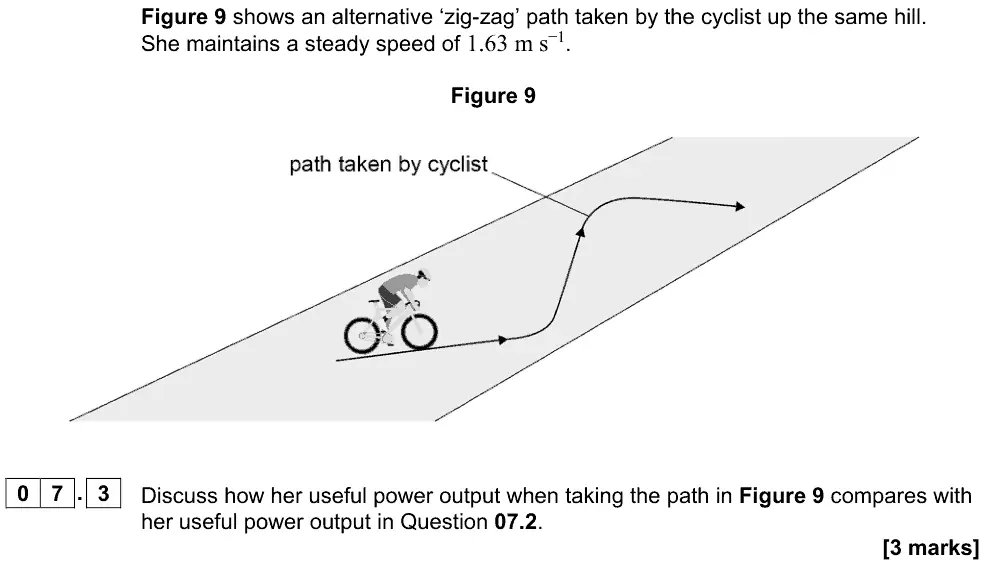
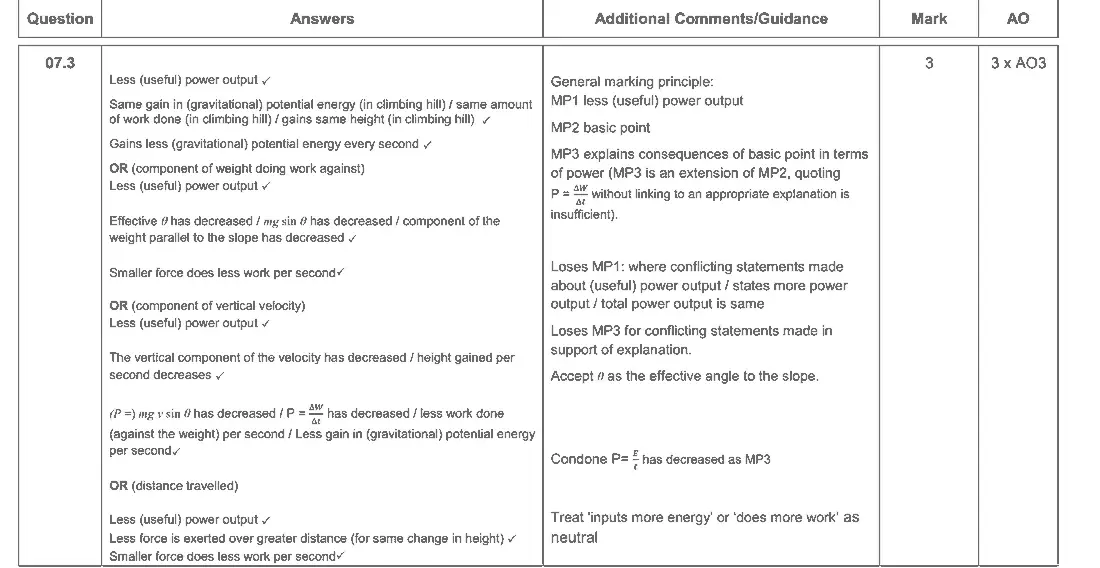
June 2022 · AS Paper 1 · Q7.33 marksAO3=3ExplanationHard
Earlier part of question 7 that this part uses
Mark scheme
Examiner's comment
07.3. Less than 10% of the cohort obtained two or more marks. Students did not seem to have any real-world appreciation of this ‘zig-zag’ path being easier than the direct path in Figure 8. They thought that the cyclist had travelled further, had encountered more resistive forces, and had done more work with a greater power output. These students offered efficiency-type arguments to explain why they thought that the useful power output had changed. Many of those who did appreciate that the effective angle had been diminished thought that the power output had increased by omitting the idea that the cyclist maintained the same steady speed.
Notes from the mark scheme and report
Less useful power: same speed but smaller effective slope, so smaller weight component / less height gained per second, less GPE gained per second
'travels further so more power' was the common misconception
June 2022 · Paper 1 · Q221 markAO1=1Multiple choice
Answer
A
Mark scheme
Notes from the mark scheme and report
Answer: A
Skills: MS4.5 Use sin, cos and tan in physical problems
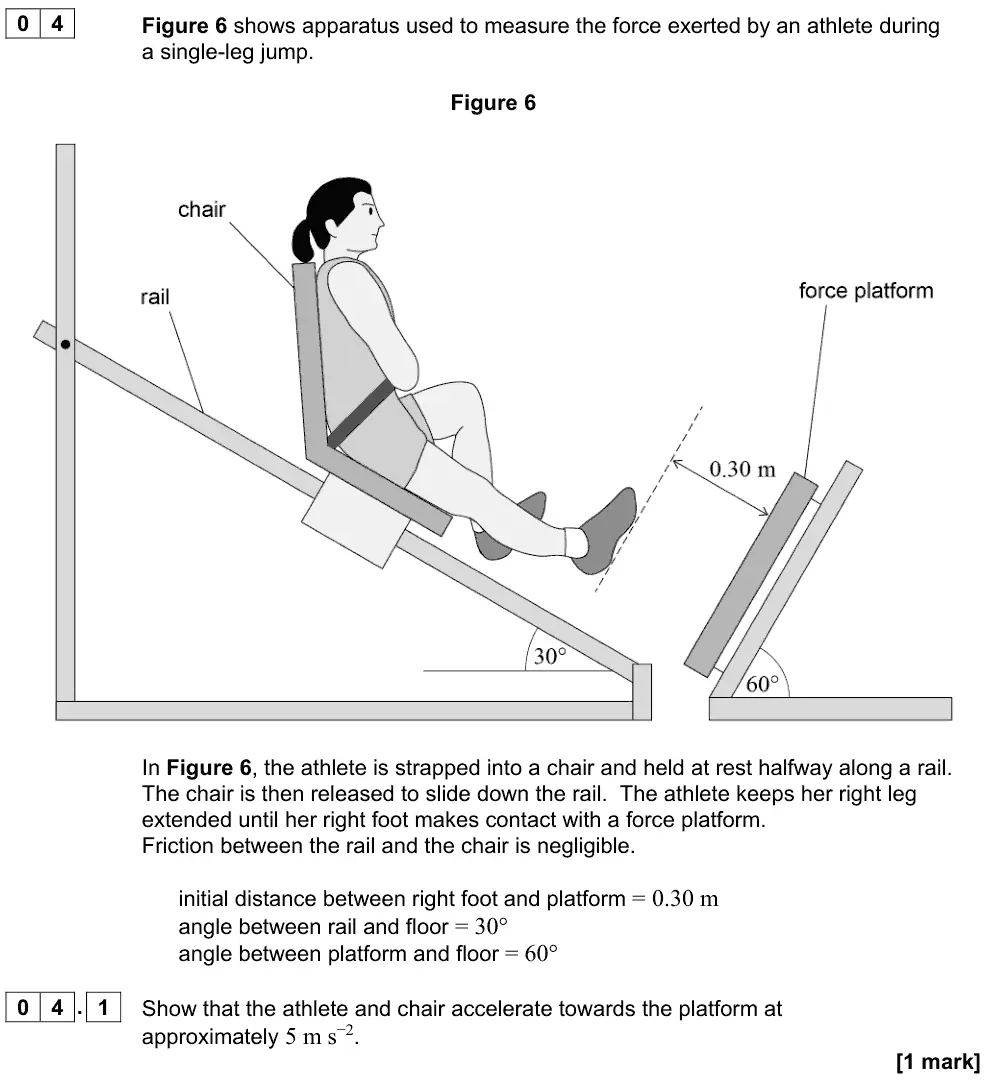
June 2022 · AS Paper 2 · Q4.11 markAO2=1Show that
Mark scheme
Examiner's comment
04.1 A surprisingly large number of students struggled with this relatively simple ‘show that’ question. This was used to establish that the motion down, and up, the rail occurred under the condition of constant acceleration.
Notes from the mark scheme and report
Answer: 4.9 m s^-2 (a = g sin 30)
Skills: MS4.5 Use sin, cos and tan in physical problems
June 2022 · AS Paper 2 · Q4.52 marksAO2=1, AO3=1Calculation
Earlier part of question 4 that this part uses
Mark scheme
Examiner's comment
04.5 A large number of students did not attempt this question or made no valid point. The questions followed the sequence of the leg jump from A to E, and students were expected to use a reading from the graph beyond E to determine the mass.
Notes from the mark scheme and report
Answer: 72-73 kg (resting force beyond E = 360 N = mg sin 30, so m = 360 / 4.91)
Skills: MS3.1 Translate information between graphical, numerical and algebraic forms; MS4.5 Use sin, cos and tan in physical problems
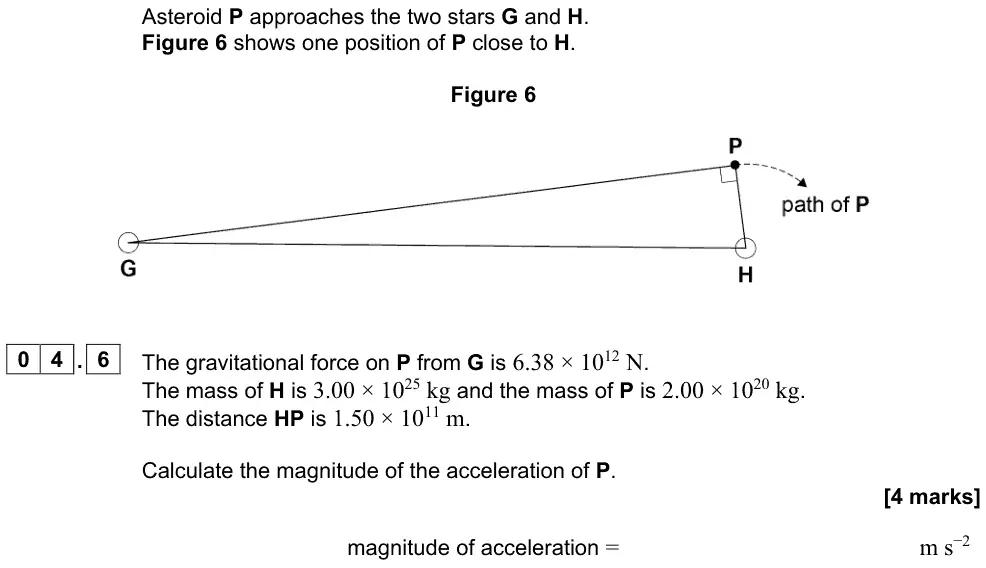
June 2022 · Paper 2 · Q4.64 marksAO1=2, AO2=2Calculation
Earlier part of question 4 that this part uses
Mark scheme
Examiner's comment
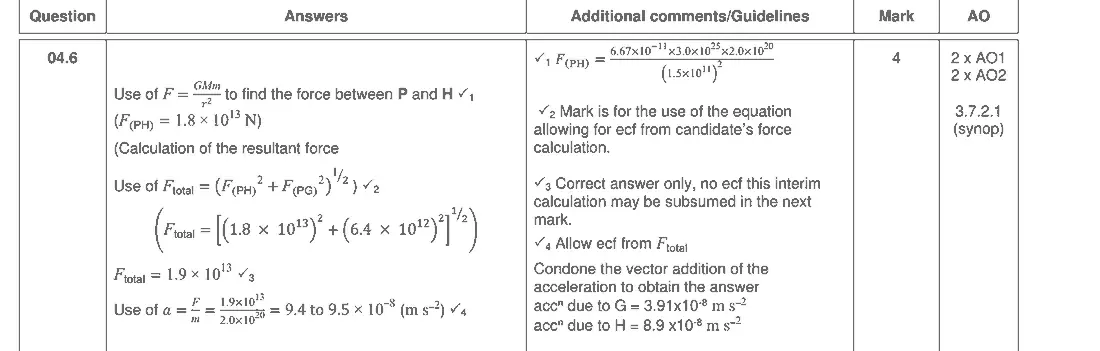
Most students could find the force on P due to H to gain the first mark, but a majority could not add the forces from G and H on P vectorially. Many attempted a plain addition rather than adding them in quadrature. This meant the next two marks were inaccessible for most. An error carried forward was allowed for the last mark (for use of F ma = ) – this gave the second mark for the majority. A few students calculated the accelerations that P would experience from G and H and then made the vector addition. This was an acceptable approach and many of these students scored full marks.
Question 04.6
Notes from the mark scheme and report
Answer: 9.4-9.5 x 10^-8 m s^-2 (F from H = 1.8 x 10^13 N
resultant by Pythagoras 1.9 x 10^13 N
a = F/m)
most added the forces arithmetically instead of in quadrature
Skills: MS2.3 Substitute numerical values into algebraic equations using appropriate units for physical quantities; MS4.4 Use Pythagoras’ theorem, and the angle sum of a triangle
June 2022 · AS Paper 2 · Q211 markAO1=1Multiple choice
Answer
B
Mark scheme
Examiner's comment
Generally, students were more successful in answering questions 9, 21, 23 and 30 and less successful in answering 7, 8, 19, 20, 22, 24, 32 and 34.
Notes from the mark scheme and report
Answer: B
June 2022 · AS Paper 2 · Q221 markAO2=1Multiple choice
Answer
A
Mark scheme
Notes from the mark scheme and report
Answer: A
Skills: MS4.5 Use sin, cos and tan in physical problems
June 2022 · AS Paper 2 · Q231 markAO1=1Multiple choice
Answer
C
Mark scheme
Examiner's comment
Generally, students were more successful in answering questions 9, 21, 23 and 30 and less successful in answering 7, 8, 19, 20, 22, 24, 32 and 34.
Notes from the mark scheme and report
Answer: C
November 2021 · AS Paper 1 · Q4.14 marksAO1=4Diagram or graph
Mark scheme
Notes from the mark scheme and report
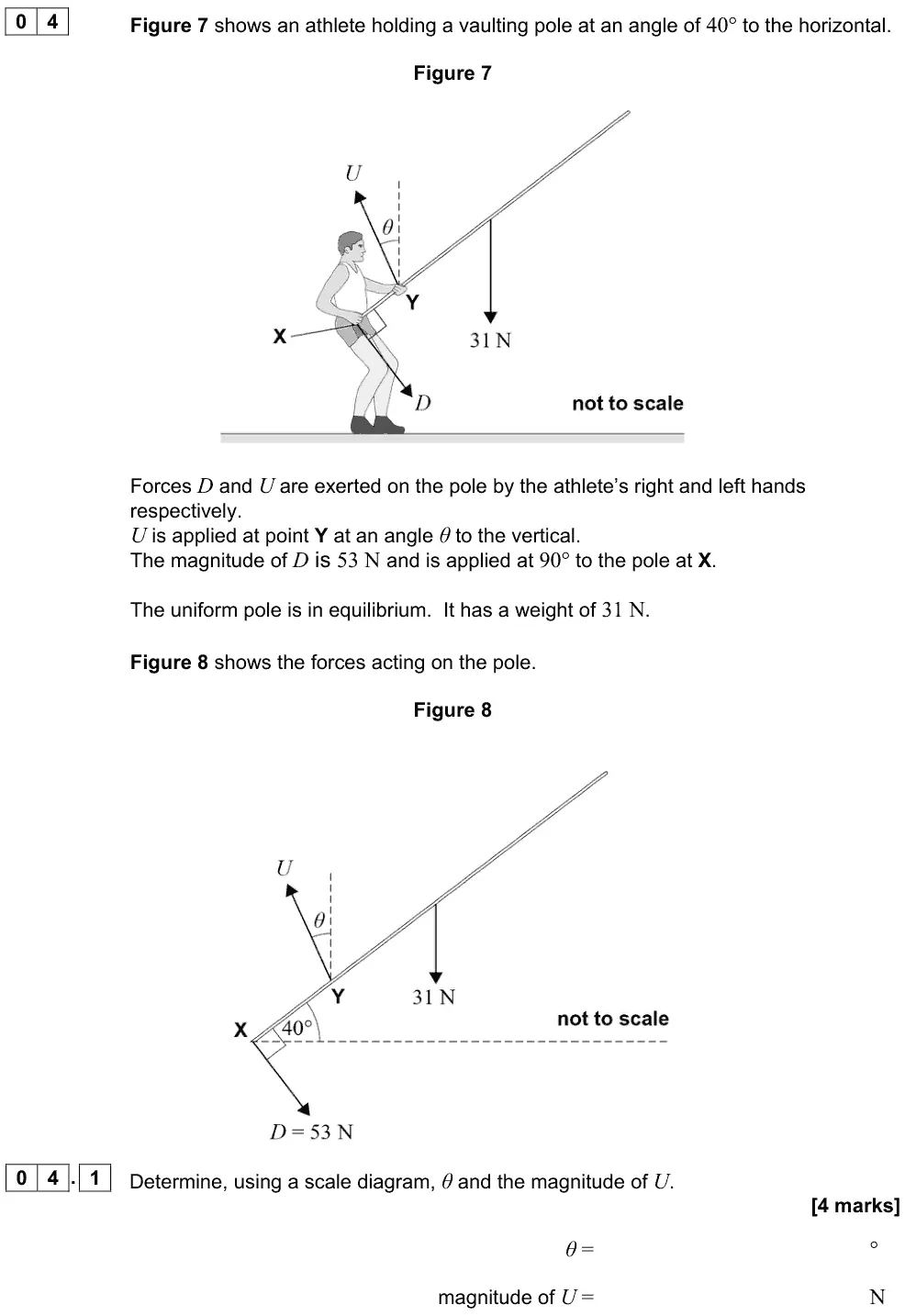
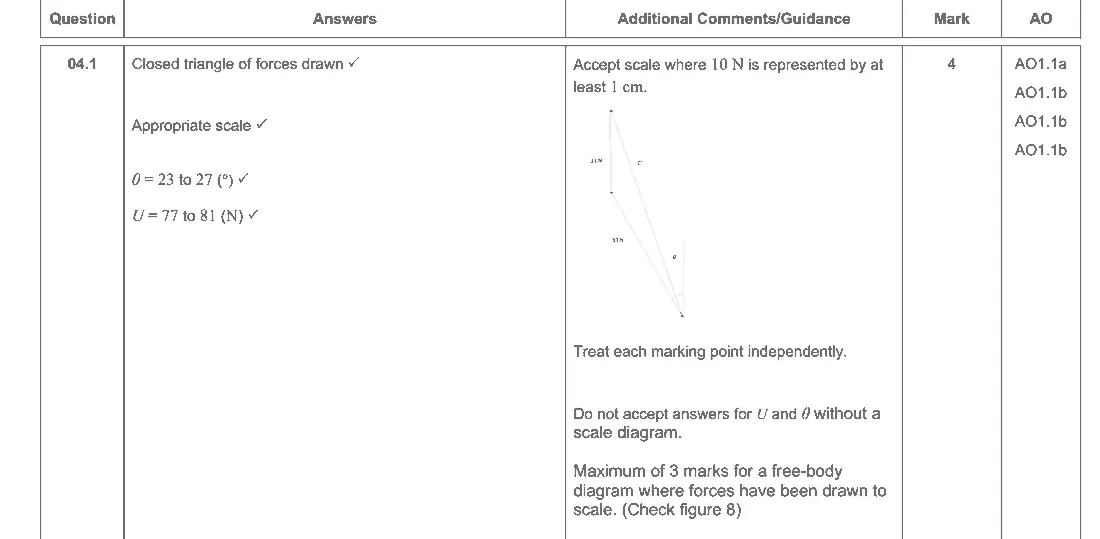
Answer: theta = 23 to 27 degrees, U = 77 to 81 N
closed triangle of forces with a sensible scale (at least 1 cm per 10 N)
no marks for values without a scale diagram
Skills: MS4.1 Use angles in regular 2D and 3D structures
November 2021 · AS Paper 1 · Q4.23 marksAO3=3Explanation
Earlier part of question 4 that this part uses
Mark scheme
Notes from the mark scheme and report
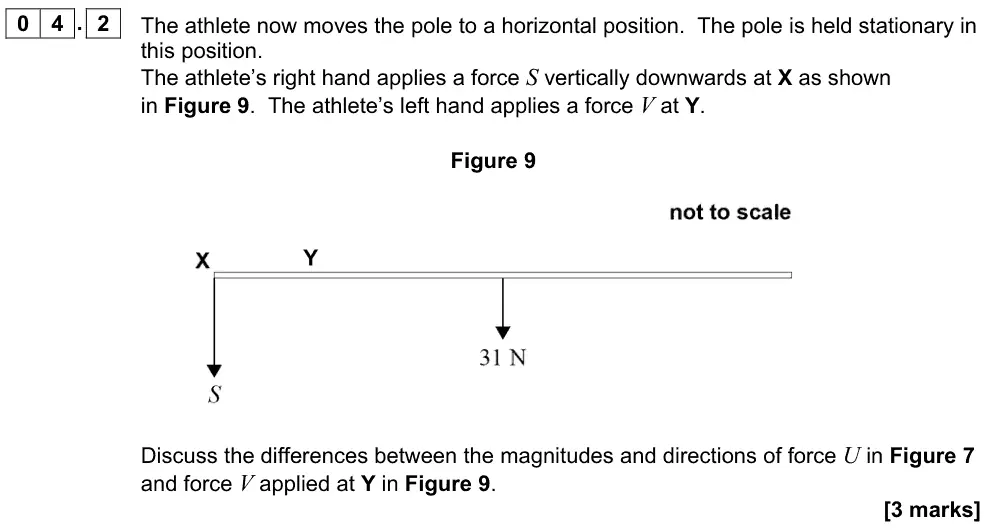
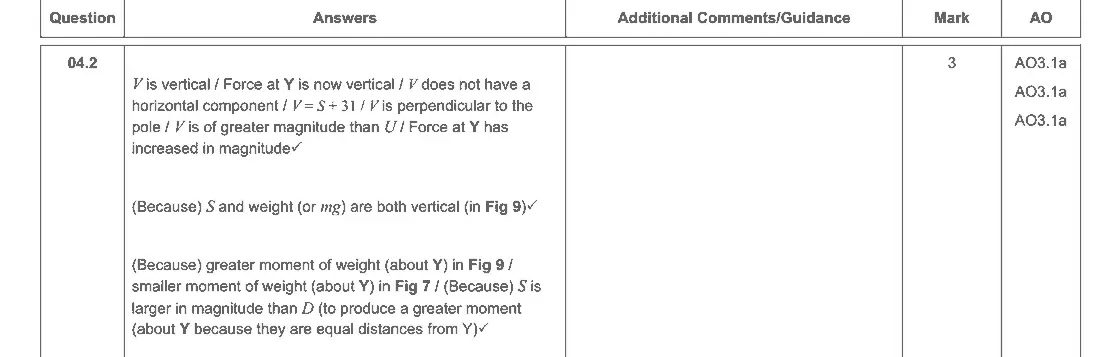
V is vertical (S and weight both vertical, no horizontal component)
V larger than U because S and the weight's moment about Y are larger with the pole horizontal
November 2021 · Paper 1 · Q5.12 marksAO2=2Show that
Mark scheme
Notes from the mark scheme and report
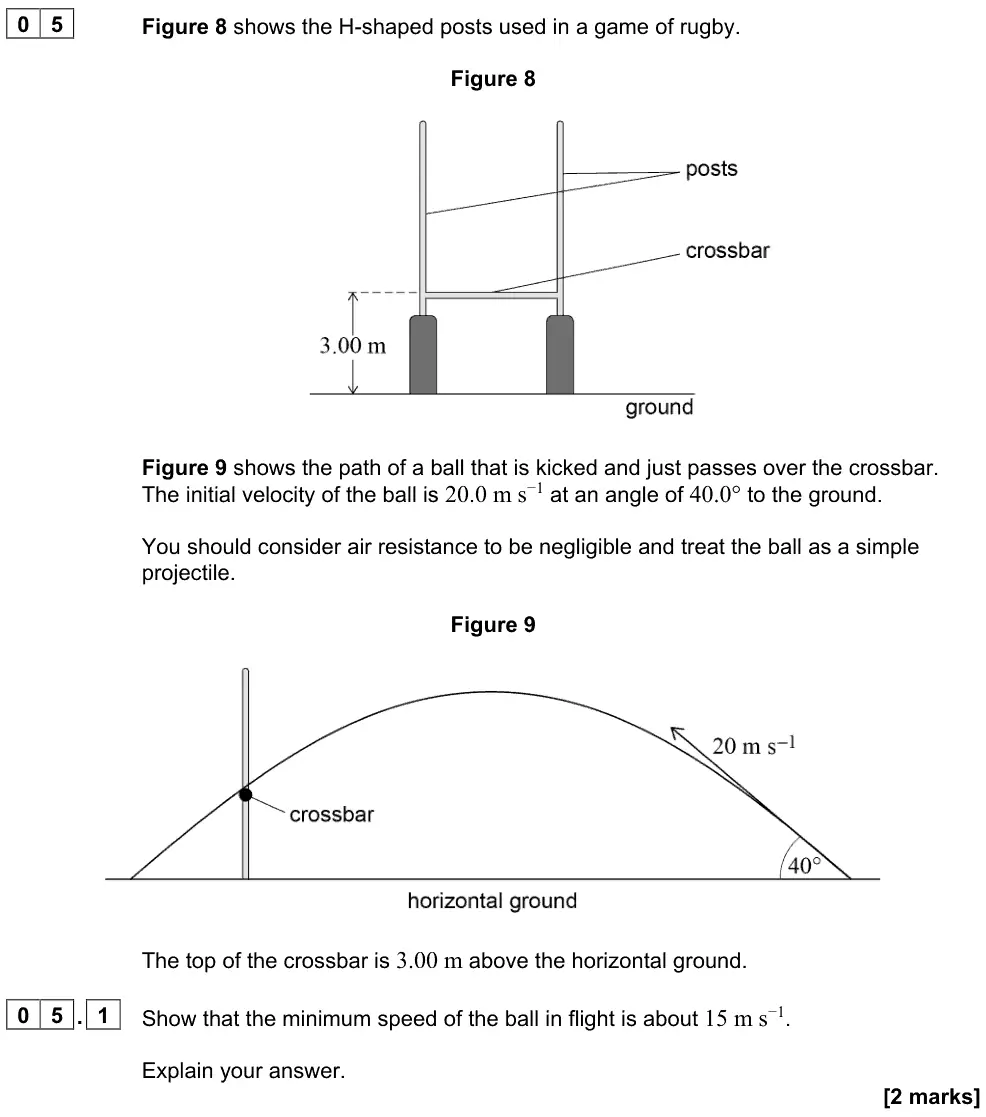
Horizontal velocity 20 cos40 = 15.3 m s^-1 is constant and is the minimum speed when vertical velocity is zero (top of flight)
Skills: MS4.5 Use sin, cos and tan in physical problems
November 2021 · Paper 1 · Q201 markMultiple choiceHard
Answer
D
Mark scheme
Examiner's comment
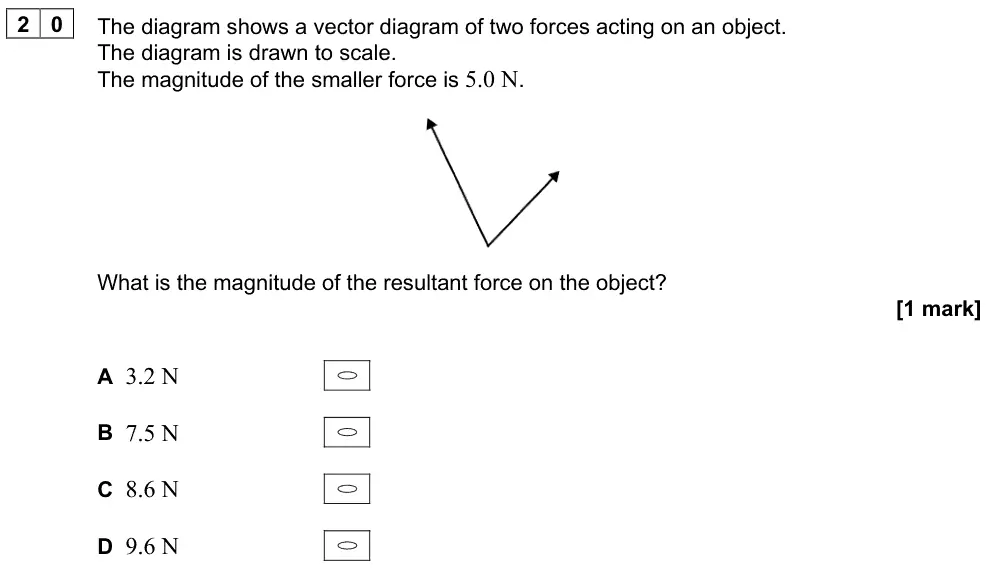
Several of the multiple-choice questions proved to be extremely difficult. In particular, questions 20, 27 and 29 were answered correctly by fewer than 30% of the students. In question 20 more students opted for B and for C than for the correct answer (D), indicating a lack of familiarity with scale diagrams. In question 27 the most popular answer was B, indicating the difficulties students have with combining resistors, and the second most popular was C, suggesting that students did not understand the difference between open and short circuits. The most popular answer to question 18 was D, probably because the students did not spot that this was a stationary, rather than progressive, wave. The most accessible questions were 10 and 16, both of which were answered correctly by over 70% of the students.
Notes from the mark scheme and report
Answer: D
more chose B or C than D (scale diagram unfamiliar)
Skills: MS4.1 Use angles in regular 2D and 3D structures
November 2021 · Paper 1 · Q211 markMultiple choice
Answer
B
Mark scheme
Notes from the mark scheme and report
Answer: B
Skills: MS2.2 Change the subject of an equation, including non-linear equations
November 2021 · Paper 1 · Q221 markMultiple choice
Answer
C
Mark scheme
Notes from the mark scheme and report
Answer: C
November 2021 · AS Paper 2 · Q2.22 marksAO2=2Calculation
Earlier part of question 2 that this part uses
Mark scheme
Notes from the mark scheme and report
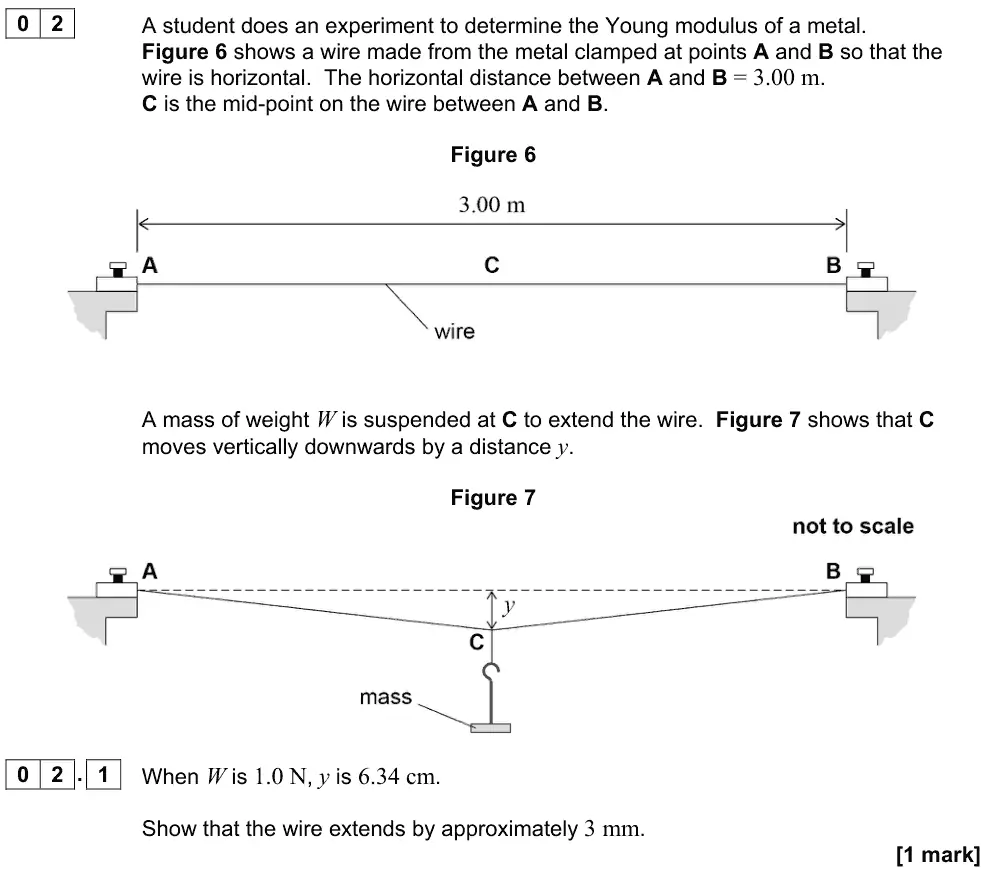
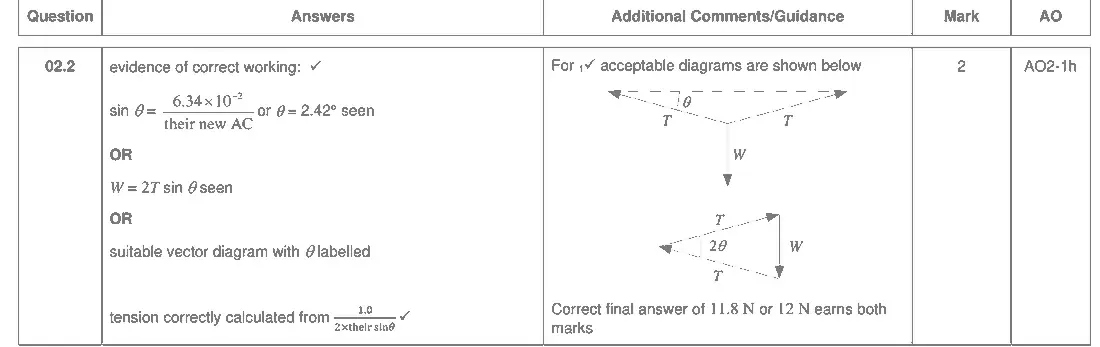
Answer: 11.8 N (theta = 2.42 degrees
W = 2T sin theta)
Skills: MS4.5 Use sin, cos and tan in physical problems
November 2021 · AS Paper 2 · Q4.11 markAO1=1Diagram or graph
Mark scheme
Notes from the mark scheme and report
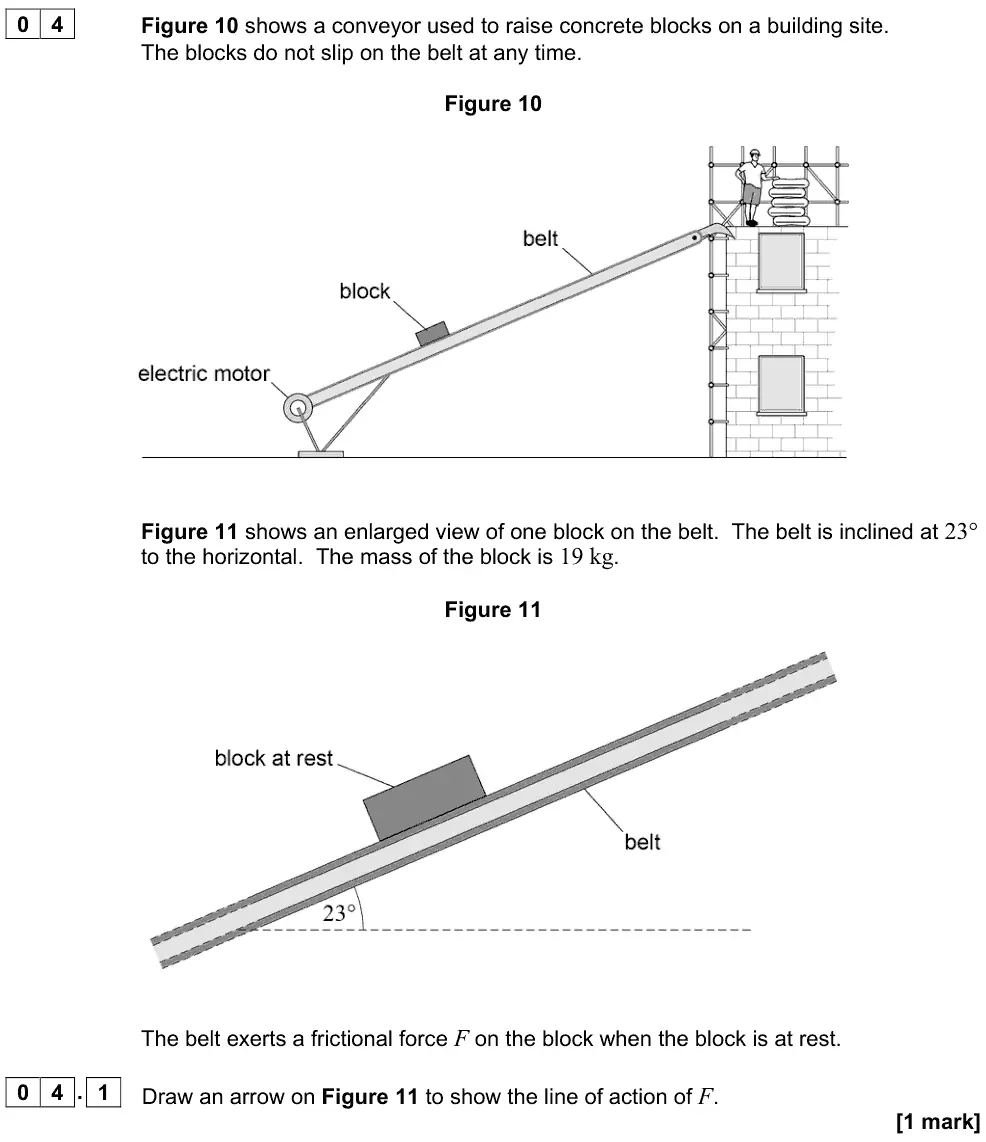
Arrow between block and belt pointing up the slope along the belt
November 2021 · AS Paper 2 · Q4.21 markAO2=1Show that
Earlier part of question 4 that this part uses
Mark scheme
Notes from the mark scheme and report
Answer: 72.8 N (F = 19 g sin 23)
Skills: MS4.5 Use sin, cos and tan in physical problems
November 2021 · AS Paper 2 · Q221 markMultiple choice
Answer
C
Mark scheme
Notes from the mark scheme and report
Answer: C
November 2020 · AS Paper 1 · Q3.21 markShow that
Earlier part of question 3 that this part uses
Mark scheme
Notes from the mark scheme and report
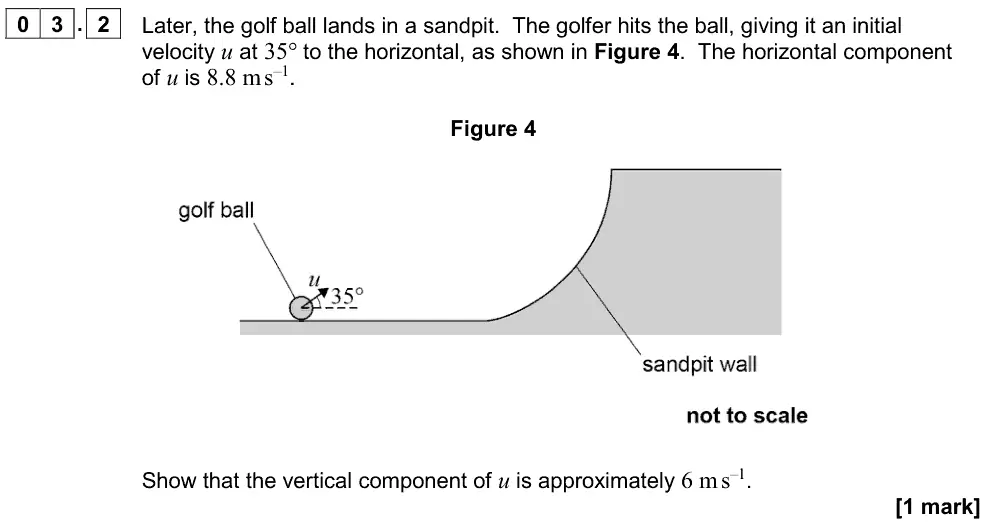
Answer: 6.2 m s^-1 (8.8 tan 35)
at least 2 s.f. with working
Skills: MS4.5 Use sin, cos and tan in physical problems
November 2020 · AS Paper 1 · Q3.62 marksExplanation
Earlier part of question 3 that this part uses
Mark scheme
Notes from the mark scheme and report
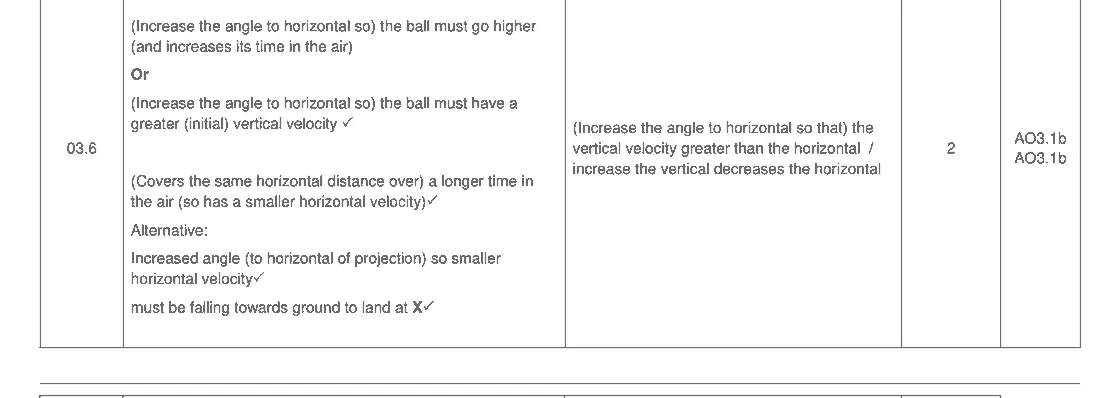
Steeper launch: greater vertical velocity so ball goes higher and is in the air longer, so covers the same horizontal distance with smaller horizontal velocity
November 2020 · Paper 1 · Q4.54 marksCalculation
Earlier part of question 4 that this part uses
Mark scheme
Examiner's comment
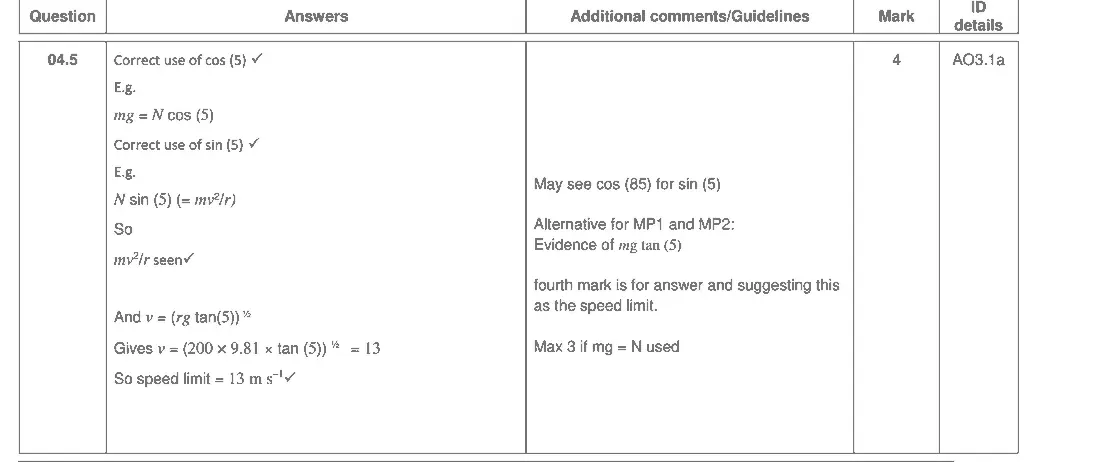
Much of the work on motion in this question was relatively straightforward and, in a typical series, students would be expected to score well on it. Although the average scores on most of the question parts were higher than the paper average, a large number of errors in basic understanding were seen. In 04.1, for example, many students struggled to work out the area, or suggested that the average speed was the average of the speeds of the three sections. In 04.2, a surprisingly large number of students did not identify the slower response time as the appropriate one for the calculation. Many careless errors in the use of suvat equations were also seen in 04.3. It was pleasing to note in 04.4 that several students understood the premise of the question and indicated that the chevrons would be too far apart and therefore people would ignore them or that the car in front would also take some distance to come to rest. Very few fully correct answers were seen in 04.5. Although most students attempted to apply ideas of circular motion, the angle of the slope was largely ignored. Many answers suggesting N mg = , or applying the equation of circular motion down the slope rather than horizontally, were seen.
Notes from the mark scheme and report
Answer: 13 m s^-1 (N cos5 = mg, N sin5 = mv^2/r, v = root(rg tan5))
N = mg or circular motion along the slope were common errors
very few fully correct
Skills: MS4.5 Use sin, cos and tan in physical problems; MS2.2 Change the subject of an equation, including non-linear equations; MS2.3 Substitute numerical values into algebraic equations using appropriate units for physical quantities
November 2020 · Paper 1 · Q201 markMultiple choice
Answer
C
Mark scheme
Notes from the mark scheme and report
Answer: C
November 2020 · AS Paper 2 · Q3.12 marksCalculation
Mark scheme
Notes from the mark scheme and report
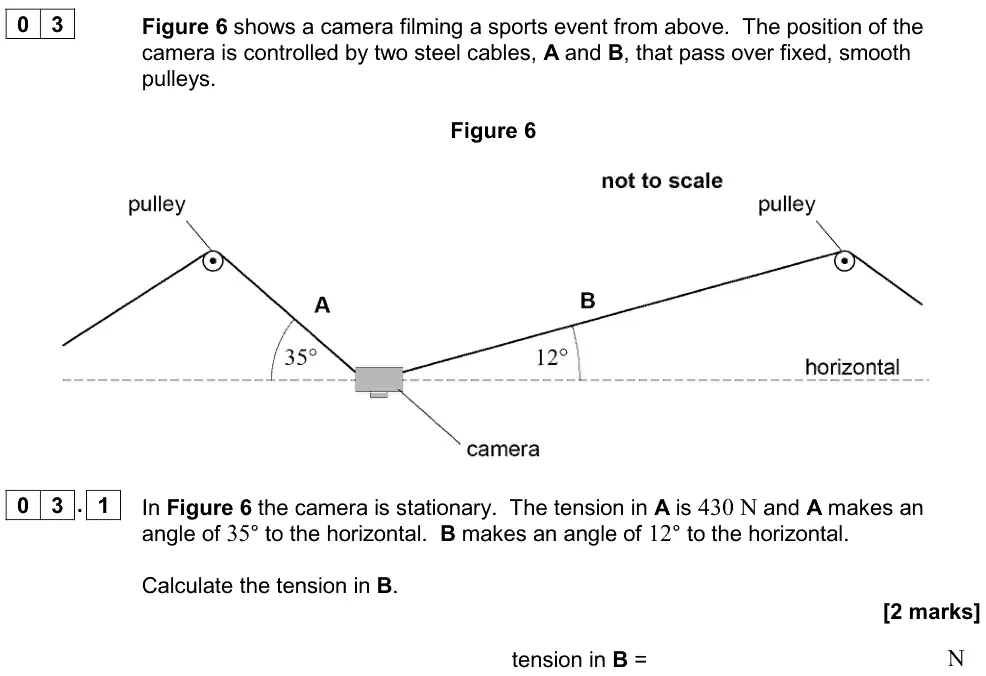
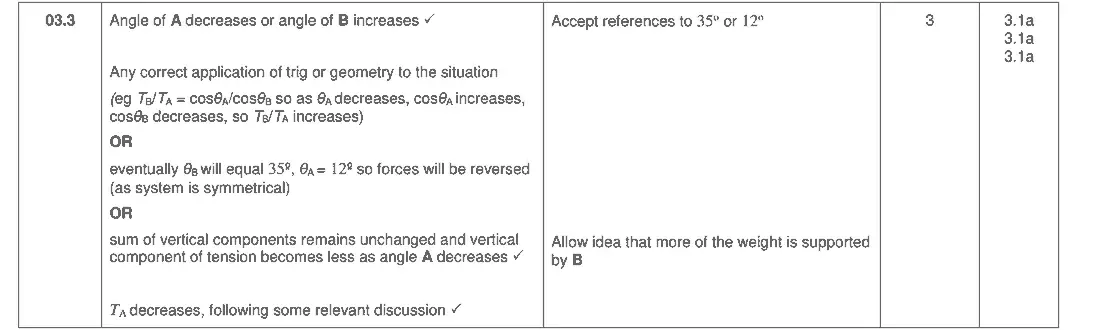
Answer: 360 N (horizontal components equal: 430 cos 35 = TB cos 12)
Skills: MS4.5 Use sin, cos and tan in physical problems
November 2020 · AS Paper 2 · Q3.33 marksExplanation
Earlier part of question 3 that this part uses
Mark scheme
Notes from the mark scheme and report
Angle of A decreases and B increases
vertical components still balance the weight so B supports more
tension in A decreases (needs relevant trig/geometry argument)
Skills: MS4.5 Use sin, cos and tan in physical problems
November 2020 · AS Paper 2 · Q171 markMultiple choice
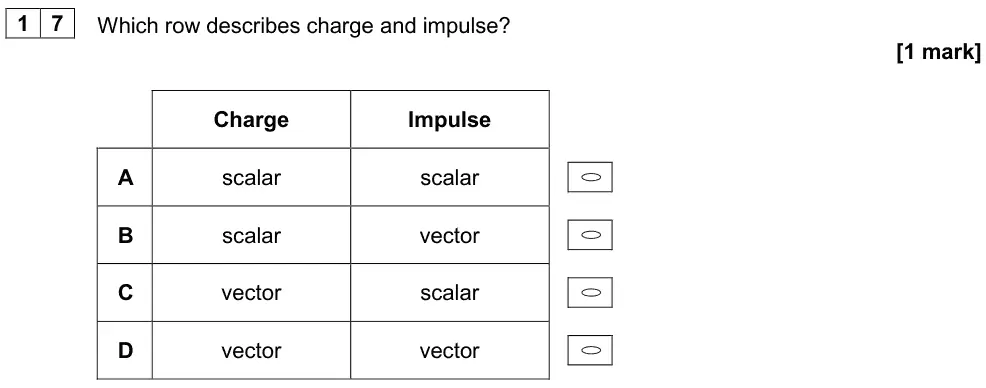
Answer
B
Mark scheme
Notes from the mark scheme and report
Answer: B
November 2020 · AS Paper 2 · Q181 markMultiple choice
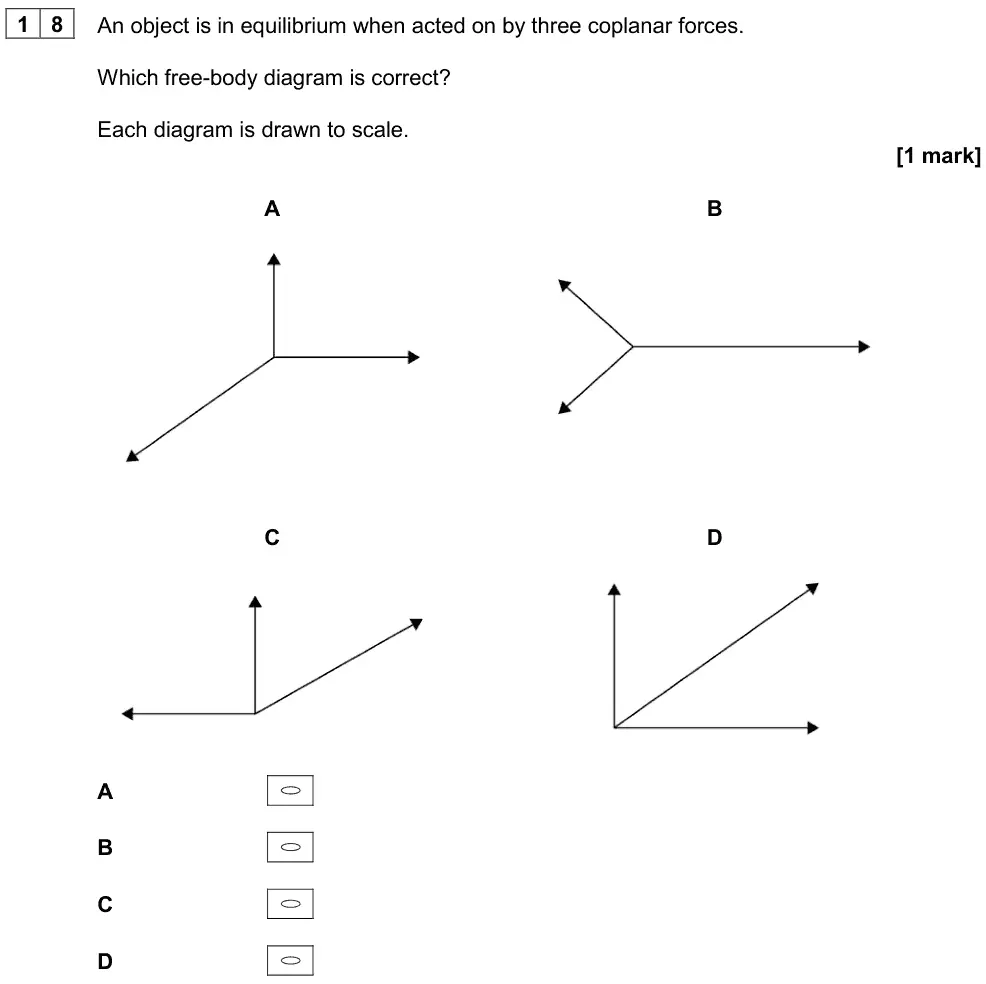
Answer
A
Mark scheme
Notes from the mark scheme and report
Answer: A
November 2020 · AS Paper 2 · Q201 markMultiple choice
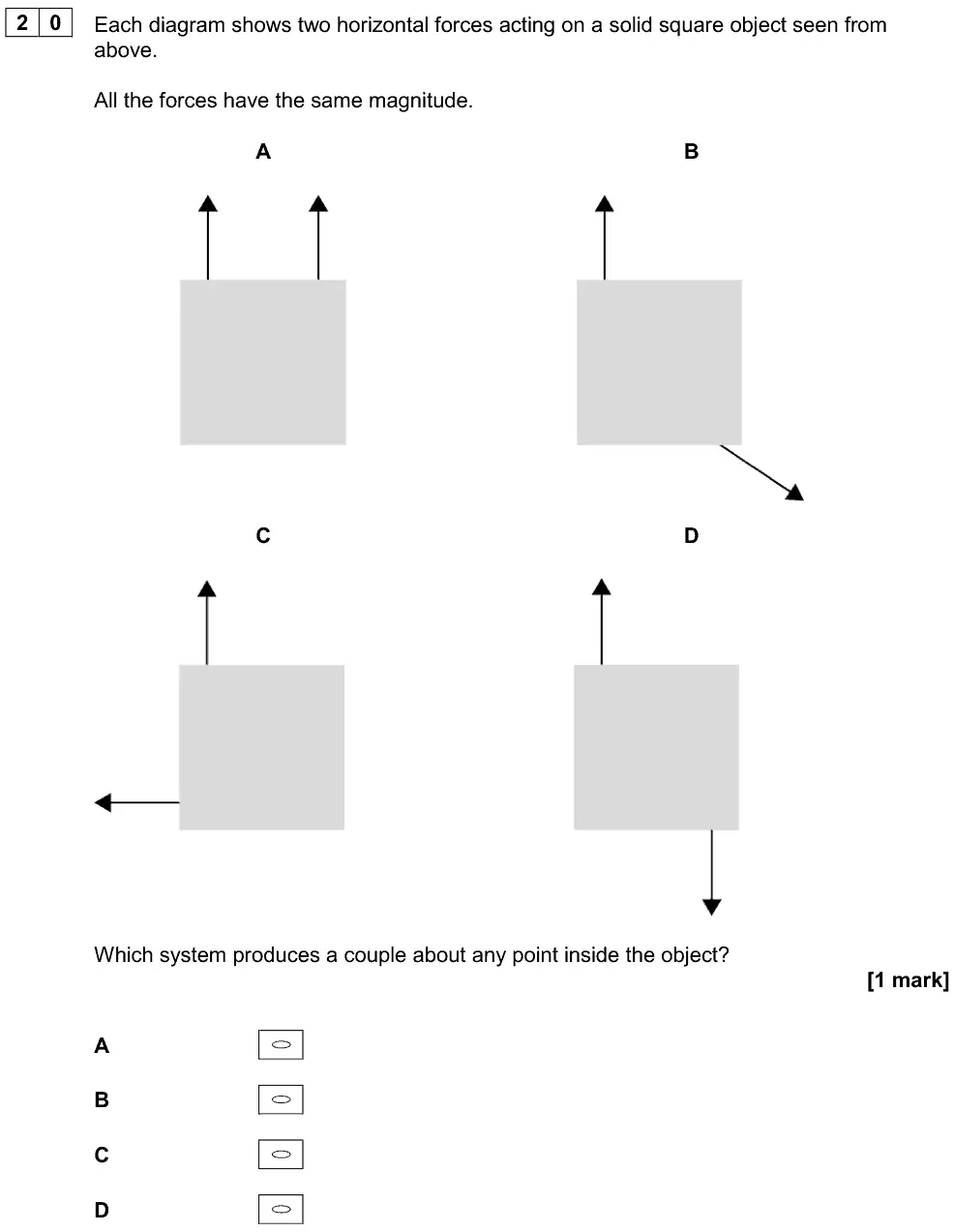
Answer
D
Mark scheme
Notes from the mark scheme and report
Answer: D
November 2020 · AS Paper 2 · Q211 markMultiple choice
Answer
C
Mark scheme
Notes from the mark scheme and report
Answer: C
June 2019 · AS Paper 1 · Q3.14 marksShow that
Mark scheme
Examiner's comment
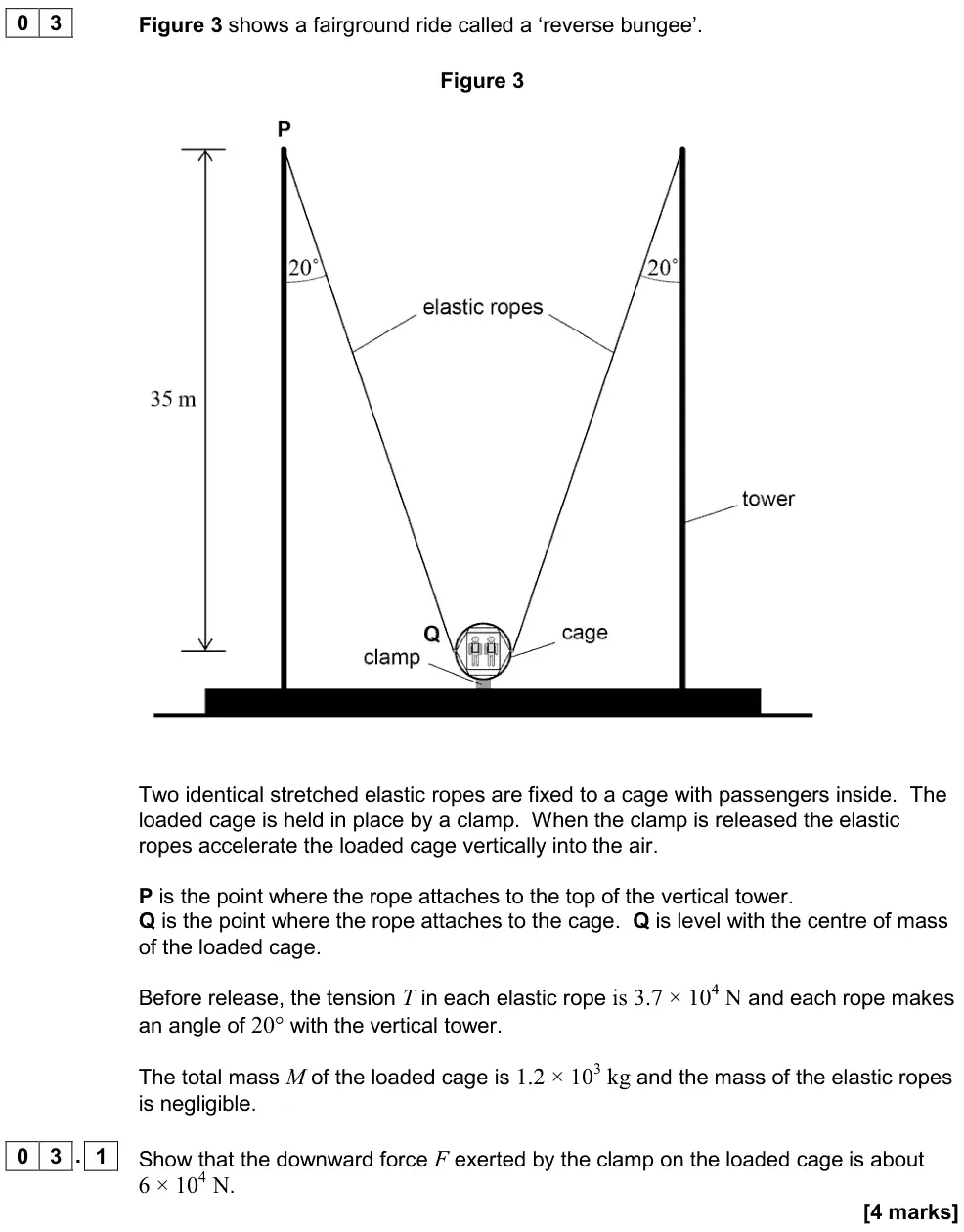
03.1 In this question, students needed to find the vertical component of the tension, then take into consideration the two ropes and, finally, resolve the weight of the loaded cage. Credit was given to students when they clearly demonstrated these steps. Nearly 40% of students achieved full marks. Answers of a high standard were easy to follow and required little interpretation by the examiner. Students should consider briefly annotating their steps (‘Two ropes so double my tension’) when giving ‘show that’ answers.
03.2 This question tested an understanding of Newton’s laws. Over 60% of students achieved both marks. Many students understood that they needed to use F ma = but did not appreciate, from Newton’s third law, that the force given in 03.1 was needed. Students should be aware that a ‘show that’ question often provides a value that will be used subsequently.
03.3 This question proved to be slightly more challenging than 03.1. Again, students gained credit for showing clear evidence of any of the steps in this calculation. A common error was to use the force from 03.1 in a Hooke’s Law calculation.
Notes from the mark scheme and report
Answer: 5.8 x 10^4 N (vertical component 3.7 x 10^4 cos 20 = 3.5 x 10^4 N per rope, twice this minus weight 1.18 x 10^4 N)
annotate each step in a show that
Skills: MS4.5 Use sin, cos and tan in physical problems
June 2019 · Paper 1 · Q4.12 marksExplanation
Mark scheme
Examiner's comment
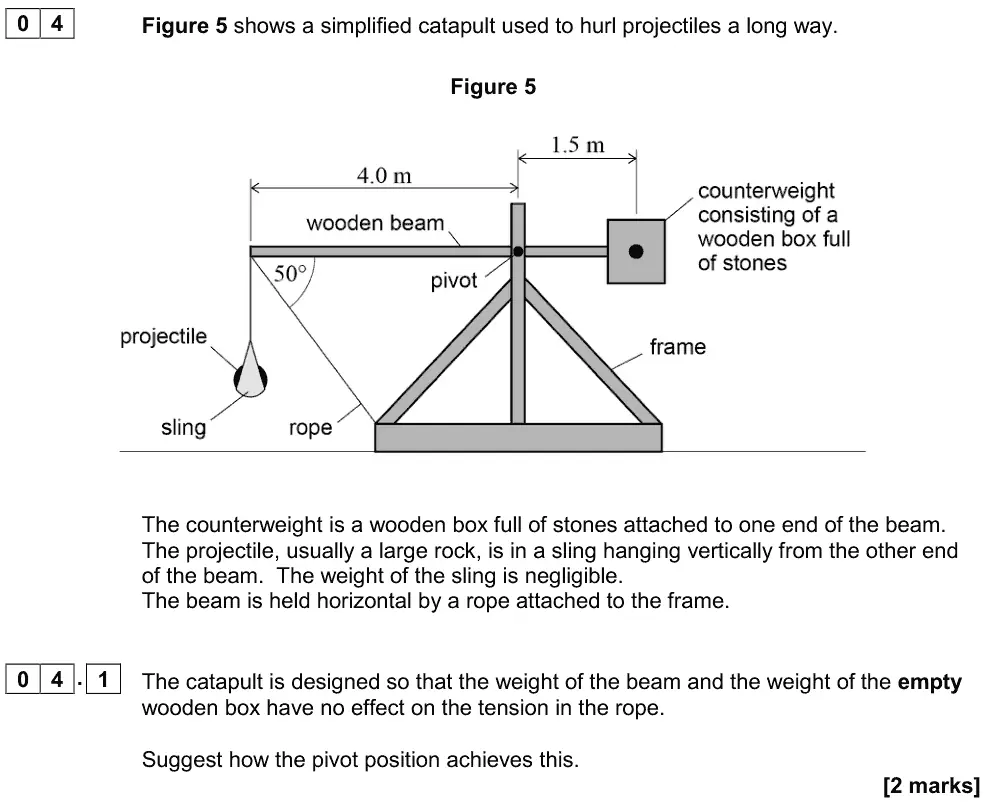
4.1 This question discriminated well. Students who argued in terms of the centre of mass were more likely to gain full credit. Although incorrect equations were not penalised on this occasion, teachers and students should be aware that this may not be the case in future examinations. A common error was the assumption that the centre of mass of the beam was 2.0 m from the pivot, or that the mass of the sling had to be considered, rather than the mass of the beam. A failure to express ideas clearly also cost some students marks.
6.2 Students who did not obtain full marks on this question tended to make mistakes reading the axes, for example using 4.1 mm for the displacement, or using the wrong power of ten in the final calculation. A surprisingly large number of students simply divided the maximum displacement by the time and received no credit.
Notes from the mark scheme and report
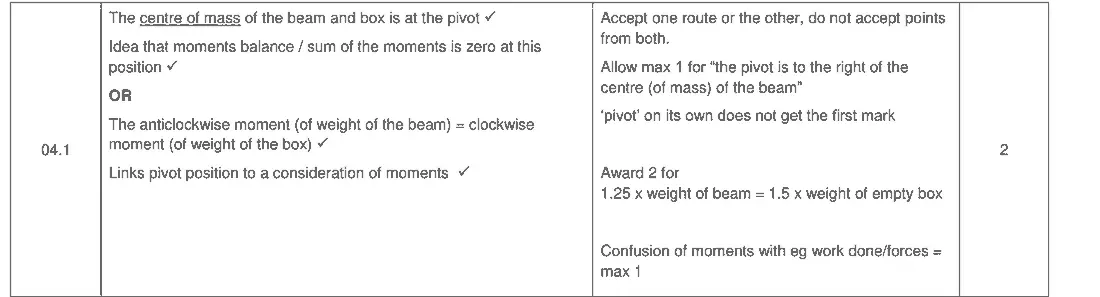
Centre of mass of beam plus empty box is at the pivot, so their moments balance (sum of moments zero)
centre of beam wrongly taken at 2.0 m or the sling considered
June 2019 · Paper 1 · Q4.25 marksCalculation
Earlier part of question 4 that this part uses
Mark scheme
Examiner's comment
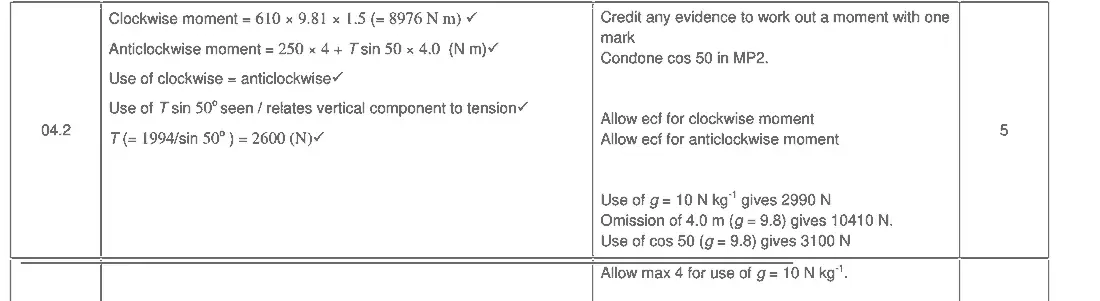
4.2 There were five marks available for this extended calculation and almost half of the students obtained all five. The mark scheme allowed students to make errors in several parts of the calculation without over-penalising them. Common errors included missing g from the weight of counterweight stones, or using the incorrect angle for the component of the tension. Occasionally the distance to the rope was missed in the equation for the turning effect of the tension. In multi-step calculations of this kind, students should be encouraged to set out their work logically and make it clear what they are doing at each step so that consequential error marks can still be awarded.
Notes from the mark scheme and report
Answer: 2600 N (610 x 9.81 x 1.5 = 8976 N m = 250 x 4.0 + T sin50 x 4.0)
missing g, cos instead of sin or the 4.0 m arm were common errors
almost half scored all five
Skills: MS4.5 Use sin, cos and tan in physical problems; MS2.3 Substitute numerical values into algebraic equations using appropriate units for physical quantities; MS2.2 Change the subject of an equation, including non-linear equations
June 2019 · AS Paper 1 · Q5.11 markShort answerEasy
Mark scheme
Examiner's comment
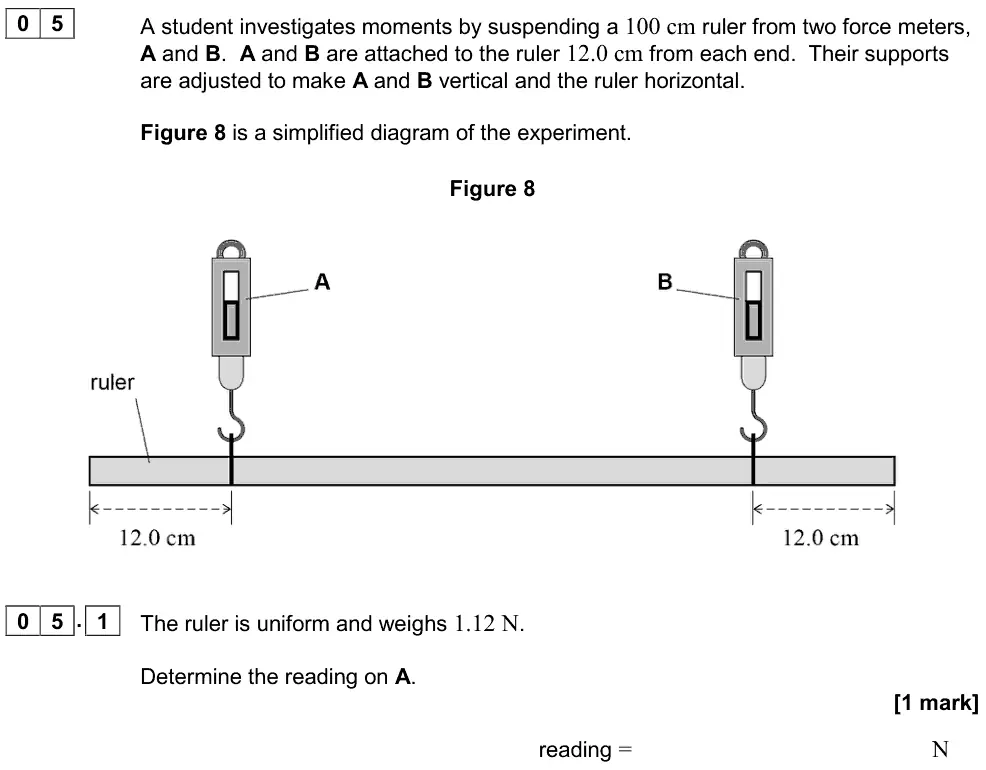
05.1 Nearly 70% of students determined the answer by considering the balance of forces.
Notes from the mark scheme and report
Answer: 0.56 N (half of 1.12 N by symmetry)
June 2019 · AS Paper 1 · Q5.22 marksExplanationHard
Earlier part of question 5 that this part uses
Mark scheme
Examiner's comment
05.2 This question was poorly answered, with over 60% gaining no credit. The definition of a couple was required and this was not well expressed. Only about 12% of students could define a couple and then explain why A and B could not be a couple. It was very common to read that A and B were a couple because of the symmetry of the system.
02.3 This question discriminated well, with about 90% of students gaining some credit. Many students could read the current from the graph and then use it to calculate a resistance. The common error was to use 2.2 V, instead of 5.2 V. A number of students determined the gradient of the characteristic graph believing it gave the resistance of the LED; this is a continuing concern as this error is common and seen year after year. The determination of resistance must come from a calculation of V at a single data point, never from an I estimate of a gradient of a V I − graph.
Notes from the mark scheme and report
Couple is two equal forces acting in opposite directions
A and B both act upwards so not a couple
symmetry argument common and wrong
June 2019 · Paper 1 · Q5.23 marksCalculation
Earlier part of question 5 that this part uses
Mark scheme
Examiner's comment
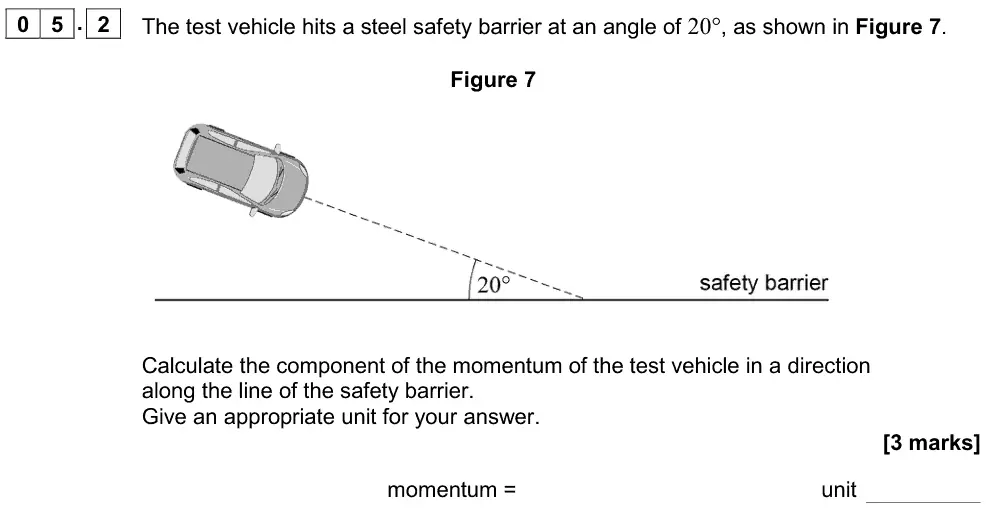
5.2 This calculation was slightly more demanding, with some students attempting to use the energy given to them in the previous calculation. This approach, whilst unnecessarily long, did gain full credit when carried out correctly. One common error was the use of sine rather than cosine when calculating the momentum, or omitting the mass altogether. Another common error was the use of N m for the unit, suggesting some confusion with energy.
Notes from the mark scheme and report
Answer: 4.4 x 10^4 kg m s^-1 (or N s) using 1500 x 31 cos20
sine instead of cosine and unit N m were common errors
Skills: MS4.5 Use sin, cos and tan in physical problems; MS0.1 Recognise and make use of appropriate units in calculations
June 2019 · AS Paper 1 · Q5.34 marksCalculationHard
Earlier part of question 5 that this part uses
Mark scheme
Examiner's comment
05.3 This question proved challenging for many students and barely 20% achieved full marks. Of the remaining cohort, few were competent in selecting an appropriate pivot position for the application of the moments principle.
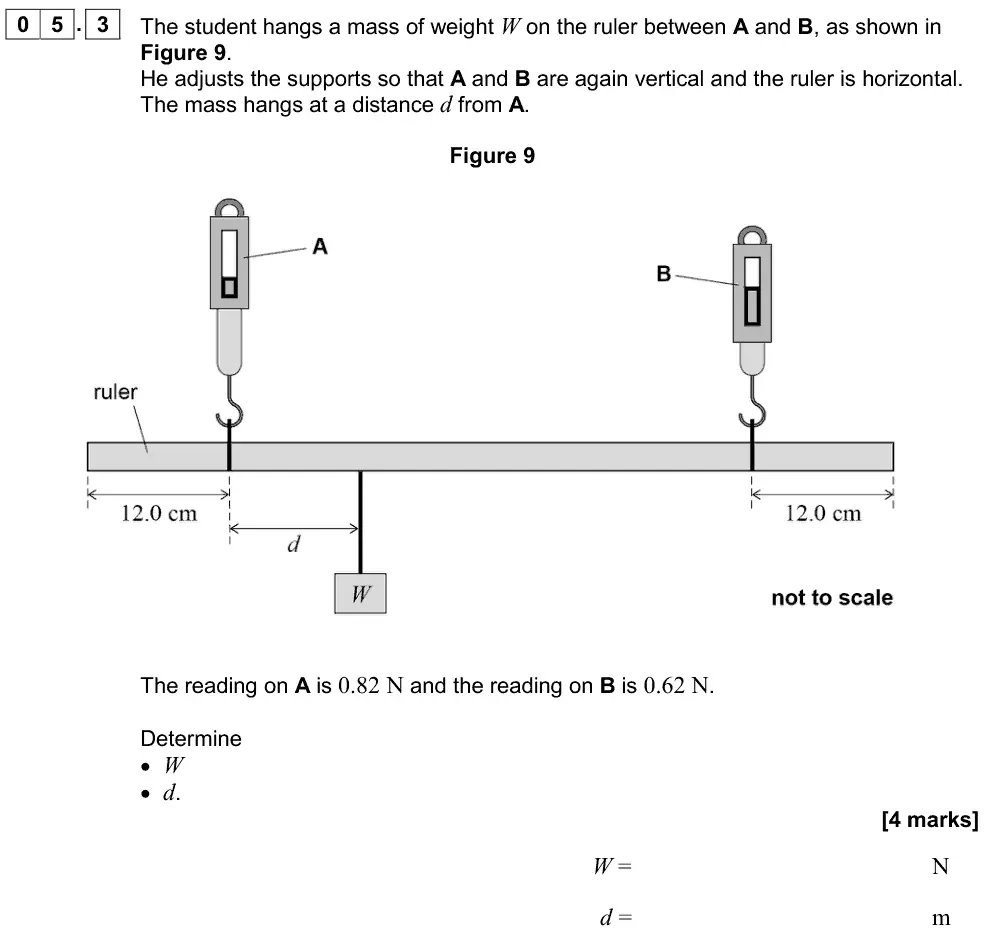
Notes from the mark scheme and report
Answer: W = 0.32 N (0.82 + 0.62 - 1.12), d = 0.14 m (moments about A)
choosing a sensible pivot was the main difficulty
Skills: MS2.3 Substitute numerical values into algebraic equations using appropriate units for physical quantities; MS2.2 Change the subject of an equation, including non-linear equations
June 2019 · Paper 1 · Q5.33 marksShow that
Earlier part of question 5 that this part uses
Mark scheme
Examiner's comment
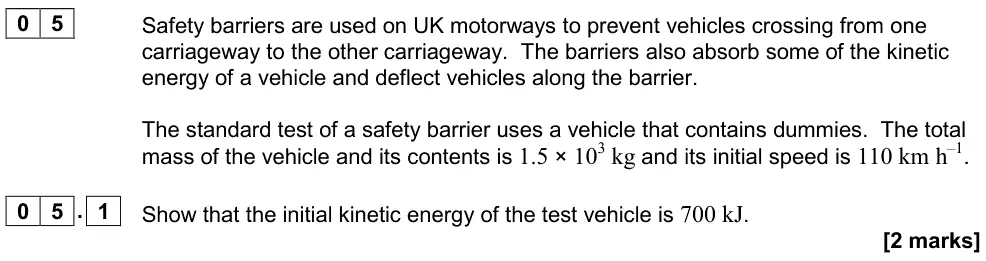
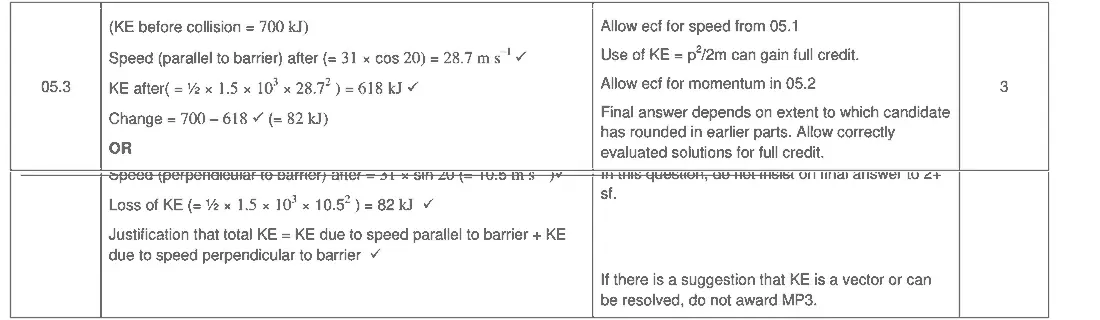
5.3 Students managed to find some very different approaches to what is essentially a straightforward multi-step calculation. Answers that appeared to be taking a component of the kinetic energy, and therefore treating it as a vector, did not gain full credit. 5.4 AO3 questions of the type in question 5.4 leave students free to choose the approach they wish to take. Each approach was treated on merit and was awarded full marks if correct. The most common, and successful, approach was a consideration of the work done by the barrier and therefore the average force that needed to be applied by the barrier to remove the perpendicular component of the car’s velocity. Occasional errors were related to incorrect physics, for example using the wrong suvat (kinematic) equation, or errors in algebra and computation. Unfortunately, many students were unable to see a way through this question that gave them any credit. This may have been due to students giving up or to them being unable to achieve the ‘show that’ values given in previous parts. Students should be encouraged to make use of the ‘show that’ values in these instances as they are there to allow access to later questions.
Notes from the mark scheme and report
Speed along barrier 28.7 m s^-1 so KE after 618 kJ, loss about 82 kJ (or 1/2 m (31 sin20)^2)
treating KE as a vector component loses MP3
Skills: MS4.5 Use sin, cos and tan in physical problems; MS2.3 Substitute numerical values into algebraic equations using appropriate units for physical quantities
June 2019 · AS Paper 1 · Q5.42 marksExplanation
Earlier part of question 5 that this part uses
Mark scheme
Examiner's comment
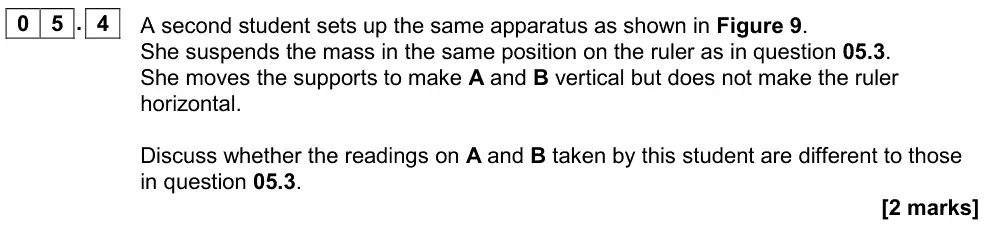
05.4 This question was not answered well. Students could have helped themselves by drawing a diagram of the new situation. Had they then drawn the vertical forces on this diagram, they may well have realised that the readings would be the same. Most students, however, considered the question in terms of moments and drew incorrect conclusions.
Notes from the mark scheme and report
Readings unchanged (total 1.44 N): weight unchanged and all perpendicular distances scale by the same factor cos theta
most argued wrongly with moments
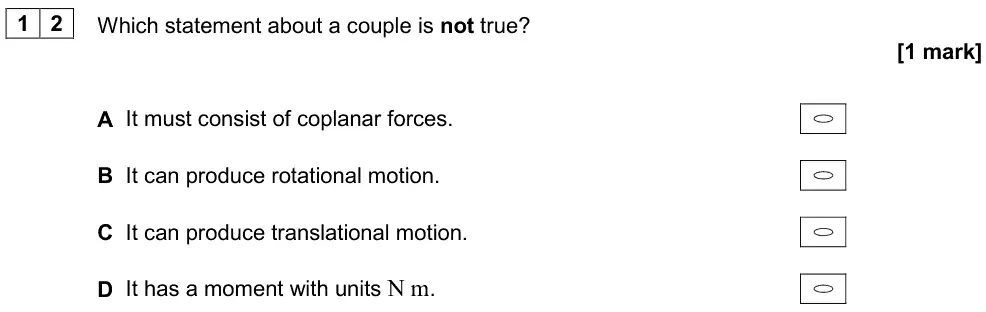
June 2019 · Paper 1 · Q121 markMultiple choice
Answer
C
Notes from the mark scheme and report
Answer: C
June 2019 · Paper 2 · Q4.22 marksDiagram or graphHard
Earlier part of question 4 that this part uses
Mark scheme
Examiner's comment
4.2 On this relatively simple question only a quarter of the students scored both marks. Even more able students did not seem to know that the foot of an arrow represents the position where the force is applied. The weight arrow, for example, was more frequently seen starting at the base of the sphere B rather than starting at the centre of mass. Also, many students did not try to represent all three forces.
Notes from the mark scheme and report
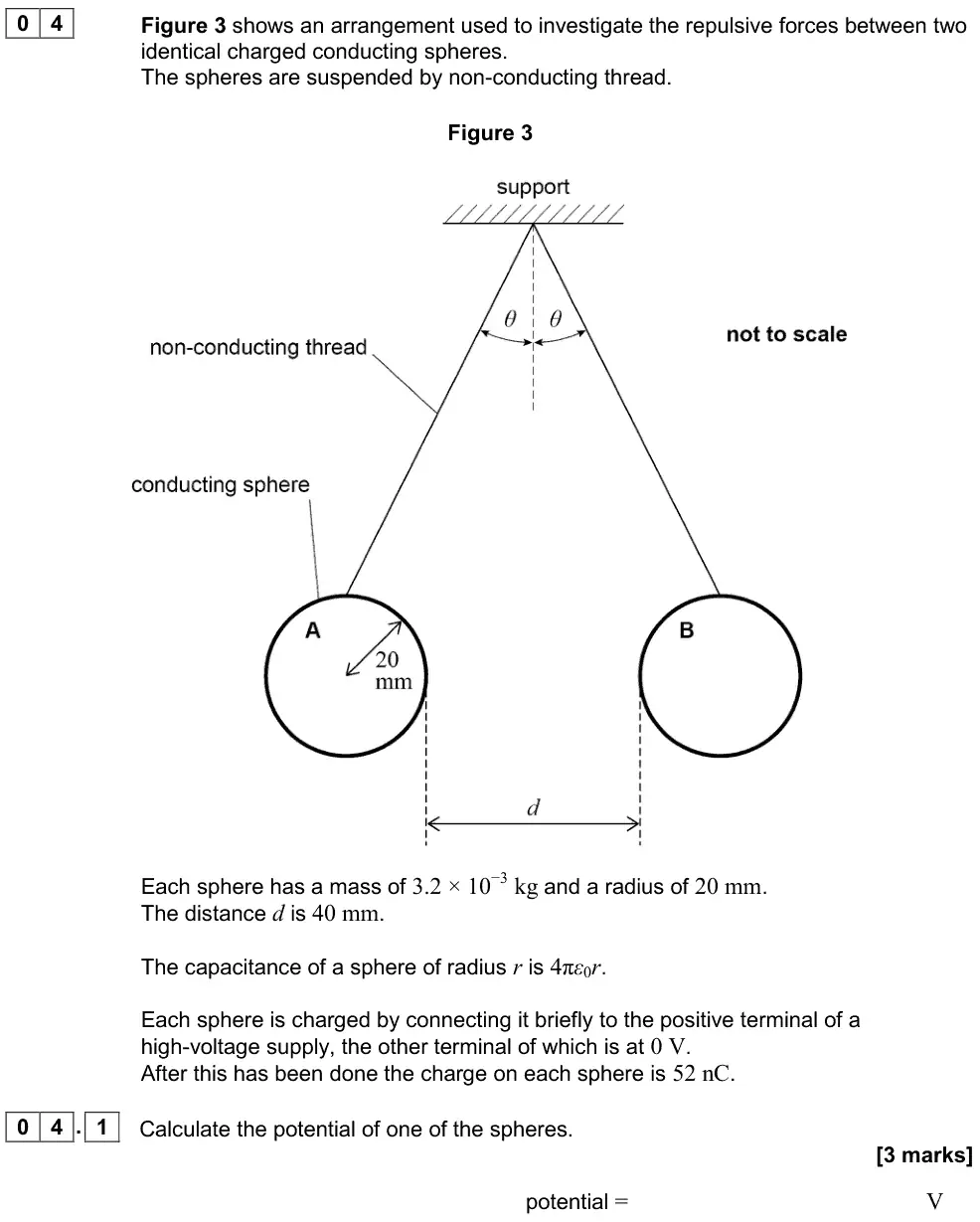
Three labelled arrows on B: tension along the thread upwards, weight vertically down from the centre, electrostatic repulsion to the right
arrows must start at the point of application
June 2019 · Paper 2 · Q4.52 marksCalculation
Earlier part of question 4 that this part uses
Mark scheme
Examiner's comment
4.5 Less than half showed that the figures were self-consistent. Some students attempted to show consistent values but used an incorrect trigonometrical function. Others gave a general answer such as ‘the angle is small which fits the data’. Some did not appreciate the problem and dealt only with the lengths of the triangle made with the two spheres and the support.
Notes from the mark scheme and report
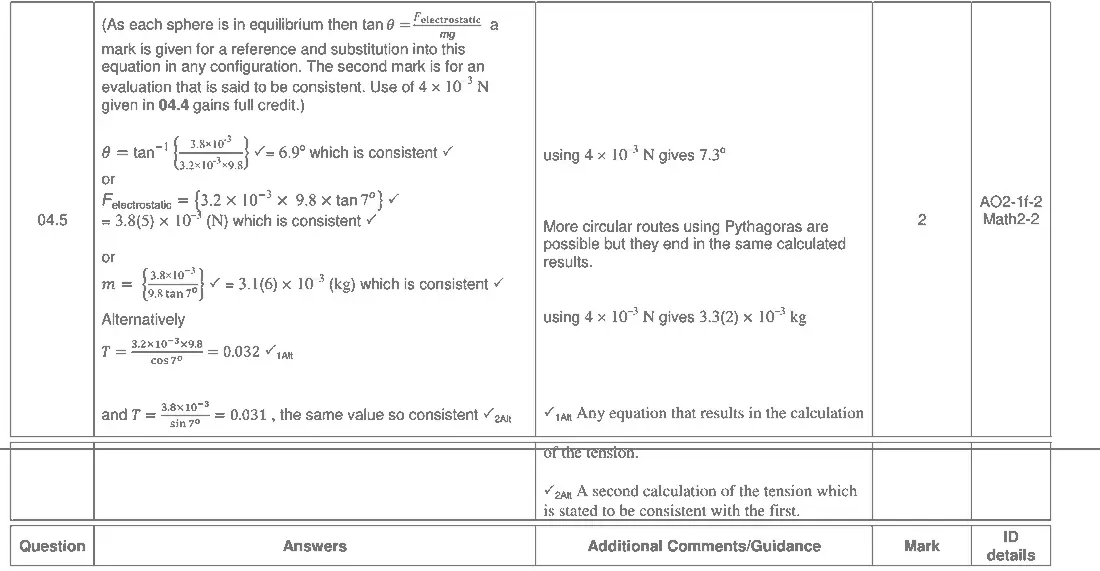
tan theta = F / mg = 3.8 x 10^-3 / (3.2 x 10^-3 x 9.81) gives theta = 6.9 degrees, consistent with 7 degrees
wrong trig function common
Skills: MS4.5 Use sin, cos and tan in physical problems; MS2.3 Substitute numerical values into algebraic equations using appropriate units for physical quantities
June 2019 · Paper 2 · Q81 markMultiple choice
Answer
B
Notes from the mark scheme and report
Answer: B
June 2019 · AS Paper 2 · Q221 markMultiple choice
Answer
C
Notes from the mark scheme and report
Answer: C
Skills: MS4.5 Use sin, cos and tan in physical problems
June 2019 · AS Paper 2 · Q231 markMultiple choice
Answer
B
Notes from the mark scheme and report
Answer: B
June 2019 · AS Paper 2 · Q241 markMultiple choice
Answer
D
Notes from the mark scheme and report
Answer: D
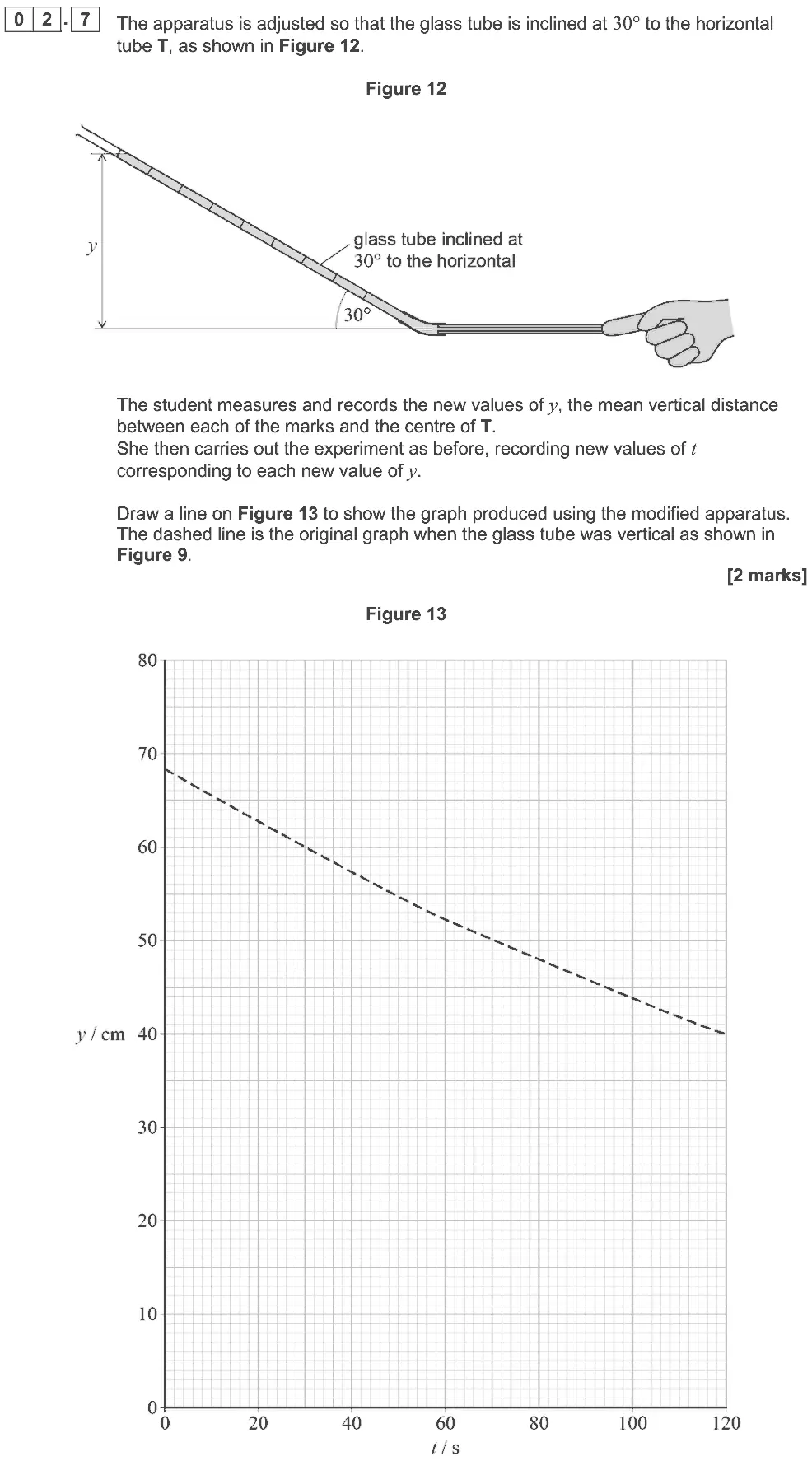
June 2019 · Paper 3 Section A · Q2.72 marksDiagram or graph
Earlier part of question 2 that this part uses
Mark scheme
Examiner's comment
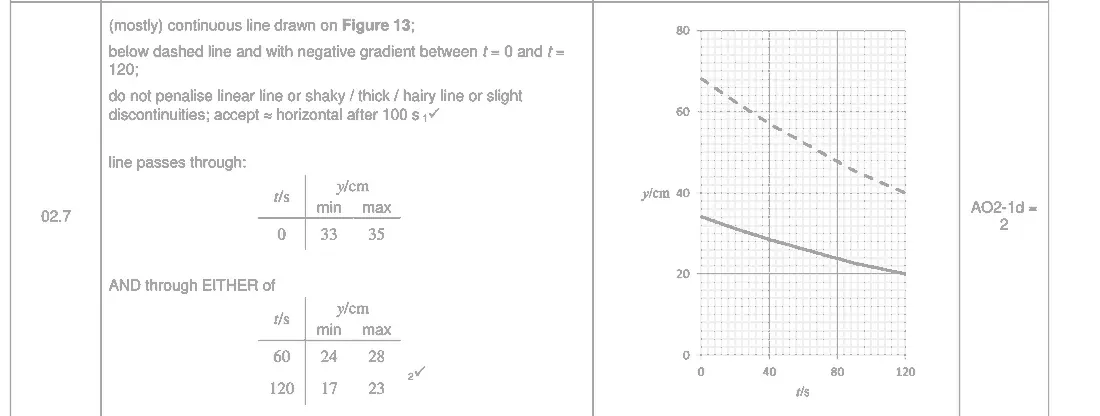
In 02.7, the key was to recognise the significance of the 30° and draw the line halfway between the dashed line and the time axis. It was possible to get full credit for drawing a straight line but, even so, about half the students did not score on this question.
Notes from the mark scheme and report
Inclined tube: vertical heights halved (sin 30), so new line lies halfway between the dashed line and the t axis (about 34 cm at t = 0, 26 cm at 60 s, 20 cm at 120 s)
Skills: MS4.5 Use sin, cos and tan in physical problems; MS3.1 Translate information between graphical, numerical and algebraic forms
June 2018 · AS Paper 1 · Q2.23 marksExplanationHard
Earlier part of question 2 that this part uses
Mark scheme
Examiner's comment
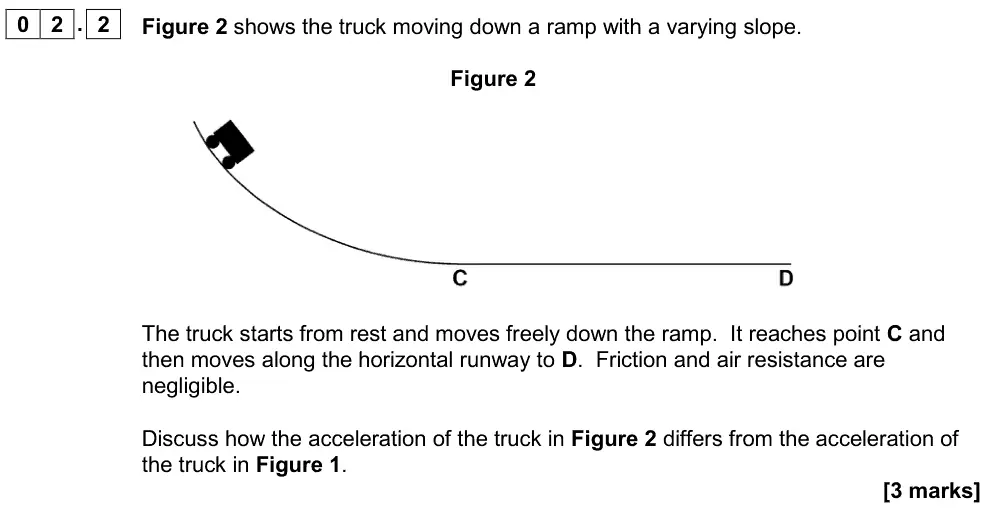
02.2 Some good responses were seen to this question although it was not uncommon for contradictory statements to be made. Most students were able to state that acceleration was constant in figure 1 but analysis of figure 2 proved more of a challenge. It was quite common to see answers that referred to speed rather than acceleration decreasing as the truck moved down the ramp. Also, a significant proportion of students thought that the truck decelerated between C and D. A quarter of students managed to gain all three marks.
Notes from the mark scheme and report
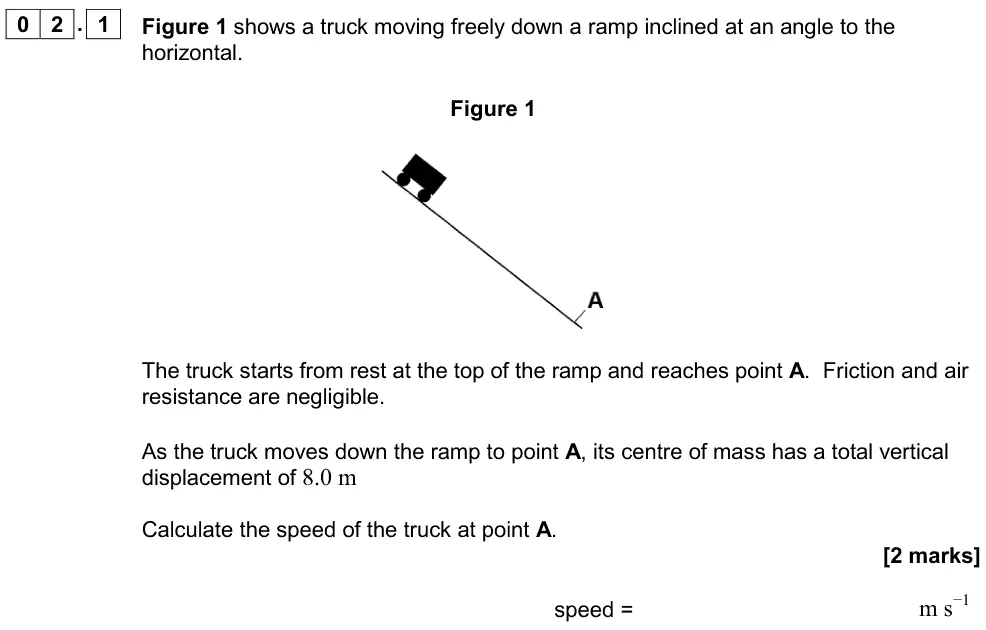
Figure 1 constant acceleration
Figure 2 greatest at the top, decreasing, zero from C to D, because the component of weight along the slope changes
many described speed not acceleration or said it decelerates from C to D
June 2018 · AS Paper 1 · Q4.12 marksShort answer
Mark scheme
Examiner's comment
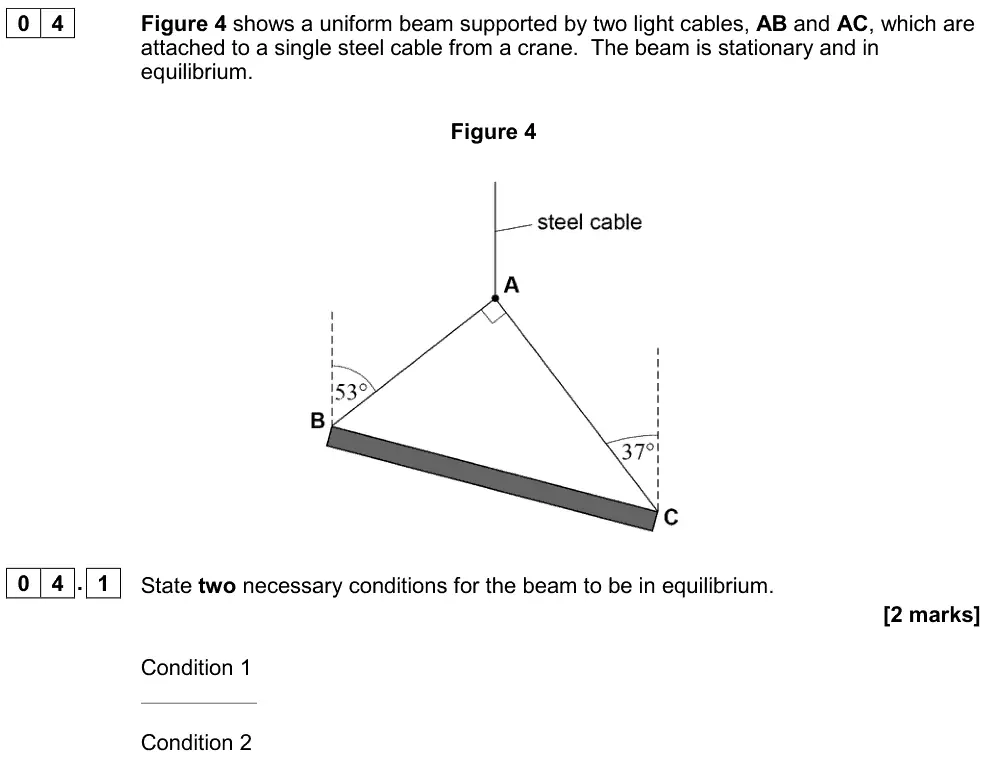
04.1 A pleasing proportion of students (nearly two-thirds) were able to identify one of the conditions for equilibrium; the resultant force being zero being the common answer. Only more able students were able to provide the second condition.
Notes from the mark scheme and report
Resultant force zero AND resultant moment zero about any point
most gave only the force condition
June 2018 · AS Paper 1 · Q4.21 markShort answer
Earlier part of question 4 that this part uses
Mark scheme
Examiner's comment
04.2 There was some confusion over how centre of mass is defined. A significant proportion of students stated what is meant by the centre of gravity. This was given credit but it is clear that the distinction between these two is not well understood.
Notes from the mark scheme and report
Point where the weight acts / mass can be considered concentrated
'where mass acts' not accepted
June 2018 · AS Paper 1 · Q4.32 marksExplanationHard
Earlier part of question 4 that this part uses
Mark scheme
Examiner's comment
04.3 Very few students (2.9%) managed to score both marks for this question. Nearly a quarter of students appreciated that this was to prevent rotation, but did not then give a complete explanation by referring to no resultant moment about A as the line of action of the forces passes through A when the beam is in equilibrium.
05.3 Students found this question very challenging and only a small minority (4.3%) managed to come up with complete solutions. Setting up an expression that enabled the volume of iron to be calculated is clearly a procedure that is unfamiliar to many students. A reasonable proportion did appreciate that a mass needed to be divided by the density of iron and picked up the first mark, but got no further because they did not appreciate that the volume of the ice is less than the volume of the cube because part of the volume is occupied by the piece of iron.
Notes from the mark scheme and report
Weight's line of action passes through A so no resultant moment about A and beam does not rotate
June 2018 · AS Paper 1 · Q4.44 marksCalculation
Earlier part of question 4 that this part uses
Mark scheme
Examiner's comment
04.4 This is not an unusual calculation at this level but it was clear that a significant proportion of students were unsure how to analyse the forces on the beam. The best students managed complete solutions whilst weaker students did manage to access some of the intermediate marks.
Notes from the mark scheme and report
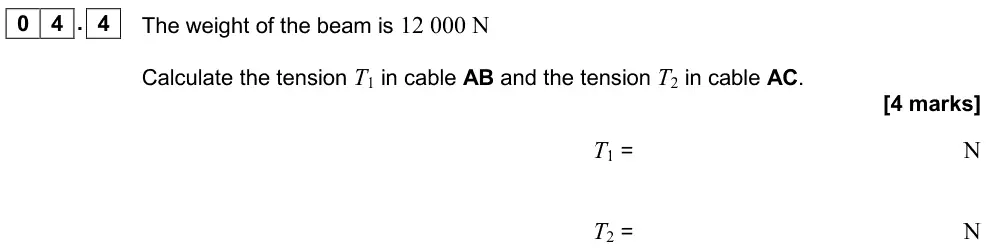
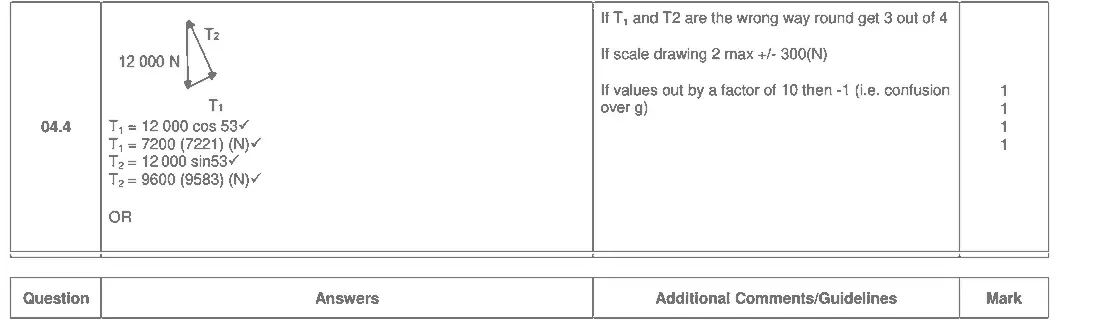
Answer: T1 = 7200 N (12000 cos 53), T2 = 9600 N (12000 sin 53)
swapped values 3 of 4
scale drawing max 2
Skills: MS4.5 Use sin, cos and tan in physical problems
June 2018 · Paper 1 · Q5.23 marksCalculation
Earlier part of question 5 that this part uses
Mark scheme
Examiner's comment
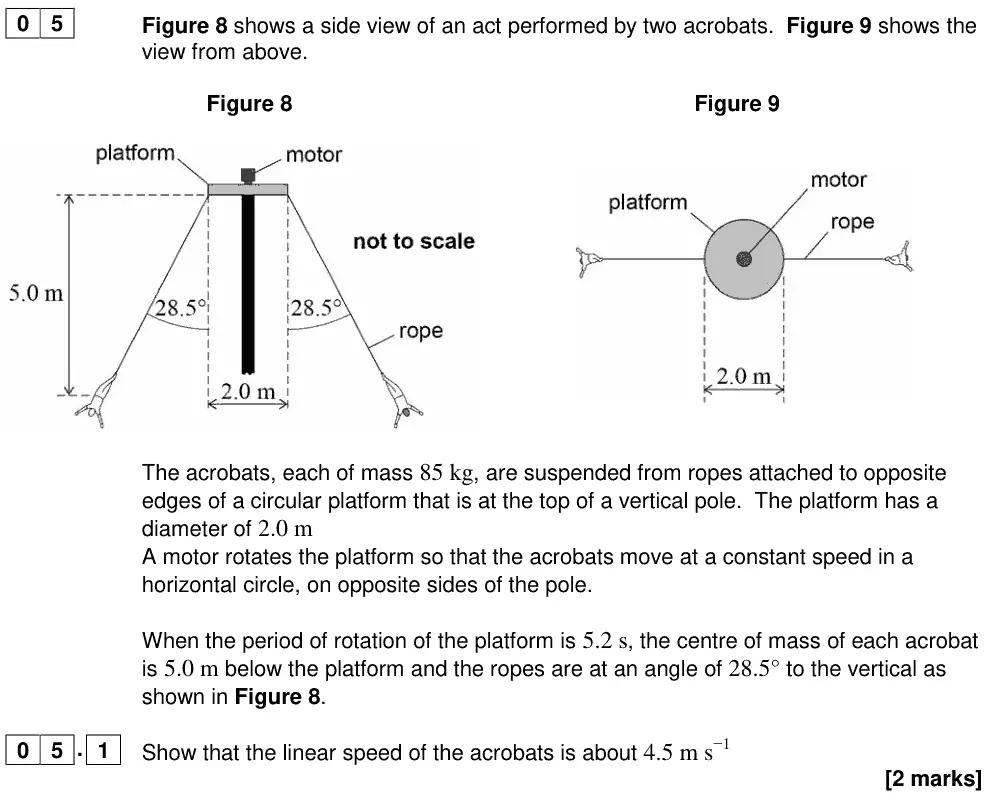
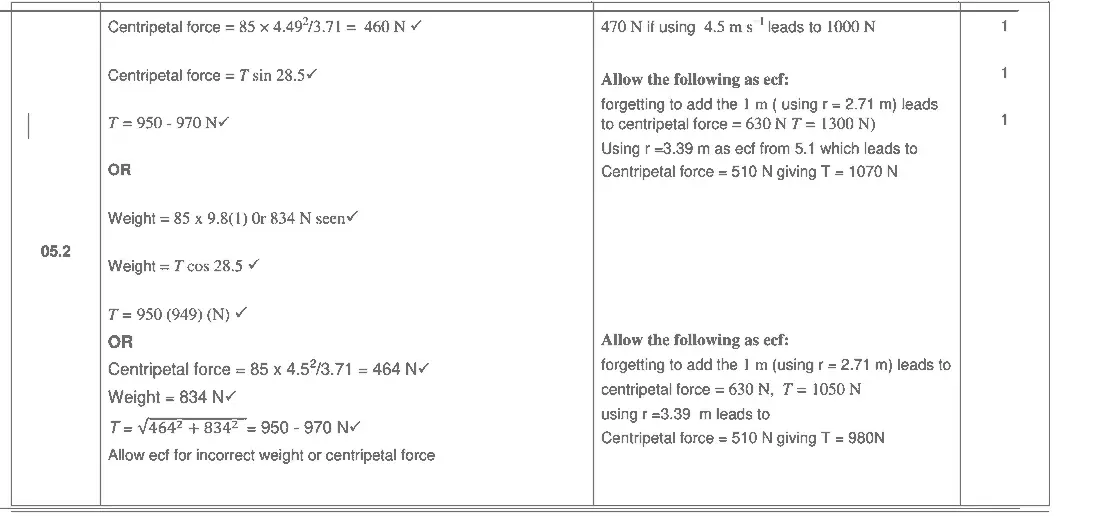
05.2 The simplest and most common route to the answer was to consider the vertical forces. There were other routes to the answer too. The most common of these was to realise that the horizontal force due to the tension provided the centripetal force. Examiners allowed the error carried forward from 05.1 for the radius of the path for those who solved the problem this way.
05.1 Many students (59%) completed this part fully successfully. This and part 05.2 exposed weaknesses in the understanding of some students when using sine, cosine and tangent. Many who arrived at 2.71 m did not add the extra metre for the platform to deduce the radius of the circular path followed by the acrobats.
Notes from the mark scheme and report
Answer: 950 N (T cos28.5 = 834 N, or T sin28.5 = mv^2/r = 460 N)
ecf from 05.1 radius
Skills: MS4.5 Use sin, cos and tan in physical problems; MS2.3 Substitute numerical values into algebraic equations using appropriate units for physical quantities
June 2018 · Paper 1 · Q5.33 marksExplanation
Earlier part of question 5 that this part uses
Mark scheme
Examiner's comment
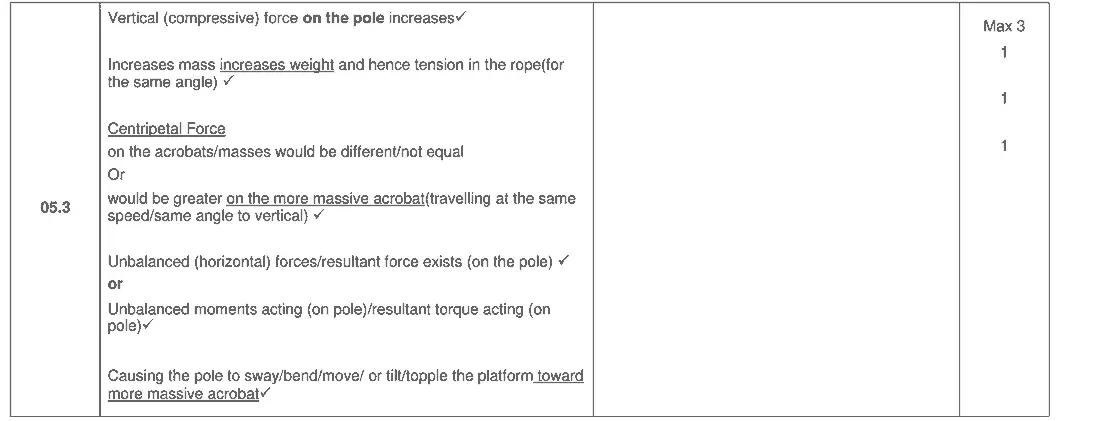
05.3 There were some very good responses to this part and many students provided at least part of the necessary analysis. A high proportion of students wrote that there would be unbalanced forces on the acrobat, but in the subsequent explanation of how this imbalance occurred many answers were spoiled when students wrote about effects of weight when they should have referred to mass and vice versa. Most responses concentrated on the unbalanced horizontal force or considered the moments of the forces. Few made any comment of the increased vertical force on the pole.
Notes from the mark scheme and report
Any 3: larger vertical compressive force on pole
larger tension and centripetal force for the heavier acrobat
unbalanced horizontal force or resultant moment so the pole bends/tilts
mass and weight often confused
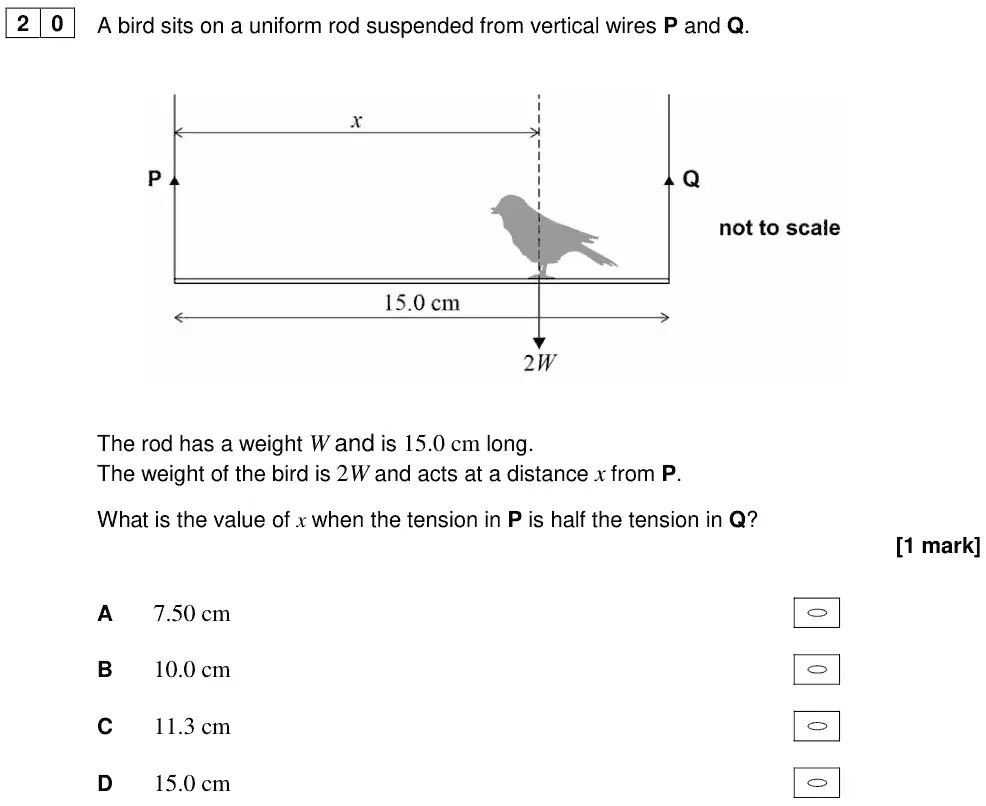
June 2018 · Paper 1 · Q201 markMultiple choice
Answer
D
Examiner's comment
The 25 questions in Section B are summarised in the table below. For each question, the key (correct answer) is provided, along with the percentage of students answering correctly. There was a good range of ‘facility’ across this section; the most accessible questions were 12 and 18 (both answered correctly by 89.2% of students), the least accessible was 20 (answered correctly by only 38.1% of students). The overall mean mark achieved by the students for Section B was 15.7 out of 25 (62.8%).
Notes from the mark scheme and report
Answer: D
least accessible item in Section B
June 2018 · Paper 1 · Q211 markMultiple choice
Answer
D
Notes from the mark scheme and report
Answer: D
Skills: MS2.2 Change the subject of an equation, including non-linear equations
June 2018 · AS Paper 2 · Q2.45 marksPractical and data analysis
Earlier part of question 2 that this part uses
Mark scheme
Examiner's comment
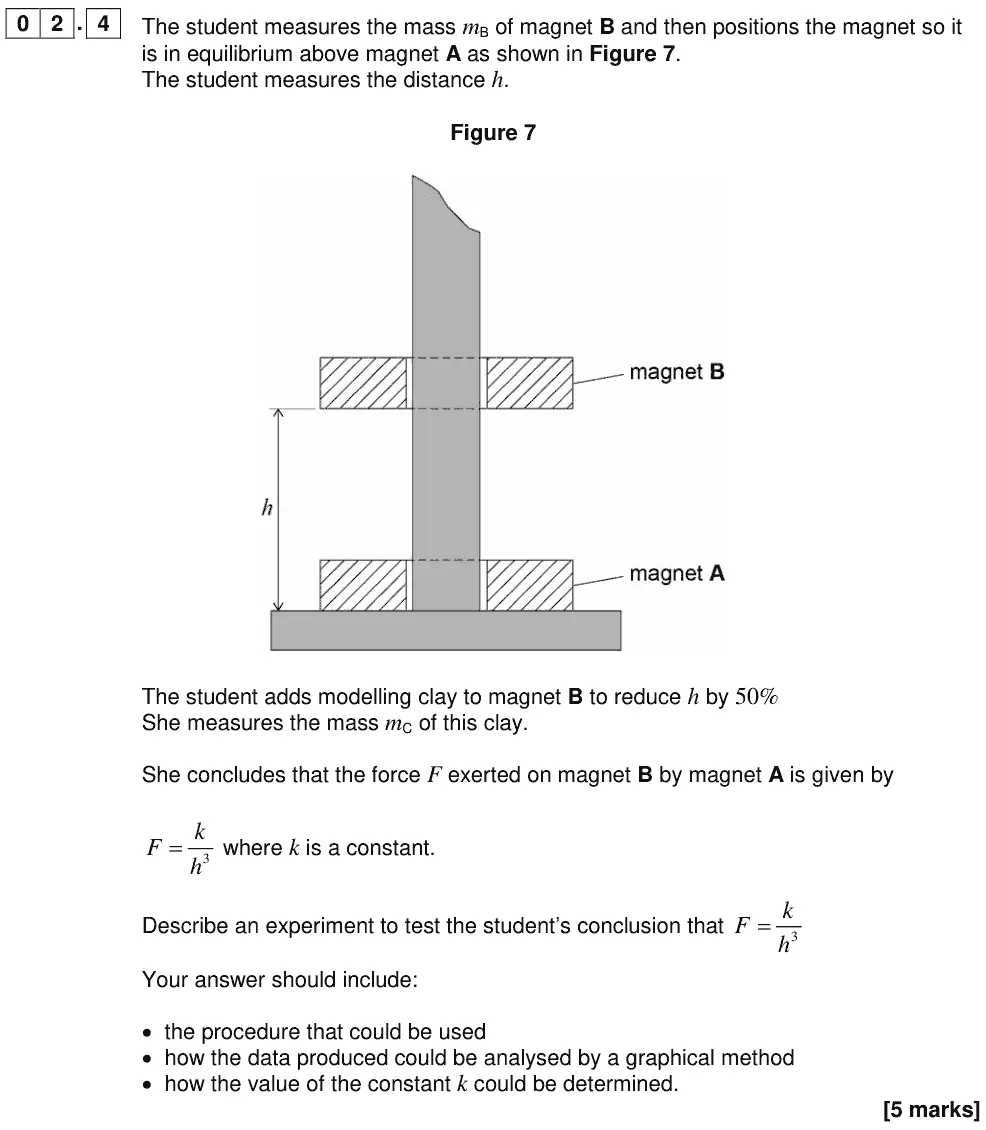
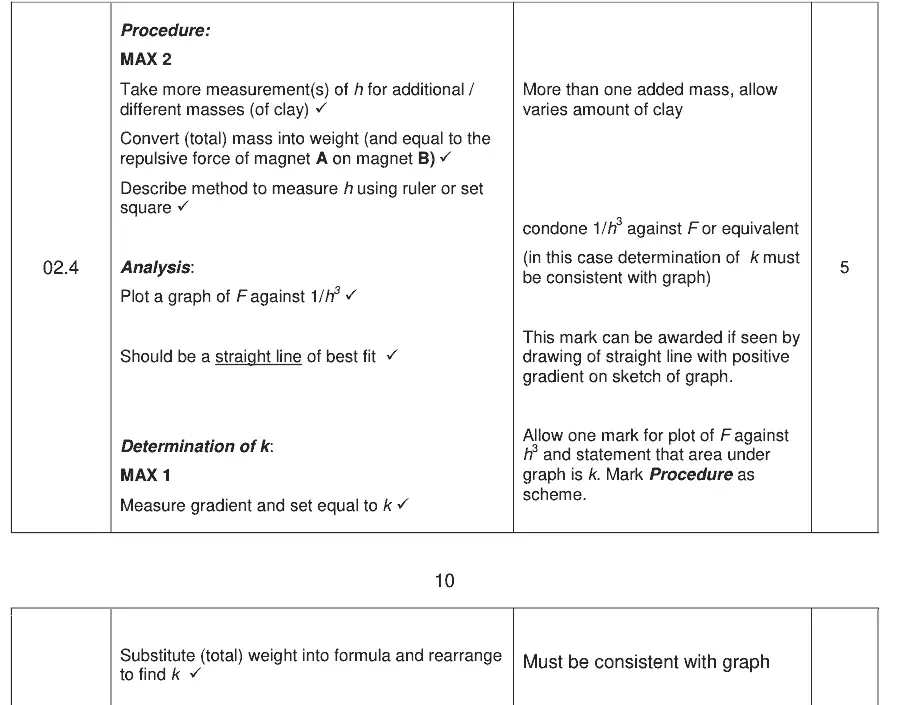
02.4 The students often made little headway in this question. The plans seen lacked details on how to vary the mass and how to record the value of h. Many students did not know how to process the data to obtain a straight-line graph for F = k h-3. Just over 40% of students managed to score at least two marks here.
Notes from the mark scheme and report
Vary added mass, weight = repulsive force, measure h with ruler/set square
plot F against 1/h^3, straight line through origin, k = gradient
few could linearise the relationship
Skills: MS3.3 Understand that y = mx + c represents a linear relationship; PS2.1 Comment on experimental design and evaluate scientific methods; PS3.1 Plot and interpret graphs
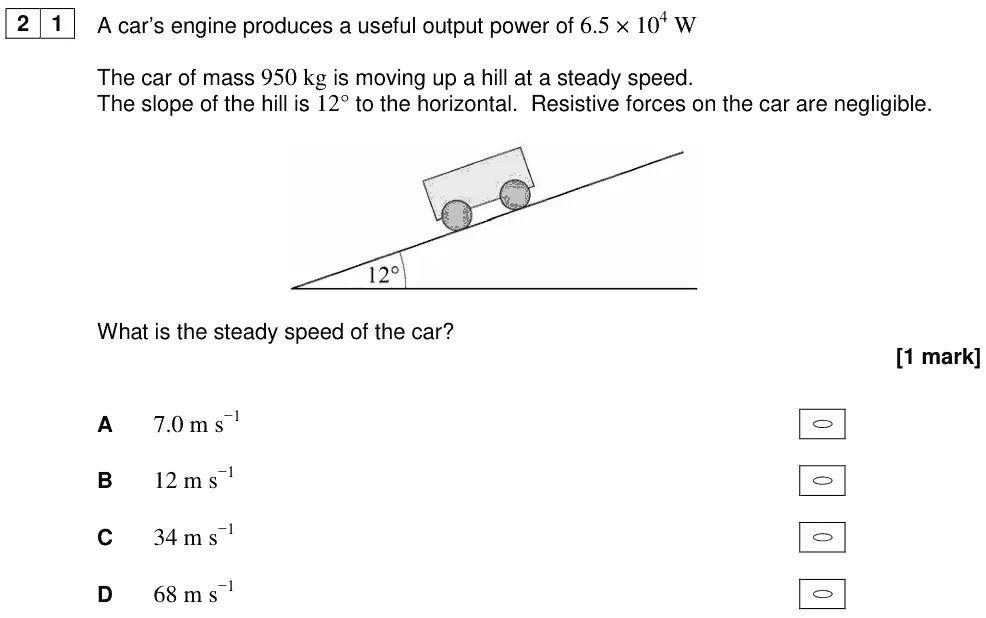
June 2018 · AS Paper 2 · Q201 markMultiple choice
Answer
C
Notes from the mark scheme and report
Answer: C
Skills: MS2.4 Solve algebraic equations, including quadratic equations
June 2018 · AS Paper 2 · Q211 markMultiple choice
Answer
C
Notes from the mark scheme and report
Answer: C
Skills: MS4.5 Use sin, cos and tan in physical problems
June 2018 · AS Paper 2 · Q251 markMultiple choice
Answer
A
Notes from the mark scheme and report
Answer: A
Skills: MS4.5 Use sin, cos and tan in physical problems
June 2018 · Paper 3 Section A · Q1.13 marksPractical and data analysis
Mark scheme
Examiner's comment
01.1 Much of the working seen convinced examiners that the students had taken moments about the pivot, although some used 30.0 rather than 29.0 in the calculation. A few forfeited a mark by rounding their result to two significant figures. Weaker students attempted a solution based on proportions of the balance reading shown in Figure 2, while others simply copied the balance reading on to the answer line. While some stated the assumption they made was that the ruler was in equilibrium, examiners were looking for a statement implying that the ruler was uniform or that the centre of mass was at the 50 cm mark. Significant numbers of students gave a creditworthy assumption although those that stated “the ruler has uniform density” or “the mass is in the middle” were unsuccessful. Just over two-thirds of students scored at least one mark. 01.2 The key failing of some students here was (surprisingly) that they seemed to think that the current direction was self-evident and not worthy of comment, even if they had correctly deduced the direction of the force (despite some tying themselves in knots with Newton’s third law). Some students relied on the examiners spotting relevant annotation made to Figure 3. Statements that the current was ‘from positive to negative’ or ‘clockwise’ were not accepted. Unless the directions of the force and the current were both stated, no credit was given for stating the direction of the field. Logically correct deductions, based on incorrect force and/or current directions, could score as long as the left-hand rule was mentioned in support. For these reasons, approximately a third of the students scored one of the three marks and nearly another third scored zero. Thankfully, 17.1% gave a detailed, fully-justified and correct response earning full credit.
The students’ knowledge of most of the core physics was generally sound. Most knew the assumption examiners were looking for in 01.1, although few could give both conditions to justify the application of Charles’s Law in 03.2.
Notes from the mark scheme and report
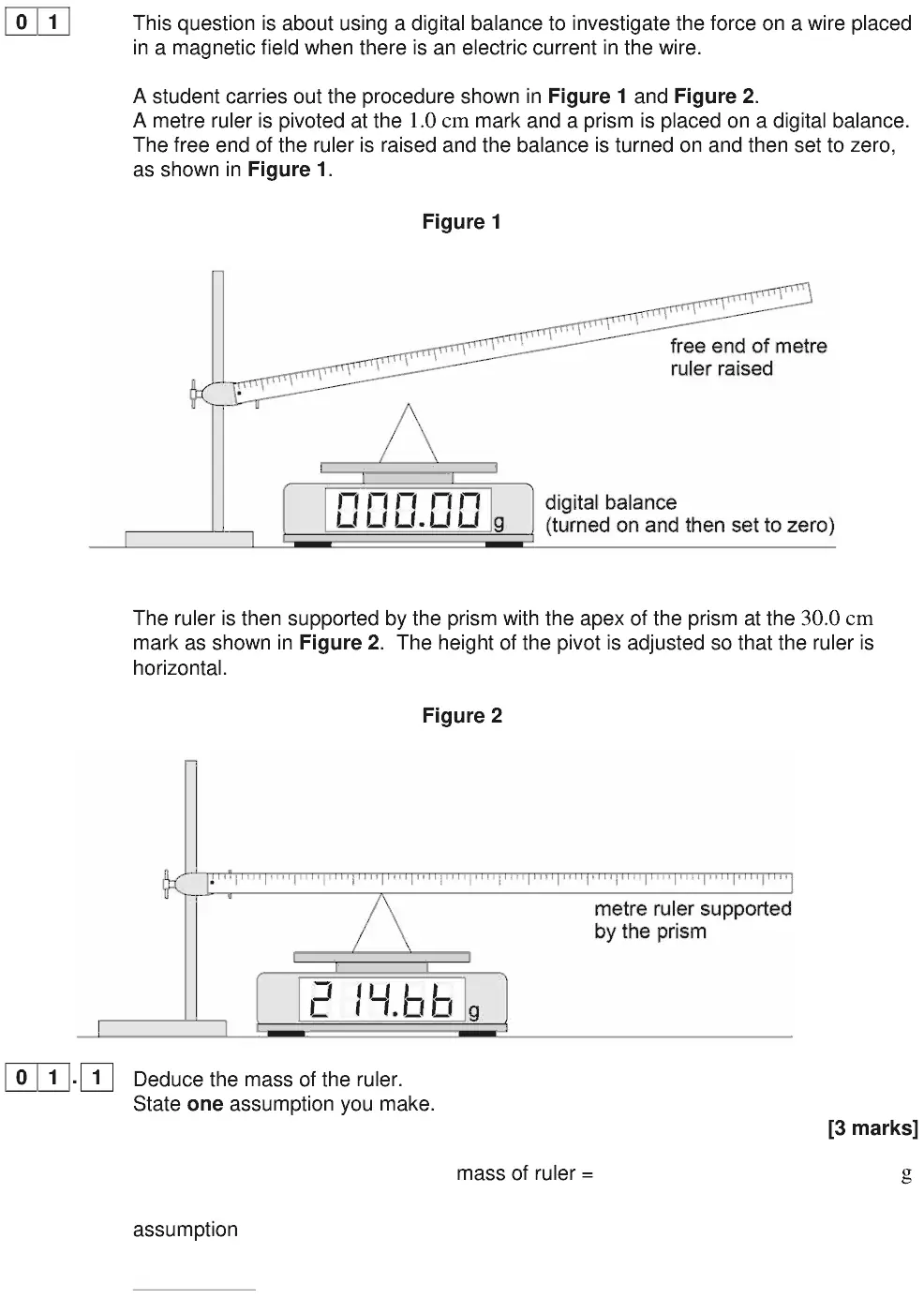
Answer: 127 g (moments about pivot: M x 49 = 214.66 x 29)
assumption ruler uniform / centre of mass at 50 cm mark
'uniform density' or 'in equilibrium' not accepted
rounding to 2 sf lost a mark
Skills: MS2.3 Substitute numerical values into algebraic equations using appropriate units for physical quantities; PS1.1 Solve problems set in practical contexts; RP10 Investigate how the force on a wire varies with flux density, current and length of wire using a top pan balance.
June 2018 · Paper 3 Section A · Q1.43 marksPractical and data analysisHard
Earlier part of question 1 that this part uses
Mark scheme
Examiner's comment
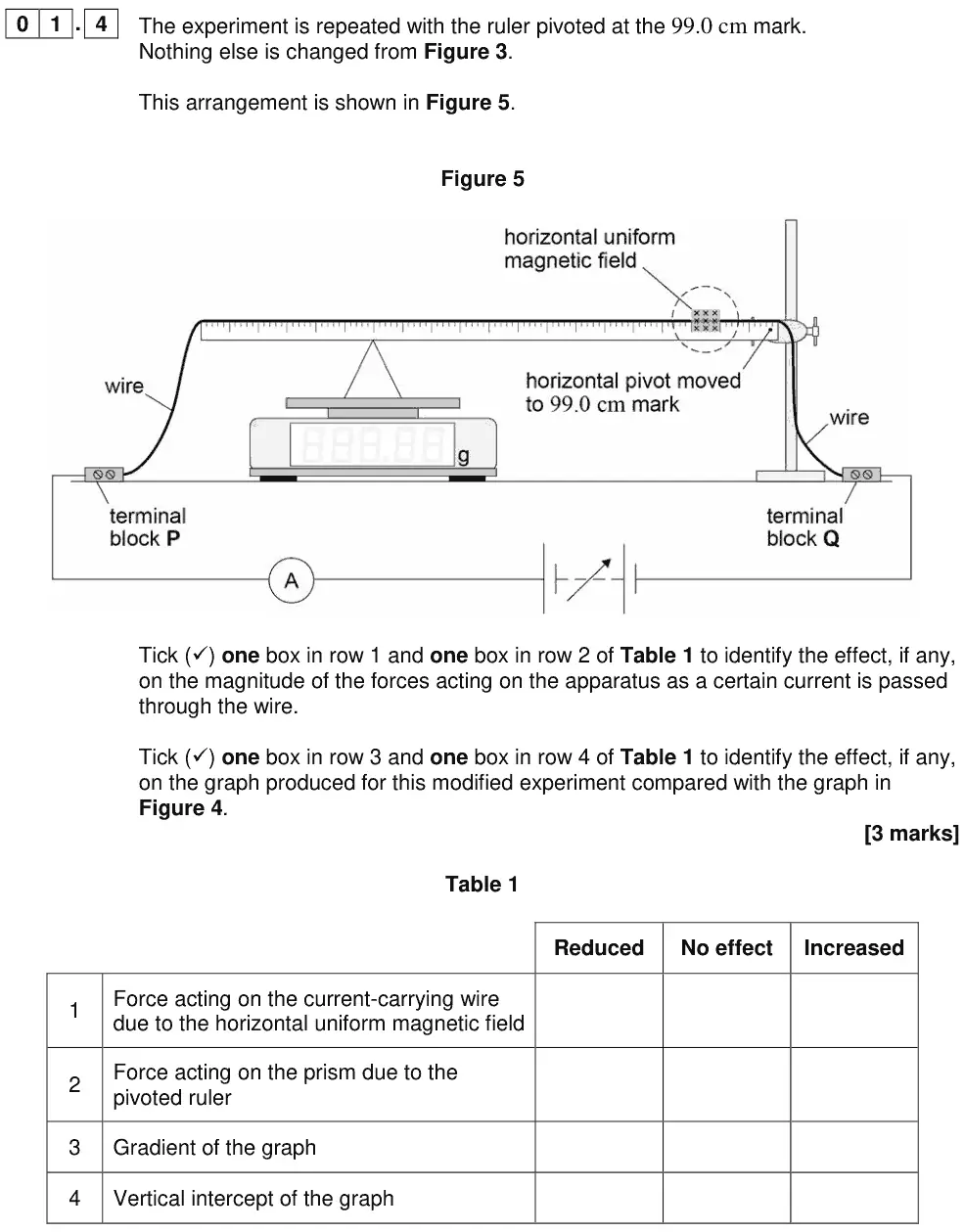
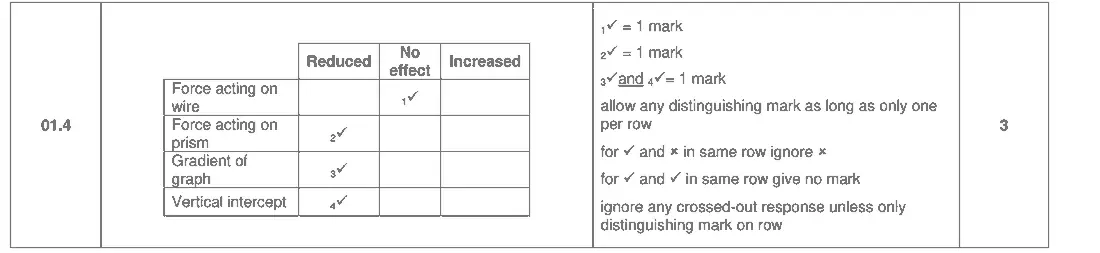
01.4 The first row of Table 1 attracted the most correct responses and thereafter things got patchier. Examiners needed to see correct responses in both row 3 and row 4 to earn the third marking point; this proved beyond all but the most able, with only 11.4% obtaining full credit.
Notes from the mark scheme and report
Row-by-row ticks as the mark scheme (force on wire unchanged
with pivot at 99 cm the lever arms change the force on the prism, gradient and intercept)
rows 3 and 4 both needed for the third mark
Skills: PS1.2 Apply scientific knowledge to practical contexts; RP10 Investigate how the force on a wire varies with flux density, current and length of wire using a top pan balance.
June 2017 · AS Paper 1 · Q3.31 markCalculation
Earlier part of question 3 that this part uses
Mark scheme
Examiner's comment
03.3 Again, it may have been the context of this question that meant that this relatively straightforward calculation was only correctly performed by a minority of students. It may also have been partly due to the fact that only one mark is available and yet there are several opportunities for error, such as missing out ‘g’ and using the wrong trigonometrical function.
Notes from the mark scheme and report
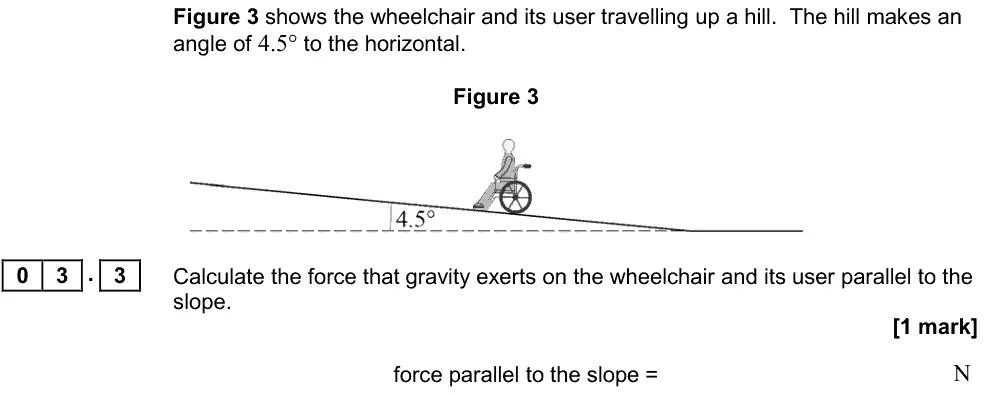
Answer: 92 N (120 x 9.81 x sin 4.5 deg)
omitted g or wrong trig function
only a minority correct
Skills: MS4.5 Use sin, cos and tan in physical problems; MS2.3 Substitute numerical values into algebraic equations using appropriate units for physical quantities
June 2017 · Paper 1 · Q5.11 markShort answer
Mark scheme
Examiner's comment
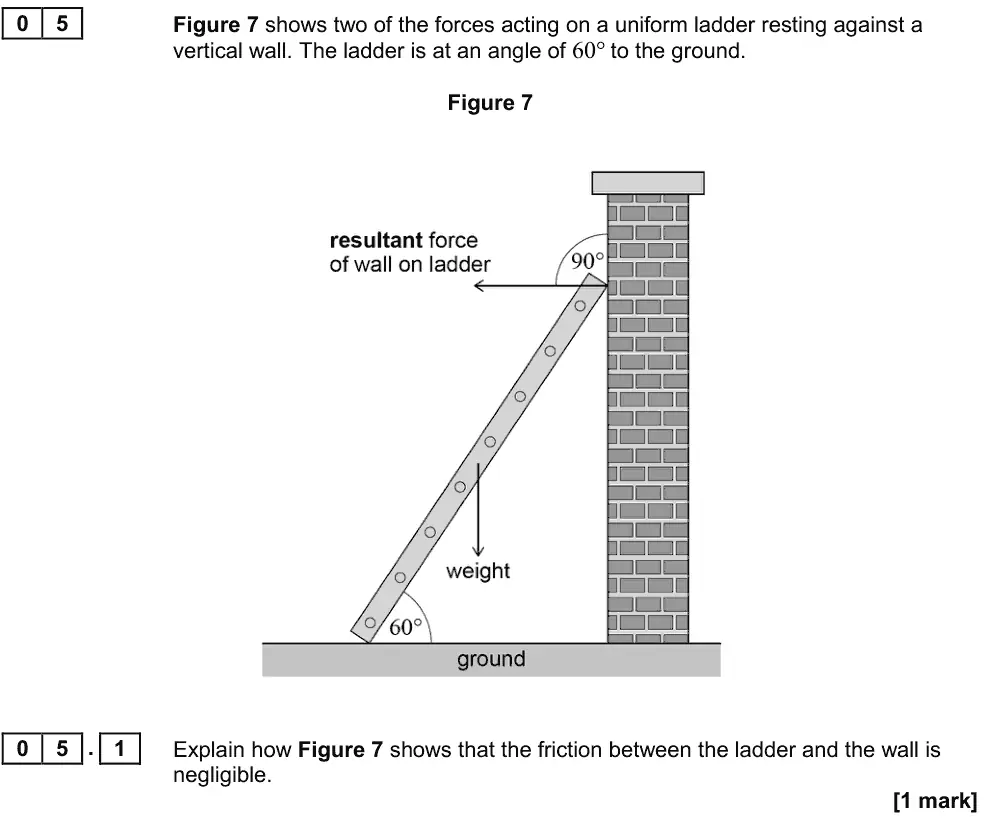
Question 05.1 was generally well answered, with the majority appreciating that friction was negligible because the resultant force was a right angle to the wall.
Notes from the mark scheme and report
Force from the wall is at right angles to the wall, so no component along it
June 2017 · AS Paper 1 · Q5.21 markCalculation
Earlier part of question 5 that this part uses
Mark scheme
Examiner's comment
05.2 This one mark calculation was poorly answered, with few students being able to obtain the correct value for the tension. It may be that many students missed the relevant data or could not picture which forces were needed. It would doubtless have helped some students had they drawn the forces on the diagram provided.
Notes from the mark scheme and report
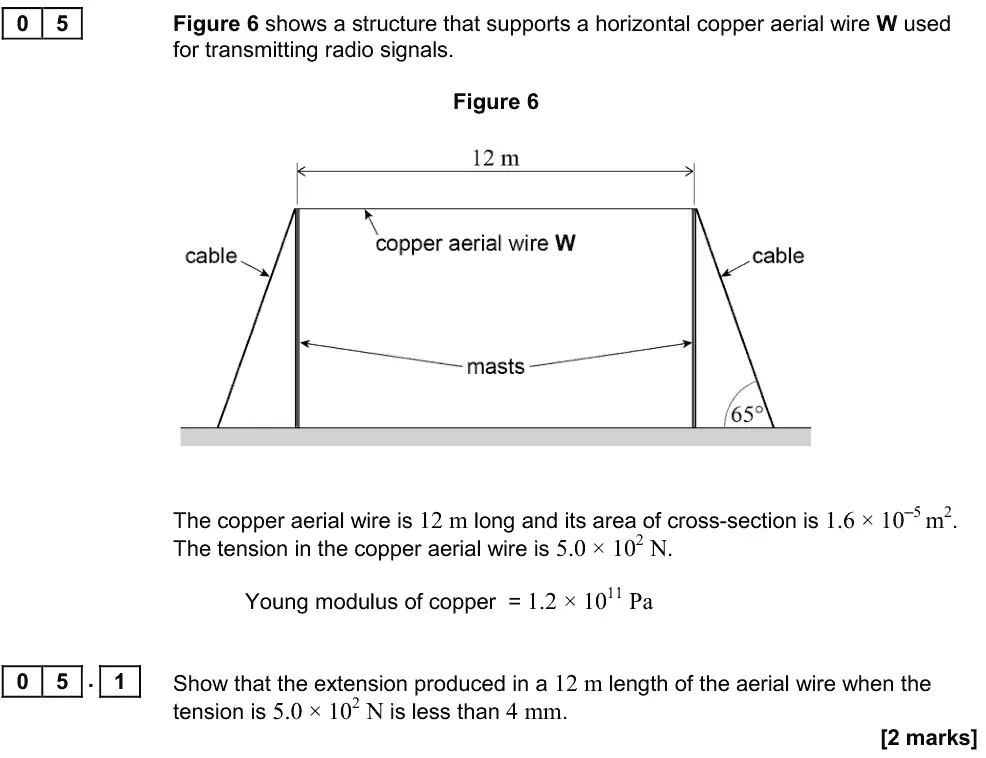
Answer: 1200 N (T cos 65 = 500 N)
poorly answered
Skills: MS4.5 Use sin, cos and tan in physical problems
June 2017 · Paper 1 · Q5.22 marksDiagram or graph
Earlier part of question 5 that this part uses
Mark scheme
Examiner's comment
Question 05.2 was less well done: very few students appreciated that the arrow for force G, the weight and the resultant force from the wall when extended would intersect at one point. G was often drawn vertically upwards or along the ladder; this did score 1 mark providing the arrow started from the point of contact with the ground. The calculation caused problems for over half of the students because they did not appreciate that they had to apply the principle of moments. The last part of the question generated some very good answers with some quite detailed analysis seen. Three-quarters of students were awarded at least two marks. There were some misconceptions such as that the force G decreases as the person climbs the ladder or that the resultant force from the wall only increases when the person is over half-way up the ladder.
Notes from the mark scheme and report
Arrow G from the ground contact point, between ladder and vertical, passing through the intersection of the weight and wall-force lines
vertical or along-the-ladder arrows scored 1
June 2017 · Paper 1 · Q5.32 marksCalculation
Earlier part of question 5 that this part uses
Mark scheme
Notes from the mark scheme and report
Answer: 110 N (113
F x 8.0 sin 60 = 390 x 4.0 cos 60)
over half did not apply moments
Skills: MS4.5 Use sin, cos and tan in physical problems; MS2.2 Change the subject of an equation, including non-linear equations
June 2017 · Paper 1 · Q5.43 marksExplanation
Earlier part of question 5 that this part uses
Mark scheme
Notes from the mark scheme and report
Any 3: vertical reaction from ground increases
direction of G changes
friction at ground increases
force from wall increases
three-quarters scored at least 2
June 2017 · Paper 1 · Q6.11 markDiagram or graph
Mark scheme
Notes from the mark scheme and report
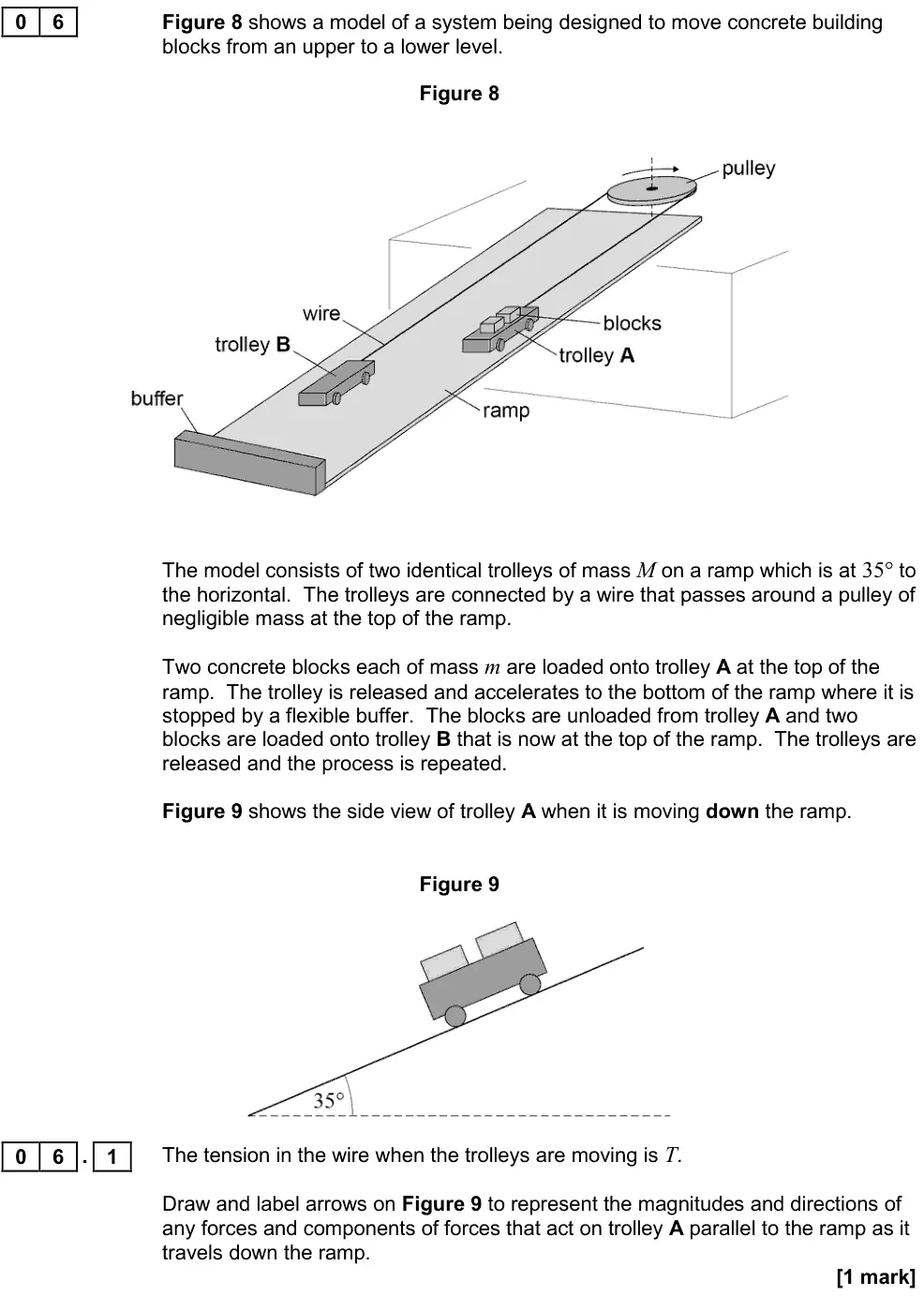
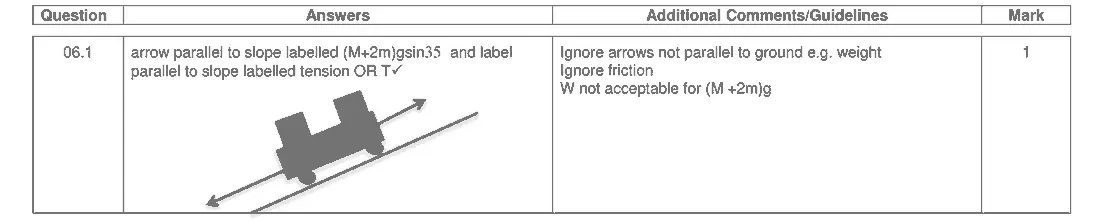
Arrows parallel to the slope: (M + 2m)g sin 35 down the slope and tension T up the slope
W alone not accepted
June 2017 · Paper 1 · Q6.22 marksShow that
Earlier part of question 6 that this part uses
Mark scheme
Examiner's comment
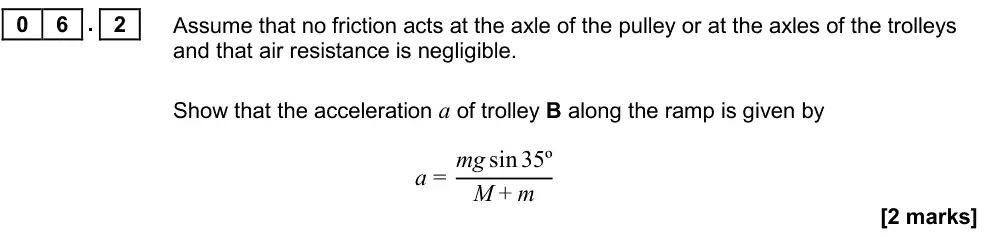
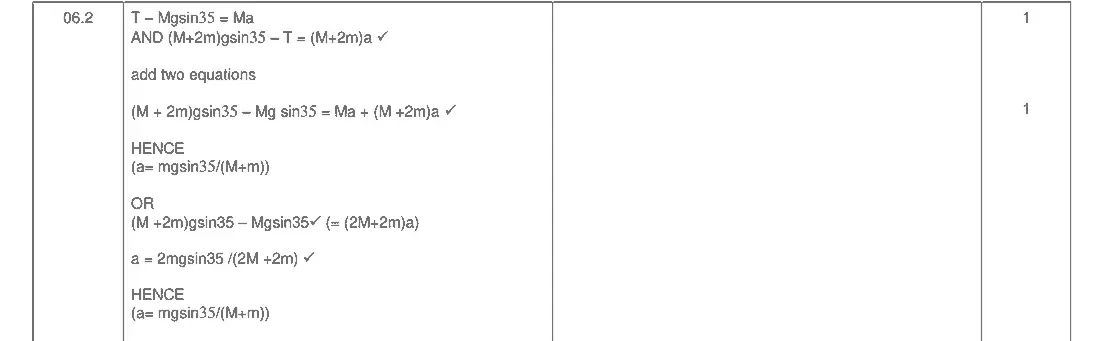
Question 06.2 involved an algebraic derivation of the acceleration of the trolley – this proved quite a challenge for some and responses had to be scrutinised carefully to see if they were valid. Many provided a correct formula for the resultant force on trolley A but then incorrectly stated that the tension was equal to the component of trolley B’s weight along the slope. The more successful answers treated the trollies as a system with a resultant force acting equal to (M+2m) gsin35 – Mgsin35 and a combined mass of 2M +2m.
There was a typographical error in question 6.3 which led candidates to assume that loaded trolley A was being compared with loaded trolley B. The question originally intended to ask students to compare loaded trolley A with unloaded trolley B (as shown in Figure 8). We judged that both interpretations should be allowed and revised the mark scheme to permit the two different approaches. Either approach could achieve 0, 1 or 2 marks according to the accuracy of the answer. Student responses to this question were carefully scrutinised to assess the impact of the typographical error, and there was no evidence that students were unable to generate meaningful responses to this question.
The conclusion mark of how the momenta compared was then conditional on the first mark being awarded. The multi-step calculations in 06.4 and 06.5 were well done, with a high proportion of students scoring at least 3 of the 5 marks available.
Notes from the mark scheme and report
Treat trolleys as one system: resultant (M + 2m)g sin35 - Mg sin35 on mass 2M + 2m
many wrongly set T equal to B's weight component
Skills: MS2.2 Change the subject of an equation, including non-linear equations; MS4.5 Use sin, cos and tan in physical problems
June 2017 · Paper 1 · Q181 markMultiple choice
Answer
A
Notes from the mark scheme and report
Answer: A
June 2017 · AS Paper 2 · Q151 markMultiple choice
Answer
D
Notes from the mark scheme and report
Answer: D
June 2017 · AS Paper 2 · Q161 markMultiple choice
Answer
C
Notes from the mark scheme and report
Answer: C
Skills: MS2.3 Substitute numerical values into algebraic equations using appropriate units for physical quantities
June 2016 · AS Paper 1 · Q1.42 marksExplanation
Earlier part of question 1 that this part uses
Mark scheme
Examiner's comment
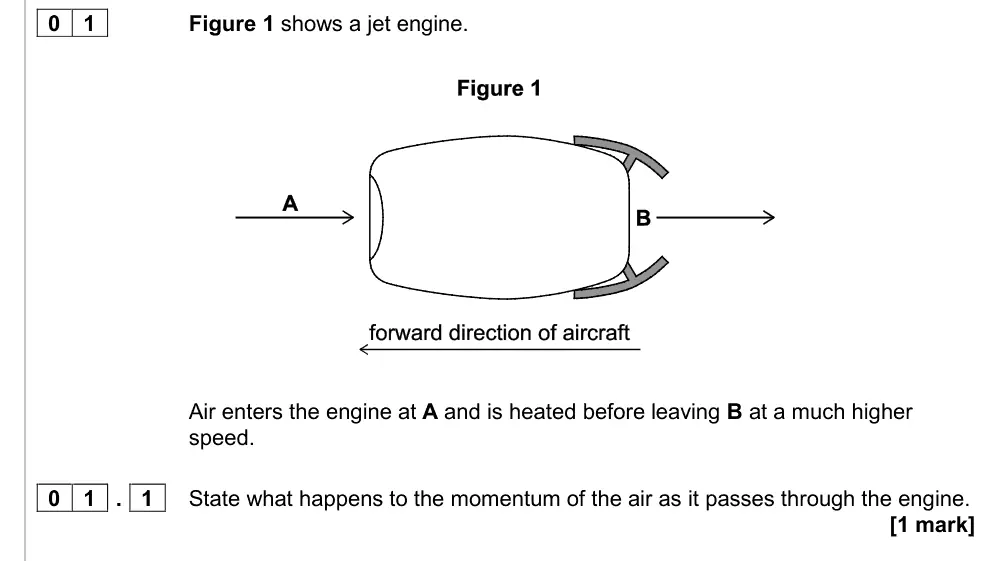
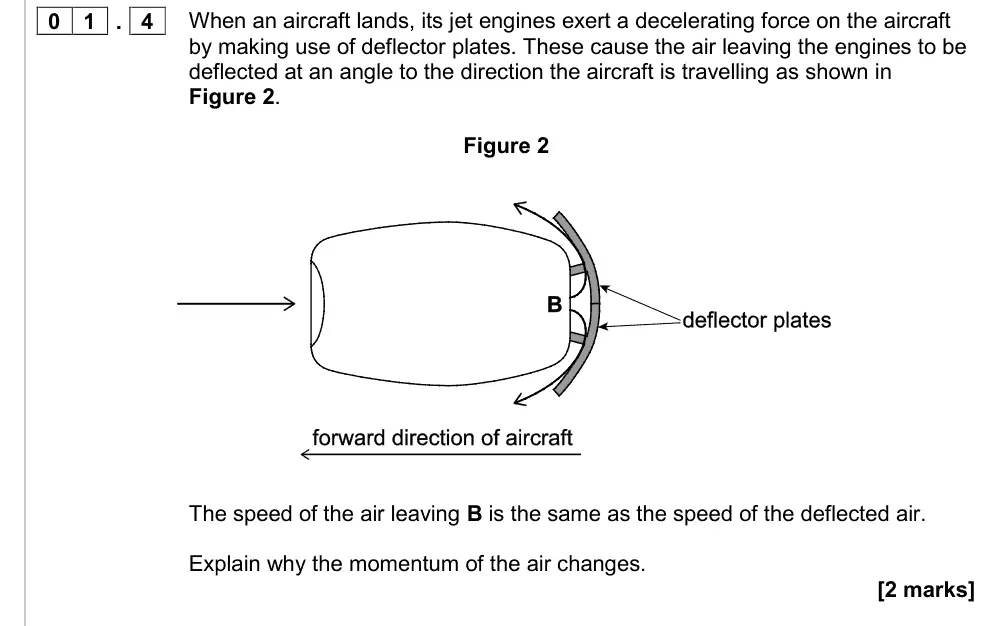
This question required students to apply their knowledge and understanding of mechanics to analyse the principles involved in the operation of a jet engine. Students for the most part were able to apply the appropriate physics ideas in their answers. In question 1.1 the vast majority of students appreciated that momentum increased. Question 1.2 in contrast, resulted in a much greater variation of response. Many students appreciated that Newton’s third law was important here and were able to quote it correctly. However, they did not often produce complete answers, missing out important detail such as the engine exerts a force on the air or that the air exerts a force equal in magnitude on the engine. Weaker responses tended to try and involve air resistance in their explanations of why there was a forward force acting on the engine. The calculations required to answer questions 1.3, 1.5 and 1.6 were well done with full credit being commonly achieved. The only major mistake seen in question 1.6 was confusion between initial velocity and final velocity. Question 1.4 required an explanation of why the momentum had changed when the deflector plates were deployed. The majority of students did appreciate this was because the direction of the air’s velocity had changed but did not then give a full answer by explaining that momentum and velocity are vector quantities. Question 1.7 was quite challenging and only the strongest responses were able to suggest that this might be due to the decrease in the mass of air entering the engine per second.
Notes from the mark scheme and report
Momentum (velocity) is a vector and the air's direction changes, so momentum changes even at the same speed
vector point often omitted
Specimen set 1 · Paper 1 · Q191 markMultiple choice
Answer
D
Notes from the mark scheme and report
Answer: D (resultant must be between 4 N and 16 N)
Specimen set 1 · Paper 1 · Q201 markMultiple choice
Answer
B
Notes from the mark scheme and report
Answer: B (moment 160 N m = 500 N x l)
Skills: MS2.2 Change the subject of an equation, including non-linear equations
June 2016 · AS Paper 2 · Q3.23 marksCalculation
Earlier part of question 3 that this part uses
Mark scheme
Examiner's comment
3.2. There were two potential errors in answers that often led students to lose at least one mark. Many students did not take the centre of mass of the ball into account, and therefore did not include the radius when calculating the distance to the pivot. Some students worked through their answers in cm, but wrote the moment unit as Nm. 3.3 Many good answers were seen to this multi-step calculation and this was a good discriminator. Some students were unable to suggest much beyond picking F=5 N and rearranging F = k∆l (given on the data sheet) to produce ∆l = 0.05 m. Spotting that this was a 3 mark question may have led some of them to realise that a more complicated calculation was needed. Others tried to calculate the extension by dividing turning moment by stiffness or by multiplying distance from the pivot by stiffness. A number of students did not attempt this question.
Notes from the mark scheme and report
Answer: 0.75 N m (distance to pivot 0.120 + 0.025 = 0.145 m to the ball's centre)
unit must match (not 'nm' or N m for cm working)
Skills: MS2.3 Substitute numerical values into algebraic equations using appropriate units for physical quantities; MS0.1 Recognise and make use of appropriate units in calculations
June 2016 · AS Paper 2 · Q3.33 marksCalculation
Earlier part of question 3 that this part uses
Mark scheme
Examiner's comment
3.2. There were two potential errors in answers that often led students to lose at least one mark. Many students did not take the centre of mass of the ball into account, and therefore did not include the radius when calculating the distance to the pivot. Some students worked through their answers in cm, but wrote the moment unit as Nm. 3.3 Many good answers were seen to this multi-step calculation and this was a good discriminator. Some students were unable to suggest much beyond picking F=5 N and rearranging F = k∆l (given on the data sheet) to produce ∆l = 0.05 m. Spotting that this was a 3 mark question may have led some of them to realise that a more complicated calculation was needed. Others tried to calculate the extension by dividing turning moment by stiffness or by multiplying distance from the pivot by stiffness. A number of students did not attempt this question.
Notes from the mark scheme and report
Answer: 0.094 m (moments: F x 0.080 = 0.75 so F = 9.4 N
delta L = F/k with k = 100 N m^-1)
using 5 N directly in F = k delta L was common
Skills: MS2.2 Change the subject of an equation, including non-linear equations; MS2.3 Substitute numerical values into algebraic equations using appropriate units for physical quantities
June 2016 · AS Paper 2 · Q181 markMultiple choiceEasy
Answer
C
Examiner's comment
18 Surprisingly the most popular distractor here was B, perhaps highlighting students’ confusion with mass and weight. 70% were able to identify the correct answer.
Notes from the mark scheme and report
Answer: C
B (weight) the main distractor
Work with an AQA physics tutor
Dropping marks on calculations, required practicals or the six-markers? Book a trial session with a specialist AQA physics tutor.