Notes and key-term cards for this topic are being written by our tutors. The past-paper questions below are ready now.
Specification statements
Show the 19 statements from the specification
3.12.2.1-01 Comparison with Huygens’ wave theory in general terms.
3.12.2.1-02 The reasons why Newton’s theory was preferred.
3.12.2.2-01 Explanation for fringes in general terms, no calculations are expected.
3.12.2.2-02 Delayed acceptance of Huygens’ wave theory of light.
3.12.2.3-01 Nature of electromagnetic waves.
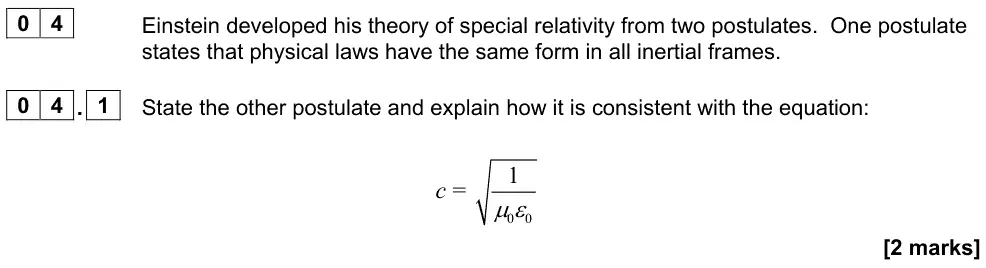
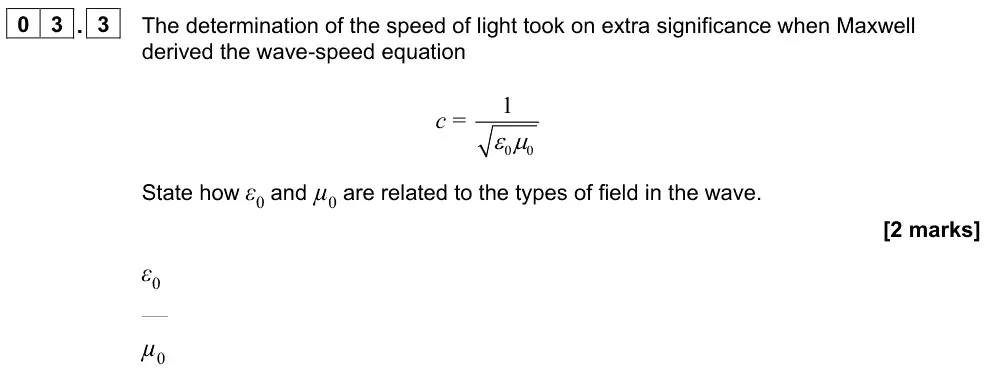
3.12.2.3-02 Maxwell’s formula for the speed of electromagnetic waves in a vacuum c = μ0ε0 1
3.12.2.3-03 where μ0 is the permeability of free space and ε0 is the permittivity of free space.
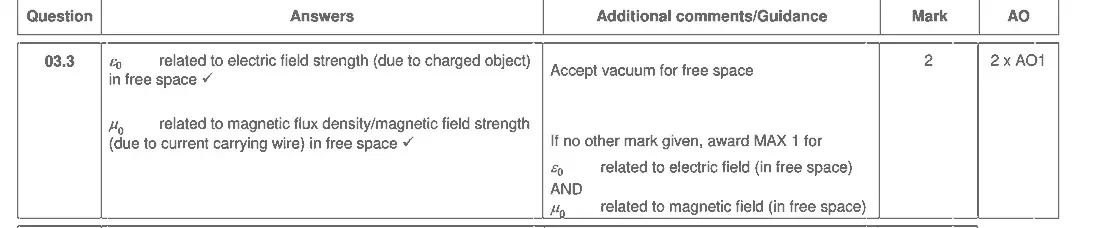
3.12.2.3-04 Students should appreciate that ε0 relates to the electric field strength due to a charged object in free space and μ0 relates to the magnetic flux density due to a current-carrying wire in free space.
3.12.2.3-05 Hertz’s discovery of radio waves including measurements of the speed of radio waves.
3.12.2.3-06 Fizeau’s determination of the speed of light and its implications.
3.12.2.4-01 The ultraviolet catastrophe and black-body radiation.
3.12.2.4-02 Planck’s interpretation in terms of quanta.
3.12.2.4-03 The failure of classical wave theory to explain observations on photoelectricity.
3.12.2.4-04 Einstein’s explanation of photoelectricity and its significance in terms of the nature of electromagnetic radiation.
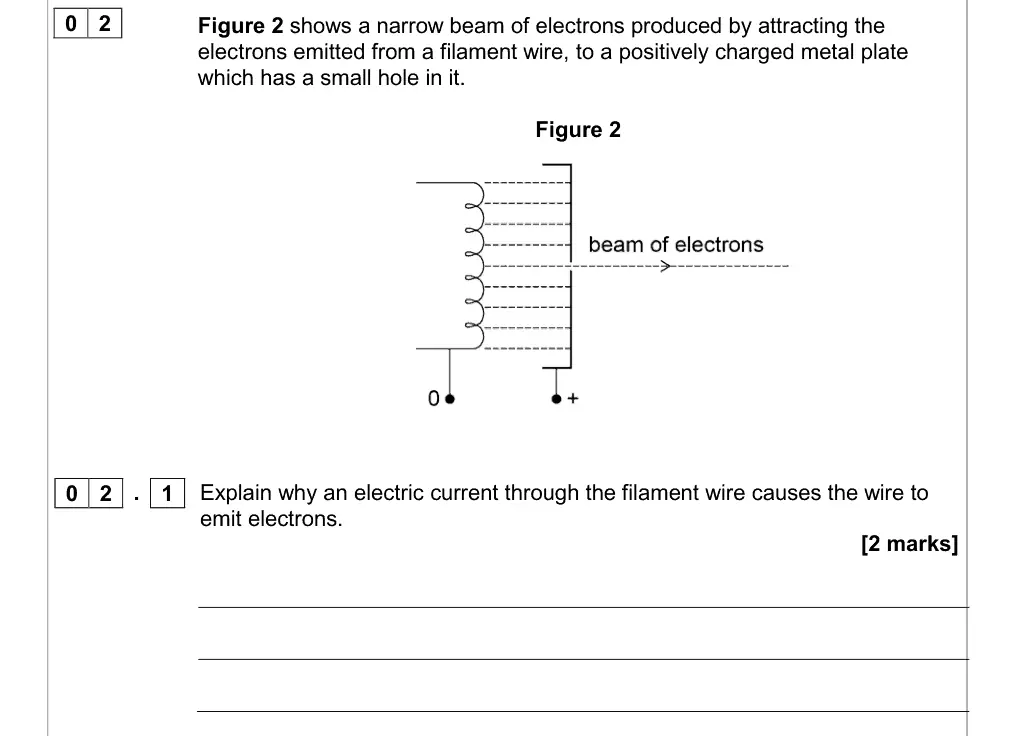
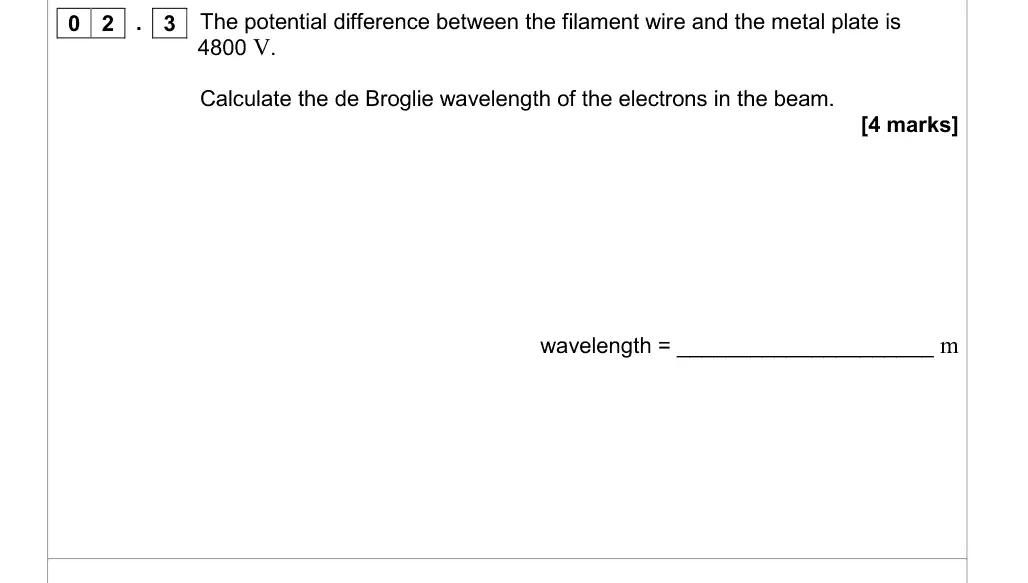
3.12.2.5-01 de Broglie’s hypothesis: p = h λ ; λ = 2meV h
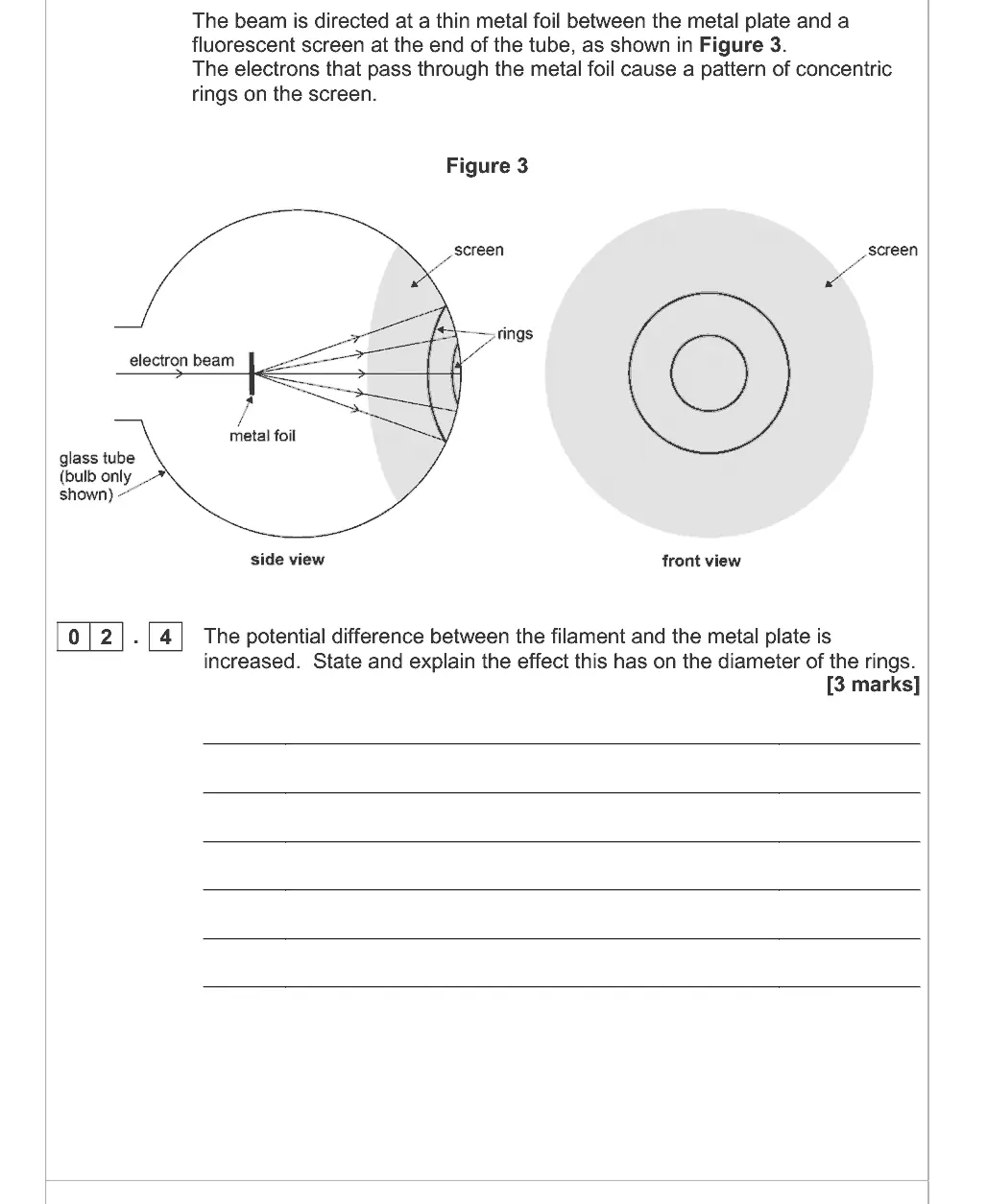
3.12.2.5-02 Low-energy electron diffraction experiments; qualitative explanation of the effect of a change of electron speed on the diffraction pattern.
3.12.2.6-01 Estimate of anode voltage needed to produce wavelengths of the order of the size of the atom.
3.12.2.6-02 Principle of operation of the transmission electron microscope (TEM).
3.12.2.6-03 Principle of operation of the scanning tunnelling microscope (STM).
Six-mark extended response questions on this topic
Tap a question to zoom it. Where a part needs a figure, table or graph from earlier in the question, that part folds out above it; the mark scheme and examiner's comment open underneath. Have the AQA data and formulae booklet beside you (see the formula sheet page).
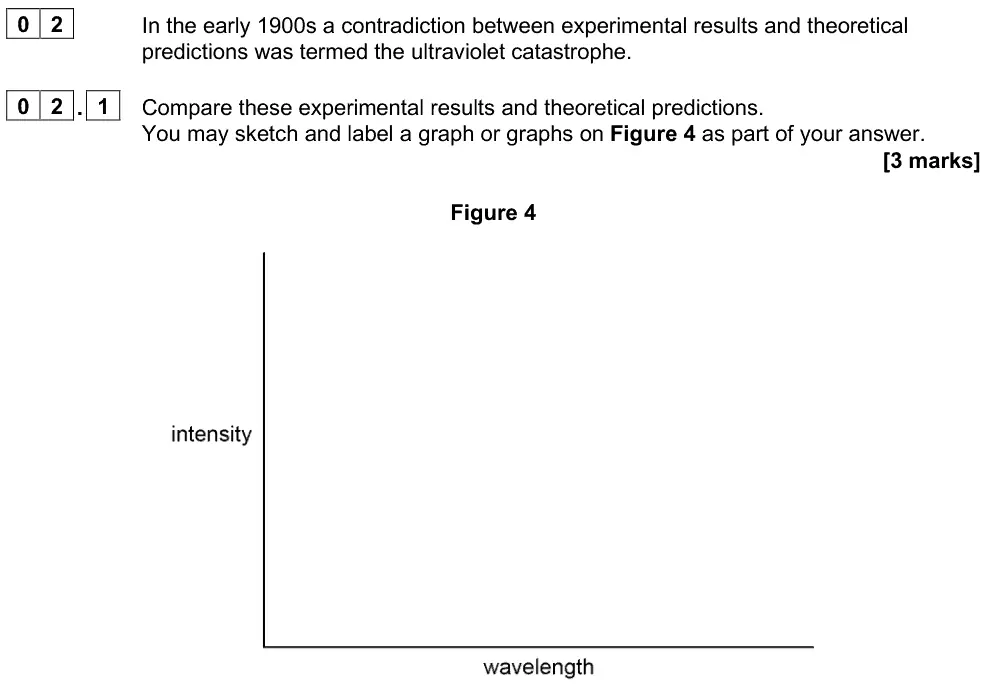
June 2025 · Paper 3B Turning points · Q2.13 marksAO1=3Explanation
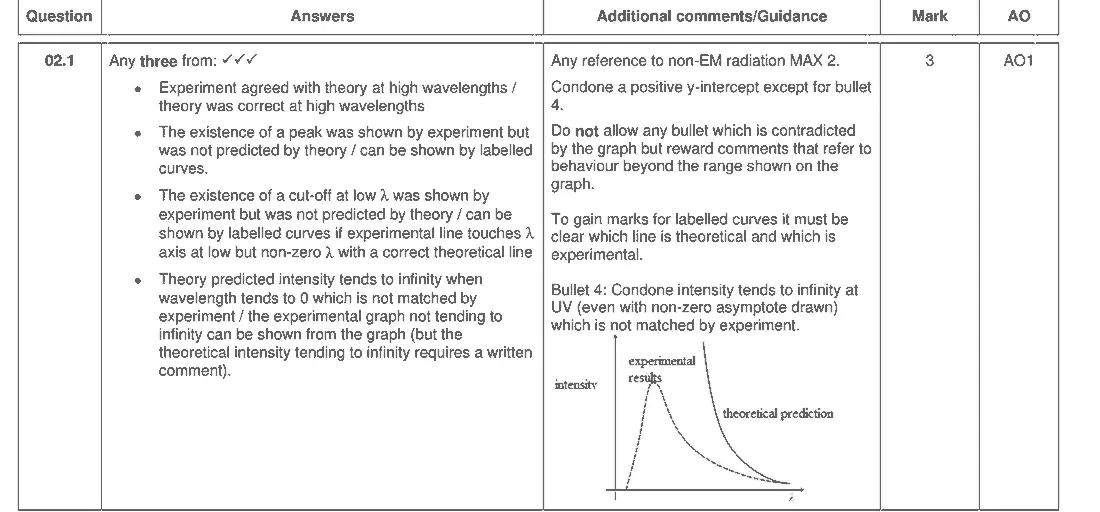
Mark scheme
Examiner's comment
02.1 Many students were familiar with the ultraviolet catastrophe with around two thirds scoring one mark and around a third gaining two marks. However, only a small number were able to score full marks. While marks could be gained from a labelled graph or the written explanation, some points required some written description to clarify. Unlabelled graphs could not gain credit and were ignored.
Most students were able to draw the experimental curve with its peak and the theoretical prediction without a peak.
The next most common mark was for a description that, in the theoretical prediction, the intensity tended to infinity as wavelength tended to zero and that this was not matched by the experimental results. Answers referring to “tending to infinity at UV wavelengths” were condoned. However, a common misconception was that the intensity tended to infinity as the temperature was increased, rather than as wavelength tends to zero at all temperatures. As students were asked to plot a graph of intensity against wavelength, in order to gain the mark students had to refer to the intensity, rather than other quantities.
Few students stated that the experiment agreed with theory at long wavelengths, although some talked about them being similar at long wavelengths which was not enough to gain the mark. This mark could only be gained from the written description. Only a very small number of students knew that the intensity dropped to zero below a certain wavelength (which was not predicted by theory). Most graphs intercepted the intensity axis, stopped before meeting either axis, or passed through the origin, rather than meeting the wavelength axis at a positive value.
Notes from the mark scheme and report
Experiment agrees with theory at long wavelengths
experiment shows a peak and a cut-off at short wavelength, theory predicts intensity tending to infinity as wavelength tends to zero
curves must be labelled
few gained 3
Skills: MS3.1 Translate information between graphical, numerical and algebraic forms
June 2025 · Paper 3B Turning points · Q2.21 markAO1=1Short answer
Earlier part of question 2 that this part uses
Mark scheme
Examiner's comment
02.2 While most students were familiar with the idea of quantisation, most answers failed to give enough detail for the mark, most commonly missing out the reference to energy being Planck’s original 𝑛𝑛ℎ𝑓𝑓. proportional to frequency or an equivalent. It was pleasing to see some students quote
Students who mixed up Planck’s and Einstein’s contribution and referred to photons or the photoelectric effect were not able to gain this mark.
Notes from the mark scheme and report
Planck: radiation emitted in quanta with energy proportional to frequency (E = nhf)
'photons' or photoelectric references not accepted
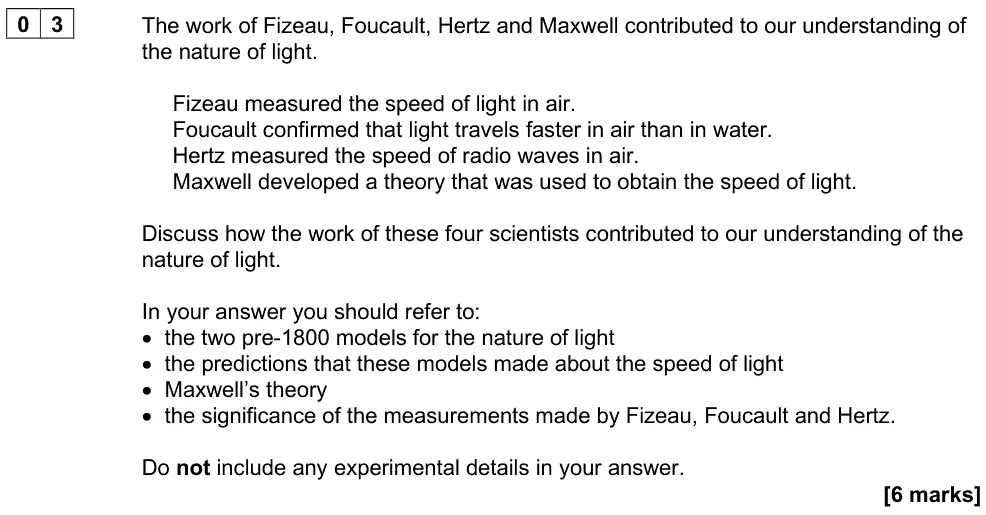
June 2025 · Paper 3B Turning points · Q36 marksAO1=4, AO2=26-mark extended response
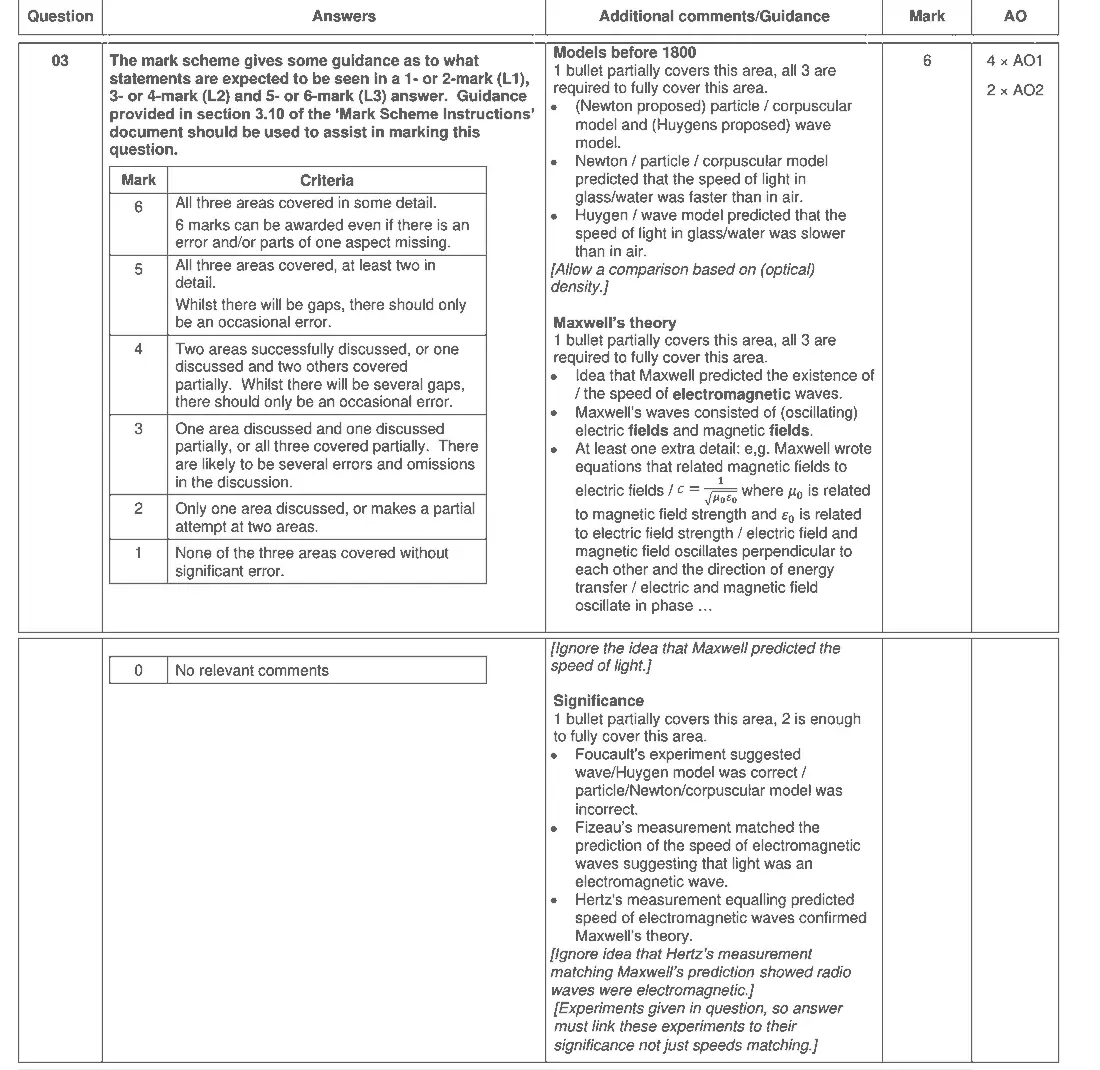
Mark scheme, with the levels and indicative content
Examiner's comment
The levels of response question was generally more accessible than in previous years, with some excellent answers seen. Most students were able to make good progress with around 60% scoring at least 3 marks. The question still discriminated well. Many, but not all, students seemed familiar with the concepts. This question brought together different experiments concerning the speed of light and asked students what the significance of these measurements was. Most students were able to gain 3 marks by: stating that Newton’s corpuscular theory predicted that light was faster in water than • in air stating that Huygen’s wave theory predicted that light was faster in air than in water • commenting that Foucault’s experiment demonstrated Newton was wrong or Huygen • was correct. Students were not expected to be familiar with the work of Foucault, with the relevant information being given in the question, but were expected to apply their knowledge of Newton and Huygen’s work to realise its significance. Most students were able to do this.
Many students were able to go on to give some details about Maxwell’s theory of electromagnetism, although most did not provide enough information to fully address this area. A minority of students did not mention the electromagnetic nature of Maxwell’s theories and stated that he predicted the speed of light, rather than the speed of electromagnetic waves.
Many students were also able to go on to express the idea that Fizeau’s measurement of the speed of light matching Maxwell’s prediction for the speed of electromagnetic waves, suggested that light was an electromagnetic wave. However, the vast majority of students did not realise the significance of Hertz’s measurement of the speed of radio waves, incorrectly stating that this proved radio waves were electromagnetic. Hertz had already established the nature of radio waves as electromagnetic through his other experiments. His measurement confirmed that Maxwell had correctly predicted the speed of electromagnetic waves.
The following were commonly seen but did not gain credit, although their inclusion was not penalised but ignored: Repeating information from the question or formulae sheet (e.g. just quoting 𝑐𝑐= 1 ඥ𝜀𝜀0𝜇𝜇0 and stating the names of 𝜀𝜀0 and 𝜇𝜇0 from formulae sheet, or repeating what Fizeau, • Foucault and Hertz did). Giving details about how the experiments were done. The question said, “Do not • include any experimental details in your answer.” Referring to other experiments performed by others (e.g. Young’s double slits) or by • the scientists named in the question (e.g. Hertz’s other experiments with radio waves). Giving more details of Newton’s and Huygen’s theories (e.g. how they explained • refraction).
A small minority mixed up Einstein’s photon model of light with Newton’s corpuscular theory of light, with many incorrectly thinking Einstein lived prior to 1800. Other common misunderstandings were suggesting that some or all of these experiments or scientists thought that the speed of light was invariant and attempting to link them to relativity. While the concept of an invariant speed of light is consistent with and could be implied by Maxwell’s formula, this was not a view that was expressed prior to Einstein’s paper on special relativity.
Notes from the mark scheme and report
Levels of response: Newton (corpuscles, faster in water) vs Huygens (waves, slower in water)
Maxwell predicted speed of EM waves of oscillating E and B fields
Foucault supported waves, Fizeau's value matched Maxwell so light is EM, Hertz's radio wave speed confirmed Maxwell's theory - most wrongly said Hertz showed radio waves were EM
June 2024 · Paper 3B Turning points · Q35 marksAO1=5Explanation
Mark scheme
Examiner's comment
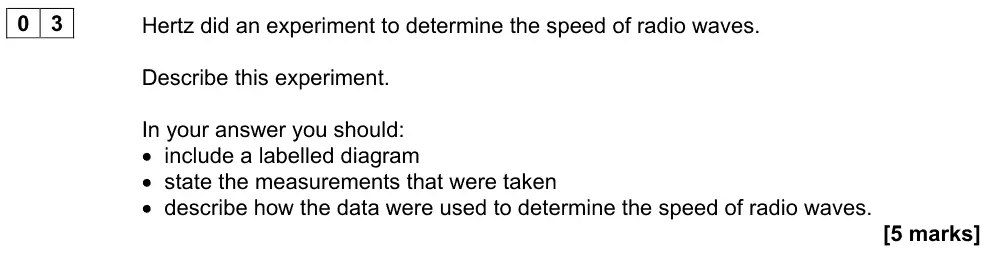
Question 3 was about Hertz’s determination of the speed of radio waves. While many students were familiar with this experiment, there was a large number of students who did not seem to know how Hertz was able to make this measurement. Some of these students were able to gain a mark for describing or naming the equipment Hertz used to create and detect radio waves. These students were obviously familiar with Hertz’s work but did not know how he measured the speed.
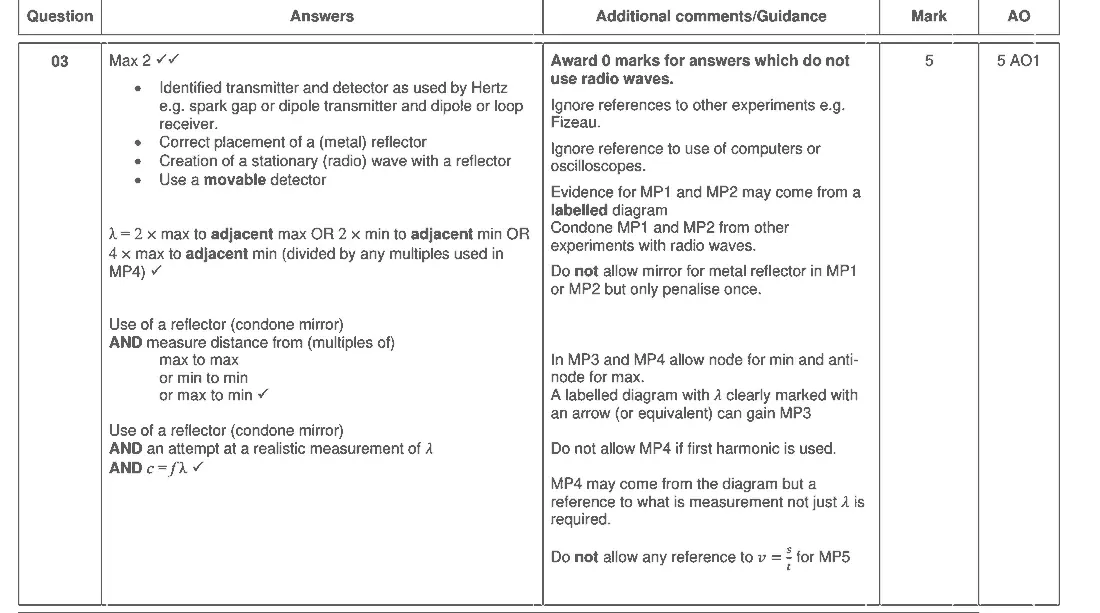
There were two marks for describing Hertz’s experimental setup; generally students who were familiar with Hertz’s work were able to score here. Common mistakes were calling the reflector a mirror or placing the reflector between the transmitter and the detector. As Hertz did many experiments over a number of years, any reference to equipment that could have been used by Hertz was credited here, with either a spark-gap transmitter or a dipole aerial used to create radio waves and a dipole aerial or loop with a small gap used to detect radio waves being accepted. This detail could be provided in a labelled diagram or the text.
The method marks were more challenging although many who knew the experiment were able to gain three marks. In order to score here, there had to be a setup which could allow the measurements to be made. So, answers which did not include some form of reflector could only score the third marking point since maxima and minima did not exist and could not therefore be measured. The third marking point was for correctly identifying the wavelength; in this case answers had to refer to the distance between adjacent nodes, not just nodes. The fourth marking point was for establishing what was measured; many students missed this point by just describing a detection of the maxima and minima but not measuring the distance between them. The last mark was only awarded when there was an experimental setup which allowed the wavelength to determined. This did not need to be described in detail for this mark and answers which failed to score either the third or fourth marking point could gain this mark if the correct experiment could be identified but was poorly described.
Some answers required a measurement of the radio wave intensity at the transmitter and reflector, which is impossible due to the size of the equipment given. Answers of this type, including those which stated that the first harmonic was used, were not able to gain the fourth marking point, since this referred to the measurements made, but were able to access the other four marking points.
Those students who attempted to measure the distance between the transmitter and the time delay between sparks being produced by the transmitter and receiver did not score any of the last three marks.
Some students were aware that stationary waves were involved but described waves on a string. These were not able to gain credit; only answers which involved radio waves were able to score.
Some students did attempt to describe a different experiment to determine the speed of light. That did not score here. This part of the specification is about historical experiments and so setups which were able to measure the speed of radio waves were only able to score marks where they described situations that were accessible to Hertz. References to data logging, computers and oscilloscopes did not gain credit, although they did not prevent marks being scored in the rest of the answer.
Notes from the mark scheme and report
Spark-gap/dipole transmitter, metal reflector to form stationary radio waves, movable detector
measure distance between adjacent maxima (or minima), wavelength = 2 x that, c = f lambda
'mirror' for reflector and v = s/t timing methods not credited
many did not know the method
June 2023 · Paper 3B Turning points · Q1.33 marksAO3=3Explanation
Earlier part of question 1 that this part uses
Mark scheme
Examiner's comment
01.3
Notes from the mark scheme and report
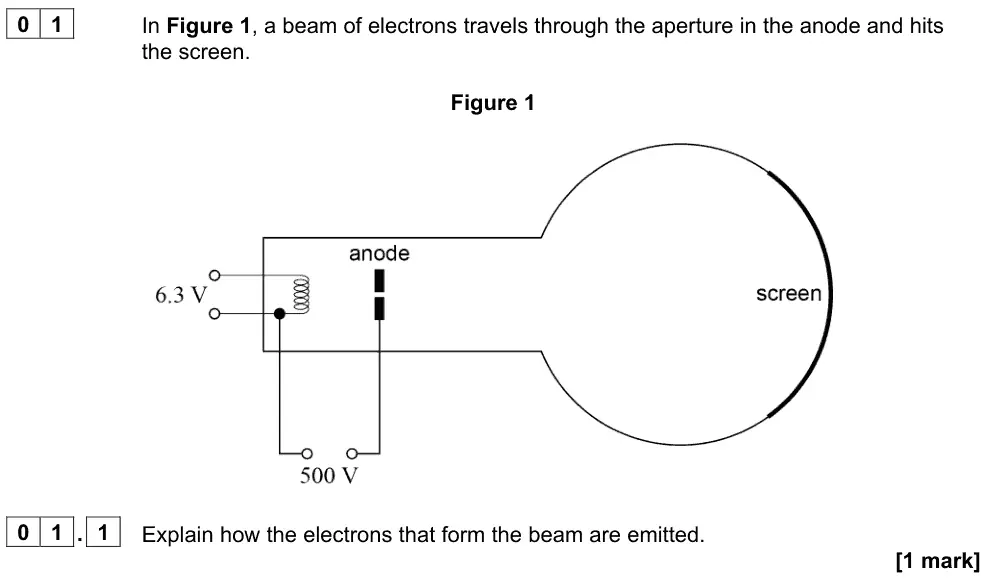
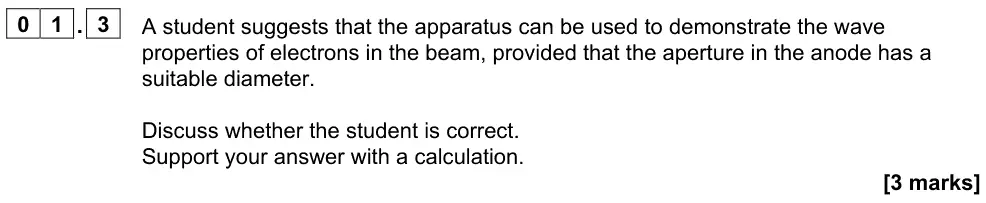
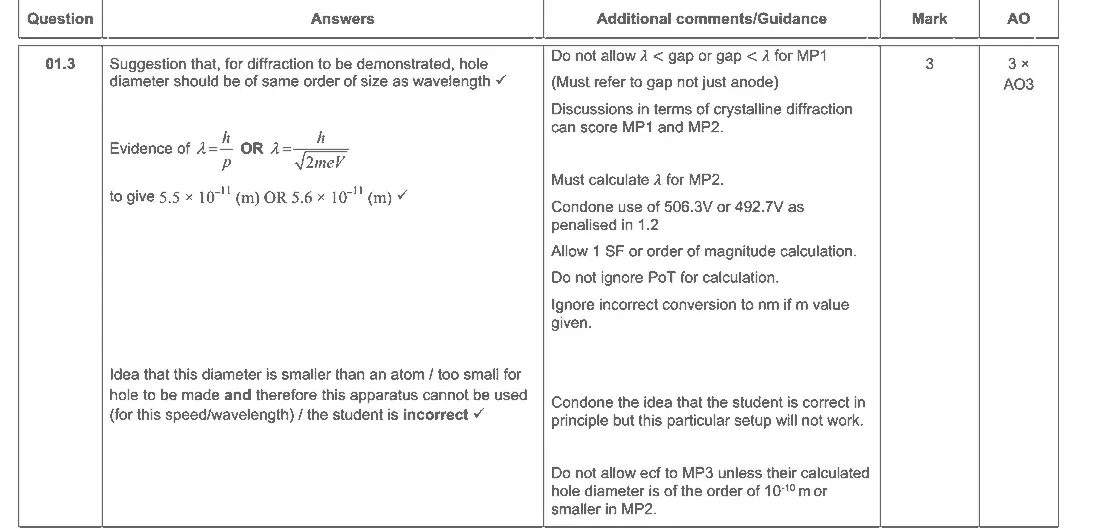
Answer: wavelength 5.5 x 10^-11 m
aperture would need to be of the order of the wavelength, smaller than an atom, so impossible - student incorrect for this set-up
Skills: MS2.3 Substitute numerical values into algebraic equations using appropriate units for physical quantities; MS1.4 Make order of magnitude calculations
June 2023 · Paper 3B Turning points · Q3.11 markAO1=1Diagram or graph
Mark scheme
Examiner's comment
03.1
Notes from the mark scheme and report
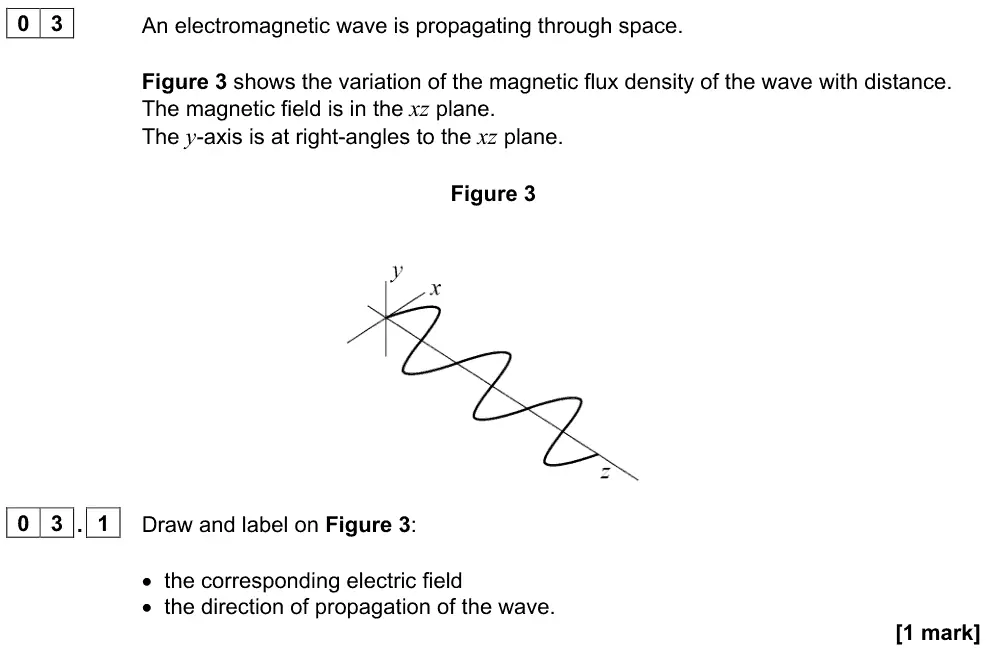
Sinusoidal E field in the vertical plane, in phase with B, plus direction of propagation perpendicular to both
both needed for the mark
Skills: MS4.2 Visualise and represent 2D and 3D forms including two- dimensional representations of 3D objects
June 2023 · Paper 3B Turning points · Q3.21 markAO1=1Short answer
Earlier part of question 3 that this part uses
Mark scheme
Examiner's comment
03.2
Notes from the mark scheme and report
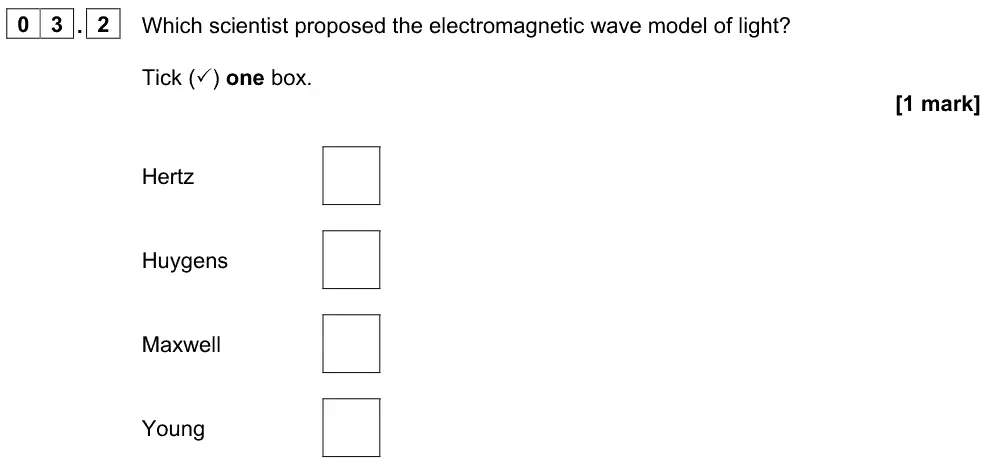
Maxwell only
June 2023 · Paper 3B Turning points · Q3.33 marksAO1=2, AO2=1Explanation
Earlier part of question 3 that this part uses
Mark scheme
Examiner's comment
03.3
Notes from the mark scheme and report
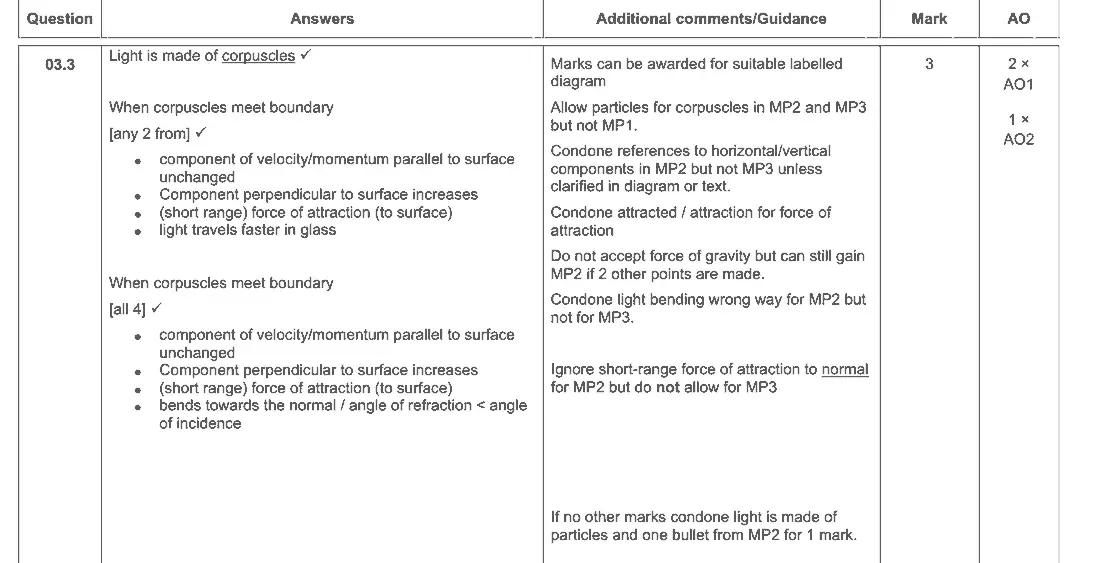
Corpuscles
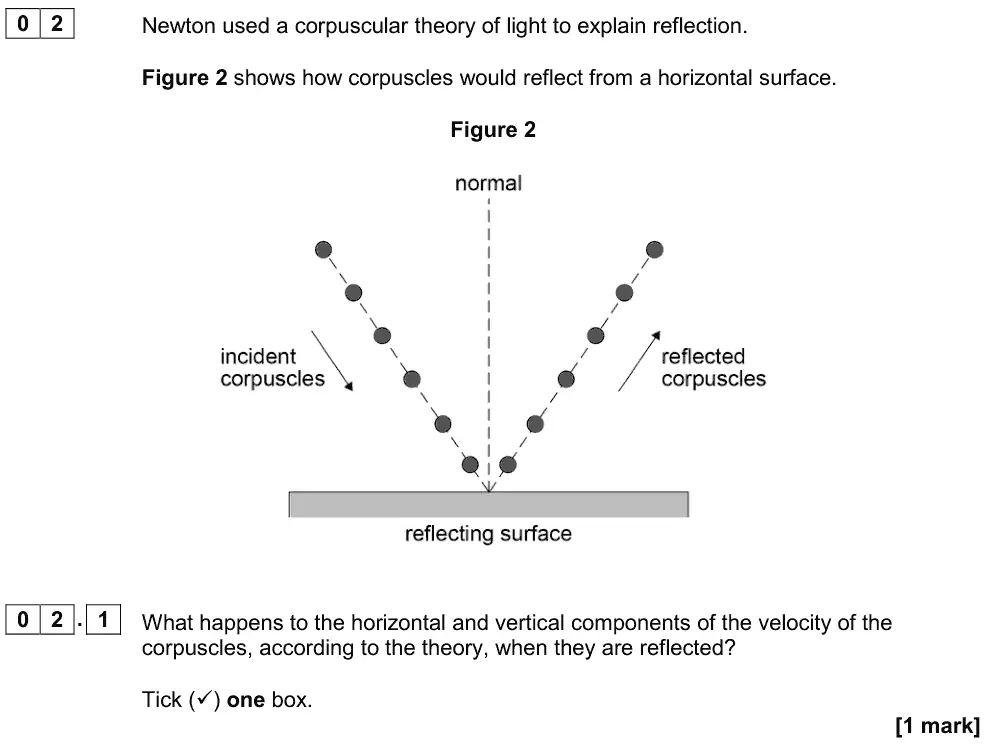
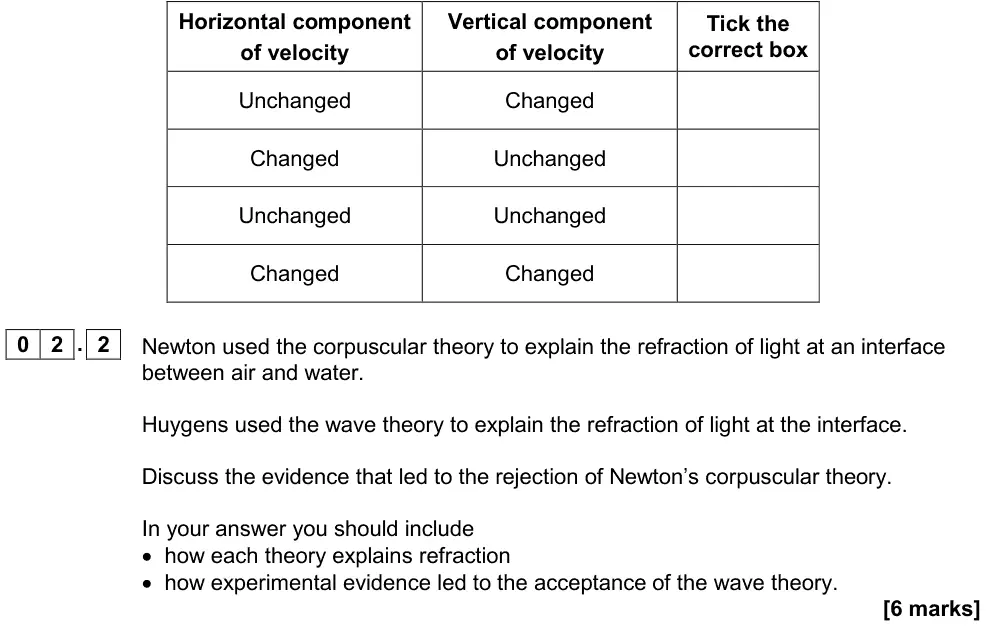
on meeting the surface the parallel velocity component is unchanged and the perpendicular component increases due to a short-range attraction, so light bends towards the normal and travels faster in glass
gravity not accepted
June 2023 · Paper 3B Turning points · Q3.43 marksAO1=2, AO3=1Explanation
Earlier part of question 3 that this part uses
Mark scheme
Examiner's comment
03.4
Notes from the mark scheme and report
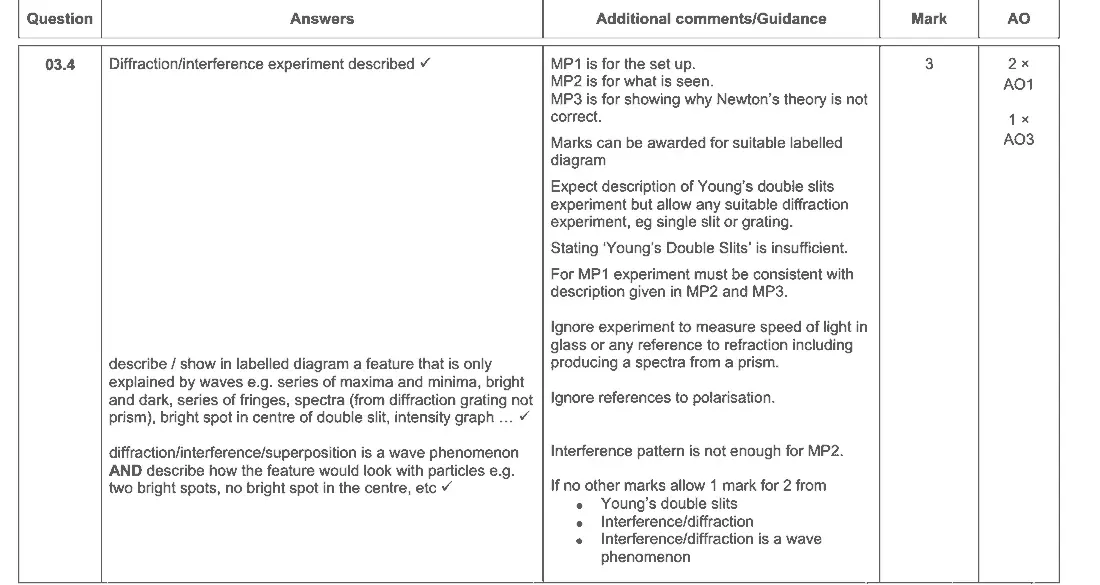
Set-up (e.g. Young's double slits), what is seen (series of bright and dark fringes), and why: interference is a wave effect, corpuscles would give two bright spots
'Young's double slits' or 'interference pattern' alone not enough
refraction/prism ignored
June 2023 · Paper 3B Turning points · Q4.12 marksAO1=1, AO3=1Explanation
Mark scheme
Examiner's comment
04.1
Notes from the mark scheme and report
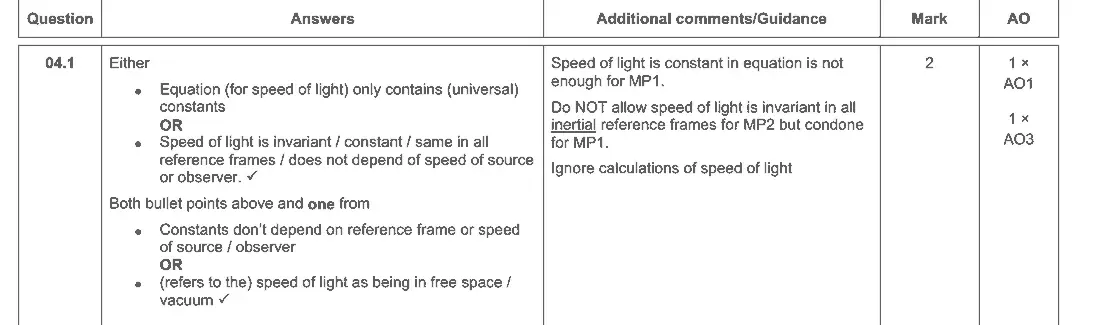
Speed of light in free space is invariant
equation contains only universal constants which do not depend on the frame of reference or speed of source/observer
June 2022 · Paper 3B Turning points · Q1.12 marksAO1=1, AO2=1Explanation
Mark scheme
Examiner's comment
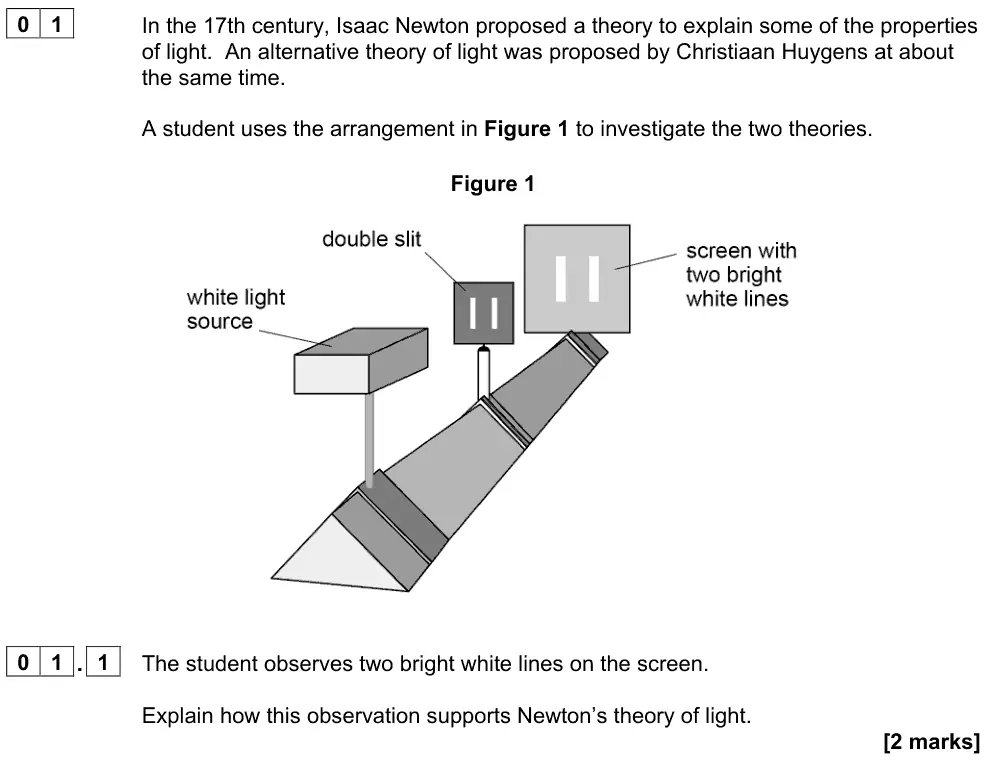
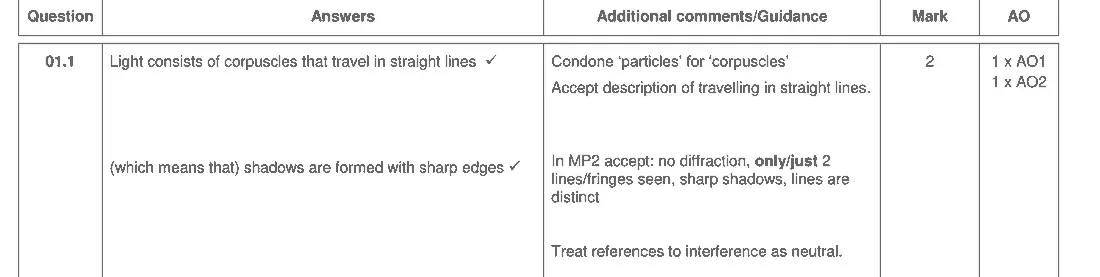
Most students were able to pick up one mark in 01.1. This was often for mentioning the absence of diffraction in the images. Fewer students obtained both marks, with the point that corpuscles were postulated to travel in straight lines being missed frequently.
Notes from the mark scheme and report
Corpuscles travel in straight lines, so sharp shadows and just two distinct lines with no diffraction
straight-line travel often missed
June 2022 · Paper 3B Turning points · Q1.26 marksAO1=4, AO3=26-mark extended response
Earlier part of question 1 that this part uses
Mark scheme, with the levels and indicative content
Examiner's comment
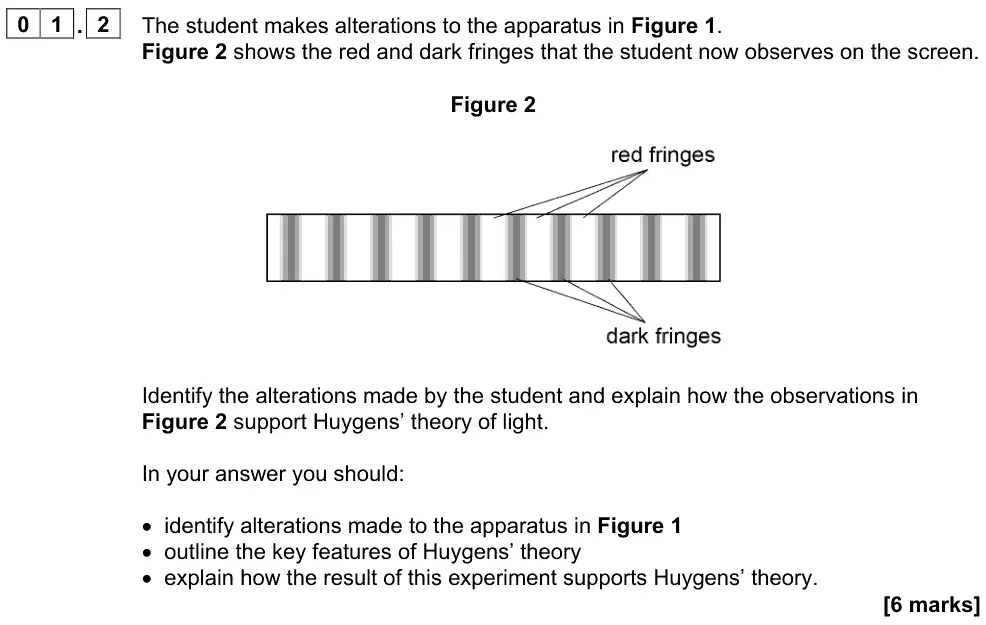
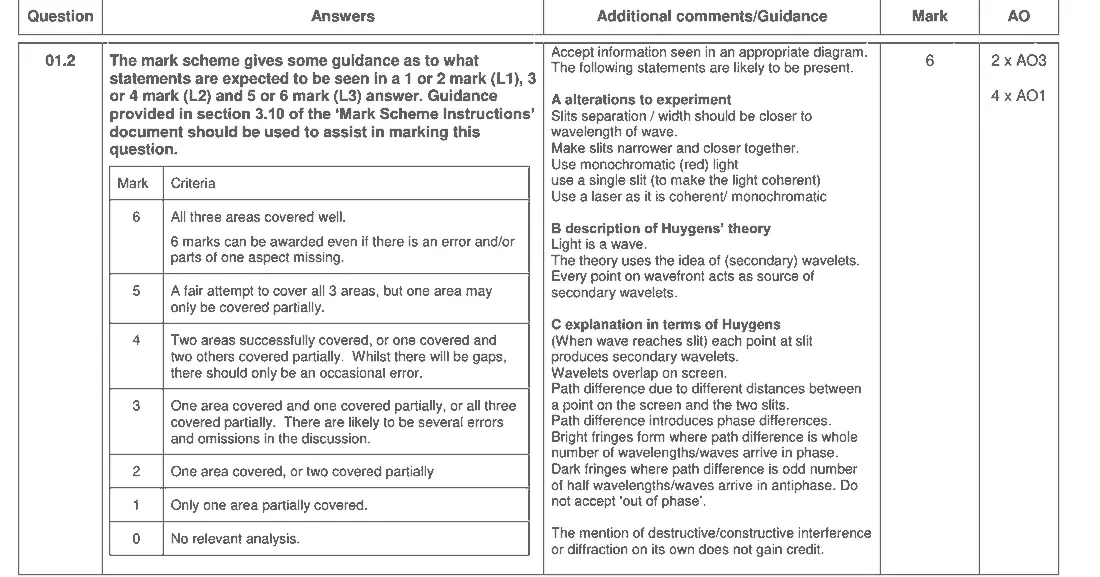
Although most students were able to pick up a few marks in 01.2, answers of high quality were rare. The changes that had to be made to the arrangement usually lacked detail, with only one or two points being mentioned. The descriptions of Huygen’s wavelets were vague and incomplete, with many students demonstrating little understanding of what the theory suggests. The explanations of the pattern were often based on basic core knowledge with little more than references to constructive and destructive interference, and with no mention of how the waves combined. Many students also confused path differences and phase differences in their discussions.
Notes from the mark scheme and report
Levels of response: narrower, closer slits, monochromatic (red) coherent light via single slit or laser
Huygens: light is a wave, every point on a wavefront is a source of secondary wavelets
wavelets from the slits overlap, path difference gives phase difference, bright where whole wavelengths, dark where odd half wavelengths
'constructive/destructive' alone not credited
path and phase difference confused
June 2022 · Paper 3B Turning points · Q1.33 marksAO2=1, AO3=2Explanation
Earlier part of question 1 that this part uses
Mark scheme
Examiner's comment
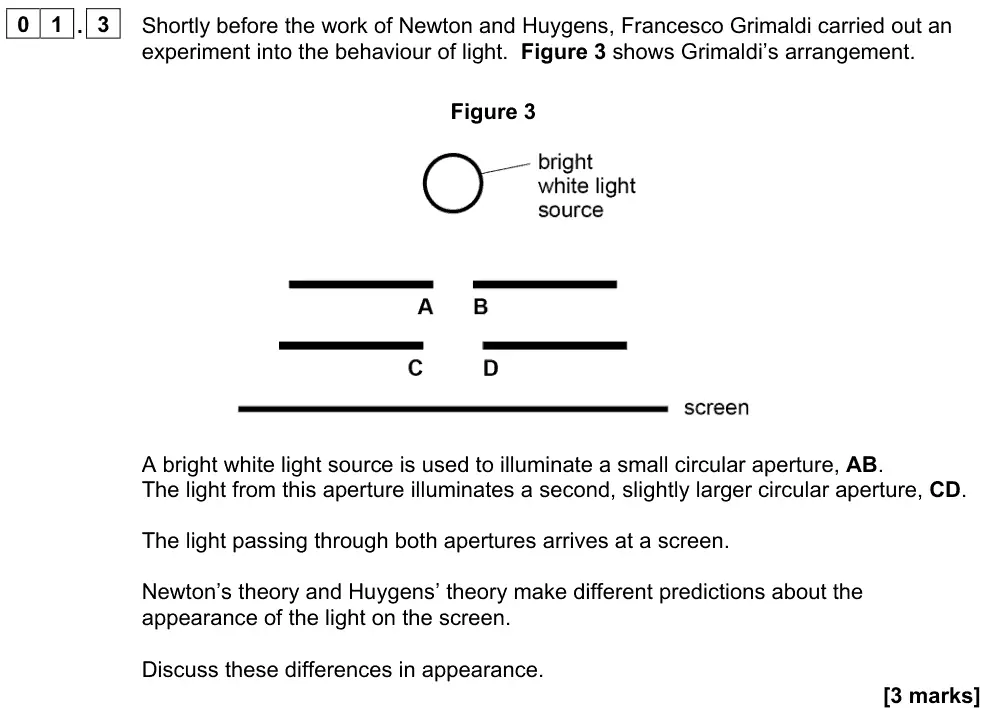
01.3 proved to be similarly challenging. The fact that the arrangement drawn would not produce sharp shadows was missed by most students. The best answers gave diagram annotations that showed the paths of the corpuscles extending beyond the area directly below the gaps. This omission meant that comparisons with Huygens based on diffraction alone rarely gained credit, as both Newton and Huygens would predict a shaded area around the central bright spot. Answers were often limited to some idea of a pattern of fringes around the bright centre, with some discussion of separation of colours.
Notes from the mark scheme and report
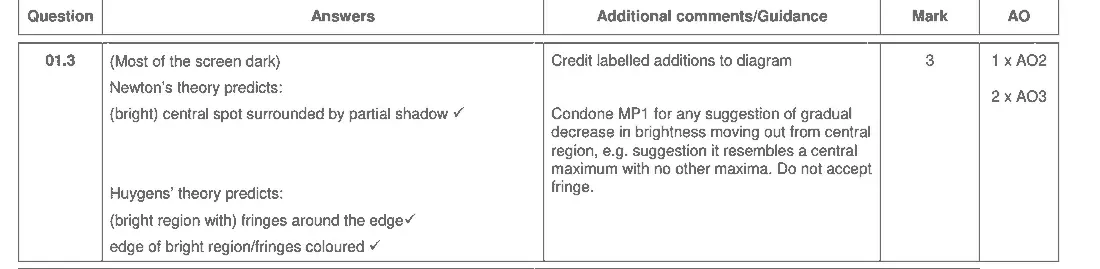
Newton: bright centre with gradual partial shadow (no fringes)
Huygens: bright region with fringes at the edge, coloured with white light
most missed that shadows are not sharp
June 2022 · Paper 3B Turning points · Q3.12 marksAO1=2Short answer
Mark scheme
Examiner's comment
Many students gave a very simple answer to 03.1 without any consideration of the significance of the frequency in that equation. Complete answers were rare.
Notes from the mark scheme and report
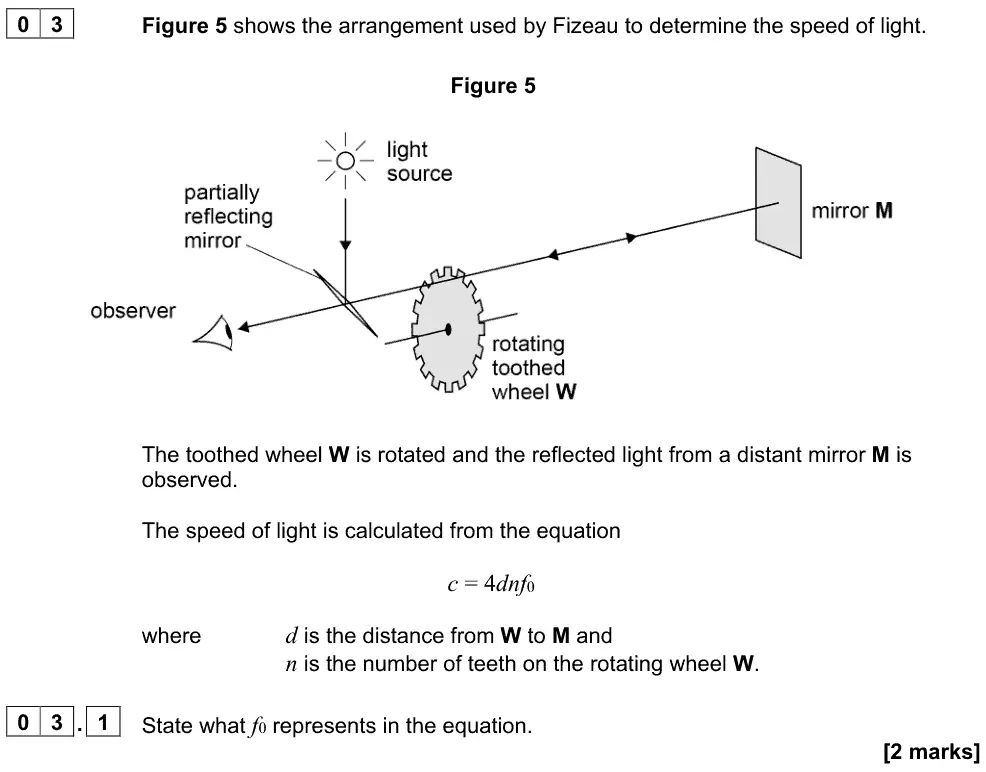
f0 is the lowest rotation frequency of W at which no reflected light is seen
June 2022 · Paper 3B Turning points · Q3.22 marksAO1=1, AO3=1Calculation
Earlier part of question 3 that this part uses
Mark scheme
Examiner's comment
In 03.2 many students simply worked out a speed and made a comment about how close it was to the speed of light, giving little consideration to the question itself. The best answers compared one of the properties of the experiment with what it would have to be in order to measure the speed of light. The frequency was the most common parameter, but the path length or number of teeth were also discussed by some students.
Notes from the mark scheme and report
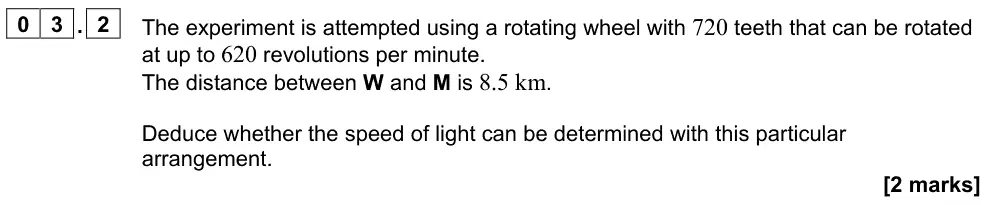
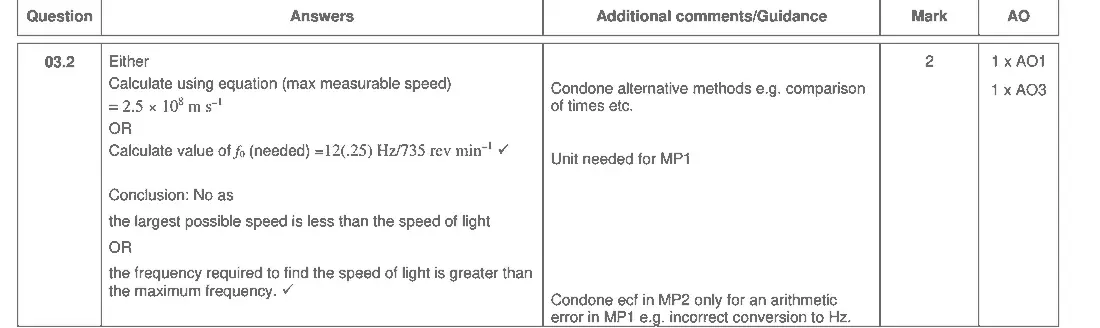
Max c measurable = 4 x 8500 x 720 x 10.3 Hz = 2.5 x 10^8 m s^-1 (or f0 needed = 12.25 Hz = 735 rev min^-1 > 620), so it cannot be measured
comparison needed
Skills: MS2.3 Substitute numerical values into algebraic equations using appropriate units for physical quantities; MS0.1 Recognise and make use of appropriate units in calculations
June 2022 · Paper 3B Turning points · Q3.32 marksAO1=2Short answer
Earlier part of question 3 that this part uses
Mark scheme
Examiner's comment
There is a statement (3.12.2.3) in the specification about the permittivity and permeability constants. It was clear in 03.3 that many students had very little idea about how these are related to the properties of an electromagnetic wave and therefore the speed of light.
Notes from the mark scheme and report
epsilon0 relates to electric field strength of a charged object in free space
mu0 relates to magnetic flux density of a current-carrying wire in free space
little understanding shown
November 2021 · Paper 3B Turning points · Q1.24 marksAO3=4Calculation
Earlier part of question 1 that this part uses
Mark scheme
Examiner's comment
This question discriminated extremely well, with students picking up a range of marks on each question part. Answers which were written clearly and contained the appropriate level of detail were able to score well. In question 01.2 it was clear that students continue to be confused by equations that include both a V for p.d. and a v for velocity. It was pleasing to note how many students were able to identify a value for the wavelength, however. There was evidence of a significant lack of experience with the use of electron diffraction to investigate the de Broglie hypothesis in question 01.3.
Notes from the mark scheme and report
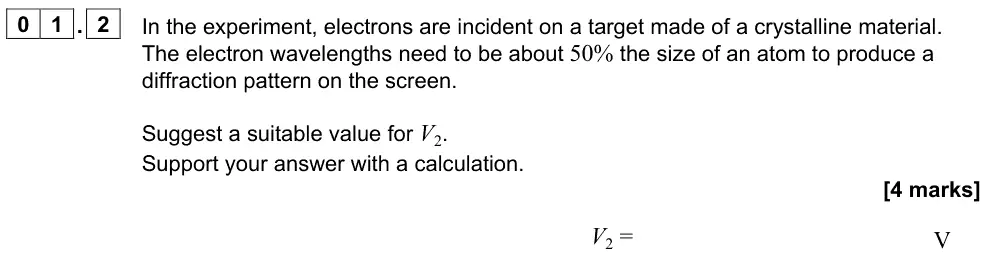
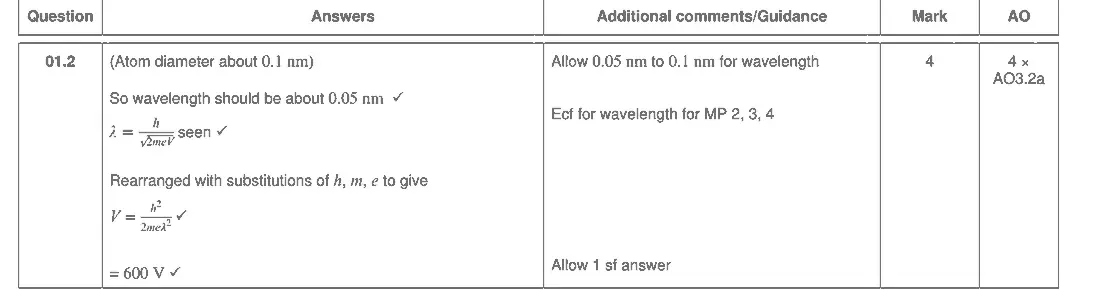
Answer: about 600 V (atom about 0.1 nm so lambda about 0.05 nm
V = h^2/(2me lambda^2))
confusion between V and v common
Skills: MS2.2 Change the subject of an equation, including non-linear equations; MS2.3 Substitute numerical values into algebraic equations using appropriate units for physical quantities; MS0.4 Estimate results
November 2021 · Paper 3B Turning points · Q1.34 marksAO2=1, AO3=3Explanation
Earlier part of question 1 that this part uses
Mark scheme
Examiner's comment
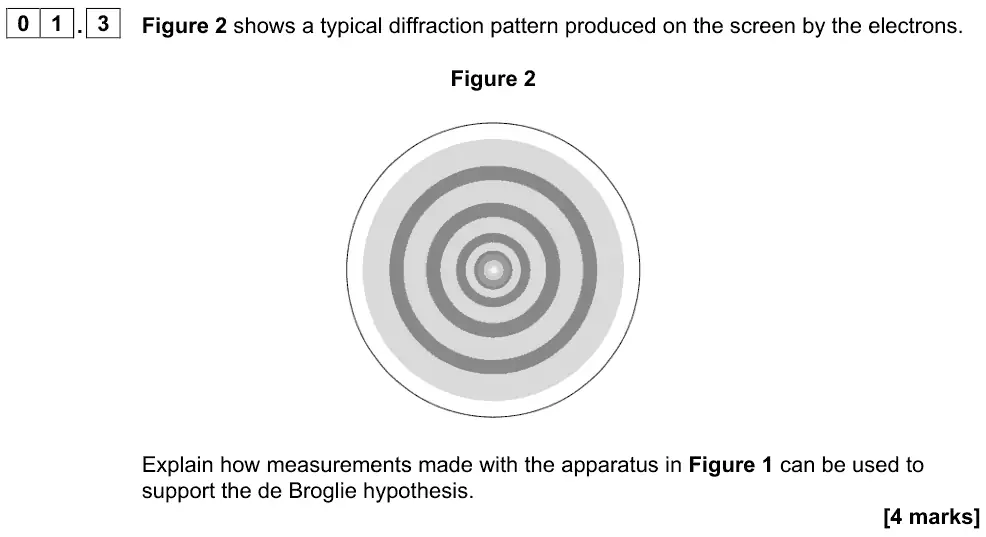
This question discriminated extremely well, with students picking up a range of marks on each question part. Answers which were written clearly and contained the appropriate level of detail were able to score well. In question 01.2 it was clear that students continue to be confused by equations that include both a V for p.d. and a v for velocity. It was pleasing to note how many students were able to identify a value for the wavelength, however. There was evidence of a significant lack of experience with the use of electron diffraction to investigate the de Broglie hypothesis in question 01.3.
Notes from the mark scheme and report
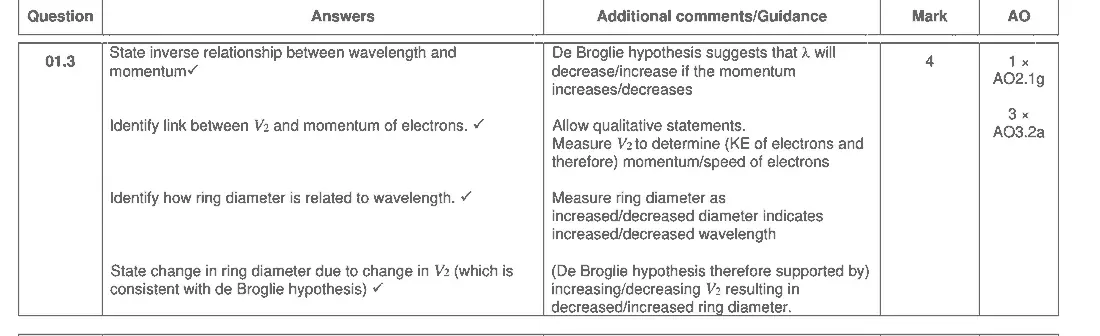
lambda = h/p
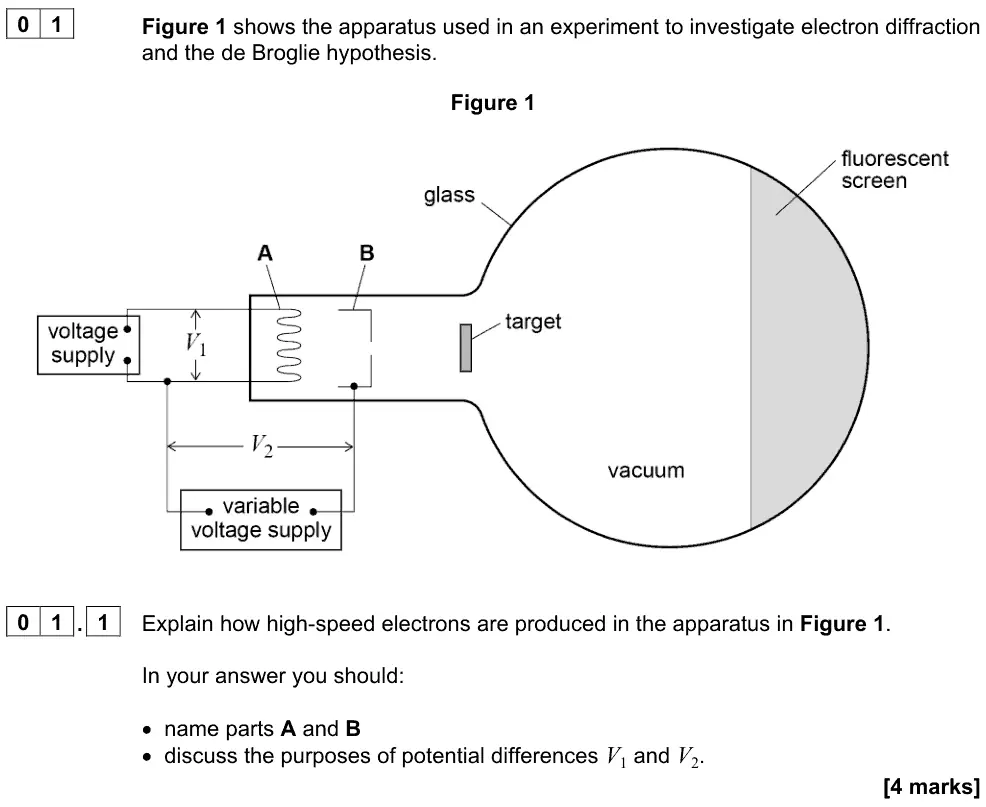
V2 sets the electron momentum
ring diameter increases with wavelength
increasing V2 shrinks the rings, consistent with de Broglie
little experience shown
November 2021 · Paper 3B Turning points · Q1.41 markAO1=1Short answer
Earlier part of question 1 that this part uses
Mark scheme
Examiner's comment
Many gaps in knowledge and understanding were seen. Only one of the 11 question parts had a mean mark greater than 50%, and that was the multiple-choice question (01.4). On average 13% of the students answering each question part made no attempt.
Notes from the mark scheme and report
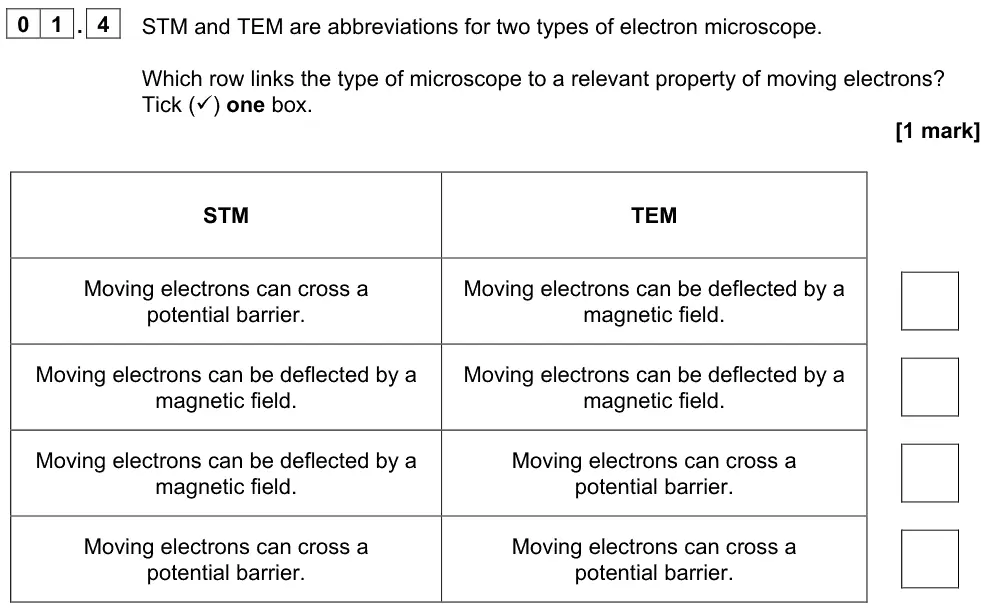
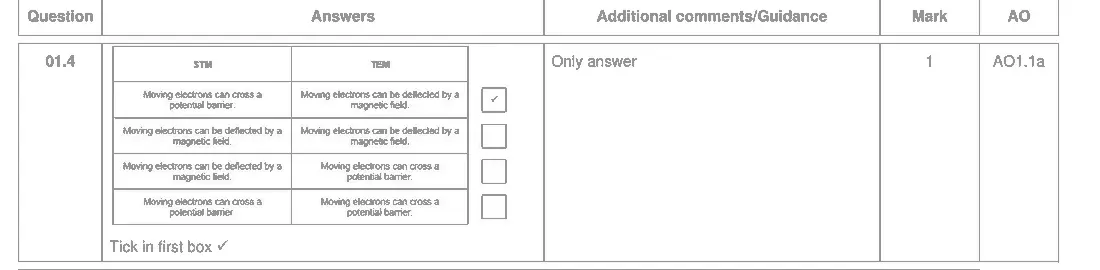
Answer: STM - electrons can cross a potential barrier
TEM - electrons deflected by a magnetic field (first row)
only item with mean above 50%
November 2021 · Paper 3B Turning points · Q2.12 marksAO2=2Show that
Mark scheme
Examiner's comment
In order to score both marks in question 02.1 a comment was needed comparing the calculated value for the speed of light with that in the data booklet. This was commonly missed. In question 02.2, many students demonstrated some knowledge of Maxwell’s model but few could relate it to the experiment. Question 02.4 assessed Assessment Objective 3 (AO3) and was not answered well by many students.
Notes from the mark scheme and report
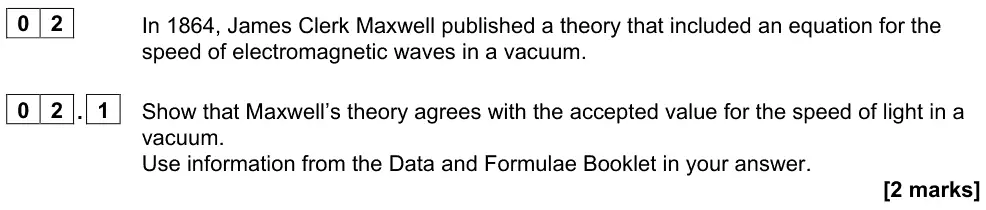
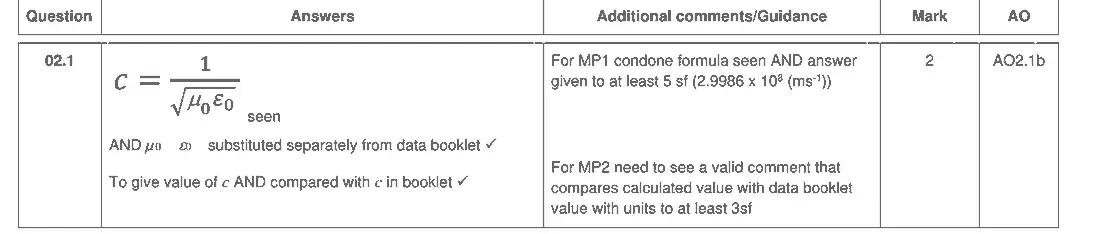
Answer: 1/sqrt(4pi x 10^-7 x 8.85 x 10^-12) = 2.9986 x 10^8 m s^-1, agreeing with c = 3.00 x 10^8 m s^-1
explicit comparison often missing
Skills: MS2.3 Substitute numerical values into algebraic equations using appropriate units for physical quantities
November 2021 · Paper 3B Turning points · Q2.24 marksAO1=1, AO2=3Explanation
Earlier part of question 2 that this part uses
Mark scheme
Examiner's comment
In order to score both marks in question 02.1 a comment was needed comparing the calculated value for the speed of light with that in the data booklet. This was commonly missed. In question 02.2, many students demonstrated some knowledge of Maxwell’s model but few could relate it to the experiment. Question 02.4 assessed Assessment Objective 3 (AO3) and was not answered well by many students.
Notes from the mark scheme and report
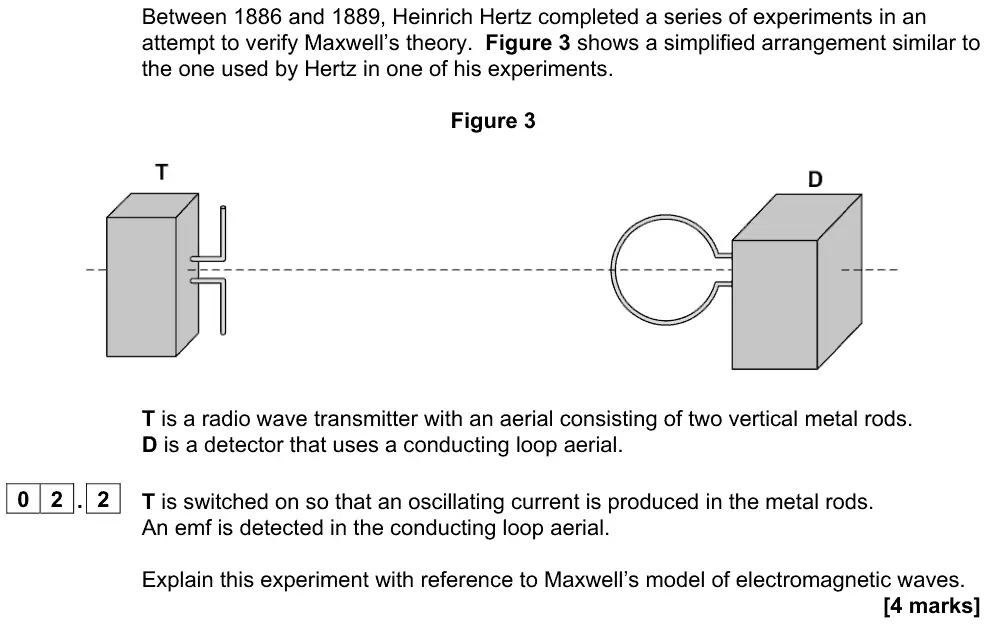
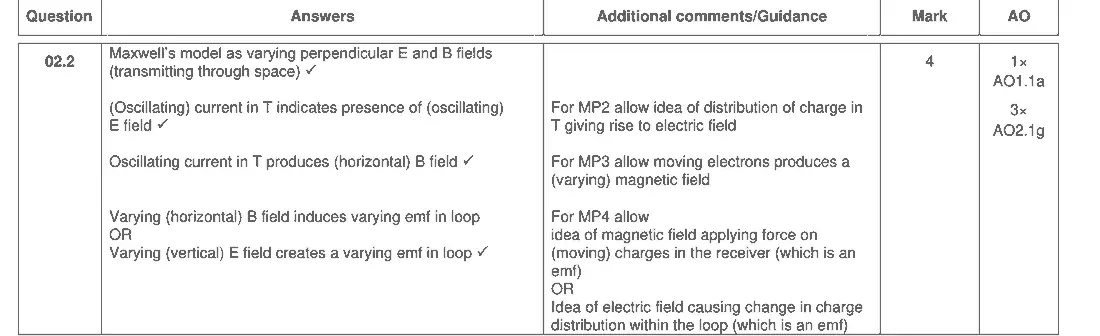
EM wave is perpendicular oscillating E and B fields
oscillating current in T gives oscillating E and horizontal B fields
changing B through the loop induces an emf (or E field moves charges in the loop)
November 2021 · Paper 3B Turning points · Q2.34 marksAO3=4Calculation
Earlier part of question 2 that this part uses
Mark scheme
Notes from the mark scheme and report
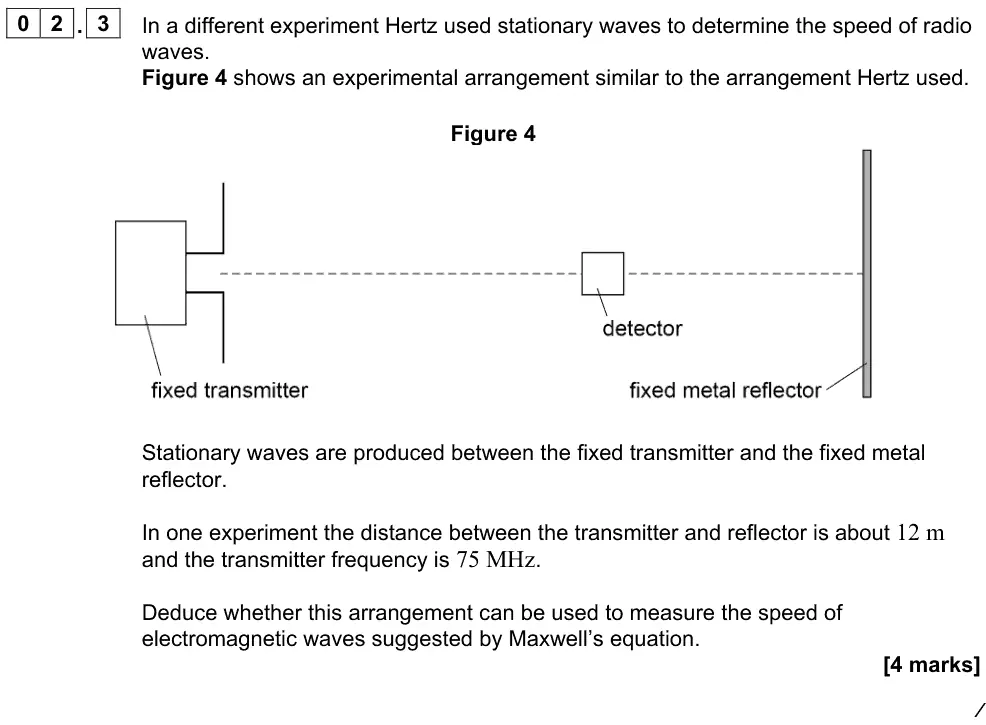
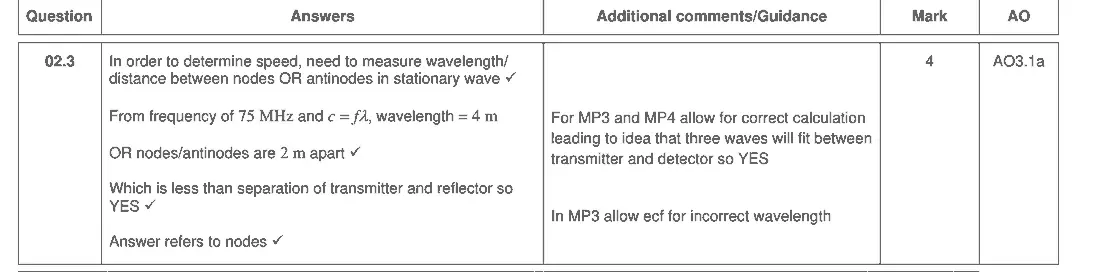
Measure node or antinode spacing
lambda = c/f = 4 m so nodes 2 m apart, several fit within 12 m, so yes
AO3 judgement poorly done
Skills: MS2.3 Substitute numerical values into algebraic equations using appropriate units for physical quantities; MS2.2 Change the subject of an equation, including non-linear equations
November 2020 · Paper 3B Turning points · Q2.12 marksShort answer
Mark scheme
Examiner's comment
This question was about the development of quantum theory. 02.1 was the poorest performing question on the paper. Many incorrect answers attempted to explain the nature of a black-body rather than to answer the question as written. It was clear from some answers that a significant number of students were unfamiliar with the term. Despite not being answered by over 15% of the students, 02.2 did yield a good spread of marks. It was common to see evidence of some familiarity with the ultra-violet catastrophe. Many students made no attempt to annotate the graph despite the explicit prompt to do so. Answers to 02.3 suggested that many students were unable to express clearly Max Planck’s contribution to quantum theory. Vague and incomplete answers were common. 02.4 had a maximum of 6 marks and, in common with previous series, the level of response mark scheme discriminated very well, with answers seen across the full mark range. Students whose knowledge of the photoelectric effect was limited to what is on the core specification were still able to pick up some marks. In the best answers, students made it very clear whether a point referred to an observation, a failure of classical theory, or to Einstein’s solution. Answers scoring low marks were usually too vague and incomplete.
Notes from the mark scheme and report
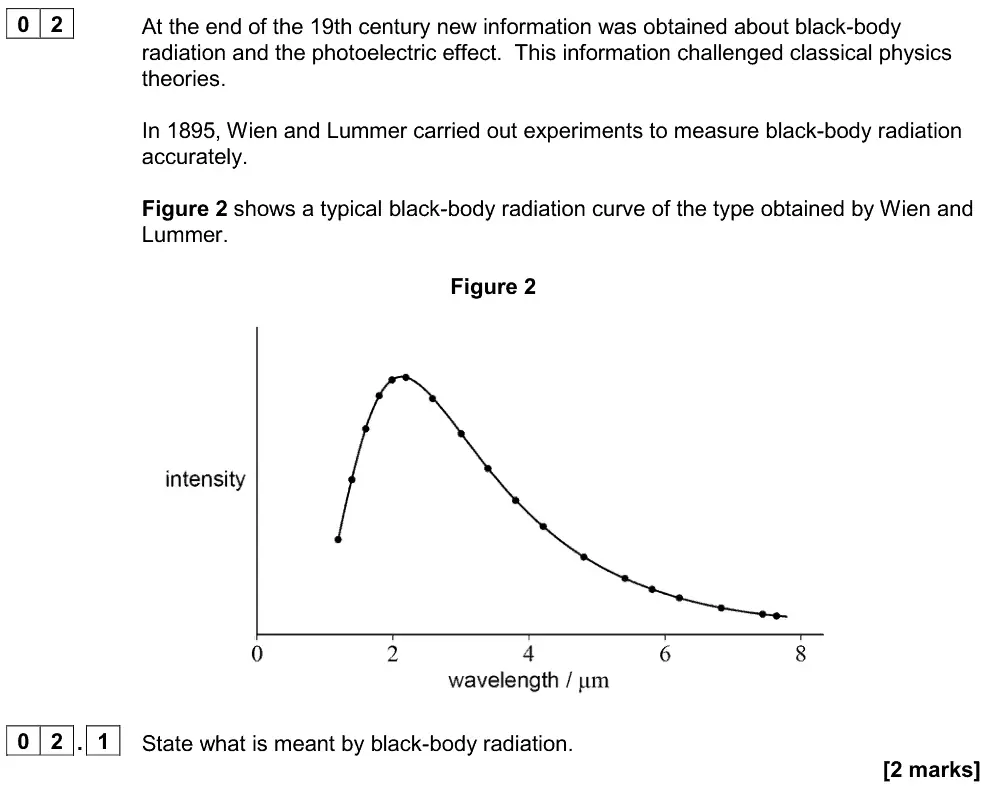
Electromagnetic radiation emitted by a perfect emitter with a spectrum whose peak depends only on temperature
describing a black body instead was common
poorest question on the paper
November 2020 · Paper 3B Turning points · Q2.22 marksDiagram or graph
Earlier part of question 2 that this part uses
Mark scheme
Examiner's comment
This question was about the development of quantum theory. 02.1 was the poorest performing question on the paper. Many incorrect answers attempted to explain the nature of a black-body rather than to answer the question as written. It was clear from some answers that a significant number of students were unfamiliar with the term. Despite not being answered by over 15% of the students, 02.2 did yield a good spread of marks. It was common to see evidence of some familiarity with the ultra-violet catastrophe. Many students made no attempt to annotate the graph despite the explicit prompt to do so. Answers to 02.3 suggested that many students were unable to express clearly Max Planck’s contribution to quantum theory. Vague and incomplete answers were common. 02.4 had a maximum of 6 marks and, in common with previous series, the level of response mark scheme discriminated very well, with answers seen across the full mark range. Students whose knowledge of the photoelectric effect was limited to what is on the core specification were still able to pick up some marks. In the best answers, students made it very clear whether a point referred to an observation, a failure of classical theory, or to Einstein’s solution. Answers scoring low marks were usually too vague and incomplete.
Notes from the mark scheme and report
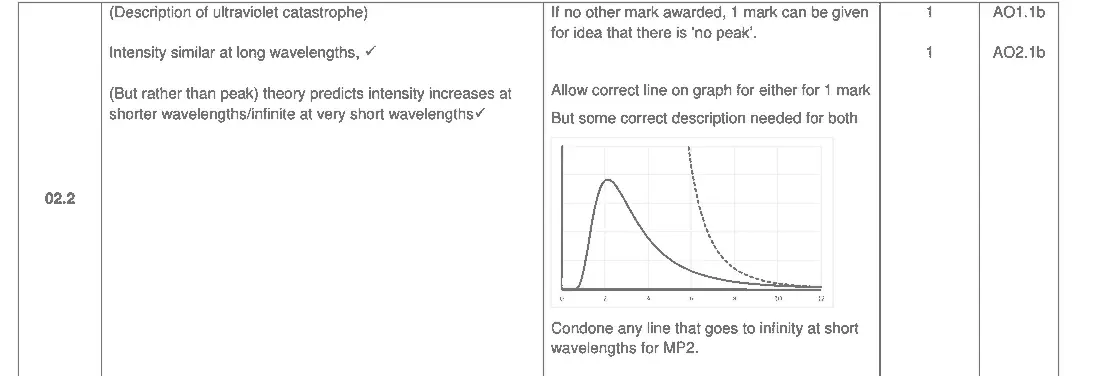
Classical theory agrees at long wavelengths but predicts intensity rising without limit at short wavelengths (ultraviolet catastrophe), no peak
annotate the graph
over 15% did not answer
Skills: MS3.1 Translate information between graphical, numerical and algebraic forms
November 2020 · Paper 3B Turning points · Q2.32 marksShort answer
Earlier part of question 2 that this part uses
Mark scheme
Examiner's comment
This question was about the development of quantum theory. 02.1 was the poorest performing question on the paper. Many incorrect answers attempted to explain the nature of a black-body rather than to answer the question as written. It was clear from some answers that a significant number of students were unfamiliar with the term. Despite not being answered by over 15% of the students, 02.2 did yield a good spread of marks. It was common to see evidence of some familiarity with the ultra-violet catastrophe. Many students made no attempt to annotate the graph despite the explicit prompt to do so. Answers to 02.3 suggested that many students were unable to express clearly Max Planck’s contribution to quantum theory. Vague and incomplete answers were common. 02.4 had a maximum of 6 marks and, in common with previous series, the level of response mark scheme discriminated very well, with answers seen across the full mark range. Students whose knowledge of the photoelectric effect was limited to what is on the core specification were still able to pick up some marks. In the best answers, students made it very clear whether a point referred to an observation, a failure of classical theory, or to Einstein’s solution. Answers scoring low marks were usually too vague and incomplete.
Notes from the mark scheme and report
EM radiation emitted in quanta whose energy is E = hf
'photon' or 'packet' not accepted for quanta
vague answers common
November 2020 · Paper 3B Turning points · Q2.46 marks6-mark extended response
Earlier part of question 2 that this part uses
Mark scheme, with the levels and indicative content
Examiner's comment
This question was about the development of quantum theory. 02.1 was the poorest performing question on the paper. Many incorrect answers attempted to explain the nature of a black-body rather than to answer the question as written. It was clear from some answers that a significant number of students were unfamiliar with the term. Despite not being answered by over 15% of the students, 02.2 did yield a good spread of marks. It was common to see evidence of some familiarity with the ultra-violet catastrophe. Many students made no attempt to annotate the graph despite the explicit prompt to do so. Answers to 02.3 suggested that many students were unable to express clearly Max Planck’s contribution to quantum theory. Vague and incomplete answers were common. 02.4 had a maximum of 6 marks and, in common with previous series, the level of response mark scheme discriminated very well, with answers seen across the full mark range. Students whose knowledge of the photoelectric effect was limited to what is on the core specification were still able to pick up some marks. In the best answers, students made it very clear whether a point referred to an observation, a failure of classical theory, or to Einstein’s solution. Answers scoring low marks were usually too vague and incomplete.
Notes from the mark scheme and report
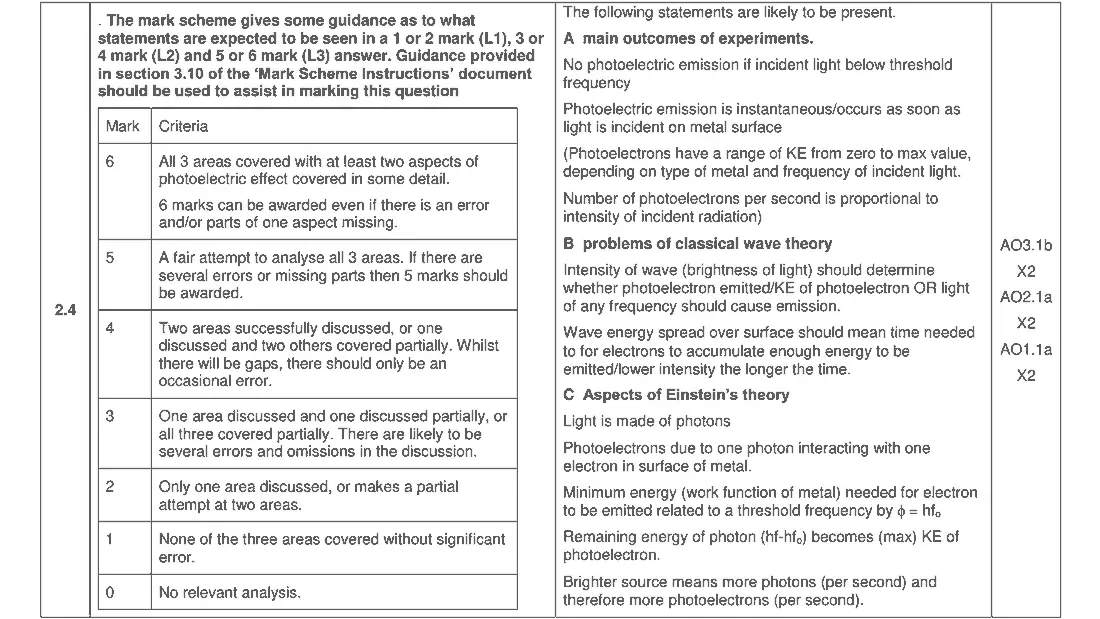
Levels of response: observations (threshold frequency, instantaneous emission, max KE depends on frequency not intensity)
classical wave theory predicts emission at any frequency with enough intensity and a delay
Einstein: photons E = hf, one photon to one electron, work function = hf0, hf - phi = max KE, intensity sets photon rate
light has a particle nature
November 2020 · Paper 3B Turning points · Q3.12 marksExplanation
Mark scheme
Notes from the mark scheme and report
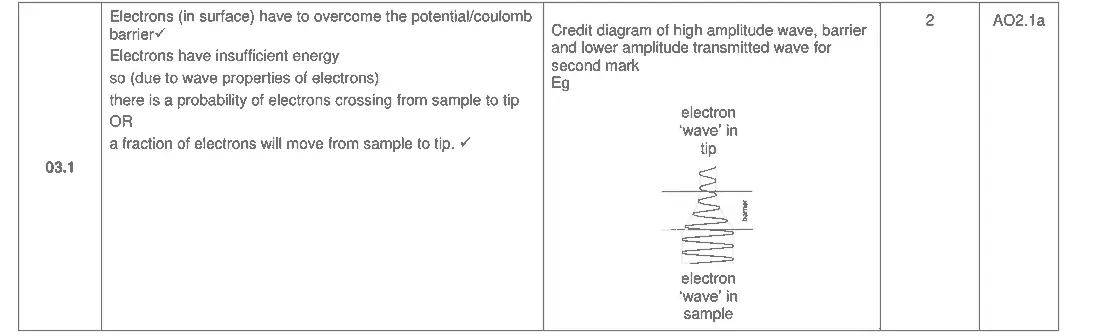
Electrons lack the energy to cross the potential barrier but, being waves, have a probability of crossing from sample to tip
diagram of decaying wave accepted
few understood
November 2020 · Paper 3B Turning points · Q3.23 marksExplanation
Earlier part of question 3 that this part uses
Mark scheme
Notes from the mark scheme and report
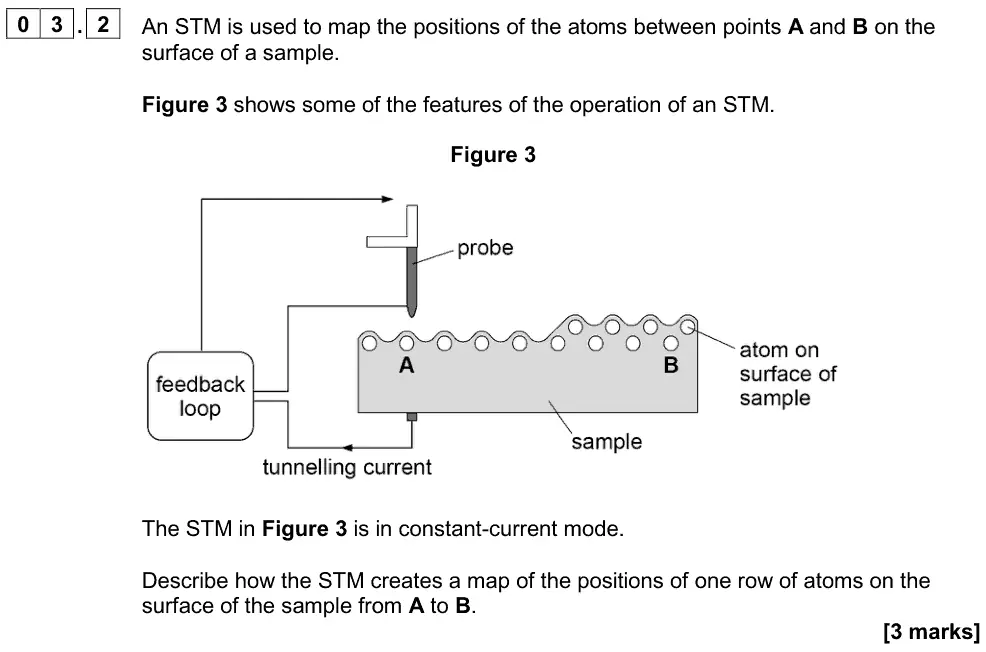
Tip held about 1 nm above surface
tunnelling current rises over a higher atom
feedback raises tip to restore the current, so tip height maps the surface
November 2020 · Paper 3B Turning points · Q3.33 marksCalculation
Earlier part of question 3 that this part uses
Mark scheme
Examiner's comment
This question required knowledge and understanding of quantum tunnelling, a specialist area of this Option. It was rare to see an answer that suggested the student had any familiarity with the process or its application in the scanning tunnelling microscope (STM). In particular, few students demonstrated an appreciation of the role that probability or wave-particle duality plays in the STM. In 03.3, many students were able to obtain a value for the de Broglie wavelength of the electrons but few managed to make a correct judgement linking this value to the size of an atom. Again it should be noted that the de Broglie wavelength equation is part of the core specification. A surprisingly common error was the use of the speed of light for the speed of the electron.
Notes from the mark scheme and report
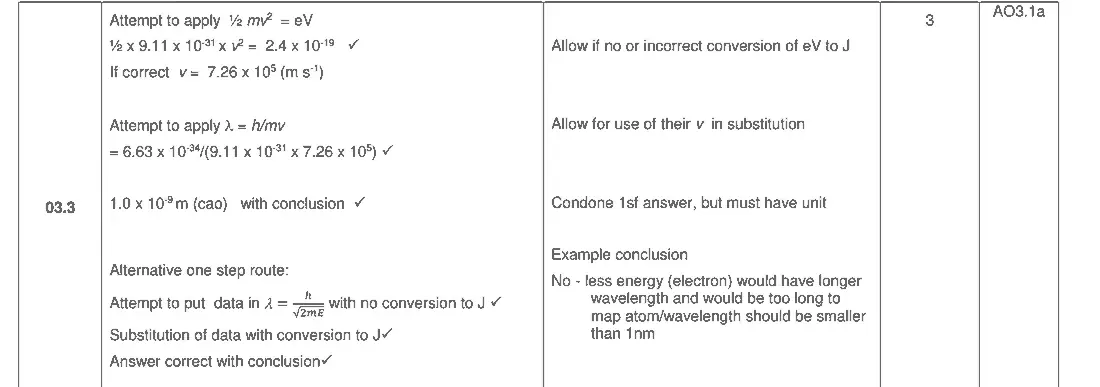
Answer: lambda = 1.0 x 10^-9 m at 1.5 eV (v = 7.3 x 10^5 m s^-1)
lower energies give longer wavelengths, too large to resolve atoms, so not suitable
using c as the electron speed was a common error
Skills: MS2.3 Substitute numerical values into algebraic equations using appropriate units for physical quantities; MS2.2 Change the subject of an equation, including non-linear equations
June 2019 · Paper 3B Turning points · Q2.11 markShort answer
Mark scheme
Examiner's comment
2.1 This multiple-choice question was answered correctly by the majority of students.
June 2019 · Paper 3B Turning points · Q2.26 marks6-mark extended response
Earlier part of question 2 that this part uses
Mark scheme, with the levels and indicative content
Examiner's comment
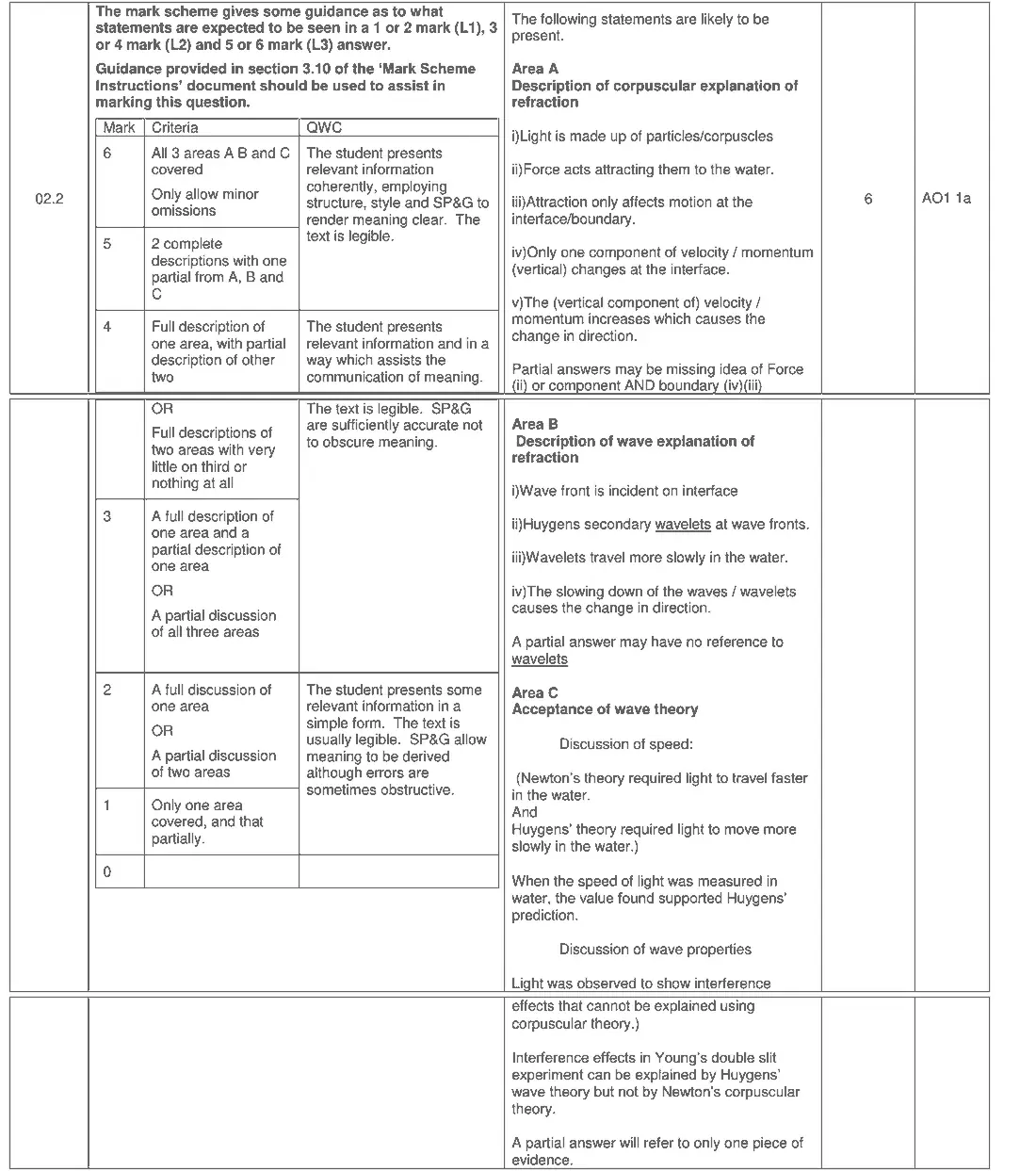
2.2 Questions about Newton’s and Huygens’ different theories on the nature of light have been asked many times in the past and it was clear that many students were familiar with their main points. A downside of this familiarity perhaps was that some students spent time describing reflection rather than refraction. The important features of Newton’s theory that were often missed are related to the behaviour of the particles at the interface, and the fact that the parallel component of momentum is unchanged, but the perpendicular component increases, thus causing the light to bend towards the normal. Even more commonly, students failed to mention the secondary wavelets that are the key feature of Huygens’ theory. Many students recalled that the predicted speed of light in water is different in the two theories and linked this to an appropriate experiment. Some also went on to describe a relevant diffraction experiment in support of Huygens, but some gave unnecessary detail. A significant minority of students incorrectly suggested that one theory predicted that light would bend away from the normal as it entered the water.
Notes from the mark scheme and report
Levels of response: Newton - attraction at the surface increases only the perpendicular velocity component so light bends towards the normal and travels faster in water
Huygens - secondary wavelets slow in water
measured speed of light in water lower, and interference (Young) explained only by waves
secondary wavelets often omitted
some described reflection
June 2019 · Paper 3B Turning points · Q2.33 marksDiagram or graph
Earlier part of question 2 that this part uses
Mark scheme
Examiner's comment
2.3 In order for students to gain any credit, they had to make it clear that both an electric field and magnetic field are involved. Some excellent labelled diagrams that gained full credit were seen. Common errors included failing to label the direction of propagation, making it unclear that the two waves are perpendicular, and failing to ensure that the two waves appear in phase. Examiners were aware of the difficulties of making these points clear in a diagram and full credit was given to students who stated these points in the text. Although it was condoned on this occasion, it is unlikely that students who suggest that polarisation causes either the electric field or magnetic field to be completely absorbed will be given full credit in the future.
Notes from the mark scheme and report
Electric and magnetic field oscillations perpendicular to each other and to the direction of travel, and in phase
both fields must be named
label propagation direction
June 2019 · Paper 3B Turning points · Q3.12 marksShort answer
Mark scheme
Examiner's comment
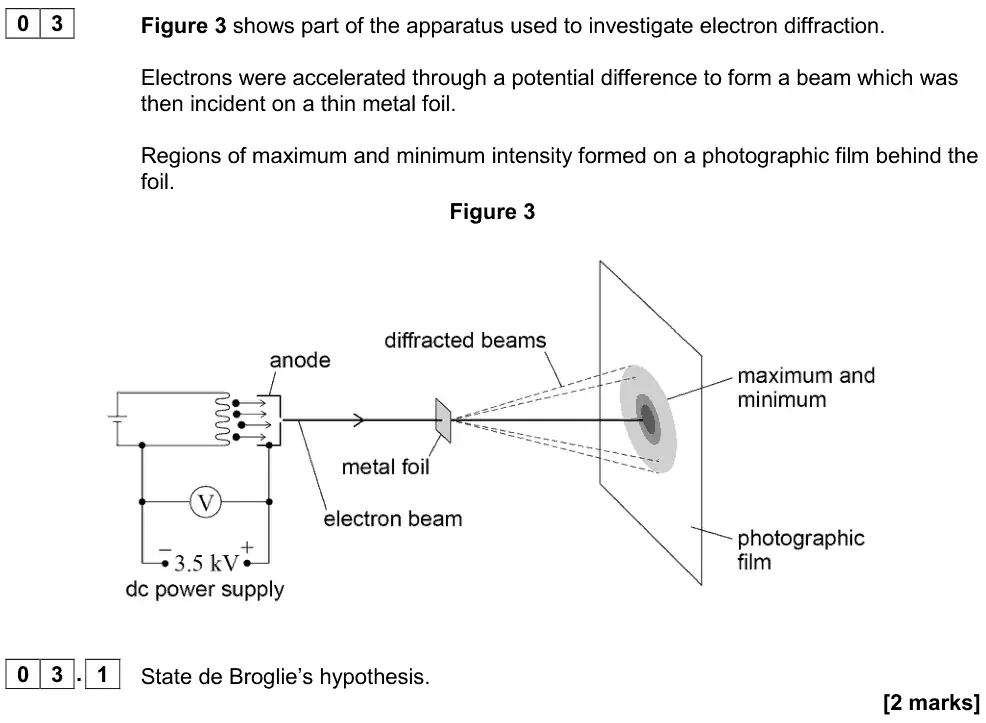
3.1 Vague and incomplete answers to this question often prevented students from gaining both marks. An equation on its own only gave access to the second mark. Also, for this mark point, the symbol p was not accepted on its own for momentum.
There is clear evidence that students are being prepared well for this paper. They show familiarity with calculations and demonstrate recall of the general ideas. Difficulties arise when students are expected to reach a judgement. This is related to the testing of Assessment Objective 3 (AO3) and this report highlights where they occur. There is also evidence to suggest that, when faced with less familiar questions, some students resort to their knowledge of the core content of the specification. This can be seen particularly in questions 1.3, 3.1, 4.2 and 4.3. Because of the overlap between this option and the core content, mark schemes will continue to require students to demonstrate knowledge and understanding of content relevant to this option in order to gain full credit.
Notes from the mark scheme and report
All particles have wave-like properties with wavelength lambda = h / momentum
p must be defined
equation alone gets only mark 2
June 2019 · Paper 3B Turning points · Q3.22 marksCalculation
Earlier part of question 3 that this part uses
Mark scheme
Examiner's comment
3.2 This calculation was familiar to many students. The need to make a comparison and state a consistent conclusion prevented some students from gaining the second mark. This is another example of an AO3 assessment that requires students to make a judgement.
Notes from the mark scheme and report
Answer: lambda = h / sqrt(2meV) = 0.021 nm at 3.5 kV, so consistent
comparison and conclusion needed
Skills: MS2.3 Substitute numerical values into algebraic equations using appropriate units for physical quantities
June 2019 · Paper 3B Turning points · Q3.34 marksExplanation
Earlier part of question 3 that this part uses
Mark scheme
Examiner's comment
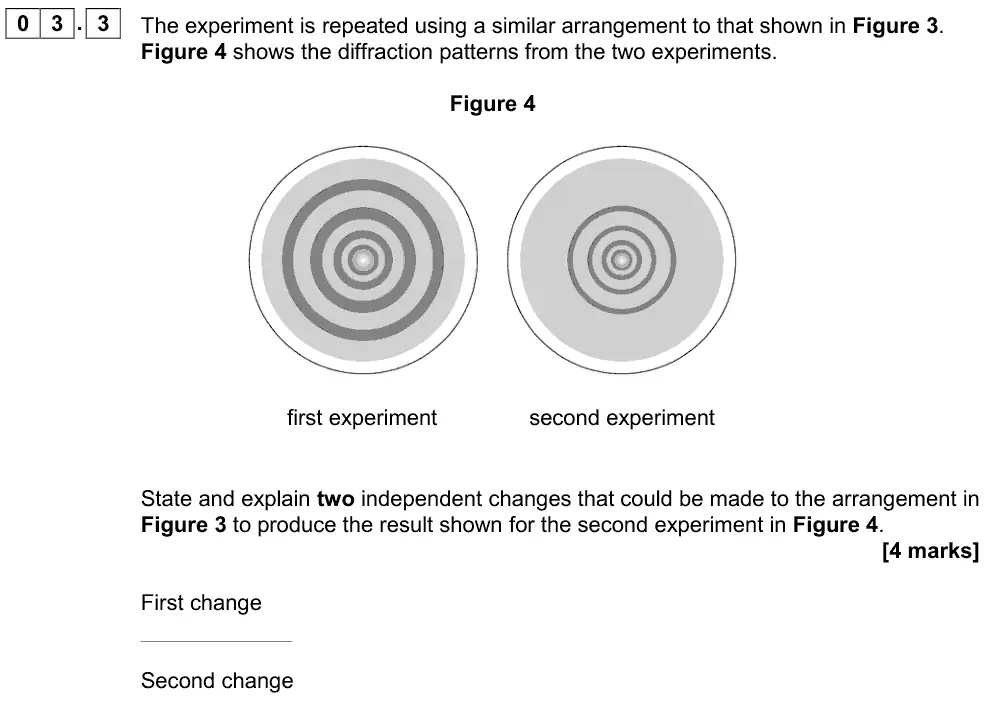
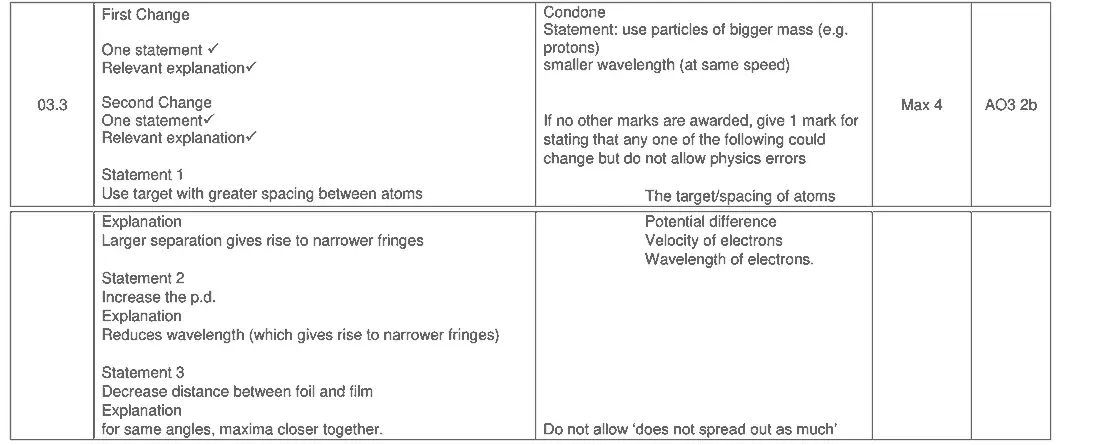
3.3 There were several approaches that were given credit in this question. The most common correct answers referred to the increase in potential difference and the decrease in distance between the foil and film. However, some students found it difficult to explain clearly why this would lead to a narrower pattern. Some students referred to changing the size of atoms rather than their spacing and therefore did not gain credit.
Notes from the mark scheme and report
Two of: increase the pd (higher speed, shorter wavelength, less diffraction)
June 2018 · Paper 3B Turning points · Q2.13 marksDiagram or graph
Mark scheme
Examiner's comment
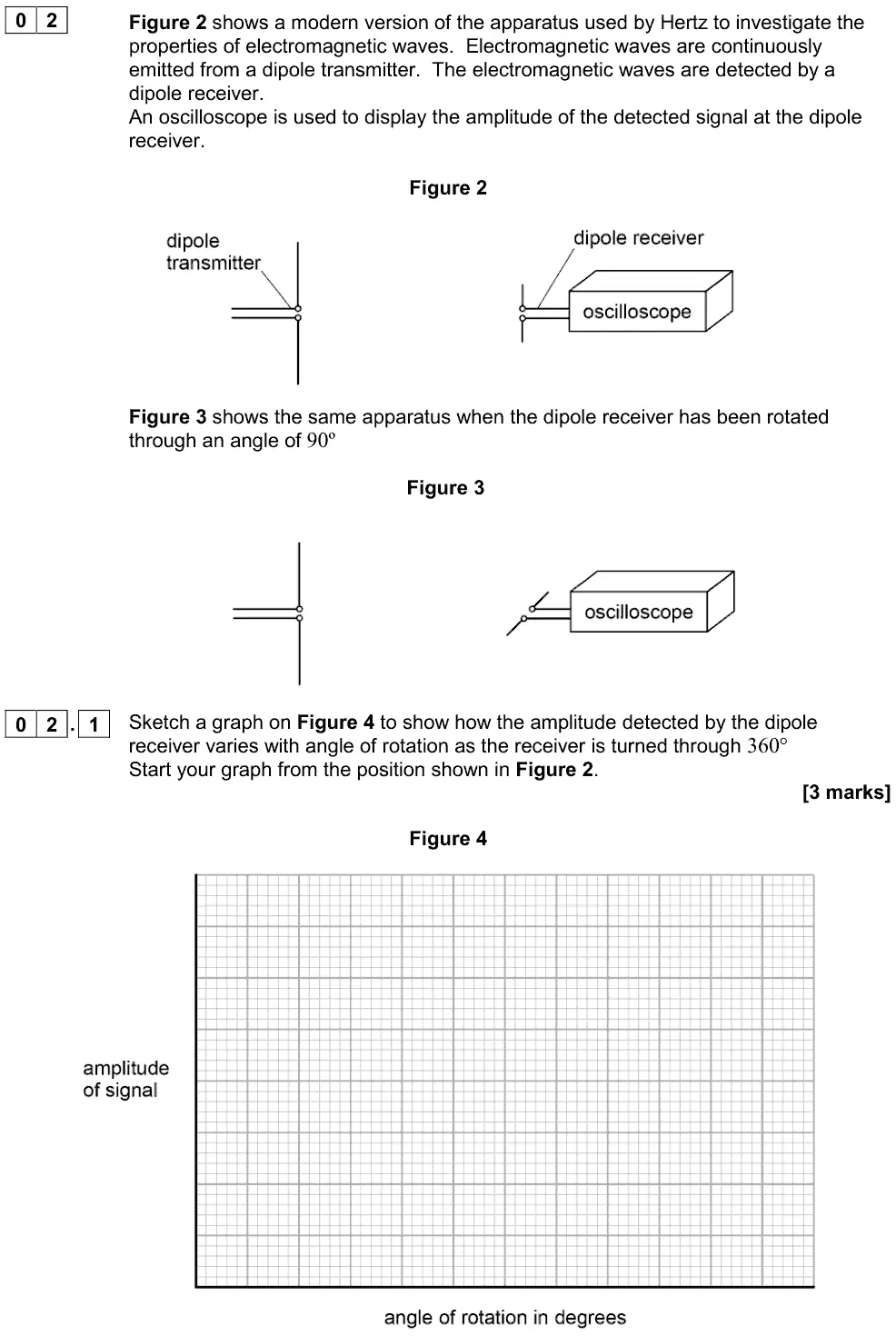
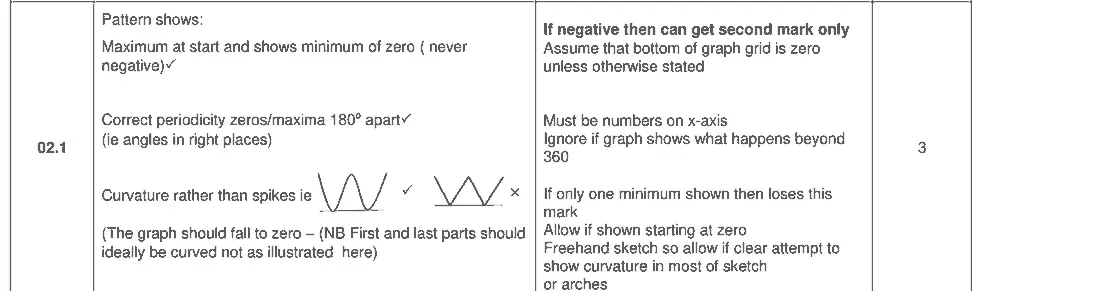
02.1 There were two particular reasons why students failed to gain marks in this question. The first was that the amplitude cannot be negative, and the second was a failure to include any scale on the angle axis. Sketches were often quite poor, but these were treated generously providing the important features were shown. Some attempt to show curvature was expected to gain the final mark. Full marks were awarded to 42.5% of students.
Notes from the mark scheme and report
Amplitude maximum at 0, 180, 360 degrees and zero at 90 and 270, never negative, curved shape
angle axis must be scaled
42.5% full marks
Skills: MS3.1 Translate information between graphical, numerical and algebraic forms
June 2018 · Paper 3B Turning points · Q2.22 marksCalculationHard
Earlier part of question 2 that this part uses
Mark scheme
Examiner's comment
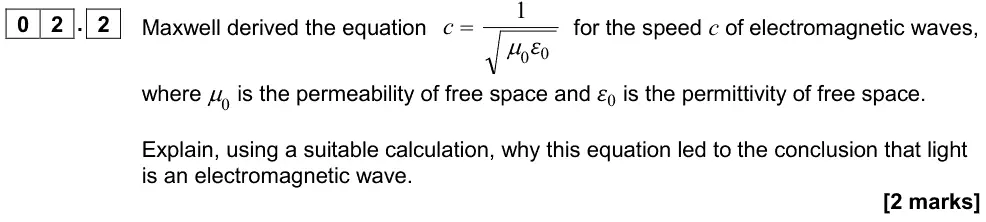
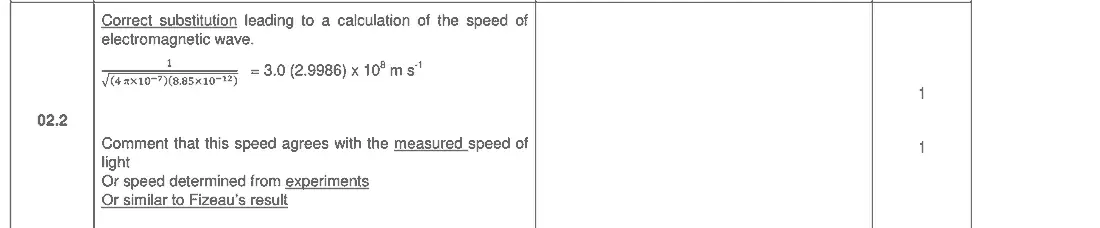
02.2 The straightforward substitution of data and computation gained the first mark. Substitution of the data was expected. The second mark was less frequently awarded (28.9% of students). The fact that Maxwell’s result agreed with a measured or experimental value was essential. That Maxwell’s equation for the speed gave a value that agreed with the ‘accepted value’ was insufficient.
Notes from the mark scheme and report
Answer: c = 1/sqrt(4pi x 10^-7 x 8.85 x 10^-12) = 3.0 x 10^8 m s^-1, which matches the measured speed of light (e.g. Fizeau)
'agrees with accepted value' insufficient
Skills: MS2.3 Substitute numerical values into algebraic equations using appropriate units for physical quantities; MS0.5 Use calculators to find and use power, exponential and logarithmic functions
June 2018 · Paper 3B Turning points · Q3.13 marksCalculation
Mark scheme
Examiner's comment
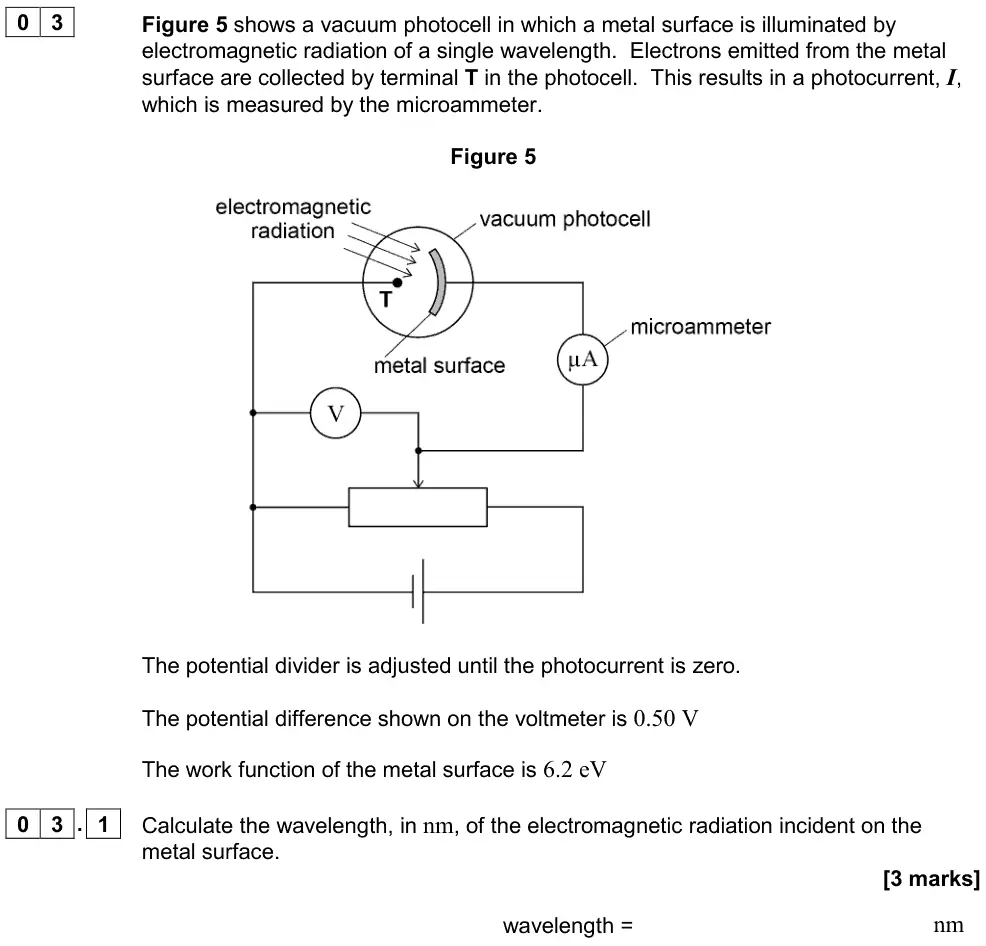
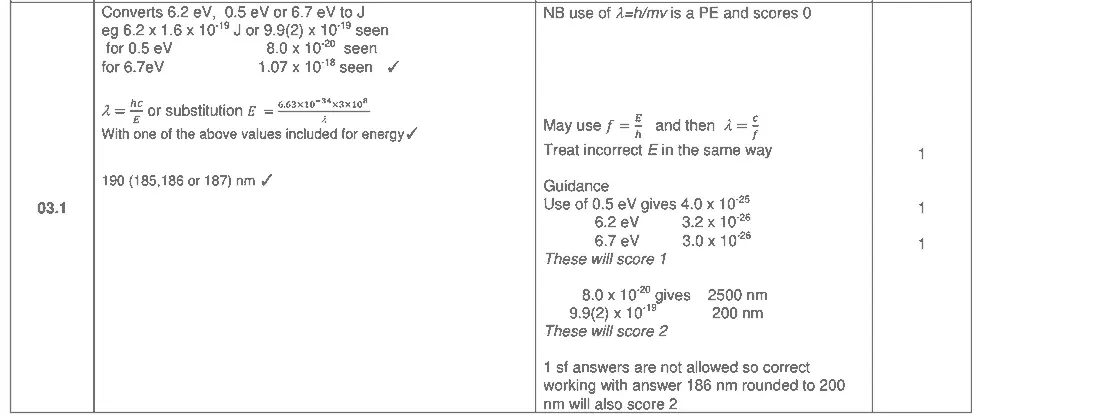
03.1 All parts of question 3 exposed misunderstanding about the photoelectric effect. Part 03.1 tested application of the photoelectric equation. Firstly, to determine the wavelength, data in eV had to be converted to Joule somewhere in the response. The 0.50 V was the stopping voltage which relates to the maximum KE of an emitted electron in eV. This, added to the work function, gave the energy of the photon which produced this electron in eV. Then the equation λ = hc/Ek, with Ek in J, gave the answer. There was a good proportion (over 40%) of correct answers. The most common incorrect response used the work function alone to determine the wavelength with various other combinations of the energies in eV or J. Some made incorrect attempts to convert eV to J.
Apart from question 3, most parts of each question proved to be accessible to many/most students. Apart from part 03.1, which was answered quite well, a majority of the students had insufficient understanding of the experimental arrangement in question 3 to deal successfully with the questions asked. The question is dealt with in more detail below. The other part that presented particular difficulties was the 6-mark question, 04.1, in which relatively few students were able to give a convincing discussion that was worthy of a mark in Level 3. The other parts that were answered surprisingly poorly were 04.2 and 04.3 where the statements of the postulates were frequently incorrect or incomplete.
Notes from the mark scheme and report
Answer: 186 nm (photon energy = 6.2 + 0.50 = 6.7 eV = 1.07 x 10^-18 J
lambda = hc/E)
using the work function alone gives 200 nm
over 40% correct
Skills: MS2.3 Substitute numerical values into algebraic equations using appropriate units for physical quantities; MS2.2 Change the subject of an equation, including non-linear equations
June 2018 · Paper 3B Turning points · Q3.23 marksExplanation
Earlier part of question 3 that this part uses
Mark scheme
Examiner's comment
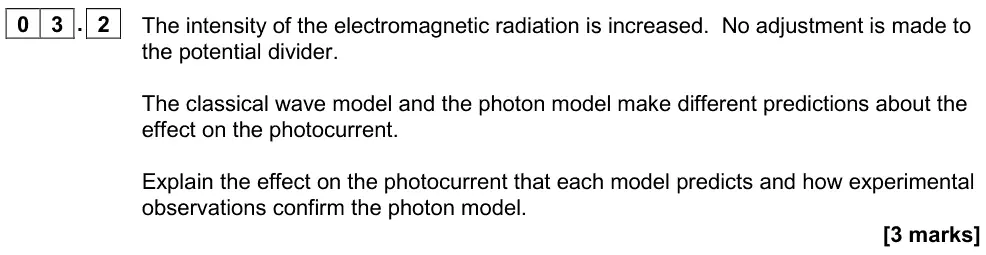
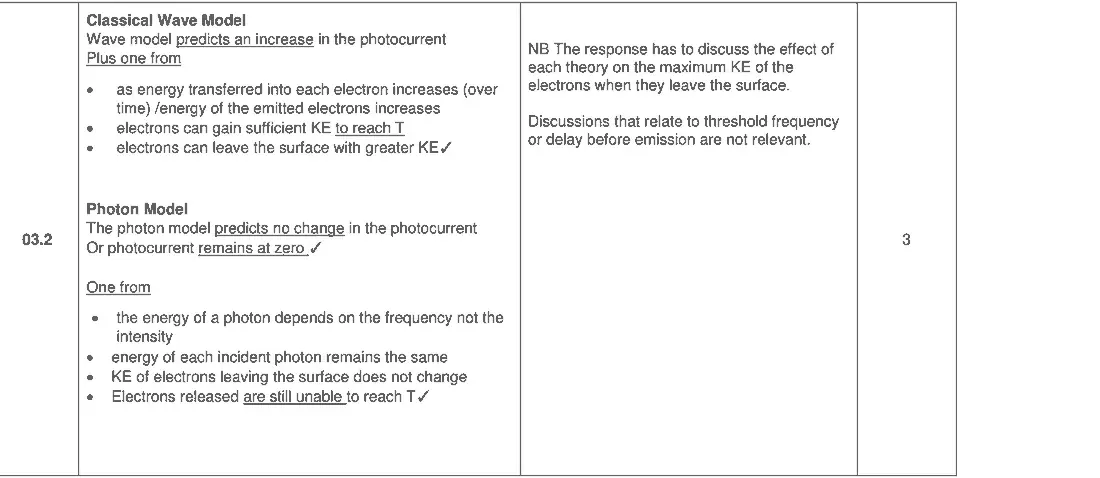
03.2 A large number of students seemed not to have read this question carefully enough – there were relatively few convincing responses. Many responses explained why the photon model could explain why there is threshold frequency, which is not what was asked. In this question, there is no change to the incoming radiation other than intensity. Some students commented that as intensity increased there would be more photons arriving, so the number of photoelectrons produced would increase, so current would increase. However, what determines the current is not the number of electrons that are emitted but the number that can reach T. As the photon energy is fixed, students needed to appreciate that current could only increase if more electrons could reach T. As the maximum KE of the photons is the same, even though there are more of them, none can reach T so the current is unchanged. A high intensity wave could transfer, resulting in electrons with more KE, so these could reach T, producing a higher current. Over half of the students failed to score on this question.
Notes from the mark scheme and report
Wave model: higher intensity gives electrons more energy so some reach T and current rises
photon model: photon energy unchanged so max KE unchanged and current stays zero
observation of no current supports photons
threshold-frequency answers irrelevant
over half scored zero
June 2018 · Paper 3B Turning points · Q3.32 marksExplanationHard
Earlier part of question 3 that this part uses
Mark scheme
Examiner's comment
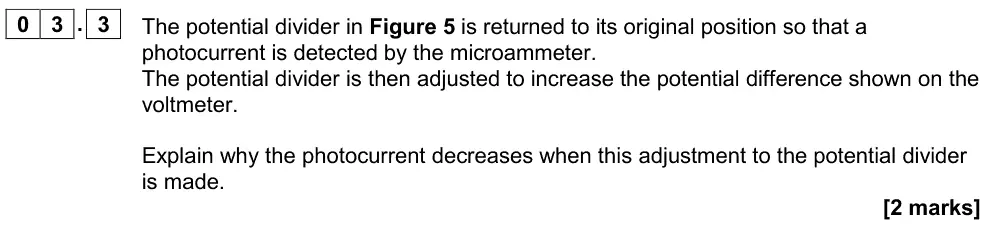
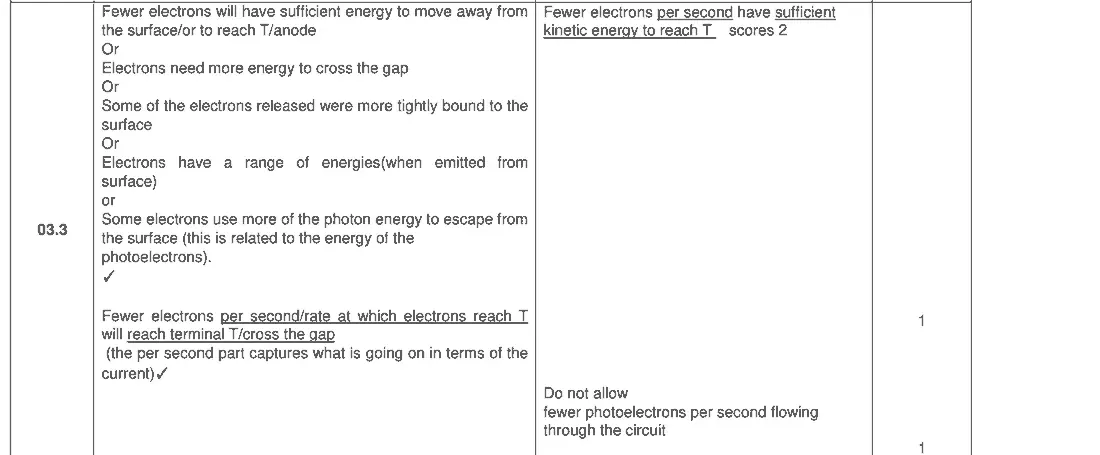
03.3 Just over a fifth of the students were able to make a comment that gave access to the first mark in the marking scheme, but very few of these referred to the current depending on the rate at which electrons reached T. In this part, the key knowledge of the photoelectric effect is that electrons are emitted with a range of kinetic energies. Students needed to appreciate that initially a current exists because, as there is no stopping voltage, all emitted electrons can reach T. As T becomes increasingly negative with respect to the metal surface, more and more electrons with KE less than the maximum KE cannot reach T. Nearly 70% of students made no headway at all with this question.
Notes from the mark scheme and report
Electrons are emitted with a range of kinetic energies
as the stopping pd rises fewer electrons per second have enough energy to reach T
June 2018 · Paper 3B Turning points · Q3.41 markShort answer
Earlier part of question 3 that this part uses
Mark scheme
Examiner's comment
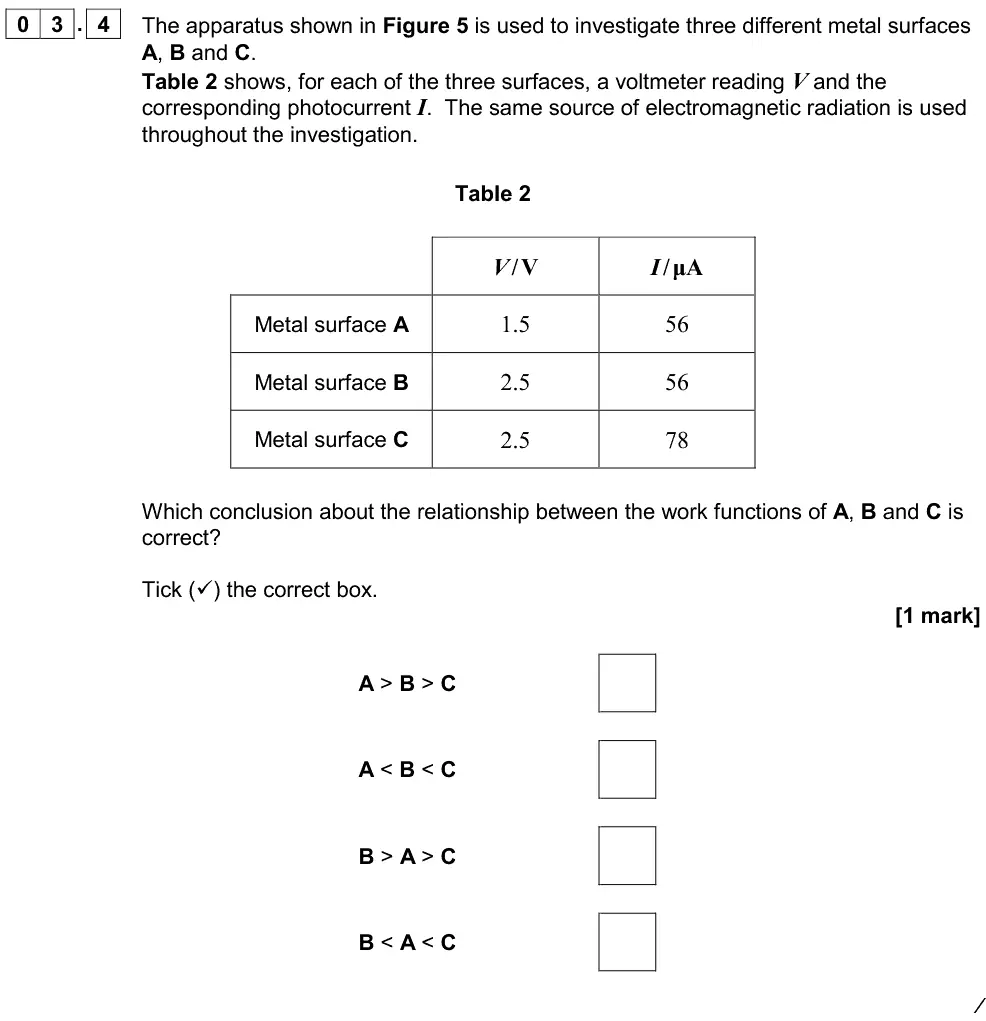
03.4 40% of the students identified the correct response.
Notes from the mark scheme and report
Answer: A > B > C (lower stopping pd means lower max KE, so larger work function
same stopping pd for B and C needs comparison of current)
40% correct
June 2017 · Paper 3B Turning points · Q2.12 marksShort answer
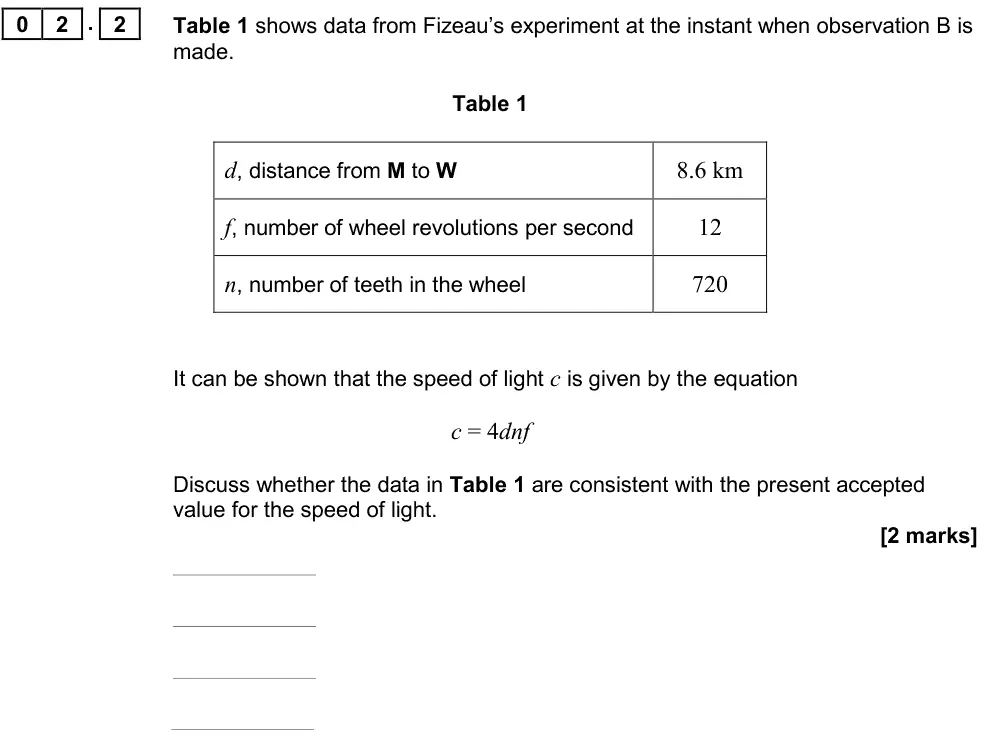
Mark scheme
Examiner's comment
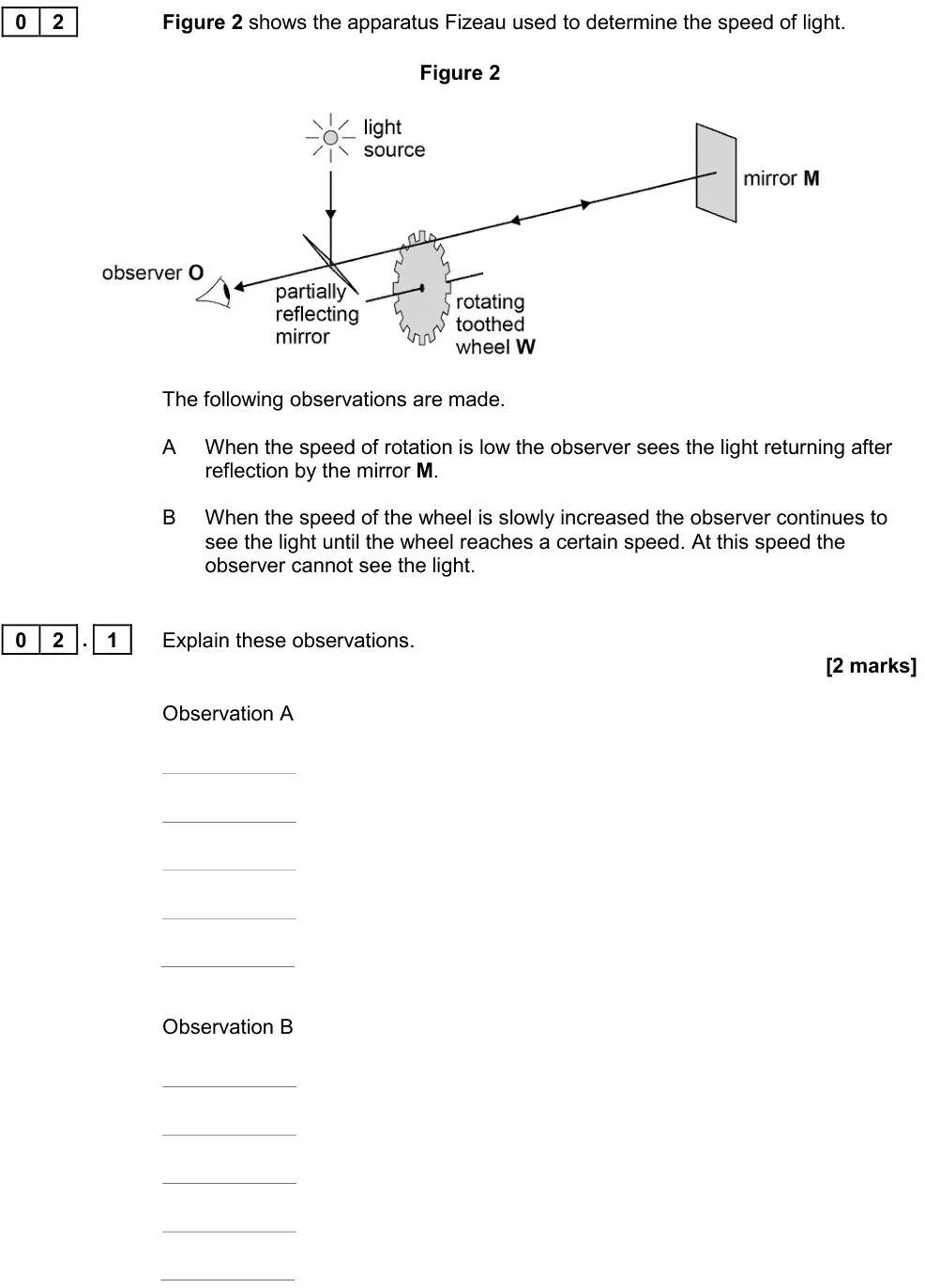
02.1 Although many responses were detailed and showed understanding of Fizeau’s experiment, few students explained with sufficient precision observations A and B. For observation A, a response explaining that light returned through the same gap was expected, while for observation B the correct response was that the light was blocked by the adjacent tooth.
Notes from the mark scheme and report
A: at low speed light returns through the same gap
B: returning light is blocked by the adjacent tooth
June 2017 · Paper 3B Turning points · Q2.22 marksCalculation
Earlier part of question 2 that this part uses
Mark scheme
Examiner's comment
02.2 Few students had trouble with what proved to be a straightforward calculation. An explicit value for the accepted speed of light, to at least two significant figures, was expected, along with a statement of comparison to the calculated value. A large number of students failed to work with this level of care and attention to detail.
Notes from the mark scheme and report
Answer: c = 4 x 8600 x 720 x 12 = 2.97 x 10^8 m s^-1, consistent with 3.0 x 10^8 m s^-1
accepted value must be quoted to at least 2 sf with a comparison
Skills: MS2.3 Substitute numerical values into algebraic equations using appropriate units for physical quantities; MS0.2 Recognise and use expressions in decimal and standard form
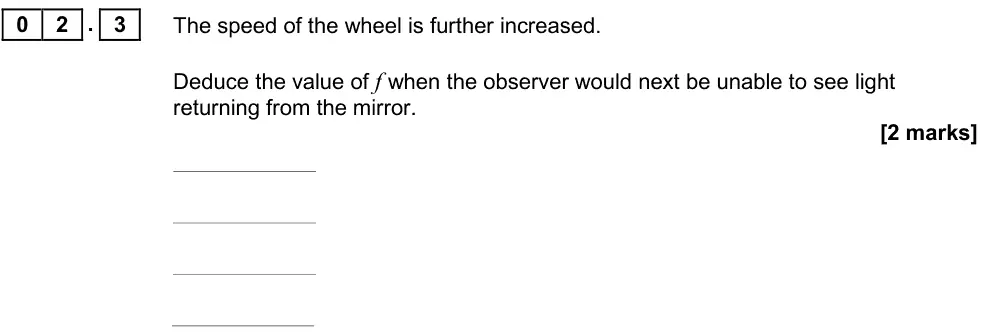
June 2017 · Paper 3B Turning points · Q2.32 marksShort answer
Earlier part of question 2 that this part uses
Mark scheme
Examiner's comment
02.3 An answer that was based on recall was not accepted as a deduction. Only a small fraction of students were able to construct a convincing deduction, although a good number were able to give the correct value for the frequency of rotation. The minimum expected as a deduction was that the light would be blocked at the next tooth.
Notes from the mark scheme and report
Answer: 36 rev s^-1 (light must pass a gap and be blocked by the next tooth, three times the speed)
recall without deduction not accepted
Skills: MS0.3 Use ratios, fractions and percentages
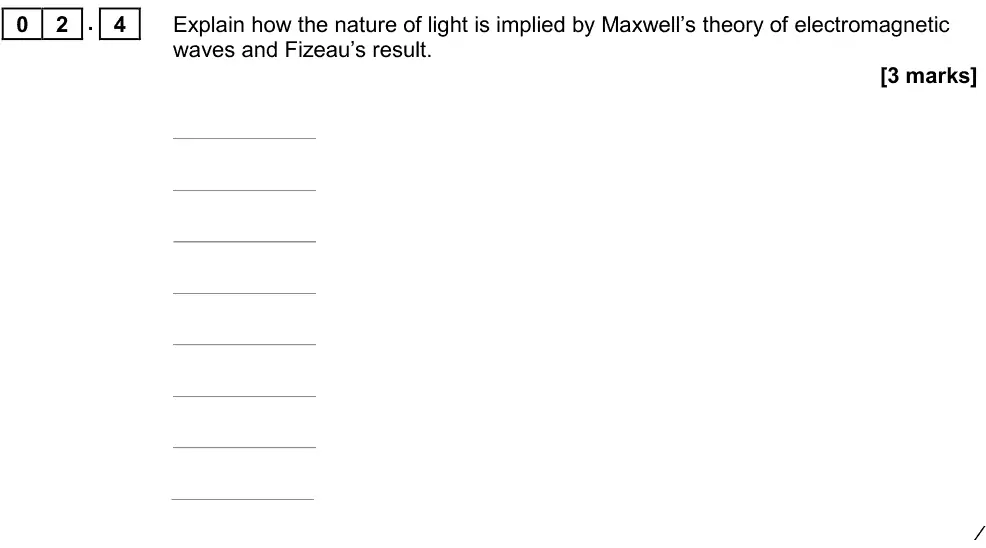
June 2017 · Paper 3B Turning points · Q2.43 marksExplanation
Earlier part of question 2 that this part uses
Mark scheme
Examiner's comment
02.4 A good proportion of responses were well rehearsed to form a clear chain of logic between Maxwell’s predicated speed for EM waves, congruence with Fizeau’s result, and the implication that light is an EM wave. Some students went only as far as stating that Maxwell’s theory predicted a value for the speed of light, meaning that the argument could not be completed. Another common mistake was to focus on various experimental results that show the wave nature of light or other electromagnetic waves.
Notes from the mark scheme and report
Maxwell predicted the speed of EM waves (1/sqrt(mu0 epsilon0))
Fizeau's speed of light agrees
so light is an EM wave
wave-nature evidence alone not relevant
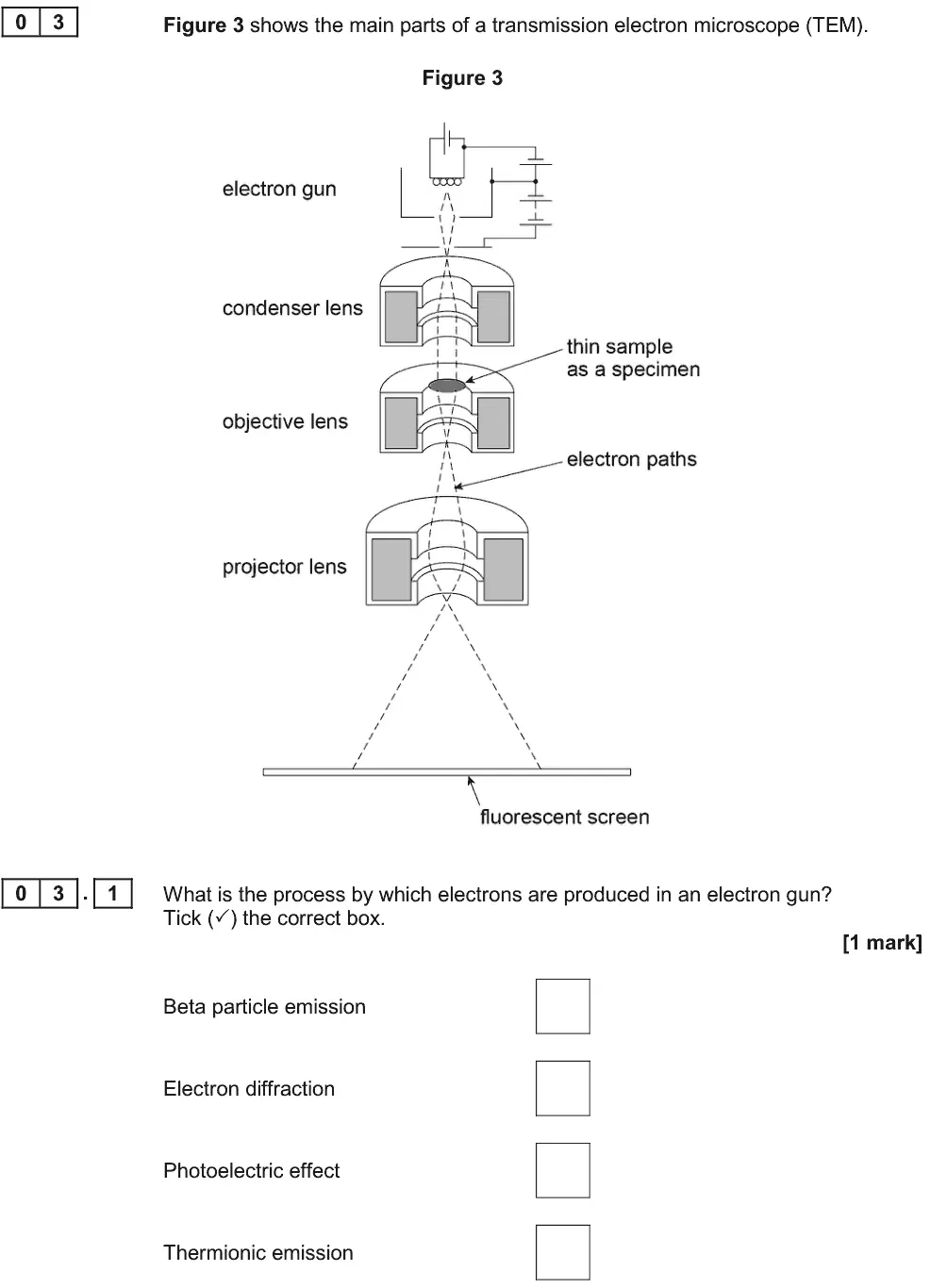
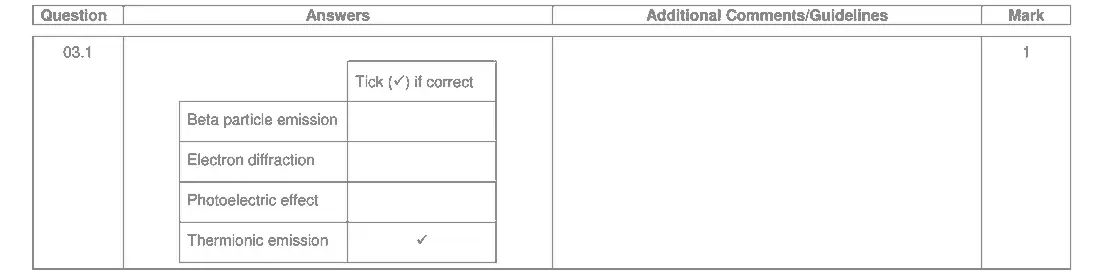
June 2017 · Paper 3B Turning points · Q3.11 markShort answer
Mark scheme
Examiner's comment
03.1 A very high proportion of students scored this simple recall mark.
Notes from the mark scheme and report
Answer: thermionic emission
very high proportion correct
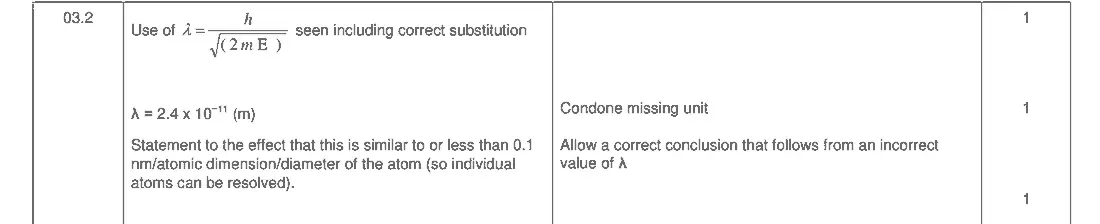
June 2017 · Paper 3B Turning points · Q3.23 marksCalculation
Earlier part of question 3 that this part uses
Mark scheme
Examiner's comment
03.2 The calculation was done well by many students. Some students used an energy argument rather than the more straightforward direct substitution from the formula sheet. Where students did follow an energy argument, a common mistake was to confuse potential difference with velocity. Students in general were reasonably successful in arguing whether the electrons could resolve atoms. Few students were able to recall and use the approximate size of an atom and compare their value for the de Broglie wavelength with this; for those who did make some progress in this regard, a common mistake was to confuse the dimensions of the atom and nucleus.
Notes from the mark scheme and report
Answer: lambda = h/sqrt(2mE) = 2.4 x 10^-11 m, smaller than an atomic diameter (about 10^-10 m), so atoms can in principle be resolved
confusing atomic and nuclear size
Skills: MS2.3 Substitute numerical values into algebraic equations using appropriate units for physical quantities; MS2.2 Change the subject of an equation, including non-linear equations
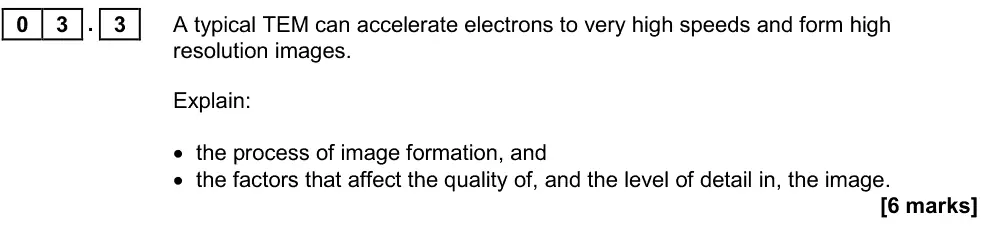
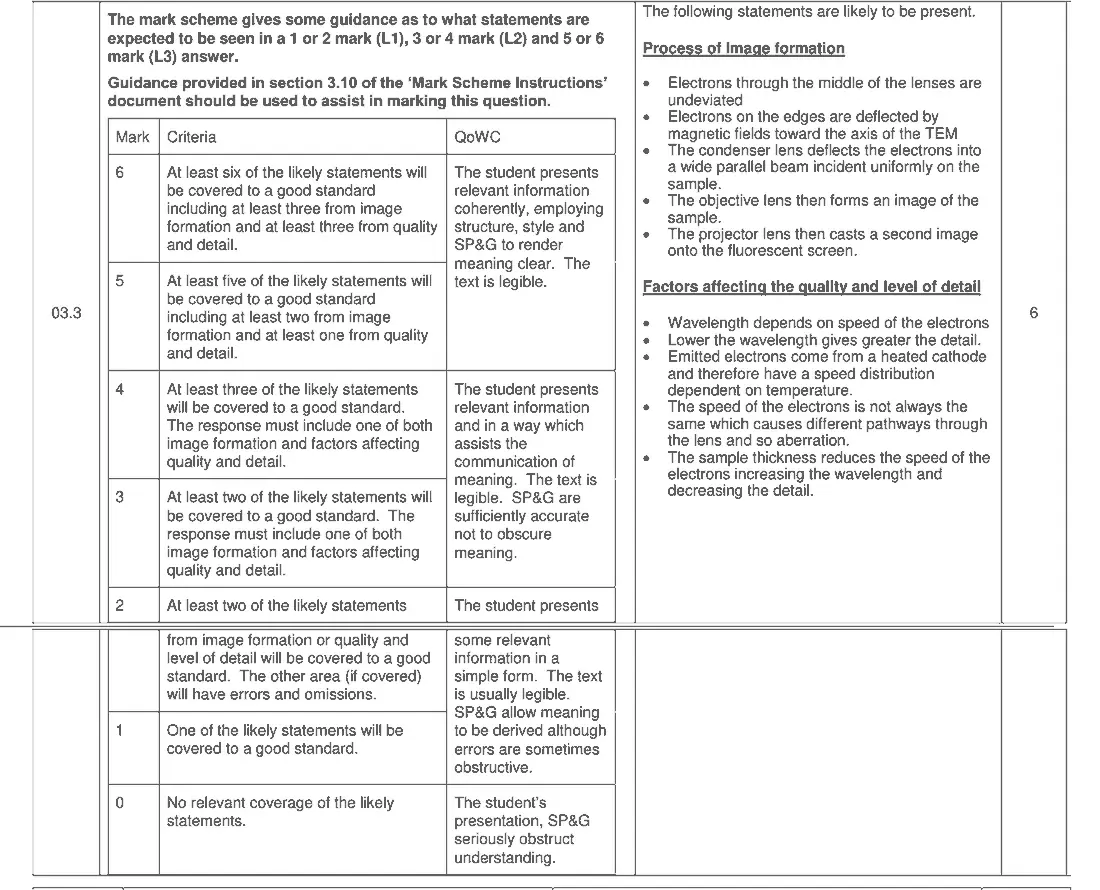
June 2017 · Paper 3B Turning points · Q3.36 marks6-mark extended response
Earlier part of question 3 that this part uses
Mark scheme, with the levels and indicative content
Examiner's comment
03.3 This question produced a wide range of levels of performance. Many students used the diagram provided to help structure their response to how the image was formed, and could support their answer with some detail about how the quality of the image was affected by the speed of the electrons. This meant that most responses fell into the middle band of performance, which was encouraging. The best responses named and described the function of three lenses well and went on to explain how resolution depended on the speed, and hence de Broglie wavelength, of the electrons. Some students were also able to detail how speed varied due to sample thickness and thermionic emission. Very few students explained sufficiently well how the electrons that travel through the centre of the TEM are unaffected by the lenses.
Notes from the mark scheme and report
Levels of response: condenser lens forms a parallel beam, objective lens forms the image, projector lens casts it on the screen
magnetic lenses deflect off-axis electrons, axial ones undeviated
higher speed gives shorter wavelength and more detail
spread of speeds (thermionic) causes aberration
thick samples slow electrons
Specimen set 1 · Paper 3B Turning points · Q2.34 marksCalculation
Earlier part of question 2 that this part uses
Mark scheme
Notes from the mark scheme and report
Answer: 1.8 x 10^-11 m (v = (2eV/m)^(1/2) = 4.1 x 10^7 m s^-1
lambda = h/mv)
Skills: MS2.2 Change the subject of an equation, including non-linear equations; MS2.3 Substitute numerical values into algebraic equations using appropriate units for physical quantities
Specimen set 1 · Paper 3B Turning points · Q2.43 marksExplanation
Earlier part of question 2 that this part uses
Mark scheme
Notes from the mark scheme and report
Higher pd gives higher speed and momentum so shorter de Broglie wavelength, less diffraction and smaller ring diameters
Specimen set 1 · Paper 3B Turning points · Q3.12 marksExplanation
Mark scheme
Notes from the mark scheme and report
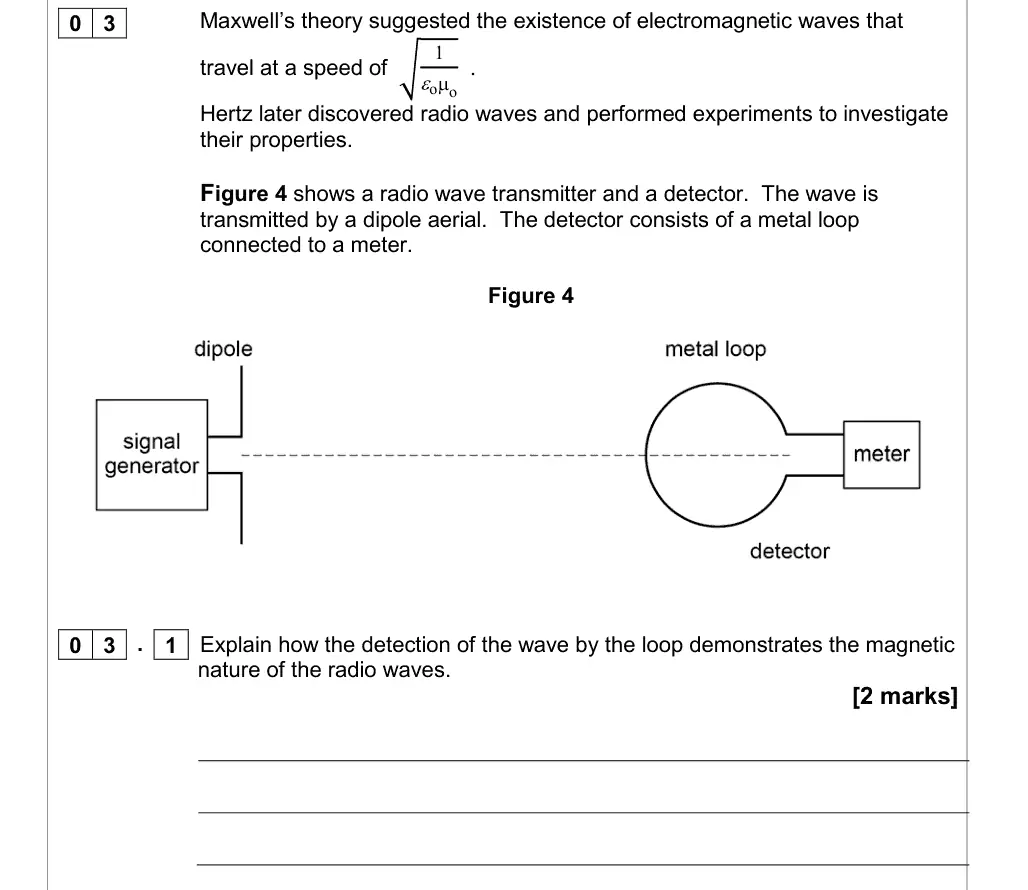
Induced emf in the loop needs a changing magnetic flux through it, which must come from the passing wave, so the wave has a magnetic component
Specimen set 1 · Paper 3B Turning points · Q3.21 markShort answer
Earlier part of question 3 that this part uses
Mark scheme
Notes from the mark scheme and report
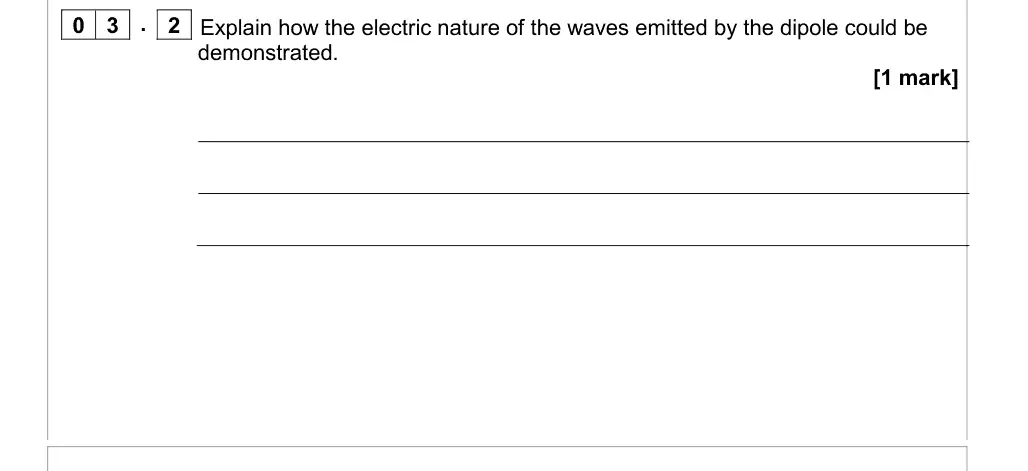
Use a second dipole aligned parallel to the transmitter to detect the changing electric field
Specimen set 1 · Paper 3B Turning points · Q3.36 marks6-mark extended response
Earlier part of question 3 that this part uses
Mark scheme, with the levels and indicative content
Notes from the mark scheme and report
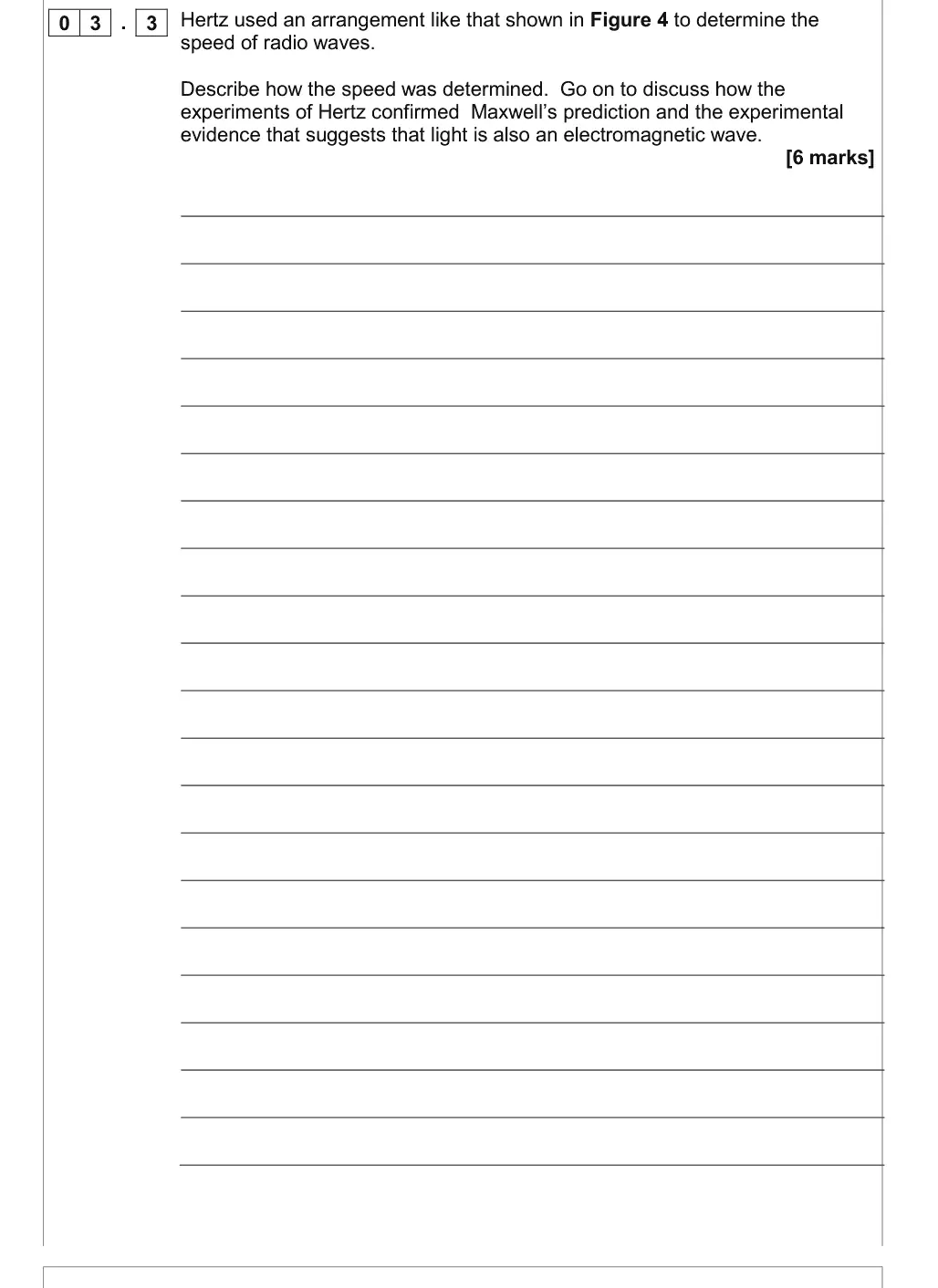
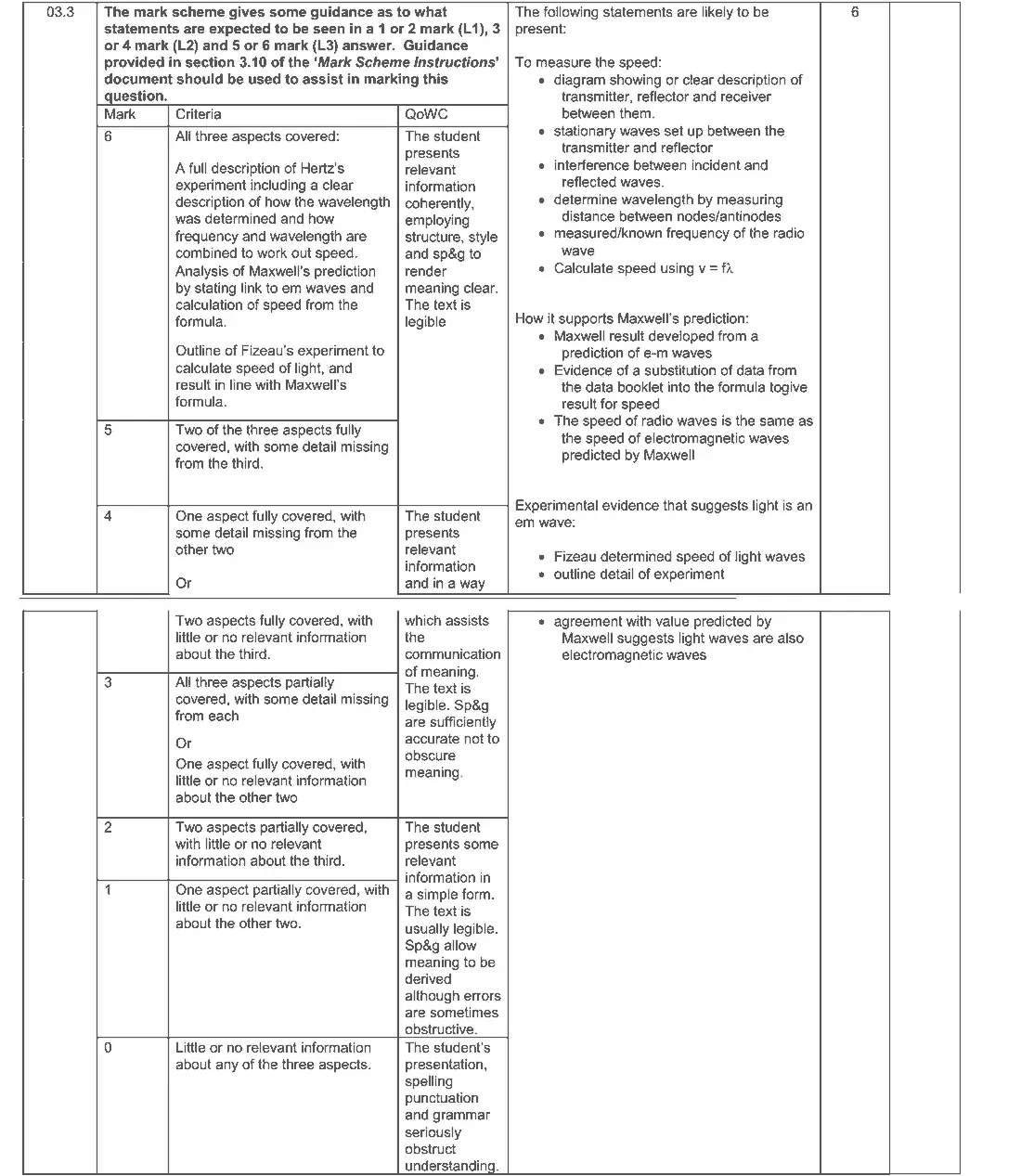
Levels of response: reflector sets up stationary waves
node or antinode spacing gives wavelength
known frequency, c = f lambda
agrees with Maxwell's 1/sqrt(mu0 epsilon0) = 3.0 x 10^8 m s^-1
Fizeau's rotating toothed-wheel measurement of the speed of light gave the same value, so light is electromagnetic
Work with an AQA physics tutor
Dropping marks on calculations, required practicals or the six-markers? Book a trial session with a specialist AQA physics tutor.