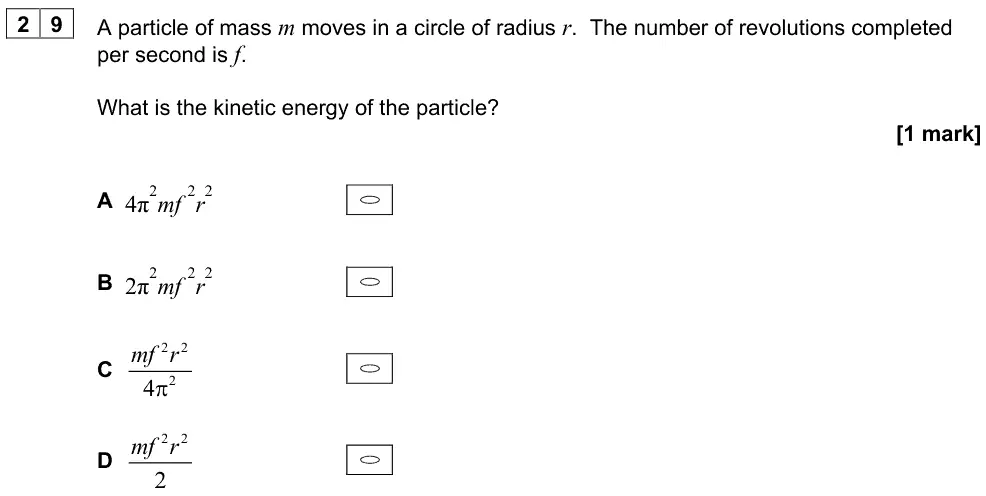
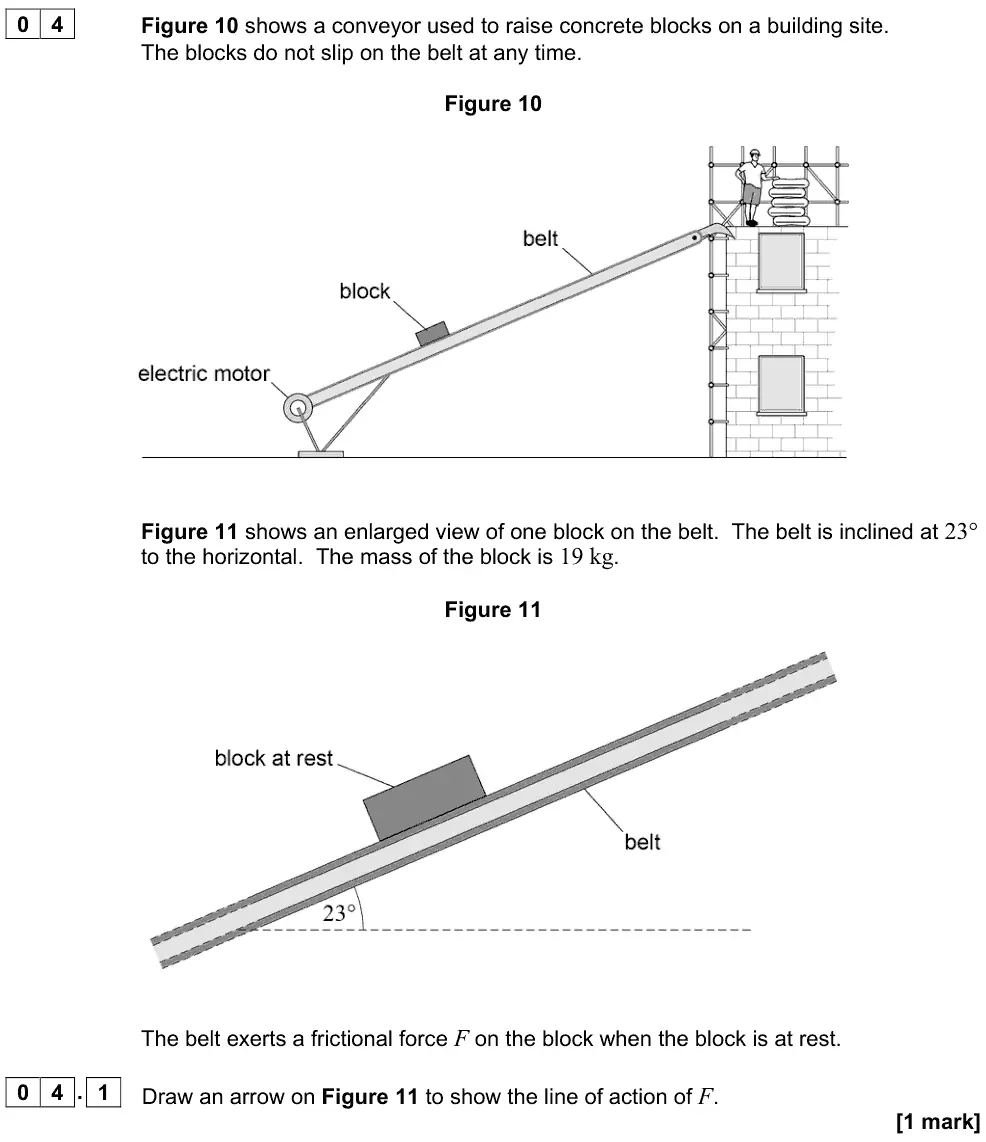
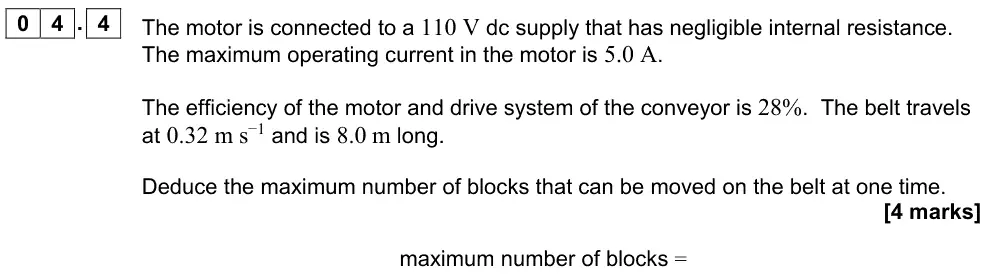
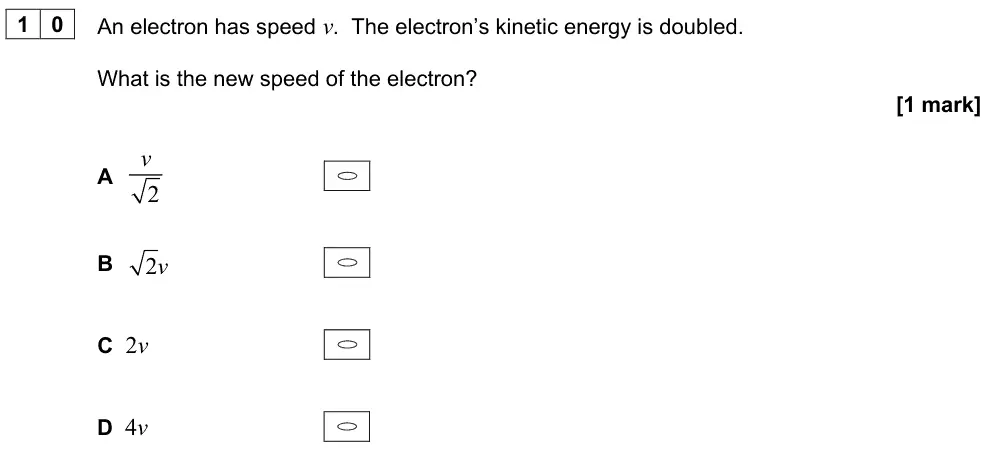
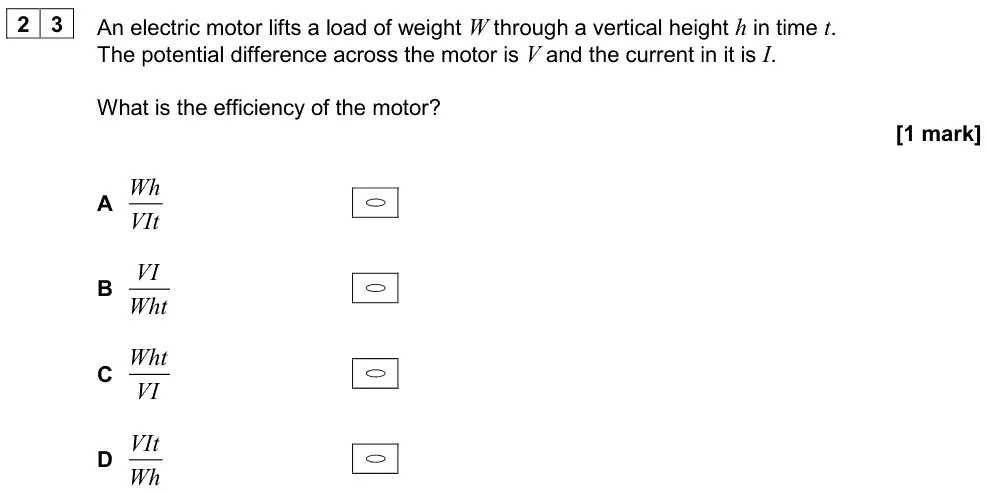
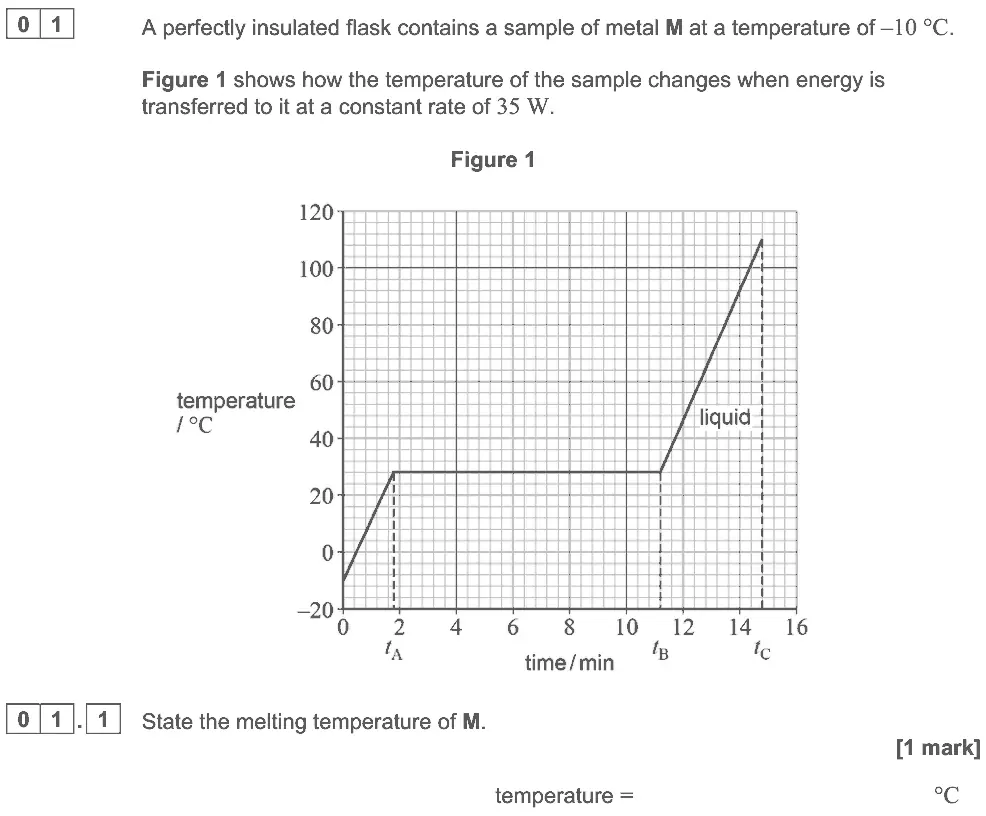
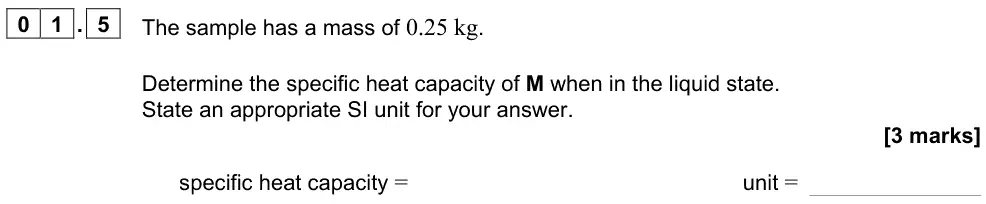
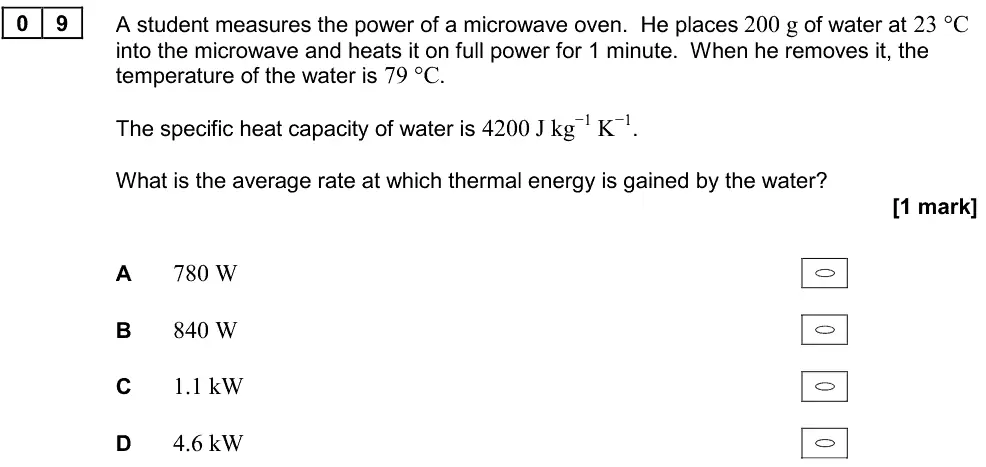
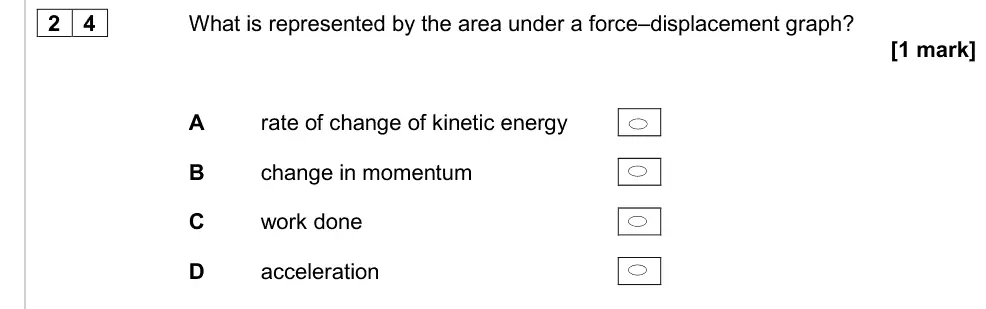
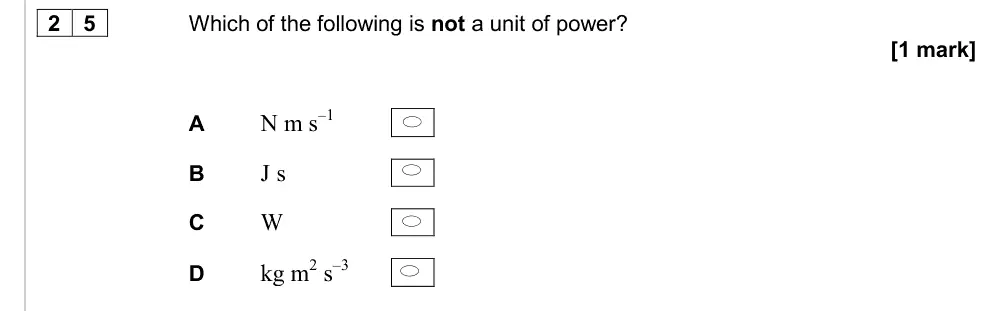
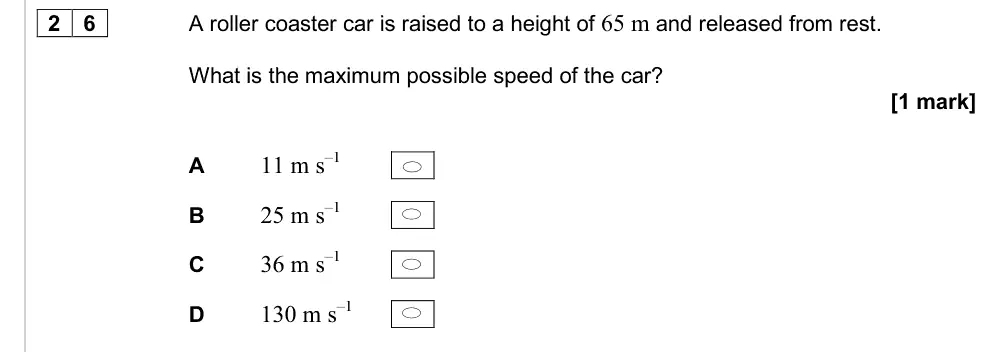
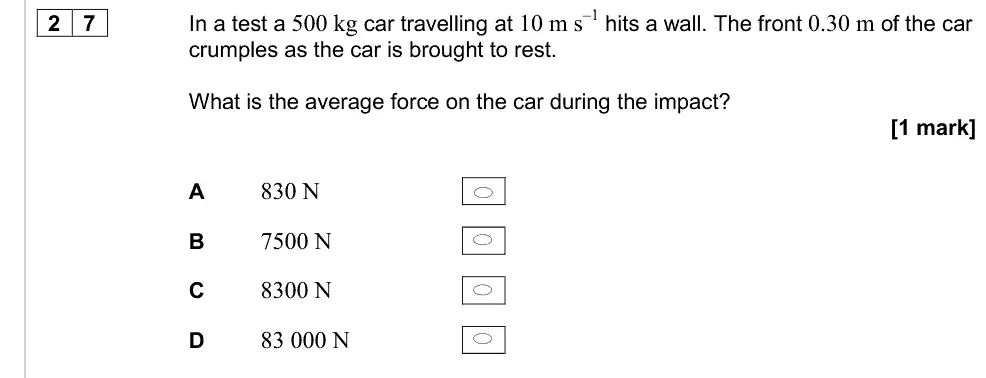
Notes and key-term cards for this topic are being written by our tutors. The past-paper questions below are ready now.
Specification statements
Show the 6 statements from the specification
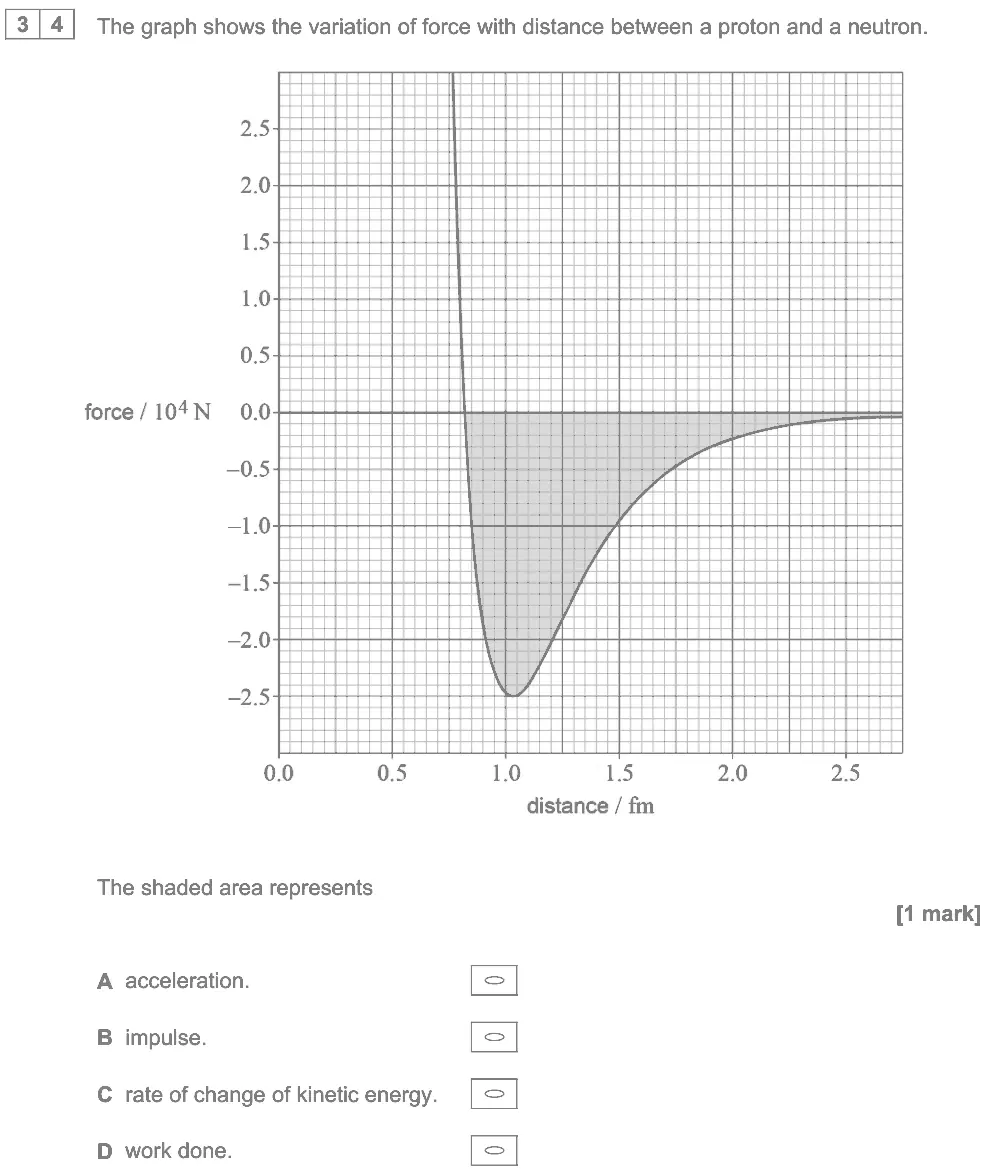
3.4.1.7-01 Energy transferred, W = Fscosθ rate of doing work = rate of energy transfer, P = ∆W ∆t = Fv
3.4.1.7-02 Quantitative questions may be set on variable forces.
3.4.1.7-03 Significance of the area under a force–displacement graph. efficiency = useful output power input power
3.4.1.7-04 Efficiency can be expressed as a percentage.
3.4.1.8-01 Principle of conservation of energy. ∆Ep = mg∆h and Ek = 1 2mv 2
3.4.1.8-02 Quantitative and qualitative application of energy conservation to examples involving gravitational potential energy, kinetic energy, and work done against resistive forces.
Tap a question to zoom it. Where a part needs a figure, table or graph from earlier in the question, that part folds out above it; the mark scheme and examiner's comment open underneath. Have the AQA data and formulae booklet beside you (see the formula sheet page).
June 2025 · AS Paper 1 · Q3.32 marksAO1=1, AO2=1Calculation
Earlier part of question 3 that this part uses
Mark scheme
Examiner's comment
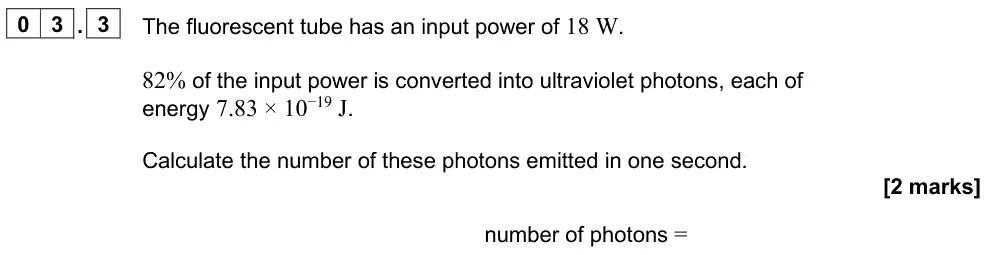
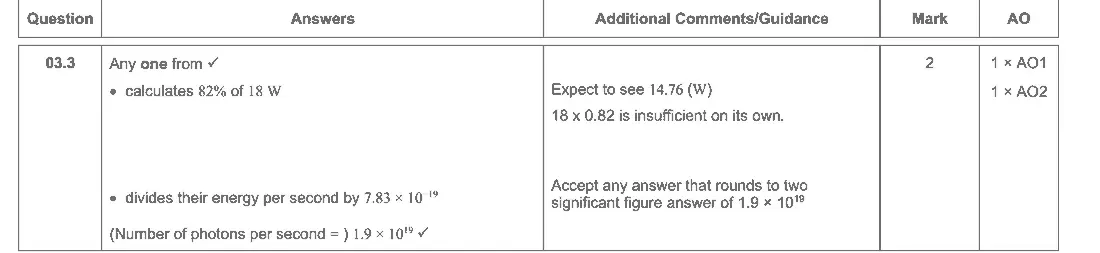
03.3 Most students (almost 85%) were able to calculate 82% of the input power. Those students who lost a mark typically reversed the required ratio and divided the photon energy by their power.
Notes from the mark scheme and report
Answer: 1.9 x 10^19 photons per second (0.82 x 18 = 14.76 W divided by 7.83 x 10^-19 J)
inverting the ratio was the common error
Skills: MS0.3 Use ratios, fractions and percentages; MS0.2 Recognise and use expressions in decimal and standard form
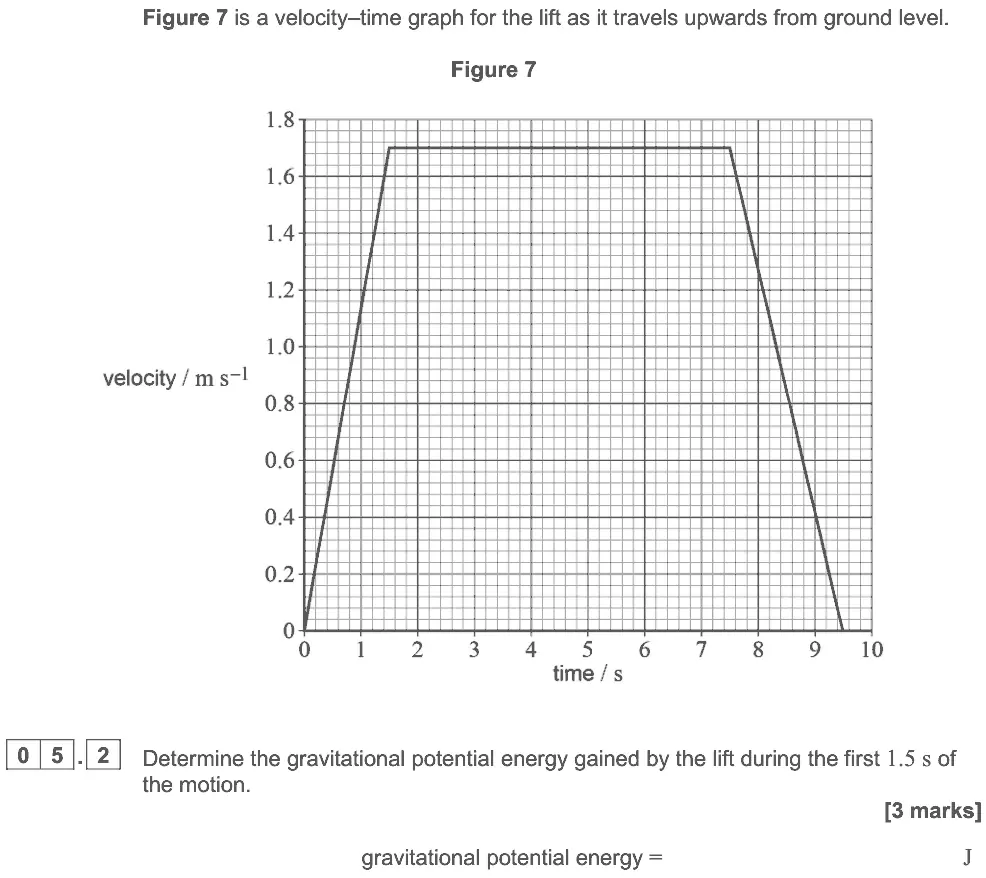
June 2025 · AS Paper 1 · Q5.23 marksAO1=2, AO2=1Calculation
Earlier part of question 5 that this part uses
Mark scheme
Examiner's comment
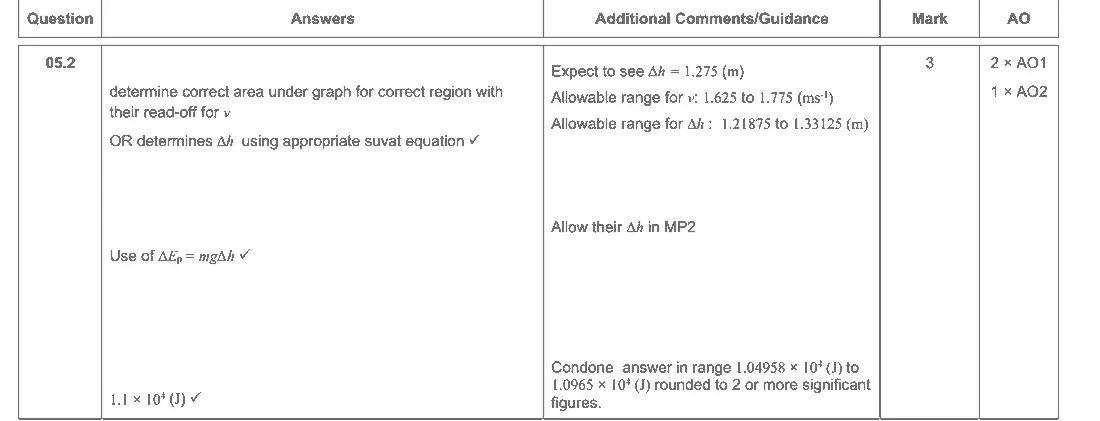
05.2 Over 50% of students gained full marks in this calculation. A common error seen in this calculation was calculating the distance travelled as 2.55 m by multiplying the velocity of 1.7 ms-1 by the time of 1.5 s. The two successful approaches were determining the area under the velocity-time graph or using appropriate equations of motion to determine the distance travelled. Some students misinterpreted the question and calculated the kinetic energy of the lift for a velocity of 1.7 ms-1. Surprisingly, almost 18% of students made no attempt at this question. This question proved challenging with less than 20% of students gaining 3 marks. Almost 50% of students gained at least two marks. Most of these students were unable to carry out the final step of the calculation. Students were unable to apply Newton’s 2nd law to this situation where the lift was moving upwards but undergoing a deceleration.
Notes from the mark scheme and report
Answer: 1.1 x 10^4 J (height = area under graph = 1/2 x 1.5 x 1.7 = 1.275 m)
1.7 x 1.5 = 2.55 m was the common error
almost 18% made no attempt
Skills: MS3.8 Understand the possible physical significance of the area between a curve and the x axis and be able to calculate it or estimate it by graphical methods as appropriate; MS2.3 Substitute numerical values into algebraic equations using appropriate units for physical quantities
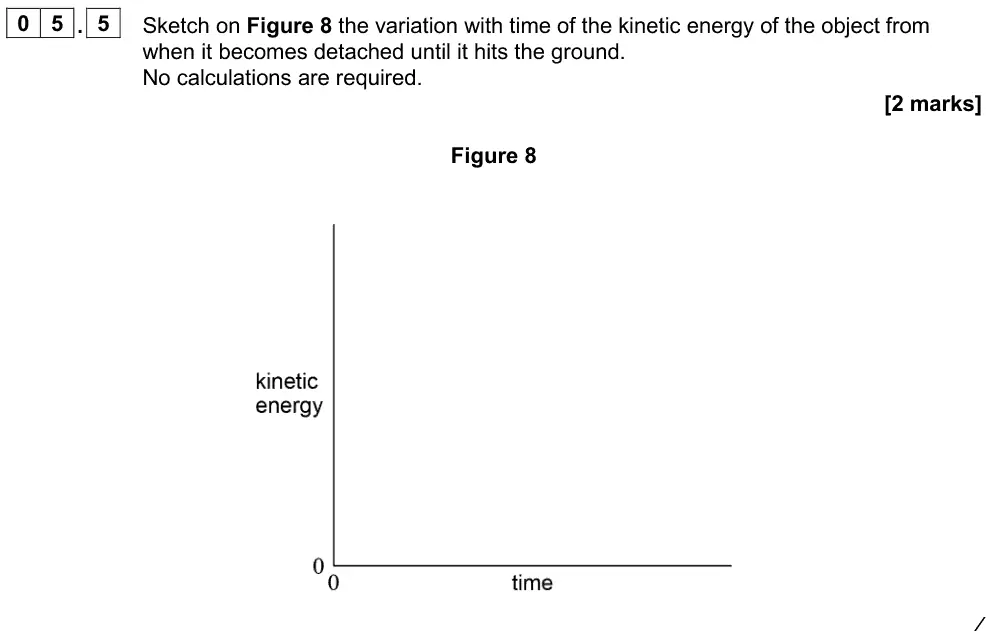
June 2025 · AS Paper 1 · Q5.52 marksAO3=2Diagram or graphHard
Earlier part of question 5 that this part uses
Mark scheme
Examiner's comment
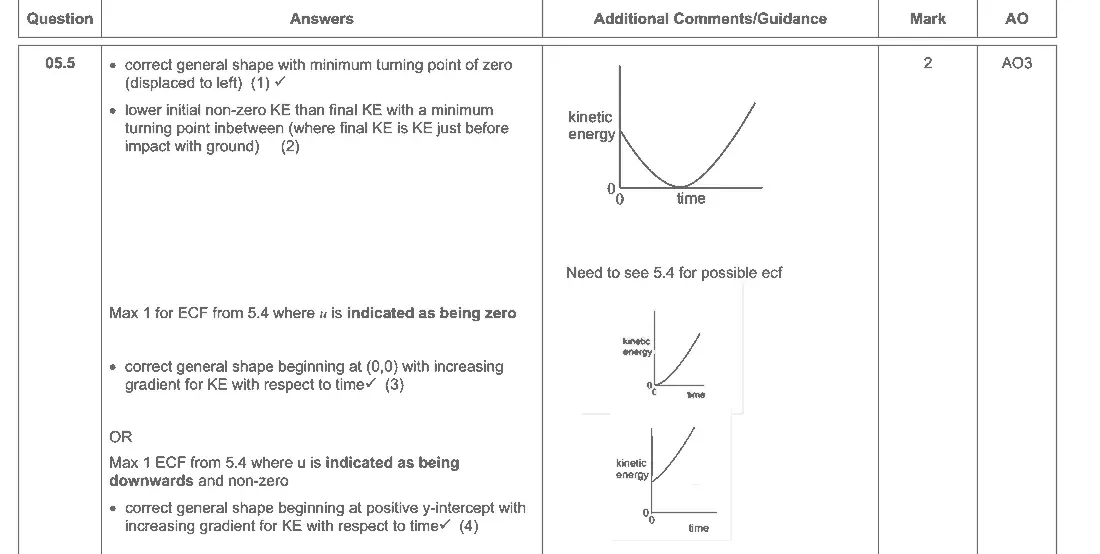
05.5 This question was marked with 05.4 to give potential credit to those who though the object’s velocity was zero (or other than 1.7 ms-1 upwards) when it was released. Again, this question proved to be very challenging with only 5% of students gaining two marks. Many students drew graphs that showed a direct proportionality between the kinetic energy and time.
05.4 This question proved challenging with approximately 25% of the students able to correctly assimilate the information and then present working that was both correct and convincing. Many students had errors with signs and didn’t seem to appreciate the vector nature of the quantities involved. A considerable number of students assumed the object hit ground 4 s after it was released from rest. Others assumed that the initial velocity was 5.5 divided by 4.0 s rather than reading the velocity off the velocity-time graph in Figure 7.
Notes from the mark scheme and report
KE starts non-zero, falls to zero at the top (minimum turning point), then rises to a larger final value
many drew KE proportional to time
June 2025 · Paper 1 · Q6.12 marksAO1=1, AO2=1CalculationEasy
Mark scheme
Examiner's comment
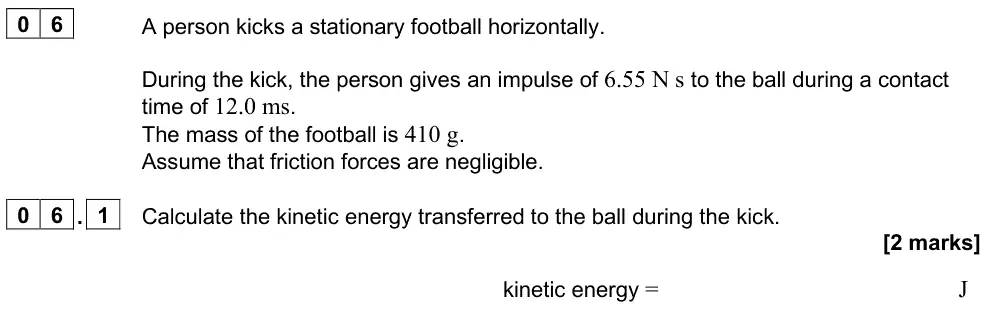
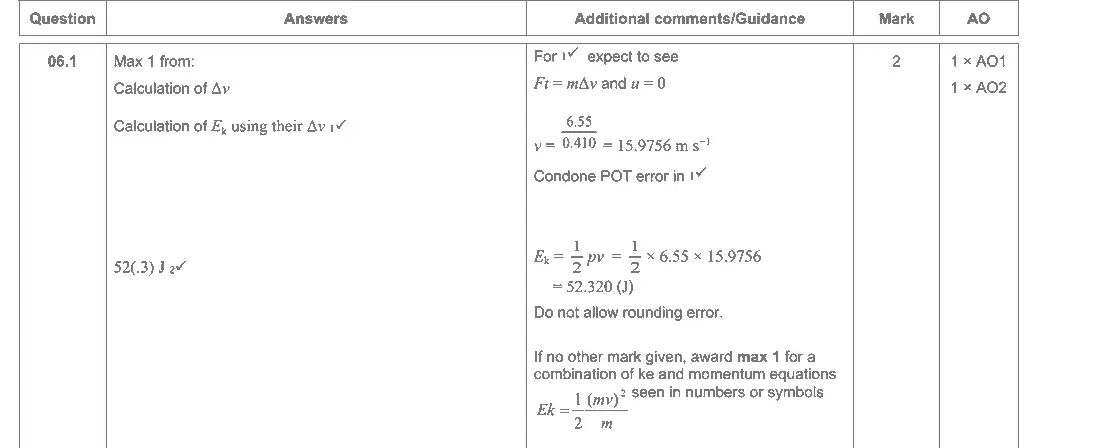
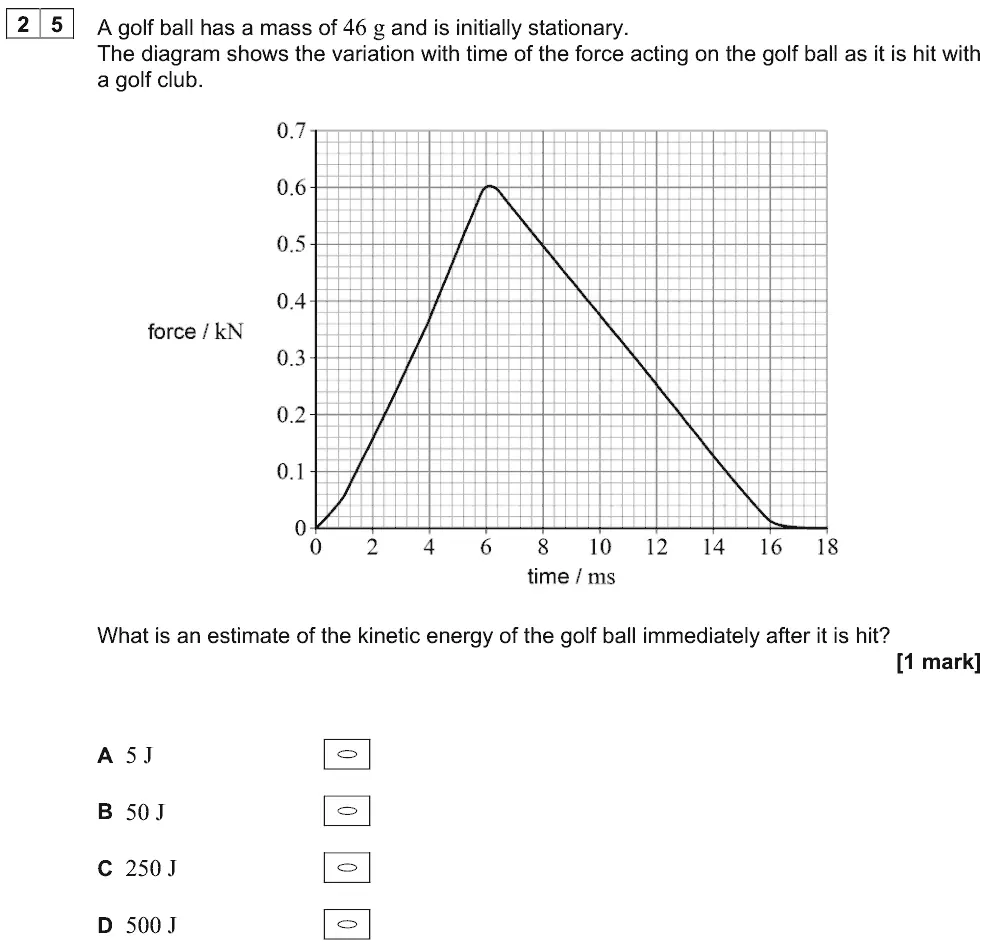
Question 6.1 was answered correctly by 65% of students. Common errors included interpreting impulse as force and therefore getting an incorrect value for the speed. This led to a very small value for the kinetic energy. Students should be encouraged to check their work if they arrive at an unlikely answer.
Only about 25% of students obtained any marks at all for Question 6.2. Those who realised that the area under the graph was the impulse often made no effort to arrive at value for the force. The most successful answers introduced an unknown, such as x, for one unit on the Force axis. They then determined an area in terms of x and related it to the impulse. Solving for x and rounding gave a value for the scale. Some students followed this or a similar path but missed out on full marks because of a power of ten error, arising from the millisecond unit on the time scale. A common incorrect approach was to relate the peak value of F to the impulse in some form.
Most students completed the calculation in Question 6.3 correctly. Some incorrectly used the horizontal component of the velocity or used 18. Many students had problems using a consistent sign convention or choosing an appropriate constant acceleration equation. Although calculators often solve quadratics directly, students should still be encouraged to set out their answers so that intermediate marks can be given.
Notes from the mark scheme and report
Answer: 52 J (v = 6.55/0.410 = 16.0 m s^-1)
treating impulse as force gave tiny answers
Skills: MS2.3 Substitute numerical values into algebraic equations using appropriate units for physical quantities; MS2.2 Change the subject of an equation, including non-linear equations
June 2025 · Paper 1 · Q7.12 marksAO2=2Show that
Mark scheme
Examiner's comment
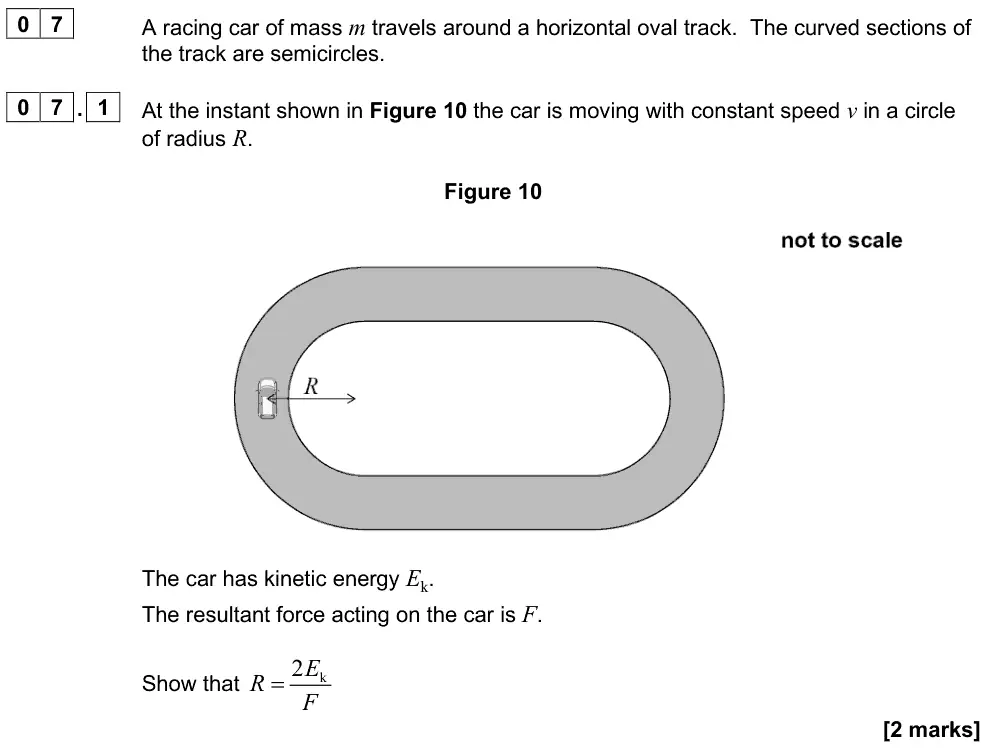
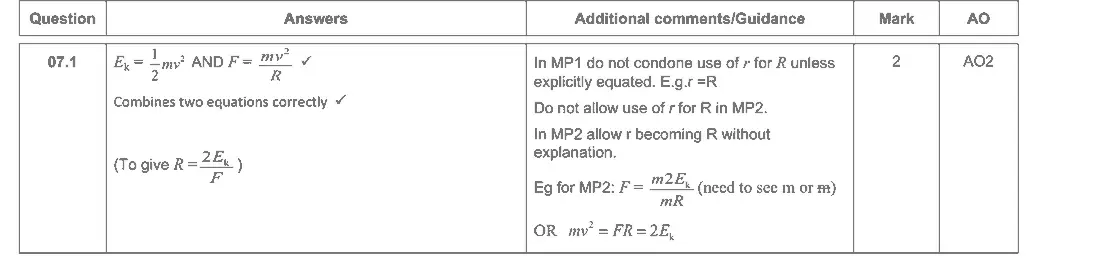
57% of students obtained full marks for Question 7.1. As this was a ‘show that’ question, each step in the derivation had to be clear. Students given one mark often used ‘r’ for the radius in early stages before substituting R in their final answer without reason. It was expected that students used R throughout or wrote r=R at some point. Students who tried to work backwards from the answer rarely gained much credit.
Notes from the mark scheme and report
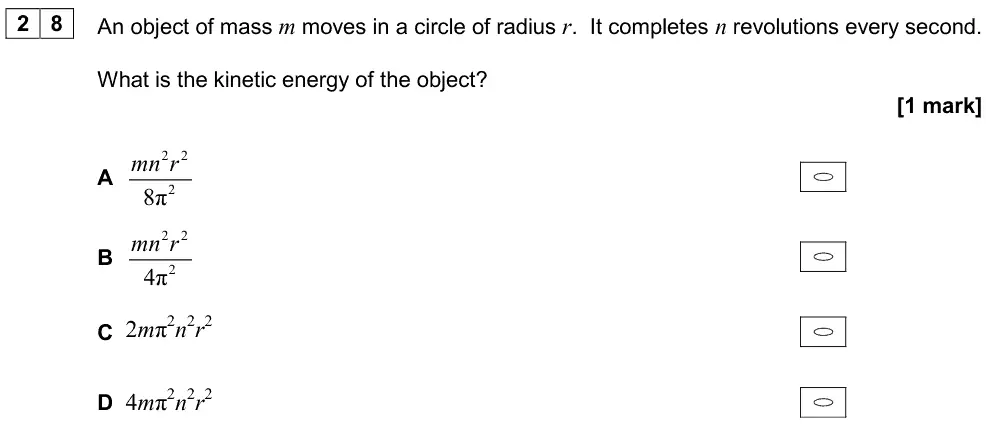
Combine Ek = mv^2/2 with F = mv^2/R
use R throughout (r for R lost a mark)
working backwards rarely credited
Skills: MS2.2 Change the subject of an equation, including non-linear equations
June 2025 · Paper 1 · Q8.12 marksAO2=2CalculationEasy
Mark scheme
Examiner's comment
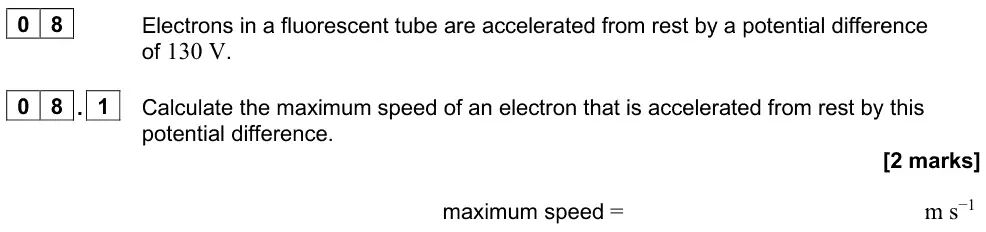
Question 8.1 was answered correctly by 64% of students. Surprisingly about 8% did not attempt this calculation. Several careless mathematical or substitution errors were seen.
Answers to Question 8.2 were often vague or based on the electrons starting with different speeds. The best answers made it clear that the kinetic energy of electrons was transferred to the gas atoms, or that the collisions were inelastic. Simply stating that collisions occurred was not enough.
Notes from the mark scheme and report
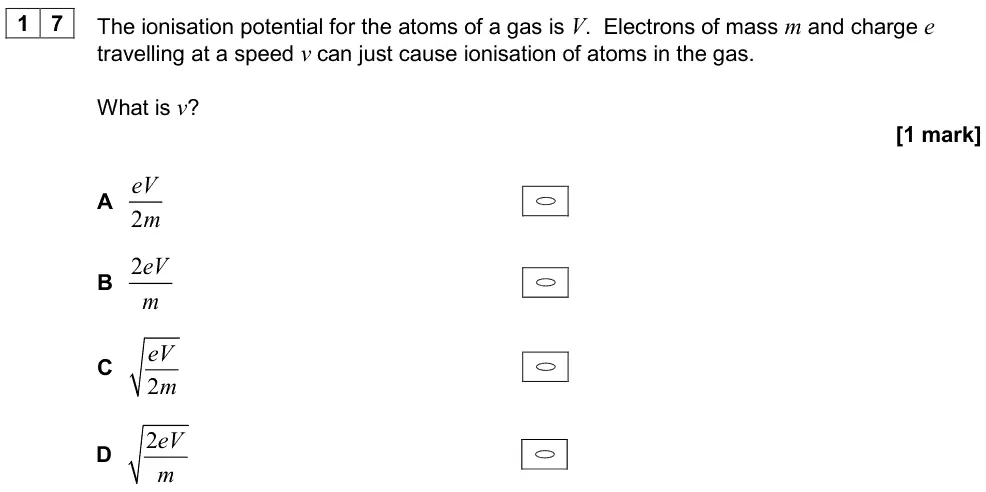
Answer: 6.8 x 10^6 m s^-1 (eV = mv^2/2)
Skills: MS2.3 Substitute numerical values into algebraic equations using appropriate units for physical quantities; MS2.2 Change the subject of an equation, including non-linear equations
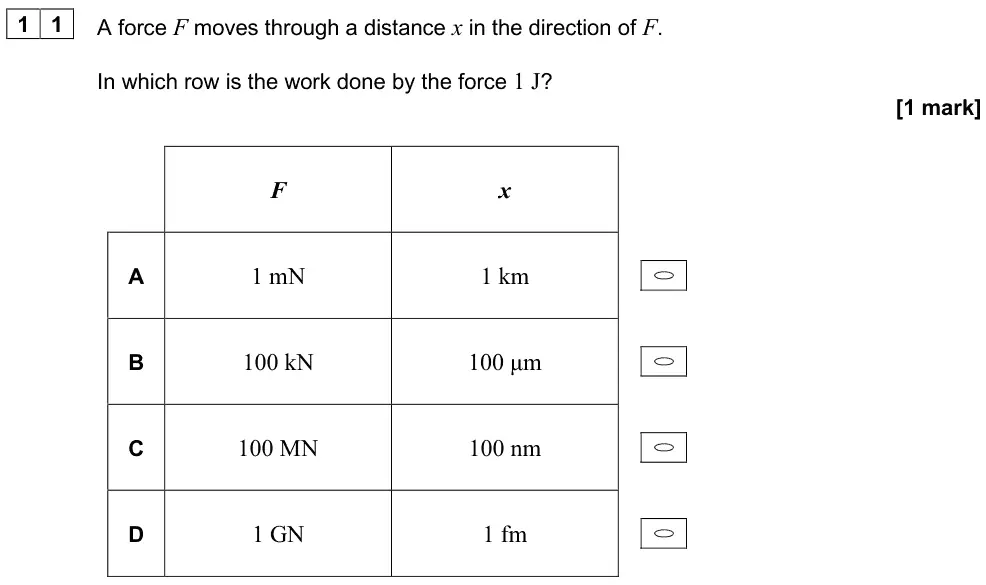
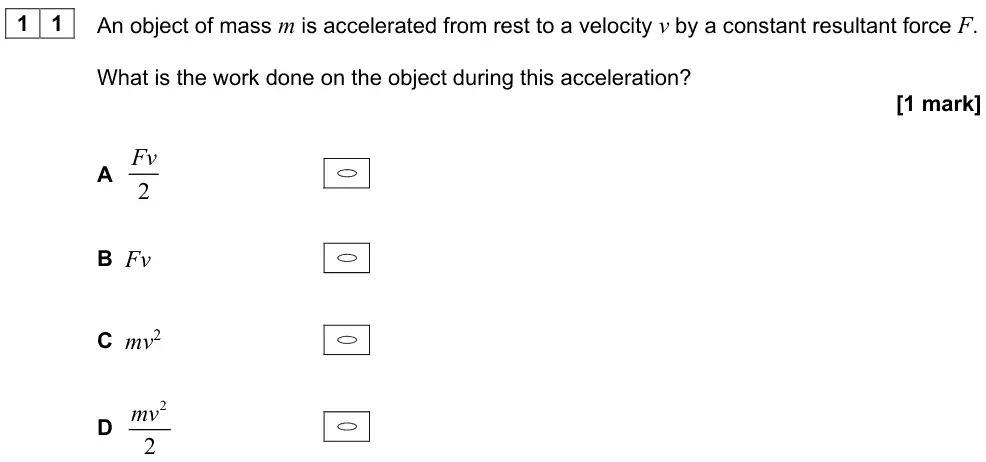
June 2025 · Paper 1 · Q111 markAO1=1Multiple choice
Answer
A
Mark scheme
Notes from the mark scheme and report
Answer: A
Skills: MS0.2 Recognise and use expressions in decimal and standard form
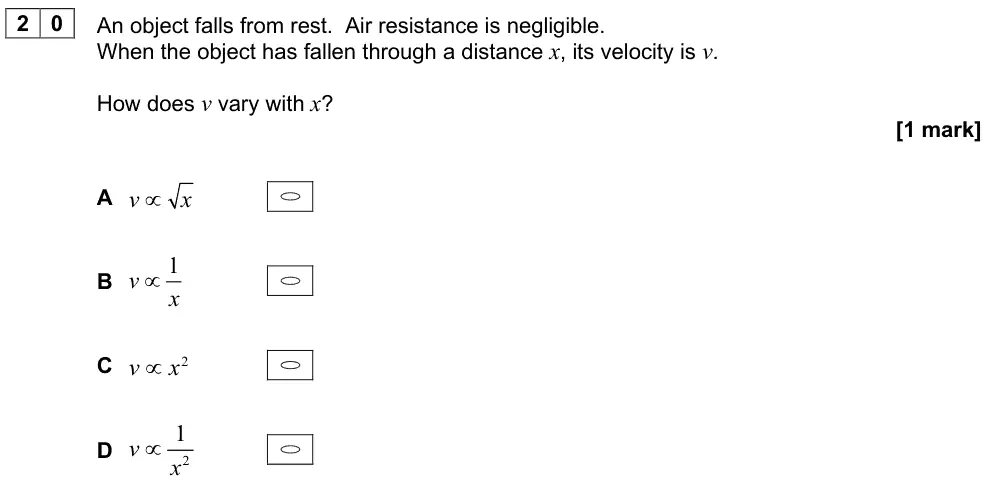
June 2025 · AS Paper 2 · Q201 markAO2=1Multiple choice
Answer
A
Mark scheme
Notes from the mark scheme and report
Answer: A
June 2025 · AS Paper 2 · Q311 markAO2=1Multiple choice
Answer
A
Mark scheme
Notes from the mark scheme and report
Answer: A
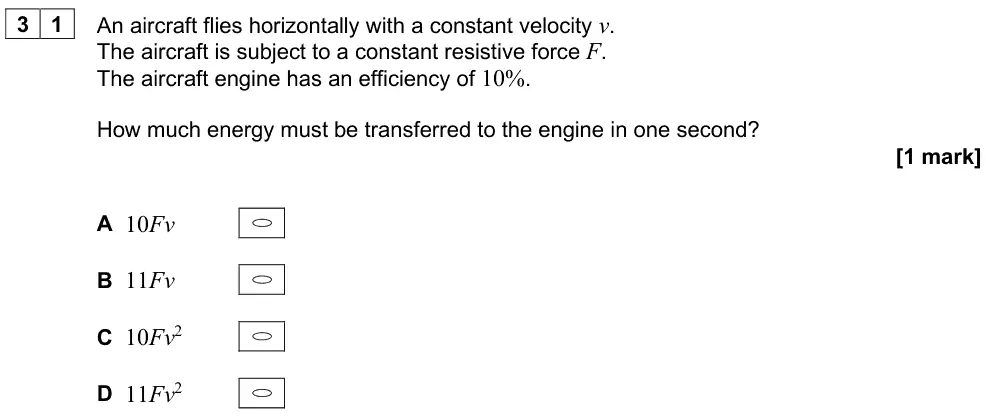
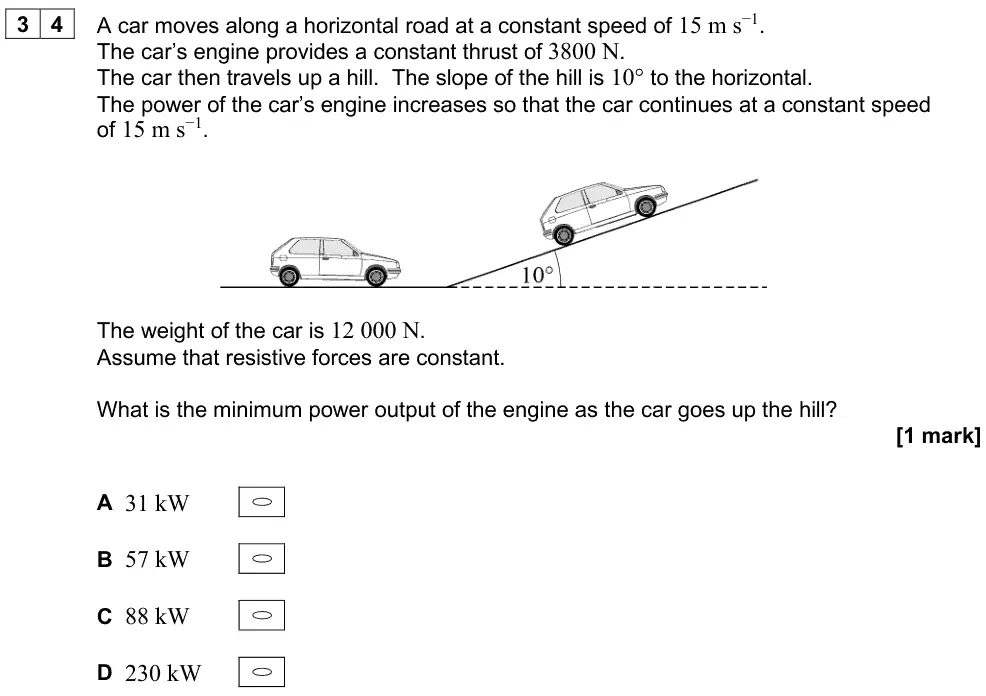
June 2025 · AS Paper 2 · Q341 markAO2=1Multiple choice
Answer
C
Mark scheme
Notes from the mark scheme and report
Answer: C
Skills: MS4.5 Use sin, cos and tan in physical problems
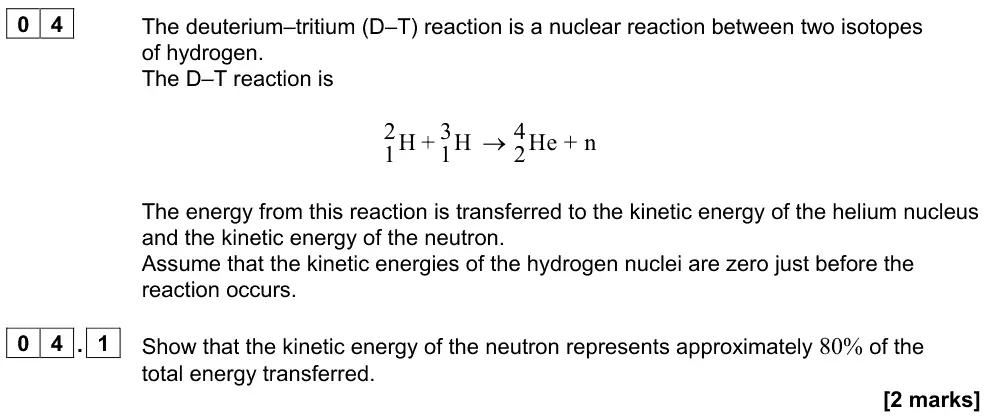
June 2024 · Paper 1 · Q4.12 marksAO3=2Show that
Mark scheme
Examiner's comment
In question 04.1 many students attempted to work out a difference in rest masses between the particles, without success. Several other students identified the difference in masses of the products and used this to explain the 80% without any reference to conservation of momentum or to kinetic energy. Almost 50% of students obtained both marks for question 04.2. The most common error was for students to use the combined energy as the energy of the neutron.
Notes from the mark scheme and report
Equal and opposite momenta with KE = p^2/2m gives neutron KE = 4 x helium KE
mass-difference arguments gained nothing. Fusion is the context only
Skills: MS0.3 Use ratios, fractions and percentages; MS2.2 Change the subject of an equation, including non-linear equations
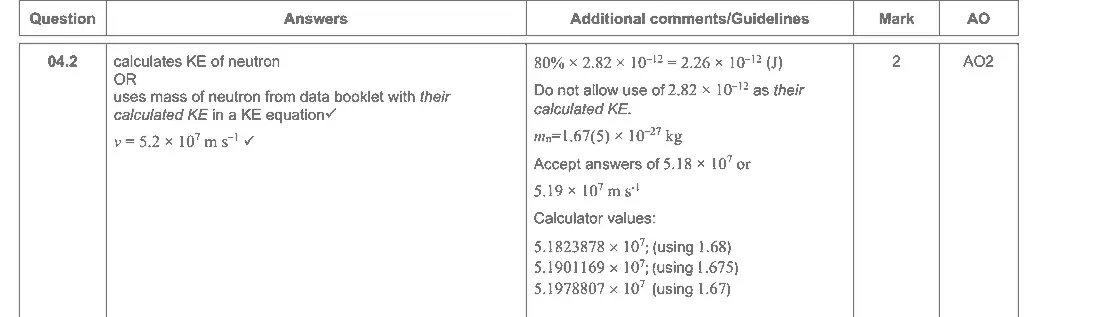
June 2024 · Paper 1 · Q4.22 marksAO2=2Calculation
Earlier part of question 4 that this part uses
Mark scheme
Examiner's comment
In question 04.1 many students attempted to work out a difference in rest masses between the particles, without success. Several other students identified the difference in masses of the products and used this to explain the 80% without any reference to conservation of momentum or to kinetic energy. Almost 50% of students obtained both marks for question 04.2. The most common error was for students to use the combined energy as the energy of the neutron.
Notes from the mark scheme and report
Answer: 5.2 x 10^7 m s^-1 (80% of 2.82 x 10^-12 J = 2.26 x 10^-12 J)
using the combined energy as the neutron's energy was the common error
Skills: MS0.3 Use ratios, fractions and percentages; MS2.3 Substitute numerical values into algebraic equations using appropriate units for physical quantities
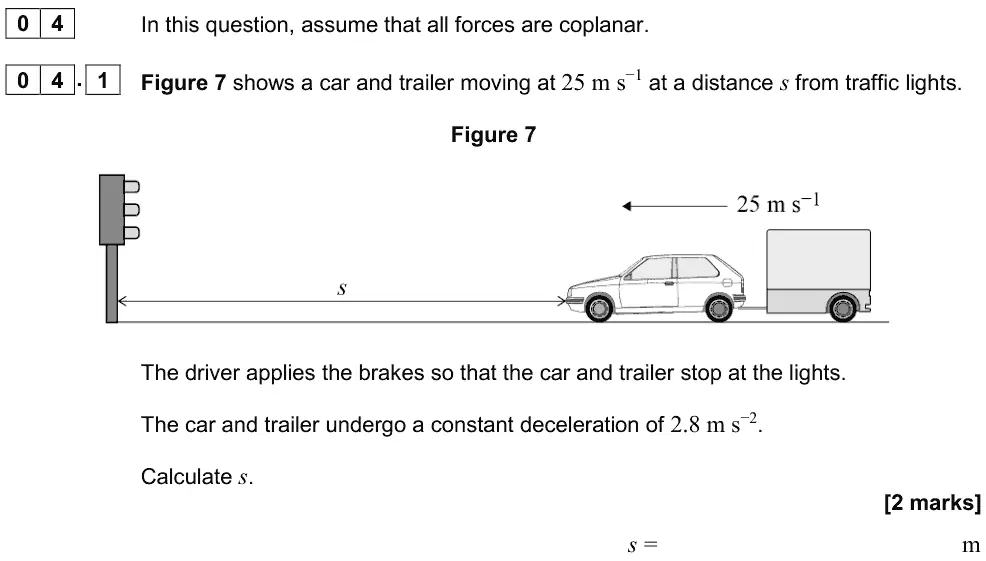
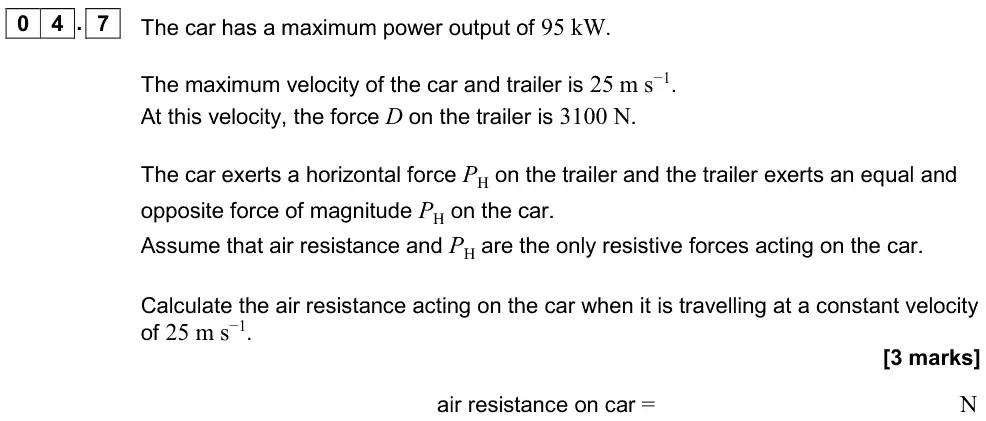
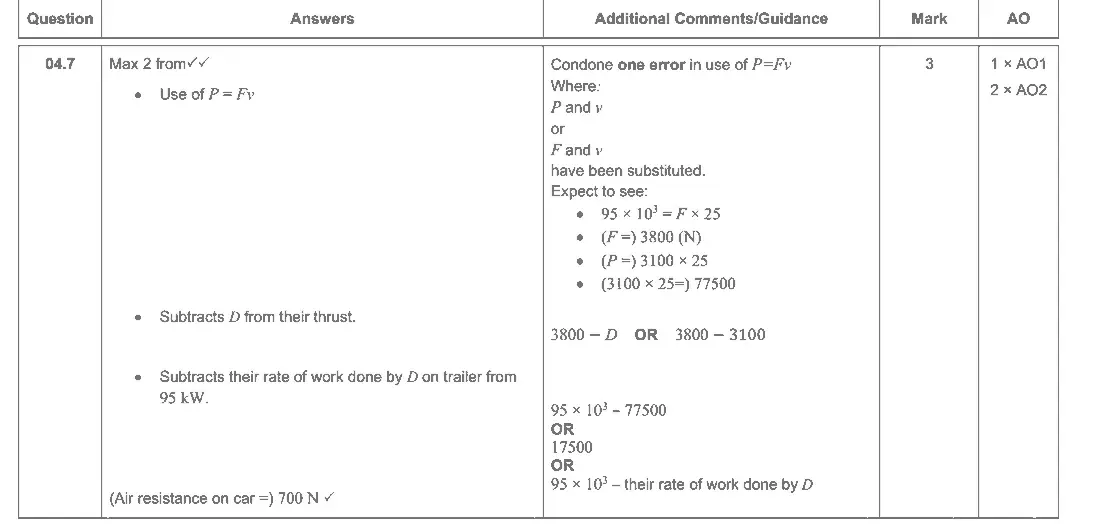
June 2024 · AS Paper 1 · Q4.73 marksAO1=1, AO2=2Calculation
Earlier part of question 4 that this part uses
Mark scheme
Examiner's comment
04.7
Notes from the mark scheme and report
Answer: 700 N (driving force 95000/25 = 3800 N, minus PH = D = 3100 N)
Skills: MS2.3 Substitute numerical values into algebraic equations using appropriate units for physical quantities
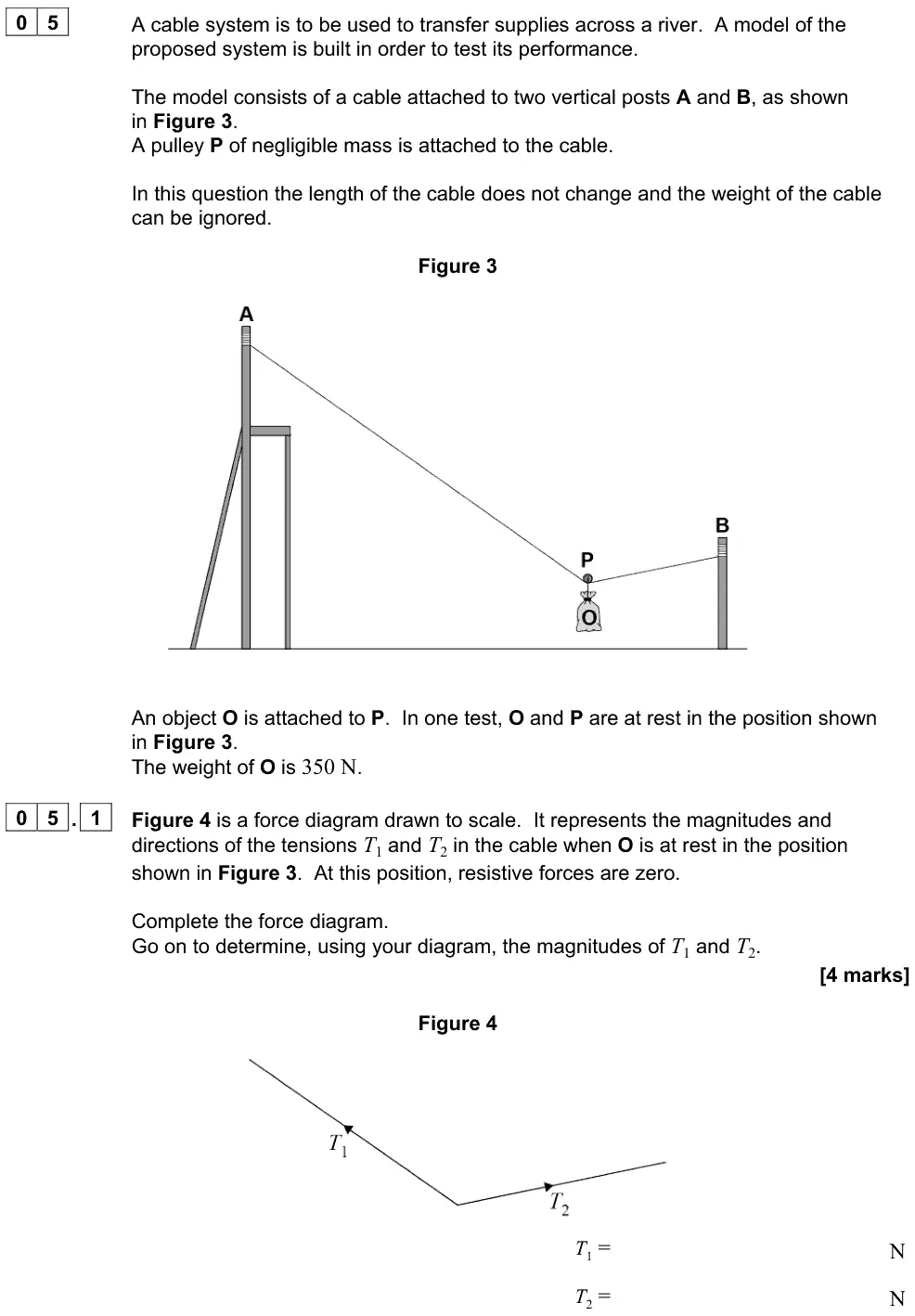
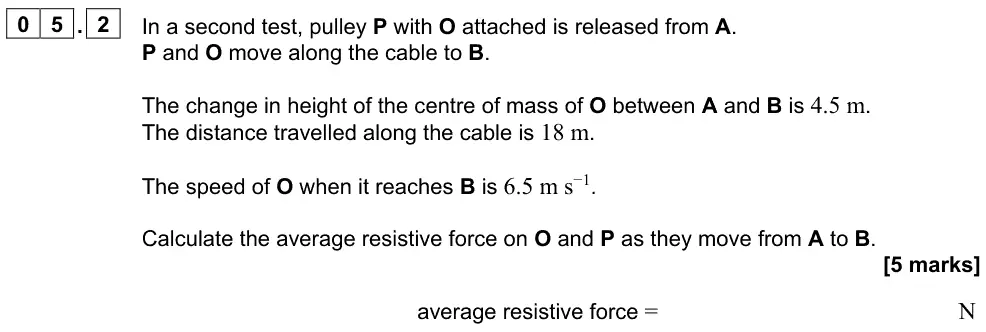
June 2024 · Paper 1 · Q5.25 marksAO2=5Calculation
Earlier part of question 5 that this part uses
Mark scheme
Examiner's comment
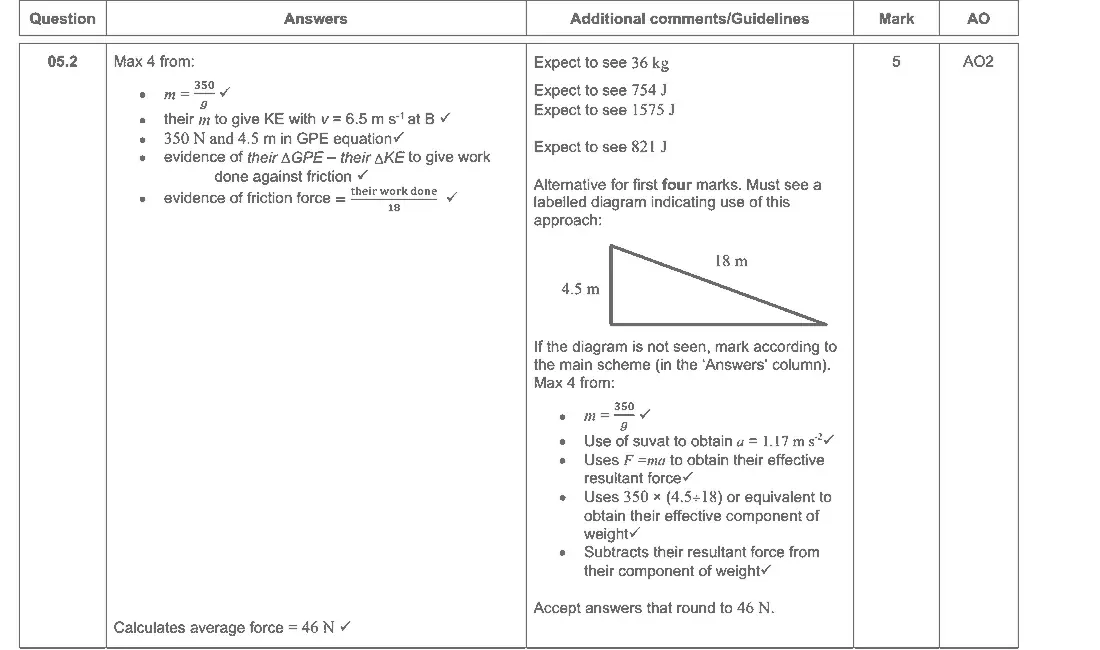
The mark scheme to question 05.2 was written in a way to give partial credit to students who could not complete the whole answer. This meant that it produced a good spread of marks and discriminated well. Many students attempted to use the constant-acceleration (kinematic) equations without modification and gained very little credit. Some students took the information in the question and drew a new equivalent diagram to arrive at the correct answer. This was only given credit when it was clear that this was what the student was doing.
Notes from the mark scheme and report
Answer: 46 N (m = 36 kg, KE 754 J, GPE 1575 J, work against resistance 821 J over 18 m)
unmodified suvat equations gained little
Skills: MS2.3 Substitute numerical values into algebraic equations using appropriate units for physical quantities
June 2024 · AS Paper 1 · Q6.22 marksAO1=1, AO2=1Calculation
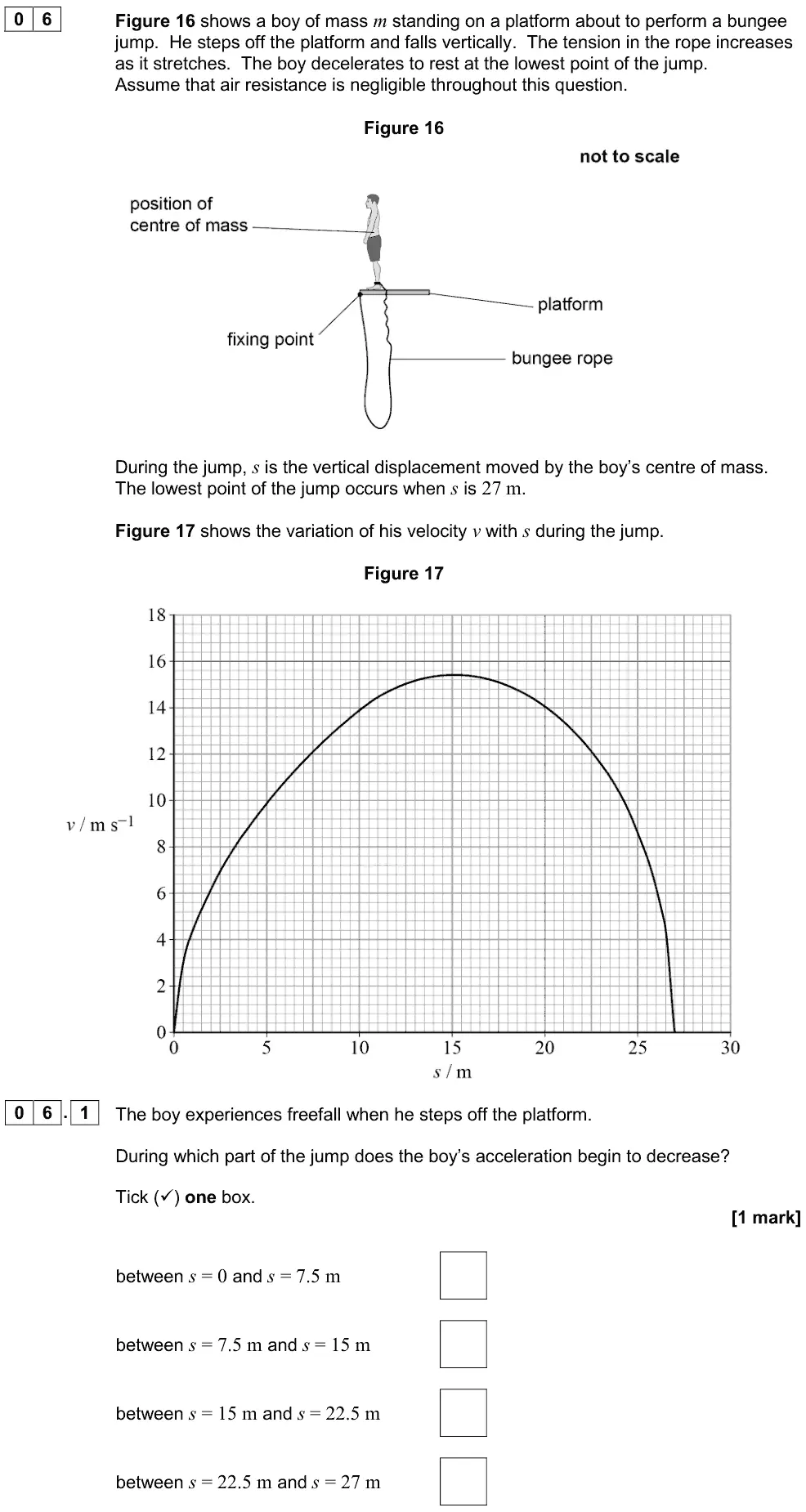
Earlier part of question 6 that this part uses
Mark scheme
Examiner's comment
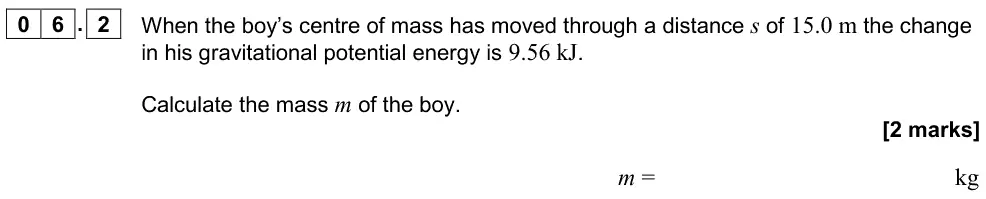
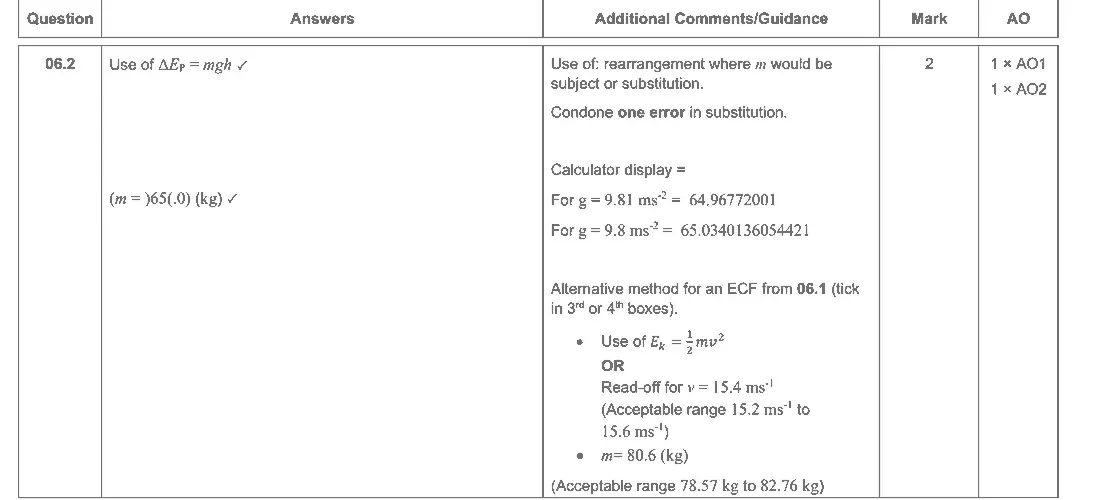
06.2
Notes from the mark scheme and report
Answer: 65 kg (9560 J / (9.81 x 15.0 m))
Skills: MS2.3 Substitute numerical values into algebraic equations using appropriate units for physical quantities
June 2024 · AS Paper 1 · Q6.33 marksAO1=1, AO2=2CalculationHard
Earlier part of question 6 that this part uses
Mark scheme
Examiner's comment
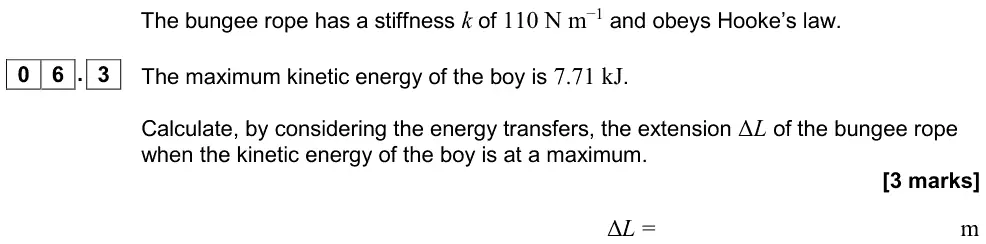
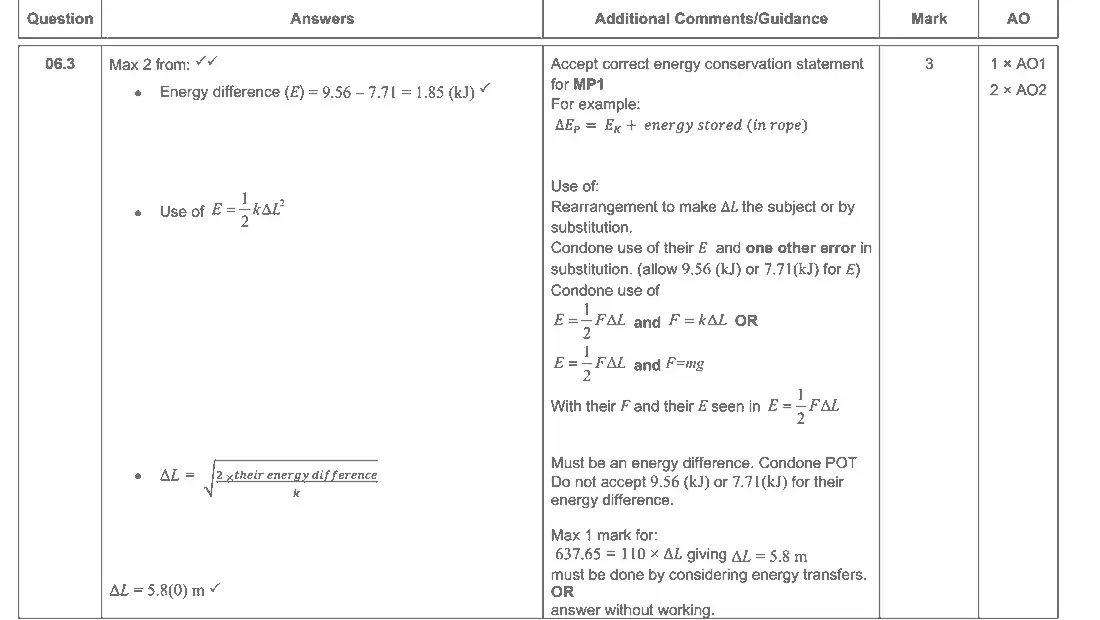
06.3
Notes from the mark scheme and report
Answer: 5.8 m (elastic energy = 9.56 - 7.71 = 1.85 kJ = 1/2 x 110 x delta L^2)
using 7.71 kJ as the stored energy was the common error
Skills: MS2.2 Change the subject of an equation, including non-linear equations; MS2.3 Substitute numerical values into algebraic equations using appropriate units for physical quantities
June 2024 · AS Paper 1 · Q6.63 marksAO3=3Explanation
Earlier part of question 6 that this part uses
Mark scheme
Examiner's comment
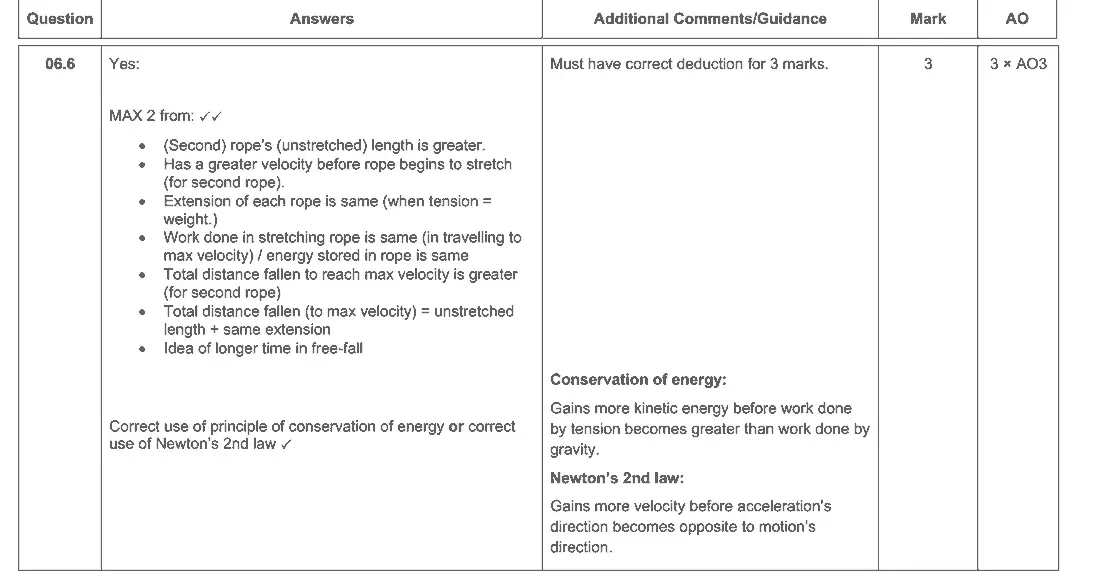
06.6
Notes from the mark scheme and report
Yes: longer unstretched rope so longer free fall and higher speed before stretching
same stiffness so same extension when tension equals weight
falls further before max velocity so greater max KE
correct deduction needed for 3
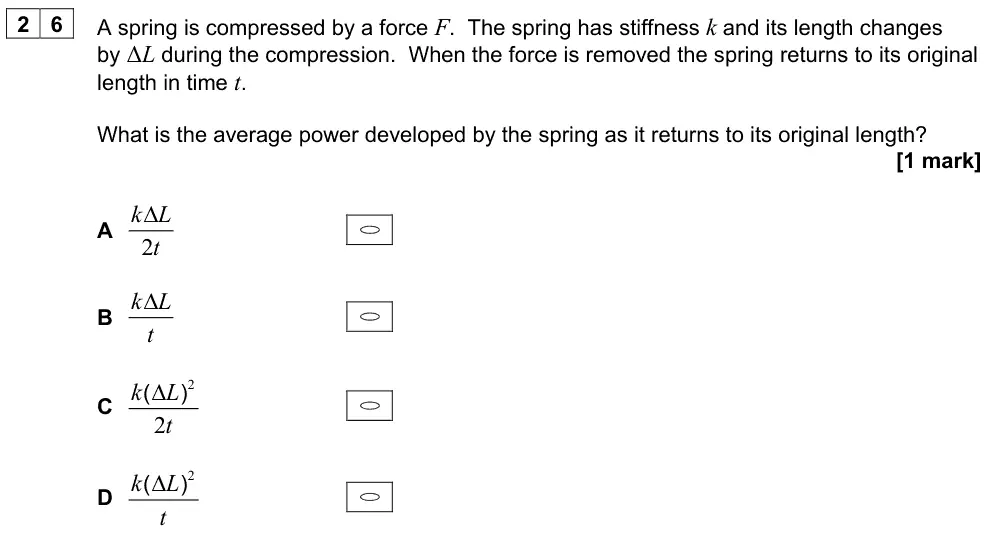
June 2024 · Paper 1 · Q261 markAO2=1Multiple choice
Answer
C
Mark scheme
Notes from the mark scheme and report
Answer: C
June 2024 · Paper 1 · Q291 markAO1=1Multiple choiceEasy
Answer
B
Mark scheme
Examiner's comment
There were five very accessible questions that were correctly answered by more than 70% of students. These were B12, B18, B14, B27 and B29.
Notes from the mark scheme and report
Answer: B
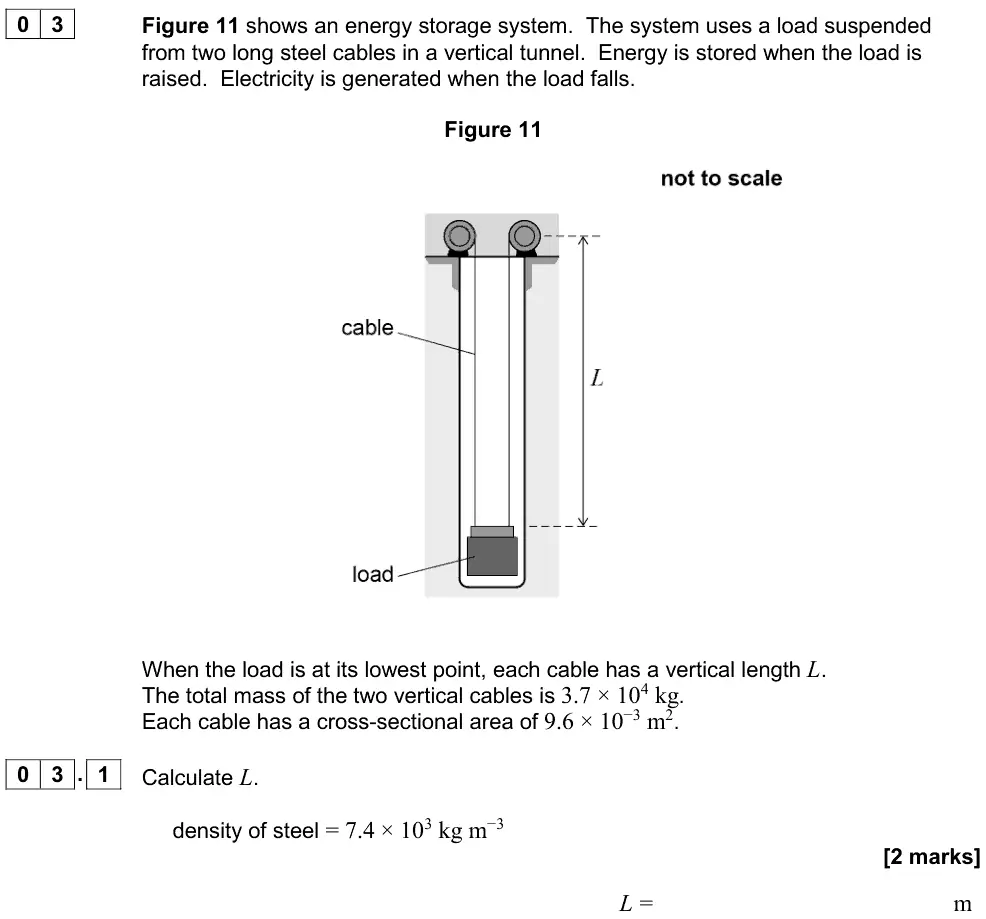
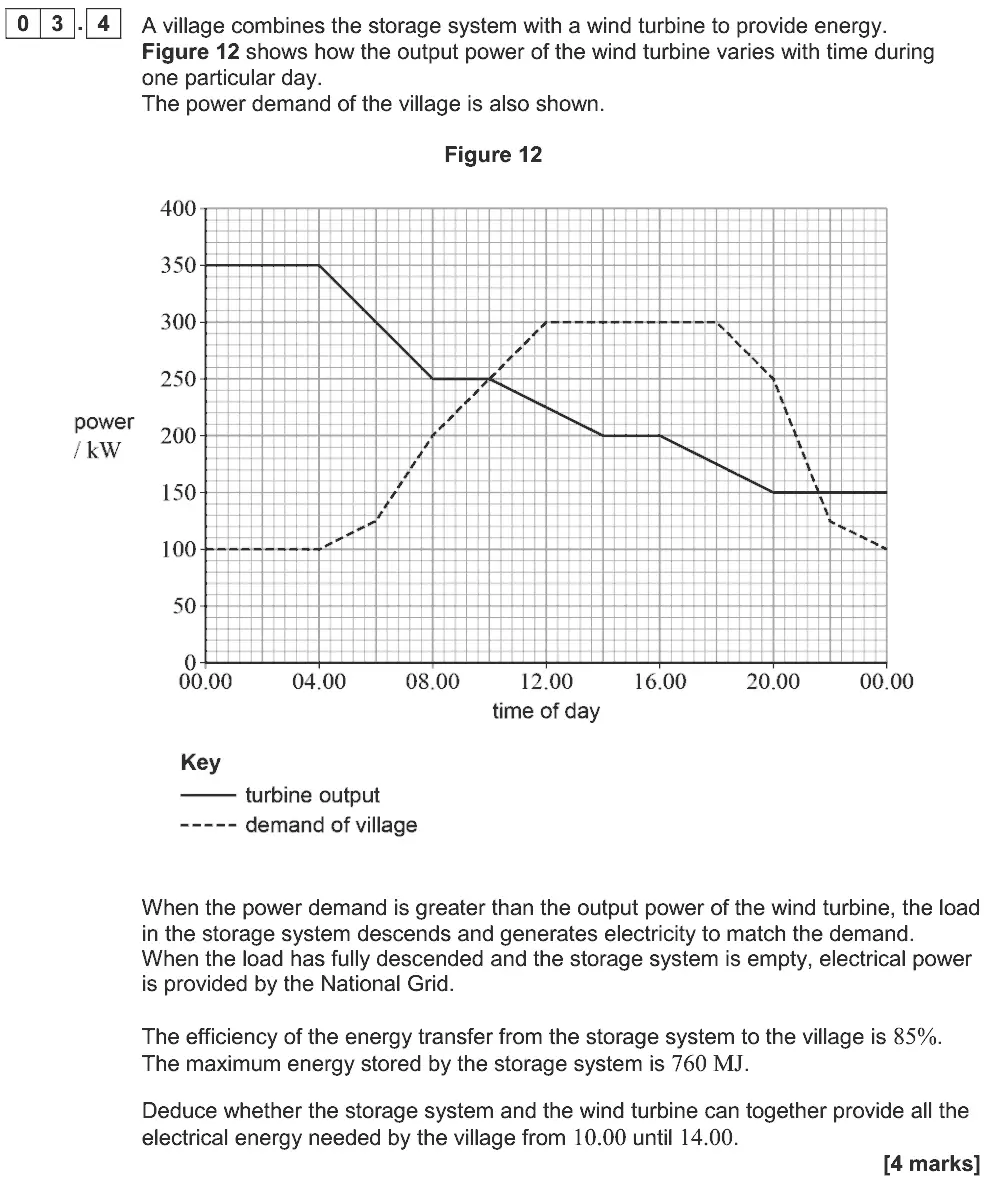
June 2024 · AS Paper 2 · Q3.44 marksAO1=1, AO2=1, AO3=2Calculation
Earlier part of question 3 that this part uses
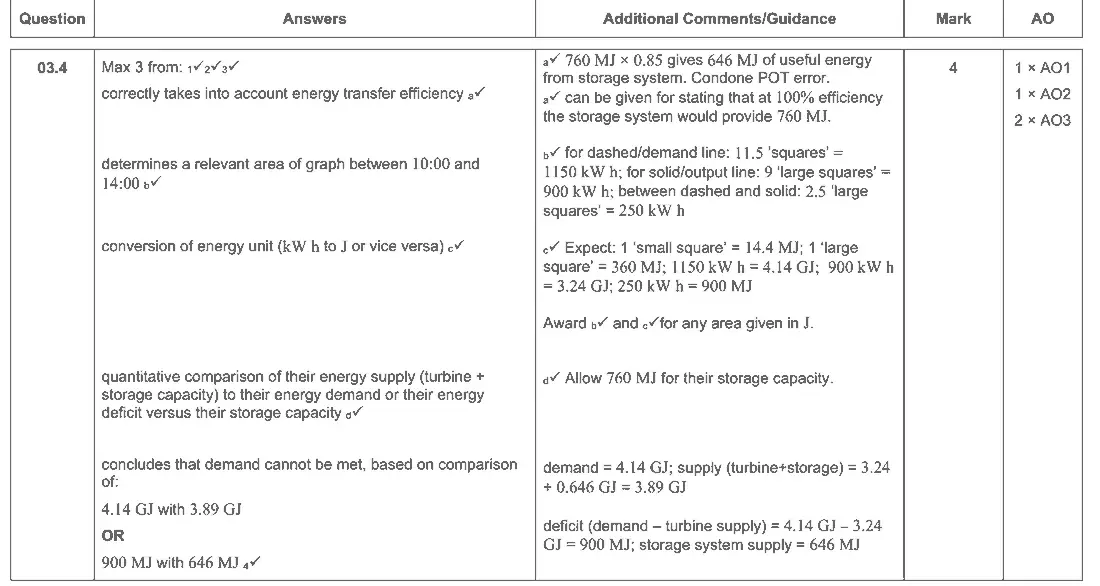
Mark scheme
Examiner's comment
03.3 False comparisons (eg 167 MPa < 890 MPa) or absent conclusions were the main reasons for students failing to gain full credit here. An explicit conclusion is necessary for complete credit in this type of question. For example, “167 × 3 = 500 MPa, which is less than 890 MPa, so the system is safe”. 03.4 Nearly 60% of students gained some credit here but about 25% made no progress. The most common error was working in mixed units of energy, for instance adding values in MJ to values in kW h. A frequent misconception was that powers could be compared. Some students struggled to identify the correct times on Figure 12.
Notes from the mark scheme and report
Demand 10.00-14.00 = 1150 kW h = 4.14 GJ
turbine 900 kW h = 3.24 GJ
storage supplies 760 x 0.85 = 646 MJ
3.89 GJ < 4.14 GJ (deficit 900 MJ > 646 MJ) so not met
mixed energy units common error
Skills: MS3.8 Understand the possible physical significance of the area between a curve and the x axis and be able to calculate it or estimate it by graphical methods as appropriate; MS0.1 Recognise and make use of appropriate units in calculations
June 2024 · AS Paper 2 · Q121 markMultiple choice
Answer
C
Mark scheme
Examiner's comment
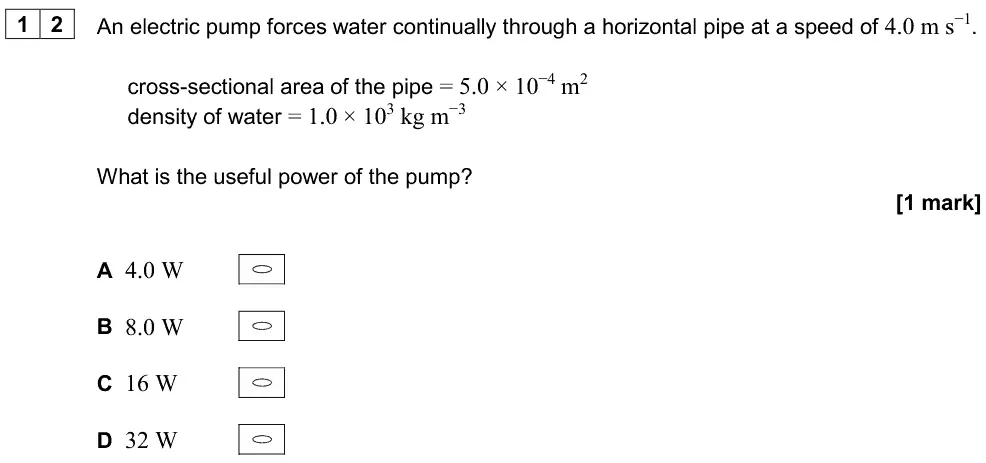
Question 12: Option B (8.0 W) was the most popular response. This is likely to be from multiplying the mass of water per second (2 kg) by the speed (4.0 m s–1). This question also had a large number of non- attempts.
Notes from the mark scheme and report
Answer: C
most chose B (8.0 W, mass per second x speed) instead of KE per second
Skills: MS2.3 Substitute numerical values into algebraic equations using appropriate units for physical quantities
June 2024 · AS Paper 2 · Q271 markMultiple choice
Answer
B
Mark scheme
Notes from the mark scheme and report
Answer: B
June 2023 · Paper 1 · Q2.22 marksCalculation
Earlier part of question 2 that this part uses
Mark scheme
Examiner's comment
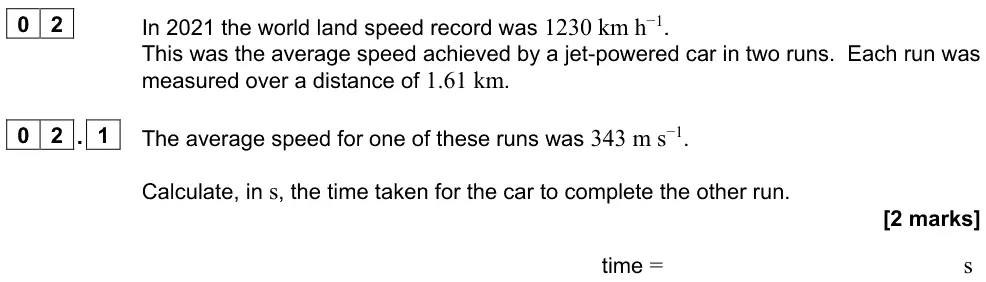
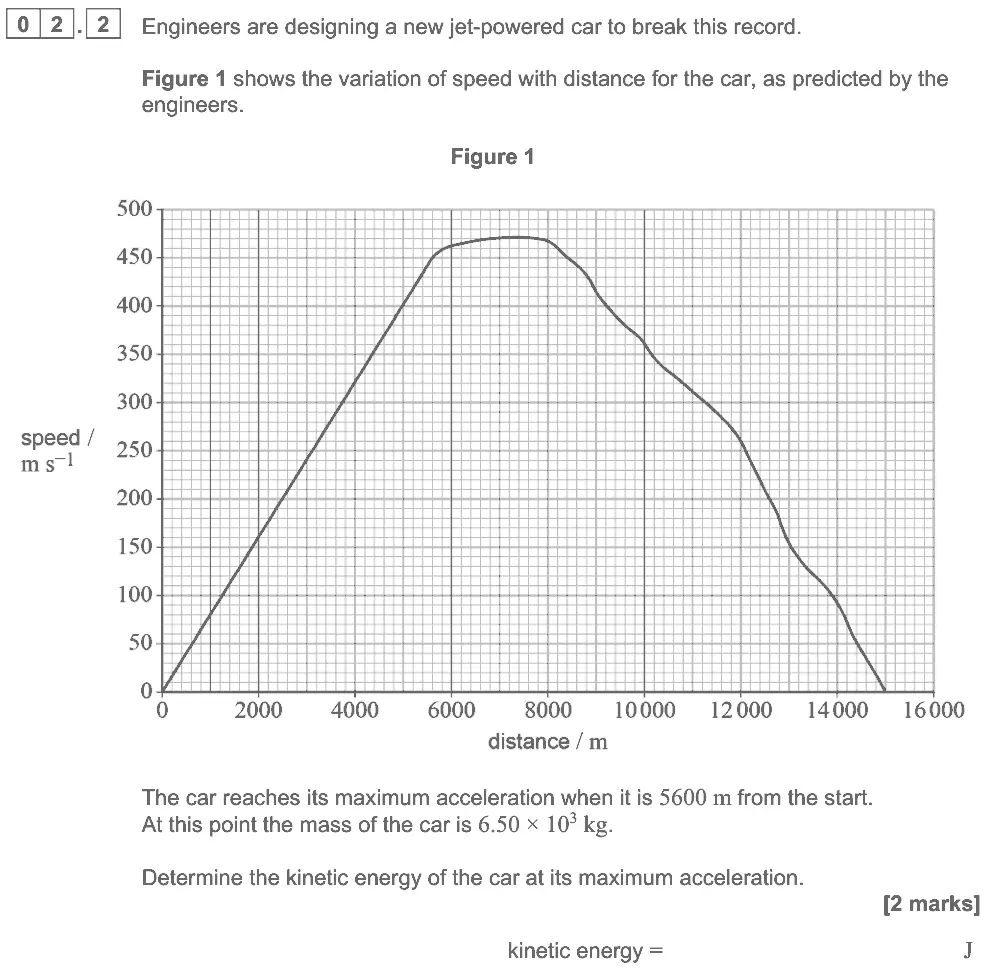
02.1 There were several alternative routes available for the first mark, and the majority of students were able to pick up credit for one of them. The second mark proved to be more difficult, with only about half of the students getting both marks. Almost all of the students who worked out the answer correctly realised that a two significant figure (s.f.) answer was inappropriate in the context of the question. 02.2 Few students had any difficulty calculating the kinetic energy. This proved to be one of the most accessible questions on the paper.
Notes from the mark scheme and report
Answer: 6.6 x 10^8 J (speed 450 m s^-1 read at 5600 m, m = 6.50 x 10^3 kg)
one of the most accessible items
Skills: MS3.1 Translate information between graphical, numerical and algebraic forms; MS2.3 Substitute numerical values into algebraic equations using appropriate units for physical quantities
June 2023 · Paper 1 · Q2.34 marksCalculation
Earlier part of question 2 that this part uses
Mark scheme
Examiner's comment
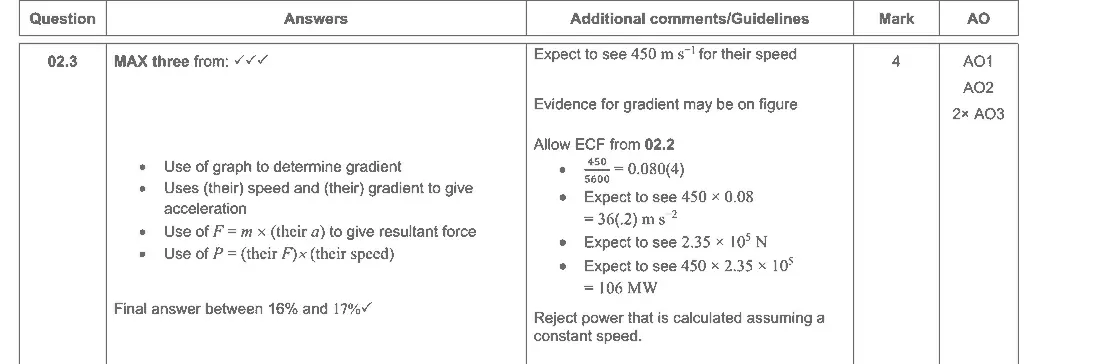
02.3 This four-mark question was answered correctly by almost half of the students. It was clear that, although the graph was unusual, the support given in the question allowed students to access the marks. The mark scheme was designed to credit each step in the calculation separately. Students who set out their answers logically and clearly benefited from this.
Notes from the mark scheme and report
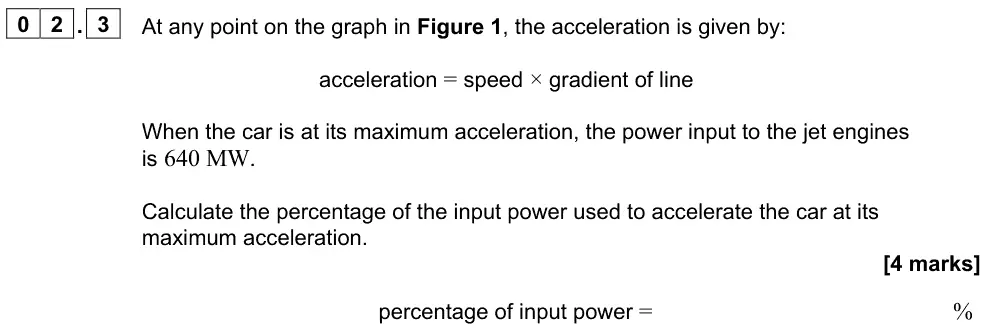
Answer: 16-17% (gradient 450/5600 = 0.080 s^-1, a = 36 m s^-2, F = 2.35 x 10^5 N, P = Fv = 106 MW of 640 MW)
almost half correct
Skills: MS3.4 Determine the slope and intercept of a linear graph; MS3.1 Translate information between graphical, numerical and algebraic forms; MS0.3 Use ratios, fractions and percentages
June 2023 · AS Paper 1 · Q4.32 marksAO3=2CalculationHard
Earlier part of question 4 that this part uses
Mark scheme
Examiner's comment
04.3 This question proved inaccessible to most students with over 94% of students achieving zero. Many attempted to use W=Fs even though the force was not constant over the distance shown in 1 Figure 6. Another significant proportion of students used W= 2 FΔL, again scoring zero due to the non-linear relationship between F and s shown in Figure 6. 04.4 Over 60% of students achieved at least one mark in this part. Grade A students typically achieved all three marks with grade E students able to make some progress. One mark was usually obtained for a correct conversion of km h–1 to m s–1 but quite often this was the only credit-worthy work seen in the working. Common errors seen included: 1 2 m v2 • incorrect re-arrangement of Ek= • forgetting to use 82% of the available energy as the kinetic energy. Many students attempted to use P=Fv because they thought that efficiency was a reference to power in this context.
Notes from the mark scheme and report
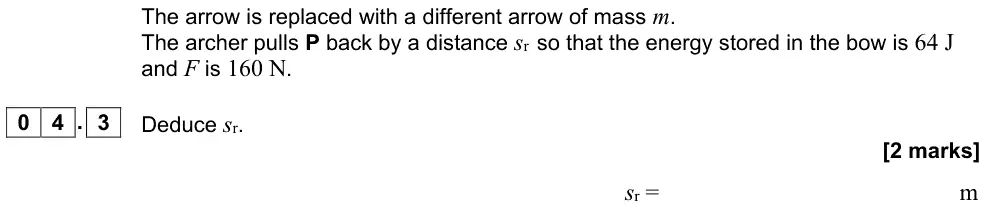
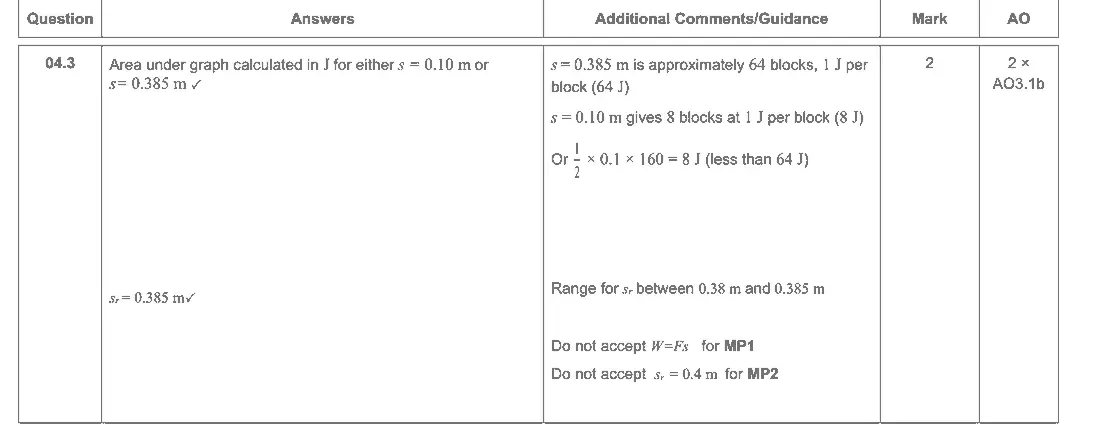
Answer: 0.385 m (area under Figure 6 up to s = 0.385 m is about 64 J
F = 160 N at s = 0.10 m gives only 8 J)
W = Fs or 1/2 F delta L invalid for the non-linear graph
Skills: MS3.8 Understand the possible physical significance of the area between a curve and the x axis and be able to calculate it or estimate it by graphical methods as appropriate
June 2023 · AS Paper 1 · Q4.43 marksCalculation
Earlier part of question 4 that this part uses
Mark scheme
Examiner's comment
04.3 This question proved inaccessible to most students with over 94% of students achieving zero. Many attempted to use W=Fs even though the force was not constant over the distance shown in 1 Figure 6. Another significant proportion of students used W= 2 FΔL, again scoring zero due to the non-linear relationship between F and s shown in Figure 6. 04.4 Over 60% of students achieved at least one mark in this part. Grade A students typically achieved all three marks with grade E students able to make some progress. One mark was usually obtained for a correct conversion of km h–1 to m s–1 but quite often this was the only credit-worthy work seen in the working. Common errors seen included: 1 2 m v2 • incorrect re-arrangement of Ek= • forgetting to use 82% of the available energy as the kinetic energy. Many students attempted to use P=Fv because they thought that efficiency was a reference to power in this context.
Notes from the mark scheme and report
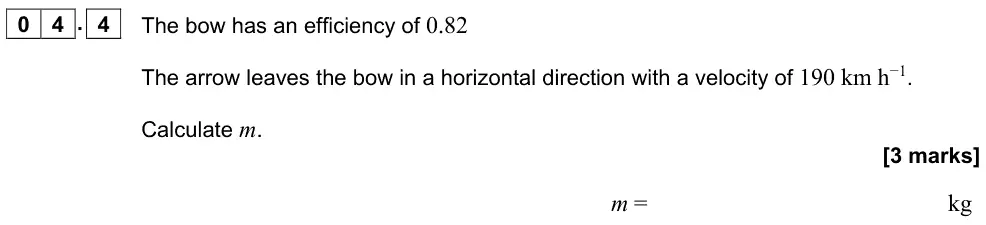
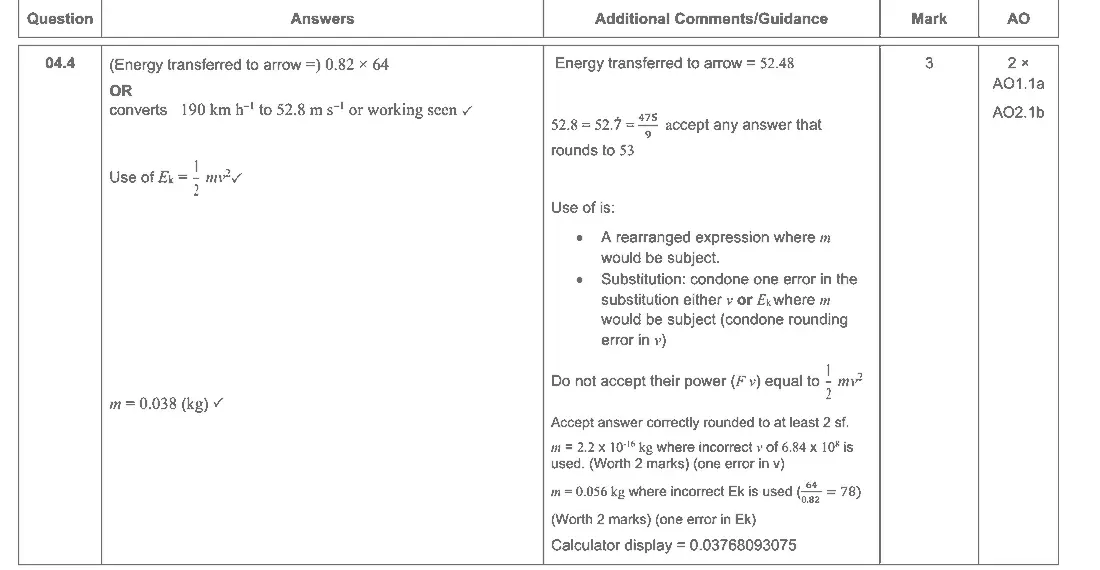
Answer: 0.038 kg (KE = 0.82 x 64 = 52.5 J, v = 190 km h^-1 = 52.8 m s^-1)
forgetting the 82% and rearranging errors common
Skills: MS0.1 Recognise and make use of appropriate units in calculations; MS0.3 Use ratios, fractions and percentages; MS2.2 Change the subject of an equation, including non-linear equations
June 2023 · AS Paper 1 · Q5.32 marksCalculation
Earlier part of question 5 that this part uses
Mark scheme
Examiner's comment
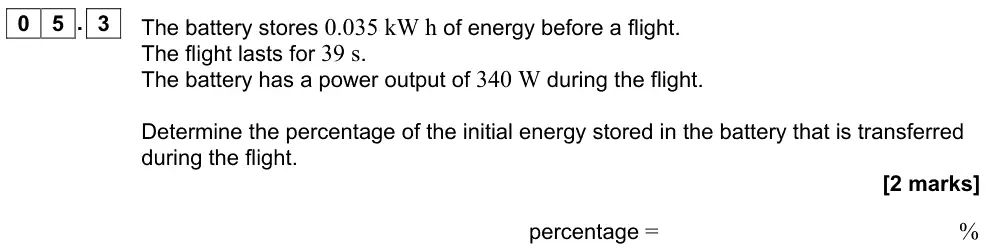
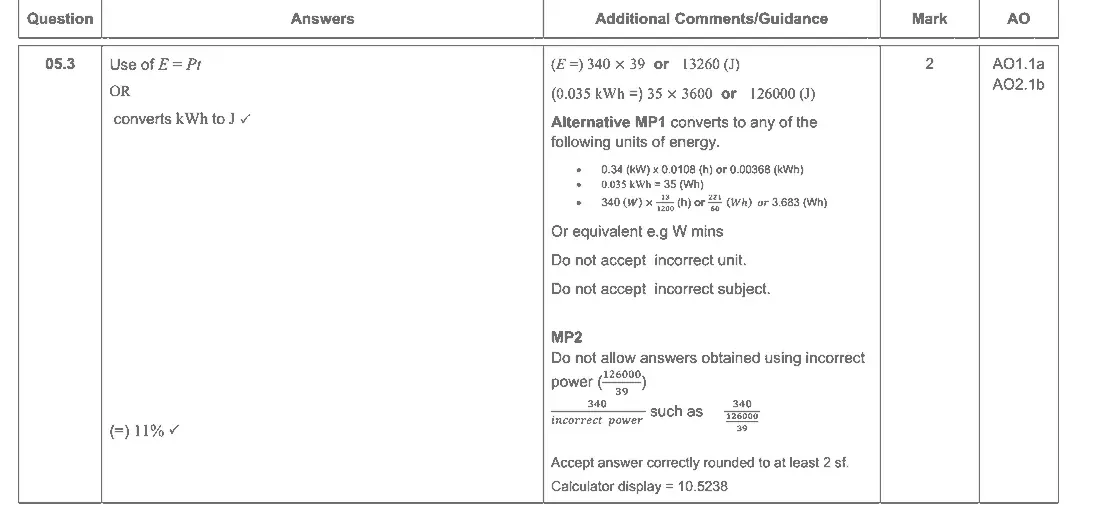
05.3 This part of the question was more accessible with almost 60% of students obtaining at least one mark. However, many students demonstrated a limited appreciation of the context and divided the energy stored in the battery by 39 s to find a power. This was incorrect as it assumed that all of the energy stored in the battery was transferred in 39 s. Many poorer performing students were unable to convert kilowatt-hours into joules.
Notes from the mark scheme and report
Answer: 11% (340 x 39 = 13260 J out of 0.035 kW h = 126000 J)
kW h to J conversion was a weakness
Skills: MS0.3 Use ratios, fractions and percentages; MS0.1 Recognise and make use of appropriate units in calculations
June 2023 · AS Paper 1 · Q5.43 marksAO3=3ExplanationHard
Earlier part of question 5 that this part uses
Mark scheme
Examiner's comment
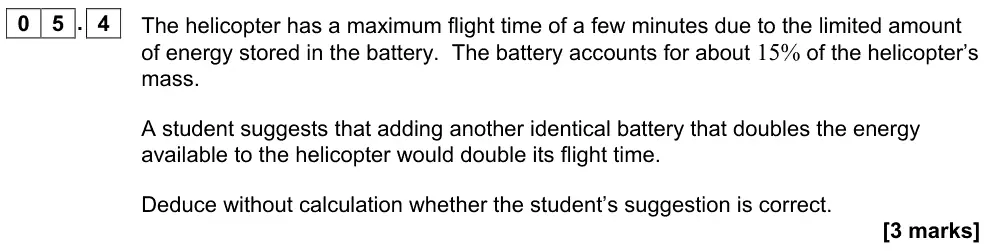
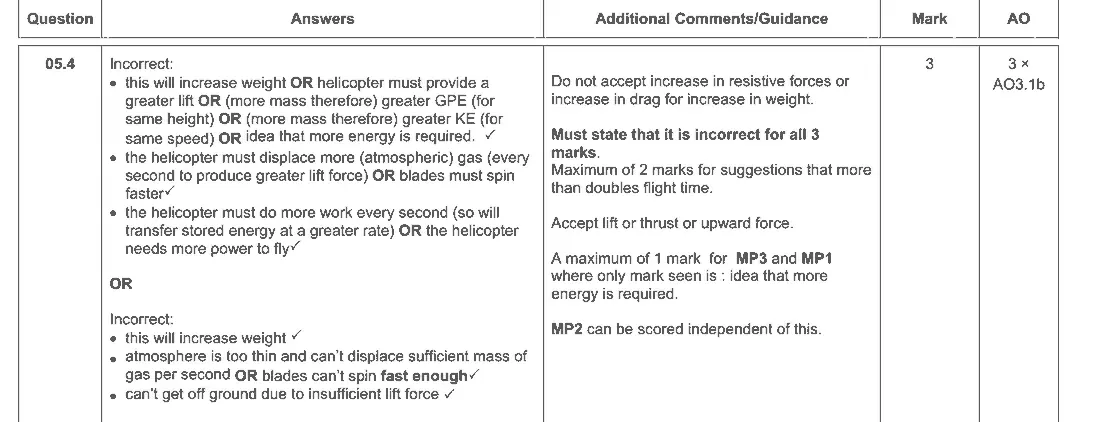
05.4 Almost 60% of students were able to score at least one mark. However, fewer than 10% of students were able to make further progress and not even 1% scored all three marks. Most realised that the helicopter was now heavier and that more work was required to keep it in the air. However, they were unable to describe how the helicopter produces the extra lift required. Also, they were unable to connect the increased amount of work done to power and therefore were unable to explain why the flight time would not double. Students would often make statements without being able to support them with an explanation that demonstrated their knowledge and understanding of the underlying physics. 05.5 58% of students obtained both marks. Almost 8% did not even attempt this calculation. Mistakes seen included dividing the acceleration by the change in velocity and using an inappropriate equation of motion.
Notes from the mark scheme and report
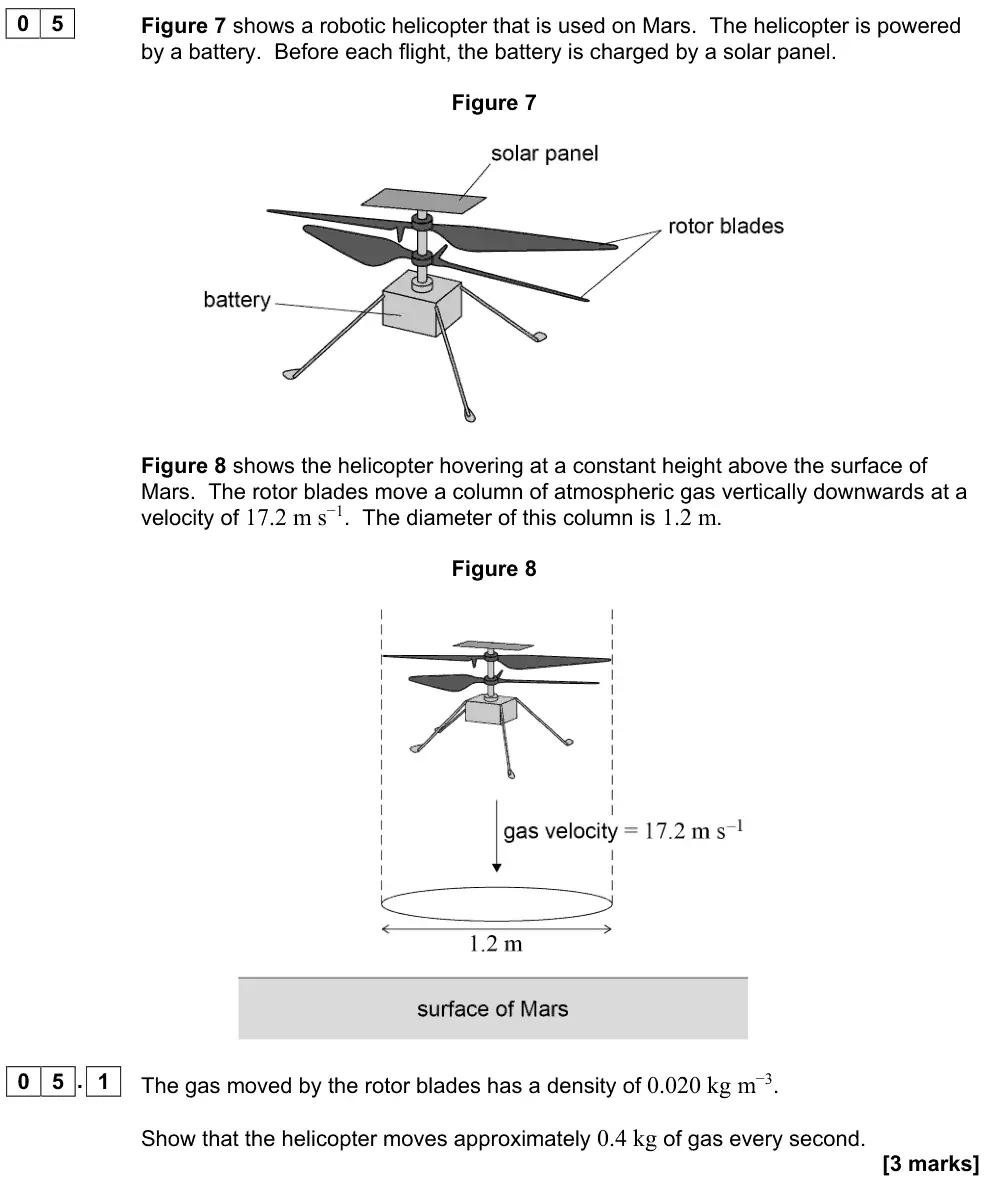
Incorrect: extra battery increases weight so more lift needed, more gas displaced per second, more power so energy used faster - flight time does not double
must say 'incorrect' for 3
June 2023 · AS Paper 1 · Q5.62 marksCalculation
Earlier part of question 5 that this part uses
Mark scheme
Examiner's comment
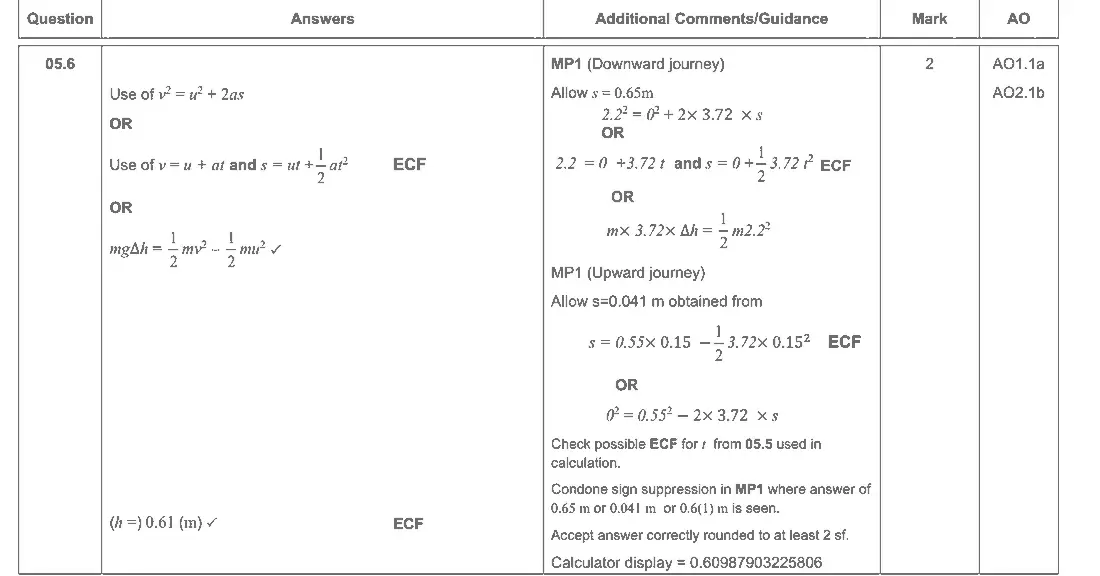
05.6 11% of students did not attempt this calculation. 32% of students scored one mark, usually for determining the maximum height above the ground or the distance travelled upwards from the position shown in Figure 9 to the maximum height. These students presented 0.65 m or 0.041 m as their answer without appreciating how this applied to this context.
Notes from the mark scheme and report
Answer: 0.61 m (fall from max height 2.2^2/(2 x 3.72) = 0.65 m minus rise 0.041 m)
giving 0.65 m or 0.041 m scores 1
Skills: MS2.3 Substitute numerical values into algebraic equations using appropriate units for physical quantities
June 2023 · Paper 2 · Q3.21 markAO2=1Short answer
Earlier part of question 3 that this part uses
Mark scheme
Examiner's comment
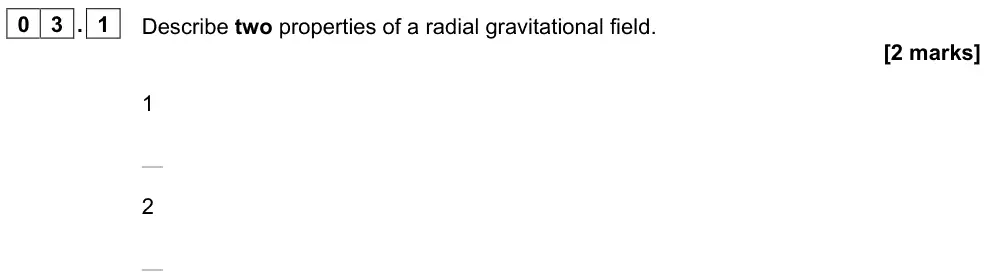
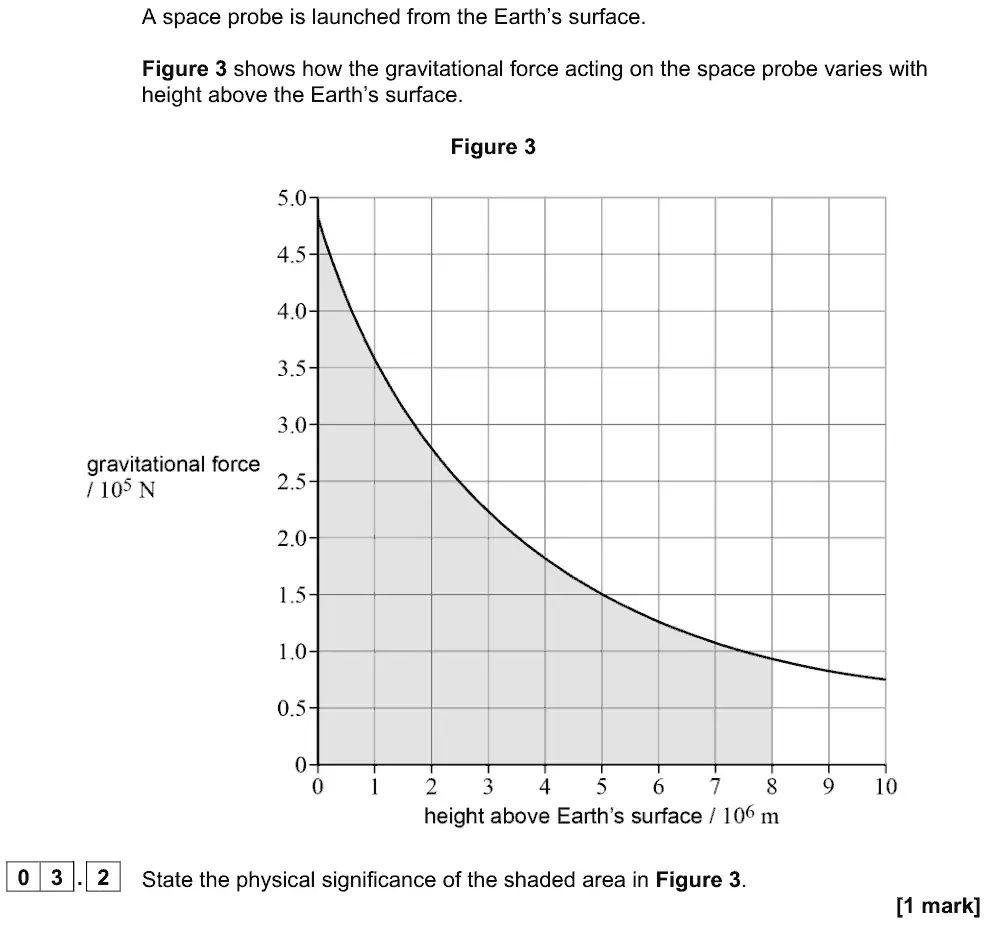
03.1 Most of the answers seen lacked detail. For example, instead of referring to the inverse-square relationship of gravitational field with distance, students often wrote that the field strength decreases with distance. The “field lines spread out” was written instead of referring to the centre of mass being the location at which field lines point or the directional gravitational force acts. Finally, equipotential lines were described as being “curved” rather than being concentric about the centre of mass. 03.2 Most gave the generic answer to what is represented by the area under a force-distance graph. So, references to potential energy or work done were commonly seen but these lacked sufficient details to gain credit. Only a minority considered the extent of the shaded area in Figure 3. When the height was given in the answer, there were still a few who lost the mark by not referring to the space probe; instead they mentioned a unit mass.
Notes from the mark scheme and report
Work done (energy needed) to lift the probe from the surface to 8 x 10^6 m, or its change in GPE
must refer to the probe and the shaded range, not unit mass
Skills: MS3.8 Understand the possible physical significance of the area between a curve and the x axis and be able to calculate it or estimate it by graphical methods as appropriate
June 2023 · Paper 2 · Q3.54 marksCalculation
Earlier part of question 3 that this part uses
Mark scheme
Examiner's comment
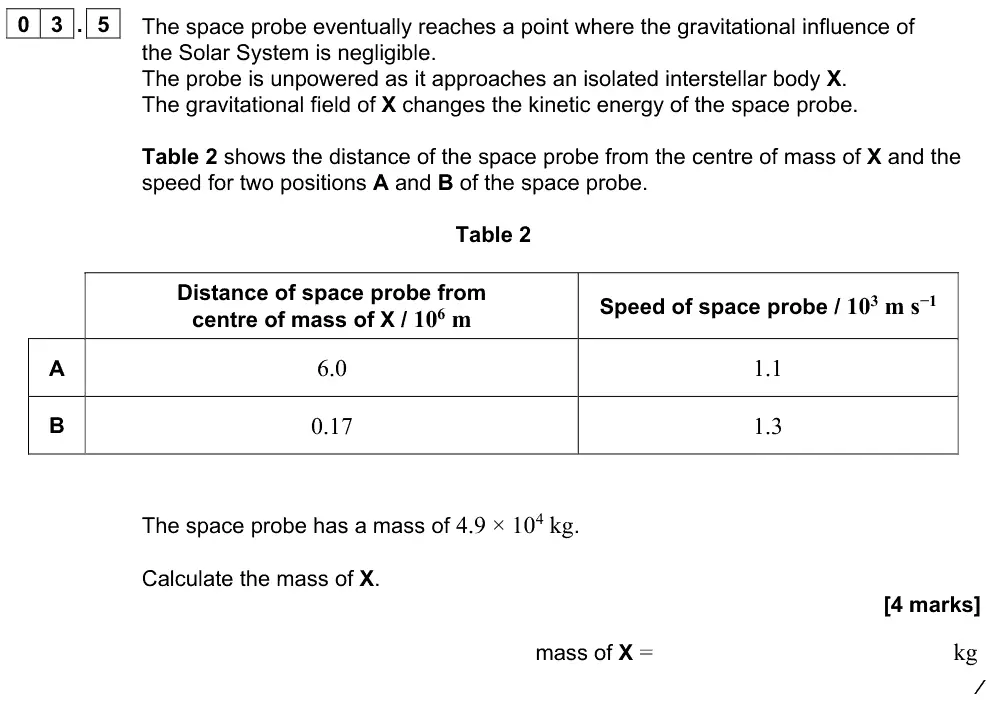
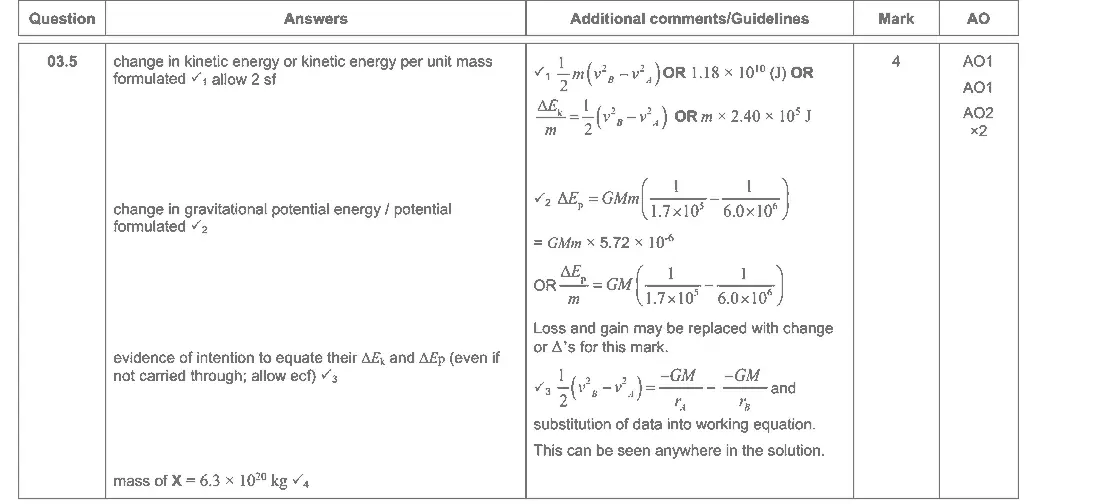
03.5 Most students simply looked for an equation that involved mass, speed and distance, then simply ‘played’ with numbers. Inappropriate force and circular-motion equations were commonly seen. The third marking point was also lost by many who missed any reference to the changes in kinetic and potential energies. The most frequently gained mark was the calculation of change in kinetic energy. However, there were many who failed to gain this mark by using the square of the difference in speed in their calculation. The determination of change in potential energy had a common error too; this was the substitution of the difference in distance for separation into the potential-energy equation.
Notes from the mark scheme and report
Answer: 6.3 x 10^20 kg (gain in KE 1.18 x 10^10 J = loss of GPE = GMm(1/rB - 1/rA))
squaring the speed difference, or using the difference in distances, were common errors
Skills: MS2.2 Change the subject of an equation, including non-linear equations; MS2.3 Substitute numerical values into algebraic equations using appropriate units for physical quantities
June 2023 · Paper 2 · Q7.32 marksShow that
Earlier part of question 7 that this part uses
Mark scheme
Examiner's comment
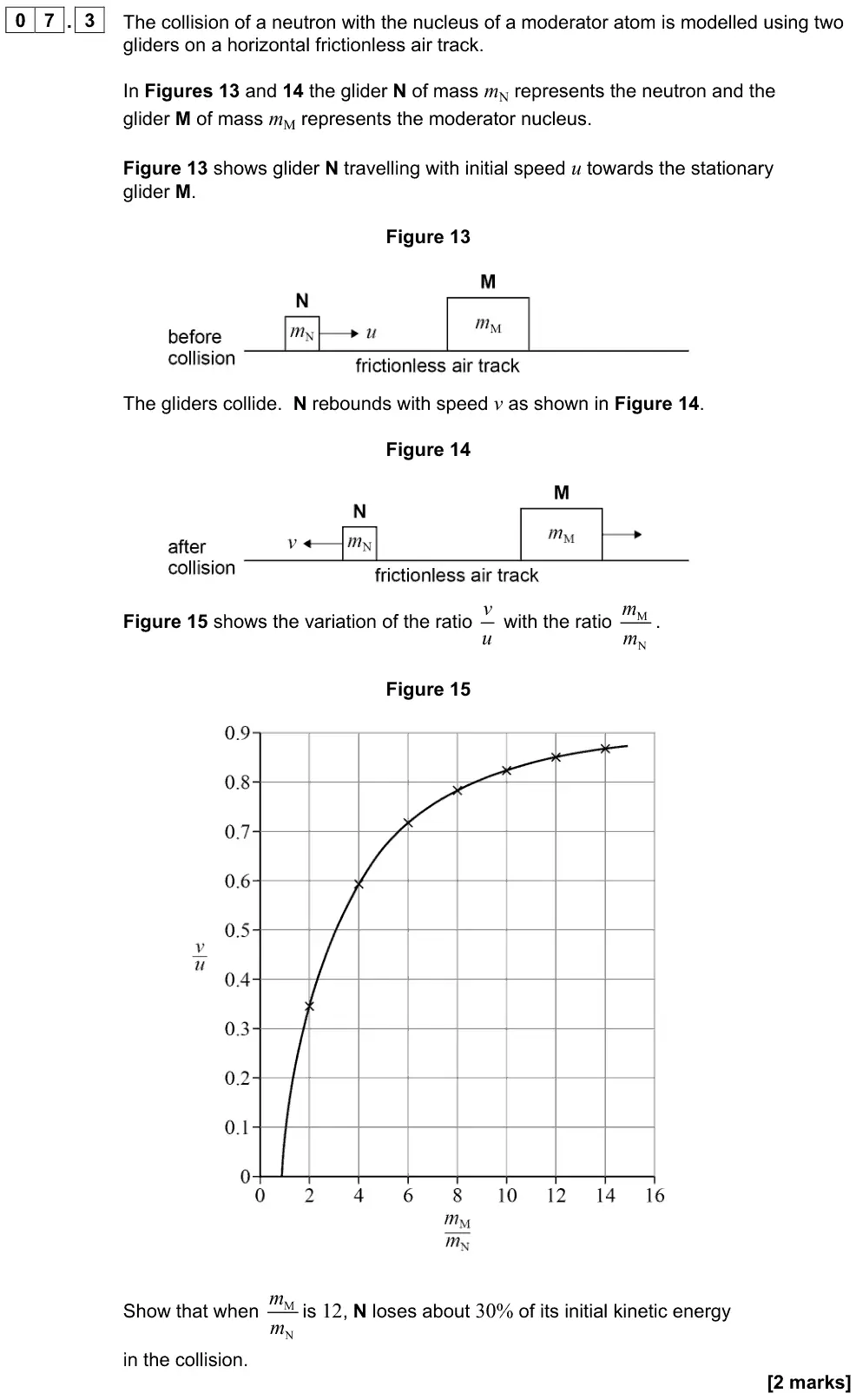
07.3 A significant minority of students did not relate kinetic energy to the information presented in Figure 15 and made little progress. Some tried to find the 30% answer by randomly multiplying the 15% loss in speed by 2. Those who did use the information to find kinetic energies generally scored both marks.
Notes from the mark scheme and report
Answer: about 28% lost (v/u = 0.85 at ratio 12, so KE ratio = 0.85^2 = 0.72)
doubling the 15% speed loss is not a valid method
Skills: MS3.1 Translate information between graphical, numerical and algebraic forms; MS0.3 Use ratios, fractions and percentages
June 2023 · AS Paper 2 · Q261 markMultiple choice
Answer
C
Mark scheme
Notes from the mark scheme and report
Answer: C
June 2023 · AS Paper 2 · Q331 markMultiple choice
Answer
B
Mark scheme
Notes from the mark scheme and report
Answer: B
Skills: MS2.3 Substitute numerical values into algebraic equations using appropriate units for physical quantities
June 2023 · AS Paper 2 · Q341 markMultiple choice
Answer
D
Mark scheme
Notes from the mark scheme and report
Answer: D
June 2022 · AS Paper 1 · Q7.22 marksAO1=1, AO2=1Calculation
Earlier part of question 7 that this part uses
Mark scheme
Examiner's comment
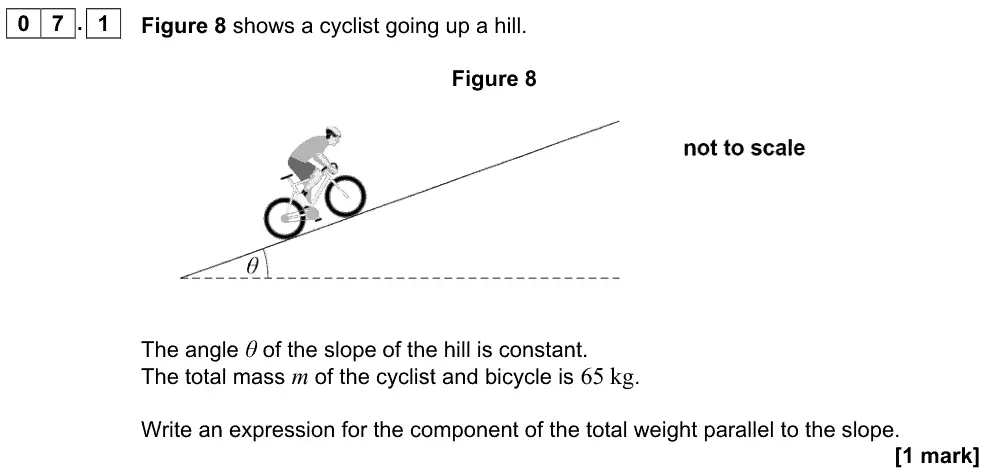
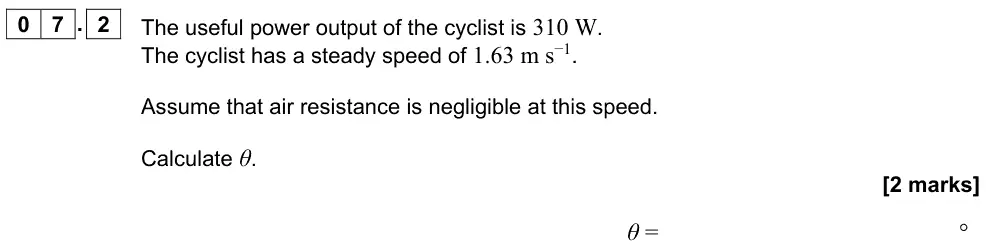
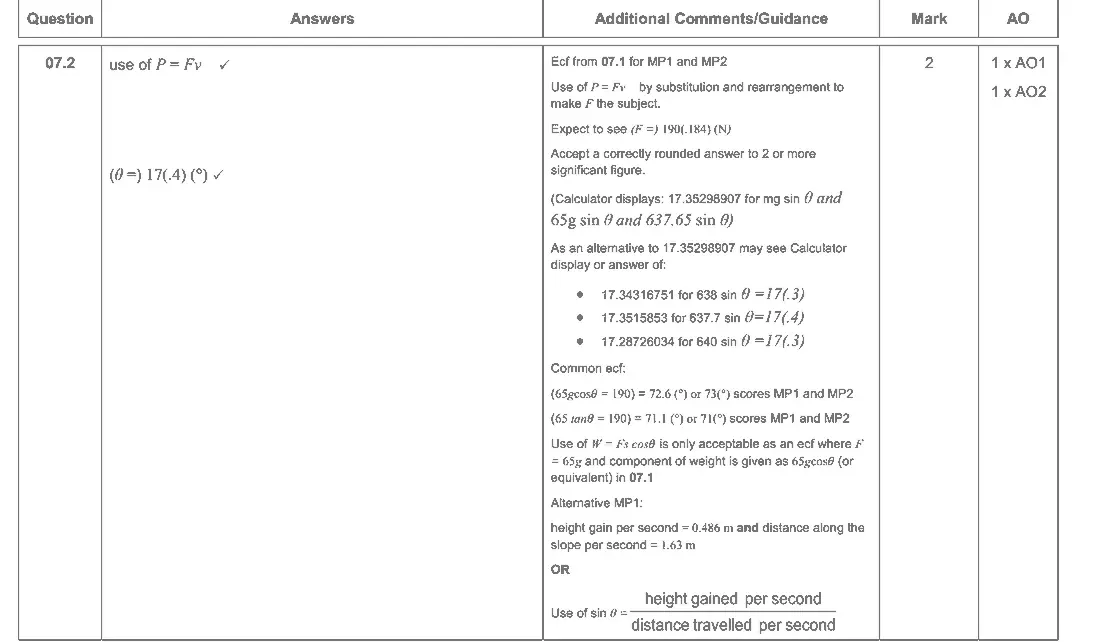
07.1 and 07.2 Almost 40% of students scored one mark in 07.1 and 36% scored two marks in 07.2. A significant number of students who could not do 07.1 were able to do the calculation in 07.2. This suggests that these students knew the process involved in determining the component of the weight parallel to the slope but were unaware of the technical term used to describe it. Many students were able to use P=Fv in question 07.2 to determine the force but were unable to relate this force to the component of the weight parallel to the slope.
Notes from the mark scheme and report
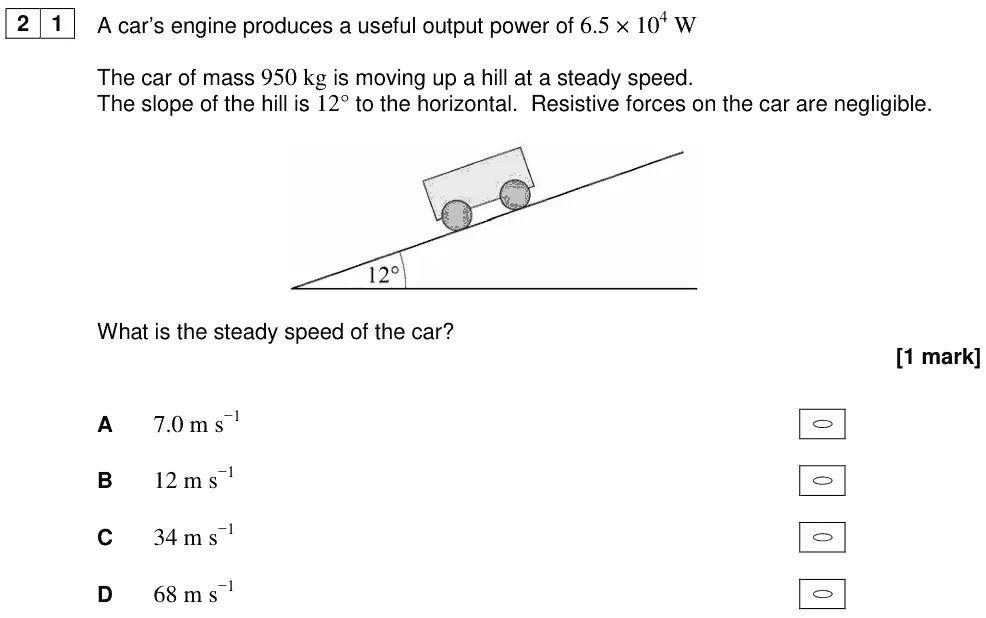
Answer: 17 degrees (F = P/v = 190 N = 65g sin theta)
Skills: MS2.3 Substitute numerical values into algebraic equations using appropriate units for physical quantities; MS0.6 Use calculators to handle sin x, cos x, tan x when x is expressed in degrees or radians
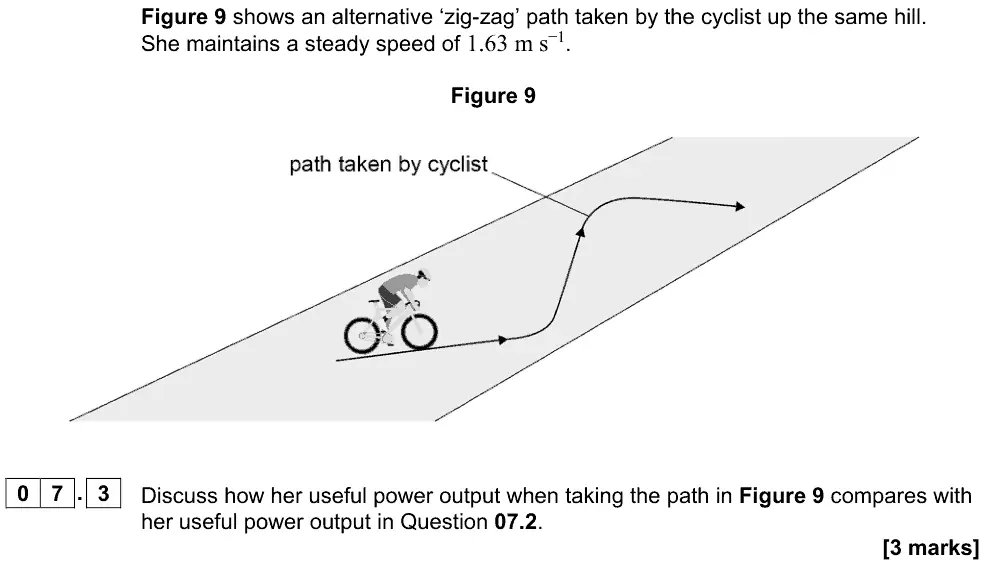
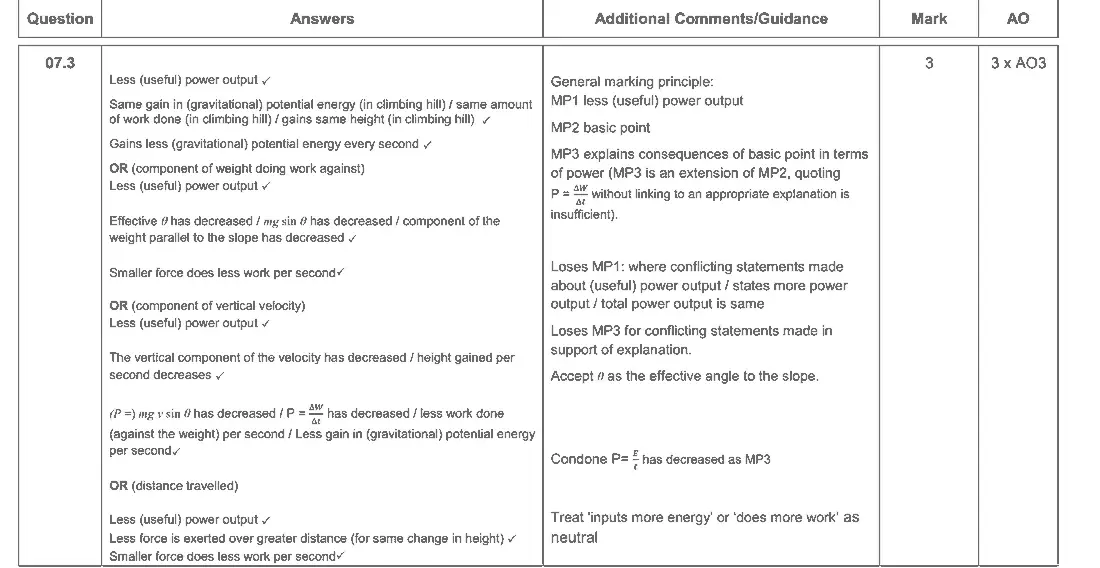
June 2022 · AS Paper 1 · Q7.33 marksAO3=3ExplanationHard
Earlier part of question 7 that this part uses
Mark scheme
Examiner's comment
07.3. Less than 10% of the cohort obtained two or more marks. Students did not seem to have any real-world appreciation of this ‘zig-zag’ path being easier than the direct path in Figure 8. They thought that the cyclist had travelled further, had encountered more resistive forces, and had done more work with a greater power output. These students offered efficiency-type arguments to explain why they thought that the useful power output had changed. Many of those who did appreciate that the effective angle had been diminished thought that the power output had increased by omitting the idea that the cyclist maintained the same steady speed.
Notes from the mark scheme and report
Less useful power: same speed but smaller effective slope, so smaller weight component / less height gained per second, less GPE gained per second
'travels further so more power' was the common misconception
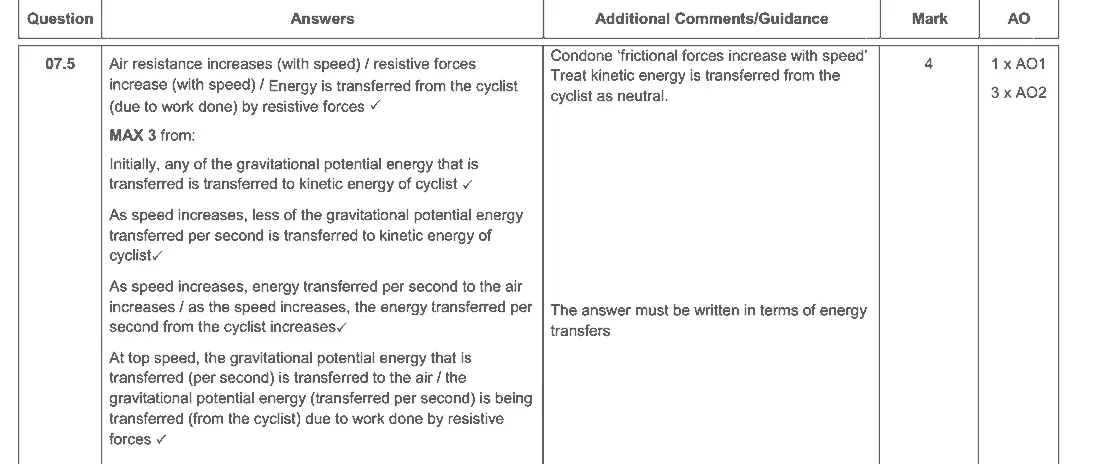
June 2022 · AS Paper 1 · Q7.54 marksAO1=1, AO2=3ExplanationHard
Earlier part of question 7 that this part uses
Mark scheme
Examiner's comment
07.5 This question proved too challenging for this cohort of students. Less than 5% of the students were able to obtain more than three marks. The answers seen were typical of work at GCSE level. The marks scored were limited to statements that air resistance increased with speed or that the gravitational potential energy was being converted into kinetic energy. Many students disregarded the instruction to outline the energy transfers and instead answered in terms of resultant forces and accelerations. The type of analysis that one would expect from more able AS students was rarely seen. A significant number of students stated that the cyclist was losing kinetic energy even though the velocity did not decrease.
Notes from the mark scheme and report
Air resistance increases with speed
at first GPE lost goes to KE
as speed rises less of the GPE lost per second becomes KE and more is transferred to the air
at terminal speed all GPE lost per second goes to the air
answers in terms of forces not credited
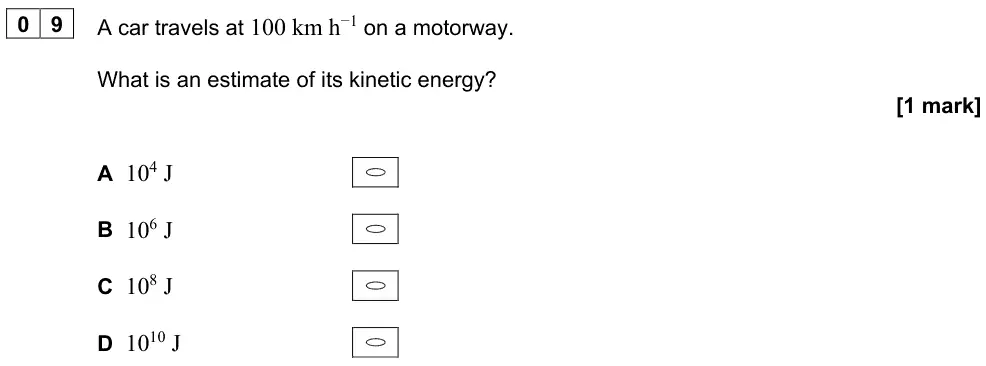
June 2022 · Paper 1 · Q91 markAO1=1Multiple choice
Answer
B
Mark scheme
Notes from the mark scheme and report
Answer: B
Skills: MS1.4 Make order of magnitude calculations; MS0.4 Estimate results
June 2022 · Paper 1 · Q261 markAO2=1Multiple choice
Answer
D
Mark scheme
Examiner's comment
Question 26 was a difficult multi-step calculation. Most students chose B, and the next most popular was D, the correct answer.
Notes from the mark scheme and report
Answer: D
most chose B (ignoring the change of direction), D next most popular
Skills: MS2.3 Substitute numerical values into algebraic equations using appropriate units for physical quantities
June 2022 · AS Paper 2 · Q4.22 marksAO2=2Calculation
Earlier part of question 4 that this part uses
Mark scheme
Examiner's comment
04.2 About 40% of students gained full marks by realising that the answer could be obtained using a ‘suvat’ equation or by considering the transfer from stored gravitational potential energy to kinetic energy. About 40% of the cohort made no relevant progress. Students are reminded not to give final answers in surd form as they will not gain the mark.
Notes from the mark scheme and report
Answer: 1.7 m s^-1 (v^2 = 2 x 4.9 x 0.30)
no surd answers
9.81 not allowed as a
Skills: MS2.3 Substitute numerical values into algebraic equations using appropriate units for physical quantities
June 2022 · AS Paper 2 · Q271 markAO2=1Multiple choice
Answer
D
Mark scheme
Notes from the mark scheme and report
Answer: D
June 2022 · AS Paper 2 · Q281 markAO2=1Multiple choice
Answer
B
Mark scheme
Notes from the mark scheme and report
Answer: B
Skills: MS0.3 Use ratios, fractions and percentages
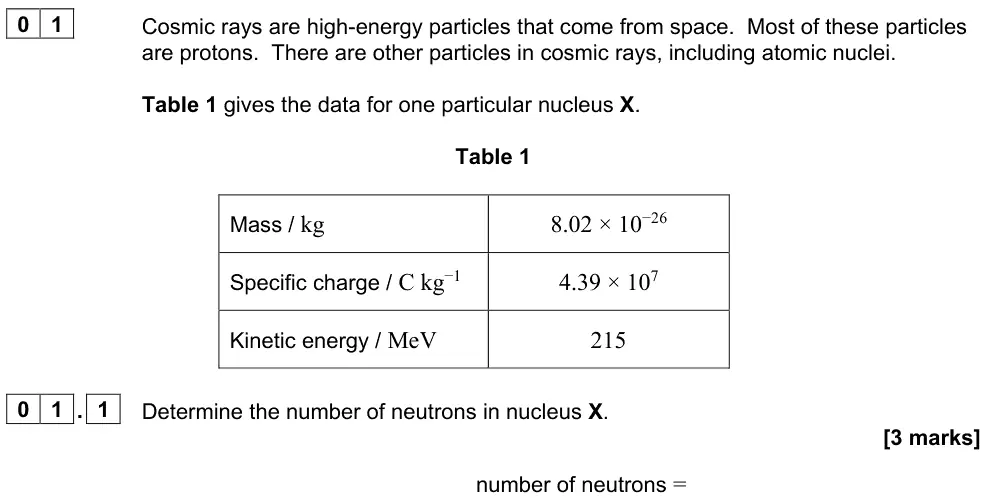
November 2021 · Paper 1 · Q1.23 marksAO1=1, AO2=2Calculation
Earlier part of question 1 that this part uses
Mark scheme
Examiner's comment
Question 01.1 was answered correctly by a majority of students. However, although a mark was available for answers that included the calculation of the number of nucleons, this mark was withheld when the student made any suggestion that what they had calculated was the number of neutrons. This resulted in very few students receiving more than one out of three marks for partial answers. In question 01.2 many students were familiar with the kinetic energy equation, but had difficulties with the conversion between MeV and J. Answers to the remaining parts indicated that many students were unfamiliar with the conservation laws or the decay of the kaon into pions, which are both explicitly on the specification.
Notes from the mark scheme and report
Answer: 2.9 x 10^7 m s^-1 (215 MeV = 3.44 x 10^-11 J, v = root(2E/m))
MeV to J conversion caused difficulty
Skills: MS2.2 Change the subject of an equation, including non-linear equations; MS2.3 Substitute numerical values into algebraic equations using appropriate units for physical quantities; MS0.2 Recognise and use expressions in decimal and standard form
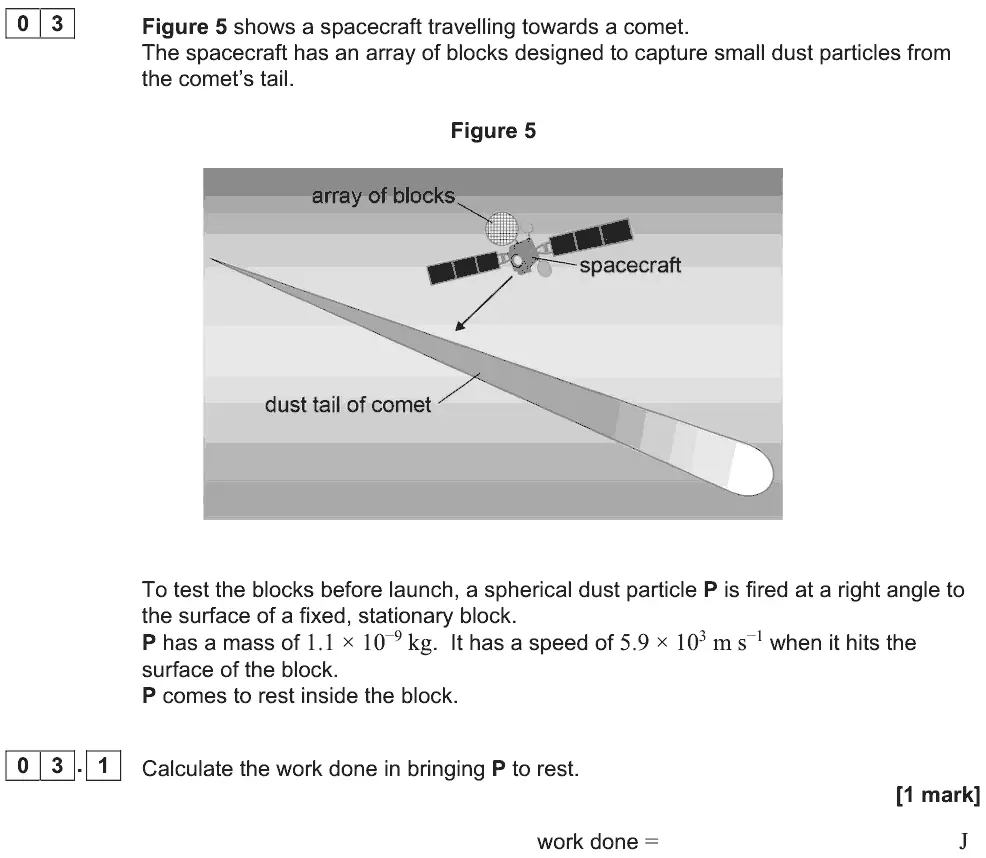
November 2021 · AS Paper 1 · Q3.11 markAO1=1Calculation
Mark scheme
Notes from the mark scheme and report
Answer: 0.019 J (1/2 x 1.1 x 10^-9 x (5.9 x 10^3)^2)
Skills: MS2.3 Substitute numerical values into algebraic equations using appropriate units for physical quantities; MS0.2 Recognise and use expressions in decimal and standard form
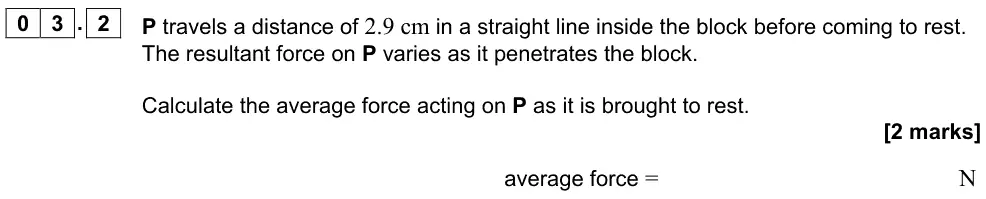
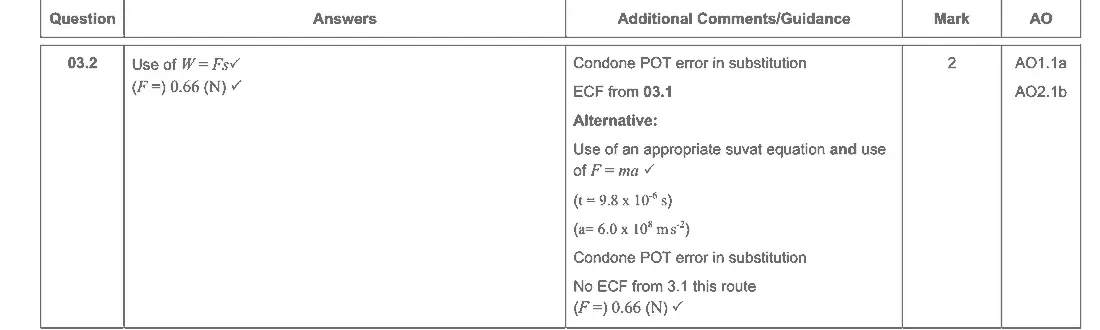
November 2021 · AS Paper 1 · Q3.22 marksCalculation
Earlier part of question 3 that this part uses
Mark scheme
Notes from the mark scheme and report
Answer: 0.66 N (W = Fs with s = 0.029 m)
Skills: MS2.2 Change the subject of an equation, including non-linear equations
November 2021 · AS Paper 1 · Q3.43 marksAO3=3Explanation
Earlier part of question 3 that this part uses
Mark scheme
Notes from the mark scheme and report
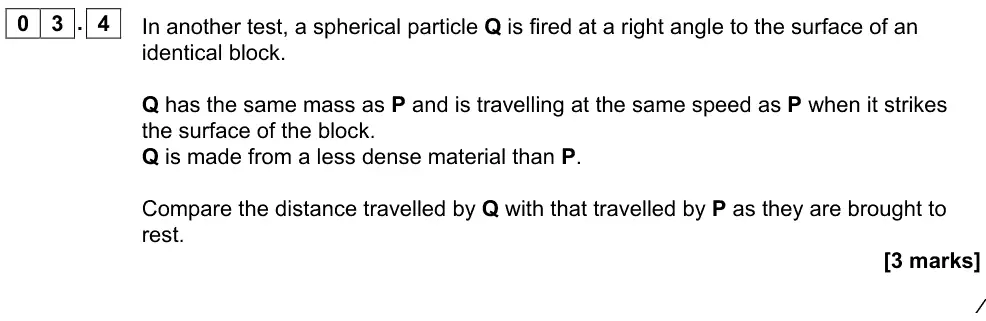
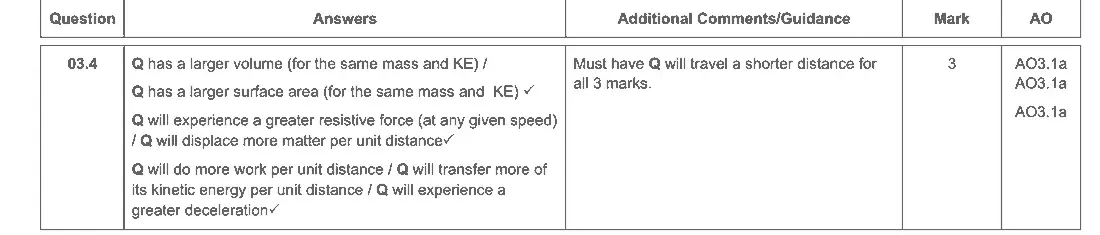
Q has larger volume/cross-section so meets greater resistive force, transfers more KE per unit distance, so travels a shorter distance (conclusion needed for 3)
November 2021 · AS Paper 1 · Q5.33 marksAO3=3Explanation
Earlier part of question 5 that this part uses
Mark scheme
Notes from the mark scheme and report
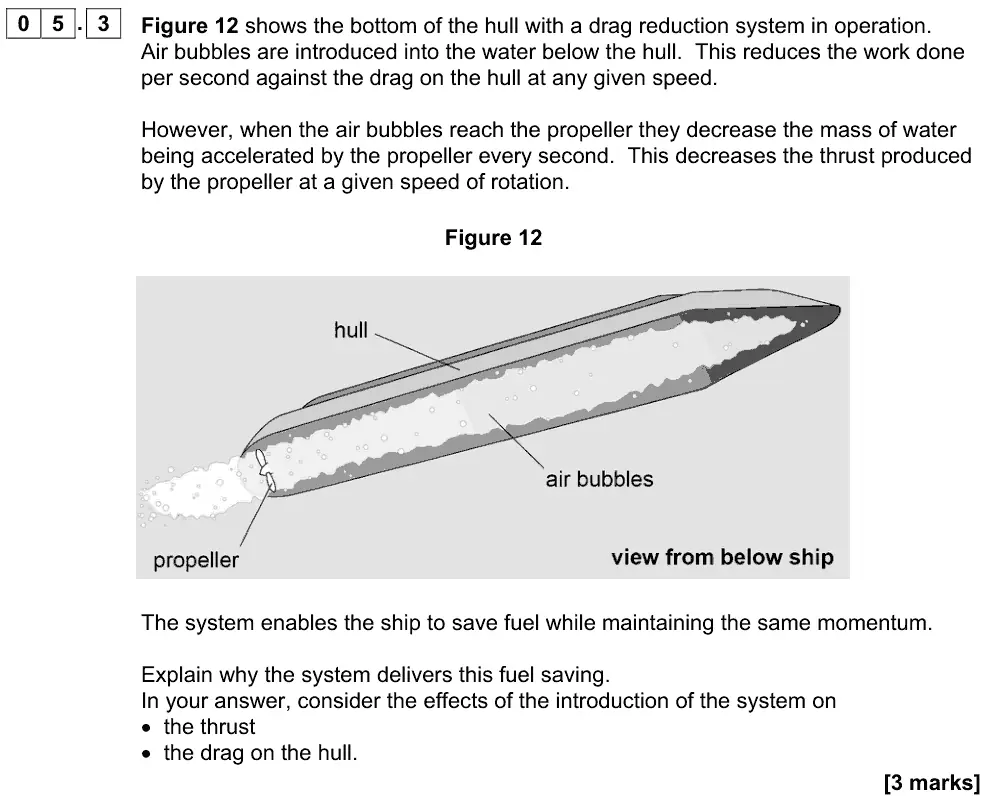
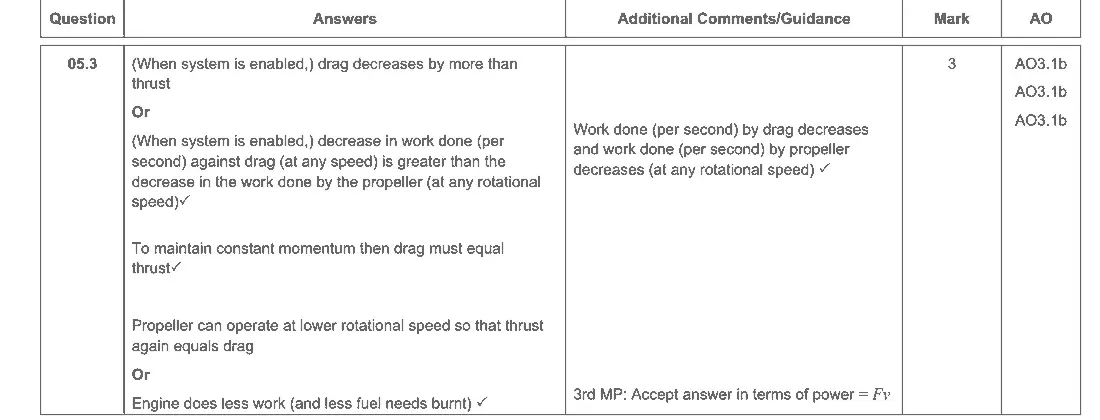
Drag falls by more than thrust
constant momentum needs thrust = drag, so propeller can turn more slowly
engine does less work per second so less fuel used
November 2021 · Paper 1 · Q161 markMultiple choiceEasy
Answer
B
Mark scheme
Examiner's comment
Several of the multiple-choice questions proved to be extremely difficult. In particular, questions 20, 27 and 29 were answered correctly by fewer than 30% of the students. In question 20 more students opted for B and for C than for the correct answer (D), indicating a lack of familiarity with scale diagrams. In question 27 the most popular answer was B, indicating the difficulties students have with combining resistors, and the second most popular was C, suggesting that students did not understand the difference between open and short circuits. The most popular answer to question 18 was D, probably because the students did not spot that this was a stationary, rather than progressive, wave. The most accessible questions were 10 and 16, both of which were answered correctly by over 70% of the students.
Notes from the mark scheme and report
Answer: B
November 2021 · Paper 1 · Q251 markMultiple choice
Answer
C
Mark scheme
Notes from the mark scheme and report
Answer: C
Skills: MS3.8 Understand the possible physical significance of the area between a curve and the x axis and be able to calculate it or estimate it by graphical methods as appropriate; MS0.4 Estimate results
November 2021 · Paper 1 · Q311 markMultiple choice
Answer
D
Mark scheme
Notes from the mark scheme and report
Answer: D
November 2021 · AS Paper 2 · Q4.44 marksAO3=4Calculation
Earlier part of question 4 that this part uses
Mark scheme
Notes from the mark scheme and report
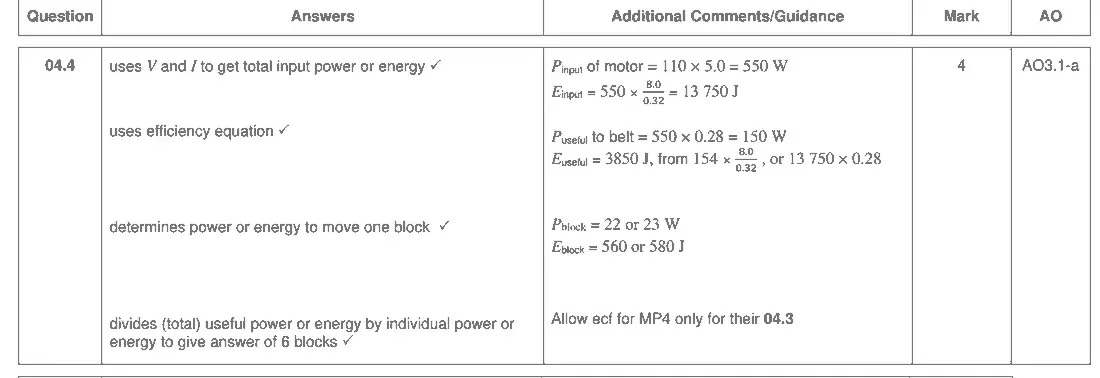
Answer: 6 blocks (input 550 W
useful 154 W
one block needs 72.8 x 0.32 = 23 W)
ecf from 04.3 for last mark
Skills: MS0.3 Use ratios, fractions and percentages; MS2.3 Substitute numerical values into algebraic equations using appropriate units for physical quantities
November 2021 · AS Paper 2 · Q101 markMultiple choice
Answer
B
Mark scheme
Notes from the mark scheme and report
Answer: B
Skills: MS0.3 Use ratios, fractions and percentages
November 2021 · AS Paper 2 · Q111 markMultiple choice
Answer
D
Mark scheme
Notes from the mark scheme and report
Answer: D
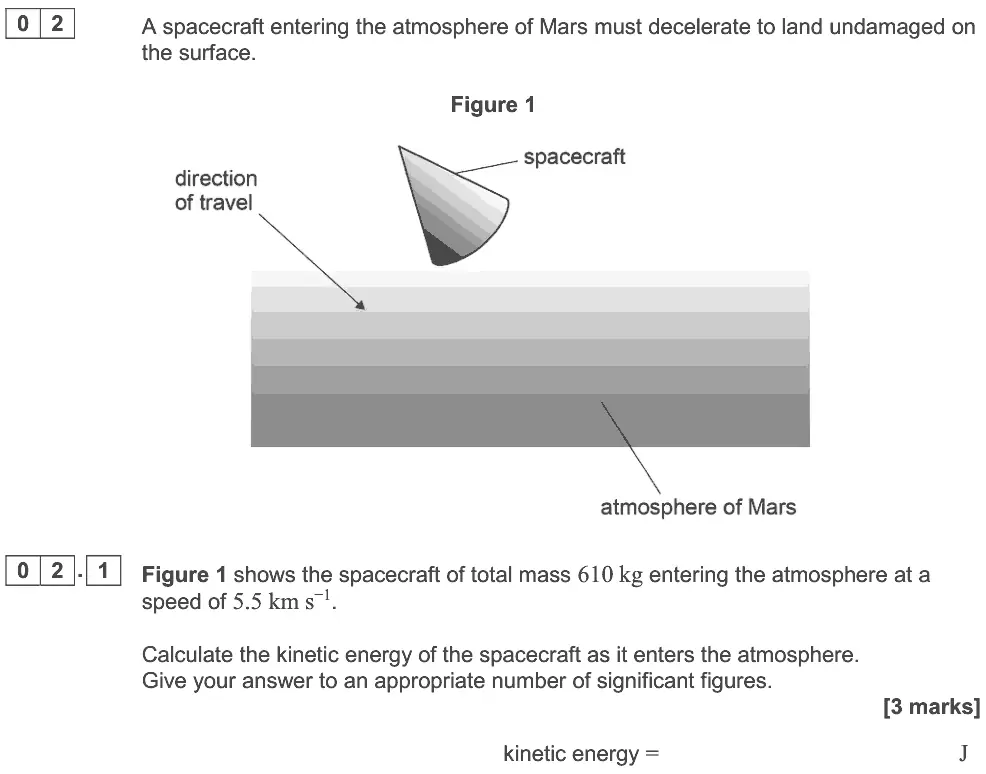
November 2020 · AS Paper 1 · Q2.13 marksCalculation
Mark scheme
Notes from the mark scheme and report
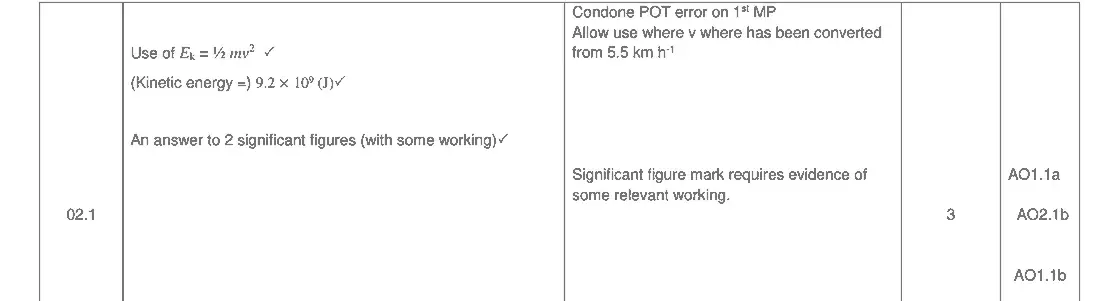
Answer: 9.2 x 10^9 J (v = 5500 m s^-1)
2 s.f. needed with working for the third mark
Skills: MS2.3 Substitute numerical values into algebraic equations using appropriate units for physical quantities; MS1.1 Use an appropriate number of significant figures; MS0.1 Recognise and make use of appropriate units in calculations
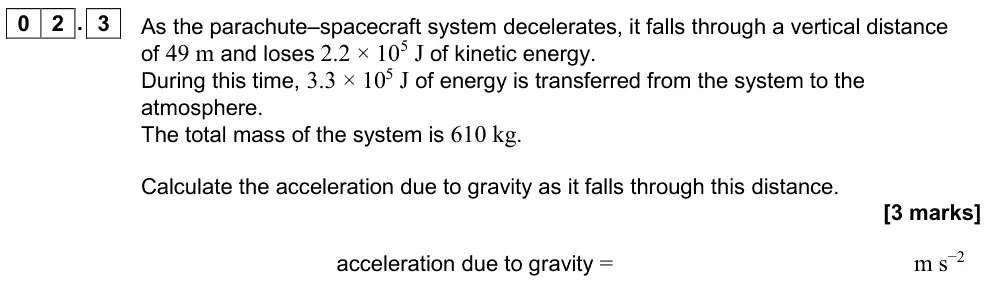
November 2020 · AS Paper 1 · Q2.33 marksCalculation
Earlier part of question 2 that this part uses
Mark scheme
Notes from the mark scheme and report
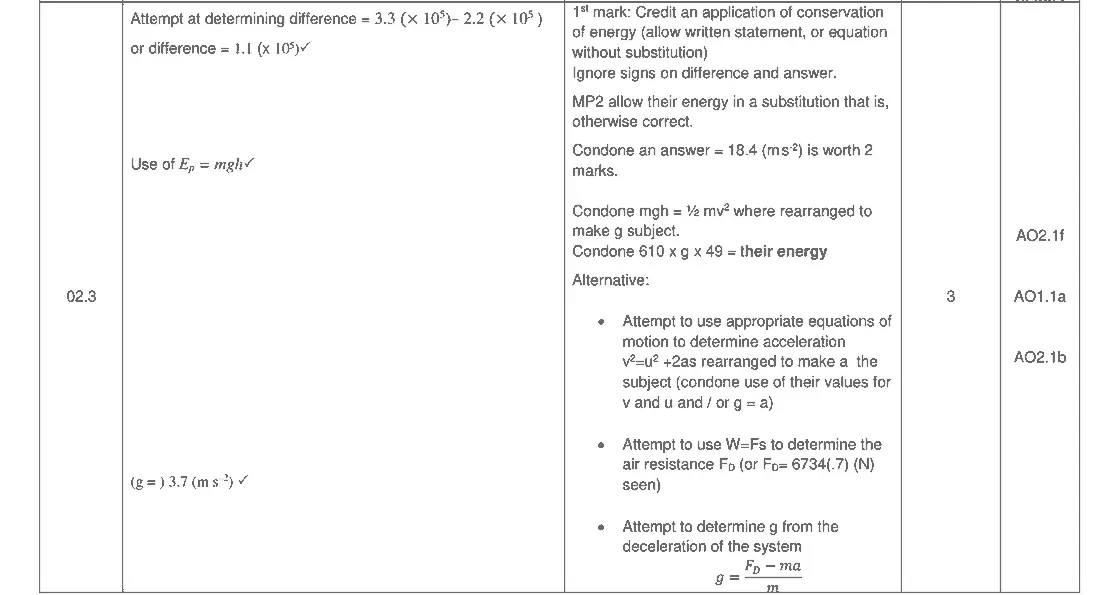
Answer: 3.7 m s^-2 (GPE lost = 3.3 x 10^5 - 2.2 x 10^5 = 1.1 x 10^5 J = 610 x g x 49)
18.4 m s^-2 from adding the energies scores 2
Skills: MS2.2 Change the subject of an equation, including non-linear equations; MS2.3 Substitute numerical values into algebraic equations using appropriate units for physical quantities
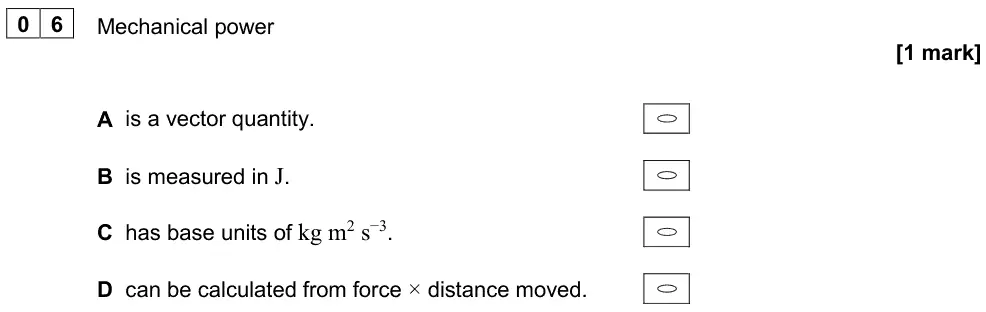
November 2020 · Paper 1 · Q61 markMultiple choice
Answer
C
Mark scheme
Notes from the mark scheme and report
Answer: C
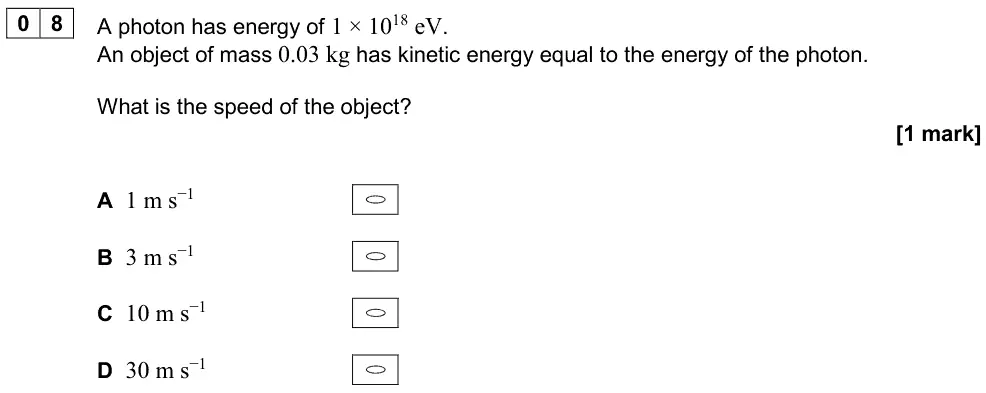
November 2020 · Paper 1 · Q81 markMultiple choice
Answer
B
Mark scheme
Notes from the mark scheme and report
Answer: B
Skills: MS0.2 Recognise and use expressions in decimal and standard form; MS2.2 Change the subject of an equation, including non-linear equations
November 2020 · Paper 1 · Q221 markMultiple choice
Answer
A
Mark scheme
Notes from the mark scheme and report
Answer: A
Skills: MS2.3 Substitute numerical values into algebraic equations using appropriate units for physical quantities
November 2020 · Paper 1 · Q231 markMultiple choice
Answer
A
Mark scheme
Notes from the mark scheme and report
Answer: A
November 2020 · Paper 2 · Q1.53 marksCalculation
Earlier part of question 1 that this part uses
Mark scheme
Examiner's comment
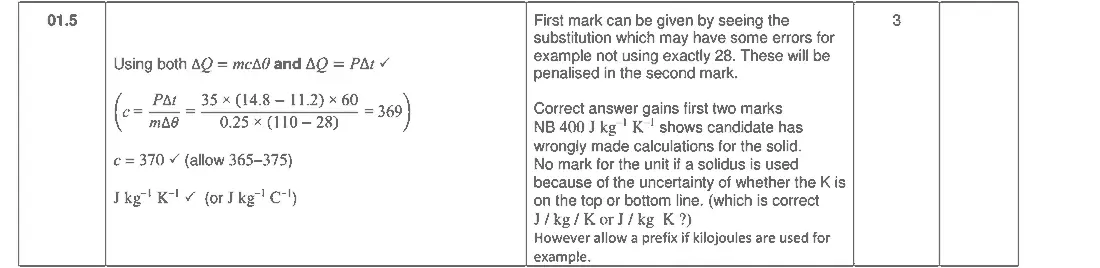
This question was answered well by students and many obtained full marks. The most common error was to equate heat energy to power. A host of other errors appeared in rather smaller numbers; these included poor equation manipulation, not using the time data in minutes, or (surprisingly) mixing the symbols for time and change of temperature.
Question 01.5
Notes from the mark scheme and report
Answer: 370 J kg^-1 K^-1 (35 x (14.8 - 11.2) x 60 / (0.25 x (110 - 28)))
minutes must be converted
400 means the solid section was used
solidus units not accepted
Skills: MS3.1 Translate information between graphical, numerical and algebraic forms; MS2.2 Change the subject of an equation, including non-linear equations; MS0.1 Recognise and make use of appropriate units in calculations
November 2020 · Paper 2 · Q1.62 marksCalculation
Earlier part of question 1 that this part uses
Mark scheme
Examiner's comment
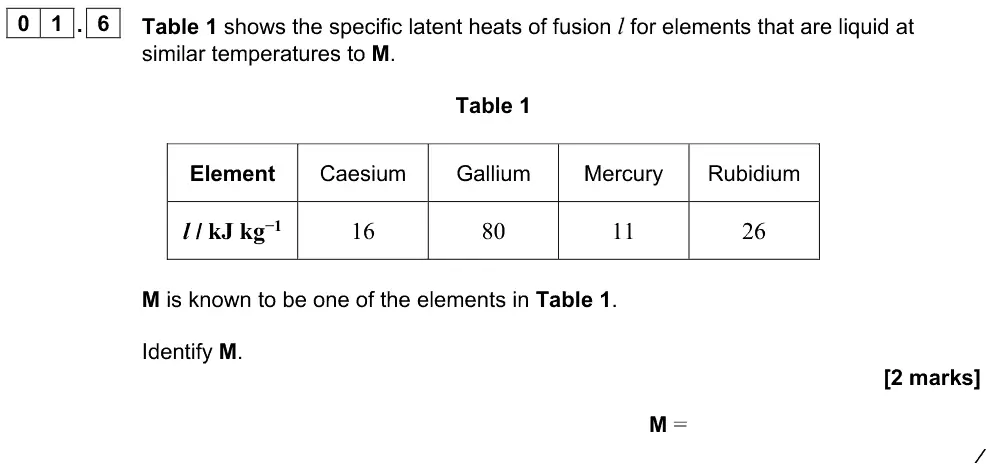
Less than half the students could determine the specific heat capacity and identify the element. The most successful students were those who showed their working in full. The last mark in the question could be awarded even when an error was carried forward from a slip in the calculation. In practice this was rarely awarded, because these students did not show enough working to confirm whether the slip was in arithmetic or transposition rather than an error in physics.
Question 01.6
Notes from the mark scheme and report
Answer: l = 79 kJ kg^-1 so M is gallium (35 x (11.2 - 1.8) x 60 / 0.25)
valid calculation needed
less than half succeeded
Skills: MS3.1 Translate information between graphical, numerical and algebraic forms; MS2.2 Change the subject of an equation, including non-linear equations
November 2020 · Paper 2 · Q2.53 marksAO2=3Calculation
Earlier part of question 2 that this part uses
Mark scheme
Examiner's comment
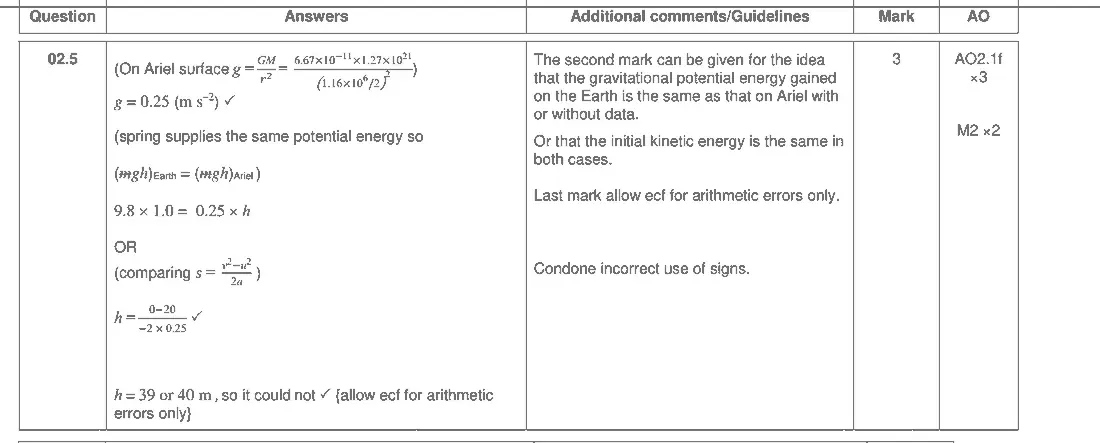
Half the students did calculate the gravitational field strength for Ariel but then had no real idea how to use this information. There were some students who gained full marks, but for many the sticking point was providing a proof that the object could not reach 100 m. Stating that the force was 39 times weaker does not constitute proof.
Question 02.5
Notes from the mark scheme and report
Answer: no - g on Ariel = 0.25 m s^-2, same energy so h = 9.8 x 1.0 / 0.25 = 39-40 m, less than 100 m
'force 39 times weaker' is not a proof
Skills: MS2.3 Substitute numerical values into algebraic equations using appropriate units for physical quantities; MS0.3 Use ratios, fractions and percentages
November 2020 · Paper 2 · Q3.53 marksCalculationHard
Earlier part of question 3 that this part uses
Mark scheme
Examiner's comment
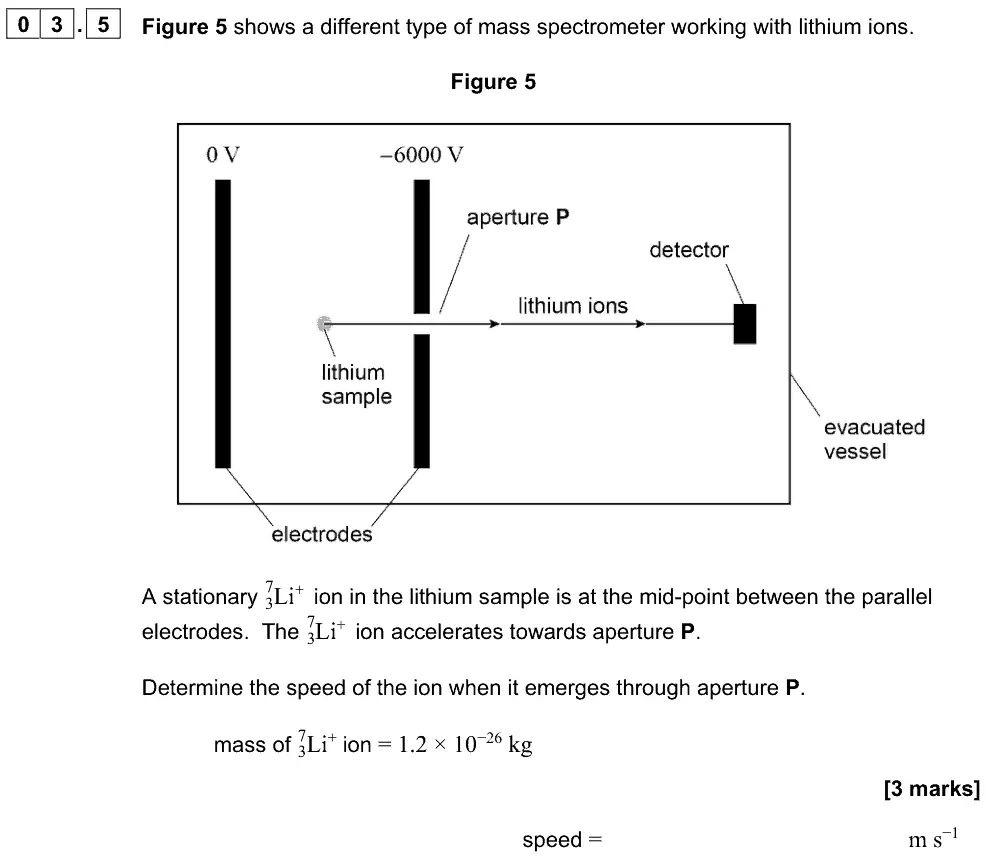
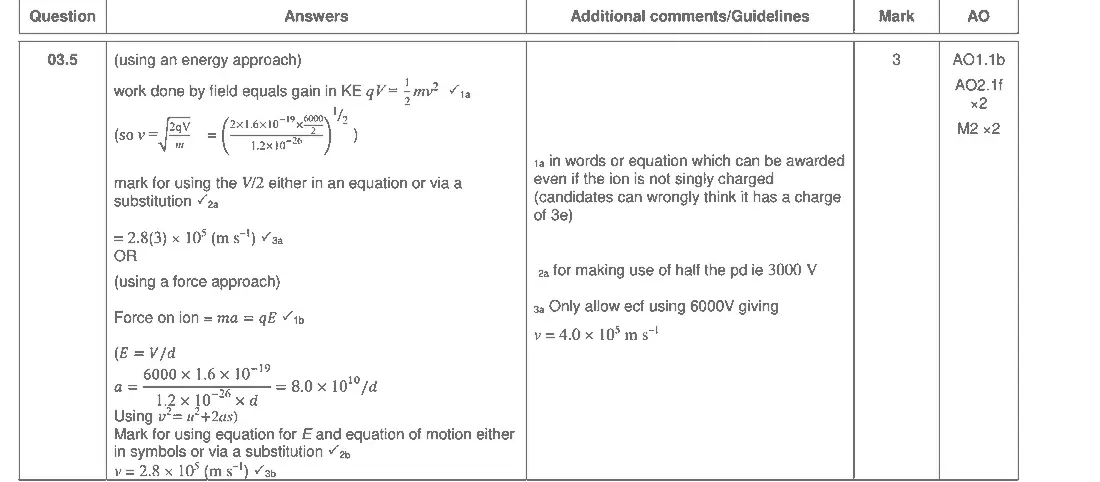
An energy approach to answering the question was the most successful and about one-sixth of the students gained full marks. Many other students were partially successful but these did not appreciate that the potential difference change for the ion was only half of the 6000 V. Those answers gaining no marks normally showed an inappropriate equation.
Question 03.5
Notes from the mark scheme and report
Answer: 2.8 x 10^5 m s^-1 (ion starts at midpoint so pd = 3000 V
qV = mv^2/2)
using 6000 V gives 4.0 x 10^5 m s^-1
Skills: MS2.2 Change the subject of an equation, including non-linear equations; MS2.3 Substitute numerical values into algebraic equations using appropriate units for physical quantities
November 2020 · AS Paper 2 · Q251 markMultiple choice
Answer
B
Mark scheme
Notes from the mark scheme and report
Answer: B
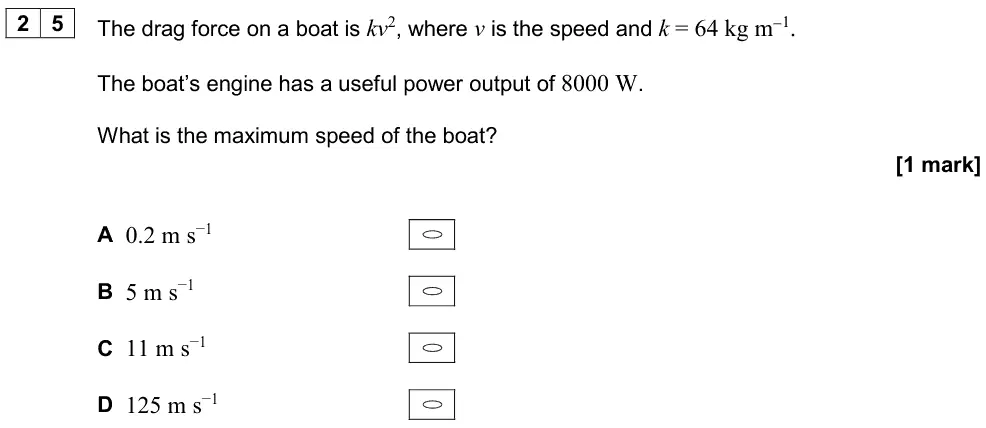
P = kv^3, v = 5 m s^-1
Skills: MS2.2 Change the subject of an equation, including non-linear equations
June 2019 · AS Paper 1 · Q3.43 marksCalculationHard
Earlier part of question 3 that this part uses
Mark scheme
Examiner's comment
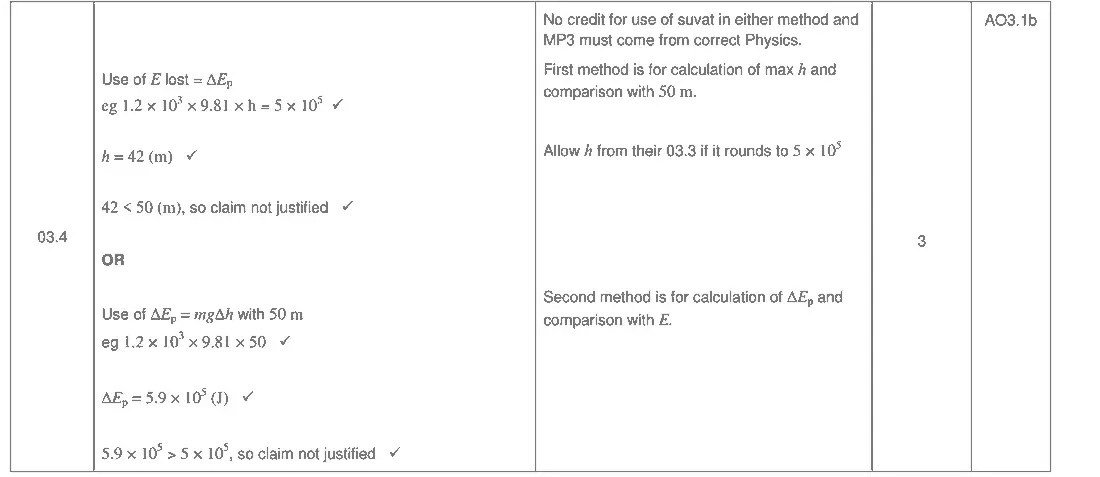
03.4 Around one-third of the cohort gained full credit for this question. As a ‘deduce’ question, there needed to be a conclusion about the justification of the claim. Over 50% of students gained no marks or did not attempt the question at all. Many did not make the connection with 03.3 and failed to consider energy transfers. A large number of students applied suvat (kinematic) equations but the acceleration is not uniform in this situation.
Notes from the mark scheme and report
Answer: h = 42 m (5 x 10^5 J = mgh) < 50 m so claim not justified (or 5.9 x 10^5 J needed)
suvat gets no credit as acceleration is not uniform
over 50% scored zero
Skills: MS2.3 Substitute numerical values into algebraic equations using appropriate units for physical quantities
June 2019 · AS Paper 1 · Q3.53 marksCalculation
Earlier part of question 3 that this part uses
Mark scheme
Examiner's comment
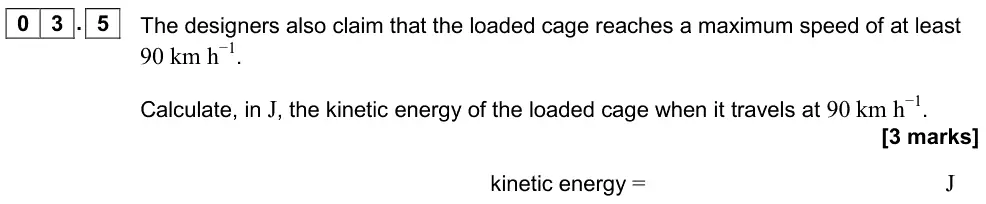
03.5 About 50% of students were able to convert the speed and to use it in the kinetic energy equation. Credit was given for an incorrect or no conversion of the speed so long as the substitution in the kinetic energy equation was fully correct. Mistakes in writing the ‘square’ exponent or in actually squaring the speed on the calculator were commonly seen.
03.6 In this question, students needed to compare their answer to 03.5 to the ‘show that’ value of 03.3. Even though an error was carried forward, many students struggled to give a relevant conclusion.
02.2 In this question, the information provided allowed students to calculate any one of four quantities (resistance, length, area, resistivity). This needed to be accompanied by a conclusion about the suitability of the tape for the second mark. Comments following a reasoned comparison between values were expected. For example, ‘the tape is suitable because the resistance will be 3.5 Ω and that is close to 3.7 Ω’. In this series, comments were too often limited in their explanation (‘yes, it is suitable’).
Notes from the mark scheme and report
Answer: 3.8 x 10^5 J (90 km h^-1 = 25 m s^-1)
conversion mark stands alone
squaring errors common
Skills: MS0.1 Recognise and make use of appropriate units in calculations; MS2.3 Substitute numerical values into algebraic equations using appropriate units for physical quantities
June 2019 · AS Paper 1 · Q3.61 markShort answer
Earlier part of question 3 that this part uses
Mark scheme
Examiner's comment
03.6 In this question, students needed to compare their answer to 03.5 to the ‘show that’ value of 03.3. Even though an error was carried forward, many students struggled to give a relevant conclusion.
Notes from the mark scheme and report
KE at 90 km h^-1 is less than the 5 x 10^5 J stored, so claim may be justified depending on GPE gained and resistive losses
June 2019 · Paper 1 · Q5.12 marksShow that
Mark scheme
Examiner's comment
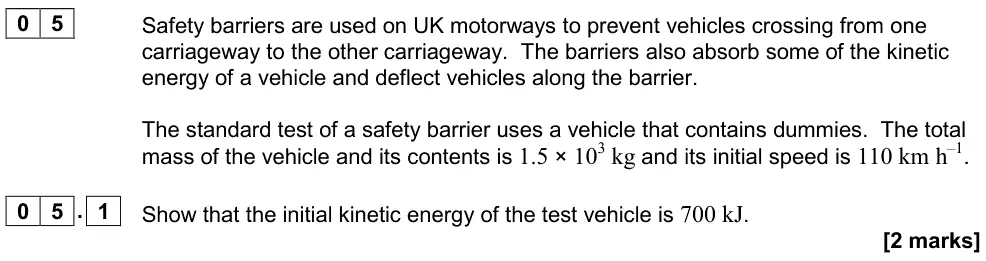
5.1 This very straightforward calculation was answered correctly by the vast majority of students. An occasional error was the failure to convert the speed to metres per second.
Notes from the mark scheme and report
110 km h^-1 = 30.6 m s^-1
KE = 0.5 x 1500 x v^2 = 7.2 x 10^5 J
forgetting to convert speed was the occasional error
Skills: MS0.1 Recognise and make use of appropriate units in calculations; MS2.3 Substitute numerical values into algebraic equations using appropriate units for physical quantities
June 2019 · Paper 1 · Q5.33 marksShow that
Earlier part of question 5 that this part uses
Mark scheme
Examiner's comment
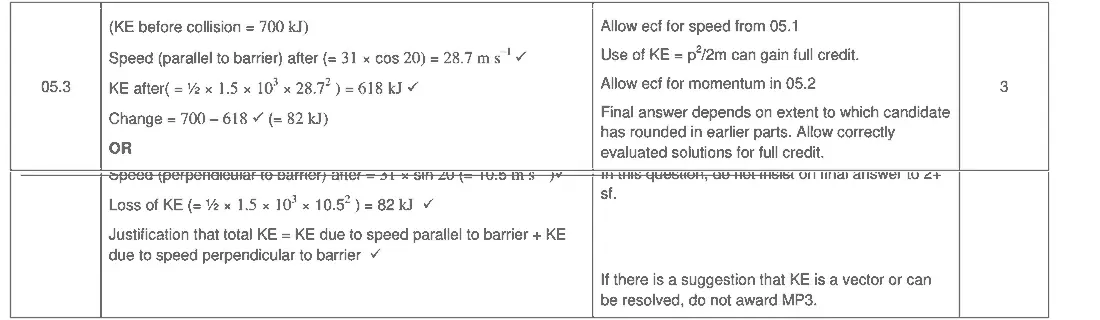
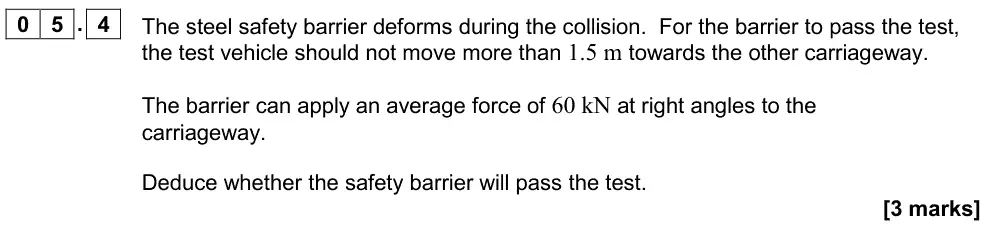
5.3 Students managed to find some very different approaches to what is essentially a straightforward multi-step calculation. Answers that appeared to be taking a component of the kinetic energy, and therefore treating it as a vector, did not gain full credit. 5.4 AO3 questions of the type in question 5.4 leave students free to choose the approach they wish to take. Each approach was treated on merit and was awarded full marks if correct. The most common, and successful, approach was a consideration of the work done by the barrier and therefore the average force that needed to be applied by the barrier to remove the perpendicular component of the car’s velocity. Occasional errors were related to incorrect physics, for example using the wrong suvat (kinematic) equation, or errors in algebra and computation. Unfortunately, many students were unable to see a way through this question that gave them any credit. This may have been due to students giving up or to them being unable to achieve the ‘show that’ values given in previous parts. Students should be encouraged to make use of the ‘show that’ values in these instances as they are there to allow access to later questions.
Notes from the mark scheme and report
Speed along barrier 28.7 m s^-1 so KE after 618 kJ, loss about 82 kJ (or 1/2 m (31 sin20)^2)
treating KE as a vector component loses MP3
Skills: MS4.5 Use sin, cos and tan in physical problems; MS2.3 Substitute numerical values into algebraic equations using appropriate units for physical quantities
June 2019 · Paper 1 · Q5.43 marksCalculation
Earlier part of question 5 that this part uses
Mark scheme
Examiner's comment
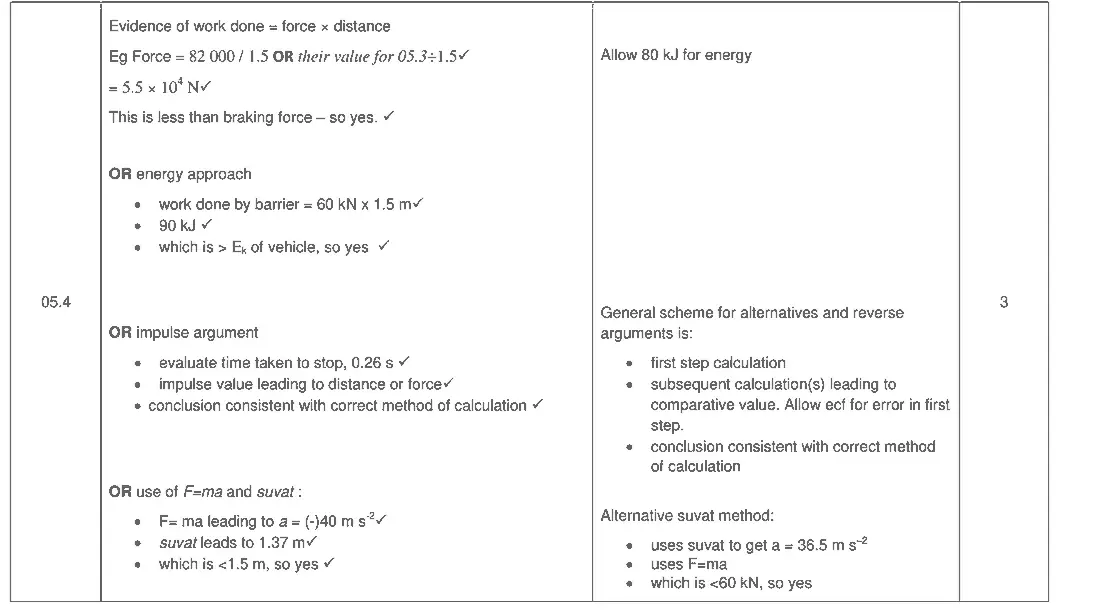
5.3 Students managed to find some very different approaches to what is essentially a straightforward multi-step calculation. Answers that appeared to be taking a component of the kinetic energy, and therefore treating it as a vector, did not gain full credit. 5.4 AO3 questions of the type in question 5.4 leave students free to choose the approach they wish to take. Each approach was treated on merit and was awarded full marks if correct. The most common, and successful, approach was a consideration of the work done by the barrier and therefore the average force that needed to be applied by the barrier to remove the perpendicular component of the car’s velocity. Occasional errors were related to incorrect physics, for example using the wrong suvat (kinematic) equation, or errors in algebra and computation. Unfortunately, many students were unable to see a way through this question that gave them any credit. This may have been due to students giving up or to them being unable to achieve the ‘show that’ values given in previous parts. Students should be encouraged to make use of the ‘show that’ values in these instances as they are there to allow access to later questions.
Notes from the mark scheme and report
Passes: work done by barrier 60 kN x 1.5 m = 90 kJ > 82 kJ (or average force needed 55 kN < 60 kN, or F = ma and suvat gives 1.37 m < 1.5 m)
many found no route
use show-that values
Skills: MS2.3 Substitute numerical values into algebraic equations using appropriate units for physical quantities
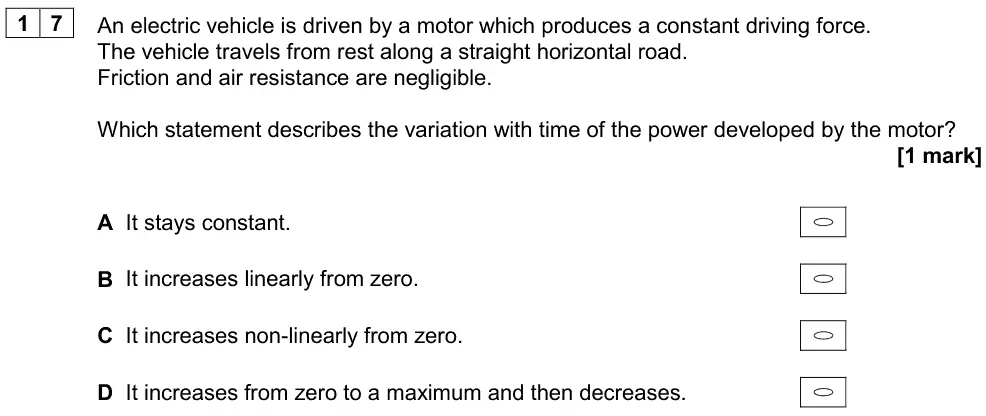
June 2019 · Paper 1 · Q171 markMultiple choice
Answer
B
Notes from the mark scheme and report
Answer: B
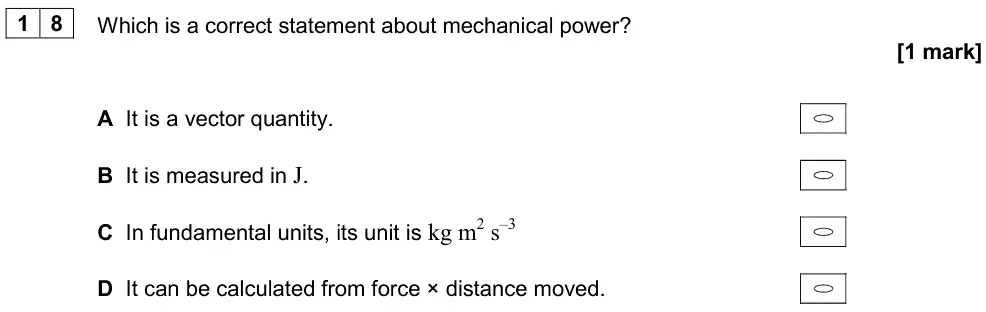
June 2019 · Paper 1 · Q181 markMultiple choice
Answer
C
Notes from the mark scheme and report
Answer: C
June 2019 · Paper 1 · Q271 markMultiple choice
Answer
C
Notes from the mark scheme and report
Answer: C
June 2019 · Paper 1 · Q281 markMultiple choice
Answer
C
Notes from the mark scheme and report
Answer: C
Skills: MS2.3 Substitute numerical values into algebraic equations using appropriate units for physical quantities
June 2019 · AS Paper 2 · Q4.23 marksCalculation
Earlier part of question 4 that this part uses
Mark scheme
Examiner's comment
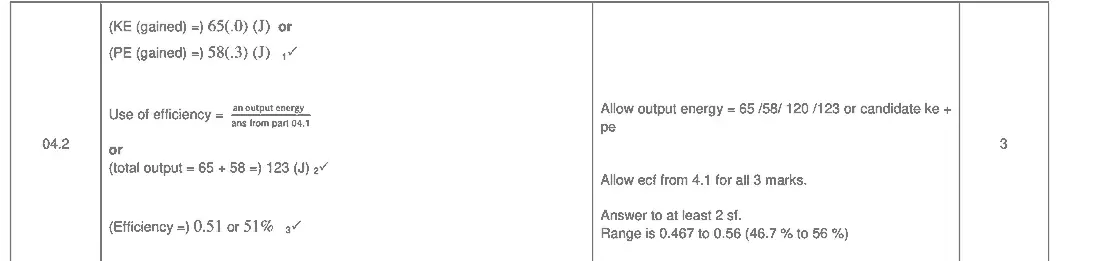
4.2 The most effective answers typically scored at least two marks. Most students who gained 1 mark determined either the potential energy (p.e.) or kinetic energy (k.e.) correctly. Many students did not recognise the sum of the p.e. and k.e. as the useful energy output, often using only p.e. Others didn’t realise that the answer to part 4.1 was the input energy and instead attempted to find some ratio of p.e. to k.e.
Skills: MS2.3 Substitute numerical values into algebraic equations using appropriate units for physical quantities; MS0.3 Use ratios, fractions and percentages
June 2019 · Paper 2 · Q171 markMultiple choice
Answer
D
Notes from the mark scheme and report
Answer: D
Skills: MS2.2 Change the subject of an equation, including non-linear equations
June 2019 · AS Paper 2 · Q271 markMultiple choice
Answer
C
Notes from the mark scheme and report
Answer: C
Skills: MS2.3 Substitute numerical values into algebraic equations using appropriate units for physical quantities
June 2018 · Paper 1 · Q1.32 marksExplanationHard
Earlier part of question 1 that this part uses
Mark scheme
Examiner's comment
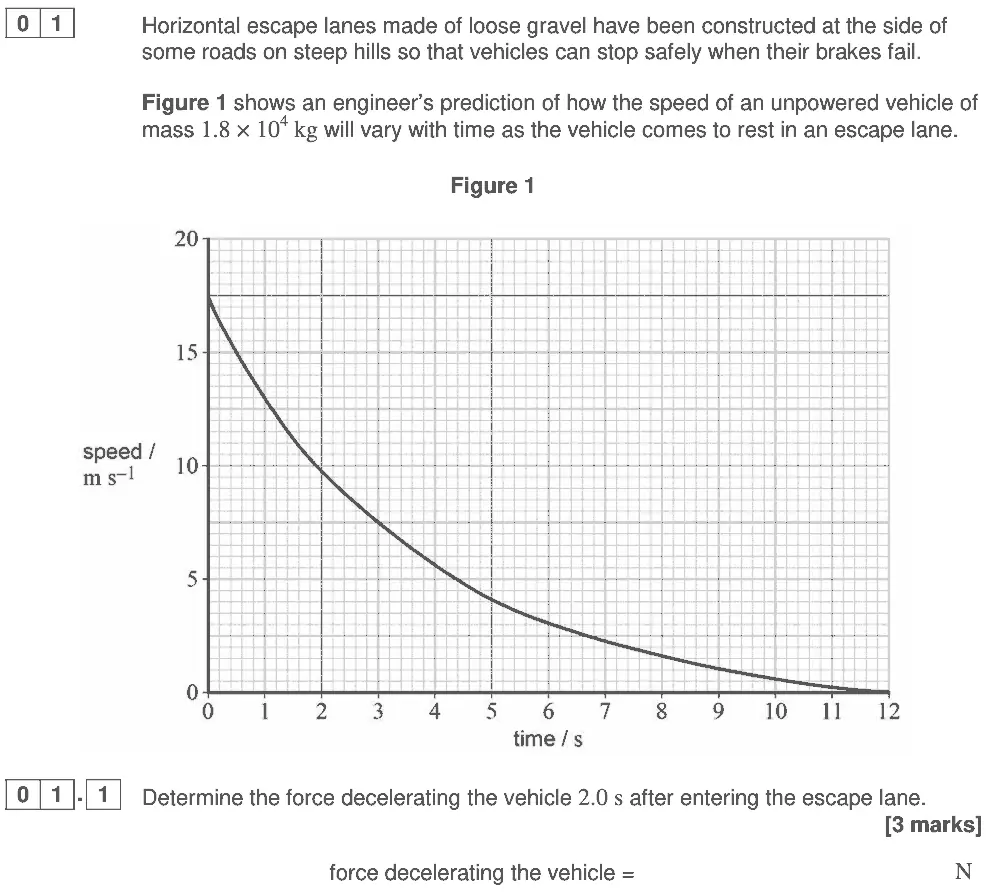
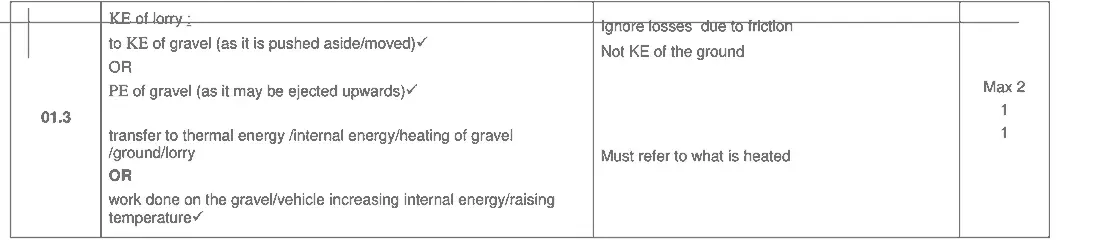
01.3 Students here needed to think of the context and respond accordingly. There were many who produced the very low level response of ‘heat and sound’, which gained no credit. It was essential to state what was heated. Only the more thoughtful students commented on the transfer of KE of the lorry to KE of the gravel, or work done moving it, which contributed to the greatest energy transfer in the context. 4.6% of students gained both marks here.
Notes from the mark scheme and report
KE of vehicle to KE of gravel pushed aside (or work done moving it) and heating of named gravel/ground/vehicle
'heat and sound' scores nothing
June 2018 · Paper 1 · Q1.43 marksCalculationHard
Earlier part of question 1 that this part uses
Mark scheme
Examiner's comment
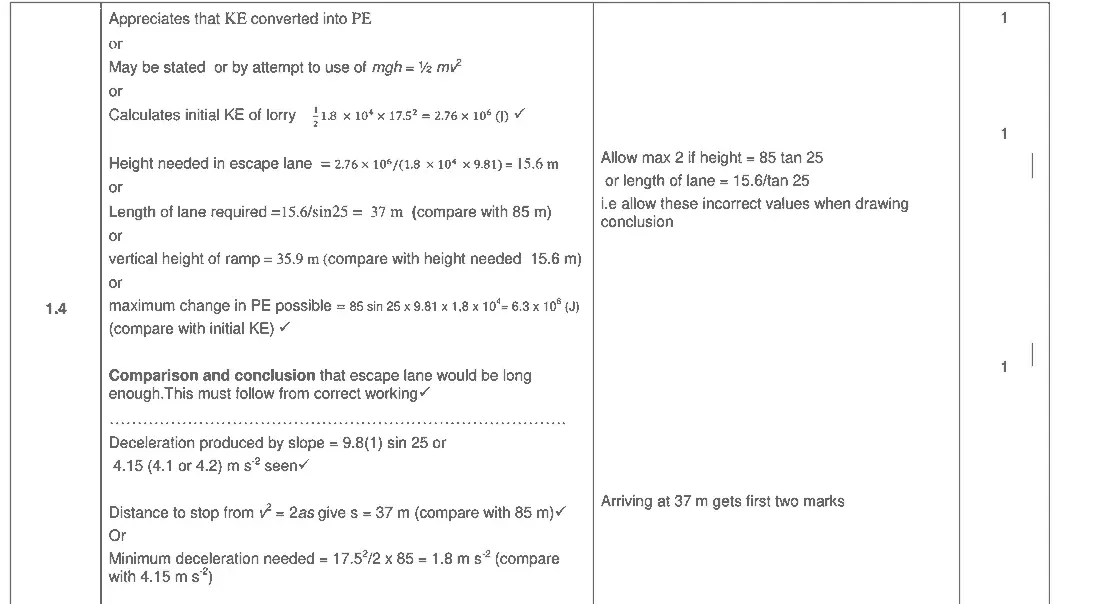
01.4 There were a number of different routes that led to the conclusion that the escape lane was long enough and they were seen in fairly even numbers. The easiest and possibly most straightforward were a comparison of the initial KE of the lorry and height at which the KE would be totally transferred, or comparison of the initial KE with the PE of the lorry if it were to reach the top of the ramp. Whilst the appropriate calculations were often seen, it was disappointing that many did not provide any comments of what each calculation represented and final statements in conclusion were often not well argued. However, over a quarter of students were able to score maximum credit.
Notes from the mark scheme and report
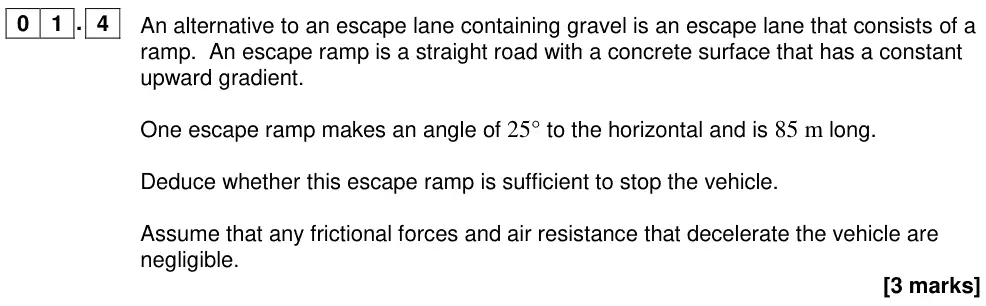
Ramp is enough: max PE gain 85 sin25 x mg = 6.3 x 10^6 J exceeds initial KE 2.76 x 10^6 J (or deceleration g sin25 = 4.15 m s^-2 gives 37 m stopping distance)
calculations need labelling and a clear conclusion
Skills: MS4.5 Use sin, cos and tan in physical problems; MS2.3 Substitute numerical values into algebraic equations using appropriate units for physical quantities
June 2018 · AS Paper 1 · Q2.12 marksCalculation
Mark scheme
Examiner's comment
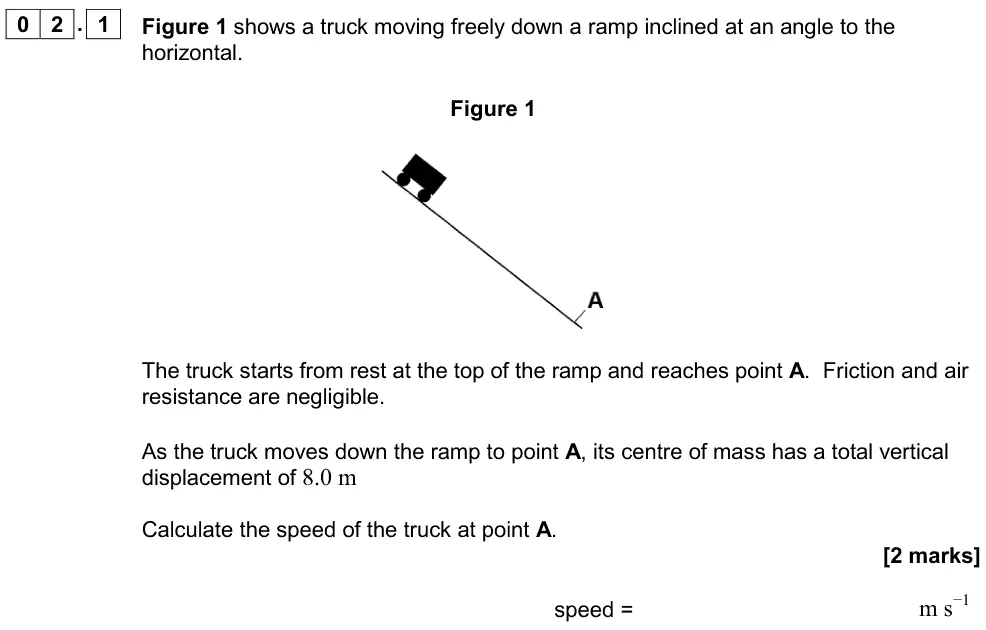
This question required an understanding of the vector nature of acceleration and momentum and also how using energy considerations can lead to a simpler analysis due to it being a scalar quantity. used 𝑣𝑣2 = 𝑢𝑢2 + 2𝑎𝑎𝑎𝑎 instead of energy considerations. This meant that they did not get 02.1 This was a straightforward calculation but a lot of students were caught out because they
Notes from the mark scheme and report
Answer: 13 m s^-1 (12.5)
mgh = 1/2mv^2
unresolved v^2 = u^2 + 2as with g scores zero - a common error
Skills: MS2.3 Substitute numerical values into algebraic equations using appropriate units for physical quantities; MS2.2 Change the subject of an equation, including non-linear equations
June 2018 · AS Paper 1 · Q2.31 markShort answerHard
Earlier part of question 2 that this part uses
Mark scheme
Examiner's comment
02.3 Only more able students could give a satisfactory explanation for the speeds being the same (19.8% correct).
Notes from the mark scheme and report
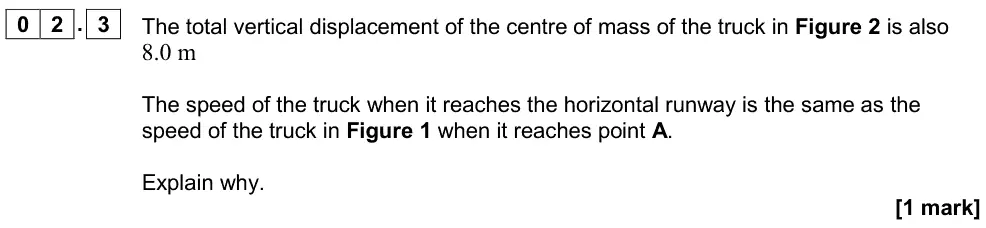
Same loss of GPE so same gain of KE
June 2018 · Paper 2 · Q1.23 marksCalculationEasy
Earlier part of question 1 that this part uses
Mark scheme
Examiner's comment
01.2 A majority performed this calculation well and with a good degree of clarity (64.5% of students scored all three marks). One error made by normally competent students was to give the final temperature rather than the rise in temperature. The other and more common fault was to quote an answer to only one significant figure. Only the very weak students made faults in re-arranging the equations.
Notes from the mark scheme and report
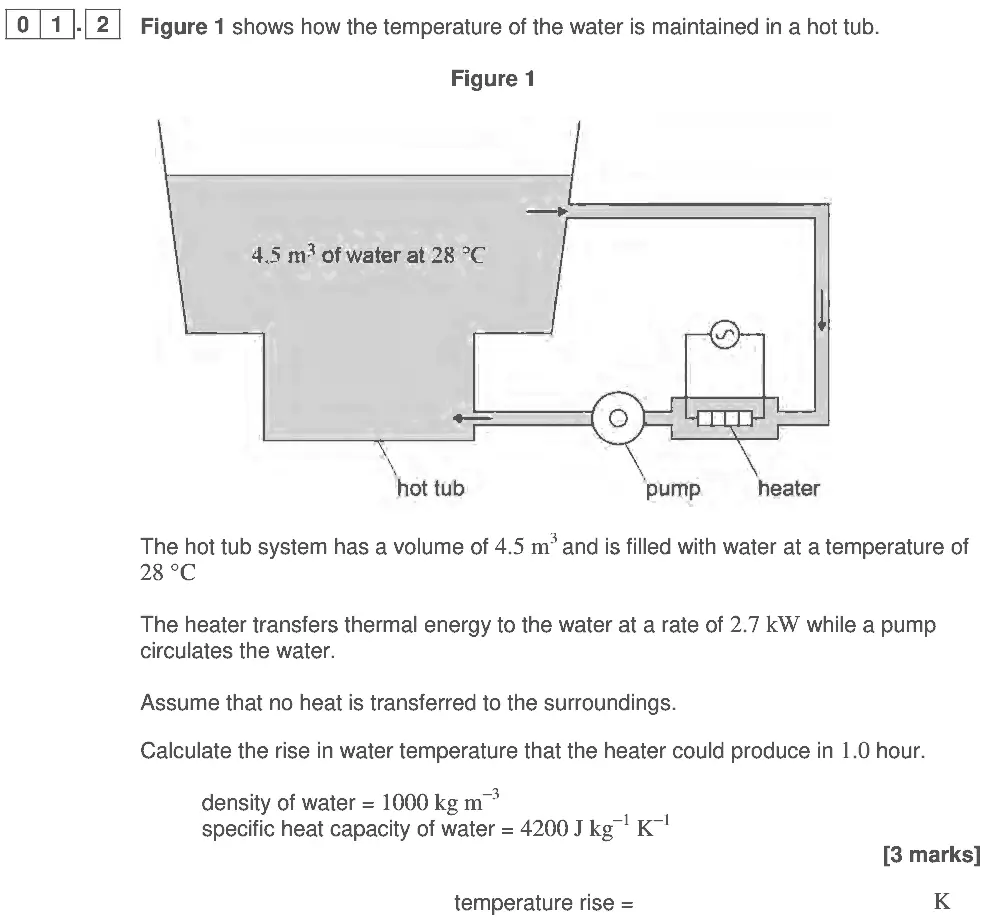
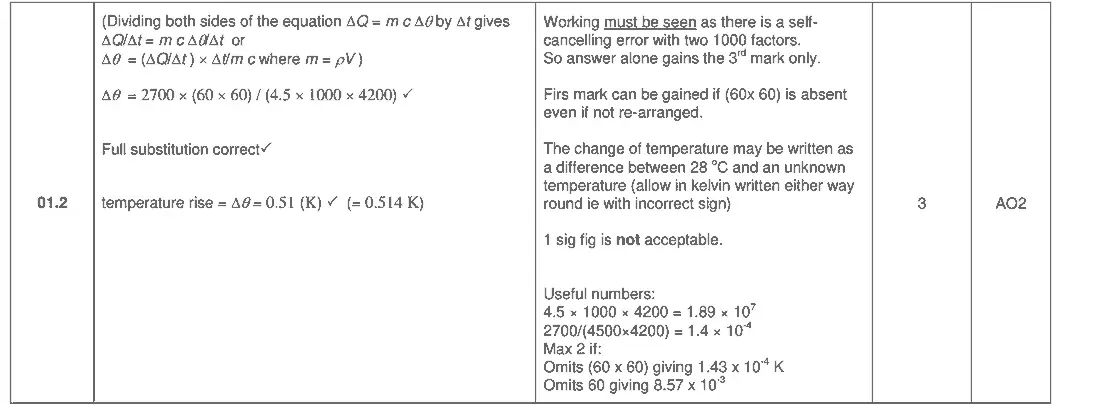
Answer: 0.51 K (2700 x 3600 / (4.5 x 1000 x 4200))
working needed
giving the final temperature or 1 sf answers lost marks
Skills: MS2.2 Change the subject of an equation, including non-linear equations; MS2.3 Substitute numerical values into algebraic equations using appropriate units for physical quantities; MS1.1 Use an appropriate number of significant figures
June 2018 · AS Paper 2 · Q3.12 marksShow that
Mark scheme
Examiner's comment
03.1 There were a number of stages to this “show that” question. Because of its level of demand the mark scheme was less stringent than usual about how “show that” calculations should be presented. However, students should be encouraged to ensure they have fully demonstrated how the answer is obtained. These pieces of advice should be considered:
• any equations used should be written with subjects seen at each stage of the calculation; • mid-calculation rounding should be avoided; • the answer should be quoted to more significant figures than the value they have been asked to find.
Most students selected B as their answer by converting 1 kW to 1000 W and dividing by 1.6 x 10⁻¹⁹. These students seemed unaware of the kWh as a unit of energy; this was evidenced by their disregard of the 1 hour in their calculation. Students would improve performance by checking the specification content including section 3.1 (Measurements and their errors). Just under a quarter of students were successful here.
Notes from the mark scheme and report
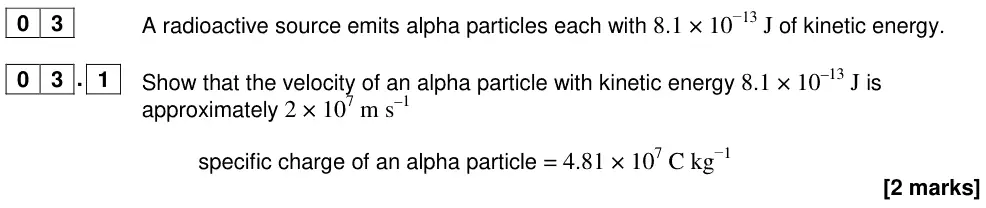
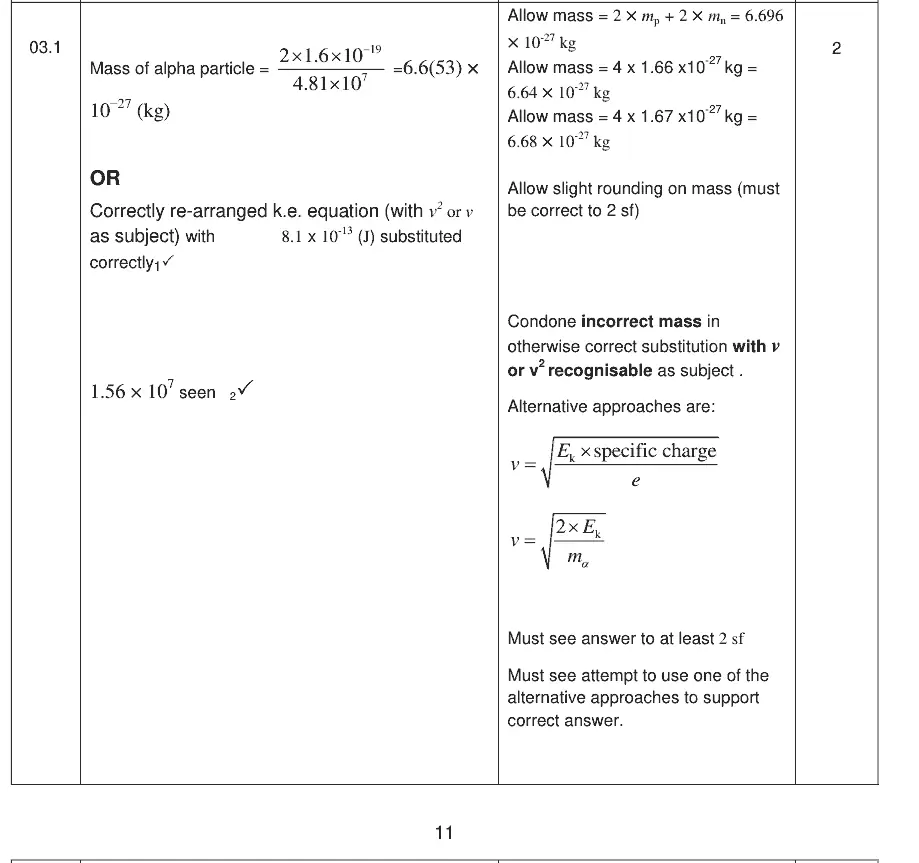
Answer: v = 1.56 x 10^7 m s^-1 (mass = 3.2 x 10^-19 / 4.81 x 10^7 = 6.65 x 10^-27 kg)
show subject at each stage and answer to more sf than given
Skills: MS2.2 Change the subject of an equation, including non-linear equations; MS2.3 Substitute numerical values into algebraic equations using appropriate units for physical quantities
June 2018 · AS Paper 2 · Q3.22 marksCalculationHard
Earlier part of question 3 that this part uses
Mark scheme
Examiner's comment
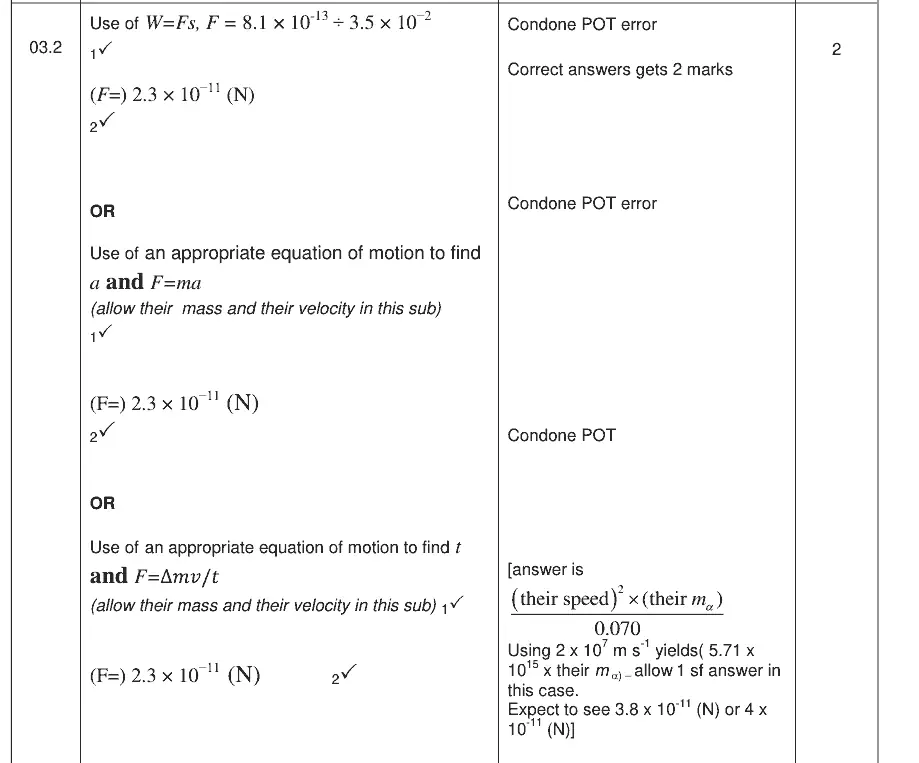
03.2 The main error seen, when using F = ma and equations of motion, was not taking into account speed changing when calculating the time to stop. Students who identified the questions as being set up for a “work done = change in kinetic energy” generally obtained all marks (27.3%).
The following questions had a significant proportion of non-attempts: Section A 1.5, Section B 3.2, 3.3, 3.4, 3.5, 4.2, 4.3 and Section C 32. It was difficult to ascertain if this was solely due to time management and instead may have been due to students being unable to know where to begin. Students should be encouraged to try and match the question to specification content as a means to unlocking the problem and enabling them to make some progress.
Notes from the mark scheme and report
Answer: 2.3 x 10^-11 N (work done = KE, F = 8.1 x 10^-13 / 0.035)
suvat routes often forgot the changing speed
Skills: MS2.3 Substitute numerical values into algebraic equations using appropriate units for physical quantities
June 2018 · AS Paper 2 · Q211 markMultiple choice
Answer
C
Notes from the mark scheme and report
Answer: C
Skills: MS4.5 Use sin, cos and tan in physical problems
June 2018 · AS Paper 2 · Q271 markMultiple choice
Answer
A
Notes from the mark scheme and report
Answer: A
Skills: MS0.3 Use ratios, fractions and percentages
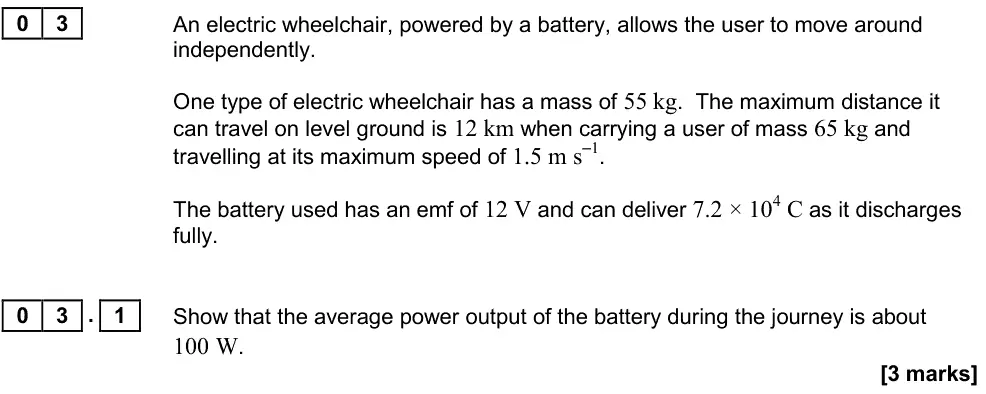
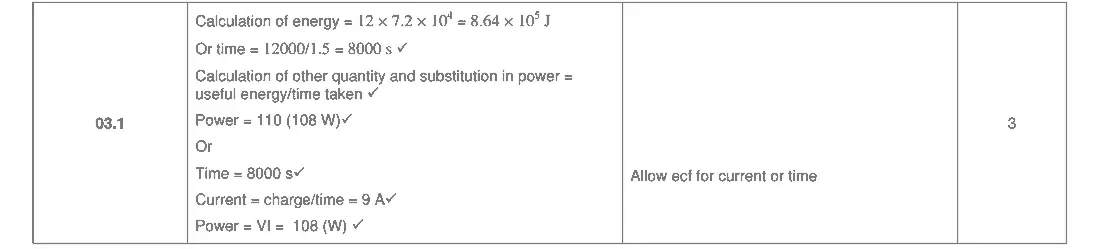
June 2017 · AS Paper 1 · Q3.13 marksShow that
Mark scheme
Examiner's comment
03.1 This was a fairly accessible question with more than half of the students gaining all three marks. There was more than one route students could choose to answer this question, with the calculation of the current proving to be a popular alternative. ‘Show that’ questions provide students with an answer that can be used later should they be unable to do the calculation. It has become relatively common to see students attempting to use the value to perform the calculation backwards. It was more common to see answers that manipulated the numbers in the stem to obtain 100W. Students should be reminded that examiners will only give credit to the final answer in a ‘show that’ calculation if it is given to at least one more significant figure than the value in the question.
03.2 Students were given full credit if they chose to use the value of 100 W from 03.1. Despite this, many students were unable to make at least some attempt at an answer, with over 10% making no attempt at all. It may be that many students were unfamiliar with questions that move from one area (such as electricity) to another (such as force), which could have led to the confusion of v (velocity) with V (pd) that was seen. Teachers should understand that this combination of topics within a question is a requirement of this specification, and the full A-level, that is certain to continue to appear in the examination papers. Errors were also seen in the answers that were provided. For example, asking for a ‘mean’ value of a quantity inevitably encourages some students to divide their answer by 2, an error that was seen a surprising number of times.
Notes from the mark scheme and report
Answer: 108 W (energy = 12 x 7.2 x 10^4 = 8.64 x 10^5 J
time = 12 000/1.5 = 8000 s)
answer to more sf than given
Skills: MS2.3 Substitute numerical values into algebraic equations using appropriate units for physical quantities
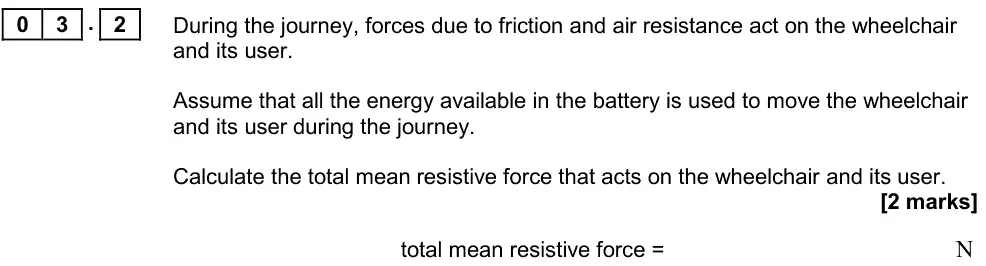
June 2017 · AS Paper 1 · Q3.22 marksCalculation
Earlier part of question 3 that this part uses
Mark scheme
Examiner's comment
03.2 Students were given full credit if they chose to use the value of 100 W from 03.1. Despite this, many students were unable to make at least some attempt at an answer, with over 10% making no attempt at all. It may be that many students were unfamiliar with questions that move from one area (such as electricity) to another (such as force), which could have led to the confusion of v (velocity) with V (pd) that was seen. Teachers should understand that this combination of topics within a question is a requirement of this specification, and the full A-level, that is certain to continue to appear in the examination papers. Errors were also seen in the answers that were provided. For example, asking for a ‘mean’ value of a quantity inevitably encourages some students to divide their answer by 2, an error that was seen a surprising number of times.
03.4 The fact that a large number of students did not attempt this question is partly related to the need to use information from 03.2, which was not well answered. It could also suggest that students expect calculations involving speed (or velocity) to require the use of the “suvat” equations, for example, and that they are therefore confused when none of the familiar information is provided. However, it is acknowledged that this is a conceptually demanding question, requiring students to appreciate that, at the maximum speed, the driving force = the total friction/drag force for example, and then apply that to P=Fv.
Notes from the mark scheme and report
Answer: 72-73 N (F = P/v = 108/1.5, or W/d
100 W gives 67 N)
v vs V confusion and halving for 'mean' were errors
Skills: MS2.3 Substitute numerical values into algebraic equations using appropriate units for physical quantities
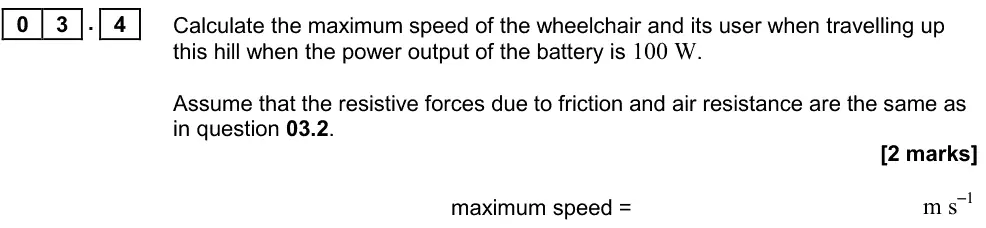
June 2017 · AS Paper 1 · Q3.42 marksCalculation
Earlier part of question 3 that this part uses
Mark scheme
Examiner's comment
03.4 The fact that a large number of students did not attempt this question is partly related to the need to use information from 03.2, which was not well answered. It could also suggest that students expect calculations involving speed (or velocity) to require the use of the “suvat” equations, for example, and that they are therefore confused when none of the familiar information is provided. However, it is acknowledged that this is a conceptually demanding question, requiring students to appreciate that, at the maximum speed, the driving force = the total friction/drag force for example, and then apply that to P=Fv.
Notes from the mark scheme and report
Answer: 0.61 m s^-1 (total resistive force 92 + 73 = 165 N at max speed
v = P/F)
many did not attempt
Skills: MS2.3 Substitute numerical values into algebraic equations using appropriate units for physical quantities
June 2017 · AS Paper 1 · Q3.54 marksExplanation
Earlier part of question 3 that this part uses
Mark scheme
Examiner's comment
03.5 Another common feature of this new specification is the assessment of a student’s ability to reach a reasoned judgement. In this question students were required to decide which effect (increase or decrease) they were going to consider, and whether this would increase or decrease the range. This was a point missed by many students. Fully correct answers were rare, with many students failing to make the link between the speed and drag forces for example.
This is Paper 1 of the second series of the new AS specification. The paper consists of seven questions from across the AS specification. It makes use of a range of question styles, including multiple choice, short answer, single- and multi-step calculations, data analysis, and extended writing. In general, many students experienced difficulties by missing important details in both the questions and their answers. Calculations were often done well, but many students struggled with answers that required extended writing, particularly those involving some reasoning, such as 02.1, 03.5, 04.3, 05.3, 05.7 and 07.4.
Notes from the mark scheme and report
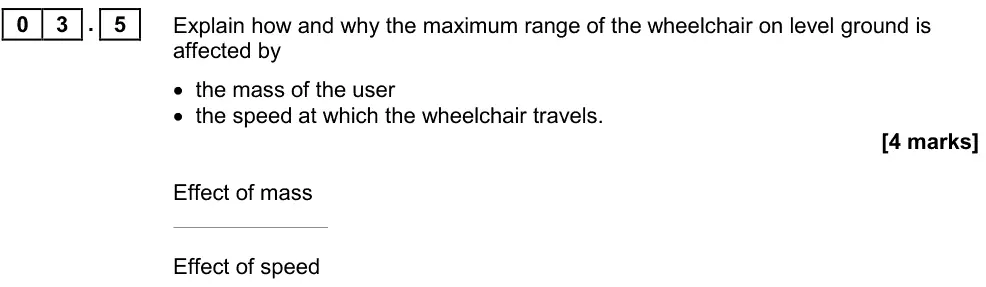
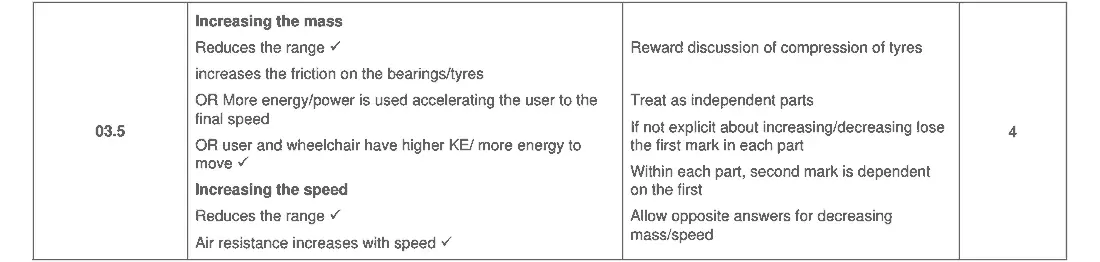
Greater mass reduces range (more friction/energy needed)
greater speed reduces range (air resistance increases with speed)
must state direction of change
June 2017 · Paper 1 · Q4.33 marksCalculation
Earlier part of question 4 that this part uses
Mark scheme
Examiner's comment
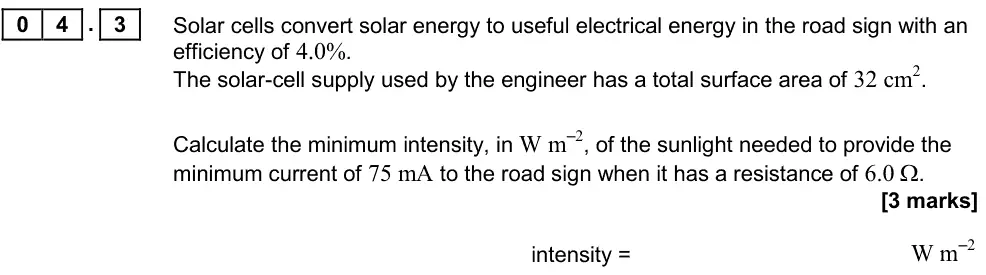
Question 04.3 involved an efficiency calculation. A large number of students were able to calculate the useful power output but a surprising number did not deal with the 4.0% efficiency correctly. It was quite common to see the input power multiplied by 0.96 rather than divided by 0.04. There were also, as is frequently the case, power of ten errors when dealing with the surface area.
Notes from the mark scheme and report
Answer: 260 W m^-2 (I^2R = 0.0338 W, divide by 0.04 = 0.844 W, area 32 x 10^-4 m^2)
multiplying by 0.96 and cm^2 conversion errors common
Skills: MS0.3 Use ratios, fractions and percentages; MS2.3 Substitute numerical values into algebraic equations using appropriate units for physical quantities; MS0.1 Recognise and make use of appropriate units in calculations
June 2017 · AS Paper 2 · Q4.33 marksCalculation
Earlier part of question 4 that this part uses
Mark scheme
Examiner's comment
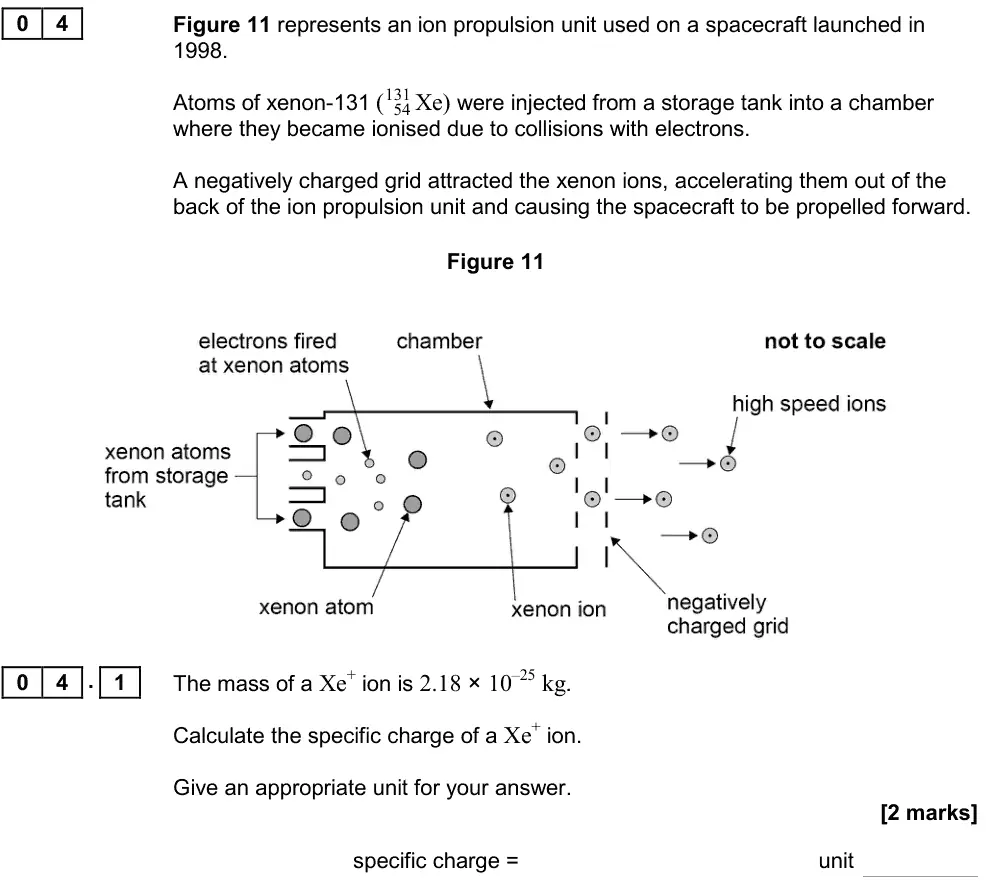
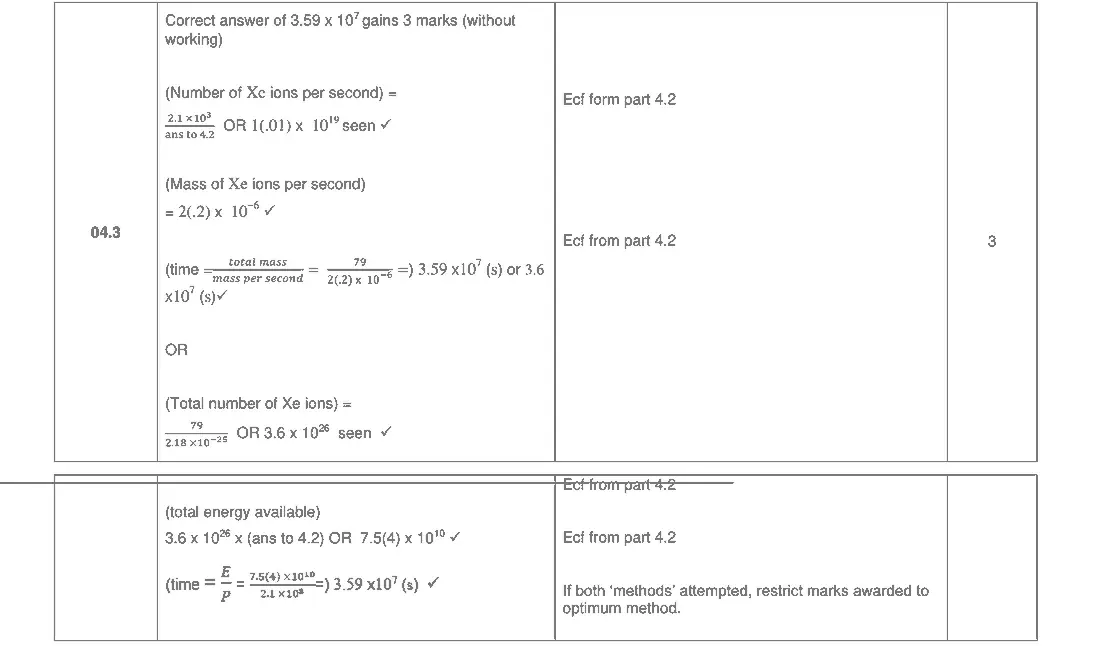
04.1 A significant number of students had difficulty with this question. Common wrong answers included: The charge = 53 × 1.6 × 10-19 arriving at an answer = 3.9 x 10⁷ • Mass divided by charge • Other students could not recall the units for specific charge; the coulomb and the joule were common wrong answers. Students who did not express the unit using index notation did not receive the mark. A common error seen was 1300 ÷ 1.6 x 10-19 = 8.125 x 10²¹ Many students could not convert 1300 eV into its equivalent 2.1 x 10⁻¹⁶ J. 04.2 04.3 A wide range in the quality of response seen here. Those who obtained 3 marks typically presented their working in a way that demonstrated a good understanding of the calculation required. Students who made some progress typically by determining the number of xenon ions in 79 kg obtained some credit. There was a significant number of non-attempts seen.
Notes from the mark scheme and report
Answer: 3.6 x 10^7 s (ions per second = 2100 / 2.08 x 10^-16 = 1.0 x 10^19, mass per second 2.2 x 10^-6 kg
79 kg / that)
many non-attempts
Skills: MS0.2 Recognise and use expressions in decimal and standard form; MS2.3 Substitute numerical values into algebraic equations using appropriate units for physical quantities
June 2017 · AS Paper 2 · Q51 markMultiple choice
Answer
A
Notes from the mark scheme and report
Answer: A
Skills: MS2.3 Substitute numerical values into algebraic equations using appropriate units for physical quantities
June 2017 · Paper 2 · Q81 markMultiple choice
Answer
B
Notes from the mark scheme and report
Answer: B
Skills: MS2.3 Substitute numerical values into algebraic equations using appropriate units for physical quantities
June 2017 · Paper 2 · Q91 markMultiple choice
Answer
A
Notes from the mark scheme and report
Answer: A
Skills: MS2.3 Substitute numerical values into algebraic equations using appropriate units for physical quantities
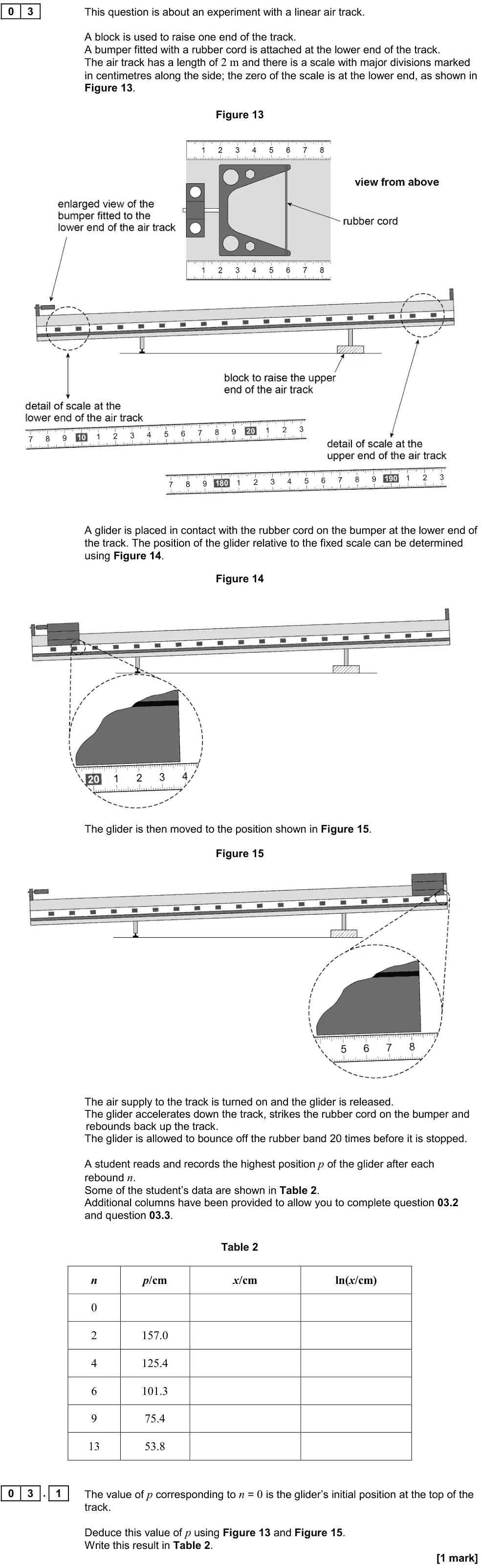
June 2017 · Paper 3 Section A · Q3.33 marksDiagram or graph
Earlier part of question 3 that this part uses
Mark scheme
Examiner's comment
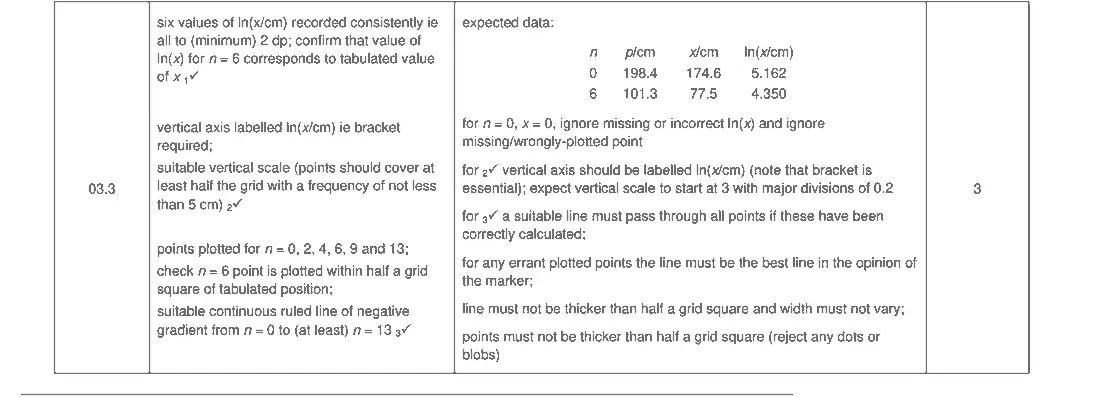
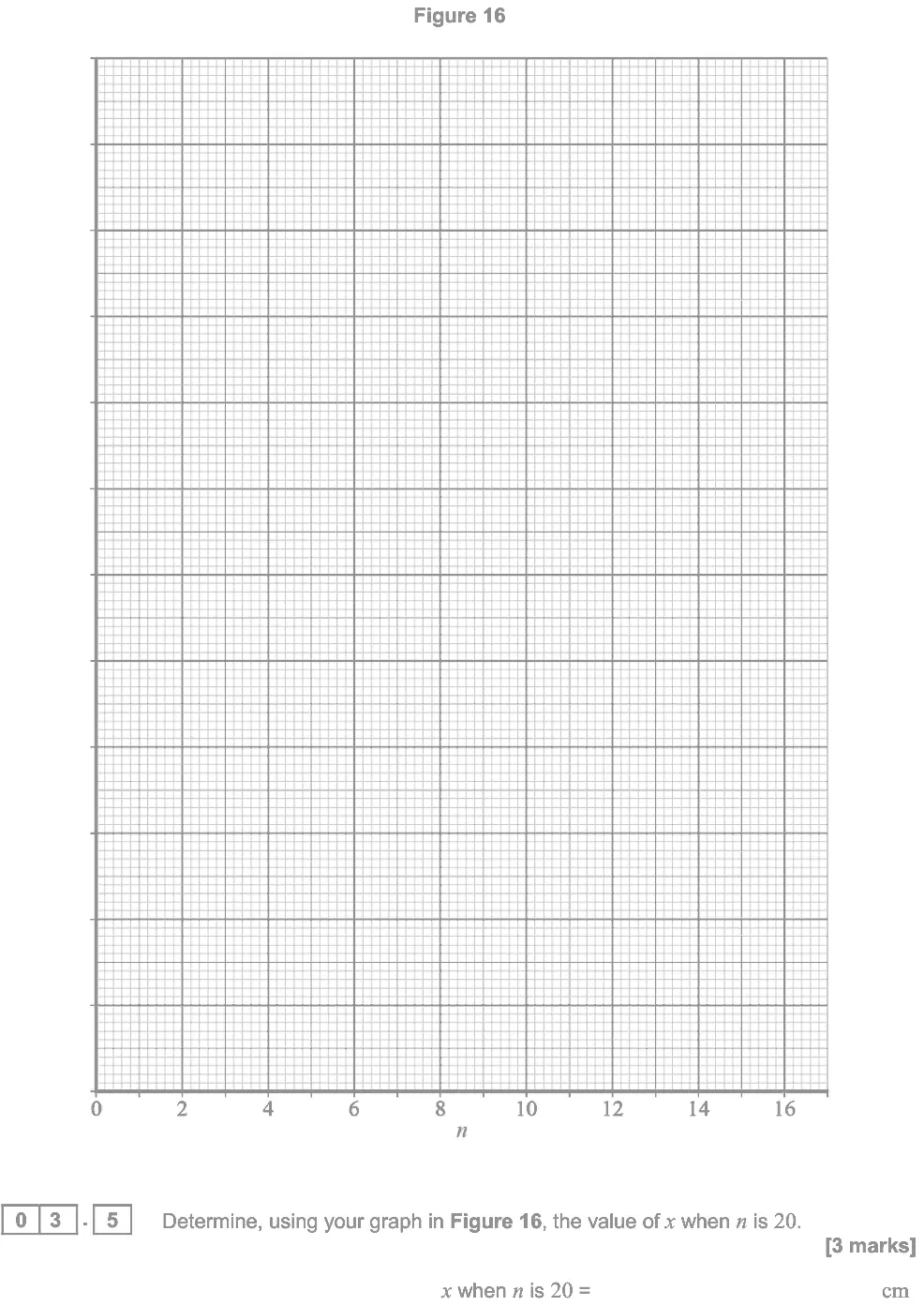
In question 03.3, most students earned a mark for working out the ln (x/cm) values correctly, and recording these in a consistent fashion to at least 2 decimal places. The second marking point was much more discriminating, and was forfeited by many students who included the origin, thus compromising the vertical scale. Others did not show the bracket around the axis label correctly, or spaced their values too widely along the axis. The point plotting was generally fine, but some students lost the mark by using ‘blobs’ rather than clearly-defined points, or by drawing a thick or non-ruled line. Those producing a curve could not score here.
Notes from the mark scheme and report
ln(x/cm) values to at least 2 dp (5.162 ... )
axis label ln(x/cm) with bracket
scale not from origin (start about 3)
points within half a square
ruled best-fit line
Skills: MS3.2 Plot two variables from experimental or other data; MS0.5 Use calculators to find and use power, exponential and logarithmic functions; PS2.2 Present data in appropriate ways
June 2017 · Paper 3 Section A · Q3.41 markPractical and data analysis
Earlier part of question 3 that this part uses
Mark scheme
Examiner's comment
In question 03.4, examiners wanted students to point out that their graph was a straight line, and that it had a negative gradient. It was clear that large numbers of students seemed to think that any straight line graph represents direct or inverse proportion. Examiners insisted on seeing ‘linear’ or ‘straight line’, and any mention of proportion (of any sort) was rejected.
Notes from the mark scheme and report
Graph of ln x against n is a straight line with negative gradient
any mention of proportion rejected
Skills: MS3.11 Use logarithmic plots to test exponential and power law variations; MS3.3 Understand that y = mx + c represents a linear relationship
June 2017 · Paper 3 Section A · Q3.53 marksPractical and data analysis
Earlier part of question 3 that this part uses
Mark scheme
Examiner's comment
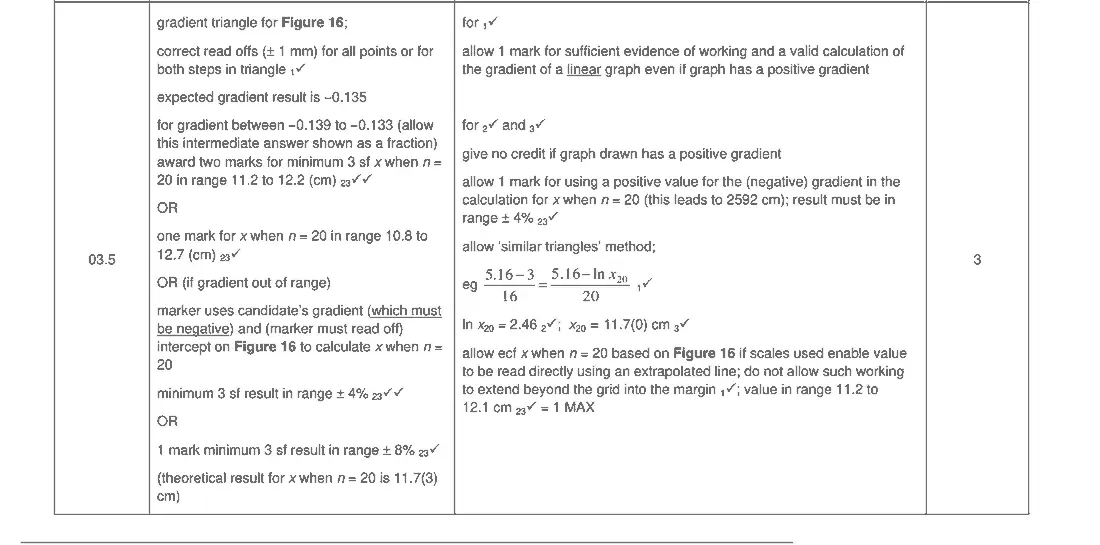
Once back to numerical work in question 03.5, students were on surer ground and most measured a gradient before successfully going on to find x when n = 20. Students who feel that this type of question is testing maths and not physics should acquaint themselves with section 6 of the specification. Question 03.6 highlighted once again how ill-equipped some students were when it came to writing with authority about practical procedures to reduce uncertainty. Some immediately seized on the idea that (percentage) uncertainty could be reduced by either increasing the raw measurements, or by reducing the intervals between the markings on a scale. Neither of these things made any sense in the context of the question, so suggestions such as “increase the length of the air track”, and “use a vernier scale”, gained no credit. Some students failed to gain credit here because they suggested the use of lasers or computers to measure distances, or simply gave vague statements about some procedure which ‘will reduce uncertainty’. Students who stuck with what, in the circumstances, would be an obvious and effective strategy, such as repeating and averaging to reduce the impact of random error, were on the safest ground. Whenever data-logging is suggested, examiners expect to see an appropriate sensor identified. In the context of this experiment a motion sensor would be fine, but a light gate would not. The use of video cameras, used increasingly in schools and colleges, to pinpoint p as the glider comes to rest, was accepted either as a means to reduce the impact of random error, or to avoid parallax error.
Notes from the mark scheme and report
Answer: x = 11.7 cm (range 11.2-12.2
gradient about -0.135 per bounce, extrapolate ln x to n = 20)
Skills: MS3.4 Determine the slope and intercept of a linear graph; MS0.5 Use calculators to find and use power, exponential and logarithmic functions; MS3.11 Use logarithmic plots to test exponential and power law variations
Specimen set 1 · Paper 1 · Q4.14 marksCalculation
Mark scheme
Notes from the mark scheme and report
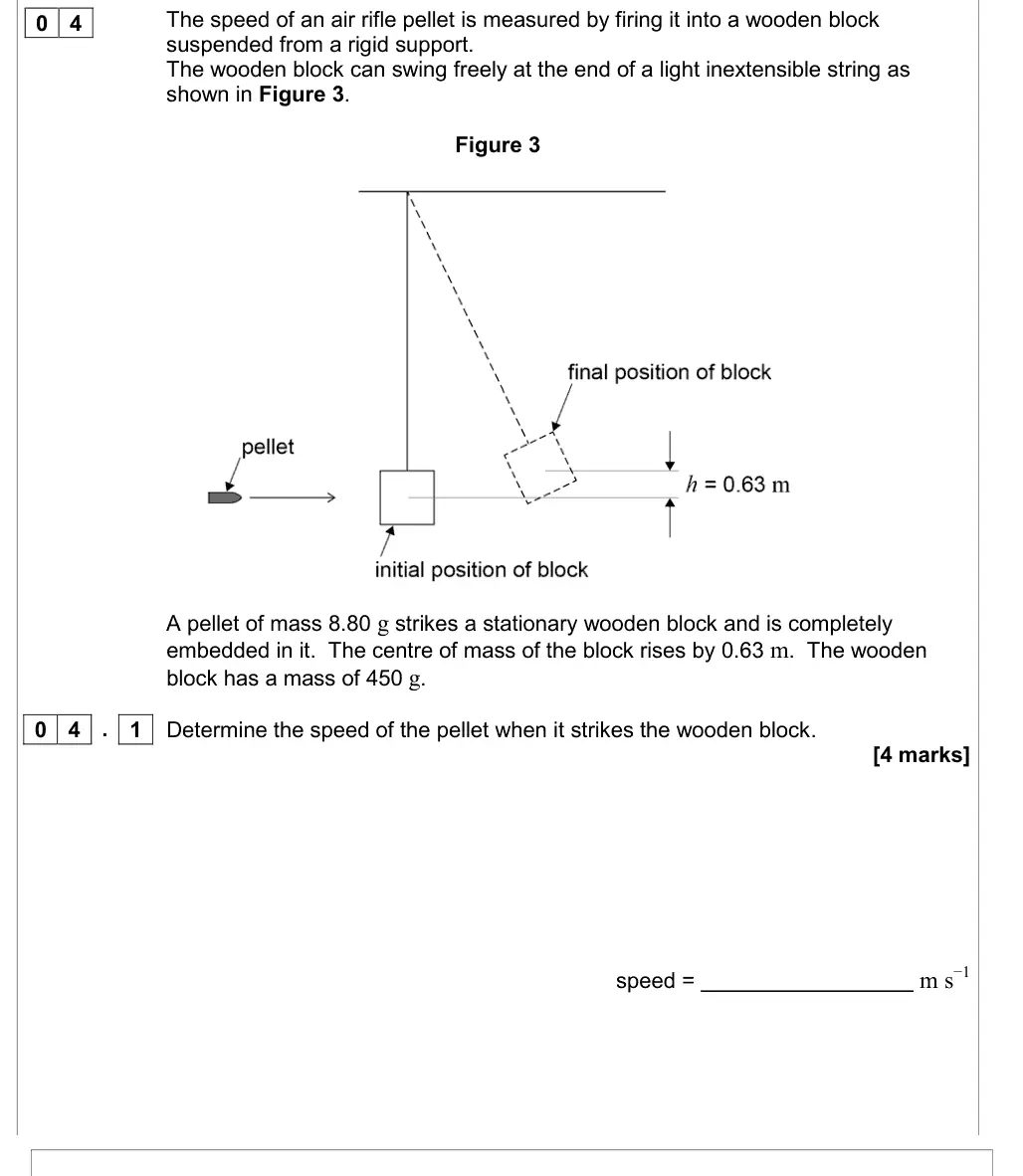
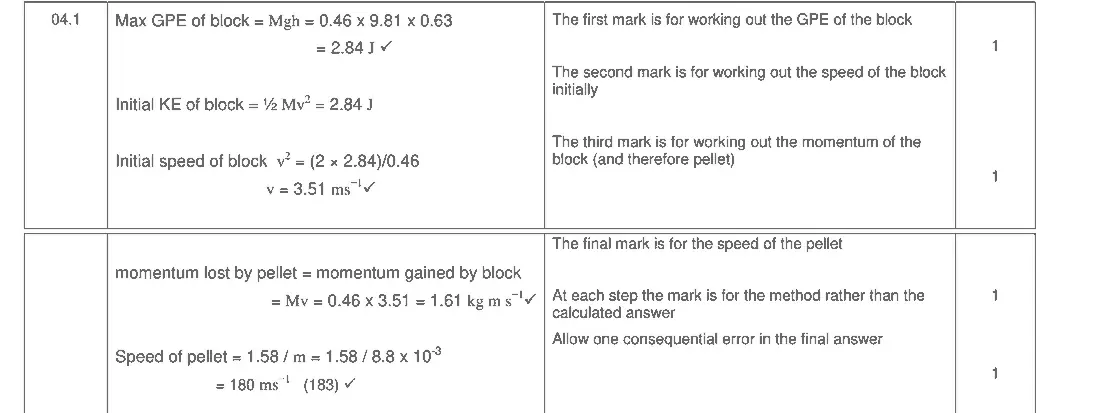
Answer: about 180 m s^-1 (GPE 2.84 J, block speed 3.51 m s^-1, momentum 1.61 kg m s^-1 divided by 8.80 g)
method marks at each step, one ecf allowed
Skills: MS2.3 Substitute numerical values into algebraic equations using appropriate units for physical quantities; MS2.2 Change the subject of an equation, including non-linear equations
Specimen set 1 · Paper 1 · Q231 markMultiple choice
Answer
A
Notes from the mark scheme and report
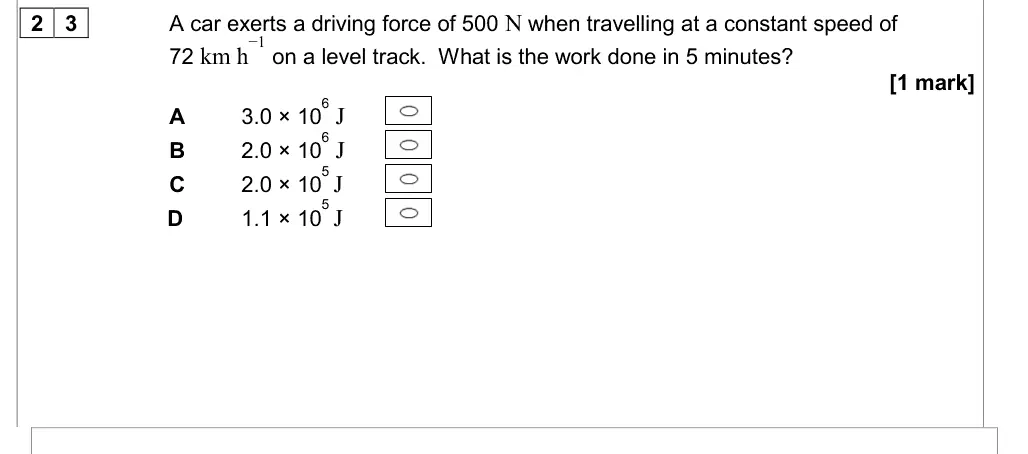
Answer: A (72 km h^-1 = 20 m s^-1, 6000 m in 300 s)
Skills: MS0.1 Recognise and make use of appropriate units in calculations; MS0.2 Recognise and use expressions in decimal and standard form
Specimen set 1 · Paper 1 · Q261 markMultiple choice
Answer
C
Notes from the mark scheme and report
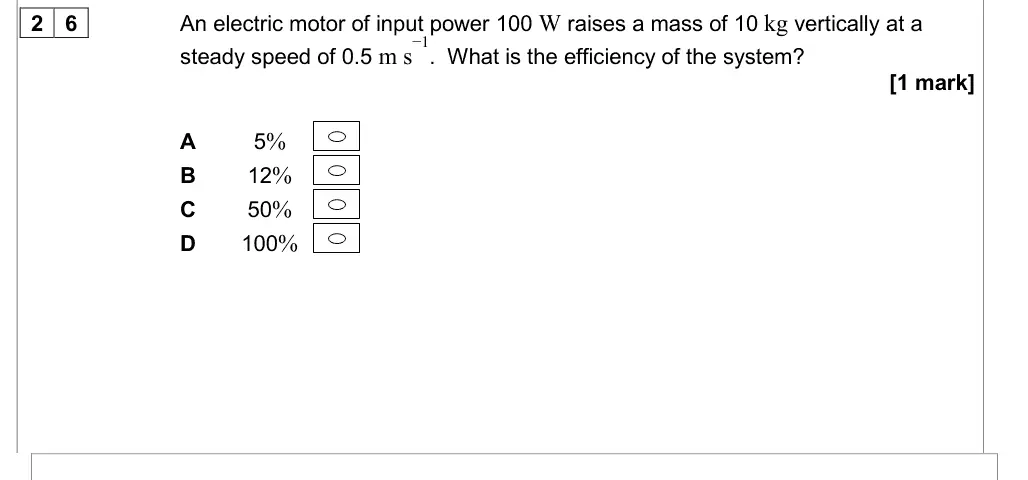
Answer: C (useful power mgv = 49 W)
Skills: MS0.3 Use ratios, fractions and percentages
June 2016 · AS Paper 2 · Q4.21 markCalculation
Earlier part of question 4 that this part uses
Mark scheme
Examiner's comment
4.2 The equation needed for this question is on the data sheet, and it was therefore disappointing to see how many students were unable to perform the calculation correctly. Most commonly students confused output and input powers, obtaining an answer of 6W. A moment’s reflection should have shown that this could not be sensible. Due to the use of 100 W in the stem, answers were accepted regardless of the number of significant figures but any rounding down had to be correct and recurring notation was rejected.
4.3 This was much more accessible with only a few students being unable to get the correct answer. The few errors seen included answers that used 1700 W (ie the answer to 4.2), perhaps carrying on the problem with input and output power in this context.
4.4 There were several routes through this question and all were given credit. A popular solution was to calculate the total circuit resistance (10.24 Ω) for an output power of 100 W, then reverse-working using the parallel resistor formula (or perhaps just dividing 45 by 10.24) to find the (non-integer) result for number of resistors. Rounding down gave the required result but a few rounded up and forfeited a mark. Those using their result from 04.2 rather than 100 W were able to get some credit.
3.1 This was a multi-step calculation that most students found fairly straight forward. The common errors seen were wrong substitution of diameter (or use of a wrong formula for volume) and power of ten errors arising from calculation of volume in cm3. Students who have difficulty converting between cm3 and m3 would be better advised to work in m from the outset. Generally “show that” questions are used to provide unsuccessful students the data they would need to complete further parts of the question. Students should be reminded to provide at least 1 sf more than the “show that” value, and they should be discouraged from trying to calculate an answer backwards. Another error is forcing their answer to be near the “show that” value: many students were denied consequential error marks when, having made an error, they attempted to manipulate their answer to obtain a numerical value near 5. For example, students who used 5 cm for the radius could obtain a value of 4.2 kg for the mass. Many would then miss out the step (multiplying by g) to determine the weight, as they had already reached a value near to 5 perhaps. Many modern calculators generate results as fractions or surds. No credit is given for final answers given in such a form or with recurring notation but there is no penalty for this with intermediate results. However students should be discouraged from doing this because it makes the work less transparent and inhibits error-checking. The rounding down of intermediate results compromises the chance of full credit; any rounding down, eg to the same significant figures as that of the least accurate data should not be done until the final stage is complete.
Notes from the mark scheme and report
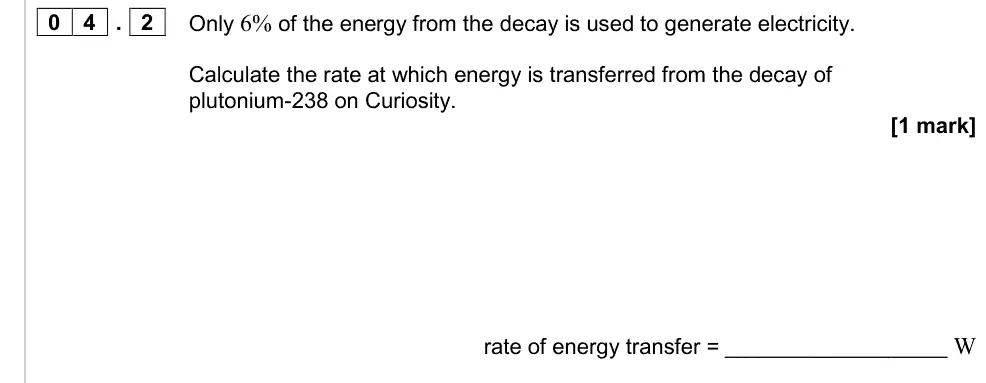
Answer: 1700 W (100 / 0.06)
6 W from confusing input and output was common
Skills: MS0.3 Use ratios, fractions and percentages
June 2016 · AS Paper 2 · Q4.52 marksCalculation
Earlier part of question 4 that this part uses
Mark scheme
Examiner's comment
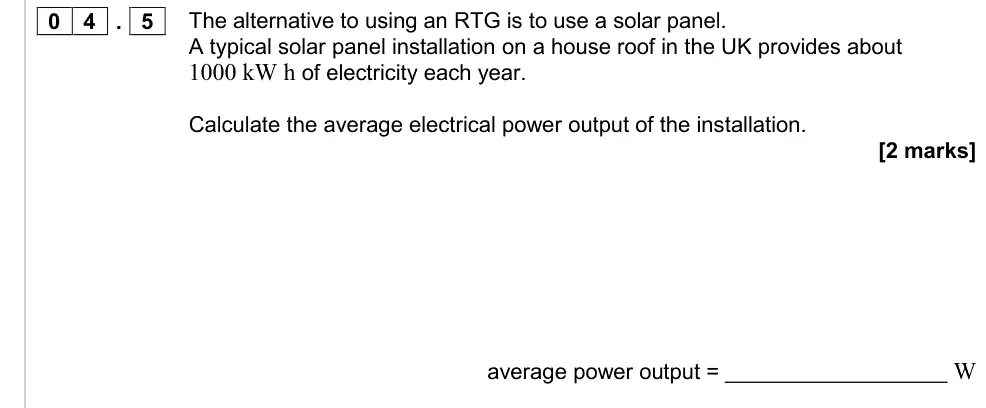
4.5 There was evidence to suggest that many students were unfamiliar with this conversion and that some centres may have overlooked this part of the specification. The most popular approach was to find the equivalent J value of the kW h and divide by the number of seconds in a year but the same idea using energy in W h was also successful. Many near misses involved mixing units, dividing W h by 3600. Disappointingly many students did not attempt this question.
4.6 Answers to this question suggested very few students were familiar with the idea of an ‘order of magnitude’ calculation. Many students who produced an answer for 4.5 did not then realise that the solar panel on Mars produced the same average power output as that on Earth. Given that the intensity of solar radiation was about the same in both situations they were looking for a solar panel with a surface area about the same as that in a typical domestic setup on Earth. Having grappled with this very few then appreciated that the answer required was to be given to the nearest power of ten (10 m2 was the expected result). Again, many did not attempt the question.
Notes from the mark scheme and report
Answer: 114 W (1000 kW h = 3.6 x 10^9 J over 3.15 x 10^7 s)
kW h conversion unfamiliar to many
many did not attempt
Skills: MS0.1 Recognise and make use of appropriate units in calculations; MS2.3 Substitute numerical values into algebraic equations using appropriate units for physical quantities
June 2016 · AS Paper 2 · Q241 markMultiple choiceEasy
Answer
C
Examiner's comment
24 Over 68% of students were able to recall, or work out, the significance of the area under a force-displacement graph. Those who chose B (approximately 20%) were probably confusing force-displacement with force-time.
Notes from the mark scheme and report
Answer: C
about 20% chose B (force-time confusion)
June 2016 · AS Paper 2 · Q251 markMultiple choice
Answer
B
Examiner's comment
25 Occasionally students are presented with multiple choice questions which require them to work out the “incorrect” answer. This will be highlighted by a bold “not” in the question. The fact that only 40% of students managed to find the correct answer may indicate that this could have caused difficulties, although this is contradicted by the small number (2%) of students choosing the watt. The most popular distractor, D, may have been chosen because of its apparent complexity.
Notes from the mark scheme and report
Answer: B
D the main distractor
Skills: MS0.1 Recognise and make use of appropriate units in calculations
June 2016 · AS Paper 2 · Q261 markMultiple choiceEasy
Answer
C
Examiner's comment
26 This calculation proved to be very accessible, with 84% of students giving the correct answer. It should be noted that, in a written paper, students who use the suvat equations would not get the same credit as those who correctly equate GPE and KE, despite the two approaches giving the same answer.
Notes from the mark scheme and report
Answer: C
Skills: MS2.3 Substitute numerical values into algebraic equations using appropriate units for physical quantities
June 2016 · AS Paper 2 · Q271 markMultiple choiceHard
Answer
D
Examiner's comment
27 This proved to be a very demanding question with only 29% of students giving the correct answer, although it proved to be quite discriminating. Students were required to calculate the kinetic energy of the car, and divide this by the distance to find the average decelerating force. The same answer could be obtained by calculating the acceleration using the suvat equations, and using F=ma. Slightly more students gave the answer C than gave the correct answer, perhaps neglecting to square the speed when calculating the kinetic energy.
Notes from the mark scheme and report
Answer: D
more chose C (not squaring the speed)
Skills: MS2.3 Substitute numerical values into algebraic equations using appropriate units for physical quantities
Work with an AQA physics tutor
Dropping marks on calculations, required practicals or the six-markers? Book a trial session with a specialist AQA physics tutor.