June 2017: Paper 3B Engineering physics

35 marks · 14 question parts · Paper, mark scheme and report on AQA's site · Have the data and formulae booklet beside you

Question by question

QTopicMarksAOType
1.1 Rotational dynamics 2Short answer
1.2 Rotational dynamics 1Show that
1.3 Rotational dynamics 2Calculation
1.4 Rotational dynamics 3Explanation
2.1 Rotational dynamics 1Calculation
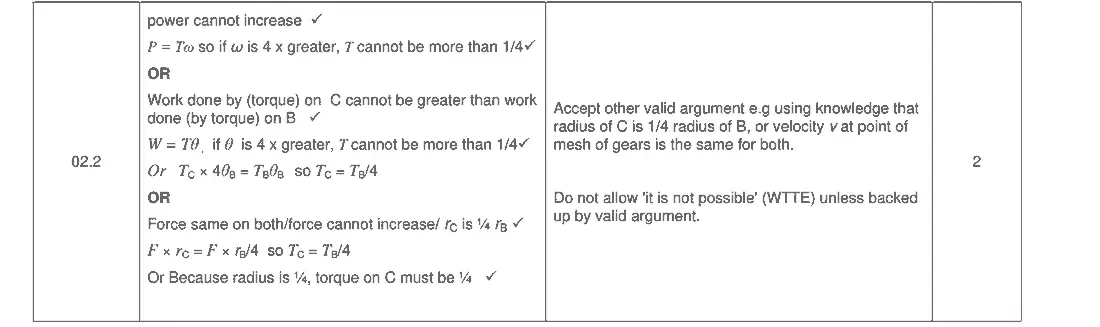
2.2 Rotational dynamics 2Explanation
2.3 Rotational dynamics 2Calculation
2.4 Rotational dynamics 3Explanation
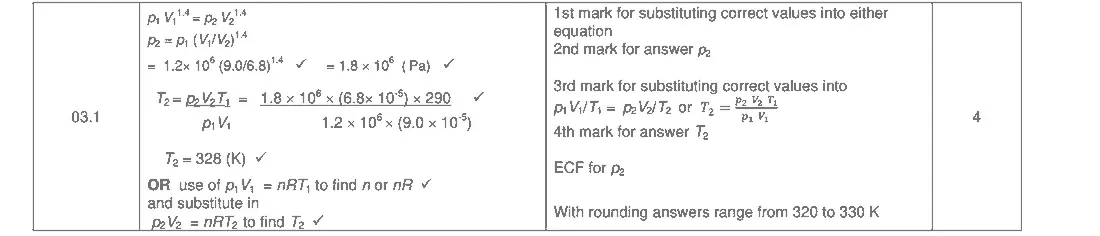
3.1 Thermodynamics and engines 4Calculation
3.2 Thermodynamics and engines 2Explanation
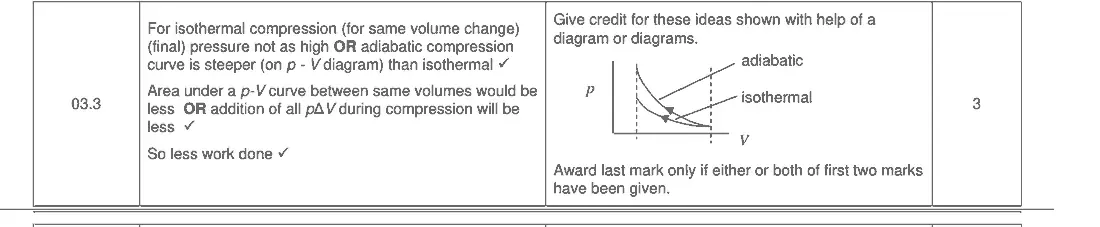
3.3 Thermodynamics and engines 3Explanation
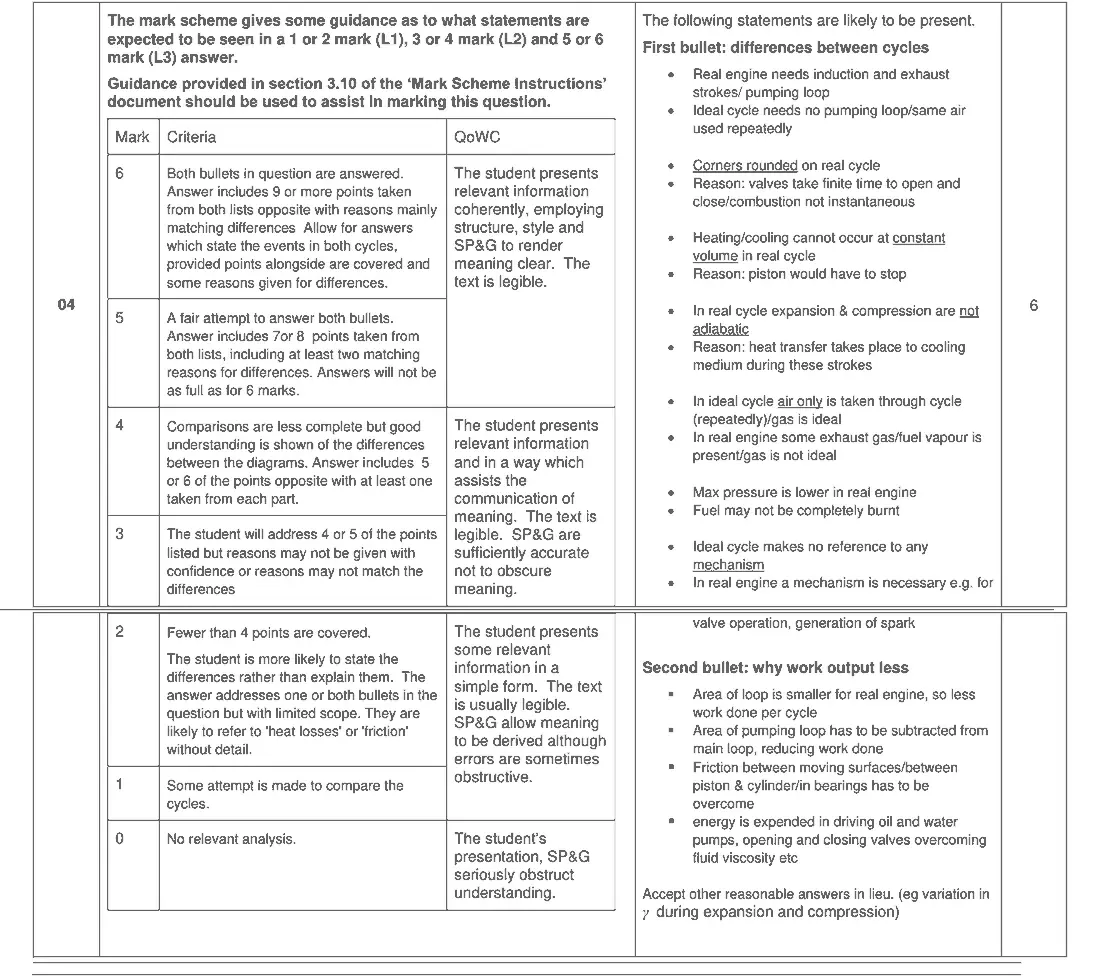
4 Thermodynamics and engines 6Extended response
5.1 Thermodynamics and engines 1Short answer
5.2 Thermodynamics and engines 3Calculation

The questions

1.11.21.31.42.12.22.32.43.13.23.345.15.2
June 2017 · Paper 3B Engineering physics · Q1.1 2 marks Short answer rotational dynamics
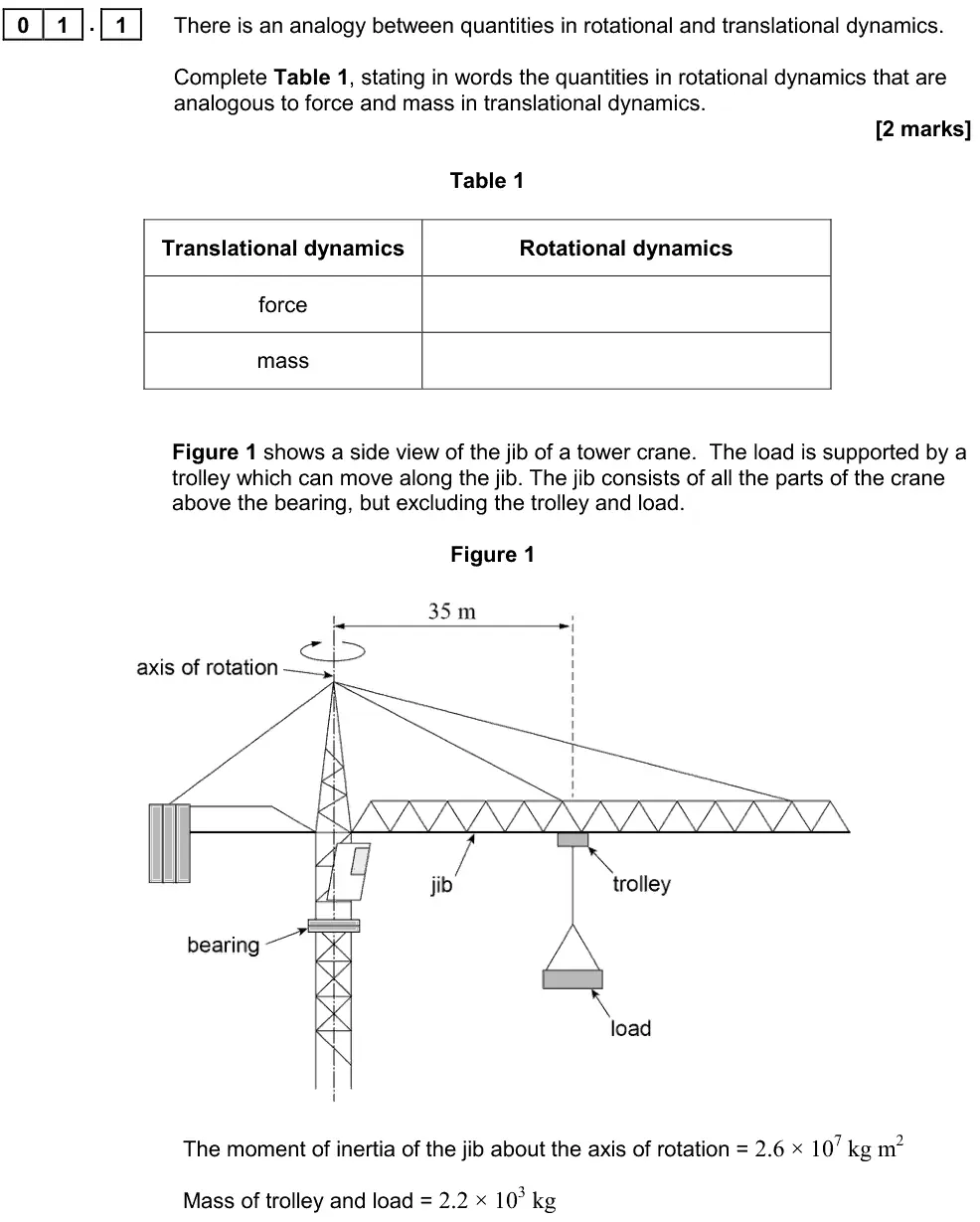
There is an analogy between quantities in rotational and translational dynamics.
Complete Table 1, stating in words the quantities in rotational dynamics that are
analogous to force and mass in translational dynamics.
[2 marks]
Table 1
Translational dynamics
Rotational dynamics
force
mass
Figure 1 shows a side view of the jib of a tower crane.  The load is supported by a
trolley which can move along the jib. The jib consists of all the parts of the crane
above the bearing, but excluding the trolley and load.
Figure 1
The moment of inertia of the jib about the axis of rotation = 2.6 × 10⁷ kg m2
Mass of trolley and load = 2.2 × 10³ kg
June 2017 · Paper 3B Engineering physics · Q1.2 1 mark Show that rotational dynamics
Earlier part of question 1 that this part usesEarlier part of June 2017 Paper 3B Engineering physics question 1
The load is at a distance of 35 m from the axis of rotation.
Show that the total moment of inertia of the jib, and the trolley and load, about the
axis of rotation is about 3 × 10⁷ kg m2.
[1 mark]
June 2017 · Paper 3B Engineering physics · Q1.3 2 marks Calculation rotational dynamics
Earlier part of question 1 that this part usesEarlier part of June 2017 Paper 3B Engineering physics question 1
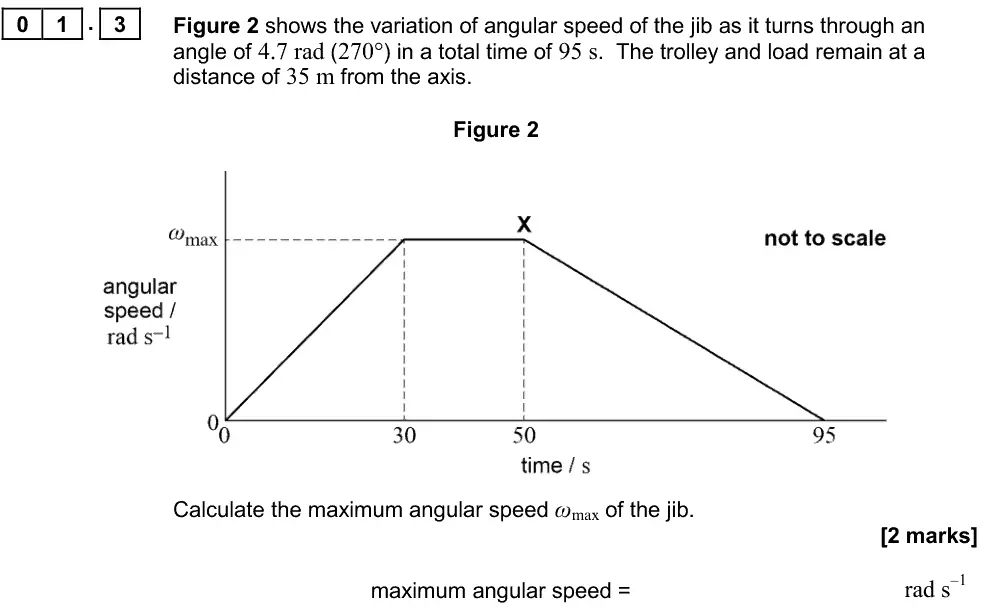
Figure 2 shows the variation of angular speed of the jib as it turns through an
angle of 4.7 rad (270°) in a total time of 95 s.  The trolley and load remain at a
distance of 35 m from the axis.
Figure 2
Calculate the maximum angular speed ωmax of the jib.
[2 marks]
maximum angular speed =
rad s–1
June 2017 · Paper 3B Engineering physics · Q1.4 3 marks Explanation rotational dynamics
Earlier part of question 1 that this part usesEarlier part of June 2017 Paper 3B Engineering physics question 1
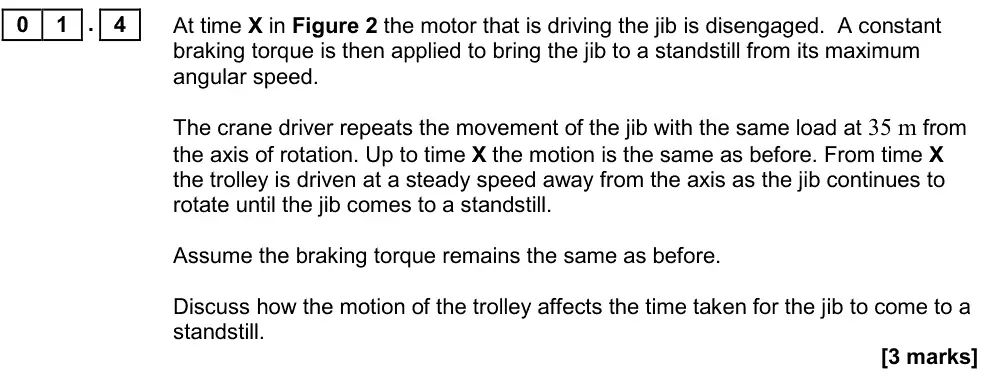
At time X in Figure 2 the motor that is driving the jib is disengaged.  A constant
braking torque is then applied to bring the jib to a standstill from its maximum
angular speed.
The crane driver repeats the movement of the jib with the same load at 35 m from
the axis of rotation. Up to time X the motion is the same as before. From time X
the trolley is driven at a steady speed away from the axis as the jib continues to
rotate until the jib comes to a standstill.
Assume the braking torque remains the same as before.
Discuss how the motion of the trolley affects the time taken for the jib to come to a
standstill.
[3 marks]
June 2017 · Paper 3B Engineering physics · Q2.1 1 mark Calculation rotational dynamics
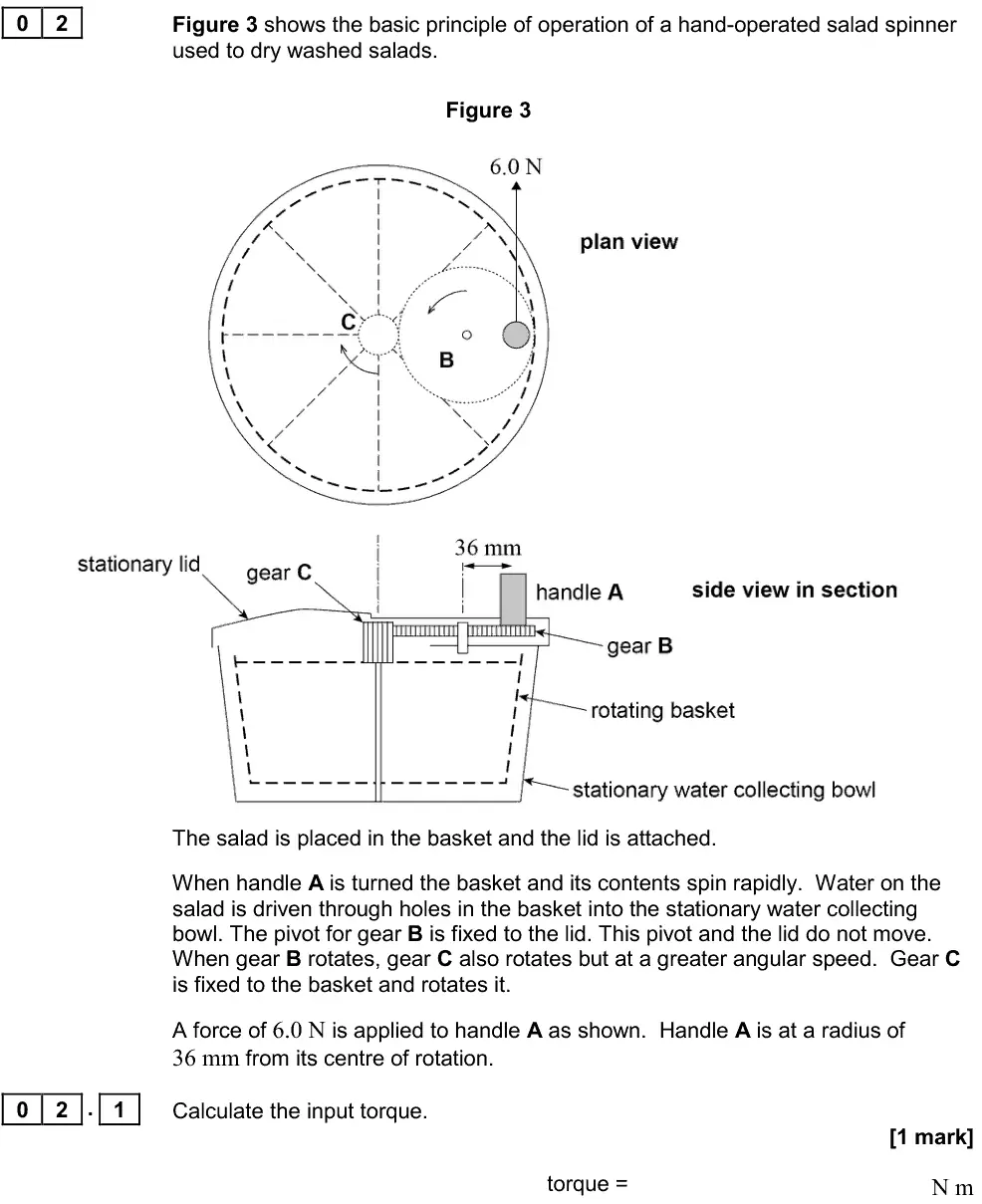
Figure 3 shows the basic principle of operation of a hand-operated salad spinner
used to dry washed salads.
Figure 3
The salad is placed in the basket and the lid is attached.
When handle A is turned the basket and its contents spin rapidly.  Water on the
salad is driven through holes in the basket into the stationary water collecting
bowl. The pivot for gear B is fixed to the lid. This pivot and the lid do not move.
When gear B rotates, gear C also rotates but at a greater angular speed.  Gear C
is fixed to the basket and rotates it.
A force of 6.0 N is applied to handle A as shown.  Handle A is at a radius of
36 mm from its centre of rotation.
Calculate the input torque.
[1 mark]
torque =
N m
June 2017 · Paper 3B Engineering physics · Q2.2 2 marks Explanation Hard rotational dynamics
Earlier part of question 2 that this part usesEarlier part of June 2017 Paper 3B Engineering physics question 2
Gear C rotates four times for every one revolution of gear B.
Deduce whether it is possible for the torque on gear C to be greater than
one quarter of the input torque.
[2 marks]
June 2017 · Paper 3B Engineering physics · Q2.3 2 marks Calculation rotational dynamics
Earlier part of question 2 that this part usesEarlier part of June 2017 Paper 3B Engineering physics question 2
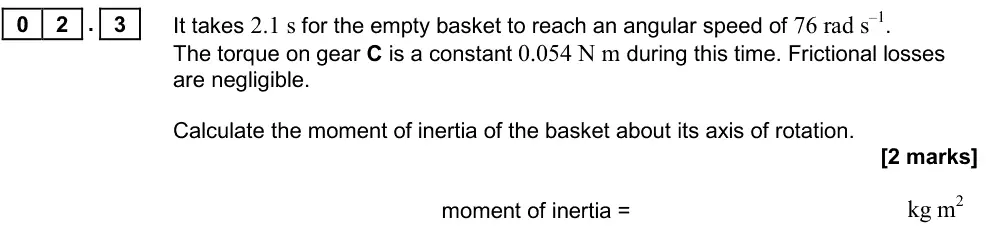
It takes 2.1 s for the empty basket to reach an angular speed of 76 rad s–1.
The torque on gear C is a constant 0.054 N m during this time. Frictional losses
are negligible.
Calculate the moment of inertia of the basket about its axis of rotation.
[2 marks]
moment of inertia =
kg m2
June 2017 · Paper 3B Engineering physics · Q2.4 3 marks Explanation rotational dynamics
Earlier part of question 2 that this part usesEarlier part of June 2017 Paper 3B Engineering physics question 2
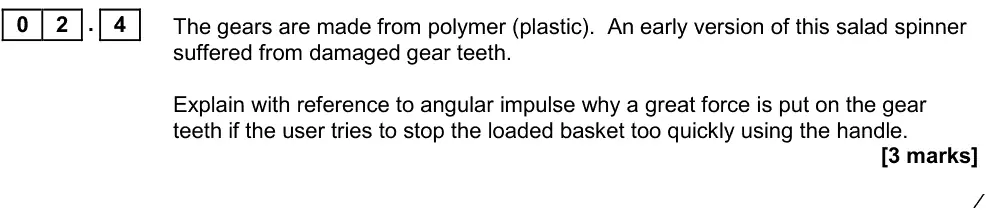
The gears are made from polymer (plastic).  An early version of this salad spinner
suffered from damaged gear teeth.
Explain with reference to angular impulse why a great force is put on the gear
teeth if the user tries to stop the loaded basket too quickly using the handle.
[3 marks]
June 2017 · Paper 3B Engineering physics · Q3.1 4 marks Calculation thermodynamics and engines
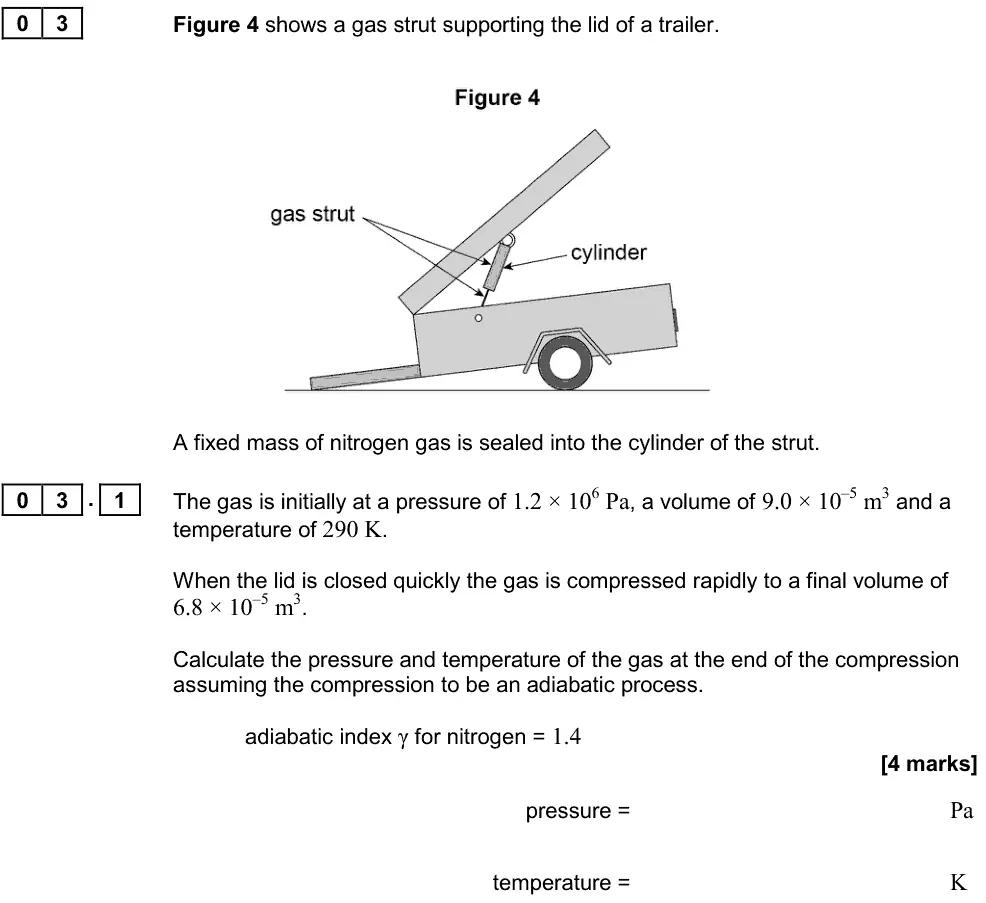
Figure 4 shows a gas strut supporting the lid of a trailer.
A fixed mass of nitrogen gas is sealed into the cylinder of the strut.
The gas is initially at a pressure of 1.2 × 10⁶ Pa, a volume of 9.0 × 10⁻⁵ m3 and a
temperature of 290 K.
When the lid is closed quickly the gas is compressed rapidly to a final volume of
6.8 × 10⁻⁵ m3.
Calculate the pressure and temperature of the gas at the end of the compression
assuming the compression to be an adiabatic process.
adiabatic index γ for nitrogen = 1.4
[4 marks]
pressure =
Pa
temperature =
K
June 2017 · Paper 3B Engineering physics · Q3.2 2 marks Explanation Hard thermodynamics and engines
Earlier part of question 3 that this part usesEarlier part of June 2017 Paper 3B Engineering physics question 3
Explain why the rapid compression of the gas can be assumed to be an adiabatic
process.
[2 marks]
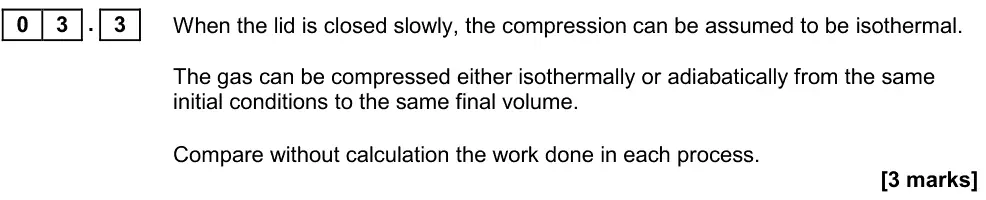
June 2017 · Paper 3B Engineering physics · Q3.3 3 marks Explanation thermodynamics and engines
Earlier part of question 3 that this part usesEarlier part of June 2017 Paper 3B Engineering physics question 3
When the lid is closed slowly, the compression can be assumed to be isothermal.
The gas can be compressed either isothermally or adiabatically from the same
initial conditions to the same final volume.
Compare without calculation the work done in each process.
[3 marks]
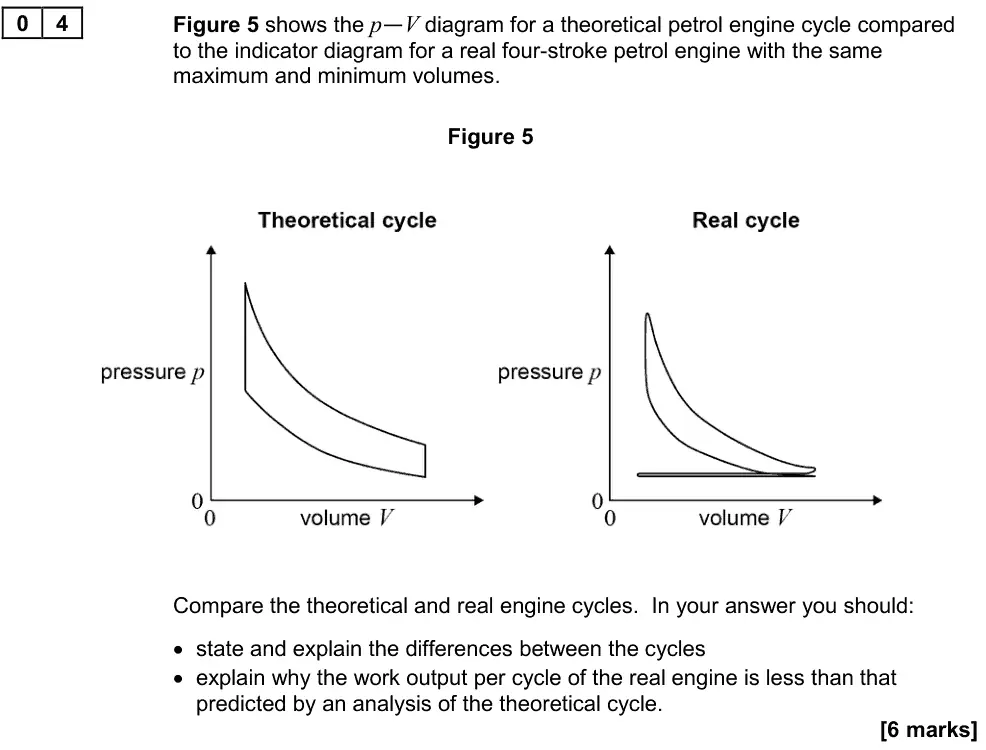
June 2017 · Paper 3B Engineering physics · Q4 6 marks 6-mark extended response thermodynamics and engines
Figure 5 shows the p—V diagram for a theoretical petrol engine cycle compared
to the indicator diagram for a real four-stroke petrol engine with the same
maximum and minimum volumes.
Figure 5
Compare the theoretical and real engine cycles.  In your answer you should:
• state and explain the differences between the cycles
• explain why the work output per cycle of the real engine is less than that
predicted by an analysis of the theoretical cycle.
[6 marks]
June 2017 · Paper 3B Engineering physics · Q5.1 1 mark Short answer thermodynamics and engines
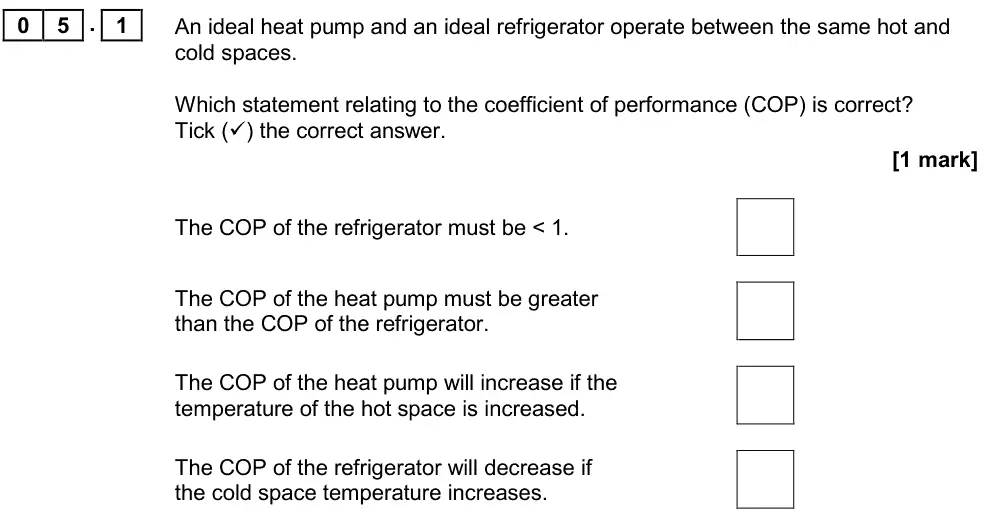
An ideal heat pump and an ideal refrigerator operate between the same hot and
cold spaces.
Which statement relating to the coefficient of performance (COP) is correct?
Tick () the correct answer.
[1 mark]
The COP of the refrigerator must be < 1.
The COP of the heat pump must be greater
than the COP of the refrigerator.
The COP of the heat pump will increase if the
temperature of the hot space is increased.
The COP of the refrigerator will decrease if
the cold space temperature increases.
June 2017 · Paper 3B Engineering physics · Q5.2 3 marks Calculation Hard thermodynamics and engines
Earlier part of question 5 that this part usesEarlier part of June 2017 Paper 3B Engineering physics question 5
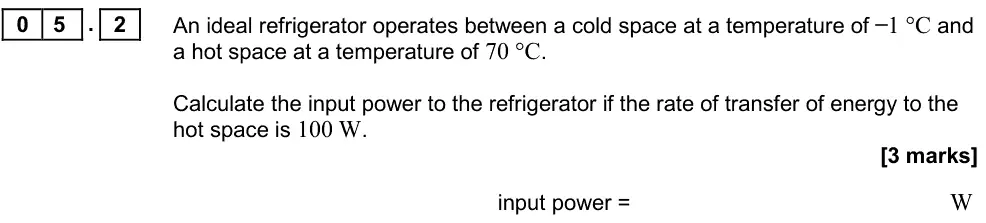
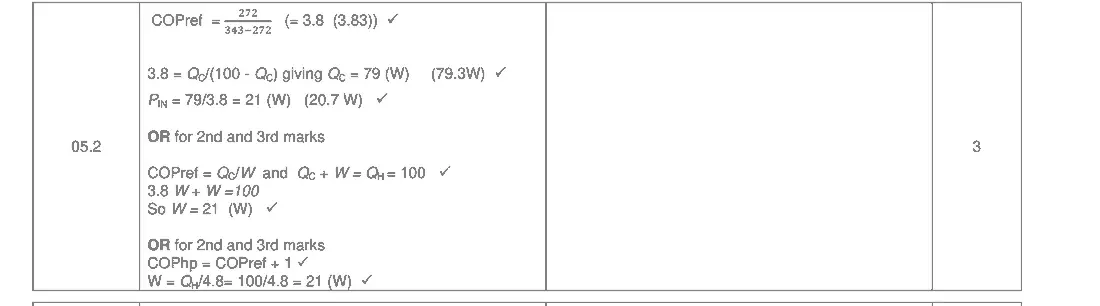
An ideal refrigerator operates between a cold space at a temperature of  ̶ 1 °C and
a hot space at a temperature of 70 °C.
Calculate the input power to the refrigerator if the rate of transfer of energy to the
hot space is 100 W.
[3 marks]
input power =
W

Work with an AQA physics tutor

Want a paper marked and gone through with you? Message us.

Prefer email? Send an enquiry

If you are under 18, please include a parent's contact details. Enquiries go to enquiries@physicsaleveltutor.com and are deleted once handled. All tutoring is online.