June 2018: Paper 3B Engineering physics

35 marks · 13 question parts · Paper, mark scheme and report on AQA's site · Have the data and formulae booklet beside you

Question by question

QTopicMarksAOType
1.1 Rotational dynamics 1Short answer
1.2 Rotational dynamics 2Show that
1.3 Rotational dynamics 3Explanation
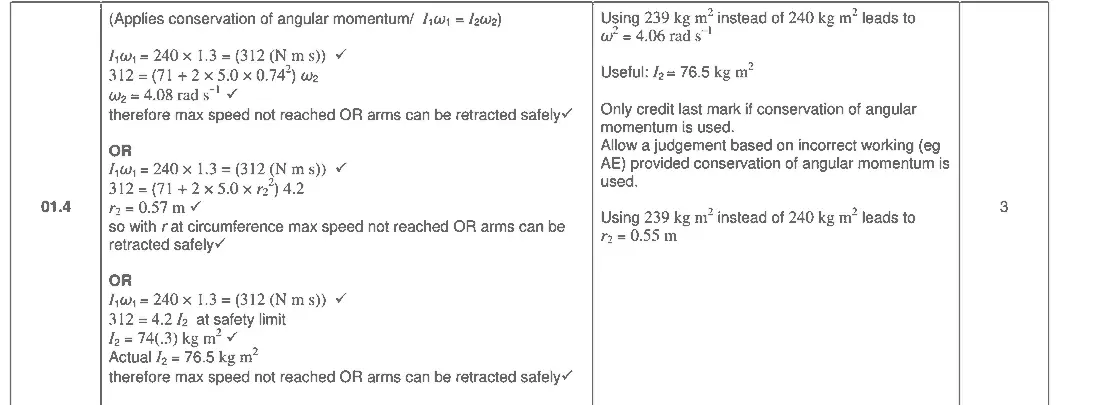
1.4 Rotational dynamics 3Calculation
2.1 Rotational dynamics 1Short answer
2.2 Rotational dynamics 3Show that
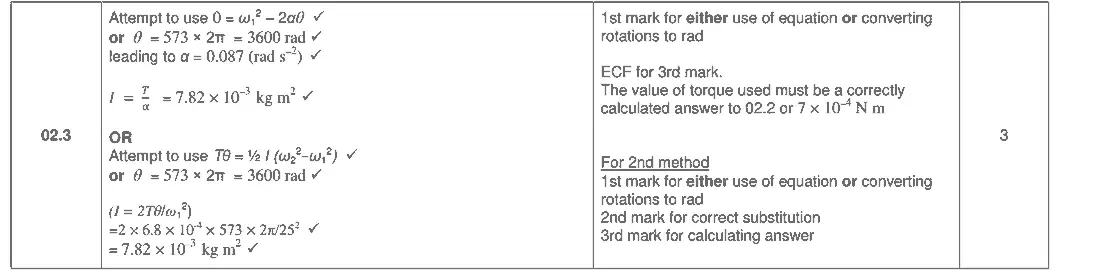
2.3 Rotational dynamics 3Calculation
3.1 Thermodynamics and engines 1Short answer
3.2 Thermodynamics and engines 5Calculation
3.3 Thermodynamics and engines 2Short answer
3.4 Thermodynamics and engines 2Calculation
3.5 Thermodynamics and engines 3Calculation
4 Thermodynamics and engines 6Extended response

The questions

1.11.21.31.42.12.22.33.13.23.33.43.54
June 2018 · Paper 3B Engineering physics · Q1.1 1 mark Short answer rotational dynamics
State the law of conservation of angular momentum.
[1 mark]
June 2018 · Paper 3B Engineering physics · Q1.2 2 marks Show that Easy rotational dynamics
Earlier part of question 1 that this part usesEarlier part of June 2018 Paper 3B Engineering physics question 1
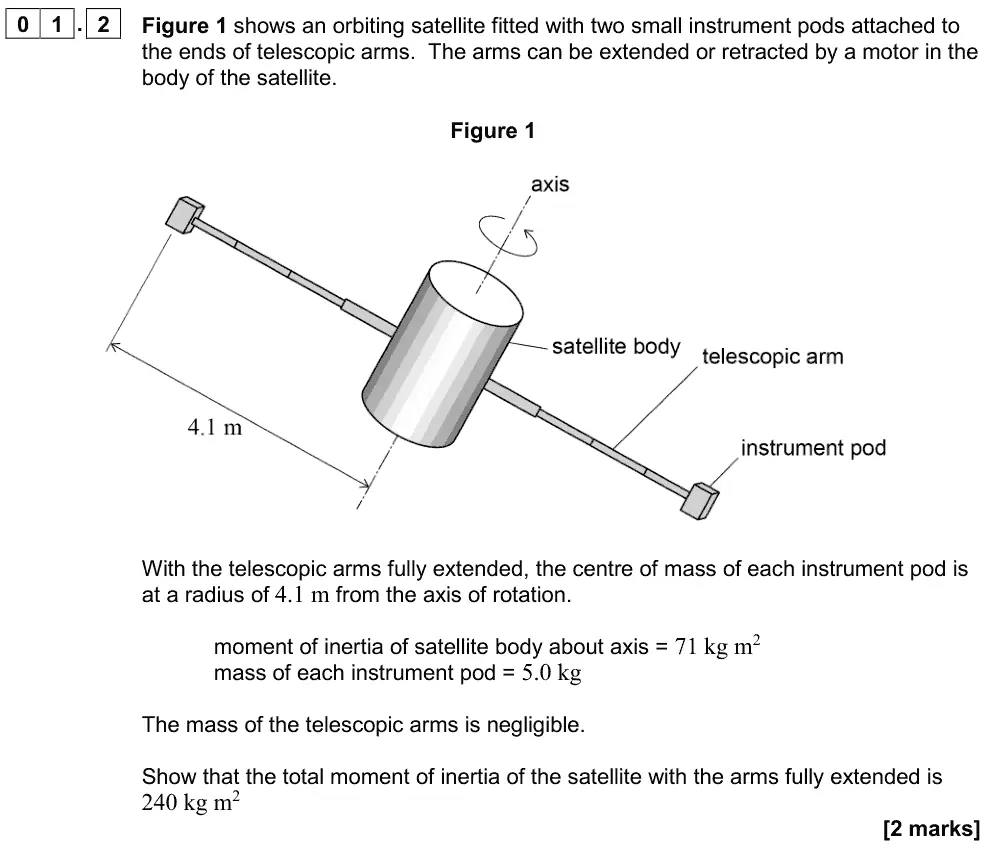
Figure 1 shows an orbiting satellite fitted with two small instrument pods attached to
the ends of telescopic arms.  The arms can be extended or retracted by a motor in the
body of the satellite.
Figure 1
With the telescopic arms fully extended, the centre of mass of each instrument pod is
at a radius of 4.1 m from the axis of rotation.
moment of inertia of satellite body about axis = 71 kg m2
mass of each instrument pod = 5.0 kg
The mass of the telescopic arms is negligible.
Show that the total moment of inertia of the satellite with the arms fully extended is
240 kg m2
[2 marks]
June 2018 · Paper 3B Engineering physics · Q1.3 3 marks Explanation Easy rotational dynamics
Earlier part of question 1 that this part usesEarlier part of June 2018 Paper 3B Engineering physics question 1
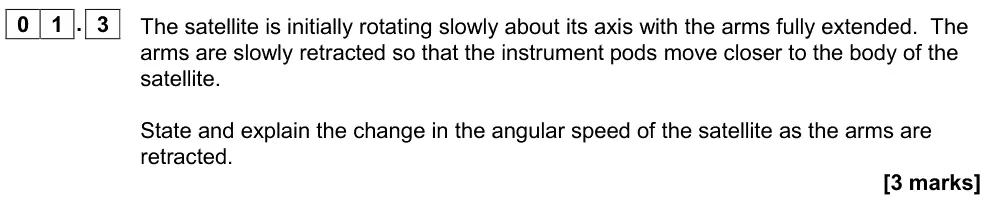
The satellite is initially rotating slowly about its axis with the arms fully extended.  The
arms are slowly retracted so that the instrument pods move closer to the body of the
satellite.
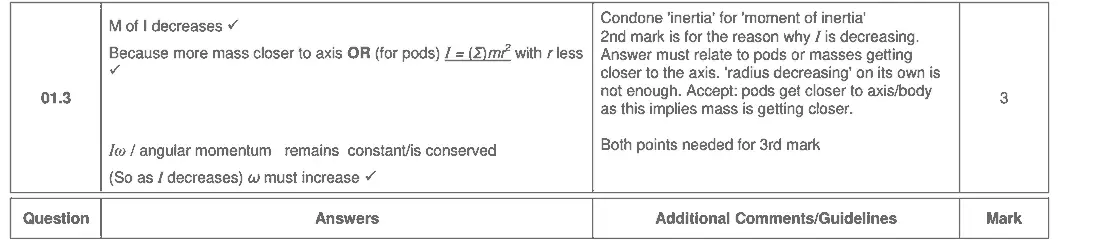
State and explain the change in the angular speed of the satellite as the arms are
retracted.
[3 marks]
June 2018 · Paper 3B Engineering physics · Q1.4 3 marks Calculation Easy rotational dynamics
Earlier part of question 1 that this part usesEarlier part of June 2018 Paper 3B Engineering physics question 1
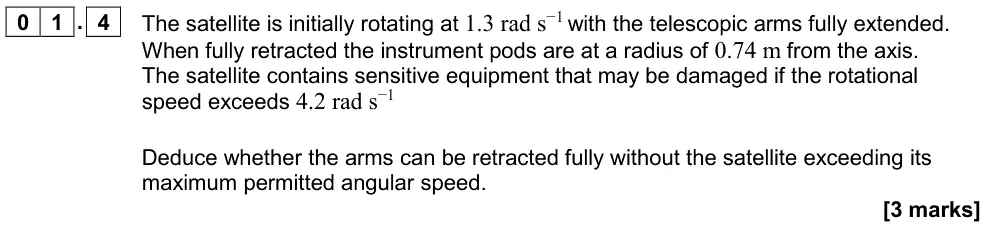
The satellite is initially rotating at 1.3 rad s−1 with the telescopic arms fully extended.
When fully retracted the instrument pods are at a radius of 0.74 m from the axis.
The satellite contains sensitive equipment that may be damaged if the rotational
speed exceeds 4.2 rad s−1
Deduce whether the arms can be retracted fully without the satellite exceeding its
maximum permitted angular speed.
[3 marks]
June 2018 · Paper 3B Engineering physics · Q2.1 1 mark Short answer Easy rotational dynamics
State one function of a flywheel.
[1 mark]
June 2018 · Paper 3B Engineering physics · Q2.2 3 marks Show that rotational dynamics
Earlier part of question 2 that this part usesEarlier part of June 2018 Paper 3B Engineering physics question 2
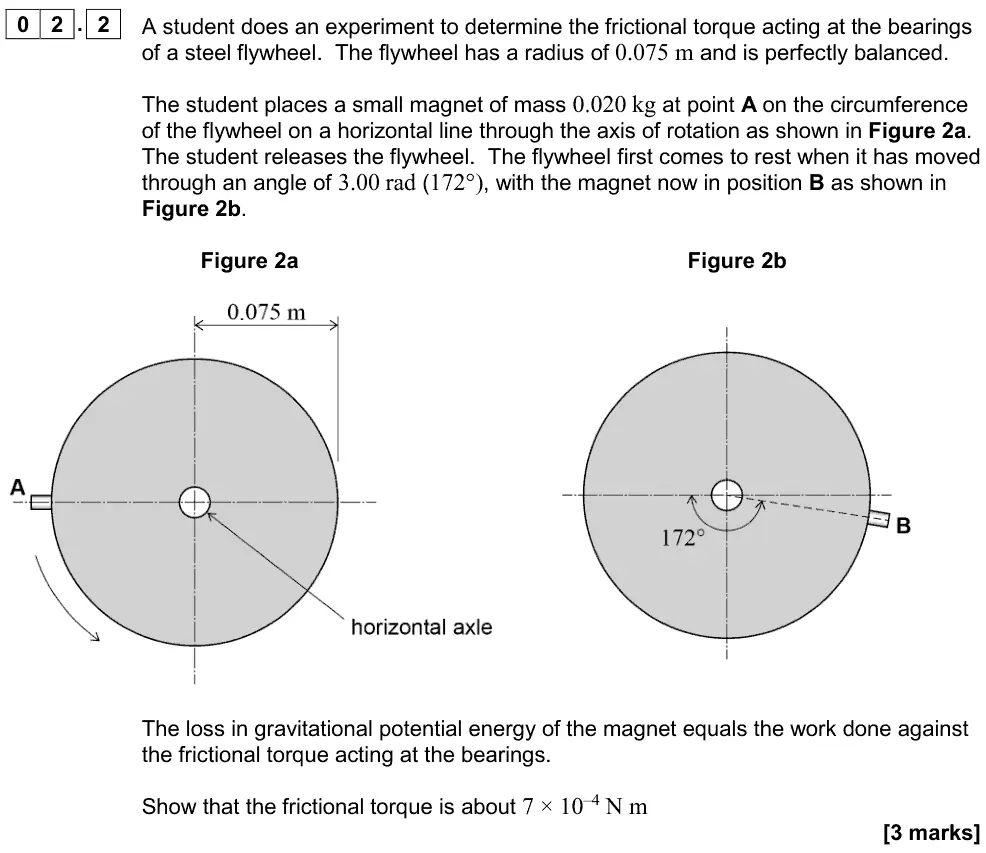
A student does an experiment to determine the frictional torque acting at the bearings
of a steel flywheel.  The flywheel has a radius of 0.075 m and is perfectly balanced.
The student places a small magnet of mass 0.020 kg at point A on the circumference
of the flywheel on a horizontal line through the axis of rotation as shown in Figure 2a.
The student releases the flywheel.  The flywheel first comes to rest when it has moved
through an angle of 3.00 rad (172°), with the magnet now in position B as shown in
Figure 2b.
Figure 2a
Figure 2b
The loss in gravitational potential energy of the magnet equals the work done against
the frictional torque acting at the bearings.
Show that the frictional torque is about 7 × 10⁻⁴ N m
[3 marks]
June 2018 · Paper 3B Engineering physics · Q2.3 3 marks Calculation rotational dynamics
Earlier part of question 2 that this part usesEarlier part of June 2018 Paper 3B Engineering physics question 2
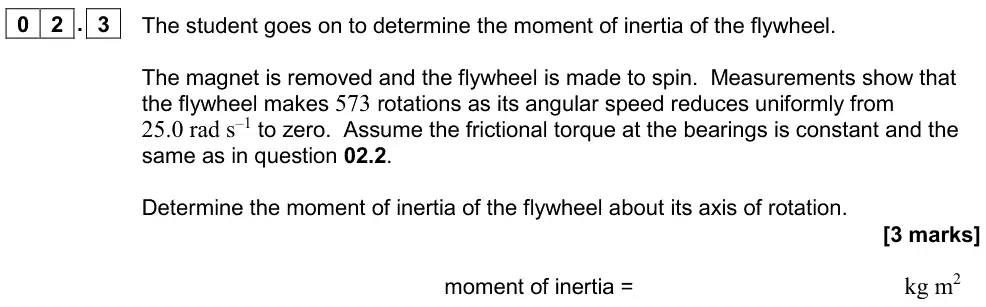
The student goes on to determine the moment of inertia of the flywheel.
The magnet is removed and the flywheel is made to spin.  Measurements show that
the flywheel makes 573 rotations as its angular speed reduces uniformly from
25.0 rad s–1 to zero.  Assume the frictional torque at the bearings is constant and the
same as in question 02.2.
Determine the moment of inertia of the flywheel about its axis of rotation.
[3 marks]
moment of inertia =
kg m2
June 2018 · Paper 3B Engineering physics · Q3.1 1 mark Short answer thermodynamics and engines
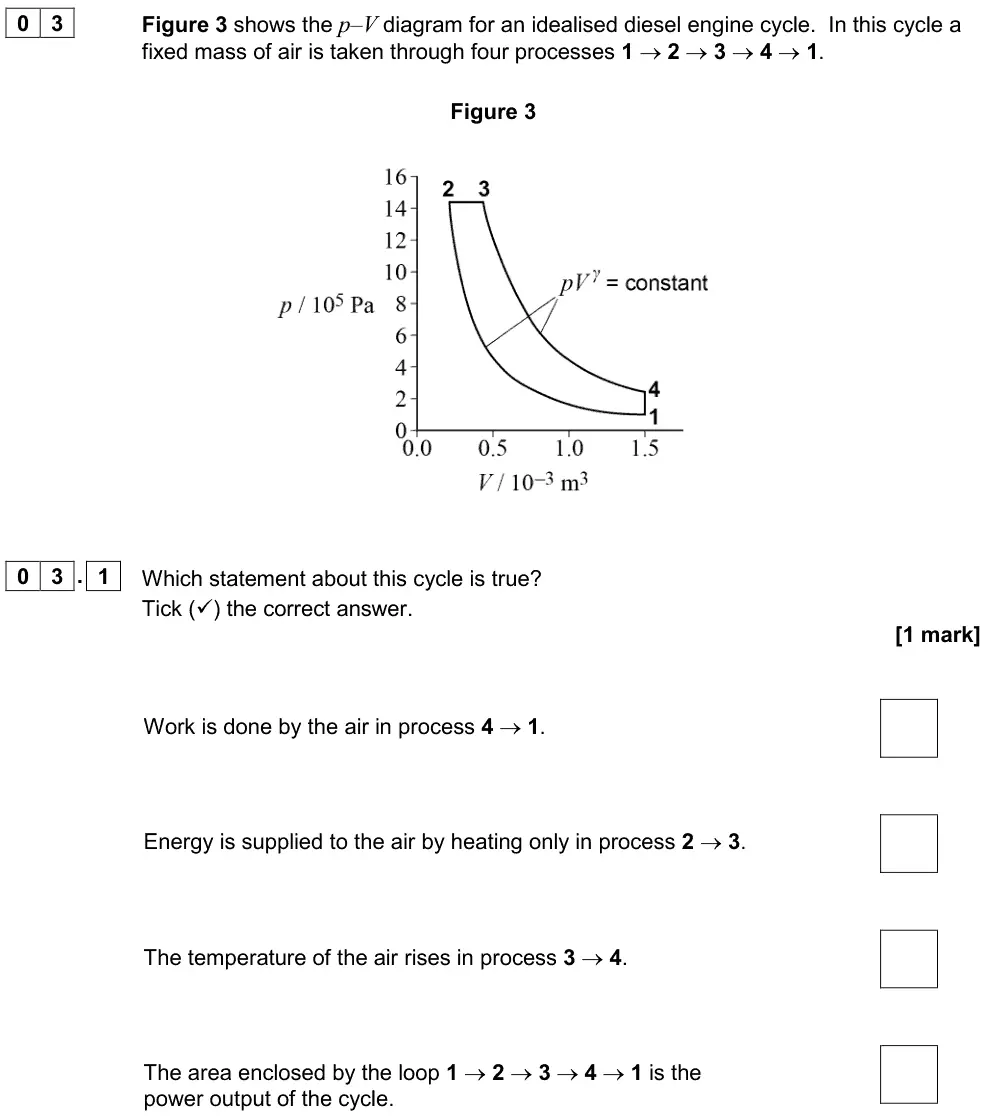
Figure 3 shows the p–V diagram for an idealised diesel engine cycle.  In this cycle a
fixed mass of air is taken through four processes 1 → 2 → 3 → 4 → 1.
Figure 3
Which statement about this cycle is true?
Tick () the correct answer.
[1 mark]
Work is done by the air in process 4 → 1.
Energy is supplied to the air by heating only in process 2 → 3.
The temperature of the air rises in process 3 → 4.
The area enclosed by the loop 1 → 2 → 3 → 4 → 1 is the
power output of the cycle.
June 2018 · Paper 3B Engineering physics · Q3.2 5 marks Calculation Hard thermodynamics and engines
Earlier part of question 3 that this part usesEarlier part of June 2018 Paper 3B Engineering physics question 3
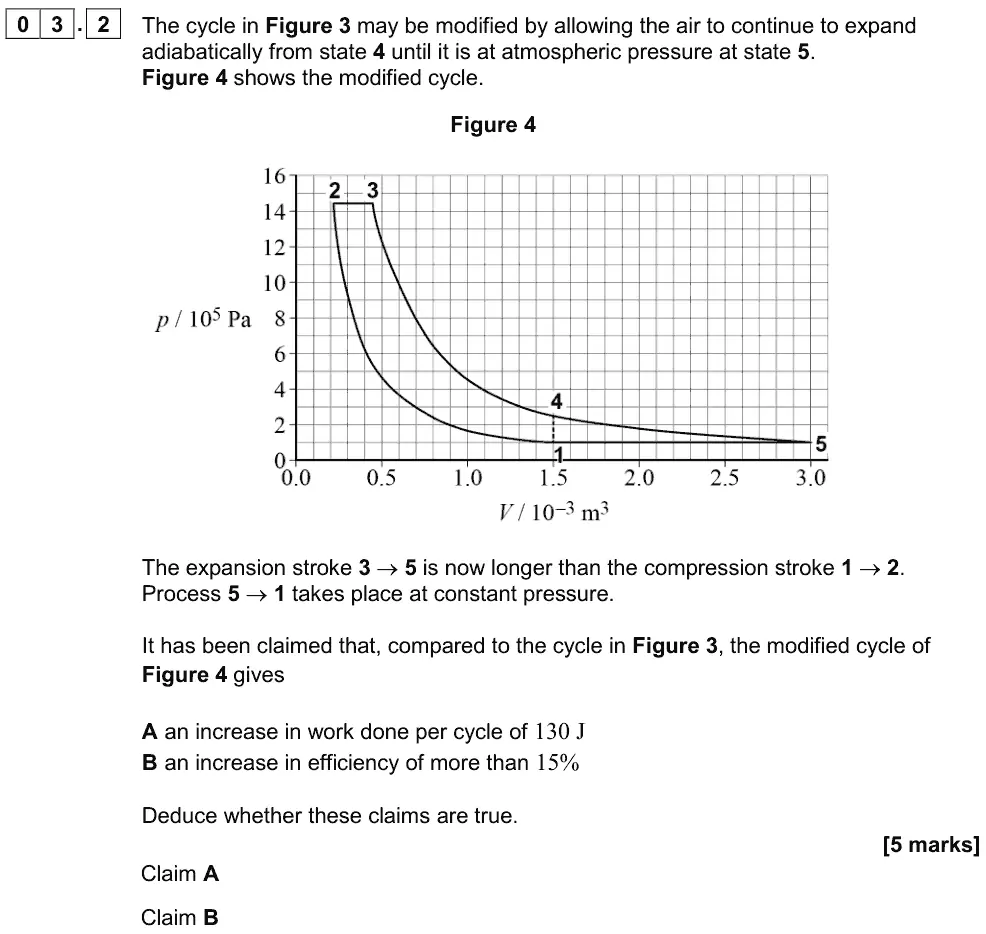
The cycle in Figure 3 may be modified by allowing the air to continue to expand
adiabatically from state 4 until it is at atmospheric pressure at state 5.
Figure 4 shows the modified cycle.
Figure 4
The expansion stroke 3 → 5 is now longer than the compression stroke 1 → 2.
Process 5 → 1 takes place at constant pressure.
It has been claimed that, compared to the cycle in Figure 3, the modified cycle of
Figure 4 gives
A an increase in work done per cycle of 130 J
B an increase in efficiency of more than 15%
Deduce whether these claims are true.
[5 marks]
Claim A
Claim B
June 2018 · Paper 3B Engineering physics · Q3.3 2 marks Short answer thermodynamics and engines
Earlier part of question 3 that this part usesEarlier part of June 2018 Paper 3B Engineering physics question 3
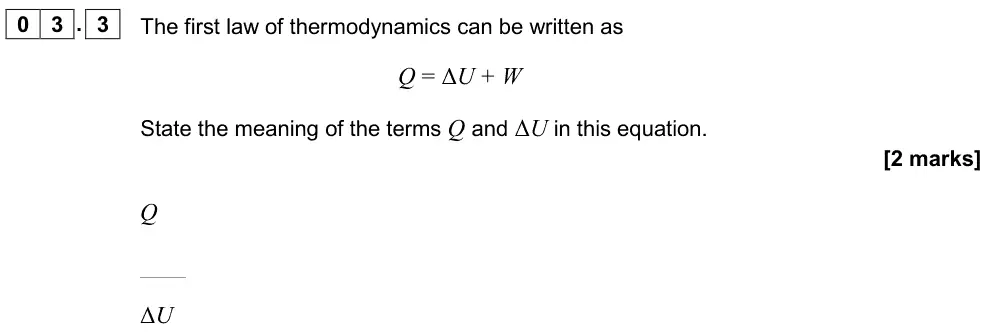
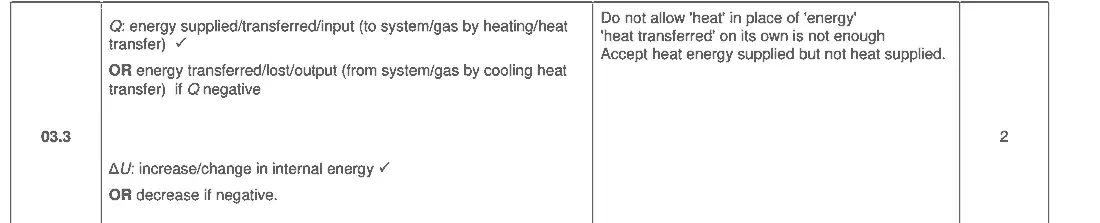
The first law of thermodynamics can be written as
Q = ΔU + W
State the meaning of the terms Q and ΔU in this equation.
[2 marks]
Q
ΔU
June 2018 · Paper 3B Engineering physics · Q3.4 2 marks Calculation Hard thermodynamics and engines
Earlier part of question 3 that this part usesEarlier part of June 2018 Paper 3B Engineering physics question 3
For the air in process 5 → 1 in Figure 4, ΔU = –374 J
Calculate the energy that must be removed by cooling for process 5 → 1.
[2 marks]
energy removed by cooling =
J
June 2018 · Paper 3B Engineering physics · Q3.5 3 marks Calculation thermodynamics and engines
Earlier part of question 3 that this part usesEarlier part of June 2018 Paper 3B Engineering physics question 3
0.060 mol of air is taken through the cycle.
Determine the maximum temperature in the cycle.
[3 marks]
maximum temperature =
K
June 2018 · Paper 3B Engineering physics · Q4 6 marks 6-mark extended response thermodynamics and engines
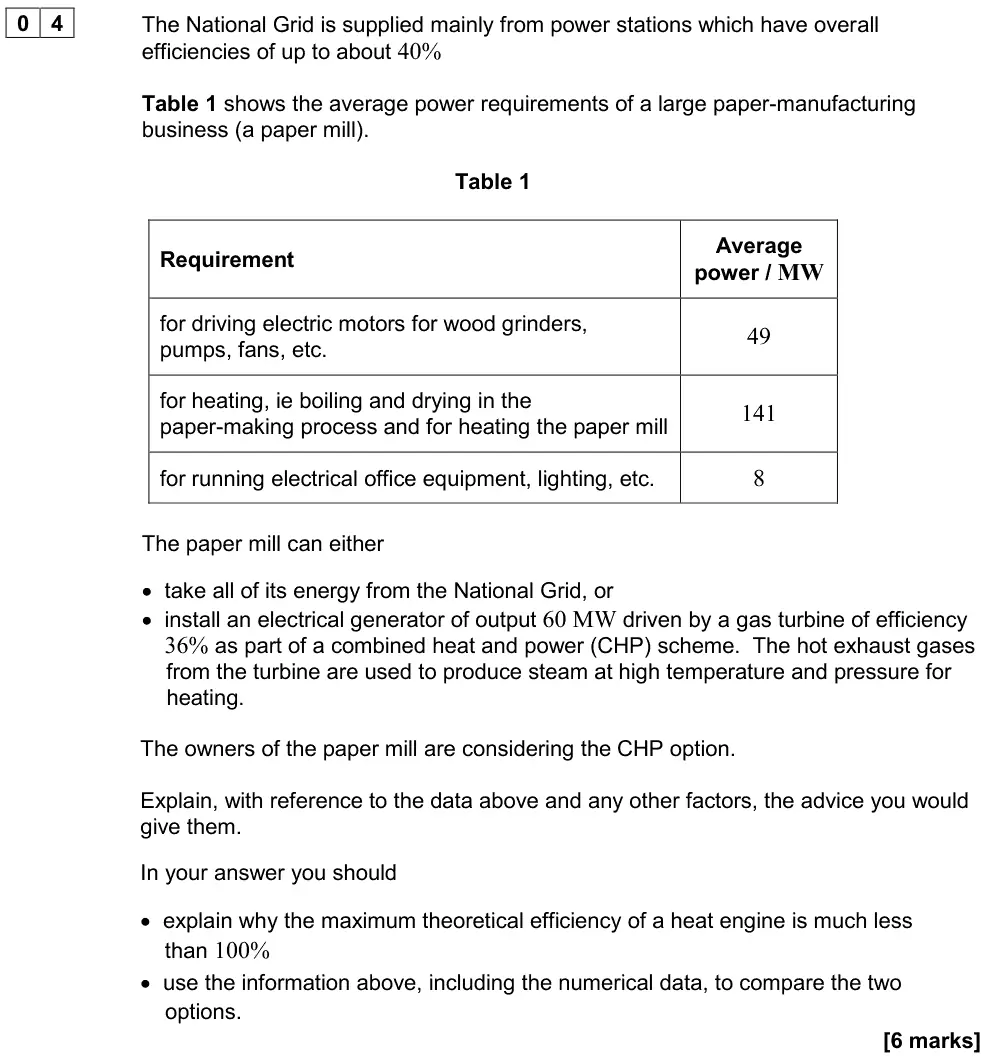
The National Grid is supplied mainly from power stations which have overall
efficiencies of up to about 40%
Table 1 shows the average power requirements of a large paper-manufacturing
business (a paper mill).
Table 1
Requirement
Average
power / MW
for driving electric motors for wood grinders,
pumps, fans, etc.
49
for heating, ie boiling and drying in the
paper-making process and for heating the paper mill
141
for running electrical office equipment, lighting, etc.
8
The paper mill can either
• take all of its energy from the National Grid, or
• install an electrical generator of output 60 MW driven by a gas turbine of efficiency
36% as part of a combined heat and power (CHP) scheme.  The hot exhaust gases
from the turbine are used to produce steam at high temperature and pressure for
heating.
The owners of the paper mill are considering the CHP option.
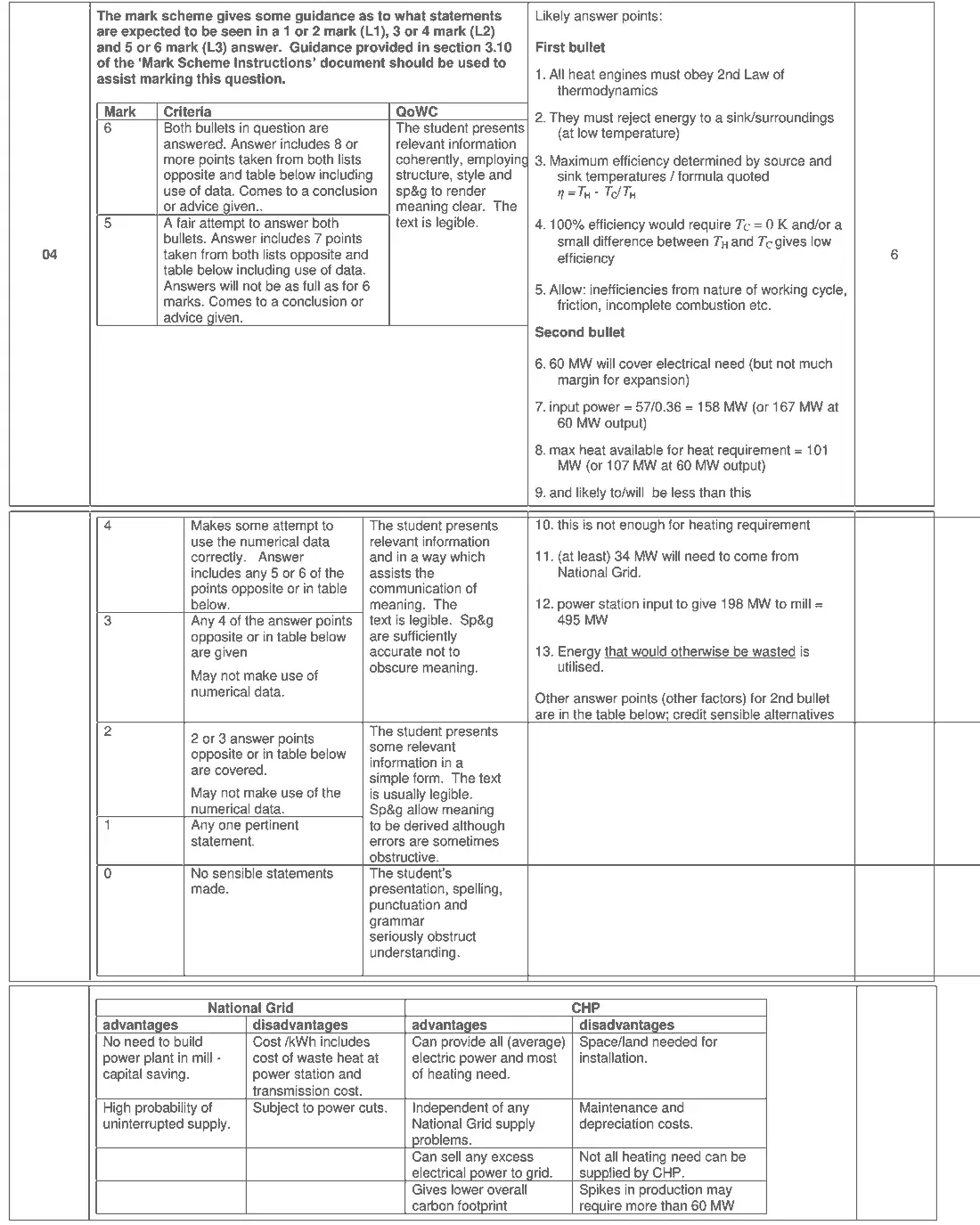
Explain, with reference to the data above and any other factors, the advice you would
give them.
In your answer you should
• explain why the maximum theoretical efficiency of a heat engine is much less
than 100%
• use the information above, including the numerical data, to compare the two
options.
[6 marks]

Work with an AQA physics tutor

Want a paper marked and gone through with you? Message us.

Prefer email? Send an enquiry

If you are under 18, please include a parent's contact details. Enquiries go to enquiries@physicsaleveltutor.com and are deleted once handled. All tutoring is online.