Examiner's comment
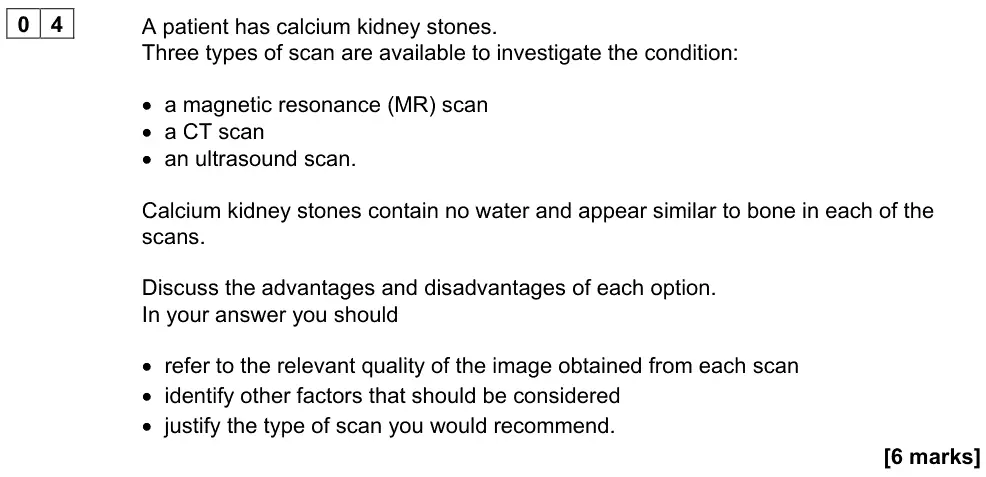
The levels-of-response question was more accessible than in previous years, with very few students scoring 0 or 1 mark. A mark of 4 was the most common score.
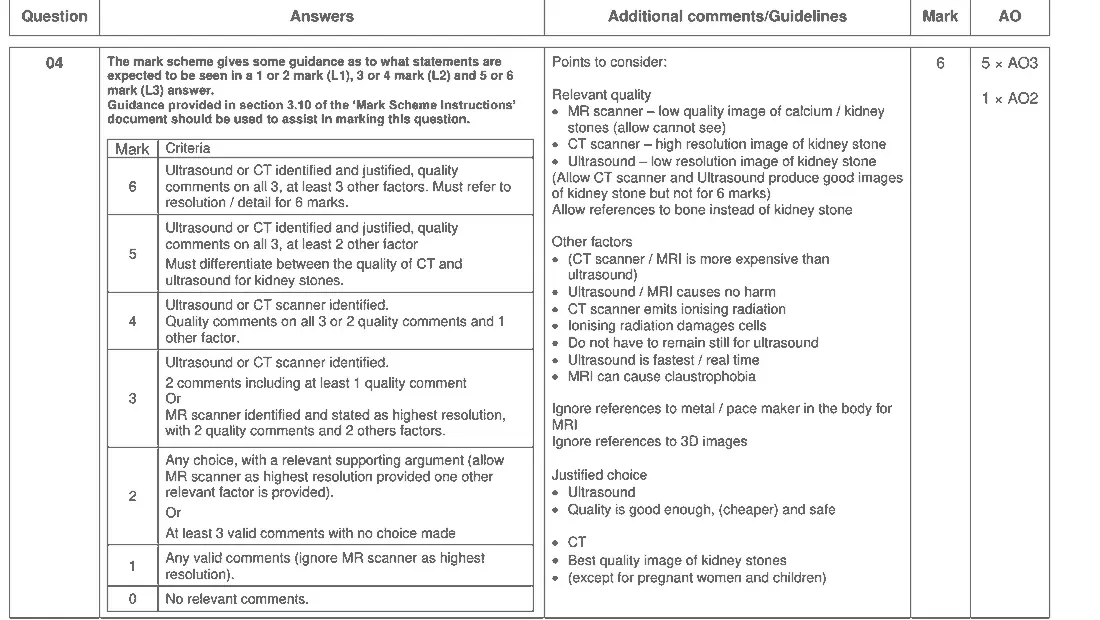
Most students were familiar with the three types of scans and were able to list information about them, with only a minority mixing up the features of the three scans. However, this question required students to evaluate the scans’ suitability in a particular context, rather than list everything they knew about the scan. While MR scans do produce high-resolution images of soft tissue, the question asked about kidney stones, which were described in the question as looking like bone in the three scans. Students should have recognised that MR scans perform poorly when viewing bone and were therefore not suitable in this case, particularly when viewed against their high cost. The question then became a comparison between the higher quality image with a large exposure to radiation with the CT scanner weighed against the lower quality image but with a lack of ionising radiation of the ultrasound scan. Both scans are used in the NHS for identifying kidney stones and selecting either enabled the answer to access top marks.
Some students did provide a very detailed description of how one or more of the scans worked. However, this did not address the question that was asked and therefore gained no marks, unless it touched on any of the relevant factors. While metal in the body is something which doctors have to consider when performing MR scans, this does not prevent MR scans taking place in a lot of cases and therefore any comments about metal in the body with reference to MR scans was treated as neutral. A significant number of students tried to focus on the 2-D or 3-D nature of MR scans and CT scans, with students stating either of the two scans being 2-D compared to the other which was 3-D. Both scans take multiple 2-D cross-sections which can be combined into a 3-D image by a computer. However, this is not usually necessary and is rarely done. Therefore this was also treated as neutral, as in previous questions on the topic.
Some students incorrectly stated that a barium meal should be used or tried to suggest X-ray techniques that are not applicable to CT scans to minimise the dosage of radiation. A significant number of students stressed the real-time nature of an MR scan. While real-time MR scans have been developed in recent years, they are rarer and more expensive than a standard MR scan and are used for tracking moving objects in the body and would therefore not be relevant to a discussion about kidney stones; this was therefore treated as a neutral comment.
For a higher band answer worth 5-6 marks, students were expected to recognise the trade-off between quality and safety. For 6 marks the quality comparison needed to use the appropriate terminology such as resolution or detail visible, while a 5-mark answer typically just referred to better quality images. At this level of comparison very few answers lacked the details required for the top band.
For a middle band answer, typical answers would not compare the quality of ultrasound with the CT scan – just referring to both being able to image bone. There was also less detail about the scans, with most 4-mark answers typically only making one relevant comment about each scan. Often these answers did not address the quality issue at all beyond commenting that the MR scan did not produce a good image of bone or focussing entirely on the quality of the image without recognising any of the other relevant issues, such as safety. Alternatively, some answers did not adequately express the idea that an ultrasound is capable of imaging bone but it does so at low resolution. A typical 3-mark answer often only made a correct comment about two of the scans or had significant errors. In this band some errors were introduced, for example students thought that because ultrasound could not see through bone, it could not then image the bone itself. While the term non-invasive could be applied to all 3 scans, it was clear that a number of students were mixing up the term non-invasive with non-ionising when they used the term to contrast MR scans and ultrasounds with CT scans.
For a lower band answer, students typically selected the MR scan focussing on its high quality images of soft tissue but not recognising that this was not relevant for imaging kidney stones. An MR scan focussed answer could gain 3 marks when it was sufficiently detailed and listed relevant factors in the other scans, but this was rare. Most answers in this band were able to list some relevant factors about the scans and therefore only a very few answers scored 1 mark. A very small number of students did not state a preference for the type of scan and therefore also scored in this band. These students however, did not usually provide a level of detail that would have moved them much higher even if they had stated a preference.