Examiner's comment
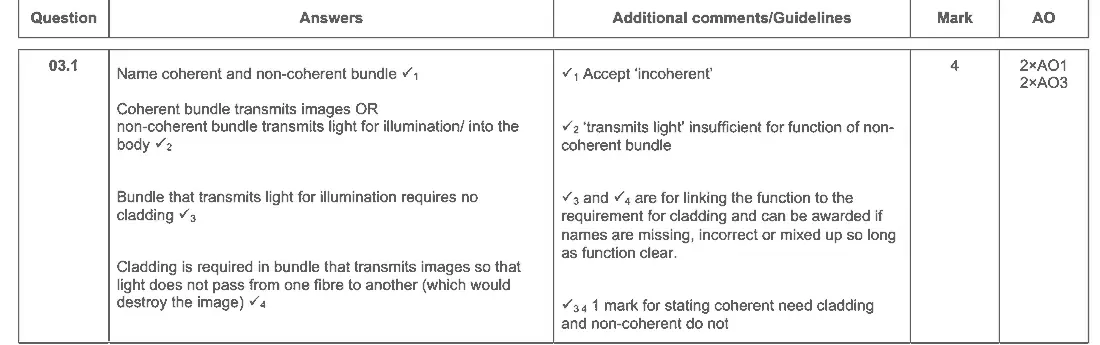
03.1 The majority of students gained at least one mark here, identifying coherent and non-coherent bundles as the two types of bundles used in endoscopy. Many then went on to describe the fibre arrangement, which was not necessary in answering the question. Clear descriptions of the functions, however, were required for the subsequent marking points, and lots of students accessed a second mark by giving at least one of these clearly. For the coherent bundle, as in previous series, ‘transmission of light’ was considered an insufficient description of the function. Answers needed to make it clear that the light was being transmitted into the body for the purpose of illumination in order for a mark to be awarded.
The discussion of the requirement for a cladding was less well answered, with just over a third of students gaining 3 or 4 marks. The common misconception highlighted by this question is that total internal reflection will not occur unless there is a cladding on a fibre, with many students arguing on this basis that both bundles would require cladding.
It was clear from responses that students have learnt about several purposes of cladding on optical fibres, and the challenge of this question was to determine which purpose was relevant in this context. In the most successful answers students had recognised that the important issue was whether or not light would be able to pass between the individual fibres in a bundle.