
June 2024: Paper 3B Engineering physics

35 marks · 13 question parts · Paper, mark scheme and report on AQA's site · Have the data and formulae booklet beside you

Question by question

QTopicMarksAOType
1.1 Rotational dynamics 3Explanation
1.2 Rotational dynamics 6Extended response
2.1 Rotational dynamics 3AO2=3Show that
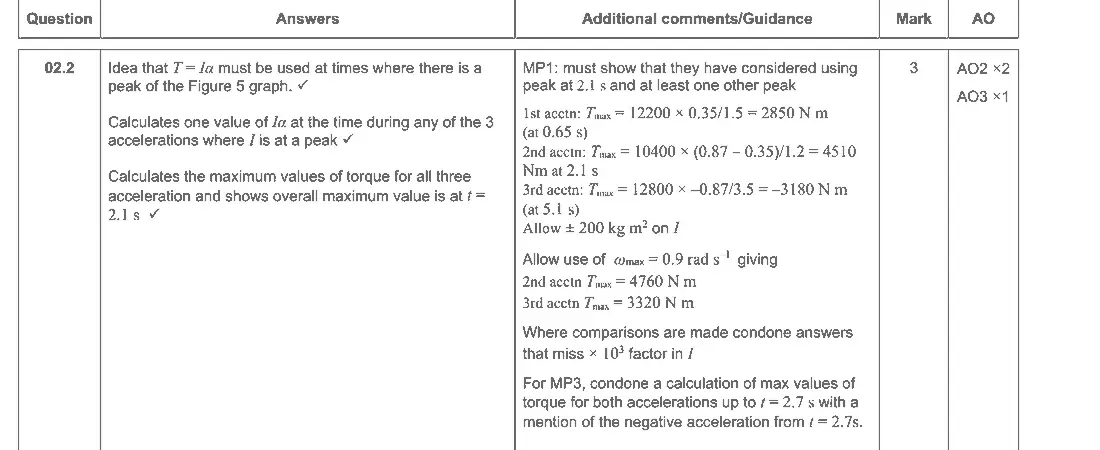
2.2 Rotational dynamics 3Show that
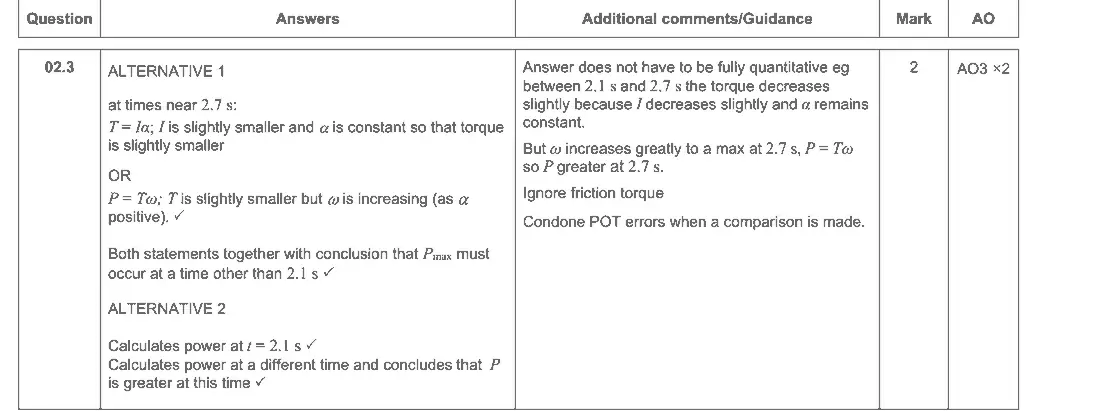
2.3 Rotational dynamics 2AO3=2Explanation
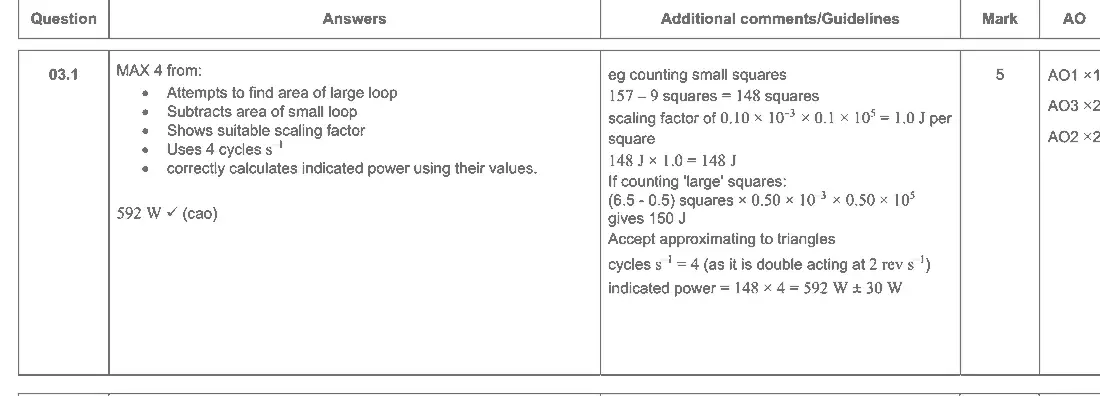
3.1 Thermodynamics and engines 5Calculation
3.2 Thermodynamics and engines 2AO1=2Calculation
3.3 Thermodynamics and engines 2AO3=2Short answer
3.4 Thermodynamics and engines 1AO1=1Short answer
4.1 Thermodynamics and engines 2AO1=2Short answer
4.2 Thermodynamics and engines 3Explanation
4.3 Thermodynamics and engines 1AO1=1Diagram or graph
4.4 Thermodynamics and engines 2AO1=2Explanation

The questions

1.11.22.12.22.33.13.23.33.44.14.24.34.4
June 2024 · Paper 3B Engineering physics · Q1.1 3 marks Explanation rotational dynamics
A heavy turntable is mounted on a fixed base.  The turntable can rotate freely on a
low-friction bearing.
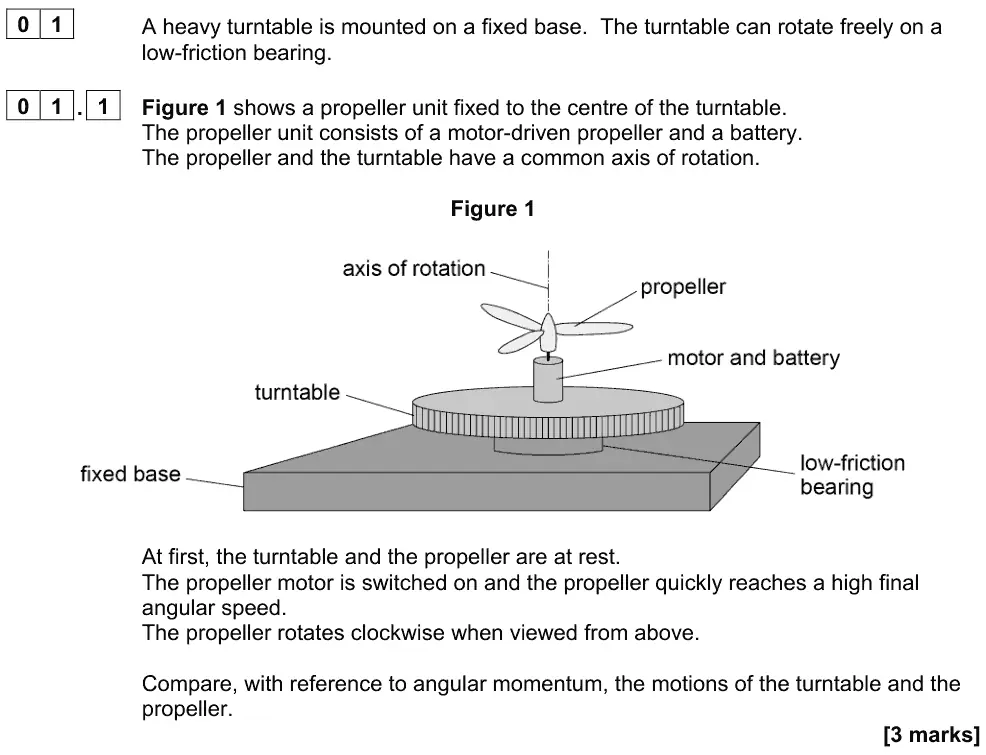
Figure 1 shows a propeller unit fixed to the centre of the turntable.
The propeller unit consists of a motor-driven propeller and a battery.
The propeller and the turntable have a common axis of rotation.
Figure 1
At first, the turntable and the propeller are at rest.
The propeller motor is switched on and the propeller quickly reaches a high final
angular speed.
The propeller rotates clockwise when viewed from above.
Compare, with reference to angular momentum, the motions of the turntable and the
propeller.
[3 marks]
June 2024 · Paper 3B Engineering physics · Q1.2 6 marks 6-mark extended response rotational dynamics
Earlier part of question 1 that this part usesEarlier part of June 2024 Paper 3B Engineering physics question 1
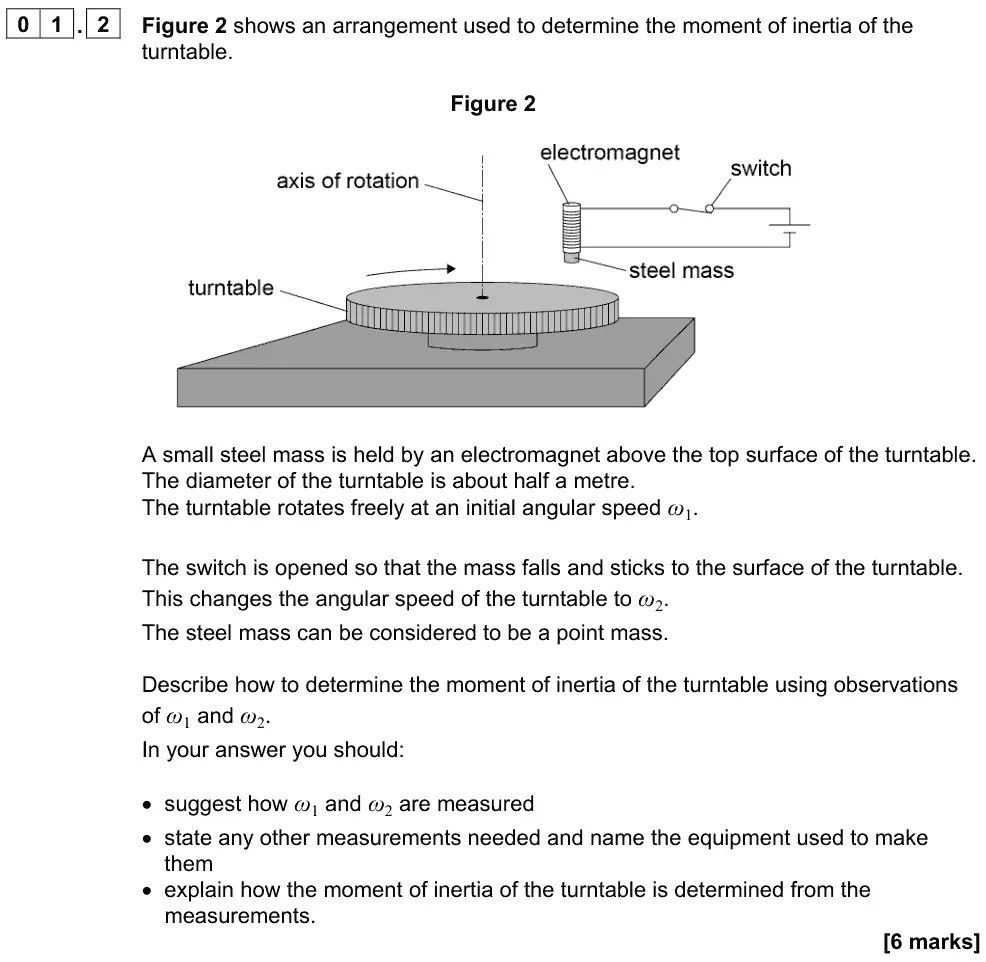
Figure 2 shows an arrangement used to determine the moment of inertia of the
turntable.
Figure 2
A small steel mass is held by an electromagnet above the top surface of the turntable.
The diameter of the turntable is about half a metre.
The turntable rotates freely at an initial angular speed ω1.
The switch is opened so that the mass falls and sticks to the surface of the turntable.
This changes the angular speed of the turntable to ω2.
The steel mass can be considered to be a point mass.
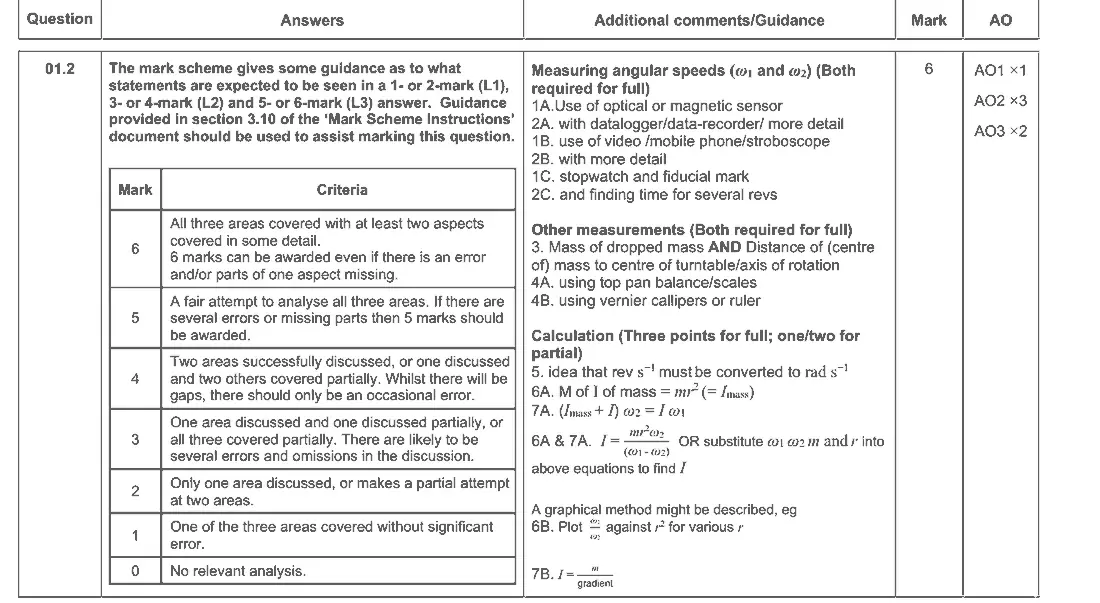
Describe how to determine the moment of inertia of the turntable using observations
of ω1 and ω2.
In your answer you should:
• suggest how ω1 and ω2 are measured
• state any other measurements needed and name the equipment used to make
them
• explain how the moment of inertia of the turntable is determined from the
measurements.
[6 marks]
June 2024 · Paper 3B Engineering physics · Q2.1 3 marks AO2=3 Show that rotational dynamics
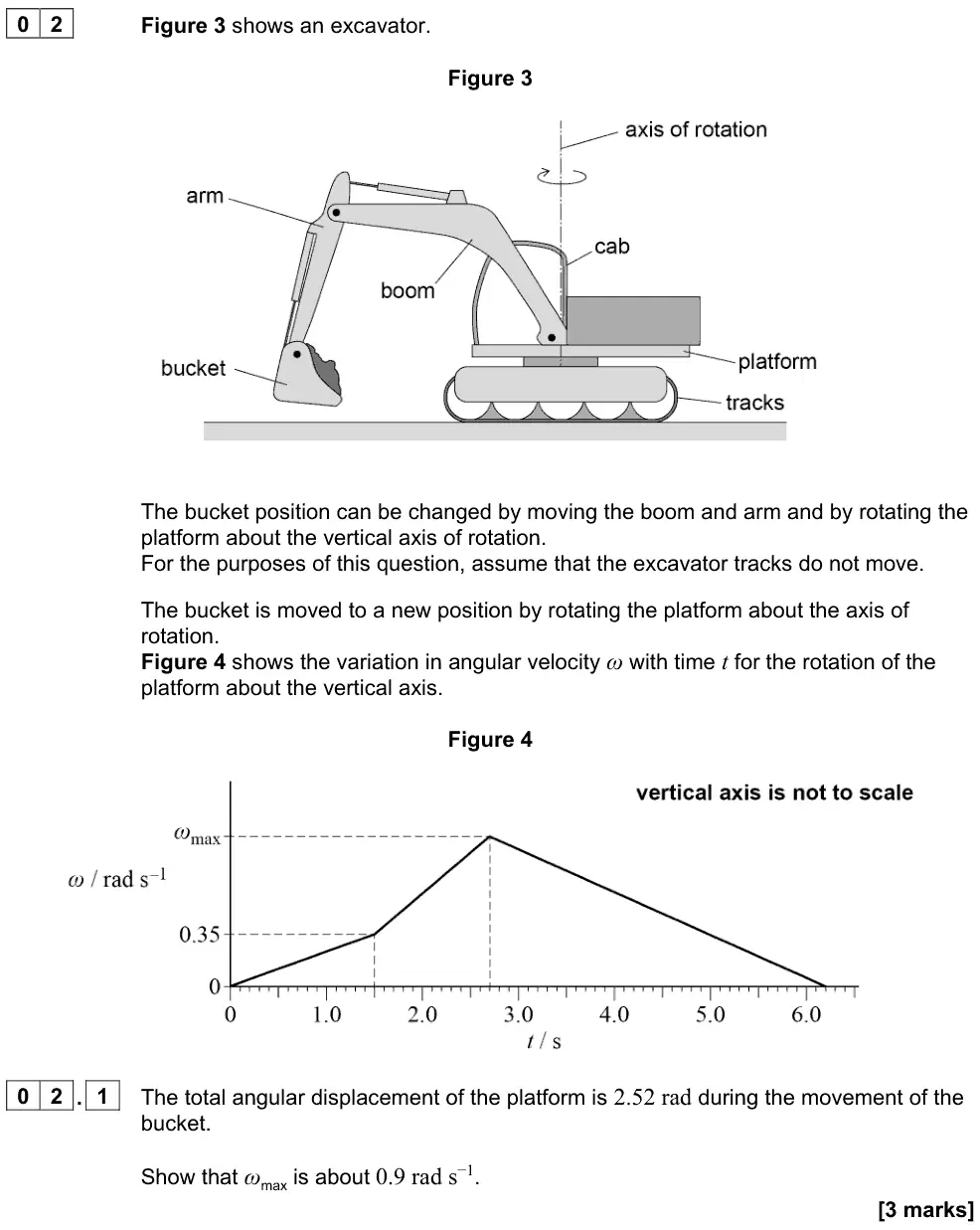
Figure 3 shows an excavator.
Figure 3
The bucket position can be changed by moving the boom and arm and by rotating the
platform about the vertical axis of rotation.
For the purposes of this question, assume that the excavator tracks do not move.
The bucket is moved to a new position by rotating the platform about the axis of
rotation.
Figure 4 shows the variation in angular velocity ω with time t for the rotation of the
platform about the vertical axis.
Figure 4
The total angular displacement of the platform is 2.52 rad during the movement of the
bucket.
Show that ωmax is about 0.9 rad s−1.
[3 marks]
June 2024 · Paper 3B Engineering physics · Q2.2 3 marks Show that rotational dynamics
Earlier part of question 2 that this part usesEarlier part of June 2024 Paper 3B Engineering physics question 2
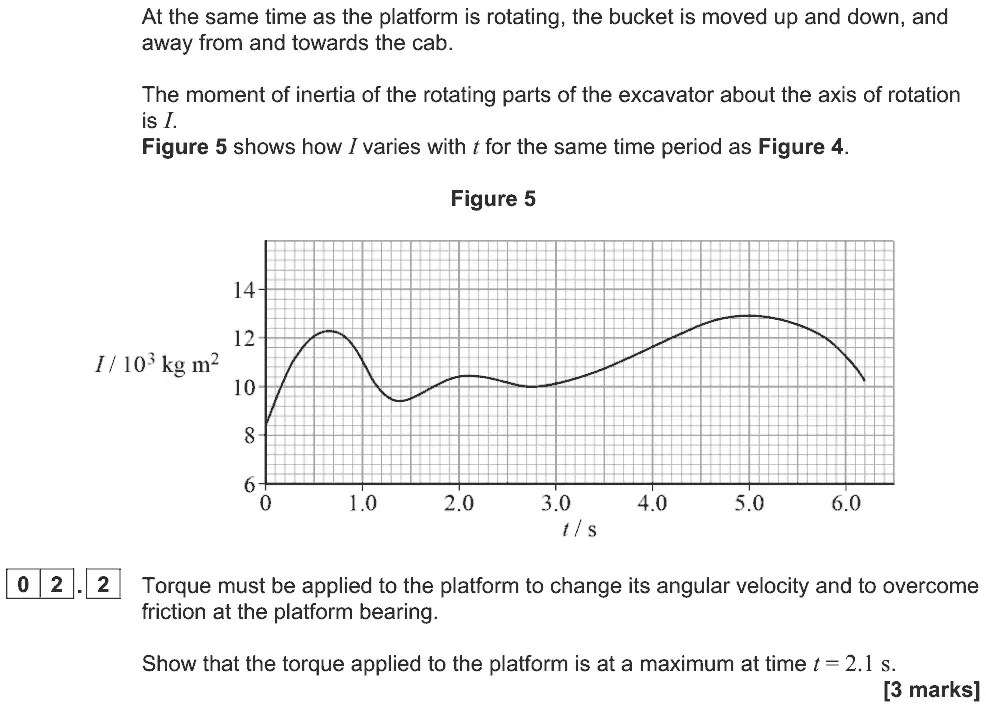
At the same time as the platform is rotating, the bucket is moved up and down, and
away from and towards the cab.
The moment of inertia of the rotating parts of the excavator about the axis of rotation
is I.
Figure 5 shows how I varies with t for the same time period as Figure 4.
Figure 5
Torque must be applied to the platform to change its angular velocity and to overcome
friction at the platform bearing.
Show that the torque applied to the platform is at a maximum at time t = 2.1 s.
[3 marks]
June 2024 · Paper 3B Engineering physics · Q2.3 2 marks AO3=2 Explanation Hard rotational dynamics
Earlier part of question 2 that this part usesEarlier part of June 2024 Paper 3B Engineering physics question 2
Deduce whether the maximum power applied to the platform occurs at the same time
of 2.1 s.
[2 marks]
June 2024 · Paper 3B Engineering physics · Q3.1 5 marks Calculation thermodynamics and engines
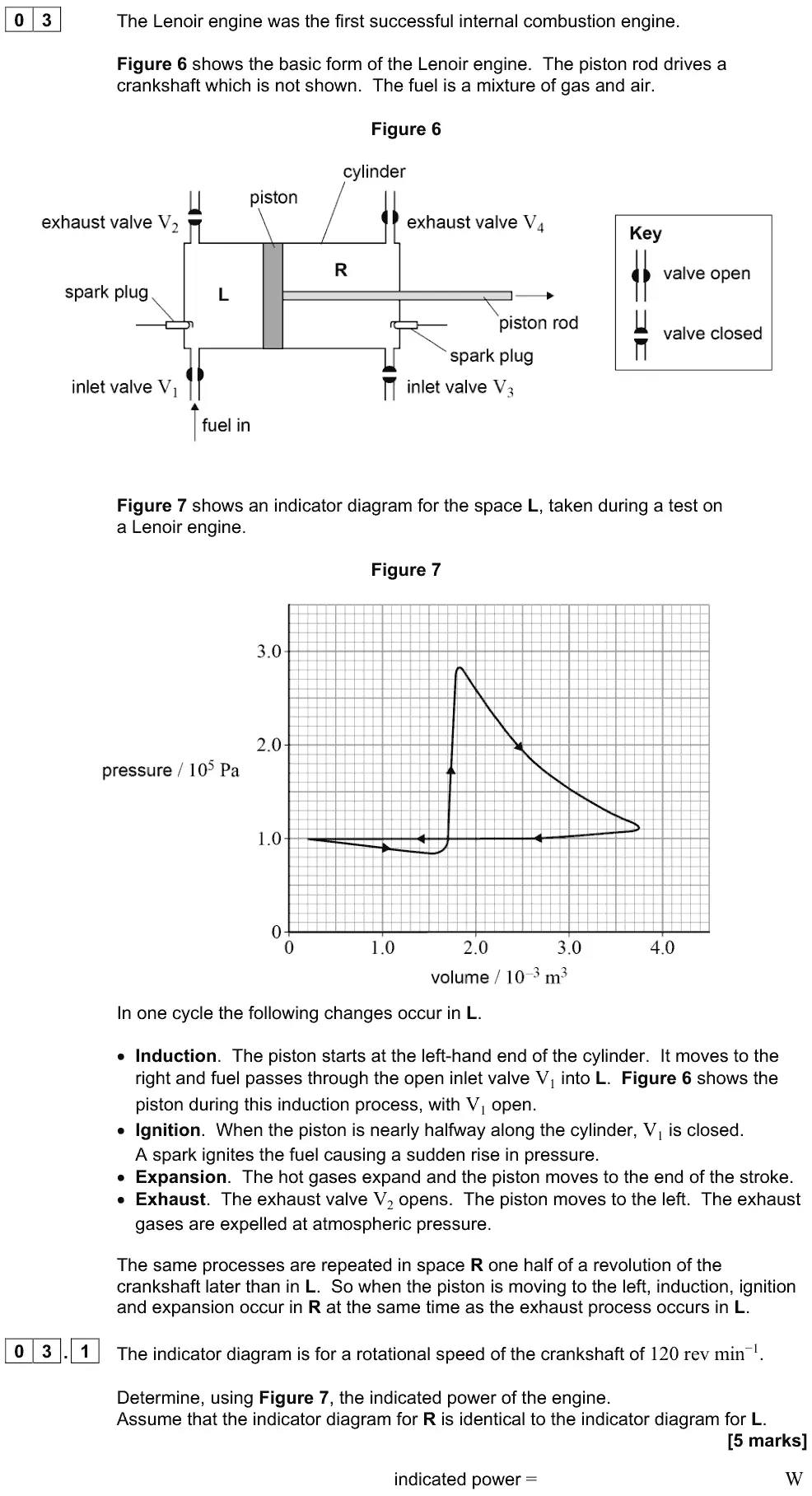
The Lenoir engine was the first successful internal combustion engine.
Figure 6 shows the basic form of the Lenoir engine.  The piston rod drives a
crankshaft which is not shown.  The fuel is a mixture of gas and air.
Figure 6
Figure 7 shows an indicator diagram for the space L, taken during a test on
a Lenoir engine.
Figure 7
In one cycle the following changes occur in L.
• Induction.  The piston starts at the left-hand end of the cylinder.  It moves to the
right and fuel passes through the open inlet valve V1 into L.  Figure 6 shows the
piston during this induction process, with V1 open.
• Ignition.  When the piston is nearly halfway along the cylinder, V1 is closed.
A spark ignites the fuel causing a sudden rise in pressure.
• Expansion.  The hot gases expand and the piston moves to the end of the stroke.
• Exhaust.  The exhaust valve V2 opens.  The piston moves to the left.  The exhaust
gases are expelled at atmospheric pressure.
The same processes are repeated in space R one half of a revolution of the
crankshaft later than in L.  So when the piston is moving to the left, induction, ignition
and expansion occur in R at the same time as the exhaust process occurs in L.
The indicator diagram is for a rotational speed of the crankshaft of 120 rev min−1.
Determine, using Figure 7, the indicated power of the engine.
Assume that the indicator diagram for R is identical to the indicator diagram for L.
[5 marks]
indicated power =
W
June 2024 · Paper 3B Engineering physics · Q3.2 2 marks AO1=2 Calculation Easy thermodynamics and engines
Earlier part of question 3 that this part usesEarlier part of June 2024 Paper 3B Engineering physics question 3
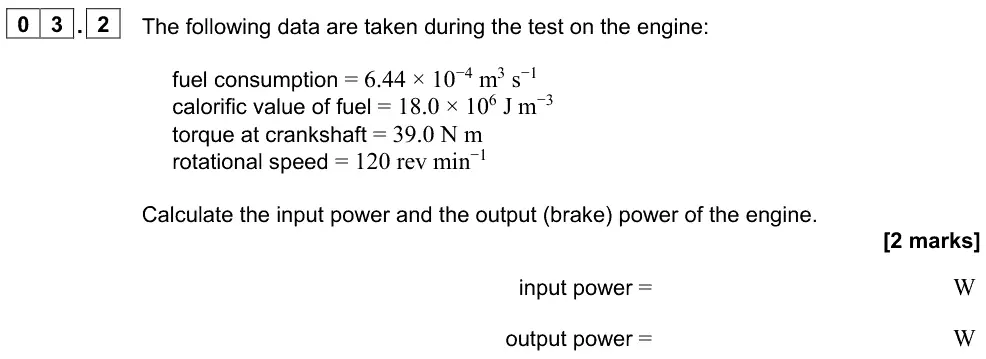
The following data are taken during the test on the engine:
fuel consumption = 6.44 × 10⁻⁴ m3 s−1
calorific value of fuel = 18.0 × 10⁶ J m−3
torque at crankshaft = 39.0 N m
rotational speed = 120 rev min−1
Calculate the input power and the output (brake) power of the engine.
[2 marks]
input power =
W
output power =
W
June 2024 · Paper 3B Engineering physics · Q3.3 2 marks AO3=2 Short answer Hard thermodynamics and engines
Earlier part of question 3 that this part usesEarlier part of June 2024 Paper 3B Engineering physics question 3
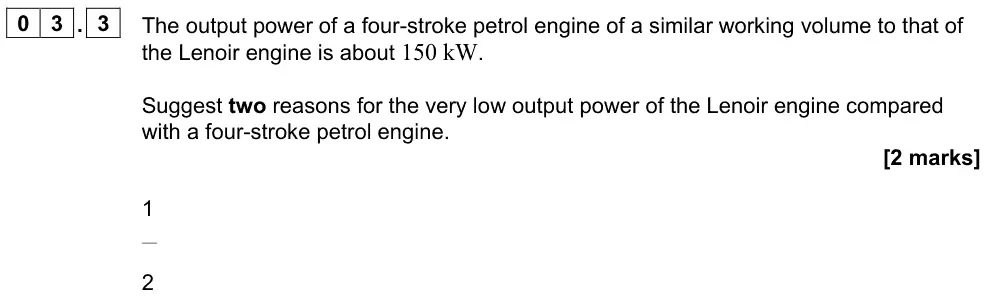
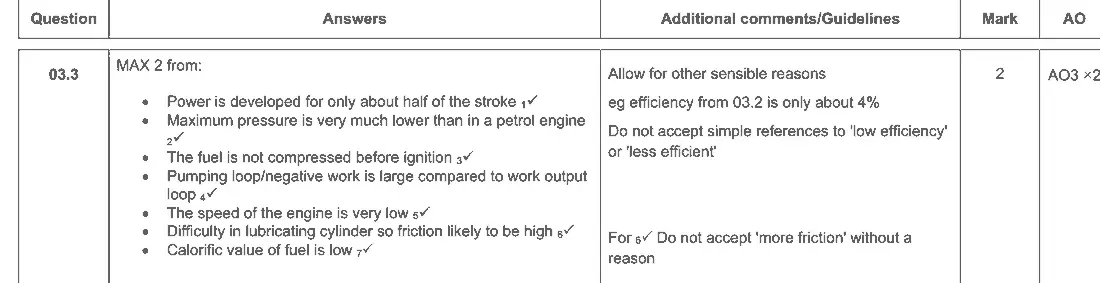
The output power of a four-stroke petrol engine of a similar working volume to that of
the Lenoir engine is about 150 kW.
Suggest two reasons for the very low output power of the Lenoir engine compared
with a four-stroke petrol engine.
[2 marks]
1
2
June 2024 · Paper 3B Engineering physics · Q3.4 1 mark AO1=1 Short answer Easy thermodynamics and engines
Earlier part of question 3 that this part usesEarlier part of June 2024 Paper 3B Engineering physics question 3
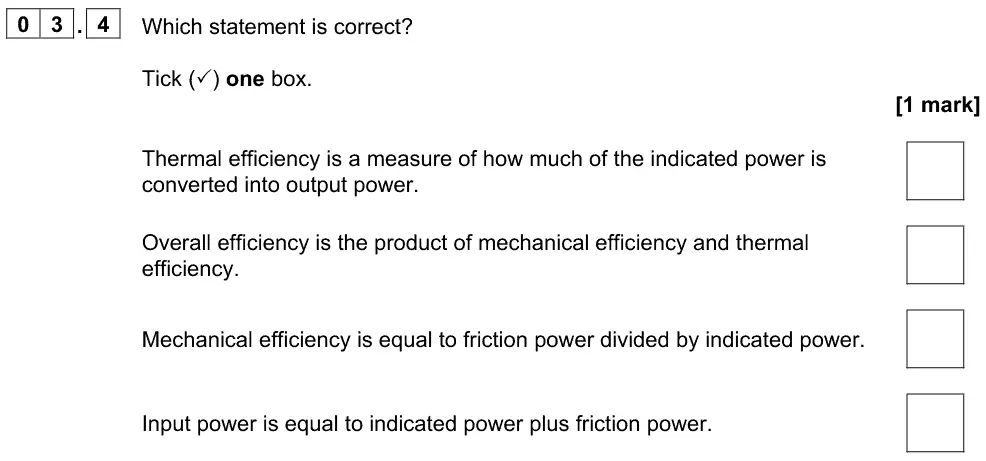
Which statement is correct?
Tick () one box.
[1 mark]
Thermal efficiency is a measure of how much of the indicated power is
converted into output power.
Overall efficiency is the product of mechanical efficiency and thermal
efficiency.
Mechanical efficiency is equal to friction power divided by indicated power.
Input power is equal to indicated power plus friction power.
June 2024 · Paper 3B Engineering physics · Q4.1 2 marks AO1=2 Short answer Hard thermodynamics and engines
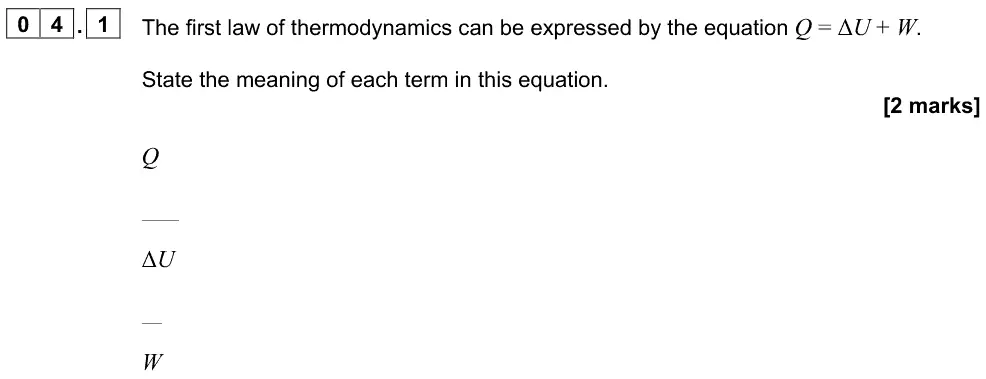
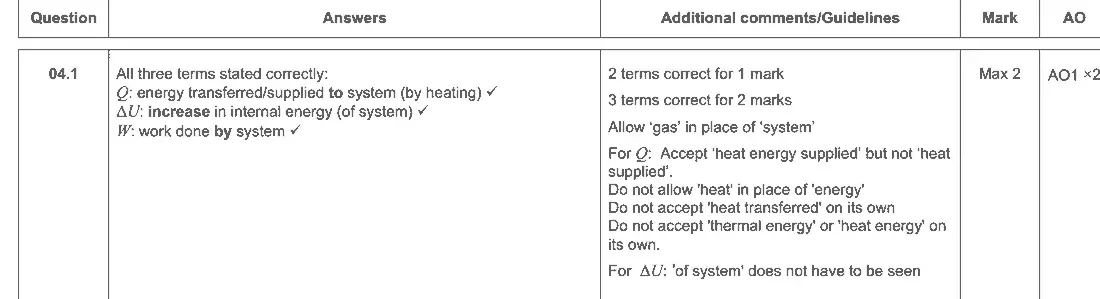
The first law of thermodynamics can be expressed by the equation Q = ΔU + W.
State the meaning of each term in this equation.
[2 marks]
Q
ΔU
W
June 2024 · Paper 3B Engineering physics · Q4.2 3 marks Explanation Hard thermodynamics and engines
Earlier part of question 4 that this part usesEarlier part of June 2024 Paper 3B Engineering physics question 4
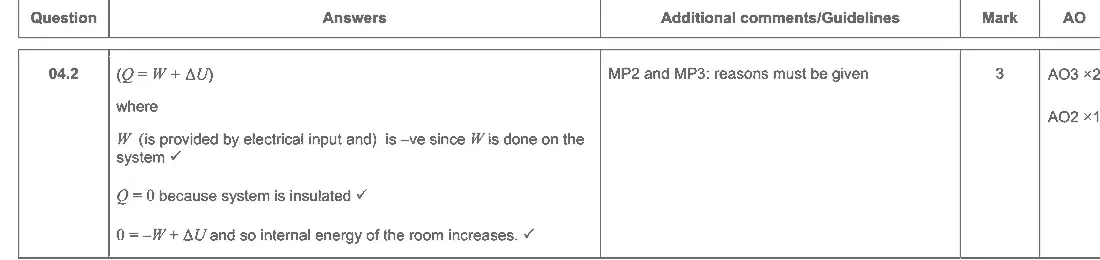
A system consists of a perfectly insulated room containing only an empty refrigerator.
The refrigerator is connected to the mains electricity and the refrigerator door is open.
Deduce, by applying the first law of thermodynamics, whether the internal energy of
the room increases, decreases or stays the same.
[3 marks]
June 2024 · Paper 3B Engineering physics · Q4.3 1 mark AO1=1 Diagram or graph thermodynamics and engines
Earlier part of question 4 that this part usesEarlier part of June 2024 Paper 3B Engineering physics question 4
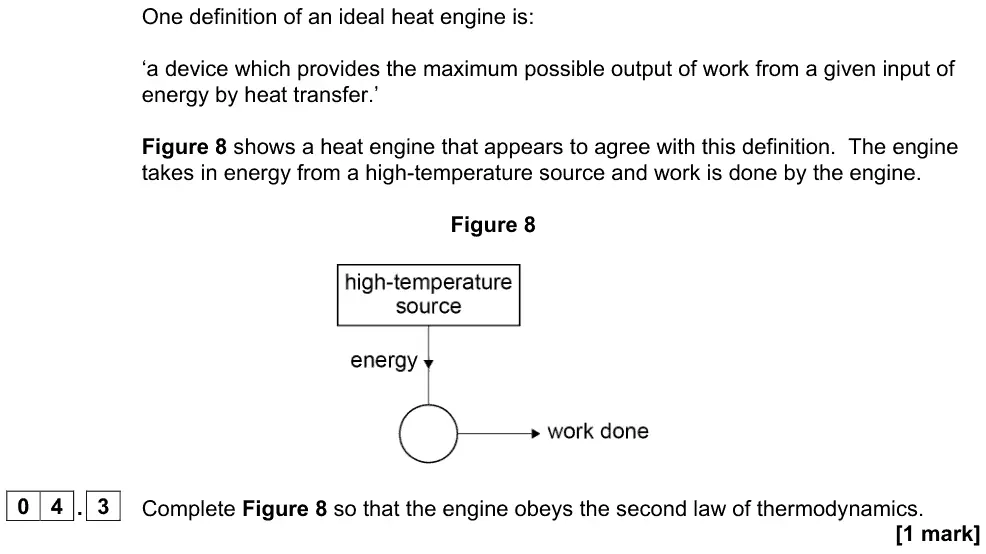
One definition of an ideal heat engine is:
‘a device which provides the maximum possible output of work from a given input of
energy by heat transfer.’
Figure 8 shows a heat engine that appears to agree with this definition.  The engine
takes in energy from a high-temperature source and work is done by the engine.
Figure 8
Complete Figure 8 so that the engine obeys the second law of thermodynamics.
[1 mark]
June 2024 · Paper 3B Engineering physics · Q4.4 2 marks AO1=2 Explanation thermodynamics and engines
Earlier part of question 4 that this part usesEarlier part of June 2024 Paper 3B Engineering physics question 4
Explain why the maximum theoretical efficiency of an ideal heat engine must be less
than 100%.
[2 marks]

Work with an AQA physics tutor

Want a paper marked and gone through with you? Message us.

Prefer email? Send an enquiry

If you are under 18, please include a parent's contact details. Enquiries go to enquiries@physicsaleveltutor.com and are deleted once handled. All tutoring is online.