Examiner's comment
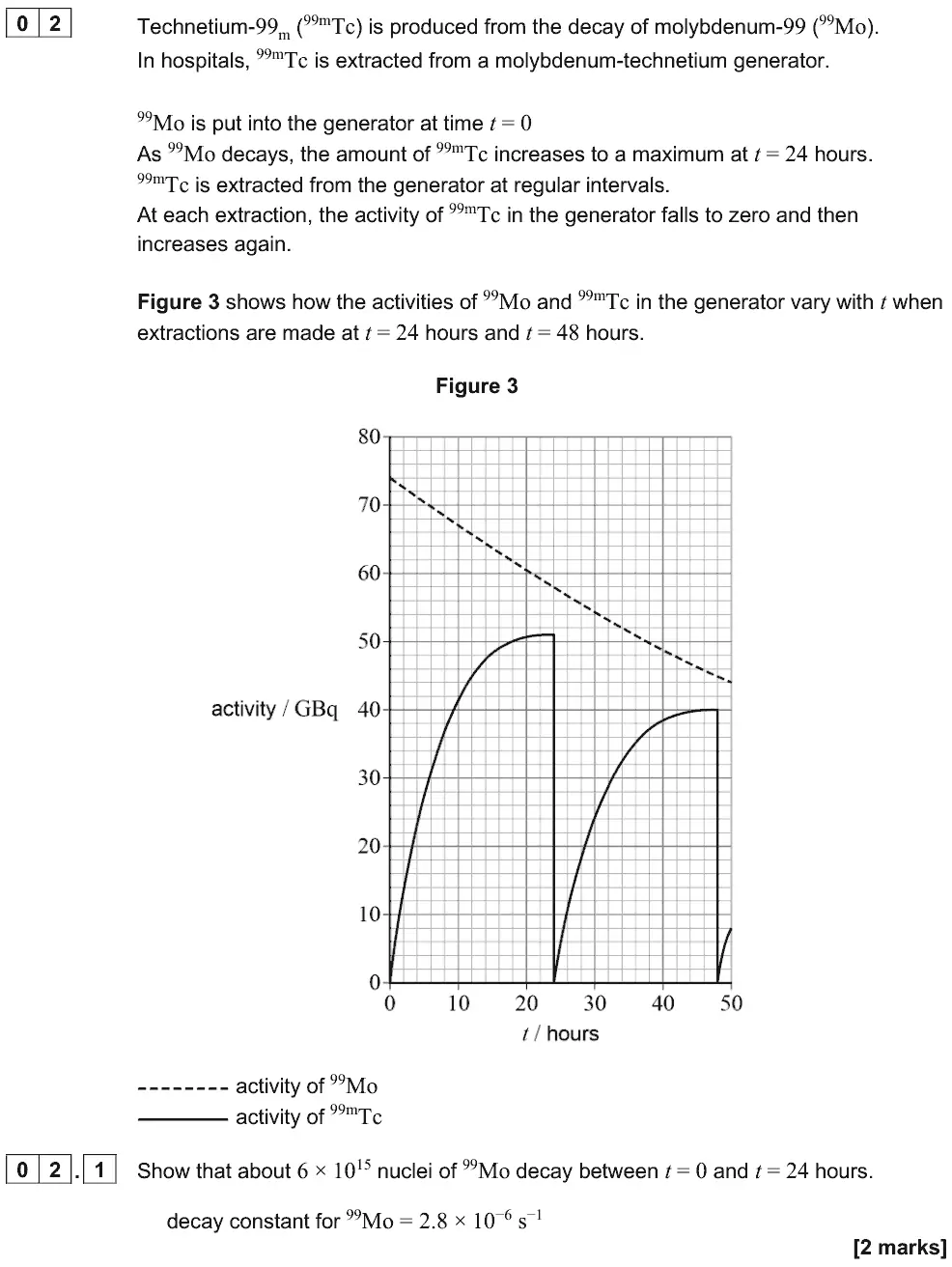
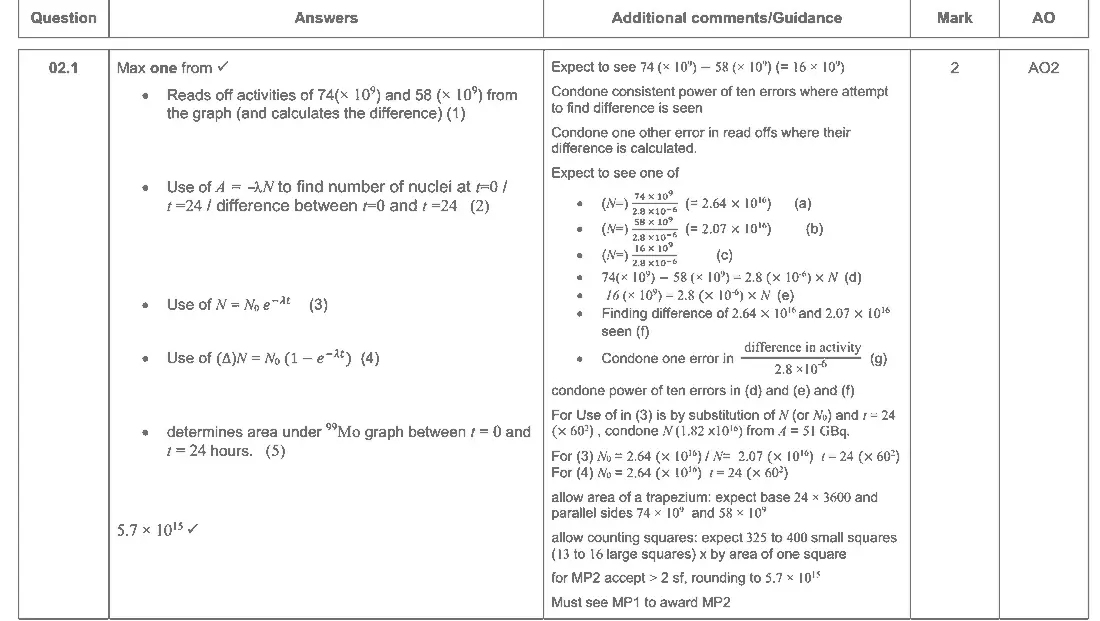
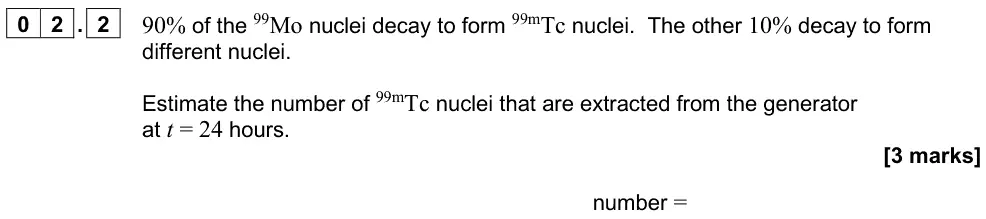
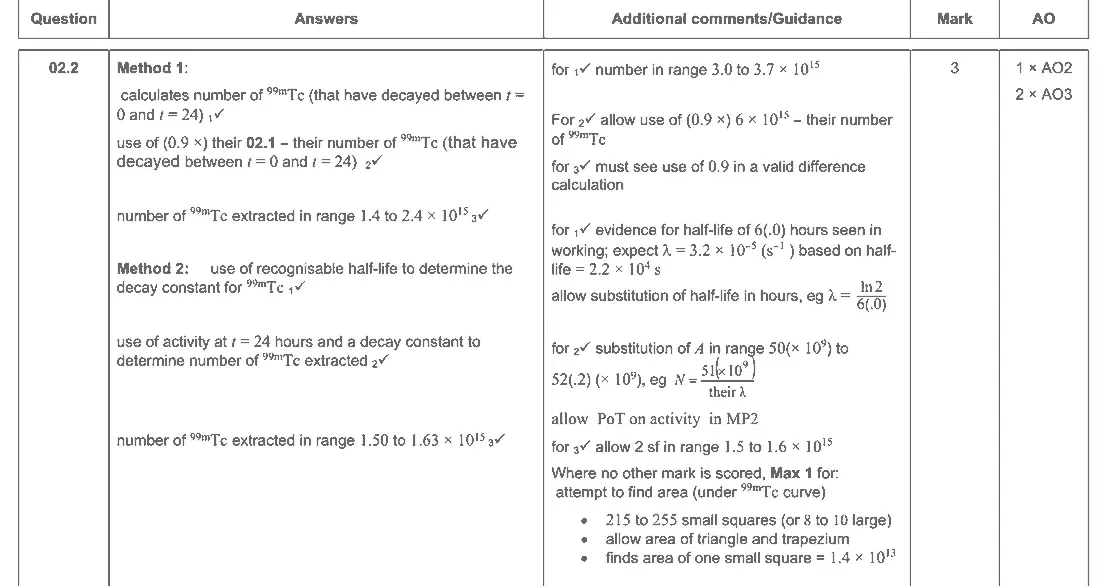
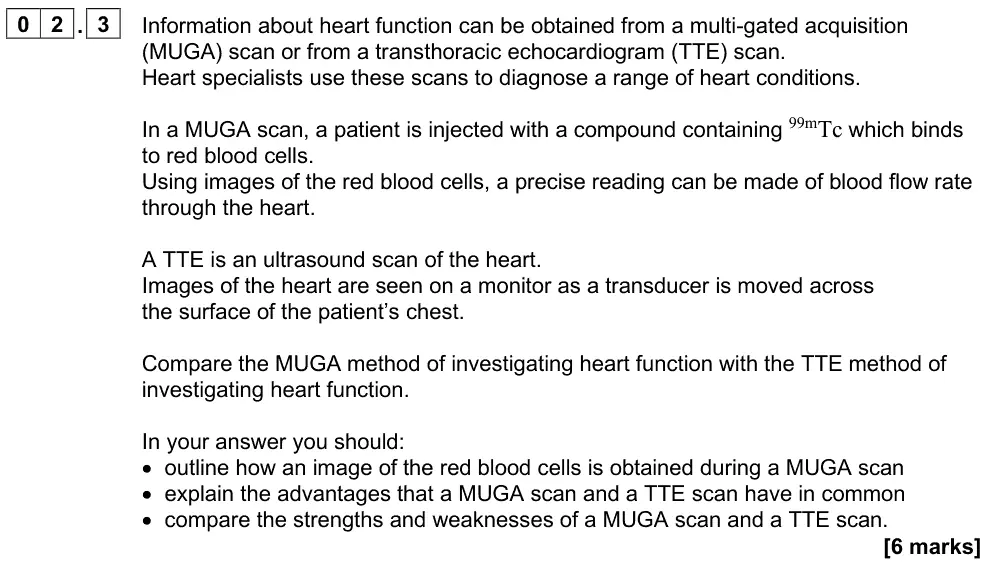
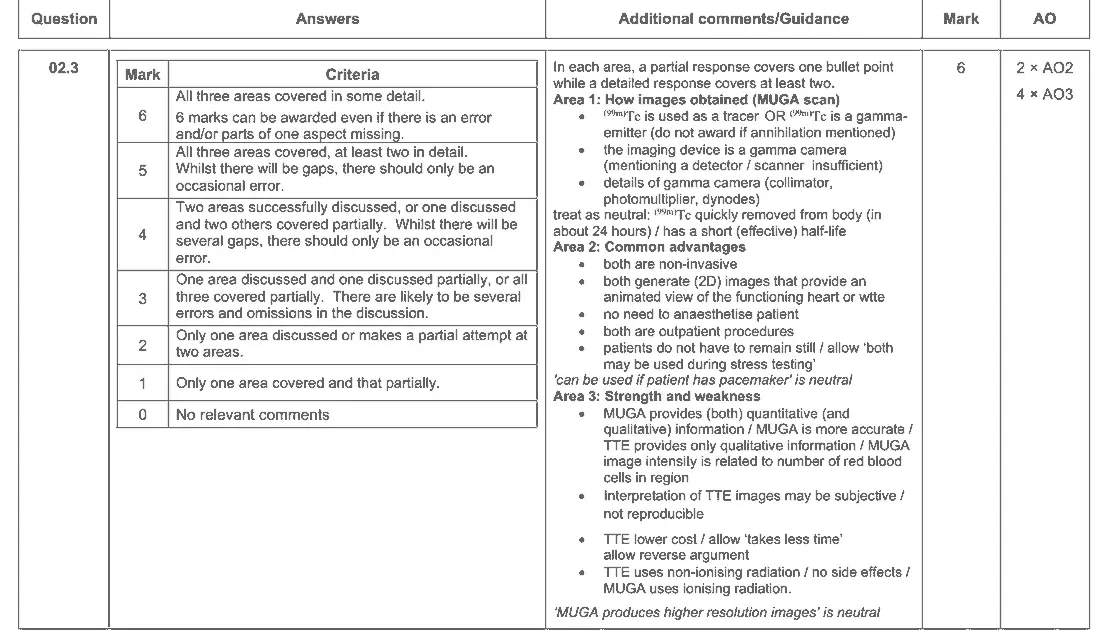
2.1 Students were able to access this question with 58% gaining two marks and a further 20 % gaining one mark. Due to the nature of the ‘show that’, students were able to gain one mark for some partial working while being one step away from the answer. 2.2 This calculation proved to be very challenging with less than 15% of students gaining at least one mark. Most students calculated 90% of their answer to Q2.1. They did not consider that some of this number will have decayed over the 24-hour period. There were two methods that they could employ: In one method, (the intended method) they had to consider how many Tc had been • produced and how many of these had decayed to determine how many remained to be extracted. In the second method, they could use the activity of the Tc after 24 hours and the • decay constant to determine the number of Tc nuclei present. But even this more direct method meant having a well-developed ability to analyse Figure 3 and choose the correct decay constant for Tc (which they had to work out from knowing that Tc has a half-life of 6 hours). Some students realised that the activity of the Tc was important but divided this activity by the decay constant for molybdenum. 2.3 Over 35% of students gained at least 4 marks. Most of these students were able to provide answers that addressed area 1 and area 3 of the mark scheme. Many students restated information given in the question without adding any further detail. Many were not sure what was meant by ‘non-invasive’ and stated TTE as being non-invasive but MUGA being invasive. Many students confused the MUGA beta minus decay with a PET scan. The quality of the language was often vague, with some students referring to radiation rather than ionising radiation.
Notes from the mark scheme and report
- Answer: 5.7 x 10^15 (Mo activity 74 GBq to 58 GBq
- N = A/lambda, difference
- or area under graph)
Skills: MS3.1 Translate information between graphical, numerical and algebraic forms; MS2.3 Substitute numerical values into algebraic equations using appropriate units for physical quantities; MS3.8 Understand the possible physical significance of the area between a curve and the x axis and be able to calculate it or estimate it by graphical methods as appropriate