November 2020: Paper 3B Medical physics

35 marks · 12 question parts · Paper, mark scheme and report on AQA's site · An autumn series using the paper written for the cancelled summer exams · Have the data and formulae booklet beside you

Question by question

QTopicMarksAOType
1.1 Physics of the eye, the ear and the ECG 5AO1=5Explanation
1.2 Physics of the eye, the ear and the ECG 1AO1=1Short answer
1.3 Physics of the eye, the ear and the ECG 3AO3=3Explanation
2.1 Physics of the eye, the ear and the ECG 2AO1=2Short answer
2.2 Physics of the eye, the ear and the ECG 3AO2=3Calculation
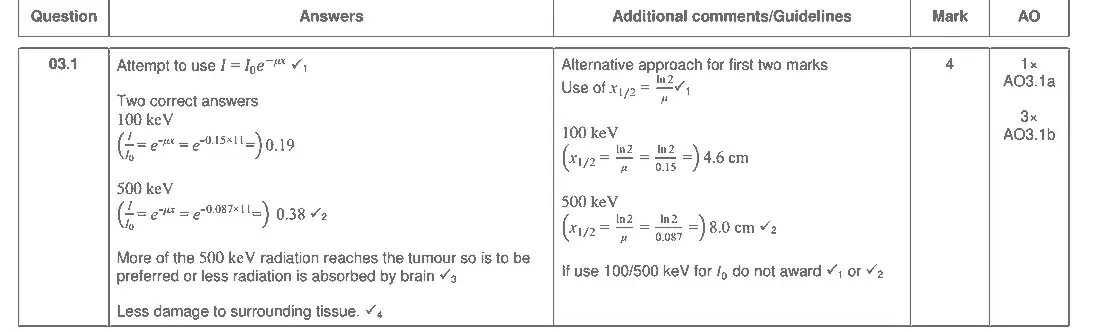
3.1 Medical imaging: ultrasound, X-rays, CT, MRI and radionuclides 4AO3=4Calculation
3.2 Medical imaging: ultrasound, X-rays, CT, MRI and radionuclides 2AO3=2Explanation
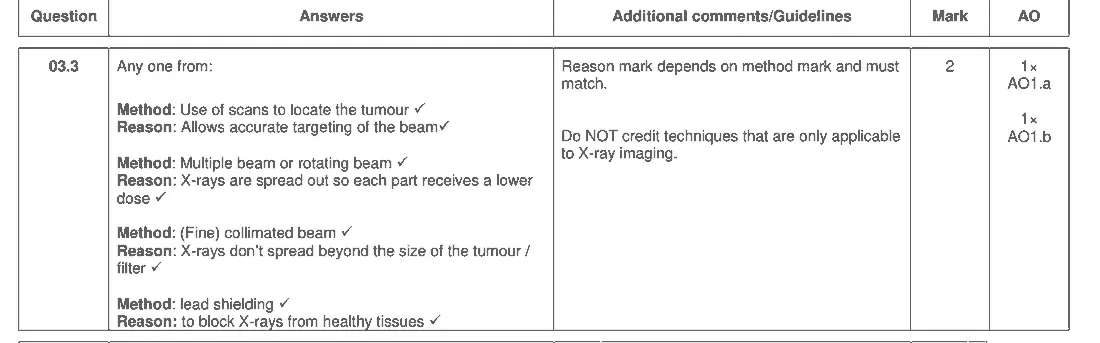
3.3 Medical imaging: ultrasound, X-rays, CT, MRI and radionuclides 2AO1=2Explanation
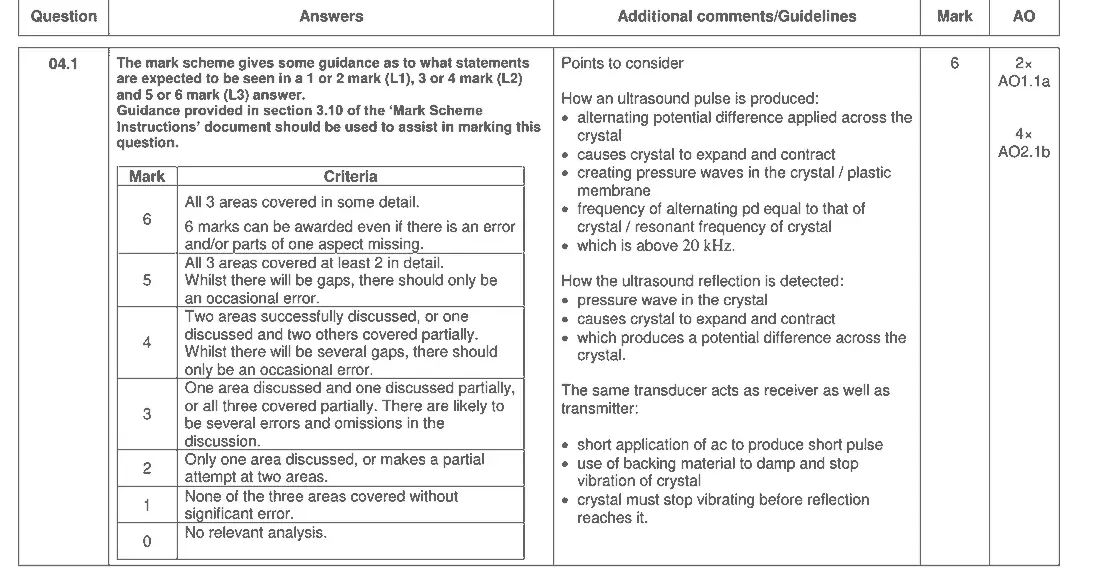
4.1 Medical imaging: ultrasound, X-rays, CT, MRI and radionuclides 6AO1=2,AO2=4Extended response
4.2 Medical imaging: ultrasound, X-rays, CT, MRI and radionuclides 1AO2=1Calculation
4.3 Medical imaging: ultrasound, X-rays, CT, MRI and radionuclides 4AO2=4Calculation
4.4 Medical imaging: ultrasound, X-rays, CT, MRI and radionuclides 2AO3=2Explanation

The questions

1.11.21.32.12.23.13.23.34.14.24.34.4
November 2020 · Paper 3B Medical physics · Q1.1 5 marks AO1=5 Explanation eye ear and ecg
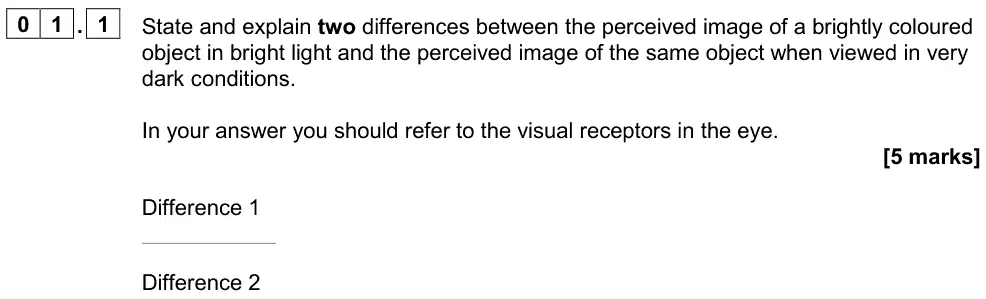
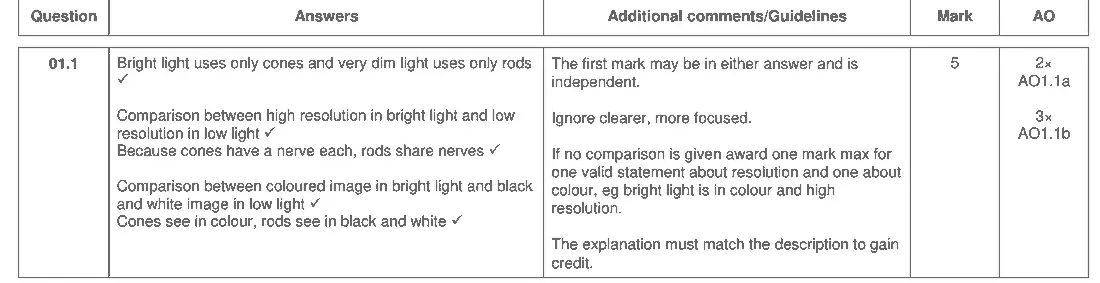
State and explain two differences between the perceived image of a brightly coloured
object in bright light and the perceived image of the same object when viewed in very
dark conditions.
In your answer you should refer to the visual receptors in the eye.
[5 marks]
Difference 1
Difference 2
November 2020 · Paper 3B Medical physics · Q1.2 1 mark AO1=1 Short answer eye ear and ecg
Earlier part of question 1 that this part usesEarlier part of November 2020 Paper 3B Medical physics question 1
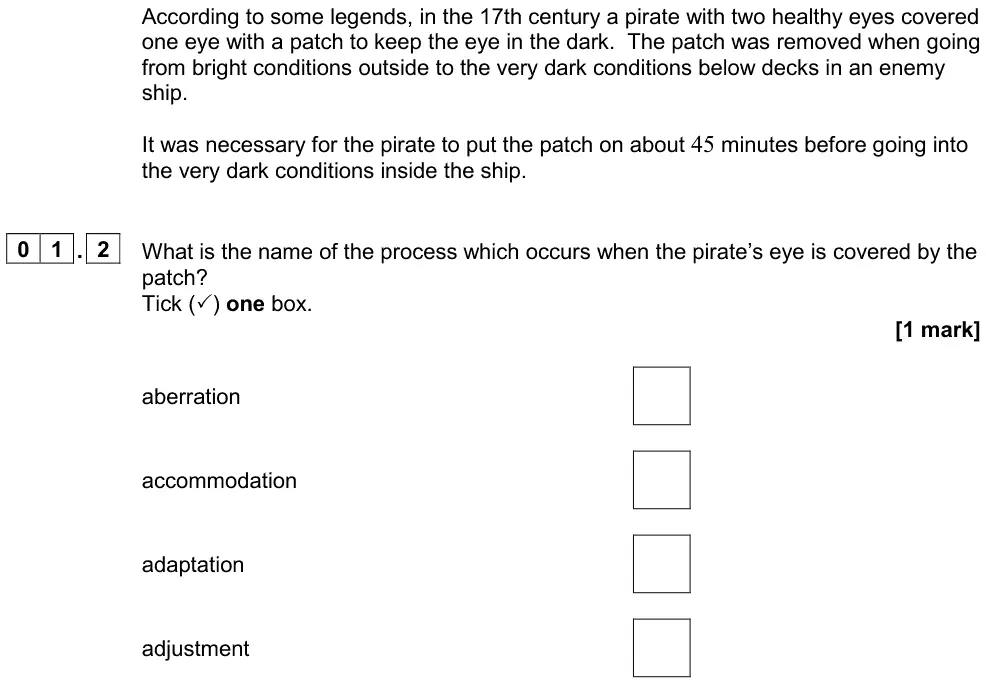
According to some legends, in the 17th century a pirate with two healthy eyes covered
one eye with a patch to keep the eye in the dark.  The patch was removed when going
from bright conditions outside to the very dark conditions below decks in an enemy
ship.
It was necessary for the pirate to put the patch on about 45 minutes before going into
the very dark conditions inside the ship.
What is the name of the process which occurs when the pirate’s eye is covered by the
patch?
Tick () one box.
[1 mark]
aberration
accommodation
adaptation
adjustment
November 2020 · Paper 3B Medical physics · Q1.3 3 marks AO3=3 Explanation eye ear and ecg
Earlier part of question 1 that this part usesEarlier part of November 2020 Paper 3B Medical physics question 1
Discuss why it was necessary to wear the eye patch for 45 minutes before entering
the ship.
[3 marks]
November 2020 · Paper 3B Medical physics · Q2.1 2 marks AO1=2 Short answer eye ear and ecg
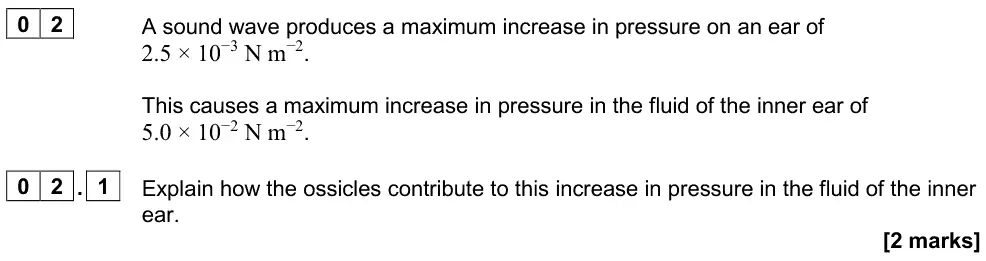
A sound wave produces a maximum increase in pressure on an ear of
2.5 × 10⁻³ N m−2.
This causes a maximum increase in pressure in the fluid of the inner ear of
5.0 × 10⁻² N m−2.
Explain how the ossicles contribute to this increase in pressure in the fluid of the inner
ear.
[2 marks]
November 2020 · Paper 3B Medical physics · Q2.2 3 marks AO2=3 Calculation eye ear and ecg
Earlier part of question 2 that this part usesEarlier part of November 2020 Paper 3B Medical physics question 2
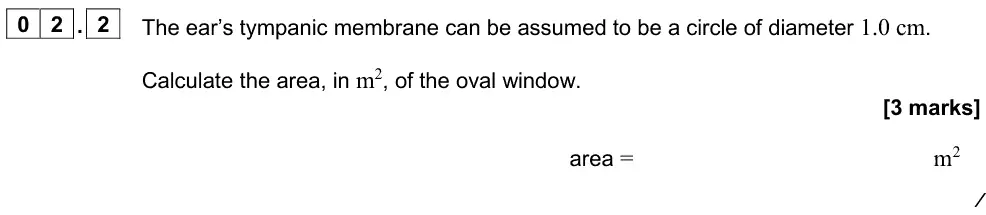
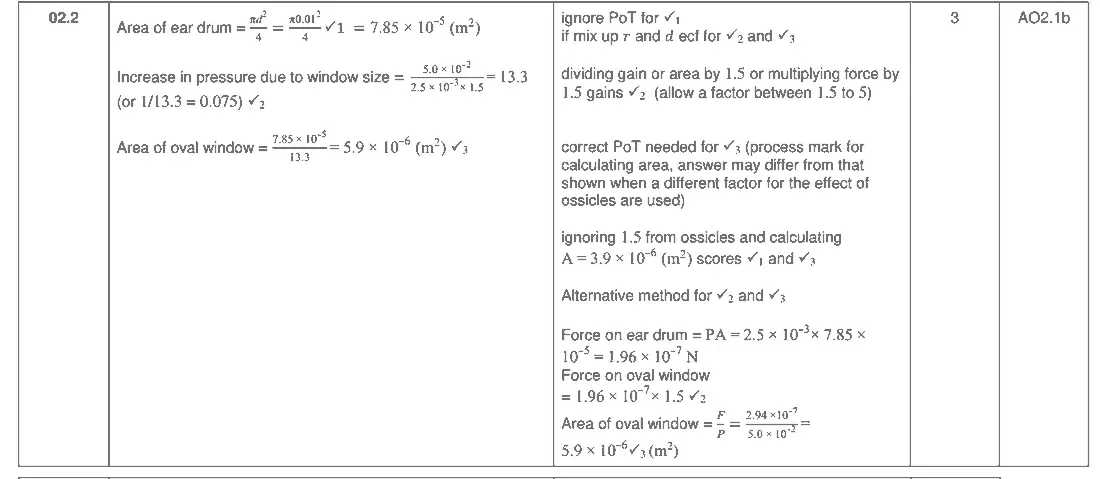
The ear’s tympanic membrane can be assumed to be a circle of diameter 1.0 cm.
Calculate the area, in m2, of the oval window.
[3 marks]
area =
m2
November 2020 · Paper 3B Medical physics · Q3.1 4 marks AO3=4 Calculation medical imaging
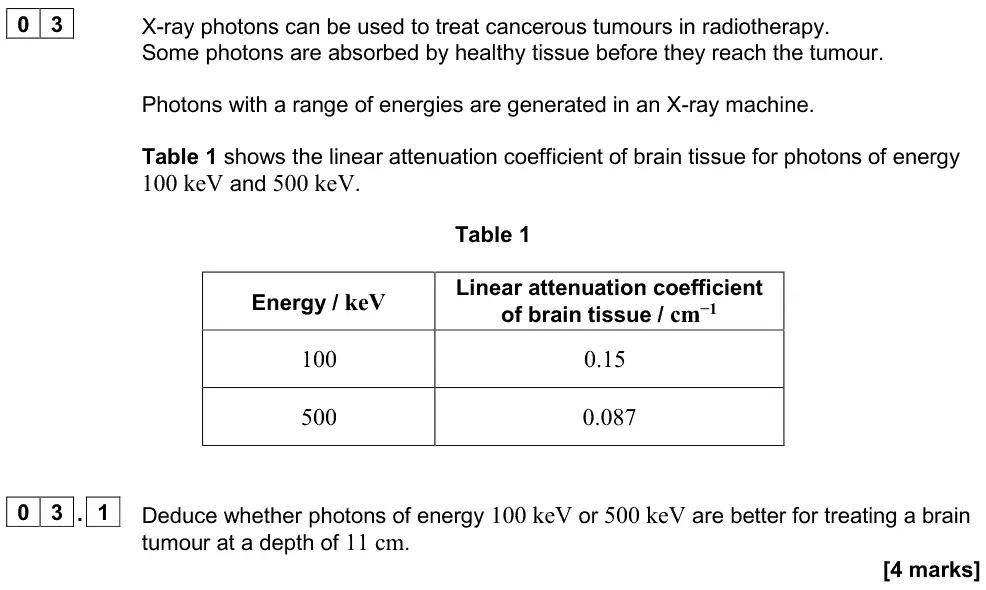
X-ray photons can be used to treat cancerous tumours in radiotherapy.
Some photons are absorbed by healthy tissue before they reach the tumour.
Photons with a range of energies are generated in an X-ray machine.
Table 1 shows the linear attenuation coefficient of brain tissue for photons of energy
100 keV and 500 keV.
Table 1
Energy / keV
Linear attenuation coefficient
of brain tissue / cm−1
100
0.15
500
0.087
Deduce whether photons of energy 100 keV or 500 keV are better for treating a brain
tumour at a depth of 11 cm.
[4 marks]
November 2020 · Paper 3B Medical physics · Q3.2 2 marks AO3=2 Explanation medical imaging
Earlier part of question 3 that this part usesEarlier part of November 2020 Paper 3B Medical physics question 3
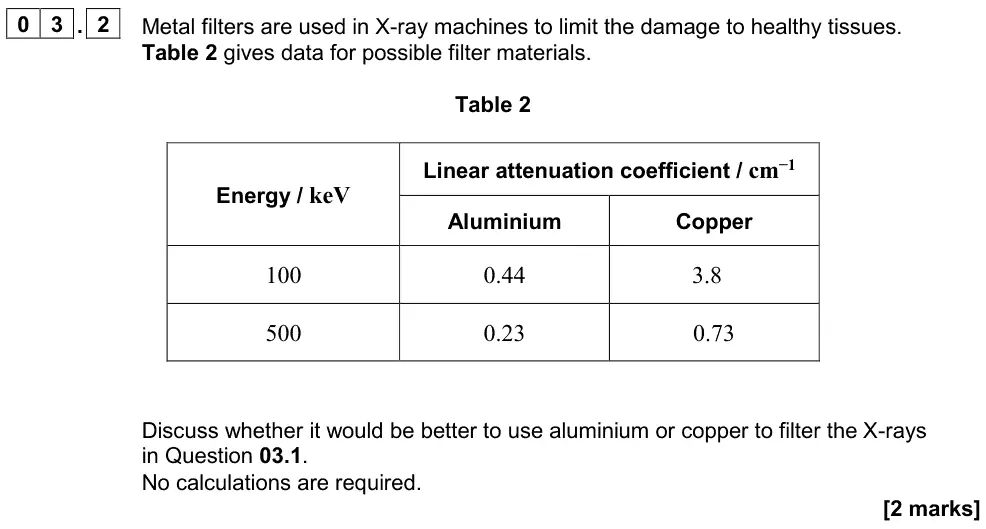
Metal filters are used in X-ray machines to limit the damage to healthy tissues.
Table 2 gives data for possible filter materials.
Table 2
Energy / keV
Linear attenuation coefficient / cm−1
Aluminium
Copper
100
0.44
3.8
500
0.23
0.73
Discuss whether it would be better to use aluminium or copper to filter the X-rays
in Question 03.1.
No calculations are required.
[2 marks]
November 2020 · Paper 3B Medical physics · Q3.3 2 marks AO1=2 Explanation medical imaging
Earlier part of question 3 that this part usesEarlier part of November 2020 Paper 3B Medical physics question 3
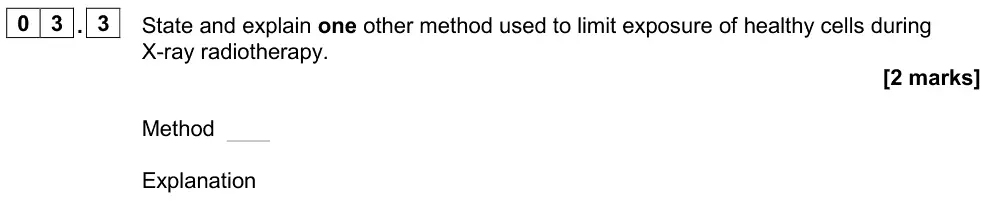
State and explain one other method used to limit exposure of healthy cells during
X-ray radiotherapy.
[2 marks]
Method
Explanation
November 2020 · Paper 3B Medical physics · Q4.1 6 marks AO1=2, AO2=4 6-mark extended response medical imaging
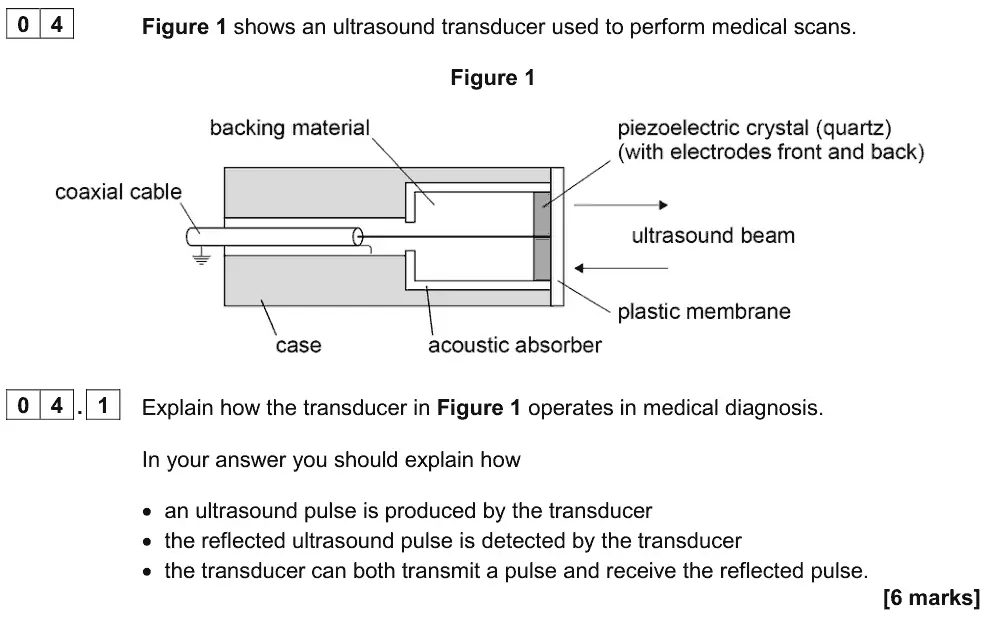
Figure 1 shows an ultrasound transducer used to perform medical scans.
Figure 1
Explain how the transducer in Figure 1 operates in medical diagnosis.
In your answer you should explain how
• an ultrasound pulse is produced by the transducer
• the reflected ultrasound pulse is detected by the transducer
• the transducer can both transmit a pulse and receive the reflected pulse.
[6 marks]
November 2020 · Paper 3B Medical physics · Q4.2 1 mark AO2=1 Calculation medical imaging
Earlier part of question 4 that this part usesEarlier part of November 2020 Paper 3B Medical physics question 4
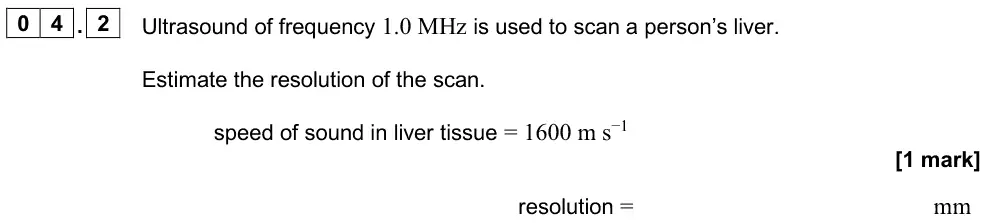
Ultrasound of frequency 1.0 MHz is used to scan a person’s liver.
Estimate the resolution of the scan.
speed of sound in liver tissue = 1600 m s−1
[1 mark]
resolution =
mm
November 2020 · Paper 3B Medical physics · Q4.3 4 marks AO2=4 Calculation medical imaging
Earlier part of question 4 that this part usesEarlier part of November 2020 Paper 3B Medical physics question 4
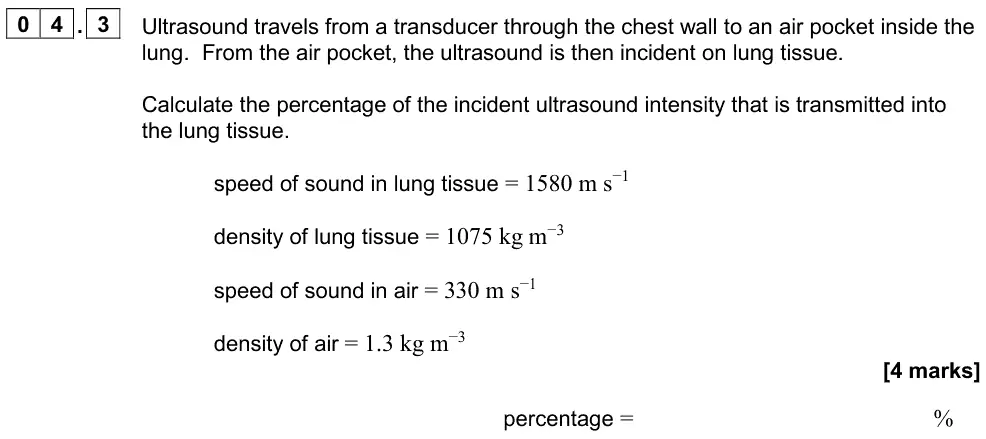
Ultrasound travels from a transducer through the chest wall to an air pocket inside the
lung.  From the air pocket, the ultrasound is then incident on lung tissue.
Calculate the percentage of the incident ultrasound intensity that is transmitted into
the lung tissue.
speed of sound in lung tissue = 1580 m s−1
density of lung tissue = 1075 kg m−3
speed of sound in air = 330 m s−1
density of air = 1.3 kg m−3
[4 marks]
percentage =
%
November 2020 · Paper 3B Medical physics · Q4.4 2 marks AO3=2 Explanation medical imaging
Earlier part of question 4 that this part usesEarlier part of November 2020 Paper 3B Medical physics question 4
Discuss whether an ultrasound scan would be suitable to investigate a tumour inside
a lung.
[2 marks]

Work with an AQA physics tutor

Want a paper marked and gone through with you? Message us.

Prefer email? Send an enquiry

If you are under 18, please include a parent's contact details. Enquiries go to enquiries@physicsaleveltutor.com and are deleted once handled. All tutoring is online.