
June 2017: Paper 3B Turning points

35 marks · 13 question parts · Paper, mark scheme and report on AQA's site · Have the data and formulae booklet beside you

Question by question

QTopicMarksAOType
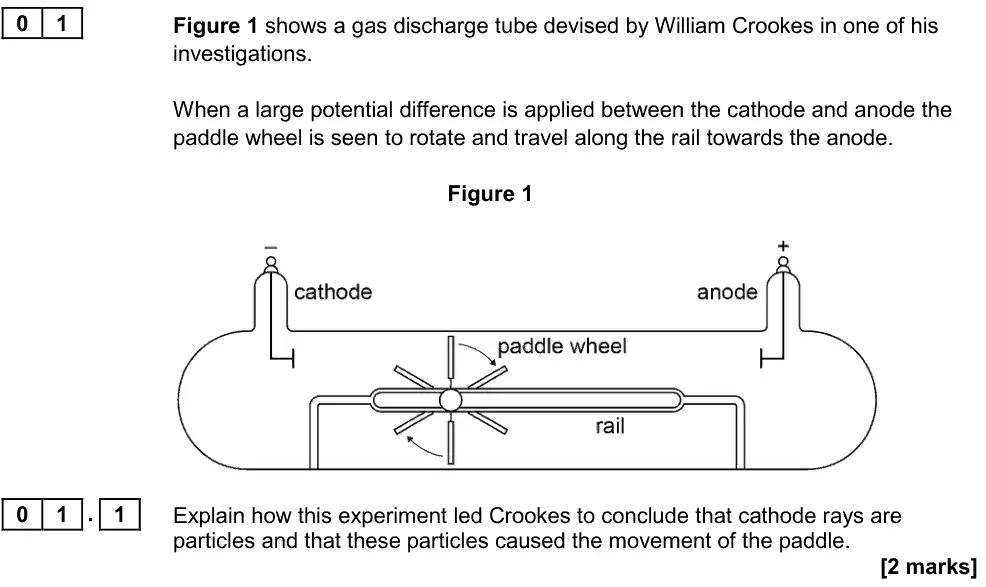
1.1 The discovery of the electron 2Explanation
1.2 The discovery of the electron 3Explanation
1.3 The discovery of the electron 2Explanation
2.1 Wave-particle duality: from Newton to electron microscopes 2Short answer
2.2 Wave-particle duality: from Newton to electron microscopes 2Calculation
2.3 Wave-particle duality: from Newton to electron microscopes 2Short answer
2.4 Wave-particle duality: from Newton to electron microscopes 3Explanation
3.1 Wave-particle duality: from Newton to electron microscopes, The discovery of the electron 1Short answer
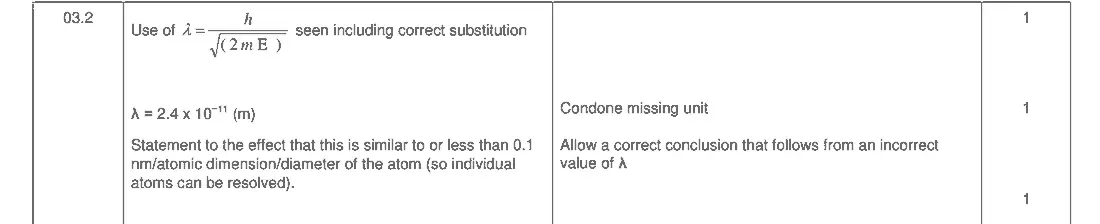
3.2 Wave-particle duality: from Newton to electron microscopes 3Calculation
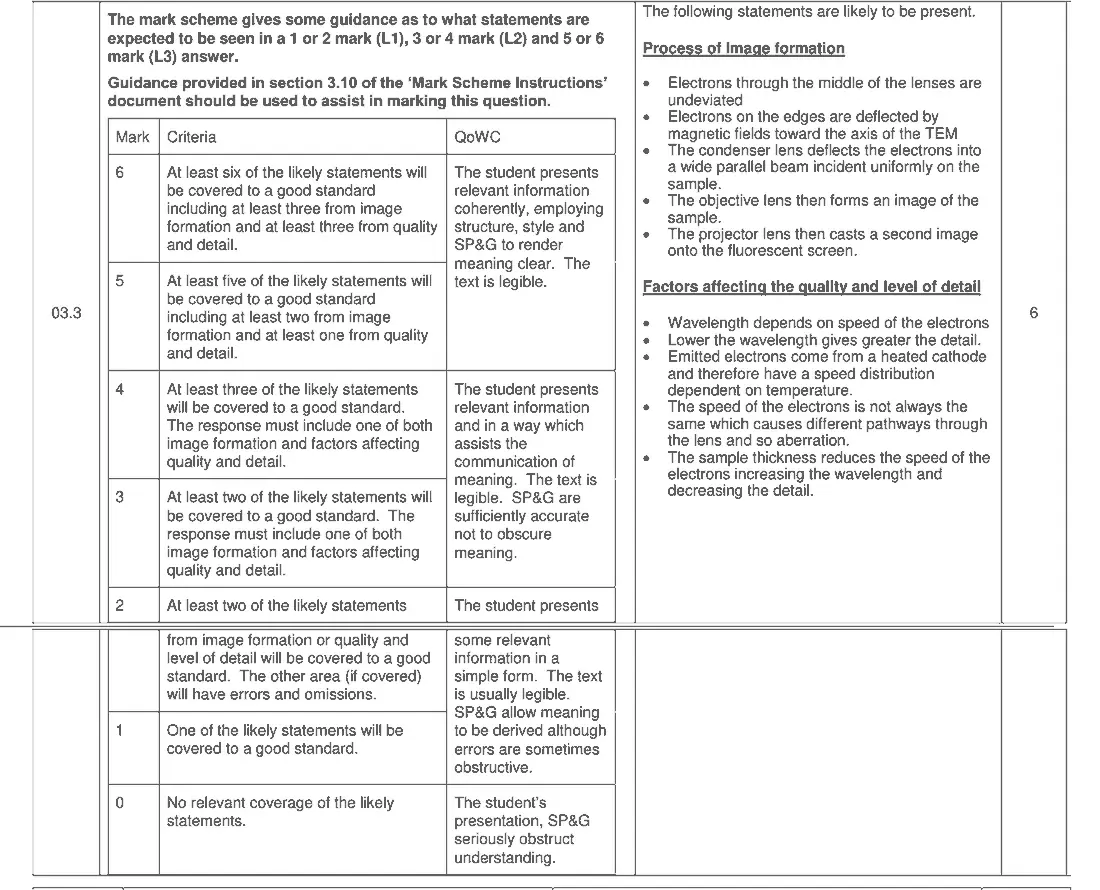
3.3 Wave-particle duality: from Newton to electron microscopes 6Extended response
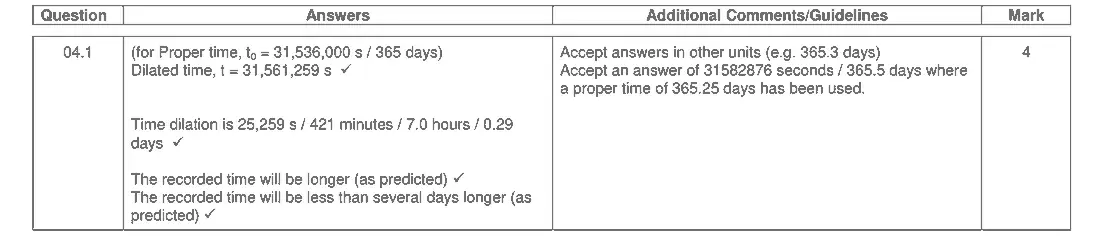
4.1 Special relativity 4Calculation
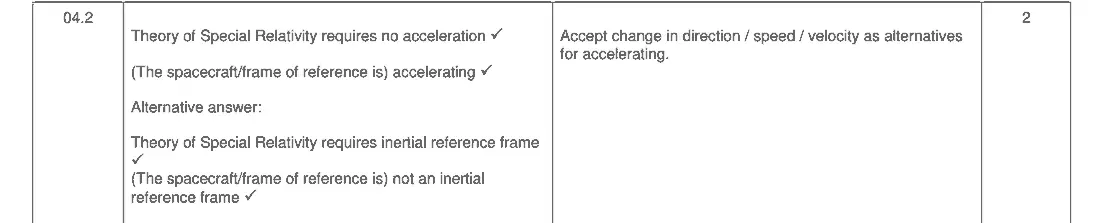
4.2 Special relativity 2Explanation
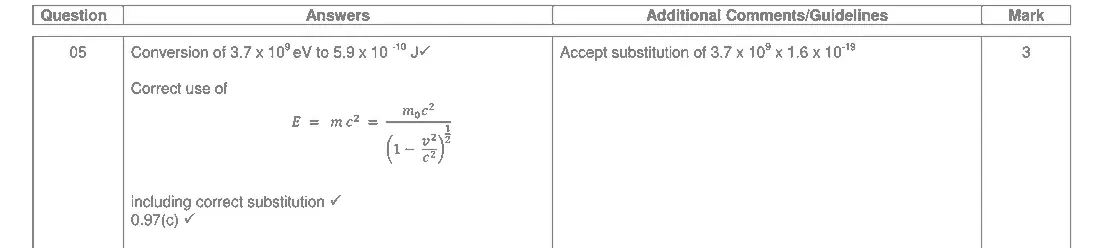
5 Special relativity 3Calculation

The questions

1.11.21.32.12.22.32.43.13.23.34.14.25
June 2017 · Paper 3B Turning points · Q1.1 2 marks Explanation discovery of the electron
Figure 1 shows a gas discharge tube devised by William Crookes in one of his
investigations.
When a large potential difference is applied between the cathode and anode the
paddle wheel is seen to rotate and travel along the rail towards the anode.
Figure 1
Explain how this experiment led Crookes to conclude that cathode rays are
particles and that these particles caused the movement of the paddle.
[2 marks]
June 2017 · Paper 3B Turning points · Q1.2 3 marks Explanation discovery of the electron
Earlier part of question 1 that this part usesEarlier part of June 2017 Paper 3B Turning points question 1
Later experiments showed that cathode rays are electrons in motion.
Explain how cathode rays are produced in a gas discharge tube.
[3 marks]
June 2017 · Paper 3B Turning points · Q1.3 2 marks Explanation discovery of the electron
Earlier part of question 1 that this part usesEarlier part of June 2017 Paper 3B Turning points question 1
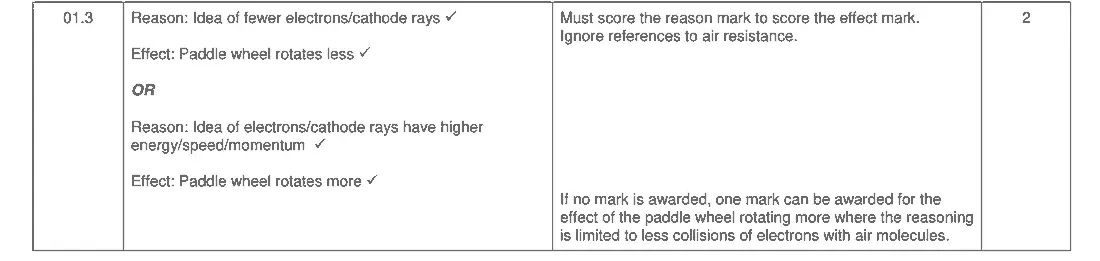
In a particular gas discharge tube, air molecules inside the tube are absorbed by
the walls of the tube.
Suggest the effect that this absorption may have on the motion of the paddle
wheel.
Give a reason for your answer.
[2 marks]
June 2017 · Paper 3B Turning points · Q2.1 2 marks Short answer wave particle duality history
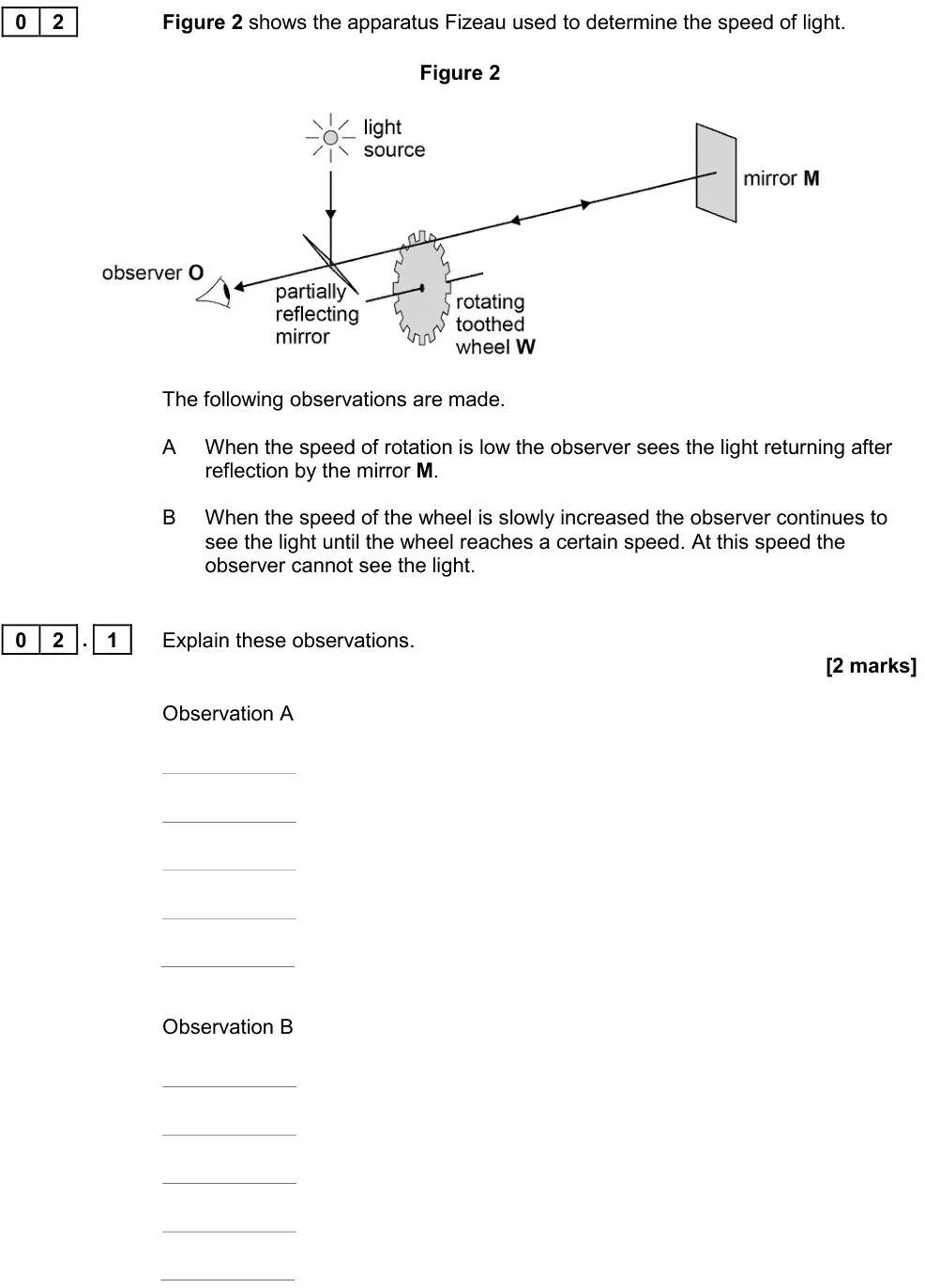
Figure 2 shows the apparatus Fizeau used to determine the speed of light.
Figure 2
The following observations are made.
A
When the speed of rotation is low the observer sees the light returning after
reflection by the mirror M.
B
When the speed of the wheel is slowly increased the observer continues to
see the light until the wheel reaches a certain speed. At this speed the
observer cannot see the light.
Explain these observations.
[2 marks]
Observation A
Observation B
June 2017 · Paper 3B Turning points · Q2.2 2 marks Calculation wave particle duality history
Earlier part of question 2 that this part usesEarlier part of June 2017 Paper 3B Turning points question 2
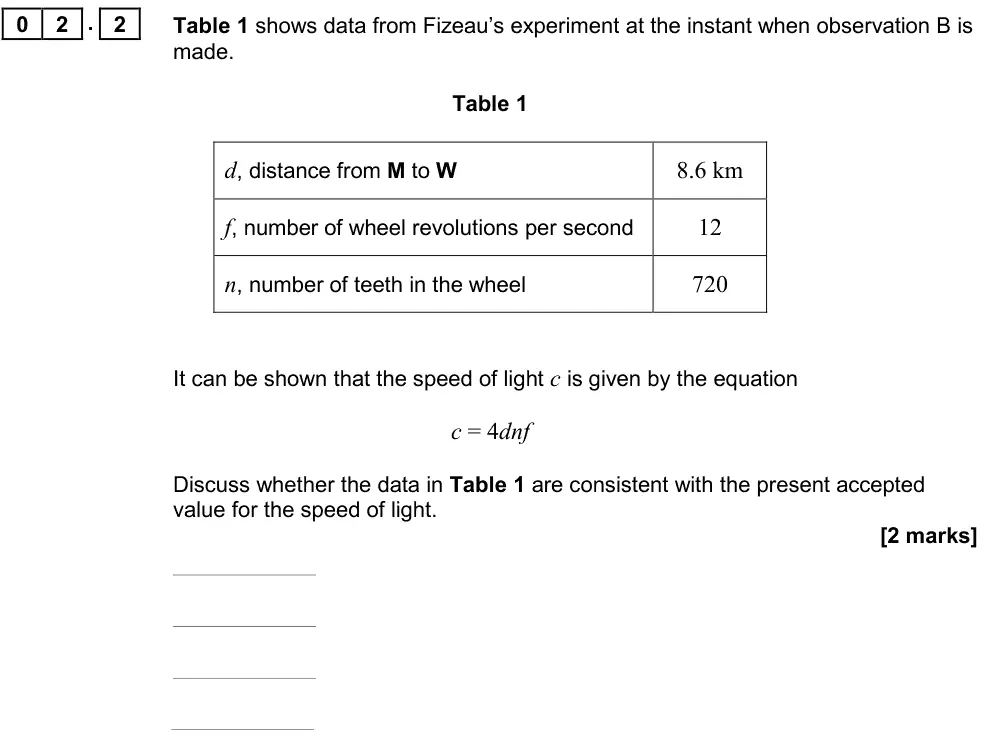
Table 1 shows data from Fizeau’s experiment at the instant when observation B is
made.
Table 1
d, distance from M to W
8.6 km
f, number of wheel revolutions per second
12
n, number of teeth in the wheel
720
It can be shown that the speed of light c is given by the equation
c = 4dnf
Discuss whether the data in Table 1 are consistent with the present accepted
value for the speed of light.
[2 marks]
June 2017 · Paper 3B Turning points · Q2.3 2 marks Short answer wave particle duality history
Earlier part of question 2 that this part usesEarlier part of June 2017 Paper 3B Turning points question 2
The speed of the wheel is further increased.
Deduce the value of f when the observer would next be unable to see light
returning from the mirror.
[2 marks]
June 2017 · Paper 3B Turning points · Q2.4 3 marks Explanation wave particle duality history
Earlier part of question 2 that this part usesEarlier part of June 2017 Paper 3B Turning points question 2
Explain how the nature of light is implied by Maxwell’s theory of electromagnetic
waves and Fizeau’s result.
[3 marks]
June 2017 · Paper 3B Turning points · Q3.1 1 mark Short answer wave particle duality historydiscovery of the electron
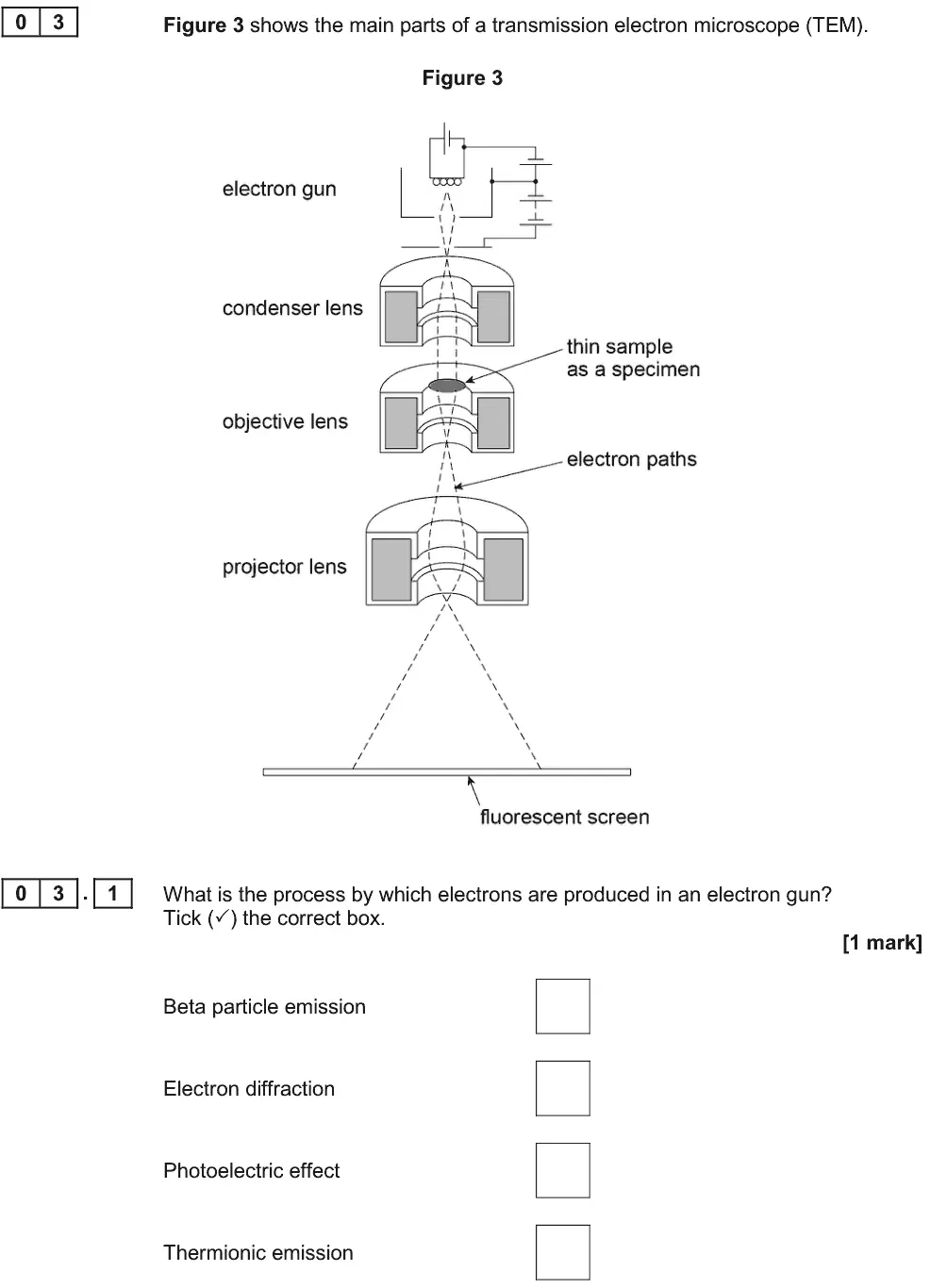
Figure 3 shows the main parts of a transmission electron microscope (TEM).
Figure 3
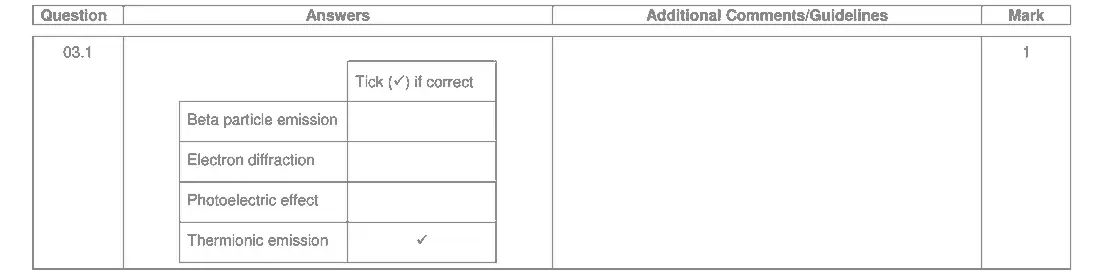
What is the process by which electrons are produced in an electron gun?
Tick () the correct box.
[1 mark]
Beta particle emission
Electron diffraction
Photoelectric effect
Thermionic emission
June 2017 · Paper 3B Turning points · Q3.2 3 marks Calculation wave particle duality history
Earlier part of question 3 that this part usesEarlier part of June 2017 Paper 3B Turning points question 3
The electrons in a particular TEM have a kinetic energy of 4.1 × 10⁻¹⁶ J.
Relativistic effects are negligible for this electron energy.
Suggest, with a calculation, whether the images of individual atoms can, in
principle, be resolved in this TEM.
[3 marks]
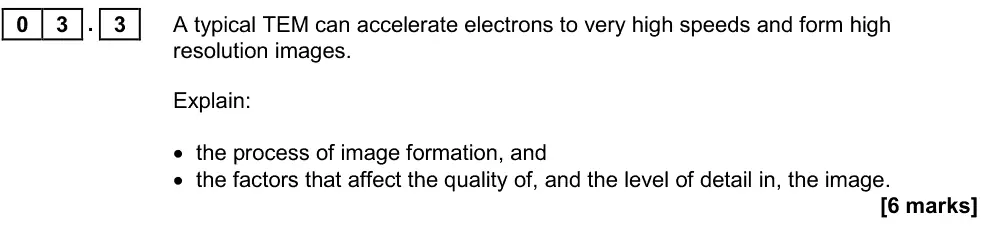
June 2017 · Paper 3B Turning points · Q3.3 6 marks 6-mark extended response wave particle duality history
Earlier part of question 3 that this part usesEarlier part of June 2017 Paper 3B Turning points question 3
A typical TEM can accelerate electrons to very high speeds and form high
resolution images.
Explain:
• the process of image formation, and
• the factors that affect the quality of, and the level of detail in, the image.
[6 marks]
June 2017 · Paper 3B Turning points · Q4.1 4 marks Calculation special relativity
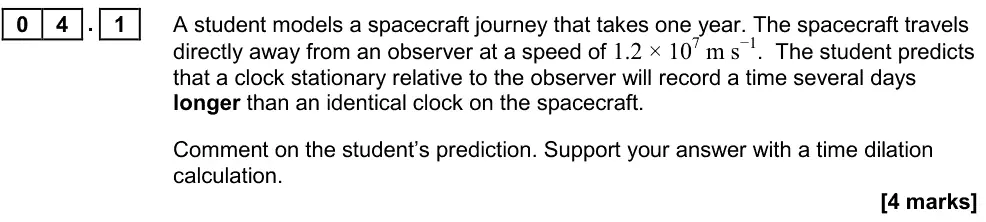
A student models a spacecraft journey that takes one year. The spacecraft travels
directly away from an observer at a speed of 1.2 × 10⁷ m s−1.  The student predicts
that a clock stationary relative to the observer will record a time several days
longer than an identical clock on the spacecraft.
Comment on the student’s prediction. Support your answer with a time dilation
calculation.
[4 marks]
June 2017 · Paper 3B Turning points · Q4.2 2 marks Explanation special relativity
Earlier part of question 4 that this part usesEarlier part of June 2017 Paper 3B Turning points question 4
In practice, the gravitational field of the Sun affects the motion of the spacecraft
and it does not travel directly away from the Earth throughout the journey.
Explain why this means that the theory of special relativity cannot be applied to the
journey.
[2 marks]
June 2017 · Paper 3B Turning points · Q5 3 marks Calculation special relativity
Cosmic rays detected on a spacecraft are protons with a total energy of
3.7 × 10⁹ eV.
Calculate the velocity of the protons as a fraction of the speed of light.
[3 marks]
proton velocity =
c

Work with an AQA physics tutor

Want a paper marked and gone through with you? Message us.

Prefer email? Send an enquiry

If you are under 18, please include a parent's contact details. Enquiries go to enquiries@physicsaleveltutor.com and are deleted once handled. All tutoring is online.