
June 2018: Paper 3B Astrophysics

35 marks · 12 question parts · Paper, mark scheme and report on AQA's site · Have the data and formulae booklet beside you

Question by question

QTopicMarksAOType
1.1 Telescopes 2Calculation
1.2 Telescopes 3Calculation
1.3 Telescopes 3Calculation
2.1 Classification of stars and the HR diagram 2Diagram or graph
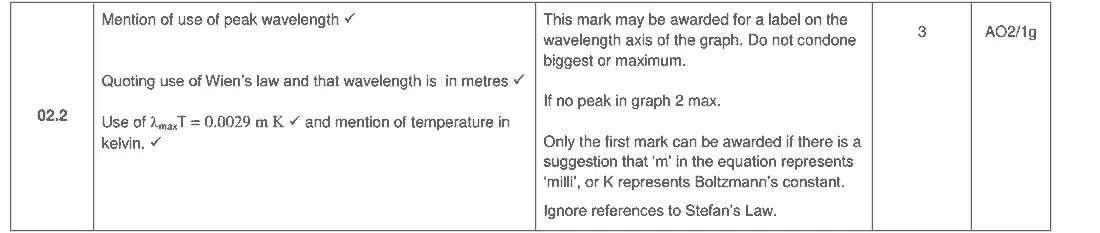
2.2 Classification of stars and the HR diagram 3Explanation
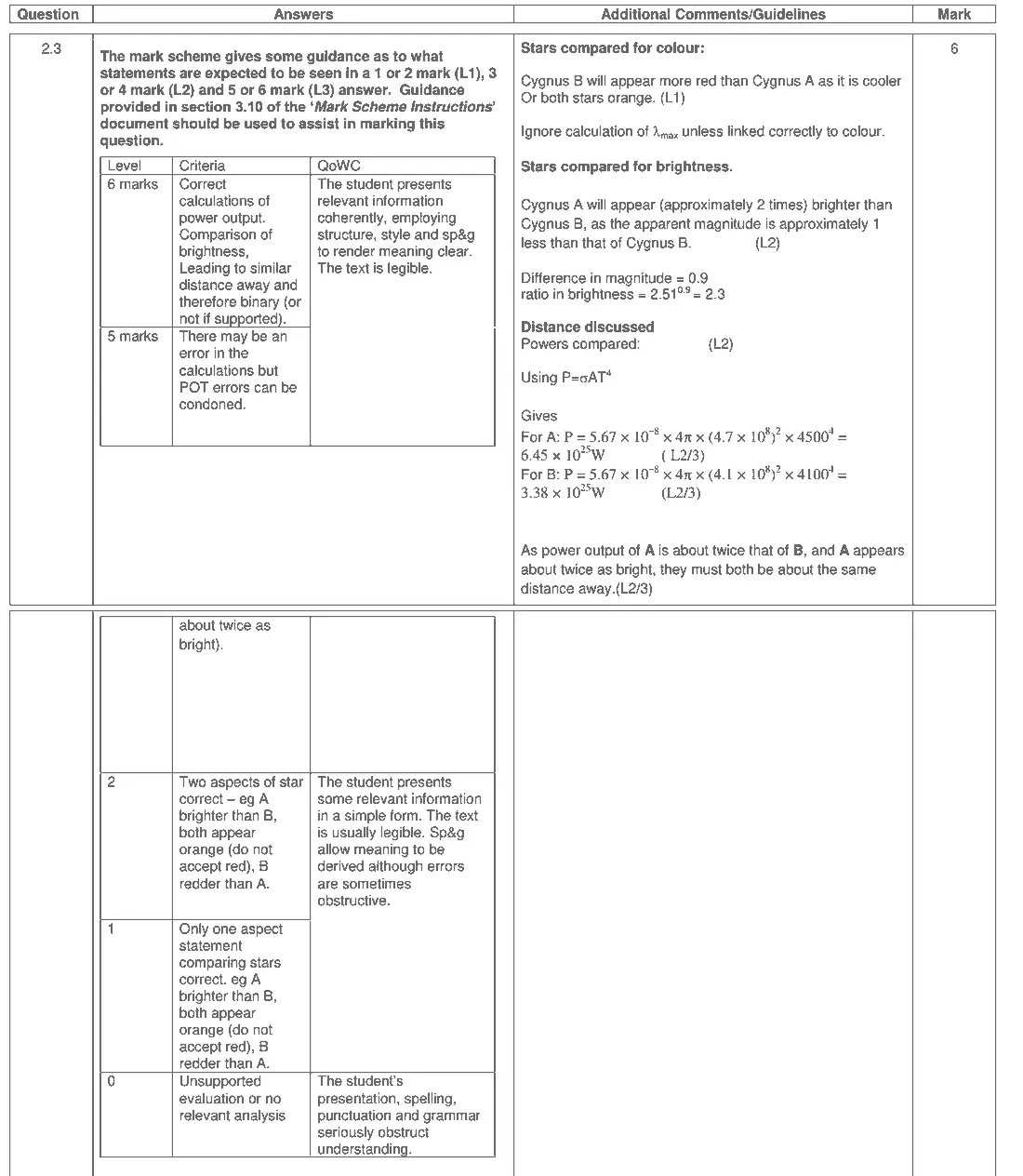
2.3 Classification of stars and the HR diagram 6Extended response
2.4 Classification of stars and the HR diagram 1Short answer
3.1 Cosmology: Doppler effect, Hubble's law, quasars and exoplanets, Classification of stars and the HR diagram 2Short answer
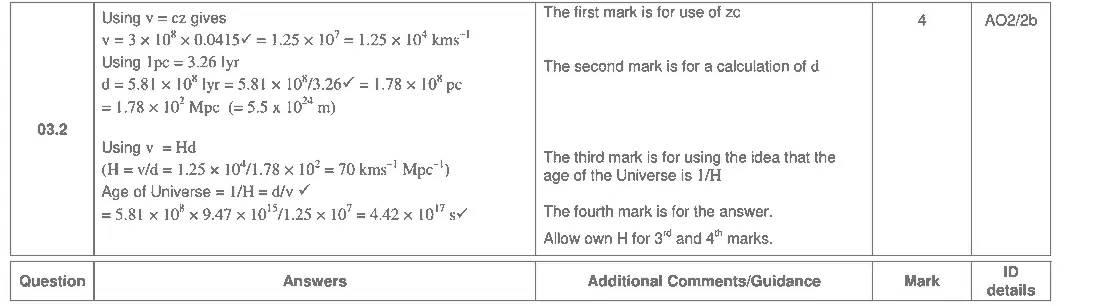
3.2 Cosmology: Doppler effect, Hubble's law, quasars and exoplanets 4Calculation
3.3 Cosmology: Doppler effect, Hubble's law, quasars and exoplanets, Classification of stars and the HR diagram 3Calculation
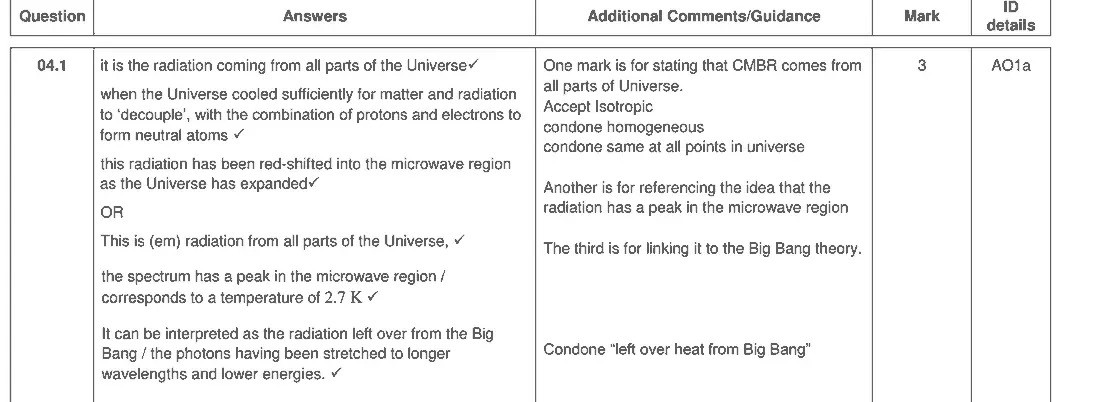
4.1 Cosmology: Doppler effect, Hubble's law, quasars and exoplanets 3Explanation
4.2 Cosmology: Doppler effect, Hubble's law, quasars and exoplanets 3Explanation

The questions

1.11.21.32.12.22.32.43.13.23.34.14.2
June 2018 · Paper 3B Astrophysics · Q1.1 2 marks Calculation Easy telescopes
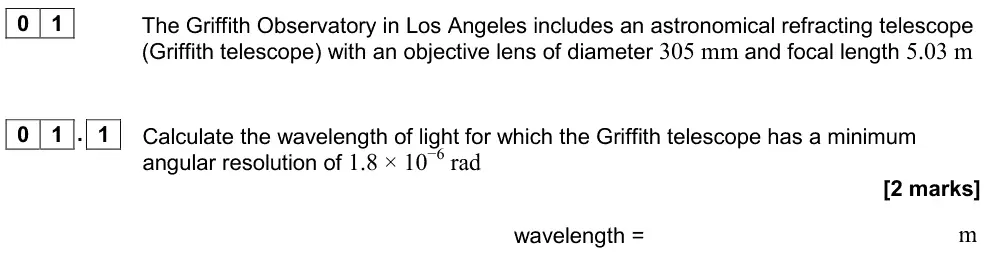
The Griffith Observatory in Los Angeles includes an astronomical refracting telescope
(Griffith telescope) with an objective lens of diameter 305 mm and focal length 5.03 m
Calculate the wavelength of light for which the Griffith telescope has a minimum
angular resolution of 1.8 × 10⁻⁶ rad
[2 marks]
wavelength =
m
June 2018 · Paper 3B Astrophysics · Q1.2 3 marks Calculation Easy telescopes
Earlier part of question 1 that this part usesEarlier part of June 2018 Paper 3B Astrophysics question 1
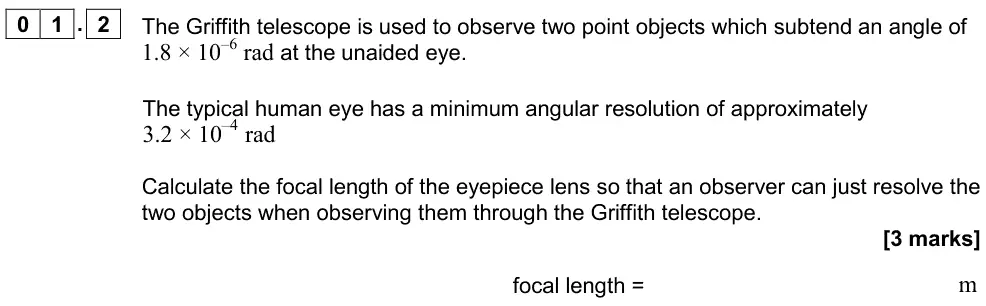
The Griffith telescope is used to observe two point objects which subtend an angle of
1.8 × 10⁻⁶ rad at the unaided eye.
The typical human eye has a minimum angular resolution of approximately
3.2 × 10⁻⁴ rad
Calculate the focal length of the eyepiece lens so that an observer can just resolve the
two objects when observing them through the Griffith telescope.
[3 marks]
focal length =
m
June 2018 · Paper 3B Astrophysics · Q1.3 3 marks Calculation Hard telescopes
Earlier part of question 1 that this part usesEarlier part of June 2018 Paper 3B Astrophysics question 1
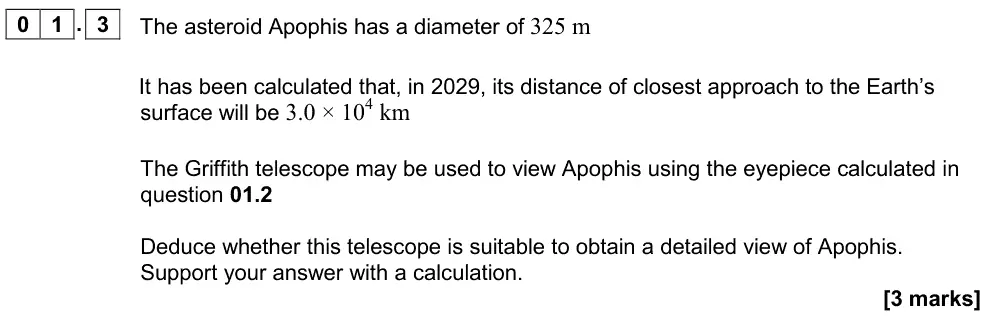
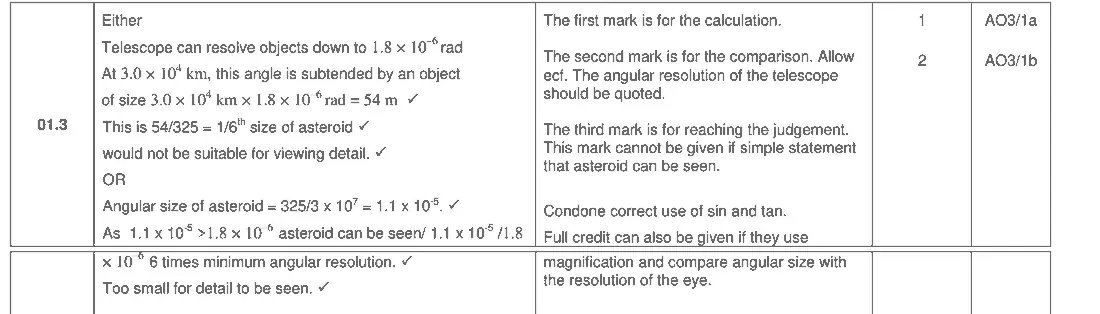
The asteroid Apophis has a diameter of 325 m
It has been calculated that, in 2029, its distance of closest approach to the Earth’s
surface will be 3.0 × 10⁴ km
The Griffith telescope may be used to view Apophis using the eyepiece calculated in
question 01.2
Deduce whether this telescope is suitable to obtain a detailed view of Apophis.
Support your answer with a calculation.
[3 marks]
June 2018 · Paper 3B Astrophysics · Q2.1 2 marks Diagram or graph Easy classification of stars
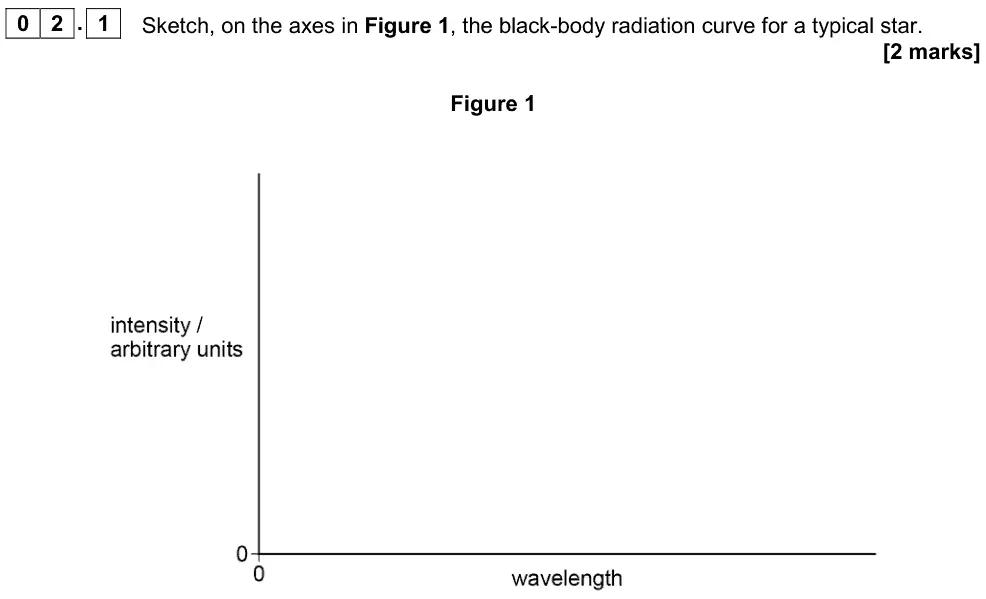
Sketch, on the axes in Figure 1, the black-body radiation curve for a typical star.
[2 marks]
Figure 1
June 2018 · Paper 3B Astrophysics · Q2.2 3 marks Explanation classification of stars
Earlier part of question 2 that this part usesEarlier part of June 2018 Paper 3B Astrophysics question 2
Explain, with reference to the SI units involved, how the curve you have drawn can be
used to determine the black-body temperature of the star.
[3 marks]
June 2018 · Paper 3B Astrophysics · Q2.3 6 marks 6-mark extended response classification of stars
Earlier part of question 2 that this part usesEarlier part of June 2018 Paper 3B Astrophysics question 2
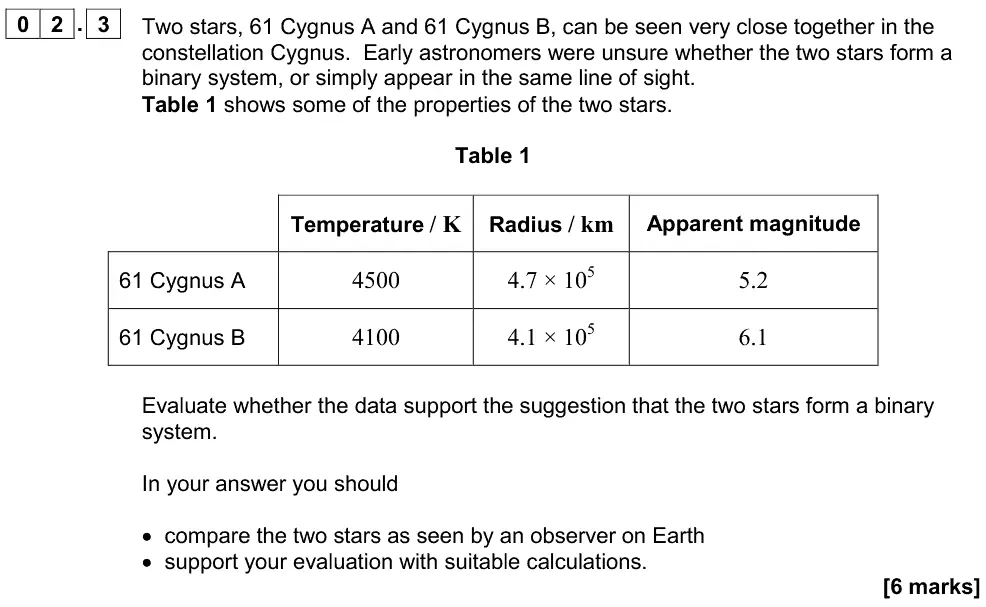
Two stars, 61 Cygnus A and 61 Cygnus B, can be seen very close together in the
constellation Cygnus.  Early astronomers were unsure whether the two stars form a
binary system, or simply appear in the same line of sight.
Table 1 shows some of the properties of the two stars.
Table 1
Temperature / K
Radius / km
Apparent magnitude
61 Cygnus A
4500
4.7 × 10⁵
5.2
61 Cygnus B
4100
4.1 × 10⁵
6.1
Evaluate whether the data support the suggestion that the two stars form a binary
system.
In your answer you should
• compare the two stars as seen by an observer on Earth
• support your evaluation with suitable calculations.
[6 marks]
June 2018 · Paper 3B Astrophysics · Q2.4 1 mark Short answer classification of stars
Earlier part of question 2 that this part usesEarlier part of June 2018 Paper 3B Astrophysics question 2
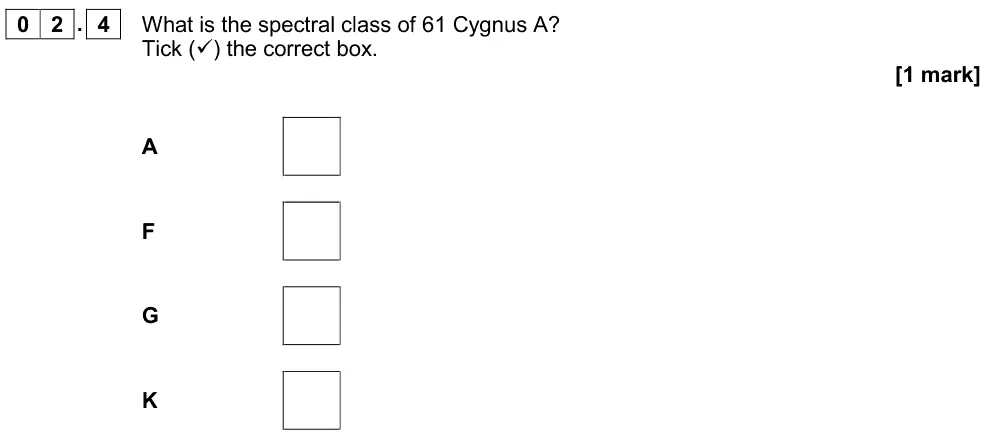
What is the spectral class of 61 Cygnus A?
Tick () the correct box.
[1 mark]
A
F
G
K
June 2018 · Paper 3B Astrophysics · Q3.1 2 marks Short answer Hard cosmologyclassification of stars
Describe the links between galaxies, black holes and quasars.
[2 marks]
June 2018 · Paper 3B Astrophysics · Q3.2 4 marks Calculation cosmology
Earlier part of question 3 that this part usesEarlier part of June 2018 Paper 3B Astrophysics question 3
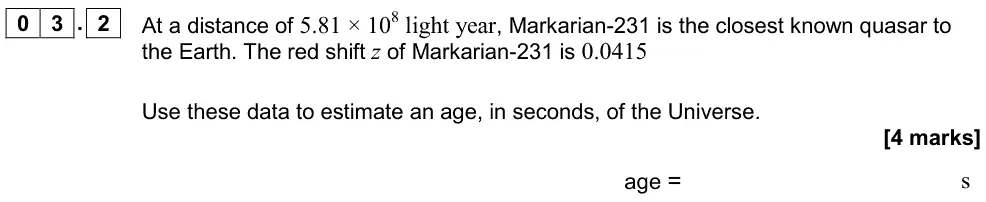
At a distance of 5.81 × 10⁸ light year, Markarian-231 is the closest known quasar to
the Earth. The red shift z of Markarian-231 is 0.0415
Use these data to estimate an age, in seconds, of the Universe.
[4 marks]
age =
s
June 2018 · Paper 3B Astrophysics · Q3.3 3 marks Calculation Hard cosmologyclassification of stars
Earlier part of question 3 that this part usesEarlier part of June 2018 Paper 3B Astrophysics question 3
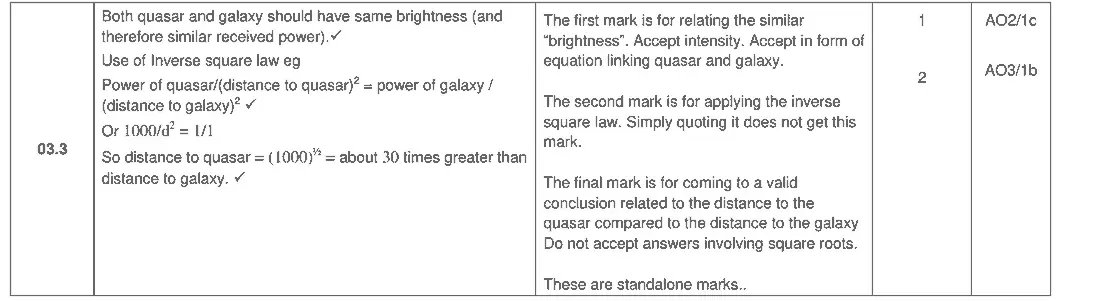
A typical quasar is believed to be approximately the size of the solar system, with a
power output similar to that of a thousand galaxies.
Estimate, with reference to the inverse-square law, how much further the most distant
visible quasar is likely to be compared to the most distant visible galaxy.
[3 marks]
June 2018 · Paper 3B Astrophysics · Q4.1 3 marks Explanation Hard cosmology
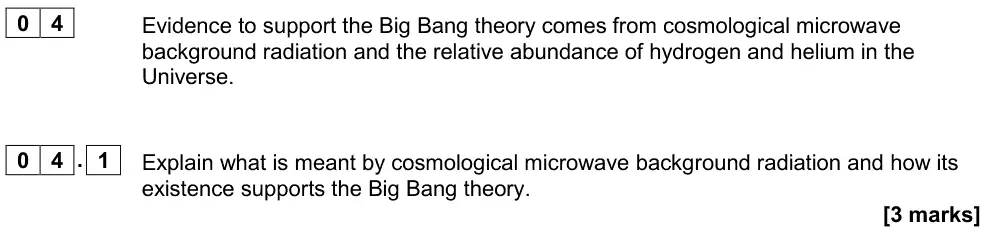
Evidence to support the Big Bang theory comes from cosmological microwave
background radiation and the relative abundance of hydrogen and helium in the
Universe.
Explain what is meant by cosmological microwave background radiation and how its
existence supports the Big Bang theory.
[3 marks]
June 2018 · Paper 3B Astrophysics · Q4.2 3 marks Explanation Hard cosmology
Earlier part of question 4 that this part usesEarlier part of June 2018 Paper 3B Astrophysics question 4
Explain how the relative abundance of hydrogen and helium supports the Big Bang
theory.
[3 marks]

Work with an AQA physics tutor

Want a paper marked and gone through with you? Message us.

Prefer email? Send an enquiry

If you are under 18, please include a parent's contact details. Enquiries go to enquiries@physicsaleveltutor.com and are deleted once handled. All tutoring is online.