Mark scheme

Examiner's comment
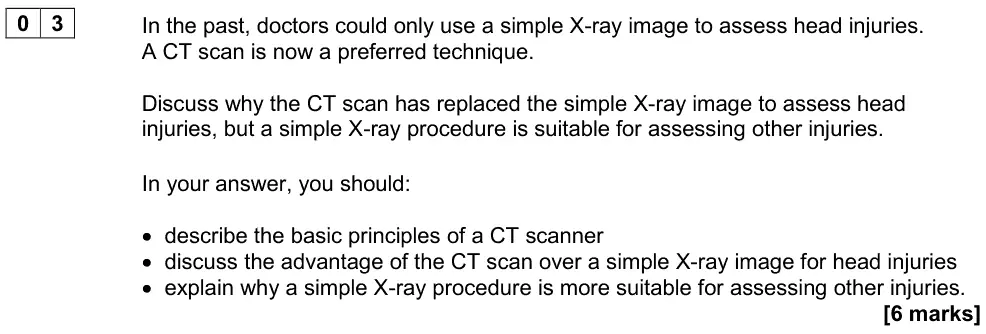
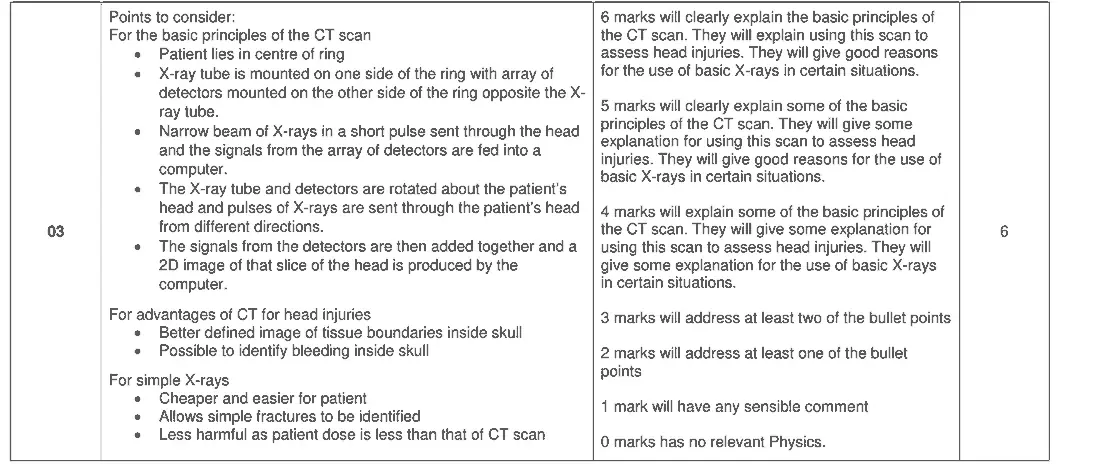
Part 01.1 was descriptive. Although the vast majority of students were able to name the two fibre bundles correctly, few were able then to explain their use well enough to gain full marks (16.2% gained all four available marks). The question required the students to name the bundle and link the fibre arrangement to the use of the bundle. Answers for the use of the coherent bundle such as “used to obtain an image”, “to form an image”, “see inside the body” and “it can image the inside of the body” were not awarded a mark. In a similar way, the answer for the use of the non-coherent bundle “used to transmit light” was not awarded a mark as both bundles transmit light. This question required the students to discuss the basic principles of a CT scanner, to explain why a CT scan was advantageous for assessing head injuries and to explain why a simple X-ray procedure was more suitable for assessing other injuries. Their answers highlighted the lack of clarity in many students’ written work. Many failed to address the advantages of the CT scan for assessing head injuries and thus limited the mark available. A noticeable number seemed to have little or no idea of what a CT scan is and either wrote about an MR scan, or about injecting radioisotopes and detecting the emitted radiation using gamma cameras. The mean mark on this question was 2.55 out of 6, with only 1.1% of students scoring all six marks available.
Notes from the mark scheme and report
- Coherent bundle (fixed fibre arrangement at both ends) transmits the image
- non-coherent bundle (random arrangement) carries light in to illuminate
- 'used to see inside' too vague
- 16.2% full marks