June 2019: Paper 3B Astrophysics

35 marks · 15 question parts · Paper, mark scheme and report on AQA's site · Have the data and formulae booklet beside you

Question by question

QTopicMarksAOType
1.1 Telescopes 1Diagram or graph
1.2 Telescopes 1Short answer
1.3 Telescopes 6Extended response
2.1 Classification of stars and the HR diagram 3Explanation
2.2 Classification of stars and the HR diagram 2Explanation
2.3 Classification of stars and the HR diagram 3Explanation
2.4 Cosmology: Doppler effect, Hubble's law, quasars and exoplanets 2Explanation
2.5 Classification of stars and the HR diagram 3Calculation
3.1 Classification of stars and the HR diagram 1Diagram or graph
3.2 Classification of stars and the HR diagram 2Diagram or graph
3.3 Classification of stars and the HR diagram 2Diagram or graph
3.4 Classification of stars and the HR diagram 1Diagram or graph
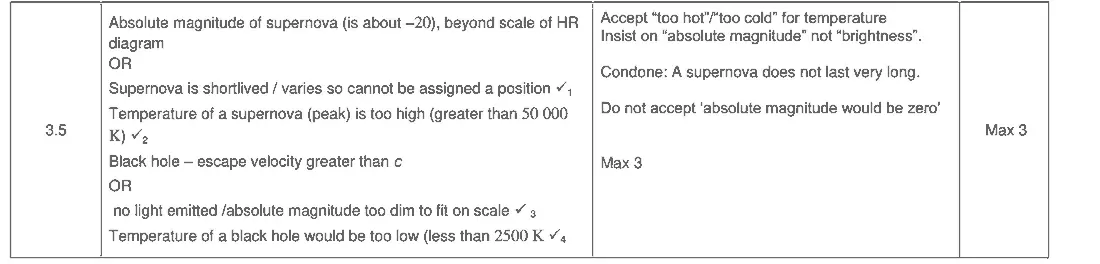
3.5 Classification of stars and the HR diagram 3Explanation
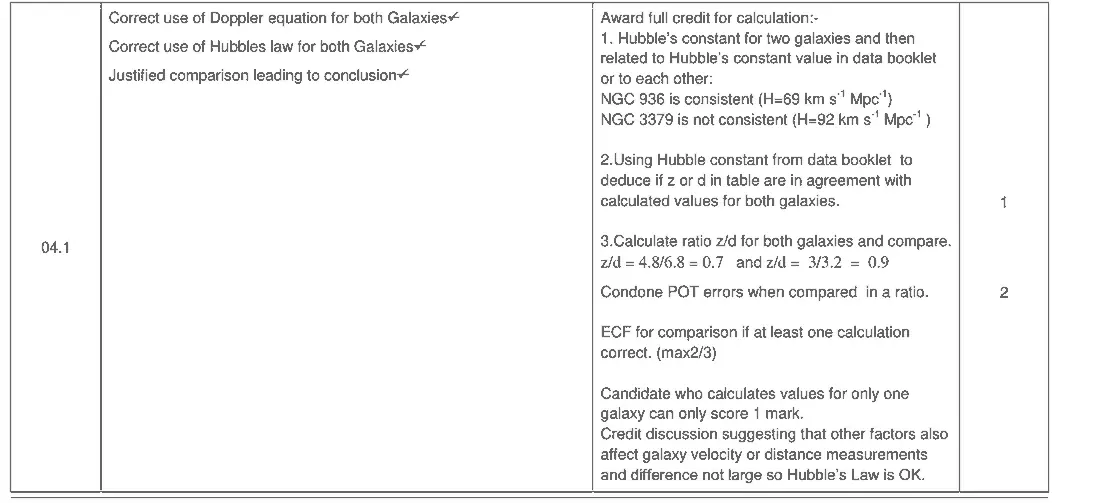
4.1 Cosmology: Doppler effect, Hubble's law, quasars and exoplanets 3Calculation
4.2 Cosmology: Doppler effect, Hubble's law, quasars and exoplanets 2Explanation

The questions

1.11.21.32.12.22.32.42.53.13.23.33.43.54.14.2
June 2019 · Paper 3B Astrophysics · Q1.1 1 mark Diagram or graph telescopes
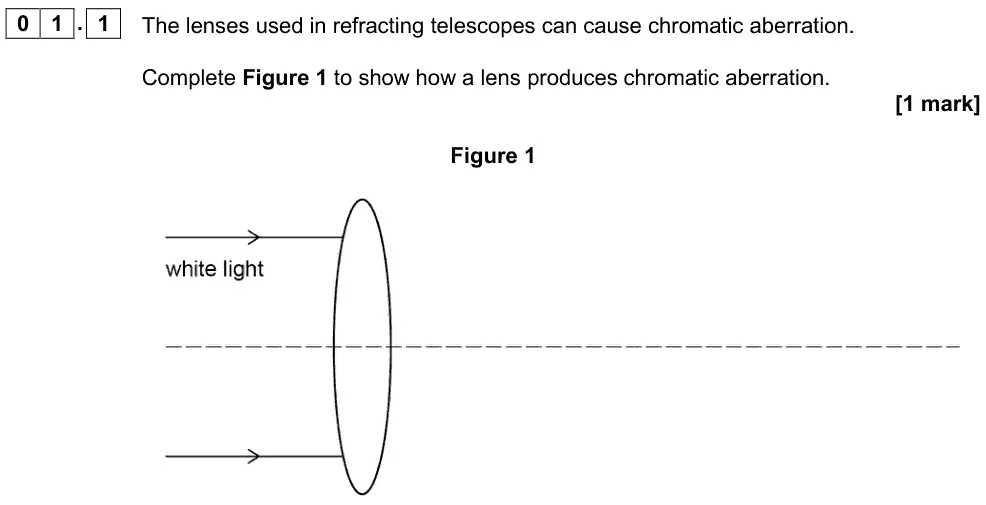
The lenses used in refracting telescopes can cause chromatic aberration.
Complete Figure 1 to show how a lens produces chromatic aberration.
[1 mark]
Figure 1
June 2019 · Paper 3B Astrophysics · Q1.2 1 mark Short answer telescopes
Earlier part of question 1 that this part usesEarlier part of June 2019 Paper 3B Astrophysics question 1
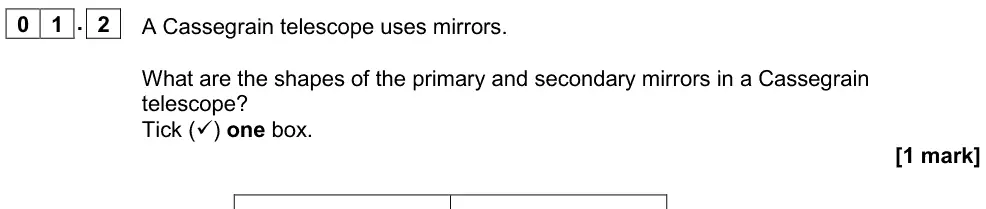
A Cassegrain telescope uses mirrors.
What are the shapes of the primary and secondary mirrors in a Cassegrain
telescope?
Tick () one box.
[1 mark]
June 2019 · Paper 3B Astrophysics · Q1.3 6 marks 6-mark extended response telescopes
Earlier part of question 1 that this part usesEarlier part of June 2019 Paper 3B Astrophysics question 1
Primary mirror
Secondary mirror
concave
concave
concave
convex
convex
concave
convex
convex
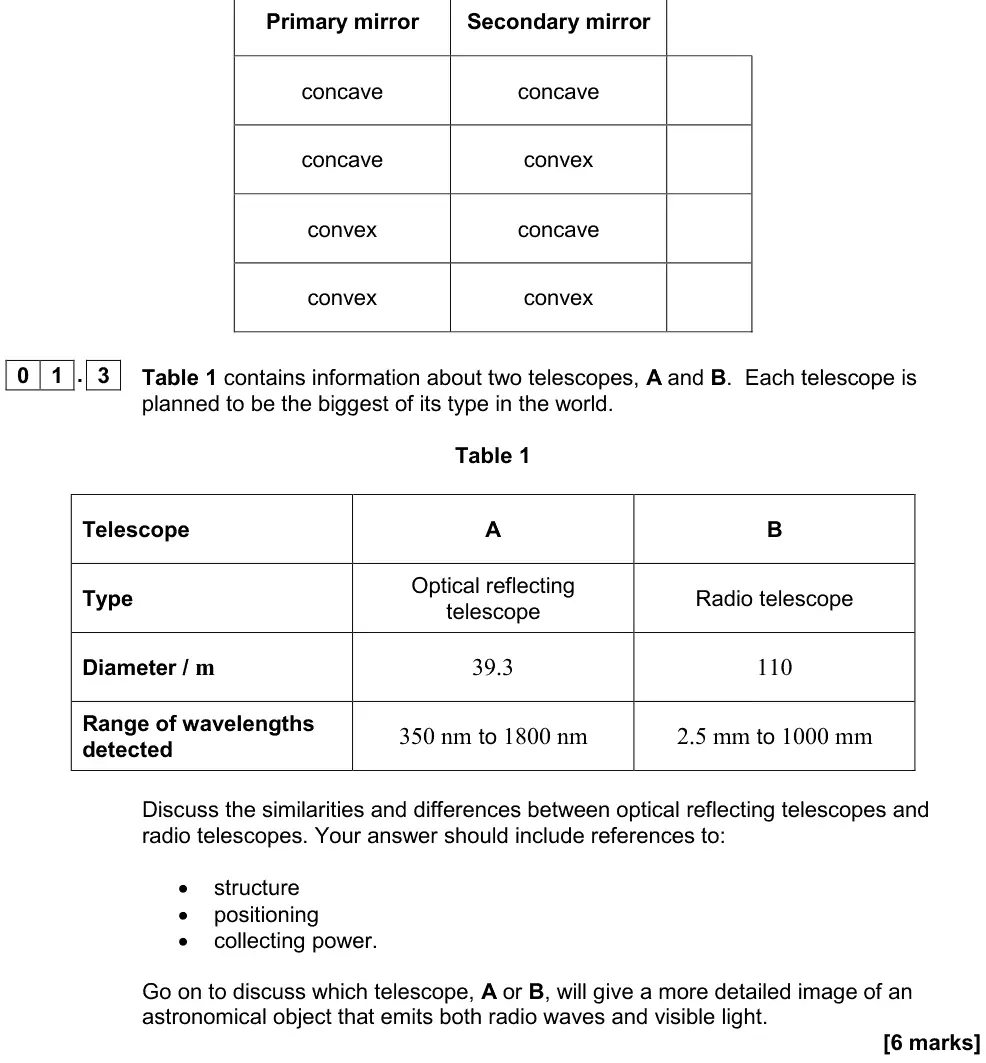
Table 1 contains information about two telescopes, A and B.  Each telescope is
planned to be the biggest of its type in the world.
Table 1
Telescope
A
B
Type
Optical reflecting
telescope
Radio telescope
Diameter / m
39.3
110
Range of wavelengths
detected
350 nm to 1800 nm
2.5 mm to 1000 mm
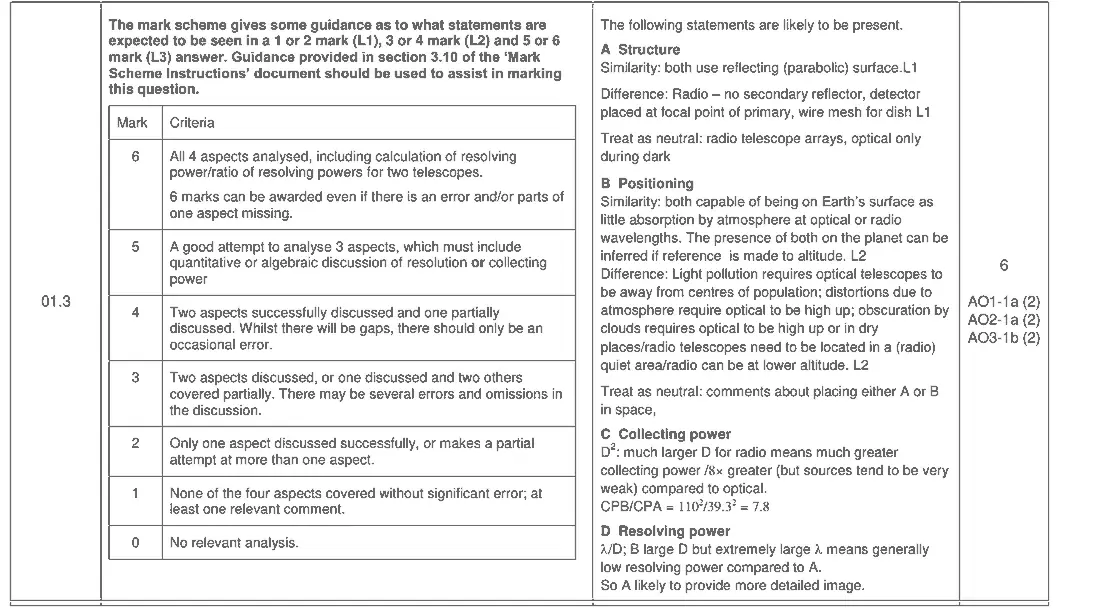
Discuss the similarities and differences between optical reflecting telescopes and
radio telescopes. Your answer should include references to:
•
structure
•
positioning
•
collecting power.
Go on to discuss which telescope, A or B, will give a more detailed image of an
astronomical object that emits both radio waves and visible light.
[6 marks]
June 2019 · Paper 3B Astrophysics · Q2.1 3 marks Explanation classification of stars
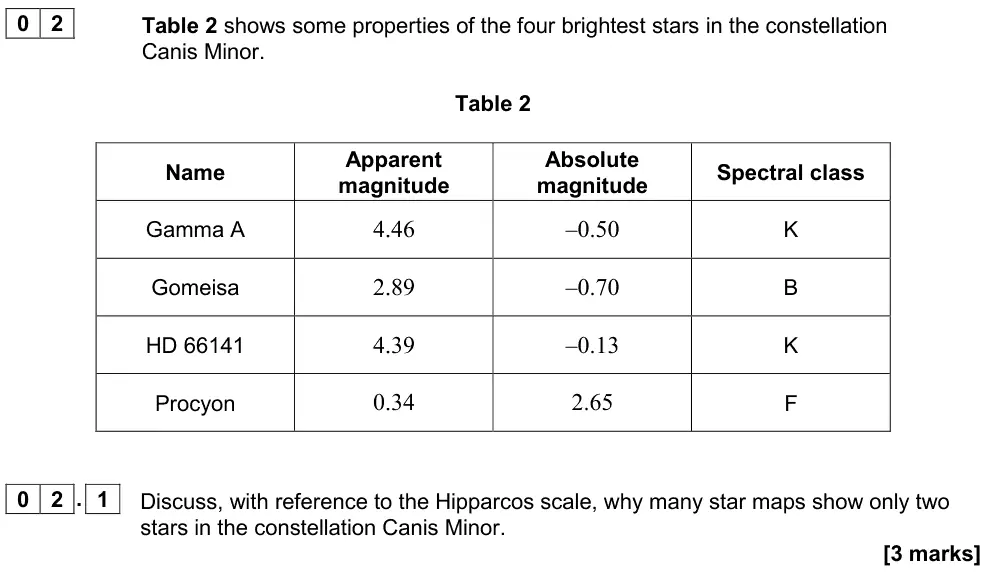
Table 2 shows some properties of the four brightest stars in the constellation
Canis Minor.
Table 2
Name
Apparent
magnitude
Absolute
magnitude
Spectral class
Gamma A
4.46
–0.50
K
Gomeisa
2.89
–0.70
B
HD 66141
4.39
–0.13
K
Procyon
0.34
2.65
F
Discuss, with reference to the Hipparcos scale, why many star maps show only two
stars in the constellation Canis Minor.
[3 marks]
June 2019 · Paper 3B Astrophysics · Q2.2 2 marks Explanation classification of stars
Earlier part of question 2 that this part usesEarlier part of June 2019 Paper 3B Astrophysics question 2
State and explain which star in Table 2 has the most prominent Hydrogen Balmer
absorption lines.
[2 marks]
June 2019 · Paper 3B Astrophysics · Q2.3 3 marks Explanation classification of stars
Earlier part of question 2 that this part usesEarlier part of June 2019 Paper 3B Astrophysics question 2
Deduce which star, Gamma A or HD 66141, has the larger diameter.
[3 marks]
June 2019 · Paper 3B Astrophysics · Q2.4 2 marks Explanation cosmology
Earlier part of question 2 that this part usesEarlier part of June 2019 Paper 3B Astrophysics question 2
Astronomers recently used the radial velocity method to discover an exoplanet orbiting
HD 66141.
Describe the main features of the radial velocity method in the detection of planets.
[2 marks]
June 2019 · Paper 3B Astrophysics · Q2.5 3 marks Calculation Easy classification of stars
Earlier part of question 2 that this part usesEarlier part of June 2019 Paper 3B Astrophysics question 2
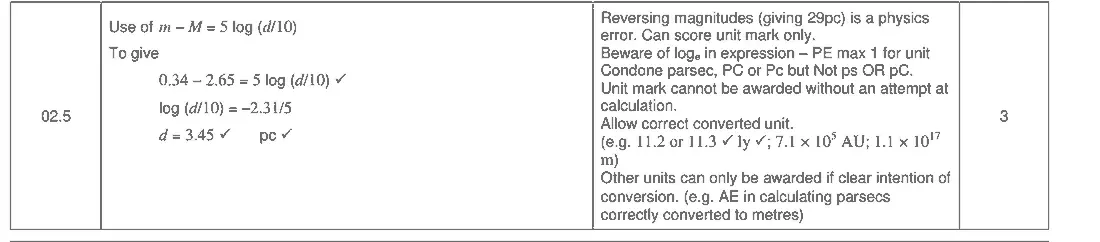
Calculate the distance from the Earth to Procyon.
Give an appropriate unit for your answer.
[3 marks]
distance =
unit
June 2019 · Paper 3B Astrophysics · Q3.1 1 mark Diagram or graph Hard classification of stars
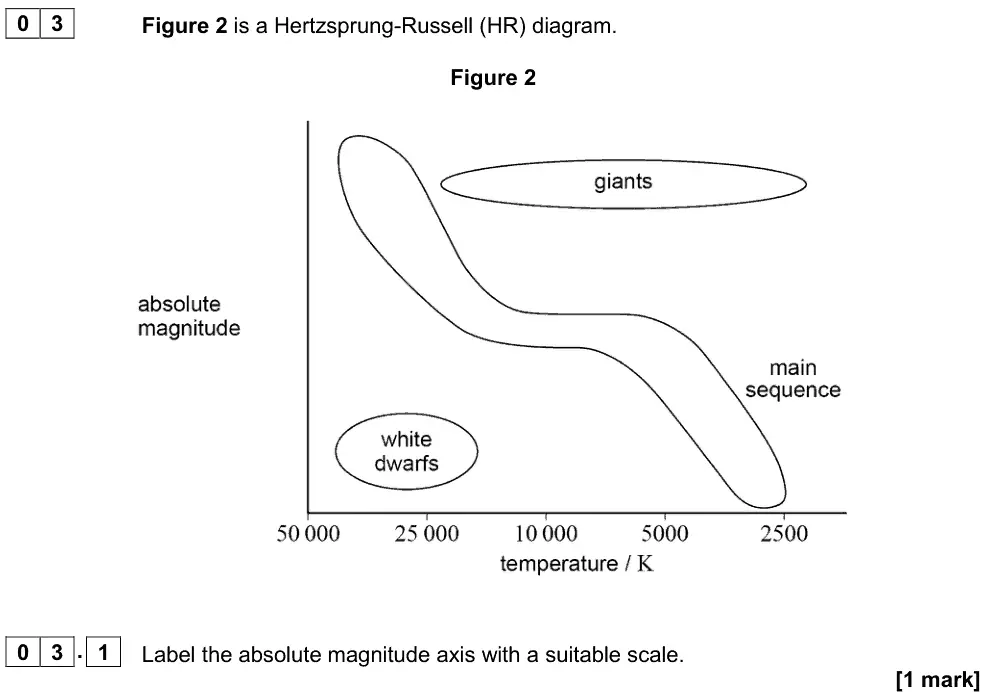
Figure 2 is a Hertzsprung-Russell (HR) diagram.
Figure 2
Label the absolute magnitude axis with a suitable scale.
[1 mark]
June 2019 · Paper 3B Astrophysics · Q3.2 2 marks Diagram or graph classification of stars
Earlier part of question 3 that this part usesEarlier part of June 2019 Paper 3B Astrophysics question 3
Label with an S the position of the Sun on the HR diagram.
[2 marks]
June 2019 · Paper 3B Astrophysics · Q3.3 2 marks Diagram or graph classification of stars
Earlier part of question 3 that this part usesEarlier part of June 2019 Paper 3B Astrophysics question 3
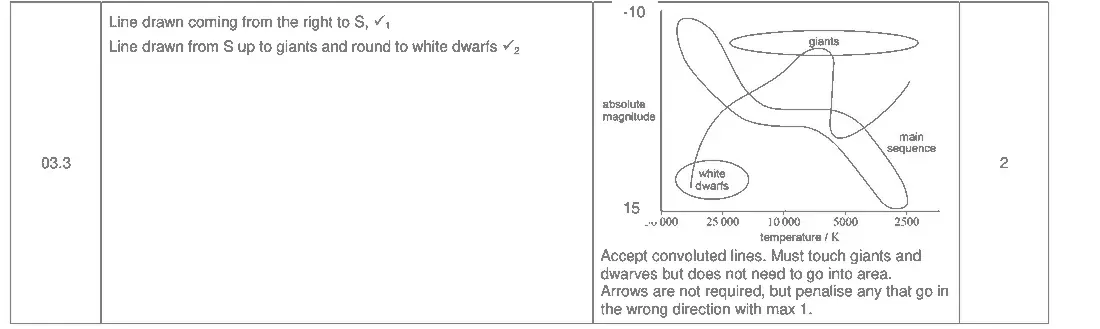
Draw a line on the HR diagram to show the evolution of a star similar to the Sun from
formation to white dwarf.
[2 marks]
June 2019 · Paper 3B Astrophysics · Q3.4 1 mark Diagram or graph Easy classification of stars
Earlier part of question 3 that this part usesEarlier part of June 2019 Paper 3B Astrophysics question 3
Label with a P the position on the HR diagram of a star much redder, and with a
greater power output, than the Sun.
[1 mark]
June 2019 · Paper 3B Astrophysics · Q3.5 3 marks Explanation classification of stars
Earlier part of question 3 that this part usesEarlier part of June 2019 Paper 3B Astrophysics question 3
A star much more massive than the Sun may become a supernova and then a black
hole.
Discuss whether supernovae and black holes can be placed on the HR diagram in
Figure 2.
[3 marks]
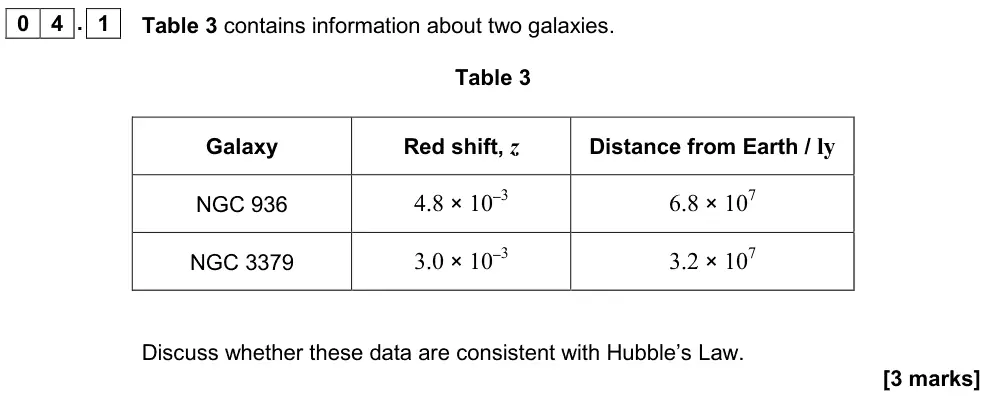
June 2019 · Paper 3B Astrophysics · Q4.1 3 marks Calculation cosmology
Table 3 contains information about two galaxies.
Table 3
Galaxy
Red shift, z
Distance from Earth / ly
NGC 936
4.8 × 10⁻³
6.8 × 10⁷
NGC 3379
3.0 × 10⁻³
3.2 × 10⁷
Discuss whether these data are consistent with Hubble’s Law.
[3 marks]
June 2019 · Paper 3B Astrophysics · Q4.2 2 marks Explanation Hard cosmology
Earlier part of question 4 that this part usesEarlier part of June 2019 Paper 3B Astrophysics question 4
Quasars are the most distant measurable objects.
Discuss one problem associated with the determination of the distance from the Earth
to a quasar.
[2 marks]

Work with an AQA physics tutor

Want a paper marked and gone through with you? Message us.

Prefer email? Send an enquiry

If you are under 18, please include a parent's contact details. Enquiries go to enquiries@physicsaleveltutor.com and are deleted once handled. All tutoring is online.