June 2019: Paper 3B Turning points

35 marks · 12 question parts · Paper, mark scheme and report on AQA's site · Have the data and formulae booklet beside you

Question by question

QTopicMarksAOType
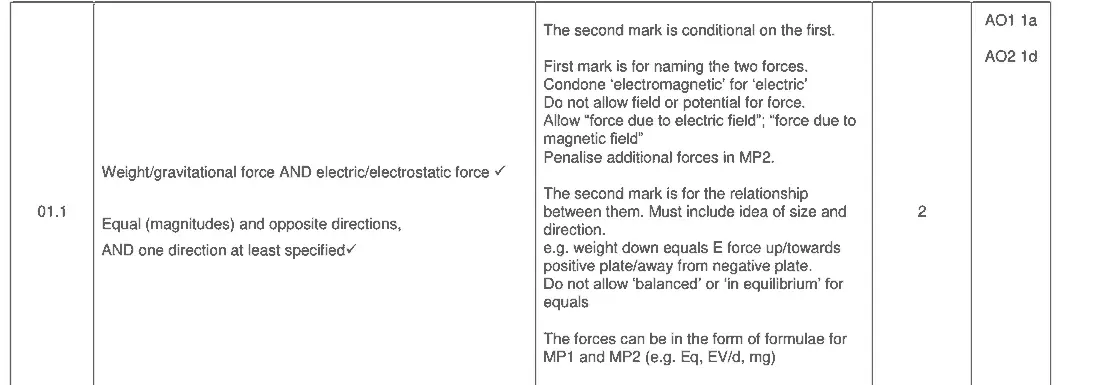
1.1 The discovery of the electron 2Short answer
1.2 The discovery of the electron 3Show that
1.3 The discovery of the electron 3Explanation
2.1 Wave-particle duality: from Newton to electron microscopes 1Short answer
2.2 Wave-particle duality: from Newton to electron microscopes 6Extended response
2.3 Wave-particle duality: from Newton to electron microscopes 3Diagram or graph
3.1 Wave-particle duality: from Newton to electron microscopes 2Short answer
3.2 Wave-particle duality: from Newton to electron microscopes 2Calculation
3.3 Wave-particle duality: from Newton to electron microscopes 4Explanation
4.1 Special relativity 2Calculation
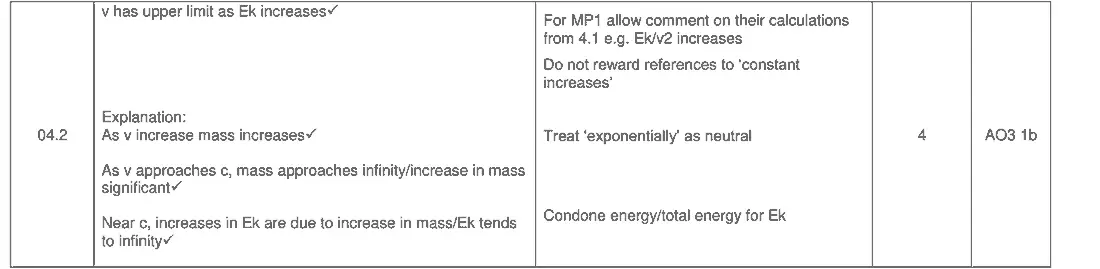
4.2 Special relativity 4Explanation
4.3 Special relativity 3Calculation

The questions

1.11.21.32.12.22.33.13.23.34.14.24.3
June 2019 · Paper 3B Turning points · Q1.1 2 marks Short answer discovery of the electron
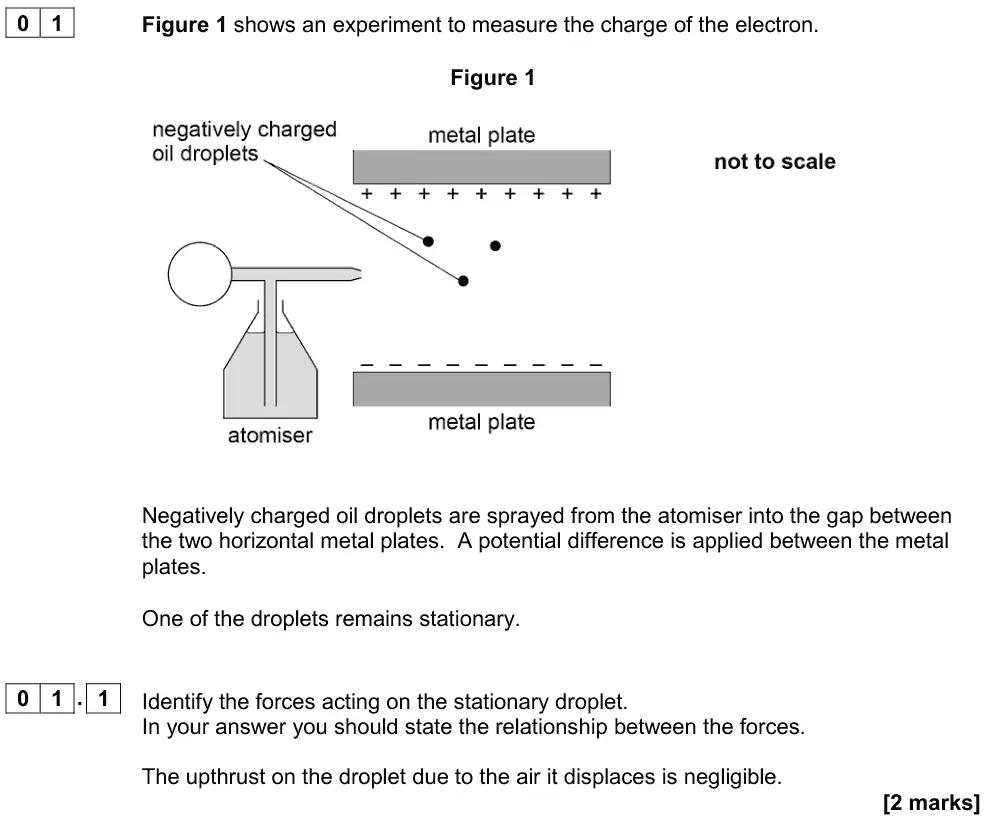
Figure 1 shows an experiment to measure the charge of the electron.
Figure 1
Negatively charged oil droplets are sprayed from the atomiser into the gap between
the two horizontal metal plates.  A potential difference is applied between the metal
plates.
One of the droplets remains stationary.
Identify the forces acting on the stationary droplet.
In your answer you should state the relationship between the forces.
The upthrust on the droplet due to the air it displaces is negligible.
[2 marks]
June 2019 · Paper 3B Turning points · Q1.2 3 marks Show that discovery of the electron
Earlier part of question 1 that this part usesEarlier part of June 2019 Paper 3B Turning points question 1
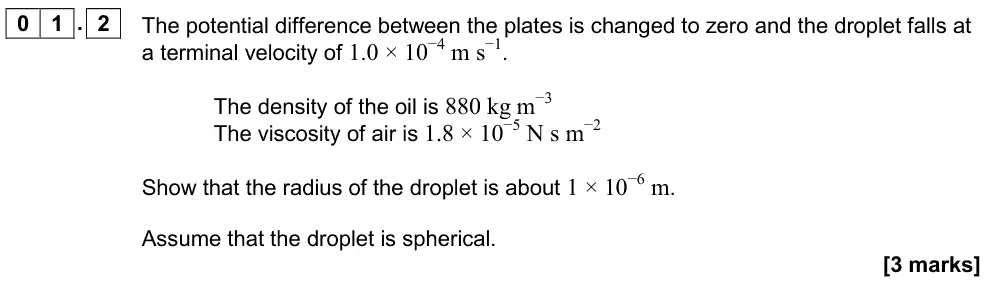
The potential difference between the plates is changed to zero and the droplet falls at
a terminal velocity of 1.0 × 10⁻⁴ m s−1.
The density of the oil is 880 kg m−3
The viscosity of air is 1.8 × 10⁻⁵ N s m−2
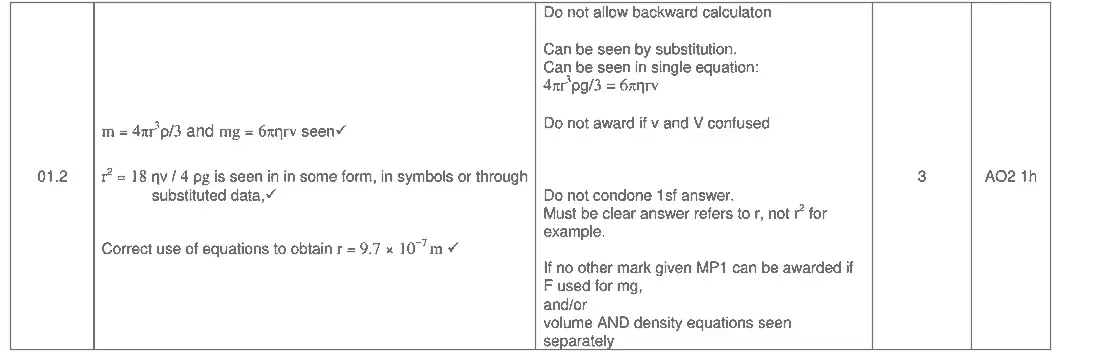
Show that the radius of the droplet is about 1 × 10⁻⁶ m.
Assume that the droplet is spherical.
[3 marks]
June 2019 · Paper 3B Turning points · Q1.3 3 marks Explanation discovery of the electron
Earlier part of question 1 that this part usesEarlier part of June 2019 Paper 3B Turning points question 1
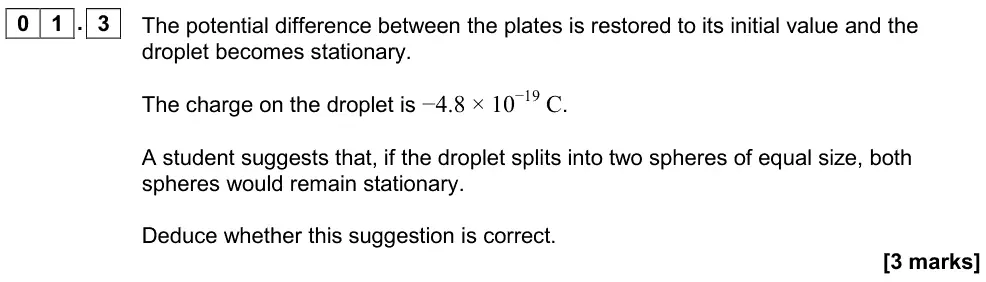
The potential difference between the plates is restored to its initial value and the
droplet becomes stationary.
The charge on the droplet is −4.8 × 10⁻¹⁹ C.
A student suggests that, if the droplet splits into two spheres of equal size, both
spheres would remain stationary.
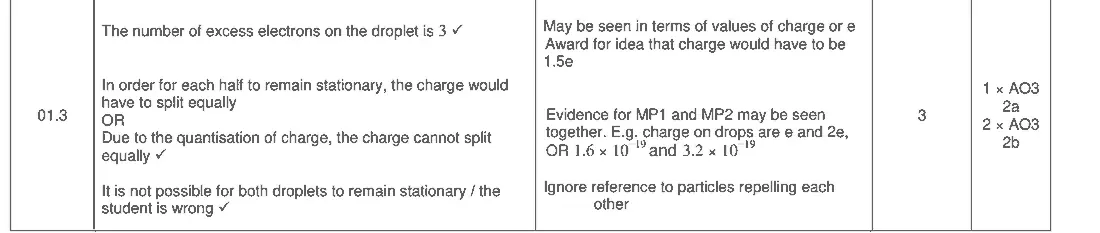
Deduce whether this suggestion is correct.
[3 marks]
June 2019 · Paper 3B Turning points · Q2.1 1 mark Short answer wave particle duality history
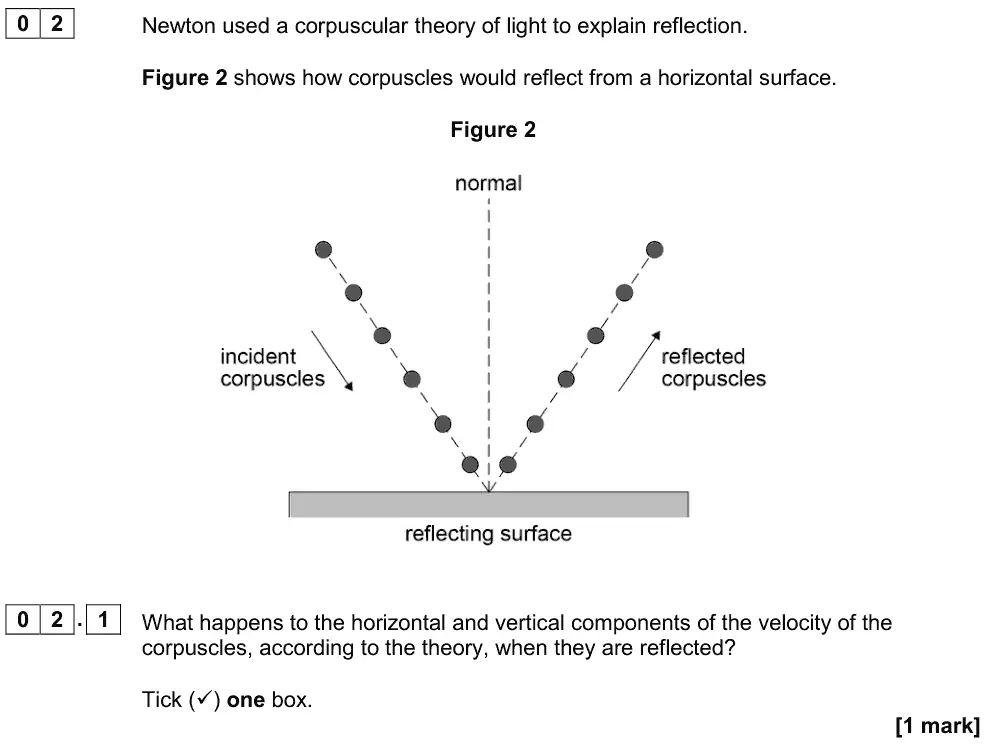
Newton used a corpuscular theory of light to explain reflection.
Figure 2 shows how corpuscles would reflect from a horizontal surface.
Figure 2
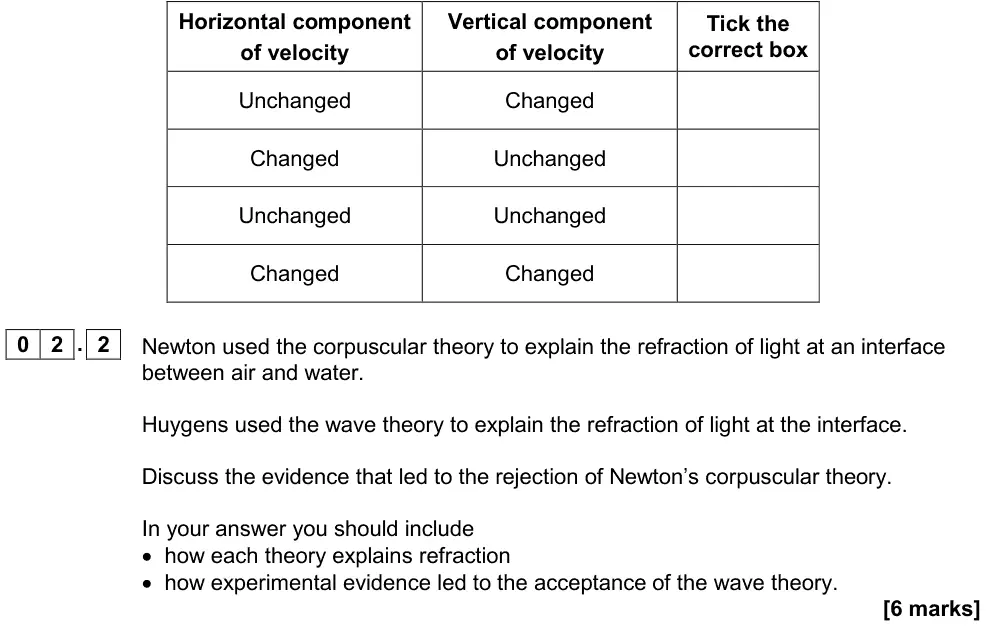
What happens to the horizontal and vertical components of the velocity of the
corpuscles, according to the theory, when they are reflected?
Tick () one box.
[1 mark]
June 2019 · Paper 3B Turning points · Q2.2 6 marks 6-mark extended response wave particle duality history
Earlier part of question 2 that this part usesEarlier part of June 2019 Paper 3B Turning points question 2
Horizontal component
of velocity
Vertical component
of velocity
Tick the
correct box
Unchanged
Changed
Changed
Unchanged
Unchanged
Unchanged
Changed
Changed
Newton used the corpuscular theory to explain the refraction of light at an interface
between air and water.
Huygens used the wave theory to explain the refraction of light at the interface.
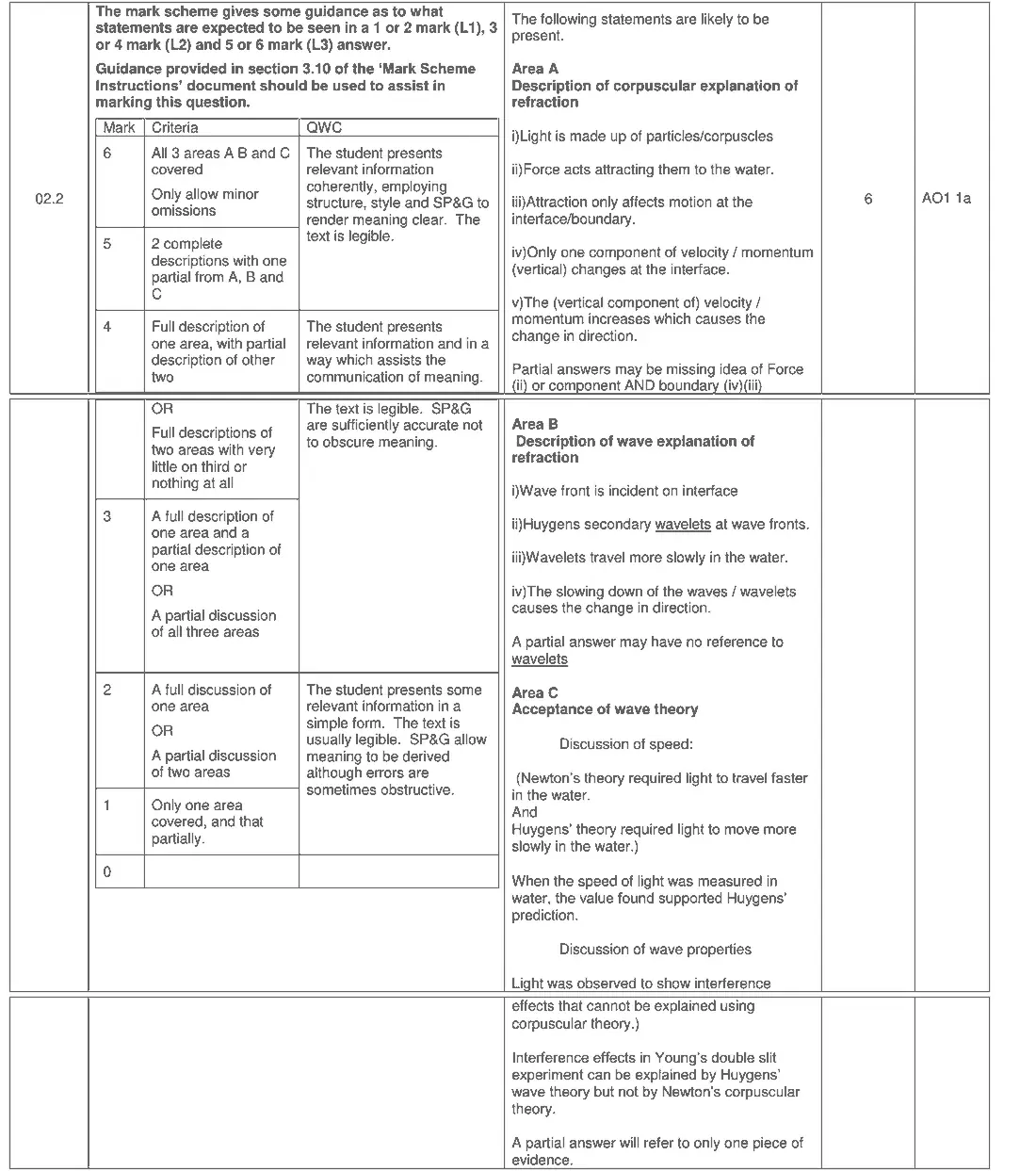
Discuss the evidence that led to the rejection of Newton’s corpuscular theory.
In your answer you should include
• how each theory explains refraction
• how experimental evidence led to the acceptance of the wave theory.
[6 marks]
June 2019 · Paper 3B Turning points · Q2.3 3 marks Diagram or graph wave particle duality history
Earlier part of question 2 that this part usesEarlier part of June 2019 Paper 3B Turning points question 2
Light is now known to behave as an electromagnetic wave.
Describe a plane-polarised electromagnetic wave travelling through a vacuum.
You may wish to draw a labelled diagram.
[3 marks]
June 2019 · Paper 3B Turning points · Q3.1 2 marks Short answer wave particle duality history
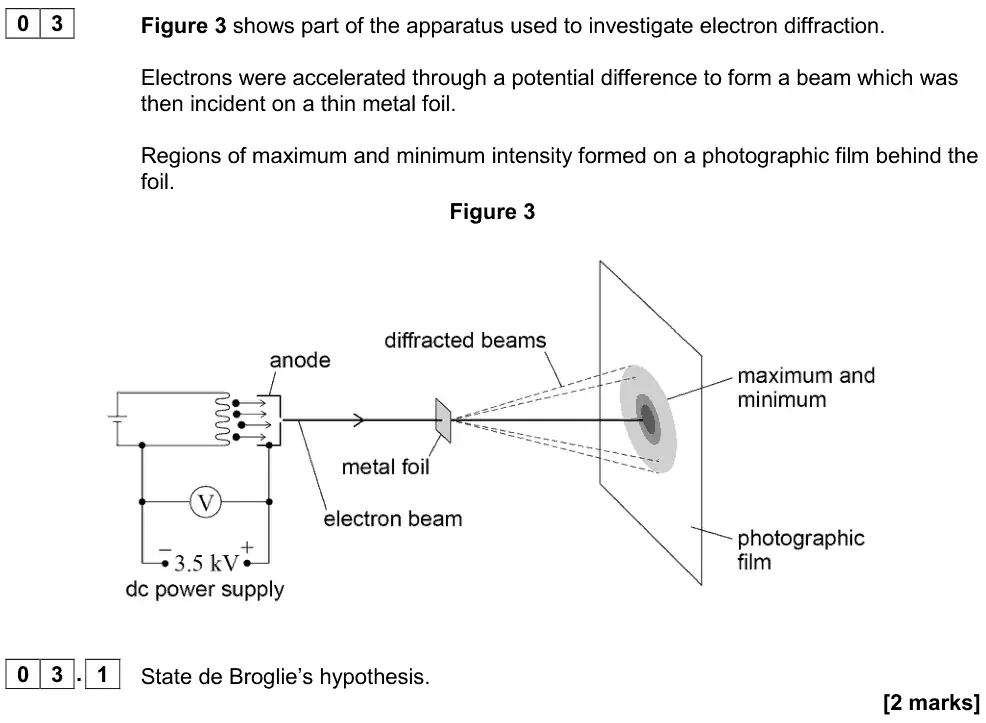
Figure 3 shows part of the apparatus used to investigate electron diffraction.
Electrons were accelerated through a potential difference to form a beam which was
then incident on a thin metal foil.
Regions of maximum and minimum intensity formed on a photographic film behind the
foil.
Figure 3
State de Broglie’s hypothesis.
[2 marks]
June 2019 · Paper 3B Turning points · Q3.2 2 marks Calculation wave particle duality history
Earlier part of question 3 that this part usesEarlier part of June 2019 Paper 3B Turning points question 3
The voltmeter in Figure 3 shows a reading of 3.5 kV.
Determine whether this voltmeter reading is consistent with a de Broglie wavelength
for the electrons in the beam of about 0.02 nm.
[2 marks]
June 2019 · Paper 3B Turning points · Q3.3 4 marks Explanation wave particle duality history
Earlier part of question 3 that this part usesEarlier part of June 2019 Paper 3B Turning points question 3
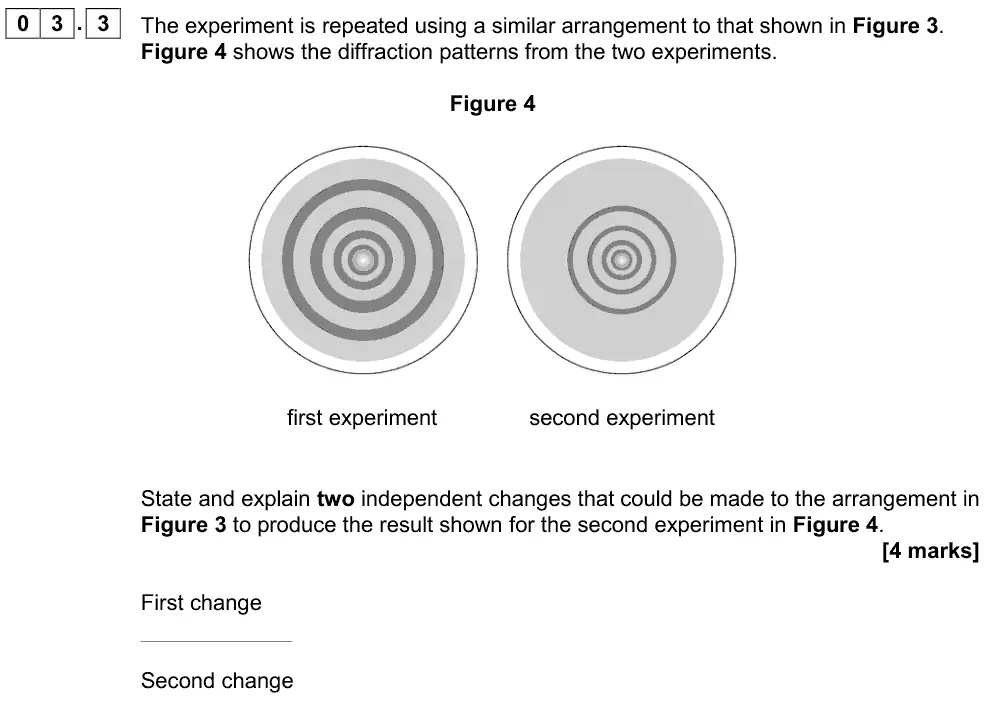
The experiment is repeated using a similar arrangement to that shown in Figure 3.
Figure 4 shows the diffraction patterns from the two experiments.
Figure 4
first experiment               second experiment
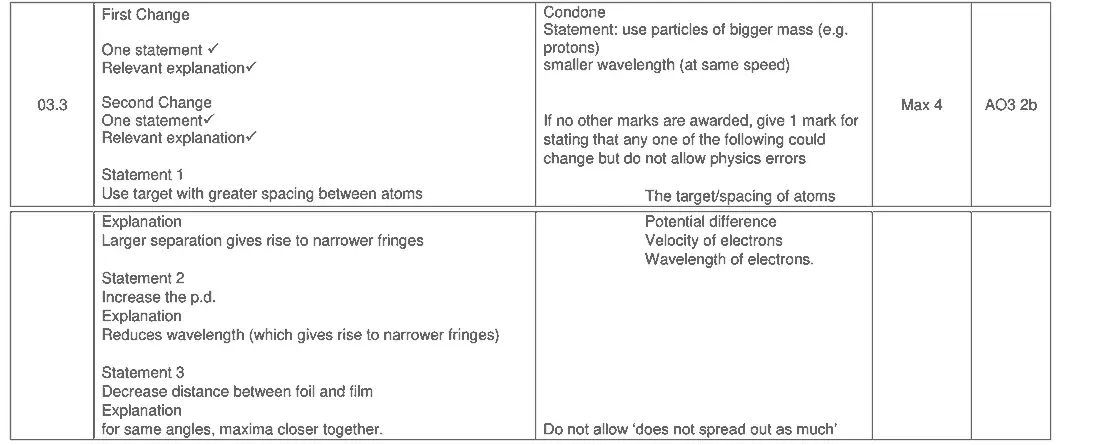
State and explain two independent changes that could be made to the arrangement in
Figure 3 to produce the result shown for the second experiment in Figure 4.
[4 marks]
First change
Second change
June 2019 · Paper 3B Turning points · Q4.1 2 marks Calculation special relativity
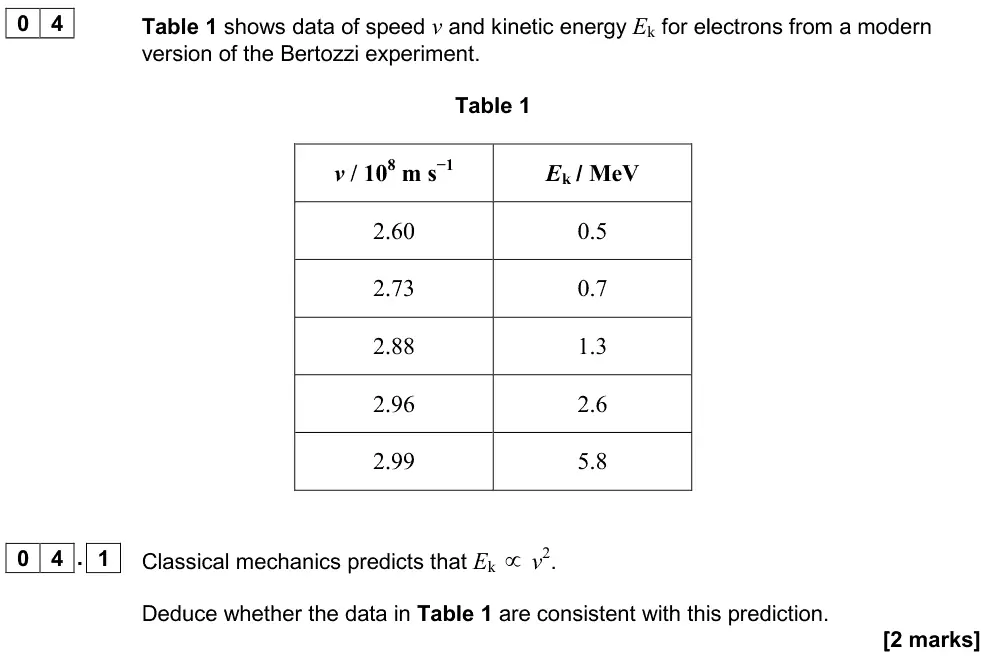
Table 1 shows data of speed v and kinetic energy Ek for electrons from a modern
version of the Bertozzi experiment.
Table 1
v / 108 m s−1
Ek / MeV
2.60
0.5
2.73
0.7
2.88
1.3
2.96
2.6
2.99
5.8
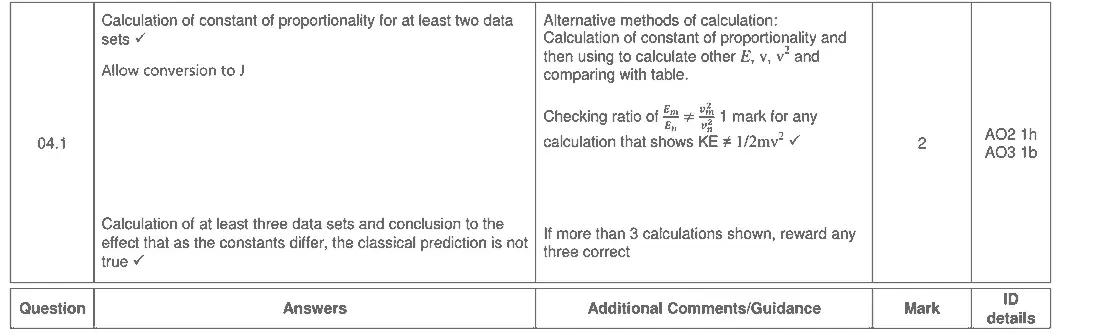
Classical mechanics predicts that Ek ∝ v2.
Deduce whether the data in Table 1 are consistent with this prediction.
[2 marks]
June 2019 · Paper 3B Turning points · Q4.2 4 marks Explanation special relativity
Earlier part of question 4 that this part usesEarlier part of June 2019 Paper 3B Turning points question 4
Discuss how Einstein’s theory of special relativity explains the data in Table 1.
[4 marks]
June 2019 · Paper 3B Turning points · Q4.3 3 marks Calculation special relativity
Earlier part of question 4 that this part usesEarlier part of June 2019 Paper 3B Turning points question 4
Calculate, in J, the kinetic energy of one electron travelling at a speed of 0.95c.
[3 marks]
kinetic energy =
J

Work with an AQA physics tutor

Want a paper marked and gone through with you? Message us.

Prefer email? Send an enquiry

If you are under 18, please include a parent's contact details. Enquiries go to enquiries@physicsaleveltutor.com and are deleted once handled. All tutoring is online.