June 2022: Paper 3B Astrophysics

35 marks · 15 question parts · Paper, mark scheme and report on AQA's site · Have the data and formulae booklet beside you

Question by question

QTopicMarksAOType
1.1 Telescopes 1AO1=1Diagram or graph
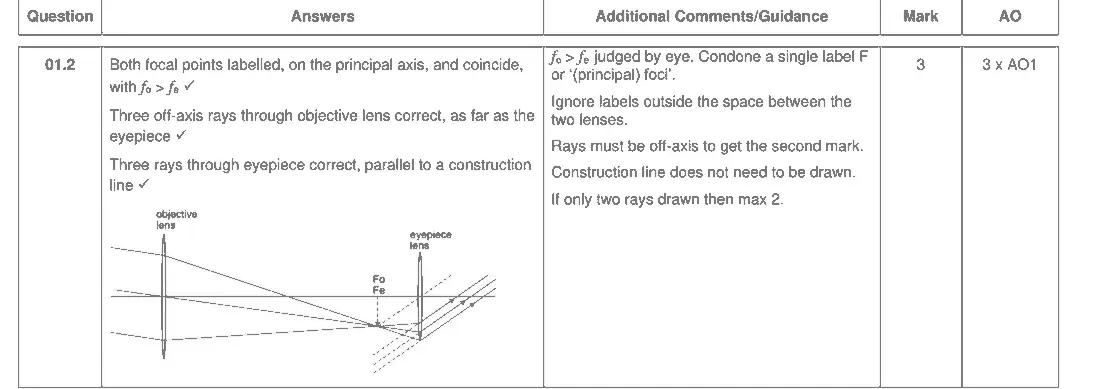
1.2 Telescopes 3AO1=3Diagram or graph
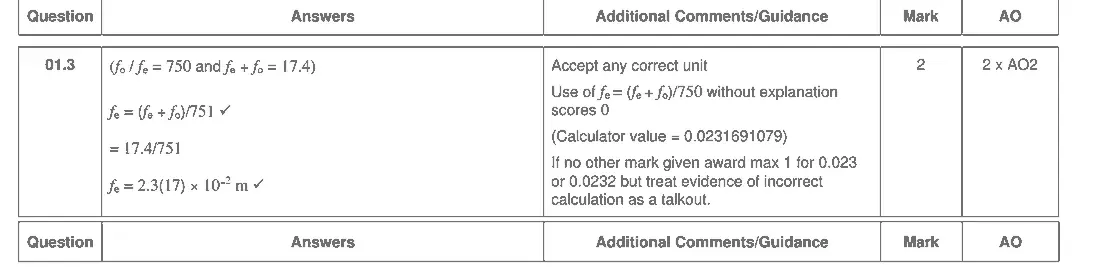
1.3 Telescopes 2AO2=2Calculation
1.4 Telescopes 3AO3=3Explanation
2.1 Cosmology: Doppler effect, Hubble's law, quasars and exoplanets 2AO2=1,AO3=1Explanation
2.2 Cosmology: Doppler effect, Hubble's law, quasars and exoplanets 1AO3=1Short answer
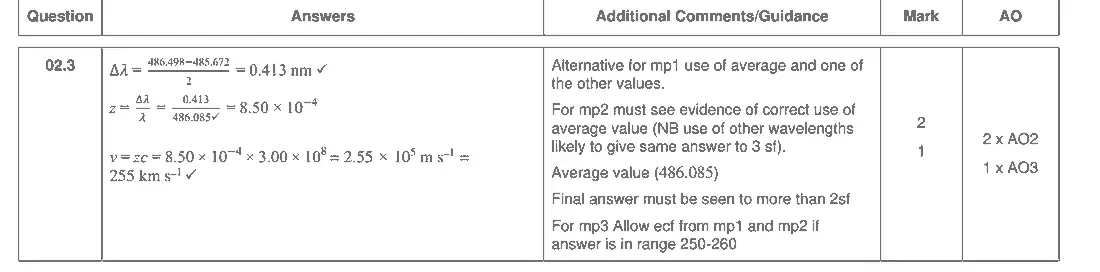
2.3 Cosmology: Doppler effect, Hubble's law, quasars and exoplanets 3AO2=2,AO3=1Show that
2.4 Cosmology: Doppler effect, Hubble's law, quasars and exoplanets 2AO2=1,AO3=1Calculation
2.5 Classification of stars and the HR diagram 1AO1=1Short answer
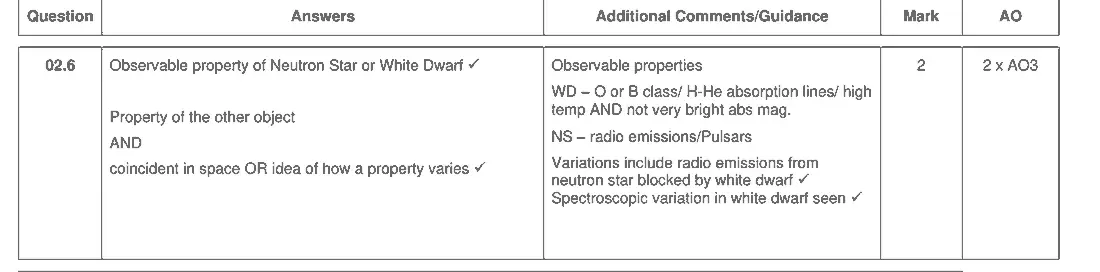
2.6 Classification of stars and the HR diagram, Cosmology: Doppler effect, Hubble's law, quasars and exoplanets 2AO3=2Explanation
3.1 Cosmology: Doppler effect, Hubble's law, quasars and exoplanets 1AO1=1Short answer
3.2 Classification of stars and the HR diagram 2AO1=1,AO2=1Show that
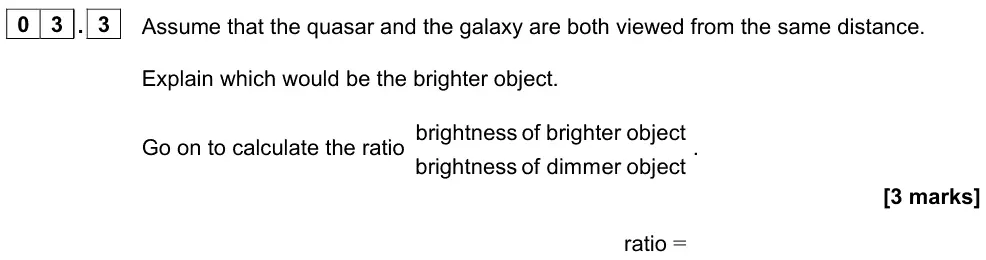
3.3 Classification of stars and the HR diagram 3AO2=3Calculation
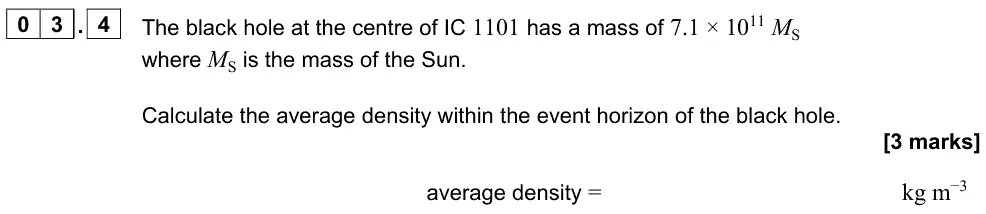
3.4 Classification of stars and the HR diagram 3AO1=1,AO2=2Calculation
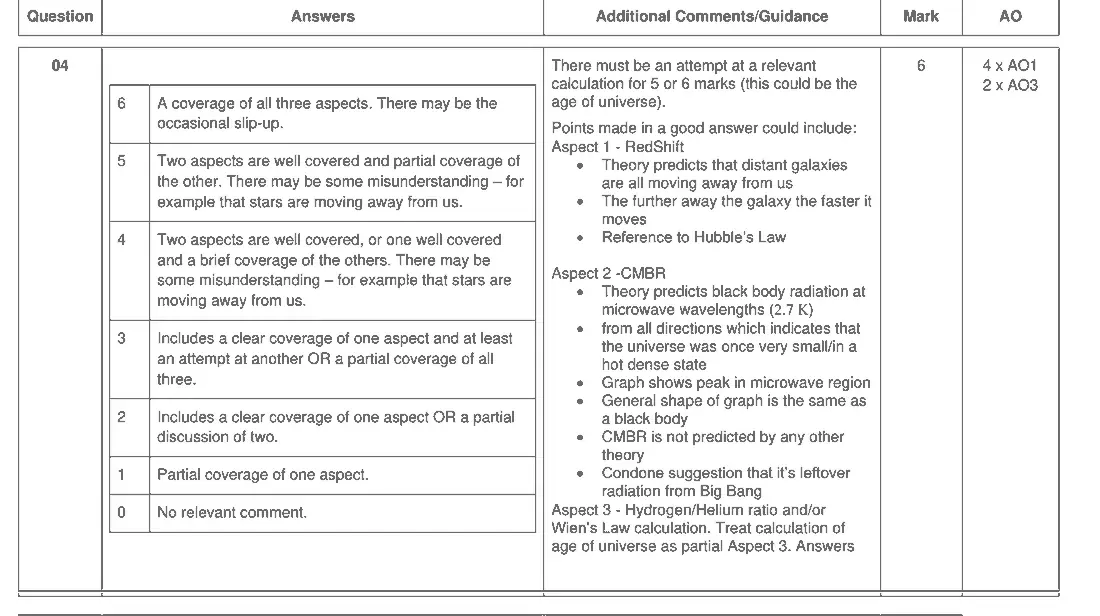
4 Cosmology: Doppler effect, Hubble's law, quasars and exoplanets 6AO1=4,AO3=2Extended response

The questions

1.11.21.31.42.12.22.32.42.52.63.13.23.33.44
June 2022 · Paper 3B Astrophysics · Q1.1 1 mark AO1=1 Diagram or graph telescopes
Draw a ray diagram to show how a converging lens can cause spherical aberration.
[1 mark]
principal
axis
June 2022 · Paper 3B Astrophysics · Q1.2 3 marks AO1=3 Diagram or graph telescopes
Earlier part of question 1 that this part usesEarlier part of June 2022 Paper 3B Astrophysics question 1
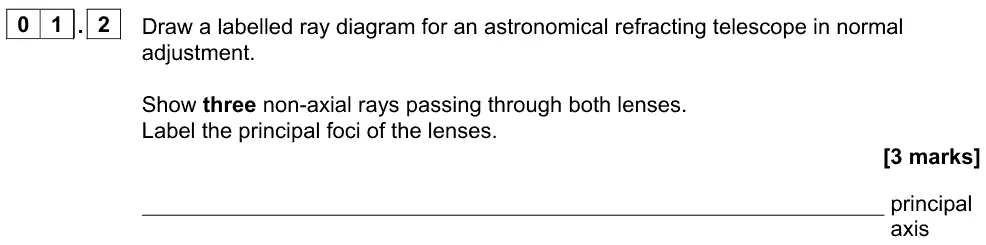
Draw a labelled ray diagram for an astronomical refracting telescope in normal
adjustment.
Show three non-axial rays passing through both lenses.
Label the principal foci of the lenses.
[3 marks]
principal
axis
June 2022 · Paper 3B Astrophysics · Q1.3 2 marks AO2=2 Calculation telescopes
Earlier part of question 1 that this part usesEarlier part of June 2022 Paper 3B Astrophysics question 1
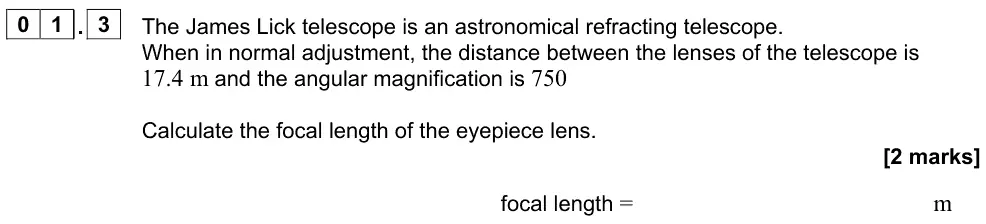
The James Lick telescope is an astronomical refracting telescope.
When in normal adjustment, the distance between the lenses of the telescope is
17.4 m and the angular magnification is 750
Calculate the focal length of the eyepiece lens.
[2 marks]
focal length =
m
June 2022 · Paper 3B Astrophysics · Q1.4 3 marks AO3=3 Explanation telescopes
Earlier part of question 1 that this part usesEarlier part of June 2022 Paper 3B Astrophysics question 1
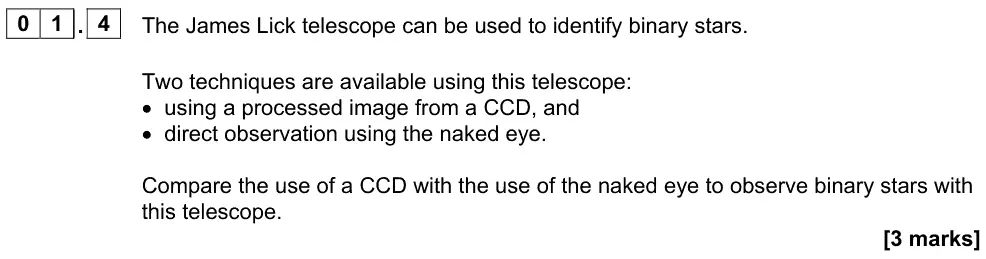
The James Lick telescope can be used to identify binary stars.
Two techniques are available using this telescope:
• using a processed image from a CCD, and
• direct observation using the naked eye.
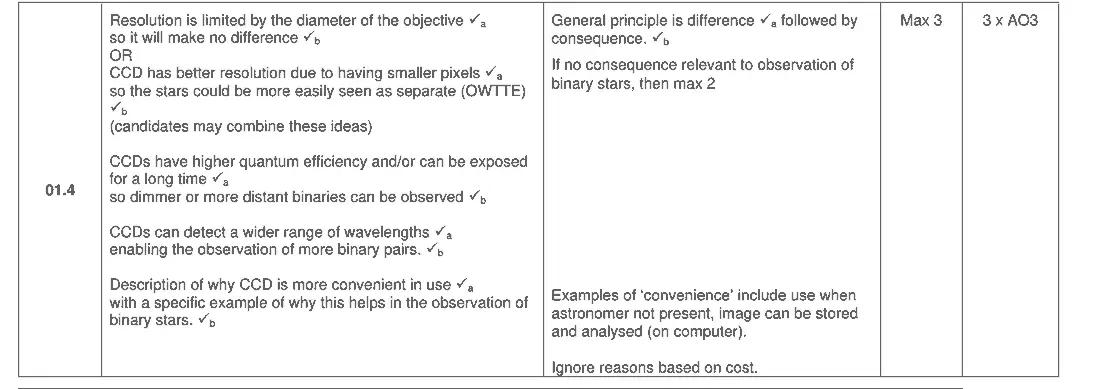
Compare the use of a CCD with the use of the naked eye to observe binary stars with
this telescope.
[3 marks]
June 2022 · Paper 3B Astrophysics · Q2.1 2 marks AO2=1, AO3=1 Explanation cosmology
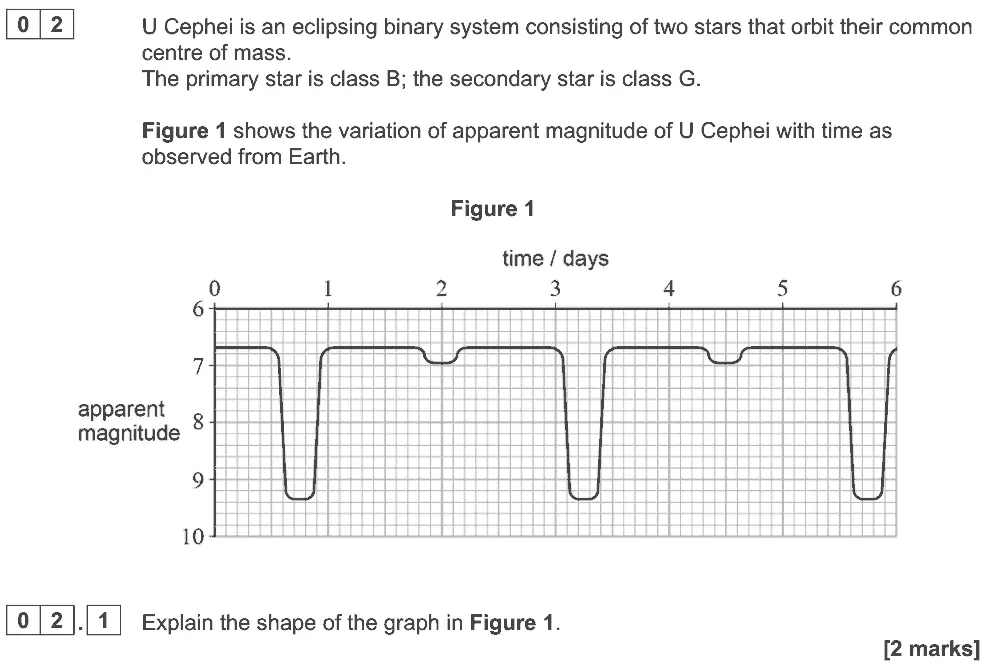
U Cephei is an eclipsing binary system consisting of two stars that orbit their common
centre of mass.
The primary star is class B; the secondary star is class G.
Figure 1 shows the variation of apparent magnitude of U Cephei with time as
observed from Earth.
Figure 1
Explain the shape of the graph in Figure 1.
[2 marks]
June 2022 · Paper 3B Astrophysics · Q2.2 1 mark AO3=1 Short answer cosmology
Earlier part of question 2 that this part usesEarlier part of June 2022 Paper 3B Astrophysics question 2
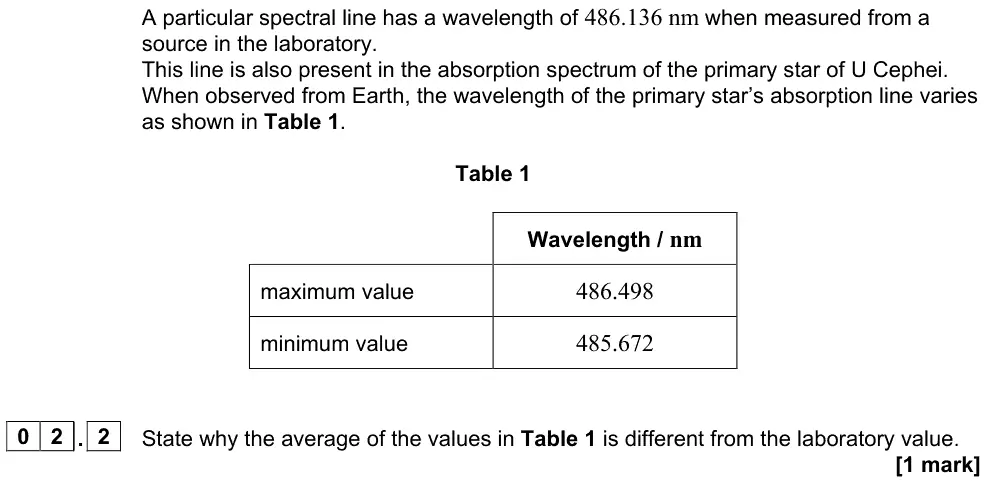
A particular spectral line has a wavelength of 486.136 nm when measured from a
source in the laboratory.
This line is also present in the absorption spectrum of the primary star of U Cephei.
When observed from Earth, the wavelength of the primary star’s absorption line varies
as shown in Table 1.
Table 1
Wavelength / nm
maximum value
486.498
minimum value
485.672
State why the average of the values in Table 1 is different from the laboratory value.
[1 mark]
June 2022 · Paper 3B Astrophysics · Q2.3 3 marks AO2=2, AO3=1 Show that cosmology
Earlier part of question 2 that this part usesEarlier part of June 2022 Paper 3B Astrophysics question 2
Show that the orbital speed of the primary star is about 250 km s−1.
[3 marks]
June 2022 · Paper 3B Astrophysics · Q2.4 2 marks AO2=1, AO3=1 Calculation cosmology
Earlier part of question 2 that this part usesEarlier part of June 2022 Paper 3B Astrophysics question 2
Calculate the orbital radius of the primary star.
[2 marks]
orbital radius =
m
June 2022 · Paper 3B Astrophysics · Q2.5 1 mark AO1=1 Short answer classification of stars
Earlier part of question 2 that this part usesEarlier part of June 2022 Paper 3B Astrophysics question 2
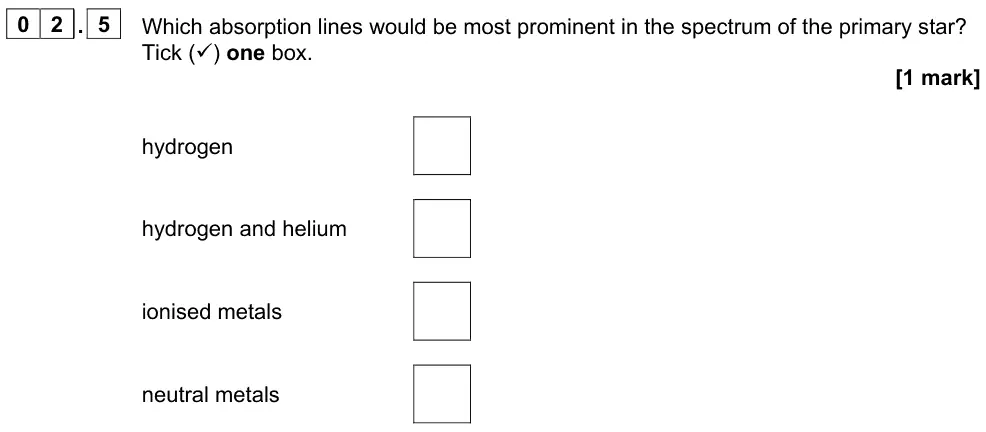
Which absorption lines would be most prominent in the spectrum of the primary star?
Tick () one box.
[1 mark]
hydrogen
hydrogen and helium
ionised metals
neutral metals
June 2022 · Paper 3B Astrophysics · Q2.6 2 marks AO3=2 Explanation classification of starscosmology
Earlier part of question 2 that this part usesEarlier part of June 2022 Paper 3B Astrophysics question 2
A different eclipsing binary star system is thought to consist of a white dwarf star and
a neutron star.
Discuss how astronomers could confirm this.
[2 marks]
June 2022 · Paper 3B Astrophysics · Q3.1 1 mark AO1=1 Short answer cosmology
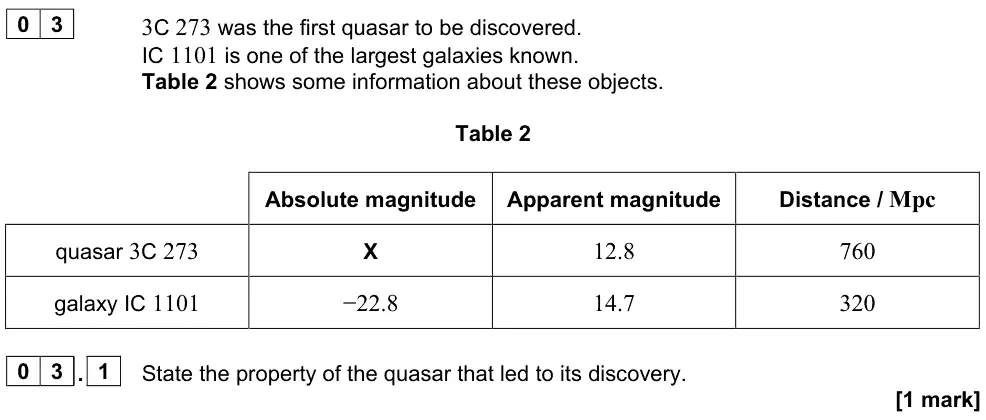
3C 273 was the first quasar to be discovered.
IC 1101 is one of the largest galaxies known.
Table 2 shows some information about these objects.
Table 2
Absolute magnitude
Apparent magnitude
Distance / Mpc
quasar 3C 273
X
12.8
760
galaxy IC 1101
−22.8
14.7
320
State the property of the quasar that led to its discovery.
[1 mark]
June 2022 · Paper 3B Astrophysics · Q3.2 2 marks AO1=1, AO2=1 Show that classification of stars
Earlier part of question 3 that this part usesEarlier part of June 2022 Paper 3B Astrophysics question 3
Show that the absolute magnitude X of quasar 3C 273 is about −27
[2 marks]
June 2022 · Paper 3B Astrophysics · Q3.3 3 marks AO2=3 Calculation classification of stars
Earlier part of question 3 that this part usesEarlier part of June 2022 Paper 3B Astrophysics question 3
Assume that the quasar and the galaxy are both viewed from the same distance.
Explain which would be the brighter object.
Go on to calculate the ratio brightness of brighter object
brightness of dimmer object
.
[3 marks]
ratio =
June 2022 · Paper 3B Astrophysics · Q3.4 3 marks AO1=1, AO2=2 Calculation classification of stars
Earlier part of question 3 that this part usesEarlier part of June 2022 Paper 3B Astrophysics question 3
The black hole at the centre of IC 1101 has a mass of 7.1 × 10¹¹ MS
where MS is the mass of the Sun.
Calculate the average density within the event horizon of the black hole.
[3 marks]
average density =
kg m−3
June 2022 · Paper 3B Astrophysics · Q4 6 marks AO1=4, AO3=2 6-mark extended response cosmology
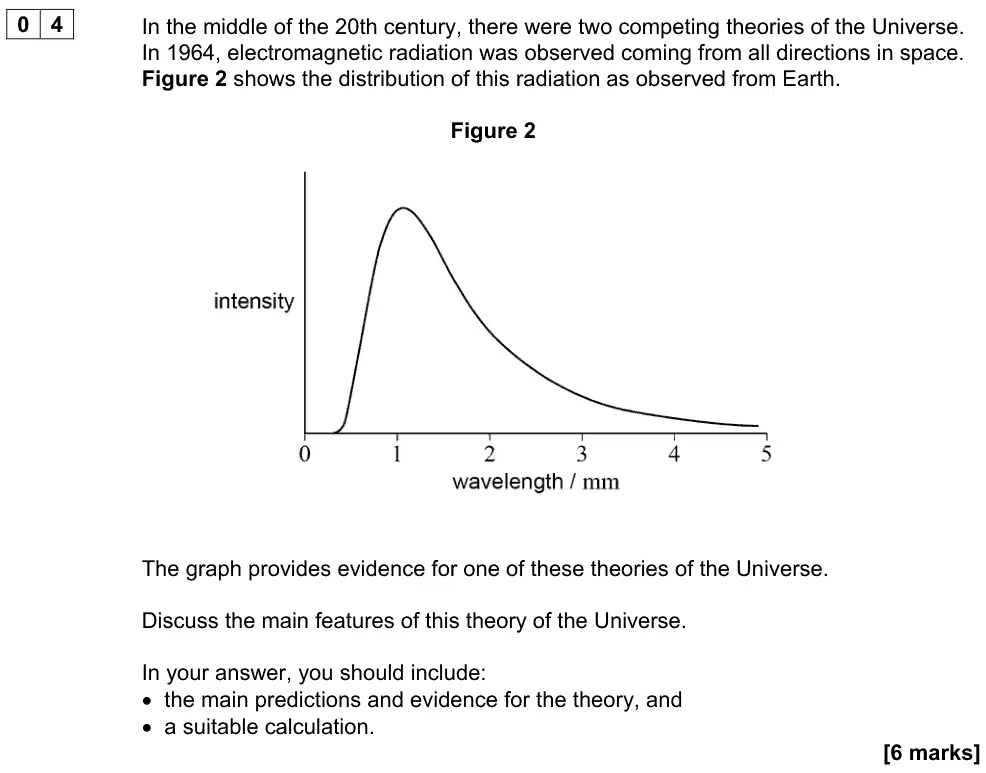
In the middle of the 20th century, there were two competing theories of the Universe.
In 1964, electromagnetic radiation was observed coming from all directions in space.
Figure 2 shows the distribution of this radiation as observed from Earth.
Figure 2
The graph provides evidence for one of these theories of the Universe.
Discuss the main features of this theory of the Universe.
In your answer, you should include:
• the main predictions and evidence for the theory, and
• a suitable calculation.
[6 marks]

Work with an AQA physics tutor

Want a paper marked and gone through with you? Message us.

Prefer email? Send an enquiry

If you are under 18, please include a parent's contact details. Enquiries go to enquiries@physicsaleveltutor.com and are deleted once handled. All tutoring is online.