June 2022: Paper 3B Turning points

35 marks · 14 question parts · Paper, mark scheme and report on AQA's site · Have the data and formulae booklet beside you

Question by question

QTopicMarksAOType
1.1 Wave-particle duality: from Newton to electron microscopes 2AO1=1,AO2=1Explanation
1.2 Wave-particle duality: from Newton to electron microscopes 6AO1=4,AO3=2Extended response
1.3 Wave-particle duality: from Newton to electron microscopes 3AO2=1,AO3=2Explanation
2.1 The discovery of the electron 1AO1=1Short answer
2.2 The discovery of the electron 3AO2=3Show that
2.3 The discovery of the electron 2AO2=2Show that
2.4 The discovery of the electron 3AO2=2,AO3=1Calculation
2.5 The discovery of the electron 3AO3=3Explanation
3.1 Wave-particle duality: from Newton to electron microscopes 2AO1=2Short answer
3.2 Wave-particle duality: from Newton to electron microscopes 2AO1=1,AO3=1Calculation
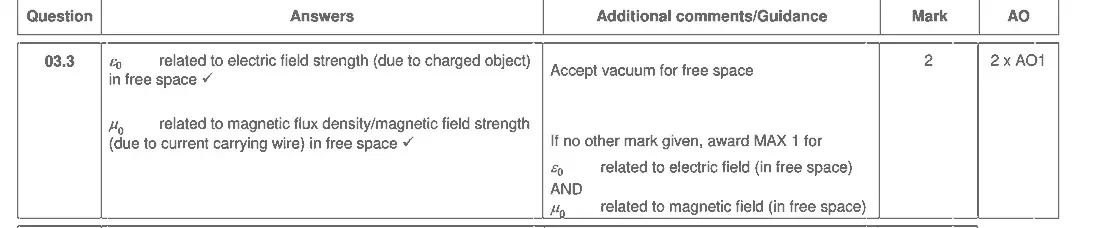
3.3 Wave-particle duality: from Newton to electron microscopes 2AO1=2Short answer
4.1 Special relativity 1AO1=1Short answer
4.2 Special relativity 3AO2=3Calculation
4.3 Special relativity 2AO3=2Explanation

The questions

1.11.21.32.12.22.32.42.53.13.23.34.14.24.3
June 2022 · Paper 3B Turning points · Q1.1 2 marks AO1=1, AO2=1 Explanation wave particle duality history
In the 17th century, Isaac Newton proposed a theory to explain some of the properties
of light.  An alternative theory of light was proposed by Christiaan Huygens at about
the same time.
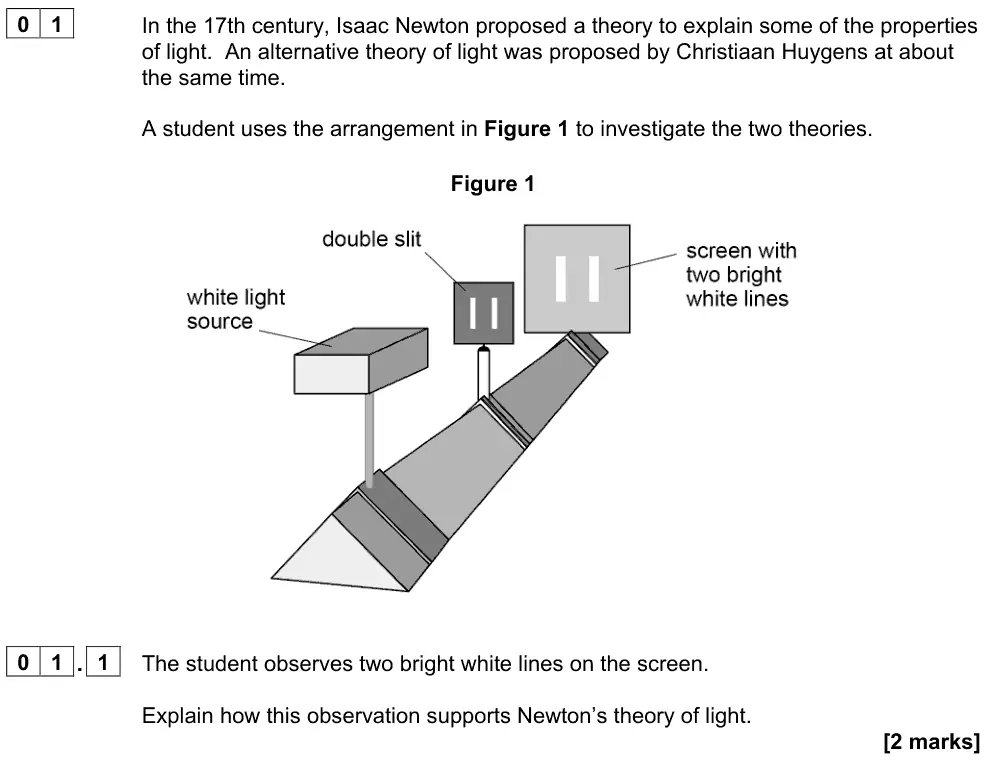
A student uses the arrangement in Figure 1 to investigate the two theories.
Figure 1
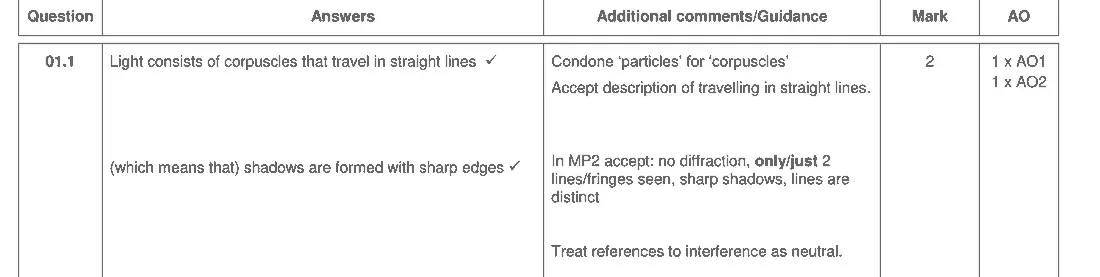
The student observes two bright white lines on the screen.
Explain how this observation supports Newton’s theory of light.
[2 marks]
June 2022 · Paper 3B Turning points · Q1.2 6 marks AO1=4, AO3=2 6-mark extended response wave particle duality history
Earlier part of question 1 that this part usesEarlier part of June 2022 Paper 3B Turning points question 1
The student makes alterations to the apparatus in Figure 1.
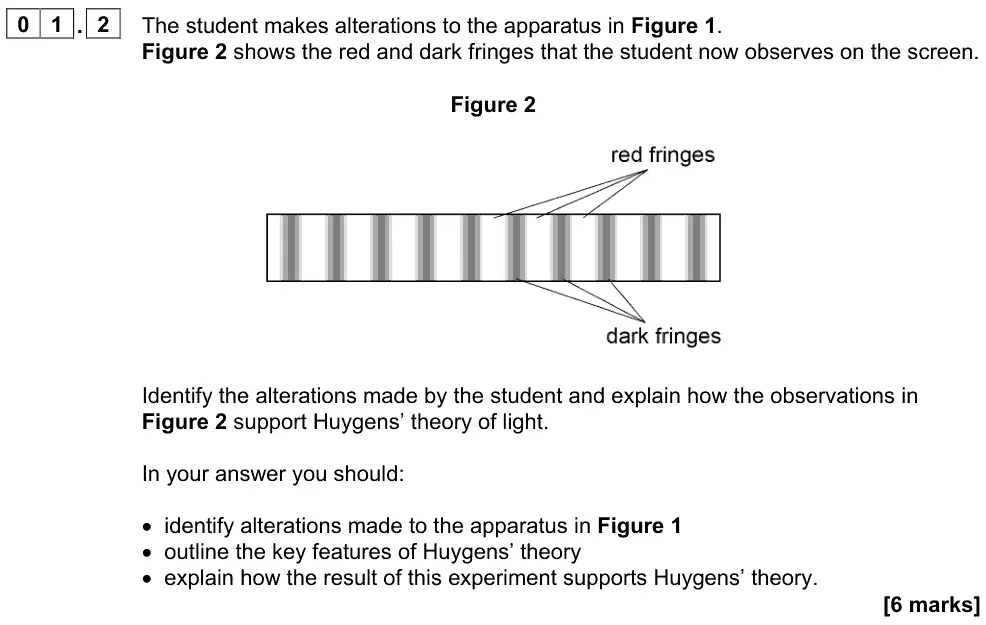
Figure 2 shows the red and dark fringes that the student now observes on the screen.
Figure 2
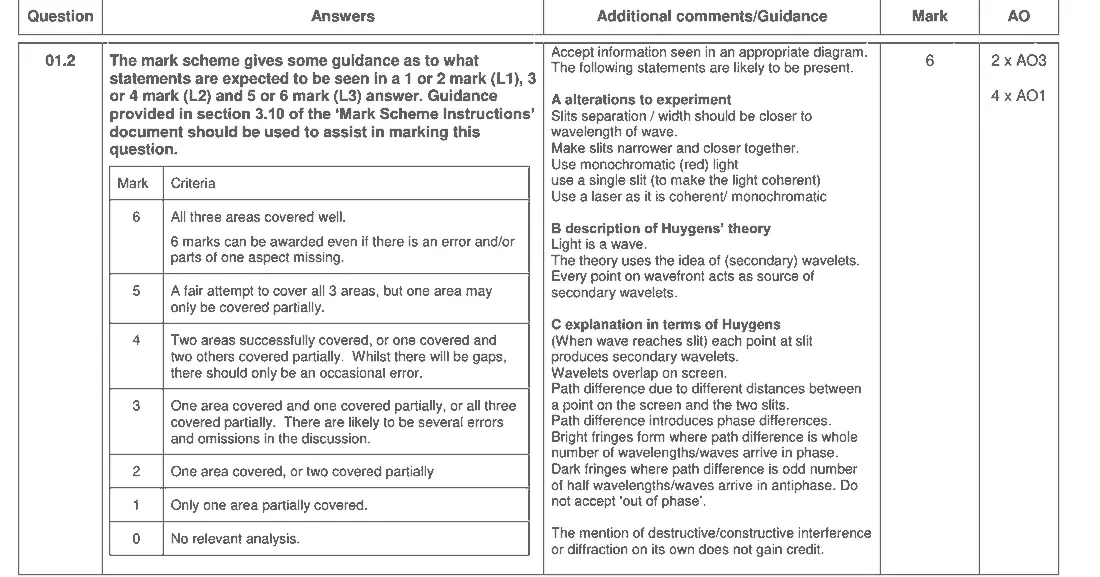
Identify the alterations made by the student and explain how the observations in
Figure 2 support Huygens’ theory of light.
In your answer you should:
• identify alterations made to the apparatus in Figure 1
• outline the key features of Huygens’ theory
• explain how the result of this experiment supports Huygens’ theory.
[6 marks]
June 2022 · Paper 3B Turning points · Q1.3 3 marks AO2=1, AO3=2 Explanation wave particle duality history
Earlier part of question 1 that this part usesEarlier part of June 2022 Paper 3B Turning points question 1
Shortly before the work of Newton and Huygens, Francesco Grimaldi carried out an
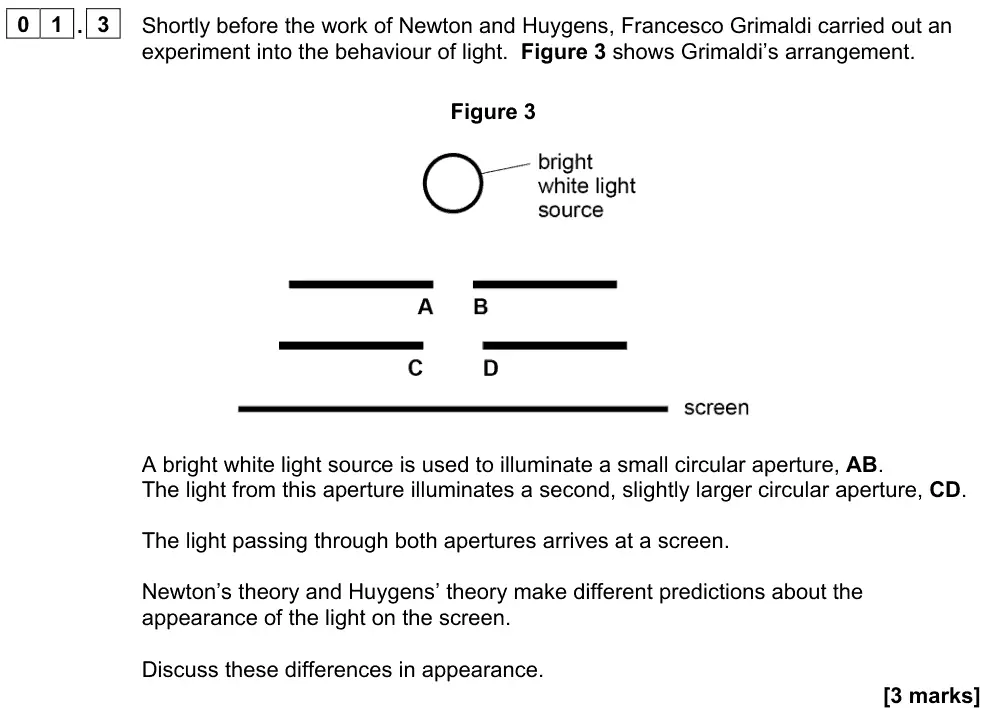
experiment into the behaviour of light.  Figure 3 shows Grimaldi’s arrangement.
Figure 3
A bright white light source is used to illuminate a small circular aperture, AB.
The light from this aperture illuminates a second, slightly larger circular aperture, CD.
The light passing through both apertures arrives at a screen.
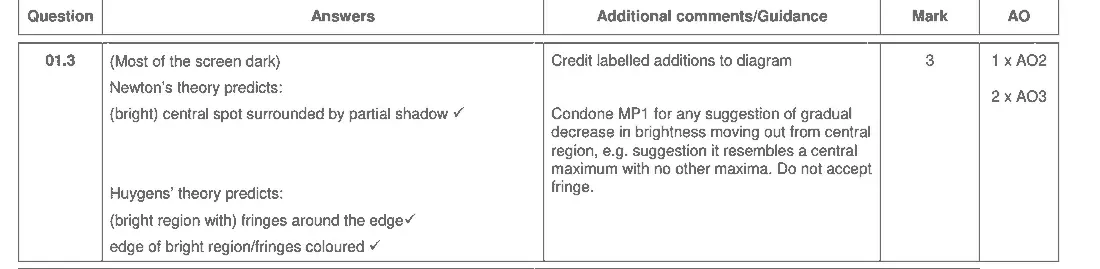
Newton’s theory and Huygens’ theory make different predictions about the
appearance of the light on the screen.
Discuss these differences in appearance.
[3 marks]
June 2022 · Paper 3B Turning points · Q2.1 1 mark AO1=1 Short answer discovery of the electron
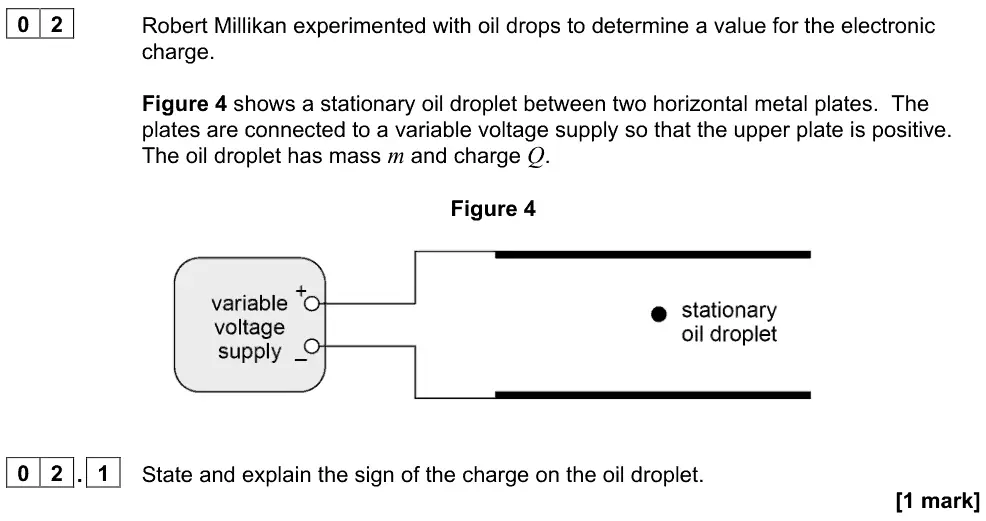
Robert Millikan experimented with oil drops to determine a value for the electronic
charge.
Figure 4 shows a stationary oil droplet between two horizontal metal plates.  The
plates are connected to a variable voltage supply so that the upper plate is positive.
The oil droplet has mass m and charge Q.
Figure 4
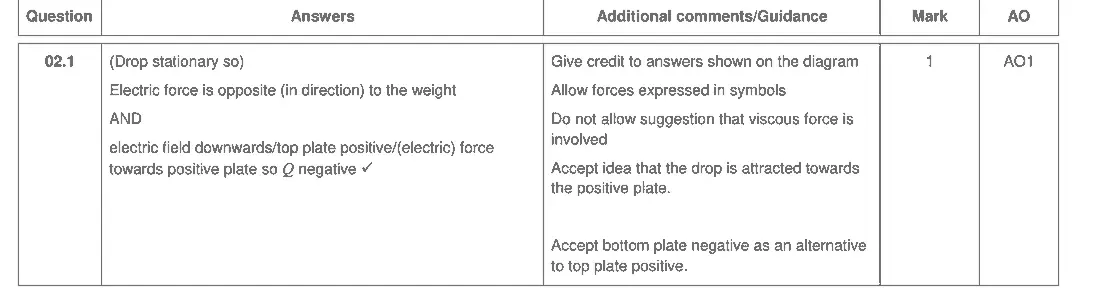
State and explain the sign of the charge on the oil droplet.
[1 mark]
June 2022 · Paper 3B Turning points · Q2.2 3 marks AO2=3 Show that discovery of the electron
Earlier part of question 2 that this part usesEarlier part of June 2022 Paper 3B Turning points question 2
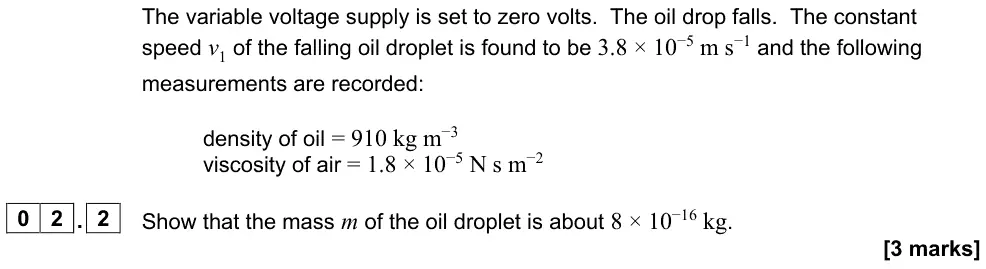
The variable voltage supply is set to zero volts.  The oil drop falls.  The constant
speed v1 of the falling oil droplet is found to be 3.8 × 10⁻⁵ m s−1 and the following
measurements are recorded:
density of oil = 910 kg m−3
viscosity of air = 1.8 × 10⁻⁵ N s m−2
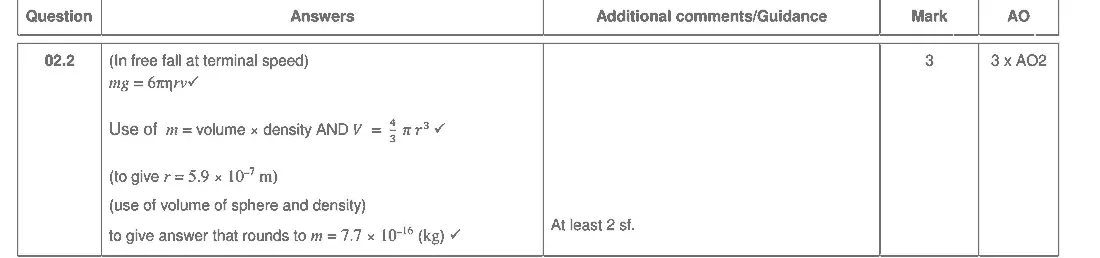
Show that the mass m of the oil droplet is about 8 × 10⁻¹⁶ kg.
[3 marks]
June 2022 · Paper 3B Turning points · Q2.3 2 marks AO2=2 Show that discovery of the electron
Earlier part of question 2 that this part usesEarlier part of June 2022 Paper 3B Turning points question 2
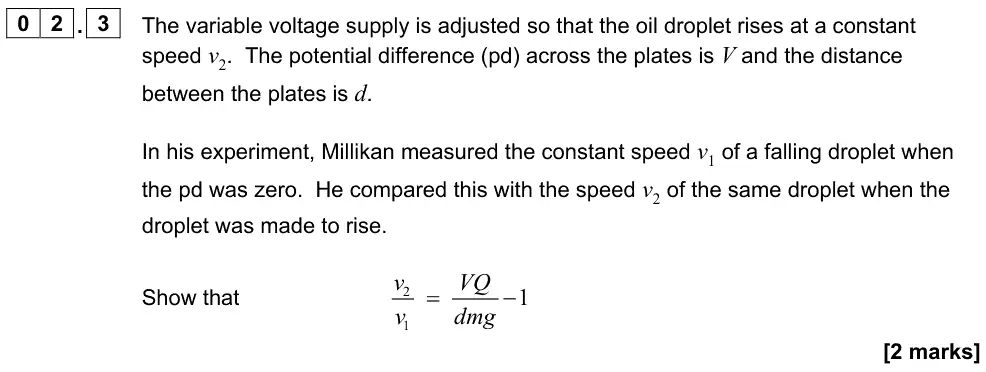
The variable voltage supply is adjusted so that the oil droplet rises at a constant
speed v2.  The potential difference (pd) across the plates is V and the distance
between the plates is d.
In his experiment, Millikan measured the constant speed v1 of a falling droplet when
the pd was zero.  He compared this with the speed v2 of the same droplet when the
droplet was made to rise.
Show that
2
1
1
v
VQ
v
dmg
=
−
[2 marks]
June 2022 · Paper 3B Turning points · Q2.4 3 marks AO2=2, AO3=1 Calculation discovery of the electron
Earlier part of question 2 that this part usesEarlier part of June 2022 Paper 3B Turning points question 2
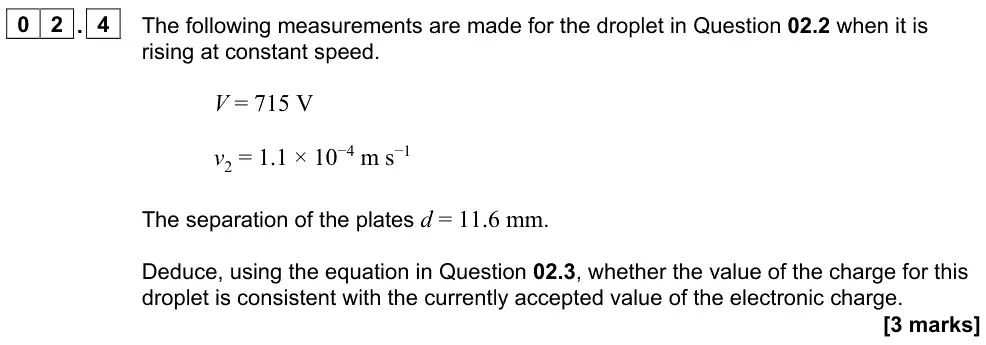
The following measurements are made for the droplet in Question 02.2 when it is
rising at constant speed.
V = 715 V
v2 = 1.1 × 10⁻⁴ m s−1
The separation of the plates d = 11.6 mm.
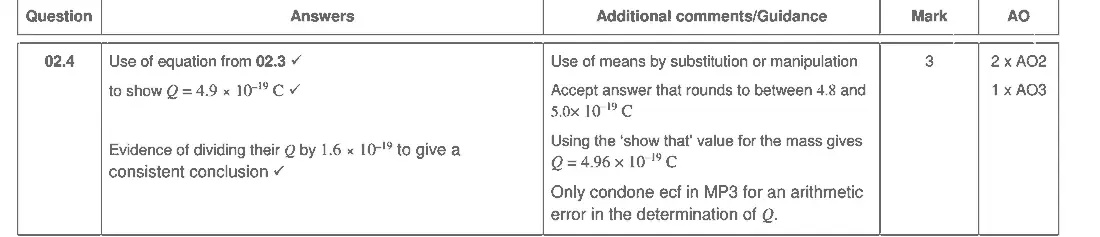
Deduce, using the equation in Question 02.3, whether the value of the charge for this
droplet is consistent with the currently accepted value of the electronic charge.
[3 marks]
June 2022 · Paper 3B Turning points · Q2.5 3 marks AO3=3 Explanation discovery of the electron
Earlier part of question 2 that this part usesEarlier part of June 2022 Paper 3B Turning points question 2
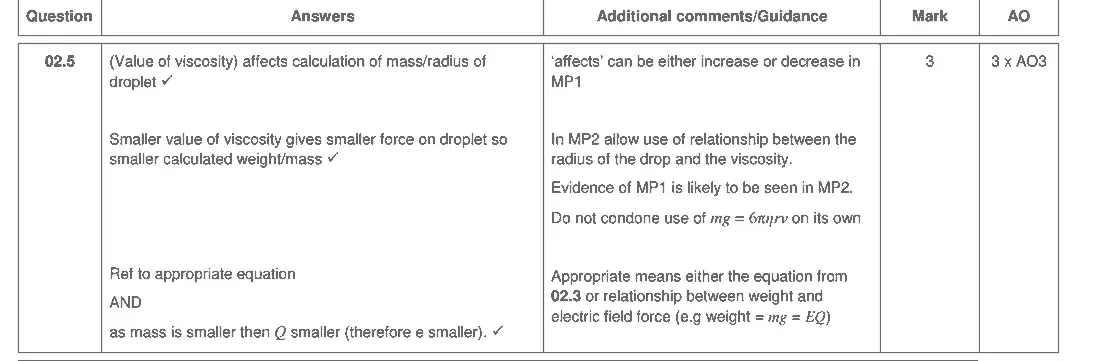
After Millikan published his results, it was found that he had used a value for the
viscosity of air that was smaller than the actual value.
Discuss the effect this error had on Millikan’s value of the electronic charge.
[3 marks]
June 2022 · Paper 3B Turning points · Q3.1 2 marks AO1=2 Short answer wave particle duality history
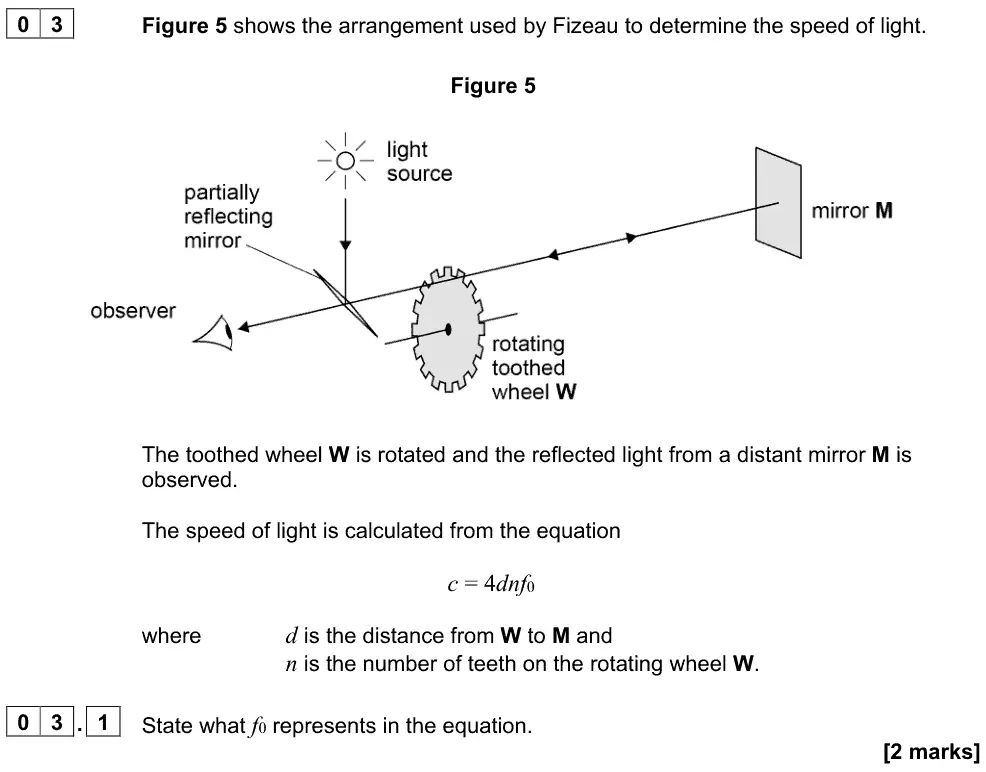
Figure 5 shows the arrangement used by Fizeau to determine the speed of light.
Figure 5
The toothed wheel W is rotated and the reflected light from a distant mirror M is
observed.
The speed of light is calculated from the equation
c = 4dnf0
where
d is the distance from W to M and
n is the number of teeth on the rotating wheel W.
State what f0 represents in the equation.
[2 marks]
June 2022 · Paper 3B Turning points · Q3.2 2 marks AO1=1, AO3=1 Calculation wave particle duality history
Earlier part of question 3 that this part usesEarlier part of June 2022 Paper 3B Turning points question 3
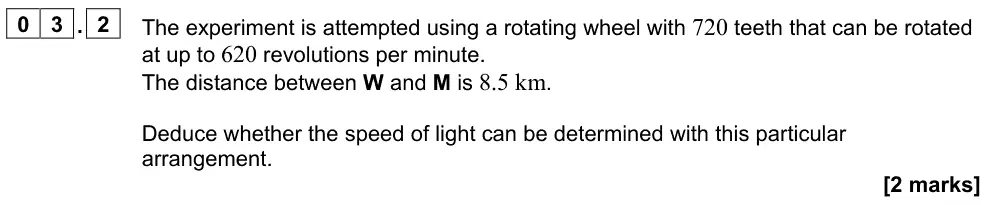
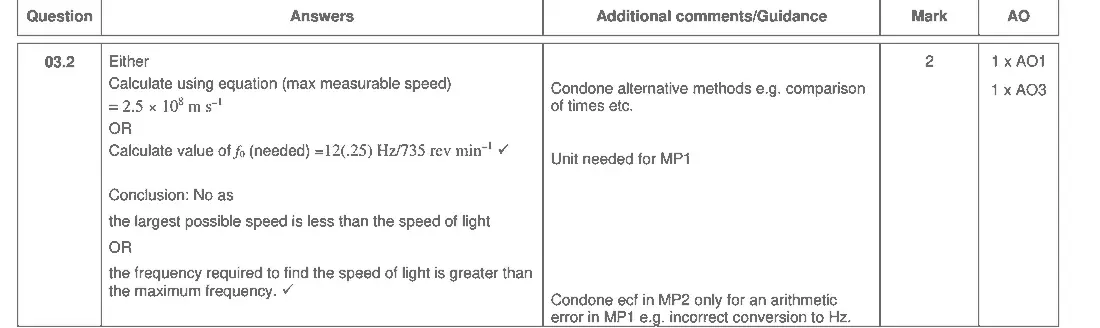
The experiment is attempted using a rotating wheel with 720 teeth that can be rotated
at up to 620 revolutions per minute.
The distance between W and M is 8.5 km.
Deduce whether the speed of light can be determined with this particular
arrangement.
[2 marks]
June 2022 · Paper 3B Turning points · Q3.3 2 marks AO1=2 Short answer wave particle duality history
Earlier part of question 3 that this part usesEarlier part of June 2022 Paper 3B Turning points question 3
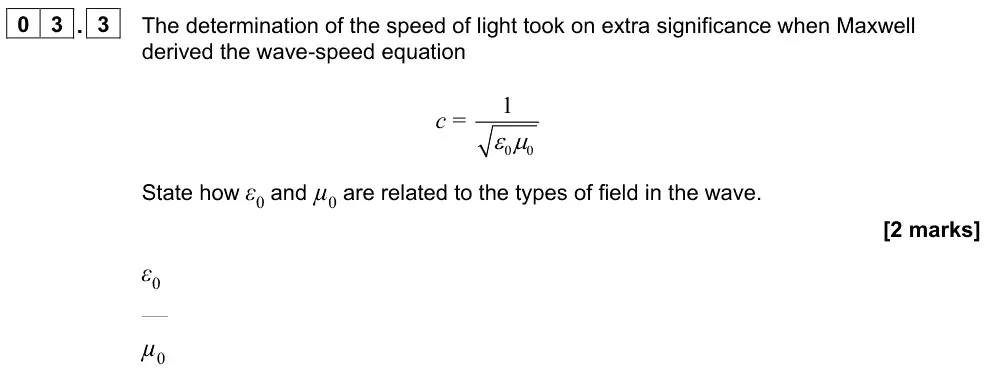
The determination of the speed of light took on extra significance when Maxwell
derived the wave-speed equation
c =
0
0
1
State how ε0 and µ0 are related to the types of field in the wave.
[2 marks]
ε0
µ0
June 2022 · Paper 3B Turning points · Q4.1 1 mark AO1=1 Short answer special relativity
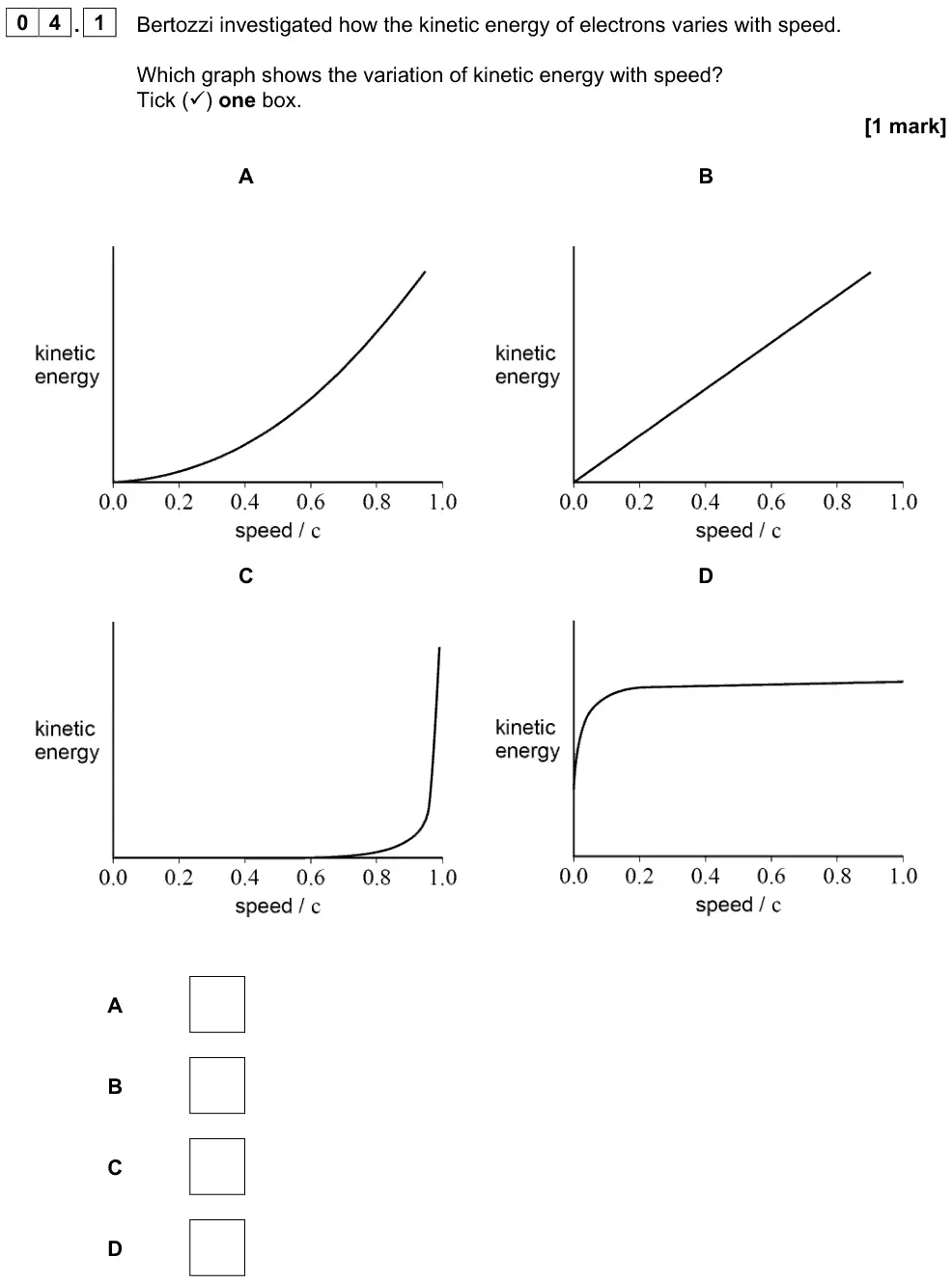
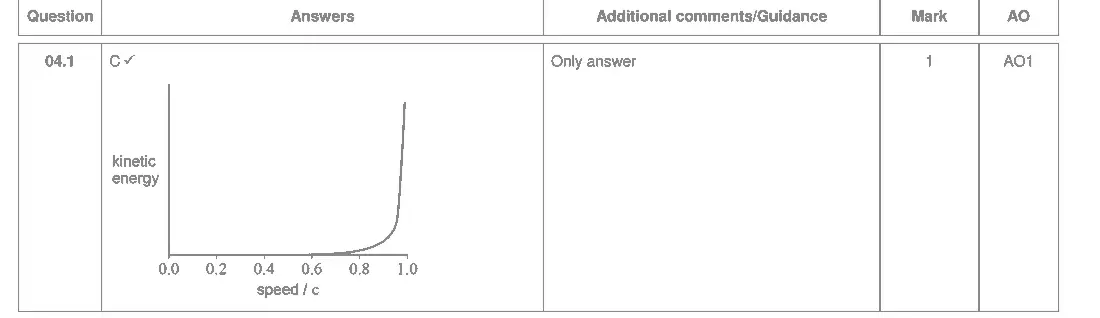
Bertozzi investigated how the kinetic energy of electrons varies with speed.
Which graph shows the variation of kinetic energy with speed?
Tick () one box.
[1 mark]
A
B
C
D
A
B
C
D
June 2022 · Paper 3B Turning points · Q4.2 3 marks AO2=3 Calculation special relativity
Earlier part of question 4 that this part usesEarlier part of June 2022 Paper 3B Turning points question 4
Calculate the speed of a particle when its kinetic energy is equal to its rest energy.
[3 marks]
speed =
m s−1
June 2022 · Paper 3B Turning points · Q4.3 2 marks AO3=2 Explanation special relativity
Earlier part of question 4 that this part usesEarlier part of June 2022 Paper 3B Turning points question 4
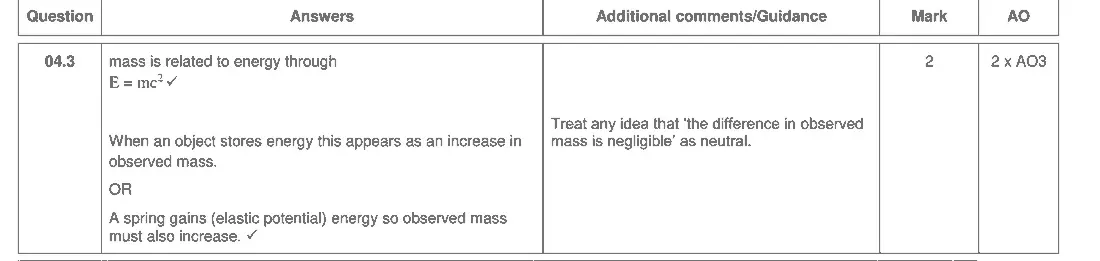
Discuss the change in the observed mass of a spring when it is stretched.
[2 marks]

Work with an AQA physics tutor

Want a paper marked and gone through with you? Message us.

Prefer email? Send an enquiry

If you are under 18, please include a parent's contact details. Enquiries go to enquiries@physicsaleveltutor.com and are deleted once handled. All tutoring is online.