June 2023: Paper 3B Turning points

35 marks · 14 question parts · Paper, mark scheme and report on AQA's site · Have the data and formulae booklet beside you

Question by question

QTopicMarksAOType
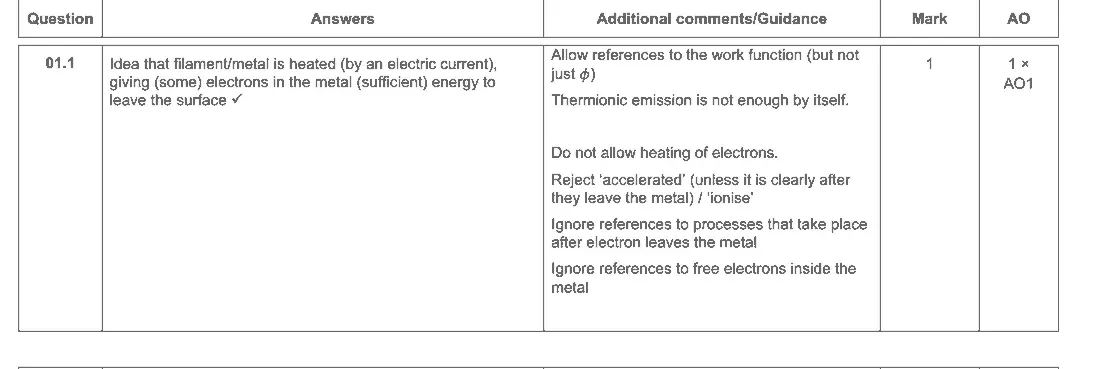
1.1 The discovery of the electron 1AO1=1Short answer
1.2 The discovery of the electron 1AO2=1Show that
1.3 Wave-particle duality: from Newton to electron microscopes 3AO3=3Explanation
1.4 The discovery of the electron 6AO1=4,AO2=1,AO3=1Extended response
2.1 The discovery of the electron 3AO2=2,AO3=1Calculation
2.2 The discovery of the electron 3AO2=2,AO3=1Calculation
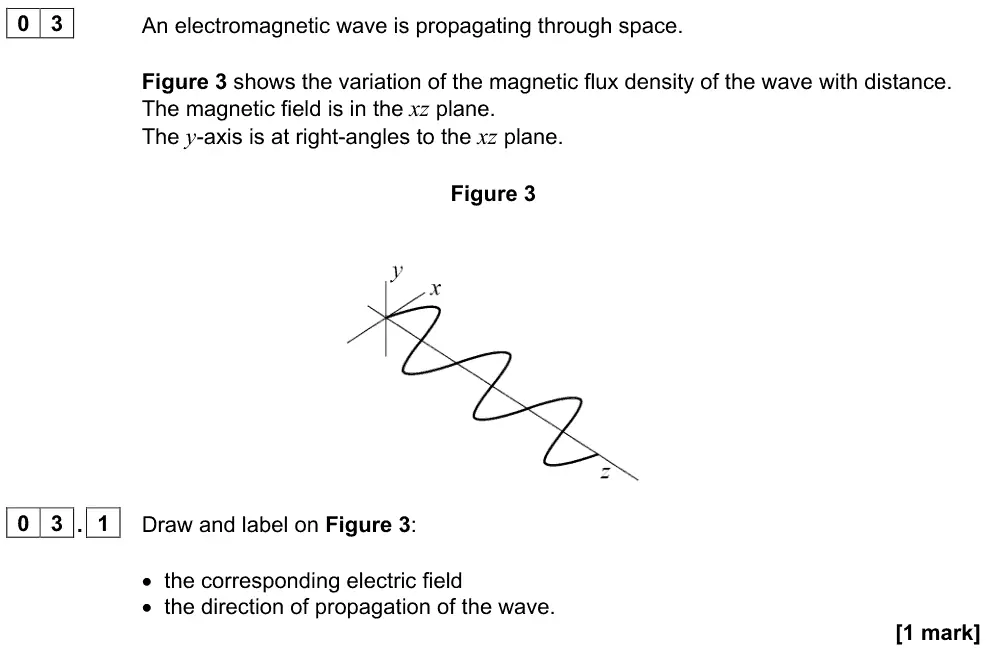
3.1 Wave-particle duality: from Newton to electron microscopes 1AO1=1Diagram or graph
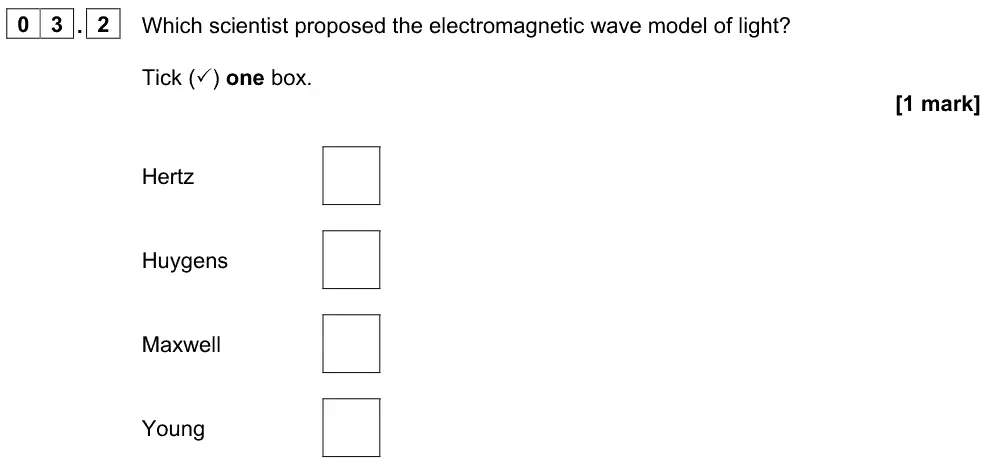
3.2 Wave-particle duality: from Newton to electron microscopes 1AO1=1Short answer
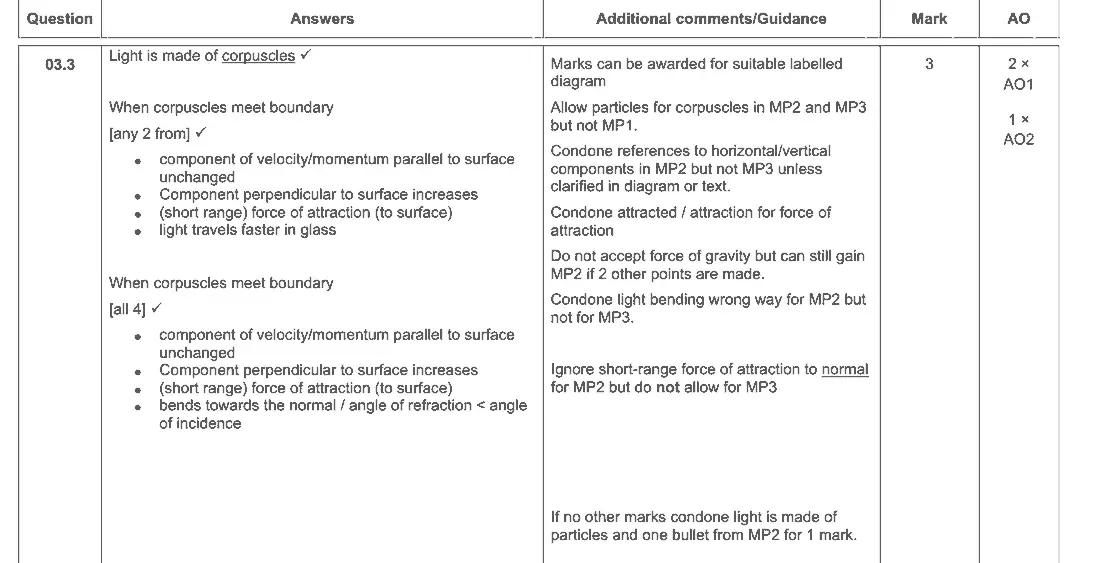
3.3 Wave-particle duality: from Newton to electron microscopes 3AO1=2,AO2=1Explanation
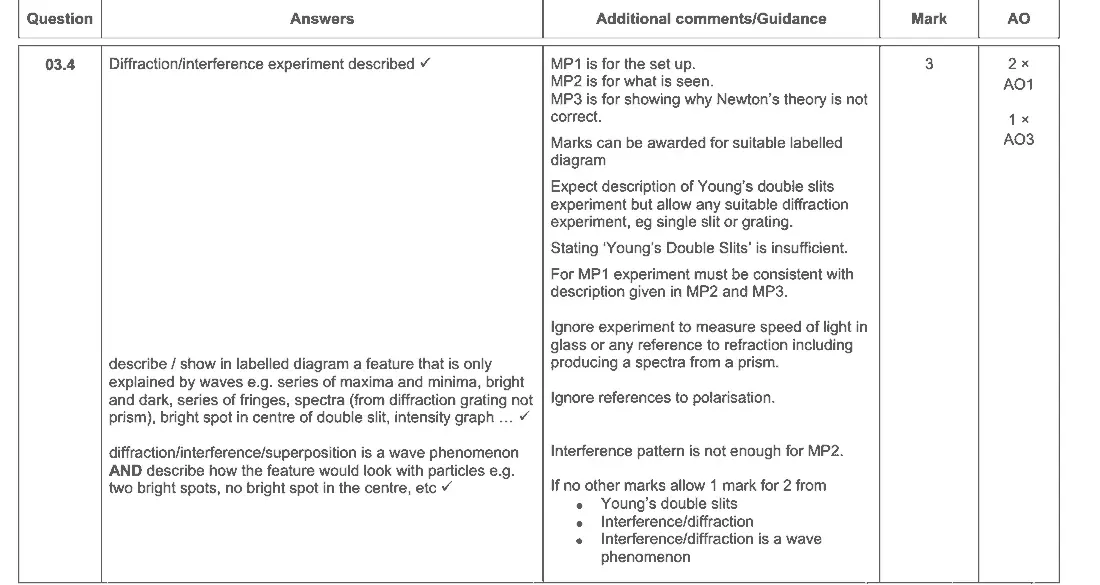
3.4 Wave-particle duality: from Newton to electron microscopes 3AO1=2,AO3=1Explanation
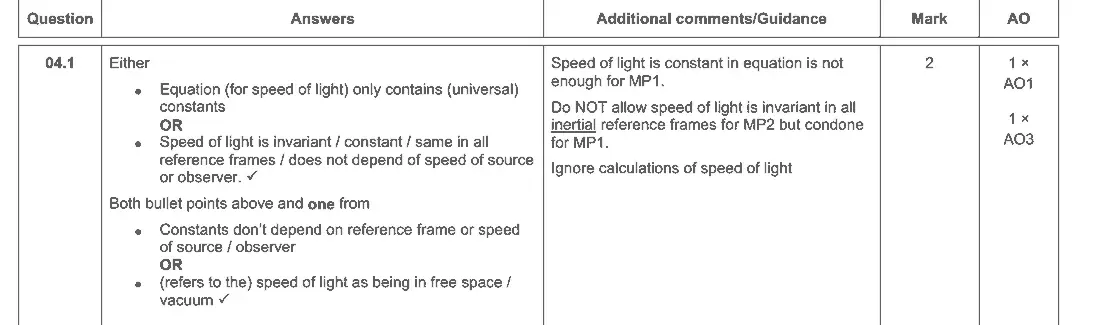
4.1 Special relativity, Wave-particle duality: from Newton to electron microscopes 2AO1=1,AO3=1Explanation
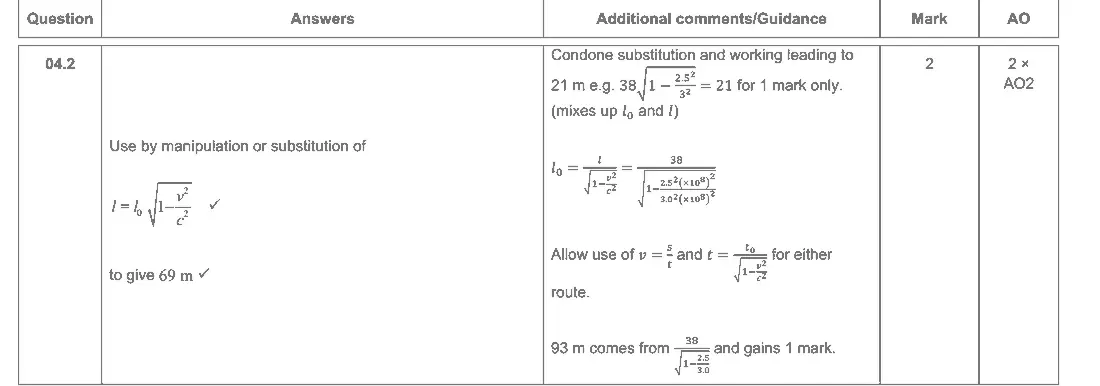
4.2 Special relativity 2AO2=2Calculation
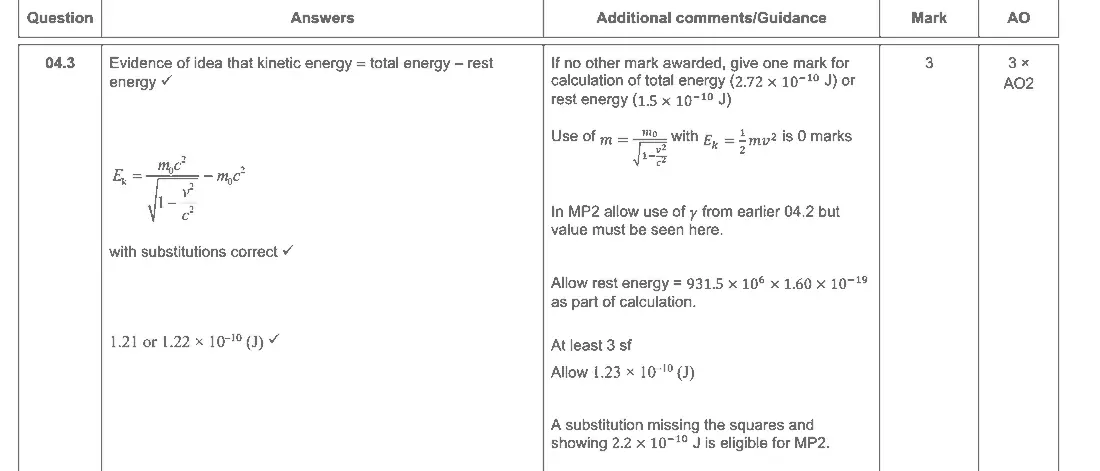
4.3 Special relativity 3AO2=3Show that
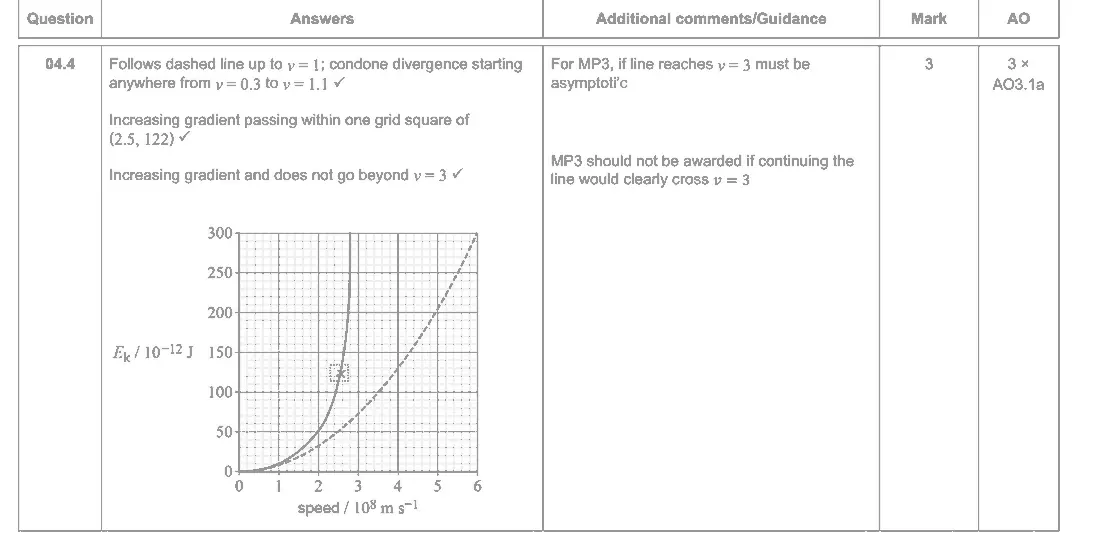
4.4 Special relativity 3AO3=3Diagram or graph

The questions

1.11.21.31.42.12.23.13.23.33.44.14.24.34.4
June 2023 · Paper 3B Turning points · Q1.1 1 mark AO1=1 Short answer discovery of the electron
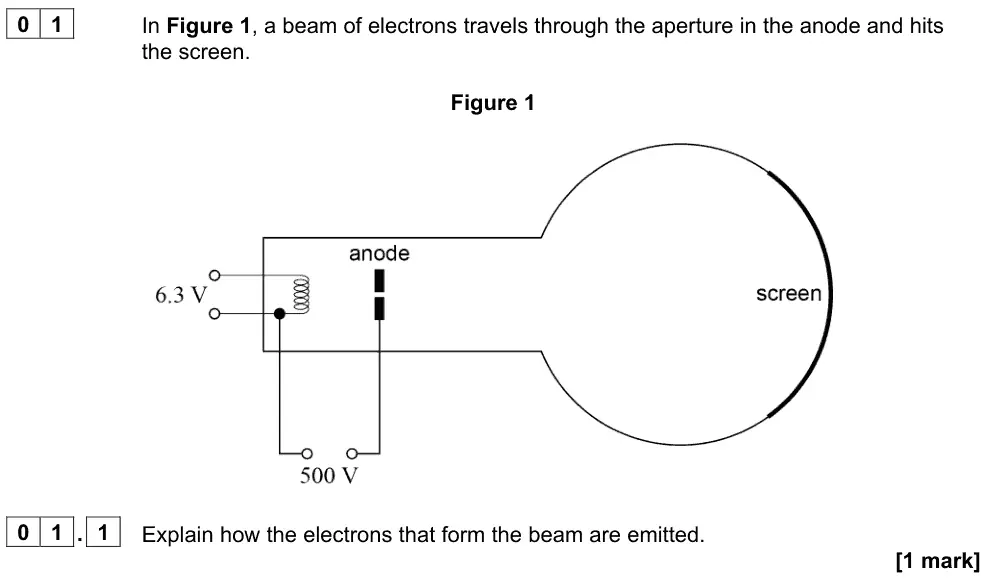
In Figure 1, a beam of electrons travels through the aperture in the anode and hits
the screen.
Figure 1
Explain how the electrons that form the beam are emitted.
[1 mark]
June 2023 · Paper 3B Turning points · Q1.2 1 mark AO2=1 Show that discovery of the electron
Earlier part of question 1 that this part usesEarlier part of June 2023 Paper 3B Turning points question 1
Show that the maximum speed of the electrons in the beam is about 1.3 × 10⁷ m s−1.
[1 mark]
June 2023 · Paper 3B Turning points · Q1.3 3 marks AO3=3 Explanation wave particle duality history
Earlier part of question 1 that this part usesEarlier part of June 2023 Paper 3B Turning points question 1
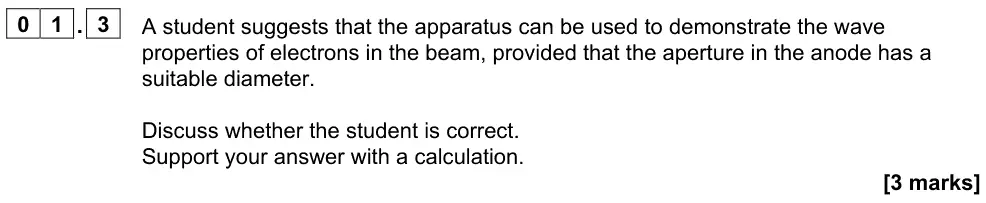
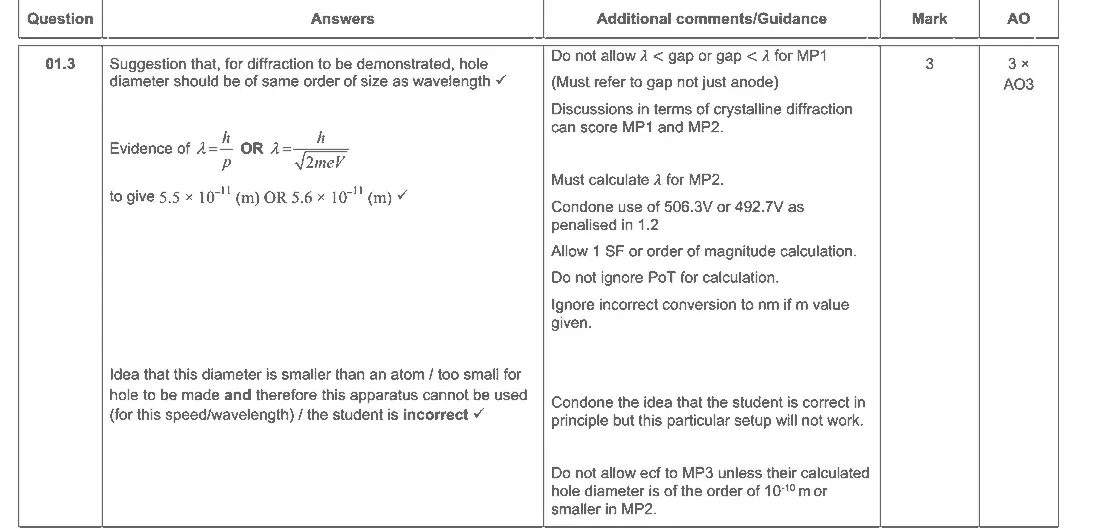
A student suggests that the apparatus can be used to demonstrate the wave
properties of electrons in the beam, provided that the aperture in the anode has a
suitable diameter.
Discuss whether the student is correct.
Support your answer with a calculation.
[3 marks]
June 2023 · Paper 3B Turning points · Q1.4 6 marks AO1=4, AO2=1, AO3=1 6-mark extended response discovery of the electron
Earlier part of question 1 that this part usesEarlier part of June 2023 Paper 3B Turning points question 1
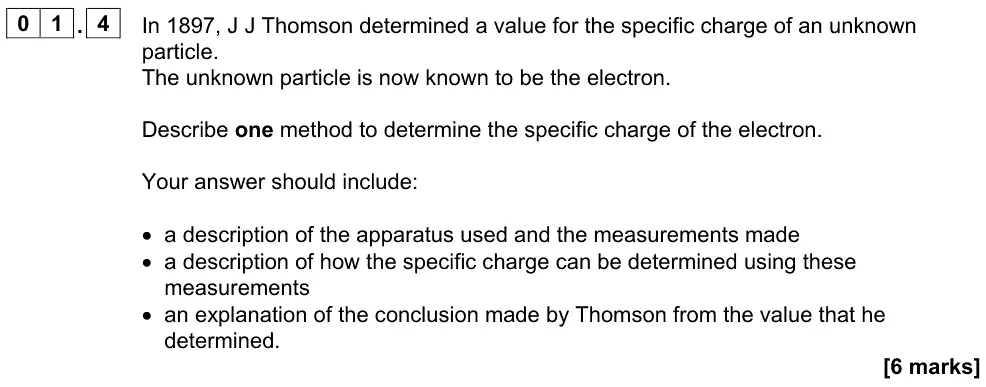
In 1897, J J Thomson determined a value for the specific charge of an unknown
particle.
The unknown particle is now known to be the electron.
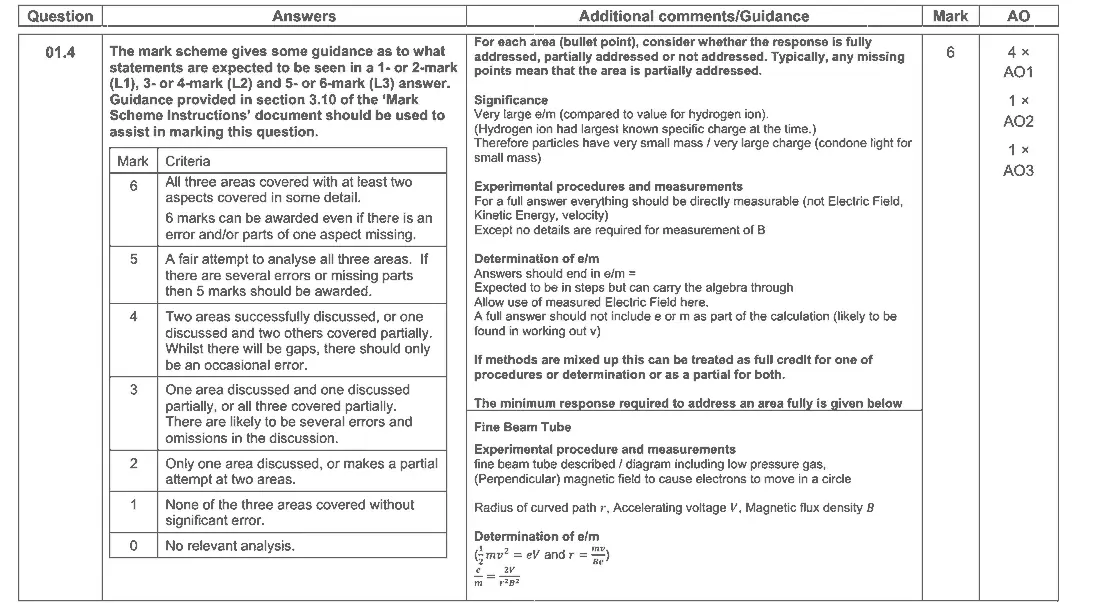
Describe one method to determine the specific charge of the electron.
Your answer should include:
• a description of the apparatus used and the measurements made
• a description of how the specific charge can be determined using these
measurements
• an explanation of the conclusion made by Thomson from the value that he
determined.
[6 marks]
June 2023 · Paper 3B Turning points · Q2.1 3 marks AO2=2, AO3=1 Calculation discovery of the electron
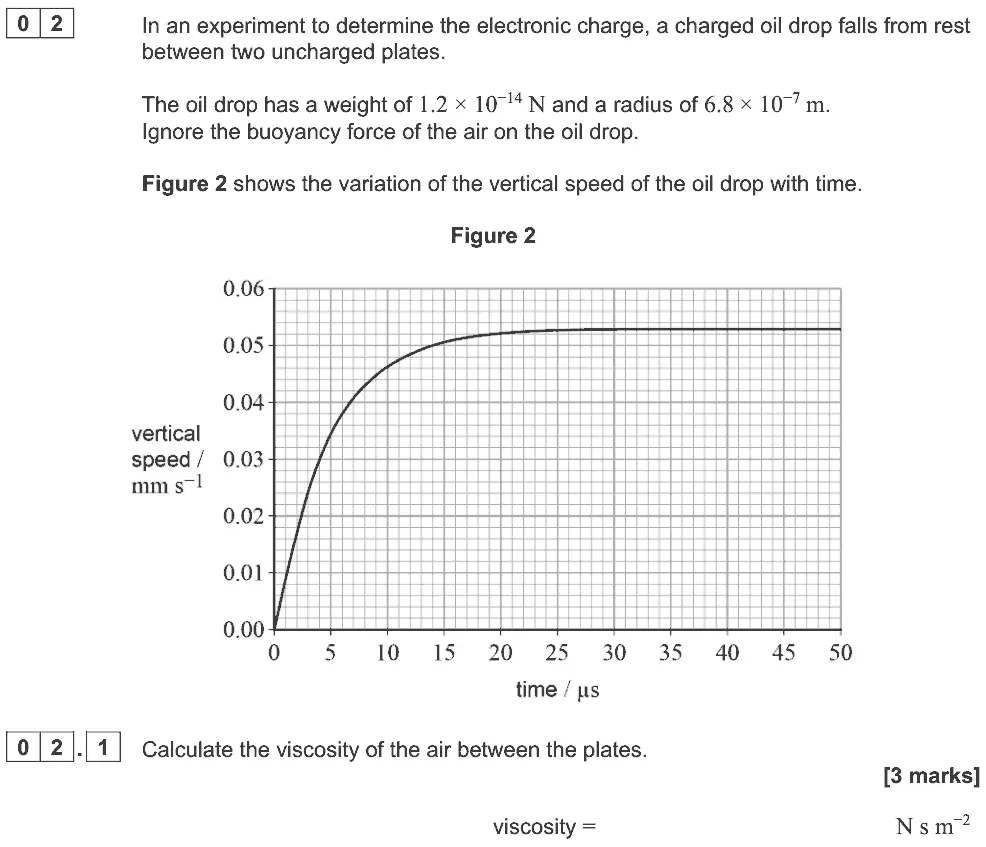
In an experiment to determine the electronic charge, a charged oil drop falls from rest
between two uncharged plates.
The oil drop has a weight of 1.2 × 10⁻¹⁴ N and a radius of 6.8 × 10⁻⁷ m.
Ignore the buoyancy force of the air on the oil drop.
Figure 2 shows the variation of the vertical speed of the oil drop with time.
Figure 2
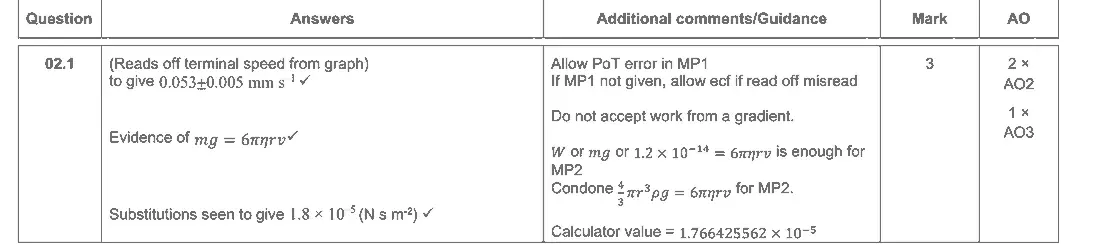
Calculate the viscosity of the air between the plates.
[3 marks]
viscosity =
N s m−2
June 2023 · Paper 3B Turning points · Q2.2 3 marks AO2=2, AO3=1 Calculation discovery of the electron
Earlier part of question 2 that this part usesEarlier part of June 2023 Paper 3B Turning points question 2
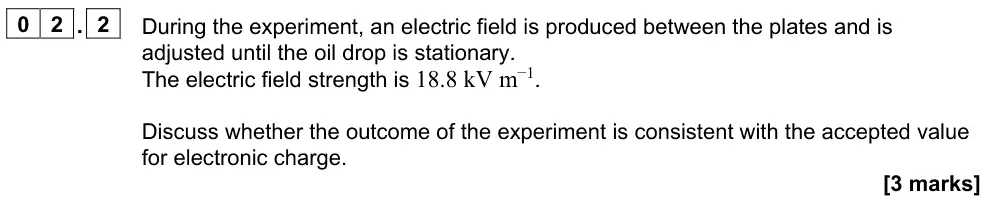
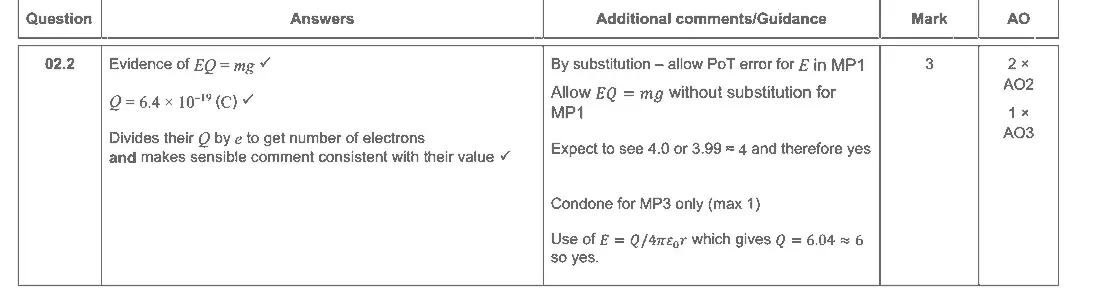
During the experiment, an electric field is produced between the plates and is
adjusted until the oil drop is stationary.
The electric field strength is 18.8 kV m−1.
Discuss whether the outcome of the experiment is consistent with the accepted value
for electronic charge.
[3 marks]
June 2023 · Paper 3B Turning points · Q3.1 1 mark AO1=1 Diagram or graph wave particle duality history
An electromagnetic wave is propagating through space.
Figure 3 shows the variation of the magnetic flux density of the wave with distance.
The magnetic field is in the xz plane.
The y-axis is at right-angles to the xz plane.
Figure 3
Draw and label on Figure 3:
• the corresponding electric field
• the direction of propagation of the wave.
[1 mark]
June 2023 · Paper 3B Turning points · Q3.2 1 mark AO1=1 Short answer wave particle duality history
Earlier part of question 3 that this part usesEarlier part of June 2023 Paper 3B Turning points question 3
Which scientist proposed the electromagnetic wave model of light?
Tick () one box.
[1 mark]
Hertz
Huygens
Maxwell
Young
June 2023 · Paper 3B Turning points · Q3.3 3 marks AO1=2, AO2=1 Explanation wave particle duality history
Earlier part of question 3 that this part usesEarlier part of June 2023 Paper 3B Turning points question 3
Another theory of the nature of light was proposed by Isaac Newton.
Describe how Newton’s theory was used to explain the refraction of light as it
moves from air into glass.
[3 marks]
June 2023 · Paper 3B Turning points · Q3.4 3 marks AO1=2, AO3=1 Explanation wave particle duality history
Earlier part of question 3 that this part usesEarlier part of June 2023 Paper 3B Turning points question 3
Describe a demonstration using visible light that can be performed in a school
laboratory to show that Newton’s theory is not correct.
[3 marks]
June 2023 · Paper 3B Turning points · Q4.1 2 marks AO1=1, AO3=1 Explanation special relativitywave particle duality history
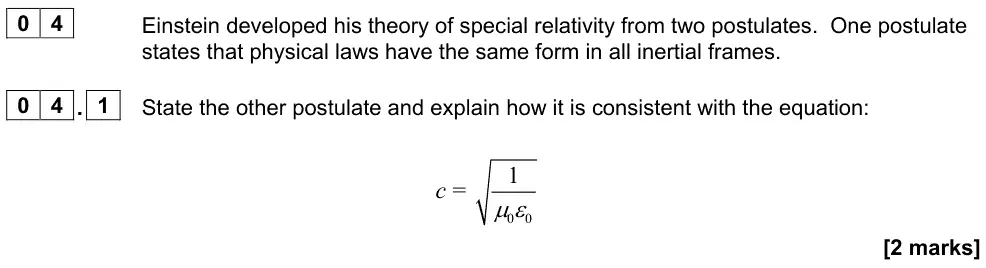
Einstein developed his theory of special relativity from two postulates.  One postulate
states that physical laws have the same form in all inertial frames.
State the other postulate and explain how it is consistent with the equation:
c =
0 0
1
[2 marks]
June 2023 · Paper 3B Turning points · Q4.2 2 marks AO2=2 Calculation special relativity
Earlier part of question 4 that this part usesEarlier part of June 2023 Paper 3B Turning points question 4
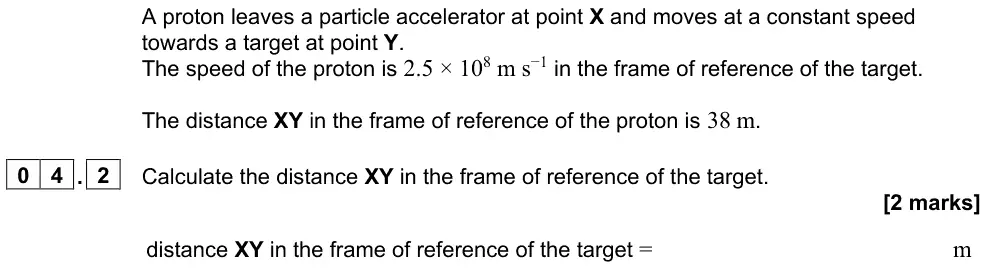
A proton leaves a particle accelerator at point X and moves at a constant speed
towards a target at point Y.
The speed of the proton is 2.5 × 10⁸ m s−1 in the frame of reference of the target.
The distance XY in the frame of reference of the proton is 38 m.
Calculate the distance XY in the frame of reference of the target.
[2 marks]
distance XY in the frame of reference of the target =
m
June 2023 · Paper 3B Turning points · Q4.3 3 marks AO2=3 Show that special relativity
Earlier part of question 4 that this part usesEarlier part of June 2023 Paper 3B Turning points question 4
Show that the kinetic energy Ek of the proton is about 1.2 × 10⁻¹⁰ J.
[3 marks]
June 2023 · Paper 3B Turning points · Q4.4 3 marks AO3=3 Diagram or graph special relativity
Earlier part of question 4 that this part usesEarlier part of June 2023 Paper 3B Turning points question 4
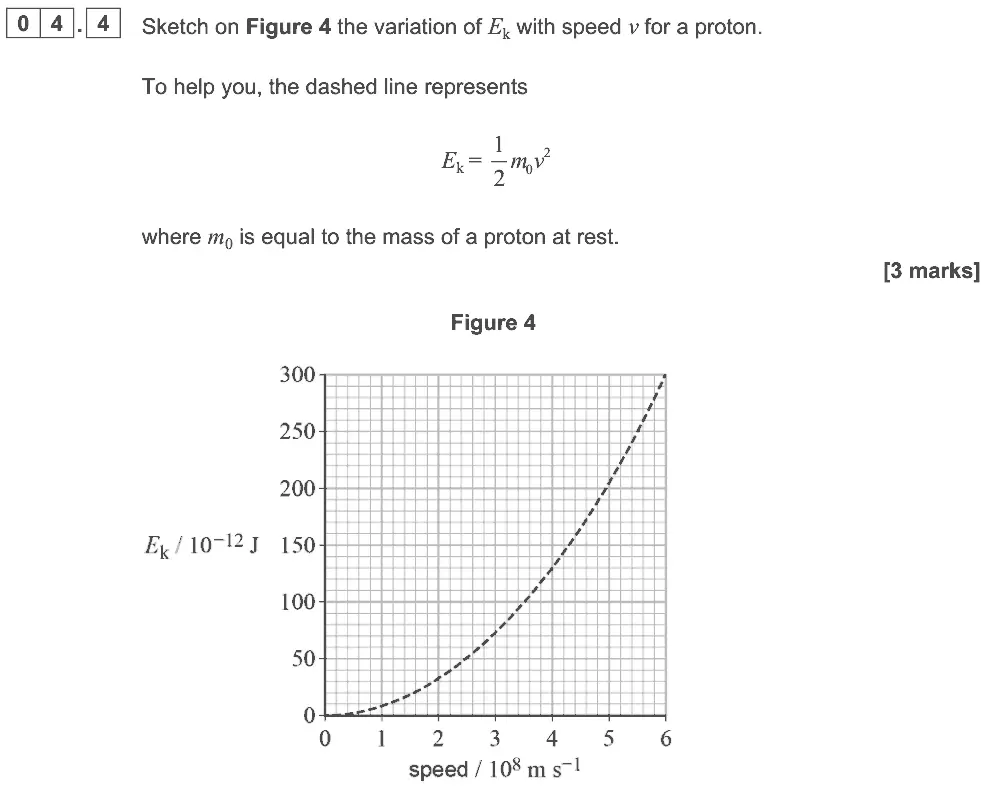
Sketch on Figure 4 the variation of Ek with speed v for a proton.
To help you, the dashed line represents
Ek =
2
0
1
2 m v
where m0 is equal to the mass of a proton at rest.
[3 marks]
Figure 4

Work with an AQA physics tutor

Want a paper marked and gone through with you? Message us.

Prefer email? Send an enquiry

If you are under 18, please include a parent's contact details. Enquiries go to enquiries@physicsaleveltutor.com and are deleted once handled. All tutoring is online.